FEDERAL COURT OF AUSTRALIA
Flower & Hart v White Industries (Qld) Pty Ltd [2001] FCA 370
INTEREST – interest on costs – exercise of a statutory power to award costs – whether s 43 of the Federal Court of Australia Act 1976 (Cth) authorizes the award of interest upon costs – whether s 51A of the Act authorizes the award of interest upon an order for costs made pursuant to s 43 of the Act – whether an application pursuant to s 43 is a “cause of action” for the purposes of s 51A – calculation of interest
TORTS – abuse of process – whether there is a claim for damages arising from the tort of abuse of process – interest as damages – whether there is a claim for damages for the purposes of s 51A of the Federal Court of Australia Act 1976 (Cth)
Federal Court of Australia Act 1976 (Cth), ss 43, 51A, 52
Limitation of Actions Act 1974 (Qld), s 10
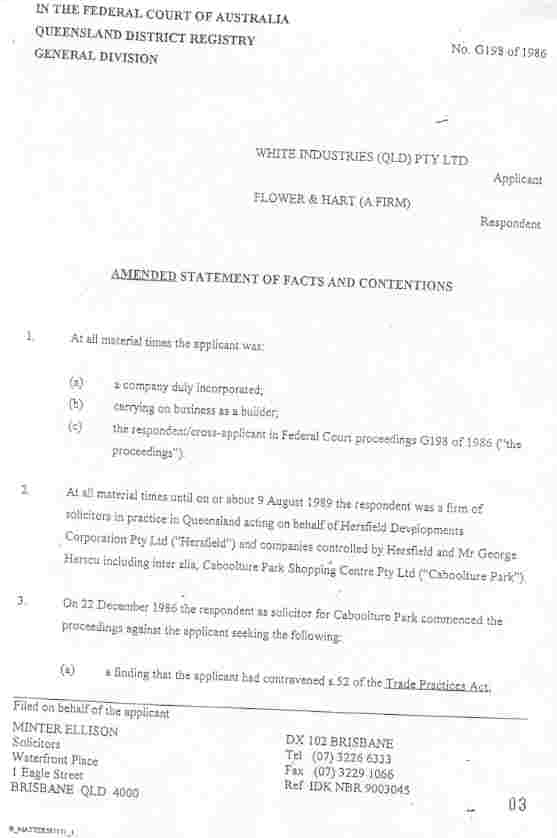
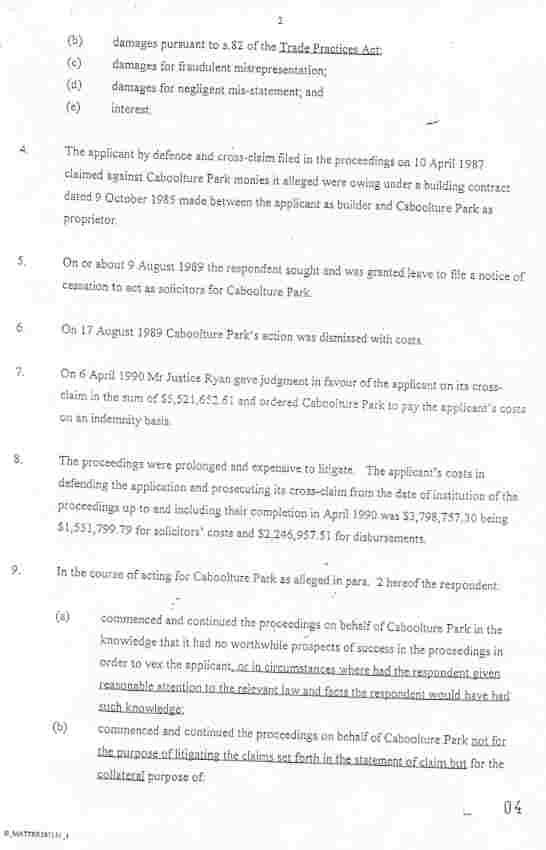
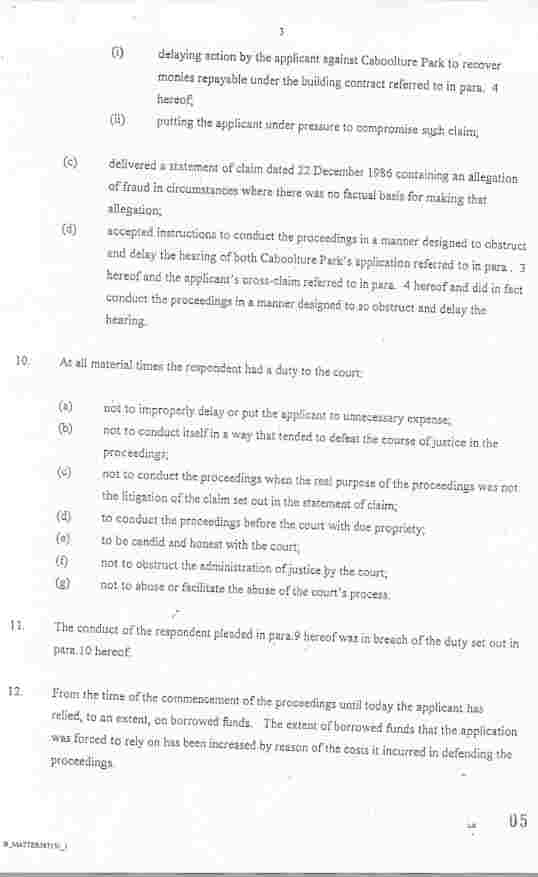
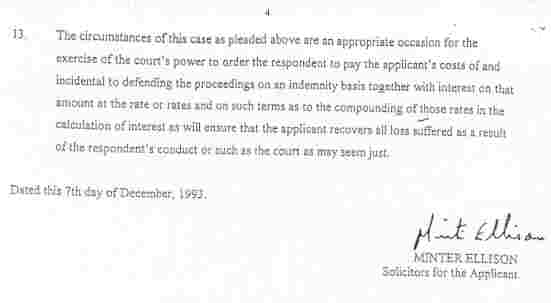
Caboolture Park Shopping Centre Pty Ltd (in liq) v White Industries (Qld) Pty Ltd (1993) 45 FCR 224 cited
White Industries (Qld) Pty Ltd v Flower & Hart (a firm) (1998) 156 ALR 169 discussed
Re Bendeich (No 2) (1994) 53 FCR 422 cited
Flower & Hart (a firm) v White Industries (Qld) Pty Ltd (1999) 87 FCR 134 cited
Commonwealth of Australia v SCI Operations Pty Ltd (1998) 192 CLR 285 distinguished
Hanrahan v Ainsworth (1985) 1 NSWLR 370 applied
Quartz Hill Consolidated Gold Mining Co v Eyre (1883) 11 QBD 674 cited
Berry v British Transport Commission [1962] 1 QB 306 cited
Coleman v Buckingham’s Ltd (1963) 63 SR(NSW) 171 cited
QIW Retailers Limited v Felview Pty Ltd [1989] 2 QdR 245 cited
Wardley Australia Ltd v State of Western Australia (1992) 175 CLR 514 considered
McWilliams Wines Pty Ltd v Liaweena (NSW) Pty Ltd (1993) 32 NSWLR 190 referred to
AWA Limited v Daniels (Rogers J, 19 April 1993, unreported) referred to
South Australian Superannuation Fund Investment Trust v Leighton Contractors Pty Ltd (1996) 66 SASR 509 referred to
Nykredit Mortgage Bank PLC v Edward Erdman Group Ltd No 2 [1997] 1 WLR 1627 referred to
Hungerfords v Walker (1990) 171 CLR 125 distinguished
Andrews v Barnes (1888) 39 ChD 133 referred to
Dipple v Dipple [1942] P 65 referred to
Re Hawke (Deceased) [1957] NZLR 152 distinguished
State of Western Australia v Wardley Australia Ltd (1991) 102 ALR 213 referred to
Wardley Australia Ltd v State of Western Australia (1992) 175 CLR 514 referred to
Torrens Aloha Pty Ltd v Citibank NA (1997) 144 ALR 89 referred to
Boylan v Farthing (1999) 86 FCR 120
Oshlack v Richmond River Council (1998) 193 CLR 72
Langman v Handover (1929) 43 CLR 334 cited
Forster v Jododex Australia Pty Ltd (1972) 127 CLR 421 cited
Sugden v Sugden [1957] P 120 referred to
Ingles v Gould [1993] 2 QdR 250 referred to
Snell Snell’s Equity 29th ed 1990 at p 28
Meagher et al Equity Doctrines and Remedies 3rd ed at p 68
FLOWER & HART (A FIRM) v WHITE INDUSTRIES (QLD) PTY LTD
Q 104 OF 2000
DRUMMOND, DOWSETT & HELY JJ
4 APRIL 2001
BRISBANE
|
IN THE FEDERAL COURT OF AUSTRALIA |
|
|
Q 104 OF 2000 |
ON APPEAL FROM A JUDGE OF THE FEDERAL COURT OF AUSTRALIA
|
BETWEEN: |
FLOWER & HART (A FIRM) APPELLANT
|
|
AND: |
WHITE INDUSTRIES (QLD) PTY LTD RESPONDENT
|
|
DATE OF ORDER: |
|
|
WHERE MADE: |
THE COURT ORDERS THAT:
1. The orders made by Goldberg J on 15 September 2000 be set aside.
2. The respondent pay the appellant’s costs of and incidental to the appeal and the proceedings concerning interest before Goldberg J.
3. Order 2 be stayed for fourteen days from the date herein, to allow the parties to agree a form of order or to make written submissions in the event that they cannot do so. In that event, submissions should be exchanged and filed within fourteen days of delivery of these reasons.
Note: Settlement and entry of orders is dealt with in Order 36 of the Federal Court Rules.
|
IN THE FEDERAL COURT OF AUSTRALIA |
|
|
Q 104 OF 2000 |
ON APPEAL FROM A JUDGE OF THE FEDERAL COURT OF AUSTRALIA
|
BETWEEN: |
APPELLANT
|
|
AND: |
WHITE INDUSTRIES (QLD) PTY LTD RESPONDENT
|
|
JUDGES: |
|
|
DATE: |
|
|
PLACE: |
REASONS FOR JUDGMENT
1 This is an appeal from a decision of Goldberg J pursuant to which his Honour ordered the appellant to pay interest on the amount of an order for costs previously made against it and in favour of the present respondent (“White Industries”). Unfortunately, it will be necessary to record in some detail the rather sorry and protracted history of this matter.
2 The appellant is a firm of solicitors practising in Brisbane. Between 22 December 1986 and 9 August 1989 it acted for a company, Caboolture Park Shopping Centre Pty Ltd (“Caboolture Park”) which was the applicant in proceedings in this Court to which White Industries was the respondent. There was also a cross-claim. These proceedings are hereinafter referred to as the “original proceedings”. On 17 August 1989 Caboolture Park’s action was dismissed with costs. On 6 April 1990 judgment was given in favour of White Industries on its cross-claim. On 7 May 1993 the present respondent filed a notice of motion in that action seeking the following orders:
(1) That the Court make such orders and give such directions for the hearing of this motion as to the Court may seem just, including, if necessary, the joinder of Flower & Hart (a firm).
(2) That, in addition to the costs orders made by Ryan J on 17 August 1989 and 6 April 1990, Flower & Hart pay all of White Industries (Qld) Pty Ltd’s costs of the action other than those costs that are solely referrable to White Industries (Qld) Pty Ltd prosecuting its cross-claim, except insofar as such costs are an unreasonable amount or have been unreasonably incurred, such that White Industries (Qld) Pty Ltd are completely indemnified by Flower & Hart for these costs and interest on these costs.
(3) That the costs are to be specified as a gross sum by Ryan J on a date to be fixed, or to be ascertained in such other manner as on that date he may direct.
(4) Such further or other orders as to this Honourable Court may seem appropriate including an order as to the costs of the motion.
3 At the request of the parties, Cooper J stated a question for consideration by the Full Court as follows:
Does this Honourable Court have jurisdiction to entertain the motion whether with or without leave as set out in the notice of motion filed on behalf of White Industries (Qld) Pty Limited on 7 May 1993 as an application in these proceedings?
4 The Full Court answered in the affirmative. See Caboolture Park Shopping Centre Pty Ltd (in liq) v White Industries (Qld) Pty Ltd (1993) 45 FCR 224. White Industries’ written submissions are at AB 306 – 315. Clearly, White Industries was claiming an order for costs either pursuant to s 43 of the Federal Court of Australia Act 1976 (Cth) (the “Act”), or in the exercise of the “inherent” jurisdiction of the Court over solicitors. The Full Court considered that there was sufficient authority for such an order in s 43, which relevantly provides:
(1) Subject to subsection 1(A), the Court or a Judge has jurisdiction to award costs in all proceedings before the Court (including proceedings dismissed for want of jurisdiction) other than proceedings in respect of which any other Act provides that costs shall not be awarded.
(1A) …
(2) Except as provided by any other Act, the award of costs is in the discretion of the Court or Judge.
5 The Full Court also addressed the so-called “inherent” jurisdiction. The appellant had submitted that legal practitioners acting in this Court owe to it no duty which can be supervised, short of punishing for contempt. This argument was primarily based upon the fact that the Federal Court has no involvement in the admission of legal practitioners. At 231 the Full Court said:
Having regard to the provisions of s 43 there is in our view no need to consider whether the “inherent jurisdiction” of the Court can be called in aid, or indeed whether, in the case of a statutory court, it is inappropriate to refer to an “inherent jurisdiction” … . It suffices to say that s 43 confers in wide terms an express jurisdiction to award costs and that the Court’s powers, in exercise of the jurisdiction, enables (sic) a costs order to be made against a third party to the litigation in a suitable case.
The second basis upon which the jurisdiction of the court to order costs against a solicitor representing one of the parties, may be founded is said to be the “implied”, “accrued” or “inherent” jurisdiction which a court has over its own officers … .
Where the Court has a statutory power to award costs against non-litigants and it is sought to obtain an order against a solicitor in consequence of his or her conduct in the litigation, it is neither necessary nor appropriate to rely upon the jurisdiction of the Court over its own officers … . However, this does not deny the existence of the jurisdiction, nor preclude recourse to it in an appropriate case where the ordinary jurisdiction as to costs is unavailable or inappropriate in the particular circumstances.
6 We observe at this stage only that the Full Court treated the notice of motion as being an application pursuant to s 43 of the Act. The judgment was delivered on 22 September 1993. On 7 December 1993 or thereabouts, White Industries delivered an amended statement of facts and contentions in support of its motion. It is of some importance for present purposes. As it was not included in the appeal book, we attach it to these reasons. In par 13 it is asserted that:
The circumstances of this case as pleaded above are an appropriate occasion for the exercise of the court’s power to order the respondent to pay the applicant’s costs of and incidental to defending the proceedings on an indemnity basis together with interest on that amount at the rate or rates and on such terms as to the compounding of those rates in the calculation of interest as will ensure that the applicant recovers all loss suffered as a result of the respondent’s conduct or such as the court as may seem just. (sic)
7 Clearly, White Industries was seeking exercise of the discretion conferred upon the Court by s 43.
8 The motion was argued before Goldberg J in April and May 1998. His Honour gave judgment on 14 July 1998. See White Industries (Qld) Pty Ltd v Flower & Hart (a firm) (1998) 156 ALR 169. At 229 his Honour considered the question of jurisdiction, observing:
The Court’s primary jurisdiction to award costs is found in s 43 of the Federal Court of Australia Act 1976 (Cth) … .
This section confers jurisdiction on the Court to award costs not only against parties to proceedings but also against persons who are not parties to proceedings … .
In particular the Court has jurisdiction to order costs against solicitors representing parties in proceedings before it. This jurisdiction is based upon the ability of the Court to enforce duties owed by practitioners to the Court: … . This jurisdiction is available notwithstanding the fact that the Federal Court does not maintain a roll of practitioners and does not have any strike-off jurisdiction in relation to practitioners; it is available when practitioners appearing before the Court have acted with impropriety … .
The primary object of the jurisdiction is to reimburse to a party to proceedings costs which that party has incurred because of the default of the practitioner, that is to say it is a jurisdiction which is compensatory rather than punitive or disciplinary … .
9 It may appear that his Honour was merging the statutory jurisdiction under s 43 of the Act with the “inherent” jurisdiction discussed separately by the Full Court. However Goldberg J was rather addressing the circumstances in which an order might be made against a legal practitioner pursuant to s 43, such an order being exceptional. This is demonstrated by his Honour’s reference to the decision of Drummond J in Re Bendeich (No 2) (1994) 53 FCR 422 at 427 in which the latter said:
Lawyers should know that, so long as they are not guilty of either professional misconduct or gross, as opposed to mere, negligence in the way they conduct their client’s case, they will not be exposed to any personal liability to pay either the costs of their own client or those of the opposing litigant.
10 Goldberg J considered conduct which might lead to such an order, including commencing litigation with no, or substantially no prospects of success and “abuse of process” which Goldberg J described (at 239) as, … a party using court proceedings and procedures for a purpose unrelated to the objectives which the court process is designed to achieve. His Honour concluded, at 241:
Williams v Spautz [(1992) 174 CLR 509] and the other cases to which I have referred are concerned with the tort of abuse of process. But it seems to me that there is a process of abuse of process independently of the tort of abuse of process strictly so-called which occurs when a party conceives or implements a purpose for misusing or manipulating the court process for purposes other than those for which the court process is intended.
11 His Honour then dealt with unjustified allegations of fraud. At 251 his Honour concluded:
In the circumstances which I have described I am satisfied that Flower & Hart’s institution and continuation of the proceeding falls within the principles and the authorities to which I have referred and warrants an order that Flower & Hart pay White’s costs of the proceedings on an indemnity basis. The institution and continuation of the proceeding was a serious breach of Flower & Hart’s duty to the Court, it was an abuse of process, it was an unreasonable institution of a proceeding with no prospects of success, it was not brought to vindicate a right claimed by the client and it was brought for an ulterior purpose. Not only was the institution of the proceeding unreasonable, so was its continuation. …
12 At 252 his Honour said:
In these circumstances I consider that I should exercise the jurisdiction to order Flower & Hart to pay White’s costs of the proceeding on the basis sought. I also consider that it follows from my findings, and it is implicit in them, that those costs should be paid on an indemnity basis.
13 Finally, at 253, his Honour said:
The order of the Court will be that Flower & Hart pay White’s costs of the proceeding brought by Caboolture Park on an indemnity basis. Flower & Hart must also pay White’s costs of the motion on a party and party basis. There is nothing in the conduct of the motion which warrants the costs of the motion being paid on an indemnity basis. I will give the parties the opportunity to address the issue whether the payment of interest should be ordered in any form.
14 His Honour’s judgment was the subject of appeal to the Full Court. See Flower & Hart (a firm) v White Industries (Qld) Pty Ltd (1999) 87 FCR 134. It seems that the parties did not seek to revisit the question of jurisdiction to order costs against a solicitor. The question of interest on such costs was not ventilated, presumably because no order for interest had been made at that time. The appeal was heard in May 1999 and dismissed on 11 June 1999. On 17 April 2000, Goldberg J heard argument concerning the outstanding question of interest on costs. Included in the appeal book are the written submissions by the parties as to that issue. It is clear that White Industries based its claim upon ss 43, 51A and 52 of the Act. The relevant parts of s 43 are set out above. Sections 51A and 52 provide relevantly as follows:
51A Interest up to judgment
(1) In any proceedings for the recovery of any money (including any debt or damages or the value of any goods) in respect of a cause of action that arises after the commencement of this section, the Court or a Judge shall, upon application, unless good cause is shown to the contrary, either:
(a) order that there be included in the sum for which judgment is given interest at such rate as the Court or the Judge, as the case may be, thinks fit on the whole or any part of the money for the whole or any part of the period between the date when the cause of action arose and the date as of which judgment is entered; or
(b) without proceeding to calculate interest in accordance with paragraph (a), order that there be included in the sum for which judgment is given a lump sum in lieu of any such interest.
(2) …
(3) …
(4) …
52 Interest on judgment
(1) A judgment debt under a judgment of the Court carries interest from the date as of which the judgment is entered.
(2) Interest is payable:
(a) at such rate as is fixed by the Rules of Court; or
(b) if the Court, in a particular case, thinks that justice so requires – at such lower rate as the Court determines.
15 We will return to these sections at a later stage. We have said that on our reading of the notice of motion and the amended statement of facts and contentions, White Industries had originally asked the Court to exercise its jurisdiction pursuant to s 43 to order costs against the appellant. We would have thought that the claim for interest on those costs was sought pursuant to ss 43 and 51A. White Industries’ written submissions on the issue of interest (AB 362 – 370) are to that effect. However, in his Honour’s reasons for the decision now under appeal, Goldberg J appears to have taken a different view of the nature of the proceedings. To understand how this happened, it is necessary to consider the course of proceedings on 17 April 2000.
16 For the purposes of s 51A it is necessary that there be proceedings for the recovery of any money (including any debt or damages or the value of any goods) in respect of a cause of action that arises after the commencement of this section … . In the course of argument, counsel for White Industries suggested that the relevant cause of action was for the recovery of money, being the amount of costs which White was required to expend to defend the claim. (See AB 409, ll 20 - 22) At AB 410 ll 10 – 15, counsel submitted:
Equally, we say, that the cause of action constituted by the applicant’s motion commenced as from that date because it was upon that date that the solicitors wrongfully caused the proceedings against White Industries to issue and that would be a constituent part of the cause of action. It is clear that, of course, the cause of action commenced after the operation of s 51A.
17 As we have said, the claim for such costs had, until this point, been treated as an application pursuant to s 43. Whether s 51A authorizes the award of interest upon an order for costs made pursuant to s 43 is a matter of statutory construction. The appellant submitted to his Honour that it did not. We leave aside that question for the moment and also the question of whether an application pursuant to s 43 is a cause of action for the purposes of s 51A. The subsequent submissions by counsel for White Industries were, we think, somewhat unorthodox. We set out relevant extracts as follows:
18 At AB 411 ll 14 – 16:
Now, your Honour, the purpose of awarding costs, and we say to award interest on costs, is to achieve the primary object of compensating the successful party for the losses it has suffered.
19 At AB 412:
Now, theoretically, as I say, your Honour, as of the date of Ryan J giving judgment in August 1989 in the Caboolture case, the cause of action which had commenced by the wrongful commencement of the litigation in 1986 was then brought into being by a separate cause of action, co-existing with the other cause of action, namely, the motion in 1993, and we submit that as of that date, theoretically, the amount of costs to be awarded should, as justice, carry interest as from the date the costs were incurred.
The awarding of interest up to the date of judgment is in the nature of damages, and acknowledges that the award of interest is an integral part of the attainment of the object of damages, namely, to compensate a plaintiff for injury sustained, and interest should not be awarded as compensation only for a period which, in fact, is clearly less than the period in respect of which the applicant was deprived of the benefit of the money, which benefit will be reflected in interest and, indeed, the benefit of that money was being enjoyed by the respondent.
What White sues for is to recover the costs that it had been caused to incur because of the misconduct of the respondent. It would be anomalous in our respectful submission, that if in distinction to a simple judgment for negligence against a professional party, interest would run as from the date the cause of action accrued, this Court, we respectfully submit, should be astute to give a wide operation to s 43 and/or to s 51A.
20 Much of this argument appears to have been based upon a priori reasoning rather than established legal principle. The power to award costs is statutory. In exercising such a power, the courts have long accepted that often, an order for costs will not compensate a party for all expense incurred in the relevant litigation. The assertion that an order for costs is in the nature of damages is also novel. In the last paragraph cited above, counsel asserted a causal link between the appellant’s misconduct and the incurrence of costs by White Industries and that a “wide operation” should be attributed to ss 43 and/or 51A. At AB 425-6 ll 17-21, his Honour said to counsel for the appellant:
But in this particular case, which in a sense is a somewhat unusual case, it’s predicated upon the joinder of your clients to the action back in 1993, and the claim made against them, as I understand it, for the recovery of money, albeit the cost of the proceedings, which are then entered as against Caboolture Park.
21 At 426 ll 4-6, 10-14 and 15-16, his Honour said:
Yes, well, I’m not concerned with technical matters of formal joinder. What I’m concerned to identify is whether there might be, or whether there is, a different justification for seeking costs from a solicitor by a party than from seeking costs from the other party to the action. …
So that you can say, forget about the nature of the technical process, but what the party to the action is seeking from the solicitors for the other party is, in fact, the recovery of money. …
I don’t want to take you outside your argument but that seems to me a stronger point for White Industries than a s 43 point.
22 This appears to be the first clear suggestion that some award might be made other than pursuant to the powers conferred by s 43, by itself or in conjunction with s 51A.
23 At AB 432 his Honour said to counsel for the appellant:
I found that the institution of the Caboolture Park proceeding in December 1986 was – and I’m speaking loosely for the moment – wrongful by and the solicitors were involved in that wrongful act. And as a result of what progressed I found that the solicitors were liable to pay the applicant’s costs speaking generally in relation to that proceeding which is instituted. As I understand you, you seem to be saying that that framework isn’t a framework of a cause of action which White had against your clients?
24 Counsel replied:
No, the submission I make is that the application that was made was an application for costs under s 43.
25 In reply (AB 456), counsel for White Industries took this new approach further, submitting:
26 At AB 456:
The cause of action is the right to recover moneys needlessly expended because of the misconduct of solicitors.
(His Honour) The right to recover the moneys from the solicitors.
Yes your Honour. And as we endeavoured to point out this morning in the passages to which I won’t refer again, in your Honour’s judgment - as your Honour said at the very inception, the solicitors knew that this was a wrong action, and thus they were, by that action, exposing – and necessarily exposing White Industries to the needless and wrong expenditure of money. And thus the cause of action, as a matter of the first dollar, accrued at that point.
(His Honour) Yes. I had understood you earlier – I must confess I got a little bit confused at one stage. I thought the primary cause of action upon which you relied in s 51A was that very cause of action; the cause of action against Flower and Hart, which I understand Mr Soffronoff contests. But are you also saying that you’re somehow relying upon the cause of action involving Caboolture Park?
Yes your Honour. That was what was relied upon in our primary submissions.
(His Honour) Yes, I understand that.
And what I put this morning was, a co-existing and alternative cause of action is what I call the White cause of action. Your Honour, it might be submitted, as indeed perhaps it has been, that it’s arguable that no cause of action for an order for costs in the typical case of a party and party situation arises until the conduct of the trial of the principal proceedings is complete. But there are two important features of this case which distinguish that situation. The first – in order to, as in the present case, to make a case against a non-party, the entitlement to the order exists independently of the cause of action in the principal proceedings.
Because what has happened here, your Honour, is that the moneys which White was required to spend to defend the action are the moneys which, we say, is the sum recoverable under s 51A. …
We say, therefore, that the White’s cause of action against Flower and Hart was complete upon the filing and serving of the application and the statement of claim by Flower and Hart on or about 23 December 1986 and White beginning to expend money in defence of it.
(His Honour) You mean White’s cause of action against Flower and Hart was complete?
Yes your Honour.
…
And, your Honour what happens thereafter and what happens when, indeed, judgment is given, is the quantification of the costs which White was improperly required to expend. And it is not correct, as my learned friend says, to say that we have difficulty in identifying the date of the cause of action. All we have done is to make the concession that it is as from September of 1989 that interest should run. That doesn’t, in any sense, disqualify the clearness of the fact of a cause of action existing as from the first of the wrongful acts of – when I say the first, the first dollar, of the wrongful acts of Flower and Hart in requiring us to incur unnecessary expenditure.
27 At AB 464 the following exchange appears:
(His Honour) Yes I understand that. I understand that argument. Mr O’Callaghan’s response to you as I understand it is. But back in December 1986 Flower and Hart by their committed wrong-doing as I found and that gave rise to a right in White to claim costs – and perhaps I have to be careful with the word I use – directly from Flower and Hart. Mr O’Callaghan says as I understand it that’s a cause of action which I have, White Industries have to recover moneys which I’ve expended. You say that’s not a cause of action either?
(Mr Soffronoff) All White Industries ever had was a right to make application under s 43 for an exercise of discretion whether against Caboolture Park or the solicitors or anybody else.
(His Honour) Why do they have to rely upon s 43?
(Mr Soffronoff) They don’t have to; they could have sued in another jurisdiction in tort for damages.
(His Honour) And if they had done so they would have been entitled …
(Mr Soffronoff) They would have obtained damages.
28 At AB 465 ll 4-5, his Honour said:
So are you saying that I shouldn’t look at their 7 May notice of motion in those terms because they specifically made their claim under s 43?
Mr Soffronoff replied:
Correct. Because its an application for costs in the exercise of the Court’s discretion under s 43.
29 In his reasons, Goldberg J first concluded that s 43, by itself, does not authorise an award of interest on costs. His Honour then considered the alternative approach raised in argument. The thrust of his Honour’s reasons appears at AB 477 - 80. It is necessary that we again quote at some length:
14. The cornerstone of Flower & Hart’s submission was that White’s application for costs against Flower & Hart was an application made pursuant to s 43 and that an order for costs under that section cannot entitle a person to make application for interest on those costs pursuant to s 51A as there is no relevant cause of action within s 51A(1).
15. Flower & Hart submitted that the opening words in s 51A(1) “In any proceedings for the recovery of any money” were not appropriate to cover a claim for costs which is endorsed on an application or a writ in which substantive relief is sought. That may be so, but in the present case there is a proceeding for the recovery of money instituted by the notice of motion filed by White on 7 May 1993 specifically seeking an order that Flower & Hart pay its costs of the principal proceeding. That motion sought an order that Flower & Hart “pay all of White’s costs of the action”. So expressed the motion sought the recovery of money within s 51A(1) albeit money that was the costs White had incurred in the principal proceeding. The term “proceeding” is defined in s 4 of the Act as including:
“an incidental proceeding in the course of, or in connexion with, a proceeding”.
Accordingly the motion was a proceeding for the recovery of money within s 51A.
16. It was put by Flower & Hart that in order for White to rely upon s 51A to obtain interest on its costs order against Flower & Hart s 51A must apply to any application for costs. I do not accept this submission. In the present case there is a particular application made for costs which is predicated, not upon White’s success in the principal proceeding as against Flower & Hart, but rather upon a particular claim or cause of action against Flower & Hart directly which gives an entitlement to recover money from Flower & Hart for and in respect of the costs White incurred in the principal proceeding. Although it is s 43 of the Act which gives rise to an entitlement to a party to a proceeding to have its costs paid, White’s claim against Flower & Hart was made by reference to a cause of action identified in its amended statement of facts and contentions, based upon abuse of process and breach of Flower & Hart’s duty to the Court. It is an oversimplification of White’s claim against Flower & Hart simply to call it an application for costs pursuant to s 43, of the Act. Although s 43, itself, may not warrant an order that interest be paid on any costs ordered, there is in the present case a cause of action which arises independently of s 43, which seeks “the recovery” of money expended by way of costs. That cause of action falls within s 51A(1).
17. The cause of action, upon which White relied in order to obtain the order for costs, would entitle it to obtain that order whether or not s 43 existed. In essence, White was claiming that it was put to expense and suffered loss and damage as a result of the abuse of process and breach of duty to the Court to which Flower & Hart was a party. White has succeeded in that claim. In my earlier reasons for judgment I said, at 249:
“The consequence is that Flower & Hart breached the duty it owed to the court to conduct proceedings before the court with propriety, not to be a party to an abuse of process and not to obstruct or defeat the administration of justice.”
It is as a result of that conclusion that White can recover its costs of the principal proceeding from Flower & Hart.
18. Counsel for Flower & Hart submitted that within the framework of the proceeding brought by Caboolture Park against White, the only avenue open to White to obtain its costs was an application under s 43 of the Act for the Court to exercise its discretion in its favour, whether that be against Caboolture Park or Flower & Hart. Counsel for Flower & Hart correctly pointed out that White could have sued Flower & Hart in another jurisdiction in tort for damages, in which case an equivalent statutory provision under s 51A(1) of the Act would have applied to any damages awarded. Flower & Hart submitted that I should not look at White’s notice of motion filed 7 May 1993 in terms of seeking damages in tort but rather as an application pursuant to s 43 of the Act, namely an application for costs in the exercise of the Court’s discretion under s 43.
19. I do not consider that I should view White’s application by that notice of motion so narrowly. …
30 His Honour then discussed the form of the notice of motion and amended statement of facts and contentions and asserted at par 20 (AB 480):
It can therefore be seen that the substance of the application made, and the manner in which it was argued, was predicated upon a substantive cause of action and not simply upon White’s success in the principal proceeding.
31 With all due respect, we consider this proposition (which also appears in par 16) to be incorrect. It is true that White Industries did not rely exclusively upon its success in the original proceedings as justifying an order for costs against the appellant. As his Honour had previously pointed out, an order for costs will not be made against a solicitor merely because he or she has acted for an unsuccessful party. It is also true that White Industries relied upon the appellant’s conduct in connection with the original proceedings as justifying the order sought. However it is incorrect to say that the application, as originally constituted, was predicated upon a substantive cause of action against the appellant (AB 480). As counsel for the appellant submitted to his Honour, the relevant conduct may have constituted a cause of action (for damages for abuse of process), but there was nothing in the notice of motion or in the amended statement of facts and contentions to indicate that White Industries was pursuing or relying upon it. Nor is there anything in either Full Court judgment or in his Honour’s earlier judgment to suggest such an approach. The motion was and, prior to 17 April, was always treated as an application pursuant to s 43. It was not a claim for damages in tort.
32 It is likely that his Honour was concerned to identify as the relevant cause of action for the purposes of s 51A, a cause of action other than that provided by s 43, because of the decision of the High Court in Commonwealth of Australia v SCI Operations Pty Ltd (1998) 192 CLR 285 which he referred to at par 21 (AB 480). We will consider that decision at a later stage. Goldberg J said (par 22 at AB 480-1):
The cause of action upon which White must rely, in order to come within s 51A(1), is its cause of action against Flower & Hart, not the cause of action in the principal proceeding by Caboolture Park against White. It is the former cause of action which gives rise to the recovery of money which creates the right for there to be included in the judgment sum interest pursuant to s 51A(1). I see no warrant for construing s 51A(1) narrowly so as to exclude from its operation an award of costs where those costs are awarded to a party not as a consequence alone of that party succeeding in a proceeding but rather as a consequence of that party obtaining an order for those costs because of a separate and distinct claim or cause of action which has arisen as a result of the conduct of the party against whom the costs order is sought. Wilcox J said in State Bank of New South Wales Ltd v Federal Commissioner of Taxation (1995) 132 ALR 653 at 665:
“[section] 51A(1) is a facultative provision intended to confer power on the court to do justice between parties in relation to pre-judgment interest, a matter of some importance in these days of high interest rates and extensive delays in finalising litigation. The subsection should be interpreted as widely as its language allows.”
I adopt this observation in support of my conclusion that s 51A(1) entitles White to claim interest on the amount of costs ordered to be paid to it as a result of its success on its notice of motion.
33 There is much in pars 23 – 28 of the judgment (AB 481-2) to similar effect. We consider that it was clearly incorrect to characterize the proceedings commenced by the notice of motion as a claim for damages for abuse of process, whether to satisfy the requirements of subs 51A(1) or for any other purpose. It may be arguable that the original proceedings between Caboolture Park and White Industries satisfied the requirement in the subsection that there be proceedings of a particular kind. Alternatively, it was arguable that White Industries, by its notice of motion pursuant to s 43, had commenced separate proceedings which satisfied that requirement. We will consider those matters shortly. However we repeat that there was no claim for damages arising from the tort of abuse of process, and therefore no proceedings to recover those damages.
34 We should briefly address two other matters. The first matter does little more than re-inforce the view which we have formed that the proceedings before Goldberg J were at no time constituted as a claim for damages for abuse of process. It is well-established that in such a claim, the claimant must plead special damage. See Hanrahan v Ainsworth (1985) 1 NSWLR 370 at 374-5. It is also well-established that in actions for malicious prosecution, a plaintiff cannot recover “extra” costs, that is the difference between taxed costs ordered in the action in question and those actually incurred as a result of the abuse of process. See Quartz Hill Consolidated Gold Mining Co v Eyre (1883) 11 QBD 674 and Berry v British Transport Commission [1962] 1 QB 306. In the latter case Devlin LJ (as his Lordship then was) demonstrated that the reason for this rule is the need to avoid double adjudication on the issue of costs. Where the entitlement to costs has been determined in proceedings, the issue ought not be re-ventilated in the guise of an action for malicious prosecution. This rule has been treated as being applicable to actions for abuse of process. See Coleman v Buckingham’s Ltd (1963) 63 SR(NSW) 171 at 179, Hanrahan v Ainsworth (supra) at 375 and QIW Retailers Limited v Felview Pty Ltd [1989] 2 QdR 245 at 259-260. In Hanrahan (supra), Hunt J held, distinguished Berry (supra), that to the extent that there has been no prior adjudication on the question of costs (for example where the tribunal in question had no jurisdiction to award costs or where the proceedings had not reached a stage at which an order could be made), the rule does not exclude a party from seeking to recover costs as damages for abuse of process, including costs taxed other than on a “party and party” basis.
35 In the amended statement of facts and contentions, White Industries alleged that it had incurred substantial costs in the original proceedings, but it also alleged that it had received the benefit of an order for costs against Caboolture Park. The rule may not have precluded a claim for costs to be taxed on an indemnity basis as against the appellant, notwithstanding that order. There had been no adjudication on the question of costs as between the appellant and White Industries. Nonetheless we consider that in order to plead a cause of action for abuse of process, it was incumbent upon White Industries, having pleaded the fact of the order, to plead that it would not compensate it fully for the costs it had incurred. We appreciate that this is a rather technical matter. We refer to it only because it demonstrates that at the time of drafting the document, those advising White Industries did not understand it to be pursuing an action for damages for abuse of process. Even the most cursory research into this somewhat arcane area would have disclosed the authorities and propositions to which we have referred.
36 The second point which we should make at this stage is that at the time at which the notice of motion was filed, any cause of action in tort against Flower & Hart was apparently statute-barred. Before Goldberg J (AB 410 ll 6-15), counsel for White Industries submitted that the cause of action was complete when the appellant filed the initiating proceedings in the action on behalf of Caboolture Park on 22 December 1986. We would have thought that any cause of action arose when White Industries first incurred costs in appearing and defending the proceedings. It filed a defence and cross-claim on 30 March 1987. It must therefore have incurred some loss prior to that date. Pursuant to s 10 of the Limitation of Actions Act 1974 (Qld), the limitation period for an action in tort, not involving a claim for damages for personal injuries, is six years. Had the notice of motion filed on 7 May 1993 raised a claim in tort arising out of the appellant’s commencement of the original proceedings, it would have been statute-barred.
37 In the course of argument before us, counsel for White Industries submitted that a cause of action may have arisen at some later date. The appellant’s conduct of the original proceedings may have involved the commission of numerous separate torts throughout the period during which it acted for Caboolture Park (until early August 1989). It may also be arguable that it was only when Caboolture Park became incapable of meeting the order for costs which was eventually made that a contingent loss or liability previously incurred by White Industries resulted in actual loss or damage. See Wardley Australia Ltd v State of Western Australia (1992) 175 CLR 514 at 532. However, even if there were a cause of action which arose within the six year period prior to the filing of the notice of motion on 7 May 1993, our view is that the notice did not raise it. If White Industries wanted to pursue a claim for damages against the appellant for the tort of abuse of process, it would need to construct, and clearly articulate a claim to that effect. As earlier explained, it did not do so. Had it done so, questions would have arisen as to whether such a claim could have been properly brought forward by way of interlocutory motion in the proceedings between Caboolture Park and White Industries, particularly after the pronouncement of judgment on the claim and cross-claim in those proceedings. Questions would also have arisen as to the limitation period within which such a claim had to be brought.
38 The above analysis of his Honour’s reasons largely reflects the appellant’s grounds of appeal and written submissions. We should now consider the grounds upon which White Industries seeks to uphold the decision. We understand that it advances four such grounds. They are:
· that s 43 alone authorizes an order for interest on costs;
· that s 51A authorizes interest on an award of costs pursuant to s 43;
· that his Honour was entitled to award interest on costs as damages for the tort of abuse of process, without reliance upon either s 43 or s 51A; and
· that his Honour was entitled to award interest pursuant to s 51A upon the order for costs previously made in these proceedings because that was, in effect, an award of damages for abuse of process.
Section 43 as authority for the award of interest on costs
39 Goldberg J concluded that s 43 does not authorize the award of interest upon costs. His Honour was referred to two such awards made by of Rogers J in the Supreme Court of New South Wales. The first of these is McWilliams Wines Pty Ltd v Liaweena (NSW) Pty Ltd (1993) 32 NSWLR 190. The second is an unreported decision, AWA Limited v Daniels, (Rogers J, 19 April 1993, unreported). As Goldberg J observed, the reasoning in each judgment is a little elusive. It is fair to say that Rogers J assumed the power rather than demonstrated it by reference to principle or authority. In each case, his Honour was applying a statutory provision broadly similar to s 43. In South Australian Superannuation Fund Investment Trust v Leighton Contractors Pty Ltd (1996) 66 SASR 509, the Full Court of the Supreme Court of South Australia declined to follow McWilliams Wines (supra) upon the basis that the relevant statutory provision was in different terms.
40 Goldberg J also declined to follow those earlier decisions of Rogers J, relying upon the decision of the House of Lords in Nykredit Mortgage Bank PLC v Edward Erdman Group Ltd No 2 [1997] 1 WLR 1627. In that case their Lordships held that courts have no inherent power to award interest on costs. Any power to do so must be statutory (per Lord Nicholls of Birkenhead at 1635-1636). See also Commonwealth v SCI Operations (supra) at pars 72 – 76 (per McHugh and Gummow JJ). The House of Lords acknowledged an exception to this proposition where, as a result of a decision on appeal, an order below is set aside. Where moneys paid pursuant to the order below are to be repaid pursuant to the order on appeal, the appellate court may order the payment of interest, even if the original payment was of an amount by way of costs. The court is then, unravelling the practical consequences of orders made by the courts below and duly carried out by the unsuccessful party (per Lord Nicholls at 1637).
41 Counsel for White Industries sought to avoid the consequences of the decision in Nykredit (supra) on two bases. Firstly, it was submitted that their Lordships had distinguished between the situation in which moneys had actually been paid and that in which moneys had not been paid, the former situation justifying an award of interest, even upon costs. We think, however, that their Lordships were merely excluding from the general rule (that courts have no jurisdiction, in the absence of statute, to award interest on costs) the situation in which costs have been paid pursuant to an order which is subsequently set aside on appeal.
42 The second submission was that the decision in Nykredit (supra) is inconsistent with the decision of the High Court in Hungerfords v Walker (1990) 171 CLR 125. The High Court was there considering quantification of damages and not interest on costs. We consider that when, in the context of litigation, lawyers discuss the award of costs and the award of damages, they are discussing quite different concepts. It is no doubt true that both concepts may involve compensating a party for loss or expense to which he or she has been put. That does not mean either that costs are damages or that damages are costs.
43 White Industries submitted that the costs which may be ordered pursuant to s 43 should not be limited to established categories such as “party and party” costs or “indemnity” costs. Reliance was placed upon the decision of the Court of Appeal in Andrews v Barnes (1888) 39 ChD 133, especially at 138 where the Court (Cotton, Fry and Lopes LJJ) said:
An examination of the older General Orders of the Court made, not under any statutory authority, but from the general and inherent authority of the Lord Chancellor, will shew that the Court exercised a most wide discretion not only as to the circumstances under which costs were to be awarded, but apparently as to the measure and fullness of the costs. These General Orders will be found to use very varied language expressing different measures of estimation. We have references not only to costs and “ordinary costs” …, but to “full costs” …; “full costs and charges in travel, attendance and otherwise” …; “good costs” …; “very good costs” …; “utmost costs to be assessed by the Court” …; “uttermost coste and charge to be assessed by the Court” …; “double costs” …; “treble costs and quadruple costs” … . It would be useless to attempt to ascertain the precise value of the expressions used, but they are inconsistent with any notion that the Court was confined to one measure of costs.
44 Whilst we accept that s 43 does not limit the power to award costs to any one measure of costs, we note the absence from the various expressions found in the Chancery orders of any award of interest on costs. At common law, policy considerations militated against the award of interest on damages in the absence of statutory authority. See Hungerfords (supra), especially per Mason CJ and Wilson J at 136 – 137. The position was otherwise in equity and admiralty. See Hungerfords (supra) at 148. Nonetheless, in those circumstances, it is not surprising that the question of interest on costs seems not to have been canvassed. It is of some significance that counsel have been unable to locate any examples of interest on costs other than the two decisions of Rogers J to which we have referred and the special example offered by Nykredit (supra).
45 There is much to be said for the observations made by Goldberg J concerning the ambit of s 43. His Honour pointed out, firstly (at AB 472), that it was not incidental to, or necessary for the exercise of the grant of jurisdiction pursuant to s 43 that there be an appended power to order interest on costs. Secondly, his Honour pointed out (at AB 472-3) that the Act made specific provision for interest in ss 51A and 52. Implicit in this assertion is the proposition that it is therefore unlikely that Parliament intended s 43, alone, to be authority for the grant of interest on costs. In our view his Honour correctly concluded that s 43, alone, does not authorize the award of interest upon costs.
Joint operation of s 43 and s 51A
46 It was submitted that when an order for costs is made pursuant to s 43, the Court may order interest on costs pursuant to subs 51A(1). It is appropriate to identify with precision the various aspects of the operation of that subsection. They are that:
· there must be proceedings for the recovery of money;
· those proceedings must be in respect of a cause of action …;
· any order for interest must be on the whole or any part of the money;
· any order for interest must be for any part of the period between the date when the cause of action arose and the date on which judgment is entered; and
· such an order is to be made unless good cause is shown to the contrary.
47 The word “proceeding” is defined in s 4 of the Act to mean:
… a proceeding in a court, whether between parties or not, and includes an incidental proceeding in the course of, or in connexion with, a proceeding, and also includes an appeal.
48 It is probable that no distinction is to be drawn between the word “proceeding” and the word “proceedings”. As we have said, the only proceedings which might have satisfied the requirements of subs 51A(1) were the original proceedings or the application for costs commenced by the notice of motion. At this stage it is appropriate to draw attention to the distinction between the wording of subs 43(1) and that of subs 51A(1). While subs 43(1) confers jurisdiction to award costs in all proceedings before the Court, s 51A operates only where there are proceedings for the recovery of any money in respect of a cause of action that arises after the commencement of this section. The temporal element was no doubt inserted to ensure that the amendment of the Act did not have retrospective effect. Apart from that, however, the range of proceedings in which an order may be made pursuant to s 43 (any proceedings) is wider than the range of proceedings in which an order may be made pursuant to subs 51A(1) (proceedings for the recovery of money in respect of a cause of action).
49 We have already observed that subs 51A(1) contemplates an award of interest on the whole or part of the money. This seems to be a reference to the money, recovery of which has been sought in the proceedings. The subsection also provides for the period during which interest is to be allowed, namely for the whole or part of the period between the date when the cause of action arose and the date of judgment. The link between the date upon which the cause of action arose and the award of interest suggests that such an award is to be upon an amount, liability for payment of which arose as a consequence of the cause of action. This would not include an amount payable pursuant to an exercise of the s 43 discretion. We consider that the money upon which interest may be awarded is that recovered for loss, damage or debt arising from the cause of action for which proceedings are brought. This appears to have been the view taken by McHugh and Gummow JJ in The Commonwealth v SCI Operations (supra) at par 69, although Gaudron J may have taken a different view at par 27.
50 It should be noted that the discretion conferred by the section is not a discretion to award interest, but rather a discretion to refrain from doing so. If an order for interest is sought, then it is to be made unless good cause is shown. As far as we know, this section has not previously been relied upon to justify the award of interest on costs.
51 In construing subs 51A(1), much depends upon the meaning to be attributed to the expression cause of action. We were referred to the decision of Hodson J (as his Lordship then was) in Dipple v Dipple [1942] P 65 at 67-69. That decision concerned the right of a divorced wife to apply for maintenance after her ex-husband’s death. The claim depended upon the application of the Law Reform (Miscellaneous Provisions) Act 1934 which operated to maintain a cause of action against personal representatives. The question was therefore whether or not the wife’s claim amounted to a cause of action. At 67-8 his Lordship said:
A cause of action is defined in Stroud’s Judicial Dictionary as “the entire set of circumstances giving rise to an enforceable claim”. As Lord Esher, MR., said in Cooke v Gill, and later in Read v Brown, a cause of action is “every fact which it would be necessary for the plaintiff to prove, if traversed, in order to support his right to the judgment of the court.”
52 His Lordship also said at 68:
The wife thus has merely the right to ask the Court to exercise discretionary powers in her favour. This seems to me to be an essentially different thing from her having an enforceable claim against the husband.
53 A somewhat different approach was taken by Stanton J in Re Hawke (Deceased) [1957] NZLR 152, especially at 154-155. That case involved an application for further provision out of an estate. His Honour distinguished Dipple v Dipple (supra) upon the basis that an applicant for such relief has:
a statutory right to (such provision) if he brings himself within the principles which have been laid down by the Courts as to his qualifications and fitness for such relief, and he has a right by civil proceedings in the Supreme Court to establish that right.
54 In State of Western Australia v Wardley Australia Ltd (1991) 102 ALR 213 at 227, a Full Court of this Court (Spender, Gummow and Lee JJ) said, in connection with a limitation defence under the Trade Practices Act 1974 (Cth):
The cause of action referred to in s 82(2) is constituted by every fact it would be necessary for the plaintiff to prove in order to support its right to recover the amount of its loss or damage and the relevant question is at what time did all those facts exist … .
55 That decision was affirmed by the High Court in Wardley Australia Ltd v State of Western Australia (1992) 175 CLR 514, although only Toohey J directly addressed this question (at 558).
56 In Torrens Aloha Pty Ltd v Citibank NA (1997) 144 ALR 89 at 101, Sackville J said (Foster and Lehane JJ concurring):
The classic formulation of a “cause of action” is that of Brett J in Cooke v Gill …:
“cause of action” has been held from the earliest time to mean every fact which is material to be proved to entitle the plaintiff to succeed – every fact which the defendant would have a right to traverse.
This formulation was adopted by Lord Esher MR in Read v Brown …; see also Trower & Sons Ltd v Ripstein … . In Do Carmo v Ford Excavations Pty Ltd (1984) 154 CLR 234 at 245 …, Wilson J said that the:
concept of a “cause of action” would seem to be clear. It is simply the fact or combination of facts which gives rise to a right to sue. In an action for negligence, it consists of the wrongful act or omission and the consequent damage.
57 We turn now to consider the two possible “proceedings” which might arguably satisfy the requirements of subs 51A(1). The original proceedings included both the claim by Caboolture Park and the cross-claim by White Industries. It may be assumed that in each, costs were claimed. The costs claimed by the notice of motion and awarded against the appellant were those incurred by White Industries other than in prosecution of the cross-claim. In other words, they were White Industries’ costs of defending Caboolture Park’s claim. As we have said, subs 51A(1) contemplates interest being awarded on an amount recovered in respect of a relevant cause of action. Although that formula may arguably be wide enough to include a claim for costs incurred in the proceedings, for reasons which we have given, the better view is that the reference is to an amount recovered pursuant to the cause of action rather than as a result of the favourable exercise of the s 43 discretion. An order for the costs of defending the claim cannot be so described. This excludes reliance for present purposes upon the original proceedings as satisfying the requirements of subs 51A(1).
58 It is therefore necessary to consider whether the claim for costs commenced by the notice of motion can itself be accurately described as proceedings for the recovery of any money in respect of a cause of action. We accept for present purposes that the words in parenthesis in the subsection, including any debt or damages or the value of any goods,do not define exhaustively the money, recovery of which may be relevantly sought. Nor do we understand the expression the recovery of any money to be a term of art. The word “recover” is defined in the Shorter Oxford Dictionary relevantly as to get back into one’s hands or possession; win back; specifically get back or obtain possession of or a right to by legal process. It might well be said that White Industries, in seeking an order for costs against the appellant, was seeking to recover moneys which it had expended in the proceedings. We accept for present purposes that the proceedings commenced by the notice of motion were proceedings for the recovery of money within the meaning of the subsection. However were those proceedings in respect of a cause of action?
59 Any party to proceedings may apply for an order for costs pursuant to s 43. Indeed, it may be an unduly narrow construction to limit such entitlement to parties. However a mere right to apply cannot be properly characterized as a cause of action. This is demonstrated by the fact that an applicant cannot plead, every fact which is material to be proved to entitle the plaintiff to succeed, if “success” is the recovery of money. One of the “facts” necessary to establish such an entitlement is a favourable exercise of the discretion conferred by s 43. It is only after the discretion has been exercised in favour of the applicant that he or she has a legal entitlement to recover costs. See Boylan v Farthing (1999) 86 FCR 120 at 126 (von Doussa, Branson and Sundberg JJ) and Oshlack v Richmond River Council (1998) 193 CLR 72 at 86 – 88 per Gaudron and Gummow JJ and at 121 per Kirby J. Even that entitlement may depend upon subsequent quantification. An order for costs does not prove that recoverable costs have necessarily been incurred. That is left for the taxing officer to determine. There is a genuine distinction between this situation and that with which Stanton J was concerned in Hawke (supra). His Honour’s decision in that case appears to have been based upon the view that the statute in question conferred only a limited discretion to decline to order further provision where entitlement was demonstrated.
60 White Industries also argued that although equitable relief is said to be discretionary, the requirement for the exercise of that discretion has not been thought to deprive an equitable claim of status as a cause of action. It is by no means clear that the traditional description of equitable relief as “discretionary” has any contemporary meaning. It may mean little more than that an applicant for equitable relief may have to deal with various maxims which, if applicable to the case, would deprive him or her of such relief. See, for example, the discussion of the maxim He who seeks equity must do equity (per Rich and Dixon JJ) in Langman v Handover (1929) 43 CLR 334 at 351-2. In any event, the availability of equitable relief has always depended upon the prior existence of an appropriate right, either legal or equitable. See Forster v Jododex Australia Pty Ltd (1972) 127 CLR 421 (per Gibbs J at 433-436). Equitable relief is available where some legal or equitable right requires vindication. In other words, there must be a cause of action before a court can exercise its discretion. The text books offer similar views in the context of discussions concerning the maxim Equity will not suffer a wrong to be without a remedy. In Snells’ Equity (29th Edition) at 28 the author observes:
But it must not be supposed that every moral wrong was redressed by the Court of Chancery. The maxim must be taken as referring to rights which are suitable for judicial enforcement, but were not enforced at common law owing to some technical defect.
61 Similarly, in Meagher, Gummow and Lehane’s Equity Doctrines and Remedies (3rd Edition) at par 304, the authors observe:
But the maxim probably never meant that the courts of equity at any time invented a remedy solely because the plaintiff had suffered an injustice for which no remedy was available; if it had meant that, there would hardly have been room for the operation of the maxim “equity follows the law”. Hanbury is probably correct when he says that to state that equity will not suffer a “wrong” to be without remedy really refers only to behaviour which is recognised as being contrary to law, not morals; that it does no more than state in equitable form what the common lawyers meant when they said: ubi ius ibi remedium; and that the maxims when taken together appear to have meant the court would afford a remedy for the invasion of a subsisting legal or equitable right.
62 Thus a party entitled to equitable relief will be able to plead the relevant facts necessary to establish his or her cause of action regardless of whether, or to what extent, the availability of equitable relief is discretionary. This approach is, we believe, consistent with that taken by the Court of Appeal in Sugden v Sugden [1957] P 120, per Denning LJ at 134 and per Hodson LJ at 136.
63 We consider that neither an application pursuant to s 43, nor the right to make such an application is a cause of action for the purposes of subs 51A(1). This view of subs 51A(1) is, we believe, consistent with the general understanding as to interest. Interest is awarded on amounts which are “owing” but unpaid. Admittedly, this language must be construed sufficiently widely to include interest on unliquidated damages. However there is a clear distinction between unliquidated damages which are due, but not yet calculated and a claim for the exercise of a discretion to award costs. In the former case, it can be said that money is owing but unpaid. It is rather more difficult to do so in the latter case.
64 As we have said, a further practical difficulty in applying subs 51A(1) to an award of costs is posed by the fact that the s 51A discretion is a discretion to deprive a party of interest, not to award it. If White Industries’ submission is correct, then in every case, upon application by a party receiving the benefit of a costs order, interest should be awarded, save where the other party demonstrates good cause for a contrary order. This might well involve a trial Judge in substantial investigation of the conduct of the case following his or her adjudication upon the principal issues. It is true that the exercise of the discretion pursuant to s 43 may also, from time to time, involve some investigation of the conduct of the case in question. However, generally speaking, as a result of long practice over many years, such matters are left to the appropriate taxing officer. It is difficult to see how an order for interest pursuant to subs 51A(1) could be worked out by the taxing officer. It is true that in the present case, White Industries has managed to simplify its claim in a way which may avoid this difficulty, but that will not usually be possible. It is unlikely that Parliament intended to confer such a potentially onerous and time-consuming duty upon the Judges. We again point out that it has never been the practice to award interest on costs orders. We do not accept that this is the result of ignorance rather than of an appropriate understanding of the intention of the Parliament as evidenced in s 43 and subs 51A(1) and in the similar provisions which apply in other jurisdictions.
65 We have previously referred to the decision of the High Court in the Commonwealth v SCI Operations (supra). Because that decision directly concerns the proper construction of subs 51A(1) it is appropriate that we refer to it. The case concerned moneys collected by the Comptroller-General of Customs which, as a result of certain changes in the relevant statutory instruments, became repayable, but only upon demand by the person who had paid them. Without making such a demand, the respondent commenced proceedings to recover the amount in question. On the same day the Commonwealth repaid the relevant sum. It seems that these events took place on the same day as the change in statutory instruments which led to the prospect of refund. Notwithstanding payment, the proceedings were continued, apparently for the purpose of obtaining interest and/or costs. At first instance the claim for interest failed, but a Full Court of this Court ordered that interest be paid pursuant to subs 51A(1). On appeal to the High Court, Brennan CJ was of the view that if there was any cause of action for the purposes of s 51A(1), no interest was due as the money had been repaid on the same date as it had become repayable. Thus “good cause” was shown for not ordering interest. (See par 11.)
66 Gaudron J concluded that there was no cause of action:
unless and until a claim is made in accordance with regs 128 and 128A. As earlier indicated, no such claim was made by SCI or by ACI. Accordingly, no cause of action had arisen under the refund provisions when these proceedings were commenced. (Par 42)
67 Thus her Honour held that there could be no award of interest pursuant to subs 51A(1).
68 McHugh and Gummow JJ said at pars 68 and 69:
68. In the present cases, the duty was refunded on the day on which the (relevant order) was made. There was no period in which debts in respect of the refunds were due and owing but unpaid. Therefore, there is no foundation for any application in the actions commenced on 3 June 1994, upon their remitter to the Federal Court, of s 51A of the Federal Court Act.
69. In the present cases, the causes of action arose on 3 June 1994 and, the payment having been made on that day, there was no sum for which judgment was given or could be given within the meaning of s 51A(1).
69 We have previously referred to this passage as supporting the view that subs 51A(1) contemplates an award of interest on moneys received in respect of the relevant cause of action. Although certain aspects of this decision may appear to be similar to aspects of the present case, we think that it is of little assistance, save in that respect. There can be no analogy between the exercise of the discretion conferred by s 43 and the making of a demand for repayment as contemplated in Commonwealth v SCI Operations (supra). Provided the demand had been made, it could have been pleaded, so satisfying the test for a cause of action. The problem in the present case arises because a party seeking an order for costs has no right to such costs until the Court itself exercises a discretion to create that right.
70 Finally, we should draw attention to the provisions of s 52 of the Act. That section provides for interest on a judgment debt … under a judgment of the Court. The term “judgment” is defined to mean a judgment, decree or order whether final or interlocutory, or a sentence …. Whether there can be a judgment debt pursuant to an order for costs until such time as the costs have been quantified may be open to doubt. However that question is not relevant for present purposes. We mention the section only because it might be thought incongruous that Parliament should have provided that an order for costs bear interest after judgment, but not for any earlier period. We say only that the circumstances which give rise to the entitlement to interest pursuant to s 52 appear to be quite different from those prescribed for the purposes of s 51A(1).
71 We have had regard to the decision of the Queensland Court of Appeal in Ingles v Gould [1993] 2 QdR 250. That case concerned interest on costs after judgment. The legislative provision in question clearly contemplated interest on those costs. Although there are some superficial similarities between the wording of that provision and that of subs 51A(1), the latter provision is much more complex. We do not consider that the decision in Ingles v Gould (supra) is of any assistance for present purposes.
Interest as damages
72 It was submitted that in a claim for damages for abuse of process, it may be appropriate to include in any award, an amount for interest upon damages, where such damages represent compensation for legal costs. Reliance was again placed upon the decision of the High Court in Hungerfords v Walker (supra). For reasons which we have given, we consider that in this case, there has never been a claim for damages for abuse of process. Therefore no occasion arises for assessing those damages, nor for deciding whether or not interest may be included in them.
iNTEREST PURSUANT TO S 51a ON DAMAGES
73 Similarly, as there has been no award of damages, the application of subs 51A(1) to such an award does not arise for consideration.
Calculation of interest
74 His Honour ordered that the appellant pay interest on costs from 25 May 1990 until the date of the judgment, subject to interest not running from 1 August 1991 to 22 August 1991 or from 23 November 1992 to 6 May 1993. The commencing date (25 May 1990) is the date upon which White Industries started to take steps to obtain the books and records of Caboolture Park (AB 486). His Honour observed that during the period between 31 July 1991 and 22 October 1991, … there was no progression of the matter and the delay during this period is such that interest should not accrue during it. At AB 486-7 his Honour said that White Industries’ approach to the matter had also resulted in delay between 23 November 1992 and 6 May 1993. These periods were therefore excluded from the period during which interest was to accrue. The appellant submits that other periods ought also to have been excluded. Despite our conclusion that there is no power to order interest on costs, we will deal briefly with this submission.
75 It is asserted that his Honour failed to make any allowance for the delay that occurred following the decision of the Full Court in September 1993. The hearing of the motion did not commence until 20 April 1998. This criticism focuses upon two particular periods, between 19 May 1994 and 17 March 1995, and between 7 July 1995 and 12 February 1996. The first period of delay was substantially the result of a motion by the appellant that the Judge who had determined the original proceedings disqualify himself from entertaining the motion for costs. This motion was filed on 12 November 1993 and heard on 19 November 1993. Unfortunately, it was not decided until 8 November 1994. It cannot be suggested that either party was in any way responsible for this delay. Opinions may differ as to how costs occasioned by delay in the court process should be borne as between the parties. However, if an award of interest is otherwise justified, it is reasonably arguable that the party who has had the benefit of the money during the period of delay ought to account for it. We are unpersuaded that his Honour erred in exercising his discretion in this respect.
76 As to the second period, between July 1995 and February 1996, the chronology which appears in his Honour’s reasons at AB 488 suggests that the matter was progressing, albeit slowly, during this period. To the extent that there was any delay, it was explained in the affidavit of Mr N B Roberts at AB 244 – 246. The appellant requested particulars in July 1995. White Industries supplied them in February 1996. On 12 June 1996, it provided further particulars. The delay in replying to the request was at least in part attributable to delay in securing access to Court files. His Honour appears to have accepted this explanation. He was entitled to do so. In the circumstances, were we otherwise satisfied that there was power to order interest upon costs, we would not be inclined to interfere in the exercise of the discretion.
77 It follows that the order as to interest made by Goldberg J should be set aside. We note that the order was taken out on 18 September 2000, but dated 15 September 2000. It is said to be “by consent”. We assume that this means that the form of order was worked out between the parties to reflect his Honour’s reasons and that the fact that it was made by consent provides no basis for declining to set it aside. We also assume that the reference to the figure of $1,650.00 in the first line should be to the sum of $1,650,000.00. We would have expected there to have been an order for the costs of the proceedings concerning interest, but there appears to have been no such order. If any order for costs was made, then, presumably, it should also be set aside. Prima facie White Industries should pay the appellant’s costs, both of the proceedings concerning interest before Goldberg J and of this appeal. It may be better if the matter is stood over to enable the parties either to agree a form of order or to make written submissions in the event that they cannot do so. In that event, submissions should be exchanged and filed within fourteen days of delivery of these reasons.
|
I certify that the preceding seventy-seven (77) numbered paragraphs are a true copy of the Reasons for Judgment herein of The Court. |
Associate:
Dated: 4 April 2001
|
Counsel for the Appellant: |
P A Keane QC G Newton |
|
|
|
|
Solicitor for the Appellant: |
McCullough Robertson |
|
|
|
|
Counsel for the Respondent: |
D F Jackson QC P Dunning |
|
|
|
|
Solicitor for the Respondent: |
Minter Ellison |
|
|
|
|
Date of Hearing: |
14 February 2001 |
|
|
|
|
Date of Judgment: |
4 April 2001 |