

FEDERAL COURT OF AUSTRALIA
San Remo Macaroni Company Pty Ltd v San Remo Gourmet Coffee Pty Ltd [2000] FCA 1842
INTELLECTUAL PROPERTY – application for interlocutory injunction – whether serious question to be tried – passing off – misleading and deceptive conduct – false representation – trade mark infringement – whether goods of same description – whether trade mark well known – balance of convenience – strength of applicant’s case – whether actual immediate harm or damage to applicant’s business, brand equity, reputation or goodwill.
Trade Marks Act 1995 (Cth): s 92(3) & (4)(b), s 120(2) & (3), s 254
Bullock v The Federated Furnishing Trades Society of Australasia (No 1) (1985) 5 FCR 464 considered
Roses Only & Lush Pty Ltd v Mark Lyons Pty Ltd [1999] ATPR 41‑706 referred to
Rowntree plc v Rollbits Pty Ltd (1988) 10 IPR 539 referred to
SAN REMO MACARONI COMPANY PTY LTD v SAN REMO GOURMET COFFEE PTY LTD & ORS
GOLDBERG J
15 DECEMBER 2000
MELBOURNE
|
IN THE FEDERAL COURT OF AUSTRALIA |
|
|
BETWEEN: |
SAN REMO MACARONI COMPANY PTY LTD (ACN 007 543 544) Applicant
|
|
AND: |
SAN REMO GOURMET COFFEE PTY LTD (ACN 064 047 605) First Respondent
CAFÉ COFFEE PTY LTD (ACN 092 803 042) Second Respondent
|
|
DATE OF ORDER: |
|
|
WHERE MADE: |
UPON the first respondent by its counsel undertaking that until the hearing and determination of the proceeding, or further order, it will not:
(a) sell the business of the retail sale of coffee products and associated products carried on by it at the premises situated at and known as 269 Charman Road, Cheltenham;
(b) establish or open for business any other retail business or establishment which offers for sale or sells coffee products and associated products under or by reference to the name “San Remo Gourmet Coffee”.
THE COURT ORDERS THAT:
1. The application by the applicant for interlocutory relief is dismissed.
2. The applicant pay to the first respondent its costs of the application for interlocutory relief.
Note: Settlement and entry of orders is dealt with in Order 36 of the Federal Court Rules
|
IN THE FEDERAL COURT OF AUSTRALIA |
|
|
BETWEEN: |
SAN REMO MACARONI COMPANY PTY LTD (ACN 007 543 544) Applicant
|
|
AND: |
SAN REMO GOURMET COFFEE PTY LTD (ACN 064 047 605) First Respondent
CAFÉ COFFEE PTY LTD (ACN 092 803 042) Second Respondent
|
|
JUDGE: |
|
|
DATE: |
|
|
PLACE: |
REASONS FOR JUDGMENT
Introduction
1 The applicant seeks interlocutory relief pending trial restraining the first respondent San Remo Gourmet Coffee Pty Ltd from using the name “San Remo” in its wholesale business of marketing and selling coffee products and in the retail business it carries on at 269 Charman Road, Cheltenham, Victoria. Initially interlocutory relief was also sought against the second respondent which purchased the retail business carried on under the name “San Remo Gourmet Coffee” at the premises at Shop 1, 113 Puckle Street, Moonee Ponds, Victoria from the first respondent on 20 June 2000. The applicant and the second respondent reached an accommodation and the application for interlocutory relief proceeded only against the first respondent.
Background
2 The applicant says it has developed and built up a substantial reputation in the name “San Remo” in relation to its business of manufacturing pasta products. The applicant manufactures and sells by way of wholesale a substantial and varied range of dry and fresh pasta products. The products are packaged in distinctive packaging which includes the “San Remo” name, a registered Australian trade mark incorporating the words “San Remo” and a device depicting two monks cooking or eating spaghetti. The packaging uses red and green colours. The applicant’s use of its name and device is typically, but not always, in the following form:

3 The applicant’s business commenced in 1936 but the “San Remo” name was not used as a brand until 1952. The applicant is registered as the proprietor of the following Australian trade marks:
· the words “San Remo”, registered in respect of pasta products, macaroni and spaghetti, (No 564652) registered from 3 October 1991;
· an image of two monks cooking spaghetti with a saucepan and plate with the words “San Remo La Preferita”, registered in respect of all goods in class 30 with the exception of coffee and macaroni, (No 203770) registered from 22 July 1966;
· an image of two men tasting food with nameplate in rectangle, serrated side with the words “San Remo Fresh! The Pasta People Since 1936”, registered in respect of all goods in class 30, particularly pasta, fresh pasta and pasta sauces, (No 626102) registered from 25 March 1994;
· an image of two monks eating spaghetti with the words “La Preferita San Remo”, registered in respect of coffee, (No 170700) registered from 21 November 1961.
4 The applicant sells its products nationally through major supermarket chains and independently owned stores. The applicant’s products are available in virtually all supermarkets and other food stores in Victoria. In the financial year ended 30 June 2000, the value of products sold by the applicant bearing the San Remo brand name was $74.2 million, of which sales of 29.3% occurred in Victoria and Tasmania.
5 The applicant has developed a substantial marketing strategy based on the San Remo name, involving television and magazine advertising and supermarket promotional activity. The applicant says that the San Remo brand is the leading brand in the pasta market with a market share in excess of 40% of the national and the Victorian dry pasta markets. The applicant says that pasta is now a staple food of nearly every household in Australia and that over the period from 1987 to 2000 the dry pasta market trebled in volume.
6 The applicant’s marketing strategy involves developing a strong association in the minds of consumers between pasta and pasta related products, such as between pasta and particular sauces. The applicant’s promotional material seeks to use images to associate the elements of traditional Italian fare (made up of pasta and a sauce together with parmesan cheese, olive oil, wine and bread) pleasantly in the minds of consumers with what it calls the “pasta occasion” (which it describes as a relaxed family oriented occasion) and the name “San Remo”.
7 The applicant has not, to date, marketed or sold coffee under, or by reference to, the name “San Remo”. However, it contends that:
“Coffee is a natural member of the set of products referred to as making up the ‘pasta occasion’. It is a traditional Italian beverage and its consumption with pasta is a part of the ‘pasta occasion’ concept.”
The applicant says that coffee is a traditional accompaniment to an Italian meal.
8 The applicant first became aware of a coffee shop known as “San Remo Gourmet Coffee” at 269 Charman Road, Cheltenham in or about March 1999. At that time the applicant considered that the operation of this business was confined to the immediate locality and was not a sufficient threat to the applicant’s business due to its localised nature.
9 In or about May 1999 the applicant became aware of a further “San Remo Gourmet Coffee” outlet at Shop 1, 113 Puckle Street, Moonee Ponds. It used the same logo or get up in relation to San Remo coffee as was used at the Cheltenham premises. The shops featured the words “San Remo Gourmet coffee” in a form different in style and layout from the manner in which the applicant applies the words “San Remo” to its products. The first respondent’s use of the name “San Remo” is typically in the following form:
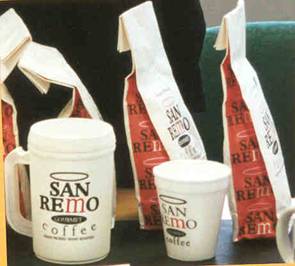
10 At the time the applicant became aware of these two retail outlets, it took no steps in relation to their use of the name “San Remo”.
11 On 16 October 2000 as a result of a Freedom of Information request, the applicant’s solicitors received a copy of an Examiner’s Report in respect of an application made on 16 November 1998 by the first respondent to register the trade mark “San Remo Gourmet Coffee” in Australia. The report was dated 16 February 1999. The examiner said that the mark was not capable of distinguishing the first respondent’s goods from the goods of other traders and that there were grounds for rejecting the application because the trade mark was substantially identical with or deceptively similar to three of the applicant’s registered trade marks and was for similar goods.
12 In October 2000 the applicant became aware that the Moonee Ponds shop had been sold to the second Respondent, Café Coffee Pty Ltd. It had been re‑named “Café Remo” but it continued to use the name and products of the first respondent.
13 The applicant fears that any representation of the San Remo name other than by it will dilute and undermine the distinctiveness of the name in respect of which it has built up a significant investment. The applicant fears that the continued existence of the San Remo Gourmet Coffee name in the marketplace will derogate from the strong association created by the applicant in the minds of consumers between the name “San Remo” and pasta products. The applicant is concerned about products not under its control which could affect the standing of its brand name in the eyes of consumers. It says that any product recall in relation to the first respondent’s products will impact on the applicant’s business in Victoria. It also fears that the use of the San Remo brand name is likely to cause confusion with consumers and traders as to whether there is an affiliation between the first respondent and the applicant and that there is a risk that its standing in the market will be affected.
14 The business now carried on by the first respondent commenced in September 1981. Its principal activity was the wholesaling of freshly roasted coffee with some retail sales. It commenced using the name “San Remo Coffee” in 1987. In 1993 the predecessor of the first respondent transferred the business to the premises at 269 Charman Road, Cheltenham. The business was incorporated under the name “San Remo Gourmet Coffee Pty Ltd” in March 1994. A wholesale and a retail operation was carried on at the Cheltenham premises. The Moonee Ponds shop was opened in October 1997 as a café/beanery and traded under the name “San Remo Gourmet Coffee”. The business was sold on 20 June 2000 to the second respondent who changed the name of the business from “San Remo Gourmet Coffee” to “Café Remo” but continues to sell the first respondent’s coffee and to use materials which display the name “San Remo Gourmet Coffee”.
15 The first respondent’s business is approximately 60% wholesale and 40% retail with an annual turnover of approximately $750,000. It has about 120 wholesale customers, the majority of whom are based in metropolitan Melbourne. The first respondent supplies products including freshly roasted coffee beans, chocolate, sugar, coffee syrups, crockery, umbrellas and street barriers as well as espresso equipment.
16 The first respondent delivers its merchandise in two vans which display the first respondent’s logo. The staff in the Cheltenham shop wear shirts and aprons printed with the first respondent’s logo and they use cups printed with the first respondent’s logo. The retail outlet displays the first respondent’s logo as do items such as cups, mugs, carry bags and packets of coffee. The bags in which the first respondent packs its coffee have red sides. In other places where the words “San Remo Gourmet coffee” are displayed, the colour of the words are black with the exception of the “m” in “Remo” which is red. The words “San Remo” are in upper case except for the “m” which is in lower case.
17 The first respondent estimates that if it were compelled to change its name it would incur losses and costs of the order of no less than $80,000 and a loss of the goodwill which it has built up in connection with its name over the past thirteen years.
18 Mr Paul Caligiore, a director of the first respondent, challenged the applicant’s assertion that the association of coffee with pasta is part of “the pasta occasion” concept and that coffee is a traditional accompaniment to the Italian meal. Mr Caligiore said it is not traditional to serve hot beverage with pasta.
19 Mr Caligiore said that it is not the present intention of the first respondent to operate any retail outlet in Victoria, other than at the Cheltenham premises. At the hearing, counsel for the first respondent offered an undertaking on behalf of the first respondent, which he said remained open, that the first respondent would not sell the Cheltenham retail business or open any other retail outlet until the hearing and determination of the proceeding.
Is there a serious question to be tried?
20 The applicant submitted that there is a serious question to be tried in relation to:
· whether the conduct of the first respondent, in using its name and marketing its coffee and associated products under and by reference to that name, is likely to mislead and deceive consumers and constitute a false representation of sponsorship, approval or affiliation in relation to the applicant;
· whether the first respondent is passing off its business and products as and for the business and products of the applicant;
· whether the first respondent, by the use of the words “San Remo”, is infringing the applicant’s trade marks.
The applicant submitted that the evidence in its present state discloses that the applicant’s name has become widely known and has become distinctive of the applicant’s business and the pasta products which it markets and sells.
21 The applicant relied on affidavits sworn by two independent marketing experts who expressed views and conclusions in relation to the applicant’s “San Remo” brand and the first respondent’s products. The first respondent objected to the admissibility of this evidence on the ground that the experts were giving opinion evidence as to the conclusions reached by consumers and on the basis of the confusion that would arise in relation to the use of the two names. The evidence went beyond this issue and analysed the nature of the marketing of the applicant’s products. I do not regard this evidence as admissible in respect of the conclusions reached by consumers. For present purposes I consider the evidence admissible in relation to the extent of the marketing of the applicant’s products, the nature of the marketing of the first respondent’s products and the effect of the first respondent’s activities on the strength of the applicant’s brand. Notwithstanding this evidence, I take into account that the first respondent has been carrying on its business for over six years without any issue having arisen in relation to any potential connection between the applicant and its products and the first respondent and its products.
22 The experts also considered that if a safety issue such as contamination arose in relation to the first respondent’s coffee products, the effect on the applicant’s business could be detrimental. This may well be the situation as a matter of theory, but at the present time it is a matter of speculation. There is no suggestion that over the period of time the first respondent has been carrying on its business any safety or contamination issue has arisen or is likely to arise.
23 There was no evidence that any person had been misled or deceived by the first respondent’s use of the words “San Remo” in relation to its coffee products. Mr Knight, the applicant’s marketing services manager, said he was “aware” that the applicant had:
“already had one enquiry from a wholesale distributor following requests for information by third parties as to whether San Remo produces coffee in addition to its pasta lines.”
This evidence is inadmissible as, amongst other matters, the source of Mr Knight’s awareness is not disclosed. In any event, it is not known what conduct or activity generated the enquiry, or whether it was associated with the first respondent.
24 The applicant submitted that a serious question arose in relation to passing off, the likelihood of consumers being mislead and deceived and there being a false representation of sponsorship, approval or affiliation, having regard to the get up of the applicant’s products, the predominance of red in that get up, the nature of the market in which those products were marketed and sold and the long use of the name “San Remo” by the applicant. The applicant contended that it was marketing the Italian way of life and what it called the “Italian food concept”. The applicant drew attention to what it said were features common to the applicant’s products and the first respondent – the same name (but not the same print or style), the religious connotation, in the case of the applicant, the monks and in the case of the respondent, the halo above the name. The word “San” in Italian means “Saint”. The applicant also pointed to the predominance of the colour red in the packaging of the products of the applicant and the first respondent. Counsel for the applicant summed up these features by submitting that, in relation to the applicant’s products, there was “the Italian flavour – the Italian impression, the feel”. It was central to the applicant’s submission that because of the nature of the first respondent’s products and get up, the image presented was that of “the Italian occasion or the pasta occasion, the Italian feel”. In effect, the applicant was submitting that any product which was associated with what it called casual Italian dining, if called “San Remo”, would be associated in the minds of consumers with the applicant.
25 The first respondent did not seriously challenge the proposition that the applicant’s evidence established a goodwill and reputation in its trade marks, get up and name in relation to pasta products, but submitted that there was no evidence of any such goodwill or reputation in relation to coffee. The first respondent submitted that the applicant’s marketing and advertising emphasised that the applicant was marketing pasta products, although it had commenced marketing some soup products.
26 It is important to remember that the first respondent has been using the name “San Remo” since the date of its incorporation in March 1994 and that its predecessor in title commenced using the name in 1987. Accordingly, it is necessary for the applicant to establish that it could have restrained the first respondent from using the name “San Remo” at the latest in March 1994. The relevant date to consider in determining whether a case for passing off is made out is the date of the commencement of the relevant conduct of which complaint is made: Cadbury Schweppes Pty Ltd v PUB Squash Co Pty Ltd (1980) 32 ALR 387 at 397; Norman Kark Publications Limited v Odhams Press Limited [1962] RPC 163 at 169; Anheuser‑Busch v Budejovicky Budvar [1984] FSR 413 at 462, 473.
27 There is evidence of the nature of the marketing and advertising of the applicant’s products in recent years. However, it is not clear to what extent the applicant, through its marketing and advertising activities, sought to create the image of what the applicant calls “the pasta occasion” in 1994. Evidence was placed before the Registrar of Trade Marks in February 1993 that in 1992 sales of products bearing the trade mark “San Remo” totalled $63 million and that there had been an expenditure of $2 million between 1989 and 1992 in relation to the advertising of San Remo products on television. At that time, as currently, the use of the name “San Remo” was used in the packaging in conjunction with the words “the pasta people”.
28 In all the circumstances, and with some hesitation, I consider that there is a serious question to be tried whether a cause of action in passing off is made out. I also consider, again with some hesitation, that there is a serious question to be tried whether the first respondent’s use of the name “San Remo” on its products and in its displays is likely to mislead and deceive consumers into believing there is an association or connection with the applicant and its products. Although I am conscious that the hearing is interlocutory and based on incomplete evidence, which will no doubt be supplemented at trial, I have reached this conclusion with some hesitation as I do not consider that the applicant’s case is a strong case. The layout and presentation of the first respondent’s name is quite different from the layout and presentation of the applicant’s name. I also have reservations about the strength of the applicant’s submission that in its marketing it has created “a pasta occasion” which has an impact in relation to other consumable items which may bear the San Remo name or mark in some form. This appears to be saying no more than any product which might be associated with, or included in, casual Italian dining will be associated with the applicant if it is called “San Remo”. However, I cannot at the present time, discount the possibility that the applicant may be able to make this case out having regard to the range of products it has marketed and sold over the years.
29 In reaching the conclusion that the applicant’s case is not a strong case I have also taken into account the fact that the name “San Remo Gourmet Coffee” has been used on coffee products for thirteen years without it being suggested that there may be a connection between this product and its proprietor and the applicant and its products. I have also taken into account that the thrust of the applicant’s marketing and advertising has been in relation to pasta and that there has been no reference to coffee in it.
30 I also find it a matter of concern that the applicant was not disposed to take any action against the first respondent after it became aware that the name “San Remo Gourmet Coffee” was being used at the second outlet in Moonee Ponds. Mr Knight, the applicant’s marketing services manager, said that the applicant did not take any action in relation to the Cheltenham operation because of the localised nature of the coffee shop. However, there is no explanation as to why the applicant did not take any action when Mr Knight became aware in May 1999 that there was a further San Remo Gourmet Coffee outlet in Puckle Street, Moonee Ponds.
31 The respondent submitted that there was no serious question to be tried on the issue of trade mark infringement. Of the four registered trade marks relied upon by the applicant, three of the marks, namely Nos 170700, 203770 and 626102, are word and device marks. In each case the device, being a picture of two monks cooking, tasting or eating spaghetti, is a significant feature. The only trade mark registered in respect of coffee is No 170700 which comprises a word and device mark, but that mark was registered (as were No 203770 and No 626102) subject to the condition or limitation:
“Registration shall give no right to the exclusive use of the words … ‘San Remo’”.
There is no evidence that this mark has been used in respect of coffee and it is therefore subject to revocation for non‑use: s 92(3) and (4)(b) Trade Marks Act 1995 (Cth).
32 The first respondent has not used any device in conjunction with its name “San Remo Gourmet Coffee” other than the halo above the name. The name “San Remo” is common to both the applicant’s trade marks Nos 203770, 626102 and 170700 and the first respondent’s mark. However, the layout and presentation of the device in the applicant’s marks is sufficiently dominant that I do not consider that there is a serious question to be tried that the first respondent’s use of its name, even with the halo and the use of the colour red, is substantially identical with, or deceptively similar to, the applicant’s three trade marks which include a device, together with the words “San Remo”.
33 The only registered trade mark which is not registered subject to the condition or limitation that registration gives no right to the exclusive use of the words “San Remo” is No 564652. However, that trade mark is registered only in respect of “pasta products, macaroni and spaghetti”.
34 Whether there is a serious question to be tried that the first respondent’s use of the words “San Remo” infringes trade mark No 564652 depends upon whether “coffee” and “pasta products, macaroni and spaghetti” are goods of the same description. This must be established in order for a cause of action under s 120(2)(a) of the Trade Marks Act to be made out. To the extent to which “coffee” and “pasta products, macaroni and spaghetti” are not goods of the same description, a cause of action may be made out under s 120(3) of the Trade Marks Act if the first respondent’s use of its name would be likely to be taken as indicating a connection between coffee and the applicant because the applicant’s trade mark is well known.
35 It is a question of fact and impression whether goods are goods “of the same description”: Rowntree plc v Rollbits Pty Ltd (1988) 10 IPR 539 at 545, 546. The authorities establish that a number of matters should be taken into account in determining whether goods are of the same description. These matters cover the nature of the goods and their characteristics, the use to which they are put and the trade channels through which they are sold: Reckitt & Colman (Australia) Ltd v Boden (1945) 70 CLR 84 at 94; J Lyons & Coy Ld’s Application [1959] RPC 120 at 128; Southern Cross Refrigeration Co v Toowoomba Foundry Pty Ltd (1953) 91 CLR 592 at 606; McCormick & Company, Inc v Mary McCormick [2000] FCA 1335 at [18]. Overall the matter is to be determined from a business point of view: Australian Wine Importers’ Trade Mark (1889) 6 RPC 311 at 318.
36 I do not consider that there is a serious question to be tried whether “coffee” and “pasta products, macaroni and spaghetti” are goods of the same description for the purpose of s 120(2) of the Trade Marks Act. Although both coffee and pasta are produced for human consumption, they are not used as substitutes or alternatives for each other. Further, the nature, characteristics and purpose of pasta products and coffee are quite different. One is food to be eaten, the other is a beverage or liquid to be drunk. They satisfy different needs. Although the phrase “goods of the same description” ought not to be given too restrictive a construction: J Lyons & Coy Ld’s Application (supra) at 128, the fact that both types of goods may be consumed does not, of itself, make them goods of the same description.
37 The first respondent also submitted that it had a good defence to a claim for infringement of trade mark No 564652 under s 120(2) of the Trade Marks Act because of the continuous user of its name before the effective date of registration of the applicant’s trade mark. Whether that defence can be made out depends on whether there is evidence of continuous user by the first respondent’s predecessors in title. Evidence will need to be led on that issue.
38 The applicant based its case for infringement not only on s 120(2) of the Trade Marks Act but also on s 120(3) which provides:
“A person infringes a registered mark if:
(a) the trade mark is well known in Australia; and
(b) the person uses as a trade mark a sign that is substantially identical with, or deceptively similar to, the trade mark in relation to:
(i) goods (‘unrelated goods’) that are not of the same description as that of the goods in respect of which the trade mark is registered (‘registered goods’) or are not closely related to services in respect of which the trade mark is registered (‘registered services’); or
(ii) services (‘unrelated services’) that are not of the same description as that of the registered services or are not closely related to registered goods; and
(c) because the trade mark is well known, the sign would be likely to be taken as indicating a connection between the unrelated goods or services and the registered owner of the trade mark; and
(d) for that reason, the interests of the registered owner are likely to be adversely affected.”
The applicant submitted that there was a serious question to be tried that, because the applicant’s trade mark “San Remo” was so well known, the first respondent’s use of the words “San Remo” would be likely to be taken as indicating a connection between its coffee products and the applicant. The evidence establishes that the applicant has promoted and advertised the name “San Remo” extensively in television and magazine advertising and in supermarket promotional activities. According to Mr Knight, since 1990 the applicant has spent at least $8 million a year in consumer and trade marketing to develop and further the San Remo brand name. Having regard to the extent of this advertising and marketing and the fact that the applicant’s San Remo brand products have achieved a market share in excess of 40% of the national and Victorian State dry pasta markets, I consider that there is a serious question that trade mark No 564652 is sufficiently well known, for the purposes of s 120(3)(c) of the Act, to the extent that the first respondent’s use of those words would be likely to be taken as indicating a connection between the first respondent’s coffee products and the applicant even though pasta and coffee are not goods of the same description.
39 I have reached the conclusion therefore, again with some hesitation, that there is a serious question to be tried that the first respondent has infringed the applicant’s trade mark No 564652 under s 120(3) of the Act. This is on the basis that it’s use of the words “San Remo” would be likely to be taken as indicating a connection between the first respondent’s coffee products and the applicant because the applicant’s mark is well known. At this interlocutory stage I accept, on the basis of the present evidence, that the applicant’s name “San Remo” is well known for the purposes of s 120(3)(c) of the Trade Marks Act. Although I have reservations about the significance of what the applicant calls “the pasta occasion”, it is well‑known that food and beverage manufacturers make a variety of different products and that brands are extended over different products.
40 The first respondent nevertheless submitted that it had an absolute defence under s 254 of the Trade Marks Act to the claims of infringement under both s 120(2) and s 120(3). Section 254 provides:
“(1) This section applies if:
(a) immediately before 1 January 1996, a person was engaging in conduct that did not constitute an infringement of a mark registered under the repealed Act; and
(b) the mark is an existing registered mark for the purposes of this Act; and
(c) the person has, on or after that date, continuously engaged in, and is engaging in, that conduct; and
(d) that conduct is an infringement of the existing registered mark under this Act.
(2) In spite of section 120, the person does not infringe the existing registered mark by engaging in that conduct.”
The applicant submitted that at this interlocutory stage of the proceeding it was not possible to resolve, or form a view on, the issue of the continuous nature of the conduct engaged in by the first respondent immediately before 1 January 1996. The applicant submitted that there was no evidence that there had been such continuous use.
41 There is no direct evidence that the first respondent has, since 1 January 1996, continuously engaged in the use of its name on its products and in its business. The evidence led by the first respondent was that the first respondent was incorporated on 23 March 1994, it received a trade award in 1996 and it has been represented at a number of festivals and displays. The tenor of the evidence led by the first respondent invites the inference that there has been such continuous use. However, the evidence is incomplete and, in the context of an interlocutory application of this nature, I do not consider that I should draw such an inference in the absence of giving the applicant the opportunity to test the factual basis for the inference.
The balance of convenience
42 I turn to the balance of convenience. In considering the balance of convenience, it is necessary to consider the nature of the interlocutory relief sought by the applicant. As the hearing proceeded, the applicant refined, and confined, the nature of the interlocutory relief sought. In its final form, the applicant sought an interlocutory injunction restraining the first respondent from:
(a) selling the Cheltenham business;
(b) marketing or selling coffee products in packaging bearing the “San Remo” name or any similar name, to any outlet, including supermarket outlets, other than the Cheltenham outlet and other outlets to which it presently sells its coffee products;
(c) displaying signs with the name “San Remo”, or any similar name, at premises other than the Cheltenham outlet and other outlets to which it presently sells its coffee products;
(d) undertaking promotional or marketing activities which include the name “San Remo”, or any similar name, of a kind not previously undertaken, including any further promotional or marketing activities not previously undertaken or engaged in by the first respondent in the press, television or other mass media.
43 The applicant emphasised that it was seeking to preserve the status quo and was not seeking to prevent the first respondent from doing business with its current customers in the manner in which it had hitherto. Rather, the applicant was concerned to restrain the first respondent from disseminating its products with its name on them through further retail outlets. In short, the applicant was seeking to limit an expansion of the first respondent’s marketing activities, but was not seeking to require the first respondent to cease using its name altogether.
44 The applicant submitted that the balance of convenience was in favour of the grant of interlocutory relief, having regard to the potential damage to the brand equity, reputation and goodwill involved in its name and trade marks.
45 I have reached the conclusion that the balance of convenience is against the grant of interlocutory relief, having regard to a number of considerations. Although I have found that there is a serious question to be tried on the issues of passing off, contraventions of s 52 and s 53 of the Trade Practices Act and infringement of trade mark No 564652, I have made these findings with some hesitation. I do not consider, on the basis of the material presently available to me, that the case is strong to the extent to which it is based on passing‑off, contravention of ss 52 and 53 of the Trade Practices Act and there being taken to be a connection between the first respondent’s coffee products and the applicant because trade mark No 564652 is well‑known. I do not consider that I should divorce the view I have formed on the strength of the applicant’s case from a consideration of where the balance of convenience lies. This view is consistent with authority. In Bullock v The Federated Furnishing Trades Society of Australasia (No 1) (1985) 5 FCR 464, Woodward J (with whom Smithers and Sweeney JJ agreed) said at 472:
“The only point I would wish to add for myself is that, when it becomes necessary to consider the balance of convenience, it is, I believe, quite proper to continue to bear in mind the apparent strength of the applicants’ case; the two legs of the test need not be considered in isolation from each other. Thus an apparently strong claim may lead a court more readily to grant an injunction when the balance of convenience is fairly even. A more doubtful claim (which nevertheless raises ‘a serious question to be tried’) may still attract interlocutory relief if there is a marked balance of convenience in favour of it.”
I would add to this observation the proposition that a more doubtful claim, which nevertheless raises a serious question to be tried, may not attract interlocutory relief if there is not a marked balance of convenience in favour of it. The observation of Woodward J was applied by Sackville J in Roses Only & Lush Pty Ltd v Mark Lyons Pty Ltd [1999] ATPR 41‑706. Sackville J cited Woodward J’s observation and continued at 43,049:
“It follows that it may be appropriate on an interlocutory application, even one which raises a serious question to be tried, to make an assessment of the apparent strength of the applicant’s claim. Such an assessment may have some bearing on whether interlocutory relief should be granted.”
46 If the interlocutory relief sought by the applicant is not granted, it does not appear that there will be any actual immediate harm or damage to the applicant’s business, brand equity, reputation or goodwill. The evidence of the marketing experts led by the applicant suggests that there will be damage to the brand equity, goodwill and reputation of the applicant and its products if the first respondent is allowed to carry on business under and by reference to its name, but such damage is amorphous. On the other hand, if the interlocutory relief sought by the applicant is granted, the first respondent will be specifically limited in its wholesaling activities. Although it will be able to continue to carry on business with the same customers as it has hitherto, it will be restrained from expanding its business by dealing with other customers. This will occur to a business which the first respondent itself has been carrying on for over six years and which has, overall, been carried on for thirteen years under the name “San Remo”.
47 The applicant’s concern, which arose when it became aware that the Moonee Ponds outlet had been sold, that the first respondent was franchising its name and giving an interest to a further party to exploit the goodwill attached to the name “San Remo” is met by the undertaking offered by the first respondent in the course of the hearing.
48 Put shortly, the refusal of an interlocutory injunction will not demonstrably result in immediate damage or harm to the applicant’s business, whereas the grant of the interlocutory relief sought by the applicant will have that immediate consequence on the first respondent’s business. The consequence of the grant of interlocutory relief will have a more significant effect on the first respondent’s business than a refusal to grant interlocutory relief will have on the applicant’s business. It is also relevant that the first respondent has been operating its business for five years before the applicant became aware of its existence.
49 In exercising my overall discretion whether to grant interlocutory relief I also take into account the delay by the applicant in applying for interlocutory relief. That delay is not, of itself, a bar to the grant of interlocutory relief. Rather, I take it into account in the sense that for a period between May 1999 and October 2000 the applicant was content for coffee products to be marketed and sold by reference to the name “San Remo”, without considering that there was any significant effect on its reputation and goodwill. What crystallised its concern was the sale of the Moonee Ponds shop and its discovery of the first respondent’s application to register the mark “San Remo Gourmet Coffee” in Australia. To the extent to which the applicant may have been concerned about the trade mark application, its concern is allayed by the rejection of the application for registration. The applicant’s concern about the consequence of the sale of the Moonee Ponds outlet is allayed by the accommodation reached with the second respondent and the undertaking offered by the first respondent.
50 Provided the first respondent is prepared to give an undertaking to the Court in the terms offered in the course of the hearing, the balance of convenience remains against the grant of interlocutory relief for the reasons to which I have referred. Subject to that undertaking being given to the Court, the applicant’s application for interlocutory relief will be dismissed. I will hear the parties on the issue of the costs of the application.
|
I certify that the preceding fifty (50) numbered paragraphs are a true copy of the Reasons for Judgment herein of the Honourable Justice Goldberg. |
Associate:
Dated: 15 December 2000
|
Counsel for the Applicant: |
J E Middleton QC and S M Anderson |
|
|
|
|
Solicitor for the Applicant: |
Piper Alderman |
|
|
|
|
Counsel for the Respondent: |
A J Ryan |
|
|
|
|
Solicitor for the Respondent: |
H S Wise Gershov & Co |
|
|
|
|
Date of Hearing: |
20 November 2000 |
|
|
|
|
Date of Judgment: |
15 December 2000 |


