FEDERAL COURT OF AUSTRALIA
Mark Anderson on behalf of the Spinifex People v State of Western Australia [2000] FCA 1717
|
IN THE FEDERAL COURT OF AUSTRALIA |
|
|
WG 6043 OF 1998 |
|
BETWEEN: |
Mark Anderson on behalf of the Spinifex People APPLICANT
|
|
AND:
AND: |
State of Western Australia FIRST RESPONDENT
Shire of Laverton SECOND RESPONDENT |
|
DATE OF ORDER: |
|
|
WHERE MADE: |
Great Victoria Desert |
The Court orders, declares and determines, with the consent of the parties, that:
1. The native title rights and interests set out in paragraphs 3.1 and 3.2 exist in those parts of the Determination Area described in the Second Schedule. The Determination Area is the land and waters described in the First Schedule.
2. The persons holding the communal or group rights comprising the native title ("the common law holders") are the Pila Nguru People (otherwise known as the Spinifex People).
3.1 Subject to paragraphs 4, 5, 6, and 7.1 the nature and extent of the native title rights and interests in the land and waters described in Part A of the Second Schedule are:
(a) a right to possess, occupy, use and enjoy the land, including the right to live on the land;
(b) a right to make decisions about the use and enjoyment of the land;
(c) a right to hunt and gather (including ochre) and to take water, for the purposes of satisfying their personal, domestic, social, cultural, religious, spiritual or non-commercial communal needs, including the observance of traditional laws and customs;
(d) a right to maintain and protect sites of significance to the common law holders under their traditional laws and customs;
(e) a right as against any other Aboriginal group or individual to be acknowledged as the traditional Aboriginal owners.
These native title rights and interests confer possession, occupation, use and enjoyment of the land on the native title holders to the exclusion of all others.
3.2 Subject to paragraphs 4, 5, 6, and 7.2 the nature and extent of the native title rights and interests in the land and waters described in Part B of the Second Schedule are:
(a) a right to possess, occupy, use and enjoy the land, including the right to live on the land;
(b) a right to make decisions about the use and enjoyment of the land;
(c) a right to hunt and gather (including ochre) and to take water, for the purposes of satisfying their personal, domestic, social, cultural, religious, spiritual or non-commercial communal needs, including the observance of traditional laws and customs;
(d) a right to maintain and protect sites of significance to the common law holders under their traditional laws and customs;
(e) a right as against any other Aboriginal group or individual to be acknowledged as the traditional Aboriginal owners.
These native title rights and interests do not confer possession, occupation, use or enjoyment on the native title holders to the exclusion of all others.
4. (a) There are no native title rights and interests in minerals and petroleum as defined in the Mining Act 1904 (WA), the Mining Act 1978 (WA), the Petroleum Act 1936 (WA) and the Petroleum Act 1967 (WA);
(b) Other than in the case of water taken in the exercise of the native title rights and interests described in paragraphs 3.1(c) and 3.2(c), there are no native title rights and interests in flowing and subterranean waters.
5. The nature and extent of other interests in relation to the Determination Area are those set out in the Third Schedule.
6. The native title rights and interests are subject to and exercisable in accordance with:
(a) the laws of the State and the Commonwealth including the common law; and
(b) traditional laws acknowledged and traditional customs observed by the native title holders.
7.1 The relationship between the native title rights and interests in the land and waters described in Part A of the Second Schedule and the other rights and interests referred to in paragraph 5 ("the other rights and interests") is that:
(a) the other rights and interests and the doing of any activity in exercise of the rights conferred by or held under the other rights and interests co-exist except in the case where they conflict with, and if there is conflict with, prevail over, the native title rights and interests in any exercise of those native title rights and interests; and
(b) the other rights and interests continue to have effect and the rights conferred by them or held under them may be exercised notwithstanding the existence of the native title rights and interests.
7.2 The relationship between the native title rights and interests in the land and waters described in Part B of the Second Schedule and the other rights and interests referred to in paragraph 5 ("the other rights and interests") is:
(a) the other rights and interests and the doing of any activity in exercise of the rights conferred by or held under the other rights and interests prevail over the native title rights and interests and any exercise of those native title rights and interests; and
(b) the other rights and interests continue to have effect and the rights conferred by them or held under them may be exercised notwithstanding the existence of the native title rights and interests.
8 (a) The native title rights and interests in the land and waters comprising the determination area are held by the common law holders.
(b) Within three months of the date of this determination, a representative of the common law holders shall nominate in writing to the Federal Court a prescribed body corporate to perform the functions mentioned in s 57 (3) of the Native Title Act. There shall be liberty to apply to a single Judge of the Court in that connection.
FIRST SCHEDULE
The Determination Area is ALL those areas of land and waters in the State of Western Australia contained within the boundaries of the following description:
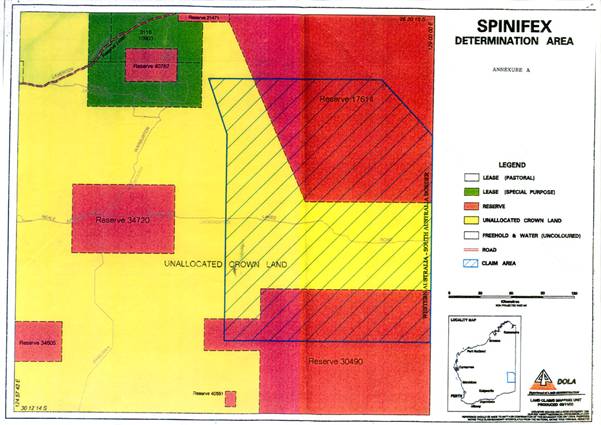
Commencing at the westernmost north western corner of Yowalga Location 7 as shown on Land Administration plan 20992 and extending east along the northernmost northern boundary of that location and east and south easterly along boundaries of Milyuga Location 20 to the Western Australian - South Australian Border; Then southerly along that border to latitude 29.500000 South; Then west to the south eastern corner of Delisser Location 9; Then west and north along boundaries of that location and north along the western boundary of Delisser Location 8 to the south western corner of Yowalga Location 7 and then generally northerly along boundaries of that location to the commencement point;
which Determination Area is as shown on the Plan annexed to this Order and marked “Annexure A”.
SECOND SCHEDULE
Part A:
Part A is all those areas of land and waters in the State of Western Australia contained within the boundaries of the following description:
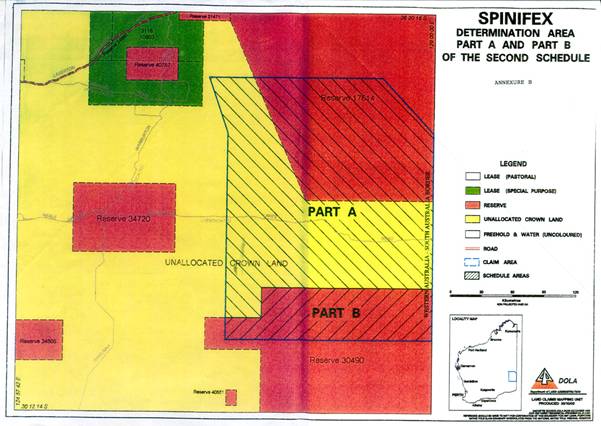
Commencing at the westernmost north western corner of Yowalga Location 7 as shown on Land Administration plan 20992 and extending east along the northernmost northern boundary of that location and east and south easterly along boundaries of Milyuga Location 20 to the Western Australian - South Australian Border; Then southerly along that border to south eastern corner of Yowalga Location 7; Then west and south along boundaries of that location to the north eastern corner of Delisser Location 8; Then south, west and north along boundaries of that location and generally northerly along western boundaries of Yowalga Location 7 to the commencement point;
which Part A is shown on the Plan annexed to this Order and marked “Annexure B”.
Part B:
Part B is all those areas of land and waters in the State of Western Australia contained within the boundaries of the following description:
Commencing at the south western corner of Delisser Location 8 as shown on Land Administration plan 20992 and extending east and north along boundaries of that location, Then north and east along the boundaries of Yowalga Location 7 to the Western Australian - South Australian Border; Then southerly along that border to Latitude 29.500000 South; Then west to the south eastern corner of Delisser Location 9; Then west and north along boundaries of that location to the commencement point;
which Part B is shown on the Plan annexed to this Order and marked “Annexure B”.
THIRD SCHEDULE
The nature and extent of other interests in relation to the Determination Area are:
(a) Reserve 30490, being the Great Victoria Desert Nature Reserve, a class A reserve under the Land Administration Act 1997 and vested in the National Parks and Nature Conservation Authority and categorised as a nature reserve under the Conservation and Land Management Act 1984;
(b) Reserve 17614, classified as a class A reserve under the Land Administration Act 1997, and under the control and management of the Aboriginal Lands Trust pursuant to section 46 of the Aboriginal Affairs Planning Authority Act 1972;
(c) the rights and interests of the Lessee, being the Ngaanyatjarra Land Council (Aboriginal Corporation) of Lease 242 of part of Reserve 17614 made on 29 November 1988 between the Aboriginal Lands Trust, the Minister for Aboriginal Affairs, the Aboriginal Affairs Planning Authority and the Ngaanyatjarra Land Council (Aboriginal Corporation), as far as the Lessee's rights and interests affect the native title rights and interests of the common law holders;
(d) the rights of members of the public to use the Serpentine Lakes Road as shown on the Plan annexed to the First Schedule and as realigned from time to time;
(e) rights and interests granted by the Crown pursuant to statute or by any valid executive or legislative act affecting the native title rights and interests of the common law holders;
(f) any other rights or interests held by or under the Crown by the force and operation of the laws of the State or the Commonwealth as may be current at the date of this determination, including the force and operation of the Rights in Water and Irrigation Act 1914; and
(g) other rights and interests of members of the public arising under the common law.
|
IN THE FEDERAL COURT OF AUSTRALIA |
|
|
WG 6043 OF 1998 |
|
BETWEEN: |
Mark Anderson on behalf of the Spinifex People APPLICANT
|
|
AND:
AND: |
FIRST RESPONDENT
Shire of Laverton SECOND RESPONDENT |
|
JUDGE: |
|
|
DATE: |
|
|
PLACE: |
REASONS FOR JUDGMENT
1 The proceeding before the Court today arises out an application for a determination of native title made by Mr Mark Anderson on behalf of the Pila Nguru People, a people who are also known as the Spinifex People. The respondents to the application are the State of Western Australia and the Shire of Laverton.
2 Those parties have recently reached an agreement which, amongst other things, recognises the pre-existing native title rights and interests of the Spinifex People and contemplates that the Court will make a determination of native title by consent. They have agreed on the terms of an order that they now ask the Court to make. Their agreement is in writing, it is signed by Mr Anderson and it is signed on behalf of the other parties. It has been filed with the Court by the State of Western Australia.
3 In these circumstances, if the Court is satisfied that an order in, or consistent with, the agreed terms would be within its power to make, the Court may, if it appears to it to be appropriate to do so, make such an order: see Native Title Act 1993 (Cth), s 87 (the Act). Any order by which the Court makes a determination of native title must set out details of the matters referred to in s 225 of the Act: see s 94A.
4 I have read the agreement between the parties. I have also read the affidavit of Mr Anderson’s solicitor, Mr O’Dea, in which he outlines the history of this application and the nature of the meeting at Tjuntjuntjara on 12 October 2000 at which the parties reached their agreement. I have read, too, the report of Dr Scott Cane dated February 2000 and entitled Pila Nguru, An enthnography of the Spinifex People in the context of Native Title. Dr Cane’s report was filed on behalf of the applicant.
5 The purpose of this hearing, at Tjuntjuntjara in the Great Victoria Desert, on the homelands of the Spinifex People is to hear anything further that the parties might wish to say to the Court about their agreement and to consider whether the Court should make the orders they seek.
6 I have had the opportunity to consider this matter before coming to Tjuntjuntjara today and I am satisfied that an order in the terms agreed upon by the parties would be within the power of the Court. I am also satisfied that it would be appropriate to make the order sought without holding any further hearing. I am satisfied, too, that an order in the terms sought would satisfy the formal requirements of the Act.
7 I wish to congratulate the Spinifex People, the State of Western Australia and the Shire of Laverton for resolving this application by agreement between them. Discussions leading to consent determinations about the existence and workings of native title will often involve very difficult questions for the parties to consider and yet agreement, if it can be reached, is highly desirable.
8 The courts have always encouraged parties to settle their claims amicably and have often congratulated them when they have done so. I am following a long tradition of common law judges in congratulating the parties to this application; but I would add that it is especially desirable that there be agreed resolutions of applications for the determination of native title cases. These cases involve matters of great importance and great sensitivity to many people. If not resolved by agreement they can be lengthy and very costly to all concerned. They can also cause distress. If an appropriate outcome can be arrived at by agreement, and it is an outcome that represents goodwill and understanding on all sides, that is something to be applauded. To similar effect, in their joint judgment in North Ganalanja Aboriginal Corporation v Queensland (1996) 185 CLR 595 at 671, five members of the High Court expressed their views on the value and importance of agreed outcomes in native title cases:
If it be practicable to resolve an application for determination of native title by negotiation and agreement rather than by the judicial determination of complex issues, the court and the likely parties to the litigation are saved a great deal of time and resources. Perhaps more importantly, if the persons interested in the determination of those issues negotiate and reach an agreement, they are enabled thereby to establish an amicable relationship between neighbouring occupiers.
9 Before turning to the nature of the agreement and my reasons for making an order in the terms agreed by the parties I should give a brief outline of the history of this proceeding. The initiating application for recognition of native title was lodged in the National Native Title Tribunal on 3 October 1995 by a number of named persons as applicants on behalf of the Peoples of the Spinifex. Pursuant to the transitional provisions of the Act (as amended) the application was deemed to have been made to the Federal Court of Australia on 30 September 1998.
10 The matter first came before the Court on 27 April 1999 at which time it was adjourned pursuant to s 86F(3) of the Native Title Act 1993 to allow time for further negotiations. On 19 September 1999 the application was amended to comply with the requirements of ss 190A, 190B and 190C of the Act. The amended application names Mark Anderson as the applicant on behalf of the Spinifex People.
11 Programming orders were made by consent on 13 October 1999 and these orders were later varied to facilitate the finalisation of the consent determination. The proposed consent determination was filed with the Court on 3 November 2000 and the terms of the proposed consent determination were settled by French J on 6 November 2000.
12
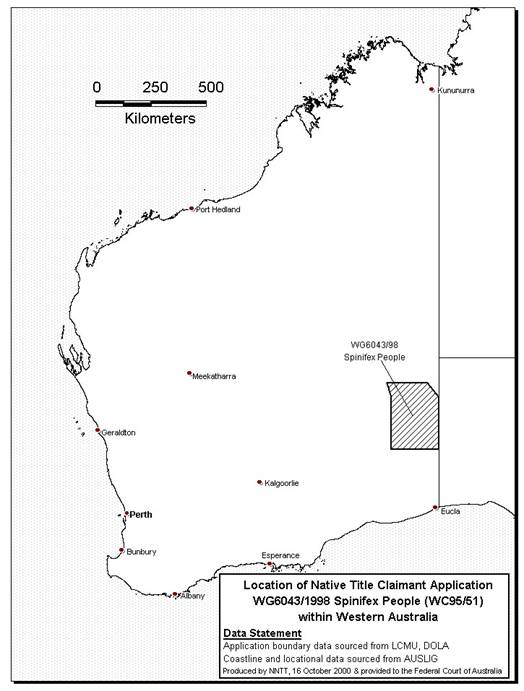 |
The area over which a determination of native title is sought is in the Great Victoria Desert. It extends over some 55, 000 square kilometres and covers the southern portion of the Desert, west from the western border of South Australia. It is adjacent to the northern margin of the Nullarbor Plain and includes the northern portion of the Great Victoria Desert Nature Reserve and the southern section of the Central Australian Aboriginal Reserve. The location of the area within the State of Western Australia is shown on the accompanying map:
13 In broad terms, the proposed determination recognises native title in respect of an area of vacant crown land, some of which was subject to abandoned pastoral leases. In relation to these leases the applicant has relied on the protection of s 47B of the Act. The claim area also contains part of an Aboriginal reserve which is vested in the Aboriginal Lands Trust and leased under a 99 year lease to Ngaanyatjarra Land Council of which the native title claimant groups are members. In relation to this area the applicant has relied on the protection of s 47A of the Act. Part of a nature reserve vested in National Parks and Nature Conservation Authority also falls within the determination area, as does the Serpentine Lakes Road.
14 The proposed order sets out the nature of the native title rights and interests in relation to the determination area. Subject to some overriding matters that are specified in the agreement, the nature and extent of those native title rights and interests in the land are:
(a) a right to possess, occupy, use and enjoy the land, including the right to live on the land;
(b) a right to make decisions about the use and enjoyment of the land;
(c) a right to hunt and gather (including ochre), and to take water for the purposes of satisfying their personal, domestic, social, cultural, religious, spiritual or non-commercial communal needs. The enjoyment and use of the land extends to the observance of traditional laws and customs;
(d) a right to maintain and protect sites of significance to the common law holders under the traditional laws and customs; and
(e) a right as against any other Aboriginal group or individual to be acknowledged as the traditional Aboriginal owners.
15 The relationship between the native title rights and interests and other rights and interests referred to in the order is a matter of some complexity. It is not necessary for me to outline in these reasons precisely how the proposed order deals with that relationship – the order speaks for itself in that regard. Some points should, however, be noted. First, the proposed order provides that there are no native title rights in relation to minerals or petroleum or any rights or interests in flowing or subterranean waters, except in the case of water taken in the exercise of certain specified native title rights. Secondly, native title rights and interests are subject to, and exercisable, in accordance with, the traditional laws acknowledged and traditional customs observed by the native title holders, and with the laws of the State and Commonwealth, including the common law. Other rights and interests that prevail over the native rights and interests include the rights of members of the public to use the Serpentine Lakes Road and rights in respect of the Great Victoria Desert Nature Reserve. The way in which, in practice, the rights and interests of the native titleholders will interact with other rights and interests will no doubt be worked out cooperatively between the parties as the need arises from time to time. The fact that the parties have been able to agree upon the terms of the orders that I will make today provides a sound and hopeful basis for their future cooperation.
16 I now turn to some of the evidence that is before the Court about the Spinifex People and their connection with the land. That evidence is contained in the lengthy and comprehensive report of Dr Scott Cane.
17 The Spinifex People describe themselves as the people who live in and own the Spinifex plains of the Great Victoria Desert between the Nullarbor Plain and the foothills of the Warburton Ranges. They call themselves, if anything, the Anangu tjuta pila nguru meaning the Aboriginal people (Anangu) many (tjuta) spinifex (pila) from (nguru). Dr Cane comments that a review of the historical records reveals that this is a consistent and reliable means of geo-cultural identification, which accurately associates the claimants with the country they are claiming.
18 The Spinifex People have been at one with the land they claim for a very, very long time. The archaeological evidence suggests the emergence of a rudimentary nomadic society in the Western Desert at least 20, 000 years ago. How old the traditions of the Spinifex People are remains largely unknown, but Dr Cane refers to a Tjukurrpa (for present purposes – but inadequately – a tradition) that appears to relate to the postglacial rise in sea levels across the Nullarbor Plain between 15, 000 and 7, 000 years ago.
19 It is clear from Dr Cane’s report that the traditional life of the Spinifex People continued well into the 20th century. The first known historical reference to the Spinifex People was not made until 1934, by Norman Tindale. Contact began at about the same time. Cundeelee, which has played an important part in the more recent history of the Spinifex People, was not established as a mission until 1950. But it was the atomic testing program at Maralinga in 1952 and 1956 that brought with it the first contact between most of the Spinifex People and the western world. Changes to land tenure in relation to the use of the existing Aboriginal reserves and the establishment of a new nature reserve across the southern part of the Spinifex homelands in the 1960s also impacted upon the Spinifex People. The steps taken by the Spinifex People to return to their homelands after the closure of the Cundeelee Mission in the early 1980s are outlined in Dr Cane’s report. He then describes in considerable detail present day Spinifex society.
20 Dr Cane’s report reveals the Spinifex People as a society of great complexity and antiquity; it reveals a society with a profound and enduring relationship with its land. It also reveals a people of great resourcefulness who have survived for countless generations in an environment in which few others could survive. It reveals a people who came out of their desert homelands with their traditional laws and customs intact and who have maintained their traditional laws and customs through the period of their recent contact with the world outside their desert homelands – a contact that has occurred within the lifetimes of many of us here today.
21 In his report Dr Cane deals specifically with the various rights and interests which find expression in the orders the Court is asked to make today. He rightly warns against the oversimplification of a subject matter of immense complexity. He says that Spinifex tradition is so pervasive that it is difficult, and perhaps a disservice, to delineate the traditions – by which he means the traditions relevant to the recognition of native title – in a systematic manner. He points out that there is always a risk that in doing so the traditional complexion of life will be discoloured and that some connection between tradition and its social expression will be lost. Having sounded this warning, he proceeds to show how each and every of the claimed rights and interests is possessed under the traditional laws acknowledged and the traditional customs observed by the Spinifex People and that the Spinifex People, by those laws and customs, have a connection with the land and waters over which they claim native title. There is no question but that these rights and interests are recognised by the common law of Australia.
22 I should add that there is nothing before the Court to suggest that there are other claims in respect of the land such as might lead the Court to conclude that it was not appropriate to make the orders sought in favour of the Spinifex People.
It is in these circumstances that I have concluded that it is appropriate to make the orders that the parties seek.
This Judgment does not have the usual certification. It was delivered orally by the Chief Justice and is subject to revision:
Dated: 28 November 2000
|
Solicitor for the Applicant: |
Mr D O'Dea |
|
|
|
|
Solicitor for the Respondent: |
Ms Kate Glancy |
|
|
|
|
Counsel for the Respondent |
Mr J O'Halloran |
|
|
|
|
Date of Hearing: |
28 November 2000 |
|
|
|
|
Date of Judgment: |
28 November 2000 |