

FEDERAL COURT OF AUSTRALIA
George Weston Foods Limited v Goodman Fielder Limited [2000] FCA 1632
TRADE PRACTICES – misleading or deceptive conduct – fibre content of sliced white bread – bread packaging, television and bus advertisements, point of sale promotional material – representation “Now Twice the Fibre” – possible meanings of representation – whether representation meaningless – relevant class of consumers – whether consumers likely to be misled or deceived
WORDS AND PHRASES – “regular white bread”
Trade Practices Act 1974 (Cth) ss 52, 53, 55
Tobacco Institute of Australia Ltd v Australian Federation of Consumer Organisations Inc (1992) 38 FCR 1 applied
Campomar Sociedad, Limitada v Nike International Ltd (2000) 169 ALR 677 considered
Lumley Life Ltd v IOOF of Victoria Friendly Society (1989) 16 IPR 316 applied
SAP Australia Pty Ltd v Sapient Australia Pty Ltd (1999) 169 ALR 1 referred to
Everready Australia Pty Ltd v Gillette Australia Pty Ltd (2000) ATPR 41-751 referred to
Telstra Corporation Ltd v Optus Communications Pty Ltd (1997) ATPR 41-541 applied
Trade Practices Commission v Optus Communications Pty Ltd (1996) ATPR 41-478 referred to
Australian Competition & Consumer Commission v Nationwide News Pty Ltd (1996) ATPR 41-519 referred to
GEORGE WESTON FOODS LIMITED (ACN 008 429 632) v GOODMAN FIELDER LIMITED (ACN 000 003 958) AND QUALITY BAKERS AUSTRALIA LIMITED (ABN 44 000 003 958)
N 1137 OF 2000
MOORE J
17 NOVEMBER 2000
SYDNEY
|
IN THE FEDERAL COURT OF AUSTRALIA |
|
|
BETWEEN: |
GEORGE WESTON FOODS LIMITED (ACN 008 429 632) APPLICANT
|
|
AND: |
GOODMAN FIELDER LIMITED (ACN 000 003 958) FIRST RESPONDENT
QUALITY BAKERS AUSTRALIA LIMITED (ABN 44 000 003 958) SECOND RESPONDENT
|
|
DATE OF ORDER: |
|
|
WHERE MADE: |
THE COURT ORDERS THAT:
1. The application be dismissed.
2. The applicant pay the respondents’ costs.
Note: Settlement and entry of orders is dealt with in Order 36 of the Federal Court Rules.
|
IN THE FEDERAL COURT OF AUSTRALIA |
|
|
JUDGE: |
|
|
DATE: |
|
|
PLACE: |
REASONS FOR JUDGMENT
Introduction
1 This is an application under Pt V of the Trade Practices Act 1974 (Cth) (“the TP Act”). Both the applicant and the respondents manufacture, distribute and market food products including white bread. The respondents’ products include “Wonder White” sliced white bread. The applicant claims the respondents are engaging in misleading or deceptive conduct (or conduct which is likely to mislead or deceive) in contravention of ss 52, 53 and 55 of the TP Act. The claim is based on an allegation that the respondents are making misleading representations in packaging, television and bus advertising and other promotional material about the fibre content of “Wonder White” as part of a relaunch of the product commencing in October 2000.
2 The application was filed on 25 October 2000. The applicant sought an urgent interlocutory hearing for orders to restrain the respondents from continuing the contravening conduct. However it was possible to expedite the final hearing and, by consent, the matter was fixed for trial (of all issues except damages) on 3 November 2000. In accordance with a direction given on 1 November 2000, a statement of claim and defence were filed and served. A cross-claim was filed in court by the respondents at the commencement of the hearing on 3 November 2000.
The facts and the impugned conduct
3 The respondents first sold “Wonder White” in the market in 1994. It is a sliced white bread and is presently sold in three varieties: “sandwich”, “lunchbox” (its slices have the same thickness as “sandwich” but have a smaller surface area) and “toast” (thicker slices).
4
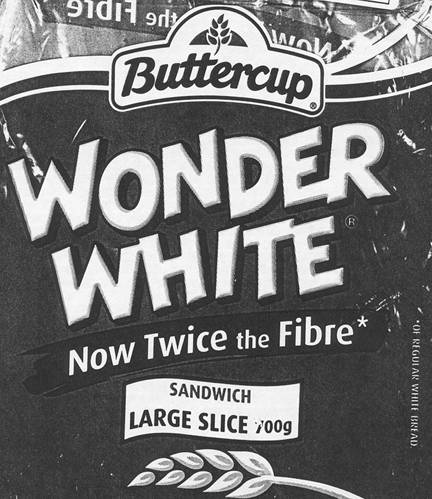 |
The applicant tendered packaged loaves of the three varieties of “Wonder White” in packaging that has been developed for the relaunch of the product this year (“the new packaging”). It is the packaging in current use. The sliced loaf is contained within an elongated plastic bag which is partly clear and partly coloured. Graphics and writing are printed on the bag. The features of the new packaging relating to the fibre content of the bread are common to each bread type. The following is the way the contentious phrase appears on the front face of the new packaging for a sandwich loaf:
5 The front face of the packaging contains, in the bottom half, the words “WONDER WHITE” in large type and the contentious phrase “Now Twice the Fibre*” in smaller type. Approximately 1.5cm to the right of the asterisk there appears, in small type and approximately at right angles to most of the text the words, “*OF REGULAR WHITE BREAD”.
6 The background colour of the new packaging of the sandwich and lunchbox loaf behind the contentious writing on the front face is dark pink. The words "Now Twice the Fibre" and the asterisk are written in a fairly bright yellow against a blue/purple band of colour and the words "*of regular white bread" are white. The effect of this colour scheme is that the words "Now Twice the Fibre" and the asterisk are comparatively prominent. The colour scheme for the toast loaf is different (blue as the general background and a dark pink band immediately behind the words “Now Twice the Fibre”) but the effect is the same.
7 When the loaf is rotated to the right-hand face, there are two boxes containing text. The top box contains, in relatively small type, a table of “NUTRITIONAL INFORMATION”, a list of “INGREDIENTS” and a “CONSUMER QUALITY GUARANTEE”. One of the items in the table of “NUTRITIONAL INFORMATION” is “DIETARY FIBRE”. The table states that there are 3.4g of dietary fibre per 57g serve, and 6.0g per 100g. Appearing third in the list of ingredients is “HI-MAIZEä STARCH**”. Below the list is the following statement: “** HI-MAIZEä STARCH IS A MAIZE CORNFLOUR MILLED ONLY FOR A UNIQUE AUSTRALIAN GROWN MAIZE WITH A HIGH DIETARY FIBRE CONTENT”. In the bottom box, in slightly larger type than the top box, is the phrase “FIBRE INCREASED WHITE BREAD WITH” followed by a device which purports to be a trade mark containing the words “Natural Hi-maize, The Vital Fibre”. When one turns to the back face of the packaged loaf, around the middle of the face appear the words, “WONDER WHITE” and “Now Twice the Fibre*” in the same format as on the front face and of a similar size. Beneath those words appears the following:
“IMAGINE! A soft, delicious white bread that the entire family will love – with twice the fibre of regular white bread. That’s Wonder White!”
Below that appears the “Natural Hi-maize” device and, in smaller type, the words:
“Our secret is Hi-maizeä - a completely natural ingredient milled from specially developed Australian corn. Hi-maizeä contains dietary fibre that is so finely ground it’s invisible, which means you can’t see or taste all the essential fibre you are eating.
Wonder White makes a valuable contribution to the fibre requirements of kids and adults alike and helps maintain a healthy digestive system.”
Below that, at the very bottom of the back face, appears, in small type, “*OF REGULAR WHITE BREAD, AS DEFINED IN FOOD AUSTRALIA (June 1996).” When one turns to the left-hand face, there are again two boxes of text. In the top box appears the following:
“Are your kids getting enough fibre in their diet?
Whilst the fibre recommendation for adults is 30g of fibre per day, the aim for Australian kids is their ‘age plus 10’ – So an eight year old would need around 18g per day†.
Studies have shown that children are not eating enough fibre rich foods to meet this target. Foods rich in fibre, such as fruit, vegetables, pasta, legumes, cereals and of course, Wonder White bread, are the starting point for any balanced diet!!
…
† Source: Food Australia (March 1996).”
8 Also in evidence were two packaged loaves of “Wonder White” in the form sold before the relaunch (“the old packaging”). The old packaging has been superseded by the new packaging. A material difference between the old and new packaging is that in place of the words “Now Twice the Fibre*” on the front and back faces are the words “HIGH IN FIBRE”. Additionally, the table of nutritional information on the left-hand face of the old packet indicates that the bread contains 2.6g of dietary fibre per 66.7g serve, and 5.7g per 100g serve. It is not in issue that “Wonder White”, as relaunched, contains 0.3g per 100g more fibre than the product it replaces.
9 It is, at this point, convenient to refer in a summary way to the case the applicant seeks to make out and some of the evidence. The pleadings will be referred to later. The applicant contends that the respondents have engaged in misleading or deceptive conduct in three ways. It also alleges that the conduct is likely to mislead or deceive. Any subsequent reference in this judgment to misleading or deceptive conduct can be treated also as a shorthand reference to conduct which is likely to mislead or deceive.
11 The phrase “Now Twice the Fibre” is said by the applicant to bear five possible meanings. First, and this is said to be most likely meaning conveyed to consumers, the respondents have doubled the amount of fibre previously contained in the same product. Second, the respondents’ bread contains twice the fibre of competing high-fibre (fibre-enriched) breads (including those produced by “boutique” bakeries). Third, the respondents’ bread contains twice the fibre of mass-produced fibre-enriched breads (such as the applicant’s bread). Fourth, the phrase invites comparison with other types of bread without ascribing a meaning to the word bread. Fifth, the respondents’ bread contains twice the fibre of regular white bread. Each of these possible meanings is said to be misleading or deceptive. As to the fifth, it is said by the applicant that there is no regulatory standard of fibre for “regular white bread” and that the notion of “regular white bread” is meaningless at least in the present context.
13 The authors then discussed the methodology they adopted in relation to both a pilot study and the Australia-wide study. The pilot study involved the sampling of bread produced by bakeries in the Sydney metropolitan area. The types of bread which were tested were described in the paper as:
“Loaves sought were 680g, sliced and wrapped units of regular white, mixed grain and wholemeal bread.” (Emphasis added)
The authors described the analysis the bread underwent in the pilot study. They then described the Australia-wide study and reference was made to the sampling of “White, mixed grain and wholemeal loaves”. While there was no express reference in the context of the Australia-wide study to the 680g loaves referred to in the discussion of the pilot study, there is little doubt, in my opinion, that the paper implies the wider study was undertaken by reference to the same bread types. That is, bread types which included a 680g sliced and wrapped regular white unit or loaf. The authors then explained the analysis the bread underwent which included an analysis of the total dietary fibre. The results of the analysis in the Australia-wide study were reflected in a table which recorded the mean total dietary fibre of white bread as 2.9g per 100g consumed. Plainly, in my opinion, the table was intended to convey the dietary fibre content of what the authors had earlier described as “regular white … bread”. Reading the paper as a whole, it is also comparatively plain that regular white bread was not a type of “fibre-increased bread(s)” which had been referred to at the commencement of the paper.
14 In order to answer the applicant’s contention that the reference to “regular white bread” on the new packaging of “Wonder White” was meaningless, the respondents tendered a number of publications in which the expression “regular white bread” was used and/or a dietary fibre content attributed to white bread. One was a leaflet prepared for Woolworths Ltd by a nutritional consultant, Rosemary Stanton. The leaflet was entitled “BREAD: The Staff of Life”. Under a heading “different types of bread” the following appeared:
“High fibre
Usually white loaves made with special flour or added legume husks to increase the fibre beyond that found in regular white bread. Different brands vary in the fibre content. If in doubt, check the label.” (Emphasis added)
This information now also appears on a web site maintained by Woolworths Ltd.
15 Another publication tendered by the respondents was the November 1998 edition of CHOICE which is a well-known publication of the Australian Consumers’ Association. It contained an article entitled “Use your loaf” which discussed choices consumers might make in selecting bread. A summary on the first page stated that: “Generally, the higher the fibre content the better. The table on pages 10-11 ranks bread types from highest to lowest fibre content”. In the table there were, relevantly, two bread types. One was “White-regular” and the other was “White-fibre-increased”. The fibre for a 60g serve of the former was recorded as 1.7g and for a 67g serve of the latter, 3.7g.
16 The next publication tendered by the respondents was a book published by Reader’s Digest (Australia) Pty Ltd in 1997 entitled “Foods that Harm — Foods that Heal”. In a chapter concerning bread, a distinction was drawn between white bread and high-fibre white bread and a table signified that the fibre content of the former was 2.7g per 100g and that “White fibre-increased bread contains a similar amount of fibre to wholemeal bread” which was recorded elsewhere in the table as having a fibre content of 6.5g per 100g. Similar information appeared in an article in a magazine entitled “Slimming” published in May/June 1996 and another magazine called “Fitness Australia”, also published in 1996.
17 The respondents also tendered a publication of the Commonwealth Department of Community Services and Health called “Nutritional Values of Australian Foods” which appears to have been published in 1991. It contained a series of tables setting out the composition for a 100g edible portion of a large range of foods. One table listed a series of bread products which included an item described as “Bread, White, Regular” and another item described as “Bread, White, Fib-inc” (the abbreviation “fib-inc” meant fibre-increased). The fibre content of the former item was 2.7g and the latter, 4.6g. A later and similar Commonwealth publication, NUTTAB95, contained the same food category (BREAD, WHITE, REGULAR) and the same fibre content (2.7g). Another document tendered by the respondents was a brochure published by the second respondent concerning “Resistant Starch” based, it appears (at least in substantial part), on a report prepared in 1996 by the CSIRO. The report contained a table identifying, amongst other things, the fibre content of white bread (2.7%) and “Wonder White” (5.7%). In another brochure published by the first respondent distributed to customers and consumers between 1994 and 1997 similar figures appeared for white bread (2.8%) and “Wonder White” (5.6%).
(a) A claim to the effect either that a bread standardised in this Standard is high in fibre or that a bread is fibre increased must not be made unless the bread contains not less than 3g of dietary fibre per serving determined by the method specified in subclause (13)(j) of Standard A1
19 The second basis on which is alleged that the respondents have engaged in misleading or deceptive conduct arises from their television advertising. The applicant tendered a video of an advertisement presently being broadcast. The advertisement has been broadcast in Sydney, Melbourne, Brisbane, Adelaide and Perth since 8 October 2000 and has been booked to be broadcast until 3 December 2000 initially. Some evidence suggests it will be used again in the first half of next year. The advertisement depicts two boys attempting to see or detect the fibre, by various means, in “Wonder White”. The following is a transcript of the advertisement which was also tendered:
|
Time (approximate secs) |
Scene no. |
Scene description |
Actors dialogue |
Voiceover |
|
0-7 |
1 |
Two schoolboys and a dog walking in front of a large billboard which bears the caption “Wonder White – now with twice the fibre of regular white bread”. |
One schoolboy says, whilst looking at the billboard: “Twice the fibre of regular white bread”. The other schoolboy replies: “That’ll make it twice as easy to find.” |
|
|
7-13 |
2 |
Two schoolboys are depicted in their school science lab examining the bread through a microscope. |
One schoolboy says to the other, despairingly: “Nothing”. The other schoolboy replies, looking through the microscope: “Wait a sec.” Then he says, disappointingly: “Nothing”. |
|
|
13-18 |
3 |
Two schoolboys standing at what appears to be an airport terminal near the machine which x-rays luggage. |
While the bread is going through the x-ray machine, the boys look at the x-ray mavchine and each, in succession, exlaim: “Nup”. |
|
|
18-24 |
4 |
One schoolboy looking out the window of his house with a telescope at another schoolboy holding up a piece of white bread. The schoolboys have walkie-talkies. |
One schoolboy says to the other: “Anything?”. The other replies; disappointed: “Done it to us again.” |
|
|
24-28 |
5 |
Single shot of Wonder White bread in the New Sandwich Packaging set against the following caption: “Wonder White® - Twice the invisible fibre*”: “*regular white bread” A magnifying glass then enters the shot and focuses on the bread packaging, pausing on the words “Buttercup” and “Wonder White – Now Twice”. |
|
“Wonder White – now even better for you, with twice the invisible fibre of regular white bread.” |
|
28-32 |
6 |
Two schoolboys, each eating a sandwich, sitting on a fence with a dog. |
The dog says, immediately after the preceding voiceover: “Twice as hard to find.” |
|
20 The third basis on which it is alleged the respondents have engaged in misleading and deceptive conduct arises from their bus advertising. I was informed that this form of advertising has been used in some capital cities in Australia but not yet in all, but that it will be. The bus advertising takes the form of posters displayed on each side (external) of the bus and a poster in the interior. The external poster is in two parts. The first part, located between the front and rear doors contains the words “NOW WITH TWICE THE FIBRE OF REGULAR WHITE BREAD”. These words are generally on one line (visually) running horizontally through the middle of the poster (though the words “white bread” are immediately below the word “regular”). However the words “twice the fibre” are arranged vertically within and surrounded by the glass of a magnifying glass. This visual effect gives those words prominence within the poster. The other part of the external poster is between the rear door and the rear of the bus and contains the words “WONDER WHITE” and a photograph of the front of the packet of a packaged loaf of “Wonder White” sitting vertically. The internal poster is an amalgam of the two parts of the external poster. The words “WONDER WHITE” appear above what is the first part of the external poster and to the right of both is the photograph (comparatively larger) of the front of the packet.
21 The applicant relied on two affidavits of Mr Robert Williams who is the compliance & regulatory affairs manager of the applicant and a qualified solicitor.
22 The respondents relied on two affidavits of Ms Aruna Iyengar. She was employed by the second respondent from March 1998 to April 1999 as assistant business development manager and from May 1999 as brand manager of Uncle Tobys breads. Throughout this time she was responsible for the marketing of the “new product development project” which resulted in the relaunch of “Wonder White” this year. She was cross-examined by senior counsel for the applicant. The cross examination was directed to whether the respondents had intended to mislead or deceive with their promotion of “Wonder White” and Ms Iyengar’s understanding of what is regular white bread. I accept her evidence that there was no intention to mislead or deceive, and such an intention cannot be inferred from any of the documentary evidence to which attention was drawn.
23 Ms Iyengar’s evidence about what is regular white bread added, in my opinion, nothing to the comparatively clear picture that emerges from the documentary evidence tendered by the respondents referred to in pars 12 to 18 above. That is, at least in so far as fibre content is concerned and probably more generally, there is an accepted notion of what is regular white bread or ordinary white bread, namely bread which ordinarily has a fibre content of at least approximately 2.7g per 100g, but less than about 3.0g per 100g.
24 Evidence was given by both Mr Williams and Ms Iyengar about promotional material displayed at in-store point of sale as part of the relaunch of “Wonder White”. Mr Williams said that a promotional cardboard poster (approximately 50cm by 40cm) had, in all likelihood, been provided to all the respondents' retail customers. I infer this is a reference to customers selling bread retail and also infer that the poster was displayed at the point of sale. To similar effect was the evidence of Ms Iyengar about the specially constructed display racks referred to in the last two sentences of par 10 above. Her evidence was that this promotional material was typical point of sale material used by the second respondent throughout Australia in many outlets since 9 October 2000. The significance of this evidence is that both the poster and the promotional material clearly indicate that the feature of "Wonder White" to which attention is being drawn is that the bread is "twice the fibre of regular white bread". While the words "of regular white bread" are, in both instances, slightly smaller than the words "twice the fibre", the entire message clearly is that the bread is twice the fibre of regular white bread. The message is an unambiguous one. There was no supplementary oral evidence or cross examination of either witness and I infer from their evidence that this promotional material would, at least in the period October to early December 2000, be displayed in many if not most stores in which the repackaged "Wonder White" with the 0.3g per 100g increase in fibre was being sold to the public. This evidence does not, however, justify a finding that all “Wonder White” in the new packaging is presently offered for sale in the specially constructed display racks. It is likely that significant quantities of “Wonder White” are offered for sale in racks of the type displayed in the courtroom.
The applicable principles
25 Before considering the issues raised in the proceedings I should refer to various authorities relied on by counsel as illustrating the applicable principles. I accept they do. The first authority is Tobacco Institute of Australia Ltd v Australian Federation of Consumer Organisations Inc (1992) 38 FCR 1. That matter concerned a newspaper advertisement in which the Tobacco Institute of Australia Ltd claimed that there was little scientific evidence to prove that environmental smoke (or passive smoking) caused disease, particularly for non-smokers. At first instance, it was held that the advertisement was misleading or deceptive because it was expressed as a statement of fact and not merely a statement of opinion. On the question of what might constitute misleading and deceptive conduct Hill J (in the Full Court) said (at 49):
“In Annand and Thompson Pty Ltd v Trade Practices Commission (1979) 40 FLR 165, Franki J expressed the test to be (at 176):
‘ ... whether in an objective sense the conduct of the appellant was such as to be misleading or deceptive when viewed in the light of the type of person who is likely to be exposed to that conduct. Broadly speaking it is fair to say that the question is to be tested by the effect on a person, not particularly intelligent or well informed, but perhaps of somewhat less than average intelligence and background knowledge although the test is not the effect on a person who is, for example, quite unusually stupid.’
…
In the end, the question is not whether account is to be taken of the effect of the conduct upon the gullible, but whether the conduct in question is misleading or deceptive. The statutory question is best tested in a case such as the present, by reference to the effect of the conduct upon the class of persons who are likely to read and consider the advertisement, that class having the qualities discussed by Franki J. The extremely stupid, and perhaps the gullible, may well be excluded from the class of persons who read such advertisements in newspapers. Some members of the class may, in reading the advertisement, be misled by a misconception of their own, howsoever arising. Those persons will not have been led into error by the representation made in the advertisement.
However, as was observed by Sheldon and Sheppard JJ in CRW Pty Ltd v Sneddon (1972) AR(NSW) 17 at 28 (the context was the Consumer Protection Act 1969 (NSW)):
‘An advertisement published in a newspaper is not selective as to its readers. The bread is cast on very wide waters. The advertiser must be assumed to know that the readers will include the shrewd and the ingenuous, the educated and the uneducated and the experienced and inexperienced in commercial transactions. He is not entitled to assume that the reader will be able to supply for himself or (often) herself omitted facts or to resolve ambiguities. An advertisement may be misleading even though it fails to deceive more wary readers.’
Where, as in the present case, the advertisement is capable of more than one meaning, the question of whether the conduct of placing the advertisement in a newspaper is misleading or deceptive conduct must be tested against each meaning which is reasonably open. This is perhaps but another way of saying that the advertisement will be misleading or likely to mislead or deceive if any reasonable interpretation of it would lead a member of the class, who can be expected to read it, into error: Keehn v Medical Benefits Fund of Australia Ltd (1977) 14 ALR 77 at 81 per Northrop J and cf the approach taken by Mason J in Parkdale.”
26 Two points emerge from this passage. The first is that the Court considers the effect of an advertisement on people who are likely to read and consider the advertisement. The second is that if the advertisement bears more than one meaning, the effect of each meaning must be considered.
27 The applicable principles concerning whether consumers have been or are likely to be misled or deceived has recently been considered by the High Court in Campomar Sociedad, Limitada v Nike International Ltd (2000) 169 ALR 677. The question arose against the following factual background. The appellants were Spanish corporations that had registered the trade mark “NIKE” in respect of cosmetics and toiletries, specifically perfumes. One of those products was marketed as “Nike Sport Fragrance”. The respondents had registered the same word as a trade mark for use on sporting footwear and clothing. Neither of the parties had marketed goods of the same description in Australia. One of the contentions of the respondents was that the display of the appellants’ product in pharmacies in Australia next to or near the Adidas sports fragrance was likely to mislead or deceive the public into believing that the Nike fragrance was being promoted or distributed by the respondents or that the respondents approved or consented to the use of their name. The respondents claimed that this conduct amounted to representations to the public at large or to a section of the public identified as prospective retail purchasers. As to the appropriate approach, the High Court said (at 704):
“Where the persons in question are not identified individuals to whom a particular misrepresentation has been made or from whom a relevant fact, circumstance or proposal was withheld, but are members of a class to which the conduct in question was directed in a general sense, it is necessary to isolate by some criterion a representative member of that class. The inquiry thus is to be made with respect to this hypothetical individual why the misconception complained has arisen or is likely to arise if no injunctive relief be granted. In formulating this inquiry, the courts have had regard to what appears to be the outer limits of the purpose and scope of the statutory norm of conduct fixed by s 52. Thus, in Puxu [Parkdale Custom Built Furniture Pty Ltd v Puxu Pty Ltd (1982) 149 CLR 191 at 197], Gibbs CJ observed that conduct not intended to mislead or deceive and which was engaged in ‘honestly and reasonably’ might nevertheless contravene s 52. Having regard to these ‘heavy burdens’ which the statute created, his Honour concluded that, where the effect of conduct on a class of persons, such as consumers, was in issue, the section must be ‘regarded as contemplating the effect of the conduct on reasonable members of the class’ [at 199] …”.
Then, in considering the “so called ‘doctrine’ of ‘erroneous assumption’”, the Court said (at 705):
“[I]n an assessment of the reactions or likely reactions of the “ordinary” or “reasonable” members of the class of prospective purchasers of a mass-marketed product for general use, such as athletic sportswear or perfumery products, the court may well decline to regard as controlling the application of s 52 those assumptions by persons whose reactions are extreme or fanciful.” [Footnotes omitted.]
It is comparatively clear that these passages invite a considered if not cautious approach to the application of s 52 in cases of the type before the High Court. However the Court was considering conduct said to give rise to a belief or misconception that the product of one manufacturer that was, or was associated with, the product of another, and it may be that the Court's observations were intended to be restricted to that class of case. However it is difficult to see why, logically, one standard might be applied in one circumstance involving representation to consumers at large and another standard applied in some other circumstance such as the present involving advertising and promotional material directed to consumers at large which is said to be inherently misleading or deceptive. Nonetheless, I do not treat the observations of the High Court as governing the consideration of the impugned conduct in these proceedings.
28 A relevant consideration in determining whether conduct is in contravention of s 52 and related sections, is the practical effect of the impugned conduct. This question was considered by Lockhart J in Lumley Life Ltd v IOOF of Victoria Friendly Society (1989) 16 IPR 316. The question arose in circumstances which differed from the present. The applicants offered a range of investment products and managed funds marketed as “Lumley Flexibond”. The applicants complained that less than two years after they had begun to market this product, the respondents released an investment product named “IOOF Flexi Bond”. In some respects the products were similar. They differed in that the applicants offered one investment product which involved reinsurance with four separate fund managers, whereas the respondents themselves managed the funds in three different investment portfolios. Both parties marketed their products in brochures through agents. Anyone interested in investing in these funds could do so only by completing an application form. The respondents’ form clearly indicated that the funds were to be managed by IOOF itself. Although there was some evidence of confusion in the investment industry between the two products, Lockhart J noted that there was also evidence that the two products were not associated together in the minds of others in the industry. As to the practical effect of the impugned conduct, his Honour said (at 323-4):
“There is a possibility, and some of the evidence lends support to it, that there might in the minds of some people be temporary and commercially irrelevant confusion, but nothing that constitutes misleading or deceptive conduct – Taco Company of Australia Inc v Taco Bell Pty Ltd (1982) 42 ALR 177; 40-303 per Deane and Fitzgerald JJ at 43,750-43,751 …
Section 52 is not concerned with conduct where the risk of infringement is remote: Global Sportsman Pty Ltd v Mirror Newspapers Ltd (1984) ATPR 40-463 and Hutchence v South Sea Bubble Co Pty Ltd (1986) 6 IPR 473; (1986) ATPR 40-667 per Wilcox J at 47,376. The risk must be a real risk in a practical sense and in all the circumstances: Bridge Stockbrokers Ltd v Bridges (1984) 5 IPR 81; (1985) ATPR 40-502 per Lockhart J at 46,023.”
See also SAP Australia Pty Ltd v Sapient Australia Pty Ltd (1999) 169 ALR 1 at par 51.
29 In these proceedings the applicant contends that the comparison with “regular white bread” is essentially meaningless. A similar issue arose in Eveready Australia Pty Ltd v Gillette Australia Pty Ltd (2000) ATPR 41-751. That matter concerned an advertising campaign by the respondent, including three television commercials (of 10, 15 and 30 seconds duration) in which it claimed that its brand of alkaline batteries (Duracell) “lasts up to four times longer”. The commercials did not make clear whether the Duracell batteries were being compared to competing brands of alkaline batteries or to other classes of battery regardless of manufacturer. There was evidence of tests that demonstrated that Duracell batteries did not last four times longer than any class of battery manufactured by any battery manufacturer. On the question of the meaninglessness of the advertisement in question Lindgren J said (at 40,694):
“If I had concluded that on close analysis the commercials were devoid of meaning I would have held them to be misleading and deceptive nonetheless. The reason why I would have done so is that the words “lasts up to four times longer” hold out to the viewer that Duracell batteries do offer a meaningful advantage over competing brands. The specificity of those words is inconsistent with the nature of advertising puff. To my mind it is misleading and deceptive to appear to a reasonable television viewer to be saying something meaningful on which the viewer is invited to rely as a basis for action, when only a degree of analysis foreign to the realities of the market place would show the viewer that what was said is meaningless.”
30 Particular considerations arise in relation to television advertisements. A convenient review of relevant authorities is found in Telstra Corporation Ltd v Optus Communications Pty Ltd (1997) ATPR 41-541. In issue in that case were two television advertisements in which the respondent was alleged to have made representations that its long distance telephone charges were generally cheaper than those of Telstra Corporation Ltd (“Telstra”). The commercials did not draw attention to the possibility that the comparison may not apply to certain discount plans offered by Telstra. There was no dispute between the parties that such plans made accurate comparison of Telstra and Optus Communications Pty Ltd (“Optus”) charges very difficult. In reviewing the authorities, Merkel J said (at 43,514):
“In Stuart Alexander & Co (Interstate) Pty Ltd v Blenders Pty Ltd (1981) 37 ALR 161 at 163 Lockhart J made some pertinent observations as to how a Court should approach a television advertisement in the context of a claim under s 52:
· His Honour placed considerable weight on the importance of the first impressions conveyed by the advertisement as these impressions will most closely approximate the impact of the advertisement on the viewer;
· His Honour also observed that:
“However, I think a robust approach is called for when determining whether television commercials of this kind are false, misleading or deceptive. The public is accustomed to the puffing of products in advertising. Although the class of persons likely to see this commercial is wide, it is inappropriate to make distinctions that are too fine and precise.”
In Tobacco Institute of Australia Limited v Australia Federation of Consumer Organisations Inc (1992) 38 FCR 1 at 4 Sheppard J said:
“It is not appropriate to take part of an advertisement such as the one in question here and endeavour to ascertain in isolation the meaning of each of the critical words or phrases which is used. Rather an attempt should be made to measure the veracity of its message by reading it in context. One needs also to take into account the fact that many readers would not make a close study of the advertisement but would read it fleetingly and absorb its general thrust.”
In Kalwajtys v Federal Trade Commission 237 F2d 654 at 656 the US Court of Appeals, 7th Circuit said –
“A statement may be deceptive even if the constituent words may be literally or technically construed so as to not constitute a misrepresentation. Rothschild v. Federal Trade Commission, 7 Cir., 200 F.2d 89, 42; D.D.D. Corporation v. Federal Trade Commission, 7 Cir., 125 F.2d 679, 681. The buying public does not weigh each word in an advertisement or a representation. It is important to ascertain the impression that is likely to be created upon the prospective purchaser. See Aronberg v. Federal Trade Commission, 7 Cir., 182 F.2d 165, 167.”
EWK Kintner in Primer on the Law of Deceptive Practices 2nd ed New York 1978 said at 101:
“Thus, even though every sentence considered separately is true, the advertisement as a whole may be misleading because factors are omitted which should be mentioned or because the message is composed to highlight the appealing aspects.””
31 The last matter which, for present purposes, the authorities deal with is exclusions, disclaimers and conditions. In Trade Practices Commission v Optus Communications Pty Ltd (1996) ATPR 41-478, Tamberlin J considered the effect of an advertising campaign for Optus mobile telephone services. The campaign consisted of television, newspaper and radio advertisements. The television commercials ran for approximately three months. During the short broadcast, the voice-over mentioned three times that Optus offered “free local calls” on weekends. It did not disclose that “local” calls meant only untimed calls, that is, all other calls (to other mobile phones, information services) incurred a charge. A qualification appeared only once, briefly and indistinctly, towards the beginning of the commercial, which read “Conditions apply”. For the first three weeks of this campaign, the words “See local newspaper for details” appeared at the end of the commercial. Tamberlin J noted at 41,889 that in order to determine whether a representation is misleading, it must be examined in its entire context. His Honour found that the dominant emphasis in the advertisement was “on free local calls”; and the minimal reference to exclusions was insufficient to dispel any impression that all local calls were to be free of charge. The reference to the newspaper advertisements was not an ameliorating factor either, because “Some exclusions apply” appeared only as a footnote to a very large advertisement, in minuscule print, and the exclusions referred to were undefined and no detail of their content was provided.
32 In Australian Competition & Consumer Commission v Nationwide News Pty Ltd (1996) ATPR 41-519, the respondent ran a promotion offering a “free” mobile telephone to readers of one of its newspapers. In fact, an acceptance of this offer involved an agreement to pay a number of charges, amounting to a substantial sum. The promotion appeared in various forms, one of which was as follows. Next to the word “free” appeared an asterisk. The companion asterisk was followed by the words “Conditions apply. For Sydney Telegraph Mirror readers”. There was also a television commercial advertising the “free mobile phone” promotion. In that advertising, the words “Conditions apply” appeared in superscript. Heerey J found that the advertisements were likely to be misunderstood as offering readers of the newspaper a mobile telephone without any charge or payment if they complied with conditions other than payment for the telephone. His Honour said at 42,495:
“[T]he reader, viewer or listener would not have the opportunity to examine the actual terms and conditions.”
The true effect of the conditions was misrepresented. The advertisements did not suggest that the conditions involved the payment of any money.
The issues and the scope of the pleadings
33 It appeared at one point during the hearing that the applicant was contending that the present marketing of “Wonder White” involved misleading or deceptive conduct because representations were being made that the bread sold under that name now contained twice the fibre content of regular white bread but that earlier versions of the same product had not contained twice the fibre content of regular white bread, whereas they had. I understood, at the time, that counsel for the applicant did not press that contention. He said (at transcript p 33):
“What I apprehend Your Honour was putting to me previously and I apprehend Mr Bannon was saying, complaining about, was that something I had said could be interpreted suggesting that our case was the materials – the advertisement was misleading because it conveyed a representation that they now had double the level of fibre in regular white bread, it being false because they had always had the level at double the level of fibre in regular white bread. I'm not saying that.”
34 However a variation of this contention was repeated in written submissions filed after the hearing and counsel for the respondents took issue in further supplementary written submissions with whether that contention could be raised.
35 The relevant parts of the statement of claim provide:
“5. In so marketing, distributing and selling “Wonder White” bread the respondents represented in trade and commerce that
(a) “Wonder White” bread, packaged as such, contains twice as much fibre as “Buttercup Wonder White” bread, as it was previously packaged, contained; or
(b) “Wonder White” bread, packaged as such, contains twice as much fibre as other fibre enriched bread currently on the market; or
(c) “Wonder White” bread, packaged as such, contains twice as much fibre as “regular white bread”; or
(d) the respondents have recently increased the fibre levels in “Wonder White” to twice the previous levels.
Particulars
(i) the Wonder White bread released in the packaging on the date stated in paragraph 4 does not contain twice as much fibre as the Wonder White bread as previously packaged;
(ii) Wonder White bread does not contain twice as much fibre as other white breads, including specifically, the Applicant’s Hyfibe bread;
(iii) Wonder White bread does not contain twice as much fibre as “regular white bread”, as to which there is no applicable standard or industry definition;
(iv) the Respondents have not recently increased the fibre levels in Wonder White to twice the previous levels.”
However, properly understood, the submission made by counsel for the applicant in the written submissions was not the same contention that was disavowed at the hearing which is not raised by the pleadings. Rather, the submission was intended to illustrate the meaninglessness of the comparison with regular white bread. It was being submitted that if one of the fibre levels (2.7g per 100g) identified in the material tendered by the respondents was to be taken to be the fibre level of regular white bread then "Wonder White" was not now twice the fibre level of regular white bread because it always had been. This was said to demonstrate the meaninglessness of the comparison.
Conclusion
36 The case of the applicant is founded on the contention that the word "now" implies, in the various contexts in which it appears in the advertising and packaging, a change from some earlier circumstance or position. I did not understand counsel for the respondents to put this in issue as a general proposition and it is, in my opinion, correct. That is, the word "now" would be likely, in most situations, to be taken to imply change in relation to the fibre content of "Wonder White". The central question is what is conveyed about the nature of the change and with what is any comparison being made.
37 Before considering the advertising and packaging in detail reference should be made to the class who might be misled or deceived by the impugned conduct. The broadest description of the class is the consumers of bread. However, in my opinion, the relevant class can more appropriately be described as consumers of bread who have some interest in the fibre content of bread. In the present proceedings, as I understand the case of the applicant, the impugned conduct is said to result in the purchase of bread (immediately or at some later point) by consumers who misapprehend (or are lead by others to misapprehend) the true position because, putting it at its lowest, the advertising and packaging is ambiguous as to what really is the fibre content of "Wonder White". That would arise in circumstances where the language used (and, in particular, the phrase "Now Twice the Fibre*" on the front of the new packaging) conveyed some meaning to the consumer who acted (immediately or subsequently) on the message so conveyed.
38 I first consider the bus advertising. In my opinion, there is little reason to doubt, with one qualification, that the message conveyed by the posters is clear. The qualification is the alleged meaninglessness of the expression "regular white bread" in the context of the comparison implied by the entire message in the advertisement. This is a matter I consider later. It is probable that a consumer who saw and had some interest in the words "twice the fibre" on either the external or internal posters would also see the words "of regular white bread". Accordingly it would be relatively clear to the consumer that the comparison the words "now" and "twice" invited was between "Wonder White" as it is presently manufactured and regular white bread. Counsel for the applicant suggested that a consumer might, as a bus passed by, see only the words "twice the fibre" (and, I infer, be influenced by them) on the external poster on the side of the bus and not see the words "of regular white bread" (and thus be misled or deceived). This possibility is so remote as to not warrant detailed consideration. In my opinion, the use of the posters does not involve misleading or deceptive conduct and is not of that character even if considered together with the other impugned conduct.
39 I next consider the television advertisement. It was submitted by the applicant that television advertisements are not intended to be logically analysed. Rather they are intended to make an impression on the consumer. Counsel emphasised the repeated use of the word “now”. This was said to suggest a recent change to the “Wonder White”. As indicated earlier in a more general context, the word “now” could well be understood to imply change. I accept the boys in the advertisement act as if the bread has changed. I also accept, as counsel for the applicant submitted, that the suggestion by the boys that the fibre in the bread would be twice as easy to find might, if scrutinised, lead to the conclusion that the bread now contained twice as much fibre as it had previously contained (it is twice as easy to find because there is twice the amount). However scrutiny of that type involves logical analysis that the authorities eschew. The clear impression created, in my opinion, by the advertisement viewed in its entirety is of change resulting in a comparison (as to fibre content) between "Wonder White" and regular white bread. Not only is this comparison made, at the beginning of the advertisement, visually on the billboard but it is, significantly, also a comparison made by the words spoken by one boy which set the scene for what follows. Also of significance is that the comparison with the fibre content of regular white bread is made in the only spoken words (the voice over) which contain anything that might be taken by a consumer to be an informed commentary on the fibre content of "Wonder White" (in contrast to the antics of the two boys). The publication of the television advertisement does not involve, in my opinion, misleading or deceptive conduct and, like the bus advertising, is not of that character if considered together with the other impugned conduct.
40 Different issues arise in relation to the packaging. Counsel for the respondents submitted that the effect of the packaging should be considered in relation to two classes of consumers. It is an approach I consider appropriate in the circumstances. I do not, however, proceed on the assumption (which I understood counsel for the respondent invited me to act on) that consumers viewing the new packaging in shops and supermarkets would have seen (and be influenced by) the television advertisement considered in the preceding paragraphs. That is not to say, however, that many consumers would not have seen the television advertising. It is probable significant numbers would have.
41 The first class of consumers identified by counsel for the respondents is those who are familiar with the "Wonder White" product. Of these consumers, it was submitted, some would not be interested in the fibre content of "Wonder White", and would probably not read or at least be influenced by the contentious words on the packaging ("Now Twice the Fibre*"). I agree. The other consumers in this class are those who are interested in the fibre content of the product. I accept, as submitted by counsel for the respondents, that members of this group may be conscious of the fact, when reading the new packaging, that the old packaging described the product as being "HIGH IN FIBRE" or at least would be aware that it was a high fibre bread. The important question is whether it is likely that the message conveyed by the words "Now Twice the Fibre*" on the new packaging would mislead or deceive these members of this class.
42 Counsel for the respondents submitted that these consumers would read the message and note the asterisk and, in the result, read the explanatory reference to "of regular white bread". Counsel for the applicant submitted that (both as to this group of consumers and more generally) there would be children and consumers who would not pursue the significance of the asterisk (or not notice it) and not be led to or look for the explanatory material. In my opinion, it is unlikely that this would be so in relation to the consumers I am presently considering. That is, consumers with an interest in the fibre content of bread who were familiar with the "Wonder White" product. I see no reason, in the present case, to differentiate between adults and children. Any child who was sufficiently discerning to take note of the reference to "Now Twice the Fibre*" on the new packaging (whether they are in large numbers may be doubted) would be as likely to be interested in the import of this statement as an adult. A consumer of the type presently under consideration (whether child or adult) who was familiar with "Wonder White" as a high fibre bread and who read the contentious words would see the asterisk, which is prominent, and appreciate its significance and also see immediately, or seek out, the contiguous words "*of regular white bread". Indeed it is probable, in my opinion, that many such consumers would, when first confronted with the new packaging, take the trouble of ascertaining what the contentious words meant and what the fibre content of the bread was by looking at information contained on the remainder of the package. Moreover, it is also probable that many consumers of the type under consideration would have seen and been influenced by the promotional material referred to in par 24 above. That material makes clear that “Wonder White” in the new packaging was claimed to be twice the fibre of regular bread. Significant numbers would also have seen the television advertising.
43 What then of consumers who were not familiar with the "Wonder White" product? Again those who were not interested in the fibre content of bread would not register the significance of, or ignore, the words "Now Twice the Fibre*". Of those who had any interest in the fibre content of bread many would, in my opinion, behave in the same way as the consumers discussed in the preceding paragraph and would also have seen the point of sale promotional material and/or the television advertising. Some may not and might treat the contentious words as signifying the product was high in fibre. But that is likely to be all the words would be taken to mean. If they were not familiar with the earlier product the word “now” would be unlikely to evoke a comparison with that product. It is unlikely that any of these latter groups would particularly focus on the word "now", appreciate that some form of temporal comparison was being made and be misled or deceived in any of the first four ways identified in the applicant's pleadings.
44 I finally consider the suggestion that the use of the words "of regular white bread" gives rise to a meaningless comparison in any relevant sense. I accept that the evidence does not establish there is a standard to which one can point that identifies with any precision what is regular white bread and which identifies what the fibre content of such bread might be (other than as an approximate range). However, as I indicated earlier in these reasons, documents tendered by the respondents do show that the expression "regular white bread" is in common usage and used to describe bread which has, as one of its characteristics, no added fibre. That is, fibre added specifically to increase the fibre content beyond the fibre content deriving from the traditional constituent elements used to make bread. I consider the expression “regular white bread” would be so understood by consumers. The fibre content of such bread is somewhere in a range commencing at approximately 2.7g and concluding at approximately 3.0g per 100g. No greater precision is necessary, in my opinion, to make a meaningful comparison between white bread with no added fibre and white bread which does have added fibre. Moreover the use of the word "regular" to describe white bread with no added fibre is, having regard to the respondents' evidence, unexceptionable. Even if, as is likely to be the case, many consumers would not know the fibre content of white bread with no added fibre (viz regular white bread) that does not result in the comparison invited by the advertising and packaging being misleading or deceptive. Consumers are being told what broadly is the position.
45 Implicit in what has been said to this point, is a rejection of the submission of the applicant that, at the very least, the words “Now Twice the Fibre” on the front face of the new packaging will be taken by some consumers as meaning that “Wonder White” in that packaging is twice the fibre of “Wonder White” that has previously been offered for sale. If so, and the words are at least ambiguous, then the Court must consider the effect of all the various meanings including the comparison with the earlier product. I must acknowledge there is a superficial or initial attractiveness attending this submission. That is, the words taken only at face value could possibly convey a meaning raising a comparison between the earlier and new “Wonder White” product. It may be accepted that the application of Part V raises considerations of the public interest and the protection of consumers. However, in the present matter, the proceedings are brought by a commercial competitor of the respondents with a view to obtaining orders, inter alia, restraining the respondents from continuing a marketing campaign publicly commenced a little over a month ago. There is evidence which shows the cost of the campaign is considerable. As counsel for the respondents pointed out, there is no evidence of consumer complaint (indeed there is some evidence there has been none) nor any suggestion, in the evidence, of interest by any regulatory authority in the conduct complained of by the applicant.
46 Nevertheless, the Court’s task is to evaluate the material objectively. Is it probable or likely that at least some consumers would view the contentious words, in context, as raising a comparison between the product carrying those words and some earlier version of the product and, so viewed, influence their conduct? In my opinion, it is, on balance, not probable or likely. The class who might view the words in this way and be influenced by them would be those who had some interest in the fibre content of bread. As already discussed, the asterisk is prominent and would be taken to signify some qualification or explanation of the words used. One could expect a consumer interested in fibre content to seek out the qualification or explanation. Not only is the explanation within 2cm of the words on the package (albeit in much smaller type) but it is repeated elsewhere on the packaging. It is an explanation which, in my opinion, would come to the attention of a consumer who might otherwise, by superficial initial impression or reaction, have viewed the product bearing the contentious words as containing twice the fibre of earlier versions of the same product. Moreover the effect of the point of sale promotional material and the television advertising cannot be discounted entirely. It is, as discussed earlier, likely that many consumers who would see the new packaging in a store would also see the promotional material referred to in par 24 which contains a clear message. The same is so of the television advertising.
47 The promotion and sale of “Wonder White” in the new packaging does not involve conduct which is misleading or deceptive or likely to mislead or deceive.
48 For the preceding reasons, I am not satisfied that the applicant has demonstrated that the respondents have engaged in conduct in contravention of s 52. For the same reasons the applicant has not demonstrated contravention of ss 53(a) or 55. I dismiss the application and order the applicant to pay the respondents’ costs. No orders are necessary in relation to the cross-claim which would have assumed relevance only if the applicant had succeeded in its application.
|
I certify that the preceding forty-eight (48) numbered paragraphs are a true copy of the Reasons for Judgment herein of the Honourable Justice Moore. |
Associate:
Dated: 17 November 2000
|
Counsel for the applicant: |
Mr B R McClintock SC |
|
|
|
|
Solicitor for the applicant: |
Corrs Chambers Westgarth |
|
|
|
|
Counsel for the respondents: |
Mr A J L Bannon SC |
|
|
|
|
Solicitor for the respondents: |
Blake Dawson Waldron |
|
|
|
|
Date of Hearing: |
3 November 2000 |
|
|
|
|
Date of Judgment: |
17 November 2000 |


