

FEDERAL COURT OF AUSTRALIA
Nintendo Co Ltd v Care [2000] FCA 1538
INTELLECTUAL PROPERTY – interlocutory injunction – infringement of registered trade marks – passing off – false attribution of affiliation – video game character – simultaneous use of name and get up of registered trade mark – whether use of name alone warranted injunction – registration of business name – delay.
NINTENDO CO LTD & ANOR v DOMINIC CARE & ANOR
V 820 of 2000
GOLDBERG J
25 OCTOBER 2000
MELBOURNE
|
IN THE FEDERAL COURT OF AUSTRALIA |
|
|
BETWEEN: |
NINTENDO CO LTD First Applicant
NINTENDO AUSTRALIA PTY LTD (ACN 060 566 083) Second Applicant
|
|
AND: |
DOMINIC CARE First Respondent
AUSTRALIA CHAMPIONSHIP WRESTLING PTY LTD (ACN 092 811 839) Second Respondent
|
|
DATE OF ORDER: |
|
|
WHERE MADE: |
UPON the applicants by their counsel undertaking:
(a) to submit to such order (if any) as the Court may consider to be just for the payment of compensation, to be assessed by the Court or as it may direct, to any person, whether or not a party, adversely affected by the operation of the interlocutory order hereby made or any continuation (with or without variation) thereof; and
(b) to pay the compensation referred to in (a) to the person there referred to.
THE COURT ORDERS THAT:
1. Until the trial of the proceeding or further order the respondents and each of them, whether by themselves, their officers, employees or agents or otherwise, howsoever be restrained from:
(a) conducting or promoting wrestling matches involving (whether as a wrestler or otherwise);
(b) selling or offering to sell goods which include a representation of;
(c) otherwise promoting by any means;
a character:
(i) called “Da’ Super Mario”;
(ii) called “Super Mario”;
(iii) in a get‑up, or having the appearance, appearing in the schedules hereto; or
(iv) bearing a substantially identical or deceptively similar name or get-up or appearance to any of the above characters.
2. A directions hearing be held on 6 December 2000.
3. The costs of this application be reserved.
Note: Settlement and entry of orders is dealt with in Order 36 of the Federal Court Rules
|
IN THE FEDERAL COURT OF AUSTRALIA |
|
|
BETWEEN: |
First Applicant
NINTENDO AUSTRALIA PTY LTD (ACN 060 566 083) Second Applicant
|
|
AND: |
First Respondent
AUSTRALIA CHAMPIONSHIP WRESTLING PTY LTD (ACN 092 811 839) Second Respondent
|
|
JUDGE: |
|
|
DATE: |
|
|
PLACE: |
REASONS FOR JUDGMENT
1 The applicants seek interlocutory relief restraining the respondents from conducting or promoting wrestling matches involving their character “Da’ Super Mario” or selling goods which include a representation of that character. The first applicant carries on the business of developing, designing, manufacturing and selling video game systems and video games and has been doing so since approximately 1975. The second applicant is a wholly‑owned subsidiary of the first applicant and is its agent and exclusive distributor in Australia.
2 The applicants have built up a substantial reputation in relation to the manufacture, distribution, sale and promotion of video games. The first applicant (“Nintendo”) developed video games in the 1980s which included a game “Super Mario Brothers”. By 1993 of the order of 100 million “Mario” games had been sold worldwide. Between January 1994 and January 1998 there were substantial sales of different versions of Nintendo’s Mario games in Australia. Games such as Super Mario All Stars, Super Mario Land DMG, Super Mario Land 2 DMG, Mario Kart 64 and Super Mario Kart 64, each achieved sales in excess of 80,000 units.
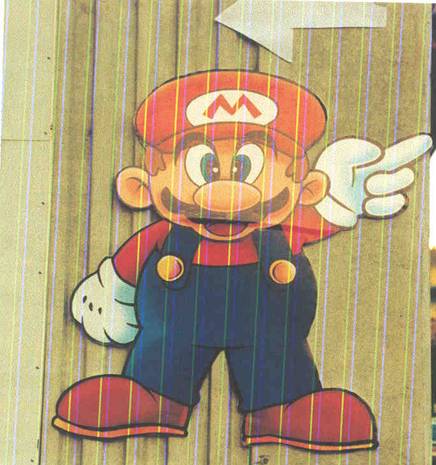
3 Nintendo says that these games are extremely well‑known and are some of the largest selling video games. It is said that they are famous as being Nintendo’s leading classic games and that they have a reputation as such with those retailers and consumers in Australia who have any association or dealings with video games. It is said that the character, Super Mario, is associated in the minds of retailers and consumers with Nintendo. The Super Mario character created by Nintendo is known by a number of physical or visual attributes. The character wears a baseball style cap with a capital “M” logo on the front of the crown in a distinctive font or style. It wears overalls and a T‑shirt. These colours may vary. It has boots, a large moustache and is described as having a portly physique. The representation of Super Mario produced in Court wears navy overalls and a red T‑shirt. It is in the following form:
4 The games in which Super Mario features involve him performing a number of physical activities. Nintendo says that he participates in these activities by way of confronting or challenging undesirable characters in the pursuit of good. The physical actions involve actions such as a punch, kick, jump kick, swing, side kick, hold and throw, side attack, pound the ground and trip. These actions are described in instruction booklets for the Super Mario game which accompany the games when sold. The Super Mario character created by Nintendo is also used by the applicants as a promotional tool, such as on business cards and at product launches where the character appears as a lifelike, three‑dimensional character.
5 Nintendo claims to own the copyright in the Super Mario video games and is the proprietor of numerous trademarks, including the names Mario, Mario Brothers, Super Mario Brothers and Doctor Mario pursuant to the provisions of the Trade Marks Act 1995 (Cth).
6 The first respondent, Mr Dominic Care, is a wrestler and the second respondent promotes wrestling bouts and performances. It was incorporated on 11 May 2000. The first respondent has created and promoted the personality “Da’ Super Mario”. One of the respondents (the evidence was not clear as to which respondent) registered the business name “Da’ Super Mario” pursuant to the provisions of the Victorian Business Names Act 1962 (vic) on 7 June 1999.
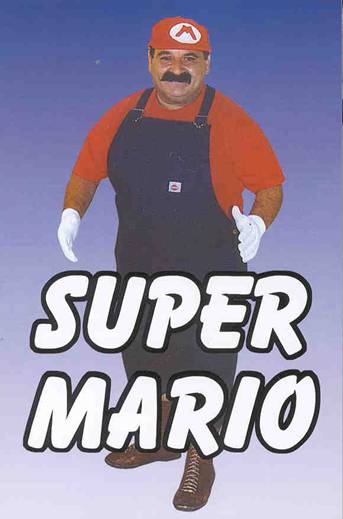
7 The applicants first became aware in August 1999 through an American Nintendo company that a wrestler in Australia was calling himself Super Mario and was presenting himself as such a character. The applicants obtained advertisements and posters promoting Super Mario in the form of a representation:
The applicants sent those advertisements and posters to the United States Nintendo company. In February 2000 the applicants were told by the United States Nintendo company to send letters of demand to the persons who were promoting Super Mario. Letters of demand were not sent until 18 July 2000. Correspondence thereafter ensued between the applicants’ solicitors and representatives of the respondents. The applicants sought formal undertakings from the respondents that they would cease promoting the Super Mario character. Although there were indications from the respondents that they would remove the character of Super Mario from future performances, no formal undertakings were given.
8 The second respondent told the solicitor for the applicants on 1 August 2000 that the second respondent would be “defrocking” Super Mario but no undertaking was given to that effect. At an Australian Championship Wrestling performance on 25 August 2000, it was announced that Da’ Super Mario would not be wrestling that night because he was in hospital as a result of a previous wrestling bout. On 29 September 2000 the first respondent appeared at a performance as the character Da’ Super Mario, although he did not appear in his Da’ Super Mario costume but was wearing casual clothes with an Australian Championship Wrestling cap. However, at that time there were promotional posters at the wrestling venue which depicted a number of wrestlers including a depiction of Da’ Super Mario in the form referred to in par 7 above.
9 On the hearing of the application, the first respondent appeared in person. He said he had been wrestling for 32 years and had been participating in wrestling shows for four years. In the course of his submissions he stated that he was not wrestling at the present time because he had sustained a heart attack and that he had no intention of going back into the wrestling ring for a year. He said that he would not use the get‑up or representation of Da’ Super Mario which he had previously used but that he wanted to use the name Da’ Super Mario in his capacity as a commissioner of Australian Championship Wrestling. In the course of his submission he said that the name Da’ Super Mario drew people to the venues. The first respondent said that if he did not use the name Da’ Super Mario he could still participate in promotions and wrestling events as a commissioner or as an official.
10 The applicants have submitted that there are serious questions to be tried in relation to the respondents’ use of the Da’ Super Mario character in three general areas:
· infringement of registered trademarks, with particular reliance on s 120(3) of the Trade Marks Act;
· the respondents are passing off their Da’ Super Mario character as associated with the applicants;
· use of the Da’ Super Mario character results in a false attribution of sponsorship, authorisation or affiliation with the applicants with the consequence that there are contraventions of ss 52, 53(c) and 53(d) of the Trade Practices Act 1974 (Cth).
11 The applicants submitted that the respondents have copied the applicants’ character image “Super Mario”. The respondents did not directly contest that proposition but appeared to be saying, through the first respondent, that they would not use the get-up of the Da’ Super Mario character hitherto used and that whenever the first respondent appeared in a wrestling context he would do so in different clothes. However, the first respondent made it clear that he wanted to use the name Da’ Super Mario and claimed to be entitled to do so by virtue of the business name registration. The respondents also put the matter of the applicants delay in seeking interlocutory relief in issue and I will return to that issue shortly.
12 I consider that there is a serious question to be tried in relation to the three areas upon which the applicants rely. The similarity in the get‑up of the applicants’ Super Mario character and the get-up of the respondents’ Da’ Super Mario character is visually demonstrable. I consider there is a serious question to be tried that what has occurred is that the respondents have copied the applicants Super Mario character. In this respect I place particular reliance upon the overalls and their colour, the white gloves, the T‑shirt and its colour, the cap with the letter “M” on it and the particular style or font of that letter. I consider that it is strongly arguable that the respondents are obtaining, and have set out to obtain, what the applicants described as a “free ride” on the reputation and the goodwill they have built up in the Super Mario character.
13 The evidence before me is such that I am satisfied that there is a serious question to be tried that the respondents have passed off their Da’ Super Mario character as and for, or associated with or otherwise identified with, the applicants’ Super Mario character. I consider also that there is a serious question to be tried that such activities of the respondents contravene ss 52 and 53 of the Trade Practices Act. On the evidence before me I am satisfied that there is a serious question that by using the Da’ Super Mario character in the way they have the respondents have represented that their character has either some authorisation by or association with the applicants: see generally Childrens TV Workshop Incorporated v Woolworths (NSW) Ltd [1981] 1 NSWLR 273, Hogan v Pacific Dunlop Ltd (1988) 12 IPR 225 and Twentieth Century Fox Film Corporation v South Australian Brewing Co Ltd (1996) 34 IPR 225.
14 I am satisfied that there is a basis for the applicants to complain (and therefore a serious question to be tried) that the respondents’ use of the Da’ Super Mario character is such as to give rise to an implication or inference of such authorisation and association. The closeness of the two characters, and the potential for some relationship between them, was demonstrated in one of the video recordings which was produced in evidence. In the course of one of those recordings, a wrestling bout was announced between Da’ Super Mario and another wrestler. As that bout was being introduced and Da’ Super Mario was coming into the wrestling ring, the recording showed one or two young people holding up what appeared to be a representation or image of the applicants’ Super Mario character.
15 There is also a serious question to be tried that there is likely to be a loss sustained by the applicants if the conduct complained of continues in the sense that damage may be done to its reputation and goodwill because of the association and authorisation which appears to arise.
16 There is a serious question to be tried in relation to the issue of trademark infringement. Although the respondents are applying the name “Da’ Super Mario” to goods which are different to those goods in respect of which the names are registered as trademarks, the applicants invoke the provisions of s 120(3) of the Trade Marks Act which provides:
“A person infringes a registered trade mark if:
(a) the trade mark is well known in Australia; and
(b) the person uses as a trade mark a sign that is substantially identical with, or deceptively similar to, the trade mark in relation to
(i) goods (‘unrelated goods’) that are not of the same description as that of the goods in respect of which the trade mark is registered (‘registered goods’) or are not closely related to services in respect of which the trade mark was registered (‘registered services’); or
(ii) services (‘unrelated services’) that are not of the same description as that of the registered services or are not closely related to registered goods; and
(c) because the trade mark is well known, the sign would be likely to be taken as indicating a connection between the unrelated goods or services and the registered owner of the trade mark; and
(d) for that reason, the interests of the registered owner are likely to be adversely affected.”
I consider there to be a serious question to be tried as to the issue of infringement of a number of the applicants’ trademarks because of the evidence before me as to the extent to which the trademarks which include the name Mario are well known in Australia: cf McDonald’s Corporation v Joburgers Drive‑Inn Restaurant (Pty) Ltd (1996) 36 IPR 11.
17 The respondents contended that they can use the name Da’ Super Mario because they have that name registered as a business name. However, that registration of itself gives the respondents no rights to the intellectual property in that name and that registration, of itself, is no defence to a claim for trademark infringement, the tort of passing off or contravention of s 52 or s 53 of the Trade Practices Act.
18 In circumstances where damage to or interference with reputation and goodwill in a product or a name is claimed, damages are usually not an adequate remedy. There is also the concern that if no interlocutory injunction is granted in relation to the use of the name, the applicants run the risk that at a final trial any continued use which has occurred in relation to that name might be used to support the proposition that the name has become more generally used in the community to the extent that final injunctive relief should not be granted: cf Koppamurra Wines Pty Ltd v Mildara Blass Ltd (1998) 41 IPR 154 at 158.
19 On the issue of whether damages are an adequate remedy for the applicants, I also take into account the fact that the second respondent has an issued and paid‑up capital of $2 only.
20 I am therefore satisfied that the applicants have overcome the first threshold required to be overcome on an application for interlocutory relief, that is that there is a serious question to be tried in respect of the matters to which I have referred.
21 I turn to the balance of convenience. For the applicants it was contended that the balance of convenience is in favour of the grant of an injunction because unless that occurs there will be a continuation of the impingement upon the reputation and goodwill which they have established in relation to their Super Mario character. If an injunction is not granted and the name is used and posters are displayed, the inference of relevant association or authorisation would be continued.
22 The respondents are apparently prepared not to use the get‑up and visual character of Da’ Super Mario of which complaint has been made, although they have not formally undertaken not to do so. The first respondent stated that because of his recent heart attack he would not be entering the wrestling ring for some twelve months. To that extent, any inhibition upon the first respondent using the get-up of Da’ Super Mario or using the name Da’ Super Mario would not affect any wrestling activities because they would not be occurring for some twelve months. However, the first respondent has been appointed, and wants to continue to be, the commissioner of Australian Championship Wrestling. He is still able to undertake that task and carry on those activities, even if he does not use Da’ Super Mario name as that character. However, as I understand the situation he still wishes to use that character in that capacity because that is the name by which he has been known in recent times and built up some reputation.
23 If injunctive relief was granted the posters and promotional cards, which are still in existence, would have to be altered. This would involve the respondents in incurring some costs, but they would be covered by any undertaking as to damages which was proffered. Overall, I am satisfied that the balance of convenience is in favour of the grant of injunctive relief.
24 It remains to consider the question of delay. Should the applicants be disentitled to injunctive relief because of the delay which has occurred in bringing this application for interlocutory relief?
25 The applicants first became aware of the existence of the Da’ Super Mario character in or about August 1999. Information was conveyed to the American Nintendo company in or about August 1999 or shortly thereafter and nothing seemed to occur until February 2000 when the applicants were instructed by the American company to send letters of demand to the interests who were involved with the Da’ Super Mario character. The delay between August 1999 and February 2000 has not been explained. Between February 2000 and June 2000 there was a further delay but that delay has been explained in part by the need for the applicants and their solicitors to be satisfied that the activities of the wrestler were being continued and to identify the particular parties involved. In this respect I note that the second respondent was only registered as a company on 11 May 2000, on which date the first respondent became a director of that company.
26 Between June 2000 and October 2000 there has been further delay but that delay has been explained by the solicitor for the applicants by reference to negotiations and discussions which occurred between the parties in relation to seeking to resolve the issues which had arisen and by the applicants seeking to obtain undertakings from the respondents which would be sufficient to obviate the necessity to have recourse to court proceedings. Delay of itself is not a disentitling factor: Wickham v Associated Pool Builders Pty Ltd (1986) 7 IPR 392 at 400. Nevertheless delay must be considered in the context of the circumstances which have occurred because if the delay has caused the respondents to alter their positions substantially in relation to the manner in which they have conducted their affairs, incurred liabilities, and incurred costs, that would be a matter to be taken into account in deciding whether or not interlocutory relief should be granted.
27 Although there has been delay, that delay does not appear to have caused the respondents to have acted substantially in a way which has resulted in prejudice if I am now to grant interlocutory relief. It does not appear that they incurred substantial costs in the interim period which will be thrown away if an interlocutory injunction is now granted. Nor does it appear that there will be a need for substantial alteration to their manner of carrying on their activities or presenting the structure of their activities or their business. Although costs may be incurred in having to prepare fresh posters or fresh promotional cards displaying the wrestlers for distribution, those costs would be well protected by an undertaking as to damages.
28 If the first respondent was still wrestling or wanting to wrestle at the present time I would have been concerned as to whether the delay should be a disentitling factor but because of his present health issue and the fact that he does not propose to wrestle for twelve months, I consider that the consequences of any delay are alleviated to that extent.
29 I am therefore satisfied that an interlocutory injunction should be granted restraining the respondents from using the Da’ Super Mario get‑up and presentation and the Da’ Super Mario name pending trial.
|
I certify that the preceding twenty-nine (29) numbered paragraphs are a true copy of the Reasons for Judgment herein of the Honourable Justice Goldberg. |
Associate:
Dated: 30 October 2000
|
Counsel for the Applicant: |
Mr G C McGowan |
|
|
|
|
Solicitor for the Applicant: |
Gadens Lawyers |
|
|
|
|
The First Respondent: |
Appeared in person |
|
|
|
|
Date of Hearing: |
25 October 2000 |
|
|
|
|
Date of Judgment: |
25 October 2000 |


