FEDERAL COURT OF AUSTRALIA
Wik Peoples v State of Queensland [2000] FCA 1443
McNAUGHT NGALLAMETTA ON HIS OWN BEHALF AND ON BEHALF OF THE WIK AND WIK WAY PEOPLES v STATE OF QUEENSLAND, COUNCIL OF THE SHIRE OF AURUKUN, NAPRANUM ABORIGINAL COUNCIL, PORMPURAAW ABORIGINAL COUNCIL, COOK SHIRE COUNCIL, PORTS CORPORATION OF QUEENSLAND, A NUMBER OF COMMERCIAL FISHING AUTHORITY HOLDERS AND CAPE YORK LAND COUNCIL
QG 6001 OF 1998
DRUMMOND J
3 OCTOBER 2000
CAIRNS
| IN THE FEDERAL COURT OF AUSTRALIA |
|
| QG 6001 OF 1998 |
| BETWEEN: | McNAUGHT NGALLAMETTA ON HIS OWN BEHALF AND ON BEHALF OF THE WIK AND WIK WAY PEOPLES APPLICANTS
|
| AND: | STATE OF QUEENSLAND COUNCIL OF THE SHIRE OF AURUKUN NAPRANUM ABORIGINAL COUNCIL PORMPURAAW ABORIGINAL COUNCIL COOK SHIRE COUNCIL PORTS CORPORATION OF QUEENSLAND A NUMBER OF COMMERCIAL FISHING AUTHORITY HOLDERS CAPE YORK LAND COUNCIL RESPONDENTS
|
| JUDGE: | |
| DATE OF ORDER: | |
| WHERE MADE: |
A. The applicants have brought Native Title Determination Application No QC94/3 (“the application”) which relates to an area which includes the land and waters the subject of the proposed determination.
B. The applicants, the State of Queensland, the Council of the Shire of Aurukun, the Pormpuraaw Aboriginal Council, the Napranum Aboriginal Council, the Cook Shire Council, the Ports Corporation of Queensland, a number of commercial fishing authority holders and the Cape York Land Council (“those parties”) have reached an agreement as to the terms of a determination of native title to be made in relation to particular land and waters.
C. Those parties have agreed to make application to the Federal Court of Australia for a consent order for a determination that native title exists in relation to the determination area, as defined in Schedule 1 to this Order.
D. Those parties have requested that the Court hear and determine separately that part of the proceeding that relates to the determination area.
E. No nomination pursuant to s 56(2) of the Native Title Act 1993 (Cth) in regard to the holding of native title in trust has been made.
F. McNaught Ngallametta, as the registered native title claimant, is in the process of seeking to incorporate, pursuant to the Aboriginal Councils and Associations Act 1976 (Cth), an Aboriginal association to be a prescribed body corporate and perform the functions mentioned in s 57(3) of the Native Title Act 1993 (Cth).
THE COURT ORDERS, DECLARES AND DETERMINES BY CONSENT THAT:
1. Native title exists in relation to the determination area.
2. The native title is held by the Wik and Wik Way peoples for their respective communal, group and individual rights and interests in the determination area in accordance with the traditional laws acknowledged and traditional customs observed by them (“the native title holders”) as common law holders.
3. The nature and extent of the native title rights and interests in relation to the determination area are that, subject to Orders 4 and 5, they confer possession, occupation, use and enjoyment of the determination area on the native title holders and, in particular, include rights, duties and responsibilities to do the following:
(a) speak for, on behalf of and authoritatively about the determination area and assert proprietary and possessory claims over the determination area;
(b) inherit and transmit the native title rights and interests;
(c) give or refuse, and determine the terms of any, permission to enter, remain on, use or occupy the determination area by others;
(d) as between Aboriginal people:
(i) resolve disputes about who is or who is not a Wik person or a Wik Way person;
(ii) determine as between native title holders what are the particular native title rights and interests that are held by particular native title holders in relation to particular parts of the determination area;
(iii) exclude particular native title holders from the exercise of particular native title rights and interests in relation to particular parts of the determination area;
(iv) resolve disputes between Aboriginal people concerning native title rights and interests in relation to the determination area, with the assistance of native title holders of adjoining areas where such assistance is necessary;
(v) uphold, regulate, monitor and enforce the customary laws of the native title holders in relation to the native title rights and interests in the determination area;
(e) make use of the determination area by:
(i) engaging in a way of life consistent with the traditional connection of the native title holders to the determination area;
(ii) physically occupying, using and enjoying the determination area;
(iii) living on and erecting residences and other infrastructure on the determination area;
(iv) protecting, managing and using the determination area;
(v) being buried on, and burying native title holders on, the determination area;
(f) take, use and enjoy the natural resources from the determination area for the purposes of:
(i) manufacturing artefacts, objects and other products;
(ii) disposing of those natural resources and manufactured items, by trade, exchange or gift save that the right of disposal of natural resources taken from the waterways (as that term is defined in the Fisheries Act 1994 (Qld) as at the date of this determination) of the determination area is only a right to do so for non-commercial purposes;
(g) maintain and protect places of importance under traditional laws, customs and practices in the determination area;
(h) be acknowledged as the traditional Aboriginal owners of the land and waters within the determination area;
(i) use and enjoy the determination area and its natural resources for the purposes of teaching, determining, maintaining, communicating and expanding cultural, social, natural, environmental, spiritual, cosmological and other knowledge, traditions, beliefs, customs, relationships, practices and institutions in relation to the determination area so as to ensure the continuing vitality of the culture and well-being of the native title holders, and
also include those rights, duties and responsibilities that are necessary for or ancillary to the full exercise and enjoyment of the native title and the native title rights and interests.
4. The native title rights and interests are and the native title is subject to and exercisable in accordance with:
(a) the laws of the State and the Commonwealth; and
(b) traditional laws acknowledged and traditional customs observed by the native title holders.
5. Notwithstanding anything in this determination, in respect of tidal and flowing water the native title rights and interests only confer on the native title holders such rights and obligations as the common law recognises.
6. The nature and extent of any other interests in relation to the determination area are:
(a) the rights and interests of the lessee and others under the Lease (Aboriginal Lands) No. 1 dated 18 January 1979 comprising the land and waters in Lot 1 on Plan SC211 (“the Lease”);
(b) the rights and interests of the grantee and others under the Deed of Grant in Trust dated 23 July 1987, being indefeasible Title Reference No 21345063 in respect of the land and waters delineated in Plan LK2;
(c) any rights and interests of a holder of an authority issued under the Fisheries Act 1994 (Qld) that authorises a commercial fishing operation in the waters of the determination area as may be current at the date of this determination;
(d) any other rights and interests held by or under the Crown by the force and operation of the laws of the State or the Commonwealth as may be current at the date of this determination.
7. The relationship between the native title rights and interests and the other rights and interests described in Order 6 is that:
(a) the other rights and interests continue to have effect and the rights conferred by or held under the other rights and interests may be exercised notwithstanding the existence of the native title rights and interests; and
(b) the other rights and interests and an activity done in exercise of the rights conferred by or held under the other rights and interests prevail over the native title rights and interests and any exercise of those native title rights and interests.
8. The native title rights and interests confer, subject to Orders 4 and 5, possession, occupation, use and enjoyment of the determination area on the native title holders to the exclusion of all others, except those having rights and interests identified in Order 6.
9. In the event at any time that that part of the determination area comprising the area covered by the waters of the Archer River seaward of the area referred to in paragraph (d) of the definition of “Determination Area”, cease to be subject of the Lease, then the native title shall be subject to a right of ingress and egress by the Council of the Shire of Aurukun or any successor in title or function, for itself and for its servants or agents, by barge over the said waters for the purpose of transporting materials, provisions and supplies for the residents of Aurukun, the native title holders and as may be required by the Council of the Shire of Aurukun for the performance of its powers and functions.
10. The words and expressions used in this determination have the same meanings as they have in Part 15 of the Native Title Act 1993 (Cth) except for the following defined words and expressions:
“natural resources” means:
(a) plant, animal, fish, bird, amphibian, reptile, insect life, and any other flora and fauna, and shells and forest products found on, or in the lands and waters of the determination area from time to time, and water, flints, clays, soil, sand, gravel and rock on or below the surface of the determination area and all other matter comprising the determination area;
but does not include:
(b) minerals as defined in the Minerals Resources Act 1989 (Qld) and petroleum as defined in the Petroleum Act 1923 (Qld);
“fauna” has the meaning attributed to it in the Fauna Conservation Act 1974 (Qld);
“fish” has the meaning attributed to it in the Fisheries Act 1994 (Qld);
“forest products” has the meaning attributed to it in the Forestry Act 1959 (Qld); and
“laws of the State and the Commonwealth” means the common law and the laws of the State and the Commonwealth of Australia, and includes regulations, statutory instruments, local government schemes and by-laws.
THE COURT FURTHER ORDERS THAT:
11. The native title is not to be held in trust.
12. Within six months of the date of this order the registered native title claimant is to nominate in writing given to the Federal Court of Australia a prescribed body corporate to:
(a) be the prescribed body corporate for the purposes of s 57(2) of the Native Title Act 1993 (Cth); and
(b) perform the functions mentioned in s 57(3) of the Native Title Act 1993 (Cth) after becoming a registered native title body corporate,
as to which there is liberty to apply.
13. In the event that there is no nomination within the time specified in accordance with Order 12 or such later time as the Court may order, the applicants shall forthwith apply to the Court for further orders.
14. Until such time as there is a registered native title body corporate in relation to the determination area any notices required under the Native Title Act 1993 (Cth) or otherwise to be served on the native title holders, the native title claim group or the registered native title claimant may be served upon the solicitors for the applicants and the representative Aboriginal body for the determination area, and such service shall be deemed to be sufficient.
Note: Settlement and entry of orders is dealt with in Order 36 of the Federal Court Rules.
| IN THE FEDERAL COURT OF AUSTRALIA |
|
| QG 6001 OF 1998 |
| JUDGE: | |
| DATE: | |
| PLACE: |
REASONS FOR JUDGMENT
1 I have before me today an application for a consent determination in respect of part of the lands the subject of the native title claim brought on behalf of the Wik and Wik Way peoples (“the Wik peoples”). It is worth noting that, for present purposes, the proceeding commenced with an application filed under the Native Title Act 1993 (Cth) on behalf of the Wik peoples in March 1994. Shortly thereafter, the National Native Title Tribunal gave public notification of the claim and by early September 1994, the Tribunal had commenced mediation. There things seemed to have come to something of an impasse for a very long period of time.
2 It was not until late last year that it appeared that a partial resolution by agreement of the claim might be achievable. Things moved along through the present year and ultimately I ordered that the Wik peoples claim be heard in two separate parts. It is the first of those parts, called Part A, which is the subject of the hearing today.
3 Part A involves, in addition to the Wik peoples as claimants, eight respondent parties. The other part of the claim which is yet to be determined, Part B, involves a total of twenty-three parties, including the nine involved in today’s matter. The case is complicated enough, but it is by no means the most complex native title case before the Court. The lands in Part A with which we are concerned today are confined to lands that have always been unallocated Crown lands or lands that have only ever been subject to forms of title granted for the benefit of Aboriginal peoples. That is subject to the qualification that there are interests in inland waters held by a small number of fishermen under permits issued under the Queensland fisheries legislation.
4 The lands in Part A do not include any lands the subject of pastoral or mining titles. It is Part B of the Wik peoples claim that contains lands held under seven pastoral and four mining titles. The determination today deals only with the simplest part of the Wik peoples claim, yet it has taken six and a half years to achieve this limited result. To date, the widely held view has been that the only practicable pathway for resolving the mass of native title claims before the Court is by negotiated outcomes. Yet the practicability of negotiation must be put into serious question when issues before the Court today that are relatively uncomplicated in comparison with many of the issues in the balance of the Wik peoples claim, and in the large number of other native title cases in the Court, have taken so long to be brought to an agreed result.
5 I still accept, at least for the moment, that an agreed resolution of the balance of the Wik peoples claim is preferable to a Court-imposed result. That is so because that is more likely to provide a more useful framework than a court decision limited to specific issues for dealing with the resolution of conflicting interests of the Wik peoples and particularly the pastoralists over the specific access and usage questions that are likely to arise in the future.
6 But the Court cannot allow the remainder of the Wik peoples claim to be the subject of yet more protracted negotiations. The cost benefits of such a negotiated resolution of a case, if that is ultimately achievable, in comparison with the costs of a Court-imposed decision are likely to be largely illusory. The uncertainty for all with interests in the Wik peoples lands, if allowed to continue for any extended further period, is unacceptable both to the public interest and to the interest of all the parties involved in this litigation.
7 Long continued uncertainty may well destroy the willingness of the Wik claimants themselves and of one or more of the various respondents to engage in the process of compromising, by giving up part of what each considers to be their full legal rights, that is essential if there is to be an agreed rather than a Court-imposed result.
8 I regret I cannot agree with everything that has fallen from the Crown Solicitor. Today’s determination is, in my opinion, not so much a cause for celebration by the Wik peoples as an occasion for all parties to this still unresolved case - the Wik peoples, the State of Queensland, the Commonwealth of Australia, the pastoralists and the miners - to resolve anew to co-operate with each other in an endeavour to achieve much more quickly than Part A of the claim has been resolved, a mutually acceptable accommodation of their various interests, though this may require each to give up part of what they may consider to be their full legal entitlements.
9 It is worthy of note that litigation rarely results in the complete vindication of the position of any one party. Much more commonly the Court, after having the opportunity to hear and consider all the evidence from all the parties, comes to the conclusion that there is at least some merit in the arguments put forward by each party. Few litigants win 100 per cent of their cases. I do not expect native title litigation to be any different in this respect.
10 All the Court can do today, it being satisfied as to the propriety of so acting, is to make determinations and orders in accordance with the draft determination Exhibit 1. There will be orders and declarations accordingly.
11 As I have said, further time must be allowed to the parties to Part B of the claim to try to reach a negotiated settlement, but the parties should anticipate that period will be measured in months rather than years. If a settlement cannot be reached promptly, the Court will consider fixing a date for the start in the first half of 2002 of the trial. This will require directions for the exchange of pleadings, and evidence to be given in about the middle of the coming year, 2001, at the latest. Prima facie, it is the Tribunal, rather than a Court appointed or a privately agreed mediator, who should have the opportunity to try to bring the parties to a final resolution of the outstanding claim. To enable the Court to have an informed opinion on the likely prospects of a prompt settlement of Part B of the claim, I intend to seek more frequent reports from the Tribunal as to the progress of mediation of the outstanding issues than has hitherto been done.
12 Initially, I will direct, pursuant to s 86E the Native Title Act 1993 (Cth), that the Tribunal, which no doubt has accumulated fairly extensive information about the positions of all the parties, provide the Court with a report by 16 November 2000 setting out what it considers, after discussions with all parties, to be a practicable program for attempting to mediate to an agreed resolution Part B of the Wik peoples claim.
13 The Tribunal, in preparing this program, will bear in mind that, unless it is apparent by mid 2001 that there are good grounds for thinking that a settlement of all of the issues in Part B will be achieved in the latter half of 2001, the Court will give directions in about mid 2001 designed to make sure that the case will come to trial in the first half of 2002.
| I certify that the preceding thirteen (13) numbered paragraphs are a true copy of the Reasons for Judgment herein of the Honourable Justice Drummond. |
Associate:
Dated: 12 October 2000
| Solicitor for the Applicants: | Ebsworth & Ebsworth |
| | |
| Counsel for the State of Queensland: | Mr C Lohe |
| | |
| Solicitor for the State of Queensland: | Crown Solicitor |
| | |
| Solicitor for the Cape York Land Council: | Ms Goodchild |
| | |
| Solicitor for the Pormpuraaw Aboriginal Council: | Farrallys Solicitors |
| | |
| Solicitor for the Napranum Aboriginal Council: | Suzette Coates |
| | |
| Solicitor for the Aurukun Shire Council: | Bottoms English |
| | |
| Queensland Seafood Industry Association | No appearance |
| | |
| Date of Hearing: | 3 October 2000 |
| | |
| Date of Judgment: | 3 October 2000 |
| IN THE FEDERAL COURT OF AUSTRALIA |
|
| QUEENSLAND DISTRICT REGISTRY | QG 6001 OF 1998 |
| BETWEEN: | McNAUGHT NGALLAMETTA ON HIS OWN BEHALF AND ON BEHALF OF THE WIK AND WIK WAY PEOPLES APPLICANTS
|
| AND: | STATE OF QUEENSLAND COUNCIL OF THE SHIRE OF AURUKUN NAPRANUM ABORIGINAL COUNCIL PORMPURAAW ABORIGINAL COUNCIL COOK SHIRE COUNCIL PORTS CORPORATION OF QUEENSLAND A NUMBER OF COMMERCIAL FISHING AUTHORITY HOLDERS CAPE YORK LAND COUNCIL RESPONDENTS
|
SCHEDULE 1
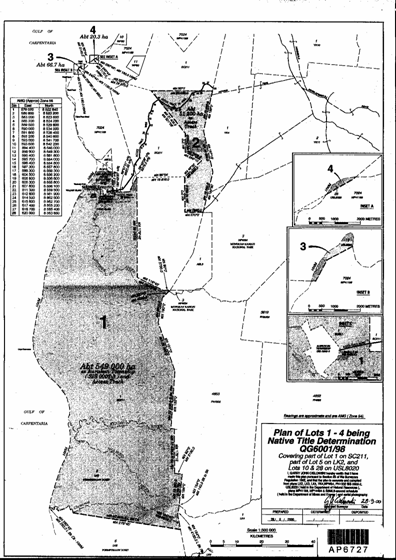
“Determination Area” is the land and waters within the area described and shown on the plan in Annexure 1 and includes:
(a) the land and waters inland of the high water mark at mean Spring tide of the main sea of the Gulf of Carpentaria;
(b) the land and waters inland of lines drawn at such high water mark across the mouth of the bays, creeks and rivers of that area including but not limited to Archer Bay, Ward River, Watson River, Archer River, Love River, Kirke River, Knox Creek, Kendall River, Holroyd River (known locally as South Kendall River), Hersey Creek (known locally as Thugu or Thuuk River) and Christmas Creek (known locally as Holroyd River);
and also includes:
(c) only such airspace over the land and waters and such subsoil under the land and waters as is necessary for the full exercise and enjoyment of the native title and the native title rights and interests;
but does not include:
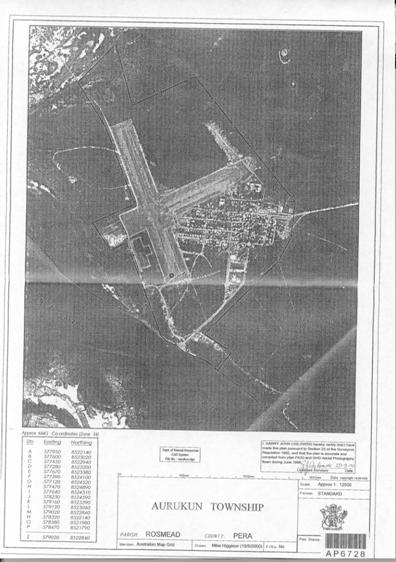
(d) the land and waters in and around the town of Aurukun within the area described in and shown on the aerial photograph and plan in Annexure 2;
(e) the land and waters within the area covered by a corridor 15 metres either side of the centre line of the present alignment of the existing road which connects the town of Aurukun to the Peninsula Development Road, commencing at point Z on the aerial plan in Annexure 2 and continuing on the present alignment of the existing road in an easterly and north-easterly direction to the junction of that road with the Peninsula Development Road as shown on the plan in Annexure 1; and
(f) minerals as defined in the Minerals Resources Act 1989 (Qld) or petroleum as defined in the Petroleum Act 1923 (Qld).