FEDERAL COURT OF AUSTRALIA
Bright v Femcare Ltd [2000] FCA 1344
PRACTICE AND PROCEDURE – representative proceeding under Pt IVA of the Federal Court of Australia Act 1976 (Cth) in which defences have not yet been filed, motions seeking orders under s 33N of the Act that the proceeding not continue as a representative proceeding have been foreshadowed, and opt out notices have not yet been given – subpoenas issued to ten public hospitals which are strangers to the litigation – application by the hospitals for orders setting aside the subpoenas in whole, or striking out certain paragraphs of each, or forbidding access to any documents produced in answer thereto – evidence that the process of identifying and extracting the documents for the purpose of complying with the subpoenas would be burdensome and time consuming for the hospitals – relevance, in determining whether the burden of complying with a subpoena issued to a stranger to a proceeding under Pt IVA is oppressive, that the stranger owes an obligation of confidence to other persons in respect of information contained in certain of the documents which the subpoena would require to be produced which would, at this particular stage of the proceeding, be protected by an order forbidding access to those documents – relevance of the fact that that information may be required to give appropriate opt out notices to class members – relevance of the fact that information contained in certain of the documents which the subpoena would require to be produced, other than that in respect of which the obligation of confidence exists, might be relevant to the determination of any motion seeking an order under s 33N
Federal Court of Australia Act 1976 (Cth), Pt IVA
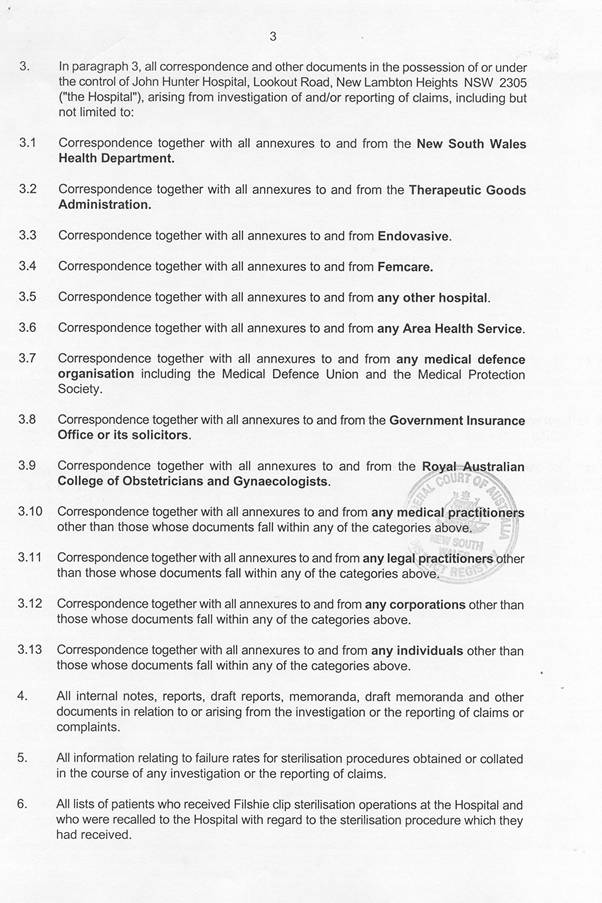
Waind v Hill [1978] 1 NSWLR 372, distinguished
KERRIE BRIGHT v FEMCARE LIMITED and ENDOVASIVE PTY LIMITED
N 410 OF 1999
LEHANE J
8 SEPTEMBER 2000
SYDNEY
|
IN THE FEDERAL COURT OF AUSTRALIA |
|
|
|
|
BETWEEN: |
KERRIE BRIGHT APPLICANT
|
|
AND: |
FEMCARE LIMITED FIRST RESPONDENT
ENDOVASIVE PTY LIMITED (ACN 061 512 132) SECOND RESPONDENT
|
|
JUDGE: |
LEHANE J |
|
DATE OF ORDER: |
8 SEPTEMBER 2000 |
|
WHERE MADE: |
SYDNEY |
THE COURT ORDERS THAT:
1. Paragraphs 1.2, 1.3, 2.3, 3.5, 3.7, 3.8, 3.9, 3.10, 3.11, 3.12, 3.13, 4, 5 and 6 of the subpoenas issued by the applicant on 7 July 2000 to Hornsby Hospital, King George V Hospital, John Hunter Hospital, Pambula Hospital, Tweed Heads Hospital, Westmead Hospital, Nepean Hospital, Bowral District Hospital, Windsor Hospital and the Royal Hospital for Women (“the public hospitals”) be struck out, and that paragraph 2 of each subpoena be amended by omitting the words “In the following paragraphs” and replacing them with the words “In paragraph 3.”
2. The applicant serve on each of the public hospitals (by serving the solicitors who represented them at today’s hearing) a copy of these orders, and annex thereto a revised Schedule to the relevant subpoena, amended in accordance with these orders.
3. The applicant pay the public hospitals’ costs of their motion dated 7 September 2000, but limited, as to the costs of the hearing of the motion, to 50 per cent of their costs of that hearing.
4. Each of the subpoenas addressed to the public hospitals be stood over until 10 October 2000 for production of documents, in the Registry, in accordance with the amended subpoenas.
5. The parties may have access to and uplift for the purposes of photocopying any documents produced by the public hospitals in answer to the amended subpoenas at the expiry of five business days from the time at which the documents are produced.
6. The public hospitals and the parties have liberty to apply to the Court on two days’ notice for the purpose of seeking orders in relation to any documents produced by the public hospitals in answer to the amended subpoenas.
7. The public hospitals have liberty to apply to the Court on two days’ notice for an order for compensation in respect of the cost of producing the documents in answer to the amended subpoenas.
Note: Settlement and entry of orders is dealt with in Order 36 of the Federal Court Rules.
|
IN THE FEDERAL COURT OF AUSTRALIA |
|
|
BETWEEN: |
KERRIE BRIGHT APPLICANT
|
|
AND: |
FEMCARE LIMITED FIRST RESPONDENT
ENDOVASIVE PTY LIMITED (ACN 061 512 132) SECOND RESPONDENT
|
|
JUDGE: |
|
|
DATE: |
|
|
PLACE: |
REASONS FOR JUDGMENT
1 Ten New South Wales public hospitals seek, by notice of motion dated 7 September 2000 and filed in Court on 8 September, orders setting aside a subpoena for production of documents served on each of them, orders in the alternative that certain paragraphs of each subpoena be struck out and, in the further alternative, an order that access not be granted to documents produced to the Court in response to any of the subpoenas.
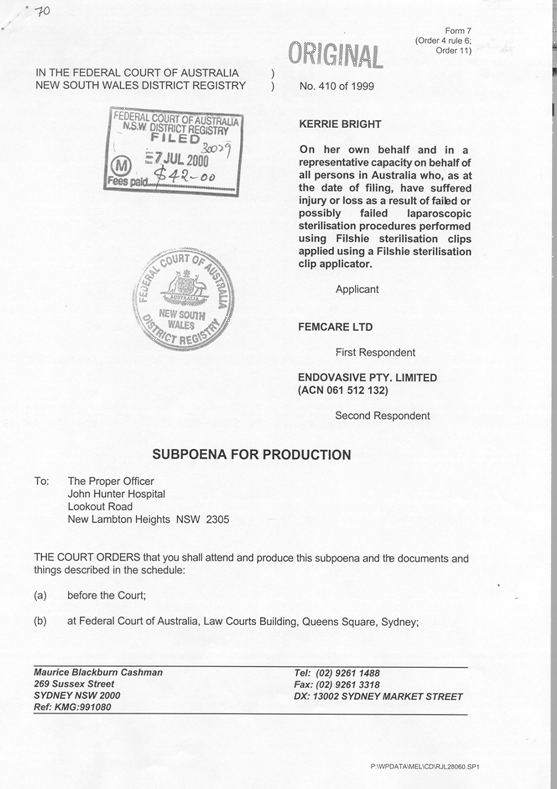
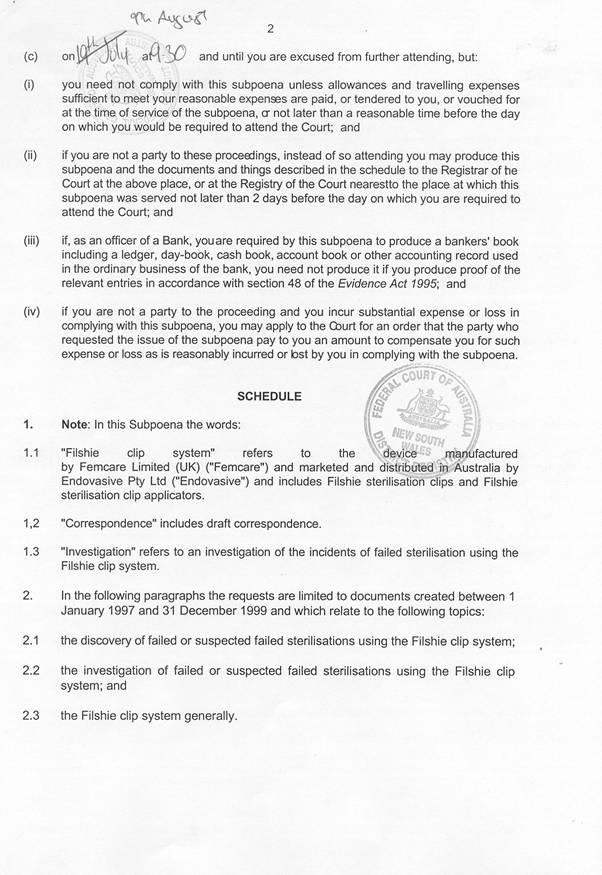
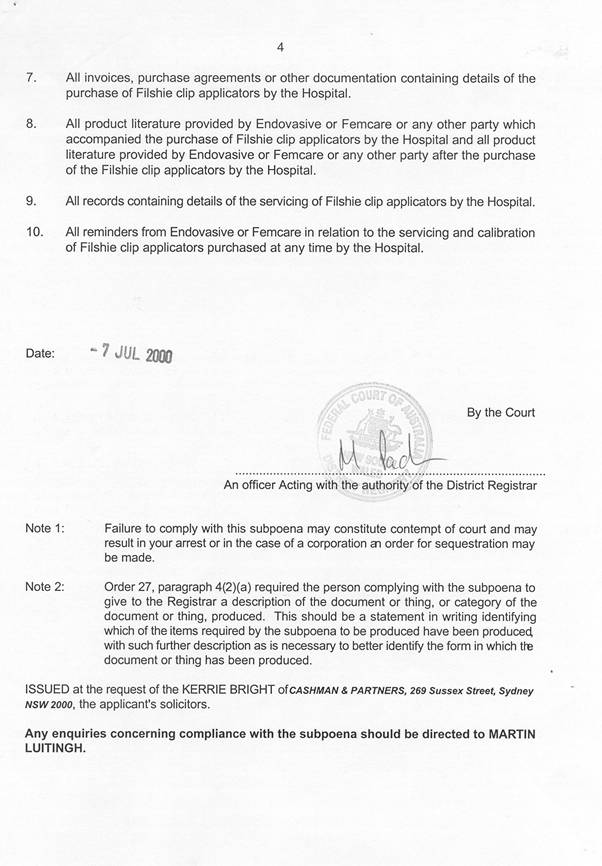
2 Although the subpoenas are directed to each of the public hospitals by name, for example Hornsby Hospital and King George V Hospital, it may be that more correctly they should be addressed in each case to an Area Health Service. Nothing, however, turns on that and I need not refer to that aspect of the matter again. The subpoenas are all in identical terms. A copy of one of them is annexed to these reasons.
3 In the light of submissions made by senior counsel for the hospitals, the applicant offered to make certain amendments to and omissions from the subpoenas. It is convenient to refer to those amendments and omissions by reference to the numbered paragraphs of the subpoenas. The offered deletions are pars 1.2, 2.3, 3.5, 3.10, 3.11, 3.12, 3.13 and 5. In addition, by way of clarification, senior counsel for the applicant has suggested that in place of the words “the following paragraphs”, at the beginning of par 2, there should be inserted the words “in paragraphs 3 and 4”.
4 Although senior counsel for the hospitals did not expressly say so in terms, I think the alterations which I have just listed, if made, would at least substantially remove the first of the objections of the hospitals to the form of subpoena, based on Commissioner for Railways v Small (1938) 38 SR (NSW) 564 at 573. That objection was to the effect that the form of subpoena would require each hospital to form a judgment as to which documents fell within the terms of the subpoena, as a matter of construction, and then to ransack its records for the documents concerned. The effect of the subpoena, as it would emerge with the amendments suggested, would be to require, of each hospital, production of certain documents relating to the discovery or investigation of failed, or suspected failed, sterilisations using the Filshie clip system, being documents created between 1 January 1997 and 31 December 1999. Those documents would include correspondence with the New South Wales Health Department, with the Therapeutic Goods Administration, with each respondent, with any Area Health Service, with medical defence organisations, with the Government Insurance Office, or with the Royal Australian College of Obstetricians and Gynaecologists. The subpoena would also require production of notes, reports, memoranda etc relating to, or arising from, the investigation or reporting of claims or complaints falling within the description in par 2: that is, claims or complaints concerning failed, or suspected failed, sterilisations or their discovery or investigation. Again, the documents required would be those created between 1 January 1997 and 31 December 1999. The subpoena would also require, without limitation as to time, lists of patients who underwent Filshie clip sterilisation operations at the hospital and who were recalled to the hospital with regard to the sterilisation procedure which they had undergone. The remaining paragraphs of the subpoena would require production of various documents relating to the purchase of Filshie clip applicators by the hospital concerned, product literature which accompanied the purchase or was provided afterwards, service records and service reminders: those paragraphs, also unlimited as to the dates of creation of the relevant documents, are not controversial.
5 It can be seen that a subpoena amended in the manner suggested by the applicant would require the production of files, or at least documents extracted from files, relating to procedures performed on patients in each hospital using Filshie equipment. The paragraphs concerned are, I think, certainly par 4 and par 6 and probably also par 3.7 and par 3.8. It is in that context that I consider the remaining submissions made on behalf of the hospitals.
6 Those submissions relied upon two propositions: first, that the subpoenas were, by reason of the nature and quantity of the documents required to be produced, oppressive (at least as to certain of the hospitals); and, secondly, that the information was of a peculiarly confidential nature so that documents disclosing it not only ought not be made available for inspection but ought not be required to be produced.
7 The evidence as to oppression was given in affidavit form by Ms Geraldine Wylie, a solicitor instructed to act on behalf of the hospitals. Her evidence was based on information she had been given by personnel in the medical records departments of certain of the hospitals; so much emerged in cross‑examination concerning the volume of material which it would be necessary to examine and the process which hospitals would need to engage in for the purposes of identifying the documents required to be produced. For some hospitals she gave an estimate, based on information from the same sources, of the amount of time likely to be required in order fully to comply with the subpoenas. The information to which Ms Wylie deposed related to five only of the hospitals: Hornsby, King George V, Westmead, Nepean and the Royal Hospital for Women. There was no evidence in relation to the other five hospitals as to what, particularly, compliance with the subpoenas would involve.
8 There are two other aspects of Ms Wylie’s evidence which ought to be mentioned. One is that it concentrated, for each of the hospitals with which she dealt, on the process of identifying and extracting patient files, not other documents. Secondly, her evidence was that the process would be, on the information she had been given, a very time consuming one: for example, up to four months in the case of King George V Hospital and three months in the case of the Nepean Hospital. Cross‑examination revealed that those estimates were not based upon any detailed information, but I think I should accept that the process of identifying and extracting the documents would be a burdensome and time consuming one for the hospitals concerned.
9 Senior counsel for the applicant submitted that the confidential nature of any of the documents sought was irrelevant to the claim that the subpoenas were oppressive. That submission was based on the decision of the New South Wales Court of Appeal in Waind v Hill [1978] 1 NSWLR 372, especially at 383. Moffitt P, with whom the other members of the Court agreed, expressed the view that questions of confidence arise not at the point where a party subpoenaed seeks to set aside a subpoena but at the point where the Court considers an application by parties to inspect documents produced in answer thereto.
10 In general terms, of course, the submission made by senior counsel for the applicant is correct. So, in general terms, is a further submission to the effect that mere expense and trouble involved in complying with the subpoena, even if considerable, is not necessarily oppressive: there is provision (see FCR O 27 r 4A) for compensation to be paid to the person to whom the subpoena is directed.
11 But the propositions relied on are propositions which, though generally true, are not necessarily, in my view, universally so. It should not, I think, come as a surprise if, in a novel class of case, there are matters which must be taken into account when considering whether a subpoena should be set aside which do not ordinarily arise in more conventional litigation. Thus, in this case the applicant has commenced a proceeding under the Pt IVA of the Federal Court of Australia Act 1976 (Cth) on behalf of what may be a great number of women, the identity of most of whom is unknown, who have undergone sterilisation procedures. Defences have not yet been filed; motions seeking orders under s 33N of the Act have been foreshadowed; and opt out notices have not yet been given. In those circumstances, in my opinion, it is highly unlikely that the Court would countenance the disclosure of information, not only of a confidential but also of a very personal kind, concerning women, some – perhaps many – of whom ultimately, for one reason or another, may not be represented by the applicant in this proceeding.
12 If compliance with the subpoena addressed to it places, in any event, a substantial burden on a hospital, it is relevant, in my view, in deciding whether the burden is oppressive, that documents sought are subject to an obligation of confidence on the part of the hospital, itself a stranger to the litigation, in favour of other persons: an obligation which, at the present stage of proceedings, would, in my view, almost certainly be protected by an order forbidding inspection. It was said on behalf of the applicant that the documents might, before the inspection, be “anonymised” and that information as to hospitals where failed sterilisations had occurred, and in what numbers that had happened, may well be relevant to any application under s 33N. It was said also that, in order to give appropriate notice to class members, to enable those who wish to do so to opt out, it may be necessary to ascertain their names and addresses so that notice may be given, so far as possible, to each individual potential group member.
13 But careful anonymisation would, I have no doubt, add yet a further considerable burden. And I am, in any case, unconvinced that the information reasonably necessary at this stage of the proceeding could not be obtained from documents produced under a more limited and less burdensome subpoena. Now is not the time, in my view, to make a decision about the appropriate manner of giving an opt out notice. Generally, in my opinion, a cautious and staged approach has much to commend it in litigation of this kind.
14 To give effect to those considerations I would strike out, in addition to the matters conceded by senior counsel for the applicant, pars 3.7, 3.8, 3.9, 4 and 6 of each subpoena. I will also strike out par 1.3 which seems to have no role, given the terms of par 2, other than to confuse. If counsel's suggestion in relation to the opening words of par 2 were adopted (and the cross‑reference, given that par 4 is struck out, were limited to par 3), pars 7 to 10 would not be subject to the temporal limitation: I am informed, however, that the hospitals do not object to that. Consequently, par 2 should be amended in that way.
15 Finally, as is implicit in what I have said, I see no reason why there should be any general restriction on access to documents which may be produced under a subpoena limited to what I may call the surviving paragraphs. There may be particular objections take by hospitals in relation to particular documents. Otherwise, I hope that the parties (a term in which I include the hospitals for present purposes) will be able to deal with questions of inspection, having regard to orders I have already made, and my reasons for them, in relation to documents produced under other subpoenas.
16 [After discussion as to the appropriate form of the orders to give effect to these reasons, the following orders were made:]
1. Paragraphs 1.2, 1.3, 2.3, 3.5, 3.7, 3.8, 3.9, 3.10, 3.11, 3.12, 3.13, 4, 5 and 6 of the subpoenas issued by the applicant on 7 July 2000 to Hornsby Hospital, King George V Hospital, John Hunter Hospital, Pambula Hospital, Tweed Heads Hospital, Westmead Hospital, Nepean Hospital, Bowral District Hospital, Windsor Hospital and the Royal Hospital for Women (“the public hospitals”) be struck out, and that paragraph 2 of each subpoena be amended by omitting the words “In the following paragraphs” and replacing them with the words “In paragraph 3.”
2. The applicant serve on each of the public hospitals (by serving the solicitors who represented them at today’s hearing) a copy of these orders, and annex thereto a revised Schedule to the relevant subpoena, amended in accordance with these orders.
3. The applicant pay the public hospitals’ costs of their motion dated 7 September 2000, but limited, as to the costs of the hearing of the motion, to 50 per cent of their costs of that hearing.
4. Each of the subpoenas addressed to the public hospitals be stood over until 10 October 2000 for production of documents, in the Registry, in accordance with the amended subpoenas.
5. The parties may have access to and uplift for the purposes of photocopying any documents produced by the public hospitals in answer to the amended subpoenas at the expiry of five business days from the time at which the documents are produced.
6. The public hospitals and the parties have liberty to apply to the Court on two days’ notice for the purpose of seeking orders in relation to any documents produced by the public hospitals in answer to the amended subpoenas.
7. The public hospitals have liberty to apply to the Court on two days’ notice for an order for compensation in respect of the cost of producing the documents in answer to the amended subpoenas.
|
I certify that the preceding sixteen (16) numbered paragraphs are a true copy of the Reasons for Judgment herein of the Honourable Justice Lehane. |
Associate:
Dated: 18 September 2000
|
Counsel for the Applicant: |
A J L Bannon SC J R Clarke |
|
|
|
|
Solicitor for the Applicant: |
Maurice Blackburn Cashman |
|
|
|
|
Counsel for the public hospitals: |
P R Garling SC S Davis |
|
|
|
|
Solicitor for the public hospitals: |
GIO Australia Ltd |
|
|
|
|
Date of Hearing: |
8 September 2000 |
|
|
|
|
Date of Judgment: |
8 September 2000 |
ANNEXURE A