

FEDERAL COURT OF AUSTRALIA
Aristocrat Leisure Industries Pty Ltd v Pacific Gaming Pty Ltd [2000] FCA 1273
intellectual property – copyright – whether written specifications for the operation of poker machines could be original literary works – whether the specifications were a product of the applicant’s work, or simply reflected a common industry standard
INTELLECTUAL PROPERTY – copyright – dramatic works - whether written specifications for the operation of poker machines could constitute original dramatic works – whether the video display could constitute a cinematograph film
INTELLECTUAL PROPERTY – copyright – infringement – whether respondent’s poker machines infringed the applicant’s copyright in the written specifications for its poker machines – where the games were substantially similar – where the respondent pursued a policy of collecting and analysing competitors’ games
WORDS AND PHRASES – “scenario” - “choreography”- “cinematograph film” - “dramatic work”
Copyright Act 1968 ss 10(1), 13 and 31
Olympic Amusements Pty Limited v Milwell Pty Limited (1998) 81 FCR 403 cited
Exxon Corporation v Exxon Insurance Consultants International Ltd [1982] Ch 119 cited
Computer Edge Pty Limited v Apple Corporation Inc (1986) 161 CLR 171 cited
Ladbroke (Football) Ltd v William Hill (Football) Ltd [1964] 1 WLR 273 cited
Sega Enterprises Ltd v Galaxy Electronics Pty Ltd (1996) 69 FCR 269 distinguished
Galaxy Electronics Pty Ltd v Sega Enterprises Ltd (1977) 75 FCR 8 distinguished
Australasian Performing Rights Association Ltd v Telstra Corp Ltd (1995) 131 ALR 141 cited
Nintendo Co Ltd v Golden China TV-Game Centre (1993) 28 IPR 313 distinguished
Copinger & Scone James On Copyright 14th ed. 1999
ARISTOCRAT LEISURE INDUSTRIES PTY LIMITED v
PACIFIC GAMING PTY LIMITED
NG 1049 OF 1998
TAMBERLIN J
SYDNEY
8 SEPTEMBER 2000
|
IN THE FEDERAL COURT OF AUSTRALIA |
|
|
BETWEEN: |
ARISTOCRAT LEISURE INDUSTRIES PTY LIMITED (ACN 001 660 715) APPLICANT
|
|
AND: |
(ACN 02 907 851) RESPONDENT
|
|
JUDGE: |
|
|
DATE: |
|
|
PLACE: |
REASONS FOR JUDGMENT
1 The applicant (“Aristocrat”) designs, manufactures and sells electronic gaming machines. Among the games which it claims to have devised and sold there are four machines which incorporate games known as “Top Gear”, “Enchanted Forest”, “Tequila Sunrise” and “White Tiger”. (Subject to context, these games will be referred to as “the Aristocrat Games”).
2 The respondent (“Pacific”) engages in similar activities. It manufactures and sells electronic game machines and Aristocrat claims Pacific has copied substantial parts of the specifications, or written descriptions of, the Aristocrat Games. The relevant games are “Diamonds in the Sky”, “Yellow Brick Road”, “Fortune Turtle” and “Lucky Lion”. (Subject to context, these games will be referred to as “the Pacific Games”).
3 The Pacific Games correspond to the Aristocrat Games as follows:
Aristocrat Pacific
Top Gear Diamonds in the Sky
Enchanted Forest Yellow Brick Road
Tequila Sunrise Fortune Turtle
White Tiger Lucky Lion
4 By application filed on 7 October 1998 Aristocrat seeks a declaration that Pacific has infringed copyright which it has in the specifications for its games and an injunction restraining further infringement. Aristocrat also seeks damages pursuant to ss 115(2), 115(4), and 116 of the Copyright Act 1968 (“the Act”), an account of profits, and an order for delivery up the offending gaming machines.
5 On 22 April 1999, I ordered that all issues as to the quantum of pecuniary relief should be tried separately from and subsequent to other issues. Consequently, this judgment is not concerned with issues relating to the quantum of pecuniary relief. Although Pacific originally raised a cross-claim this is no longer pressed. There is no suggestion that any licence is in force from Aristocrat in relation to the games which bears on the issues raised in these proceedings.
6 The Statement of Claim asserts that the written specifications for the Aristocrat Games are original literary or dramatic works within the meaning of s 10(1) of the Act. I have set out an extract of a specification below. The specifications are dated at various times within the period June 1993 to April 1996. Two of the specifications, namely those for “Top Gear” and “Enchanted Forest” are said to have been created by Colin Fong (“Fong”) whilst in the employment of Aristocrat. The other two Aristocrat Games, namely “White Tiger” and “Tequila Sunrise”, are claimed to be have been created by Nicholas Bennett (“Bennett”) whilst employed by Aristocrat. It is not disputed that the games were formulated during the course of employment of Fong and Bennett with Aristocrat or that they are qualified persons within the meaning of s 32(4) of the Act. Aristocrat claims that copyright subsists in it in respect of each of the specifications for the Aristocrat games.
7 Pacific denies that the Aristocrat specifications are original literary works in that they are said to lack the necessary “originality”. The denial of originality is on the ground that the specifications are reproductions or adaptations of specifications for existing gaming machines of competitors in the industry.
8 The Pacific Games are claimed to embody a “computer program”, and a “cinematograph film”, within the meaning of s 10(1). Aristocrat pleads that the specifications for the Pacific Games, the cinematograph films and the computer programs are a reproduction in a material form, or an adaptation of the whole or a substantial part of, the relevant Aristocrat specifications. Pacific admits that its games embody computer programs and cinematograph films but denies that these or the written specifications, are a reproduction in a material form or an adaptation of the whole or a substantial part of the specifications for the Aristocrat Games.
9 Pacific makes corresponding denials in relation to the claim the Aristocrat Games are original dramatic works.
10 Finally, Aristocrat alleges that Pacific flagrantly infringed the copyright of Aristocrat and it seeks damages. This also is denied.
11 The relevant provisions of the Act, for present purposes, are as follows:
“10(1)In this Act, unless the contrary intention appears:
…
cinematograph film means the aggregate of the visual images embodied in an article or thing so as to be capable by the use of that article or thing:
(a) of being shown as a moving picture; or
(b) of being embodied in another article or thing by the use of which it can be so shown;
and includes the aggregate of the sounds embodied in a sound-track associated with such visual images.
computer program means an expression, in any language, code or notation, of a set of instructions (whether with or without related information) intended, either directly or after either or both of the following:
(a) conversion to another language, code or notation;
(b) reproduction in a different material form;
to cause a device having digital information processing capabilities to perform a particular function.
dramatic work includes:
(a) a choreographic show or other dumb show; and
(b) a scenario or script for a cinematograph film,
but does not include a cinematograph film as distinct from the scenario or script for a cinematograph film.
literary work includes:
(a) a table, or compilation, expressed in words, figures or symbols (whether or not in a visible form); and
(b) a computer program or compilation of computer programs.
material form, in relation to a work or an adaptation of a work, includes any form (whether visible or not) of storage from which the work or adaptation, or a substantial part of the work or adaptation, can be reproduced.
work of joint authorship means a work that has been produced by the collaboration of two or more authors and in which the contribution of each author is not separate from the contribution of the other author or the contributions of the other authors.”
12 Section 13 sets out the rights expressed in copyright as follows:
“13(1)A reference in this Act to an act comprised in the copyright in a work or other subject-matter shall be read as reference to any act that, under thus Act, the owner of the copyright has the exclusive right to do.
(2) For the purposes of this Act, the exclusive right to do an act in relation to a work, an adaptation of a work or any other subject-matter includes the exclusive right to authorise a person to do that act in relation to that work, adaptation or other subject-matter.”
13 The nature of copyright in original works is described in s 31 which provides:
“31(1)For the purposes of this Act, unless the contrary intention appears, copyright, in relation to a work, is the exclusive right:
(a) in the case of a literary, dramatic or musical work, to do all or any of the following acts:
(i) to reproduce the work in a material form;
(ii) to publish the work;
(iii) to perform the work in public;
(iv) to broadcast the work;
(v) to cause the work to be transmitted to subscribers to a diffusion service;
(vi) to make an adaptation of the work;
(vii) to do, in relation to a work that is an adaptation of the first-mentioned work, any of the acts specified in relation to the first-mentioned work in subparagraphs (i) to (v), inclusive; and
(b) in the case of an artistic work, to do all or any of the following acts:
(i) to reproduce the work in a material form;
(ii) to publish the work;
(iii) to include the work in a television broadcast;
(iv) to cause a television programme that includes the work to be transmitted to subscribers to a diffusion service; and
(c) in the case of a literary work (other than a computer program) or a musical or dramatic work, to enter into a commercial rental arrangement in respect of the work reproduced in a sound recording; and
(d) in the case of a computer program, to enter into a commercial rental arrangement in respect of the program.”
14 Section 32(2) relevantly provides copyright subsists in a work if first publication takes place in Australia, and the author was a qualified person. There is no real dispute in this case as to the operation of s 32 if the other elements are made out.
The nature of the games
15 The games, which are the subject of this proceeding, originate from mechanical gaming machines which have been in existence for many years and which are known as “poker machines”. This description is well-known in Australia particularly by those who frequent licensed clubs and hotels. The machines are gambling machines. Originally they had mechanical spinning wheels with a number of symbols, frequently card images such as Ace, King and Queen, and other pictorial and numerical images. The wheels were spun manually by a player using a lever pulled to activate the actual spinning of the wheels. For this reason, and perhaps for their ability to extract money from players, they were known as “one armed bandits”. When the wheels come to a standstill a line of images was shown and the operator could see whether a prize had been won, normally in the form of coins trickling or (hopefully) cascading into a metallic tray with considerable noise to stimulate the player to play further.
16 In more recent times these games have become electronic and more sophisticated with the aid of computer technology. The present day machines operate with data and software and the games are displayed on a somewhat larger video screen window which contains more images of the symbols used. Operation is by way of buttons rather than levers. No skill whatsoever is required to play the games although this may not be universally appreciated. The machines simulate the movement of reels by moving video images. The video screen window of the Aristocrat and Pacific Games display rows of images and each row displays a mix of symbols. Each reel can contain up to at least seventy symbols but it is not necessary that each reel should contain the same number of symbols. Often on each machine there will be two rows of buttons. The top row determines the number of “credits” (the size of the wager bet per line) and the lower row determines the number of pay lines which player wants to bet upon. A “pay line” is a line of symbols on which predefined symbols must appear in the required sequence in order to win a prize. Originally games had only one pay line on which prizes could be won, namely the centre line. That concept was then extended to five lines and such games are called “multi-line games”. The gaming machines in question in this case are multi-line games. There can therefore be a large number of winning combinations in respect of which rewards or prizes are given in the form of credits or otherwise. Game prizes are paid in credits, generally multiples of the unit amounts played. For example a player gambling 10 credits may win 100 credits on a particular combination, whereas a player gambling 20 credits will win 200 credits on the same combination.
17 Money is fed into the machine and the player is allocated credits. The player can bet these credits on any number of pay lines. Once the bet is determined the start button is pressed and video images of the reels appear to spin for a short period and then stop. When the images come to a halt it is possible to see whether any prize has been won. The prize details are pre-determined by a computer program. Machines vary as to the way in which symbols must be configured in order to secure a prize. For example, games can be played left to right along the pay lines, or right to left or in a variation of the two. This operation may be called the “basic game” which is usually the main part of the game in terms of the prizes paid to players.
18 In addition to the basic game it is not unusual for the games to include “features”. There are several different types of features. One of these is known an “anys”. This is short for “anywhere on the reels”. An “anys feature” gives a player a win whenever predefined symbols appear on any reels along a pay line (rather than left to right, for example), or as a scatter. A “scatter feature” gives a player a win when a set of predefined symbols appear in a required sequence, but on different pay lines in the window. They do not need to appear on the same pay line in order to win a prize or trigger a feature. A variant of these features is known as “scatters pay anys”. This means that the symbols can appear anywhere in the window and win a prize irrespective of whether they appear on the pay line and irrespective of which reels they appear on.
19 Another feature is known as the “hold and respin feature.” This means that when the predefined symbols appear in the required sequence certain reels are held while the other reels spin again automatically without cost to the player. In effect this gives the player one or more free chances to secure rewards or prizes.
20 In addition to the basic game, in the case of “Top Gear” there is what is known as a “second screen feature”. This is triggered in the course of the basic game by a predefined combination of symbols. The combination causes the first screen, namely the spinning reels, to disappear and to be replaced by the second screen feature. The second screen feature may contain an animated game, and depending on the outcome of the animated game, the player is awarded extra prizes. An example of a second screen feature is the animated drag race featured in “Top Gear”. The drag race accords with the racing car theme of “Top Gear” which includes images of drivers’ helmets and so on. When the requisite configuration of symbols appears, the first screen disappears and the new screen appears in the form of a video depicting a somewhat jerky car race. The player selects a car and depending on where the car finishes in the video race there is a prize awarded. The second screen feature depicted in “Top Gear” is relatively rare and only comes up on average once every 144.68 games. This is called the “feature hit rate”. In “Diamonds in the Sky”, the Pacific Game said to correspond to “Top Gear”, there is a feature similar in structure but with a different theme. The feature is again a race, but this is in the form of space ships staggering towards a planet docking station. Again, the feature hit rate is once every 144.68 games.
21 The feature hit rate contrasts with the “hit rate” which is the measure of how often a prize is paid to the player.
22 The images that appear on the reels are called “symbols”. They may be images or pictures relevant to the theme of the game, or they may be card symbols, such as Ace, King, Queen, or Ten. Some symbols operate as “substitute symbols”. These are symbols that will be read by the gaming machine as the same as another symbol for the purpose of determining whether a prize is payable. Substitutes symbols can stand in for all or only some of the other symbols. If a substitute symbol can stand in for only some other symbols it is sometimes referred to as a “partial substitute symbol”. Substitute symbols often contain thematic images such as, in the case of “Top Gear”, a racing car driver’s helmet and in the case of “White Tiger”, a white tiger. The number and type of symbols used are said to affect the “feel” or “balance” of a game. For example, if a game has 20 symbols the player may forget the symbols. If on the other hand a game uses only five symbols the player is repeatedly seeing the same symbols and, although the player will remember them, the concern of the Game Designer is that the player can become bored. Accordingly, a decision has to be made as to the optimum number and type of symbols for each game.
23 The “return to player” is the percentage of each dollar put into a machine that must, on average, be returned to the player. In New South Wales the return to player must be at least 85%. The return to player is made up of the sum of the return from the basic game, and the return from features. For example, a game with an 85% return to the player may return 70% through the basic game and 15% through features. The relevant game design for present purposes is known as “Variation 99” which is the description commonly used in the industry for a version of a game with a return to player in the order of an 87% return to player.
24 For each game there are said to be two relevant types of computer programs. The first can be described as a base program common to a number of games. The second program is that which is unique to the particular game and contains the rules and data of each game. This second type is copied or “burnt” into what is known as an “E Prom” device which is installed into a particular machine. In each case it is the program embodied in the E Prom in conjunction with the underlying software which controls the operation of the game in accordance with the rules of the game. After a machine is distributed to a customer, for example a club or hotel, it can be updated periodically by simply installing a new E Prom which embodies the new version of the game. In some cases the variation is substantial and it may be necessary to update the artwork on the machine. The artwork, such as it is, and the symbols used on the reels are designed to present a theme corresponding to the name of the game. An example of the illustrations appearing on Aristocrat’s “White Tiger” game, which shows the artwork and instructions, appears below:
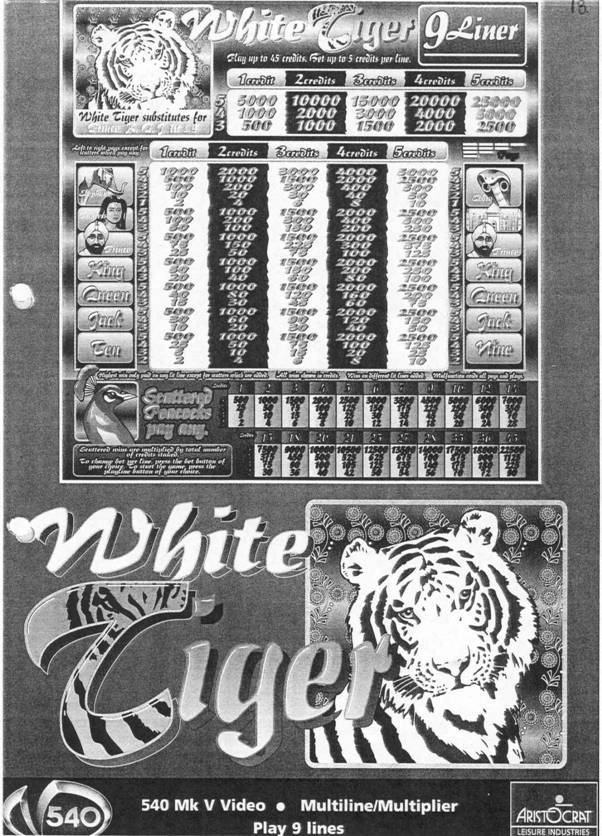
25 The types of symbols and their number are determined by the Game Designer, as are the rules of the game and the prize table.
Specifications
26 The documents of central importance in the present case are the specification for each game lodged with the Liquor Administration Board (“the LAB”). The LAB is established under Part IV of the Liquor Act 1982 (NSW). It is necessary for gaming machines to be licensed and for the specifications to be approved by the LAB. There are corresponding bodies in other States.
27 The poker machine specifications in the present case are in the form required by the LAB. Relevantly they are in three sections A, B and C. Section A in Aristocrat’s game “Top Gear” describes the medium of display as being five simulated spinning reels with five pay lines. The possible coin denominations are five and ten cents, and up to 50 coins may be played at once. Section A continues:
|
“9 Effect of staking the various number of coins on one play: |
A MAXIMUM OF 10 CREDITS BET PER LINE WITH A MAXIMUM OF 5 LINES. EACH LINE TO HAVE THE SAME NUMBER OF CREDITS STAKED. THE NUMBER OF LINES ACTIVATED IS EQUAL TO THE NUMBER OF LINES BET.
|
|
10 Theoretical (or estimated) club profit percentage: |
VAR. 99 : 12.341% VAR. 03 : 9.512%
|
|
11 Rules of the Game: |
PLAYER SELECTS THE NUMBER OF CREDITS TO BET PER LINE (OR RETAIN THE PREVIOUS VALUE) AND THEN SELECTS THE NUMBER OF LINES TO PLAY. TOTAL STAKE IS EQUAL TO THE NUMBER OF CREDITS BET PER LINE X NUMBER OF LINES PLAYED.
“DRIVER” SUBSTITUTES FOR ACE, KING, QUEEN, JACK & 9.
HIGHEST WIN ONLY PAID ON ANY LIT LINE EXCEPT SCATTERS WHICH ARE ADDED. WIN ON LIT LINES ONLY. WINS ON DIFFERENT LIT LINES ADDED. ALL WINS SHOW IN CREDITS. PLAY 1-5 LINES. BET 1,2,3,5,10 CREDITS PER LINE. PLAY UP TO 50 CREDITS.
SCATTER WINS ARE MULTIPLIED BY TOTAL NUMBER OF CREDITS STAKED. ALL WINS MULTIPLIED BY CREDITS BET PER LINE.
PICK THE WINNER FEATURE. FEATURE STARTS WHEN 3 SCATTERED “EAGLE” OR 3 SCATTERED “CAT” OCCUR. PLAYERS THEN PRESS ONE OF THE FLASHING BUTTONS TO CHOOSE THE CAR THEY THINK WILL WIN THE RACE. PRIZES AS PAID PER SCORECARD BELOW: 1ST PLACE PAY 50 CREDITS 2ND PLACE PAY 30 CREDITS 3RD PLACE PAY 20 CREDITS 4TH PLACE PAY 10 CREDITS 5TH PLACE PAY 5 CREDITS FEATURE WIN MULTIPLIED BY TOTAL NUMBER OF CREDITS STAKED. MALFUNCTION VOIDS ALL PAYS AND PLAYS.
ISSUED: 16-9-93”
|
28 The second page is Section B. That Section lists the reel symbols and shows the order in which each symbol appears on each reel. In the case of “Top Gear” there are 25 symbols on each of the five reels.
29 Section C lists the prizes payable for different winning combinations assuming the player makes the smallest bet possible. For example, a combination of five “Driver” symbols in “Top Gear” will pay 8000 times the number of credits bet. This occurs very rarely, whereas a combination of three “Nines” will pay only five times the bet and occurs more frequently.
30 The corresponding Pacific Game “Diamonds in the Sky” has a specification in similar form but with a number of differences.
PRODUCTION OF THE SPECIFICATIONS
31 The applicant called two principal witnesses in relation to the work and decisions involved in the production of the Aristocrat Games. The first witness was Bennett who has been employed with Aristocrat since 16 May 1988. He is a Game Design Manager who graduated from the University of Sydney with a Bachelor of Science majoring in Pure and Applied Mathematics in 1983. He was responsible for drawing up the Aristocrat games “Tequila Sunrise” and “White Tiger”, which are said to correspond with the Pacific games “Fortune Turtle” and “Lucky Lion”.
32 His evidence was that in late 1992 he conceived of creating a game to incorporate a combination “free spin/scatter feature”. He could not recall any other game on the market at that time which combined the two concepts although each concept was separately known at that time. By “free spin” he is referring to a “hold and re-spin” feature described earlier in these reasons. Bennett then decided that this feature for the new game, which became “Tequila Sunrise”, would operate whenever two, three or four scattered “Sun” symbols appeared left to right on specific reels. When the symbols appeared in this way the reels on which they appeared were held and all other reels were automatically spun three times. At the end of each spin any prize paying combination would be paid. After he decided how he wanted this feature to workBennett then decided how often he wanted it to occur because this is vital to what he referred to as the balance of the game. He also had to make a decision as to the percentage return of the feature as opposed to the return through the basic game. The reference to “balance” is a reference determining the optimum hit rate of the feature. If it does not occur often enough the player get frustrated with the game and may not play any more. Bennett made a decision to have the feature appear every 70 to 100 spins. Bennett then had to decide how many symbols would appear on each reel and determine what type of pay structure should apply. He states the nature and number of decisions he made in his affidavit evidence. He also decided to include a substitute symbol in “Tequila Sunrise” so that the “Sun” symbol substitutes for a “Coyote” symbol, a “Donkey” symbol and other traditional card symbols.
33 Bennett then proceeded to do the mathematics for the feature and there is in evidence a confidential copy of his Excel Spreadsheet print out. This was created in about December 1992. He decided how frequently the feature should occur. Having done that Bennett proceeded to design the reel strips by a process of trial and error, which involved manipulating the number of each type of symbol appearing on each reel. He then ran the prize combination and symbol distribution table through an “in-house” computer program to calculate the number of hits per cycle on each possible combination and the return to player of such combinations. He annexed a print out in respect of the game to his affidavit. After creating a Version 99, Bennett then created different variations of “Tequila Sunrise” with different return to player rates.
34 When he had created the games he gave to the Department Administrator at the time, either Jean Van Dam (“Van Dam”) or Janice Hampson (“Hampson”) the documents prepared by him. Either Van Dam or Hampson drafted an internal Aristocrat document called a “combination issue sheet”. The “Tequila Sunrise” combination issue sheet was issued on 17 December 1992. A LAB specification was then drawn up and, on the Aristocrat evidence, I accept that it was drafted by Hampson. The specification was sent to the LAB on 24 May 1993. Although he did not have a definite recollection of what specific documents he actually gave to Hampson or Van Dam for the purposes of preparing a combination issue sheet, Bennett’s usual practice was to give copies of the basic documents to them and he testified that having examined the specifications of “Tequila Sunrise” he was satisfied that sections A, B and C of the specifications replicate the words and figures determined by him and contained in the confidential exhibits to his affidavit. I accept his evidence. Bennett estimates that drawing up “Tequila Sunrise”, including generating the mathematical spreadsheet print outs, involved around two weeks work by him.
35 Bennett gave similar evidence in relation to the Aristocrat game “White Tiger” which I will not repeat here. He said he created this game in about May 1993. He again describes in a similar manner to “Tequila Sunrise” the choices that he had to make, the design features, and the problems which he encountered and resolved. His estimation was that it took him three to four days work to create “White Tiger” and the mathematical calculations necessary to prepare the specification. Bennett said that in respect of this work, after having examined the specification for “White Tiger”, he was satisfied that the specification replicated the words and figures generated by him as shown in the confidential exhibits to his affidavit.
36 Although Bennett was cross-examined in some detail, in my view his evidence was not shaken in any significant respect and I accept it in relation to the creation of the games, the amount of work involved and the nature of the decisions and calculations which had to be made in the course of preparing the games. I am satisfied that his work on these games was substantial and that the specification is an expression of the extensive individual and original work done by him in preparing these games.
37 In my view Bennett was the sole author of the specifications of “Tequila Sunrise” and “White Tiger”. On the evidence before me I am satisfied that the relevant work was carried out in the course of his employment with Aristocrat and that Aristocrat is the entity in which copyright subsists for the purpose of the present case. Even if the position were that Bennett and Van Dam and/or Hampson were joint authors, I am also satisfied that the work done by all of them was done in the course of their employment and that copyright subsists in Aristocrat.
38 Evidence to a similar effect was led from Fong who was the Game Designer for “Top Gear” and “Enchanted Forest”. Fong details how, from about early 1993, he went about the design and calculations for “Top Gear”. He specified the nature and number of decisions he had to make in designing the game. In particular he dealt with the second screen feature of “Top Gear” which is the car race referred to earlier. He set out details as to how he took into account various aspects of the games such as “volatility” by which he means whether the return to the player should be comprised of occasional big wins or more regular but smaller wins. The volatility of a game can be a major factor contributing to the feel or balance of the game to the player. In turn the feel or balance are important factors in keeping players interested. Fong estimates that it took him around three weeks to create “Top Gear” and to follow through the steps which he details in his affidavit. He says that once he had created the different versions of the games he gave the documents outlining the print out of the calculations to Hampson.
39 Fong also gave similar evidence to that of Bennett as to the way in which he went about his design of “Enchanted Forest”. He estimates it took him around six to eight weeks work to create “Enchanted Forest”. His evidence goes to the extent of explaining how in the course of designing the game he made a mistake by including a substitute symbol on each of the five reels, and his change in the reel strips to remedy this error. I am satisfied that the specifications for these two games are the result of the work of Fong singly, or in combination with Hampson.
are the aristocrat specifications original literary works?
40 The threshold of literary quality prescribed by s 10 of the Act for a specification to be a “literary work” is not high. The concept of a literary work expressly includes computer programs and a table or compilation expressed in words, figures or symbols whether visible or not.
41 It is not appropriate to approach the question on the basis of any preconceptions as to what is meant by “literary work” with respect to literary merit. The concept has been applied to many diverse works such as railway timetables, street directories, novels, poetry, football coupons and gaming machine prize tables. It suffices to establish only that the work is one intended to afford either information, instruction, or pleasure in the form of visual enjoyment. Questions of high literary quality of style are not pertinent. See Olympic Amusements Pty Limited v Milwell Pty Limited (1998) 81 FCR 403 at 413-414; affirmed on appeal (1999) 85 FCR 436 at 442-446; Exxon Corporation v Exxon Insurance Consultants International Ltd [1982] Ch 119 at 140; Copinger & Scone James On Copyright 14th ed. 1999 at 3-05 to 3-21 and Computer Edge Pty Limited v Apple Corporation Inc (1986) 161 CLR 171 at 182, 192-3, 201.
42 In my view, the specifications for the Aristocrat Games are a compilation, expressed in words, figures and symbols within the inclusive description of literary work. In the same way as a bookmaker’s table; Ladbroke (Football) Ltd v William Hill (Football) Ltd [1964] 1 WLR 273, or a poker machine prize table; Milwell, they are a precise expression of an idea, and the result of work.
43 I am satisfied that there is sufficient work and effort reflected in the expression contained in sections A, B and C of the specification sheets in respect of each of the games to give rise to copyright. The “work” reflected in the specifications is the calculations, decisions , analysis and judgments made by Bennett and Fong outlined in their evidence and noted above. In light of the employment relation noted earlier, copyright in these specifications subsists in Aristocrat.
44 The evidence does not establish that Aristocrat copied the games from other sources. Although there was some suggestion in cross-examination that the games were not original as required by the Act and the case law, I am not satisfied that this has been made out on the evidence. There was a paucity of evidence on this point and the evidence of Fong and Bennett was not weakened in cross-examination. It is apparent that some other games were looked at by Aristocrat employees, but I am satisfied that the specification embodied and were directly derived from their independent work
45 Pacific called Mr Ashmore (“Ashmore”), a software engineer employed by Pacific from 1989. He stated that the Pacific Games were developed between mid-1995 and October 1996 which, of course, was after the Aristocrat Games had been accepted by the LAB. His evidence was directed to establishing that some features of the Aristocrat’s Games were not original. I do not consider that his evidence supports a case that there was little or no originality in the games as drawn up by Aristocrat designers because they were simply embodying well accepted prior art into their games slight adaptations.
46 I have strong reservations as to the reliability of Ashmore’s evidence. For example, in his affidavit, he points to similarities between “Top Gear” and another game “Dinosaur” and says that they had “exactly the same type of second screen feature”. This is simply not correct as, for example, both features pay in different ways. In cross-examination he also agreed that the special features in two of the Pacific Games, “Diamonds in the Sky” and “Fortune Turtle”, were very similar to the corresponding Aristocrat Games, but that they were not similar to earlier games relied on by Pacific to support its prior art argument. In my view, his evidence did not advance Pacific’s case.
47 The substance of Pacific’s submission in relation to originality is set out in paragraph 28 and 29 of its final submissions which are in the following terms:
“28 However, what is clear from the evidence of the game designers called by both of the parties is that behind these final percentages designating playout return and behind the selection of the order and the number of symbols which appear on the five reel strips there lies a great deal of calculation. The evidence in this case is that each of the parties performed their own independent calculations using similar spreadsheet computer programs, adjusting and fine tuning, which results in the theoretical or statistical “hit rate” for each of the winning combinations that will ultimately be included in the game design. It is that statistical work, often carried out on the trial and error basis which is the proper reflex of the work and effort involved in the preparation of the LAB specifications.
29 In summary, the assertion by Aristocrat that it enjoys copyright in each of the specifications as an original literary work has to take account of the following:
(a) the format of sections A, B and C of the poker machine specifications in each case is constrained by the LAB regulations as to the presentation of the document;
(b) the verbal expression of the “rules of the game” which has little literary quality and simply defines a function or operation;
(c) the form of the reel symbols included in section B invariably includes five columns and the length of them is dictated by the number of symbols ultimately included on each reel;
(d) the inclusion of playing card symbols as the lower denominational symbols is axiomatic in the industry. The selection is special symbols has a literary content affected by the theme chosen for the game;”
48 Pacific submits that the true complaint of Aristocrat is that each of the Pacific games has a special feature the same as the existing Aristocrat game and that Aristocrat is really seeking to prevent Pacific from taking advantage of the idea of incorporating special features in its machines. I do not accept this as an adequate summary of Aristocrat’s position. Nor do I accept Pacific’s submission. The Aristocrat specifications are an expression of specific work and they can properly be described as tables or compilations expressed in words, figures and symbols. They contain far more details than simply describing the operation of a feature.
49 Pacific refers to each of the sections of the specifications. In relation to section A it is said that it is a pro forma document required by the LAB. It is said that many of the rules of the game are absolutely standard and to the extent that they are individualised the order of words which express the rules are a product of a directly descriptive process, and that any suggested quality as a literary work must be ascertained bearing that in mind.
50 It is not to the point to suggest that simply because the format of sections A, B and C of the specifications are constrained by LAB requirements they cannot be original or give rise to copyright. That there may be some non-original features incorporated into what is otherwise a “literary work” does not mean that the specification is not a literary work or is not original: Ladbroke v William Hill.
51 I consider that the relevant expression of the “rules of the game” in the specification referred to does qualify as the literary work within the liberal and extended meaning given to that term and I do not accept that it simply defines a function or operation. Rather it contains a visible and verbal description of the game.
52 While it is true to say that the form of the reel symbols referred to in section B include the five columns as an industry standard, and the length of them is dictated by the number of symbols ultimately included on each reel, this is not to the point. The choice of the reel strip lengths, the calculations and the arrangements of the symbols is what makes the specifications original.
53 In relation to section B Pacific also contends that the symbols themselves carry no originality or simply reflect the game theme. I do not consider that this is any answer to the subsistence of copyright in Aristocrat. While it is true that playing card symbols are used in the industry, this does not advance the case of Pacific. It is the effort involved in arranging the symbols on the reels strips that is significant here, not the design of the symbols themselves.
54 In relation to Section C of the specifications Pacific says that this is simply a list of prizes the form of which is partly conventional. It points out that it is time, work and effort which is rewarded in relation to copyright and literary works. It is said that the specification does not, except in one minor respect, namely the club percentage return, set out mathematical information leading to the formulations of the specifications.
55 I do not accept that the respondents performed their own independent calculations relevantly for the purposes of designing the games. This is an issue going to infringement and I will deal with it subsequently. I am, however, satisfied that Aristocrat performed its own independent calculations and that Bennett and Fong exercised skill and undertook work when designing the games with a particular “feel” or “balance”. The specifications are the end product of all the work and design undertaken by employees of Aristocrat, as detailed by the evidence of Messrs Bennet and Fong in particular. It is in this sense that each of the Aristocrat specifications are an “original literary work”.
Does the specification amount to an original dramatic work?
56 I have not been referred to any authority directly on the point whether the specification in the present case could constitute a “dramatic” work. The s 10 definition is an inclusive one. It includes a choreographic or other dumb show and a scenario or script for a cinematograph film.
57 “Choreography” is defined in The Macquarie Dictionary 2nd ed. 1991, relevantly, in these terms:
“1. the art of composing ballets, etc., and arranging separate dances.
2. the art of representing the various movements in dancing by a system of notation.
3. the art of dancing.”
58 “Scenario” is defined in the same edition to mean:
“1. an outline of the plot of a dramatic work, giving particulars as to the scenes, characters, situations etc
2. the outline or manuscript of a film, giving the action in the order in which it takes place, the description of scenes and characters, the printed matter to be shown on the screen etc
3 the outline of a general situation; a plan to be followed or observed.”
59 In the present case I do not consider that the specifications fall within the meanings set out in the above definition.
60 The appropriate approach when determining whether there is a “dramatic work” within the meaning of s 10, in my view, is set out in Copinger at para 3-26 as follows:
“In the case of subject matter which does not fall into any of the obvious types of dramatic work [eg a play or screen play], … this requires not only that there should be identifiable with sufficient certainty sufficient elements or features in such subject matter which are of a dramatic nature in the sense discussed above, but also that those features or elements should be sufficiently linked or connected so as to be capable of performance. This ultimately turns on the facts of the particular case, but …it has been held that a sports game did not constitute a choreographic work (and therefore not a dramatic work), even though parts of the game were intended to follow a predetermined plan. Similarly, it has been held that news and current affairs programs comprising video clips, interviews and discussions, lack the choreography required to constitute their dramatic works.” (Emphasis added) (Citations omitted)
61 While it is not necessary to the concept of “dramatic work” to have something in the nature of a play by Shakespeare or Moliere, there is a minimum requirement of some type of performance. This performance need not in my view be that of human beings. For example a script of an animated cartoon, such as “South Park” or “The Simpsons”, may well be a dramatic work because it calls for performance by characters.
62 In the present case, while it is possible that the video races, taken in isolation, could be described as cinematograph films the specifications for the Aristocrat Games lack the element of performance by characters, and are insufficiently predetermined, to amount to “dramatic works”. There is no apparent plot, nor is there any choreography, script, characterisation or interaction between characters and there is a strong element of unpredictability and randomness. None of these elements are essential or individually determine the question but, weighing them cumulatively, I am led to the conclusion that the specifications do not give rise to any dramatic work.
Do the games constitute a CINEMATOGRAPH film?
63 In the present case it is submitted for Aristocrat that the games of both Pacific and Aristocrat amount to cinematograph films. Aristocrat contends that the second screen features in “Top Gear” and “Diamonds in the Sky” are cinematograph films. In addition, it submits that the simulated images of the spinning reels can also be classified as moving pictures. That the Pacific Games embodied cinematograph films was conceded by Pacific, and it is not necessary for me to decide the issue here, however I offer these observations.
64 The s 10 definition requires an aggregate of visual images embodied in an article or thing so as to be capable by use of that article or thing to be shown as a moving picture. The aggregate of visual images also includes the aggregate of sounds included in a sound track associated with the visual images.
65 As Burchett J pointed out in Sega Enterprises Ltd v Galaxy Electronics Pty Ltd (1996) 69 FCR 269 at 273-274, which concerned “video” games, it is appropriate to adopt a “liberal interpretation” to intellectual property legislation, including the present Act, and to avoid a narrow, literal approach specific to a particular technology or unduly limited to the state of the art as at the date when the relevant provisions were passed. The decision of Burchett J and his observations as to a liberal construction were upheld and endorsed by a Full Federal Court in Galaxy Electronics Pty Ltd v Sega Enterprises Ltd (1977) 75 FCR 8. In adopting this approach it is also important to ensure that the result contended for reasonably arises from the language selected by parliament. On this point see Computer Edge v Apple at 187–188 and Australasian Performing Rights Association Ltd v Telstra Corp Ltd (1995) 131 ALR 141.
66 The decisions in Sega concerned two video games which presented a series of images resembling a traditional movie film. The games involved police officers who carried out a series of investigations. They involved sound effects, music and dialogue. The Court held that they were cinematograph films. Likewise, in Nintendo Co Ltd v Golden China TV-Game Centre (1993) 28 IPR 313, Hartzenberg J of the Supreme Court of South Africa, determined that certain Nintendo “video” games were cinematograph films. However, that decision turned on factors derived from the South African legislation which relevantly differed from the definition in the Australian Act. Moreover, the sequences and types of visual images under consideration in those cases were significantly different from those relied on in the present case which, as far as the basic games are concerned, are simply moving pictures of static symbols which simulate the spinning of the reels. It is possible that an argument could be made that the second screen features in “Top Gear” and “Diamonds in the Sky”, which respectively simulate a drag car race and a space ship expedition, constitute cinematograph films. However, the characteristics that could be said to make this part of the games “cinematograph films”, are not the calculations underlying the specifications but the visual images of the two races. I deal with the question of infringement of the specifications below, but in relation to the features as films, no question of infringement could arise. Visually, although these second screen features both depict races, one is concerned with cars, the other with spaceships. They are therefore visually very different. Their only common feature is the idea of a race.
67 I was not directed to any authority, nor have I found any, which assists in resolving the question of whether the simulated spinning which constitutes the base game can be said to be a “cinematograph film”. However, on my reading of the definition, the better view is that the basic games do not embody a moving picture. It is literally true that the specific symbols appear to rotate on the reels but there is no element of progression or movement in the symbols themselves as there is in a traditional movie film, which is comprised of a series of marginally different pictures, which when repeated quickly, give the impression of motion. I appreciate that the language is not to be restricted by any static view anchored to previous technology but there is real difficulty in accepting that the aggregate of the symbol images in the present case constitutes a “moving picture”.
infringement
68 The onus rests on Aristocrat to establish that there has been copying. As Copingerpoints out, at par 7-15, an infringement case would normally start by establishing substantial similarity combined with the possibility of access. Where these elements are established there is prima facie evidence of copying. Once a prima facie case is established a shift in the balance of persuasion takes place and it is for the defending party, Pacific, to rebut the applicant’s case. This can be done, for example, by establishing independent creation or some credible alternative explanation for the similarities. The Court must then decide looking at the evidence as a whole whether or not there has been copying.
69 Aristocrat relies on the proven access which Pacific had to Aristocrat’s specifications and in particular on Memoranda, Notes, and references made by employees of Pacific in a number of internal documents in relation to the Aristocrat Games. These documents were produced by Pacific on discovery.
70 Before referring to the documents I briefly note some of the relevant protagonists. During the period 1992-1998 Mr Masu (“Masu”) worked for Universal Technous Ltd (“Universal”) which was associated with Pacific as part of the Universal Group in Japan. Mr Sakamoto (“Sakamoto”) was the Managing Director of Pacific during the period 1992-1998, and Mr Yasu Aoki (“Aoki”) worked as a Games Designer for Pacific from July 1993 to June 1996. Aoki’s brother was also employed by Universal.
71 On 2 January 1994 Masu wrote a Memorandum to Sakamoto. Translated into English the Memorandum included the following:
“6 Specs of competing companies’ popular models
As reference material for development of the next models, we are asking that material on competing companies’ popular models be collected, but hardly anything has come in. The models currently under development should be completed in 2 to 3 weeks. For our subsequent direction, at this time we are thinking that we should get each of our members to produce sample programs for our competitors’ current popular models, based on their specifications, and together with analysing their computations, get the real feel of the games.
Since it will be resource material for the next generation of models, we would ask if all executive staff members, yourself included, could possibly assist us in getting this information. We know you are busy, but this is our earnest request.
This is the list of machines we requested information for the other day. (There are amore to come).
* Lucky Strike (Aristocrat)
* Tequila Sunrise (Aristocrat)
* Carat Patch (Aristocrat)
* Fat Cat (Vidco)
Later on, if there are machines that business staff, or anyone, notice particularly, do please get hold of the information and send it to us.
End. Masu” (Emphasis added)
72 This Memorandum indicates a lively interest in, and a proposal to carry out detailed analyses of, competitors’ gaming machines. In particular it specifically includes two Aristocrat games, one, “Tequila Sunrise”, under consideration here.
73 On 14 March 1994 Masu wrote to Aoki informing him that Masu would be getting together various information on machines of competitors. The Memorandum refers to winnings distribution charts for different companies including Aristocrat (two pages), Vidco (one page) and Pacific (two pages). Masu refers to the “Table of models’ basic functions” and the “Scatter symbol comparison Table for each model (two pages)”. Masu says that by and large the above has been “got together” and that further material on competitors’ models as brought back by Mr Imamura (“Imamura”) will be included at a later point. Imamura appears to have been an employee of Universal. The Memorandum refers to a summary of data on wins not by line but by reference to the whole screen image. It also refers to comparison tables of arrangements with symbols, of different features and of substitute symbols. There is attached to the Memorandum a number of analyses in relation to “White Tiger”, “Tequila Sunrise” and “Top Gear” showing their prize tables. There are also detailed breakdowns of these three games in relation to betting options, scatters, the number of reels, and features. This material follows on from a note dated 7 March from Mr Sunaga (“Sunaga”) of Universal in Japan to Aoki, with a copy to Imamura, which said:
“Great effort! You must be very busy now, but keep at it.
I am sending a progress table.”
74 On 20 May 1994 Masu wrote to Aoki referring to reviewing material with the “design” branch. There is a paragraph concerning other firms and their machines which reads:
“On 12/5, we arrived at Takawa headquarters …
From yesterday, our members took time to start up the games. Please give me a little more time to send you their thoughts on the different machines.
I will be discussing with Deputy Branch Head Aoki [Yasu Aoki’s brother] what we should do about these machines. At present the talk is of buying systems and analysing their software. When a course of action has been finally decided I will let you know.” (Emphasis added)
75 There is also included in the evidence a 64 page document which is entitled “Australian Game Development Process Standard Booklet.” This refers to analysis of games by other companies and sets out in detail how the analysis is to take place. This process includes breaking down and analysing other companies’ games in details according to instructions such as these.
|
“List of Tasks |
Contents of Tasks |
|
2. Analysis of Games by Other Companies. |
Create a Calculation Sheet in Technos system based on the specifications of Calculations Sheets of other companies’ games, create a special characteristics graph and analyse them.
|
|
1) Creation of Calculation Sheet. |
Create a Calculation Sheet in the Technos system … based on the specifications of Calculation sheets of other companies’ games. Using the Calculation Sheet created, analyse and summarise the special characteristics of games
|
|
2) Creation of Special Characteristics Graph |
Based on the Calculation Sheet created above, create a graph to analyse the special characteristics of games. Study various kinds of graphs to choose a suitable one.” (Emphasis added)
|
76 There is reference to checking against popular models in the market and finalising the dividends that present no difficulties in calculations.
77 Aoki was not called as a witness for Pacific. An explanation was given for not calling him in that there was difficulty locating him. This explanation in relation to Aoki highlights the fact that no explanation was given for not calling a number of other persons referred to in the above Memoranda who could have explained their role and purpose in analysis of the Aristocrat Games. I am satisfied that Masu, Sakamato, Imamura and Sunaga were aware of and involved in the making of the analyses, yet they were not called to explain how competitors’ specifications were used or how the Pacific Games were designed. This omission serves to support available inferences that not only did Pacific have access to, indeed sought out, the specifications and machines of Aristocrat but also that they had a detailed program of basing their games on the specifications of competitors including Aristocrat.
78 In addition to the documentary material referred to above there are notations on several internal documents of Pacific in the handwriting of Mr Sellathamby (“Sellathamby”), a mathematician employed by Pacific, suggesting copying. For example, on a page containing calculations in relation to “Diamonds in the Sky”, the words “Top Gear” appear in brackets next to the words “Diamonds in the Sky”. One matter of considerable significance, in my view, is that there is a reference to the feature frequency rate of “Diamonds in the Sky”. This is identical to the feature frequency rate in “Top Gear”. Another notation on a different page again in the handwriting of Sellathamby, is “Lucky Lion”. This appears alongside a reference, in brackets, to Aristocrat’s corresponding game “White Tiger”. This does not seem to be a mere coincidence and points to copying. Attached are several sheets which analyse “White Tiger” in detail as to wins, cycles, times and rollover. Sellathamby had no recall of these notations and could give no satisfactory explanation for them. It is reasonably clear that this material was given to Sellathamby by the Games Designers of Pacific yet neither he nor any of the other witnesses called for Pacific could recall where the material originated. The evidence is that they were simply handed to Sellathamby by Aoki without identifying the source. I consider that it is more likely than not that when Sellathamby was given specifications they in fact included the specifications of the Aristocrat games but that he did not know their provenance.
79 The documents I have referred to above establish that Pacific had access to the specifications of “Top Gear”, “Tequila Sunrise” and “White Tiger”. I was not referred to a document that specifically established that Pacific had access to “Enchanted Forest”. However, given Pacific’s policy of collecting competitors’ games, including those of Aristocrat, and the evidence of similarity in relation to this game as noted below, I am satisfied that Pacific copied the specifications for “:Enchanted Forest” when it created “Yellow Brick Road”.
substantial Similarity
80 To establish infringement it is also necessary to consider the objective similarities between the two sets of specifications and the extent and nature of those similarities. In this exercise it is not determinative that there may be some differences. Rather the question is whether any substantial part of the Aristocrat specifications have been copied. The expression “substantial” in this context includes important qualitative features as well as quantitative aspects.
81 The main evidence led by Aristocrat as to the nature and extent of the similarities was given by Lynne Oldfield (“Oldfield’) and Scott Olive (“Olive”) together with documentary material which compared important features of the corresponding programs. These are contained in Exhibits B, C, D1 and D2 and MFI1.
82 Oldfield graduated from Sydney University in 1974 with a Bachelor of Science, majoring in Pure Mathematics and Mathematical Statistics. Her work history discloses a wide ranging experience in relation to gaming machines in many contexts, both regulatory and in private enterprise, dating back to 1978. She was an impressive witness and I have no hesitation in accepting her evidence. Oldfield calculated statistical characteristics if the games including the number of times on average each of the possible winning calculations occurred, player return rates, and the “profile” of each game. She considered the “feel” of the games, the type of features, the prize table and the frequency that different prizes would occur, and the occurrence of significant symbols throughout the game. In particular, she considers many of these factors in the context of the design choices that are open to a Games Designer. She concluded that the games in each case were substantially the same in specific important respects. A comparison chart between the four sets of games is set out in MFI1. I accept this chart as an accurate summary of important similarities in the features. The chart shows that there were significant similarities between each of the sets of games.
83 As part of the exercise carried out by Oldfield she prepared charts and graphs to show the degree of correspondence between the four sets of games. One of these was a “profile” of what she described as a “perfect game”, based on the way in which the games would “play” over 721 games starting with 200 credits. Oldfield selected 721 games as statistically, a sufficiently large figure to provide a reliable profile. This approach was challenged in cross-examination. However, I accept Oldfield’s explanation as to the legitimacy of constructing a hypothetical perfect game, which would produce a result which complied with the requirements of the relevant liquor administration body. I also accept her evidence which was that the perfect game analysis provided a useful guide as to certain characteristics of games, and a tool with which to consider the degree of correspondence between the games. However, even if the “perfect game” calculations and charts were not accepted, Oldfied has indicated in my view a sufficient number of significant similarities to require an explanation from the respondent as to how this came about. Particularly, I note Oldfield’s evidence that both “Enchanted Forest” and “Yellow Brick Road” contained a similar design “weakness” being a very large number of Queens on the first reel. No adequate explanation has been advanced for the similarity identified.
84 In addition to the evidence of Oldfield as to substantial similarity, Olive gave evidence as to the extent of the correspondence between the four sets of games. Although he has only been employed by Aristocrat since 1997 I am satisfied that he had sufficient qualifications and familiarity with the games to carry out the exercises undertaken. I accept his evidence in relation to the specific similarities in respect of the corresponding games. Oldfield generally agreed with his analysis of the similarities. However I am not persuaded that Olive’s attempt to fix a specific numerical overall degree of correspondence, such as 0.92 or 0.94, between each of the comparable games is a useful exercise having regard to the criticisms levelled at that approach by Dr Buchen (“Buchen”), an expert witness called by Pacific. The fact that Olive attempted such a quantitative exercise does not detract from the weight to be accorded to his other evidence as to similarity. His evidence as to the details of the correspondences in each game is soundly based and in my view, together with the evidence of Oldfield, is strong evidence of substantial objective similarity between each pair of games.
85 Pacific led the evidence from Buchen, a highly qualified mathematician, in order to show lack of objective similarity. Buchen conceded that he had little experience of gaming machine designs. While I accept his criticisms of Olive’s generalised figure as to the overall degree of correspondence as being too simplistic, I generally prefer the evidence of Olive and Oldfield in relation to the question of the number, extent and significance of similarities in the games. I do this having regard to their greater and more specific experience and expertise with respect to gaming machines. The evidence shows that game design is not a purely a quantitative question of statistical analysis or of mathematical calculation. Buchen agreed that his study was purely quantitative in relation to the similarities between the games.
86 Sellathamby, also gave evidence of calculations undertaken by him in relation to games specifications while working for Pacific. He was not a Game Designer but rather performed calculations on games based on specifications given to him. Some may have been competitors’ games. As mentioned earlier he was not aware of the source of these specifications. I find this somewhat curious since he made notes in his own handwriting referring to “Top Gear” and “White Tiger”, as noted above, and he was not able to give any satisfactory explanation of these. Sellathamby’s task was largely a mechanical one based on specifications given to him by Aoki. His role was not to create, design or formulate the games or specifications. His work was also directed to ensure that the Pacific Games complied with regulatory requirements. He agreed in cross-examination that there were a number of material correspondences between the various sets of games. His evidence does not give any support for a conclusion that the work of Pacific was original and not copied from the Aristocrat specifications.
87 Another witness for Pacific was Jason Meyer (“Meyer”). He was first employed on 1 February 1999 having graduated in 1998 from the University of Newcastle. His experience was very limited. His evidence largely turned on the feel of the games, based on calculations which he pointed to, and sought to show a number of differences between the pairs of games. He also attached considerable significance to the importance to a player of card symbols as opposed to non-card symbols. His evidence was highly subjective and he had no objective evidence or significant experience in the industry to support the distinction which he drew. He also conceded that the overall frequency of pays, as distinct from the frequency of pays for card and non-card symbols, was an important feature in the feel of the game. He agreed that there were similarities or marked similarities between “Enchanted Forest” and “Yellow Brick Road”, “Top Gear” and “Diamonds in the Sky”, and “Tequila Sunrise” and “Fortune Turtle”.
88 Mr Peterson, a computer systems engineer, was called by Pacific. His evidence was directed to the computer software program which was said to be embodied in the E Proms and the alleged cinematograph films and he was asked to express a view as to whether there had been copying. He argued that the E Prom did not contain instructions as to the operation of the game but said that it contained data. However, in cross-examination he agreed that the Aristocrat E Prom embodied software for each particular game and that it was this software which controlled specific characteristics of the game and the way in which it operated. He agreed that the game was controlled by the base software used in conjunction with the E Prom which made it game specific. He agreed that the game could not operate without the game specific software embodied in the E Prom.
89 As noted earlier, Pacific admitted that its games contained a computer program. Further, I am satisfied having regard to Peterson’s evidence and particularly the cross-examination, that the E Prom of Aristocrat and Pacific contained instructions necessary to make the game operate and that the E Prom in each case satisfied the definition of a “computer program” in s 10 of the Act. I am satisfied that the Pacific E Proms substantially reproduced the specifications of the Aristocrat Games.
Conclusion
90 I find that copyright in the four Aristocrat Game specifications subsisted in Aristocrat at all relevant times and there has been infringement by Pacific in copying Aristocrat’s specifications into the specifications and the E Proms for the Pacific Games. I am satisfied that this copying was done intentionally. I will make no orders today but I direct the applicant to bring in Short Minutes within four weeks from the date of the publication of these reasons to give effect to them and to provide for costs. I also direct that a timetable be prepared in relation to the hearing of any issues as to the nature and quantum of pecuniary claims under ss 115(2) and (4). I consider this is an appropriate case for an injunction to be granted.
|
I certify that the preceding ninety (90) numbered paragraphs are a true copy of the Reasons for Judgment herein of the Honourable Justice Tamberlin. |
Associate:
Dated: 8 September 2000
|
Counsel for the Applicant: |
A Franklin R Cobden |
|
Solicitor for the Applicant: |
Clayton Utz |
|
|
|
|
Counsel for the Respondent: |
J M Ireland QC R J Webb |
|
Solicitor for the Respondent: |
McCabe |
|
Date of Hearing: |
27,28, 29 October 1999 and 24, 25, 27 July 2000 |
|
Date of Judgment: |
8 September 2000 |


