FEDERAL COURT OF AUSTRALIA
Gambro Pty Limited v Fresenius Medical Care South East Asia Pty Ltd
[2000] FCA 1044
PATENTS – amendment of specification – principles relevant to amendment – public interest to encourage invention.
Patents Act 1990 (Cwth), ss 40, 102, 105
Ethyel
Corporation’s Patent [1972] RPC 169 applied
Wimmera Industrial Minerals Pty Ltd v RGC Mineral Sands Ltd (No 3) (1997) AIPC 91-366 discussed
Socieétyé
des Usines Chimiques Rhoône-Poulenc
v Commissioner of Patents (1958)
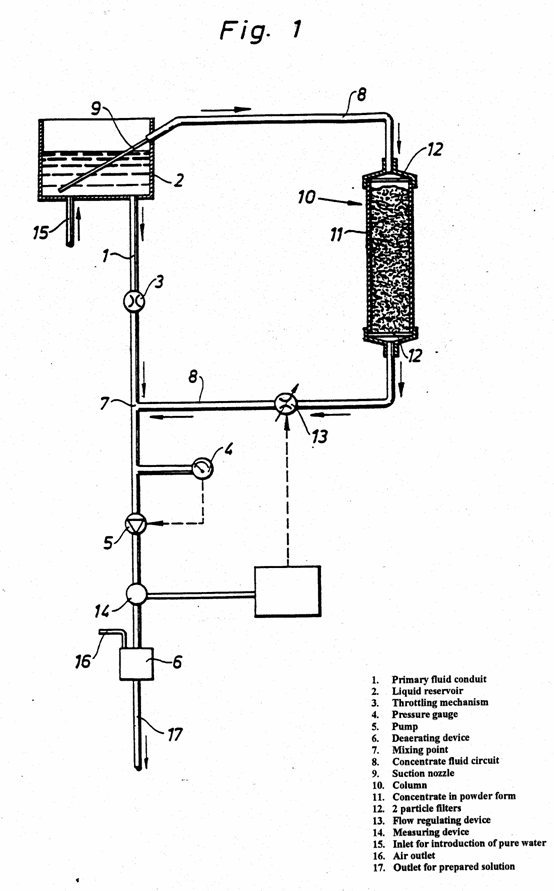
100 CLR 5 applied
F Hoffman-La Roche & Co AG v Commissioner of Patents (1971) 123 CLR 529 referred to
Decor Corporation Pty Ltd v Dart Industries Inc (1988) 13 IPR 385 referred to
Leonardis v Sartas No 1 Pty Ltd (1996) 67 FCR 126 applied
RGC Mineral Sands Pty Ltd v Wimmera Industrial Minerals Pty Ltd (1998) 89 FCR 458 discussed
GAMBRO PTY LIMITED & ANOR v FRESENIUS MEDICAL CARE SOUTH EAST ASIA PTY LTD & ORS
NG 474 OF 19972000
BURCHETT, HEEREY and LEHANE JJ
4 AUGUST 2000
SYDNEY
|
IN THE FEDERAL COURT OF AUSTRALIA |
|
|
BETWEEN: |
GAMBRO PTY LIMITED (ACN 001 288 491) First Applicant
GAMBRO AB Second Applicant
|
|
AND: |
FRESENIUS MEDICAL CARE SOUTH EAST ASIA PTY LIMITED (ACN 067 557 877) Respondent
FRESENIUS MEDICAL CARE SOUTH EAST ASIA PTY LIMITED (ACN 067 557 877) Cross-Claimant
GAMBRO AB First Cross-Respondent
GAMBRO PTY LIMITED (ACN 001 288 491) Second Cross-Respondent
|
|
DATE OF ORDER: |
|
|
WHERE MADE: |
THE COURT ORDERS THAT:
1. The
application for leave to appeal beis
dismissed.
2. The respondent Freseinius
Medical Care South East Asia Pty Limited pay the costs of the applicants Gambro
Pty Limited and Gambro AB to be taxed.
Note: Settlement and entry of orders is dealt with in Order 36 of the Federal Court Rules.
|
IN THE FEDERAL COURT OF AUSTRALIA |
|
|
NG 474 of 1997 |
|
JUDGES: |
|
|
DATE: |
|
|
PLACE: |
REASONS FOR JUDGMENT
THE COURT:
1
On 19 June 1997 the first applicant Gambro Pty
Limited and the second applicant Gambro AB (collectively Gambro) commenced this
proceeding against the respondent Fresenius Medical Care South East Asia Pty
Ltd (Fresenius) alleging infringement of Australian patent no 595423. Fresenius filed a defence denying
infringement and a cross-claim seeking revocation for invalidity on the grounds
of lack of novelty and lack of inventive step. On 1223
December 1997 Gambro applied to amend the claims of the patent in suit and
filed a first set of amended claims.
With the consent of the parties the Court agreed to hear the issue of
amendment separately from and in advance of questions of
infringement and validity.
The amendments sought were subsequently varied and in their final form
were the subject of a notice filed on 30 September 1999.
2 On 29 February 2000 Tamberlin J ordered the amendments be made. Fresenius seeks leave to appeal from that order. The order was made pursuant to reasons for judgment delivered by his Honour on 23 December 1999.
Background of the invention
3 The following description is largely taken from his Honour’s judgment. The process of dialysis involves the transport of solutes across a semi-permeable membrane. In hemodialysis, the blood of a patient suffering from impaired kidney function is conducted along one side of a semi-permeable membrane in a dialyser or artificial kidney, at the same time as dialysis fluid is conducted along the other side of the same membrane. The toxins or waste substances are removed from the patient’s blood by diffusion to the dialysis fluid through the semi-permeable membrane. Hemodialysis, hemofiltration and hemodiafiltration are all procedures for treating patients by treating their blood externally to the patient, and this is referred to as extracorporeal treatment.
4 Hemodiaylsis requires an isotonic fluid (dialysis fluid) into which the impurities in the patient’s blood diffuse. Hemofiltration requires a sterile isotonic replacement fluid to replace the volume of filtrates removed from the patient’s blood during the procedure. Hemodiafiltration is a mixture or hybrid of hemodialysis and hemofiltration and requires both dialysis fluid and sterile replacement fluid.
5
There are two essential elements which go to
make up dialysis fluid. The first
element consists of electrolytes, which must be provided at the same
concentration as those in the blood so as not to deplete them from the
blood. The second is a chemical buffer
system which must be provided so that the acid balance of the blood is
corrected by the treatment. To achieve
this result both acetate and bicarbonate buffers are used extensively in
hemodialysis solutions. The concentrates
for hemodialysis comprise solutions which are almost saturated, and which were
developed with a view to reducing the volume of solutions for handling and
storage, and to substantially increasing their shelf life. The dialysis machine dilutes these
concentrates to an isotonic level at the patient’s bedside. This means that the solution contains just
enough salt to prevent the destruction of the red blood corpuscles when it is
added to the blood. Acetate buffered
concentrates allow for the storage of the electrolytes and the buffer in the
same container. Around five litres of
concentrate are needed for a single treatment.
Bicarbonate buffered concentrates must be stored in two separate
containers as the bicarbonate will react with certain electrolytes if they are
put together to form a precipitate. The
solution of electrolytes in bicarbonate buffered solutions is referred to as
the “A” or “Acid” component. The other
component, which is be referred to as the “B” component,
contains the bicarbonate buffer and approximately nine litres is required in
addition to five litres of “A” component for a single treatment.
6 Prior to about 1986, preparation of the “B” component entailed manual mixing of bicarbonate powder with water to produce a canister of solution. This solution was then transported to the point of treatment in ten litre canisters. In 1986 Gambro introduced a pre-mix “B” component in ten litre containers which alleviated the need for hospitals to mix the solution on site. This liquid “B” concentrate was far more convenient but had the difficulty of being more susceptible to bacterial contamination.
7 The invention which is the subject of the patent in suit was designed to overcome the numerous difficulties associated with the preparation of these dialysis fluids. The difficulties included the storage space necessary and the occupational safety issues relating to the carrying by hospital staff of ten litre containers. The invention also led to the elimination of the problem of bacterial contamination.
8 These advantageous results are provided by producing a supply of sodium bicarbonate concentrate solution “on line”, of a constant concentration, from bicarbonate powder during the course of the treatment and for the entire duration of the treatment. The concentrate solution then is combined with water and diluted “A” component during the treatment to produce a constant supply of isotonic dialysis fluid.
9 In the proceeding before his Honour and in its application for leave to appeal, Fresenius relied on certain discretionary factors such as delay. These were ultimately abandoned at the hearing so it will not be necessary to canvass the history of the patent in suit and various litigation in other countries.
The specification
10 The specification is entitled: “A SYSTEM FOR PREPARING A FLUID INTENDED FOR A MEDICAL PROCEDURE BY MIXING AT LEAST ONE CONCENTRATE IN POWDER FORM WITH WATER AND A CARTRIDGE INTENDED TO BE USED IN SAID SYSTEM.”
11 The specification firstly describes the field of the invention outlined earlier and also sets out the background to the invention. There is then a summary of the invention followed by a brief description of the drawings. The nature of the drawings is described as follows:
“FIGS. 1-4 illustrate four alternative embodiments of the system in accordance with the present innvention [sic] for preparing a fluid for a medical procedure by mixing of a concentrate in powder form with water.
FIG. 5 illustrates a further alternative arrangement for the system of the present invention in which the fluid is prepared starting with one concentrate in powder form and a second concentrate in liquid form.
FIG. 6 illustrates a still further arrangement for the system in accordance with the present invention which again utilizes a concentrate in powder form and a concentrate in liquid form, the system of FIG. 6 being particularly adapted for use in connection with a hemodialysis-type of treatment.
FIG. 7 illustrates a cartridge intended to be used in any of the alternative system arrangements shown in FIGS. 1-6, the cartridge being shown mounted in a holder therefor.
FIG. 8 illustrates a still further arrangement for the system in accordance with the present invention in which two different concentrates in powder form are utilised in connection with a further concentrate in liquid form for preparing a fluid for a medical procedure.” (Emphasis added)
12 (A copy of FIG 1 is annexed to these reasons.) There is then a description of the preferred embodiments. The claims defining the invention are then set out, with proposed amendments to the claim noted in the form of notations and deletions in handwriting.
13 The variations to claims 1-4 are as follows (handwritten additions are shown in upper case and deletions are shown as strike-outs):
“1. A system for preparing a DIALYIS OR REPLACEMENT fluid for a
medical procedure OR A COMPONENT FLUID THEREOF by mixing of at least one
concentrate in powder form with water, said system comprising:
a source of water;
a vessel for containing a POWDER concentrate in
powder form;
first fluid conducting means having a first end
communicating with said source of water for withdrawing water from said source
of water, and a second end for delivering a prepared solution DIALYSIS
OR REPLACEMENT FLUID OR COMPONENT FLUID THEREOF;
second fluid conducting means communicating with said
source of water AND with an inlet for introducing water from said source oif
water into said vessel to THEREBY produce a concentrate fluid SOLUTION
containing dissolved powder concentrate in water;
third fluid conducting means communicating with an outlet
of said vessel and with a mixing point LOCATED in said first fluid conducting
means intermediate said first and second ends for conducting said concentrate fluid
SOLUTION from said vessel into said first fluid conducting means WHERE IT IS to
be mixed with fluid being conducted through said first fluid conducting
means to thereby produce a THE prepared solution FLUID in said
first fluid conducting means for delivery to said second end of said first
fluid conducting means;
measuring means LOCATED in said first fluid conducting
means downstream of said mixing point for measuring the composition of the
prepared FLUID solution obtained by mixing of said concentrate fluid and
water in said first fluid conducting means ; and
flow regulating means LOCATED in said third fluid
conducting means AND BEING responsive to said measuring means for controlling
the flow of said concentrate fluid SOLUTION from said vessel.”
…
4. A system for preparing a DIALYSIS OR REPLACEMENT fluid for
a medical procedure OR A COMPONENT FLUID THEREOF by mixing of at least one
concentrate in powder form with water, said system comprising:
a source of water;
a vessel for containing a POWDER concentrate in
powder form, said vessel including an inlet at the top thereof and an
outlet at the bottom thereof;
first fluid conducting means having a first end
communicating with said source of water for withdrawing water from said source
of water, and a second end for delivering a prepared solution FLUID;
second fluid conducting means communicating with said
source of water and with said inlet of said vessel for introducing water from
said source of water into the top of said vessel, to produce WHEREBY a
concentrate SOLUTION fluid containing dissolved powder
concentrate in water IS PRODUCED IN THE VESSEL; and
third fluid conducting means communicating with
said outlet of said vessel and with a mixing point LOCATED in said first
fluid conducting means intermediate said first and second means ENDS for
conducting said concentrate fluid SOLUTION from the bottom of said vessel into said
first fluid conducting means to be WHERE IT IS mixed with fluid being
conducted through said first fluid conducting means to thereby produce a
THE prepared FLUID, solution in said first fluid conducting means for
delivery to said second end of said first fluid conducting means, whereby water
is conducted through said vessel from the top thereof to th [sic] bottom
thereof to thereby maintain a
WHEREIN THE SYSTEM IS ARRANGED SUCH THAT A relatively constant concentration
level of dissolved powder concentrate IS MAINTAINED in said third fluid
conducting means BY FLUID BEING CONDUCTED THROUGH SAID VESSEL FROM ITS TOP TO
ITS BOTTOM.”
The Patents Act 1990 (Cth) (the Act)
14 The power of the Court to direct by order amendments is conferred by s 105 of the Act which relevantly provides:
“(1) In any relevant proceedings in relation to a patent, the court may, on the application of the patentee, by order direct the amendment of the patent, the patent request, or the complete specification in the manner specified in the order.
…
(4) A court is not to direct an amendment that is not allowable under section 102.”
15 Section 102 is as follows:
“(1) An amendment of a complete specification is not allowable if, as a result of the amendment, the specification would claim matter not in substance disclosed in the specification as filed.
(2) An amendment of a complete specification is not allowable after the specification has been accepted if, as a result of the amendment:
(a) a claim of the specification would not in substance fall within the scope of the claims of the specification before amendment; or
(b) the specification would not comply with subsection 40(2) or (3).
(3) This section does not apply to an amendment for the purpose of correcting a clerical error or an obvious mistake made in, or in relation to, a complete specification.” (Emphasis added)
16 Section 40(2) and (3) of the Act relevantly provide:
“(2) A complete specification must:
(a) describe the invention fully, including the best method known to the applicant of performing the invention; and
(b) … end with a claim or claims defining the invention;
…
(3) The claim or claims must be clear and succinct and fairly based on the matter described in the specification.” (Emphasis added)
Opposition
17 Relevantly for present purposes opposition to the amendments was based on two grounds. First, contrary to s 102, as a consequence of the amendments the specification would claim matters not in substance disclosed in the specification as filed, and also as a result of the amendment, certain of the claims would not in substance fall within the scope of the claims of the specification before amendment. Secondly, as a result of the amendments the specification would not comply with s 40(2) or (3) of the Act because each of the claims would not define the invention, would not be clear and succinct, and would not be fairly based on the matter described in the specification.
Relevant principles
18
His Honour noted, and it was not disputed before
us, that it is a well-settled approach that the requirements of s 102 should
generally be given a liberal construction because there is a strong public
interest that inventive genius should be encouraged: Etheyl
Corporation’s Patent [1972] RPC 169. The requirement of substantial disclosure is
very similar to the requirement that a claim must be “fairly based” on matter
disclosed in a specification: Wimmera
Industrial Minerals Pty Ltd v RGC Mineral Sands Ltd (No 3) (1997) AIPC
91-366 at 39,781-2; and, on appeal, RGC Mineral Sands Pty Ltd v Wimmera Industrial
Minerals Pty Ltd (1998) 89 FCR 458. There must be “a real and reasonably clear disclosure”: Socieéteé
des Usines Chimiques Rhône-Poulenc v Commissioner of Patents (1958) 100 CLR
5 at 11; Leonardis v
Sartas No 1 Pty Ltd (1996) 67 FCR 126 at 142-143. See also F
Hoffman-La Roche & Co AG v Commissioner of Patents (1971) 123 CLR
529. As to the principles of
construction, see Decor Corporation Pty
Ltd v Dart Industries Inc (1988) 13 IPR 385 at 400.
Leave to appeal
19 It is accepted that the decision of his Honour was an interlocutory judgment and that Fresenius requires leave to appeal. The hearing involved an argument as to the merits of a substantive appeal should leave be granted.
20
As will hereafter
appear, we think the attacks on the
judgment are not well founded. But at
the outset we wish to say that we do not consider this an appropriate case for
leave. We do not consider this an appropriate case for
leave. As will hereafter appear, we
think the attacks on the judgment are not well founded. Fresenius submitted that “important matters of
public law are involved” but such matters were not identified. Indeed, somewhat inconsistently, Fresenius
subsequently submitted that there appeared to be “no dispute between the
parties as to the legal principles to be imapplied
for assessing whether the amendments to the claims were allowable”.
21
Fresenius also submitted that if the application
for leave were refused and the matter proceeded to a hearing on validity and
infringement, an appeal could be lodged to the Full Court in relation to the
form of the amended claims. It was said
that if the Full Court “later found that amendment of the claims of a patent
had been allowed in error, the issues of validity and infringement of the
patent based on different claims (either the original unamended claims or
claims amended in some different form) would have to be re-heard by the
Court”. It was said that as a
consequence the time and resources of the Court and the parties would be
wasted. We need not decide
whether thisThis contention is not soundly
based. Even if it is, it
could not assist the applicant were the Court to refuse leave on the ground
that an appeal would inevitably fail. As
the case has been fully argued, this course is open if the
Court so determines.The
view we take may be illustrated by the analogous case where an amendment to
pleadings is allowed and leave to appeal from the order granting leave is
refused. On the subsequent hearing of an
appeal against the substantive judgment in the case, the appellate court could
not revisit the decision to grant leave to amend, absent some extension of time
for leave to appeal.
22 Moreover, apart from general assertions that acts which infringe the amended claims would not infringe the claims to which Gambro was properly entitled and that the prior art base would be broadened, the affidavit in support of the application for leave does not provide any practical detail as to why the amendments would cause harm to Fresenius and its activities.
2322This
proceeding has now been in train for over three years, that is to say double
the Court’s target period for resolution of the great bulk of cases. A trial date has not yet been fixed. The best part of half a year has been taken
up with the present leave application.
These factors weigh in favour of refusal of leave, especially where no
tangible injustice has been demonstrated to flow from the order complained
of.
2423
We now turn to the disputed
amendments.
Claims 1 and 4 – “dialysis or replacement fluid or a component thereof”
2524
The essence of the amendment
allowed was to replace the phrase “fluid for a medical procedure” with the
phrase “dialysis or replacement fluid or a component fluid thereof”. The objection was that the amended claims
were not fairly based on the specification because there was no disclosure in
the body of the specification which described the way in which to make a
dialysis or replacement fluid with the addition of powder from one source to
water.
2625
However his Honour found that there
are a number of components which make up a dialysis fluid and the specification
sufficiently describes how to prepare a fluid for a medical procedure, mainly
dialysis or replacement fluids, by mixing concentrate in powder form with
water. The fact that a dialysis fluid or
replacement fluid is made from several components was clearly disclosed in the
specification as filed. The structure of
the specification was firstly to describe the system where one concentrate is
used (which preferably is one of the components of the dialysis or replacement
fluid), FIG 1, and then to develop the system by adding fluids to achieve the final
multiple component systems described and illustrated by FIGS 5, 6 and 8. These were disclosed.
2726
We agree with his Honour’s
observation (at par 45) that
“… the reference to a ‘fluid for a medical procedure’ in its ordinary and natural meaning is sufficiently broad to cover not only a ‘final’ fluid but would also cover any other fluids forming part of it so that they can properly be described as fluids for use in a medical procedure. A component fluid in this sense is properly described as a fluid for a medical procedure if it is one of a number of fluids which go to make up a fluid which is to be used for that procedure.”
Claim 4 – “fluid” v “water”
2827
The amendment here was to delete
“water is conducted through said vessel from the top to the bottom” and insert
“fluid being conducted through said vessel from its top to its bottom”.
2928
Fresenius argued that the term
“fluid” is broader than “water” and encompasses any liquid (whether water based
or organic) and even gasses such as carbon dioxide.
3029
However, as his Honour pointed out,
the meaning of the term “fluid” must be determined in its context. There is a reference in claim 4 to
“concentrate solution” instead of “concentrate fluid”. “Concentrate solution” refers to what is
produced from the vessel and “fluid” refers to what is present in the vessel,
namely the solution building up in concentration with the addition of powder to
water as the water passes through the vessel.
His Honour was correct in saying that there was no broadening of the
claim by this substitution.
Claims 1, 2, 3 and 4 – “or a component fluid thereof”
3230
In the first line of the above
claims the words “for a medical procedure” were deleted and the words “or a
component fluid thereof” substituted so that the commencement
of the claim read “a system for preparing a dialysis or replacement fluid or a
component fluid thereof”. The contention
of Fresenius was that as a in the matter
of construction the claim before the amendment could not have included a
component of the fluids. In dealing with
this point his Honour noted evidence that a dialysis fluid or replacement fluid
is made from a number of component fluids.
As already mentioned, we agree with his Honour’s construction that a
fluid for a medical procedure includes a component fluid.
Claims 1, 2, 3 and 4 – “for delivery to said second and first fluid conducting means”
3331
Fresenius objected to deletion of
these words on the basis that their presence supported the construction of the
pre-amendment claims as being for final products. It was said that the amendment was designed
to support the “component” amendment which is a broader claim and should not be
permitted.
3432
His Honour was in our view correct
in holding that the words were mere surplusage and could appropriately be
deleted without broadening or relevantly varying the original claim. Both before and after amendment the prepared
fluid is delivered to the same point 7 in FIG 1, for example, and thereafter it
must be delivered to the second end of the first fluid conducted means, namely
to point 17. This has no bearing on what
happens at point 17 in the sense of whether the fluid is an ultimate or
component fluid.
Claim 88
3533
This is a new claim as follows:
“A system according to any one of claims 28 to 30, wherein the powder concentrate is arranged as a column between the inlet and outlet of the cartridge so that, in operation, the powder concentrate becomes dissolved in water flowing through the vessel, and the cartridge is so dimensioned, as to produce a substantially saturated solution of the powder concentrate in water.”
3634
The complaint here was that the
system disclosed is one which had both a measuring and a
flow regulating means. Before the
amendment, it was said, nothing in the specification or claims disclosed
or contemplated the production of a “substantially saturated solution” in the
absence of measuring andthe
flow regulating means.
3735
But the specification teaches how
to obtain a substantially saturated solution from the bottom of the column of
powder concentrate. It is clear that the
substantially saturated solution is produced by virtue of the water being
conducted downwardly through the column.
If a flow-regulating device and measuring device are employed, they only
control the amount or volume of the substantially saturated solution which has
already been produced and which is delivered to the mixing point 7. Neither a flow regulating device nor a
measuring device has any influence on the production of the substantially
saturated solution produced from the bottom of the vessel. His Honour was in
our view correct in finding there was a reasonably clear disclosure of this
concept in the specification.More particularly,
as senior counsel for Gambro pointed out, the specification as filed included
an elaborate consistory clause. That
clause began with a general description of the invention and then described a
number of particular “aspects”, or
embodiments, of it. The general
description read as follows:
“The present invention is directed to a system which overcomes or minimizes the aforementioned difficulties and problems of the prior art by providing a system for preparing fluid intended for a medical procedure substantially at the time of use by mixing of at least one concentrate in powder form in water. More particularly, the system of the present invention includes a source of water such as a reservoir, at least one vessel for containing a concentrate in powder form, and a concentrate fluid circuit for withdrawing a small quantity of water from the source of water and passing same through the vessel containing the concentrate in powder form in order to dissolve the concentrate to produce a concentrate fluid, and for then conducting the concentrate fluid to a primary fluid circuit to be mixed with the rest of the water withdrawn from the source of water.”
That general description incorporated neither a measuring nor a flow regulating means. The fourth of the particular “aspects” read:
“In accordance with another aspect of the present invention, the vessel containing the concentrate in powder form includes an inlet at the top thereof and an outlet at the bottom thereof, with the vessel being arranged in the concentrate fluid circuit so that water withdrawn from the source of water is introduced into the top of the vessel to produce a concentrate fluid containing dissolved powder concentrate, and so that the produced concentrate fluid is withdrawn from the bottom of the vessel and conducted to the primary fluid conducting means to be mixed with water being conducted therethrough to produce the prepared solution. In this manner, water is conducted through the vessel from the top thereof to the bottom thereof to thereby maintain and provide a relatively constant concentration level of dissolved powder concentrate being introduced into the primary fluid conducting means.”
That is, in essence, claim 4, on which claim 88 is dependent. Again, there is neither measuring nor flow-regulating means described.
36 In our view his Honour was correct in finding that matter is not claimed in claim 88 which is not in substance disclosed in the specification as filed.
Orders
37
The application for leave to appeal will be
dismissed. The Court having
heard full argument, it will be dismissed on the ground
that an appeal would have no prospect of success. A successful applicant for amendments will
often be ordered to pay the respondent’s costs, the rationale being that the
applicant is seeking an indulgence. Such
an order was made in the present case by his Honour, although having regard to
certain circumstances the award was reduced to 70 per cent .cent. But different considerations apply on an
application for leave to appeal. Having
received detailed reasons, Fresenius chose to seek leave to appeal and caused
Gambro to incur substantial costs in successfully oapposing
leave. Costs should follow the event.
38 Moreover, Fresenius sought leave to appeal on nine separate grounds, including a charge that his Honour had erred in two separate respects in the exercise of the discretion to allow the amendments. Fresenius did not notify Gambro that it would abandon four of those grounds, including the discretionary grounds, until the day of the hearing. Gambro prepared argument and filed submissions in relation to all grounds. The discretionary grounds in particular required a detailed review of Gambro’s affidavit evidence and the transcript of the cross-examination of its witnesses.
|
I certify that the preceding thirty- |
Associate:
Dated: 4 August 2000
|
Counsel for the Applicant for leave (the Respondent in the action): |
Mr A J L Bannon SC |
|
|
|
|
Solicitors for the Applicant for leave: |
Allen Allen & Hemsley |
|
|
|
|
Counsel for the Respondent to the application for leave (the Applicant in the action): |
Mr D K Catterns QC |
|
|
|
|
Solicitors for the Respondent to the application for leave: |
Blake Dawson Waldron |
|
|
|
|
Date of Hearing: |
5 June 2000 |
|
|
|
|
Date of Judgment: |
4 August 2000 |