

FEDERAL COURT OF AUSTRALIA
Root Quality Pty Ltd v Root Control Technologies Pty Ltd [2000] FCA 980
INTELLECTUAL PROPERTY – patent – construction of claims – effect of amendment – ‘pith and marrow’ – purposive construction – skilled addressee – infringement – want of novelty – obviousness – manner of new manufacture – fair basing
TORTS – procuring interference with patentee’s rights – intentional tort – personal liability of director for company’s wrongdoing
WORDS AND PHRASES – “strip”, “for”
Patents Act 1990 (Cth) ss 7(2), 7(3), 18(1), 40(3), 116, 138(3)(b), 234(5), Schedule 1
Patents Act 1952 (Cth) ss 35(1)(a), 40(2), 100(1)(c), 100(1)(d), 100(1)(e), 100(1)(g)
ADGA Systems International Ltd v Valcom Ltd (1999) 39 CCEL (2d) 163 cited
American Cyanamid Company v Ethicon Ltd [1979] RPC 215 cited
Ansett Transport Industries (Operations) Pty Ltd v Australian Federation of Air Pilots [1991] 1 VR 637 referred to
Ansett Transport Industries (Operations) Pty Ltd v Australian Federation of Air Pilots (No 2) [1991] 2 VR 636 cited
Arnold v Bradbury (1871) 6 ChApp 706 referred to
Australasian Performing Right Association Ltd v Valamo Pty Ltd (1990) 18 IPR 216 cited
Autocaps (Aust) Pty Ltd v Pro-Kit Pty Ltd (1999) 46 IPR 339 cited
Banfield v Johnson (1994) 7 NZCLC 260,496 cited
Beecham Canada Ltd v Procter & Gamble Co (1982) 61 CPR (2d) 1 cited
Bristol-Myers Squibb Company v FH Faulding & Co Ltd (2000) 46 IPR 553 followed
British Ore Concentration Syndicate Ltd v Minerals Separation Ltd (1909) 26 RPC 124 referred to
Catnic Components Ltd v Hill & Smith Ltd [1982] RPC 183 applied
CBS Inc v Ames Records and Tapes Limited [1982] Ch 91 cited
C Evans & Sons Ltd v Spritebrand Ltd [1985] 1 WLR 317 not followed
Clark v Adie (1875) 10 ChApp 667 referred to
Commissioner of Patents v Microcell Ltd (1959) 102 CLR 232 cited
Conoco Specialty Products (Inc) v Merpro Montassa Ltd [1994] FSR 99 referred to
Cropper v Smith (1884) 26 Ch D 700 followed
C Van Der Lely NV v Bamfords Ltd [1963] RPC 61 referred to
D C Thomson & Co Ltd v Deakin [1952] Ch 646 referred to
Décor Corporation Pty Ltd v Dart Industries Inc (1988) 13 IPR 385 referred to
Electric & Musical Industries Ltd v Lissen Ltd (1939) 56 RPC 23 cited
Electricity Trust of South Australia v Zellweger Uster Pty Ltd (1986) 7 IPR 491 cited
Emerald Construction Co Ltd v Lowthian [1966] 1 WLR 691 cited
Falcon v Famous Players Film Co [1926] 2 KB 474 cited
Fightvision Pty Ltd v Onisforou (1999) 47 NSWLR 473 applied
Flour Oxidizing Company Ltd v Carr & Co Ltd (1908) 25 RPC 428 referred to
Genentech Inc v The Wellcome Foundation Ltd (1989) 15 IPR 423 cited
The General Tire & Rubber Company v The Firestone Tyre & Rubber Company Ltd [1972] RPC 457 discussed
Golden v Anderson (1967) 64 Cal Rptr 404
Graham Hart (1971) Pty Ltd v S W Hart & Company Pty Ltd (1978) 141 CLR 305 referred to
Greig v Insole [1978] 1 WLR 302 cited
Hill v Evans (1862) 4 de G F & J 288; 45 ER 1195 referred to
Hirsh Co v Minshall (1988) 89 NR 136, 22 CPR (3d) 268 cited
Hirsh Co v Spacemaker Ltd (1987) 17 CPR (3d) 89 cited
Hoover plc v George Hulme (Stockport) Ltd (1982) FSR 565 cited
Imperial Oil Ltd v C & G Holdings Ltd 62 DLR (4th) 261 referred to
Improver Corporation v Remington Consumer Products Ltd [1990] FSR 181 applied
Innovative Agricultural Products Pty Ltd v Crawshaw (unreported, Federal Court of Australia, Lee J, 19 August 1996) cited
International Standard Electric Corporation v Ooms 157 F2d 73 (1946) cited
J K Smit & Sons Inc v McClintock [1940] SCR 279 cited
J T Stratford & Son Ltd v Lindley [1965] AC 269 cited
James v The Commonwealth (1939) 62 CLR 339 referred to
Jasperson v Dominion Tobacco Company [1923] AC 709 referred to
Kalamazoo (Aust) Pty Ltd v Compact Business Systems Pty Ltd (1985) 5 IPR 213 cited
Katun Corp v Technofax Inc (1988) 22 CPR (3d) 269 cited
King v Millpurrurru (1996) 136 ALR 327 referred to
Kyowa’s Application [1968] RPC 101 cited
Leonardis v Sartas No 1 Pty Ltd (1996) 67 FCR 126 at 146 cited
Lumley v Gye (1853) 2 El&Bl 216; 118 ER 749 discussed
Martin and Biro Swan Ltd v H Millwood Ltd [1956] RPC 125 referred to
Martin Engineering Co v Nicaro Holdings Pty Ltd (1991) 100 ALR 358 cited
Mentmore Manufacturing Co Ltd v National Merchandising Manufacturing Co Inc (1978) 89 DLR (3d) 195 referred to
Meyers Taylor Pty Ltd v Vicarr Industries Ltd (1977) 137 CLR 228 referred to
Microsoft Corporation v Auschina Polaris Pty Ltd (1996) 71 FCR 231 cited
Minnesota Mining and Manufacturing Company v Beiersdorf (Australia) Ltd (1980) 144 CLR 253 cited
Moorhouse v University of New South Wales [1976] RPC 151 cited
Nesbit Evans Group Australia Pty Ltd v Impro Ltd (1997) 39 IPR 56 referred to
Non-Drip Measure Co Ltd v Stranger’s Ltd (1943) 60 RPC 135 cited
Northern Territory of Australia v Mengel (1995) 185 CLR 307 referred to
NV Philips Gloeilampenfabrieken v Mirabella International Pty Ltd (1993) 44 FCR 239 referred to
O’Brien v Dawson (1942) 66 CLR 18 discussed
Olin Corporation v Super Cartridge Co Pty Ltd (1977) 180 CLR 236 referred to
Osram Lamps v Pope Electric Lamp Co (1917) 34 RPC 369 cited
Plimpton v Malcolmson (1876) 3 ChD 531 referred to
Pope Appliance Corporation v Spanish River Pulp and Paper Mills Ltd (1929) 46 RPC 23 cited
Populin v HB Nominees Pty Ltd and Binder (1982) 41 ALR 471 referred to
Performing Right Society Ltd v Ciryl Theatrical Syndicate Ltd [1924] 1 KB 1 not followed
Quinn v Leathem [1901] AC 495 referred to
Radiation Ltd v Galliers & Klaerr Pty Ltd [1938] 60 CLR 36 referred to
The Raleigh Cycle Co Ltd v H Miller & Co Ltd (1946) 63 RPC 113 cited
The Raleigh Cycle Co Ltd v H Miller & Co Ltd (1948) 65RPC 141 referred to
RCA Corporation v John Fairfax & Sons Ltd [1982] RPC 91 cited
Ridgeway Maritime Inc v Beulah Wings Ltd and Dr Tunji Braithwaite (‘The Leon’) [1991] 2 Lloyd’s Rep 611 cited
Rodi and Wienenberger AG v Henry Showell Ltd [1969] RPC 367 referred to
Rookes v Barnard [1964] AC 1129 referred to
Rosedale Associated Manufacturers Ltd v Carlton Tyre Saving Co Ltd [1960] RPC 59 cited
Rotocrop International Ltd v Genbourne Ltd [1982] FSR 241 cited
Rutherford v Poole [1953] VLR 130 discussed
Said v Butt [1920] 3 KB 497 followed
Sami S Svendsen Inc v Independent Products Canada Ltd (1968) 119 CLR 156 referred to
Sanders v Snell (1998) 196 CLR 329 cited
Sharpe & Dohme Inc v Boots Pure Drug Co Ltd (1928) 45 RPC 153 applied
Short v The City Bank of Sydney (1912) 15 CLR 148 applied
Société Technique de Pulverisation Step v Emson Europe Ltd [1993] RPC 513 cited
Tetra Molectric Ltd v Japan Imports Ltd [1976] RPC 547 referred to
TNT Canada Inc v Kwik Transfer Inc (1987) 18 CPR (3d) 51 cited
Trevor Ivory Ltd v Anderson [1992] 2 NZLR 517 referred to
Tsaprazis v Goldcrest Properties Pty Ltd (2000) 18 ACLC 285 discussed
Underwriters’ Survey Bureau Ltd v Massie & Renwick Ltd [1938] Ex CR 103 affirmed [1940] SCR 218 cited
Vidal Dyes Syndicate Ltd v Levinstein Ltd and Read Holliday & Sons Ltd (1912) 29 RPC 245 referred to
Vigneux v Canadian Performing Right Society (1943) 4 Fox Pat C 183 cited
Visa International Service Association v Visa Motel Corp (1984) 1 CPR (3d) 109 cited
Wah Tat Bank Ltd v Chan Cheng Kum [1975] AC 507 not followed
Walker v Alemite Corporation (1933) 49 CLR 643 distinguished
The Wellcome Foundation Ltd v V R Laboratories (Aust) Pty Ltd (1981) 148 CLR 262 cited
White Horse Distillers Ltd v Gregson Associates Ltd [1984] RPC 61 referred to
Windsurfing International Inc v Novacttion Sports Inc (1987) 18 CPR (3d) 230 cited
ROOT QUALITY PTY LTD and R&R OWEN NOMINEES PTY LTD v ROOT CONTROL TECHNOLOGIES PTY LTD, MARK STYAN, JAMES TROWBRIDGE and JOHN MENZIES SPARK; ROOT CONTROL TECHNOLOGIES PTY LTD v ROOT QUALITY PTY LTD, PETER ALAN LAWTON, NICHOLAS JOHN RIVETT and JENNIFER WHITTAKER
VG 314 of 1998
JUDGE: FINKELSTEIN J
PLACE: MELBOURNE
DATE: 1 AUGUST 2000
| IN THE FEDERAL COURT OF AUSTRALIA |
|
| VG 314 of 1998 |
| BETWEEN: | ROOT QUALITY PTY LTD and R & R OWEN NOMINEES PTY LTD Applicants
|
| AND: | ROOT CONTROL TECHNOLOGIES PTY LTD, MARK STYAN, JAMES TROWBRIDGE and JOHN MENZIES SPARK Respondents
|
| BETWEEN: |
ROOT CONTROL TECHNOLOGIES PTY LTD Cross-Claimant
|
| AND: | ROOT QUALITY PTY LTD, PETER ALAN LAWTON, NICHOLAS JOHN RIVETT and JENNIFER WHITTAKER Cross-Respondents
|
| DATE OF ORDER: | |
| WHERE MADE: |
THE COURT DIRECTS THAT:
Within 14 days, the cross-claimant should bring in short minutes of orders to reflect these reasons for judgment.
Note: Settlement and entry of orders is dealt with in Order 36 of the Federal Court Rules.
| IN THE FEDERAL COURT OF AUSTRALIA |
|
| VG 314 of 1998 |
| BETWEEN: | ROOT QUALITY PTY LTD and R & R OWEN NOMINEES PTY LTD Applicants
|
| AND: | ROOT CONTROL TECHNOLOGIES PTY LTD, MARK STYAN, JAMES TROWBRIDGE and JOHN MENZIES SPARK Respondents
|
| BETWEEN: |
ROOT CONTROL TECHNOLOGIES PTY LTD Cross-Claimant
|
| AND: | ROOT QUALITY PTY LTD, PETER ALAN LAWTON, NICHOLAS JOHN RIVETT and JENNIFER WHITTAKER Cross-Respondents
|
| JUDGE: | |
| DATE: | |
| PLACE: |
REASONS FOR JUDGMENT
1 The second cross-respondent, Peter Lawton, is an engineer. In 1989 he claimed to be the inventor of a container suitable for growing plants which are later to be transplanted; the container is commonly referred to as the SpringRing container. A company controlled by Mr Lawton, Ronneby Tree Farm Pty Ltd, applied for, and was granted, Australian Patent No. 629067 for the claimed invention.
2 The cross-claimant, Root Control Technologies Pty Ltd, is now the proprietor of the patent, having taken an assignment from the proprietor. It sues the first cross-respondent, Root Quality Pty Ltd, for infringement of the patent. It also sues the company’s director, the third cross-respondent, Nicholas Rivett, and the company’s major shareholder, the fourth cross-respondent, Jennifer Whittaker, along with Mr Lawton, for authorising or inducing that infringement. The cross-respondents deny the alleged infringement and cross-claim for the revocation of the patent as being invalid, relying upon all of the usual grounds. By agreement, the claim against Ms Whittaker and all other matters raised by the pleadings have been deferred pending the resolution of the issues of validity and infringement.
3 It is not often that an inventor attacks his own invention for obviousness and lack of novelty. There is no bar to him doing so (see Cropper v Smith (1884) 26 Ch D 700), but when he does his evidence should be approached with some caution. This is a matter to which I will return. It is necessary first to consider with some care the complete specification for the patent. In large measure, the claim for infringement depends upon the correct construction to be placed on the patent.
4 Trees and shrubs which are intended to be transplanted are often grown in containers. There are at least two advantages to this method of growing plants. First, plants can be grown at a faster rate because they are tended more closely. Second, because the roots of the plant are not severed when transplanted, transplanting is more successful.
5 Various types of containers are used for growing plants prior to transplanting. A problem encountered with many containers, typically those cylindrical in shape, is that when the roots come into contact with the sides and bottom, spiral and circular root growth occurs. This is damaging to a plant because that root growth does not provide lateral anchorage for the plant when transplanted. This problem led to the development of containers that control root growth by “air pruning”, that is by allowing the roots to be trapped by recesses on the container wall and then to pass through openings in the sides of the container causing the tips of the roots to be “air pruned”.
6 Mr Lawton has been involved in growing ornamental trees for over twenty-two years. During the 1980s he carried on business under the name “Ronneby Tree Farm”, growing and selling trees and shrubs. The business was conducted from a property at Berwick, Victoria. In 1988 the business was transferred to Ronneby Tree Farm Pty Ltd, a company controlled by Mr Lawton. To deal with the problem of root growth Mr Lawton grew his trees and shrubs in bags that he purchased from the United States.
7 Dr Whitcomb is an inventor, resident in the United States. In 1988 he and a colleague invented a panel for use in constructing a container suitable for growing transplantable plants. In March 1988 Dr Whitcomb came to Australia at the invitation of Mr Lawton to talk about developments in growing ornamental trees. He spoke to Ronneby Tree Farm staff and to other plant growers. Dr Whitcomb also spoke to students at the Burnley Horticultural College. In these discussions, Dr Whitcomb provided details of his invention.
8 The American inventors applied for an Australian Patent for their invention on 23 June 1988. In the body of the specification the invention was given the following description:
“[A] flexible panel for use in constructing either alone or with a plurality of like panels a container for a plant prior to subsequent transplantation, said panel including:
(a) opposed edge joints adapted to allow them to be detachably connected together or to the edges of said like panels to form the side wall of an open-topped container;
(b) a lattice of tapering recesses formed on one surface thereof with at least some of said recesses terminating in one of said holes whereby said roots are directed by said recesses to said holes, and
(c) a plurality of holes therein whereby roots growing within said container can be air-pruned when they reach the vicinities of said holes.”
The specification also described the invention by reference to drawings. Two drawings are reproduced:
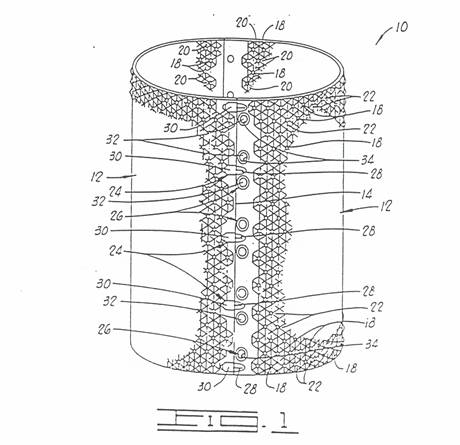
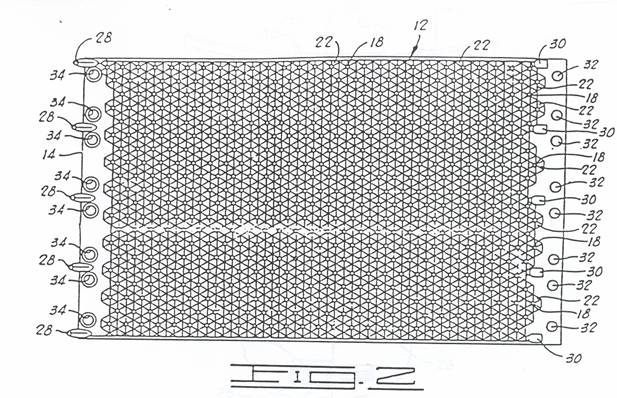
9 Dr Whitcomb had brought with him to Australia a flexible panel constructed substantially in accordance with the invention described in his Australian patent application. The panel has a lattice of guiding recesses or cusps extending almost from one end to the other, much as appears in drawing no.2. According to the specification the sides of the panels are removably joined together by two sets of mortice and tenon joints located at each edge of the panel (depicted as 24 and 26 in the drawings). One set comprise circular holes into which are fitted button shaped protrusions located at the opposite edge. When connected they prevent latitudinal and longitudinal movement. The flexible panel differs from that described in the patent application in that it has two rows of recesses located between one end and the tenons located near that end. This panel has been referred to commonly as the “modified Whitcomb panel”.
10 In July 1988 Mr Lawton visited Dr Whitcomb in the United States. While there he purchased 3,000 modified Whitcomb panels and had them shipped to Australia, where they arrived in October 1988. Each panel was approximately 600mm long and 400mm wide.
11 Mr Lawton instructed staff at Ronneby Tree Farm to assemble the panels for use around trees that were then being grown in bags. Four or five panels were required to form a cylinder around the root ball of each tree. The diameter of a four panel container was approximately 600mm and this was not sufficient to enclose many of the trees.
12 To form a container it was necessary to join the panels. This proved to be a difficult task. Mr Lawton said that a special jig was made to hold the panels. The panels would then be hit with a mallet to make the joint secure. However, when in use the panels often came apart. Various methods of dealing with this problem were employed. One method was to fasten a cord around the circumference of a container to hold the panels in place. Another method was to dispense altogether with the existing fastening means and simply overlap two or three rows of cusps, with the cusps held in their overlapping position by u-shaped wire clips. This method enabled containers with different diameters to be formed. On occasion wire ties were passed through the circular holes to hold the panels in an overlapped position instead of the use of u-shaped wire clips.
13 By the use of these methods it was possible to form a container of the required diameter for any particular size of plant or tree, and the container panels were more securely connected than if they had been joined solely by the connectors at the edges of the panels. As Mr Lawton said, forming the containers was a laborious process and the end product was far from satisfactory.
14 Mr Lawton identified another deficiency with the modified Whitcomb panels. He later explained to his patent attorney, Mr Savage, that being individually moulded, the modified Whitcomb panels were too expensive to manufacture and as a consequence he felt there would be consumer resistance to the product in Australia. When asked in cross-examination to confirm that this had been his view, Mr Lawton was reluctant to do so. I do not doubt that Mr Lawton’s reticence to accept a proposition which is to be found in the specification for his own invention stemmed from his determination not to make a concession that might prove to be against his interest. In this, and in other aspects of his evidence, Mr Lawton was an unsatisfactory witness. On more than one occasion he appeared to me to be more concerned with advancing his own case than giving honest answers to the questions he was asked.
15 Mr Lawton developed a container to overcome the deficiencies that he had encountered with the modified Whitcomb panels. It is this container, the material from which it is made, and the method of growing a plant by its use, which is the subject matter of the patent in suit. The complete specification for that patent is entitled “Plant Growth Container”. The specification describes various types of plant growing containers, including the container the subject of the American inventors’ Australian patent application. Having described that container the specification states:
“Various problems have been encountered with the aforementioned system. A first problem arises as a result of the complex construction of the panels. In order to have suitably interlocking edge formations the panels need to have a reasonably robust construction so that the interlocking formations do not simply disengage as pressure increases within the container during growing or whilst the filled container is being handled. The aforementioned Australian Patent Application describes a system wherein the connection arrangement at the edge joint of adjacent panels is a mortice and tenon joint. This construction has proved difficult to interconnect since the edge formations need to be correctly aligned in order for the tenons to fit into the respective mortices to join the panels together.
The panels which have heretofore been used for this type of container have been individually moulded and that manufacturing process adds significantly to the cost of the container. This type of moulding has proved necessary to ensure the edge formations have the requisite strength and inter-engageability.”
16 The specification then states the object of Mr Lawton’s invention. That object is “to provide a container for above ground plant growth which is easily adaptable in diameter”. The invention is then given the following description:
“A container according to the invention is comprised of a flexible strip of material having a length greater than its width and having an inner and an outer surface, said inner surface being formed in part by a lattice of root guiding recesses, at least some of said recesses being of substantially truncated conical form having a wall which converges towards a hole through the strip, said outer surface being formed in part by a lattice of protuberances at the same relative positional arrangement as the recesses, said strip arranged in a cylinder with its opposite ends overlapping and the protuberances on the outer surface of one end nesting within the recesses on the inner surface of the other end at the overlap, fastening means being provided to hold the strip in said overlapping, nested engagement.”
17 According to the specification the size of the container can be increased as is desired by disconnecting the end of the strip that overlaps with, and nestles within, the recesses of the opposite end, adjusting the degree of overlap by either increasing or decreasing the area of overlap and then reconnecting the ends.
18 The specification states that it is necessary to provide a fastener to hold the overlapping ends in their engaged and overlapped condition. It continues:
“The fastener may comprise a rivet, but if it is desirable to reuse, or expand the diameter of the container, a releasable fastening means may be provided. For example a strap or tie which passes through aligned holes at the overlap could be used, or an adjustable strap or belt which extends around the circumference of the container could be used for this purpose.” (References to diagrams omitted)
19 Turning then to the claims, the first thing to mention is that by order made on 9 December 1998, I directed that the claims be amended. My reasons for judgment are reported at (1999) 44 IPR 113. In construing the amended specification it is permissible to refer to the specification as originally published: see s 116 of the Patents Act 1990 (Cth) (the 1990 Act). Accordingly it is necessary to describe the claims in their original form. It will be convenient in this regard to take the description from my judgment on the amendment application.
20 The claims in the complete specification were of four kinds. First there were claims to a container for growing plants (claims 1, 2 and 3). The principal and the broadest claim was to be found in claim 1 and it followed the description of the invention set out in the body of the specification. According to that claim the container had the following features: (i) it was formed from a flexible strip of material that had a length greater than its width; (ii) the inner surface was formed in part by a lattice of root guiding recesses; (iii) some root guiding recesses had a substantially truncated conical form having a wall which converged towards a hole; (iv) the outer surface was formed by a lattice of protuberances; (v) the protuberances were at the same relative position or arrangement as the recesses; (vi) the strip was arranged in a cylinder where the opposite ends overlapped; (vii) the protuberances on the outer surface of one end nested within the recesses on the inner surface of the other end at the overlap; and (viii) the container had a fastening means to hold the strip in the overlapping nested engagement. Claims 2 and 3 depended upon claim 1. Claim 2 provided for the flexible strip of material to be formed of a relatively thin sheet of plastic and that the formation of the root guiding recesses in the inner surface produced the protuberances on the outer surface. Claim 3 provided for each recess to lead towards a hole through the strip.
21 Secondly there were claims for a strip of material for forming an open topped container within which a plant could be grown (claims 4, 5, 6 and 7). Claim 4 described the features of the strip of material and they comprised the same features as were to be found in claim 1 with one additional feature namely that the “strip [be] formed of a material which is sufficiently flexible so that strip can be rolled into a cylindrical form”. The means of fastening the overlapping ends was not mentioned. Claims 5 and 6 repeated the features described in claims 2 and 3 and claim 7 was for a strip according to the features of claims 4 to 6 but where the material was made of foamed polystyrene.
22 Thirdly there was a claim for a method of growing a plant which was intended to be transplanted (claim 8). The method was by use of the strip of material according to claim 4.
23 Finally there were three “as described” claims (claims 9, 10 and 11), one for a container, one for a strip of material and one for a method of growing plants. The claims were for a container, strip of material and method as described in the body of the specification and as illustrated in the drawings which formed part of the complete specification.
24 In their amended form I need only refer to claims 1 and 12, for it is accepted that if the alleged infringing panels, which I will describe later, do not infringe these claims they will not infringe the others. Claim 1 (with deletions that are indicated by square brackets and additions that are indicated by underlining) now reads:
“1. A container for growing a plant comprised of a flexible strip of material having a length greater than its width and having an inner and an outer surface, said inner surface being formed in part by a lattice of root guiding recesses, [at least some of] each said recess[es] being of substantially truncated conical form having a wall which converges towards a hole through the strip, said outer surface being formed in part by a lattice of protruberances (sic) at the same relative positional arrangement as the recesses, said strip arranged in a cylinder with its opposite ends overlapping and the protruberances (sic) on the outer surface of one end nesting within the recesses on the inner surface of the other end at the overlap, said lattice of root guiding recesses and said lattice of protruberances (sic) each extending completely from one end of the strip to the other end, fastening means being provided to hold the strip in said overlapping, nested engagement.”
Claim 12 is the fourth claim renumbered and amended. It reads:
“12. [4] A strip of material for forming an open topped container within which a plant can be grown, said strip having a length greater than its width and an inner surface and an outer surface, the inner surface being formed in part by a lattice of root guiding recesses, [at least some of] each said recess[es] being of substantially truncated conical form having a wall which converges towards a hole through the strip, the outer surface being formed in part by a lattice of protruberances (sic) at the same relative positional arrangement as the recesses, said strip being formed of a material which is sufficiently flexible so that strip can be rolled into a cylindrical form with opposite ends of the strip overlapping and the protruberances (sic) on the outer surface of one end nesting within the recesses on the inner surface of the other end, said lattice of root guiding recesses and said lattice of protruberances (sic) each extending completely from one end of the strip to the other end.”
25 At the outset I said that the infringement claim depends upon the construction to be placed upon the patent in suit. The first claim is for a container “comprised of a flexible strip of material” having certain features, one of which is that the inner surface is formed in part by a lattice of root guiding recesses, each recess being of substantially truncated conical form having a wall which converges towards a hole through the strip. The twelfth claim is for “a strip of material for forming an open topped container within which a plant can be grown”, the strip having the same features as in the first claim. Three questions of construction arise.
26 The first question is what is meant by “a flexible strip of material”. Is the container to be formed from a single piece of material? Or can the container be formed from a number of pieces of material joined together? The answer will depend upon the meaning to be given to the word “strip”. The second question is what is meant by the word “for” in the phrase “a strip of material for forming an open topped container”. The final question is whether each root guiding recess must end with a hole.
27 The principles to be applied in construing the claims were not in dispute. The following are the rules to which I will conform. Each claim must be read as part of the entire specification: Electric & Musical Industries Ltd v Lissen Ltd (1939) 56 RPC 23. Thus, the meaning of the words used in a claim may be affected by what is said in the body of the specification: Rosedale Associated Manufacturers Ltd v Carlton Tyre Saving Co Ltd [1960] RPC 59 at 69. Once the true meaning of the claim is arrived at, it is not permissible to vary the scope of the claim by reason of what appears in the body of the specification: The Raleigh Cycle Co Ltd v H Miller & Co Ltd (1946) 63 RPC 113 at 132; Beecham Canada Ltd v Procter & Gamble Co (1982) 61 CPR (2d) 1 at 11. There are other principles of construction which I will mention later.
28 As regards the first question I do not think there is any serious difficulty with the meaning of the word “strip”. One ordinary meaning of that word, and the only meaning that is presently relevant, is ‘a piece of material that is long and narrow’. That is the meaning that is found in more than six dictionaries to which I was referred. For the cross-respondents it was submitted that one strip of material can be produced by joining two or more strips together. Even if that were a possible meaning of the word “strip”, and I do not dispute that in certain instances it might be, it is not the meaning it bears in the claim.
29 Leaving aside for the moment the words of the claim, reference to the remainder of the specification shows what is meant by the word “strip”. First, there is the statement of the object of the invention that I have already set out. It is for a container “which is easily adaptable in diameter”. The possibility of adaptation arises from the use of a single strip of material. Thus the specification records:
“It is envisaged that the strip will be formed in long lengths in a continuous process, and the long lengths will [be]cut to shorter lengths to form individual strips for the containers.” (References to diagrams omitted)
Later the specification states:
“It is envisaged that for initial growing … the strip will be rolled in a relatively tight roll in which the strip extends twice around the inner volume of the container. Thereafter… the volume can be increased by disengaging the fastening means and then disengaging the inner and outer surfaces of the strip and unravelling the roll to increase the diameter of the container…” (References to diagrams omitted)
30 Second, reference should be made to the deficiency in the prior art that is mentioned in the specification, namely the significant cost of manufacturing individually moulded panels. The invention overcomes this problem because it provides for a container which is adaptable in diameter by use of a single strip. Finally, an embodiment of the invention is described in various drawings. Those drawings, particularly figures 6 and 7, depict a circular cylindrical container with a single strip rolled in a way that the strip extends twice around the inner volume. What is shown in each case is a single strip, as opposed to a strip made up of connected parts.
31 Thus, it is clear that the container described in the specification and referred to in the claim is made from a single strip, the ends of which are overlapped and that the amount of overlap is dictated by the size of the container that is desired. This is one of the two important improvements that this invention has over the prior art.
32 Two witnesses called by the cross-claimant, Dr Peter Yau, an arboriculturalist, and Dr Peter May, an agricultural scientist familiar with the horticultural industry, gave evidence on the meaning of the word “strip”. They said that the word “strip” could mean either a single pre-cut length of material or two or more sheets of material which are securely joined. That might be so. But the issue is not what is the possible meaning of the word “strip” but, rather, what meaning the word is to be given in the specification. As to this I do not think any evidence was receivable. The word is not used in any special or technical sense. While it is true that I must heed the point that a judge is not the skilled addressee to whom the specification is directed and in accordance with whose knowledge and understanding it must be construed, when it comes to the meaning of an ordinary word like “strip” as used in the patent in suit, I do not feel at any disadvantage in arriving at my own conclusion, even if it be different from the conclusion arrived at by those skilled in the relevant art.
33 The meaning of the word “for” in the phrase “a strip for forming” presents greater difficulty. The cross-respondents say that it means “intended or destined for something”. They have support from Dr May. In one affidavit he deposed: “In my judgment the word ‘for’ can certainly be read as referring to an intention or purpose rather than by reference to what might be capable of being done.” If it is to bear that meaning, then to determine whether there has been an infringement of the patent, it would be necessary, among other things, to determine the purpose for which an alleged infringing strip is sold or offered for sale. While this may have been the intention of the draftsman of the patent in suit, it would be a curious approach to take in the present context.
34 Another possibility is that a strip “for” forming a container means a strip that is suitable for that purpose; that is to say, a strip that is capable of being used for that purpose. On this construction it would not be necessary to inquire as to the intention of the manufacturer or vendor of the alleged infringing article: see also The Raleigh Cycle Co Ltd v H Miller & Co Ltd (1946) 63 RPC 113 at 137 and on appeal (1948) 65 RPC 141 at 157 and 164. It is true that there is often difficulty associated with claims for devices that are “for” a particular purpose. Blanco White in “Patents for Inventions” (5th ed 1983) at par 2-117 suggests that it might result in the claim being a method claim. That may be true in some cases, but it will not be so in this case. In my opinion, the strip the subject of the claim is one from which a container can be made.
35 The final point on construction is whether every root guiding recess must converge to a hole. In its original formulation (that is prior to its amendment) the first claim required the inner surface of the strip of material to be “formed in part by a lattice of root guiding recesses, at least some of said recesses being of substantially truncated conical form having a wall which converges towards a hole through the strip”. As a result of the amendment, “each said recess must converge towards a hole”. What does this mean?
36 It is the duty of the patentee to state clearly the nature of his claim so that others may know the boundaries of the monopoly. What is not claimed is disclaimed: Electric & Musical Industries Ltd v Lissen Ltd (1939) 56 RPC 23 at 39; Walker v Alemite Corporation (1933) 49 CLR 643 at 653. So, the monopoly conferred by the patent will be confined to what is claimed. Protection will not extend to that which might have been, but by inadvertence or otherwise was not, claimed: Rodi and Wienenberger AG v Henry Showell Ltd [1969] RPC 367 at 380.
37 The literal infringement of a patent is rare. Of course if an alleged infringing article falls squarely within the meaning of the claim, that is an end to the matter. But to limit protection to a literal copy would greatly reduce the utility of a patent. What of the person who takes the patent but has made unimportant changes or minor variations? Is he able to avoid infringement? Or does the patentee still have a remedy?
38 In Clark v Adie (1875) 10 ChApp 667 at 675 James LJ said:
“The patent is for the entire combination, but there is, or may be, an essence or substance of the invention underlying the mere accident of form; and that invention, like every other invention, may be pirated by a theft in a disguised or mutilated form, and it will be in every case a question of fact whether the alleged piracy is the same in substance and effect, or is a substantially new or different combination.”
The idea that a patent could be infringed by a device which employs the principle of the patent and appropriates the substance of the invention was widely accepted. In England, see C Van Der Lely NV v Bamfords Ltd [1963] RPC 61; Rodi and Wienenberger AG v Henry Showell Ltd [1969] RPC 367. In the High Court, in Radiation Ltd v Galliers & Klaerr Pty Ltd [1938] 60 CLR 36 at 51, Dixon J said:
“But, on a question of infringement, the issue is not whether the words of the claim can be applied with verbal accuracy or felicity to the article or device alleged to infringe. It is whether the substantial idea disclosed by the specification and made the subject of a definite claim has been taken and embodied in the infringing thing.”
In Olin Corporation v Super Cartridge Co Pty Ltd (1977) 180 CLR 236 at 246 Gibbs J said that these principles, that is infringement by taking the “pith and marrow” or the substance of an invention, were still good law.
39 The decision of the House of Lords in Catnic Components Ltd v Hill & Smith Ltd [1982] RPC 183 changed the law in this area. The patent in that case was for a lintel of box construction suitable for use to support bricks or building blocks over an aperture. The claim required that the upper plate be supported upon the lower by two supports “extending vertically” from one plate to the other. The defendant drew a lintel that had a support which inclined 6° or 8° from the vertical. At first instance Whitford J found that there had been infringement. The reason he gave was that the defendant’s lintel took all of the essential features of the claim and the difference was in an immaterial respect. An appeal taken to the Court of Appeal was allowed by majority, Buckley and Waller LJJ, Sir David Cairns dissenting. The majority were of the opinion that the word “vertical” was a word of precision and therefore the defendant’s model did not infringe.
40 In the House of Lords the decision of Whitford J was restored. Lord Diplock, with whom the other Law Lords agreed, said (at 242):
“My Lords, in their closely reasoned written cases in this House and in the oral argument, both parties to this appeal have tended to treat ‘textual infringement’ and infringement of the ‘pith and marrow’ of an invention as if they were separate causes of action, the existence of the former to be determined as a matter of construction only and of the latter upon some broader principle of colourable evasion. There is, in my view, no such dichotomy; there is but a single cause of action and to treat it otherwise, particularly in cases like that which is the subject of the instant appeal, is liable to lead to confusion.”
The correct approach, his Lordship explained (at 242-243) was as follows:
“My Lords, a patent specification is a unilateral statement by the patentee, in words of his own choosing, addressed to those likely to have a practical interest in the subject matter of his invention (ie ‘skilled in the art’), by which he informs them what he claims to be the essential features of the new product or process for which the letters patent grant him a monopoly. It is those novel features only that he claims to be essential that constitute the so-called ‘pith and marrow’ of the claim. A patent specification should be given a purposive construction rather than a purely literal one derived from applying to it the kind of meticulous verbal analysis in which lawyers are too often tempted by their training to indulge. The question in each case is: whether persons with practical knowledge and experience of the kind of work in which the invention was intended to be used, would understand that strict compliance with a particular descriptive word or phrase appearing in a claim was intended by the patentee to be an essential requirement of the invention so that any variant would fall outside the monopoly claimed, even though it could have no material effect upon the way the invention worked.”
41 In other words, what is required is a construction of the specification which is reasonable and fair to both the patentee and the public. If, upon a reasonable view, the specification can be read to protect the inventor then the court should give effect to that construction. This is what is sought to be achieved by a purposive construction, as is apparent from the passages cited from Catnic. Further, Lord Diplock was not only dealing with principles of construction, but was also setting out the proper approach to questions of infringement.
42 In this connection reference should be made to Improver Corporation v Remington Consumer Products Ltd [1990] FSR 181, where Hoffmann J (as his Lordship then was) said that when the issue is whether a feature embodied in an alleged infringement, which falls outside the primary or literal meaning of a claim (a feature which he called the ‘variant’), was nevertheless within its language as properly interpreted, the court should ask “Lord Diplock’s three questions”: (1) Does the variant have a material effect upon the way the invention works? If yes, the variant is outside the claim. If no: – (2) Would this (that is, that the variant had no material effect) have been obvious at the date of publication of the patent to a reader skilled in the art? If no, the variant is outside the claim. If yes: – (3) Would the reader skilled in the art nevertheless have understood from the language of the claim that the patentee intended that strict compliance with the primary meaning was an essential requirement of the invention? If yes, the variant is outside the claim.
43 It must always be borne in mind that an element of a claim that appears not to be necessary for the invention may nevertheless be regarded by the patentee as essential for some reason that is not apparent: Société Technique de Pulverisation Step v Emson Europe Ltd [1993] RPC 513 at 522. Accordingly, the court should act with some care before it broadens a claim in reliance upon a purposive construction of the words used in the specification.
44 It seems that the following is the position that now pertains. Before Catnic, the subject matter of a patent was defined in accordance with the literal meaning of the claim. Nevertheless, if the substance (pith and marrow) or mechanical equivalent of the claim was taken, there would be an infringement. The rules were made necessary to render patents useful. The change brought about by Catnic was that a patent specification is to be given a purposive and not a literal construction. The question to be determined under this approach is whether the patentee intended strict compliance with an element of the invention to be an essential requirement of the invention. On this basis the former approach, that is, whether the “pith and marrow” or substance of a claim has been taken, is no longer necessary.
45 In Australia the so-called ‘purposive approach’ to construction has been adopted (see Populin v HB Nominees Pty Ltd and Binder (1982) 41 ALR 471; Nesbit Evans Group Australia Pty Ltd v Impro Ltd (1997) 39 IPR 56) although some cases imply that the former approach can still have application: see Populin at 475-477; see also J W Dwyer and A Dufty (eds) Lahore on Patents Trademarks and Related Rights (1996) pars 18,135 and 18,140. On the other hand when the Improver questions are posed and answered, it is difficult to see what can be achieved by recourse to the “pith and marrow” approach.
46 With the above considerations in mind I turn back to the question whether each root guiding recess must converge in a hole. To place myself in the position of being able to answer this question from the point of view of someone with a practical interest in the subject matter, I have evidence from a number of witnesses to which reference will be made.
47 If the language of the claim is clear, then the meaning of that language cannot change by reference to what appears in the specification. But the words of the claim must read in light of the specification as a whole and given a meaning in that context. Once construed it is not permissible to extend or narrow the ambit of the claim by reference to the specification: see generally Conoco Specialty Products (Inc) v Merpro Montassa Ltd [1994] FSR 99 at 106 and the cases there cited. Thus if, expressly or by necessary implication, something is indicated in the descriptive part of the specification to be an essential feature of the invention, the patentee is bound by that assertion: J K Smit & Sons Inc v McClintock [1940] SCR 279 at 295. Likewise, if a feature of the invention is said to be inessential, the court should not go behind that statement.
48 The approach that I will adopt is to consider the claim in its unamended form to discern what was intended and then to consider whether the meaning has changed following the amendments. Usually, the task of construction is best undertaken by taking the claim as it currently stands and ascertaining its meaning, having regard to the nature of any amendments made. In this case, for reasons which will become apparent, a different approach is called for. It is not an approach which, I believe, will lead to error.
49 The proper construction of the specification is a matter of law: see generally Décor Corporation Pty Ltd v Dart Industries Inc (1988) 13 IPR 385 at 400. It is, however, a task that must be undertaken through the eyes of the person to whom the specification is directed, that is the person skilled in the art or science to which the specification relates: Vidal Dyes Syndicate Ltd v Levinstein Ltd and Read Holliday & Sons Ltd (1912) 29 RPC 245 at 272; Osram Lamps v Pope Electric Lamp Co (1917) 34 RPC 369 at 391. It is this person who may give expert evidence to inform the court what is the generally accepted meaning of technical terms and also to explain how things actually work: American Cyanamid Company v Ethicon Ltd [1979] RPC 215 at 254.
50 There will be cases, however, where expert evidence is not admissible on the question of construction. Sometimes the text of the specification will be couched in language with which all lawyers are familiar, containing no technical or trade terms calling for explanation. In that event the court of construction can determine for itself, unassisted by experts, the relevant meaning, as it does with any other instrument. In its unamended form the specification of the patent in suit falls into this category at least so far as concerns the issue presently under consideration.
51 Whether each recess must end in a hole is the subject of express comment in the specification. An embodiment of the invention is described by reference to a number of drawings. According to those drawings, especially figures 1, 2 and 3, each root guiding recess leads to a hole. However, the specification states: “It is not essential that each recess leads towards a respective hole, but this is the preferred arrangement”. Further, according to the specification when the strip is overlapped, in order to hold the ends in their overlapped condition a fastener is required. Examples of various fasteners are given. One is a tie which passes through a number of aligned holes. These holes are no longer capable of air pruning the roots of a plant.
52 There can be no doubt that, in their unamended form, it was not an essential aspect of the claims that each protuberance end in a hole. First, the wording of the principal claims (claims 1, 4 and 8) expressly provided that only some, and not all, recesses should converge to a hole. Second, there is the express statement to that effect in the descriptive part of the specification. Finally, as the descriptive part shows, some of the holes may be blocked by a releasable fastening device.
53 Have the amendments brought about a change in construction? The first point to note about these amendments, taking claim 1 as the example, is that a literal reading of the claim, in isolation from the remainder of the specification, now requires each recess to converge to a hole. In my opinion, however, it does not necessarily follow that an element that had not been an essential requirement of the invention has become essential. In the first place, the fact that when read literally the claim requires each recess to end in a hole, is not enough for the skilled addressee to conclude that this feature is essential. To determine whether that is truly so, other matters must be taken into account. In the second place, although the claims were amended, there was no amendment to the statement in the specification that this was not essential to the invention. While that statement remains in the specification it cannot be ignored unless it is possible to conclude that the amendments are so inconsistent with the statement such that the statement must yield to the new language. An analogy might be drawn with an implied amendment of a statute. In reality, however, there is no inconsistency. The amended claims can be read, as claims sometimes are, as containing the features of the preferred embodiment of the invention.
54 The cross-respondents say that one object of the amendments to claim 1 was to restrict the scope of the claim to a strip of material which had, as an essential feature, each truncated conical form ending in a hole. They refer to what was said by counsel for the patentee on the amendment application to reinforce this point. I do not accept that the specification can be construed by reference to direct statements of intention. A specification is addressed not to the public but to persons skilled in the particular art of the patent under review. In construing the patent, the addressee is not entitled to interrogate the inventor nor to take into account what the inventor may have said about his invention. A fortiori in the case of an assignee who amends the specification.
55 Nevertheless, I accept that as a result of the amendment, the issue is not as clear as it was beforehand. Therefore I intend to consider also whether strict compliance with the feature is required by reference to the questions suggested in Improver. To undertake that task it will be necessary to consider the matter by reference to the alleged infringing products. It is only by having regard to those products that the particular “variant” can be identified. It will also be appropriate to consider the evidence on the effect of the variant.
56 In early 1997 the original proprietor of the patent in suit, Ronneby Tree Farm Pty Ltd, was placed under administration pursuant to Part 5.3A of the Corporations Law. On 20 January 1997 Mr Lawton, who until then was a director of the company, was dismissed from office. Shortly thereafter he took charge of Root Quality. By this I mean that Mr Lawton became responsible for the affairs of Root Quality, although he did not become one of its directors. As he said: “I do all of the physical activities of Root Quality personally. I conduct all of the manufacturing, the design, the sales and the accounting”. Being an undischarged bankrupt, Mr Lawton could not accept office as a director of Root Quality : see s 229(1) of the Corporations Law, being the provision in force in 1997; see now s 206B(3).
57 Since September or October 1997 (Mr Lawton said that it was “in the spring of ’97”) Root Quality has been in the business of selling plant growing containers or panels that can be assembled to form a plant growing container. The features of these containers, or the panels from which they are constructed, have changed over the years. It is important to consider these changes. For convenience I will refer to the different versions of the container, or the panels for that container, by the description employed by the parties, although at times there was some confusion concerning which particular container had a particular designation. Root Quality refers to each of its containers as the Rocketpot. Four different versions of the Rocketpot have been developed. Each is given a different designation, from Mark 1 through to Mark 4. Only three of the containers are the subject of the infringement claim.
58 The first container manufactured and sold by Root Quality is referred to as the Mark 1 Rocketpot. The evidence shows that this container has all of the features of claim 1 of the patent in suit, including the fact that it was made from a single panel. For a number of reasons Root Quality discontinued production of the Mark 1 container in about January 1998. Mr Lawton said that one reason was his concern that the container might infringe the patent in suit. Be that as it may, Root Control brings no claim for infringement in respect of the Mark 1.
59 The Mark 2 Rocketpot container is different from the Mark 1 in that it is assembled from more than one panel. Mr Lawton sometimes referred to it as a “two panel product”, although the container is usually made from three or four panels. However, nothing turns on that point. Each panel contains all of the features of the strip referred to in claim 1 except the following. The overlapping ends of each panel are held in their overlapping position by two screw threaded fasteners. The fasteners are inserted through the aligned holes on each of the nested cusps of the overlapping edge portions.
60 The Mark 3 Rocketpot container came onto the market in August 1998. It has the features of the Mark 2 with one exception. It has two rows of root guiding recesses that do not end in a hole. Those rows are the upper two rows of the container in its assembled condition.
61 Mr Lawton explained the importance of leaving the upper two rows of recesses without holes. He said that a plant must be flooded with water at the time of planting. The removal of the holes enables full water saturation to take place by allowing water to be retained within the container. This was said to be of great value to the life of a plant. Mr Lawton said “top up nursery watering and after-market watering are made much quicker and more effective by omission of the holes. In hostile after-market storage areas it can make a major contribution to tree survival.”
62 There is both truth and exaggeration in what Mr Lawton said. The evidence shows that when a plant is placed into a container, potting mixture is put around the plant and sometimes mulch is placed on the surface of the mixture. The container is filled to the brim with potting mixture because the mixture consolidates and after a short time settles to a level of approximately one inch below the top of the container . Upon being placed into the container the plant must be watered. However working practices differ. Some nurseries flood the newly transplanted plant by using a hand-held hose. Most nurseries now use an automated or computer controlled dripper or spray watering system that does not flood the container.
63 I accept that the absence of holes is a useful feature. But the degree of usefulness has been significantly overstated by Mr Lawton. Mr Davidson, a tree surgeon, was called by the cross-respondents to give evidence. He explained that the initial flood watering takes place immediately after the plant has been placed in the container. At this time the surface level of the potting mixture is at the top of the container. Accordingly, the absence of holes will have little effect on the capacity of the container to retain water. However, as the surface level drops the capacity to retain water will increase. Mr Davidson said that some retail nurseries still hand water their plants rather than use an automated sprinkler system. For those nurseries watering will be a little easier when the two top rows of the container do not have cusps that end in a hole.
64 Important as regards the Mark 3 Rocketpot container is the fact that the absence of holes in the top rows of the container will not affect the air root pruning that is achieved by the use of the container. The reason is obvious. Once the surface level of the potting mixture settles below the top of the container roots will not extend to the vicinity of the top two rows. The evidence also shows that if one or two of the overlapping holes are taken up with a fastening device this will have no effect on the growth of the root system.
65 There is one aspect of the Mark 3 Rocketpot container that requires separate comment. Mr Lawton gave evidence that Root Quality did not sell single panels from which a Mark 3 container could be made. He said that the panels were sold in sets of either three or four, dependent upon the size of the container that was required by the purchaser. There was no evidence of Root Quality having sold a single panel so that a purchaser could make one small container. But there was evidence of a threat to do so. After the commencement of this proceeding, the former solicitors for Root Quality wrote a letter dated 9 November 1998 to Root Control’s patent attorneys as follows:
“We are instructed by Mr Peter Lawton that he has recently developed a new version of the Rocketpot root container which will be displayed by representatives of Root Quality Pty Ltd at an industrial exhibition which commences this Thursday.
Our client’s patent attorneys have advised that the new product does not infringe the SpringRing patent owned by your client. However we would be pleased to receive your opinion regarding the same prior to the unveiling of the product in public. A sample of the smaller size of the new product will be available for inspection at our office.”
66 Mr Schlicht, an attorney with Phillips Ormonde & Fitzpatrick, took up the invitation to inspect the sample. He described the container that he was shown as a Rocketpot container with the two top rows of root guiding recesses unpunched. He said that it was made from a single panel. He took possession of the sample but unfortunately did not retain it.
67 Mr Lawton was asked how this particular version of the Mark 3 Rocketpot container had come into existence. He said that his solicitor had requested him to produce it for the purpose of discussions with Mr Schlicht. I do not accept this explanation. Mr Lawton also said that the sample was never displayed at an industry exhibition. That may be true. It seems to me that Mr Lawton originally intended to sell a single panel version of the Mark 3 Rocketpot but decided not to do so for fear that it might infringe the patent in suit.
68 The Mark 4 Rocketpot container seems to have been first manufactured some time during 1999, but the evidence is unclear on this point. In all relevant respects it has the same features as the Mark 3, although its precise status is unclear. In an affidavit Mr Lawton deposed that “the Mark 4 is being implemented progressively”. Yet during his cross-examination he said that production was limited to an “experimental batch” and that it was not intended for it to be manufactured for sale. There is not sufficient evidence for me to resolve this inconsistency, but at least I am entitled to infer that there is a threat to sell the Mark 4 Rocketpot .
69 With this background in mind I now come back to the Improver questions. For the purposes of those questions there are two variants. The first is that some aligned holes are taken up by the screw fastening means. The second variant is that two rows of recesses do not end in a hole. The first question is whether these variants have a material effect on the way in which the invention works. The specification says that “the main aims of the invention are to provide containers which guide primary roots radially outwardly towards holes in the container walls. As the roots approach the holes they are air pruned resulting in secondary roots branching from the length of the primary roots and thereby forming a well matted and cohesive root ball which is ideal for transplantation.” From what I have already said it is clear that the variants will not affect the way in which the invention will facilitate the growth of the root ball in the desired fashion. In the case of the Mark 2 Rocketpot there is a loss of only six or eight air pruning holes and that is not sufficient to affect the capacity of the container to function as a root pruning container in the desired manner. With the plants grown in either the Mark 3 or Mark 4 Rocketpot, the roots will not extend to the areas of the upper two rows above the surface of the potting mixture.
70 The second question is whether the fact that the variants do not have a material effect on the invention would be known to the skilled addressee. Here I must say some more about this person. The identity of the skilled addressee occupied a little time during the hearing. Both parties proceeded on the basis that the skilled addressee was not to be found in one discipline, but in two. The skilled addressee, or the judge adopting the mantle of the skilled addressee, is relevant for a variety of purposes in patent law. He is the person to whom the patent is addressed and who must construe it. He is the person whose knowledge will determine whether a patent is novel. He is the person who will judge whether a patent is obvious. The skilled addressee has been given various descriptions. Sometimes he is the “notional skilled addressee” (Electricity Trust of South Australia v Zellweger Uster Pty Ltd (1986) 7 IPR 491 at 500), sometimes the “uninventive skilled worker in the particular field” (Leonardis v Sartas No 1 Pty Ltd (1996) 67 FCR 126 at 146), sometimes the “non-inventive worker in the field” (The Wellcome Foundation Ltd v V R Laboratories (Aust) Pty Ltd (1981) 148 CLR 262 at 270; Minnesota Mining and Manufacturing Company v Beiersdorf (Australia) Ltd (1980) 144 CLR 253 at 293), sometimes the “person skilled in the art” (Genentech Inc v The Wellcome Foundation Ltd (1989) 15 IPR 423 at 545; Tetra Molectric Ltd v Japan Imports Ltd [1976] RPC 547 at 583) and sometimes the “non-inventive hypothetical skilled addressee” (Innovative Agricultural Products Pty Ltd v Crawshaw (unreported, Federal Court of Australia, Lee J, 19 August 1996 at par 90)).
71 Generally speaking the skilled addressee is the person who works in the art or science with which the invention is connected. In Plimpton v Malcolmson (1876) 3 ChD 531 Jessel MR said (at 556):
“What is meant is that if [the invention] is a manufacture connected with a particular trade, the people in the trade shall know something about it; if it is a thing connected with a chemical invention, people conversant with chemistry shall know something about it.”
In Catnic Lord Diplock said (at 242) that skilled addressees are “those likely to have a practical interest in the subject matter of [the] invention”. A variety of people may have that interest. There are those who might wish to make or construct the invention, those who may wish to compound the invention and those who may wish to use the invention. The skilled addressee seems to me to be a relative expression which does not identify any specific person. Because the patent is directed to a person interested in making, constructing, compounding or using the invention (see eg s 27(3)(b) of the Patent Act 1993 (Canada); International Standard Electric Corporation v Ooms 157 F2d 73 (1946)), this hypothetical person, the patent lawyer’s “reasonable man”, may be required to be skilled in more than one art. Such a person might be thought of as the composite being, mentioned by Buckley LJ in Tetra Molectric, above, at 583. It may be preferable not to search for a composite addressee but a team whose combined skills are to be employed. In The General Tire & Rubber Company v The Firestone Tyre & Rubber Company Ltd [1972] RPC 457 at 485, Sachs LJ said:
“The construction of these documents is a function of the court, being a matter of law, but, since documents of this nature are almost certain to contain technical material, the court must, by evidence, be in the position of a person of the kind to whom the document is addressed, that is to say, a person skilled in the relevant art at the relevant date. If the art is one having a highly developed technology, the notional skilled reader to whom the document is addressed may not be a single person but a team, whose combined skills would normally be employed in that art in interpreting and carrying into effect instructions such as those which are contained in the document to be construed.”
72 Although for some purposes the skilled addressee must be a team, in considering whether it would have been obvious that the variants do not have a material effect on the way in which the invention works, the relevant member of the team, if there need be a team, is the person who intends to use the invention. This would be a horticulturalist or nurseryman. A number of witnesses had the relevant expertise, including Drs May and Yau. Dr May said that the alleged infringing containers “would function, in the sense of root control, in exactly the same manner as the … SpringRing container”. Dr Yau gave evidence to the same effect. Their evidence on this aspect was not challenged. So, we have an affirmative answer to the second question.
73 The final Improver question is whether the patent specification makes it obvious to the skilled addressee that the variants could not have been intended to be excluded from what is specified in the claim. The skilled addressee in this case would find the clear statement in the specification that it is inessential that each recess end in a hole. He would discover that the specification contemplates that some holes would be taken up with a fastening device. He would be aware of the amendments and the potential for repugnancy. But he would note that when the claims were amended the remainder of the specification remained intact. The skilled addressee would conclude, as I do on his behalf, that the variants were not intended to be excluded from the claim.
74 So far what I have said leads to the conclusion that unless the patent in suit is invalid, selling or offering to sell panels for the Mark 2 and Mark 3 Rocketpot is an infringement of the patent, and threatening to sell panels for the Mark 4 Rocketpot is a threat to infringe the patent. The conduct would infringe the first claim according to the principle that selling the component parts of an article which is protected by a patent amounts, in substance, to selling the article: Rotocrop International Ltd v Genbourne Ltd [1982] FSR 241 at 259. This is not a case, such as Walker v Alemite Corporation (1933) 49 CLR 643, where only some components of an article are sold. In Walker Dixon J said (at 658) that the exclusive property in a combination invention is not infringed by the sale of the components. That particular rule does not apply when all of the components of a combination invention are sold by a person who knows and intends that the ultimate purchaser would assemble the invention. The conduct would infringe the twelfth claim because the panels can be formed into a container. This is true both in cases of a single panel, although the formation would not be easy, and multiple panels.
75 Is the patent in suit invalid? The application for the complete specification of the patent was lodged when the Patents Act 1952 (Cth) (the 1952 Act) was in force. The 1952 Act was repealed and replaced by the the 1990 Act which came into operation on 30 April 1991, before the patent was sealed. Although the 1990 Act applies to the patent (s 234(2)), the patent cannot be invalidated on any ground not available under the 1952 Act (s 234(5) of the 1990 Act).
76 The first ground relied upon to contest the validity of the patent in suit is want of novelty. Section 138(3)(b) of the 1990 Act provides that a standard patent may be revoked on the ground “that the invention is not a patentable invention”. One element in the definition of “patentable invention” is that the invention is novel when compared with the prior art base as it existed before the priority date of that claim: s 18(1)(b)(i) of the 1990 Act. The comparable provision in the 1952 Act is s 100(1)(g). In Meyers Taylor Pty Ltd v Vicarr Industries Ltd (1977) 137 CLR 228 at 235 Aickin J said that “[t]he basic test for anticipation or want of novelty is the same as that for infringement and generally one can properly ask oneself whether the alleged anticipation would, if the patent were valid, constitute an infringement.”
77 In the case of anticipation by a document or a prior patent (prior publication), the test is quite rigorous. The prior publication must give directions which will inevitably result in something within the claim. In General Tire & Rubber Company,above, at 485-486 Sachs LJ said:
“[I]f carrying out the directions contained in the prior inventor’s publication will inevitably result in something being made or done which, if a patentee’s patent were valid, would constitute an infringement of the patentee’s claim, this circumstance demonstrates that the patentee’s claim has in fact been anticipated.”
The directions must be clear and unmistakable. In Flour Oxidizing Company Ltd v Carr & Co Ltd (1908) 25 RPC 428 Parker J said (at 457):
“But where the question is solely a question of prior publication, it is not, in my opinion, enough to prove that an apparatus described in an earlier Specification could have been used to produce this or that result. It must also be shown that the Specification contains clear and unmistakable directions so to use it.”
The directions must give information to a person of ordinary knowledge so that he will at once perceive the invention. In Hill v Evans (1862) 4 de G F & J 288 at 300; 45 ER 1195 at 1199, Lord Westbury put the matter this way:
[T]he antecedent [publication] must be such that a person of ordinary knowledge of the subject would at once perceive, understand and be able practically to apply the discovery without the necessity of making further experiments and gaining further information before the invention can be made useful. If something remains to be ascertained which is necessary for the useful application of the discovery, that affords sufficient room for another valid patent.”
78 The final point to mention is that the anticipation must be found in a single document. A number of prior publications cannot be combined to constitute an anticipation. In British Ore Concentration Syndicate Ltd v Minerals Separation Ltd (1909) 26 RPC 124 at 147 Fletcher Moulton LJ said:
“It cannot be too carefully kept in mind in patent law that, in order to render a document a prior publication of an invention, it must be shown that it publishes to the world the whole invention – ie, all that is material to instruct the public how to put the invention in practice. It is not enough that there should be suggestions which, taken with suggestions derived from other and independent documents, may be shown to foreshadow the invention or important steps in it. Since the date of the vigorous protest of Lord Justice James against such a ‘mosaic’ of prior publications this has been a universally accepted and most salutary principle. It applies with exceptional force in cases where the alleged prior publications are the Specifications of unsuccessful inventions which have accordingly never passed into public general knowledge but have rightly been forgotten.”
79 The prior art alleged to anticipate the patent in suit is the Whitcomb patent application, the modified Whitcomb panels, or containers made from those panels, and a United States Patent No. 3,963,813.
80 I can quickly dispose of the Whitcomb patent application. One amendment made to the claims was a requirement that the lattice of root guiding recesses and protuberances extend completely from one end of the strip to the other. In the Whitcomb application the lattice of recesses and protuberances does not extend to the ends of the panel. There is a relatively narrow area at each end, where the fastening means are found, where the lattice does not extend.
81 According to Dr May, whose evidence on this point I accept, this is an important difference between the two articles. Dr May said that the feature appearing in the patent in suit permits a nesting of recesses and protuberances at any point, which in turn gives rise to a number of advantages over the article claimed in the Whitcomb patent application. First, it is simple and uncomplicated to form a container by overlapping the ends of the strip. Second, because of its simplicity, the overlapping and fastening can be done easily, quickly and inexpensively. Third, it is simple and easy to vary the degree of overlap and thereby alter the circumference of the container.
82 The cross-respondents claim that the modified Whitcomb panel does have the feature of root guiding recesses extending substantially from end to end, by pointing to the “buttons” at one end of the panel. These buttons do not end in a hole but, as the evidence shows, this is of no practical consequence. However, the difference with the SpringRing is both in the shape and the function to be performed by the root guiding recesses described in the patent in suit, which cannot be attributed to the buttons. An important feature of the SpringRing is that when the ends of the strip are in an overlapped condition the protuberance on the outer surface will nest within the recesses of the inner surface of the area of overlap. This interlocking resists splitting.
83 It is also argued that the Whitcomb container anticipates the nested engagement of the cusps, not when the container was constructed in accordance with the invention by use of the mortar and tenon joints, but when the overlapping engagement was employed to overcome the difficulty of assembling the container.
84 The evidence does indicate that when the Whitcomb panels were overlapped, it was at the area of overlap that there was something in the nature of an engagement of the protuberances within the recesses. But as Dr May explained, “there is no sense of engagement of the two things. They just happen to fit together because they are the same shape. It is being held together by the electrical ties.” This evidence confirms my own impression that the engagement and nesting is not sufficient to act as a genuine fastening means.
85 The invention the subject of US Patent No. 3,963,813 relates to a process of forming shaped products, in particular for forming a cuspated sheet of thermoplastic material by “hot-shaping techniques”. The general specification describes the several properties of the cuspated sheet. One is that the “cuspated sheet can ‘nest’ and, though ‘bulky’, many sheets can be stored in small volume. For like reasons sheet edges can ‘lock’ to each other.” Various uses of the product are given. According to the general specification:
“The products from our process may be used as cores for composite boards or panels; as packaging or padding substances; as decorative acoustics; filtrative, or diffusive sheets; as clothing or fabric interlayers; as interlocking fastening devices; as damp course and surfacing membranes, for concrete or plastic products; as brushes or mats. The fibrillated sheet may be shaved to form a tufted perforated sheet. Combinations or pairs of products may structurally interlock or reinforce each other.
…
The cuspated sheets of our invention because of their tapering columnar structure are well designed to withstand compressive forces normal to its plane. Because the structure is extremely anisotropic the crush strength across the sheet is correspondingly low.
…
The cuspated sheets are of particular value when used as core sheets for laminates
…
We have found that the laminates of our invention have the unexpected property of being extremely easy to shape by strip heat folding, and lend themselves to production of corner bends of very high strength
…
The laminates of our invention are of use, for example, as corrugated cardboard substitutes, and for textile, wall and floor covering, and as structural building panels.
Shaped articles which may be readily prepared from the laminates of our invention by strip heat folding include, for example, pallets, shaped conduits for pipes, walls of containers and furniture.
…
Cuspated core laminates are stronger in compression and shear and laminates based on foams. An important improvement in ruggedness results from other factors of scale.
…
Any cuspated sheet may have some or all of the cusp tips removed. We have found that such a sheet is useful as filter, percolation or ventilation media.”
86 Specific examples of the use of the invention are given, by way of illustration. Two examples are relevant. The first is example 19 which relevantly provides:
“To construct a large shallow cylindrical composite, one free end of doubly cuspate laminate strip 6 inches wide, 14 feet long was fixed to a simple rotatable mandrel in the form of a drum 12 inches diameter. Set up also adjacent to the mandrel was a strip of 30 mesh to the inch copper gauze 6 inches wide, 14 feet long, capable of being fed through a strip-flame able to raise the gauze to red heat by passage through the flame at a rate of 5 feet/minute. Rotation of the mandrel caused cuspated core and foil both to wind up under low tension.”
87 The second, example 24, describes products that can be made from the fused laminates. The products include a cuspated sheet placed between two facing sheets for use as “heavy duty panel intended for use as pallets, crate and general purpose ‘board’”, a “container and caravan wall, building sheet” and an “impact resistant board for automotive padding and crush packaging”.
88 The question is whether this document is so clear and so apposite as to be likely to lead the skilled addressee to the invention of the patent in suit. I cannot help but think that the argument that it does is far-fetched. In the first place the US patent is not directed to a person who has a working knowledge of containers in general or of air root pruning containers in particular. To my mind, in the absence of any reference to an air root pruning container in the US specification, and there is no such reference, that should be an end to the matter.
89 In the second place there is Mr Petschel, a consulting engineer with twenty-four years’ experience in the design and manufacture of plastic products, who was called to give evidence by the cross-respondents. Mr Petschel had read and considered the US patent and gave evidence to the effect that certain features of the SpringRing container are to be found in the specification. What he did not say, and I assume advisedly so, is that a skilled addressee wishing to overcome the problems faced by the inventor of the patent in suit would say of the US patent: “that gives me what I wish”, to adopt the language of Viscount Dundein in Pope Appliance Corporation v Spanish River Pulp and Paper Mills Ltd (1929) 46 RPC 23 at 52. Mr Petschel’s failure to give that evidence confirms the hopelessness of the argument.
90 The second ground relied upon to contest validity is that the invention was obvious. The definition of “patentable invention” requires the invention, among other things, to involve an inventive step when compared with the prior art base as it existed before the priority date of that claim: s 18(1)(b)(ii) of the 1990 Act. In assessing obviousness, the invention may be considered in the light of common general knowledge alone, or in the light of common general knowledge together with information which a person skilled in the relevant art may be reasonably expected to have ascertained, understood and regarded as relevant, but which does not form part of the common general knowledge: ss 7(2) and 7(3). This ground was available under the 1952 Act: see s 100(1)(e).
91 The test for obviousness was described by Viscount Simonds in Martin and Biro Swan Ltd v H Millwood Ltd [1956] RPC 125 at 133-4:
“Your Lordships at least have the opportunity of affirming that the law on this matter is as stated by Jenkins LJ in Allmanna Svenska Elektriska A/B v Burntisland Ship Building Co Ltd (1952) 69 RPC 63, and that the proper question to ask is that which was formulated by Sir Stafford Cripps in Sharpe & Dohme Inc v Boots Pure Drug Co Ltd (1928) 45 RPC 153 at p 163.”
Sir Stafford Cripps had posed this question :
“Was it obvious to any skilled chemist, in the state of chemical knowledge existing at the date of the Patent, that he could manufacture valuable therapeutic agents by making the higher alkyl resorcinols by the use of the condensation and reduction processes described? If the answer is ‘No’ the Patent is valid as regards subject matter; if ‘Yes’, the patent is not valid.”
92 The so-called ‘Cripps question’ evolved as a sophisticated elaboration upon the basic principle that patent monopolies should not be given for mere workshop improvements. That is to say, changes which could readily be derived by skilled workmen in a workshop, small improvements developed by skilled workmen because they are skilled, were not regarded as subject matter for a patent.
93 Thus the question to be answered is whether the skilled addressee, now in the guise of an unimaginative skilled technician, but reasonably well-versed in the relevant art in the light of the common general knowledge, would have been led directly and without difficulty to the invention. Now in arriving at an answer to that question it is important not to be confused by hindsight. In Graham Hart (1971) Pty Ltd v S W Hart & Company Pty Ltd (1978) 141 CLR 305 at 332 Aickin J cited with approval the following passage from the speech from Lord Russell in Non-Drip Measure Co Ltd v Stranger’s Ltd (1943) 60 RPC 135 at 142:
“Whether there has or has not been an inventive step in constructing a device for giving effect to an idea which when given effect to seems a simple idea which ought to or might have occurred to anyone, is often a matter of dispute. More especially is this the case when many integers of the new device are already known. Nothing is easier than to say, after the event, that the thing was obvious and involved no invention. The words of Fletcher Moulton LJ (British Westinghouse Electric Manufacturing Co v Braulik (1910) 27 RPC 209, at p 230) may well be called to mind in this connexion: ‘I confess’ [he said] ‘that I view with suspicion arguments to the effect that a new combination, bringing with it new and important consequences in the shape of practical machines, is not an invention, because when it has once been established, it is easy to show how it might be arrived at by starting from something known, and taking a series of apparently easy steps. This ex post facto analysis of invention is unfair to the inventors, and in my opinion it is not countenanced by English Patent Law.’”
94 The technician with whom we are now dealing is the team made up of an uninventive horticulturalist or nurseryman and an uninventive plastics engineer. The team may be unimaginative but they do have skills in their respective fields. The team also has general knowledge comprising knowledge that the evidence establishes to have been sufficiently accepted within the art so as to be generally known and understood by real unimaginative skilled technicians.
95 There is no doubt that by the priority date the modified Whitcomb panel was well-known to nurserymen. Dr Whitcomb had lectured on his invention. Brochures and catalogues depicting the panel and describing its use had been disseminated. The panel was seen by visitors to Ronneby Tree Farm. Some panels were purchased by tree growers. The modified Whitcomb panels assembled to form Whitcomb containers had been on display at Ronneby Tree Farm before the priority date. I am prepared to assume that those containers were seen by a number of people, including nurserymen and tree growers.
96 Mr Lawton ultimately agreed that his invention overcame two shortcomings associated with the modified Whitcomb panel. First there was the problem with the complicated press-stud and mortar and tenon connection means. This was dealt with by the lattice of recesses and protuberances, extending from end to end, to allow nesting of the overlapping ends. The second problem was the cost of the panels. This was overcome by a continuous strip that was adaptable in diameter so that a container could be made from one strip rather than by joining a number of panels to form one container.
97 Mr Lawton denied that his activities involved any invention. Indeed in his cross-examination he went so far as to suggest that he had little to do with the invention, preferring instead to allow others to take the credit. This is not the first occasion upon which I have commented that I am not prepared to act on Mr Lawton’s evidence. I have no doubt that Mr Lawton was prepared to say whatever was necessary if he thought that it could enable him to succeed in the litigation. He was certainly not trying to assist the court in any way. Unless it is not contentious, I will not act on the evidence of Mr Lawton on any material issue unless it is supported by other evidence.
98 On the question of obviousness, Mr Petschel did give evidence in support of Mr Lawton. I have already introduced Mr Petschel. He is a consultant engineer to the plastics industry and a “professional designer”. Principally, Mr Petschel works as a professional designer. He described his business, APS Plastics, as one that is staffed by “lateral thinking people who enjoy exploring outside the circle”. His business is well-known for its commitment to “leading-edge technology” and “innovation”.
99 At a session in a solictor’s office, Mr Petschel was shown three Whitcomb panels. He was told that they had been assembled to make a tree container and the principles of air root pruning were explained to him. He was then told that the panels had proved difficult to connect and that in use their joints would sometimes burst. He was asked how he would solve this problem.
100 Mr Petschel immediately suggested that the product should be made in a single long panel and joined by lap joining, that is by overlapping the two ends. He demonstrated the overlap by holding two panels overlapping with the protuberances on the front (outer) side of one panel fitting into the recesses on the back (inner) side of the other. He said that the overlapped ends could then be fastened together by various means. Mr Petschel said that it would not be necessary to have the moulded end pieces of the panels; here he was referring to the fastening means. He said that the size of the container could be adjusted by simply adjusting the extent of the overlap. He said that the number and type of fasteners would depend upon the strength of the join required, as well as the possible suitability of commercially available existing fastener components. From beginning to end it took Mr Petschel about ten minutes to solve the problem. He said that his solution did not involve any inventive skill on his part and his views were the same now as they would have been on the priority date.
101 It must be said that, at first glance, this is powerful evidence in support of the contention that the claimed invention of the patent in suit did not involve an inventive step. But before making that finding it is necessary to examine Mr Petschel’s evidence closely. In particular it is necessary to consider precisely what Mr Petschel meant when he said that his solution was arrived at without any inventive skill.
102 During cross-examination Mr Petschel acknowledged, as would no doubt have been obvious to anyone who had listened to his evidence, that he was a very creative plastics engineer. He explained what his work involved and what he understood to be the difference between creative and inventive work on the one hand and unskilled work on the other:
Q Have you come up with a method to make improvements of products which you regard as being new or original?
A As a designer you’re coming up with new ways of manipulating tools, products, materials, every day. I haven’t invented a process, if you like, but we would often - - -
…
Q But you have improved plenty of products?
A And that’s often our role. People come to us hoping that’s exactly what we’ll do for them.
Q For example, saying, ‘This thing’, whatever it is, ‘doesn’t perform the function for which it was designed satisfactorily. Can you suggest some way in which it can be reconfigured so it will do the job better or properly’?
A That would be a brief we would often get. A variation of that would be ‘We’re happy with our product, here’s what it does, but we want to make it cheaper. How can we go about it?’ Or, ‘Here’s our competitor’s product. It looks - - -’
Q ‘How can we have one of them?’ - - - ‘Can we do better than that at a lower price?’
A In those instances we would usually be quite aggressive in reviewing what new technologies and processes and materials may be out there that even their competitors haven’t considered, so we do see it as our role to be researching, if you like, around the world, who has come up with a new way of doing something? Can we apply that to this product? I would have to say even reading the 813 patent was an education for me because I hadn’t come across that way of making a cuspated sheet. I mean, injection moulding and vacuum forming, you can commonly use to make a product like that, so that is part of the learning process. That’s now something I guess that’s new to me and that’s fine. You’re always on these gathering missions, if you like, so we go to exhibitions overseas to see whet companies are presenting as their new technologies or their new way of doing things.
Q Because that might teach you how to adapt something else by use of the new technology which you might not have thought about or heard about or read about before?
A Correct, or our clients haven’t so its important for us to be up to date because they’re paying us to be up to date, so they don’t have to keep reinventing the wheel or have a team of people within their own organisations to even – for example, recently we redesigned a full set of coolers or eskies. Everyone knows what an esky is but they have to keep getting redesigned to make them more efficient or more features or more comfortable or more something, yet to the public, yes, it’s just another cooler. To our customer who is the owner of it trying to sell it, it’s not - - -
…
Q Occasionally you would come up with the new approach to solving a particular problem, that non-one in the market has quite addressed before?
A Well, it’s possible. You go through a – we classify as brainstorming sessions and other staff in our company and clients, we usually sit down and bash around the ideas because we can’t be experts in all fields, we’re not, so we expect our clients to be the experts in coolers or planters or whatever their field is that they have come into us with. They expect us to be the experts in plastics technology, materials, tooling and processing, so to have a think-tank session on a new product between the people that know the produce and know what they’re looking for, they know their market, we don’t. We may a little but they ought to be experts at it. Then we would apply our knowledge which is in, as I say, the fields of plastics and tooling, and together create products that are effective cost-wise, appearance, suited to the manufacturing facilities either available or that could be made available, and out of that process it is possible that something is considered new, but that would be a definition for someone else to make, not for me. I’m just there to solve the problem.
…
Q And you would regard yourself as inventive, wouldn’t you?
A Well, creative, but the definition of ‘inventive’ as I say is really up to other people to decide. I’m not an inventor.
HIS HONOUR: Coming up with new ideas. That’s part of your job, or a fair part of your job?
A Yes, we’re coming up with new ideas but we’re not a company where we are classified as an invention company, so people don’t come to us like brokers with money to say, ‘Hey, you’re an inventor company. What have you invented we can invest in or do something with?’ We’re not a think-tank for wild and wonderful new things. We basically work to a client brief.
Q What do you think ‘inventive’ means, by the way?
A I tend to use the word ‘creative’ more than ‘inventive’ because most things are just – again, the Lego kit, so I would tend to consider myself creative and - - -
HIS HONOUR: Creating something which wasn’t there before?
A Well, creative in the putting together of, yes, and so if you take the patent you’re talking about here with the lid, someone else might classify that as inventive or creative, but to me it’s a screw thread with a lug sticking out of it and it goes ‘clack’ past another little lever sticking out and when you go past it, it won’t go back again, and you have got to stick your finger in and move that thing before you can undo it again, so to me it’s a relatively simple mechanical device.
103 My task is to decide whether the improvements effected to the prior art would have been obvious to the uninventive skilled person or whether they required a degree of inventiveness. The evidence of Mr Petschel does not assist in this task. I will do him no disservice when I say that Mr Petschel is as far removed as one could be from the skilled but uninventive addressee whose mantle I am required to assume. Mr Petschel may not regard himself as an inventor but the considerable skill and ability that he brings to bear on the work that he performs, shows him to be a man much more concerned with creative work than with mere labour and industry. Mr Petschel did say that he had arrived at his solution to the problem associated with the modified Whitcomb panels from the standpoint of the uninventive workman. My first impression is that this is precisely what Mr Petschel did not do. I do not believe that Mr Petschel could ignore his own capacities and pretend to have much less skill than he actually has. That task would have been far too difficult for Mr Petschel.
104 The result is that I have no evidence on which to find in favour of the cross-respondents on the point now under consideration. I leave out of account altogether my own personal opinion on the question of obviousness.
105 A somewhat related point is the contention that the invention is not a “manner of new manufacture”. The subject matter of a patent must be an “invention”: see the definition of “patentable invention” in s 18(1) of the 1990 Act. The dictionary found in Schedule 1 of the 1990 Act defines “invention” as “any manner of new manufacture the subject of letters patent and a grant of privilege within section 6 of the Statute of Monopolies…”. The comparable provisions in the 1952 Act are s 100(1)(d) and the definition of “invention” in s 6.
106 The cross-respondents allege that the SpringRing container is not a manner of new manufacture because it is no more than a claim for a use of known material in the manufacture of known articles for the purpose of which its known properties make that material suitable: see Commissioner of Patents v Microcell Ltd (1959) 102 CLR 232 at 251.
107 In NV Philips Gloeilampenfabrieken v Mirabella International Pty Ltd (1993) 44 FCR 239 the Full Court of the Federal Court drew a distinction between obviousness or want of inventive step and want of inventiveness sufficient to characterise the subject matter of a patent as a manner of new manufacture. Lockhart J said (at 263):
“Although grounds of objection in patent law sometimes overlap, objections of want of novelty and obviousness are nevertheless essentially distinct from each other. Likewise, the requirement that a patentable invention be a manner of new manufacture is inherently distinct from the requirements of novelty, lack of obviousness, involving an inventive step and utility …”
In Bristol-Myers Squibb Company v FH Faulding & Co Ltd (2000) 46 IPR 553 that proposition was doubted at least as regards inventiveness under the 1990 Act. What is clear is that if the lack of inventive step appears on the face of the specification, that is that the invention claimed would be obvious to the hypothetical non-inventive and unimaginative skilled worker on the basis of what was known and revealed in the specification, then the threshold requirement of inventiveness is not met: Bristol-Myers at 564.
108 I have already described the nature of the improvements effected over the prior art, in particular the modified Whitcomb panel, by the patent in suit when describing the obviousness of the invention. The conclusion that I reached on that issue makes it inevitable that I find the patent in suit to be an invention. The panel reveals some creative skills sufficient to justify the grant of a statutory monopoly.
109 The final argument on validity is that the claims are not fairly based on the matter described in the specification. Section 40(3) of the 1990 Act provides that the “claim or claims must be clear and succinct and fairly based on the matter described in the specification”. The comparable provisions in the 1952 Act are ss 40(2) and 100(1)(c).
110 The cross-respondents submit that there is a lack of conformity between the amended claims and the specification. They point out that the general body of the specification provides that “the inner surface of the flexible strip should be formed in part by lattice of root guiding recesses, at least some of said recesses being of substantially truncated conical form having a wall which converges towards a hole through the strip … ”. Reference might also be made to that part of the specification which provides that it is not essential that each recess lead towards a respective hole, but that is the preferred arrangement. The argument is that the specification does not fully describe the invention embodied in the claims, because the claims require that “each” recess converge towards a hole and the specification does not instruct the reader that this is what is required.
111 The relevant principle to be applied is not in doubt – the invention as claimed must not be more extensive than that disclosed in the specification: Olin Corporation v Super Cartridge Co Pty Ltd (1977) 180 CLR 236 at 250-251; Sami S Svendsen Incorprated v Independent Products Canada Ltd (1968) 119 CLR 156. Further, as Lord Hatherley LC said in Arnold v Bradbury (1871) 6 ChApp 706 at 712:
“I do not think that the proper way of dealing with this question is to look first at the claims, and then see what the full description of the invention is; but rather first to read the description of the invention, in order that your mind may be prepared for what it is the inventor is about to claim.”
Accordingly the descriptive portion should lay the groundwork for straightforward reasoning from the particular embodiment or species described to the genus that is claimed.
112 The point relied upon by the cross-respondents arises from the amendments. An amended claim, just like the original claim, must be fairly based on the specification: Kyowa’s Application [1968] RPC 101. The fact that the amendments were allowed implies that they were fairly based on the unamended specification. But in any event I do not believe there is any disconformity between the general description and the claims. This must follow from my ruling that it is not a requirement of the invention that each recess end in a hole. Accordingly I reject the submission that the claims are not fairly based on the specification.
113 Having disposed of the claim for invalidity, I can now turn to the next question on this aspect of the case which is whether Mr Rivett can be made personally liable for the infringement of the patent by Root Quality. The case pleaded against Mr Rivett, a director of Root Quality, is that he infringed the patent by wrongfully supplying and selling the Rocketpot. In the alternative it is alleged that he “with knowledge of the [patent in suit] caused, alternatively authorised or alternatively induced” Root Quality to infringe the patent. Although the alternative claim lacks precision, I understand it to be a claim in tort for procuring an interference with the exclusive rights conferred by the patent in suit.
114 The only evidence against Mr Rivett is an admission made on his behalf. His former solicitors wrote that Mr Rivett “has knowledge of the commercial activity of Root Quality Pty Ltd, and has either manufactured or marketed the Rocketpot or has authorised or approved same.”
115 Much has been written about the liability of directors and other officers for corporate wrongdoing. The cases present a confusing picture on an issue that has persistently vexed the common law. In recent years the uncertainty has increased partly by reason of divergent decisions and partly for other reasons.
116 I can begin by stating some basic principles which, I trust, will not be regarded as controversial. A corporation is a legal entity separate and distinct from its officers, directors and shareholders. This separate status has produced the general rule that officers, directors and shareholders are not liable for the obligations of the corporation. On the other hand, if in the course of carrying out his duties an officer or a director of a corporation commits a tortious act, such as negligence or trespass, he will be personally liable for the wrongdoing. The corporation may also be vicariously liable for the act of its officer or director.
117 What is the case where the officer or director is in some way personally involved in the wrongdoing of the corporation? Can the officer or director be made personally liable alongside the corporation? If so, what is the personal involvement by the officer or director that must be shown?
118 As a general rule, it is an actionable wrong to procure the violation of the legal rights of another. The modern formulation of the tort is based upon the leading case of Lumley v Gye (1853) 2 El&Bl 216; 118 ER 749. Ms Wagner was engaged to perform at a theatre. She was enticed by the defendant to breach her contract. He was successfully sued in tort for interference with Ms Wagner’s contract. The tort is almost universally referred to as “interference with contractual relations”. But the tort is not confined to interference with contracts. In Quinn v Leathem [1901] AC 495, Lord Macnaghten said (at 510):
“Speaking for myself, I have no hesitation in saying that I think that the decision [in Lumley v Gye] was right, not on the ground of malicious intention – that was not, I think, the gist of the action – but on the ground that a violation of legal right committed knowingly is a cause of action, and that it is a violation of legal right to interfere with the contractual relations recognised by law if there be no sufficient justification for the interference.”
In the same case, Lord Lindley said (at 535):
“[T]he principle involved in it, [Lumley v Gye] cannot be confined to inducements to break contracts of service, nor indeed to inducements to break any contracts. The principle which underlies the decision reaches all wrongful acts done intentionally to damage a particular individual and actually damaging him.”
See too, the remarks of Lord Haldane in Jasperson v Dominion Tobacco Company [1923] AC 709 at 713 and those of Dixon J in James v The Commonwealth (1939) 62 CLR 339 at 370, where his Honour noted that in Lumley v Gye itself Erle J adopted the view that not only was procuring a breach of contract a tort, so also was procuring the commission of a tort, each resting upon the principle that “the procurement of the violation of a right is a cause of action in all instances where the violation is an actionable wrong…”: 2 El&Bl at 232; 118 ER at 755.
119 The cases recognise that unlawful interference may arise directly or indirectly. There will be direct interference where a person persuades another to commit the act that constitutes the interference. Indirect interference will occur when there has been no direct persuasion but where other steps have been taken to bring about the unlawful interference: see generally D C Thomson & Co Ltd v Deakin [1952] Ch 646; J T Stratford & Son Ltd v Lindley [1965] AC 269; Greig v Insole [1978] 1 WLR 302. But in a case of indirect interference, no action will lie unless the means taken are independently unlawful: D C Thomson & Co Ltd, above, at 681-682.
120 How are these principles to be applied to a director or officer of a corporation who “procures” his company to unlawfully interfere with the rights of a third party?
121 On one view there should be no objection to the maintenance of a cause of action for the tort of procuring infringement of legal rights against a director or officer who intentionally procures his corporation to commit an unlawful act that causes a third party to suffer loss or damage. The unlawful act could include any civil wrong such as breach of contract, tort, breach of statute or breach of trust: see the cases on the meaning of “unlawful act” collected by Brooking J in Ansett Transport Industries (Operations) Pty Ltd v Australian Federation of Air Pilots [1991] 1 VR 637 at 667; see also Sanders v Snell (1998) 196 CLR 329.
122 It is not surprising then to find, both in England and Australia, cases that have held that a director or officer renders himself personally liable if, having control of a corporation, he directs the corporation to commit an unlawful act. Here I refer to authorities which appear to be based upon the principles established by Lumley v Gye. I leave out of account those cases where the director or officer has so conducted himself that it may be fairly said that he is the actual perpetrator of the wrong. As I will show, however, the application of Lumley v Gye to the case of directors and officers faces great difficulty. But more of this later. First, I should mention some of the cases which accept that liability can be imposed upon a director or officer.
123 The decision most commonly referred to in this area of the law is that of Atkin LJ in Performing Right Society Ltd v Ciryl Theatrical Syndicate Ltd [1924] 1 KB 1 at 14-15:
“Prima facie a managing director is not liable for tortious acts done by servants of the company unless he himself is privy to the acts, that is to say unless he ordered or procured the acts to be done. That is authoritatively stated in Rainham Chemical Works v Belvedere Guano Co [1921] 2 AC 465, where it was sought to make a company liable for an explosion upon their works in the course of manufacturing high explosives. The company were held liable on the principle of Rylands v Fletcher (1868) LR3HL 330. It was also sought to charge two directors with liability. They were eventually held responsible because they were in fact occupiers of the works. It was contended that they were liable on the ground that they were managing directors of the company, that the company was under their sole control as governing directors, and that they were responsible for the work done by their servants. Lord Buckmaster said (at 476): ‘I cannot accept either of these views. If the company was really trading independently on its own account, the fact that it was directed by Messrs Feldman and Partridge would not render them responsible for its tortious acts unless, indeed, they were acts expressly directed by them. If a company is formed for the express purpose of doing a wrongful act or if, when formed, those in control expressly direct that a wrongful thing be done, the individuals as well as the company are responsible for the consequences, but there is no evidence in the present case to establish liability under either of these heads.’ Perhaps that is put a little more narrowly than it would have been if it had been intended as a general pronouncement without reference to the particular case; because I conceive that express direction is not necessary. If the directors themselves directed or procured the commission of the act they would be liable in whatever sense they did so, whether expressly or impliedly.”
This passage was referred to with approval by Lord Salmon when delivering the judgment of the Privy Council in Wah Tat Bank Ltd v Chan Cheng Kum [1975] AC 507 where his Lordship said (at 514-515):
“A tort may be committed through an officer or servant of a company without the chairman or managing director being in any way implicated. There are many such cases reported in the books. If, however, the chairman or managing director procures or directs the commission of the tort he may be personally liable for the tort and the damage flowing from it: Performing Right Society Ltd v Ciryl Theatrical Syndicate Ltd [1924] 1 KB 1, 14, 15 per Atkin LJ. Each case depends upon its own particular facts.”
These statements have been applied in Australia: see, eg, Australasian Performing Right Association Ltd v Valamo Pty Ltd (1990) 18 IPR 216; Kalamazoo (Aust) Pty Ltd v Compact Business Systems Pty Ltd (1985) 5 IPR 213 at 240-241; Martin Engineering Co v Nicaro Holdings Pty Ltd (1991) 100 ALR 358; Microsoft Corporation v Auschina Polaris Pty Ltd (1996) 71 FCR 231; and my own decision in Autocaps (Aust) Pty Ltd v Pro-Kit Pty Ltd (1999) 46 IPR 339.
124 It is not clear whether Atkin LJ intended that his statement, set out above, should be regarded as a general principle of the common law. The plaintiffs in Performing Right Society Ltd were the owners of the copyright in a number of musical works. Under the Copyright Act 1911 (UK) copyright in a work was infringed by any person who “reproduces” or “authorises” the reproduction of the work: ss 1 and 2. The plaintiffs sued the defendant company and its managing director for “authorising” the infringement of their copyright: see the judgment of Rowlatt J at first instance [1923] 2 KB 146. Though on one view the language used by Atkin LJ reads as a statement of general principle, reference to other parts of his Lordship’s judgment indicate that he may have intended to confine his statement to a claim under the Copyright Act. For example, after considering the facts of the case his Lordship said, shortly after the passage already cited: “It is said that the appellant [the managing director] authorised the performance within the meaning of the [Copyright] Act. I think the plain answer is that he did not.” I do accept, however, that the cases that have applied Atkin LJ’s statement, including Wah Tat Bank Ltd, do not refer to this distinction.
125 There are, however, a number of difficulties that those cases do not confront. The first arises from the nature of corporate personality and the liability of a corporation for the acts of its agents. A corporation is an abstraction; a creature of statute. It can carry out acts only because the law attributes to the corporation certain actions of its directors and officers. Thus a corporation can interfere with the rights of a third party only when the acts constituting the unlawful interference are attributed to the corporation. There is a reason why, in that circumstance, the law should not impose liability both on the corporation for unlawful interference and separate liability on the director or officer for procuring that interference.
126 The reason is to be found in Said v Butt [1920] 3 KB 497. The plaintiff, “a Russian gentleman of independent means”, went to the Palace Theatre to see a new play. The defendant, the managing director of the theatre company, gave orders to the attendants that the plaintiff was not to occupy his seat and his money was to be returned to him. In the result the plaintiff was refused admission to the performance. He sued the defendant on the ground that he had wrongfully and maliciously procured the company to breach the contract made when the plaintiff had purchased a ticket for a seat entitling him to view the performance.
127 McCardie J found against the plaintiff because he could not establish the existence of a contract and accordingly could not prove that the defendant had caused any breach of a contract. However, his Lordship went on to consider what would have been the position had there been a contract. His Lordship observed that strange results that would flow from treating servants acting within the scope of their authority as being liable in an action for interference with their employer’s contract with another person. His Lordship said (at 504-505):
“If the plaintiff is right in his contention, it seems to follow that whenever either a managing director or a board of directors, or a manager or other official of a company, causes or procures a breach by that company of its contract with a third person, each director or official will be liable to an action for damages, upon the principle of Lumley v Gye, as for a tortious act. So, too, with the manager or other agent of a private firm, who does the like thing. This far-reaching result of the principle here suggested by the plaintiff is emphasized, when it is remembered that in an ordinary action for breach of contract the plaintiff recovers his pecuniary loss only; whereas in an action for wrongfully procuring a breach of contract the damages against the wrongdoer are at large, and may vastly exceed the sum recoverable in a mere claim for breach of contract against the contractor…” (citations omitted)
After referring to a vain search for any decision which supports the view that a servant could be liable in tort for procuring a breach of his master’s contract with another, his Lordship continued (at 505-506):
“But the servant who causes a breach of his master’s contract with a third person seems to stand in a wholly different position. He is not a stranger. He is the alter ego of his master. His acts are in law the acts of his employer. In such a case it is the master himself, by his agent, breaking the contract he has made, and in my view an action against the agent under the Lumley v Gye principle must therefore fail, just as it would fail if brought against the master himself for wrongfully procuring a breach of his own contract. This, I think, is the true answer to the ingenious arguments of Mr Disturnal on behalf of the plaintiff upon this point. To hold otherwise might create at least three actions whenever a managing director or other authorized agent knowingly procured a breach of the employer’s contract. First, an action based on contract against the employer for the pecuniary loss caused by the breach of contract; secondly, an action for tort against the agent who had procured the breach of contract, wherein the damages would be at large and might include every element of annoyance, inconvenience, or indignity; and thirdly, an action against the employer himself for the tortious wrong committed by his authorized agent in procuring the employer to break his contract with the plaintiff. This extraordinary result shows, I think, that the contention of the plaintiff in this case cannot be sound. If the plaintiff here be right in his submission, then the flood-gates of litigation would indeed be widely opened.”
128 In D C Thomson & Co Ltd, above, Evershed MR cited this passage with approval. He then said (at [1952] Ch 680-681):
“As was pointed out by Mr Gardiner, so long as the servant acted within the scope of his authority, the master would be responsible for the act of the servant; in other words, the servant’s acts would be the master’s acts, and the curious situation would then result that the master would be inducing a breach of his own contract. Quite plainly, he could not be sued both for breach of contract and also for inducing his own breach – in the latter event, the damages being at large. So much, I think, emerged from the case of Said v Butt [1920] 3 KB 497, which was approved by this court in the case of G Scammell & Nephew Ltd v Hurley [1929] 1 KB 419.”
129 In order to fully appreciate the point made by McCardie J, it is necessary to explain the reference to damages being ‘at large’ in an action for procuring an infringement of rights. According to authority, the measure of damages in an action for unlawful interference is not the same as the measure recoverable against the person who induced the interference. In the latter case the plaintiff need not prove what is referred to as ‘special damage’. For example, in Lumley v Gye itself it was recognised that damages in an action for inducing breach of contract might be calculated on a different footing than damages in an action for the breach itself. In Rookes v Barnard [1964] AC 1129, where the tort of intimidation resulted in a wrongful dismissal, Lord Devlin said (at 1221):
“It must be remembered that in many cases of tort damages are at large, that is to say, the award is not limited to the pecuniary loss that can be specifically proved. In the present case, for example, and leaving aside any question of exemplary or aggravated damages, the appellant’s damages would not necessarily be confined to those which he would obtain in action for wrongful dismissal. He can invite the jury to look at all the circumstances, the inconveniences caused to him by the change of job and the unhappiness maybe by a change of livelihood. In such a case as this, it is quite proper without any departure from the compensatory principle to award a round sum based on the pecuniary loss proved.”
The expression “a round sum based on the pecuniary loss proved” means a sum which will reflect, but will not necessarily be confined to, pecuniary loss: see generally Ansett Transport Industries (Operations) Pty Ltd v Australian Federation of Air Pilots (No 2) [1991] 2 VR 636.
130 If Said v Butt were applied, a director or officer acting in that capacity could not be found liable for procuring his corporation to infringe the rights of another. Should the case be applied? On this question there is a number of cases to which reference should be made. The first is O’Brien v Dawson (1942) 66 CLR 18. The plaintiff alleged that he was entitled to a lease of two picture theatres and to possession and control of them. He alleged that the defendant company wrongly took possession of the two theatres and he sued that company for trespass and for breach of the two contracts. He also sued its director for conspiracy and for knowingly procuring the breach of the contracts. At trial the jury entered a verdict for the plaintiff. On appeal that verdict was set aside. A further appeal was taken to the High Court. In argument the director relied upon Said v Butt. In the course of his reasons Starke J said (at 32):
“The company, if it were guilty of a breach of its contracts in this case, acted through its director the respondent Doyle, but it is neither ‘law nor sense’ … to say that Doyle in the exercise of his functions as a director of the company combined with it to do any unlawful act or become a joint tortfeasor. Again, it is equally fallacious to assert that Doyle knowingly procured the company to break its contract. The acts of Doyle were the acts of the company and not his personal acts which involved him in any liability to the plaintiff. But I would add that it does not follow that a director of a company would escape personal liability under cover of the company’s responsibility if he himself became an actor and invaded the plaintiff’s rights, as by trespassing on his land, or seizing his goods and so forth.”
McTiernan J added (at 34):
“A commits an actionable wrong against B if he procures C to break his contract with B … . But an action by the plaintiff would not lie against the company for procuring a breach of its own contract with him nor against the individual defendants on that cause of action if in terminating the agreement they were acting in pursuance of their authority as directors (Said v Butt). There is no evidence that they were not acting in pursuance of that authority.”
131 The second case is Rutherford v Poole [1953] VLR 130, a decision of the Full Court of the Supreme Court of Victoria. The question in that case was whether the exclusive licensee of a patent could sue servants or agents of the licensor who, in the course of their employment by the licensor, assisted him to break the licence by manufacturing articles in accordance with the patent. The Full Court held that the conduct of the employees did not amount to an actionable wrong on their part. Herring CJ, with whom Lowe J generally agreed, arrived at this conclusion by applying Said v Butt and D C Thompson & Co Ltd. The remaining member of the Court, Sholl J, was of the same opinion. He said (at 143) that whatever may be the position in relation to persons who are not servants or agents acting within the scope of their employment, the suggested cause of action against persons who are servants or agents so acting could not be maintained.
132 The final case is Tsaprazis v Goldcrest Properties Pty Ltd (2000) 18 ACLC 285, a recent decision of the NSW Supreme Court. The plaintiffs, tenants of certain premises, sued the landlord for damages for breach of certain covenants in the lease. The plaintiffs also made a claim for damages against a director of the landlord for negligently breaching his duty of care by failing to ensure that the landlord complied with its obligations under the lease. The director sought summary judgment on the basis that the plaintiffs could show no arguable case against him. In the course of refusing to grant that relief Hodgson CJ in Eq said (at 288):
“In my opinion, this question must be decided in the context of general principles concerning contracts made by companies. In general, only the company is liable under such a contract, not its shareholders or directors, unless they guarantee the company’s performance. Directors may become indirectly liable to other contracting parties through breach of their director’s duties to the company, or through breach of the Corporations Law relating to such matters as insolvent trading. Consistently with this general approach, directors are not liable for the tort of inducing breach of contract, where, in exercising their functions as directors, they have caused the company to breach its contract: see Said v Butt and O’Brien v Dawson.”
133 His Honour treated cases such as Performing Right Society Ltd and Wah Tat Bank Ltd as concerning the liability of directors in recognised areas of tort, such as trespass, fraud and conversion, the acts being done by them on behalf of the company.
134 In the face of these authorities it would be quite wrong for me not to apply Said v Butt. Presently, that case represents the law in this country and I will follow it. I should say that even if Said v Butt were not the authority in Australia I would still be inclined to apply this case because it appears to me to be good law. Said v Butt has been adopted in Canada (see Imperial Oil Ltd v C & G Holdings Ltd (1989) 62 DLR (4th) 261; ADGA Systems International Ltd v Valcom Ltd (1999) 39 CCEL (2d) 163 (Ont. C.A.)); in the United States, see, for example, Golden v Anderson (1967) 64 Cal Rptr 404 at 408.
135 If Said v Butt were not to be followed there are two aspects of the tort that would need to be addressed. The first is the need to distinguish between direct and indirect interference. To induce a corporation to commit an unlawful act, the persuasion could be directed to the managing director or some other person having authority to commit the corporation to the intended course of action. That would be regarded as a direct inducement. But if the approach is made to an employee to have him perform some act that will bring about the interference by the corporation, the inducement is indirect. In the case of an indirect interference, according to D C Thomson & Co, above, at 682, the intervener will be liable only if the act which he procures the employee to do is either a breach of contract with the principal or otherwise itself tortious. The application of this rule will diminish the liability of a director or officer, depending on the facts of the case.
136 The second issue is whether the director or officer must know that the act that he procured is unlawful. The Court of Appeal in C Evans & Sons Ltd v Spritebrand Ltd [1985] 1 WLR 317 rejected this as a requirement. But whatever be the position in England (C Evans & Sons Ltd is inconsistent with a number of decisions, including Emerald Construction Co Ltd v Lowthian [1966] 1 WLR 691), intention is an element of the tort. Indeed all the torts that can be traced back to Lumley v Gye are “intentional” torts: Northern Territory of Australia v Mengel (1995) 185 CLR 307 at 342. Thus the defendant must have ordered or procured the doing of what he knew would be a wrongdoing: Short v The City Bank of Sydney (1912) 15 CLR 148 at 160; Fightvision Pty Ltd v Onisforou (1999) 47 NSWLR 473 at 509-512. Constructive knowledge following from a reckless disregard of the facts will suffice.
137 Staying with the assumption that directors and officers may be liable in tort for procuring an interference with legal rights, there is yet another problem that has emerged in recent times. It is a problem of principle. Is it right, as a matter of policy, that a director or officer should be held liable together with the corporation for wrongs committed by the corporation or does this undermine the principles of limited liability and separate corporate personality?
138 This issue was considered in New Zealand in Trevor Ivory Ltd v Anderson [1992] 2 NZLR 517. This was not an action against a director for procuring a civil wrong, but a claim in negligence. The appellant was a “one-man company”. It was retained by an orchardist to provide horticultural advice. The company, by its director, advised the orchardist to use a herbicide to control the growth of couch grass that was threatening its raspberry crop. The herbicide destroyed the raspberry crop. The plaintiff brought a claim in both contract and tort against each of the appellant and its director. As against the director, it was alleged that he failed to exercise reasonable care, skill, diligence and competence in advising on the use of chemical sprays.
139 The President, Sir Robin Cooke, said that the personal liability of the director was of “some difficulty and general importance”. His Honour referred to the elementary principle that an incorporated company and any shareholder are separate legal entities but that in some circumstances, a person may be identified with the corporation so as to be its embodiment or directing mind and not merely its servant, representative, agent or delegate. His Honour went on to say that “if a person is identified with a company vis-à-vis third parties, it is reasonable that prima facie the company should be the only party liable.” Then, after referring to the decision of Nourse J in White Horse Distillers Ltd v Gregson Associates Ltd [1984] RPC 61, a decision to which I will return, his Honour said (at 523):
“…that it behoves the Courts to avoid imposing on the owner of a one-man company a personal duty of care which would erode the limited liability and separate identity principles associated with the names of Salomon [a reference to Salomon v Salomon & Co Ltd [1897] AC 22] and Lee [a reference to Lee v Lee’s Air Farming Ltd [1961] AC 12].
Hardie Boys J agreed with the President. His Honour dealt with the issue in this way (at 526-527):
“An agent is in general personally liable for his own tortious acts: Bowstead on Agency (15th ed, 1985) at p 490. But one cannot from that conclude that whenever a company’s liability in tort arises through the act or omission of a director, he, because he must be either an agent or an employee, will be primarily liable, and the company liable only vicariously. In the area of negligence, what must always first be determined is the existence of a duty of care. As is always so in such an inquiry, it is a matter of fact and degree, and a balancing of policy considerations. In the policy area, I find no difficulty in the imposition of personal liability on a director in appropriate circumstances. To make a director liable for his personal negligence does not in my opinion run counter to the purposes and effect of incorporation. Those purposes relevantly include protection of shareholders from the company’s liabilities, but that affords no reason to protect directors from the consequences of their own acts and omissions. What does run counter to the purposes and effect of incorporation is a failure to recognise the two capacities in which directors may act; that in appropriate circumstances they are to be identified with the company itself, so that their acts are in truth the company’s acts. Indeed I consider that the nature of corporate personality requires that this identification normally be the basic premise and that clear evidence be needed to displace it with a finding that a director is acting not as the company but as the company’s agent or servant in a way that renders him personally liable.”
Then his Honour set out what he regarded as the appropriate test of liability (at 527):
“Essentially, I think the test is, or at least includes, whether there has been an assumption of responsibility, actual or imputed. That is an appropriate test for the personal liability of both a director and an employee. It was the basis upon which the director was held liable in Fairline Shipping Corporation v Adamson [1975] QB 180, (see p 189), where the assumption of responsibility was virtually express. It may lie behind the finding of liability in Centrepac Partnership v Foreign Currency Consultants Ltd (1989) 4 NZCLC 64,940. Assumption of responsibility may well arise or be imputed where the director or employee exercises particular control or control over a particular operation or activity, as in Adler v Dickson [1955] 1 QB 158 (although there the issue did not arise, as it was a pretrial decision on a different point of law). Yuille v B & B Fisheries (Leigh) Ltd [1958] 2 Lloyd’s Rep 596 is another illustration. This is perhaps more likely to arise within a large company where there are clear allocations of responsibility, than in a small one. It arose however in the case of a small company in Morton v Douglas Homes Ltd [1984] 2 NZLR 548, 593ff; but not in a case to which I made some reference in my judgment in Morton, namely Callaghan v Robert Ronayne Ltd (Auckland, A 1112/76, 17 September 1979), a judgment of Speight J. It may be that in the present case there would have been a sufficient assumption of responsibility had Mr Ivory undertaken to do the spraying himself, but it is not necessary to consider that possibility.”
140 Trevor Ivory concerned a claim in negligence against the director of a one-man company. The general rule is that a director who actually participates in a tort, such as assault, trespass to property, nuisance, negligence and the like, will be liable in damages. The point which troubled the court in Trevor Ivory may be confined to the case of a one-man company, that is to say a case where, unless some limitation were placed on the liability of a director, there would almost always be concurrent liability in both the corporation and the director. Such a situation may be undesirable. Whether this is so, however, is a very difficult question. Be that as it may, Trevor Ivory should not be regarded as authority for the proposition that it will only be in the case of “an assumption of liability” that a director or officer will be found liable for a personal tort: Banfield v Johnson (1994) 7 NZCLC 260,496. For present purposes, I would observe that the issues raised by Trevor Ivory will arise in acute form whenever there is an attempt to impose secondary liability on a director.
141 This very point was raised in Canada in Mentmore Manufacturing Co, Ltd v National Merchandising Manufacturing Co Inc (1978) 89 DLR (3d) 195, coincidentally a patent case. An action was brought against the shareholders and controllers (president and director) of a corporation for having directed the corporation to infringe the plaintiff’s patent. The trial judge, Collier J, applied the law as stated by Atkin LJ in Performing Right Society Ltd: 14 CPR (2d) 151 at 166-167. He held that there was insufficient evidence to impose liability on the defendants and dismissed the claim. An appeal was taken to the Federal Court of Appeal. The judgment of that court was delivered by Le Dain J. He identified two conflicting questions of policy to which it was necessary to pay regard in deciding the circumstances in which a director could be liable for procuring an infringement by the company. The first is that an incorporated company is separate and distinct in law from its shareholders, directors and officers and that it is in the interests of the commercial purposes served by incorporation that the liability of shareholders, directors and officers should be limited. The second is the principle that everyone should be answerable for his own tortious acts. Le Dain J said that reconciling these competing principles is “a very difficult question of policy”: 89 DLR (3d) at 202. Nevertheless his Lordship felt that there were circumstances in which a director should be held accountable. But according to Le Dain J only a particular type of participation in the acts of a corporation should give rise to personal liability, namely (at 203):
“… that degree and kind of personal involvement by which the director or officer makes the tortious act his own. It is obviously a question of fact to be decided on the circumstances of each case. I have not found much assistance in the particular case in which Courts have concluded that the facts were such as to warrant personal liability. But there would appear to have been in these cases a knowing, deliberate, wilful quality to the participation…”
Later in his reasons (at 204-205) his Lordship continued:
“But in my opinion there must be circumstances from which it is reasonable to conclude that the purpose of the director or officer was not the direction of the manufacturing and selling activity of the company in the ordinary course of his relationship to it but the deliberate, wilful and knowing pursuit of a course of conduct that was likely to constitute infringement or reflected an indifference to the risk of it. The precise formulation of the appropriate test is obviously a difficult one.”
142 Mentmore has been followed or invoked in a number of patent cases: Visa International Service Association v Visa Motel Corp (1984) 1 CPR (3d) 109; Hirsh Co v Spacemaker Ltd (1987) 17 CPR (3d) 89; TNT Canada Inc v Kwik Transfer Inc (1987) 18 CPR (3d) 51; Windsurfing International Inc v Novaction Sports Inc (1987) 18 CPR (3d) 230; Hirsh Co v Minshall (1988) 89 NR 136, 22 CPR (3d) 268; and Katun Corp v Technofax Inc (1988) 22 CPR (3d) 269.
143 The “making the tort his own” test was accepted by Nourse J in White Horse Distilleries Ltd v Gregson Associates Ltd [1984] RPC 61. The directors of the defendant were sued for procuring the tort of passing off. The parties proceeded on the basis that Mentmore correctly stated the law. In that regard the parties may have been influenced by the fact Whitford J in Hoover plc v George Hulme (Stockport) Ltd (1982) FSR 565 at 596-597 had applied the decision. Although Nourse J was prepared to act on the concession of the parties, his Lordship commented on the Mentmore test (at 92):
“Subject to the question of policy, there is, in my view, much to be said for the higher test [the test in Mentmore] particularly in regard to its requirement that the director should make the act or conduct his own as distinct from that of the company. That would seem to be an entirely rational basis for personal liability. Conversely, it would seem to be irrational that there should be personal liability merely because the director expressly or impliedly directs or procures the commission of the tortious act or conduct. In the extreme, but familiar, example of the one-man company, that would go near to imposing personal liability in every case. As for deliberateness or recklessness and knowledge or means of knowledge that the act or conduct is likely to be tortious, I think that these may on examination be found to be no more than characteristic, perhaps essential, elements in the director’s making of the act or conduct his own.”
144 In King v Milpurrurru (1996) 136 ALR 327 the Full Court of the Federal Court considered an appeal by the directors of a company who had been found personally liable for their company’s infringement of copyright in certain artwork. The appeal was allowed upon the ground that there was no evidence that the directors had authorised their company to breach copyright. In the course of her reasons for judgment, Beazley J, after reviewing the English, Canadian and New Zealand decisions, said that in her view the principles stated in Performing Right Society did not pay sufficient heed either to the separate legal existence of the corporation or to the fact that the corporation acts through its directors. Her Honour agreed with the criticism of those decisions by Nourse J in White Horse Distillers, preferring instead the Mentmore line of authority as a more satisfactory approach.
145 On the other hand, the Court of Appeal in England in C Evans & Sons Ltd v Spritebrand Ltd, above , another copyright infringement case, felt constrained to follow the English decisions which have held that a director is liable for those tortious acts of his company which he has ordered or procured to be done. The cases to which reference was made included Performing Right Society Ltd and Wah Tat Bank Ltd. Slade LJ, who delivered the judgment of the Court of Appeal, refused to follow the decision in White Horse Distillers. His Lordship said (at 329):
“The authorities, as I have already indicated, clearly show that a director of a company is not automatically to be identified with his company for the purpose of the law of tort, however small a company may be and however powerful his control over its affairs. Commercial enterprise and adventure is not to be discouraged by subjecting a director to such an onerous potential liabilities. In every case where it is sought to make him liable for his company’s torts, it is necessary to examine with care what part he played personally in regard to the act or acts complained of.
…
Nevertheless, in my judgment, with great respect to Nourse J (and to Whitford J who has since followed him), in expressing a principle in the White Horse case said to be applicable to all torts, expressed it in terms which were not sufficiently qualified. I readily accept that the statements of Lord Buckmaster and Atkin LJ, to which I have referred, themselves cannot be regarded as a precise and unqualified statement of the principles governing a director’s personal liability for his company’s torts; I do not think they were so intended. In particular, I would accept that if the plaintiff has to prove a particular state of mind or knowledge on the part of the defendant as a necessary element of the particular tort alleged, the state of mind or knowledge of the director who authorised or directed it must be relevant if it is sought to impose personal liability on the director merely on account of such authorisation or procurement; the personal liability of the director in such circumstances cannot be more extensive than that of the individual who personally did the tortious act. If, however, the tort alleged is not one in respect of which it is incumbent on the plaintiff to prove a particular state of mind or knowledge (eg, infringement of copyright) different considerations may well apply.”
146 If the Mentmore line of cases were adopted it would not always be easy to identify the circumstances under which a director could “make the tort his own”. All that can be said confidently is that if a director decides that his company should carry out an act that results in an infringement of the rights of a third party, the director does not, without more, render himself personally liable at the suit of the third party: cf Ridgeway Maritime Inc v Beulah Wings Ltd and Dr Tunji Braithwaite (‘The Leon’) [1991] 2 Lloyd’s Rep 611 at 624-625. The director’s conduct must be such that it can be said of him that he was so personally involved in the commission of the unlawful act that it is just that he should be rendered liable. If a director deliberately takes steps to procure the commission of an act which the director knows is unlawful and procures that act for the purpose of causing injury to a third party, then plainly it is just that liability should be imposed upon him. Lesser conduct may suffice. For example, if the director is recklessly indifferent as regards whether his company’s act was unlawful and would cause harm, that may also suffice. In the end it will depend upon the facts of each particular case. Where the boundary lies, between the non-tortious conduct of a director who acts bona fide within the course of his authority and the tortious conduct of a director who acts deliberately and maliciously to cause harm, cannot be stated with any precision.
147 There is one final point concerning the claim against a director or officer that should be mentioned lest it be thought that I have overlooked it. The right conferred by a patent sealed under the 1990 Act includes the right to “authorise another person to exploit the invention”: see s 13(1). This may be contrasted with the effect of a patent granted under the 1952 Act, as to which see s 69. It may be possible to bring a claim against a director or officer who “procured” his company to infringe a patent on the basis that such conduct in itself constituted an infringement of the exclusive rights given by a patent. In that event it would be necessary to determine the precise meaning of “authorise”. As to this there are conflicting decisions: in England see Falcon v Famous Players Film Co [1926] 2 KB 474; CBS Inc v Ames Records and Tapes Limited [1982] Ch 91; in Australia see Moorhouse v University of New South Wales [1976] RPC 151; RCA Corporation v John Fairfax & Sons Ltd [1982] RPC 91; in Canada see Underwriters’ Survey Bureau Ltd v Massie & Renwick Ltd [1938] Ex CR 103 affirmed [1940] SCR 218; Vigneux v Canadian Performing Right Society (1943) 4 Fox Pat C 183. It would also be necessary to consider whether the acts of a director or officer procuring his company to infringe a patent could amount to an “authorisation” or whether the “authorisation” would only be by the company itself. Having regard to the cause of action relied upon in this case these issues do not fall for determination.
148 I can now return to the claim against Mr Rivett. It is clear that whatever test is applied, no case has been made against him. The only evidence against him is his “admission” and that does not establish that Mr Rivett did anything in particular. What the solicitors have said amounts to no more than this - that Mr Rivett knew that Root Quality was manufacturing and selling the Rocketpot. It does not go any further than that. The solicitors say that Mr Rivett may have manufactured the Rocketpot (but they do not concede that he did) or that he may have marketed the Rocketpot (but they do not concede that he did) or he may have authorised its manufacture or marketing (but they do not concede that he did) or that he may have approved of its manufacture and marketing (but they do not concede that he did). So, Mr Rivett cannot be found liable for direct infringement, for example, by manufacturing or marketing the Rocketpot, because the admission does not say that he did any of those things. The same is true in regard to the claim for inducing or procuring an infringement, if such an action is maintainable.
149 Finally I must deal with the claim against Mr Lawton. He is not a director or officer of the company and cannot rely upon the Said v Butt line of cases nor, if they were applicable, upon the principles discussed in Trevor Ivory and Mentmore. The fact that Mr Lawton may be a ‘director’ within the definition under the Corporations Law does not affect this conclusion. To succeed against Mr Lawton, Root Control must prove that he intentionally procured the infringement of its patent. A bona fide belief reasonably entertained by Mr Lawton, that manufacturing and selling the Mark 2 and Mark 3 Rocketpot is not an infringement of the patent, is fatal to the claim: Short v The City Bank of Sydney, above, at 160. The evidence falls far short of establishing the requirement of intention or its substitute, namely reckless indifference or wilful blindness to the possibility of an infringement of the patent. Accordingly the suit against Mr Lawton must also fail.
150 The parties should bring in short minutes of orders to reflect these reasons and to provide directions for the future conduct of the proceeding as regards the issues that still remain to be resolved.
| I certify that the preceding one hundred and fifty (150) numbered paragraphs are a true copy of the Reasons for Judgment herein of the Honourable Justice Finkelstein. |
Associate:
Dated: 1 August 2000
| Counsel for the cross-claimant: | Mr C Golvan |
| | |
| Solicitor for the cross-claimant: | Minter Ellison |
| | |
| Counsel for the first, third and fourth cross-respondents: | Mr M Goldblatt |
| | |
| Solicitor for the first, third and fourth cross-respondents: | Arthur Robinson & Hedderwicks |
| | |
| The second cross respondent appeared in person. | |
| | |
| Dates of Hearing: | 9, 12, 15, 16, 17, 18 & 19 November 1999 and 8 & 9 December 1999 |
| | |
| Date of Judgment: | 1 August 2000 |


