FEDERAL COURT OF AUSTRALIA
Wandarang, Alawa, Marra and Ngalakan Peoples
v Northern Territory of Australia [2000] FCA 923
CATCHWORDS
ABORIGINALS AND TORRES STRAIT ISLANDERS – native title – claimant application for determination of native title – description of area of land and waters claimed – inconsistency between map accompanying application and metes and bounds description.
ABORIGINALS AND TORRES STRAIT ISLANDERS – native title – recognition by the common law – rights to the waters of tidal rivers.
ABORIGINAL AND TORRES STRAIT ISLANDERS – native title – previous exclusive possession act – commercial lease – exclusive possession lease – scheduled interest.
ABORIGINAL AND TORRES STRAIT ISLANDERS – native title – grant to statutory authority – meaning of statutory authority.
ABORIGINAL AND TORRES STRAIT ISLANDERS – native title – Native Title Act – validity of grant “apart from this Act”.
REAL PROPERTY - lease – authority to grant lease of Crown land – validity of lease – indefeasibility of title.
Aboriginal Land Rights (NT) Act 1976 (Cth)
Crown Lands Act 1931 (NT)
Minerals (Acquisition) Act (NT)
Native Title Act 1993 (Cth)
Northern Territory Land Corporation Act 1986 (NT)
Petroleum Act 1984 (NT)
Race Discrimination Act 1975 (Cth)
Territory Development Act 1978 (NT)
Territory Loans Management Corporation Act 1986 (NT)
The Northern Territory Land Act 1872 (SA)
Validation (Native Title) Act (NT)
Attorney-General (NT) v Maurice 73 ALR 326
Fejo v Northern Territory 195 CLR 96
Mabo v Queensland 175 CLR 1
R v Kearney; ex parte Japanangka 158 CLR 395
Wik Peoples v Queensland 187 CLR 1
THE WANDARANG, ALAWA, MARRA AND NGALAKAN PEOPLES v THE NORTHERN TERRITORY OF AUSTRALIA AND ORS
DG 6001 of 1997
OLNEY J
DARWIN
25 JULY 2000
THE FEDERAL COURT OF AUSTRALIA |
|
|
|
|
NORTHERN TERRITORY DISTRICT REGISTRY
|
DG 6001 of 1997 |
|
|
|
BETWEEN: |
THE WANDARANG, ALAWA, MARRA, and NGALAKAN PEOPLES APPLICANTS
|
||
|
AND: |
THE NORTHERN TERRITORY OF AUSTRALIA and ORS
RESPONDENTS
|
||
|
JUDGE: |
|||
|
DATE: |
|||
|
PLACE: |
|||
REASONS FOR JUDGMENT
CONTENTS
SUBJECT PARAGRAPHS
Introduction 1 – 5
The Trial 6 – 17
The Relief Sought 18 – 19
Native Title 20 – 26
The Claimed Land and Waters 27 – 42
The Claimant Groups 43 - 68
Native Title Rights and Interests 69 – 76
Extinguishment of Native Title 77 – 80
Validity of CLP 346 81 – 91
Commercial Lease 92 – 99
Exclusive Possession Lease 100
Scheduled Interest 101 – 102
Statutory Authority 103 – 105
Previous Exclusive Possession Act 106 – 107
Past Act 108 – 109
Pastoral Leases 110 – 112
Annual Pastoral Lease 9 113 – 115
Mining Interests 116
Other Interests 117
Roper River 118 – 120
Cox and Limmen Bight Rivers 121 – 122
Towns River 123
Resources 124 – 126
Roads 127 – 133
Stock Route 134
Boat Ramps 135
Water Pumps 136
Gravel Pits 137
Section 47B 138 – 139
Summary 140 – 142
Determination 143 - 144
INTRODUCTION
1. The applicants seek a determination of native title pursuant to the Native Title Act 1993 in respect of a large area of land and waters in the Northern Territory. The area in respect of which the determination is sought is referred to in these reasons as the claim area.
2. The application was originally made pursuant to s 13(1)(a) of the Native Title Act to the Registrar of the National Native Title Tribunal (NNTT) on 12 September 1994 and, in an amended form, was accepted on 21 December 1994. (The application as amended is referred to in these reasons as the application). The NNTT did not make a determination under ss 70, 71 or 73 and on 7 March 1997, as then required by s 74, the Registrar lodged the application with the Federal Court for decision. All this occurred before the Native Title Amendment Act 1998 was enacted.
3. The application is expressed to be made on behalf of the Wandarang, Marra, Alawa and Ngalakan Peoples by Angelina George, Roy Golokurndu, Roy Hammer, Andrew Joshua, John Joshua, Ruth Joshua, Maurice Lansen, Jack Riley and Eva Rogers. Andrew Joshua has since died and has been replaced by Fred Conway. (As is often the case with Aboriginal names, there is some inconsistency in the spelling of “Wandarang” and “Marra”. On occasions parties have spelt the former name “Warndarang” and the latter “Mara”. The spelling adopted in these reasons is that which is currently regarded as correct).
4. By virtue of s 84 of the Native Title Act (as it applied at the relevant time) a large number of individuals, and organisations were parties to the proceeding but only those who entered an appearance in the Federal Court have sought to take part in it.
5. Appearances were entered by
Northern Territory of Australia – first respondent;
Northern Territory Land Corporation – second respondent; and
Northern Territory Fishing Industry Council Inc. (since renamed Northern Territory Seafood Council Inc.) – third respondent.
Ashton Mining Limited also entered an appearance but later withdrew from the proceeding.
THE TRIAL
6. The trial commenced at Darwin on 20 September 1999 when counsel opened the applicants’ case and counsel for each respondent made a brief statement outlining their clients’ cases. The Court then adjourned until 22 September 1999 for the hearing of evidence.
7. The evidence of the applicants’ witnesses was heard at a number of places on or closely adjacent to the claim area. In the period from 22 to 30 September 1999 the Court sat at an Aboriginal settlement at Wamunggu (also known as Maria Lagoon) and from 10 to 16 October 1999 it sat at Tomato Island on the Roper River near Ngukurr. During these periods the Court also visited and took evidence at numerous sites. A total of 41 Aboriginal witnesses gave evidence. The trial continued in Darwin on 13 March 2000 when the evidence was finalised. The parties subsequently exchanged written submissions and made their final addresses in Darwin on 23 and 24 May 2000.
8. Much of the evidence is contained in historical and expert reports and other documents (including copies of public records) and witness statements, which were tendered by consent without formal proof.
9. Section 82(1) of the Native Title Act, as amended by the Native Title Amendment Act 1998, provides that the Federal Court is bound by the rules of evidence “except to the extent that the Court otherwise orders”. The proof of traditional laws and traditional customs necessarily requires the calling of evidence which is in the nature of hearsay. Although a witness may testify from his or her own knowledge what laws and customs in relation to land are currently acknowledged and observed, the traditional nature of those laws and customs can only be proved by witnesses recounting what others, usually elderly or deceased ancestors, have told them about the laws and customs acknowledged and observed by previous generations. By the same token, the proof of descent from long deceased ancestors is not something that can be proved by the production of official records of births, deaths and marriages. Rather, contemporary witnesses are able only to recount what they have been told by others concerning their forebears. In this proceeding no objection was raised concerning the admission of evidence of the type described and it was unnecessary for any formal order to be made dispensing with the rules of evidence to enable it to be admitted.
10. Reference should also be made to s 82(2) of the Native Title Act which enables the Court to take account of the customary and cultural concerns of Aboriginal peoples and Torres Strait Islanders, but not so as to prejudice unduly any other party to the proceeding. In the course of the hearing it was said that certain evidence which the applicants wished to call was of such a nature that only males should be present and have access to the transcript of what was said. This is not an unusual circumstance in this type of proceeding and, without objection from any party, I directed that females be excluded when the evidence in question was given and imposed appropriate restrictions concerning the preparation of, and access to, the transcript. The obvious difficulties that such a procedure gives rise to in a case in which the legal advisers of all the parties included both males and females were adequately overcome by the parties agreeing to the tendering of a statement as to the general thrust of the evidence which did not disclose any gender specific information.
11. The area of land and waters to which the proceeding relates is adjacent to three areas which have been the subject of traditional land claim inquiries pursuant to s 50(1)(a) of the Aboriginal Land Rights (Northern Territory) Act 1976 (the Land Rights Act). In 1980 the then Aboriginal Land Commissioner (Toohey J) conducted an inquiry in relation to the Limmen Bight Land Claim and his report dated 30 December 1980 contains his findings as to the traditional Aboriginal ownership of the land immediately adjacent to the eastern boundary of the claim area which is now designated as NT Portion 2099 and is vested in the Marra Aboriginal Land Trust. In 1982 Justice Toohey conducted an inquiry into the Yutpundji-Djindiwirrtj (Roper Bar) Land Claim in relation to an area of land which is adjacent to the north-western portion of the claim area. His report, dated 31 March 1982, contains his findings as to the traditional Aboriginal ownership of the land which is now designated as NT Portion 2632 and is vested in the Yutpundji-Djindiwirrtj Aboriginal Land Trust. In 1982 Justice Kearney conducted an inquiry into the Cox River (Alawa/Ngandji) Land Claim in relation to land then known as Cox River Station which adjoins part of the southern boundary of the claim area. His report, dated 20 November 1984, contains findings as to the traditional Aboriginal ownership of the land which is now vested in the Alawa Aboriginal Land Trust.
12. Each of the traditional land claims mentioned above is of relevance in the present proceeding in so far as the respective findings of traditional Aboriginal ownership relate to several of the groups of Aboriginals on whose behalf the present application is made. It is therefore appropriate that the Court should, pursuant to s 86 of the Native Title Act, receive into evidence relevant portions of the transcript of the evidence given in those inquiries and where appropriate, adopt relevant findings of the respective Commissioners. In addition to the three traditional land claims in the immediate vicinity of the claim area, the Federal Court constituted by Justice O’Loughlin has recently concluded the hearing of a native title determination application (proceeding DG6003/96) in relation to an area known as the Urapunga Township being land situated close to the north-western corner of the claim area. The applicant group in that proceeding is the same as one of the groups on whose behalf the present application is made. In these circumstances the transcript and a number of documents tendered in the Urapunga Township proceeding were tendered without objection in this proceeding.
13. In order to complete the picture, although it has nothing to do with the matters discussed in the preceding paragraphs, it is worth recording that there are two other substantial areas of Aboriginal land which are adjacent to the claim area. The land immediately to the north of the claim area is vested in the Arnhem Land Aboriginal Land Trust. This land was part of the land contained in Schedule 1 of the Land Rights Act when originally enacted and was the subject of a deed of grant made pursuant to s 12 of that Act. Adjacent to the western boundary of the claim area is the former Hodgson Downs pastoral lease which was the subject of a traditional land claim under the Land Rights Act but the claim did not proceed to an inquiry as the Act was amended to include the land in Schedule 1. The land was subsequently granted to the Alawa 1 Aboriginal Land Trust.
14. As has become the practice in this type of litigation, the applicants’ case was explained in detail at the outset in a series of documents which were tendered in evidence without objection (the claim documents). The documents are described as Anthropologists’ Report (exhibit A1), Site Register (exhibit A2), Site Map (exhibit A3) Genealogy (12 separate volumes being exhibits A 4.1 to A 4.12), Claimant Profiles (exhibit 5) and Witness Summaries (Exhibit 6).
15. The anthropologists’ report (sometimes called the claim book) was prepared by Ms Wendy Asche, Mr Ben Scambary and Mr Jeff Stead, each of whom holds academic qualifications in the field of anthropology and is employed by the Northern Land Council (NLC). It is a comprehensive document. To some extent it reflects the earlier research of other anthropologists who have been involved in the various traditional land claims in the region as well as other anthropological research. The report outlines the history of the claim area from the period prior to European settlement through to the present time and deals in detail with the composition of the various groups of Aboriginals on whose behalf the application is made (the claimant groups), the social organisation of those groups and the land tenure system observed and practised by them. The applicants also tendered an expert anthropological report prepared by Professor John Bern (exhibit A18) which deals with a number of specific questions referred to him for opinion by the NLC. The other claim documents supplement the material contained in the claim book. Of particular importance is the site map which identifies the tracks of various Dreamings with which the claimant groups are associated and shows the location and names of sites on those Dreaming tracks. The site register contains detailed information about the sites including the relevant map co-ordinates and a description of the physical appearance of each site. (In these reasons when reference is made to a site recorded in the site register the number assigned to the site is shown in parenthesis after the name of the site). Each volume of the genealogy depicts in graphic form the descent links of one of the claimant groups back to the group’s earliest known ancestor. The claimant profiles identify each member of the claimant groups and gives details of the individual’s Aboriginal name (if any), his or her birth place, age or date of birth (if known) and current place of residence. The witness summaries provide an outline of the general thrust of the evidence proposed to be led. Although there are no formal pleadings, the claim documents (which were made available to the respondents in advance of the trial) provided a comprehensive statement of the applicants’ case. For the most part the oral evidence of the applicants’ witnesses verified and, in some cases, expanded upon the material in the claim documents.
16. Following the conclusion of the evidence of the Aboriginal witnesses two further reports were circulated and later tendered. Mr Stead prepared a statement (exhibit A1.2) in which he deals with matters that arose during the hearing and which are not dealt with in the claim book whilst Professor Bern provided a written commentary on a number of specific matters in relation to the evidence (exhibit 18.2). None of the respondents sought to cross-examine any of the anthropologists on their reports and in the result none gave oral evidence. Nor did any of the respondents seek to call any anthropological or other expert evidence.
17. For the most part the evidence of the Aboriginal witnesses supported the opinions expressed by the experts, which is not surprising in view of the long history of anthropological research in the region. To the extent that the expert reports express opinions on matters which are not the subject of direct evidence, those opinions are unchallenged and given the experience and standing of those involved, the Court can with some confidence accept their reports as credible and probative of the facts asserted. Much of what follows in the parts of these reasons which deal with the composition of the claimant groups, their connection with the claim area and the nature and extent of the native title rights and interests claimed in relation to the claim area is based directly upon material contained in the claim documents as well as the uncontested oral evidence of the Aboriginal witnesses.
THE RELIEF SOUGHT
18. The rights and interests claimed by the applicants have been variously expressed. As set out in the application they are quite extensive and descend to a considerable degree of particularity. A slightly different formulation is expressed in the applicants’ statement of facts, issues and contentions and yet another version was put forward in the applicants' opening address. Subsequently, in the course of final oral submissions counsel for the applicants tendered a document which is said to encompass the determination being sought (hereafter referred to as the applicants’ draft determination). In the circumstances it will be unnecessary to canvass in detail the earlier versions of the claimed native title rights and interests. As it may be of some assistance in following several aspect of contentious issues to be addressed later in these reasons, the applicants’ draft determination is set out below:
ST VIDGEON NATIVE TITLE CLAIM
DRAFT DETERMINATION PROPOSED BY THE APPLICANTS
THE COURT ORDERS DECLARES AND DETERMINES THAT:
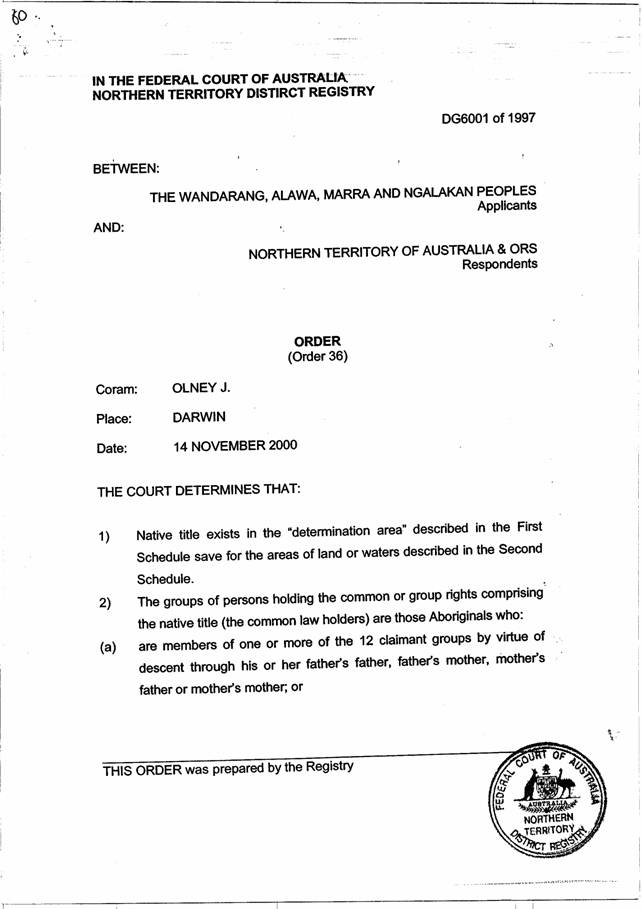
1. Native title exists in the whole of the claimed land and waters (‘the determination area’).
2. Native title existing in the determination area is held by those Aboriginals who:
(a) are members of one or more of the 12 claimant groups by virtue of descent through his or her father’s father, father’s mother, mother’s father or mother’s mother; or
(b) are otherwise members of one or more of the 12 claimant groups in accordance with traditional laws and customs.
(Such persons are hereinafter described collectively as ‘the common law holders of native title’).
3. In accordance with traditional law and custom, other Aboriginal people have rights in respect of the land and waters of an estate which is not their own, subject to the rights and interests of the estate group members, which include but are not limited to:
(a) members of estate groups from neighbouring estates have a right to visit, camp upon, hunt, fish and forage on the land and waters of their neighbours, particularly if they are related to them, but subject to the permission, implicit or express, of the senior estate group members;
(b) spouses of estate group members have a right to live on the estate of their wives or husbands, and hunt, fish and forage there; and
(c) where the travels of an ancestral being associated with a Dreaming pass through more than one estate, members of other estate groups with ritual authority may act for the protection of sites associated with the Dreaming.
4. Subject to paragraph 7 hereof, the nature and extent of the native title rights and interests in:
(a) NT Portion 819;
(b) the northern bank of the Roper River to the west of the western boundary of PL 737;
(c) that portion of the Urapunga Stock Route that lies south of the Roper River and to the east of Roper Bar;
(d) such parts of the beds of the Roper River, the Towns River and the Limmen Bight River as have been claimed and as are tidal –
are entitlement as against the whole world to possession, occupation, use and enjoyment of these parts of the determination area.
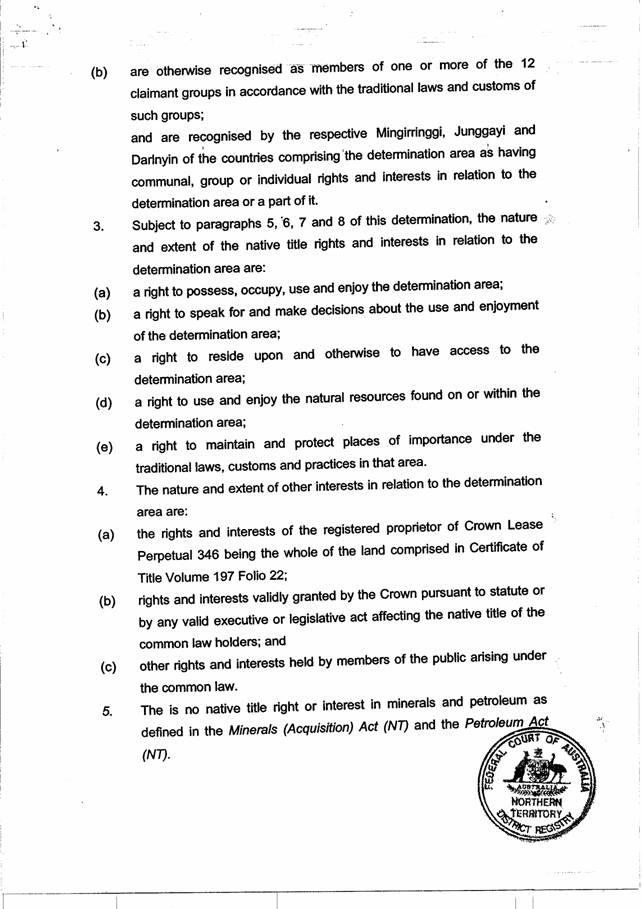
5. Subject to paragraph 7, 8, 9 and 10 hereof the nature and extent of the native title rights and interests existing in the balance of the determination area are as follows:
(a) a right to possess, occupy, use and enjoy the determination area;
(b) a right to speak for and make decisions about the use and enjoyment of the determination area;
(c) a right of reside upon and otherwise to have access to the determination area;
(d) a right to use and enjoy the natural resources found on or within the determination area;
(e) a right to maintain and protect places of importance under traditional laws, customs and practices in that area.
6. The nature and extent of other interests in relation to the determination area are the interests created by the Crown as set out in the First Schedule.
7. There is no native title right or interest in minerals and petroleum, as defined in the Minerals (Acquisition) Act (NT) and the Petroleum Act 1984 (NT).
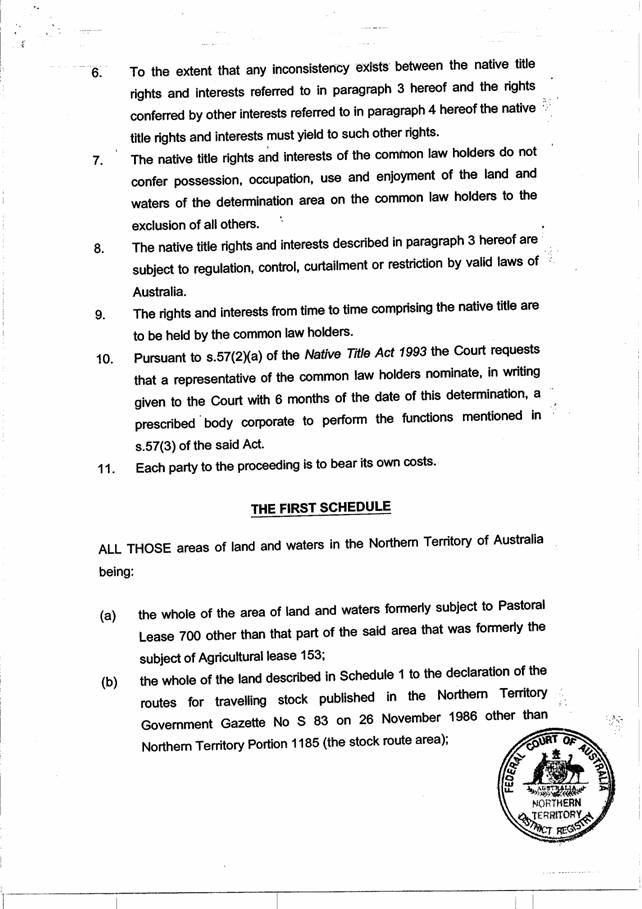
8. To the extent that any inconsistency exists between the native title rights and interests referred to in paragraph 5 hereof and the rights conferred by other interests referred to in paragraph 6 hereof the native title rights and interests must yield to such other interests.
9. The native title rights and interests referred to in paragraph 5 hereof do not confer on the common law holders possession, occupation, use and enjoyment of land and waters to the exclusion of all others.
10. The native title rights and interests described in paragraphs 4 and 5 hereof are subject to regulation, control, curtailment or restriction by valid laws of Australia.
11. Within two months the common law holders of native title are to file any minute of proposed determination under ss 56 and 57 of the Native Title Act 1993 (Cth) and if no such minute is filed it is determined that native title is held by the common law holders.
FIRST SCHEDULE
Other interests in the determination area are of the following kind:
(a) Interests obtained by reason of provisions of legislation of the Northern Territory of Australia or the Commonwealth of Australia;
(b) Interests held by members of the public arising under the common law.
19. The respondents’ primary submission is that native title does not exist in relation to the claim area, a view based upon an assertion first that in relation to the claim to the Roper, Limmen Bight and Cox Rivers the common law does not recognise the existence of native title, and second, in respect of the balance of the claim area that all native title has been extinguished, or alternatively, any exclusive rights have been extinguished. In the first respondent’s final written submission a proposed form of determination is advanced to cover the eventuality that, contrary to their primary submission, the Court finds that native title exists. As the second and third respondents have each expressly adopted the first respondent’s submissions the proposed form of determination (hereafter referred to as the respondents’ draft determination) is set out below:
DETERMINATION PROPOSED BY THE FIRST RESPONDENT
If native title is found to exist, the first respondent proposes the following determination:
i) Native title exists in respect of the determination area.
ii) The persons who are descended by birth or adoption from the original Alawa, Marra, Ngalakan and Wandarang inhabitants of the 12 countries distinguished in the application who are recognised by the respective Mingirringgi, Junggayi and Darlnyin of those countries under the traditional laws acknowledged and the customs observed by them as having communal, group or individual rights and interests in relation to such estates.
iii) The nature and extent of the native title rights and interests in relation to the determination area are, subject to the rights of others validly granted by the Crown pursuant to statute and to any valid executive or legislative act affecting the native title of the common law holders, as follows:
a) the right to possession, occupation, use and enjoyment of the land and waters of the determination area;
b) the right to take, use and enjoy the natural resources found on or within the land and waters of the determination area;
c) the right to protect places and areas of importance in or on the land and waters within the determination area.
iv) The nature and extent of other interests in relation to the determination area are such rights and interests validly granted by the Crown pursuant to statute or by any valid executive or legislative act affecting the native title of the common law holders including the rights and interests of members of the public to the use and enjoyment of the determination area according to law.
v) To the extent that any inconsistency exists between the native title rights and interests referred to in paragraph (iii) and the rights conferred by the other interests referred to in paragraph (iv), the native title rights and interests must yield to such other rights.
vi) The native title rights and interests of the common law holders do not confer possession, occupation use and enjoyment of the determination area on the common law holders to the exclusion of all others.
NATIVE TITLE
20. In Mabo v Queensland (No 2) 175 CLR 1 (Mabo (No 2)) the concept of what is now generally understood as “native title” was referred to by each of the majority Judges. Mason CJ and McHugh J referred (at p 15) to the recognition by the common law of Australia of “a form of native title which … reflects the entitlement of the indigenous inhabitants, in accordance with their laws or customs, to their traditional land”. Brennan J (whose reasons for judgment Mason CJ and McHugh J expressly adopted) said (at p 57):
The term “native title” conveniently describes the interests and rights of indigenous inhabitants in land, whether communal, group or individual, possessed under the traditional laws acknowledged by and the traditional customs observed by the indigenous inhabitants.
Deane and Gaudron JJ used the term “common law native title” to refer generally to what they described (at pp 87-88) as “that special kind of title” which
must, in the event of dispute between those entitled to it, be determined by reference to the pre-existing native law or custom.
Toohey J (at p 176) applied the term “native title” to “the interests (the plaintiffs’) predecessors enjoyed in the Islands prior to annexation ...” and at p 187 said:
the traditional title has a common law existence because the common law recognises the survival of traditional interests and operates to protect them.
21. The preamble to the Native Title Act 1993 recites, inter alia, that the High Court has:
held that the common law of Australia recognises a form of native title that reflects the entitlement of the indigenous inhabitants of Australia, in accordance with their laws and customs, to their traditional lands.
The principal object of the Act is expressed, to be:
to provide for the recognition and protection of native title (s 3(a)).
The statutory definition of “native title” largely adopts the language used in Mabo (No 2). Subsections (1) and (2) of s 223 provide:
223 (1) The expression native title or native title rights and interests means the communal, group or individual rights and interests of Aboriginal peoples or Torres Strait islanders in relation to land or waters, where:
(a) the rights and interests are possessed under the traditional laws acknowledged, and the traditional customs observed, by the Aboriginal peoples or Torres Strait Islanders; and
(b) the Aboriginal peoples or Torres Strait Islanders, by those laws and customs, have a connection with the land or waters; and
(c) the rights and interests are recognised by the common law of Australia
(2) Without limiting subsection (1), rights and interests in that subsection includes hunting, gathering, or fishing, rights and interests.
22. The claimed native title rights and interests of the applicants are said to represent the traditional laws acknowledged and the traditional customs observed by the applicants or their ancestors since before the exercise of British sovereignty over the claimed land and waters. The 135th meridian of east longitude more or less bisects the claim area. Sovereignty to the east of 135°E was first exercised in 1788 but it was not until 1825 that sovereignty was exercised in relation to the balance of the claim area. As the first contact with Europeans did not occur until 1845, and the first settlement of any part of the area did not occur until 1871, there is no significance in the fact that the date of sovereignty is not the same for the whole of the claim area.
23. It is necessary for the applicants to establish that, at the time of sovereignty, there was an identifiable community or organised society of Aboriginals that occupied, used or was present upon the claimed land and waters under traditional laws and customs. In Mabo (No 2) Toohey J said (at p 188):
It is the fact of the presence of indigenous inhabitants on acquired land which precludes proprietary title in the Crown and which excites the need for protection of rights. Presence would be insufficient to establish title if it was coincidental only or truly random, having no connexion with or meaning in relation to a society’s economic, cultural or religious life. It is presence amounting to occupancy which is the foundation of the title which attracts protection, and it is that which must be proved to establish title. Thus traditional title is rooted in physical presence. That the use of land was meaningful must be proved but it is to be understood from the point of view of the members of the society.
At p 16 Brennan J referred to the need for the people to remain “an identifiable community”. Deane and Gaudron JJ also referred (at p 86) to the requirement that, at the time of colonisation, there be an “identified community” with an established entitlement to the use and occupation of land under local law and custom.
In determining whether the requisite occupation, presence or use has been established in respect of a claim area, regard must be had to the physical characteristics of the area and the lifestyle of those who were connected to it under traditional laws and customs. Thus, presence on the land need not amount to possession at common law. A nomadic lifestyle is not to be viewed as inconsistent with occupancy (Toohey J at p 189).
24. Paragraph 223(1)(c) of the Native Title Act makes it clear that a right or interest which is not recognised by the common law of Australia cannot be recognised as a native title right or interest. In this proceeding the question of recognition by the common law arises in relation to the claim to exclusive rights in relation to the waters of the rivers mentioned in the application. The term waters is defined in s 253 of the Native Title Act thus:
waters includes:
(a) sea, a river, a lake, a tidal inlet, a bay, an estuary, a harbour or subterranean waters; or
(b) the bed or subsoil under, or airspace over, any waters (including waters mentioned in paragraph (a)); or
(c) the shore, or subsoil under or airspace over the shore, between high water and low water.
The term land is defined:
land includes the airspace over, or subsoil under, land, but does not include waters.
The draftsman has helpfully added the following notes to the latter definition:
Note 1: Because of the definition of waters, not only rivers and lakes etc, but also such things as the bed or subsoil under, and airspace over, rivers and lakes etc will not be included in land.
Note 2: Because of the definition of waters, the area between high water and low water will not be included in land.
25. In Mabo (No 2) Brennan J said (at p 43) that recognition by the common law of the rights and interests in land of the indigenous inhabitants would be precluded if the recognition were to fracture a skeletal principal of the Australian legal system. In Fejo v Northern Territory (1998) 195 CLR 96 at para 104, Kirby J chose to express the same concept in different terms. He said that:
a Court should not destroy or contradict an important and settled principle of the legal system.
The applicants’ claim as originally formulated sought a determination of exclusive native title rights to the waters of the several rivers referred to.
26. The third respondent has submitted a detailed argument in support of the proposition that the common law can recognise neither property rights in flowing waters nor exclusive rights of occupancy and control over tidal rivers. Many authorities have been quoted in support of this proposition, but it is unnecessary to canvass the issue further as the applicants’ draft determination makes no such claim. To the extent that the applicants seek a determination of native title against the whole world (paragraph 4), the claim (insofar as it relates to rivers) is confined to portion of the bank of the Roper River and those parts of the beds of the Roper, Towns and Limmen Bight Rivers as have been claimed and are tidal. No determination of exclusive rights is sought in relation to the waters of those rivers. Such a claim would by definition include both the water and the bed of the river but a determination is sought only as to river beds and a part of a river bank.
THE CLAIMED LAND AND WATERS
27. Section 13(1)(a) of the Native Title Act authorises the making of an application for a determination of native title in relation to an area for which there is no approved determination of native title. No part of the claim area is the subject of an approved determination of native title. There is however an issue between the parties as to whether certain areas of land and waters are within the claim area. In other circumstances it might have been possible to resolve the dispute by allowing the applicants to make a minor amendment to their application. However, whilst an application may at any time be amended to reduce the area of land or waters covered by the application (s 64(1A)), the Act does not permit an amendment which results in the inclusion of any area of land or waters that was not covered by the original application (s 64(1)) except in the case of two or more claimant applications being combined (s 64(2)).
28. The dispute arises from the fact that there is an inconsistency between the description of the claim area as expressed in the application and the boundary of the claim area shown on the map accompanying the application (the application map). In order to understand the nature of the inconsistency it is necessary first to refer to the description of the claim area in the application and then to say something about the various components of the claim area. It is not convenient to reproduce in these reasons a map of sufficiently large scale to depict all of the detail to which reference will be made, however, what is written below may be read in conjunction with the application map, plans which appear on the leases to which reference is made and other diagrams relating to the claim area, all of which are in evidence in the proceeding.
29. In the application the description of the claimed land and waters is described as:
A6. The area covered by the application is in the Roper River region of the Northern Territory. It includes most of the land previously known as St Vidgeon Station. For convenience an A4 size copy of this map in black and white format is attached marked AC. Specifically the area is as follows.
1. All land and waters contained in NT Portion 819 other than the area of land which was formerly the subject of agricultural lease 153, 157, and 158. The area subject to the latter two leases is encompassed within the area that was subject to agricultural lease 153. Copies of these leases marked AD, AE, and AF respectively are attached. Agricultural lease 153 is marked on the map marked AB.
2. The beds, banks and waters of the Roper River from its mouth at Port Roper westwards to the point at which the border between NT Portion 819 and NT Portion 2632 intersects with the Roper River. This point is near Roper Bar. The mouth of the Roper River is to be taken as the line formed across the river by the Australian Terrestrial (sic, presumably Territorial Sea) Baseline.
3. The beds, banks and waters of the segment of the Cox River which adjoins NT Portion 819.
4. The beds, banks and waters of the segment of the Limmen Bight River which adjoins NT Portion 3476 and NT Portion 819.
The area subject to this application does not include NT Portion 1185, NT Portion 3475, NT Portion 3476, or NT Portion 4249. Information regarding these portions is nevertheless included in the land tenure history in section A8.
The outer boundary of the area delineated on the map referred to contains a notation along the northern side of the extreme western section of the Roper River stating:
Boundary follows southern border of Urapunga Station.
30. Section 113 of the Crown Lands Act 1931 (NT) as in force at the relevant time provided:
113. The Minister may, by notice in the Gazette, declare routes, not exceeding 1610 metres in width, through Crown lands or reserved or dedicated land, whether or not that land is held under licence or lease granted under this or any other Act, to be routes for the passage of travelling stock.
(The 1931 Act was repealed by the Crown Lands Act 1992, s 96 of which is in the same terms as the former s 113).
By notice published in the Northern Territory Government Gazette No S 83 on 26 November 1986 the Minister for Lands in pursuance of s 113 of the Crown Lands Act declared a number of areas shown hatched on plans appearing in schedules to the declaration to be routes for the passage of travelling stock. Schedule 1 of the declaration is headed Roper Bar Locality and contains a plan on which an area is shown hatched (hereafter referred to as the stock route area). The hatched area is bounded on the north by the right bank of the Roper River; on the west by the eastern boundary of NT Portion 2632 (the Yutpundji-Djindiwirrtj Land Trust land) and on the east by a line which is an extension of the eastern boundary of PL 657 (Urapunga). The area is expressed to be “1609.3 wide”. The plan also identifies NT Portion 1185 as being within the hatched area although the scale of the plan does not permit of any conclusion as to whether that portion itself is shown as hatched.
31. The evidence does not disclose when NT Portion 819 was first identified as a separate allotment but it is known that on 30 November 1964 Pastoral Lease 700 (PL 700) was granted to over:
all that piece or parcel of land being Northern Territory Portion 819 situated in the Darwin and Gulf District and containing an area of two thousand six hundred and thirty square miles or thereabouts as delineated on the plan hereon and therein tinted yellow . . .
The plan in the lease identifies two features described respectively as “Stock Route” and “Roper Bar landing ground”. Both are in the extreme north-west corner of the plan and neither is tinted yellow. The stock route is shown as being immediately south of a section of the Roper River which is adjacent to, and south of, an area identified as “PL 657” and is clearly the same area as is described in Schedule 1 to the declaration published in the Gazette on 26 November 1986. Pastoral Lease 657 was, at the relevant, time the pastoral lease under which the property known as Urapunga Station was held. The tinted area on the plan in PL 700 bears the notation:
2630 Sq. M
ex S.R. & Roper Bar landing ground.
I interpret this notation as emphasising what is otherwise apparent, namely, that neither the stock route area nor the Roper Bar landing ground form part of the land covered by PL 700 and thus were not part of NT portion 819.
32. The Certificate of Title for PL 700 records that on 10 December 1982 the lease was transferred to Northern Territory Development Land Corporation under a power of sale contained in mortgage No 43983. The final dealing recorded on the Certificate of Title is:
Lawfully surrendered vide LTO instrument No 163093
Registered the 20th day of August 1985 at 11.03.30.
(It is noted that whereas the Certificate of Title for PL 700 shows that the surrender was registered on 20 August 1985, an endorsement on the surrender document itself records that it was registered on 21 August 1985).
It will be necessary to refer later to the surrender of PL 700.
33. By instrument dated 5 July 1985 the Northern Territory of Australia granted to Northern Territory Development Land Corporation a Crown lease of:
all that land being Northern Territory Portion 819 containing an area of six hundred and seventy thousand hectares or thereabouts as delineated on the plan hereon and tinted pink . . .
The lease is expressed to commence on the twenty-second day of July 1985 and to be in perpetuity. It is known as Crown Lease Perpetual 346 (CLP 346) and is registered in the Register Book as Volume 197 Folio 22. The circumstances surrounding the granting and registration of CLP 346 will be examined later in another context but for present purposes it is relevant to observe that the pink tinted area on the plan in the lease corresponds with the yellow tinted area on PL 700 except only to the extent that in CLP 346 the plan shows a number of roads 100 metres wide to be excluded. The tinted area bears the notation:
819
670 000 ha
(Ex Roads).
Again, as with the plan on PL 700, the notation merely confirms what is apparent from the plan, namely, that the roads in question, to a width of 100 metres, are not part of the leased land.
34. Apart from the roads excluded from the area leased under CLP 346, the land originally covered by CLP 346 and PL 700 was the same. Neither lease included the area of the stock route adjacent to the north-west corner of the leased land. Several parts of the land originally covered by CLP 346 have since been surrendered to facilitate the granting of interests to third parties. The areas affected by the partial surrenders are NT Portions 3475, 3476, 4046, 4047 and 4048. NT Portions 4046, 4047 and 4048 have since been amalgamated into a single area designated as NT Portion 4249. Prior to the application being lodged with the NNTT, third party interests were granted in each of those portions which no doubt explains why they were expressly excluded from the claim area.
35. It is clear that those who framed the description of the claim area in the application not only had no regard to the existence of the stock route but also assumed that the whole of the northern boundary of NT Portion 819 adjoined the Roper River as far west as the eastern boundary of NT Portion 2632. There are a number of facts which lead to this conclusion. The plan accompanying the application does not make any reference to the existence of the stock route. Rather, in the application it is said that the boundary of the area subject to this application is shown on the attached map marked AB and the map notes that -
Boundary follows southern border of Urapunga Station.
The southern border of Urapunga Station at the relevant place, is the left bank of the Roper River. The boundary of the claim area on the map clearly encompasses both the bed and banks of that part of the river and the adjoining stock route.
36. There are on the other hand a number of indications which suggest that the stock route and the adjacent bed and banks of the Roper River are not part of the claim area. The only specific reference to land (other than the bed and banks of the rivers) is in the numbered item 1 of the particularised description of the claim area which merely refers to NT Portion 819. There is no evidence that the stock route area has ever been part of NT Portion 819. Further, the description of the western limit of the section of the Roper River the subject of the claim (as expressed in item 2) contains an erroneous assumption. The common boundary between NT Portion 819 and NT Portion 2632 does not intersect with the Roper River. The most northern point of the common boundary between those two portions is where the southern boundary of the stock route meets the eastern boundary of NT Portion 2632. At the point where the eastern boundary of NT Portion 2632 intersects with the Roper River, the adjacent land is the stock route, not NT Portion 819. There is clearly an inconsistency between the particularised description of the claim area and that described by the application map; and it is equally clear that this inconsistency has arisen by reason of the failure to advert to the existence of the stock route area as being separate from NT Portion 819.
37. In the presentation of their case the applicants did nothing to clarify the position. Indeed they compounded the confusion. Two of the most important documents in the proceeding are the claim book (exhibit A 1) and the site map (exhibit A 3). In the introductory paragraph of the claim book the authors state:
This report documents the customary land tenure of the Marra, Ngalakgan, Alawa and Warndarrang people associated with
* the former St Vidgeon Pastoral Lease;
* the beds, banks and waters of the Roper River from its mouth to the western most point at which the former St Vidgeon pastoral lease adjoins the river;
* the beds, banks and waters of the Cox River which adjoins the former pastoral lease;
* The beds, banks and waters of the Limmen Bight River which adjoins the former pastoral lease and NT Portion 3476;
* a portion of the Urapunga Stock Route which adjoins the former St Vidgeon Pastoral Lease to the south and east, and the Yutpundji-Djindiwirrtj (Roper Bar) Land Trust to the west, and the Roper River to the north;
* the portion of the Roper River, including its beds, banks and waters, which adjoins the aforementioned portion of the Urapunga Stock Route to the south, and the Urapunga Station to the north.
Paragraph 1.1 of the report is headed “Area claimed” and contains the following statement:
The area claimed (see Map 1), is essentially the old St Vidgeon Pastoral Lease (PL) excluding a portion in its northern eastern corner which has been freehold, a portion in the south eastern corner which has been granted as a lease, and a portion south of Ngukurr formerly subject to agricultural leases 153, 157 and 158. The area claimed also includes the beds, banks and waters of the Roper River, Cox River and the Limmen Bight River (as described below).
The portion formerly subject to agricultural leases 153, 157 and 158, a portion of the Urapunga Stock Route (as described above), and a portion of the Roper River which adjoins the Stock Route (as described above), is subject to a separate native title application. For convenience, these portions are examined in this report.
Counsel appearing for the applicants disavows the suggestion that the stock route and the adjoining portion of the Roper River are the subject of a separate native title application although it is common cause that both are the subject of traditional land claims under the Land Rights Act made by the NLC on behalf of the traditional owners. Be that as it may, the clear inference to be drawn from the anthropologists’ report is that although it documents the customary land tenure of the applicants in relation to each of six areas described, the claim itself does not extend to the two last mentioned areas; and the site map has been drawn on this assumption. The “claim boundary” as shown on the site map excludes both the stock route area and the adjoining section of the Roper River.
38. This lengthy discourse concerning the area of land and waters covered by the application does nothing to resolve the question as to whether the Court should treat the stock route and the adjacent river as part of the claim. As previously indicated, the Court has no power to amend the application to include any additional unclaimed areas. The applicants maintain that the stock route and the adjacent river are covered by the application. They point to the application map which shows the outer boundary extending to the southern border of Urapunga Station. They also call in aid the decision of the Full Court of the Federal Court (Lockhart, Sheppard and Burchett JJ) in Attorney-General (NT) v Maurice and others 73 ALR 326. In that case, which had to do with a traditional land claim under the Land Rights Act, the application contained both a description of the claimed land by its metes and bounds and a map which was intended to show clearly the location of the lands but there were a number of inconsistencies between the two. The Full Court’s decision is accurately expressed in the head note to the report which states:
Held: (i) The interpretation of the application and the identification of the land which is claimed should be approached bearing in mind that this is not a case of interpretation of a precise legal instrument such as a will, Crown grant or conveyance, that such applications usually relate to large areas of land whose area is difficult to define with any degree of real precision and that the Aboriginal Land Rights (Northern Territory) Act 1976 (Cth) requires a liberal or broad construction to give effect to the beneficial purpose it is intended to serve.
(ii) Conflicts between the metes and bounds description in the application and the map attached to it were not to be resolved by recourse to principles of interpretation such as the contra proferentem rule or the principle of falsa demonstratio non nocet cum de corpore constat. The map was a clear and more reliable exposition of the application.
(iii) Per Sheppard J: The question is one of the claimant’s intention which is to be gathered from a consideration of the application read as a whole.
The applicants seek to apply the same reasoning in the present context.
39. The respondents adopt a contrary view. They point out that on its literal application the metes and bounds description in the application does not include the stock route and adjacent river ; and that this is not a case where the area is difficult to define with any real degree of precision nor can it be said that the map is a more reliable exposition of the application than the written description. On the contrary, a very precise definition of the claim area is not only possible, but is essential for the purpose of giving effect to the statute. Further, the applicants’ own evidence in the anthropologists’ report and the site map indicates that the application does not extend to either the stock route or the adjacent river.
40. Reading the application as a whole it is clear that the applicants’ intention was to include both the stock route and the adjacent river in the area of land and waters covered by the application. The notation on the application map indicating that the boundary follows the southern border of Urapunga Station is a decisive indication of the applicants’ intention. Another indication of the applicants’ intention is the express exclusion of NT Portion 1185 from the claim area. NT Portion 1185 is a small area (a little under 40 acres) situated within the stock route area held under a special purposes lease. If the stock route was not intended to be part of the claim area it would have been unnecessary to make any reference to NT Portion 1185. The subsequent erroneous interpretation of the application by the authors of the anthropological report and the draftsman of the site map cannot be taken to have amended the application. In these circumstances the stock route area and the beds and banks of the adjacent part of the Roper River will be treated as being within the area of land and waters covered by the application.
41. One further question concerning the description of the claim area remains to be resolved. This has to do with the roads which are shown as excluded from CLP 346. It will be recalled that in CLP 346 the leased land is described as NT Portion 819 in the body of the lease and that the plan in the lease on which the leased land is tinted pink excludes certain roads shown thereon to a width of 100 metres. Given that the area leased is described as NT Portion 819 without any qualification and that the plan indicates that the roads are excluded, it follows that the roads cannot be regarded as part of NT Portion 819 and accordingly are not covered by the reference to that portion in the application. The applicants nevertheless maintain that the roads are encompassed within the claim area.
42. It is not possible to draw any relevant distinction between the stock route and the roads. Neither presently form part of NT Portion 819 and neither are specifically included in the particularised description of the claim area in the application, but both are encompassed within the outer boundary shown on the application map and in all the circumstances on reading the application as a whole it is clear that the applicants’ intention was to include the roads within the claim area. I interpret the reference to NT Portion 819 as being to that portion as it existed in relation to PL 700. The roads which are identified on the plan in CLP 346 will accordingly be treated as part of the land in respect of which the determination is sought.
THE CLAIMANT GROUPS
43. The application is made on behalf of 12 groups of Aboriginals in respect of land and waters associated with the Wandarang, Marra, Alawa and Ngalakan language groups and has been presented on the basis that the claim area encompasses the whole or part of the traditional country of the several groups. For convenience, each group is on occasions referred to as a local descent group which is a term borrowed from the Land Rights Act conveying the notion that each member of the group is connected by descent to an apical ancestor who had rights and obligations associated with the land in question. It is not suggested however, that the Land Rights Act definition of the term local descent group has any application in native title law. Due to intermarriage between members of the various claimant groups, most claimants have standing in one capacity or another in more than one group.
44. Each group claims rights and interests in a tract of land which is known as that group’s country. The country of most of the claimant groups extends beyond the claim area. Each country is associated with a set of ancestral beings (Dreamings) whose activities are believed to have given form and meaning to the land. The core of each country is made up of named places most of which are said to have been created, or given meaning to, by the ancestral beings. Away from the core of sites, countries tend to merge into each other without clear cut boundaries.
45. The evidence suggests that there are no longer any individuals who speak the Wandarang language and that the rights and interests of that were formerly capable of identification as belonging to that group have been absorbed by other neighbouring groups. Marra is the dominant language spoken by the claimants whilst Alawa, which is said to be a very similar language, is often also spoken by Marra people. Ngalakan is the language of the people of the north-western section of the claim area. The language group affiliation of the applicants is of marginal importance in this proceeding. Many of the rising generation do not speak the language of their ancestors whilst most are able to communicate in either or both English and a local form of Kriol. The evidence is that the inability to speak the relevant Aboriginal language is no impediment to the recognition of the appropriate status of an individual within a land holding group.
46. The following paragraphs set out in an abbreviated form the main aspects of the social structure of the claimant groups. Although the several groups identify with a separate country and are comprised of people drawn from different language groups, the social organisation of each of the 12 groups is essentially the same.
47. The rights and interests of members of a land holding group in, and responsibility for, the country of that group are primarily derived by descent although rights and interests may also be derived by way of adoption (which is regarded as a form of descent), succession and/or incorporation (concepts which are explained below) or what is known as spiritual conception.
48. The term Mingirringgi is used to describe those whose rights and interests are derived through their father and father’s father. These rights and responsibilities are acquired essentially by birth and may not be removed except in extreme circumstances. Under some circumstances, Mingirringgi rights may be acquired through adoption, succession, incorporation or through spiritual conception. Individuals whose rights and interests in a country are derived from their mother and mother’s father, and those whose rights and interests are inherited from their father’s mother are known as Junggayi. In the former case the rights can be passed on to the next generation but no further, but in the latter case the rights cannot be passed on. Individuals who claim rights in a country by descent through their mother’s mother are called Darlnyin.
49. Rights from succession arise when the Mingirringgi are threatened with extinction through a lack of numbers. Such a circumstance brings into operation processes of succession which result in Mingirringgi (usually linked by the same ancestral beings) associated with another country taking over the rights and interests in the country of the extinct (or much weakened) Mingirringgi.
50. Rights may arise from the circumstances of personal life history. For example, persons who have close links with a country through residence and belong to the appropriate social category may be accepted as Mingirringgi, Junggayi or Darlnyin for that country provided this course is approved by the appropriate Mingirringgi, Junggayi or Darlnyin.
51. Rights in a country may also be gained by a person whose “animating” (conception) spirit was “found” in a country other than that of his father and father’s father provided this claim is approved by the relevant Mingirringgi, Junggayi and Darlnyin. In such cases, the rights, interests and responsibilities in that land are those of a Mingirringgi.
52. Rights in a country may be obtained by adoption. For example, a male Mingirringgi may adopt the children of his wife. The process of adoption usually includes appropriate induction into the ceremonial roles associated with a country.
53. There are a few individuals who for a number of reasons (eg, age, intellect, desire, etc) have ritual and mythological information pertaining to a vast range of land. These people are often relied upon to assist less knowledgeable people. This is described as “backing up” those people. Such people are sometimes called “classificatory” Junggayi, Darlnyin and Mingirringgi. They are perceived as related or descended through the actions of the ancestral beings.
54. The Mingirringgi, Junggayi and Darlnyin have differing but complementary roles to perform in relation to the conduct of the ceremonial activities of the claimants. Their respective functions are well documented in the evidence contained in the expert reports previously referred to and in the oral testimony of the witnesses. In addition, the Mingirringgi, Junggayi and Darlnyin are jointly responsible for teaching the younger generation such things as the religious knowledge of the country (including the location of sites and the route and direction of ancestral tracks) the narratives, dances and rituals associated with the ancestral tracks, and the location of dangerous places and sites within a country and the behaviours required to visit, manage and control such places.
55. There are two other aspects of the social organisation of the claimant groups to which reference must be made. Each ancestral being is socially categorised as belong to a particular category called a semi-moiety and each site created by ancestral beings belongs to the same semi-moiety. Occasionally, sites will have more than one semi-moiety category indicating that ancestral beings of different semi-moiety categories interacted with the site. Semi-moieties divide non-European phenomena into four named categories: Burdal, Guyal, Murrungun and Mambali. All flora and fauna, Dreamings, natural phenomenon, people, sites and land belong to one of these categories. An individual belongs to the same semi-moiety as his or her father. Semi-moieties are grouped into two moieties. Each individual belongs to the same moiety as his or her father and their marriage partners come from the opposite moiety. A system of social classification known as subsections is also shared by most of the claimants. These named categories, which are based on principles drawn from the kinship system, classify all individuals into one of eight sociocentric categories. Each category has male and female terms. The subsection systems of the claimants share a number of essential features. First, people of the same category are considered to be siblings, either brothers or sisters, to each other. Second, the children of women are distinguished from those of their brothers. The result is that children of men of a category belong to a different subsection to that of children of women of the same category. Third, members of a subsection category should obtain their spouses from the opposite category with which they are paired as potential spouses. The subsections are arranged into four such pairs and there is a preference for marriage to members of the opposite category.
56. In the claim book the 12 claimant groups were allocated a number for the purpose of identification. The numbers themselves have no other significance. Whilst it is not possible to draw firm boundaries around the respective countries of the individual groups it is possible to describe the countries in a general way both graphically and verbally. The claim book (at p 58) contains a map which bears the caption:
Very approximate delineation of group interests within claim area . . .
The caption has an addition by way of footnote stating:
In arid areas countries merge without clearcut boundaries.
The countries of the various claimant groups are shown to encompass the whole of the claim area and beyond.
57. Chapter 5 of the claim book describes the geographical focus of each of the land holding groups. The salient features of each group are summarised at the beginning of the discussion of each group. Each of the summaries is reproduced below. In view of concessions made by the respondents both during the evidence and in final submissions (to which reference will be made later) it is unnecessary, except in the case of group 11, to particularise the composition of the groups in any more detail.
Group 1
Means of Identification: “Roberts mob” after main family
Semi-Moiety Affiliation: Burdal
Geographic Focus on Claim Area: Central west, south west of claim area.
Also an area located on the south bank of
Roper River.
Main Dreaming Affiliations: Plains kangaroo (Yarrgarla), black headed
python (Buburnarra), rain and lightning
(Awaran)
Senior Spokespeople: Steven Roberts (Mingirringgi)
Sammy Limmen (Junggayi)
Peter Jackson (Junggayi)
Maurice Lansen (Junggayi)
Group 2
Means of Identification: Guyal after semi-moiety
Semi-Moiety Affiliation: Guyal
Geographic Focus: Western parts of claim area
Main Dreaming Affiliations: Debil debil (Bardirrnya)
Senior Spokespeople: Edric Hall (Mingirringgi)
Barney Farrer Ilaga (Mingirringgi)
Dorothy Watson (Mingirringgi)
Sammy Limmen (Junggayi)
Sandy August (Darlnyin)
Group 3
Means of Identification: Wamalirr (S. 19)(after major site located
in south western corner of St Vidgeon).
Semi-Moiety Affiliation: Mambali
Geographic Focus: Land around Wamalirr (S. 19)(Peter Yard)
in the claim’s south western corner.
Main Dreaming Affiliations: Gurrartbonggo (quiet snake)
Senior Spokespeople: Hughey Watson (Mingirringi)
Sandy August (Junggayi)
Stephen Roberts (Junggayi)
Group 4
Means of Identification: Wunubari (after major site)(S. 395)
Semi-Moiety Affiliation: Murrungun
Geographic Focus: Area around Mt Young; coastal strip from
south of the Towns River to just north of the
Limmen Bight River
Main Dreaming Affiliations: King brown snake (Bandiyan); company
relationship with mermaid track
(Gilyirringgilyirring) from Burrgun (S. 219)
dugong hunters (Malbingarri)
Senior Spokespeople: Gordon Forrest (Mingirringgi)
Sammy Limmen (Mingirringgi)
Ginger Riley (Junggayi)
Roy Hammer (Junggayi)
Group 5
Means of Identification: Walangara (after the paper bark trees a
characteristic feature of this country)
Geographic Focus: South eastern corner of claim area. Most
of its “country” is located into the south,
south east of the claim area centred on the
site Wurrumarla (Lake Mary) (S. 270).
However, it has responsibility for the
whirlywind track up to Ladaya (S. 39)
in the claim area’s north west.
Main Dreaming Affiliations: Garrimala (Taipan), Walulu (whirlywind,
rainbow snake).
Senior Spokespeople: Roger Rogers (Mingirringgi)
Henry Jurluba (Djuluba)(Mingirringgi)
Ginger Riley (Junggayi)
Roy Hammer (Junggayi)
Group 6
Means of Identification: Burdal
Semi-moiety Affiliations: Burdal
Geographic Focus: South eastern part of claim area.
Main Dreaming Affiliations: Yarrgarla (plains kangaroo), Buburnarra (black
nosed python), barramundi (Mirriji).
Senior Spokespeople: Sandy August (Mingirringi)
Ginger Riley (Mingirringgi)
Roy Hammer (Mingirringgi)
Sammy Limmen and siblings (Junggayi)
Group 7
Means of Identification: Nayirrinji (after major site)(S. 212)
Semi-moiety Affiliations: Mambali
Geographic Focus: There are 2 separate geographic foci to this
“country”. One part focuses on the site
Nayirrinji (S. 212) found at the mouth of the
Towns River. The other, more northern area,
is focused on the Number One Landing on the Roper River. The land extends west and south west into St Vidgeon. The majority of the claim
area’s north east part is the responsibility of Group 7.
Main Dreaming Affiliations: Gilyirring Gilyirring (mermaids, women)
Senior Spokespeople: Steven Daniels (Mingirringgi)
Donald Blitner (Mingirringgi)
Jerry Blitner (Mingirringgi)
Group 8
Means of Identification: Marrawalwalgunyigunyi (clan name)
Semi-moiety Affiliation: Guyal
Geographic Focus: Main focus on the claim area is the area
between the Number Two Landing and
Mountain Creek, south down the creek.
Main Dreaming Affiliations: Groper (Yimayirri), goanna (Wajurndu)
Senior Spokespeople: Fred Conway (Mingirringgi)
Lindsay Joshua (Mingirringgi)
Walter Rogers (Junggayi)
Don Gibbs (Junggayi)
Group 9
Means of Identification: Milwarapara-Yutpundji (after main
Dreaming and main site).
Semi-moiety Affiliation: Burdal
Geographic Focus: Extreme north-western corner of claim area.
Main Dreaming Affiliations: Djadukul (plains kangaroo), native cats
(Nyuluk)
Senior Spokespeople: Samson Ponto (Mingirringgi)
Doreen Ponto (Mingirringgi)
Dawson Daniels (Junggayi)
Barney Farrer Illaga (Darlnyin)
Group 10
Means of Identification: Langgaban (S. 41)
Semi-moiety Affiliation: Murrungun
Geographic Focus: South west parts of the claim area.
Main Dreaming Affiliations: Mermaids (Gilyirringgilyirring), emu
(Jiwirdiwirdi)
Senior Spokespeople: Maurice Lansen (Mingirringgi)
Peter Jackson (Mingirringgi)
Barney Farrer Ilaga (Junggayi)
Stephen Roberts (Junggayi)
Hughie Watson (Darlnyin)
Group 11
Means of Identification: Warlanji (S. 32)(after major site)
Semi-moiety Affiliation: Murrungun
Geographic Focus: Northern-west corner of the claim area.
Main Dreaming Affiliations: Mermaids (Gilyirringgilyirring)
Senior Spokespeople: Ashwood Farrel (Mingirringgi)
Felix Farrel (Mingirringgi)
Roy Golokurndu (Darlnyin)
Group 12
Means of Identification: Ngawurrbalan (Djindiwirritj )after major
site and Dreaming.
Semi-moiety Affiliation: Mambali
Geographic Focus: North west corner of the claim area.
Main Dreaming Affiliation: Quite snake (Gurrartbonggo), whirlywind
(Walulu)
Senior Spokespeople: Roy Golokurndu, Splinter Gerrepbere.
58. The authors of the claim book make the following observations concerning group 11:
This group is associated with a very small part of the north western corner of the lease, centred on the Hodgson River and the track of the mermaid ancestors. To the north is the “country” of group 9. Directly to the west and south west is group 12. To the east is the land of group 8.
The Hodgson River marks the track of the mermaids. This “country” is often called Warlanji (S. 32) after a major site.
The main Mingirringgi for group 11 are the children of Paddy Gudalba (dec.). Paddy (dec.) and his brother Walanji (dec.) were from Arnhem Land. They came down to the Roper Valley to work when young and spent the rest of their lives there. Paddy and Warlanji were incorporated into local ceremony and were given Mingirringgi rights in the mermaid Dreaming. Paddy’s children (Ashwood, Felix, Topsy, Tommy [adopted] and Suzanne) have inherited his Mingirringgi rights.
The senior Junggayi are the children of Ruby Meregun (dec.) (Barney Farrer Ilaga, Dorothy, Jim Farrer, Brian Farrer, Mary Farrer, Gerard “King Boy”). Other Junggayi are the children of Suzanne and Topsy Farrel. Agnes (dec.), Dorothy, June (dec.) and Mary Farrer’s children are Darlnyin.
Roy Golokurndu, Splinter Gerrepbere, Jacob Carew, are also classed as senior Darlnyin because of their “country’s” close geographic connection to group 11’s “country”.
59. Whilst the respondents have readily accepted that in a traditional sense descent need not necessarily involve a biological relationship with an ancestor, the notion of “incorporation” into a group as explained in relation to group 11 is not accepted as being in accordance with the traditional laws and customs of the land holding group. For the moment it is only necessary to identify this area of contention. More will be said of it when the competing arguments are analysed later.
60. Reference has already been made to the absence of any competing anthropological evidence called by the respondents and to the absence of any cross-examination of the applicants’ experts. Nor was there any substantial questioning of the Aboriginal witnesses as to either their genealogical and other descent connections with their ancestors or the continuity of their connection with the claim area. Indeed on 27 September 1999 at a relatively early stage of the trial, counsel appearing for the first respondent sought leave to tender a statement setting out her client’s attitude to some of the crucial issues in the case. The statement (which became exhibit NT 1) was later adopted by the second and third respondents. The text of the statement is reproduced in full below:
ST VIDGEON’S NATIVE TITLE CLAIM
STATEMENT BY THE FIRST RESPONDENT ON 27 SEPTEMBER 1999
Subject to issues of extinguishment:
1. Persons who are capable of being the holders of native title in respect of the claim area are those persons who claim country in the area under claim through:
(1) father’s father – Mingirringgi
(2) mother’s father or father’s mother – Junggayi
(3) mother’s mother – Darlnyin
unless the members of one of the applicant estate groups indicate otherwise.
2. Interests in country through Dreaming connections do not, in themselves, confer membership of a land holding group.
3. The question of whether a person can be Mingirringgi for two countries is not resolved.
4. “Co-option adoption” or admission of adults to landownership (i.e. Mingirringgi status) via ceremony remains problematic.
5. “Descent” includes adoption of minors and proof of adoption is the “growing/rearing up” of children by adopting parents.
6. The patrician estate is the tenurial unit in the Roper region (called a “country”).
7. The semi-moiety system is a feature of regional/social organisation and has been in place since observed by Spencer & Gillen who record its existence as a traditional institution at the turn of the century (and we accept that it is still maintained by the applicants).
8. The relationship between ceremony and land was found to be problematic by Justice Toohey in the Limmen Bight Land Claim; this relationship remains an issue to be resolved on the basis of evidence given and to be given in this case.
9. There was a body of Aboriginal law and custom that historically was characteristic of the Roper region and was passed down from generation to generation; the extent to which the law and custom continues as a living tradition remains to be demonstrated with regard to particular issues that pertain to native title.
10. Matters of traditional law and custom which are not in dispute in relation to Aboriginal people in the Roper region are:
(a) initiation of young boys and conduct of higher ceremonies;
(b) conduct of smoking ceremonies following the death of significant group members to free the spirit;
(c) observation of the range of restrictions including eating restrictions in respect of one’s own dreaming, gender based restrictions on the circulation of certain information about some ceremonies and geographical restrictions relating to access to certain places in the country.
(d) acceptance of sanctions where there has been a breach of the laws, for example, where a site on the country is damaged the Mingirringgi must pay compensation to the Junggayi; and
(e) protection of places in the country which are of cultural and spiritual importance.
11. It is also accepted that Aboriginal people hunt, fish and forage for sustenance in the area claimed.
12. It is not accepted that Aboriginal traditional laws and customs, of themselves apply to or have any binding force on non-Aboriginal persons.
61. There is substantial evidence before the Court which suggests that an identifiable community or organised society of indigenous inhabitants occupied, were present upon and used the claim area at the time of first non-Aboriginal contact. Leichhardt and his party are the first Europeans to be recorded as having crossed the claim area. They did so in 1845. Leichhardt’s diary records numerous observations of Aboriginals and of signs of their presence, including well beaten native footpaths, fresh burnings, fresh mussel-shells, large grinding stones, “a sort of a playground on which the natives seem to have danced and crawled about”, fisheries and fish-traps. In the vicinity of the Limmen River, Leichhardt noted that the natives “seemed very numerous”. At the Roper River, he described the country as “well-inhabited”. Leichhardt’s observations are supported by those of a range of others who were present in the area shortly after first settlement. Gregory passed through the Roper River region in 1856 and observed some circumcised Aboriginal men with whom he had a hostile encounter. Cadell proceeded about 40 miles up the Roper in 1867 and had a friendly encounter with an Aboriginal man at a point where his boat had been stopped by “a sort of bar”. In 1870 MacLachlan “frequently saw natives” while conducting a survey from Leichhardt’s Bar to the mouth of the Roper. In 1871, Patterson, who was in charge of the construction of the northern end of the Overland Telegraph Line, had a number of encounters with indigenous people on the Roper River, some in the vicinity of the Supply Depot located some seven miles downstream of the Bar. These are but a few examples of the many references contained in the historical material which is in evidence confirming a substantial Aboriginal presence in the claim area at the time of, and following, the first contact with non-Aboriginal explorers and settlers.
62. Indigenous occupation and use of, and presence upon, the claimed area would not have been uniform but rather was dictated by seasonal factors such as the availability of resources and ceremonial obligations. Indeed the same situation prevails to the present time. A number of witnesses spoke of staying at one place for a short period and then moving on. Ginger Riley, a senior Junggayi of group 5 who was born in the bush, put it this way:
Oh some place we used to find lots of food, lots of food in that place. We used to stay around for maybe couple of nights, and sometime three days, and sometime we used to see not much food in there so we just sort of moved out from there again toward …(T 65-6)
Some witnesses also spoke of moving from one place to another because of a desire for a “change of food”. Whatever the exact position at sovereignty, it is clear that differential occupation and use of and presence upon the claimed area is unproblematic.
63. Since first European contact there has been substantial Aboriginal occupation and use of, and presence upon, the claim area by the claimant groups and their ancestors. European settlement in the claim area did not effect the same dislocation of indigenous life as occurred in other parts of Australia. Although the Overland Telegraph Supply Depot had an estimated population of 300 by late in 1872 when work on the project was nearing completion, by 1873 most of the workers had returned to their homes in the southern States. Only a small community of Europeans continued to live at Leichhardt’s Bar and the Supply Depot. The earliest pastoral leases affecting the claim area were not executed until 2 February 1882 and although a number of other pastoral interests were issued in the 1880s, some parts of the claim area were not affected by the grant of any pastoral interest until many years later and relative to the great majority of stations, there has been a very low level of use and development of the claim area. This is evidenced not only by the lack of infrastructure “on the ground”, but also by the fact that the lessees were repeatedly in default of lease conditions. Furthermore, the early proprietor of St Vidgeon, Jimmy Gibbs, employed only Aboriginal people.
64. Within the lifetimes of senior applicants, Aboriginal people were living in the bush on and in the immediate vicinity of the claimed land and waters.. In addition, varying numbers of Aboriginal people lived at the police station at Roper Bar until it ceased to operate in 1980 and used the surrounding countryside for hunting and foraging, travel and ceremonial purposes. A significant number of the applicants were born in the bush on or in the immediate vicinity of the claim area. Many claimants and their ancestors were born and lived much of their lives at Ngukurr. Others, particularly group 9 and group 12 applicants, spent much of their lives at Roper Bar or Urapunga Station where an Aboriginal community has existed and continues to exist up to the present day. Some have spent much of their lives on nearby cattle stations, particularly Hodgson Downs and Nutwood Downs. From these stations, some applicants and ancestors at times mustered cattle on the claim area. The countries of at least four of the applicant groups (namely groups 1, 2, 3 and 11) extend onto Hodgson Downs.
In the 1950s and 1960s, some people returned to their country on a semi-permanent basis. Others planned to do likewise or at least expressed a desire to do so. In about 1965 there was a proposal by some Marra men to obtain a loan with a view to establishing a cattle project between the Limmen River and the Towns River. This proposal involved building some housing at Maria Lagoon where there is presently a substantial community led by Ginger Riley and Roy Hammer.
65. Some of the matters referred to in the first respondent’s midtrial statement (exhibit NT 1) are dealt with in its final written submission under the headings Holders of Native Title (paragraphs 31-47), Connection with Ancestors (paragraph 48) and Substantial Maintenance of Connections with Country (paragraphs 49-52). The paragraphs referred to (which have been adopted by the second and third respondents) contain a number of important concessions having direct relevance to issues which the Court is required to determine and rather than attempt to summarise the submission the paragraphs in question are reproduced in full (footnotes have been excluded):
Holders of Native Title
Mingirringgi, Junggayi and Darlnyin
31. In its statement of 27 September 1999, the first respondent accepted that the Mingirringgi, Junggayi and Darlnyin of the 12 applicant groups are capable of holding native title to the claimed land.
32. No submission is made that the evidence in this case discloses a less inclusive native title holding “model” (i.e. Mingirringgi only or Mingirringgi and Darlnyin).
33. The first respondent has accepted that “descent” includes the adoption of minors by growing up/rearing of children by adoptive parents, whereby a child is placed into the group as though biologically descended from the adoptive parent.
34. However, the circumstances whereby an adult (male) is “incorporated” into a group is problematic.
35. The process of incorporation involves the selection and endorsement by ceremonial elders of a person who is then “put into country” which he would otherwise not have inherited in accordance with principles of descent.
36. In addition, instances are given of persons who would otherwise inherit land by principles of descent being disinherited by the ceremonial elders.
37. The first respondent does not dispute that there are circumstances where a person may be incorporated into a group associated with country otherwise than by principles of descent i.e. long residence in an area, superior knowledge of ritual etc. That “incorporation” requires endorsement of the group. However, those cases are the exception to the general rule of inheritance by principles of descent.
38. In the Roper Region, the exception is becoming the rule. In addition, adult males are selected and endorsed by a group of ceremonial elders for incorporation. Rights of inheritance are maintained in both the country of birth and the “new” country.
39. It is accepted that succession, in the sense that secondary links to country are converted to primary rights, is part of the traditional laws and customs of the region.
40. But the evidence does not support a conclusion that incorporation is a long established tradition. Rather, it appears to be a recent mechanism whereby males are “recruited” through ceremony in order to make viable otherwise rapidly diminishing groups where the normal process of succession would be too slow.
41. If incorporation is a recent mechanism which does not devolve from traditional laws and customs, then holders of native title, as a matter of law, will be only those who have inherited their rights by descent, and not “incorporatees”.
42. It would, of course, be open for those native title holders to “incorporate” other persons into the land holding group by some non-traditional mechanism, even though those “incorporated” persons’ rights in the land would not be capable of being recognised and protected under the Native Title Act.
43. If incorporation is either traditional, or is a succession mechanism adapted in accordance with traditional laws and customs, then rights of incorporatees in the land would be capable of recognition and protection as native title rights.
The “Community”
44. The applicants proffer the “community” of native title holders as “that which is comprised of the members of the 12 different groups”.
45. Whilst the first respondent generally accepts that proposition, the reference to “members” of a “group” is reminiscent of the “local descent group” of the Aboriginal Land Rights (Northern Territory) Act 1976 (Cth) and is not appropriate wording in respect of the description of a community of native title holders.
46. In the event that native title is found to exist, it is suggested by the first respondent that the community of native title holders should be described as:
“Those Aboriginal persons who are descended by birth or adoption from the original Alawa, Marra, Ngalakan and Wandarang inhabitants of the 12 countries distinguished who are recognised by the respective Mingirringgi, Junggayi and Darlnyin of those countries under the traditional laws acknowledged and the customs observed by them as having communal, group or individual rights and interests in relation to such estates”.
47. The above formulation is proposed on the basis that:
(a) Mingirringgi of country are those persons who inherit rights in the country of their father’s father.
(b) Junggayi of country are those persons who inherit rights in their father’s mother’s country, or their mother’s father’s country.
(c) Darlnyin of country are those persons who inherit rights in their mother’s mother’s country.
(d) Children who are adopted in the sense of being “grown up” inherit rights as if they were the biological descendant of the “growing up” parents.
(e) Adult (males) who are incorporated into the group associated with country by their selection and endorsement by a core group of Mingirringgi, Junggayi and Darlnyin, and the descendants of those persons are native title holders by virtue of that process, not by descent.
Connection with Ancestors
48. The first respondent accepts that the present community (being the “community” described in paragraph 47 above) is descended from the original inhabitants of the region in the sense that there is a “substantial degree of ancestral connection” between the present community and the original community.
Substantial Maintenance of Connection with Country
Physical Connection
49. The first respondent accepts that there is evidence of physical connection of Aboriginal people with the claimed area over a long period.
50. This is not a case where there has been no physical contact at all by virtue of Aboriginal presence becoming impracticable and the “community” maintaining its connection with country by maintenance of knowledge of ritual and culture.
Language
51. The first respondent does not submit in this case that there has been a lack of substantial maintenance of connection with the claimed area due to loss of language.
52. However, the first respondent notes that the evidence of some claimants was that loss of language equated with loss of country. There was evidence of the death of Wandarang as a language.
66. The following observations are made in response to the respondents’ submissions in relation to the incorporation of an adult male into a group other than that of his ancestors (an issue which is relevant in relation to group 11). First, whilst it is in accordance with the evidence that “incorporation” requires the endorsement of the relevant group and that such cases are the exception to the general rule of inheritance by principles of descent, there is no basis in evidence to conclude that, in the Roper Region, the exception is becoming the rule but even if that were to be the case, if the process of incorporation truly reflects a process consistent with the traditional laws and customs of the land holding group, the prevalence or otherwise of the practice is not relevant. Second, it is said that the evidence does not support a conclusion that incorporation is a long established tradition but rather appears to be a recent mechanism whereby males are “recruited” through ceremony in order to make viable otherwise rapidly diminishing groups where the normal process of succession would be too slow. The answer to these assertions is that the witnesses have accepted that the incorporation process is consistent with their traditional laws and customs and there is no evidence to the contrary. There is nothing in the evidence to suggest that one process of succession is the normal process and another abnormal. It is accepted without question that in a variety of circumstances a group may, consistent with traditional laws and customs, succeed to the country of another and in the absence of any contradictory evidence the clear inference is that the process whereby the status of Mingirringgi in relation to group 11’s country was acquired by two former Arnhemlanders, and the subsequent status of their descendants as members of the land holding group, was in accordance with the group’s traditional laws and customs.
67. In the event that the Court finds that native title exists in relation to the claim area it will be necessary to identify “who are the persons, or each group of persons, holding the common or group rights comprising the native title” (the common law holders) (Native Title Act, s 223(a)). The respondents’ formulation of the common law holders is set out in paragraph 46 of the first respondent’s final submission. The applicants advocate the following formulation:
Native title existing in the determination area is held by those Aboriginals who:
(a) are members of one or more of the 12 claimant groups by virtue of descent through his or her father’s father, father’s mother, mother’s father or mother’s mother; or
(b) are otherwise members of one or more of the 12 claimant groups in accordance with traditional laws and customs.
68. As the respondents’ proposal restricts the common law holders to those who are descended (either genealogically or by adoption) from the original inhabitants of the claim area, it is unsatisfactory. It may be open to being interpreted as not accommodating the case of rights being held as the result of succession and/or incorporation. My own preference is to adopt the following formulation:
The groups of persons holding the common or group rights comprising the native title (the common law holders) are those Aboriginal persons who:
(a) are members of one or more of the 12 claimant groups by virtue of descent through his or her father’s father, father’s mother, mother’s father or mother’s mother; or
(b) are otherwise recognised as members of one or more of the 12 claimant groups in accordance with the traditional laws and customs of such groups;
and are recognised by the Mingirringgi, Junggayi and Darlnyin of the countries comprising the determination area as having communal, group or individual rights and interests in relation to the determination area or a part of it.
NATIVE TITLE RIGHTS AND INTERESTS
69. The Native Title Act sets out the requirements of a determination of native title. Section 225 provides:
225. A determination of native title is a determination whether or not native title exists in relation to a particular area (the determination area) of land and waters and, if it does exist, a determination of:
(a) who the persons, or each group of persons, holding the common or group rights comprising the native title are; and
(b) the nature and extent of the native title rights and interests in relation to the determination area; and
(c) the nature and extent of any other interests in relation to the determination area; and
(d) the relationship between the rights and interests in paragraphs (b) and (c) (taking into account the effect of this Act); and
(e) to the extent that the land or waters in the determination area are not covered by a non-exclusive agricultural lease or a non-exclusive pastoral lease – whether the native title rights and interests confer possession, occupation, use and enjoyment of that land or waters on the native title holders to the exclusion of all others.
70. The conclusion of the High Court in Mabo (No 2) was that:
the Miriam people are entitled against the whole world to possession, occupation, use and enjoyment of the lands of the Murray Islands.
It is difficult to imagine a more comprehensive statement of rights and interests in land.
71. It is said in the applicants’ final submissions on native title (paragraph 9.4) that in essence, as in Mabo (No 2), the applicants claim that they are entitled as against the whole world to possession, occupation, use and enjoyment of the land and waters the subject of the application, a submission which is substantially, but not entirely reflected in the applicants’ draft determination.
72. Whilst it is true that the first step in determining the native title rights and interests in land and waters is to ascertain the nature and extent of the native title rights and interests that existed at the time that sovereignty was first exercised over the area in question, in a practical sense, much of the debate which takes place in that context is of only marginal relevance in the final analysis as it is the nature and extent of the rights and interests which exist at the time the determination is made that must find expression in the Court’s determination.
73. The evidence provides an adequate basis upon which to infer that prior to sovereignty the claim area was occupied, used and enjoyed, and in that sense was possessed, by the forebears of the present claimants and further that by their traditions and customs the original inhabitants exercised control over access to their country by those who did not belong there. If the issue were being judged at a point in time immediately prior to the exercise of sovereignty in 1788 a determination of the type made in Mabo (No 2) would no doubt be appropriate. But that case is not this case.
74. The evidence of the applicants’ anthropologists, as expressed in the claim book, is that prior to European contact only the Mingirringgi, Junggayi and Darlnyin (and other close relations) had a traditional right to enter their country. Other persons could only enter if invited for a funeral, ceremony business or to share food sources. Permission had to be obtained by smoke signal or letter stick. The letter stick sent to different groups specified where and when a ceremony was to be held and who was invited. Strangers would announce their arrival by creating a large smoke signal. Thus the traditional owners would be notified and would go out to meet the visitors. The traditional owners would determine what the visitors required and would grant or refuse permission to enter. As most visitors were classified as close “relations”, permission was seldom refused. Whilst much of the actual contact with the visitors may have been with the Junggayi, the Junggayi were advised by the Mingirringgi. If senior Mingirringgi were unavailable Darlnyin or Junggayi would make decisions about entry and the use of a country’s resources. The claim book provides a helpful explanation of the social organisation and land tenure system of the applicants as understood by its authors but it is not a complete substitute for the evidence of the claimants in relation to these matters. It is however unnecessary to examine every aspect of the evidence of all the witnesses; rather it is fair to say that the overwhelming weight of the evidence, and particularly that of the senior members of the land holding groups supports the assertions made by the authors of the claim book.
75. The debate as to whether the right to exclude strangers extended to the exclusion of Europeans is an arid one. Prior to European settlement the question would never have arisen. Subsequent to settlement, whilst on occasions resistance was encountered, exploration and settlement proceeded uninhibited. Whatever may have been the rights claimed and exercised by the original inhabitants prior to the arrival of the common law, those rights are now subjected to constraints imposed not only by subsequent statute law and executive acts, but by the common law itself.
76. It is fair to say that in accordance with Aboriginal traditional laws and customs, the rights enjoyed by the original inhabitants prior to colonisation were probably in the nature of exclusive rights, but for present purposes it is necessary to have regard to the common law principles previously discussed and to the general question of extinguishment of native title rights before any assessment can be made of the current native title rights and interests of the claimant groups in relation to the claim area. However, the specific rights set out in paragraph 5 of the applicants’ draft determination appear to adequately describe the nature of the rights and interests in relation to the claim area enjoyed by the ancestors of the claimant group prior to the advent of non-Aboriginal contact. It will be noted that in paragraph (iii) of the respondents’ draft determination no reference is made either to the claimed right to speak for and make decisions about the use and enjoyment of the determination area (applicants’ draft determination para 5(b)) or the claimed right to reside upon and otherwise to have access to the determination area (para 5(c)). These latter claimed rights are merely a more specific expression of some of the general rights covered by paragraphs 5(a) and 5(c) of the applicants’ draft determination and for that reason it is appropriate that reference be made to them in the event of the Court making a determination of native title.
EXTINGUISHMENT OF NATIVE TITLE
77. Native title rights and interests may be extinguished either by operation of the common law or by valid legislative or executive act. In Mabo (No 2) (at p 15) Mason CJ and McHugh J limited the common law recognition of native title to “cases where it has not been extinguished”. In the same case Brennan J observed (at p 68) that:
A Crown grant which vests in the grantee an interest in land which is inconsistent with the continued right to enjoya native title in respect of the same land necessarily extinguishes the native title.
In his nine point summary of what he held to be the common law of Australia with reference to land titles Brennan J said (at pp 69-70) in numbered paragraphs 3 – 5:
3. Native title to land survived the Crown’s acquisition of sovereignty and radical title. The rights and privileges conferred by native title were unaffected by the Crown’s acquisition of radical title but the acquisition of sovereignty exposed native title to extinguishment by a valid exercise of sovereign power inconsistent with the continued right to enjoy native title.
4. Where the Crown has validly alienated land by granting an interest that is wholly or partially inconsistent with a continuing right to enjoy native title, native title is extinguished to the extent of the inconsistency. Thus native title has been extinguished by grants of estates of freehold or of leases but not necessarily by the grant of lesser interests (e.g., authorities to prospect for minerals).
5. Where the Crown has validly and effectively appropriated land to itself and the appropriation is wholly or partially inconsistent with a continuing right to enjoy native title, native title is extinguished to the extent of the inconsistency. Thus native title has been extinguished to parcels of the waste lands of the Crown that have been validly appropriated for use (whether by dedication, setting aside, reservation or other valid means) and used for roads, railways, post offices and other permanent public works which preclude the continuing concurrent enjoyment of native title. Native title continues where the waste lands of the Crown have not been so appropriated or used or where the appropriation and use is consistent with the continuing concurrent enjoyment of native title over the land (e.g., land set aside as a national park).
Similar opinions were expressed by Deane and Gaudron JJ (at pp 89-90), and in Wik Peoples v Queensland 187 CLR 1 (Wik) at p 135 Toohey J speaking for the majority Judges said:
So far as the extinguishment of native title rights is concerned, the answer given is that there was no necessary extinguishment of those rights by reason of the grant of pastoral leases under the Acts in question. Whether there was extinguishment can only be determined by reference to such particular rights and interests as may be asserted and established. If inconsistency is held to exist between the rights and interests conferred by native title and the rights conferred under the statutory grants, those rights and interests must yield, to that extent, to the rights of the grantees.
78. The Native Title Act deals with the extinguishment of native title rights in a number of different contexts. For present purposes it is appropriate to refer initially to Division 2B of Part 2 of the Act, the provisions of which have application in the Northern Territory by operation of the Validation (Native Title) Act (NT) (the Validation Act). The relevant sections and schedule are repeated in the Northern Territory legislation and except where otherwise indicated it will be more convenient to refer to the section numbers as contained in the Commonwealth legislation. Central to much of the discussion which follows is the definition of the expression “previous exclusive possession act” which is set out in s 23B of the Native Title Act and replicated in clause 1 of Schedule 1 of the Validation Act. The definition is quite long but as several aspects of it have relevance the whole section is set out below:
23B (1) This section defines previous exclusive possession act.
(2) An act is a previous exclusive possession act if:
(a) it is valid (including because of Division 2 or 2A of Part 2); and
(b) it took place on or before 23 December 1996; and
(c) it consists of the grant or vesting of any of the following:
i) a Scheduled interest (see section 249C);
ii) a freehold estate;
iii) a commercial lease that is neither an agricultural lease nor a pastoral lease;
iv) an exclusive agricultural lease (see section 247A) or an exclusive pastoral lease (see section 248A);
v) a residential lease;
vi) a community purposes lease (see section 249A);
vii) what is taken by subsection 245(3) (which deals with the dissection of mining leases into certain other leases) to be a separate lease in respect of land or waters mentioned in paragraph (a) of that subsection, assuming that the reference in subsection 245(2) to “1 January 1994” was instead a reference to “24 December 1996”;
viii) any lease (other than a mining lease) that confers a right of exclusive possession over particular land or waters.
(3) If:
(a) by or under legislation of a State or Territory, particular land or waters are vested in any person; and
(b) a right of exclusive possession of the land or waters is expressly or impliedly conferred on the person by or under the legislation;
the vesting is taken for the purposes of paragraph (2)(c) to be the vesting of a freehold estate over the land or waters.
[Note: The section does not contain subsections (4), (5) or (6)]
(7) An act is a previous exclusive possession act if:
(a) it is valid (including because of Division 2 or 2A); and
(b) it consists of the construction or establishment of any public work that commenced to be constructed or established on or before 23 December 1996.
(9) An act is not a previous exclusive possession act if it is:
(a) the grant or vesting of any thing that is made or done by or under legislation that makes provision for the grant or vesting of such things only to, in or for the benefit of, Aboriginal peoples or Torres Strait Islanders; or
(b) the grant or vesting of any thing expressly for the benefit of, or to or in a person to hold on trust expressly for the benefit of, Aboriginal peoples or Torrs Strait Islanders; or
(c) the grant or vesting or any thing over particular land or waters, if at the time a thing covered by paragraph (a) or (b) is in effect in relation to the land or waters.
(9A) An act is not a previous exclusive possession act if the grant or vesting concerned involves the establishment of an area, such as a national, State or Territory park, for the purpose of preserving the natural environment of the area.
(9B) An act is not a previous exclusive possession act if it is done by or under legislation that expressly provides that the act does not extinguish native title.
(9C) If an act is the grant or vesting of an interest in relation to land or waters to or in the Crown in any capacity or a statutory authority, the act is not a previous exclusive possession act:
(a) unless, apart from this Act, the grant or vesting extinguishes native title in relation to the land or waters; or
(b) if the grant or vesting does not, apart from this Act, extinguish native title in relation to the land or waters – unless and until the land or waters are (whether before or after 23 December 1996) used to any extent in a way that, apart from this Act, extinguishes native title in relation to the land or waters.
(10) The regulations may provide that an act is not a previous exclusive possession act.
(11) To avoid doubt, the fact that an act is, because of any of the previous subsections, not a previous exclusive possession act does not imply that the act is not valid.
79. The significance of a previous exclusive possession act is the extinguishing effect it has on native title. Section 23C (ss 9H and 9J of the Validation Act) provides:
23C (1) If an act is a previous exclusive possession act under subsection 23B(2) (including because of subsection 23B(3)) and is attributable to the Commonwealth:
(a) the act extinguishes any native title in relation to the land or waters covered by the freehold estate, Scheduled interest or lease concerned; and
(b) the extinguishment is taken to have happened when the act was done
(2) If an act is a previous exclusive possession act under subsection 23B(7) (which deals with public works) and is attributable to the Commonwealth:
(a) the act extinguishes native title in relation to the land or waters on which the public work concerned (on completion of its construction or establishment) was or is situated; and
(b) the extinguishment is taken to have happened when the construction or establishment of the public work began.
(3) If this section applies to the act, sections 15 and 22B do not apply to the act.
80. The respondents assert that CLP 346 is a previous exclusive possession act that had the effect of extinguishing any native title that may have remained in relation to the land covered by the lease at the time the lease was granted. This assertion is based upon the claim that CLP 346 is both a commercial lease which is neither an agricultural lease nor a pastoral lease and a lease (other than a mining lease) that confers a right of exclusive possession over particular land or waters. It is also said that CLP 346 is a scheduled interest. The applicants dispute that CLP 346 is valid (hence it fails the test of s 23B(2)(a)), and further say that even if it is valid, it does not have any of the characteristics of a previous exclusive possession act, and in any event (even if valid and otherwise within the scope of s 23B(2)) it is not an exclusive possession act by reason of s 23B(9C).
VALIDITY OF CLP 346
81. The challenge to the validity of CLP 346 initially raises an issue involving the construction of s 15 of the Crown Lands Act (NT). At the relevant time s 15 provided:
15. (1)Subject to this Act, the Minister shall not –
(a) grant a pastoral lease of Crown land except upon application; or
(b) grant an estate in fee simple in, or a lease other than a pastoral lease of, Crown land unless he has first –
(i) invited applications for that estate or lease, as the case may be, in that land; or
(iii) offered that estate or lease, as the case may be in that land for sale by auction, tender or ballot.
(2) . . .where the Minister, by instrument in writing, so determines, he may grant an estate in fee simple in, or a lease other than a pastoral lease of, Crown land without complying with subsection (1)(b) in relation to that land.
(3) . . .
(4) . . .
(5) The Minister shall cause notice of each determination made for the purposes of subsection (2) to be published in the Gazette within 60 days after the date on which the determination was made.
(6) . . .
82. The applicants contend that in a case to which s 15(2) applies the Minister must first execute an instrument expressing his determination to grant (in this case) a lease of Crown land without complying with subsection (1)(b) in relation to that land; and then cause a separate notice of the determination to be published in the Gazette within the time specified in ss (5). It is said that there must be two documents namely, the instrument of determination and a separate notice of the determination.
83. On 3 October 1984 the relevant Minister signed a document which is reproduced below:
NORTHERN TERRITORY OF AUSTRALIA
Crown Lands Act
NOTICE OF DETERMINATION
I, JAMES MURRAY ROBERTSON, Attorney-General, acting for and on behalf of the Minister for Lands pursuant to section 15(5) of the Crown Lands Act, hereby give notice of a determination made for the purposes of section 15(2) of the Act and being more particularly described in the Schedule.
Dated this 3rd day of October, 1984
(Sgd) Jim Robertson
Attorney-General, acting for and on behalf
of the Minister for Lands
SCHEDULE
Particulars of Determination of grant of Crown Land
Date of determination –
Type of grant made – Crown Lease Perpetual
Proposed Development – For the purpose of carrying out the functions of the Northern Territory Development Corporation in accordance with the Territory Development Act subject to the Crown Lands Act.
Price – Nil (Subject to surrender of Pastoral Lease No 700)
Person to whom grant made - Northern Territory Development Land Corporation
Description of Crown Land the subject of the grant – Portion 819 containing an area of 6581 km² or thereabouts
A copy of this document was published in The Northern Territory Government Gazette G43, on 31 October 1984. In the Gazette the heading “Northern Territory of Australia” is not reproduced and in the Schedule the date 3 October 1984 appears beside Date of Determination, a particular which is absent from the copy of the signed document produced in evidence. In all other respects what was published in the Gazette corresponds with the document which bears the Minister’s signature.
84. To avoid the need to comply with s 15(1)(b) of the Crown Lands Act in respect of the proposed grant of a perpetual lease in relation to NT Portion 819 it was necessary first for the Minister to determine in writing to make a grant without complying with that subsection. In the body of the document signed by the Minister reference is made to “a determination made for the purposes of section 15(2) of the Act” which determination is “more particularly described in the Schedule”. The document signed by the Minister satisfies the description of an “instrument in writing”; it indicates that a determination has been made for the purposes of s 15(2) of the Crown Lands Act; and it particularises other details which identify the type of grant to be made and the land to be the subject of the grant. It would seem that the other particulars in the Schedule, i.e. proposed development, price and person to whom grant made, were unnecessary to strictly comply with s 15(2). Be that as it may, the document taken as a whole is an instrument in writing which expresses a determination made by the Minister to grant a lease other than a pastoral lease in the circumstances referred to in s 15(2), namely, without complying with subsection 1(b) in relation to the land in question. By causing a copy of the document to be published in the Gazette within the time prescribed, the Minister has clearly satisfied the requirements of s 15(5). There is no substance in the applicants’ argument that CLP 346 is invalid by reason of a failure to comply with s 15 of the Crown Lands Act.
85. At paragraph 2.6 of their written submission concerning the validity of CLP 346 the applicants say:
2.6 If however contrary to the above submissions, this Court accepts that the notice of determination dated 3 October 1984 evidences the existence of a determination made pursuant to s 15(2), it is submitted that the Minister did not have power under s 15(2) of the Crown Lands Act to make a determination to grant a lease subject to a contingent event, namely, the subsequent surrender of PL 700. Accordingly, the notice of determination was either of no effect and therefore it was necessary for the Minister to comply with the requirements of s 15(1)(b) of the Act or the notice of determination is to be read as requiring the surrender of PL 700 prior to the grant of CLP 346.
86. The assertion that the Minister did not have power under s 15(2) of the Crown Lands Act to make a determination to grant a lease subject to a contingent event misrepresents both the provisions of the section and the context of the determination. Section 15(2) does not confer on the Minister the power to grant a lease; that power is conferred by s 14 and it is a power to grant, inter alia, a lease of Crown land. The only express restriction applying to the making of a determination under s 15(2) is that it must relate to Crown land, a term defined in s 3 as all land of the Northern Territory other than reserved or dedicated lands. As at 3 October 1984, NT Portion 819 was the subject of PL 700. It was not reserved or dedicated land. It was Crown land. There is nothing in s 15 to suggest that a determination cannot be made in anticipation that an existing interest will cease to exist. Furthermore, the determination is not expressed to be contingent on the surrender of PL 700. What the particulars show is that the price to be paid for the proposed lease will be “nil”, provided PL 700 is surrendered. If any relevant meaning can be attached to the words “(Subject to the surrender of Pastoral Lease 700)” it is not that the determination was made conditional upon the surrender but that there would be no free grant of a perpetual lease unless PL 700 is surrendered. It must be remembered that a determination under s 15(2) is a determination to make a grant without complying with ss (1)(b); it presupposes that a decision to grant the land has preceded the making of the determination. The subsequent grant of CLP 346 was not invalid by reason of any failure to comply with the provisions of s 15 of the Crown Lands Act.
87. It appears from the documents produced in evidence that CLP 346 was executed by the Northern Territory Development Land Corporation (the name by which the second respondent was formerly known) on 5 July 1985 and by a delegate of the Minister on 22 July 1985. The lease is expressed to commence on 22 July 1985. It was registered under the Real Property Act on 21 August 1985 as Volume 197 Folio 22 in the Register of Crown Leases. A surrender of PL 700, executed by the Corporation on 12 August 1985, was lodged at the Office of the Registrar-General on 20 August 1985 and was registered on 21 August 1985, the same day as CLP 346 was registered.
88. The applicants say, by way of alternative argument, that by making a grant of CLP 346 (on 22 July 1985) prior to the registration of the surrender of PL 700 (on 21 August 1985) the Minister failed to comply with the terms of the determination made under s 15(2) of the Crown Lands Act and that in the circumstances he had no power to grant the lease without complying with a 15(1)(b). There is no substance in this argument, which seems to treat the determination to make the grant and the grant itself as being one. The determination was not conditional upon the surrender of PL 700. It simply expresses the future intention of the Minister to grant a lease of the land without complying with s 15(1)(b).
89. The applicants further say that the validity of the grant of a Crown lease is to be determined at the date of the grant, which they say, in the case of CLP 346, was the date on which it was executed on behalf of the Minister, being prior to the surrender of PL 700. Assuming for present purposes that this proposition is correct, the applicants’ case is however dependent upon the acceptance of a second proposition namely, that the Minister had no power to grant a further lease over land held under an existing pastoral lease, and that therefore the grant of CLP 346 was invalid and of no effect.
90. It is true that at the date execution of CLP 346 by the Minister’s delegate the land described in the lease was held under an existing pastoral lease, PL 700. At that time the Northern Territory had an interest in remainder in the land expectant upon the termination of the lessee’s interest under PL 700; and the land, by definition, was Crown land. Pursuant to s 14 and s 15(2) of the Crown Lands Act the Minister was authorised to enter into a further lease of the Territory’s interest in the land. As in each case the Northern Territory was the lessor and the Northern Territory Development Land Corporation was the lessee the execution of CLP 346 did not purport to affect the rights of any third party. It is sufficient to say that CLP 346 was a valid grant of a lease of the Territory’s interest in the land to which it related as at the date of its execution on behalf of the Minister. The lease was subsequently registered under the Real Property Act and thereupon, by virtue of s 69 of that Act, the title of the registered proprietor was absolute and indefeasible.
91. The preceding discussion deals only with the validity of CLP 346 in terms of the Crown Lands Act. To the extent that the lease was invalid to any extent because of native title, it has been validated by s 4 of the Validation Act. Whether the lease is a previous exclusive possession act is a question which must now be addressed. The answer will depend upon a number of factors including whether the lease is “a commercial lease that is neither an agricultural lease nor a pastoral lease”, a “lease (other than a mining lease) that confers a right of exclusive possession over particular land or waters”; or a “Scheduled interest”; and whether the lessee is “the Crown in any capacity or a statutory authority”.
COMMERCIAL LEASE
92. The terms mining lease, commercial lease, agricultural lease and pastoral lease are respectively defined in ss 245, 246, 247 and 248 of the Native Title Act. There is no suggestion that CLP 346 is either a mining lease, an agricultural lease or a pastoral lease. Nor is it a residential lease. Subsection 246(1) defines commercial lease as a lease (other than a mining lease) that permits the lessee to use the land or waters covered by the lease solely or primarily for business or commercial purposes. In order to apply this definition to CLP 346 it is necessary to determine the nature of the activity which the lease permits.
93. CLP 346 does not identify any specific activity but rather states a purpose for which it was granted namely the purpose of carrying out the functions of the Northern Territory Development Corporation in accordance with the Territory Development Act subject to the Crown Lands Act. This necessarily invites further inquiry as to the functions of the Northern Territory Development Corporation. To do this involves consideration of a somewhat complex legislative history.
94. The Territory Development Ordinance 1978was assented to on 29 June 1978 and came into operation on 1 July 1978, the day that self-government came to the Northern Territory. Thereupon the Ordinance became an Act. By section 5, a corporation by the name of the Northern Territory Development Corporation was established as a body corporate with perpetual succession and a common sea, capable, in its corporate name, of acquiring, holding and disposing of real, leasehold and personal property and of suing and being sued. The functions and powers of the Corporation are set out in Part III of the Act (ss 15-25). In 1979 and again in 1984 minor amendments were made to Part III so that by the time CLP 346 was granted the relevant provisions of the Part, namely ss 15 and 16, provided:
15. The function of the Corporation is to assist in the development of industry and small business in the Territory by the provision of money, resources and advice.
16.(1) Subject to this Act, the Corporation has power to do all things that are necessary or convenient to be done for or in connexion with or incidental to the performance of its function and the exercise of its powers.
(2) Without limiting the generality of sub-section (1), the Corporation may, for the purpose of carrying out its function or exercising its powers, including the powers conferred on it elsewhere in this Ordinance:
(a) provide assistance in the performance of a function conferred on another person or body under another law of the Territory;
(b) investigate any matter referred to it by the Minister and report to the Minister thereon;
(c) administer such schemes, including schemes of assistance, as the Minister refers to it;
(d) make assessments from time to time as required by the Minister of the needs of industry in the Territory;
(e) enter into contracts (contracts for the acquisition or disposition of any estate or interest in land excepted);
(f) acquire, hold and dispose of real or personal property, rights, privileges, permits, licences and authorities;
(g) participate in the formation of companies;
(h) give guarantees;
(i) improve any real or personal property owned by or under the control of the Corporation;
(j) appoint receivers, agents and attorneys;
(k) act as agents; and
(l) do anything incidental to any of its powers.
(3) Nothing in this section prevents the acquisition, holding or disposition of any estate or interest in real property only as security for a debt owed to the Corporation.
The terms industry and small business were defined thus:
industry means a trade, business, branch of productive labour or other activity carried on in the Territory that has for its object –
(a) the production of food, marketable products or things; or
(b) the provision of services.
small business means a business in which one or two persons are required to make the critical management decisions without the aid of internal specialists and which, in the case of a manufacturing business, has less than 100 employees and, in any other case, has less than 20 employees.
The Corporation also had power to lend money (s 18), guarantee loans by others (s 19), supply property to applicants for assistance (s 20), waive debts (s 21), administer schemes (s 22), employ staff (s 23), engage consultants (s 24) and provide managerial advice and assistance to a person or body engaged in industry (s 25).
95. In 1979 the Territory Development Act was amended by the addition of a new Part IIIA (Sections 25A-25P) pursuant to which a body corporate to be known as the Northern Territory Development Land Corporation was established (s 25B). Section 25D provided:
25D (1) The Land Corporation is not an authority or instrumentality of the Crown and is not, for the purposes of the Interpretation Act and the Financial Administration and Audit Act, a statutory corporation.
(2) The Land Corporation is not subject to the control and direction of the Minister or the Crown.
The primary function of the new body, as expressed in s 25N(1), was “to acquire, hold and dispose of real property (including any estate or interest in real property) in accordance with this Act and it may acquire and hold such property notwithstanding any other law in force in the Territory which would restrict or otherwise limit the capacity of the Land Corporation to acquire and hold such property”.
Subsection 25N(6) provided:
(6) The Corporation has the care, control and management of all land
acquired by the Land Corporation.
(By definition “the Corporation” was the Northern Territory Development Corporation).
96. The Territory Development Act as amended was repealed by s 4 of the Territory Loans Management Corporation Act 1986, ss 6 and 14 of which provided:
6. (1) Notwithstanding the repeals effected by section 4, the Northern Territory Development Corporation that was, immediately before the commencement date, in existence by virtue of the Territory Development Act as then in force is continued in existence and shall be known as the Territory Loans Management Corporation.
(2) . . .
(3) . . .
14. (1) The function of the Corporation is to administer the loans and guarantees of or to which the Corporation was a party immediately before the commencement date, to enforce agreements relating to those loans and guarantees and to continue the agency or other arrangements relating to other loans and guarantees being carried out by the Corporation immediately before the commencement date.
(2) Subject to this Act, the Corporation has such of the powers it had immediately before the commencement date as are necessary or convenient to enable it to perform its functions or exercise its powers.
Section 3 of the Territory Loans Management Corporation Act 1986 provided:
3(1) This Act shall expire on a date to be fixed by the Administrator by notice in the Gazette;
(2) The Administrator shall not cause a notice under subsection (1) to be published in the Gazette unless he is satisfied that all the functions of the Corporation have been discharged.
97. Upon the repeal of the Territory Development Act the Northern Territory Land Corporation Act 1986 came into operation. Section 4(1) of the new Act provides:
4(1) Notwithstanding the repeals effected by section 4 of the Territory Loans Management Corporation Act 1986, the Northern Territory Development Land Corporation that was, immediately before the commencement of this Act (other than sections 1 and 2), in existence by virtue of the Territory Development Act as then in force, is continued in existence and shall be known as the Northern Territory Land Corporation.
The provisions of Part III A of the repealed Act are substantially re-enacted in the new Act. Section 6 re-enacted in the same terms as the former s 25D. The only significant departure from the previous regime is that in the new Act the equivalent provisions to the former s 25N(6) (i.e. s 15(6) and (7)) provide:
(6) The Corporation may enter into such arrangements as it thinks fit with the Territory or any other person in relation to the care, control and management of and or an interest in land held by the Corporation.
(7) Subject to subsection (6), the Minister has the care, control and management of all land and interests in land held by the Corporation.
Section 16 provides for the amendment of the name of the Corporation on any official register or record of real property vested in the Corporation before the commencement of the Act.
98. On 1 February 1994 the following notice was published in The Northern Territory Government Gazette No 57:
Territory Loans Management Corporation Act
NOTICE OF EXPIRATION
I, KEITH JOHN AUSTIN ASCHE, the Administrator of the Northern Territory of Australia, acting with the advice of the Executive Council, in pursuance of section 3(1) of the Territory Loans Management Corporation Act, being satisfied that all the functions of the Corporation have been discharged, fix 1 February 1994 as the date on which the Territory Loans Management Corporation Act shall expire.
Dated 31st January 1994.
K.J.A. ASCHE
ADMINISTRATOR
99. The legislative history of the Northern Territory Development Corporation is not such as to lead to the conclusion that a lease granted for the purpose of carrying out the functions of that body in accordance with the Territory Development Act is a lease “that permits the lessee to use the land or waters covered by the lease solely or primarily for business or commercial purposes”. The ordinary meaning of commercial suggests an involvement in business or trade. None of the functions of the former Development Corporation appears to contemplate it engaging in such activities. Rather its object was to assist others in the development of industry and small business by the provision of money, resources and advice. It was not contemplated that the Corporation itself would engage in industry. CLP 346 cannot properly be regarded as a commercial lease.
EXCLUSIVE POSSESSION LEASE
100. The leases considered by the High Court in Wik, which were granted for pastoral purposes, were held not to have conferred a right of exclusive possession. Factors which influenced the majority of the Court in reaching that conclusion included the purpose for which the leases were granted and the general nature of the land, namely vast areas in a remote location which were known to be inhabited by Aboriginals. The latter factors, namely the large area granted, its remoteness and the presence of a substantial Aboriginal population are present in relation to CLP 346. The purpose for which CLP 346 is hard to characterise. Whilst the lease does not contain any express reservation in favour of the Aboriginal inhabitants, the presence of a substantial Aboriginal population on the land would have been known. There is no suggestion that the Land Corporation would ever use the land; rather, its function was to hold it, possibly, as turned out to be the case, with a view to parts of it being granted to third parties for business or commercial purposes. At least since 1 February 1994 and probably since before 1986, there has existed no relevant function to carry out within the scope of the purpose for which the lease was granted. Given the overall context in which the lease was granted it is not possible to discern an intention to confer on the lessee a right of exclusive possession. Indeed, exclusive possession rights were only subsequently granted following the surrender of portions of the original grant and the creation of freehold and leasehold estates in the surrendered areas by fresh grants from the Crown.
SCHEDULED INTEREST
101. The term scheduled interest is defined in s 249C(1) of the Native Title Act as follows:
249C(1) A Scheduled interest is:
(a) anything set out in Schedule 1, other than a mining lease or anything whose grant or vesting is covered by subsection 23B(9), (9A), (9B), (9C) or (10) (which provide that certain acts are not previous exclusive possession acts); or
(b) an interest, in relation to land or waters, of a type declared by a regulation for the purposes of this paragraph to be a Scheduled interest.
Part 7 of Schedule 1 (paragraphs 42 to 46) deals with a large variety of leasehold interests affecting the Northern Territory and is reproduced in its entirety as Schedule 2 to the Validation Act.
102. Paragraph 46(7) of Schedule 1 specifies:
(7) A lease under paragraph 23(b) or 23(c) of the Crown Lands Act 1931-1991 of the Northern Territory, or a Crown lease under paragraph 26(a) or (b) of the Crown Lands Act of the Northern Territory, that permits the lessee to use the land or waters covered by the lease solely or primarily for any of the following purposes:
. . . industrial development . . . industrial purposes . . .
Having regard to the purpose for which CLP 346 was granted and the function of the Northern Territory Development Corporation as expressed in s 15 of the Territory Development Act as it applied at the time of the grant, it cannot be said that the lease permitted the use of the land for industrial purposes but it is fair conclude that the lease permits the lessee to use the land and waters covered by the lease solely or primarily for the purpose of industrial development and is therefore a scheduled interest. This being so, subject to subsections 23B(9), (9A), (9B), (9C) or (10), CLP 346 comes within the ambit of the definition of previous exclusive possession act. In the present context only subsection 23B(9C) has any relevance.
STATUTORY AUTHORITY
103. The effect of subsection 23B(9C) is to deny a grant of an interest in land the status of a previous exclusive possession act if it is a grant of an interest in relation to land or waters to “the Crown in any capacity or a statutory authority” unless apart from the Native Title Act, the grant extinguishes native title in relation to the land or waters. It is not open in this Court to argue that the Land Corporation (or its predecessor) is the Crown or that it is an emanation of the Crown. To do so would contradict the express provisions of s 6 of the Northern Territory Land Corporation Act and the decision of the High Court in R v Kearney; ex parte Japanangka (1984) 158 CLR 395. Whilst there can be no doubt that the Land Corporation is an authority created by the statute law of the Northern Territory, the question remains as to whether it is, for the purposes of s 23B(9C) of the Native Title Act, a statutory authority.
104. Section 23B was inserted in the Native Title Act by the Native Title Amendment Act 1998. Prior to the amendment the Act contained a reference to “a statutory authority of the Crown in any capacity” in ss 229 and 230, and s 253 contained the following definition:
statutory authority, in relation to the Crown in right of the Commonwealth, a State or a Territory, means any authority or body (including a corporation sole) established by a law of the Commonwealth, the State or Territory other than a general law allowing incorporation as a company or body corporate.
But for the definition, there would be no question of the Land Corporation being regarded as a statutory authority of the Crown for the purposes of either s 229 or s 230. To do so would fly in the face of High Court authority. But the definition, which appears to have been drafted precisely to meet the needs of ss 229 and 230, extends the meaning of the terms used in those sections to include “any authority or body … established by a law of the Commonwealth, the State or Territory”. It has been suggested in argument that as the Land Corporation is not a statutory authority of the Crown, the definition has no application to it but that cannot be so. The purpose of the definition is to explain the intended meaning of the words used in the statute. It clearly intends that all statutory authorities be encompassed. This would include the Land Corporation. It is not to the point that the ordinary meaning of those words does not encompass the Land Corporation.
105. A number of new sections added by the Native Title Amendment Act 1998 use the term “statutory authority” but in each case without the addition of the words “of the Crown”. Subsection 23B(9C) contains one such reference. Others can be found in ss 47, 47A and 47B. Whether or not the absence of the descriptive words “of the Crown” in the new sections was deliberate does not seem to be a matter of importance. With or without the additional words, for the purposes of s 23B(9C), the Land Corporation is covered either by the ordinary meaning of statutory authority or by the definition.
PREVIOUS EXCLUSIVE POSSESSION ACT
106. One of the elements of the definition of previous exclusive possession act is that the act must be valid (s 23B(2)(a)). Acts which took place before 1 January 1994 that were invalid because of native title have been validated, in the case of acts attributable to the Northern Territory, by s 4 of the Validation Act. However, for a grant to a statutory authority which would otherwise be a previous exclusive possession act to escape the effect of s 23B(9C), it is necessary that apart from the Act, the grant would have extinguished native title. An act which but for the Act would be invalid because of native title does not fit this description; nor does the grant of a non-exclusive possession lease, albeit a lease which is a scheduled interest.
107. As CLP 346 was granted subsequent to the passing of the Racial Discrimination Act 1975, but for the validating provisions of the Native Title Act and the Validation Act, it would not be valid. Further, it not being an exclusive possession lease, it would not, apart from any statutory provision, have the effect of extinguishing native title. The effect of s 23B(9C) is to deny CLP 346 the status of a previous exclusive possession act. Accordingly s 23C has no application to CLP 346.
PAST ACT
108. The term act as used in the Native Title Act includes, inter alia, the creation of any interest in relation to land or waters (s 226(2)(c)). It follows that the grant of a lease is an act for the purposes of the legislation. The grant of a lease is a past act if the grant took place before 1 January 1994 when native title existed in relation to the particular land and waters and apart from the Native Title Act, the act was invalid to any extent, but it would have been valid to that extent if the native title did not exist (s 228(2)). Assuming the existence of native title in relation to the land in question at the relevant time, CLP 346, which was granted before 1 January 1994 but after the Racial Discrimination Act came into force, is a past act.
109. The Native Title Act makes provision for four categories of past acts, namely categories A, B, C and D. The definitions of category A and category B past acts expressly exclude acts which are the grant of a lease to a statutory authority, and for reasons expressed earlier, CLP 346 does not come within the scope of either of those categories. Nor is it a category C past act, not being a mining lease. It follows that CLP 346 is a category D past act, being a “past act that is neither a category A past act, or a category B past act or a category C past act” (s 232). The non-extinguishment principle (as described in s 238) applies to all category D past acts (Validation Act, s 8). Accordingly, CLP 346 did not extinguish any native title that existed in relation to the leased land at the date of its grant.
PASTORAL LEASES
110. Most of the land which is now identified as NT Portion 819 was included in pastoral leases issued between 1881 and 1883. From 1896 a number of further pastoral leases were issued over the claim area but there were two areas not covered by the early pastoral leases. Part of the north-western area of NT Portion 819 and the stock route area were the subject of an annual pastoral lease issued in 1901; and an area in the south-eastern corner was free of any tenure until the issuing of a grazing licence in 1923. From 1908 to 1964 (when PL 700 was granted) the claim area was predominantly covered by grazing licences. PL 700 covered the whole of the land component of the claim area other than the stock route area and included the roads which were later excluded from the area covered by CLP 346.
111. All of the pastoral leases granted over the claim area contained reservations in favour of the Aboriginal inhabitants. In pastoral leases granted prior to PL 700, the reservations, although variously expressed, were substantially the same in content. The rights so reserved were the right to enter on the leased land, to have access to its springs and natural surface water, to erect and make wurlies and other dwellings and take and use for food birds and animals ferae naturae. The reservations were expressed to be in favour of the Aboriginal inhabitants generally rather than those Aboriginals inhabiting the leased areas. In the case of PL 700 the lease was expressed as being “subject to a reservation in favour of the Aboriginal natives of the Northern Territory”, an expression which at the time the lease was granted was, by virtue of s 24(e) of the Crown Lands Act, required to be read as a reservation permitting Aborigines to enter and be on the leased land, to use the natural waters and springs on the leased land and to kill upon the leased land and use for food birds and animals ferae naturae.
Section 6 of the Crown Lands Act (No 3) 1978 repealed s 24(e) and substituted the following new subsections:
(2) Subject to sub-section (3), in any lease under this Ordinance a reservation in favour of the Aboriginal inhabitants of the Northern Territory shall be read as a reservation permitting the Aboriginal inhabitants of the leased land and the Aboriginal inhabitants of the Northern Territory who in accordance with Aboriginal tradition are entitled to inhabit the leased land –
(a) to enter and be on the leased land;
(b) to take and use the natural waters and springs on the leased land;
(c) subject to any other law in force in the Northern Territory, to take or kill for food or for ceremonial purposes animals ferae naturae on the leased land; and
(d) subject to any other law in force in the Northern Territory, to take for food or for ceremonial purposes any vegetable matter growing naturally on the leased land.
(3) Subject to sub-section (4), a reservation in favour of the Aboriginal inhabitants of the Northern Territory in any lease under this Ordinance does not apply to that part of the leased land which is within 2 kilometres of a homestead.
(4) Where an Aboriginal or a group of Aboriginals was at the date of commencement of the Aboriginal Land Ordinance 1978 residing within 2 kilometres of a homestead and was entitled to use educational, medical or other facilities provided for his or their use within that area, the Aboriginal or group of Aboriginals may reside within 2 kilometres of the homestead and use the educational, medical and other facilities provided for him or them until the Aboriginal or group of Aboriginals ceases to reside permanently within 2 kilometres of the homestead or until adequate facilities of a similar nature are provided on a site suitable to the Aboriginal or group of Aboriginals.
(5) For the purposes of sub-section (3), “homestead” means a group of buildings and other facilities of a substantial nature built for residential, administrative and management purposes and used for residential, administrative and management purposes connected with the legitimate use of the leased land.
(6) Where a lease under this Ordinance contains a reservation in favour of the Aboriginal inhabitants of the Northern Territory a person shall not, without just cause, interfere with the full and free exercise, by the persons thereby entitled, of the rights reserved to them.
Penalty: 2,000 dollars
Subsection (2) was repealed by the Crown Lands Amendment Act (No 2) 1985 and replaced by a new subsection (2) as follows:
(2) In a lease under this Act, a reservation in favour of the Aboriginal inhabitants of the Northern Territory shall be read as a reservation permitting those Aboriginals –
(a) who ordinarily reside on the leased land;
(b) who ordinarily reside on an area of land which at any time after 1 January 1979 was within the boundaries of the land that then comprised the leased land and which area of land has since that date been excised from that leased land as a living area or part of a living area for those Aboriginals; or
(c) who, by Aboriginal tradition, are entitled to use or occupy the leased land,
subject to subsection (3) –
(d) to enter and be on the leased land;
(e) to take and use the water from the natural waters and springs on the leased land; and
(f) subject to any other law in force in the Territory –
(i) to take or kill for food or for ceremonial purposes animals ferae naturae; and
(ii) to take for food or for ceremonial purposes vegetable matter growing naturally,
on the leased land,
but not permitting –
(g) those Aboriginals referred to in paragraph (a) to reside on the leased land other than at the place on the leased land where they ordinarily reside; or
(h) those Aboriginals referred to in paragraph (b) or (c) to reside on the leased land.
112. The mere reservation of certain limited rights in favour of the Aboriginal inhabitants does not evidence an intention to extinguish all other existing native title rights and interests. Indeed, the pastoral lease reservations appear in some cases to extend rights to Aboriginals who by tradition and custom would not have had rights in relation to the leased land. It is fair to say however, consistent with the reasoning of the majority in Wik, that the granting of a pastoral lease giving the lessee the right to enter upon, occupy and use the land for pastoral purposes would have the effect of extinguishing any exclusive rights of occupation use and enjoyment that may otherwise have been an incident of the native title rights of the indigenous inhabitants of the land in question. Similarly, any traditional right to control access to the land would have been extinguished to the extent that the exercise of such rights would be inconsistent with corresponding rights enjoyed by the lessee or indeed by other Aboriginals exercising a reserved right.
ANNUAL PASTORAL LEASE 9
113. Annual Pastoral Lease 9 (APL 9) was granted in 1901 in respect of an area of 900 square miles in the Hundreds of Douglas, Flint, Glynne, Reynolds, Fasque and Alexander for a term of one year commencing on 1 July 1901 with an annual right of renewal for 20 years. The lease expired on 30 June 1908. It did not contain a reservation in favour of the Aboriginal inhabitants. The leased land included part of the north-western corner of NT Portion 819 and the stock route area and extended north beyond the Roper River. The lease contained the following express conditions:
1. The lessee shall not use or permit or suffer to be used the said land or any part thereof for any purpose other than depasturing by cattle or sheep.
2. The lessee shall not unlawfully depasture any cattle or sheep beyond the boundaries of the said land.
3. This lease is subject to the rights of commonage of owners of land within the said Hundreds and of persons holding land within the said Hundreds under agreement for purchase from the Crown.
4. The right of resumption is reserved for any purpose on giving six months notice in writing without any compensation for improvements.
114. The six Hundreds referred to in APL 9 were established pursuant to The Northern Territory Land Act 1872 (SA) by proclamation published in The South Australian Government Gazette on 9 January 1873. The northern boundary of each of the Hundreds of Reynolds, Fasque and Hawarden were expressed to be “along the southern side of the (Roper) river” whereas the southern boundaries of each of the Hundreds of Douglas, Flint and Glynne were expressed respectively as the northern boundary of the Hundreds of Reynolds, Fasque and Hawarden. It follows that a section of the Roper River was contained within each of the Hundreds of Douglas, Flint and Glynne. The area covered by APL 9 is described in the lease as “900 square miles of Crown lands” situated within the 6 named hundreds “as delineated in the plan attached hereto and therein coloured red”. Although the lease and plan put in evidence is only a black and white photocopy, it would appear from the shading of the area in question that the portion of the Roper River in question was not covered by the lease. This conclusion is based on the best evidence made available to the Court and is consistent with the reference in the lease of Crown lands without any reference to the river.
115. The conditions contained in APL 9 do not evidence an intention to grant to the lessee a right to exclusive possession of the leased land. On the contrary, they recognise the possibility that others may have rights of commonage within the same area. It is clear that APL 9, which was granted purely for pastoral purposes, did not extinguish all existing native title rights but nevertheless it did contemplate the use, occupation and enjoyment of the land by the lessee and others and to that extent was inconsistent with the continued existence of exclusive native title rights of use, occupation and enjoyment.
MINING INTERESTS
116. The first mining interest granted in relation to the claim area was an authority to prospect issued on 7 October 1965. In the following period up to 5 August 1971 a further ten such authorities were issued. Since then, in the period from 14 November 1972 to 5 September 1996 a total of 38 exploration licenses were granted, two of which are still current. One is due to expire on 15 June 2001 and the other on 14 July 2002. In the period between 1983 and 1988 three seismic surveys were carried out.
It is not suggested by the respondents that any of the authorities and licences referred to extinguish native title. To the extent that the rights granted to the prospectors and explorers were inconsistent with any exclusive native title rights that then existed, the grants would have prevailed over the native title rights but as all of the grants postdate the grant of PL 700 there is no real purpose to be served in pursuing that matter further.
OTHER INTERESTS
117. Prior to the grant of PL 700 three pastoral permits and 26 grazing licences had been issued over parts of the claim area. To the extent that these licences and permits authorised the respective grantees to occupy, use and enjoy the land any inconsistent exclusive native title rights and interests would have been extinguished. In 1961 Miscellaneous Licence 1241 was granted to the Church Missionary Society authorising it, for a period of three months from 1 October 1961, to go upon an area of land in the vicinity of Childers Creek (part of which is within the claim area) to take salt therefrom. The licence which expressly provided that the licensee did not have an exclusive right to the area was clearly not intended to extinguish all existing native title but would have extinguished any prior exclusive native title right to take salt from it.
ROPER RIVER
118. The Roper River flows in an easterly direction from near Mataranka to the Gulf of Carpentaria, a distance of roughly 250 kilometres. From its mouth at Port Roper the river is affected by tides for about 100 kilometres, as far east as Roper Bar which is a short distance to the west of the western extremity of the claim area. From the river mouth to the eastern boundary of Urapunga pastoral lease the northern boundary of the claim area is described in the application map as the southern border of the Arnhem Land Aboriginal Land Trust, namely the low water mark of the left bank of the Roper River. There is evidence that the river is navigable as far west as Roper Bar. The balance of the northern boundary of the claim area is the southern boundary of Urapunga pastoral lease which is the top of the left bank of the Roper River.
The northern boundary of the land covered by PL 700 extended to the top of the right bank of the Roper River, as did the land originally covered by CLP 346. Neither of those leases included any part of the Roper.
In more recent times, title under the Land Rights Act has been granted to the Marra Land Trust of NT Portion 2099 being the land adjacent to the eastern border of NT Portion 819. The northern boundary of this area extends to the low water mark of the right bank of the Roper. The claim area does not include NT Portion 2099 and the application does not indicate the extent of the claim to the river adjacent to this land. It is however presumed that it was not intended to include within the claim area any land presently held under Aboriginal title. Accordingly, the low water mark of the river is taken to be the southern limit of the claim area in relation to the segment of the river which abuts NT Portion 2099.
In summary, the portion of the bed and banks of the Roper River which is within the claim area can be described as being bounded by:
a) the territorial sea baseline across the mouth of the river;
b) the low water mark of the left bank from its intersection with the territorial sea baseline to a point adjacent to the eastern boundary of the Urapunga pastoral lease, then east along the top of the left bank as far as the eastern boundary of the Yutpundji-Djindiwarritj Land Trust land (NT Portion 2032);
c) a line running from the top of the left bank to the top of the right bank being an extension of the eastern boundary of the Yutpundji-Djindiwarritj Land Trust land;
d) the top of the right bank of the river from the eastern boundary of the Yutpundji-Djindiwarritj Land Trust land to the western boundary of the Marra Aboriginal Land Trust land, thence along the low water mark to the territorial sea baseline.
119. The evidence discloses that land to both the north and the south of the section of the Roper River which is east of the eastern boundary of the land held under APL 9 was covered by two former pastoral leases namely PL 737 and PL 2151. PL 737 commenced on 1 July 1883 and was cancelled on 28 March 1895. No copy of the lease document has been located although the boundaries are shown on tenure maps prepared at the time. From the material available it is not possible to draw any inference as to whether or not the relevant part of the Roper River was included in the leased area. PL 2151 was executed on 11 December 1900 and commenced on 1 January 1901. It was surrendered on 17 April 1908. The leased area, which included the whole of the area which had previously been covered by PL 737, is described as:
ALL THAT portion of Crown lands situated within that portion of the Province of South Australia known as the Northern Territory containing by estimation three thousand two hundred (3200) square miles and the abuttals and boundaries whereof so far as they can now be ascertained are delineated and set forth in the plan thereof to this Indenture annexed and signed with the initials of the Surveyor-General or one of the principal officers of his department together with all ways paths passages waters water-courses advantages and appurtenances thereto belonging or appertaining.
The plan annexed to the lease shows an area bounded on the east by the coast of Limmen Bight and on the west (in the area of the Roper River) by the eastern boundaries of the Hundreds of Glynne and Hawarden.
120. The following conclusions can be drawn from the foregoing. First, that the grant of PL 2151 extinguished any exclusive native title in relation to the Roper River downstream from the eastern boundary of APL 9; and second, that APL 9 did not have that effect in relation to the section of the river which is upstream from that boundary.
COX AND LIMMEN BIGHT RIVERS
121. The portions of the Cox and Limmen Bight Rivers which are part of the claim area were formerly covered by either PL 2151 (to which reference is made above) or PL 2105. The latter lease commenced on 1 January 1900 and was determined on 13 November 1901. From the evidence it is not possible to say with any precision exactly what part of the rivers fell within each lease but as the leases had a common boundary and were couched in similar terms (in particular insofar as both grants included water and water courses) the conclusion expressed earlier as to the partial extinguishing effect of PL 2151 on part of the Roper River applies equally to the sections of the Cox and Limmen Bight Rivers in question.
122. No evidence has been adduced as to the extent of the tidal limit in these rivers. From observations made during a visit to a site on the bank of the Limmen Bight River close to Maria Lagoon it is fair to say that at least that far upstream the river is tidal. The evidence contained in the statement of Hang Meng Lim (exhibit SFC 6) indicates that the holders of mud crab licences, who are thereby entitled to operate inside the rivers so far as they are tidally affected, “will generally go some thirty to forty kilometres up the Roper River, and very deep inside the Towns River, the Limmen Bight River and Cox River”. As the portion of the Limmen Bight River within the claim area extends westward to the point where the Cox River flows into it, I infer from the evidence quoted (which was not challenged) that the whole of the claimed portion of the Limmen Bight River is tidally affected and that so too is at least part of the claimed portion of the Cox River. In the latter case it is not possible to make a finding as to the extent of the tidal effect.
TOWNS RIVER
123. The Towns River is not specifically referred to in the application but is mentioned in the applicants’ draft determination. It has its source some distance to the west of the Nathan River Road. It flows in a north-easterly direction across NT Portion 819 and thence across NT Portion 2099 (the Marra Aboriginal Land Trust land) to Limmen Bight. To some extent the river is affected by the tide but there is no evidence as to the limit of the tidal effect and in particular there is no evidence as to whether that limit is within the claim area. The river is shown on the plan in CLP 346 but there is no other detail. In the absence of evidence to the contrary it is assumed that the bed and banks of the Towns River form part of the area covered by CLP 346.
RESOURCES
124. The Crown has by the exercise of its legislative powers (in particular by the Minerals (Acquisition) Act (NT) and the Petroleum Act 1984 (NT)) appropriated to itself an interest in all minerals and petroleum as defined in those acts, amounting to full beneficial ownership thereof. The applicants concede that no native title right or interest exists in such minerals and petroleum. The only question in issue concerning minerals is whether ochre is to be regarded as a mineral. The Minerals (Acquisition) Act (NT) provides that:
minerals includes all mineral substances, gold, silver, copper, tin and other metals, ores or other substances containing metals or minerals, and gems, precious stones, coal shale, mineral oils and valuable earths and substances.
There is no evidence of any commercial trade in ochre and although it is something prized by members of the claimant groups particularly in relation to their ceremonial activities, it is not possible on the material before the Court to make a finding that ochre found within the claim area is, by operation of the Minerals (Acquisition) Act, vested in the Crown.
125. The respondents accept that native title rights and interests of hunting, gathering and fishing have not been extinguished by the legislative regimes set up under the Territory Parks and Wildlife Conservation Act (NT) in relation to flora and fauna and under the Fisheries Act (NT) in relation to fish and fishing.
The licensing regime under the Fisheries Act prohibits certain types of fishing activities, including fishing in the rivers within the claim area, except in accordance with the terms of a licence (s 10(1)) but not so as to limit the right of Aboriginals who have traditionally used the resources of an area of land or water in a traditional manner from continuing to use those resources in that area in that manner (s 53(1)). However, the exception in favour of Aboriginals does not authorise a person to enter any area used for aquaculture, to interfere with or remove fish or aquatic life from fishing gear that is the property of another person, or to engage in a commercial activity (s 43(2)).
Section 46 of the Territory Parks and Wildlife Conservation Act provides:
46. All plants on Crown land or plants that are wildlife on land leased from the Territory are the property of the Territory.
However, section 122(1) provides that nothing in the Act prevents Aboriginals who have traditionally used an area of land or water from continuing to use the area of land or water for hunting, for food gathering (otherwise than for purposes of sale) and for ceremonial and religious purposes.
The legislation affecting the rights of Aboriginals to hunt, gather and fish, whilst preserving the traditional use of those resources, is essentially regulatory in nature but nevertheless is inconsistent with the continued existence of an exclusive native title right to engage in those activities.
126. As previously discussed, the common law does not recognise a claim to ownership of flowing water. In relation to water generally, the Control of Waters Ordinance 1938 (now replaced by the Water Act 1992) has established a regime in relation to water rights which is inconsistent with the continued existence of exclusive native title rights to the ownership and use of water.
ROADS
127. In Mabo (No 2) Brennan J said at p 70:
. . . native title has been extinguished as to parcels of the wastelands of the Crown that have been validly appropriated for use (whether by dedication, setting aside, reservation or other valid means) and used for roads . . . which preclude the continuing concurrent enjoyment of native title.
The roads which are shown on the plan in CLP 346 as being excluded from the grant, but which were formerly part of the land leased under PL 700, reverted to being unalienated Crown land upon the surrender of PL 700. They have not since been the subject of the grant of any further interest by the Crown. The evidence of Arthur Busato (exhibit NT 10) establishes that each of the areas excluded from CLP 346 is used for the purpose of a road. It is however a matter of contention as to whether the setting aside of a road reserve of 100 metres extinguishes native title in respect of the whole of that area in circumstances where the actual road surface occupies only a fraction of the reserve. Although there can be no hard and fast rule applicable to all roads in every part of Australia, having regard to the nature of the physical environment in the remote areas of the Northern Territory, and the effect that weather conditions (particularly in the wet season in the Top End) have on many roads in the region, necessitating on many occasions temporary diversions from the formed surface, it does not seem to be unreasonable that a 100 metre corridor be provided. In my opinion it is appropriate to treat each of the road areas excluded from CLP 346 as having been set aside and used for roads.
128. There are other circumstances in which the construction of a road may give rise to the extinguishment of native title, namely when a road is for the purposes of the Native Title Act a public work.
Section 23B(7) of the Native Title Act provides that a valid act which consists of the construction or establishment of any public work that commenced to be constructed or established on or before 23 December 1996 is a previous exclusive possession act; and by virtue of s 23C(2), if the act is attributable to the Commonwealth, it extinguishes native title in relation to the land or waters on which the public work, on completion of its construction or establishment, was or is situated (The corresponding section of the Validation Act is 9J).
129. The term public work is defined in s 253 as:
public work means:
(a) any of the following that is constructed or established by or on behalf of the Crown, or a local government body or other statutory authority of the Crown, in any of its capacities:
(i) a building, or other structure (including a memorial), that is a fixture; or
(ii) a road, railway or bridge; or
(iia) where the expression is used in or for the purposes of Division 2 or 2A of Part 2 – a stock-route; or
(iii) a well, or bore, for obtaining water; or
(iv) any major earthworks; or
(b) a building that is constructed with the authority of the Crown, other than on a lease.
and s 251D provides:
In this Act, a reference to land or waters on which a public work is constructed, established or situated includes a reference to any adjacent land or waters the use of which is or was necessary for, or incidental to, the construction, establishment or operation of the work.
130. In the case of the roads known as the Nathan River Road (which links the Roper River area and Borroloola) and the Port Roper Road (which runs from the Nathan River Road at a point about 86 kilometres from Roper Bar to Port Roper at the mouth of the Roper River) the roads were constructed prior to Territory self-government by or on behalf of the Crown in the right of the Commonwealth. The Nathan River Road was constructed in the period 1967 – 1968 whilst the Port Roper Road was constructed in around 1965 – 1966. These roads are clearly public works which together with an appropriate adjacent area, extinguish native title. There is however no evidence from which any finding can be made as to the precise extent of the adjacent area but in view of the conclusion expressed above as to the effect of the setting aside and use of the road corridors it is not necessary for present purposes to pursue that question further.
A similar conclusion applies in relation to a small section of road which runs from the Roper Bar Store to the Roper Bar prawning jetty. This road, approximately 3 kilometres in length was constructed by the Commonwealth Department of Works in about 1976 – 1977. It was maintained for a few years and then reverted to an unmaintained access road when prawning ceased in the area.
131. There are other parts of the claim area which are used for the purpose of gaining access to various places both on and beyond the claim area. Whilst in general they are referred to as roads, for the most part they are better described as tracks, albeit in some cases well established tracks. Two in particular have been the subject of debate in this proceeding and require some comment.
132. There is a road in the south-east of NT Portion 819 which runs from the Nathan River Road eastward to NT Portion 3476. In Annexure A to the statement of Arthur Busato (exhibit NT 10) the road is described as –
access road to Maria Lagoon Living area and NT Portion 3476
and as –
Public Road to provide access to NT Portion 3476.
The Maria Lagoon Living area is the Aboriginal settlement established at the site Wamunggu where much of the evidence was given. The settlement, although having been established for many years, is not strictly a “living area” as understood in the Northern Territory as it is established on land for which the community has no title. Indeed, it is entirely on land held under CLP 346 by the Land Corporation. NT Portion 3476 is one of the areas which was formerly part of CLP 346 but was surrendered in order to facilitate the grant of a leasehold interest to a third party. It is now the site of a camping area used mainly by recreational fishermen and tourists.
No information is available as to the date of construction or establishment of the road, 13 kilometres of which lies within the claim area. It is said however that the road is maintained by the NT Department of Transport and Works as far as the Maria Lagoon Living Area and that the section beyond the living area is –
the legal access to NT Portion 3476.
The evidence does not justify a finding either that the road in question has been appropriated by the Crown for use as a road or that it is a public work within the meaning of the Native Title Act.
The land over which the road runs was formerly part of PL 2151 and PL 700 and as a result of either or both of those leases, any exclusive native title in relation to the area was extinguished. If it be the case that the road is, under Northern Territory law, a public road, its status as such would not, in the absence of it having been dedicated, set aside or reserved as such by the Crown, extinguish any non-exclusive native title rights and interests in the land.
133. There is a road, better described as a track, which is described in Annexure A to exhibit NT 12 as the “Old St Vidgeon Homestead Road via Mountain Creek”. Elsewhere, and in the course of argument, it is referred to simply as the Mountain Creek Road. It runs from the Nathan River Road from the northern bank of Mountain Creek to the site of a former St Vidgeon Station homestead in the south-west of the claim area. No information is available as to the date of construction or establishment of the road which is 33 kilometres long and lies entirely within the claim area. It is not maintained by the Department of Transport and Works. There is no basis in the evidence to conclude that the Mountain Creek Road has affected the existing non-exclusive native title rights of the claimants.
STOCK ROUTE
134. The definition of public work in the Native Title Act includes (where the term is used for the purposes, inter alia, of Division 2 of Part 2 of the Act) a stock route. The term stock route is not defined and must be accorded its ordinary meaning, namely a route for the passage of travelling stock.
Division 2 of Part 2 (sections 13A to 20 inclusive) deals with the validation of past acts. Section 15 provides that a past act which is a category A past act to which s 229(4) (which deals with public works) applies extinguishes native title in relation to the land and waters on which the public work was or is situated. (The corresponding provision of the Validation Act is s 6).
Section 229(4) provides, inter alia, that a past act consisting of the establishment of a public work is a category A past act if the work was established before 1 January 1994 and still existed on that day.
The portion of the claim area referred to as the stock route area was established as a stock route by a Minister of the Crown in the right of the Northern Territory by the declaration pursuant to s 113 of the Crown Lands Act (NT) published in the Northern Territory Government Gazette No S 83 on 26 November 1986. As at 1 January 1994 the declaration of the stock route had not been revoked.
By reason of the provisions referred to above, the declaration of the stock route area as a route for the passage of travelling stock extinguished native title in relation to that area of land.
BOAT RAMPS
135. In 1999 three public boat ramps were constructed along the Roper River; one at Roper Bar, a second about 45 kilometres from Roper Bar and a third at an area near the mouth of the river known as Number One Landing. The latter two ramps are said to be within St Vidgeon Station. (Statement of Phillip William Hall, exhibit NT 15). Although these ramps, which are of concrete construction, may properly be regarded as fixtures, and were constructed on behalf of the Crown in the right of the Northern Territory, having been constructed subsequent to 23 December 1996, they are neither category A past acts nor category A intermediate period acts, and accordingly their construction did not affect any existing native title rights. It seems likely that the ramp at about 45 kilometres from Roper Bar is situated on part of the land which was formerly Agricultural Lease 153 and thus may not be within the claim area. The ramp at No 1 Landing is within the claim area.
WATER PUMPS
136. The statement of Lionel Robert Dennis (exhibit NT 11) asserts that there are three submersible pumps installed in the Roper River at Ngukurr to assist in supplying water to the Ngukurr community. The pumps are said to be within the area the subject of this proceeding. Annexed to the statement are three plans which are said to indicate the position and location of the pumps. Unfortunately, the plans provided to the Court are extremely poor reproductions from which little or no useful information can be gleaned. Apart from that, there is no indication of where the northern boundary of the claim area, the low water mark, is located.
It is not possible to make any findings as to the status of the pumps referred to nor, for the same reason, can any finding be made concerning certain concrete mountings and pipes which are part of the same reticulation system (Statement, para 13).
GRAVEL PITS
137. The statement of Arthur Busato (exhibit NT 10) gives particulars of location and size of gravel pits and water access points used by the Northern Territory Department of Transport and Works in relation to the maintenance of roads within the claim area. There are 48 gravel pits associated with the Nathan River Road. These are situated at varying distances from the road; the closest being 20 metres distant and the furthest, 550 metres. Many are within the 100 metre road corridor. In addition, 12 water access points are identified. For the Port Roper Road there are eight gravel pits and for the Maria Lagoon Road, three. It is said that the excavation of road maintenance material does cause disturbance to the pit area but progressive rehabilitation of the pit is carried out once the available material is exhausted.
No information has been provided in the evidence as to when each gravel pit was first used but given the history of the claim area and the information provided concerning the construction of the Nathan River and Port Roper Roads it is likely that for the most part this did not occur until the mid 1960s by which time there would have been no question of exclusive native title rights continuing to exist. A gravel pit is clearly not a “major earthwork” for the purposes of the definition of “public work” in the Native Title Act.
SECTION 47B
138. There are some circumstances in which special provision is made in the Native Title Act for the prior extinguishment of native title to be disregarded. One such provision is section 47B which (to the extent presently relevant) provides:
47B (1) This section applies if:
(a) a claimant application is made in relation to an area; and
(b) when the application is made, the area is not:
(i) covered by a freehold estate or a lease; or
(ii) covered by a reservation, proclamation, dedication, condition permission or authority, made or conferred by the Crown in any capacity, or by the making, amendment or repeal of legislation of the Commonwealth, a State or a Territory, under which the whole or a part of the land or waters in the area is to be used for public purposes or for a particular purpose; or
(iii) subject to a resumption process (see paragraph (5)(b));
and
(c) when the application is made, one or more members of the native title claim group occupy the area.
(2) For all purposes under this Act in relation to the application, any extinguishment, of the native title rights and interests in relation to the area that are claimed in the application, by the creation of any prior interest in relation to the area must be disregarded.
(3) If the determination on the application is that the native title claim group hold the native title rights and interests claimed:
(a) the determination does not affect:
(i) the validity of the creation of any prior interest in relation to the area; or
(ii) any interest of the Crown in any capacity, or of any statutory authority, in any public works on the land or waters concerned; and
(b) the non-extinguishment principle applies to the creation of any prior interest in relation to the area.
(4) . . .
(5) . . .
139. The only parts of the claim area which have been the subject of a prior act which extinguishes all native title are the road corridors excluded from CLP 346 and the stock route area. When the application was made none of these areas was covered by a freehold interest or a lease. The roads were however areas of land dedicated for a public purpose whilst the stock route area was covered by a reservation or condition under which the land is to be used for a particular purpose, namely a route for the passage of travelling stock. In the circumstances the roads and the stock route area are covered by s 47B(1)(b)(ii). In any event there is no evidence to suggest that the areas in question were, at the time the application was made, occupied by one or more members of the native title claim group.
The applicants’ interest in establishing the invalidity of CLP 346 is significant in the present context. As the lease has been held to be valid, s 47B can have no application to the land covered by it, the whole of that land having been covered by a lease when the application was made. Accordingly, the extinguishing effect of prior interests in the land covered by CLP 346, notably the extinguishing of any prior exclusive rights of possession, occupation and use of the land, is unaffected.
To the extent that the rivers within the claim area are tidal, the common law does not recognise any exclusive native title rights thereto. This is not a case of prior rights being extinguished but rather the non-recognition of such rights. Accordingly, s 47B has no application in relation to tidal rivers. If it be the case that part of the section of the Cox River which is within the claim area is not affected by the tide, the extinguishment of any exclusive native title rights to that part arising from the creation of a prior inconsistent interest, notably PL 2105, would not be affected by s 47B, there being no evidence of the occupation of that area by any member of the native title claim group when the application was made.
SUMMARY
140. The findings and conclusions expressed in the foregoing reasons may be summarised as follows:
a) The area of land and waters in respect of which a determination of native title is sought (the claim area) includes:
i) the whole of the land formerly covered by PL 700 other than the area formerly covered by Agricultural Lease 153;
ii) the whole of the land described in Schedule 1 to the declaration of routes for travelling stock published in the Northern Territory Government Gazette No S 83 on 26 November 1986 other than NT Portion 1185 (the stock route area);
iii) the bed, banks and waters of the Roper River between the eastern boundary of NT Portion 2632 and the Territorial Sea Baseline at the mouth of the river other than land which is Aboriginal land under the Aboriginal Land Rights (Northern Territory) Act 1976;
iv) the bed, banks and waters of the segments of the Limmen Bight and Cox Rivers which are adjacent to either or both of NT Portion 819 and NT Portion 3476.
b) CLP 346 is valid and was in force when the application was made.
c) Native title does not exist in relation to the land and waters which are delineated as roads on the plan in CLP 346.
d) Native title does not exist in relation to the stock route area.
e) Native title does not exist in relation to minerals and petroleum, as defined in the Minerals (Acquisition) Act (NT) and the Petroleum Act 1984 (NT).
f) Native title does not exist in relation to the water of the segments of the Roper, Limmen Bight and Cox Rivers which are affected by the tide;
g) Non-exclusive native title exists in relation to the balance of the claim area (the determination area).
h) The common law holders of native title in relation to the determination area are those Aboriginals who:
(i) are members of one or more of the 12 claimant groups by virtue of descent through his or her father’s father, father’s mother, mother’s father or mother’s mother; or
(ii) are otherwise recognised as members of one or more of the 12 claimant groups in accordance with the traditional laws and customs of such groups;
and are recognised by the Mingirringi, Junggayi and Darlnyin of the countries comprising the determination area as having communal, group or individual rights and interests in relation to the determination area or a part of it.
i) The nature and extent of the native title rights and interests in relation to the determination area are:
(i) a right to possess, occupy, use and enjoy the determination area;
(ii) a right to speak for and make decisions about the use and enjoyment of the determination area;
(iii) a right of reside upon and otherwise to have access to the determination area;
(iv) a right to use and enjoy the natural resources found on or within the determination area;
(v) a right to maintain and protect places of importance under traditional laws, customs and practices in that area.
j) The nature and extent of other interests in relation to the determination area are such rights and interests validly granted by the Crown pursuant to statute or by any valid executive or legislative act affecting the native title of the common law holders including the rights of the registered proprietor of CLP 346 and the rights and interests of members of the public to the use and enjoyment of the determination area according to law.
k) The relationship between the rights and interests in subparagraphs (i) and (j) is to the extent that any inconsistency exists between the native title rights and interests referred to in subparagraph (i) and the rights conferred by the other interests referred to in subparagraph (j), the native title rights and interests must yield to such other rights.
141. As it is possible that there are or have been public works constructed or established in the determination area it is appropriate that the Court’s determination contain a general exclusion of such works and any associated adjacent areas. The submersible water pumps at Ngukurr are an example of a situation in which it is possible that there has been some extinguishment of native title by the construction of a public work but the evidence does not permit of a finding in relation thereto. There may be other examples to which no reference has been made in the evidence. If there are or have been other public works of such a nature as to extinguish native title rights and interests, those rights and interests will necessarily have been extinguished irrespective of whether they have been referred to in the evidence. It is therefore convenient to include a general exclusion of public works in the determination.
142. The applicants’ draft determination contains (in paragraph 3) reference to the rights of “other Aboriginal people” in respect of the land and waters of an estate which is not their own. Presumably this paragraph has been included as an indication of “the nature and extent of any other interests in relation to the determination area” (Native Title Act, s 225(d)). The evidence of the applicants is that according to their traditional laws and customs they have the right to control access to the claim area by persons who are not part of the land holding group. The persons referred to in paragraph 3 of the draft determination are, by definition, not members of the land holding group and any “right” of access to and use of the claim area and its resources would be merely personal to each individual concerned and subject to the granting of permission by the land holders. Such a right is not properly to be regarded as a right “in relation to land and waters” for the purpose of the statutory definition of native title.
DETERMINATION
143. The Court intends to make a determination of native title to give effect to the findings which are summarised above. A minute of the proposed determination will be published and made available to the parties upon publication of these reasons. The final form of the determination will be settled after the parties have had the opportunity to consider these reasons and to make submissions as to the precise content of the determination.
144. One of the determinations that the Court is required to make pursuant to the Native Title Act is whether the native title is to be held in trust, and if so, by whom (s 56(1)). For the purpose of complying with its obligations under s 56(2) the Court requests that a representative of the persons who it is proposed will be included in the determination as the common law holders indicate whether the common law holders intend to have the native title held in trust by:
i) nominating in writing given to the Federal Court within a period of three months, from the date of the publication of these reasons a prescribed body corporate to be trustee of the native title; and
ii) including with the nomination the written consent of the body corporate.
In the event that the common law holders give such nomination within the period specified, the Court will determine that the prescribed body corporate is to hold the rights and interests from time to time comprising the native title in trust for the common law holders (s 56(2)(b)) otherwise the Court will determine that such rights and interests are to be held by the common law holders (s 56(2)(c)).
I certify that this and the
preceding 77 pages are a true
copy of the Reasons for Judgment
of the Honourable Justice Olney
Executive Assistant
Dated: 25 July 2000
APPEARANCES:
Counsel for the applicants: Mr T. Keely
Solicitor for the applicants: Mr R.M.D. Levy (Northern Land Council)
Counsel for the first respondent: Ms R. Webb with Mr B. O’Loughlin
Solicitor for the first respondent: Solicitor for the Northern Territory
Counsel for the second respondent: Mr G. Hiley QC with Mr T. Anderson
Solicitors for the second respondent: Clayton Utz
Counsel for the third respondent: Mr G. Hiley QC with Mr C. Goodall
Solicitor for the third respondent: Cridlands
HEARD:
At Darwin: 20 September 1999
At Wamunggu (Maria Lagoon) and
adjacent sites: 22 – 30 September 1999
At Tomato Island and adjacent sites: 10 – 16 October 1999
At Darwin: 13 March 2000, 23 and 24 May 2000.
Reasons published: 25 July 2000.