

FEDERAL COURT OF AUSTRALIA
Old Digger Pty Ltd v Azuko Pty Ltd [2000] FCA 676
Patents – infringement – whether respondents’ product infringed the express words of the claims -–whether it took the substance of the invention – whether differences relied on by the respondents were minor variations in the invention of no mechanical significance.
Patents – revocation – invalidity – whether invention lacked novelty having regard to the prior art base and prior information – whether prior publications of other patent specifications anticipated the invention – whether prior claiming – whether there had been prior use of the invention by the inventor and by others before the priority date – whether receipt of orders by the inventor before the priority date from a third party under an obligation to keep the invention confidential to purchase the commercial embodiment of the invention constituted a use of the invention – whether manufacture of several commercial quality assemblies embodying the invention in a period of less than one month between field trials and filing of the provisional specification constituted part of the reasonable trial of the invention – whether invention obvious – whether complete specification described the invention fully – whether patent obtained by false suggestion – whether invention useful.
Patents Act 1952 (Cth), ss 40, 100(1)(f), 100(1)(h), 100(1)(k)
Patents Act 1990 (Cth), ss 7(2), 18(1)(c), 138(3)(c), 138(3)(d), 233(4), 234(5)
Minnesota Mining and Manufacturing Co v Beiersdorf (Aust) Ltd (1980) 29 ALR 29 applied
Radiation Limited v Galliers and Klaerr Pty Ltd (1938) 60 CLR 36 applied
Commonwealth Industrial Gases Limited v M W A Holdings Pty Ltd (1970) 180 CLR 160 applied
Populin v HB Nominees Pty Ltd (1982) 41 ALR 471 cited
Nesbit Evans Group Australia Pty Ltd v Impro Limited (1997) 39 IPR 56 cited
Catnic Components Limited v Hill & Smith Limited [1982] RPC 183 cited
Decore Corp Pty Ltd v Dart Industries Inc (1988) 13 IPR 385 applied
Raleigh Cycle Co Ltd v Miller and Co Ltd (1948) 65 RPC 141 cited
Utilux Pty Ltd v AMP Inc (1974) 48 ALJR 17 cited
Rehm Pty Ltd v Websters Security Systems (International) Pty Ltd (1988) 11 IPR 281 cited
NV Philips Gloeilampenfabrieken v Mirabella International Pty Ltd (1993) 26 IPR 513 applied
Nicaro Holdings Pty Ltd & Others v Martin Engineering Co & Another (1990) 91 ALR 513 applied
Kromschröder (G.) A.G.’s Patent [1960] RPC 75 discussed
Daikin Kogyo Co Ltd (Shingu’s) Application [1974] RPC 559 discussed
Merck and Co (Macek’s) Patent [1967] RPC 157 distinguished
Wilkinson Sword Limited’s Application [1970] RPC 42 distinguished
Ethyl Corp (Cook’s) Patent [1970] RPC 227 distinguished
Alcatel NV v Commissioner of Patents (1996) 35 IPR 255 cited
Stanway Oyster Cylinders Pty Ltd v Marks (1996) 35 IPR 71 applied
Fomento Industrial SA, Biro Swan Ltd & Anor v Mentmore Manufacturing Co Ltd [1956] RPC 87 applied
Melbourne v Terry Fluid Controls Pty Ltd (1993) 26 IPR 292 applied
Montecatini Edison SpA v Eastman Kodak Co (1971) 45 ALJR 593 cited
Monsanto Co (Brignac’s) Application [1971] RPC 153 applied
Boyce v Morris Motors Limited (1926) 43 RPC 105 cited
Re Wheatley’s Patent Application (1984) 2 IPR 450 distinguished
Hudson, Scott and Sons Limited v Barringer, Wallis and Manners Limited (1906) 23 RPC 79 applied
International Paint Co Ltd’s Application [1982] RPC 247 cited
Harrison v Project & Design Co (Redcar) Ltd [1978] FSR 81 applied
Non-Drip Measure Co Ltd v Stranger’s Limited (1943) 60 RPC 135 considered
Wellcome Foundation Limited v V R Laboratories (Aust) Pty Ltd (1981) 148 CLR 262 cited
W R Grace & Co v Asahi Kasei Kogyo Kabuschiki Kaisha (1993) 25 IPR 481 cited
Genetics Institute Inc v Kirin-Amgen Inc (No 3) (1998) 41 IPR 325 applied
Patent Gesellschaft AG v Saudi Livestock Transport and Trading Company (1997) 37 IPR 523 applied
No-Fume Ltd v Frank Pitchford & Co Ltd (1935) 52 RPC 231 cited
Interlego AG v Toltoys Pty Ltd (1973) 130 CLR 461 cited
Lahore Patents, Trade Marks and Related Rights 1996
Ricketson The Law of Intellectual Property 1984
Young et al Terrell on the Law of Patents 14th ed 1994
Blanco White Patents for Inventions 4th ed 1974
Matter No. SG 5 of 1997
OLD DIGGER PTY LTD (formerly called SDS Digger Tools Pty Ltd) v AZUKO PTY LTD & SEISMIC SUPPLY INTERNATIONAL PTY LTD
VON DOUSSA J
ADELAIDE
25 MAY 2000
| IN THE FEDERAL COURT OF AUSTRALIA |
|
| SG 5 OF 1997 |
| BETWEEN: | OLD DIGGER PTY LTD (formerly called SDS Digger Tools Pty Ltd)
|
| AND: | AZUKO PTY LTD First Respondent
SEISMIC SUPPLY INTERNATIONAL PTY LTD Second Respondent
|
| DATE OF ORDER: | |
| WHERE MADE: |
THE COURT ORDERS THAT:
1. Direct the applicant to bring into Court within fourteen days minutes of order reflecting the reasons for judgment delivered this day.
2. Further consideration of the application adjourned to a date to be fixed.
Note: Settlement and entry of orders is dealt with in Order 36 of the Federal Court Rules.
| IN THE FEDERAL COURT OF AUSTRALIA |
|
| SG 5 OF 1997 |
| BETWEEN: | OLD DIGGER PTY LTD (formerly called SDS Digger Tools Pty Ltd)
|
| AND: | First Respondent
SEISMIC SUPPLY INTERNATIONAL PTY LTD Second Respondent
|
| JUDGE: | |
| DATE: | |
| PLACE: |
REASONS FOR JUDGMENT
1 The applicant claims remedies for infringement of two patents. The respondents deny infringement and by counter-claim seek revocation of both patents. By consent it has been ordered that the questions of infringement and revocation will be decided first, and issues relating to remedies will, if necessary, be determined at a later hearing.
2 The inventions described in the patents in suit both concern features of a down hole reverse circulation percussive hammer incorporating a face sampling drill bit. Hammers of this kind are used in the mining industry for exploratory drilling. The intended purpose of such hammers is to permit the collection of cuttings from the drill face which are of sufficient quality and quantity to permit reliable geological evaluation. The applicant contends that the inventions claimed in the patents markedly improved the quality and quantity of sample recovery over other rock drilling arrangements known at the relevant priority dates.
3 The applicant and the respondent Azuko Pty Ltd (Azuko) are manufacturers and suppliers of drilling equipment to the mining and exploration industry, and compete with one another. Azuko trades as “Premier Rock Tools”.
4 The applicant is the present owner of both patents in suit. The claims of each patent said to have been infringed are as follows:
Australian Letters Patent No. 638571 entitled “Transmission sleeve for a down hole hammer” (the SDS patent) claims:
1. A sacrificial transmission sleeve when used with a reverse circulation down hole hammer of the percussive type actuated by a fluid under pressure, including an outer sleeve, a drill bit retaining means held in the outer sleeve, and a drill bit retained in the retaining means and extending forwardly therefrom; the transmission sleeve comprising a body and an annular flange, the body having a first inner surface and a second outer surface, the diameter of the second outer surface being greater than that of outer sleeve and substantially the same as that of the drill bit, the transmission sleeve located near an end of the down hole hammer proximate the drill bit, the annular flange being of diameter substantially the same as the drill bit and extending from the body towards the drill bit, and the wear characteristics of the transmission sleeve being similar to that of the drill bit, whereby, in use, the transmission sleeve wears at a similar rate to the drill bit.
2. A sacrificial transmission sleeve according to claim 1, in which at least a length of said drill bit is provided with a plurality of longitudinal grooves forming exhaust air passages in sides of the drill bit and wherein said flange encircles at least a portion of said length in such a manner as to form a continuous shroud to assist in the downward passage of the exhaust air to a cutting face of the drill bit.
3. A sacrificial transmission sleeve according to claim 1 or 2, wherein said transmission sleeve is clamped to said hammer between said outer sleeve and said drill bit retaining means.
5. A sacrificial transmission sleeve according to claims 1 or 2, in which the transmission sleeve and the drill bit retaining means are integrally formed with one another.
Claims 7 to 9 and 11, which it is alleged have been infringed, describe a reverse circulation down hole hammer of the percussive type working in association with a transmission sleeve and drill assembly as claimed in claims 1 to 3 and 5 respectively. For example, claim 11 reads:
11. A reverse circulation down hole hammer according to claim 7 or 8, wherein the transmission sleeve and the drill bit retaining means are integrally formed with one another.
Claims 13 and 14 also said to have been infringed, are omnibus claims which read:
13. A sacrificial transmission sleeve when used with a reverse circulation down hole hammer substantially as hereinbefore described with reference to Figure 1, Figure 2 or Figure 3 of the accompanying drawings.
14. A reverse circulation down hole hammer substantially as hereinbefore described with reference to Figure 1, Figure 2 or Figure 3 of the accompanying drawings.
Australian Letters Patent No. 656724 entitled “Percussive drilling arrangement” (the Giehl patent – so called after its inventor, Werner Giehl) relevantly claims:
1. A drill bit assembly for in-the-hole hammer reverse circulation percussive drilling using air pressure to both drive the percussion hammer and clear cuttings, the bit having a plurality of outermost channels extending in direction parallel to the axis of the bit down the outer side of the bit and having a collection duct or ducts passing through the bit with its collection opening or openings through the face of the bit and an outlet at the axially aligned opposite end of the bit, and an outermost cover acting as a shroud which is located to engage against and extend around the outer side of the drill bit and form with the channels conduits which are shaped and positioned so that air flow to clear the cuttings will be directed by reason of passage through a one or more of the conduits directly at the periphery of the cutting face of the bit for subsequent passage across the face of the bit to the collection opening or openings of the collection duct or ducts through the face of the bit and such that substantially all of such directed air will flow through such collection opening or openings to the collection duct or ducts.
…
4. A drill bit assembly substantially as described in the specification with reference to and as illustrated by the accompanying drawings.
5. A drill bit assembly as in any one of the preceding claims incorporated in an in-the-hole hammer reverse circulation percussive drill using air pressure to both drive the percussion hammer and clear cuttings and such that air flow to clear the cuttings from the face of the bit will be directed by reason of passage through a respective one of the conduits thereby directly at the periphery of the cutting face of the bit for subsequent passage across the face of the bit.
5 The feature of each of these patents which is central to the allegation of infringement is the “transmission sleeve” referred to in the SDS patent, and the “shroud” referred to in the Giehl patent. In the course of evidence these expressions were often used interchangeably and the same component part has at times been described by witnesses, and by counsel as a “gauge sleeve”. It is convenient to use that description.
6 The priority date of the Giehl patent is 19 April 1990. There is a dispute about the priority date of the claims in the SDS patent contained in the specification as sealed, but the date alleged by the applicant is 26 April 1990, a few days after the Giehl patent.
7 The patent applications were lodged under the Patents Act 1952 (Cth) (the 1952 Act). That Act was repealed by s 230 of the Patents Act 1990 (Cth) (the 1990 Act). Under the transitional and saving provisions in Chapter 23, s 234, the 1990 Act applies to applications lodged under the 1952 Act as if they were lodged under the 1990 Act, subject however to the provisions of ss 233(4) and 234(5) which have application in relation to the counter-claim seeking revocation on the ground of invalidity. The SDS patent was granted on 19 December 1996 on an application made by way of provisional specifications PJ9817 filed on 26 April 1990 and PK3850 filed on 12 December 1990, and by a complete specification filed on 24 April 1991. The SDS patent was therefore granted under the 1990 Act (which came into operation on 30 April 1991) on an application made under the 1952 Act. That is also the situation in relation to the Giehl patent which was granted on 7 January 1997 on a provisional specification filed on 19 April 1990, and by a complete specification filed on 19 April 1991. The issues of infringement and relief are therefore to be determined under the 1990 Act.
8 It is not in dispute that on the dates alleged in the particulars of infringement Azuko manufactured and distributed face sampling reverse circulation down hole hammers known as the Premier PR5, the Premier PR54 and the Premier PR40, and that the second respondent, Seismic Supply International Pty Ltd (Seismic) distributed and sold the Premier PR54 and PR40 tools from its premises in Queensland. There are design differences between the PR5 and PR54 models, but those differences relate to the internal mechanism of the hammer, and not to the gauge sleeve. The PR54 and PR40 hammers are of the same design, but have different diameters. The PR5 operates a five inch drill bit, whereas the PR54 operates a five and a half inch drill bit and the PR40 operates a four inch drill bit. Each of these hammers is said to infringe the patents in suit. These models are referred to simply as “Premier tools”.
9 Infringement is disputed on various grounds, but principally on the grounds that within the meaning of the SDS patent Premier tools do not have a “transmission sleeve” and, if the final integer in claim 1 is capable of any sensible meaning (which the respondents dispute), do not have a transmission sleeve “the wear characteristics” of which are “similar to that of the drill bit” and which “wears at a similar rate to the drill bit”; and that within the meaning of the Giehl patent the Premier tools do not have “an outermost cover acting as a shroud which is located to engage against and extend around the outer side of the drill bit and form with the channels conduits…”.
10 Revocation of the patents is sought on grounds of alleged invalidity that are largely common to both patents, although it is also said that the SDS patent is invalid, having been anticipated by the Giehl patent which has an earlier priority date. The respondents contend that the alleged inventions lacked novelty and were obvious having regard to the prior art base and prior information available in Australia before the relevant priority dates. The prior art base alleged comprises the publication of a number of earlier patents, and the use of other drill assemblies said to incorporate transmission sleeves and shrouds which anticipated the inventions claimed in the patents in suit. A number of other publications in mining journals are also relied on. It will be necessary to consider each of the prior publications and uses alleged. It is also contended that the alleged inventions were used in Australia by Werner Giehl before the respective priority dates of the patents. In addition the respondents allege that the specifications of each of the patents fail to comply with the requirements of s 40 of the 1990 Act, that the patents were obtained by false suggestion, and that in the case of the SDS patent the patent is invalid for inutility.
11 The alleged inventions claimed in the patents in suit have application in exploratory drilling where cuttings from the drill hole are collected for analysis by geologists. The object is to recover the greatest possible percentage of cuttings from the drill face, free of contamination from material from elsewhere in the drill hole, and to accurately determine the depth from which a sample has been collected. Problems to which improvements in drilling techniques have been directed include the reduction of sample loss, and the prevention of contamination.
12 In the early 1970’s exploratory drilling was carried out by rotary drilling with tri-cone bits. Initially cuttings from the bits were recovered by delivering high pressure air through a central duct in the drill string to the bottom of the drill hole, the cuttings being then entrained and carried to the surface by the air in the annular gap between the drill string and the wall of the hole. This mode of conveying cuttings to the surface is known as a conventional drilling system. As cuttings travel up the annular space, there is a significant risk of contamination by additional materials from elsewhere in the hole which can be collected on the way.
13 During the 1970’s coaxial (dual walled) drilling rods became available. With these rods, it was possible to deliver high pressure air to the bottom of the hole through one system of ducts, and to recover the cuttings combined with the air released at the bottom of the hole through another duct system, namely the central duct in the drill string. This mode of recovery of the cuttings reduced the risk of contamination from material higher in the hole collected as air returned to the surface (as with a conventional drilling system). However, contamination could still occur by material higher in the hole falling to the bottom, and being intermixed with fresh cuttings as the drill string rotated.
14 Rotary drilling with tri-cone bits was largely overtaken in the late 1970’s by the use of down hole percussion hammers. These hammers consist of an air operated reciprocating piston which rapidly strikes the head of an anvil bit. At the same time the drill string is rotated by mechanical force applied at the drilling rig on the ground surface, thereby rotating the bit. The components of a down hole percussive hammer include an outer sleeve or housing for the body of the hammer, an upper sub assembly which fastens the hammer to the drill string, and a lower sub assembly into which the drill bit fits and through which rotational force is applied. The lower sub assembly is commonly referred to as the “drive sub”.
15 The face of the bit is armed with tungsten carbide buttons. The force of the hammer blows, transmitted to the rock at the face of the bit, breaks the rock into small fragments. In early models of down hole percussive hammers air expelled after driving the hammer was exhausted through an opening at the centre of the bit face. This air flowed outwards across the face of the bit, carrying with it loose cuttings that were then carried to the surface in the exhaust air through the annular space between the drill string and the wall of the hole in the same way as the conventional drilling system used in rotary drilling. However, with the advent of coaxial drilling rods “crossover subs” were introduced to enable the application of a reverse circulation system. The upper sub assembly incorporated external channels and a passageway leading from the annular space between the outer housing of the hammer body and the wall of the hole to the central duct in the drill string. By restricting air flow by sealing means between the upper sub assembly and the wall of the drill hole above the crossover passageways, the exhaust air and cuttings from the drill face were directed into the central duct in the drill string, and carried to the surface. This substantially reduced the risk of contamination from material higher in the hole, but did not reduce the risk of contamination from material in the wall of the hole from the face of the bit to the crossover sub, a distance of several feet. Over this distance, the cuttings continued to pass through the annular space between the outer sleeve of the hammer and the wall of the hole. The reverse circulation system combined with a crossover sub helped to reduce sample contamination, but introduced a new problem not present in conventional drilling. It was not possible to completely seal the annular space between the upper sub assembly of the hammer and the wall of the hole, as this would jam the hammer in the hole. Some gap was necessary, but through this gap air and cuttings could escape causing “blow back”. The greater the gap, the greater the escape of cuttings up the outside of the drill stem to the surface. Further, material from the wall of the hole could fall, and if the gap permitted, this material would drop below the sealing means, and contaminate cuttings entering the crossover sub.
16 The next major improvement in reverse circulation drilling was the advent of face sampling down hole percussion hammers. The intended mode of collection of cuttings in these hammers involves the release of air at or below the drive sub so that air travels down the outside of the drill head, then across the face of the bit carrying the cuttings to ducts in the face of the bit which lead in turn to the passage in the centre of the drill string, then to the surface. The intent of this process is that cuttings are collected direct from the face of the drill bit, further reducing the risk of contamination. As with earlier forms of reverse circulation drilling, the efficiency of sample collection was influenced by the effectiveness of the sealing means employed to prevent air escaping through the annular space between the outer sleeve of the hammer and the wall of the hole. Early face sampling hammers included (in about 1976 or 1977) the Bakerdrill, (then some ten years later) the Bulroc, the Samplex, the Halco-Lister, the Mincon, the Klemm (Hydroc) and the Ingersol-Rand hammers, each of which the respondents plead as relevant prior art – either by the publication of patents of which the hammers are said to be the commercial embodiments, by their description in brochures and literature publicly available in Australia, or by their use in Australia.
17 It is clear on the evidence, and I so hold, that these hammers did not receive widespread acceptance in the mining industry in Australia. Indeed, apart from a version of the Bulroc hammer (which differed from the preferred embodiment described in the Bulroc patent) the hammers were hardly used, but remained with suppliers as display items. There is evidence that the Bulroc hammer was tested by a number of drilling companies, but it seems that its commercial use in Australia was limited. The industry perception was that the drilling capability of the hammer was slow, and, more important for present purposes, the sampling efficiency was inadequate. The hammer did not recover a sufficient proportion of the cuttings.
18 Before the priority dates of the patents in suit, it was common general knowledge in the drilling industry that the efficiency of sample recovery in face sampling reverse circulation drilling depended in part upon the effectiveness of the sealing means engaged to prevent blow back of air. I find that it was generally thought that if the annular space between the outer sleeve of the hammer and the hole could be sufficiently sealed, enough exhaust air from the hammer would flow into the ducts in the face of the drill bit to ensure that a sufficient sample was returned to the surface through the central passage inside the drill string. It was generally understood that the sealing means should be near the lower end of the down hole hammer so as to minimise the risk of contamination and the risk of air dissipating into the surrounding strata. A complete seal was practically impossible as this would cause the hammer to jam in the hole. As will appear from discussion about particular hammers, features of some of the prior art patents were directed to achieving sealing means between the hammer and the wall of the hole. It was also generally understood that sample recovery was assisted by directing airflow, which exhausted from the hammer through the drive sub, towards the head of the bit.
19 It is necessary to refer to another drilling problem which arose from inevitable wear to the tungsten carbide buttons on the drill bit. The diameter of the hole being drilled is determined by the outermost buttons forming the gauge row. As the gauge row buttons wear, the diameter of the hole diminishes, thus narrowing the annular gap between the outer housing of the hammer and the wall of the hole. Before the introduction of a compensating sleeve, fitted to the outer surface of the housing of the hammer, which wore down in sympathy with the wearing of the gauge row buttons, the reducing diameter of the hole led to a risk of the hammer jamming. Jamming at the least causes unproductive down time, and at worst may lead to the loss of expensive equipment down the hole, and the abandonment of the hole. Drillers were faced with a dilemma: if a drilling pass commenced with a drill bit that provided minimal clearance between the outer housing of the hammer and the wall of the hole, a good recovery was initially achieved, but the length of the pass possible before the risk of jamming occurred was diminished. Alternatively, if a gap was initially provided which allowed for wear of the bit as the hole deepened, the efficiency of the sample recovery was compromised.
20 One of the patents pleaded by the respondents as an anticipation of the inventions claimed in the patents in suit is Australian Patent, application no. 43643/89, published on 26 April 1990 (the DTA compensating ring patent). The application was filed by the present applicant, then named Drilling Tools Australia Pty Ltd (DTA), for a “Compensating Ring for a Down Hole Hammer”. The invention described in the application was “a sacrificial compensating ring … designed to provide an effective seal between the bore of the hole and the drill tube and to wear down at a similar rate as the drill bit to maintain such seal as the drill bit wears”. The specification stated that “[s]acrificial in the context of the present invention means that the compensating ring is intended to be consumed in drilling much the same as the drill bit is”. The compensating ring had been invented and developed by four of the applicant’s personnel at that time, Brian Sanfead, John Elsby, John Urquhart Dewar and Andrew Greathead. Messrs Elsby, Greathead and Sanfead, were also the inventors of the invention the subject of the SDS patent. DTA had started to develop a prototype reverse circulation hammer in late 1987. The potential for such hammers was seen as promising and a period of twelve months rigorous testing was undertaken by the company. This led to the development of the compensating ring.
21 The incorporation of features reflecting the above-mentioned common knowledge into those face sampling reverse circulation hammers which preceded embodiments of the patents in suit did not satisfactorily overcome the problem of inefficient sample recovery.
22 A continuing problem was described in the preamble in the body of the specification of the Giehl patent as follows:
“Australian Patent Application No. 80143/87 … describes an arrangement characterised by a drill stem comprising coaxial air ducts. Compressed air flows down one of the ducts to a reciprocating valveless motor. The other air duct is connected to the collection ducts. The arrangement allows for collection of material chips from a known drill depth with minimal contamination of other materials from other depths and sources. Such an arrangement has proved to be of significant improvement compared to previous arrangements. But, there has been a problem of significant loss of chips recovered from the cutting head. Experimentation has shown that the air transports only about 70% of the chips the surface (sic).
To discover the cause of loss of chips has required very extensive investigations, trials and discovery. The chips form a very important source of information regarding the cut material. This is particularly the case where substances drilled for are found only in small concentrations.
Accordingly, the problem has been to provide an arrangement and method by which some greater efficiency of drilling and collection of chips can be achieved.”
[Australian Patent Application No. 80143/87, upon grant became the 1987 Giehl patent, discussed later in this judgment, which the respondents contend anticipated the Giehl patent in suit.]
23 The consistory clause describes the invention in the Giehl patent as follows:
“The invention may be said to reside in a drill bit assembly … the bit having a plurality of outermost channels extending in direction parallel to the axis of the bit down the outer side of the bit and having a collection duct or ducts passing through the bit with its collection opening or openings through the face of the bit and an outlet at the axially aligned opposite end of the bit, and an outermost cover acting as a shroud which is located to engage against and extend around the outer side of the drill bit and form with the channels conduits which are shaped and positioned so that air flow to clear the cuttings will be directed by reason of passage through a one or more of the conduits directly at the periphery of the cutting face of the bit for subsequent passage across the face of the bit to the collection opening or openings …” (emphasis added).
The specification goes on to explain
“What appears to happen with such an assembly is that the air is constrained within the conduit shape defined by the respective channel and the enclosing shroud and it is therefore caused to flow in strongly directed manner directly at the periphery of the cutting face of the bit and thereby over the periphery of the working face and thence across the face.”
24 The continuing problem which still existed in April 1990 is described in more detail in the preamble in the body of the specification of the SDS patent:
“In general, in the art of reverse circulation drilling, a relatively small annular clearance, of typically 3mm, is provided between the drill tube and the bore of the hole being drilled. The clearance must be kept relatively small so that air preferentially travels around the drill bit and forces the rock cuttings from the bottom of the hole through a passageway in the drill itself and the drill string to the surface by the action of compressed air exhausted around the sides of the drill bit and at the face of the bit. To further minimise leakage of air and/or rock cuttings into the annular space, the exhaust ports at the sides of the drill bit, and the drive sub or chuck must be adapted so as to direct air to the face of the bit. A further requirement of reverse circulation drilling is [to] maximise the recovery of rock sample from the bottom of the hole. This aim is achieved in practice by having the maximum outside diameter of the drill bit as close as possible to the maximum outside diameter of the drill tube. However, as the cutting face of the drill bit bores out the hole, it wears down and becomes smaller in diameter. When the diameter of the drill bit approaches that of the drill tube, the drill bit would normally be replaced to prevent damage to the drill tube occurring through contact between the drill tube an[d] the wall of the hole.
If a drill bit is used with a maximum outside diameter greater than that of the drill tube, the clearance between the drill tube and the bore of the hole is increased. This type of arrangement leads to longer bit life but increases the leakage of air into the annular clearance, reduces the rate of sample recovery and results in higher sample contamination.”
25 The combination of the integers comprising the invention described in the SDS patent is said to address these problems as the transmission sleeve:
(a) is sacrificial in that it is intended to be consumed in drilling in much the same way as the drill bit. It is intended to wear preferentially avoiding the replacement of other more expensive components, and allows the use of larger drill bits for a given diameter drill tube than would otherwise be the case;
(b) provides an improved and effective seal between the bore hole and the drill tube throughout the lifetime of the drill bit because it seals the hole closer to the face of the bit, and the seal is maintained over a longer length;
(c) provides an improved rate of sample recovery without undue sample contamination or undue air consumption by releasing the exhaust air from the hammer closer to the face of the drill bit.
26 The applicant commenced the commercial production and sale of the preferred embodiment of the SDS patent (the SDS hammers) in about September 1990. The SDS hammers received industry acceptance in Australia, and they became widely used. They achieved rates of sample recovery which satisfied the exploration geologists. Evidence led about the success of the SDS hammers provides strong support for the applicant’s case that the integers in claims 1 and 2 of the SDS patent, incorporated in the SDS hammers, constituted a novel improvement that largely overcame the continuing problem identified in earlier hammer assemblies. Important to the success of the SDS hammer is the fact that the gauge sleeve (transmission sleeve) directs the air flow to clear the cuttings directly at the periphery of the cutting face of the bit, that also being an essential integer of the Giehl patent.
27 It is convenient at this point to record the circumstances leading up to the design, manufacture and distribution of the Premier tools.
28 Prior to February 1993 Patrick Purcell held a fifty per cent interest in the applicant through an Irish company controlled by him, Mincon International Limited (Mincon). In February 1993 Patrick Purcell sold his fifty per cent interest to Fred Moir who was the other co-owner of the applicant at the time. Thereafter the applicant underwent a name change to SDS Digger Tools Pty Ltd (and has since undergone a further name change to Old Digger Pty Ltd).
29 Joseph Michael Purcell, the son of Patrick Purcell, worked at times between 1980 and 1988 for Mincon. In the same period he undertook tertiary training, obtaining a Bachelor of Engineering with Honours in Ireland in 1988. Thereafter he worked for Mincon in the United States as a technical representative. He was seconded to work for the applicant in Australia for three months between August and October 1990. He then returned to Ireland and worked as a design engineer for Mincon. In April 1991 he took up a position with the applicant as its chief design engineer, and held that position until 2 July 1993. During that time he worked in Australia with Mr Elsby who was the general manager of the applicant, and Mr Sanfead who was the applicant’s production development manager. Joseph Purcell’s duties included producing designs of hammers and bits, both conventional and reverse circulation, threaded bits, and various other products of the applicant. In their several capacities Messrs Joseph Purcell, Elsby and Sanfead had access to the applicant’s design information relating to its products. Joseph Purcell became familiar with the design of the applicant’s reverse circulation hammers, models RC60 and RC55. He designed the reverse circulation hammers known as models RC44 and RC46. The RC44, RC46, RC55 and RC60 produced by the applicant all exhibit the design described in the SDS patent and differ only in size.
30 Shortly after he commenced with the applicant, Joseph Purcell’s duties required him to consider correspondence from the applicant’s patent attorney regarding the completed specification for the SDS patent. His correspondence with the patent attorney concerned, in particular, the final integer in claim 1 relating to wear characteristics.
31 Following Patrick Purcell’s sale of his interest in the applicant, he and Joseph Purcell, together with Mr Elsby, took steps to set up a new company which is now Azuko. Initially it was called Veldan Pty Ltd (Veldan). It was proposed that the company would manufacture threader bits which would put it in competition with only a very small part of the applicant’s business. However, the business of Veldan soon went beyond that, and Veldan commenced production of parts, including spare parts used in conjunction with SDS hammers and bits.
32 Following Joseph Purcell’s resignation from the applicant on 2 July 1993 he was concerned with setting up Azuko. Mr Elsby resigned from the applicant and commenced working for Azuko in November 1993. Joseph Purcell commenced working for Azuko in February 1994, and Mr Sanfead resigned from the applicant and joined Azuko in March 1994.
33 In July 1994 the applicant took proceedings in the Supreme Court of Western Australia against Messrs Elsby, Joseph Purcell, Patrick Purcell, Sanfead and Veldan, and others, first to obtain an Anton Piller order, and then injunctions to restrain the use by those parties of SDS computer programs containing the applicant’s design information, and programs for sophisticated manufacturing machinery used in making the applicant’s drilling equipment. Following those orders Joseph Purcell set about designing the PR5 Premier tool. In his witness statement Exhibit R23 he says:
“When I was designing the PR5 hammer, I knew that it must not infringe the SDS Patent. From working at SDS and using and applying the SDS Patent, my understanding was that a reverse circulation down hole hammer design would not infringe the SDS Patent if it did not include a shroud. A shroud is the common name for the part referred to in the SDS Patent as a ‘transmission sleeve’, and is so named because it covers and ‘shrouds’ the head of the bit.”
34 The PR54 and PR40 models of Premier tools followed the PR5 model. The Premier tools have achieved market acceptance, and compete with the SDS products which incorporate the transmission sleeve, the subject of the SDS patent. The applicant’s case on infringement is that the Premier tools also include that invention, notwithstanding Joseph Purcell’s endeavour to avoid infringement.
35 The invention the subject of the Giehl patent was made by Werner Giehl. Mr Giehl’s tertiary training and professional experience is as a surgical and orthopaedic instrument maker, but since 1968 he has also designed and manufactured items of drilling equipment. At the time that he applied for patent protection for his invention, he was not associated with the applicant, which later acquired the invention from him. The applicant was the owner of the patent at the time that Joseph Purcell worked for SDS, and he was aware of it whilst he was designing the Premier tools.
36 The question now for decision is whether Joseph Purcell was successful in his endeavour to avoid infringement of the patents in suit, and if not, whether the patents are in any event invalid.
37 To understand the arguments of the parties, particularly on the infringement claim, it is helpful to compare Figure 1 from the SDS patent specification relating to the preferred embodiment of the invention with a comparable drawing of a Premier tool prepared by Joseph Purcell, which appear below. The figure from the SDS patent is descriptive of the commercial embodiment of the invention in the SDS hammers (although the relevant comparison that must be made in determining infringement is not between the features of the SDS hammers and Premier tools, but between the claims in the patents and the Premier tools).
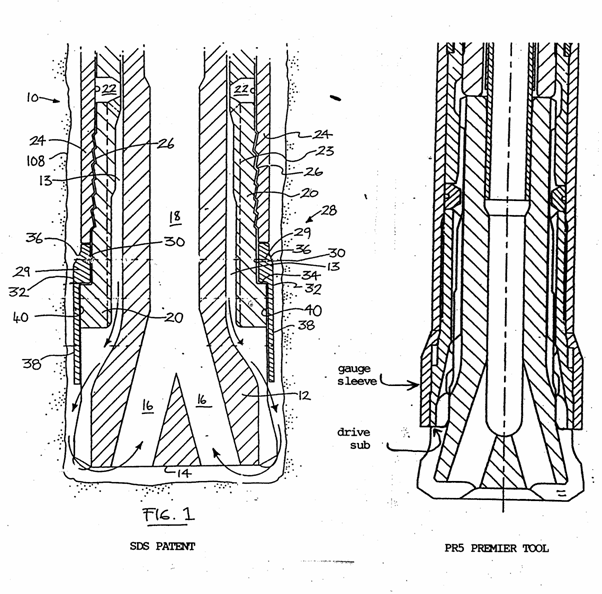
Figure 1 is relevantly described in the SDS specification as follows:
“Shown in figure 1 … is a down hole hammer 10 comprising a drill bit 12 having air passages 13, a cutting face 14 and a plurality of apertures 16 extending into a central aperture 18. The drill bit 12 is retained in a drill bit retaining means in the form of a drive sub 20 by slip split rings 22 and splines 23 which are dimensioned so as to allow for exhaust air passages 13 between the drill bit 12 and the drive sub 20 in known manner. The drive sub 20 is held in an outer sleeve 24 typically by way of a threaded portion 26 of the outer sleeve 24. The outer sleeve 24 surrounds porting means (not shown) of known type to enable a piston (not shown) to reciprocally strike the bit 12 in known manner. … Longitudinally intermediate of the outer sleeve 24 and the drive sub 20 is a sacrificial transmission sleeve 28 having a body 29 comprising a first inner surface 30 substantially conforming to the drive sub 20 and a second outer surface 32. … As may also be seen, the body 29 is partially proud of the outer sleeve 24.
Preferably, the diameter of the transmission sleeve 28, as measured at the body 29 … is substantially the same as that of the drill bit 12.
The transmission sleeve 28 further comprises an annular flange 38 extending from the body 29 of the transmission sleeve 28 towards the drill bit 12. The flange 38 is disposed with an interior surface 40 overlying the drive sub 20 extending beyond the drive sub 20 towards the drill bit 12.
…
The flange 38 is adapted to encircle a portion of the drill bit which defines longitudinal grooves forming the exhaust air passages 13 in the sides of the bit in such a manner as to form a continuous shroud around at least a part of the grooves so as to assist in the downward passage of the exhaust air to the face of the drill bit 12.
…
The transmission sleeve 28 of the present invention serves to provide a more effective seal with the hole 108 than the compensating ring of our earlier Australian Patent Application No. 43643/89, as it seals the hole 108 closer to the face 14 of the drill bit 12. Further, the flange 38 allows the seal to be maintained over a longer length. This reduces the chances of sample contamination and/or increased air consumption.
The words emphasised in bold print were added in the amended provisional specification filed on 12 December 1990, and included in the complete specification filed on 24 April 1991.
38 It is common ground that transmission sleeve 28 is so described in the SDS patent as it transmits air in the manner described in the specification.
39 It is not necessary to understand the arguments on infringement to depict in similar fashion the features claimed in the Giehl patent. It is sufficient to say that the Giehl patent concerns “an outermost cover acting as a shroud”. In the preferred embodiment depicted in the drawing of the Giehl patent the outermost cover acting as a shroud is fitted in a similar position in relation to the drill bit as the transmission sleeve in the SDS patent. The specification says:
“In preference, the said cover means are part of a drill chuck sub adapted to affix to a drill stem. Alternatively, the said cover means are fixed about the said drill bit by a drill chuck sub adapted to affix to a drill stem. It will be appreciated that it is a minor matter to design the cover means to be separate but held in place by the drill chuck sub. However, the former is preferred.”
The expression “drill chuck sub” in the Giehl specification means a drive sub.
40 It is convenient to first consider the claim of infringement of the SDS patent.
41 The Premier tools incorporate a gauge sleeve similar in shape, dimensions and position to the transmission sleeve in the SDS hammer. The Premier gauge sleeve has a body and an annular flange. The outer diameter of the body of the gauge sleeve is greater than the outer diameter of the outer sleeve (the hammer housing) and substantially the same diameter as the drill bit. The annular flange has a diameter which is substantially the same as the drill bit. Moreover, the Premier gauge sleeve extends from the body towards the drill bit. These are features of the sacrificial transmission sleeve claimed in claim 1 of the SDS patent. However, as will be noted from the diagrams above, the gauge sleeve in the Premier hammers does not extend in an axial direction downward from the drive sub. In the Premier hammers the drive sub has been extended so that it terminates flush with the lower end of the gauge sleeve.
42 The Premier tools comprise a hammer of the type described and claimed in the SDS patent. At trial there was some argument over the meaning of the expression “drill bit retaining means”. According to the evidence that is not an engineering term. It carries its ordinary meaning. The SDS patent describes the drill bit retaining means as being in the form of a drive sub. The Premier tools plainly have a drill bit retaining means of the kind described in the SDS patent. Further, the evidence establishes that the Premier tools are used with a gauge sleeve that is “sacrificial” in nature. The gauge sleeve fitted to the Premier tools is consumed in much the same way as the drill bit, and that it wears in preference to other components of the hammer assembly, and in particular the outer housing of the hammer and the drive sub.
43 The respondents’ defence asserts that whilst the gauge sleeve of the Premier tool is sacrificial, it is not a “transmission” sleeve within the meaning of the SDS claims as it does not transmit air. Because it does not transmit air the respondents contend that the gauge sleeve simply fulfils the function of a compensating ring, like that described in the DTA compensating ring patent. In the Premier tools, the transmission of air is performed by the drive sub which ends flush with the gauge sleeve. Further, the respondents contend that the wear characteristics of the Premier gauge sleeve are not “similar to that of the drill bit”, and that the Premier gauge sleeve does not wear at a “similar rate” within the meaning of the final integer of claim 1 in the SDS patent.
44 The question of infringement is to be decided upon a proper understanding of what is described in the body of the specification, and on a proper construction of the claims. On a literal construction of the claims, a gauge sleeve, to meet the description “transmission sleeve” will be a sleeve that transmits air. In the manner in which the Premier tools have been designed and manufactured, the gauge sleeve is not performing that function. Infringement is a question of fact, and it is clear on the authorities that infringement may occur where the respondent takes the substance of the invention yet stays outside the express words of the claim, unless the wording of the claim makes it clear that the relevant area has been deliberately left outside the claim: Minnesota Mining and Manufacturing Co v Beiersdorf (Aust) Ltd (1980) 29 ALR 29 per Aitken J (with whose judgment Barwick CJ, Stephen, Mason and Wilson JJ agreed) at 52-53. It is sufficient to cite the comments of Dixon J in Radiation Limited v Galliers and Klaerr Pty Ltd (1938) 60 CLR 36 at 51 where his Honour said:
“But, on a question of infringement, the issue is not whether the words of the claim can be applied with verbal accuracy or felicity to the article or device alleged to infringe. It is whether the substantial idea disclosed by the specification and made the subject of a definite claim has been taken and embodied in the infringing thing”.
and Menzies J in Commonwealth Industrial Gases Limited v M W A Holdings Pty Ltd (1970) 180 CLR 160 at 167-168:
“Patent rights are not to be set at nought by such a subterfuge which I am satisfied added nothing to the equipment and was made merely in an attempt to take full advantage of the invention while avoiding infringement of the plaintiff’s letters patent by a modification so small as to be insignificant…
The cases do establish that, if the alleged infringement differs materially from an essential feature of the plaintiff’s claim, there can be no infringement…In the present case normality of the reflector is made an essential feature of the plaintiff’s patent. As I have said, however, the modified manufacture since 1966 does not avoid the essential feature because the reflector as made thereafter is so close to being flat that the defendant’s manufacture and sales still takes the plaintiff’s invention”.
These and other authorities to a like effect were discussed by a Full Court of this Court in Populin v HB Nominees Pty Ltd (1982) 41 ALR 471 at 475-477. See also Nesbit Evans Group Australia Pty Ltd v Impro Limited (1997) 39 IPR 56 at 80 and Catnic Components Limited v Hill & Smith Limited [1982] RPC 183 per Lord Diplock at 242-243.
45 I agree with and accept the opinion of Mr G A McGoggin, called by the applicant, that the extension of the Premier drive sub is a minor variation, one which he described as a “trifling variation of no mechanical significance”. The configuration of the extended portion of the drive sub in the Premier tools, which masks the inner surface of the gauge sleeve, serves merely to replace channels formed in the bit and enclosed by the inner surface of the transmission sleeve described in the SDS patent with mirror image channels formed in the drive sub, and enclosed by the surface of the drill bit. In normal operation, the variation does not result in the Premier tool losing any of the advantages of the invention claimed in the SDS patent. The Premier tool is the functional equivalent of the SDS invention. I consider that this is a plain case of Azuko taking the substantial idea disclosed in the specification of the SDS patent and seeking to avoid the literal meaning of the claims by a contrived modification that has no practical significance in the normal operation of the drilling apparatus.
46 By their terms, none of the claims indicates that a modification of the kind undertaken by Azuko has been deliberately left outside the scope of any of the claims. Rather, the body of the SDS patent specification concludes with the statement that:
“Modifications and variations such as would be apparent to a skilled addressee are deemed within the scope of the present invention”
and the evidence satisfies me that a modification of the kind made by the respondent would be apparent to a skilled addressee, particularly having regard to claim 5 and the accompanying figure representing that embodiment.
47 The gauge sleeve on the Premier tools acts to seal the annular space between the hammer assembly and the bore hole much closer to the face of the bit than was known before April 1990. The gauge sleeve works in combination with the drive sub on the Premier tool to direct the flow of exhaust air, and to restrain it until released at the head of the drill bit proximate to the face of the bit. The gauge sleeve is also a sacrificial component of the Premier tools.
48 The respondents’ other infringement defence based on wear characteristics and wear rate turns primarily on the construction of the final integer of claim 1 which reads:
“…and the wear characteristics of the transmission sleeve being similar to that of the drill bit, whereby, in use, the transmission sleeve wears at a similar rate to the drill bit”.
The respondents contend that “wear characteristics” is to be read separately from, and given a distinct meaning to “wear at a similar rate to the drill bit”. The respondents contend that “wear characteristics” is a reference to the inherent metallurgical properties or mechanisms of wear, rather than to the rate of wear of the sleeve and bit in use. In my opinion the applicant is correct in the construction which it places on this integer, namely that it is to be read as a whole, and as concerned with wear of the relevant components in use. So construed this integer imposes a requirement that the transmission sleeve and the gauge row of carbides in the drill bit wear sympathetically so that the difference in diameters remains similar. This is a construction which is practical, purposive and consistent with the disclosure of the invention in the SDS patent.
49 As Mr McGoggin and Mr McInnes in their evidence explained, assertions by the respondents’ witnesses that the final integer requires that the sleeve of the invention have a similar “hardness” to the drill bit confuses the static properties of the respective components with the dynamic analysis of “wear” to the transmission sleeve and drill bit in use. I was impressed by the evidence of each of these witnesses, and I prefer their evidence to that of the respondents’ expert witnesses where they differ.
50 I agree with the applicant that the construction contended for by the respondents through the evidence in chief of their witness Mr Laczko is not a fair attempt to construe claim 1 so as to make the invention work. Mr Laczko in his cross-examination acknowledged that the SDS patent teaches that the transmission sleeve must be constructed so that in use it reduces in diameter at approximately the same rate as the diameter of the gauge row, and that the patent appears to be focusing on maintaining in use an equivalent reduction in diameters of the transmission sleeve and gauge row.
51 Joseph Purcell in his witness statements said that he did not understand the final integer, and sought to give “wear characteristics” and “wear at a similar rate to the drill bit” meanings which would render the final integer meaningless. However, in his cross-examination he conceded that he did not think the expressions were meaningless when he was corresponding with the applicant’s patent attorney in April 1990, and that his witness statements to the contrary were false, to support Azuko’s case.
52 Witnesses who gave evidence about the manufacture of gauge sleeves were unanimous in their view that there would be no difficulty in meeting the teaching of the SDS specification that:
“Typically, the transmission sleeve 28 is made of a heat treated alloy steel with a hardness similar to the outer sleeve 24 but softer than the drive sub 20 (i.e. the drill bit retaining means)”.
53 The requirement of the final integer of claim 1 is also to be understood against the general knowledge of those experienced in the art in April 1990. Mr Stevens, called by the respondents, agreed that the materials used in the manufacture of all reverse cycle hammers was at that time standard. In particular that was the case for the materials used in drill bits, carbides, hammer casings, drive subs and sleeves and shrouds. The wear mechanisms of the different materials were well known. Similar evidence was given by another of the respondents’ witnesses Mr Schwann.
54 In final submissions counsel for the respondents argued that the applicant had failed to establish that the gauge sleeves and carbides of the Premier tools wear in use at a similar rate. It was said that there was no evidence adduced from any “hands-on driller” that this occurred in practice. I understand this submission to contend that the applicants had failed to establish that the gauge sleeve and carbides of Premier tools would wear in use in such a way that the outside diameters of the two would reduce in sympathy. I reject this submission. There was expert evidence led by the applicant from Mr McGoggin, who explained that the gauge sleeves and carbides of the Premier tools would wear in this way in use. This evidence received support from the evidence of the respondents’ witness Mr Leahy. Further, the underlying premise on which the case was fought on both sides was that the gauge sleeves and carbides of the Premier tools do wear at similar rates in use – indeed if they did not, the Premier tools would not have achieved the degree of market success which they have achieved.
55 It was contended by the respondents, in relation to claim 2 of the SDS patent, that even if the drive sub and gauge sleeve are treated as a combined item which constrains and directs exhaust air until released, the gauge sleeve and drive sub do not encircle a portion of the drill bit “in such manner as to form a continuous shroud to assist in the downward passage of the exhaust air to [the] cutting face of the drill bit”. I do not accept this submission. I agree with and accept the opinion of Mr McGoggin in paragraph 53 of his reply statement, Exhibit A6, that the Premier drive sub/gauge sleeve combination does encircle a portion of the length of the drill bit in a manner to form a continuous shroud to assist in the downward passage of exhaust air to the cutting face of the drill bit. This arrangement in the Premier tool shrouds the longitudinal grooves in the side of the drill bit head at their commencement in the shoulder of the bit. This arrangement directs the passage of exhaust air into these grooves, and directly at the cutting face, particularly when the hammer is operating in the closed, i.e. normal operating, position. The Premier tools, like the applicant’s hammers, are designed and intended for use in hard conditions. In those conditions, I am satisfied by the evidence, particularly that of Mr McInnes, that the operating gap between the weight bearing surface of the drive sub and the shoulder of the head of the bit would be very small, and not such that the combination of the gauge sleeve and a drive sub in Premier tools would not perform the function of directing exhaust air into the longitudinal grooves of the drill bit proximate to the cutting face.
56 It is not a requirement either of claim 1 or claim 2 of the SDS patent that the sacrificial transmission sleeve encircle and cover part of the head of the drill bit below the weight bearing shoulder. There is nothing in the claims in the SDS patent, or in the specification, to suggest such a requirement.
57 The gauge sleeve on the Premier tools is clamped to the hammer between the outer sleeve of the hammer and the drill bit retaining means, namely the drive sub, and that integer of claim 3 is present.
58 The applicant contends that claim 5 is infringed in that the Premier gauge sleeve and drive sub acting in combination constitute:
“A sacrificial transmission sleeve according to claims 1 or 2, in which the transmission sleeve and the drill bit retaining means are integrally formed with one another”.
59 The respondents deny this contention saying that a component is not integrally formed unless it is manufactured as one item. In the Premier tools the gauge sleeve and the drive sub are separately manufactured, and remain separate, even though they are clamped together when in operation.
60 If recourse is had to the body of the specification it is, in my opinion clear from descriptions of possible embodiments of the invention that a transmission sleeve “integrally formed” is one manufactured as a single discrete item. However, it is the claims themselves which define the invention which is the subject of the patent and it is not legitimate to confine the scope of the claims by reference to limitations which may be found in the body of the specification if the claims are otherwise clear: Decore Corp Pty Ltd v Dart Industries Inc (1988) 13 IPR 385 at 400. But if an expression used in a claim is not clear or is ambiguous, it is permissible to resort to the body of the specification to define or clarify the meaning of the words used in the claim.
61 The Shorter Oxford English Dictionary defines “integrally” to mean “in an integral manner; as a whole; entirely”. The primary meanings of the adjective “integral” are “1. Of or pertaining to a whole. Set of a part or parts: Belonging to or making up an integral whole; constituent, component; spec necessary to the completeness of the whole. (2) made up of component parts which together constitute a unity…”.
62 The words “integrally formed” must be construed in context. The full expression used in claim 5 is “integrally formed with one another”. Standing alone, this expression could imply that the sacrificial transmission sleeve claimed is not one separate and discrete item, but one in which the transmission sleeve and another component of the assembly, one with the other, are combined, for example by being welded or screwed together, locked or clamped together, or joined by any mechanical means so that they are united for practical purposes.
63 In the context of the claims, however, if this were the meaning, claim 5 would cover the same ground as claims 1 and 3. In my opinion there is such ambiguity or uncertainty in the meaning of the expression “integrally formed with one another” as to require recourse to the body of the specification. It then becomes clear that the expression in claim 5 means that the transmission sleeve is physically formed with the drive sub, that is, that they are made or produced as a whole. There are statements in the description of the second and third embodiments of the invention to this effect. It is sufficient to refer the description of the third embodiment, to which claim 5 relates, on page 12 of the specification:
“Similarly, as the flange … of the drive-sub … of the third embodiment is worn the drive-sub … will require to be replaced in its entirety. Thus, it can be seen that the first embodiment of the present invention is to be preferred …”
and to figure 3 which shows the drive sub and the flange as a single component.
64 The respondents’ case, and evidence from Joseph Purcell in particular, sought to assert material differences between the Premier tools and the SDS invention. These were said to demonstrate that the gauge sleeve and drive sub assembly in Premier tools were not a mere mechanical equivalent of the SDS invention. A number of these alleged differences were said to result in the Premier tool being less efficient in sample recovery in certain modes of operation. Even if that were so I do not consider that such differences, because they have that effect, offer the respondents a defence to the infringement allegations. As noted above the Premier tools are designed and intended for use in hard conditions, and in those conditions the gauge sleeve / drive sub combination of the Premier tools achieves all the advantages afforded by the SDS invention and the invention works in the same way. It is beside the point that in some infrequent operating conditions the advantages so gained might be somewhat diminished.
65 In one of his witness statements filed before the commencement of the trial Joseph Purcell alleged three major differences between the Premier tools and the SDS patent. One difference concerned the fact that the Premier gauge sleeve did not extend past the drive sub so as to shroud the head of the bit. This alleged difference has already been considered. Another difference was that when the drill bit is in the fully extended position the combination of the gauge sleeve and the drive sub in the Premier tool no longer covered any part of the head of the bit, whereas in the preferred embodiments disclosed in the SDS patent the transmission sleeve would still encircle part of the bit head. This difference was said to give rise to a reduced efficiency. In normal operating conditions, a hammer is not operating with the drill bit in an extended position. Indeed, when the drill bit is in the extended position, the reciprocating piston in the hammer is inoperative. The difference is functionally irrelevant. Moreover, no evidence was led to show that the alleged difference resulted in any practical inefficiency in sample recovery.
66 The other difference alleged by Joseph Purcell was that the air flow in the Premier tools was not as direct as in the SDS patent assembly which “gives the air a smooth passage all the way down the drill bit to the face of the bit”. In the Premier tools the air flow, he said, was not as direct “therefore when the air leaves the drive sub and enters the channels in the side of the bit, there is a slight disruption in air flow. This affects the passage of the air to the face of the bit and therefore the efficiency of the sampling”. Again, there was no evidence led that the sampling efficiency was any less in the case of a Premier tool than occurred with the use of the SDS patent assembly. Further, there was no evidence led from any expert qualified to give it that the movement of the air through the passages described by Joseph Purcell caused “slight disruption in air flow”. Moreover, as already noted, even if differences between the preferred embodiment of the SDS patent and the Premier tools led to a slight diminution in efficiency, this does not save the Premier tools from infringement.
67 Other differences were alleged during the course of the trial, namely “partial reaching”, “shanking” and restricted lateral movement of the bit in the drive sub. The evidence led in support of these alleged differences was not advanced initially in the respondents’ witness statements, but came forth during the trial in circumstances which I consider indicate that it was advanced as an afterthought in an attempt to obfuscate the real issues raised by the infringement case. I found the evidence unconvincing, and, significantly, no attempt was made to lead any evidence that, when Premier tools were operating in the field, there was any inefficiency in sampling capabilities.
68 “Partial reaching” was said to occur in operation when the bit was further extended than in the normal operating position, but not fully extended. There was no satisfactory evidence led that Premier tools operate in a “partial reaching” position in normal drilling operations, or that the alleged differences in fact affected sample recovery. Indeed, Mr Schwann said that there was no technical basis for a comparative assessment of the Premier tools with the SDS patent assembly, and that there was no difference “at the surface”, by which I understood him to mean that there was no appreciable difference in the sample recovery. On the question of partial reaching I found the evidence of Mr McInnes convincing, and I accept it in preference to the evidence of the respondents’ witnesses on that topic.
69 The “shanking” difference was said to relate to the comparative potentials of drill bits in Premier tools and SDS assemblies to fracture. The respondents’ case suggested that differences in the configuration of bits used in Premier tools would give them added strength. No evidence was led as to analysis or testing of the different bit configurations, and the evidence fails to indicate whether in fact there is any difference in strength. The difference therefore is not made out on the evidence, but in any event, as the applicant points out, the claims do not relate to the bit design.
70 Finally, it was suggested that in the Premier tools the configuration of the extended drive sub allows less opportunity for lateral movement of the bit. Again, this allegation was not supported by appropriate technical evidence, and it was wholly rejected by Mr McGoggin who considered that there was no difference in lateral movement between the two assemblies. Insofar as it is possible to form a view by visual examination of the exhibits, Mr McGoggin’s opinion would appear to be correct. Again, however, the claims do not relate to this issue.
71 In the result, I am satisfied, and so find, that the Premier tools infringe claims 1, 2, 3, 7, 8, and 9 of the SDS patent. I also consider that the Premier tools infringe the omnibus claims in claims 13 and 14 which incorporate the drawings into the claim: Raleigh Cycle Co Ltd v Miller and Co Ltd (1948) 65 RPC 141; Utilux Pty Ltd v AMP Inc (1974) 48 ALJR 17 at 20 and Rehm Pty Ltd v Websters Security Systems (International) Pty Ltd (1988) 11 IPR 281 at 300. The Premier tools are substantially as described in the body of the SDS patent and Figure 1 which accompanies the specification.
72 I turn now to the allegation of infringement of the Giehl patent. It is not disputed that the Premier tools incorporate:
(a) a drill bit assembly for in-the-hole hammer reverse circulation percussive drilling
(b) using air pressure to both drive the percussion hammer and to clear cuttings
(c) the bit having a plurality of outermost channels extending in a direction parallel to the axis of the bit down the outer side of the bit and
(d) having a collection duct or ducts passing through the bit with its collection opening or openings through the face of the bit and
(e) an outlet at the axially aligned opposite end of the bit
these being the first five integers of claim 1. However, the respondents contend that the remaining integers are not present, namely:
(f) an outermost cover acting as a shroud which is located to engage against and extend around the outer side of the drill bit
(g) (which) form(s) with the channels conduits which are shaped and positioned so that air flow to clear the cuttings will be directed by reason of passage through one or more of the conduits directly at the periphery of the cutting face of the bit.
73 The respondents’ contentions are in substance those advanced in support of the argument that Premier tools do not have a “transmission sleeve” that infringes claim 1 of the SDS patent. It is contended that the gauge sleeve of the Premier hammer is the “outermost cover” but that it does not act as a “shroud” which is located to engage against and extend around the outer side of the drill bit so as to form conduits with channels in the drill bit. In my opinion the respondents’ contentions should be rejected for the same reasons given for rejecting similar submissions in relation to the SDS patent. The Premier gauge sleeve and drive sub in combination act to relevantly direct air and answer the description of a shroud within the meaning of claim 1 of the Giehl patent. The substantial idea of the claim has been taken, and the design modification of the drive sub to mask the inner surface of the gauge sleeve is a mere subterfuge adopted in an attempt to take full advantage of the invention, while avoiding infringement of the letter of the claims. As with the SDS patent, there is nothing in the wording of the claims which make it clear that the relevant idea has been deliberately left outside the claim. Significantly, the invention claimed concerns the direction of air by means of a shroud so that the air flow to clear the cuttings will be directly at the periphery of the cutting face of the bit. The invention is not concerned with a sacrificial sleeve which maintains a seal whilst wearing down sympathetically with the gauge row of the drill bit. In the preferred embodiment, the subject of the drawings accompanying the specification, air is relevantly directed by the inner surface of the drive sub. That is exactly what occurs in the Premier tools.
74 In the Giehl patent there is no requirement in either the claims or the specification that the cover acting as a shroud cover part of the drill bit below the weight-bearing shoulder of the bit. Part of the teaching in the specification is directed to the portion of the channels on the outside of the drill bit which are not covered. An alternative description of the invention on page 4 of the specification reads (and it is to be noted that the expression “drill head” in the specification describes the totality of the bottom assembly including the bit (or “drill”) and the drive sub):
“Alternatively the invention can be said to reside in a drill head that includes a plurality of channels each extending from the working face of the drill, the arrangement being characterised in that there is a cowl surrounding the drill head and shaped and adapted with the remainder of the drill head whereby each of the respective channels has its otherwise open side closed by the cowl to the extent that there is only a relatively short channel part which extends directly from the working face of the drill up the side of the drill head which is not so closed off.
It appears that the channels and the cover means of such an arrangement constrain the flow of air. Further, the air is strongly directed toward at the edge of the cutting face. Then the air flows to the collection ducts…” (emphasis added)
Joseph Purcell says that in designing the Premier tools to avoid infringing the SDS patent:
“In basic terms, I brought the face of the bit closer to the drive sub, rather than extending the drive sub towards the face of the bit” (Exhibit 23).
By this design the Premier tools took and applied the substance of the invention as described above in the Giehl patent, and, in my opinion, infringed claims 1, 4 and 5.
75 I turn now to the cross-claim which seeks the revocation of both the SDS patent and the Giehl patent. Revocation is sought on numerous grounds, separately particularised in relation to each patent. In the presentation of the case, counsel concentrated first on the SDS patent and then on the Giehl patent. I shall follow the same course but, as many of the arguments addressed to the Court are common to both patents, a degree of cross referencing is both convenient and inevitable.
76 As earlier stated, both patents were granted under the 1990 Act on applications made under the 1952 Act. The validity of both patents is therefore to be determined in accordance with the 1990 Act, subject to ss 233(4) and 234(5) of that Act. The relevant effect of those sections was discussed in NV Philips Gloeilampenfabrieken v Mirabella International Pty Ltd (1993) 26 IPR 513 where Lockhart J, with whose reasons Northrop J concurred at 515 and Burchett J generally agreed at 542, said at 527:
“In my opinion the evident intent of s 233(4) is to ensure that the grounds of revocation under the 1990 Act (which, though in some cases are expressed in different terms, are essentially the same as the grounds previously available under s 100 of the 1952 Act) apply as the grounds for revocation of a 1952 Act patent; but with this important qualification, namely, that the elements of each ground of revocation under the 1990 Act apply only to the extent that they replicate in substance the elements that previous constituted a ground of revocation under the 1952 Act. Hence, if a ground of revocation under the 1990 Act omits an element which was a necessary part of a ground under the 1952 Act, the patentee has the benefit of it. On the other hand, if a ground under the 1990 Act contains an element not previously present under the 1952 Act, it cannot apply in aid of revocation of the 1952 Act patent. In short, a 1952 Act patentee is not to be worse off than he would have been if the 1952 Act had continued to operate, but he may be better off if the 1990 Act treats a former element of a ground of revocation as being no longer necessary.”
In short, whilst the claims fall to be determined under the 1990 Act, the effect of ss 233(4) and 234(5) is that the applicant may be “better off” by reason of the 1990 Act, but should “not be worse off” if the 1952 Act had continued to operate. These sections assume importance in determining whether the Giehl patent prior claims of the SDS patent.
77 The first ground of attack on each patent is that it lacks novelty having regard to the prior art base and prior information in Australia before the relevant priority date of the patent, being in the case of the SDS patent 26 April 1990 on the applicant’s case, or alternatively either 12 December 1990 or 24 April 1991 on the respondents’ case, and in the case of the Giehl patent 19 April 1990. The respondents rely on four prior publications of patent specifications in the case of the SDS patent and eight in the case of the Giehl patent (reliance upon the ninth publication pleaded, the Mincon patent, being abandoned at trial).
78 Counsel were in agreement as to the principles of law applicable to determine whether a prior publication anticipates the invention claimed in a patent in suit. Those principles are conveniently summarised in the judgment of Lockhart J in Nicaro Holdings Pty Ltd & Others v Martin Engineering Co & Another (1990) 91 ALR 513 at 517:
“It is well established that the prior art must disclose all features of the invention embodied in the patent in suit and must do so in clear, unequivocal and unmistakeable terms. The prior art must enable the notional skilled addressee at once to perceive and understand and be able practically to apply the discovery without the necessity of making further experiments. Whatever is essential to the invention must be read out of or gleaned from the prior publication: see Hill v Evans (1862) 31 LJ Ch 457 at 466: General Tire & Rubber Co v Firestone Tyre & Rubber Co Ltd, supra, at 486; Washex Machinery Corp v Roy Burton & Co Ltd (1974) 49 ALJR 12 at 18; and Van der Lely NV v Bamfords Ltd [1963] RPC 61 at 72-3.
In revocation proceedings the prior publication must disclose all of the integers with the possible exception of the substitution of ‘mechanical equivalents to perform analogous purposes’: Sunbeam Corp v Morphy-Richards (Aust) Pty Ltd (1961) 35 ALJR 212 per Windeyer at 220; R D Werner & Co Inc v Bailey Aluminium Products Pty Ltd, supra; Dennison Manufacturing Co v Monarch Marking Systems Inc (1983) 66 ALR 265 at 273, 274, 276 and 286. Although nothing turns on it in this case, I accept the correctness of the submission of counsel for the respondents that the term ‘mechanical equivalents’ is properly used in cases of want of novelty and the term ‘workshop improvement’ is essentially a term applicable to cases of obviousness: see Blanco White, Patents for Inventions, 5th ed, para 4.212 and Terrell, The Law of Patents, 13th ed, para 5.108; cf Terrell, para 6.52.
The invention must appear in a single disclosure, so it is not permissible to make a pattern or mosaic of or to read together various pieces of prior art in different patents. It is, however, permissible to refer not only to the patent relied on as the source of disclosure but to another patent or other patents incorporated by reference provided that it is plain that the incorporation by reference unequivocally and plainly demonstrates that the draftsman has adopted the cross-referencing system solely as a shorthand means of incorporating a writing disclosing the invention: George C Warner Laboratories Pty Ltd v Chemspray Pty Ltd (1967) 37 AOJP 2513 at 2516; Blanco White, 5th ed, at para 4.107 and Gratwick, ‘Having Regard to What was Known and Used’ (1972) 88 LQR 341 at 343.”
See also Gummow J at 524-539. It is also common ground that where a published specification is to be construed as part of the prior art in relation to an issue of novelty, the specification is to be construed in light of common general knowledge in the relevant industry at the time of publication of that specification.
79 It is with these principles in mind that each of the prior publication, and prior uses, pleaded by the respondents must be considered.
The SDS patent – novelty
(a) The DTA compensating ring patent
80 This patent, in respect of a “Compensating Ring for a Down Hole Hammer” has already been referred to at para 20 above. The patent became open to public inspection on 26 April 1990, the date which the applicant alleges as the priority date for the SDS patent. If that date, being the date of the first provisional application PJ9817 upon which the SDA patent is based, is the correct priority date (which I think it is – see below) the DTA patent does not prior publish the SDS patent (see s 18(1)(b) of the 1990 Act).
81 In any event, I do not consider that the specification of the DTA patent was anticipatory of the SDS patent. The DTA compensating ring patent discloses a reverse circulation face sampling percussive hammer in association with a sacrificial compensating ring which acts as a seal to prevent escape of air, and which wears sacrificially as the drill bit wears. It is held between the drive sub and the hammer barrel, and is positioned above the exhaust air outlet at the bottom of the drive sub. In this position, the compensating ring does not act to transmit air. This integer of the SDS patent is absent. The purpose of the compensating ring is to provide an effective seal and to wear as a drill bit wears. It is not designed to seal the hole closer to the face of the bit than was otherwise known in April 1990, and it is not part of the claimed invention that the compensating ring releases air closer to the face of the bit than was previously known.
82 The respondents acknowledge that the DTA compensating ring patent does not disclose a separate transmission sleeve as claimed in the SDS patent. However, this concession is made on the footing that the compensating ring is not “integrally formed” with the drive sub. If the respondents’ submissions on the construction of claim 5 of the SDS patent were to be rejected, the respondents contend that it would follow that the DTA compensating ring patent anticipated claim 5 of the SDS patent in that the DTA patent taught that the compensating ring, could encircle the drive sub. If the applicant’s argument is correct, namely, that it is sufficient for a ring or sleeve in that position to work in combination with the drive sub to be “integrally formed” for the purpose of claim 5 of the SDS patent, then the compensating ring and the drive sub would in combination transmit air. Even on that argument, however, the two components working in combination would not seal the hole closer to the bit face, nor release air closer to the bit face than was otherwise known in April 1990.
(b) The Giehl patent
83 As the Giehl patent was not published until well after the SDS patent was open to public inspection, the respondents are constrained to rely on the Giehl patent as a prior claiming of the invention disclosed in the SDS patent. The respondents contend that the specification of the Giehl patent discloses in substance the invention claimed in the SDS patent. In particular it is contended that the evidence establishes that a skilled addressee is informed by the specification that the shroud can be a separate component that is sacrificial. The respondents contend that the “wear characteristics” integer of the SDS patent, although not specifically expressed in the Giehl patent, would be automatically read into the Giehl patent by a skilled addressee, as the need to ensure those characteristics in a shroud or compensating sleeve was common general knowledge in the field of technology to which the patent related.
84 The respondents concede that if they are confined as a matter of law to the claims made by the Giehl patent, those claims do not anticipate the invention claimed in the SDS patent. The absence of these integers from the claims made in the Giehl patent led the respondents to argue that as a matter of law they were not confined to the terms of the claims in the Giehl patent, but could have regard to the specification generally and the substance of the invention there disclosed. The 1990 Act, by s 7(2), relevantly provides that an invention is taken to be novel when compared with the prior art base unless it is not novel in light of prior art information contained in a single specification of the kind mentioned in subparagraph (b)(ii) of the definition of “prior art base” in Schedule 1 to the Act. That definition reads:
“(b) In relation to deciding whether an invention is or is not novel:
…
(ii) information contained in a published specification filed in respect of a complete application where:
(A) if the information is, or were to be, the subject of a claim of the specification, the claim has, or would have, a priority date earlier than that of the claim under consideration; and
(B) the specification was published after the priority date of the claim under consideration; and
(C) the information was contained in the specification on its filing date and when it was published.”
85 Under these provisions an invention will lack novelty if it has been anticipated in a published specification which meets the requirements of subparagraph (b)(ii). The disclosure need not be contained within the actual claims of the published specification. The respondents argue that the 1990 Act has not materially altered the test for prior claiming which applied in Australia under the 1952 Act.
86 The respondents contend that there is no decided authority in Australia which compels a narrow test which would limit prior claiming under the 1952 Act to the terms of the prior claim. The respondents acknowledge the decisions of the Court of Appeal in Kromschröder (G.) A.G.’s Patent [1960] RPC 75 and Daikin Kogyo Co Ltd (Shingu’s) Application [1974] RPC 559 which confined the inquiry under analogous provisions of the Patents Act 1949 (UK) (the 1949 Act) to the disclosures contained in prior claims. The respondents contended that these decisions should not be applied in Australia in the construction of the 1952 Act. I do not agree. Kromschröder’s case concerned an application for revocation of a patent under s 32(1)(a) of the 1949 Act that provided “that the invention, so far as claimed in any claim of the completed specification, was claimed in a valid claim of earlier priority date contained in the complete specification of another patent granted in the United Kingdom”. Daikin’s case concerned opposition proceedings brought under s 14(1)(c) of the 1949 Act which in similar terms denied novelty where the invention is claimed in a claim in the earlier specification. Lord Evershed MR, delivering the judgment of the Court in Kromschröder said at 82:
“In our judgment, the language of Para. (a) of Sec. 32(1) of the Act requires that … the words ‘claimed in a valid claim’ are not satisfied if the invention in question is only covered or comprehended by the claim as being a part or integer (however important) or some wider combination or ‘arrangement’ which and which alone is the subject matter of the claim. The words at the beginning of the paragraph– ‘the invention so far as claimed in any claim’ – seem to us to postulate that the subject matter contemplated must itself be that for which protection is claimed; and we think the same sense should be given to the later words– ‘claimed in a valid claim’.”
87 Notwithstanding several single judge decisions which place a different interpretation upon the relevant provisions of the Patents Act 1949 (UK), holding that the interpretation given in Kromschröder was only applicable to the “type” of patent there subject to appeal, (see for example Merck and Co (Macek’s) Patent [1967] RPC 157, Wilkinson Sword Limited’s Application [1970] RPC 42 and Ethyl Corp (Cook’s) Patent [1970] RPC 227), the Court of Appeal in Daikin’s case confirmed the construction placed on the 1949 Act by Lord Evershed. Buckley LJ at 579 referred to the test approved in Kromschröder as well established law and said at 580:
“It does not suffice to show that what is claimed in the applicants’ specification is to be found somewhere comprehended or described in an opponent’s specification. In Kromschröder’s Patent (supra) the court was concerned with an application for revocation under section 32(1)(a) of the Patents Act, 1949, but the language of that subsection is for all practical purposes the same as the language of section 14(1)(c) with which we are concerned. Where an earlier claim is wider in its scope than a later claim and there is no separate claim in the earlier specification restricted to the subject-matter of the later claim, the claimant of the earlier claim cannot, in my judgment, assert that he has made a prior claim to the subject-matter of the later claim.”
88 In my opinion s 100(1)(f) of the 1952 Act should be similarly construed, and the expression “so far as claimed in any claim of the completed specification…” should be read literally so as to require the invention to be disclosed in a claim, not otherwise upon a reading of the complete specification. That this was the law in Australia prior to the 1990 Act gains support from the 1984 report of the Industrial Property Advisory Committee on Patents, Innovation and Competition in Australia upon which the relevant provisions of the 1990 Act are based: see Alcatel NV v Commissioner of Patents (1996) 35 IPR 255 at 257, a view accepted by Burchett J in that decision.
89 In any event, even if it were permissible, where prior claiming is alleged, to have regard to the description of the invention in the specification, as opposed to the claims themselves, I am persuaded by the evidence of Mr McGoggin that a skilled addressee would not be taught by the specification, and the specification would not be read and understood in light of common general knowledge to disclose, that the wear characteristics claimed in the SDS patent were part of the invention claimed in the Giehl specification.
90 In summary, I do not consider the Giehl patent discloses all the features of the SDS patent, and certainly, the claims in the Giehl patent do not do so. Moreover, I consider that only the claims in the Giehl patent are available as a ground of revocation under s 100(1)(f) of the 1952 Act.
(c) The Bakerdrill patent
91 The Australian application of the Bakerdrill patent, entitled “Sampling Airhammer Apparatus” became open to public inspection in Australia on 24 November 1977, and its publication appears to be that which introduced face sampling reverse circulation percussive hammers on to the Australian scene.
92 The Bakerdrill specification is difficult to understand. Two of the respondents’ witnesses, Messrs Stevens and Purcell, doubted that the drill, as described in the specification, would work. The specification contains mistakes in that descriptions relating to figures 6 and 7, and a section line through figure 1(d), are inaccurate. These mistakes were not detected by the respondents’ witnesses Messrs Stevens and Schwann. Their failure to detect these mistakes, which were relevant to issues under consideration, in my opinion reflects adversely on the quality of their evidence. I accept the submission of counsel for the applicant that this omission indicates that they too readily allowed information given to them by the respondents to influence their opinions.
93 Read at its publication date, I do not consider a skilled addressee would understand the specification as disclosing the features of the sacrificial transmission sleeve of the SDS patent.
94 The invention described in the Bakerdrill specification is said to overcome those problems associated with hammers using a crossover sub to divert the airflow and samples from outside of the hammer to the inside of the dual pipe drill string. The claimed apparatus is said to operate with reverse circulation airflow and a static air seal. The static air seal of the invention includes what is called a “gauge sleeve” which is mounted on a housing structure a short distance above the lower end of the drill bit. The gauge sleeve does not extend below the drive sub. The gauge sleeve is of slightly less diameter than the outer diameter of the gauge row of the drill bit, and it is held in place by being clamped between the drive sub and the outer housing of the hammer. In those respects its features are similar to those of the DTA compensating ring patent, but the specification is silent as to whether the gauge sleeve is intended to wear at all, and if it is, there is no statement as to its wear characteristics. Rather, the specification describes a static (fluid) seal created around the gauge sleeve by exhaust air from the hammer being directed into the bore hole adjacent to the upper and lower ends of the gauge sleeve. The static seal is described as preventing drill cuttings or rock debris from passing upwards or downwards around the gauge sleeve.
95 It is clear from the body of the specification, although not so clear from the figures attached, that the operation of the Bakerdrill depends on two separate air circuits, one circuit being for high pressure or supply air, and the other being for exhaust air expelled after driving the piston of the hammer. In contrast, the SDS patent is concerned only with the transmission of exhaust air, and with a face sampling apparatus in which the cuttings are entrained solely in exhaust air.
96 The exhaust air from the Bakerdrill is expelled through exhaust ports or holes in the drive sub below the gauge sleeve. The gauge sleeve therefore has no function in directing exhaust air. In addition to the exhaust air, high pressure air also flows into the bore hole “to sweep the cuttings produced on the bottom of the hole around the bit drilling face and into the (central) passages through the anvil bit”. High pressure air is constantly pumped through discharge ports of holes for this purpose. The discharge ports open into a shallow annular space at the lower edge of the gauge sleeve but at a point above the lower end of the drive sub. It is said by the respondents that this feature teaches that the gauge sleeve directs or transmits air and therefore acts as a “transmission sleeve”. Although there is no reference to the gauge sleeve being sacrificial, or being intended to have a similar wear rate to the drill bit, the respondents contend that it would go without saying that the gauge sleeve was sacrificial and that standard drilling practice would dictate that so far as possible a skilled addressee would attempt to achieve a similar wear rate for the gauge sleeve and drill bit.
97 Insofar as the intended operation of the Bakerdrill can be deduced from the specification, the purpose of the gauge sleeve is quite different to the transmission sleeve of the SDS patent. Its stated purpose is to create a static seal in conjunction with airflow from ports above and below the gauge sleeve. In the absence of any reference to the potential of the gauge sleeve to wear, or to its wear characteristics, I am unable to accept that a skilled addressee would infer that the gauge sleeve was sacrificial or that standard drilling practice would dictate that the skilled addressee should attempt to achieve a similar wear rate for the gauge sleeve and a drill bit. Moreover, high pressure air flowing from the discharge ports at the lower end of the gauge seal is not described in the Bakerdrill patent as being directed to the cutting face of the bit. On the contrary, once the high pressure air is discharged, the specification says, only, that it “flows into the bore hole … to sweep the cuttings produced on the bottom of the hole around the drill bit face …”. The specification does not teach that air, either exhaust or high pressure, should be transmitted by a sleeve extending towards the drill bit in the manner required by the SDS patent, nor does the Bakerdrill have a flange which encircles at least a portion of the length of the drill bit to form a continuous shroud to assist in the downward passage of exhaust air to the cutting face of the drill bit as required by claims 2 and 8 of the SDS patent.
(d) The Bulroc (Weaver and Hurt) patent
98 This patent entitled “Closed Fluid Circulation in Down Hole Drill” became open to public inspection in Australia on 11 December 1986. The patent discloses a reverse circulation face sampling percussive hammer, the object of which is to provide a rock drill where clearing of the chippings and debris from the bottom of the hole can be substantially guaranteed, thereby overcoming difficulties in the prior art where airways feeding exhaust air to the cutting face become blocked. The consistory clause reads (page 3):
“According to the present invention, a rock drill comprises an outer wear tube, an inner centre tube, a drill bit mounted on the end of the centre tube, a reciprocal piston slidably mounted on the centre tube…the arrangement being such that the piston, at the end of its down-stroke, strikes the inner end of the drill bit, and there being porting means…to direct exhaust air to an annular passageway between the end of the wear tube and the drill bit and whereby air is exhausted in its entirety around the periphery of the drill bit to the bottom of the hole, from where it enters a central bore through the drill bit and is exhausted through the centre tube carrying with it all chippings and debris gathered in the bottom of the hole. While the annular passageway can be formed between the end of the wear tube and the drill bit, it is preferred to provide a short extension tube connected to the end of the wear tube, the annular passageway being formed between the extension tube and the drill bit.
…
An inevitable result of producing a bore is the creation of a narrow annular gap between the outer face of the wear tube and the wall of the hole, and up which exhaust air can pass. It is therefore usual to seal the upper end of the bore at the surface, but this can have the possibly harmful effect of a gradual build-up of pressure in the annular gap. It is therefore a further advantageous feature of the invention that seal means are provided between the outer wear tube and the hole wall to limit the length of the annular gap over which pressurisation can occur. Thus, a sealing ring may be secured to the wear tube of a material that combines the two required properties of reasonable flexibility and wear resistance, and which will therefore not impede the passage of the drill down the hole or its withdrawal.” (emphasis added)
99 A drawing depicting an embodiment of the invention is attached to the specification. In describing that embodiment the specification reads:
“In the drawing, a down-the hole rock drill as (sic-has) an outer wear sleeve 1 secured at one end to a back head 2 and at the opposite end to a chuck 3…”
100 It is plain from the drawing and the description that the wear sleeve 1 referred to in the specification is the outer casing of the hammer, and is separate and distinct from both the back head 2 and the chuck 3 (i.e. the drive sub).
101 There is no description in the specification of the seal means which is said to be a further advantageous feature. Nor is there any description of its placement on the “wear tube”, or of its dimensions. However, as it is described as “secured to the wear tube”, I conclude that the sealing ring must be above the drive sub.
102 The description of the drawing also instructs that:
“The outer surface of the drill bit and the inner surface of the chuck are correspondingly splined as indicated at 12, the splines being so dimensioned as to provide a number of gas passageways 13 around the drill bit 10…Thus, for so long as pressure air is provided the piston is caused to reciprocate at high speed, with pressure air in the chambers 32 and 33 being alternatively exhausted through the passageways 13 around the exterior of the drill bit. Consequently, all of the exhausted air passes around the exterior of the drill bit and into the bottom of the hole being drilled from where it escapes through the angled passageway 31 in the bit and up through the centre of the drill…”
103 In the drawing the drill bit is depicted as having a pronounced shoulder, giving the head of the drill bit, to use the applicant’s description, a square profile at the point of contact of the drive sub with the shoulder of the bit. This shoulder would deflect the downward flow of exhaust air towards the sides of the bore hole.
104 The respondents contend that the “short extension tube” referred to in the specification teaches a reader of the Bulroc patent of a transmission sleeve with all the features of the SDS patent. This view was supported by the evidence in chief of Messrs Stevens and Schwann who deposed to diagrams, prepared by Mr Joseph Purcell for the purposes of these proceedings, as representing their interpretation of the “extension tube” (see Exhibits RS45 and PS27 to their respective affidavits). These diagrams depict a length of tubing slid over the external circumference of the drive sub and affixed so that portion of the tube extends from the bottom of the drive sub towards the cutting face of the bit in a manner that encircles the portion of the bit below the square shoulder. The “short extension tube”, so placed by these diagrams, is said to constitute a transmission sleeve with all the features of the SDS patent.
105 The effect of sliding a tube over the drive sub in this manner, is to create a flange with an outer diameter substantially the same as that of the drill bit. This is not a feature of the drawing accompanying the Bulroc specification. The extension tube in this position also gives it the appearance of being a sacrificial sleeve which would wear in use in preference to the drive sub and the outer housing of the hammer (i.e. the “wear tube”). The specification does not state that the short extension tube is intended to be a sacrificial component.
106 I found the evidence led by the respondents in support of their interpretation of the Bulroc patent depicted in these diagrams unconvincing. Doubts about their correctness were heightened when in cross examination it was revealed by Mr Stevens that in his attempts to understand the Bulroc patent he had created his own “independent” diagram which he had given to the respondents’ solicitors. This diagram was not referred to in his witness statements. That diagram (Exhibit A9) showed the extension tube as being of equal diameter to the outer circumference of the drive sub, and extending from its lower edge.
107 The features and configuration of the “short extension tube” referred to in the Bulroc specification are not clearly described, nor is its location. Neither the diagrams deposed to by Messrs Stevens and Schwann, nor Mr Stevens own diagram depict an extension tube “connected to the end of the wear tube”, that is, to the end of the outer casing of the hammer. On the contrary, they show an extension tube affixed to the drive sub, an interpretation which finds no support in the wording of the specification.
108 Moreover, the diagrams deposed to by Messrs Stevens and Schwann are not a fair representation of the Bulroc assembly as it appears in the drawing accompanying the specification. The diagrams give a different representation to the drive sub, they disregard or span the spanner flats depicted in the drawing, and they show a different configuration of the splines on the inside of the drive sub and on the shaft of the drill bit. The collection ports and grooves on the face of the bit are different, and, importantly, the grooves in the side of the bit are more sharply angled in the drawing accompanying the specification plan than in the diagrams. This last mentioned feature of the diagrams suggests that exhaust air would encounter less obstruction from the curves in the grooves in the side of the bit than would occur in the preferred embodiment of the Bulroc patent.
109 Mr McGoggin, whose evidence I accept on this topic as I do on others in preference to that of Messrs Stevens and Schwann, was not able to put any clear meaning or definition to the reference in the Bulroc specification to the “short extension tube”. However, in cross examination he indicated how it would be possible to attach a short extension tube to the end of the wear tube in a manner that accorded with the teaching of the specification (see his drawing, Exhibit R5). In particular, a short extension tube in the position shown, would result in an annular passageway being formed between the extension tube and the drill bit in accordance with the description of the preferment of a short extension tube. The specification does not teach that air is exhausted through an annular passage formed between the drill bit and the drive sub. In my opinion the respondents’ construction, which treats the annular passageway as being formed between the drive sub, or an extension to it, and the drill bit is incorrect.
110 The respondents say that Mr McGoggin’s interpretation of the specification should be rejected, as an extension tube so positioned would perform no function. Mr McGoggin disagreed with this proposition, offering the opinion that it would serve to protect the bottom edge of the hammer housing (the “wear tube”) from abrasion. This is not a function described in the specification but Mr McGoggin’s evidence reflects the best interpretation which a skilled addressee reasonably and intelligibly could place on the otherwise vague and imprecise instruction offered by the specification.
111 In my opinion the Bulroc patent does not anticipate the SDS patent.
The Giehl patent – novelty
112 It is convenient now to deal with the eight prior patent specification publications relied on by the respondents as anticipating the Giehl patent.
(a) The 1987 Giehl patent
113 This patent became open to public inspection on 28 April 1988. It is entitled “Rotary‑Percussive Drill with Reversed Air Circulation” and relates to a drilling arrangement for rotary percussive drilling. Prior percussive hammers relied on normal circulation, and the specification describes important factors for drilling arising from reverse circulation. The invention uses air pressure to drive a hammer which is characterised by the fact that there are two air passages in the drill stem, and that it is a face sampling reverse circulation hammer:
“The air passageways being arranged with respect to the drill bit such that air at pressure is directed from above and outside of the drill bit so as to pass around the side of the drill bit and below and into an aperture passing upwardly through the body of the drill bit, whereafter connecting with one of the said two passageways extending to an above surface outlet.
A significant advantage of this arrangement is that the drill bit has then only to be designed to allow for air only to pass around its outer perimeter rather than to include both air and chips so that accordingly, any channels or scallop shape (sic) passageways that must be cut from the external side of the drill bit, can be significantly smaller than hitherto.
…
The invention can also be said to reside in the method of effecting percussion drilling which includes the steps of directing air such that it will pass from above and then around the outside of the drill bit and then pass across the bottom of the drill bit whereby to carry cut chips into an inner located upwardly extending conduit.
One of the significant further advantages of having air travel in the direction stated, is that the air can be caused to flow prior to collecting chips, across most of an external surface of the drill bit.
…
One problem that has been further discovered relates to maintaining that a majority of air directed into the location immediately above the drill head will indeed travel through the channels and across the drill bit face and into an outer conduit.
Conventionally, the drill bit is supported by a backing cylinder housing which has a diameter approximately equal to the diameter of the hole cut.
It has been found that, however, in some situations with the ground, particularly where the surface that is being cut is relatively soft, some bleed out from the housing at the outside of the drill stem will occur.
This is considered an advantage with soft material but if the cutting surface is hard, there is found to be more advantage in providing that with air being introduced into a channel, that the channel be only open downward towards the drill bit face and that the housing will provide a more effective seal against air loss up the side of the drill stem.
It is presumed nonetheless that such channels as would be provided, would open onto the bit face and in a preferred instance would have an axis which is parallel to the axes of other of the channels so that there might be four or five or more such channels around the peripheral side wall of the drill bit and support housing and further that these axes are parallel to the axis of the drill bit head.
According to a preferred arrangement then, there are provided distinct channels connecting the bottom of each channel extending up the side of the support housing, to an inlet conduit within the drill bit adapted to collect the cuttings.”
114 The attached drawings illustrating the preferred embodiments depict a drill bit with a prominent square shoulder, or weight bearing surface, and with grooves positioned in the head of the bit such that air from the hammer exhausting through the drive sub would be substantially deflected by curves in channels as they pass around the shoulder of the bit.
115 The respondents contend that the 1987 Giehl patent discloses all the features of the Giehl patent. Although it is acknowledged that the language is different, they contend that there is nothing of substance new in the Giehl patent. The respondents argue that the only apparent difference between the assemblies of the two patents is the presence of a shroud on the head of the bit in the case of the Giehl patent, yet (contrary to an argument put in their defence to the infringement claim) they say there is nothing in the Giehl patent that makes it clear that the shroud must extend around the head of the bit rather than the shank. Through their witness Mr Stevens, the respondents argue that if the words “drill bit” in the Giehl patent include the shank, then a drive sub shrouding the shank (as in the 1987 Giehl patent) would fall within and therefore anticipate the claims of the Giehl patent.
116 It follows from what I have said above regarding the infringement of the Giehl patent, that I construe the words “drill bit” in the Giehl patent as meaning the whole drill bit component, and that the invention claimed does not require that the shroud extend around or cover part of the head of the bit. Nevertheless, I do not consider that the 1987 Giehl patent anticipates the Giehl patent.
117 The Giehl patent expressly refers to the 1987 Giehl patent application, and refers to problems with the hammer described in the 1987 Giehl patent in that it returns only about 70 per cent of chips to the surface. The 1987 patent does not describe or illustrate an “outermost cover acting as a shroud to direct the air directly at the periphery of the cutting face of the bit” as required by the Giehl patent, and the 1987 Giehl patent does not show a flange that extends towards the drill bit that directs air that is exhausted from the hammer in the manner described and claimed in the Giehl patent.
(b) The Samplex (Ennis) patent
118 The respondents particulars of prior publication plead two Samplex patents, the first being the publication of the Australian patent number 15048/88 which became open to public inspection on 27 October 1988, and the United States patent specification number 4765418 which became available for inspection in the Patent Office Library, Canberra, on 19 September 1988. The two specifications are in material respects identical, and there does not appear to have been any evidence adduced by the respondents directed specifically to the United States patent. It is convenient to deal with the two together as the Samplex patent.
119 The Samplex patent describes a “Valveless Down-the-Hole Hammer”. The assembly disclosed in the patent is directed to a valveless hammer with a less complex piston design than those in the prior art. The object of the assembly is to provide a valveless type hammer drill in which damage to the piston is avoided by not having a complex piston design incorporating complicated port and or passage configurations formed in the hammer piston. The valveless hammer described comprises a body tube, a chuck mounted on the body tube with exhaust ports and three axially projecting dogs which fit into corresponding recesses in the exterior of the cutter bit so as to provide a driving connection between the body tube and the cutter bit which is retained within it. The hammer comprises an inner tube, surrounding a sample tube and an annular section piston with the ports controlling the airflow. Face sampling from the hammer is achieved by a sample tube and annular nozzle within the central passageway in the cutter bit to inject a portion of high pressure air upwardly into the lower end of the sample tube. In the operation of the hammer, high pressure air, which bypasses the hammer, is redirected upwardly into the sample tube by “an airflow reversing device”. This arrangement, according to the specification, “ensures a strong upward flow of high pressure air into the sample tube which can entrain the chippings or other material and carry it away up the sample tube”. This arrangement creates a venturi effect. The invention intends that a suction effect at the cutting face will entrain cuttings from the bit face and carry them into the sample tube and thence to the surface. The intended operation of the invention is more fully described in a brochure published in 1988 by Entech Industries Limited, a Northern Ireland company promoting the sale of the preferred embodiment of the invention of the Samplex patent.
120 The bit shank of the hammer does not have any splines to facilitate the rotation of the bit, as the rotational force is applied through the dogs projecting from the chuck (the drive sub).
121 The respondents contend that the projecting dogs form a shroud that directs exhaust air to the periphery of the cutting face of the drill bit, as is done in the Giehl patent.
122 I do not agree that the Samplex patent anticipates the Giehl patent. The Samplex patent is concerned with a valveless hammer that recovers chips from the cutting face by suction, whereas the invention disclosed in the Giehl patent does not rely to any extent on a suction effect. The projecting dogs of the Samplex hammer do not act as a continuous shroud which “extends around the side of the drill bit”.
123 Exhaust air from the operation of the Samplex hammer passes through the inner portion of the chuck, or drive sub, and exhausts mainly at the lower end of the drive dogs. The respondents contend that the venturi effect cannot and is not expected to work on its own and is dependent on the exhaust air directed by the dogs to the cutting face. Whilst it is clear from the description of the invention that exhaust air passes between the drive dogs and the body of the bit, the specification does not describe that the passage of exhaust air past the drive dogs is designed to contribute to the flushing of chips produced at the bit face, nor does the specification teach that the dogs direct air to assist with the recovery of cuttings from the drill face.
(c) DTA compensating ring patent
124 This patent has already been discussed in relation to the allegation of want of novelty in the SDS patent. It did not become open to public inspection until seven days after the priority date of the Giehl patent which was 19 April 1990. The DTA compensating ring patent is therefore not available as an anticipation of the Giehl patent. In addition, the respondents’ witnesses did not assert that the invention of the DTA compensating ring patent disclosed all the features of the Giehl patent. In particular, the compensating ring does not operate to constrain exhaust air or direct it to the periphery of the face of the bit, nor does the compensating ring locate or engage against, and extend around, the drill bit.
(d) The Lister patent
125 This patent became open to public inspection on 18 April 1990, the day before the Giehl patent. It is entitled “Improvements in Pneumatic Percussion Hammers”. The patent describes a face sampling reverse circulation hammer. An important feature of the hammer is that exhaust air is directed by internal ducts within the drill bit itself to flutes in the side of the drill bit, where it is released into the bore hole significantly below the drive sub. The exhaust air is then intended to flow through the flutes or channels in the face of the bit into and up the central bore of the hammer.
126 The respondents, through Mr Schwann, sought to support the pleading that the Lister patent anticipated the Giehl patent, and has the features of the invention of the Giehl patent. Mr Schwann gave evidence about the introduction in the late 1980’s of the Halco-Lister hammer, which appears to be the commercial embodiment of the Lister patent. Mr Schwann noted that the features of the Halco-Lister hammer include an “oversized” drive sub, the outside diameter of which is greater than that of the hammer casing and nearly the same as the outside diameter of the drill bit itself, that air is directed through passageways in the drill bit towards the cutting face of the drill bit, and that air also passes between the drive sub and the drill bit towards the cutting face of the bit. In his evidence, however, Mr Schwann acknowledged that this airflow was for lubrication purposes. Mr Schwann’s evidence seems not clearly based upon the specification itself, but rather to be based partly on promotional leaflets published in connection with the Halco-Lister hammer.
127 Again, I do not think that the Lister patent anticipates the Giehl patent. There is no disclosure in the Lister patent of “an outermost cover acting as a shroud to direct air to the periphery of the cutting face of the bit”. Whilst the Lister drive sub is connected to the outer casing of the hammer, there is no space between the drive sub and the drill bit to direct any relevant airflow to the face of the bit. There is no skirt or shroud to form channels to direct the air to the face of the bit. Rather, the flow of air exhausted from the hammer is transmitted to the face of the bit through oblique air ducts and flutes in the body of the drill bit itself, and, as already mentioned, the air exhausts below the drive sub.
(e) The Klemm (Hydroc) patent
128 This patent became open to public inspection in Australia in about May 1982. The invention describes an “Annular Drilling Hammer”. The patent is relied upon by the respondents primarily in support of its plea of obviousness in the case of the SDS patent, but it is also pleaded as an anticipation of the Giehl patent. The Klemm patent discloses a reverse circulation face sampling hammer. The hammer includes an annular bore crown (drill bit) with flow channels leading from the rear shoulder through to both the cutting face and to the central aperture in the bore crown. Air exhausted from the hammer flows through these channels and aids the entrapment of bored material (cuttings) which are then carried out through the inner tube with the aid of a venturi opening. The clearing mechanism disclosed in the patent depends primarily upon the venturi effect created by the flow of exhaust air through the channels leading into the central aperture of the bore crown. The specification describes longitudinal grooves or splines within the drive sub through which exhaust air flows. The lower end of the drive sub is:
“…conically enlarged and in this region the driving medium (exhaust air) flows against the bore crown… To ensure that as high a percentage as possible of working fluid flows back through the inside of the annular bore crown…rather than through the gap between the outer tube (drive sub) … and the bore hole wall, a set of bore holes 65 and 66 are provided in the bore crown. … The bores 65 extend from the rear shoulder of the bore crown to the front end, whilst the bores 66 lead directly from the rear shoulder to the interior of the bore crown.
A part of the working fluid is conducted directly through the bores 65 and 66 into the interior of the bore crown…and thence to the inner tube. This direct flow creates a suction at the bore crown by which the working fluid which leaks out laterally between the outer tube (drive sub) … and the bore crown…is entrained and urged into the inside of the bore crown…”
129 It is apparent from this description that in the intended working of the invention a high percentage of the exhaust air will flow through the flow channels, or bores 65 and 66, and that only a low percentage of exhaust air will “leak out laterally” between the conically enlarged end of the drive sub and the outer surface of the drill bit.
130 The respondents assert that the Klemm patent discloses an outermost cover acting as a shroud, namely, the conically enlarged drive sub. Mr Stevens expressed the opinion in his evidence in chief that the Klemm patent discloses all the features of the invention claimed in the Giehl patent. It appeared in his cross examination that this opinion was based on the assumption that most of the exhaust air would pass through an annular space between the conically enlarged end of the drive sub and the drill bit. This assumption is inconsistent with the teaching of the patent. Both Mr Stevens and Mr Schwann based their evidence on the assumption that there are “scallops” which convey airflow across the back of the bit and towards the periphery of the hole. This interpretation of the specification is not supported by the description in the body of the specification, or by the drawings (which do not show a cross section or representation at any point above the bit face).
131 In my opinion, the Klemm patent does not disclose a cover acting as a shroud in the manner of the invention of the Giehl patent. The mechanism for clearing cuttings from the bottom of the hole is by a suction effect. Whilst the specification of the Klemm patent describes a conically enlarged drive sub acting to constrain and direct air, it is directing air not through conduits external to the periphery of the bit for passage across the face of the bit into the inner tube, but through the internal flow channels in the drill bit described as the bores 65 and 66.
132 In my opinion the Klemm patent does not anticipate the Giehl patent.
(f) The Bakerdrill patent
133 This patent has already been discussed in relation to the SDS patent. It is pleaded that the Bakerdrill patent discloses an assembly that has all the features of the Giehl patent, but this allegation does not appear to have been taken up by the witnesses called for the respondents, or by the respondents in final submissions. The Bakerdrill patent does not have all the features of the Giehl patent. In particular, it does not have an outermost cover acting as a shroud, to direct exhaust air.
(g) The Bulroc (Weaver and Hurt) patent
134 This patent has also been discussed in relation to the SDS patent, and the respondents’ assertions in relation to the Bulroc patent, as against the novelty of the Giehl patent, are essentially the same as those made against the SDS patent. It is contended that the short extension tube described in the Bulroc patent performs precisely the same function as the shroud referred to in the Giehl patent. Again, this submission depends upon the interpretation of the Bulroc patent represented in the diagrams deposed to by Messrs Stevens and Schwann as Exhibits RS45 and PS27 respectively. I have rejected that interpretation. In my opinion the Bulroc patent does not disclose an “extension tube” which acts as an outermost cover acting as a shroud to direct air to the periphery of the cutting face of the bit, nor does it disclose a skirt or a shroud to form channels to direct air to the face of the bit as in the invention of the Giehl patent.
(h) The Minroc patent
135 This patent became open to public inspection in Australia in approximately April or May 1989. The patent claims a reverse circulation down-the-hole face sampling hammer drill apparatus. In final submissions counsel for the respondents indicated that this patent was no longer relied on as an anticipation of the Giehl patent, and whilst it lay “at the edge of the respondents’ case” it was said to be relevant in showing the general common knowledge in the relevant field of expertise at the priority dates of the patents in suit.
136 Within the drill bit of the Minroc patent there are exhaust air ducts leading from an expansion chamber into which exhaust air from the hammer flows. The ducts through the body of the bit emerge on the cutting face near its periphery. There are also angled passageways in the bit face which act as collection ducts. The stem (or shank) of the bit also has venturi orifices leading to the central bore of the bit.
137 The Minroc patent does not anticipate the Giehl patent. It does not disclose an outermost cover acting as a shroud to engage against and extend around the outer side of the drill to form conduits. Such a feature would be pointless as the exhaust air in the Minroc patent flows to the periphery of the cutting face through the air ducts situated within the body of the drill bit.
Novelty – prior uses
138 Against both the SDS patent and the Giehl patent a number of prior uses are alleged. In many instances the allegations of prior use are common to both patents. It is convenient first to deal with those which are not common.
(a) SDS patent – use of DTA patent compensating rings
139 There is evidence that prior to April 1990 about forty compensating rings were sold and thereafter presumably used in the field. However, it follows from the conclusion that the DTA patent did not anticipate the SDS patent, that the use of articles in the form of the preferred embodiment of the patent did not constitute prior use.
(b) Giehl patent – use of the Halco-Lister hammer
140 There is scant evidence about the use in Australia of any Halco-Lister reverse circulation face sampling percussive hammers prior to April 1990. The manufacturer in Australia of Halco-Lister hammers, Mr Bourne, gave evidence for the respondents. He said that some twelve to eighteen hammers were made in Australia prior to April 1990, which were exported to the United Kingdom. In cross examination, he said that the hammers were manufactured in accordance with the Lister patent. It appears that other hammers known as Halco-Lister hammers may have been imported into Australia, as there is evidence from Mr Cocking that he saw one at some stage in Kalgoorlie, and Mr McElroy was aware of brochures promoting such a hammer in Australia. Mr Schwann identified a brochure published by the Halifax Tool Co of England for a Halco-Lister hammer and an article in a mining journal “World Mining Equipment”, April 1990, relating to reverse circulation sampling systems promoted by Halco-Lister, which incorporated a hammer. It seems these documents came into Mr Schwann’s possession well after April 1990. The evidence falls short of establishing that Halco-Lister hammers imported into Australia were used in Australia before April 1990. Moreover, there is no suggestion in the evidence of Mr Cocking, or in the brochures, that the Halco-Lister hammer referred to departed in any material respect from the preferred embodiment of the Lister hammer described in the Lister patent.
141 It follows from the description of the Lister patent already given, that it operated in an entirely different manner to the invention of the Giehl patent, and that the use of a commercial embodiment of the invention of the Lister patent did not anticipate the Giehl patent.
(c) Giehl patent – use, publication and sales of the Samplex hammer
142 The evidence shows that there was minimal use of Samplex reverse circulation face sampling percussive hammers in Australia prior to April 1990. In November 1989 the second respondent entered into negotiations with Entech Industries Limited of Northern Ireland with a view to securing Australian distribution rights for the Samplex product. Two Samplex hammers were imported into Australia by the second respondent from Entech for trial purposes, arriving in about December 1989. The hammers were of the Samplex 501 model, the precise configuration of which is not disclosed in the evidence. Trials of the hammers were conducted by Davies Drilling and Drillcorp in Western Australia, and by Kelly Drilling in Queensland. The testing was completed in about February 1990, and in May 1990, orders for the commercial supply of these hammers were placed by the second respondent with Entech. With the delivery of the two hammers imported for trial purposes in December 1989, a number of brochures relating to the hammers were received by the second respondent. Although use of the Samplex hammers in Australia prior to April 1990 was for trial purposes only, it is not suggested that the trials were in any sense secret. It is not suggested that the Samplex hammers differed in any material respect from the preferred embodiment described in the Samplex patent. It follows from my conclusion that the Samplex patent did not anticipate the Giehl patent, that the use of the commercial embodiment of the Samplex patent also did not do so.
(d) Giehl patent – use of the Bakerdrill hammer
143 By late amendment to the Particulars of Objection filed by the respondents a prior use of the Bakerdrill hammer is alleged to anticipate the Giehl patent. This amendment was made following evidence from Mr George Bourne (Snr), given in the course of the trial that he had seen an experimental Bakerdrill hammer in Brisbane (of unknown operation and unknown configuration) on dates unknown (but probably in the late 1980’s). Mr Bourne’s evidence does not establish that the experimental Bakerdrill hammer observed by him was a reverse circulation face sampling hammer, being a commercial embodiment of the Bakerdrill patent. However, even accepting that it was, it follows from the finding that the Bakerdrill patent did not anticipate the Giehl patent, that the use of a commercial embodiment of the Bakerdrill patent would not do so.
(e) Both patents in suit – sale by Mincon Limited and use by Pontil Pty Ltd of a wear sleeve.
144 The respondents led evidence that a wear sleeve for use on the drive sub of a reverse circulation hammer, as described in the preferred embodiment of the Mincon patent, was sold by Mincon Limited and used by Pontil Pty Ltd in about February 1990. As I understand the final submissions of the respondent, this prior use is no longer relied upon. In any event, the features of the wear sleeve were similar to the DTA compensating ring patent, and it did not contain features which anticipated the invention of the SDS patent or the Giehl patent.
(f) Both patents in suit – prior use of tri-cone bits
145 The widespread use of tri-cone bits fitted with shrouds or skirts in rotary reverse cycle drilling is pleaded as an anticipatory use of the invention of both the patents in suit. As I understood the final submissions of the respondents, the respondents now rely on this use primarily as evidence showing the obviousness of the inventions of the patents in suit, rather than as an anticipatory use. Nevertheless, the pleadings require that the alleged anticipatory use be considered. In paras 12 and 13 of these reasons, a brief description is given of the process of rotary drilling with tri-cone bits. When coaxial drilling rods became available, it became common practice to place a shroud between the end of the drill string and the tri-cone bits. The process of drilling and the recovery of cuttings in the rotary drilling systems is fundamentally different to that employed in a reverse circulation percussive hammer which incorporates a face sampling drill bit. In reverse circulation rotary drilling, high pressure or supply air is delivered down the external annulus of the dual wall drill string with the sole function of entraining cuttings and carrying them to the surface. There is no hammer in the system and no reciprocating piston driven by the supply air. By contrast, the exhaust air has already worked the piston with reverse circulation percussive hammers.
146 Whilst evidence was given by the manufacturers of tri-cone bits about the probable directions of airflows within the bottom of the hole in the drilling process, there was no scientific evidence put forward to support any of the theories advanced. The evidence, however, reveals that the cuttings produced by the rotating tri-cone bits were cleared in consequence of high pressure air entering through restricted ports the cavity at the bottom of the hole in which the tri-cone bits operated, such ports acting as jets or nozzles to increase the velocity of the air released directly above the part of the bottom of the hole just cut by each rotating cone. Thus the air was expelled with force directly at the cuttings on the bottom of the hole without intermediate obstruction from the working part of a drill bit. In contrast, in a reverse circulation percussive hammer incorporating a face sampling drill bit, the bottom of the hole being drilled is always covered by the bit which necessarily impedes the collection of the cuttings. The shroud commonly used in reverse circulation tri-cone bit assemblies was an extension and continuation of the drill string fitted to better confine the high pressure air to ensure that it was vented through jets directed to the bottom of the hole, and between the rotating tri-cones. As I understand the evidence, the shroud also served a sealing function. However, as the nature of the reverse circulation tri-cone drilling process is fundamentally different to that involved in a reverse circulation percussive hammer incorporating a face sampling bit, I agree with counsel for the applicant that there is no relevant comparison at all to be made between the two drilling assemblies. I do not consider that the use of shrouds with reverse circulation tri-cone bits anticipates either of the patents in suit. Moreover, the dissimilarity of the nature of the two drilling processes means that the shroud on a tri-cone assembly is not relevantly sacrificial and is not intended to and does not wear at a similar rate to the drill bit.
(f) Both patents in suit – use of the Bulroc patent
147 Mr Schwann described the demonstration of a Bulroc hammer he witnessed in 1988. He said that it was fitted with a bit which had a similar configuration to the drawing appended to the Bulroc patent, and was not like the bit shown in the brochure. Insofar as the design followed the drawing of the patent, it did not anticipate the inventions of the patents in suit, for the reasons already given: see par 98-111, 134.
148 There is also evidence of the sale and use of a Bulroc reverse circulation hammer in Australia during the late 1980’s which was of a slightly different design to that disclosed in the drawing appended to the Bulroc patent. The finding that the Bulroc patent did not anticipate the inventions of the patents in suit, therefore, does not necessarily dispose of the respondents’ plea that the use and sale of Bulroc hammers before the relevant priority dates constituted anticipatory uses of the invention.
149 The design of the commercial production of the Bulroc hammers sold and used in Australia is depicted in a brochure tendered through the evidence of Mr Stevens, Exhibit RS26. The hammer did not incorporate a “short extension tube” and in this respect did not differ materially from the drawing of the Bulroc patent. Whilst the head of the bit as depicted in the brochure is of a slightly different configuration to that shown in the drawing appended to the patent, the passage of exhaust air through the internal mechanism of the hammer and the sub assembly is apparently the same. The exhaust air flows generally through the interlocking splines on the drill bit and the inner surface of the drive sub, and is expelled at the shoulder of the head of the bit. The air is exhausted much further from the face of the bit than is taught by the specifications of the patents in suit, a fact further illustrated by the drill bit and drive sub of a Bulroc hammer, which are Exhibit R9. The design philosophy of the Bulroc hammer appears to accept the then current belief that the outer housing of the hammer would act as a sufficient seal thereby causing exhaust air to travel to the bottom of the hole and across the face of the bit to the inlet ports on the face of the bit. To use Mr McGoggin’s expression, it was generally understood in the drilling industry at that time that air could be “delivered” to the face of the bit in this way, but air so delivered did not sufficiently entrain the cuttings being produced by the hammer.
150 In my opinion, for present purposes, the Bulroc hammer depicted in the brochure does not materially differ from the preferred embodiment of the invention described in the Bulroc patent, and the sale and use of the Bulroc hammer did not anticipate the inventions in either of the patents in suit.
(g) Both patents in suit – prior use of the inventions
151 The following allegations of anticipatory use assert that the inventions of the patents in suit were used either in field trials, or by Werner Giehl, before the relevant priority dates. Between 1985 and 1989 Mr Giehl was intermittently engaged in research and development to produce an effective reverse circulation percussive hammer incorporating a face sampling drill bit. Broadly speaking, he developed three prototypes, the first in 1985, the second in 1987, and the third at a date between late 1988 and early 1990. The first prototype was tested on one occasion at Kambalda in Western Australia. The testing of the first prototype led to the 1987 Giehl patent. The second prototype was tested by Cherlor Air Drillers Pty Ltd and Mr Simpson at Mineral Hills. The third prototype led to the application for the Giehl patent in suit following experimentation conducted by Gaden Drilling in Mr Giehl’s presence in the Northern Territory in March 1990. The testing of each of these prototypes is pleaded as an anticipatory use of each of the inventions in suit. Testing of prototypes made by a third party are also relied upon.
152 In order to deprive a patented invention of novelty, the use relied upon must be a use in public which discloses to a person skilled in the relevant art all the essential features or integers of the invention the subject of the challenged patent. The information must enable the notional skilled addressee at once to perceive and understand, and be able to practically apply the discovery, without the necessity of making further experiments: Stanway Oyster Cylinders Pty Ltd v Marks (1996) 35 IPR 71 at 75. The use must be such that the public were free to do whatever they wished with the information derived from that use. A disclosure to a person under an obligation of confidence, who is not free in law or equity to make use of the information acquired for their own purposes, is not use in public: Fomento Industrial SA, Biro Swan Ltd & Anor v Mentmore Manufacturing Co Ltd [1956] RPC 87 at 99 per Lord Evershed.
153 Under the 1952 Act for the purpose of determining whether a ground for revocation exists under s 100(1)(g) because the invention was not novel in Australia on the priority date account shall not be taken of any secret use: s 100(2). A use will be “secret” if it is a use for trial and evaluation for the purpose of assisting the manufacturer to learn whether his product needs improvement, or to learn how it may be improved: Melbourne v Terry Fluid Controls Pty Ltd (1993) 26 IPR 292 at 302. A secret use for a purpose other than the purpose of reasonable trial or experiment only, however, is a separate ground for revocation: see ss 100(1)(l) and 100(3)(a) of the 1952 Act.
154 Under the 1990 Act revocation may be ordered on the ground that the invention is not a patentable invention: s 138(3)(b). An invention will not be a patentable invention if the invention has been:
“…secretly used in the patent area before the priority date of that claim by, or on behalf of, or with the authority of, the patentee or nominated person or the patentee’s or nominated person’s predecessor in title to the invention.”: s 18(1)(d)
By s 9 of the 1990 Act the following acts are not to be taken to be secret use of the invention in the patent area:
“(a) any use of the invention by or on behalf of, or with the authority of, the patentee or nominated person, or his or her predecessor in title to the invention, for the purpose of reasonable trial or experiment only;
(b) any use of the invention by or on behalf of, or with the authority of, the patentee or nominated person, or his or her predecessor in title to the invention, being use occurring solely in the course of a confidential disclosure of the invention by or on behalf of, or with the authority of, the patentee, nominated person, or predecessor in title;
…”
155 Thus the questions which the allegations of prior use of the inventions pose are:
a) whether the alleged use disclosed to a person skilled in the relevant art all the essential features or integers of each of the inventions; and if so
b) whether the use was a use in public; or
c) whether the use was a secret use by, or on behalf of, or with the authority of, the patentee or nominated person or the patentee’s or nominee’s predecessor in title to the invention, not being acts protected by s 9 of the 1990 Act.
[This question is posed in terms of the 1990 Act as the 1952 Act is not more favourable to the applicant in its treatment of secret use: see par 76 above].
156 The onus of proof is on the respondents to establish a clear case of invalidity: see Montecatini Edison SpA v Eastman Kodak Co (1971) 45 ALJR 593 at 595-596 per Gibbs J. The evidence adduced by the respondents as to the prior use of the invention is the oral evidence of witnesses to the alleged use based on their recollections of events years beforehand. The alleged use is said to have taken place in the course of trialling reverse circulation percussive hammers incorporating prototype face sampling drill bit assemblies. The particular assemblies have not been produced in evidence. Oral evidence led in these circumstances must be viewed with particular caution, partly for the reason that the memory of the witnesses is likely to have been influenced by other products seen in the meantime, and to reflect reconstruction on the basis of these later observations: see Commonwealth Industrial Gases Limited v MWA Holdings Pty Ltd (1970) 180 CLR 160 at 165-166, and Nicaro Holdings Pty Ltd & Others v Martin Engineering Co & Another (1990) 91 ALR 513 at 525 per Gummow J.
(1) Prior use by Cherlor Air Drillers Pty Ltd and Lionel Simpson
157 This use is said to have occurred in May 1987 at Mineral Hills Gold Prospect, near Condobolin in New South Wales. The respondents called Mr Lionel Simpson, the former managing director of Cherlor Air Drillers Pty Ltd, and Mr Philip Kitson, a driller, to prove this alleged use of the inventions. The applicant called Mr Giehl, who denied that the apparatus used on the occasion deposed to by Messrs Simpson and Kitson incorporated or anticipated the invention.
158 The particulars of the alleged use describe the apparatus, said to have been used in exploration drilling, as:
“…featuring a skirt or shroud mounted at the lower end of the drill sub extending over the drill bit. The skirt had an outside diameter greater than the sleeve of the reverse circulation hamme,r and a little less than the diameter of the drill bit. The skirt extended below the lower drive sub and around the sides of the drill bit. In order to accommodate the skirt the inner end of the head of the bit was ground away for approximately one half of the length of the head of the bit to a depth of approximately one half of an inch. The skirt was welded to the drive sub to keep it centralised to the drill bit and fixed to the drive sub.”
A drawing reflecting this arrangement is appended to the particulars. If the oral evidence led by the applicant established the particulars, a strong case of anticipatory use of the invention of the Giehl patent would be made out, provided that the use was a public use, in the sense that those present were not obliged to keep the trial confidential, and the trial was not a reasonable trial or experiment.
159 The first question is whether the particulars are established by the evidence. It is common ground between Messrs Simpson, Kitson and Giehl that a prototype manufactured by Mr Giehl was tested at Mineral Hills on 14 May 1987, that it did not perform well, and that there was discussion between Mr Giehl and Mr Simpson, in the presence of Mr Kitson, as to how sample recovery might be improved.
160 The evidence of Mr Simpson, supported by Mr Kitson, is that at the site on the day of the test Mr Simpson suggested that a skirt or a shroud be mounted at the lower end of the drive sub to extend over the drill bit. Mr Simpson gave evidence that this suggestion was further discussed by himself and Mr Giehl as the two men drove from the site back to Mr Simpson’s home at Dubbo. Mr Simpson says that not only the drill bit, but the whole of the Giehl hammer assembly was returned from the site to Dubbo that day. At his workshop late that day Mr Simpson fabricated a skirt for the hammer. To mount the skirt it was necessary for Mr Simpson to grind away the inner head of the bit for approximately one half the length of the head. The skirt was then welded to the drive sub of the hammer. In addition, Mr Simpson says that he deepened the existing external airways in the drill bit in line with the splines as he considered that the original airways in the bit were not sufficiently deep to ensure that air was delivered to the bottom of the drill hole.
161 Mr Simpson’s evidence was strenuously denied by Mr Giehl. Mr Giehl gave evidence that the conversation at the site concerned the probable beneficial effects of cutting grooves into the face of the bit leading directly from the periphery of the bit face to the sample retrieval holes. He denies that either at the site, or elsewhere, was there any discussion about a skirt or a shroud. Mr Giehl says that only the drill bit was returned to Dubbo, and that it was he, not Mr Simpson, who cut deeper grooves in the side of the head of the bit, and across the face of the bit with an angle grinder.
162 Mr Giehl says he left Dubbo the following day to return to Adelaide, on the understanding that Mr Simpson would return to the test site and test the modified drill bit in the Giehl hammer. Mr Giehl says that he received a facsimile from Mr Simpson dated 19 May 1997 which discussed the performance of the modified drill bit. Mr Giehl, on his return to Adelaide, had prepared another drill bit with deeper grooves properly machined into it, which was sent to Mr Simpson for further testing. Mr Giehl says that on 25 May 1987 he received a further facsimile from Mr Simpson reporting on the testing of the properly machined drill bit. Two facsimiles bearing transmission dates of 19 May and 25 May 1987 were produced by Mr Giehl. Neither facsimile makes any reference to a shroud or skirt. The second of the facsimiles is strongly supportive of the evidence of Mr Giehl that the modifications being tested concerned the characteristics and depth of grooves machined into the drill bit head.
163 Sometime later, after Mr Simpson and Mr Giehl had fallen out because of adverse comments Mr Simpson had made about the Giehl hammer, Mr Giehl requested that the prototype hammer which had been tested at Mineral Hills be returned to him. The hammer, but not the drill bits, were returned. He says that the hammer and drive sub showed no sign of having been modified, and there was no evidence to suggest that a skirt or shroud had at any time been attached to the drive sub.
164 Mr Giehl gave evidence at length about the development of his prototypes, and the trials of them which are the subject of the respondents’ allegations of anticipatory use. He gave his evidence in a straightforward way, and there is nothing about either the content of his evidence, or the manner in which it was given, that causes me to doubt its general reliability and truthfulness. On the other hand, there were aspects of the evidence of both Mr Simpson and Mr Kitson which cause me to doubt their reliability. In particular:
· In his oral evidence Mr Simpson said that he had “always” suggested to Mr Giehl that a shroud was necessary, and that he was surprised that the prototype hammer which Mr Giehl brought to the test was not fitted with a shroud. This evidence was contrary to his earlier written statement where he asserted that the suggestion was made on the site. When this was pointed out to him in cross examination he said that his written statement was wrong;
· Mr Simpson said in evidence that he had told other people about his testing of the shroud on Mr Giehl’s prototype. When pressed, he could identify only Mr Ted Rear as the person so informed. Other evidence establishes that Mr Rear was in discussion with the respondents’ advisers in Adelaide about this case shortly before Mr Simpson’s evidence was given. Mr Rear was not called by the respondents, nor was any reason for his absence proffered by them. Mr Rear is himself a designer and manufacturer of drilling equipment. It is significant that neither he nor anyone else adopted a shroud in the two years which followed the testing. Had the shroud been used in May 1989 with the degree of success now claimed by Mr Simpson, it is indeed surprising that no one took up the improvement – in particular either Mr Rear or Mr Giehl himself;
· In response to Mr Giehl’s pre-trial statement identifying the facsimiles, Mr Simpson in his statement in response merely noted that “The extracts of the fax referred to in Mr Giehl’s statement appear to me to be incomplete. Unfortunately I do not have a copy of the fax…”. He did not otherwise seek to answer those parts of the second fax which clearly refer to the characteristics of the grooves in the head of the bit. In cross examination he said that the faxes had been prepared by his wife. No evidence as to the incompleteness of the faxes was forthcoming from her;
· In the course of his cross examination, Mr Simpson suggested that the second fax was one sent in 1990 dealing with the testing of a completely different hammer owned by Mr Giehl. This assertion was surprising, first because it was not raised earlier in response to the production of the second fax by Mr Giehl in his written statement, and secondly because the evidence suggests that the two men had earlier fallen out and had not collaborated since. When pressed about the transmission date shown on the foot of the second fax, Mr Simpson asserted that the fax had been fabricated. I reject that suggestion entirely, and, in my opinion, the fact that the suggestion was made is indicative of how lightly Mr Simpson treats the truth. The frank way in which Mr Giehl conceded matters put to him in the course of his cross examination is quite inconsistent with the conduct of a witness prepared to fabricate evidence to advance a cause;
· I was unimpressed by the evidence of Mr Kitson. He was plainly wrong about the circumstances in which he came to give a declaration in opposition proceedings brought by Pasdonnay Pty Ltd against the SDS patent application, and his evidence about the preparation of the statement was not credible. He also denied having discussed his evidence in the present proceedings with Mr Simpson in the course of their travel from Dubbo to Adelaide to give evidence, when it is plain that there was relevant discussion between the two men.
165 As the respondents carry the onus of proof it would be sufficient to find in the applicant’s favour that I am not satisfied that the onus of proof has been discharged, and that the respondents have not clearly made out an anticipatory use of the inventions. However, I go further and make positive findings as I think the evidence justifies me doing so. I accept the evidence of Mr Giehl that there was no discussion about a shroud or sleeve between himself and Mr Simpson at Mineral Hills. I reject the evidence of both Mr Simpson and Mr Kitson to the contrary, and I also reject Mr Simpson’s evidence that he conceived the idea of a shroud or sleeve in May 1987, and his evidence that he fitted such an improvement to the Giehl hammer.
166 In light of this finding it is not necessary to consider whether the testing of the prototype at Mineral Hills was conducted in circumstances that imposed obligations of confidentiality upon those present, nor whether it was a use for the purpose of reasonable trial or experiment only.
(2) Prior use by Werner Giehl in 1985
167 This allegation concerns an alleged anticipatory use of the inventions of both patents in suit by Werner Giehl when trialling his first prototype at Kambalda in 1985.
168 The respondents’ particulars allege the use in exploratory drilling of a reverse circulation percussive hammer featuring a shroud between the body of the hammer and the drill bit, comprising a piece of pipe welded on to the end of the drive sub which had a configuration as shown in an annexed drawing. It is said that the use was not secret as claimed by Werner Giehl as it was conducted in the presence of persons who were not under any obligation of confidentiality, namely Greg Botica, Alex Mahony, Stan McMann and Kevin McCoombe. The drawing, prepared by the respondents for the purposes of the proceedings, depicts a piece of pipe welded on to the drive sub so that the greater length of the pipe extended towards the face of the bit, and covered approximately half the distance between the weight bearing shoulder of the bit and the cutting face, being a length more than one third the diameter of the face of the drill bit.
169 None of Messrs Botica, Mahony, McMann and McCoombe gave evidence. The only evidence touching on the 1985 alleged prior use in Kambalda comes from Mr Giehl himself. His evidence is that the body of the hammer of the first prototype, which he refers to as the “drill sleeve”, was six and a quarter inches in diameter, and the drill bit was six and a half inches in diameter. It was taken by him to Kambalda to be tested on a site operated by Western Mining Corporation. The arrangements were made for that test to be carried out by two employees of Western Mining Corporation who were also acting in another capacity as Mr Giehl’s agents for the promotion of his business. On the first test of the assembly it became stuck. Mr Giehl made arrangements during the lunch break to access a machine shop where he was able to machine down the entire length of the outer surface of the body of the hammer (the drill sleeve) to about six inches in diameter. He did this to create a larger gap so as to prevent the hammer sticking in the hole. Having done this, he was concerned that the size of the hole would cause an excessive escape of air which might compromise the efficiency of sample collection. To fill in “the gap” he decided to weld a piece of pipe over the drive sub. A piece of pipe of suitable diameter was found in the machine shop and tack welded on to the drive sub. The precise dimensions of the attached pipe are not disclosed by the evidence. In cross examination Mr Giehl said that the pipe extended below the drive sub by half an inch. He said that in welding the pipe on to the drive sub he was not concerned with directing air to the face of the bit. The following exchange occurred in cross examination:
“You say you welded it after your concern that reducing the diameter would allow blowblack? (sic)---That’s correct, yes.
You welded at the bottom of the sleeve, near the bit?---Yes.
And the purpose of it was to?---Fill up the hole.
Yes, make sure the air went down towards the bit?---That’s right.
And down towards the face of the bit?---At the time, it was mostly to fill up the hole.
To fill up the hole to stop the air blowing back up the hole? You’ve nodded, that’s - - -?---Yes.
So you knew that welding the pipe on would stop the air blowing back up the hole?---We hoped so.
That, therefore, the air would flow down the hole?---Yes.
And the purpose of the pipe being welded on was to direct the air down the hole?---Yes. Well, once you fill up the hole, it has to go down. We hoped so, anyway.
To direct it down the hole to the face of the bit?---Yes.”
170 The assembly so described, with the piece of pipe extending not more than half an inch below the drive sub, does not have the characteristics of the sleeve shown in the drawing appended to the particulars. The evidence fails to establish that in the assembly the attached piece of pipe had the effect of transmitting air in the manner described in the SDS patent, or that in operation it would form with the channels in the drill bit conduits to direct air by reason of passage through one or more of the conduits directed at the periphery of the cutting face of the bit as required by the Giehl patent. Indeed, the evidence fails to describe either the characteristics of the drill bit used in the trial, nor any information about the exhaust flow of air from the reciprocating hammer.
171 It is clear that accidental, experimental or de minimus use will not deprive an invention of novelty. Where experimental use produces a product which is rejected as useless before its true potential is revealed that experimental use may not constitute a prior use of the invention: Monsanto Co (Brignac’s) Application [1971] RPC 153 at 165. In the present case, if the relatively small projection of the pipe beyond the drive sub had any significant effect on directing air in the manner claimed in the patents in suit, that fact was not recognised as the hammer so modified did not work satisfactorily. The use plainly was experimental and moreover, was de minimus: see Boyce v Morris Motors Limited (1926) 43 RPC 105.
(3) Prior use by Drillquip
172 Against both patents in suit anticipation is alleged by the prior use by Pasdonnay Pty Ltd (trading as Drillquip International) in 1989 at Peak Hill and Kalgoorlie, Western Australia of reverse circulation percussive hammers featuring:
“(a). a sleeve between the body of the hammer and the drilling bit as illustrated in ‘Figure 5’ annexed hereto; and
(b). a shroud between the body of the hammer and the drilling bit as illustrated in ‘Figure 6’ annexed hereto.”
Figure 5 shows a sleeve fitted at the lower edge of the housing of the hammer so as to protect the otherwise uncovered outer surface of the drive sub. The drawing indicates a “replaceable sleeve which reduces annular space between hammer and bore hole”. The sleeve does not extend below the drive sub. Figure 6 shows a “replaceable shroud which encapsulates head of bit and directs air to face of bit” which is again fitted at the lower end of the housing of the hammer so as to cover the otherwise exposed outer surface of the drive sub and extends therefrom towards the cutting face of the bit so as encircle the head of the bit for at least half the distance between the shoulder of the bit and the cutting face.
173 Presumably these figures were prepared by the respondents for the purposes of these proceedings, but neither drawing was proved in evidence by any of the witnesses called in support of this allegation. The alleged uses are said to have occurred during the testing of Drillquip reverse circulation hammers designed as TRC 55 (in March 1989) and TRC 45 (in November 1989). There is however no evidence before the Court which depicts the actual dimensions of either of those hammers. The hammers themselves are not in evidence.
174 The use alleged is not by the patentee or predecessor entitled to either invention. It is use by a third party. The case has been conducted on the basis that such a use of an apparatus which has all the essential features or integers of the patents in suit, and is not a secret use, would anticipate the claimed inventions. This approach appears to be in accordance with the law: see Lahore Patents, Trade Marks and Related Rights 1996 at 12,735.
175 The respondents called three witnesses in support of the alleged anticipatory use, Messrs Alan Bennett, Gavin Redmond and Bevan Ritchie. A Mr Miller who was present at the testing in November 1989, who is alive and presumably available to give evidence, was not called by the respondents. Mr Ted Rear, the principal of Drillquip who was intimately involved with the trials and testing for Drillquip equipment in 1989 and 1990, was also not called by the respondents. Freehand sketches prepared by Mr Ritchie on the eve of his evidence, to illustrate the sleeve or shroud, were tendered in evidence and identified as BRRA, BRRB and BRRC. Freehand sketches prepared by Mr Redmond, annexures GR5 and GR6 to his affidavit, were also tendered. None of the sketches is dimensioned, or purports to be to any particular scale. They do not show cross sectional views, and are uninformative about the internal and hidden features of the apparatus such as would enable the adequate identification of features said to correspond with the features or integers of the patents in suit. Moreover, in the years intervening between the alleged uses, and the preparation of the sketches, the memories of both Mr Ritchie and Mr Redmond are likely to have been influenced by the development and success of shrouds and sleeves of the kind claimed in the patents in suit which are now common in the market place.
176 The inadequacy of the sketches, and the evidence generally, as to the characteristics, configuration and operation of the apparatus said to anticipate the inventions of the patents in suit in my opinion is sufficient to lead the Court to conclude that the respondents have not clearly made out a case of invalidity of either patent on the ground of anticipation by prior use. That that is the proper conclusion to draw is strongly supported by evidence that Pasdonnay pursued at length and with vigour proceedings mounted both under s 27 and under s 59 of the 1990 Act before the Commissioner of Patents, and in those proceedings in 1993, when memories were less likely to be influenced by later improvements in drilling systems, no mention at all was made by Pasdonnay, or by Messrs Rear and Ritchie, both of whom made declarations in the proceedings, about the testing of sleeves or shrouds by Pasdonnay Pty Ltd (Drillquip) in 1989 or 1990.
177 According to the evidence of Mr Ritchie the first of the trials featuring a “sleeve” occurred in March 1989 at Peak Hill. A test was conducted by Mr Bennett, in his capacity as a drilling supervisor at Peak Hill. Mr Bennett’s evidence as to the apparatus tested was both general in nature, and not helpful in determining the characteristics of the “shroud” which he claims were used. Significantly, however, Mr Ritchie, who would be better positioned to know what was trialled, says that the trial concerned the item depicted in his sketch BRRA. That is merely a sleeve that does not extend beyond the drive sub, and on the most favourable view of the evidence from the respondents’ viewpoint, would operate like the compensating ring in the DTA compensating ring patent. It does not exhibit the features or integers of either of the patents in suit.
178 In his evidence at trial Mr Ritchie said that the assemblies depicted in his drawings BRRB and BRRC were trialled by Mr Redmond and Mr Miller at Kalgoorlie. Mr Redmond kept no relevant records of his drilling or testing, and I am satisfied (by the evidence of Mr Tye in particular) that Mr Redmond has no reliable recollection of the dates upon which the various tests were performed. It may be that at some time he tested apparatus for Drillquip that included a shroud which was at least superficially similar to one of the embodiments of the patents in suit, but his evidence does not establish that the event occurred before April 1990. Mr Ritchie kept a diary at the time, some extracts of which have been copied into a statutory declaration he made in the proceedings before the Commissioner of Patents. However, the diary has now been lost. The only entry which might relate to the events about which he gave evidence at trial is one dated 30 November 1989 concerning a communication with Mr Miller wherein Mr Miller said that he would try a Drillquip hammer again “with a drive sub shroud”. Mr Ritchie had no independent evidence which would enable him to date the events about which he spoke. The diary entry just mentioned anticipates future conduct by Mr Miller, but there is no evidence from him or from any other source either that the forecast event occurred, or when it occurred. Mr Ritchie may now be confused about dates, a possibility which might explain why no reference was made in his 1994 statutory declaration filed with the Commissioner of Patents to the testing now described by him.
179 The evidence fails to establish a clear case of invalidity of the patents in suit by reason of prior uses by Drillquip which anticipated the inventions. Further, the evidence shows that Drillquip is an organisation that is sensitive to confidentiality requirements of patentable subject matter and that it would expect its employees and drillers engaged to assist in testing to maintain confidentiality. Both Mr Bennett and Mr Redmond acknowledged that obligation. In the circumstances the evidence supports a finding that the Drillquip uses of the assemblies being tested in 1989 were secret uses for the purpose of reasonable trial or experiment. As such, the uses were not uses in public which disclosed the features of the apparatus being trialled.
(4) Use by Werner Giehl in March 1990
(5) Secret use by Werner Giehl March 1990
180 These two alleged uses may conveniently be discussed together. In the course of developing his third prototype in late 1989 – early 1990, Mr Giehl had a number of tests conducted by a friend in whom he had confidence, Mr Peter Gaden of Gaden Drilling, in the Northern Territory. On the last of these occasions, a hammer which is represented in the preferred embodiment of the Giehl patent was trialled. Mr Giehl considered that the shroud directed air in a new and significant way, and overcame the problems that remained in drilling assemblies reflecting the prior art. It is plain on the evidence that these tests were conducted secretly for the purpose of reasonable trial and experiment only, and they are not relied upon by the respondents as an anticipatory prior use. However, the events which followed are relied upon by the respondents.
181 At the conclusion of the testing Mr Gaden encouraged Mr Giehl to apply for patent protection of the hammer assembly saying, according to Mr Giehl, “Werner, patent that thing: none of them got it there yet…they haven’t woken up to it”. Mr Giehl says he returned to Adelaide and forthwith consulted the patent attorney who had assisted him in obtaining the 1987 Giehl patent. The provisional application for the Giehl patent was filed on 19 April 1990. The evidence relied upon by the respondents is contained in a short section of Mr Giehl’s cross examination as follows:
“Yes?---I knew Mr Gaden for 20 years and I would have done business with him for 20 years.
That’s right, and when you went up to Darwin in connection with the events that you describe regarding the third prototype in your statement, was that in connection with the supply of equipment to him?---No, that was already to – the hammer, what he had there.
But I suggest to you you had other business reasons for going up to see him as well as testing the hammer?---No, it was at that time for testing. We only went up for testing. The business, what we did, he done with the fax and talk to my people at the office. So didn’t – we just brought that up in between driving.
I see, but during this period he did order other equipment from you?---Yes.
Which you supplied?---Yes, lots of it.
And he was in the habit of ordering equipment from you?---Yes.
I suppose you regarded him as a good potential customer for when your hammer was ready for the market?---He was.
He was?---Yes.
When you were up there developing the hammer, as you say in your statement, you discussed with him I suppose supplying the hammer to him?---Yes.
Did he say he wanted to order some?---He did.
Was that while you were up there testing it?---No, the ordering came in afterwards, once we had tested them, and we only had the one hammer there. We had to run it, we had to bring it back, then we made the second one up. I had to bring it back – like, the same identical hammers, one up, one down, one up, one down.
But while this was happening he must have said to you things like, ‘Well, if this works I’ll want to buy some’?---That’s right, yes.
So you knew he was a potential customer if you’d got a product that
worked?---He always was a good customer.
…
And then in [your witness statement] you say, ‘On my return to Adelaide in about March 1990 I manufactured several more hammers in accordance with the design of the final version of the third prototype’ - - -?---That’s right.
‘- - - which included the cover.’ Is that right?---That’s correct.
Now, that was after you’d done all the testing and the third prototype, so far as you were concerned, was working?---That’s right.
The hammers you manufactured there, you manufactured for sale?---Afterwards, yes.
When you returned to Adelaide in about March 1990?---It was still a bit later.
Well, you see, you say there in [your witness statement], ‘On my return to Adelaide in about March 1990 I manufactured several more hammers in accordance with the design of the final version of the third prototype’?---That’s correct.
Do you see that?---That’s correct.
That was immediately on your return to Adelaide?---Can I say something?
Well, was it immediately on your return to Adelaide?---It was immediately, yes.
You manufactured several hammers?---Lots of them.
Yes. And so far as you were concerned, the hammers you manufactured were ready to work?---That’s right.
But you didn’t sell any of them?---Until later.
Until later. You didn’t sell any of them until Mr Schulze had filed the provisional application of 19 April 1990?---That’s correct.
How many of the hammers you manufactured did you have in stock on 19 April 1990?---I would have had about 15 or 20.
15 or 20?---Yes.
They were manufactured and it was your intention to sell them?---That’s correct.
You knew that Mr Gaden was likely to buy one or more?---He already ordered at that time five or six.
What, he gave you that order then you were up in Darwin?---When we were there, yes. He said, ‘Make us some hammers up and let us know afterwards.’”
182 Upon this evidence the respondents contend firstly that the invention was used before the priority date by the manufacturer of hammers in accordance with the claims of the Giehl patent in or about March 1990, and, in the alternative, by “the placing of an order to purchase five or six of these hammers placed by Peter Gaden of Gaden Drilling made orally to Mr Giehl in Darwin in about March 1990”.
183 Against the Giehl patent it is also pleaded that the same conduct, the manufacture and “the placing of an order”, constituted a secret use by Mr Giehl.
184 It is not clear on the evidence that the order by Mr Gaden to purchase five or six hammers was made orally by Mr Gaden to Mr Giehl in Darwin in about March 1990. In light of the apparent success of the confidential trials which Mr Gaden, a drilling contractor, had performed and witnessed, it is not surprising that he expressed interest in acquiring hammers of the same design if and when they became available. However, he was aware of the confidentiality of the testing, and it is reasonable to conclude he was also aware that steps were to be taken by Mr Giehl to obtain patent protection.
185 On one view of Mr Giehl’s evidence, the orders for five or six hammers were received by him after he returned to Adelaide. Perhaps it does not matter whether the orders were made orally in Darwin or were received by written communication later in Adelaide. On either view orders were placed by Mr Gaden, and received by Mr Giehl prior to 19 April 1990. Possibly Mr Giehl commenced manufacture of the fifteen to twenty hammers before the order was received, but even if this were not so it is reasonable to assume that at least some of the hammers were manufactured after the order was received and before 19 April 1990.
186 The respondents contend that upon this evidence the decision of the Court of Appeal in Re Wheatley’s Patent Application (1984) 2 IPR 450 is decisive in the respondents’ favour. According to the head note of that case the applicant invented a new kind of pull key to stop conveyor belts and other machinery used in coal pits. He demonstrated a prototype at a meeting with an official of the National Coal Board (NCB). At the meeting the applicant indicated that the internal workings of the prototype were “secret and confidential” and the NCB official apparently accepted this. As a result of this demonstration, an oral order for ten pull keys was placed with the applicant by the NCB. The order was later confirmed in writing. The applicant filed his patent application on the same day as he delivered the pull keys to the NCB. The application was opposed on the ground of alleged prior use by the oral order and its subsequent written confirmation. The Patents Court held that there had been a prior use, and this decision was upheld by the Court of Appeal which held that the applicant had dealt commercially in the invention before he had obtained any patent rights, and that constituted a “use” which was not a “secret use”.
187 In my opinion the decision in Re Wheatley’s Patent Application is distinguishable. A critical finding of fact in that case was that Mr Wheatley accepted the order when it was placed by the NCB. Lawton LJ at 451 noted this fact and said:
“The applicant accepted the offer. It is likely that price would have been mentioned and discussed. By accepting the order he had undertaken when the time came for delivery to transfer to the NCB for gain and commercial advantage to himself the products of his invention. The NCB got a legal right to delivery of these pull keys and on delivery to do what they liked with them.”
Oliver LJ agreed, as did Dillon LJ who said at 455:
“Any sale or agreement for sale of articles made according to the invention is, on the natural meaning of words, a use of the invention and as the acceptance of the order from the NCB took place before the priority date and was not secret, the opponents must succeed.”
188 A similar conclusion had been reached long before in the case of Hudson, Scott and Sons Limited v Barringer, Wallis and Manners Limited (1906) 23 RPC 79 where Kekewich J at 88 held that there had been a prior use of an invention where he had before him “distinct evidence of orders given and secured before the date of the patent, orders which, if they were not fulfilled would be a foundation for an action … That, to my mind, is distinct user.”
189 What anticipates an invention is “use” in public. There will be such a use in public if in advance of obtaining patent protection, the patentee enters into an enforceable contract of sale, or has engaged in the commercial promotion of an embodiment of the invention by offering it for sale (Hudson Scott & Son Limited at 87) or by display and gift of a sample (Fomento Industrial SA, Biro Swan Limited & Anor v Mentmore Manufacturing Co Ltd). Such conduct by the patentee places the invention on the market and constitutes use in public. In the present case, however, Mr Giehl did not engage in conduct of this kind. He did not place his invention on public display or seek to solicit orders from the public. There is no evidence that the unsolicited order received from Mr Gaden was accepted by Mr Giehl prior to 19 April 1990. The effect of his evidence is to the contrary. Mr Gaden had become aware of the invention in circumstances which placed upon him an obligation to keep his knowledge confidential. By placing an order Mr Gaden could not convert the confidential information in his possession to public information, nor could he convert a confidential, secret use to a public use by this means. The confidence, the secrecy, was that of Mr Giehl. It required some action or consent by Mr Giehl to waive the confidence and to remove the secrecy. Acceptance of the orders by Mr Giehl would have done so, but there is no evidence that he accepted them before the priority date.
190 In my opinion there was no use in public of the invention by Mr Giehl in March 1990 or thereabouts which was anticipatory of the inventions in the patents in suit, such that those inventions were not novel in Australia on the priority date.
191 The respondents also allege that the manufacture of the fifteen to twenty hammers before the priority date was a secret use which prevented the invention from being a patentable invention on 19 April 1990. One of the historical bases for the secret user ground of revocation was to prevent a patentee from gaining a longer monopoly than the statutory period of sixteen years by enjoying a period of de facto monopoly through the secret user without meeting the corresponding obligation attaching to such a monopoly, namely the public disclosure of the invention. It is against this rationale that the exemption in respect of use for the purpose of reasonable trial and experiment only is to be understood. There is authority that a prior secret use, if it is to invalidate a patent, must be a commercial use, although not every commercial use will necessarily be outside the concept of a reasonable trial and experiment only: see Ricketson The Law of Intellectual Property 1984 at 49.27 and International Paint Co Ltd’s Application [1982] RPC 247 at 274. Whether or not a particular secret use is for the purposes of reasonable trial and experiment only is a question of fact and degree in each case, depending on all the circumstances including the nature of the invention in question: see Harrison v Project & Design Co (Redcar) Ltd [1978] FSR 81 at 89 and Young et al Terrell on the Law of Patents 14th ed 1994 at 5.41. In the present case the trial and experimentation conducted in Darwin in March 1990 was of a single prototype hammer. In my opinion reasonable trial and experiment of the invention would extend to the use of the invention in proceeding from that prototype to the production of commercial quality hammers for sale. Without actual manufacture of a commercial quality product, it would be difficult to know whether the invention would be economically viable, and whether other modifications were required to perfect the invention. I consider the manufacture of fifteen to twenty hammers in the period of less than one month following the trials in Darwin is within the scope of reasonable trial – at least that view is open on the very limited evidence elicited from Mr Giehl about the manufacture, which did not inquire of him what was involved in proceeding from prototype to commercial production, and why fifteen to twenty hammers were made when they were. I am not satisfied that the respondents have made out a case for revocation of the Giehl patent on the ground of secret use not being for the purpose of reasonable trial or experiment only.
192 However, whether or not that view be correct, in my opinion the manufacture of the fifteen to twenty units, none of which was exposed for public view, or offered for sale before the priority date, comes within the exception from secret use provided in s 9(b) of the 1990 Act. In the manufacture of those units the invention was used by and on behalf of the predecessor in title of the invention, that use being a confidential use which did not involve disclosure of the invention to anyone other than employees of Mr Giehl engaged upon the manufacture.
SDS patent – novelty and fair basing: meaning of “drill bit retaining means”
193 The provisional specification PJ9817 of the SDS patent filed on 26 April 1990 refers in several places to “drive sub”. When the complete specification was filed on 12 December 1990 the expression “drill bit retaining means” was substituted. The respondents contend that the expression “drill bit retaining means” is wider in meaning than “drive sub”, that the complete specification is therefore not based on the provisional specification, and that the earliest priority date of the SDS patent is therefore 12 December 1990. As there had been sales of articles made in accordance with the SDS patent before that date, the patent is invalid on the ground of lack of novelty.
194 The respondents argue that the “drill bit retaining means” is a description of split rings within the drive sub which have the function of preventing the drill bit sliding out of the drive sub when the bit is not subjected to upward pressure from the surface being drilled.
195 The expression “drill bit retaining means” must be read in context. Whilst in another context, the expression might fairly describe split rings within a drive sub, in the context of the provisional specification the expression “drive sub” is used in a broad way to describe one of three components of a down hole hammer, the other components being the outer sleeve of the hammer itself, and the drill bit. The specification is not concerned to describe the mechanical way in which a drill bit is retained within the drive sub. The method by which the drill bit is retained is not a feature or integer of the invention.
196 The expression “drill bit retaining means” is not an engineering term. It carries its ordinary English meaning. The complete specification teaches that the drill bit retaining means is in the form of a drive sub and that the two expressions are used interchangeably. This is made clear in two places where the complete specification has been amended by manuscript insertion, but I think that this is clear in any event without the additions. For example from figure 3 and the description of that figure in the body of the specification, it is clear that the drill bit is retained in the “drive sub” and that this description is of the same feature which is elsewhere described as a drill bit retained in “the retaining means”.
197 I do not accept the respondents’ contention that the SDS patent is not fairly based on the provisional specification. In my opinion, the priority date of the claims of the SDS patent is 26 April 1990.
Both patents in suit – obviousness
198 The respondents contend that the inventions disclosed in both patents in suit involved no inventive step and would have been obvious to the notional person skilled in the art, in light of the common general knowledge as at the relevant priority dates. The respondents contend that the notional person skilled in the art is a person (or combination of persons) skilled in the art of the design, manufacture and use of reverse circulation down hole hammers as at the priority dates. On this point the applicant appears to be in substantial agreement as it contends that the relevant addressees include all those people involved in the design, manufacture and use of down hole drilling equipment, although the applicant then says that neither Mr Stevens nor Mr Schwann answer this description. I do not think it unfair to any of the witnesses called to give evidence as skilled addressees to observe that not one of them had expertise in each of the three designated fields. The expertise of each of them was confined primarily to a particular aspect of the drilling industry. Of the witnesses called I have already expressed my general preference for the evidence of Mr McGoggin.
199 The Court must guard against determining the issue of obviousness in “the glare of hindsight”: Lahore Patents, Trade Marks and Related Rights 1996 at par 12,865. The question of obviousness must be judged in light of the common general knowledge of relevantly skilled addressees at the priority dates of the patents in suit. It pays to repeat the observations of Lord Russell of Killowen in Non-Drip Measure Co Ltd v Stranger’s Limited (1943) 60 RPC 135 at 142, a passage cited with approval by Menzies J in Commonwealth Industrial Gases Limited v M W A Holdings Pty Ltd & Others (1970) 180 CLR 160 at 163164:
“Whether there has or has not been an inventive step in constructing a device for giving effect to an idea which when given effect to seems a simple idea which ought to or might have occurred to anyone, is often matter of dispute. More especially is this the case when many integers of the new device are already known. Nothing is easier than to say, after the event, that the thing was obvious and involved no invention. The words of Moulton LJ (British Westinghouse Electric Manufacturing Co v Braulik (1910), 27 RPC 209, at p 230) may well be called to mind in this connexion: - ‘I confess’ (he said) ‘that I view with suspicion arguments to the effect that a new combination, bringing with it new and important consequences in the shape of practical machines, is not an invention, because, when it has once been established, it is easy to show how it might be arrived at by starting from something known, and taking a series of apparently easy steps. This ex post facto analysis of invention is unfair to the inventors, and in my opinion it is not countenanced by English patent law.’ My Lords, it is always pertinent to ask, as to the article which is alleged to have been a mere workshop improvement, and to have involved no inventive step, has it been a commercial success? Has it supplied a want? Some language used by Tomlin J in the cse of Samuel Parkes & Co Ltd v Cocker Bros Ltd (1929), 46 RPC 241, at p 248, may be cited as apposite: ‘Nobody, however, has told me, and I do not suppose that anybody ever will tell me, what is the precise characteristic or quality the presence of which distinguishes invention from workshop improvement … The truth is that when once it has been found, as I find here, that the problem had waited solution for many years, and that the device is in fact novel and superior to what had gone before, and has been widely used, and used in preference to alternative devices, it is, I think, practically impossible to say that there is not present that scintilla of invention necessary to support the patent.’’ No evidence is more cogent of the success of the invention than that the defendants simply copied it and made profits by making and selling the products.”
That quotation emphasises the well known principle that “a scintilla of inventiveness” is sufficient. The observation that such a degree of inventiveness is likely to exist where it is found that the problem has awaited solution for a long time, and that the device claimed as an invention is in fact novel and superior to that which has gone before, in my opinion has particular application in the present case.
200 In Wellcome Foundation Limited v V R Laboratories (Aust) Pty Ltd (1981) 148 CLR 262 at 270 Aickin J (with whom the other members of the Court agreed) formulated the question to be asked as follows:
“It is as well to bear in mind that the question of obviousness involves asking the question whether the invention would have been obvious to a noninventive worker in the field, equipped with the common general knowledge in that particular field as at the priority date, without regard to documents in existence but not part of such common general knowledge.”
See also W R Grace & Co v Asahi Kasei Kogyo Kabuschiki Kaisha (1993) 25 IPR 481 at 491-493, a decision of a Full Court of the Federal Court. Pertinent to this case are observations of the Full Court made at 493 in relation to the significance of trade articles and publications which were said to form part of common general knowledge in Australia:
“It is necessary, of course, for the material in the articles to have become part of the stock of the common general knowledge of the hypothetical skilled addressee…and it is not sufficient that it is simply public knowledge. It must become part of the common stock of knowledge of the hypothetical skilled addressee in relation to the art or science.”
201 The respondents contend that the relevant common general knowledge at the priority date included:
(a) a number of reverse circulation hammers including:
(i) the DTA reverse circulation hammer including a hammer with a compensating ring or sleeve according to the DTA compensating ring patent;
(ii) the Drillquip reverse circulation hammer, the subject of the field testing at Peak Hill in Kalgoorlie in November 1989;
(iii) the Bulroc hammer;
(iv) the Samplex hammer;
(v) tri-cone bits with shrouds and reverse circulation rotary drilling;
(b) reverse circulation drilling using tri-cone bits including tri-cone bits with a sleeve or shroud directing air to the cutting face of the bit; and
(c) matters including build up of the drive sub, sealing the hole, the need to direct air to the face of the bit, wear characteristics / wear rates “in use” and relevant drilling practices directed to achieving efficient sample recovery using a reverse circulation percussive hammer associated with a face saving drill as recognised in the general preamble in the body of the SDS specification.
202 In light of this common general knowledge the respondents contend that it would have been obvious to a person skilled in the art that a sleeve or shroud could be used to direct air downwards towards the face of the bit, and, further, such a person would encounter no difficulties in attaching or using such a device or shroud to achieve that end. It is contended that the obviousness of the SDS invention can be illustrated by the fact that a number of persons in the industry independently arrived at the concept at about the same time as the invention of the SDS patent, or beforehand, namely Lionel Simpson, Werner Giehl and Drillquip (including Mr Ritchie). The respondents called Mr Brian Sanfead, one of the inventors of the invention of the SDS patent, to say that he did not consider the SDS patent involved any inventive step. He said “this idea came to me naturally as a matter of routine when I was considering the modified bit. It seemed to me an obvious engineering solution to the problem concerning the bit and I thought of it without any difficulty…”. At the time, however, he nevertheless joined with the other inventors in seeking patent protection.
203 Whilst not specifically referred to by the respondents in their final submissions, the pleadings also allege as relevant to the common general knowledge for the purpose of the objections to the patents in suit, an Australian patent number 604024 in the name of Ingersol Rand entitled “two piece downhole drill chuck” made open for public inspection on 4 February 1988, and also refer to the Mincon patent.
204 Mr Sanfead’s assertion that the development of the SDS transmission sleeve was a matter of routine, and an obvious engineering solution to the problems being encountered in the industry with reverse circulation hammers in April 1990 is not decisive of the issue of obviousness. Even at face value I do not think that Mr Sanfead’s evidence establishes the lack of an inventive step. The solution took a long time to come to him, notwithstanding that there had been discussion, so he says, as early as late 1988 that a shroud extending towards the face of the bit from the drive sub might improve performance. He says the notion of the transmission sleeve came to him as he was machining a drill head for another purpose. A form of sleeve was manufactured and trialled, and further modifications were made. Marked improvement in the performance of the drill assembly was evident. In due course, when the assembly was marketed, it was an instant success and collared the market. The combination of features involved was new. In my opinion, the success of the combination, and the general description of its development given by Mr Sanfead, indicates that there was an inventive step involved. Notwithstanding this interpretation of his evidence, however, I indicate that I do not accept Mr Sanfead’s opinion as honestly stating the opinion which he held at the time. He presently has a shareholding in the first respondent, and a very direct interest in the outcome of these proceedings. He joined in the application for the SDS patent as one of the inventors and asserted then that the claims made involved an inventive step worthy of patent protection. Rather, I hold that he did so as he then believed the invention was patentable.
205 Neither Mr Stevens nor Mr Schwann proffered a personal opinion that the inventions of the patents in suit were obvious to them, or more importantly, would have been obvious to them on the priority dates. Rather, they made broad assertions about matters that would be of common general knowledge to persons experienced in the design and manufacture of drilling equipment at that time, despite neither of them being engaged in those fields. In preparing to give evidence in the case, and in their evidence, each of them was asked to consider the various patents pleaded as part of the prior art. Their ultimate conclusions, plainly, are influenced by interpretations which they placed upon those specifications which I have already rejected. Importantly, on the question of obviousness, neither of the witnesses claimed to have read or considered the specifications prior to April 1990 as part of their work duties. The patents, and much of the other information tendered through them which was said to be relevant to the question of common general knowledge, was supplied to the witnesses as part of a package of information put together by or on behalf of the respondents for the purposes of this case, years after the priority dates.
206 As for the patent specifications, and the various reverse circulation percussive hammers relied upon as evidence of prior anticipatory use, in my opinion they establish that by April 1990 the common general knowledge was as I have summarised it early in these reasons at para 18. Mining journals proved in evidence about particular drill assemblies gave only limited information. The evidence falls short of establishing that the specifications of the prior art hammers relied on, and the hammers themselves, were known in Australia other than by a very few people. It is doubtful that they had become part of the common general knowledge by April 1990. Apart from the Bulroc hammer, the other drill assemblies appear to have been unsuccessful and undergone only minimal trialling. Reference has already been made to the limited use of the Bakerdrill, Samplex and Halco-Lister hammers. There is no evidence of a drill assembly according to the Klemm patent being operated in Australia. As for the hammer according to the Mincon patent, there is no more than a suggestion that a Mincon hammer of unknown configuration was only briefly trialled in Australia, and was then discarded as having an unacceptable performance. The evidence regarding the Ingersol Rand patent indicated that it concerned a form of disposable wear ring, “the Chuck-It ring”, but this ring was used only with a conventional circulation percussive hammer. Such a ring would teach nothing about the directing and transmission of exhaust air in a face sampling drill assembly. As for the prior uses by Cherlor Air Drillers, Pasdonnay and Werner Giehl, relied upon by the respondents, the evidence which I have accepted about those uses demonstrates, in my view, that the inventions the subject of the patents in suit were not obvious at the times of those events, or by the priority date. The uses alleged, which were in each instance experimental trials, were not followed up by the development of a shroud or transmission sleeve having the effect described in the specifications of the patents in suit.
207 I am persuaded by the evidence that the opinion of Mr McGoggin is correct, that as at the priority dates the inventions of the patents in suit would not have been obvious to a non-inventive skilled addressee involved in the design, manufacture and use of reverse circulation percussive hammers incorporating a face sampling drill bit.
208 In summary, I consider the evidence shows that as at the priority dates, it was not part of common general knowledge that it was necessary that the exhaust air from such hammers be constrained by a shroud or transmission sleeve, so that the air was released closer to the face of the bit, and that at the point of release the air was directed directly at the face of the bit. Hammers prior to the inventions of the patents in suit were designed to operate, and did operate, on the incorrect assumption that if there were adequate sealing means between the hammer assembly and the wall of the hole, exhaust air would flow across the face of the bit in a manner sufficient to entrain the cuttings, and transport them to the central collection tube.
Non-compliance with section 40.
209 In accordance with ss 233(4) and 234(5) of the 1990 Act, only those elements of s 40 of the 1990 Act which are common to the 1952 Act are relevant to the validity of the patent. In Genetics Institute Inc v Kirin-Amgen Inc (No 3) (1998) 41 IPR 325 Heerey J at 336 considered that despite some drafting differences, s 40 of the 1952 Act and s 40 or the 1990 Act had the same effect, and accordingly applied s 40 of the 1952 Act in a case where the patent application was commenced under that Act, and not finally dealt with before the commencement of the 1990 Act.
210 Section 40(1) of the 1952 Act requires that a complete specification shall fully describe the invention, including the best method of performing the invention which is known to the applicant. The respondents contend that in the case of the SDS patent this requirement is not met, as the final integer which requires “the wear characteristics of the transmission sleeve being similar to that of the drill bit, whereby in use, the transmission sleeve wears at a similar rate to the drill bit” is nonsensical and lacking in meaning. The construction of this integer has already been discussed at para 48 above. If due regard is given to the concluding words of the integer “whereby, in use, the transmission sleeve wears at a similar rate to the drill bit”, I consider it is clear that the integer refers to the transmission sleeve reducing in diameter at a similar rate to the gauge row buttons of the drill bit when in use. The teaching of the specification is that the transmission sleeve of the invention must be constructed such that the sleeve reduces in diameter at approximately the same rate as the gauge row buttons reduce in diameter in use. The concern of the inventor is that the sleeve of the invention reduces in outside diameter sympathetically with the inevitable reduction of the diameter of the gauge row buttons so as to prevent the hammer jamming, but not to reduce in diameter at a significantly greater rate as that would compromise the sealing means of the drill assembly.
211 The applicable principles are stated in Blanco White Patents for Inventions 4th ed 1974 as follows:
“Para 4-502. To be proper and sufficient, the complete specification as a whole (that is, read together with the claims, and in light of the drawings, if any) must in the first place contain such instructions as will enable all those to whom the specification is addressed to produce something within each claim ‘by following the directions of the specification, without any new inventions or additions of their own’ and without ‘prolonged study of matters which present some initial difficulty’.
…
Para 4-504. A specification is not insufficient merely because some experiment of a routine character (as distinct from ‘prolonged research, inquiry or experiment’ is necessary in each particular case; nor because it fails to give detailed instructions as to matters which a ‘practical person…would naturally settle, and would expect to have to settle himself’, provided he ‘would find no difficulty in so doing’; nor merely because it fails to give detailed instructions as to matters not forming part of the invention.”
212 The specification will contain a full description if it makes the nature of the invention plain to persons having reasonably competent knowledge of the subject, and makes it plain, to a skilled addressee, how to perform the invention: Patent Gesellschaft AG v Saudi Livestock Transport and Trading Company (1997) 37 IPR 523 at 530.
213 The degree of “sufficiency” required was discussed in No-Fume Ltd v Frank Pitchford & Co Ltd (1935) 52 RPC 231 at 243 where Romer LJ said:
“…the Patentee fulfils his duty if in his complete specification he describes and ascertains the nature of the invention, and the manner in which the invention is to be performed, sufficiently and fairly. It is not necessary that he should describe in his specification the manner in which the invention is to be performed, with that wealth of detail with which the specification of the manufacturer of something is usually put before the workman who is engaged to manufacture it. Specifications very frequently contain mistakes; they also have omissions. But if a man skilled in the art can easily rectify the mistakes and can readily supply the omissions, the patent will not be held to be invalid. The test to be applied for the purpose of ascertaining whether a man skilled in the art can readily correct the mistakes or readily supply the omissions, has been stated to be this: Can he rectify the mistakes and supply the omissions without the exercise of any inventive faculty? If he can, then the description of the specification is sufficient. If he cannot, the patent will be void for insufficiency.”
214 The evidence establishes that skilled people involved in the design and manufacture of reverse circulation down hole hammers as at the priority date would have no difficulty in manufacturing a flange having the characteristics described in the specification. The design and manufacture of the transmission sleeve would involve no more than continuing to apply existing, known technology about the material to be used, about machining, and about heat treatment of the component parts. The “wear characteristics” integer is defined by reference to the result which is to be achieved (as to which, see Interlego AG v Toltoys Pty Ltd (1973) 130 CLR 461 at 480 per Barwick CJ and Mason J). The teaching in the specification is in my opinion sufficient for the result to be obtainable by the exercise of the common general knowledge of those to whom the specification was addressed.
215 I consider the SDS patent is not rendered invalid on the ground that the “wear characteristics” integer and the description pertaining to it in the specification is devoid of meaning, or constitutes a failure to fully describe the invention.
SDS patent – false suggestion and inutility
216 These alleged grounds for revocation of the SDS patent are closely related. The ground of false suggestion is provided for in s 100(1)(k) of the 1952 Act and s 138(3)(d) of the 1990 Act, and the ground of inutility is provided for in s 100(1)(h) of the 1952 Act and, by virtue of ss 18(1)(c) and 138(3)(c), is a ground under the 1990 Act. The respondents’ allegations under both grounds concern the “wear characteristics” integer of the claims. The alleged grounds are related because it is suggested that the false suggestion is a misrepresentation as to the nature or “utility” of the claimed invention. In Lahore Patents Trademarks and Related Rights 1996 at para 12,980 the relationship of these two grounds is discussed:
“If the patentee has claimed that his invention will achieve a particular result and it is incapable of doing so, the patent will be bad for lack of utility. If on the other hand the specification contains statements which are subsequently shown to have been ‘over-sanguine and erroneous’ an objection to validity should more properly be based on false suggestion. This assumes that the inventor has not claimed that particular level of performance can be achieved; if he has, then inutility is a more apt objection.” (footnotes omitted)
217 In the SDS specification it is stated that:
“The sacrificial transmission sleeve of the present invention is designed to provide an effective seal between the bore of the hole and drill tube and to wear down at a similar rate to the drill bit thus maintaining the seal throughout the lifetime of the drill bit.”
218 The respondents acknowledge that in practice a driller will endeavour to match the transmission sleeve and the drill bit so that the clearance between the sleeve and the side of the hole will remain roughly the same for the life of the drill bit. Both drillers and others in the industry recognise that to achieve this result the outside surface of the transmission sleeve needs to reduce in diameter at a “similar” rate to the outside diameter of the carbides of the drill bit. The respondents assert that this does not happen in practice, and that there is no evidence that it does happen in practice.
219 The “wear characteristics” integer has been discussed both in relation to infringement and the “no sufficient description” ground for revocation. The integer is to be construed as requiring the wear characteristics of the transmission sleeve and the drill bit to be similar, in that in use both reduce in outside diameter at a similar rate. In my opinion the evidence establishes that transmission sleeves and matched drill bits do reduce in diameter at similar rates in use. The evidence also establishes, in my opinion, that the instruction of the specification would enable a person skilled in the art to make a transmission sleeve that, with a degree of routine trial and error in the field by the driller, will achieve the result forecast by the specification. Whilst under these alleged grounds for revocation the respondents argue that similar wear rates cannot be achieved in practice, and that there is no evidence that this happens in practice, I note that in respect of the allegations of prior claiming by the Giehl patent of the invention of the SDS patent, and in relation to obviousness, the respondents argue that the “wear characteristics” described in the SDS patent were part of the common general knowledge of those skilled in the relevant art at April 1990.
220 In my opinion these grounds of revocation of the SDS patent are not established.
Giehl patent – no sufficient description
221 In their final address the respondents summarised their challenge to the Giehl patent by arguing that use of the word “drill bit” in the specification is vague and uncertain because it does not differentiate between the head and the shank of the bit. The respondents submit that “clearly the shroud is not intended to extend around the shank of the bit”. It is also contended that the phrase “directly at the periphery of the cutting face” is vague in that it does not specify how close the shroud needs to be to deliver air in accordance with the invention.
222 The preferred embodiment of the invention of the Giehl patent, and the drawing thereof has the shroud extending around the outer side of the drill bit head but the invention, as claimed, is not so limited. I do not consider there is any vagueness in the use of the word “drill bit” in the body of the specification or in the claims. No evidence was adduced that a person skilled in the relevant art, following the teaching of the specification, could not perform the invention because the specification does not say how close to the face of the bit the shroud needs to be. That omission is one that can be supplied with experiment of a routine character, without the exercise of any inventive faculty.
223 I do not consider the respondents have made out a ground for revocation of the Giehl patent on the basis that the specification does not fully describe the invention.
The Giehl patent – false suggestion
224 The particulars allege that the Giehl patent was obtained by false suggestion or misrepresentation because Mr Giehl was not the inventor, or alternatively was not the sole inventor of the patent, and because he falsely suggested that he was in the Notice of Entitlement filed with the Application. The respondents contend that Lionel Simpson was the sole, or alternatively, the co-inventor. I have rejected Mr Simpson’s evidence upon which this ground of revocation was based, and accordingly the ground fails. For the same reason, the allegation that the patentee is not entitled to the invention fails.
225 In my opinion the respondents have not made out any of their grounds for revocation and the cross claim should be dismissed.
226 For the above reasons the applicant is entitled to declarations that the respondents have infringed claims 1, 2, 3, 7, 8, 9, 13 and 14 of the SDS patent and claims 1, 4 and 5 of the Giehl patent; and to relief consequential upon the infringements. The cross claim should be dismissed with costs. I direct that the applicant bring into Court within fourteen days minutes of order reflecting these reasons for judgment.
| I certify that the preceding two hundred and twenty-six (226) numbered paragraphs are a true copy of the Reasons for Judgment herein of the Honourable Justice von Doussa. |
Associate:
Dated:
| Counsel for the Applicant: | Mr B N Caine with Mr B J Hess |
| | |
| Solicitor for the Applicant: | Norman Waterhouse |
| | |
| Counsel for the Respondent: | Mr J Garnsey QC with Mr G W Provan |
| | |
| Solicitor for the Respondent: | Freehill Hollingdale & Page |
| | |
| Dates of Hearing: | 8-25 March 1999 and 6-21 July 1999 |
| | |
| Date of Judgment: | 25 May 2000 |


