

FEDERAL COURT OF AUSTRALIA
Trustees of the Franciscan Missionaries of Mary v Weir [2000] FCA 574
BANKRUPTCY – bankruptcy notice in prescribed form unless defective because the signature confirming its issue on the application of the creditor’s authorised agent (a solicitor) was not the personal signature of the solicitor but of an employee signing “per employ” – whether such a signature has effect as that of the solicitor – whether the bankruptcy notice fails to comply with an essential requirement of the Act – whether the defect (if any) is a formal defect cured by s 306 – discussion of the effect of the amendment of s 41 by the Bankruptcy Legislation Amendment Act 1996 – whether the prescribed form of bankruptcy notice must be applied for by an authorised agent not being a corporation or individuals acting jointly – relation between the prescribed form and s 306 – whether every part of the prescribed form is made essential by the Act and its prescription – discussion of power to stay proceedings under a sequestration order made by a Registrar pending its review by the Court – conditions of the exercise of delegated judicial power by an officer of a federal court – effect of general denial in the Bankruptcy Act of power to stay a sequestration order beyond 21 days – power of Court to order a stay in review proceeding where the sequestration order was made by a Registrar.
Bankruptcy Act 1966, ss 31A (now repealed), 37, 41, 52(3), 228, 238, 306.
Bankruptcy Legislation Amendment Act 1996, s 3, Sch. 1
Federal Court of Australia Act 1976, ss 18AC, 23, 35A
Acts Interpretation Act 1901, s 25C
Federal Court Rules, Order 77 r 7, Order 79 r 4
Bankruptcy Regulations, reg 4.01, 4.02
Meekin v Commonwealth Bank of Australia [1999] FCA 682 approved
McWilliam v Jackson [2000] FCA 175 disapproved
National Australia Bank Limited v Westbrook [2000] FCA 246 disapproved
McRae v Coulton (1986) 7 NSWLR 644 applied
Muirhead v Commonwealth Bank of Australia (1996) 139 ALR 561 applied
London County Council v Agricultural Food Products Ltd [1955] 2 QB 218 applied
Metropolitan Waste Disposal Authority v Willoughby Waste Disposals Pty Ltd (1987) 9 NSWLR 7 applied
Sharp v Deputy Federal Commissioner of Taxation (1988) 88 ATC 4259 applied
Deputy Commissioner of Taxation (Vic) v Boxshall (1988) 83 ALR 175 applied
Kleinwort Benson Australia Limited v Crowl (1988) 165 CLR 71 applied
Re McCormac; Ex parte Taylor (1985) 10 FCR 162 referred to
Downey v Pryor (1960) 103 CLR 353 referred to
Farrugia v Farrugia [2000] FCA 385 referred to
Official Trustee in Bankruptcy in the matter of Street v Street [2000] FCA 216 referred to
Talbot v NRMA Holdings Limited (1996) 68 FCR 590 referred to
James v Federal Commissioner of Taxation (1955) 93 CLR 631 applied
Pillai v Comptroller of Income Tax [1970] AC 1124 applied
Project Blue Sky Inc v Australian Broadcasting Authority (1998) 194 CLR 355 applied
Bendigo Bank Ltd v Williams [2000] FCA 482 discussed, distinguished
Ex parte Stanford. In re Barber (1886) 17 QBD 259 referred to
CIC Insurance Limited v Bankstown Football Club Limited (1997) 187 CLR 384 referred to
Australia and New Zealand Banking Group v Hubner [1999] FCA 1346 referred to
Harris v Caladine (1991) 172 CLR 84 applied
Cheesman v Waters (1997) 77 FCR 221 applied
D’Antuono v Minister of Health (1997) 80 FCR 226 applied
Taylor v Deputy Commissioner of Taxation [1999] FCA 195 applied
Re Young; Ex parte Hunter MMI Finance Limited (Burchett J, unreported, 23 March 1993) referred to
Australian Guarantee Corporation Limited v Collard (Tamberlin J, unreported, 30 September 1997) referred to
Minister for Immigration, Local Government and Ethnic Affairs v Msilanga (1992) 34 FCR 169 referred to
RE PAULINE DOROTHY WEIR; TRUSTEES OF THE FRANCISCAN MISSIONARIES OF MARY v PAULINE DOROTHY WEIR
N 8445 of 1999
BEAUMONT, BURCHETT AND HELY JJ
5 MAY 2000
SYDNEY
|
IN THE FEDERAL COURT OF AUSTRALIA |
|
|
N 8445 of 1999 |
|
RE:
BETWEEN: |
PAULINE DOROTHY WEIR
TRUSTEES OF THE FRANCISCAN MISSIONARIES OF MARY Applicant
|
|
AND: |
PAULINE DOROTHY WEIR Respondent
|
|
JUDGES: |
BEAUMONT, BURCHETT AND HELY JJ |
|
DATE OF ORDER: |
5 MAY 2000 |
|
WHERE MADE: |
SYDNEY |
THE COURT ORDERS THAT:
1. The question whether a bankruptcy notice in the form that issued in this matter, in so far as it stated the ‘person who applied for this notice to be issued’ and contained the signature and words that followed the words in the form ‘who confirms by the following signature that he or she is the creditor’s authorised agent’, operated or was capable of operating in law as a valid bankruptcy notice be answered in the affirmative.
2. The question whether there is power to suspend the operation of the Registrar’s order or stay it pending completion of the review proceedings be answered in the affirmative, whether or not such a suspension or stay is for more than 21 days.
3. The costs of the Special Case be costs in the principal proceeding.
Note: Settlement and entry of orders is dealt with in Order 36 of the Federal Court Rules.
|
IN THE FEDERAL COURT OF AUSTRALIA |
|
|
N 8445 of 1999 |
|
RE:
BETWEEN: |
TRUSTEES OF THE FRANCISCAN MISSIONARIES OF MARY Applicant
|
|
AND: |
Respondent
|
|
JUDGES: |
|
|
DATE: |
|
|
PLACE: |
REASONS FOR JUDGMENT
THE COURT
1 A body corporate named in the Second Schedule to the Roman Catholic Church Communities’ Lands Act 1942 (NSW) and incorporated by s 4 of that Act, Trustees of the Franciscan Missionaries of Mary, petitioned for a sequestration order, on the ground of her failure to comply with a bankruptcy notice, against the respondent, Pauline Dorothy Weir. On 15 March 2000, a sequestration order was made by Registrar Hedge pursuant to a delegation to her, under s 35A of the Federal Court of Australia Act 1976 and Order 77 r 7 of the Rules, of powers of the Court including the power to make such an order. A motion for review, filed on behalf of the respondent, came before Burchett J, who, since the matter raised questions of some practical significance, as to which there are conflicting decisions of judges of the Court, stated a Special Case for the determination of those questions, and of a further question of considerable general importance, by this Full Court.
The Form of the Bankruptcy Notice
2 The initial questions make up a constellation of issues revolving around the form by which the bankruptcy notice was applied for, and in which it issued. Subject to the satisfaction of certain conditions not here in dispute, a creditor is entitled, by s 41 of the Bankruptcy Act 1966, to apply for the issue of a bankruptcy notice. These days, the notice is issued by, or by the authority of, an Official Receiver, not, as formerly, by a Registrar of the Court. In the present case, it bore an impression of the Official Receiver’s signature. The form required to be followed (and there is an issue how precisely) is prescribed by s 41(2) of the Act and reg 4.02 of the Bankruptcy Regulations. That form was followed by the creditor’s solicitor in the document she submitted to the Official Receiver for issue, subject to the matter to be mentioned.
3 The prescribed form, after providing for the specification of details of the debtor, creditor, debt and judgment or order, demand made by the notice and other information required to be specified, continues:
“For the Information of the Creditor – Note about use of information
It may be necessary to disclose some or all of the information provided by you on this Form to Government agencies and departments for any purpose under the Act. Also, the information may be included on a public record or given to other persons, bodies or agencies for purposes authorised by the Act.
______________________________________________________________
The person who applied for this notice to be issued is:
___________________________
(name)
who confirms by the following signature that he or she is the creditor/the creditor’s authorised agent*:
___________________________
(signature)
(*delete as appropriate)
and whose address for service is:
___________________________
___________________________
___________________________
___________________________
(address)
Telephone and fax numbers ___________________________
(including STD code): ___________________________
DX number (if applicable): ___________________________
|
"
The notice which is in question here included this portion of the prescribed form, completed, so far as concerns the reference to the applicant for the issue of the notice and the confirmatory signature, as follows:
“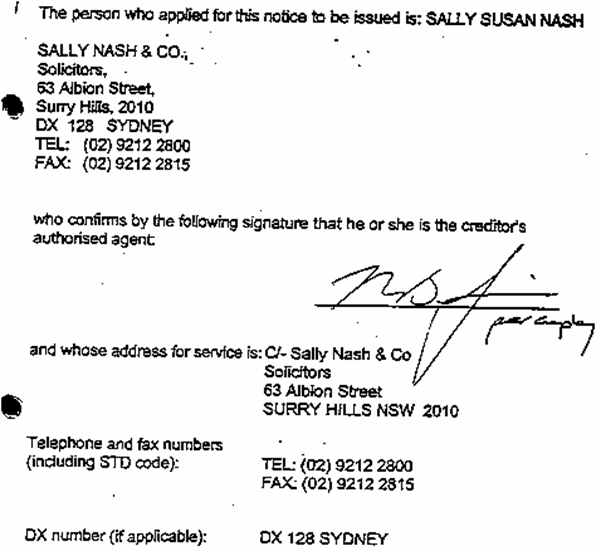 "
"
The signature is that of a solicitor, Natasha Kay Banfield, employed by Sally Susan Nash, who had been authorised to sign on behalf of Ms Nash, and who added, after signing, the words “per employ”. Although there is no doubt about this signature in point of fact, a person unacquainted with Ms Banfield’s handwriting would not be able to decipher it unless, perhaps, if that person knew the names of Ms Nash’s employees, by inference from the reasonably clear “N”, “B”, and “f”, the suggestion of an “i”, and the order of those letters.
4 The sSpecial Case raises (apart from a question about ratification which dropped out of the debate at the hearing) the following questions in relation to the form of this bankruptcy notice:
“(a) whether a bankruptcy notice in the form that issued in this matter, in so far as it stated the ‘person who applied for this notice to be issued’ and contained the signature and words that followed the words in the form ‘who confirms by the following signature that he or she is the creditor’s authorised agent’, operated or was capable of operating in law as a valid bankruptcy notice?
(b) whether the bankruptcy notice, in the respect referred to in the preceding question, contained a ‘formal defect orn an irregularity’ within s 306(1) of the Bankruptcy Act 1966, or revealed or involved a ‘defect or irregularity’ of the kind referred to in s 306(2) in the appointment of the person who made the confirmation for which the prescribed form of bankruptcy notice provides?
(c) whether s 25C of the Acts Interpretation Act 1901 had any application to the said bankruptcy notice in relation to any of the matters referred to in the preceding questions?
(d) whether, if the matters referred to in question (1a) would have invalidated the bankruptcy notice because of requirements of regs 4.01 and 4.02 of the Bankruptcy Regulations, or either of them, those requirements are valid in so far as they would have that effect upon such a notice, having regard to the provisions of the Bankruptcy Act, and s 41 in particular?”
5 In Meekin v Commonwealth Bank of Australia [1999] FCA 682, Moore J decided an application to set aside a not dissimilar bankruptcy notice. The corresponding part of it read:
“The person who applied for this notice to be issued is:
JOHN HENRY BARTROP [a solicitor] who confirms by the following signature that he or she is the creditor/the creditor’s authorised agent:
[here appeared the signature of one Sancia de Jersey and the handwritten words ‘by his employed solicitor’]
Creditor’s solicitor”.
After referring to relevant authorities, Moore J concluded (at para 27):
“[I]t is plain that de Jersey was signing on behalf of Bartrop. It is equally clear that the application was being made by Bartrop as [the creditor’s] solicitor and agent. The signature of de Jersey was, in my opinion, a sufficient signature of the agent for the purpose of both securing the issue of the notice and identifying the applicant who had sought its issue and the capacity in which it was sought.”
We would respectfully agree.
6 However, unfortunately, this decision was not cited to Wilcox J when a like problem came before him in McWilliam v Jackson [2000] FCA 175. Nor were the authorities to which Moore J had referred concerning the validity of a signature made by A on behalf of B: McRae v Coulton (1986) 7 NSWLR 644 at 651, 663 per Hope JA; Muirhead v Commonwealth Bank of Australia (1996) 139 ALR 561 at 565, per McPherson JA, with whom the other members of the Court relevantly agreed; London County Council v Agricultural Food Products Ltd [1955] 2 QB 218. Nor were there cited the decisions of Cohen J in Metropolitan Waste Disposal Authority v Willoughby Waste Disposals Pty Ltd (1987) 9 NSWLR 7 and of this Court in Sharp v Deputy Federal Commissioner of Taxation (1988) 88 ATC 4259 and Deputy Commissioner of Taxation (Vic) v Boxshall (1988) 83 ALR 175. The joint judgment of Lockhart, Burchett and Gummow JJ in Boxshall holds (at 178) that “[a]t common law, where a person authorises another to sign for him, the signature of the person so signing is the signature of the person authorising it”, and concludes (at 179):
“It is permissible for a petition to be signed in the name of a Deputy Commissioner by his duly authorised agent who signs the Deputy Commissioner’s name in the manner which occurred in the present case. Alternatively, a petition may be signed by a duly authorised agent of the Deputy Commissioner in the Deputy Commissioner’s name but in terms which make it clear that the signature is by a person acting as agent. The latter is the form of signature which commended itself to Denning LJ in London County Council v Agricultural Food Products Ltd, supra.”
7 In McWilliam v Jackson, the bankruptcy notice was declared to be a nullity on two independent grounds. One of these was expressed (in paras 28-29) as follows:
“I do not think it can properly be said that certification other than by the authorized person constitutes a substantial compliance with the requirement of Form 1 for execution of the notice by the creditor or a person who, by his or her signature, ‘confirms … that he or she is the creditor’s authorized agent’. Nor do I think the omission of proper certification is a ‘formal defect’ or ‘irregularity’ within the meaning of s306 of the Act. The receipt by a debtor of a bankruptcy notice is a serious matter; non-compliance with the requirements of the notice constitutes an act of bankruptcy and exposes the person to the possibility of being made a bankrupt. Certification is required in order to give an assurance to the addressee of the notice that it comes with the authority of the creditor and its demand is the demand of the creditor himself or herself. For that reason, the notice is required to be signed personally by either the creditor or the person who is disclosed as the creditor’s agent. To use the words of the Crowl [Kleinwort Benson Australia Limited v Crowl (1988) 165 CLR 71] majority, this is a ‘requirement made essential by the Act’.
In this case, it may be surmised that the person who signed the notice did so with the knowledge and approval of Ms Nash [in that case, as in this, the solicitor who was applying for the issue of the bankruptcy notice]. But surmise is not sufficient, the addressee of the notice is entitled to be assured of the position. Execution of the notice by someone other than the authorized agent is not a substantial compliance with the requirements of the form.”
8 Some comments need to be made on this reasoning. (1) With respect, the first sentence can easily be read in a way that misstates the relevant requirement of the prescribed form: it does not in terms say “who confirms by his or her signature”, but “who confirms by the following signature”. The unidiomatic and somewhat awkward language can only really be explained on the basis of the contemplation, as a possibility, of a signature in accordance with the common law principles expounded in Boxshall – which, when this form was drafted, had been firmly established as applicable to bankruptcy petitions (see Boxshall at 179) for over one hundred years. (2) The description of what occurred as “the omission of proper certification” seems to put the matter very high; the certification was actually in accordance with the prescribed form. What was said to be wrong with it was the illegible signature at the end of it, which was not in fact the personal signature of Ms Nash. An analogous defect – an incorrect attestation clause, attestation of the execution of the document being required – was held to come within s 306 of the Act, as a formal defect or an irregularity, in Boxshall at 181, where a number of authorities justifying that view were cited. “[I]n the context of a defect of form”, as the joint judgment then stated (as to the reason for these qualifying words, see Re McCormac; Ex parte Taylor (1985) 10 FCR 162 at 165-167; 63 ALR 251 at 255-256, a passage cited by their Honours), a formal defect or an irregularity “is one that could not reasonably mislead the debtor”. (3) No authority is cited for the proposition that the purpose of this part of the prescribed form is “to give an assurance to [the debtor] that it comes with the authority of the creditor and its demand is the demand of the creditor himself or herself”. In the setting out of the prescribed form, this portion of it follows immediately after a section headed “For the Information of the Creditor”. It may rather be that it is directed to the Official Receiver, with whom, by reg 4.01(1)(a), “a duly completed draft bankruptcy notice” must be lodged “[i]n order to apply for the issue of a bankruptcy notice”. The bankruptcy notice, when issued, will come to the debtor with the authority of the Official Receiver. One of the things it will tell the debtor is that it issued on the application of the creditor or the creditor’s agent. Unless the person who signed was not authorised to do so – which was not shown in any of the relevant cases, or in this case – it is difficult to see how a signature certifying the appropriate statement, whether or not indecipherable, could be misleading. Having regard to the common practice in business and in the legal profession, sanctioned by the common law, of one person signing for another, a debtor who received such a notice, apparently regularly issued by the proper authority, the Official Receiver, could hardly be deprived by the form of its signature of the substance of the assurance contained in the document.
9 McWilliam v Jackson was followed by Gray J in National Australia Bank Limited v Westbrook [2000] FCA 246, again without the citation of any of the earlier authorities in which the signature of a document by one person on behalf of another has been considered. In National Australia Bank Limited v Westbrook, the statement in the bankruptcy notice of the “person who applied for this notice to be issued” was completed by the insertion of the name of a firm of solicitors, as follows: “Russell Kennedy, Solicitors”, and the words of confirmation on the form were followed by an indecipherable signature, being in fact the signature of a solicitor employed by the firm. Gray J commented (at paras 10-11):
“The facts of this case may be even worse for a petitioning creditor than were the facts of McWilliam. In that case, the name given as the name of the person who applied for the notice to be issued was the name of a natural person. In the present case, the name of the person who applied for the notice to be issued is given as the name of a firm. The use of the word ‘person’ in the prescribed form raises issues of construction.
Section 22(1)(a) of the Acts Interpretation Act 1901 (Cth) provides that, unless the contrary intention appears, expressions used to denote persons generally, such as the word ‘person’, include a body politic or corporate as well as a natural person. Section 23(b) of the Acts Interpretation Act 1901 (Cwth) provides that, unless the contrary intention appears, words in the singular number include the plural. There are powerful arguments for concluding that the prescribed form of a bankruptcy notice displays a contrary intention for the purposes of both these provisions. The use of the words ‘he or she is’ in the prescribed form suggests that the applicant for the issue of a bankruptcy notice must be one person and that person must be a natural person. If the purpose of the signature of a bankruptcy notice is that characterised by Wilcox J in McWilliam, there is every reason why the recipient of the notice should not be left wondering which of a number of partners of a firm is the applicant for the notice or which officer or employee of a corporation had the authority of the creditor. These issues were not fully argued fully and I express no concluded view of them.”
His Honour held (at para 13) the notice to be a nullity on the ground that “execution of the notice by someone other than the authorised agent is not a substantial compliance with the requirements of the form.”
10 With respect, it is not possible to accept the reasoning in the passage we have quoted. Neither the use of the singular number nor the use of the masculine and feminine genders can require the form to be read as excluding, on the one hand, several applicants, and on the other, an inanimate applicant, such as an ordinary corporation. Apart from obvious questions of convenience, the language of the form – “he or she is the creditor/the creditor’s authorised agent” – requires the rejection of his Honour’s tentative conclusion. For the summary expression “he or she” must be accommodated to the case of joint creditors and to the case of a corporate creditor, just as much as to the case of an authorised agent. The draftsman plainly did not intend corporations and joint creditors to be excluded; but neither was it intended that differences of number and gender should be ignored by the multiplication, in the issue of bankruptcy notices, of psittacine recapitulations of the very words of the form, whether appropriate or not. Once both of these points are recognized, the words “he or she is” must be seen to be subject to amendment as required, and cannot have a controlling operation on the construction of the form: cf. Downey v Pryor (1960) 103 CLR 353 at 361-362, per Kitto J.
11 In the final analysis, the fundamental question is simply whether the prescribed form requires the personal signature of the applicant for the issue of the bankruptcy notice. In our opinion, the language of the form should not be construed as having that confining effect. It is unnecessary to consider how a corporate applicant, whether as creditor or as authorised agent, could have applied for the issue of a bankruptcy notice had we held otherwise. It is also unnecessary to consider whether s 41(2) of the Act, which provides that “[t]he notice must be in accordance with the form prescribed by the regulations”, would authorise the prescription, not merely of a form of bankruptcy notice, but of a regulation restricting the mode of application for its issue, an application authorised in perfectly general terms by the statute itself: s 41(1).
12 It is desirable, however, to say something about s 306 of the Act, to which we would have had to refer if we had found the bankruptcy notice defective. Section 306 provides:
“(1) Proceedings under this Act are not invalidated by a formal defect or an irregularity, unless the court before which the objection on that ground is made is of opinion that substantial injustice has been caused by the defect or irregularity and that the injustice cannot be remedied by an order of that court.
(2) A defect or irregularity in the appointment of any person exercising, or purporting to exercise, a power or function under this Act or under a deed entered into under this Act does not invalidate an act done by him or her in good faith.”
Section 306 has always been regarded as applicable to a bankruptcy notice on the basis that its issue is a proceeding under the Act: Kleinwort Benson Australia Limited v Crowl (1988) 165 CLR 71 at 77. It was suggested, in Farrugia v Farrugia [2000] FCA 385 at para 58, that the issue of a bankruptcy notice by an Official Receiver, instead of by a Registrar of a Court as previously, may possibly bear on the applicability of s 306. However, Katz J did not so hold. In our view, “[p]roceedings under this Act” are not confined to proceedings in a court: cf Official Trustee in Bankruptcy in the matter of Street v Street [2000] FCA 216. It is to be borne in mind that the issue of a bankruptcy notice by a registrar was always a ministerial act. In any case, the expression “proceedings under this Act” is apt to embrace any proceeding authorised by the Act, whether or not in a court, the word “proceedings” being a word that is not necessarily limited to court proceedings: see the clear contrast between “legal proceeding” in s 228(2)(c) and “proceeding” in s 228(3)(b), and the similar contrast to be found within s 238. As an instance outside the Act, reference may be made to the fact that the passing of a special resolution by a company has been held to be “an obvious example of a proceeding under the Corporations Law”: Talbot v NRMA Holdings Limited (1996) 68 FCR 590 at 593. That s 306 was intended to have a wide scope, rather than a narrow focus on court proceedings, is made plain by sub-s (2) which would certainly extend to some actions of an Official Receiver.
13 In some cases, an obvious ground for rejecting the application of s 306 may be that the defect in the notice cannot be regarded as merely a formal defect or irregularity because there are involved “breaches of important provisions” of the Act (James v Federal Commissioner of Taxation (1955) 93 CLR 631 at 644), a proposition restated in Kleinwort Benson Australia Limited v Crowl (at 79-80), where it was said that the authorities (James at 644 was cited together with Pillai v Comptroller of Income Tax [1970] AC 1124 at 1135) “show that a bankruptcy notice is a nullity if it fails to meet a requirement made essential by the Act”. What requirements are “essential” for this purpose? The majority judgment in Kleinwort Benson Australia Limited v Crowl makes it clear (at 76 and 79-80) that the requirements their Honours had in mind as essential were those set out in the then terms of s 41 of the Act. They included that a named debtor be required within a specified time to pay the judgment debt or sum ordered to be paid, in question, in accordance with the judgment or order, or to secure the payment or compound the debt as provided in the section, and that a statement be included of the consequences of non-compliance (see the provisions of s 41(2) as set out at 76). Plainly, if a document sought to be relied upon as a bankruptcy notice does not fulfil the statutory definition of such a notice at all, because of a failure to comply with defining, or “important” or “essential”, provisions of the Act, its defectiveness cannot be described as a mere matter of form, or as a mere irregularity.
14 But in cases where a notice does not fail so completely, the test has long been accepted, and was restated by the majority of the High Court in Kleinwort Benson Australia Limited v Crowl at 79, as being whether the bankruptcy notice “could reasonably mislead a debtor as to what is necessary to comply with the notice”.
15 In the Act as it presently stands, the requirements stated in s 41 have been replaced by s 41(2):
“The notice must be in accordance with the form prescribed by the regulations.”
Whereas s 41(2) was previously expressed in terms of the substance of what the bankruptcy notice must contain, it is now expressed entirely in terms of the prescribed form. In so far as the form prescribed under the new provision embodies matters of substance required to be contained in a bankruptcy notice, the reasoning in James and Kleinwort Benson Australia Limited v Crowl is not at all displaced. It would be surprising if it were, since the amendment of s 41 does not (nor did the Explanatory Memorandum circulated by the Attorney-General when the amendment came before Parliament as the Bankruptcy Legislation Amendment Bill 1996, nor did the second reading speech of the Attorney-General reported in the House of Representatives Hansard of 26 June 1996 at 2825 et seq) demonstrate any intention to introduce an upheaval of principle; the obvious explanation of the amendment relates to the machinery for the implementation of the substitution of one ministerial authority issuing bankruptcy notices for another (that is, of the Official Receiver for the Registrar of the Court). But it would work a far reaching reversal of the operation of the Act if the amendment of s 41(2) were to be regarded as doing away with the emphasis of bankruptcy administration on matters of substance, in favour of the elevation of form as the criterion of validity. That would be the consequence if every part of the prescribed form were treated as something made essential by the Act, and it would use the expression coined by the majority in Kleinwort Benson Australia Limited v Crowl in a sense that would turn their actual decision (which excused, as Deane J emphasized, a quite serious defect) on its head. Such an approach would be completely at odds with the formulation in James confining the consequence of invalidation to important breaches of the relevant provisions of the Act and matters that could mislead, that is to say, to defects of substance.
16 In our opinion, as a matter of construction, the very fact that the new s 41(2) is expressed in terms of form aligns it directly and naturally with s 306. The new s 41(2) does not amend s 306; it is inserted into an Act that already contains that provision, and it is intended to operate accordingly in the statutory setting into which it is received. The form must be complied with, but in the context of an Act containing s 306, a “formal defect” by the express terms of the statute does not attract the invalidating consequences once associated with a mandatory provision: Project Blue Sky Inc v Australian Broadcasting Authority (1998) 194 CLR 355. It is in fact recognized in regulation 4.02 that the prescription of a form of bankruptcy notice does not involve a requirement of strict compliance, substantial compliance being sufficient. That the draftsman attributed this consequence to the operation of s 25C of the Acts Interpretation Act 1901, rather than to s 306 of the Act, and that express attention was drawn to the matter only because of a drafting problem related to the issue of format, in no way detracts from the conclusion that the regulation was not intended to prescribe a form in precise terms, but one to be complied with in substance. As Katz J pointed out in Farrugia v Farrugia (at para 66), the reference to s 25C in the regulation “discloses an intention in the delegated legislator not to attempt to impose by sub-reg 4.02(2) a requirement which has to be strictly complied with”. And, logically, if it was thought s 25C would apply to subreg (2), it must have been thought it would apply to subreg (1), so that the relevant intention must have been the same. The contrary suggestion made in Bendigo Bank Ltd v Williams (infra, at para 16), with respect, simply overlooks the manner in which the regulation has been drafted. In Farrugia v Farrugia (at paras 61-64), Katz J refers to Ex parte Stanford. In re Barber (1886) 17 QBD 259, where a strong Court of Appeal held that a provision indistinguishable in terms from s 41(2) exacted only substantial compliance; however, in the context of the Act, the appropriate brake on the apparently mandatory word “must” in s 41(2) is that provided by s 306. It is more in accord with modern principles of statutory interpretation to give weight to the statutory context, and the consistency of the section with the statutory scheme as a whole, than to place significant reliance on the kind of verbal distinction which grounds this Court of Appeal decision: cf. CIC Insurance Limited v Bankstown Football Club Limited (1997) 187 CLR 384 at 408.
17 The Court was referred to Bendigo Bank Ltd v Williams [2000] FCA 482, where the majority (Moore and Lehane JJ, Kiefel J dissenting) declined to follow the unanimous decision of another Full Court in Kirk v Ashdown [1999] FCA 1664. It was suggested that the later decision would stand in the way of any application of s 306 to the present case. Had an application of s 306 been essential to our decision, and had we accepted the proposition that Bendigo Bank Ltd v Williams directly decided the very point, we should have requested the Chief Justice to reconstitute the Court as a bench of five, having regard to the conflict between the two Full Court decisions. However, as we have already made clear, we take the view that there is no defect in the bankruptcy notice with which we are concerned. Furthermore, we do not think that, if we needed to resort to s 306, Bendigo Bank Ltd v Williams would be a decision directly in point. What the Court was concerned with in that casewas a bankruptcy notice which failed to conform with the prescribed form because it did not have attached to it a document stating the provision that was the ground of a claim for interest included in the bankruptcy notice. This is one of the things for which the prescribed form provides. Without attempting to re-enter the controversy dividing two Full Courts, we think it is obvious a failure to comply with a requirement designed to ensure there is disclosure of the basis on which a claim for interest is made could be regarded as an “important” breach, or as involving the omission of something made essential to a valid notice. The majority stated the proposition (at para 23) that “subject perhaps to exceptional cases, the entire failure to address or deal with, in a bankruptcy notice, a matter which the legislative scheme requires be addressed or dealt with is not a formal defect or irregularity cured by s 306.” Although we have preferred to approach the questions of principle which are involved in a somewhat different way, and in other cases the difference may be very significant, we do not think the proposition which commended itself to their Honours can govern the present case. Any application of that proposition will always involve difficult definitional problems since what is “a matter” within the proposition, and what is merely an elaboration of or addition to a matter, the omission of which does not constitute an entire failure to address it, is a question on which minds may differ, and on which it appears minds did differ, as well as on other things, in Bendigo Bank Ltd v Williams. However, in the present case, it could not be suggested there was an entire failure to address the certification required by the prescribed form; it was only the manner in which this certification was signed that was in dispute. If we had held the mode of signature to be defective, we should have gone on to hold that s 306 saved the bankruptcy notice from invalidation. We may add that, in Australia and New Zealand Banking Group v Hubner [1999] FCA 1346 at para 39, Spender J made it clear he thought the weight of authority overwhelmingly favoured such a conclusion.
The power to stay proceedings under a sequestration order made by a Registrar pending its review by the Court
18 There is a general provision in s 52(3) of the Act empowering the Court to “stay all proceedings under a sequestration order for a period not exceeding 21 days”. Not only is this power limited as to the length of the stay which may be granted; there is also, in s 37(2) of the Act an express denial to the Court of any power “to rescind or discharge, or to suspend the operation of …. a sequestration order”. The two provisions appear to make a distinction between a suspension of the operation of an order and a stay of all proceedings under it.
19 Both s 52(3) and s 37 are directed to powers exercisable in relation to orders made by the Court. The question which must be addressed is whether they have any relevance to a case where a sequestration order has been made in an exercise of delegated power which the Court has been called upon to review. This question is of considerable general importance, since the process of review may take some time, and a stay of proceedings under the Registrar’s order until the review is completed may well be convenient. A denial of such a stay could leave a debtor seriously affected by an order which has not yet been considered by a judge appointed in accordance with the Cconstitution to exercise the judicial power of the Commonwealth. In the present case, a stay was in fact ordered until the hearing of the Special Case, and this Court has continued it until further order. We shall now proceed to state our reasons for holding that there was power to stay the order made by the Registrar.
20 The authorities establish that a federal court may constitutionally be empowered to delegate the exercise of its judicial powers to an officer of that Court, subject to quite strict conditions. What is essential is that the control and supervision of the Court over the exercise of the delegated powers must be so real and effective that the decision, being within the Court’s jurisdiction, though made by an officer who is not a judge, can still be seen to be a decision of the Court: Harris v Caladine (1991) 172 CLR 84; Cheesman v Waters (1997) 77 FCR 221; D’Antuono v Minister of Health (1997) 80 FCR 226 at 229-231; Taylor v Deputy Commissioner of Taxation [1999] FCA 195 at paras 13-27. The last of these decisions specifically upheld the validity of a delegation indistinguishable from that with which we are concerned.
21 But if the effectiveness of the review of a Registrar’s decision by a Judge is so restricted that important aspects of the decision may be required to be carried out, over a significant period, before its correctness is judicially determined, there may well be a question whether the Constitutional requirements are satisfied.
22 The power to make a sequestration order exercised by a Registrar of this Court in modern times has its origin in s 31A(1)(n) of the Bankruptcy Act. Section 31A was repealed by the Bankruptcy Legislation Amendment Act 1996, s 3 and Schedule 1. Since then, and in the present case, an identical power has been exercised pursuant to s 35A of the Federal Court of Australia Act 1976, Order 77 r 7 of the Rules, and directions given by judges of the Court pursuant thereto. Despite the length of time during which Registrars have made sequestration orders, there is little authority bearing on the present point. In Re Young; Ex parte Hunter MMI Finance Limited (unreported, 23 March 1993), Burchett J, who was reviewing a sequestration order made by a Registrar under s 31A, had his attention directed to s 37 as possibly providing a bar to the rescission by the Court of the sequestration order. His Honour nevertheless set aside the order, saying:
“However, it seems clear to me that s 37 has nothing to say to s 31A, which is not a general provision about the powers of the Court in bankruptcy, but a specific provision dealing with the delegation of powers to the Registrar, and with the consequences of such a delegation, framed, of course, in terms designed to overcome the constitutional problem which was highlighted in Reg. v Davison (1954) 90 CLR 353.”
In Australian Guarantee Corporation Limited v Collard (unreported, 30 September 1997), Tamberlin J had to consider whether to grant a stay of proceedings under a sequestration order which was subject to review, having been made, not by a Registrar under either of the provisions we have mentioned, but by a Judicial Registrar whose decision was subject to review under the closely corresponding provisions of s 18AC(1) of the Federal Court of Australia Act and O 79 r 4 of the Federal Court Rules. His Honour was referred to the limitation of a stay to twenty-one days contained in s 52(3) of the Bankruptcy Act. He said:
“The case advanced for the applicant on the notice of motion is that the Court should be taken to have inherent jurisdiction, by which I understand implied necessary jurisdiction, which attaches to the Court to enable it to make all orders and do all things necessary to performing its function as a superior court. Alternatively, it was suggested in the course of argument that the provisions of s 23 of the Federal Court Act would suffice to give it power to make an order staying proceedings in a case where there is a bona fide appeal [scilicet – review proceeding] instituted. … In the present case the application for a stay is clearly an interlocutory order and I think that, there having been demonstrated to be a bona fide appeal [sic] on what appear to me to be reasonably arguable grounds, it is appropriate for such a stay to be granted.”
23 In our opinion, ss 37 and 52(3) of the Bankruptcy Act are provisions having general application to the exercise of jurisdiction in bankruptcy by the Court; but the exercise of that jurisdiction through a delegation satisfying the strict requirements of Harris v Caladine and the other authorities to which we have referred is a special case, and it is governed by its own rules. Indeed, it must be in order to be constitutionally valid. S 35A(6) of the Federal Court of Australia Act provides:
“The Court may, on application under subs (5) [the subsection enabling a party to apply to the Court to review the Registrar’s exercise of power] or of its own motion, review an exercise of power by a Registrar pursuant to this section and may make such order or orders as it thinks fit with respect to the matter with respect to which the power was exercised.”
The last portion of this subsection is in unqualified terms, and we construe it as authorising the Court, if it thinks fit, to grant a stay order, in a bankruptcy case as in other cases, pending the completion of its review, as an appropriate order “with respect to the matter with respect to which the power was exercised”. When the power is exercised in a bankruptcy case, it is not limited to an order for a period of twenty-one days. We do not think s 35A(6) should be construed as failing in any respect to empower the Court to make such an order, but if the section requires any supplementation, we agree with what we understand to have been the view of Tamberlin J in Australian Guarantee Corporation Limited v Collard that s 23 of the Federal Court of Australia Act is adequate for the purpose: cf Minister for Immigration, Local Government and Ethnic Affairs v Msilanga (1992) 34 FCR 169.
Orders
24 Question (a) stated in the Special Case should be answered in the affirmative, and the further question whether there is power to suspend the operation of the Registrar’s order or stay it pending completion of the review proceedings should also be answered in the affirmative. Those answers make it unnecessary to answer the other questions asked. Costs should be costs in the principal proceeding.cause.
|
I certify that the preceding twenty-four (24) numbered paragraphs are a true copy of the Reasons for Judgment herein of the Court. |
Associate:
Dated: 5 May 2000
|
Counsel for the Applicant: |
Mr M R Aldridge SC with Mr J T Johnson |
|
Solicitor for the Applicant: |
S Nash & Co |
|
Counsel for the Respondent: |
Mr N L McCaffery |
|
Solicitor for the Respondent: |
Crichton-Brownes |
|
Solicitor for the Inspector-General as Amicus Curiae: |
Mr M Murray of the Australian Government Solicitor |
|
Date of Hearing: |
28 April 2000 |
|
Date of Judgment: |
5 May 2000 |


