

FEDERAL COURT OF AUSTRALIA
W & D Engineering Pty Ltd v Chief Executive Officer of Customs
[2000] FCA 440
CUSTOMS AND EXCISE – bounty – Bounty (Machine Tools and Robots) Act 1985 – “robotic machine” capable of handling objects by simultaneous movement in two or more axes
STATUTES – ordinary meaning – whether evidence admissible
WORDS & PHRASES – “robotic machine”
Bounty (Machine Tools and Robots) Act 1985 (Cth) s 4
In re Bidie v General Accident Fire & Life Assurance Corporation Ltd [1949] Ch 121 cited
Chief Executive Officer of Customs v Tasmanian Electro Metallurgical Co Pty Ltd (1997) 76 FCR 476 referred to
Collector of Customs v Pozzolanic Enterprises Pty Ltd (1993) 43 FCR 280 applied
Commissioner of Taxation of the Commonwealth of Australia v Scully [2000] HCA 6 cited
Great Western Railway Company v Carpalla United China Clay Company Ltd [1909] 1 Ch 218 cited
Grenfell v The Commissioners of Inland Revenue (1876) 1 Ex D 242 applied
Herbert Adams Pty Ltd v The Federal Commissioner of Taxation (1932) 47 CLR 222 applied
Marquis Camden v Commissioners of Inland Revenue [1914] 1 KB 641 cited
Nova, an Alberta Corporation v Minister of National Revenue (1988) 87 NR 101 referred to
The Owners of the Ship ‘Shin Kobe Maru’ v Empire Shipping Co Inc (1994) 181 CLR 404 applied
Re Ontario Mushroom Co Ltd v Learie (1977) 76 DLR (3rd) 431 cited
W & D ENGINEERING PTY LTD v CHIEF EXECUTIVE OFFICER OF CUSTOMS
V224 of 1999
JUDGES: HEEREY, SUNDBERG & FINKELSTEIN JJ
DATE: 7 APRIL 2000
PLACE: MELBOURNE
|
IN THE FEDERAL COURT OF AUSTRALIA |
|
|
V224 of 1999 |
On appeal from a single judge of the Federal Court of Australia
|
BETWEEN: |
W & D ENGINEERING PTY LTD Appellant
|
|
AND: |
CHIEF EXECUTIVE OFFICER OF CUSTOMS Respondent
|
|
DATE OF ORDER: |
|
|
WHERE MADE: |
THE COURT ORDERS THAT:
1. The appeal be dismissed.
2. The appellant to pay the respondent’s taxed costs of the appeal.
Note: Settlement and entry of orders is dealt with in Order 36 of the Federal Court Rules.
|
IN THE FEDERAL COURT OF AUSTRALIA |
|
|
V224 of 1999 |
On appeal from a single judge of the Federal Court of Australia
|
BETWEEN: |
Appellant
|
|
AND: |
CHIEF EXECUTIVE OFFICER OF CUSTOMS Respondent
|
|
JUDGES: |
|
|
DATE: |
|
|
PLACE: |
REASONS FOR JUDGMENT
THE COURT:
1 The first attempt to build an automat was made in ancient Greece, 2300 years ago, by Archytas of Tarent. The first android, an automat with a human appearance, was built by Leonardo da Vinci. Automatic apparatus that perform functions ordinarily ascribed to humans are now commonly referred to as robots. This case is concerned with the meaning of “robotic machine” in the Bounty (Machine Tools and Robots) Act 1985 (Cth), a statute which, according to its long title, was passed “to provide for the payment of bounty on the production of certain machine tools [and] certain robots and related equipment.”
2 Before turning to the relevant provisions of the statute, it is helpful first to say something about the task of a court in attempting to understand a statute. The object of statutory construction is to determine what Parliament intended so that the legal consequences can be put into effect. This object assumes that there is an intention behind every enactment, an assumption that is probably false: see F Bennion Statutory Interpretation 3rd ed (1997) at par 168. It also proceeds on the basis that what is to be ascertained is the collective intention of the members of Parliament rather than that of the sponsor (usually the ruling political party), or of the draftsman (generally parliamentary counsel), or of persons not connected with the Parliament, of the bill that gives rise to the enactment.
3 Speaking generally, the intention of Parliament is to be found solely in the words of the enactment. But it is not the meaning of the words in isolation that must be gathered. It is the meaning that is to be given to the words used having regard to the context in which the words appear and the purpose of the enactment as a whole. In In re Bidie v General Accident Fire & Life Assurance Corporation Ltd [1949] Ch 121 at 129-130 Lord Greene MR explained that:
“The first thing to be done … in construing particular words in a section of an Act of Parliament is not to take those words in vacuo, so to speak, and attribute to them what is sometimes called their natural or ordinary meaning. Few words in the English language have a natural or ordinary meaning in the sense that their meaning is entirely independent of their context. The method of construing statutes that I myself prefer is not to take out particular words and attribute to them a sort of prima facie meaning which may have to be displaced or modified, it is to read the statute as a whole and ask myself the question: ‘In this statute, in this context, relating to this subject-matter, what is the true meaning of that word?’ … The real question that we have to decide is, what does the word mean in the context in which we here find it, both in the immediate context of the sub-section in which the word occurs and in the general context of the Act, having regard to the declared intention of the Act and the obvious evil that it is designed to remedy.”
4 The word “robot” was first used by the Czech playwright Karel Capek in 1920. It appeared in his play Rossum’s Universal Robots, a science fiction parable in the guise of a farce. Rossum’s Universal Robots was a manufacturer of mechanical labourers that looked like real people. They worked endlessly, never complained and never spoke in anything but a monotone. Eventually the robots rose up against the humans and destroyed all but one. Written in the aftermath of World World I, Capek sought to show that the most advanced technology is no better than the human nature it serves.
5 As a young chemist, Isaac Asimov coined the word “robotics” in his first robot story “Robbie”, originally published in 1940 as “Strange Bedfellow” in Super Science Stories. The Oxford English Dictionary wrongly attributes the first use of the word to Asimov in a short story published in Astounding Science Fiction in 1941.
6 The industrial robot or “robotic machine” with which this appeal is concerned does not behave like Mr Rossum’s robots. Nor does it bear any similarity to “the faithful Robbie” of the I, Robot collection. Nonetheless, it is extremely useful. By the 1980’s robots were in widespread use in industry. The cost of retooling machinery restricted their use to factories that turned out thousands of products. However, the development of reprogrammable machinery made it economically feasible to introduce automatic production processes into manufacturing concerns that involved short product runs.
7 What is the nature of a robot? Various definitions have been given. The British Robot Association in the December 1982 edition of Robotfacts defined robot as:
“An industrial robot is a reprogrammable device designed to both manipulate and transport parts, tools or specialised manufacturing implements through variable programmed motions for the performance of specific manufacturing tasks.”
According to the Robot Institute of America a robot is:
“a reprogrammable, multi-functional manipulator designed to move material, parts, tools or specialised devices through variable programmed motions for the performance of a variety of tasks.”
The Japan Industrial Robot Association defined industrial robots as:
“[T]hose devices providing flexible moving functions similar to those of the moving parts of organisms and/or providing intellectual functions so that they can operate in compliance with human request. Here the intellectual functions mean the ability to govern any of the functions like judgment, recognition, adaptation and learning by means of sensing, memory and other capabilities.”
The following definition of an industrial robot was proposed by the International Organization for Standardization in November 1980:
“The industrial robot is an automatic position-controlled reprogrammable, multi-functional manipulator having several degrees of freedom capable of handling materials, parts, tools, or specialized devices through variable programmed motions for the performance of a variety of tasks …It often has the appearance of one or several arms ending in a wrist. Its control unit uses a memorizing device and sometimes it can use sensing and adaptation appliances that take account of environment and circumstances. These multi-purpose machines are generally designed to carry out repetitive functions and
can be adapted to other functions without permanent alteration of the equipment.
8 In a report on robots presented to the Prime Minister in 1982, the Australian Science and Technology Council (ASTEC) recommended that the Industries Assistance Commission (IAC) be asked for examine the appropriate level of support for the Australian robot manufacturing industry. For the purposes of its report, the ASTEC took as its meaning of robot:
“[A] machine for handling objects (including materials, parts and tools) which:
· is versatile (able to carry out several tasks);
· is programmable; and
· operates independently of direct human control.”
The ASTEC recommendation was adopted and IAC was requested to enquire into and report whether assistance should be accorded to the production in Australia of robots and if so what should be the nature of that assistance. For the purposes of its report the IAC adopted the definition of robot formulated by ASTEC.
9 The 1985 Act was enacted to give effect to the recommendation of IAC that assistance by way of bounty should be accorded to production in Australia of robots to encourage greater use of robots and expand the local market to reduce the price of robots.
10 The 1985 Act includes within the categories of equipment upon which bounty is payable, a machine referred to as a “robotic machine”. The Act contains a definition of “robotic machine” that is different from, but adopts many of the features of the industry definitions. Omitting reference to certain excluded machines, the definition of “robotic machine”, which is found in s 4 of the 1985 Act, is:
“a completely assembled power fed machine that:
(a) is controlled by an integrated computer controller;
(b) consists of:
(i) a structure with mechanical linkages and joints capable
of handling objects by simultaneous movements in 2 or
more axes; or
(ii) a prescribed structure;
(c) is designed to operate independently of human control when
the computer controller that controls it is programmed;
(d) utilises:
(i) a system known as pick and place;
(ii) a system known as playback (point to point);
(iii) a system known as playback (continuous path); or
(iv) a prescribed system; and
(e) if it were imported into Australia, would be goods to which:
(i) a heading in Chapter 84 or 85 in Schedule 3 to the
Tariff Act ; or
(ii) a heading in Schedule 3 to the Tariff Act determined by
the Minister by instrument in writing;
would apply;”
11 The appellant manufactures machinery which it calls palletisers and depalletisers. It says that this machinery qualifies for a bounty under the 1985 Act. The machinery is used as part of a production process. It moves objects, such as bottles and other containers, on a conventional conveyer system. The objects are taken from pallets and moved on one axis to the next stage of the process. Then the objects are moved along another axis again, on a conveyer, placed into an appropriate formation and loaded onto pallets.
12 It is accepted that this machinery satisfies the requirements of pars (a), (c) and (e) of the definition of “robotic machine”. There is a dispute whether the machinery satisfies the remaining two requirements. As regards par (b), the resolution of the dispute depends upon the meaning to be given to the words in subpar (i), it being agreed that the machinery does not consist of a prescribed structure. Whether the machinery utilises one or other of the systems mentioned in par (d) is largely a question of fact.
13 The respondent, the Comptroller-General of Customs (now known as the Chief Executive Officer of Customs) administered the 1985 Act. He rejected the applicant’s claim for a bounty. The appellant then applied to the Administrative Appeals Tribunal to review that decision. There were two issues that the Tribunal was required to resolve. The first was whether the appellant’s goods fell within par (b)(i) of the definition of “robotic machine”. The second was whether the appellant’s machinery utilised one of the systems mentioned in par (d).
14 As regards the first question, it was common ground that none of the words in par (b)(i) had a technical meaning. It was agreed that the words should be given their ordinary or usual meaning. In that event the usual rule is that evidence is not admissible to establish the meaning of the words. The leading case is Marquis Camden v Commissioners of Inland Revenue [1914] 1 KB 641 where (at 649-650) Swinfen Eady LJ said:
“It is the duty of the Court to construe a statute according to the ordinary meaning of the words used, necessarily referring to dictionaries or other literature for the sake of informing itself as to the meaning of any words, but any evidence on the question is wholly inadmissible … [W]e are not dealing with any private statutes nor with contracts. It is a public Act of Parliament, and the Court must take judicial cognizance of the language used without evidence.”
15 Conversely, where a word in a statute has a technical or, as it is sometimes known, a trade meaning, it is permissible to resort to evidence to establish that meaning: Herbert Adams Pty Ltd v The Federal Commissioner of Taxation (1932) 47 CLR 222 at 227.
16 Despite the rule in Camden, evidence is sometimes received on the meaning of a word if it is from a witness with knowledge of an activity to which the legislation applies. For example, in Chief Executive Officer of Customs v Tasmanian Electro Metallurgical Co Pty Ltd (1997) 76 FCR 476 Merkel J approved the use of evidence to establish the meaning of the words “minerals”, “beneficiation” and “recovery” in s 164 of the Customs Act 1901 (Cth) although they had no trade meaning. In Re Ontario Mushroom Co Ltd v Learie (1977) 76 DLR (3rd) 431, the High Court of Ontario relied upon evidence of common understanding as regards whether a mushroom was a vegetable for the purpose of certain regulations. As Reid J explained (76 DLR (3rd) at 435) the evidence was “from those persons who are not only knowledgeable on the subject of mushroom and vegetable growing, but are also the kind of persons to whom the Act appears to be directed. Therefore it is useful to hear what they have to say.”: see also Nova, an Alberta Corporation v Minister of National Revenue (1988) 87 NR 101, 109.
17 The second question was whether the appellant’s machinery utilised a system known as “pick and place” or “playback (point to point)” or “playback (continuous path)” so as to satisfy the requirements of par (d) of the definition. Generally, a court must presume that the ordinary and not a technical meaning is to be given to words in a statute: Grenfell v The Commissioners of Inland Revenue (1876) 1 Ex D 242 at 248. As Farwell LJ said in Great Western Railway Company v Carpalla United China Clay Company, Ltd [1909] 1 Ch 218 at 236 (affirmed [1910] AC 83, citing Lord Ellenborough in Robinson v French (1803) 4 East 130 at 135):
“A written instrument must be ‘construed according to its sense and meaning, as collected in the first place from the terms used in it, which terms are themselves to be understood in their plain, ordinary, and popular sense, unless they have generally in respect to the subject-matter, as by the known usage of trade, or the like, acquired a peculiar sense distinct from the popular sense of the same words; or unless the context evidently points out that they must in the particular instance, and in order to effectuate the immediate intention of the parties to that contract, be understood in some other special and peculiar sense.’”
Whether this presumption is to be applied in a particular case is a question of law: Collector of Customs v Pozzolanic Enterprises Pty Ltd (1993) 43 FCR 280 at 289. See, however, Driedger on the Construction of Statutes 3rd ed (1994) at 22 where it is said that whether a term has a technical meaning and what that meaning is are both questions of fact.
18 Sometimes it will be apparent that a word used in a statute has a meaning different from its ordinary meaning. So it is in this case. The expressions “pick and place”, “playback (point to point)” and “playback (continuous path)” are not expressions that have any ordinary meaning. Evidence is not needed to establish that these expressions have some special meaning.
19 At the hearing before the Tribunal, the respondent called an expert witness to give evidence about both the meaning of par (b)(i) of the definition as well as the meaning of the technical terms in par (d). The witness, Dr Kassler, was a consultant to the robotics industry and the national co-ordinator and secretary of the Australian Robot Association Inc. As regards par (b)(i) Dr Kassler explained that he had “been asked, based on [his] experience in robotics field, to give [his] opinion of the meaning of the phrase ‘capable of handling objects by simultaneous movements in 2 or more axes’ in the context of the [1985] Act.” In response to this request he said that the phrase was capable of two meanings. First, it might refer to a machine which could handle one object by moving it simultaneously through two or more axis. He called this a Type A machine. Second, it could refer to a machine which handles an object by moving it through one axis whilst simultaneously handling another object by moving it in a different axis. This he styled a Type B machine.
20 Dr Kassler said that according to his experience in the robotics field, which was not inconsiderable, he believed that the 1985 Act required a machine to be a Type A machine for it to be eligible for bounty and that a Type B machine was not eligible. Dr Kassler reached this conclusion substantially for two reasons. First, he relied upon the pre-enactment history of 1985 Act. That history led Dr Kassler to conclude that the term “robotic machine” was intended to refer to machinery belonging to the class of equipment commonly known as “robots”. He said that “an essential criterion for determining eligibility for bounty assistance as a robotic machine is that the candidate device be a robot”. Dr Kassler then referred to various definitions of robot, some of which I have mentioned earlier, and said that a Type A machine fell within those definitions whereas a Type B machine did not.
21 The second reason that led Dr Kassler to his conclusion was that when the 1985 Act was enacted, the vast majority (he thought more than 90 per cent) of all commercially available robots had the structure of a Type A machine. This evidence was uncontroversial. In its 1982 report, ASTEC stated that while various unusual forms of robots had been proposed, all existing robots in use in industry had the following features:
“The mechanical structure. This consists of a central pedestal and the mechanical linkages and joints which allow movements in various directions or axes. At the end of this ‘arm’ is a ‘wrist’ which may have a gripper or tool attached. The arrangement of arm plus wrist assembly allows a certain number of independent motions and these are the degrees of freedom which characterise the system. The design of the arm is of great importance as the mechanical arrangement of the arm determines which motions are possible and which points in space can be reached.”
Two pictorial examples of the mechanical structure of a robot were given. They are reproduced below. Each robot depicted was a Type A machine.
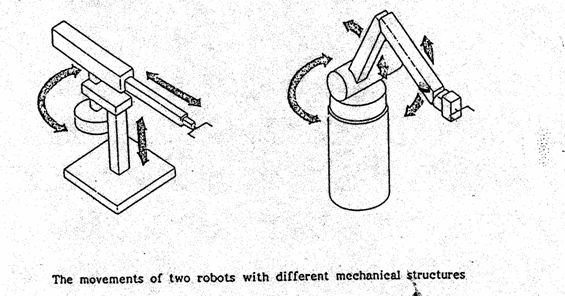
22 It is clear that Dr Kassler should not have been permitted to give evidence of his understanding of the meaning of par (b)(i). First, the subject was not one that called for evidence, unless it was limited to proving the pre-legislative history, although that hardly required formal evidence. Second, Dr Kassler’s approach disclosed legal error, although Dr Kassler could hardly be blamed for this. The basis of Dr Kassler’s evidence on the construction to par (b)(i) was his understanding of the meaning of the expression “robotic machine”. As the Full Bench of the High Court pointed out in The Owners of the ship ‘Shin Kobe Maru’ v Empire Shipping Co Inc (1994) 181 CLR 404 at 419, it is circular to construe the words of a definition by reference to the term defined. Perhaps Dr Kassler might be forgiven his error, because it was permissible, when considering the words of the definition, to take into account the fact that the word “robot” appeared in both the long and short title of the statute.
23 On the other hand, Dr Kassler was entitled to give evidence on what par (b)(i) meant to people conversant with robots. The ordinary meaning of words will not always be construed by reference to the meaning given to them by the man in the street not concerned with the particular industry to which the legislation is directed. Perhaps this is how Dr Kassler’s evidence should be understood.
24 Paragraph (d) of the definition of “robotic machine” is concerned with the control system of the machine. Dr Kassler gave evidence of the meaning of the technical terms that
were employed. After a review of certain literature that described those systems, Dr Kassler said:
“i that the phrase in the Act a system known as pick and place means a system of mechanical stops or limit switches that provide control only of the end positions of manipulator motion in such a way that to change any such position the machine must be physically adjusted.
i that the phrase in the Act a system known as playback means a system in which the end positions of manipulator motion are controllable by a program, so that it is possible to change such a position automatically according to an electronic signal. A playback (point to point) system allows this form of control only of the end poses (points and angles) of manipulator motion. A playback (continuous path) system allows this form of control over end poses as well as intermediate paths between them, and also may control the speed with which the path is traversed.”
25 The Tribunal held that the appellant’s machinery satisfied the requirements of par (b)(i) of the definition. In reaching that conclusion the Tribunal did not act upon Dr Kassler’s evidence. The Tribunal said:
“There is no dispute as to the meanings to be ascribed to the words in s 4(b), and neither party suggests any of the words should be ascribed a technical meaning. What the respondent seeks to do, however, is to apply a trade understanding of what is constituted by a ‘robot’ and incorporate that meaning into the term ‘robotic machine’. Where, as is the case here, the statute sets out the criteria which must be fulfilled before a machine can be determined to be a robotic machine then it is not legitimate, in the view of the Tribunal, to seek by ascribing a trade usage to narrow the field so as to exclude machinery which otherwise falls within the ordinary meaning arising from the use of the words set out in the nominated statutory criteria. There is no warrant for the Tribunal adopting an interpretation that would narrow the ordinary meaning which would otherwise be given to the words used in the section.”
26 On the question whether the machinery satisfied the requirements of par (d), the Tribunal referred to a description of the operation of the machines given by a witness and to video recordings of those operations which were shown to the Tribunal. On the basis of that evidence it concluded that the machinery operated as a playback robot of the playback (point to point) variety. The Tribunal left open the question whether it operated as a playback (continuous path) robot.
27 In view of these finding the Tribunal held that the appellant’s machinery qualified for a bounty. The respondent brought an appeal from this decision to the Federal Court pursuant to s 44 of the Administrative Appeals Tribunal Act 1975 (Cth). The appeal was heard by Ryan J. Each finding of the Tribunal was challenged. His Honour allowed the appeal, set aside the decision of the Tribunal and, rather than send the matter back for rehearing, declared that the appellant’s machinery were not “robotic machines” as defined in s 4 of the 1985 Act. His Honour granted a declaration, because no useful purpose would have been served by remitting the matter to the Tribunal when it was capable of being determined by his Honour on the uncontroverted evidence that had been before the Tribunal.
28 Ryan J found that the Tribunal had adopted an interpretation of par (b)(i) that extended it beyond what would be regarded in the relevant industry as a “robotic machine”. His Honour was critical of the Tribunal’s approach in that regard. He said:
“The Tribunal’s reasoning demonstrates that it reached its own conclusion about the range of the Bounty Act without allowing appropriate influence to the context in which it was enacted. It is not obvious, as the Tribunal seems to suggest, that, on the ordinary meaning of the words used, the requirement of simultaneous movement along two or more axes can have only one possible connotation. Rather, I consider that two interpretations of those words are available as a matter of ordinary English and the one which the statutory context suggests should be adopted is that which Dr Kassler testified accords with the usage employed in the robotics industry. That is, the stipulation ‘capable of handling objects by simultaneous movement along two or more axes’ requires that a machine be able to handle each object along more than one axis at the same time in order to quality for the bounty.
The force which the statutory context gives to the industry usage is sufficient, in my view, to confer on the words used in s 4(b)(i) a meaning which is clear and unambiguous.”
29 In view of his finding that the appellant’s machinery did not satisfy the requirements of par (b)(i), it was unnecessary for his Honour to consider whether the appellant’s machinery utilised one of the systems mentioned in par (d). It will not be necessary to return to this aspect of the case.
30 We can say immediately that we agree with the conclusion reached by the trial judge as regards the meaning of par (b)(i). We have, however, reached that conclusion for reasons which are a little different from those of the trial judge.
31 Kirby J recently observed in his dissenting judgment in Commissioner of Taxation of the Commonwealth of Australia v Scully [2000] HCA 6 at par 74 that: “Questions of statutory construction are generally thought uninteresting because, upon many of them, it is perfectly legitimate for different decision makers to reach opposite opinions.” This case is an example of what his Honour had in mind. The Tribunal was of opinion that according to its ordinary meaning par (b)(i) was referring to a machine that was capable of performing the functions of a Type B machine. The trial judge was of opinion that par (b)(i) was ambiguous, in the sense that two interpretations were open and he preferred an interpretation that accorded with the evidence of Dr Kassler.
32 For our part, without regard to extrinsic evidence, we are of opinion, if one is required to apply the rule of construction “that Parliament said what it meant and meant what it said” (Shin Kobe, above, at 420) that par (b)(i) refers only to a Type A machine. The paragraph requires a robotic machine to have a particular structure. It is a structure comprising mechanical linkages and joints. Those linkages and joints must be capable of handling objects. The handling of objects must be by movements in two or more axes. Those movements must be simultaneous. Such a description is satisfied by a machine that handles an object in two or more axes simultaneously. It is not satisfied by a machine that handles one object in one axis and simultaneously handles another object in another axis. The use of the plural “objects” does not lead to the conclusion that the type of machine with which the definition is concerned is one that will handle two or more objects simultaneously. That is not the natural meaning of the paragraph. “Objects” is not used as a true plural but rather in a generic sense, as in for example “a crane strong enough to lift motor vehicles”.
33 Further, the legislative history, the ASTEC and IAC reports show the mischief at which the 1985 Act was directed. The facts and surrounding circumstances disclosed by those reports demonstrate that only a particular type of robot, Dr Kassler’s Type A machine, was deserving of a bounty. If the 1985 Act was construed so that the bounty was payable on a Type B machine then Parliament wholly missed its mark.
34 Finally, to the extent that it is possible to treat what Dr Kassler said as evidence of how people in the robot industry would understand the definition, that evidence confirms the construction that we have placed on ‘robotic machine’.
35 We would dismiss the appeal with costs.
|
I certify that the preceding thirty-five (35) numbered paragraphs are a true copy of the Reasons for Judgment herein of the Court. |
Associate:
Dated: 7 April 2000
|
Counsel for the Appellant: |
Mr J Slonim |
|
|
|
|
Solicitor for the Appellant: |
HS Wise Gershov & Co |
|
|
|
|
Counsel for the Respondent: |
Mr J Lenczner |
|
|
|
|
Solicitor for the Respondent: |
Australian Government Solicitor |
|
|
|
|
Date of Hearing: |
24 November 1999 |
|
|
|
|
Date of Judgment: |
7 April 2000 |


