FEDERAL COURT OF AUSTRALIA
Hossen v Minister for Immigration & Multicultural Affairs
[2000] FCA 363
HOSSEN v MINISTER FOR IMMIGRATION & MULTICULTURAL AFFAIRS
W 135 of 1999
CARR J
27 MARCH 2000
PERTH
|
IN THE FEDERAL COURT OF AUSTRALIA |
|
|
W 135 OF 1999 |
|
BETWEEN: |
KAMAL HOSSEN Applicant
|
|
AND: |
MINISTER FOR IMMIGRATION AND MULTICULTURAL AFFAIRS Respondent
|
|
DATE OF ORDER: |
|
|
WHERE MADE: |
THE COURT ORDERS THAT:
1. The decision of the Refugee Review Tribunal, made on 15 November 1999, be set aside.
2. The matter be remitted to a differently constituted Tribunal for re-hearing, with or without new evidence, in accordance with law.
Note: Settlement and entry of orders is dealt with in Order 36 of the Federal Court Rules.
|
IN THE FEDERAL COURT OF AUSTRALIA |
|
|
W 135 OF 1999 |
|
BETWEEN: |
Applicant
|
|
AND: |
MINISTER FOR IMMIGRATION AND MULTICULTURAL AFFAIRS Respondent
|
|
JUDGE: |
|
|
DATE: |
|
|
PLACE: |
REASONS FOR JUDGMENT
Introduction
1 This is an application for an order of review of a decision of the Refugee Review Tribunal, made on 15 November 1999, by which the Tribunal affirmed the decision of a delegate of the respondent not to grant a protection visa to the applicant. The applicant, who is a citizen of Bangladesh, arrived in Australia on 20 May 1999. On 17 June 1999 he lodged an application for a protection visa with the Department of Immigration and Multicultural Affairs (“the Department”). On 11 August 1999 a delegate of the respondent refused to grant the applicant a protection visa and on 13 August 1999 the applicant sought review of that decision by the Refugee Review Tribunal.
Application for an Order of Review
2 The applicant was unrepresented. His application is in a form common to several other applications recently lodged by applicants from the Port Hedland Detention Centre. The grounds of the application were stated as follows:
“(a) The decision involved an error of law, being an error involving the incorrect interpretation of the applicable law or an incorrect application of the law to the facts as found by the Tribunal or both.
(b) The decision involved an error in that the Tribunal made findings of fact upon which its decision was based that were not rationally supported by probative evidence and it failed to rationally consider the probative evidence that was before it.”
Did the Tribunal Err in Law?
3 The applicant being unrepresented and not being able to speak English was, not surprisingly, unable to identify the legal errors which, in his application, he asserted had been made by the Tribunal.
4 Accordingly, as in similar recent cases, I have examined the Tribunal’s reasons to see whether they reflect any error of law of the type referred to in the grounds of application.
5 The Tribunal started its reasons by setting out the relevant article of the Refugees Convention and the law relating to the interpretation of that article. In my view, it correctly stated the law.
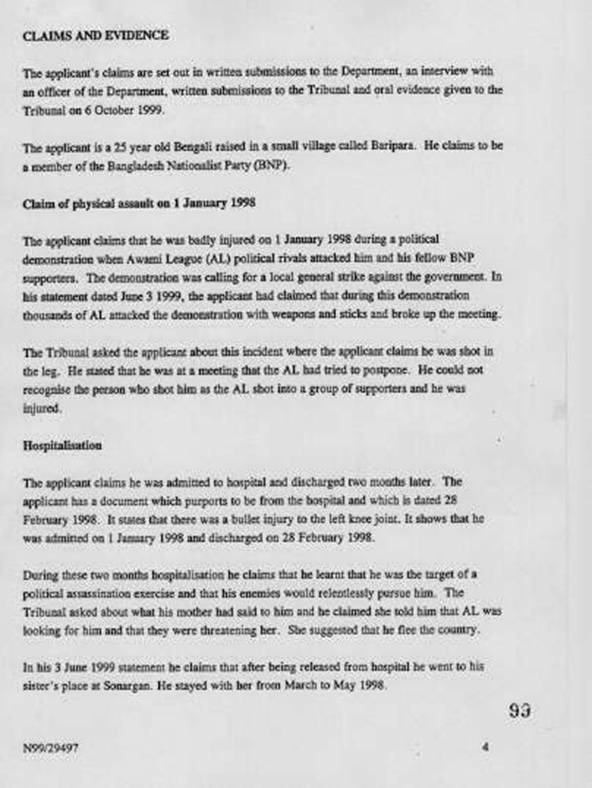
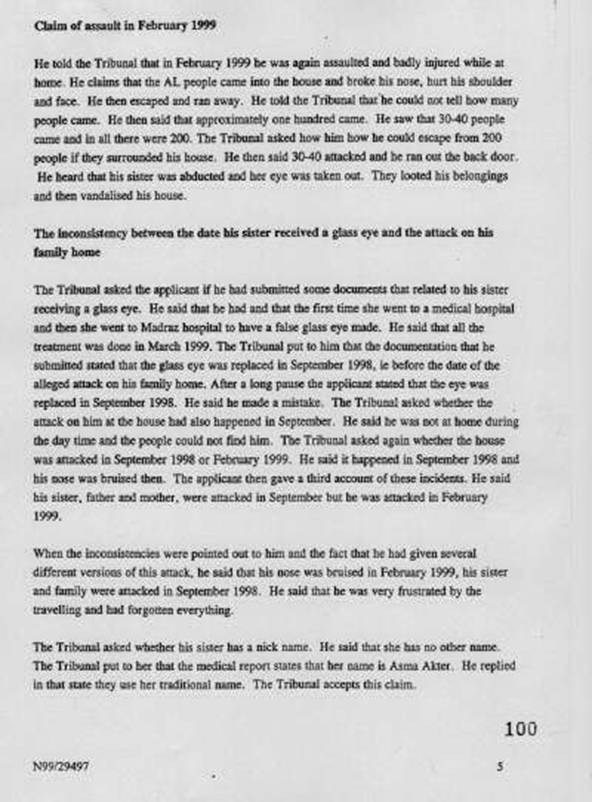
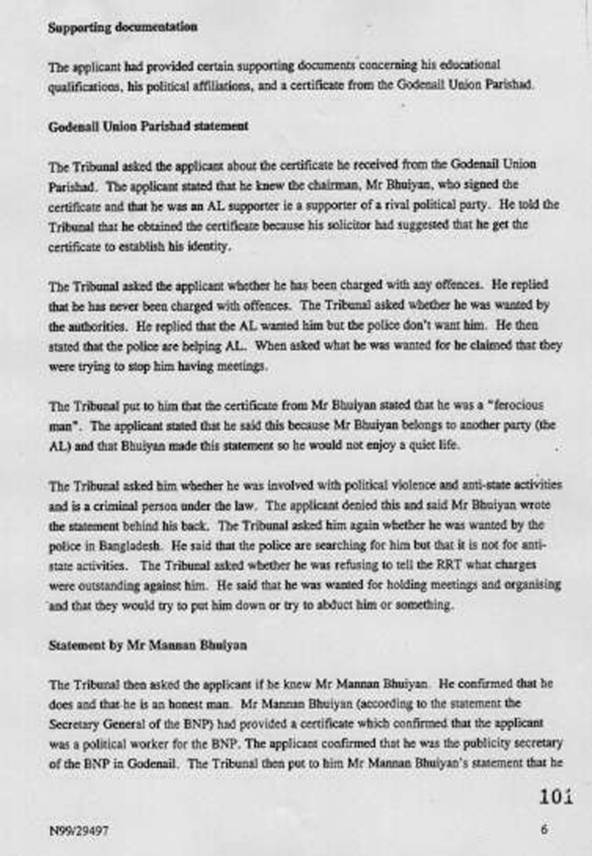
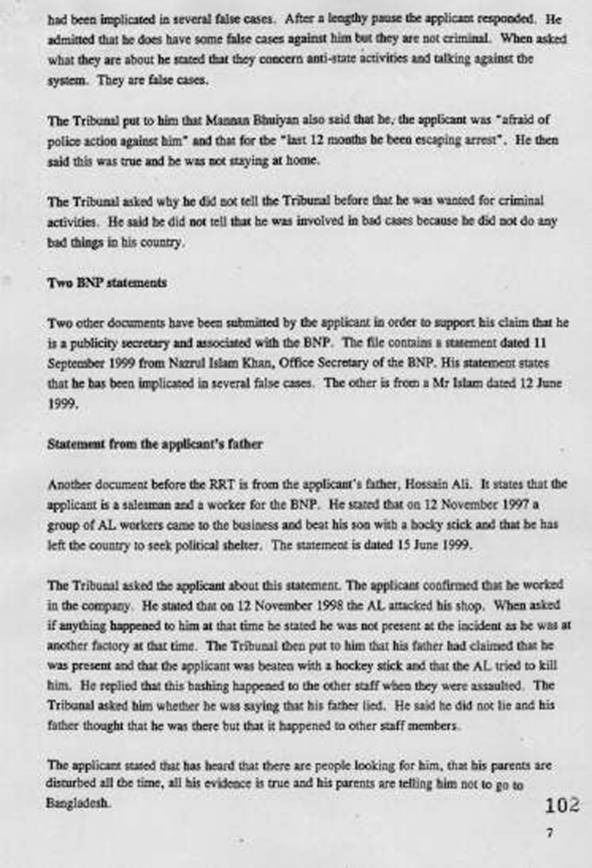
6 The applicant’s claims and evidence were set out between pages 4 and 8 of the Tribunal’s reasons. I annex hereto, and incorporate by reference into these reasons pages 4 to 7 of the Tribunal’s reasons dated 15 November 1999 (the first two lines of p 8 have been transposed to the foot of p 7).
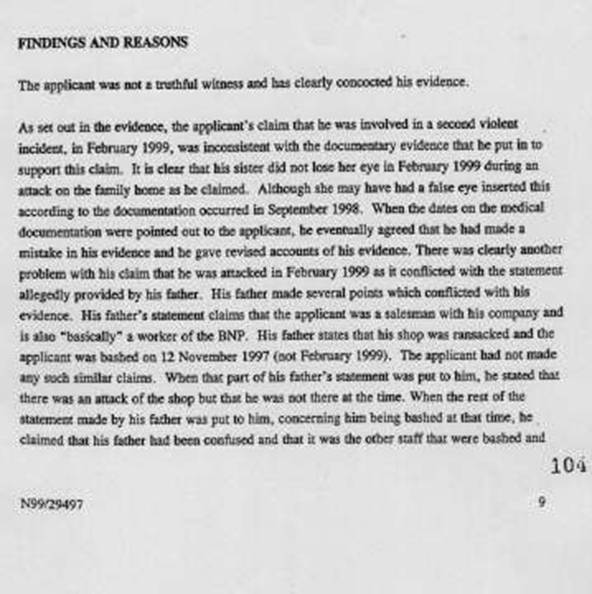
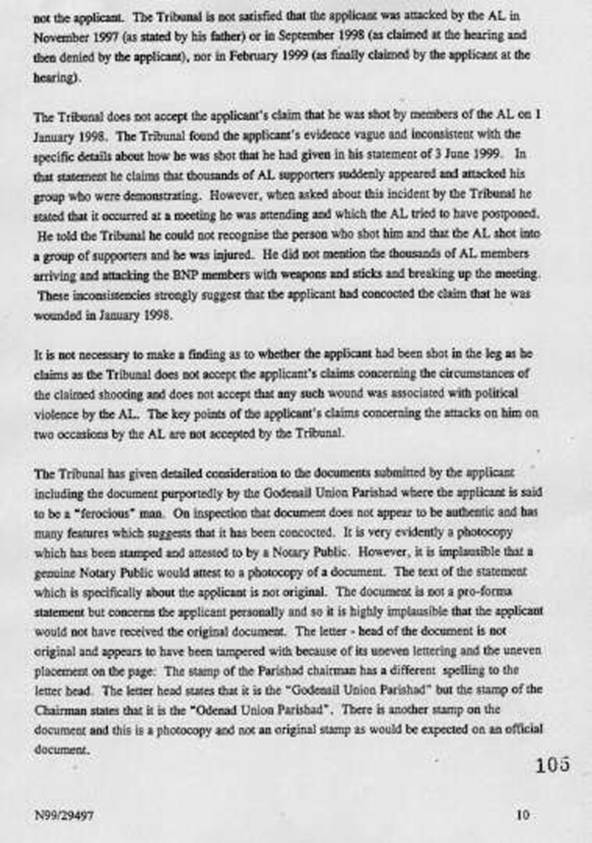
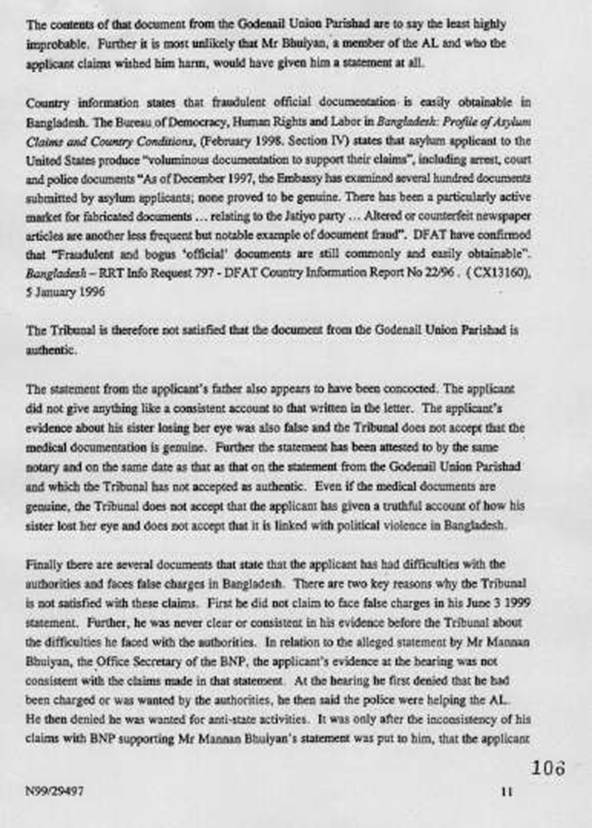
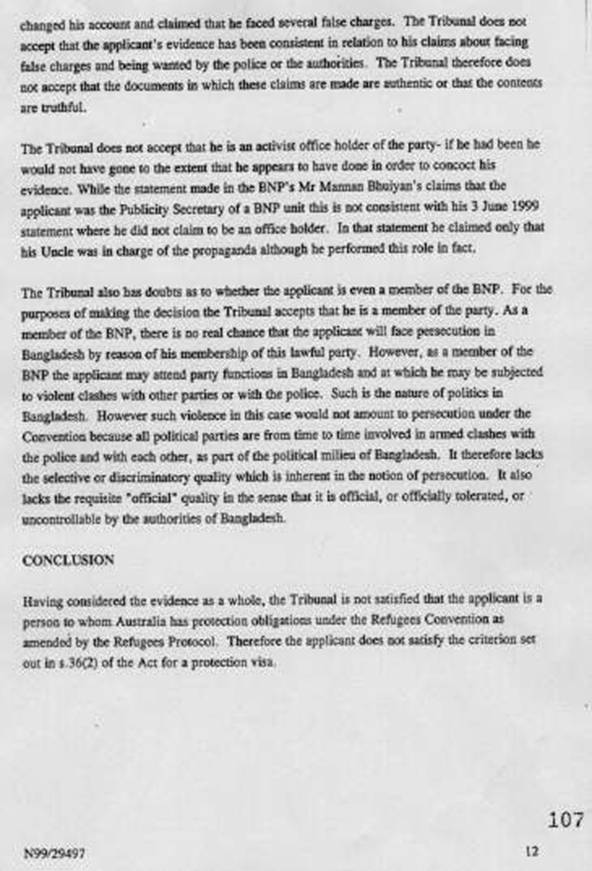
7 The Tribunal then considered some country information about violence in political life in Bangladesh and the prospects of being imprisoned for political rather than criminal reasons. The Tribunal’s findings and reasons were contained on pp 9 to 12 of its reasons. I annex the relevant portions of those pages and incorporate them by reference into these reasons.
8 The Tribunal made strong credibility findings against the applicant. In summary, it found that:
· the applicant was not a truthful witness and had clearly concocted his evidence;
· the incident on 1 January 1998 when he claimed to have been shot in the leg did not occur in association with political violence by the Awami League;
· the alleged incident in February 1999 at the applicant’s house when he was badly injured did not occur as the applicant claimed;
· the applicant was not attacked by the Awami League in November 1997;
· the applicant did not face false criminal charges in Bangladesh; and
· the applicant was not “an activist office holder” of the Bangladesh Nationalist Party.
9 In my view, it was clearly open to the Tribunal to disbelieve the applicant on the basis of the inconsistencies which it identified in its reasons. It was also, in my opinion, clearly open, on the evidence before it, to make the findings of fact to which I have referred above.
10 Where it fell into error, in my opinion, is revealed by the last paragraph of its reasons before it stated its conclusion. That paragraph (which I shall call “the Penultimate Paragraph”) reads as follows:
“The Tribunal also has doubts as to whether the Applicant is even a member of the BNP. For the purposes of making the decision the Tribunal accepts that he is a member of the party. As a member of the BNP, there is no real chance that the Applicant will face persecution in Bangladesh by reason of his membership of this lawful party. However, as a member of the BNP the Applicant may attend party functions in Bangladesh and at which he may be subjected to violent clashes with other parties or with the police. Such is the nature of politics in Bangladesh. However such violence in this case would not amount to persecution under the Convention because all political parties are from time to time involved in armed clashes with the police and with each other, as part of the political milieu of Bangladesh. It therefore lacks the selective or discriminatory quality which is inherent in the notion of persecution. It also lacks the requisite “official” quality in the sense that it is official, or officially tolerated, or uncontrollable by the authorities of Bangladesh.” [Emphasis added by me].
11 The last sentence set out above might, at first reading, be taken to amount to a finding of fact by the Tribunal that violence at the hands of other political parties in Bangladesh was not uncontrollable by the authorities of Bangladesh. I do not think that it is such a finding. I have emphasised the words and the punctuation above which are identical to and in relevantly identical sequence to the observations of Hely J in Rahman at p 10 (“Paragraph 10”). There are 70 such similarities in the relevant three sentences. The Tribunal’s reasons are entitled to a benevolent and not over-critical reading. But this is not a finding of fact. It is an obvious regurgitation of Paragraph 10. If the Tribunal wished to derive anything from Hely J’s judgment, it would, in my opinion, have to be a proposition of law. Paragraph 10 is, with all due respect, an unexceptionable statement of law, presumably based on a finding of fact by the Tribunal in that matter that as at 6 October 1998 (the date of its decision), and for the reasonably foreseeable future, the violence visited upon Jatiya Party members by other political parties was not uncontrollable by the authorities of Bangladesh.
12 This case has relevant similarities to the case of Islam v Minister for Immigration and Multicultural Affairs [2000] FCA 362a decision which I have handed down today. In Islam the applicant had the benefit of strong factual findings in his favour of past and likely future harm. So far as past harm is concerned, the applicant in this case has been totally disbelieved by the Tribunal and its reasoning discloses, in my view, no legal error. However, in the Penultimate Paragraph the Tribunal specifically found that the applicant may attend party functions in Bangladesh on his return at which he may be subjected to violent clashes with (relevantly) other (political) parties. Thus, in practical terms, the applicant in this matter has been found to be, prospectively, in identical circumstances to those of Mr Islam. In Azam v Minister for Immigration and Multicultural Affairs [2000] FCA 276 an identically-constituted Tribunal found that the applicant in that case might, as a member of the BNP, be “caught up” in violent political demonstrations in the future in Bangladesh. That was a generalised finding which, I think, distinguishes that matter from this one. However, if there is no valid distinction, I would not follow Azam which, in that circumstance, I regret to say, was wrongly decided.
13 I shall not repeat here my reasoning in Islam for finding that there was an incorrect interpretation of the applicable law. I adopt that part of my reasoning in Islam which identified such error as arising out of the failure on the Tribunal’s part to make a finding on the question of effective government protection and its failure to determine why the applicant will be at risk of future harm if he returned to Bangladesh i.e. would the reason be sufficiently related to his political activities as to be properly characterised as being “by reason of” his political opinion. [In respect of the first of those two matters, counsel for the respondent, among other submissions, submitted that, for the Tribunal to be required to consider it, it would need to have been raised by the applicant. I am satisfied that it was – see pp 29 and 31 of Exhibit R1]. For the foregoing reasons, the Tribunal’s decision in this matter will be set aside and the matter remitted to a differently-constituted Tribunal for a decision according to law.
|
I certify that the preceding thirteen (13) numbered paragraphs are a true copy of the Reasons for Judgment of Justice Carr. |
Associate:
Dated: 27 March 2000
|
The Applicant appeared for himself: |
|
|
|
|
|
Counsel for the Respondent: |
Mr P R Macliver |
|
|
|
|
Solicitor for the Respondent: |
Australian Government Solicitor |
|
|
|
|
Date of Hearing: |
23 March 2000 |
|
|
|
|
Date of Judgment: |
27 March 2000 |