FEDERAL COURT OF AUSTRALIA
Azam v Minister for Immigration & Multicultural Affairs
[2000] FCA 276
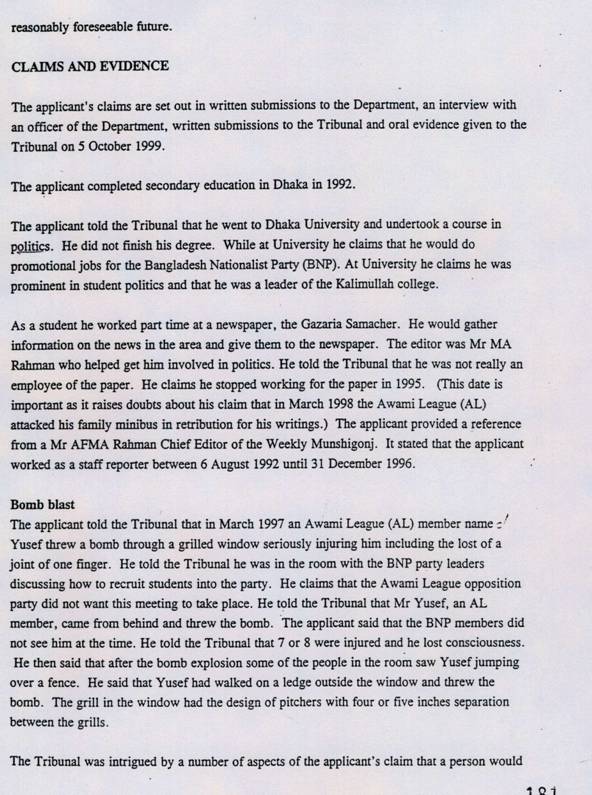
MOHAMMED ALI AZAM v MINISTER FOR IMMIGRATION AND MULTICULTURAL AFFAIRS
W 121 of 1999
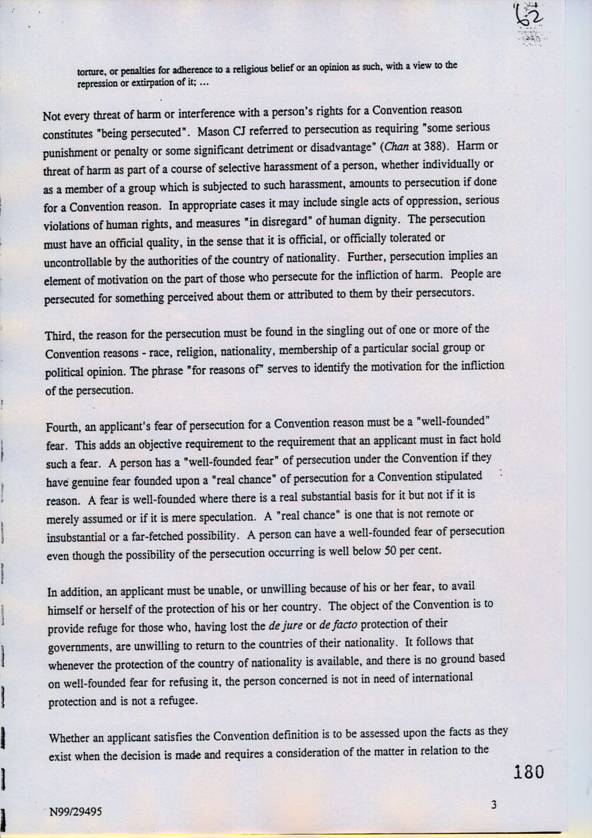
CARR J
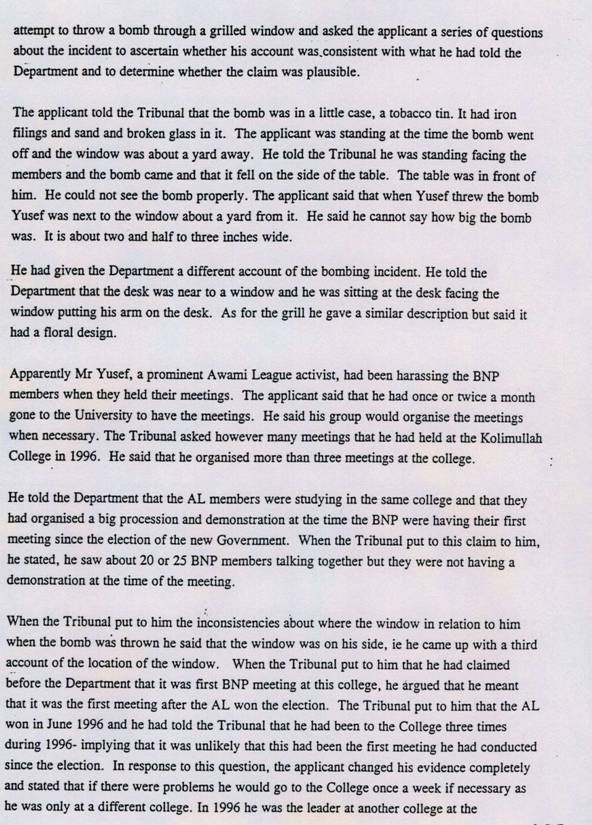
13 MARCH 2000
PERTH
|
IN THE FEDERAL COURT OF AUSTRALIA |
|
|
W 121 OF 1999 |
|
BETWEEN: |
MOHAMMED ALI AZAM Applicant
|
|
AND: |
THE MINISTER FOR IMMIGRATION AND MULTICULTURAL AFFAIRS Respondent
|
|
DATE OF ORDER: |
|
|
WHERE MADE: |
THE COURT ORDERS THAT:
1. The application be dismissed.
2. Applicant pay the respondent’s costs.
Note: Settlement and entry of orders is dealt with in Order 36 of the Federal Court Rules.
|
IN THE FEDERAL COURT OF AUSTRALIA |
|
|
W 121 OF 1999 |
|
BETWEEN: |
Applicant
|
|
AND: |
THE MINISTER FOR IMMIGRATION AND MULTICULTURAL AFFAIRS Respondent
|
|
JUDGE: |
|
|
DATE: |
|
|
PLACE: |
REASONS FOR JUDGMENT
Introduction
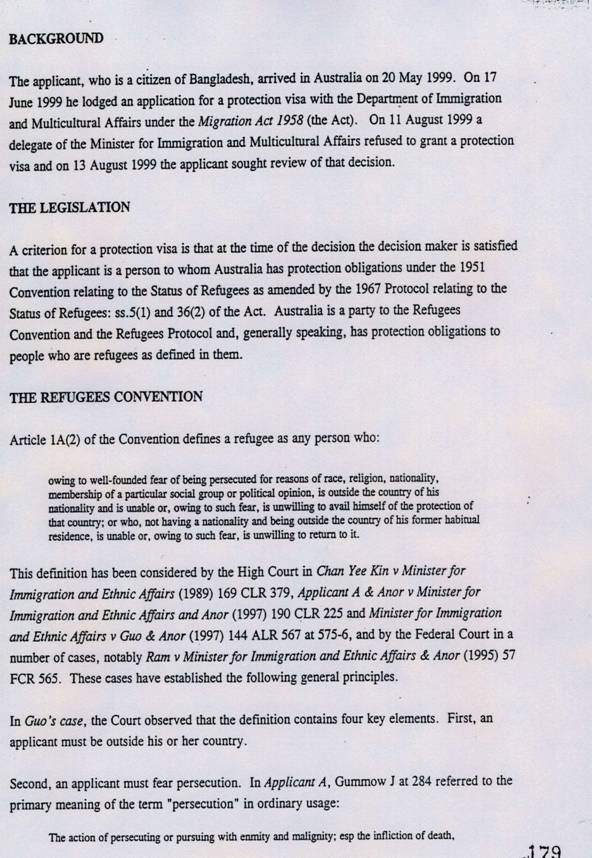
1 This is an application for an order of review of a decision of the Refugee Review Tribunal made on 25 October 1999 in which the Tribunal affirmed the decision of the delegate of the Minister for Immigration and Multicultural Affairs not to grant a protection visa to the applicant. The applicant, who is a citizen of Bangladesh, arrived in Australia by boat and without any travel documents on 20 May 1999. He lodged his application for a protection visa with the Department of Immigration and Multicultural Affairs (the “Department”) on 17 June 1999 and on 11 August 1999 a delegate of the Minister refused to grant him a protection visa.
2 On 13 August 1999 the applicant sought review of the delegate’s decision by the Refugee Review Tribunal. The Tribunal in its reasons first set out the relevant article of the Refugees Convention and the law relating to the interpretation of that article. The Tribunal referred to the applicant’s claims and evidence as provided in written submissions to the Department, an interview with an officer of the Department, written submissions to the Tribunal and the applicant’s oral evidence given to the Tribunal on 5 October 1999.
Factual and Procedural Background
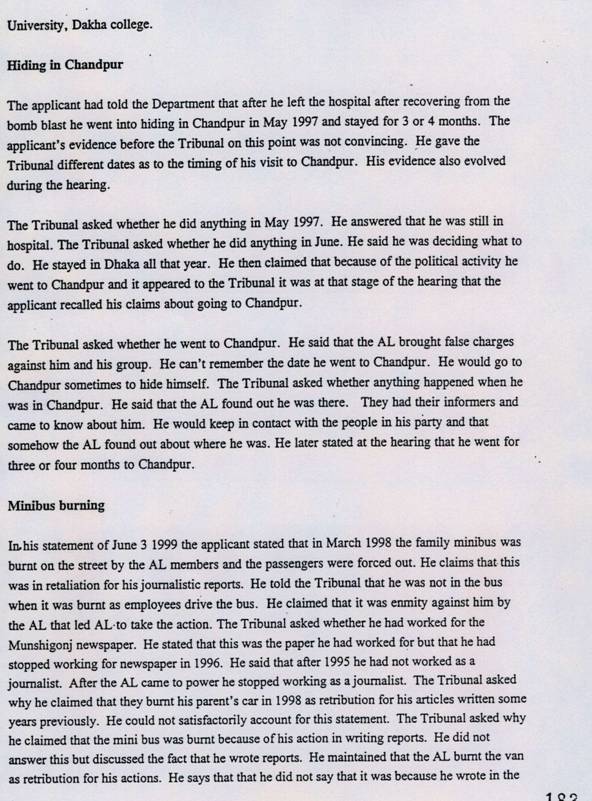
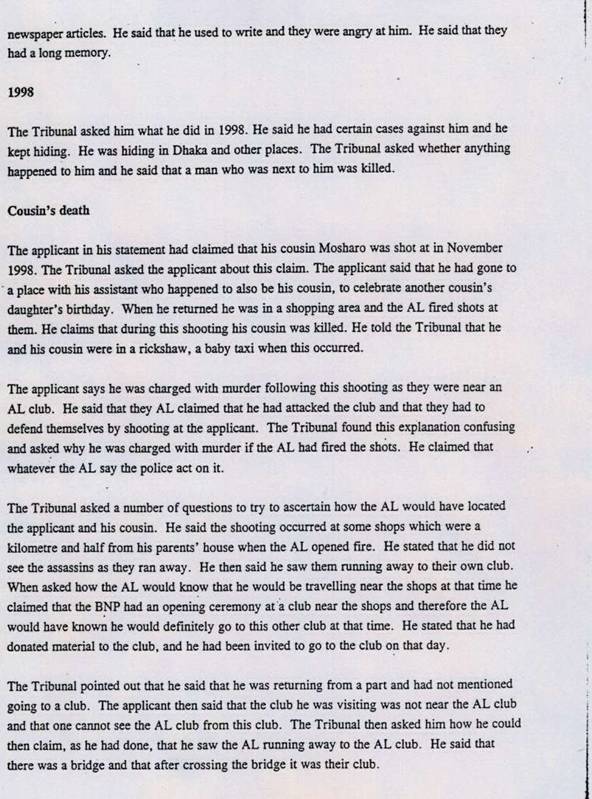
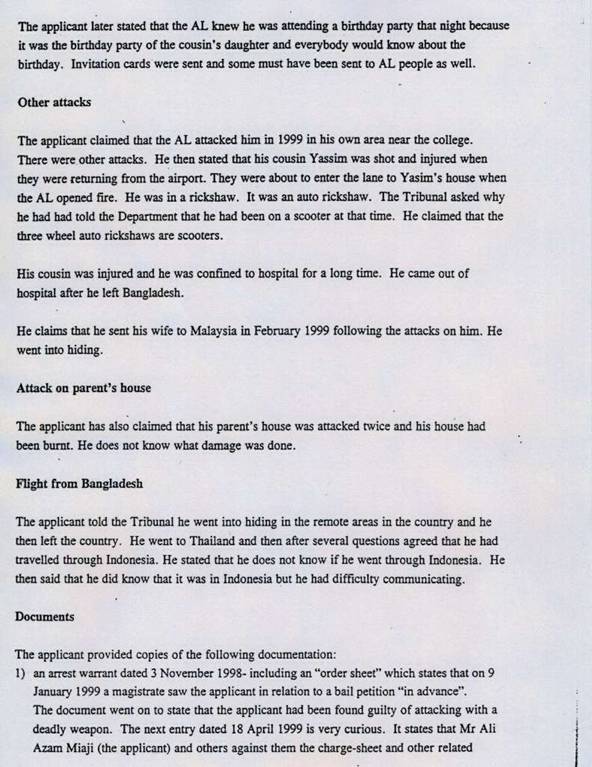
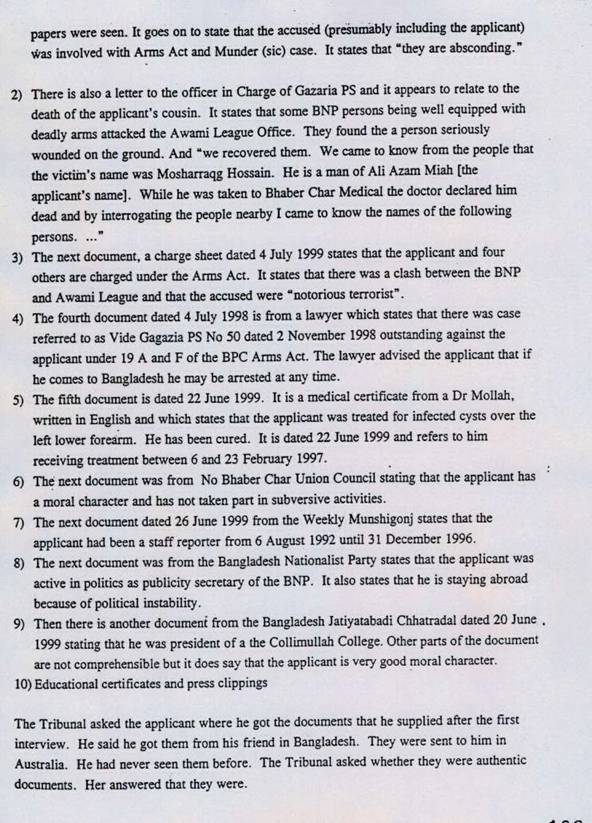
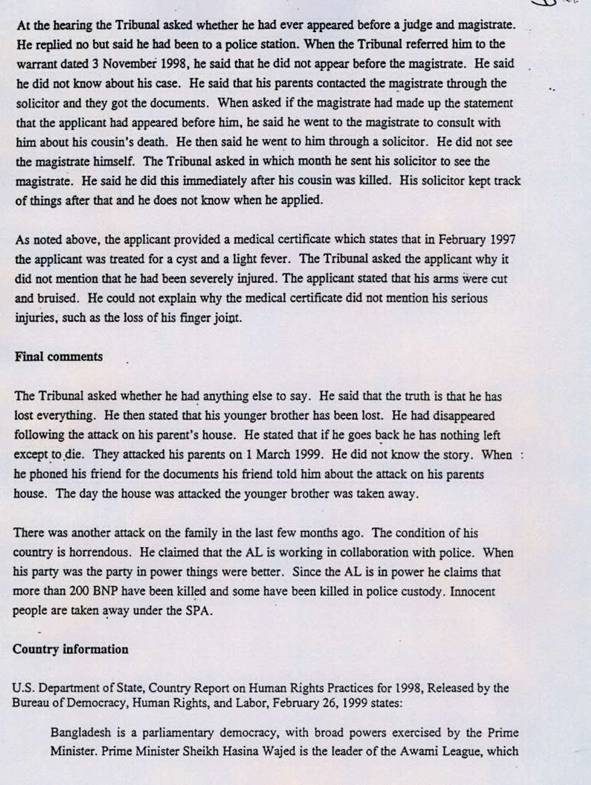
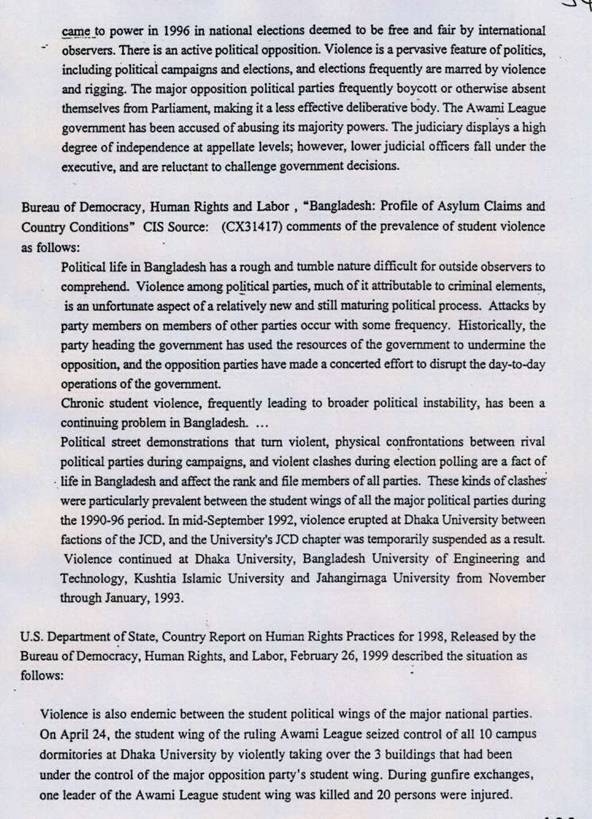
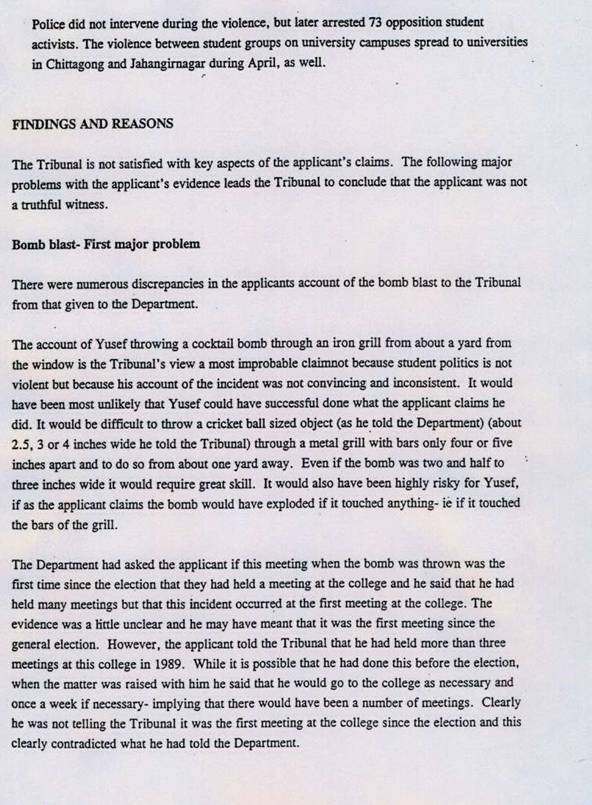
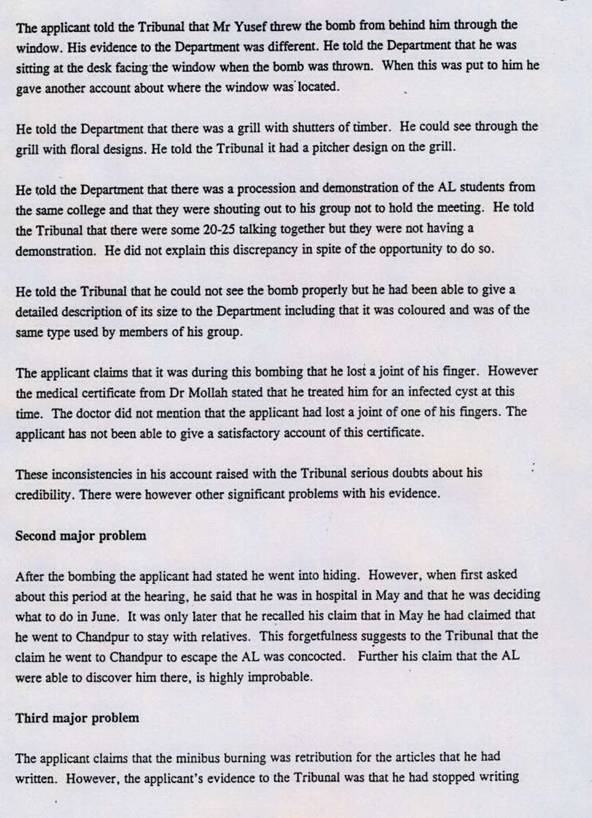
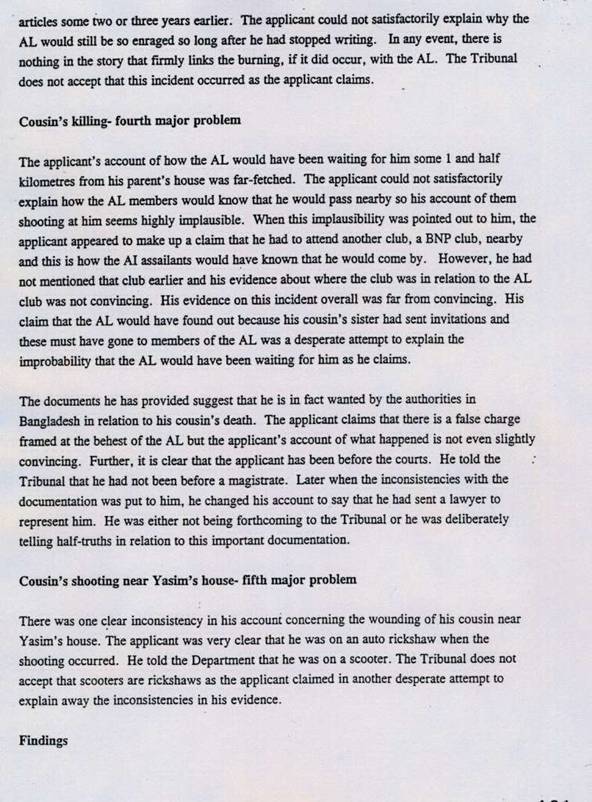
3 The claims made by the applicant before the Tribunal and its findings of fact are as set out at pages 4 to 15 of its reasons for decision dated October 1999, which are annexed to and incorporated by reference into these reasons. In summary, the Tribunal noted (and accepted – see p 15 of its reasons) that the applicant was a member of a political group called the Bangladesh Nationalist Party (BNP). The BNP is in opposition to the Government of Bangladesh. The applicant alleged that as a result of belonging to the BNP and his writings as a journalist, he was injured, harassed and threatened by members of the ruling Awami League (AL). But the Tribunal found that the applicant was not a truthful witness. It identified five aspects of the applicant’s claims which the Tribunal said were improbable or were inconsistent with the applicant’s own evidence, or with information available about Bangladesh. These inconsistencies led the Tribunal to disbelieve the relevant parts of his evidence. This conclusion, among others, led the Tribunal to find that the applicant did not have a well-founded fear of persecution for a Convention reason.
Application for order of review
4 On 28 October 1999, the applicant lodged an application for an order of review. In it the applicant alleged that the Tribunal’s decision involved errors of law. The particular grounds of appeal were as follows:
(a) The decision involved an error of law, being an error involving the incorrect interpretation of the applicable law or an incorrect application of the law to the facts as found by the Tribunal or both.
(b) The decision involved an error of law in that the Tribunal made findings of fact upon which its decision was based that were not rationally supported by probative evidence and it failed to rationally consider the probative evidence before it.
My Reasoning
5 As the applicant was unrepresented and cannot speak English, he was unable to identify the errors of law which he claimed had been made by the Tribunal. I have read and re-read the Tribunal’s reasons and could find no reviewable error on the Tribunal’s part. The Tribunal, at pp 2, 3 and 4 correctly set out the relevant law. In particular, it understood what is meant by a “real chance” of persecution for a Convention stipulated reason (see p 3). It then examined the applicant’s claims of persecution. There were six incidents upon which the applicant relied. I identify them as being a bomb attack, which, so the applicant alleged, occurred in March 1997 and in which he claimed to have been seriously injured, his escape to Chandpur in May 1997, the March 1998 attack on a mini bus belonging to the applicant’s father, the November 1998 incident in which a Mr Mosharof was killed, so the applicant claimed, while in a rickshaw with the applicant, the February 1999 incident in which a Mr Yasim was wounded in the shoulder, again so the applicant claimed, while in a ricksaw with the applicant, and (after the applicant again went into hiding) the 1999 incident when the applicant’s parent’s house was allegedly attacked. The applicant also relied upon a claim that he would face false criminal charges upon return to Bangladesh.
6 The Tribunal identified what it described as “major problems” with the applicant’s evidence which, so the Tribunal stated, had led it to conclude that the applicant was not a truthful witness. In relation to the March 1997 bomb blast, the Tribunal referred to what it described as “numerous discrepancies in the applicant’s account”. Some of those discrepancies might be regarded as of a minor nature, but there were several of them. Others can be seen as being of more significance. However, it is the province of the Tribunal not this Court, to weigh up the evidence and decide whether to believe the applicant. It is not to the point that the primary decision-maker appears to have accepted the applicant’s claim in relation to the March 1997 bomb attack.
7 The Tribunal engaged in a very close analysis of each of the applicant’s claims (and in particular the March 1997 bomb attack) and in each case referred to inconsistencies which it perceived in the applicant’s evidence. It went so far as to say this:
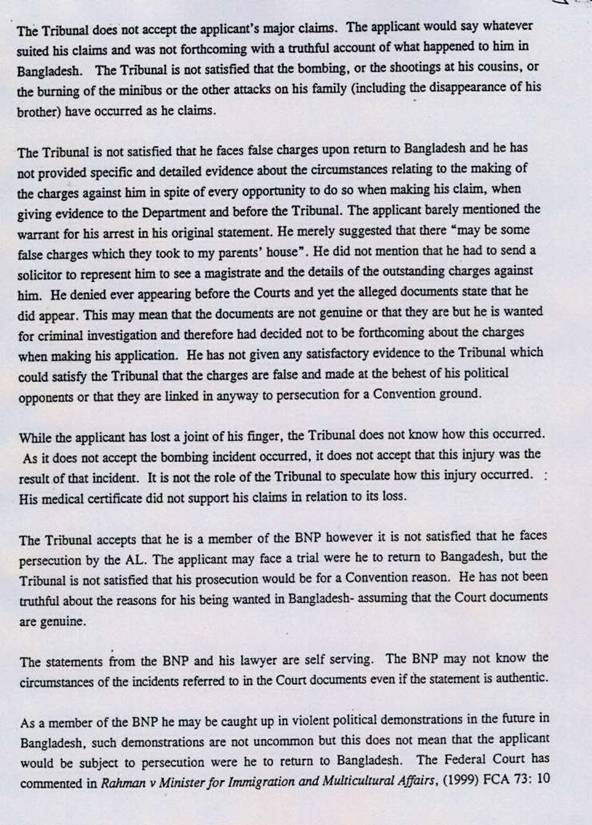
“The Tribunal does not accept the applicant’s major claims. The applicant would say whatever suited his claims and was not forthcoming with a truthful account of what happened to him in Bangladesh. The Tribunal is not satisfied that the bombing, or the shootings at his cousins, or the burning of the mini bus or the other attacks on his family (including the disappearance of his brother) have occurred as he claims.”
8 Nor was the Tribunal satisfied that the applicant faces false charges upon return to Bangladesh. The Tribunal stated that the applicant may face a trial were he to return to Bangladesh, but that it was not satisfied that his prosecution would be for a Convention reason.
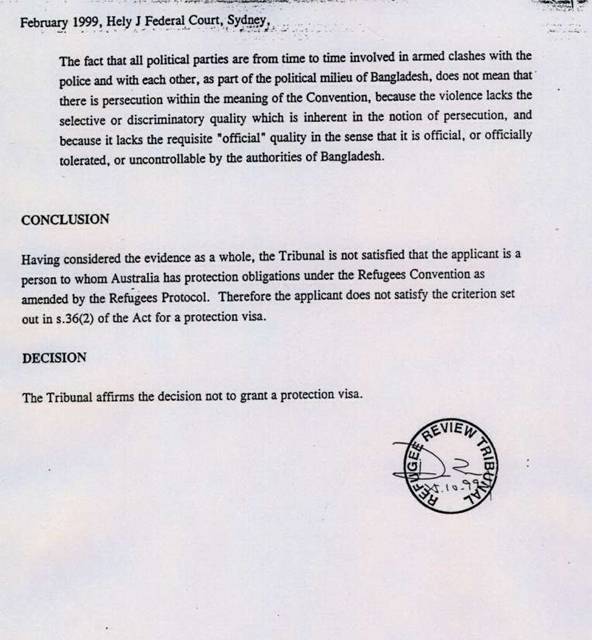
9 The Tribunal acknowledged that the applicant, as a member of the BNP, may be caught up in violent political demonstrations in the future in Bangladesh, but observed that such demonstrations were not uncommon and did not mean that the applicant would be subject to persecution were he to return to that country. In that regard it cited the case of Rahman v Minister for Immigration and Multicultural Affairs (1999) FCA 73 at para 10.
10 In my opinion, it was open to the Tribunal to make the relevant findings on the material before it and I am not satisfied that it erred in law in doing so. The Tribunal’s reasons demonstrate that it applied the law correctly to the facts as found by it when it concluded that the applicant was not a person to whom Australia had protection obligations. The Tribunal did not expressly state that it found that the applicant did not have a genuine fear of persecution founded upon a “real chance” of persecution for a Convention reason. However, its repeated statements of disbelief of the applicant’s evidence, its rejection of all his claims and its conclusion, in my view, quite clearly amount to an implied finding to that effect. In my opinion the Tribunal did not err in law in reaching the decision under challenge.
11 Accordingly the application must be dismissed.
|
I certify that the preceding eleven (11) numbered paragraphs are a true copy of the Reasons for Judgment of Justice Carr. |
Associate:
Dated: 13 March 2000
|
Applicant appeared for himself |
|
|
|
|
|
Counsel for the Respondent: |
Mr J C Curthoys |
|
|
|
|
Solicitor for the Respondent: |
Australian Government Solicitor |
|
|
|
|
Date of Hearing: |
13 March 2000 |
|
|
|
|
Date of Judgment: |
13 March 2000 |