

FEDERAL COURT OF AUSTRALIA
[2000] FCA 191
THE STATE OF WESTERN AUSTRALIA & ORS
V
BEN WARD & ORS
SUMMARY
In accordance with the practice of the Federal Court in certain cases of public interest, the Court has prepared a brief summary to accompany the reasons for judgment that are to be delivered today. It must, of course, be emphasised that the only authoritative pronouncement of the Court’s reasons is that contained in the published reasons for judgment. This summary is intended to assist in understanding the principal conclusions reached by the Court, but it is necessarily incomplete.
3 March 2000
FEDERAL COURT OF AUSTRALIA
[2000] FCA 191
THE STATE OF WESTERN AUSTRALIA & ORS
V
BEN WARD & ORS
SUMMARY OF REASONS FOR JUDGMENT GIVEN ON 3 MARCH 2000
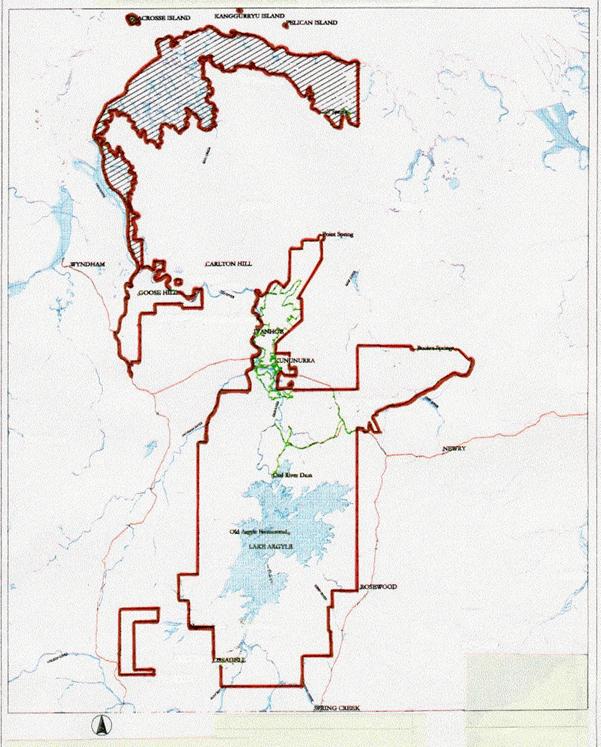
These are appeals, and a cross-appeal, against the first determination of native title in Western Australia made by this Court. The determination was made on 24 November 1998 by Justice Lee in favour of the Miriuwung and Gajerrong people. The claim covered an area of land and waters in the north-east of Western Australia, known as the East Kimberley District, and adjoining land in the Northern Territory. The total claim area was approximately 7,900 square kilometres and included part of the township of Kununurra, Lake Argyle and Lake Kununurra, part of the Ord River irrigation area and the Argyle Diamond Mine. The claim area also included some vacant Crown land and Crown land that had been leased or reserved for various purposes, including for conservation, preservation of Aboriginal art, mining and the Keep River National Park. At one time or another a great deal of the claim area has been the subject of pastoral leases.
The trial
The hearing of the trial before Justice Lee occupied 83 days with much of the applicants’ primary evidence being taken at various sites within the claim area. The transcript of the trial ran to more than 9000 pages. Justice Lee’s judgment was 277 pages.
The trial judge held that ordinarily native title is a communal interest in land, determined by reference to the Aboriginal community’s traditional laws and customs and that community’s connection with the land. The trial judge held that native title may be extinguished by an act of the Crown, but only if the Crown demonstrates a clear and plain intention to extinguish native title. Furthermore, the trial judge held that if rights over the land were granted to a third party in a way that regulated or modified the exercise of the native title rights, such as by a grant of a pastoral lease, licence or reserve, native title was not necessarily extinguished. For extinguishment to occur, the trial judge held that the rights granted must be permanently inconsistent with the native title rights and have the effect of removing all connection of the indigenous people with the land. Where some lesser effect was shown native title rights may be suspended, curtailed or otherwise regulated.
The trial judge held that native title was proved to exist over most of the area claimed, as the Miriuwung and Gajerrrong people had substantially maintained their connection with the land. The only extinguishment of that native title which had occurred was effected by the construction of roads, permanent public works, freehold grants and some reserves.
The appeal
The appeal was heard in Perth and lasted for 15 days, making it one of the longest appeals in this Court’s history. The written submissions ran into thousands of pages. The hearing of the appeal was greatly assisted by the Court’s technological facilities so that the CD Rom version of the transcript of the trial could be viewed by both counsel and the bench via computer screens centrally operated in Court.
This Full Court was called upon to consider a large number of issues. As a result, the judgments in this appeal are necessarily substantial. There are two judgments to be handed down today in these appeals – the majority judgment of Justices Beaumont and von Doussa, and the separate judgment of Justice North which dissents in part. The decision of the Court is as follows:
Connection of the claimants with the land
The existence of native title is a question of fact to be ascertained by evidence of the connection of the Aboriginal community with the land at the time of occupation and evidence of the maintenance of that connection since that time.
The judgment of the trial judge was based on a thorough analysis of evidence from many sources, including evidence from senior members of the Miriuwung and Gajerrong community as well as anthropological evidence. Both the majority and the dissenting judge uphold the trial judge’s findings of fact in relation to the connection of the present Miriuwung and Gajerrong community with the land claimed, and their connection with the Aboriginal people in occupation of the claim area at the time of sovereignty.
The other major issue dealt with by the Full Court is whether or not native title has been extinguished.
Extinguishment of native title
The majority judgment finds that the principles by which the trial judge determined whether extinguishment had occurred departs from the test approved by the High Court in Wik and Fejo. In relation to the rights granted by the Crown, there is no requirement in Australian law that the rights be permanently inconsistent with native title, nor that the rights actually be exercised.
Furthermore, the majority holds that it is possible for some of the “bundle of rights”, which together make up native title, to be extinguished. Where this happens, “partial extinguishment” occurs. This concept has not been authoritatively determined by the High Court in the cases that have come before it to date. Nor has it been determined by a Full Court of this Court until this case.
The majority finds that in relation to the pastoral leases, the grant of the leases in the claim area partially extinguished native title. Most of the pastoral leases contained reservations which protected Aboriginal peoples’ rights of access and use of the land under lease. In Western Australia this is limited to areas that are unenclosed and unimproved. This has the result that there may be areas within the Western Australian pastoral leases where native title has been extinguished altogether. In the Northern Territory the majority finds that there has not been total extinguishment in any of the areas, as the explicit protection of the Aboriginal rights is not limited in the same way.
The majority agrees with the trial judge that the creation of the Keep River National Park does not extinguish native title. Similarly, reservations of land for a public purpose do not automatically cause extinguishment. However, the majority holds that native title has been wholly extinguished in respect of the areas covered by the Ord Irrigation Project and the Argyle Diamond Project. The nature of such major projects and the range of activities involved are completely inconsistent with the continued enjoyment of native title. The majority also finds that native title rights in minerals and petroleum in the claim area have been wholly extinguished by legislation. Further, the majority holds that the grant of mining leases in the Western Australian portion of the claim area has wholly extinguished native title in the areas covered by the leases.
The dissenting judge, Justice North, differs from the majority decision primarily on the question of the proper approach to extinguishment. His Honour holds that native title is not a bundle of rights but a fundamental right to land. Accordingly, there can be no “partial extinguishment” of some of those rights. His Honour holds that extinguishment will only occur where there is a total and permanent inconsistency between the rights granted and the native title. Where a lesser degree of inconsistency exists, native title is not extinguished but merely temporarily suspended or impaired.
Justice North agrees with the trial judge’s interpretation of the law relating to extinguishment and his Honour’s application of that law to the claim in question. Justice North also recognises a native title right to maintain, protect and prevent the misuse of cultural knowledge.
In the result, the appeals fail on the “connection” issues, but by a majority (Justices Beaumont and von Doussa) the appeals are allowed in part on the extinguishment issues. Justice North, dissenting, would have dismissed the appeals. The cross-appeal is dismissed.
A draft determination which identifies the areas where native title is held to exist, and where it is wholly or partially extinguished, is appended to the majority judgment, and to this summary.
The full text of the judgment is available on the Federal Court’s website at: www.fedcourt.gov.au
FEDERAL COURT OF AUSTRALIA
[2000] FCA 191
THE STATE OF WESTERN AUSTRALIA & ORS
V
BEN WARD & ORS
THE COURT ORDERS:
1. That Appeals Nos. WG 6293 of 1998, WG 6292 of 1998, WG 6294 of 1998, WG 6295 of 1998 and WG 6296 of 1998 be allowed in part.
2. That the Cross-Appeal by the Kimberley Land Council in Appeal No. WG 6293 of 1998 be dismissed.
3. That Appeal No. W 6020 of 1999 be dismissed.
4. That the orders, declarations and determination made in Action No. WAG 6001 of 1995 be set aside and in lieu thereof there be orders, declarations and a determination which reflect the reasons for judgment of the majority of this Court.
5. That the parties be at liberty within twenty-eight days to file and serve written submissions on the draft determination published this day with the reasons for judgment.
6. That the orders as to the costs of the trial made on 6 May 1999 be set aside and that there be no order as to costs either of the trial or of the appeals or of the Cross-Appeal.
Note: Settlement and entry of orders is dealt with in Order 36 of the Federal Court Rules.
DRAFT DETERMINATION
THE COURT ORDERS, DECLARES AND DETERMINES THAT:
1. Native title exists in the “determination area” save for the areas of land or waters described in the Second Schedule. The determination area is that part of the land or waters within the area depicted by red outline on the map in the First Schedule as does not include land or waters in respect of which no application for determination of native title was made by the first applicants in the application lodged with the National Native Title Tribunal referred to the Court by the Tribunal.
2. Native title existing in the determination area is held by the Miriuwung and Gajerrong People, and in respect of that part of the determination area known as Booroonoong (Lacrosse Island), native title is also held by the Balangarra Peoples, both parties being described hereafter as the common law holders of native title.
3. Subject to paragraph 7 hereof the nature and extent of the native title rights and interests in:
The whole of the land in the Glen Hill pastoral lease;
The whole of Reserve 40260;
Booroongoong (Lacrosse Island);
Kanggurryu (Rocky Island);
The north-west extremity of the mainland portion of the determination area encompassing Shakespeare Hill and Cape Donnet, being the mainland lying outside the limits of the former Carlton Hill Station pastoral lease 3114/1058;
The whole of NT portion 3541 (Policemans Hole);
The whole of NT portion 3542 (Bucket Springs), and
The whole of NT portion 3863 (Bubble Bubble)
are an entitlement as against the whole world to possession, occupation, use and enjoyment of these parts of the determination area.
4. Subject to paragraph 7 hereof the nature and extent of the native title rights and interests in Reserves 26600, 31221, 40536 and 41401, each for “Use and Benefit of Aboriginal Inhabitants”, Reserve 31504 for “Arts and Historical — Aborigines” and Reserve 32446 “Native Paintings”, being reserves within the Ord Project area to which s 47A of the Native Title Act 1993 (Cth) applies, are an entitlement as against the whole world to possession, occupation, use and enjoyment of these parts of the determination area, save that their entitlement does not affect the public works comprising the Ord Project.
5. Subject to paragraphs 7, 8, 9 and 10 hereof the nature and extent of the native title rights and interests existing in the balance of the determination area are as follows:
(a) a right to possess, occupy, use and enjoy the land;
(b) a right to make decisions about the use and enjoyment of the land;
(c) a right of access to the land;
(d) a right to use and enjoy the traditional resources of the land;
(e) a right to maintain and protect places of importance under traditional laws, customs and practices in the determination area.
6. The nature and extent of other interests in relation to the determination area are the interests created by the Crown as set out in the Third Schedule.
7. There is no native title right or interest in minerals and petroleum in the State as defined in the Mining Act 1978 (WA) and the Petroleum Act 1967 (WA), or in the Territory as defined in the Minerals (Acquisition) Act (NT) and the Petroleum Act 1984 (NT).
8. To the extent that any inconsistency exists between the native title rights and interests referred to in paragraph 5 hereof and the rights conferred by other interests referred to in paragraph 6 hereof the native title rights and interests must yield to such other rights.
9. The native title rights and interests referred to in paragraph 5 hereof do not confer on the common law holders possession, occupation, use and enjoyment of land and waters to the exclusion of all others.
10. The native title rights and interests described in paragraphs 3, 4 and 5 are subject to regulation, control, curtailment or restriction by valid laws of Australia.
11. Within twenty-eight days the common law holders of native title are to file any minute of proposed determination under ss 56 and 57 of the Native Title Act 1993 (Cth) and if no such minute is filed it is determined that native title is held by the common law holders.
FIRST SCHEDULE
SECOND SCHEDULE
Native title has been wholly extinguished in the following parts of the determination area:
1. All the land identified in Exhibits 21A and 21B as:
(i) Diversion Dam and Works Area (1960);
(ii) First Farm Area (1960);
(iii) Second Farm Area (1961);
(iv) Kununurra Townsite (1961) except for the area now comprised in Reserve 37883 - Mirima (Hidden Valley) National Park;
(v) Third Farm Area (1960-1962);
(vi) Kimberley Research Station Extension (1963);
(vii) Fourth Farm Area and Levy Bank (1967);
(viii) Packsaddle Farm Area (1972 and 1975);
(ix) The lands resumed from the Lissadell and Texas Downs Pastoral Leases in 1972, which now comprise part of Reserve 31165 (and include that part of Special Agreement Lease M259SA which is within the determination area).
2. The land formerly comprised in the Argyle Downs Pastoral Lease, and the freehold land surrounding the former Argyle Downs homestead (King Location 2) acquired by the Minister of Works under an Agreement for Sale signed on 23 November 1970.
3. Land in Reserves (being lands outside the areas already described in this Schedule).
(i) The whole of former Reserve 16729 (“Use and Requirements of the Government of the State”).
(ii) The whole of Reserve 34724 (“Preservation of Historic Relics”).
(iii) The whole of Reserve 40978 (“Repeater Station Site”).
(iv) The whole of Reserve 39016 (“Repeater Station Site”).
(v) That part of Reserve 42710 (“Quarantine Checkpoint”) on which ablution blocks, a parking lot, power generator, fuel and water tanks, a tourist information shelter, shed and facilities for the Quarantine Checkpoint have been constructed and a reasonable curtilage surrounding those constructions.
4. Land in leases (being lands outside the areas already described in this Schedule).
(1) Pastoral leases
(a) Those parts of pastoral leases granted in the determination area under the Land Regulations 1882 (WA), the Land Regulations 1887 (WA) and the Land Act 1898 (WA) which were “enclosed and improved” within the meaning of the reservations in favour of Aboriginal people contained in the said pastoral leases.
(b) Those parts of pastoral leases granted in the determination area under the Land Act 1933 (WA) which were or are enclosed or improved within the meaning of s 106(2) of the Land Act 1933. Without limiting the generality of this subparagraph of the determination, it is declared that in land the subject of pastoral leases 3114/640 (Ivanhoe Station), 3114/1176 (Carlton Hill Station), 3114/1001 (Lissadell Station) and 3114/995 (Texas Downs Station) the areas agreed as “enclosures” in Exhibit 55, Schedules 1A to 1F, are enclosed lands within the meaning of s 106(2).
(ii) Other leases
The whole of the land in Lease 152/140 (Wallace and Others);
The whole of the land in lease 332/1175 (R G Skuthorp) being portion of Reserve 1059;
The whole of the land in lease 332/2177 (G & J Harman) being portion of Reserve 1061.
(iii) Mining Leases
M80/012 in area 95C, 96;
M80/014 in area 95C, 96;
M80/339 in area 95C, 96
M80/347 in area 5;
M80/401 in area 95C, 96
M80/402 in area 96;
M80/360 in area 29, 95M
M80/079 in area 29, 95M
THIRD SCHEDULE
Other interests in the determination area are of the following kind:
(a) Interests of persons in whom Crown reserves are vested under the Land Act 1898 (WA) or Land Act 1933 (WA) or under a lease made for the purpose of the reserve.
(b) Interests of persons entitled to use reserves according to a purpose for which Crown land is reserved, or under a lease made for the purpose of the reserve.
(c) Interests of lessees under:
(i) Leases granted under the Land Act 1933 (WA);
(ii) Leases granted under the Crown Lands Act 1978 (NT);
(iii) Leases granted under the Special Purposes Leases Act 1953 (NT);
(iv) Leases granted under the Mining Act 1978 (WA);
(v) Leases granted under the Aboriginal Affairs Planning Authority Act 1972 (Cth).
(d) Interests of licensees under:
(i) Licences issued under the Land Act 1933 (WA);
(ii) Licences issued under the Fish Resources Management Act 1994 (WA);
(iii) Licences issued under the Jetties Act 1926 (WA);
(iv) Licences issued under the Mining Act 1978 (WA);
(v) Licences issued under the Wildlife Conservation Act 1950 (WA);
(vi) Licences issued under the Rights in Water and Irrigation Act 1914 (WA);
(vii) Licences issued under the Transport Co-ordination Act 1966 (WA);
(e) Interests of holders of permits issued under:
(i) The Land Act 1933 (WA);
(ii) The Ord Irrigation District By-Laws under the Rights in Water and Irrigation Act 1914 (WA);
(f) Interests of holders of tenements under the Mining Act 1904 (WA).
(g) Interests of holders of tenements under the Petroleum Act 1936 (WA) and the Petroleum Act 1967 (WA).
(h) Interests of grantees under the Miscellaneous Acts Amendment (Aboriginal Community Living Areas) Act 1978 (NT) and the Crown Lands Act 1978 (NT).
(i) Other interests obtained by reason of provisions of legislation of the State, Territory or Commonwealth.
(j) Other interests held by members of the public arising under the common law.


