

FEDERAL COURT OF AUSTRALIA
Eveready Australia Pty Ltd v Gillette Australia Pty Ltd [1999] FCA 1824
TRADE PRACTICES – comparative advertising – advertisement that one brand of battery “lasts four times longer” or “lasts up to four times longer” – smaller print stating “than ordinary zinc carbon batteries” – whether advertisement misleading or deceptive – identification of subject of comparison – meaning of “up to”.
Trade Practices Act 1974 (Cth) s 52
EVEREADY AUSTRALIA PTY LIMITED v GILLETTE AUSTRALIA PTY LIMITED
NG 1205 of 1998
LINDGREN J
23 DECEMBER 1999
SYDNEY
|
IN THE FEDERAL COURT OF AUSTRALIA |
|
|
NG 1205 OF 1998 |
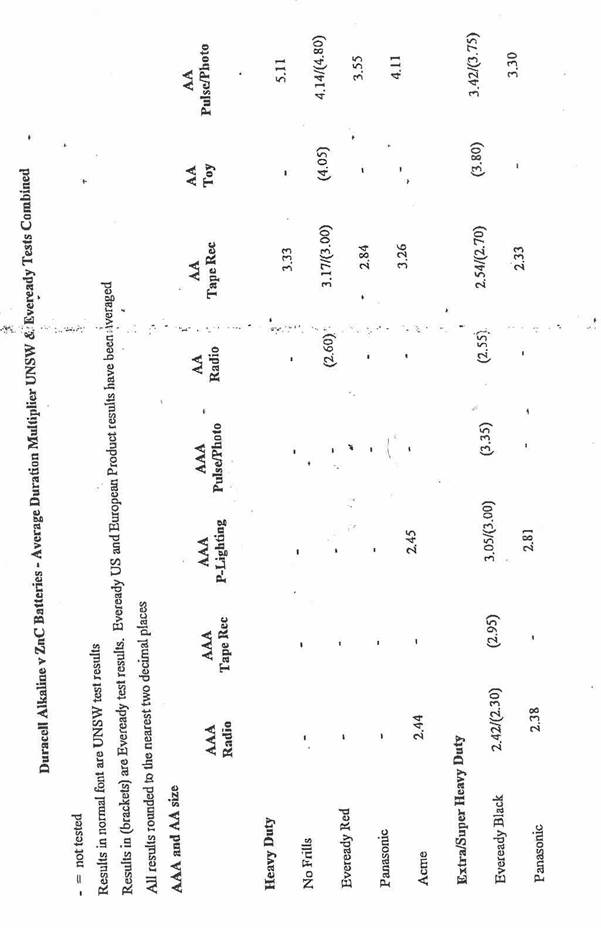
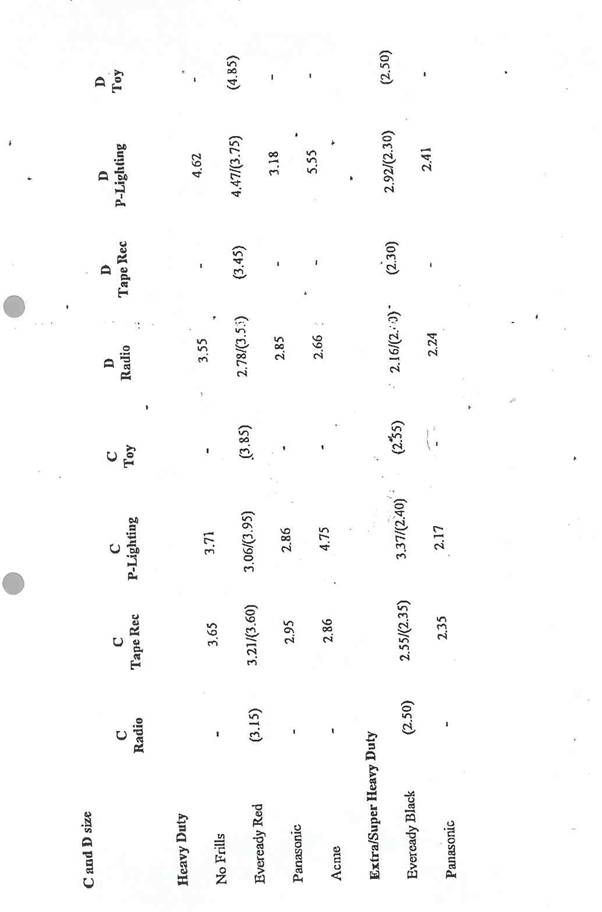
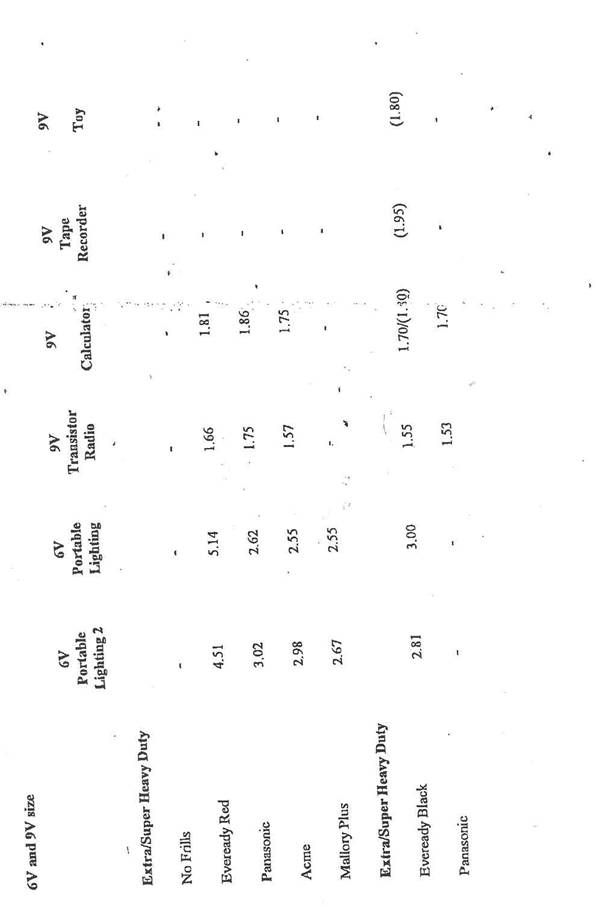
|
BETWEEN: |
EVEREADY AUSTRALIA PTY LIMITED (ACN 003 539 026) Applicant
|
|
AND: |
GILLETTE AUSTRALIA PTY LIMITED (ACN 000 011 914) Respondent
|
|
DATE OF ORDER: |
|
|
WHERE MADE: |
THE COURT ORDERS THAT:
1. The proceeding be listed on 9 February 2000 at 9.30 for the making of orders including orders as to costs.
2. The parties provide to the Associate to Lindgren J by 2 February 2000 agreed short minutes of the orders to be made and if agreement has not by then been reached, the forms of short minutes of orders for which they will respectively contend and outlines of their submissions in support.
Note: Settlement and entry of orders is dealt with in Order 36 of the Federal Court Rules.
|
IN THE FEDERAL COURT OF AUSTRALIA |
|
|
NG 1205 OF 1998 |
|
BETWEEN: |
EVEREADY AUSTRALIA PTY LIMITED (ACN 003 539 026) Applicant
|
|
AND: |
GILLETTE AUSTRALIA PTY LIMITED (ACN 000 011 914) Respondent
|
|
JUDGE: |
|
|
DATE: |
|
|
PLACE: |
REASONS FOR JUDGMENT
1 The parties manufacture batteries. The applicant (“Eveready”) complains about a comparative advertising campaign by the respondent which sells batteries under the brand name “Duracell” (I will use the word ‘Duracell’ to refer to the respondent itself as well as to its batteries). Eveready’s complaint arises out of three television advertisements, a form of billboard advertisement, and stickers which were attached to Duracell battery packs.
2 It will be necessary to discuss in detail the content of the advertising but for the purpose of this introduction it is adequate to think of it as an advertisement that “Duracell lasts four times longer” or “Duracell lasts up to 4 times longer”. What is the meaning of “up to” four times longer in the present context? The word “longer” indicates a comparison, but a comparison with what? These two questions lie at the heart of the present case.
3 Eveready submits that Duracell’s advertising would have led consumers to think that the comparison being made was between Duracell batteries and the batteries of each other manufacturer. Duracell submits that its advertising would have been understood by consumers as invoking a comparison between its batteries, which are all alkaline batteries, and zinc carbon batteries. Eveready manufactures, relevantly, both alkaline batteries and zinc carbon batteries, the former under the name “Energiser”.
4 It is not in dispute
· that alkaline technology is more advanced than zinc carbon technology;
· that Duracell batteries, being alkaline, would, like Eveready’s own Energiser batteries (being also alkaline), outlast Eveready’s zinc carbon batteries, at least to some extent;
· that Duracell batteries do not last four times longer than Eveready’s Energiser batteries.
5 Originally, Eveready sought damages as well as declaratory and injunctive relief, but it no longer seeks damages. The television advertising took place in October and November 1998. Eveready sought interlocutory injunctive relief but Dowsett J refused that application on 3 December 1998.
6 The parties are agreed that I should not make orders at this stage but should publish these Reasons then hear the parties on the orders to be made.
FACTS
The Australian consumer battery market
7 The issues in the present case arise in the context of the Australian dry cell battery market. According to the evidence, there are three segments to that market: a “primary” or “general purpose” segment; a “rechargeable” segment; and a “specialist” segment. The “specialist” segment embraces small disc batteries designed for use in such things as hearing aids and watches. The present case concerns only the first segment.
8 The general purpose segment encompasses cylindrical batteries with terminals at both ends and oblong batteries with two terminals on the top. The cylindrical batteries come in “sizes” generally known as AAA, AA, C and D, D being the largest and heaviest, and AAA being the smallest and lightest. The oblong configuration comprises six volt (6V) and nine volt (9V) batteries. By far the largest selling battery is the AA.
9 Marketing is largely by brand and the two main brands in the Australian market are those represented by the present parties. Another is Panasonic and there are house brands of which “Acme”, the Woolworths house brand, and “No Frills”, are referred to in the evidence.
10 Batteries store energy. A way of describing and measuring a battery’s capacity to store energy is by reference to its life. Lithium batteries have a longer life than alkaline, and, as already noted, alkaline have a longer life than zinc carbon.
11 While Duracell batteries are all sold under the “Duracell” brand, Eveready batteries are sold under different names. “Energiser” is the Eveready alkaline product. Eveready sells its zinc carbon batteries as “General Purpose”, “Heavy Duty” and “Super Heavy Duty”. The “General Purpose” Eveready battery is blue and is sometimes called the “Eveready Blue”; the “Heavy Duty” Eveready product is red and is sometimes called the “Eveready Red”; and the “Super Heavy Duty” Eveready product is black and is sometimes called the “Eveready Black”. Eveready’s Super Heavy Duty battery, the Eveready Black, is the largest selling zinc carbon battery.
12 The main sales of the batteries of present concern occur in supermarkets and variety stores. In the marketing evidence, the supermarket outlets are called “grocery”, while the variety stores are such chains as “Target” and “Big W”. In total, the grocery and variety store outlets account for some 80 per cent of total sales.
13 The energy storage capacity of batteries is reflected in their price. The Energiser and Duracell batteries, both being alkaline, occupy the “premium” segment of the primary battery market and are generally recognised by consumers as being long-lasting, multi-purpose and suitable for medium to high drain consumer devices. They sell for virtually the same price.
14 The parties provided a statement of agreed facts in relation to “technical evidence” (“the Agreed Statement”). The Agreed Statement included a table headed, “Duracell Alkaline v ZnC Batteries – Average Duration Multiplier UNSW & Eveready Tests Combined”, a table of results of tests of the longevity of various kinds of batteries (“the Table”). The following is the text of the Agreed Statement (the Table is the first table annexed to these Reasons):
“1. Eveready and Gillette both manufacture consumer batteries in range [sic] of standard sizes. There are three types of consumer battery relevant to the proceedings; zinc carbon, alkaline and lithium. The types differ in their chemical content and structure. Eveready sells batteries of all three types under the brand names Eveready, Energizer and Energizer Lithium respectively. Gillette only sells alkaline batteries. They are sold under the brand name Duracell and (since February 1990) Duracell Ultra.
2. The oldest technology is zinc carbon. Alkaline is a more advanced technology. Alkaline batteries will outperform a zinc carbon battery for all consumer uses. The extent to which an alkaline battery lasts longer than a zinc carbon battery of the same size is not uniform but depends on the particular consumer use.
3. A further more advanced type of battery technology is lithium. Lithium batteries possess some advantages over alkaline batteries; they are lighter, can run at higher voltages and can store even more energy than alkaline batteries.
4. It is agreed that the claim ‘lasts up to four times longer’ could not accurately be made if the relevant comparison was Duracell alkaline batteries as against Energizer alkaline or Energizer Lithium batteries.
5. Standards have been promulgated for testing of the performance of batteries. The standard used by battery manufacturers, including Eveready and Gillette, is the IEC (‘International Electrotechnical Commission’) standard IEC 86-1 and IEC 86-2. This standard has been adopted in Australia by Standards Australia where it is known as standard AS/NZ 2176/96. The testing undertaken by Eveready and Gillette was to this standard.
6. The standards require certain testing conditions and tests that are designed to simulate generally consumers’ actual use of batteries in appliances. For each test appliance, for example ‘Radio’, the standard prescribes the test schedule that is to be followed, i.e. the periods for which the appliances is to be switched on. For example, the standard specified that the test schedule for the AAA size ‘Tape Recorder’ test is for the batteries to be run one hour per day. The standards also specify the test conditions, for example, the resistance and end voltages to be used.
7. Testing is then done by placing the battery to be tested into a computer-controlled test apparatus, which is then used to apply the relevant test schedule. The test terminates when the battery has been run down to a pre-specified voltage. The time for this to occur (or the number of cycles, for example in a camera flash test) is a measure of the life of the battery under those test conditions. The test is done with a number of identical batteries and the results averaged.
8. Annexed hereto is a table which summaries the results of the battery tests carried out by Eveready and Gillette. The table shows the factor by which the life of the standard Duracell alkaline battery exceeds that of the carious [sic – various] zinc carbon batteries. For example, the results show that AA Duracell alkaline battery lasts 3.33 times longer than the No Frills zinc carbon battery when tested using the ‘Tape Recorder’ test.
9. The performance of the Duracell alkaline battery was compared with a range of zinc carbon batteries. Those zinc carbon batteries include No Frills, Eveready Red, Panasonic, Acme and Mallory Plus heavy duty batteries and the Eveready Black and Panasonic Extra/Super heavy duty batteries. In addition to the Eveready Red and Black batteries Eveready also sells a lower grade of General Purpose battery known as the Eveready Blue. This battery was not tested but it generally performs at a lower level than the Eveready Red battery.”
15 I will later have occasion to refer to the results in the Table.
The Duracell television commercials
16 All three television advertisements depict two teams of bunnies playing soccer. The message conveyed is that one team which is powered by Duracell batteries outlasts the other team which is powered by other unidentified batteries. A Duracell battery is seen in the back of one of the Duracell team and a “generic” battery is seen in the back of one of the defeated team. In a rapid, colourful and boisterous action, the Duracell team scores four goals while the other team collapses on the field.
The ten second television commercial
17 In this, the shortest of the three television commercials, the words spoken are:
“This program … brought to you by Duracell … kicking on 4 times longer than the opposition.”
18 The message of these last words is reinforced by the fact that the Duracell team has scored four goals. Without more, it means that Duracell batteries last four times longer than the batteries of Duracell’s “opposition” in the market place, that is non-Duracell batteries. Duracell’s main opposition in the market place is Eveready.
19 The following subtext appears in small print on three occasions:
“Ordinary batteries = zinc carbon batteries”
It will be noted, however, that there is no reference to “ordinary batteries” elsewhere in this commercial.
Another subtext which appears once is:
“Lasts up to 4 times longer.”
As noted earlier, however, the words spoken are “kicking on four times longer than the opposition”, that is, the words “up to” are not spoken.
The fifteen second television commercial
20 In this case the small subtext states “ordinary batteries = zinc carbon batteries” twice, “lasts up to 4 times longer” once and “lasts up to 4 times longer than ordinary zinc carbon batteries” once. The audio accompaniment, which is spaced throughout the advertisement, is, in total, as follows:
“In extra time at the final, Duracell … keeps going, the … ordinary batteries are finished. … One! … Oh Two! … and that’s Three! … and that’s Four! Duracell batteries … last up to 4 times longer.”
The counting coincides with the scoring of the goals. Accordingly, in this case, the words “up to” are spoken and appear in the subtext.
The thirty second television commercial
21 Being twice as long as the commercial last described, this one is more elaborate and contains more action. It contains the same four subtexts as the fifteen second commercial. The audio accompaniment, spaced throughout the commercial, is, in total, as follows:
“In extra time at the final, Duracell … keeps going, the … ordinary batteries are finished. … One! … that’s Two! … and that’s Three. … [There are two successive blasts of a referee’s whistle] Oh, that’s … Four! … Extra power for extra time. … Duracell batteries … last up to four times longer.”
Like the fifteen second commercial but unlike the ten second one, this one contains the spoken words “up to” before “four times longer”.
The Duracell billboard advertisement
22 The form of billboard advertisement contains at the top right hand side the words “Kick On” but the letter “O” is represented by a soccer ball. Below those words and still on the right hand side is a picture of a Duracell battery lying flat. The word “DURACELL” is in block capital letters, runs along the centre of the battery and is the most prominent print on it. Immediately below the word “DURACELL” and in less bold block capital letters appear the words “alkaline battery”. Below the battery and in prominent bold black print are the words “Four times longer” without, it will be noted, the words “up to”. Below those words and in smaller white print appear the words “Lasts up to four times longer than ordinary zinc carbon batteries”. On the left hand side of the billboard is the image of a bunny character.
23 In his Reasons for Judgment dated 3 December 1998, Dowsett J stated:
“At the invitation of the parties, I have viewed one of the billboards at the corner of Campbell and Hunt Streets, Sydney. Whilst passing the board in the front passenger seat of the car, I was able to read all the wording on it.”
Gillette relies on this passage. In my opinion, his Honour was not intending, in the interlocutory application with which he was dealing, to express a finding that the average member of the public would in fact, while riding in a motor car, read all of the wording, including the sentence “Lasts up to four times longer than ordinary zinc carbon batteries”. I will discuss this issue further below.
24 Photographs of the billboard were in evidence. They show that depending upon the position of the viewer, parts of the sign might be obstructed by, for example, an electricity installation on the footpath, passing motor traffic or a telephone booth. The small print, being close to the bottom edge of the billboard, was more likely than any other part of the sign to be concealed from view.
The Duracell product stickers
25 Eveready complains about a red product sticker, a blue product sticker and a competition sticker. All were affixed to Duracell battery packs and so were visible at point of sale in supermarkets and elsewhere. Examples of all three stickers were in evidence. The red product sticker which was attached to an AA 4 pack looked something like this:
26
 “Duracell
last’s [sic] up to
4 times
longer.*
(*THAN ORDINARY ZINC CARBON BATTERIES)”
As above, the print in the opening four lines was much thicker and more striking than the words in parentheses.
27 There were two blue product stickers in evidence. One bore the image of a boxing bunny and the other a motor cycling bunny. In each case, adjoining the image large thick bold print appeared against a white background in a circle and below the circle there appeared against the general blue background and in smaller and less clear print the words to which an asterisk in the circle referred. The material looked something like this:
28

“ Lasts up
 to 4 times
longer*
* THAN ORDINARY ZINC CARBON BATTERIES”
29 The competition sticker was in fact inside a small “fold-out” the cover of which announced the possibility of winning cash prizes. The small “fold-out” was affixed to the battery packs and gave details of the competition. It was designed so that once the competition had closed the competition information could be detached leaving a “red product sticker” intact for use alone. On the inside of the front cover appeared in yellow the words:
“REMEMBER
Duracell last’s [sic] up to 4 times longer.*
(*THAN ORDINARY ZINC CARBON BATTERIES)”
30 On this occasion, the difference in print between the words “Duracell last’s [sic] up to 4 times longer” and the words in parentheses was not so striking, although the former words were in yellow print and the latter in white.
31 All of the Duracell battery packs are marked “Alkaline Batteries”. However, in most cases these words appear in relatively small and fine print on the bottom left hand corner of the battery pack.
Survey evidence
32 At the request of the solicitors for Eveready, Q2 Market Research (“Q2”) conducted what it described as “a communications test on a Duracell commercial”. The individual at Q2 responsible was Patrick Weissenberg. Mr Weissenberg apparently has a postgraduate Diploma in Market Research and Advertising from the University of South Africa and Master of Commerce degree based on a thesis, “The Assessment of Advertising Effectiveness”. Since 1980 he has been employed in the market research area.
33 Mr Weissenberg devised a questionnaire intended to subject respondents to a memory test, a comprehension test and an interpretative test. The questionnaire was administered, not by Q2, but by NCS Australasia Pty Ltd (“NCS”), who trained and engaged interviewers for the purpose. Four hundred interviews were conducted; 200 in a shopping centre at Hurstville, Sydney and 200 in a shopping centre at Fountaingate, Melbourne. The survey was conducted from Thursday 1 to Saturday 3 July 1999. Respondents were to be over fourteen years but less than seventy years of age. A person was to be excluded if he or she worked for Duracell or a member of his or her family did so. The individuals were taken to an enclosed area and were twice shown a “clutter reel” of five commercials in sequence. The Duracell commercial was the third in the sequence.
34 The questionnaire contained twenty questions. According to Mr Weissenberg, certain questions contained the memory test and were directed to assessing what respondents recalled after exposure to the commercial in the manner described. According to him, the comprehension test was directed to assessing what respondents understood by the terms “ordinary batteries”, “zinc carbon batteries” and “ordinary zinc carbon batteries”. The interpretative test was designed to assess how the message of the commercial was interpreted. The last question, question 20, was directed to this end. It read:
“In the commercial they say ‘Duracell lasts up to four times longer than ordinary zinc carbon batteries’. What does this suggest to you about Duracell?”
Suggestions for “probing” respondents were contained in the form of instructions to interviewers. The “probes” were of the form “What else? Anything else?” That is, in relation to appropriate questions, after giving his or her initial response, a respondent would be asked “What else?” and after responding, would be asked “Anything else?”
35 Mr Weissenberg concluded:
“Based on the communications test which was undertaken, I have made the following conclusions:
· The brand name ‘Duracell’ is clearly recalled after two exposures to the commercial.
· The phrase ‘up to’ is only recalled by a very insignificant number of respondents.
· Whilst the term ‘ordinary’ is used in the voice-over and is shown briefly on the screen in two key frames, it is not clearly recalled by the vast majority of respondents.
· A very insignificant number of respondents recalled the term ‘zinc carbon’.
· Whether or not the term ‘zinc carbon’ was recalled, it was not a term understood by the respondents.
· The message ‘lasts up to 4 times longer than ordinary zinc carbon batteries’ is misunderstood by an overwhelming majority of respondents to the test.
· The two message panels which were put to respondents in questions 12-17 containing the references to zinc carbon batteries, [these were taken from the Duracell advertisement in the “clutter reel”] are not recalled by the substantial majority of respondents.
· Those respondents who recalled the references to the two message panels did not understand the meaning of those references. In my view, this is due to the following factors:
- The poor contrast between the writing and the background on which they appear;
- The short length of time in which the message is exposed;
- The visual distraction which occurs at the time the message panels appear;
- The strong emphasis in the final scene of the commercial on the words ‘lasts up to 4 times longer’.
· Even if the commercial had properly conveyed a reference to zinc carbon batteries, there would still be confusion in the minds of the consumer or [sic – as] to the type of batteries referred to.
My overall conclusion is that most respondents have been left with the understanding that Duracell is superior to all other batteries, including alkaline batteries.”
36 Dr Petocz, Senior Lecturer in Statistics in the School of Mathematical Science at the University of Technology, Sydney, who holds a PhD degree of the University of New South Wales in mathematical statistics, testified that he had examined a summary of the results of the survey and had read Mr Weissenberg’s report on the results. He said that in his opinion “all the statistical aspects of [the] project were carried out in a way consistent with good statistical research and practice”.
37 On the other hand, the survey was strongly criticised by Dr Ian Robert Gordon, Director of the Statistical Consulting Centre, University of Melbourne. Dr Gordon holds a PhD degree of the University of Melbourne on the basis of a thesis “On Sample Size Determination for Discrete Data”. He has an impressive publication record extending over a period from 1988 to date in the area of statistics.
REASONING
The Duracell television commercials
General
38 I have reviewed each of the 10 second, 15 second and 30 second Duracell television commercials more than once, and have tried to assess their likely impact on members of the public in the circumstances in which they would have been likely to view them. Those circumstances are not the circumstances in which I viewed the commercials. First, it would be very unlikely that members of the public would have viewed any of the commercials in isolation: rather, they would almost certainly have viewed them after and before viewing other things on the television screen. Second, unlike myself, they would not have viewed the commercials with a special interest in them and many would probably have viewed the commercials against a background of distractions, such as domestic activity or simply pre-occupation with other more interesting concerns. Third, members of the viewing public would not know in advance that the commercials were about to commence.
39 Several observations may be made at once. First, the action and sound of the commercials are meant to excite, and the dominant theme is the scoring of a full four goals by the Duracell team.
40 Second, in my view the commercials clearly invite a comparison between Duracell and competing brands. The ten second commercial refers expressly to “the opposition”, but all three are based on the theme of a sporting contest, a triumphant Duracell team and a dejected and defeated competing team.
41 Third, I think that most viewers would fail to read the small subtext “ordinary batteries = zinc carbon batteries”, that most of those who did would be unlikely to attach any importance to it, and would not appreciate the distinction being drawn between “alkaline” and “zinc carbon” batteries. The subtext appears in small print, the colour of which does not stand out. Moreover, it does not appear at the beginning or end of the commercial but a little distance into it, at a time by which the viewer has become interested in the action. There is no audio accompaniment to the subtext. The creator of the advertisement has attached no importance to it, intending the viewer not to do so either. I think the creator’s intention would be fulfilled.
42 Fourth, I think that most viewers would read the other subtext, “lasts up to four times longer”. Those words appear in larger print than the earlier subtext, the print is coloured white which makes it stand out against the background, and the subtext is on the screen for a longer period than the other one. It is, however, a different question whether a viewer would give any weight to the words “up to”. I will, however, assume in favour of Duracell that a viewer would remember those words as well as the words “lasts … four times longer”.
43 Fifth, I think that the words “lasts up to four times longer” would lead most viewers to think that all Duracell batteries could be shown as a matter of objective fact to last “up to four times longer”, whatever the meaning of that expression might be (see later), than the comparable batteries of competing manufacturers.
44 I turn next to the two issues mentioned earlier: the meaning of “up to four times longer” and the identity of that with which the Duracell product is being compared. The two issues are related but I find it convenient to address them separately.
What is the meaning of the words “up to four times longer”?
45 I think the words “up to” mean “extending to and attaining”. I think they bear that meaning even without the soccer action on the television screen. It must be remembered, after all, that the advertisements are promoting a longevity advantage of Duracell batteries and the reference to “four times longer” is a claim made in that context. It would be reasonable for a viewer, who wished to buy AAA batteries for a portable dictating machine, to understand, on the basis of the words “lasts up to four times longer”, that in choosing Duracell in preference to the Eveready Black he or she had a chance of acquiring a battery that lasted four times longer than the Eveready Black AAA battery. The action in the television commercials reinforces this message. Four goals, no less, are scored by the Duracell bunnies. Excitement builds up until the fourth goal is scored.
46 It will be recalled that the words “up to” are not spoken in the ten second commercial. This omission emphasises in the case of that commercial the claim that “four times longer” will be attained.
47 Senior counsel for Duracell submits:
“‘Up to’ four times longer signifies in its ordinary meaning a range of superior durability and that in a not insignificant number of cases the durability approaches or exceeds four times.”
48 I agree that “up to four times longer” indicates a range. But with respect I think that senior counsel’s formulation does not adequately recognise the implicit claim that “four times longer” will in fact be attained. It may be exceeded but that is accidental. It may be attained in more than one instance but that is likewise accidental. Whatever the two things are that are being compared, no matter that the Duracell product may in some instances last less than four times longer than the other brand, it will last four times longer in at least one instance.
49 No doubt the words “up to” must be understood according to the context in which they are used. In some contexts, a limitation will be emphasised, as in the case of a grant of a licence to take something “up to” a specified quantity. In the present case, the context makes it clear that there can be no complaint by the consumer if the Duracell battery he or she buys lasts more than four times longer than the object of comparison. But I am of the view that the claimed comparative longevity is promised to be attained in at least one instance over a range.
Longer than what?
50 Since the purpose of the commercial is to influence consumers to choose Duracell batteries in preference to the batteries of other manufacturers, I think that the comparison understood, and intended to be understood, is with products which represent an alternative or substitute for the viewer. There is substitutability within each of the classes of battery known as AAA, AA, C, D, 6V and 9V, but not between the categories. The commercial informs the viewer that a Duracell AAA battery, for example, lasts up to four times longer than either a AAA battery of any other particular manufacturer one may care to nominate or up to four times longer than AAA batteries of all other manufacturers in general. The consumer understands that the commercials are addressed to him or her as a potential buyer. But batteries are sold according to the categories mentioned as both advertiser and viewers know. The consumer reasonably understands that the number four has been specified because the advertiser has some objective evidence to support the use of that number rather than some other number, in the application of the commercial to the circumstances of the particular consumer.
51 Against the former construction (“any other particular manufacturer” one may care to nominate) is the fact that it would not be obvious to viewers how the words “up to” could be sensibly used in relation to the same class of battery in the context of a comparison between a Duracell battery in a particular category and the product of only one other manufacturer within that category. The viewer might well think, for example, that all Duracell AAA batteries would have the same life and all Eveready Black AAA batteries would have the same life. In fact, as the Table shows, the consumer would be wrong in this respect because the measured life of a battery differs according to the kind of use against which its longevity is assessed.
52 Against the latter construction (“all other manufacturers in general”) is the fact that the consumer wishing to choose a battery for purchase would not know whether any particular competing brand he or she was considering was outlasted by Duracell at all, let alone whether it was outlasted by “up to four times”. This is the kind of construction contended for by Duracell: the advertisement may be irrelevant to the circumstances of any particular viewer and each viewer understands this to be so. I do not, however, agree. I think the advertisement was intended to influence consumer behaviour in favour of Duracell by conveying a meaning relevant to the circumstances of each viewer who is considering buying a battery.
53 In the event, even taking the second construction, that is, the one more favourable to Duracell, the commercial is misleading because, as noted above, I think that “up to four times longer” at least signifies that in one instance “four times longer” is attained, yet Duracell AAA batteries do not last four times longer than the AAA size battery of any other manufacturer on any test, and the Duracell 9V battery does not last four times longer than the 9V battery of any other manufacturer on any test. That is, a person who bought a Duracell AAA size (or 9V) battery on the basis of the representation that it would last four times longer than the AAA size (or 9V) battery of at least one other manufacturer on at least one test would have been misled.
54 But Duracell and the viewers know that it is unreal to think that a consumer is interested to know that there is, in relation to each class of battery, some unidentified manufacturer which Duracell outperforms on at least one test by four to one. They know that the comparison in which the consumer is interested is between Duracell and Eveready, or between Duracell and Panasonic, or between Duracell and Acme, for example. Giving Duracell the benefit of a viewer who gave weight to the words “up to”, he or she would think that those words were included to safeguard against variations which can occur between individual batteries of the same class or between individual testings of energy capacity. On this basis, the television commercials are misleading in relation to the following classes of battery, because the Duracell battery does not last four times longer than any of those of the other manufacturers noted below, on any one of the tests conducted, and Duracell has not suggested that on further testing the Duracell battery might yet attain a “four times longer” result according to one or other of the various forms of test carried out:
AAA: Eveready Black, Panasonic, Acme;
AA: Eveready Black, Panasonic;
C: Eveready Red, Eveready Black, Panasonic, No Frills;
D: Eveready Black, Panasonic;
6V: Eveready Black, Panasonic, Acme;
9V: Eveready Red, Eveready Black, Panasonic, Acme.
Further observations
55 What I have said is enough to show that in my view all three television commercials are misleading or deceptive.
56 In its submissions Eveready dealt with a number of other possible objects of comparison, such as “significant competing brands”, “major competing grades of zinc carbon batteries”, “the major selling zinc carbon battery”, “each major use of zinc carbon batteries”.
57 Eveready produced a chart which is the second table annexed to these Reasons, “Frequency with which Particular Multiples are Reached”. By reference to the chart, Eveready makes the following submissions:
“5.1 In only 11 of 78 test results was a multiplier of four or more reached.
5.2 Moreover, three of those reading are in respect of AA camera flash use which on the evidence … is virtually obsolete.
5.3 Of the remaining 8 readings of 4 or greater, six relate to No Frills, Acme and Eveready Red portable lighting use and two are confined to Eveready Red toy use (AA, D).
5.4 The relative narrow incidence of these readings renders the general claim of Duracell’s advertising claims misleading.
5.5 It is also to be observed that forty-five of the 78 test results showed multipliers of less than three.
5.6 Not only is there no test result in respect of 9 volt batteries which exceeds four, there is no result which exceeds two.”
58 Whether one refers to the very general impression created (“Duracell batteries last four times longer than the batteries of its competitors”) or a meaning which gives full weight to every word but invokes the notion of class of battery (Duracell batteries last up to four times longer than all zinc carbon batteries of the same class), the commercials are untrue when measured against the Agreed Statement and the Table.
59 If I had concluded that on close analysis the commercials were devoid of meaning I would have held them to be misleading and deceptive nonetheless. The reason why I would have done so is that the words “lasts up to four times longer” hold out to the viewer that Duracell batteries do offer a meaningful advantage over competing brands. The specificity of those words is inconsistent with the nature of advertising puff. To my mind it is misleading and deceptive to appear to a reasonable television viewer to be saying something meaningful on which the viewer is invited to rely as a basis for action, when only a degree of analysis foreign to the realities of the market place would show the viewer that what was said is meaningless.
60 I have arrived at the conclusions expressed above without relying on the survey evidence. I note, however, that there is nothing in that evidence that is inconsistent with my conclusions.
The Duracell billboard advertisement
61 Unlike the television commercials, the billboard advertisement is semi-permanent: if a consumer so desired, he or she could pause to examine it. In practice, however, this is unlikely to occur. Most people would merely glance at it as they pass by.
62 Similar criticisms can be made of the billboard as of the television commercials, notably, the size of the qualifying subtext relative to the main slogan; the emphasis on “four times longer” rather than “up to four times longer”, and the minimal reference to the comparison being between alkaline batteries and zinc carbon batteries.
63 If all of the information of the Billboard is read and considered, including the words, “Alkaline Battery” on the image of the Duracell battery, the words “four times longer” and the subtext “Lasts up to four times longer than ordinary zinc carbon batteries”, the reader might deduce that the claim is that Duracell (alkaline) batteries last up to four times longer than ordinary zinc carbon batteries of the same category. As discussed above, such a statement is misleading.
64 But the average passer-by would not piece together in this way the information to be found on the billboard. Rather, he or she would be left with the impression that Duracell batteries in fact last four times longer, not up to four times longer, than Duracell’s competitors batteries in general. Although the main slogan “four times longer” is a generalised claim, and does not specify the object of the comparison, I think consumers would understand the message as being “four times longer than the opposition’s batteries”. Again, members of the public would understand the advertiser’s objective to be to persuade them to buy Duracell batteries in preference to other brands of batteries of the same category on the ground that they do not last as long as the Duracell ones.
65 It is true that the “up to” and “ordinary zinc carbon batteries” white subtext is not as indistinct as the subtext on some of the television advertisements and that it does not “blend” into the background. How much of the billboard will be read by a particular member of the public will vary according to all the circumstances, including the location of the reader, the direction and speed of his or her movement and the extent of his or her pre-occupation with other matters at the time. I note that in some of the photographs in evidence, the billboard is set back from the road or at a distance from a train track, so that all that a train or car passenger would read would be “kick on”, “Duracell” and “four times longer”. Moreover, in some of the photographs the view of the subtext is obstructed by an intervening object.
The Duracell product stickers
66 The general statements “Duracell last’s [sic] up to 4 times longer” (red sticker) or simply “Lasts up to 4 times longer” (blue sticker) are the dominant feature of the advertising on the product stickers. The qualifying subtext “than ordinary zinc carbon batteries” appears in much lighter print at the foot of the sticker. The difference between the colour of the text of the generalised claim and that of the subtext is greater on the blue sticker than on the red sticker, although I find the print of the subtext on the blue sticker easier to read than that on the red. All the packets of batteries in evidence to which the stickers are attached are labelled somewhere “alkaline battery” or “alkaline batteries”. In some cases these words are more prominently displayed than in others. For example, in one case they appear in relatively large print at the bottom of the packet as well as in smaller print at the bottom left hand corner. In other cases, they appear only in quite small print at the bottom left hand corner of the packaging and are slightly distorted due to the effect of the plastic packaging.
67 But again, as explained in para [53] above, the Duracell batteries do not attain the “four times longer” measure on any test as against zinc carbon batteries of the classes AAA or 9V, and as explained in para [54] above, the Duracell batteries do not attain the “four times longer” measure on any test as against the zinc carbon batteries of the classes of the manufacturers there mentioned.
CONCLUSION
68 As requested by the parties, the proceeding will be stood over to a date for the making of orders consistent with the above reasons.
|
I certify that the preceding sixty-eight (68) numbered paragraphs are a true copy of the Reasons for Judgment herein of the Honourable Justice Lindgren. |
Associate:
Dated: 23 December 1999
|
Counsel for the Applicant: |
Mr A C Archibald QC and Mr François Kunc |
|
|
|
|
Solicitors for the Applicant: |
Gilbert & Tobin |
|
|
|
|
Counsel for the Respondent: |
Mr R C Macaw QC and Mr Stephen Sharpley |
|
|
|
|
Solicitors for the Respondent: |
Mallesons Stephen Jaques |
|
|
|
|
Date of Hearing: |
1, 2, 3, 4 November 1999 |
|
|
|
|
Date of Judgment: |
23 December 1999 |
|
|
|
OUTLINE A
FREQUENCY WITH WHICH PARTICULAR MULTIPLES ARE REACHED (HIGHEST RESULTS- USED IN EACH CASE)
|
|
||||||
|
MULTIPLIER |
ALL SIZES |
AAA |
|
AA |
C |
|
D |
6V |
9V |
|
1.50 TO 1.99 |
12 |
|
|
|
|
|
|
|
12 |
|
2.00 TO 2.49 |
11 |
4 |
|
1 |
2 |
|
4 |
|
|
|
2.49 TO 2.99 |
22 |
2 |
|
4 |
6 |
|
4 |
6 |
|
|
3.00 TO 3.49 |
12 |
2 |
|
4 |
2 |
|
2 |
2 |
|
|
3.50 TO 3.99 |
10 |
|
|
3 |
5 |
|
2 |
|
|
|
4.00 TO 4.49 |
3 |
|
|
2 |
|
|
1 |
|
|
|
4.50 TO 4.99 |
5 |
|
|
1 |
1 |
|
2 |
1 |
|
|
5.00 TO 5.49 |
2 |
|
|
1 |
|
|
|
1 |
|
|
5.50 TO 5.99 |
1 |
|
|
|
|
|
1 |
|
|
|
TOTAL NO OF RESULTS |
78 |
8 |
|
16 |
16 |
|
16 |
10 |
12 |
|
1432MMD0C |
|
|
Page 1 |
|
|
||||


