FEDERAL COURT OF AUSTRALIA
Australian Competition & Consumer Commission v Pauls Ltd [1999] FCA 1750
PRACTICE AND PROCEDURE – pleadings – application to strike out statement of claim – claims of prolix pleadings – need for brevity – use of annexed documents to statement of claim coupled with allegations of the effect of those documents.
Trade Practices Act 1974 (Cth) ss 52, 53(a), 53(c) and 53(eb)
Federal Court Rules O 11 r 3, O 11 r 4 and O 11 r 16
Davy v Garrett (1877) 7 ChD 473 followed
Hill v Hart Davis (1884) 26 ChD 470 followed
Re Brazendale, (Northrop J, 31 October 1991, unreported) cited
Bloom v Kugi Pty Ltd (Drummond J, 31 May 1991, unreported) cited
Murex Diagnostics Australia Pty Ltd v Chiron Corporation (1995) 128 ALR 525 cited
Torrens Aloha Pty Ltd v Citibank NA (1996) 32 ATR 450 applied
Brambles Holdings Ltd v Trade Practices Commission (1979) 28 ALR 191 cited
Carr v McDonald’s Australia Ltd (1994) 63 FCR 358 cited
Coshott v Kam Tou Mak (Wilcox J, 3 March 1998, unreported) cited
AUSTRALIAN COMPETITION & CONSUMER COMMISSION v PAULS LIMITED (ACN 009 698 015)
D 4 OF 1999
O’LOUGHLIN J
21 DECEMBER 1999
ADELAIDE (Heard in Darwin)
|
IN THE FEDERAL COURT OF AUSTRALIA |
|
|
D 4 OF 1999 |
|
BETWEEN: |
AUSTRALIAN COMPETITION AND CONSUMER COMMISSION APPLICANT
|
|
AND: |
PAULS LIMITED (ACN 009 698 015) RESPONDENT
|
|
DATE OF ORDER: |
|
|
WHERE MADE: |
THE COURT ORDERS THAT:
1. The further amended statement of claim in this matter be struck out.
2. The applicant be at liberty to file and serve a further amended application and a second further amended statement of claim within twenty-eight days of this date.
3. The applicant file and serve within twenty-eight days of this date its answers to the respondent’s request for further and better particulars of the further amended statement of claim.
4. The applicant pay the respondent’s costs of and incidental to this order which costs are to be taxed in default of agreement.
Note: Settlement and entry of orders is dealt with in Order 36 of the Federal Court Rules.
|
|
|
|
D 4 OF 1999 |
|
BETWEEN: |
AUSTRALIAN COMPETITION AND CONSUMER COMMISSION APPLICANT
|
|
AND: |
PAULS LIMITED (ACN 009 698 015) RESPONDENT
|
|
JUDGE: |
|
|
DATE: |
|
|
PLACE: |
REASONS FOR JUDGMENT
1 In these proceeding the applicant, the Australian Competition and Consumer Commission (“the ACCC”) seeks declarations that the respondent, Pauls Limited (“Pauls”):
§ has engaged in conduct in trade or commerce that was misleading or deceptive or was likely to mislead or deceive: contrary to s 52 of the Trade Practices Act 1974 (Cth) (“the TPA”)
§ has engaged in conduct in trade or commerce in connection with the supply of milk products or the promotion of milk products which falsely represented that milk products were of a particular quality or composition: contrary to s 53(a) of the TPA
§ has engaged in conduct in trade or commerce in connection with the supply of milk products or the promotion of milk products which represented that the milk products had benefits which they did not have contrary to s 53(c) of the TPA
§ has engaged in conduct in trade or commerce in connection with the supply of milk products or the promotion of milk products which falsely or misleadingly represented the place of origin of the milk products: contrary to s 53(eb) of the TPA
2 The proceedings have arisen out of Pauls’ use of certain advertising and promotional material concerning its sale of milk in the Northern Territory. In addition to the declarations that it seeks, the ACCC also seeks numerous other declaratory orders as well as injunctive relief against Pauls, together with costs and an order that Pauls implement a Trade Practices Corporate Compliance Program.
Milk Products
3 In the drafting of its further amended statement of claim (“the FASC”), the ACCC has used the term “milk products” throughout, having first sought to define it in par 2 in these terms:
“2. The Respondent:
(a) …
(b) at all material times carried on business, inter alia, as a manufacturer and supplier of dairy products in Queensland and the Northern Territory, including white milk products:
(i) packaged under the name Pauls (“the milk products”); and
(ii) packaged under the names Malanda and Rowlands which the Respondent supplied to retailers for sale to consumers in the Northern Territory.”
It is not clear from the structure of paragraph 2 what is encompassed within the defined term. Is it intended to mean “dairy products” that are manufactured and supplied in Queensland and the Northern Territory (including white milk products) or is it “white milk products” only that are packaged under the name “Pauls”?
4 The problem is accentuated when one reads the ACCC’s amended application. Once again the term “milk products” is defined but in terms that are different to the language of the FASC. In par 1 of the amended application it is stated that part of the relief sought by the applicant is:
“1. A declaration that the Respondent, by publishing and distributing a poster which represented that all of the Respondent’s white milk products which it supplied to retailers for sale to consumers in the Northern Territory (“the milk products”) were processed from raw milk obtained only from … the Brigalow dairy in the Northern Territory, when in fact … .”
5 As I understand the position, the ACCC intends the term “milk products” to be limited in its operations to “white milk products”, thereby excluding from consideration any other products that may be manufactured or processed or supplied by Pauls in either Queensland or the Northern Territory. In my opinion, such an interpretation accords with the language of the amended application, but it does readily fit into the FASC; that pleading should be amended so that it is clearly stated what is included in the term “milk products”. If it is intended to mean only “white milk products” that should be clearly stated. But it is also necessary to know what is meant by “white milk products”. Is it limited to “milk” that one pours on breakfast cereal or drinks as in “a glass of milk”? Or do “white milk products” include such items as cream, butter and yoghurt? Are they the milk products that are manufactured in and supplied in the Northern Territory or do they extend to those that are either manufactured or supplied in the Northern Territory? Perhaps, despite what I understand to be the position, they are intended to extend to milk products that are either manufactured or supplied in Queensland. It will be necessary for the respondent to amend the FASC and, perhaps, the amended application to make these issues clear.
Engaged in conduct
6 There is a need for the ACCC to attend to another error in its pleadings. In its amended application (but not in the FASC) the applicant seeks in pars 2, 3, 4, 6, 7, 8, 9, 10, 12, 13, 14, 18, 19, 21, 22 and 23 declarations that Pauls “has engaged in conduct” in trade or commerce that has led to a breach of one of three of the various proscriptions that are contained in s 53 of the TPA. In fact s 53, unlike s 52, does not refer to the phrase “engaged in conduct”; it states that a corporation “shall not, in trade or commerce in connection with the supply or possible supply of goods or services or in connection with the promotion by means of the supply of use of goods or services” engage in any of the activities that are proscribed in the eleven subparagraphs of the section. As the ACCC seeks in par 35 of the FASC “the relief sought in the amended application” it will be necessary for the applicant to file and serve a further amended application which deletes reference to the phrase “engage in conduct” where it appears in the paragraphs to which I have referred; it will also be necessary to make other consequential grammatical corrections.
The Notice of Motion
7 There is presently before the Court a notice of motion in which Pauls seeks, primarily, an order that the whole of the FASC be struck out on the ground that it contravenes O 11 r 3 of the Rules of Court, in that it is not as brief as the nature of the case admits. Specifically, Pauls complains that numerous provisions of the FASC are repetitive. In the alternative, Pauls seeks orders that nominated paragraphs of the FASC be struck out pursuant to O 11 r 16 on the grounds that they disclose no reasonable cause of action, that they have the tendency to cause prejudice, embarrassment or delay and that they constitute an abuse of process. Finally there is a request for further and better particulars of certain provisions of the FASC. That last mentioned request has not been challenged; there will therefore, be an order that the applicant file and serve, within twenty-eight days of this date its answers to the respondent’s request for further and better particulars as set out in par 3 of the respondent’s notice of motion dated 14 July 1998.
Brevity
8 There are cases of respectable antiquity that extol the virtues of brevity in pleadings. In Davy v Garrett (1877) 7 ChD 473, Baggallay LJ said at 486:
“The complaint is that the statement of claim is prolix and embarrassing. The word ‘prolix’ may be used to denote two different things; it may refer to the too lengthy statement of necessary facts, or to the statement of facts unnecessary to be stated. Where the only thing complained of is the statement at unnecessary length of things necessary to be stated, Order XIX., rule appears sufficiently to meet the case … . Here I think that the statement of claim is embarrassing, both for the offensive length at which the statements of necessary facts are set out, and from the statement of unnecessary fact.”
And, at p 486, Thesiger LJ remarked:
“I also am of the opinion that this statement of claim ought to be struck out. It offends against the rules both by needless prolixity and by stating evidence. The case as put in the argument on behalf of the Plaintiffs rested on a few simple facts which might have been pleaded very shortly. They might be set out in a few words, instead of which we have a statement of claim of forty-five pages … .”
A few years later in Hill v Hart Davis (1884) 26 ChD 470, Cotton LJ said at 472:
“I agree that although the rules contain no provision for taking a document off the files for prolixity, yet it is the duty of the Court to see that its files are not made the instruments of oppression, and that without any provision in the rules the Court has the power, and it is its duty, to order oppressive documents to be taken off the file, even though this should result in their being burnt.”
At 473, Bowen LJ added:
“Every Court must have the power to protect its own records from being abused. I prefer not to define what constitutes oppression or vexation. It is better to determine in each case whether the circumstances are such as to come within a perfectly intelligible expression.”
At 473, Fry LJ remarked:
“I am not inclined to express any opinion whether the documents … are relevant or not. But assuming that they are, it is perfectly plain to my mind that they might have been set out in a way which could not have been oppressive. There is a prolixity in this affidavit of which no account can be given except a desire to cause vexation and costs to the Defendant.”
Those views have not materially changed in recent times. In Re Brazendale, (Northrop J, 31 October 1991, unreported) Northrop J discussed the purpose of Order 11 of the Federal Court Rules. His Honour said, in discussing O 11 r 4 (which permits a pleader to state the effect of a document or spoken words without setting out the precise terms):
“It is designed to overcome the problems that had arisen in the past of pleaders adopting a very prolix form of pleading by copying at great length the whole contents of documents, and even, for that matter, conversations, in the pleading itself. The rule was designed to avoid that prolixity and to compel a pleader to state the effect of a document or, under our rules, the spoken words, without referring to the precise terms of them or setting them out in full. This was enforced by the refusal to allow costs of a pleading that was too prolix by reason of adopting a form of that kind.”
A particular instance of prolixity arises where the same (or substantially the same) allegations are duplicated at various points in a pleading. Thus, in Bloom v Kugi Pty Ltd (Drummond J, 31 May 1994, unreported) Drummond J refused leave to make certain proposed amendments on the basis that they were “hopelessly prolix”. His Honour directed specific criticism to “duplication”, remarking that:
“In paragraph 25, at pages 33 and 34, we find a duplication of much of what appears back on page 14 in paragraph 11(1) …”
His Honour continued:
“Paragraph 33(k) on page 37 gives particulars of how the representation in paragraph 24 contravened s 52 and duplicates what has been elsewhere pleaded without any apparent reason for doing so.”
These remarks are to be borne in mind and applied when considering the many complaints that Pauls have made about the quality of the FASC.
9 The ACCC submitted, correctly in my opinion, that it must be plain and obvious that the impugned FASC (or the part of it that is under attack) is unarguably bad before it will be struck out: Murex Diagnostics Australia Pty Ltd v Chiron Corporation (1995) 128 ALR 525 at 533: Pauls must show that the action is doomed to failure and should not therefore be permitted to go to trial: Torrens Aloha Pty Ltd v Citibank NA (1996) 32 ATR 450 at 461. Counsel for Pauls did not challenge this proposition, nor did he advance an argument that the ACCC did not have an arguable claim. Rather he advanced the proposition that, accepting that the ACCC does have an arguable case, it has not pleaded it competently and in accordance with the Rules of Court. The basis for this rather novel approach is that the pleading is not as brief as it could be and that it is “convoluted and confusing.”
10 The power to strike out pleadings or portions of pleadings is discretionary and should be employed sparingly and only in a clear case (Brambles Holdings Ltd v Trade Practices Commission (1979) 28 ALR 191 at 193). The modern system of pleading requires only that the material facts on which a party’s claim is based be stated; the claim is not expected to be formulated as an elegant model of legal purity: Carr v McDonald’s Australia Ltd (1994) 63 FCR 358 at 367 and there is now a tendency against taking a pedantic approach to a pleading: Coshott v Kam Tou Mak (Wilcox J, 3 March 1998, unreported).
The first advertisement
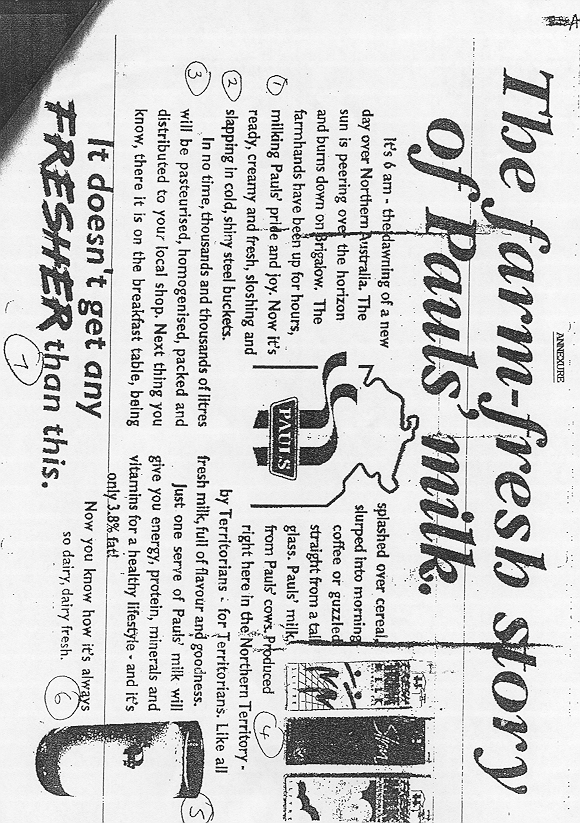
11 Pauls’ conduct, of which the ACCC complains, commenced with a poster that was allegedly published in or about July 1998. It is said that this poster was labelled “The farm-fresh story of Pauls’ milk” and it is alleged that the poster was published, for display by retailers, to the general public in the Northern Territory.
12 According to par 3 of the FASC, the poster depicted several of Pauls’ milk products and carried words including the following:
“(a) “The farm-fresh story of Pauls’ milk”;
(b) “It’s 6am – the dawning of a new day over Northern Australia. The sun is peering over the horizon and burns down on Brigalow. The farmhands have been up for hours, milking Pauls’ pride and joy …”;
(c) “In no time, thousands and thousands of litres will be pasteurised, homogenised, packed and distributed to your local shop. Next thing you know, there it is on the breakfast table …”;
(d) Pauls’ milk from Pauls’ cows. Produced right here in the Northern Territory …”;
(e) “It doesn’t get any fresher than this”; and
(f) “Now you know how it’s always so dairy, dairy fresh”;”
A copy of the poster appears as Annexure “A” to the FASC.
13 The ACCC has attacked the accuracy of the poster. In par 4 of the FASC it is alleged that Pauls represented to the public by means of the poster that the milk products:
“(a) were processed from raw milk obtained only from “Brigalow” (Brigalow Farms Pty Ltd, hereinafter referred to as “the Brigalow Dairy) in the Northern Territory;
(b) were supplied to consumers in the Northern Territory soon after the raw milk had been obtained from the Brigalow dairy;
(c) contained only raw milk supplied by the Brigalow dairy to Pauls; and
(d) were the only milk products produced from raw milk supplied by the Brigalow dairy.”
14 The four representations that have been identified in par 4 of the FASC are said to be misleading or deceptive or likely to mislead or deceive in relation to the milk products for five nominated reasons. Those reasons are set out in par 5 of the FASC and are repeated below:
“(a) the Brigalow dairy, which was the only dairy farm in the Northern Territory, did not provide the Respondent with all of the raw milk contained in the milk products;
(b) Malanda Dairyfoods Ltd (ACN 068 031 550) (“the Malanda dairy”) in Queensland provided the Respondent with most of the raw milk contained in the milk products;
(c) all of the milk products were processed from raw milk obtained from both the Brigalow and Malanda dairies which had been mixed together at the Respondent’s milk processing plant in the Northern Territory (“the processing plant”);
(d) the raw milk from the Brigalow and Malanda dairies which had been mixed together at the processing plant was also packaged under contract for the Malanda dairy, which was the Respondent’s major competitor in the Northern Territory; and
(e) most of the milk products were supplied to consumers between three and seven days after the raw milk had been obtained from the Brigalow and Malanda dairies.”
15 Having regard to the manner in which Pauls has complained about the repetitive nature of the ACCC’s pleading, it will be convenient to refer to the poster to which reference has been made above as “the first advertisement”.
16 Dealing with pars 3, 4 and 5 of the FASC, the written submissions that were filed on behalf of Pauls contain the following assertion:
“28 The Applicant’s case appears to depend on the proposition that the “story” told in paragraph 3 involves an implied representation that all raw milk used in the processing of the Respondent’s “white milk products” sold in the Northern territory comes from the Brigalow dairy. This is not expressly stated; nor is it an implication which can reasonably be drawn.”
17 I feel that this assertion must be rejected. In par 4 of the FASC, there is an express allegation that Pauls represented that the milk products “were processed from raw milk obtained only from Brigalow” (emphasis added) and in par 5 there is the allegation that the representations in par 4 were misleading or deceptive because the Brigalow dairy “did not provide the Respondent with all of the raw milk”. (emphasis added) There is no suggestion of an implied representation in the FASC, as asserted in counsel’s submission – far from it - there is an allegation that there was an express representation that all milk came from Brigalow.
The second advertisement
18 In par 6 of the FASC, the ACCC shifted its attack to what I will describe as “the second advertisement”. It is there pleaded that some six months later, in January and February 1999, Pauls published an advertisement entitled “LOCAL MILK – THE FACTS”. This advertisement appeared in the Northern Territory News, the Katherine Times and the Centralian Advocate. It is alleged that the advertisement depicted a carton of one of the milk products and carried the words:
“(a) “LOCAL MILK – THE FACTS”;
(b) “Fact 2: Pauls takes all the milk from dairy farms in the Territory”;
(c) “Fact 3: Pauls is the only dairy which employs over 140 local people”;
(d) “PAULS support local milk – local milk means local jobs!”; and
(e) “PAULS Our local milk”.”
A copy of the advertisement appears as Annexure “B” to the FASC.
19 The ACCC has also attacked the accuracy of this advertisement in pars 7 and 8 of the FASC. In compiling its attack, the pleader has followed the technique that was used in the preparation of pars 3, 4 and 5 of the FASC although, of course, some of the factual assertions that are the subject of complaint differ. In the first of the three paragraphs, there is the identification of the contents of the challenged advertisement. That is followed by a summary of the representations that are alleged to be found in the advertisement. Finally, there is the claim that the representations were misleading or deceptive or likely to mislead or deceive for the reasons that are listed in the third of the paragraphs. In the case of the second advertisement, it is alleged in par 7 that Pauls represented to the public by means of the advertisement that the milk products:
“(a) were processed from raw milk obtained from a number of dairy farms within the Northern Territory;
(b) contained only raw milk obtained from dairy farms in the Northern Territory;
(c) were “local”, in that they were processed from raw milk only obtained from within the Northern Territory;
(d) were directly responsible for the employment of over 140 persons in the processing plant; (emphasis added)
(e) contained only raw milk supplied by the Brigalow dairy to the Respondent; and
(f) were the only milk products produced from raw milk supplied by the Brigalow dairy.”
20 The six representations that have been identified in par 7 of the FASC are (as was the case with the four representations that are identified in par 4) said to mislead or deceive or to be likely to mislead or deceive in relation to the milk products. In this case, there are six nominated reasons in support of the complaint. They are found in par 8 of the FASC and are set out hereunder:
“(a) the Brigalow dairy did not provide the Respondent with all of the raw milk contained in the milk products;
(b) the Malanda dairy in Queensland provided the Respondent with most of the raw milk contained in the milk products;
(c) all of the milk products were processed from raw milk obtained from both the Brigalow and Malanda dairies which had been mixed together at the processing plant;
(d) the raw milk from the Brigalow and Malanda dairies which had been mixed together at the processing plant was also packaged under contract for the Malanda dairy, which was the Respondent’s major competitor in the Northern Territory;
(e) Brigalow was the only farm in the Northern Territory from which the Respondent obtained raw milk; and
(f) the milk products were directly responsible for the employment of substantially less than 140 persons in the processing plant.” (emphasis added)
When the language of subpars (a), (b), (c) and (d) of par 8 of the FASC is compared with the language that has been used by the pleader in subpars (a), (b), (c) and (d) of par 5, (see par 14 of these reasons) it can be seen that it is virtually the same. The fifth of the alleged representations that appears in par 5 (ie, that most of the milk was supplied within three to seven days) is not repeated in par 8 but two additional representations are advanced. They are those set out in subpars 8(e) and (f).
21 The presence of the words “in the processing plant” in subpars 7(d) and 8(f) is inappropriate. The words in the second advertisement are:
“Fact 3: Pauls is the only dairy which employs over 140 local people”.
That claim is not qualified by reference to the number who are employed in the processing plant. It is apparent that some corrections must be made to the FASC because of the inappropriate addition of the reference to “the processing plant”. There is another area of concern in respect of this particular issue of employment. In subpar 6(c), the allegation is that the advertisement claims that “Pauls is the only dairy which employs over 140 local people”. When, however, one comes to consider the alleged representation in subpar 7(d) we find that it is not alleged that “Pauls employ”; it is alleged that “the milk products” were directly responsible for the employment. Is this an accidental slip? Is there an issue of material significance in the change of language? It is not possible to say. It can, however, be said that it is not fair to leave a respondent wondering, not knowing the exact nature of the case that it is to meet.
The third advertisement
22 We come next to the third advertisement. Once again the same “three-way” pleading technique has been used. In par 9 there are set out details of the advertisement; par 10 makes the claimed identification of the representations and par 11 lists the complaints. It is alleged that in December 1998 and January 1999 Pauls published a full page advertisement in the Northern Territory News and the Sunday Territorian entitled:
“It doesn’t get any fresher than this …”
23 It is alleged that the third advertisement depicted cartons of the milk products and carried the words:
“(a) “Pauls Fresh Milk has been produced in the Territory for over 35 years”;
(b) “Not only is it daily refreshment, it employs over 150 Territorians …”; and
(c) “MILK THE TERRITORY’S OWN”
A copy of the advertisement appears as annexure “C” to the FASC.
24 As to this advertisement, the ACCC has alleged in par 10 of the FASC that Pauls represented to the public that the milk products:
“(a) had been “freshly” processed by the Respondent, (in that it was not milk which had been blended or reconstituted), in the Northern Territory for over 35 years;
(b) were directly responsible for the employment of over 150 (sic) persons in the processing plant; (emphasis added) and
(c) were processed from raw milk only obtained from within the Northern Territory.”
25 In par 11 of the FASC these representations are said to be misleading or deceptive or likely to mislead or deceive for the following reasons:
“(a) the Respondent had only been processing “fresh” milk since 31 October 1985;
(b) the milk products were directly responsible for the employment of substantially less than 140 (sic) persons in the processing plant; (emphasis added)
(c) the Brigalow dairy did not provide the Respondent with all of the raw milk contained in the milk products;
(d) the Malanda dairy in Queensland provided the Respondent with most of the raw milk contained in the milk products; and
(e) all of the milk products were processed from raw milk obtained from both the Brigalow and Malanda dairies which had been mixed together at the processing plant.”
Once again there are unjustified references to “the processing plant” in par 10(c) and par 11(b). Added to this is the unexplained reference to 140 persons in subpar 11(b) when subpar 10(b) claims that the third advertisement allegedly referred to 150 persons.
26 The complaint that is particularised in par 11(c) to the effect that the Brigalow dairy did not provide Pauls with all of the raw milk that is contained in the milk products, repeats the substance of the complaints that were made in subpars 5(a) and 8(a). The same can be said for the complaints in par 11(d) and par 11(e). Those complaints are repeats of what appears in subpars 5(b) and 8(b) on the one hand and subpars 5(c) and 8(c) on the other. The complaint that has been made in subpar 11(a) is novel to that paragraph but the complaint in subpar 11(b) to the effect that the milk products were directly responsible for the employment of substantially less than 140 persons “in the processing plant” is a direct repeat of the complaint that appears in subpar 8(f).
The repetitive pleadings
27 Further advertisements are said to have been published by Pauls. The fourth and fifth of them were television commercials (as to which see pars 12 and 15 of the FASC). They were said to have been published in January and February 1999. The sixth, seventh, eighth and ninth advertisements were alleged to be newspaper and other advertisements (such as sunhats, banners and milk cartons): see pars 18, 21, 24 and 27 of the FASC. In respect of each item of published material, the same technique has been used. First, there is a statement of the information that is depicted in the published material; that is then followed by particulars of the representations that were thereby said to have been made to the public; finally there is the concluding plea that the representations were misleading or deceptive or were likely to mislead or deceive and the reasons in support of that allegation are then set out. It is that style of drafting that has attracted the criticism of the respondent.
28 The pleader could have operated in one of two ways. Where he or she considered it appropriate to state a reason in support of an allegation of misleading or deceptive conduct that had earlier been stated in respect of another allegation, he or she could have adopted the device of that saying the applicant “repeats the allegation contained in subpar xyz hereof” or, as the pleader chose to do in this FASC, he or she could have repeated the reason on each occasion when the need arose.
29 I have, to date, summarised three, and otherwise referred to another six advertisements, all of which are the subject of complaints by the ACCC. In respect of each of the nine advertisements, the ACCC has pleaded that it contained one particular representation that was misleading or deceptive or that was likely to mislead or deceive. That representation was said to be, in each case, that the Brigalow dairy provided the Respondent with all of the raw milk contained in the milk products.
30 That allegation, using the same language, appears nine times – once in respect of each of the nine advertisements – see subpars 5(a), 8(a), 11(c), 14(b), 17(a), 20(a), 23(a), 26(a) and 29(a).
31 This technique is then used throughout the whole of the FASC. Thus the allegation that:
“the Malanda dairy in Queensland provided the Respondent with most of the raw milk contained in the milk products”
is stated nine times as is the allegation that:
“all of the milk products were processed from raw milk obtained from both the Brigalow and Malanda dairies which had been mixed together at the processing plant”.
On the other hand, the allegation that:
“Brigalow was the only farm in the Northern Territory from which the Respondent obtained raw milk”
is repeated only three times – see subpars 8(e), 17(e) and 20(e). But the allegation that
“the milk products were directly responsible for the employment of substantially less than 140 persons in the processing plant”
is repeated five times – see subpars 8(f), 11(b), 14(a), 17(f) and 20(f).
32 This summary is not exhaustive, but it is sufficient to identify the method of pleading.
Order 11 rule 3
33 The first of Pauls’ complaints is that the whole of the FASC should be struck out on the ground that it contravenes O 11 r 3 of the Federal Court Rules. That rule states:
“A pleading shall be as brief as the nature of the case admits.”
34 The structure that has been used in the drafting of the FASC – that is, the technique of repeating the same allegation - has undoubtedly increased the length of the pleading and, as is apparent, there are substantial areas of repetition. But the presence of repetitive allegations will only be objectionable if the repetition is unnecessary or could have, within reason, been avoided. I do not think that it could be said that these allegations were unnecessary. It must be remembered that the ACCC is complaining about nine advertisements, each of which was different in its substance. Each advertisement required individual consideration. If each consideration could arguably lead to an allegation that the same misrepresentation is to be found in each of the nine advertisements, then it is incumbent on the pleader to address that same complaint on each of the nine occasions. It then becomes a matter of style in determining whether it is best done by setting out, in full, the same allegation on nine separate occasions or by using a system of cross-referencing.
35 Undoubtedly, there would be advocates for both schools of thought. Personally, I find it tedious having to read one page of a document and then, as part of that reading, in a cross-referencing exercise, having to turn to another page to read part of the contents of that second page. But, having made that personal observation, I could hardly say that there is a fundamental objection to that method of pleading.
36 There are problems for the reader when the pleader uses the competing method of repeating each allegation. Has the same language been used on each occasion? The omission or addition of a word might not be observed on a casual reading of the document – and if there is such an omission or addition, was it accidental or deliberate? But subject to the tedium of comparing the language carefully, this method does have the attraction of permitting the reader to absorb the contents of different sections of the document in isolation without having to check back to other pages to pick up and digest cross-referenced material.
37 It was submitted on Pauls’ behalf that the repetition in the FASC has arisen through the pleader’s habit (which was described as an “idiosyncratic” habit) of pleading ultimate conclusions “bundled up with allegations of fact” rather than first pleading the facts and, thereafter, the conclusions that are said to be derived from those facts. For example, it is complained that par 5 of the FASC commences with the conclusion that:
“The representations referred to in paragraph 4 were misleading or deceptive or were likely to mislead or deceive in relation to the milk products …”
and is thereafter followed by the facts that are said to support that conclusion. It was argued that if the usual, logical and correct process of pleading the material facts had been employed, followed, thereafter, by the conclusions that were alleged to follow from those facts, the facts relied on could have been pleaded but once and the various conclusions, whether they be breaches of one or more provisions of the TPA could have then been pleaded by reference to those facts. The difficulty with this proposition is that it fails to have sufficient regard to the existence of nine separate advertisements and the need to address each of those advertisements separately. If, in respect of all nine advertisements, identical misrepresentations were pleaded, the present technique of repeating the same allegations on nine separate occasions would have been unnecessary and objectionable. It would have been appropriate to plead the existence of the misrepresentations once only - but in respect of all nine advertisements. But that is not the case here; there are no two advertisements in respect of which identical misrepresentations have been pleaded. Although there is much repetition, there is some difference in all nine allegations of misleading and deceptive conduct. This factor is the factor that, in my opinion, has justified the pleader’s methodology. In my opinion, the attack by Pauls on this method of drafting was not justified.
Annexing the advertisements
38 Mr Morris QC, counsel for the respondent, submitted that the ACCC fell into error by summarising the contents of the advertisements in the FASC and by then annexing the advertisements to the pleading. He submitted that the applicant could do one or the other but not both. This complaint applied to all nine advertisements but it will be sufficient to refer to one only. The first of the challenged advertisements (which carries the heading “The farm-fresh story of Pauls’ milk”) is set out as an annexure to these reasons. In par 3 of the FASC the applicant has alleged that it “carried words including” those that are then set out in the succeeding six subparagraphs.
39 Pauls seek to have all of par 3 struck out apart from the first sentence and the words in parenthesis at the end. Paragraph 3 of the FASC, which I have already quoted, is set out again: the words in bold type are those which the respondent seeks to have struck out.
“3. In or about July 1998 the respondent, in trade or commerce, published a poster labelled “The farm-fresh story of Pauls’ milk for display by retailers to the general public in the Northern Territory (“the Poster”): “The poster depicted several of the Respondent’s milk products and carried words including:
(a) “The farm-fresh story of Pauls’ milk”;
(b) “It’s 6am – the dawning of a new day over Northern Australia. The sun is peering over the horizon and burns down on Brigalow. The farmhands have been up for hours, milking Pauls’ pride and joy …”;
(c) “In no time, thousands and thousands of litres will be pasteurised, homogenised, packed and distributed to your local shop. Next thing you know, there it is on the breakfast table …”;
(d) Pauls’ milk from Pauls’ cows. Produced right here in the Northern Territory …”;
(e) “It doesn’t get any fresher than this”; and
(f) “Now you know how it’s always so dairy, dairy fresh”;”
(A copy of the poster is set out in Annexure “A” to the FASC.)”
40 Presumably, the purpose of this attack is to limit the ACCC to the contents of the first advertisement by denying it the opportunity of pleading “the effect” of the advertisement.
41 According to Mr Morris, the respondent is embarrassed and, so he said, “left in a quandary as to whether the applicant is merely putting in the poster for an inappropriate reason – that is, merely as evidence to back up what is pleaded in pars 3(a) to (f), or whether there’s a time bomb ticking away in the poster”. I must say that I thought this submission to be unduly alarmist but the issue was quickly resolved when Ms Ford stated that there was “no time bomb”.
42 There is, in my opinion, argument that supports the annexure of documents to a pleading in certain types of cases. In a case such as this, where there are nine different advertisements to consider, it informs the respondent from the outset which advertisement is the subject of various paragraphs of the statement of claim. Order 11 rule 4 permits a pleader “to state the effect of the document … without setting out the precise terms thereof”. By utilising this provision of the rules, the pleader identifies the relevant document and then pleads “the effect of the document”. If the applicant, at a later stage, believes that the document has some further “effect”, there may be an application to amend. If, at trial, the applicant sought to lead evidence of some further “effect” of the advertisement there would be a risk that an objection from the respondent would be upheld, either upon the basis that the evidence could not be led, or perhaps, with an adjournment with costs against the applicant. In no circumstance would a court allow an ambush of the type feared by Mr Morris. The short answer to this complaint is that the relevant rules are merely permissive; they permit a pleader to state the effect of a document – that does not prevent the pleader incorporating the document in its entirety and additionally stating its effect. No rule of general application can be laid down; each case must be decided on its particular facts. In this particular case, I have come to the conclusion that an intelligent reader of the FASC would be aided by the manner in which the pleader had gone about making the complaint about each advertisement whilst giving the reader the opportunity to consider for himself or herself the contents of the advertisement. In my opinion the submission that has been presented on behalf of Pauls based on the aggregation of stating the effect of a document and exhibiting a copy of the advertisement must be rejected.
Order 11 rule 16
43 In the event of it being unsuccessful in having the whole of the FASC struck out under O 11 r 3, the respondent seeks a series of alternative orders pursuant to O 11 r 16. That rule provides as follows:
“16. Where a pleading:
(a) discloses no reasonable cause of action or defence or other case appropriate to the nature of the pleading;
(b) has a tendency to cause prejudice, embarrassment or delay in the proceeding; or
(c) is otherwise an abuse of the process of the Court;
the Court may at any stage of the proceeding order that the whole or any part of the pleading be struck out.”
The respondent claims that the FASC offends each of the proscriptions in pars (a), (b) and (c) of rule 16.
44 The manner in which Pauls has attacked the FASC in this alternative approach is almost the same in respect of each of the nine advertisements. I will deal with the first advertisement. The respondent seeks to have pars 3 to 5 struck out – they being the paragraphs that deal exclusively with the first advertisement. As part of this attack, Pauls also seeks orders striking out subpars 30(a), 31(a), 33(a) and 34(a). Subparagraph 30(a) of the FASC, so far as relevant, is as follows:
“30. By reasons of the matters alleged in paragraphs:
(a) 3, 4 and 5; …
…
the Respondent, in trade or commerce, engaged in conduct that was misleading or deceptive or likely to mislead or deceive, contrary to Section 52(1) of the Act.”
Subparagraph 31(a) of the FASC pleads:
“31. Further or alternatively, by reason of the matters alleged in paragraphs:
(a) 3, 4 and 5; …
…
the Respondent, in trade or commerce, in connection with the supply of the milk products, or in connection with the promotion of the supply of the milk products, falsely represented that the milk products were of a particular quality or composition contrary to Section 53(a) of the Act.”
45 Subparagraphs 33(a) and 34(a) follow in the same vein, alleging breaches of pars 53(c) and 53(eb) of the TPA. The effect of this application if successful, would be to strike down the applicant’s case with respect to the first advertisement. Similar attacks have been made on the remaining eight advertisements.
46 The argument upon which Pauls based this claim was that nowhere is it alleged that the words that are set out in par 3 of the FASC, and upon which the ACCC relies, are other than literally true. That proposition cannot stand up. The pith and substance of the case against Pauls is that the words were representations to the public that were misleading or deceptive or were likely to mislead or deceive. The pleading would have been better expressed if it had said that the representations amounted to conduct that was misleading or deceptive or that it was conduct that was likely to mislead or deceive but I do not understand that to be Pauls’ complaint. Even if it was, it would not be an error of such magnitude as to warrant striking down these paragraphs in the FASC. There is, in my opinion, a reasonably clear pattern in the pleading which, using the first advertisement and a claimed breach of s 53(a) of the TPA as an example, can be rationalised this way: par 3 of the FASC identifies words in the advertisement, par 4 claimed that the words amounted to representations to the public, and par 5 alleged that those representations were misleading or deceptive or were likely to mislead or deceive. Par 31(a) of the FASC is then used to plead that by reasons of all those matters:
“… the Respondent, in trade or commerce, in connection with the supply of the milk products, or in connection with the promotion of the supply of the milk products, falsely represented that the milk products were of a particular quality or composition contrary to Section 53(a) of the Act.”
Accepting, only for the purposes of these reasons, that the ACCC can make good the allegations that are contained in the FASC, this seems to me to establish a good cause of action. It is not necessary to set out, in full, the arguments with respect to the claim that no cause of action is disclosed in pars 30(a), 33(a) and 34(a). These are the paragraphs where it is alleged that Pauls, in trade or commerce, engaged in conduct that was misleading or deceptive or likely to mislead or deceive, (contrary to s 52 of the TPA) and Pauls represented that the milk products had benefits that they did not have (contrary to s 53(c)) and that it made a false or misleading representation concerning the place of origin of the milk products (contrary to s 53(eb)).
47 Pauls have made independent submissions that the contents of the FASC in respect of each of the remaining eight advertisements should also be struck out. The groupings of the relevant provisions in the FASC and their relationship to the different advertisements are as follows:
|
2nd Advertisement: |
Paragraphs 6, 7, 8, 30(b), 31(b), 33(b), and 34(b) |
|
3rd Advertisement: |
Paragraphs 9, 10, 11, 30(c), 33(c) and 34(c) |
|
4th Advertisement: |
Paragraphs 12, 13, 14, 34(d), 31(c) and 33(d) |
|
5th Advertisement: |
Paragraphs 15, 16, 17, 30(e), 31(d), 33(e) and 34(e) |
|
6th Advertisement: |
Paragraphs 18, 19, 20, 30(f), 31(e), 33(f) and 34(f) |
|
7th Advertisement: |
Paragraphs 21, 22, 13, 30(g), 31(f), 33(g) and 34(g) |
|
8th Advertisement: |
Paragraphs 24, 25, 26, 30(h), 31(g), 33(h) and 34(h) |
|
9th Advertisement: |
Paragraphs 27, 28, 29, 30(i), 31(h), 33(i) and 34(i) |
48 I do not consider that it is necessary to make an individual examination of these provisions of the FASC nor do I consider it necessary to give specific attention to the respondent’s submissions in respect of them. The pleadings follow the pattern that I have identified and the respondent’s submissions are, in substance, a repeat of the arguments that I have already identified. There are some errors in these sections of the FASC which I have not identified for example, where they are merely the same errors that have earlier been identified. As an example, I refer to pars 18 and 19 of the FASC which deal with the sixth advertisement, a newspaper advertisement entitled “Look for the Local Code”. It is claimed in par 18 that the advertisement carried the words, “Pauls is the only dairy which employs over 140 local people” but in par 19 the same mistake of referring to employees in the processing plant has been used. For the reasons that I have set out, I cannot agree that pars 3, 4 5 fail to disclose any cause of action.
49 As part of this attack, the respondent also seeks to have pars 4(d) and 5(d) struck out.
50 Those paragraphs provide as follows:
“4. The Respondent represented to the public by means of the poster that the milk products:
…
(d) were the only milk products produced from raw milk supplied by the Brigalow dairy.
…
5. The representations referred to in paragraph 4 were misleading or deceptive or were likely to mislead or deceive in relation to the milk products, in that:
…
(d) the raw milk from the Brigalow and Malanda dairies which had been mixed together at the processing plant was also packaged under contract for the Malanda dairy, which was the Respondent’s major competitor in the Northern Territory... .”
51 In my opinion, Pauls’ complaints in this area are, in reality, addressing evidentiary issues. Pauls accept that the “story” that is conveyed in par 3 of the FASC applies to milk obtained by it from the Brigalow dairy; it also accepts that it takes all of the milk that is produced at Brigalow. But it poses this question: would any consumer reasonably apprehend that the specific dairy that is featured in the first advertisement accounts for all of Pauls’ white milk products? It was submitted that this question leads to the further question! Does s 52 and the other provisions in Pt V of the TPA prevent manufacturers and distributors from highlighting the most attractive stages in their train of supply? I do not shy away from the importance of those questions. In fact, the first of them goes to the heart of the ACCC’s complaint. However, they are questions for the trial judge, to be determined after all the evidence has been tendered. Neither question can fairly be disposed of at this interlocutory level. In par 3 the “story” that is told is one that purports to be about “Pauls’ milk”. It claims that the farm hands are milking “Pauls’ pride and joy”; the poster talks of “Pauls’ milk from Pauls’ cows. Produced right here in the Northern Territory …”. There is an arguable element of proprietorial right. It might be interpreted that it means that Brigalow alone supplies milk to Pauls. Should such an interpretation be correct – and all I can say at this stage is that such a finding might be open to the trial judge – then the ACCC could lead evidence to establish its allegations in par 5(d) to the effect that raw milk from the Malanda dairy was mixed with Brigalow’s milk and the resulting mixture was sold to the public under both brand names.
52 Having considered the submissions that have been advanced on behalf of Pauls, it seems to me, as I have said, that several of them have to be classified as complaints at the evidentiary level. An example of what I have in mind is the respondent’s complaint about the allegation that is contained in subpar 7(b) of the FASC, that is, the allegation that the milk products “contained only raw milk obtained from dairy farms in the Northern Territory”. As I understand the effect of the respondents’ complaint, it is that no such interpretation could reasonably be drawn from the advertisement. That may, at the end of the day, prove to be correct, but it is not a helpful submission on a strike out application. At this interlocutory level, one has to note that the relevant advertisement (which is the second advertisement, the effect of which is set out in par 17 hereof) may be capable of supporting the inference that has been pleaded. The evidence at trial may be sufficient to justify a finding that the use of the word “local”, in combination with the reference to taking “all the milk from dairy farms in the Territory”, amounted to a false representation that the respondent’s milk products contained only raw milk that had been obtained from dairy farms in the Northern Territory. Whether the relevant advertisements did make all of the representations alleged in the statement of claim and whether such representations were in breach of the Act will ultimately be for the trial judge to decide. The fact that the respondent disputes the applicant’s interpretation does not make the pleading defective. I do not accept that these complaints nor the method of pleading that has been used had a tendency to cause prejudice, embarrassment or delay, nor do I consider it to be an abuse of the process of the Court.
Paragraph 25
53 In par 25 of the FASC a separate issue arises; in that par it is alleged as follows:
“25 The respondent represented to retailers and to the public by means of the said cartons that the milk products contained within the cartons:
(a) were “local”, in that they were processed from raw milk only obtained from within the Northern Territory; and/or
(b) were processed from raw milk only obtained from within the Northern Territory.”
54 It is said, by way of complaint, that the allegations that are contained in these two subpars are substantially repetitive. I agree. In par (a) the commencing words “were ‘local’ in that they” do not appear in par (b) but the balance of the language in par (a) is repeated verbatim in par (b). In my view the whole of subpar (b) should be struck out as a repetitive pleading. Paragraph 25 is part of the pleadings that deal with the eighth advertisement. In par 24 it is alleged as follows:
“On a date unknown to the Applicant, but prior to December 1998, the Respondent, in trade or commerce, supplied its fresh milk products in cartons to retailers for sale to the public in the Northern Territory. The said cartons contained the words:
(a) “Your local N.T. full cream milk”; and
(b) “MILK THE TERRITORY’S OWN”; or
(c) “TRIM THE TERRITORY’S OWN”; or
(d) “SLIM THE TERRITORY’S OWN”; or
(e) “THE TERRITORY’S OWN HIGH CALCIUM PhysiCAL”.
(Copies of the said cartons are set out in “Annexure G” which is annexed hereto.)”
55 In par 26, it is pleaded:
“The representation referred to in paragraph 25 was misleading or deceptive, or was likely to mislead or deceive in relation to the milk products, in that:
(a) the Brigalow dairy did not provide the Respondent with all of the raw milk contained in the milk products;
(b) the Malanda dairy in Queensland provided the Respondent with most of the raw milk contained in the milk products; and
(c) all of the milk products were processed from raw milk obtained from both the Brigalow and Malanda dairies which had been mixed together at the processing plant.”
56 Pauls complained that the process of reasoning that led to the ultimate conclusion, as pleaded in par 26, was, what it described as, “tenuous, at best, involving two “leaps of faith!” They were said to be, first, that the use of the words “The Territory’s own” involved an implication that all raw milk that was used in processing the milk products was obtained in the Northern Territory and, secondly, that because more than half of the raw milk came from Queensland, it made it false to describe the milk as “The Territory’s Own”. The complaints, may, in the end, turn out to be justified. But that will be for the trial judge to determine after hearing all the evidence. The pleadings are not attended by that required degree of uncertainty that is necessary to justify a strike out application.
Conclusion
57 These reasons have, of necessity, been longer than is normal in a strike out application. This has been occasioned because of the extensive attacks that have been made on the composition of the FASC. I have not mentioned all of the attacks: in some cases, because I did not think them to be of sufficient importance to warrant detailed consideration. I have noted the areas where, in my opinion, there are important deficiencies in the FASC; those deficiencies are of such a nature that the best course of action is to strike out the FASC with leave to file and serve a fresh pleading. In composing that fresh pleading, I would counsel the pleader to have regard, not only to these reasons, but also to the other complaints of the respondent. Not all were justified but recognition of some of them will enhance the quality of the next version of the statement of claim. As an example I point to the expression in par 3 of the FASC – “It doesn’t get any fresher than this …”. There was much debate over the proper inference to draw from that statement. In subpar 5(e) the ACCC claimed that this statement amounted to misleading or deceptive conduct because most of the milk products were supplied to consumers between three and seven days after the raw milk had been obtained from the dairies. What meaning is attributable to the word “fresh” and its derivatives? Is it temporal? That is, three to seven days is not fresh. Or is it comparative? That is, no other supplier of milk gets its milk to its consumers in a shorter space of time? Another small curiosity in the area of “fresh” milk is that the third advertisement (see pars 9, 10 & 11) contains the same statement: “It doesn’t get any fresher than this …”. Despite the treatment of that statement in pars 3, 4 and 5 (dealing with the first advertisement) the pleader did not plead in par 11 that the third advertisement was misleading or deceptive for the reason that it took three to seven days to supply the milk to consumers.
58 The task of preparing, in pleading form, the three-part exercise in respect of nine different advertisements is a painstaking and laborious one. But that cannot excuse laxity. The respondent is entitled to know, exactly, the case that it is to meet in respect of each of those advertisements. Although the respondent has not been wholly successful in its attacks on the FASC, the degree of its success, coupled with the existence of some glaring errors in the pleading, are sufficient to justify the respondent having its costs. I will allow the ACCC twenty-eight days from this date within which to file a second further amended statement of claim. The earlier order (see par 7 hereof) that the ACCC supply further and better particulars of certain provisions of the FASC may, if it be appropriate, be satisfied in whole or in part, by addressing the requests for particulars in the next statement of claim.
|
I certify that the preceding fifty-eight (58) numbered paragraphs are a true copy of the Reasons for Judgment herein of the Honourable Justice O’Loughlin. |
Associate:
Dated:
|
Counsel for the Applicant (the applicant on the Motion): |
Mr A J H Morris QC |
|
|
|
|
Solicitor for the Applicant: |
Biggs & Biggs |
|
|
|
|
Counsel for the Respondent (the applicant on the Motion: |
Ms E Ford |
|
|
|
|
Solicitor for the Respondent: |
Australian Government Solicitor |
|
|
|
|
Date of Hearing: |
29 September 1999 |
|
|
|
|
Date of Judgment: |
21 December 1999 |