FEDERAL COURT OF AUSTRALIA
Roxborough v Rothmans of Pall Mall Australia Ltd
[1999] FCA 1535
CONTRACTS – contract between wholesaler and retailer – wholesaler passed on to retailer a tax by way of a “licence fee” – terms – implied term – whether term as to refund, by wholesaler to retailer, of “licence fee” in certain circumstances an implied term of contract – relevance of proposition that each party, if successful, stood to make a windfall gain – restitution – total failure of consideration – whether wholesaler undertook to perform particular obligation in consideration of payment to it by retailer of “licence fee” – unjust enrichment – nature of concept – whether retention of payments by wholesaler “unjust” in the absence of express or implied term requiring refund and of total failure of consideration – restitution – mistake – whether full amount payable by retailer to wholesaler, including “licence fee”, due as a matter of contract – whether alleged mistake caused payment of “licence fee”
TRUSTS – constructive trust – “personal” and “proprietary” constructive trusts – whether retailer paid “licence fees” to wholesaler in circumstances where constructive trust should be declared or imposed upon wholesaler in favour of retailer
TRADE PRACTICES – conduct that is misleading or deceptive – whether alleged representation as to future matter made in wholesaler’s invoice to retailers specifying an amount for “licence fee”
WORDS AND PHRASES – “unjust enrichment” – “constructive trust”
Trade Practices Act 1974 (Cth) s 51A and s52
Business Franchise Licences (Tobacco) Act 1987 (NSW) s 41(3)
Ha v State of New South Wales (1997) 189 CLR 465 applied
Walter Hammond & Associates Pty Ltd v State of New South Wales (1997) 189 CLR 465 applied
Dennis Hotels Pty Ltd v The State of Victoria (1960) 104 CLR 529 cited
Dickenson’s Arcade Pty Ltd v The State of Tasmania (1974) 130 CLR 177 cited
Phillip Morris Limited v The Commissioner of Business Franchises (Victoria) (1989) 167 CLR 399 cited
Commissioner of State Revenue (Victoria) v Royal Insurance Australia Ltd (1994) 182 CLR 51 discussed
Ling v Commonwealth of Australia (1994) 51 FCR 88 distinguished
BP Refinery (Westernport) Pty Ltd v Shire of Hastings (1977) 180 CLR 266 applied
Baltic Shipping Co v Dillon (1993) 176 CLR 344 applied
Shirlaw v Southern Foundries (1926) Ltd [1939] 2 KB 206 cited
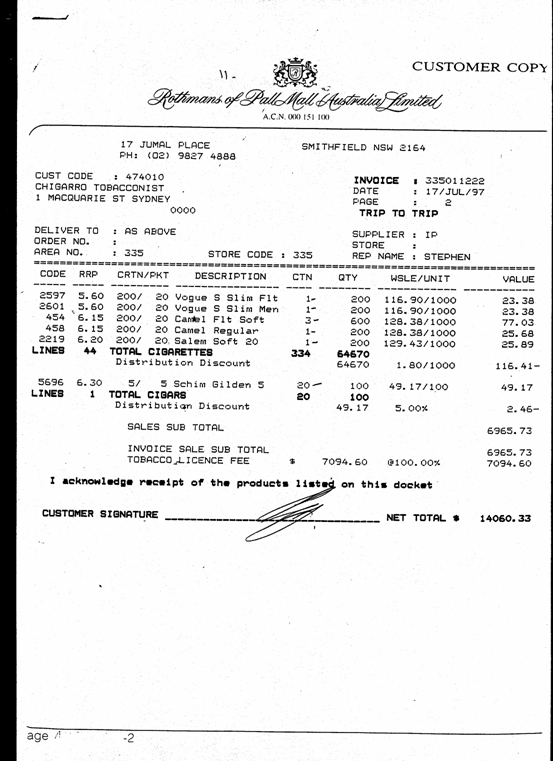
Pavey & Mathews Pty Ltd v Paul (1987) 162 CLR 221 discussed
David Securities Pty Ltd v Commonwealth Bank of Australia (1992) 175 CLR 353 applied
Woolwich Equitable Building Society v Inland Revenue Commissioners [1993] AC 70 distinguished
Hirst v Tolson (1850) 2 Mac & G 134 disapproved
Muschinski v Dodds (1985) 160 CLR 583 distinguished
Sabemo Pty Ltd v North Sydney Municipal Council [1977] 2 NSWLR 880 distinguished
Barclays Bank Ltd v Quistclose Investments Ltd [1970] AC 567 referred to
Re Australian Elizabethan Theatre Trust; Lord v Commonwealth Bank of Australia (1991) 30 FCR 491 applied
Giumelli v Giumelli (1999) 161 ALR 473 discussed
123 East Fifty‑Fourth Street, Inc v United States 157 F 2d 68 discussed
Decorative Carpets, Inc v State Board of Equalization 373 P 2d 637 referred to
Baumgartner v Baumgartner (1987) 164 CLR 137 distinguished
Westdeutsche Landesbank Girozentrale v Islington London Borough Council [1996] AC 669 cited
Commonwealth Quarries (Footscray) Pty Ltd v Commissioner of Taxation (Cth) (1938) 59 CLR 111, cited
Tanu Pty Ltd v Commissioner of Taxation (Cth) (1999) 160 ALR 227, referred to
Stephens v The Queen (1978) 139 CLR 315, referred to
Maxitherm Boilers Pty Ltd v Pacific Dunlop Ltd [1998] 4 VR 559, cited
Chattis Nominees Pty Ltd v Norman Ross Homeworks Pty Ltd (in Liq) (1992) 28 NSWLR 338, cited
Hussey v Horne-Payne (1879) 4 App Cas 311, cited
Howard Smith & Co Ltd v Varawa (1907) 5 CLR 68, cited
Panorama Development (Guildford) Ltd v Fidelis Furnishing Fabrics Ltd [1971] 2 QB 711, cited
Hospital Products Ltd v United States Surgical Corporation (1984) 156 CLR 41, cited
Australian Broadcasting Corporation v XIVth Commonwealth Games Ltd (1988) 18 NSWLR 540, cited
Hawkins v Clayton (1988) 164 CLR 539, cited
Byrne v Australian Airlines Ltd (1995) 185 CLR 410, applied
Fibrosa Spolka Akcyjna v Fairbairn Lawson Combe Barbour Ltd [1943] AC 32, applied
Rugg v Minett (1809) 11 East 210, referred to
Dimskal Shipping Co SA v International Transport Workers Federation [1992] 2 AC 152, considered
Goss v Chilcott [1996] AC 788, cited
Commonwealth v Ling (1993) 44 FCR 397, cited
ALEXANDER GARNET ROXBOROUGH AND GWENETH JOYCE ROXBOROUGH (t/as SANDY’S TOBACCONIST) AND BRUCE ALLDIS (formerly t/as SMOKE KING) AND ARISTOTLE BALATSIAS (t/as CHIGARRO TOBACCONIST) AND EYEARN PTY LIMITED (t/as DEEPWATER PLAZA TOBACCONIST) AND RODNEY WHITE AND SUSAN WHITE (t/as GUNSMOKE TOBACCONIST) AND GRAHAME COOK (t/as TAMWORTH PLAZA TOBACCONIST) AND PETER HEFFERNAN AND CHRISTINE HEFFERNAN (t/as PETER & CHRISTINE TOBACCONIST) v ROTHMANS OF PALL MALL AUSTRALIA LIMITED
N 199 OF 1999
HILL, LEHANE AND GYLES JJ
11 NOVEMBER 1999
SYDNEY
| IN THE FEDERAL COURT OF AUSTRALIA |
|
| N 199 OF 1999 |
THE COURT ORDERS THAT:
1. The appeal be dismissed.
2. The appellants pay the respondent’s costs.
Note: Settlement and entry of orders is dealt with in Order 36 of the Federal Court Rules.
| IN THE FEDERAL COURT OF AUSTRALIA |
|
| N 199 OF 1999 |
| BETWEEN: | ALEXANDER GARNET ROXBOROUGH AND GWENETH JOYCE ROXBOROUGH (t/as SANDY’S TOBACCONIST) First Appellant
|
|
| BRUCE ALLDIS (formerly t/as SMOKE KING) Second Appellant
|
|
| ARISTOTLE BALATSIAS (t/as CHIGARRO TOBACCONIST) Third Appellant
|
|
| EYEARN PTY LIMITED (ACN 002 369 075) (t/as DEEPWATER PLAZA TOBACCONIST) Fourth Appellant
|
|
| RODNEY WHITE AND SUSAN WHITE (t/as GUNSMOKE TOBACCONIST) Fifth Appellant
|
|
| GRAHAME COOK (t/as TAMWORTH PLAZA TOBACCONIST) Sixth Appellant
|
|
| PETER HEFFERNAN AND CHRISTINE HEFFERNAN (t/as PETER & CHRISTINE TOBACCONIST) Seventh Appellant
|
| AND: | ROTHMANS OF PALL MALL AUSTRALIA LIMITED (ACN 000 151 100) Respondent
|
| JUDGES: | HILL, LEHANE AND GYLES JJ |
| DATE: | 11 NOVEMBER 1999 |
| PLACE: | SYDNEY |
REASONS FOR JUDGMENT
HILL AND LEHANE JJ:
1 Each of the appellants is a tobacco retailer. Each at the relevant time in 1997 carried on business in New South Wales. Each was the holder of a retailer’s licence under the Business Franchise Licences (Tobacco) Act 1987 (NSW), (“the Act”). The respondent, Rothmans of Pall Mall Australia Limited (“Rothmans”), in the relevant time sold tobacco products by wholesale to the appellants and others. Rothmans was the holder of a wholesaler’s licence under the Act.
2 On 5 August 1997 the High Court delivered judgment in Ha v State of New South Wales and Walter Hammond & Associates Pty Ltd v State of New South Wales (1997) 189 CLR 465. It held that the Act was invalid as imposing a duty or duties of excise. In the result it was no longer necessary for either wholesalers or retailers of tobacco products to be licensees under the Act or to pay licence fees which the Act purported to impose as part of the licensing scheme. However, the licence fees, which were payable monthly, were imposed by reference to tobacco sales in a preceding period. It will be necessary to set out more fully the legislative scheme.
3 The effect of the contractual relationship between Rothmans and the retailers was that the licence fees which Rothmans were liable to pay each month were borne by the retailers. Because the licence fees were payable by reference to past sales the consequence of the Act being declared invalid was that Rothmans made a windfall profit. It was no longer liable to pay a licence fee by reference to sales it had made to retailers in the period from 28 June to 5 August 1997 although the amount of the licence fees relating to these sales had been in effect paid in advance to it by the retailers. In the present proceedings, which were brought as a representative proceeding under Part IVA of the Federal Court of Australia Act 1976 (Cth), the appellants (“the Retailers”) sought to recover from Rothmans what the application refers to as:
“amounts paid … to the Respondent which were identified in the Respondent’s invoices to the Applicants as licence fees under the Act in the period 1 July 1997 to 5 August 1997 and before the decision of the High Court in Walter Hammond, which amounts were retained by the Respondent following that decision.”
4 The jurisdiction of the Court was attracted as a result of the Retailers claiming that Rothmans had breached s 52 of the Trade Practices Act 1976 (Cth) and claiming orders under s 87 of that Act.
The constitutional background and legislative scheme
5 The conceptual framework of the Act had its origins in the decisions of the High Court in Dennis Hotels Pty Ltd v The State of Victoria (1960) 104 CLR 529 and Dickenson’s Arcade Pty Ltd v The State of Tasmania (1974) 130 CLR 177.
6 In the former case a majority of the High Court held that licensing provisions in the Licensing Act 1958 (Vic) other than a provision which fixed the fee for certain temporary licences, did not impose a duty of excise. In the latter, the High Court held that the Tobacco Act, 1972 (Tas) was valid in imposing a system of tobacco licensing where the licence fee payable was calculated by reference to tobacco sales in a period of twelve months ending six months before the commencement of the period in respect of which the licence was granted. The reasoning of the High Court in reaching this conclusion depended not so much on the form of the legislation as one of licensing, but rather upon the fact that the licence fee was not imposed directly on goods (that is to say the goods that would be sold during the relevant licence period), but by reference to amounts representing goods sold in the past. There was no necessary relationship between the licence fee and sales made during the currency of the licence.
7 The Parliament of New South Wales enacted the Business Franchise Licences (Tobacco) Act (Act No 63 of 1975) shortly after the decision of the High Court in Dickenson’s Arcade. The 1987 Act replaced the earlier 1975 legislation, which itself had been amended from time to time, but followed the basic legislative design of it.
8 Following the decision of the High Court in Phillip Morris Limited v The Commissioner of Business Franchises (Victoria) (1989) 167 CLR 399 it was recognised that the process of reasoning in Dickenson’s Arcade Pty Ltd v Tasmania was flawed. In particular the proposition that merely because a tax was to be quantified by reference to sales in a past period, rather than directly imposed by reference to the value of particular goods sold meant that the tax was not a duty of excise had been rejected. So too had any suggestion that the form of a tax as a fee paid under a system of licensing prevailed over its substance as a tax. However, in Phillip Morris a majority of the High Court suggested that a fee imposing a licensing scheme would not be a duty of excise if the imposition of the license fee was an element in regulatory legislation controlling the sale and distribution of a particular commodity (see at 439 in the judgment of Mason CJ and Deane J). So Dennis Hotels and Dickenson’s Arcade were treated as authority for the proposition that in the special field of licenses to sell alcohol and tobacco a license fee which would otherwise be regarded as a duty of excise would not be so regarded if properly to be characterised as a fee for carrying on business and if calculated by reference to sales made during a period other than the period of the license.
9 The decision of the majority of the High Court (Brennan CJ, McHugh, Gummow and Kirby JJ) in Ha ultimately rejected even the possibility that special exceptions such as alcohol and tobacco might exist. The majority referred (at 497) to the present New South Wales legislation with which the High Court was concerned, as involving “a simple device in legislative drafting”. The majority asserted the supremacy of substance over form, the need to examine the practical operation of the legislation rather than relying on the mere drafting device of tobacco licensing which had been adopted. The fact that the tax was 100%, the fact that the relevant licence period was short (1 month), the fact of the proximity between the period in respect of which the fee was to be calculated and the period of the licence, and the fact that the scheme of the legislation was that the fee was borne once only in the course of tobacco distribution were factors which assisted the conclusion that the effect of the legislation was the invalid imposition of a duty of excise.
10 The starting point of the Act, in the form it took during the relevant period, was Part 4 (ss 27A to 33) which provided, inter alia, that it was an offence to carry on a business of tobacco wholesaling or tobacco retailing without a licence. Relevantly there were two kinds of licence, a tobacco wholesaler’s licence (s 34 (a) ) and a tobacco retailer’s licence (s 34(b)). Licences under the Act had a currency of one month. They expired in the usual case at the end of the 27th day of the month: s 39.
11 A person desiring a licence was required to make an application accompanied by payment of a licence fee as assessed under Part 5 of the Act. However, if before expiry of a licence, the licensee paid the fee assessed for a further licence the licensee was taken to have applied for a renewal and taken to have been granted a renewed licence from the expiration of the previous licence, unless otherwise notified: s 40(1). If the payment of the licence fee was made after the end of the 27th day the Chief Commissioner was authorised to direct that the licence be regarded as having been renewed from the date the previous licence expired.
12 The assessment of licence fees was provided for in s 41 of the Act. The relevant subsections of that section were in the following terms:
“(1) The fees to be paid for licences are as follows:
(a) for a wholesaler’s licence – a fee of $10 together with an amount equal to 100 per cent of the value of tobacco sold by the applicant in the course of tobacco wholesaling during the relevant period, other than tobacco sold to the holder of a wholesaler’s licence …
(b) …
(c) for a retailer’s licence – a fee of $10 together with an amount equal to 100 per cent of the value of tobacco sold by the applicant in the course of tobacco sold by the applicant in the course of tobacco retailing during the relevant period, disregarding any such tobacco purchased from a licensee ...
(2) …
(3) For the purposes of subsection (1)(c) and (d), the value of tobacco purchased from the holder of a wholesaler’s licence …is to be disregarded only if the holder of the licence has paid or is liable to pay a licence fee in respect of that tobacco.”
(Subsection (3) was introduced into the Act by the State Revenue Legislation (Further Amendment) Act 1992 (Act No 86 of 1992)).
13 The relevant period in relation to a licence referred to in s 41 was defined in s 3 of the Act as:
“the month commencing 2 months before the commencement of the month in which the licence expires.”
An applicant who had not carried on business in the whole or any part of the relevant period as so defined could request the Commissioner to assess a licence fee under s 43(1). An applicant for a licence who had carried on business in the whole of the relevant period but had difficulty in accurately assessing the quantity or the value of tobacco sold during the period could likewise seek an assessment by the Chief Commissioner.
14 The value of tobacco, an ingredient of the licence fee to be calculated was to be determined by the Minister. On 9 June 1988 the Minister determined that the value of tobacco should be:
“The wholesale list price for tobacco as published from time to time by tobacco manufacturers and importers, excluding … any amount included in the selling price in consideration of a license fee.”
15 In addition to committing an offence for trading without a licence, a person who was required to be licensed, but was not, was liable to pay to the Chief Commissioner an amount equal to the licence fee that would have been payable for the licence had one been applied for and granted together with a penalty of twice that amount.
16 In summary, therefore, a wholesaler was required to renew a licence on or before midnight on the 27th of each month. To do so the wholesaler was required to pay a licence fee of $100 together with an amount equal to 100% of the value of the tobacco sold by the wholesaler in the month ending one month before the date the licence was required to be renewed. A licence for the period 28th June to 27th July required payment of a licence fee calculated by reference to the monetary value of sales the wholesaler had made in the period 28th April to 27th May, calculated by reference to wholesale list price. A retailer seeking to renew in respect of the same period was required to pay a licence fee of $100 together with an amount equal to 100% of the sales it had made in the period 28th April to 27th May, but calculated by reference to the wholesale list price, rather than actual retail sale price or other price received. However, there was to be excluded from this calculation the value of any tobacco sold which the retailer had purchased from, relevantly, a licensed wholesaler – subject to the provisions of s 41(3), which will be considered later in these reasons. In the normal course of events, on any construction of s 41(3), the retailer paid only $100 for renewal of the retailer’s licence, the tax having been exacted at the wholesale level.
The contractual relationship between the parties
17 Since the ministerial determination of the value of tobacco required that there be published by tobacco wholesalers a wholesale list price for tobacco Rothmans from time to time published price lists for tobacco which it sold by wholesale. The price list which was current at the relevant time contained 5 columns. In the first column there was described the particular brand of cigarettes. The second column showed the quantity of cigarettes of that brand contained in the carton. The third column, which was headed “Wholesale price per 1000”, stated the wholesale list price which was the value of tobacco upon which the licence fee was to be calculated. The fourth column was headed “Cost at wholesale including State licence fees 100%”. The figure in this column was the wholesale list price per carton to which was added the 100% licence fee. The final column was headed “Recommended Retail price per packet including state license fees 100%”. This column is self explanatory.
18 Some time before the period in question each of the Retailers had completed a form of request to Rothmans for a commercial trading account. In so doing each agreed to comply with Rothmans’ trading terms and conditions. These were stated to be as follows:
“1. In these conditions of sale:
(a) ‘Company’ and ‘Seller’ means [Rothmans].
(b) ‘Purchaser’ means the person, firm or company placing an order with the Seller in respect of the supply of Goods …
(c) ‘Goods’ means all goods and merchandise supplied by Seller pursuant to these Conditions the Purchaser or as the Purchaser may direct.
…
4. The prices charged by the Company as set out in the Company’s applicable list may be altered without notice and any resulting increase shall be added to the purchase price. Such price or prices quoted on purchases from the Company are subject to any increase in the amount of excise duty, sales tax, freight or insurance between the date of order and the date of delivery and any such amount shall be added to the purchase price and be payable by the Purchaser to the Company.
…
6. The Purchaser shall pay for all Goods delivered within 7 days from the date of receipt of the Goods (‘Due Date’) …
7. On the happening of any one or more of the following events, namely:
(a) the Purchaser fails to pay the Seller and when due and payable any moneys comprised in the Purchaser’s debt (such moneys being due and payable at the time expressly agreed between the Purchaser and the Seller herein and in default of such agreement according to the normal terms of trade of the Seller or, in respect of amounts not covered by the Seller’s ordinary terms of trade, on demand by the Seller);
…
the seller may at its option exercise all or any of the following rights …
(i) demand payment of the whole of the Purchaser’s debt then outstanding, and the Purchaser agrees to pay the same accordingly.
…
10. … until payment is made in full to the Seller for the Goods:
(a) property in the Goods remains with the Seller and the Purchaser agrees to hold the Goods in a fiduciary capacity as bailee for Seller …”
19 Rothmans, consequent upon an order placed by a retailer for cigarettes, issued a form of invoice. It may be noted that by force of s 66(2) of the Act Rothmans was required to issue an invoice in relation to any sale of tobacco it made. Invoices were to be numbered consecutively and a copy was required to be kept for at least 6 years. In addition, by virtue of s 66(1), Rothmans was obliged to keep such records containing such particulars as might be prescribed by Regulation. Regulation 14(1) of the Regulations prescribed under the Act required a tobacco wholesaler to keep separate records showing, inter alia, for each invoice which it issued under s 66(2) the quantity and value of each brand of tobacco sold. A retailer was required to retain for 6 years the invoice supplied to it in relation to its purchases.
20 Obviously the most convenient way for a tobacco wholesaler to comply with its obligations under the Act and Regulations relating to invoices and record keeping was to issue a price list which itself set out both and quantity and value of each brand of tobacco it sold. Hence, not surprisingly, price lists issued by Rothmans to the Retailers set out, in addition to the name and address of the purchaser and the date of sale, the quantity of each brand of tobacco sold and the wholesale list price per 1000, being the sum which it had specified in the third column of the price list to which reference has already been made. Although the published price list did not show details of discounts which were allowed, Rothmans in fact gave discounts to purchasers which were taken into account in the amount ultimately charged to its purchasers. The invoice was divided into eight headings. The first showed a code relevant to the particular products and the second the recommended retail price per packet of cigarettes. The third heading showed the number of cigarettes that were in the carton sold and the number of cigarettes that were in each packet contained in the carton. The fourth heading contained a description of the particular brand sold. The fifth and sixth headings referred to the number of cartons which where the subject of sale and the quantity of cigarettes in total that were the subject of sale. The final two columns were headed “WSLE/Unit” and “Value”. The former of these headings showed the wholesale price per unit. This figure represented in respect of cigarettes, the wholesale price per 1000 cigarettes (in the case of cigars the price was calculated by reference to 100 cigars) and was identical to the figure on the published price list. The latter column was the total sale price charged for each particular sale of the particular brand before discounts were taken into account. The invoice then showed a deduction for discounts and arrived in the last column at a figure referred to as “Sales sub total” and “Invoice sale sub total” – these being in each case the same. Immediately under this figure was a line which read “Tobacco Licence Fee”. The figure under this heading was calculated at 100% of the total of the sales calculated at the list price before allowing discounts. This figure was then added to the final column to produce a “net total” which was the amount which the customer was required to pay.
The bases upon which the Retailers put their claim
21 In essence the Retailers claim to be entitled to be paid by Rothmans the amount shown in the invoices delivered to them between 1 July to 5 August 1997 under the heading “Tobacco Licence Fee”, (the latter date being the date upon which, as has already been noted, the High Court delivered judgment in Ha). No attempt was apparently made to identify what tobacco each retailer had on hand on 5 August 1997, although it is obvious that sales it made in the relevant period to customers would have recouped to it the licence fee, assuming that the retailer as is most likely, sold by retail tobacco products at a price which took into account what it paid to Rothmans. Further it is quite possible that a retailer could have on hand tobacco products it had purchased in the preceding two month period relevant to the computation of licence fee, or products it had purchased in earlier months, or both.
22 The Retailers’ claim was put on a number of bases which can be summarised shortly as follows:
· Breach of an implied term of the contract between Rothmans and the Retailers that Rothmans would refund amounts which it charged in respect of licence fee in invoices where it did not subsequently pay the licence fee to the Government.
· Restitution for a total failure of consideration by reason of a failure on the part of Rothmans to perform an implied promise that it would each month renew its licence and pay to the State Government a licence fee which included the amounts charged to the Retailers in invoices.
· Restitution on the basis that payments had been made under invalid legislation which gave rise to unjust enrichment on the part of Rothmans in respect of the licence fee amounts it had charged the Retailers.
· Recovery on the basis that as and when amounts were paid to Rothmans by the Retailers Rothmans held those amounts on a constructive trust to pay them to the NSW State Government (or presumably, if this was not required) to return them.
· Restitution for payments made under a mistake.
· Contravention of s 52 of the Trade Practices Act on the basis that Rothmans had engaged in misleading and deceptive conduct in representations said to have been implicit in the invoices or course of conduct between the parties. A number of representations were pleaded and will be considered hereafter. It suffices to say that one of them, and the representation which the Retailers really relied upon in its case, was that Rothmans would pay amounts shown on the invoices and which it had charged the Retailers as licence fees.
23 It will be necessary to consider each of these alternative causes of action in more detail later.
The judgment appealed against
24 The learned primary judge was of the view that the Retailers had not made out any of the causes of action which they had advanced. For convenience we will set out under headings the process of reasoning which in his Honour’s view led to the conclusion he had reached in respect of each of the categories of claim.
Implied term
25 His Honour refused to imply into the contractual terms applicable as between each Retailer and Rothmans a term to the effect that Rothmans would refund amounts paid to it for license fees if Rothmans did not pay the license fee under the Act. In reaching this conclusion his Honour found it to be critical to construe the effect of sections 41(1)(c) and 41(3) of the Act. This was said to be so because the implied term could only be necessary if the consequence of Rothmans not paying a licence fee on renewal was that the retailer would then be required to pay an ad valorem amount as a licence fee for renewal of his or her license, notwithstanding that he or she had paid the amount shown in an invoice for “Tobacco Licence Fee”. We shall refer to this question as the “construction issue”.
26 His Honour rejected such an interpretation. His Honour’s reasons for so doing are not wholly clear. It seems to have been his Honour’s view by reference to the context of the legislation, and ss 50A and 33A of the Act, that the calculation which a retailer was obliged to make for the licence fee which the retailer had to pay excluded tobacco sold by the retailer during the relevant period that had been purchased from a licensee. Although his Honour did not say so directly, such an interpretation meant that s 41(3) added nothing to s 41(1)(c). His Honour said:
“There was no relationship between the amount shown in an invoice for ‘TOBACCO LICENCE FEE’ and the tobacco in respect of which a retailer would be required to pay an ad valorem licence fee.”
Total failure of consideration
27 The submission that there had been a total failure of consideration of a contract to the effect that Rothmans would pay the licence fee to the Chief Commissioner depended first upon it being a term of the contract between Rothmans and each Retailer for tobacco products that in consideration of the retailer paying to Rothmans the amount shown in each invoice as “Tobacco Licence Fee” Rothmans would pay the amount invoiced to the Chief Commissioner. This was said to arise as a matter of interpretation of the contract as a whole and particularly the separation of wholesale price and licence fee in the invoice. An alternative way the matter could be put involved implying such a term from the express terms of the contract to be found in or evidenced by the invoice consequent upon each order.
28 For there to be such a contractual term, whether it be treated as a term arising by construction of the contract, or as an implied term, depended upon there being not, as such, a contract to purchase the tobacco products ordered for an overall price, but upon there being two contracts: one for purchase of the tobacco products at listed wholesale price (less discounts where appropriate) and one for a promise on the part of Rothmans to pay the license fee in consideration of the retailer paying the amount shown in the invoice as “Tobacco Licence Fee”. Only then could there be said to be a total failure of consideration.
29 In his Honour’s view, properly construed, the contract was for the payment of a total price in return for the transfer of title to the tobacco. Thus no question of a total failure of consideration could arise.
Unjust enrichment
30 The claim that there was an unjust enrichment by Rothmans because the payments in question were requested and made by reference to legislation later found to be invalid in part was said to be based upon what was said by the House of Lords in Woolwich Equitable Building Society v Inland Revenue Commissioners [1993] AC 70 at 171-2. However, while no doubt such a claim would succeed if what was sought was recovery of money paid under legislation which was held to be invalid, the principle in Woolwich had no application to a case where the claim was made pursuant to a valid contract, albeit a contract formed against the background of legislation ultimately found to be invalid.
Constructive trust
31 The claim that the monies paid by each retailer to Rothmans were to be impressed with a trust, whether express, implied or constructive, was likewise rejected. The premise upon which the claim depended was that Rothmans was legally obliged to pay an amount as licence fee and intended to do so. The consequence said to follow from this was that since Rothmans had not paid licence fees calculated by reference to the tobacco which was the subject of the invoices it was obliged to hold an amount equal to the amounts specified in the invoices as “Tobacco Licence Fee” on trust for each Retailer. The learned primary judge was urged to apply the principle discussed in the dissenting judgment of Judge Learned Hand in 123 East Fifty-Fourth Street v United States (1946) 157 F Rep (2d) 68 where it was suggested that a restaurant owner who had added on to the restaurant bills an amount for tax ultimately held not to be payable held monies recovered from the government by way of overpayment upon constructive trust for customers. This his Honour refused to do because in the absence of a contractual term that Rothmans would pay the monies to the revenue authorities there was no basis for the law to impose upon Rothmans a constructive trust in respect of the amounts shown in the invoices as “Tobacco Licence Fee”. Further, in his Honour’s view the claim that there was an obligation on the part of Rothmans that it would pay to the Chief Commissioner the amounts described in the invoices as “Tobacco Licence Fee” was inconsistent with the scheme of the Act where the tobacco referred to in the invoice was not the basis of computation of the licence fee payable by Rothmans, that licence fee being computed by reference to other tobacco which had been sold by Rothmans in a prior period.
Restitution for money paid on mistake
32 The claim that the Retailers were entitled to recover the amounts shown in the invoices as “Tobacco Licence Fee” as restitution for money paid on mistake failed because in his Honour’s view each of the Retailers had made payment of the relevant amounts in satisfaction of the contractual obligation to pay the “NET TOTAL” shown in the invoices as consideration for the tobacco products each had contracted to purchase. There was no causal connection between the payments said to constitute the unjust enrichment and the mistaken belief alleged. These so called “mistaken beliefs” were in essence the same as the representations said to have been made by Rothmans and relied upon by the Retailers which formed the basis of the case sought to be advanced under the Trade Practices Act and which are detailed below.
33 Further, in his Honour’s view, based upon evidence adduced in the hearing, none of the Retailers had established that they had made payments under any operative mistake. In the circumstances, therefore, there had been no unjust enrichment of Rothmans at the expense of any of the Retailers.
The Trade Practices case
34 Finally his Honour considered the case claimed to be advanced under the Trade Practices Act. It was alleged that by identifying in each invoice an amount of licence fee referable to each sale Rothmans had made the following representations, which were misleading and deceptive and were relied upon:
· the amount invoiced was an amount lawfully required to be paid as a licence fee under the Act.
· the Retailer was legally obliged to pay that amount to Rothmans;
· Rothmans was legally entitled to receive payment of that amount from the Retailer;
· Rothmans was legally obliged to pay the amount as a licence fee under the Act;
· Rothmans intended to pay that amount by way of licence fee under the Act;
· Rothmans would pay that amount by way of licence fee under the Act;
35 His Honour found that the first, second and fourth of these representations did not arise from the invoices. In his Honour’s view the inclusion of the amount in the invoices for “Tobacco Licence Fee” was no more than an indication that Rothmans was passing on to the Retailers an amount which it expected it would have to pay in order to renew its licence for a subsequent period. The third alleged representation was, his Honour held, true. As regards the fifth and sixth alleged representations his Honour found that Rothmans did intend to make payments to the Chief Commissioner subject only to the outcome of the constitutional challenge. It was not, in his Honour’s view, misleading and deceptive conduct for Rothmans not to say that if the constitutional challenge were successful Rothmans would not need to make any payment in order to renew a licence. This conclusion was reinforced, in his Honour’s view, by the fact that each of the Retailers was aware of the constitutional challenge.
36 A further reason for rejecting the claim under the Trade Practices Act was, in his Honour’s view, that there was no causal connection between the breach, if there was one, of the norms of conduct implied by s 52 of that Act and any loss which the Retailers had suffered. This was so, in his Honour’s view, because the detriment alleged by the Retailers, namely the payment by them of the licence fees was not induced by any conduct of Rothmans. The amounts the retailers paid were part of the consideration the Retailers were obliged to pay for title to pass to them of the tobacco products they had ordered. Without payment there would simply have been no transaction at all between the Retailers and Rothmans. Further each of the Retailers had on sold the tobacco products he, she or it had purchased and been reimbursed in the sale price received the monies paid to Rothmans.
The construction issue
37 For reasons which we will shortly make clear it is not in our view critical to decide the construction issue. For whether it is decided in the way which the Retailers submit, or in the way which the learned primary judge decided, we are of the view that no term such as is said to be implied in the contract should in fact be implied. However, as the matter was fully argued we propose to deal briefly with it.
38 Prior to the insertion into the Act of subs (3), s 41(c) had the effect that a retailer who had purchased tobacco products from a licensed tobacco wholesaler and resold those products in the “relevant period”, was not obliged to pay an ad valorem licence fee dependent upon the value of those products. As already noted, subsection (3) was inserted into the Act in 1992. There is no extrinsic material which expressly makes clear why it was inserted. The Explanatory note to the section as enacted read:
“The amendments make it clear that a retailer is not liable to pay the licence fee in respect of tobacco purchased from a licensed wholesaler only if the wholesaler is liable to pay the licence fee in respect of that tobacco.”
39 That note would suggest that s 41 (3) was intended to have some effect. It suggests, as the language of the subsection also suggests, that the exclusion of liability of the retailer to pay an ad valorem licence fee in respect of tobacco purchased from a licensed wholesaler was not, after subsection (3) was inserted, to depend solely upon the tobacco having been purchased in a month in which the wholesaler was a licensee and in consequence paid or became liable to pay a license fee. Rather it was to depend upon the wholesaler being liable to pay a licence fee “in respect of that tobacco”, that is to say, the actual tobacco which the retailer sold in the relevant period.
40 Under the legislative scheme the wholesaler who was licensed and who sold products in, say, June would not at the time of sale have paid any license fee directly calculated by reference to the tobacco then sold. Rather, because the scheme of the legislation depended upon the licence fee being calculated by reference to sales in the past, any licence fee in respect of sales made by a wholesaler before 27 June would be payable only in respect of a licence for which the wholesaler would apply on or before 27 August entitling it to make tobacco sales in the period from 28 August to 27 September. The effect of the amendment in accordance with its terms was, for example, that tobacco sold by a retailer in the period from 28 May to 27 June, which fell for consideration in calculating the tobacco licence fee payable by the retailer in respect of renewal of licence for the period 27 August to 28 September would need to be examined to determine whether the wholesaler from whom that tobacco had been purchased was not only a licensee but also had either actually paid a licence fee in respect of it or come under a liability to pay a licence fee with respect to it.
41 In the judgment appealed against the learned primary judge considered whether some assistance in construing s 41(3) could be gleaned from the provisions of sections 50A and 33A which were inserted in 1996. The problem to which these amendments was directed was that a wholesaler could determine to cease trading so that no license fee would be payable in respect of tobacco which had been sold by it in the two months preceding the day when the license was to be renewed for the next month, but was not renewed. A wholesaler could so arrange its prices that it could sell tobacco products at wholesale list price (excluding licence fee) or at least at a discount from the ordinary price (which took account of the future license fee) without seeking to collect from retailers any amount relative to the tobacco license fee .
42 This problem was overcome by s 50A, which required that a wholesaler should declare its future trading intentions for the three months following the date at which it sought renewal of its license. Section 33A then required that a person determining to cease business was obliged to sell tobacco in the two licensing period prior to not renewing a license at a price of at least 195% of the wholesale value, thereby preventing discounting. It is interesting to note that there was considerable emphasis in the Second Reading Speech to the Bill which when passed inserted both ss 50A and 33A upon the need to regulate tobacco as part of the then government’s drug strategy, an emphasis which at least in part may be inferred to have been prompted by the perceived need to ensure that the Act imposed not a tax but regulated an industry.
43 It is difficult to see how these sections assist in understanding s 41(3). First, they were passed long after that subsection had been inserted in the Act. Secondly, the amendment was clearly not directed at ensuring that the wholesaler about to cease business pay a license fee on the tobacco he or she sold in the two periods prior to the wholesaler ceasing to be licensed. The additional amount which such a wholesaler was required to charge brought about the result that the wholesaler would make a windfall profit at the expense of the revenue unless the retailer was, in addition, required to pay an ad valorem amount by reference to the tobacco purchased from that wholesaler which was never to bear tax. Once there is a liability on the retailer to pay tax if tax was not paid by the wholesaler the total effect of the legislation would be to ensure that the wholesaler would have no practical chance of selling tobacco products at all, for a registered retailer would not only have to pay the wholesaler a price virtually the same as if the wholesaler would pay tax, but also the retailer would have to pay a licensing fee as well, in effect increasing the wholesale price to the retailer by one third.
44 On the whole we do not see that these sections assist in the construction of s 41(3).
45 There are, perhaps, two difficulties which adoption of a construction which gives effect to the ordinary meaning of the language used in s 41(3) creates. The first is that that subsection makes clearer than ever that the license fee was in truth a tax upon particular goods. Given the lengths to which the draftsman had originally gone to avoid the tax being seen as a duty of excise, it is remarkable that s 41(3) represented a departure from this approach. The second problem is that s 41(3) so construed, brought about the result that a liability was imposed upon a retailer to pay a license fee on renewal of the license (and a penalty if the amount paid was wrong) where the fee depended upon a matter outside the knowledge of the retailer. An interpretation that requires a liability for tax to be imposed by reference to facts not within the knowledge of that taxpayer (and to provide for penalties if a self assessment of that tax is not accurate) is bound to be viewed with some scepticism by a court. It is not an interpretation which readily commends itself. However, it is difficult to see how the clear words of the statute can do other than bring this result about.
46 In our view the proper interpretation of s 41(3) is that it does operate to qualify s 41(1)(c). It adds to the latter subsection the qualification that a sale can only be excluded from the tax payable by the retailer if not only the goods the subject of the sale were purchased by the retailer from a licensed wholesaler, but also that that wholesaler have actually paid a license fee or subjected itself to having to pay a license fee with respect to the actual goods sold by the wholesaler to the retailer.
The implied term case
47 The Retailers pleaded an implied term as follows:
“It was an implied term of each contract of sale that the amount paid by each Applicant as identified in the invoice as the amount of the licence fee referable to the sale would be refunded in full by the Respondent to the Applicant if the amount were not paid by the Respondent as licence fees under the Act.”
That term was said to be cumulative on another term pleaded by the Retailers:
“Further or alternatively …, it was an express or alternatively an implied term of each contract of sale that in consideration of the Applicant paying to the Respondent the amount identified in the invoice as the amount of the licence fee referable to the sale, the Respondent would pay the said amount by way of licence fees under the Act.”
48 There was no dispute, and it may be regarded as self‑evident, that the contemplation of the parties was that the licence fees (tax) would be passed on, ultimately, to the consumer. Rothmans, as wholesaler, could not sell its cigarettes profitably unless it recouped the tax from the retailers; nor could the Retailers sell the cigarettes profitably unless they, in turn, recovered from their purchasers the amount which they had paid for tax to Rothmans.
49 Equally, the commercial assumption on which the Retailers must be taken to have traded is that they would not have to pay ad valorem tax to the New South Wales government as well as paying amounts for tax to Rothmans. That assumption, however, as we have construed the Act, would be made good only if, in the future, Rothmans renewed its wholesaler’s licence by paying the tax in respect of the cigarettes which it had sold to the Retailers. That being so, if, on construing the contractual arrangements, no express term is to be found requiring Rothmans to make payment of tax to the New South Wales Government, there may be little difficulty in implying a term of some kind as to the payment of tax by Rothmans: precisely what term is, however, a more difficult question, and we shall return to it when considering the case on total failure of consideration.
50 The proposition that whichever party is successful in this litigation will receive a windfall may, no doubt, distract attention from the real issues and may, for most purposes, be irrelevant: Commissioner of State Revenue (Victoria) v Royal Insurance Australia Ltd (1994) 182 CLR 51 at 90‑91 per Brennan J, with whom Toohey and McHugh JJ agreed. But it directs attention to one matter, at least, which for present purposes is undoubtedly relevant, that is the legislative and commercial context of the dealings between the parties. Assuming that the Act remained in force, Rothmans, if it wished to remain in business as a wholesaler of tobacco, would have to pay the tax in respect of cigarettes which it had sold to the Retailers; accordingly, as a commercial matter it would have to pass the amount of the tax on to the Retailers; the Retailers would have to pay tax not in any event but only if Rothmans did not; there was, therefore, every reason why they should accept an obligation to pay the amount of tax to Rothmans, on the basis that Rothmans would, as it would have to do to stay in business, pay the tax to the government; and the Retailers’ commercial expectations would be fulfilled if they, in turn, recovered from their purchasers the amount they had paid Rothmans (including the amount for tax) together with their margin.
51 Once that is seen, it is evident, in our view, that the officious bystander’s question, “but what if Rothmans have received an amount for tax from a retailer and it turns out that neither Rothmans nor the retailer has an obligation to pay tax to the government?” does not admit of a clear answer and would be unlikely to elicit a unanimous one. Rothmans might well have replied that, in the circumstances contemplated, the Retailers would not be deprived of anything for which they had bargained or which they reasonably expected, so that there was no reason why they should be entitled to a refund. The Retailers would very likely have given a different answer. But the circumstances underlying Rothmans’ hypothetical answer distinguish, in our view, this case from cases such as Ling v Commonwealth of Australia (1994) 51 FCR 88. Applying, as we must, the possibly overlapping conditions listed in BP Refinery (Westernport) Pty Ltd v Shire of Hastings (1977) 180 CLR 266 at 283, we do not see how it can be said that the implied term pleaded is either necessary to give the contract business efficacy or so obvious that “it goes without saying”.
The total failure of consideration case
52 On any view, the Retailers can succeed in a claim for restitution on the ground of total failure of consideration only if Rothmans undertook an obligation in exchange for the promise to pay the amount identified as being for tax and that obligation was wholly unperformed. So much, at least, was reaffirmed by the High Court in Baltic Shipping Co v Dillon (1993) 176 CLR 344.
53 Once the matter is seen in that light (and assuming severability of the contract between respondent and each appellant so that the amount paid in respect of the tax is to be regarded as attributable not to the sale of cigarettes but to the other obligation undertaken), it is evident that the question to be answered is, what obligation did Rothmans undertake? We have described the contractual documents. It is apparent that Rothmans did not expressly undertake any relevant obligation. It is, once again, a matter of implication. The difficulty with implying terms is, we think, that there is no warrant in the authorities (or in principle) for a process of implication upon implication. The hypothetical dialogue between the parties and the officious bystander (Shirlaw v Southern Foundries (1926) Ltd [1939] 2 KB 206 at 227) does not proceed by stages, arriving first at a term and then, through a process of further hypothetical discussion, adding qualifications and exceptions. What is to be implied must meet the tests we have already mentioned and must, we think, appear fully fledged.
54 Where a wholesaler passes on to a retailer the amount of a tax for which the wholesaler expects to be liable, and where in the circumstances the retailer might be expected to pass the tax on to its purchasers, it is by no means obvious that the wholesaler should be taken as incurring any obligation in respect of the amount passed on. The retailer is not concerned with the existence or extent of the wholesaler’s obligations. What makes this case to some extent unusual is the circumstance that the legislation provided that if the wholesaler did not pay tax in respect of the goods which it sold to the retailer, then the retailer was obliged (if it wished to remain in business) to pay the tax. In those circumstances it might well be supposed that the parties’ common answer to the officious bystander would have been that Rothmans undertook some obligation. But what obligation? What was the particular obligation required to give business efficacy to the contract between respondent and appellant? Surely not an obligation to pay to the government the precise amount paid by the appellant whether or not Rothmans was liable, whatever the extent of Rothmans’ liability (in theory, at least, the rate of tax might have increased or decreased) and whether or not the payment was in fact necessary to relieve the appellant of its own liability to pay ad valorem tax. Nor is it obvious that the answer to the bystander would have been that in return for the payment Rothmans undertook to pay whatever sum it might have been required to pay in order to renew its wholesaler’s licence. Perhaps the only term which would meet the test would be one by which Rothmans undertook to pay to the government so much as might be required of, but no more than, the sums for “licence fee” received from retailers in order to entitle it to continue to trade or, alternatively, to relieve its retailers of a liability to pay tax should they wish to continue to trade. But a term in that form does not require payment to the government in circumstances where no payment is due and the mere circumstance that no payment is in fact due does not mean that the consideration for the payment has wholly failed.
55 In short, in order to make good their claim of total failure of consideration, the Retailers must first establish that, by implication, Rothmans has undertaken to perform a particular obligation which it has totally failed to perform or which, at least, has become wholly impossible of performance. It must be an obligation the terms of which are capable of clear (and, we would add, precise) definition and must otherwise meet the tests summarised in BP Refinery (Westernport). It is at that point, in our view, that the Retailers’ claim fails.
The unjust enrichment case
56 The Retailers advanced two distinct submissions. One was based on the observation of Deane J in Pavey & Mathews Pty Ltd v Paul (1987) 162 CLR 221 at 256, 257. The context of his Honour’s observations is important. He was dealing with what he described as a “quasi‑contractual obligation to pay fair and just compensation for a benefit which has been accepted”, arising only “in a case where there is no applicable genuine agreement or where such an agreement is frustrated, avoided or unenforceable”. His Honour said:
“In such a case, it is the very fact that there is no genuine agreement or that the genuine agreement is frustrated, avoided or unenforceable that provides the occasion for (and part of the circumstances giving rise to) the imposition by the law of the obligation to make restitution.
To identify the basis of such actions as restitution and not genuine agreement is not to assert a judicial discretion to do whatever idiosyncratic notions of what is fair and just might dictate. The circumstances in which the common law imposes an enforceable obligation to pay compensation for a benefit accepted under an unenforceable agreement have been explored in the reported cases and in learned writings and are unlikely to be greatly affected by the perception that the basis of such an obligation, when the common law imposes it, is preferably seen as lying in restitution rather than in the implication of a genuine agreement where in fact the unenforceable agreement left no room for one. That is not to deny the importance of the concept of unjust enrichment in the law of this country. It constitutes a unifying legal concept which explains why the law recognizes, in a variety of distinct categories of case, an obligation on the part of a defendant to make fair and just restitution for a benefit derived at the expense of a plaintiff and which assists in the determination, by the ordinary processes of legal reasoning, of the question whether the law should, in justice, recognize such an obligation in a new or developing category of case … .”
57 The Retailers sought support from the approval of the latter part of that passage in the judgment of Mason CJ and Deane, Toohey, Gaudron and McHugh JJ in David Securities Pty Ltd v Commonwealth Bank of Australia (1992) 175 CLR 353 at 378, 379. But, again, it is important to understand the context. Their Honours cited the observations of Deane J as a rejection of the proposition that “in Australian law unjust enrichment is a definitive legal principle according to its own terms and not just a concept”. Their Honours continued, at 379:
“Accordingly, it is not legitimate to determine whether an enrichment is unjust by reference to some subjective evaluation of what is fair or unconscionable. Instead, recovery depends upon the existence of a qualifying or vitiating factor such as mistake, duress or illegality.”
58 Assuming that the Retailers are right in suggesting that the elements required to establish an action for restitution in a novel category of case may be summarised as benefit to the defendant at the plaintiff’s expense in circumstances where the defendant’s retention of the benefit is unjust (K Mason & J W Carter, Restitution Law in Australia (1995) at par 203), “unjust” means unjust in accordance with established legal principle. The payments in question here were made in discharge of contractual obligations. If, as we have held, the contracts incorporated no term, express or implied, entitling the Retailers to a refund; if (as we have also held) there was no total failure of the consideration; and if the contracts themselves were not frustrated or vitiated in some way (given the conclusion we have already reached no basis is apparent upon which it might be said that the contracts were frustrated or otherwise vitiated) it is not easy to see a basis in principle to hold that Rothmans’ retention of the payments is unjust.
59 It was suggested that we should apply by analogy the principles recognised by the House of Lords in Woolwich Equitable Building Society v Inland Revenue Commissioners [1993] AC 70. That case concerned recovery of a payment exacted under an unlawful demand for tax. It was submitted on behalf of the Retailers that the injustice involved in a taxing authority retaining a payment unlawfully exacted is no greater in kind than, and no different in principle from, that which was said to be the injustice of Rothmans retaining the amounts paid by the Retailers. But that, in our view, both ignores the effect of the contracts between Rothmans and the Retailers and gives insufficient weight to considerations which the majority of the House of Lords evidently regarded as crucial: particularly, that a public body, armed with the coercive powers of the state, exacted money unlawfully; see at 171, 172 per Lord Goff of Chieveley, at 198 per Lord Browne‑Wilkinson and at 204 per Lord Slynn of Hadley.
60 The second submission on this aspect of the case was that injustice of a relevant kind should be seen to arise where money is paid on a condition which is not fulfilled, or on a mutual assumption that turns out to be wrong. But at least the existence of the condition (as to which see Baltic Shipping Co at 389‑391 per McHugh J) or the common assumption would need to be established by evidence and we were directed to none; indeed, counsel for Rothmans drew our attention to evidence given by certain of the Retailers which might well be thought a serious obstacle to the Retailers’ submission. But in any event we do not think that the submission could succeed in circumstances where payment was made in discharge of an obligation under a valid contract, where the contract itself does not provide for refund and where the consideration for the payment has not wholly failed.
61 In supplementary submissions on this point the Retailers relied on Hirst v Tolson (1850) 2 Mac & G 134. There Lord Cottenham LC ordered, in effect, restitution of a portion of a premium paid at the commencement of a term of articles in circumstances where the attorney who had received the premium died before the term expired. The Lord Chancellor treated the case (at 138) as an instance “of a payment made by anticipation for something hereafter to be enjoyed; and if circumstances arise so that future enjoyment is denied, the party paying is not to lose his money”. It is true that Lord Cottenham’s words were cited with approval by Deane J in Muschinski v Dodds (1985) 160 CLR 583 at 620; but the citation was in a context entirely different from the present and, particularly, one in which it was unnecessary to draw the distinction between a case where the future enjoyment of a promised benefit had been partly enjoyed and one in which it had not. That distinction was drawn by the Court of Exchequer Chamber in Whincup v Hughes (1871) LR 6 CP 78 in which it was unanimously held that the decision in Hirst v Tolson could not be justified at law or, except possibly in the particular case of a clerk articled to an attorney (an officer of the Court), in equity: see at 83 per Bovill CJ, at 84 per Willes J, at 86 per Montague Smith J and 86, 87 per Brett J. In any event, in our view the decision in Hirst v Tolson is inconsistent with Baltic Shipping Co.
62 In their supplementary submissions the Retailers relied also on the decision of Sheppard J in Sabemo Pty Ltd v North Sydney Municipal Council [1977] 2 NSWLR 880. But that case, in our view, does not assist the Retailers, simply because, whereas here the payment was made under a contract, there money was spent upon a project in the common interests of the parties in circumstances where a contract was expected to be, but had not been, entered into.
The constructive trust case
63 The Retailers accepted that they could not claim, against Rothmans, that they had a beneficial interest in any asset or fund or that their payment to Rothmans of amounts for tax gave rise to an express (or resulting) trust of the kind which arose in Barclays Bank Ltd v Quistclose Investments Ltd [1970] AC 567. Rothmans was under no obligation to keep separate the amounts paid which, whatever personal obligation Rothmans may have assumed in favour of the Retailers, became part of Rothmans’ own funds: see Re Australian Elizabethan Theatre Trust; Lord v Commonwealth Bank of Australia (1991) 30 FCR 491 at 501, 502.
64 But although there was no particular property to be subjected to a trust, the Retailers submitted that a constructive trust arose, or should be imposed, requiring Rothmans personally to account as if it were a trustee. The Retailers relied on the following passage in the joint judgment of Gleeson CJ, McHugh, Gummow and Callinan JJ in Giumelli v Giumelli (1999) 161 ALR 473 at 475:
“The term ‘constructive trust’ is used in various senses when identifying a remedy provided by a court of equity. The trust institution usually involves both the holding of property by the trustee and a personal liability to account in a suit for breach of trust for the discharge of the trustee's duties. However, some constructive trusts create or recognise no proprietary interest. Rather there is the imposition of a personal liability to account in the same manner as that of an express trustee.”
65 Two things must, however, be recognised. That was a preliminary observation in a case concerning a constructive trust which was proprietary in nature. Secondly, their Honours added:
“An example of a constructive trust in this sense is the imposition of personal liability upon one ‘who dishonestly procures or assists in a breach of trust or fiduciary obligation’ by a trustee or other fiduciary.”
66 That, of course, is a somewhat special case. In circumstances where a defaulting trustee or fiduciary has an obligation to account to a beneficiary or principal, a person who participated in or assisted the breach but received no property to which a trust or fiduciary obligation attached, is subjected to the same accounting obligation as the principal defaulter. That is, of course, far from this case.
67 The Retailers relied before us, as they had before the trial judge, on the dissenting judgment of Judge Learned Hand in 123 East Fifty‑Fourth Street, Inc v United States 157 F 2d 68 and the partial approval of that judgment by Mason CJ in Royal Insurance at 75‑78. In 123 East Fifty‑Fourth Street the owner of a restaurant had been told by the Collector of Internal Revenue that the restaurant’s receipts from its patrons were subject to tax on the footing that the restaurant was to be regarded as a cabaret. The owner for a period paid tax accordingly and passed the tax on to patrons as part of the amounts charged to them. Judge Learned Hand (whose dissenting judgment was approved and applied by the Supreme Court of California in Decorative Carpets, Inc v State Board of Equalization 373 P 2d 637) said, at 70, 71:
“In disposing of that question I shall assume what is not, strictly speaking, in the record, but what, it seems to me, is fairly inferrable from it: I shall assume that, when the plaintiff charged its guests with the amount of the tax for which it supposed itself liable, it added the amount as a separate item and described it as a tax which it must pay, and which it was apparently collecting from the guests in order to pay it to the Treasury. If the plaintiff wishes to dispute this, I should allow it to do so, because I regard the distinction as crucial whether it made the charge in that form, or merely included in the bills rendered the amount of the supposed tax without saying anything about it. If it said nothing, I should agree with my brothers that the guests had no legally recognizable interest in the money collected, which gave them any claim to it superior to the plaintiff’s; and in that case some statute would be necessary to deprive the plaintiff of its right to recover. On the other hand, if the plaintiff collected the money under what the guests must have understood to be a statement that it was obliged to pay it as a tax, and that it meant to do so, the money was charged with a constructive trust certainly so long as it remained in the plaintiff’s hands. For example, if, before the plaintiff had paid it, the Treasury had declared that the tax was not due, the plaintiff could not have successfully resisted the guests’ demand that it be turned back to them, the very purpose for which they had paid it having then become incapable of execution.”
His Honour proceeded to hold that, as the money had in fact been paid to the collector, the owner’s claim against the collector was charged with a constructive trust just as the money collected from patrons had been. But because it was plain that the owner could not distribute to patrons any money recovered from the collector the situation was “the familiar one, in which the equities are equal and legal title should prevail”: meaning, presumably, the legal title of the collector, so that the owner’s claim against the collector failed.
68 In Royal Insurance, at 77, 78 Mason CJ said:
“I would accept so much of Judge Learned Hand’s analysis in [123 East‑Fifty Fourth Street] as leads to the conclusion that the restaurant owner was a constructive trustee of the amount of the tax received from its patrons if the owner charged the separate amount of the tax to its patrons. The tax so received was received by the owner as a fiduciary on the footing that it would apply the money in payment of the tax. If that purpose failed or could not be effected because the tax was not payable then the owner held the moneys for the benefit of the patrons who paid the moneys. The same result would ensue if the owner recovered payments from the revenue authority made as and for tax which was not payable. And, in my view, the patrons who paid the tax to the owner would have a right of recovery, as Judge Learned Hand makes clear, against the revenue authority so long as it retained the payments which it was not entitled to retain.
But does all this require the further conclusion that in the circumstances predicated by Judge Learned Hand – the addition of the tax as a separate item to the bills – the restaurant owner could not recover? I would answer the question in the negative on the footing that the restaurant owner had a legal title to the money immediately before it was paid to the revenue authority. In that respect, the money belonged to the plaintiff even though, if it recovered the money, it would hold as trustee for the patrons. But, in such a case, the plaintiff should be required to satisfy the court, by the giving of an undertaking or by other means, that it will distribute the moneys to the patrons from whom they were collected, thereby recognising their beneficial ownership of those moneys.”
69 The assigning of the parties to this litigation to roles analogous to the revenue collector, the restaurant owner and the patrons is not an entirely straightforward exercise. A constructive trust is sought to be imposed on Rothmans in favour of the Retailers, thus, presumably, assigning to Rothmans the position of the restaurant owner and to the Retailers that of the patrons; but then it was submitted by Rothmans (a submission which the trial judge accepted) that on Judge Learned Hand’s reasoning the Retailers could not recover from Rothmans because the Retailers, in turn, could not or would not return any money recovered to those who had bought cigarettes from them.
70 But, according to Judge Learned Hand’s analysis, that inability or unwillingness would presumably be relevant only if the Retailers were, in turn, constructive trustees for those who bought cigarettes from them and that would be so only if a separately identified amount for tax was charged to them: we do not know whether that was so or not, but we may reasonably suppose it to be unlikely. If that supposition is correct, literal acceptance of the proposition stated by Judge Learned Hand or the qualified proposition stated by Mason CJ would, we should think, lead to the conclusion that Rothmans was subject to a constructive trust, or should have a trust imposed on it, in favour of the Retailers. The money paid by the Retailers to Rothmans was their own, not subject to any trust. Because Rothmans separately identified the amount charged for tax to the Retailers, the amount paid by the Retailers to Rothmans was subject to a constructive trust. And, because the money paid by each appellant was (on our supposition) its own, there is no impediment to the imposition or enforcement of that trust. It must be remembered that 123 East Fifty‑Fourth Street was not a suit for the imposition or enforcement of a trust but an action claiming a refund of tax wrongfully exacted: an action which, in Judge Learned Hand’s view, should have failed because the claim on which it was based was held by the claimant not beneficially but as trustee of a trust which it would not, or could not, perform.
71 The Retailers submitted that the constructive trust recognised by those authorities is an example of one involving simply the imposition of a personal liability to account. We shall return to that argument. They submitted also that “the declaration of the constructive trust by the Court can be treated as having the effect of retrospectively impressing that amount with the character of trust property from the time of its receipt by the restaurant owner”. That, in our view, cannot be right. Judge Learned Hand would not have “declared” a constructive trust: no one claiming to be a beneficiary was a party to the proceeding, which concerned simply a claim by a tax payer against a tax collector. Plainly enough both Judge Learned Hand and Mason CJ (whose observations were obiter) were speaking of a trust to which, without any order of the Court, the transaction by its nature – particularly, what must have been taken as the intention of the payer – gave rise. Excessive weight, we think, should not be given to the use of the term “constructive” to describe the trust. It is notorious that there has for a long time been considerable fluidity in the classification of trusts; there has, particularly, been a good deal of argument as to the correct classification of the Quistclose trust, discussed by Gummow J in the passage in Australian Elizabethan Theatre Trust to which we have referred. The trust of which both Judge Learned Hand and Mason CJ speak is one which arises where a payment is made with the intention (or “on the footing”) that it is to be applied for a particular purpose: that is what gives rise to the trust. But that is precisely the form of trust recognised by Quistclose, which, as Gummow J demonstrates, is properly to be described as an express trust (it arises because of the express intention of the payer in making the payment) and a trust of that kind attaches from the outset to the particular sum paid. But it is conceded – and, as, in our view, Australian Elizabethan Theatre Trust demonstrates, properly conceded – that no such trust arose in this case.
72 It would, in our view, be somewhat anomalous if in circumstances where there was an intention which, but for the lack of some other essential element, would give rise to a Quistclose trust, the Court would nevertheless give effect to the same intention by recognising or imposing a constructive trust to precisely the same effect. The Retailers relied, however, on the discussions of principle in Muschinski and Baumgartner v Baumgartner (1987) 164 CLR 137. In those cases, the constructive trusts imposed were proprietary in nature; they affected, and were imposed to reflect the parties’ contributions to, property acquired in the course of a joint relationship or endeavour. After the reference to Hirst v Tolson on which the Retailers particularly relied, Deane J in Muschinski formulated the principle, at 620, as follows:
“Those circumstances can be more precisely defined by saying that the principle operates in a case where the substratum of a joint relationship or endeavour is removed without attributable blame and where the benefit of money or other property contributed by one party on the basis and for the purposes of the relationship or endeavour would otherwise be enjoyed by the other party in circumstances in which it was not specifically intended or specially provided that that other party should so enjoy it. The content of the principle is that, in such a case, equity will not permit that other party to assert or retain the benefit of the relevant property to the extent that it would be unconscionable for him so to do …”
73 It would be wrong, in our view, to equate the contractual relations between the Retailers and Rothmans with a joint endeavour or relationship to which those principles apply. If, as the Retailers submitted, Rothmans is to be required to account as if it had received as trustee the amounts charged to the Retailers for tax, it can only be because, on some other basis in accordance with established principle, equity would regard Rothmans’ retention of those sums as unconscionable. But what must be demonstrated – in our view, it has not been demonstrated – is what there is about that retention which, in circumstances where restitution is available on no other basis, justifies equity’s intervention by way of constructive trust.
74 That is the context in which the Retailers’ submission that a “personal” constructive trust should be declared or imposed must be seen. Clearly, in our view, 123 East Fifty‑Fourth Street is about proprietary, not personal, constructive trusts: “… the money was charged with a constructive trust certainly so long as it remained in the plaintiff’s hands”. The observations of Mason CJ in Royal Insurance reflect a similar approach. The submission lacks any direct support in authority; as we have said, it does not in our view identify a particular basis for equitable intervention; and recent authority in the House of Lords is, at least, discouraging: Westdeutsche Landesbank Girozentrale v Islington London Borough Council [1996] AC 669 at 689, 690; 702‑709; 716; 726‑730.
75 For those reasons in our view this is not a case in which the Court should grant relief by way of the declaration or imposition of a constructive trust.
Money paid under mistake?
76 The Retailers’ case under this head was based on the proposition, stated in the majority judgment in David Securities at 378, that:
“the payer will be entitled prima facie to recover moneys paid under a mistake if it appears that the moneys were paid by the payer in the mistaken belief that he or she was under a legal obligation to pay the moneys or that the payee was legally entitled to payment of the moneys. Such a mistake would be causative of the payment.”
77 This ground was not pressed in relation to all Retailers; but it was submitted that we should find, in relation to certain of them, that they:
“… entered into the contracts of sale and made payments of the amount identified in the invoices as ‘Tobacco Licence Fee’ in the belief that they were legally obliged to pay these amounts to Rothmans and that Rothmans was legally obliged to and would pay those amounts to the Commissioner. That belief was mistaken.”
78 Rothmans submitted, correctly in our view, that there are two difficulties with that proposition. One is that, whether or not the full amount shown in the invoices is to be regarded as the price of the cigarettes sold, nevertheless the full amount, as a matter of contract, was due by the Retailers to Rothmans. Indeed, the Retailers’ claims based on an implied term and total failure of consideration assume that to be so. The payment being contractually due, it is not recoverable as a payment made under a mistake: David Securities at 376. Secondly, there can be no recovery on the ground of mistake unless the mistake has caused the payment. That requirement was discussed by the majority in David Securities at 376‑378 and by Brennan J who, at 392, 393, said:
“If the payer would not have paid the money had the payer known all the relevant circumstances, both legal and factual, the defendant is unjustly enriched by the receipt. In principle, there seems to be no reason – though there are cases to the contrary … – why the donor should not be entitled to restitution in such a case.”
79 The Retailers criticised aspects of the trial judge’s findings, on the evidence of certain of the Retailers, about their appreciation of the circumstances. But all of the Retailers were aware, at least, that there was a constitutional challenge to the validity of the Act. And none gave evidence that he would not, but for a mistake, have paid the full amount claimed by the invoices. In the absence of such evidence, to infer that any of the Retailers would not have paid the full amount would be a bold step indeed. They could, as they did, continue to pay the full amount in the knowledge that they could recoup it from their own purchasers. The natural inference, in our view, is that that is what they would have done rather than run the risk, at least, of a dispute with Rothmans.
Trade Practices Act, s 52
80 This claim is now pressed only in relation to the first appellants (Mr and Mrs Roxborough) and the third appellant (Mr Balatsias). Mr Roxborough gave evidence that, although he was aware of the High Court challenge to the legislation, he understood from Rothmans’ invoices at all times up to 5 August 1997 “that the licence fee identified in the invoices was an amount that I was legally obliged to pay to it in connection with the sale of the cigarettes referred to in the invoices and that the Respondent was itself legally obliged to then pay to the State Government”. He made, he said, certain payments after 5 August 1997 “because the invoices and the stock referred to in the invoices had been delivered prior to the judgment and I believed, based on the inclusion of the licence fee in the invoices, that I was still legally obliged to pay the licence fee to the Respondent”. Mr Balatsias gave similar evidence: and he said that he believed, because of the description of the licence fee in Rothmans’ invoices and its itemisation as a separate amount, that (among other things) “the Respondent was legally obliged to and would pay the licence fee to the State Government”.
81 The Retailers claimed that the trial judge erred:
“(a) in failing to find (unambiguously) by identifying in each invoice an amount as ‘TOBACCO LICENCE FEE’ the respondent represented to each appellant that:
(i) the respondent intended to pay that amount by way of licence fee under the Act; and
(ii) the respondent would pay that amount by way of licence fee under the Act;
(b) in declining to find that the respondent engaged in conduct that was misleading or deceptive or likely to mislead or deceive, in contravention of s 52 of the Trade Practices Act 1974;
(c) in failing to find that the respondent did not at the time of each invoice and before payment by each appellant of the amount identified as ‘TOBACCO LICENCE FEE’ in the invoice:
(i) intend to pay the said amount by way of licence fee under the Act; or
(ii) have reasonable grounds for representing that it would pay the said amount by way of licence fee under the Act.”
82 His Honour’s findings as to the two representations were as follows:
“So far as representations (e) and (f) are concerned, as I have indicated, Rothmans intended to make those payments, subject only to the outcome of the challenge in the High Court. I do not consider that it was misleading or deceptive for Rothmans not to inform the Applicants that, if the challenge succeeded, there would be no need to make any payment in order to renew a licence. Failure to disclose information in circumstances where there would be a reasonable expectation that such facts, if in existence, would be disclosed may constitute ‘misleading and deceptive conduct’ – Demagogue v Ramensky (1992) 110 ALR 608. However, Rothmans was not giving legal advice to the Applicants. Further, the evidence disclosed that the Applicants were all aware of the possibility of a High Court challenge. I do not consider, in all the circumstances, that it was misleading or deceptive for Rothmans not to have informed its customers that a challenge to certain provisions of the Act might succeed and that Rothmans might not have to renew its licence.”
83 The Retailers’ complaint is justified, no doubt, to the extent that his Honour, rather than direct specific attention to the question whether the particular representations pleaded were in fact conveyed by the words of the invoice, concentrated rather on the underlying question whether what the invoice actually said was misleading or deceptive. That is an approach with which it is easy to sympathise; but some analysis is required, at least in order to decide whether Rothmans has made a representation with respect to a future matter so as to bear the onus of proof imposed by s 51A of the Trade Practices Act. An unqualified representation to the effect that Rothmans would pay the amount specified as “tobacco licence fee” to the state government would, no doubt, be such a representation.
84 The question is whether the separate identification of the tobacco licence fee on the invoices amounted to a representation that, whatever happened, Rothmans intended, or would, pay that amount by way of licence fee under the Act. It is relevant that the evidence indicates that the existence of the High Court challenge was known to a number of tobacco retailers, including Mr and Mrs Roxborough and Mr Balatsias. We do not think that the statement on the invoice, addressed to its audience of retailers, conveyed either that Rothmans would necessarily be liable to pay that particular amount to the government or that, if it were not liable, it would nevertheless pay it. It conveyed that the amount specified was that which, under the statutory scheme then taken to be in force, was expected to be payable in respect of the cigarettes to which the invoice related.
85 Given that conclusion, it is unnecessary for us to consider grounds of appeal dealing with the availability or extent of relief.
Conclusion
86 For the reasons we have given we would dismiss the appeal with costs.
| I certify that the preceding eighty-six (86) numbered paragraphs are a true copy of the Reasons for Judgment herein of the Honourable Justices Hill and Lehane. |
Associate:
Dated: 11 November 1999
| IN THE FEDERAL COURT OF AUSTRALIA |
|
| NEW SOUTH WALES DISTRICT REGISTRY | N 199 OF 1999 |
| BETWEEN: | ALEXANDER GARNET ROXBOROUGH AND GWENETH JOYCE ROXBOROUGH (t/as SANDY’S TOBACCONIST) First Appellant
|
|
| BRUCE ALLDIS (formerly t/as SMOKE KING) Second Appellant
|
|
| ARISTOTLE BALATSIAS (t/as CHIGARRO TOBACCONIST) Third Appellant
|
|
| EYEARN PTY LIMITED (ACN 002 369 075) (t/as DEEPWATER PLAZA TOBACCONIST) Fourth Appellant
|
|
| RODNEY WHITE AND SUSAN WHITE (t/as GUNSMOKE TOBACCONIST) Fifth Appellant
|
|
| GRAHAME COOK (t/as TAMWORTH PLAZA TOBACCONIST) Sixth Appellant
|
|
| PETER HEFFERNAN AND CHRISTINE HEFFERNAN (t/as PETER & CHRISTINE TOBACCONIST) Seventh Appellant
|
| AND: | ROTHMANS OF PALL MALL AUSTRALIA LIMITED (ACN 000 151 100) Respondent
|
| JUDGES: | GYLES J |
| DATE: | 11 NOVEMBER 1999 |
| PLACE: | SYDNEY |
REASONS FOR JUDGMENT
GYLES J:
87 I have had the advantage of reading a draft of the joint judgment of Hill and Lehane JJ. I gratefully adopt what their Honours have said as to the constitutional background and legislative scheme, and the construction issue.
Contractual relationship
88 I need not repeat what their Honours have said concerning the primary contractual facts, although I do need to say more about this issue because of its relevance to the claims by the appellants. I commence by annexing to these reasons an example of the standard form of invoice described by their Honours. The case turns upon the implications of the item “Tobacco Licence Fee” in the invoice.
89 It needs to be borne in mind that each of the appellants had a longstanding relationship with the respondent and that the transactions here in question were an unremarkable continuation of that relationship. In other words, there was a contractual course of dealing between the parties rather than a negotiated ad hoc transaction. The documents involved were standard forms which had governed transactions between the parties for some time. Furthermore, as the trial judge found, it was contemplated by all parties that the respondent would continue in business for the foreseeable future and it was assumed that the respondent would continue to pay the tobacco licence fee in the future as it had in the past.
90 The way in which the legislation works is, of course, a most significant part of the matrix of circumstances to be taken into account in properly understanding the contractual relationship.
91 The first point to note about the way the Business Franchise Licences (Tobacco) Act 1987 (NSW) (“the Act”) works is that the wholesale sale from the respondent to an appellant would not be taken into account in the calculation of the licence fee payable in respect of the goods sold by the respondent until some weeks into the future. Thus, the respondent was effectively collecting in advance the monies it would ultimately have to disgorge to the revenue authority. In other words, the invoice item “Tobacco Licence Fee” related to a licence fee yet to be paid. Secondly, for so long as the legislative scheme remained in force, an appellant retailer would best receive the benefit of s 41(3) and be relieved from the obligation to pay licence fees from a business and practical point of view, if the respondent, in due course, paid the licence fee in respect of the goods acquired by the retailer from the respondent. Thirdly, an appellant retailer might well pay the amount identified as the “Tobacco Licence Fee” to the respondent wholesaler before any retail sale by it of all or some of the goods acquired by it from the respondent.
92 Bearing this background in mind, the following can be said about the item identified in the invoices as “Tobacco Licence Fee”:
(1) It is an amount which is calculated by reference to the value of the particular goods included in the invoice.
(2) It is the precise amount which will be required to pay the licence fee which will be calculated in due course by reference to those goods.
(3) That amount of licence fee will not be payable by the respondent for some weeks.
(4) Payment of the licence fee referable to the goods involved in the transaction evidenced by the invoice is the best means of ensuring that the retailer in question receives the benefit of s 41(3) of the Act.
(5) It cannot be assumed that the retailer in question will have received from its customers the amount paid to the respondent on account of the licence fee at the time of payment of the invoice according to ordinary terms of trade.
93 In substance, therefore, the retailer funds the payment by the wholesaler of the licence fee (or tax, as it can now be called) in advance, the payment of which, when it is made, effectively acquits the taxation obligations of both the wholesaler and the retailer. The circumstance that some of the retailers were aware that there was a legal challenge on foot does not, it seems to me, affect the basis upon which the amount identified as the “Tobacco Licence Fee” was paid and received.
94 The respondent devoted much attention before the trial judge to establishing that each of the appellants knew and accepted that it had to pay the whole of the amount demanded by the invoice in return for receiving the goods. This may readily be accepted. The trial judge, however, was persuaded to take the next step and conclude that this meant that the price for the goods was not the amount identified on the invoice as the price of the goods, but, rather, the total of the invoice, including both the amount identified as that for goods as well as that identified for the licence fee. From this, his Honour was persuaded that the consideration was one and indivisible and that the failure to pay the licence fee by the respondent did not amount to failure of consideration such as would entitle the payer to a refund.
95 In my opinion, the evidence cannot be regarded in this way. The commonsense conclusion from the evidence is that the retailer agreed to pay the identified price of the goods and also agreed to, and did, fund the amount of the licence fee to be paid in respect of them, in return for which the wholesaler supplied the goods and promised to pay that licence fee in due course, as it had in the past. As was said by Dixon and McTiernan JJ in Commonwealth Quarries (Footscray) Pty Ltd v Commissioner of Taxation (Cth) (1938) 59 CLR 111 at 121:
“In a contract under which for a single lump sum of money a party undertakes to do various things, including the transfer of property in goods, it is quite true that the entire money consideration or contract price cannot be regarded as the amount for which the goods are sold. In such a case the amount for which the goods were sold could not be ascertained from the transaction except by allocating part of the consideration to the other acts or things to be done by the seller.”
In the present case, the amount sought and paid is expressly apportioned and identified. See also Tanu Pty Ltd v Commissioner of Taxation (Cth) (1999) 160 ALR 227.
96 To use the expression of Gibbs J in Stephens v The Queen (1978) 139 CLR 315 at 333, the amount identified as the “Tobacco Licence Fee” in the invoice is thereby earmarked for that purpose, rather than as payment to the respondent for value received by the appellants from it.
97 The point as to earmarking is well illustrated by an American case, the facts of which are rather like the present. The case was cited by counsel for the appellants on the constructive trust argument, but its significance is by no means limited to that. It casts light upon the analysis of the contract.
98 In 123 East Fifty-Fourth Street v United States (1946) 157 F Rep (2d) 68, a restaurant owner had collected taxes (subsequently held not to be payable) from its patrons and paid the amount so collected to the revenue authority. The case was between the restaurant owner and the revenue authority. Learned Hand J (in dissent) said (at 70-1):
“… I shall assume that, when the plaintiff charged its guests with the amount of the tax for which it supposed itself liable, it added the amount as a separate item and described it as a tax which it must pay, and which it was apparently collecting from the guests in order to pay it to the Treasury. If the plaintiff wishes to dispute this, I should allow it to do so, because I regard the distinction as crucial whether it made the charge in that form, or merely included in the bills rendered the amount of the supposed tax without saying anything about it. If it said nothing, I should agree with my brothers that the guests had no legally recognizable interest in the money collected, which gave them any claim to it superior to the plaintiff’s; and in that case some statute would be necessary to deprive the plaintiff of its right to recover. On the other hand, if the plaintiff collected the money under what the guests must have understood to be a statement that it was obliged to pay it as a tax, and that it meant to do so, the money was charged with a constructive trust certainly so long as it remained in the plaintiff’s hands. For example, if, before the plaintiff had paid it, the Treasury had declared that the tax was not due, the plaintiff could not have successfully resisted the guests’ demand that it be turned back to them, the very purpose for which they had paid it having then become incapable of execution.”
99 In Commissioner of State Revenue (Vic) v Royal Insurance Australia Ltd (supra) at 77-8, Mason CJ said:
“I would accept so much of Judge Learned Hand’s analysis in 123 East Fifth Fourth Street [sic] as leads to the conclusion that the restaurant owner was a constructive trustee of the amount of the tax received from its patrons if the owner charged the separate amount of the tax to its patrons. The tax so received was received by the owner as a fiduciary on the footing that it would apply the money in payment of the tax. If that purpose failed or could not be effected because the tax was not payable then the owner held the moneys for the benefit of the patrons who paid the moneys. The same result would ensue if the owner recovered payments from the revenue authority made as and for tax which was not payable. And, in my view, the patrons who paid the tax to the owner would have a right of recovery, as Judge Learned Hand makes clear, against the revenue authority so long as it retained the payments which it was not entitled to retain.”
100 This analysis of the effect of describing an item in a bill as tax by Learned Hand J, approved by Mason CJ, is most persuasive. Whatever problem there may be about the remedy of constructive trust (and I do not mean to imply that I think there is one) does not detract from this reasoning. I should mention that the majority in 123 East Fifty-Fourth Street (supra) allowed the possibility of common law recovery by the patrons against the restaurant owner in the event of non payment of the taxes. It seems to go without saying that Learned Hand J (and Mason CJ) would have allowed recovery at common law in the present circumstances. In 123 East Fifty-Fourth Street the constructive trust was required to provide a basis for the return to the restaurant owner of taxes paid to the revenue authority and subsequently found not to have been payable. That complication does not exist here.
101 I do not regard the conclusion that there was a promise by the respondent to pay the licence fee to be the implication of a term in the sense that that process is usually understood. Rather, it is a factual conclusion as to the agreed terms of the bargain deduced or inferred objectively from a course of conduct as well as from the formal documents, against the background of the operation of the legislation. Payment of the licence fee by the respondent in the past is as much part of the relevant facts as the pro forma invoices (Maxitherm Boilers Pty Ltd v Pacific Dunlop Ltd [1998] 4 VR 559 at 567-8; Chattis Nominees Pty Ltd v Norman Ross Homeworks Pty Ltd (in Liq) (1992) 28 NSWLR 338 at 343C-E; Hussey v Horne-Payne (1879) 4 App Cas 311 at 316; Howard Smith & Co Ltd v Varawa (1907) 5 CLR 68; Panorama Development (Guildford) Ltd v Fidelis Furnishing Fabrics Ltd [1971] 2 QB 711 at 716; Hospital Products Ltd v United States Surgical Corporation (1984) 156 CLR 41 at 120; Australian Broadcasting Corporation v XIVth Commonwealth Games Ltd (1988) 18 NSWLR 540). If there is any implication involved in this process, it is comfortably within the tests applicable to an informal contractual relationship (Hawkins v Clayton (1988) 164 CLR 539 at 573; Hospital Products Ltd v United States Surgical Corporation (supra) at 121; Byrne v Australian Airlines Ltd (1995) 185 CLR 410 at 422-3 and 442-6).
102 With respect to those who may take a different view, I cannot see any uncertainty as to the promise involved. As I have said, the respondent has specified a particular amount to be paid in each invoice, identified as “Tobacco Licence Fee”, which in each case is the precise amount that would be payable under the Act as the licence fee in respect of the very goods sold.
Failure of consideration
103 If, as I hold, the correct analysis of the contractual relationship is that the respondent promised to pay the equivalent of the amount received by it from the retailer for “Tobacco Licence Fee” as the licence fee in due course, and if that has not been and cannot be done, then the amount paid for “Tobacco Licence Fee” should be returned to the appellant retailer who had paid it to the respondent on account of the payment of tax which, at the time, was assumed to be for the benefit of each of them. On these facts, there is a total failure of consideration in respect of the amount paid for “Tobacco Licence Fee”. This is a sufficient foundation for a claim of money had and received by the respondent for the use of the appellants.
104 There have been many cases which have discussed the question of contractual payment made in advance of performance by the other party and the failure thereafter of divisible or severable consideration. A convenient starting point for present consideration is Fibrosa Spolka Akcyjna v Fairbairn Lawson Combe Barbour Ltd [1943] AC 32. The principle applicable here is most clearly enunciated by Lord Porter at 77, where he said:
“Under that system [English law] money had and received to the plaintiff’s use can undoubtedly be recovered in cases where the consideration has wholly failed, but unless the contract is divisible into separate parts it is the whole money, not part of it, which can be recovered. If a divisible part of the contract has wholly failed and part of the consideration can be attributed to that part, that portion of the money so paid can be recovered, but unless this be so there is no room for restitution under a claim in indebitatus assumpsit.”
Viscount Simon LC said, at 48-9:
“In English law, an enforceable contract may be formed by an exchange of a promise for a promise, or by the exchange of a promise for an act – I am excluding contracts under seal – and thus, in the law relating to the formation of contract, the promise to do a thing may often be the consideration, but when one is considering the law of failure of consideration and of the quasi-contractual right to recover money on that ground, it is, generally speaking, not the promise which is referred to as the consideration, but the performance of the promise. The money was paid to secure performance and, if performance fails the inducement which brought about the payment is not fulfilled.
If this were not so, there could never be any recovery of money, for failure of consideration, by the payer of the money in return for a promise of future performance, yet there are endless examples which show that money can be recovered, as for a complete failure of consideration, in cases where the promise was given but could not be fulfilled: see the notes in Bullen and Leake’s Precedents of Pleading, 9th ed., p. 263. In this connexion the decision in Rugg v Minett [11 East, 210] is instructive. There the plaintiff had bought at auction a number of casks of oil. The contents of each cask were to be made up after the auction by the seller to the prescribed quantity so that the property in a cask did not pass to the plaintiff until this had been done. The plaintiff paid in advance a sum of money on account of his purchases generally, but a fire occurred after some of the casks had been filled up, while the others had not. The plaintiff’s action was to recover the money he had paid as money received by the defendants to the use of the plaintiffs. The Court of King’s Bench ruled that this cause of action succeeded in respect of the casks which at the time of the fire had not been filled up to the prescribed quantity.”
105 Rugg v Minett (1809) 11 East 210 was expressly referred to by Lord Atkin at 52-3, and by Lord Wright at 64-5 in a passage which should be set out in full as it was relied upon by counsel for the respondent:
“Must, then, the court stay its hand in what would otherwise appear to be an ordinary case for the repayment of money paid in advance on account of the purchase price under a contract for the sale of goods merely because the contract has become impossible of performance and the consideration has failed for that reason? The defendant has the plaintiff’s money. There was no intention to enrich him in the events which happened. No doubt, when money is paid under a contract it can only be claimed back as for failure of consideration where the contract is terminated as to the future. Characteristic instances are where it is dissolved by frustration or impossibility or by the contract becoming abortive for any reason not involving fault on the part of the plaintiff where the consideration, if entire, has entirely failed, or where, if it is severable, it has entirely failed as to the severable residue, as in Rugg v Minett [11 East, 210]. The claim for repayment is not based on the contract which is dissolved on the frustration but on the fact that the defendant has received the money and has on the events which have supervened no right to keep it.”
106 It was submitted that this passage supported the proposition that it is only where a contract has been discharged for breach, or is frustrated, or is otherwise avoided or unenforceable that there may be occasion for the law of restitution in general, or the doctrine of total failure of consideration in particular, to operate. It is no doubt true that where monies are paid under a contract on the basis that they will be applied for a particular purpose, whilst ever that purpose might be fulfilled there can be no failure of consideration. But the situation here is quite different. The contract has been executed in all respects save for payment of the licence fee by the respondent. The licence fee is no longer payable. It cannot and will not be paid by the respondent. That is the end of the matter. Performance is no longer possible. If formal termination by the appellants is necessary, then bringing these proceedings is sufficient.
107 Total failure of consideration where there has been a payment in advance of performance has been recently considered by the High Court in Baltic Shipping Co v Dillon (1993) 176 CLR 344. The case itself concerned a complication not present here, namely, a situation where the consideration is indivisible and some benefit is received which might be, but was not, provided for in the contract on a pro rata basis. There is no suggestion in the judgments that failure of severable consideration would not lead to recovery, and there are many acknowledgments of the principle that it would. No doubt was cast upon the authority of Fibrosa (supra) in this context. Counsel for the respondent referred to a passage from the judgment of Mason CJ at 355-6 to suggest that the contract must have been discharged either for breach or following frustration for the remedy to apply. I read that passage as being a shorthand statement of the circumstances rather more comprehensively set out by Lord Wright in the passage to which I have referred. The other passage referred to by counsel for the respondent to the same effect is from the judgment of Gaudron J at 385 and puts the matter in what I regard as the proper perspective:
“Of course, the right to recover depends on the contract being brought to an end, for, otherwise, the other party might still perform his or her part of the bargain.”
Lord Wright in Fibrosa is cited as one of the authorities for that proposition.
108 As I have said, in the present circumstances, the contract has been brought to an end in the relevant sense. The obligation to pay the licence fee cannot be performed. The passage from Lord Goff in Dimskal Shipping Co SA v International Transport Workers Federation [1992] 2 AC 152 at 165 to which counsel for the respondent referred says that where it is alleged that a contract is voidable on the grounds of duress, the innocent party must first avoid the contract on that basis before the money paid under it can be recovered for failure of consideration. That, with respect, says nothing as to the present issue.
109 Counsel for the appellants submits, in my opinion correctly, that the appellants’ case on severability and failure of consideration is assisted by the discussion in David Securities Pty Ltd v Commonwealth Bank of Australia (1992) 175 CLR 353, particularly in the joint judgment of Mason CJ, Deane, Toohey, Gaudron and McHugh JJ at 382-3, and by the decision of the Privy Council in Goss v Chilcott [1996] AC 788, particularly at 797-8.
110 In the present case, identifiable amounts were paid over on the basis that an equivalent amount would be paid as licence fees in due course. As that cannot be done, there has been, and will be, no performance of the promise, and the payer has received no benefit from it. This is, in my opinion, a perfectly conventional case of failure of divisible consideration and the respondent has no answer to a claim for money had and received. Such a claim is quasi-contractual or restitutionary (Mason & Carter, Restitution Law in Australia (1995) at para 1114; Westdeutsche Landesbank Girozentrale v Islington London Borough Council [1996] AC 669 at 682-3 and 710-11). The present case does not require any further analysis of the doctrinal basis of this cause of action. Whilst it may be defeated by an express contractual provision, it does not depend upon the terms of the contract once failure of consideration is established. It is not relevant to discuss such a claim in terms of an ad hoc implied term. I cannot see that any question of implication upon implication arises.
Implied term
111 Whilst my conclusion as to failure of consideration is sufficient to dispose of the matter, it is convenient to deal with the appellants’ alternative common law argument that a contractual term was to be implied that the amount identified in the invoice as “Tobacco Licence Fee” and paid by each appellant would be refunded in full by the respondent to the appellant if the amount were not paid by the respondent as licence fees under the Act. I shall approach this issue on the basis of the contract as I have found it to be.
112 The trial judge rejected this argument because of the construction he put upon the Act. As we all differ from his Honour in that respect, it is necessary to consider the issue afresh.
113 I have referred in paragraph 15 above to the authorities which deal with the implication of a term in circumstances where the contractual relationship is informal rather than formal. In those circumstances, there is no rigid application of the tests referred to in BP Refinery (Westernport) Pty Ltd v Hastings Shire Council (1977) 180 CLR 266. In cases where the whole of the contract is not neatly contained within one formal document the task of imputing a term in the real sense only arises after the Court has otherwise determined the terms of the contract. In an illuminating passage, McHugh and Gummow JJ said in Byrne v Australian Airlines Ltd (supra), at 442:
“… the first task is to consider the evidence and find the relevant express terms. Some terms may be inferred from the evidence of a course of dealing between the parties. It may be apparent that the parties have not spelled out all the terms of their contract, but have left some or most of them to be inferred or implied. Some terms may be implied by established custom or usage, as described above. Other terms may satisfy the criterion of being so obvious that they go without saying, in the sense that if the subject had been raised the parties to the contract would have replied “of course” [Hospital Products Ltd v United States Surgical Corporation (1984) 156 CLR 41 at 121]. If the contract has not been reduced to complete written form, the question is whether the implication of the particular term is necessary for the reasonable or effective operation of the contract in the circumstances of the case; only where this can be seen to be true will the term be implied [Hawkins v Clayton (1988) 164 CLR 539 at 573].
This passage is consistent with, although a little fuller in detail than, that of Brennan CJ, Dawson and Toohey JJ at 422.
114 In my opinion, if a term meets the test of obviousness then, in the case of an informal contract, that will suffice because, being obvious, it could not conflict with other terms of the contract and is, in effect, the inference to be drawn from the facts.
115 In my opinion, the suggested term is obvious in this sense. I have held that the retailer was bound to pay the amount identified as “Tobacco Licence Fee” and that the respondent was bound to pay an equivalent amount as licence fees in the future. The question is to be tested at the time of the formation of the contract. If, at that time, the question were asked “What should happen to the money if it is not necessary or, indeed, possible to pay it as a licence fee?”, in my opinion no reasonable person, whether a party to the contract or a bystander, could have any other response than that it must be returned to the retailer. It was not the price of the goods. The respondent gave no value for it. There is no reasonable basis upon which it could be contended that an amount, so collected, should constitute a gift by the retailer to the wholesaler, to be retained by it as an accretion to its assets. The fact that some, or all, of the amount in question may have been collected from customers of the retailer is quite beside the point as between the retailer and the respondent. That circumstance would give no reasonable basis for the respondent to claim the benefit of those monies.
116 If, contrary to my opinion, it is necessary in circumstances such as these for the suggested term to also be necessary for the reasonable or effective operation of the contract, I have no doubt that it is. A significant feature of the relationship between the parties was not adverted to by them and needed to be dealt with. The suggested term deals with it in a manner which is reasonable. My opinion is strengthened by the fact that the ultimate payment of the licence fee would have been perceived to be for the benefit of both the retailer and the respondent, but does not depend upon that circumstance.
117 Whilst there is a limit to the usefulness of considering particular examples in this field, I have gained assistance from the manner in which Beaumont J dealt with a similar issue in Commonwealth v Ling (1993) 44 FCR 397 at 416-9, his Honour’s reasoning not being affected by the decision of the Full Court on appeal (sub nom Ling v Commonwealth (1994) 51 FCR 88), bearing in mind that each decision was prior to the decision of the High Court in Byrne.
118 Once again, I cannot see any impermissible process of implication upon implication involved in the foregoing. Once the terms of the informal contract between the parties are found, it can be seen that they do not deal with an issue. The implied term is to fill that gap.
Other bases for claim
119 In view of the conclusion that I have come to as to the two common law grounds I have examined, I do not need to deal with the other grounds argued. In particular, as the present respondent is solvent and retains the benefit of the monies collected, there is no need to pursue equitable remedies for there to be effective recovery.
120 I should indicate, however, that it is instructive to consider the situation which would have arisen absent, or apart from, the contract. Take, for example, a Sydney-based person (A) who agrees to organise the importation of goods for an acquaintance (B) who lives in the country. A asks for, and receives from B, a cheque in his favour for the amount of duty which he estimates will be levied and become payable to secure the release of the goods. Assume further that A simply pays this cheque into his ordinary account. Then assume that, prior to payment of the duty, the Customs tariff is amended so that no duty is levied for the release of the goods. A claim by B against A at common law, for money had and received for the amount paid, could hardly be resisted, quite apart from any fiduciary issues which might arise. It was simply money received for a purpose which wholly failed. It would be brave to suggest that A could retain the monies beneficially for himself. I can see no distinction in principle between that situation and the present case. The appellant retailers can surely not be worse off because there were contractual obligations as to the payment of the monies.
121 In conclusion, I should say that I do not regard the real issue in the proceedings as whether the appellants or the respondent should receive the benefit of a windfall. This notion found favour with the trial judge and also found its way into the respondent’s submissions from time to time. It is not an issue in the proceedings, and to identify it as such is likely to distract attention from the proper principles to be applied. What obligations (if any) the appellants may have in relation to monies returned to them, and whether, and how, they may have been or will be acquitted, is irrelevant. Such an argument was decisively rejected by the High Court in Commissioner of State Revenue (Vic) v Royal Insurance Australia Ltd (1994) 182 CLR 51, most clearly per Brennan J at 90-91, with whose judgment Toohey and McHugh JJ agreed.
| I certify that the preceding thirty-five (35) numbered paragraphs are a true copy of the Reasons for Judgment herein of the Honourable Justice Gyles. |
Associate:
Dated: 11 November 1999
| Counsel for the Appellants: | Mr SJ Gageler with Mr RA Dick |
| | |
| Solicitor for the Appellants: | Glasheen & Quilty |
| | |
| Counsel for the Respondent: | Mr JD Heydon QC with Mr IM Jackman |
| | |
| Solicitor for the Respondent: | Clayton Utz |
| | |
| Date of Hearing: | 19 August 1999 |
| | |
| Date of Judgment: | 11 November 1999 |