

FEDERAL COURT OF AUSTRALIA
Construction, Forestry, Mining and Energy Union v Coal and Allied Operations Pty Ltd [1999] FCA 1531
INDUSTRIAL LAW – Workplace Relations Act 1996 (Cth) – Part XA Freedom of Association – whether individual an officer of an industrial association – whether injury or alteration of position to employee’s prejudice – whether absent for purpose of carrying out duties as an officer – whether leave unreasonably withheld – whether conduct for a prohibited reason – consideration of statutory onus
Workplace Relations Act 1996 (Cth) ss 3, 4, 298A, 298B, 298G, 298K(1), 298L(1), 298T, 298U. 298V
Acts Interpretation Act 1901 (Cth)s 23(b)
Plumton v Cathay Hotel Pty Ltd (1987) 21 IR 410, cited
Automotive, Food, Metals, Engineering, Printing and Kindred Industries Union v Fohmsbee (1998) 81 IR 120, cited
Re McJannet; Ex parte Minister for Employment, Training and Industrial Relations (Qld) (1995) 184 CLR 620, cited
Blair v Australian Motor Industries Ltd (1981) 61 FCR 283, cited
Kimpton v Minister for Education of Victoria (1996) 65 IR 317, cited
Patrick Stevedores Operations No. 2 Pty Ltd v Maritime Union of Australia [1998] HCA 30, (1998) 195 CLR 1, cited
Byrne v Australian Airlines Ltd (1995) 185 CLR 410, cited
Bostik (Australia) Pty Ltd v Gorgevski (No. 1) (1992) 36 FCR 20, cited
Davids Distribution Pty Ltd v National Union of Workers [1999] FCA 1108; (1999) 165 ALR 550, followed
CONSTRUCTION, FORESTRY, MINING AND ENERGY UNION v COAL AND ALLIED OPERATIONS PTY LTD
NG 778 of 1998
BRANSON J
SYDNEY
5 NOVEMBER 1999
| IN THE FEDERAL COURT OF AUSTRALIA |
|
| NG 778 of 1998 |
| BETWEEN: | CONSTRUCTION, FORESTRY, MINING AND ENERGY UNION Applicant
|
| AND: | COAL AND ALLIED OPERATIONS PTY LTD Respondent
|
| JUDGE: | |
| DATE: | |
| PLACE: |
REASONS FOR DECISION
Introduction
1 Part XA of the Workplace Relations Act 1996 (Cth) (“the Act”) is headed “Freedom of association”. The specific objects of the Part are set out in s 298A of the Act as follows:
“(a) to ensure that employers, employees and independent contractors are free to join industrial associations of their choice or not to join industrial associations; and
(b) to ensure that employers, employees and independent contractors are not discriminated against or victimised because they are, or are not, members or officers of industrial associations.”
2 The applicant has made application under s 298T of the Act for orders of the Court imposing penalties on the respondent in respect of various conduct of the respondent claimed by the applicant to be conduct in contravention of Part XA of the Act. In each case the conduct followed an employee being absent from work without leave.
Background Facts
The Parties
3 It is admitted on the pleadings that the applicant is, and was at all material times, an organisation registered under the Act and an “industrial association” within the meaning of Part XA of the Act.
4 It is further admitted on the pleadings that the respondent:
(a) is, and was at all material times, incorporated in New South Wales under the Corporations Law;
(b) is, and was at all material times, a body corporate that is, for the purposes of para 51(xx) of the Constitution, a trading corporation formed within the limits of the Commonwealth and is as such a constitutional corporation within the meaning of the Act;
(c) at all material times owned a coal mine at Singleton in New South Wales known as the Hunter Valley Number 1 Coal Mine (“the Mine”).
5 The Rules of the applicant provide for the establishment of Divisions of the applicant with Divisional Rules, and for the Divisions to have Branches “along a geographic, occupational or area basis.” One Division of the applicant is the Mining and Energy Division. The Rules of the Mining and Energy Division (“the Mining and Energy Rules”) provide for the continued existence of the Northern District Branch. The Rules of the Northern District Branch (“the Branch Rules”) provide for the Northern District Branch Executive “to establish Lodges of the District Branch at all collieries in the Northern District”. The Mine is geographically within the Northern District for the purpose of the Branch Rules.
6 Two Lodges are in existence at the Mine. The Hunter Valley No. 1 Lodge (“the No. 1 Lodge”) covers members of the applicant employed by the respondent at the Mine with the exception of those members who are employed in the Coal Handling and Preparation Plant (“the CHPP”). The Hunter Valley No. 2 Lodge (“the No. 2 Lodge”) covers those members of the applicant employed at the CHPP. Until about 1992 the Hunter Valley No. 1 Mine and the CHPP were operated by the respondent as separate entities. The two Lodges have continued to exist and operate notwithstanding that the management of Mine and the CHPP has in more recent times been largely integrated.
7 The Branch Rules provide for the Lodges of the Northern District Branch to play a significant role in ensuring the participation of their members in the affairs of the Northern District Branch, and in ensuring the industrial well being of their members. The Branch Rules provide for Lodges to be managed by a Committee consisting of a President, Secretary/Treasurer and at least three other members. Later provisions in the Branch Rules refer to the Lodge Secretary, and on occasions refer to a separate office of Treasurer.
The Conduct
8 The various acts of the respondent concerning which the applicant makes complaint all arose out of incidents in which specific individuals, being members of the applicant and employees of the respondent, were absent from work without the leave of the respondent.
9 The background to the relevant incidents is not in the main contentious. Much of the background is set out in the following paragraphs from an affidavit of Allan James Davies (“Mr Davies”):
“Background
1. I am employed by Rio Tinto Coal (NSW) as General Manager of operations North which includes the management of the Hunter Valley No. 1 Mine (“the Mine”) and the Howick Mine. The Mine is owned and operated by the Company. I have held this position since 1 January 1996. Prior to my appointment in this position I was General Manager Operations at United Colliery for a period of 5 years. I have over 25 years experience working in the mining industry and approximately 20 years experience in the coal industry.
Union Delegate Leave Policy – Pre December 1997
2. When my employment with the Company began it had no formal policy relating to the absence from work of union delegates and other employee representatives for the purpose of performing these roles. These absences occurred in an uncontrolled way. Employee representatives would sometimes seek permission for these absences and on some occasions they would not.
3. The Company had an informal policy in relation to employees’ absence from work to attend hearings in the Australian Industrial Relations Commission or the Coal Industry Tribunal. This policy was to the effect that where the relevant proceedings were instigated by the Company, full payment would be made for employees’ time spent attending the hearings and when they were instigated by the union, the payment of bonus only would be made. Where collective bargaining negotiations occurred, employee representatives would be given leave to attend these negotiations as required. The Respondent very rarely endeavoured to limit the number of employee representatives who would attend these discussions and often there could be up to 10 employees who would absent themselves from their normal duties to attend these discussions. When the discussions were held off site the employee representatives would generally seek permission from the Company to attend the discussions. However, no such permission was generally sought when the discussions were held on site.
4. A loose convention existed regarding payment for attendance at collective bargaining meetings. Generally, if the meeting was held on site and during a normal shift, employees would be paid as if they were at work. If the meeting went outside work hours, employees were often paid overtime for their attendance. Where the meetings were off site, employees were paid as if at work if the meeting was a Company-initiated meeting, or paid bonus only if the meeting was a union-initiated meeting.
…
7. The overwhelming majority of the Company’s employees are members of the Construction, Forestry, Mining and Energy Union (“CFMEU”). It is my understanding that the CFMEU has organised its members at the Mine into two lodges. The Hunter Valley No. 1 Lodge contains employees working in the mine area and the Hunter Valley No. 2 Lodge contains employees working at the Mine’s coal preparation plant. From time to time, certain employees represent themselves as the Presidents and Secretaries of the two Lodges, or as Vice Presidents of No. 1 Lodge.
8. In early 1997 I informed representatives of all unions on site that I required employee representatives to seek the approval of the Company for absences from their normal duties for the purpose of performing their roles as employee representatives. I required them to complete a form indicating the expected duration of their absence and the reason for their absence. This type of form was used by Mr Beiger on 21 March 1997 to seek approval for an absence. Annexed to this affidavit and marked “AJD11” is a true copy of this form.”
10 The form referred to in paragraph 8 of Mr Davies’ affidavit is headed “Application for Union Delegate Absence”. It incorporates a request in the following terms:
“I seek management approval to be absent for Bona Fide Union Business on ….”
and seeks information as to the relevant union, details of the union business and the venue. Guidelines reproduced on the face of the form indicate that the General Manager will take into account the operational needs of the business in deciding whether to approve leave, and that disciplinary procedures will apply in respect of employees when absent from work without approval.
11 It appears that during the course of 1997, the issue of when leave should be granted for employee representatives to perform their duties became a matter of debate between the applicant and the respondent, particularly so far as leave to attend district delegates’ meetings and hearings at the Australian Industrial Relations Commission (“AIRC”) was concerned. Until late 1997 union business leave was, according to Mr Davies, “generally approved” and, according to William George Dean (“Mr Dean”) “almost invariably granted” to allow employee representatives at the Mine to attend district delegate meetings. Such meetings were treated by the respondent until late 1997 as bona fide union business. Attendance by union representatives at an AIRC hearing was also treated by the respondent until late 1997, as bona fide union business. The evidence is not clear as to whether, during the course of 1997, the respondent had a policy of imposing a limit on the number of employee representatives to attend AIRC hearings. If there was a limit, it appears that it was relatively informal and allowed at least two representatives from the No. 1 Lodge and one representative from the No. 2 Lodge to attend AIRC hearings on union business leave.
12 Mr Davies gave evidence that at a meeting held on 15 August 1997 to advance enterprise bargaining negotiations a document was handed to those present which set out the applicant’s position in relation to absence from work for reasons concerning union business. Mr Davies said that at the same meeting the respondent’s position was fully explained orally. By the “respondent’s position”, I understand Mr Davies to mean the position that the respondent proposed to adopt as its future policy position concerning the circumstances in which it would grant employees approval to be absent from work to attend to union business. Agreement was not reached between the applicant and the respondent on this issue in August 1997 or, it would seem, at any time.
13 By letter dated 2 December 1997, sent to officers of the No. 1 Lodge and the No. 2 Lodge, Mr Davies advised as follows:
“RE: ACTIVITIES OF EMPLOYEE REPRESENTATIVES
As foreshadowed in discussions with you recently, I am writing to confirm the Company’s approach to the activities of employee representatives which will become effective from December 15, 1997.
1. Union Meetings
In future the Company expects that any union meetings are conducted outside working time. Neither Company time nor payment will be provided for union meetings.
The Company will communicate to its employees via various meetings and may organise meetings of all the employees if the Company deems it appropriate.
2. Employee Representatives
Employee representatives will be accorded time to address legitimate concerns of employees. Employee representatives are to obtain approval to leave their work site prior to doing so in accordance with current procedures (see Appendix A).
3. Attendance at Hearings, Industrial Tribunals
From time to time, employee representatives will seek approval from the Company to attend hearings and/or tribunals. The Company may grant approval for up to three union representatives from across the site to attend at one time, ie. CFMEU – 2, AMWU – 1, where appropriate.
In the normal course of events, the Company will make no payment for wages that would have accrued during the absence. The existing bonus arrangements will be observed until superseded by new working conditions. Where the Company requires the presence of employee representatives at a hearing it will pay normal wages and compensate reasonable expenses.
Where additional employee representatives want to attend a hearing, they should apply for annual leave, or other appropriate leave, the application for which will be considered in the normal way.
4. Right of Entry of Union Officials
The right of entry procedures at Hunter Valley No. 1 shall be in accordance with the Australian Workplace Relations Act.
5. Trade Union Training
As a general rule the Company will not support Trade Union Training. Employees who want to attend such training will need to apply for annual leave in the normal way.
The training needs of individuals are to be considered as part of the foreshadowed Annual Performance, Training and Development Review.
If you have any queries regarding the above please don’t hesitate to contact me.”
14 Mr Davies agreed in cross-examination that the policy set out in his letter of 2 December 1997 was not intended to apply to district delegate meetings. I find that the respondent had decided as at the date of the letter that such meetings would not be classified as union business and that company policy would be to refuse to approve union business leave to allow an employee to attend a union delegates’ meeting. It appears, however, that some of the Mine managers were confused as to the new policy. Mr Dean, for example, gave evidence that up to the end of 1997 the test for whether an application for union business leave to attend a delegates’ meeting would be approved was whether the meeting was bona fide union business, but that thereafter the test was whether the meeting directly related to the Mine.
15 I am satisfied that on 2 December 1997, at a regular meeting between the General Manager, Mr Davies, and the Mine managers, who included Mr Dean, Manager – Mining, and Kenneth James Byatt (“Mr Byatt”), Manager – Coal Preparation Plant, the issue of the granting of union business leave to attend AIRC hearings was discussed. As is mentioned below, this discussion took place at a time when consideration was being given to whether union business leave to attend the final day of an AIRC appeal hearing scheduled for 5 December 1997 should be approved. I am satisfied that all present at the meeting were aware that the approach which the meeting determined should be adopted when considering applications for union business leave to attend AIRC hearings involved departure from previously established company practice concerning the granting of union business leave to attend AIRC hearings.
16 By letter dated 17 December 1997, representatives of the applicant were advised by the respondent that “[a]s advised in the correspondence dated 2 December, 1997, the new arrangements regarding union activities at Hunter Valley No. 1 have been implemented.” The letter advised of a new form to be completed by anyone applying to take part in union activities, which was to be used for all future applications. The new form did not include reference to “bona fide union business” but incorporated the request:
“I seek management approval to be absent from my normal work location to undertake union activities on …”.
The form provided for details to be given of the date and duration of the proposed absence, the name of the union, what union activity was to be engaged in, and when and where it was to be engaged in.
17 It seems that in consultation with the managers employed at the Mine, Mr Davies had attempted in late 1997 to formulate a new company policy concerning approval of the activities of employee representatives at the Mine. It was this policy which was referred to in the respondent’s letters of 2 and 17 December 1997. It appears that a formal document setting out the policy in full was first published on 20 January 1998. That document is entitled “Employee Representative Activities Policy & Procedure” (“ERAPP”).
18 The opening paragraphs of ERAPP read as follows:
“1.0 PURPOSE
The purpose of this policy and procedure is to ensure there are clear guidelines for the approval of activities of employee representatives at Hunter Valley No. 1.
2.0 SCOPE
This policy applies to all employees at Hunter Valley No. 1 who are members of an organisation representing employees.
3.0 STRATEGY
The strategy behind the policy is to minimise the disruption of the operation by reducing the amount of lost time due to unproductive union meetings.
The procedures outline the correct authority for approval levels, circumstances and process to ensure there is consistency across the site when requests that relate to union business are made by employee representatives.
4.0 PRINCIPLES
a) Union Meetings
Any union meetings are to be conducted outside of working time. Neither Company time nor payment will be provided for union meetings.
The Company will communicate to it’s employees via various meetings and may organise meetings of the employees if the Company deems it appropriate.
b) Employee Representatives
Employee representatives will be accorded time to address legitimate concerns of employees.
Employee representatives are to obtain approval to leave their work site prior to doing so in accordance with Attachment 1 of this procedure.
c) Attendance at Hearings and Industrial Tribunals
From time to time, employee representatives will seek approval from the Company to attend hearings and/or tribunals. The Company may grant approval for up to three union representatives from across the site to attend at one time, ie CFMEU – 2, AMWU – 1, where appropriate.
d) In the normal course of events, the Company will make no payment for wages that would have been accrued during the absence. Any bonus arrangements that are in place and relate to payment for absence will be adhered to.
Where the Company requires the presence of employee representatives at a hearing it will pay normal wages and compensate reasonable expenses.
Where additional employee representatives want to attend a hearing, they should apply for annual leave, or other appropriate leave, the application for which will be considered in the normal way.
e) Right of Entry of Union Officials
The right of entry procedures at Hunter Valley No. 1 shall be in accordance with the Australian Workplace Relations Act 1996.
5.0 PROCEDURE
The procedure to apply for approval to be absent due to union related activities is outlined on the “Application for Union Delegate Absence” form (attached).
Approval is solely by management discretion and should be sought at least 48 hours in advance. Where approval is not granted, a representative can apply for annual leave and be considered in the normal way. Time in lieu will in general, not be granted.
6.0 AUTHORITIES
The MRU Manager or designated representative is authorised to approve a leave of absence for union representative business. The MRU Manager also has the authority to approve expenses associated with the approved leave.
The General Manager has the authority to review decisions of the MRU Manager to ensure there is consistency across the site.
The General Manager has the authority to review and sign off on the Policy and Procedures document.”
Attachment 1 to ERAPP is in the following form:
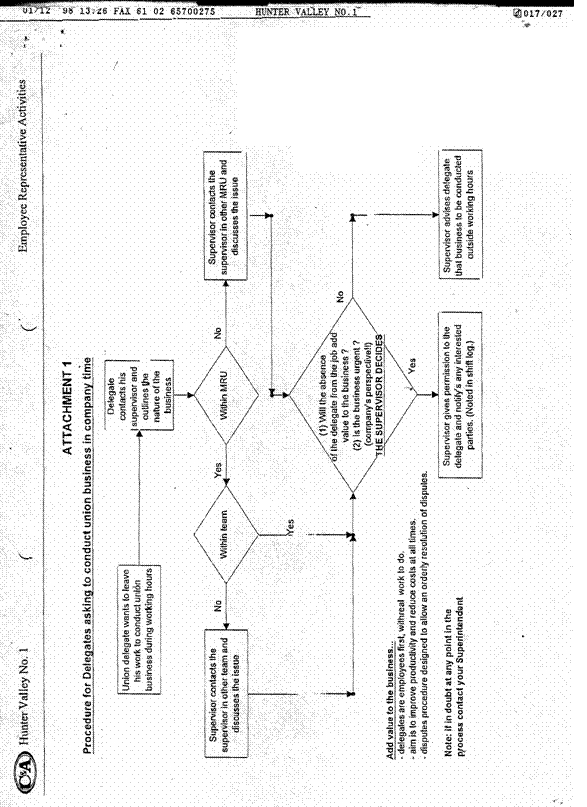
19 In oral evidence, Mr Davies stated that attachment 1 to ERAPP refers to the process by which employee delegates would be granted absence from their normal jobs for activities to be conducted on the Mine site, and that it had no application in respect of applications for union business leave to attend a hearing of the AIRC. He agreed, however, that nothing in the terms of ERAPP so restricts it. Plainly paragraph 4c of ERAPP was intended to have application to AIRC hearings. Although the paragraph indicates that the company may grant approval for up to three employee representatives to attend AIRC hearings “where appropriate”, it provides no guidance as to when such attendance will be regarded as appropriate.
20 I accept the evidence of Mr Davies, and other witnesses called by the respondent, that prior to December 1997 it was assumed by the respondent that attendance at AIRC hearings was bona fide union business and up to three employee delegates from the Mine were virtually assured of being granted union business leave to attend AIRC hearings if they requested the leave. However, from 2 December 1997, Mr Davies, in considering an application for union business leave to attend an AIRC hearing, adopted the test of whether the employee’s attendance at the hearing was required by the Hunter Valley No. 1 operation or would add value to the Hunter Valley No. 1 operation. Mr Dean, whose conclusions in respect of the applications with which this Court is concerned were always consistent with those of Mr Davies, appears to have acted on the basis that the appropriate test, both before and after 2 December 1997, was whether the leave sought was for bona fide union business. However, it appears that after 2 December 1997 Mr Dean acted on the basis that bona fide union business meant “something directly related to Hunter Valley No. 1”. Mr Byatt gave evidence that, with the introduction in December 1997 of the new form for application for union business leave, the test for whether leave should be approved was “what we term loosely, the bona fide of the case”. He explained:
“First of all, each case would be judged on the particulars of the application and its all (sic) the form of our application. Then does it add value to our business and/or can the individual employee be of assistance in actually solving, having a solution to the case, as in could he assist yourself [ie the company] in the case. Is he required to do that.”
21 Although some witnesses called by the respondent sought to suggest otherwise, I am satisfied that the test in fact adopted by the respondent in considering whether to approve union business leave for the purpose of attending AIRC hearings changed on or about 2 December 1997 and became significantly more restrictive. Although I accept that the issue of the circumstances in which union business leave should be granted was discussed at meetings between representatives of the applicant and representatives of the respondent during 1997, I find that the actual test which Mr Davies, on behalf of the respondent, caused to be applied from 2 December 1997 was at no relevant time explained to the applicant or its members. Indeed, it is far from clear that the Mine managers who reported to Mr Davies fully understood the policy which Mr Davies intended to introduce from December 1997 so far as it related to attendance at AIRC hearings.
22 At all times material to this application, the respondent implemented disciplinary procedures at the Mine in accordance with a published document entitled “Disciplinary Procedure”. That document provides as follows:
“1.0 PURPOSE
· To provide all employees with simple guidelines on the procedure that will be followed when an employee breaches the Code of Conduct.
· To ensure that unacceptable behaviour is confronted and corrected before it becomes necessary to take more serious action.
2.0 SCOPE
The Principles & Procedure apply to all employees. The document is subject to periodic review and change. Where significant change is required, the Company will consult with affected Employees.
3.0 PRINCIPLES
There are three types of breaches of the Code of Conduct:-
1. Minor Breach
2. Serious Breach
3. Major Breach
1. All breaches of the Code of Conduct will be dealt with in accordance with these Principles and Procedure.
…
7. The type of action taken will reflect the severity of the breach.
…
9. Disciplinary action following a Serious Breach may include but is not limited to written warning, suspension without pay, removal from role, dismissal on notice or summary dismissal. A Major Breach will lead to Suspension without pay or dismissal on notice or summary dismissal.
…
11. Warnings will expire after a set time period, but should another breach occur during the period of a warning, then all current warnings will have their time limits extended to the most recent.
…
[4.0 PROCEDURE reproduced in diagram on next page]
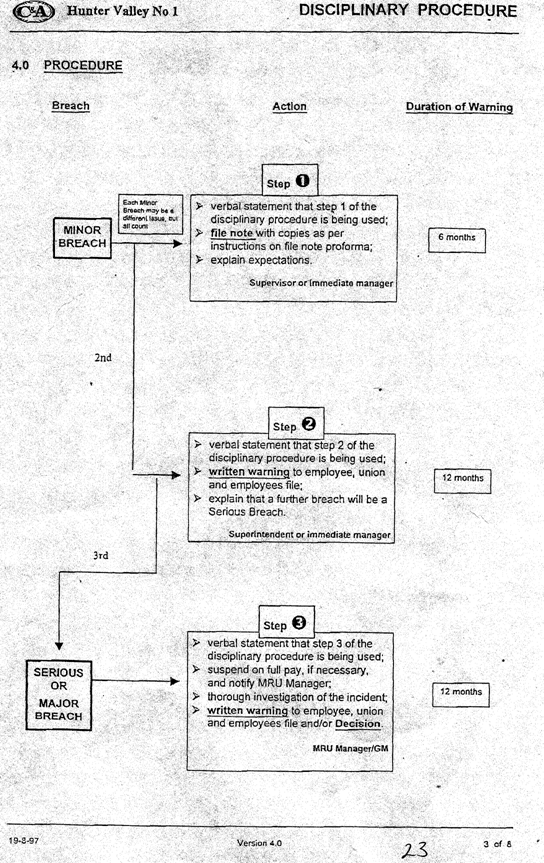
7.0 CONTROLS & REPORTING
· Copies of Notification of Breach, Step 1 File Notes and Written Warnings will be sent to a central file. Copies should be marked “DP File”.
· The DP File will be a single file which is subdivided into sections for each MRU, and then alphabetically for each MRU.
· A company official will be nominated by the General Manager to fulfil the role of DP File Manager.
· Copies of all documentation will also be put on the employees Personnel File as a permanent record.
Statutory Framework
23 As is mentioned above, Part XA of the Act, which is comprised of ss 298A-298Y, is concerned with freedom of association. The objects of Part XA are set out in para 1 above. By reason of s 298G, Part XA applies to conduct by a “constitutional corporation”. As is mentioned above, the respondent is a “constitutional corporation” within the meaning of the Act.
24 Section 298K(1) of the Act, so far as is here relevant, provides:
“An employer must not, for a prohibited reason, or for reasons that include a prohibited reason, do or threaten to do any of the following:
(a) dismiss an employee;
(b) injure an employee in his or her employment;
(c) alter the position of an employee to the employee’s prejudice;
…”
25 Section 298L(1) of the Act defines a “prohibited reason” for the purposes of s 298K. For such purposes, conduct is for a prohibited reason if it is carried out because the employee:
“ …
(j) has participated in, proposes to participate in or has at any time proposed to participate in a proceeding under an industrial law; or
...
(m) … has absented himself or herself from work without leave if:
(i) the absence was for the purpose of carrying out duties or exercising rights as an officer of an industrial association; and
(ii) the employee … applied for leave before absenting himself or herself and leave was unreasonably refused or withheld …”
26 Section 4 of the Act contains the following definitions:
“officer, in relation to an organisation or branch of an organisation, means a person who holds an office in the organisation or branch;”
“office, in relation to an organisation or branch of an organisation, means:
(a) an office of president, vice-president, secretary or assistant secretary of the organisation or branch;
(b) the office of a voting member of a collective body of the organisation or branch, being a collective body that has power in relation to any of the following functions:
(i) the management of the affairs of the organisation or branch;
(ii) the determination of policy for the organisation or branch;
(iii) the making, alteration or rescission of rules of the organisation or branch;
(iv) the enforcement of rules of the organisation or branch, or the performance of functions in relation to the enforcement of such rules;
(c) an office the holder of which is, under the rules of the organisation or branch, entitled to participate directly in any of the functions referred to in subparagraphs (b)(i) and (iv), other than an office holder of which participates only in accordance with directions given by a collective body or another person for the purpose of implementing:
(i) existing policy of the organisation or branch; or
(ii) decisions concerning the organisation or branch;
(d) an office the holder of which is, under the rules of the organisation or branch, entitled to participate directly in any of the functions referred to in subparagraphs (b)(ii) and (iii); or
(e) the office of a person holding (whether as trustee or otherwise) property:
(i) of the organisation or branch; or
(ii) in which the organisation or branch has a beneficial interest;”
27 Section 298B(1) of the Act expands the definition of officer for the purposes of Part XA of the Act, by providing that in Part XA, unless the contrary intention appears:
“officer, in relation to an industrial association, includes:
(a) a delegate or other representative of the association; and
(b) an employee of the association.”
Section 298B(1) also provides that in Part XA, unless the contrary intention appears, an industrial association as defined in the section includes a branch of such an association. It is not controversial that the applicant is an “industrial association” within the terms of the definition contained in s 298B(1). The reference in s 298L(1)(m) to “an industrial association” is thus to be read as encompassing a branch of the applicant.
28 Section 298T is concerned with applications to the Court. So far as is here relevant it provides:
“(1) Subject to subsection (4), an application may be made to the Court for orders under section 298U in respect of conduct in contravention of this Part.
(2) The application may be made by:
…
(c) in the case of a contravention of this Part by virtue of the operation of section 298G or 298H - an industrial association of which the person is a member; or
….”
29 Section 298T(4) has no relevance in the circumstances of this proceeding. Section 298U is in the following terms:
“In respect of conduct in contravention of this Part, the Court may, if the Court considers it appropriate in all circumstances of the case, make one or more of the following orders:
(a) an order imposing on a person or industrial association whose conduct contravened or is contravening the provision in question a penalty of not more than:
(i) in the case of a body corporate - $10,000; or
(ii) in any case - $2,000;
(b) an order requiring the person or industrial association to reinstate an employee, or to re-engage an independent contractor;
(c) an order requiring the person or industrial association to pay to an employee or independent contractor, or to a prospective employee or independent contractor, compensation of such amount as the Court thinks appropriate;
(d) an order requiring the person or industrial association not to carry out a threat made by the person or association, or not to make any further threat;
(e) injunctions (including interim injunctions), and any other orders, that the Court thinks necessary to stop the conduct or remedy its effects;
(f) any other consequential orders.”
30 Section 298V is concerned with proof of intent in an application to the Court under s 298T. It provides:
“If:
(a) in an application under this Division relating to a person’s or an industrial association’s conduct, it is alleged that the conduct was … carried out for a particular reason or with a particular intent; and
(b) for the person or industrial association to carry out the conduct for that reason or with that intent would constitute a contravention of this Part;
it is presumed, in proceedings under this Division arising from the application, that the conduct was … carried out for that reason or with that intent, unless the person or industrial association proves otherwise.”
Findings as to Conduct
Allan Burford – 5 December 1997
31 The first conduct in respect of which the applicant seeks relief took place on or about 8 December 1997 and concerned Allan Burford (“Mr Burford”).
32 Mr Burford was an employee of the respondent at the Mine from 1985. He received notice of retrenchment in October 1998. He was at all material times a member of the applicant and a member of the No. 1 Lodge. In December 1997 Mr Burford was Secretary of the No. 1 Lodge.
33 In late 1997, the AIRC heard an appeal in which the respondent to this proceeding was the appellant and the applicant to this proceeding was the respondent. Three members of the applicant attended each of the first three days of the hearing. Mr Burford was one of those members. Mr Burford, and probably the other members also, were paid full wages and the coal production bonus for the three days. Mr Burford had sought and received approval for such leave on the standard “Application for Union Delegate Absence” form. At the end of the first three days of the appeal hearing, counsel for the respondent (ie the appellant before the AIRC) had completed their submissions in support of the appeal and senior counsel for the applicant (ie the respondent to the appeal) was nearing the close of his address but he had not completed it. Counsel for a third party was yet to be heard and senior counsel for the respondent (ie the appellant before the AIRC) had estimated that he would address the AIRC in reply for approximately an hour and a half. The appeal hearing was adjourned to 5 December 1997.
34 On 2 December 1997, Mr Burford completed the standard “Application for Union Delegate Absence” form seeking leave from work to attend the AIRC hearing on 5 December 1997. His application was refused. The completed form shows Mr Davies signature in the place indicated for “General Manager’s Approval” beside the circled word “NO”. Mr Dean’s signature appears in the place indicated for ‘MRU Manager’s Approval” beside the circled word “NO”.
35 On 4 December 1997, there was a conversation between Mr Burford and his supervisor Mr Fuller. Mr Fuller said that he had been told to let Mr Burford know that he was not allowed to go to the next day’s hearing as it was not union business. Mr Burford replied that it was union business and “[w]e’ve been there for the proceedings all along and we will go tomorrow as well.”
36 On the same day, a conversation took place between Mr Burford and Mr Dean, the respondent’s Manager-Mining. I accept that this conversation was to the following effect:
Mr Dean: “You aren’t allowed to go tomorrow. You will be marked as AWOL. You are not required for the proceedings. It’s only a wrap-up of what’s gone on, the union will have someone there anyway.”
Mr Burford: “We will be going. It is union business. We have been there throughout the case. We may be needed there to tell them what is going on, and we need to be able to come back and tell the troops. They expect it of us.”
Mr Dean: “Why don’t you apply for another form of leave?”
Mr Burford: “I shouldn’t have to take my holidays for union business.”
Mr Dean: “You could apply for leave without pay.”
Mr Burford: “I’ve already applied for union leave. It’s the same thing.”
37 I find on the balance of probabilities that Mr Dean did not explain to Mr Burford the distinction which Mr Dean saw between union business leave and leave without pay. Mr Burford did attend the final day of the appeal hearing before the AIRC. He did so without having obtained the approval of the respondent to be absent from work.
38 By letter dated 8 December 1997, addressed to Mr Burford, Mr Dean advised Mr Burford in respect of his attending the AIRC on 5 December 1997:
“For the reasons explained to you in earlier correspondence I did not believe that it was appropriate for you to attend the hearing, but none the less on the afternoon prior I had given you some options that would have allowed you to attend, but you chose to ignore them. Therefore you will be recorded as AWOL for the Friday shift 5/12/97 and will not receive any payment. Your behaviour is a Serious Breach of the Code of Conduct. This letter is a written warning under step three of the Disciplinary Procedure. Accordingly I am notifying you that for a period of 12 months from the date of this letter any further breaches of the Code of Conduct may result in your employment being terminated
Please take this letter as timely reminder, and take an opportunity to review your current approach.”. [Underlining in original]
39 Mr Burford received a subsequent formal notification that “a Serious Breach of the Code of Conduct has been received from your Manager, and that the details have been entered into the DP File”.
Stephen Burke – 5 December 1997
40 The applicant also seeks relief in respect of conduct of the respondent concerning Stephen Burke (“Mr Burke”) which arose out of Mr Burke’s attendance at the AIRC on 5 December 1997.
41 Mr Burke was employed by the respondent at the Mine from 1985. He received notice of retrenchment in October 1998. He was at all material times a member of the applicant and Secretary of the No. 2 Lodge.
42 Mr Burke, like Mr Burford, was refused approval for union business leave to attend the resumed AIRC appeal hearing on 5 December 1997. Mr Burke’s manager was Mr Byatt Manager – Coal Preparation Plant.
43 Mr Byatt attended the mine managers’ meeting held on 2 December 1997. It was Mr Byatts’ understanding following that meeting that the initial three days of the appeal hearing had been taken up with presenting evidence and that by contrast only legal argument would be presented on 5 December 1997.
44 Mr Byatt acknowledged that the decision to refuse Mr Burke union delegate leave to attend the AIRC hearing on 5 December 1997 was a significant departure from the practice which the respondent had earlier adopted.
45 Mr Byatt agreed that he had not himself advised a representative of the applicant that a more restrictive approach was to be adopted to applications for union business leave to attend AIRC hearings. He believed, however, that the issue of union business leave had been discussed at meetings between representatives of each of the applicant and the respondent.
46 I find that on 4 December 1997, Mr Byatt told Mr Burke that he did not have approval to attend the AIRC hearing the next day and reminded him of the Code of Conduct. Mr Burke queried why a different approach was being taken to the last day of the hearing as opposed to the first three days. I find that Mr Byatt responded to the effect:
“The hearing is only going to be about submissions. You won’t be adding any value as such – if you are passionate about going you can apply for some other leave.”
47 Mr Burke understood Mr Byatt’s reference to “other leave” to mean annual leave. He was not willing to use any part of his annual leave to attend the AIRC hearing on 5 December 1997.
48 By letter dated 4 December 1997 Mr Byatt wrote to Mr Burke in the following terms:
“I refer to the letter dated 4th December 1997 from Ross Peters on your behalf. The stated reason for attendance at the AIRC tomorrow is not considered by the Company to provide sufficient justification for attendance of 3 delegates.
Unless you can provide more substantive reasons for attendance prior to your rostered shift, your request is denied.
Otherwise, if you intend on going to the AIRC tomorrow instead of attending for your normal shift, I am prepared to offer you the option of applying for annual leave. Your application will be considered in the normal way. I would expect that your application would be approved prior to you taking any leave.
If you do not take the option of applying for annual leave, you are directed to report for duty at the Coal Preparation Plant as rostered on 5th December.
Your absence will leave you liable to be considered to be in breach of your contract of employment”
49 Mr Burke absented himself from work on 5 December 1997 to attend the AIRC hearing. He did not have the approval of the respondent to be absent from work on that day.
50 In a letter dated 8 December 1997 from Mr Byatt to Mr Burke, Mr Burke’s attendance at the AIRC rather than at his place of work was noted. The letter goes on:
“For the reasons I explained to you in earlier correspondence I did not believe that it was appropriate for you to attend the hearing, but nonetheless on the afternoon prior I had given you some options that would have allowed you to attend, but you chose to ignore them. Therefore you will be recorded as AWOL for the Friday shift 5/12/97 and will not receive any payment. Your behaviour is a Serious Breach of the Code of Conduct. This is a written warning under step three of the Disciplinary Procedure. Accordingly I am notifying you that for a period of 12 months from the date of this letter any further breaches of the Code of Conduct may result in your employment being terminated.” [Underlining in original]
Allan Burford – 17 April 1998
51 The next conduct to be considered is that related to an application made by Mr Burford on 13 April 1998 for union business leave on 17 April 1998 to attend “AIRC Report Back Hearing”.
52 In February 1998 Mr Burford had ceased to be Secretary of the No. 1 Lodge and had been elected President of the Lodge.
53 It appears that on 19 February 1998 the applicant notified the AIRC of a dispute between it and the respondent concerning disciplinary action taken against local union officials for carrying out union duties. On 3 April 1998 the applicant had notified the AIRC of a dispute in relation to the proposed introduction by the respondent of a performance appraisal system at the Mine.
54 On 8 April 1998 Mr Burford, along with Mr Burke, Ian King, then Secretary of the No. 1 Lodge (“Mr King”), and Mr Endacott, an Industrial/Record Officer employed by the applicant, attended two hearings before Commissioner Harrison of the AIRC. The first hearing related to the dispute notification concerning the proposed performance appraisal system. That hearing was adjourned at 12.37pm that day until 17 April 1998. As insufficient time remained for the Commissioner to deal with the dispute concerning disciplinary action taken against local union officials, the Commissioner stood that matter over generally expressing “trust that the issues can be resolved.” The Commissioner’s trust was not well placed. The dispute concerning disciplinary action taken against local union officials for carrying out union duties was subsequently relisted for 17 April 1998.
55 The respondent did not give approval for Mr Burford to take union business leave on 17 April 1998, although it did approve applications made on behalf of Mr King and Mr Burke, Secretary of the No. 2 Lodge, for union business leave to attend the AIRC hearings on 17 April 1998. By letters dated 15 April 1998, Mr Endacott notified both Commissioner Harrison and Mr Davies that the issue of attendance before the AIRC and of related action taken against employees was a matter of ongoing disputation between the parties which the applicant wished to bring before the AIRC.
56 Mr Endacott’s letter of 15 April 1998 to Mr Davies reads as follows:
“I write with respect to the Australian Industrial Relations Commission proceedings, Matter No. 21376 of 1998, which is listed before the Commission on Friday 17 April 1998 and to inform you that Ian King, Lodge Secretary of Hunter Valley No. 1 Lodge, Allan Burford, Lodge President of Hunter Valley No. 1 Lodge and Stephen Burke, Lodge Secretary of the Hunter Valley No. 2 Lodge are required by the CFMEU to be in attendance at the Commission and as a result they will be unable to attend their respective shifts on 17 April 1998.
It is my understanding that Mr King and Mr Burke have been given approved leave but this leave has been declined for Mr Burford.
Should you remain of the view that Mr King, Mr Burke or Mr Burford should not be in attendance at these proceedings this Union suggests you raise it with the Commissioner at the aforementioned proceedings.
As the issue of attendance at proceedings before the Commission and subsequent action taken against employees that attend is a matter of ongoing disputation between the parties and subject to dispute in Matter No. 20565 of 1998 this Union will be requesting that Matter No. 20565 of 1998 be listed before the Commission on Friday 17 April 1998.
Please find attached a copy of correspondence sent to the Australian Industrial Relations Commissioner concerning this matter.”
57 By letter dated 16 April 1998 addressed to Mr Endacott, Mr Davies confirmed that Mr Burford was not granted union business leave for 17 April 1998. The letter goes on:
“However, Mr Burford is aware that other forms of leave are available under the [company] policy to attend the AIRC providing he makes the appropriate application with his supervisor. This leave may or may not be granted depending on the operational circumstances which exist at the time.
I would encourage you to advise Mr Burford to make the leave application as described above.”
58 Mr Burford absented himself from his work on 17 April 1998 to attend the hearing before the AIRC. He did not have the approval of the respondent to be absent from work on that day.
59 By letter dated 6 May 1998 Mr Dean advised Mr Burford as follows:
“On Friday, 17 April 1998, despite extensive verbal and written communications, to yourself, the lodge secretary and the CFMEU Industrial/Research officer you attended the AIRC, without obtaining an approved leave of absence.
On your return to work on Monday April 20, when questioned by your superintendent regarding your actions, you acknowledged that you had not had permission from the company to be absent from work, but had absented yourself anyway.
This is the second time that you have chosen to ignore a directive of this nature, on the previous occasion you were issued with a serious breach. Under the Hunter Valley No. 1, Code of Conduct for a repeat of a serious breach, the breach is then classed as a Major breach. Under the policy this letter is to confirm the issue of the Major breach and the penalty to be applied is a two (2) day suspension without pay.
This suspension will however not be applied, at this time. If at some time within the next 12 months you receive another Serious or Major breach the suspension will be added to any penalty issued at that time. Also you will be recorded as AWOL for the Friday shift, 17 April 1998 and will not receive any payment for this day.
This letter is a written warning under step three of the Disciplinary Procedure. Accordingly I am notifying you that for a period of 12 months from the date of this letter any further serious or major breaches of the Code of Conduct are likely to result in your summary dismissal from employment at Hunter Valley No. 1 mine.
Please take this letter as a further reminder, and take an opportunity to review your current behaviour.” [Underlining in original]
Allan Bromage – 5 May 1998
60 Allan Bromage (“Mr Bromage”) was employed by the respondent as a coal mine production worker in the CHPP from about February 1983. In October 1998 Mr Bromage received notification of his retrenchment. Since about 1994 Mr Bromage has held the position of President of the No. 2 Lodge.
61 On or about 1 May 1998, Mr Bromage asked Stephen Martin Burke (“Mr Burke”), Secretary of the No. 2 Lodge, to complete an application form on his behalf seeking union business leave to attend a meeting of CFMEU delegates in the Northern District on Tuesday, 5 May 1998. Mr Burke completed a form as requested by Mr Bromage and, on his evidence, on which he was not cross examined, gave the form to Mr Byatt on or about 1 May 1998. Mr Byatt gave evidence that he didn’t personally receive the form, which he understood was faxed to Mr Davies. Mr Byatt gave evidence that he received a message on his answering machine on 4 May 1998 from Mr Burke advising that Mr Burke had faxed leave applications for himself and Mr Bromage to Mr Davies and asking that Mr Byatt “follow through” with the application forms and leave a message on Mr Burke’s answering machine. As 1 May 1998 was a Friday, it is possible that Mr Burke faxed the application forms to Mr Davies on 1 May 1998 but that they had not been considered by 4 May 1998. I find that Mr Burke completed the leave forms on 1 May 1998 and sent them to Mr Davies by facsimile transmission on 1 May 1998.
62 On the evening of 4 May 1998 Mr Byatt telephoned Mr Bromage at his home. A conversation took place between the two during which words were said to the following effect:
Mr Byatt: “I am calling to let you know your application for union leave for tomorrow has been rejected. I suggest that you talk to the supervisor about some other form of leave, annual leave or leave without pay.”
Mr Bromage: “What’s the difference between union leave and leave without pay? As an elected official of the CFMEU I have got a right to attend the meeting and will do so regardless of the outcome. I will not be at work tomorrow.”
I find that Mr Byatt did not respond to Mr Bromage’s query regarding the difference between union leave and leave without pay.
63 On 5 May 1998 Mr Bromage attended the meeting of delegates of the Northern District of the Mining and Energy Division of the CFMEU held at the Cessnock Leagues Club. He did not have the approval of the respondent to be absent from work on that day.
64 By letter dated 15 May Mr Byatt wrote to Mr Bromage as follows:
“On Tuesday 5 May, 1998 in direct contravention of my verbal instruction, you attended a Distr[i]ct Delegates Meeting rather than your place of work.
On your return to work on Thursday 7 May, 1998, when questioned by myself regarding your actions, you acknowledged that you had been told not to attend, but had gone anyway.
For the reasons explained to you in earlier correspondence I did not believe that it was appropriate for you to attend the meeting, but none the less on the afternoon prior I had given you some options that would have allowed you to attend, but you choose to ignore them. Therefore you will be recorded as AWOL for the day shift on 5/5/98 and will not receive any payment. Your behaviour is a Serious Breach of the Code of Conduct. This letter is a written warning under step three of the Disciplinary Procedure. Accordingly I am notifying you that for a period of 12 months from the date of this letter any further breaches of the Code of Conduct may result in your employment being terminated.” [Underlining in original]
Ian King – 27 May 1998
65 Mr King was employed by the respondent in the Mine from November 1989. In October 1998 he received notification of his retrenchment. He has been Secretary of the No. 1 Lodge since March 1998.
66 On or about 14 May 1998, Mr King completed an application for union business leave in the usual form which he handed to the Superintendent – Mining at the Mine. Mr King made it explicit on the face of the form that he was seeking union business leave but without requesting payments of any kind. The form was signed on 15 May 1998 by Mr Dean, as Mr King’s operational manager, refusing approval and on 17 or 18 May 1998 Mr Davies signed as General Manager endorsing the refusal of leave.
67 On 25 May 1998, the form, bearing the signature of Messrs Dean and Davies, was returned to Mr King in the presence of Mr Dean. On the bottom of the form the note “Where approval is not granted, a delegate can apply for annual leave and be considered in the normal way” had had the words “or leave without pay” added in handwriting. A conversation to the following effect took place between Mr King and Mr Dean:
Mr King: “Bill [ie Mr Dean], I’m a bit confused as to why the application has been rejected.”
Mr Dean: “It’s for personal business. You should make application for personal leave, either annual leave or leave without pay.”
Mr King: “It’s an application for bona fide union business, there has been no claim for payment and the application is really an application for leave without pay.”
Mr Dean: “It’s for personal business, not union business. You will have to make an application for the day on the appropriate form.”
Mr King: “What’s your definition of bona fide union business?”
Mr Dean: “I will have to think about that and get back to you.”
Mr King: “I’ve already made application to the company for leave on the appropriate form, I will be unable to attend work on that day.”
68 On 27 May 1998 Mr King flew to Melbourne and attended a meeting of delegates and executive officers of the applicant convened outside the building in which the Annual General Meeting of Rio Tinto was to be held that day. Those who attended the union meeting were addressed, before and after the annual general meeting, by the then National President of the Mining and Energy Division of the applicant and by a number of international speakers with an interest in Rio Tinto’s industrial and community relations policies. An address was also given by Stephen Beiger (“Mr Beiger”) on the history of the dispute between the applicant and the respondent at the Mine.
69 By letter dated 28 May 1998 Mr Dean wrote to Mr King in the following terms:
“On Wednesday, 27 May 1998, despite clear written communications, you absented yourself from work, without obtaining approval for the leave.
On your return to Work on Thursday May 28, when questioned by your superintendent regarding your actions, you acknowledged that you had not received prior approval for the leave.
You will be recorded as AWOL for the Wednesday shift, 27 April 1998 and will not receive any payment for this day. In this instance your action is classed as a Serious breach, under the Hunter Valley No. 1, Code of Conduct. This letter is to confirm the issue of the Serious breach.
This letter is a written warning under step three of the Disciplinary Procedure. Accordingly I am notifying you that for a period of 12 months from the date of this letter any further serious or major breaches of the Code of Conduct are likely to result in suspension without pay or your summary dismissal from employment at Hunter Valley No. 1 mine. [Underlining in original]
Stephen Beiger – 27 May 1998
70 Mr Beiger was employed by the respondent from November 1985. In October 1998 he received notification of his retrenchment. He has been Vice-President of the No. 1 Lodge since about April 1995.
71 On or about 14 May 1998, Mr King completed an application for union business leave in the usual form on Mr Beiger’s behalf seeking approval for Mr Beiger to be absent from his normal work location on 27 May 1998 to attend a delegate’s meeting in Melbourne. On 15 May 1998 Mr Dean signed the form as Mr Beiger’s operational manager refusing the leave sought. On 17 or 18 May 1998, Mr Davies signed the form indicating his endorsement of the decision that the leave sought should be refused.
72 Mr Beiger flew to Melbourne on 27 May 1998 and, as is mentioned above, addressed the meeting held outside the building in which the Rio Tinto annual general meeting was to be held.
73 On 29 May 1998, Mr Beiger received a letter dated 28 May 1999 signed by Mr Dean. The substance of the letter was identical to the substance of the letter of the same date received by Mr King. Mr Beiger denies, and I accept his denial, that he had a conversation with his superintendent, or any staff member of the applicant, in which he acknowledged that he had not received prior approval for his absence from normal duties on 27 May 1998. However, when asked on 28 May 1998 by his superintendent where he had been the day before, he had responded that he had “attended the delegates’ meeting in Melbourne.”
Standing
74 As the respondent is a “constitutional corporation” within the meaning of the Act, Part XA of the Act applies to the respondent (s 298G(1)(a)). Each of the employees referred to in the Statement of Claim was, at the time of the conduct complained of by the applicant, a member of the applicant. The applicant is an “organisation” registered under the Act and an “industrial association” within the meaning of s 298B of the Act. Accordingly the applicant has standing under s 298T(2)(c) of the Act to make the application by which the proceeding was commenced.
Participation in a Proceeding under an Industrial Law
75 The applicant has alleged that on 17 April 1998 Mr Burford “participated in a proceeding under an industrial law” within the meaning of s 298L(1)(j) of the Act. This allegation has not, in my view, been established. Mr Burford merely attended the AIRC hearing on that day. He did not give evidence, nor did he play any role in the conduct of the hearing. His role, in my view, fell short of being a participant in the proceeding – notwithstanding that a dispute under consideration by the AIRC on 17 April 1998 related to disciplinary action earlier taken against him.
Officer of an Industrial Association
76 Section 298L(1)(m) is drafted so as to, in effect, proscribe conduct taken in certain circumstances in respect of an “officer of an industrial association” (ss 298K and 298L(1)(m)(i)).
77 Section 298B(1), the relevant terms of which are set out in para 27 above, has the effect of extending the definition of an officer contained in s 4 of the Act for the purposes of the expression “officer of an industrial association” contained in s 298L(1)(m)(i) of the Act. Significantly for present purposes, a “delegate or other representative” of the applicant or a branch of the applicant will by reason of s 298B(1) fall within the expression “officer of an industrial association” contained in s 298L(1)(m)(i). So also will a person who holds an office in a branch of the applicant (s 4 of the Act).
78 An individual is not a delegate or other representative of an organisation simply by reason of being a member of that organisation (Plumton v Cathay Hotel Pty Ltd (1987) 21 IR 410 and 416.
79 It is contended on behalf of the respondent that whilst Messrs Burford, Burke, Bromage, King and Beiger may have been “delegates or other representatives” of, as the case may be, either the No. 1 Lodge or the No. 2 Lodge, they were not “delegates or other representatives” of the applicant. The respondent challenges the contention of the applicant that the No. 1 Lodge and No. 2 Lodge are branches of the applicant.
80 The Full Court of this Court gave consideration to the indicia of a branch of an industrial organisation in Automotive, Food, Metals, Engineering, Printing and Kindred Industries Union v Fohmsbee (1998) 81 IR 120. The respective reasons for judgment of Northrop, Wilcox and Madgwick JJ make it clear that the term “branch”, which is not defined in the Act, is to be given a wide meaning when used in respect of an industrial organisation. Northrop J at 133 observed that the true position in respect of a branch is made clear by Brennan CJ, Deane and Dawson JJ in Re McJannet; Ex parte Minister for Employment, Training and Industrial Relations (Qld) (1995) 184 CLR 620 at 640 where their Honours observed, in part:
“A branch of a federal industrial organisation is not a person; it has no existence apart from that of the members of the branch. The word “branch” in that context is no more than a collective noun which, although singular in form, is used with a plural implication.”
81 Northrop J at 134 said of the Act:
“… the words “branch of an organisation” contained in the definition of ‘office’ in the Act is used in the sense of a collective noun which although singular in form is used with a plural implication. The word ‘branch’ is not used as identifying an entity or body. It is used to describe a group of members of an organisation which under the rules of the organisation or other lawful authority are formed together for the better management of the affairs and objects of the organisation within the bounds of the authority conferred upon that group.”
82 Wilcox J at 139 said:
“A branch of an industrial organisation is simply a section of the total membership of the organisation, locally organised, under the organisation’s rules, for the sake of convenience…. There is no magic in the title ‘branch’. I see no reason why a locally organised section of the membership, even that part of the membership that follows callings talking within the ambit of a particular Division of the organisation, resident within a geographic area called a ‘Region’, cannot properly be described as a ‘branch’ of the organisation for the purposes of the definition of ‘office’.”
83 Madgwick J, whilst agreeing with the essential reasoning of Northrop J concerning the meaning to be attributed to the term “branch”, and agreeing also with Wilcox J that no narrow view should be taken of the expression, saw some reason to limit the width of the expression. His Honour at 145 said:
“… it seems to me that whether a body within an organisation is a ‘branch’ may very well depend on matters of degree. Ephemeral and ad hoc, or insufficiently clearly delimited, collections of union members may not warrant the appellation. Neither may mere divisions of the membership unaccompanied by some substantial power of independent action or some substantial degree of internal self-government. It may be regrettable that such an important legislative concept depends upon matters such as these upon which … opinions may readily differ. Nevertheless, in my view, it is inescapable that the concept does so depend.”
84 As is mentioned in para 5 above, the Branch Rules provide for the Northern District Branch Executive “to establish Lodges of the District Branch at all collieries in the Northern District”. The Mine is a colliery in the Northern District within the meaning of the Mining and Energy Rules.
85 In my view, the Mining and Energy Rules and the Branch Rules do give Lodges of the Northern District Branch sufficient power of independent action, and sufficient degree of internal self-government to impart to them the character of branches as that term was elucidated by the Full Court in Fohmsbee’s Case.
86 I reject the contention, put by the respondent in the alternative, that the Rules of the applicant do not permit the formation of two Lodges at one colliery. Reliance was placed on provisions in the Branch Rules which refer to, for example, “a Lodge” at a colliery. No evidence was placed before the Court as to the Rules, if any, that governed the establishment of Lodges at collieries at the time of the formation of the No. 1 and No. 2 Lodges. The Branch Rules which were placed in evidence recognise that Lodges may already be in existence (see for example, rule 11(i)(b)). Nothing in the Branch Rules requires the disestablishment of Lodges where more than one exists in respect of a colliery. It is also appropriate, in my view, for reliance to be placed in this regard on s 23(b) of the Acts Interpretation Act 1901 (Cth) which provides that in any Act, unless the contrary intention appears, words in the singular number include the plural.
87 I find that the No. 1 Lodge and the No. 2 Lodge are, and were at all material times, branches of the applicant.
88 In my view, it would be contrary to the clear purpose of Part XA of the Act for the expression “officer of an industrial association” appearing in s 298L(1)(m)(i) to be given a narrow interpretation. The Branch Rules vest the management of each Lodge in a Committee “consisting of a President, Secretary/Treasurer and at least three other members (r 11(ii)(a)). The duties of Lodge Committees are to –
“see that the health and lives of their fellow workmen are protected to the utmost and … deal with all matters as (sic) affecting the interest of the Lodge.” (r 11(vi)).
89 I find that each of the members of the respective Committees of the No. 1 Lodge and the No. 2 Lodge is an “officer of an industrial association” within the meaning of s 298L(1)(m) of the Act by reason of being a representative of a branch of the applicant. I further find that the Presidents and Secretaries of the No. 1 Lodge and the No. 2 Lodge, and possibly the Vice-Presidents of the No. 1 Lodge (see para 110 below), are “officers of an industrial association” within the meaning of s 298L(1)(m) of the Act (see para (a) and (b) of the definition of an office in s 4 of the Act).
Injury or Alteration of Position to the Employee’s Prejudice
90 The conduct which the applicant seeks to have characterised as having injured an employee in his employment (s 298K(1)(b)) or as having altered the position of an employee to the employee’s prejudice (s 298K(1)(c)) is the issuing of warnings and the making of entries on the employment files of the employee pursuant to the respondent’s practice concerning disciplinary procedures.
91 The respondent contended that as none of the employees referred to in the statement of claim had his employment contract varied, his job altered, or his position altered, none of them was injured in his employment or had his position altered to his prejudice. The respondent placed reliance on the decision of Evatt J in Blair v Australian Motor Industries Ltd (1981) 61 FLR 283. In that case his Honour rejected the argument that an employee had been injured in his employment, or that the employee’s position had been altered to his prejudice, when he received a “first warning” which was said to take him “one step closer to possible dismissal in the future”. Evatt J appears to have taken the view that only alterations to the legal rights of an employee were relevant to the question of whether the employee had been injured in his or her employment or had his or her position prejudicially altered.
92 In Kimpton v Minister for Education of Victoria (1996) 65 IR 317 at 319 North J, in considering an application for summary dismissal, may be thought to have doubted the correction of the approach taken by Evatt J in Blair’s Case.
93 The High Court has more recently given consideration to s 298K(1) of the Act in Patrick Stevedores Operations No. 2 Pty Ltd v Maritime Union of Australia [1998] HCA 30 (1998) 195 CLR 1. Brennan CJ, McHugh, Gummow, Kirby and Hayne JJ in para 4, said of s 298K(1) of the Act (which is set out in para 24 hereof):
“Paragraph (a) covers termination of employment; para (b) covers injury of any compensable kind; para (c) is a broad additional category which covers not only legal injury but any adverse affection of, or deterioration in, the advantages enjoyed by the employee before the conduct in question.”
94 It seems to me that their Honour’s approach to s 298K(1)(c) is inconsistent with the approach adopted by Evatt J when considering the comparable provision in the Conciliation and Arbitration Act 1904 (Cth).
95 As is mentioned in para 22 above, at all times material to this application the respondent implemented disciplinary procedures at the Mine in accordance with a document entitled “Disciplinary Procedure”. Salient parts of that document are set out in para 22 above. Warnings have an important role to play in the procedures provided for by the document “Disciplinary Procedure”. I accept the contention of the applicant that the issuing to an employee of a “written warning” of a “serious or major breach” within the meaning of the document “Disciplinary Procedure” has the effect of making the employee’s continuing employment less secure. Conduct engaged in by an employee who has received such a warning could lead to the termination of his or her employment although the same conduct engaged in by an employee who had not received a warning would not lead to the termination of that employee’s employment. In a sense, written warnings under the respondent’s disciplinary procedures may be regarded as analogous to the receipt of driving demerit points. It seems to me that few holders of driving licences would doubt that the advantage enjoyed by them in holding driving licences is adversely affected by the accumulation of demerit points close to, but less than, the number required to trigger cancellation of their licences.
96 I find that by issuing a written warning of a serious or major breach, as the case may be, to one of its employees, the respondent altered the position of that employee to the employee’s prejudice within the meaning of s 298K(1) of the Act.
The Purpose of the Absences WITHOUT Leave
97 Section 298L(m) relevantly only has an operation in a case in which an employee has absented himself from work without leave if “the absence was for the purpose of carrying out duties or exercising rights as an officer of an industrial association.” Para 89 records my finding that each of the members of the respective Committees of the No. 1 and No. 2 Lodges was at the time of the conduct concerning him an officer of an industrial association within the meaning of this section.
98 For the applicant’s case to succeed, however, it is necessary for me to be satisfied that when each of the employees was absent from work without leave, his absence was for the purpose of carrying out duties or exercising rights as such an officer.
Mr Burford and Mr Burke – 5 December 1997
99 These employees were absent from work without leave on this occasion for the purpose of attending the final day of an appeal hearing before the AIRC. The parties to this proceeding were parties to the appeal. The appeal concerned important issues relating to the Mine.
100 On 5 December 1997, Mr Burford was Secretary of the No. Lodge and Mr Burke was Secretary of the No. 2 Lodge. The Branch Rules provide that each Lodge shall be managed by a Committee, which consists of the “President, Secretary/Treasurer and at least three other members”. I find that as the Secretary of his respective Lodge, each of Messrs Burford and Burke was a member of the Lodge Committee of his Lodge.
101 As is mentioned above, rule 11(vi) of the Branch Rules provides as follows:
“The Committee of each Lodge shall see that the health and lives of their fellow workmen are protected to the utmost and shall deal with all matters as (sic) affecting the interests of the Lodge.”
Rule 4 of the Rules of the applicant contains the objects of the applicant. The first of those objects is:
“To uphold the right of combination of labour, and to improve, protect, and foster the best interests of the Union and its members, and to assist them to obtain their rights under industrial and social legislation.”
102 In my view, rule 11(vi) of the Branch Rules has the intent of giving Lodge Committees the function of dealing with matters of the kind referred to in rule 4 of the Rules of the Applicant so far as such matters have particular relevance to the membership of the particular Lodge.
103 Section 3 of the Act provides:
“The principal object of this Act is to provide a framework for co-operative workplace relations which promotes the economic prosperity and welfare of Australia by:
…
(b) ensuring that the primary responsibility for determining matters affecting the relationship between employers and employees rests with the employer and employees at the workplace or enterprise level; ….”
As is mentioned above, the AIRC appeal which was being heard by the AIRC on 5 December 1997, concerned matters specific to the Mine as a workplace. The No. 1 Lodge and No. 2 Lodge are branches of the applicant providing representation to employees at that workplace.
104 I am satisfied that each of Messrs Burke and Burford attended the hearing before the AIRC on 5 December 1997 for the purposes of being available to give instructions to the applicant’s counsel and of reporting to their respective Lodge membership with respect to the appeal hearing. I find that each of their absences from work on that day was for the purpose of carrying out duties as an officer of an industrial association within the meaning of Part XA of the Act.
Mr Burford – 17 April 1998
105 Mr Burford was absent from work without leave on 17 April 1998 for the purpose of attending before the AIRC. Two disputes concerning the Mine were listed before the AIRC on that day. First, a dispute concerning the introduction of a workplace performance review system, and secondly, a dispute concerning disciplinary action taken against Messrs Burford and Burke following their absence from work on 5 December 1997, and the restrictions generally that the applicant believed were being placed by the respondent on union delegates in the performance of their work.
106 For the reasons given above concerning the absence of Messrs Burford and Burke from work on 5 December 1997, I find that Mr Burford’s absence from work on 17 April 1998 was for the purpose of carrying out duties as an officer of an industrial association.
Mr Bromage – 5 May 1999
107 Mr Bromage was absent from work without leave on 5 May 1998 for the purpose of attending a meeting of delegates of the Northern District of the Mining and Energy Division. Mr Bromage was at this time President of the No. 2 Lodge. He agreed with the suggestion put to him in cross-examination that it was “an internal meeting of the northern district of the union” and that he had attended such meetings for years. Mr Bromage gave unchallenged evidence that the meeting was addressed by Mr Martin Ferguson MP, a former President of the ACTU, and received a regular report from the District Secretary about financial matters, a report on the provision of legal representation before an industry inquiry and the District Check Inspector’s Report. Although the issue is not clear-cut, I find that the meeting was concerned with “matters … affecting the interest of the [No. 2] Lodge”, within the meaning of clause 11(vi) of the Branch Rules.
108 I find in the circumstances that Mr Bromage’s absence from work on 5 May 1999 was for the purpose of carrying out duties as an officer of an industrial association.
Mr King and Mr Beiger – 27 May 1998
109 As at 27 May 1998, Mr King was Secretary of the No. 1 Lodge and Mr Beiger was Vice-President of the No. 1 Lodge.
110 The Branch Rules do not provide for an office of Vice-President of a Lodge. However, Mr King gave evidence that the No. 1 Lodge has five executive members: the President, the Secretary and three Vice-Presidents. It seems reasonable to conclude, and I do conclude, that the Committee of the No. 1 Lodge includes three members who carry the title “Vice-President” (r 11(ii) of the Branch Rules). I find that Mr Beiger was as at 27 May 1998 a member of the Committee of the No. 1 Lodge.
111 On 27 May 1998, Messrs King and Beiger attended what some witnesses described as “a meeting of CFMEU Mining and Energy Division delegates to be held in Melbourne”. Mr Beiger agreed in cross-examination that the meeting was held outside the premises where the Rio Tinto Annual General Meeting was to be held and that the purpose of the meeting, which he described as a rally, was to call public attention to the affairs of Rio Tinto. I accept this evidence of Mr Beiger. To the extent that Mr King may have sought to characterise the meeting differently, I prefer the evidence of Mr Beiger.
112 Notwithstanding that Mr Beiger gave a report about the progress of an industrial dispute at the Mine to the meeting, I find that the meeting was only concerned with the Mine in a peripheral way. That is, only to the extent that it could be of assistance in supporting criticism of the operation of Rio Tinto generally. Having regard to the locally focussed duties of Lodge Committees under the Branch Rules and the evident purpose of s 298L(m) of the Act, I am not satisfied that the absence of either Messrs King or Beiger from work on 27 May 1998 was for the purpose of carrying out duties or exercising rights as an officer of an industrial association within the meaning of s 298L(m) of the Act.
Was Leave Refused?
113 I do not understand it to be seriously challenged by the respondent that each of the employees with which this proceeding is concerned applied for leave before absenting himself from his work and that approval for the category of leave for which he applied was refused or withheld. The contention of the respondent that each of the employees had the option of applying for a different category of leave and, had he done so, leave of that category might have been granted to him is, in my view, irrelevant to the requirement of s 298K(m)(ii).
114 I find that in the case of each of the employees, he applied for leave before absenting himself and leave was refused or withheld within the meaning of s 298K(m)(ii). Such finding does not touch on the additional question of whether the leave was unreasonably refused or withheld.
WAS LEAVE UNREASONABLY WITHHELD?
General
115 It is necessary to give consideration to the meaning of the word “unreasonable” in the phrase “leave was unreasonably refused or withheld” in s 298L(m)(ii) of the Act. I accept the submission of the applicant that some guidance is to be found in decisions concerning award provisions proscribing “harsh, unjust or unreasonable” dismissals. However, ultimately s 298L(m)(ii) is to be construed having regard to its ordinary meaning and the particular context in which it is found, namely in Part XA of the Act.
116 The High Court gave consideration to an award provision proscribing “harsh, unjust or unreasonable” termination of employment by an employer in Byrne v Australian Airlines Ltd (1995) 185 CLR 410. Brennan CJ, Davison and Toohey JJ at 430 observed that the relevant award provision did not require the adoption of any particular procedure for the dismissal of an employee and went on:
“However, it is clear that the use of an unfair procedure may result in a dismissal being harsh, unjust or unreasonable. For example, the failure to afford an employee the opportunity to explain apparent misconduct where there is an innocent explanation available would result in the dismissal of the employee being in breach of [the relevant claims of the award]. On the other hand, if the employer were to observe the actual misconduct of the employee in circumstances which allowed no innocent explanation, a summary dismissal might not be in breach of [the claim]. And facts which existed at the time of a dismissal, but which came to light only subsequently, might justify the dismissal when otherwise it would be harsh, unjust or unreasonable.”
McHugh and Gummow JJ at 465-466 said:
“The distinction between procedure and substance is elusive. … In our view, it is unhelpful and contrary to the tenor of the Award to introduce it into [the relevant claim].
That is not to say that the steps taken, or not taken, before termination may not in a given case be relevant to consideration of whether the state of affairs that was produced was harsh, unjust or unreasonable. Thus, it has been said that a decision which is the product of unfair procedures may be arbitrary, irrational or unreasonable. But the question under [the relevant clause] is whether, in all the circumstances, the termination of employment disobeyed the injunction that it not be harsh, unjust or unreasonable. That is not answered by imposing a disjunction between procedure and substance. It is important that the matters not be decided simply by looking to the first issue before there is seen to be any need to enter upon the second.”
117 Having regard to the objects of the Act as a whole, and the particular objects of Part XA, which include ensuring that employees are not discriminated against or victimised because they are members of industrial associations, it seems to me that in considering whether leave was unreasonably refused or withheld within the meaning of s 298L(m) it is appropriate for the Court to have regard to:
(a) the purpose for which the leave was sought;
(b) the circumstances which led to and surrounded the refusal or withholding of leave;
(c) the impact of the refusal or withholding of leave on the employee and, having regard to the objects of the Act, on the legitimate interests of his or her industrial association; and
(d) the impact that the approval of leave would have had on the employer and, having regard to the objects of the Act, its legitimate industrial interests (cf Bostik (Australia) Pty Ltd v Gorgevski (No. 1) (1992) 36 FCR 20 at 28).
Allan Burford – 5 December 1997
118 The evidence as to why Mr Burford’s application for union business on 5 December 1997 was refused is somewhat confused. Although Mr Dean’s belief was that he made the decision as to whether Mr Burford should be granted union business leave to attend the AIRC hearing on 5 December 1997, based on his consultation with Mr Davies, I find that the true position was, as Mr Davies recognised, that Mr Davies made the ultimate decision on 2 December 1997 after consultation with Mr Dean.
119 As is mentioned in para 15 above, I am satisfied that Mr Davies told Mr Dean and other managers at a mine managers meeting on 2 December 1997 that as the AIRC meeting on 5 December 1997 would involve final submissions and legal argument only, no employee should be granted union delegate leave to attend the hearing. Mr Davies gave affidavit evidence that on each of the occasions relevant to this proceeding when employee representatives were denied approval to be absent from their normal duties on union business he reviewed the request for absence under ERAPP on its individual merit and discussed them with the relevant operation manager. His evidence was that the applications were reviewed on the basis of “whether attendance was required by, or did it add value to, the Hunter Valley No. 1 operation.”
120 In cross-examination Mr Davies said that in the context of approving an attendance at an AIRC hearing “add value” had the meaning:
“… if someone attended a Commission hearing on behalf of the company it may well add value because there was a solution to the issue provided. They could support the company’s position. That’s one option. The other option, if there was a conflict situation in the Commission and the employee … was there to support the union’s position, classification of an issue by the employee may well add value to the – a solution being found. But, as I said, … each circumstance had to be evaluated under its own merits. There are a whole range of – potentially a very large range of ways in which value could be added or not added.”
121 As is mentioned in para 13 above, on 2 December 1997, Mr Davies advised the applicant, through Lodge representatives, that, in effect, the respondent would be adopting a changed approach to the activities of employee representatives “effective from December 15, 1997”. ERAPP had not been promulgated as at 2 December 1997, except to the extent that the terms of that document, when issued, were consistent with the approach outlined in the letter of 2 December 1997.
122 Mr Dean gave affidavit evidence as follows:
“I rejected Mr Burford’s application for union delegate leave on 5 December 1997 because he had already attended the 3 days of the hearing of the matter at which evidence was heard. As far as I was aware, the day in question involved only legal submissions and it was unnecessary, in my view, for Mr Burford to attend.”
Mr Dean further gave evidence of his understanding that a full time officer of the applicant, Mr Kelly, would be present at the AIRC hearing on 5 December 1997 and in a position to advise members of the No. 1 Lodge of the outcome of the hearing.
123 Under cross-examination, Mr Dean agreed that he understood that the test he applied in December 1997 as to whether union business leave would be approved was a “bona fide union business” test. He agreed that he understood the test to mean “something directly related to Hunter Valley No. 1” but that he had no specific definition beyond that. Mr Dean’s evidence was that the operational requirements of the Mine were not a consideration so far as Mr Burford’s application for union business leave on 5 December 1997 was concerned.
124 Mr Dean gave evidence that operational requirements, such as whether a replacement employee could be found, were relevant to consideration of an application for leave without pay.
125 There was in December 1997 no form specifically designed for application for leave without pay. An application for leave without pay was required to be considered by the applicant’s supervisor – presumably because of the operational considerations which were relevant to the approval of leave of this kind. Mr Dean agreed that applications for leave without pay were not a common event in late 1997 and that they were not encouraged in the normal course of business. Mr Dean regarded leave without pay as a form of annual leave to be applied for on an annual leave application form – although he accepted that the annual leave application form in use at the time did not provide any place at which an employee could indicate that he or she was seeking leave without pay.
126 Mr Dean had no recollection of ever having before 2 December 1997 rejected an application by an employee representative for union business leave to attend at AIRC hearing. He agreed that in the previous two years there would have been numerous such applications and that on each of the occasions when he had been required to consider the applications he had discussed “the state of play of those proceedings and what was to happen” with Mr Davies. Mr Dean agreed that in the context of what had happened in the previous two years, the refusal of the respondent to grant leave to employee representatives to attend the AIRC hearing on 5 December 1997 was an unusual event. Mr Dean’s evidence was that he was unable to recall whether or not there was a relationship between the forthcoming introduction of ERAPP and the refusals.
127 Mr Dean was in error in thinking that evidence was heard during the first three days of the appeal hearing. Mr Dean’s recollection was that Mr Davies had told him that evidence would be led during the first three days of the appeal hearing. I think that it is unlikely that Mr Davies did misinform Mr Dean in this way, but I accept Mr Dean’s evidence as to his belief concerning the nature of the first three days of the appeal hearing. Mr Dean did not tell Mr Burford, or any member or representative of the applicant, of his belief that the final day of the appeal hearing would be different in substance form the first three days. Thus the true position was not explained to him by Mr Burford or anyone else.
128 As to Mr Kelly, I find that the respondent would not have allowed him to address employees of the respondent during working hours, and that if a meeting had been held on the Mine site outside of working hours to allow Mr Kelly to address members of the applicant, the respondent would have ensured that a member of staff was present at the meeting.
129 I am satisfied that the approach adopted by Messrs Davies and Dean to Mr Burford’s leave application involved departure from the previously established practice of the respondent concerning the granting of union business leave to attend AIRC hearings.
130 Furthermore, the decision not to approve the application was taken at a time when the respondent had foreshadowed to the applicant a change of practice to take effect from 15 December 1997 – thus, I find, implying that there would not be any significant earlier change in the practice.
131 I find that the effectiveness and value of the consultation process which took place at the managers’ meeting held on 2 December 1997 was undermined by two significant factors. First, neither Mr Dean nor Mr Byatt understood that the first three days of the AIRC hearing, which a number of employees had attended on union business leave apparently with full pay, had not involved the calling of evidence. They were therefore unaware on 2 December 1997 of the extent to which a decision not to approve Mr Burford’s application would amount to a departure from the approach taken by the respondent to the approval of union business leave to attend the first three days of the hearing. Secondly, those who attended the meeting did not have a common understanding of the policy which they were seeking to implement.
132 Further, I find that the significance of the option said by the respondent to have been open to Mr Burford of applying for leave without pay to attend the AIRC hearing on 5 December 1997 was undermined by Mr Dean’s failure when he raised the option to explain to Mr Burford the distinction between unpaid union business leave and leave without pay (see para 36-37 above).
133 The AIRC hearing was plainly a matter of legitimate importance to both the applicant and the respondent. Indeed, the respondent has more recently sought and obtained special leave to appeal to the High Court from a decision of the Full Court of this Court concerning the outcome of the AIRC appeal.
134 In all of the circumstances, I am satisfied that Mr Burford’s application for union business leave to attend the AIRC hearing on 5 December 1997 was unreasonably refused within the meaning of s 298L(1)(m) of the Act.
135 It is important that it be understood that this is a conclusion of law based on the intention of Parliament as disclosed by the language of the Act (see para 117 above). It is not a finding that Mr Burford had a legal entitlement to be granted leave to attend the AIRC hearing on 5 December 1997.
Stephen Burke – 5 December 1997
136 Mr Burke, like Mr Burford, applied for union business leave to attend the AIRC hearing on 5 December 1997. For the reasons given above in respect of Mr Burford’s application, I am satisfied that Mr Burke’s application for union business leave to attend the AIRC hearing on 5 December 1997 was unreasonably refused within the meaning of s 298L(1)(m) of the Act. I repeat the remarks contained in para 135 above.
Allan Burford – 17 April 1998
137 Messrs Burke and King received approval to take union business leave to attend the AIRC on 17 April 1998. However, Mr Burford did not.
138 Mr Davies gave evidence, in effect that Mr Burke’s application for union business leave to attend the AIRC on 17 April 1998 was approved because he was the only applicant for such leave from the CHPP.
139 Messrs King and Burford both worked within the Mine. Mr Davies gave evidence, which I accept, that Mr King’s application was approved whilst Mr Burford’s was not approved because Mr Davies considered that Mr King had been more actively involved in the earlier hearings than Mr Burford. Whilst it might be thought to have been more appropriate for any decision as to whether the Secretary or the President of the No. 1 Lodge should be granted official leave to represent Lodge members at an AIRC hearing to have been left to the Lodge Committee, I am not persuaded that it was unreasonable of Mr Davies to have adopted the approach that he did.
140 Mr Dean gave evidence that he decided in consultation with Mr Davies that it was not necessary for two representatives of the No. 1 Lodge to attend the AIRC hearing on 17 April 1998. He said that he told Mr King that he and Mr Burford “could decide amongst themselves which one wanted to take the leave in question and which one stayed at work.” Mr King denied that Mr Dean had said anything to him to the effect that it was for him and Mr Burford to decide who would attend before the AIRC on 17 April 1998. I accept this evidence of Mr King upon which he was not cross examined. The evidence of Mr Dean in this regard sits comfortably with Mr Davies evidence as to the basis upon which Mr King’s application for leave was approved but Mr Burford’s not approved.
141 The decision to grant approval to only two members of the applicant to attend the AIRC hearing on 17 April 1998 was consistent with ERAPP. By the publication of ERAPP, the respondent had placed the applicant, and its members, on notice that, as a general rule, where additional employee representatives wished to attend an AIRC hearing they should apply for a form of leave other than union business leave. Mr Endacott’s letter of 15 April 1998 to Mr Davies identifies no particular reason why Mr Burford’s attendance at the AIRC as opposed to the attendance of any other representative or representatives of the No. 1 Lodge, was required on 17 April 1998. It was the Lodge office holders themselves who took the decision to seek approval for three rather than two members of the applicant to attend the AIRC hearing on union business leave. Had the applicant, or the relevant Lodge office holders, considered that it was particularly appropriate for Mr Burford to attend the hearing on union business leave they had the options of ensuring that he was one of only two members of the applicant who sought union business leave to attend the meeting or alternatively of presenting a special case to the respondent for him to be granted leave.
142 As to consistency of approach by the respondent, although the evidence establishes that more than two members of the applicant attended the AIRC dispute hearings on 8 April 1997, it falls short of establishing that more than two of them attended having received approval for union business leave.
143 It is the case, as the applicant pointed out, that as at 17 April 1997, only Messrs Burke and Burford had been disciplined for absenting themselves from work to attend to what the applicant regarded as union business. However, I am not satisfied that this of itself made it necessary for Mr Burford to be present at the AIRC hearing on 17 April 1998, or that it was necessarily unreasonable in that circumstance for the respondent not to approve union business leave for both Messrs Burke and Burford on that day.
144 It is not for this Court on an application under s 298T of the Act to attempt to set best practice standards of industrial conduct for employers, employees and industrial associations. I repeat that the Court is concerned only to interpret and apply the law as established by Part XA of the Act.
145 In all of the circumstances, I am not satisfied that Mr Burford’s application for union business leave to attend the AIRC hearing on 17 April 1998 was unreasonably refused within the meaning of s 298L(1)(m) of the Act.
Allan Bromage – 5 May 1998
146 Mr Davies’ affidavit evidence was that he considered Mr Bromage’s application for union business leave on 5 May 1998 “under ERAPP” and on its individual merits and discussed it with the relevant operating managers. Yet his oral evidence was that neither his letter of 2 December 1997 or ERAPP referred to district delegate meetings and that by the end of December 1997 it had been decided, presumably by Mr Davies and the operating managers, that district delegates meetings were not to be classified as bona fide union business. Indeed, Mr Davies gave evidence that it was decided at this time that by and large there would be “blanket refusal for union leave for attendance at meetings off-site.”
147 As is mentioned above, until the end of December 1997, union business leave was almost invariably approved to allow delegates to attend district delegates meetings. I find that the applicant was not informed in writing of this new policy of the respondent. Mr Davies said that the applicant was orally informed “regularly” of the policy change. Whilst I consider it more likely than not that representatives of the applicant were informed by representatives of the respondent that, in effect, the respondent considered that it was entitled unilaterally to fix a policy to cover applications for union business leave, including union business leave to attend delegates meetings, I am not satisfied that the applicant was advised at any time before 5 May 1998 that district delegates meetings were as a matter of company policy no longer regarded by the respondent as bona fide union business for leave purposes.
148 The conclusion that the applicant was not informed that district delegates meetings were no longer to be regarded by the respondent as bona fide union business is supported, in my view, by the failure of both Mr Davies and Mr Byatt by their respective affidavit evidence to explain the decision not to approve Mr Bromage’s application for leave on 5 May 1998 by reference to any such policy.
149 Mr Byatt gave affidavit evidence concerning Mr Bromage’s leave application as follows:
“I decided not to approve Mr Bromage’s request for union delegate leave on 5 May 1998. He had requested leave to attend a union meeting during working time. In my opinion, approval would have been inconsistent with the Company Employee Representative Activities Policy and Procedure. Also the absence of Mr Bromage would, and did, cause the Company to incur additional expense. Mr Bromage was a train loader. The replacement of Mr Bromage required a replacement employee paid for 6 hours at overtime rates. This resulted in additional cost to the company of $198.”
150 As is mentioned above, Mr Davies’ evidence was that ERAPP had no application to district delegates meetings. It was also Mr Davies’ evidence that operational requirements were not relevant to the consideration of applications for union business leave.
151 Under cross-examination, Mr Byatt said that it was consistent with the respondent’s policy for Mr Bromage’s application for union business leave on 5 May 1998 not to be approved. The relevant test, he said, was whether the approving of such leave would “add value”, and that a factor that had to be considered was the cost of a replacement employee for Mr Bromage. Mr Byatt conceded in his evidence that the cost of a replacement employee was a factor to be considered was inconsistent with his earlier evidence that operational considerations were not relevant to the consideration of application for union business leave.
152 I find that in May 1998 the respondent had formulated no clear policy governing the circumstances in which applications for union business leave to attend district delegates meetings would be approved. I consider it likely that Mr Davies’ attitude in May 1998 was that no applications for union business leave to attend a district delegates meetings should be approved. However, I find that this attitude was not clearly understood by at least some of the operational managers, and was not known to the application and its members.
153 Relevantly, Mr Byatt, I find, considered that the relevant test was an “add value” test which was to be applied having regard to, amongst other things, operational considerations such as the cost of a replacement employee. The lack of a consistent understanding by Messrs Davies and Byatt of the factors relevant to a proper consideration of Mr Bromage’s application for leave had the tendency, I find, to undermine the utility of their consultation concerning this leave application.
154 Having regard, in particular, to the earlier policy of the respondent to approve virtually all applications for union business leave to attend district delegates meetings, the failure of the respondent clearly to advise the applicant or its members of a new policy in this respect, and the apparent confusion in the minds of those responsible for determining whether Mr Bromage’s leave application should be approved as to the appropriate matters to be considered, I find that Mr Bromage’s application for union business leave to attend a district delegates’ meeting on 5 May 1998 was unreasonably refused within the meaning of s 298L(1)(m) of the Act. I repeat the remarks contained in paras 135 and 144 above.
Ian King – 27 May 1998
155 I have earlier concluded that I am not satisfied that Mr King’s absence from work on 27 May 1998 was for the purpose of carrying out duties or exercising rights as an officer of an industrial association within the meaning of s 298L(1)(m) of the Act (para 112 above). It is thus not strictly necessary for me to reach a view as to whether his application for leave to attend a delegates’ meeting on that day was unreasonably refused within the meaning of s 298L(1)(m) of the Act.
156 The two issues are, in seems to me, inextricably linked. However, lest it be of some value in the future, I record that, in view of the respondent’s concerns, which I find to have been reasonably based, as to the nature and purpose of the meeting proposed to be held in Melbourne on 27 May 1998, I am not satisfied that the leave for which Mr King applied was unreasonably refused or withheld within the meaning of s 298L(1)(m) of the Act. I repeat the remarks contained in paras 135 and 144 above.
Stephen Beiger – 27 May 1998
157 The position concerning Mr Beiger’s application for leave on 27 May 1998 is not relevantly different from that of Mr King’s application. I record that I am not satisfied that the leave for which Mr Beiger applied was unreasonably refused or withheld within the meaning of s 298L(1)(m) of the Act. I repeat remarks in paras 135 and 144 above.
INTENT
158 The final issue for consideration is whether the conduct of the respondent which altered the positions of Messrs Burford, Burke and Bromage to their respective prejudice was carried out “for a prohibited reason, or for reasons that include a prohibited reason” within the meaning of s 298K(1) of the Act.
159 Section 298V of the Act, which is set out in para 30 above, is concerned with proof of intent in an application to the Court under s 298T of the Act. It enables an allegation that conduct was carried out for a particular reason to stand as sufficient proof that the conduct was carried out for that reason unless the employer proves otherwise (Davids Distribution Pty Ltd v National Union of Workers [1999] FCA 1108 (1999) 165 ALR 550 per Wilcox and Cooper JJ at para 109).
160 The statement of claim in this proceeding alleges, in effect, in respect of each instance of conduct said to fall within the terms of s 298K(1) of the Act, that the conduct was carried out for a prohibited reason or for a reason that includes a prohibited reason.
161 In respect of the allegation that the respondent injured Mr Burford in his employment, or altered his position as an employee to his prejudice, for the reason, or for reasons that included the reason, that Mr Burford had participated in proceedings under an industrial law. I have concluded in para 75 above, that Mr Burford did not relevantly participate in proceedings under an industrial law within the meaning of s 298L(1)(j). Section 298V of the Act does not, in my view, allow the applicant to circumvent that finding. Rather it is to be construed as an aid to proof of the intent or reason of the respondent which motivated, or formed part of the motivation for, the respondent’s conduct. It may fairly be presumed that the section is intended to alleviate the difficulties of proof by one party of the state of mind or motivation of another.
162 For analogous reasons, I do not consider, so far as the circumstances proscribed in s 298L(1)(m) are concerned, that s 298V relieves the applicant from the obligation of establishing as a fact that the relevant employee absented himself from work without leave for the purpose of carrying out duties as an officer of an industrial association (s 298L(1)(m)(i)) and that the employee applied for leave before absenting himself and that leave was unreasonably refused or withheld (s 298L(1)(m)(ii)). The impact of s 298V, in my view, is simply to alleviate the evidentiary difficulty facing the applicant of providing proof of the intent or reason which motivated, or formed part of the motivation for, the respondent’s conduct following the absence of the employee from work.
163 The respondent has not, in my view, proved that its conduct in altering the position of each of Messrs Burford, Burke and Bromage, as I have found to their respective detriment, was not carried out “for a prohibited reason or for reasons that include a prohibited reason” within the meaning of s 298K(1) of the Act. That is, the causal link between the respondent’s conduct and the prohibited reason has not been disproved. It is thus to be presumed (s 298V).
CONCLUSION
164 The applicant has succeeded in establishing that the respondent has engaged in conduct in contravention of Part XA of the Act in three instances. First, by issuing a written warning to Mr Burford in respect of his absence from work on 5 December 1997. Secondly, by issuing a written warning to Mr Burke in respect of his absence from work on 5 December 1997. Thirdly, by issuing a written warning to Mr Bromage in respect of his absence from work on 5 May 1998.
165 The conduct of the respondent in issuing written warnings to Mr Burford in respect of his absence from work on 17 April 1997, to Mr King in respect of his absence from work on 27 May 1998 and to Mr Beiger in respect of his absence from work on 27 May 1998 has not been shown to be conduct in contravention of Part XA of the Act.
166 I will hear counsel as to the appropriate orders to be made in the light of these reasons for decision.
| I certify that the preceding one hundred and sixty-six (166) numbered paragraphs are a true copy of the Reasons for Judgment herein of the Honourable Justice Branson. |
Associate:
Dated: 5 November 1999
| Counsel for the Applicant: | Mr Beech-Jones |
| | |
| Solicitor for the Applicant: | Construction, Forestry, Mining and Energy Union |
| | |
| Counsel for the Respondent: | Mr West QC and Mr Crow |
| | |
| Solicitor for the Respondent: | Freehill Hollingdale & Page |
| | |
| Date of Hearing: | 21, 22, and 23 June 1999 and 2 August 1999 |
| | |
| Date of Judgment: | 5 November 1999 |


