

FEDERAL COURT OF AUSTRALIA
Australian Competition & Consumer Commission v Real Estate Institute of Western Australia Inc [1999] FCA 1387
TRADE AND COMMERCE – trade practices – exclusionary provisions – contract, agreement or understanding substantially lessening competition in a market – unlawful price fixing – anti-competitive provisions of Rules of Real Estate Institute – contraventions of Act conceded – consent orders – injunctive relief – deterrent publicity notices – compliance programs – Trade Practices Act 1974 (Cth) ss 45(2), 80
Trade Practices Act 1974 (Cth) ss 45(2), 80
Federal Court of Australia Act
Australian Competition and Consumer Commission v Real Estate Institute of Western Australia Inc (1999) 161 ALR 79, cited
Australian Competition and Consumer Commission v Z-Tek Computer Pty Ltd (1997) 148 ALR 339, followed
Australian Competition and Consumer Commission v Office Link (Aust) Pty Ltd (1997) ATPR 41-598
Janssen Pharmaceutical Pty Ltd v Pfizer Pty Ltd (1986) ATPR 40-654, cited
Hospitals Contribution Fund of Australia Ltd v Switzerland Australia Health Fund Pty Ltd (1988) 78 ALR 483, followed
AUSTRALIAN COMPETITION AND CONSUMER COMMISSION v REAL ESTATE INSTITUTE OF WESTERN AUSTRALIA INCORPORATED, MICHAEL GRIFFITH, SOUTH WEST REGIONAL COLLEGE OF TAFE, WEST COAST COLLEGE OF TAFE, CONAL PATRICK O’TOOLE
REAL ESTATE INSTITUTE OF WESTERN AUSTRALIA INCORPORATED and MICHAEL GRIFFITH v CORSER & CORSER and CONAL PATRICK O’TOOLE
WAG 71 OF 1998
FRENCH J
8 OCTOBER 1999
PERTH
|
IN THE FEDERAL COURT OF AUSTRALIA |
|
|
WAG 71 OF 1998 |
|
BETWEEN: |
AUSTRALIAN COMPETITION AND CONSUMER COMMISSION Applicant
|
|
AND: |
REAL ESTATE INSTITUTE OF WESTERN AUSTRALIA INCORPORATED First Respondent
MICHAEL GRIFFITH Second Respondent
SOUTH WEST REGIONAL COLLEGE OF TAFE Third Respondent
WEST COAST COLLEGE OF TAFE Fourth Respondent
CONAL PATRICK O'TOOLE Fifth Respondent
And
REAL ESTATE INSTITUTE OF WESTERN AUSTRALIA INCORPORATED First Cross-claimant
MICHAEL GRIFFITH Second Cross-Claimant
CORSER & CORSER First Cross-Respondent
And
CONAL PATRICK O’TOOLE Second Cross-Respondent
|
|
DATE OF ORDER: |
|
|
WHERE MADE: |
A. By Consent as between the Applicant and the First and Second Respondents the Court Orders that:
1. The Application be amended by deleting paragraph 44 of the Application in so far as it relates to the First and Second Respondents.
2. The First and Second Respondents have leave to amend their Defence in terms of the Minute of Amended Defence filed herewith and the Minute of Amended Defence do stand as the Amended Defence and service thereof be dispensed with.
3. It is declared that:
(i) The Rules of the Real Estate Institute of Western Australia Inc (REIWA) as amended from time to time (“the Rules”) and the Rules of Practice of REIWA as amended from time to time (“the Rules of Practice”) and each of them constitute a contract, or alternatively, an arrangement or understanding:
(a) between the First Respondent and its members; and
(b) between the members of the First Respondent inter se.
(ii) Rule 39 of the Rules constitutes a provision of each of the contracts, arrangements or understandings referred to in sub-paragraph (i) above which is an exclusionary provision within the meaning of s 45(2)(a)(i) and s45(2)(b)(i) of the Trade Practices Act 1974 (“the Act”).
(iii) Rule 39 of the Rules constitutes a provision of each of the contracts, arrangements, or understandings made or arrived at between the First Respondent and its members and between the members of the First Respondent themselves which provision would have or be likely to have the effect of substantially lessening, preventing or hindering competition in the Western Australian franchisor market for real estate franchisor services, as that market is defined in the Statement of Claim.
(iv) The First Respondent in making the contract or arrangement or arriving at the understanding with its members referred to in sub-paragraph (i)(a) above has contravened s 45(2)(a)(i) and s 45(2)(a)(ii) of the Act.
(v) The First Respondent in giving effect to a provision, namely Rule 39 of the Rules, of the contract, arrangement or understanding between the First Respondent and its members referred to in sub-paragraph (i)(a) above has contravened s 45(2)(b)(i) and s 45(2)(b)(ii) of the Act.
(vi) Each of:
(a) Rule 2.1.2 of the Rules of Practice;
(b) Rule 2.1.3 of the Rules of Practice;
(c) Rule 2.6 of the Rules of Practice
constituted a provision of a contract or arrangement or understanding made between or arrived at between the First Respondent and its members and between the members of the First Respondent themselves which is an exclusionary provision within the meaning of s 45(2)(a)(i) and s 45(2)(b)(i) of the Act.
(vii) Each of:
(a) Rule 2.1.2 of the Rules of Practice;
(b) Rule 2.1.3 of the Rules of Practice;
(c) Rule 2.6 of the Rules of Practice; and
(d) Rule 9.2 of the Rules of Practice,
constituted a provision of a contract or arrangement or understanding made or arrived at between the First Respondent and its members and between the members of the First Respondent themselves which, if given effect to, would have or be likely to have the effect of substantially lessening, preventing or hindering competition in the Western Australian market for real estate services, as that market is defined in the Statement of Claim.
(viii) The First Respondent in making the contract or arrangement or arriving at the understanding with its members containing a provision, namely Rule 9.2 of the Rules of Practice, has contravened s45(2)(a)(ii) of the Act.
(ix) The First Respondent in giving effect to a provision, namely Rule 9.2 of the Rules of Practice, of the contract, arrangement or understanding between the First Respondent and its members referred to in sub-paragraph (i)(a) above has contravened s 45(2)(b)(ii) of the Act.
(x) The First Respondent in making the contract or arrangement or arriving at the understanding with its members referred to in sub-paragraph (i)(a) above containing each of the following provisions:
(a) Rule 2.1.2 of the Rules of Practice;
(b) Rule 2.1.3 of the Rules of Practice; and
(c) Rule 2.6 of the Rules of Practice
has contravened s 45(2)(a)(i) and s 45(2)(a)(ii) of the Act.
(xi) The Second Respondent, in engaging in the conduct as pleaded in paragraphs 39, 43, 44, 59, 61, 62, 64 (as admitted in the Amended Defence of the First and Second Respondents), 66, 67, 68, 69, 72, 73, 76, 77, 79(a), 80, 81, 82, 83, 84, 93, 94 and 95 of the Further Amended Statement of Claim, has been, directly or indirectly, knowingly concerned in, or party to, the contraventions of s 45(2)(a)(i), s 45(2)(a)(ii), s 45(2)(b)(i) and s 45(2)(b)(ii) of the Act.
(xii) Each of:
(a) clause 4(2) of the Licence of Copyright agreement dated 17 July 1997 between the First Respondent and the Third Respondent;
(b) clause 4(2) of the Licence of Copyright agreement dated 4 August 1997 between the First Respondent and the Fourth Respondent;
is a provision of a contract or arrangement which has the purpose, or is likely to have the effect, or fixing, controlling or maintaining the price of the supply of training services, being the Certificate III in Property Services training programme, by the First Respondent and the respective parties to the contract or arrangement in competition with each other.
(xiii) Clause 4(2) of the Licence of Copyright agreement dated 17 July 1997 between the First Respondent and the Third Respondent is a provision of a contract or arrangement made between the First Respondent and the Third Respondent which has the purpose, or would have or be likely to have the effect, of a substantially lessening competition in the Western Australian Training market for training services, as that market is defined in the Statement of Claim.
(xiv) Clause 4(2) of the Licence of Copyright agreement dated 4 August 1997 between the First Respondent and the Fourth Respondent is a provision of a contract or arrangement made between the First Respondent and the Fourth Respondent which has the purpose, or would have or be likely to have the effect, of a substantially lessening competition in the Western Australian Training market for training services, as that market is defined in the Statement of Claim.
(xv) The First Respondent in making:
(a) a contract or arrangement with the Third Respondent, being the Licence of Copyright agreement dated 17 July 1997, containing as a provision clause 4(2); and
(b) a contract or arrangement with the Fourth Respondent, being the Licence of Copyright agreement dated 4 August 1997, containing as a provision clause 4(2);
has in each case contravened s 45(2)(a)(ii) of the Act.
(xvi) The Second Respondent, in executing on behalf of the First Respondent and in acting on behalf of the First Respondent in the administration of each of the following contracts or arrangements:
(a) the Licence of Copyright Agreement between the First Respondent and the Third Respondent dated 17 July 1997; and
(b) the Licence of Copyright Agreement between the First Respondent and the Fourth Respondent dated 4 August 1997,
has been, directly or indirectly, knowingly concerned in, or party to, the contraventions of s 45(2)(a)(ii) of the Act.
(xvii) Each of the First Respondent, by its officers, employees, members, agents or howsoever, and the Second Respondent be restrained from giving effect to, or attempting to give effect to or threatening to give effect to, any of:
(i) Rule 39 of the Rules;
(ii) Rule 2.1.2 of the Rules of Practice;
(iii) Rule 2.1.3 of the Rules of Practice; and
(iv) Rule 2.6 of the Rules of Practice.
4. Within 1 month from the date of this order or such other time as the Court shall allow the First Respondent take all necessary steps for the removal of:
(i) Rule of Practice 2.1.2 from the Rules of Practice;
(ii) Rule of Practice 2.1.3 from the Rules of Practice; and
(iii) Rule of Practice 2.6 from the Rules of Practice.
5. Each of the First Respondent, by its officers, employees, members, agents or howsoever, and the Second Respondent be restrained from attempting to induce, whether by threat, promise or otherwise, real estate franchisor members of the First Respondent or any other real estate agency franchisor to:
(a) supply or offer real estate franchisor services under a real estate franchise agreement or a proposed real estate franchise agreement to licensed real estate agents on condition that the licensed real estate agents acquire REIWA membership services from the First Respondent; or
(b) refuse to supply or offer real estate franchisor services under a real estate franchise agreement or a proposed real estate franchise agreement to licensed real estate agents for the reason that those licensed real estate agents have not acquired or have not agreed to acquire membership services from the First Respondent.
6. The First Respondent, whether by its officers, employees, agents or otherwise howsoever, be restrained from giving effect to, or threatening to give effect to, clause 4(2) of the Licence of Copyright agreement dated 17 July 1997.
7. The First Respondent, whether by its officers, employees, agents or otherwise, howsoever, be restrained from giving effect to, or threatening to give effect to, clause 4(2) of the Licence of Copyright agreement dated 4 August 1997.
8. The First Respondent, by its officers, employees, agents or otherwise howsoever, be restrained from entering into or inducing or attempting to induce any other party to enter into a contract, arrangement or understanding fixing, controlling or maintaining, or providing for the fixing, controlling or maintaining of, the price for training services to be supplied by each of the parties to the contract, arrangement or understanding or the proposed contract, arrangement or understanding in competition with each other.
9. The Second Respondent be restrained from being in any way, directly or indirectly, knowingly concerned in, or party to, the entry into, or the inducing or attempting to induce a party to enter into, a contract, arrangement or understanding fixing, controlling or maintaining, or providing for the fixing, controlling or maintaining of, the price for training services to be supplied by each of the parties to the contract, arrangement or understanding or the proposed contract, arrangement or understanding in competition with each other.
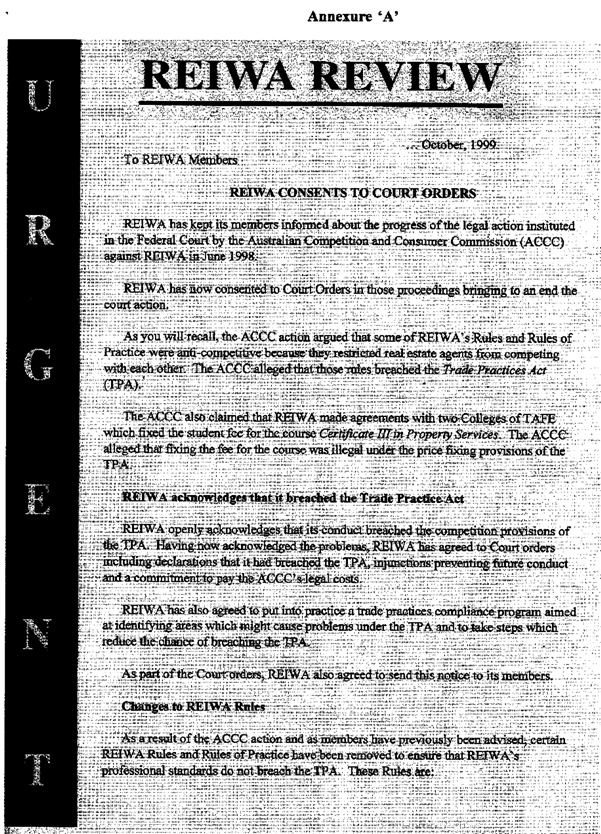
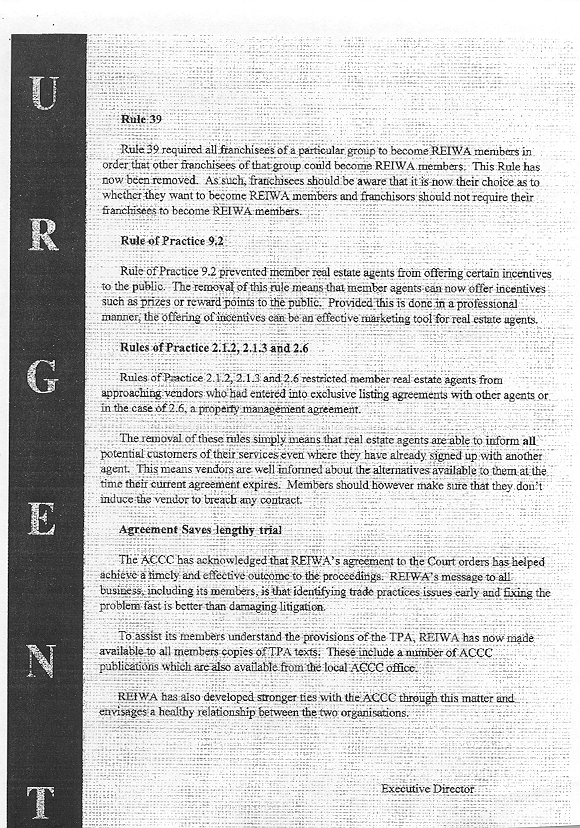
10. The First Respondent notify all of its members in writing of the terms of these Orders by forwarding a notice in terms of Annexure “A” hereof to each of its members by its publication REIWA Review within 7 days of these Orders being made.
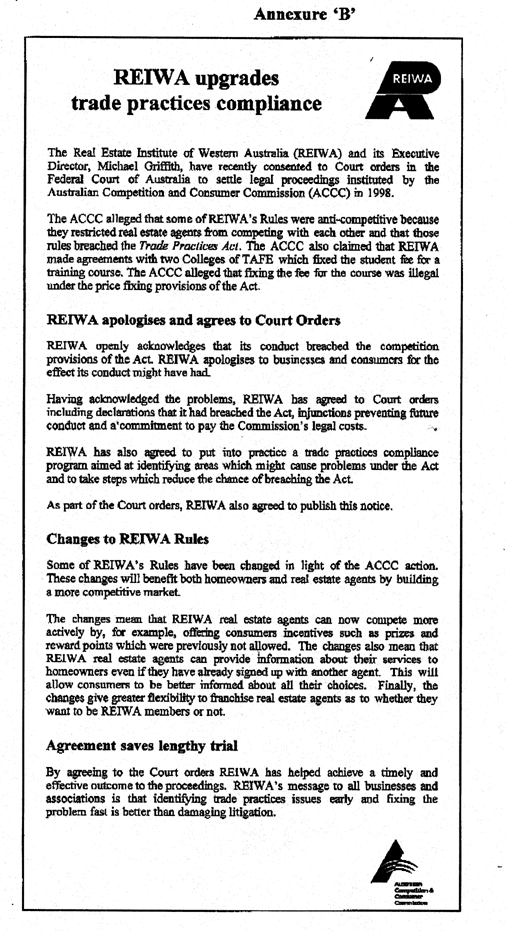
11. The First Respondent and the Second Respondent cause to be published, at their own expense, in The West Australian newspaper and the REIWA News an advertisement in the terms of Annexure “B” hereof and further that such advertisement be:
(a) of a size not less than 13 centimetres wide by 25 centimetres deep;
(b) in a text which is in a type size not less than 10 point;
(c) placed within the first 16 pages of the newspaper;
(d) published on a Saturday in The West Australian newspaper within 14 days of the date of this order;
(e) published in the next available issue of the REIWA News from the date of this order.
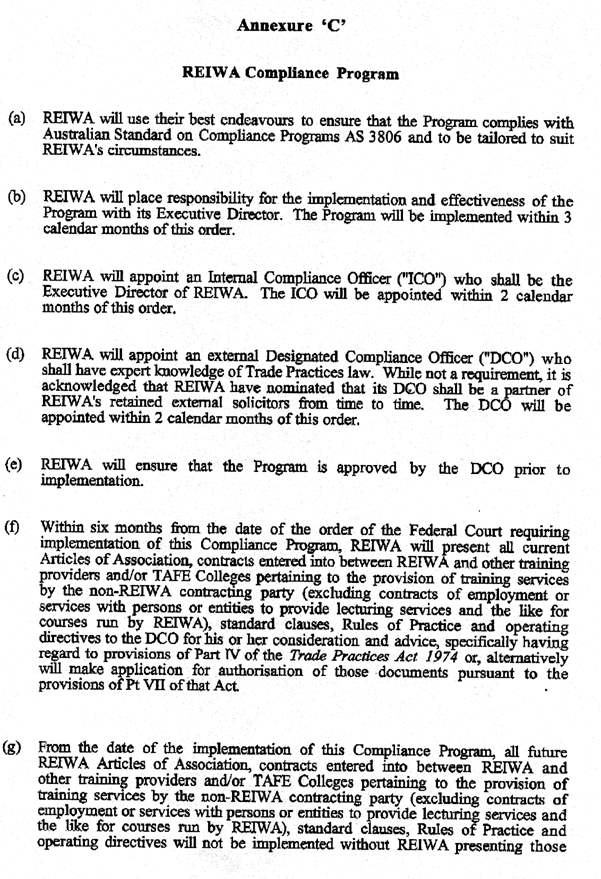
12(a) The First Respondent implement a Trade Practices Corporate Compliance Program in the form of Annexure “C” hereof.
(b) The First Respondent continue to implement the Trade Practices Corporate Compliance Program until 9 October 2005.
(c) The First Respondent be at liberty to vary the Trade Practices Corporate Compliance Program by written agreement with the Applicant.
(d) The First Respondent have liberty to apply to the Court to vary the Trade Practices Corporate Compliance Program by reason of changes in the law or otherwise by reason of changed circumstances.
13. The First and Second Respondents pay the Applicant’s costs of the proceedings to be taxed.
B. By Consent as between the Applicant and the Third and Fourth Respondents the Court declares that:
1. Each of:
(a) clause 4(2) of the Licence of Copyright Agreement dated 17 July 1997 made between the First Respondent and the Third Respondent; and
(b) clause 4(2) of the Licence of Copyright Agreement dated 4 August 1997 made between the First Respondent and the Fourth Respondent
is a provision of a contract or arrangement which had the purpose, or had or was likely to have had the effect, of fixing, controlling or maintaining the price for the supply of training services by the respective parties to the contract or arrangement in competition with each other and which, by virtue of s45A(1) of the Trade Practices Act 1974 (“the Act”) or, alternatively s45A(1) of the Competition Code of Western Australia (“the Competition Code”) had the purpose, or had or was likely to have had the effect of substantially lessening competition.
2. The Third Respondent in making a contract or arrangement with the First Respondent, namely the Licence of Copyright Agreement dated 17 July 1997, containing as a provision Clause 4(2) has contravened s45(2)(a)(ii) of the Act or, alternatively, has contravened s45(2)(a)(ii) of the Competition Code.
3. The Fourth Respondent in making a contract or arrangement with the First Respondent, namely the Licence of Copyright Agreement dated 4 August 1997, containing as a provision Clause 4(2) has contravened s45(2)(a)(ii) of the Act or, alternatively, has contravened s45(2)(a)(ii) of the Competition Code.
C. By consent as between the First and Second Respondents and the Cross-Respondents the Court orders that:
1. The First Respondent (“REIWA”) and the Second Respondent (“Griffith”) have leave to discontinue its cross-claim.
2. The cross-claim is discontinued.
3. The First Cross-Respondent (“Corser & Corser”) and the Second Cross-Respondent (“O’Toole”) shall pay 50% of the Applicant’s (“ACCC”) party and party costs of the Action, the costs to be taxed if not agreed, to REIWA and Griffith within 21 days of the costs being taxed or agreed.
4. Corser & Corser and O’Toole shall pay 50% of the solicitor and client costs charged by Phillips Fox to or on behalf of REIWA relating to the ACCC’s investigation of the activities of REIWA and Griffith, for the period commencing with the appointment of Phillips Fox as solicitors for REIWA in May 1998 and ending with the commencement of the Action on 16 June 1998, (save and except to the extent to which the payments referred to in the schedule to these orders cover the same work and save and except to which the solicitor and client costs charged by Phillips Fox are recoverable under Order 5 or Order 6) the costs to be taxed if not agreed, to REIWA and Griffith within 21 days of the costs being taxed or agreed. Costs of the taxation shall be payable according to the discretion of the Taxing Officer.
5. Corser & Corser and O’Toole shall pay 50% of the solicitor and client costs charged by Phillips Fox to, or on behalf of REIWA of the Action (save and except to the extent to which payments referred to in the schedule to these orders covers the same work) the costs to be taxed if not agreed, to REIWA and Griffith within 21 days of the costs being taxed or agreed. Costs of the taxation shall be payable according to the discretion of the Taxing Officer.
6. Corser & Corser and O’Toole shall pay 50% of REIWA’s and Griffith’s party and party costs in the Cross-claim (save and except to the extent to which payments referred to in the schedule to these orders covers the same work) the costs to be taxed if not agreed, to REIWA and Griffith within 21 days of the costs being taxed or agreed. Costs of the taxation shall be payable according to the discretion of the Taxing Officer.
Schedule of Payments Referred to in Order C4, C5 and C6
1. Wayne Martin WQC fee note dated 4 November 1997.
2. John Gilmore QC fee notes dated 19 December 1997, 2 February 1998, 16 February 1998 and 23 March 1998.
3. Michael Corboy fee note dated 16 June 1998.
4. Richard Keen fee note dated 3 April 1998.
5. Jamieson Johnston fee note dated 18 June 1998.
6. Dyson Heydon QC fee notes dated 1 September 1998 and 17 March 1999.
7. Rene Le Miere QC fee notes dated 12 July 1999, 6 September 1999 and 28 September 1999.
D. By Consent as between the Applicant and the Fifth Respondent the court orders that:
1. The Applicant have leave to amend its Application to delete paragraph 44 of the Application in so far as it relates to the Fifth Respondent.
2. It is declared that the Fifth Respondent, in preparing on behalf of the First Respondent, each of the following contracts or arrangements:
(a) the Licence of Copyright agreement dated 17 July 1997 between the First Respondent and the Third Respondent; and
(b) the Licence of Copyright agreement dated 4 August 1997 between the First Respondent and the Fourth Respondent;
has been, directly or indirectly, knowingly concerned in, or party to, the contraventions of s 45(2)(a)(ii) of the Act or, alternatively, the contraventions of s 45(2)(a)(ii) of the Competition Code, by the First Respondent.
Note: Settlement and entry of orders is dealt with in Order 36 of the Federal Court Rules.
 |
|
IN THE FEDERAL COURT OF AUSTRALIA |
|
|
WAG 71 OF 1998 |
|
JUDGE: |
|
|
DATE: |
|
|
PLACE: |
REASONS FOR JUDGMENT ON CONSENT ORDERS
History of Proceedings
1 The Australian Competition and Consumer Commission (“ACCC”) commenced proceedings in this Court on 16 June 1998 against the Real Estate Institute of Western Australian Inc (“REIWA”) and its Executive Director, Michael Griffith. The ACCC alleged, in effect, that various of the Rules of REIWA were anti-competitive in contravention of Part IV of the Trade Practices Act 1974 (Cth). Part IV proscribes various kinds of anti-competitive conduct including the making of contracts, agreements, arrangements or understandings which include exclusionary provisions or which have or are likely to have the effect of substantially lessening competition in a market for goods or services. The ACCC also alleged that REIWA and Mr Griffith contravened provisions of Part IV by seeking to enforce the Rules in various circumstances referred to in the claim.
2 There is another aspect of the application which has already been settled in part. It relates to the provision of education and training for prospective real estate and business agents. It was dealt with in my judgment of 18 January 1999 in these proceedings. It concerned the terms upon which REIWA agreed to licence to the South West Regional College of TAFE and the West Coast College of TAFE, named as third and fourth respondents, materials in which it asserted copyright for the purpose of providing certificated training services for potential real estate agents in Western Australia. Clause 4(2) of each of the agreements embodying a minimum price requirement was said to have constituted price fixing. Alternatively, it had the effect or was likely to have the effect of substantially lessening competition in the Western Australian training market. By entering into the agreements, REIWA and the two Colleges were alleged to have contravened s 45(2)(a)(ii) of the Trade Practices Act and, alternatively, the like provisions of the Competition Code of Western Australia. Again, the Executive Director was said to have been directly or indirectly knowingly concerned in the conduct.
3 Mr Conal O’Toole, a legal practitioner and partner in the law firm Corser and Corser, was named as a fifth respondent. He was said to have prepared the Copyright Licence Agreements with the two Colleges and the other proposed Copyright Licence Agreements on the instructions of REIWA. In the course of the proceedings REIWA and Mr Griffith filed a cross-claim against Corser and Corser and Mr O’Toole. This cross-claim has also been settled subject to the making of consent orders proposed between the Commission, REIWA and Mr Griffith.
4 All parties have now reached agreements to settle the proceedings. Consent orders have been tendered to the Court. The question for the Court is whether the proposed consent orders are within power and appropriate.
The Contraventions
5 As part of the settlement of the proceedings, REIWA and Mr Griffith have amended their defence to admit sufficient of the matters alleged against them to support the grant of the relief claimed by the ACCC. The combined effect of the statement of claim and the admissions now made in the amended defence supports findings of fact by the Court from which its consideration of the proposed consent orders may be based. The applicant has amended its application be deleting the claim for the imposition of pecuniary penalties against REIWA, Mr Griffith and Mr O’Toole.
6 REIWA is an association of real estate agents who provide real estate services within the State of Western Australia. The Association is incorporated under the provisions of the Associations Incorporation Act 1987 (WA) and, it is common ground, is a trading corporation for the purposes of the Trade Practices Act. All members of REIWA at the time of its incorporation and all new members of REIWA after the date of its incorporation agreed to be bound by its Rules and by its Rules of Practice. The Rules are evidently made by members of REIWA in general meeting by a two-thirds majority resolution. It is not in dispute that the Rules and the Rules of Practice, as amended from time to time, and each of them, constitute a contract or alternatively an arrangement or understanding between REIWA and its members and between the members inter se.
7 The Rules of REIWA, until 10 March 1998, include a Rule 39 relating to franchising arrangements entered into by members of REIWA. The provisions of Rule 39 were as follows:
“No member shall enter into a franchising agreement with a non-member. A member may enter into a franchising agreement with another member provided that: -
(a) the franchisor shall first submit to the Institute Council for its approval a copy of the proposed franchise agreement:
(b) the trading name of the franchisee and the franchisor shall be first approved by the Institute Council which shall have power at its sole and absolute discretion to accept or reject or modify such trading name;
(c) the names of the franchisor and the franchisee shall be displayed in conformity with the relevant Institute policy from time to time;
(d) if, during the currency of any franchising agreement, the membership of either the franchisor or franchisee is suspended or terminated by the Institute Council or Executive Committee, it may follow that the membership of the franchisor and of all franchisees to the franchisor shall be suspended or terminated as the Institute Council or Executive Committee in its discretion shall think fit;
(e) for the purpose of these provisions, whenever persons carry on business as agents, whether in common or not, pursuant to a franchising agreement and notwithstanding any agreement to the contrary, the parties to that agreement shall be jointly and severally liable in respect of any claim arising by reason of the non-compliance of either the franchisee or the franchisor or of any sub-agent or employee, director, officer, controller of approved manager with any Rules or Regulations of the Institute.”
8 Rule 39 was, and other Rules of REIWA are, supported by ancillary Rules of a disciplinary character which provide for expulsion, suspension, fining and reprimanding of members. These functions are carried out variously by the Council, the Executive Committee and Arbitration Committees which may be set up under the Rules. There is also provision for a Special Committee to be set up by the Council to deal with particular complaints or disputes instead of an Arbitration Committee. These provisions are to be found in Rules 45, 49, 56, 58 and 65.
9 It appears from the amended defence that by a resolution of members at a general meeting on the evening of 10 March 1998 and prior to the commencement of the present proceedings, Rule 39 was removed from the Rules entirely. Further, by a resolution of the REIWA Council on 2 July 1998 it was proposed that Rules 40, 45, 49, 56, 58 and 65 be amended in a manner yet to be finalised having regard to concerns raised by the ACCC. Notwithstanding the amendments, it is maintained by REIWA and Griffith that the Rules were in the public interest because they provided a mechanism for supervision and enforcement of a code of proper professional conduct for real estate agents who were members of REIWA and put in place an industry infrastructure that promoted and assisted the smaller franchises and the independent real estate agencies in order to promote competition with the larger franchises. Moreover they were said to have provided the public with a benchmark of quality real estate services as member agents would all have to comply with the Rules and the Rules of Practice. No doubt this position is maintained against the possibility of future authorisation of the Rules in some modified form.
10 The Rules of Practice referred to in the statement of claim contained the following provisions:
2.1.2 “An agent who is aware of a current exclusive agency including an auction or Multiple Listing Authority which obliges a principal to pay a fee to another agent if the property and/or business concerned is sold or leased shall not contact the principal or otherwise solicit an appointment as agent in respect of that property and/or business.
In all such cases any negotiation regarding the subject property and/or business must be carried out with the agent who holds the exclusive appointment and not directly with the principal, except when a client is fully aware of his responsibilities to the first agent and despite this knowledge instructs the second agent to list the property and/or business for sale.
Inspections of the subject property and/or business must not be made other than with the knowledge and consent of the Listing Agent.
Penalty: a maximum fine of $2,000.00, such fine being subject to change by Council from time to time. This provision does not limit obligations to fee sharing in any other rule.
2.1.3 When an agent’s board is erected on a property and/or business another agent shall not contact or otherwise solicit an agency for that property and/or business.
…
Penalty: A maximum fine of $2,000.00, such fine being subject to change by Council from time to time. This provision does not limit obligations to fee sharing in any other rule.
2.2 In the interests of fair competition, agents may distribute “SOLICITING” material and circulate letters which comply at all times with the Real Estate Institute of Western Australia Code of Ethics and are of a reasonable quality of production in keeping with the standards of the Institute.
Penalty: A maximum fine of $2,000.00, such fine being subject to change by Council from time to time. This provision does not limit obligations to fee sharing in any other rule.
2.6 An agent who is aware of a current agency or arrangement which obliges a Strata Company to pay a fee to another agent shall not solicit that Strata Company or any of its proprietors in respect of that Strata Company’s management.
Penalty: A maximum fine of $2,000.00, such fine being subject to change by Council from time to time.
9.2 An agent when acting as an agent shall not hold out to the general public, by way of advertisement or otherwise, offers of gifts, prizes, incentives or inducements of a kind not associated with the provision of professional services of a real estate nature.”
11 It is said in the amended defence that the Rules of Practice and amendments to them were reviewed and approved by REIWA’s retained solicitors at all material times. Certain of the Rules of Practice pleaded in the Statement of Claim have, both prior to and after the commencement of the proceedings, either been amended by REIWA or are the subject of proposed amendments. Particulars of the amendments were set out in the Amended Defence. Among those amendments was the removal of Rules of Practice 2.3, 2.6 and 9.2 by resolutions of the REIWA Council in March and July 1998. The ACCC was advised of these proposed changes by way of a letter from REIWA’s solicitors in June 1998. The plea is maintained that the Rules of Practice were in the public interest for the same reasons as the REIWA Rules.
12 The membership of REIWA covers licensed real estate agents under the Real Estate and Business Agents Act 1978 (WA), persons who hold licences under that Act on behalf of a licensed partnership or as nominee of a licensed corporation, and corporations and partnerships which are licensed agents, other corporations or partnerships approved by the REIWA Council and any real estate franchisors who have entered into franchising agreements with members of REIWA. The services provided by REIWA to its members include access to the Multiple Listing Service of WA, which is owned by REIWA and membership of which is limited to approved REIWA members, advertising services, a stationery discount service, training and educational programs, a telephone discount service, a photography service, a graphic arts service, a market information service, a library service and the benefit of the public reputation associated with REIWA membership.
13 The nature of the real estate services provided is common ground. These services, provided to members of the public, are the services of an agent in connection with, inter alia:
“(a) the sale or disposal of real estate or any right to the use or occupation of real estate, including the lease or letting of real estate;
(b) the purchase or acquisition of real estate or any right to the use or occupation of real estate, including the acquisition under lease or letting or the tenancy or occupation of real estate;
(c) the collection of rents or other payments for the use or occupation of real estate.”
14 Licences to carry on business as a real estate agent may be granted under the Real Estate Agents Act to individuals or partnerships or bodies corporate.
15 It is common ground that within the State of Western Australia licensed agents, including members of REIWA, are and were at all material times in competition with each other to provide real estate services to members of the public. The way in which licensed agents and members of REIWA compete include:
“(a) providing or endeavouring to provide:
(i) a better and more comprehensive level of services; and
(ii) a better standard of service
to members of the public and, in particular:
(A) more effective; and
(B) more innovative
marketing and promotion services for the sale of properties on behalf of members of the public;
(b) promoting the advantages in, inter alia, expertise, experience and reliability associated with:
(i) the name and reputation of the agency;
(ii) the principals and sales representatives employed by the agency; and
(iii) any network to which the agency belongs;
(c) providing or endeavouring to provide real estate services to members of the public at lower cost.”
There is and was at all material times no close substitute in Western Australia for real estate services. It is admitted that within Western Australia there is and was at all material times a market for the supply of real estate services by licensed agents to members of the public. This is designated in the pleadings “the Western Australian market”.
16 The nature of franchisor services is agreed. A real estate franchisor carries on the business of supplying to licensed agents, real estate franchise services including, inter alia:
“(a) the use of the franchise brand name and associate trade marks and logos;
(b) marketing and promotional services, programs and initiatives;
(c) business and management systems and supporting technology;
(d) training services;
(e) networking services;”
It is common ground that within the State of Western Australia real estate franchisors, including franchisors who are members of REIWA, are and were at all material times in competition with each other to provide franchisor services to licensed agents. The competition between real estate franchisors and franchisors who are members of REIWA is competition in the provision of marketing and promotional services, the enhancement of the franchise brand name, the structuring of franchise royalty and fee payments by franchisees and the business and management services and technology in support of those business and management services. It is also common ground that within the State of Western Australia there is and was at all material times a market for the supply of franchisor services by real estate franchisors to licensed agents. This is designated in the pleadings “the Western Australian franchisor market”.
17 The common factual position in relation to the conduct of REIWA and its Executive Director in enforcing Rule 39 and Rule of Practice 9.2 is set out in the Joint Submission of the ACCC, REIWA and Mr Griffith in support of the consent orders. Deleting particular paragraph designations, it is convenient to set out those agreed facts as follows.
1. Hooker Corporation is a real estate franchisor which has entered into franchise agreements with various real estate agents in Western Australia. At the material times Hooker Corporation was a REIWA member. Rule 39 required Hooker Corporation not to enter into franchise agreements with a franchisee unless the franchisee was or became a REIWA member. Franchisees who entered franchise agreements and became REIWA members included:
(i) Montana (WA) Pty Ltd trading as LJ Hooker Spearwood which entered into an LJ Hooker franchise agreement in November 1996 and, following steps taken by REIWA to enforce compliance with Rule 39, became a full REIWA member in December 1997.
(ii) Exchange Resources Pty Ltd trading as LJ Hooker Port Hedland, which entered into an LJ Hooker franchise agreement and made application to become a REIWA member in December 1994.
(iii) Blacklaw Pty Ltd trading as LJ Hooker Karratha which entered into an LJ Hooker franchise agreement and made application to become a REIWA member in January 1992.
(iv) Aspramonte Pty Ltd trading as LJ Hooker Roleystone which entered into an LJ Hooker franchise agreement in October 1996 and became a full REIWA member in October 1997.
2. In November 1997 REIWA convened a Professional Standards Tribunal to consider, inter alia, a breach of Rule 39 by LJ Hooker in respect of its franchisee relationship with LJ Hooker Spearwood. The Tribunal found that LJ Hooker was in contravention of Rule 39 and it was given 14 days to rectify the situation.
3. In November 1995 LJ Hooker Ltd, a subsidiary of Hooker Corporation, entered into an agreement with Telstra Corporation Ltd to promote Telstra Visa Card scheme through LJ Hooker franchise offices throughout Australia. Under the scheme 100,000 reward points would accrue to a Telstra Visa card holder whose property was listed and sold through an LJ Hooker franchisee.
4. The LJ Hooker Telstra promotion commenced in late 1995 and continued throughout Australia from that time save for Western Australia.
5. Active marketing of the Telstra promotion by Hooker Corporation and LJ Hooker franchisees within Western Australia commenced in or about April 1997.
6. REIWA took various steps to stop the marketing of the Telstra promotion within Western Australia on the basis that it breached Rule of Practice 9.2 including:
(i) various letters, telephone calls and communications to Mark Sinclair, the then Western Australian Regional Manager of Hooker Corporation (“Sinclair”);
(ii) letters to LJ Hooker Spearwood, including the imposition of a $500.00 penalty;
(iii) letters to LJ Hooker Karratha, including a possible referral to a Professional Standards Tribunal;
(iv) letters and communications to LJ Hooker Roleystone, including a proposed referral to a Professional Standards Tribunal;
(v) letters to LJ Hooker Willetton including a proposed referral to a Professional Standards Tribunal;
(vi) letters to LJ Hooker Forrestfield;
(vii) convening of a Professional Standards Tribunal in November 1997 to consider, inter alia, an alleged breach by Sinclair of Rule of Practice 9.2 in respect of an LJ Hooker advertisement in the West Australian newspaper of 27 September 1997 advertising the Telstra promotion;
(viii) imposition of a $10,000 fine by the REIWA Council upon Sinclair for a breach of Rule of Practice 9.2 upon the finding of the Professional Standards Tribunal convened in November 1997. The fine however was not enforced by REIWA and has not been paid.
7. Roy Weston Ltd is a real estate franchisor which has entered into franchise agreements with various real estate agents in Western Australia. At the material times Roy Weston Ltd was a member of REIWA and, as a result of Rule 39, Roy Weston could not enter into a franchise agreement with a franchisee who was not or who did not become a member of REIWA. Airline Holding Pty Ltd trading as Roy Weston Geoff Baldwin Team entered into a Roy Weston franchise agreement and made application to become a REIWA member in March 1996.
8. In November 1997 the Roy Weston Geoff Baldwin Team distributed brochures and flyers to householders which included a promotion offering prizes including accommodation and dinner at Hillarys Harbour Resort.
9. In November 1997 REIWA took steps to stop the Geoff Baldwin promotion by a letter to the Roy Weston Geoff Baldwin Team advising that the Geoff Baldwin promotion was not in accordance with Rule of Practice 9.2 and requiring it to be abandoned.
10. In November 1997 edition of its monthly publication “REIWA News”, REIWA advised its members that breaches of Rule of Practice 9.2 could result in financial penalties being imposed by a Professional Standard Tribunal.
11. Griffith, as Executive Director of REIWA, was actively involved in the steps taken by REIWA to ensure compliance by REIWA members with Rule 39 and Rule of Practice 9.2.
18 As already noted, Rule 39 was suspended by a special general meeting of REIWA on 10 March 1998. On 3 December 1998, by resolution of a general meeting of REIWA a new set of rules/articles was adopted which no longer contained Rule 39. Rule of Practice 9.2 was cancelled by the Council of REIWA on 10 March 1998.
19 In relation to the Copyright Licence Agreement between REIWA and the two Technical and Further Education Colleges named in the proceedings, it is now admitted that there was at all material times a Western Australian market for the provision to the public of training services for prospective real estate representatives. REIWA and the two Colleges named as respondents, the Central Metropolitan College of TAFE, the Midland College of TAFE and the C.Y. O’Connor College of TAFE were in competition with each other in that market.
20 On 17 July 1997, REIWA entered into a Copyright Licence Agreement with the South West Regional College of TAFE and on 4 August 1997 a similar agreement with the West Coast College of TAFE. Each of the agreements contained a term that the training services provided by the Colleges would not be offered to their students for a fee of less than $780. In June 1997 and August 1997, REIWA sent Copyright Licence Agreements containing similar provisions to the three other Colleges mentioned, but none of those Colleges executed the agreements.
21 Each of the Copyright Licence Agreements with the South West Regional College of TAFE and the West Coast College of TAFE were signed on REIWA’s behalf by Mr Griffith, who was aware of their terms and conditions including the minimum pricing provision.
22 It is admitted that Rule 39 had the purpose of preventing, restricting or limiting the supply of franchisor services to licensed agents by franchisor members and that Rules of Practice 2.1.2, 2.1.3 and 2.6 had the purpose of preventing, restricting or limiting the supply of real estate services to members of the public by agent members. It is also admitted that until the suspension of its operation, Rule 39 of the Rules had or was likely to have had the effect of substantially lessening competition within the Western Australian franchisor market. It is further admitted that Rules 2.1.2, 2.1.3, 2.6 and 9.2 of the Rules of Practice, at all material times, had or were likely to have the effect of substantially lessening competition within the Western Australia market.
23 It is now conceded that by reason of Rule 39, REIWA had made a contract, an arrangement or an understanding containing a provision which was an exclusionary provision in contravention of s 45(2)(a)(i) of the Act and that it was or was likely to have the effect of substantially lessening competition in contravention of s 45(2)(a)(ii) of the Act. It is also agreed that in contravention of s 45(2)(b)(i) and s 45(2)(b)(ii) of the Act REIWA had given effect to that provision. The Rules of Practice referred to were rules which had or were likely to have the effect of substantially lessening competition or were exclusionary provisions in contravention of ss 45(2)(a)(i) and (ii) of the Act. It was also conceded that Mr Griffith was directly or indirectly knowingly concerned in contraventions of the Act already referred to in relation to giving effect to provisions of the Rules.
24 So far as the Copyright Licence Agreement is concerned, it is admitted that at all material times there was a market for the provision of training services to students for reward within Western Australia and that at all material times REIWA, the two Colleges named as respondents, Central Metropolitan College, Midland College and C.Y. O’Connor College were in competition with each other for the provision of training services in that market. Clause 4(2) of the Copyright Licence Agreements and the proposed Copyright Licence Agreements each had the purpose or had or was likely to have the effect of fixing, controlling or maintaining the price for the training services provided by REIWA and each of the respective licensees or proposed licensees under those agreements. It is also admitted that the provisions of the Copyright Licence Agreements were provisions to which s 45A of the Act applied and which by virtue of that section, had the purpose or effect or would have been likely to have the effect of substantially lessening competition in the Western Australian Training Market. The making of the contracts with the two named respondents is agreed to have been in contravention of s 45(2)(a)(ii) of the Act.
25 REIWA and Mr Griffith also admit that Griffith was directly or indirectly knowingly concerned in the contraventions of the Act constituted by the execution of the Copyright Licence Agreements. Mr Griffith was admittedly directly or indirectly knowingly concerned in the contraventions of the Act constituted by making the licence copyright agreements with West Coast College and South West Regional College.
26 REIWA and Griffith both admit that REIWA is entitled to the relief set out in the minute of consent orders.
The Joint Submission
27 ACCC, REIWA and Griffith jointly submit to the Court in support of the proposed consent orders that the contraventions involved are contraventions of very important sections of the Act, noting in particular that the prohibition on price fixing is a per se provision. While REIWA was not itself a participant in the Western Australian real estate services market, its Rules and Rules of Practice governed the manner in which its members, who comprise some 80 to 85% of the real estate agents operating in the Western Australian market, carry on business within the market. To the extent that those Rules and Rules of Practice had an anti-competitive effect, that effect was widespread in the market.
28 Similarly, while REIWA was not itself a participant in the Western Australian franchisor market for real estate franchisor services, Rule 39 governed the manner in which its franchisor members, who comprised at the material times all the real estate franchisors operating in the Western Australian market, carried on business within that market. Consequently the anti-competitive effect of Rule 39 was wide spread in the Western Australian franchisor market for real estate franchisor services.
29 REIWA was also a participant in the training services market. Entry into the Copyright Licence Agreements fixed a minimum price at which the sales representative training course would be provided by three out of the five then participants in that market. At the same time, REIWA sought to enter into similar agreements with the two remaining TAFE Colleges which also participated in the market and with the third, C.Y. O’Connor College, which had expressed an interest in entering the market but had not then done so. The anti-competitive effect of the price fixing agreement deemed to exist in any event by s 45A at that time would have been significant in that market. REIWA initiated the signing of the two Copyright Licence Agreements and, together with its then solicitors, Corser & Corser, was responsible for setting their terms (including the price fixing clause). The South West Regional College and the West Coast College had no input into the formulation of those terms. Although REIWA may have a legitimate interest to protect in the Copyright Licence Agreements, the addition of the price fixing clause to those agreements was not necessary in order to protect those interests.
30 It is also part of the joint submission that in September 1997 the ACCC notified REIWA and Griffith of its concerns that Rule 39 and Rule of Practice 9.2 might be anti-competitive and in breach of the Act. REIWA, including its then President, and with the active involvement of Griffith as Executive Director, continued to firmly maintain to all of its members that the restrictions in these Rules applied. REIWA actively continued its enforcement of Rule of Practice 9.2 against its members, in particular Mr Sinclair of the L.J. Hooker Group upon whom it imposed a $10,000 fine for breach of Rule of Practice 9.2 in November 1997. Payment of that fine was not subsequently enforced by REIWA and it has not been paid. REIWA did not take any steps to withdraw the relevant Rules and Rules of Practice until March 1998. REIWA published statements, publicly and to its members, which were critical of the ACCC’s involvement in issues concerning its Rules and Rules of Practice and of those members of REIWA from whom ACCC had been seeking information regarding issues relating to the relevant Rules and Rules of Practice. It did not accept, prior to September 1998, that it was necessary for it to implement a formal Trade Practices Compliance Program as required by the ACCC in correspondence and discussions on the issue up to that date.
31 On the other hand, it is acknowledged that REIWA removed Rule of Practice 9.2 and suspended the operation of Rule 39 in March 1998, although it did not then admit any contravention of the Act. In April 1998 it instigated a review of its Rules and Rules of Practice by independent counsel to deal with any trade practices issues arising from them. In June 1998 it advised the ACCC that as a consequence of that review, Rules of Practice 2.1.2, 2.1.3 and 2.6 in their then form were to be removed. They were rescinded by the Council of REIWA on 14 December 1998.
32 In February 1998, REIWA terminated the Copyright Licence Agreements containing the price fixing clauses with both the South West Regional College and the West Coast College.
33 In September 1998, REIWA, as part of ongoing discussions with the ACCC regarding the possible resolution of the matters at issue in these proceedings, indicated that it was prepared to consider the implementation of a Trade Practices Compliance Program in terms which would have satisfied the ACCC’s principal concerns. However no such resolution was agreed to at that time. The implementation of a Trade Practices Compliance Program which has been developed from that suggested in September 1998 is the subject of the proposed consent orders.
34 It is said that the removal of the relevant Rules and Rules of Practice, the withdrawal of the Copyright Licence Agreements and the agreed implementation by REIWA of a Trade Practices Compliance Program in terms which are satisfactory to the applicant and reinforced by appropriate injunctions, reflect a genuine commitment by REIWA and Griffith to ensure that there is no repetition in the future of the conduct in question and that the reach and purposes of trade practices law are expounded and its observance inculcated within the operations of REIWA.
The Proposed Consent Orders
35 The proposed consent orders, as between the ACCC, REIWA and Griffith, are in the following terms:
“Subject to the Court’s agreement to make all of the following orders and declarations substantially in the terms set out herein, the Applicant and the First and Second Respondents will consent to the making of the following orders and declarations:
1. The Applicant have leave to amend its Application by deleting paragraph 44 of the Application in so far as it relates to the First and Second Respondents.
2. The First and Second Respondents have leave to amend their Defence in terms of the Minute of Amended Defence filed herewith and the Minute of Amended Defence do stand as the Amended Defence and service thereof be dispensed with.
3. A declaration that the Rules of the Real Estate Institute of Western Australia Inc (REIWA) as amended from time to time (“the Rules”) and the Rules of Practice of REIWA as amended from time to time (“the Rules of Practice”) and each of them constitute a contract, or alternatively, an arrangement or understanding:
(a) between REIWA and its members; and
(b) between the members of REIWA inter se.
4. A declaration that Rule 39 of the Rules constitutes a provision of each of the contracts, arrangements or understandings referred to in paragraph 3 above which is an exclusionary provision within the meaning of s45(2)(a)(i) and s45(2)(b)(i) of the Trade Practices Act 1974 (“the Act”).
5. A declaration that Rule 39 of the Rules constitutes a provision of each of the contracts, arrangements or understandings made or arrived at between the First Respondent and its members and between the members of the First Respondent themselves which provision would have or be likely to have the effect of substantially lessening, preventing or hindering competition in the Western Australian franchisor market for real estate franchisor services, as that market is defined in the Statement of Claim.
6. A declaration that the First Respondent in making the contract or arrangement or arriving at the understanding with its members referred to in paragraph 3(a) above has contravened Section 45(2)(a)(i) and Section 45(2)(a)(ii) of the Act.
7. A declaration that the First Respondent in giving effect to a provision, namely Rule 39 of the Rules, of the contract, arrangement or understanding between the First Respondent and its members referred to in paragraph 3(a) above has contravened Section 45(2)(b)(i) and Section 45(2)(b)(ii) of the Act.
8. A declaration that each of:
(a) Rule 2.1.2 of the Rules of Practice;
(b) Rule 2.1.3 of the Rules of Practice;
(c) Rule 2.6 of the Rules of Practice
constituted a provision of a contract or arrangement or understanding made between or arrived at between the First Respondent and its members and between the members of the First Respondent themselves which is an exclusionary provision within the meaning of s 45(2)(a)(i) and s45(2)(b)(i) of the Act.
9. A declaration that each of:
(a) Rule 2.1.2 of the Rules of Practice;
(b) Rule 2.1.3 of the Rules of Practice;
(c) Rule 2.6 of the Rules of Practice; and
(d) Rule 9.2 of the Rules of Practice,
constituted a provision of a contract or arrangement or understanding made or arrived at between the First Respondent and its members and between the members of the First Respondent themselves which, if given effect to, would have or be likely to have the effect of substantially lessening, preventing or hindering competition in the Western Australian market for real estate services, as that market is defined in the Statement of Claim.
10. A declaration that the First Respondent in making the contract or arrangement or arriving at the understanding with its members containing a provision, namely Rule 9.2 of the Rules of Practice, has contravened Section 45(2)(a)(ii) of the Act.
11. A declaration that the First Respondent in giving effect to a provision, namely Rule 9.2 of the Rules of Practice, of the contract, arrangement or understanding between the First Respondent and its members referred to in paragraph 3(a) above has contravened Section 45(2)(b)(ii) of the Act.
12. A declaration that the First Respondent in making the contract or arrangement or arriving at the understanding with its members referred to in paragraph 3(a) above containing each of the following provisions:
(a) Rule 2.1.2 of the Rules of Practice;
(b) Rule 2.1.3 of the Rules of Practice; and
(c) Rule 2.6 of the Rules of Practice
has contravened Section 45(2)(a)(i) and Section 45(2)(a)(ii) of the Act.
13. A declaration that the Second Respondent, in engaging in the conduct as pleaded in paragraphs 39, 43, 44, 59, 61, 62, 64 (as admitted in the Amended Defence of the First and Second Respondents), 66, 67, 68, 69, 72, 73, 76, 77, 79(a), 80, 81, 82, 83, 84, 93, 94 and 95 of the Further Amended Statement of Claim, has been, directly or indirectly, knowingly concerned in, or party to, the contraventions of Section 45(2)(a)(i), Section 45(2)(a)(ii), Section 45(2)(b)(i) and Section 45(2)(b)(ii) of the Act.
14. A declaration that each of:
(a) clause 4(2) of the Licence of Copyright agreement dated 17 July 1997 between the First Respondent and the Third Respondent;
(b) clause 4(2) of the Licence of Copyright agreement dated 4 August 1997 between the First Respondent and the Fourth Respondent;
is a provision of a contract or arrangement which has the purpose, or is likely to have the effect, or fixing, controlling or maintaining the price for the supply of training services, being the Certificate III in Property Services training programme, by the First Respondent and the respective parties to the contract or arrangement in competition with each other.
15. A declaration that Clause 4(2) of the Licence of Copyright agreement dated 17 July 1997 between the First Respondent and the Third Respondent is a provision of a contract or arrangement made between the First Respondent and the Third Respondent which has the purpose, or would have or be likely to have the effect, of a substantially lessening competition in the Western Australian Training market for training services, as that market is defined in the Statement of Claim.
16. A declaration that Clause 4(2) of the Licence of Copyright agreement dated 4 August 1997 between the First Respondent and the Fourth Respondent is a provision of a contract or arrangement made between the First Respondent and the Fourth Respondent which has the purpose, or would have or be likely to have the effect, of a substantially lessening competition in the Western Australian Training market for training services, as that market is defined in the Statement of Claim.
17. A declaration that the First Respondent in making:
(a) a contract or arrangement with the Third Respondent, being the Licence of Copyright agreement dated 17 July 1997, containing as a provision clause 4(2); and
(b) a contract or arrangement with the Fourth Respondent, being the Licence of Copyright agreement dated 4 August 1997, containing as a provision clause 4(2);
has in each case contravened section 45(2)(a)(ii) of the Act.
18. A declaration that the Second Respondent, in executing on behalf of the First Respondent and in acting on behalf of the First Respondent in the administration of each of the following contracts or arrangements:
(a) the Licence of Copyright Agreement between the First Respondent and the Third Respondent dated 17 July 1997; and
(b) the Licence of Copyright Agreement between the First Respondent and the Fourth Respondent dated 4 August 1997,
has been, directly or indirectly, knowingly concerned in, or party to, the contraventions of section 45(2)(a)(ii) of the Act.
19. Each of the First Respondent, by its officers, employees, members, agents or howsoever, and the Second Respondent be restrained from giving effect to, or attempting to give effect to or threatening to give effect to, any of:
(i) Rule 39 of the Rules;
(ii) Rule 2.1.2 of the Rules of Practice;
(iii) Rule 2.1.3 of the Rules of Practice; and
(iv) Rule 2.6 of the Rules of Practice.
20. Within 1 month from the date of this order or such other time as the Court shall allow the First Respondent take all necessary steps for the removal of:
(i) Rule of Practice 2.1.2 from the Rules of Practice;
(ii) Rule of Practice 2.1.3 from the Rules of Practice; and
(iii) Rule of Practice 2.6 from the Rules of Practice.
21. Each of the First Respondent, by its officers, employees, members, agents or howsoever, and the Second Respondent be restrained from attempting to induce, whether by threat, promise or otherwise, real estate franchisor members of the First Respondent or any other real estate agency franchisor to:
(a) supply or offer real estate franchisor services under a real estate franchise agreement or a proposed real estate franchise agreement to licensed real estate agents on condition that the licensed real estate agents acquire REIWA membership services from the First Respondent; or
(b) refuse to supply or offer real estate franchisor services under a real estate franchise agreement or a proposed real estate franchise agreement to licensed real estate agents for the reason that those licensed real estate agents have not acquired or have not agreed to acquire membership services from the First Respondent.
22. The First Respondent, whether by its officers, employees, agents or otherwise howsoever, be restrained from giving effect to, or threatening to give effect to, clause 4(2) of the Licence of Copyright agreement dated 17 July 1997.
23. The First Respondent, whether by its officers, employees, agents or otherwise, howsoever, be restrained from giving effect to, or threatening to give effect to, clause 4(2) of the Licence of Copyright agreement dated 4 August 1997.
24. The First Respondent, by its officers, employees, agents or otherwise howsoever, be restrained from entering into or inducing or attempting to induce any other party to enter into a contract, arrangement or understanding fixing, controlling or maintaining, or providing for the fixing, controlling or maintaining of, the price for training services to be supplied by each of the parties to the contract, arrangement or understanding or the proposed contract, arrangement or understanding in competition with each other.
25. The Second Respondent be restrained from being in any way, directly or indirectly, knowingly concerned in, or party to, the entry into, or the inducing or attempting to induce a party to enter into, a contract, arrangement or understanding fixing, controlling or maintaining, or providing for the fixing, controlling or maintaining of, the price for training services to be supplied by each of the parties to the contract, arrangement or understanding or the proposed contract, arrangement or understanding in competition with each other.
26. The First Respondent notify all of its members in writing of the terms of these Orders by forwarding a notice in terms of Annexure “A” hereof to each of its members by its publication REIWA Review within 7 days of these Orders being made.
27. The First Respondent and the Second Respondent cause to be published, at their own expense, in The West Australian newspaper and the REIWA News an advertisement in the terms of Annexure “B” hereof and further that such advertisement be:
(a) of a size not less than 13 centimetres wide by 25 centimetres deep;
(b) in a text which is in a type size not less than 10 point;
(c) placed within the first 16 pages of the newspaper;
(d) published on a Saturday in The West Australian newspaper within 14 days of the date of this order;
(e) published in the next available issue of the REIWA News from the date of this order.
28. The First Respondent implement a Trade Practices Corporate Compliance Program in the form of Annexure “C” hereof.
29. The First and Second Respondents pay the Applicant’s costs of the proceedings to be taxed.”
36 The proposed compliance program is in the following terms:
“Annexure ‘C’
REIWA Compliance Program
(a) REIWA will use their best endeavours to ensure that the Program complies with Australian Standard on Compliance Programs AS 3806 and to be tailored to suit REIWA’s circumstances.
(b) REIWA will place responsibility for the implementation and effectiveness of the Program with its Executive Director. The Program will be implemented within 3 calendar months of this order.
(c) REIWA will appoint an Internal Compliance Officer (“ICO”) who shall be the Executive Director of REIWA. The ICO will be appointed within 2 calendar months of this order.
(d) REIWA will appoint an external Designated Compliance Officer (“DCO”) who shall have expert knowledge of Trade Practices law. While not a requirement, it is acknowledged that REIWA have nominated that its DCO shall be a partner of REIWA’s retained external solicitors from time to time. The DCO will be appointed within 2 calendar months of this order.
(e) REIWA will ensure that the Program is approved by the DCO prior to implementation.
(f) Within six months from the date of the order of the Federal Court requiring implementation of this Compliance Program, REIWA will present all current Articles of Association, contracts entered into between REIWA and other training providers and/or TAFE Colleges pertaining to the provision of training services by the non-REIWA contracting party (excluding contracts of employment or services with persons or entitles to provide lecturing services and the like for courses run by REIWA), standard clauses, Rules of Practice and operating directives to the DCO for his or her consideration and advice, specifically having regard to provisions of Part IV of the Trade Practices Act 1974 or, alternatively will make application for authorisation of those documents pursuant to the provisions of Pt VII of that Act.
(g) From the date of implementation of this Compliance Program, all future REIWA Articles of Association, contracts entered into between REIWA and other training providers and/or TAFE Colleges pertaining to the provision of training services by the non-REIWA contracting party (excluding contracts of employment or services with persons or entities to provide lecturing services and the like for courses run by REIWA), stand clauses, Rules of Practice and operating directives will not be implemented without REIWA presenting those documents to the DCO for his or her consideration and advice, specifically having regard to provisions of Part IV of the Trade Practices Act 1974 or, alternatively without REIWA making application for authorisation of those documents pursuant to the provisions of Pt VII of that Act.
(h) REIWA will require the DCO to review in draft all REIWA arbitration and tribunal awards prior to issue to ensure they comply with the provisions of Part IV of the Trade Practices Act 1974.
(i) REIWA will require the DCO to maintain a documentary record of the reviews and advice referred to at paragraphs (f), (g) and (h) above. Such documentary record will include:
i) a description of the proposed document; and
ii) written advice of any identified trade practices implications and action recommended to address those implications (including the date on which the document was reviewed).
(j) The ICO will review all minutes of all REIWA Committees, Divisions and Groups prior to their dissemination to identify any issues under the provisions of Part IV of the Trade Practices Act 1974 and address those issues promptly.
(k) The DCO will advise REIWA, by its Executive Director and President, of any amendments to Part IV of the Trade Practices Act 1974. Further, the DCO (or their nomination) will attend each monthly Senior Management meeting and report on any changes to Part IV of the Trade Practices Act 1974.
(l) The ICO will report directly to the Council of REIWA on all aspects concerning part IV of the Trade Practices Act 1974 and specifically make recommendations in light of any amendments to that legislation.
(m) REIWA will ensure that the DCO conducts training concerning Part IV of the Trade Practices Act to REIWA Arbitrators; REIWA Professional Standards Committee, REIWA Secretariat and REIWA’s general membership on four occasions over the 3 years following this order. The first of these training programs will be completed within three calendar months of the order, the second training program within six months of the first and the remaining two on an annual basis thereafter.
(n) REIWA will ensure that the DCO reviews the Program on three occasions with a view to identifying and implementing improvements thereto. The first of these review programs to be completed within twelve calendar months of the order and the remaining two annually thereafter. Should the DCO’s review identify deficiencies, REIWA shall make the necessary alterations to the Program within three weeks.
(o) REIWA will ensure that the ICO keeps records, within a separate log book, of all details of complaints in regard to REIWA’s compliance with Part IV of the Act. Such record will identify the date, the details of the complaint and the action taken by REIWA with respect to the complaint and such record shall be made within two weeks of the complaint being received by REIWA.
(p) REIWA will make available to its executive and members trade practices reference material. While not a requirement, REIWA have nominated that it will make available the following materials:
Russell Miller’s Annotated Trade Practices Act;
Fair and Square;
Summaries of the Trade Practices Act and the Prices
Surveillance Act;
Small Business and the Trade Practices Act; and
Advertising and Selling.
(q) REIWA will ensure that the records referred to at paragraph (i) and (o) above are available for review by the Australian Competition and Consumer Commission as may be required from time to time. Such records are to be available two weeks after the record creation and for a period of 3 years after that date. Such records will be provided to the Australian Competition and Consumer Commission within 10 working days of written request for those records.
(r) REIWA will report to the Australian Competition and Consumer Commission within 1 calendar month of each of the reviews referred to at paragraph (n) above summarising:
(i) the records referred to at paragraphs (i) and (o) referred to above; and
(ii) details of the training program referred to at paragraph (m) above including, the contents of the training, advice as to the presenter of that training and the persons attending.
Such report will also attach the most recent review referred to at (n) above.”
Whether the Proposed Consent Orders Should be Made
37 As I observed in the reasons for judgment in ACCC v REIWA and Others (1999) 161 ALR 79 there is a general principle of judicial restraint in the scrutiny of proposed settlements which was enunciated early in the history of the Trade Practices Act 1974. It is not the function of the Court to impede settlements between parties legally represented and able to understand and evaluate the desirability of agreeing to a settlement nor to refuse to give effect to terms of settlement by refusing to make orders or accept undertakings where they are within the Court’s jurisdiction and are otherwise unobjectionable. The Court will not substitute its own view of the orders or undertakings which it would have made if those proffered fall within the range of an appropriate disposition in the case.
38 Nevertheless, in the making of consent orders and the acceptance of undertakings the Court must not exceed its power. The limitations affecting jurisdiction or power to grant the relief sought must be observed. The Court cannot put itself in the position of enforcing conduct which it has no capacity to command or compel. Parties cannot by consent confer power on the Court to make orders which the Court lacks power to make. Moreover the power of the Court to make orders is an exercise of power defined and conferred by public law. The Court, in exercising that power, does not merely give effect to the wishes of the parties. It exercises a public function and must have regard to the public interest in doing so. In consideration of the public interest, however, it must also weigh the desirability of non-litigious resolution of enforcement proceedings.
39 I respectfully accept, as I did previously, the observations of Merkel J in Australian Competition and Consumer Commission v Z-Tek Computer Pty Ltd (1997) 148 ALR 339 at 343 that there must be a nexus between the conduct alleged or found to constitute the relevant contraventions and the injunctions granted. See also Australian Competition and Consumer Commission v Office Link (Aust) Pty Ltd (1997) ATPR 41-598. Whether there is a sufficient nexus between the orders sought and the contravention alleged involves an evaluative judgment.
40 The amendments to the pleadings which involve various admissions by REIWA lay the factual foundation for the making of the orders proposed and are appropriate. The declarations as to the various contraventions are also appropriate and can be made pursuant to s 23 of the Federal Court of Australia Act. There is no difficulty in making those declarations by reason of the pending cross-claim by REIWA against its solicitors as the cross-claim is also to be settled contingent upon the resolution of the principal proceedings. That also means that the declaratory relief previously sought by consent between the ACCC and the Colleges can now be granted.
41 The negative injunctive relief is directed to the classes of contravention now admitted and is appropriate in the terms proposed.
42 The mandatory injunctions for notification to members of REIWA of the outcome of these proceedings in the REIWA Review and to members of the public in The West Australian newspaper are sought under the general power of the Court in s 80(1) of the Act. That provides, inter alia, that an injunction may be granted “in such terms as the Court determines to be appropriate” where, on the application of the Commission or any other person, the Court is satisfied that a person has engaged, or is proposing to engage, in conduct that constitutes or would constitute a contravention of provisions of the Act, including part IV, attempting to contravene such provisions or otherwise being accessory to such contravention.
43 The general power is qualified by s 80(1AA) in the case of an injunction sought by consent of the parties. In that event the Court may “… if the Court determines it to be appropriate, grant an injunction by consent of all the parties to the proceedings whether or not the Court is satisfied that a person has engaged, or is proposing to engage in conduct of a kind mentioned in subsection (1).”
44 In relation to mandatory injunctions, s 80(5) provides:
“The power of the Court to grant an injunction requiring a person to do an act or thing may be exercised:
(a) whether or not it appears to the Court that the person intends to refuse or fail again, or to continue to refuse or fail, to do that act or thing;
(b) whether or not the person has previously refused or failed to do that act or thing; and
(c) whether or not there is an imminent danger of substantial damage to any person if the first-mentioned person refuses or fails to do that act or thing.”
45 There is specific provision in s 80A for the making of orders for corrective or disclosure advertising. That section applies only to conduct constituting a contravention of Part IVB and Part V of the Act. Significantly, however, the section is expressed not to limit “the generality of s 80”.
46 The relationship between the power conferred by s 80 and that conferred by s 80A was considered by Burchett J in Janssen Pharmaceutical Pty Ltd v Pfizer Pty Ltd (1986) ATPR 40-654 at 47,295. There his Honour noted that in 1983 s 80(1) had been amended to confer upon the Court a wide power to “grant an injunction in such terms as the Court determines to be appropriate”. At the same time s 80A(1) was amended by the insertion at its commencement of the words “without limiting the generality of s 80…”. In the light of those amendments his Honour concluded that the power to make orders requiring the publication of corrective advertisement under s 80, the existence of which had previously been doubted by Ellicott J in Mundine v Layton Taylor Promotions Pty Ltd (1981) ATPR 40-211, does inhere in the Court under the Act in its amended form. This view was supported by the Full Court in Hospitals Contribution Fund of Australia Ltd v Switzerland Australia Health Fund Pty Ltd (1987) 78 ALR 483 at 491. But as Morling J, who wrote the principal judgment in that case pointed out, the power to order corrective advertising is one to be used protectively and not by way of punishment. In that case, which involved a contravention of s 52 of the Trade Practices Act, having regard to the time which had elapsed since last publication of misleading advertisements, there was no real purpose to be served by the publication of a correcting advertisement.
47 The Act makes specific provision for penalties which may be imposed on those who contravene its provisions. These penalties serve the purposes of specific and general deterrence – Trade Practices Commission v CSR Ltd (1991) ATPR 41-076 at 52,152. Those remedies which are penal in character should be plainly identified as such. Absent a clear legislative direction, I would not be prepared to entertain the use of the injunctive power of the Court to fashion a new form of penalty – that is to say publication as a form of punishment.
48 The possibility of adverse publicity orders was considered by the Australian Law Review Commission in its Report Number 68 – Compliance with the Trade Practices Act 1974. It is notable that although the Commission recommended that s 80A be amended to provide that an adverse publicity order may be imposed where a corporation is found to have contravened the Act and the Court wishes to impose a penalty, it was not suggested that such power already existed under s 80. The Commission observed at par 10.18 of its report that:
“Punitive orders cannot lawfully be made under s 80A.”
I agree. The same proposition applies to s 80.
49 In my opinion there is power to make orders under s 80 which bring the outcome of the proceedings to the attention of members of REIWA and to the public as consumers. It is important that such advertisements are seen to do more than merely announce a “win” for the ACCC and the contrition of the respondent. Such advertisements in cases involving contraventions of Part IV are within the power conferred by s 80 if they are directed to informing the relevant markets of the outcome of the litigation so that those in the market have at least a broad understanding of the ways in which the contravenors have had to change their conduct. This will at least alert those in the markets to question or inquire about the lawfulness of conduct in the future which may seem to contravene the Act and/or breach the injunctions which have been granted. In this way, public advertising as proposed may aid in the enforcement of the primary orders and the prevention of the repetition of the contravening conduct. In so saying, it is not intended to assert any exhaustive principle upon which the making of such orders under s 80 can be justified. It is doubtful, however, that the Court is entitled to make orders for such wide purposes as the general education of the public about the Act and its enforcement. In my opinion the proposed notices in the REIWA Review and REIWA News and the proposed advertisement in The West Australian newspaper are appropriately ancillary to the primary relief that is sought and are within power.
50 The joint submission advanced the proposition that the publicity order sought was not in the same category as a publication order or an order for corrective advertising in the sense considered in Janssen Pharmaceutical Pty Ltd v Pfizer Pty Ltd and Hospitals Contribution Fund of Australia Ltd v Switzerland Australia Health Fund Pty Ltd. In so far as the submission suggests that orders under s 80 can be imposed for a punitive purpose, I do not accept it.
51 The proposed Compliance Program is limited to Part IV of the Act. The admissions made in the defence and the Joint Submission indicates that there was, prior to resolution of these proceedings, a strong, indeed it might be said righteous, belief within REIWA of its entitlement to behave in the way that it did, which was in blatant contravention of various provisions of Part IV. In the light of that entrenched culture of non-compliance, no doubt based upon misunderstanding of the application of Part IV, there is a need for the development in REIWA of an institutional sensitivity to and understanding of the principal provisions of Part IV. Such institutional sensitivity and understanding of the law is indispensable to the culture of compliance which will minimise the risk of further contraventions of the Act in this area. The development of that culture is not going to happen overnight. There will plainly be a need to build up appropriate infrastructure, supporting internal practices and procedures, which over a period of time will bring about the necessary changes. The Compliance Program is appropriately designed to that end. In so far as it is required to comply with the relevant Australian Standard for Compliance Programs, there is a best endeavours requirement which overcomes the concern I expressed in relation to the compliance program proposed in orders sought against the third and fourth respondents. The Program is comprehensive and thorough going, but so too were the contraventions. The Program is not disproportionate to the contraventions which have been admitted and I am prepared to make an order supporting the implementation of that Program as the parties have agreed.
52 I am not prepared to make an order of indefinite duration relating to the establishment and maintenance of a general Corporate Compliance Program. I therefore propose to direct that the Compliance Program requirement shall be for a period of six years. It is also desirable that there be flexibility in such orders. There will therefore be ancillary orders allowing for variation by written agreement with the ACCC and liberty to apply to the Court in the event of changed circumstances.
53 The parties are agreed that REIWA and Mr Griffith will pay the ACCC’s costs of the proceedings to be taxed.
Consent Orders as Between the ACCC and the Third and Fourth Respondents
54 The declarations which I previously declined to make because they covered matters still then at issue between the ACCC, REIWA and Mr Griffith, can now be made. Those declarations are to the effect that the licence of copyright agreements made in July and August 1997 were price fixing agreements and had the purpose or were likely to have had the effect of substantially lessening competition and that the two Colleges in entering into those agreements had contravened the Act or the Competition Code. I will order the declarations in terms of the consent minute filed on 10 December 1998.
Consent Orders as Between the ACCC and the Fifth Respondent
55 A further consent order has been tendered seeking to delete the penalty claim against the fifth respondent and the making of a declaration that the fifth respondent was involved in contraventions relating to the Licence of Copyright Agreement. The minute also proposed an order for publication, in the Law Society Magazine Brief, of a notice that Mr O’Toole had been found to contravene the price fixing provisions of the Act. I have previously made orders granting injunctive relief against the fifth respondent, including a requirement that he undertake an educative compliance program. The declaratory relief sought appears to be appropriate. I am not, however, prepared to order publication of the proposed notice. It does not serve any relevant corrective purpose related to the contraventions. It can be characterised either as a notice for the general education of the legal professional or as an adverse publicity order or as both. I do not consider, in the circumstances, that it is within the power conferred upon the Court by s 80 and if it were within that power, I would not consider it appropriate. The parties having been advised in advance of the difficulty with the proposed publication order, they have indicated that they will be content with orders in terms of the other orders proposed.
Consent Orders on the Cross-Claim
56 The cross-claim under which REIWA and Mr Griffith sued their solicitors, Corser and Corser and Mr O’Toole of that firm, has also been resolved contingent upon the resolution of the principal proceedings. That resolution is upon the basis that the cross-claim is discontinued with the solicitors paying fifty per cent of ACCC’s costs of the action against REIWA and Griffith and fifty per cent of the solicitor/client costs charged by Phillips Fox to or on behalf of REIWA relating to the ACCC’s investigation of the activities of REIWA and Griffith. In addition, Corser & Corser and O’Toole are to pay fifty per cent of the solicitor/client costs charged by Phillips Fox to REIWA in the action and fifty per cent of REIWA’s and Griffith’s party and party costs in the cross-claim. These orders are all appropriate and within power.
|
I certify that the preceding fifty-six (56) numbered paragraphs are a true copy of the Reasons for Judgment herein of the Honourable Justice French. |
Associate:
Dated: 8 October 1999
|
Counsel for the Applicant: |
Mr N.W. McKerracher QC and Ms L.C. Thipthorp |
|
|
|
|
Solicitor for the Applicant: |
Australian Government Solicitor |
|
|
|
|
Counsel for the First and Second Respondents and First and Second Cross-Claimants: |
Mr R.L. Le Miere QC |
|
|
|
|
Solicitor for the First and Second Respondent and First and Second Cross-Claimants: Counsel for the Third and Fourth Respondents: Solicitor for the Third and Fourth Respondents: Counsel for the Fifth Respondent: Solicitor for the Fifth Respondent: Counsel for the First and Second Cross-Respondents: Solicitor for the First and Second Cross-Respondents: |
Phillips Fox Mr B.J. Prentice Crown Solicitor for the State of Western Australia Mr P. Doherty Minter Ellison Ms C.J. McLure QC Pynt Mckay |
|
|
|
|
Date of Hearing: |
5 October 1999 |
|
|
|
|
Date of Judgment: |
8 October 1999 |


