FEDERAL COURT OF AUSTRALIA
Tolmark Homes Pty Ltd v Paul [1999] FCA 1355
INTELLECTUAL PROPERTY – copyright – infringement – floor plans of project home – ownership of copyright – reproduction – authorisation – damages for infringement.
Copyright Act 1968, ss 13(2), 14(1), 36(1), 115(3), 127
Lend Lease Homes v Warrigal Homes Pty Ltd [1970] 3 NSWR 265, followed
LED Builders Pty Ltd v Masterton Homes (NSW) Pty Ltd (1994) 30 IPR 447, considered
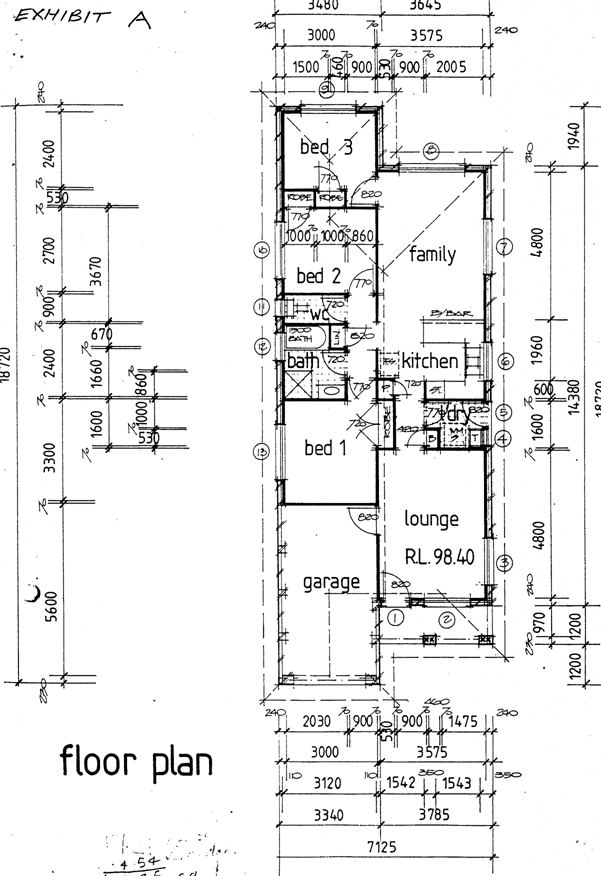
Collier Constructions Pty Ltd v Foskett Pty Ltd [1991] 20 IPR 666, considered
LED Builders Pty Ltd v Eagle Homes Pty Ltd (1996) 35 IPR 215, considered
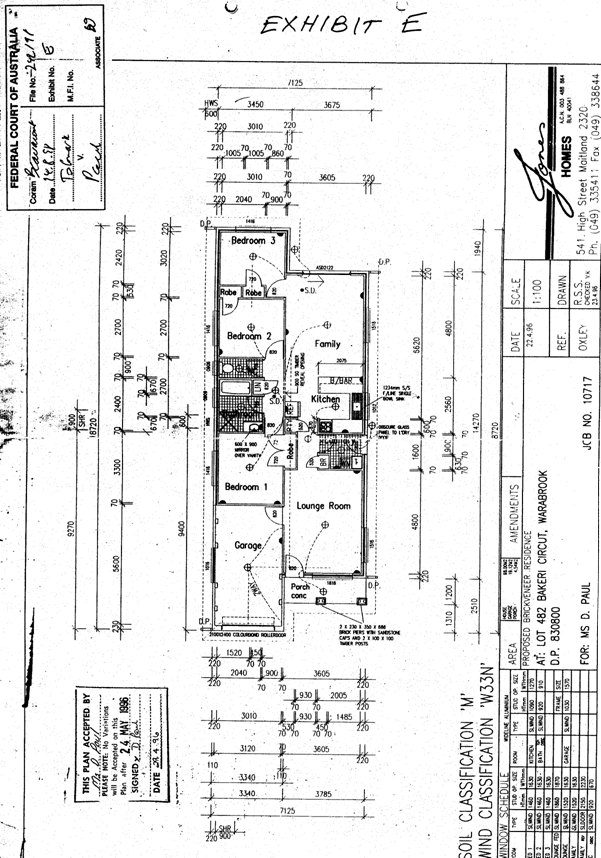
University of New South Wales v Moorehouse (1975) 133 CLR 1, applied
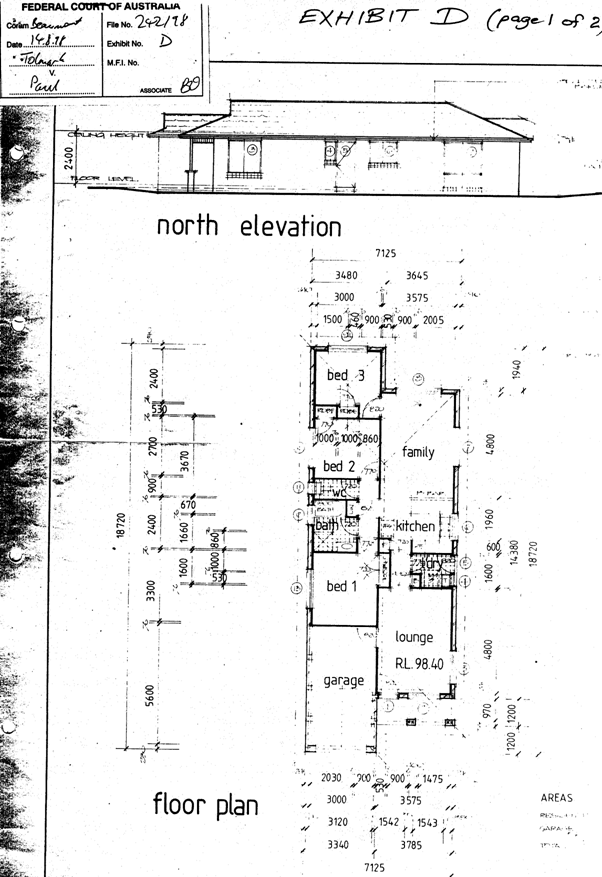
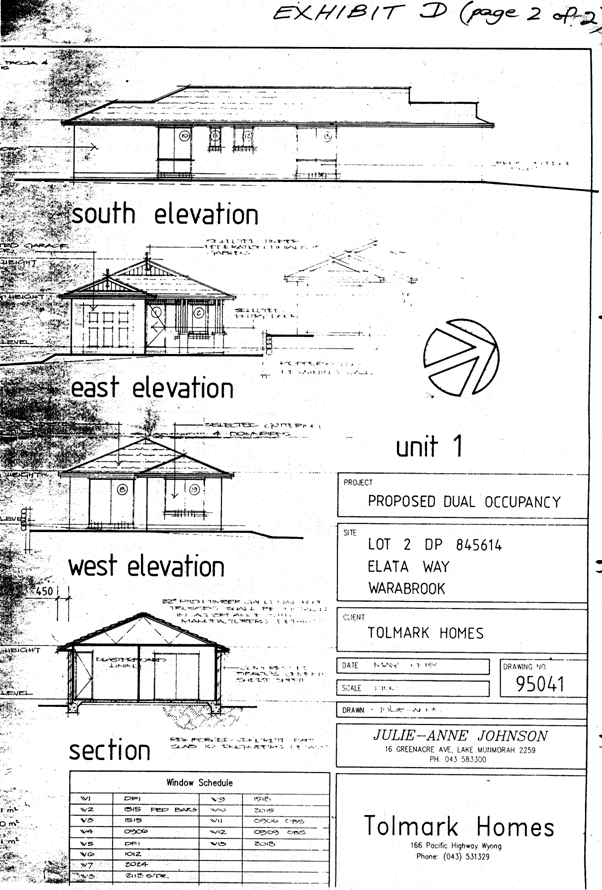
Eagle Homes Pty Ltd v Austec Homes Pty Ltd (1999) 43 IPR 1, cited
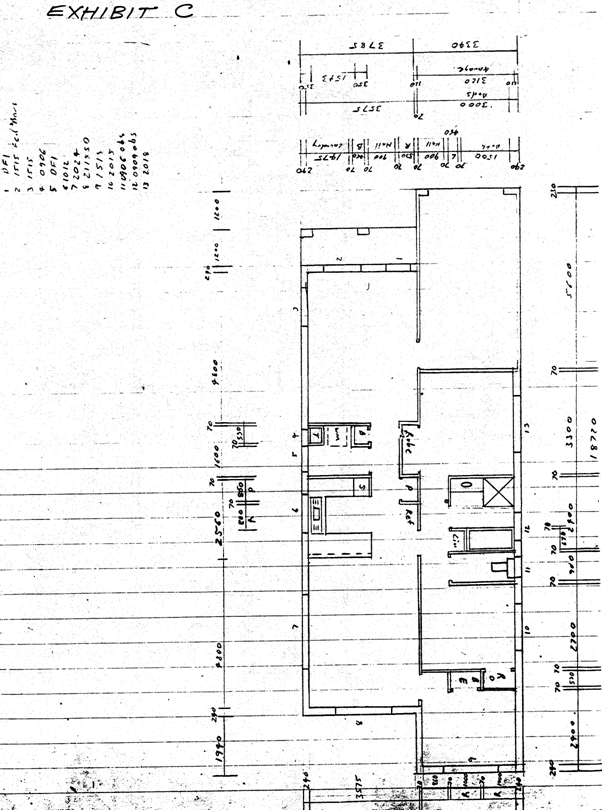
WEA International Inc. v Hanimex Corporation Ltd (1987) 17 FCR 274, cited
Nationwide News Pty Ltd v Copyright Agency Ltd (1996) 65 FCR 399, cited
Golden Editions Pty Ltd v Polygram Pty Ltd (1996) 61 FCR 479, considered
Chabot v Davies [1936] 3 All ER 221, followed
Stovin-Bradford v Volpoint Ltd [1971] 1 Ch 1007, followed
Interfirm Comparison (Australia) Pty Ltd v Law Society of New South Wales (1975) 6 ALR 445, followed
Australasian Performing Right Association Ltd v Grebo Trading Co Pty Ltd (1978) 23 ACTR 30, followed
New England Homes v Moore (1998) 82 FCR 500, cited
Autodesk Australia Pty Ltd v Cheung (1990) 94 ALR 472, cited
TOLMARK HOMES PTY LTD V DEBRA ANNE PAUL
NG 242 OF 1998
JUDGE: BEAUMONT J.
DATE: 30 SEPTEMBER 1999
PLACE: SYDNEY
|
IN THE FEDERAL COURT OF AUSTRALIA |
|
|
BETWEEN: |
TOLMARK HOMES PTY LTD Applicant
|
|
AND: |
DEBRA ANNE PAUL Respondent
|
|
DATE OF ORDER: |
|
|
WHERE MADE: |
THE COURT ORDERS THAT:
1. Judgment for the applicant against the respondent in the sum of $3,300, together with interest in the sum of $1,200.
2. Costs reserved.
Note: Settlement and entry of orders is dealt with in Order 36 of the Federal Court Rules.
|
IN THE FEDERAL COURT OF AUSTRALIA |
|
|
NG 242 OF 1998 |
|
BETWEEN: |
Applicant
|
|
AND: |
Respondent
|
|
JUDGE: |
|
|
DATE: |
|
|
PLACE: |
REASONS FOR JUDGMENT
BEAUMONT J:
INTRODUCTION
1 Tolmark Homes Pty Ltd (“the applicant”) is a project homebuilder and developer, operating in the Wyong, Central Coast and Newcastle districts of New South Wales. The applicant’s usual practice is to design and prepare standard plans for project homes, and to build those homes for clients. On occasion the plans are varied for clients who have particular requirements. The applicant does not provide plans for purposes other than building a Tolmark project home.
2 As part of the applicant’s operations it designed a project home known as the Tolmark “Chisholm” design. The Chisholm design contained three bedrooms, a bathroom, a family room, a lounge room, a kitchen, a laundry and garage space.
3 The applicant claims that Debra Anne Paul (“the respondent”) requested a quote for a Chisholm design home and, after receiving a floor plan of the Chisholm design attached to the quote, proceeded to construct a residence which was identical, or substantially the same, as the Chisholm design. The applicant contends that it has copyright in the Chisholm design plan and that the respondent infringed that copyright by constructing her residence.
4 The applicant claims damages for infringement of copyright under s 115(2) of the Copyright Act 1968 (“the Act”), and additional damages pursuant to s 115(4) of that Act. The applicant also claims damages for conversion under s 116 of the Act. Alternatively, the applicant seeks an order that an inquiry be held to determine the applicant’s loss and damage.
BACKGROUND FACTS
5 On or about the 9 February 1996 the respondent met with Mr Beazley, a housing consultant employed by the applicant, to inspect residences at a housing estate at Warrabrook. The Warrabrook estate contained a number of inspection homes (known as “spec” homes within the industry) and, in particular, two Chisholm “spec” homes which the applicant had for sale. The respondent shortly afterward met with Mr Beazley for a second time and again inspected the Chisholm homes. The respondent made an offer to purchase a rather narrow parcel of land together with a Chisholm design home, however the offer was rejected as too low.
6 On or about the 19 February 1996 Mr Beazley provided the respondent with a quote of $66,287 “for the construction of a modified Tolmark Chisholm with Federation facade” which attached a copy of the floor plan (“the subject plan”). The quote together with the subject plan became Exhibit “A”.
7 Discussions between the respondent and the applicant did not proceed any further. The respondent decided that the quote was beyond her price range. The respondent then commenced discussions with another project home developer, Jones Homes Pty Ltd (“Jones Homes”) and provided it with a copy of the subject plan in order to obtain a second, more competitive, quote. The respondent had a preference for the design in the subject plan because the block of land she was contemplating to purchase was narrow, and the subject plan suited those requirements. Jones Homes offered a number of different designs to the respondent, but the respondent preferred the Chisholm design as the only workable design for the block. Jones Homes subsequently provided to the respondent a written tender dated 29 February 1996 in the amount of $60,580 “for the construction of a three bedroom brickveneer and title ‘Oxley’ design home …”. The written tender became Exhibit 4, and did not attach a plan. On 12 April 1996, the respondent accepted the written tender by signing a document entitled “Acceptance of Tender” (Exhibit J). Exhibit J also did not attach a plan, instead a “Plan Preparation Request”, which nominated the design of the house as the respondent’s “own design”, was attached.
8 On 24 May 1996 the respondent attended the offices of Jones Homes and signed the final building agreement. The plan of the Jones Homes’ design (Exhibit E) was signed by the respondent on 29 April 1996 but no variations were permitted after 24 May 1996. Exhibit E is alleged to be the plan which reproduces the subject plan.
CONCLUSIONS ON LIABILITY
(a) Who owns copyright in the subject plan?
9 The respondent submitted that the applicant was not the owner of copyright in the subject plan annexed to Exhibit A. Exhibit A, it will be recalled, was the quote provided by the applicant annexing the subject plan which the respondent provided to Jones Homes. Exhibit A was essentially a reproduction of floor plans drawn by the applicant’s draughtsperson, Ms Johnson. The plans drawn by Ms Johnson became Exhibit D at trial. Counsel for the respondent submitted that Ms Johnson was the owner of copyright in Exhibit A.
10 Mr Sneesby, a director and the manager of the applicant, in his evidence said that Ms Johnson did nothing but trace Exhibit C (hand drawn plans Mr Sneesby had designed) onto Exhibit D (the applicant’s plans on which Ms Johnson is recorded as the draughtsperson). Exhibit A reproduced the floor plan in Exhibit D. During his evidence, Mr Sneesby was asked to place Exhibit C over Exhibit A, in order to illustrate that the plans were identical. This exercise indicated that this is indeed the case.
11 In Lend Lease Homes v Warrigal Homes Pty Ltd [1970] 3 NSWR 265, Helsham J said (at 270):
“It seems to me that there is no magic to be found in detailed scale plans if the floor plan contains the exemplification of the original idea. I believe that any reasonably competent draughtsman, given the floor plan, the approximate room sizes, and the total area (as in the present case) could come up with a set of working drawings, and I fail to see how such working drawings could claim the copyright that is said to be denied to the very embodiment of the architects idea, namely the floor plan.” (Emphasis added)
12 It seems to me that Exhibit C, the plans drawn by Mr Sneesby, were the “exemplification of the original idea”, in that the plans contained the necessary details for Ms Johnson to subsequently draught both the floor plans and the elevations (Exhibit D), those floor plans becoming the subject plans annexed to Exhibit A. The floor plan specifications in Exhibit A were almost identical with those found in Exhibit C, and this was starkly shown when Exhibit C was superimposed over Exhibit A. I find therefore that copyright in Exhibit A vests in the applicant.
13 The respondent also submitted that s 127(1) of the Act applied in this case. Section 127(1) provides:
“127. (1) Where a name purporting to be that of the author of a literary, dramatic, musical or artistic work appeared on copies of the work as published or a name purporting to be that of the author of an artistic work appeared on the work when it was made, the person whose name so appeared, if it was his or her true name or a name by which he or she was commonly known, shall, in an action brought by virtue of this Part, be presumed, unless the contrary is established, to be the author of the work …” (Emphasis added)
14 Although Exhibit D contains a statement that it was “drawn” by Ms Johnson, the evidence has established to my satisfaction that here the presumption has been rebutted since the contrary has been established.
(b) Subsistence of copyright in Exhibit C
15 As previously noted, Exhibit A was based on Exhibit C (the plans drawn by Mr Sneesby). The respondent submits that the level of originality in Exhibit C is so low, and the features so commonplace and lacking in distinction, that copyright should not be held to subsist.
16 The respondent’s expert witness, Mr Chapman, in his report dated 27 July 1998 (Exhibit 2A), referred to the floor plan in Exhibit A as a “sketch layout” and that it was “typical of a layout designed for a narrow block and in my view is not unique and does not reflect special skill in its design”. During his oral evidence, Mr Chapman was asked to look at Exhibits A and C and comment on whether, in his experience, the plans contained any distinctive features. He said:
“It’s designed for a narrow block, and so any house designed for a narrow block has to be longer than it is [wider] and it is usual to have a garage facing the street, usual to have a living room facing the street, so there’s nothing special there. It’s usual to group bedrooms together and those are done in this case. I suppose one distinctive feature would be the location of the laundry in that it’s between the kitchen and the lounge room, but otherwise I don’t see anything distinctive about it. As far as the elevation is concerned, it just follows what most project builders have as a type of design with a hip roof broken into a gable, but otherwise it’s nothing. I mean, there’s nothing distinctive about it.”
17 The applicant’s expert witness, Mr Gibson, when asked in his evidence a question to the same effect, said:
“I think it’s distinctive in that for a project home it has an extension at both ends of the building, if you like, a roof extension at both ends of the building which is a cost parameter that I normally wouldn’t – that a lot of project builders would refuse to countenance. It is interesting in that the laundry and bedroom 1 wardrobe protrudes into what is a communal space. I think if you would care to define distinctive any further or how you want me to define distinctive I’d leave it at that.”
18 Helsham J in Lend Lease Homes (at 269 – 270) approached the question of originality, not by asking whether any individually distinctive features could be found, but rather, when all the features are taken together and it is shown that the plans were created, planned and designed by the person claiming copyright, that is sufficient to establish that the work is original. Here, when one takes Exhibit C as a whole, and if one bears in mind that the design was specifically created for a narrow block, and that the location of the laundry and bedroom 1 is distinctive, and that there are extensions to both ends, then the design is, in my opinion, sufficiently original. It should also be noted, in this regard, that the evidence established that Mr Sneesby had designed the plan, and there was no suggestion that it had been copied from another source.
19 I find therefore that Exhibit C was, for the purposes of the Act, an original work.
(c) Did Jones Homes infringe copyright in Exhibit A by preparing Exhibit E?
20 In order for infringement to have occurred, a substantial part of the work needs to be reproduced. The “substantiality” test for infringement is now provided in s 14(1) of the Act:
“In this Act, unless the contrary intention appears:
(a) a reference to the doing of an act in relation to work or other subject-matter shall be read as including a reference to the doing of that act in relation to a substantial part of the work or other subject-matter; and
(b) a reference to a reproduction, adaptation or copy of a work shall be read as including a reference to a reproduction, adaptation or copy of a substantial part of the work, as the case may be.”
21 Having found that copyright subsists in Exhibit A, a comparison between it and the exhibit which allegedly reproduces it (Exhibit E) is required in order to determine whether “a substantial part” has in fact been reproduced.
22 Some recent authorities have considered the question of infringement in relation to design plans for project homes. In LED Builders Pty Ltd v Masterton Homes (NSW) Pty Ltd (1994) 30 IPR 447, Sheppard J remarked (at 454):
“Two matters emerge from this evidence and from the authorities. The first is that, particularly in the case of low or medium cost housing, the originality of design will be limited …. The house has to be of a particular size in order both to keep costs down and to fit it on a standard block of land. It will usually be rectangular or L-shaped. There will be three, or perhaps four, bedrooms, two bathrooms, a family room, a lounge room and a dining room. The kitchen will need to be accessible to the family room and the dining room. The bathrooms will need to be accessible to the bedrooms. The bedrooms will usually be together although the principal bedroom may, in some designs, be separate from others. There will be an entrance hall or lobby. There may or may not be a hallway off which the bedrooms will run and there will be a laundry, either at the back or at the side of the house. There will either be a single garage or a double garage depending upon the size of the block. Those are the constraints within which the designer must work. In one sense that makes the task more simple than might be the case if the design were of an elaborate house, much larger and more expensive than the ones in question here. On the other hand, the task may be extremely difficult because the very fact that the designer has to work within the constraints which I have indicated means that a degree of skill and professional expertise must be brought to the task. One can well imagine that some designs ... may involve a great deal of work. Others may come more easily.
A further matter to be noted is that, where there are two similar plans, it will often be difficult to determine whether or not, upon a simple comparison of the two, one is a reproduction or copy of the other or at least of a substantial part of it: see s 14 of the Copyright Act 1968 (Cth). That is why, as Street J [in Ancher Mortlock Murray & Woolley Pty Ltd v Hooker Homes Pty Ltd [1971] 2 NSWLR 278] remarked,the key to whether infringement of copyright has occurred will so often depend on the evidence which there is, direct or indirect, in relation to actual copying.”
23 In Collier Constructions Pty Ltd v Foskett Pty Ltd [1991] 20 IPR 666, the Full Federal Court (at 669) summarised the applicable principles in determining whether a substantial part of copyright material had been reproduced as follows:
“In determining whether what is taken is a substantial part of the copyright work various circumstances are relevant. The importance which the alleged substantial part bears in relation to the work as a whole is a significant matter. If it is a material part, even though it may be only a small part of it in quantity, it may nevertheless be substantial ... . It is well established that the phrase “substantial part” refers essentially to the quality, rather than the quantity, of what is taken by the infringer ... . It is always a question of judgment in each case whether the part taken from the work in which copyright subsists is a substantial part of the work ... . It is plain that the question of what is a substantial part of a work may involve fine questions of fact and degree.”
24 Davies J, in LED Builders Pty Ltd v Eagle Homes Pty Ltd (1996) 35 IPR 215, also cautioned that proving infringement in relation to plans for project homes will often be difficult because the plans are necessarily basic in design. His Honour said (at 218):
“Where a plan is a simple one, however, an applicant’s case may be difficult to prove. In Dixon Investments Pty Ltd v Hall (1990) 18 IPR 481 at 483, Pincus J said that ... “[t]he simpler and more commonplace the copyright drawing, the more closely must the alleged infringer adhere to it, in order for liability to exist: Kenrick & Co v Lawrence & Co (1890) 25 QBD 99 at 102; Ownitt Homes Pty Ltd v D & F Mancuso Investments Pty Ltd (1988) AIPC 90-488 at 38,243.”
25 (See also Collier Constructions, above, at 669 – 670).
26 It should be noted that Exhibit A contained only floor plans and did not provide any elevations. Any infringement of copyright must therefore be based on a comparison between the floor plans alone.
27 Mr Gibson, the applicant’s expert witness, in his report dated 5 August 1998 (Exhibit H1) stated:
“I have compared the copy of the plans provided by Jones Homes dated 22/4/1996 in 2 sheets [Exhibit E] with copy of plan provided by Tolmark Homes dated 22/5/1995.
Apart from external wall thickness the plans and elevations in both sets of documents would be considered identical. I particularly note:
· The plan layout is identical. When allowance for external wall thickness is taken into consideration, the dimensions of the layout are identical. The kitchen/laundry/storage configuration is unusual and is identical on both plans. I note what I consider to be an error in normal setout in respect of the dimensional allowance for the bath on the Tolmark plan and this error is repeated on the Jones Home plan. External openings are identically located despite the potential for variation.
· The roof configuration is identical despite the potential for numerous variations in roof configuration. Generally the external treatment of facades and gables are considered to be identical.”
28 Counsel for the respondent did not lead any evidence to challenge Mr Gibson’s opinion and properly conceded, in his written submissions, correctly in my view, that Exhibit E “is dimensionally similar” and “employs the same layout” as Exhibit A.
29 It is significant, I think, that Exhibit E reproduced an error contained in Exhibit A. In this regard, Mr Sneesby gave the following evidence:
“MR THANGARAJ: [counsel for the applicant] Now on the floor plan with respect to the kitchen, laundry, and storage, look at the floor plan anywhere, the area of the kitchen, laundry, and storage, would you say it would be fair to describe that as unusual ? --- I believe it is.
Now, is there something about the bath on your plan, the Tolmark plan? --- Yeah, it’s a little bit of a joke but there’s a slight error in the way the bathroom recess is set.
And could you describe that error? --- Well, it’s dimensioned as being 670 mm plus 70 which makes it 740 mm which is technically the width of the bath but in actual fact by the time you recess the bath the linen press would jut out so it’s one of those things we fix on site as we go, it’s just a little error [that] occurs. So that if the edge of the bath is going to line up with the edge of the linen press as drawn you need to make a slight modification on site to make it fit.
Is that repeated in the Jones Homes plan which is exhibit E --- Yes, it is.”
30 The similarities between Exhibit A and the floor plan of Exhibit E are clearly evident. As counsel for the respondent rightly conceded, the two plans are similar in dimension and share an almost identical layout.
31 However, counsel for the respondent points to the following differences which, he submits, are significant enough to avoid infringement, in particular; differences in the thickness of the walls, differences in window utilisation and specification, and the fact that Exhibit E includes an elevation plan and other site information.
32 I cannot accept the respondent’s argument.
33 It is well established that where there is substantial similarity, this constitutes, prima facie, evidence of copying and of access (Copinger and Skone James on Copyright, Vol. 1, 14th ed. at 397). Moreover, no witness was called by the respondent from Jones Homes. In those circumstances, it may be inferred that any such witness would not have assisted the respondent’s case (see Jones v Dunkel (1959) 101 CLR 298). In all of the present circumstances, the inference should be drawn that Jones Homes copied the applicant’s plans with resulting sufficient similarity (see Eagle Homes Pty Ltd v Austec Homes Pty Ltd (1999) 43 IPR 1 per Lindgren J at 15 – 22).
34 Further, the additional drawings included in Exhibit E are not relevant to the question of infringement because, as has been pointed out above, the subject plan in which copyright subsists and the plan which allegedly reproduces it, were both floor plans contained in Exhibit A and Exhibit E respectively. In my opinion, Exhibit E reproduces a substantial part of Exhibit A. The differences with respect to wall thickness and window specification are not, in my view, significant enough for it to be said that the two plans are materially different. The fact that the dimensions and layout of the rooms are almost identical, and the fact that the error in the bathroom is repeated in Exhibit E, is strong evidence that an infringement of copyright has, in fact, occurred.
(d) Did the respondent authorise Jones Homes to use Exhibit C?
35 In order to establish infringement of copyright it must be shown that a person (who is not the owner of the copyright) “without the licence of the owner of the copyright, does in Australia, or authorizes the doing in Australia of, any act comprised in the copyright”. (s36(1)). Section 13(2) of the Act defines “authorised” as “the exclusive right to do an act in relation to a work, an adaptation of a work or any other subject-matter includes the exclusive right to authorize a person to do that act in relation to that work, adaptation or other subject-matter.”
36 Counsel for the respondent submits that, even if it be assumed that infringement of the applicant’s rights had in fact occurred, the applicant has not in any event discharged its onus of proving that there was here an act that was authorised by the respondent.
37 During the course of examination-in-chief of the respondent, counsel for the respondent sought to adduce oral evidence of a conversation between the respondent and Ms Carroll, the representative of Jones Homes. A question as to admissibility arose, and I provisionally allowed the evidence in, subject to its relevance being established.
38 Counsel for the applicant challenged the admissibility of the evidence on two grounds. First, it was argued that the evidence was, at trial, only adduced on the basis that it went toward the issue of flagrancy, not liability. The relevant passage of the transcript reads:
“Mr Green [counsel for the respondent]: My friend pleads against us, the question of flagrancy. This is solely concerned with the flagrancy, reprehensibility or any of the other provisions of the relevant section at the end of the Copyright Act. It does not relate to the other issues that we have canvassed earlier today.”
39 The applicant’s second objection to the admissibility of the evidence was that it was hearsay.
40 As has been noted, the evidence in question concerned the respondent’s conversation with Ms Carroll. The respondent had indicated during that conversation that she “had a sort of an idea of a concept of what I would actually like on the block, and I said that I had a drawing, a plan that might assist so she had a look at that”. The evidence then continues:
“[Mr Green:] Did [Ms Carroll] say anything more than the amount that you said before? --- Yes, she did. I showed her this plan, just this one actually before me [Exhibit A] and I said that I liked the layout – I like the design the way the rooms ran, it was simply nothing more than that and she said to me that there would be [no] problem in Jones furnishing me a quote based on that plan. In fact she said that they had done this 100s of times before, used other builder’s plans.”
41 As mentioned, the evidence was adduced on the footing that it was relevant only to the question of flagrancy and thus damages. As a result counsel for the respondent did not cross-examine the witness. If the evidence was admitted in order to prove the truth of representations made by Ms Carroll, it would be hearsay. In my view, the evidence is admissible but only on the issue of damages.
42 The question whether the respondent “authorised” Jones Homes to do the relevant act by authorising Jones Homes to use Exhibit A can be refined to this: Did the respondent “authorise” Jones Homes, by presenting Exhibit A to Ms Carroll as her favoured design, because it was the only design available which she found suitable for the narrow block of land on which the house was to be built? It cannot be disputed that the respondent actually gave Jones Homes access to Exhibit A, along with a strongly stated preference for that design. The question is, therefore, whether this conduct amounts to authorisation of an act which infringed copyright.
43 In University of New South Wales v Moorehouse (1975) 133 CLR 1 Gibbs J said (at 12 – 13):
“A person cannot be said to authorize an infringement of the copyright unless he has some power to prevent it … Express or formal permission or sanction, or active conduct indicating approval, is not essential to constitute an authorization: ‘Inactivity or ‘indifference, exhibited by acts of commission or omission, may reach a degree from which an authorization or permission may be inferred’’ .... However, the word ‘authorize’ connotes a mental element and it could not be inferred that a person had, by mere inactivity, authorized something to be done if he neither knew nor had reason to suspect that the act might be done … a person who has under his control the means by which an infringement of copyright may be committed – such as a photocopying machine – and who makes it available to other persons, knowing, or having reasons to suspect, that it is likely to be used for the purposes of committing an infringement, and omitting to take reasonable steps to limit its use to legitimate purposes, would authorize any infringement that resulted from its use.”
44 Jacobs J said (at 20 – 21):
“ … authorization is wider than authority. It has, in relation to a similar use in previous copyright legislation, been given the meaning, taken from the Oxford Dictionary, of ‘sanction, approve, countenance’ …. It is a wide meaning which in cases of permission or invitation is apt to apply both where an express permission or invitation is extended to do the act comprised in the copyright and wheresuch a permission or invitation may be implied. Where a general permission or invitation may be implied it is clearly unnecessary that the authorizing party have knowledge that a particular act comprised in the copyright will be done.
The acts and omissions of the alleged authorizing party must be looked at in the circumstances in which the act comprised in the copyright is done. The circumstances will include the likelihood that such an act will be done ‘… [t]he Court may infer an authorization or permission from acts which fall short of being direct and positive; … indifference, exhibited by acts of commission or omission, may reach a degree from which authorization or permission may be inferred. It is a question of fact in each case what is the true inference to be drawn from the conduct of the person who is said to have authorized …’ (per Banks L.J. in Performing Right Society Ltd v Ciryl Theatrical Syndicate Ltd [1924] 1 K.B. 1 at 9).” (Emphasis added)
45 It is clear, therefore, that authorisation may, for the purposes of the Act, include circumstances where there is no express or formal permission or active conduct indicating approval. (See also WEA International Inc. v Hanimex Corporation Ltd (1987) 17 FCR 274 at 286; and Nationwide News Pty Ltd v Copyright Agency Ltd (1996) 65 FCR 399 per Sackville J at 422 – 424).
46 In this case, the respondent supplied Exhibit A, containing the subject plan upon which Exhibit E is alleged to be based, and did so on the footing that alternative plans presented by Jones Homes were an inadequate solution to the problem of designing a house for a narrow block of land. It is significant that the respondent rejected those alternative plans and stated a preference for Exhibit A. The respondent’s conduct, seen in the context of negotiations with a rival builder, involving the rejection of plans proposed by Jones Homes, the presentation of Exhibit A as the favoured design solution, and the acceptance of a quote based on Exhibit A, constitutes conduct from which implied authorisation of an act comprised in the copyright may be inferred. In my view, this inference should be drawn here.
47 I find that the respondent authorised Jones Homes to commit an act comprised in the copyright.
DAMAGES
The respondent’s defence as pleaded
48 The respondent pleaded in her defence that any infringement of copyright was made without her being aware, or having reasonable grounds for suspecting, that her acts constituted an infringement of the applicant’s copyright.
49 Subsection 115(3) of the Act provides:
“Where, in an action for infringement of copyright, it is established that an infringement was committed but it is also established that, at the time of the infringement, the defendant was not aware, and had no reasonable grounds for suspecting, that the act constituting the infringement was an infringement of the copyright, the plaintiff is not entitled under this section to any damages against the defendant in respect of the infringement, but is entitled to an account of profits in respect of the infringement whether any other relief is granted under this section or not.” (Emphasis added)
50 In Golden Editions Pty Ltd v Polygram Pty Ltd (1996) 61 FCR 479 the Full Federal Court considered the operation of s 115(3). Burchett and Tamberlin JJ rejected a submission that s 115(3) required the defendant to know the identity of the copyright owner, then said (at 480):
“… in general the question is not whether the defendant knew the identity of the owner of the copyright, but whether the defendant has established a lack of awareness, and of reasonable grounds for suspecting, that the relevant act was an infringement of the copyright which was infringed, in whomsoever that copyright might be vested.”
51 During cross-examination, the applicant gave the following evidence:
“When you decided to go ahead with Jones Homes you didn’t first ring Mr Beazley and say I’ve decided to go with Jones Homes. The only time you rang him was to seek a better quote? --- Yes, that’s correct.
You certainly didn’t tell anyone at Tolmark, Mr Beazley or otherwise, that you intended to use that plan, did you? --- No.
You never asked permission? --- No.
And you never thought about making inquiries as to whether or not you were entitled to use those plans? --- No, that thought never crossed my mind.
...
… When you got this plan from Tolmark you knew they designed it? --- Yes, they gave it to me.
It was their plan. They never gave you permission to use it with some other builder, did they? ---- No.
When they gave it to you they gave it to you as a quote for them to build a house for you? ---- Yes.
All you did was take it to the cheapest person that would build a house for you, Jones Homes? ---- Jones Homes, yes.
It’s inevitable, isn’t it, that Tolmark had rights that you knew about? ---- I’m sorry, I don’t understand the question.
You knew that you had to ask Tolmark’s permission to use their property? ---- No, I did not.”
52 I cannot accept that the respondent did not have reasonable grounds to suspect that the plans provided by Jones Homes would infringe Tolmark’s copyright. The respondent readily accepted Exhibit A from the applicant and subsequently used those plans when negotiating with Jones Homes. Those negotiations raised the question of whether Tolmark plans could be used. The evidence establishes that the respondent had at the very least an awareness of a question arising as to the propriety of using the applicant’s plans. I reject this aspect of the respondent’s defence.
The applicant’s evidence on damages
(a) Stewart James Gibson
53 Mr Gibson was called as the applicant’s expert witness. He is a graduate in architecture from the University of Sydney, has lectured at the University of New South Wales in Town Planning, tutored at Sydney University in Architectural Design, and has been in practice as an architect for twenty-one years. Mr Gibson gave evidence that he had designed buildings and let building contracts in the low cost housing area “for over 300 odd” of those dwellings in the last four to five years.
54 Mr Gibson provided the applicant’s solicitors with a report dated 5 August 1998 (Exhibit H1) in which he addressed the industry practice in relation to receiving licence fees for the use of architectural plans. Mr Gibson stated:
“A license fee is commercially negotiated and there are no absolute terms. A 1% fee would be considered reasonable in respect of industry standards in a situation where there would be consistent repeat use of the license ie. the amount of the fee reflects the quantity of reuse.
Where there is no reuse or ongoing commercial relationship the concept of a license fee is not applicable. In this [the present] circumstance a one-off design fee would apply and this again would be commercially negotiated in the range of 5% - 10% of construction cost.”
55 I am satisfied that Mr Gibson’s experience qualified him to express these opinions.
56 Mr Gibson was not cross-examined at any length.
(b) Mr Leigh Sneesby
57 Mr Sneesby gave evidence that the applicant would ordinarily charge a fee of $3,000 for the use of a Chisholm design. In my view, this evidence is admissible, although not of course conclusive on the question of the amount of the notional licence fee to be attributed in this case. During cross-examination, Mr Sneesby conceded that when a person was given a licence to build a Chisholm home from the applicant, that fee would include all of the relevant documents prepared by the applicant, that is, the house plan, the specification and the engineer’s plan.
The respondent’s evidence
58 Mr Martyn Chapman, the respondent’s expert witness, provided two reports. In his first report (Exhibit 2A), dated 27 July 1998, Mr Chapman stated:
“…the floor plan is typical of a layout designed for a narrow block and in my view is not unique and does not reflect special skill in its design. As a consequence I am of the view that it would be reasonable to base a licence fee for the use of the plan on the time taken for a draughtsman to produce a sketch layout and I would estimate a reasonable fee in the range between $750 and $1,000.”
59 Mr Chapman reiterated this opinion in his subsequent report dated 7 August 1998 (Exhibit 2B):
“The usual fee an architect would charge for the design of a house in sketch form, including receiving a brief from a client, studying the site and preparing a preliminary cost estimate would be 12% (RAIA fee guide) of the total fee for the design documentation and contract administration of a project. A reasonable fee for a one off house design would be 10% of the building cost, therefore the total sketch design fee would amount to 1.2% of the cost, a net fee for a one off design would in my opinion be 1%.”
60 Mr Chapman was not cross-examined at any length.
CONCLUSIONS ON DAMAGES
61 The applicant claimed damages for infringement and additional damages.
62 Damages for infringement of copyright are awarded by way of compensation to the copyright owner. The measure of the damages open to this Court, in a case of this kind, include damages at large or, alternatively, what has been called the “licence fee” approach; see Chabot v Davies [1936] 3 All ER 221; Stovin-Bradford v Volpoint Ltd [1971] 1 Ch 1007; Interfirm Comparison (Australia) Pty Ltd v Law Society of New South Wales (1975) 6 ALR 445 at 447; Australasian Performing Right Association Ltd v Grebo Trading Co Pty Ltd (1978) 23 ACTR 30 at 31; for a recent application, see New England Homes v Moore (1998) 82 FCR 500 at 505 – 506. If it be necessary to draw an inference that the respondent would have paid the licence fee for the use of the applicant’s plans (see Autodesk Australia Pty Ltd v Cheung (1990) 94 ALR 472 at 476-7), I have no difficulty in concluding that the respondent, in the circumstances of this case, would have paid that licence fee. The respondent had clearly decided that the applicant’s plan was the only design suitable for the block of land she had chosen. It should be noted that the case was conducted by the respondent on the basis that the licence fee approach was the appropriate measure of damages, if infringement and authorisation were proved.
63 In my opinion, an appropriate licence fee in this case would represent five per cent of the total building cost of $66,000, that is, $3,300. I propose to award that amount to the applicants as damages for infringement. As has been noted, neither of the independent experts was cross-examined at any length, doubtless because of costs considerations. One opinion is, as we have seen, in the range of five to ten per cent; the other a little more than one per cent. Doing the best I can in the circumstances, I think that a figure somewhere near the mid-range of the extremes of the percentages mentioned does justice to both parties in a relatively small claim.
64 Finally the claim for additional damages under s 115(4) of the Act needs to be considered. I do not think that the respondent’s conduct in this case justifies an award for additional damages. The respondent gave evidence that she sought some form of reassurance from Ms Johnson that it was permissible to use the subject plan. I do not think that the respondent’s conduct justifies an award of additional damages (see Burchett J’s observations in New England Homes v Moore (1998) 82 FCR 500 at 505 – 506). There is certainly no suggestion of profiteering here. As Burchett J noted, caution is required in this area.
INTEREST
65 I propose to award pre-judgment interest at the equivalent prescribed rates in the NSW Supreme Court Rules, which over the period approximate ten per cent per annum. Interest will be awarded for the period of about three and a half years (i.e. from February 1996) in the total amount of $1,200 (i.e. $330 x 3 ½).
COSTS
66 I reserve the question of costs.
ORDERS
1. Judgment for the applicant against the respondent in the sum of $3,300, together with interest in the sum of $1,200.
2. Costs reserved.
|
I certify that the preceding sixty-six (66) numbered paragraphs are a true copy of the Reasons for Judgment herein of the Honourable Justice Beaumont. |
Associate:
Dated: 30 September 1999
|
Counsel for the Applicant: |
Mr Murugan Thangaraj |
|
|
|
|
Solicitor for the Applicant: |
Aubrey Brown Partners |
|
|
|
|
Counsel for the Respondent: |
Mr Michael Green |
|
|
|
|
Solicitor for the Respondent: |
Aitken McLachlan & Thorpe Solicitors |
|
|
|
|
Date of Hearing: |
14 August 1998, 11 June 1999. |
|
|
|
|
Date of Judgment: |
30 September 1999 |