FEDERAL COURT OF AUSTRALIA
Autocaps (Aust) Pty Ltd v Pro-Kit Pty Ltd [1999] FCA 1315
COPYRIGHT – infringement – trade catalogues – whether sufficient skill, judgment and labour – defences – whether equitable defences available
DESIGN – infringement – obvious imitation – fraudulent imitation – defences
Copyright Act 1968 (Cth) s 115(3)
Colbeam Palmer Ltd v Stock Affiliates Pty Ltd (1968) 42 ALJR 209 cited
Collis v Cater, Stoffell & Fortt Ltd (1898) 78 LT 613 applied
Dart Industries Inc v Decor Corporation Pty Ltd (1989) 15 IPR 403 applied
De Bussche v Alt [1878] 8 Ch D 286 applied
Elconnex Pty Ltd v Gerard Industries Pty Ltd (1991) 22 IPR 551 referred to
Electrolux Ltd v Electrix Ltd (1953) 71 RPC 23 referred to
Firmagroup Australia Pty Ltd v Byrne & Davidson Doors (Vic) Pty Ltd (1987) 180 CLR 483 applied
Fisher & Paykel Healthcare Pty Ltd v Avion Engineering Pty Ltd (1991) 22 IPR 1 applied
Football League Ltd v Littlewoods Pools Ltd [1959] 1 Ch 637 applied
Hollinrake v Truswell [1894] 3 Ch 420 applied
International Scientific Communications Inc v Pattison [1979] FSR 429 referred to
Kalamazoo (Aust) Pty Ltd v Compact Business Systems Pty Ltd (1985) 84 FLR 101 referred to
Ladbroke (Football) Ltd v William Hill (Football) Ltd [1964] 1 WLR 273 applied
The Lindsay Petroleum Co v Prosper Armstrong Hurd, Abram Farewell & John Kemp (1874) LR5PC 221 applied
Macmillan & Co Ltd v Cooper (1923) 40 TLR 186 applied
Malleys Ltd v J W Tomlin Pty Ltd (1961) 180 CLR 120 applied
Milwell Pty Ltd v Olympic Amusements Pty Ltd (1999) 85 FCR 436 cited
Pauling’s Settlement Trusts; In re [1962] 1 WLR 86 applied
Purefoy Engineering Co Ltd v Sykes Boxall & Co Ltd (1955) 72 RPC 89 distinguished
S W Hart & Co Pty Ltd v Edwards Hot Water Systems (1985) 159 CLR 466 referred to
Shaw v Applegate [1977] 1 WLR 970 referred to
AUTOCAPS (AUST) PTY LTD, A S DALY NOMINEES PTY LTD AND DEVUZO PTY LTD V PRO-KIT PTY LTD AND STEVE ZAAROUR
VG 452 OF 1997
JUDGE: FINKELSTEIN J
DATE: 24 SEPTEMBER 1999
PLACE: MELBOURNE
|
IN THE FEDERAL COURT OF AUSTRALIA |
|
|
VG 452 OF 1997 |
|
BETWEEN: |
A S DALY NOMINEES PTY LTD and DEVUZO PTY LTD Applicants
|
|
AND: |
STEVE ZAAROUR Respondents
|
|
JUDGE: |
|
|
DATE: |
|
|
PLACE: |
REASONS FOR JUDGMENT
1 The first applicant, Autocaps (Aust) Pty Ltd, owns and operates a business that trades under the name CPC Auto Components. The business is commonly referred to as CPC. The business involves the manufacture and supply of parts for trucks and motor vehicles. The parts with which this case is concerned are fuel tank caps and radiator caps. CPC is the largest manufacturer and wholesaler of fuel tank caps and radiator caps in Australia. It manufactures and sells caps to motor vehicle manufacturers such as General Motors, Ford and Mitsubishi. This segment of the market is referred to as the original equipment market or OEM. It also sells caps to spare parts wholesalers such as Repco. This part of the market is referred to as the after-market and CPC’s share of that segment is approximately 90 per cent. In dollar terms, its annual turnover in fuel tank caps and radiator caps is approximately $4,500,000.
2 The first part of this case concerns the catalogues prepared by CPC in which it lists all of the radiator caps and fuel tank caps that it offers for sale. CPC contends that it holds the copyright in those catalogues and that the first respondent, Pro-Kit Pty Ltd (“Pro-Kit”), a competitor of CPC, has infringed that copyright. It also says that the second respondent, Mr S Zaarour, a director of Pro-Kit, authorised that infringement. CPC seeks injunctions and damages or, at its option, an account of profits.
3 The second part of the case relates to the design of two unleaded petrol fuel tank caps. The second applicant, A S Daly Nominees Pty Ltd (“A S Daly”), became registered under the Designs Act 1906 (Cth) as the proprietor of Design No. 93836 and Design No. 94802 on 23 October 1986 and 15 January 1987, respectively. The claimed monopoly for each design is in the shape and configuration of the cap as indicated in the drawings accompanying each certificate of registration. A S Daly granted CPC the exclusive licence to use the designs. Later it assigned its interest in the designs to the third applicant, Devuzo Pty Ltd (“Devuzo”), although it appears that Devuzo has not yet become registered as the proprietor of the designs. A S Daly and Devuzo claim that Pro-Kit has infringed the copyright in the designs and that Mr Zaarour procured that infringement. Damages and an account of profits are sought. There was a cross-claim for revocation of the designs, but that was not prosecuted at the trial.
4 With the consent of the parties, the trial has been conducted on the basis that I should first determine liability in respect of the alleged copyright and design infringement. If infringement is found to have occurred, issues concerning remedies should then be decided.
5 Returning to the copyright claim, it is necessary to say something about the production and format of the catalogues. The CPC business was started many decades ago by Colin Coutts. It began to manufacture fuel tank caps and radiator caps in the late 1940s. By 1953 CPC was producing catalogues listing the products that it offered for sale. As regards fuel tank caps and radiator caps, the catalogue took the form of a chart that specified the particular cap that was suitable for use with a particular make or model of vehicle. Mr M Malak, the purchasing manager of CPC, explained the importance of using the correct cap. He said that if an incorrect radiator cap was used this might cause considerable damage to the engine, presumably as a result of overheating. If an incorrect fuel tank cap was used there was a risk of explosion of the fuel tank. Accordingly, he said that great care had to be taken to ensure that the correct caps were specified.
6 The CPC business passed through a number of hands, in some cases as a result of an internal corporate restructure, until the business together with “all industrial and intellectual property rights that attached to the business” was acquired by Autocaps in 1990. Throughout the period since the introduction of the first catalogue in 1953, a new catalogue has been issued every two or three years. Each new catalogue listed additional vehicles in respect of which caps were offered for sale. In most cases they were vehicles that had come onto the market since the publication of the immediately preceding catalogue. Sometimes a vehicle that had appeared in a catalogue was not listed in a subsequent catalogue, because there was insufficient demand for parts or CPC no longer held a stock of parts for that vehicle.
7 Due to the fact that various types of fuel tank caps and radiator caps have been manufactured over the years and particular caps were only suitable for specific vehicles, CPC developed a part numbering system to identify the types of caps that it offered for sale and the vehicle which they suited. Each different type of cap was given an individual part number that in some cases comprised only digits and in other cases was constituted by a combination of letters of the alphabet and digits. Every catalogue since 1953 has referred to the caps by reference to their part number.
8 The following is a brief description of the part numbering system as it was in 1953 and the changes that have taken place since then. Fuel tank caps were given a two digit part number and radiator caps were given a three digit number. As a new type of cap was manufactured it was usually allocated the next consecutive number. There were two styles of fuel tank caps, one had a bayonet fitting and the other a screw fitting. They were identified by the prefix “B” or “S” before the two digits. For example, in the 1953 catalogue the fuel tank cap for a Bristol 400 is designated “S64”. It is a solid brass cap with a small airhole. According to the catalogue the same cap could be used for a Hillman 20/70. The 1953 catalogue records that the fuel tank cap for all Holden models was a “B20” cap. That cap could also be used for other makes of vehicle including Chrysler, De Soto and Hupmobile. Some time after 1953 the letter “X” was placed after the digits to indicate that the top of the fuel tank cap was chrome plated or made from stainless steel.
9 There were three different types of radiator caps in 1953, one with a bayonet fitting, one with a screw fitting and a pressurised cap. The bayonet fitting and screw fitting caps were identified respectively by the letters “B” and “S” before the three digits. Thus, a radiator cap for a 1929 Essex was given the part number “S101” and for a 1956 Dodge the applicable cap was “B169”. Pressurised caps were identified by the letter “P” followed by a three digit number commencing with 501. Immediately following the three digits there was placed the sign “/” followed by the pressure rating of the cap in pounds per square inch. For example, for all Buick models manufactured between 1945 and 1953 the designated cap was a “P501/4”. The same cap could also be used for all Holden vehicles.
10 The introduction of new fuel tank caps after 1953 resulted in corresponding changes to the part numbering system. For example, fuel tank caps that were capable of being locked with a key were introduced in 1955. They were identified by the letters “PL” (petrol locking) appearing before the two digits. In 1968 a new type of locking cap was introduced called a snap-on lock. This cap was identified by the letters “SL” in front of the two digit number. After some time, the letters “PL” were dropped and all locking caps, whether key locked or snap-locked, were designated “SL”.
11 In 1975 vehicle manufacturers were required to install emission control equipment for the protection of the environment. One consequence of the new laws was the introduction of a new emission control fuel tank cap which would reduce the amount of fumes released into the atmosphere. These caps were designated “EC”, with the letters appearing after the two digit number. The caps first appeared in a CPC catalogue in 1980.
12 In 1982 unleaded petrol was introduced in Australia. In 1986 CPC began to manufacture and sell fuel tank caps for vehicles that used unleaded petrol. To distinguish those caps from other caps it was decided that the two digit number would begin with the number 82 followed by the letters “ULP”. Thus, the first unleaded petrol fuel tank cap designed was “SL82ULP”. The non-locking counterpart of this cap was “82ULP”.
13 Since 1953 there have also been changes to the type of radiator caps that CPC manufactured and sold. Originally there were two pressure caps, one with a safety pressure mechanism and one without such a mechanism. The letter “S” was placed before the three digits to signify the safety pressure cap and the letter “P” was used for the non-safety cap. In 1977 safety pressure caps were discontinued and by the 1984 edition of the catalogue no letter appeared in front of the digits.
14 In 1977 a new radiator system known as a sealed system was introduced. It was designed so that as the water temperature rose and the water expanded, the surplus water was forced into an expansion tank. The converse occurred when the water cooled. A new radiator cap was developed to permit the flow of water from the radiator to the expansion tank. In the CPC catalogues these caps (referred to by CPC as radiator cap coolant recovery) began with the number 530 and new caps in the range were allocated the next consecutive number. A smaller version of the coolant recovery cap was given the number 560. In conformity with the designation of other pressure caps manufactured and sold by CPC, the part number of the cap also identified the pressure rating. Since 1977 that rating has been expressed in kilopascals instead of pounds per square inch.
15 To better understand the part numbering system, I will set out extracts from a number of the CPC catalogues beginning with the earliest published in 1953. From this catalogue I have taken all of the vehicles where the name of the manufacturer begins with the letter “A”:
“Make & Model Petrol Radiator
Armstrong, Siddeley 16 hp ’48 - B30
Armstrong, Siddeley 14 hp ‘37-38 - S162
Auburn ‘34-37 B20 B165
Auburn ‘31-32 B20 B116
Austin ‘34-53 B33 -
Austin 3.5 ton trucks ‘47-53 S12 -
Austin ‘7’ early model B30 -
Austin ‘8’ - S135”
16 The format of the catalogue changed somewhat over the years. From the catalogues published in 1990, 1995 and 1997 I will reproduce the entries in relation to the following makes: Alfa Romeo, BMW and Diahatsu. In the 1990 catalogue those entries were:
“RADIATOR CAPS FUEL TANK
MAKE YEAR MODEL STANDARD COOLANT RECOVERY CAPS
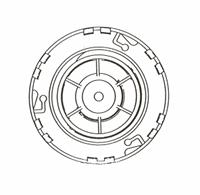
Part No. Part No. KPA LOCKING STANDARD
ALFA ROMEO
1964-68: Giulia Sprint GT 507 07 536 07 50 SL20
1969-76: 1300, 1600, 1750 507 07 536 07 50 SL20 20X
1972-76: Alfa Romeo 2000 507 07 536 07 50 SL44EC
BMW
To 1974: All Models 532 16 110 SL20 20X
1975-78: 3.05, 3.051, 3.0 CSL 532 16 110 SL44EC
1975-85: 520, 520I, 525, 528 532 16 110 SL44EC
DAIHATSU
1967-72: All Trucks 507 07 536 07 50 SL23 23X
1980-82: Diesel 4WD 543 13 90
1980-83: Charade 543 13 90 SL40EC
1983-On: Charade 560 90 90
1982-84: Scat 543 13 90
1984-On: Rocky 560 90 90
1988-On: Feroza 560 90 90”
In the 1995 catalogue the corresponding entries were:
“RADIATOR CAPS FUEL TANK
MAKE YEAR MODEL STANDARD COOLANT RECOVERY CAPS
Part No. Part No. KPA LOCKING STANDARD
ALFA ROMEO
1964-68: Giulia Sprint GT 507 07 536 07 50 SL20 20X
1969-76: 1300, 1600, 1750 507 07 536 07 50 SL20 20X
1972-76: Alfa Romeo 2000 507 07 536 07 50 SL44EC
1979-84: Alfasud 536 07 50
1983-88: Sprint 536 07 50
1984-88: Alfa 33 1500CC only 536 07 50
BMW
To 1974: All Models 532 16 110 SL20 20X
1975-78: 3.05, 3.05i, 3.0 CSL 532 16 110 SL44EC
1975-85: 520, 520i, 525, 528 532 16 110 SL44EC
1983-85: 735i 543 13 90
1986-92: 735i 532 16 110
DAIHATSU
1967-72: All Trucks 507 07 536 07 50 SL23 23X
1980-82: Diesel 4WD 543 13 90
1980-83: Charade 543 13 90 SL40EC
1983-93: Charade 560 90 90 SL21EC
1993-On:Charade SL84ULP 84ULP
1982-84: Scat 543 13 90
1984-On: Rocky 560 90 90 SL40EC 21EC
1988-On: Feroza 560 90 90 SL21EC
1989-On: Applause 560 90 90 SL84ULP 84ULP
1991-On: Mira SL21EC”
Finally, in the 1997 catalogue, being the current CPC catalogue, the entries are:
“RADIATOR CAPS FUEL TANK
MAKE YEAR MODEL STANDARD COOLANT RECOVERY CAPS
Part No. Part No. KPA LOCKING STANDARD
ALFA ROMEO
1964-68: Giulia Sprint GT 507 07 536 07 50 SL20 20X
1969-76: 1300, 1600, 1750 507 07 536 07 50 SL20 20X
1972-76: Alfa Romeo 2000 507 07 536 07 50 SL44EC
1979-84: Alfasud 536 07 50
1983-88: Sprint 536 07 50
1984-88: Alfa 33 1500CC only 536 07 50
BMW
To 1974: All Models 532 16 110 SL20 20X
1975-78: 3.05, 3.05i, 3.0CSL 532 16 110 SL44EC 45EC
1980-87: 318i SL44EC 45EC
1978-85: 635CSi 532 16 110
1978-79: 733i 532 16 110 SL44EC 45EC
1983-85: 735i 543 13 90 SL44EC 45EC
1986-92: 735i 532 16 110 SL44EC 45EC
DAIHATSU
1967-72: All Trucks 507 07 536 07 50 SL23 23X
1980-82: Diesel 4WD 543 13 90
1989-97: Applause 560 90 90 SL84ULP 84ULP
1995-97: Centro 582 110 110
1980-83: Charade 543 13 90 SL40EC
1983-93: Charade 560 90 90 SL40EC
1993-97: Charade 580 90 90 SL84ULP 84ULP
1988-97: Feroza 560 90 90 SL40EC
1981-90: Handivan 560 90 90
1997: Handivan single cam 580 90 90
1997: Handivan twin cam 582 110 110
1982-84: Hi-Jet 543 13 90
1984-90: Hi-Jet 560 90 90
1991-93: Mira 560 90 90
1993-95: Mira 580 90 90 SL84ULP 84ULP
1997: Move 580 90 90
1997: Pyzar 580 90 90 SL84ULP 84ULP
1984-97: Rocky 560 90 90 SL40EC 21EC
1982-84: Scat 543 13 90”
17 Apart from the layout, there are obvious differences between the catalogues. Comparing the 1995 and 1997 catalogues, two differences should be noticed. The first is the addition of new vehicles. For example, the 1997 Daihatsu Centro and the 1997 Daihatsu Pyzar do not appear in the 1995 catalogue for reasons that are obvious enough. The second difference is the manner in which the models of vehicles of particular manufacturers are listed. In the 1995 catalogue and in all previous catalogues the various models were set out in chronological (date of manufacture) order. In the 1997 catalogue most of the models are listed in alphabetical order.
18 It is now necessary to say something about the work that was undertaken to determine which cap is suitable for use with a particular make or model of vehicle. The evidence on this topic was not altogether clear. Little is to be found in the affidavits of the witnesses called by CPC, being affidavits that were filed pursuant to an order made before trial that the parties file affidavits to stand as their evidence in chief. The relevant evidence was elicited orally and by leave. Further, the evidence was given by witnesses who were employed by CPC after 1987. However, having regard to the nature of the evidence given by those witnesses (in particular Gregory Barker, a former sales manager and Joseph Bayona, the operations manager of CPC) it is reasonable to infer that the work that they described as having been carried out after 1987 was substantially the same as that which had been performed previously.
19 In relation to the original equipment market, a motor vehicle manufacturer wishing to purchase caps from CPC would either supply a sample cap to CPC or provide it with detailed written specifications for the cap. If a sample cap was provided, it was examined and subjected to “comprehensive testing”, the precise nature of which was not explained, but it included pressure testing on a mercury monometer and other pressure recording equipment to determine whether a cap in the current range manufactured by CPC was the same as the sample. This required separate tests to be carried out on the existing range of caps (or at least on those that were likely to be appropriate) to establish their suitability.
20 When CPC was required to manufacture a cap to meet the specifications of a manufacturer, the work involved often took many months. It involved the manufacture of a prototype, testing the prototype to ensure that it complied with the manufacturer’s specifications and then the work that was involved in the manufacture of the part, including quality control testing of the final product.
21 In relation to caps for the after-market, the same work was involved to ascertain the suitability of existing caps. Thus when a new vehicle became available and CPC did not manufacture a cap for that vehicle, CPC would acquire a sample cap and by a process of testing would determine whether any of its existing caps were suitable. If CPC found that it had a suitable cap, both the new vehicle and the applicable cap would be recorded in the next edition of its catalogue. It is not clear from the evidence whether CPC also manufactures caps solely for the after-market.
22 During the course of their cross-examination by Mr Ryan, counsel for the respondents, Mr Barker and Mr Bayona conceded that the work involved in selecting caps from the existing range as well as the work involved in the manufacture of new caps was undertaken in order to produce a sellable product; that is a product fit for the particular vehicle in respect of which it was being offered for sale. But apart from its sales to the original equipment market, CPC produced its catalogues to obtain after-market sales. Mr Barker said that the work involved in selecting caps for particular vehicles was undertaken so that those caps could be offered to the after-market through the medium of the catalogue.
23 Pro-Kit was established in 1984 to import and distribute automotive parts and accessories manufactured in Taiwan. Mr Zaarour was involved in the establishment of the company and is its managing director. The products sold by Pro-Kit include fuel filters, oil filler caps, oil pressure switches and flasher units. Since it commenced operations, Pro-Kit has sold fuel tank caps that have been manufactured in Taiwan. In 1990 it introduced radiator caps into its range of products. This line was discontinued in 1992, but re-introduced in 1995. Pro-Kit is now the only significant competitor of CPC in relation to fuel tank caps and radiator caps, although during the 1970s and 1980s there were other competitors.
24 To advertise its caps Pro-Kit produces catalogues, the earliest versions of which it refers to as application sheets. I infer that these catalogues are known as application sheets, because they indicate which particular cap from the range of caps available is suitable for a particular make or model of vehicle. Mr Zaarour described an application sheet as one “which cross-referenced popular vehicles to applicable petrol cap part numbers which could be used by sales staff”.
25 One example of a Pro-Kit catalogue that is in evidence is an application sheet that was produced in about 1990. The catalogue is entitled “Petrol Locking Cap Application”. The information that it contains is set out below four headings: “Make/Model”, “Date”, “Locking” and “Non-Locking”. Beneath the first heading is a list of vehicle models grouped according to manufacturer with the manufacturers listed in alphabetical order. The following is an extract from the application sheet relating to the vehicles manufactured by Alfa Romeo, BMW and Daihatsu:
“MAKE/MODEL DATES LOCKING NON LOCKING
ALFA ROMEO
Guilia Sprint GT 64-68 PK 20
1300, 1600, 1750 69-76 PK 20 NL 20
Alfa Romeo 2000 72-76 PK 44EC
BMW
All Models 70-74 PK 20 NL 20
3.05, 3.05i, 3.0CSL 75-78 PK 44EC
DAIHATSU
All Trucks 67-72 PK 23 NL 23
Charade 80-83 PK 40EC
Charade 83-ON PK 21EC
Rocky 84-ON PK 40EC NL 21EC
Feroza 88-ON PK 21EC
Applause 89-ON PK 82 ULP NL 84 ULP”
26 Mr Zaarour said that he could not recall how he compiled this application sheet, but said that it was likely that he made reference to other comparable catalogues including the then current CPC catalogue. However, some changes were made to the information that was obtained from those other catalogues, such as adopting the prefix “PK” for locking fuel tank caps to designate the part as a Pro-Kit part. Mr Zaarour said that other suppliers had adopted a similar approach to their part numbering systems. For example, Brunlyn, a supplier of caps, used the prefix “BL” while another supplier, Auto High-Tech, used the prefix “H”. Mr Zaarour said that the remainder of the information that appeared in the application sheet had been copied from the other catalogues. Mr Zaarour said that most, if not all, of the catalogues produced by other distributors of fuel tank caps and radiator caps used a part numbering system that was similar to that which Pro-Kit adopted. Specifically Mr Zaarour said that all distributors had a part number that comprised digits and letters. He said that those digits and letters (apart from the letters which identified the particular distributor) were the same as those used by CPC. Mr Zaarour explained that for his fuel tank cap application sheet he had adopted the same part numbering system (apart from the prefix), because as he understood it this was the “industry accepted [numbering system] to identify non-genuine applicable parts for particular vehicle models” and that had he been aware that it was not lawfully permissible to adopt this numbering system he would not have done so. He said that he only changed the prefix to “PK” to distinguish Pro-Kit products from those of its competitors.
27 It does not seem to be seriously in dispute that during the 1970s and 1980s there were a number of distributors of both locally manufactured and imported fuel tank caps that had adopted the part numbering system devised by CPC. They included Brunlyn, Auto High-Tech, Austral, Lenlock, A & M Rocket and Translok, among others. The part numbering system that these distributors adopted was not identical to that devised by CPC. Often the prefix was different. For example, a Brunlyn locking cap was designated “BL72”, a D’Or locking cap was designated “DCL15”, a non-locking cap produced by Lenlock was given the part number “NL14” and Austral produced a locking cap that was designated “ALC16”. In some cases the distributor did not use any prefix. For example, A & M Rocket had a cap number “21EC” and Translok sold caps that were given the part numbers “16” and “71”.
28 A number of these distributors also provided application sheets with their caps. A casual comparison between the application data supplied by A & M Rocket, Auto High-Tech, Austral and Translok with the CPC catalogue for 1987 shows that the digits that were used to identify that a particular cap could be used for a particular vehicle were the same in each case. Thus, by way of example, in the Translok catalogue the entries for Alfa Romeo and BMW were as follows:
“ALFA ROMEO
1300, 1600, 1750 1969-76 SL20
Alfa Romeo 2000 1972-76 SL44EC
BMW
All Models To 1974 SL20
520, 520i, 525 1975-ON SL44EC”
The corresponding entries in the CPC catalogue were:
“LOCKING STANDARD
ALFA ROMEO
1964-68: Giulia Sprint GT SL20
1969-76: 1300, 1600, 1750 SL20 20X
1972-76 Alfa Romeo 2000 SL44EC
BMW
To 1974: All Models SL20 20X
1975-ON: 520, 520I, 525, 528, 3.05
3.05I, 3.0CSL SL44EC”
29 Pro-Kit published its first catalogue for distribution to wholesalers in about 1991. Some hundreds were printed and distributed. The catalogue was prepared by an employee of Pro-Kit under the supervision of Mr Zaarour. The employee had, or was provided with, a copy of the then current CPC catalogue for reference. According to Mr Zaarour, the employee was instructed to “refer” to the CPC catalogue for the purpose of preparing the Pro-Kit catalogue. The employee was also instructed to test the caps to ensure that they did fit the vehicles for which the caps were to be recommended.
30 The following are extracts from the 1991 Pro-Kit catalogue in relation to vehicles manufactured by Alfa Romeo, BMW and Daihatsu:
“RADIATOR CAPS
STND COOLANT PETROL CAPS
RECOVERY NON
MAKE/MODEL DATES Part No. Part No. KPA LOCKING LOCKING
ALFA ROMEO
Giulia Sprint GT 64-68 607-07 636-07 50 PK20
1300, 1600, 1750 69-76 607-07 636-07 50 PK20 NL20
Alfa Romeo 2000 72-76 607-07 636-07 50 PK44EC
BMW
All Models 70-74 632-16 110 PK20 NL20
3.05, 3.051, 3.0CSL 75-78 632-16 110 PK44EC
520, 520i, 525, 528 75-85 632-16 110 PK44EC
DAIHATSU
All Trucks 67-72 607-07 636-07 50 PK23 NL23
Diesel 4WD 80-82 643-13 90
Charade 80-83 643-13 90 PK40EC NL21EC
Charade 83-ON 660-90 90 PK21EC NL21EC
Scat 82-84 643-13 90
Rocky 84-ON 660-90 90 PK40EC NL21EC
Feroza 88-ON 660-90 90 PK21EC NL21EC
Applause 89-ON 660-90 90 PK82ULP NL84ULP”
The corresponding entries from the then current CPC catalogue have been set out earlier in these reasons.
31 Mr Zaarour conceded that the numbering system used to identify the radiator caps was taken from the CPC catalogue, except that the first digit was changed from “5” to “6”. He said that this was done “to distinguish Pro-Kit products from CPC’s”. I doubt that this was the true explanation. In his cross-examination Mr Zaarour said that the change had been effected “just to be different”. I note that when Pro-Kit reintroduced its range of radiator caps in 1995, the part numbers were prefixed with the letters “RC”. Thus, in its 1995 radiator cap listing, the caps for Alfa Romeo vehicles were designated in the following manner:
“ALFA ROMEO
GUILIA SPRINT GT 1964-68 RC-7LB
1300, 1600, 1750 1969-76 RC-7LB
ALFA ROMEO 2000 1972-76 RC-7LB
ALFASUD 1979-84 RC-7LB
SPRINT 1983-88 RC-7LB
ALFA 33 1500cc ONLY 1984-88 RC-7LB”
When it was suggested to Mr Zaarour that his 1991 catalogue had been copied from the CPC catalogue he said: “It wasn’t exactly copied”, no doubt because there were certain differences. However he did accept that significant use had been made of the CPC catalogue.
32 In 1995 Pro-Kit published a new catalogue. Instead of being in the form of a bound booklet (as was the case with the 1991 catalogue) the 1995 catalogue was contained in a loose-leaf ring binder. This enabled the catalogue to be updated from time to time by the replacement of pages. Around 1,000 loose-leaf catalogues were produced. The original 1995 catalogue is not in evidence, but an updated version is. There was a significant update to the catalogue in 1997 after Pro-Kit had obtained a copy of the 1997 CPC catalogue. Set out below are extracts from the updated 1995 Pro-Kit catalogue in relation to vehicles manufactured by Alfa Romeo, BMW and Daihatsu:
“LOCKING NON LOCKING
ALFA ROMEO
1300, 1600, 1750 1969-76 PK 20 NL 15
ALFA ROMEO 2000 1972-76 PK 44EC NL 44EC
BMW
ALL MODELS TO 1974 PK 20 NL 15
3.05, 3.05i, 3.0CSL 1975-78 PK 44EC NL 44EC
318i 1980-87 PK 44EC NL 44EC
733i 1978-79 PK 44EC NL 44EC
735i 1983-92 PK 44EC NL 44EC
DAIHATSU
ALL TRUCKS 1967-72 PK 23 NL 23
APPLAUSE 1989-97 PK 84ULP NL 84ULP
CHARADE 1980-93 PK 40EC NL 21EC
CHARADE 1993-97 PK 84ULP NL 84ULP
FEROZA 1988-97 PK 40EC NL 21EC
HANDIVAN SINGLE CAM 1997 PK 84ULP NL 84ULP
HANDIVAN TWIN CAM 1997 PK 84ULP NL 84ULP
MIRA 1993-95 PK 84ULP NL 84ULP
MOVE 1997 PK 84ULP NL 84ULP
PYZAR 1997 PK 84ULP NL 84ULP
ROCKY 1984-97 PK 40EC NL 21EC”
33 The first thing to notice is that the updated catalogue follows the form of the 1997 CPC catalogue by listing vehicle models in alphabetical order. The second thing to observe is that while there are differences between the two catalogues, there are also similarities. The difference lies in the prefix. Pro-Kit locking caps begin with the letters “PK” and its non-locking caps with the prefix “NL”. CPC locking caps begin with the prefix “SL” and there is no prefix for its non-locking caps. There are also some differences in the specification of caps for particular vehicles which suggests that CPC and Pro-Kit do not always agree on which cap is appropriate for a particular vehicle. The evidence does not permit me to say how all these discrepancies have come about. In some cases it is, because there is some interchangeability of parts. For example, Mr Zaarour said that the NL15 cap was interchangeable with the NL20. CPC does allege that Pro-Kit has made errors in designating a particular cap as being appropriate for use in a particular vehicle. It should also be noted that there is not a complete correspondence of vehicles in respect of which caps are offered for sale. CPC appears to provide caps for a greater number of vehicles. The similarity between the part numbers is in the digits. This is the means by which a particular cap is designated as the appropriate cap for a particular vehicle. It is also the way the interchangeability of the cap is indicated.
34 The 1995 Pro-Kit catalogue and the 1997 update were also prepared by an employee of Pro-Kit. As with the 1991 catalogue, the employee had available to him the then current CPC catalogue, although Mr Zaarour said that he did not give the employee a copy of the CPC catalogue. However, Mr Zaarour did accept that it was likely that the employee made reference to CPC catalogues when preparing the 1995 Pro-Kit catalogue and the 1997 update. I have no doubt that this was so.
35 I have said sufficient about the facts to deal with the two principal issues that arise on the copyright claim: (a) does copyright subsist in the CPC catalogues; and (b) if it does, has Pro-Kit infringed that copyright by publishing its 1991 catalogue, its 1995 catalogue and the update to that catalogue? (Although the pleadings put in issue a number of other matters, counsel for the parties, each of whom is experienced in this type of litigation, have approached this part of the case on the basis that, subject to any special defences, CPC will succeed in establishing infringement if it obtains an affirmative answer to each question. Counsel are to be commended for concentrating their attention only on the substantive issues.) It will be necessary to return to the facts in order to consider the special defences raised by the respondents if the answers to the questions posed are in the affirmative.
36 Copyright subsists in an original literary, dramatic, musical or artistic work that is unpublished and for which the author was a qualified person when the work was made or if the making of the work extended over a period, was a qualified person for a substantial part of that period: s 32(1) of the Copyright Act 1968 (Cth). For the purposes of the Copyright Act, a literary work includes “a table, or compilation, expressed in words, figures or symbols”: see the definition in s 10. Generally speaking, it is the author of the work who is the owner of the copyright subsisting in the work: s 35(2). Where the work is made by another in pursuance of the terms of his or her employment it is the employer who is the owner of the copyright: s 35(6).
37 There is no issue here, nor could there be, that a compilation such as a catalogue, listing goods for sale is not within the definition of “literary work”. Such a compilation has no artistic merit, and does not need it. It provides information and that is sufficient: Hollinrake v Truswell [1894] 3 Ch 420 at 428.
38 For copyright to subsist in a compilation it must be shown that sufficient labour, skill, judgment or ingenuity has been brought to bear in its creation: Football League Ltd v Littlewoods Pools Ltd [1959] 1 Ch 637 at 651. What will be sufficient labour, skill, etc cannot be defined. “In every case it must depend largely on the special facts of that case, and must in each case be very much a question of degree.”: Macmillan & Co Ltd v Cooper (1923) 40 TLR 186 at 190 per Lord Atkinson. What is not clear is whether the skill, labour, etc must be more than negligible or whether it must be substantial. The cases expressing the competing views are collected in the judgment of Thomas J in Kalamazoo (Aust) Pty Ltd v Compact Business Systems Pty Ltd (1985) 84 FLR 101 at 120-121. In resolving this issue it is necessary to bear in mind that the purpose for requiring there to be some degree of labour, skill, etc is to confer on the work the stamp of originality. This suggests that some effort must be involved, although it need not be great. Nevertheless, there will be cases where it will be difficult to draw a line between what is substantial on the one hand and that which is merely trivial on the other.
39 The labour, skill, etc that must be considered with regard to the preparation of the CPC catalogues is at least that involved in selecting the make and model of vehicle to be included in the catalogue, selecting the digits that are to form part of each part number and, where applicable, selecting the letters that will precede or follow the digits. The evidence discloses that the selection of the digits and letters was not a difficult task to perform. So much is common ground. But did the work involve enough skill to give to the catalogues a sufficient quality of originality to enable copyright to subsist? It seems to me that there was no less labour, skill, etc in preparing these catalogues than there was in preparing the pharmacist’s stock list that was held to be sufficiently original in Collis v Cater, Stoffell, & Fortt Ltd (1898) 78 LT 613, a decision that was approved by the House of Lords in Ladbroke (Football) Ltd v William Hill (Football) Ltd [1964] 1 WLR 273.
40 If this conclusion should not be accepted, CPC contends that the work involved in testing the caps in order to determine which of them is appropriate for use with a particular vehicle, should also be taken into account in assessing whether sufficient labour, skill, etc went into producing the catalogues. If that work can be taken into account, even Pro-Kit would concede that there is sufficient originality in the catalogues to justify the subsistence of copyright. However, Pro-Kit does not make the concession and argues that such work is irrelevant to the question of copyright. It relies on Purefoy Engineering Co Ltd v Sykes Boxall & Co Ltd (1955) 72 RPC 89. In that case an engineering company specialised in the manufacture and supply of a comprehensive range of standardised parts for use in making up jigs for machine tools. It prepared catalogues of the jigs and claimed that copyright subsisted in those catalogues. The company argued that the work involved in the manufacture of the jigs should be taken into account in determining whether copyright did subsist. The Court of Appeal drew a distinction between the skill and labour involved in the selection of the goods to be manufactured and sold and that employed in bringing into existence the catalogue. The Court of Appeal said the first category of labour could not be taken into account in determining whether copyright subsisted in the catalogues.
41 It is not clear whether this distinction is altogether sound. The issue was considered by the House of Lords in Ladbroke in connection with the preparation of betting coupons. There the point was made (by Lord Hodson at 287, Lord Devlin at 290 and Lord Pearce at 293) that the work in selecting what should go into the compilation was so interconnected with the preparation of the compilation that it would be artificial to separate the two. Indeed, Lord Devlin expressed views that might be taken to be inconsistent with Purefoy. He said (at 290):
“I do not think it necessary in this type of case that the work done should have as its sole, or even as its main, object the preparation of a document such as a list or catalogue or race card. It is sufficient that the preparation of the document is an object of the work done. If that be so, the work cannot be split up and parts allotted to the several objects. The value of the work as a whole must be assessed when the claim to originality is being considered. If, when the work of selection is being done, there is no intention of listing results, the matter might well be different. A line could then be drawn between the work of selecting and the work of recording a selection independently made. No such line can be drawn in the present case which is, to my mind, much stronger than the ordinary case in which goods are being catalogued. The whole object of the work done was the production of the coupon.”
42 There is of course a distinction to be drawn between the preparation of a catalogue listing goods for sale and the preparation of a document such as a betting coupon. As Lord Devlin pointed out, all of the work done by Ladbroke (Football) Ltd in connection with the preparation of the betting coupon had as its object the production of the coupon for that was the means by which wagers were placed. Here, however, the preparatory work involved in the identification of which cap suited a particular vehicle was undertaken for the principal purpose of offering those caps for sale. Nevertheless it was a subsidiary but important object of the work that the information obtained would be recorded in a catalogue, being the principal means by which CPC advertised its products. That this was a significant subsidiary purpose of CPC is sufficient, in my opinion, to enable the work to be taken into account in determining the originality of the catalogue. On the other hand, I do not think that the work involved in manufacturing a cap could be taken into account. That work is too remote from the preparation of the catalogue to have any bearing on its originality.
43 Strictly speaking, I do not have to decide this case on the basis of whether the work involved in selecting which cap is applicable for a particular make or model of vehicle can be taken into account for copyright to subsist. If it were permissible only to consider the limited skill, labour, etc that went into the preparation of the catalogue, being the selection of the part numbers and the selection of vehicles to which those part numbers relate, that would be sufficient to reach the same conclusion. In Collis v Cater the chemist’s catalogue was “nothing whatever but a simple list”. CPC’s catalogues are much more than that. In my view there can be no doubt that copyright subsists in them.
44 I now turn to consider the second question, namely whether the Pro-Kit catalogues (the 1991 edition, the 1995 edition and the updated edition) infringe the copyright in the CPC catalogues. To deal with this issue I will proceed upon the assumption that copyright subsists in each catalogue produced over the years by CPC. It was not suggested by the respondents, I assume for good reason, that if CPC held copyright in any one of its catalogues (presumably the first) there could be no copyright in any subsequent catalogue, because the changes made by way of alteration or addition to the later catalogues were not sufficient to enable copyright to subsist.
45 The issue of infringement presents much greater difficulty than the question whether copyright subsisted in the catalogues. Mr Ryan says, pointing to the differences between the part numbers in the alleged infringing works and those found in the CPC catalogues, that there is insufficient objective similarity with the CPC catalogues for there to be a reproduction. That there are differences cannot be denied. The question is whether those differences are sufficient to take the case out of infringement. In my opinion, they are not.
46 Copyright in a literary work gives the owner the exclusive right, among others, “to reproduce the work in a material form”: s 31(1)(a)(i). Copyright will be infringed if a person, not the owner or without the licence of the owner, does an act comprised in the copyright: s 36(1). “An act comprised in the copyright” is any act the owner of the copyright has the exclusive right to do: s 13(1). Further, s 14(1) provides that the doing of an act in relation to a work includes the doing of that act in relation to a substantial part of that work. Accordingly, copyright in a literary work will, broadly speaking, be infringed by reproduction where: (a) there has been copying of the plaintiff’s work, which the cases express as a need to show “some causal connection” between the plaintiff’s work and the alleged infringing work (see eg Ladbroke above at 276; S W Hart & Co Pty Ltd v Edwards Hot Water Systems (1985) 159 CLR 466 at 472); and (b) there is a sufficient degree of objective similarity between the two works. Of course, the objective similarity need not be with the whole of the plaintiff’s work. Often only a part of the work is taken. In that event, what must be shown is that what has been taken constitutes a substantial part of the plaintiff’s work. In either case the infringing work need not be an exact copy. If there is sufficient objective similarity with either the whole or a substantial part of the plaintiff’s work, copyright will be infringed.
47 This case was not argued on the basis that Pro-Kit has taken the whole of the CPC catalogues. It is put that a substantial part of those catalogues has been reproduced. The CPC catalogues provide a variety of information. They indicate the stock that is available for sale. They identify the particular cap that is suitable for a particular make or model of vehicle. They give some description of the cap: in the case of radiator caps, whether it is a standard cap or whether it can be used with a sealed radiator system, the pressure rating; and in the case of fuel tank caps, whether it is locking or non-locking, whether it is for a vehicle with emission control, whether it is for leaded or unleaded petrol. In addition, one important piece of information which the catalogues provide is in relation to the interchangeability of the caps: that is, which cap is suitable for more than one make or model of vehicle. This is conveyed by that portion of the part number that is comprised of the digits. For example, the radiator cap which has the part number 560 90 is suitable for over 100 models, the fuel tank cap which bears the part number 84ULP can be used for most Toyota and Honda vehicles and the fuel tank cap identified by the part number 86ULP is suitable for a number of vehicles manufactured by General Motors, Daewoo and Kia.
48 The complaint made by CPC is that Pro-Kit has taken the information constituted by the digits in the part number for each cap, that a particular cap is suitable for use not only for a specific make or model of vehicle, but for other models, and those vehicles in relation to which the caps can be used. In my view, the digits are a significant element of each CPC part number in the sense that, of the various pieces of information conveyed by a part number, the information concerning interchangeability is as important as the other information. When taken in combination with the list of vehicles for which a particular cap is appropriate, it enables a retailer wishing to sell these caps to readily determine which caps should be purchased and in what quantity in order to meet demand. It is possible for such a retailer, once he or she is aware that caps are interchangeable, to maintain a significantly smaller holding of stock.
49 Pro-Kit has taken this information from the CPC catalogues and has incorporated it in its 1991 catalogue with respect to both radiator caps and fuel tank caps and in the 1995 and 1995 updated catalogues in relation to fuel tank caps only. It is true that it did not take the whole of each part number and it did not take all of the part numbers. Nor did it list all of the vehicles that appear in the CPC catalogues, for in some cases Pro-Kit did not stock parts supplied by CPC and accordingly nothing in respect of those parts has been taken. In other cases Pro-Kit supplied parts that were not sold by CPC and in respect of those parts Pro-Kit was required to determine its own part numbers. However, in adopting its own part numbers it incorporated the lettering system used by CPC such as “ULP” for unleaded petrol and “EC” for emission control caps.
50 It is also true that the prefix employed by Pro-Kit is not the same as that used by CPC. Mr Ryan used this feature to argue that the appearance of the Pro-Kit part numbers are not substantially similar to the CPC part numbers. I do not regard this difference as material. First, as I have pointed out, discrete information is conveyed by that portion of the CPC part number that is comprised of the digits. Other information is provided by the letters following the digits (eg EC, ULP, X). Second, in the case of a work as is here under consideration, the question as to whether there is an objective similarity between the plaintiff’s work and the defendant’s work is not to be determined merely by reference to the overall visual similarity between the two works. A compilation is not a work of art. It is a work that conveys information. When one considers whether the particular information conveyed in the defendant’s work is substantially the same as the like information conveyed by the plaintiff’s work, the issue is whether the manner in which the defendant has displayed that information, or the important aspects of it, is in substance the same as portrayed in the plaintiff’s work.
51 I am of the firm view that the substantial amount of skill and effort which was directed to making the CPC catalogues can be seen in the Pro-Kit catalogues. The difference between the part numbers for radiator caps that appear in the 1991 catalogue and the CPC part numbers, namely that one digit is changed, is not significant. The manner of conveying the information is for practical purposes the same. This is also true in respect of the information in relation to fuel tank caps that appear in both the 1991 catalogue and the 1995 updated catalogue published by Pro-Kit.
52 Having found that CPC has established that Pro-Kit has infringed its copyright in the catalogues, it is now necessary to consider whether Mr Zaarour is also liable in respect of that infringement. He will be liable if he authorised the breach of copyright by Pro-Kit: see s 36(1). Mr Zaarour is a director of Pro-Kit and is in charge of its affairs. He procured the preparation of the 1991 catalogue and the 1995 catalogue and its updates. In addition, Mr Zaarour was aware that the employee who was physically involved in the preparation of the catalogues was making use of the CPC catalogues. Therefore he is equally liable with the company and I did not hear his counsel argue to the contrary.
53 CPC seeks injunctions, delivery up (limited as I will mention) and damages (including additional damages under s 115(4)) or, at its option, an account of profits. The remedies of injunction and delivery up are not sought in relation to the use of the part numbering system for radiator caps. The reason is that by their defence the respondents say, and it is not disputed, that they have not published catalogues since 1992 that refer to radiator caps by part numbers which bear any similarity to the CPC part numbers. The respondents go further. Without any admission of liability, they have undertaken that they will not publish catalogues that refer to radiator caps by reference to part numbers which have any similarity to the CPC part numbers. CPC accepts this undertaking in lieu of an injunction. Having regard to the fact that no offending catalogue referring to radiator caps has been published since 1992, no order for delivery up is required.
54 The first of the special defences raised by the respondents is that CPC is disentitled to any relief by reason of laches, acquiescence and delay. It is alleged that since 1990 CPC has been aware that Pro-Kit published catalogues which adopted the CPC part numbering system and that CPC stood by until 3 April 1997 (the date upon which its solicitors wrote a letter of demand) without making any complaint.
55 The respondents do not rely on mere delay alone. Mr Zaarour said that his company had built up a reputation in using the part numbers and if Pro-Kit is required to change those numbers, then confusion in its market will be the result. Mr Zaarour explained the Pro-Kit customers order fuel tank caps by reference to their part number and any change to those numbers would create confusion in the ordering of stock.
56 An appeal to legal principle might suggest that in the absence of facts giving rise to an estoppel (no estoppel is pleaded except for estoppel by acquiescence) the defence of laches or delay could only be deployed against equitable remedies or, in the case of copyright where the remedies are statutory (see s 115), in respect of those remedies which have their origins in chancery. On this basis delay could not be relied upon to defeat a claim in damages. This point was referred to, but not resolved, by Windeyer J in Colbeam Palmer Ltd v Stock Affiliates Pty Ltd (1968) 42 ALJR 209 at 212. See also International Scientific Communications Inc v Pattison [1979] FSR 429, a passing-off case where Goulding J considered a defence of waiver or release in relation to a claim for damages and a defence of delay only in relation to a claim for an account of profits.
57 However, it seems that orthodoxy must give way to precedent, at least until the point is resolved by a final court of appeal. For some years now copyright cases have been argued and decided on the basis that the defences of laches, acquiescence and delay are available in respect of remedies derived from the common law as well as those which originate in equity: see eg H P Bulmer Ltd & Showerings Ltd v J Bollinger SA & Champagne Lanson Pere et Fils [1978] RPC 79; Habib Bank Ltd v Habib Bank AG Zurich [1981] 1 WLR 1265; Hoover PLC v George Hulme (Stockport) Ltd & Hulme [1982] FSR 565. In Shaw v Applegate [1977] 1 WLR 970, Goff LJ, no doubt alert to the issue, said (at 979) that it is easier to make out these defences where the right involved is equitable.
58 What must be shown to make out a defence of laches or acquiescence? For delay to operate so as to deny a plaintiff a remedy, speaking generally, it must be shown that it would be unjust to give the remedy, because by his neglect the plaintiff has put the defendant in a situation where it would not be reasonable to grant the remedy: The Lindsay Petroleum Co v Prosper Armstrong Hurd, Abram Farewell & John Kemp (1874) LR5PC 221 at 239-240. A shorthand way of stating this proposition is that the remedy will be withheld if it would be unconscionable for the plaintiff to insist upon it: see eg Electrolux Ltd v Electrix Ltd (1953) 71 RPC 23 at 35. However, delay of itself will not be a good defence where, as here, there is a statute of limitations (s 134). That is, the defence of laches cannot be relied upon when there is a statutory time bar: In re Pauling’s Settlement Trusts [1962] 1 WLR 86 at 115; affirmed [1964] Ch 303 at 353. H Laddie, P Prescott and M Vitoria in their text The Modern Law of Copyright and Designs 2nd ed (1995) vol 1 at par (24.23) argue that in applying this rule, if the court does not consider delay in a case where infringement has occurred for a period longer than the limitation period, a remedy may be granted although it might be unconscionable due to delay. Perhaps the answer lies in the proposition that where a defence such as estoppel cannot be made out the defendant who continues his wrongdoing beyond the statutory period will be taken to know that he does not have a defence for the unprotected period based on delay. Another view might be that it is not unconscionable to act on the basis that if there is a statutory time bar, the statute covers the field.
59 As to acquiescence, the situation is not so straightforward. Acquiescence is usually understood in two senses. One is where the plaintiff stands by whilst his rights are infringed and does nothing to interfere. This has no relation to delay. The second sense in which the term is employed is where there is assent to a wrong already committed: see Cashman v 7 North Golden Gate Gold Mining Co [1897] 7 QLJ 152 at 153-154; Glasson v Fuller [1922] SASR 148. This is no different from delay.
60 In connection with this defence it is necessary to make further reference to the evidence. On 8 May 1989 patent attorneys for A S Daly, Messrs Griffith Hack & Co, wrote to Pro-Kit alleging that by selling fuel tank cap 85ULP it was infringing design no. 93836. A reply was received on 23 May 1989 from Messrs Spruson & Ferguson who had been retained by Pro-Kit. Spruson & Ferguson explained at some length why they were of the view that there was no infringement of the design. However, the letter went on to deal with the part numbering system. The third last and final paragraphs of their letter read:
“We would note that your correspondence implies some improper motive on the part of our client by its adoption of the designation PK85ULP for the locking petrol cap in question. We vigorously dispute such a suggestion. Your client is fully aware that traders in automotive parts, such as petrol caps, use part number codes which combine letters such as PK (for Pro-Kit), EC (for Emission Control), SL (for Self Locking) and ULP (for unleaded petrol vehicle), together with various numbers. The fact that your client has adopted a part number similar to that of our client is no more controversial than the fact that the MOTORCRAFT Spare parts Division of Ford Motor Company of Australia Limited utilises Cap No. 85 to designate a replacement locking cap to suit GMH vehicles (HQ, HJ and Statesman) manufactured between 1972 and 1974).
…
While our client currently has no stock of the locking petrol cap No. PK85ULP on hand, it fully intends to import and distribute additional quantities of the product. If, notwithstanding our comments above, your client decides to proceed with action without further reference to us, then we must insist that this correspondence be placed before the Court for its consideration.”
61 In fact the 8 May 1989 letter made no express or implied allegation of wrongdoing in relation to the part numbering system. Nevertheless on 30 May 1989 Griffith Hack & Co wrote to Spruson & Ferguson, not only taking issue with their defence of the design infringement allegation, but also dealing with the part numbering system. On this aspect their letter stated:
“ Finally the comments in the last three paragraphs of your letter show some sensitivity on the part of your client. We can find no implication in our previous correspondence of the improper motive in the adoption of the designation by your client. Our letter merely referred to the products by the designations used by both manufacturers. Your detailed analysis of the derivation, now causes us to question the coincidence. ”
62 I would be very surprised if Griffith Hack & Co did not raise this issue with CPC. It is true that CPC was not their client - Griffith Hack & Co were acting for the registered owner of the design - but it is likely that the complaint about Pro-Kit’s activities would have been raised by CPC and not the owner of the design. After all, CPC was licensed to use the design and it was its interests that were being protected. Nothing is known of the discussion that occurred and what advice was given. Mr May, the former general manager of the CPC business has passed away. It is likely that he was the person who was involved in the discussions.
63 After some further correspondence between the patent attorneys, Spruson & Ferguson wrote to Pro-Kit that: “We are optimistic that this matter is now at an end but if further correspondence is received then we will immediately revert to you.” Although there was further correspondence between the attorneys this was only in relation to the alleged design infringement. Nothing further was mentioned about the part numbering system.
64 The first occasion upon which CPC made complaint about the use of the part numbering system was in a letter from its solicitors dated 3 April 1997. There it was asserted that CPC owned the copyright in the part numbering system and that Pro-Kit was infringing that copyright. It seems that Mr Barker, who commenced his employment with CPC in June 1996, was the person who raised the issue for consideration by the solicitors.
65 It was suggested, perhaps rather faintly, that the explanation for the failure by CPC to take any step between 1989 and 1997 to protect its copyright in the catalogues was a lack of awareness of its rights. I do not accept this explanation. There are two reasons for this. First, as I have said, I believe it to be likely that the copyright question was raised with CPC by Griffith Hack & Co in 1989. Second, and more importantly, over the years CPC has granted permission to a number of distributors to use the part numbering system usually in consideration for a small fee ($10.00) but sometimes for no fee. The grant of that permission demonstrates, in my opinion, that CPC knew that it had a proprietary right in respect of the system, that right being copyright.
66 If Pro-Kit is able to establish that CPC’s failure to act to protect its copyright induced it to commit the infringement, which it might not otherwise have done, it will make out acquiescence: De Bussche v Alt (1878) 8 Ch D 286 at 314. I cannot doubt that this is what has occurred. First, it is clear that there was widespread use in the trade of CPC’s part numbering system. Many distributors of caps made use of at least that portion of the part number that comprised the digits. Many also used letters such as “EC” or “ULP” in combination with the digits, although if prefix letters were used they were different. Further, there is little doubt that the part numbering system was used by the distributors principally for the purpose of identifying the interchangeability of the caps. Gerry Nabarro, the marketing manager of Tridon Australia Pty Ltd, a company that sells automotive parts, said that during his twenty-two years in the industry radiator caps and fuel tank caps were nearly always identified by reference to the CPC part number. Perhaps the evidence of Mr Nabarro should be understood as referring only to CPC caps. Nevertheless, a reasonable inference to be drawn from all of the evidence is that the part numbers were used in reference to CPC caps and those of other manufacturers.
67 Second, Mr Zaarour said that it was this industry-wide practice which led him to believe that he would be committing no wrong if his company also adopted the practice. I accept his evidence in this regard, although on some other matters Mr Zaarour was not altogether a reliable witness.
68 Third, when Spruson & Ferguson raised the propriety of their client using the part numbering system in 1989, they pointed out that other traders were using the same part numbers. In their response, Griffith Hack & Co did not dispute this assertion. Nor did they assert any proprietorship in the system on behalf of CPC.
69 In these circumstances Pro-Kit could be forgiven for thinking, as I accept it did, that if it adopted the CPC part numbering system in its own catalogues it would not thereby infringe any copyright. The failure by CPC to assert its rights when it knew that Pro-Kit intended to make use of the system, produced that position. That Pro-Kit continued to use the system, especially in the catalogues published in 1991, 1995 and in the updated catalogue, is a sufficient detriment to support the defence.
70 In the result, CPC is not entitled to pursue any remedy in respect of the infringing conduct that took place before 3 April 1997, the date upon which its solicitors wrote the letter of demand. I would go further than this and deny to CPC relief for a further period of three months. This is the period that would reasonably have been required to enable Pro-Kit to discontinue its use of the CPC part numbering system and replace it with one of its own.
71 The respondents also rely on s 115(3) as a special defence. That subsection provides:
“Where, in an action for infringement of copyright, it is established that an infringement was committed but it is also established that, at the time of the infringement, the defendant was not aware, and had no reasonable grounds for suspecting, that the act constituting the infringement was an infringement of the copyright, the plaintiff is not entitled under this section to any damages against the defendant in respect of the infringement, but is entitled to an account of profits in respect of the infringement whether any other relief is granted under this section or not.”
72 In view of my findings on acquiescence, it is not necessary for me to deal with this defence. I note that in Milwell Pty Ltd v Olympic Amusements Pty Ltd (1999) 85 FCR 436 the Full Court held that the subsection could have no application where there was a belief that, as a matter of law, copyright could not subsist in a particular form of work. The Full Court said (at 449) that “[t]o obtain the protection of s 115(3) a defendant must establish (i) an active subjective lack of awareness that the act constituting the infringement was an infringement of the copyright, and (ii) that, objectively considered he or she had no reasonable grounds for suspecting that the act constituted an infringement.” Hence a mistake of law (eg that copyright could not subsist in a particular work) would be of no avail.
73 Although it is not necessary for me to rule upon the application of s 115(3) I incline towards the view that Mr Zaarour’s position is not properly to be described as a mistaken belief on a matter of law (that there could be no copyright in a part numbering system), but rather a belief that CPC did not hold any copyright in the part numbering system due to its widespread use by others. Be that as it may, before Mr Zaarour could rely upon the provision he would need to have made some inquiry or carried out some investigation before it could be said that he had reasonable grounds for suspecting that the publication of the Pro-Kit catalogues did not constitute an infringement of CPC’s copyright. My tentative view is that Mr Zaarour’s belief was not founded on the reasonable grounds that are required by the subsection. Thus, the protection afforded by the provision seems to me to be narrower in some respects than the defences that are available at law.
74 In the result, CPC will be entitled to an injunction to restrain any further infringement of its copyright and damages or an account of profits in respect of the infringement of the copyright in its catalogues that has accrued since 3 July 1997. In this connection, I suspect that neither damages nor an account of profits will yield a large sum. Further, this is plainly not a case for the additional damages that are sought under s 115(4). The reasons will be obvious from what I have already said. If the parties cannot agree on a proper award they may think it appropriate for me to assess damages in a relatively small sum based on the present state of the evidence, rather than to take the trouble and incur the additional expense that will be involved in leading further evidence on the issue.
75 The second part of this case is the claim by A S Daly and Devuzo that Pro-Kit has infringed the monopoly in the two registered designs. It is not necessary to consider whether the proper plaintiff is A S Daly, the registered proprietor of the designs, or Devuzo which has taken an assignment of A S Daly’s interest, although that assignment has not been registered: see s 19 of the Designs Act.
76 For the purposes of the Designs Act a monopoly may be obtained in respect of “features of shape, configuration, pattern or ornamentation applicable to an article”: see the definition of “design” in s 4. When a design is registered in respect of an article, the owner has a monopoly in that design: s 25. That monopoly will be infringed if a person, without the consent of the owner, (a) applies the design or any fraudulent or obvious imitation of it to any article in respect of which the design is registered (s 30(1)(a)), or (b) sells or offers for sale any article to which the design or any fraudulent or obvious imitation of it has been applied outside Australia without the consent of the owner (s 30(1)(c)).
77 CPC has manufactured fuel tank caps in accordance with the two designs pursuant to the licence that has been granted to it by the registered owner. The CPC part numbers and the corresponding designs in relation to which infringement is alleged are 82ULP, 85ULP and 86ULP being applications of design no. 93836 and 84ULP being an application of design no. 94802.
78 The alleged infringing fuel tank caps bear the Pro-Kit part numbers NL82ULP, NL84ULP, NL85ULP and NL86ULP. Pro-Kit arranged for the manufacture of these caps in Taiwan. It did this by sending a sample of the corresponding CPC cap with the instruction to “make a cap that will conform with this [CPC] cap, that is a cap of the same dimension but not necessarily with the same configuration.” In relation to configuration this is what Mr Zaarour said were the instructions that were given to the Taiwanese manufacturer:
“MR GOLVAN: Did you think it was okay for them to copy the look of the part that you sent?---No.
It wasn’t okay?---No
So they had to change it on your view?---Yes.
Change it to make it look something a bit different to the look of the one that you sent?---Yes.
Why did it have to be changed to make it look a bit different to the one that you sent?---Because I wanted Pro-Kit to be a distinctive look.
…
HIS HONOUR: Did you instruct the Taiwanese manufacturer to make it look different?---Yes.
Did you tell the Taiwanese manufacturer in what respects it should be different in look?---Not really. Well, I don’t recall exactly what I told them but I said, ‘Look, make them different.’ I made that point as far as I can - - -”
79 When Mr Zaarour arranged for the caps to be manufactured in Taiwan he was aware of the existence of the registered designs. In his evidence he said that he had seen them in the late 1980s, presumably when there was the exchange of correspondence between the patent attorneys concerning the alleged design infringement. If this point had not been conceded by Mr Zaarour during the course of his cross-examination, I would have found, as more probable than not, that Mr Zaarour had become familiar with the registered designs at around that time.
80 It is necessary for me to describe the important features of each design. In this respect I rely not only on my own view of the distinctive features of shape and configuration of each cap (which is the monopoly that is claimed), but also upon the evidence of Mr Bayona, the factory manager of CPC. His evidence on this aspect was not seriously challenged. To follow this discussion the reader will be assisted by the representations in respect of which registration was obtained. They appear as a schedule to these reasons as do drawings of the alleged infringing caps apart from the underneath view of NL86ULP.
81 The key features of design no. 93836 are: (a) the handle, in particular the slanted grip features of the handle, and its dimensions; (b) from the underneath view, the ratchet mechanism (it has the appearance of a key lock) which is designed to ensure a tight fit on the fuel tank neck, proper closure and ease of removal; (c) from the underneath view, the inner circle where the pressure valve is housed; (d) from the underneath view, the ribs which provide support for the central valve casing. Design no. 94802 has the same key features as design no. 93836 in all but one respect. In design no. 94802 the valve enclosure is different. Instead of a central hole there are four slots to accommodate a vacuum valve rather than the pressure valve that is employed in design no. 93836.
82 The differences between design no. 93836 and the Pro-Kit fuel tank caps NL82ULP, NL85ULP and NL86ULP are: (a) the Pro-Kit caps have continuous scoring on the upper surface of the handle whereas on the design there are four rows of scoring at each end of the handle, but at the same angle; (b) the Pro-Kit caps have three circular depressions on the upper surface of the handle whereas the design has none; (c) from the underside view, the Pro-Kit caps have the supporting ribs extending from the central housing to the wall, but they do not so extend on the design; (d) from the side view, the Pro-Kit caps have groups of six depressions on the edge of the cap whereas the design has groups of four depressions; (e) on the top of Pro-Kit caps, on either side of the handle, there are raised letters that read “unleaded fuel only”; (f) in relation to the Pro-Kit cap NL86ULP, from the underneath view, there is no hole at the centre of the valve housing whereas there is in the design.
83 On the question of infringement, counsel were not in dispute on what are the applicable principles. Accordingly, I need do no more than state them briefly. The monopoly conferred by a registered design does not extend to any feature which does not determine the actual shape or configuration: Firmagroup Australia Pty Ltd v Byrne & Davidson Doors (Vic) Pty Ltd (1987) 180 CLR 483 at 488. The monopoly then is for appearance. The scope of protection must be determined by reference to the prior art at the priority date. Thus, when a design has a close resemblance to the prior art the protection will be limited. In Dart Industries Inc v Decor Corporation Pty Ltd (1989) 15 IPR 403 at 409 the Full Court explained:
“Small differences between the registered design and the prior art will generally lead to a finding of no infringement if there are equally small differences between the registered design and the alleged infringing article. On the other hand, the greater the advance in the registered design over the prior art, generally the more likely that a court will find common features between the design and the alleged infringing article to support a finding of infringement.” (citations omitted)
Whether the monopoly has been infringed is to be determined by a visual comparison between the design and the alleged infringing article. But the comparison to be undertaken is different, to some extent at least, in the case of an obvious imitation and a fraudulent imitation: Malleys Ltd v J W Tomlin Pty Ltd (1961) 180 CLR 120 at 123. To determine whether there has been an obvious imitation (when there is not an exact replication) the question is whether, based on the overall impression to be gained from the design and the alleged infringing article, there is substantial similarity between them. While it might provide some limited assistance in arriving at a conclusion to list the similarities and differences between the design and the alleged infringing article (as I have done) such an approach has the potential to cause error. It is the overall appearance of the registered design and the alleged infringing article that must be compared, as it is not the differences that are in issue: Fisher & Paykel Healthcare Pty Ltd v Avion Engineering Pty Ltd (1991) 22 IPR 1 at 10. In the case of a fraudulent imitation (that is when there has been deliberate copying with knowledge that the design being copied is registered: see Elconnex Pty Ltd v Gerard Industries Pty Ltd (1991) 22 IPR 551 at 556) greater allowance is made where there are differences with the design: Fisher & Paykel at 12 and the cases there cited.
84 The immediate impression that I gained when I compared the alleged infringing articles with the designs during the course of the hearing was that the Pro-Kit caps plainly involved an application of the relevant designs. I also examined caps that CPC had made from the designs and that confirmed my first impression. However, for the purpose of determining whether there has been an infringement, I leave the comparison with the CPC caps, and the view that I have formed in consequence of it, out of account.
85 After listening to the evidence and hearing the argument my overall impression has not changed. I admit that some of the dissimilarities between the designs and the alleged infringing articles that were identified by the evidence as well as by Mr Ryan during the course of his final arguments, were not at first apparent to me. However, my view of those differences - because it is only by reference to those differences that infringement could be avoided in this case - is that they are not sufficiently material to avoid the conclusion that the Pro-Kit caps are a fraudulent imitation of the designs. I would reach the same conclusion even if the case had been confined to an allegation of obvious imitation. The only areas of real dissimilarity, so far as visual appearance is concerned, are the scoring on the handle and the raised letters on the top. I assume that these differences result from the fact that Pro-Kit had instructed its Taiwanese manufacturer that the caps should be different from the articles being copied. In my view this instruction was given to avoid a successful claim for design infringement. I do not regard the raised letters as supporting the conclusion that there are substantial differences between the designs and the alleged infringing articles. The raised letters are not a significant part of the shape or configuration of the cap. I do not consider the nature of the scoring or the circular depressions on the handle as constituting significant differences. Even with different scoring and circular depressions it is apparent to the eye that the alleged infringing articles are copies of the designs. The differences do not detract from the overall similarity that the alleged infringing articles have with the essential features of the designs.
86 Thus far I have not mentioned the prior art. I have reached the conclusion that the essential features of the two designs are sufficiently different from the design of fuel tank caps before the priority date that the prior art can be ignored. Two fuel tank caps were put into evidence as constituting the relevant prior art; one was for a 1984 Nissan Pulsar and the other for the Hyundai Excel range. These caps bear some similarity to the designs. Both are screw fitting caps with a handle on the top. However, the handles are of different dimensions and design than those which appears on the designs. Moreover, both are much narrower and do not have any scoring. The Pulsar cap from the underneath view has a central housing with a hole in the centre that is similar to design no. 93836. It also has radiating lateral segments although they are much shorter than those that appear in design no. 93836. The underside appearance of the Hyundai cap bears little similarity with either design. Finally, neither the Pulsar cap nor the Hyundai cap has a ratchet locking system.
87 It follows from my finding that Pro-Kit has infringed the monopoly in the designs; that Mr Zaarour, having regard to his involvement in that infringement, is equally liable with the company: see my earlier discussion concerning his liability as a joint tortfeasor for breach of copyright.
88 As with the copyright claim, the respondents rely upon the defence of laches acquiescence and delay to avoid judgment being entered against them. Pro-Kit has undertaken not to import, make, sell, offer or keep for sale the alleged infringing caps, but without any admission of liability. Hence, the only question that arises is whether the defence of laches, etc can be relied upon in relation to the claim for damages or an account of profits.
89 I can deal with these defences quite shortly. On the facts, they are not made out. As I have mentioned, in May 1989 Griffith Hack & Co wrote to Pro-Kit alleging that its fuel tank cap 85ULP infringed design no. 93836. In consequence, Pro-Kit and Mr Zaarour had their attention drawn to not only design no. 93836, but also design no. 94802. There was some debate between the patent attorneys as to whether Pro-Kit was in fact infringing design no. 93836 as had been alleged. The debate was not resolved. Then in October 1989 Griffith Hack & Co repeated its demand that Pro-Kit cease producing its cap 85ULP. In November 1989 Spruson & Ferguson advised that this demand would be considered upon the return from leave of the attorney handling the matter. Notwithstanding this, nothing further passed between the attorneys until 1997 and nothing passed between the parties. There the matter lay until the letter of demand of 3 April 1997. It is the intervening silence for some eight years that the respondents rely upon to make out their defence.
90 In my view, that silence could not be taken as an indication that A S Daly or Devuzo did not intend to rely upon their rights to protect their interest in the designs. There is no doubt that A S Daly could have commenced a proceeding in 1990 complaining of the infringement and if it had the defence of delay, etc would not have been available. If it could have commenced a proceeding in 1990 without being met by a defence of delay, etc there is no reason why could it not have done so at any later time. In other words, mere delay in the institution of a proceeding, and here there is nothing more than mere delay, is not sufficient to make out the defence.
91 Accordingly, the respondents are liable in damages or, in the case of Pro-Kit, to an account of profits in respect of infringement since 12 August 1991, being six years prior to the date on which this proceeding was commenced: see s 5 of the Limitation of Actions Act 1958 (Vic) which is made applicable to proceedings in the Federal Court by s 79 of the Judiciary Act 1903 (Cth).
92 I will hear the parties on the appropriate orders, if any, that should be made pending the resolution of the balance of this proceeding.
|
I certify that the preceding ninety-two (92) numbered paragraphs are a true copy of the Reasons for Judgment herein of the Honourable Justice Finkelstein. |
Associate:
Dated: 24 September 1999
|
Counsel for the Applicant: |
Mr C Golvan |
|
|
|
|
Solicitor for the Applicant: |
Marshalls & Dent |
|
|
|
|
Counsel for the Respondent: |
Mr A J Ryan |
|
|
|
|
Solicitor for the Respondent: |
Sprusons |
|
|
|
|
Date of Hearing: |
30 November 1998 to 4 December 1998 |
|
|
|
|
Date of Judgment: |
24 September 1999 |
SCHEDULE
Representations taken from the certificate of registration for Design no: 93836.
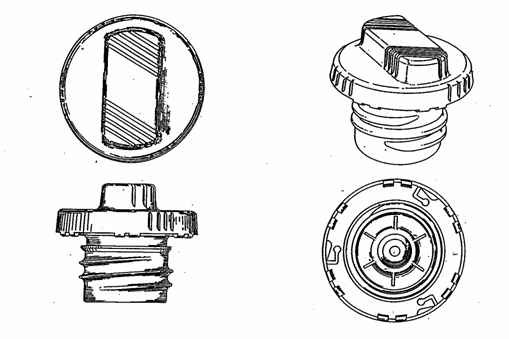
Representations taken from the certificate of registration for Design no: 94802.
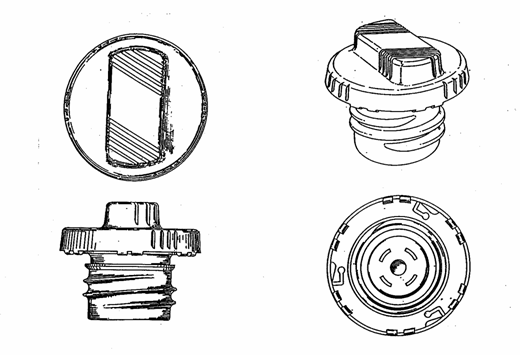
Representations of the front view, perspective view and plan view of Pro-Kit caps: NL82ULP; NL84ULP; NL85ULP & NL86ULP.
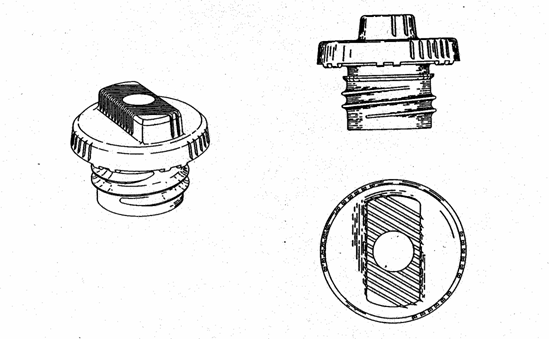
A representation of the underneath view of Pro-Kit cap: NL84ULP.
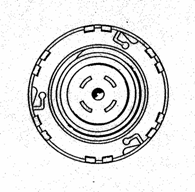
A representation of the underneath view of Pro-Kit caps: NL82ULP & NL85ULP.