

FEDERAL COURT OF AUSTRALIA
Australian Rugby Union Ltd v Hospitality Group Pty Ltd [1999] FCA 1061
PRACTICE AND PROCEDURE – legal professional privilege – draft minutes of meeting at which legal advice provided in presence of non-clients – draft prepared by client – whether document is privileged – whether pre-trial waiver of privilege is governed by common law or Evidence Act 1995 (Cth), s122 – whether client waived privilege in the document – effect of limited disclosure of privileged communication
Trade Practices Act 1974 (Cth), ss 46(1), 47(1), 52
Evidence Act 1995 (Cth), ss 118, 119, 122(4), 122(5)
Grant v Downs (1976) 135 CLR 674, followed
Esso Australia Resources Ltd v Federal Commissioner of Taxation (1998) 83 FCR 511, followed
Adelaide Steamship Co Ltd v Spalvins (1998) 81 FCR 360, cited
Northern Territory of Australia v GPAO (1999) 161 ALR 318, followed
British Coal Corporation v Dennis Rye Ltd (No 2) [1988] 1 WLR 1113, cited
Network Ten Ltd v Capital Television Holdings Ltd (1995) 36 NSWLR 275, discussed
Goldberg v Ng (1995) 185 CLR 83, discussed
Gotha City v Sotheby’s [1998] 1 WLR 114, cited
Trade Practices Commission v Sterling (1979) 36 FLR 244, referred to
Wheeler v Le Marchant (1881) 17 Ch D 675, cited
Nickmar Pty Ltd v Preservatrice Skandia Insurance Ltd (1985) 3 NSWLR 44, cited
Commissioner of Australian Federal Police v Propend Finance Pty Ltd (1997) 188 CLR 501, cited
Telstra Corporation Ltd v BT Australasia Pty Ltd (1998) 156 ALR 634, cited
Equuscorp Pty Ltd v Kamisha Corporation Ltd [1999] FCA 681, followed
Goldberg v Ng (1994) 33 NSWLR 639, discussed
Attorney-General (NT) v Maurice (1986) 161 CLR 475, distinguished
AUSTRALIAN RUGBY UNION LTD v HOSPITALITY GROUP PTY LTD & ORS
N 324 OF 1999
JUDGE: SACKVILLE J
PLACE: SYDNEY
DATE: 4 AUGUST 1999
|
IN THE FEDERAL COURT OF AUSTRALIA |
|
|
N 324 OF 1999 |
|
BETWEEN: |
AUSTRALIAN RUGBY UNION LIMITED Applicant
|
|
AND: |
HOSPITALITY GROUP PTY LIMITED First Respondent
ICM (MARKETING) PTY LIMITED Second Respondent
AUSTRALIAN TOURS FOR SPORT PTY LIMITED Third Respondent
CAMERON JACKSON Fourth Respondent
|
|
DATE OF ORDER: |
|
|
WHERE MADE: |
THE COURT ORDERS THAT:
1. Orders 1 and 2 of the orders made on 30 July 1999, be discharged.
2. The first respondent’s motion, filed on 22 July 1999, be dismissed.
3. The costs of the motion be reserved.
Note: Settlement and entry of orders is dealt with in Order 36 of the Federal Court Rules.
|
IN THE FEDERAL COURT OF AUSTRALIA |
|
|
N 324 OF 1999 |
REASONS FOR JUDGMENT
The Motion
1 The first respondent/cross-claimant in the principal proceedings, Hospitality Group Pty Ltd (“HG”), has filed a notice of motion, seeking an order that leave be given to all parties to the proceedings to inspect a document produced to the Court on subpoena by a non-party, International Management Group of America Pty Ltd (“IMG”) (“the Document”). IMG claims that the Document, other than a small portion which has been disclosed to HG, is subject to legal professional privilege or, as it is called in the Evidence Act 1995 (Cth) (“Evidence Act”), client legal privilege.
2 In correspondence, IMG’s solicitors described the Document and the claim for privilege as follows:
“draft notes of a meeting between representatives of the [Australian Rugby Union], IMG and Stadium Australia and solicitors from this firm. Solicitors from this firm provided legal advice at that meeting and the meeting was held for the sole purpose of those solicitors receiving instructions and providing that advice. The document contains a record of those instructions and advice”.
Although this description does not make the basis of the privilege claim entirely clear, IMG resists HG’s application on the ground that disclosure of the contents of the Document would infringe the privilege of the Australian Rugby Union (“ARU”), the applicant in the principal proceedings. IMG was represented at the hearing by the same solicitors and counsel as have represented the ARU.
3 On 30 July 1999, I delivered a judgment on the motion. I made orders granting leave to all parties to inspect the Document. I did so on the basis of a finding that the ARU was not entitled to claim legal professional privilege in the Document, because the ARU was unable to satisfy the “sole purpose” test laid down in Grant v Downs (1976) 135 CLR 674. That finding, in turn, was based on an erroneous factual assumption. I was responsible for the error.
4 The factual error was drawn to my attention later on 30 July 1999, by means of a facsimile sent by the solicitors for the ARU and IMG, of which a copy was sent to the solicitors for HG and the second respondent (“ICM”). In the meantime, the solicitors for HG and ICM, quite properly, had inspected the Document and made copies.
5 Upon receipt of the facsimile, I immediately caused the matter to be relisted. After hearing from Mr Gleeson on behalf of the ARU and Mr Harrowell on behalf of HG and ICM, I stayed the orders made earlier in the day and made further orders requiring HG and ICM to retrieve and not make further use of any copies of the Document until further order. I should record that Mr Harrowell consented to this course of action. At that hearing, Mr Gleeson and Mr Harrowell canvassed the possibility that the parties should consent to the withdrawal of the judgment and that I should proceed to consider the issues afresh.
6 I was later informed that the parties had indeed consented to the earlier judgment being withdrawn and to my considering the issues afresh. In my view, this was a very sensible approach to a difficulty which was not of the parties’ making. I propose to adopt that approach and to withdraw the judgment given and the orders made on 30 July 1999. What follows is my judgment on HG’s motion.
The Document
7 To understand the dispute, some background to the Document is necessary. The ARU promotes and manages the Australian representative Rugby Union team known as the Wallabies. The ARU’s solicitors are Freehill, Hollingdale & Page (“FH&P”).
8 IMG is the ARU’s agent for certain purposes, notably the provision of hospitality services to persons attending matches involving the Wallabies at Stadium Australia. Stadium Australia Management Ltd (“SAM”) is the operator and manager of Stadium Australia. SAM, like IMG, is not a party to the principal proceedings.
9 The Document contains notes of a meeting held on 31 July 1998 (“the Meeting”). The persons attending the Meeting were as follows:
Mr B Thorburn)
Mr S MacKay ) ARU
Ms K Everett )
Mr D Perry ) FH&P
Ms J Gorka )
Mr A Castellaro ) IMG
Mr R Read SAM
10 The portion of the Document which IMG has made available for inspection by the parties to the proceedings is the following:
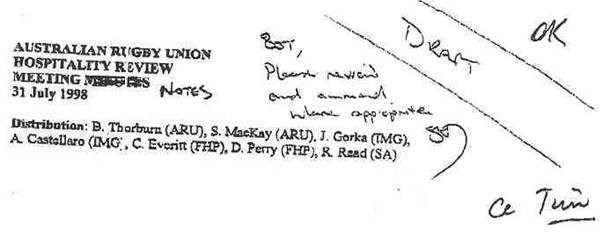
photocopy of Ex 1
11 The evidence allows the following conclusions to be drawn:
· The draft notes of the Meeting were prepared by Mr MacKay of the ARU.
· The handwritten note to “BJT” [Mr Thorburn] is from Mr MacKay.
· Mr Thorburn of the ARU faxed a copy of the notes on 5 August 1998 to Mr McDermott, the Manager of IMG’s account for the ARU, under a cover sheet bearing the ARU’s name. Mr McDermott had not been at the Meeting. The sheet included a printed notation that “[t]he information contained in this facsimile is strictly confidential”.
· I infer that Mr Thorburn approved the draft notes of the Meeting before sending them to Mr McDermott.
· I also infer, having regard to the heading on the Document, that Mr MacKay, on behalf of the ARU, contemplated that the notes prepared by him would or might be distributed to the persons attending the Meeting. There is no evidence that a copy of the Document was actually distributed to any representatives of the non-clients present at the Meeting. However, as I have noted, a copy of the Document was sent to Mr McDermott of IMG.
12 Ms Everett gave unchallenged evidence that, at the Meeting, Mr Thorburn provided information to Mr Perry and her and that the information was “supplemented by others of the persons present”. Ms Everett also said that she had provided legal advice to the ARU at the Meeting. She said, however, that she did not provide advice either to IMG or to SAM.
13 During the hearing, Mr Gleeson, who appeared for IMG, invited me to inspect the Document. Mr Muddle, who appeared for HG, was content for me to take that course. I have in fact inspected the Document.
The Principal Proceedings
14 The principal proceedings were instituted on 16 April 1999. The pleadings make reference to two important events at Stadium Australia involving the Wallabies. The first is the Centenary Test against England, which was in fact played on 26 June 1999. The second is the Bledisloe Cup match against the New Zealand All Blacks, which is scheduled to take place on 28 August 1999.
15 The ARU foreshadowed in its original application a claim for interlocutory relief against HG, but did not seek an interlocutory hearing prior to the Centenary Test. However, the ARU’s claim for interlocutory relief is now listed for hearing on 9 August 1999, some three weeks before the Bledisloe Cup match. The relief sought by the ARU on an interlocutory basis includes orders restraining HG from performing a contract with a third party to which it is alleged to have agreed to provide tickets to the Bledisloe Cup match and restraining the other respondents from offering for sale tickets to the match. HG also seeks interlocutory relief, including an order restraining the ARU from refusing admission to the match to persons who have purchased tickets from HG. The present motion arises out of the parties’ preparation for the interlocutory hearing.
16 In its further amended statement of claim, the ARU pleads that, subject to limited exceptions, it is responsible for issuing tickets to all persons attending Rugby Test matches played by the Wallabies at Stadium Australia. It says that it has issued tickets to the Centenary Test and the Bledisloe Cup with a printed condition in the following terms (“the Condition”):
“It is a condition of sale that any ticket may not be resold at a premium or used for advertising, promotion or other commercial purposes without the prior written consent of the ARU. If the ticket is sold in contravention of this condition, the bearer of the ticket will be denied admission to Stadium Australia.”
According to the ARU, the Condition has been brought to the attention of purchasers of tickets to the two matches. The ARU intends to incorporate the Condition in its tickets for future matches.
17 The ARU claims that HG and the remaining respondents have breached the Condition, by supplying tickets to other persons. HG is alleged intentionally to have induced the other respondents to breach their contracts with the ARU. Allegations are also made that HG has engaged in misleading or deceptive conduct, in contravention of s 52 of the Trade Practices Act 1974 (Cth) (“TP Act”).
18 HG has filed a cross-claim in which it contends that the ARU, by supplying tickets to the two matches, subject to the Condition, has engaged in the practice of exclusive dealing, in contravention of s 47(1) of the TP Act, and has misused its market power in contravention of s 46(1) of the TP Act. The relief sought by HG includes a declaration that the Condition is void.
The Submissions
19 Both HG and IMG filed written submissions in support of their respective positions on the current motion. In its written submissions, HG argued that the ARU had failed to adduce sufficient evidence to support its claim for privilege. It is fair to say that this contention was not developed in argument. In his oral submissions, Mr Muddle relied principally on the contention that the ARU had lost client legal privilege in the Document by reason of s 122(4) of the Evidence Act. Section 122(4) provides that, subject to sub-section (5), Division 1 of Part 3.10 of the Evidence Act
“does not prevent the adducing of evidence if the substance of the evidence has been disclosed with the express or implied consent of the client or party to another person other than:
(a) a lawyer acting for the client or party; or
(b) ...”.
20 According to Mr Muddle, any legal advice provided by Ms Everett at the Meeting had been disclosed, with the express or implied consent of the ARU, to the representatives of IMG and SAM. This conclusion followed from the fact that legal advice had been given by FH&P to the ARU in the presence of representatives of non-clients. Thus the ARU had lost any privilege it might have had in the Document. Section 122(5) of the Evidence Act did not apply, since it only covers the case of disclosure to a person represented by the same lawyer (sub-par (a)) or disclosure to a person with whom the client had, at the time of disclosure, a common interest relating to a current or anticipated proceeding (sub-par (b)). Mr Muddle argued that neither of these sub-paragraphs had been satisfied.
21 It should be said that Mr Muddle’s submissions did not specifically distinguish between advice given by Ms Everett at the Meeting and information provided to her by the ARU and the non-clients, presumably for the purpose of enabling her to give legal advice. Nor did Mr Muddle rely on the fact that Mr MacKay had prepared the Document contemplating that it would be distributed to representatives of the non-clients who had attended the Meeting (a copy actually having been sent to Mr McDermott). In short, HG’s submissions were put on a narrow basis.
22 Mr Muddle submitted that if, contrary to his principal submission, the common law principles governing waiver of privilege applied (rather than s 122(4) of the Evidence Act), the ARU’s privilege in communications made at the Meeting had been waived.
23 Mr Gleeson submitted that s 122(4) of the Evidence Act does not apply to questions of loss of privilege arising before the time at which a party seeks to adduce evidence. So much was said to follow from the decision of the five member Full Court in Esso Australia Resources Ltd v Federal Commissioner of Taxation (1998) 83 FCR 511. Mr Gleeson further argued that the overruling by Esso of the earlier Full Court decision in Adelaide Steamship Co Ltd v Spalvins (1998) 81 FCR 360, precluded IMG from contending that s 122(4) of the Evidence Act had modified “by analogy” the common law principles of waiver of privilege applicable at the ancillary stages of litigation. Mr Gleeson submitted that, although the High Court has granted special leave to appeal in Esso, this view of the authorities was supported by the remarks of Gleeson CJ and Gummow J (with whom Gaudron, McHugh, Callinan and Hayne JJ agreed) in Northern Territory of Australia v GPAO (1999) 161 ALR 318, at 324.
24 Mr Gleeson contended that the disclosure of the legal advice at the Meeting had been made to a limited number of persons, on terms of implied (if not express) confidentiality. In these circumstances, so it was argued, the disclosure of the advice for a limited and specific purpose did not amount to a waiver of privilege as against the respondents in the principal proceedings: British Coal Corporation v Dennis Rye Ltd (No 2) [1988] 1 WLR 1113 (CA), at 1121-1122; Network Ten Ltd v Capital Television Holdings Ltd (1995) 36 NSWLR 275, at 283-286, per Giles J; Goldberg v Ng (1995) 185 CLR 83, at 106-109, per Toohey J; Gotha City v Sotheby’s [1998] 1 WLR 114 (CA). Alternatively, Mr Gleeson contended that the ARU had not waived its privilege because, in the circumstances, there would be no unfairness in permitting it to assert privilege in the Document.
The Threshold Question: Is the Document Subject to Legal Professional Privilege?
25 HG’s written submissions, which were apparently prepared before Ms Everett’s affidavit was sworn, referred to the paucity of evidence adduced in support of the ARU’s claim to privilege. However, no specific submission was made that the communications at the Meeting were not subject to legal professional privilege.
26 Whether the communications were subject to legal professional privilege depends on the application of the “sole purpose” test laid down in Grant v Downs, rather than the “dominant purpose” test specified in ss 118 and 119 of the Evidence Act: Esso v FCT, at 525-526. Grant v Downs decided that legal professional privilege at common law is confined to confidential communications made or brought into existence for the sole purpose of being submitted to legal advisers for advice or for use in legal proceedings, actual or contemplated: at 688, per Stephen, Mason and Murphy JJ.
27 In Trade Practices Commission v Sterling (1979) 36 FLR 244, Lockhart J identified a number of classes of documents or communications subject to legal professional privilege. The classes included the following (at 245-246):
“(a) Any communication between a party and his professional legal adviser if it is confidential and made to or by the professional adviser in his professional capacity and with a view to obtaining or giving legal advice or assistance; notwithstanding that the communication is made through agents of the party and the solicitor or the agent of either of them.”
...
(d) Notes, memoranda, minutes or other documents made by the client or officers of the client or the legal adviser of the client of communications which are themselves privileged, or containing a record of those communications, or relate to information sought by the client’s legal adviser to enable him to advise the client or to conduct litigation on his behalf.
(e) Communications and documents passing between the party’s solicitor and a third party if they are made or prepared when litigation is anticipated or commenced, for the purposes of the litigation, with a view to obtaining advice as to it or evidence to be used in it or information which may result in the obtaining of such evidence.
(f) Communications passing between the party and a third person (who is not the agent of the solicitor to receive the communication from the party) if they are made with reference to litigation either anticipated or commenced, and at the request or suggestion of the party’s solicitor; or, even without any such request or suggestion, they are made for the purpose of being put before the solicitor with the object of obtaining his advice or enabling him to prosecute or defend an action.”
...” (Citations omitted; emphasis added.)
28 As I have pointed out, the submissions did not distinguish between different kinds of communications recorded in the Document. In particular, they did not distinguish between communications made by non-clients at the Meeting, and any legal advice given at that Meeting by FH&P. The distinction could be important because of the limitation expressed by Lockhart J in relation to classes (e) and (f) of privileged communications. It will be seen from Lockhart J’s summary, that communications between a party’s solicitor and a third party are ordinarily privileged only if they are made or prepared when litigation is anticipated or commenced. This limitation, which has its origins in the decision of the Court of Appeal in Wheeler v Le Marchant (1881) 17 Ch D 675, was held by Wood J in Nickmar Pty Ltd v Preservatrice Skandia Insurance Ltd (1985) 3 NSWLR 44, at 52-56, to represent the current law. (Nickmar was disapproved in one respect by the majority of the High Court in Commissioner of Australian Federal Police v Propend Finance Pty Ltd (1997) 188 CLR 501, but the disapproval was not expressed to effect Wood J’s view that Wheeler v Le Marchant remains good law. See, further, Esso v FCT, at 560-561, per Finkelstein J.)
29 The limitation on the scope of legal professional privilege does not mean that a communication between a party’s solicitor and a third party (a non-client), made before proceedings are instituted or contemplated, cannot be protected by legal professional privilege. The communication will be privileged if the third party is an agent of the client and if the communication is both confidential and made to the solicitor in his or her professional capacity with a view to providing legal advice to the client. In Nickmar, Wood J held that reports obtained by a solicitor from investigators or experts, on the explicit instructions of the client, should be regarded as having been supplied by the investigators or experts as agents of the client. His Honour said this (at 56):
“Any other view seems to place undue emphasis on form, and to ignore the substance of the engagement of the expert as an agent by direction. In such circumstances I believe the information could properly be regarded as collected and communicated confidentially on behalf of the client to its legal adviser, in the character, and for the purpose of obtaining legal advice.”
30 In my view, the communications at the Meeting in the present case, from the non-clients to FH&P (the solicitors for the ARU), fall within class (a) of the communications identified by Lockhart J in TPC v Sterling. Although Ms Everett’s evidence was not as explicit as it might have been, I think it should be inferred that the non-clients at the Meeting (that is, the representatives of IMG and SAM) provided information to FH&P at the express request of either the solicitors or the ARU, or both. The inference is strengthened by the fact that any information provided by the non-clients to FH&P was given at the Meeting, in the presence of the ARU’s representatives. In these circumstances, in my view, the communications by the non-clients to the solicitors were made by the non-clients as agents for the ARU.
31 It is also clear enough that, subject to any question of waiver or loss of privilege, the communications made by the non-clients to the solicitors were confidential and were made for the purpose of enabling FH&P to give legal advice to their client, the ARU. Mr Muddle, in cross-examination, did not suggest to Ms Everett that the Meeting had some other purpose. It follows that the communications by the non-clients, like the communications between the ARU’s representatives and the solicitors from FH&P, were subject to legal professional privilege.
32 It will be seen that what I have said in the previous paragraph does not depend on the contents of the Document. As Giles J observed in Network Ten v Capital Television, at 278, a court should be cautious about paying regard to material which is not known to one of the parties. It is enough to say that my inspection of the Document does not lead to any conclusion different from that stated in the previous paragraph.
33 I should add that no submission was made on behalf of HG that, if the communications made at the Meeting satisfied the sole purpose test, the Document itself was nonetheless not privileged. An argument perhaps might have been made that, even though the Document was prepared by Mr MacKay of the ARU (that is, the client) and merely recorded what occurred at the Meeting, the Document was not necessarily brought into existence for the sole purpose of obtaining or recording legal advice. It might have been said, bearing in mind that it was contemplated that the Document was to be circulated to persons other than the representatives of the client, that the Document was brought into existence for other purposes. However, in the absence of any such argument, I am content to proceed on the basis accepted by the parties, namely that the question is whether the fact that the communications at the Meeting were made in the presence of clients is enough to result in the waiver or loss of the privilege.
The Statute or Common Law?
34 In Esso v FCT, the Full Court held
· by majority (Black CJ, Sundberg and Finkelstein JJ; Beaumont and Merkel JJ dissenting), that ss 118 and 119 of the Evidence Act, which state that “[e]vidence is not to be adduced” of certain confidential communications between solicitor and client, do not apply as a matter of construction to pre-trial discovery; and
· by the whole Court, that ss 118 and 119 of the Evidence Act cannot be used as the foundation for modifying the common law test for determining whether communications are subject to legal professional privilege, as stated in Grant v Downs.
35 It seems to me that Mr Gleeson was correct in submitting that the effect of Esso v FCT is that loss or waiver of privilege, at the pre-trial stage of proceedings (whether the relevant documents are included in a list of discovered documents or produced to the Court in response to a subpoena), is governed by the common law and not by s 122(4) of the Evidence Act. That sub-section is expressed not to “prevent the adducing of evidence” disclosed with the express or implied consent of the client, to persons other than those specified in sub-pars (a) and (b). The similarity in language between ss 118 and 119, on the one hand, and s 122(4), on the other, suggests that the reasoning in Esso v FCT applies so as to limit s 122(4) of the Evidence Act to the circumstances in which evidence may be adduced, as distinct from pre-trial disputes concerning access to documents produced to the Court in response to a subpoena.
36 This conclusion is supported by the comments of Gleeson CJ and Gummow J in Northern Territory v GPAO. In that case, a question arose concerning what was said to be an inconsistency between the Community Welfare Act 1983 (NT) and the Evidence Act. Gleeson CJ and Gummow J rejected the contention that there was any inconsistency. Their Honours observed that the Evidence Act is concerned with the adducing and admissibility of evidence and ancillary matters (at 324). They continued:
“It does not deal with the obligations of a party to whom an order in the nature of a subpoena is addressed to produce documents to the court in question. Nor does the Evidence Act deal with the grant of leave by the court to inspect or otherwise make use of documents which have been produced in answer to a subpoena.”
Gaudron, McHugh, Callinan and Hayne JJ agreed with this portion of the judgment of Gleeson CJ and Gummow J.
37 It is true that a majority of the Full Court in Telstra Corporation Ltd v BT Australasia Pty Ltd (1998) 156 ALR 634, held that s 122 of the Evidence Act modifies the common law principles relating to waiver of legal professional privilege, even at the pre-trial stage. However, as Heerey J pointed out in Equuscorp Pty Ltd v Kamisha Corporation Ltd [1999] FCA 681 [at 11], the reasoning in Telstra v BT was based upon the decision of an earlier Full Court in Adelaide Steamship v Spalvins. In Esso v FCT, the majority held that Spalvins was wrongly decided. The majority in Esso v FCT, although noting (at 520, per Black CJ and Sundberg J) that Telstra v BT had followed Adelaide Steamship, did not specifically consider the reasoning of the majority in the former case. However, I agree with Heerey J that the decision in Telstra v BT, having regard to the overruling of Adelaide Steamship, cannot now be understood as standing for the proposition that s 122 of the Evidence Act modifies the common law of waiver of privilege at the pre-trial stages of discovery or production of documents on subpoena. I also agree with Heerey J that the reasoning in Esso v FCT leads to the conclusion that the common law principles governing waiver of privilege apply at the pre-trial stage.
Did the ARU Waive Privilege?
38 In Network Ten v Capital Television, at 284-285, Giles J identified two approaches that have been taken to the case where the person entitled to legal professional privilege discloses the privileged communications to a third party for a particular, limited purpose. One approach was exemplified by the judgment of Kirby P in Goldberg v Ng (1994) 33 NSWLR 639, at 651-653. Kirby J (at 653) took the view that a series of decisions in the United Kingdom (British Coal v Dennis Rye; Goldman v Hesper [1988] 1 WLR 1238; Downey v Murray [1988] NI 600) had established that
“it is possible for the holder of legal professional privilege to disclose relevant privileged material to a third party for a limited and specific purpose in a specific context, and that limited waiver of the privilege will not prevent the holder of the privilege from maintaining that privilege as against the opposing litigant. It is also clear that the absence of an express reservation of confidentiality and/or privilege is not fatal to the operation of the limited waiver”.
39 The other approach was illustrated by the judgment of Clarke JA in the same case. Clarke JA considered (at 676) that cases such as British Coal v Dennis Rye (where a plaintiff in an action based on fraud handed privileged documents to the police to aid a prosecution against the defendant) merely stand
“as authority for the proposition that the particular conduct of the plaintiff did not constitute a waiver of the privilege which the plaintiff enjoyed in the relevant documents and simply demonstrates the fact that there is no universal rule that the disclosure of documents produced for the sole purpose of seeking legal advice or litigation to a stranger to that litigation constitutes a waiver of the privilege in that document.”
Clarke JA (at 677) identified the question to be addressed, in a case where there is no express waiver, as whether the law should impute a waiver in all the circumstances, having regard to considerations of fairness.
40 In Network Ten v Capital Television itself, Giles J expressed the view (at 286) that the divergence of opinion between Kirby P and Clarke JA might be a matter of semantics, rather than substance. Giles J observed that the decision of the Court of Appeal in Goldberg v Ng underlined
“that there can be limited disclosure without relevant loss of legal professional privilege”.
In Network Ten itself, Capital Television had disclosed a privileged letter of advice to a limited number of persons, on terms of confidentiality. It had taken steps to confine dissemination of the letter of advice and to regain copies of the letter of advice once the purpose of the disclosure had been served. Giles J held (at 286) that a disclosure limited in this way did not result in loss of the privilege. If there could be limited waiver, without loss of the privilege as against an opposing litigant, this was such a case; if the correct approach was that the law would not impute a waiver unless a party intentionally performed an act rendering it unfair to another party that the privilege be maintained, there was nothing in the circumstances of the limited disclosure rendering it unfair to maintain the privilege.
41 Network Ten v Capital Television was decided before the High Court gave judgment in Goldberg v Ng, on appeal from the New South Wales Court of Appeal. The facts in that case were that Mr Goldberg, a solicitor, had disclosed privileged documents to the Law Society, for the limited purpose of assisting inquiries made by the Law Society in relation to a complaint lodged against Mr Goldberg by Mr Ng. The disclosure was made by Mr Goldberg on the express basis that the Law Society would not show the documents to anybody else. The majority (Deane, Dawson and Gaudron JJ) held (at 95) that the disclosure did not constitute an express or intentional general waiver of legal professional privilege; nor did the disclosure destroy the confidentiality necessary for the privilege to be maintained. Accordingly, if there had been a waiver of the privilege as against the Ngs, it was a waiver imputed by operation of law in the particular circumstances of the case.
42 It seems to follow from Goldberg v Ng that a disclosure of a privileged communication for a limited purpose, if subject to a confidentiality requirement, may well not amount to an express or intentional waiver of legal professional privilege. In short, as Toohey J said (at 109), such a limited, confidential disclosure may be an exception to express general waiver. But it also seems to follow from Goldberg v Ng that even if a limited, confidential disclosure does not constitute an express or intentional general waiver of privilege, the circumstances of the disclosure may be such as to impute a waiver of privilege by operation of law.
43 That a limited disclosure which falls short of an express or intentional general waiver of legal professional privilege may take place in circumstances constituting an imputed waiver by operation of law is illustrated by the facts of Goldberg v Ng itself. The circumstances of Mr Goldberg’s confidential disclosure to the Law Society were held to result in the waiver of his privilege by operation of law. The majority considered it would be unfair to permit Mr Goldberg to rely on legal professional privilege to prevent the relevant documents being made available for inspection, since the disclosure had been voluntary and had been made for the calculated purpose of assisting him to rebut the complaint made by the Ngs. However, their Honours appeared to contemplate (at 96) that, depending on the circumstances, an imputed waiver need not necessarily destroy the privilege:
“Like an express waiver, it can be limited so that it applies only in relation to particular persons, materials or purposes.”
44 In my view, the mere fact that otherwise privileged communications at the Meeting took place in the presence of persons who did not represent clients of FH&P, does not justify a conclusion that the ARU had expressly or intentionally waived privilege in those communications. The disclosure of the privileged communications was to a limited group, namely those attending the Meeting. While there is no evidence of an express undertaking by the non-clients present at the Meeting to preserve confidentiality, the circumstances suggest that the non-clients were under an implied obligation to respect the confidentiality of the communications at the Meeting. The Meeting took place with solicitors present. That of itself does not necessarily show that all communications were subject to legal professional privilege. But, as I have found, the purpose of the Meeting was to enable FH&P to give legal advice to the ARU, and indeed such advice was given. So far as the evidence goes, the representatives of the non-clients were in attendance in order to provide information required by the solicitors.
45 Nor do I think that considerations of fairness justify imputing a waiver of the ARU’s legal privilege, as least against HG or the other respondents. This is not a case, for example, where the ARU has disclosed part of the privileged communications for forensic purposes and it would be misleading to withhold the remainder: cf Attorney-General (NT) v Maurice (1986) 161 CLR 475, at 487-488, per Mason and Brennan JJ. Nor is it a case like Goldberg v Ng, where the disclosure was made to enable the person entitled to privilege to gain an advantage over the opposing party in litigation. The non-clients simply gave information to solicitors who utilised that material, together with information provided by the client, to give legal advice. Mr Muddle suggested that privilege in the relevant communications would have been preserved if the non-clients had been asked to leave the room when the ARU provided information to the solicitors and the solicitors gave their advice. But to impose such a requirement would not only be impractical; it would be difficult to reconcile with the policy objectives underlying the privilege, namely to induce the client to seek legal advice and to encourage the client to make a full and frank disclosure: Grant v Downs, at 685; Propend, at 508, per Brennan CJ, at 543, per Gaudron J, at 551-552, per McHugh J.
Conclusion
46 The orders stayed on 30 July 1999 should be discharged. HG’s motion should be dismissed. I will reserve the question of costs. The further orders made on 30 July 1999 will remain in force.
|
I certify that the preceding forty-six (46) numbered paragraphs are a true copy of the Reasons for Judgment herein of the Honourable Justice Sackville. |
Associate:
Dated: 4 August 1999
|
Counsel for the Applicant and IMG: |
Mr J Gleeson |
|
|
|
|
Solicitor for the Applicant and IMG: |
Freehill Hollingdale & Page |
|
|
|
|
Counsel for the 1st and 2nd Respondents: |
Mr W G Muddle |
|
|
|
|
Solicitor for the 1st and 2nd Respondents: |
Hunt & Hunt |
|
Solicitor for the 3rd Respondent:
Date of Hearing: |
Peter Speakman & Co
26 July 1999 |
|
|
|
|
Date of Judgment: |
4 August 1999 |


