FEDERAL COURT OF AUSTRALIA
Roses Only & Lush Pty Ltd v Mark Lyons Pty Ltd [1999] FCA 1000
TRADE PRACTICES – application for interlocutory injunction under ss 52 and 80 of the Trade Practices Act 1974 (Cth) – parties competitors in the retail sale by telephone of packaged roses – whether descriptive name has acquired a secondary meaning – whether form of advertisements is likely to mislead or deceive consumers.
INJUNCTION – interlocutory injunction – whether serious issue to be tried – balance of convenience.
Trade Practices Act 1974 (Cth), ss 52, 80
Castlemaine Tooheys Ltd v South Australia (1986) 161 CLR 148, cited
Patrick Stevedores Operations No 2 Pty Ltd v Maritime Union of Australia [No 3] (1998) 72 ALJR 873, cited
Bullock v The Federated Furnishing Trades Society of Australasia (No 1) (1985) 5 FCR 464, followed
S & I Publishing Pty Ltd v Australian Surf Life Saver Pty Ltd (1999) ATPR 41-667, cited
Taco Company of Australia Inc v Taco Bell Pty Ltd (1982) 42 ALR 177, cited
The Guide Dogs Owners’ and Friends’ Association Inc v Guide Dog Association of New South Wales (1998) ATPR 41-645, cited
The Guide Dogs Owners’ and Friends’ Association Inc v Guide Dog Association of New South Wales [1999] FCA 316, cited
Hornsby Building Information Centre Pty Ltd v Sydney Building Information Centre Ltd (1978) 140 CLR 216, cited
Dodds Family Investments Pty Ltd v Lane Industries Pty Ltd (1993) 26 IPR 261, cited
Equity Access Pty Ltd v Westpac Banking Corporation (1989) 16 IPR 431, cited
BM Auto Sales Pty Ltd v Budget Rent A Car System Pty Ltd (1976) 12 ALR 363, cited
Opals Australia Pty Ltd v Opal Australiana Pty Ltd (1993) ATPR 41-264, cited
Bass v Permanent Trustee Co Ltd (1999) 161 ALR 399, distinguished
Cubillo v Commonwealth (1999) 163 CLR 395, distinguished
Farquhar v Bottom [1980] 2 NSWLR 380, cited
Typing Centre of NSW Pty Ltd v Northern Business College Ltd (1989) 13 IPR 627, cited
FAI General Insurance Co Ltd v RAIA Insurance Brokers Ltd (1992) 108 ALR 479, cited
CBS Records Australia Ltd v Telmak Teleproducts (Aust) Pty Ltd (1987) 72 ALR 270, cited
Gollel Holdings Pty Ltd v Kenneth Maurer Funerals Pty Ltd (1987) 9 IPR 109, cited
ROSES ONLY & LUSH PTY LTD trading as “ROSES ONLY” v MARK LYONS PTY LTD trading as “ROSES PLUS”
N 407 OF 1999
JUDGE: SACKVILLE J
PLACE: SYDNEY
DATE: 27 JULY 1999
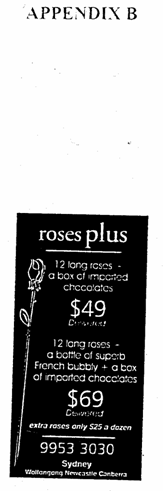
|
IN THE FEDERAL COURT OF AUSTRALIA |
|
|
NEW SOUTH WALES DISTRICT REGISTRY |
N 407 OF 1999 |
|
BETWEEN: |
ROSES ONLY & LUSH PTY LTD trading as "ROSES ONLY" Applicant
|
|
AND: |
MARK LYONS PTY LTD trading as "ROSES PLUS" Respondent
|
|
JUDGE: |
SACKVILLE J |
|
DATE OF ORDER: |
27 JULY 1999 |
|
WHERE MADE: |
SYDNEY |
THE COURT ORDERS THAT:
UPON the applicant, by its counsel, giving the usual undertaking as to damages:
1. The respondent, by itself, its servants or agents, be restrained, pending final determination of these proceedings or until further order, from placing newspaper advertisements promoting the business known as “Roses Plus”, which advertisements are in or substantially in the following format:
(a) having dimensions of 16 cm or 18 cm in length, by 3.5 cm in width; and
(b) are reversed out (that is, have white lettering or images on a black background).
2. The application for interlocutory relief otherwise be dismissed.
3. Costs be costs in the cause.
4. Order 3 be stayed if within seven days either party files written submissions seeking a different order as to costs.
Note: Settlement and entry of orders is dealt with in Order 36 of the Federal Court Rules.
|
IN THE FEDERAL COURT OF AUSTRALIA |
|
|
N 407 OF 1999 |
|
BETWEEN: |
ROSES ONLY & LUSH PTY LTD trading as "ROSES ONLY" Applicant
|
|
AND: |
MARK LYONS PTY LTD trading as "ROSES PLUS" Respondent
|
|
JUDGE: |
|
|
DATE: |
|
|
PLACE: |
REASONS FOR JUDGMENT
The Proceedings
1 This is a dispute between two companies each carrying on a business taking telephone orders for the delivery of packages containing roses to retail customers. The applicant has conducted its business since 1995 under the name “Roses Only”, while the respondent commenced its business in early March 1999 under the name “Roses Plus”.
2 Both companies have advertised their products in mass circulation newspapers, the applicant more extensively. The applicant seeks interlocutory orders restraining the respondent from advertising in a manner which is said to constitute misleading or deceptive conduct in contravention of s 52 of the Trade Practices Act 1974 (Cth) (“TP Act”). The orders sought by the applicant in its amended application are to restrain the respondent from advertising the business known as “Roses Plus”
“(a) Substantially in the format or manner of annexure ‘A’ to this application, namely an advertisement with the dimensions of 16 cm x 3.5 cm or 18 cm x 3.5 cm and being reversed out;
(b) Substantially in the format or manner of annexure ‘B’ to this application, namely an advertisement with the dimensions of 10 cm x 5 cm and being reversed out.”
3 It will be seen that the scope of the orders sought by the applicant is narrow. It is only if an advertisement has the specified dimensions and is “reversed out” that it will be caught by the orders. The expression “reversed out” means that an advertisement in a newspaper comprises white lettering or images on a black background, rather than the more usual black lettering or images on a white background.
4 Annexure A to the amended application (to which I refer as “Advertisement A”) is reproduced as Appendix A to this judgment. The respondent has placed an advertisement in substantially this form in various newspapers, including the Sydney Morning Herald (“SMH”), the Australian Financial Review (“AFR”) and the Daily Telegraph (“Telegraph”). Since the end of June 1999, it has placed Advertisement A only in the Telegraph and only on Mondays.
5 Advertisement A is either 16 cm or 18 cm in length and one newspaper column in width. According to Mr Lyons, the principal of the respondent, he initially selected an advertisement of these dimensions because the SMH’s minimum advertising size in the main body of the newspaper was 16 cm in length by one column in width, while the AFR’s minimum size was 18 cm by one column. He also said that he formed the view that the “column” advertisement suited the Roses Plus product (long roses) and accommodated a pictorial representation of a long-stemmed rose.
6 Advertisement A is “reversed out”. According to Mr Lyons, the suggestion that the advertisements should be reversed out was made by Ms Hickey, a sales executive for the Telegraph. Mr Lyons claimed that, although he was initially against the idea, he was persuaded to adopt it. The evidence establishes that, despite a suggestion to the contrary by Mr Stevens (the applicant’s principal), newspaper advertisements often adopt a reversed out format.
7 Annexure B to the amended application (to which I refer as “Advertisement B”) is reproduced as Appendix B to this judgment. The respondent has regularly placed an advertisement substantially in this form in the Telegraph, in the middle of the share market page. In very recent times, it has appeared from Tuesday to Saturday. (The Telegraph does not publish a share market summary on Mondays.) The dimensions of the advertisement are 10 cm in depth, by a width of one and a half columns. It will be seen that its shape is markedly different from that of Advertisement A.
8 The applicant commenced its newspaper advertising campaign in 1996 in the AFR. From about August 1996, it adopted the “column” style of advertising, utilising advertisements between 16 and 18 cm in length and one column in width. The advertisements bore the name “roses only” in lower case lettering at the top and contained contact details, including a telephone number, near the bottom. In about late 1997, Mr Stevens decided to “reverse out” the column advertisement, to make it more distinctive, although the idea was apparently suggested by an advertising agency. The advertisements thereafter appeared in this form in the AFR.
9 In early 1998, the applicant advertised on several occasions in the SMH, using the same format as the advertisements appearing in the AFR. These advertisements were apparently successful in generating demand for the applicant’s product. Mr Stevens decided to target a wider market and, from about July 1998, commenced advertising regularly in the SMH, the Telegraph and the Sunday Telegraph. The advertisements placed in these newspapers continued to use the column, “reversed out” format.
10 The extent of the applicant’s newspaper advertising is shown by its expenditure for that purpose. In 1998, it spent $75,000 on newspaper advertisements and a further $110,000 on radio advertisements and entries in the Yellow Pages. In the first half of 1999, the applicant’s expenditure on advertising totalled $189,000, of which $65,000 was spent on newspaper advertising.
11 The text of the applicant’s column advertisement has varied somewhat from time to time, depending on the precise offer being made and whether a particular promotion was current. The form of the applicant’s advertisement appearing in March and April 1999 is reproduced as Appendix C. That advertisement (to which I refer as the “Roses Only Advertisement”) frequently appeared in the same newspapers as the respondent’s advertisements, especially Advertisement A.
The Institution of Proceedings
12 Mr Stevens first noticed the respondent’s advertisements in early March 1999. On 5 March 1999, the applicant’s patent attorneys wrote to the respondent. The letter asserted that the applicant had acquired a substantial reputation and goodwill derived from the use of what was said to be the trade mark “Roses Only” and its visually distinctive and memorable form of advertising. The letter stated that the respondent’s form of advertising contravened s 52 of the TP Act, in that consumers were likely to be misled into falsely believing that the respondent’s roses had some affiliation with “Roses Only”. The letter sought the respondent’s agreement to undertakings by 19 March 1999.
13 By a letter of 25 March 1999, the respondent declined to give the undertakings. For reasons unexplained in the evidence, the applicant did not institute proceedings until 7 May 1999. Even then, it did not seek an early hearing of its application for interim relief. In consequence, the matter was listed for directions in the ordinary course on 15 June 1999, before another Judge of the Court. On that date, an interlocutory hearing was set for 29 July 1999. For reasons connected with Court listings, that date was subsequently brought forward to 20 July 1999.
14 The applicant’s claim for interlocutory relief is based solely on the respondent’s alleged contravention of s 52 of the TP Act. The applicant invokes the Court’s power under s 80(2) of the TP Act to grant an interim injunction where the Court is satisfied that a person has engaged in conduct that constitutes a contravention of Part V of the TP Act. Mr Coleman, who appeared on behalf of the applicant, accepted that for present purposes a claim in passing off could not add anything to the claim for injunctive relief pursuant to s 80 of the TP Act. Although the applicant has applied to register a trade mark incorporating the name “roses only”, no claim has been made under the Trade Marks Act 1995 (Cth). It should be noted, however, that the trade mark the applicant has sought to register is one which uses dark lettering on a white background, not the “reversed out” format.
The Principles Governing the Grant of Interlocutory Relief
15 The principles governing a claim for interlocutory relief are not in doubt. The applicant must satisfy the Court that there is a serious question to be tried: Castlemaine Tooheys Ltd v South Australia (1986) 161 CLR 148, at 153-154, per Mason ACJ; Patrick Stevedores Operations No 2 Pty Ltd v Maritime Union of Australia [No 3] (1998) 72 ALJR 873, at 880, per Brennan CJ, McHugh, Gummow, Kirby and Hayne JJ. In addition, the applicant must show that the balance of convenience favours the grant of an injunction: Castlemaine Tooheys, at 153; Bullock v The Federated Furnishing Trades Society of Australasia (No 1) (1985) 5 FCR 464 (FC), at 472, per Woodward J (with whom Smithers and Sweeney JJ agreed). In considering the balance of convenience, it is appropriate to take into account the apparent strength of the applicant’s case. As Woodward J said in Bullock, at 472:
“the two legs of the test need not be considered in isolation from each other. Thus an apparently strong claim may lead a court more readily to grant an injunction when the balance of convenience is fairly even. A more doubtful claim (which nevertheless raises ‘a serious question to be tried’) may still attract interlocutory relief if there is a marked balance of convenience in favour of it.”
It follows that it may be appropriate on an interlocutory application, even one which raises a serious question to be tried, to make an assessment of the apparent strength of the applicant’s claim. Such an assessment may have some bearing on whether interlocutory relief should be granted.
Is there a Serious Issue to be Tried?
The Case Law
16 The principles applicable to a claim based on a contravention of s 52 of the TP Act were recently restated by a Full Court in S & I Publishing Pty Ltd v Australian Surf Life Saver Pty Ltd (1999) ATPR 41-667 (Hill, R D Nicholson and Emmett JJ), at 42,507 – 42,508:
“1. There will be no contravention of s 52 unless the error or misconception which occurs results from the conduct of the corporation and not from other circumstances for which the corporation is not responsible.
2. Conduct will be misleading and deceptive if it leads into error.
3. Conduct will be likely to mislead or deceive if there is a ‘real or not remote chance or possibility’ of misleading or deceiving regardless of whether it is less or more than 50%.
4. Conduct causing confusion or uncertainty in the sense that members of the public might have cause to wonder whether the two products or services might have come from the same source is not necessarily misleading and deceptive conduct.
5. In a case such as the present an applicant must establish that it has acquired the relevant reputation in the name or get-up such that the name or get-up has become distinctive of the applicant’s business or products.
6. Conduct may be misleading or deceptive or likely to mislead or deceive notwithstanding that the corporation said to engage in that conduct acted honestly and reasonably and did not intend to mislead or deceive.... Nevertheless, where the intention to mislead or deceive is found, it logically would be likely that a court would more easily find that the conduct was misleading or deceptive....
7. In many cases it will be necessary to consider the class of persons to whom the representation was directed....
8. There is no proposition of law to the effect that intervention from erroneous assumption between conduct and misconception destroys the necessary chain of causation with the consequence that the conduct cannot be regarded as likely to mislead or deceive.
9. The test of whether conduct is misleading or deceptive or likely to mislead or deceive is an objective one for the Court to determine. It is ultimately a question of fact.” (Citations omitted.)
17 The judgment of Deane and Fitzgerald JJ in Taco Company of Australia Inc v Taco Bell Pty Ltd (1982) 42 ALR 177, at 202-203, sets out guidelines elaborating on some of the established principles:
“First, it is necessary to identify the relevant section (or sections) of the public (which may be the public at large) by reference to whom the question of whether conduct is, or is likely to be, misleading or deceptive falls to be tested...
Second, once the relevant section of the public is established, the matter is to be considered by reference to all who come within it, ‘including the astute and the gullible, the intelligent and the not so intelligent, the well educated as well as the poorly educated, men and women of various ages pursuing a variety of vocations...
Thirdly, evidence that some person has in fact formed an erroneous conclusion is admissible and may be persuasive but is not essential. Such evidence does not itself conclusively establish that conduct is misleading or deceptive or likely to mislead or deceive. The court must determine that question for itself. The test is objective…
Finally, it is necessary to inquire why proven misconception has arisen.... The fundamental importance of this principle is that it is only by this investigation that the evidence of those who are shown to have been led into error can be evaluated and it can be determined whether they are confused because of misleading or deceptive conduct on the part of the respondent.”
Analysis
18 The applicant’s telephone sales business, from its inception, has offered roses to retail customers. Roses have been the only flowers offered, although the applicant has advertised them packaged together with other items, notably chocolates or champagne (or sometimes both). The name “roses” is clearly descriptive of the principal product sold by the applicant.
19 The significance of the word “only” is perhaps not as apparent. The evidence suggests that the applicant first used the expression “roses only” in connection with a retail florist outlet in the city of Sydney, although the evidence does not make it clear whether that outlet sold only roses. As applied to the telephone business, the word “only” is descriptive to the extent that the applicant sells no flowers other than roses.
20 The general principles concerning the circumstances in which a descriptive name can become distinctive of a business are well known: see generally The Guide Dogs Owners’ and Friends’ Association Inc v Guide Dog Association of New South Wales (1998) ATPR 41-645, at 41,135 - 41,136 (aff’d Guide Dog Owners’ and Friends’ Association Inc v Guide Dog Association of New South Wales [1999] FCA 316, per Heerey, Carr and Mansfield JJ). As Stephen J observed in Hornsby Building Information Centre Pty Ltd v Sydney Building Information Centre Ltd (1978) 140 CLR 216, at 229, there is a price to be paid for advantages flowing from the possession of a descriptive trade name. In particular, there is always the possibility of confusion which might be attributed to the use of the descriptive name, rather than to any misleading or deceptive conduct on the part of a rival trader, even where that trader uses the same or a similar name.
21 In Dodds Family Investments Pty Ltd v Lane Industries Pty Ltd (1993) 26 IPR 261, at 269, a Full Court approved the following statement of Hill J in Equity Access Pty Ltd v Westpac Banking Corporation (1989) 16 IPR 431, at 448:
“Just as the distinction between descriptive and fancy names is not a distinction of law so too it is wrong to see the distinction in black and white terms. The reality is that there is a continuum with at the extremes purely descriptive names at the one end, completely invented names at the other and in between names that contain ordinary English words that are in some way or other at least partly descriptive. The further along the continuum towards the fancy name one goes, the easier it will be for a plaintiff to establish that the words used are descriptive of the plaintiff’s business. The closer along the continuum one moves towards a merely descriptive name the more a plaintiff will need to show that the name has obtained a secondary meaning, equating it with the products of the plaintiff (if the name admits of this – a purely descriptive name probably will not) and the easier it will be to see a small difference in names as adequate to avoid confusion.”
The circumstances in which descriptive words may become distinctive of the business of a particular trader are illustrated by BM Auto Sales Pty Ltd v Budget Rent A Car System Pty Ltd (1976) 12 ALR 363 and Opals Australia Pty Ltd v Opal Australiana Pty Ltd (1993) ATPR 41-264 (Lockhart J).
22 The applicant’s case is that the name “roses only” has acquired a secondary meaning distinctive of the applicant’s business, at least when used in combination with what it says is the “unique” column style and “reversed out” format of the applicant’s newspaper advertising. The applicant relies on the use by the respondent of the same style and format of advertising. Moreover, it says that the evidence warrants a finding that, despite Mr Lyons’ denials, the respondent chose the column style and the “reversed out” format for its newspaper advertising with the deliberate intention of inducing confusion in retail customers. The applicant also points to evidence that some customers have confused the applicant’s business with that of the respondent. In these circumstances, Mr Coleman submits that the applicant has established that there is a serious issue to be tried.
23 It is undesirable and, indeed, unnecessary to make findings of fact at an interlocutory stage of the proceedings: cf Bass v Permanent Trustee Co Ltd (1999) 161 ALR 399, at 417 (joint judgment); Cubillo v Commonwealth (1999) 163 ALR 395 (O’Loughlin J), at 405-406. I think that, for present purposes, it is enough to say that the applicant has adduced evidence sufficient to establish that there is a serious question of fact as to whether the name “roses only” has acquired a secondary meaning distinctive of the applicant’s business. It has spent large sums on extensive advertising, both in the print media and on radio. It is likely that some, perhaps many, buyers or potential buyers of roses for delivery have come to associate the name “roses only” with the business of the applicant. How far this association has resulted from the style and format of the applicant’s newspaper advertising, in particular its use of column advertisements in a reversed out format, is a much more difficult question. The evidence on the second question is somewhat thin.
24 In my opinion, a serious question of fact also arises as to whether Mr Lyons’ choice of advertising style and format was independently arrived at (as he maintained) or was part of a deliberate strategy to imitate elements of the applicant’s advertising strategy. There is some independent evidence supporting Mr Lyons’ contention that the suggestions for column advertisements in a reversed out format were made by persons advising him, for reasons unconnected with the applicant’s style of advertising. On the other hand, it is quite clear that early drafts of the respondent’s advertisements were prepared with knowledge of the form of the applicant’s newspaper advertisements. The challenge to Mr Lyons’ account in cross-examination suggests that an issue will arise as to whether his evidence should be accepted. Of course, it may be that the facts as ultimately found will be somewhere between the versions advanced by Mr Lyons and the propositions put to him in cross-examination.
25 I should add that there is no evidence that the dimensions and style of Advertisement B were dictated by the form of the applicant’s newspaper advertising. The applicant has used only the column format for its advertisements and, as I have noted, the dimensions of Advertisement B are markedly different from the Roses Only Advsertisement.
26 Taking into account that the applicant has established a factual basis (in the sense of serious issues to be tried) for at least some of its contentions, in my view it nonetheless faces considerable difficulties in establishing a cause of action under the TP Act. In particular, I think it faces difficulties in demonstrating that, upon an objective comparison of the advertisements placed respectively by the applicant and the respondent, the respondent’s conduct was likely to mislead or deceive consumers of the relevant class.
27 The comparison must of course take into account the characteristics of the audience the respondent’s advertisements were intended to reach: see Farquhar v Bottom [1980] 2 NSWLR 380 (Hunt J), at 385-386, applied in Typing Centre of NSW Pty Ltd v Northern Business College Ltd (1989) 13 IPR 627 (Wilcox J) and FAI General Insurance Co Ltd v RAIA Insurance Brokers Ltd (1992) 108 ALR 479 (Foster J), at 495-496. It will also need to have regard to the likelihood that impulse buyers of roses (part, at least, of the target audience) will not be inclined to scrutinise advertisements with meticulous care and that some of that class will associate the name “roses only” with the applicant.
28 Even so, as Mr Stevens QC submitted on behalf of the respondent, despite the fact that Advertisement A and the Roses Only Advertisement have the same dimensions and reversed out style, there are striking differences between them. These include the following:
· The business names in each, although having the descriptive word “roses” in common, are different. Indeed, on one view, the use of the word “plus” in Advertisement A is calculated to distinguish the respondent’s business from that of the applicant’s, which incorporates the word “only” in its business name.
· The lettering used in the Roses Only Advertisement to record its business name is distinctive and quite different from that employed in Advertisement A.
· The Advertisement A contains a distinctive, stylised representation of a rose. No similar representation appears in the Roses Only Advertisement.
· The Roses Only Advertisement contains considerably more information than Advertisement A and presents what might be described as a more “cluttered” image to the casual reader.
· The “free” elements in each advertisement are different.
29 A comparison between the Roses Only Advertisement and Advertisement B reveals yet more significant differences (although the latter, like the former, has a somewhat “cluttered” appearance). In particular, Advertisement B does not appear as a “column” advertisement and thus its shape is markedly different from the Roses Only Advertisement. Indeed, the only substantial similarity between the two advertisements, apart from the use of the word “roses” and the descriptive reference to “12 long roses” is the use of the “reversed out” format.
30 In cross-examination, Mr Stevens’ attention was drawn to an advertisement inserted by the respondent in the financial pages of the Telegraph on 29 May 1999. This advertisement was the same size as Advertisement B (that is, 10 cm long by one and a half columns wide), but was not “reversed out”. It was headed “Roses and Chocolates”, in cursive script, and included a representation of a rose (although not in the same form as the rose in Advertisement B). The advertisement invited readers to purchase for $49
“13 LONG
STEMMED ROSES
A BOX OF
IMPORTED
CHOCOLATES
BEAUTIFULLY
GIFTBOXED
AND DELIVERED”.
31 Mr Stevens said in evidence that he had no objection to the “Roses and Chocolates” advertisement. He was asked to explain:
“So, why is it then that the size of the ad for roses and chocolates appearing in the business section, which is the same size as the advertisement for Roses Plus appearing in the business section is acceptable, but the Roses Plus by reason of size is not acceptable?---Predominantly because of its blacked out, reversed out style and the roses and chocolates ad I think only appeared in that business section and wasn’t as well known as the roses only ad, and looked significantly different. The other roses and chocolates ads were totally different and never appeared in the stock page ever again, or before that time.”
It must be said that it is not easy to understand why the reversed out format of Advertisement B is the particular element that would cause confusion among potential purchasers of roses who wish to order by telephone. In other words, if (as Mr Stevens accepted) the “Roses and Chocolates” advertisement is not likely to mislead potential purchasers, it is not clear why Advertisement B is likely to mislead them.
32 It is relevant to take into account evidence of confusion among potential buyers of roses and others who have seen the respondent’s advertisements. In this connection, the manager of the applicant’s retail outlet, whose duties included taking orders for roses by telephone, was asked in early March 1999 to make a note of any customers who complained or appeared confused in consequence of the respondent’s advertisements. She made written records of three such cases over a period of about three months. However, I am not inclined to think that these three cases substantially advance the applicant’s contentions.
33 Of the three cases, one complaint related to an advertisement not placed by the respondent. A second customer (who swore an affidavit) made inquiries of Directory Assistance for “roses something”, having forgotten the name of “roses only” through which he had previously ordered a rose package. Not surprisingly, Directory Assistance could not help him. He then looked at the Telegraph and saw only one advertisement for roses, being an advertisement substantially in the form of Advertisement A. He assumed, incorrectly, that the advertisement was for the service he had previously used. Clearly enough, this customer’s difficulty resulted largely from his failure to remember the applicant’s name except for the descriptive word “roses”, and from the absence in the Telegraph of the “Roses Only” Advertisement.
34 The third case involved a customer making a complaint to the applicant about the date of delivery, having in fact ordered roses from the respondent. The manager’s contemporaneous note recorded that this customer was “confused with the similarity in names & product…”. This customer also swore an affidavit, but it may well prove to be significant that the contemporaneous note identifies as the first source of his confusion the similarity between the “roses only” and “roses plus” names.
35 The difficulties facing the applicant in establishing a cause of action are illustrated further by an answer given by Mr Stevens in cross-examination. He was asked to compare the Roses Only Advertisement and Advertisement A:
“Why, seeing both ads side by side, do you think it would not remove confusion from the eyes of any reader of the newspaper?---I am familiar with the ads, I don’t – I think most people would look at the two ads as being the same column ad with ‘Roses’ written up the top and a telephone number down the bottom and invariably miss everything that’s in between.”
This answer, although referring to the “column ad”, underlines that the applicant’s choice of a descriptive name is likely to be productive of confusion in a casual reader.
36 I think that a distinction must be drawn between Advertisement A and Advertisement B. In my view, the applicant has not established that there is a serious issue to be tried in relation to the respondent’s placement of advertisements in the form of Advertisement B. The differences in format between Advertisement B and the Roses Only Advertisement preclude a finding that members of the relevant class would be induced to believe, by reason of any misleading or deceptive conduct on the part of the respondent, that there was an association or affiliation between business conducted by the applicant and that conducted by the respondent. I bear in mind that there is no evidence that the respondent adopted the style and format of Advertisement B in a conscious attempt to copy the applicant’s style of advertising. I also bear in mind the evidence of Mr Stevens as to his attitude to the “Roses and Chocolates” advertisement.
37 The position is somewhat different in relation to Advertisement A. As I have noted, there is a serious factual issue to be resolved as to whether the respondent adopted the column, reversed out format of Advertisement A in a deliberate attempt to take advantage of the applicant’s style of advertising. If the applicant makes out its factual claim and if it also establishes that its name has acquired a distinctive secondary meaning, this would support (although by no means conclusively establish) its contention that the respondent’s use of the column, reversed out style of advertisement was likely to mislead or deceive some consumers.
38 It seems to me that the applicant has shown that there is a serious issue to be tried in relation to its cause of action under the TP Act flowing from the respondent’s use of Advertisement A, although I would not be inclined to characterise its case, on the evidence adduced by it at the interlocutory hearing, as strong. In particular, the applicant will need to demonstrate that, despite the striking differences between Advertisement A and the Roses Only Advertisement, potential purchasers of roses are likely to be confused by reason of the form of the respondent’s advertisements. Nonetheless, so far as Advertisement A is concerned, the applicant has satisfied the criterion for the grant of interlocutory relief that there be a serious issue to be tried.
Balance of Convenience
39 Two factors, in particular, support the applicant’s claims on the balance of convenience. First, it may be difficult to quantify the applicant’s losses (if any) flowing from the respondent’s use of Advertisement A, should it ultimately succeed at the trial. Specifically, it may not be able to demonstrate the extent to which the use of advertisements in this form have had an adverse impact upon its sales or profits. Secondly, the order sought by the applicant in relation to Advertisement A is very narrow in scope. The order would not prevent the respondent, for example, from continuing its form of advertising in the Monday Telegraph, provided it did not adopt the “reversed out” format for its column advertisement. The order would not of course affect the applicant’s use of Advertisement B.
40 The second factor to which I have referred gives rise to another consideration, although neither counsel adverted to it. There must be a question as to whether an order so limited in scope will have any practical utility in protecting the applicant from harm. If all the respondent need do to comply with the interim order is to refrain from using the “reversed out” format, it is not obvious that any negative impact on the applicant’s business from the respondent’s use of Advertisement A will be overcome. Putting the matter another way, the limited nature of the relief sought by the applicant perhaps suggests that any harm it has suffered by reason of any misleading or deceptive conduct by the respondent (as distinct from its efforts as a competitor) is likely to be minor.
41 From the respondent’s perspective, an order preventing it from advertising in the form of Advertisement A will have very little impact on its business. In recent times, it has used that form of advertisement only in the Monday Telegraph. More importantly, the order would not prevent it from running precisely the same advertisement, except that it would not be able to utilise the reversed out format. It is difficult to see how such an order would have any significant impact on the respondent’s sales and profits pending a final hearing. I accept that, just as the applicant’s losses (if any) pending a hearing might not be easy to quantify, so any losses sustained by the respondent in consequence of the order cannot readily be quantified. For this reason, the respondent may not gain much comfort from the applicant’s undertaking as to damages. However, on the material before me, the likelihood is that any impact of an interlocutory order on the respondent’s business would be marginal.
42 I think the balance of convenience, so far as Advertisement A is concerned, favours the grant of the limited relief substantially in the form sought by the applicant. In reaching this conclusion, I have taken into account the difficulties confronting the applicant in establishing its case for final relief. Even so, the respondent should be restrained, pending final hearing, from publishing advertisements adopting the column, reversed out format.
43 I have not overlooked the fact that the respondent advanced, as a further reason for denying the applicant interlocutory relief, the absence of a convincing explanation by the applicant for its delay in seeking interlocutory relief. The authorities tend to suggest that, in the absence of any proof of prejudice to the respondent, delay in claiming interlocutory relief under the TP Act is usually not an important consideration, largely because of the interest in protecting the public from misleading or deceptive conduct. CBS Records Australia Ltd v Telmak Teleproducts (Aust) Pty Ltd (1987) 72 ALR 270 (Bowen CJ), at 284; Gollel Holdings Pty Ltd v Kenneth Maurer Funerals Pty Ltd (1987) 9 IPR 109 (Einfeld J), at 121-122. In the present case, the respondent has not pointed to any prejudice it has sustained by reason of the delay. I am inclined to think that, even in the absence of prejudice, delay is a factor that can be taken into account in determining whether relief should be granted under the TP Act. However, I do not think that the delay in this case is such as to tip the balance against the award of limited interlocutory relief to the applicant.
Conclusion
44 An order should be made on an interlocutory basis restraining the respondent from advertising in the format adopted by Advertisement A. The order should be substantially in the narrow form sought by the applicant, although I have amended it slightly. My present inclination is that the costs of the application should be costs in the cause. However, if either party wishes to make submissions on costs, I shall provide an opportunity to do so.
|
I certify that the preceding forty-four (44) numbered paragraphs are a true copy of the Reasons for Judgment herein of the Honourable Justice Sackville. |
Associate:
Dated: 27 July 1999
|
Counsel for the Applicant: |
Mr A P Coleman |
|
Solicitor for the Applicant: |
Haralambis Lawyers |
|
Counsel for the Respondent: |
Mr C Stevens QC |
|
Solicitor for the Respondent: |
Central Law |
|
Date of Hearing: |
20 July 1999 |
|
Date of Judgment: |
27 July 1999 |