

FEDERAL COURT OF AUSTRALIA
Koninklijke Philips Electronics N V v Remington Products Australia Pty Ltd
[1999] FCA 816
INTELLECTUAL PROPERTY – trade marks – device marks, being drawings depicting shape of part of a product – infringement – whether word “shape” included in definition of “sign” in Trade Marks Act 1995 (Cth) s 6 includes shape of goods or part of goods – whether three-dimensional shape can be substantially identical with or deceptively similar to representation in two dimensions – whether device mark can be infringed by manufacture or sale of article which, or part of which, is in shape of mark – “uses as a trade mark” – whether use by alleged infringer of mark as shape of part of goods constituted use as badge of origin – disclaimer – disclaimer to the effect that registration of mark shall not confer “any right to the use of its features as a design applied to an article of manufacture” – whether exclusive use disclaimed of any parts or matter which mark contains, for purposes of Trade Marks Act 1955 (Cth) s 32(1) – cross-claim opposing registration of shape mark under Trade Marks Act 1995 (Cth) – whether Trade Marks Act 1995 Pt 4 ousts jurisdiction of court to make declaration as to registrability of mark the subject of application for registration – whether, as matter of discretion, Court ought not to intervene in procedure set out in Trade Marks Act 1995 (Cth) Pt 4 – whether failure to raise matters going to registrability of mark the subject of application for registration would found Anshun estoppel – whether use of mark, not being trade mark use, ought not to be taken into account for purposes of Trade Marks Act 1995 (Cth) s 41(6)(a)
INTELLECTUAL PROPERTY – designs – fraudulent imitation – whether allegedly infringing design based on or derived from registered design – whether differences between allegedly infringing design and registered design so substantial that result not to be described as imitation – whether certain features features of shape or configuration or of pattern or ornamentation
TRADE PRACTICES – conduct that is misleading or deceptive – false or misleading representations – use of feature of goods said to be associated with applicant only – true source of product indicated on product – whether product complained of likely to be taken as product of applicant – whether product complained of likely to be taken as being manufactured and distributed with approval or licence of applicant – passing off – whether misrepresentation
WORDS AND PHRASES – “sign” – “shape” – “uses as a trade mark” – “fraudulent imitation” – “misleading or deceptive”
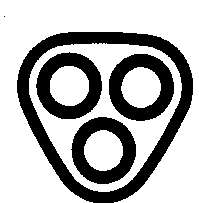
Trade Marks Act 1994 (UK)
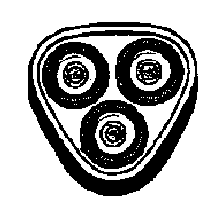
Trade Marks Act 1995 (Cth) ss 6, 7, 17, 27, 30, 31, 32, 33, 35, 41(6), 52, 54, 55, 56, 74, 120(1), 233(1), 238
Trade Marks Act 1994 (Cth) s 5 and s 39
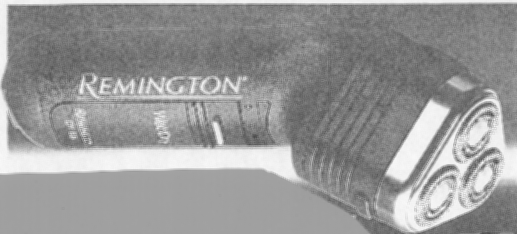
Trade Marks Act 1955 (Cth) s 6 and s 32
Trade Practices Act 1974 (Cth) ss 52, 53(c), 53(d)
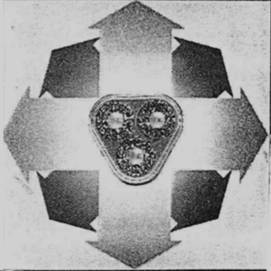
Designs Act 1906 (Cth) s 30(1)
Trade Marks Regulations reg 4.3(3) and reg 4.3(7)
Philips Electronics N.V. v Remington Consumer Products (1997) 40 IPR 279 referred to
Remington Rand Corporation v Philips Electronics N.V. (1995) 191 NR 204 referred to
Smith Kline and French Laboratories (Australia) Ltd v Registrar of Trade Marks (1967) 116 CLR 628 referred to
Re Coca-Cola Trade Marks [1986] RPC 421 cited
John Haig & Co Ltd v Forth Blending Co (1953) 70 RPC 259 cited
Reckitt & Colman Products Ltd v Borden Inc [1990] 1 WLR 491 cited
Re Coca-Cola Trade Marks [1986] RPC 421 applied
The Shell Co of Australia Ltd v Esso Standard Oil (Australia) Ltd (1963) 109 CLR 407 applied
Mark Foy’s Ltd v Davies Coop & Co Ltd (1956) 95 CLR 190 applied
Johnson & Johnson Australia Pty Ltd v Sterling Pharmaceuticals Pty Ltd (1991) 30 FCR 326 cited
Musidor BV v Tansing (1994) 52 FCR 363 cited
Mars GB Ltd v Cadbury Ltd [1987] RPC 387 cited
Top Heavy Pty Ltd v Killin (1996) 34 IPR 282 cited
J B Stone & Co Ltd v Steelace Manufacturing Co Ltd (1929) 46 RPC 406 cited
Edward Young & Co Ltd v Grierson Oldham & Co Ltd (1924) 41 RPC 548 cited
Philips Electronics N.V. v Remington Products Australia Pty Ltd (1997) 39 IPR 33 referred to
Port of Melbourne Authority v Anshun Pty Ltd (1981) 147 CLR 589 referred to
Registrar of Trade Marks v Muller (1980) 144 CLR 37 cited
Philips Electronics N.V. v Remington Consumer Products (Court of Appeal, 5 May 1999, unreported), referred to
Blount Inc v Registrar of Trade Marks (1998) 40 IPR 498 referred to
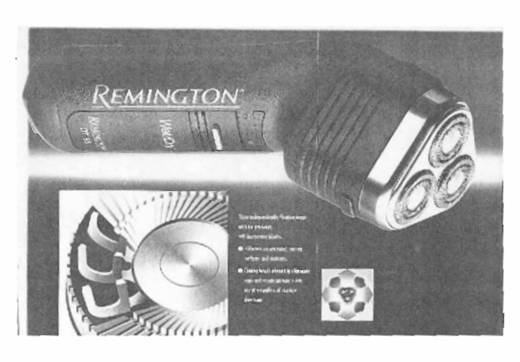
Dart Industries Inc v Decor Corporation Pty Ltd (1989) 15 IPR 403 applied
Turbo Tek Enterprises Inc v Sperling Enterprises Pty Ltd (1989) 23 FCR 331 cited
Elconnex Pty Limited v Gerard Industries Pty Limited (1991) 32 FCR 491 referred to
L J Fischer & Co Ltd v Fabtile Industries Pty Ltd (1979) 49 AOJP 3611 cited
Fisher & Paykel Healthcare Pty Ltd v Avion Engineering Pty Ltd (1991) 22 IPR 1 cited
Malleys Ltd v J W Tomlin Pty Ltd (1961) 180 CLR 120 applied
Firmagroup Australia Pty Ltd v Byrne & Davidson Doors (Vic) Pty Ltd (1987) 180 CLR 483 applied
Gerard Industries Pty Ltd v Auswide Import Export Pty Ltd (1998) 40 IPR 119 applied
AMP Inc v Utilux Pty Ltd [1972] RPC 103 cited
In Re Wolanski’s Registered Design (1953) 88 CLR 278 cited
Parkdale Custom Built Furniture Pty Ltd v Puxu Pty Ltd (1982) 149 CLR 191 applied
Bridge Stockbrokers Ltd v Bridges (1984) 4 FCR 460 referred to
ConAgra Inc v McCain Foods (Aust) Pty Ltd (1992) 33 FCR 302 applied
KONINKLIJKE PHILIPS ELECTRONICS N.V. AND PHILIPS ELECTRONICS AUSTRALIA LIMITED v REMINGTON PRODUCTS AUSTRALIA PTY LIMITED AND REMINGTON PRODUCTS AUSTRALIA PTY LIMITED AND KONINKLIJKE PHILIPS ELECTRONICS N.V. AND PHILIPS ELECTRONICS AUSTRALIA LIMITED
NG 637 OF 1997
LEHANE J
18 JUNE 1999
SYDNEY
| IN THE FEDERAL COURT OF AUSTRALIA |
|
| BETWEEN: | KONINKLIJKE PHILIPS ELECTRONICS N.V. First Applicant
PHILIPS ELECTRONICS AUSTRALIA LIMITED (ACN 008 445 743) Second Applicant
|
| AND: | REMINGTON PRODUCTS AUSTRALIA PTY LIMITED (ACN 007 070 573) Respondent
REMINGTON PRODUCTS AUSTRALIA PTY LIMITED (ACN 007 070 573) Cross‑Claimant
KONINKLIJKE PHILIPS ELECTRONICS N.V. First Cross‑Respondent
PHILIPS ELECTRONICS AUSTRALIA LIMITED (ACN 008 445 743) Second Cross‑Respondent
|
| DATE OF ORDER: | |
| WHERE MADE: |
THE COURT ORDERS THAT:
1. The respondent file and serve, not later than 25 June 1999, short minutes of the orders which it contends should be made in the light of these reasons.
Note: Settlement and entry of orders is dealt with in Order 36 of the Federal Court Rules.
| IN THE FEDERAL COURT OF AUSTRALIA |
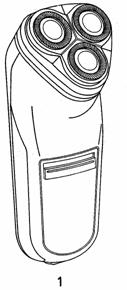
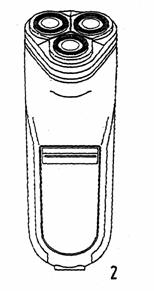
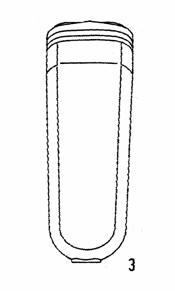
|
| JUDGE: | |
| DATE: | |
| PLACE: |
REASONS FOR JUDGMENT
Background: nature of proceeding
1 This case concerns men’s rotary electric shavers. The applicants (I shall refer to them indiscriminately as “Philips”) have for many years manufactured and sold, in many parts of the world, rotary electric shavers, particularly shavers with three “shaving heads” arranged in the form of an equilateral triangle. The first applicant (Philips Electronics) manufactures shavers; the second applicant (Philips Australia) distributes them in Australia. Philips Electronics is the owner of a design (No. 105780) registered under the Designs Act 1906 (Cth) in respect of a “dry” shaver; it also owns two trade marks, registered originally under the Trade Marks Act 1955 (Cth) (the 1955 Act), (No. 308424 and No. 309250), now registered trade marks for the purposes of the Trade Marks Act 1995 (the 1995 Act) (s 233(1)). Each is registered in class 8 for shaving apparatus; hair trimmers, parts thereof and accessories thereto not included in other classes. Philips has also applied for registration of a trade mark, also for goods in class 8, comprising a “shape”: it is described as “a shape of a shaving unit consisting of a substantially equilateral triangularly shaped housing containing three circular shaving heads”. I shall refer to it as the “Trade Mark Application”.
2 Philips first sold triple‑headed rotary shavers in Australia in 1956. It has advertised them widely and sold a large number of them. Until June 1997 the only rotary shavers sold in Australia were those made by Philips. During that month the respondent (Remington, a term which, again, I shall use indiscriminately to refer both to the respondent and to the corporate group of which it is a member) sold in Australia a number of men’s triple‑headed rotary electric shavers manufactured by a Japanese company, Izumi Products Company (Izumi). Remington also is a member of a large and well known corporate group which sells its branded electrical products, including electric shavers, throughout the world. The shavers which it sold in Australia, however, had until June 1997 been “foil” shavers, not rotary shavers. The distinction is this: whereas a rotary shaver has circular rotating cutters beneath a mesh or (as in the case of the shavers with which this case is concerned) slotted “head”, the cutting apparatus of a foil shaver is a horizontal row of reciprocating blades covered by a metal foil or mesh. Just as the working surface of a rotary shaver may comprise one or more “heads” (in the case of the shavers with which this case is concerned, three, disposed at the points of an equilateral triangle), a foil shaver may have two or more rows of foil‑covered cutters: included among Remington’s products, for example, has been a “triple foil” shaver.
3 The triple‑headed shaver which Remington imported and sold in Australia from June 1997 is known as model RR DT55. I shall call it the “Remington product”. It is a “wet/dry” shaver: that is, unlike any Philips shaver marketed before this proceeding commenced, it could be used dry or with lather and it could be rinsed or immersed in water. I shall deal with some other features of it later. Remington admits on the pleadings that it intends to continue to distribute the Remington product and to import it into Australia for sale, or for use for the purposes of trade or business.
4 Remington is at present restrained by interlocutory injunction from selling, advertising for sale or promoting or marketing the Remington product. The orders now sought by Philips include permanent injunctions and declarations that Remington has infringed Philips’ registered design and trade marks. It seeks that relief on the basis that Remington’s conduct, as well as infringing the registered design and trade marks, amounted to passing off and infringed s 52 and s 53 of the Trade Practices Act 1974 (Cth).
5 Remington, in turn, by cross‑claim seeks a declaration that the mark the subject of the Trade Mark Application is not registrable and an order directing Philips Electronics to withdraw the Trade Mark Application. Remington also seeks an order for rectification of the Register of Designs by expunging Philips’ registered design.
6 There has been much litigation between, on the one hand, Philips and, on the other, Izumi and those (including Remington) who have distributed Izumi’s triple‑headed rotary shavers. The present proceeding is one of a number which have been, or are being, conducted in a number of jurisdictions. I was referred, particularly, to the judgment of Jacob J in proceedings in England, Philips Electronics N.V. v Remington Consumer Products (1997) 40 IPR 279 (and, since reserving judgment, to the decision of the Court of Appeal delivered on 5 May 1999), and the decision of the Canadian Federal Court of Appeal in Remington Rand Corporation v Philips Electronics N.V. (1995) 191 NR 204. But, though there is a degree of overlap, the issues in those cases were by no means identical with the issues here; and the English and Canadian trade marks legislation differs significantly from the 1995 Act. As a result, the English and Canadian decisions, though interesting and in some respects instructive, offer only limited assistance in the resolution of the matters in issue between the parties in this proceeding.
Trade mark infringement
(a) The marks, and the use complained of
7 The trade marks on which Philips relies became known, in the course of argument, as the two‑dimensional mark and the three‑dimensional mark. Both were initially registered under the 1955 Act. Each was registered as a device mark. The two‑dimensional mark (No. 308424) is:
 |
8
 |
The three‑dimensional mark (No. 309250) looks like this:
9 The registration of the three‑dimensional mark incorporates what was described in argument as a disclaimer:
“Registration of this trade mark shall neither confer nor recognise any right to the use of its features as a design applied to an article of manufacture.”
10
 |
The Remington product looks like this:
11 It is immediately apparent that there is a close similarity between the working surface of the Remington product, and the face plate which incorporates it, and the three‑dimensional mark. There is one particular difference. Each of the three heads of the Remington product comprises two concentric rings of slots, under each of which is a circle of rotating cutters. Each head depicted in the three‑dimensional mark has only one ring of slots and, of course, by implication one circle of cutters. Remington describes its product as a “dual track shaver”.
12 Advertising material for the Remington product and the package in which it is delivered to a consumer have printed on them this device:
 |
13 Philips contends that its marks are infringed by the use of the triple head configuration of the Remington product, the use of photographs or images of the triple head on packaging and in brochures and advertisements and the use of the device on packaging and in brochures and advertisements. Philips claims that each of the matters of which it complains amounts to use as a trade mark, in relation to goods in respect of which Philips’ trade marks are registered, of a sign that is substantially identical with or deceptively similar to one or both of Philips’ marks. Remington’s principal contentions, on this issue, are that the registered marks do not give Philips the exclusive right to use the mark (in a trade mark sense) as the design of the face plate of a shaver and that, in any event, Remington is not, in the Remington product, using the design of its shaving head as a trade mark.
(b) Legislation: contentions; consideration
14 Philips’ marks are registered trade marks for the purposes of the 1995 Act: s 233(1). Section 120(1) tells us what, relevantly, amounts to infringement:
“120 (1) A person infringes a registered trade mark if the person uses as a trade mark a sign that is substantially identical with, or deceptively similar to, the trade mark in relation to goods … in respect of which the trade mark is registered.”
15 The expression “uses as a trade mark” is not defined but it is common ground that the expression encapsulates what was previously held to be trade mark use for the purposes of the earlier legislation. The word “sign” is defined in s 6 of the 1995 Act: it
“includes the following or any combination of the following, namely, any letter, word, name, signature, numeral, device, brand, heading, label, ticket, aspect of packaging, shape, colour, sound or scent.”
16 Philips argued that “shape” must include the shape of an article, or of part of an article, which is within the class of goods for which the mark is registered. Thus, the argument proceeded, Remington had used, in relation to the Remington product, a sign (the shape of the top of the product, including the shaving heads) which was deceptively similar, at least, to the three‑dimensional mark. Remington’s response was that the disclaimer had the result that Philips was not entitled to complain of the use of its mark (or of a sign similar to it) as a feature of the design of part of the Remington product. In any event, the inclusion of “shape” among the various types of “sign” should not be taken as overturning the well established principle that a mark is always something distinct from the goods in relation to which it is used; and, in any event, it could not have been intended that a device mark registered under the 1955 Act should now confer on its owner the rights of the owner of a “shape” mark registered under the 1995 Act.
17 It may be accepted that before the 1995 Act took effect the shape or appearance of goods was not registrable as a trade mark in respect of goods of its class, for the reason given by Windeyer J in Smith Kline and French Laboratories (Australia) Ltd v Registrar of Trade Marks (1967) 116 CLR 628 at 639, 640:
“A trade mark is defined in the Act as ‘a mark used or proposed to be used in relation to goods’ for the purposes stated. This definition assumes, it seems to me, that the mark is something distinct from the goods in relation to which it is used or to be used. It assumes that the goods can be conceived as something apart from the mark and that the mark is not of the essence of the goods. The goods are assumed to have an existence independently of the mark. As Sargant L.J. put it, in stating the difference between a design and a trade mark, ‘A trade mark is something which is extra, which is added to the goods for the purpose of denoting the origin of the goods’: Charles Goodall & Son Ltd v John Waddington Ltd [(1924) 41 RPC 658 at 668] and Lord Lindley, then Lindley L.J., said in In Re James’ Trade Mark [(1886) 33 Ch D 392 at 395], ‘We must be careful to avoid confusion of ideas. A mark must be something distinct from the thing marked. A thing cannot be a mark of itself …’. This does not mean that today a trade mark must be a mark to be physically applied to the goods. It may now be a mark to be used in other ways in relation to goods. A thing can always be described and distinguished in appearance by any visible characteristic which it has, its shape, colour or any mark which it bears. But the test is not – Can the goods be described or depicted without reference to their markings? As I see it, a mark for the purposes of the Act must be capable of being described and depicted as something apart from the goods to which it is to be applied, or in relation to which it is to be used. … I do not think that a mere description of goods simply by shape, size or colour can be a trade mark in respect of those goods.”
See also Re Coca-Cola Trade Marks [1986] RPC 421.
18 The 1955 Act used the word “mark” rather than “sign” and defined it, in s 6, to include:
“… a device, brand, heading, label, ticket, name, signature, word, letter or numeral, or any combination thereof.”
A registered mark was infringed (s 62(1)) by a person who in the course of trade used a mark which was substantially identical with, or deceptively similar to, the trade mark, in relation to goods or services in respect of which the trade mark was registered. Thus, if a “mere description of goods simply by shape” could not be registered as a trade mark in respect of those goods, neither could the manufacture or sale of goods, having a particular shape, amount of itself to use of the shape as a trade mark so as to infringe a registered mark comprising a device of the same, or a similar, shape.
19 The question, then, is whether by its expanded definition of “sign” the 1995 Act has significantly changed the law. The question is not altogether easy. The 1995 Act defines “trade mark”, in s 17, substantially in the traditional terms which played an important part in Windeyer J’s reasoning. But if “shape” does not include the shape of goods, or of a part of goods, within the class for which a trade mark is registered, it is not easy to see what “shape” adds to “device”; it hardly seems a sensible construction to limit “colour” or “scent” to a colour or scent used in relation to goods, but not as the colour or scent of the goods, or part of the goods, themselves; and if that is so in relation to “colour” and “scent”, why should “shape” be construed in a more limited way? One possible limitation, perhaps, might be to read “shape” as limited to the get‑up of goods, not extending to the goods themselves (the distinction, based on John Haig & Co Ltd v Forth Blending Co (1953) 70 RPC 259, is referred to by Lord Oliver of Aylmerton in Reckitt & Colman Products Ltd v Borden Inc [1990] 1 WLR 491 at 504): but to limit “shape” in that way would give it no field of operation not already covered by “aspect of packaging”.
20 Aspects of the background of the 1995 Act are significant. In 1989 a Working Party was appointed, with the authority of the then responsible Minister, to review and streamline the trade marks legislation; among the matters taken into account by the Working Party were the then draft agreement in respect of trade‑related aspects of intellectual property rights (TRIPS) associated with the Uruguay Round of the General Agreement on Tariffs and Trade (it is common ground that the 1995 Act, like the Trade Marks Act 1994 (UK) (the UK Act), was intended, among other things, to give effect to Australia’s obligations under TRIPS). The report of the Working Party said this:
“There is majority support for the proposition that if the sign constitutes some element of the shape or the packaging of the product, and if the applicant can demonstrate that the element is not necessary for the proper functioning, or does not result from the nature of the product or its packaging, then it should be capable of registration.
It is recommended that the existing definition should be replaced with one which follows the UK and EC example and complies with the TRIPS Agreement principles. The Working Party believes the recommended definition is consistent with the function of a mark being to indicate the commercial origin of goods and services, that it is wide enough to encompass all signs now known to be used as trade marks, and yet provides appropriate limitations to protect the legitimate rights of other traders as well as those of the public generally.”
21 The report of the Working Party led to the release of the Trade Marks Bill 1994. Because of timing constraints imposed by the outcome of the Uruguay Round, that Bill was enacted, though it did not come into effect, before there had been any significant opportunity to seek and consider comment on it. Following its enactment, however, submissions on what had become the Trade Marks Act 1994 (Cth) (the 1994 Act) were received, resulting in the enactment of the 1995 Act which repealed the 1994 Act before it took effect. Some aspects of the 1994 Act, however, are significant. Apart from a change in the order of the words, the definition of “sign” in the 1994 Act was the same as the definition in the 1995 Act (the order in the 1994 Act was “… heading, label, ticket, shape, colour, sound or aspect of packaging”: but I do not think it is possible to regard the change in order as suggesting that “aspect of”, in the 1995 Act, governs “shape, colour, sound or scent” as well as “packaging”). The definition of “trade mark” is the same in each Act; though there are differences in the provisions relating to infringement, there is none relevant to this case. Significantly, the 1994 Act included the following provision which assumed that the word “shape” in the definition of “sign”, encompassed the shape of goods:
“39 An application for the registration of a trade mark in respect of goods must be rejected if the trade mark consists wholly or principally of:
(a) the shape, or some other characteristic, possessed, because of their nature, by the goods; or
(b) a shape, or some other characteristic, that the goods must have if a particular technical result is to be obtained.”
22 The 1995 Act contains no such provision: it deals with the problem in a rather different way, particularly, perhaps, in s 41(6):
“(6) If the Registrar finds that the trade mark is not inherently adapted to distinguish the designated goods or services from the goods or services of other persons, the following provisions apply:
(a) if the applicant establishes that, because the extent to which the applicant has used the trade mark before the filing date in respect of the application, it does distinguish the designated goods or services as being those of the applicant – the trade mark is taken to be capable of distinguishing the designated goods or services from the goods or services of other persons;
(b) in any other case – the trade mark is taken not to be capable of distinguishing the designated goods or services from the goods or services of other persons.”
23 It would be surprising if the same definition, plainly to be read as including the shape of goods in legislation containing an express limitation on the circumstances in which a “shape” might be accepted, was to be read in a more limited sense in successor legislation not containing that limitation.
24 The explanatory memorandum to the Trade Marks Bill 1995 offers little by way of further assistance. In relation to the definition of “trade mark”, it says this:
“17. This clause defines a trade mark to be a ‘sign’ whose use in trade distinguishes the goods or services of one person from those of any other. A non‑exhaustive list of what constitutes a ‘sign’ is set out in its definition in clause 6. Significantly, a trade mark could be registered where the trade mark is a sign that is a shape, sound, colour or smell, provided that all the requirements for registrability are met; for example, that the trade mark can be represented graphically, and is capable of distinguishing the applicant’s goods or services (see clause 40 (‘Trade mark that cannot be represented graphically’) and clause 41 (‘Trade mark not distinguishing applicant’s goods or services’)).”
The Minister’s second reading speech, also, is of limited assistance: it records the history, particularly the recommendations of the Working Party, and the attempt to harmonise Australia’s trade marks system, as far as practicable, with similar systems of other industrialised countries. Curiously, the Minister’s reference to the new definition of “sign” does not refer to “shape”:
“A new, broader definition of what may constitute a trade mark is introduced by the bill. As a result, it will now be possible to register sounds, smells and aspects of packaging as trade marks provided that all the other requirements for registrability are met. This change is responsive to the contemporary and developing marketing needs of business.”
25 As to differences between the 1994 and 1995 Acts, the Minister said this:
“While this bill differs from the 1994 act, mostly in matters of clarity and technical detail, there are three changes that deserve special mention.”
The Minister, however, did not proceed to refer to any matter relevant to the treatment, by the 1995 Act, of “shape” trade marks.
26 One clear impression left by that history is that it was not thought that the inclusion of “shape” in the definition of “sign” would effect a radical change in trade mark law. Undoubtedly, however, the Working Party recommendation proceeded on the basis that “shape” included the shape of goods, or of part of them. Equally, it is clear that the Working Party’s recommendations were, in large part, the source of the provisions, so far as they differed from the pre‑1994 legislation, of the 1995 Act. The 1994 Act plainly proceeded on the basis that “shape” was to include the shape of the goods. And nothing in the explanatory memorandum or in the Minister’s speech suggests that substantially the same definition of “sign” in the 1995 Act was intended to operate differently. In short, the legislative history, I think, suggests nothing to the contrary of, but rather offers some support for, what I think is the natural meaning of the word “shape” included in the definition of “sign”: it includes the shape of goods, or of part of them, in relation to which a sign of that kind is used.
27 That conclusion is consistent with Jacob J’s construction (in Philips), approved by the Court of Appeal, of the UK Act; that Act, however, refers explicitly to the “shape of goods” and incorporates, in s 3(2), restrictions which include the substance of those in s 39 of the 1994 Act.
28 The next step is Remington’s submission that a mark registered as a device, particularly one registered under the 1955 Act, did not confer on its owner the exclusive rights of the owner of a “shape” mark. To hold otherwise, it was said, “would result in a massive retrospective vesting of rights in device marks with potentially catastrophic consequences for manufacturing industries”. Not only might the owner of a mark obtain something closely resembling a perpetual monopoly in an industrial design; but, additionally, established “device” marks might have become vulnerable and new device marks, at least those comprising a representation of goods, or part of goods, more difficult to register. I think there may well be difficulties, and there may be aspects of the 1995 Act which warrant reconsideration. To anticipate somewhat, it may be that the extent of the difficulties depends to some extent on the scope of what is regarded as use as a trade mark of a sign which is a shape.
29 Senior counsel for Remington referred, in support of his submission, to the particular way in which the Trade Mark Regulations deal with applications for shape marks and their examination. Regulation 4.3(3) provides:
“In an application for the registration of a trade mark that contains, or consists of, a 3 dimensional shape:
(a) if practicable, the representation of the trade mark in the application must be illustrated in a perspective that shows each feature of the trade mark; and
(b) otherwise, the representation of the trade mark in the application must include views of the trade mark that are necessary to show each feature of the trade mark.”
Sub‑regulation (4) then empowers the Registrar to require “additional views” of the trade mark sufficient for the proper examination of the application. Sub‑regulation (7) provides:
“If a trade mark for which registration is sought contains or consists of a sign that is a colour, scent, shape, sound or an aspect of packaging, or any combination of those features, the application for registration of the trade mark must include a concise and accurate description of the trade mark.”
30 Of course, a shape (for example of a particular surface) is not necessarily three‑dimensional. If it is two‑dimensional, then regulation 4.3(3) does not apply, though regulation 4.3(7) does. Philips’ marks are two‑dimensional. The “three‑dimensional” mark is, of course, in fact two‑dimensional but drawn so as to indicate the three dimensions of the object depicted. But I do not think there can be any doubt that a three‑dimensional shape can be, if not substantially identical with, then at least deceptively similar to, a representation in two dimensions (The Coca‑Cola Company v All‑Fect Distributors Ltd (Federal Court of Australia, Merkel J, 18 December 1998, unreported at 19)). And to suggest that a device mark (whether registered before or after the 1995 Act took effect: it can make no difference) can never be infringed by, for instance, the manufacture or sale of an article which, or part of which, is in the shape of the mark is to qualify s 120(1) of the 1995 Act in a way which its terms do not support. A registered trade mark – any registered trade mark – is infringed if a person uses as a trade mark a sign that is deceptively similar to the trade mark in relation to goods in respect of which it is registered. The comparison to be made is one between the registered mark and a “sign”: if the latter is deceptively similar to the former and if it is used as a trade mark in relation to goods of the relevant class, then there is infringement. It is not an express requirement, and I can see no reason to hold that it is an implied requirement, that the sign used by the putative infringer be in the same category as the sign which is the registered mark.
(c) Trade mark use
31 The starting point is the particular use of which Philips complains. I have included in the judgment a representation of the Remington product and I shall have to return in more detail to some of its features when considering the case on design infringement. Apart from the appearance of the “business end” of the Remington product, which I have already described, it is to be noted that the word “Remington” followed by the symbol “®” is printed vertically, in large letters, on the front of the handle and, without the symbol and in somewhat smaller letters, horizontally at the foot of a panel beneath the switch in the middle of the front of the handle. The package in which it is presented to the consumer is a box from the right hand front of which the front of the Remington product protrudes in a plastic “blister”. The three heads are thus prominently displayed; they are covered by a transparent plastic guard across which “Remington®” is printed in large letters. On the left hand side of the front of the package “Remington” is printed prominently in white on a blue background; beneath it “wet/dry” in large and prominent black type; beneath that, “rechargeable rotary” in smaller and less prominent black type; and then “dual track shaver”, again printed in white on a blue background. Towards the bottom of the front of the pack there appears the following:
“WORLDS ONLY
WET/DRY DUAL TRACK
ROTARY SHAVING SYSTEM”
32 Turning to the back of the package, one sees, on the left at the top, a similar version of the four‑line message on the front. That is followed by:
“ADVANCED DUAL TRACK
ROTARY SHAVING TECHNOLOGY
TWIN BLADE ROTARY SHAVING SYSTEM
CORDLESS OPERATION”
33 That is followed, in somewhat smaller and less bold type, by:
“THREE INDEPENDENTLY FLOATING HEADS WITH 60 PRECISION, SELF SHARPENING BLADES”
followed by a description of four desirable characteristics of the product. There are then, side by side, two pictures. The first is a representation of the “advanced dual track shaving system”, showing a shaving head and, in a cut away portion, segments of the two concentric circles of cutters. The other is the device (shown earlier in this judgment) in the shape of the triangular shaving surface from which broad arrows extend in eight directions, beneath which appear the words “three heads ensure no gaps when shaving”. On the right hand side of the back of the package there appear four photographs of the Remington product designed to illustrate certain of its features; two of the photographs show the triangular shaving surface very clearly, though the legends above and below the photographs, referring to various features of the product, do not refer to the configuration of the heads or any of their properties except that they can be immersed and cleaned in water. The diligent student is rewarded with further reading matter on the sides and bottom of the package which, however, adds nothing material for present purposes.
34 The brochure complained of is a “trade” publication, not addressed directly to consumers. It comprises a single sheet of glossy cardboard, folded at the centre. When it is unfolded, there is revealed a picture of the Remington product underneath which is a large representation of a shaving head, with the cut away section, and a smaller representation of the device with eight arrows. That part of the brochure looks like this:
35
 |
On the other side, the front when the brochure is folded, there is a close‑up picture of the shaver apparently at work on a man’s face, with the legend “RR 55 smooths the toughest terrain”. That, no doubt, is intended to evoke ideas associated with cars. Inside the brochure, to the left of the pictures, beneath words similar to those found on the front of the package, there appears:
“Independent Suspension
Smooths out those rugged features and lets you get a really close shave.
Three independently floating heads with 60 precision self sharpening blades effectively cut the whiskers on irregular, uneven surfaces and contours of the face or under the chin.
Handle really close shaves with confidence, knowing that you’re in total control of the smoothest ride of your life.
Full Power Coverage
The cutting heads are aligned to avoid gaps so that regardless of your shaving direction, no whiskers are left uncut.
Exceptional performance in the wet and the dry.
RR 55 takes the toughest conditions wet or dry. The unit is waterproof, sealed against dirt, hair or moisture intrusion for long life without maintenance.”
36 On the opposite side of the pictures, the theme continues, with sections headed “Styling and Performance” and “Reliability”.
37 Finally, the advertisement relied on comprises principally a close‑up photograph of the shaver, face forwards so that the three heads are very prominently displayed. Also prominently displayed is the word “Remington” on the handle. Across the bottom of the picture there appear, in large and prominent white lettering against a dark background, the words “the quickest, smoothest thing on three wheels”. That motif is sustained:
“The all new Remington Rechargeable Dual Track Shaver performs brilliantly in wet or dry conditions. Its fully sealed chassis protects against dirt, hair or moisture intrusion so you’ll get exceptional performance with shaving foam or gel that is kinder to sensitive skin.”
There is a further reference to a “self adjusting suspension” and “the smoothest ride over all facial contours”.
38 Philips submitted that the message of the Remington product itself, its packaging and the way it was presented both to the trade and to consumers was one calculated to produce the response, adapting the words of Kitto J in The Shell Co of Australia Ltd v Esso Standard Oil (Australia) Ltd (1963) 109 CLR 407 at 425: “There I see something that the Remington people are showing me as being a mark by which I may know that any shaver in relation to which I see it used is theirs”. In other words, prospective buyers were told that the Remington product was to be distinguished from the products of other traders partly because they were described by the appearance of the three dual track cutting heads in a triangular configuration: Mark Foy’s Ltd v Davies Coop & Co Ltd (1956) 95 CLR 190 at 205. That, in turn, was so because of the constant emphasis of the shaving surface, and its appearance, in association with the name “Remington” (the statement of the true source of the product did not, of course, of itself exclude infringement: Mark Foy’s at 205). The triple head configuration was a striking and powerful image; the evidence established that outward appearance and style of a shaver were important in marketing: particularly, where what was marketed was a men’s shaver, it was important to evoke a “masculine image and association”. Hence the dominant motoring imagery: “wheels” were not wheels but looked like them, the purpose being to direct attention to the shaving heads (the substance of that proposition received the assent, in cross‑examination, of Mr R G Stepon, Remington’s General Manager – Logistics and Distribution). Mr Stepon also accepted that the dual track feature provided a potential marketing advantage, as a means of distinguishing Remington from its competitors:
“So that what you wanted was consumers would see the three heads in the triangular configuration with the dual row of cutters and associate that configuration of dual row of cutters with Remington? – Correct.”
39 Senior counsel for Philips pointed also to evidence to the effect that the dual track feature did not enhance shaving efficiency, a proposition which, however, Mr Shunji Izumi, the president of Izumi, was not prepared, in cross‑examination, to accept.
40 Two other principal submissions were made on behalf of Philips. One referred to evidence – to which I shall return when dealing with the design case – which, Philips claimed, showed that the design of the Remington product was a result not of any research to determine whether the best functional arrangement of shaving heads was to position them at the points of an equilateral triangle but rather of “copying the market leader”: the aim was to do what Philips did for marketing, not functional, reasons: in other words, to trade off Philips’ marketing success. Senior counsel referred particularly to the following exchange in his cross‑examination of Mr Edward Szymansky, the Vice President Engineering, Shavers of the US corporation, Remington Products Company LLC:
“Remington has never, I think as you say in your statement, spent money on investigating alternative designs for the head configuration of cutting heads for a rotary shaver? – Yes, true.
And has never spent any money investigating different configurations of cutting head shapes, for example? – There’s a very fine point in the cutting head shapes. You have to be more specific when you say cutting head shapes.
You know that Remington, when it has made or sold rotary shavers, has always adopted a circular cutting head? – Rotary shaver?
In rotary shavers, yes. – Yes.
It has never spent any money investigating the possibility using cutting edge shapes other than circular, has it? – You don’t have to investigate that.
You have never spent any money investigating that, have you? – No.
Or investigating a configuration of cutting heads, configuration or shape, which would look different to that of the [Philips], do you agree? – you have never spent money on that? – Yes, true.
And that’s because, isn’t it, Remington has chosen in the rotary shaver market to attempt to ride on the back of [Philips’] marketing success? – Yes.”
That, senior counsel submitted, spoke overwhelmingly against the contention that the triple head configuration was not being used to distinguish Remington’s goods.
41 The second submission was simply that no evidence had been called to the effect that the shape in question conveyed any clear descriptive meaning. Rather, the evidence about the striking look of the triangular triple head, and about the emphasis placed on it by Philips over many years in its own advertising, suggested strongly that the use of the shape by another trader was more than merely descriptive: Remington had encouraged consumers to find a secondary meaning by emphasising the appearance of the heads rather than what they did.
42 Remington submitted that it did not use the shape of the three rotary cutting heads, configured substantially as an equilateral triangle, as a badge of the origin, or of the origin of the quality, of the Remington product. No submission had been made, it was said, by Philips relating simply to the use of the shape or the face of the Remington product: the submissions had related to the way it was packaged, presented to the trade and advertised to consumers. In any event, the Remington product was prominently labelled “Remington”; and there was nothing to suggest that this was a case of multiple trade mark use. The design of the packaging, and the depiction of the shaver in the brochure and advertisement, were calculated simply to demonstrate what sort of a shaver this was: unlike the foil shavers which Remington had previously sold in Australia, this was a rotary shaver. As the evidence led by both sides unsurprisingly demonstrated, it was customary, in advertising a shaver, to show its “business end”; and indeed there was a plethora of advertising material, relating to various electric shavers, in evidence, which made that proposition good. Additionally, it was said, the depiction of the “dual track” feature indicated an aspect of function: the cut away section showed how the two rows of cutters worked – it was irrelevant, if it were the case, that the “dual track” function did not significantly enhance the performance of the shaver.
43 I have mentioned that I do not think that the 1995 Act has brought about any change in the test of trade mark use. There is in s 6 and s 7 of the 1995 Act a definition of “use of a trade mark” which expands, rather than limits, the ordinary meaning of that phrase. But none of the expansions, if they applied, would have any bearing on this case. In any event, it is not obvious that a definition of “use of a trade mark …” affects the meaning of the different expression, in s 120(1), “if the person uses as a trade mark”. I do not think it does.
44 The legal test is not in doubt. There are a number of well known formulations and there is no need to repeat a large selection of them. The test derives from the definition of “trade mark” itself:
“With the aid of the definition of ‘trade mark’ in s 6 of the Act, the adverbial expression may be expanded so that the question becomes whether, in the setting in which the particular pictures referred to were presented, they would have appeared to the television viewer as possessing the character of devices, or brands, which the appellant was using or proposing to use in relation to petrol for the purpose of indicating, or so as to indicate, a connexion in the course of trade between the petrol and the appellant. Did they appear to be thrown on to the screen as being marks for distinguishing Shell petrol from other petrol in the course of trade?”
(Shell at 425). I have already referred to the formulation by Williams J in Mark Foy’s at 205. Both those formulations have been cited and applied on numerous occasions: see, for example, Johnson & Johnson Australia Pty Ltd v Sterling Pharmaceuticals Pty Ltd (1991) 30 FCR 326 at 347, 348 per Gummow J; Musidor BV v Tansing (1994) 52 FCR 363 at 372, 373 per Gummow and Heerey JJ.
45 As Kitto J said in Shell at 422 and as Shell itself strikingly demonstrates, “the context is all‑important”. There are at least two aspects of that proposition which are relevant to this case. One is that it is relevant to know, as the evidence establishes, that the conventional way, in the trade, to advertise an electric shaver is to give some prominence, in any depiction of it, to its head (see Mars GB Ltd v Cadbury Ltd [1987] RPC 387 at 402; Johnson & Johnson at 347). Secondly, particular considerations may apply depending upon the category of sign which is used.
46 Thus, where the sign is an invented word or words which have, by themselves, no determinate meaning, it will commonly not be difficult, where the sign is printed or embossed on an article, its packaging or an advertisement, to regard that as trade mark use: why would such a sign be used in such a context but to indicate origin? (Mark Foy’s). That may equally be so in the case of a sign which is a device, particularly a device whose shape or appearance bears no particular relation to the class of goods in relation to which it is used. Matters may be rather different if the sign is, for example, a word or phrase which has a clear meaning in ordinary use: there may be a much more difficult question whether the word or phrase is used to indicate origin or simply to convey the meaning that it ordinarily has (for example, the words “chill out”: Top Heavy Pty Ltd v Killin (1996) 34 IPR 282). It should cause no surprise that cases in which difficult controversies about trade mark use arise commonly concern marks comprising words which have, or may be perceived to have, a meaning descriptive of a characteristic of goods. Other considerations may apply if the sign is a colour: to continue the motoring analogy, and to choose an example which may approach absurdity, to paint a car yellow would not ordinarily be to indicate its origin, or the origin of its quality. It is not easy to imagine circumstances in which a sign which is simply a colour, rather than perhaps a particular combination of colours or a colour in combination with some other element (for example, aspect of packaging), will be capable of registration, or of use, as a trade mark.
47 It is not possible, I think, to approach the question, is use of a shape of an article trade mark use, in quite the same way as the courts have traditionally approached the question in relation to words or devices. In those cases the question is, typically, does the use of the mark suggest commercial origin or does it, rather, convey some other message? Particularly, does it describe the goods or some characteristic of them (e.g. Mark Foy’s, Johnson & Johnson, Musidor, J B Stone & Co Ltd v Steelace Manufacturing Co Ltd (1929) 46 RPC 406) or the place from which they come (e.g. Edward Young & Co Ltd v Grierson Oldham & Co Ltd (1924) 41 RPC 548)? The shape of an article is itself, of course, one of its characteristics. It follows, I think, that by providing that a shape may (if it meets the requirements of the 1995 Act, particularly of s 41) be registered as a trade mark, with the consequence that the “use” of a shape in relation to an article (that is, use as the shape of the article or part of it) may be trade mark use, the 1995 Act requires consideration, in relation both to registrability and to infringement, of matters on which earlier authority gives only limited assistance. When, for example, may a shape properly be regarded as inherently distinctive? If a shape is not inherently distinctive but does in fact distinguish goods of a particular person, who has then registered the shape as a trade mark, what is it about the use by another trader of the same shape, in relation to goods in the same class, which identifies that use as trade mark use? As to the latter question, the authorities tell us that trade mark use is that which indicates that the goods in relation to which a shape is used are to be distinguished from goods of other traders because, or at least partly because, they have that shape. But that is all.
48 I do not think, on this aspect of the case, that the reasons why Remington adopted an equilateral triangular shape matter particularly. Let it be assumed without qualification that Remington (and Izumi) made no independent investigation of possible alternative shapes but merely saw the shape which Philips had used, considered that it was in all respects satisfactory and decided to adopt it. Whatever other configurations might be feasible, that one had been proved to work and had been successfully marketed. There might be any number of configurations of multiple‑headed rotary shavers which would work and could have been adopted; but there was a satisfactory configuration to hand. It is not easy to see why those circumstances should be taken to indicate that the use of the shape denotes origin.
49 On the question whether the shape of itself is striking (or masculine) no doubt opinions might differ. It is probably not controversial to say, at least, that it represents a neat and compact design of a triple‑headed rotary shaver. Certainly, there is nothing particularly surprising or eccentric about it. No doubt, however, Philips was right in submitting that what is important for present purposes is not the mere manufacture and sale of a shaver with three shaving heads configured as an equilateral triangle but the way in which that shaver was presented to the market. The packaging with its blister pack emphasises the head and the word “Remington” on the cover. The trade brochure shows the head prominently associated with the word “Remington” in large type on the handle. The advertisement equally shows the head prominently and, like the brochure but with greater emphasis, relies on images associated with certain of its aspects. But in my view (I mention in passing that no “consumer” evidence was called) the message of the packaging, brochure and advertisement is not “where you see an electric shaver with three shaving heads configured as an equilateral triangle, there you see a Remington”. Of course, the appearance of the head, as apparently with all advertising of electric shavers, is given emphasis. But to say of the shaver that it is “the quickest, smoothest thing on three wheels” is not to suggest that three “wheels” are an exclusive or distinctive characteristic of Remington shavers: it is to say only that of those which have three “wheels”, the Remington is the quickest and smoothest. In fact, in my view, the feature which both the brochure and the advertisement particularly emphasise is the “dual track”. That feature, similarly, is emphasised in the packaging, on which “dual track shaver” is prominently printed immediately beside the display of the head in the blister pack. Philips, in fact, relied heavily on the emphasis of the dual track and on the concession by Mr Stepon that Remington wished consumers to “see the three heads in the triangular configuration with the dual row of cutters and associate that configuration of dual row of cutters with Remington”. But to concede that is not to concede that the use (or emphasis) of the triangular shape suggests, or was intended to suggest, a distinctive association with Remington. Although the shape was referred to in the question put to Mr Stepon, the emphasis was on the “dual row of cutters”: and that emphasis reflects, particularly, the brochure and the advertisement. Each stresses the fact that the shaver is a “dual track shaver”. Each (particularly the brochure) gives considerable emphasis to the fact that the Remington product is a “wet/dry” shaver; so does the packaging. Each refers to “three independently floating heads” and (particularly in the case of the brochure) to their alignment “to eliminate gaps and ensure no hair is left uncut regardless of shaving direction”. But all that is some distance, I think, from using the shape of three heads in an equilateral triangle so as to denote origin.
50 Accordingly, I conclude that the use by Remington, on which Philips relies, subject to one possible qualification, is not a use of either of Philips’ marks as a trade mark. The qualification is this: one of the matters complained of by Philips was the use of the device, representing the shape of the head, with eight arrows protruding from it. No argument was directed specifically to that. It may be that the use of that device by Remington on its packaging, its brochure and its advertising material would amount to an infringement of, at least, the three‑dimensional mark. But I have the clear impression that this is not a matter which either party regards as a major concern and it would be wrong, in the absence of argument, to come to a final view about it. If, however, Philips wishes to pursue that aspect of the case, it may be mentioned when the matter is before the Court for the making of orders.
(d) The disclaimer
51 As I have concluded that infringement is not in any event made out, strictly it is unnecessary to consider the effect of the disclaimer. I heard argument about it, however, and because the matter may well go further it is desirable that I express my views. The disclaimer affects only the three‑dimensional mark; its text is as follows:
“Registration of this trade mark shall neither confer nor recognise any right to the use of its features as a design applied to an article of manufacture.”
52 The disclaimer, apparently, resulted from a condition required by the registrar under s 32 of the 1955 Act. That section provided:
“32 (1) If a trade mark:
(a) contains parts:
(i) which are not the subject of separate applications by the proprietor for registration as trade marks; or
(ii) which are not separately registered by the proprietor as trade marks; or
(b) contains matter which is common to the trade or is otherwise not distinctive;
the Registrar or a prescribed court, in deciding whether the trade mark shall be registered or shall remain upon the Register, may, in his or its discretion, require as a condition that the proprietor shall disclaim any right to the exclusive use of any or those parts, or of that matter, to the exclusive use of which the Registrar or the prescribed court holds the proprietor not to be entitled or that the proprietor shall make such other disclaimer as the Registrar or the prescribed court considers to be proper for the purpose of defining the rights of the proprietor under the registration.
(2) No such disclaimer affects the rights of the proprietor of the trade mark which do not arise out of the registration of the trade mark.”
53 Section 238 of the 1995 Act provides that if the particulars entered in the Register in respect of a mark registered under the 1955 Act include particulars of a disclaimer made under s 32 of the 1955 Act “about the exclusive right to use a specified part of the mark, that disclaimer has effect as if it were a disclaimer made under section 74 of this Act”. Section 74 is in somewhat narrower terms than s 32 of the 1955 Act. It provides:
“74 (1) An applicant for the registration of a trade mark, or the registered owner of a registered trade mark, may, by notice in writing given to the Registrar, disclaim any exclusive right to use, or authorise the use of, a specified part of the trade mark.
(2) The disclaimer affects only the rights given by this Act to the registered owner of the trade mark on registration of the trade mark.
(3) The Registrar must, on registering the trade mark or on receiving notice of the disclaimer (whichever is later), enter the particulars of the disclaimer in the Register.
(4) A disclaimer properly made may not be revoked.”
54 Senior counsel for Philips did not argue that the disclaimer was invalid or legally ineffective, though he did submit that on its true construction it had little practical effect and none which affected the outcome of this case. Further reflection, however, has by no means diminished my puzzlement about the disclaimer. There was no suggestion – and I do not think there could be a suggestion – that the disclaimer concerns “parts” contained in the mark, of the sort referred to in s 32(1)(a) of the 1955 Act; nor is it easy to see that it concerns “matter” of the sort referred to in s 32(1)(b). If one assumed that the three‑dimensional mark, applied as the design of an article, was common to the trade or otherwise not distinctive, it is somewhat difficult to point to “matter” which it “contains” which is common or non‑distinctive. Possible ways in which the mark might be used are not, in any ordinary sense of the words, matter which it contains. The problem deepens when one considers s 238. What is striking about that section is that the disclaimers which it preserves are those “about the exclusive right to use a specified part” of a mark. In other words, s 238 appears to pick up s 32(1)(a) of the 1955 Act, but not s 32(1)(b); and to limit in that way the category of disclaimers continued in effect might well have been thought consistent with s 74.
55 In short, though the matter was not argued in this way, I am inclined to think that the disclaimer was never authorised by s 32 of the 1955 Act; and I am strongly inclined to the view that, even if it were authorised by s 32, it is not continued in force by s 238 of the 1995 Act.
56 In any event, I accept Philips’ argument about the construction of the disclaimer. It does not “disclaim” a right to the “exclusive use” of any “parts” or “matter” which the mark “contains”. It states that registration of the mark does not “confer” or “recognise” a “right” to the use of any of its features “as a design applied to an article of manufacture”. That may well have been, before the 1995 Act took effect, a statement which was both correct and, to those who knew about the law of trade marks and designs, obvious. But that is no warrant for reading it as a disclaimer by Philips of the exclusive right to use the three‑dimensional mark, as a trade mark, as the shape of an article or of part of an article.
57 Accordingly, if Remington’s use of the shaver were trade mark use of a shape deceptively similar to the three‑dimensional mark, the disclaimer would not prevent it from amounting to infringement.
(e) The cross‑claim
58 The allegations founding Remington’s cross‑claim for a declaration and an injunction in respect of the Trade Mark Application appear in par 29 and par 30 of the Further Amended Cross‑claim, as follows:
“29. On 15 March 1996 Philips N.V. applied for registration of a trade mark under the Trade Marks Act in respect of the following goods in Class 8:
Electric shaving apparatus, parts of and accessories to the mentioned goods, including shaving unit, consisting of a housing with shaving heads;
(“the pending trade mark application”)
Particulars
The pending trade mark application dated 15 March 1996 and numbered 704664 carries the following description:
The mark consists of a shape of a shaving unit consisting of a substantially equilateral triangularly shaped housing containing three circular shaving heads.
A copy of the mark which is the subject of the pending trade mark application is attached as Schedule C hereto.
30. At all relevant times the mark the subject of the pending trade mark application, was and is inherently unregistrable as a trade mark under the Trade Marks Act.
Particulars
(a) the mark is not a trade mark within the meaning of section 17 of the Trade Marks Act;
(b) the mark is not a sign which can be used to distinguish goods dealt with in the course of trade by Philips N.V. from goods so dealt with by any other person;
(c) the mark is not capable of distinguishing Philips N.V.’s goods in respect of which the trade mark is sought to be registered from the goods of other persons because it is a representation of functional features of the goods;
(d) the mark is not inherently adapted to distinguish Philips N.V.’s goods from the goods of other persons because it is a representation of functional features of the goods;
(e) there has been no use by Philips N.V. of the mark as a trade mark;
(f)use of the mark would be contrary to law;
(g) registration of the mark would be contrary to the public interest;
(h) registration of the mark would be contrary to or would enable Philips N.V. and Philips Australia to contravene s 46 of the Trade Practices Act 1974 (Cth) (“the Trade Practices Act”);
(i) the functionality of the mark is inconsistent with registrability.”
59 The allegation concerning contravention of s 46 of the Trade Practices Act 1974 (Cth) was not pressed in submissions: a separate claim based on s 46, made in an earlier further amended defence and cross‑claim, was withdrawn during the early stages of the trial.
60 To some extent and, of course, in a preliminary way, I have dealt with the issues arising on the cross‑claim in a judgment on Philips’ motion to strike out an earlier version of it: Philips Electronics N.V. v Remington Products Australia Pty Ltd (1997) 39 IPR 303. In that judgment I expressed the view that Pt 4 of the 1995 Act did not oust the jurisdiction of the Court to make the declaration which Remington seeks. Senior counsel for Philips sought, by a careful analysis of the provisions of Pt 4, to convince me that I should depart from that preliminary view. I have considered the question again, but in the end am not persuaded that the existence of the procedure by which, under the 1995 Act, a trade mark application is to be dealt with – including the provisions for appeals and opposition proceedings – deprives the Court of power to make a declaration as to the registrability of a mark the subject of an application for registration. There is no doubt, of course, that the existence of the procedures provided by the 1995 Act is an important matter to be taken into account in considering whether, as a matter of discretion, a declaration should be made. I see no need, in the end, to add to the reasons set out in the reported judgment at 306‑308.
61 Likewise, Remington submitted, as it had submitted before, that the principle for which Port of Melbourne Authority v Anshun Pty Ltd (1981) 147 CLR 589 is authority requires that matters going to the registrability of the “shape” mark the subject of the Trade Mark Application be raised in this proceeding. I remain unpersuaded that the Anshun principle has any such consequence and again see no need to add to the brief reasons given in my reported judgment at 308, 309.
62 A particular discretionary matter on which Remington relied was the uncertainty which would attend its plans to launch a triple‑headed rotary shaver in Australia while, even if it were found not to have infringed the two‑dimensional or the three‑dimensional mark, the Trade Mark Application remained on foot. Had I concluded that Philips’ claim failed because the existing device marks conferred an exclusive right only to use the marks as devices, whether (in the case of the three‑dimensional mark) because of the disclaimer or for the more general reasons for which Remington argued, there might have been some force in those submissions. It is perhaps to state the obvious to say that their force is substantially diminished in circumstances where my conclusions favour Philips on those matters but, on the other hand, uphold Remington’s argument that its use of the contentious shape is not trade mark use.
63 In considering the exercise of the Court’s discretion it is important to keep in mind the essential elements of the statutory procedure. A person who meets the requirements of s 27 may apply for registration of a mark. The Registrar must publish particulars of the application (s 30) and must examine the application and report on it (s 31). The Registrar determines the class or classes in which the relevant goods or services are comprised (s 32). The Registrar must, after examining the application, accept it unless it has not been made in accordance with the Act or there are statutory grounds for rejecting it. The Registrar must not reject an application without giving the applicant an opportunity of being heard (s 33(4)). The Registrar’s decision must be notified to the applicant and published in the Official Journal. The applicant may appeal to the Court against a decision either to reject the application or to accept it subject to conditions or limitations (s 35).
64 Up to that point, there is no provision for intervention by third parties. They may discover, through the Offical Journal, what is going on; but the matter is simply between the applicant and the Registrar, representing the public interest. Third parties enter into the picture when, and only when, an application has been accepted. A third party may then (s 52) lodge a notice of opposition. The Registrar must give both the opponent and the applicant an opportunity of being heard (s 54) and, having done so, the Registrar must decide either to register the trade mark (with or without conditions or limitations) or to refuse registration (s 55). Either the applicant or the opponent may appeal to the Court from the Registrar’s decision (s 56).
65 Plainly, if the Court were readily to intervene, at the suit of a potential opponent, before the Registrar had completed the examination of an application, the statutory scheme would be significantly undermined. The Court would be deprived of the benefit of the reasons of the Registrar for rejecting an application or for granting or refusing registration, particularly in relation to matters of impression and fact which the Registrar is specifically required to consider and decide (see particularly s 41). Remington suggested that that, these days, is a matter of little account. Perhaps it is true that courts are now less reluctant to differ from the Registrar than they may once have been, but Remington’s broad submission is contrary to the course of authority: Registrar of Trade Marks v Muller (1980) 144 CLR 37 at 41.
66 It was argued strongly on behalf of Remington that a mark which depicted functional features of an article could not be inherently adapted to distinguish goods of an applicant from goods of other persons and that the sign depicted in the Trade Mark Application was the shape of a functional feature of a triple‑headed rotary shaver. Remington argued also that no matter what use of the sign by Philips was proved, it was still – because it represented functional features – incapable of distinguishing Philips’ goods; and that in any event the use proved by Philips, in the light of the evidence of the marketing history and the multitude of advertisements which were before the Court, was not trade mark use and therefore ought not to be taken into account for the purposes of s 41(6)(a). That last question involves an assessment under s 41(6) which the 1995 Act entrusts, in the first instance, to the Registrar. As I have already indicated, I do not think that it would be right, in the circumstances of this case, for the Court to intervene in that process at this stage. Moreover, to hold that that last question would never be reached in the circumstances of the present case would require a construction which finds no explicit support in any provision of the 1995 Act and would, I think, be contrary to the view taken by Branson J in Blount Inc v Registrar of Trade Marks (1998) 40 IPR 498 at 508, 509. I appreciate that the English Court of Appeal, in Philips, reached, at 12, a different conclusion, but it did so tentatively (the matter is to be referred to the European Court of Justice) and on the basis of a provision (the proviso to s 3(1) of the UK Act) in terms which are significantly different from those of s 41(6). Whereas the UK Act refers to a mark which “has in fact acquired a distinctive character as a result of the use made of it”, s 41(6)(a) refers to a question which Branson J in Blount described, at 508, as “entirely one of fact”: namely, has the applicant established that, “because of the extent to which the applicant has used the trade mark before the filing date in respect of the application, it does distinguish the designated goods or services as being those of the applicant”?
67 Because in my view the declaration sought, and a fortiori the injunction, should be refused on discretionary grounds, it is unnecessary, and I think undesirable, to go further.
The registered design
68
 |  |  | |||
The design in suit is Australian Registered Design No. 105780. I shall refer to it as “the design in suit” or “the registered design”. It was registered under the Designs Act 1906 (Cth) on 31 October 1989. The article in respect of which it is registered is described as “dry shaver”. A monopoly is claimed in respect of “the features of shape and configuration” appearing in seven representations, copies of which follow:
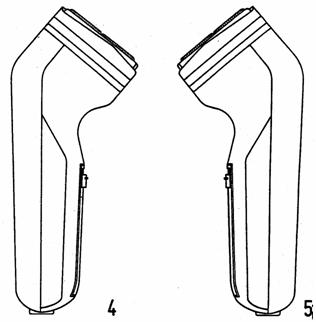 | 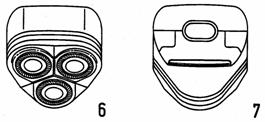 | ||
69 Remington’s cross‑claim includes a claim for rectification of the Register by expunging the entry of the registration of the registered design. Its primary case, however, is that the design is valid but the Remington product (to which I shall refer also, where the context makes it convenient, as the DT55) is not an infringing article. It seeks an order expunging the registered design only in the event that it is held that, assuming validity, there is infringement.
70 Philips claims that Remington has applied to the Remington product an imitation of the registered design which is obvious or fraudulent (Designs Act s 30(1)). To understand the claim of fraudulent imitation it is necessary to recount some of the evidence about the circumstances in which the Remington product was designed. The design and development of the first triple‑headed rotary shaver manufactured by Izumi commenced in 1975. It was manufactured for the American corporation Sears Roebuck & Company (Sears). Izumi manufactured a series of models of shavers for Sears. In 1986 Izumi suggested to Sears that it develop for Sears a wet/dry triple‑headed rotary shaver. Sears embraced the suggestion and Izumi retained a designer, Penta Design, the principal of which was Mr Teizo Sato, to prepare a design. A design was prepared and accepted. The wet/dry shaver was manufactured and was sold by Sears for several years. It was described as model no. 6810; there follows a copy of a photograph of it:
71
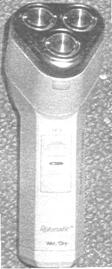 |
During the 1980s Izumi also developed a relationship with another American corporation, known as Windmere Corporation. From 1984 Izumi manufactured triple‑headed rotary shavers for sale by Windmere under the brand name “Ronson”. During 1991 Izumi suggested to Windmere that they should develop a series of smaller, more compact and “sleeker looking” shavers. Windmere accepted that proposal and once again Izumi retained Penta Design to design such a product. Mr Izumi’s evidence was that a design drawing produced by Penta Design gave rise to concern on his part and on the part of Mr Katuya Asawa, the Director, Overseas Business Research and Development Department of Izumi. They were concerned, Mr Izumi said, because they thought that the drawing was not sufficiently distinctively different from a current Philips shaver then sold in the United States, known as the Norelco model 725 (“Norelco” is the brand name under which Philips shavers are sold in the United States of America). They concluded that it would be desirable to incorporate in the top of the handle what was described as a “waist” (a feature to which I shall return) and that various other modifications should be made. Shavers based on the revised design, known as the WR‑6, WR‑7 and WR‑8, ultimately went into production.
72 Izumi had manufactured products, though not shavers, for Remington since about 1968. In the late 1970s and early 1980s there were discussions between Remington and Izumi concerning the possible development of a Remington branded triple‑headed rotary shaver. The discussions, however, did not advance with any speed and came to a halt when, in October 1984, Philips commenced proceedings in the United States alleging patent and trade mark infringement against both Izumi and Windmere. Discussions resumed, however, (Izumi gave Remington an indemnity against claims by Philips) and in 1989 Izumi commenced production for Remington of two models of triple‑headed rotary shavers, known as the RR1 and RR2. A principal distinctive feature of those models, which makes them unique among the multitude of shavers which were tendered, was that the angle between the head and the handle was, within somewhat narrow limits, adjustable. Otherwise, except that they were the first produced by Izumi for Remington, those models are of no particular significance.
73 The precise circumstances in which Izumi introduced to Remington the idea it might produce for Remington a rotary shaver based substantially on the WR‑6 are not made clear in the evidence and are to some extent controversial. Evidence was given, however, by Mr Joseph Sulik, Remington’s Manager, Industrial Design, that in October 1992 he was shown by Mr Gaines (then Marketing Manager for Men’s Shavers) models which he identified as the IR6 and IR7. Mr Sulik’s evidence in that respect is not disputed. Subject to one matter, it is also uncontroversial that the IR6 and the IR7 were the same as the WR‑6 and the WR‑7. The one matter is this. Windmere had been offered the “dual track” feature, which Izumi had devised, but ultimately had rejected it. The original design of the WR‑6 and related models, however, included that feature and what happened subsequently demonstrates that the models which Mr Gaines gave to Mr Sulik incorporated it. Evidently, by October 1992, Izumi had persuaded Remington of the virtues of the dual track design and all subsequent designs of Remington models, and the models themselves, incorporated it.
74 After discussion with Mr Gaines (who, according to Mr Sulik, asked for a design which was more masculine and more modern) Mr Sulik, in consultation with his immediate superior, Mr Mockovak, prepared a series of design sketches of a triple‑headed rotary shaver. He discussed the sketches with Mr Gaines and with Mr William Strauss, the Vice President Marketing, and it was decided that Mr Sulik would prepare a design based on elements of two of his sketches. He prepared a “control drawing” in the following form:
75
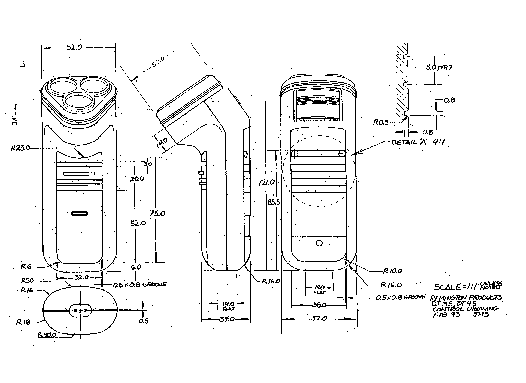 |
That drawing, apparently, was sent to Izumi; Izumi made some comments on it which led to alterations, particularly a slight increase in the width of the handle. Further exchanges took place between Izumi and Remington about various aspects of the design. On behalf of Izumi, the correspondence was conducted principally by Mr Masumi Suzuki, Izumi’s Chief Representative in New York; involved on the Remington side were Dr Elaine Barber, then a Vice President of Remington and Mr Edward Szymansky, the Vice President Engineering. Mr Sulik was involved in some discussions with Mr Suzuki; Mr Gaines was involved in internal discussions within Remington; the President of Remington, Mr Kiam, was given copies of at least some of the material. The only particular aspect of the exchanges which requires mention at this point is that, whereas Mr Sulik’s design did not include a “waist”, one was added by Izumi. According to Mr Sulik’s account, he asked Mr Suzuki why this had been done and was told that it was necessary in order to distinguish the design further from Norelco shavers. Mr Sulik noted on an Izumi drawing (on which he had written “Mr Suzuki phone call 1.20.93”) the words, “To distinguish from Norelco. OK. JMS. 1.20.93” with an arrow pointing to the “waist”.
76 By March 1993 the design work was complete. At least two models of shavers were manufactured and sold in the United States in accordance with the design, known as the DT35 and the DT45; later a model known as the DT50 was added to the range. There are no relevant differences between those models. An example of the DT45 is in evidence.
77 The evidence as to the circumstances leading to the production of the DT55 is considerably more sketchy. The only officers of Remington called who had any knowledge of the process, Mr Sulik and Mr Szymansky, each claimed to have had only a passing involvement. To some extent the gaps are filled by the evidence of Messrs Izumi, Asawa and Sato. What happened is clear enough in outline. In about July 1993 Mr Asawa asked Mr Sato to design a wet/dry electric shaver in which Izumi could use common parts with the Sears model 6810. Mr Sato produced a design which looked very like the 6810, which he gave to Izumi. He later received from Mr Narai, an assistant to Mr Asawa, a copy of his drawing on which an outline of a revised design had been drawn, together with a memorandum explaining what was wanted: in substance, the design should be similar to that of the DT45; the angle between the head and the handle should be 125° and the handle should be oval. Mr Sato prepared a further design which took those matters into account and was undoubtedly sent to Remington, because in about October 1993 it was given to Mr Sulik with a request that he “do something with the design to improve it and render it more attractive”. Mr Sulik was also given a Sears shaver model 6810. He was told, and his own inspection confirmed, that Mr Sato, starting with the 6810, had eliminated the “hump” at the back of that model by moving the handle back to the rear of the head base and, by altering the angle which the axis of the head base bore to the axis of the handle, had “created the basic relationship between the handle and the head on the RR‑55”. Mr Sulik took the view that there was little he could do to improve the appearance of the shaver but he made changes to the design which he described as follows:
“(a) I narrowed the handle to 45mm and consequently narrowed the control panel on the front face of it;
(b) I created hand grip grooves on the rear face of the handle;
(c) I grooved the head to reduce the appearance of bulk somewhat;
(d) I widened the radius of the chin of the RR‑55 to soften the line formed by it.”
78 Further correspondence led to some more, relatively minor, changes. By the end of March 1994 the design process was substantially complete. In due course the DT55 went into production.
79 Thus, in short, the original source of inspiration for the design of the Remington product was the Sears model 6810; the design based on that product was then substantially modified, the principal purpose and effect of the modifications being to assimilate the Remington product, in a number of respects, to the DT45: the angle between the head base and the handle was the same; there was no hump at the back of the head base, but (similarly to the DT45) there was a “chin” effect at the front, where the head base met the handle. There were also differences, among them a substantially larger head base (necessary because of the need to waterproof the wet/dry machine), a narrower and somewhat rounder handle; and, instead of the waist, there was what may be described as a slope inwards on each side at the junction between the head and the narrower handle. The DT45 was in turn derived, through the process which I have described, from the WR‑6.
80 Philips’ argument that there was copying such that the design applied to the DT55 is a fraudulent imitation of the design in suit involves (at least) the following steps. The Norelco 725 was an embodiment of a United States registered design which is the substantial equivalent of the design in suit. The Norelco 725 had been on sale in the United States since 1990 (thus far, Remington offered no serious contest). Both Izumi, particularly Mr Izumi himself, and Mr Sato were aware of it. The WR‑6 was a thinly disguised copy of the Norelco 725: indeed the copying in the original design of the WR‑6 was so thinly disguised that Mr Izumi and Mr Asawa thought it necessary to add elements to the design to differentiate it from the Norelco product. Equally, Remington was well aware of the Norelco product. Remington, additionally, had adopted the practice of making searches of patents and design patents in the United States and were aware of those which had been registered. The DT45 was deliberately adapted from the WR‑6 as a Philips or Norelco “look‑alike”. The DT55 was designed so as, as far as practicable, to replicate the Remington “line” of rotary shavers, represented by the DT45. Thus it, also, should be regarded as a copy, though a less successful one, of the Norelco design.
81 In support of its submissions that I should find fraudulent imitation on that basis, Philips relied on a number of aspects of the evidence. First, there was the similarity between the Norelco 725 and both the WR‑6 and the DT45. One aspect of this similarity, it was said, was especially striking. It may be illustrated by reference to representations 4 and 5 of the design in suit. Those show clearly the “chin” effect, to which I have already referred, where the head base and the handle meet. That is an aspect of the design in suit which was, by comparison with the prior art, clearly novel (that proposition was not in contest). Both the WR‑6 and the DT45 have a chin, though somewhat different from the Philips chin: there is no concavity as there is with the Philips chin (a glance at the representation, earlier in this judgment, of the DT55, whose chin in this respect is similar, will demonstrate what I mean); the Philips chin is higher at the front of the head than the other two; and the chin of the DT45, particularly, is sharper and more abrupt than that of the Philips. Nevertheless, at the time when the WR‑6 was designed there was no shaver on the market, and none represented in the prior art, which had a chin substantially resembling that of the Philips’ design and the Norelco 725; but the WR‑6 emerged from the design process with that feature.
82 Secondly, Mr Sato sent Mr Asawa on 6 January 1992 a drawing of his design of “Windmere’s Three Eyed Electric Shaver” on which he had written notes. There was no controversy about the translation from the Japanese. On the drawing there is an arrow pointing to what appears to be an indication of the size of the front of the head, at the end of which is the note “the size of the mecha‑box (mechanical box) is large”. The note continues “Small Radius”, with an arrow pointing to the chin. There are also arrows pointing to the bottom of the handle of the shaver with a note “want to design corners having a smaller radius”; and at the foot of the drawing the following note appears:
“We are having a tough time since a roundish configuration, which is the main point of the request at the beginning, is not easily obtainable. The reason for this is that the mecha box (mechanical box) for the gear section is larger and less attractive than Philips’ one, but do you still want to stick with a design like a roundish vehicle?”
83 Mr Izumi was not prepared to concede that Izumi acquired a sample of any new Norelco shaver as soon as it appeared on the market but did accept that there were Norelco shavers in the Izumi factory. In any event, he was aware that the Norelco 725 was available in the market in 1990 or 1991. Mr Sato agreed that he kept himself informed of shavers in the market but claimed not to have been familiar with the Norelco 825 (a successor of the 725 and very similar to it, which was available in the market at the time when his drawing was prepared); he said that he became aware of it after he prepared his drawing. Mr Asawa claimed not to have been aware, at the time he received the drawing, of the Norelco 725. Mr Sato said that the drawing with the notes resulted from a discussion with Mr Asawa; that during the discussion Mr Asawa said that he wanted Mr Sato to incorporate “depressions” in the neck (that is, apparently, in substance what became the “waist”). The point about the notes and arrows concerning the “mecha‑box” was, according to Mr Sato, that its size made it impossible to incorporate depressions of the size Mr Asawa wanted in the part of the handle where he wanted them. There was no discussion during that conversation, he said, of a Philips or Norelco shaver: why Philips was referred to was not explained. Mr Sato firmly maintained that the references to the size of the mecha‑box, the difficulty of including a roundish configuration and of assimilating the design to the curved configuration of a modern motor car had nothing to do with the chin but concerned, rather, the desired depressions.
84 Mr Sato’s explanation of the way in which the design of the WR‑6 came to look like the current Norelco shaver, and of the circumstances in which the design came to incorporate a chin, appears in the following exchange:
“You discussed with Mr Asawa, before you did this drawing, making a shaver like the Norelco shaver you have up there, exhibit A5? – No.
Would you agree that the two shavers, the one you have in your hand and in your drawing, look very similar? – Yes.
Can you offer any explanation to the Court, to his Honour, as to how it came about that you could design a shaver which was so similar to the one you have in your hand? – I was asked to make it compact and also I was asked to make the back straight so that it can be packaged in a blister package. That means I had to push the hump forward. Then I ended up having some dead space here. Then if I had a straighter chin here, it would make it more difficult for user to operate on the switches, so I thought I’d better remove the dead space here.
So Mr Asawa told you to remove the hump, did he? – Yes, he said it doesn’t have to stand and it has to be flat here.
He told you that, did he? He said it had to be flat at the back, no hump? – I don’t think, Mr Asawa specifically told me to do so, but I knew that it has to be packaged in the blister pack and it doesn’t have to stand on its own and also it has to be compact. Taking those requirements into consideration, I [came] up with this design.”
85 Mr Sato had previously said that when making his note about the Philips mecha‑box he had no particular Philips model in mind.
86 There are a number of difficulties with that. First, there is the simple coincidence that the design came to incorporate what was the most striking feature of the Philips design, not found in any prior art. Secondly, the note referring to the size of the mecha‑box appears plainly, through its position, to refer to the space it occupied within the head base of the shaver and the arrow from the words “small radius” plainly points to the chin, not the depression. The only other point in the design where a “smaller radius” is referred to and curves appear is at the bottom of the shaver, plainly remote from any mechanical components. The note at the foot of the drawing, referring again to the mecha‑box in the context of a desire to achieve a “roundish configuration”, can only sensibly refer to those parts of the top of the shaver to which the note about the size of the mecha‑box and the “small radius” clearly refer. The point becomes all the more obvious when one compares side by side the Norelco product and both Mr Sato’s drawing and the actual WR‑6. The chin of the Norelco shaver starts considerably higher in the front of the head (it can do so, presumably, because of the smaller “mecha‑box”) and has a considerably less sharp and “rounder” curve. In short, I do not accept the evidence that the reference, incorporating the comparison with the Philips model, was to the depressions: plainly, in my view, Mr Sato was referring to the chin.
87 That conclusion is consistent with evidence given by Mr Sulik. He said that he did not want “a sharper chin”; he wanted one which had “a larger radius to basically go with the form of the rest of the shaver”. His explanation of the difficulty appears in the following exchange:
“But there was some component, just under the head of the shaver which you are referring to, under the shaving heads? – There is something inside here, right in the side view, right here in front, that won’t let me do what I wanted to do there.
And stopped getting a more roundish configuration on the chin; is that right? – Right.
This component which you are referring to, did Philips have a similar component? – I don’t know.
Looking at the Norelco shaver there, they have a rounder chin; it’s got a rounder chin. – They may have a component in there, but maybe their drive system is shorter than the Izumi drive system. I don’t know.
So, in other words, one possibility is that this particular gear component you are referring to in Philips is more compact, which enables them to get a rounder chin? – Yes …
So the constraint of this component was this, wasn’t it, that if you wanted a head size as compact as the one shown in the middle drawing, you needed a sharper chin? – Yes.
You could get a more rounded chin, but you would have to make that head portion a little less compact? – Correct.”
88 I have found that, in drawing his comparison with “Philips’ one”, Mr Sato was referring to the shape of the chin. That being so, “Philips’ one” would naturally be taken as a reference to the only Philips models which had that feature, and which had been on the market for some time, the 725 and the very similar 825. I find, on the balance of probabilities, that Mr Sato was familiar with one or both of those models, that the reference in his note was to one of them and that he expected that the reference would be so understood by the recipients of the drawing. Complete acceptance of Mr Sato’s evidence would lead to a finding that he had not seen the Philips model (or at least did not have his attention directed to it, and did not refer to it, for the purpose of his design) but that he received particular instructions from Mr Asawa as to design features which he should incorporate: the design was to be “roundish”, like a car, it was to be compact and there was to be no hump at the back. By giving effect to those instructions, Mr Sato produced a design which, fortuitously, looked like the Philips design: so much so that Mr Izumi, at least, thought it desirable to add distinguishing features. The note on the drawing about “Philips’ one” would be found to refer to no particular Philips model and, although the making of the note followed conversations with Mr Asawa, a discussion of Philips shavers to have formed no part of those conversations; and what was referred to as dictated by the size of the mecha‑box to be not the configuration of the chin but the size and position of the depressions forming the waist. That seems to me, in any event, implausible; but, for reasons which I have already sufficiently explained, it is contrary to the inferences clearly to be drawn from the drawing and the notes and arrows on it.
89 The finding that Mr Sato referred, in his note, to the Philips 725 or 825 and expected that his readers would understand the reference leads to further findings that Mr Sato had the Philips design in mind when he prepared his design and that he was concerned that the size of the mecha‑box meant that the necessary size of the head base made it look less attractive than the Philips shaver and gave rise to difficulties in producing a design with a “roundish configuration”. The proper inference, in my view, is that Mr Sato was seeking, within the constraints imposed by the size of the Izumi components, to replicate essential features of the Philips design. To adapt the words of Lockhart J in Dart Industries Inc v Decor Corporation Pty Ltd (1989) 15 IPR 403 at 412 (but omitting an important element, to which I shall return), I find that Mr Sato’s design was knowingly, consciously or deliberately based on or derived from the design of the two Philips shavers.
90 The evidence discloses very little about the circumstances in which Remington came to adopt the WR‑6, with the dual track feature, as the starting point for a design of its own shavers. Mr Sulik’s account began with Mr Gaines showing him models of two Izumi shavers marked IR6 and IR7. He gave no account of the circumstances which had led Mr Gaines to do that. Mr Szymansky did not throw any light on those circumstances and no other Remington witness was called to do so. Mr Izumi gave affidavit evidence that in January 1992 he met Mr Kiam and Dr Barber at the Chicago Housewares Show and showed them models of the WR‑6, WR‑7 and WR‑8 shavers which Izumi was then developing for Windmere. When, however, during cross‑examination Mr Izumi realised that, given the dates when Mr Sato produced his drawings, he could not have had a “waisted” Windmere model at the 1992 Chicago Housewares Show, he gave evidence that his recollection must have been at fault and that it must have been at the 1993 Show that he showed the models to Mr Kiam and Dr Barber; but, of course, by January 1993 the process of designing the Remington shavers was already substantially advanced. I do not doubt the truth of Mr Sulik’s evidence that, though there were Norelco shavers at Remington’s premises, he did not refer to any of them in the course of preparing his drawings based on the WR‑6. What is clear from Mr Sulik’s evidence – and there is nothing surprising about it – is that marketing executives of Remington, including Mr Gaines and his superiors, were consulted in relation to the design and had a significant influence on its final form as embodied, for example, in the DT45. Senior counsel for Philips devoted a good deal of attention, both in cross‑examination of Mr Sulik and Mr Szymansky and in final address, to two inter‑office memoranda, of which Mr Gaines was one of the authors, written substantially after the event: one dated 26 July 1995 addressed to a number of senior officers of Remington, including the President, and the other, addressed to a similar group, dated 8 February 1996. Both related, in general terms, to future directions in the development of Remington’s electric shavers. The former included the following comments about Remington’s rotary shavers, among them the DT45:
“Our current rotary line has a very contemporary and consumer appealing styling. After all, it is replicated after the Norelco design.
The one exception is the RR‑55 Wet/Dry model. We believe the product is oversized and clunky looking. It lacks the attractive styling of the rotary line.
Also, relative to Norelco, we feel our pop‑up trimmer does not elevate high enough up to provide good user visibility.”
91 The second memorandum described what his authors called the “general product design platform” as “Norelco look alike”. Both Mr Sulik and Mr Szymansky gave evidence that what was said by Mr Gaines simply represented his opinion, stated some time after the event, and that they did not agree with it. I do not place any particular weight on the fact that neither Mr Sulik nor Mr Szymansky protested, at the time, that there was an inaccuracy (and, in Mr Sulik’s case, a defamatory one) in the statements in the memoranda. It does seem to me significant, however, that such statements, particularly the earlier one, appeared, as what the authors seemed to regard as statements of accepted fact, in documents distributed widely among senior executives of Remington. There is no other evidence about the considerations which led Remington to take the WR‑6 as its starting point. The DT45 is in many respects strikingly similar to the Norelco 725 and 825; Mr Sulik agreed that its chin had substantially the same visual effect as the Philips chin. A particular feature – the waist – was adopted in the design of the DT45 explicitly to distinguish it from the Philips products. Remington had samples of the Philips products. It also had a lively appreciation of the existence of registered designs owned by Philips and of the need to avoid infringement. That is well established by documentary evidence; and Mr Szymansky agreed that at the commencement of the process which resulted in the design of the DT45 he ensured that a search was undertaken of Philips registered designs for shavers and that “probably” that search revealed the existence of US registered design no. 306360. The appropriate conclusion is, I think, that Remington’s design, embodied in the DT45, and with the WR‑6 as its starting point, was knowingly, consciously or deliberately based on or derived from the Philips design.
92 This case, however, is about the design of the DT55, not the DT45 or any other model. Unquestionably, Mr Sato’s commencement point for the design of the wet/dry shaver was the Sears model 6810: naturally enough, because of the desire to use, to the maximum extent possible, the components of that product. However, there is no doubt on the evidence that the changes which were made, radical in a number of respects, were designed to give the DT55, so far as possible, the “Remington look”: that is, to make it visibly part of the range of shavers which included the DT45. For present purposes, therefore, in my view the DT55 is to be treated as based on or derived from the same design as the DT45.
93 The passage in the reasons of Lockhart J in Dart Industries at 411, 412, which I have adapted, should perhaps be quoted more fully; I shall omit his Honour’s citations of authority:
“A design may be an obvious imitation within the meaning of s 30(1)(a) of the Act notwithstanding that the person who puts the obvious imitation on the market may not know of the registered design. By contrast, a fraudulent imitation presupposes a knowledge of the registered design and making use of it by the author of the alleged infringing design: … It follows that, whereas visual comparison will establish whether the article alleged to infringe the registered design applies the registered design or an obvious imitation of it, something more is required to establish whether there has been a fraudulent imitation.
As I observed in [Firmagroup Australia Pty Ltd v Byrne & Davidson Doors (Vic) Pty Ltd (1986) 67 ALR 29 at 41] the use of the word "fraudulent" in the Act is perhaps somewhat unfortunate since fraudulent in this context does not necessarily connote dishonesty. The essence of fraudulent imitation is that the respondent's design has knowingly, consciously or deliberately been based on or derived from the registered design and neither dishonest intent nor deliberate or conscious intention to copy is a necessary element: … .”
94 Fraudulent imitation, as Lockhart J pointed out, presupposes (by contrast with obvious imitation) knowledge of the registered design: one cannot copy, or consciously base one’s own design upon, another design of which one is ignorant. But, in my view, it is not a necessary element of fraudulent imitation that the imitator know that the design imitated is an Australian registered design. The Full Court held in Turbo Tek Enterprises Inc v Sperling Enterprises Pty Ltd (1989) 23 FCR 331 at 348 that it was sufficient that the imitator had reason to believe that an application for registration of the design was pending. And in Elconnex Pty Limited v Gerard Industries Pty Limited (1991) 32 FCR 491 at 503 Burchett J said this:
“It seems to me that what makes conduct of the relevant kind fraudulent is the infringer’s dishonest concealment of the reality of copying in order to evade being held legally responsible for it. That form of dishonesty can only arise where the copier knows or suspects that his copying will infringe another's legal rights. But in cases where the nature of what is done makes more than one form of intellectual property right relevant, I cannot think it would be a defence to a charge of dishonest concealment of an imitation of a registered design for the infringer to say that he actually had the other right in mind and was not thinking of design rights. If it was an infringement, his misapprehension would not make it any less so, nor would the particular reason for concealment affect its fraudulent nature. In these days of trans‑national industries, any other view might have strange consequences for a case where an infringer of an Australian registered design was quite without knowledge or suspicion of that registration, but perfectly aware of a registration in another country of the same design, of which he produced a fraudulent imitation for marketing in Australia.”
95 I shall return to what his Honour says about the nature of the “fraud” which is involved. In this case, however, Remington, I find, was aware of the registration of the design, the substantial equivalent of the design in suit, in the United States of America. Applying what was said by Burchett J, that knowledge is sufficient if the other elements of fraudulent imitation are made out.
96 Burchett J spoke, in the context of the case with which he was dealing, of fraudulent conduct, dishonest concealment and evasion and cited the reference by the Full Court in Turbo Tek at 349 to “fraudulent intention”. Language of that kind is, however, used in these cases in a somewhat special sense. It is not an infringement to produce a product as close in design to a registered design “as the law might be forecast to allow” (L J Fischer & Co Ltd v Fabtile Industries Pty Ltd (1979) 49 AOJP 3611 at 3621; Fisher & Paykel Healthcare Pty Ltd v Avion Engineering Pty Ltd (1991) 22 IPR 1 at 13) if the design of the product is not an imitation of the registered design. It will be an imitation, if the element of “fraud” is proved, if it is “a copy with differences which are both apparent and not so slight as to be insubstantial but which have been made merely to disguise the copying” (Malleys Ltd v J W Tomlin Pty Ltd (1961) 180 CLR 120 at 127; Firmagroup Australia Pty Ltd v Byrne & Davidson Doors (Vic) Pty Ltd (1987) 180 CLR 483 at 489; Gerard Industries Pty Ltd v Auswide Import Export Pty Ltd (1998) 40 IPR 119 at 126, 127). But if there are substantial differences of a material kind between the article and the registered design, there will be no imitation and no infringement (Malleys at 128). And the smaller the differences between the registered design and the prior art, the smaller are the differences between the design of an article and the registered design which will be regarded as material or substantial: Dart Industries at 409.
97 There was some discussion in argument as to whether it was an essential element of the test of fraudulent imitation, propounded in Malleys, affirmed in Firmagroup and applied on many occasions subsequently, that the differences between the registered design and the allegedly infringing article “have been made merely to disguise the copying”. The question has some significance in the present case, because one of the differences – indeed the most striking difference – between the design in suit and the Remington product is the considerably greater size of the Remington product’s head base. The evidence – particularly that of Mr Sulik and the two notes of which Mr Gaines was an author – establishes that Remington would greatly have preferred a smaller head but could not achieve it because of the size of the internal components and the need to waterproof the machinery. That difference thus exists not because Remington wished to disguise any copying but because the character of the particular machine dictated it.
98 In that respect, this is an unusual case and gives rise to a question which, so far as I know, no court has previously had to consider. If, literally, it was a requirement of fraudulent imitation that any changes to the design be introduced merely to disguise copying, it would follow that, where there is a design based on a registered design, where the designer earnestly wishes to get as close to the registered design as possible but is, in some respect, prevented by some mechanical imperative and is forced to introduce a change on that account, the design is not a fraudulent imitation however clearly it may fall within the established tests of “imitation”. I am not convinced that that conclusion, which does not strike me as particularly sensible, is required by authority. There is much to be said, I think, for the view that the essential questions are, first, whether the allegedly infringing design is based on or derived from the registered design and, then, whether the differences are so substantial that the result is not to be described as an imitation. Frequently, of course, probably usually, changes will have been introduced for the purpose of disguising copying or, perhaps, because of a conscious desire to come as close as possible to the registered design while avoiding infringement. But, as this case illustrates, particular changes may be introduced for other compelling reasons; and there is no obvious reason why that should defeat a claim of fraudulent infringement. As will become apparent, however, it is not necessary for me to reach a final conclusion about that.
99 The monopoly claimed in the design in suit is stated as follows:
“Those features of the representations in respect of which the applicant for registration of the design wishes to claim a monopoly are the features of shape and configuration.”
100 No monopoly is claimed, thus, for features of pattern or ornamentation. There is no statement of novelty. There was some argument about whether certain features both of the design in suit and of the Remington product were to be regarded as features of shape or configuration or, on the other hand, of pattern or ornamentation. Philips claimed that a number of matters said by Remington (and Professor Redmond, an expert witness called by Remington) to be significant were in fact irrelevant because they were not features of shape or configuration. These included ribbing and a clover leaf pattern on the head fascia of the design in suit (apparent on representation 1), what were described as “rebates” on the back of the Remington product, the “separate base feature” of the Remington product, the lines on the side of the head base of the Remington product and the concave line above its switch fascia panel. That, I think, represented a somewhat extreme position. Equally extreme, I think, was Remington’s submission to the effect that any three‑dimensional feature is necessarily a feature of shape or configuration, not of pattern or ornamentation.
101 In my view, though in the end I doubt that it matters, the clover leaf on the head of the design in suit is a feature of shape or configuration, but the ribbing (and likewise the lines on the side of the head fascia of the design in suit) is a feature of pattern or ornamentation; the “rebates” on the back of the Remington product, on Mr Sulik’s evidence put there to assist the user to maintain a firm grip while using the machine under the shower, are a feature of shape or configuration but the separate base feature and the lines on the side of the head base of the Remington product are features of pattern or ornamentation; and the concave line above the switch panel of the Remington product is, I think, a feature of shape or configuration.
102 There is one comment which should be made before leaving this perhaps unproductive topic. There was some difference between the witnesses as to the effect of the lines around the head base of the Remington product which I have concluded, accepting the submission of senior counsel for Philips, are to be regarded as a feature of pattern or ornamentation. Mr Sulik’s evidence was that the purpose of the lines was to mitigate the visual effect of the considerable size of the head base of the Remington product. Mr J R Brown, an expert industrial designer called by Philips, thought that the lines had that intended effect. Professor Redmond, however, thought that the lines might accentuate the visual effect of the head’s size, which might be less striking if they were eliminated. Therefore, senior counsel for Philips suggested, the lines, not being part of the monopoly claimed, ought to be disregarded in assessing the size of the head as it strikes the eye. The answer, surely, is that that, in practical terms, is impossible. The exercise which the Court is required to perform is one of comparison between the design and the Remington product; the Court cannot adjust its eye so as to eliminate the effect of the lines (whatever, hypothetically, that effect may be). It is not legitimate to look at something other than the Remington product, for example, a drawing or a cut out pattern of it from which the lines have been eliminated.
103 Mr Brown acknowledged the existence of a number of differences between the Remington product and the design in suit; but he regarded the differences as not visually distinctive and his overall conclusion is, I think, summed up in the following two introductory paragraphs of his affidavit:
“5. I regard the RR(DT)55 and the product depicted in ARD105780 as coming from the same ‘family’ of shavers. They appear in my view to have an identical product image. I use the expression ‘product image’ in the same way as the expression ‘corporate image’ is used in relation to that used [sic] in the commercial world. Each product uses what I would describe as the same ‘visual vocabulary’, that is, the same appearance design and range of design elements.
6. In design practice a common visual vocabulary is used to ensure that two products may be identified as being part of the same range and from the same manufacturer.”
104 Professor Redmond, on the other hand, expressed the view that:
“The difference in the parts of the design, when viewed as a total design, establish the design applied to the article in the ARD # 105,780 as different to the design applied to the same article in the Remington DT55.”
He identified also four features of the design in suit which “may be” (I think were established to be) novel. He described them as follows:
“• the particular concavity or undercut at the neck intersection of the head and handle [that is, the “chin”].
• the particular extent and shape of the front fascia panel and the congruity of shape between it and the handle profile.
• the extension of the base of the handle into half circular shape continuous with the shape profile of the front fascia panel.
• a slight deviation from the parallelness of the sides.”
Again, Professor Redmond concluded that there were two of those features which were “conceptually similar” in the Remington product, the chin and the presence of a front fascia panel; but neither was similar in design detail, and the dissimilarity of the other features of originality in the design and the corresponding features of the Remington product, combined with distinctive features of the DT55, led to the conclusion that the design in suit had a different appeal to the eye, in relation to its features of originality, from the design of the Remington product.
105 I have been assisted by the discussion by both expert witnesses of the features of the design in suit and the Remington product, and of the prior art. Ultimately, however, the Court must make the comparison required by the authorities. It was submitted on behalf of Philips that I should make the comparison having regard to the way in which the Remington product is (or was) presented in the course of trade, particularly in the blister pack. It may be that there are in that submission echoes of the doctrine of AMP Inc v Utilux Pty Ltd [1972] RPC 103 as to the relevant “eye” which, of course, does not represent the position under the Australian Designs Act: Dart Industries at 408, 409. In any event, the authorities make it plain that what is to be compared with the design is the allegedly infringing article, not some view of it which may be at best partial, obscured and, possibly, distorted.
106 As Lockhart J said in Dart Industries at 412, first impressions are important. I was introduced to the design in suit and the Remington product during the interlocutory hearing, and my first impression was that they look significantly different. Further acquaintance with each, over what I regret has been a somewhat extended period, has not dispelled that first impression. There are, I think, two aspects of the Remington product which give rise to it. One is that which struck several witnesses, including Mr Sulik, and also apparently struck Mr Gaines, as unfortunate: the size of the head base, the appearance of which was described in evidence and during submissions in various derogatory terms. Whereas the consensus of the witnesses was that, in relative terms, the design in suit, and the products made substantially according to it, was aesthetically pleasing, no one had a good word for the Remington product; “powerful” was the description offered which most closely approximated a term of praise. The other feature, I think, which gives rise to an immediate impression of difference is the size and shape of the handle relative to the head. In the registered design, looked at either from the front or from the back, there is no perceptible change in width where the head base meets the handle: there is simply a gradual tapering over the whole length of the shaver down to the strikingly rounded base. When the Remington product is looked at either from the front or from the back, it is immediately apparent that there is a narrowing where the handle meets the head base; the handle is considerably narrower than the head base and the sides of the handle are not tapered but are parallel.
107 There are, of course, significant similarities between the design in suit and the Remington product. Perhaps the most striking is the chin, which is of some importance as it is, after all, perhaps the principal feature of novelty in the registered design. Close inspection reveals that there are differences between the two chins, to which I have already referred. But I do not agree with Professor Redmond’s view that the differences result in the two chins appearing significantly dissimilar. They look, I think, very much alike. And the similarity is, no doubt, enhanced by the fact that the angle between the head base and the handle is almost the same in the Remington product as it is in the registered design. Another of the features of originality of the registered design which has a counterpart in the Remington product is a fascia plate, with the switch at the top, occupying most of the front of the handle and shaped similarly to the handle itself. But here, I think, the differences are most striking: the Remington fascia plate not only looks (no doubt is) substantially narrower than that of the registered design but looks proportionately narrower in relation to the width of the handle. It looks, I think, significantly different. There are other similarities, of course. There are the three shaving heads arranged in an equilateral triangle and a head base in that shape. There is a smooth transition at the rear between the head base and the handle: there is no hump. The main axis of the handle in each case is the same. Each has a rounded base. But not only is the Remington handle narrower and not tapered: being narrower it has a much more oval appearance than the handle of the registered design.
108 It is important and necessary to compare particular features, particularly, perhaps, those features which, in the registered design, were novel. However, monopoly is claimed in respect of the features of shape and configuration of the whole of the representations of the design and the design, as a whole, must be compared with the Remington product. As a whole there are in my judgment substantial differences of a material kind between the registered design and the Remington product which give the latter a distinctively different appearance from the former. Those differences are principally the size of the head base and the size and shape of the handle. The differences between the two fascia plates are, in my view, also significant. Beyond that, I can only repeat the observations of Kitto J in the rather different context of In Re Wolanski’s Registered Design (1953) 88 CLR 278 at 281. It follows, however, that, there being for the reasons I have given no imitation, there is no fraudulent imitation and, a fortiori, no obvious imitation. Consequently, Philips has not made good its claim that the design in suit has been infringed.
Trade Practices Act; passing off
109 Philips alleges in its amended statement of claim that:
“Either:
(a) by reason of their appearance; and/or
(b) by reason of their packaging or marketing
the Respondent’s triple head shaver is likely to be taken by the trade, and by the public generally, as being:
(c) the triple head shaver of the First Applicant or further or alternatively the Applicants; or
(d) manufactured and distributed by the First Applicant or further or alternatively the Applicants; or
(e) manufactured and distributed with the licence or approval of the First Applicant or further or alternatively the Applicants.”
It is said that, none of (c), (d) and (e) being true, to sell the Remington product in Australia, or import it for sale in Australia, would be to engage in conduct infringing s 52 of the Trade Practices Act 1974 (Cth), to make representations prohibited by s 53(c) or s 53(d) of the Trade Practices Act and would amount also to passing off.
110 Philips first sold triple‑headed rotary shavers in Australia in 1956. It has advertised and sold them here continuously, on a large scale, since 1966. Philips shavers were, until the brief period during 1997 when Remington advertised and sold triple‑headed rotary shavers, the only triple‑headed rotary shavers (indeed, the only rotary shavers) on the Australian market. The extensive advertising of the shavers invariably portrayed them in a way which clearly showed the shape of the head and always in connection with the name “Philips” or “Philishave” and often in association with a Philips trade mark in the form of a shield. There was general agreement that consumers were very likely to associate the triangular form of the head with Philips shavers. That was accepted by Mr Stepon; it was accepted also by Dr Bednall, a marketing expert called by Remington; and no doubt it is so.
111 Remington also is, and has been for many years, a well known brand in Australia. The evidence suggests that it has a larger share of the overall market in Australia for “personal care” items than Philips, though a substantially lesser share of the market in electric shavers; and, of course, it had not until 1997 marketed a rotary shaver.
112 In my interlocutory judgment (reported at (1997) 39 IPR 283) I held, at 294, that there was no serious question to be tried as to a breach of s 52 or s 53 of the Trade Practices Act. I took the view that that conclusion was required by the decision of the High Court in Parkdale Custom Built Furniture Pty Ltd v Puxu Pty Ltd (1982) 149 CLR 191. In that case the applicant had for many years manufactured and sold furniture of a distinctive appearance and design; its range of furniture was called the “Contour” range. The respondent sold chairs which it described as “Rawhide”. Their appearance was very similar to the applicant’s Contour chairs. The respondent’s chairs were labelled, not very conspicuously, to indicate that they were “Parkdale Custom Built Furniture” and formed part of the “Rawhide” range. It is not, I think, to summarise the decision too baldly to say that the majority held that the presence of the label was sufficient to exclude a breach of s 52. The difficulty which Puxu posed for Philips, which I thought insurmountable, may be illustrated by the following passage from the judgment of Brennan J at 225, 226, on which at the final hearing Philips placed some reliance:
“Of course, where identical or similar goods are on the market, it may take very little evidence of conduct additional to the mere manufacture and sale of the goods to establish a case under s 52. The degree of risk of confusion is material to an appreciation of the conduct of a trader in marking or getting up his goods for sale in competition with the goods of another trader. In the present case, however, where Parkdale labelled the ‘Rawhide’ suite in accordance with the practice of the trade and the label clearly distinguished that suite from the ‘Contour’ suite, there was no misleading or deceptive get‑up. If customers mistook the ‘Rawhide’ suite for the ‘Contour’ suite the mistake was not induced by Parkdale’s conduct. It was not misleading or deceptive conduct merely to manufacture and sell a lounge suite similar to the Contour suite - or, for that matter, a suite identical with the Contour suite. Something more was needed to show conduct inducing a mistaken belief that the ‘Rawhide’ suite was manufactured by Puxu, but [the] only additional evidence, the label, showed conduct which was calculated to correct any confusion as to source.”
113 Senior counsel for Philips submitted that Puxu was to be distinguished on a number of grounds. The first was that (it was said) the present case is quite unlike one where a trader acquires a reputation for an entire article (such as a chair) made in accordance with a particular design. Here, by contrast, the evidence is that the shape of shavers of many (perhaps all) brands, including Philips, has changed significantly and on many occasions. A Philips shaver of the late 1990s looks very different from its counterpart of one, two or three decades ago. The one constant, however, has been the shape and configuration of the head; and that constant, exclusive in Australia to Philips, has been emphasised in Philips’ marketing so that consumers regard a head in that shape and configuration as distinguishing a Philips shaver from others: in this respect it is similar to the radiator grilles of certain well known brands of motor cars.
114 Secondly, and perhaps by way of reinforcement of the first point, it was submitted that the particular image of the triangular shaving head, depicted in Philips’ advertising, is striking and memorable. That was a matter on which there was, I think, complete unanimity in the evidence. Thirdly, a particular aspect of Remington’s advertising was said to be significant: the motoring references, which I have mentioned already. The particular significance for present purposes is, it was said, that the motoring references pick up a series of fairly recent advertisements in which Philips also made vigorous use of motoring imagery. Fourthly, consumers are used, it was said, to an environment of mergers and acquisitions, “second brands” and distribution arrangements: for example Remington at various times distributed not only its own branded products but also Clairol and Revlon products as well. Indeed, Remington itself had, about fifteen years ago, widely published an advertisement in which its president, Mr Victor Kiam, announced that he had liked the product so much that he had bought the company. Additionally, there was evidence – including evidence from Dr Bednall – that consumers tended to forget brand names. Those were the surrounding circumstances, it was said, in which Remington deliberately set out to market a triple‑headed rotary shaver, placing strong emphasis on the shape and characteristics of the head.
115 Philips relied on the discussion by Lockhart J, in Bridge Stockbrokers Ltd v Bridges (1984) 4 FCR 460 at 472-475: at 474, his Honour said this:
“It is obvious that mere confusion or uncertainty is not the same as misleading or deceptive conduct; but, in some cases a corporation's conduct which causes confusion or uncertainty in the mind of the public may, I suggest, constitute misleading or deceptive conduct within s 52 notwithstanding that the conduct does not constitute a misrepresentation in the sense in which that expression is understood at this stage in the development of s 52: … .
Why is the section not contravened when an unscrupulous trader cleverly pitches his marketing techniques at shoppers who will be perplexed or uncertain about the identity of its and another product? In the mere seconds which are frequently involved in making decisions to buy many products, they may simply decide in their state of confusion to buy the product which they think may be from the same source as the product with which they are familiar; but they are not sure. Their state of mind is one of confusion throughout, rather than reaching a final stage of conviction that the two products are the same. This situation is a commonplace.”
116 Finally, Philips relied on the evidence of Dr Beaton, a marketing expert called by Philips. Dr Beaton expressed the opinion (based on his experience and a reading of evidence in this case) that for many years the equilateral triangular shape, which he regarded as particularly striking, had for many years formed part of the Philips “brand”. (Dr Bednall, as I have mentioned, thought that the consuming public would associate the shape of the head with Philips, but regarded it as significant that all Philips’ advertising had associated the name “Philips” or “Philishave” with the shape and considered that the use of the “Remington” brand on the Remington product, and on its packaging and advertising material, would clearly indicate that the source of the Remington product was not Philips).
117 There is another element of the context, disclosed by the evidence, which in my view should be kept in mind. Electric shavers are not items which are picked up from the shelves of a supermarket. They are usually sold in specialty shops and department stores, commonly being displayed in locked cabinets. The evidence also shows that various brands of electric shaver are commonly displayed together. Thus, for example, Remington products and Philips products are likely to be found in close proximity. Secondly, Philips’ own marketing has been assiduous in making the connection between its product and its own name. In those circumstances, and accepting that “Remington” also is a well known brand of, among other things, shavers, it seems to me that Dr Bednall’s opinion is considerably more probably correct than Dr Beaton’s. The use of the well known name “Remington”, emblazoned on the Remington product, its packaging and its promotional material, is indeed important. If a consumer is thoroughly familiar with the triangular head and associates it with Philips, then upon looking at the Remington product the consumer will appreciate that it is not a Philips; it is a Remington. If the consumer is not so well informed (and, perhaps, buys a shaver as a gift – on the evidence, a common occurrence), it seems to me a leap of faith, rather than a matter established by evidence, to suppose that the consumer will appreciate that there has in the past only been one brand of shaver sold in Australia with a head of this kind and will believe that, therefore, the Remington must be it. Remington’s conduct is not, I think, calculated to mislead or deceive such a consumer: particularly when the consumer is likely to be faced with a display which includes both Philips and Remington models. It is not significant, I think, that consumers forget brand names or that some shaver buyers, surveyed by Remington, were confused about which manufacturer produced which kind of shaver. It may be that those facts demonstrate no more than that these matters are of less pressing importance to consumers than to those who seek their custom.
118 In any event, I am not convinced by the distinction sought to be drawn between this case and Puxu (and certainly it is not open to me to accept a submission that Puxu should be confined to its own facts). That case was about a particular brand of chair the design of which was well known, so that a consumer, seeing a chair of that design, would be likely to say, “that is a Contour”. The essence of the decision was that a consumer, who might on first seeing the respondent’s chair, say “that is a Contour” was not an object of misleading or deceptive conduct because closer inspection, particularly inspection of the label, would reveal that the chair was not a Contour but a Parkdale Rawhide. The submission on behalf of Philips was that if Contour chairs had varied in design over the years but one feature of them, perhaps a peculiarly shaped armrest, had been constant (and exclusive to Contour) then a label would have been insufficient to avoid the likelihood that consumers would be misled or deceived by a Rawhide chair incorporating a similar feature. In principle, however, I do not see that there is any difference between the two cases. In each case the design of the article itself, or of a feature of it, conveys that it has a particular commercial source. It has in fact a different commercial source. The trader who manufactures and sells it may well engage in conduct which is misleading or deceptive if the trader presents the article to consumers in a way that does not reveal its true commercial source; but (and this is the effect of the decision in Puxu) if the true source is displayed with sufficient clarity, then the trader’s conduct is unlikely to be regarded as misleading or deceptive.
119 No doubt Puxu leaves open the possibility that there may be cases, of this general kind, in which conduct is misleading or deceptive even where the true commercial source of a product is clearly disclosed. But the evidence in my view falls well short of establishing that this is such a case. It establishes that both Philips and Remington are well known brands; well known, particularly, as competing brands of shavers. It establishes that, until 1997, no one other than Philips had sold a rotary shaver in Australia and that Philips had established, through assiduous marketing and a large volume of sales over a long period, a strong association in the mind of consumers between the equilateral triangular head and its shavers. The evidence establishes also some commonality of theme between a form of advertising which Philips had used for some time and that which Remington employed in relation to the DT55. It establishes that Remington appreciated the strength of Philips’ marketing and wished to derive advantage from it. But it does not establish that Remington’s conduct would, or would be likely to, suggest to consumers that there was one source only of a triangular triple‑headed rotary shaver and that source was Remington. Certainly it does not establish either of the first two matters which Philips pleads as likely to be taken by the trade and by the public generally by reason of the aspects of Remington’s conduct referred to.
120 That leaves the third matter, that is, the question whether the DT55 is likely to be taken by the trade and by the public generally as being:
“… manufactured and distributed with the licence or approval of the First Applicant or further or alternatively the Applicants.”
121 Dr Beaton expressed the view that this was likely to be the case, as a result of the power of the image of the triple head, its association over a long period with Philips and public knowledge of the existence of licensing arrangements, mergers and takeovers. On the other hand, Dr Bednall expressed the view that, though the image of the head was powerful, and though it was associated with Philips, its use in the particular context in relation to a shaver which was clearly marked as a Remington would make it clear that, of the products of two substantial competitors, this was a Remington. Both opinions were expressed on the basis of substantial and long experience in matters to do with marketing and certain of the affidavit and other material before the Court. As I have said already, in my view Dr Bednall’s opinion accords with the probabilities.
122 For those reasons the case based on s 52 fails; so, equally, does the case based on s 53. The claim of passing off has the same basis as the Trade Practices Act claim: the alleged misrepresentation (an essential element of passing off: ConAgra Inc v McCain Foods (Aust) Pty Ltd (1992) 33 FCR 302 at 308, 340) was to be found in the same conduct, said to be likely to give rise to the same mistaken impressions or understandings pleaded in relation to s 52 and s 53. The claim fails for the same reasons. I discussed certain other aspects of the passing off claim in my interlocutory judgment, at 294-296; there is no need to add to that discussion.
Conclusion
123 For the reasons I have given, both the application (subject to any argument about the Remington device with arrows) and the cross‑claim should be dismissed, in each case with costs. The interlocutory injunction should be dissolved. It may be that some consequential orders will be required. The appropriate course, I think, is simply to order that Remington, within seven days after the publication of these reasons, file and serve short minutes of the orders which it considers should be made in the light of these reasons. The matter may then be set down, by arrangement with my associate, for any argument as to the form of the orders and for the making of orders disposing of the matter.
| I certify that the preceding one hundred and twenty‑three (123) numbered paragraphs are a true copy of the Reasons for Judgment herein of the Honourable Justice Lehane. |
Associate:
Dated: 18 June 1999
| Counsel for the Applicant: | Mr A J L Bannon SC with Mr D B Studdy |
| | |
| Solicitor for the Applicant: | Allen Allen & Hemsley |
| | |
| Counsel for the Respondent: | Mr D Shavin QC with Ms E A Strong |
| | |
| Solicitor for the Respondent: | Freehill Hollingdale & Page |
| | |
| Date of Hearing: | 24-27, 30 November 1998; 1-4, 7-11, 14-16 December 1998 |
| | |
| Date of Judgment: | 18 June 1999 |


