

FEDERAL COURT OF AUSTRALIA
Australian Competition & Consumer Commission v
MHG Plastic Industries Pty Ltd [1999] FCA 788
TRADE PRACTICES – s65C(1) Trade Practices Act 1974 – whether particular motorcycle helmets do not comply with prescribed consumer product safety standard – whether tests carried out by applicant were in accordance with the testing procedure specified in the standard – whether words in the standard which permit testing for penetration “at any points” above test line should be construed to permit testing at only the two conventional test sites – relevance of industry practice to construction of the standard – whether standard permits use of cantilever arm during testing for resistance to penetration – construction of words “rigid” and “rigidly mounted” - whether passing one particular test which satisfies requirements for testing specified by the standard means that goods cannot be said to “not comply with” the standard even if they fail some other test which also accords with the standard – relevance of past test results to risk of other helmets not complying with the standard – degree of risk of non-compliance required to establish contravention – whether necessary to show more likely than not that particular helmet would not comply or merely a real risk of non-compliance – reliability of methodology used and test results relied on by the applicant
WORDS & PHRASES – “do not comply with”, “at any points”, “rigid”, “rigidly mounted”
Trade Practices Act 1974 (Cth) s65C(1)
AUSTRALIAN COMPETITION & CONSUMER COMMISSION v
MHG PLASTIC INDUSTRIES PTY LTD
N 418 OF 1999
EMMETT J
15 JUNE 1999
SYDNEY
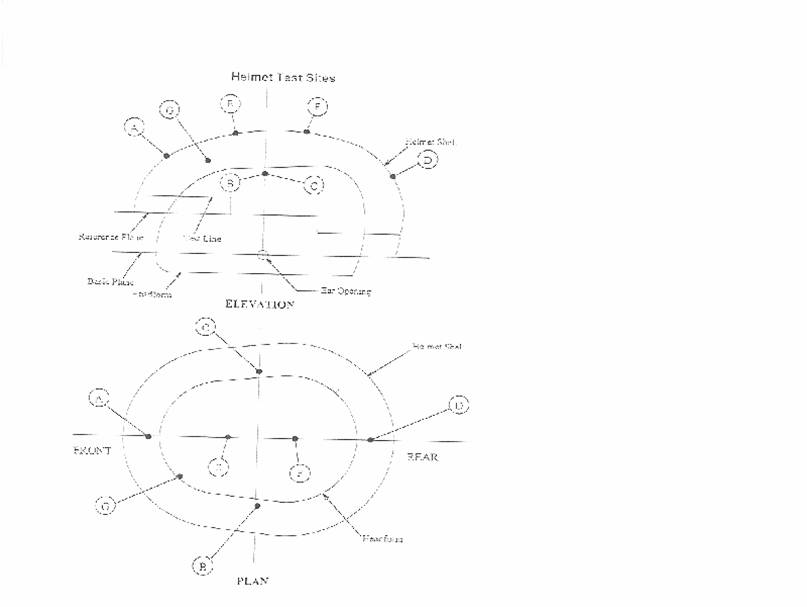
|
IN THE FEDERAL COURT OF AUSTRALIA |
|
|
BETWEEN: |
AUSTRALIAN COMPETITION & CONSUMER COMMISSION Applicant
|
|
AND: |
MHG PLASTIC INDUSTRIES PTY LIMITED Respondent
|
|
JUDGE: |
|
|
DATE: |
|
|
PLACE: |
REASONS FOR JUDGMENT
1 The respondent, MHG Plastic Industries Pty Ltd (“MHG”), manufactures and supplies protective helmets for motor cycle riders. The applicant, Australian Competition and Consumer Commission (“the Commission”), seeks declarations that the supply in trade or commerce of certain protective helmets manufactured by MHG would contravene section 65C(1)(a) of the Trade Practices Act 1974. The Commission also seeks orders restraining MHG from supplying the helmets.
2 Section 65C(1)(a) relevantly provides as follows:
“65C(1) A corporation shall not, in trade or commerce, supply goods that are intended to be used, or are of a kind likely to be used, by a consumer if the goods are of a kind:
(a) in respect of which there is a prescribed consumer product safety standard and which do not comply with that standard;
……….”
3 It is common ground that the helmets are goods intended to be used, and are likely to be used, by consumers. It is also common ground that there is a prescribed consumer product safety standard in respect of the helmets, namely, AS 1698–1988 (“the Standard”). The question is whether the helmets that MHG threatens to supply do not comply with the Standard.
4 Paragraph 1 of the Standard identifies that its scope is as follows:
“This Standard specifies requirements for protective headgear for vehicle users, as designed to mitigate the adverse effect of a blow on the head. The Standard is written with particular reference to motor cyclists, but is equally applicable to users of other types of vehicle.”
The Standard also incorporates several other standards that specify methods of testing protective helmets, being AS 2512.1, AS 2512.2, AS 2512.3.1, AS 2512.4 and AS 2512.5.
5 There are two respects in which the Commission alleges in its statement of claim that MHG’s helmets do not comply with the Standards, as follows:
· Resistance to penetration.
Clause 6.3 of the Standard requires that, when a helmet is tested in accordance with AS 2512.4, there should be no contact between the striker and the surface of the test headform. AS 2512.4 prescribes Method 4 for testing protective helmets, being determination of penetration resistance. The Commission contends that:
(a) on the proper construction of the Standard, any statistically significant failure of a sampled product to pass the resistance to penetration test constitutes non-compliance of the product with clause 6.3 and a statistically significant number of helmets fail the resistance to penetration test, or
(b) the helmets do not comply with clause 6.3 of the Standard in that it is more likely than not that each helmet in each model will fail the resistance to penetration test.
· Strength of retention system
Clause 6.4 of the Standard requires that, when a helmet is tested in accordance with AS 2512.5 under certain conditions, the retention system or its attachments must not separate and the elongation between pre-loading and test loading must not exceed 25 mm. AS 2512.5 specifies Method 5 for testing protective helmets, being determination of strength of the retention system and its attachment points. The Commission contends that:
(a) on the proper construction of the Standard, any statistically significant failure of a sampled product to pass the retention system test constitutes non-compliance with the product with clause 6.4 and a statistically significant number of the helmets fail the retention system test, or
(b) the helmets do not comply with clause 6.4 of the Standard in that it is more likely than not that each helmet will fail the retention system test.
The terms used in that formulation of the Commission’s claims are explained below.
6 The Commission relies on tests carried out by Crashlab, a division of the Roads and Traffic Authority of New South Wales, in respect of helmets manufactured by MHG. The Commission contends that the helmets tested failed to pass the tests in question. MHG, on the other hand, has also tested helmets manufactured by it. The Commission accepts that the tests conducted by MHG complied with the procedures laid down in the Standard. The helmets tested by MHG passed the tests conducted by MHG. It is common ground that the helmets tested by Crashlab and MHG were manufactured to the same specifications and that the helmets which MHG threatens to supply have been or will be manufactured to those specifications.
7 MHG contends that the tests conducted by Crashlab, purportedly in accordance with AS 2512.4 and AS 2512.5, do not satisfy the requirements of those standards. MHG also contends, in the alternative, that, if the tests conducted by Crashlab do satisfy the requirements of those standards, nonetheless, it cannot be said that the helmets do not comply with the Standard because of the results of the tests conducted by MHG. In other words, MHG contends that goods comply with a standard if they pass a test that satisfies the requirements of the methods of testing specified by that standard, irrespective of whether the goods will fail another test that also satisfies those requirements.
CONSTRUCTION OF AS 2512.4
8 Paragraph 6 of the Standard relevantly provides as follows:
6 PERFORMANCE REQUIREMENTS.
6.1 General. The tests specified in Clauses 6.2 and 6.3 shall be applied at any points above the test line…
………………………………
6.3 Resistance to penetration. When the helmet is tested in accordance with AS 2512.4, there shall be no contact between the striker and the surface of the test headform.
The penetration test site(s) shall be at a point above the test line but not on a fastener or other rigid projection. Sites shall be at least 76 mm apart, and at least 76 mm from the centres of any impacts applied during the impact energy attenuation test. At least two penetration sites shall be tested.
The height of the guided free fall shall be 3,000 ± 15 mm.”
9 AS 2512.4 relevantly provides as follows:
“1 SCOPE. This standard sets out a method for determining the penetration resistance of a protective helmet.
2 PRINCIPLE. A penetration test striker is dropped onto the outer surface of a rigidly mounted helmet positioned on a rigidly mounted test headform in a direction essentially normal to the outer surface of the helmet.
3 APPARATUS. The following test apparatus is required:
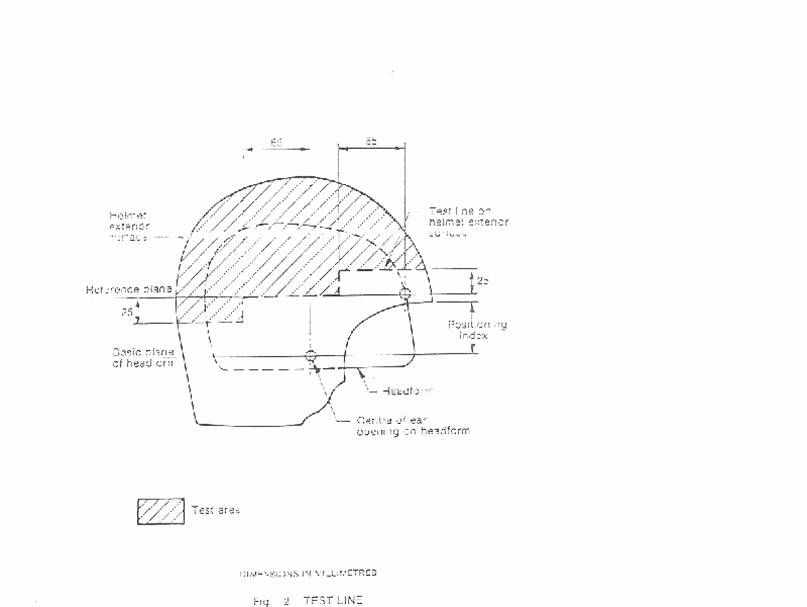
(a) Headform of the dimensions and design specified in AS 2512.1 and made of magnesium alloy, e.g. K-1A, and exhibiting no resonant frequencies below 3000 Hz. The contactable surfaces of the test headform shall be constructed of a metal or metallic alloy having a Brinell hardness number not greater than 55, which will readily permit detection should contact by the striker occur. The surface shall be re-finished if necessary prior to each penetration test blow to permit detection of contact by the striker.
NOTE: The composition of magnesium alloy K-1A is 0.7 percent zirconium, balance magnesium.
(b) Penetration striker complying with the following requirements:
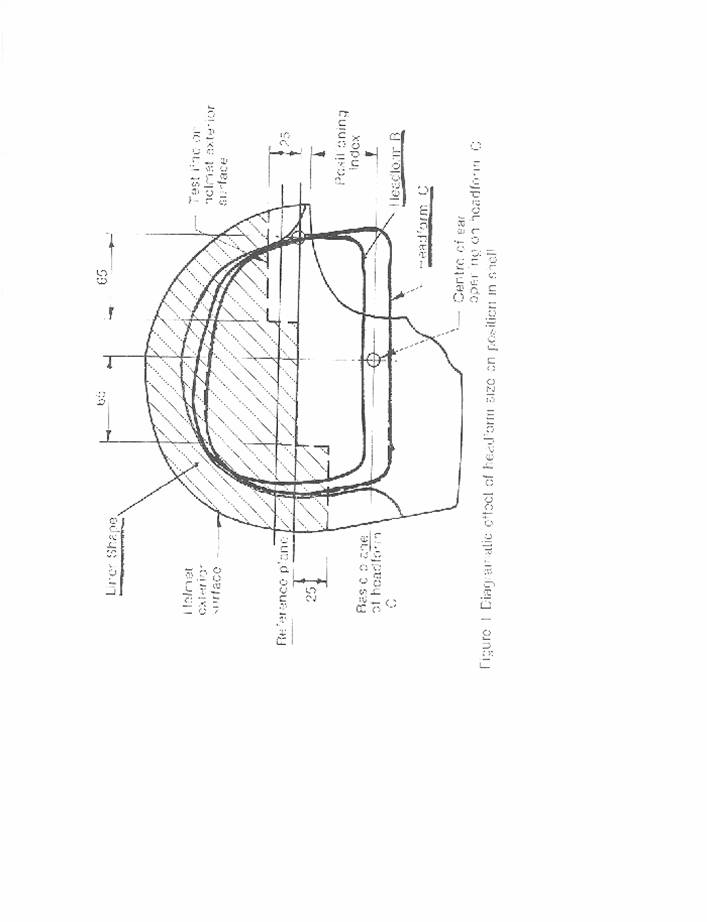
(i) The mass of the test striker shall be 3 +0.045, -0 kg.
(ii) The point of the striker shall have an included angle of 60 ±0.5 degrees and a cone height of not less than 38 mm.
(iii) The radius of the striking point shall be 0.5 ±0.1 mm.
(iv) The striking tip shall have a hardness of at least 60 Rockwell (Scale C).
(c) Rigid mount as specified in AS 2512.3, Clause 4(c).
(d) A means to control the direction of the free fall.
4 PROCEDURE. The procedure shall be as follows:
(a) Condition and prepare the helmet(s) in accordance with AS 2512.2, Clauses 2 and 3.
(b) Ensure that the laboratory conditions are as specified in AS 2512.2, Clause 5.
(c) With the adjusting components fully relaxed, position the helmet as specified in AS 2512.2, Clause 4.
(d) Perform the penetration test(s) as specified in the product standard. With its axis aligned vertically, drop the penetration test striker from the height specified in the product standard onto the outer surface of the helmet in the direction essentially normal to that surface.
NOTE: The height is measured from the striker point to the impact point on the outer surface of the helmet.”
10 Clause 4 of AS 2152.3 specifies the apparatus required for the impact energy attenuation test. It relevantly provides as follows:
“4. APPARATUS. The following test apparatus is required. Typical apparatus is shown in Fig. 1:
(a) Headform of the dimensions and design specified in AS 2512.1 and made of magnesium alloy, e.g. K-1A, and exhibiting no resonant frequencies below 3,000 Hz…
(b) Anvils. A flat steel anvil the diameter of which shall be not less than 127 mm and a hemispherical steel anvil the diameter of which shall be 48 mm.
(c) Mount for anvils consisting of a solid mass of at least 130 kg faced with a steel plate of at least 25 mm thickness, the lateral dimension of which shall be not less than 300 mm.
(d) A drop assembly…”
11 Three construction questions arise concerning the tests conducted by Crashlab.
(a) Point of Testing
12 MHG adduced evidence that demonstrated industry acceptance of penetration resistance testing of helmets at two sites (as required by paragraphs 6.1 and 6.3 of the Standard), being sites E and F shown on the diagram of a helmet, which is Appendix 1 to these reasons. MHG contends that, having regard to industry practice, a test conducted at, for example, site G shown on the diagram would not satisfy the requirements of AS 2512.4. Crashlab, in the tests in question, conducted penetration resistance tests at site G shown on the diagram.
13 As I have indicated, paragraph 6.1 of the Standard provides for tests to be conducted “at any points” above the “test line”. The term “test line” is explained below. Paragraph 6.3 requires that “at least two penetration sites” be tested. I do not consider that there is anything in the language of the Standard or of AS 2512.4 which justifies limiting testing to the sites habitually tested in industry practice. I do not consider that by reason only of testing at site G, the Crashlab tests did not satisfy the requirements of the Standard.
14 The concentration of Crashlab on conducting the penetration test at sites E and F supports the contention that the usual practice is for the penetration test to be conducted at those sites. The evidence justifies the conclusion that those sites have traditionally been chosen by the industry.
15 Crashlab supplies to its technical officers work instructions for the conduct of testing. In particular, Crashlab has published a work instruction for testing under the Standard and AS 2512.4. The work instruction that was published on 28 September 1998 is still current. That work instruction specifies sites E and F as the sites for the application of the penetration test. There is no work instruction issued by Crashlab that requires testing at site G.
16 Mr A.J. Wood is the Quality Assurance and Information Systems Manager of Crashlab. Mr Wood said that, so far as he is aware, prior to the testing carried out by Crashlab on MHG’s helmets in March 1999, no penetration testing had been carried out on crash helmets at sites other than E and F. However, because of the failures recorded on the MHG helmets at site G, it is now the practice of Crashlab to carry out a penetration test on all motor cycle helmets at site G. There was no evidence to explain what prompted the testing at site G for the first time in March 1999.
17 The National Association of Testing Authorities Australia (“NATA”) is Australia’s only nationally and internationally recognised provider of laboratory accreditation. NATA was established over 50 years ago and is an independent private company. Its operations are monitored and reviewed by its members, industry, government and professional bodies, which are represented in the make up of NATA’s council. NATA has a Memorandum of Understanding with the Australian Government that recognises its national role in Australia’s technical infrastructure.
18 Laboratory accreditation provides a means of determining the competence of laboratories to perform specific types of testing, measurement and calibration. It allows a laboratory to determine whether it is performing its work correctly and to appropriate standards. Manufacturing organisations use laboratory accreditation to ensure that the testing of their products by their own in-house laboratories is being done correctly.
19 MHG has its own in-house testing laboratory. MHG’s laboratory is accredited by NATA. NATA accreditation is reviewed more or less annually. Prior to renewal of accreditation, NATA representatives attend at the in-house laboratory and review the testing equipment and testing procedures to ensure that testing is being conducted in conformity with relevant standards. MHG’s accreditation has always been renewed by NATA. MHG has conducted penetration tests on its helmets but only at sites E and F. There has never been any suggestion by NATA that by doing so MHG has failed to comply with the testing requirements of the Standard.
20 Quality Assurance Services Pty Ltd (“QAS”) is a wholly owned subsidiary of Standards of Association Australia (“SAA”). SAA is the proprietor of a trade mark (“the StandardsMark”). SAA has granted to QAS a licence to sub-licence the StandardsMark and QAS has granted a sub-licence to MHG. One of the requirements of the licence is that the products to which the trade mark is applied must be tested with acceptable results. Licences are granted only to applicants who satisfy SAA’s Board of Directors that they are capable of producing goods that comply in all respects with the appropriate quality assurance program for product specification as issued by QAS.
21 QAS provides certification programs for various products, including protective motor cycle helmets. A licensee must comply in all respects with the appropriate quality assurance program as issued by QAS as amended from time to time. MHG has at all relevant times complied with the quality assurance program issued by QAS in relation to the Standard.
22 MHG contends that, in the light of the evidence that I have outlined above, all alleged failures of the penetration test at site G should be disregarded and should assume no relevance. However, I do not consider that the practice adopted by the industry can affect the true construction of the Standard. The Standard means what it says. Its meaning cannot be changed by practices adopted after its promulgation. It may be that practices in vogue at the time of its promulgation could have a bearing on its meaning. However, there has been no evidence on that question. On the other hand, the practice of the industry may have some bearing on the relief that may be appropriate in the circumstances of a threatened contravention of section 65C of the Trade Practices Act. That is a different question.
(b) Cantilever arm
23 AS 2512.4 requires the dropping of a striker on to a “rigidly mounted helmet”, being a helmet which is positioned on a “rigidly mounted test headform”. It is apparent from the description of the apparatus in clause 3 of AS 2512.4 that the test headform must be rigidly mounted to a “rigid mount”, being the apparatus specified in paragraph 4(c) of AS 2512.3. That paragraph refers to a “mount for anvils” having certain specifications. It is clear from the description of the apparatus in AS 2512.3 that a mount for an anvil is different from an anvil.
24 The apparatus employed by Crashlab in its penetration resistance tests at site G consisted of a test headform mounted on a ball socket which is screwed into a horizontal post protruding from a 100 mm square section of steel which is 320 mm in height. The horizontal post passes through the section of steel and is welded at both sides. The section of steel, which is hollow, is welded onto a solid base of steel approximately 460 mm x 150 mm x 50 mm high. The section of steel is also welded to the solid base by means of a gusset. The solid base is clamped to a rigid mount that satisfies the description in clause 4(c) of AS 2512.3.
25 MHG contends that such apparatus does not satisfy the requirements of AS 2512.4. Rather, it is contended, AS 2512.4 contemplates a mechanism whereby the striker is dropped onto the surface of the helmet which is fixed onto the headform which is fixed on an anvil which is then fixed on the rigid base. I do not consider there is any basis in the language of AS 2512.4 for that contention. The description of the apparatus refers only to the rigid mount specified in clause 4(c) of AS 2512.3. No mention is made of the anvil. I consider that the apparatus employed by Crashlab satisfies the description of the apparatus in AS 2512.4.
(c) Resonance of the Horizontal Post
26 MHG contends that the horizontal post that forms part of the Crashlab apparatus, which was sometimes referred to as a cantilever arm or support, is not “rigidly mounted” as required by AS 2512.4. Mr John C. Simmons, who was called as a witness by MHG, is an expert in the field of structural dynamics, amongst other things. Mr Simmons said that, besides the commonly understood notion of rigidity “in the sense of it being very stiff”, there is a more quantitative expression of rigidity used widely in “the dynamics literature”. Mr Simmons said that a structure or object is regarded as “rigid” if its lowest natural frequency is significantly higher than the frequency of a relevant excitation force, i.e. its shortest natural period is significantly less than the period of the excitation force. It is common ground that such a definition of rigidity is widely accepted in the dynamics literature.
27 Mr Simmons considered that a cantilever type of mount, such as that employed by Crashlab, cannot be regarded as “rigid” without detailed tests of its resonant frequencies and associated mode shapes and comparison of those results with the relevant characteristic impact periods. He was of the opinion that, without further data regarding the Crashlab cantilever support, he could not determine whether that type of support would cause a penetration result to be higher or lower than a truly rigid anvil mount. He was of the opinion that it may be either higher or lower but that it is very likely to be different.
28 The Commission accepted that, if Mr Simmons definition of “rigidity” is appropriate for the expression “rigidly mounted”, then the requirements of AS 2512.4 would not be satisfied. That is to say, if the headform on which a helmet is mounted must be rigidly mounted on the “rigid mount” such that the lowest natural frequency of the cantilever arm is significantly higher than the frequency of the relevant excitation force, the cantilever arm employed by Crashlab was not rigidly mounted.
29 I do not consider that there is any justification for adopting Mr Simmons definition of “rigidity” in the present context. There is no definition of the term “rigidly” or “rigid” in the Standard or AS 2512.1, which contains definitions for use in the standards that specify methods of testing protective helmets. I do not consider that there is any justification for construing those terms otherwise than in accordance with their normal meaning. When the author of AS 2512.4 considered that it was desirable to specify the resonant frequencies of any part of the apparatus, that was done (as is apparent from the definition of “headform” in both AS 2512.3 and AS 2512.4).
30 A text book, Mechanical Engineering Design, by J.E. Shigley, was accepted by both parties as containing an appropriate definition of “rigid” for the purposes of general usage by mechanical engineers. The definition is as follows:
“A structure or mechanical element is said to be rigid when it does not bend, or deflect, or twist too much when an external force, moment, or torque is applied. But if the movement due to the external disturbance is large, the member is said to be flexible. The words rigidity and flexibility are qualitative terms which depend upon the situation. Thus, the floor of a building which bends only 0.1 inches due to the weight of a machine placed upon it would be considered very rigid if the machine were heavy. But a surface plate which bends 0.1 inches due to its own weight would be considered too flexible.”
Further, the term “rigid” is defined in the Macquarie Dictionary in the following terms:
1. Stiff or unyielding; not pliant or flexible; hard.
2. Firmly fixed, set, or not moving.
31 The description of the cantilever arm, which I have set out above, indicates, in my view, that it is rigidly attached to the rigid mount as that terminology would be understood in ordinary usage. I consider that the apparatus employed by Crashlab satisfies the requirement that a rigidly mounted helmet is positioned on a rigidly mounted test headform, in that the headform is rigidly attached to the cantilever arm which in turn is rigidly mounted on the rigid mount.
COMPLIANCE WITH THE STANDARD
32 MHG contends, in the alternative that, even if the tests conducted by Crashlab satisfied the requirements of the Standard, that is immaterial if the helmets in fact passed other tests which also satisfied the tests of the Standard. MHG has in fact carried out tests in accordance with the Standard and the helmets tested all passed the tests. MHG contends, therefore, that the helmets comply with the Standard.
33 MHG’s contention is that goods will comply with the Standard if a test which satisfies the Standard is devised and the goods pass that test. It was said that, if goods have been tested in accordance with a test which is devised bona fide and the test demonstrates that the goods “comply” with the relevant Standard, no question of non compliance can then arise. MHG adduced evidence of some 70 tests conducted by it in respect of 280 helmets. There were no failures.
34 However, I do not consider that that is sufficient. The Standard specifies performance requirements. The performance requirements are to be determined by tests. Clearly, there will be a variety of tests that might be conducted that would satisfy the specification in the Standard. I consider that if goods will not satisfy a test conducted in accordance with a standard, the goods do not comply with that standard, notwithstanding that they might satisfy another test conducted in accordance with the standard.
35 The position may be different if a standard were formulated with such precision that there was no judgment involved in conducting a test. However, clause 6.1 of the Standard requires that the tests specified in clauses 6.2 and 6.3 are to be applied “at any points” above the test line. Under clause 6.3, “at least two penetration sites” must be tested. Thus, in conducting a test, the testing party may choose two sites from the, at least theoretically, infinite number of sites on a helmet. The fact that one testing agency has, in good faith, chosen two sites and conducted tests at those sites which the helmet passes does not preclude another agency from choosing two other sites. If the helmets fail the test conducted at those two other sites, there will be a failure to comply with the Standard.
36 It is a characteristic of the performance tests in the Standard that they are expressed in the negative. Thus, under clause 6.2, in relation to the impact energy attenuation test, the headform acceleration “must not exceed” a specified acceleration. Under clause 6.3, in relation to the resistance to penetration test, there “must be no contact” between the striker and surface of the test headform. Under clause 6.4, dealing with the strength of retention system test, the retention system or its attachment “must not separate” and the elongation “must not exceed” a specified maximum. The structure of the Standard would require, in order to establish compliance positively, that a negative be proved.
37 A contrast might be drawn with clauses 4, 8 and 9 of the Standard. Under clause 4.1, the helmet is to consist of “a shell with a hard, smooth outer surface capable of resisting penetration, a means of absorbing impact energy, and a retention system”. The capacity to resist penetration, the means of absorbing impact energy and the retention system are the subject of the tests set out in clauses 6.2, 6.3 and 6.4. However, the requirement that the shell consists of a hard, smooth outer surface is a positive requirement. A manufacturer, thus, can establish positively that that requirement is satisfied by demonstrating that the shell does in fact consist of a hard, smooth outer surface.
38 Under clause 8, each helmet must be permanently and legibly marked with the following:
· name of manufacturer;
· model designation;
· size;
· month and year of manufacture;
· the words “Vehicle User’s Helmet”;
· instructions to user;
· the certification mark (where required by statutory authorities).
It would be quite straightforward for a manufacturer to establish that clause 8 is satisfied.
39 Similarly, clause 9 provides that each helmet must be accompanied by an informative brochure or label that includes certain specified information. That is a matter which can be established positively by the manufacturer.
40 Clause 5 provides that the manufacturer of a helmet must establish that the characteristics of the materials used in the manufacture are suitable for the purpose, having regard to the provisions of Appendix A. The requirements of Appendix A are all negative. However, it may even be possible to analyse in a positive fashion the characteristics specified in Appendix A. Appendix A provides as follows:
“ APPENDIX A
CHARACTERISTICS OF MATERIALS USED IN THE
MANUFACTURE OF PROTECTIVE HELMETS
(This Appendix does not form an integral part of this Standard.)
The following material characteristics are recommended:
(a) Known not to undergo appreciable alteration under the influence of ageing, or the circumstances of use to which the helmet is normally subjected, such as exposure to sunlight, extremes of temperature, and rain. Ultraviolet inhibitors should be used where necessary.
(b) For parts of the helmet coming into contact with the skin or hair, known not to undergo appreciable alteration arising from contact with perspiration or skin or hair toiletries.
(c) Known not to cause skin irritations or disorders.
(d) For metal parts used in the construction of the helmet, corrosion-resistant or having corrosion-resistant finish.
(e) For the shell, known not to support flame propagation.”
41 Thus, except for requirement (d), the requirements are that the material is known not to have particular characteristics. In other words, there is no requirement to establish that the material does not in fact have particular characteristics, such as supporting flame propagation. The requirement is simply that the material be “known not to” support flame propagation. The criteria, therefore, appear to be based on the state of knowledge at any given time. That is something that can be established positively by a manufacturer.
42 The distinction that I have drawn suggests that it will be difficult for a manufacturer to establish positively that some requirements of the Standard have been satisfied. It may be possible, as a matter of scientific probability, by conducting very stringent and extensive testing, to prove the negative requirements of clauses 6.2, 6.3 and 6.4. However, if a manufacturer does not undertake such stringent and extensive testing, the manufacturer must be at risk that a test will be conducted that satisfies the requirements of clauses 6.2, 6.3 or 6.4 and establishes non compliance with the requirements prescribed by those clauses.
43 That is to say, the manufacturer of a helmet may demonstrate, from the tests conducted by it, that there is no penetration site where contact will occur between striker and surface of the test headform. However, unless it does so, there will always be the possibility of proving that there is a site where application of the test in accordance with the Standard will result in contact between striker and surface of the test headform.
44 On the other hand, the structure of section 65C(1)(a) enables contravention to be demonstrated by simply negating the negative requirements of clauses 6.2, 6.3 or 6.4. It may be very difficult for a manufacturer who had the onus of establishing that his goods complied with the Standard to demonstrate, in fact, that goods do in fact comply with the Standard. There is no reason to think that it would be impossible to do so, since appropriate testing must be possible that would demonstrate, at least on the balance of probabilities, that the test applied at any site will be satisfied.
45 If it is correct to say that proving compliance positively is very difficult, for the reasons indicated above, a question may arise as to the purpose of providing in clause 6.3 that at least two penetration sites must be tested. The failure at any one site will establish that the requirement of 6.3 has not been satisfied. The requirement of testing at least two penetration sites may suggest that, if the requirements of clause 6.3 are satisfied by application of the test at two penetration sites that otherwise comply with the requirements of the Standard, the helmet complies with the Standard. Otherwise, the requirement for testing at least two penetration sites could be seen to be otiose. In other words, the reference to two penetration sites may suggest that the Standard will be complied with if there is no contact between striker and surface of the test head form when the resistance to penetration test is applied at any two sites, irrespective of whether there might be contact if the test were applied at some other site.
46 However, it is difficult to see the rationale for such a provision. The better explanation for the requirement of testing at least two penetration sites is to ensure that more than one site be tested at any time, thereby increasing by two-fold the chances of finding any site susceptible to penetration. The requirement that the sites be at least 76 mm apart is an indication that the Standard requires testing of discrete and separate parts of a helmet. There appears to be no rationale, and none was advanced on behalf of MHG, for a provision under which positive compliance with the Standard could be established by testing which leaves open the possibility that the helmet is penetrable at sites other than those chosen at random.
47 If it be the fact that, for whatever reason of physics or otherwise, two sites on a helmet are particularly resistant to penetration but the balance of the helmet was easily penetrable, the wearer of the helmet would be very much at risk notwithstanding that, on that view of the construction of clause 6.3, the helmet complied with the Standard. No evidence was advanced to explain why a helmet might be more susceptible to penetration at any one site than at any other site.
48 Further, there was no evidence as to the relative strength or vulnerability of helmets at any given points. For example, the geometry and physics involved in the structure of a helmet may be such that the penetration test when conducted at, say, sites E and F, is more likely to be satisfied than when conducted at, say, site G. I consider that the performance requirements of the Standard will not be satisfied if a helmet fails the penetration test conducted at any point above the test line.
EXTRAPOLATION FROM TEST RESULTS
49 Three different models are manufactured by MHG. Each model has several sizes. The models are as follows:
· Model EXR – an open faced helmet having 6 sizes;
· Model RXR – a closed faced helmet having 5 sizes; and
· Model MXR – a motor cross helmet with a chin guard having 6 sizes.
50 The components of each model and size are manufactured using identical materials. The outermost “shell” of each helmet is made from hard ABS plastic capable of resisting penetration over its entire area. The “liner” of each helmet is made from expanded polystyrene foam. Polystyrene foam is a crushable material capable of absorbing impact energy. The interior of each helmet is fitted with a lining of “padding” made from foam backed brushed nylon fabric providing both size variance and wearer comfort. The chin straps of each helmet are made from webbed polyester continuous filament material, which are fastened by means of chrome plated steel “D rings” and attached to the helmet with rivets.
51 The EXR and MXR models have identical shells, the only difference being that the MXR model has an additional chin guard, which is riveted on. There is only one shell size for all sizes of the EXR and MXR models. The variation in size of helmets is achieved by varying the thickness of the liner and the padding. There are two sizes of liner, one for extra small and small and the other for the other sizes. All sizes of RXR model helmets have the same size outer shell and variation in size is achieved by variation in the thickness of the liner and the thickness of the padding. One size of liner is used for extra small and small and the other size liner is used for the other sizes. All three models have extra small (“XS”), small (“S”), medium (“M”), large (“L”) and extra large (“XL”) sizes. In addition, the EXR and MXR models have an extra extra large (“XXL”) size.
52 There has been no evidence as to the effect, if any, of variation in the thickness of the liner or the padding. In the light of the evidence that the liner is made from a material which is capable of absorbing impact energy and that size variations are achieved by varying the thickness of the liner, I would have expected that that could have an effect on the penetration test. That is to say, if there is a thinner liner in a larger size helmet, the probabilities might be that there is a greater prospect of there being contact between striker and the surface of the test headform when such a helmet is tested. However, the parties proceeded on the basis that those matters are not material.
53 The question arises, in the context of section 65C of the Trade Practices Act, as to the use to be made of the tests of helmets. The testing of any particular helmet results in destruction of the helmet. In order to determine whether a helmet which is offered for sale or which a person threatens to supply in trade or commerce does not comply with a standard such as the Standard, it is necessary to make an extrapolation from the results of tests conducted on other helmets. There is an underlying assumption in a provision such as section 65C(1)(a) that every helmet manufactured in accordance with a particular specification will perform in the same way as, or will have the same performance characteristics as, all other helmets manufactured in accordance with the same specification. Putting it another way, the assumption is that all helmets will perform in the same way or will have the same performance characteristics as any tested helmet that has been manufactured according to the same specification.
54 It may be possible that not every helmet will perform in precisely the same way as every other helmet manufactured in accordance with the same specification. In other words, where two apparently identical tests are applied to two helmets apparently manufactured according to the same specification, the results may not necessarily be the same. Such differences may be capable of being explained by tolerances in manufacture or variances in the conduct of the tests. Alternatively, helmets could be manufactured according to different specifications by reason of poor quality control.
55 Clause 7 of the Standard provides that at least four helmets of the same size must be submitted for test. The testing methods require that the four helmets be conditioned for testing in different ways. The conditioning is to be for 16 to 30 hours. Thus, prior to testing, one helmet is to be conditioned by being exposed to ambient temperature, one helmet by being exposed to low temperature, one helmet by being exposed to high temperature and the fourth helmet by being immersed in water. The consequence appears to be that no two identical tests are conducted on any two helmets. A note to clause 7 states as follows:
“The certifying body may waive tests on some helmets within a range of helmets on the basis of engineering evaluation.”
56 The burden of proof that a helmet does not comply with the Standard lies with the Commission. The burden is the ordinary civil burden of proof. In other words, I must be satisfied, on the balance of probabilities, that any helmet that MHG threatens to supply does not comply with the Standard. That question must be considered separately in relation to each model of helmet manufactured according to particular specifications. I take the question to be whether, in the light of the evidence of testing samples of a particular model of helmet, it is more likely than not, that a given helmet, manufactured to the same specifications as the sample, will not comply with the Standard.
57 Failures during testing might be either random or systematic. Random failures may be due to poor quality control. Systematic failures may also be due to poor quality control, but could also be caused by a design fault in a helmet. Mr T.J. Gibson, who was called as a witness by the Commission, is an expert in the area of design and development of biomechanically based solutions to prevent impact injury, with special emphasis on motor vehicles and helmets. Mr Gibson observed that some failures are difficult to ascribe to a particular reason and may be a combination of both poor quality control and design fault. Those considerations must be taken into account in determining the weight to be given to test results.
58 The question is whether the results of the Crashlab tests indicate that the helmets do not comply with the Standard. The Commission contended that if there is a real risk or a substantial risk that a helmet would not pass a relevant test, then the helmet does not comply with the Standard. I do not consider that that is the appropriate test. The Commission has the onus of establishing, on the balance of probabilities, that any particular helmet that MHG threatens to supply in trade or commerce does not comply with the Standard. That question can only be answered by an extrapolation from the test results. The question is whether, on the basis of the evidence, including the test results of a particular model, it is more likely than not that a given helmet will fail the tests in the Standard.
CRASHLAB METHODOLOGY
59 MHG complained of certain of the methodology adopted by Crashlab in the tests carried out by it.
Contents of Reports
60 Clause 5 of AS 2512.4 provides that a report of a test must include the following:
“(a) Identity of the helmet under test.
(b) Details of headform.
(c) Degree of penetration and whether or not the striker contacted the surface of the headform.
(d) The number of this Australian Standard, i.e. AS 2512.4”
61 AS 2512.4 also requires that the contactable surfaces of the test headform must be constructed of a metal or metallic alloy which will readily permit detection should contact by the striker occur. The surface must be refinished, if necessary, prior to each penetration test blow to permit detection of contact by the striker.
62 I shall describe in more detail below the Crashlab test reports relied on by the Commission. They do not comply strictly with the requirements of Clause 5 of AS 2512.4 in that none of them includes the degree of penetration and whether or not the striker contacted the surface of the headform. The report of the test of 3 March 1999 contains the following:
“Since AS 2512.4 sets out a method for determining the penetration resistance of a protective helmet, it is assumed that the contactable surface of the headform beneath the impact site would be in contact with the internal surface of the test headform.”
63 No such comment appears in any of the other reports. The reports of the tests conducted on 3, 19 and 23 March 1999 simply state that the helmets “were unable to demonstrate compliance with the requirements of” the Standard. The reports of the tests conducted on 19 and 23 March 1999 simply stated that identified helmets “failed the resistance to penetration test”. The reports of the tests conducted on 23 and 27 April 1999 stated that identified helmets “allowed contact between the striker and the headform when tested” at specified sites. However, no reference to the degree of penetration appears in the report.
64 Notwithstanding that the reports do not satisfy all of the specific requirements of the Standard, the report of the tests conducted on 23 April and 27 April 1999 does report contact between the striker and the headform at test site G. I do not consider that that failure to comply would affect a conclusion that the helmets do not comply with the Standard in so far as they fail the penetration resistance test.
Size of Headform
65 AS 2512.1 specifies four sizes of headform being sizes A, B, C and D in ascending order of size. That is to say, headform A is the smallest size and headform D is the largest size. AS 2512.2 specifies a procedure for determining the test line of a helmet as follows:
· The complete helmet to be tested is to be placed on a reference headform of the largest size corresponding to the interior surface of the helmet. The reference headform must be firmly seated with the basic and reference planes horizontal.
· A static force of 45.0+ 0 - 0.5 N is applied to the apex of the helmet. The helmet is to be centred laterally and seated firmly on the reference headform according to its helmet positioning index.
· Maintaining that force and position, a test line as defined in clause 3.12 of AS 2512.1 is then drawn on the outer surface of the helmet.
66 Under clause 3.12 of AS 2512.1, the test line is a line drawn on the outer surface of a helmet coinciding with portions of the intersection of that surface with certain planes as shown in figure 2 of that Standard. A copy of figure 2 is set out in Appendix 2 to these reasons. The planes are as follows:
“(a) A plane 25 mm above and parallel to the reference plane in the anterior portion of the reference headform.
(b) A vertical transverse plane 65 mm behind the point on the anterior surface of the reference headform at the intersection of the mid-sagittal and reference planes.
(c) The reference plane of the reference headform.
(d) A vertical transverse plane 65 mm behind the centre of the external ear opening in a side view.
(e) A plane 25 mm below and parallel to the reference plane in the posterior portion of the reference headform.”
67 When a helmet is being positioned for testing, it is to be placed on a test headform of the same size designation as the reference headform used for determining the test line, in a position that conforms to its helmet positioning index. The helmet must be secured so that it does not shift position prior to the test. The helmet positioning index is the distance, as specified by the manufacturer, from the lowest point of the brow opening at the lateral mid point of the helmet to the basic plane of a reference headform, when the helmet is firmly and properly positioned on the reference headform.
68 The use of an incorrect reference headform will distort the test area of a helmet. The shape of an incorrect reference headform may not suit the helmet’s internal shape and so may lead to large gaps occurring between the helmet liner and the test headform. Such gaps typically will occur at the helmet crown if too large a headform is chosen. A smaller headform, being able to fit further into the helmet will gave a test result more typical of a user with a well fitted helmet.
69 Due to the need for compromise between those two conflicting requirements, the reference headform size is at the discretion of the test agency. It is not a matter for the manufacturer. Typically, a helmet type will have a range of sizes that may require at least two or three sizes of headform to test adequately. The variation of the headform position with headform size is shown diagrammatically in the figure set out in Appendix 3 to these reasons. In that figure, the B headform has been shifted deeper into the helmet but the headform planes have been kept parallel to those for the C headform.
70 Mr Gibson was of the opinion that the more appropriate test headform for conducting the penetration test on a size M helmet was the C size test headform. However, he was of the view that the choice of the appropriate test headform was always at the discretion of the testing agency. He considered that it was open to Crashlab to determine that the B size was the largest size headform corresponding to the interior surface of a size M helmet, having regard to the air gap observed with the C size test headform.
71 It would be unsatisfactory if the question of compliance with the Standard depended upon the exercise of a judgment involving selection of one of two possible headforms, where each choice was a reasonable one to be made. However, having regard to the negative nature of the test, as described above, I consider that for there to be compliance with the Standard, it would be necessary to demonstrate that the helmet passed the test on the basis of any headform which it was open to the testing authority to select. I consider that on the evidence before me, it was open to Crashlab to select the size B test headform, albeit that it was also open to select the size C test headform.
72 In the circumstances, I do not consider that the form of the Crashlab reports or the selection of headform size are grounds for rejecting the Crashlab results as unreliable.
PENETRATION TESTS
73 There was evidence of a number of tests conducted by Crashlab. The first test was conducted on 3 March 1999 at the behest of MHG and resulted in test report “TR99/135”. The test was conducted in respect of model EXR size M helmets. Another test was conducted on 19 March 1999 at the behest of QAS, also in respect of model EXR size M helmets. The second test gave rise to test report TR99/146. Two further tests were conducted on 23 March 1999 at the behest of QAS. The first was in respect of model EXR size L helmets and the second was in respect of model RXR size L helmets. Test Reports TR99/147 and TR99/148 respectively were the result.
74 Finally, tests were conducted by Crashlab at the behest of the Commission on 23 and 27 April 1999 in respect of 14 helmets. Test report TR99/189 was produced as a result. The tests were conducted on 4 model EXR size XS helmets, 2 model EXR size L helmets, 4 model EXR size XXL helmets, 1 model MXR size XXL helmet, 1 model MXR size XL helmet and 2 model MXR size S helmets.
75 In test TR99/135, the helmet that had been conditioned to high temperature failed the penetration test when applied at sites E and F. The helmet conditioned to ambient temperature passed the penetration test at site E but failed at site F. The other two helmets passed the penetration test when applied at both site E and site F. No penetration test was applied at site G.
76 All four helmets in test TR99/146 passed the penetration test when applied at site E. One of the helmets failed the test when applied at site F but the other three helmets passed the penetration test applied at site F. No test was applied at site G. The helmet which failed the test had been conditioned to high temperature.
77 All four helmets in test TR99/147 passed the penetration test at sites E and F. In addition, the helmet conditioned to ambient temperature was also subjected to the penetration test at site G. That helmet failed that test.
78 In test TR99/148, one helmet conditioned to ambient temperature passed the penetration test at sites E and F as well as site G. On the other hand, the helmet conditioned to high temperature passed the penetration test applied at sites E and F but failed the test when applied at site G. There was no evidence to explain why the test was conducted at three sites on those two helmets. The penetration test was not applied at site G on the other two helmets which were the subject of TR99/148
79 There was no explanation as to why only some of the helmets in TR99/147 and TR99/148 were subjected to the penetration test at three sites and other helmets at only two sites. The three helmets that were subjected to the penetration test at site G were also tested at sites E and F. The evidence does not indicate conclusively the order of testing. It suggests that the helmets were subjected to the penetration test at site G after having passed the test at sites E and F.
80 In TR99/189, the resistance to penetration test was applied to the model EXR size XS helmets at sites E, F, G and H. All four helmets passed the penetration test at sites E, site F and site H. However, each failed the penetration test when applied at site G.
81 In test TR99/189, the model EXR size XXL helmets conditioned to ambient, high and low temperature failed the test applied at site E. There was no result in relation to the helmet that had been conditioned by immersion in water. The Commission conceded that the test applied to the helmet conditioned to low temperature did not satisfy the requirements of the Standard that the penetration sites be at least 76 mm apart and at least 76 mm from the centres of any impacts applied during the impact energy attenuation test.
82 I am not satisfied that the model EXR size XXL helmets in test TR99/189 conditioned to ambient and high temperatures were tested in accordance with the Standard. That is to say, I am not satisfied on the evidence before me that the penetration sites were at least 76 mm from the centre of impact applied during the impact energy attenuation test to those helmets. The question was disputed and it was not apparent from an examination of the helmets where the centre of impact applied during the impact energy attenuation test was. All four helmets were recorded as having passed the penetration test when applied at site F.
83 The two EXR model size L helmets in TR99/189, conditioned to ambient and high temperature, were tested at sites E and F. Both passed the penetration test at both sites.
84 The Standard requires testing at “at least two penetration sites”. That suggests that testing at a third site is not prohibited. However, testing at a third and fourth site seems to be a departure from normal practice. On the other hand, no complaint appears to have been made on the basis that the helmets were tested at more than two sites. The complaint, as I have indicated, is that testing at site G is a departure from standard practice.
85 I am satisfied from the evidence before me that helmets of the three models in question satisfy the performance requirements as to resistance to penetration when tested at sites E and F. I consider, on the balance of probabilities, that each of the models will not fail the penetration test when applied at site E or site F.
86 However, the application of the penetration test at site G is a different matter. The evidence before me is not conclusive. However, I consider that it is more likely than not that size XS of the EXR model will fail the penetration test applied at site G. Since the EXR model and the MXR model have identical shells, I am also satisfied that the XS size of the MXR model is also more likely than not to fail the penetration test applied at site G. Further, in the absence of any evidence indicating that the thickness of the liner has any effect on the penetration test, I am satisfied that, on the balance of probabilities, all sizes of models EXR and MXR would fail the penetration test applied at site G.
87 The conduct of the penetration test at site G in relation to RXR model helmets is not entirely satisfactory. As I have indicated, the helmets that failed that test appear to have been subjected to the penetration test at sites E and F beforehand. There are only two helmets that have been subjected to the tests. One had been conditioned to ambient temperature and one had been conditioned to high temperature.
88 While the design of the outer shell of the RXR model differs from that of the EXR and MXR models, they are all manufactured from the same substance. There is no evidence to indicate that the different shape has any bearing on the conduct of the penetration tests at site G. Accordingly, I am satisfied, on the balance of probabilities, that the RXR model would also fail the penetration test applied at site G.
89 It follows, in my opinion, that each of the models does not comply with the Standard because each does not satisfy the performance requirement specified in clauses 6.1 and 6.3 of the Standard.
RETENTION TESTS
90 Under AS 2512.5, the strength of retention system test is to be conducted by positioning the helmet on a test headform of the same size designation as the reference headform used for determining the test line, in a position that conforms to its helmet positioning index. The helmet is to be secured so that it does not shift position prior to test. The retention system is to be positioned so that it does not interfere with free fall, impact or penetration. Under clause 6.1 of the Standard, the strength of the retention system test is to be conducted prior to the impact energy attenuation and resistance to penetration tests. Once the helmet is positioned, the helmet is to be secured so that the points of attachment of the retention system to the helmet are subjected to the same force as the retaining strap.
91 Next, a preliminary load is applied to the retention system of the magnitude and duration specified in the Standard. The force is to be applied normally to the basic plane of the test headform and symmetrical with respect to the centres of the retention assembly. Under clause 6.4 of the Standard the preliminary loading is 225 ±5N applied for 30 seconds. Next an additional load is to be applied to the retention system of the magnitude and duration specified in the Standard. Under clause 6.4, the additional load is 1,110 ±25N applied for 120 seconds. Under clause 6.4, the retention system or its attachments must not separate and the elongation between pre-loading and test loading is not to exceed 25 mm.
92 The tests were conducted at Crashlab by feeding the chin strap of the helmet through a roller attachment and fastening the chin strap. A vertical static load was then applied to the roller attachment for the requisite 30 seconds. The purpose of that first load was to eliminate any slack in the chin strap and comfort padding in the helmet. A measurement of the position at the top of the helmet was then taken and a measurement was also taken of the position of the roller attachment.
93 The additional heavier load was then applied to the chin strap for the requisite 120 seconds. Once again a measurement of the position at the top of the helmet was taken and a measurement was again taken of the position of the roller attachment. The overall test result was the difference between the measurements taken after the application of the two loads.
94 In the first test conducted by Crashlab, TR99/135, the four helmets passed the strength of retention system test. Those helmets were model EXR size M. The test in TR99/146 also related to model EXR size M helmets. All four helmets passed the strength of retention system test. The test conducted in TR99/147 related to model EXR size L helmets. Once again all helmets passed the strength of retention system tests.
95 The second test conducted on 23 March 1999, TR99/148, related to model RXR size L helmets. The helmet conditioned to ambient temperature failed the test while the other three helmets passed.
96 In TR99/189, two tests were conducted in accordance with the Standard. Those tests related to model EXR size XS and model EXR size XXL. In addition, two further tests were purportedly conducted but apparently not strictly in accordance with clause 7 of the Standard. As I have indicated, clause 7 requires that at least four helmets of the same size must be submitted for test. One of the purported tests in TR99/189 was in respect of two model EXR helmets both size L. The other purported test was in respect of four model MXR helmets, being two size S, one size XL and one size XXL.
97 While those tests do not appear to comply strictly with the Standard, no point was made by MHG in relation to that aspect of the tests. I assume, therefore, that the variations in sizes and the failure to test four helmets is not of significance. Nevertheless, the failure to adhere strictly to the requirements of the Standards tends to cast doubt on the reliability of the results, particularly where they are not conclusive.
98 All the model EXR size XXL helmets in TR99/189 passed the strength of retention system tests. The two model EXR size L helmets also passed.
99 The model EXR size XXS helmet which had been conditioned to high temperature failed the test as did the three model MXR helmets conditioned to ambient, high and low temperatures. Three of the failures were recorded as resulting from slippage of the webbing through the D-rings. The fourth failure, the model MXR size S, conditioned to low temperature, was recorded as exhibiting elongation of the webbing of 29 mm, 4 mm in excess of the maximum specified in clause 6.4 of the Standard.
100 Tests have been conducted by MHG in respect of 280 helmets. None failed the strength of retention system test. Of 30 helmets tested by Crashlab, 25 passed the test and only 5 failed. There is no evidence to explain conclusively why only some of the helmets failed the test. I shall deal below with some evidence that the webbing was of a different width on various helmets.
101 MHG sought to explain the failures on the basis of incorrect selection of the size of the headform for the purposes of testing the helmets. MHG contended that the results of the tests were unreliable because the use of a size B headform:
· permits horizontal movement which permits rotation of the helmet during testing;
· permits bowing or buckling of the helmet such that the chin strap may be extended, even after the initial load.
102 It was said that the Crashlab testing apparatus precluded the application of continuous static force and permitted a shear force. It was said that shear force permits an unequal application of the force being applied. More force is applied to one side of the webbing than the other. The unequal application of force permits the D-rings to slip in a manner not possible when force is applied properly.
103 AS 2512.5 states the scope of that standard as being to set out a method for determining the static strength of the retention system of a protective helmet and its attachment points. The principle of the test is stated as follows:
“With the helmet positioned on a fixed headform a static tensile force is applied to the retention system. The elongation of the retention system is then measured.”
A note indicates that the value obtained for elongation of the retention system is not intended to include any reading due to compressing of any impact-attenuating material such as the crushable liner of a helmet.
104 I accept that, as a matter of principle, the bowing of a helmet could result in elongation of the strap. It does not result in any distortion of the strap but, because the points at which the strap is anchored to the helmet would be drawn closer together as a result of the bowing, the strap would extend lower. There was no quantification of such an effect and I am not satisfied that any bowing would result in a significant extension of the strap.
105 I also accept that if a helmet does not fit firmly on the headform, the application of a load could cause rotation of the helmet. However, if a helmet rotated, it would not result in any distortion of the strap. If a helmet rotated and, for example, tipped forward, the length of the strap could be elongated in that the strap could extend lower. However, the rotation would occur, as I understand the mechanism involved, upon the application of the preliminary load.
106 While there is a possibility of a certain amount of motion upon the application of the additional test load, Mr Gibson considered that the movement would be no more than 3mm. Mr Gibson said that in the tests that he observed at Crashlab, there was no further movement. The relevant measurement is taken of the difference between the position of the strap after the application of the preliminary load and after the application of the additional load. Even if there were any rotation, I do not consider that it would affect the test result.
107 I have indicated above my conclusion concerning the selection of the size of headform. I am not persuaded that Crashlab has erred in the selection of size B headform. Further, I am not persuaded that the apparatus employed by Crashlab results in the impermissible application of a shear force rather than a static force, assuming that the two are alternatives.
108 Another explanation proffered on behalf of MHG for failure of the strength of retention system tests, is inadequate fastening of the chin strap. There is, however, no evidence that the chin straps were inadequately fastened.
109 Mr Gibson considered that the retention system failures were too frequent to describe as random. Three of the failures occurred with the model MXR helmet, being three of the four helmets of that model tested. Only one of the 22 EXR models tested failed the test and only one of four RXR models tested failed the test. Mr Gibson observed that all of the failures were due to slippage of the webbing through the D-rings and considered that further investigation was necessary in order to find the cause of the failures.
110 Mr Gibson also observed that there was some variation in the components used in the retention systems that failed. In a subsequent report, he noted that two types of webbing were used in the retention systems of the helmets. Following measurement, Mr Gibson ascertained that of the 25 helmets available for measurement, 12 helmets had narrower webbing, 20.1 mm wide and 13 had wider webbing of 20.9 mm wide. None of the helmets with the wide webbing failed the retention system test.
111 Mr S.E. Hadanich, the General Manager of MHG, considered that since Mr Gibson’s measurements of the webbing were taken after the retention test, the measurements could not be used as a basis to conclude that different webbing had been used by MHG in its helmets. However, no evidence was adduced on behalf of MHG as to that question. It would have been open to MHG to adduce evidence to demonstrate that only one thickness of webbing had been used. There was no evidence to suggest that the application of the test would distort the webbing to such an extent that the differences in measurement could be observed.
112 None of the evidence suggested that there was likely to be a difference in the performance of the retention systems of different models. The EXR and MXR models have identical shells. The rivet that attaches the retention system, however, is not in the same position. Accordingly, even if I were satisfied, on the balance of probabilities, that the retention system of the MXR model does not comply with the Standard, it does not follow that the retention system of the EXR model does not comply. That is to say, it may be that the position of the rivets securing the straps to the helmet has a part to play in the mechanism of the slippage that resulted in failure of the strength of retention system test.
113 I do not consider that the tests conducted by Crashlab demonstrate systematic failure of the retention system. Certainly Mr Gibson was of the view that the failures were not random. However, the number of helmets tested does not appear to be significant. There was no evidence as to the statistical significance of the numbers involved.
114 Further, while Mr Gibson considered that the failures were not random, no explanation was offered as to the mechanism of failure based on width of the webbing. As I have indicated, MHG did not accept that there were two sizes of webbing. In the circumstances, I am not satisfied from the evidence presently before me that, on the balance of probabilities, the retention system does not comply with the Standard.
CONCLUSION
115 I have not yet heard argument on the relief that might be appropriate in the light of the conclusions that I have reached. The proceedings were brought on with some expedition and the hearing lasted longer than had been estimated by the parties. Accordingly, I indicated to the parties that I would publish my findings on the question of compliance with the Standard and then give the parties the opportunity of addressing on the question of relief in the light of my findings. I therefore propose to stand the proceedings over for further argument after the parties have had an opportunity of considering the conclusions that I have reached.
|
I certify that the preceding one hundred and fifteen (115) numbered paragraphs are a true copy of the Reasons for Judgment herein of the Honourable Justice Emmett. |
Associate:
Dated: 15 June 1999
|
Counsel for the Applicant: |
S.J. Gageler; G.R. Kennett |
|
Solicitor for the Applicant: |
Australian Government Solicitor |
|
Counsel for the Respondent: |
G.A. Flick SC |
|
Solicitor for the Respondent: |
Freehill Hollingdale & Page |
|
Date of Hearing: |
31 May 1999, 1 and 2 June 1999 |
|
Date of Judgment: |
15 June 1999 |
 |
APPENDIX 1
APPENDIX 2
 |
 |
APPENDIX 3


