FEDERAL COURT OF AUSTRALIA
Qadir v Minister for Immigration & Multicultural Affairs [1999] FCA 620
MIGRATION – citizen of Pakistan – member of Ahmadi sect – fear of persecution – application for review of decision of RRT refusing application for refugee status – refusal by Tribunal to grant an application for adjournment of its hearing – whether Tribunal failed to act in accordance with substantial justice and the merits of the case in relation to the application for adjournment – whether the Tribunal gave a true or bona fide consideration of the application for adjournment
Migration Act 1958 (Cth)
Sali v SPC [1993] 116 ALR 625 cited
Sun Zhan Qui v Minister for Immigration & Ethnic Affairs [1997] 151 ALR 505 followed
Nguyen Do Vinh v Minister for Immigration and Ethnic Affairs (unreported Full Court of the Federal Court, 16 October 1997) cited
MUHAMMAD QADIR V MINISTER FOR IMMIGRATION & MULTICUTURAL AFFAIRS
NG 593 OF 1998
THE HON JUSTICE MARCUS EINFELD AO
SYDNEY
11 MAY 1999
|
IN THE FEDERAL COURT OF AUSTRALIA |
|
|
NG 593 OF 1998 |
|
BETWEEN: |
MUHAMMAD QADIR Applicant
|
|
AND: |
MINISTER FOR IMMIGRATION AND MULTICULTURAL AFFAIRS Respondent
|
|
DATE OF ORDER: |
|
|
WHERE MADE: |
THE COURT ORDERS THAT:
1. the determination of the Tribunal be set aside
2. the matter be remitted to a differently constituted Tribunal for a new hearing on the merits
3. the respondent pay the applicant’s costs
Note: Settlement and entry of orders are dealt with in Order 36 of the Federal Court Rules.
|
IN THE FEDERAL COURT OF AUSTRALIA |
|
|
NG 593 OF 1998 |
|
BETWEEN: |
Applicant
|
|
AND: |
MINISTER FOR IMMIGRATION AND MULTICULTURAL AFFAIRS Respondent
|
|
JUDGE: |
|
|
DATE: |
|
|
PLACE: |
REASONS FOR JUDGMENT
Introduction
1 The applicant is a citizen of Pakistan who arrived in Australia in October 1995. He applied for refugee status on 29 December 1995 on the grounds that as a member of the Ahmadi sect by reason of his father’s conversion, he was in fear of persecution if he was returned to Pakistan. The Minister’s delegate refused the application on 23 September 1997 and the refusal was affirmed by the Refugee Review Tribunal on 18 May 1998. The applicant now seeks judicial review of this refusal by this Court.
2 The case raises the legal consequences which flow from a refusal by the Tribunal to grant an application for adjournment of its hearing. The applicant twice asked for an adjournment. On 23 March 1998, the applicant’s lawyers wrote to the Tribunal conveying their instructions that the applicant was not fit to attend the proposed hearing on 8 April 1998. The enclosed a certificate from a psychologist dated 17 March 1998 stating:
Mr Muhhamad QADIR is currently receiving psychological treatment from me following a serious work accident in which several of the fingers of his left hand were severed. He has informed me that he has an interview with Dept. of Immigration in April 1998. He has not indicated the nature or purpose of the interview. Mr Qadir is suffering from an anxiety disorder (post-traumatic stress disorder) and depression and is unlikely to be able to participate fully in an interview. His concentration is affected, he is highly anxious, he requires medication and he is struggling to cope with daily activities. May I respectfully suggest that his interview be postponed for a period of three months in order to allow Mr Qadir sufficient time to recover from the anxiety and depression.
3 After the Tribunal refused the adjournment, the lawyers wrote again on 30 March enclosing a letter from the applicant’s treating doctor. The lawyers’ letter stated in part:
We enclose an additional report from the applicant’s treating doctor in relation to his injuries and the treatment he is receiving.
The applicant instructs us that he is suffering from depressions [sic] and is undergoing treatment for that. He instructs us that this depression makes it difficult for him to recalls things clearly and to concentrate properly.
He is also expecting to undergo further surgery this month.
We once again request that his hearing be adjourned so that he is able to complete his medical treatment and be in a position to instruct us fully and properly and to be able to properly contribute to a hearing before the Tribunal.
4 The doctor’s letter stated:
Mr Mohammed Qadir is under my care since June 96. He informs me that he is on temporary residence permit in Australia and has applied for permanent residence status. He has also informed me that he has an interview in April 98 with your department for the above matter.
Mr Qadir was involved in a very serious accident while at work on 2/12/97 in which he cut his second, third and fourth fingers of his left hand. He had Micro surgery and plastic surgery done to join them at Westmead Hospital. He remained in the hospital till the 16/12/97. His fingers are deformed painful and do not function naturally. Follow up X-rays done on 25/3/98 shows that the bones of these fingers have not united yet in spite of internal fixation by wire. He further needs surgery which is scheduled on 28/4/98 and might need further eight to ten weeks to recover.
Since the accident Mr Qadir has been suffering from anxiety with depression and finds it very difficult to concentrate. He is receiving Psychotherapy. If you could consider his case compassionately and postpone his interview for about three months.
5 On 1 April 1998, the Tribunal replied to the applicant’s lawyers as follows:
The Member reviewing Mr Qadir’s case has asked me to advise you that he is not prepared to grant Mr Qadir an adjournment on the basis of the information you have provided. The additional report that you have submitted indicates that Mr Qadir was involved in a serious accident at work on 2 December 1997. He was released from hospital on 16 December 1997. There is nothing in that report to suggest that he is physically incapacitated in any way that would prevent him from attending the hearing scheduled for 8 April 1998. The Member notes that Mr Qadir is to have further surgery on 28 April 1998 but this clearly does not present any conflict with the date of the scheduled hearing.
The Member reviewing Mr Qadir’s case further notes that the certificate from a psychologist which you provided under cover of your facsimile message dated 23 March 1998 suggests only that Mr Qadir is suffering from post traumatic stress disorder, that his concentration is affected, that he is highly anxious and that he is struggling to cope with daily activities. To the extent that Mr Qadir’s performance at the hearing may be said to be affected by his psychological problems following upon his work accident, this may be the subject of submissions at the appropriate time. As previously advised, the member is not prepared to grant your client the adjournment sought.
The applicant’s submissions
6 The applicant submits that the Tribunal failed act in accordance with substantial justice and the merits of the case in relation to the application for the adjournment. His counsel described the approach of the Tribunal as callous and inhumane. He labelled as a complete misunderstanding the Tribunal’s statement that the applicant was not incapable of attending the hearing because what was put was that his participation would be adversely affected. Similarly, the future operation was not put as a clash of appointments. Counsel categorised as “quite unjust” the Tribunal’s view that any adverse effect on the applicant’s ability to give evidence was irrelevant because the matter could be addressed in submissions. He called the proceedings before the Tribunal a travesty which can only be remedied by the intervention of the Court.
7 The applicant filed an affidavit in these proceedings. In it he said in part:
On or about 2 December 1998 whilst at work as a process worker I suffered an amputation of three fingers of my left hand. I was admitted to Westmead Hospital and was detained for two weeks. I was operated upon on the day of admission I was told of the need to have this further operation to my hand in late March as the operation was not successful. I underwent a further operative procedure on 25 May 1998.
I am in much pain and have been taking panadeine forte 4 time a day since I left hospital. My doctors at Westmead Hospital advised me that I could not expect the procedures to lead to a complete success and that I would be left with some disability. I have instructed my solicitors to commence proceedings at common law for damages, the guillotine machine being unguarded.
The Hearing before the Tribunal
8 To put these submissions into context, what follows are pages 2-4 of the transcript of the hearing (TM is Toni Mossman, the applicant’s lawyer; GS is the Tribunal member; MQ is the applicant):
MQ: I mentioned that I don’t want any Pakistani interpreter. And secondly I am not able to answer your questions. Since last full year I’m under treatment in a hospital and I’m not able to give any answer – in the fifth month.
GS: On your original application document that I have from you has no special requests to the interpreter.
MQ: I did not mention but what I say it is not correct.
GS: Well, I am not a clairvoyant and it it’s mentioned the Tribunal can’t act on your wishes. Now, with regard to your accident, I have looked at the evidence from your adviser and it tells me that you had an accident in December last year and were hospitalised for 14 days. There is nothing in the material your adviser has provided to suggest that you’re unfit to attend today.
MQ: The Psychologist where I’m under treatment has given some medication to me to just forget this accident. And on the 20th of this month I have another operation. And I am very much upset at this stage.
GS: I am aware you have another operation on the 28 April but again I don’t accept that means you can’t answer questions here today.
MQ: I feel better than you but I’m still feeling much distress and I am feeling not easy. I came here to take help.
GS: What medication are you receiving from the psychologist?
MQ: It’s at home, not here.
GS: So you don’t know the name of the medication.
MQ: No I don’t.
GS: Is the psychologist prescribing that medication?
MQ: The psychologist telephoned to my GP and he prescribed.
TM: Did you receive a copy of the psychologist’s report.
GS: Yes, I’ve got a copy of the psychologist’s report here. He sent that to us. It doesn’t say what medication Mr Qadir is receiving.
TM: No it doesn’t but his concentration is affected and his anxiety.
GS: As I indicated to your adviser and I hope your adviser has told you, the fact that your concentration is affected and that you’re highly anxious, is a matter which can appropriately be made the subject of submissions if your performance at this hearing is affected. The Applicant’s who appear before this Tribunal are almost always suffering from stress. I accept that your psychologist says that you’re suffering from Post Traumatic Disorder as a result of this injury. But I don’t accept that means that you can’t answer questions here today.
MQ: You are doing your own you’re not listening to me. In our country in the same way they do whatever they want to me.
GS: Well, this Tribunal is for your benefit, to enable you to answer questions about your application for a protection Visa in this country.
MQ: I want some more time to settle down myself.
GS: Well, as I’ve already indicated to your legal representative I’m not prepared to grant you an adjournment on the basis of the evidence that is provided.
MQ: Better do what ever you want, you have decided you’re guilty your own decision. I can’t tell you anything.
GS: Well, if you don’t want to take advantage of the opportunity been offered to you to have a hearing that is your choice.
MQ: What I have to say. What can I reply to you?
TM: Can I also ask whether you’ve been advised that he has an appointment at one today.
GS: I have been advised of that.
TM: I think that’s another that might be causing his some anxiety because he was anxious this morning and we were actually told that the hearing was to be re-scheduled and then subsequently we were told that it was actually going to be held. That caused some distress to my client. But he doe shave an appointment at one o’clock in relation to his hand.
GS: So far as that’s concerned the advice that was given to him a month ago that this Tribunal was going to have this hearing today.
TM: That’s correct but the hearing was going to be at 9.30am and his appointment is at 1 or 1.30.
GS: In Parramatta.
TM: The fact that an interpreter wasn’t for this morning is not something that is his fault in the matter. He was here at 9.30 and has an appointment that he needs to go to at 1. It is in relation to his hand obviously it’s an extremely important issue to him.
GS: If you’re saying that the fact that appointment is scheduled after this hearing is causing his stress, he knew that this hearing was taking place today and he made the appointment.
TM: No, what I’m saying is are we going to finish in time.
GS: Well, if we can get under way, we’ll finish in time.
TM: In an hour?
GS: Yes.
MQ: It will take an hour to go there, I have to go to Westmead. So that if I go now I can be there by I. I am feeling pain and I losing my hand and you don’t know how much pain I’m getting.
GS: The point I’m making to you Mr Qadir is that you arranged that medical appointment in the knowledge that you had to be here for a hearing today.
MQ: Before I had an appointment at 9.30 and it was not a problem for me at that time. But now it’s a tight schedule.
GS: Well as your adviser would have told you hearings at this Tribunal typically go for anything up to 3 hours.
MQ: No.
GS: Your adviser didn’t tell you?
MQ: When?
GS: What did your adviser tell you about how long hearings typically take?
MQ: This morning they told me.
9 The Tribunal then commenced to question the applicant about the Ahmadi faith. In answer to a question as to when the Ahmadi movement was founded, the applicant answered:
MQ: I mentally very much upset it’s very difficult for me to answer the questions and I could not sit longer. After 10 or 15 minutes, if I sit in one place I feel dizziness.
GS: How were going to travel to Belgium if you have this problem?
MQ: I applied for Belgium.
GS: If you can’t sit still for more than 10 or 15 minutes, how did you think you were going to get to Belgium?
MQ: Nobody will ask me this question even if I go to GP or psychologist it very difficult for me to sit over there. Psychologist treat me with his talk but its very difficult for me to sit over there for more than 10 minutes.
GS: I’ll give you a five minute adjournment and then we’ll come back and we’ll start again.
10 After the 5 minute break, the interrogation continued:
GS: Before we took that break I was asking you about when _________ founded the Ahmadi movement.
MQ: In 1800 something.
GS: What would you say were the main difference between the Ahmadi movement and the Sunni and Shiite sects and Islam?
MQ: They don’t accept us as a Muslim, and say we are not Muslim.
GS: But what are the main differences in the religious beliefs between the Ahmadis movement as distinct from the Sunni and Shiite sects?
MQ: I don’t know about Shiite, I don’t have much knowledge.
GS: What does the Ahmadi sect believe about Jesus of Nazareth?
MQ: My brain is not working.
GS: What does the Ahmadi sect believe about the concept of Jihad?
MQ: They said that whatever you are I will be honesty.
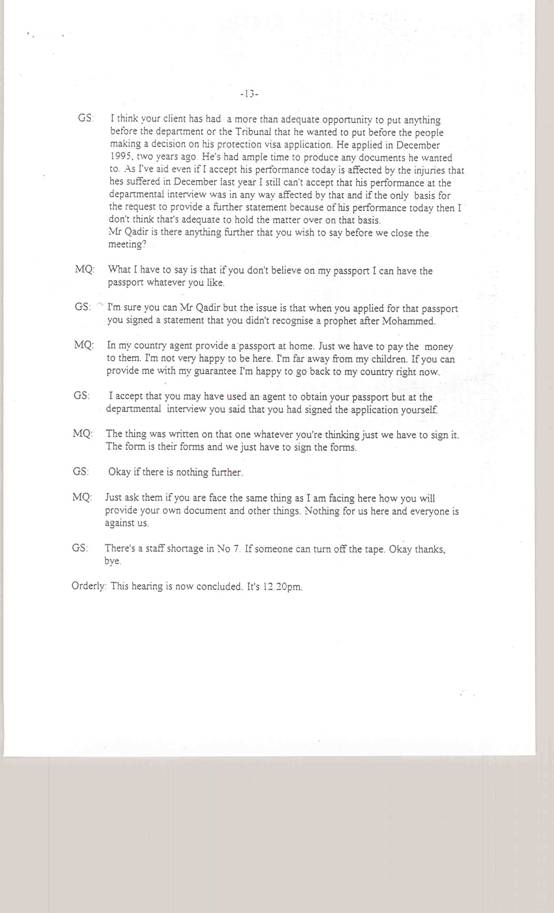
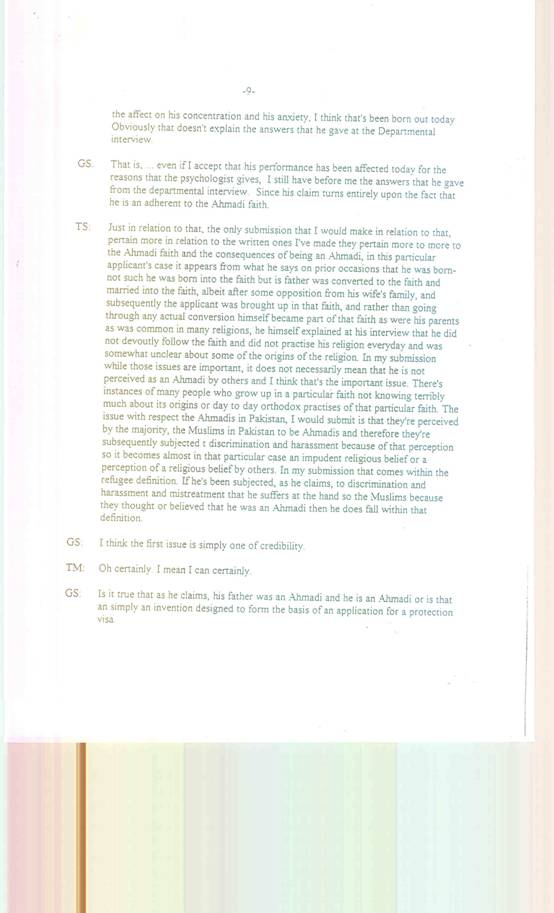
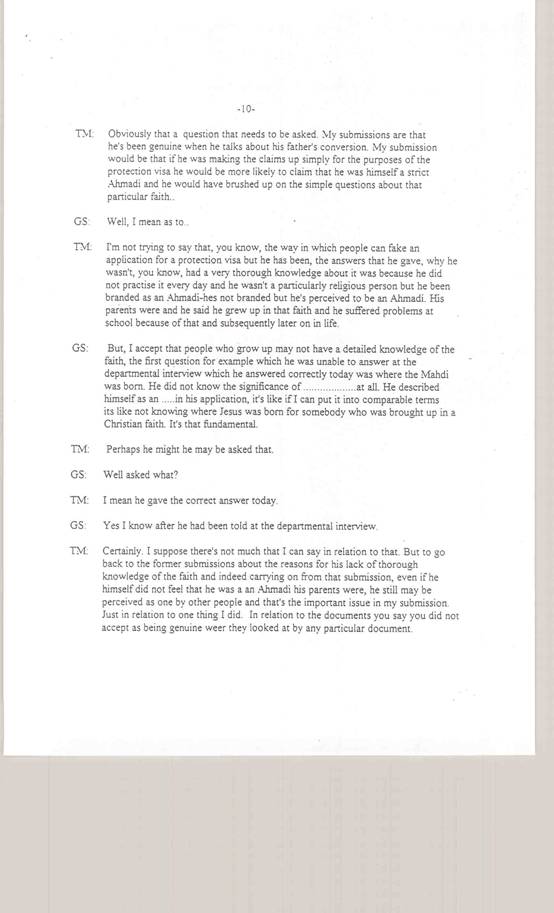
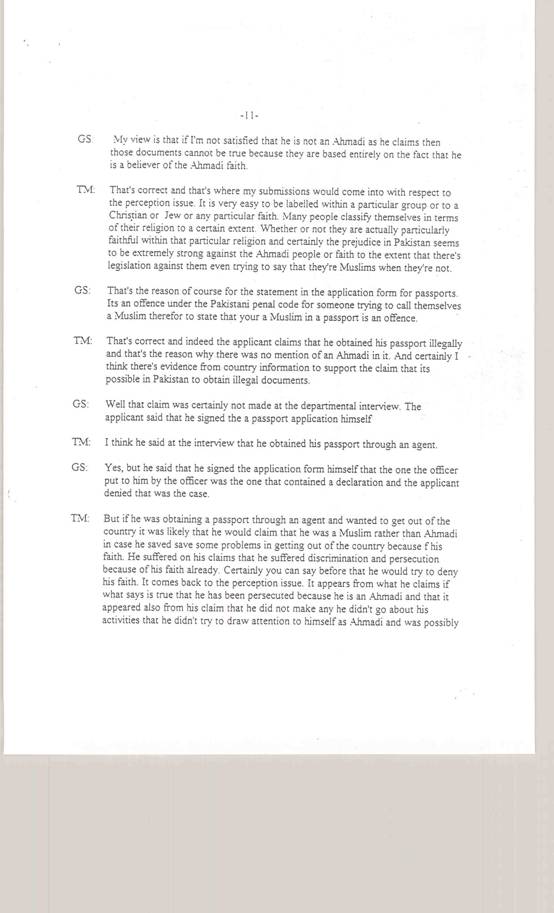
11 The transcript then reveals the exchanges annexed to these reasons for judgment as Appendix 1 and concludes with the exchange marked as Appendix 2.
12 As the transcript reveals, the applicant had a medical appointment at 1 pm at Westmead which was said to be about an hour’s journey away, and what might have been a hearing of up to 3 hours did not commence until well after the scheduled 9.30 am start. There was at least doubt as to whether it would be possible for him to keep the appointment. The inference was that the applicant was a public patient who did not enjoy great flexibility in fixing or changing his appointments.
The respondent’s submissions
13 The respondent submitted that it was a matter for the Tribunal to determine whether injustice might result to the applicant from refusal of an adjournment: Sali v SPC [1993] 116 ALR 625; Nguyen Do Vinh v Minister for Immigration and Ethnic Affairs (unreported Full Court of the Federal Court, 16 October 1997). He said that no error of procedure will occur as long as the Tribunal makes an informed decision on the adjournment. He describes the applicant’s criticisms of the Tribunal as tantamount to a submission that there was no discretion in the Tribunal to refuse the adjournment. He submitted that the Tribunal had the advantage of observing the applicant first hand and that the merits of the exercise of the discretion were not judicially reviewable. He said that the applicant had offered no evidence as to how his case would have been improved if the adjournment had been granted, especially as the conclusion the Tribunal reached was that the applicant was not an Ahmadi.
Consideration
14 In my opinion the treatment of this matter by the Tribunal was grossly unsatisfactory. Tribunals, like Courts, are required to give litigants fair, impartial and courteous hearings. They may rule on arguments and make decisions on disputed questions of fact and law. But even when inquisitorial, they may not mock or ridicule parties or make light of serious matters placed before them in an apparently bone fide manner. They may be sceptical of things said and may reject alleged happenings, but the rejections must be based on evidence or reasonable implications from it. Cases cannot be decided by presuming the answer and then working back to find the evidence to justify it.
15 The Tribunal in this case was made aware that the applicant had suffered the amputation of 3 fingers at work 4 months before the hearing requiring micro and plastic surgery, that the fingers were deformed and not functioning normally, that current X-rays showed that several bones of the fingers had not united despite internal wiring, that he had suffered and was continuing to suffer pain for which he was taking prescribed analgesics, and that he was scheduled to undergo further surgery 3 weeks after the scheduled hearing. The Tribunal was also informed by unchallenged expert evidence that the applicant was suffering from anxiety and depression, that he was stressed and found it difficult to concentrate, that he was receiving psychotherapy and taking medication, and that he was struggling to cope with life. The Tribunal’s response to all this that none of it prevented the applicant from attending the hearing was of course quite beside the point. No one was suggesting that he could not be present. It was said that he would not be able to do justice to himself and his refugee claim. The Tribunal thus failed to address itself to the argument made to it.
16 When soon after the start of the hearing, the applicant stated that he was feeling dizzy and too unwell to answer questions, he was in substance accused of lying because if he could not “sit still for more than 10 minutes”, this complaint was inconsistent with some supposed intention to travel to Belgium. There was and is no evidence that the applicant proposed to visit Belgium at this time or that he could not “sit still” for 10 minutes or that a trip to Belgium was equivalent to sitting still for 10 minutes. The Tribunal’s unilateral limitation of the adjournment it took at that time to 5 minutes was a tokenistic quite inexpert assessment of what was or might have been required. I have not before heard anything quite like it myself.
17 The Tribunal’s reference to the psychologist’s and doctor’s reports was equally banal. It even ridiculed the doctor’s name. The statement that all applicants to the Tribunal suffered from stress at their hearings at best completely misunderstood the conditions the experts were talking about. The Tribunal appears to have revealed a high degree of ignorance of what anxiety and depression are, what effect they have on those suffering from or with them, and what careful management and treatment by experts they often demand. They are serious medical conditions, not correlative with temporary nervousness at facing a challenging and stressful experience. Similarly, judged by its approach during the hearing and by its ultimate explanations in its judgment, the Tribunal exhibited no appreciation of the effect of months of pain and heavy analgesics on a person’s capacity to concentrate and remember detailed facts.
18 In this connection, the Tribunal’s treatment of the applicant’s inability to answer questions such as when the Ahmadi sect was founded, what its attitude was to Jesus and to jihad, and what are the main religious differences between Ahmadis and Sunnis/Shias, or to explain to the Tribunal’s satisfaction why his passport stated he was a Muslim when Pakistani law legislated that Ahmadis were not Muslims manifests a quite profound degree of at best misconception about the problems faced by people in pain who are suffering from post traumatic depression.
19 The Tribunal’s additional statement (rather than question) that to obtain a Pakistani passport stating that he was Muslim, the applicant would have had to sign a declaration that he did not recognise any prophet after Mohammed and that he considered the founder of the Ahmadi sect to be an imposter and a non-Muslim exhibited other significant relevant misunderstandings. Firstly, as the material available to the Tribunal indicated, Pakistani law, society and officialdom do not operate on such abstract foundations, especially towards Ahmadis. Secondly, the perceptions of the applicant’s alleged persecutors were no less important on these matters than the acceptability of his answers or the consistency of his actions. His credibility may well have been, and may yet be, crucial to the outcome of his claim for refugee status. But proper consideration of the application demanded a weighing of his claims with the dilemmas faced by and demands placed on Ahmadis by reason of their serious persecution and harassment by Pakistani authorities as evidenced by material before the Tribunal. This requirement included a consideration of at least the possibility if not probability that the applicant could be a genuine Ahmadi and could suffer persecution as an Ahmadi even if he was not particularly knowledgable about the faith, beliefs and teachings of Ahmadis.
20 The Tribunal’s statement that it had listened to a tape of the applicant’s interview with the original investigating departmental officer, which took place before his injuries, and that that interview convinced it that he knew little or nothing about the Ahmadi sect is also demonstrative of error. A Tribunal hearing only occurs when a favourable decision cannot be made on the papers and the applicant has availed himself of the opportunity of an oral presentation: ss 425, 426. He is denied that presentation when, because of illness, his performance is so adversely affected that the Tribunal can fall back on the departmental interview as determinative, not merely of a minor issue identified by the Tribunal but of an ultimately decisive issue.
21 These matters were all issues that required to be taken into consideration on the question of the adjourment. The Tribunal appears to have addressed none of them.
Conclusion
22 In my opinion, the applicant did not receive the true or bone fide consideration of his application for adjournment that the Tribunal was bound to give him. The material submitted made out a prima facie case for an adjournment. There was no contrary evidentiary basis for rejecting the application. Its due consideration required a considered analysis and a dispassionate not preconceived decision. At the very least, there was evidence that could have established that without an adjournment, the applicant could not receive the hearing offered him by the Migration Act. In Sun Zhan Qui v Minister for Immigration & Ethnic Affairs [1997] 151 ALR 505 at 565, Justice North said that the review system prescribed inter alia by sections 420 and 476 of the Act is intended by the Parliament to be humane and civilised. In my view, the Tribunal’s treatment of this matter and its decision to affirm the refusal of asylum as a refugee to the applicant on the ground that he was not an Ahmadi did not meet this standard.
23 The Tribunal’s determination of 18 May 1998 is set aside. The matter is remitted to the Tribunal for a new hearing on the merits by a different Tribunal member. The respondent is to pay the applicant’s costs.
|
I certify that the preceding twenty-three (23) numbered paragraphs are a true copy of the Reasons for Judgment herein of the Honourable Justice Marcus Einfeld AO. |
Associate:
Dated: 11 May 1999
|
Counsel for the Applicant: |
Mr J.R. Young |
|
|
|
|
Solicitor for the Applicant: |
Newman & Associates |
|
|
|
|
Counsel for the Respondent: |
Mr D.H. Godwin |
|
|
|
|
Solicitor for the Respondent: |
Australian Government Solicitor |
|
|
|
|
Date of Hearing: |
29 September 1998 |
|
|
|
|
Date of Judgment: |
11 May 1999 |
FEDERAL COURT OF AUSTRALIA
Qadir v Minister for Immigration & Multicultural Affairs [1999] FCA 620
Appendix 1
MUHAMMAD QADIR V MINISTER FOR IMMIGRATION & MULTICUTURAL AFFAIRS
NG 593 OF 1998
THE HON JUSTICE MARCUS EINFELD AO
SYDNEY
11 MAY 1999
GS: How does that differ from the beliefs of the Sunni sect?
MQ: We never feel any different, but they think they’re different.
GS: What would be the views of the Ahmadi sect on conversion by force? Conversion to the Islamic faith by force
MQ: We never force anyone.
GS: When would the Ahmadi sect belief that a religious war was correct?
MQ: If you give me some time I can reply to these questions.
GS: When did _______ die?
MQ: In India.
GS: I’m asking when he died?
MQ: It is impossible for me to reply any more questions. If you want to consider my application please give me some more time.
GS: I’ve already explained to you why I don’t accept that you require an adjournment.
MQ: Your doing your own and your not listening to me. There is no justice for us anywhere.
GS: Look, Mr Qadir, I’ve had the advantage of listening to the tape of the interview with the Departmental Officer. That interview took place before your injury. In that interview you demonstrated a comprehensive lack of knowledge about the Ahmadi sect, and the only explanation you gave was that you were too busy to learn about your religion. Your passport states that you are a Muslim.
MQ: Of course we are Muslim.
GS: And the information available to me is that in order to have a passport stating that you’re a Muslim you would have had to sign a declaration stating that you do not recognise any prophet after Muhammed and that you consider _______ to be an imposter and is non Muslim.
MQ: In Pakistan we can do anything.
GS: On the basis of you answers in the departmental interview, on the basis of the few answers that you’ve given me today and on the basis of the statement on your passport I do not accept that you are in adherent of the Ahmadi sect.
MQ: We know it will happen like this, and it’s the same thing that is happening in my country and the same thing is happening here. They got the power and they do things according to their own wish. We’re thing we have in our own hearts. I am not happy, I worry about my children, I don’t come here to earn the money only. I lost every thing here when I came. Since last 5 months I’m very much upset with my injury, I’ve never been to hospital in my life before.
GS: So that there’s no misunderstanding because I don’t accept that you are a member, an adherent of the Ahmadi sect, I don’t accept that the documents that you’ve produced, which suggest that you face charges in Pakistan are genuine. And I don’t accept that you face charges in Pakistan are genuine. And I don’t accept that you face any prospect of being arrested or imprisoned on the basis of your religious beliefs.
MQ: If anybody will kill us on the airport then will you believe it?
GS: Now then, I give you that back I’ve got the copy of the original this afternoon. Are there any questions that you feel I should have put to you?
TM: Well, I think the difficulty is that he’s having difficulty answering them so I think that’s a problem more than the questions asked of him. That seems to be evident from the answers he’s give so far. I mean, in a perfect hearing you’d be asking questions about every aspect of his claim. Whether there’s any point to that or not, it’s difficult to see that there is really.
GS: Have you listened to the tape of the interview?
TM: No, I’ve read the decision and it’s fairly, from that it’s fairly obvious what happened at the departmental interview. I wasn’t acting for him then and in fact I only just recently, fairly recently come into the matter and I have only very recently seen Mr Qadir because he didn’t see me from the time he had the accident till the time now. So there has been some difficulty in fully preparing the matter as I would have liked to prepare it for the hearing today. And it’s been difficult to obtain adequate and sufficient information from him because he has been like this with me also, he’s been suffering from distress when we start discussing his case. I’d just like to put on the record that, it’s obviously on the file, that the problems that he says he’s been having and that the medical information was sent to the Tribunal about
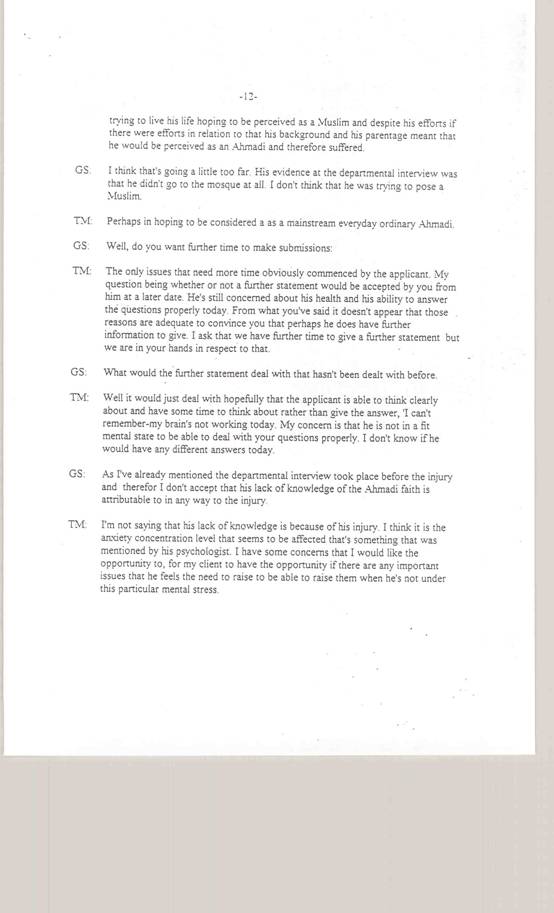
FEDERAL COURT OF AUSTRALIA
Qadir v Minister for Immigration & Multicultural Affairs [1999] FCA 620
Appendix 2
MUHAMMAD QADIR V MINISTER FOR IMMIGRATION & MULTICUTURAL AFFAIRS
NG 593 OF 1998
THE HON JUSTICE MARCUS EINFELD AO
SYDNEY
11 MAY 1999