

FEDERAL COURT OF AUSTRALIA
Dr Martens Australia Pty Ltd v Figgins Holdings Pty Ltd [1999] FCA 461
EXPLANATORY SUMMARY
Interests associated with the manufacture of Dr Martens footwear commenced proceedings against Figgins Holdings Pty Ltd, Bata Shoe Company of Australia Pty Ltd, Rivers (Australia) Pty Ltd and Windsor Smith Pty Ltd and other companies and persons associated with them claiming, in substance, that those companies had manufactured and sold footwear which copied the features of the trade dress and get‑up of Dr Martens Z welt footwear which were said to be distinctive of the Z welt footwear. It was said that in so doing these companies had represented that their footwear was Z welt footwear and came from the same trade source as the Dr Martens Z welt footwear.
These companies had marked their footwear with their own brands and their footwear was sold at retail prices cheaper than the prices of the Dr Martens Z welt footwear.
The Court has found that the claims against Figgins Holdings Pty Ltd, Bata Shoe Company of Australia Pty Ltd, Rivers (Australia) Pty Ltd and the companies and persons associated with them have not been made out and the Court has dismissed those claims.
The Court has found that Windsor Smith Pty Ltd and companies associated with it have represented that their three items of footwear are Z welt footwear, come from the same trade source as the Z welt footwear and have the sponsorship or approval of the Dr Martens trade source. The Court has found that these companies have passed off their footwear as and for footwear emanating from the Dr Martens trade source and have contravened s 52 and s 53(c) of the Trade Practices Act 1974 (Cth). The Court has also found that a director of these companies was involved in those contraventions.
The Court has concluded that the application against the Windsor Smith respondents has succeeded because in addition to the features of trade dress and get‑up found in the Windsor Smith footwear there was moulded on the sole of such footwear the words “The ORIGINAL” in a stylised script identical to the words “The ORIGINAL” moulded on the soles of Dr Martens footwear since 1987.
It will now be necessary for there to be a further hearing to determine the amount of loss and damage suffered by the Dr Martens interests as a result of the conduct of Windsor Smith Pty Ltd and its associated companies.
FEDERAL COURT OF AUSTRALIA
Dr Martens Australia Pty Ltd v Figgins Holdings Pty Ltd [1999] FCA 461
TRADE PRACTICES – misleading and deceptive conduct – whether the applicants Dr Martens “Z welt” footwear trade dress and get‑up, comprising specific distinctive features, had acquired a substantial reputation and identification in the market - whether the existence of imitations and “look‑alikes” in the market diluted or diminished the significance, identification and reputation of the Z welt footwear distinctive features – whether look‑alike footwear possessing a combination of the distinctive features caused consumers to associate the trade source with Dr Martens - whether existence of look‑alike footwear enabled potential purchasers to become aware of their existence and able to distinguish them from the genuine footwear – whether footwear manufactured by the respondents similar in appearance, trade dress and get‑up to the applicants’ footwear - misrepresentation – whether in trade or commerce - whether purchasers or potential purchasers likely to be deceived or misled by the respondents’ look‑alike footwear – effect of labelling, branding and price differences – effect of consumers’ brand awareness.
INTELLECTUAL PROPERTY – passing off - elements of – misrepresentation – whether purchasers or potential purchasers likely to be deceived or misled by the respondents’ look‑alike footwear – effect of labelling, branding and price differences – effect of consumers’ brand awareness.
INTELLECTUAL PROPERTY – trade marks - infringement - whether respondents’ marks were substantially identical with or deceptively similar to the applicants’ registered trade mark.
Trade Practices Act 1974 (Cth) s 52, s 53, s 55, s 75B
Trade Marks Act 1995 (Cth): s 122(1)(b)
Reckitt & Colman Products Limited v Borden Inc [1990] RPC 341 – considered and distinguished
Cadbury‑Schweppes Pty Ltd v The Pub Squash Co Pty Ltd (1980) 32 ALR 387 - applied
Taco Company of Australia Inc v Taco Bell Pty Ltd (1982) 42 ALR 177 - applied
Conagra Inc v McCain Foods (Aust) Pty Ltd (1992) 33 FCR 302 - applied
Parkdale Custom Built Furniture Pty Ltd v Puxu Pty Ltd (1981) 149 CLR 191 – applied
Equity Access Pty Ltd v Westpac Banking Corporation (1989) 16 IPR 431 - applied
Australian Woollen Mills Ltd v F S Walton and Co Ltd (1937) 58 CLR 641 - applied
Paragon Shoes Pty Ltd v Paragini Distributors (NSW) Pty Ltd (1988) 13 IPR 323
Philips Electronics NV v Remington Products Australia Pty Limited (1997) 39 IPR 283 -
Levi Strauss & Co v Wingate Marketing Pty Limited (1993) 43 FCR 344 (on appeal (1994) 49 FCR 89) - distinguished
HP Bulmer Ltd & Showerings Ltd v J Bollinger SA [1978] RPC 79 - distinguished
Taittinger SA v Allbev Ltd (1993) 27 IPR 105 - distinguished
Shell Company of Australia Co Limited v Esso Standard Oil (Australia) Limited (1963) 109 CLR 407 - applied
DR MARTENS AUSTRALIA PTY LTD & ORS v FIGGINS HOLDINGS PTY LTD & ORS
VG 958 of 1995
DR MARTENS AUSTRALIA PTY LTD & ORS v BATA SHOE COMPANY OF AUSTRALIA PTY LTD & ORS
VG 959 of 1995
DR MARTENS AUSTRALIA PTY LTD & ORS v RIVERS (AUSTRALIA) PTY LTD & ORS
VG 960 of 1995
DR MARTENS AUSTRALIA PTY LTD & ORS v WINDSOR SMITH PTY LTD & ORS
VG 962 of 1995
GOLDBERG J
16 APRIL 1999
MELBOURNE
| IN THE FEDERAL COURT OF AUSTRALIA |
| |
| VICTORIA DISTRICT REGISTRY |
| |
|
VG 958 of 1995 BETWEEN
AND: |
DR MARTENS AUSTRALIA PTY LTD R GRIGGS & CO LTD DR ING. HERBERT FUNCK ELISABETH MAERTENS WOLLASTON VULCANISING COMPANY LTD Applicants FIGGINS HOLDINGS PTY LTD SASHA SHOES PTY LTD KEITH JAMES CORN MARK FAGENBLAT JEFFREY DONALD FIGGINS DAVID MAYNE VENNER LORRAINE JOY FIGGINS MARK LANE ROBERTSON VAN MURRAY MacGREGOR TERENCE ROY GRIFFIN FREDERICK HALCOMB MOYLAN Respondents | |
| VG 959 of 1995 BETWEEN:
AND: |
DR MARTENS AUSTRALIA PTY LTD R GRIGGS & CO LTD DR ING. HERBERT FUNCK ELISABETH MAERTENS WOLLASTON VULCANISING COMPANY LTD DR MARTENS INTERNATIONAL TRADING GmbH DR MAERTENS MARKETING GmbH Applicants BATA SHOE COMPANY OF AUSTRALIA PTY LTD JOHN RICHARD BECKWITH GORDON HERBERT THRING MALCOLM WILLIAM GRANT ALAN KELLY Respondents | |
| VG 960 of 1995 BETWEEN:
AND: |
DR MARTENS AUSTRALIA PTY LTD R GRIGGS & CO LTD DR ING. HERBERT FUNCK ELISABETH MAERTENS WOLLASTON VULCANISING COMPANY LTD Applicants RIVERS (AUSTRALIA) PTY LTD LOUISE ROBYN GOODMAN PHILIP HARRY GOODMAN Respondents | |
| VG 962 of 1995 BETWEEN: | DR MARTENS AUSTRALIA PTY LTD R GRIGGS & CO LTD DR ING. HERBERT FUNCK ELISABETH MAERTENS WOLLASTON VULCANISING COMPANY LTD DR MARTENS INTERNATIONAL TRADING GmbH DR MAERTENS MARKETING GmbH Applicants | |
| AND: | WINDSOR SMITH PTY LTD CHICAGO BOOT COMPANY PTY LTD BRETT MANCE CRAIG MANCE LEANNE MANCE DIANE MANCE AD. MANCE AUSTRALIA PTY LTD Respondents | |
|
|
| |
| JUDGE: | GOLDBERG J | |
| DATE: | 16 APRIL 1999 | |
| PLACE: | MELBOURNE
| |
INDEX
Heading Page
Introduction 2
The applicants and their background 5
Development of the Z welt footwear 8
Labelling and branding of the Z welt footwear 9
Licensing arrangements 11
History of Dr Martens in Australia 12
Promotional activity in relation to Dr Martens footwear 15
Sales of Z welt footwear in Australia 17
What are the distinctive features of the Z welt footwear? 18
The New Zealand manufactured product 29
Manufacture and sale of “look‑alike” or imitation products 35
The applicants’ description of the respondent’s products 43
Distinctiveness of the trade dress or get‑up and its reputation 47
Reputation and misrepresentation 50
Actual Deception 55
Branding and pricing 55
The Bata case 66
Bata expert evidence 73
The Figgins case 78
The Rivers case 84
The Windsor Smith case 92
Relevant legal principles 106
INDEX cont …
Is there an association identified between the Dr Martens trade source and look‑alike 128
products notwithstanding different branding?
Basic propositions relied upon by applicants 131
Does knowingly purchasing an imitation cause loss? 137
Similarity of respondents’ footwear 139
The Windsor Smith products 141
The Figgins product 142
The Rivers product 143
The Bata product 144
Was there passing off and a contravention of the Trade Practices Act? 145
Proof of actual damage or loss 151
Individual respondents 151
Trade mark infringement 153
Standing 156
Claim against Chicago Boot Company Pty Ltd 159
Limitation of Actions defence 160
Conclusion 161
| IN THE FEDERAL COURT OF AUSTRALIA |
|
|
|
| BETWEEN
AND: |
DR MARTENS AUSTRALIA PTY LTD R GRIGGS & CO LTD DR ING. HERBERT FUNCK ELISABETH MAERTENS WOLLASTON VULCANISING COMPANY LTD Applicants FIGGINS HOLDINGS PTY LTD SASHA SHOES PTY LTD KEITH JAMES CORN MARK FAGENBLAT JEFFREY DONALD FIGGINS DAVID MAYNE VENNER LORRAINE JOY FIGGINS MARK LANE ROBERTSON VAN MURRAY MacGREGOR TERENCE ROY GRIFFIN FREDERICK HALCOMB MOYLAN Respondents |
| VG 959 of 1995 BETWEEN:
AND: |
DR MARTENS AUSTRALIA PTY LTD R GRIGGS & CO LTD DR ING. HERBERT FUNCK ELISABETH MAERTENS WOLLASTON VULCANISING COMPANY LTD DR MARTENS INTERNATIONAL TRADING GmbH DR MAERTENS MARKETING GmbH Applicants BATA SHOE COMPANY OF AUSTRALIA PTY LTD JOHN RICHARD BECKWITH GORDON HERBERT THRING MALCOLM WILLIAM GRANT ALAN KELLY Respondents |
| VG 960 of 1995 BETWEEN:
AND: |
DR MARTENS AUSTRALIA PTY LTD R GRIGGS & CO LTD DR ING. HERBERT FUNCK ELISABETH MAERTENS WOLLASTON VULCANISING COMPANY LTD Applicants RIVERS (AUSTRALIA) PTY LTD LOUISE ROBYN GOODMAN PHILIP HARRY GOODMAN Respondents |
| VG 962 of 1995 BETWEEN: | DR MARTENS AUSTRALIA PTY LTD R GRIGGS & CO LTD DR ING. HERBERT FUNCK ELISABETH MAERTENS WOLLASTON VULCANISING COMPANY LTD DR MARTENS INTERNATIONAL TRADING GmbH DR MAERTENS MARKETING GmbH Applicants |
| AND: | WINDSOR SMITH PTY LTD CHICAGO BOOT COMPANY PTY LTD BRETT MANCE CRAIG MANCE LEANNE MANCE DIANE MANCE AD. MANCE AUSTRALIA PTY LTD Respondents
|
| JUDGE: | |
| DATE: | |
| PLACE: |
REASONS FOR JUDGMENT
Introduction
1 Dr Martens footwear, or as it is often more colloquially called, “Doc Martens” or “Docs”, is one of the more famous footwear brands in the world. Dr Martens footwear started off life as industrial or work footwear and was initially marketed to, and used by, persons in a variety of occupations needing hard wearing footwear who spent long periods on their feet. However, in the 1970s and into the 1980s the applicants’ footwear and in particular their boots with what the applicants describe as the “Z welt” style or look started to become popular with teenagers and young adults. The reference to Z welt is a reference to the method of stitching the welt to the upper of the footwear. This style or look was adopted as an image of tough streetwear and was considered to identify a sign of rebellion and anti‑establishment feeling in the wearer. The Z welt footwear rapidly became identified with popular culture and began to achieve a cult status. It became more popular as a cult item after a large pair of Dr Martens boots appeared in the 1970s film “Tommy” which featured the music of the group “The Who” and Elton John.
2 Over the years, and more recently in the late 1980s and 1990s, the Z welt footwear has achieved a very wide acceptance as a fashion item. It has achieved its image and acceptance not so much through media advertising as through word of mouth and association with its work and cult background.
3 What is in issue in these proceedings arises out of the get‑up and trade dress, image and presentation of the Z welt footwear. It has developed from its original concept as comfortable work wear into a fashion statement with the youth and young adult market who purchase it as a fashion item and for streetwear. According to the evidence young people have regarded Z welt footwear as “anti‑fashion”, “cool”, and a sign of anti‑establishment or rebellious feeling. The Z welt style or look is found in both boots and shoes. Subject to further analysis to which I shall refer the Z welt style is said by the applicants to incorporate the following distinctive features:
· a prominent and brightly coloured welt stitch thread of yellow or yellow/orange colour;
· the welt stitch thread is sewn in a large and visible looped stitch;
· a visible synthetic or plastic welt of black or dark brown colour;
· a partially transparent synthetic or plastic sole made from PVC having a light brown colour, a grooved sole edge and a two‑tone effect in sole side view;
· an angled heel on the sole instep;
· a sole pattern being either the Dr Martens sole design (called the DMS sole) or a cleated sole design (called the BEN or Commando sole);
· thick yellow and black, brown and yellow or black laces.
4 In these reasons I refer to these features for the convenience of using a shorthand expression as the “distinctive features” although it is a matter of controversy as to whether the features are in fact distinctive or distinctive of footwear manufactured by the second applicant, R Griggs & Co Ltd. The footwear given the designation Z welt by the second applicant has not been known or identified by that name by the public and I use that designation in these reasons as a shorthand expression to describe footwear possessing the distinctive features relied upon by the applicants.
5 The applicants claim in a number of forms, which I will presently identify, a commercial or proprietary interest in the Dr Martens technology, brand name, get‑up and trade dress and they are seeking in these proceedings to protect that get‑up and trade dress. They have done so by issuing four separate proceedings against four different groups of respondents, and, with the consent of the parties, the four proceedings have been heard together on the basis, substantially, that the evidence led is evidence in each proceeding.
6 The applicants say that the respondents have copied the get‑up and trade dress of the particular Dr Martens Z welt footwear, and put look‑alike or imitation Dr Martens products into the market. By so doing, it is said that the respondents have wrongfully appropriated the distinctive features of the trade dress and get‑up of the Z welt footwear and have thereby wrongfully appropriated the goodwill and the reputation of the applicants in the trade dress and get‑up of the Z welt footwear. It is also said that those activities constitute misleading and deceptive conduct and fake and misleading representations.
7 The four principal respondents are Figgins Holdings Pty Ltd (“Figgins”), Bata Shoe Company of Australia Pty Ltd (“Bata”), Rivers (Australia) Pty Ltd (“Rivers”) and Windsor Smith Pty Ltd (“Windsor Smith”). Against all respondents the applicants rely on causes of action in passing off and contraventions of ss 52, 53 and 55 of the Trade Practices Act 1974 (Cth) (“the Act”). Against two respondents, Bata and Windsor Smith, there is also a claim for trade mark infringement. Against directors of the various corporate respondents it is alleged that they have been knowingly concerned in, or a party to, the contraventions alleged. On 15 July 1997 I ordered that the issue of liability be determined separately from any issue as to the quantum of any loss and damage.
8 The respondents’ principal defences are put on a number of bases:
· what are said to be the distinctive features are not in fact distinctive of, or referable to, Dr Martens footwear but are common and found in other items of footwear;
· their respective footwear does not have all the distinctive features;
· their respective footwear has features which result in a different trade dress or get‑up from that of the Z welt footwear;
· Dr Martens footwear has developed a substantial reputation and image by reference to, and the use of, the brand name “Dr Martens” either independently of the distinctive features or at least in conjunction with them to the extent that it is the brand name which attracts the customer;
· the distinctive features are not distinctive of all items of Z welt footwear produced by the applicants or under licence with them;
· any distinctiveness of the Z welt footwear was diluted and diminished by the marketing and sale of a range of Dr Martens “College” footwear manufactured in New Zealand;
· there is no representation in, or by, the respondents’ products that they are Dr Martens footwear or that they come from the Dr Martens trade source;
· in the respondents’ products are sold under and by reference to brand names and marks which make it clear that what are being sold are products of manufacturers other than, and not connected, with Dr Martens;
· Dr Martens has advertised and sold items of Z welt footwear which do not possess all the distinctive features;
· numerous look‑alike and imitation Z welt footwear has come into the market over the years and potential purchasers have been able to distinguish that footwear from the genuine Z welt footwear and this has diluted and diminished the distinctiveness of the Z welt footwear by reference to the distinctive features.
Bata and Windsor Smith also deny trade mark infringement.
9 To the extent to which I refer to the evidence of witnesses hereafter I accept that evidence except where I say to the contrary.
The applicants and their background
10 The applicants represent two sets of interests, the Griggs interests and the Dr Martens interests. The first applicant Dr Martens Australia Pty Ltd (“DMA”) is the exclusive distributor and seller in Australia of Dr Martens footwear, including the Z welt footwear, manufactured by the second applicant. Previously DMA was the exclusive distributor of Dr Martens footwear in the eastern States of Australia and, with Swan Imports Pty Ltd, was the distributor of Dr Martens footwear in South Australia and Western Australia.
11 The second applicant R. Griggs & Co Ltd (“Griggs”), is and has been since 1960 the manufacturer in England of Dr Martens footwear including the Z welt footwear. The applicants claim that Griggs is the owner of the goodwill in the trade dress and get‑up of the Z welt footwear.
12 The third applicant Dr Ing. Herbert Funck (“Dr Funck”) and the fourth applicant, Elisabeth Maertens (“Elisabeth Maertens”) were the proprietors of certain trade marks including “Dr Martens” which, through Dr Martens International Trading GmbH and Dr Maertens Marketing GmbH the sixth and seventh applicants in the Bata and Windsor Smith proceedings, are exclusively licensed to Griggs. Elisabeth Maertens is the widow of, and successor in law to, Dr Klaus Maertens who died in 1988. Dr Funck and Elisabeth Maertens also licence to the fifth applicant Wollaston Vulcanising Company Limited, the manufacture of the air cushioned sole for Dr Martens footwear.
13 The fifth applicant, Wollaston Vulcanising Company Limited (“Wollaston”), is the manufacturer in England of the air cushioned soles for Dr Martens footwear including the Z welt footwear and sells the soles to Griggs.
14 The sixth applicant, Dr Martens International Trading GmbH, is the registered proprietor of Australian registered trade mark 641055(25) and since 2 May 1997 the seventh applicant Dr Maertens Marketing GmbH has been registered as the joint proprietor of that trade mark. The trade mark is in the following form:
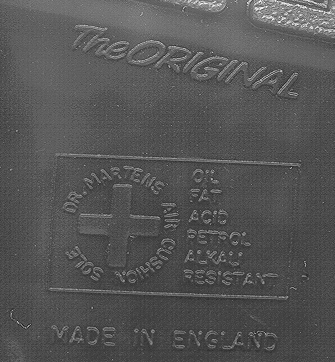
It is only the rectangle which comprises the trade mark; the words “The ORIGINAL” and “MADE IN ENGLAND” do not form part of it. However it is helpful to show the lay out of the sole markings as they are relevant to a number of issues in the proceedings. This trade mark is often described as the Dr Martens logo or the resistance rectangle. The sixth and seventh applicants are now the registered proprietors of the trade marks “DR. MARTENS” and “DOC’S”.
15 Each applicant claims to have suffered loss and damage in various ways as a result of the conduct of the respondents in manufacturing and marketing their respective footwear.
16 Griggs and its predecessors have been involved in the manufacture of footwear in the village of Wollaston in Northamptonshire in England since 1901. The Griggs predecessors over the years have manufactured agricultural boots and military boots which have been used in the First World War, the Second World War and the Korean War. In 1957 the Griggs interests established Wollaston for the purpose of manufacturing vulcanised rubber soles for attachment to boot uppers. The vulcanised rubber sole enabled the use of production methods which resulted in greater output for lower cost than the traditional methods then being used by the Griggs interests. Wollaston has supplied the Griggs interests with rubber soles for use in the manufacture of their footwear.
17 In the late 1940s and early 1950s Dr Funck and Dr Maertens developed a new sole unit for footwear and a manufacturing process for that sole unit. The sole unit had a structure which comprised a series of separated air compartments which created an air cushioned effect in the sole of the footwear when worn. This air cushioned sole was the subject of a number of United Kingdom patents (now expired) in the names of Dr Funck and Dr Maertens. Wollaston became interested in the patents, the air cushioned sole and its manufacturing process and in late 1959 or early 1960 Dr Funck and Dr Maertens and Wollaston entered into a licence agreement (called a “Utilisation Contract”) whereby Wollaston was granted the rights to exploit the patents and manufacture the air cushioned sole. Under the Utilisation Contract the air cushioned soles which were produced were to have marked on them the words “Dr Martens”. It was separately agreed that footwear made in Germany was to be sold under the trade mark “Dr Maertens” but that the promotion, marketing and sales of the footwear in the United Kingdom and elsewhere could occur if the word “Maertens” was anglicised to “(Dr) Martens”. The Utilisation Contract gave Wollaston the right to sub‑licence the right to manufacture shoes constructed with the air cushioned sole manufactured by Wollaston and it was expressed to operate for an initial term of one year but it was apparently extended either indefinitely or from time to time. It made no provision for the design, style, trade dress or get‑up of the footwear which was to be manufactured with the air cushioned sole.
Development of the Z welt footwear
18 In early 1960 Griggs adapted the air cushioned sole for use with a footwear upper by a process which involved heat sealing the sole to the upper with a welt and using a large looped bright coloured yellow/yellow‑orange coloured welt stitch thread around the footwear. This created what was said to be a particular “footwear look” which involved a leather upper, a dark welt with a large looped bright yellow/yellow‑orange coloured welt stitch, a light coloured sole with a two‑toned band effect in the sole side view which resulted from the heat sealing of the dark welt with the lighter coloured sole, the consequence being that there was a merging of the dark colour into the light colour. Griggs used a finishing method for the edge of the sole units which had the effect of creating grooves on the side edge of the sole around the footwear. The grooved sole edge resulted from the manner in which Griggs finished or trimmed the sole side edges. As the finishing or trimming occurs there is a variable pressure at the sole side edge which results in fine sole edge grooving with an uneven or irregular “patterning” around the perimeter edge of the footwear at the sole side edge. It is possible to finish or trim the sole side edge by alternative processes which eliminate the grooves and provide a smooth or flattened sole side edge with a more even or regular sole side edge.
19 The sole had a particular sole pattern called “the DMS sole” which, in general terms, comprised broken ribbing or parallel bars. This footwear look was new to the United Kingdom at the time and quite different in look from any footwear then being made or sold. It is the applicants’ case that this look which incorporates the distinctive features has over the years become distinctive of “Z welt” footwear manufactured by Griggs. The DMS sole was not the only sole used on the Z welt footwear by Griggs. An alternative design was used called the “BEN” or “Commando” sole.
20 The first item of footwear manufactured by Griggs with the Z welt look occurred on 1 April 1960. It was an eight eyelet boot which incorporated the distinctive features and it was given the style number 1460 representing the date of its first manufacture. Shortly afterwards a shoe was manufactured by Griggs which incorporated the same look and this was given the style number 1461. The letter “Z” was attached as a suffix to these codes, the “Z” referring to any footwear bearing the yellow/yellow‑orange large looped welt stitch. According to Mr Shelton, the deputy chairman of Griggs and the managing director of R Griggs Group Limited, the origin of the yellow stitching on the 1460Z and the 1461Z products came from a whim of Mr W H Griggs.
21 Since 1960 the soles on the Z welt footwear have had moulded on the instep in the course of Wollaston’s manufacturing process the words “Dr Martens”, the Dr Martens logo and “MADE IN ENGLAND”. On some soles instead of the Dr Martens logo there has been moulded a Swiss cross device with the words “Dr. Martens” and “Air Cushion Sole” surrounding the cross. Since 1960 Griggs has also manufactured non‑Z welt boots and shoes made from soles manufactured by Wollaston and these are not in issue in these proceedings.
Labelling and branding of the Z welt footwear
22 From its inception the Z welt footwear manufactured by Griggs was branded and labelled in a number of ways. The words “Dr Martens” and “AirWair” with a symbol of bouncing soles were printed on the sock or inner sole of the footwear with the words “MADE IN ENGLAND”. The symbol comprised a representation of a ball with the words “AirWair” through the middle of the ball and the words “with bouncing soles” across the bottom of the ball. This AirWair logo has been displayed on the end of the boxes in which the Griggs Z welt footwear has been packaged since the mid 1970s. From 1987 the words “The Original” were also printed on the sock in a stylised form. Since the 1960s there has been moulded on the instep of the sole the Dr Martens logo and “MADE IN ENGLAND”. From 1987 the words “The ORIGINAL” in a stylised form were also moulded on the instep of the soles made in the DMS sole pattern. There was also attached to the eyelet of the footwear a swing tag with the words “Dr Martens AirWair” and the bouncing soles symbol together with text explaining the features of the Dr Martens footwear.
23 In the late 1960s and until 1988 the sock inserted in almost all Griggs manufactured Dr Martens footwear was marked with the words - “AirWair With Bouncing Soles” being placed over a bouncing ball and the words “Dr Martens” were placed underneath the AirWair logo. Since 1988 the sock has been imprinted with the Dr Martens AirWair bouncing soles logo below which appear the words:
“The Original
MADE IN ENGLAND
LEATHER UPPER
AIR CUSHION
MAN MADE SOLES”
The AirWair logo has been used in conjunction with the name Dr Martens and with the expression “with Bouncing Soles” in one form or another since the 1960s. The 1460Z boot has had for some time a heel tag with the words “AirWair” and “WITH Bouncing SOLES” in contrasting yellow stitching woven into it.
24 The labelling of the boxes in which Dr Martens footwear manufactured by Griggs has been exported to Australia and sold has changed over the years. From 1960 until the mid 1980s the packaging was a plain cardboard box with an “AirWair WITH Bouncing SOLES” logo on the front. From the mid 1980s to the late 1980s the cardboard boxes were coloured red, white and blue with the words AirWair and Dr Martens Air Cushioned Soles featured prominently on the box together with the Dr Martens AirWair bouncing soles logo. From approximately 1989 to 1992 the Dr Martens footwear was exported to Australia in a burgundy box which had a logo attached to the end of the box showing the Dr Martens name, the AirWair with bouncing soles logo and the words “export quality” and “Made in England”. During 1992 and 1993 Griggs exported the Dr Martens footwear to Australia in a box bearing the Dr Martens name, the AirWair with bouncing soles logo and the words “Made in England”. From 1993 to the present date Griggs has exported the Dr Martens footwear to Australia in a box bearing the Dr Martens name.
25 Since Griggs commenced manufacturing Dr Martens footwear it has tied swing tags to the shoes and boots through an eyelet. The swing tag has changed from to time. From the mid 1960s to the mid 1970s the swing tag displayed the AirWair with bouncing soles logo. From the mid 1970s to the early 1980s the swing tag featured a portion of the Union Jack and under it the words “GENUINE Dr Martens AIR CUSHION SOLES MADE IN ENGLAND”. From the early 1980s to the mid 1980s the swing tag displayed the name Dr Martens, the AirWair with bouncing soles logo, the words “MADE IN ENGLAND” and a short narrative of the history of the air cushioned sole and its features. From the mid 1980s to the late 1980s the swing tag displayed the name Dr Martens, the words “MADE IN ENGLAND” and a short narrative of the history of the air cushioned sole and its features. Between 1989 and 1994 the swing tag displayed the words “air cushioned comfort”, the Dr Martens name and the AirWair with bouncing soles logo, the words “with lasting style for all walks of life” and a narrative of the air cushioned sole. From 1994 to the present date the swing tag has displayed the words “Genuine”, underneath it the words “Dr Martens” with the AirWair with bouncing soles logo and underneath it the words “air cushioned comfort”. It also sets out a short narrative of the features of the air cushioned sole.
Licensing arrangements
26 Initially the manufacture and sale of the Dr Martens footwear constructed with the Wollaston soles was sub‑licensed to Griggs but later Wollaston appointed other companies as sub‑licensees as a result of the demand for Dr Martens footwear. Griggs was a sub‑licensee of Wollaston from 1960 through to 1996 and other sub‑licensees were also appointed for various periods. These included G.T. Hawkins & Co Limited (“Hawkins”) from 1960 to 1993, George J. Cox Ltd from 1960 to 1996 and White & Co. (Earls Barton) Limited (“White”) from 1960 to 1995. These companies manufactured footwear with the distinctive features which was sold in Australia and although the footwear was always branded as Dr Martens each manufacturer packaged its version of the Z welt footwear differently with its own brand such as Griggs ‑ “AirWair”, Accent Footwear Limited - “Dr Martens”, Hawkins - “Astronauts” and White - “Tred‑Air”. There were other sub‑licensees some of whom became wholly owned subsidiaries of Griggs and thereupon ceased their manufacturing activities.
27 As the standing of the applicants to claim the relief sought is challenged it is desirable to identify the various agreements whereby rights relevant to the manufacture and sale of footwear bearing the Dr Martens trade mark and the Z welt get‑up and trade dress were granted. Confidentiality has been claimed in respect of these agreements and their terms and accordingly I set out the relevant parts of these agreements in confidential Appendix A to these reasons.
28 Under the agreements commencing with the first licence agreement in 1960 (the Utilisation Contract) royalty payments have been made by Wollaston and subsequently by Griggs to Dr Funck and Dr Maertens and their interests. The Griggs interests are now in complete control of the manufacture and worldwide marketing, sale and distribution of all Dr Martens footwear including the Z welt footwear and any other clothing or other products bearing the Dr Martens trade mark. In 1992 R. Griggs Group Limited was incorporated and became the holding company for the Griggs group of companies.
29 Between April 1960 and April 1995 Dr Martens footwear manufactured by Griggs was marketed, sold and distributed by Griggs within the United Kingdom and for export. Between April 1995 and January 1997 the air cushioned sole continued to be manufactured by Wollaston which sold it to Griggs for manufacture into Dr Martens footwear. Griggs then sold the completed footwear to AirWair Limited (a Griggs group company) which became responsible for all export marketing, sales and distribution worldwide of the Dr Martens footwear manufactured by Griggs. Griggs also sells footwear to AirWair UK Ltd which distributes Dr Martens footwear in the United Kingdom. After the restructuring in January 1997 the air cushioned sole has been manufactured by Griggs as has the Dr Martens footwear which Griggs sells to AirWair Limited. It, in turn, sells to AirWair UK Ltd which is responsible for export marketing, sales and distribution.
30 Although the Griggs companies entered into a number of licensing and sub‑licensing agreements for the manufacture of Dr Martens footwear, aspects of trade dress were not a part of those licensing agreements until 1997.
31 Griggs has a fully utilised manufacturing capacity of ten million pairs of Dr Martens footwear per annum. The other sub‑licensees combined had a manufacturing capacity of approximately six hundred thousand pairs of Dr Martens footwear per annum. Of the ten million pairs of Dr Martens footwear produced by Griggs per annum approximately 65% is Z welt footwear possessing what are said by the applicants to be the distinctive features.
History of Dr Martens in Australia
32 Dr Martens products were introduced to Australia through Swan Imports Pty Ltd (“Swan Imports”), a company run by an experienced footwear operator Mr Wolf Schladow. Swan Imports began importing and distributing Dr Martens branded industrial footwear during the 1960s. It obtained its products from Griggs. In the late 1960s Swan Imports began to receive shipments of the 1460Z boot and 1461Z shoe which incorporated the distinctive features and the Dr Martens logo. Swan Imports had no written distribution agreement but it continued to import Dr Martens footwear until April 1997 when its non‑exclusive Western Australian distributorship agreement with Griggs was terminated.
33 Swan Imports sold the Dr Martens footwear it imported not only in Western Australia but also in Sydney, Melbourne and Adelaide. Mr Schladow estimates that initially, imports would have been under 1000 pairs per year but from the mid 1980s the quantities imported increased so that by 1992 of the order of 16,000 pairs per year were imported from Griggs by Swan Imports. By 1993 Swan Imports had imported over 80,000 pairs of Dr Martens footwear. Most of the Dr Martens footwear imported up to the mid 1980s by Swan Imports from Griggs was Z welt footwear and from 1981 through 1996 around 90% of the Dr Martens footwear imported and distributed by Swan Imports comprised Z welt footwear. Over 140,000 pairs of Dr Martens footwear were imported and sold by Swan Imports during this period.
34 Swan Imports was not the only importer of Dr Martens footwear in the 1970s. Mr Bernard Moffat who has been in the footwear trade since 1945 commenced working for David W Griffiths Pty Ltd in 1974 which distributed high quality, expensive, imported ranges of footwear including the brand “Cox Bros” (now George J Cox). At that time Cox Bros distributed footwear branded “Dr Martens” which was obtained from Griggs. Mr Moffat recalls that at that time, 1974, the Dr Martens branded footwear had the distinctive features.
35 From 1974 David W Griffiths Pty Ltd sold relatively small numbers of Dr Martens Z welt boots and shoes. From Mr Moffat’s observations in the 1970s Dr Martens footwear was sold in disposal stores mainly in New South Wales, having been supplied by Swan Imports in Perth. According to Mr Moffat in the 1970s and into the 1980s Dr Martens footwear was purchased by two groups, namely people who, for work reasons, required a tough, durable and comfortable boot often with a steel toe cap who were on their feet for long periods of time and young males involved in the skin head movement who wore the Z welt eight eyelet lace‑up boots as part of the image or uniform of their movement.
36 In 1979 the David Griffiths business was acquired by Suckling Industries Ltd which had a subsidiary Accent Footwear Limited which at that time was importing Dr Martens footwear from Griggs into New Zealand. The David Griffith business was taken over by a new company David W Griffiths (1979) Pty Ltd (the first applicant DMA, which later changed its name) which Mr Moffat managed until 1988. In 1980 it commenced selling the Griggs range of Dr Martens footwear including the Z welt footwear with the distinctive features which continued to appeal to the same two groups of people. During the 1980s the image of Dr Martens footwear started to change and sales extended to a broader range of customers other than skin heads or for work requirements. Sales began to be made to more “up‑market” footwear retailers.
37 Throughout the 1980s David W Griffiths (1979) Pty Ltd expanded the range of disposal store and retail store customers to whom it sold Dr Martens footwear. Approximately 95% of the footwear sold was Z welt footwear.
38 Over the years there have been changes in the emphasis of the brand given prominence in relation to Dr Martens footwear. Throughout the 1970s and the early 1980s brands such as “AirWair” (Griggs), “Tred‑Air” (White) and “Astronauts” (Hawkins) were given greater prominence by the manufacturers. The words “Dr Martens” were not on the soles of those brands but were usually used on the swing tag. During the later 1980s and into the 1990s the Dr Martens mark was given greater prominence.
39 In 1984 Suckling Industries Ltd acquired Radcliff Footwear Limited which employed Mr James Duell who had twenty years experience in the footwear manufacturing industry. Suckling Industries Ltd subsequently changed its name to Accent Group Ltd. Thereafter Mr Duell managed DMA’s Australian footwear business. Suckling Industries Ltd entered into a distribution agreement with Griggs on 9 November 1983 which gave it distribution rights in Australia for Dr Martens footwear until April 1997 when a new distribution agreement was entered into. Since 1 April 1997 Griggs has granted DMA exclusive distribution rights for Dr Martens footwear throughout Australia (save for Western Australia where the right is not exclusive).
40 During the 1980s DMA continued to import and distribute Dr Martens footwear and in particular the Z welt footwear. From 1988 when restrictions on the importation of footwear manufactured in the United Kingdom were removed the quantities of Dr Martens footwear imported by DMA and sold in Australia increased significantly. It is not necessary to set out in any detail the value or quantities of Dr Martens products imported into Australia by DMA during the 1980s and the 1990s up to the commencement of these proceedings. Suffice it to say that the quantities ran into many tens of thousands of pairs of footwear of which approximately 80% was Z welt footwear. A substantial increase in those sales occurred during 1990, 1991 and 1992. The sales for the year ended April 1991 more than doubled in the year ended April 1993. However, the DMA figures do not represent the total of sales in Australia of Dr Martens footwear manufactured by Griggs as Swan Imports was also distributing footwear manufactured by Griggs.
41 Between 1989 and 1993 and continuing through to 1997 substantial quantities of Z welt footwear were sold by Griggs and exported to Australia. Griggs was not the only sub‑licensee exporting Dr Martens footwear to Australia and between April 1992 and September 1995 substantial quantities were also sold by other sub‑licensees. Between April 1992 and September 1995 Griggs through AirWair Limited exported more Dr Martens footwear to Australia than the other sub‑licensees. As at July 1995 AirWair Limited exports to Australia were about four times greater than the combined total of the other sub‑licensees. One of those sub‑licensees, George J Cox Ltd not only exported Z welt footwear manufactured by it to Australia, but also purchased Z welt footwear from Griggs and sold that footwear to Figgins.
42 In the words of the 1995 Dr Martens catalogue:
“In a little over 30 years, the name Dr. Martens has written itself into the history of popular culture as one of the most distinctive, popular and biggest selling footwear brands in the world - an icon of the 20th Century.”
43 There was a virtual unanimity amongst all the witnesses that Dr Martens footwear had achieved immense success and, in particular, success in relation to the Z welt style which had the distinctive features.
Promotional activity in relation to Dr Martens footwear
44 During the 1970s and up to the late 1980s little television, radio or print media advertising promoting Dr Martens footwear was carried out but the sales of the Z welt footwear increased over this period.
45 Although it does not appear that the applicants supplied significant promotional material to the retailers prior to around 1993, there were from time to time products in the nature of promotional materials supplied. Over the years Griggs supplied Swan Imports with promotional material bearing the words “Dr Martens” which was passed on to retailers. Some of this promotional material in the early 1990s referred to the fact that customers should not accept any other brand and should demand the original. This tends to support other evidence relied upon by the respondents that imitations and look‑alikes were available on the market for some years prior to 1992.
46 In 1993 Griggs established an intellectual property department to protect the reputation and goodwill in the Dr Martens footwear and the Z welt footwear and these proceedings are one part of a pattern of legal proceedings taken in a number of countries in relation to footwear which the applicants say imitates the Z welt footwear. Proceedings have been taken in several countries and numerous consent judgments have been obtained in which manufacturers and retailers have acknowledged the proprietary rights Griggs has in the distinctive features of the Z welt footwear. For example, on 25 June 1996 Bata Company (NZ) Limited as part of a settlement acknowledged that R Griggs Group Limited (which definition included all its subsidiaries) had valuable intellectual property rights in the distinctive trade dress of the 1460Z boot and the 1461Z shoe which trade dress was described as the “overall configuration” of the footwear, yellow welt stitching, grooved sole edge, sole side view including darker and lighter colour bands, the undersole pattern (the DMS sole) and in the case of the boot, a black heel tab. Bata Company (NZ) Limited also acknowledged that the “Danny” footwear which it had purchased from Bata (the same footwear as the subject of the Bata proceeding) is deceptively similar to the Dr Martens footwear and breached trade marks vested in R Griggs Group Limited. Other consent judgments included as part of the distinctive trade dress or distinctive features the partially transparent sole, the angled heel and thick laces. These acknowledgments and consent judgments are of interest so far as a consideration of the distinctive features is concerned but they are not binding upon any of the respondents nor do they create any estoppel or constitute a binding admission which can be used in these proceedings.
47 Until August 1995 the ownership of the trade mark “Dr Martens” in Australia was in dispute. In 1983 Figgins, the first respondent in proceeding VG 958 of 1995, had lodged a trade mark application for the words “Dr Martens” with respect to footwear. Dr Funck and Dr Maertens were successful in opposition proceedings and on appeal by Figgins the proceeding was resolved by a consent judgment that ownership of the Dr Martens trade mark was owned by Dr Funck and Dr Maertens. Mr Shelton said that it was for those reasons that letters of demand were not sent to various footwear manufacturers and distributors in Australia until October 1995. The four proceedings were commenced on 21 December 1995.
48 DMA says that the reason for the limited promotional activities and advertising of Dr Martens footwear in Australia was uncertainty as to the proprietorship of the Dr Martens trade mark in Australia because of the legal proceedings over the trade mark. Those proceedings were only resolved in August 1995. DMA says there was also some uncertainty about the ongoing nature of DMA’s rights as a distributor of Dr Martens products. It was only after September 1995 that DMA undertook an active promotional and marketing campaign and there are a number of examples of such promotional activity in evidence. However, there is evidence that from 1988 through to 1997 advertising and promotional articles for Dr Martens footwear was carried out by DMA in an Australasian footwear trade magazine “Footwear News Australia”. At an early stage this material from time to time included warnings to retailers about imitations. From time to time advertising of Dr Martens footwear was undertaken by retailers as well as DMA.
49 From time to time point of sale material was supplied by Griggs and DMA to retail customers but this appeared to be of a desultory kind and the promotional activities were only substantially upgraded around August 1995. Since 1995 every retailer of Dr Martens footwear has received a pack of point of sale material including posters, show cards and the like and DMA has established a substantial merchandising program which focuses on the name Dr Martens, the Dr Martens logo and the distinctive features to which I have referred.
Sales of Z welt footwear in Australia
50 A number of documents were presented by the parties for the purpose of establishing the quantities of Z welt footwear, imitation and look‑alike footwear and the respondents’ footwear sold in Australia over the years. The parties could not agree on the quantities because in some cases estimates had to be made of the quantities of Dr Martens footwear sold which had the Z welt distinctive features. For present purposes nothing significant turns on whether the quantities identified were accurate or approximate. Mr Duell a director of DMA, estimated that 80% maybe up to 85% of United Kingdom sourced products sold by DMA were Z welt products and gave varying estimates of 65% or 70% and 75% to 80% of New Zealand products as being Z welt products. I proceed on the basis that I adopt the figure of 80% for United Kingdom sourced products and 75% for New Zealand sourced products. The amount of Z welt footwear sold by DMA in Australia between 1982 and 1997 is set out in Confidential Appendix B.
51 During the 1980s and 1990s some thousands of pairs of footwear were also sold by other sub‑licensees of Wollaston such as White (Tred‑Air and Solovair), George J Cox and Hawkins (Astronaut). Significant quantities of imitation or look‑alikes were also sold in Australia during the same period. Some of these quantities are set out in Confidential Appendix C.
52 It was also said that Raben Footwear in or about 1991 had sold “seconds” or reject Dr Martens footwear but such sales are of marginal relevance and significance to the main issues in these proceedings.
53 By 1991/1992 there was an enormous demand for Dr Martens footwear particularly among customers in the 15–25 years age group. As one of the respondents Mr Craig Mance put it:
“A major fad in footwear had developed by this time under the Dr Martens name and the local industry had to respond, which it did …”
The footwear was attractive to young people because of its appearance and get‑up and it was identified by potential purchasers and consumers by the appellation “Docs” and less frequently “Doc Martens” or “Dr Martens”. (I refer hereafter to potential purchasers and consumers who were interested in purchasing.)
What are the distinctive features of the Z welt footwear?
54 In the various amended statements of claim the applicants claim that the footwear manufactured pursuant to the agreements with Wollaston has what are called “the footwear features”. These features are a leather upper, a synthetic or plastic welt and a synthetic or plastic one piece moulded sole and heel of some 15mm thickness, the welt being welded to the sole by a heat sealing process, and with stitching securing the welt to the leather upper. It is also said that the Z welt footwear has, in addition to the footwear features, what are called for the purposes of the proceedings and what I have earlier defined in these reasons as the “distinctive features”.
55 The applicants claim that continuously since the late 1960s footwear made with the moulded sole (which includes the Z welt footwear) has been advertised promoted, marketed and sold under and by reference to the marks “Dr Martens”, “DOC’s”, “Doc Martens’, “Docs” and the Dr Martens logo.
56 The applicants claim that since the early 1980s this footwear has also been advertised, promoted, marketed and sold by the use of some further words and logos namely a stylised representation of the words “The ORIGINAL”, the words “Export Quality” in a stylised form, the words “Air Cushioned Sole” or “Air Cushioned Shoe” and the trade mark “AirWair” in a stylised form and the Dr Martens AirWair logo.
57 It is important to bear these allegations in mind when asking the question – what does the evidence show to be the distinctive features? - because the respondents say that one cannot determine what are the distinctive features and whether the features are in fact distinctive of the Z welt footwear and the Dr Martens trade source without considering them in conjunction with the marks and logos used by the applicants.
58 There was some confusion or, at the least, ambivalence by the applicants as to the nature and the extent of the distinctive features relied upon as identifying the Z welt footwear. In his principal affidavit Mr Shelton described the distinctive features of the Z welt footwear in the same terms as set out in the statements of claim. In the course of cross‑examination Mr Shelton described the principal features of the Z welt footwear as being the yellow stitching, the black upper, the welt, the grooved sole edge, the angled heel and the sole pattern. However, in depositions given for the purpose of pending Canadian proceedings, he only referred to the yellow stitching, the ribbed sole edge and the DMS sole pattern. His explanation for the difference between the two accounts was that he gave a more comprehensive answer in his affidavit in these proceedings. When it was put to him that he thought that only three features were important he disagreed and referred to the heel tab of the boot as an important feature but was only prepared to say that the angled heel was a feature rather than an important feature. I note also that in the Canadian proceedings there was only a reference to the DMS sole as being an important feature; there was no reference to the BEN or Commando sole. Mr Shelton agreed that the Commando sole was not a feature of the Dr Martens trade dress and said that he would reject the Commando sole as a distinctive feature of Dr Martens footwear.
59 Mr Shelton also said in cross‑examination that he would dismiss the thick laces as a distinctive feature although he said that when used in combination with the distinctive features they added up to an overall distinctiveness of the Dr Martens footwear. However, this is not the position taken by the applicants in their statements of claim nor in the primary evidence filed on their behalf where they relied on the thick coloured laces as a distinctive feature. Further, Mr Shelton did not refer to the two‑toned side profile or transparent or translucent sole as being a distinctive feature. Mr Shelton said that the features identified in the Canadian proceedings and the Australian proceedings were essentially the same but I do not consider that this is correct.
60 Although the applicants rely upon distinctive features of the Z welt construction in relation to the 1460Z boot and the 1461Z shoe, it was apparent that the Z welt product covers many different colours, many different types of leather upper and many configurations. Although the vast majority of the Z welt product produced (95%) is yellow stitched, from time to time black, brown, navy, blue, red, rainbow and maybe white stitching was used according to Mr Shelton. However, he did not regard these colours as distinctive of the Z welt footwear and only regarded the yellow stitching as distinctive of the Z welt footwear.
61 It is apparent that it is the yellow stitching which lies at the core of the applicants’ case. This was made clear by Mr Shelton when he said he would object to a yellow welt stitch on a black Derby style boot. Although the shade and tone of the yellow stitch varied over the years, the applicants now use a standardised yellow colour. Further, although the vast majority of welts used by Griggs were black they had, from time to time, used other welts such as brown or translucent brown similar to the sole.
62 Mr Shelton said that the use of consistent yellow thread goes back prior to 1990 and that 50% of the shoes manufactured by Griggs bore each and every aspect of the trade dress. I took this to be a reference to 50% of the Z welt footwear produced.
63 Mr Shelton accepted that the 1460Z boot was a Derby boot which was common to the trade. He was also aware that contrasting stitching had been used in the 1950s but said that at that time yellow stitching was not a common colour. However, as Mr Shelton pointed out, the applicants were not pretending that they were the first to use contrast stitching. They adopted what was used in the industry at the time and stitched in yellow which was not particularly common. The applicants’ point rather was that yellow stitching taken in conjunction, and in combination, with the other distinctive features results in a get‑up which is distinctive of the Dr Martens products. Mr Shelton’s objection was not to contrast stitching around the sole but rather to the use of yellow stitching around the sole if the manufacturer was trying to imitate the Dr Martens products.
64 In the early 1990s Griggs started to expand its range when it introduced various categories of footwear. The classic range contained the elements of the trade dress relied upon in these proceedings. There was also a children’s range, an industrial range with a steel cap, a terrain range and a catwalk range which was comprised of unusual fabrics and leathers. The idea of the expanding of the range was to broaden the customer base. All these products were described on the footwear as “The ORIGINAL”.
65 Mr Shelton agreed that the use of Griggs’ soles and angled heels in a wide range of shoes was common and had been used since the 1950s. However he did not agree that Griggs’ soles and heels and angled heels and Commando sole combinations were common since the 1950s. He said that the angled heel was not common with the Commando sole, although this had been done earlier. Again, not much point is served by this sort of analysis as the applicants do not claim originality in the individual distinctive features but rather they claim originality in the combination of all the distinctive features as being an identification of trade source.
66 A matter of significance raised with Mr Shelton was the difference in the description of the distinctive features in the Canadian litigation and these proceedings. Mr Shelton said that the Australian lawyers had drawn up the list of distinctive features and given them to him to sign. He said he was not the author of the distinctive features in the Australian proceedings or in the Canadian proceedings. However, I would expect that Mr Shelton would be able to identify with a degree of certainty and precision the particular items or features which he regarded as distinctive of the Dr Martens footwear. This difference was said by the respondents to cast doubt upon the strength of the applicants’ case as to the relevant reputation in the particular distinctive features. One would expect the distinctive features to be the same in whatever country or places the boots and shoes are presented. The distinctive features should remain the same but the nature of their description may vary depending upon the appropriateness of the language and the particular context. However it is apparent that a different view has been taken in Canada than in Australia.
67 This is also confirmed by the letter of demand dated 6 October 1995 which was sent to Bata. Mr Shelton was taken through the distinctive features relied upon in that letter and it was apparent that the distinctive features there relied on were an overstatement of the applicants’ case. Mr Shelton said that that letter had been sent on his instructions but that the reason why the facts were not correctly stated in the letter in relation to the Dr Martens footwear was due to one or two misunderstandings. He agreed that the claims in the letter somewhat overstated the applicants’ position. For example, the feature being the yellow welt stitch thread which sews the welt to the insole prior to the heat sealing process was not correct in relation to the New Zealand product produced by Accent Footwear Limited. The claim that uppers are made from black leather was not correct as the uppers are not exclusively black leather. The claim that a distinctive feature is the BEN cleated sole was not accurate as Mr Shelton acknowledged that the BEN sole was not distinctive of the Dr Martens footwear. The reference to the heel tag was not a feature as such other than as being a vehicle for the identification of the name Dr Martens. The words “The ORIGINAL” in a stylised logo were not used on the BEN soles.
68 In April 1995 Griggs applied to the United Kingdom Patent Office to register a trade mark in relation to articles of footwear. The mark consisted of:
“a 3-dimensional article of footwear incorporating the following features: a heel tab, sole bearing longitudinal ribbing, yellow welt stitching, the welt being darker in colour than the sole and an under sole, all of the shape and configuration as shown in the above representations.”
The representation of the mark displayed the DMS sole and a 1460Z boot. On 3 October 1995 the Patent Office wrote to Griggs’ patent agents stating that the features of the footwear being claimed were in fact commonly known and used. It was stated that the application was accepted in error and that the Registrar intended to refuse the application. A number of objections to the application were lodged. The significance of this trade mark application is that it does not incorporate the distinctive features in the terms relied upon in these proceedings. It does not refer to the welt stitch thread being sewn in a large and visible looped stitch, nor to the grooved sole edge. Mr Shelton said the trade mark application was still current and that his company had submitted further evidence in the last few weeks before he was cross‑examined.
69 As I have noted earlier, notwithstanding the letter of demand to Bata, Mr Shelton agreed that the BEN or Commando sole was not a distinctive feature of the Dr Martens product and he said that the Australian proceedings was the first time the BEN sole was said to be a distinctive feature. It is not being relied upon in the Canadian proceedings. Further, it was not relied upon or referred to in any of the consent judgments which have been obtained. In cross‑examination Mr Shelton said that it had been his company’s consistent position that the BEN or Commando sole was not a distinctive trade dress item or feature. Mr Shelton said that he thought they had gone “over the top” by saying that the BEN sole was a distinctive feature and he said that was always his position, notwithstanding the fact that in paragraph 40.6.2 of his affidavit he identified the BEN or Commando sole as a distinctive feature of the Z welt footwear. His explanation for this inconsistency was that he “overlooked” that particular paragraph. It was curious that Mr Shelton said that he was not aware that in these proceedings it was being alleged the BEN sole was a distinctive feature as was the DMS sole. He said it only came to his knowledge when Mr Garde QC, senior counsel for the Bata respondents, pointed it out during cross‑examination. I find this surprising having regard to paragraph 40.6.2 of his affidavit. It is not unreasonable to assume that Mr Shelton read the affidavit before he signed it. Indeed he said that he reviewed the affidavit. He also said his reference in of his affidavit to thick laces being either yellow or black, brown and yellow or black being a distinctive feature was also “over the top” although he later maintained that when used in combination with the other features they added up to an overall distinctiveness of the Dr Martens footwear.
70 The significance of the reliance by the applicants on features which Mr Shelton said are not relied upon or, are “over the top” is that firstly it was said by the respondents that the applicants cannot make out their case as pleaded. By this I mean that they rely upon a combination of all the distinctive features and this combination cannot be sustained. Secondly, it means that it casts doubt upon the applicants’ reliance on the distinctive features. By this I mean that there are doubts or reservations about whether the distinctive features relied upon are in fact distinctive of the Z welt footwear.
71 In paragraph 73 of his affidavit Mr Shelton said that all the Dr Martens footwear produced by Accent Footwear Limited was footwear which incorporated the distinctive features. In cross‑examination Mr Shelton accepted that that footwear did not contain all the distinctive features. In this context I should point out that in paragraph 94 of his affidavit Mr Shelton said that since 1960 and continuously to date, Griggs has branded each and every pair of the Dr Martens Z welt footwear with the distinctive features as well as with other branding. He accepted that this was not true in the case of one feature on the New Zealand Docs - a reference to the welt sole. When pressed he acknowledged that the statement was also not true in relation to the children’s range manufactured by Griggs in relation to the two‑toned sole.
72 Although Mr Shelton in paragraph 40 of his affidavit he said that one of the distinctive features was the prominent and brightly coloured welt stitch thread of yellow, or yellow/orange colour, he agreed that that proposition applied to at least 95% of the Z welt shoes produced because in a small number of styles different colours had been produced. However, he accepted that he had said in paragraph 40 that the distinctive features had been incorporated into each and every pair of the Z welt footwear. It now appears that this is not correct because of the colour of the stitching on some of the footwear. I think a fair reading of paragraph 40 is that Mr Shelton was saying, and indeed the applicants’ pleaded case is, that the Z welt footwear is distinguished by the yellow stitching and it can only mean that all the Z welt footwear is so distinguished. I note that Mr Shelton agreed that it was not necessarily every distinctive feature in every case which was incorporated in each and every pair of Z welt footwear (Transcript 759). This evidence was contrary to what he had sworn in his affidavit of 13 October 1997 that between 1968 and 1996 the Z welt footwear “always” had the prominent yellow/orange welt stitch. He accepted that this was not correct.
73 In his first affidavit Mr Duell had identified the distinctive features of the Z welt as including the yellow stitching and had said that 100% of the Z welt footwear had yellow stitching. In cross‑examination he acknowledged that there were other colours of welt stitching available in the Z welt style although the majority had yellow stitching and he said that in his affidavit he must have overlooked the other colours. In cross‑examination he also failed to list the large and visible looped welt stitch as a distinctive feature. Notwithstanding the different versions of the distinctive features to which I have referred the applicants have maintained that the distinctive features are those which they have pleaded (paragraph 3 above). I have therefore proceeded on the basis that it is these distinctive features which the applicants must establish in order to succeed in their claims, not the distinctive features in the Canadian proceedings or the United Kingdom trade mark application.
74 It was submitted by the respondents that none of the footwear features as defined have been shown to be distinctive of Dr Martens products as numerous styles of Dr Martens footwear including the Z welt range do not have leather uppers, some do not have a welt or yellow welt stitching and in the case of the children’s footwear stitchdown range and the New Zealand product, the sole is cemented to the upper rather than being heat sealed. There was evidence which established these matters but the evidence also established that the predominant quantities of Z welt footwear imported into Australia from the United Kingdom up to the end of 1993 and, prior to the issue of these proceedings, incorporated the “footwear features” and the “distinctive features”. It is also true that the New Zealand Dr Martens footwear had different construction features but, for reasons to which I shall refer, that does not mean that the applicants are not entitled to claim that the Z welt footwear incorporates and displays the “distinctive features”. The New Zealand footwear does have, as I discuss later in these reasons, a significance in relation to products being perceived by potential purchasers and consumers as distinguishable and different from the United Kingdom manufactured footwear.
75 The respondents submitted that the applicants had been selective in listing the distinctive features relied on in the statements of claim and that there were a number of construction components which were not relied upon as part of the distinctive features such as the use of the sole manufacturing process and the use of the welted method of construction. However the applicants have concentrated on trade dress and get‑up and it is for them to establish the distinctiveness of the features upon which they rely. If they have not sought to rely upon a particular attribute or presentation of the footwear it is then a matter of evidence whether that attribute is significant or not. Branding and labelling is significant for the outcome of these proceedings and I will return to this issue.
76 The respondents submitted that there was no exclusive connection between the Dr Martens brand and a single style but rather the brand as used by the Griggs interests strongly identified itself as sourced in England and connected with soles bearing the features of the Wollaston patented soles. There may be no exclusive connection between the Dr Martens brand and a single style but that is not to say that, as a matter of fact, a particular style is not identified with the Dr Martens brand when the brand and labelling on it is taken into account.
77 The applicants’ case is based upon the Z welt footwear said to have the distinctive features. It is not based on other footwear displaying different features which the applicants manufacture and sell. There is no reason why a manufacturer cannot build up an identification, reputation and goodwill in relation to a number of different products. Whether it has done so is a question of fact. It is for that reason that I do not consider it of substantial significance that the applicants have manufactured and offered for sale Z welt type footwear with different features such as different laces and different types and colours of leather. For example a pair of Z welt boots was produced which did not have a leather upper but rather had a glistening purple fabric and there was also a pair of boots with a fabric of a fruit salad design. These somewhat exotic designs are peripheral to what is the predominant design or style produced by Griggs.
78 Although the distinctive features referred to in the Canadian pending proceedings, the application to the United Kingdom Patent Office and a number of the consent judgments are not in the same terms as the distinctive features relied upon by the applicants in these proceedings, it is those distinctive features which the applicants seek to establish in these proceedings and the applicants’ success must depend upon whether the evidence supports their claims in relation to those distinctive features.
79 The respondents also submitted that if the brand image upon which the applicants rely, namely the distinctive features, are not used on all products which bear the applicants’ principal or primary brand, Dr Martens, they could not establish a brand image or secondary branding capable of protection. It was said that there were many Dr Martens branded styles which did not display the distinctive features.
80 As a matter of principle a manufacturer may make such a range of products of a particular type, such as footwear, that it cannot be said that any particular product in that range has become distinctive of, and identified with, the manufacturer. No doubt there are many shoes and boots which, absent an identifying brand name, cannot be said to be distinctive of a particular manufacturer. However a particular type of footwear may fall into that category. The applicants said that the Z welt footwear with the distinctive features does so. That is the issue to be determined and it matters not that the applicants also manufacture Dr Martens branded footwear and Z welt footwear without some of the distinctive features. That factor only bears upon whether as a matter of fact the applicants may not be able, because of the diversity of features found in the range of Z welt footwear, to establish a particular identification, reputation and goodwill in those items of Z welt footwear which incorporate and present the distinctive features.
81 The fact that there are variations in some of the features of the Z welt range said to be distinctive does not diminish or negate the fact that the overwhelming proportion of footwear manufactured by the applicants in the Z welt range incorporates the distinctive features relied upon by the applicants.
82 I regard the existence of different Z welt combinations as peripheral to the main issue in the proceedings, namely whether a particular combination of features have become distinctive of the applicants’ product and its trade source and whether the applicants have established a sufficient reputation and goodwill in footwear possessing and displaying that combination. There is no reason in principle why a manufacturer cannot establish a reputation and goodwill in a number of different types in the same product, for example footwear by the use of different combinations of what are said to be the distinctive features of those products. The position may be that because there are a number of different permutations of those features, such as, for example, different colours of the welt stitch, it can be said that such feature of the welt stitch is not distinctive of the product as emanating from a particular source because the use of a number of different colours means that one colour has not become distinctive of the particular product. But that is a question of fact to which I shall return.
83 Notwithstanding the existence of the differences in styles and features to which I have referred I am satisfied for the reasons to which I shall refer, that by 1991 and continuing up to and after the commencement of these proceedings the use of the combination of the distinctive features claimed by the applicants had in combination and in association with the Dr Martens name, branding, markings and labelling become distinctive of the applicants’ footwear. Some of the distinctive features are more distinctive than others in the sense that they are more readily recognised and identified as being associated with Dr Martens footwear than other features. It was apparent from most witnesses that the prime feature distinctive of Dr Martens footwear was the yellow stitching on the welt although most witnesses identified a number of the distinctive features relied on by the applicants as distinctive of Dr Martens footwear.
84 The respondents submitted that the applicants had not included in the identified distinctive features what they contended was the most critical and important distinctive or distinguishing feature, the branding, markings and labelling on the footwear. The name Dr Martens appeared on each pair of Dr Martens footwear sold including footwear made under licence in New Zealand. Mr Shelton highlighted the longstanding relevance and significance of the branding on the Z welt footwear when he said in his principal affidavit that “since 1960 and continuously to date” Griggs had branded Dr Martens footwear in the following ways – the distinctive features were incorporated into each and every pair of Z welt footwear; the Dr Martens logo was on the sole of the footwear; the words “Dr Martens” and “MADE IN ENGLAND” were imprinted on the sock of the footwear; swing tags with the words “Dr Martens” prominently displayed were attached to the footwear; the shoes were contained in boxes with the words “Dr Martens” prominently imprinted on them.
85 I agree that branding, marking and labelling occupies a central and critical place in the proceedings but I consider that these should be analysed separately from identifying the distinctive features relied upon by the applicants. As will become apparent I have concluded that the applicants’ case against the respondents fails to have sufficient regard to the nature and extent of the branding, markings and labelling on the Z welt footwear and the branding on the respondents’ footwear. Put shortly, although it may be possible to identify distinctive features in the Z welt footwear they cannot be looked at in isolation or in a vacuum, without reference to the branding, markings and labelling on the Z welt footwear and the branding on the respondents’ footwear.
The New Zealand manufactured product
86 Around 1987 the New Zealand company Accent Footwear Limited was granted a licence by Wollaston to manufacture Dr Martens footwear in New Zealand and to distribute such footwear to countries in the Australasian region. This licence terminated in May 1997. This footwear became known as the “college” range and of the order of 70% of production comprised footwear incorporating the appearance of the Z welt distinctive features although the footwear was not constructed in the same manner as the Z welt footwear.
87 Much was made by the respondents of this footwear which was sold in Australia after 1987. The shoes bore the Dr Martens trade mark and logo. A number of the styles produced had some but not all of the distinctive features of the Z welt footwear but were not constructed in the same manner as the Z welt footwear because the sole was not heat sealed to a welt; rather the sole was cemented or glued to the upper. Although the construction method of fixing the sole to the upper of the Z welt footwear is not claimed by the applicants as a distinctive feature of the trade dress or get‑up of the Z welt footwear, it is in the nature of the Z welt footwear, because of the method of its construction, that its sole is of that construction. It should also be remembered that the consequence of cementing the sole to the upper is that the two‑toned appearance of the side profile of the sole achieved by the heat sealing process of the Goodyear welting process applied on the Z welt footwear is not achieved. Further, the New Zealand footwear did not have a welt but rather had a rand (a strip of material sitting on top of the sole and giving the appearance of a welt) and although some of the New Zealand products presented with large yellow loop stitching that stitching was not stitching through a welt but was rather through a rand or false welt and the stitching itself was ornamental in the sense that it performed no attaching function nor did it have any construction function. There was also no sponge filler in the sole. The applicants contended that this footwear displayed the get‑up and trade dress of the Z welt footwear.
88 Mr Duell said the New Zealand footwear was not as comfortable or as reliable as the English footwear. It was of inferior quality to that of the English manufactured product. In particular it did not have a welted construction and did not have a heat sealed air cushioned sole. Approximately 65% ‑ 70% of the New Zealand manufactured footwear was constructed with a rand or false welt with a decorative large looped yellow stitch which performed no function but presented the same appearance as the Z welt footwear. Mr Shelton accepted that the cementing of the sole to the upper was not as good as the Goodyear welted heat sealed construction. Yet the air cushioned sole as fitted to the English manufactured footwear was an important feature of the Z welt footwear and the marketing of it. Mr Kevin Hewitson, an experienced retailer, said that the key to Dr Martens was the construction method of stitching the sole onto the upper as it gives the shoes durability and comfort features. This is an important consideration because the New Zealand Dr Martens footwear did not have a welt construction whereby the sole was stitched to the welt.
89 The expression “The ORIGINAL” has appeared on the soles of both the English and the New Zealand footwear since 1987, but I had difficulty in understanding what was intended by the description or designation of the New Zealand footwear as “Genuine” and as “The ORIGINAL”. The applicants’ witnesses agreed that the New Zealand footwear was inferior to the English footwear. Indeed one of the applicants’ witnesses, Mr Peter Isaacs ceased stocking the New Zealand footwear because of problems he had with them.
90 Mr Shelton said that the expression “The ORIGINAL” was introduced and placed on the Dr Martens footwear in 1987 so as to illustrate the heritage and longevity of the footwear going back to the 1960s. If this be the reason for that expression then it seems to me it was not appropriate that such mark be placed upon the New Zealand college range footwear which was constructed in a quite different manner. Untutored, members of the public could be excused for thinking when they saw “The ORIGINAL” on the sole of a Dr Martens boot or shoe that it was a reference to what was identified as, or understood as the genesis of; the Dr Martens footwear in its well known form, that is to say with the air cushioned sole, its heat sealed method of construction and the grooved side profile of the sole, at the least in the form that was first used in 1960 displaying the distinctive features.
91 However, notwithstanding the difference in appearance the different sole construction and the inferior nature of the product, the New Zealand product presented and was displayed as coming from the same trade source and as being “Genuine” and “The Original”. Mr Shelton and Mr Duell’s explanation for the appellation “The ORIGINAL” on the New Zealand footwear was that it bore the “Dr Martens” brand and was an original Dr Martens shoe. I find this explanation unsatisfactory as the words used convey, in my opinion, that something is being said about the characteristics or features of the footwear. By referring to the New Zealand footwear as “Genuine” and “The ORIGINAL”, the manufacturer was saying that the footwear possessed the characteristics and features which were originally found in the English manufactured product, with the distinctive features. However if potential purchasers thought they were getting the same sole as the English product in the New Zealand product they would be mistaken as Mr Duell agreed. Mr Shelton said that the use of “The ORIGINAL” on the New Zealand product was not deliberately misleading but when it was put to him that it was “accidentally misleading” he said “Well it could be taken that way”. In my opinion it was inaccurate to describe the New Zealand Dr Martens footwear as “The ORIGINAL” as it did not have the characteristics or all the distinctive features of the Dr Martens Z welt footwear first manufactured in April 1960.
92 The significance of the production of the New Zealand Dr Martens product according to the respondents was that the applicants diluted and diminished the significance of the distinctive features by allowing the New Zealand Dr Martens to be made under licence and to be sold by reference to the name Dr Martens footwear and in particular the appellation “The ORIGINAL”. Another significant aspect of the New Zealand Dr Martens was its price. During the period of production its wholesale price was of the order of $40‑$50 and its retail price was around $75‑$80 which was substantially less than the price for which the Dr Martens made in England footwear was sold, namely around $150.
93 What Mr Duell was seeking to do was to align the New Zealand footwear with the English footwear and it was the Dr Martens markings which enabled him to do this. However the consequence of that fact is that the significance of the distinctive features relied upon as identifying Dr Martens as the source is diminished in the sense that it cannot be said that the distinctive features on Dr Martens branded footwear always signified the same comfort and durability.
94 There is another aspect in respect of which it can be said that the production of the New Zealand footwear diminished or reduced the significance of the distinctive features as identifying Dr Martens trade source footwear. This arises from the fact that in 1992 when New Zealand Dr Martens footwear was retailing in Australia at between $70 and $90 Accent Footwear Limited sold a type of Dr Martens footwear described as “CULT” to Big W stores in Australia which retailed them for $54.95, to the concern of a number of retailers. (It is not clear from the evidence whether the retail price was $54.95 or $44.97 but nothing turns on the difference). This product was described as “The Original Dr Martens” which Mr Duell said was a fair description of the shoes. The CULT footwear had no yellow stitching, no stitching, no welt or rand, no heat sealed process being applied to the sole, no two‑tone colour on the side profile of the sole and no thick laces. What it did have was an angled heel and a DMS sole. In my opinion it was inaccurate to describe this footwear as “The Original Dr Martens”.
95 Accent Footwear Limited also manufactured and marketed the “SOHO” shoe. It had a DMS sole, an angled heel and a grooved sole in side view. It was branded “Dr. Martens, AirWair” and also “The ORIGINAL”. A swing ticket was attached which included the words “Genuine, Dr. Martens AirWair with bouncing soles, College Shoes”. It had no yellow stitching, no stitching, no welt or rand, no heat sealed process was applied to the sole, there was no two‑tone colour on the side profile of the sole and no thick laces. Its wholesale price was $49. Again, in my opinion, it was inaccurate to describe this footwear as “The Original” Dr Martens footwear.
96 The significance of the New Zealand footwear was that it was sold with the express permission of Griggs and the Dr Martens interests. This was notwithstanding the fact that the New Zealand footwear did not have a number of the distinctive features of the English Dr Martens products. In effect the applicants were allowing inferior shoes to be placed on the market under the Dr Martens name. In such circumstances it is difficult to see how this footwear could properly be described as “The ORIGINAL” Dr Martens footwear.
97 Mr Shelton did not agree that the activity of Accent Footwear Limited in selling the New Zealand product in the Australian market caused harm to the market for the Griggs’ manufactured shoes. His reason was that “the New Zealand made shoes were marketed in a distinctive way which precluded any possibility of confusion in the market place”.
98 The following exchange between counsel for Figgins and Windsor Smith and Mr Shelton then occurred:
“Now how was the public to distinguish between the New Zealand shoe and the UK shoe?
Well first of all the price. There was a big price difference between the two.
And that would the price difference tell the public?
Well the price difference would tell the public that it was different.
Yes. What else ---
HIS HONOUR: Why is that?
Well I don’t imagine, your Honour, that you get the same retailer selling two identical products at vastly different prices.
And do you mean by that that the UK shoe is simply not in the same market in the mind of the consumer as the New Zealand shoe?
Yes.
Now were there any other differences that the public was able to discern, do you think, between the UK and the New Zealand shoe?
Well there were the differences in the markings on the shoe that we have already been through.
Yes. And were they sufficient, do you think, to help the public distinguish between the two shoes?
Well I think those markings and the price difference would be a good indication, yes.
What would the markings and the price difference tell the public, do you think?
That it was a different range of shoes.” (Transcript 800‑801)
These answers are significant and important because they shed light on the manner in which look‑alikes or imitations might be expected to be viewed in the market by the public when considered in relation to genuine Dr Martens footwear.
99 If Mr Shelton’s evidence is an accurate identification of why the New Zealand product would be distinguished from the product made in England, as I consider it is, why does it not apply equally to the distinction between the genuine Dr Martens product and a look‑alike or imitation product branded with a name unrelated to Dr Martens and offered for sale at a lesser price than the genuine Dr Martens product ? If the fact of different prices is a basis for distinguishing between the Dr Martens product made in England and the New Zealand Dr Martens product, the same proposition should apply to a Dr Martens and a look‑alike or imitation product. The same observation applies in relation to the markings on the shoe. If the markings and the price difference would be a good indication of the distinction between English manufacture and New Zealand manufacture, then they should also be a good indication of the distinction between a genuine product and a look‑alike or imitation product. If the price difference means that the English manufactured product “is simply not in the same market in the mind of the consumer as the New Zealand shoe” why does not the price difference between the respondents’ footwear and the English manufactured product have the same meaning?
100 The significance of the New Zealand manufactured product is not that it diminished the claim of distinctiveness made in respect of the Z welt footwear but rather that it made the market and the potential purchasers in it aware that there was a range of different Dr Martens branded products and that they did not necessarily all possess the same characteristics. In particular the existence of the New Zealand manufactured product meant that there was available on the market footwear which, although displaying the Dr Martens brand and some of the distinctive features, was not footwear made in the England nor was it footwear which could be relied on to have the same characteristics of durability and comfort as the English manufactured product. To that extent I consider that the result was that potential purchasers were able to recognise that there was footwear in the market place which, although possessing some of the distinctive features, they were able to distinguish from, and recognise as being different from, the genuine manufactured product made in England. I reach this conclusion because of the brand and price consciousness of the persons in the market to whom the Dr Martens footwear was directed. I consider the issue of brand consciousness and price consciousness later in these reasons.
Manufacture and sale of “look‑alike” or imitation products
101 It is a feature of the fashion and footwear industries that popular styles are copied albeit under, and by reference to, different brand names. Mr Jeffrey Figgins the managing director of Figgins said that the Australian fashion industry, both for shoes and clothing, was greatly influenced by trends in the major fashion centres and kept up‑to‑date with international fashion trends by deriving shoe styles from the latest shoe styles in the major fashion centres. However Mr Figgins took the view as did other witnesses that consumers readily distinguished between branded and non‑branded products. I will return to this issue.
102 Dr Martens Z welt footwear has been so successful that it has generated an industry of what are called “look‑alikes” or imitations. Each of the corporate respondents has manufactured, marketed and sold products said by the applicants to be a look‑alike or imitation of the Dr Martens Z welt footwear. This claim is made because it is said that the look‑alikes display the distinctive features to which I have referred. The respondents do not deny the manufacture and sale of the footwear said to be look‑alikes or imitations although they contend, in varying respects, that their products do not have the distinctive features or all of them and rather have other features which distinguish them from being seen or believed to be genuine Dr Martens footwear. They contend that they were entitled to manufacture and sell these products and they also point to features of their products which they say distinguish their footwear from genuine Dr Martens footwear.
103 The manner in which Dr Martens footwear and in particular the Z welt footwear has been advertised, exposed and offered for sale is of critical importance in these proceedings as the respondents say that the emphasis placed upon the brand name “Dr Martens” is such that when one looks at the respondents’ products and their own particular brands there is in fact no passing off or misrepresentation.
104 The time at which it became apparent to the applicants there were imitations or look‑alikes in the Australian market is controversial. The applicants’ evidence is that they became aware of the existence of such products around 1992. For example Mr Moffat said that there was no other footwear sold in Australia with the distinctive features other than footwear manufactured in England by Dr Martens licensees or sub‑licensees until about 1992. Yet there is documentary evidence available which suggests that the applicants were aware of such items well beforehand. Mr Duell, a director of DMA, produced a number of items of advertising and promotional material upon which the respondents rely to demonstrate that at least from July 1988 DMA was aware of imitations and look‑alikes and was warning wholesalers to be aware of imitations. In the July 1988 edition and subsequent editions of the trade journal “Footwear News Australia” DMA or the New Zealand licensee placed an advertisement drawing attention to the fact that Dr Martens college shoes were “The Original” and including the following:
“WARNING: BEWARE OF IMITATIONS”.
105 The advertisements included advertisements for the sale of college shoes “ex‑stock” which were available but the only boot advertised was the “DM RAMBLER” in respect of which the warning as to “Beware of Imitations” was repeated.
106 Mr Duell said that in 1988 he was not aware of any imitations or look‑alikes in Australia and that the advertisements were referring to the fact, as he understood it, that some manufacturers were proposing to make look‑alikes. In the same issue of “Footwear News Australia” there was an article which noted that:
“Local manufacturers, who are usually quick to grasp onto a winner, are producing their own versions of the DM style and reporting plenty of success and the repeat performance is the prediction of an industry majority”.
Mr Duell denied that the applicants had any involvement or participation in this statement.
107 Mr Duell said that he was aware of many imitations in July 1991 in New Zealand but that the first he knew of imitations of the Z welt footwear with the distinctive features in Australia was in 1992. Around 1992 his company published warning advertisements.
108 Mr Duell’s explanation for the advertisements was not convincing. Although he said that the expression “WARNING: BEWARE OF IMITATIONS” was inserted because he expected there would be imitations the evidence shows that at that time there were other look‑alike products on the market in Australia.
109 Although Mr Duell said he was not aware of imitations in the Australian market before 1992 I am satisfied that DMA was aware of and concerned about the existence of imitations in the Australian market as early as 1988. So much emerges from the July 1988 issue of “Footwear News Australia” to which I have earlier referred. Further, on 8 October 1991 Mr Duell sent Griggs a report on the market in Australia and New Zealand. In that report Mr Duell said:
“We estimate that in the 1989-90 period DWG‑Accent Pty Ltd supplied around 40% of branded Dr Martens into Australia (excluding Western Australia, that is serviced by Swann). In the present year, we believe our share has increased to around 50%, with the balance equally split between Figgins and the ‘grey marketers’.
…
Similarly to UK, the Dr Martens style is being slavishly copied by Australian manufacturers, that have excess capacity arising from the deepening recession in the market, and by imports from China. In price terms, these shoes tend to compete with the NZ made College shoe. The damage is considerable, but can best be addressed through promotion of ‘The Original’, the high quality features, and development of new ranges.
…
This [promotional] campaign will strengthen the position of ‘The Original’, thus minimising damage by copies. However, it may at present be a risky campaign for Australia, when the brand is emblazoned on inferior UK‑made seconds and Australian‑made copies.
…”
110 It is apparent from the evidence, in particular, advertisements in “Footwear News Australia” that prior to 1993 and back to 1988 there were a number of look‑alikes or imitation Dr Martens footwear available for sale in the market. Although Mr Duell did not recall seeing these advertisements there is no doubt that the following look‑alikes (identified by name, brand or manufacturer) were available in the market prior to 1993: Paramount B52, Wings, Gamin - Dr Munro, Invaders, Clarks, Roc, Diana Ferrari Docs, Junior Docs, Jason Harper, Sasha, Clarks, Dude, Winestock, H G Browns, and Clarks Duke. It is also relevant to the reputation and the distinctive features of Dr Martens relied upon by the applicants in 1989 and 1990 that Raben Footwear was importing second grade and substandard United Kingdom made Dr Martens products into Australia. According to Mr Shelton a lot of the Raben sales were of rejects and substandard footwear.
111 A number of trade witnesses were aware of the existence of look‑alikes in the market by 1992. I refer to retailers such as Mr Moffat, Mr Hewitson, Mr Brenton Whittenbury and Mr Andrew Herzfeld. The existence of look‑alikes in the market prior to 1992 is also supported by an advertisement placed in the December 1991 issue of “Footwear News Australia” by DWG Accent Pty Ltd in relation to the genuine United Kingdom Dr Martens footwear. The advertisement stated inter alia:
“WARNING! Beware of Immitations (sic) – of which there are many!”
This advertisement was repeated in subsequent issues in 1992. Also in June 1992 Raben Footwear Pty Ltd who was parallel importing United Kingdom manufactured Z welt footwear was, in its advertising, referring to the existence of imitation products and exhorting the public to avoid imitations and “get real ‘Docs’” or the “actual Docs”.
112 Although the existence of imitations or look‑alikes in the market had occurred prior to 1992 I am satisfied that the growth or surge in the availability of the imitation footwear occurred during the period commencing from 1992.
113 By early 1993 there were a considerable number of look‑alike products in the Australian market. There was a product from Hong Kong described by Mr Moffat as a “particularly very strong copy”. Paramount was marketing B52s from about 1988 and certainly by 1991. Gamin was marketing Dr Munro footwear from about 1988 and certainly by 1993. A Korean manufacturer was marketing “Doc EM” footwear from around 1988. Cull & Harding Pty Ltd were selling “Roc” boots from the end of 1990 and Diana Ferrari Pty Ltd was marketing “Docs” by 1993. Wings was marketing footwear by 1988. Clarks Limited was marketing Invaders by 1993.
114 The applicants emphasised that the distinctive features were very important in the brand image of Dr Martens footwear and they have sought to remove from the market look‑alike and imitation footwear which reproduce the distinctive features. There have been a number of proceedings taken by the applicants in this respect in recent times in which they have obtained consent judgments or settlements of their claims whereby the look‑alike and imitation products have been withdrawn from sale.
115 Although Mr Duell said he was aware of imitations in Australia in 1992 the applicants had to wait for clarification of the ownership of the trade mark “Dr Martens” which was an issue in the appeal proceeding between Figgins and the applicants arising out of the applicants’ successful opposition to Figgins’ claim to register that trade mark. That litigation was only resolved in August 1995. A deed of assignment of the mark to the Funck and Maertens interests was executed on 8 August 1995. Mr Duell said the applicants waited for clarification of the Figgins trade mark proceedings before bringing the present proceedings, but it must be remembered that substantial claims are made by way of passing off and misleading and deceptive conduct rather than trade mark infringement and no trade mark infringement is alleged against Rivers. Even if the applicants were awaiting the outcome of the Figgins trade mark proceeding before bringing proceedings in relation to look‑alike products, the fact is that in the intervening period the presence of look‑alikes and imitations and their acceptance as look‑alikes and imitations became a feature of, and fact in, the footwear market.
116 The significance of imitations and look‑alikes and the knowledge and understanding of potential purchasers and consumers in relation to imitations and look‑alikes must be examined and considered as at the date the infringing conduct alleged against the respondents is said to have commenced.
· As against the Figgins respondents that date is around September 1995.
· As against the Bata respondents that date is around June 1994.
· As against the Rivers respondents that date is around March 1993.
· As against the Windsor Smith respondents that date is around April 1991 in relation to the Hot shoe, around May 1991 in relation to the MC shoe and around November 1994 in relation to the Fire shoe.
117 Not only were imitations and look‑alikes in the market in, and prior to, 1993, but also potential purchasers were aware of their existence and were able to distinguish them from the genuine product made in England. There are a number of reasons for this – the market into which the products were sold was substantially a market comprised of teenagers and young adults up to the late 20s. These persons were brand conscious, price conscious and aware of the existence in the market of imitation and look‑alike products. Several trade witnesses said that in March 1993 awareness of the Doc Martens brand was very strong amongst teenagers and youths and they wanted to buy the Doc Martens brand. Indeed there was virtual unanimity amongst the trade witnesses that although children and customers for the genuine product were concerned to wear the image or “look” they were also brand focussed and aware of price differentials. Although there was a suggestion in some of the evidence that in the early part of the 1990s youthful customers may not have been aware that a look‑alike shoe without the Dr Martens brand on it was not a genuine Dr Martens product I am satisfied that by 1993 youthful customers and those in the market for genuine Dr Martens products made in England were aware that a look‑alike shoe without the Dr Martens brand on it was not a genuine Dr Martens product. Such awareness arose because of their consciousness of brand and price differentials.
118 For example, Mr Herzfeld an experienced footwear retailer, agreed that price was a significant factor which distinguished a genuine product from an imitation product in the minds of potential purchasers. He said that when a person bought a look‑alike they would be under no illusion as to its trade source. His reason was:
“Because I don’t think – customers by the whole are not stupid. I mean, from what I have been saying you might think they are, but they are not, they are just different and people do not believe that for $79, say for the argument, they are going to get $150 article.” (Transcript 961)
Mr Herzfeld’s evidence covered the period back to at least 1993.
119 I found Mr Herzfeld’s evidence helpful because, again in re‑examination, he said that although look‑alikes are associated with genuine Dr Martens footwear he said that customers did not believe they were buying genuine Dr Martens footwear when they were purchasing look‑alikes because people recognise that they are buying imitations. He said that “look” is associated with brand and lifestyle and that it is “look” that starts the motivation to buy. But by the time the purchase is made the purchaser is well aware that he or she is buying an imitation or look‑alike product.
120 The applicants submitted that the evidence supported the proposition that there was no consumer awareness of copies in the market place in the early years of copying activity. Reliance was placed on the evidence of Mr Moffat in the following terms:
“Did you observe over the period from the late 1980s when you first began retailing these shoes, until the mid‑1990s, whether there was any change in the ability of customers, to perceive whether a shoe they may have bought was a Dr Martens shoe or was indeed a copy of a Dr Marten shoe?‑‑‑No, I felt that the customers were buying the look of the shoe. And they would buy any shoe that resembled it, and this was one of the reasons why I was tempted to put in Rocs at one stage, because I knew I could sell them, because they looked like Doc Martens. And I think the average customer wasn’t really interest in what the brand of the footwear was, as they become very, very strong. They just wanted a pair of shoes that looked like Doc Martens. And I guess this is why the success of a lot of these copies was built on that fact. There was plenty of die hards, you know, would come in and say, well – I know would not buy a copy because they realised probably the difference, after wearing them for many years, between the copies, and they realised you couldn’t get a Doc Marten at a cheaper price, similar to the English one. But the general public weren’t aware of that fact.” (Transcript 66)
121 However this evidence rather addresses the point that many customers wanted to buy “the look”. I rejected the last sentence of this answer as being inadmissible. In any event as I have earlier noted, there was trade evidence to the contrary based on the fact that the potential purchasers in the relevant market were brand and price conscious.
122 This conclusion is also supported by the advertisements on behalf of the applicants referring to the existence of imitations. Mr Duell accepted that DMA’s advertisement in September 1994 that there were imitation Dr Martens footwear conveyed the impression that consumers knew imitation Dr Martens footwear when they saw it.
123 It was submitted by the respondents that over a considerable period of time the applicants allowed these look‑alikes or imitations to remain in the market thereby diminishing the significance of the Z welt trade dress or get‑up being uniquely associated with the Dr Martens trade source. The respondents submitted that the applicants took no steps to restrain their distribution and that any reputation and identification the Z welt footwear and the applicants had in the distinctive features was lost, dissipated, diluted or diminished by the time the conduct alleged against the respondents commenced. However the applicants took proceedings against a number of manufacturers and distributors in 1995 and 1996, such as Cull & Harding Pty Ltd who distributed the “Roc” brand, Clarks Limited who distributed the “Trek” and “Invaders” brands, Paramount Footwear and Leathergoods Pty Ltd who distributed the “B52” brand, Diana Ferrari Pty Ltd who distributed the “Docs by Diana Ferrari” brand and Figgins who distributed the “Dr Martens” brand. Each of these proceedings was resolved by consent orders. The applicants explained the delay in bringing these proceedings by reference to the need to await the resolution of the trade mark dispute with Figgins and uncertainty as to the continuation of the licensing arrangements with the Dr Martens interests.
124 I do not consider, in these circumstances, that the applicants slept on their rights in relation to the protection of their reputation and goodwill in the Z welt footwear. But that is not to say that the existence of the imitations and look‑alikes did not have a significance.
125 It is apparent from the evidence of a number of retailers that purchasers and potential purchasers are alive to the existence of imitation and look‑alike products in the fashion and footwear industries. This awareness is heightened by the existence of prices for look‑alike or imitation footwear different from the genuine footwear. A number of retail witnesses said, and Mr Shelton agreed, that a price for an item of footwear different from the price of a genuine Dr Martens footwear would either distinguish, or help in distinguishing, the two products from each other.
126 DMA (the first applicant) acknowledged the relative ease with which imitation and look‑alike Dr Martens products could be identified in shops in an advertisement published by DMA in “Footwear News Australia” September 1994 which stated:
“There are imitation Dr Martens.
And when they are seen in your
store people will say …
‘Hey, look, imitation Dr Martens’.
…
Oh sure these cheap (and sometimes incredibly expensive) knock‑offs
kind of look a bit like Dr Martens shoes. But as is the case with most
imposters, look just a little past the surface and all the similarities
seem to totally disappear.
…
Now, you should also know that while we can say all this about Dr Martens,
the only thing our many imitators can occasionally muster about their shoes,
is, ‘They kind of look like Dr Martens if you look at them under a dim light
while wearing sunglasses … during an eclipse … in a closet.’
.” [emphasis in original]
127 By 1993 potential purchasers had become aware of the fact that Dr Martens “look‑alike” or imitation products were in the market. I am not satisfied that this diminished the reputation of the Z welt footwear or that the distinctive features had necessarily become less distinctive of the Z welt footwear as a Dr Martens product albeit in conjunction with the Dr Martens brand. Rather the point is, as I will shortly identify, that potential purchasers were aware of the existence of both the genuine Dr Martens product and the look‑alikes or imitations and were able to distinguish them one from another. There was evidence, for example, that potential purchasers would come into a shop and ask, in relation to an imitation or look‑alike – are these Docs or are these real Docs?
128 I am satisfied that the existence of imitations and look‑alikes in the market branded with names different from Dr Martens did not dilute or diminish the identification and reputation of Z welt footwear by reference to the distinctive features but rather because of the separate branding identified a distinct and different trade source between the genuine Dr Martens footwear and the look‑alikes. The consequence was that potential purchasers of footwear displaying the distinctive features became aware and alive to the fact that there were both genuine Dr Martens products and non‑Dr Martens trade source look‑alikes or imitations available for sale. Those potential purchasers were able to distinguish between the two classes by reference to branding, labelling and pricing. This conclusion is supported by the fact that the swing tickets on the Z welt footwear displayed the words “Genuine Dr Martens AirWair” and the instep of the sole displayed the words “The Original”, which also appeared on the sock of the footwear and elsewhere on the swing ticket.
The applicants’ description of the respondents’ products
129 The respondents’ products of which complaint is made by the applicants display what the applicants said were a number of the distinctive features found in the Z welt footwear. The case for the applicants is that there has been a deliberate copying and that this has resulted in passing off and a contravention of ss 52, 53 and 55 of the Act. The applicants said there are many methods of manufacturing footwear and that it is not necessary to manufacture footwear of the type which the respondents have manufactured with the particular distinctive features which are found in the respondents’ footwear. For example, it is said that it is not necessary for a welt stitch to be stitched with a large loop nor is it necessary for the welt thread to be brightly coloured and in particular of a bright yellow or yellow/orange colour. It is also said that it is not necessary for the heel to join the sole in‑step at an angle and that there are alternative ways of finishing or trimming the side of the sole without achieving the grooving effect which occurs in the Z welt footwear.
130 Mr Duell said that the respondents’ footwear is of a lesser quality and made of cheaper materials than the Dr Martens Z welt footwear and that purchasers of the respondents’ footwear would not enjoy the same benefits of durability, workplace reliability and comfort found in Dr Martens footwear. However that issue was not substantially pursued at trial and no submissions were directed to that issue.
131 It is necessary to identify the manner in which the applicants say that the respondents’ footwear has the same get‑up as the Z welt footwear. There are a number of respects in which the construction and get‑up of the respondents’ footwear is different from that of the Z welt footwear and I will return to that issue.
132 The applicants say that the Bata J.J. Lester and Co Ltd “Danny” boot has the following features:
· a leather upper;
· a visible black synthetic or plastic strip of material with the appearance of a welt;
· a prominent and visible yellow stitch thread with a large looped stitch with the appearance of a welt stitch;
· a partially transparent synthetic or plastic one piece moulded sole and heel of some 15mm thickness having a light brown colour, a grooved sole edge and a sole side view of two‑tone effect;
· an angled heel on the sole instep;
· a BEN (or Commando) sole pattern;
· thick black laces;
· a logo moulded on the sole using the words “Air Cushioned” and “Oil Resistent [sic]”. (In fact the words on the sole are “Air Cushion”).
It is acknowledged by the applicants that the boot is labelled “J.J. Lester and Co Ltd”.
133 The applicants say that the Figgins “ah! SOUL” Butt Head Black Leather and Butt Stitch Black Leather shoes and the Rivers “Liverpool Black” shoe have the same features (except for the logo on the sole) save that their black laces are not described as thick laces. It is acknowledged by the applicants that the Figgins shoes are labelled “ah! SOUL and the Rivers shoe is labelled “Rivers”.
134 The applicants say that the Windsor Smith “Hot”, “Fire” and “MC” Lipstik shoes have the same features (save for the logo on the sole) but with the following variations and additions – they have either a BEN or a DMS sole pattern; on the sole instep there is a stylised logo moulded on the sole using the words “The ORIGINAL” above a rectangle alternatively there is on the sole instep a stylised logo moulded on the sole using the words “The Original” above the resistance rectangle. It is acknowledged by the applicants that the Windsor Smith shoes are labelled “Lipstik”.
135 The applicants misstated the comparison of the Z welt footwear and the respondents’ products in a number of respects so far as the distinctive features were concerned. Mr Duell said in affidavits that in a number of respects the respondents’ products had identical features to the Z welt footwear but this evidence was not correct and in cross‑examination he accepted that he was incorrect. For example, in relation to the Rivers shoe Mr Duell said the sole had a two‑tone effect but upon examination in the witness box he said that the Rivers shoe had a dark brown sole. Mr Duell also said that the Rivers shoe had a PVC sole with a two‑tone effect in the sole side view. Although he adhered to this view in cross‑examination, the two‑tone effect was very difficult to see. Certainly it was not similar to the two‑tone effect in the sole side view of the Z welt footwear.
136 Mr Duell did not accurately describe the features of the Lipstik shoes and, as with the other footwear of the respondents, identified distinctive features which were not present in the Lipstik shoes. His reference to the shoes possessing a welt was wrong as they were made with a rand. The Lipstik sole was not as transparent as was the Z welt footwear and it was not light brown nor did it have a two‑tone effect. What followed from this was that the comparison he made between the Windsor Smith shoe and the Dr Martens footwear could not be correct as it was based upon his inaccurate identification of the distinctive features.
137 The same criticisms can be made of Mr Duell’s affidavit in the Figgins proceedings as Figgins’ ah! SOUL shoe did not have a plastic welt but rather had a plastic rand. Further, its stitch loops are longer than the Z welt footwear and the ah! SOUL sole is not as partially transparent as the Dr Martens footwear. Mr Duell accepted that the sole was a brownish green tone rather than a light brown colour. He accepted that it did not have a two‑tone effect. Again, as with the Windsor Smith shoe his comparison with the features between the ah! SOUL footwear and the Z welt footwear was not correct as it was based upon an inaccurate identification of the relevant distinctive features.
138 However I find little significance in these misdescriptions. They do not affect Mr Duell’s credit which is not a significant issue in the proceeding and having regard to the fact that all the respondents’ footwear are physical exhibits before me (save for the Windsor Smith MC shoe), I am not left in any doubt as to the relevant characteristics and features of the respondents’ footwear which are in issue. Further, Mr Duell’s errors become of little significance in the light of the respondents’ evidence as to how their various products came to be designed and manufactured. I will consider shortly the genesis of each of the respondents’ products and the features of their trade dress and get‑up.
139 In the course of the proceedings it became apparent that the applicants had not correctly described one of the features of the respondents’ footwear which was said to be the same as one of the distinctive features of the Z welt footwear. A welt and welt stitch is claimed as a distinctive feature. None of the respondents’ footwear incorporates a welt or, by definition, a welt stitch. They do incorporate a rand and a stitch which is not accurately described as a “welt stitch”. Accordingly the initial pleading that the respondents’ footwear had the feature of a visible black synthetic or plastic welt and a prominent and visible yellow welt stitch thread was not strictly correct. I allowed an amendment to each statement of claim to allege that the respondents’ footwear had a strip of material with the appearance of a welt.
140 The respondents relied on the need for the amendment and the nature of it to demonstrate that their footwear does not incorporate the features alleged and that the amendment highlights the inability of the applicants to identify clearly the nature of the features of the respondent’s footwear relied upon. However I do not consider there is any substance in the contention that the applicants had not sufficiently pleaded what were said to be the features incorporated in the respondents’ footwear. The case is one about trade dress and get‑up, that is, the way in which the footwear is presented and seen by potential purchasers. The issue is not one about the construction features of the Z welt footwear, that is to say to determine whether the respondents have used a welt or a rand. It matters not what the construction of the footwear is; rather what matters is – what is the appearance, trade dress and get‑up of the footwear. I consider the change in the pleading from an allegation of a welt to an allegation of an appearance of a welt as of little consequence.
Distinctiveness of the trade dress or get‑up and its reputation
141 I am satisfied that in Australia by the early 1990s and thereafter, up to the point of time the allegations against the respondents arose and each proceeding was issued, the applicants’ Z welt footwear had acquired a substantial reputation and identification by reference to its trade dress and get‑up comprising the distinctive features. At each of these points of time I am satisfied that the trade dress and get‑up of the Z welt footwear comprising the distinctive features in conjunction with the Dr Martens branding and labelling was widely recognised as identifying a particular trade source, namely the Dr Martens group. There may have been different coloured laces, different coloured leather uppers, different uppers such as those made of fabric and different coloured welt stitching used to manufacture Z welt footwear from time to time. Nevertheless the predominant quantities of Z welt footwear manufactured in the United Kingdom and imported into Australia displayed the distinctive features. However the reputation and identification by reference to the trade dress and get‑up comprising the distinctive features had also at the same time developed and been acquired in conjunction with, and by reference to, the brand name “Dr” or “Doc” “Martens” or “Docs” and the branding, markings and labelling on the footwear. As Mr Craig Mance, the managing director of Windsor Smith said:
“A major fad in footwear had developed by this time [1991‑1992] under the Dr Martens name …”
142 Two caveats need to be placed on that substantial reputation and distinctiveness by reference to the distinctive features. One caveat relates to the build up and significance of look‑alikes or imitation products and the New Zealand manufactured products. The other caveat relates to the extent, significance and relevance of branding, markings and labelling.
143 Each of the distinctive features relied upon by the applicants to constitute the overall trade dress and get‑up of the Z welt footwear was not novel. Each item of those features was shown to have existed in one form or another in items of footwear before and after April 1960. However, what is more important is that no witness, expert or otherwise, was able to point to any item of footwear in which allof the distinctive features relied upon by the applicants were found in an overall trade dress or get‑up.
144 Bata and Windsor Smith called experts Ms June Swann, Mr Phillip Nutt and Mr Ian Armstrong who gave extensive evidence as to the historical development of footwear and as to the existence in footwear prior to 1960 of each of the distinctive features relied upon by the applicants. The thrust of their evidence was that there was nothing novel in the Z welt trade dress which incorporated features which had been, and were, commonly used in the footwear trade. However they all accepted that the combination of distinctive features relied upon by the applicants as constituting the Z welt trade dress or get‑up had not been previously used. None of them identified any other footwear which possessed all the distinctive features claimed for the Z welt footwear.
145 There is no doubt that it was the look of the trade dress of the Z welt footwear which brought about the strong demand for it and the desire of other manufacturers to imitate it and produce look‑alikes albeit under different brand names.
146 There was a substantial body of evidence that although potential purchasers and consumers were initially attracted to footwear incorporating the Z welt trade dress or get‑up because of the trade dress or get‑up, they were also concerned to identify the brand of the footwear they were looking at or proposing to purchase. Mr Rodney Williams, the Group General Manager, Wholesale and Business Development of Country Road Limited, a large fashion retailer, likened the Z welt trade dress to the Nike “swoosh”, the symbol used on Nike products without a juxtaposed brand name. He said that Nike, like other manufacturers, was seeking to gain instant recognition for its products by reference to its logo or get‑up irrespective of any other branding or labelling. He said that Dr Martens had been able to establish in the minds of consumers in Australia recognition of its product by reference to its trade dress irrespective of any particular brand or makings or labels on the footwear. Mr Williams was asked how he related the Dr Martens trade dress to the Nike “swoosh” and he answered:
“It’s like the Nike swoosh, it will give you the first impression of the brand behind it and then when you have a close inspection of the product, if you go into a store, whatever, then you would also look for the brand name as well.”
147 Numerous footwear trade witnesses (such as Mr Herzfeld) said that potential purchasers and consumers were attracted to imitation and look‑alike products because of their similarity to the look and style of Dr Martens footwear and that such footwear would lose its appeal if it did not incorporate the distinctive features of the Dr Martens footwear. However this does not mean that look‑alike footwear is, by virtue of displaying the distinctive features, being represented as a genuine Dr Martens product. Mr Herzfeld said, as did other trade witnesses, that potential purchasers were initially attracted by the look or style (in effect the trade dress) of the footwear but by the time they came to purchase the footwear they were aware of its brand and trade origin. The desire to buy may have occurred or been stimulated by a recognition of the distinctive features and their association with the Dr Martens brand. But, according to Mr Herzfeld, by the time a potential purchaser comes to buy the footwear the purchaser is aware that he or she is not purchasing genuine Dr Martens footwear because they have seen the brand on the footwear. That may be, and I accept such evidence, but it leaves open the issue whether there is a misrepresentation by the manufacturer of such products, whether the potential purchasers are misled or deceived and whether the applicants suffer loss and damage by a person knowingly purchasing an imitation product, intending to do so and not intending to purchase an English manufactured Dr Martens product.
148 Some footwear trade witnesses (such as Mr Isaacs) as well as consumers also said that in their experience the overall look of Dr Martens footwear was more important for purchasers than any label attached to footwear at the time of purchase. I accept that some purchasers, may not be interested in purchasing, or may not regard it as important to purchase a Dr Martens branded product so long as they can purchase a product which displays the look or get‑up associated with the Dr Martens branded product. For example Ms Nerissa Dillon, a purchaser of Dr Martens footwear, said she did not find the labels attached to imitation footwear as important as the “look” of the footwear which is like the “look” of Dr Martens footwear. Mr Herzfeld said that he believed that consumers would not be attracted to imitation footwear unless it had the distinctive features and that the Dr Martens “look” is more important than the label attached to the footwear when it is sold. But that is not to say that a misrepresentation has been made to them or that they have been misled or deceived when they purchase an imitation or look‑alike.
149 The fact that the “look” of an imitation will have a greater impact in motivating a potential purchaser or consumer to purchase an imitation than the label on the imitation does not mean that the purchaser pays no regard to the label, nor does it mean that purchasers of an imitation believes they are purchasing a genuine English manufactured Dr Martens product. Absent any evidence of actual deception, at the most it means that a purchaser is more interested in purchasing a look than purchasing a product branded in a particular way.
150 Because the Z welt footwear has a brand, markings and labelling on it one must pay attention to the branding on the look‑alikes. When it was put to Mr Shelton that it is a vitally important aspect of his marketing, which is constantly reinforced, that the products are Dr Martens branded, his response was “I believe it is a combination of the brand and the look”. He said that Griggs had never marketed a Dr Martens product in Australia without reference to the brand name Dr Martens.
Reputation and misrepresentation
151 The respondents asserted, supported in particular by the Bata expert evidence, that the Z welt footwear boot and shoe are footwear patterns which have been used by many manufacturers for many years. Similar evidence was given by a number of trade witnesses. They also submitted that the particular distinctive features relied on by the applicants have also been used by other manufactures for many years. These propositions are not in issue as the relevant point is to enquire as to the combination of the distinctive features upon which the respondents rely. There was no evidence that any manufacturer had produced a boot or a shoe with all the distinctive features before Griggs manufactured the Z welt footwear.
152 The applicants called a number of retailers and persons in the advertising and marketing industry who gave evidence to the effect that they associated the distinctive features with the genuine Dr Martens footwear. Their evidence was directed to the proposition that members of the public associated the distinctive features with genuine Dr Martens branded footwear made in England and that persons who saw the distinctive features on footwear would believe the footwear to be the genuine Dr Martens product. This evidence was also supported by a number of consumers who also said that they associated and identified the distinctive features with the genuine Dr Martens footwear.
153 It must immediately be said that such evidence cannot be considered, nor can conclusions be drawn from it, in isolation. It must be considered and analysed in the context not only of the branding, markings and labelling applied to the applicants’ footwear but also the branding, markings and labelling of footwear generally, the existence of imitation and look‑alike footwear in the relevant market and the awareness and knowledge of potential purchasers in the market into which the Z welt footwear and the respondents’ footwear was offered for sale. The Z welt footwear, indeed all Dr Martens footwear, was not marketed, or known, simply by reference to its trade dress or get‑up but by reference to its brand name Dr Martens and the Dr Martens logo. At various times it was also marketed and known by reference to the particular brand names used by Wollaston licensees such as AirWair or Tred‑Air. For a period of time the Griggs’ interests gave prominence to their house brand such as AirWair because they had no long term licence from the Dr Martens interests. The dominant brand name was Dr Martens and its colloquial equivalents “Docs” or “Doc Martens” were used in relation to that brand.
154 The branding of footwear is significant because potential purchasers understand and accept a brand as denoting a trade source. This is a trite proposition but there was trade and consumer evidence to this effect. For example, Mr Duell acknowledged the significance of branding in the sale of the New Zealand footwear by saying that people know they are buying Dr Martens by the label on the sock, by the sole and by the box in which the footwear is sold.
155 By the early 1990s the brand name Dr Martens was extremely well‑known in Australia as well as in other countries. Trade witnesses agreed that by 1993 Dr Martens was one of the world’s leading footwear brands. In the Dr Martens 1994 catalogue it was said that the 1460 boot:
“… has certainly helped position the brand firmly amongst the world’s best known names”.
156 A similar statement appeared in the Dr Martens 1995 catalogue:
“In a little over 30 years, the name Dr. Martens has written itself into the history of popular culture as one of the most distinctive, popular and biggest selling footwear brands in the world – an icon of the 20th Century.
In fact Dr. Martens has become such an integral part of today’s lifestyle that a definition of the brand is now to be found in both the New Shorter Oxford English and Collins English Dictionaries.
Further evidence of something we’d known for years - Dr Martens, the name speaks for itself.”
157 The applicants called a number of witnesses from the advertising and marketing industry who emphasised the importance and significance of the establishment of a brand identification and brand image which was reinforced by promotion and advertising. These witnesses agreed that the Dr Martens brand was a very strong brand and one of the most famous footwear brands in the world. Prior to 1995 it was not known for a great amount of advertising and it was said that it was an extraordinary product because of its word of mouth reputation.
158 The evidence from the footwear trade, marketing and advertising witnesses was that the brand name was extremely well‑known particularly among the customer age group which formed its market. For example, Mr Isaacs, an experienced retailer said that in March 1993 brand awareness of the Dr Martens brand amongst teenagers or youths was very strong. Similar evidence was given by other retailers (for example Mr Christopher Demetrious, Mr David Neill and Mr Mark Taylor). Mr Figgins said that Dr Martens had had premium brand status among young customers and the name itself was an invaluable selling tool. It was also the experience of Mr Shelton that Dr Martens shoes were commonly asked for by brand name. Most people asked for the boot or shoe by name, usually they asked for “Docs” or “a pair of Docs” and Dr Martens footwear was known by this name. The brand name Dr Martens also, according to trade evidence, signified that the product was quality footwear made in England and it was the brand name that justified its relatively high price of $150 or thereabouts.
159 Branding appears on footwear in two main places – the sock of the footwear which is inside the footwear and on the instep of the sole. The branding on the sock is such that it is visible to a potential purchaser when the footwear is handled. Indeed the branding is placed on the sock for the purpose of ensuring that it is seen by the potential purchaser. When Mr Shelton was asked why his company put its own brand on the sock he answered:
“It is so that the customer sees it when they pick it up.”
It is apparent that when potential purchasers are considering the purchase of footwear they pick it up, handle it, feel it and examine it before trying it on. In such circumstances it is usual, if not inevitable, that the potential purchaser will see the brand of the shoe on the sock and it is also usual for the potential purchaser to see the brand on the instep of the sole.
160 Branding is of significance in these proceedings because of the branding applied to the Z welt footwear and the branding by the respondents to each of their products. Each of the respondents’ products is clearly branded on the sock of the shoe or boot. That this is a significant place for the placing of a brand was acknowledged by Mr Shelton in the following exchange:
“Now I want to understand, having regard to the traditional shoe, the 1461, why it is you placed the Doctor Martens mark in the sock of the shoe?‑‑‑Well because it’s one of the obvious places where you can see it.
And what is its placing in that location intended to convey to the consumer?‑‑‑Well when they pick up the shoe and examine it they will see the trade mark.
And why do you put the trade marks that you have on the sole of the shoe?‑‑‑For the same reason.”
Similar evidence was given by other retailers who said that customers look at the sock of footwear to determine the relevant brand.
161 A number of trade witnesses agreed that an imitation product with a non‑Dr Martens brand on it would not be considered by potential purchasers to be anything other than that particular brand. For example Mr Timothy Jackson, an experienced retailer, was shown the Rivers look‑alike product, the Liverpool Black, and the following exchange occurred:
“In your experience if a customer encountered that shoe with the Rivers brand on it, it would be reasonable to assume that the customer would believe that it is a shoe that was manufactured by Rivers, would it not?‑‑‑In this instance, yes.
And despite the fact that it is a Doc Martens look‑alike the fact that it bears the Rivers brand would also mean that the customer did not think they were buying a Doc Martens shoe?‑‑‑No, in this instance for sure.”
162 The applicants relied upon a substantial body of evidence from trade and consumer witnesses to the effect that the distinctive features were referable to and associated with the Dr Martens footwear and would be so taken by potential purchasers. In particular witnesses identified the yellow stitch thread and the grooved sole. However most of those witnesses also associated the Dr Martens brand names and markings with the Dr Martens footwear. For example Mr Whittenbury, an experienced retailer, said he had been aware of Dr Martens branded footwear for some time and that “as well as brand names and markings” he had always associated Dr Martens branded footwear with the distinctive features which he said were indicative of Dr Martens footwear and were always associated with Dr Martens footwear.
163 Numerous witnesses said that they associated the distinctive features with Dr Martens footwear and other witnesses said when they saw footwear with the distinctive features they assumed it was genuine English manufactured footwear. Such evidence needs to be treated with caution because such witnesses made these statements without any consideration of such branding and labelling as was on the footwear. The nature of the branding and labelling on footwear cannot be ignored. But there was also a substantial body of evidence which I accept which established that the distinctiveness of the trade dress was recognised in conjunction with the brand name “Dr Martens”. It does not follow from the fact that because a potential purchaser on an initial examination associates or identifies the distinctive features with the genuine Dr Martens footwear that I should infer that such association or identification will be maintained when the potential purchaser looks further at the footwear, handles it, examines it and tries it on. It is necessary to make the next enquiry – what is the nature of the branding, marking and the labelling on the footwear which is being handled, examined and tried on and for what price is it offered for sale?
164 It is a key ingredient of the applicants’ case that the distinctive features identify a particular trade source, namely their trade source and in particular the Griggs’ trade source. Mr Garde QC who appeared with Mr Roberts for the Bata respondents, submitted that by the time the Bata “Danny” boot came on the market such distinctive features as the yellow stitching on the welt of the footwear did not identify any trade source but was rather a fashion item. He put this on the basis that the yellow stitched product really “took off” in Australia around 1988/1989. He demonstrated from a summary of sales extracted from the evidence that around the same time look‑alikes and imitations came on the market so that by 1994 the market was represented one third as to the applicants’ product, one third as to New Zealand Dr Martens footwear and one third as to look‑alike products. He submitted by reference to the summary that this situation had occurred over a number of years so that by 1994 appearance did not constitute a badge of source. Putting the matter another way, he said that it could not be said that appearance identified trade source alone. However the evidence of numerous witnesses, both trade and lay, was to the effect that, taken in isolation from branding and pricing, when they saw the distinctive features on footwear they associated the footwear with the Dr Martens trade source.
165 I am prepared to accept and indeed I find, that at the relevant times in the 1990s (when the respondents were marketing and selling their respective footwear, the subject of these proceedings) and up to the time of the issue of the four proceedings the distinctive features incorporated in footwear created in the mind of a potential purchaser an initial association and identification with Dr Martens footwear and its trade source. But as I have earlier observed, it is necessary for the purposes of considering whether any cause of action has been made out to take into account the effect of branding, markings and price, that is to say the fact of different branding, markings and a price different to that of the genuine Dr Martens product in determining whether there has been any relevant misrepresentation, passing‑off or contravention of the Act.
Actual Deception
166 There was no evidence of any incident or circumstance whereby a person purchased one of the respondents’ products in the mistaken belief that it was a genuine Dr Martens product. There was also no evidence of any confusion between any of the respondents’ products and genuine Dr Martens products in any shop or sale environment. There was no evidence to the effect that purchasers had asked for “Docs” or the genuine English manufactured footwear but had in fact been given the footwear of one of the respondents. No such evidence was led in relation to the Bata, Rivers and Windsor Smith respondents. There was some evidence of the use of the appellation “Docs” in house in relation to the Figgins respondents but I am not satisfied that there was any incident where a customer or potential consumer was told that an ah! SOUL shoe was genuine Dr Martens footwear. There was some evidence of confusion brought about by Figgins’ use of the Dr Martens mark prior to August 1995 but such matters are not relevant in the present proceedings.
Branding and pricing
167 The relationship between the brand and price of footwear on the one hand and the trade dress and get‑up of the footwear on the other hand is an important and critical relationship in these proceedings.
168 The evidence of trade and consumer witnesses supports the following propositions and findings which I accept as being valid as at 1993, during the period of the conduct alleged against the respondents thereafter and up to the time the four proceedings were instituted:
· branding of footwear is important as identifying the source of manufacture in the footwear industry;
· footwear was commonly branded on the sock and the sole as well as on swing tags and boxes;
· some retailers used point of sale material supplied by Dr Martens to promote the sale of Dr Martens footwear which included the Dr Martens name and logo;
· purchasers handled footwear and looked at the sock and sole of footwear before making a purchase;
· purchasers usually if not inevitably looked at, and identified, the brand on footwear before making a purchase;
· purchasers were accustomed to distinguish products by reference to brand names and price;
· the price was commonly put on the sole of footwear and customers tended to look at the price on the sole;
· price was a distinguishing factor when a potential purchaser was considering whether a particular product is a genuine branded product or was an imitation or look‑alike of a different brand;
· purchasers were aware of the Dr Martens brand name;
· the boxes in which Dr Martens shoes were packaged bore the Dr Martens brand name but there was no consistent pattern as to whether purchasers were exposed to the boxes before or after the decision to purchase;
· purchasers expected Dr Martens footwear to be English made footwear of a welted construction which was durable, comfortable and of good quality;
· when purchasers bought Dr Martens footwear they expected to see the name or mark Dr Martens on the footwear;
· consumers preferred to purchase well‑known brands because of reputation, previous purchase or peer‑group use;
· young children and young adults were brand conscious and in particular well aware of the Dr Martens brand although it was the image or appearance of the Z welt footwear which attracted them to it;
· there was a considerable quantity of Z welt look‑alikes and imitations in the market;
· purchasers, particularly young children and young adults were alive to the existence of Z welt imitation and look‑alike products in the market;
· many purchasers wanted to buy the image or look projected by the genuine Dr Martens product;
· people purchased imitations because they wanted to be seen to be wearing the image projected by the genuine Dr Martens product;
· it was common for potential purchasers to ask of a product - “Are these the real Docs?”;
· purchasers referred to the genuine Dr Martens footwear as “Docs” or “Doc Martens”;
· a number of the retailer witnesses had stocked and sold imitation or look‑alike footwear including Rivers, Windsor Smith and Lipstik;
· if purchasers saw shoes with the marks Rivers, Windsor Smith, Lipstik ah! SOUL on them, purchasers would think that the footwear came from those sources and would not think it was Dr Martens footwear;
· complaints were received about the wearability of the New Zealand licensed product.
The evidence enables me to conclude, or at least infer, that these propositions and findings were valid as at 1991 with the exception of the awareness of potential purchasers of the existence of, and their recognition of, Z welt look‑alike and imitation products in the market. Although there were a number of imitation and look‑alike products in the market by 1991 their number was not as substantial as it was by 1993. I am not satisfied that during 1991 the awareness of potential purchasers of the existence of imitation and look‑alike Z welt products and their recognition of them was as strong as it had become by 1993.
169 Overall the evidence enables me to reach the following conclusion - it is true that the distinctive features relied upon by the applicants have initially attracted people to think that a product bearing the combination of the distinctive features either is or may be a genuine Dr Martens product. However before potential purchasers have finally decided to purchase a product they have paid attention to, or looked at, the brand of the product. They were also conscious of price. Apart from a confined situation with Figgins where its “Sasha” Dr Martens product was discounted below the level of its ah! SOUL product for some months towards the end of 1995 the genuine Dr Martens product was priced at around $150 whereas the price of look‑alikes and the respondents’ products was substantially less. The evidence supports the conclusion that if footwear displaying the distinctive features was priced substantially less than $150, potential purchasers would understand and expect the footwear to be a look‑alike or an imitation of the genuine product. The evidence also supports the proposition that potential purchasers are well aware of the existence of look‑alikes and imitations in the fashion market. When they come to make up their mind about a purchase, although they may be initially attracted to a look‑alike or an imitation by the distinctive features and by the time they decide to purchase the footwear they are aware that it is not a genuine Dr Martens product. This awareness comes about through seeing the branding and markings on the footwear. The purchaser is also alerted to the fact that it is a look‑alike by its cheaper price.
170 The fact that there may be a large body of potential purchasers who are not brand conscious does not mean that they are deceived or mislead in what they are buying by the appearance or get‑up of a product. The evidence shows that where consumers have less money to spend they are less brand conscious in the sense that they cannot afford to purchase a particular brand. However, this is not to say that they do not still want to buy a product which resembles the look of the genuine brand or which reproduces the appearance and get‑up of the genuine brand. The fact that they are not brand conscious in the sense that they cannot afford the brand means no more than that and does not mean that they will buy a product with the trade dress or get‑up of another product thinking they are buying that other product. Therefore, it does not follow that a potential purchaser seeing a Dr Martens look‑alike with a brand of another manufacturer will believe that they are buying a genuine Dr Martens product.
171 In any event, the relevant question to ask is whether in such circumstances there is a representation that the look‑alike is a genuine product or is being passed off as and for the genuine product. The answer to that question depends upon whether the trade dress or get‑up has such a reputation that the presence of the distinctive features creates a representation. In circumstances where there is a clearly identified distinctive branding, I doubt that such a situation arises although each individual case must be considered on its merits. (See, for example Reckitt & Colman Products Limited v Borden Inc [1990] RPC 341 and United Biscuits (UK) Limited v Asda Stores Limited [1997] RPC 513 where passing off was established notwithstanding the existence of different branding.)
172 The main thrust of the submissions of all respondents was that in pleading their case and leading their evidence the applicants had ignored the significance of the Dr Martens brands and marks and other indicia referred to in the amended statements of claim and had concentrated on what they called the distinctive features of the Z welt footwear to the exclusion of the brand, marks and other indicia. It was put that in relation to the brands, marks and other indicia on the one hand and the distinctive features on the other, one could not have one without the other. It was said that the applicants had over the years promoted and marketed the Dr Martens brand name and other indicia and although the distinctive features relied upon may have become embedded in the minds of consumers that had only occurred in conjunction with and in association with the use and identification of the Dr Martens brand, marks and other indicia. It was said to be a fatal flaw in the applicants’ case that they ignored the significance of the Dr Martens brand, marks and the other indicia. There is substantial force in this argument.
173 In the various amended statements of claim the Z welt footwear is said:
(a) to have the footwear features – a leather upper, a synthetic or plastic welt and a synthetic or plastic one piece moulded sole and heel, 15mm thick;
(b) to have in addition to the footwear features the distinctive features;
(c) to have been advertised, promoted, marketed and sold under and by reference to the Dr Martens trade marks and Dr Martens logo;
(d) to have been advertised, promoted, marketed and sold by use of the markings - the stylised “The ORIGINAL”, the words “Export Quality”, “Air Cushioned Sole” or “Air Cushioned Shoe” and the trade mark AirWair in stylised form and the Dr Martens AirWair logo.
174 It is then said that when the distinctive features, the trade marks either solely or in combination with each other and the markings appear on footwear in Australia, they indicate that the footwear is connected with the Z welt footwear and its trade source, namely the applicants.
175 It is then said that the respondents have marketed footwear having features which are the same get‑up as Z welt footwear. The features referred to include the brand name of the respondents’ products. It is then said that the respondents’ acts lead people to believe that the respondents’ footwear is Z welt footwear and emanates from the same trade source as the Z welt footwear.
176 This pleading highlights the significance of the trade marks or brand names but the applicants’ case in essence fails to take them into account when comparing the applicants’ Z welt footwear with the respondents’ footwear. The applicants alleged that the respondents’ footwear “is substantially identical with or deceptively similar to the Z welt footwear”. This is not the language of a passing off cause of action nor is it the language of a ss 52, 53 or 55 cause of action. Rather it is the language of trade mark infringement (cf s 120 of the Trade Marks Act 1995 (Cth)). I do not consider such a test is an appropriate test for passing off or the Trade Practices Act causes of action but even if it was appropriate it could not be applied without taking into account the whole of the presentation of the respondents’ footwear including the branding and labelling. Once branding and labelling is taken into account the applicants’ case (save as against Windsor Smith) is substantially eroded.
177 Mr Caine, who appeared for the Rivers’ respondents, submitted that branding had a negative and a positive aspect to it. The negative aspect was that the brand or name Dr Martens did not appear on any infringing footwear so that that factor by itself distinguished the respondents’ footwear from the applicants which it was said in the pleading had been continuously advertised, promoted, marketed and offered for sale by reference to one or more of the trade marks. He consolidated this submission by referring to the positive aspect of branding which was that the Rivers brand name itself appears on the infringing footwear. He said that these two aspects were sufficient to indicate no passing off or deception and, perhaps, more importantly, no representation as to trade source other than the trade source of Rivers. He returned to the negative aspect of branding when he submitted that the lack of the Dr Martens brand name on the respondent’s product sent a signal to consumers that this is not a genuine Dr Martens product because the Dr Martens product is always advertised, promoted, marketed and sold by reference to the Dr Martens brand.
178 Counsel for all respondents criticised the applicants’ primary evidence and in particular the evidence from a range of consumers and retailers who said they were familiar with the Dr Martens brand and the various distinctive features relied upon by the applicants which were found in the Dr Martens products. These persons then said that when they saw the distinctive features in footwear they assumed that the footwear was a Dr Martens product. However, there was a significant omission in their evidence which, in my opinion, renders their evidence of little value. Some witnesses specifically referred to the fact that they were familiar with the Dr Martens brand name and in other affidavits this was perhaps more implicit. However, when they said that when they saw the distinctive features on footwear they assumed that it was a Dr Martens shoe, they did not refer at all to any brand name seen with or juxtaposed to those distinctive features. In other words, they looked at the distinctive features in the abstract which, in my opinion, was an arid exercise and quite artificial. It appears from the evidence that one rarely, if ever, finds an item of footwear without a brand name on it. It is usually imprinted on the sock of the footwear. When these witnesses said that they saw the distinctive features on footwear they assumed a Dr Martens product they were ignoring the fact that they would also, as consumers looking to buy an item of footwear, be looking at or seeing a brand name. What the witnesses called by the applicants failed to address was the significance of a brand name on the footwear which they were observing or examining. Numerous witnesses said that if they saw a brand such as Rivers or Windsor Smith on a shoe they would not have expected it to come from the Dr Martens trade source. This evidence is consistent with other evidence that potential purchasers in the market for footwear are alive and alert to the significance of branding and its identification with trade source.
179 Counsel for all respondents submitted with considerable force that there was no representation or misrepresentation as to trade source in any of their products as each respondents’ product identified a brand name which bore no relationship to and was quite unconnected with the Dr Martens brand name. With the exception of Windsor Smith I accept this submission and I will return to it.
180 Branding plays a central part in these proceedings. It is relevant to the issue of whether the genuine Dr Martens footwear is identified and distinguished by reference to its get‑up or trade dress alone or whether it is identified and distinguished, either principally or in conjunction with the get‑up or trade dress, by reference to its branding, labelling and other indicia such as the Dr Martens logo. Branding is also relevant to the issue whether the branding applied to the respondents’ footwear is such as to identify a trade source of its own, that is to say a trade source different from the Dr Martens trade source.
181 The applicants submitted that the application of the respondents’ brands to their products still results in a misrepresentation and an appropriation of their goodwill and reputation. It was said that the respondents’ products carry the false pretence of either being the Z welt footwear or being associated with it and that all that the application of the brand does is to identify the person claiming the association with the distinctive trade dress. It was said that this follows from the distinctive nature of the Z welt trade dress, that is to say that the Z welt footwear as such has such a distinctive reputation as emanating from the Dr Martens trade source that customers will believe that footwear displaying the distinctive features with a brand other than Dr Martens is associated with the genuine product and its trade source.
182 I have already explained why I do not consider that potential purchasers or consumers would conclude that a differently branded product would be believed by them to be associated with the trade source of the genuine Dr Martens product. It is necessary, however to say something further about the significance of branding and pricing. The applicants’ submissions gave insufficient weight and significance to the application of the brand name of the footwear. Numerous witnesses testified to the brand awareness and brand consciousness of teenagers and young adults. The relevant time to consider this brand awareness and brand consciousness is the time during which the conduct of the respondents is alleged to have occurred. For example, Mr Isaacs, an experienced retailer said that in March 1993 brand awareness of the Dr Martens brand was very strong and that in his business (a very fashion conscious segment of the population) brand is 100% important. Another experienced retailer Mr Glennon in response to the question:
“Does the youth customer have difficulty in perceiving a brand differences [sic] in approaching the purchasing of similar types of footwear”,
answered:
“Generally speaking they’re very brand conscious and they’re pretty astute when it comes to distinguishing. But – because the potency of branding they’re also – a large number of consumers who are happy to pay less for [a] look alike.”
These witnesses were speaking generally about the habits and attitudes of customers and consumers and I am satisfied that their evidence and observations related to and covered the period of time during the 1990s in which the respondents had offered for sale, marketed and sold their footwear.
183 When potential consumers see a brand name they identify the brand name with the source of the product. The applicants say nevertheless the product (which is a Z welt look‑alike) represents itself as footwear identified by the misappropriated get‑up. But this does not mean that product is represented by the get‑up as either being, or being associated with, the Z welt footwear. At most it means that the manufacturer of the brand is saying this is my version of the Z welt footwear look or style. The manufacturer is not representing an association with the Z welt footwear.
184 It was a matter of controversy between the parties as to whether the purchasing public identifies and distinguishes Dr Martens Z welt footwear by reference to its distinctive features and not by any brand or marking on the footwear. Mr Moffat believed that the distinctive features had over a period of time evolved to signify in the mind of the customer the Dr Martens footwear which is known as “Docs” or “Dr Martens”. He did not believe that customers distinguished between the various brand names but rather purchased the footwear by reference to its distinctive features. He also believed that potential purchasers might mistakenly purchase an imitation product for the genuine Dr Martens footwear.
185 The applicants called Mr Randall Glennon who has worked in advertising and marketing for twenty‑two years. He is an experienced advertiser and marketer whose clients include footwear manufacturers. He emphasised the importance of brand image both by reference to the name of the brand and the presentation or get‑up of a particular product, such as the shape of the Coca Cola bottle. He drew a distinction between the brand name and a brand image which he also called a trust mark which he says has to be continuously promoted to preserve its significant value. This is called brand reinforcement. He said that brand image or trust marks are important because consumers identify with a product by reference to it. He had been aware of Dr Martens footwear for about fifteen years and he associates that footwear with most of the distinctive features. He said that the strong sales of Dr Martens footwear without advertising support prior to 1996 was an unusual phenomenon which, in substance, he attributed to the very strong brand image that the footwear was able to generate. Mr Glennon did not believe that the respondents’ brand names on their look‑alike products would enable purchasers to distinguish the respondents’ footwear from the genuine Dr Martens footwear.
186 However there was a substantial body of other evidence in the case both expert and lay which supports the opposite conclusion, which I accept, namely that the respondents’ brand names on their look‑alike products would enable purchasers to distinguish that footwear from the genuine Dr Martens footwear and recognise that it came from a different trade source. (I ultimately reach a different conclusion in relation to the Windsor Smith shoes because of their sole markings.) Many witnesses said that if a footwear product is clearly branded with a name other than Dr Martens they and consumers would not expect that product to be a Dr Martens product but would expect it to be a product from the trade source of the brand. Further, the evidence supports the proposition that consumers are well aware of look‑alike products because of brand and price differences. Mr Glennon may well be correct that the distinctive features are identified with Dr Martens footwear but it does not follow that footwear adequately branded and with a price differential is being passed off as and for Dr Martens footwear or that potential purchasers are misled into believing that such footwear is Dr Martens footwear. Mr Glennon agreed that the youth market is very much aware of branding and that when young people buy look‑alike products they know they are buying look‑alikes because of their close examination of the product and its price. He said that people check brands prior to purchase. Mr Glennon’s evidence, being evidence of a person experienced in the marketing and promotion of footwear and fashion goods, again, as other witnesses, supports the proposition that branding plays a very important part in the identification of products by consumers even where the products have distinctive features. Also as Mr Glennon pointed out price is a relevant consideration and also a distinguishing factor when considering whether a particular product is a genuine brand of product or a look‑alike product albeit with a different brand.
187 The same points were variously made by other witnesses. I have already referred to Mr Shelton’s evidence (paragraph 98 page 32). Mr Duell accepted that it was the brand Doc Martens that enabled a consumer to tell the original from a look‑alike if the consumer examined the look‑alike. Consumers examine footwear before purchasing. Mr Whittenbury, referring to the Windsor Smith look‑alike shoes said that:
“most people that bought them bought them because they were cheaper than Dr Martens and therefore they would know that they were not Doctor Martens I would think.
Mr Herzfeld accepted the proposition that in purchasing a product at $79 customers know they are not buying a genuine Dr Martens shoe.
188 The applicants relied on a passage from the judgment of Lord Jauncey in Reckitt v Colman Products (supra) where at 417 his Lordship said:
“However, it is not essential to the success of a passing off action that the defendant should misrepresent his goods as those of the plaintiff. It is sufficient that he misrepresents his goods in such a way that it is a reasonable foreseeable consequence of the misrepresentation that the plaintiff’s business or goodwill will be damaged.”
189 In my view, there is no such misrepresentation where the branding applicable to the particular respondents’ footwear is clear and accordingly there is no damage to the applicants’ business or goodwill.
190 The applicants also relied upon Flamingo Park Pty Ltd v Dolly Dolly Creations Pty Ltd (1986) 65 ALR 500 where at 517 Wilcox J said:
“In order to succeed in its passing off claim, the applicant must establish that there was a misrepresentation by Mercedes concerning Mercedes’ product, that is the fabric, resulting in a likelihood of damage to Flamingo Park; as for example causing confusion adversely affecting its goodwill – [Erven Warnink [1979] AC 731; Lego System [1983] FSR 155] – or wrongfully appropriating its name and reputation – see Henderson v Radio Corporation Pty Ltd (1960) SR (NSW) 576; Totalizator Agency Board v Turf News Pty Ltd [1967] VR 605.”
191 This passage is of no assistance to the applicants where no name is appropriated and where a distinct brand is clearly identified with the footwear. It must also not be forgotten that price is a distinguishing factor.
192 The manner in which the Z welt footwear, both boot and shoe, have been displayed marketed offered for sale and sold leads me to the conclusion and I find, that although the Z welt footwear has achieved recognition in the market place by reference to the distinctive features the identification and display of the name “Dr Martens” and “AirWair” has been a substantial part of such display, marketing and selling. I am also satisfied that those names have played such a prominent part in the display, marketing and sale of the Z welt footwear that the name or brand on the Z welt footwear is a significant factor in the minds of purchasers and potential purchasers of the footwear. Indeed so much is pleaded and relied upon by the applicants. The significance of this finding is that it throws into stark relief the situation where an imitation product, that is to say a product displaying a number of the distinctive features, is advertised, marketed or presented for sale with another brand name either visibly or prominently displayed on it. More particularly is this so where the other brand name is prominent and well known such as Rivers or Bata.
The Bata case
193 Bata was incorporated in 1948. It manufactures and imports footwear and distributes footwear on a wholesale basis and caters substantially for the commodity market (lower price, mass production) rather than fashion market. Although it is the Australian arm of the worldwide Bata shoe organisation there is no centralised direction of its manufacturing and marketing strategies and it operates autonomously. This is relevant because of evidence led by the applicants as to the settlement by the Bata New Zealand company of proceedings similar to these proceedings in which the Bata New Zealand company acknowledged that the J.J. Lester boot (the same boot as the subject of these proceedings,) was deceptively similar to the Z welt footwear and infringed trade marks owned by R Griggs Group Limited. I do not consider that settlement to be of any assistance or relevance in the present proceedings; it is not binding on, or an admission which can be used against, the Australian Bata company. In any event Mr Malcolm Grant Bata’s managing director, said that the settlement was a commercial decision by the local New Zealand manager without consultation with Bata Australia.
194 The applicants have joined a number of Bata directors in the proceeding on the basis that they were knowingly concerned in or party to the contraventions complained of. However, apart from Mr Grant there is no evidence that any of those directors were knowingly concerned in or a party to the decision to manufacture the J.J. Lester “Danny” boot. Mr Weston was the chairman of directors and the Bata organisation’s regional executive for the Asia Pacific region. It appears from a Bata internal memorandum from Mr Weston to Mr Grant dated 8 February 1994 that a decision was made to prepare samples of, and to manufacture, Dr Martens style boots. I am satisfied on the evidence to which I shall refer that Bata set out to copy the style of the Dr Martens footwear. But that, of itself, does not necessarily mean that there has been any infringement of the applicants’ rights or a contravention of any statute.
195 The only Bata director with any knowledge of the circumstances which led to the manufacturer of the Danny boot was Mr Grant. He had sworn an affidavit on 23 September 1997 in which he said that the boot was manufactured in early 1994 “upon the recommendation” of Bata’s then chairman Mr Weston. In his affidavit he said that Mr Weston’s recommendation was that Bata “should move into that particular fashion style of footwear”. Mr Grant was cautious and somewhat coy about how the Danny boot came into existence. I was told that the 8 February 1994 internal memorandum which sets out in some detail the proposal for the manufacture of the boot was not discovered to the applicant until 5 November 1997 after the hearing had commenced. However, it appears that Mr Grant was aware of the memorandum before he swore his affidavit. No satisfactory explanation was given why the memorandum was not discovered when it came to Mr Grant’s attention.
196 Mr Grant said that in early in February 1994 Bata was visited by Mr Weston and an Italian designer Mr Renato Bacchi who was a Bata Italy senior development officer. He said that at that time Bata was struggling with its leather shoe line and had success in its casual shoe line. According to Mr Grant it was Mr Weston’s view that Bata needed to freshen up the shoe line and that, by using the skills of Mr Bacchi, Bata could produce a style in the nature of a Dr Martens type of footwear. Mr Grant was reluctant to accept that his reference in his affidavit to “that particular fashion style of footwear” was a reference to the Dr Martens type of footwear. This was somewhat surprising because Mr Grant said that Mr Weston had said that Bata should be looking at the Dr Martens type style. Ultimately he accepted that his reference to “that particular fashion style of footwear” was a reference to the style exemplified by the Dr Martens 1460Z boot. Mr Grant was somewhat reticent about how the Danny boot came into existence and I can only presume that it is for that reason that he did not refer in his affidavit to the memorandum of 8 February 1994 or at least to the matters set out in it. He would not agree that Bata had copied the Dr Martens footwear and also did not accept that Bata had used the Dr Martens footwear as a model for the Danny boot. I find this evidence unconvincing and I reject it. I am satisfied that Bata set out to copy the style of the Dr Martens footwear albeit under and by reference to the name of J.J. Lester.
197 In my opinion so much is admitted by Mr Grant when he said in his affidavit that the recommendation of Mr Weston that Bata “should move into that particular fashion style of footwear” was a reference to the style exemplified by the Dr Martens 1460Z boot. This is confirmed by the references in the internal memorandum of 8 February 1994 which is headed “Visit to Bata Australia 1st ‑ 5th Feb, 1994” and relevantly states:
“Dear Malcolm,
…
The major remaining challenge is product development and marketing, the identification of key trends and the successful development/manufacture and marketing of volume articles.
We had a very positive meeting with Mr. Bacchi and your marketing people action points agreed:
1) …
2) Dr. Marten typle [sic] styles as per last and bottom from Mr. Bacchi. Order outsole moulds with two top plates for yellow stitching or imitation stitch.
3) Produce a product line of Dr. Marten type branded J.J. Lester with yellow stitches ready for 1st May production – sizes 2‑11. Sample 6 pairs each style for 20th February.
4) Produce a product line of Dr. Marten school shoes branded Bata for 1st July Production – all sizes boys, girls, ladies, mens.
…
8) Make samples of Dr. Marten type, 8 eyelet toe, Derby shoe, and double Gusset book with metal toe caps to test market reaction as soon as possible.
…”
198 As it turned out these samples were not made but that does not negate the initial intention of Bata. Mr Grant said that the reference to “produce a product line of Dr. Marten type branded J.J. Lester with yellow stitches” was a reference to the boot which is the subject of the proceeding. Bata’s intention is also confirmed in my view by Mr Grant’s evidence that some points of differentiation between the Danny boot and the Dr Martens Z welt boot were deliberately adopted such as the orange stitching, the butt toe and the leather boot tab rather than the fabric boot tab.
199 The work sheet setting out the specifications for the production of the J.J. Lester boot called the “Danny” design was signed by Mr Grant and he approved of the packaging for the footwear, that is to say the J.J. Lester box. Bata manufactured 3037 pairs of the J.J. Lester boot of which 2994 pairs were sold to a number of outlets throughout Australia the remaining 43 pairs being kept in the warehouse since the commencement of the proceeding against Bata. The boot’s wholesale price was of the order of $48.30 and the retail purchase was made for $95.
200 Mr Grant agreed that J.J. Lester was not a name that was well known in Australia at the time it was decided to produce the boot and that the mark J.J. Lester was not a particular symbol known to consumers. At that time Mr Grant hoped to turn around the company’s fortunes which were then struggling and he said he hoped to do this by some of the items referred to in the internal memorandum of 8 February 1994.
201 It is a substantial part of the Bata respondents’ case that the “Danny” boot was branded with the J.J. Lester name which distinguishes it from the Dr Martens boot particularly because the J.J. Lester name was well known as being used in a number of countries for many years. So much was sworn to by Mr Grant in his affidavit of 23 September 1997 where he said that Bata was the registered owner of the trade mark J.J. Lester in various jurisdictions around the world and used such trade mark on a particular style of footwear and accessories marketed in various countries around the world. To hammer the point home he said that the name “J.J. Lester and Company” had been used by the Bata Shoe organisation for many years and he produced the Bata Italy 1996 catalogue which illustrated the range of footwear and products sold under the name J.J. Lester. One could have been excused for thinking that the impression sought to be created by Mr Grant was that the name J.J. Lester was well known in Australia and had been used on Bata boots in Australia for many years. This was not the true position.
202 In cross‑examination Mr Grant said that the Danny boot was the first product on which the mark J.J. Lester had been used in Australia (production occurred around July 1994). When it was put to him that paragraph 15 of his affidavit said that J.J. Lester had been used for many years he said he did not intend to say it had been used in Australia. This statement is quite disingenuous as the purpose of Mr Grant’s affidavit was to meet the case of passing off, misleading conduct and trade mark infringement in Australia. In my view paragraph 15 was misleading as it created the clear impression of substantial use of the J.J. Lester mark on footwear in Australia for many years. Mr Grant also acknowledged that Bata had only applied for registration of the trade mark “J.J. Lester” in Australia in 1996.
203 I am in no doubt that Bata set out to try and derive a commercial advantage by using the Dr Martens style of footwear on a new style of its own. Bata was struggling financially in 1994 and it needed to freshen up in the domestic market.
204 Bata also called Mr Peter Parkinson, a footwear retailer of almost forty years experience in Melbourne. He said that each of the distinctive features of the Dr Martens footwear relied upon by the applicants had been commonly used for many years but he was not able to identify any other footwear which presented all the distinctive features relied upon by the applicants. He said that Dr Martens footwear represented a remarkable story but he was firmly of the view that the brand name of Dr Martens had more importance than the appearance of the footwear. He said that the Dr Martens footwear became a popular item because of its name rather than because of its appearance. However, this evidence does not lie easily with the evidence of other witnesses (which I accept) who said that it was because of its alternative appearance that the footwear became popular with the “alternative” community in the 1960s and then spread into the youth and young adult market later. Although Mr Parkinson said that the brand name was the dominant consideration he appeared to base this view on the fact that people came into his shop from time to time and asked for “Docs” or “Doc Martens”. However, the fact that people asked for that footwear by that name does not mean that it was not the appearance which attracted the footwear to them. The purchasers of Dr Martens footwear with whom Mr Parkinson came into contact were customers who were dedicated to the purchase of Dr Martens footwear. I therefore do not find Mr Parkinson’s evidence of assistance in determining the extent to which the appearance of the footwear or its brand name was an attraction for purchasers.
205 However, Mr Parkinson did express the view that he did not consider it likely that a person seeking to purchase a Dr Martens item of footwear would be misled or deceived into purchasing either the Bata footwear or the Figgins footwear because both were clearly marked with trade marks which bore no connection with any Dr Martens trade mark and no Dr Martens trade marks or brands appeared on that footwear. He was further influenced by the fact that the Bata footwear is marked with a swing tag stating “Made in Australia”. In fact the swing tag stated “100% AUSTRALIAN MADE”. I should also point out that the box in which Bata stored and sold the “Danny” boot had a J.J. Lester logo which contained a Croydon/England address. However, the evidence does not lead to the conclusion that this was a matter which attracted the attention of potential purchasers of the Danny boot.
206 Mr Parkinson thought that the yellow stitching on the Dr Martens footwear gave it an individual fingerprint which he said was part of its image but not an intrinsic part of its image. What he was seeking to say was that the image of the Dr Martens boot was the name Dr Martens irrespective of the product. However the overwhelming evidence is that it was the presentation or the image of the boot which gave it its initial attraction and significance and which continued in conjunction and association with the Dr Martens brand, markings and labelling.
207 Bata also called a number of witnesses with no expert or trade qualifications but who had been purchasers at one time or another of Dr Martens footwear and were familiar with the footwear. Their evidence savoured of a miniature survey as each had been shown a Danny boot and asked if it was a Dr Martens boot or whether they would mistake the Danny boot for a Dr Martens boot or to draw a comparison with the Dr Martens boot. Each witness in one form or another said that he or she would not have thought the J.J. Lester boot was a Dr Martens boot or would not have mistaken it for a Dr Martens boot. However, I do not find this evidence of much assistance. It did not present the Danny boot in the context in which potential purchasers would come across it and the manner in which the questions were asked was not conducive to an objective consideration of the matter. For example, one witness, Ms Samantha Cotsanis said that she knew that the purpose of the inspection was to identify the Danny boot as other than a Dr Martens boot. She said she was asked “Could this shoe be mistaken for a Dr Martens product?” Each of the witnesses identified a number of differences between the Danny boot and the Dr Martens 1460Z boot such as the fact that the Danny boot had a tag on it which said Australian made, it had orange stitching, it had the J.J. Lester name on it, it did not have the Dr Martens name on it. Some of the witnesses also were asked about the ah! SOUL shoe for a similar purpose. Overall this evidence only serves to emphasise that there are a number of differences between the Dr Martens footwear and the Danny boot and the ah! SOUL footwear which are quite clear. It did not take these witnesses to point these matters out to me in order for me to be able to appreciate the differences.
208 The applicants said Bata’s Danny boot made of black leather reproduced the following distinctive features said by the applicants to reside in the Z welt footwear: a visible black synthetic or plastic strip of material with the appearance of a welt, a prominent and visible yellow stitch thread with a large looped stitch with the appearance of a welt stitch, a partially transparent, synthetic or plastic one piece moulded sole and heel 15mm thick having a light brown colour, a grooved sole edge and a sole side view of two‑tone effect, an angled heel on the sole instep; a BEN sole pattern thick and black laces.
209 Bata identified numerous physical and construction differences between the Z welt footwear and the Danny boot but many of these are of no, or marginal, significance in relation to the overall get‑up and trade dress of the boot from the point of view of the perception of potential purchasers. I have taken into account all the differences relied on by Bata which relate to construction and appearance and I only mention some of them. The Bata boot has a plain black polished leather heel tag, two rows of very fine stitching (the Z welt footwear has three rows of bold and large stitching), the stitching on the rand is orange (Pantone reference PMS 137) (the Z welt footwear has welt stitching with yellow thread – Pantone reference PMS 109), the last shape of the Bata footwear is broader and bolder than the last shape of the Z welt footwear and the interior of the Bata footwear is not lined (the interior of the toe of the Z welt footwear is lined with a woolly skin coloured lining).
210 The J.J Lester boot was branded and labelled in the following manner. The name “J.J. Lester and Co. Ltd.” is embossed on the upper outside of the boot. On the sock there appears the words “J.J. Lester and Co. ltd” surrounded by an oblong border, the words “by Bata” in heavy black script and the words “GENUINE LEATHER UPPER” set out as follows:
by
Bata
GENUINE LEATHER
UPPER”
A green and gold swing tag in the shape of Australia is attached to the boot bearing the words “100% AUSTRALIAN MADE”. On the sole there appear the words “AIR CUSHION” and “SOLE OIL RESISTENT [sic]” surrounded by a half circle in the following form:
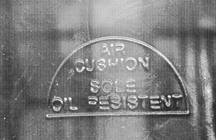
211 I am satisfied that Bata set out to copy the style and a number of the features of 1460Z boot albeit under and by reference to the J.J. Lester name. The Danny boot reproduced the following distinctive features relied on by the applicants: an appearance of a welt, a large looped welt stitch which was orange rather than yellow or yellow/orange, a grooved sole edge, an angled heel on the sole instep, a partially transparent BEN sole, an embryonic two‑tone effect on the sole side view.
Bata expert evidence
212 Bata called two persons very experienced in the footwear industry, Ms June Swann and Mr Phillip Nutt. Mrs Swann has been involved in many aspects of the footwear industry for almost fifty years and has published widely in the footwear area. She said (and it is not substantially contradicted by the applicants) that the various “footwear features” and “distinctive features” upon which the applicants rely have been common and well known and used for footwear for many years, sometimes going back through the centuries. In particular she said that the general configuration of the Dr Martens Z welt boot was a common configuration which had been produced for many years. Again this is not in dispute. She compared the Dr Martens boot with the Danny boot produced by Bata and noted a number of differences between the construction and get‑up of the two boots. She also noted that the boxes in which the two products were packed are distinctively different. The differences between the two boots covered matters such as heel tags, different branding, different components such as the tongue and the rows of stitching on the side seam and the back strap. Ms Swann said that the profile of the two boots was quite different in that the Dr Martens boot has a wide pass line whereas the Danny boot has a very narrow ankle and lower leg. Ms Swann said that the inside edge of the sole at the waist of the two boots is differently shaped and that the top edge of the Dr Martens boot is angled down to the rear of the boot whereas the top edge of the Danny boot rises to the rear.
213 In my opinion, few of the differences identified by Ms Swann bear upon the issue whether the Danny boot is being passed off as and for a Dr Martens boot because it incorporates the distinctive features. These matters were of interest but I should not lose sight of the fact that the proceedings are about get‑up and trade dress rather than different construction and a number of the matters referred to by Ms Swann either do not bear on the issue of get‑up and trade dress or are of marginal relevance to that issue.
214 Ms Swann made much of the development and history of the use of welts and rands and welt stitching but this is of little assistance in determining whether the Danny boot is being passed off as and for a Dr Martens boot. The thrust of Ms Swann’s evidence was that there was nothing novel about the design of the Dr Martens boot, it being an ordinary work boot which had been around for many years. Notwithstanding Ms Swann’s extensive knowledge of the footwear industry and its history she was not able to identify any footwear which had the same combination of features as are found in the Dr Martens 1460Z boot. This was notwithstanding the fact that she understood her task to be to identify any other footwear with yellow stitching which exemplified the features in the Dr Martens boot. Like Mr Nutt, Ms Swann did not accept that there were two separate colours on the side of the sole of the Danny boot. She did not accept that it was a two‑toned sole but said that there was a sharp dividing line between the two separate colours. I did not find her explanation as to why the Danny sole side profile did not present as two‑toned convincing. In my opinion when one looks at the side of the sole of the Danny boot it has the appearance of an embryonic two‑toned colour, the upper part being dark and the lower part being light. This comes about because of the colour of the rand but the grooves which run along the side of the sole also run along the side of the rand and in my opinion the side view of the sole presents as embryonically two‑toned and I do not consider that a potential purchaser would distinguish the colour of the side of rand as being a separate component from the sole.
215 What was interesting about Ms Swann’s evidence was that in the course of cross‑examination she mistook the Danny boot for the Dr Martens boot. Ms Swann gave considerable evidence about the differences between the Danny boot and the Dr Martens boot and did not consider that the boots were close in appearance when she was asked to look at a specific detail. However, in this context she made an important qualification because she said she was not looking at the whole appearance.
216 The other expert witness called by Bata was Mr Phillip Nutt. However, it is not strictly accurate to describe him as an independent expert witness as he had spent many years working with the Bata organisation. Although he had substantial marketing and product development experience he had little experience on the retail side. As with Ms Swann the thrust of Mr Nutt’s evidence was that there was nothing unique or novel in the distinctive features relied upon by the applicants as being found in the Dr Martens Z welt footwear and he explained how each of those items could be found in other brands of footwear over the years. Mr Nutt was of the opinion that any reputation which the applicants had in their footwear resided in the Dr Martens brand name. Mr Nutt explained that the footwear industry was divided into two basic types of market, namely the commodity market in which price plays an important role and the fashion market. He said that it was common in the fashion market for manufacturers to copy successful or trendsetting styles.
217 In the course of cross‑examination Mr Nutt tended to be evasive, argumentative and non‑responsive in his answers. The cross‑examination demonstrated on a number of occasions that he had overstated his case and propositions in his affidavits and he tended on a number of occasions to assume the role of advocate.
218 A clear example of overstating or rather misstating his case is found in his proposition that imitation of popular footwear styles was so common place in the footwear industry that it was only in brand names that any individual manufacturer had any reputation. In cross‑examination he changed this position and said that his proposition was that a manufacturer’s reputation resides in the brand name together with the brand image and what that means to a customer. By accepting or conceding that the manufacturer’s reputation was in the brand image and not just in the brand he demonstrated that he had either misstated the proposition or failed to have regard to a significant aspect of the marketing of footwear. Another example of overstating or misstating his case was where he swore in his first affidavit that the only individual aspect of the Dr Martens boot was the Funck construction technique. In cross‑examination he said that he was then referring to construction matters and not to trade dress.
219 A significant example of overstating his case was found in his second affidavit where he said:
“In order to be able to understand why the alleged distinctive features of the Dr Martens product merely result from the method of manufacture used in the Dr Martens construction it is first necessary to understand how each of the products are constructed in order that the similarity and appearance ultimately obtained can be understood.”
It is a fair reading of this passage that Mr Nutt is saying that the distinctive features are an inevitable result of the method of manufacture used in the Dr Martens construction. However, in cross‑examination Mr Nutt said that in relation to a number of those distinctive features relied upon by the applicants the manufacturer has a choice. For example, he said that the manufacturer has the choice whether to expose the welt stitch or conceal it, a choice as to the type and colour of the stitch as well as to the loop size and a choice in relation to the type of sole to be used, the colour of the sole and the profile of the sole.
220 Another example of Mr Nutt overstating his case was where he referred in his second affidavit to a Clarks desert boot in support of the proposition that there are now standard constructions, components or decorative features which will often result in an appearance similar to the Dr Martens welt. He pointed as an example to the Clarks desert boot which he said had “contrast stitching in the welt/rand area”. In cross‑examination he accepted that the Clark’s desert boot did not have a welt or a rand and he said that in the affidavit he was only referring to the contrast stitching. Again, the proposition was expressed too widely and I found his explanation unconvincing.
221 I also found Mr Nutt’s evidence as to whether the Danny boot had a two‑toned sole unconvincing. He accepted that the public would not distinguish between a rand and a sole yet he maintained that the Danny sole did not appear to be two‑toned, nor did he accept that the Dr Martens sole was two‑toned. I do not accept this evidence having regard to observations which I have made of the soles and in particular their side profile view. The grooves which run along the sole run along the side of the rand as well as along the side of the sole and if Mr Nutt is correct, as I believe he is, that the public would not distinguish between a rand and a sole then it seems to me that there is an embryonic two‑toned appearance on the side of the sole of both the Danny boot and the Dr Martens boot.
222 Mr Nutt produced a number of examples of footwear which possessed someof the distinctive features which the applicants claim to be distinctive of the Z welt footwear. However, he was unable to produce any examples which contained all the distinctive features relied upon by the applicants. This was important because he agreed that over the last three years he had tried to find shoes which undermined the Dr Martens claims in relation to the Dr Martens trade dress. He was unable to find any such shoes. He acknowledged that he had put forward in the affidavit the whole of the material to undermine the applicants’ claim in relation to the trade dress of the Dr Martens footwear but such material did not identify any items of footwear which reproduced all the distinctive features. He was only able to identify examples with some of the distinctive features.
223 In my view Mr Nutt’s evidence was coloured by his attitude to plagiarism which he said he encouraged. He supported copying because he said it has a useful social purpose and in his words “the masses need to be able to have in my opinion the looks of what rich people can afford”. This may be a laudable, social policy objective but in the context of the recognition, protection and enforcement of intellectual property rights it has no place. If a product is not protected by copyright, design or trade mark registration there is no legal impediment to it being copied so long as it is not passed off as and for the product of another manufacturer and so long as potential purchasers are not mislead or deceived into believing it is the product or has the sponsorship of, or is associated with, another manufacturer.
224 In the course of cross‑examination Mr Nutt was asked from time to time to look at the Danny boot. On more than one occasion when he did so, he immediately looked inside the boot and looked at the sole. When asked why he had done this he said that looking at the boot did not enable him to tell whether it was a Dr Martens boot or a Danny boot. This evidence was significant as it tends to negate the significance of the distinctions and differences which Mr Nutt drew between the Dr Martens boot and the Danny boot which are found in paragraph 22 of the Bata respondents’ amended defence.
225 Another example of Mr Nutt’s inability to distinguish between the Danny boot and the Dr Martens boot was found in his examination of the Bata work book which was a presentation of the Bata range for retailers. Mr Nutt’s attention was drawn to page 32 of the book which displayed a number of boots under the name “J.J. Lester” and in particular to two boots. He said he could not identify those boots as either J.J Lester boots or as Dr Martens boots without looking at the brands on the boots. Mr Nutt’s attention was also drawn to page 48 of the book where he was asked to look at three boots under the name of “J.J. Lester”. Again, he said that he could not say if those boots were J.J. Lester boots or Dr Martens boots without looking at the branding.
226 In summary Mr Nutt’s evidence overall does not support the conclusion that when one looks at the Danny boot and the Dr Martens boot one sees clearly features which distinguish one from the other. Overall, I found Mr Nutt’s evidence unsatisfactory and can place little reliance on it where it is relied upon to support the propositions for which the Bata respondents contend.
The Figgins case
227 Figgins is one of the largest retailers of shoes in Australia. It trades under a number of names including, relevantly for present purposes, Shoo Biz, Scooter and Emporio. Figgins has over a hundred stores in all states except Tasmania. Figgins sells a large range of shoes and directs various types of shoes to various markets through its selected retail outlets. The younger shoe market is targeted through stores such as Shoo Biz, Scooter and Emporio. The Figgins’ trading outlets have distinctive appearances. The store images promote the name Figgins and it is the store images which are promoted as such. Mr Figgins regarded image as critical in the sale of the fashion product.
228 Figgins uses almost no point of sale material and does not promote particular brands but rather promotes its shops and their particular images which are designed to create an atmosphere or set a theme for customers. No swing tags are used in the stores and boxes and bags are only produced after purchase. Figgins predominantly sells shoes bearing its own brand names but it does not manufacture shoes itself, rather it arranges for the manufacture of shoes and also buys shoes as a wholesaler. Figgins spends little money on direct advertising but spends substantial amounts on store image. It also receives substantial unpaid promotion through editorial coverage in fashion magazines which promote the high fashion image of Figgins’ stores. These publications are targeted primarily at a younger age fashion conscious market.
229 Figgins made extensive use of the Dr Martens mark on a wide range of shoes during the 1980s and early 1990s including non‑Z welt footwear made by George J Cox. Mr Figgins said that Figgins believed that it was the first organisation to use the Dr Martens mark in Australia on footwear rather than on soles and that it had established the market in Australia for the mark in connection with a diverse range of fashion shoes different in style and appearance to the shoes claimed to have the distinctive features identified by the applicants. Figgins had applied for registration of the Dr Martens mark as a trade mark in Australia in 1983. The application was accepted in June 1988 and thereafter there was a successful opposition and a subsequent appeal to the Federal Court. Around the same time the Dr Martens interests had taken proceedings against Figgins for falsely claiming entitlement to the trade mark. These proceedings were settled on 8 August 1995 as a result of which the Dr Martens interests obtained proprietorship of the trade mark “Dr Martens” and Figgins was given the right to sell its remaining stock of Dr Martens branded footwear until 8 November 1995.
230 The case made by the Figgins respondents is quite straight forward. Figgins set out to copy the Dr Martens Z welt 1461Z shoe but did so with what it says were differences and with its own brand and at a different price. Figgins said it was entitled to do so and that it does not infringe any rights of the applicants because the shoe was branded “ah! SOUL”. Figgins also says that it set out to imitate the Dr Martens footwear but at a different price point.
231 Figgins had originally obtained Dr Martens branded products from George J Cox and had subsequently asked Cox to manufacture a shoe identical to the shoe it had been supplied branded Dr Martens. Figgins had asked Cox to manufacture “Docs” and to copy the 1461Z shoe and the attempt was to reproduce the Griggs’ yellow stitched product as closely as possible. This was done at a time when there was a lack of supply of Dr Martens products in Australia. Figgins wanted to have the same look as the Griggs product as it was the look of the shoe which sold and he wanted a reproduction as close as possible to the Griggs product. From about 1989 Figgins had procured Sasha Holdings Pty Ltd (“Sasha”) to copy the distinctive features of the 1461Z welt footwear and when it settled the court proceedings in August 1995 it was left with approximately four hundred pairs of this product. It had these shoes re‑socked with the “ah! SOUL” brand name and at or about the same time, it procured Sasha to produce a further quantity of shoes in the same style under the “ah! SOUL” brand to make up the size range. Approximately 1048 pairs were manufactured, 693 pairs of women’s shoes and 355 pairs of men’s shoes.
232 Within about twenty‑four hours of settling the court proceedings in August 1995 Figgins obtained legal advice to the effect that it could sell the same product which had been the subject of the trade mark proceedings but under a different brand and it asked Sasha to manufacture the shoe, the subject of this proceeding. The only change from the product it had earlier copied was the “ah! SOUL” brand and a different colour on the name plug on the sole. The re‑socked ah! SOUL shoes and the ah! SOUL shoes which were manufactured were sold predominantly through Shoo Biz stores although a small quantity were sold through other stores. A total of approximately 1313 pairs were sold. The shoes sold at Shoo Biz, Scooter and Emporio stores covered a wide range of styles at the lower end of the footwear fashion market. They were sold at various prices between $30 and $118. Mr Figgins said that brand conscious customers generally shop at the Figgins higher price stores.
233 Mr Figgins said that most of the ah! SOUL shoes were sold on a clearance basis and that customers buying from clearance stock were not looking for brands but were more interested in price. He also said that Dr Martens has had premium brand status among younger customers. However later evidence showed that towards the end of 1995 ah! SOUL shoes were being sold at around $110 whereas the Sasha stock which the terms of settlement allowed Figgins to sell up until 8 November 1995 were being discounted down to $50.
234 Mr Figgins said that consumers were educated in branding and that they had paid attention to the branding on the sock of footwear. He also took the view that customers buying the shoes pay attention to the marking of the shoes on the sock rather than any other form of marking. He said that the market for shoes between $30 and $70 is different from the market for shoes for $150 and upwards but as I noted earlier, the original ah! SOUL women’s shoe price was around $110.
235 Although Mr Figgins identified differences between the 1461Z shoe and the ah! SOUL shoe he agreed that Figgins set out to imitate the features of the Dr Martens footwear and to copy the 1461Z shoe. He put the differences on the basis that consumers would not see the ah! SOUL footwear as the genuine Dr Martens product. He said that Figgins attempted to get the benefit of the reputation of Dr Martens and to attract a customer prepared to pay a lower price. However, it does not necessarily follow from this evidence that customers believed they were buying Dr Martens products when they were buying ah! SOUL products or that there was necessarily any misrepresentation or that the ah! SOUL shoes were being passed off as and for shoes emanating from the Dr Martens trade source.
236 Mr Figgins said that if staff were asked what “The Original” meant on the footwear they were to say that it meant “The Original Dr Martens made in Australia”. Such a statement has a potential for deception in it but the case made against Figgins is in relation to the get‑up and trade dress of the ah! SOUL footwear and no relief is sought in respect of such a statement. There is no evidence that in fact any particular customer was told this.
237 The ah! SOUL shoes as with the other shoes in the Figgins stores were offered for sale on display shelves and there was no signage used in relation to them. The signage in Figgins’ stores rather was directed to identifying the store name, sale items and prices. There was no emphasis on, or highlighting of, brand names. Footwear sold was placed in store carry bags and the ah! SOUL shoes were placed in a box marked “ah! SOUL”.
238 Mr Macaw QC, who appeared with Mr Hess on behalf of the applicants, made much in cross‑examination of Mr Figgins and other Figgins’ witnesses that there was Figgins’ merchandising report documentation which suggested that the Sasha shoes and the ah! SOUL shoes were referred to as “Docs”. The evidence shows that from time to time the ah! SOUL shoes were referred to as Docs within the Figgins organisation. Mr Figgins said that no instruction was given to staff not to call the ah! SOUL shoes Docs. However having considered all the Figgins documentation which was tendered I am not satisfied that there was any occasion on which a customer complained that he or she had purchased an ah! SOUL shoe believing it to be a genuine Dr Martens product. (There was one complaint about quality but that was not related to source). Nor am I satisfied that there has been any incident or circumstance in a Figgins store of confusion over the trade source of the ah! SOUL shoe.
239 Much was made of a reference in a merchandising report dated 9 February 1996 to a client request for the English Dr Martens. The reference is only on one line of the report and the following lines relate to a different request. I am not able to draw any conclusion or inference from this reference that any customer had formed the view that the ah! SOUL shoe was, or was seen to be, the genuine product.
240 Mr Figgins did accept that staff may have referred to ah! SOUL shoes as Docs and may have met a request for Docs with the supply of the ah! SOUL version although there was no evidence that this in fact occurred. There was also no record of any customer complaint about ah! SOUL shoes being thought to be Dr Martens footwear. I am not satisfied that such an event occurred.
241 Figgins sought to capitalise on the perceived attraction of Dr Martens by selling its shoes at a price where a person could be seen to be wearing the English version. Mr Figgins said that people wanted the look for the price.
242 There is no evidence against any directors of Figgins other than Mr Figgins in relation to the decision to sell the ah! SOUL shoe. Mr Figgins said it was not a board decision to put that product on the market and that he made the decision on legal advice. He did not discuss it with his fellow directors and kept his plans to inner management. Mr Figgins thought that by 1995 Dr Martens was no longer a fashion item as that image had been destroyed by the product going into disposal stores and supermarkets. Although he said this started to happen in 1992 he sought to copy the footwear as late as September 1995 and I consider the weight of the evidence not to support the proposition that by 1995 Dr Martens footwear was no longer a fashion item.
243 A number of Figgins’ employees gave evidence. Mrs Michelle Baumann, the Shoo Biz and Scooter buyer for women’s footwear, said that Shoo Biz and Scooter stores did not promote brands (although they did promote Windsor Smith and Rivers). She said that ah! SOUL was intended as a fun name for youth oriented shoes and had not been promoted with any in‑store signage or special promotion. She did not recall any complaints about consumers thinking that ah! SOUL shoes were Dr Martens shoes. She said that in the volume market, style and price were key influences rather than brand which only became a key consideration with higher priced shoes. She thought the Dr Martens footwear was brand distinctive and that people asked for them by name. She had never heard of the ah! SOUL footwear being referred to as Docs. She said that ah! SOUL footwear was sold at $118 for men and $110 for women whilst Dr Martens footwear was being discounted at $100, then $70, then $50. She saw the ah! SOUL shoes as an alternative to the Dr Martens footwear as they had a similar look.
244 The applicants say the Figgins ah! SOUL shoe reproduces the following distinctive features said by the applicants to reside in the Z welt footwear: a visible black synthetic or plastic strip of material with the appearance of a welt, a prominent and visible yellow stitch thread with a large looped stitch with the appearance of a welt stitch, a partially transparent synthetic or plastic one piece moulded sole and heel 15mm thick, having a light brown colour, a grooved sole edge and a sole side view of two‑tone effect, an angled heel on the sole instep, a BEN sole pattern and black laces.
245 Although Mr Figgins identified a number of differences between the Dr Martens 1461Z shoe and the re‑socked ah! SOUL shoe I place little weight on these differences save for the orange welt stitch, the branding and the words on the sock. I do not consider for example, that potential purchasers would see as significant or as a difference the position of the stitching on the rand and the welt. Mr Figgins said the stitching on the ah! SOUL shoe is on the vertical section of the randing whereas the stitching on the 1461Z shoe is on the apex of the curve between the vertical and horizontal sections. In my view this difference would not be perceived by potential purchasers. Potential purchasers would not see as distinguishing features the different lengths of the loop stitch on the welt or false welt or rand or the different angle of the heel on the sole instep or the fact that the sock of the ah! SOUL shoe is a full sock lining compared to the half sock lining of the 1461Z shoe. However I do consider the branding of the shoe as “ah! SOUL made in Australia” with a logo of a stylised rear view of a naked small man and the yellow sole plug with the same logo as important. I have taken into account all the differences identified by Mr Figgins but overall the impression sought to be created and, in my view, the appearance created was one of similarity to the appearance of the Dr Martens 1461Z shoe albeit with a different branding and labelling.
246 I am satisfied that Figgins set out to copy the 1461Z shoe albeit under and by reference to the ah! SOUL name. The shoe made of black leather reproduced the following distinctive features relied upon by the applicants: the appearance of a welt with a stitch which was orange rather than yellow or yellow/orange, a grooved sole edge, an angled heel on the sole instep and a sole colour similar to the 1461Z shoe. However it bore no Dr Martens markings. Rather along the length of the sock there appeared the words “ah! SOUL” with the image of a stylised rear view of a naked small man between the “ah!” and the “SOUL” underneath these words there appeared the words “made in Australia”. Further down the sock there appeared across the sock the words:
“MADE BY SASHA SHOES P/L
ALL LEATHER UPPERS
SYNTHETIC QTR. LINING
RESIN SOLE”
On the sole there appeared a yellow plug with a stylised rear view of a naked small man.
The Rivers case
247 Rivers has a long history in the footwear industry and is presently owned by the family and interests of Mr Philip Goodman. In 1979 Mr Goodman and his father purchased Columbia Shoes, an existing shoe manufacturing company. In early 1980 Mr Goodman, wanting to develop new products and a new trade mark to differentiate the new products from the products previously associated with the Columbia name, hit upon the name “Rivers” for which trade mark registration was applied in February 1980. Rivers is now the proprietor of seven different trade marks incorporating the name “Rivers”, one of which is in the form of a stylised eagle with outstretched wings sitting on top of a dark irregular shaped rectangle within which the word “rivers” appears (“the Rivers logo”). In 1981 the Goodman interests, in conjunction with others, purchased the shoe manufacturing company Paddle Bros. Shoes Pty Ltd (“Paddle”). Thereafter Paddle manufactured and sold Rivers branded men’s footwear and Diana Ferrari women’s footwear. The Kirkhope brothers who were involved in the Diana Ferrari business acquired the Diana Ferrari side of the business in July 1987 and ultimately, Mr Goodman acquired the whole of the shareholding in Paddle from 1989. On 21 December 1995 Paddle changed its name to Rivers (Australia) Pty Ltd.
248 Rivers is a substantial company with its manufacturing base in Ballarat. Its primary business is the manufacture and sale of footwear to retail stores throughout Australia. Rivers footwear has been sold through hundreds of stores throughout Australia. These retail stores include department store chains such as Myers/Grace Bros with approximately 80 department stores throughout Australia, footwear chains such as Cecil Bros with approximately 120 stores throughout Australia and the Kinney group with approximately 400 stores throughout Australia. Further, approximately 350 independent retailers (retailers with less than 20 stores) throughout Australia and New Zealand have stocked Rivers products. In addition, Rivers has since 1990 sold shoes and clothing bearing the Rivers trade mark directly to the public through Rivers own specialty concept stores and, to a limited extent, directly to the public from the Ballarat factory and its Albury distribution centre. Since 1985 Rivers has sold clothing bearing the Rivers trade marks to retail stores throughout Australia. The lay out of the concept stores is devoted solely to Rivers’ products and all the Rivers’ products are clearly branded Rivers. So far as Rivers footwear is concerned the brand is and has been identified as Rivers by reference to swing tags, sock stickers, sock labelling and the sole brand being the name “rivers” moulded into the sole. Rivers has branded its shoes with the Rivers trade marks since the inception of the brand in 1980. It has also used Rivers swing tags on its footwear since 1980 and has branded its shoes with the Rivers logo on the sock of its shoes and the Rivers name on the sole.
249 Rivers’ advertising and promotional activities are centred around the “Rivers” trade mark and the Rivers logo. Since at least 1990 Rivers has advertised by way of newspaper inserts which have been distributed with newspapers to between 300,000 and 1.4 million households throughout Australia between two and six times each year. These advertisements have featured the name Rivers prominently and have often included the Rivers trade marks and logo. In its concept stores Rivers has used point of sale material prominently displaying the Rivers trade marks. Since 1982 this type of point of sale material has been provided by Rivers to most major retailers who sell Rivers shoes and clothing. Rivers has undertaken television advertising in relation to its footwear which display the Rivers trade marks. The expenditure on this advertising has been very substantial. Rivers shoes have since at least 1990 been packaged in boxes prominently displaying the Rivers name.
250 The Rivers name is well known in the footwear and clothing industry and its market is generally directed to mature aged men. Mr Goodman said that Rivers’ principal target market is the middle socio‑economic group in the thirty to fifty age bracket. Its footwear range is primarily directed to the men’s casual shoe market. Between 1980 and 1997 of the order of 7 million pairs of shoes have been sold under the Rivers trade marks.
251 By 1993 Rivers had established a substantial reputation in Australia for footwear by reference to the mark “Rivers” and I am satisfied that by 1993 Rivers was well known to retailers and to consumers as an Australian manufacturer of footwear.
252 The shoe which is the subject of the proceeding is called the “Liverpool Black”. Rivers started selling it by wholesale in March 1993 and its wholesaling activities ceased in April 1994 although there were subsequent retail sales. Its retail selling price was $100. The trap purchase upon which the applicants rely was made on 7 August 1995.
253 Rivers says that by March 1993 when the Liverpool Black was introduced there were many Dr Martens look‑alikes on the market known to traders and consumers. Rivers also relies upon the evidence that by this time Dr Martens was advertising to consumers – “beware of imitations of which there are many”.
254 The original decision of Rivers to introduce the Liverpool Black to its range was made by Mr Peter Abbott, Rivers’ marketing manager in March 1992. Neither Mr Goodman nor his wife Mrs Louise Goodman who are personal respondents in the Rivers proceeding were involved in that decision. Mr Abbott wanted to embody or copy the principal features which were embodied in the Dr Martens look and style but he wanted to do so by reference to a shoe which was recognisable as a Rivers shoe. Rivers says that it tailored its shoe to suit its market of males over thirty years and that the product produced was more elegant and conservative.
255 Each season Mr Abbott considered 300 or 400 styles for inclusion in the Rivers range for the particular season and the styles he considers are those which he has seen advertised, worn or sold overseas during his overseas trips. During his trip overseas in March 1992 he noticed many people wearing a simple black derby shoe with a black leather upper on a plain or pleated sole with yellow stitching. He returned with a number of samples. At the time of his trip he was familiar with Dr Martens footwear. He knew that people wearing the style which he had noticed were either wearing Dr Martens shoes or look‑alikes. He had no particular recollection of the actual design process for the Liverpool Black shoe, although he would have been involved in that process and he said that it was possible that when the sample of the Liverpool Black was made a Dr Martens shoe was “for us”. I take this to be a reference to it being available to Rivers. In any event, Mr Abbott says it was his intention to produce a shoe in a style which he had seen for Rivers and he set out to incorporate the fashionable features which he had seen in a shoe recognisable as a Rivers shoe. Mr Abbott said that when he made the decision to include the Liverpool Black shoe in the range there were approximately a dozen Australian companies and a dozen overseas companies manufacturing and selling a similar looking shoe.
256 There is no doubt that Mr Abbott set out to copy the style of the shoe which he brought back whether it was a Dr Martens Z welt shoe or a look‑alike incorporating the distinctive features. He says that the sample provided the inspiration of the shoe and that he designed the Liverpool Black for Rivers’ customers but with the “Docs” look. The evidence is not clear as to whether Mr Abbott in fact purchased a Dr Martens sample. He did not recall buying the Dr Martens shoe for business purposes although he bought other shoes with the distinctive features of the Dr Martens look. It appears from the design documentation that the Rivers pattern room was given a sample shoe to copy and a sample sole to copy the grooves. I am satisfied that the sample provided was either a Z welt shoe or a look‑alike or imitation displaying the distinctive features. On the whole of the evidence I am satisfied that Rivers set out to imitate or copy the distinctive features or a number of them and to incorporate in the Liverpool Black a number of the distinctive features albeit, as Mr Abbott said, with Rivers’ handwriting on it. Overall, Rivers sold 4,406 pairs of Liverpool Black shoes of which approximately 80% were sold by retailers other than Rivers concept stores.
257 Mr Goodman said that the overwhelming majority of footwear products sold in Australia are products which have been derived from original designs created overseas. He said that because of the significant tooling costs required to make a new style of shoe a new style has to have a relatively high chance of volume sales and a commercially viable selling price is desired. It is for this reason that successful designs were apparently copied on the basis that the tooling costs involved were thought to be justified because the design being copied would be a reasonable volume seller.
258 Although Mr Goodman said that it was almost certain that the Liverpool Black was based upon a Dr Martens shoe, Mr Goodman said that there were a number of significant differences between the Liverpool Black and the Dr Martens 1461Z shoe. However, a considerable number of these differences would barely be recognisable or identifiable by a potential purchaser when looking at a Liverpool Black shoe for the purpose of considering purchase. Further a number of the differences do not relate to matters of trade dress or get‑up. Mr Goodman said that a number of the measurements of the two shoes were quite different yet a number of these measurements are barely discernible to the naked eye. For example, the distance from the outside vamping point to the toe of the last is 100mm on the Liverpool Black and 90mm on the Dr Martens 1461Z shoe; the width of the lug from the vamping point to the top line is 80mm on the Liverpool Black and 90mm on the 1461Z shoe. One difference noted by Mr Goodman, and picked up by Mr Abbott, was that the last on the Liverpool Black shoe is quite traditional or conservative whereas the Dr Martens last is a lot younger and more radical. However, there is no doubt that Rivers sought to embody a number of the distinctive features of the Dr Martens footwear in its Liverpool Black product such as the appearance of a welt, the yellow welt stitching and the grooving on the side of the sole.
259 Mr Goodman, the Rivers chairman, said that the purpose of adopting these features characterising the Dr Martens look was “to capitalise upon a look of shoe that was popular and selling well in the market place”.
260 Notwithstanding the fact that a number of “significant differences” identified by Mr Goodman between the Dr Martens shoe and the Rivers shoe are not readily apparent to customers, the “rivers” trade mark on the sole is a significant difference from the Dr Martens logo on the sole as is the appearance of the Rivers logo on the sock of the shoe. On the sock there is imprinted an oval shape. Inside the upper half of the oval there are the words “CAPTURE THE SPIRIT”; inside the lower half of the oval are the words “THE AUSTRALIAN BRAND”. In the centre of the oval there is printed the Rivers logo. Further down the sock there appears a triangle displaying within its shape the words “Leather Upper”, “Rubber Sole”, the size and the word “rivers”. On the sole there appears the word “rivers” within the irregular rectangular shape.
261 Rivers called sixteen witnesses whose evidence was substantially identical. They had either been contacted by a market research organisation or were known to the solicitors representing Rivers. These witnesses said that they were familiar with Rivers shoes, they were familiar with Dr Martens shoes and some of them were aware of Dr Martens look‑alikes. They all said that if they saw a shoe with a number of the distinctive features relied upon by the applicants but with the name Rivers on it, they would consider the shoe came from Rivers. When shown the Rivers’ Liverpool Black shoe they said it was a Rivers shoe because it had the Rivers name on it. A number of them said the yellow stitching was a characteristic feature of the Dr Martens footwear and an important feature. The evidence of some of them was of little assistance because they had no knowledge of the Dr Martens footwear at the relevant time and had never seen a Liverpool Black shoe in a retail store. Their evidence was in substance, akin to a small market survey. It was apparent that they were all asked a series of questions and overall their evidence shows no more than that the market for Rivers shoes is a different market from the market for Dr Martens, the former being for people aged thirty‑something and the latter being for younger people.
262 Rivers also called Mr Ross Morgan who had been involved in the footwear industry for over sixteen years and was employed by Myer Grace Bros being second in charge of footwear, cosmetics and accessories for the 68 Myer stores. He regarded Rivers, Windsor Smith, Bata and Lipstik as established brand names. He was also familiar with the Dr Martens brand styles and markets and said that purchasers of Dr Martens footwear did not buy the footwear solely because of the appearance but also because of the Dr Martens name and trade mark. He believed that persons who purchased Dr Martens look‑alikes did so because of their appearance rather than because of a belief that the shoe was made by Dr Martens. Mr Morgan’s evidence supports the view I have reached that branding is important in the footwear industry as a means of identifying trade source particularly with younger people who are attracted to brand names because of peer group attitudes. The concept of the look‑alike is well known and, in my view, understood and accepted by young people who are familiar with brand names. If they can afford the price they prefer to buy the well‑known brands. If they cannot afford to buy the well‑known brands, they go for what some might regard as second best and acquire the look knowing that they are not buying the well‑known brand.
263 The importance of recognising a brand as a means of identifying trade source when one is faced with an imitation or look‑alike product was demonstrated by one Rivers’ witness Mr Stephen Gray, who was asked in an interview the question whether there was any difference between the Liverpool Black and the Dr Martens product. He said he thought they were probably made by the same manufacturer although he did not form a view on who the manufacturer was. However, this evidence is not of much assistance because of his evidence that if he saw a shoe with yellow stitching, a black upper and a thick sole with the name “Rivers” on it, he would consider the shoe came from Rivers.
264 Mr Phillip Scala, Rivers’ sales manager for its retail shops, had ten years experience in the footwear industry. He saw the Dr Martens footwear and the Rivers footwear targeted at different markets. Dr Martens was targeted at men and women between thirteen to twenty/twenty‑five and representing rebellious streetwear whereas Rivers was targeted primarily at the twenty‑five to fifty year old men’s footwear market. He said that the Rivers image was associated with an earthy, comfortable feel which was not too loud or fashionable but not too conservative.
265 Mr Colin Brown had twenty‑three years experience in the footwear industry, sixteen years of which were as men’s footwear buyer for Myer (now Coles Myer Ltd). He did not think that consumers would confuse the Liverpool Black shoe with Dr Martens footwear because of its branding. He regarded Dr Martens shoes as a fashion statement and accepted that they were now a mainstream fashion item. He accepted that there was footwear with similar looks to Dr Martens but did not believe that they were imitations. Indeed he would not accept that the Rivers’ shoe was an imitation of Dr Martens footwear but the manner in which he gave his evidence tended to show a partiality towards Rivers and he was not forthcoming when confronted with the likeness between the Rivers’ Liverpool Black and the Dr Martens footwear. When pressed he accepted that the Rivers footwear was a similar look to Dr Martens but said that customers for Rivers were totally different and he said he would not call the shoe an imitation because it was priced at a different price point.
266 Although in cross‑examination Mr Brown referred to the fact that he “would have sold the Doc Martens Liverpool to a customer” I regard this statement as a slip of the tongue, having regard to the context, rather than an identification of the Liverpool Black with the Dr Martens product. Ultimately, his evidence only assisted to confirm the proposition that in general terms consumers are brand conscious, that if they cannot afford a genuine article they are prepared to buy a similar look, albeit recognising and accepting that they are not buying a genuine article but are rather buying a look‑alike. He had said in evidence‑in‑chief that people buy footwear primarily by reference to brand names although he accepted in cross‑examination that some consumers buy by reference to the look of footwear. He also agreed that the Windsor Smith look‑alike which he had seen was a cheaper version of the Dr Martens look. However, that does not mean that the Windsor Smith shoe is therefore being passed off as and for a Dr Martens product, nor does it mean that potential purchasers or consumers are deceived when they see it. To say that a product is a cheaper version of a genuine product is to say no more than there is a recognition that it is a look‑alike and the fact that it is cheaper is a feature which distinguishes it from being the genuine article.
267 Mr Ian Scandrett sold footwear in Sydney for many years. He had sold Dr Martens footwear for quite some time although he was not doing so at the time of the hearing due to a dispute with Dr Martens. He agreed that between 1993 and 1995 Dr Martens footwear had become a fashion item for school children and that it had become an extraordinarily successful product which had grown since 1989 but he now regarded it as having failed. He agreed that the Dr Martens footwear made a statement of a rebellious kind. It was apparent from his evidence that there was no love lost between Mr Scandrett and Dr Martens and this was apparently due to the fact that Dr Martens was then not willing to supply him with Dr Martens products. He thought there were three factors which accounted for the reducing sales of Dr Martens. First was the introduction in 1991 of the New Zealand Docs, namely the Soho products which had no yellow stitching and were cheaper than the Dr Martens. The New Zealand product was of a lower overall quality and was also much cheaper. Secondly, Mr Scandrett said that the English footwear had originally been available in limited numbers to alternative and non‑mainstream shops and that young people saw it as exclusive and difficult to obtain and not a product which their parents approved. Once the New Zealand Docs became available in unlimited quantities and in particular the sales in 1994 to Big W which sold the New Zealand Docs for $44.97, there was an impact on their popularity. Thirdly, he said that Dr Martens footwear was a fashion item and fashions change. The first two factors are relevant to the proceedings before the Court.
268 What was important about Mr Scandrett’s evidence was that he said that young people distinguished between the English Dr Martens and the College or New Zealand shoe and this demonstrates an ability of young people to distinguish between genuine branded footwear and look‑alike products, albeit with different brands. Mr Scandrett said that it was the Dr Martens brand logo which the young people wanted and that they wanted to see the brand on their foot. Although Mr Scandrett appeared to bear some ill will towards Dr Martens his evidence was generally corroborative of other evidence as to the ability of young people to distinguish between a genuine product and look‑alike products and their reliance on branding as a reason for purchase.
269 I am satisfied that Rivers set out to copy the distinctive features of the 1461Z shoe albeit under and by reference to the Rivers name and logo. The applicants say that the Rivers Liverpool Black shoe made of black leather reproduces the following distinctive features: a visible black synthetic or plastic strip of material with the appearance of a welt, a prominent and visible yellow stitch thread with a large looped stitch with the appearance of a welt stitch, a partially transparent synthetic or plastic one piece moulded sole and heel 15mm thick, having a light brown colour, a grooved sole edge and a sole side view of two‑tone effect, an angled heel on the sole instep, a BEN sole pattern and black laces. Although Mr Goodman said there were a number of significant differences between Liverpool Black (paragraph 258) I do not consider that potential purchasers or consumers would be alive to those differences or would regard them as features distinguishing the shoe from the genuine Dr Martens. The Liverpool Black reproduced the following distinctive features relied upon by the applicants: the appearance of a welt with a large looped yellow welt stitch, a grooved sole edge, an angled heel on the sole instep and a BEN or Commando sole.
The Windsor Smith case
270 Windsor Smith is a substantial Australian men’s and women’s footwear manufacturer. It was founded in 1946 and it presently manufactures men’s shoes 90% of which are branded under the name Windsor Smith. The secondnamed respondent, Chicago Boot Company Pty Ltd sells women’s shoes under the brand Lipstik which has been used on women’s shoes since 1976 and over the years it has become a well‑known brand. The name “Lipstik” has featured prominently in advertisements for the sale of Windsor Smith’s women’s footwear and the name Windsor Smith has featured prominently in advertisements for the sale of Windsor Smith’s men’s footwear. The seventhnamed respondent, Ad. Mance Australia Pty Ltd manufactures shoes for sale by the other two companies. Both companies sell into the volume or mass consumer market. Windsor Smith and Lipstik brand shoes are, and have been for some years, sold in approximately 1200 outlets throughout Australia and since 1990 some 5 million pairs of footwear have been sold running into a value of some hundreds of millions of dollars. Over the years Windsor Smith has used advertisements in the print media, television and in‑store promotions which identify and promote the brands Windsor Smith and Lipstik. Its products have been sold at prices from $50 to $100 to the age group between fifteen years to forty plus. Between 1991 and 1995 nearly all Windsor Smith shoes retailed for under $100 with the average retail price for the Windsor smith brand being $70 ‑ $80 and the average retail price for the Lipstik brand being $60 ‑ $70.
271 Three Windsor Smith products are in issue in the proceeding, namely “Hot”, “Fire” (both of which are women’s shoes) and “MC” (a men’s shoe) all of which were made by Ad. Mance Australia Pty Ltd. The model “Hot” was branded Lipstik on the sock. Its first sale to retailers was on 1 April 1991 and its last sale to retailers was on 16 August 1993. In its original form it was marked on the sole (a BEN or Commando sole) with a rectangle similar in layout to the Dr Martens resistance rectangle. On the left‑hand side of the rectangle it had a different type of cross, more a Maltese cross. Surrounding the cross in a circular form were the words “WINDSOR SMITH SOFT SOLE”. On the right‑hand side of the rectangle there were set out vertically the words “OIL FAT ACID PETROL ALKALI RESISTANT”. The words “The ORIGINAL” in a stylised script similar to that of “The ORIGINAL” on the Dr Martens footwear were imprinted above the rectangle and the words “MADE IN AUSTRALIA” appeared below it. There was no reference on the sole to Dr Martens. The marking was in the following form:
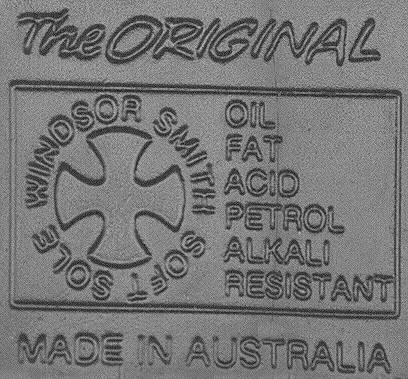
272 Around June/July 1991 the form and content of the rectangle was changed. The contents of the rectangle were removed and the rectangle was changed to an Australian flag so that the words “The ORIGINAL” appeared in the same stylised script above the flag and the words “MADE IN AUSTRALIA” appeared below it. The rectangle was in the following form:
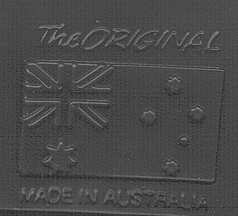
273 The model “Fire” was first sold to retailers on 21 November 1994 and the last sale to retailers was on 9 November 1995. Two “Fire” shoes were in evidence and although they were the same styles, their sock markings were different. One shoe (exhibit “TRH‑2”) was branded “Lipstik” on the sock whereas the other “Fire” shoe (part of exhibit “CM‑1” to the affidavit of Craig Mance) was branded “Lipstik” with the words “COMFORT SOLE” below and these words were in yellow print on a green rectangular background. In each shoe there also appeared further inside the sock the words:
“MADE BY
CHICAGO BOOT CO
LEATHER UPPER
NON LEATHER SOLE
& QUARTER LINING”
Each shoe was branded on the sole (a BEN or Commando sole) with an Australian flag with the words “The ORIGINAL” in the same stylised form as on the Hot shoe above the flag and the words “MADE IN AUSTRALIA” below the flag.
274 The model “MC” was first sold to retailers on 10 May 1991 and the last sale to retailers was on 31 March 1993. It was branded Windsor Smith. The sole marking was the same as initially appeared on the Hot shoe (paragraph 271) and it was not changed. The sole was a ribbed sole similar in style to the Dr Martens DMS sole. There was no MC shoe available to be tendered in evidence but a video of a television advertisement for the MC shoe was tendered in evidence as was a still black and white photograph taken from the video.
275 The Hot and MC products enjoyed substantial sales the Fire product had lesser sales. The sales figures are included in Confidential Appendix C. The three Windsor Smith products were part of the trend to the heavier shoe styling in the early 1990s which became associated with Dr Martens footwear. Windsor Smith said that although its products may have had a look associated with Dr Martens, its shoes were distinguished by their branding and there was no representation of any association with Dr Martens. Windsor Smith said that all three products were distinctive as being Windsor Smith and Lipstik footwear and would have appeared as such to Windsor Smith and Lipstik purchasers.
276 Mr Craig Mance, the managing director of Windsor Smith was less than forthcoming as to the manner in which the three Windsor Smith products came into existence. I formed the impression that Mr Mance was not candid in his evidence and would only acknowledge what appeared to be self evident after being pressed in cross‑examination. In evidence‑in‑chief he said that he was particularly involved in the design and marketing side of the businesses but he did not disclose how the designs of the three Windsor Smith products evolved. In the late 1980s he visited London and noticed the heavy lace‑up shoes look with or without contrast stitching which was available. At that time he was aware of Dr Martens products. He noted that the heavy shoe look and shoe fashions were starting to be popular in Australia by the early 1990s and he said that the Dr Martens brand name had become very well established in Australia by the early 1990s as a result of publicity, promotion, word of mouth and cult following. He said this resulted in an enormous demand for Dr Martens footwear by 1991 ‑ 1992 and that local manufacturers, including the Windsor Smith group, made shoes with features seen on Dr Martens brand footwear, albeit under their own brands. Mr Mance said that the Windsor Smith products were targeted to the teenage school market, where prices are quite different to the fashion segment of the market where products retailed for around $150. Like other witnesses called for the respondents he believed that brand was a significant influence on a customer’s mind.
277 Mr Mance identified the “Hot”, “Fire” and “MC” shoes but did not in evidence‑in‑chief give any evidence as to how those designs came about. He referred to the Australian flag feature on the sole of the Hot and Fire styles but was not forthcoming as to how that feature came about. He said in evidence‑in‑chief that the reference to the words “The Original” on Windsor Smith shoes was a branding device Windsor Smith used to refer to a first shoe in a product category for the Windsor Smith group. Mr Mance did not identify any other shoe where this branding device had been used. However, for reasons to which I shall refer I regard this explanation as disingenuous, particularly because the words “The ORIGINAL” are in a stylised form which, in my view, is identical to the stylised form on the Dr Martens Z welt footwear.
278 It emerged in the cross‑examination of Mr Mance that the genesis of the creation of the “Hot”, “Fire” and “MC” shoes occurred on 25 February 1991 when Mr Mance asked an employee, Mark White, to purchase a number of items of Dr Martens Z welt footwear. Mr Mance asked Mr White to purchase eleven pairs of 1461Z shoes and four pairs of cherry red Z welt shoes. Mr White, when asked by the salesman what he was going to do with the shoes, responded:
“We are going to cut them up and see how they were made and copy them”.
279 This evidence, given by the salesman, was not challenged by Windsor Smith. Mr Mance’s explanation for the purchase in cross‑examination was that “it’s not an uncommon thing for us to do” and said that they bought the shoes:
“for testing and to learn and find out if there was anything fantastic about these shoes.”
280 Mr Mance also said that they sent the shoes to Asia “to see what was available” and to Italy “to source soles, to save us investing in a set of moulds”. Mr Mance agreed that he set out exactly to copy the sole of the Dr Martens shoe. When it was put to Mr Mance that he sent the shoes to Asia to have them copied he did not agree and said that he sent them overseas as a reference as he was investigating buying the products that were already being made overseas. I do not accept this explanation.
281 I regard Windsor Smith’s evidence‑in‑chief through Mr Mance as not candid and as secretive and deceptive as to the creation of the relevant three designs. There was no reference whatsoever in the evidence‑in‑chief as to how the designs came about. Although at one point in cross‑examination Mr Craig Mance said that he did not intend to copy the Dr Martens products as purchased, I reject that explanation. He said that he played a part in the design process of the three shoes and that that design process involved making some heavy black shoes. He said he wanted to use the international flavour of the Dr Martens look and he set about using a different sole pattern involving cleats because he had used them before.
282 Mr Mance said that he was following “a look” and said that he “set out to create our own version of such a product”. When presented with the first “Hot” shoe he said that the only features of appearance of the Dr Martens footwear he set out to imitate and copy was the grooved edge on the side of the sole and to create Windsor Smith’s own version of what he called “the box” on the sole. I take that to be a reference to the Dr Martens logo. He said he “quite possibly” copied the Dr Martens square box but that it was a square box that many people were using. He said the orange stitching on the rand was decorative and was adopted not to imitate the appearance of the yellow welt stitch in the Dr Martens footwear but rather to imitate “the look” of that footwear. He said he sought to put his “own handwriting to the look”. When asked about the moulding of “The ORIGINAL” on the Hot shoe his response was:
“Well, in my opinion, this is the original product for us and there are a lot of originalities about it”.
He denied copying “The ORIGINAL” on the Dr Martens footwear and said that he asked the employee who “used to get those things done for me” to put “The Original” on the sole. Although Mr Mance said he did not ask this employee to put the words on the sole in the same script as on the Dr Martens product he was aware as soon as the sole was in production that it had the words in the same script as Dr Martens. He agreed that the type face of “The ORIGINAL” on the two shoes appeared to be the same and said that his “best explanation” of why that was so was that if the mould maker was given the Dr Martens sole and was told to put “The Original” on the Windsor Smith shoe he would have copied it. I am satisfied that Mr Mance gave instructions to copy the style of “The ORIGINAL” on the sole of the Dr Martens shoe. This conclusion is reinforced by Mr Mance’s evidence as to how the cross came to be moulded on the sole of the Hot shoe. Mr Mance said he designed it and got the idea from a Dr Martens shoe. His intention was “to be involved” in the Dr Martens look.
283 It is apparent from the shoe specifications for the Hot shoe produced by Windsor Smith that there was an intention to copy features of the Dr Martens footwear. There is a reference in the specifications to “NB Heavy Yellow Stitch” and elsewhere in the specification “yellow” has been deleted and “orange” substituted. Orange is specified as the colour of the heavy stitch. Mr Craig Mance maintained that the colour of the stitching on the Hot shoe was orange rather than yellow but a viewing of an advertisement on television produced in evidence on video tape showed in my view, that the stitching was tending towards yellow. That there was an intention to copy the yellow stitching is confirmed in my view, by an advertisement in the February 1992 “Dolly” magazine which identified a Hot shoe as having “yellow stitching”. Mr Mance suggested that the advertisement was joint advertising which was not necessarily approved by his company but the precise advertisement was produced by his father Mr Gregory Mance as evidence of the type of advertising carried out by Windsor Smith. However, as I find later in these reasons, orange thread was used on the Hot and Fire shoes tendered in evidence.
284 Mr Mance’s explanation for using a rectangle on the sole of the Hot shoe similar to the Dr Martens resistance rectangle was that the qualities of the PVC product Windsor Smith used enabled them to put the words “oil fat, acid, petrol, alkali, resistant” on the footwear. I find this explanation disingenuous particularly having regard to his statement that:
“We purchased at the time some Doc Martens shoes which we – for various reasons, and we took reference to the symbolling on the bottom”.
What Mr Mance was saying, in my view, was that he copied the symbols on the sole of the Doc Martens shoe, albeit marketing the footwear as Windsor Smith footwear.
285 Mr Mance contended that the Hot shoe was completely different from the Dr Martens product because of the orange stitching, cleated sole, eyelets, its last and the Lipstik branding. I do not accept that the Hot product is completely different from the Dr Martens product because there are a number of similarities to the distinctive features but the branding on the shoe is a significant difference to which I shall return.
286 I found Mr Mance’s explanation for the reason why the cross rectangle on the sole was removed from the Hot shoe two to three months after it had been sold to retailers, namely in June or July 1991 and changed to the Australian flag, not credible and I reject it. His explanation was that some two, three or four shoes had been returned in circumstances where they had been used in certain fast food chicken places where oil or chicken fat had got stuck between the cleats and had destroyed the soles. No tests had been carried out on the soles to determine whether they were oil or fat resistant and the shoes returned were isolated cases. Mr Mance said that this reason plus the fact that there was a “Buy Australia” campaign led to the substitution of the Australian flag. However, those reasons would not have accounted for the removal of the whole of the text in the rectangle and Mr Mance said he changed the whole of the rectangle as it would have been messy otherwise. I find this explanation not credible and I reject it.
287 Mr Mance’s explanation was not referred to in his affidavits. In his first affidavit he said that the change from the cross rectangle to the Australian flag on the Hot style occurred in February 1992 (it was in cross‑examination that he changed this date to June or July 1991). The bald statement was made “we ceased to use this description on the ‘Hot’ style in February 1992”. Having regard to the significance and the relevance of the cross rectangle I would have expected to have found the evidence for the change in evidence‑in‑chief. Mr Mance did refer in his evidence‑in‑chief to the fact that he believed at the time that the cross rectangle was being used that the soles were oil, fat, acid, petrol and alkali resistant. He said that he had been advised this by the supplier but in cross‑examination he did not know when that advice was given nor did he know the form in which the advice was given. He did not ask for it in writing and he did not know who had asked for the advice. Having regard to the fact that he was prepared to swear in evidence‑in‑chief that he believed at the time that the description was being used that the soles were in fact fat resistant it is not credible that if an incident had occurred which showed that the soles were not fat resistant that it was not referred to in evidence‑in‑chief.
288 In the outcome it does not matter because I am satisfied from the whole of Mr Mance’s evidence that Windsor Smith through Mr Mance set out to copy the distinctive features of the Dr Martens Z welt footwear and sought to do so in the manufacturing process albeit under a different brand name. However this finding of itself, does not mean that the applicants succeed in their claims for passing off and contraventions of the Act. There remain the issues of the branding and marking on the footwear and the different prices for which the footwear was sold.
289 Windsor Smith produced one of the moulds for the sole of the MC men’s shoe. That mould had a rectangle in the position of the instep of the sole containing the words “oil fat acid petrol alkali resistant” set out vertically, a cross similar to the cross on the Hot shoe, the words “WINDSOR SMITH”, “SOFT SOLE” surrounding the cross, the words “MADE IN AUSTRALIA” and “The ORIGINAL” in the stylised script similar to Dr Martens. Mr Mance acknowledged that the MC sole pattern shown upon the moulds was very similar to the sole pattern of the Dr Martens products which had been purchased. He said that the mould “took its reference” from the Dr Martens shoes he purchased. I regard this language as a euphemism simply for a copying of the Dr Martens sole. Indeed Mr Mance acknowledged that he adopted exactly the same sole pattern as the Dr Martens product he had purchased to imitate the sole of the Dr Martens footwear. The cross rectangle was not changed on the MC product. Another matter of concern about the moulds was that on the MC mould there are the letters “DM” which in the absence of any different explanation (which was not offered) I can only take to be a reference to Dr Martens.
290 Certain answers by Mr Mance as to how the Fire shoe came into production also support the conclusion there was a deliberate attempt by Windsor Smith to copy or imitate the Dr Martens Z welt footwear. The Fire shoe was introduced to retailers on 21 November 1994 and the same mould was used for the soles as was used for the “Hot” shoes. Mr Mance said that there were differences between the Hot shoe and the Fire shoe and he identified different eyelets and a slightly different pattern but in my opinion, from a visual point of view, they are substantially the same product in the sense that a potential purchaser seeing the two products would most likely consider them to be the same product. A product bill of material was prepared for the Fire shoe and this specified that the soles were to be stitched in yellow cotton. Mr Mance said that that reference was a mistake and that it should be orange but I reject that explanation as it seems to me more probable than not that the initial reference in the document was correct having regard to what Windsor Smith set out to achieve and having regard to the references to yellow cotton on the shoe specification list for the Hot product. The fact that there are references in the shoe specification list to orange cotton does not mean that Windsor Smith was not seeking to copy or imitate Dr Martens products. Mr Mance maintained that the Windsor Smith products were not stitched with yellow cotton but rather with orange cotton. Although the cotton on the Windsor Smith products was orange, it is necessary to consider that colour in conjunction with the other features of the footwear in determining the overall impression which potential purchasers would have of the footwear. I will return to this issue.
291 Exhibit RW1(5) was a mock up of swing tags that Mr Mance said were put on Lipstik and Windsor Smith shoes. He said they were used in 1994/1995. Later on in cross‑examination he said that the swing tags were used from 1993 onwards and in my view, he was speculating on this issue. I am not satisfied that such swing tags were used on Lipstik and Windsor Smith shoes at relevant times.
292 I found Mr Mance’s evidence as to the point of sale material used by Windsor Smith in relation to the Hot, MC and Fire shoes unsatisfactory and unreliable. In his first affidavit he said that he believed that Windsor Smith spent substantial sums promoting the MC, Hot and Fire shoes on television and in the print media. That may well be and the evidence shows that the shoes were displayed on television by reference to the name “Windsor Smith” and “Lipstik”. However, the evidence in relation to in‑store displays and point of sale material is less cogent. Mr Mance said in his first affidavit that substantial sums were spent on extensive in‑store display posters, show cards and display units but there is no specific evidence before the Court in relation to the three subject shoes. He did produce in his second affidavit (very belatedly on 5 December 1997, the twenty‑third day of the trial) some agents’ mock ups for in‑store displays but he was unable to say whether the shoes, the subject of the proceeding were depicted on the final version of the mock ups.
293 Leave was granted to Windsor Smith when Mr Mance was called to give evidence to lead further evidence‑in‑chief in relation to certain display material which it was said was used between 1992 and 1993. This display material had not been discovered and Mr Mance said he had found it in a corner of the factory the previous weekend. Having regard to the relevance of advertising and point of sale material to the issues in the case, it is most surprising that this evidence did not emerge earlier. In the event, I find it of little assistance and probative value. One of the items of the point of sale material (exhibit RW1(4)) was the art work for the heel card. Mr Mance was asked whether it was used in connection with the shoes the subject of the proceeding and in my view, his answer, although in the affirmative, was qualified in such a way as to demonstrate that Mr Mance was not saying, and could not say, that the heel card was used on any of the MC, Hot or Fire shoes. I am not prepared to find on the evidence before me that any of the MC, Hot or Fire shoes had heel cards in them of the type exemplified by exhibit RW1(4).
294 In the absence of confirmatory documentary evidence I am not prepared to accept Mr Mance’s evidence as to what, if any, point of sale material or in‑store advertising material was used in relation to the Hot, MC and Fire shoes during the relevant period. Mr Douglas Freedman a director of Cecil Brothers Pty Ltd, which has stores throughout Australia (except in Queensland) gave evidence as to his company’s use of Windsor Smith and Lipstik display and point of sale material but his evidence does not assist me in determining the nature and extent of that material. Although he said his company made great use of the material supplied by Windsor Smith between 1990 and 1995 he could not recall it or describe it.
295 Mr Mance made the bald statement that point of sale material is given to all stores displaying Windsor Smith products and that he inspected the stores to see displays. In particular, he said he visited PB Stores which showed the display card. However, the trap sale which was made in August 1995 was made by Mr Thomas Heerey, a solicitor for the applicants, who purchased the shoes from a PB Store in the City of Melbourne and he said that there were no display cards or point of sale material in the store relating to Windsor Smith or Lipstik products. I have no reason not to accept Mr Heerey’s affidavit and he was not cross‑examined. Mr Mance said that what Mr Heerey had said was not accurate but he gave no basis for this statement. Mr Heerey said that there were no Lipstik or Windsor Smith stickers, swing tags, posters or signage near or affixed to the shoes which enabled him to identify the manufacturer or the branding of the shoe. I cannot, of course, draw a conclusion from this one visit as to what is or has been the position in relation to the hundreds of other stores selling Windsor Smith and Lipstik footwear. All I can say is that there is insufficient evidence before me to make any finding as to what was the nature and extent, if any, of Windsor Smith and Lipstik display and point of sale material in relation to the Hot, Fire and MC shoes.
296 There is no doubt that the Hot, MC and Fire footwear was designed so as to present the appearance of the Dr Martens Z welt footwear. When it was put to Mr Mance that it was apparent that the Hot and the MC shoes were a close imitation of the Dr Martens product and he answered “it was part of that whole look of that era … they [retailers] would have been aware”, he was, in substance, assenting to the proposition.
297 Mr Mance denied that the market he was aiming for with the Hot, MC and Fire shoes was essentially the market in which Dr Martens products was sold. I found this answer surprising having regard to the reason why the three products came into existence, namely to capitalise on a look which had become current and fashionable and for which manufacturers were seeking supplies. Mr Mance’s reason for saying that the market he was aiming for was not the same as the market for which Dr Martens products were sold in was in my view, outdated. He said that he had “always felt that the Doc Martens product back in that era was aimed at weirdos primarily”. He said that he was referring to a very small selective type of different people of alternative lifestyle who wanted to look very much different to other people. However, he said that today possibly the Dr Martens product has extended to a wider area than just that narrow group. In my view Mr Mance’s description of the purchasers of Dr Martens footwear may have been descriptive of a general type of Dr Martens purchaser in the 1970s and into the early 1980s. However, by the early 1990s I am satisfied that the market for Dr Martens branded shoes and Dr Martens style of shoes had extended into the mainstream youth and young adult market. So much is clear from many of the witnesses called on both sides. Mr Mance said that in the early 1990s Windsor Smith’s traditional market was the mainstream Australian fashion market which was not used to paying more than $60 to $80 for its shoes. He therefore said that he saw his market as different to the Dr Martens market. However, what Windsor Smith was seeking to do was to tap the popularity of the Dr Martens style and look and introduce it to a market which was either not able, or did not want to pay, the price sought for the genuine Dr Martens product.
298 Windsor Smith called Mr Ian Armstrong who has had extensive experience in the retail footwear industry. Although he was called as someone with independent expertise in the area, he was not independent of the Windsor Smith group. He had developed a special relationship with the Windsor Smith group as a result of his footwear retailing activities and said he had a close association with Windsor Smith and the Mance family. Overall this came through in his evidence where in my opinion, he undertook the role of an advocate for Windsor Smith rather than that of an independent, detached expert. Mr Armstrong’s evidence cannot be accepted as independent evidence. He took the opportunity to give favourable evidence for Windsor Smith in a non‑responsive way from time to time and was not responsive to questions put to him. For example he did not respond directly to the question whether there was any product on the market prior to the introduction of the Dr Martens Z welt product which contained the same combination of features as the appearance of that product. He ultimately answered that question in the negative. His attempt to explain and justify Windsor Smith’s use of “The ORIGINAL” on the sole of the Hot and Fire shoes (also used on the MC shoe) is a further example of his partiality, especially having regard to Mr Craig Mance’s evidence as to how those words came to be used on the Windsor Smith shoes. The following exchange occurred with Mr Armstrong:
“Did you observe that the words ‘the original’ written in the same style of script as in the Dr Martens product was on the sole of the product?‑‑‑I must say I didn’t because as a retailer and a consumer of footwear neither of those two groups of people take much notice of the patterning on the sole. We look to the internal branding of the shoe.
Do you consider that there is any justification for Windsor Smith to mark its Hot or Fire shoes with the words “the original”?‑‑‑I believe they could do that because it could be an original shoe to them, original sole to them.
What could there be that was original about the sole to Windsor Smith?‑‑‑Well, it’s a different colour from the sole of the Doc Martens.
And that would justify a manufacturer calling it “the original”?‑‑‑Different thickness. It had different chemical components.”
299 Mr Armstrong saw the Windsor Smith group catering to a broader consumer market with fashionable shoes. I can rely on his evidence to demonstrate that Mr Craig Mance was not correct when he said that the market for Dr Martens footwear in either the late 1980s or the early 1990s was a limited market or a market for “weirdos”. Mr Armstrong said that the popularity of Dr Martens shoes was such that by the late 1980s retailers were pressuring manufacturers to create similar shoes. Mr Armstrong said that the extensive promotion given to Dr Martens footwear may have given it an aura of distinctiveness which he said was undeserved. However, the fact is that the Z welt footwear did achieve a distinctiveness upon which other manufacturers sought to capitalise.
300 Mr Armstrong’s evidence did support the proposition that branding was critical in distinguishing the source of manufacture of various shoes. However, branding must be put in context and the relevant context is the way a shoe is presented and displayed and appears to a potential consumer. Branding, of itself, is not determinative of the issue.
301 The final witness called by Windsor Smith was Mr Freedman who has had over thirty years experience in the retailing of footwear in Western Australia with Cecil Bros Pty Ltd, which runs a chain of ninety‑five retail stores in all states of Australia, except Queensland. He said that the Windsor Smith brand of footwear was extremely well known across a broad cross‑section of his company’s customers although the promotion of the brand tended to be towards a younger age group. He said that the Dr Martens brand was a high selling brand especially in the twelve to eighteen months prior to December 1997 (a period not relevant for the present proceedings) but he did not consider that it had remained a strong product. He said that purchasers of footwear were influenced by style and price, which is consistent with evidence led by other trade witnesses. As with other witnesses he related brand to price, that is to say the more money a consumer had to spend the more important brand names became. His stores had sold the Windsor Smith and Lipstik footwear, the subject of the proceedings and had also sold Dr Martens products as well as other look‑alike products.
302 As I have earlier found, I am satisfied that Windsor Smith set out to copy and imitate the distinctive features of the Dr Martens Z welt footwear albeit under and by reference to other brand names. However unlike the other respondents Windsor Smith went further and sailed much closer to the wind (and in my view too close to the wind) by adapting other indicia found in the Z welt footwear albeit in a corrupted form. I am satisfied that Windsor Smith added the words “The ORIGINAL” to the Hot, Fire and MC shoes for the purpose of suggesting or implying a connection or association with Dr Martens or genuine Dr Martens footwear. I reach the same conclusion in relation to the application of the cross rectangle to the Hot shoe and the MC shoe.
303 The applicants said that the Hot, Fire and MC shoes reproduced the following distinctive features: a visible black synthetic or plastic strip of material with the appearance of a welt, a prominent and visible yellow stitch thread with a large looped stitch with the appearance of a welt stitch, a partially transparent synthetic or plastic one piece moulded sole and heel 15mm thick, having a light brown colour, a grooved sole edge and a sole side view of two‑tone effect, an angled heel on the sole instep, a BEN or DMS sole pattern and thick black laces.
304 Mr Mance said there were a number of differences between the Hot, Fire and MC shoes but I do not consider that potential purchasers or consumers would be alive to those differences or would regard them as features distinguishing the shoes from the genuine Dr Martens shoe.
305 I am satisfied that the Hot, Fire and MC shoes reproduced the following distinctive features of the Z welt footwear:
the Hot shoe: an appearance of a welt, a large looped welt stitch which was orange rather than yellow or yellow/orange, a grooved sole edge, an angled heel on the sole instep, a BEN sole;
the Fire shoe: an appearance of a welt, a large looped welt stitch which was orange rather than yellow or yellow/orange, a grooved sole edge, an angled heel on the sole instep, a BEN sole;
the MC shoe: an appearance of a welt, a large looped orange welt stitch, a grooved sole edge, an angled heel on the sole instep, a BEN sole.
They were branded and marked in the manner described in pars 271 and 272
Relevant legal principles
306 There is a substantial body of evidence to the effect that interpreting and copying fashion styles and fashion looks is endemic in the fashion and footwear industries and is therefore justifiable. Such a proposition depends upon whether a right is infringed or a statutory provision is contravened by such copying. In the absence of copyright, design or trade mark protection there is no infringement of any right by such interpretation and copying unless the copy product can be said to be passed off as and for the genuine product or that consumers are misled and deceived into believing that the copy product is a genuine product or as emanating from the trade source of the genuine product, or has the sponsorship of, or an association with, the manufacturer of the genuine product. The tenor of some of the cross‑examination of the respondents’ witnesses was that in principle there was something wrong or illegitimate about copying somebody else’s product. Whatever view one may have about the moral or social propriety of such copying that is not a matter for the Court. The matter was put succinctly by Lord Scarman speaking for the Privy Council in Cadbury‑Schweppes Pty Ltd v The Pub Squash Co Pty Ltd (1980) 32 ALR 387 at 393:
“But competition must remain free: and competition is safeguarded by the necessity for the plaintiff to prove that he has built up an ‘intangible property right’ in the advertised descriptions of his product: or, in other words, that he has succeeded by such methods in giving his product a distinctive character accepted by the market. A defendant, however, does no wrong by entering a market created by another and there competing with its creator. The line may be difficult to draw: but, unless it is drawn, competition will be stilled. The test applied by Powell J in the instant case was to inquire whether the consuming public was confused or misled by the get‑up, the formula or the advertising of the respondent’s product into thinking that it was the appellants’ product. And he held on the facts that the public was not deceived. Their Lordships do not think that his approach in law (save in one respect, as will later appear), to the central problem of the case can be faulted.”
307 The issue for the Court is whether there has been an infringement of a right given by law or the contravention of any statutory provision. Accordingly, it forms no part of my task to be critical of persons for copying products unless they have infringed such a right or brought about such a contravention.
308 The key ingredient of a cause of action for passing off or contravention of ss 52, 53 or 55 of the Act is that there be a misrepresentation: Taco Company of Australia Inc v Taco Bell Pty Ltd (1982) 42 ALR 177, per Deane and Fitzgerald JJ at 202; Conagra Inc v McCain Foods (Aust) Pty Ltd (1992) 23 FCR 302 per Lockhart J at 308, 340. The applicants submitted that the relevant misrepresentation required to establish passing off, or a contravention of ss 52, 53 and 55 of the Act, is found in the taking and use of the distinctive get‑up of the Z welt footwear. As a matter of principle there is no doubt that if the get‑up or trade dress of a product is distinctive of a product and its trade source then passing off or a contravention of, can be established even if the infringing product bears a brand or label different from the product being misrepresented. In Reckitt & Colman Products (supra) a misrepresentation was established by the use of the same get‑up as was used by the respondents notwithstanding that the infringing product had a label with a different brand name attached to it. The relevant get‑up was a plastic container of lemon juice made in the shape, colour and size of a natural lemon. It had been marketed for many years by the plaintiff and had dominated the market for lemon juice. Although the trial judge found that there was no difficulty in a careful shopper concluding that the infringing product was not the Reckitt & Colman Jif product because the shopper could read the label, he found on the evidence that many shoppers would buy the defendant’s product believing it to be the Jif product.
309 The reason for this conclusion was the trial judge’s findings extracted by Lord Oliver at 408, inter alia, that:
“The crucial point of reference for a shopper who wishes to purchase a Jif squeezy lemon is the lemon shape itself. Virtually no, if any, attention is paid to the label which that lemon bears. This is easily understood, for the shopper has no need to read the label, or pay any attention to it, in order to obtain the goods that she requires. Moreover, the evidence is that most people, when they get the lemon home, take off the label, which performs no useful function and is easily detachable, so that it is not consciously thereafter any part of the purchased product.”
And that (at 408 – 409):
“… when the consumer goes forth to purchase another such lemon, the starting point of the reference is the unadorned lemon, and not the lemon plus label.”
And that (at 409):
“Now, paying proper attention to all these matters, and placing myself in the position of the shopper in relation to whom all these matters apply as part of his or her shopping knowledge and habits, I really have no hesitation in coming to the conclusion that there is bound to be confusion in the shopper’s mind in relation to all three marks of the defendants’ lemons. None of them is really sufficiently distinctive, nor are the labels such as to impinge sufficiently forcefully upon the shopper’s attention, as to call immediately to mind that the item is not a Jif lemon: it would be supposed by a very large number of shoppers – probably, on any attempted arithmetical calculation running into millions – that each of the defendants’ lemons was no more than an immaterial variant of the Jif lemon.”
And that (at 409):
“the embossing of the word Jif on the true Jif lemons, is far from being easily legible, and certainly would not be seen by a glance at the shelf on which they were displayed, as any true surface graphics can be seen.”
Among the matters which influenced the trial judge in reaching his conclusions were the casual nature of the purchase and the fact that a substantial number of purchasers paid little or no attention to the label.
310 Lord Oliver, who delivered the leading judgment in the House of Lords (and with whom Lords Bridge, Brandon and Goff agreed) restated the relevant principles applicable to the tort of passing off in the following terms at 406:
“The law of passing off can be summarised in one short general proposition – no man may pass off his goods as those of another. More specifically, it may be expressed in terms of the elements which the plaintiff in such an action has to prove in order to succeed. These are three in number. First, he must establish a goodwill or reputation attached to the goods or services which he supplies in the mind of the purchasing public by association with the identifying ‘get‑up’ (whether it consists simply of a brand name or a trade description, or the individual features of labelling or packaging) under which his particular goods or services are offered to the public, such that the get‑up is recognised by the public as distinctive specifically of the plaintiff’s goods or services. Secondly, he must demonstrate a misrepresentation by the defendant to the public (whether or not intentional) leading or likely to lead the public to believe that goods or services offered by him are the goods or services of the plaintiff. Whether the public is aware of the plaintiff’s identity as the manufacturer or supplier of the goods or services is immaterial, as long as they are identified with a particular source which is in fact the plaintiff. For example, if the public is accustomed to rely upon a particular brand name in purchasing goods of a particular description, it matters not at all that there is little or no public awareness of the identity of the proprietor of the band name. Thirdly, he must demonstrate that he suffers or, in a quia timet action that he is likely to suffer, damage by reason of the erroneous belief engendered by the defendant’s misrepresentation that the source of the defendant’s goods or services is the same as the source of those offered by the plaintiff.”
Lord Jauncey addressed the issue of copying get‑up in the following terms (at 418):
“Get‑up is the badge of the plaintiff’s goodwill, that which associates the goods with the plaintiff in the mind of the public. Any monopoly which a plaintiff may enjoy in get‑up will only extend to those parts which are capricious and will not embrace ordinary matters which are in common use.
However, although the common law will protect goodwill against misrepresentation by recognising a monopoly in a particular get‑up, it will not recognise a monopoly in the article itself. Thus A can compete with B by copying his goods provided that he does not do so in such a way as to suggest that his goods are those of B. Lawful competition will not be restricted by the common law.”
311 Although their Lordships expressed surprise as to the trial judge’s findings of fact that shoppers would purchase the defendant’s product believing it to be the Jif product they found them unassailable. As Lord Oliver said (at 414):
“The trial judge here has found as a fact that the natural size squeeze pack in the form of a lemon has become so associated with Jif lemon juice that the introduction of the appellants’ juice in any of the proposed get‑ups will be bound to result in many housewives purchasing that juice in the belief that they are obtaining Jif juice. I cannot interpret that as anything other than a finding that the plastic lemon‑shaped container has acquired, as it were, a secondary significance. It indicates not merely lemon juice but specifically Jif lemon juice.”
312 What was critical in Reckitt & Colman Products (supra) was the extent to which shoppers identified the get‑up of the Jif product with a trade source and paid little attention to the label. Lord Oliver said at 416:
“In the instant case, side‑by‑side visual comparison does not in fact take place. Moreover the trial judge was satisfied of the fact that a substantial part of the purchasing public requires specifically Jif lemon juice, associates it with the lemon‑shape, lemon‑size container which is the dominant characteristic of the get‑up and pays little or no attention to the label.”
313 Put shortly, in that case the label or brand on the product had little impact on, or significance for, the purchasers. I am satisfied that the situation is quite different in relation to the applicants’ and the respondents’ footwear where the article to be purchased is examined, handled and tried on the foot before purchase, where branding is a matter of importance and significance to potential purchasers and where the brand is observed on the sock and sole of the footwear. Footwear is not purchased casually and in the words of Jacob J in Hodgkinson & Corby Ltd v Wards Mobility Services Ltd [1995] FSR 169 at 180:
“They are far removed from the ‘penny packets’ of the Dolly Blue [in William Edge & Sons Limited v William Niccolls & Sons Limited [1911] AC 693] or the cheap plastic lemons of Jif”.
Not only does the branding or labelling on the footwear have a greater significance for, and impact upon, consumers and potential purchasers, it also is used as an integral part of the marking and display of the footwear.
314 It seems to me that once a potential purchaser or consumer was confronted with look‑alike footwear with a brand name other than Dr Martens and a price point substantially less than the price at which genuine Dr Martens footwear is sold, the consumer would form the view that this was not a genuine Dr Martens product. It was apparent from the evidence that the market at which Dr Martens footwear and the look‑alike or imitation footwear was targeted was brand conscious, price conscious and fashion conscious. That market was also well attuned to the existence of look‑alikes and imitations. In my view Reckitt & Colman Products (supra) is distinguishable from the facts before me. In these proceedings I am not concerned with supermarket or casual purchases of a relatively cheap product. The decision to purchase the Jif lemon would probably take less than sixty seconds. That is not the situation with footwear which usually if not inevitably has to be handled, examined for fit, comfort, look and fashion content and tried on. Further, persons interested in buying a Dr Martens product will usually be aware of the name Dr Martens or at least will be aware of a relatively expensive product made in England.
315 Reckitt & Colman Products (supra) emphasises that it is the manner in which the relevant products are presented to the public which dictates the approach to determining the effect or likely effect on consumers. At 415 Lord Oliver noted the question asked by Lord Kingsdown in Leather Cloth Co Ltd v The American Leather Cloth Company Ltd (1865) 11 HLC 523, 539 “how far the defendants’ trade mark bears such a resemblance to that of the plaintiffs, as to be calculated to deceive in cautious purchasers” and said:
“It is also the question to be asked in this case. It has, however, to be asked in every case against the background of the type of market in which the goods are sold, the manner in which they are sold and the habits and characteristics of purchasers in that market. The law of passing off does not rest solely upon the deceit of those whom it is difficult to deceive.”
316 In Reckitt & Colman Products (supra) the trial judge had found that a substantial part of the purchasing public paid little or no attention to the label on Jif lemon juice. The evidence before me shows that the target market for Dr Martens footwear and Dr Martens style footwear was at the relevant times and is brand conscious, price conscious, discriminating as to fashion and to fashion trends and alerted to the and recognition of look‑alikes. The evidence also shows that potential purchasers become aware of brands on potential purchases and are aware of brands generally.
317 In this area the law is concerned with a tension between competing principles, namely the Court’s concern in relation to “any attempt to extend or perpetuate a monopoly” (Reckitt & Colman Products (supra) at 416; on the one hand and the principle on the other hand that “no man is entitled to steal another’s trade by deceit” (Reckitt & Colman Products (supra) at 416).
318 The applicants’ case was put on the basis of passing off, misleading and deceptive conduct under s 52 of the Act, false attribution of sponsorship or approval under s 53 of the Act and misleading conduct as to the characteristics of the footwear under s 55 of the Act. (Trade mark infringement is raised against Bata and Windsor Smith.) Although the two causes of action seek to protect different interests, passing off being concerned with protection of reputation and goodwill: Conagra Inc v McCain Foods (Aus) Pty Ltd (supra) at 231, and ss 52, 53 and 55 being concerned with protection of the public interest the authorities on passing off provide “guidance by analogy as to the type of conduct which would be likely to mislead or deceive the public”: R & C Products Pty Limited v SC Johnson & Sons Pty Limited (1993) 42 FCR 188, 192 per Davies J. In Parkdale Custom Built Furniture Pty Ltd v Puxu Pty Ltd (1981) 149 CLR 191 Brennan J said at 219:
“In my opinion, this is a case where common law principles are relevant to a true understanding of the scope and operation of s 52. The relevant principles prescribe the protection to which a manufacturer is entitled against the marketing of copies of his goods and the correlative (albeit incidental) protection of consumers who might be led by the appearance of a copy into believing that it is made by that manufacturer”.
319 However, it must be remembered that in a passing off case, unlike a case brought under the Act, it is necessary to establish that the relevant misrepresentation is calculated to injure the business or goodwill of the complaining party and that such business and goodwill has been damaged or that there is a probability of such damage.
320 It is not necessary to establish such injury or damage in a case brought under ss 52, 53 or 55 of the Act. The causes of action under the Act are made out by establishing the relevant misrepresentation and its likelihood to mislead or deceive. Deane and Fitzgerald JJ put the matter succinctly in Taco Company of Australia Inc v Taco Bell Pty Ltd (supra) at 199:
“In our view, it is sufficient to enliven s 52 that the conduct, in the circumstances, answers the statutory description, that is to say, that it is misleading or deceptive or is likely to mislead or deceive. It is unnecessary to go further and establish that any actual or potential consumer has taken or is likely to take any positive step in consequence of the misleading or deception. That is not to say that evidence of actual misleading or deception at the point of sale and of steps taken in consequence thereof is not likely to be both relevant and important on the question whether the relevant conduct in fact answers the statutory description and as to the relief, if any, which should be granted.”
321 Although Lord Oliver said in Reckitt & Colman Products (supra) at 406 that the law of passing off:
“[c]an be summarised in one short general proposition – no man may pass off his goods as those of another”,
it has been said that:
“…the law of passing off contains sufficient nooks and crannies to make it difficult to formulate any satisfactory definition in short form.”
Conagra Inc v McCain Foods (Aust) Pty Ltd (supra) at 355 per Gummow J, (cf Carty, Dilution and Passing off: Cause for Concern (1996) 112 LQR 632). As noted earlier, Lord Oliver acknowledged in Reckitt & Colman Products (supra) at 406 that it was necessary to establish three elements for a passing off action; goodwill or reputation attached to the goods or services, misrepresentation and damage.
322 Lord Oliver also referred to the five essential characteristics of a passing off action identified by Lord Diplock in Erven Warnink BV v J Townend & Sons (Hull) Ltd [1979] AC 731 at 742:
“… (1) a misrepresentation (2) made by a trader in the course of trade, (3) to prospective customers of his or ultimate consumers of goods or services supplied by him, (4) which is calculated to injure the business or goodwill of another trader (in the sense that this is a reasonably foreseeable consequence) and (5) which causes actual damage to a business or goodwill of the trader by whom the action is brought or (in a quia timet action) will probably do so.”
This statement has been accepted in Australia: Moorgate Tobacco Co Limited v Philip Morris Limited (No 2) (1984) 156 CLR 414, 443 – 444 per Deane J; Conagra Inc v McCain Foods (Aust) Pty Ltd (supra) at 308 – 310.
323 The relevant date for determining whether the cause of action for passing off or contravention of the Act has occurred is the date of the commencement of the conduct and activities of which complaint is made: Cadbury‑Schweppes Pty Ltd v The Pub Squash Co Pty Ltd (supra) at 397.
324 In Equity Access Pty Ltd v Westpac Banking Corporation (1989) 16 IPR 431 at 440 ‑ 441 Hill J set out a number of propositions which apply to s 52 cases:
“1. For conduct to be misleading or deceptive the conduct must convey in all the circumstances of the case a misrepresentation: Taco Bell at 202. In the present case the misrepresentation on the part of the respondents is said to be that the financial product advertised and marketed by each of them is the product of the applicant or that there is some business relationship between the applicant and each of the respondents or that the applicant has endorsed the respective product of the respondents.
2. There will, however, be no contravention of s 52(1) of the Act unless error or misconception results from the conduct of the corporation and not from other circumstances for which the corporation is not responsible: Puxu per Gibbs CJ at (CLR) 6 and per Mason J at (CLR) 15; Global Sportsman Pty Ltd v Mirror Newspapers Ltd (1984) 55 ALR 25 at 34.
3. Conduct will be likely to mislead or deceive if there is a ‘real or not remote chance or possibility’ of misleading or deception regardless of whether it is less or more than 50 per cent: Global Sportsman at 34. The question of whether conduct is misleading or deceptive or likely to mislead or deceive is an objective question which the court must determine for itself. Hence evidence that persons in the relevant class have been misled will, although admissible, not be determinative. In some cases however such evidence will be very persuasive: Puxu per Gibbs CJ at (CLR) 198‑9.
4. Conduct of a corporation causing mere confusion or uncertainty in the minds of the public in the sense that they may be caused to wonder whether two products may have come from the same source is not necessarily coextensive with misleading or deceptive conduct: Puxu at (CLR) 100; Bridge Stockbrokers Ltd v Bridges (1984) 5 IPR 81; 57 ALR 401 at 413 per Lockhart J. Since actual deception need not be shown the court must consider whether a reasonably significant number of potential purchasers would be likely to be misled or deceived: Weitmann v Katies Ltd (1977) 29 FLR 336 at 343. The test in passing off cases is usually expressed as being whether a ‘substantial number of persons likely to become purchasers … are liable to be deceived by the defendant’s use of the name’. On the other hand it is not necessary to show that all, or substantially all, persons in the market associate the name with the plaintiff’s goods, if this can be shown of a substantial proportion of persons who are probably purchasers of the goods of the kind in question’ (per Wilberforce J, as he then was, in Norman Kark Publications Ltd v Odhams Press Ltd [1962] RPC 163 at 168 and see Saville Perfumery Ltd v June Perfect Ltd (1941) 58 RPC 147 at 175‑6; 10th Cantanae Pty Ltd v Shoshana Pty Ltd (1987) 10 IPR 289; 79 ALR 299 at 315 per Gummow J).
5. In a case such as the present the applicant must establish that it has acquired the relevant reputation in the name, that is to say that the name had become distinctive of the applicant’s business in a particular country or geographical area: Sheraton Corporation of America v Sheraton Motels Ltd [1964] RPC 202; BM Auto Sales Pty Ltd v Budget Rent A Car System Pty Ltd (1976) 12 ALR 363. However, at least in some circumstances, very slight activities may be found to be sufficient to establish that a name has become distinctive of a person’s business in a particular country: Miki Shoko Co Ltd v Merv Brown Pty Ltd (1987) ATPR 40‑858.
6. Section 52 is not confined to conduct which is intended to mislead or deceive: Puxu per Gibbs CJ at (CLR) 197 and a corporation which acts honestly and reasonably may none the less engage in conduct that is likely to mislead or deceive: Yorke v Lucas (1985) 61 ALR 307 at 309.”
325 In determining whether a misrepresentation has been made, it is necessary to determine the effect of the relevant conduct on persons of average intelligence and capability. They do not have to be particularly intelligent or well informed but at the same time the test is not to be applied by reference to persons who are stupid, careless or indifferent to the issue. In Taco Company of Australia Inc v Taco Bell Pty Ltd (supra) Deane and Fitzgerald JJ said at 202 ‑ 203:
“First, it is necessary to identify the relevant section (or sections) of the public (which may be the public at large) by reference to whom the question of whether conduct is, or is likely to be, misleading or deceptive falls to be tested (Weitmann v Katies Ltd (1977) 29 FLR 336, per Franki J at 339‑40, cited with approval by Bowen CJ and Franki J in Brock v Terrace Times Pty Ltd (1982) 40 ALR 97 at 99; [1982] ATPR 40‑267 at 43,412).
Second, once the relevant section of the public is established, the matter is to be considered by reference to all who come within it ‘including the astute and the gullible, the intelligent and the not so intelligent, the well educated as well as the poorly educated, men and women of various ages pursuing a variety of vocations”: Puxu Pty Ltd v Parkdale Custom Built Furniture (1980) 31 ALR 73; per Lockhart J at 93: see also World Series Cricket v Parish, supra, per Brennan J (16 ALR at 203).
Thirdly, evidence that some person has in fact formed an erroneous conclusion is admissible and may be persuasive but is not essential. Such evidence does not itself conclusively establish that conduct is misleading or deceptive or likely to mislead or deceive. The court must determine that question for itself. The test is objective (see generally, Annand & Thompson Pty Ltd v Trade Practices Commission (1979) 25 ALR 91, per Franki J at 102; Sterling v Trade Practices Commission (1981) 35 ALR 59, per Franki J (with whom Northrop J agreed) at 66 and per Keely J at 69; Snoid v Handley (1981) 38 ALR 383, per the court (Bowen CJ, Northrop and Morling JJ); and Brock v Terrace Times, supra, per Bowen CJ and Franki J).
Finally, it is necessary to inquire why proven misconception has arisen: Hornsby Building Information Centre v Sydney Building Information Centre (18 ALR at 647; 140 CLR at 228). The fundamental importance of this principle is that it is only by this investigation that the evidence of those who are shown to have been led into error can be evaluated and it can be determined whether they are confused because of misleading or deceptive conduct on the part of the respondent.”
(See also Parkdale Custom Built Furniture Pty Ltd v Puxu Pty Ltd (supra) at 198 ‑ 199 per Gibbs CJ.)
326 It is also necessary that a significant or substantial number of persons are likely to be deceived or misled by the relevant activity or conduct: Conagra Inc v McCain Foods (Aust) Pty Ltd (supra) at 346 per Lockhart J, at 380 per French J; Pacific Dunlop Ltd v Hogan (1989) 23 FCR 553 at 581; Siddons Pty Ltd v The Stanley Works Pty Ltd (1991) 29 FCR 14 at 20.
327 Although it is not necessary to establish an intention to misrepresent, pass off, mislead or deceive, the applicants submitted that the intention of the respondents to adopt the get‑up of the Z welt footwear is relevant to the issue of whether there is in fact a misrepresentation. Authority supports this proposition. In Australian Woollen Mills Ltd v FS Walton and Co Ltd (1937) 58 CLR 641 Dixon and McTiernan JJ said at 657:
“The rule that if a mark or get‑up for goods is adopted for the purpose of appropriating part of the trade or reputation of a rival, it should be presumed to be fitted for the purpose and therefore likely to deceive or confuse, no doubt, is as just in principle as it is wholesome in tendency. In a question how possible or prospective buyers will be impressed by a given picture, word or appearance, the instinct and judgment of traders is not to be lightly rejected, and when a dishonest trader fashions an implement or weapon for the purpose of misleading potential customers he at least provides a reliable and expert opinion on the question whether what he has done is in fact likely to deceive.”
328 In Office Cleaning Services Ltd v Westminster Window and General Cleaners Ltd (1946) 63 RPC 39 Lord Simonds said at 42:
“Confusion innocently caused will yet be restrained. But if the intention to deceive is found, it will be readily inferred that deception will result. Who knows better than the trader the mysteries of his trade?”
329 In Hoffman‑La Roche & Co AG v DDSA Pharmaceuticals Ltd [1969] FSR 410, Harman LJ said at 419:
“Now I myself never received from the defendants a satisfactory answer to the plain question why do they wish to market their goods in green and black? I can only answer that they wish to do so in order to attract to themselves some part of the plaintiffs’ goodwill and trade on their reputation and in fact to represent to the public that their goods are the goods of the plaintiffs. That, in my judgment, is the classic case of passing off. … I do think that the defendants, by putting it up in this form, would be trying to filch some part of the plaintiffs reputation, and that, in my judgment, they are not entitled to do. …”
330 Similar statements have been made in the context of s 52 cases: Telmak Teleproducts (Australia) Pty Ltd v Coles Myer Ltd (1989) 15 IPR 362 per Sheppard J at 373.
331 In Conagra Inc v McCain Foods (Aust) Pty Ltd (supra) Lockhart J said at 345:
“Evidence of fraud is still tendered in passing off cases because evidence that the defendant had a fraudulent intent may assist in establishing the requisite misrepresentation, as the court ‘will not be astute to find the defendant has failed in his nefarious design’: Midland Counties Dairy Ltd v Midland Dairies Ltd (1948) 65 RPC 429 at 435 … But deliberate copying of the plaintiff’s goods does not always evidence an intention to deceive; it may indicate nothing more than realisation that the plaintiff has a useful idea which the defendant can turn to his own advantage, though not intending to pass off his goods as those of the plaintiff”. (emphasis added)
(cf Cadbury‑Schweppes Pty Ltd v The Pub Squash Co Pty Ltd (supra) at 397).
332 However, as I have found earlier, each of the respondents set out to adopt the get‑up and trade dress or a substantial or significant part of the get‑up and trade dress of the Z welt footwear but also with the intention of branding it as their own by using their own brand. It was only Windsor Smith who used “The ORIGINAL” on the instep of the sole of its MC, Hot and Fire shoes and a rectangle cross and word device on the MC shoe and on the Hot shoe between April and June/July 1991.
333 The respondents were unapologetic for copying the look of the Z welt footwear and assert that their branding of the footwear ensures that there is no misrepresentation as to trade source. The respondents, however, denied that they were appropriating part of the applicants’ goodwill and reputation and denied any intention to deceive. They acknowledged some of them begrudgingly, that they had sought to copy a “look” and said they were entitled to do so, so long as they made it clear that they were not representing their footwear as footwear emanating from the applicants but were in fact representing that the footwear comes from a different source. This they did, they said, by applying and displaying their own brand names on the footwear.
334 The deliberate copying of the get‑up of the product of another trader, of itself, does not establish for the purposes of a passing off cause of action a case of fraud, that is a case of an intention to induce consumers to believe that if they purchase the product, they are purchasing a product made by that other trader or they are purchasing a product in circumstances where there is some relationship or association between the manufacturer of the product and the other trade or between their respective products. In Conagra Inc v McCain Foods (Aust) Pty Ltd (supra) Lockhart J said at 352:
“Merely to imitate the name of another trader or his product or his get‑up does not establish a case of fraud. That appears clearly from the Pub Squash case”.
At 374 Gummow J said:
“However, whilst I would not disturb the finding of the primary judge as to fraud, I should add that, like Lockhart J, my impression from the evidence is that there is much to be said for the view that the respondent acted as it did, not to filch the appellant’s market or prospective market in Australia, but because it was impressed by the success of the appellants product in the United States and thought that a similar product was likely to succeed here. That would not amount to fraud in the required sense. Deliberate copying does not necessarily indicate fraud. A notable example is provided by Cadbury Schweppes Pty Ltd v The Pub Squash Co Pty Ltd (1980) 32 ALR 387; [1981] RPC 429 at 493‑4.”
335 In Cadbury‑Schweppes Pty Ltd v The Pub Squash Co Ltd (supra) Lord Scarman, delivering the opinion of the Privy Council said at 396 – 397:
“Where an intention to deceive is found it is not difficult for the court to infer that the intention has been, or in all probability will be, effective: see Slazenger & Sons v Feltham & Co (2) (1889) 6 RPC 531, per Findley LJ at 538. But in dealing with the issue of deception the learned judge directed himself correctly and made the comment, which is also good law, that ‘ … the court must be on its guard against finding fraud merely because there has been an imitation of another’s goods, get up, method of trading or trading style (see, for example, Gova Ltd v Gala of London Ltd (1952) 69 RPC 188)’. [emphasis in original]
After a very careful consideration of the judgment as a whole, their Lordships do not think that in the arrangement of the subject‑matter of his judgment the judge allowed himself to overlook the importance, subject to safeguards, of a defendant’s intention when deciding the issue of deception.
Once it is accepted that the judge was not unmindful of the respondent’s deliberate purpose (as he found) to take advantage of the appellants’ efforts to develop Solo, the finding of ‘no deception’ can be seen to be very weighty: for he has reached it notwithstanding his view of the respondent’s purpose. But it is also necessary to bear in mind the nature of the purpose found by the judge. He found that the respondent did sufficiently distinguish its goods from those of the appellants. The intention was not to pass off the respondent’s goods as those of the appellants but to take advantage of the market developed by the advertising campaign for Solo. Unless it can be shown that in so doing the respondent infringed ‘the [plaintiffs’] intangible property rights’ in the goodwill attaching to their product, there is no tort: for such infringement is the foundation of the tort: see Stephen J in Hornsby Building Information Centre Pty Ltd v Sydney Building Information Centre Pty Ltd (supra).”
Thus, the mere copying of a design or get‑up is not sufficient to constitute passing off or a contravention of ss 52, 53 or 55 of the Act so long as the manufacturer copying has sufficiently distinguished its products and made it clear that they are not the goods of the manufacturer whose design or get‑up is copied (see also Adidas KG v O’Neill & Co Ltd [1983] FSR 76).
336 It is in this context that it is necessary to have regard to the analysis in Puxu (supra). At 196 Gibbs CJ said:
“Further, it is difficult to escape from the conclusion that the appellant deliberately copied the design and appearance of the respondent’s chairs. However, it does not follow that the appellant had any intention to mislead or deceive. One manufacturer may copy the product of another, because that product has proved successful and with the intention of taking advantage of an available market for a product of that kind, but with no intention of passing off his own product as the product of the original manufacturer. The fact that the appellant sold its products to retailers, and labelled them before delivery, and the absence of any evidence of any improper agreement between the appellant and any retailer, support the conclusion that the appellant had no intent to mislead or deceive.”
337 At 199 ‑ 200 Gibbs CJ said:
“Speaking generally, the sale by one manufacturer of goods which closely resemble those of another manufacturer is not a breach of s. 52 if the goods are properly labelled. There are hundreds of ordinary articles of consumption which, although made by different manufacturers and of different quality, closely resemble one another. In some cases this is because the design of a particular article has traditionally, or over a considerable period of time, been accepted as the most suitable for the purpose which the article serves. In some cases indeed no other design would be practicable. In other cases, although the article in question is the product of the invention of a person who is currently trading, the suitability of the design or appearance of the article is such that a market has become established which other manufacturers endeavour to satisfy, as they are entitled to do if no property exists in the design or appearance of the article. In all of these cases, the normal and reasonable way to distinguish one product from another is by marks, brands or labels. If an article is properly labelled so as to show the name of the manufacturer or the source of the article its close resemblance to another article will not mislead an ordinary reasonable member of the public.”
Mason J said at 209 – 210:
“Conduct does not breach s. 52(1) merely because members of the public would be caused to wonder whether it might not be the case that two products come from the same source. Lockhart J. was of the view that it was enough that the ordinary person entertained a reasonable doubt, relying on the construction given to ‘likely to deceive’ in s. 114 of the Trade Marks Act 1905‑1948 by the Court in Southern Cross Refrigerating Co. v Toowoomba Foundry Pty. Ltd. and on appeal. In McWilliam’s Smithers, Northrop and Fisher JJ. held that it was inappropriate to apply the approach given to s. 114 of the Trade Marks Act to s. 52 of the Act and the respondent does not seek to support the reasoning of Lockhart J. on this point.
There are sound reasons, some of which are elucidated in McWilliam’s, for not applying unchanged the construction given to s. 114 of the Trade Marks Act.
The Trade Marks Act is concerned with deception or confusion to the public as to the source of goods. The Trade Practices Act is concerned with deception of the public as consumers of goods or services. The function of a trade mark is to identify the source of goods; the purpose of s. 52 is to prohibit misleading or deceptive conduct which will affect the recognition or identification of goods. Registration of a mark confers rights of a proprietary nature. The applicant for a trade mark bears the onus of establishing that use of his mark is not likely to deceive or cause confusion. Under s. 52 the onus is on the plaintiff to show that the conduct is likely to mislead or deceive. Therefore conduct which merely causes some uncertainty in the minds of relevant members of the public does not breach s. 52.
Here, I am prepared to infer that the very close resemblance of the appellant’s and respondent’s furniture could lead a person who had previously seen the respondent’s furniture either displayed in a shop or advertised in the media mistakenly think on seeing the appellant’s ‘Rawhide’ suite that it was a ‘Contour’ suite. It seems unlikely that an ordinary purchaser would notice the very slight differences in the appearances of the suites, especially if the prospective purchaser had not earlier inspected the respondent’s “Contour’ suite in detail.”
Brennan J said at 225 ‑ 226:
“A later manufacturer who does no more than exercise his freedom to manufacture and sell goods made in accordance with a design in the public domain does not mislead or deceive; and if a consumer has an erroneous preconceived belief that the first manufacturer has a monopoly, a false assumption by the consumer as to the source of the later manufacturer’s goods is self‑induced. …
Of course, where identical or similar goods are on the market, it may take very little evidence of conduct additional to the mere manufacture and sale of the goods to establish a case under s. 52. The degree of risk of confusion is material to an appreciation of the conduct of a trader in marking or getting up his goods for sale in competition with the goods of another trader. In the present case, however, where Parkdale labelled the ‘Rawhide’ suite in accordance with the practice of the trade and the label clearly distinguished that suite from the ‘Contour’ suite, there was no misleading or deceptive get‑up. If customers mistook the ‘Rawhide’ suite for the ‘Contour’ suite the mistake was not induced by Parkdale’s conduct. It was not misleading or deceptive conduct merely to manufacture and sell a lounge suite similar to the Contour suite – or, for that matter, a suite identical with the Contour suite. Something more was needed to show conduct inducing a mistaken belief that the ‘Rawhide’ suite was manufactured by Puxu, but only additional evidence, the label, showed conduct which was calculated to correct any confusion as to source.”
These observations are of particular relevance and application in the present proceedings.
338 The applicants sought to distinguish Puxu (supra) on the basis that the respondents have not manufactured the same design as such but rather have picked on the capricious additions to the footwear thereby inevitably identifying an association with the trade source of the genuine Z welt footwear. The applicants rightly pointed out that Puxu (supra)was not a case involving a contest as to get‑up but was rather a case involving a contest as to the design of the furniture. As Brennan J said at 223:
“The present case has not been contested as a case of deceptive get‑up; it is a case of substantial similarity in the goods themselves”.
339 The distinction between capricious items of get‑up and the functional or design aspects of a product was recognised by Lord Jauncey in Reckitt v Colman Products (supra) where his Lordship said at 418:
“Get‑up is the badge of the plaintiff’s goodwill, that which associates the goods with the plaintiff in the mind of the public. Any monopoly which a plaintiff may enjoy in get‑up will only extend to those parts which are capricious and will not embrace ordinary matters which are in common use.”
340 I consider that the principles in Puxu (supra) are nevertheless applicable to, and cover, the situation where rather than copying the design and construction of a clearly branded article and branding the copied design with a different brand, the trade dress or get‑up is copied or imitated but with a distinctive and clear brand or label. In such a situation so long as the article is clearly branded and labelled there is no contravention of ss 52, 53 or 55 of the Act or passing off so long as it can be said that potential purchasers are, in the context of the relevant products, brand aware and brand conscious and so long as it is clear (unlike the “Jif” case) that the brand and labelling of the copy is placed fairly and squarely before the potential purchaser before purchase so that he/she is made well aware of the brand. The context of the relevant products in the present case is one where the Z welt footwear is always branded “Dr Martens”, the relevant market is brand conscious, fashion conscious and price conscious and the look‑alike or imitation products (with the exception of the Windsor Smith products) are clearly branded with the respondents’ name or brand.
341 The applicants relied upon a number of decisions in which the labelling of a product has been insufficient to prevent passing off, but those decisions are distinguishable on their facts. I have already considered Reckitt & Colman Products (supra) and I will turn shortly to Paragon Shoes Pty Ltd v Paragini Distributions (NSW) Pty Ltd (1988) 13 IPR 323. In Lever v Goodwin (1887) 36 ChD 1 the Court was concerned with tablets of soap in similar packaging but with different names. An injunction was granted on the basis of passing off. Cotton LJ said at 6:
“It is very true that Goodwin’s name appears as the maker or the wholesale seller of this particular soap, but it is quite contrary to experience, and quite contrary to the evidence, to suppose that every one, when buying a packet of tabular soap, would look to the name for the purpose of determining whether what he has bought is that which he has been accustomed to buy in a very similar packet.”
Lindley LJ said at 8:
“Then if you look at the evidence, it comes out clearly and strongly that the Defendants’ soap is often bought under the belief that it is the Plaintiffs’ soap, and it is of no use to point out the differences, which of course may be perceived when attention is drawn to them.”
342 The evidence before this Court is that potential purchasers are brand conscious and look at the brand of footwear before deciding on a purchase. Also there is no evidence of actual mistaken purchases.
343 In Weingarten Bros v Charles Bayer & Co (1905) 22 RPC 341, the offending party copied more than the product, women’s corsets; it copied the distinctive form of type or “scroll” used by the plaintiff on the name of its product which was the same name as the plaintiff used albeit with the addition of its well‑known initials. The majority of the House of Lords found passing off on the basis of the distinctive form of type of scroll used by the offending party on the name of the corsets. Save for Windsor Smith the respondents’ branding is quite different from the Dr Martens branding.
344 In John Haig and Company Limited v Forth Blending Company Limited (1953) 70 RPC 259 an injunction was granted restraining the supply of whisky in the shape of the “Dimple” bottle. However the Court was influenced by the fact that because of the position of the bottle on the bar, the label would not be obvious to all the customers in the bar and the way in which the bottle was used. The branding of the respondents’ footwear is such as to bring the brand fairly and squarely before a potential purchaser or consumer.
345 In Tavener Rutledge Ltd v Specters Ltd [1959] RPC 83 an injunction was granted restraining the use of a sweets tin of a similar design to the plaintiff’s sweets tin, albeit with the defendant’s name clearly placed on it. However, in such a case the product is not given the degree of consideration and attention as is given to footwear before it is purchased. The purchase of a tin of sweets, like the purchase of a “Jif” lemon, will usually occur within a very short time frame unlike the purchase of footwear, particularly where the potential purchaser is brand conscious.
346 In Coca‑Cola Company v AG Barr & Company Ltd [1961] RPC 387 no interim interdict was granted as the respondent discontinued the use of the offending bottle. Although Lord Walker thought a prima facie case had been made out that the use of the respondent’s bottle resulted in it being passed off as and for the petitioner’s product the issue was never ruled on. It was also significant that neither bottle bore any label.
347 In Adidas Sportschuhfabriken Adi Dassler KG v Harry Walt & Co (Pty) Ltd (1976) (1) SA 531 passing off was found in respect of footwear bearing four lateral stripes displayed in a similar way to the Adidas footwear displaying three lateral stripes. The Court was influenced by the fact that a potential purchaser, who did not know or remember the name Adidas, but who was influenced by the identifying get‑up would treat the visual impact of the shoe as indicative of origin and purchase on the strength of that impact. The Court thought that it was not probable that a potential purchaser would regard a different name as indicative of a different origin rather than as designating a particular model in the line of shoes marketed by Adidas. In short the Court did not consider that the defendant’s brand name was of any consequence in respect of a potential purchaser’s intention to acquire an Adidas product. In the four cases before this Court the evidence is quite different. Potential purchasers are brand conscious and the name of a brand is influential in the purchasing decision.
348 The applicants sought to distinguish Puxu (supra) and like cases where the copying of a design was not restrained on the basis that the Z welt footwear is not, and never has been, an “ordinary article of consumption”. It was said that the ordinary article of consumption is the underlying footwear item, either a boot or a shoe, but that once it has the distinctive features applied to it, it ceases to be an ordinary article of consumption, it becomes proprietary to the applicants and is not susceptible to being copied (albeit it with different branding) as in Puxu (supra). However I consider the applicants’ reliance on the non‑ordinary article of consumption characterisation of the Z welt footwear not to be well founded. All the applicants were saying is that a trader may be able to copy a functional design so long as the copy is clearly branded, but a trader cannot copy the get‑up or trade dress of a product, that is to say a trader cannot copy the capricious additions to the functional design. That proposition so baldly stated, is not, in my opinion, a correct statement of principle. Rather, the principle is that a trader does not simply by using a particular trade dress or get‑up acquire the right to prevent another trader from using the same or similar get‑up on its products. That right only arises where the trade dress or get‑up has become so associated by the public with the first trader’s products as to be distinctive of the products of that particular trader. At the same time one cannot ignore the branding of, or the labelling on, the product as such distinctiveness of trade dress or get‑up as exists, may only exist in conjunction or association with the particular brand or labelling applied to the particular product.
349 Put shortly, there will be cases where initially a trade dress or get‑up is thought to be distinctive of a particular product and trade source but, having regard to the particular market, and the manner in which the product is examined and considered at the time of purchase the trade dress and get‑up cannot be divorced from, or considered separately or in isolation from, the branding, marking and labelling on the genuine product and on the imitation product. The four cases before the Court are, in my opinion, such cases.
350 The determination of this issue is ultimately a question of fact and earlier cases must be looked at in the context of the facts before the previous courts. For example in William Edge & Sons Limited v William Niccolls & Sons Limited [1911] AC 693 the respondent was said to have passed off its laundry blue tints as the products of the appellant notwithstanding that the respondent’s products bore a label with its name. However, the appellant’s “Dolly” blue tints bore no name and the market at which the products were aimed was not brand conscious. Lord Gorell said at 704 – 705:
“The goods in question are made up in penny packets, and are chiefly purchased over the counter by washerwomen, cottagers, and other persons in a humble station of life.
…
The poorer classes, who buy this class of goods, do not seem to distinguish the goods by the label, but by the general appearance which the articles present.”
This approach is not apposite to the market in which the applicants and the respondents’ footwear were found between 1991 and the commencement of the four proceedings.
351 A fact situation similar to that before the Court can be found in Paragon Shoes Pty Ltd v Paragini Distributors (NSW) Pty Ltd (supra) where the respondent was found to have contravened s 52 and s 53(d) of the Act by copying the designs of shoes manufactured by the applicants and using the brand name “Paragini” on the shoes. However it was not simply the copying which brought about the contravention. At 337 – 338 Woodward J said:
“In considering whether the facts outlined above constitute a contravention of ss 52 or 53 of the Act, it must first be conceded that mere copying, even precise copying, of shoe styles is not unlawful. The designs have no protection under relevant patent, copyright or designs legislation. It is also clear that the adapting of overseas designs to Australian requirements is central to the Australian shoe manufacturing industry. This will quite often amount to close copying.
Because Australian designs are themselves derivative, and because they appear on the scene later, it is much less common to find those designs being adapted or copied by other manufacturers. But this is likely to occur if some local design is seen as being, or likely to be, particularly successful. When it does occur, it is not unlawful unless there is something in the advertising or promotion of the copied shoes which misleads potential purchasers into thinking they are buying the shoes of the designer, not the copier.”
352 Woodward J distinguished Puxu (supra) from the case before him (339 – 340):
“… for the simple reason that the trade name ‘Paragini’, far from providing a clear distinction from ‘Paragon’, is misleadingly similar. This use of a similar name was ‘conduct additional to the mere manufacture and sale of the goods’. The ‘ordinary, reasonable member of the public’ was likely to be misled by the combination of close copying and name similarity.”
It was the combination of the similar name and the copying which influenced his Honour.
353 A more recent situation involving two products similar in design is found in Philips Electronics NV v Remington Products Australia Pty Limited (1997) 39 IPR 283, where Lehane J found no serious question to be tried on issues of contraventions of s 52 and s 53 of the Act and passing off although he granted interlocutory injunctive relief in relation to the issue of trade mark infringement. Philips had marketed a triple‑headed rotary shaver for many years and its product was until June 1997 the only rotary headed shaver sold in Australia. In June 1997 Remington started to import and sell a triple headed rotary shaver branded as Remington. Philips claimed that the triangular head had for many years become distinctive of its electric shavers and was a distinctive badge of origin and that its power was such that the name “Remington” would be overlooked. It was said that consumers would think that the Remington came from the same source as the Philips or that there was a relationship, possibly a licence between Philips and Remington. It was also said that Remington had intended to get as close as possible to the Philips design and intentional copying can reflect an intention to mislead which assists in a finding of deception. Lehane J said at 39,922:
“To accept those arguments, however, would in my view be to deny the proposition for which Puxu most clearly stands. It may be accepted that three shaving heads in the equilateral triangular configuration were, until June 1997, unique in Australia to Philips. But unless Philips is entitled to a monopoly in that configuration by virtue of particular intellectual property rights (for example registered trade marks or registered designs) then another trader may copy it provided that it is clearly indicated that the copied product is not a Philips but a product of the other trader. Where, as in this case, each of the manufactures concerned has a well known brand name, I cannot see why it should be thought necessary (as counsel for Philips suggested, and as apparently has been done in some advertising in the United States) to add ‘this machine is not a Philips’. (It might be said that, if one were to take some of Philips’ arguments literally, even that might not help). Nor do I think that Philips is helped by the answers to the Remington questionnaire: the questions, though not directed precisely to issues relevant to s 52 (or passing off), certainly elicited answers which demonstrated a good deal of confusion as to the brands of electric shavers of various sorts. Perhaps the answers demonstrate that people may, when they seek one of the Remington shavers complained of, conclude (wrongly) that it comes from the same source as shavers which they have previously bought. Unless, however, s 52 prevents Remington Australia from selling a shaver, clearly marked with the Remington brand, which looks very similar – even identical – to a Philips shaver (and Puxu rules out such a proposition) then such confusion is of no significance.”
354 The applicants submitted that the respondents’ footwear has the inherent potential to mislead the public and they relied in support of this proposition on Levi Strauss & Co v Wingate Marketing Pty Limited (1993) 43 FCR 344 at 372 (appeal allowed in part but not disturbed on this point on appeal (1994) 49 FCR 89). They also submitted that the respondents’ footwear has a “badge of fraud”, referring to Cadbury Limited v Ulmer GmbH [1988] FSR 385 at 406ff. These cases are not precisely in point and in any event can be distinguished on their facts. Levi Strauss was concerned with the sale of second‑hand Levi Jeans bearing the trade mark of the manufacturer. Although the jeans also bore the second‑hand seller’s mark Lockhart J found that consumers were inevitably drawn at the same time to both marks. Any inherent potential to deceive or badge of fraud is dissipated and eliminated by clear branding and labelling. In Cadbury Limited v Ulmer GmbH (supra) it was recognised (at 405) that :
“It has long been well settled, on the authority of the court of Appeal in J.B. Williams Co. v H. Bronnley & Co. Ltd (1909) 26 RPC., 765 (see especially per Fletcher Moulton LJ at page 773, line 45 to page 774, line 3), followed by the Court of Appeal in Terrapin Limited v Ariston Buildings Limited [1964] FSR 218 (see especially at page 224 and in Benchairs Limited v Chair Centre Limited [1974] RPC 429 (see especially the passage at pages 435‑436) that there must be something more than mere similarity of the goods themselves to amount to passing off”.
355 These appellations do not add anything substantive to the application of the principles to which I have referred because it is still necessary to determine whether there has been a misrepresentation having regard to all the circumstances surrounding the respondents’ footwear, in particular the branding on the footwear and its price structure.
356 The applicants submitted that a case directly in point was the South African Appeal Court decision in Weber‑Stephen Products Co v Alrite Engineering (Pty) Ltd (1992) (2) SA 489. The appellant manufactured a “kettle type” barbecue known as a Weber One Touch Barbecue Grill which had been imported into South Africa since the late 1970s. Since 1986 the respondent made and sold a virtually identical product called the Mirage Braai Oven. The appellant obtained an interdict restraining the respondent from passing off its barbecue grill as a Weber barbecue grill without clearly distinguishing it. The respondent then attached to its grills a notice stating that:
“This MIRAGE braai oven is an all South African product by ALRITE and has NO CONNECTION WITHthe“WeberOneTouchBarbecueGrill’of WEBER‑STEPHENS CO of America”.
It was not disputed that the reputation of the Weber unit lay in its shape and not in its name. The appellant maintained that the notice was insufficient to distinguish the two products and brought proceedings for breach of the interdict. The Appeal Court held that the notice was insufficient and ambiguous because potential purchasers, on seeing the grill with the notice and knowing that the product with the reputation had the relevant shape, would remain confused because the notice whilst alerting them to the fact of two unconnected sources having the same shape would not enable them to know which source had the reputation. The identity of shape of the two products remained a source of likely confusion. However in that case the brand name of the Weber unit did not loom large in the reputation of the product unlike the present proceedings where the brand name has been promoted and where potential purchasers and consumers frequently refer to the Z welt footwear as “Docs” or “Doc Martens” when seeking to purchase them and where potential purchasers and consumers are brand conscious.
357 The applicants contended that there was more than just a similarity between the Z welt footwear and the respondents’ footwear as they said that the distinctive features were seen as identifying the trade source of genuine Dr Martens footwear. But as I observed earlier the existence of the Dr Martens brand and the associated markings cannot be excluded, nor can the respondents’ branding be excluded when considering whether a representation, and a misrepresentation at that, is conveyed by the presentation of the distinctive features, or most of them, in the trade dress and get‑up of the respondents’ footwear.
Is there an association identified between the Dr Martens trade source and look‑alike
products notwithstanding different branding?
358 The applicants submitted that the evidence shows that the get‑up trade dress and distinctive features of the Dr Martens Z welt footwear has become so well known that when it is seen on footwear made by other manufactures by potential purchasers they immediately identify those features as coming from the Dr Martens trade source or at least a single trade source which happens to be Dr Martens and assume there is an association between the Dr Martens trade source and the other manufactures. It was said that this is well established by the evidence of the applicants’ witnesses many of whom said that when they saw the distinctive features they associated them with Dr Martens footwear. It was then said, consistently with the principles in Reckitt & Colman Products (supra) that as the trade dress was so associated with Dr Martens products, consumers believed that when they purchased a look‑alike with those features they were acquiring a genuine Dr Martens product. When it was put to Mr Macaw that he was overlooking the significant relevance of the branding on the product he responded that once the features, trade dress and get‑up were found as a fact to be distinctive of Dr Martens products, any use of a brand name would not diminish or detract from that association. Rather he said that consumers would think that there was an association between Dr Martens and the trade source associated with the get‑up and the brand name on the product.
359 Although the evidence demonstrates that the distinctive features are identified and associated by many people with the Dr Martens products, when a consumer comes to purchase a product the identification of the brand of the footwear does intrude into the purchase process. As Mr Herzfeld observed, although the identification and recognition of the distinctive features initiates a purchaser’s interest in the product, by the time the purchaser or comes to purchase the product the purchaser has become aware of the existence of the brand. The identification and purchase of footwear can be expected to take some little time, unlike the purchase of Jif lemon juice taken from a supermarket shelf. A potential purchaser looks for and picks out footwear with the distinctive features, which footwear may be in fact a look‑alike or imitation. Prior to completing the acquisition it can reasonably be expected that the purchaser would see the brand name on the footwear on the sock and/or on the sole of the footwear. Why should the consumer or purchaser think that the product is associated with Dr Martens? Mr Macaw asserted the proposition that the consumer or purchaser would hold this belief but in my view the evidence does not support the proposition. The evidence, particularly from Mr Parkinson, the president of the National Footwear Retailers’ Association, was that there were no examples in Australia of the licensing of get‑up without a concomitant licensing of a brand name. I should also point out that Mr Figgins said that he was not aware of the practice of licensing of “get‑up” as distinct from the licensing of brands occurring in the Australian footwear industry and this view was confirmed by other witnesses. Mr Shelton said Griggs had never licensed the use of trade dress or get‑up without licensing the Dr Martens name.
360 The answer to the applicants’ association proposition is that there is no evidence that potential purchasers in the market would think, nor is there justification for the proposition, that they would think that the owner of footwear bearing the distinctive features and a well‑known brand name would allow another manufacturer to use those features without reference to the owner’s brand. Mr Jason Dowd a retailer experienced in fashion called by the applicants said that garments usually bear appropriate licensing marking when made under licence. It seems to me that the purpose of licensing a style which has been made popular by reference to a brand name is to take advantage of the goodwill and reputation attached to that brand name. This was the position accepted by Mr Rodney Williams, an experienced retailer called by the applicants. An example of how this situation is achieved is found in the licensing of the College range of footwear produced by Accent Footwear Limited in New Zealand.
361 It was submitted by the applicants that a potential purchaser might think that the other brand was another brand owned by the owner of the distinctive features. Again, there was no evidence or suggestion as to why or how potential purchasers would form that view. Rather the evidence was to the contrary. A number of trade witnesses said that it was not usual for an owner of a particular get‑up to licence that get‑up without licensing the brand name in conjunction with it. Mr Parkinson could not point to any such evidence. Mr Shelton said that none of the companies in the Griggs Group had ever licensed any designs or trade dress without the use of the Dr Martens brand in connection with the designs or trade dress. They had never licensed the look without the brand. Because the concept of branding footwear is so much part of the identification and marketing of footwear I do not consider that consumers would conclude or draw an inference that look‑alike footwear is in some way licensed by the owner of a brand bearing similar trade dress where the brand on the look‑alike footwear is quite different from the brand on the similar trade dress. I am fortified in this conclusion when I put into the equation the proposition that potential purchasers, particularly in the market for Z welt footwear, were at the relevant times generally brand and price conscious and were alive to the existence and recognition of look‑alike and imitation footwear.
362 The association situations considered in Pacific Dunlop Ltd v Hogan (supra); Hogan v Koala Dundee Pty Ltd (1988) 20 FCR 314 and Twentieth Century Fox Film Corporation v South Australian Brewing Co Ltd (1996) 66 FCR 451 at 466ff were quite different as they related to character merchandising.
363 In HP Bulmer Ltd & Showerings Ltd v J Bollinger SA [1978] RPC 79 Goff LJ said at 117 that what was required in a passing off action was a representation that the defendant’s goods were connected with the plaintiff’s goods:
“… in such a way as would lead people to accept them on the faith of the plaintiff’s reputation. Thus for example it would be sufficient if they were taken to be made under licence, or under some trading arrangement which would give the plaintiff some control over them ….”
There is no evidence to support the proposition that potential purchasers would or might believe that the respondents’ footwear was made under licence in circumstances where the well known brand “Dr Martens” was not used in relation to the footwear. More particularly is this so when the brand name “Dr Martens” is well known in an industry where branding is recognised as an identification of trade source.
364 I am satisfied that the use of the Figgins, Bata and Rivers respondents’ own name or brand on their footwear did not indicate a claimed association with the applicants’ Z welt footwear or trade source signified by the get‑up or trade dress but rather involved the respondents’ version of the well known Dr Martens or Z welt “look” which, in the absence of a relevant misrepresentation, was available to the respondents. The position in relation to Windsor Smith is different because of its use of “The ORIGINAL” on the soles of the Hot, Fire and MC shoes and the use of its cross rectangle on the soles of the Hot and MC shoes. I will return to this issue.
Basic propositions relied upon by applicants
365 The applicants relied upon a number of basic propositions which I will now address to the extent to which I have not already considered them.
366 Mr Macaw submitted that a misrepresentation amounting to passing off or a contravention of s 52 might occur by taking a distinctive get‑up or brand name or both but one need not take both the get‑up and the brand name in order for the misrepresentation to occur. That proposition is not contentious but it leaves open the issue as to whether a misrepresentation occurs when the get‑up is taken, the brand name is not taken but rather a different brand name is applied to the product. It is against this background that the question must be asked - is there a relevant representation? That question must also be asked against the background and in the context of the footwear market. That is a market in which the existence of look‑alikes and imitations is well known and understood not only by the trade but by potential purchasers. It is a market in which potential purchasers and consumers are price conscious and price sensitive. The consequence is that a significant difference between the prices of two items of footwear with a similar get‑up will result in recognition by potential purchasers and customers that the footwear offered for sale at a lower price will be a different brand or sourced footwear from the footwear offered for sale at the more expensive price. It is a market where consumers, and in particular teenage and young adult consumers are brand conscious. Thus, one cannot look at trade dress or get‑up in isolation from brand or price.
367 It is in this context that the brand names applied by the respondents to their footwear are critical, in particular to the issue of whether or not there is a relevant misrepresentation.
368 It followed said the applicants, that reliance on what Rivers submitted was the negative aspect of branding (the absence of the Dr Martens brand on the respondents’ footwear), flies in the face of the evidence of the distinctiveness of the applicants’ trade dress. The applicants also said that reliance on the negative aspect of branding is illogical and contrary to ordinary experience. I would accept that submission if I was faced with the respondents substantially copying the Z welt get‑up without any identifying brand. However it is quite a different situation where not only is the well known Dr Martens name and other indicia relied on by the applicant not used but there is a different and distinctive name and indicia used on the footwear by the respondents (other than Windsor Smith).
369 The applicants also submitted that, leaving aside the extremely knowledgeable and brand conscious consumer, the precise identification of the features of a get‑up distinctive of a trader’s product will not normally be possible and that although a potential purchaser may have an imperfect recollection of a particular get‑up the consumer will be able to recognise it when he or she sees it. It was then said that in such a case it is not necessary that consumers be able to recall or describe every detail of the get‑up or trade dress and that a false representation can be conveyed by adopting a get‑up which is substantially the same or deceptively similar in that it conveys the impression of the original product without in fact being precisely the same. Such a proposition is not controversial but it is still necessary for an applicant to lead evidence in respect of those elements or aspects of the trade dress or get‑up which are said to be distinctive of the applicants’ product and the applicants’ trade source and it is still necessary to take into account branding, marking and labelling. I am prepared to accept that some consumers may not be able to recall or identify specifically each item of the Z welt get‑up or trade dress upon which the applicants rely. Nevertheless, it is still necessary for the applicants to lead evidence of that combination of items upon which they rely. The applicants have disavowed distinctiveness in relation to each element of trade dress upon which they rely. Rather their position is that it is a combination of the particular elements upon which they rely which leads to the relevant distinctiveness.
370 The applicants contended that the requirement that “a single trade source” be signified by a product’s trade dress or get‑up must be approached with care and that it is not necessary that the source of manufacture be known with any precision. I accept this proposition but the evidence must establish that the trade dress or get‑up is sufficiently distinctive so as to identify “a trade source” whatever it may be so long as it is the trade source which produces the particular trade dress or get‑up. I am prepared to accept that a particular trade dress or get‑up can identify the source of a particular product without the use of any brand name. However, it is still necessary to take into account the use of brand names, markings and labelling.
371 The applicants submitted that if a person uses the distinctive get‑up or trade dress of another person, the first person prima facie represents that the product it puts out is the product signified by that get‑up or trade dress and that the use of that person’s own name or brand involves no more than a claimed association with the product signified by the get‑up or trade dress. It was said that if that person’s name or brand is well known the claim is more likely to be accepted. I do not consider that the evidence supports these propositions and I have considered this submission in the immediately preceding section of these reasons.
372 The applicants contended that the reputation in the distinctive get‑up or other signifier of a particular product may extend to those who have not previously purchased it. It was said that this is so in the instant case where widespread recognition has resulted from the striking nature and visibility of the “Docs” trade dress and from word of mouth reputation. Again, I am prepared to accept that the Z welt get‑up has become distinctive of a product produced by the applicants but it is still necessary to determine whether there is any relevant misrepresentation. It is apparent from the evidence that the Z welt get‑up has become known and identified by reference to the applicants because of the appellations “Docs”, “Doc Martens” and “Dr Martens” used by consumers or potential consumers. Accordingly, I am prepared to accept that a person who had never purchased any Z welt footwear and was confronted with footwear bearing the distinctive Z welt get‑up might think initially on looking at the footwear and without referring to or considering branding or labelling that what he or she was seeing might be a “Dr Martens” product. However, if it was one of the respondents’ products then a different brand name would be identified with the product and in such circumstances (save for Windsor Smith) there would be no relevant misrepresentation. In such circumstances I do not consider that such potential purchaser or consumer, on seeing the brand, would think that he or she was purchasing a Dr Martens product. Such potential purchaser would see the brand name on the sock, the side of the boot (in the case of Bata) and on the sole and would realise that it was not a genuine Dr Martens product or a product to which the appellations “Docs”, “Doc Martens” or “Dr Martens” applied, but was rather a product manufactured by a different manufacturer and trade source.
373 The applicants submitted that when considering the relative importance of trade dress and brand in giving rise to reputation trade dress was very important. The applicants appeared to be saying that in the present circumstances the significance of the trade dress was more important than the brand name because of the manner in which each item of footwear was displayed to potential consumers. It was said that it was significant that, save perhaps in the case of boots, the trade dress of the applicants’ product was visible but the Dr Martens brand name was not when the product is worn. It was also said that the respondents’ brands were not visible on the product when worn except in the case of the J.J. Lester and Co Ltd marking on the Danny boot. It was said that the result was that an imitation cannot be told apart from the genuine product when worn and that the purchaser of a counterfeit product is enabled therefore to appear to be wearing the genuine product. Reliance was placed on a passage in Concrete Constructions (NSW) Pty Limited v Nelson (1990) 169 CLR 594 where at 604 the majority of the Court (Mason CJ, Deane, Dawson and Gaudron JJ) said:
“What the section [s 52] is concerned with is the conduct of a corporation towards persons, be they consumers or not, with whom it (or those whose interests it represents or is seeking to promote) has or may have dealings in the course of those activities or transactions which, of their nature, bear a trading or commercial character. Such conduct includes, of course, promotional activities in relation to, or for the purposes of, the supply of goods or services to actual or potential consumers, be they identified persons or merely an unidentifiable section of the public. In some areas, the dividing line between what is and what is not conduct ‘in trade or commerce’ may be less clear and may require the identification of what imports a trading or commercial character to an activity which is not, without more, of that character.”
374 One needs to examine this submission at two levels or points of time. First at the point at which the product is displayed and offered for sale and then after it is purchased. At the former point of time the product is displayed and the brand name is exposed and according to the evidence would be seen in the course of the normal process before purchase when such a product is examined, handled and tried on. It is in that context that one has to determine whether there is a relevant misrepresentation and conduct in trade or commerce. At that point of time the display and exposure of the brand name of the Figgins, Bata and Rivers products is, in my opinion, significant and brought to the notice of the potential purchaser or consumer.
375 It may well be that after purchase, and when worn, the respondents’ products do not present as, nor are they seen as, being the respondents’ products in the sense of being identified with the brand name they bear. It was then said that because the Z welt get‑up is so distinctive of Dr Martens products observers of the wearer of the respondents’ products will think that the wearer is wearing a genuine Dr Martens product. However, at that point of time there is no relevant representation or misrepresentation being made by the respondents independently and separately from the identification of the product with their name. Further, at that point of time no representation is being made in trade or commerce by the respondents so far as any claimed contravention of ss 52, 53 or 55 of the Act is concerned. I do not consider that the passage in Concrete Constructions (NSW) Pty Limited v Nelson (supra) to which I have referred is intended to cover, nor is it apt to cover, the situation posed by the applicants.
376 In that case the High Court was concerned with a statement by a foreman to an employee in the course of carrying out his work for his employer. The Court was concerned to limit s 52 to those activities involved in the central conception of trade and commerce and not to extend it to cover all the myriad activities in which corporations engage in the course of carrying on an overall trading or commercial business. I do not consider that the majority of the Court intended to expand the area of trade and commerce so that it could be said that after a corporation’s products had been purchased by the ultimate or end user the corporation was continuing to make a representation which changed its character because observers of the product could not see the brand imprinted on the footwear because it was being worn. Put shortly the scope for the operation of s 52 and s 53 ends once the final transaction in relation to a product has been entered into by the end or ultimate consumers. At that point of time the footwear has ceased to be in the course of trade. If no misrepresentation is made to that person, it cannot be said that a misrepresentation by the manufacturer arises once the purchaser, conscious of the brand of footwear they are wearing dons it and displays it to the public. Although the footwear may be displaying some or all of the distinctive features no misleading or deceptive conduct or misrepresentation by the manufacturer occurs because the manufacturer has branded its footwear so as to make it clear to potential purchasers of the footwear what is its trade source.
377 The applicants submitted that the proposition that it is not possible to have a distinctive get‑up or trade dress unless there is a single version is incorrect and there is no reason in principle why that should be so. It was said that in any event it is a question of fact and not marketing theory. I accept this proposition. I do not consider that it is of any consequence that in addition to the distinctive features by reference to which the applicants identify the Z welt footwear, the applicants have also manufactured and marketed similar footwear but with different coloured welt stitch threads or with different coloured leather uppers. In short, this is a question of fact and depends upon what the evidence discloses. The evidence discloses that the overwhelming Z welt footwear produced does possess the distinctive features and I do not consider that the existence of the other versions of Z welt footwear identified in the evidence detract from the proposition that the Z welt footwear has become distinctive of the applicants by reference to the distinctive features relied upon by the applicants.
378 In such circumstances the person who purchased the footwear has not been deceived. The fact that passers‑by might think that the person is wearing a Dr Martens product is not to the point. Once the purchaser has purchased the product, the circumstances occurring in trade and commerce have ceased. Further, the fact that the purchaser is wearing a look‑alike in the street will not mislead a passer‑by into buying the goods of a look‑alike manufacturer rather than the goods of Dr Martens because the passer‑by will not know the identity of the manufacturer of the look‑alike or its trade source.
379 The applicants contended that they would lose sales if purchasers bought imitations because they thought they could get away with looking as though they were wearing a genuine product. That proposition assumes that such a purchaser would inevitably purchase a genuine article if an imitation article was not available. However, that proposition fails to take into account the fact, in respect of which there was evidence, that purchasers especially young purchasers of footwear of the type like Z welt footwear were price conscious and well aware of price differences between various products. Having regard to the price differential it does not follow that a purchaser of an imitation Z welt product would have bought the genuine Z welt product if the imitation had not been available.
Does knowingly purchasing an imitation cause loss?
380 Mr Macaw submitted that there is a passing off and a contravention of s 52 and s 53 of the Act where an imitation or look‑alike is sold but the purchaser is well aware that the product is an imitation or look‑alike and intends to buy the imitation. But the purchaser is not misled or deceived and there is no misrepresentation as to the genuineness of the product. Mr Macaw submitted that in such circumstances damage is suffered by the manufacturer of the genuine article, not because there is a diversion of a sale, but because there is a loss of exclusivity and reputation. He also submitted that there is misleading conduct in such circumstances because the product pretends to be something which it is not. It is inherently deceptive, it was said, because it can be used to continue the deception after purchase when it is worn as it continues to pretend to be the real thing.
381 Mr Macaw relied on passages in the judgments in two of the “Champagne” cases. In H P Bulmer and Showerings Ltd v J Bollinger SA (supra) Buckley LJ said at 93‑94:
“If B has made use of a name, mark or get‑up which has become distinctive of A’s goods, B does not damage or interfere with A’s right or ability to use that name, mark or get‑up but he does, or may be likely to damage A in respect of his trade, that is to say, in respect of his, A’s enjoyment of an exclusive right to make use on the market of the reputation of his goods. What is damaged or liable to be damaged is that reputation. It is this which A is entitled to have protected.
If B sells goods which are not A’s goods in such a way as to give the impression that they are A’s goods, A may be injured in respect of his trade in either or both of two ways. He may lose sales of his own goods which he might otherwise have made, and the reputation which his goods enjoy may be depreciated by the confusion of B’s goods with his so that A’s competitive position in the market may be weakened. Moreover the exclusivity of the association of the name, mark or get‑up with A’s business might, perhaps, be shown to be itself a valuable asset as a powerful means of bringing A’s goods to the notice of the public, thus maintaining and promoting A’s competitive position on the market.”
382 In Taittinger SA v Allbev Ltd (1993) 27 IPR 105 Sir Thomas Bingham MR said at 122:
“Plainly, those with any knowledge of wine will not buy the defendants’ product instead of Champagne. It is also hard to imagine anyone buying the defendants’ product instead of champagne for a celebratory occasion for which he would otherwise buy Champagne. Even on those sporting occasions when the consumer’s intention is not so much to drink the contents of the bottle as to spray it around, the defendants’ product would be unsuitable as the bottle would not, even if shaken, produce the necessary head. Like the judge, I do not think the defendants’ product would reduce the first plaintiffs’ sales in any significant and direct way. But that is not, as it seems to me, the end of the matter. The first plaintiffs’ reputation and goodwill in the description Champagne derive not only from the quality of their wine and its glamorous associations, but also from the very singularity and exclusiveness of the description, the absence of qualifying epithets and imitative descriptions. Any product which is not Champagne but is allowed to describe itself as such must inevitably, in my view, erode the singularity and exclusiveness of the description Champagne and so cause the first plaintiffs damage of an insidious but serious kind. The amount of damage which the defendants’ product would cause would of course depend on the size of the defendants’ operation. That is not negligible now, and it could become much bigger. But I cannot see, despite the defendants’ argument to the contrary, any rational basis upon which, if the defendants’ product were allowed to be marketed under its present description, any other fruit cordial diluted with carbonated water could not be similarly marketed so as to incorporate the description champagne. The damage to the first plaintiffs would then be incalculable but severe.”
383 These passages are not, however, precisely on the point presently under consideration. In the circumstances before me the distinctiveness and exclusivity upon which the applicants rely, and which they wish to protect, is integrally tied up and associated with the name “Dr Martens” and its variations such as “Docs”. I do not consider that the Dr Martens reputation and the exclusivity for its products which it claims is damaged where it is made clear by the respondents that their product is a different brand and comes from a different trade source. The Dr Martens situation is different from the facts in the Champagne cases. The word “Champagne” is indicative not only of source but is a description of a particular type of product. The situation is quite different when a manufacturer applies its brand to a get‑up similar to the Z welt footwear in such a manner as to indicate a trade source different from the Dr Martens trade source. In those circumstances, the manufacturer is not diminishing the exclusivity of the Dr Martens reputation and exclusivity in its branded product but is rather distinguishing its product from the Dr Martens product and saying – this is my version of that well‑known style or fashion.
Similarity of respondents’ footwear
384 I have already considered the claims and evidence as to whether there is a similarity between the trade dress and get‑up of the genuine Dr Martens Z welt footwear and the respondents’ footwear. However I think it is helpful to revisit this issue briefly for the purpose of reaching my final conclusions although I do not propose to analyse or explain again each difference relied upon by each respondent.
385 Each of the respondents submitted that their footwear had features of its trade dress and get‑up which distinguished it from the Z welt footwear. It is necessary to consider each product individually but overall I am satisfied that notwithstanding the differences and distinctions identified by each respondent, each of the respondents’ products is sufficiently similar in appearance to the Z welt footwear that, without consideration of the branding and marking used and the price adopted for retail sale, the respondents’ footwear would be taken by potential purchasers either to be Z welt footwear or associated with Z welt footwear in the sense of emanating from the same trade source. The overall effect of the trade dress and get up of the respondents’ footwear was to give their footwear a similar appearance to that of the Z welt footwear.
386 I reach this conclusion notwithstanding the fact that the Bata, Figgins and Windsor Smith products displayed an orange stitch thread rather than a yellow or yellow/orange thread on the rand. I am satisfied that the colour of the orange thread used by Bata, Figgins and Windsor Smith is sufficiently close to the colour of the yellow thread used on the Z welt footwear, in the context of the other similar features, to create a recollection or impression of similarity to the Z welt footwear. I also reach this conclusion notwithstanding the fact that the footwear of each of the respondents does not reproduce each of the distinctive features pleaded and relied upon by the applicants.
387 In the context and circumstances in which the issue would have arisen, that is when a person was considering purchasing footwear which had some of the features of the trade dress and get‑up of the Z welt footwear, that person would not usually have both genuine and look‑alike products before him or her to compare and contrast. If that person had a recollection or impression of the Z welt footwear it was likely to be imperfect. It is most unlikely that such a person would be able to bring to mind immediately all the distinctive features of the Z welt footwear. The probability is that the person would only be able to bring to mind some of them. I am satisfied that in such circumstances the person would bring to mind a yellow welt stitch or a brightly coloured welt stitch, the grooved side of the sole, the angled heel on the sole instep because of its juxtaposition to the grooved side of the sole when viewed and perhaps the two‑tone colour of the sole in side view. In such circumstances the overall appearance of the trade dress and get‑up and the impression that would be conveyed to the potential purchaser would be sufficiently close to the distinctive features relied on by the applicants as to result in the footwear of each respondent having in the mind of the potential purchaser a similar appearance to that of the Z welt footwear. I reach this conclusion without any consideration of relevant branding, marking and pricing which I find to be the ultimate factor which distinguishes the respondents’ footwear (other than Windsor Smith) from the Z welt footwear.
388 I have already noted that this point of an impression of similarity was made rather ironically by the two experts called by the Bata respondents, Ms Swann and Mr Nutt who although eloquent on the differences between the get‑up and features of the Bata “Danny” boot and the Z welt footwear, in the course of answering questions identified the wrong footwear. Ms Swann when describing the stitching on the Z welt footwear picked up the Bata boot and when describing the toe cap profile referred to the Dr Martens boot by mistake instead of the Danny boot. Mr Nutt, when presented with a boot, looked inside at the marking on the sock and at the sole for the resistance rectangle to confirm it was a Dr Martens boot. He acknowledged that when presented in the witness box with a Bata boot and a Dr Martens boot he had to look inside the boot at the sock to ascertain which was which.
389 Overall, all the respondents’ products are very similar to the Z welt footwear in their trade dress and get‑up. They were each designed and created for that purpose. True it is that Bata, Figgins and Rivers may not have intended to pass off their products as Z welt footwear but rather intended to create their branded version of the Z welt look. Nevertheless, in my view, each succeeded in creating a design which in its trade dress and get‑up displayed a product substantially similar in get‑up and trade dress (putting branding, marking and pricing on one side) to the Z welt footwear. I accept that in a number of respects each of the respondents’ products displayed construction aspects and features different from the Z welt footwear but, in my view, those differences were not such as to render the footwear to a potential purchaser as being visually different in trade dress and get‑up from the Z welt footwear.
The Windsor Smith products
390 Craig Mance said that Windsor Smith used orange thread in the stitching on the three shoes. As I have noted there was a dispute as to whether the thread on the “Hot” and “Fire” shoes was orange or yellow in colour and the Pantene colour formula guide was submitted in evidence to assist in the resolution of this issue. I am satisfied that orange thread was used on the Hot and Fire shoes tendered in evidence and I therefore conclude that orange thread was used on all the Hot and Fire shoes which were manufactured. The colour of the thread used on the MC shoe is more problematic because an actual shoe was not available for inspection, but I am satisfied that orange thread was also used on the MC shoe.
391 Mr Mance pointed to a number of further differences in the “Fire” and “Hot” shoes such as the different sole colour, being green in tone, a single coloured sole in side view with a black rand rather than a welt, a non‑transparent sole, a different sole pattern to the relevant Z welt BEN or Commando sole pattern, larger and different coloured eyelets, different coloured inside lining and a different toe stitch. I have compared the BEN sole on the Hot and Fire shoes with the BEN sole on the Z welt footwear and am satisfied that the impression conveyed is that they are substantially similar in their pattern. I draw attention again to the name “Lipstik” stamped on the sock of the “Fire” and “Hot” shoe with the addition of the words “COMFORT SOLE” on one of the “Fire” shoes tendered in evidence. The boxes in which the shoes are packaged are clearly labelled Lipstik and bear no resemblance to the box in which the Z welt footwear has been packaged.
392 As against these differences one finds a visible strip of material, a rand, at the point where the upper is joined to the sole which has the appearance of a welt, a prominent and visible orange stitch thread with a large looped stitch which has the appearance of a welt stitch, a plastic one piece moulded sole and heel brown in colour with a grooved sole edge, and an angled heel on the sole instep. The Hot and Fire shoes have a BEN sole substantially similar in patter design to that on the sole of Z welt footwear and the MC shoe had a sole similar to the DMS sole. On the instep there is moulded the words “The ORIGINAL” in a stylised form with the Australian flag and the words “MADE IN AUSTRALIA”. On the soles of the MC and Hot shoes between April and June/July 1991 there was moulded the cross rectangle to which I have already referred instead of the Australian flag.
393 Overall, without considering branding, markings or price, the impression conveyed by the trade dress and get‑up of the three Windsor Smith shoes is one of similarity to the trade dress and get‑up of the 1461Z shoes.
The Figgins product
394 Mr Figgins identified a number of differences between the Figgins “ah! SOUL” shoe and the Z welt footwear such as orange stitching on the vertical section of the rand and the length of the loop of the stitch on the rand being approximately half that of the Z welt footwear but this was not consistently found in all ah! SOUL shoes. A pair of ah! SOUL shoes purchased on behalf of the applicants had stitch loops of approximately the same length as the Z welt footwear. Mr Figgins said the sole was a green tone whereas the Z welt was red in tone. In my opinion, that difference is marginal. Mr Figgins said the Z welt sole was transparent whereas the ah! SOUL sole was not and that the side view of the sole was single coloured. The laces used in the ah! SOUL shoe are thinner. The angle of the heel on the sole instep is different. He said the sole pattern was different but I consider any difference to be marginal. The colour of the inside lining is different and the sock of the ah! SOUL is full length lining compared to the half sock lining of the Z welt footwear. The name “ah! SOUL” is stamped on the sock as are the words “made in Australia” and there is imprinted further down the sock the words:
“MADE BY SASHA SHOES P/L
ALL LEATHER UPPERS
SYNTHETIC QTR. LINING
RESIN SOLE”
The sole has a yellow rectangular sole plug with a trade mark stylised naked little man viewed from the rear. The box in which the shoe is packaged has stamped on it “ah! SOUL” and “Made in Australia” and bears no resemblance to the box in which the Z welt footwear is packaged.
395 As against these differences one finds a rand with the appearance of a welt, a prominent and visible orange stitch thread which in some shoes is large looped and has the appearance of a welt stitch, a plastic one piece moulded sole and heel brown in colour similar to the colour of the 1461Z shoe with a grooved sole edge in side view, an angled heel on the sole instep and a BEN sole.
396 Overall, without considering brandings, markings or price the impression conveyed by the trade dress and get‑up of the ah! SOUL shoe is one of similarity to the trade dress and get‑up of the 1461Z shoe.
The Rivers product
397 Rivers agreed that its “Liverpool Black” shoe modified the features of the Z welt footwear being the black upper the yellow stitch, the ribbing on the side and the grooved sole. However Rivers asserted that the Liverpool Black shoe was different to the Z welt footwear when worn and it pointed to the following differences – the colour of the sole in side profile is not two‑toned, what was called the “toe spring” or the “kick on the toe” was different as was the side profile of the lugs on the shoe which on the Z welt footwear had a more jaunty profile. Mr Goodman pointed to a number of differences – the thickness of the sole, the different last, the Liverpool Black last being traditional whereas the Z welt last is “a lot younger and more radical”, the stitching on the rand is on the vertical section and not, as with the Z welt footwear, on the apex of the curve between the vertical and the horizontal sections of the rand and was barely visible when one looked down on it whereas the stitching on the Z welt footwear was clearly visible when one looked down on it. Mr Goodman also said that the pattern for the upper of the Rivers shoe was quite different to the upper of the Z welt shoe and that the measurements of the two shoes were quite different. I do not regard these differences in the pattern and measurements of the two shoes as being of any significance on the issue of the similarity of the trade dress or get‑up of the two shoes.
398 The Rivers shoe is clearly branded with Rivers marks. On the sock of the Rivers shoe an oval shape is stamped within which there is stamped the Rivers logo. Inside the perimeter of the oval are stamped the words “* CAPTURE THE SPIRIT * THE AUSTRALIAN BRAND”. On the instep of the sole there is moulded the name “rivers” surrounded by the same rectangular type shape as is found in the registered trade mark.
399 As against the differences one finds a rand with the appearance of a welt with a large looped yellow stitch, a grooved sole edge in side view, an angled heel on the sole instep, a plastic one piece moulded sole and heel and a BEN sole.
400 Overall, without considering branding, markings or price the impression conveyed by the trade dress and get‑up of the Rivers shoe is one of similarity to the trade dress and get‑up of the 1461Z shoe.
The Bata product
401 Bata identified differences between the Danny boot and the Z welt boot not only in relation to construction features but also features of appearance. It pointed to the differences in the heel tags used, the shape of the facing of the boots, the number of rows of stitching on the uppers, the mock rand and the orange stitching, the differences in the last shape and back shape, the difference in the lining sewn behind the eyelets, the difference in the sole construction and the lining of the interior of the toe, different swing tags and different cartons.
402 The upper side of the Bata boot has the name “J.J. Lester and Co Ltd.” impressed into the leather. On the sock there is imprinted “J.J. Lester and Co ltd.” surrounded by an oblong border and outside the border there appears:
by
Bata
GENUINE LEATHER
UPPER”
On the instep of the sole there is moulded a half circle inside which there is moulded “Air Cushion Sole Oil Resistent”[sic] as set out in paragraph 210. The boxes in which the boots are packaged are quite dissimilar although the address on the J.J. Lester box creates a suggestion of English origin. However the swing tag on the boot is in the shape of a map of Australia and states “100% AUSTRALIAN MADE”.
403 As against the differences one finds a rand with the appearance of a welt with a large looped yellow stitch, a grooved sole edge in side view with an embryonic two‑tone colouring, an angled heel on the sole instep, a plastic one piece moulded sole and heel and a partially transparent BEN sole.
Was there passing off and a contravention of the Trade Practices Act?
404 The conclusions I have reached in relation to the differences and similarities between the Z welt footwear and the respondents’ products do not resolve or determine the issues of passing off or contravention of ss 52, 53 or 55 of the Act because it is necessary to take into account and consider the relevance and significance of the branding, markings and labelling on the Z welt footwear and the respondents’ footwear, the prices at which they were offered or exposed for sale and the existence of imitation and look‑alike products in the market.
405 The Figgins “ah! SOUL” shoe displays that name clearly and distinctly on the sock together with the stylised naked figure which figure is also displayed on the instep of the sole.
406 The Rivers shoe displays the name “rivers” in conjunction with the Rivers logo clearly and distinctly on the sock and the name “rivers” clearly on the instep of the sole.
407 The Windsor Smith Hot and Fire shoes display the name “Lipstik” clearly and distinctly on the sock and the MC shoe displayed the name “Windsor Smith” but there was no evidence as to the manner in which it was displayed. However the marking on the instep of the sole of the Hot and Fire is ambiguous as to source because of the reference to “The ORIGINAL”, notwithstanding the depiction of an Australian flag and the reference to “Made In Australia”.
408 The Bata boot shows the name “J.J. Lester and Co ltd” on the sock together with the words “by Bata”. There are only the words “Air Cushion Sole Oil Resistent” (sic) on the instep of the sole and the name “J.J. Lester & Co Ltd” are impressed on the upper outside leg of the boot. The swing tag in the form of a map of Australia attached to the boot states “100% AUSTRALIAN MADE”.
409 I am satisfied that the brand names and markings of the applicants’ and respondents’ products are used and displayed on the products in such a manner as to make those brand names an integral part of the display and sale of the products.
410 The evidence to which I have referred earlier in these reasons satisfies me that when potential purchasers of footwear of the type such as the Figgins, Bata and Rivers products, are considering the purchase of the footwear, their attention is drawn to the brand name shown on the footwear and it is displayed in such a manner as to be brought before, and to the mind of, the potential purchaser. By contrast with the situation found by the trial judge in Reckitt & Colman Products (supra) the name is more prominent and exposed to view and forms part of the purchasing process in the sense that attention is paid to the brand name which impinges upon the purchaser’s attention.
411 I am satisfied that Figgins, Bata and Rivers have not made any representation that their footwear is Z welt footwear or that it has the sponsorship or approval of the trade source of the Dr Martens Z welt footwear. I am satisfied that Figgins, Bata and Rivers have not passed off their respective footwear as and for the footwear of any of the applicants. I am also satisfied that in manufacturing, marketing, offering for sale and selling their respective footwear Figgins, Bata and Rivers have not engaged in conduct which contravenes ss 52, 53 or 55 of the Act.
412 Although the trade dress and get‑up of the “ah! SOUL”, “Danny” and “Liverpool Black” footwear is similar to the trade dress and get‑up of the Z welt footwear the consequence of the separate and distinctive branding and marking of the “ah! SOUL”, “Danny” and “Liverpool Black” footwear is that no misrepresentation has been made as to the trade source of the footwear being the trade source of the Dr Martens Z welt footwear or as to any sponsorship or approval of that trade source. Further I do not consider that a substantial or significant section of the public has been misled or deceived or is likely to be misled or deceived by the trade dress and get‑up of those three items of footwear when considered in conjunction and association with the branding, marking and labelling on the footwear, its price and having regard to the awareness of potential purchasers of the existence of look‑alikes or imitations in the market and their ability to recognise look‑alikes and imitations.
413 There was no evidence of any persons being misled or deceived and I do not consider that any persons were likely to have been misled or deceived. There was a sufficient range of trade and consumer witnesses called who assisted me in reaching the conclusions I have reached. I have had regard to that evidence for the purpose of assisting me to determine the probability of such misleading and deception having occurred or being likely to occur. I have reached the conclusions I have reached based on my own observations of the relevant footwear of the applicants and the respondents and having regard to the trade and consumer evidence.
414 I am fortified in this conclusion by the fact that the Z welt footwear is prominently branded and labelled “Dr Martens” together with the other indicia to which I have referred and the fact that the price at which the respondents’ footwear has been offered for sale and sold is substantially less than the price at which the Z welt footwear is offered for sale. I have already referred to the awareness of potential purchasers in the market at the relevant times of the existence of look‑alike and imitation footwear and their ability to recognise look‑alike and imitation footwear because of their brand consciousness and price consciousness.
415 However I reach a different conclusion in relation to each of the three Windsor Smith products. Although the Windsor Smith shoes do not incorporate all the distinctive features relied upon by the applicants they incorporate a sufficient number of them in such a manner that when they are taken in conjunction with the words “The ORIGINAL” on the sole of the shoes in the same stylised type as the Dr Martens “The ORIGINAL”, a misrepresentation is made that the shoes are Z welt footwear the shoes come from the Dr Martens Z welt footwear trade source and have the sponsorship or approval of that trade source. That conclusion is strengthened when I consider the use of the cross rectangle on the Hot shoe between April and June/July 1991 and on the MC shoe.
416 I am satisfied that the three shoes have been passed off as Z welt footwear and as and for footwear emanating from the same trade source as the Dr Martens Z welt footwear. I am further satisfied that the marketing and sale of such footwear was misleading and deceptive whereby it was represented that the footwear was Z welt footwear or was from the same trade source as the Dr Martens Z welt footwear and had the sponsorship and approval of the trade source of the Dr Martens Z welt footwear. That conclusion is a fortiori when one takes into account the use of the cross rectangle initially used on the Hot shoe and always used on the MC shoe. If I am wrong in this respect I am satisfied that the marketing and sale of such footwear was likely to mislead and deceive potential purchasers into believing that the footwear was Z welt footwear or was from the same trade source as the Dr Martens Z welt footwear and had the sponsorship and approval of the trade source of the Dr Martens Z welt footwear.
417 Although the Hot shoes were branded on the sock Lipstik and the MC shoe was branded on the sock “Windsor Smith” and although they were so advertised on television the use of the stylised “The ORIGINAL” creates a greater tendency for deception. That might be dissipated or minimised by the presence of swing tags and point of sale material in juxtaposition to the shoes when displayed but I am not satisfied on the evidence that such point of sale material, swing tags or signage was in fact in use at relevant times.
418 Although Mr Armstrong, who was called by the Windsor Smith respondents, said that branding on soles has little or nothing to do with the retailer and consumer identifying the brand of the shoe I am not satisfied that I should accept that evidence. I have identified earlier why I am not prepared to accept Mr Armstrong’s evidence as independent and why I concluded that he undertook the role of an advocate for Windsor Smith. There was evidence from other trade witnesses to the effect that in considering the purchase of footwear potential purchasers handled the footwear and examined it closely. In so doing they would be most likely to look at the sole and the markings on it and form a view about those markings. Having regard to the fact that potential purchasers of footwear are interested in the look, feel, comfort, style and fit of footwear I am satisfied that as part of the purchasing process potential purchasers would have looked not only at the outside and inside of the footwear but also at the sole. In such circumstances the branding, labelling or insignia on the sole would be brought to their attention and would register with them as branding, labelling and insignia relating to the trade source of the footwear.
419 The embossing of the Australian flag and the words “MADE IN AUSTRALIA” may also be seen to distinguish the Lipstik footwear from the Z welt footwear particularly because the Z welt footwear is made in the England and has the Dr Martens logo moulded on the sole. However I cannot disregard what I regard as the dominant significance of “The ORIGINAL”. I have rejected Windsor Smith’s explanation for the meaning to be attributed to these words. I am satisfied that these words not only suggest, but affirmatively invite, an identification or association. But with what? In my opinion the answer is – with that product which was the genesis of the style or look which the Z welt footwear now exemplifies. The words “The Original” and their style were effectively “lifted off” the Z welt footwear by Windsor Smith and it is with that footwear, that is footwear whose trade source is the Dr Martens interests, with which a potential purchaser would associate the footwear having regard to the similarity of the trade dress and get‑up to which I have referred.
420 It is also important to remember that the Hot shoe was first sold to retailers on 1 April 1991 and its last sale to retailers was on 16 August 1993 and the MC shoe was first sold to retailers on 10 May 1991 and its last sale to retailers was on 31 March 1993. (The Fire product was first sold to retailers on 21 November 1994.) In 1991 there were a number of look‑alikes or imitations in the market but their prevalence was not as great as in 1993 and subsequently. There was therefore in and following April and May 1991 a greater likelihood that potential purchasers would see the Hot and MC shoe with their trade dress and get‑up, Maltese cross rectangle on the sole with the words “OIL FAT ACID PETROL ALKALI RESISTANT” and the words “The ORIGINAL” in the stylised script as having an association with, or sponsorship by, the trade source of the Z welt footwear.
421 The Windsor Smith respondents submitted that their footwear is clearly distinguished by branding, being well known branding, which is not in any way associated with the Dr Martens branding. It may be accepted that the “Lipstik” and “Windsor Smith” brands are not associated with the Dr Martens branding but the distinction drawn by the branding became diluted to the point of extinction when the stylised “The ORIGINAL” was used on the sole. Even more so did that situation occur when the Maltese cross type logo was used with the same words as in the Dr Martens logo.
422 Absent the use of “The ORIGINAL” on the sole of the footwear I would not conclude that the “Fire” and “Hot” shoes in the latest form (that is without the Maltese cross rectangle) resulted in a contravention of ss 52, 53 or 55 of the Act or in their being passed off as for the footwear of the applicants. I also do not consider that any case has been made out for a contravention of s 55 of the Act.
423 I draw an analogy with the situation that faced Woodward J in Paragon Shoes Pty Ltd v Paragini Distributors (NSW) Pty Ltd (supra). In that case, his Honour found that the trade name attached to the respondent’s shoes “Paragini” “far from providing a clear distinction from ‘Paragon’ is misleadingly similar”(339). In my opinion the combination of the similarity of get‑up and the use of the words “The ORIGINAL” either misled or deceived or was likely to mislead and deceive potential purchasers into believing that the Windsor Smith shoes were either a genuine Dr Martens product or affiliated or associated with the Dr Martens trade source. I accept the fact that the Z welt footwear is made in the United Kingdom and that the Windsor Smith product is expressed, and displayed, as “MADE IN AUSTRALIA”. However a potential purchaser or consumer cannot be expected to undertake a reasoned analytical exercise when confronted with a Windsor Smith shoe and the markings on it. Some persons might have in the forefront of their mind the distinguishing feature that if the shoe is made in Australia it cannot be anything to do with the genuine product which is known to be manufactured in the United Kingdom. However, as I have already said I consider the use of the words “The ORIGINAL” on the Windsor Smith shoes to be a dominant and very strong appellation. Notwithstanding the moulding of the Australian flag and the words “MADE IN AUSTRALIA” on the instep of the sole of the Windsor Smith shoes I consider that such impression they may make upon a potential purchaser or consumer or such message they may convey to potential purchaser or consumer is dissipated and supplanted by the impression and message conveyed by the words “The ORIGINAL”.
424 In the case of the “Hot”, “Fire” and “MC” shoes Windsor Smith did more than take ideas from the Z welt footwear, it copied the footwear. And it copied the footwear in such a manner that by copying “The ORIGINAL” on the sole of the shoes it crossed the boundary between the permissible and the impermissible. In so doing Windsor Smith passed off its “Hot”, “Fire” and “MC” shoes as and for shoes manufactured by Griggs and distributed by DMA. By so doing it also engaged in misleading and deceptive conduct and conduct that was likely to mislead or deceive and represented that the shoes had sponsorship and approval (namely from the Dr Martens interests) which they did not have.
Proof of actual damage or loss
425 The respondents submitted that the applicants had failed to demonstrate actual or probable damage as a result of the respondents’ conduct. However, although at this stage of the proceedings there is no direct evidence that any of the applicants suffered actual damage as a result of the marketing, offering for sale and sale of the Windsor Smith MC, Hot and Fire footwear, I consider that there is a probability that such damage occurred. I consider that it is probable that some potential purchasers or customers would have been influenced in the decision they made to purchase such footwear by the words “The ORIGINAL” on the sole of the footwear taken in conjunction with the trade dress and get‑up of the footwear. In such circumstances damage would be caused to the goodwill and reputation of at least the business Griggs and DMA by their being associated with footwear of which they were not the trade source. The nature of the misrepresentation made by Windsor Smith in relation to the MC, Hot and Fire footwear is such that having regard to the nature of the product passed off it is open for me to infer that damage has been caused to the goodwill and reputation of the business of Griggs and DMA: Petersville Sleigh Ltd v Sugarman [1988] VR 426; Pinky’s Pizza Ribs on the Run Pty Ltd v Pinky’s Seymour Pizza and Pasta Pty Ltd [1997] ATPR 41,600 at 44‑283.
426 This consideration of loss and damage is not relevant to contraventions of s 52 and s 53 of the Act: Taco Company of Australia Inc v Taco Bell Pty Ltd (supra) at 199 per Deane & Fitzgerald JJ.
Individual respondents
427 Although a number of individual directors have been named as respondents in each proceeding, the applicants accepted, consistently with the principles in Yorke v Lucas (1985) 158 CLR 661 that they could only proceed against those persons shown to have been directly involved in the contraventions of s 52 and s 53 of the Act. Accordingly final submissions were only made in relation to:
· Mr Jeffrey Figgins, the managing director of Figgins Holdings Pty Ltd
· Mr Malcolm Grant, the managing director of Bata Shoe Company of Australia Pty Ltd
· Mr Craig Mance, the managing director of Windsor Smith Pty Ltd, Chicago Boot Co Pty Ltd and Ad. Mance Australia Pty Ltd
· Mr Brett Mance, a director of Windsor Smith Pty Ltd.
428 The relevant principle by which to determine personal liability is to ask whether that person is:
“an intentional participant, the necessary intent being based upon knowledge of the essential elements of the contravention”.
(Yorke v Lucas (supra) at 670 per Mason ACJ, Wilson, Deane and Dawson JJ)
429 More recently it was stated that:
“it is not enough to show that the respondent was a principal on whose behalf acts were done falling within the section; the principal himself must be involved in the contravention.”
(Keen Mar Corporation Pty Ltd v Labrador Park Shopping Centre Pty Ltd (1995) 61 ALR 504, 508)
430 Submissions were not made in respect of all other individual respondents and the proceedings against them should be dismissed.
431 As I have found that there has been no contravention of ss 52, 53 or 55 of the Act by Figgins and Bata it follows that no liability attaches to Mr Figgins or Mr Grant under s 75B of the Act. However, the situation in relation to Windsor Smith is different. I am satisfied that, consistently with the authorities to which I have referred Mr Craig Mance was an intentional participant in, and involved in, Windsor Smith’s, Ad. Mance Australia Pty Ltd’s and Chicago Boot Company Pty Ltd’s contraventions of the Act. He was the person who decided that the relevant footwear be manufactured and he gave the instructions for their design and features. I am not satisfied that Mr Brett Mance was such an intentional participant. It was submitted by the applicants that he was in charge of manufacturing and was aware of the design, manufacture and sale of the three products. It is true that the evidence establishes that he had the prime responsibility in the manufacturing section of the Windsor Smith respondents’ business but that is insufficient to impose liability upon him under s 75B of the Act. According to Mr Craig Mance, Mr Brett Mance was aware of the three shoes but it was not suggested that he was involved in their design. Being aware of the products and their manufacture does not mean that he was an intentional participant in the contraventions. Although Mr Craig Mance said that he discussed the manufacture of the three shoes I am not prepared to infer that Mr Brett Mance had knowledge of the essential elements of the contraventions. There is insufficient evidence to enable me to draw such an inference. The proceedings against Mr Brett Mance should be dismissed.
Trade mark infringement
432 Trade mark infringement causes of action were brought against Bata and Windsor Smith. I can deal briefly with the claim against Bata. The registered trade mark relied upon by the applicants is in the form of the Dr Martens logo or the resistance rectangle. Its registered number is 641055. The sixth applicant applied for its registration on 21 September 1994 and it was sealed on 11 April 1997. The registration took effect from 21 September 1994 and the sixth and seventh applicants are now registered as the joint proprietors.
433 In considering whether the Bata and Windsor Smith marks are substantially identical to the applicants’ mark I adopt the test enunciated by Windeyer J in Shell Company of Australia Co Limited v Esso Standard Oil (Australia) Limited (1963) 109 CLR 407, 414 (reversed on appeal but not on this principle):
“In considering whether marks are substantially identical they should, I think, be compared side by side their similarities and differences noted and the importance of these assets having regard to the essential features of the registered mark and the total impression of resemblance or dissimilarity that emerges from the comparison.”
I adopt the approach set out by Dixon and McTiernan JJ in Australian Woollen Mills Ltd v FS Walton and Co Ltd (supra) at 658 in determining the issue whether the Bata mark is deceptively similar to the applicants’ mark:
“An attempt should be made to estimate the effect or impression produced on the mind of potential customers by the mark or device for which the protection of an injunction is sought. The impression or recollection which is carried away and retained is necessarily the basis of any mistaken belief that the challenged mark or device is the same.”
434 In Levi Strauss & Co v Wingate Marketing Pty Limited (1993) 43 FCR 344 (not disturbed on appeal on this principle (1994) 49 FCR 89) Lockhart J said at 359 ‑ 360:
“The test of deceptive similarity is to have regard to the impression that will be produced in the minds of consumers: Shell Co of Australia Ltd v Esso Standard Oil (Australia) Ltd (1963) 109 CLR 407 at 415‑16; Australian Woollen Mills Ltd v FS Walton & Co Ltd (1937) 58 CLR 641 at 658. The applicant must discharge the onus of establishing deceptive similarity or likelihood of confusion. The test is not whether consumers might think that ‘REVISE’ is essentially the same as ‘LEVI’S’. It is sufficient that there is a real risk that the result of the use by Wingate of its mark ‘REVISE’ will be that a significant number of persons will be caused to wonder as to the source of the goods. There must be confusion as to the origin of the goods. People must be caused to wonder as to whether or not the seller of the second‑hand goods sold under the mark ‘REVISE’ is associated with LEVI’S: Colgate Palmolive Ltd v KF Pattron [1978] RPC 635; Southern Cross Refrigerating Co v Toowoomba Foundry Pty Ltd (1954) 91 CLR 592.
Whether there is a likelihood of confusion is ultimately a question for the Court to determine; but it may have regard to the evidence of witnesses called at the hearing: Murray Goulburn Co‑Operative Co Ltd v NSW Dairy Corp (1990) 24 FCR 370 at 377; Ritz Hotel Ltd v Charles of the Ritz Ltd (1988) 15 NSWLR 158 at 215.”
435 The essential features of the registered mark are:
(a) a layout inside a rectangle;
(b) a Swiss cross device in the left‑hand half of the rectangle;
(c) words in a circular form around the Swiss cross;
(d) a vertical arrangement of words in the right‑hand half of the rectangle;
(e) specific words “Oil Fat Acid Petrol Alkali Resistant”.
436 Bata is said to have infringed the registered trade mark by its use on the instep of the sole of its “Danny” boot a half circle inside which are the words:
“AIR
CUSHION
SOLE
OIL RESISTENT” [sic].
The applicants submitted that the Bata mark is substantially identical with or deceptively similar to the applicants’ registered trade mark.
437 When I compare the registered mark and Bata mark side by side there are very few similarities; rather there are significant differences having regard to the essential features of the registered mark. In determining the effect or impression of the registered mark I do not consider there is any prospect of confusion arising from the use of the Bata mark. I do not get an impression of resemblance or similarity. Rather I get an impression of dissimilarity. Further, I do not consider that there is any real risk that the use of the Bata mark will be that a significant number of persons will be caused to wonder as to the source of the footwear: Australian Woollen Mills Ltd v FS Walton and Co Ltd (supra). In my view, there is no similarity between the two marks and no likelihood of confusion between them. If I am wrong in this respect I would regard the words “air cushion sole” and “oil resistent” [sic] as descriptive of the characteristics and qualities of the sole used in the “Danny” boot so that no infringement results from their use: Trade Marks Act 1995 (Cth) s 122(1)(b); FH Faulding & Co Limited v Imperial Chemical Industries of Australia & New Zealand Limited (1965) 112 CLR 537, 543, 544; Johnson & Johnson Australia Limited v Sterling Pharmaceuticals Pty Limited (1991) 30 FCR 326.
438 However, the position is different in relation to the Windsor Smith mark used initially on the Hot shoe between April and June/July 1991 and the MC shoe between May 1991 and March 1993. In my view, it adopts each of the essential features of the registered mark and although the words “WINDSOR SMITH SOFT SOLE” circumferentially surround the cross which is generally in the form of a Maltese cross I consider that the difference in those words and cross compared to the words in the registered mark “Dr Martens Cushion Sole” are overborne by the other features of the mark. The effect or impression produced by the registered mark is one related to the layout of the rectangle and the use of a cross on the left‑hand side and words set out vertically on the right‑hand side. The effect or impression is not altered by the fact that the crosses are not precisely identical nor is not altered by the existence of different words surrounding the cross. Although the words are different there is a similarity from an effect or impression point of view between “cushion sole” and “soft sole”. Although it is not strictly relevant to the determination of the issue of infringement it is of some interest to recall that Mr Craig Mance was prepared to say that “I quite possibly copied the Dr Martens square box”. I am satisfied that Windsor Smith copied not only the Dr Martens rectangular shape but also the words in it vertically set out and made colourable changes to the cross and the words surrounding it.
439 Accordingly, I conclude that the Windsor Smith mark initially used on the Hot shoe between April and June/July 1991 and on the MC shoe between May 1991 and March 1993 was substantially identical to the registered mark. If I am wrong in that respect I am satisfied that the mark is deceptively similar to the registered mark because the overall impression that would be created in the mind of a potential purchaser or consumer is that there is some association between that mark and the Dr Martens source of goods or at least a significant number of persons will be caused to wonder as to the source of the footwear.
440 However that conclusion is of no avail to the sixth and seventh applicants as the registration of the mark only took effect from 21 September 1994 over three years after the use on the Hot shoe ceased and almost eighteen months after the use on the MC shoe ceased. Further, infringement of the mark is only raised in the fifth amended statement of claim in relation to the Hot shoe. For the purposes of the Trade Marks Act 1995 (Cth) which is the applicable statute, there was no use of the Windsor Smith mark on or after 21 September 1994. There is no suggestion that Windsor Smith proposes to reintroduce the mark with the Maltese type cross and the enumerated words. Mr Craig Mance’s evidence that Windsor Smith did not make any use of that mark after March 1993 was not challenged in cross‑examination and Windsor Smith did not at trial assert any right or wish to use that mark in the future.
Standing
441 Figgins and Windsor Smith submitted that the applicants had not established any standing to bring the claims made. Dr Funck and Elisabeth Maertens (the third and fourth applicants) have no interest in the trade dress or get‑up of the Z welt footwear, their only interest being as proprietors of the Dr Martens trade marks, subsequently assigned to the sixth and seventh respondents in the Bata and Windsor Smith proceedings. Wollaston (the fifth applicant) only had the right to licence the right to use the Dr Martens mark on soles the subject of the patents, now long expired. Although it entered into a manufacturing agreement with Griggs in October 1988 it had no right to licence the use of the trade dress or get‑up of the Z welt footwear. It was not until January 1997 that the trade dress or get‑up of the Z welt footwear became the subject of a licensing agreement between the Griggs interests and the Maertens interests.
442 I am satisfied that the rights to the trade dress and get‑up of the Z welt footwear reside within the Griggs group of companies. The only issue is, in which company did they reside at the time of the institution of the four proceedings? This issue arises because there was a corporate reconstruction within the Griggs group of companies around 1992 whereby R Griggs Group Limited became the ultimate holding company in the group in the place of Griggs. That company is not an applicant in any of the present proceedings. Its role in the manufacturing, marketing and sale process was not clear. Mr Duell said that DMA purchased its footwear between 1990 and 1996 from R Griggs Group Limited. That company had been the applicant or plaintiff in earlier Canadian proceedings in which rights to the trade dress and get‑up in the Z welt footwear had been asserted. In those proceedings R Griggs Group Limited claimed proprietorship of the trade dress of the Z welt footwear which Griggs is claiming in the present proceedings. It has made the same claims in proceedings brought in other courts in Europe and the United States of America. Letters of demand were also sent on behalf of R Griggs Group Limited and not Griggs. It was also the company which, with AirWair Limited, entered into a distribution agreement with DMA of the products of “the R Griggs Group of Companies” in Australia.
443 No documentation was produced which showed what rights and benefits, if any, passed from Griggs to R Griggs Group Limited. Mr Shelton did not believe there was any written agreement. Mr Shelton said that R Griggs Group Limited became the successor to Griggs and became the principal holding company in the hierarchy as though it did not start manufacturing footwear.
444 The Griggs interests have not identified what rights and benefits R Griggs Group Limited acquired from Griggs. The two companies appear to have been used interchangeably in a number of areas. For example in the trade mark licensing agreement entered into on 30 January 1997 it is said that Dr Martens footwear has been manufactured under licence by R Griggs Group Limited and its predecessors. When Mr Shelton was asked whether R Griggs Group Limited had been engaged in the manufacture of Dr Martens footwear he said that it had by virtue of the fact that it was the holding company and so it was involved through its subsidiaries. He then agreed with the proposition that it had its own interest in the trade dress of the Z welt footwear but I took that answer, in context, to be a reference to its role as the principal company in a group with active subsidiaries.
445 I am satisfied that up to the time of the institution of these proceedings Griggs which had developed and marketed the Z welt footwear since 1960 remained the proprietor of the trade dress and get‑up in the Z welt footwear. That situation did not formally change until the agreement entered into in January 1997. Although similar, or perhaps the same, rights were asserted in other proceedings in other countries I can find no contractual, licensing or other documentary basis to justify the assertion of those rights by a company other than Griggs. The view which appears to have been taken, as expressed by Mr Shelton, is that as R Griggs Group Limited was now the new ultimate holding company it either owned the trade dress rights to the footwear manufactured by its subsidiaries or was entitled to protect and enforce those rights for and on behalf of its subsidiaries.
446 Although at one stage in his evidence Mr Shelton said that AirWair Limited manufactured Doctor Martens footwear for export between 1988 and 1994 it was not suggested that AirWair Limited as distinct from Griggs had any proprietary interest in the trade dress of that footwear.
447 Mr Shelton also said that Griggs is still manufacturing the Z welt footwear. The issue is confused even more by the agreement entered into on 1 September 1995 between AirWair Limited, R Griggs Group Limited and DMA which identifies AirWair Limited as the sales and marketing company and identifies the manufacturer of the footwear as AirWair Limited and R Griggs Group Limited which, by the definition used in the agreement, includes all its subsidiaries, thereby covering the field of all companies in the Griggs Group including Griggs.
448 Figgins and Windsor Smith submitted that the evidence, a substantial portion to which I have referred, is such that the rights to the trade dress and get‑up claimed in the proceedings are non‑existent. I do not accept this submission. For the reasons to which I have referred I am satisfied that Griggs was entitled at the commencement of each of the four proceedings to claim common law rights in relation to the proprietorship, goodwill and reputation of and related to the Z welt footwear. I am satisfied that DMA in its capacity as distributor of the Z welt footwear in Australia had sufficient standing to bring the proceedings for contravention of s 52 and s 53 of the Act.
449 Insofar as Wollaston and the trade mark owners are concerned they have no standing to bring any proceedings based on a cause of action for passing off. They do have standing to bring proceedings in relation to contraventions of s 52 and s 53 of the Act having regard to their commercial and financial interest by way of royalties in the sales of the Z welt footwear.
Claim against Chicago Boot Company Pty Ltd
450 The applicants claimed that it was misleading and deceptive, and therefore a contravention of s 52 and s 53 of the Act, for the Lipstik footwear to be shown on the footwear to be “made by” Chicago Boot Company Pty Ltd, the second respondent in the Windsor Smith proceeding. It was acknowledged and accepted by the Windsor Smith respondents that the true manufacturer is the seventh respondent Ad. Mance Australia Pty Ltd. Chicago Boot Company Pty Ltd is in fact the distributor of Lipstik footwear. The Windsor Smith respondents say the term “made by” should be understood to include the concept that the entity said to make the product in fact authorised the manufacture of the product which was made by another entity.
451 Chicago Boot Company Pty Ltd and Ad. Mance Australia Pty Ltd are related companies and are part of the overall trade source of the Lipstik footwear, namely the Windsor Smith group of companies. To that extent, from a practical point of view it is not misleading or deceptive to describe the footwear as made by Chicago Boot Company Pty Ltd as the footwear is made by the trade source of which Chicago Boot Company Pty Ltd is a component part; nor is such a description likely to mislead or deceive consumers. Consumers would only be misled or deceived if they believed that the footwear was made by a trade source other than one connected or associated with Chicago Boot Company Pty Ltd.
452 It seems to me that in the context of fashion garments and footwear the reference on a product to “made by” a particular entity should be taken to include a representation that the manufacture of the product was authorised by the specified entity which is responsible for its manufacture. If this is not a correct analysis of the situation it would mean that in a situation where a fashion house had independent contractors making up garments to the specifications of the fashion house and with fabric supplied by the fashion house it would be necessary for each independent contractor’s name to be shown as the maker of the garment and not the name of the fashion house. I doubt that the Parliament intended s 52 and s 53 to have such a consequence.
453 So long as a product is shown or described as made by a company which, from a commercial point of view, is part of the same trade source as the company which actually makes the product, that is fabricates or physically puts together the product, there is, in my view, no misleading or deceptive conduct or conduct that is likely to mislead or deceive.
Limitation of Actions Defence
454 The Windsor Smith respondents raised a number of limitation of actions defences. They submitted that the first to fifth applicants were not entitled to pursue any claim for relief against Ad. Mance Australia Pty Ltd pursuant to s 82 and s 87(1A) of the Act concerning any conduct complained of prior to 16 May 1994, that is three years prior to the joinder of Ad. Mance Australia Pty Ltd as a respondent in the proceeding on 16 May 1997. Nor, was it said, are those applicants entitled to pursue any such claim concerning any conduct complained of prior to 21 December 1992 (save with respect to the conduct of the individual respondents) with respect to Ad. Mance Australia Pty Ltd in which case the individual respondents are not entitled to claim any such relief prior to 16 May 1994.
455 They also submitted that the sixth and seventh applicants are not entitled to pursue any claim for relief against the Windsor Smith respondents pursuant to s 82 and s 87(1A) of the Act concerning any conduct complained of prior to 11 June 1994 (being three years prior to the joinder of these applicants in the proceeding on 11 June 1997).
456 The parties made no substantive submissions in relation to these limitations of action defences. The applicants simply asserted that the defences are not relevant to any injunctive relief claimed under the Act, passing off or trade mark infringement and that insofar as they are relevant to any issue of damages under the Act the consideration of them should be deferred until after the issue of liability was determined. The respondents simply submitted that the defences shut out the proceedings.
457 Although the matter has not been fully argued it seems to me that any amendment made to the statement of claim in accordance with O 13 r2 of the Federal Court Rules speaks from the date the proceeding was commenced. This is implicit in decisions in this Court such as Bradshaw v Hair Transplant Pty Ltd (1986) 13 FCR 1 and Zoneff v Elcom Credit Union Ltd (1990) 94 ALR 445.
458 However as the issue of damages has been deferred until after the issue of liability is determined I consider it more appropriate that any limitation of action defences should be determined in the context of a claim for damages. The relevant limitation period prescribed by s 82(2) of the Act does not apply to a claim for declaratory or injunctive relief.
Conclusion
459 The applicants have therefore failed to make out any of their causes of action against the Figgins, Bata and Rivers respondents. Against those respondents the orders will be in each of the proceedings against those respondents that the application is dismissed with costs including reserved costs. The applicants have succeeded against Windsor Smith, Chicago Boot Company Pty Ltd, Ad. Mance Australia Pty Ltd and Mr Craig Mance and it will therefore be necessary for the quantum of loss and damage claimed to be suffered by the applicants to be determined as against those respondents. The proceedings against Mr Brett Mance, Ms Leanne Mance and Ms Diane Mance should be dismissed. I will hear from the parties as to the form of the orders to be made in the Windsor Smith proceeding.
| I certify that the preceding four hundred and fifty‑nine (459) numbered paragraphs are a true copy of the Reasons for Judgment herein of the Honourable Justice Goldberg |
Associate:
Dated: 16 April 1999
| Counsel for the Applicants: | Mr R C Macaw QC and Mr B J Hess |
| | |
| Solicitor for the Applicants: | Coltmans Price Brent |
| | |
| Counsel for the Bata parties: | Mr G H Garde QC and Mr M A Roberts |
| | |
| Solicitor for the Bata parties: | Septimus Jones & Lee |
| | |
| Counsel for the Figgins parties: | Mr C D Golvan |
| | |
| Solicitor for the Figgins parties: | McKean & Park |
| | |
| Counsel for the Windsor Smith parties: | Mr C D Golvan |
| | |
| Solicitor for the Windsor Smith parties: | Baldwins |
| | |
| Counsel for the Rivers parties: | Mr B N Caine |
| | |
| Solicitor for the Rivers parties: | Freehill Hollingdale & Page |
| | |
| Dates of Hearing: | 27-31 October 1997 3, 5, 6, 7, 17-21, 25-28 November 1997 1-5, 8, 9 December 1997 2-6, 9, 10 February 1998 |
| | |
| Date of Judgment: | 16 April 1999 |


