

FEDERAL COURT OF AUSTRALIA
TRADE PRACTICES – PASSING OFF –whether publication of a magazine with masthead having some similarity to that of pre-existing magazine amounts to misleading and deceptive conduct contrary to s 52 Trade Practices Act 1974 where name descriptive of the sport with which the magazine is concerned is given prominence in both publications.
TRADE PRACTICES – examination of the principles applicable to s 52 of the Trade Practices Act 1974 when appellate courts may take a view different to the trial judge on whether conduct is misleading or deceptive – where conduct complained of involves name of a product or get-up including a word of general application – examination of law where relevant name includes a descriptive word.
TRADE PRACTICES – PASSING OFF – whether evidence from persons in class to whom representation is directed is admissible and persuasive in determining whether conduct is indeed misleading or deceptive – whether question is ultimately for Court to decide.
Trade Practices Act 1974 (Cth) – s 52
Biogen Inc v Medeva plc (1996) 36 IRP 438 – cited
Esso Australia Resources Limited v Commissioner of Taxation (1998) 98 ATC 4768 – cited
S W Hart & Co Pty Ltd v Edwards Hot Water Systems (1984-5) 159 CLR 466 – cited, discussed
Turbo Tek Enterprises Inc v Sperling Enterprises Pty Ltd (1989) 23 FCR 331 – cited
Skybase Nominees Pty Ltd v Fortuity Pty Ltd (1996) 36 IPR 529 – cited
Federal Commissioner of Taxation v Chubb Australia Ltd (1995) 95 ATC 4186 – referred to
Federal Commissioner of Taxation v Smith & Nephew Pty Ltd (1994) 94 ATC 4507 – referred to
Pacific Dunlop Ltd v Hogan (1989) 23 FCR 553 – discussed
Allsop Inc v Bintang Ltd (1989) 15 IPR 686 – referred to
10th Cantanae Pty Ltd v Shoshana Pty Ltd (1987) 79 ALR 299 – referred to
Taylor v Johnson (1983) 151 CLR 422 – referred to
The Heating Centre Pty Ltd v Trade Practices Commission (1986) 65 ALR 429
Brown v Jam Factory Pty Limited (1981) 53 FLR 340 – cited
Henjo Investments Pty Limited v Collins Marrickville Pty Limited (1988) 79 ALR 83 – cited
Equity Access Pty Limited v Westpac Banking Corporation (1990) ATPR ¶40-994 – followed
Parkdale Custom Built Furniture Pty Ltd v Puxu Pty Ltd (1982) 149 CLR 191 – cited
Global Sportsman Pty Ltd v Mirror Newspapers Ltd (1984) 2 FCR 82 – cited
Tobacco Institute of Australia v Australian Federation of Consumer Organisations (1993) ATPR ¶41-199 – cited
Argy v Blunts & Lane Cove Real Estate Pty Limited (1990) 26 FCR 112 – referred to
Bridge Stockbrokers Ltd v Bridges (1984) 57 ALR 401 – cited
Taco Company of Australia Inc v Taco Bell Pty Ltd (1982) 42 ALR 177 – cited
Sheraton Corporation of America v Sheraton Motels Ltd [1964] RPC 202 – cited
BM Auto Sales Pty Ltd v Budget Rent A Car System Pty Ltd (1976) 12 ALR 363 – cited
Hornsby Building Information Centre Pty Ltd v Sydney Building Information Centre Ltd (1978) 140 CLR 216 – cited
Australian Home Loans Ltd v Phillips (1998) ATPR ¶41-626 – referred to
New South Wales Dairy Corporation v Murray Goulburn Co-operative Co Ltd (1989) 86 ALR 549 – referred to
Campomar Sociedad Limitada v Nike International Ltd (1998) 156 ALR 316 – cited
Betta Foods Australia Pty Ltd v Betta Fruit Bars Pty Ltd (1998) ATPR ¶41-624 – referred to
Opals Australia Pty Ltd v Opals Australiana Pty Ltd (1993) ATPR ¶41-264 –cited
Dodds Family Investments Pty Ltd v Lane Industries Pty Ltd (1993) 26 IPR 261 – cited
McWilliams Wine Pty Ltd v McDonalds System of Australia Pty Ltd (1980) 49 FLR 455 – cited
S & I PUBLISHING PTY LTD v
AUSTRALIAN SURF LIFE SAVER PTY LIMITED
VG 414 of 1998
HILL, R D NICHOLSON AND EMMETT JJ
SYDNEY
20 NOVEMBER 1998
|
IN THE FEDERAL COURT OF AUSTRALIA |
|
appeal from a single judge of the federal court
|
BETWEEN: |
S & I PUBLISHING PTY LIMITED (ACN 070 130 264) Appellant
|
|
|
AND: |
AUSTRALIAN SURF LIFE SAVER PTY LIMITED (ACN 062 183 895) Respondent
|
|
|
DATE OF ORDER: |
||
|
WHERE MADE: |
||
THE COURT ORDERS THAT:
1. The appeal be allowed.
2. The orders of the primary judge be set aside and in lieu thereof it be ordered that:
(a) the application be dismissed;
(b) Australian Surf Life Saver Pty Limited pay the costs of S & I Publishing Pty Limited at first instance.
3. The Respondent pay the Appellant’s costs of the appeal.
Note: Settlement and entry of orders is dealt with in Order 36 of the Federal Court Rules
|
IN THE FEDERAL COURT OF AUSTRALIA |
|
appeal from a single judge of the federal court
|
BETWEEN: |
S & I PUBLISHING PTY LIMITED (ACN 070 130 264) Appellant
|
|
|
AND: |
AUSTRALIAN SURF LIFE SAVER PTY LIMITED (acn 062 183 895) Respondent
|
|
|
JUDGES: |
HILL, R D NICHOLSON AND EMMETT JJ |
|
|
DATE OF ORDER: |
20 NOVEMBER 1998 |
|
|
WHERE MADE: |
SYDNEY |
|
REASONS FOR JUDGMENT
THE COURT: The Appellant, S & I Publishing Pty Limited (“S&I”), appeals from the judgment of a judge of this Court restraining it at the instance of Australian Surf Life Saver Pty Limited (“Life Saver”), the Respondent in the present proceedings, from selling, offering for sale or distributing in Australia a publication “Triathlon & Multi Sport Magazine” with the get up of its title reproduced in a manner depicted in a particular exhibit tendered in the proceedings or in a substantially similar manner.
There is now little, if any, dispute between the parties as to the underlying facts or, for that matter, the relevant legal principles to be applied. What is, however, at issue is the application of those legal principles to the facts of the present case.
Life Saver has, since July 1998, been the proprietor of a magazine called “Triathlon Sports”. A magazine under that name had been published since 1984. As the title suggests, it is concerned with articles, photos and editorials dealing with the triathlon sport involving competitive activity in the fields of running, swimming and cycling. The magazine has been sold and marketed to the general public through newsagents and by subscription since its initial publication in 1984. There is a pattern of ten issues per year published monthly, except for the months of May, June, July and August when the magazine has appeared bi-monthly reflecting seasonal conditions in triathlon competition. It may easily be inferred that the magazine is largely purchased and read by persons interested in triathlon sports. Distribution figures disclose that for the nine editions since February 1998, between approximately 7,000 and 8,000 copies had been distributed and between approximately 2,500 and 4,300 were sold.
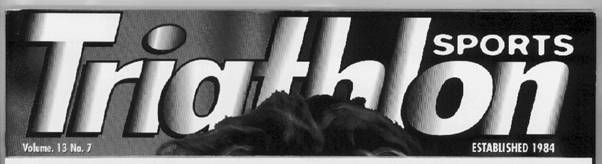
Until early 1997 the front cover of the magazine had as its masthead the word “triathlon” printed prominently and in upper case and the word “sports” appearing less prominently below it but also in upper case. That format changed in early 1997. In the new format the word “triathlon”, though still prominent, was shown in lower case (other than the letter “T”) with the word “sports” in upper case and smaller letters off-centre and appearing above the letters “on” being the last two letters of the word “triathlon”.
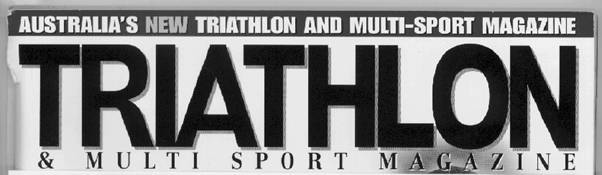
In June of the present year S&I published the first edition of a magazine under the name “Triathlon & Multi Sport Magazine”. Although the style and contents of the two magazines may be distinguished, both can generally be said to concern triathlon sports. S&I’s masthead had the word “triathlon” prominently displayed in black with grey/blue edging in upper case. Underneath the word “triathlon” in smaller upper case appear the words “& multi sport magazine”. On top of the word “triathlon” appears prominently in white and yellow print, upper case, the words “Australia’s new triathlon multi-sport magazine”. The word “new” predominates because of the yellow printing. The cover shows the edition to be volume 1, number 1.
To enable the mastheads to be compared there follows a representation of each of them, of necessity shown in black and white:
It is not necessary to say much about the evolution of the magazine “Triathlon & Multi Sport Magazine” except to say that it came about as the result of an approach of Mr Rod Cedaro to Mr Silvio Morelli, the Managing Director of S&I. Mr Cedaro is a triathlete who has competed at the elite level in that sport and has been involved, inter alia, in newspaper, magazine and associated periodicals as an author of articles on triathlon topics including being the editor of another magazine, “Australian Triathlete”, in the period 1993 to 1997. Mr Cedaro proposed the publication of a new magazine. He had initially turned his mind to purchasing the magazine “Triathlon Sports” but his attempts to do so failed. Mr Cedaro also proposed that Mr Morelli should acquire “Triathlon Sports” magazine. Mr Cedaro was not interested in that proposition.
Discussions took place between Mr Cedaro and Mr Morelli as to the name of a proposed new magazine which Mr Cedaro was to edit. The title proposed by Mr Cedaro was “Triathlon Downunder”, a name that did not appeal to Mr Morelli. Other names considered were “Inside Triathlon”, “Multi Sport Magazine”, “Triathlon Australia” and “Triathlon 2000”. Each of these names had difficulties and was rejected. The decision to adopt the name “Triathlon & Multi Sport Magazine” was made by Mr Morelli. His evidence as to how he came upon the name was not accepted by the learned primary judge who took the view that Mr Morelli was not a credible witness. His Honour found that, in April or May 1998, Mr Morelli became aware that the Respondent was going to purchase the publication “Triathlon Sports”. According to his Honour it was probable that Mr Morelli then decided that it would be open to him effectively to do what he had earlier rejected, namely acquire and use in substance the title “Triathlon Sports” without purchasing it. According to his Honour, he decided so to do by using a title that had many similarities both in language and format to the title of a magazine he knew was being acquired by another. This finding ultimately played no part in his Honour’s decision.
The Primary Decision
After setting out the facts outlined above, the trial judge then proceeded to summarise evidence led by both sides from purchasers and advertisers. We shall deal more fully with this later. Suffice it to say for the moment that, as one might expect, there was some evidence of confusion on the part of witnesses called by Life Saver and at least some evidence of persons who said they were misled into believing that the publication “Triathlon & Multi Sport Magazine” was the magazine owned by Life Saver. The evidence filed on behalf of the Appellant was to the contrary effect.
His Honour recognised that evidence of this kind, while admissible, did not displace the duty the judge has himself or herself to consider objectively whether the conduct complained of was misleading or deceptive or likely to mislead or deceive. Ultimately it does not seem that his Honour gave any particular significance to the evidence but rather approached the matter, correctly in our view, on the basis that the decision ultimately was his to make.
The case originally was brought both as one arising under s 52 of the Trade Practices Act 1974 (Cth) (“the Act”) and under the general law of passing off. However, the parties agreed, correctly, that in a case such as the present, success or failure on the s 52 question determined success or failure in the tortious claim. For this reason his Honour ultimately confined his conclusions to the question whether the conduct of S&I in publishing the “Triathlon & Multi Sport Magazine” was conduct which was misleading and deceptive or likely to mislead or deceive so as to fall within s 52, there being no dispute that the publication of the magazine was in trade or commerce. We proceed on the same basis.
His Honour then turned to consider the problem that the word “triathlon” itself was the name of a sport and descriptive of the contents of the magazine or the type of magazine that was being published. His Honour concluded, and in our view correctly, that the word “triathlon” was not of itself a word over which a monopoly of use could be asserted in the name of a magazine. However, his Honour rested his conclusion upon the fact that the word “triathlon” had been featured prominently throughout the publication of the magazine “Triathlon Sports”, prominence not being altered by the use of lower case since 1997 for the initial upper case. The word his Honour said might fairly be said:
“to dominate the cover of the magazine because of both the size of the word in an absolute sense and, more significantly, its relative size to other text on the cover. The manner in which the word is portrayed renders it distinctive. … I think it may reasonably be inferred that the dominant use of the word ‘triathlon’ provides a point of distinction at the time of purchase between the magazine owned by Life Saver and other magazines generally dealing with the same subject matter in the market. The adoption of the same word and its prominent display by S & I constitutes, in my opinion, a representation that its magazine is the magazine owned by Life Saver.”
His Honour then discussed points of distinction between the mastheads but returned to the question of prominence. His Honour said:
“In my opinion the prominent use of the word ‘triathlon’in the magazine published by S & I will create something more than mere confusion or uncertainty. There is a real possibility that purchasers of triathlon magazines will and will continue to believe the magazine published by S & I is the magazine owned by Life Saver. In reaching this conclusion it has been unnecessary to rely on any inferences that might be drawn from a finding that S & I intended to mislead purchasers. However the finding I have made concerning the adoption of the masthead by S & I fortifies the conclusion I have reached.”
The Appellant’s Submissions
S&I put its submissions in three ways. This is not to say that it resiled in any way from the submissions which it had filed but rather that it was an attempt to summarise the material in in a logical way. The three submissions were as follows:
1. That the learned primary judge erred in the comparison he made of the get up of the two publications and the conclusion he reached that S&I’s masthead in effect represented that the publication “Triathlon & Multi Sport Magazine” was a magazine owned and published by Life Saver.
2. Insofar as the evidence of witnesses supported his Honour’s conclusion, that evidence was of little weight. In particular there was evidence of witnesses supporting the case of S&I that they were not or would not be misled.
3. On the basis that his Honour was correct in concluding that the use of the S&I masthead involved conduct which was misleading or deceptive or likely to mislead or deceive, the case was one where in all the circumstances an injunction should not have been granted because:
(a) any misleading or deception would be transient and its effect dissipated once the S&I magazine was sold on the market; and
(b) Life Saver had said in its evidence that it proposed to change its current masthead and so a permanent injunction was not appropriate.
The Respondent’s Submissions
The submissions on behalf of Life Saver, as may be expected, supported the approach taken by the primary judge. So it was submitted that, in the present case, where members of the relevant section of the public would not only be caused to wonder whether the two magazines came from the same source but also to conclude that they did, there was misleading and deceptive conduct.
Counsel for Life Saver also submitted that, on the evidence, the primary judge was entitled to find that the conduct of S&I in publishing its magazine was misleading and deceptive and that S&I had shown no error of law in this conclusion. In response to S&I’s third submission, Life Saver said that the question before the Court had necessarily to be decided at the time of publication and it was irrelevant what the situation might be in the future if no injunction had been granted.
Role of appellate court
It seems to us useful to deal with the issues raised in the present appeal by considering first the relevant principles and then applying those principles to the facts of the present case. We will then shortly consider the significance or effect of the evidence of witnesses for the parties. As will be seen, we did not find it necessary to consider the Appellant’s third submission. However, in saying that, we should not be taken to have accepted it.
Before embarking upon that discussion, it is useful to say something about the role of an appellant court in cases such as the present.
Once the primary facts have been found, the question whether conduct is misleading or deceptive or likely to mislead or deceive is a conclusion of fact. No doubt the question whether conduct is capable of being misleading or deceptive or likely to mislead or deceive would involve a question of law.
It has recently been said by Lord Hoffmann (with the agreement of all other members of the House of Lords) in Biogen Inc v Medeva plc (1996) 36 IRP 438 at 452 that even where primary facts are not in dispute an evaluation of facts not depending on assessment of credibility, requires appellate caution in reversing the trial judge’s findings. His Lordship said:
“The need for appellate caution in reversing the judge’s evaluation of the facts is based upon much more solid grounds than professional courtesy. It is because specific findings of fact, even by the most meticulous judge, are inherently an incomplete statement of the impression which was made upon him by the primary evidence. His expressed feelings are always surrounded by a penumbra of imprecision as to emphasis, relative weight, minor qualification and nuance (as Renan said, la vérité est dans une nuance), of which time and language do not permit exact expression, but which play an important part in the judge’s overall evaluation.”
That passage has found support in a Full Court of this Court in Esso Australia Resources Limited v Commissioner of Taxation (1998) 98 ATC 4768 at 4779.
There have been some suggestions originating in the area of copyright law where the issue is whether one work is a reproduction of another in a material form that particular respect should be paid to the decision of a primary judge. So in S W Hart & Co Pty Ltd v Edwards Hot Water Systems (1984-5) 159 CLR 466 at 478 per Gibbs CJ, with whose reasons Mason J agreed, said:
“The nature of the issue, involving as it does matters of impression, is one in which particular respect and weight should be given to the decision of the trial judge unless some error in his judgment has been demonstrated.”
Perhaps a similar idea is expressed in the judgment of Brennan J at 491.
A Full Court of this Court comprising Sweeney, Fisher and Sheppard JJ adopted this approach in considering whether a registered design had been infringed in Turbo Tek Enterprises Inc v Sperling Enterprises Pty Ltd (1989) 23 FCR 331. However, at 350 their Honours after setting out the comment of Gibbs CJ set out above, added:
“What his Honour said does not mean that in an appropriate case one may not find error in a case of this kind simply because one takes a different view from the primary judge.”
Ultimately their Honours found the judgmental task difficult and were not persuaded there was error.
A similar approach has been taken in this Court in Skybase Nominees Pty Ltd v Fortuity Pty Ltd (1996) 36 IPR 529 at 534 per Hill J; in different contexts Federal Commissioner of Taxation v Chubb Australia Ltd (1995) 95 ATC 4186 at 4188 per Burchett J and at 4197 per Hill J; Federal Commissioner of Taxation v Smith & Nephew Pty Ltd (1994) 94 ATC 4507 at 4513 per Beaumont J; Pacific Dunlop Ltd v Hogan (1989) 23 FCR 553 at 581 per Beaumont J; Allsop Inc v Bintang Ltd (1989) 15 IPR 686 at 701; and see too 10th Cantanae Pty Ltd v Shoshana Pty Ltd (1987) 79 ALR 299 at 316 per Gummow J (dissenting in the result) referring to Paterson v Paterson (1953) 89 CLR 212; Taylor v Johnson (1983) 151 CLR 422 at 426 and The Heating Centre Pty Ltd v Trade Practices Commission (1986) 65 ALR 429 at 431.
There is some considerable similarity between the questions of infringement arising in the copyright and design area on the one hand and the question of misleading and deceptive conduct on the other. Both involve questions of judgment and degree. So it is not surprising that in Pacific Dunlop, a case involving both passing off and misleading and deceptive conduct, Beaumont J at 581, with whose reasons on this point Burchett J agreed (see at 583), applied what had been said in Edwards Hot Water Systems. The judgment of Sheppard J in the same case, dissenting in the result, appears at 569 rather to have proceeded upon the view that it was for the appellate court itself to reach its own conclusion on the question of fact and degree.
There has been no further discussion on the question in cases under s 52 of the Act so far as our researches have shown. This is so although clearly appellate courts have, although it must be said not often, taken different views from those taken at first instance on the question whether particular conduct is or is not misleading or deceptive or likely to mislead or deceive, eg. Pacific Dunlop; 10th Cantanae and Paula Brock v The Terrace Times Pty Ltd (1982) 40 ALR 97.
We think that while what was said by Gibbs CJ in Edwards Hot Water Systems is apposite in a case such as the present, it does not preclude the appellate court from reaching a different conclusion from the trial judge if it forms the view that conduct is not misleading and deceptive which was found to be so by the trial judge; a fortiori if a conclusion at first instance involves a question of principle. What was said in Edwards Hot Water Systems is no more than a salutary reminder that questions of fact and degree involving judgment may be such that minds may differ so that in a doubtful case an appellate court should give weight to the views of the trial judge. It is not a fetter on an appellate court reaching its own conclusion where it is of a contrary view to that taken by the trial judge.
This approach to the role of the appellate court was accepted by both parties to the appeal. We propose therefore to proceed to consider for ourselves the question whether S&I engaged in conduct which was misleading or deceptive while giving respectful weight to the conclusion to which the learned trial judge came.
Relevant Principles
As we have already noted there is no dispute between the parties as to the relevant principles to be applied.
Section 52 creates what Fox J in Brown v Jam Factory Pty Limited (1981) 53 FLR 340 at 348 referred to as “a norm of conduct”. Where that “norm” is not observed, a cause of action may arise under s 82 of the Act in a person who suffers loss or damage thereby.
Section 52 operates in a variety of situations. It may not be limited to cases where the conduct complained of is a misrepresentation although that is the normal case which presents itself: Henjo Investments Pty Limited v Collins Marrickville Pty Limited (1988) 79 ALR 83 at 93 per Lockhart J.
Where the conduct claimed to be misleading or deceptive involves what is said to be a misrepresentation a number of principles applicable are well established. These were summarised in Equity Access Pty Limited v Westpac Banking Corporation (1990) ATPR ¶40-994 at 50,950-51 in a passage which has been followed in many cases and which was applied by the learned primary judge. We would restate the applicable principles relevant to the present case as follows:
1. There will be no contravention of s 52 unless the error or misconception which occurs results from the conduct of the corporation and not from other circumstances for which the corporation is not responsible: Parkdale Custom Built Furniture Pty Ltd v Puxu Pty Ltd (1982) 149 CLR 191 at 199-200 per Gibbs CJ and at 209-211 per Mason J; Global Sportsman Pty Ltd v Mirror Newspapers Ltd (1984) 2 FCR 82 at 91; Tobacco Institute of Australia v Australian Federation of Consumer Organisations (1993) ATPR ¶41-199 and cf Argy v Blunts & Lane Cove Real Estate Pty Limited (1990) 26 FCR 112 at 132.
2. Conduct will be misleading and deceptive if it leads into error: Parkdale at 198.
3. Conduct will be likely to mislead or deceive if there is a “real or not remote chance or possibility” of misleading or deceiving regardless of whether it is less or more than 50%: Global Sportsman at 87.
4. Conduct causing confusion or uncertainty in the sense that members of the public might have cause to wonder whether the two products or services might have come from the same source is not necessarily misleading and deceptive conduct: Parkdale at 200; Bridge Stockbrokers Ltd v Bridges (1984) 57 ALR 401 at 413 per Lockhart J; Taco Company of Australia Inc v Taco Bell Pty Ltd (1982) 42 ALR 177.
5. In a case such as the present an applicant must establish that it has acquired the relevant reputation in the name or get-up such that the name or get-up has become distinctive of the applicant’s business or products: Sheraton Corporation of America v Sheraton Motels Ltd [1964] RPC 202; BM Auto Sales Pty Ltd v Budget Rent A Car System Pty Ltd (1976) 12 ALR 363.
6. Conduct may be misleading or deceptive or likely to mislead or deceive notwithstanding that the corporation said to engage in that conduct acted honestly and reasonably and did not intend to mislead or deceive: Parkdale at 197 per Gibbs CJ; Hornsby Building Information Centre Pty Ltd v Sydney Building Information Centre Ltd (1978) 140 CLR 216 at 223 per Stephen J; Global Sportsman at 88. Logically, a finding that conduct had been intentionally engaged upon will be irrelevant in determining whether that conduct is misleading or deceptive. It may perhaps be imagined that conduct engaged upon with the intent to mislead or deceive may fail in its purpose and not be found misleading or deceptive. Nevertheless, where the intention to mislead or deceive is found, it logically would be likely that a court would more easily find that the conduct was misleading or deceptive: cf Australian Home Loans Ltd v Phillips (1998) ATPR ¶41-626 and New South Wales Dairy Corporation v Murray Goulburn Co-operative Co Ltd (1989) 86 ALR 549 at 558. It is unnecessary in the present case to consider the question whether a finding of intention to mislead or deceive can have relevance in other ways to issues such as remedies.
7. In many cases it will be necessary to consider the class of persons to whom the representation was directed: Parkdale at 199 and Taco Bell at 202. To the extent that it is here necessary so to do that must be the class of persons interested in purchasing magazines concerned with triathlon sport.
8. There is no proposition of law to the effect that intervention from erroneous assumption between conduct and misconception destroys the necessary chain of causation with the consequence that the conduct cannot be regarded as likely to mislead or deceive: Taco at 200; Campomar Sociedad Limitada v Nike International Ltd (1998) 156 ALR 316 at 344-5.
9. The test of whether conduct is misleading or deceptive or likely to mislead or deceive is an objective one for the Court to determine. It is ultimately a question of fact.
Descriptive name
One matter which assumes particular significance in the present case is where the conduct complained of involves a representation said to be that of a product where the name of the product or a get-up including a name is a word of general application, in the present case descriptive of a sport.
There is much discussion in the case law of factual circumstances where the relevant name includes a descriptive word: cf Hornsby at 229-231 and, for a recent example, the judgment of Goldberg J in Betta Foods Australia Pty Ltd v Betta Fruit Bars Pty Ltd (1998) ATPR ¶41-624. No doubt it is correct to say that where a descriptive trade name is used, there will always be the possibility of confusion. It is also true to say that where a descriptive trade name is used it will be difficult for that name to become distinctive of a particular business, application to like businesses would not ordinarily mislead the public: Hornsby at 229.
Nevertheless there will be cases where usage of even a descriptive name may bring about the result that it acquires a secondary meaning equating it with the products of an applicant: Opals Australia Pty Ltd v Opals Australiana Pty Ltd (1993) ATPR ¶41-264. There may ultimately be a question of fact involved as discussed in Equity Access at 50,956 in a passage cited with approval by a Full Court of this Court in Dodds Family Investments Pty Ltd v Lane Industries Pty Ltd (1993) 26 IPR 261 at 269:
“Just as the distinction between descriptive and fancy names is not a distinction of law so too it is wrong to see the distinction in black and white terms. The reality is that there is a continuum with at the extremes purely descriptive names at the one end, completely invented names at the other and in between names that contain ordinary English words that are in some way or other at least partly descriptive. The further along the continuum towards the fancy name one goes, the easier it will be for a plaintiff to establish that the words used are descriptive of the plaintiff’s business. The closer along the continuum one moves towards a merely descriptive name the more a plaintiff will need to show that the name has obtained a secondary meaning, equating it with the products of the plaintiff (if a name admits of this – a purely descriptive name probably will not) and the easier it will be to see a small difference in names as adequate to avoid confusion.”
Distinctiveness
The name of a sport is not quite on all fours with a descriptive name in the sense used in the above citation. It is difficult to see how the name of a sport on its own could ever become distinctive of particular products of a person. No such suggestion is directly made in the present case. But no doubt the name of a sport, like the name of an article such as an opal, may be used as part of a get-up including a name such that it could become distinctive of a particular person’s business or product. However, it will not be the name of the sport that creates the necessary distinctiveness to enable the circumstances to fall within s 52. Rather it will be a combination of names or the get-up adopted which will bring about this result.
We do not doubt that the name “Triathlon Sports” used over a period of time in connection with a magazine could become and indeed (as his Honour found) did become distinctive of the magazine of Life Saver. No doubt anyone using the same name would engage in conduct within the meaning of s 52 of the Act. We do not think that the mere use of the name “Triathlon & Multi Sport Magazine” on its own is sufficiently similar to the name “Triathlon Sports” to itself constitute conduct which is misleading and deceptive. Indeed it would seem that the trial judge took the same view for his Honour did not concentrate on the name itself but on the prominence which the word “triathlon” had in the masthead or, in other words, upon the get-up which S&I had adopted. So much is clear from the orders made by his Honour as well as the reasons to which we have already referred.
Differentiation
The question whether the get-up of the two publications should be taken to constitute a representation that the magazine of S&I is a magazine under the proprietorship of Life Saver is an objective one as we have said. It requires a comparison of the two mastheads to reach a conclusion, having regard to their similarities and differences but viewed as a whole, whether the similarity is such as to amount to conduct falling within s 52.
In our view, when that objective comparison is undertaken, the conclusion that must be reached is that the S&I masthead is well differentiated from the Life Saver masthead. Of great significance in the making of this comparison is the fact that the “Triathlon & Multi Sport Magazine” included in quite prominent lettering a statement that it was “Australia’s New Triathlon and Multi-Sport Magazine”. That was a clear indication that it was not the same as another magazine which had been in existence for some time. There are other factors, both as to the volume numbers and as to the period of establishment and the selection of type face and colours which can be taken into account. In our view, it is not correct to say that the S&I masthead carries with it the representation that the “Triathlon & Multi Sport Magazine” is a magazine the same as “Triathlon Sports” and published by Life Saver or, for that matter, related to it. It seems to us that his Honour erred in giving too much significance to what his Honour refers to as the “prominent display” of the word triathlon being a word relevant to the name of a sport and the subject matter of the magazine rather than to the overall masthead and get-up. Prominence of the name of a sport alone, absent other factors such as distinctive printing, colouring or other matters of get-up, could not have the necessary distinctiveness to bring about the conclusion that a contravention of s 52 has occurred.
Having reached this position, it is not necessary for us to consider the differentiating effect of the contents of each of the magazines upon which the appellant’s case placed additional reliance.
Significance of the Evidence of Witnesses
In determining whether conduct is misleading or deceptive or likely to mislead or deceive, just as in determining whether there is an infringement of copyright, it is now clear that evidence from persons in the class to whom a representation is directed is admissible and may be persuasive in the determination of the question whether the conduct was indeed misleading or deceptive or likely to mislead or deceive: Parkdale at 198-199 per Gibbs CJ; Taco at 202; McWilliams Wine Pty Ltd v McDonalds System of Australia Pty Ltd (1980) 49 FLR 455 but it is also clear that such evidence is not conclusive. Ultimately, it will be for the Court itself to conclude whether the conduct in question is indeed relevantly misleading or deceptive or likely to mislead or deceive. This is particularly so in a case such as the present where the question involves a comparison of one get-up with another. In the present case, the reasons suggest ultimately that his Honour did indeed form his own view on a comparison of the two mastheads rather than by reference to the evidence.
As we have already indicated, the evidence called on both sides differed but not surprisingly. Four witnesses were called in the Life Saver case. The first witness was a Mr Halaby, a director and shareholder of Life Saver and himself obviously neither confused nor misled. His evidence amounts to no more than that he had asked someone at the counter of a newsagent whether the publication “Triathlon & Multi Sport Magazine” which he waved was “Triathlon Sports” magazine. He received a positive answer. The circumstances and extent to which the counter person considered the question are unknown and the evidence is of little or no significance.
The next witness was Ms Nettle, a part-time nurse and triathlete. She had, she said, picked out the S&I magazine seeing the word “triathlon” on it but intending to purchase “Triathlon Sports”. She did not consider there was a featured word on its cover announcing it was a new magazine. However, having looked through it, she realised it was a different magazine. Her proffered view, that if she had not looked at it in detail she would have believed it was the magazine owned by Life Saver, was likewise of little significance in supporting the case of that company.
The high point of this evidence on the part of Life Saver was the evidence of Mr Wilks, an amateur triathlete and regular reader of “Triathlon Sports” who purchased “Triathlon & Multi Sport Magazine” believing, so he said, that it was the magazine put out by Life Saver and that Life Saver had simply added the words “& multi sport” to the cover so that it included some other sport such as canoeing or rock climbing. He was not cross-examined on the effect on him of the words “Australia’s New Triathlon and Multi-Sport Magazine” as they appeared at the top of the masthead on the “Triathlon & Multi Sport Magazine”.
The final witness was an advertiser. One thing is clear. There was no likelihood that advertisers would be confused and his Honour so found.
No doubt the evidence of Mr Wilks is entitled to some weight. Ultimately however it cannot outweigh the objective result of an examination of the two publications. Evidence to the contrary of his was given on behalf of S&I. A Mr Stevenson gave evidence that he purchases triathlon magazines on a regular basis, buying “Triathlon Sports” occasionally. He said he first saw “Triathlon & Multi Sport Magazine” on sale in a Melbourne newsagency in July 1998 and formed the view it was a new magazine noting, among other things, the fact that it was volume 1 number 1, that it had a different masthead layout and a different name. He said he was never under the impression that the magazine was “Triathlon Sports” in a revamped form or the same magazine.
The state of the evidence was not compelling and of little assistance. It is the objective comparison of the two magazines which in the present case answers the question favourably to S&I.
In our view the appeal should be allowed, the orders of the primary judge set aside and, in lieu thereof, it be ordered that the application be dismissed and that Life Saver pay the costs of S&I both of the appeal and the proceedings at first instance.
|
I certify that this and the preceding fifteen (15) pages are a true copy of the Reasons for Judgment herein of the Honourable Justices Hill, R D Nicholson and Emmett |
Associate:
Dated: 20 November 1998
|
Counsel for the Appellant: |
Mr D H Yates SC Mr R J Webb |
|
|
|
|
Solicitor for the Appellant: |
Minter Ellison |
|
|
|
|
Counsel for the Respondent: |
Mr C C Hodgekiss, Ms A G Pearman Mr I Pike |
|
|
|
|
Solicitor for the Respondent: |
Webster O’Halloran |
|
|
|
|
Date of Hearing: |
9 November 1998 |
|
|
|
|
Date of Judgment: |
20 November 1998 |


