

FEDERAL COURT OF AUSTRALIA
PATENTS – infringement proceeding – cross-claim for revocation – disposable nappy – fair basis of claims – whether can be based on a preferred embodiment – whether there is “a real and reasonably clear disclosure” – effect of lack of precise definition and inherent variability in claims – full description of invention in broad, practical terms – novelty – obviousness – effect of s 7 of Patents Act – effect of transitional provision re patent granted under 1952 Act – common general knowledge – whether matters that could have arisen under obviousness and novelty could be raised under Patents Act 1952 as going to whether there was a patentable invention in the absence of the lack of an inventive step appearing on the face of the specification – whether position would be different under Patent Act 1990 – false suggestion – non-disclosure in Australia of objection to novelty raised in U.S. – utility – not to be tested by postulating deliberate choice of ineffective material – infringement – token variations not to defeat patentee – added feature not avoiding infringement – authorisation of company’s infringement by a director.
CONSTRUCTION – syntactic indication – ambiguity in patent specification clarified by terms of a claim – context.
WORDS AND PHRASES – “flaps” – “fluid” – “preferably soft, conformable and vapor and/or fluid permeable” – “fluid pervious”.
Rehm Pty Ltd v Websters Security Systems (International) Pty Ltd (1988) 11 IPR 289, followed
Leonardis v Sartas No 1 Pty Ltd (1996) 67 FCR 126, followed
Nesbit Evans Group Australia Pty Ltd v Impro Ltd (1997) 39 IPR 56, followed
Canadian Pacific Tobacco Company Limited v Stapleton (1952) 86 CLR 1, referred to
Evans and J. and J. Taunton Ld v Hoskins and Sewell Ld (1905) 24 RPC 517, applied
Genentech Inc’s Patent [1989] RPC 147, referred to
Elconnex Pty Limited v Gerard Industries Pty Limited (1991) 32 FCR 491, applied
Minnesota Mining and Manufacturing Company v Beiersorf (Australia) Limited (1980) 144 CLR 253, followed
N V Philips Gloeilampenfabrieken v Mirabella International Pty Limited (1993) 44 FCR 239, followed
Atlantis Corporation Pty Ltd v Schindler (1997) 39 IPR 29, distinguished
Coopers Animal Health Australia Ltd v Western Stock Distributors Pty Ltd (1987) 15 FCR 382, applied
Martin v Scribal Pty Ltd (1954) 92 CLR 17, applied
Patent Gesellschaft AG v Saudi Livestock Transport and Trading Company (1997) 37 IPR 523, referred to
General Tire & Rubber Co v Firestone Tyre & Rubber Co Ltd [1972] RPC 457, applied
Tidy Tea Ltd v Unilever Australia Ltd (1995) 32 IPR 405, referred to
Wellcome Foundation Ltd v V.R. Laboratories (Aust) Pty Ltd (1981) 148 CLR 262, followed
Advanced Building Systems Pty Ltd v Ramset Fasteners (Aust) Pty Ltd (1998) 152 ALR 604, applied
Prestige Group (Australia) Pty Ltd v Dart Industries Inc (1990) 95 ALR 533, referred to
Winner v Ammar Holdings Pty Ltd (1993) 41 FCR 205, referred to
Washex Machinery Corp v Roy Burton & Co Pty Ltd (1974) 49 ALJR 12, applied
Walker v Alemite Corporation (1933) 49 CLR 643, applied
Rescare Ltd v Anaesthetic Supplies Pty Ltd (1992) 111 ALR 205, applied
King v Milpurrurru (1996) 66 FCR 474, applied
Martin Engineering Co v Nicaro Holdings Pty Ltd (1991) 100 ALR 358, referred to
Microsoft Corporation v Auschina Polaris Pty Ltd (1996) 142 ALR 111, referred to
Meyers Taylor Pty Ltd v Vicarr Industries Ltd (1977) 137 CLR 228, referred to
Australasian Performing Right Association Ltd v Jain (1990) 96 ALR 619, referred to
Trubenising, Ld v Steel and Glover, Ld (1945) 62 RPC 1, referred to
Welch Perrin and Company Proprietary Limited v Worrel (1960) 106 CLR 588, referred to
KIMBERLY-CLARK AUSTRALIA PTY LIMITED v ARICO TRADING INTERNATIONAL PTY LIMITED & ORS
NG 861 of 1995
Burchett J
Sydney
8 September 1998
|
IN THE FEDERAL COURT OF AUSTRALIA |
|
|
|
|
||
|
BETWEEN: |
KIMBERLY-CLARK AUSTRALIA PTY LIMITED Applicant
|
|
|
AND:
AND BETWEEN:
AND: |
ARICO TRADING INTERNATIONAL PTY LIMITED First Respondent
ARIE KLIGER Second Respondent
FRANCISCO MARTIN OTERO TRADING AS KOALA NAPPY EXPRESS Third Respondent
ARICO TRADING INTERNATIONAL PTY LIMITED Cross-claimant
KIMBERLY-CLARK AUSTRALIA PTY LIMITED Cross-respondent
|
|
|
DATE OF ORDER: |
|
|
WHERE MADE: |
THE COURT ORDERS THAT the applicant bring in, on a date to be fixed, short minutes of orders appropriate to be made in the light of the reasons of the Court.
Note: Settlement and entry of orders is dealt with in Order 36 of the Federal Court Rules.
|
IN THE FEDERAL COURT OF AUSTRALIA |
|
|
JUDGE: |
|
|
DATE: |
|
|
PLACE: |
REASONS FOR JUDGMENT
The applicant sues for infringement of its patent by the importation and sale of disposable nappies under the name “BABY SITTER”, and the cross-claimant seeks a declaration of invalidity and an order revoking the patent. Issues are raised in respect of infringement, fair basis, novelty, subject matter, and other questions to which I shall turn later in these reasons.
The patent is a convention patent, the priority date of which, in reliance on a United States patent, is 2 July 1984. The complete specification refers to an invention entitled “DIAPERS WITH ELASTICIZED SIDE POCKETS”, and the abstract of the disclosure states:
“A unitary disposable diaper with elasticized legs is provided having a fluid pervious liner a fluid impervious backing with absorbent material positioned there between. A fecal containment flap is positioned along each side of the diaper and extends inward from the lateral edges.”
Under the heading “BACKGROUND OF THE INVENTION”, the specification states:
“Unitary disposable diapers have recently become the primary type of diaper used in this country. Disposable diapers with elasticized leg openings to provide a better fit and improved containment have recently become a significant part of the disposable diaper market. These elasticized portions are designed to fit around the legs of the baby to aid in the prevention of side leakage and they have been a substantial improvement over the conventional non-elastic disposable diaper. The elastic leg diapers however, are not completely successful in stopping explosive liquified [sic] bowel movements which often occur.”
The specification then goes on to refer to certain attempts “to provide diapers with some additional reinforcing containment means” by methods of folding and by “the use of folded plastic strips to form containment means”. There follows a “SUMMARY OF THE INVENTION”, as follows:
“According to this invention an elastic legged unitary disposable diaper is provided which has an elasticized flap extending inwardly from each side of the diaper and extending its entire length. This flap has elasticization means near the inner most portion so that when the diaper is worn, the flap tends to form a second inwardly facing barrier particularly adapted to contain diarrhetic bowel movements.”
(It is perhaps convenient to note here that the word “diarrhetic” is not usual in modern English, although it is listed in vol IV of the Oxford English Dictionary, 2nd ed (1989). It is not to be found in The New Shorter Oxford English Dictionary (1993), or in the Macquarie Dictionary, 3rd ed (1998). However, it is used here as an adjective with the meaning “of the nature of or characterized by diarrhoea”. The word is used in that sense in the United States (see Webster’s Dictionary) as an alternative to “diarrhoeal” or “diarrhoeic”, the usual adjectives from “diarrhoea” given in standard English dictionaries – The New Shorter Oxford English Dictionary gives the meaning I have quoted. The word “diarrhoea” is defined in that dictionary as signifying: “A condition of excessively frequent and loose bowel movements. Also, watery or semi-liquid faeces characteristic of this condition.”)
The specification contains a detailed description of the invention illustrated by drawings. It is necessary to set out the description and to reproduce the drawings, as follows:
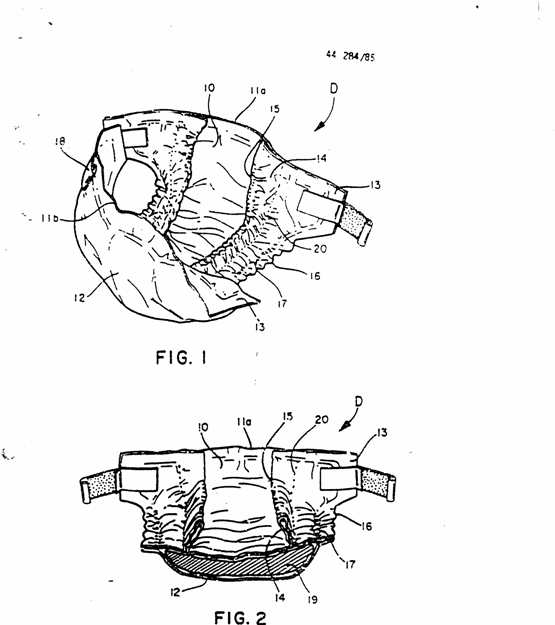
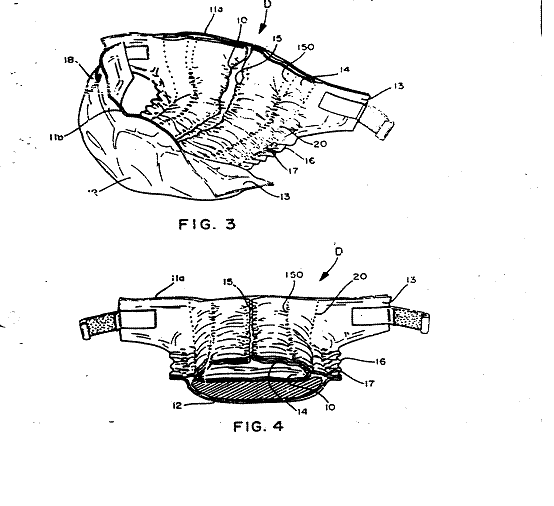
“The invention can be more readily understood by reference to the drawings in which FIG. 1 is a perspective view of a partially opened diaper of this invention and FIG. 2 is an end view partially in cross section of the embodiment depicted in FIG. 1. FIG. 3 is a perspective view of a second embodiment and FIG. 4 is a cross-sectional view of the embodiment depicted in FIG. 3.
As can be seen by reference to FIGS. 1 and 2 the diaper D is provided with a front waist portion 11b and a back waist portion 11a with each of the waist portions including two ear projections 13 which are designed to configure themselves around the baby’s waist. The diaper is maintained in place by tape tab 18 and includes a fluid pervious diaper liner 10 designed to be in contact with the baby’s skin a fluid impervious backing 12 which is sealed peripherally to the liner 10 and an absorbent matrix 19 positioned between the liner 10 and the backing 12. The sides of the diaper 16 include the ear projections 13 and the centrally positioned elasticized means 17 which is designed to form a barrier around the leg of the infant when the diaper is worn and is generally parallel and extends slightly beyond the central or crotch area of the diaper. According to this invention, a flap 14 which is sealed along seal line 20, is provided with elastic means 15 positioned near the inward projecting portions of the flap 14. Elastic means 15 serve to direct flap 14 to a direction substantially perpendicular to side 16. Elastic means 15 therefor serves to reorient the flap 14 in relation to the rest of the diaper profile and elastic length and strength necessary to perform this reorientation is dependent upon the textile of the liner and of [sic] the overall diaper size and would be apparent once the flap concept is disclosed, to those skilled in the art.
The ends of the flap 14 are also preferably sealed to the waist end portions11a and 11b of the diaper to prevent folding outward when the diaper is being put on. Stretch elastic threads are suitable elastic means for the elasticized portion 15 of the flap 14.
There are several methods of elasticizing the side of the diaper in [sic – scil. ‘and’] this particular feature being well known in the art is not part of this invention. These flaps typically form a gap about 2-1/2 inches wide between them when the diaper is opened. A typical elastic thread useful for this invention is about 1/16 inch wide and stretched to about 3 times its original length to a tension of between 30-60 grams with the side flaps at its narrowest dimension being about 2-1/4 inch wide. This produces an elasticized edge which is about 1-1/4 inch from the longitudinal center line of the diaper.
The embodiment depicted in FIGS. 3 and 4 is one in which the width of the flap 14 is extended on each side so that the inward edges of the flap are almost touching each other. A second elastic means 150 is provided. The elastic member 15 has less tension then [sic] the elastic member 150 with the result that the flap should depress like a trap door by the weight provided by the body waste and then return to place. This particular configuration is especially useful in isolating fecal material from the wearer’s skin and should be particularly beneficial for older children and for incontinent adults. It should be noted that diapers as used in this specification also refer to incontinent garments which are similar in purpose to a diaper although due to the size of the wearer have a larger configuration.
The flap material is preferably soft, conformable and vapor and/or fluid permeable. A suitable material made of a fine mesh with a basis weight of 0.7 to 0.8 ounces per square yard and may be a spunbonded diaper liner of the type used throughout the diaper.”
Following the detailed description of the invention, there are twenty-six claims, of which it is sufficient for present purposes to set out the first six, as follows:
“The claims defining the invention are as follows:
1. An absorbent garment comprising:
a back sheet;
a liquid pervious bodyside liner, coterminous with said back sheet, defining front and back waist sections and opposed first and second sides connecting said waist sections, including a pair of leg sections delimited along said sides, each of said leg sections having a tensioned elastic member disposed therealong, forming elasticized leg gathers; an absorbent body disposed between said liner and back sheet; and
first and second elasticized fluid pervious flaps, attached to or formed from said bodyside liner and spaced inwardly of said leg elastic members, respectively, defining a waste containment pocket.
2. An absorbent garment comprising:
a pair of waist sections together defining a waist opening;
a crotch section disposed between said waist sections and a pair of elasticized leg openings separated by said crotch section;
a back sheet;
a liquid pervious bodyside liner which together with said back sheet defines said waist sections and said crotch section;
an absorbent body disposed between said liner and said backsheet; and
first and second elasticized fluid pervious flaps, attached to or formed from said liner and spaced inwardly from said elasticized leg openings, respectively, defining a waste containment pocket.
3. The garment of claim 1 or 2, wherein each of said first and second fluid pervious flaps comprises an essentially rectangular shape with first and second longitudinal sides and first and second base sides.
4. The garment of claim 3, wherein each of said first and second flaps is attached to or formed from said bodyside liner along respective first and second lines wherein said first and second lines are essentially parallel to a centerline of said garment wherein said centerline lies between said first and second sides.
5. The garment of claim 4, wherein each of said first and second longitudinal sides have a preselected length and each of said first and second base sides have a preselected width.
6. The garment of claim 5, wherein said first longitudinal side of each of said flaps has a length sufficient to extend from said front waist section to said back waist section along said respective first and second lines.”
The relevant portions of the body of the specification having been set out, together with (inter alia) claims 1 and 2, it is convenient to refer at once to one of the central questions in the case. It will be observed that the detailed description identifies the position, elasticization and other features, including some functions, of the “flaps”, but does not until its last paragraph refer to the material of which these flaps should be made. In that paragraph, it is stated “[t]he flap material is preferably soft, conformable and vapor and/or fluid permeable”, and then there is reference to “suitable material” as being a particular “fine mesh” which “may be a spunbonded diaper liner of the type used throughout the diaper”. The cross-claimant drew attention to the word “preferably”, pointing out that claims 1 and 2 both specify “fluid pervious flaps” as essential integers. The argument was that the claims could not be fairly based on the specification because it did not so specify. In answer to this argument, the patentee relied on expert evidence, which I accept, that the person skilled in the art at the priority date would unhesitatingly have chosen liquid pervious flaps, as he would have appreciated immediately the need to protect the baby’s skin from irritation produced by the trapping of urine between an impervious flap and the elasticized leg gathers, which would be designed to be impervious. The effect of this evidence was that the inventive idea resided in the flaps themselves, and that, once that idea was disclosed, the range of materials appropriate to be used would be obvious in principle, although some degrees of perviousness would be preferable to others, and selection would involve judgment and experience: cf Samuel Taylor Pty Ltd v S.A. Brush Company Limited (1950) 83 CLR 617 at 624-625. The patentee, in argument, placed great weight on the fact that the cross-claimant called no expert evidence; the submission was that the expert view which I have outlined was uncontradicted.
For the patentee, it was also pointed out that the limitation of its claims to “fluid pervious flaps” was a true narrowing, and not a widening of those claims. It was said that, plainly enough, the body of the specification included fluid pervious flaps as flaps. Indeed, the preferred embodiment involved flaps of this kind. Reliance was placed on the statement of Gummow J in Rehm Pty Ltd v Websters Security Systems (International) Pty Ltd (1988) 11 IPR 289 at 304 which was endorsed by the joint judgment in Leonardis v Sartas No 1 Pty Ltd (1996) 67 FCR 126 at 143 and by Lindgren J (with whom Hill J agreed) in Nesbit Evans Group Australia Pty Ltd v Impro Ltd (1997) 39 IPR 56 at 92:
“[T]he question is whether there is a real and reasonably clear disclosure in the body of the specification of what is then claimed, so that the alleged invention as claimed is broadly, that is to say in a general sense, described in the body of the specification.”
When Gummow J made that statement, he introduced it by a comment that is very relevant to the present case, that “the circumstance that material is part of the description of the invention does not mean that it must be included as an integer of each claim”. See also Elconnex Pty Limited v Gerard Industries Pty Limited (1991) 32 FCR 491 at 515-516.
But it seems to me there are some anterior questions of construction. The first is the meaning of the word “fluid” as used in the claims. I do not think this first question presents any difficulty. It is true that the word “fluid” may embrace both liquids and gases; but a glance at The New Shorter Oxford English Dictionary will show that, used as a noun, the word may refer specifically to a “liquid constituent or secretion of a living organism”, and that a number of the more common expressions in which it is used refer to liquids. As a nappy is concerned with containment and absorption of bodily secretions, it is plain that prima facie the word “fluid” ought sensibly to be read as referring to liquids. This understanding is emphasized by the draftsman’s choice of the expression “vapor and/or fluid permeable” in the sentence at the end of the body of the specification: “The flap material is preferably soft, conformable and vapor and/or fluid permeable.” Plainly, in that sentence, the word “fluid” is confined to the meaning of liquid.
My discussion of the meaning of “fluid” in the specification leads directly into the more significant question, which is whether, as the cross-claimant contends, the patentee has really, in that part of the specification, indicated that the flap material may be either impermeable or permeable, though preferably permeable. The word “preferably” is an adverb preceding the adjective “soft”. This juxtaposition of words, in ordinary English usage, plainly indicates that the adverb qualifies that adjective, which is its “neighbour”, as Beaumont J said when stating a similar syntactic proposition in Switzerland Insurance Australia Limited v Mowie Fisheries Pty Ltd (1997) 74 FCR 205 at 224. Does it also qualify the succeeding adjectives “conformable” and “permeable”? The unambiguous way to express that meaning would have been to have said: “Preferably, the flap material is soft, conformable and … permeable.” The way the sentence has been written, the word ‘preferably” unambiguously refers to “soft”, but it does not unambiguously refer to “conformable” or “permeable”. Nor does it make very much sense to see the quality of being “permeable”, in this context, as the preferable choice. That is because the word “permeable” is already qualified – it may be vapor permeable, vapor and liquid (“fluid”) permeable or simply liquid (“fluid”) permeable. How can this range be considered the preferable option? Since people do not always write precisely, the word order is not a safe guide to meaning, as Dixon CJ recognized in Canadian Pacific Tobacco Company Limited v Stapleton (1952) 86 CLR 1 at 6. But it seems to me that it may raise, as it did there, an ambiguity, and that, here, the further difficulty of regarding the reference to permeability as a statement of the preferred embodiment tends to suggest that the word “preferably” either only qualifies the word “soft”, or at least does not qualify the word “permeable”.
If the body of the specification leaves open the construction which confines the flaps to fluid or liquid permeable flaps, the statement in the claims confining them to “fluid pervious flaps” would, if it could be taken into account in the construction of the document as a whole, support the conclusion that this is the meaning intended. In my opinion, the claims are part of the context of the complete specification, and they may be relied upon in this way. It is stated in Blanco White on Patents for Inventions, 5th ed (1983), para 2-103 (see too my discussion of the interpretation of patent documents in N V Philips Gloeilampenfabrieken v Mirabella International Pty Limited (1993) 44 FCR 239 at 285-287, a dissenting judgment, but not on this point):
“Reference may also be made to the claims to assist in construing a doubtful passage in the body.”
This proposition is supported by the judgment of Vaughan Williams LJ in Evans and J. and J. Taunton Ld v Hoskins and Sewell Ld (1905) 24 RPC 517 at 522, where his Lordship said:
“If the Claim clears up something which in the other part of the text might be doubtful, it seems to me that the Court may, and is bound, in a Specification, to take into consideration in construing it everything you find in the Specification just as much as you would in any other document.”
Having regard to these considerations, I conclude that the claims do not lack fair basis on the ground alleged. The slight narrowing of the claims involved in confining them to liquid pervious flaps (if I am right in understanding “fluid” as “liquid” here as well as in the body of the specification) is not, in my view, such a departure as to leave the claims not fairly based. The claims do not seize upon something so subsidiary or so incidental to the main thrust and orientation of the specification as to be outside its fair scope, to adopt the reasoning of Beaumont J in Coopers Animal Health Australia Ltd v Western Stock Distributors Pty Ltd (1987) 15 FCR 382 at 400. Alternatively, if claims 1 and 2, upon the true construction of the specification, are actually based on a preferred embodiment, it remains true that “there is a real and reasonably clear disclosure in the body of the specification” of that preferred embodiment, which is sufficient to provide fair basis for those claims. In understanding that disclosure, the court may be guided by skilled persons: Leonardis v Sartas at 137-138. On the uncontradicted evidence, the expert reader of the specification would understand the disclosure made by it to be directing him, as a practical matter, to make a disposable nappy falling within the terms of claims 1 and 2. The present case is the complete opposite of a case such as Atlantis Corporation Pty Ltd v Schindler (1997) 39 IPR 29, where (as is made clear at 50) the claims were far wider than the specification, and where (as appears at 53) nothing in the specification suggested in any way the one respect in which they were narrower.
A further contention that the claims lacked fair basis arose out of the expression in the summary of the invention by which the flaps were described as “extending [the] entire length [of the diaper]”. This statement was not repeated in the first five claims. However, it was also not repeated in the detailed description of the invention, although the embodiments shown in the drawings did have such flaps. It seems to me that the putative skilled reader could have been in no doubt that the words quoted did not define an essential integer of the invention. The diaper is described in the detailed description as being “provided with a front waist portion … and a back waist portion … with each of the waist portions including two ear projections … which are designed to configure themselves around the baby's waist”. It would be obvious that the purpose of the provision of a “barrier particularly adapted to contain diarrhetic bowel movements”, which the invention set out to provide, could be fulfilled although the flaps did not extend right up into the front waist portion, the back waist portion, or indeed either of them. On the face of the specification, the reason why it might be desirable to extend the flaps so far, in a particular embodiment, is to allow for a convenient anchor point at the waist in order to prevent outward folding of the flaps. But a disposable nappy so made is referred to in the detailed description only as a preferred embodiment, and it is plain that the same result could be achieved in other ways, in particular by the interposition of some other piece of material between the end of a flap and the waist portion or by a cross-piece linking the two flaps. The preferred embodiment in question is described as follows:
“The ends of the flap 14 are also preferably sealed to the waist end portions 11a and 11b of the diaper to prevent folding outward when the diaper is being put on.”
I do not think the claims lack fair basis in the respect suggested. It could not be said, in the words of Dillon LJ in Genentech Inc’s Patent [1989] RPC 147 at 236-237 that the claims in this respect have an “object … to cover a wide and unexplored field” or that “there is not disclosure in the specification which is in any way coterminous with the monopoly in the claims”.
The cross-claimant also seized upon the expressions “extending inwardly” and “inwardly facing”, applied to the flaps in the summary of the invention, to argue that the claims were not fairly based in so far as they did not use these expressions. But it seems to me that when the specification is read as a whole it reveals an arrangement involving two “fecal containment flap[s]” the inward extension (in one sense, ie towards the body of the wearer) of which, achieved by elasticization, creates “inwardly facing [in another sense, ie the sense in which a garden wall faces or confronts the garden] barrier[s] particularly adapted to contain diarrhetic bowel movements.” That arrangement, as described in more detail in the specification, is illustrated by the figures which leave no doubt that the arrangement is one “defining a waste containment pocket”. In my opinion, the claims in this respect unambiguously reflect the body of the specification. The fact that they do not use all the same words to convey the same meaning is not to the point.
Then the cross-claimant drew attention to the fact that the summary of the invention refers to the elasticization “means” of each flap as being “near the inner most portion [of the flap]”. The first and second claims, and a number of the other claims, do not specify the position of the elasticization, merely referring to “elasticized fluid pervious flaps”. But only a wilful misreading of the claims would position the elasticization so that the flaps would not form a waste containment pocket as required by the invention. Although the body of the specification refers to the elastic position which would achieve the result, it also specifically states:
“There are several methods of elasticizing the side of the diaper [and] this particular feature being well known in the art is not part of this invention.”
It was therefore appropriate to omit it from the claims.
A large part of the cross-claimant’s case was directed to the meaning and implications of the expression “fluid pervious”, as applied to the flaps. I have made it clear that I understand “fluid” to be used in the sense of “liquid”. But counsel pointed out that the concept of liquid perviousness is by no means exact. He referred to my discussion of a comparable expression, “in a liquid tight manner”, in Elconnex Pty Ltd v Gerard Industries Pty Ltd at 511 et seq. But the draftsman of a claim for a patent is not required to use only exact expressions. In the well known case Minnesota Mining and Manufacturing Company v Beiersdorf (Australia) Limited (1980) 144 CLR 253 at 274, Aickin J said of the expression “inextensible”:
“Lack of precise definition in claims is not fatal to their validity so long as they provide a workable standard suitable to the intended use”.
(It was there conceded that the word “inextensible” could not be taken literally; in the circumstances it meant “relatively inextensible” or “not capable of stretching appreciably”, as Aickin J put it (ubi supra).) A number of authorities were cited to support the same proposition in the judgment of the court in Leonardis v Sartas at 134, where the expressions “substantially”, “relatively small”, “a minor amount of water … small in comparison with the total amount of other liquid constituents”, “substantially dropwise” and “substantial effect” were mentioned. In Nesbit Evans Group Australia Pty Ltd v Impro Ltd at 95, Lindgren J (with whom Hill J agreed) cited several decisions, including these cases, as supporting the proposition:
“[I]t is not unusual for a claim to define an invention partly by the use of a relative expression which necessitates exercise of judgment … and so long as the claims provide a workable standard suitable to the intended use, they will be valid … . The expressions in question must be understood in a practical, common sense manner.”
In the same case (at 88), his Honour concluded from the use of rather imprecise expressions that precision was not essential to the invention, nor to the purpose of the particular integer. A similar view was taken of the word “permeability”, in the context of wearing apparel, in Trubenising, Ld v Steel and Glover, Ld (1945) 62 RPC 1 at 12.
In my opinion, the skilled reader, looking “in a practical, common sense manner” at the making of a disposable nappy, and noting that the “fluid pervious flaps” were to define a waste containment pocket, would have no difficulty in understanding the word “pervious”. As I have said, in relation to a different argument, the evidence was that such a person would appreciate the need to protect the baby’s skin from irritation produced by the trapping of urine between an impervious flap and the final impervious barrier of the elasticized leg gathers. It would not be practical to think of everything as remaining in position throughout the wearing of a nappy by a baby. Urine would be likely, from time to time, to get past an impervious flap, a fold of which might impede its getting to the absorbent pad provided for it. For that reason, the evidence shows, it is desirable to have a pervious barrier through which the liquid can pass to be absorbed in the pad. At the same time, the flap would fail to perform its function of providing a barrier “to contain diarrhetic bowel movements” if it were made too easily penetrable. It needs to be pervious, but not to such a degree that it will cease to provide a useful barrier to bodily products somewhat more viscous than urine. I think this broad, practical understanding of the meaning of the word “pervious” is appropriate to the context, and that the claims so expressed are valid. A patentee does not, as Dixon CJ made clear in Martin v Scribal Pty Ltd (1954) 92 CLR 17 at 60, have to express his claim with a precision that “must be but an arbitrary restriction on the inherent variability of [a] feature” which is part of the invention.
It follows that I reject an argument put forward on behalf of the respondents that “pervious” has a special meaning referring to that degree of perviousness which pertains to the body side liner of the absorbent pad. The body side liner does not have any function of a barrier, but on the contrary, is intended to facilitate the transfer of bodily secretions into the absorbent pad. It is pervious, but many materials less pervious than the body side liner would still fairly answer the description of “pervious”, and would fulfil the function of permitting liquid to return to the core of the nappy. A flap less pervious than the body side liner would be more effective in containing “diarrhetic bowel movements”. In other words, the inventor contemplated a compromise, to be made on a practical common sense basis.
It follows also that I do not accept arguments, based on the concept of liquid perviousness, or on the other alleged disconformities between the claims and the specification, by which counsel contended that the claims were not “clear and succinct” within s 40(3) of the Patents Act 1990 and that the claims did not “define” the invention within s 40(2) or describe it fully within the same provision, the effect of which was stated by Carr J (in a judgment with which Jenkinson J agreed and Sackville J relevantly agreed) in Patent Gesellschaft AG v Saudi Livestock Transport and Trading Company (1997) 37 IPR 523 at 530-531. I should add that disconformity, as such, is not, of course, a ground of revocation in Australia: Coopers Animal Health Australia Ltd v Western Stock Distributors Pty Ltd at 388, per Fox J.
On the issue of novelty, the cross-claimant relied on two prior patents. One of these was an Australian patent based on a Canadian patent, having the priority date 17 July 1981, referred to as Aziz, after one of the inventors named in it. It was entitled “Disposable absorbent article having elasticized flaps provided with leakage resistant portions”. As that title suggests, the invention is not limited to disposable nappies. In the part of the complete specification headed “Background Of The Invention”, it is stated that disposable absorbent articles “have many uses”. Reference is then made to “disposable diapers”, but also to “bandages … intended to absorb and contain blood and other body exudates” and “catamenial pads”. However, Aziz “particularly relates to disposable diapers and the like”. It refers to such diapers “having a multiplicity of flaps along the longitudinal sides of the absorbent core in which the flaps have an elastically contractible distal edge, a fixed edge and a non-wicking, non-absorbent, liquid impermeable leakage resistant member interposed between the distal and fixed edges on the liquid contacting surface.” It is to be noted that, in this description, the “multiplicity of flaps” are “along the longitudinal sides of the absorbent core”, and also that they are liquid impermeable. As to the first point, a “multiplicity” could of course be two, one on each of the two longitudinal sides. But if a greater number of flaps could also be intended, there is no indication that any of them is to be placed other than “along” a longitudinal side of the absorbent core. This positioning would require that any additional flaps be formed by having each first flap on a particular side shorter than the length of the side, and placing further flaps along the free portions of that side, so that the flaps would be ranged end to end along the side. Impermeable flaps so positioned would be the equivalent of the leg gathers in the invention in suit, and would not anticipate its flaps, which provide a barrier inwards of the leg gathers. Of course, they would also not anticipate the invention in suit because of the characteristic of impermeability. In view of the argument about the meaning of “pervious” in the patent in suit, it is interesting to note that this patent uses the broad expression “liquid will not pass the leakage resistant portion … in normal use of the diaper” to explain impermeability.
In another statement of the invention in the Aziz specification, the expression “longitudinal sides” is replaced by “a peripheral edge comprising a first longitudinal side edge and a second longitudinal side edge”. The specification then refers to “at least two flaps”, but the words “two flaps” are an ink alteration of the originally typed expression “one flap”. The specification then refers only to two flaps, one “connected to [the outer covering layer of the absorbent core] at said first longitudinal side edge of said absorbent core means and one of said flaps having [its fixed edge] connected to said outer covering layer at said second longitudinal side edge”. The expressions “peripheral edge” and “side edge” are emphatically precise. The drawings are totally consistent with the Aziz flaps being formed from or attached to materials at the edge of the core structure of the pad, and there is no suggestion in the body of the specification or in the drawings of any way of forming flaps inwards of the outer impermeable barrier so formed. If the inventors actually contemplated more than two flaps, one on each side, since they drew attention to the “many uses” of “disposable absorbent articles” according to the invention, including “bandages”, it may be that they contemplated a case where a continuous flap along one side might have a disadvantage, and might need to be severed into two separate flaps to accommodate a part of the human body or a surgical appliance. It would be entirely wrong to use hindsight, informed by the patent in suit, to read into Aziz an arrangement of inner flaps which the specification does not mention. Even apart from the matter of the impermeability of the flaps, it could not be said, for purposes of practical utility, that Aziz gives “the same information as is given by [the patent in suit] so far as it relates to [claims 1 and 2]”, to use the expression adopted by Blanco White op cit para 4-105. Putting the matter in the well known metaphorical language of Sachs LJ in General Tire & Rubber Co v Firestone Tyre & Rubber Co Ltd [1972] RPC 457 at 485-486, it is not enough for the cross-claimant to show that Aziz was “a signpost, however clear, upon the road to the patentee’s invention”. Novelty will only be destroyed where it can be said that “[a] prior inventor [has been] clearly shown to have planted his flag at the precise destination before the patentee”.
The second patent relied on as an anticipation was referred to as Beckestrom, that being the name of the inventor. It was registered in the European Patent Office with the priority date 1 July 1982. The title of the invention, “Protector against incontinence or diaper”, suggests that the primary focus is on incontinence pads rather than nappies, although nappies are included, and a reading of the specification confirms this impression. There is no reference to a “waist portion” as in the patent in suit, and as one would expect with a child’s nappy. The specification refers to a disadvantage of the prior art in that “[m]ovement of the thighs can affect the position of the diaper and its sealing ability, giving rise to risk of leakage”. The specification makes it clear that it is speaking of incontinence pads or diapers in which “[t]he lateral portions of the absorbent layer are provided with an elastic band or an elastic thread at least along a part of its length” and where “[t]he elastic lateral portions can be tensioned around the thighs and thereby achieve a reliable liquid-tight sealing”. The specification then states:
“It is the object of the invention to design a protector of the aforementioned type in such a way that it provides a reliable liquid-tight sealing of the crotch area also during thigh movement.”
What I am here reproducing is, of course, a translation, and I understand the word “also” in the translation to refer back to the statement that movement of the thighs can affect the position of the diaper and its sealing ability, so that what is being said is that the object of the invention is to provide for liquid-tight sealing during movement as well as in its absence. The word “also” is not referring to a second sealing means. Nothing in the specification suggests that. What is described is a more elaborate sealing means which will permit movement of the thighs without disturbance of the protection provided by the incontinence protector or diaper.
The nature of the Beckestrom protector is made clear by the description in the specification, as follows:
“According to the invention, the improvement of known protectors of this type is achieved in that the outer liquid-tight layer [under the absorbent pad] is provided with relatively wide lateral portions which are folded inwards and extend along the entire length of the protector. These are connected at their ends to the mid section of the outer layer and have an elastic band, an elastic thread or such like arranged at the inner free edges on the opposite side. The distance between the inner free lateral edges is approximately half that of the width of the absorbent layer in its mid section. When the diaper is placed between the thighs at the crotch, the elastic edges form creases at the thighs and seal against the same. Usually, the diaper is held in place with a pair of briefs or a girdle or such like.
The connection between the elastic lateral edges and the mid section of the absorbent layer is achieved according to the invention by means of inwardly folded lateral flaps of the outer layer which function as the folds of an easily moveable bellow. The mid section of the absorbent layer can thus make substantial movements in various directions as the bellow folds are unfolded to a greater or lesser extent, without transmitting these movements to the sealing lateral edges. The seal is hereby maintained with greater security. The diaper is also more comfortable to wear.”
The specification gives further information concerning the wearing of the protector, including the use of a velcro-type strip to attach the protector to the inside of briefs in order to hold it in the desired position, and an explanation that the protector can have what amounts to a codpiece, details that confirm the primary concentration on adult use to which I have already referred. After an explanation by reference to figures, the specification states:
“When the diaper is grasped at its ends and pulled up between the thighs to the position of use, the elastic edges … will come into sealing and elastic contact with the thigh creases in the crotch. Then a pair of briefs is put on which presses the absorbent layer … into the crotch between the legs. The portions … of the side flaps … will be folded up thereby to a greater or lesser extent and form a moveable connection between the lateral edges … and the mid section … of the absorbent layer …, so that it can move relatively freely without affecting the lateral edges … and their seal.”
It is plain that Beckestrom is not talking about an internal barrier or a waste containment pocket within a nappy, as a feature supplementing elasticized leg gathers, but is talking about an elaboration of the elasticized leg gathers themselves. That elaboration consists of the insertion of flaps, not designed to provide initial barriers to “explosive” or “diarrhetic” bowel movements, but designed to allow movement of the legs without disturbance of the seal against them. In order to achieve that quite different purpose, the flaps must project sufficiently far to allow for the ‘bellow folds”, or concertina effect, of which the specification speaks. It is a different idea, and one would expect the dimensions to be different in practice from those of a nappy according to the patent in suit. Since the backing sheet, which of course is impervious, is utilized in the forming of the flaps of a protector according to Beckestrom, this alleged anticipation does not have the integer of fluid perviousness of the flaps.
I conclude that Beckestrom did not plant his flag at the precise destination before the patentee.
I turn to the ground of obviousness. Section 7 of the Patents Act 1990 was designed to change the law concerning obviousness in the manner which I discussed in Tidy Tea Ltd v Unilever Australia Ltd (1995) 32 IPR 405 at 413-414. But the patent in suit was granted under the Patents Act 1952. Section 233 of the Patents Act 1990 makes the following provisions in respect of such a patent:
“(1) Subject to this Chapter and the regulations, this Act applies in relation to a standard patent or a petty patent granted under the 1952 Act as if the patent had been granted under this Act.
…
(4) Objection cannot be taken to a patent mentioned in subsection (1), and such a patent is not invalid, so far as the invention is claimed in any claim, on any ground that would not have been available against the patent under the 1952 Act.”
The effect of this provision was discussed by Lockhart J (with whom Northrop J agreed and with whom I relevantly agreed) in N V Philips Gloeilampenfabrieken v Mirabella International Pty Limited at 251-254. His Honour concluded this discussion (at 253-254):
“Hence, if a ground of revocation under the 1990 Act omits an element which was a necessary part of a ground under the 1952 Act, the patentee has the benefit of it. On the other hand, if a ground under the 1990 Act contains an element not previously present under the 1952 Act, it cannot apply in aid of revocation of the 1952 Act patent. In short, a 1952 Act patentee is not to be worse off than he would have been if the 1952 Act had continued to operate, but he may be better off if the 1990 Act treats a former element of a ground of revocation as being no longer necessary.”
The result is that for present purposes the law remains as I stated it in the passage of my judgment in Elconnex Pty Ltd v Gerard Industries Pty Ltd at 507 which I quoted in Tidy Tea Ltd v Unilever Australia Ltd at 413:
“As the Latin derivation (obvius, in the way) makes plain, something is obvious if it is lying in the way, so that one who takes the ordinary route will be likely to come upon it. The doctrine which goes by the name of obviousness is concerned with testing whether there is anything out of the way, in the sense of requiring inventive ingenuity, in the claimed invention. Some of the leading principles were discussed in the joint judgment of the full court in Allsop Inc v Bintang Ltd (1989) 15 IPR 686 at 700 et seq. The court there cited the test of obviousness stated by Aickin J in Wellcome Foundation Ltd v VR Laboratories (Aust) Pty Ltd (1981) 148 CLR 262 at 270; 34 ALR 213 at 216:
‘It is as well to bear in mind that the question of obviousness involves asking the question whether the invention would have been obvious to a non-inventive worker in the field, equipped with the common general knowledge in that particular field as at the priority date, without regard to documents in existence but not part of such common general knowledge.’
The court emphasised that, while the hypothetical worker in the field must be taken to be non-inventive, he should be assumed to be skilled in the relevant art. Under the conditions which prevail in modern industry, he may be part of a sophisticated research team with a great amount of information available to it.
While the hypothetical skilled worker, against whose efforts the claimed invention is to be tested, may be taken to have extensive knowledge, he must be uninventive. Even a small inventive element is sufficient to sustain a patent. However, there is a great difference between the simple idea which really breaks new ground and an unimaginative extension of well known techniques into a closely similar area. Of course, if the area is not closely similar, so that an imaginative leap (even perhaps a small one) is required to perceive that the techniques are applicable to it, there will be invention.”
What distinguishes the law of obviousness as so stated from the position under the Patents Act 1990 is the modification, to which I referred in Tidy Tea Ltd v Unilever Australia Ltd (at 413-414), effected by s 7 in respect of the effect of documents in existence as at the priority date, which, according to the earlier law, could not be taken into account unless they were shown to be part of the common general knowledge at that date: Wellcome Foundation Ltd v V.R. Laboratories (Aust) Pty Ltd (ubi supra); Advanced Building Systems Pty Ltd v Ramset Fasteners (Aust) Pty Ltd (1998) 152 ALR 604 at 611. Thus the effect of s 233 of the Patents Act 1990 is to require me to disregard, as I would have had to do under the previous state of the law, the Aziz and Beckestrom patents, unless the evidence entitles me to find that they were part of the common general knowledge at the relevant date. There was no evidence to that effect. In the case of Beckestrom, it was a European patent which, as I have already observed, although it contained statements that it was applicable to diapers, was directed on its face rather to incontinence protectors for adults. Aziz was an Australian patent application officially published in January 1983. There is no evidence that it had become part of the common general knowledge by the priority date, some eighteen months later. Even if it had, my analysis of it shows that it did not suggest the internal barriers forming a waste containment pocket which are the essence of the invention in suit.
What was disclosed by the prior art was a disposable nappy with elasticized leg gathers. Both Beckestrom and Aziz concentrated, each from a different point of view, on the details of the making of a protector or nappy with a form of elasticized leg gathers. In the case of Beckestrom, the intention was to provide a grip in a quite high position near the crotch, while having loose folds which would enable the pad to ride somewhat lower, supported by briefs. In the case of Aziz, there was nothing to suggest that the positioning of the nappy was intended to be other than entirely standard, with the elasticized leg gathers also in a standard position. Nappies with elasticized leg gathers were actually marketed prior to the priority date, and it was such disposable nappies which constituted the relevant prior art. There was nothing which suggested the concept of a barrier, on each side, inwards of the elasticized leg gathers, intended to absorb the initial impact of a baby’s diarrhoeal bowel movements. Counsel for the respondents argued that mothers have placed pilchers over nappies for generations, and that the idea of additional reinforcing could not be regarded as inventive. But it seems to me that is just the point. The obvious idea is to reinforce from outside by sealing the edges of a nappy, or by enclosing it in plastic or attaching it (as in Beckestrom) to a pair of briefs by velcro or otherwise. What is new about the invention claimed by the patentee is the internal rearrangement of the nappy to relieve the pressure at its edges from within. The evidence does not suggest that anything in the common general knowledge in the industry would have led anyone to this remedy. It required striking out in a new direction. The idea might be fairly simple, but it was not the way the problem had been tackled before, and it seems to me that that “smallness” of invention is present here, which Aickin J considered sufficient in Meyers Taylor Pty Ltd v Vicarr Industries Ltd (1977) 137 CLR 228 at 249. Accordingly, I reject the respondents’ submissions on obviousness.
The amended particulars of invalidity filed in this matter raised, as a ground independent of both novelty and obviousness, an allegation that the “alleged invention is not a patentable invention in that, so far as claimed in each claim, it is not a manner of manufacture within the meaning of s 6 of the Statute of Monopolies”. But, at least in a case involving the provisions of the Patents Act 1952, it would be erroneous, in the absence of the lack of an inventive step appearing on the face of the specification, to consider under this pleading matters that could have arisen under the grounds of obviousness and lack of novelty: Advanced Building Systems Pty Ltd v Ramset Fasteners (Aust) Pty Ltd at 616. It is unnecessary to decide whether the same position would apply in a case governed solely by the Patents Act 1990. The lastmentioned case suggests (at 616) that the authority of N V Philips Gloeilampenfabrieken v Mirabella International Pty Ltd (1995) 183 CLR 655 is limited to a case “where the lack of an inventive step appears on the face of the specification”. See also N V Philips Gloeilampenfabrieken v Mirabella International Pty Limited (1993) 44 FCR 239 at 268-271.
The cross-claimant argued too that the patent “was obtained on a false suggestion or representation” within s 100(1)(k), and that the invention was “not useful” within s 100(1)(h). What must be established in respect of these arguments is not in doubt. As to the issue of utility, the joint judgment of Brennan CJ, Gaudron, McHugh and Gummow JJ in Advanced Building Systems v Ramset Fasteners states the law succinctly (at 611):
“It is no objection to the validity of a patent granted under the [Patents Act 1952] that it is commercially impracticable; its utility depends upon whether, by following the teaching of the complete specification, the result claimed is produced.”
I considered the authorities which establish this proposition at somewhat greater length in Martin Engineering Co v Trison Holdings Pty Ltd (1989) 14 IPR 330 at 336-338. So far as false suggestion is concerned, the principles were considered quite elaborately in Prestige Group (Australia) Pty Ltd v Dart Industries Inc (1990) 95 ALR 533, where Gummow J made it clear (at 554) that this ground could be made out if a false suggestion “was a material inducing factor which led to the grant”. He added that “much will depend upon the particular facts of the case”.
In the present case, the cross-claimant places reliance on the statement, in the summary of the invention, that “the flap [in a nappy according to the invention] tends to form a second inwardly facing barrier particularly adapted to contain diarrhetic bowel movements”. It is argued that a fluid pervious flap could not achieve this object, so that there is both a false representation and inutility. However, the argument entirely overlooks the words “tends to form”. In my opinion, the uncontradicted evidence at least supports this more limited claim, which is not false, and the invention is useful in the sense that the result claimed is produced.
The cross-claimant also relied on the cross-respondent’s failure to disclose, when seeking its patent, that an objection had been raised against the basic application in the United States by reason of the Beckestrom patent. It was said that this objection had led to the abandonment of certain claims in the United States. However, I am not satisfied that the alleged abandonment in the United States in fact had anything to do with Beckestrom. The cross-respondent maintained that it was related to the United States equivalent of a divisional application, and there was no evidence to the contrary. The cross-claimant’s argument is very similar to an argument which was rejected by the full court in Winner v Ammar Holdings Pty Ltd (1993) 41 FCR 205 at 220, per Davies J (with whom Morling J agreed). For the reasons there given by Davies J, I do not think the failure to cite a particular piece of prior art in the United States could generally be regarded as a false suggestion or representation under the Patents Act 1952. In the present case, I have already considered the prior art in question, and have reached the conclusion that it did not anticipate the invention. I hold as a matter of fact that the failure to disclose it was not a material inducing factor which led to the grant of the patent in suit.
A further matter relied upon was that claims 1 and 2 refer to “a back sheet”, without specifying that it must be impervious to liquid. Counsel for the cross-claimant argued that accordingly the claims embraced a nappy that would not be useful and that, in suggesting the contrary, the cross-respondent had made a false suggestion. I do not accept this argument. In my opinion, the skilled reader would regard the expression “back sheet” as in itself conveying the notion of relative imperviousness. The back sheets of nappies may not be like the hatches of submarines, but they are intended to keep moisture from leaking through onto garments or bedclothes. The skilled addressee would make a nappy according to the patent, using a liquid pervious back sheet, only if he were determined to be obtuse. As Stephen J said in Washex Machinery Corp v Roy Burton & Co Pty Ltd (1974) 49 ALJR 12 at 19: “To postulate such a happening is not an appropriate mode of testing validity of a patent specification.” Cf Welch Perrin and Company Proprietary Limited v Worrel (1960) 106 CLR 588 at 602, per Menzies J.
I turn to the issue of infringement. The respondents’ “BABY SITTER” nappy is certainly an absorbent garment with a back sheet as specified in claims 1 and 2. It has a body side liner most of which, ie the central portion, is certainly liquid pervious. But the body side liner is not constructed entirely in one piece. It is extended by small sections of a different material attached to the major part on each side. This different material is also utilized in the forming of what the applicants claim to be the flaps. Two questions are raised by that construction: whether the description in the claims of “a … bodyside liner” is fulfilled although the body side liner is not made of one piece of material, and whether the extra portions are liquid pervious. The “BABY SITTER” certainly has front and back waist sections, et cetera, as described in claim 1, which also satisfy the description in claim 2, except that there is dispute as to whether the “BABY SITTER” has “first and second elasticized fluid pervious flaps, attached to or formed from said bodyside liner and spaced inwardly of said leg elastic members, respectively, defining a waste containment pocket”. There is no doubt, in my opinion, that it does have such flaps, except for the following disputed points:
1. Whether they are fluid pervious is disputed; and
2. Whether they are properly described as “flaps” is disputed.
I have indicated what I see as the real areas of dispute in respect of infringement. The respondents sought to argue whether the attachment and spacing of what were alleged to be the flaps fell within the terms of the claims and whether they defined a waste containment pocket; but in my opinion those arguments were without substance. It is necessary now to examine in more detail the issues which do arise.
The construction of the body side liner does not seem to me to avoid infringement. The claims do not specify that this integer must comprise a seamless sheet of homogeneous material, but only that it must be liquid pervious and, in the case of claim 1, that it must be coterminous with the back sheet. At least in substance, the composite body side liner of the “BABY SITTER” is coterminous with the back sheet and, in combination with the back sheet it does define the waist and crotch sections. The question of the perviousness of the parts of it at each edge, as well as of what are alleged to be the flaps, depends entirely on one’s understanding of the expressions “liquid pervious” and “fluid pervious” as these expressions are used in the claims. I have already made it clear that I think the patent should be understood in practical terms. Perviousness is a relative, not an absolute, concept. If, under the conditions under which a nappy is worn by a baby, the material will let liquid through, in my opinion it is liquid pervious. On the evidence, I am satisfied that the added material, both in the body side liner and in the alleged flaps, utilized in the making of the “BABY SITTER” nappy is of that character. Furthermore, so far as the body side liner is concerned, if I had thought the small portion added at the edge was not liquid pervious, that would not have altered my conclusion that this part of the nappy, taken as a whole, answered the description in the claims, having regard to the undoubted liquid perviousness of almost the whole of it. Token strips at the sides could not so easily defeat the rights conferred on the applicant by its patent. However, the fluid perviousness of the flaps is an essential integer; and, as I have said, the material alleged to constitute these does answer the description.
The “BABY SITTER” does have, inwards of each longitudinal edge, a piece of material projecting, by reason of elasticization, in the manner shown in Figures 1 and 2 of the figures illustrating the specification, so as to provide a barrier on each side to faeces and other bodily secretions. But there is this difference. A few centimetres from each end of the nappy, these elasticized barriers, which continue to each end, are bridged so as to join them by a piece of material, and that material is joined to the waist portion at the front and back of the nappy. The question is whether the joining of the ends of the “flaps” to these bridging pieces and to the waist sections means that they are not flaps within the meaning of the claims. The word “flap” is relevantly defined in The New Shorter Oxford English Dictionary (inter alia) as “Something that flaps”; or as “Something broad and flat hinged or attached on one side only, as a trapdoor, a table-leaf, the cover of a pocket, the seal of an envelope etc.”; or as “A hanging or pendent portion of a garment, hat, etc.”; or as “Something broad and loose, irrespective of connection with anything else”. In my opinion, the last of these meanings is the most appropriate in the context of the specification. Close examination of the specification shows that the “flaps” were intended to be so fixed in a preferred embodiment: “The ends of the flap … are also preferably sealed to the waist end portions … of the diaper to prevent folding outward when the diaper is being put on”. Thus, as its own dictionary, the specification makes clear the sense in which it uses the word “flap”. The material is intended to project, by reason of the elasticization, to form a barrier, but it obviously will be held tight, both at back and front against the waist sections when the nappy is worn. So long as it forms a projecting piece of material, by reason of the elastic, where and to the extent that the wearing of the nappy permits this projection, it will answer the description contained in the claims of the specification. The bridging material at either end may, as counsel suggested, actually be a good idea. It may improve the waste containment pocket formed by the flap at each side. But to improve on a patented invention is not to avoid infringement. The fact that something added, after all the integers of the invention have been taken (indeed, taken exactly in accordance with a preferred embodiment), may make a descriptive word less apt in its application to one of those integers that had already been taken cannot affect the substance of the matter. The respondents have left out nothing of the invention, but have put in something extra which does not affect the way it works, although it might possibly provide some further protection. Then, they say, the flaps are no longer flaps because fixed by the bridging pieces. I hold they are still flaps, but in any case they are the same things, serving the same purposes, and if a change of name is produced, their identity is not changed. Interestingly, that it is appropriate to call the items “flaps” is confirmed by the second respondent’s own usage when he lodged a provisional specification in respect of his product.
The final issue is authorisation. Section 13(1) of the Patents Act 1990 provides that the patentee has the exclusive rights, during the term of a patent, to exploit the invention and to authorise another person to exploit the invention. The applicant says that the second respondent, Arie Kliger, authorised the first respondent to do the acts which constituted infringement of the patent. Mr Kliger was at relevant times a director of the first respondent, together with his wife. But his own affidavit acknowledges that she did not play any active role in its operations. He obtained a patent attorney’s advice, on the basis of which he concluded that the “BABY SITTER” did not involve any infringement of the patent. As he swore in his affidavit:
“I then made the decision to commence importing the disposable nappy with the pocket design”.
In my opinion, the proper conclusion is that Mr Kliger personally directed the acts which constituted the infringement. In the language of Dixon J in Walker v Alemite Corporation (1933) 49 CLR 643 at 658, he “made himself a party to the act of infringement”. It may be that s 13 embraces actions amounting to less, but at least it does embrace that: Rescare Ltd v Anaesthetic Supplies Pty Ltd (1992) 111 ALR 205 at 243, per Gummow J. In King v Milpurrurru (1996) 66 FCR 474 at 480-481, Jenkinson J said, speaking of the liability of a director for authorisation under the Copyright Act 1968:
“But for tortious liability to be imposed on the respondents what is required is that they confer … their authority to commit the torts so that they can be said to have agreed in their commission”.
In the same case, Lee J, who was in dissent on the facts, said (at 486):
“Obviously a director who expressly procures or directs the commission of a tort by a corporation will be personally liable for the tort of the corporation.”
This was the view which I had taken, in a patent case, in Martin Engineering Co v Nicaro Holdings Pty Ltd (1991) 100 ALR 358, and it was also adopted by Lindgren J, in the copyright context, in Microsoft Corporation v Auschina Polaris Pty Ltd (1996) 71 FCR 231 at 245-246. See also Australasian Performing Right Association Ltd v Jain (1990) 96 ALR 619 at 625-627.
In my opinion, the second respondent, by procuring and directing the actions taken by the company, the first respondent, authorised those acts within the meaning of s 13 of the Patents Act 1990.
In the result, the applicant succeeds on its claim, and on the cross-claim. The only order I make at the present stage is to direct that it bring in, on a date to be fixed, short minutes of orders appropriate to be made in the light of my reasons.
|
I certify that this and the preceding twenty-four (24) pages are a true copy of the Reasons for Judgment herein of the Honourable Justice Burchett |
Associate:
Dated: 8 September 1998
|
Counsel for the Applicant: |
D K Catterns QC with S J Goddard |
|
Solicitor for the Applicant: |
Sprusons Solicitors |
|
Counsel for the Respondents: |
A H L Bannon QC with K J Howard |
|
Solicitor for the Respondents: |
Banki Haddock Fiora |
|
Dates of Hearing: |
20,21,22,23,24,27,28 October 1997 |
|
Date of Judgment: |
8 September 1998 |


