

FEDERAL COURT OF AUSTRALIA
CATCHWORDS
ABORIGINES- Native title - Native Title Act1993 - extension to waters over which Australia asserts sovereignty - common law recognition of off-shore native title rights and interests.
ABORIGINES - Native title - claim to ownership and exclusive possession, occupation, use and enjoyment of the sea and its resources .
ABORIGINES - Native title - effect of legislative and administrative acts on native title rights to fish, hunt and gather.
ABORIGINES - Native title - native title rights to sea and sea-bed - inconsistency with rights of leaseholder.
CONSTITUTIONAL LAW (NT) - seaward boundaries of Territory - location of low water mark - identification of bays and gulfs.
EVIDENCE - native title - proof of descent from indigenous inhabitants - proof of traditional laws and customs - use of historical and ethnographical material - evidentiary value of anthropological report.
Aboriginal Land Rights (Northern Territory) Act 1976 (Cth) s 3;
Acts Interpretation Act 1901 (Cth) s 15B;
Atomic Energy Act 1953 (Cth);
Atomic Energy (Control of Minerals) Act 1946 (Cth);
Coastal Waters (Northern Territory Title) Act 1980 (Cth);
Continental Shelf (Living Natural Resources) Act 1968 (Cth);
Crown Lands Act (NT);
Evidence Act 1995 (Cth) ss 73, 74;
Fisheries Act 1878 (SA);
Fisheries Act 1904 (SA);
Fisheries Act 1952 (Cth);
Fisheries Act 1988 (NT);
Fisheries Amendment Act 1980 (Cth) s 11;
Fish and Fisheries Act 1979 (NT);
Fisheries Management Act 1991 (Cth);
Fisheries Ordinance 1911;
Fisheries Ordinance 1949;
Fisheries Ordinance 1965;
Fisheries Ordinance 1972;
Minerals (Acquisition) Ordinance 1953;
Native Title Act 1993 (Cth) ss 3, 6, 10, 13, 17, 23, 26-44, 62, 81, 82, 213, 223, 235, 238, 253;
Northern Territory Crown Lands Act 1890 (SA);
Northern Territory Land Act 1872;
Northern Territory (Self Government) Act 1978 (Cth);
Offshore Waters (Application of Territory Laws) Act 1985 (NT) s 3;
Pearl Fisheries Act 1952 (Cth);
Pearling Ordinance 1930;
Pearling and Pearl Culture Ordinance 1964;
Petroleum (Prospecting and Mining) Ordinance 1954;
Seas and Submerged Lands Act 1973 (Cth) ss 7, 10, 11, Schedule 1;
Validation of Titles and Actions Act 1994 (NT).
A. Raptis & Son v South Australia 138 CLR 346 Appl;
Attorney-General (UK) v Chambers (1854) 4 De GM & G 206 (43 ER 486) Appl;
Attorney-General (NT) v Maurice 161 CLR 475 Appl;
Bowen v Minister for Urban Affairs and Planning (1996) 90 LGERA 368 Appl;
Blundell v Catterall (1821) 5 B & Ald 218 (106 ER 1190) Appl;
Delap v Hayden (1923) 4 DLR 1102 Appl;
Eaton v Yanner; ex parte Eaton, Qld Court of Appeal, unreported, 27 February 1998, Refd;
Harper v Minister for Sea Fisheries 168 CLR 314 Appl;
Mabo v The State of Queensland 175 CLR 1 Appl;
Minister for Primary Industries and Energy v Davey (1993) 119 ALR 108 Appl;
New South Wales v The Commonwealth 135 CLR 337 Appl;
Reg v Keyn (1876) 2 Ex. D 63 Appl;
The Wik Peoples v The State of Queensland and others 187 CLR 1 Appl;
Western Australia v Ward 76 FCR 492 Refd.
MARY YARMIRR AND OTHERS v THE NORTHERN TERRITORY OF AUSTRALIA AND OTHERS
DG NO 6001 OF 1996
OLNEY J
DARWIN
6 JULY 1998
|
IN THE FEDERAL COURT OF AUSTRALIA |
|
|
BETWEEN: |
mary yarmirr and others ApplicantS |
|
|
AND: |
the northern territory of australia and others RespondentS
|
|
|
DATE OF ORDER: |
||
|
WHERE MADE: |
||
MINUTE OF ORDER
1. For the purposes of s 56(2)(a) of the Native Title Act 1993 the Court requests that Mary Yarmirr as the representative of the common law holders identified in the Court’s reasons for judgment published this day indicate whether the common law holders intend to have the native title referred to in the proposed determination set out below held in trust by nominating to the Court in writing a prescribed body corporate to be trustee of the native title and including with such nomination the written consent of the body corporate.
2. The Court specifies a period of 28 days from the date of this order as the period within which the said nomination is to be given to the Court.
AND THE COURT DIRECTS THAT:
3. The parties have leave to file and serve on or before 5 August 1998 written submissions relating to the form of the proposed determination of native title and any other matters relating to the proceeding.
4. Further consideration of the proposed determination and any other matters relating to the proceeding be stood over to Thursday 12 August 1998 at 10.15am in Darwin.
PROPOSED DETERMINATION OF NATIVE TITLE
The Court proposes to make a determination of native title in the following terms:
1. Communal native title exists in relation to the sea and sea-bed within the claimed area.
2. The native title is held by the Aboriginal peoples who are yuwurrumu members of the Mandilarri-Ildugij, the Mangalara, the Murran, the Gadura-Minaga and the Ngaynjaharr clans (the common law holders).
3. The native title rights and interests do not confer possession, occupation, use and enjoyment of the sea and sea-bed within the claimed area to the exclusion of all others.
4. The native title rights and interests which the Court considers to be of importance are the rights of the common law holders, in accordance with and subject to their traditional laws and customs to have free access to the sea and sea-bed within the claimed area for all or any of the following purposes:
(a) to travel through or within the claimed area;
(b) to fish and hunt for the purpose of satisfying their personal, domestic or non-commercial communal needs including the purpose of observing traditional, cultural, ritual and spiritual laws and customs;
(c) to visit and protect places which are of cultural and spiritual importance;
(d) to safeguard their cultural and spiritual knowledge.
5. The native title rights and interests of the common law holders in relation to the sea and sea-bed within the claimed area are affected by, and to the extent of any inconsistency must yield to, all rights and interests in relation to the sea and sea-bed within the claimed area which exist pursuant to valid laws of the Commonwealth of Australia and of the Northern Territory of Australia including the rights and interests of the lessee of Crown Term Lease No. 1034.
Note: Settlement and entry of orders is dealt with in Order 36 of the Federal Court Rules.
|
IN THE FEDERAL COURT OF AUSTRALIA |
|
|
BETWEEN: |
(As set out in Part 1 of Schedule 1) ApplicantS
|
|
|
AND: |
the northern territory of AUSTRalIA and others (as set out in Part 2 of Schedule 1) RespondentS
|
|
|
JUDGE: |
||
|
DATE: |
||
|
PLACE: |
||
PARAGRAPHS
Introduction 1 - 5
The application 6 - 8
The parties 9
The issues 10 - 18
The trial 19 - 25
The claimed area 24 - 29
Offshore application of the Native Title Act 30 - 32
Application of the common law 33 - 34
Recognition of native title 35 - 39
The limits of the Northern Territory 40 - 51
A brief historical overview 52 - 56
An assessment of the applicants’ evidence 57 - 67
The system of native title 68 - 76
The estates and estate groups 77 - 83
The claim to native title rights and interests 84 - 87
Descendants of the original inhabitants 88
The Croker Island community 89
Traditional laws and traditional customs 90
The extent of the sea country 91 - 98
The claimed right of ownership 99 - 100
The claim to exclusive possession occupation, use and enjoyment 101 - 115
The claimed rights to use and control resources 116 - 118
The claimed right to trade 119 - 122
The claimed right to protect places of importance 123 - 125
The claimed right to safeguard cultural knowledge 126 - 127
Extinguishment and related issues 128 - 136
Fishing legislation 137 - 157
Minerals 158
Crown Term Lease No 1034 159 - 160
Summary of Conclusions 161
Proposed Determination 162 - 166
INTRODUCTION
1. In Mabo v The State of Queensland (Mabo No 2) [1] the High Court held that the common law of Australia recognises a form of native title which, in the cases where it has not been extinguished, reflects the entitlement of the indigenous inhabitants, in accordance with their laws and customs, to their traditional lands[2]. The judgments in Mabo No 2 are replete with references to rights and interests in land. Indeed, Brennan J explained:
The term “native title” conveniently describes the interests and rights of indigenous inhabitants in land, whether communal, group or individual, possessed under the traditional laws acknowledged by and the traditionalcustoms observed by the indigenous inhabitants[3]
and the operative portion of the High Court’s declaration (for present purposes) was:
that the Meriam people are entitled as against the whole world to possession, occupation, use and enjoyment of the lands of the Murray Islands[4]. (emphasis added)
There is no reference in Mabo No 2 to the recognition of native title in relation to the sea, and this notwithstanding that the Meriam people are described in the judgment as island people who “have a strong sense ofrelationship to their Islands and the land and the seas of the islands”[5].
2. The applicants, and those on whose behalf this application is brought, like the plaintiffs in Mabo No 2, are island people whose sustenance is in part derived from fishing and who on any view of the evidence have a strong sense of relationship to their islands and the land and the sea of the islands. Unlike the Mabo No 2 plaintiffs, the applicants make no claim to the lands of their islands. Their claim as formulated in their application made pursuant to s 13(1)(a) of the Native Title Act 1993 relates to the sea and sea-beds within the boundaries of a defined area surrounding their islands but excludes land which has been granted for the benefit of Aboriginal people pursuant to the Aboriginal Land Rights (Northern Territory) Act 1976 (the Land Rights Act).
3. The application made pursuant to s 13(1)(a) of the Native Title Act is an application for a determination of native title. Section 225 provides:
225. A “determination of native title” is a determination of the following:
(a) whether native title exists in relation to a particular area of land or waters;
(b) if it exists:
(i) who holds it; and
(ii) whether the native title rights and interests confer possession, occupation, use and enjoyment of the land or waters on its holders to the exclusion of all others; and
(iii) those native title rights and interests that the maker of the determination considers to be of importance; and
(iv) in any case - the nature and extent of any other interest in relation to the land or waters that may affect the native title rights and interests.
4. Although the form of the determination sought in the application was somewhat
different, the applicants, in their final submissions, seek a determination:
(a) that native title exists in the waters and land claimed;
(b) that the native title to the waters and land claimed is held by the members of the Mandilarri-Ildugij clan, the Mangalara-Yangardi clan, the Gadura-Minaga clan, the Murran clan, and the Ngaynjaharr clan;
(c) that the native title rights and interests confer possession, occupation, use and enjoyment of the waters and land to the members of the five clans to the exclusion of all others, subject to the right of senior clan members to permit others to have the use and enjoyment of the waters and land;
(d) that the following rights and interests are of importance -
(i) the right of ownership of the waters and land of the clan’s estate;
(ii) the right to make decisions about the use of the waters and land of the clan’s estate;
(iii) the right of free access to the waters and land of the clan’s estate;
(iv) the right to control the access of others to the waters and land of the clan’s estate;
(v) the right to use the resources of the waters and land of the clan’s estate;
(vi) the right to control the use of others of the resources of the waters and land of the clan’s estate;
(vii) the right to trade in the resources of the waters and land of the clan’s estate;
(viii) the right of clan members to receive a portion of a major catch taken from the waters or land of the clan’s estate;
(ix) the right to protect places of importance in the waters and land of the clan’s estate;
(x) the right to safeguard the cultural knowledge associated with the waters and land of the clan’s estate;
(xi) the secondary rights of the matrifiliates of clan members to have access to the waters and land of the clan’s estate, to be consulted in respect of decisions concerning the use made of the area of the clan’s estate, to use the resources of the clan’s estate, to receive and safeguard the cultural knowledge associated with the waters and land of the clan’s estate.
(e) that there are no private non-native title interests in the land or waters, other than Crown Lease Term No. 1034 to Tiwi Pearls Pty Ltd, which could affect the native title;
(f) that certain fishing licences granted under the Fisheries Act could affect native title rights and interests, but that such licences will not authorise entering into the waters concerned after this determination of native title takes effect, and
(g) that the exercise of a public right to enter the waters could affect native title rights and interests, but such a right will not survive (after) this determination of native title takes effect.
5. The principal issues in this case to a large extent turn upon the proper construction of s 6 and s 223 of the Native Title Act which provide as follows:
6. This Act extends to each external Territory, to the coastal sea of Australia and of each external Territory, and to any waters over which Australia asserts sovereign rights under the Seas and Submerged Lands Act 1973.
223(1) The expression “native title” or “native title rights and interests” means the communal, group or individual rights and interests of Aboriginal peoples or Torres Strait Islanders in relation to land or waters, where:
(a) the rights and interests are possessed under the traditional laws acknowledged, and the traditional customs observed, by the Aboriginal peoples or Torres Strait Islanders; and
(b) the Aboriginal peoples or Torres Strait Islanders, by those laws and customs, have a connection with the land or waters; and
(c) the rights and interests are recognised by the common law of Australia.
(2) Without limiting subsection (1), “rights and interests” in that subsection includes hunting, gathering, or fishing rights and interests.
(3) ...
(4) ...
Section 253 of the Native Title Act provides that unless the contrary intention appears “land” includes the airspace over, or subsoil under, land, but does not include waters; and “waters” includes:
(a) sea, a river, a lake, a tidal inlet, a bay, an estuary, a harbour or subterranean waters; or
(b) the bed or subsoil under, or airspace over, any waters (including waters mentioned in paragraph (a)).
Central to the applicants’ claim in this proceeding is the question of whether the common law of Australia recognises native title rights and interests in relation to waters which are not within the territory of Australia, an issue which did not arise in Mabo No 2 and which has not previously been addressed in native title litigation.
THE APPLICATION
6. The proceeding has its origin in an application for a determination of native title lodged with the Registrar of the National Native Title Tribunal on 22 November 1994 and accepted pursuant to s 63(1) of the Native Title Act on 26 May 1995. On 21 May 1996 the Native Title Registrar lodged the application with the Court for decision. The application was made on behalf of the Mandilarri-Ildugij, Mangalara, Murran, Gadura, Minaga, Ngaynjaharr and Mayarram peoples. (In the proceeding in the Federal Court the Mayarram people were not advanced as having any relevant native title rights and interests). The area the subject of the application (the claimed area) is described in general terms as the seas in the Croker Island region of the Northern Territory which adjoin Croker Island, Manburrwa (Oxley Island), Gurrmurl (New Year Island), Gurrbalud (Lawson Island), Injurranggan (McCluer Island), Wurrulja (Grant Island)[6], and other related islands, and a portion of the mainland which extends between De Courcy Head and the commencement of the Cobourg Marine Park near Guialung Point and includes the sea-bed and any land or reefs within that area which have not been granted for the benefit of Aboriginal people pursuant to the Land Rights Act. The extent of the land excluded from the claim by reason of a grant of title made pursuant to the Land Rights Act is discussed later.
7. The map in schedule 2 to these reasons (the Commonwealth map) is a reproduction of an addendum to the statement of facts issues and contentions filed by the Commonwealth. For present purposes it can be regarded as accurately identifying the boundaries of the claimed area. The other boundaries shown on the Commonwealth map, apart from that described as showing “Geographical limits of NT” are not in dispute. The extent of the geographical limits of the Northern Territory is a matter of contention.
The application asserts that, by their traditional laws and customs, the members of the
claimant groups:
a) are the owners of the claimed waters and land;
b) have the right to exclusive possession of the waters and land;
c) have the right of access to the waters and land;
d) have the right to control the access of other people to the waters and land;
e) have the right to hunt, fish and gather food and material in the waters and land;
f) have the right to prevent or control other people from hunting, fishing or gathering material from the waters and land;
g) are the exclusive owners of the living marine organisms found permanently, or from time to time, within the waters and land;
h) have the right to speak for and make decisions about the use of the waters and land;
i) have the right to receive and to pass on the cultural and religious knowledge associated with the waters and land;
j) have the right and responsibility to care for and protect the sites of significance in the waters and land;
k) have the right and responsibility to care for and protect the resources of the waters and land.
The determination ultimately sought by the applicants, although similar in substance, is expressed in somewhat different terms.
THE PARTIES
9. Section 84(1) of the Native Title Act provides that the persons who were parties to the application under s 68 (which deals with parties to the procedures required to be undertaken in the National Native Title Tribunal following the acceptance of an application) are parties to the Federal Court proceeding. Due to the death of one of the original applicants their number has been reduced to 12[7]. Although named in the application as an applicant no claim was made on behalf of Phillip Galbanyara, the second named applicant in part 1 of schedule 1. In these reasons references to “the applicants” are not intended to include Phillip Galbanyara. There has also been some variation in the identity and description of the other parties. The third, fourth and seventh respondents are collectively referred to as the fishing industry parties. The eighth respondent was joined by leave pursuant to s 84(2)[8]. The fifth and sixth respondents took no part in the proceeding.
THE ISSUES
10. The matters which the applicants identify as requiring to be established are:
(a) the nature of rights and interests in land or waters possessed under traditional laws and customs;
(b) the continuity of the traditional association with the land and waters under claim;
(c) the identity of those who hold rights and interests in the land and waters, according to traditional laws and customs; and
(d) recognition by the common law of Australia.
Each of these matters relates to one or other element of the definition of “native title” or “native title rights and interests” in s 223(1) of the Native Title Act.
11. The primary (but not sole) contention of the respondents other than the eighth respondent (the principal respondents) is that no native title rights are capable of existing or of being recognised by the common law in respect of areas of the sea, sea-bed, subsoil and airspace above the seas and reefs beyond the limits of the Northern Territory and accordingly, insofar as the claimed area extends beyond the limits of the Northern Territory, no native title rights and interests can exist or be recognised by the common law. It is said that upon the acquisition of sovereignty by the Crown the common law of England was imported into Australia but only applied to the low water mark and did not extend to the territorial sea so that any rights and interests existing under indigenous laws and customs at that time in respect of the territorial sea are incapable of recognition at common law. It is said further that, where the application of the common law has been extended beyond the limits of the Northern Territory by legislative enactment, the common law does not recognise native title rights and interests beyond the limits of the Territory.
12. The principal respondents have raised a number of other issues which are pleaded in the alternative. They say that native title rights and interests cannot exist and/or be recognised by the common law beyond three nautical miles from the baselines from which the territorial sea is drawn; that to the extent that native title rights and interests can exist and be recognised by the common law between the limits of the Northern Territory and the area to three nautical miles from the baseline or otherwise beyond the limits of the Northern Territory:
(i) such rights and interests do not confer rights of possession, occupation, use and enjoyment of the waters, the sea-bed, the subsoil of the sea-bed and the airspace above the claimed area on the holders of native title to the exclusion of all others;
(ii) the holders of native title do not have ownership of the marine resources found within the claimed area, including fish, mammals and crustacea;
(iii) the holders of native title do not have ownership of mineral resources present on the sea-bed within, or in the subsoil below, the claimed area, including minerals, oils and gases;
(iv) such rights and interests are subject to the public right of navigation, the right of innocent passage by foreign vessels, the public right to fish, and rights granted under and powers exerciseable pursuant to legislation of the Commonwealth and the Northern Territory, including, without limiting such rights and powers, statutory fishing rights conferred under the Fisheries Management Act 1991 (Cth);
that legislation and administrative acts which apply or have applied to the whole or part of the claimed area have extinguished native title rights and interests in the claimed area in total or partially; and that the conferral of powers of management and control over the claimed waters and land upon, and the exercise of same by, the Northern Territory, is inconsistent with the continued existence of all or any native title rights and interests in the waters and land claimed.
13. The fishing industry parties, in addition to adopting the submissions of the Northern Territory and the Commonwealth, say that if the applicants or any of them ever held any native title rights and interests in or over any part of the claimed area then such rights and interests as did exist have been extinguished or permanently impaired to the extent of inconsistency by the use and occupation of the subject waters by the fishing industry parties and others who have used and occupied those waters for commercial fishing and similar purposes.
14. The Northern Territory says Crown Lease Term No 1034 has extinguished all or any native title rights and interests which may have existed within the leased area (which is off-shore from Croker Island) and in relation to that lease, the exercise of rights under it is inconsistent with the continued exercise of all or any native title rights and interests in the relevant waters and land.
15. The eighth respondent accepts that native title may exist in the sea, sea-bed and subsoil of waters over which Australia asserts sovereign rights but says that the content of such native title will vary with the law, customs and connection upon which it is founded. She says that her interests may be affected by a determination of native title but this would depend upon the content of the determination and that a determination that the applicants’ native title rights confer possession, use and enjoyment of the claimed area on the claimant groups to the exclusion of all others would have an adverse effect on the value of her licences and on the feasibility of her operations.
16. The foregoing summary of the issues reflects the matters raised by the parties in their statements of facts, issues and contentions. In the course of the proceeding the Commonwealth expressed its attitude to the claim in a less formal fashion. The opening paragraphs of the Commonwealth’s written submissions filed on 26 November 1997 state:
1.1 It should be made clear at the outset that the Commonwealth does not in any way dispute the right of the applicants to continue to have free access to, and use of, the waters and seabed, to the resources of the claimed area and to continue to maintain their traditional customs in relation to the claimed area subject only to the common law rights of other Australians and to what is permitted by the laws of Australia.
1.2 Accordingly, the applicants’ capacity to continue their traditional uses of the sea as they have done to date will be unaffected by the decision in this case.
1.3 Nor does the Commonwealth dispute that the applicants have traditional uses of, and customs associated with, the sea.
1.4 Nor, of course, does the Commonwealth dispute that in appropriate circumstances, native title rights to fish, or to exclusive possession as was established in Mabo No 2 or to other of the rights claimed by the applicants might be established on land. However, the question whether the common law of Australia may recognise such rights offshore has yet to be authoritatively determined.
1.5 The Commonwealth does dispute:
· that such customary practices can be recognised as native title rights by the common law in the claimed area beyond the limits of the Northern Territory as opposed to rights shared in common with the people of this country; and
· that, even if native title rights can exist in respect of any part of the claimed area, that such rights could now confer, or could at any time have conferred, exclusive possession, ownership of the marine resources of the sea or the seabed or of minerals within it or any other right to control access to or exploitation of, those areas by the public and by foreign ships.
1.6 Indeed, even where the common law applies to offshore areas within the limits of the Northern Territory so as to form a basis upon which native title rights might be recognised, the common law principles which apply in that area necessarily have the result that the customary practices which might be recognised as native title rights are more limited than those which could be recognised on dry land.
1.7 Accordingly, the heart of this dispute, in the Commonwealth’s contention, lies in distinction between the legal regime which applies on land and that which applies offshore.
1.8 This distinction is rooted in the physical nature of sea territory which distinguishes it from land territory and materially affects people’s relationship with the sea. Whereas the land is capable of being fenced off, of being cultivated and improved, and of being occupied and lived upon by people, our relationship with the sea is primarily limited to the taking of fish and other sea life from and the traversing of the sea. Our capacity to physically close off and to cultivate the seas has been confined to areas close to shore and only recently has modern technology enabled us to build large structures for the drilling of oil and other such purposes in deeper waters of the sea.
1.9 The different relationship between people and the sea is recognised in the principles of the common law and of international law which govern rights in the sea. The legal regimes of both systems of law are premised first and foremost upon the concept of the freedom of the seas. In the common law, this finds reflection in the ancient public rights to fish and to navigate and in the principles of Magna Carta which enjoined the Crown from granting exclusive rights to fish. In international law in the area of the territorial sea, this finds reflection in the right of the ships of all nations to innocent passage. For the reasons which are explained (in another part of the submission) the evidence reveals that applicants’ customs and practices have also had to take account of the physical nature of the seas and has reached an essentially similar position through the custom that deeper waters are shared with other inhabitants of the region.
17. In opening the case for the Northern Territory the Solicitor-General for the Northern Territory (Mr T. Pauling QC), whilst not resiling from the arguments advanced on behalf of the Commonwealth concerning the off-shore recognition of native title said (at transcript p 891):
So you can see that there may be things that, as this jurisprudence develops, one can recognise them and say, “Well, I can see a right of some sort there”. What we say - and leaving aside the matters that are put to you by Dr Griffith because these submissions only become necessary if your Honour were to find that the common law goes offshore but for other reasons rights are not extinguished; but if your Honour were to consider what rights - what the incidents of native title might remain in this case, we would say that it could be put no higher - no higher than a non-exclusive, non-commercial, inshore fishery, and in the course of cross-examination and submissions we will point to the evidence that establishes the fact of merely an inshore fishery.
The theme of a non-exclusive, non-commercial, in-shore fishery was repeated in the Northern Territory’s final submissions, both written and oral.
18. In their final written submissions the fishing industry parties say:
1.4 It is the contention of the Fishing Industry Parties that whilst the evidence supports the existence of some rights of usage of the seas and rights in relation to some of the resources of the sea (as opposed to the sea bed, subsoil and airspace), it does not support rights of exclusive possession. Further, it is submitted that the rights established are not “native title rights and interests” as defined by the Act, or more particularly as recognised by the common law.
1.5 The Fishing Industry Parties main contentions are:
1.5.1 Native title does not exist offshore:
(a) because it does not apply to the “high seas” - for the reasons submitted by the Commonwealth; and
(b) because the evidence has not established that proposition.
1.5.2 To the extent that native title does exist it does not include rights or incidents which are, as between the native title holders and the rest of the world, exclusive.
1.5.3 Further, with the possible exception of turtle and/or dugong, there are no native title rights in other species of fish or marine life, alternatively no exclusive or other rights which would preclude other members of the public from fishing for them and having access for that purpose.
1.5.4 Further, there are no native title rights or interests which are commercial in nature or such as would (i) enable the native title holders to fish etc for commercial purposes without complying with relevant statutory requirements e.g. such as require the obtaining of a licence; or (ii) prevent other members of the public from fishing etc for commercial purposes.
THE TRIAL
19. The application was initially listed for directions at Darwin on 4 July 1996. Further directions hearings were held at Darwin on 7 March 1997 and by video link between Melbourne and Darwin on 21 March 1997 and 14 April 1997. There are no formal pleadings but each party has filed a statement of the facts, issues and contentions which are relied upon and in addition a number of expert reports have been filed. This material identifies the issues. The trial commenced at Croker Island on 22 April 1997. Evidence was heard at various sites on Croker Island and on several adjacent islands from 22 April 1997 to 29 April 1997, and from 4 June 1997 to 7 June 1997. Further evidence was heard at Darwin from 19 August 1997 to 21 August 1997. The parties exchanged written submissions prior to the Court sitting at Darwin from 1 December 1997 to 4 December 1997 when counsel made oral submissions. In the course of those submissions it was suggested that the Court should initially make findings of fact concerning what can conveniently be called the issue of native title and rule on the related question of recognition by the common law, leaving aside for the time being any questions relating to the territorial limits of the Northern Territory and to extinguishment of native title rights and interests and related matters. There being a consensus amongst counsel that this would be a desirable approach I acceded to the suggestion. On maturer consideration I formed the view that it would be undesirable to fragment the proceeding in this manner. Pursuant to directions given on 23 February 1998 further written submissions on the outstanding issues were exchanged and further oral submissions were made in Darwin from 20 April 1998 to 23 April 1998.
20. Section 82 of the Native Title Act requires the Federal Court to pursue the objective of providing a mechanism of determination that is fair, just, economical, informal and prompt; it must take account of the cultural and customary concerns of Aboriginal peoples and Torres Strait Islanders and it is not bound by technicalities, legal forms or rules of evidence. Consistent with these obligations, at the applicants’ request, the Court conducted hearings in a temporary shelter at Minjilang on Croker Island [9] and at a number of other sites on Croker Island and on other islands within the claimed area. As many of the Aboriginal witnesses gave evidence on more than one occasion, and at more than one place, cross-examination was delayed until after the evidence-in-chief of all such witnesses had been completed. The only exception was that during visits away from the main hearing place witnesses were on occasions
cross-examined in relation to site specific matters.
21. Any proceeding in which the Court is required to make findings as to traditional laws and customs practiced more than 150 years ago must necessarily rely upon evidence other than that of the personal observations of witnesses. Similarly, the proof of genealogical connections to ancestors living at or prior to European settlement cannot be proved by reference to official records. To a large extent some of the most important issues before the Court can only be resolved upon evidence which in other circumstances may be regarded as hearsay. However, apart from s 82 of the Native Title Act the provisions of ss 73(1)(d) and 74(1) of the Evidence Act 1995 (Cth) relating to evidence of reputation concerning history and family relationships and of reputation concerning the existence, nature or extent of a public or general right enable the Court to have regard both to the evidence of witnesses who have recounted details concerning relationships and traditional practices which have been passed down to them by way of oral history and to matters recorded by ethnographers and other observers.
22. The trial also involved the difficult question of gender-restricted evidence. The matter was dealt with at the directions hearing on 14 April 1997. On 15 April 1997 I made an order excluding female members of the public from attending a particular sitting but declined to restrict the attendance of female parties or female legal representatives of parties. The views expressed in my reasons published at the time were not supported by the Full Court in Western Australia v. Ward [10] the judgment in which was handed down on 8 July 1997 after the conclusion of the evidence at Croker Island. In the events which happened, thanks to the sensitive approach adopted by the Northern Territory and the Commonwealth (whose respective legal teams included at least one female) only male counsel were present at the relevant time and the evidence was given in circumstances which did not cause offence to the witness or other members of the claimant group As it happens, the evidence in question has no direct bearing upon the outcome of the proceeding and no further reference need be made to it.
23. Nineteen Aboriginal witnesses gave evidence during the sittings at Croker Island. With one exception, each witness was a member of one or other of the groups on whose behalf the application was made. The applicants also called a linguist (Dr Nicholas Evans) and two anthropologists (Drs Nicolas Peterson and Jeannie Devitt). The applicants put in evidence and rely upon a variety of documents including published articles and commentaries which record observations made by explorers and others in the late 19th and early 20th century. The Northern Territory called one witness, Dr Rex Rondon Pyne, then Acting Deputy Director, Fisheries Division, in the Northern Territory Department of Primary Industries and Fisheries, and tendered a number of exhibits. The Commonwealth did not call any witnesses but relied upon several witness statements which were tendered without objection and on a considerable volume of documentary material. The fishing industry parties called three witnesses and tendered a number of witness statements without objection as well as other exhibits. The eighth respondent did not adduce any evidence.
THE CLAIMED AREA
24. Section 13(1) of the Native Title Act contemplates that an application for a determination of native title may be made “in relation to an area for which there is no approved determination of native title”. Section 62(1)(c) requires that a native title determination application must “contain a description of the area over which the native title is claimed”. The application lodged with the Court is the application made initially to the Native Title Registrar under s 13(1)(a) and the Court’s role under s 81 is to “hear and determine applications lodged with it under s 74”. The Court is therefore concerned with the claim to native title rights and interests in relation to the area identified in that application. The applicants have expressly excluded from the area over which native title is claimed all lands and reefs within the boundaries of the claimed area which have been granted for the benefit of Aboriginal people pursuant to the Land Rights Act. However, it must be noted that the application is made in respect of the seas and sea-bed within the claimed area.
25. By deed of grant dated 30 May 1980 the Governor General granted to the Arnhem Land Aboriginal Land Trust, pursuant to the provisions of the Land Rights Act, an estate in fee simple in the islands (other than Groote Eylandt) within boundaries which correspond with those described in schedule 1 of the Land Rights Act under the heading of Arnhem Land (Islands). As the boundary lines defined in relation to the Arnhem Land (Islands) in schedule 1 (and in the deed of grant) encompass an area considerably in excess of the outer boundaries of the claimed area, all islands within the boundaries of the claimed area have been granted in fee simple to the Arnhem Land Aboriginal Land Trust for the benefit of Aboriginal people and are excluded from the area over which native title is claimed. The question remains as to whether the title of the Arnhem Land Aboriginal Land Trust in relation to the islands, terminates at the high water mark, or extends to the low water mark. The deed of grant does not expressly deal with the seaward limit of the land granted but it does describe the land as being “more particularly shown on Compiled Plan 4182 which has been deposited with the Registrar-General, Darwin”. A search of Compiled Plan 4182 indicates that it refers to “Arnhem Land (Islands) in NT portion 1647 being all those islands above low water mark ...”. In the course of the trial counsel for the applicants indicated that a determination of
native title was sought in respect of the waters of the intertidal zone of the islands (ie the water which from time to time covers the area between the low water and high water marks).
26. The Native Title Act requires applicants to identify “the area” over which native title is claimed; and in Part 3 it sets out a series of procedures which must be followed by the National Native Title Tribunal before an application can be lodged with the Court for decision. Section 213(1) provides:
213. (1) If, for the purpose of any matter or proceeding before the Federal Court, it is necessary to make a determination of native title, that determination must be made in accordance with the procedures in this Act.
In my opinion this provision effectively prevents the amendment of an application by the expansion of the area over which native title is claimed once the application has been lodged with the Court for decision. The procedures of Part 3 of the Act would have to be observed before the Court could exercise its jurisdiction in relation to the additional area.
27. In the present case the outer boundaries of the claimed area are specified in the application which seeks a determination of native title in respect of the seas and sea-beds and any land and reefs contained within that boundary excluding land or reefs granted under the Land Rights Act. The exclusion must necessarily exclude the land of the intertidal zone. The question arises as to whether by excluding the land of the intertidal zone, the application has also extended the waters which from time to time cover it. The definition of “waters” in s 253 of the Native Title Act is not without its difficulties. The term is expressed to “include”, inter alia, “sea” or “the bed or subsoil under ... any waters”. On a literal application of the definition a claim in relation to “waters” would relate to either the sea etc or to the sea-bed etc but not both. It may be because of this perceived problem that the application expressly refers to the “seas and sea-beds” in the defined area. If it is legitimate to treat the sea-bed separately from the sea which covers it, (and the definition suggests that it is) then it would appear to be open to claim a determination in respect of the sea of the intertidal zone of the islands without making a similar claim in respect of the sea-bed of that zone (ie the land of the intertidal zone when it is covered by the sea). The application as originally framed, in seeking a determination in relation to all of the sea within the claimed area, extends to the waters of the intertidal zone.
28. Another issue concerning the definition of the area in respect of which a determination is sought has to do with the proper manner of identifying the low water mark. The applicants advocate the adoption of the lowest astronomical tide being -
The lowest tidal level which can be predicted to occur under average meteorological conditions and under any combination of astronomical conditions.
Some support for this approach is sought to be gained from the fact that the 1983 proclamation under s 7 of the Seas and Submerged Lands Act 1973 relating to the baseline from which the width of the territorial sea is measured calculates the low water line according to the lowest astronomical tide. The contrary view adopted by the principal respondents, is that the mean low water mark is the appropriate description.
29. Courts have consistently held that “low water mark” is constituted by the mean low water mark as determined by the tides[11]. Medium ordinary tides are arrived at by excluding the highest tides of the month (springs) and the lowest (neaps). Mean high water mark is, for example, the line of the medium high tide between the springs and the neaps. The landward and seaward limits of the foreshore are therefore the mean high and low water marks
respectively. The Commonwealth correctly points out that the applicants’ alternative proposition, that low water mark is constituted by the lowest astronomical tide, is unsupported by authority.
OFFSHORE APPLICATION OF THE NATIVE TITLE ACT
30. The Native Title Act is Parliament’s response to Mabo No 2. It is an Act “about native title in relation to land or waters” (long title). One of its main objects is to provide for the recognition and protection of native title (s 3(a)). It recognises and protects native title in accordance with the Act (s 10). The Act “extends to each external Territory, to the coastal sea of Australia and of each external Territory, and to any waters over which Australia asserts sovereign rights under the Seas and Submerged Lands Act 1973”. (s 6). In the absence of a contrary intention “coastal sea” has the meaning given by ss 15B(4) of the Acts Interpretation Act 1901 (s 253) which provides:
15B(4) In this section, “coastal sea”:
(a) in relation to Australia, means:
(i) the territorial sea of Australia; and
(ii) the sea on the landward side of the territorial sea of Australia and not within the limits of a State or internal Territory;
and includes the airspace over, and the sea-bed and subsoil beneath, any such sea;
Apart from s 6 of the Native Title Act, in the absence of a contrary intention, the provisions of every Act have effect in and in relation to the coastal sea of Australia as if the coastal sea were part of Australia (Acts Interpretation Act 1901, s 15B(1)(a)).
31. By Proclamation dated 13 November 1990 made pursuant to s 7(1) of the Seas and Submerged Lands Act, Australia extended the limits of the territorial sea over which it asserts sovereign rights out to 12 nautical miles from baselines established by proclamation on 9 February 1983. The whole of the outer boundary of the claimed area is within the 12 nautical mile limit of the territorial sea and by reason of the adoption of straight line baselines, a substantial part of the claimed area is on the landward side of the baselines and thus of the territorial sea. By virtue of ss 6 and 10 of the Seas and Submerged Lands Act sovereignty in respect of the territorial sea and in respect of the internal waters of Australia (that is, any waters of the sea on the landward side of the baseline of the territorial sea) including the related airspace, sea-bed and sub-soil is vested in and exercisable by the Crown in the right of the Commonwealth. It is therefore the case that the whole of the waters within the outer boundary of the claimed area are waters (as defined in s 253 of the Native Title Act) over which Australia asserts sovereignty under the Seas and Submerged Lands Act.
32. The Native Title Act differentiates between an “onshore place” and an “offshore place”. An onshore place is land or waters within the limits of a State or Territory to which the Act extends whereas an offshore place is any land or waters to which the Act extends, other than land or waters in an onshore place (s 253). There are several provisions of the Native Title Act in which the distinction between onshore and offshore places is made. Sections 17 and 23 are examples. The “right to negotiate” provisions of the Act (ss 26-44) apply only in respect of a proposed permissible future act in relation to an onshore place. A future act in relation to an offshore place is a permissible future act (s 235(8)). In my opinion the Native Title Act discloses an intention to recognise and protect native title in accordance with the Act, both onshore and offshore.
THE APPLICATION OF THE COMMON LAW
33. In New South Wales v The Commonwealth (the Seas and Submerged Lands Act case) [12]the High Court upheld the Seas and Submerged Lands Act as a valid exercise of legislative power under s 51 (xxix) of the Constitution. A majority of the Court (Barwick CJ, McTiernan, Mason and Jacobs JJ) also held that the boundaries of the former Australian colonies ended at the low water mark and that they had no sovereign or proprietary rights in respect of the territorial sea or the sub-adjacent soil or super-adjacent airspace. In this context Barwick CJ said (at p 368):
The colonists inherited the common law: but it operated only in the realm which ended at low water mark. This was decided in Reg v Keyn (1876) 2 Ex. D. 63, a decision with which I respectfully agree. ... Thus, property in and power over the territorial seas could not have come from the common law.
Earlier in his reasons (at p 367) the Chief Justice made reference to remarks of Lush J in Reg v Keyn to the effect that although the common law of the realm ended at low water mark, the Parliament could alter that situation if it so desired to which his Honour added the caveat that whilst for its own domestic purposes it could pass without restriction laws operating beyond the dominion, only such of those laws as operated within the area conceded to the nation by the comity of nations could have validity at international law. In concluding his judgment Barwick CJ, in discussing the sovereignty and sovereign rights referred to in the Act, said (at p 375):
That sovereignty and those sovereign rights are exercisable in and in respect of the territorial sea and the continental shelf. The Act, in my opinion, validly vests that sovereignty and these sovereign rights in the Crown in the right of the Commonwealth but any Act or law operating within Australia to implement either of those Conventions or the powers they give must be itself a valid law of the Commonwealth. But if there is such a law, it may operate on matters and things which otherwise could not be the subject of a law of the Parliament.
34. The Commonwealth Parliament has the capacity to enact a law extending to any waters over which Australia asserts sovereign rights under the Seas and Submerged Lands Act. The Native Title Act is such a law. The validity of s 6 of the Native Title Act is not in issue. Nor can it be challenged that to the extent that Australian law operates in those waters, it is the statute law and not the common law of Australia which applies and this notwithstanding that pursuant to the Offshore Waters (Application of Territory Laws) Act 1985 (NT) the “written and unwritten” laws in force in the Territory have effect in and in relation to the coastal waters of the Territory out to three nautical miles (s 3(1)(a)).
RECOGNITION OF NATIVE TITLE
35. It is an element of the Native Title Act definition of native title or native title rights and interests that rights and interests referred to in the definition are recognised by the common law of Australia (s 223(1)(c)). As the recognition accorded by the common law of Australia to a form of native title which reflects the entitlement of the indigenous inhabitants, in accordance with their laws and customs, to their traditional land is confined to “cases where (native title) has not beenextinguished”[13] it may be said from the outset that the common law of Australia does not recognise native title rights and interests which have been extinguished. But it is clear that the judgments in Mabo No 2 contemplate other circumstances which would preclude recognition. For example, Brennan J observed (at p 43) that recognition by our common law of the rights and interests in land of the indigenous inhabitants of a settled colony would be precluded if the recognition were to fracture a skeletal principle of our legal system, and later (at p 60) that a native title which has ceased with the abandoning of laws and customs based on tradition cannot be revived for contemporary recognition. Further, the common law will only recognise rights and interests which constitute a native title when those rights and interests are possessed by the indigenous inhabitants and their descendants[14]. Relevant to a discussion of the recognition of native title is Toohey J’s observation (at p 188):
Presence (of indigenous inhabitants on acquired land) would be insufficient to establish title if it was coincidental only or truly random, having no connexion with or meaning in relation to a society’s economic, cultural or religious life. It is presence amounting to occupancy which is the foundation of the title and which attracts protection, and it is that which must be proved to establish title.
In the second of his general propositions about native title which can be stated without reference to evidence, Brennan J said (at p 61):
Secondly, native title, being recognized by the common law (though not as a common law tenure), may be protected by such legal or equitable remedies as are appropriate to the particular rights and interests established by the evidence, whether proprietary or personal and usufructuary in nature and whether possessed by a community, a group or an individual. The incidents of a particular native title relating to inheritance, the transmission or acquisition of rights and interests on death or marriage, the transfer of rights and interests in land and the grouping of persons to possess rights and interests in land are matters to be determined by the laws and customs of the indigenous inhabitants, provided those laws and customs are not so repugnant to natural justice, equity and good conscience that judicial sanctions under the new regime must be withheld.
These examples serve to identify some of the factors that may call for consideration in determining whether or not any rights and interests of the type described in s 223(1) are recognised by the common law.
36. In Mabo No 2 the Court did not address the question of whether the common law of Australia recognises native title rights in relation to offshore waters. It is idle to speculate what may have been the answer if the question had been addressed. However, the Native Title Act was passed in the wake of Mabo No 2and those who drafted the legislation, and hopefully those who saw its passage through Parliament, would have been familiar with the Mabo judgments, including the reference to the strong sense of relationship of the Murray Islanders to their islands and the land and the sea of the islands (Toohey J at p 191). The Commonwealth’s written submissions (filed 26 November 1997) assert:
The Native Title Act 1993 has been drafted in a manner to allow claims to be made to offshore areas because the issue of whether any native title rights can exist offshore has not yet been determined. However, the fact that the Act permits such claims to be made and resolved does not support the proposition that the common law has, can or does recognise any native title rights offshore. Rather, in view of the uncertainty over the question whether native title can be recognised offshore, the Native Title Act 1993 and other legislation such as the Offshore Minerals Act 1994 were drafted with an eye to prudence and to ensuring that they operate validly even if native title is recognised in areas to which those Acts apply. Thus, notwithstanding submissions by the applicant to the contrary, references to native title in offshore areas in the Native Title Act and other legislation do not “acknowledge” the existence of native title beyond the limits of the Northern Territory. They simply provide for that possibility.
The proposition that by extending the application of the Native Title Act to offshore waters, Parliament has not acknowledged the existence of native title beyond the limits of the Northern Territory is valid because the existence of native title must be proved in each case. However, by enacting s 6 it is clear that Parliament intended the Act to apply to the greatest possible area. Section 6 goes beyond the provisions of s 15B(1) of the Acts Interpretation Act in that, by extending its effect to waters over which Australia asserts sovereign rights, it has included the area of the continental shelf beyond the territorial sea (Seas and Submerged Lands Act 1973,
s 11).
37. In confirming the application of the Native Title Act in relation to the coastal sea and extending its effect to all waters over which Australia asserts sovereign rights Parliament has indicated a specific intention to recognise that native title rights, if proved, are capable of recognition in relation to those seas and waters. Section 6, coupled with the recognition of native title accorded by s 10, namely recognition "in accordance with this Act", supports the proposition that the legislative intention was to provide a statutory basis for recognition offshore. Indeed, consistent with the established learning on the subject, the only way in which Australian law can apply to an offshore area is by legislative enactment.
38. Although the concept of native title adopted by the Native Title Act (as expressed in
s 223(1)) appears to be consistent (at least so far as rights and interests in land are concerned) with that identified in Mabo No 2, the Act has not adopted every aspect of it. For example,
s 11(1) provides that native title may not be extinguished contrary to the Act. Furthermore, "the non-extinguishment principle" (as defined and explained in s 238) is a departure from the common law as explained in Mabo No 2. It is no longer the law that a future alienation of land by the granting of an interest that is wholly or partially inconsistent with the continuing right to enjoy native title effects extinguishment of the native title to the extent of the inconsistency nor is it the case that a valid and effective appropriation of land by the Crown to itself which is wholly or partially inconsistent with a continuing right to enjoy native title will effect extinguishment to the extent of the inconsistency. Under the statute law in the case of a "permissible future act", the non-extinguishment principle applies in circumstances in which, under the common law, extinguishment may have occurred[15]. The Native Title Act has extended and enhanced the common law concept of native title.
39. It would be entirely inconsistent with the thrust of the legislation if the requirement expressed in s 223(1)(c) of the Native Title Act that the rights and interests which constitute native title or native title rights and interests must be rights and interests that are recognised by the common law of Australia were to be construed as imposing a territorial limit in relation to the recognition of native title. In conjunction with the other provisions of s 223, s 223(1)(c) merely identifies the nature of the rights and interests which are capable of being recognised as native title rights and interests. The rights and interests to which s 223(1)(c) refers are clearly, the rights and interests identified by the earlier provisions of the section. Those provisions describe the types of rights and interests which are encompassed within the concept of native title. For example, consistent with common law principles, such rights must not be rights which fracture a skeletal principle of our legal system; they must be rights which are possessed only by the indigenous inhabitants and their descendants; they must be rights which continue to be observed in conformity with the traditional laws and customs of the people to whom the claimants belong. These examples provide an indication of the meaning of "recognised by the common law" in the context of s 223(1). It would be contrary to the clear and plain intention of the Act to recognise and protect native title rights and interests which are shown to exist in relation to the coastal sea of Australia and to waters over which Australia asserts sovereign rights under the Seas and Submerged Lands Act if s 223(1)(c) were to be construed as meaning “the rights and interests exist in relation to an area of land and waters where the common law of Australia applies”. These conclusions render unnecessary the task of making a finding as to the geographical limits of the Northern Territory, but in case it is later held, contrary to the opinion I have expressed, that native title rights and interests can only be recognised by the common law in relation to land and waters within the territory of Australia I propose to express a view as to the limits of the Northern Territory.
THE LIMITS OF THE NORTHERN TERRITORY
40. The letters patent issued to Captain Arthur Phillip and read by him at Sydney Cove on 7 February 1788 defined the western limit of the territory annexed as the 135th degree of east longitude. The commission to Governor Darling proclaimed on his assumption of the administration of New South Wales on 20 December 1825 substituted the meridian of 129° east longitude for the meridian of 135° east longitude as the western boundary of New South Wales. The alteration of the western boundary was preceded by a voyage along part of the northern coast by Captain J.J.G. Bremer, of HMS “Tamar” who landed at Port Essington on 20 September 1824 and at Melville and Bathurst Islands on 26 September 1824. On each occasion he took possession of “the north coast of New Holland or Australia contained between the meridian of 129° and 135° East of Greenwich, with all Bays, Rivers, Harbours, Creeks, etc., in and all the Islands laying off” in the name and in the right of King George IV. The area of sea presently under claim lies between 129° E and 135° E. The British Crown accordingly acquired sovereignty over the land territory within the boundaries of the claimed area as a result of Captain Bremer’s actions in 1824. The present limits of the Northern Territory were defined in letters patent dated 6 July 1863 by which the territory which now constitutes the Northern Territory was annexed to South Australia, a situation which still existed at the time of Federation on 1 January 1901. The Northern Territory was surrendered to the Commonwealth in 1911 and remained under Commonwealth control until the granting of self government in 1978.
41. The Letters Patent of 6 July 1863 defined the limits of the territory annexed to South Australia as:
So much of our said colony of New South Wales as lies to the northward of the twenty-sixth parallel of south latitude, and between the one hundred and twenty-ninth and one hundred and thirty-eighth degrees of east longitude, together with the bays and gulfs therein, and all and every the islands adjacent to any part of the mainland within such limits as aforesaid, with their rights, members, and appurtenances ...
The Commonwealth and the applicants assert that the territorial limit is as shown on the Commonwealth map. In support of this proposition they rely upon dicta in A. Raptis & Son v South Australia [16] in which Gibbs J said (at pp 359-360):
There cannot in my opinion be the slightest doubt that the waters of the bays and gulfs of the southern coast of South Australia were included within the Province - that is, they became part of its territory. The words of the statute and of the letters patent are in this respect plain and unambiguous ... the effect of the letters patent of 1836 was that the bays and gulfs on the south coast of South Australia became part of the territory of South Australia whether or not they would have been regarded by the rules of the common law or the rules of international law as forming part of that territory. It lies within the prerogative power of the Crown to extend its territory on land or at sea, and the acquisition of territory by the Crown is an act of state which cannot be challenged in the courts.
The Letters Patent which constituted the Province of South Australia in 1836, and which were the subject of consideration in Raptis used a similar form of words to those adopted in the 1863 Letters Patent, in particular the words -
“including therein all and every the Bays and Gulfs thereof”
The High Court decided in Raptisthat the waters of both Spencer Gulf and the Gulf of St Vincent were included in the territory of South Australia. The Court also defined the lines which marked the respective entrances to the gulfs.
42. The depiction of the limit of the Northern Territory on the Commonwealth map is based upon the description of Mountnorris Bay in The Australia Directory of 1863 as extending “from cape Cockburn NW 25 miles to cape Croker, and is about 23 miles in depth”. It is said in support of this proposition that it is clear from the decision in Raptis that it is relevant to consider the understanding of the geography of the area by contemporary geographers and cartographers and that in the absence of some contrary indication, that perception will normally be determinative. But I do not think the two citations from Raptis referred to in the Commonwealth submission, but not quoted, support such a firm view. The Commonwealth submission refers first to Gibbs J at p 361 but it may be preferable to quote the whole of the paragraph (which commences on p 360) in which the relevant comments appear:
The question that then falls for consideration in the present case is what waters form part of Spencer Gulf and the Gulf of St Vincent or, in other words, what are the lines marking the respective entrances to those gulfs? It is unnecessary for present purposes to attempt to distinguish between bays and gulfs. Both are indentations of the sea into the land. “The distinction between gulf and bay is not always clearly marked, but in general a bay is wider in proportion to its amount of recession than a gulf; the latter term is applied to long land-locked portions of sea opening through a strait, which are never called bays”: see Oxford English Dictionary, “gulf”, and Stamp, Glossary of Geographical Terms, 2nd ed. (1966), “gulf”. This suggested distinction is by no means consistently drawn in naming bays and gulfs, but since both bays and gulfs are included in the territory of South Australia it is immaterial whether any particular indentation is a bay or a gulf. In deciding whether any particular stretch of water forms part of a bay or gulf both geographical and historical considerations have to be regarded (cf. People v. Stralla (1939) 14 Cal 2d 614). It is first necessary to consider the configuration of the coast with a view to deciding what features would naturally mark the entrance to the indentation. This is a matter on which the opinions of geographers and cartographers are entitled to due weight. Further, it will be relevant and important if at the date of the statute and letters patent the bay or gulf was commonly understood to extend over a particular area, for it may be assumed, in the absence of any indication to the contrary, that the portion of the sea intended to be embraced by the description of bays and gulfs was that which in common understanding was included within them.
His Honour then proceeded to say -
A study of the configuration of the coastline makes it clear that, if points on the mainland only are taken, the entrance points of Spencer Gulf will be in the vicinity of Cape Catastrophe on the west and Cape Spencer on the east, and those of the Gulf of St Vincent will be in the vicinity of Troubridge Point on the west and Cape Jervis on the east.
43. The second citation referred to in the Commonwealth submission is from Jacobs J in Raptis at p 393. After quoting from both the 1830 edition of The Australia Directory and the 1853 edition his Honour said -
The two great gulfs have never since been described otherwise. I regard the opinions of cartographers contemporary with the 1834 statute and the letters patent of 19th February 1836 as of primary significance in the elucidation of the question now posed. Where there is a gulf or bay within the meaning to be given in the context to these general words, then, unless the contemporary description of a particular configuration can be shown to be the result of a cartographic or topographical misconception or a popular misnomer it should be accepted as an accurate description and identification of the configuration falling within the general words “gulfs and bays”.
44. Barwick CJ adopted a somewhat different approach. At p 352 he said -
The question is to be answered, in my opinion, exclusively by the construction of the statutory instruments by or by virtue of which the Province of South Australia was constituted in 1836. The various historical circumstances which may be thought to bear on that construction are mentioned in the reasons for judgment of my brother Stephen. These have had my consideration but, in the long run, I have become convinced upon the proper construction of these statutory instruments that the waters of the two gulfs within closing lines conventionally drawn were included in the area which was placed by the British Executive under government of the Province of South Australia. The inclusion of the word “Gulfs” in the constating formula was unique in Australian colonial history, and the geographical prominence of the two gulfs in relation to the land lying between the designated degrees of longitude seem to me to admit of no other conclusion than that it was intended by the constating description to include the waters of those two gulfs in the new colony.
At p 353, without reference to The Australia Directory or any other similar contemporary publication, he was able to identify the geographical features between which the respective closing lines should be drawn. The features so identified in fact correspond with those described in the 1830 edition of The Australia Directory.
45. The other majority Judge in Raptis was Stephen J who was apparently prepared to have regard to material published subsequent to the Letters Patent of 1836. At pp 372-3 he said -
The reference to “gulfs” must I think be taken to include the whole of the waters of Spencer Gulf and of Gulf St Vincent from their northernmost reaches southerly to the extremities of the land which bounds them on either side. In the case of Spencer Gulf a line from Cape Catastrophe on the south eastern extremity of Eyre’s Peninsula to Cape Spencer on the south western extremity of Yorke Peninsula appropriately defines that gulf. Not only are those two points more or less at the extremities of the bounding land but they are prominent landmarks long recognized in charts and sailing directions as important features of the coast and described in the Australia Directory (1853), Vol 1, p 81 and in subsequent like publications, including the Australia Pilot, 6th ed. (1973), as forming the entrance to the gulf.
The case of Gulf St Vincent is somewhat different since it might be said that Kangaroo Island should be regarded as an extension to one side of the land within which the gulf lies. Leaving aside for the moment this possibility the extent of the gulf is not otherwise in doubt. The Australia Directory of 1853, at p 82, describes the entrance to Gulf St Vincent as lying between Cape Jervis and Troubridge Hill. That cape is near the south western extremity of Fleurieu Peninsula and is a prominent local feature. Troubridge Hill is in fact a high cliff face on the south eastern point of Yorke Peninsula and in the 1973 edition of Australia Pilot is described as two miles west of the entrance to the gulf, which is said to be Troubridge Point. This latter feature is more clearly at the south eastern extremity of Yorke Peninsula and is closer to Cape Jervis than is the hill and for these reasons seems to provide a more appropriate western terminating point for the southern margin of the gulf. I would accordingly regard a line from Cape Jervis to Troubridge Point as marking the southern limits of Gulf St Vincent.
46. One feature of The Australia Directory of 1863 to which no reference was made by the Commonwealth, but nevertheless is contained in the material relied upon, is the prefatory statement headed “Advertisement”. After describing some of the sources of the material published in the Directory, and referring to “some of the numerous out-lying dangers off the north and north west coasts of Australia” the author states -
But as most of these dangers are little known, and many parts of the coasts yet remain imperfectly surveyed, this work must necessarily be considered incomplete, and will yet afford frequent occasion for revision and amendment.
In all the circumstances it would in my opinion be wrong to treat the 1863 edition of The Australia Directory as determinative of the matter presently under consideration. Apart from the very tentative manner in which the information concerning the north coast is put forward the weight of the judgments in Raptis contradicts such an approach. Barwick CJ favoured closing lines “conventionally drawn” and had no need to refer to The Australia Directory but nevertheless identified the same geographical features as the other majority Judges. He thought that “both geographical and historical considerations have to be regarded” and that “it will be relevant and important if at the (relevant dates) the bay or gulf was commonly understood to extend over a particular area”. Gibbs J considered that it “is first necessary to consider the configuration of the coast with a view to deciding what features would naturally mark the entrance to the indentation”. Having said that his Honour then identified the relevant features after “a study of the configuration of the coast line”. Jacobs J qualified his view as to the primary significance to be attached to the opinions of contemporary cartographers in two ways. First, there must be “a bay or gulf within the meaning to be given in the context to these general words” and second, “the contemporary description (must not) be shown to be the result of a cartographic or topographical misconception or a popular misconception”. Stephen J first identified the relevant land marks and then drew some comfort from the opinions expressed in the edition of The Australia Directory some 17 years after the date of the Letters Patent. The Court ought not regard itself as in any way bound by the description of Mountnorris Bay, nor those of Somerville and Palm Bays in The Australia Directory of 1863. Rather it is the Court’s task to first decide whether the areas in question are indeed properly to be regarded as bays (there is no suggestion that they are gulfs) and if they are found to be so, to identify “conventionally drawn” closing lines.
47. Without resiling from its primary submission concerning the limits of the Northern Territory and the weight to be accorded the description in The Australia Directory of 1863, the Commonwealth written submission continued:
However, were it not for the description in the 1863 Australia Directory, the Commonwealth contends that the presence of Bowen Strait as a navigable waterway would make it clear that, even if Mountnorris Bay were regarded as a bay, the appropriate closing lines would normally be drawn from points on the mainland, namely Coombe Point to Guilung Point. Indeed, the presence of Bowen Strait and the history of its use as a navigable waterway may be factors that lead to the conclusion that the description of the bay in the Australia Directory ought not be regarded as determinative.
Similarly, Somerville Bay and Palm Bay on Croker Island were depicted on the Commonwealth map as bays within the limits of the Territory on the basis of the contemporaneous description of Palm Bay and Somerville Bay as bays in the 1863 Australia Directory, even though, as is explained below, there is some doubt as to whether they would otherwise satisfy the criteria with which a bay is identified.
48. In Raptis, Stephen J gave careful and detailed consideration to the question of what constitutes a bay for the purposes of the Letters Patent then under consideration and it is clear that his observations must have equal relevance in relation to the Letters Patent of 1863. I propose therefore to quote at length from Stephen J at pp 376-378:
The common law has always recognized that coastal waters in the form of bays enclosed within the jaws of the land form part of the inland waters of the littoral State. However, difficulty has always been experienced in defining with any precision what must be the attributes of such waters before they may be regarded as sufficiently landlocked to qualify as inland waters. It is said that they must be waters inter fauces terrae but little comfort is to be derived from a recourse to the Latin. To explain the concept by reference to fauces terrae only invites the question how one determines what are the sufficient jaws of the land; as Hill J put it in The Fagernes ([1926] P. 185 at p. 189), “What is the metaphor, the open mouth of a man or of a crocodile?” For long the common law had resort to criteria of human vision in determining the permissible width of jaws and an illusion of certainty prevailed: but Lord Hale’s test - “where a man may reasonably discern between shore and shore” - must necessarily lead to very different results from that of East (2 East P.C., c. 17, s. 10), approved of by Lord Coke, “where a man, standing on the side of the land, may see what is done on the other”.
...
... what was said in the Award of the Permanent Court of Arbitration at The Hague in the North Atlantic Coast Fisheries Arbitration (1910) Reports of International Arbitral Awards, vol. XI, 167, at p 199, although expressed in the context of international law, describes accurately enough the modern common law approach to the question of what bays are internal waters:
“The interpretation must take into account all the individual circumstances which for any one of the different bays are to be appreciated, the relation of its width to the length of penetration inland, the possibility and the necessity of its being defended by the State in whose territory it is indented; the special value which it has for the industry of the inhabitants of its shores; the distance which it is secluded from the highways of nations on the open sea and other circumstances not possible to enumerate in general”.
It was of this passage that Atkin L.J. said in The Fagernes, when that case was before the Court of Appeal [1927] P. 311, at p 325 that “I do not know a better statement of the considerations that must be taken into account ...” The passage reveals a multifactoral approach in which geography is a major consideration but, as their Lordships pointed out in the Conception Bay Case[1877]2 App. Cas. at p 419, usage and history also play a part; precise dimensions are not conclusive, neither the three or six mile single or double cannon-shot rule nor any strict ten mile limit from headland to headland is to be regarded as providing an absolute test. Instead, as expressed by Hosking J in Adams v Bay of Islands County[1916] NZLR 65, at p 71, the question,
“what part of the sea is part of the territory of New Zealand for all purposes is to be determined by the circumstances of the particular case. It is not because a place is called a ‘bay’ that its waters are to be deemed territorially part of the mainland. The size and configuration of the bay may decide the question almost on sight, so to speak. If those circumstances leave the decision doubtful, then acts of administration and other historical facts showing proprietorship may be decisive. All this, of course, leaves the ocean boundary in an indefinite state until some judgment or other formal act renders it definite”.
For Windeyer J in Ferguson v Union Steamship Co of New Zealand Ltd(119 CLR 191, at p. 201) the size and configuration of Emu Bay on the Northern Tasmanian coast did provide an answer “almost on sight”: “I can only say it hardly seems to me possible to say that Emu Bay as a whole is within the fauces terrae. That expression I take to refer to defined promontories or headlands enclosing a narrow entrance to an arm or inlet of the sea”. But “Each such case must depend upon its own special circumstances”: The Fagernes, per Lawrence L.J [1927] P., at p. 328.
If such then be the common law approach to the question of what indentations of the coast create bays which answer the description of inland waters, it will also be very much the approach which a court will necessarily have to adopt in determining which of such indentations are within the description of “bays” for the purposes of the Act of 1834 and the letters patent. Neither the ordinary dictionary meaning of “bay” nor the somewhat more refined meanings to be found in dictionaries of geographical terms provides anything like precision of meaning and I am aware of no historical circumstances which might be used to give to the word, as used in the Act and letters patent, any particular application. ...
... a most careful and detailed consideration of each feature of the coastline thought likely to qualify as a bay would have to be undertaken before it could be concluded whether or not it in fact enclosed internal waters. ... The geographical aspects of the particular feature would require to be adequately understood and all relevant aspects of history and usage would have to be examined.
49. Having regard to the physical features of the mainland and Croker Island shown on the Commonwealth map, particularly the size and configuration of the area of sea on the eastern side of Croker Island which is shown on the Commonwealth map as being within the geographical limits of the Northern Territory (including those areas identified on the map as Mountnorris Bay and Malay Bay) it is not possible to say that any part of that area falls within the jaws of the land and subject to what is said below concerning Mission Bay, it is not possible to define any promontories or headlands which enclose a narrow entrance to an arm of the sea. The same comments apply with equal force to the areas of Somerville Bay and Palm Bay. Nor has there been any historical circumstance established by the evidence which might have any bearing on the matter in question.
50. The status of Mission Bay is not readily capable of determination on the material before the Court. No detailed consideration of relevant features of the coastline was undertaken. A rough calculation based on the 1:250,000 scale map tendered in evidence (exhibit Com 17) suggests that at its narrowest, the entrance to the bay is about 2½ kilometres wide; its maximum width to the west of the entrance is a little less than 2 kilometres and its length within the entrance is about 4½ kilometres. The bay is adjacent to the main living area on the island (Minjilang) and its shores were the original site of the mission from which the bay takes its current name. Although there is no historical material of the nature which was regarded as important in Raptis, it may reasonably be said that the waters landward of a line joining the points on the north and south sides of the entrance to the bay constitute an arm of the sea enclosed by a narrow entrance and therefore within the territory of the Northern Territory, but I am unable to define the extent of those waters more precisely.
51. It is my opinion that, consistent with the judgments of the High Court in Raptis and the Seas and Submerged Lands Act Case, the territorial limits of the Northern Territory within the claimed area include the waters of Mission Bay but otherwise extend to, but not beyond, the low water mark of the coast line of the islands and mainland.
A BRIEF HISTORICAL OVERVIEW
52. The following paragraphs touch upon some of the major events known to have occurred in the general vicinity of the claimed area. The information has been extracted from evidence tendered in the proceeding which, so far as it goes, is uncontroversial[17]. From about 1720 until 1906 fishermen from the port of Macassar (now known as Ujang Pandang) in southern Sulawesi travelled to the Arnhem Land coast annually for the purpose of collecting a range of products both from the land and from the sea. Their major task was to gather and preserve trepang (also known as beche-de-mer or “sea cucumber”). The Macassan ships (known as praus) arrived each year in December or January and departed between April and June. The claimed area (and the adjacent Cobourg Peninsula) was an important area for Macassan activities, it being the first trepanging ground encountered on the trip from Sulawesi and also the area where praus mustered before the journey home. Trepanging grounds in the vicinity of the claimed area were located in Bowen Strait, Mountnorris Bay, Malay Bay and Raffles Bay. Campsites and trepang processing stations were established on Copeland Island, on the north side of Bowen Strait and at Raffles Bay. Grant Island is thought to have been used as a source of water and vegetable food by Macassan crewmen and there are oral traditions that the freshwater spring at Minjilang on Croker Island was also used by Macassans. Some Macassan fleets were extremely large. For example, in 1829 Fort Wellington (in Raffles Bay) was visited by 34 praus manned by 1056 men. Praus with as many as 60 crew members have been documented. The size of the industry declined throughout the 19th century and after the mid-1880s Macassan fleets generally contained between 100 and 300 men. The 1905-06 season was the last in which the Macassans operated in the claimed area. Early records (i.e. records from 1818 through to 1829) indicate that violence and mistrust were rife between Macassans and the local Aborigines but that situation improved in the 1830s and 1840s, to the extent that Aborigines frequently assisted Macassans with trepang fishing and in addition a trading relationship sprang up whereby the Aborigines provided turtle shell, seed pearl, pearlshell and buffalo horns and in return for these goods and their labour received dugout canoes, tobacco, rice, cloth, iron and alcohol.
53. Dutch explorers made fleeting visits to the Cobourg Peninsula in 1636 and 1644, and conducted a more substantial investigation of the area in 1705. The first British explorer to reach the area was Mathew Flinders, who landed on New Year Island in 1803 where he saw human footprints on the shore. Phillip Parker King subsequently charted the small islands east of Croker Island in 1818 and passed through Bowen Strait. Permanent European settlement began in 1827 when Fort Wellington was established at the mouth of Raffles Bay. It was abandoned in 1829. In 1839 the British established the Victoria Settlement at Port Essington to the west of the claimed area. After Victoria Settlement was abandoned in 1849 vessels briefly investigated the area in 1851, 1866 and 1867, but no attempt at settlement was made until 1874 when Darwin-based entrepreneurs John Lewis and Edmund Robinson investigated the possibilities for pastoralism and fishing in the area. In December 1874 Robinson commenced collecting trepang at Port Essington but abandoned the venture after six months. He attempted trepanging again in 1878 when, with his partner Thomas Wingfield, he established a new trepanging station on Croker Island. His camp was situated at a place known locally as Whitecliffs on the western side of the island. A group of Aborigines worked at the station which began to achieve some financial success. In December 1879 Wingfield was murdered by Aborigines and Robinson abandoned the venture. Despite its uncertain beginnings, a relatively stable locally based trepang fishery had developed in western Arnhem Land by the turn of the twentieth century but by 1910 the government was forced to concede trepanging had been “almost entirely abandoned”. In the following year only two boats and eight licence holders were engaged in the industry. The outbreak of war between China and Japan crippled the trepang market, and its price collapsed in the late 1930s. By 1941 Northern Territory trepang exports had declined to only a few tons a year and ceased with the outbreak of war with Japan.
54. The most significant industry in the claimed area after trepanging was the pearling industry. Pearling was carried out by a fleet of luggers based in Darwin. Little or no pearling appears to have been carried out in the claimed area before 1901, when the fleets were concentrated between Darwin and Melville Island. In 1908 Cecil Strangman (a medical officer and Protector of Aborigines) noted that the Aborigines on Croker Island were in contact with Japanese pearlers and in 1915 there were at least 11 luggers working in the claimed area around Malay Bay, Darch Island, Cape Croker and Oxley Island. In the late 1920s and early 1930s Japanese were observed diving for pearl shell off Grant Island and in the waters around Croker Island. The Second World War disrupted the pearling industry, and the pearling fleets did not return to the claimed area. More recently the Paspaley Pearling Company established leases for pearl culture immediately outside the claimed area at Port Essington in 1963 and at Port Bremer in 1978.
55. Crocodile shooting began in the claimed area prior to the Second World War. There were several crocodile shooters’ camps in Palm Bay, on the western side of Croker Island, in the late 1930s. After the Second World War many migrants to Australia found work shooting crocodiles along the Northern Territory coastline including within the claimed area. Once crocodile shooting was banned in the 1960s their attention was turned to barramundi fishing. Prawn trawling, shark fishing and mackerel fishing (the latter off New Year Island) have occurred within the claimed area since the early 1970s. Currently, commercial fishing activities in the claimed area include mackerel fishing, reef fishing, shark fishing, prawning and barramundi fishing.
56. In 1940 the Methodist Overseas Mission established a home for children of mixed descent on Croker Island at Mission Bay. Some current residents of Croker Island were among the children brought to the mission. Others are descended from such children. The mission was relocated to Darwin in the 1970s.
AN ASSESSMENT OF THE APPLICANTS’ EVIDENCE
57. For the most part, the evidence called in support of the applicants’ case is unchallenged. Considerable reliance is placed upon the testimony of a small group of senior members of the claimant group, notably that of Mary Yarmirr who is recognised as the senior Mandilarri-Ildugij spokesperson, and Charlie Wardaga, an elderly gentleman with an extensive knowledge and understanding of the traditions and customs of the Aboriginal people in the area. Mary Yarmirr’s knowledge and understanding of the culture and traditions of the applicant groups is clearly all embracing. Although in giving evidence in English she spoke in what she said was her third language she spoke with considerable eloquence and her sincerity was both patent and compelling. As her evidence touched upon virtually every aspect of the case, frequent reference will be made to it, and relied upon, in much of what follows. Charlie Wardaga is not particularly well versed in English and on occasions some difficulty in communication was experienced, but nonetheless, he was able to convey, often in a most colourful fashion, an understanding of his traditions and culture. Frequent reference will also be made to his evidence. The evidence of the other Aboriginal witnesses is substantially consistent with that of the senior claimants. In these circumstances the Court can accept the evidence of the Aboriginal witnesses as credible. That is not to say that it necessarily establishes all of the claims made on behalf of the applicants, but rather their evidence, particularly that relating to the oral history and traditions of the claimant groups and of genealogical connections and family relationships, can be relied upon with some confidence.
58. One of the documents tendered in evidence by the applicants, indeed the first document tendered by Mr Howie (counsel for the applicants) during his opening address, is a report co-authored by Drs Peterson and Devitt entitled “A Report in Support of an Application for Recognition of Native Title to Areas of Sea by the Mangalara, Mandilarri-Ildugij, Murran, Gadura, Mayarram, Minaga and Ngaynjaharr of the Croker Island Region” (the anthropologists’ report, also occasionally referred to as Peterson and Devitt) which was filed and served pursuant to an order made at the first directions hearing directing that:
On or before 20 December 1996 the applicants are to file and serve any expert reports or documents upon which they rely, such reports where relevant to include a statement of the qualifications and experience of such expert witness and an account of the field work or other research or sources relied upon in the preparation of the report.
A similar type of document was discussed, in a different context, in Attorney-General (NT) v Maurice[18]. In that case the document in question was a “Claim Book” prepared for use in relation to a traditional land claim made under the Land Rights Act. The issue before the High Court had to do with legal professional privilege, which does not arise in this case. However, the respective functions of the Claim Book and of the anthropologists’ report are essentially the same. The judgments in Attorney-General v Maurice provide some guidance as to the status of such a document. In his judgment Gibbs CJ said:
The 1982 Claim Book was in some respects analogous to a pleading; it served to state the case which the claimants intended to present although it went into much more detail than would be expected of a formal pleading. ...
The 1982 Claim Book was a document of a kind that would not be admissible in ordinary proceedings, but if it had been admissible in the proceedings before the Aboriginal Land Commissioner, and if it had in fact been admitted as evidence, the appellant would have been entitled to test its accuracy and weight, ...[19]
59. In the present case the anthropologists’ report was filed and served pursuant to a direction of the Court; it was tendered in evidence initially without formal proof and without objection. However, on 4 June 1997, prior to the commencement of the cross-examination of the Aboriginal witnesses, counsel for the principal respondents expressed concern as to how the Court would deal with facts asserted in the anthropologists’ report which had not been independently proved by the witnesses. The issue had first been raised by way of a letter dated 2 June 1997 from the solicitors for the fishing industry parties to the applicants’ solicitors which stated:
The fishing parties will be contending that as far as practicable all evidence to be relied upon by the applicants and by the expert witnesses should be adduced by the applicants and such other lay witnesses best able to give such evidence based upon their own knowledge, which we have defined to mean primary evidence. Accordingly, we have foreshadowed that objection will be taken to reliance by any of the applicants’ experts upon statements by available living persons who have not been the subject of primary evidence and that alternatively submissions will be made as to the reliability of and weight to be given to such expert opinion.
Whilst the above is consistent with normal principles applicable to expert evidence, we thought it appropriate to remind you now in case you wish to seek leave to recall any of your witnesses before we embark upon cross-examination[20].
As it happened, counsel for the applicants had not seen the letter until just before the Court sat and sought the opportunity to consider his position. The matter concluded with the following exchange:
HIS HONOUR: Yes, I think as the matter has been raised you should have that opportunity, and if you wish to make an application to call a further witnessor witnesses, then, that will be dealt with appropriately when you make the application.
MR HOWIE: Yes, thank you, your Honour.
HIS HONOUR: I think, however, that the opening paragraph of Cridlands’ letter really says it all, which is always the case; it is a question of weight. If the expert opinion is based upon assumed facts which are not proved, well, then ...
MR HOWIE: There is a problem.
HIS HONOUR: Yes, there is a problem. In the circumstances, I think we should proceed with the cross-examination of such witnesses as can be dealt with today, and perhaps in the meantime you could possibly either at the end of the day or some time tomorrow indicate what your instructions might be about any other witness[21].
In the events which happened counsel for the applicants did not seek to call any further witnesses.
60. The authors of the anthropologists’ report were subsequently called as witnesses and were available for cross-examination. Dr Peterson described in evidence-in-chief the process by which he and Dr Devitt carried out the research upon which the report is based and confirmed both that the contents of the report reflected the results of the research carried out and that the opinions expressed in the report are opinions which he holds[22]. He was cross-examined at some length by counsel for each of the principal respondents. Dr Devitt similarly testified in chief that the information contained in the report is correct as best she could ascertain and that the opinions expressed are held by her[23]. She was not cross-examined.
61. It is beyond question that the qualifications and experience of Drs Peterson and Devitt in the field of anthropology equip them with the necessary standing to give opinion evidence within their field of learning and this notwithstanding that in this proceeding they are cast in the role of advocates for the applicants’ cause. To the extent that their report records conversations with, and information supplied by, other persons it may properly be regarded as evidence that such conversations took place and that such information was supplied but it is a matter of contention as to whether the conversations and information so recorded can be treated as evidence of the truth of the matters asserted in the conversations or of the accuracy of the information supplied. One of the main complaints about the report is that it records statements attributed to a person within the claimant group who was available to give evidence but was not called, thereby depriving the respondents of the opportunity to test the accuracy of the facts asserted by the anthropologists’ informant as recorded in the report. Another complaint is that the report records information supplied to the authors by a senior applicant which was not referred to when that applicant gave evidence.
62. Litigation conducted under the Native Title Act has its own peculiarities, not the least of which is that the Court is not bound by the rules of evidence. But s 82(3) does not stand alone. It must be applied in the context of the other provisions of the Act including s 82(1) which imposes upon the Court the obligation to provide a mechanism that is, inter alia, fair and just. Notwithstanding the special statutory regime under which the Court is required to perform its functions under the Native Title Act, fundamental to any exercise of judicial power is the
requirement that the Court can only have regard to evidence which is relevant, probative and cogent. Furthermore, in the context of the matter presently under discussion, I adopt the sentiment attributed to Mr Howie and referred to by Deane J in Attorney-General v Maurice (at p 492):
“What really matters is the evidence of the Aboriginal claimants ...”
but with the caveat that such evidence must withstand the usual tests as to its credit and weight.
63. My approach to the anthropologists’ report can be summarised in this way:
(i) To the extent that it sets out the basis upon which the applicants’ claim to native title is formulated, it is in the nature of a pleading;
(ii) It contains, to some extent, expert opinion evidence of persons qualified in the relevant field of learning;
(iii) To the extent that it contains assertions of fact in the nature of hearsay, based upon information supplied by informants who later gave evidence, regard must be had to the evidence of the informants rather than to the contents of the report;
(iv) Inconsistencies between facts asserted in the report and the evidence of the witnesses may reflect upon the credit of the witnesses, but this would not necessarily be so if the weight of evidence suggests that the report is inaccurate;
(v) The weight to be accorded to assertions of fact not in the nature of expert opinion which are not supported by the evidence of witnesses will depend upon the particular circumstances including whether or not the respondents have had a real opportunity to test the accuracy of the matters asserted in the report.
64. In the present case the anthropologists’ report serves the very useful purpose of providing the contextual background against which the oral testimony of the applicants’ witnesses can be better understood. Whether or not a particular statement in the report is to be classified as mere pleading, as expert opinion or as hearsay is not always readily apparent but to a very large extent the report can be accepted as both reliable and informative. It contains some speculation but not much, and to the extent that it does, I have not found it necessary to refer to it.
65. The applicants’ anthropological evidence is virtually unchallenged. Drs Peterson and Devitt clearly have extensive experience in the anthropology of Aboriginal land tenure in the region. They carried out extensive field work with the Aboriginal people associated with the claimed area and in addition to the report they prepared genealogies of the several claimant groups and mapped the very considerable number of significant sites to which reference was made in the evidence. None of these documents has been the subject of challenge by the respondents either in cross-examination or by the calling of other expert evidence. Subject to the reservations expressed earlier in these reasons, the anthropologists’ report provides an informative background to the oral testimony of the other witnesses and assists the Court’s understanding of the cultural significance of much of that evidence.
66. The applicants also tendered and rely upon a considerable volume of historical material. The vast majority of this material is interesting rather than relevant to the main issues of the case but nevertheless, being uncontroversial, some aspects of it assists in providing a better understanding of the historical context into which the present litigation fits.
67. Having regard to these several matters, it is possible for the Court to make many findings of fact without canvassing in detail the evidence upon which they are based.
THE SYSTEM OF NATIVE TITLE
68. The following summary of the system of native title relied upon by the applicants and the findings made hereafter relating to the composition of the various estate groups rely heavily on Peterson and Devitt. The facts asserted are not controversial.
69. The applicants’ system of native title has four components:
The estate - the primary spatial unit in which estate groups have native title rights and interests.
The estate group - all those people with native title rights and interests in an estate.
The incidents of
title - the native title rights and interests that are held in an estate.
The mechanism of succession - the process by which estate groups threatened by extinction gain new right-holders.
70. An estate is usually made up of a single continuous tract of land and sea but it may have separate smaller tracts as well. No distinction is made between the sea and land components of an estate but as a matter of convenience the sea component of an estate is referred to as the “sea country” of the relevant estate group. The boundaries of the sea country of an estate are relatively well marked along the shoreline but at sea there is less concern with their exact location. The seaward extent of an estate has no measurable dimension to it but is said to extend as far as the eye can see. Each estate is normally associated with a single group of people, who trace or claim descent through the male line, known as a yuwurrumu. An estate is commonly referred to by the name of the right-holding yuwurrumu. The estate group includes all people who have rights and interests in an estate. These rights and interests are derived from several sources and vary in their significance and strength. Rights from yuwurrumu membership are acquired automatically by birth and are inalienable[24]. They are the most important rights in an estate.
71. The report identifies the native title rights and interests in an estate claimed by yuwurrumu members to be:
1. The right of members of the yuwurrumu to be recognised as the traditional owners of the estate (which includes the sea-bed, the water and all life within it), to transmit all the inherited rights, interests and duties to subsequent generations and to exclude or restrict others from entering any area of the estate.
2. The right of senior yuwurrumu members, to speak for and make decisions about all aspects of the estate.
3. The right of all members of the yuwurrumu to free access to the estate and its everyday resources in normal circumstances.
4. The right of the senior members of the yuwurrumu to control the use of and access to the subsistence and other resources, including the ritual resources, of the estate by all people including younger members of the yuwurrumu and to engage in the trade and exchange of estate resources.
5. The right of senior members of the yuwurrumu to receive a portion of major catches (eg turtle, dugong, crocodile or big hauls of fish) if they are co-resident with the person making the catch.
6. The right of the senior yuwurrumu member(s) to close off areas of the estate on the death of either yuwurrumu members or of individuals in important relationships with yuwurrumu members, and to decide when they shall be re-opened to use.
7. The right of senior yuwurrumu members to allocate names associated with their estate to their relatives and/or to exchange them with others in order to express, create and consolidate ‘company’ and other relationships.
8. The right of the senior members of the yuwurrumu to speak for and make decisions about the significant places in the estate and to ensure unintended harm is not caused by them, or to them.
9. The right to receive, possess and safeguard the cultural and religious knowledge associated with the estate and the right and duty to pass it on to the younger generation.
10. The right to speak for and make decisions about the estate’s resources, and the use of those resources, and the right and duty to safeguard them[25].
72. The rights of matrifiliates (ie children of female yuwurrumu members) are quite limited in a formal sense particularly when the yuwurrumu is robust, and cannot be passed on. They mainly concern the firm expectation that they can have easy access to the estate of their mother’s country for use and residence. Matrifilial interests can increase in significance in a situation of succession.
73. Because of the relatively small size of Aboriginal core estate group members, they are often threatened with extinction as a result of variations in fertility and mortality, accidents and conflict. Throughout northern Australia there are established ways of dealing with succession problems caused by the extinction of such groups. As a result of the impact of Macassans and Europeans in the western Arnhem Land region, succession problems have intensified and accelerated as infertility and death from introduced diseases have led to the decline of a number of yuwurrumus in the area. The processes by which succession is achieved are often slow and may involve disputes. In the claimed area, any such disputes are between members of the various yuwurrumus within that local area on the basis of the non-patrilineal rights each may hold in the estate to which they seek to succeed. They are disputes within the community of applicants and do not involve people from outside the area without any rights in the estate. When succession is completed, the rights acquired are those of a yuwurrumu in an estate.
74. Rights may arise by way of gift or exchange. Such rights are primarily rights to reside on and use the land during the lifetime of the people to whom the gift is made but once there is such a gift a desire for transmission between generations of the beneficiaries may arise even if it is clearly acknowledged at the time that the underlying native title lies with the gifting yuwurrumu. Long term residence of the beneficiaries of the gift and the growth of their families, many of whom may well be conceived on the area, create contingent interests. The descendants of the original beneficiary of the gift may in time make claims for more enduring and influential rights than those originally given.
75. Contingent rights may arise out of residence, place of conception or other factors. They are emergent in the sense that people have to make a claim against them and can only do this when they have reached mature status and can command the attention of others. An elderly person with a long term history of permanent residence in an area may be able to successfully assert a claim particularly if the estate group’s yuwurrumu is depleted or made up of people who are younger than him or herself.
76. There are long-standing “company” or “one-countryman” groupings within the claimed area which cut across the community of interest of the constituent groups. While members of such groupings do little together, they have stronger mutual claims on each other than on other yuwurrumus and are expected to support each other in rituals and disputes.
THE ESTATES AND ESTATE GROUPS
77. The claimed area, together with the Aboriginal land within its outer boundary, encompasses either the whole or part of the estates of the Mangalara, Mandilarri-Ildugij, Murran, Gadura, Minaga, Yangardi and Ngaynjaharr yuwurrumus. The Mayarram yuwurrumu which is mentioned in the original application is not advanced as having an estate in the claimed area. The following paragraphs describe in general terms the location of each estate and identify the senior members of the relevant yuwurrumu. Where there are matrifiliates who are senior members of a different yuwurrumu they also are identified and their yuwurrumu affiliation indicated.
78. The Mangalara estate encompasses Grant, McCluer, Lawson, Oxley and New Year Islands and adjacent sea country to the east of Croker Island. The claim to Oxley Island is disputed by the Mandilarri-Ildugij yuwurrumu. The senior Mangalara spokesperson is Charlie Wardaga. The Mangalara yuwurrumu is in the final stages of succeeding to the Yangardi estate which encompasses land on the east of Croker Island in the vicinity of Sandy Bay, as well as Darch Island and the adjacent sea country between Croker Island and the western limit of the Mangalara estate. Charlie Wardaga is recognised as the senior male controlling the Yangardi estate and estate group. Khaki Marrala (Murran) is a matrifiliate of the Yangardi estate.
79. The Mandilarri-Ildugij land estate encompasses both the northern and southern extremities of Croker Island, a central portion of the island to the west of the Yangardi estate as well as Templer and Valencia Islands. The sea estate extends in the east to the western limit of the Mangalara estate. The Mandilarri-Ildugij yuwurrumu members are the descendants of two men who were probably born in the mid to late 1800s. The eight children of Mary Yarmirr’s father and the three children of his brother are descendants of one of these ancestors, Mirrun/Warrawarri, while there is only one surviving patrilineal descendant of the other ancestor, Wurnburn. The sole survivor, Matthew Woneamirri, declined to be formally listed as an applicant although his rights to do so are acknowledged by the applicants. The relationship between Mandilarri and Ildugij was apparently established through an exchange of territorial rights between the two groups at some time in the past. Subsequently, the Ildugij yuwurrumu has died out and the yuwurrumu rights to the Ildugij estate have been succeeded to by the Mandilarri yuwurrumu The only known male member of the Ildugij yuwurrumu, Gulamuwu, had no sons and only one of his daughters Hazel/Mamiya (now deceased) has a surviving child, Joy Williams. In the late 1970s Hazel/Mamiya described the Ildugij and Mandilarri as being “the same nguya (group)”. At about that time Hazel/Mamiya gave Jim Wauchope rights to areas of the mainland Ildugij estate. Although it is undisputed that the Mandilarri have the yuwurrumu rights in the Ildugij estate, because of the recent death of the last member of the Ildugij group, the survival of that person’s daughter and the willing of portion of the estate to Jim Wauchope, the estate name is retained in conjunction with Mandilarri but it is undisputed that the native title rights in the Ildugij estate are with the Mandilarri. The Mandilarri-Ildugij also claim yuwurrumu rights in Darch Island which is part of the Yangardi estate and to Oxley Island. The Mangalara contest both these assertions. Joy Williams (Gadura) is a matrifiliate of the Mandilarri-Ildugij estate.
80. Most of the Murran estate is on the mainland in the vicinity of Mountnorris Bay and is not within the claimed area but a small island in Mountnorris Bay, Copeland Island, is part of the Murran estate as is the sea country in Mountnorris Bay. There are two lineages of the Murran yuwurrumu which currently have three associated focal families namely those of Khaki Marrala, Ron Cooper and Brian Yambigbig. Khaki Marrala and Brian Yambigbig are of the same patriline. Khaki is elderly and has no children. Ron Cooper’s father, Rueben Cooper, the son of a European man and his Ngaynjaharr wife, Maruwuldan, was accorded Murran status through Maruwuldan’s promised Murran husband, Nangadbali, who gave Rueben a Murran name, Arramuniga. Rueben Cooper died in about 1942 and according to local conventions his descendants are accorded Murran status. Nancy Rotumah (the daughter of Khaki’s father’s brother) has several children by Andrew Yarmirr (Mandilarri-Ildugij) who are matrifiliates of the Murran estate.
81. The principal and separate estates of both the Gadura yuwurrumu and the Minaga yuwurrumu are on the mainland outside the claimed area. However, the two groups have joint responsibility for a small portion of land on the western side of Croker Island and for sea country in Bowen Strait. The details of how the two clans came to have shared rights in this area are no longer known with any certainty. The senior yuwurrumu members are Joy Williams (Gadura) and Goldie Blyth and William and Peter Rotumah (Minaga). There are no matrifiliates of the Gadura estate. Charlie Wardaga (Mangalara) is a matrifiliate of the Minaga estate.
82. Most of the Ngaynjaharr estate is on Cobourg Peninsula adjacent to the Murran estate but there is an area of land on Croker Island (with adjacent sea country) around Point David which the Ngaynjaharr hold under a long-standing agreement resulting from intermarriage with people from that area. The Mandilarri-Ildugij assert that the area and the adjacent sea remain part of their estate but concede that the Ngaynjaharr have had use rights in the area for a long time. The senior Ngaynjaharr applicant is Ilijili Lamilami (Mandilarri-Ildugij) who asserts her rights to the area through her Ngaynjaharr mother.
83. This brief analysis of the various estates and estate groups is supported not only by the anthropologists’ report but also by the extensive genealogies prepared by them and the unchallenged oral testimony of the Aboriginal witnesses.
THE CLAIM TO NATIVE TITLE RIGHTS AND INTERESTS
84. The applicants’ claim of native title will be dealt with on the basis that the determination sought, as finally enunciated in the applicants’ written submissions, expresses the ambit of their claim notwithstanding that in the original application, and in Peterson and Devitt the claims are expressed in somewhat different terms. Before doing so however, it will be appropriate to comment upon some aspects of the definition of “native title” or “native title rights and interests” in s 223 which have not previously been the subject of detailed discussion in these reasons.
85. First, there is the word “traditional”. The question of what is a traditional law or traditional custom has excited some interest in cases in overseas jurisdictions but the law in Australia is readily capable of understanding without reference to external authority. The general thrust of the majority judgments in Mabo No 2 indicates that the traditional laws and traditional customs of Aboriginal peoples and Torres Strait Islanders are the laws and customs which have their origins in the culture and social organisation of the relevant group as it existed prior to the advent of non-Aboriginal interference with that culture and social organisation. In Mabo No 2 Brennan J said (at p 61):
Of course in time the laws and customs of any people will change and the rights and interests of the members of the people among themselves will change too. But so long as the people remain as an identifiable community, the members of whom are identified by one another as members of that community living under its laws and customs, the communal native title survives to be enjoyed by the members according to the rights and interests to which they are respectively entitled under the traditionally based laws and customs, as currently acknowledged and observed. (emphasis added)
It is the traditional basis of the currently acknowledged and observed laws and customs which attracts recognition of native title. The task of the Court is to identify those laws and customs which regulated the lives of the forebears of the present members of the applicants prior to European settlement which are currently acknowledged and observed. I do not find any assistance to be derived from Canadian authorities which speak of rights which are “integral to the distinctive culture” of the claimant group. In Australia, Parliament has provided a definition which says all that needs to be said and is readily capable of being understood and applied.
86. The second matter for comment is the requirement that the rights and interests defined by s 223 are rights and interests in relation to land or waters whereby the peoples concerned have a connection with the land or waters. Not every traditional law and custom will necessarily relate to a people’s land or waters nor will it necessarily provide a connection with the land or waters. A law or custom of an indigenous community, group or person, however much it is based on traditional observances of the community, group or person, will not be within the scope of the statutory definition unless it both relates to land or waters and gives rise to a connection with the land or waters.
87. It should also be noted that s 223(2) confirms that native title rights and interests may include hunting, gathering or fishing rights and interests. In Mabo No 2 Brennan J (at p 61), in referring to the capacity of the common law to protect native title, did not differentiate between proprietary, personal and usufructuary rights and interests and it may be that s 223(2) does no more than recognise that usufructuary rights are capable of recognition. The subsection does however confirm that native title rights and interests in relation to land and waters which are purely usufructuary are accorded the protection of the Native Title Act even though those rights and interests are not an adjunct to or dependent upon the existence of native title in some other land or waters. The distinction may be of importance in a case in which, for example, a native title right to possess or occupy land has been extinguished but a right to hunt on or fish in the same or adjacent land or waters has nevertheless been preserved. The usufructuary right does not need to be associated with a right to possess or occupy land or waters.
DESCENDANTS OF THE ORIGINAL INHABITANTS
88. The historical records both prior and subsequent to the acquisition of sovereignty by the British Crown over the land within the boundaries of the claimed area contain accounts of the presence of indigenous people inhabiting Croker Island and the nearby mainland. The genealogies and the evidence of the senior Aboriginal witnesses suggest that the members of the applicant groups are descendants of the indigenous inhabitants of the area in the mid 1800s. By way of example, Mary Yarmirr, her brother and their sisters are able to trace their descent through the patriline for four generations. In ordinary circumstances, this would represent about 100 years prior to Mary’s birth in 1946. Given the preponderance and weight of the available evidence, and the absence of any contradictory evidence, I draw the inference that the ancestors of the applicant groups were the indigenous inhabitants of the islands within the boundaries of the claimed area and of the mainland adjacent to the claimed area since a time prior to the first European contact with the area and in particular since prior to the acquisition of sovereignty in 1824 and that those ancestors and their descendants have inhabited the islands and adjacent mainland continuously ever since.
THE CROKER ISLAND COMMUNITY
89. The applicants (other than Phillip Galbanyara) together with the peoples on whose behalf this proceeding was brought comprise the members of five different estate groups which have traditional connections with the land and sea country within the boundaries of the claimed area. Many, but not all, live on Croker Island. Others live on the mainland, are related to those who reside on Croker Island and visit them there. All are members of one or other of the yuwurrumus representing the patrilineal descendants of the indigenous inhabitants who occupied the islands at or prior to the acquisition of sovereignty or have other secondary rights in the estates of one or more of those yuwurrumus. But not all Croker Island residents are members of a relevant estate group. Those who are not members are not regarded as having, nor do they claim, any traditional rights within the claimed area, and this notwithstanding that their physical connection with Croker Island may go back several generations. Although each estate group asserts traditional rights in respect of discrete areas of land and sea, the members of the several estate groups regard themselves as a single community (hereafter referred to as the Croker Island community) and bring this application on that basis rather than as separate groups or as individuals claiming native title rights and interests in relation to their respective estates. Such an approach was adopted in the declaration made in Mabo No 2 and is clearly contemplated by the reference in s 223(1) of the Native Title Act to “the communal, group or individual rights and interests of Aboriginal peoples ...”. In Mabo No 2, Brennan J observed (at p 62) that a communal native title enures for the benefit of the community as a whole and for the sub-groups and individuals within it who have particular rights and interests in the community’s lands.
TRADITIONAL LAWS AND TRADITIONAL CUSTOMS
90. In Mabo No 2 when explaining what he meant by native title Brennan J referred separately to rights and interests which are possessed under traditional laws and rights and interests which are possessed under traditional customs. Although he did observe (at p 18) that the Meriam society was regulated more by custom than by law. The same distinction is made in s 223(1) of the Native Title Act. As in each case the laws acknowledged and the customs observed must be such as would entitle the relevant people to possess rights and interests in relation to land and waters, the distinction between law and custom, if there be one, is not readily discernible, and in the present case nothing turns upon it. The senior yuwurrumu members who gave evidence, when asked the basis of their traditional rights and interests, without exception identified Aboriginal law as their source and none was challenged on that issue.
THE EXTENT OF THE SEA COUNTRY
91. Notwithstanding the delineation of the boundaries of the claimed area in the application, the evidence is not specific as to the extent of the sea country in respect of which native title rights and interests are claimed. Peterson and Devitt state that “the applicants have traditionally thought of the sea to the horizon as being under their control” [26]and in their chapter dealing with native title there is the reference previously noted that the estates extend seawards “as far as the naked eye can see”[27]. Mary Yarmirr’s evidence confirms these statements. When asked how far her sea country extended to the east of Croker Island towards the Mangalara estate sea country she said -
“As far as my eyes can carry me - carry - look towards the ocean.”[28]
and when the reverse question was put namely how far Mangalara sea country extended from Manburrwa (Oxley Island) towards Cape Croker she replied -
“Old people version or their story was, as far as they could see, as far as the eyes could carry”[29].
A similar response was given when, after discussing sites named by her on the western and northern sides of the island, counsel asked:
“And if you stood at any of those places and looked out to the sea, which would be to the west or the north west, how far does that sea country go?”.
She replied -
“As far as my eyes could carry me”[30].
Shortly after, in the course of giving evidence relating to the sea country between Peacock Island (which is adjacent to Darmarl Point at the western extremity of Somerville Bay) and Danger Point (on Cobourg Peninsula) the following exchanges took place -
Q. How far does your sea country go from there?
A. Right. There is a system there - a traditional system, a law, that guides us. The first one is ajbud, that is the sand, dry sand, the beach itself, ajbud. This is when you go to the sand, on the beach, where the water comes in, the sea.
Q. A-j-b-u-d. And that is the sea?
A. Ajbud is the beach. Inyjagbirlil is where the waves crash onto the sand, onto the beach.
Q. I-n-y-j-a-g-b-i-r-l-i-l crash?
A. Right. Further down, where you can see the white sand, the sand bar as you call it, we call it aldij.
Q. A-l-d-i-j, that is aldij?
A. When you are in the boat, you can see the bottom of the ocean, the ocean bed or whatever you call it. The next one is the reef which is inybarl. That’s where the fish, all those marine lives, actually ---
Q. I-n-y-b-a-r-l, yes?
A. They breed there
Q. What breeds there?
A. Fish. Cray fish, all that. Next one is the sea grazing land.
Q. Yes?
A. Sea country. Sea grazing, sea country.
Q. And what is that called?
A. Idamugi
Q. Idamugi. Yes?
A. That is where our rich sea grazing country is. It is called idamugi.
Q. Yes?
A. The next one is balu. It is much deeper water.
Q. Idamugi - I-d-a-m-u-g-i. Balu?
A. Balu is a refuge or a deeper water where, when it is low tide, when the water goes right out, as it goes out it takes most of the marine creatures with it such as the turtles and the dugongs, the bigger ones, and they take refuge in that balu. It’s too deep, but we can still see it, see the bottom of it.
Q Right?
A. That is where our old people, our law, speaks about those areas. Further it is birrina, but that is right out into the ocean. Right out in the ocean, that is birrina. We have no interest but that is the word for that area, right out birrina.
Q. That is b-i-r-r-i-n-a. This is the ocean?
A. Yes. So our sea country - Mandilarri sea country starts from the ajbud and finishes off down at the balu.
Q. Starts off at the ajbud and finishes at the balu. All right?
A. Because then we know that our sea creatures are safe. They will then come in with the tide back into the sea grazing country where they feed, and that’s where we catch them, full stop[31].
Counsel revisited the same issue later when there was the following exchange -
Q. And between that area on Darmarl Point there, between there and Danger Point on the other side of the strait, how far does the sea country of Mandilarri go to the west from there?
A. As I’ve indicated this morning, that our ownership of sea country extends to the balu. That’s all. The birrina is an ocean.
Q. Yes. And does it extend to the sea country of the people coming from the other side, which you described as being Ngaynjaharr and Murran?
A. I’m not quite sure, but the only information - the only knowledge I hold is my people’s yuwurrumu’s sea country only extends to the balu, that’s all.
Q. You have said before in your evidence this morning about it going as far as the eye can take you, I think is the expression?
A. Yes, which is when you’re sitting down on the beach or standing up, the first thing that you can see is the balu, before you see the birrina.
Q. All right. And is that ---?
A. If you can understand what I’m saying to you, because that’s how we sea people, island people, identify our sea country by using those - terminology such as birrina and balu[32].
These passages record answers to questions put in the context of an examination of the seaward extent of the Mangalarri-Ildugij sea country between Darmarl Point and Danger Point. However, the answers appear to be of general application although it is difficult to reconcile the two concepts of sea country extending on the one hand to the balu (which presumably includes the whole of the balu) and on the other, as far as the eye can see. The problem is compounded by the absence of any evidence as to how far away the horizon would appear to a person “sitting down on the beach or standing up”. Nor is there any evidence, such as hydrographic maps, which might help to identify the several zones described by Mary Yarmirr in the waters around Croker and the adjacent islands.
On another occasion, at Cape Croker, when asked to say whether a ship which could then be
seen some distance out to sea was in the balu or the birrina, Mary said -
“Balu is as far as you can see. Further is birrina”[33].
Under cross-examination by senior counsel for the fishing parties, Mr Hiley QC, Mary said -
“I’d like to remind you, in the balu area our yuwurrumu doesn’t stop there. It extends further into the birrina”[34]
and later she added -
“I have caught fish in the balu area as well as the birrina”[35].
When standing at an elevated position on Cape Croker, Mary Yarmirr identified a reef to the north of Croker Island known as Malajuyi Lablab as being both in the birrina and in Mandilarri sea country. According to the scale on the applicants’ site map the distance between Cape Croker and Malajuyi Lablab (which is just inside the claimed area boundary) is slightly less than 5 kilometres.
93. Andrew Yarmirr was asked in cross-examination how far he would go from the
shore when he hunted dugong , to which he replied -
“Well, if it was, like, low tide, well, you have to go out where deep water. If it was a full tide, well, that’s - those dugong get back in really close to the shore”[36].
When asked if he knew the term balu he replied in the affirmative and having
explained -
“The balu that’s right out in the deep water”
he then said that when the tide was out he hunted the dugong “right at the balu area”[37].
94. Ilijili Lamilami was also cross-examined by Dr Perry, counsel for the Commonwealth, concerning the various zones in the sea country. Unfortunately, the result was a degree of confusion. However, as the witness appears to have said that the balu and birrina are “the same” it is worthwhile to quote the full context.
Q. And do fish breed in the reef?
A. Fish for reef?
Q. Yes?
A. Yes, we fishing.
Q. So you go fishing in the reef?
A. Yes, yes.
Q. Yes. And is there a country known as sea grazing land; does that - do you know that word idamugi?
A. Idamugi.
Q. Yes. And is that the area where the fish graze?
A. Yes.
Q. And that? ...
A. Idamugi and balu, the same word.
Q. And balu. It is the same word for the same area?
A. Mm
Q. And water that is a little bit deeper than that, than those that is deeper, is there a word for that, water this is deeper than balu and sea grazing country?
A. That balu and idamugi, and balu.
Q Is there ---?
A. And - excuse me, and birrina.
Q. Birrina. And what is birrina, is that deeper water?
A. A little bit deep.
Q. Little bit deep. Is there another word for deeper water still than birrina
A. Birrina the same word.
Q. Right?
A. You can’t get any more different word, you know, the same.
Q. The same?
A. Yes.
Q. And the same as balu or --- ?
A. Balu and birrina, they’re all the same.
Q. All the same. Right. Now, in relation to fishing, do you fish on the reef?
A. Yes, we’re fishing on the reef.
Q. And you sometimes fish on the sand, on the beach? ---
A. Some time we’re fishing at - fish - I mean, at the beach.
Q. And are those the best places for fishing?
A. Yes.
Q. Yes. So mostly you fish there?
A. We’re fishing there, we go somewhere else for fishing; you know, if we see no fish, we go other place to fishing.
Q. You go to another place to fish?
A. Yes.
Q. So mostly the deeper water, the balu, or the birrina, you use when you go from one place to another sometimes?
A. Yes [38].
95. My analysis of this passage is that the witness has confirmed that she knows the word idamugi which is a place where fish graze; that fish also graze in the balu; and that birrina is deeper water than idamugi and the balu. Counsel’s question “Is there another word for deeper water than birrina?” contains an unwarranted assumption that the birrina does not encompass all of the deep water beyond the balu. The witness was understandably confused and volunteered “You can’t get any more different word, you know, the same”. And so when counsel sought to follow up with a further question about the balu, the witness interrupted saying “Balu and birrina, they’re all the same”. I understand the witness to be saying, that the word for balu is balu and the word for birrina is birrina. Any other conclusion would be entirely at odds with her previous evidence. Be that as it may, the line of questioning seems to have led nowhere. Having established that the witness’s preferred place for fishing is from the beach and that if there are no fish there she goes to another place not only did counsel not ask what other place, e.g. elsewhere on the beach or from a reef or at sea , but she immediately posed the question -
“So mostly the deeper water, the balu, or the birrina, you use when you go from one place to another sometimes?”.
To preface the question with the word “So” suggests that the proposition contained in the question follows from earlier evidence, which clearly it does not. Further, by concluding with the word “sometimes” the question clearly invited an inconclusive answer. The question appears to have been aimed at establishing that the witness did not fish in the balu or birrina but rather used those areas when travelling from one place to another but the witness was not asked whether she fished in either the balu or in the birrina. Absent that question the Court is left unassisted.
96. Charlie Wardaga’s evidence appears to contradict that of the other witnesses referred to above insofar as he said, when asked whether the balu was the deep water or shallow:
“That deep water that balu”
and when asked what is the birrina he replied:
“Birrina little bit shallow, and balu too deep, that balu”[39].
The same conclusion appears open, but with less clarity, from evidence he gave at Grant Island when there was the following exchange between Mr Hiley and the witness:
Q. I want to ask you about the birrina. Do you know the white fellow word for that birrina? Do you know what that one means?
A. Birrina, you know, like 10 fathom, like that. That deep.
Q. Right, okay. And when we were coming here, from Minjilang to here, was some of that birrina or not birrina?
A. No, that really balu, really balu, because might be - how many - how many long that road? 15 or 17, like that. You going inside and the bottom, you know. Too deep, really too deep[40].
Charlie Wardaga claimed that a reef to the north of New Year Island is part of Mangalara country [41] but he said of the sea to the north and east -
“Yes, outside. That for Government, that one”[42].
He said that the sea between New Year Island and Cape Croker and the areas around Lawson, Oxley and New Year Islands belong to him and that he shares it in company with “Mary mob”[43].
97. There is abundant evidence that members of the Croker Island community use waters within the claimed area to catch fish, hunt for and catch turtle and dugong and collect oysters and crustacea, both for personal consumption and for use in relation to ceremonial activities. Some senior applicants have personal experience of travelling to the more remote islands in the claimed area There is credible oral history of the ancestors of the present members of the community having done likewise. There is however no direct evidence of the extent seaward to which the applicants and their ancestors have travelled to pursue these activities, and more particularly there is no direct evidence as to what relationship the boundary of the claimed area bears to the areas used. There are however a number of facts from which reasonable inferences can be drawn.
98. The western boundary of the claimed area has been fixed arbitrarily, it being the boundary of the Cobourg Marine Park. It is in close proximity to the western coastline of Croker Island. The estates of some of the claimant yuwurrumus extend to Cobourg Peninsula immediately across Bowen Strait from their Croker Island country. There is no doubt that traditionally the relevant groups would have made extensive use of the waters of Bowen Strait both for travel and for fishing. Although the distances are somewhat greater, the same considerations apply in relation to the sea between the southern boundary of the claimed area (which follows the mainland coast from near Guialung Point to De Courcy Head) and the southern portion of the eastern side of Croker Island. About 30 kilometres east of Croker Island there is a line of islands running more or less north and south, they being Oxley, Lawson and Grant Islands. There is evidence that Grant Island has a source of water and that in earlier times was inhabited. It is fair to assume that people travelled the sea between these islands and Croker Island and that they fished the sea. New Year Island is a further 30 kilometres or so north-east of Grant Island and McCluer Island is about halfway between the two. Charlie Wardaga’s evidence concerning New Year Island is compelling testimony of a traditional connection with New Year Island and I accept his claim that the reef just to the north of it is part of Mangalara country. It will be recalled that Flinders saw human footprints on the shore of New Year Island in 1803. The eastern boundary of the claimed area appears to be a reasonable representation of the limit to which the sea in that area would have been used. The western portion of the northern boundary of the claimed area comes within about two kilometres of Darmarl Point and passes just to the north of Malajuyi Lablab. It also encloses Somerville Bay. Having regard to Mary Yarmirr’s evidence it appears to be a reasonable representation of the extent of the sea country of the Mandilarri-Ildugij yuwurrumu in that area. The balance of the northern boundary whilst no doubt fixed quite arbitrarily, nevertheless appears to be reasonably consistent with the evidence and the other factors to which reference has been made. In these circumstances, in the absence of any contradictory evidence or challenge to the credit of the witnesses, I draw the inference that the waters within the outer boundary of the claimed area comprise either the whole or part of the sea country of one or other of the several yuwurrumus of the Croker Island community.
THE CLAIMED RIGHT OF OWNERSHIP
99. The first native title right of the applicants identified in Peterson and Devitt (and referred to in different terms in paragraph (d)(i) of the proposed determination) is the right to be recognised as the traditional owners of the relevant estate. The term “traditional Aboriginal owners” has a defined meaning under the Land Rights Act [44] but it is not one which has any special meaning in the context of the Native Title Act nor is it one which the applicants’ final submission uses. What the submission says is:
According to the traditional laws and customs of the applicants it is the yuwurrumu which has the title in the country, which includes both land and sea. This comprises both rights and interests. By such laws and customs the applicants have the connection of ownership with the claimed waters and land[45].
In support of this assertion reference is then made to Mary Yarmirr’s answer when asked if there is “someone who is the owner of the sea country” to which she responded -
“It’s always the yuwurrumu, yuwurrumu clan that owns that particular estate”[46]
and to Ronald Lamilami’s evidence which arose in the context of a series of questions relating to the need for strangers to seek permission to go on to the country of a yuwurrumu -
Q. What gives them the right to stop you going?
A. Well, firstly, it’s their grass, you know. I mean, the sea bed is theirs, you know, it’s part of their yuwurrumu.
Q. Yes?
A. They own that area, and they - it’s part of them[47].
There is nothing in the evidence to explain what the applicants understand “the connection of ownership” to encompass unless it be the aggregation of separate rights which are asserted in respect of the claimed area. This is perhaps not surprising as the term “ownership” is one which was used in the first instance by counsel rather than the witnesses. For example, the first time the question of rights in country was raised with Mary Yarmirr was when, after a lengthy discussion of some of the laws and customs which the applicants observe to regulate their personal and social relationships, she was asked -
“Now are there any laws about the ownership of country?”[48].
In the case of Ronald Lamilami, it was the witness who first raised the concept of ownership when, having discussed the need for obtaining permission to go on to another person’s country, he was asked -
“Why would you not trespass in that area?”
to which he replied -
“Well, it’s like - I mean, that’s his country you know. His country, that’s his sea. I mean, the sea may not be his, but what’s underneath it, mainly the seabed, what’s in there, the reef you know, each reef got a name”[49].
100. Native title can only be understood as a combination of rights and interests. Unless “ownership” is described by reference to the incidents which attach to it, the term adds nothing to understanding the nature of the claim except to indicate that the rights and interests in question attach to a particular group of people. For example, when witnesses spoke of certain land and sea being “my country” or “Mandilarri-Ildugij country” they identified the right holders and in ordinary parlance may be understood as saying “I own that country” or “ The Mandilarri-Ildugij yuwurrumu owns that country”. Statements of that kind, in the absence of anything else, do not seem to be an assertion of the type of dominion over the country that might normally be associated with ownership in its most absolute form. In Mabo No 2 Brennan J (at p 75) thought that it may be confusing to describe the title of the Meriam people as conferring “ownership”, a term which he said connotes an estate in fee simple or at least an estate of freehold. It would be equally confusing to ascribe the right of ownership to an area of sea and seabed. To understand “ownership” in the present context it will be necessary to consider in detail what Toohey J described in Mabo No 2 as “the abstract bundle of rights”[50] that are said to be enjoyed by reason of the connection of ownership. The constituent parts of the bundle are considered in the following paragraphs.
THE CLAIM TO EXCLUSIVE POSSESSION, OCCUPATION, USE AND ENJOYMENT
101. The ten rights which Peterson and Devitt consider to be the rights held by the yuwurrumu members of an estate do not expressly include a claim to exclusive possession, occupation, use and enjoyment of the applicants’ sea country although the sum total of the claimed rights associated with the right to be recognised as traditional owners of the estate, the right to make decisions about all aspects of the estate, the right of free access to the estate, the right to control the use of and access to the subsistence and other resources of the estate and the right to close off areas of the estate and to decide when they shall be re-opened may well justify a claim for a determination -
that the native title rights and interests confer possession occupation, use and enjoyment of the waters and land to (sic) the members of the five clans to the exclusion of all others, subject to the right of senior clan members to permit others to have the use and enjoyment of the waters and land[51].
102. In support of the claimed right of yuwurrumu members to make decisions about all aspects of the estate evidence was led relating to a number of specific topics notably oil exploration, tourism and commercial fishing. After Mary Yarmirr had asserted that the yuwurrumu members have all the rights to make decisions about the sea country counsel raised the question of oil exploration. The following exchanges followed:
Q. So that if, for instance, say, a petroleum exploration company came into this area and they wished to drill for oil under the sea, if they were - and I am talking about an area of sea country, for instance, that was part of the Mandilarri-Ildigij sea country - if that petroleum company was required to follow your traditional law, what should they do?
A. In respect to my law and my culture, as I have respect for another culture, I’d ask them to come towards us and ask permission.
Q. All right. And if they asked permission, what rights would you have by your law in the way that you responded to their request?
A. As a yuwurrumu holder, I would then sit down and negotiate and come to a settlement.
Q. Would you be able to say by your law “no” to them?
A. Yes, I have done that on numerous occasions.
Q. In respect of what?
A. In respect to oil exploration at Somerville Bay.
Q. So there have been requests for oil exploration at Somerville Bay?
A. That’s correct.
Q. And what has happened on those occasions?
A. On those occasions, because they identified where they’d like to explore and it was on some of our sacred areas, we said to them due to respecting our old traditional law and our culture we’d ask you to reconsider, maybe looking at another area to avoid those sacred areas, which they did.
Q. All right. If the area was a suitable area as far as your yuwurrumu was concerned, would you have the right to say not “not”(sic) but “yes”?
A. Yes.
Q. And you have spoken negotiation. Would you have the right to say yes but subject to conditions?
A. That’s correct[52].
It is unfortunate that no other evidence was called concerning the requests referred to. It would have been helpful to know at what stage of their planning the oil companies had approached the applicants and whether or not the applicants’ concerns had influenced the decision not to proceed. In the absence of further details the evidence is sufficient only to demonstrate that in the instances referred to the applicants had asserted the right to be consulted and to request that their traditional law and culture be respected.
103. The evidence concerning tourism and commercial fishing is less specific but nonetheless indicative of the applicants’ claimed rights as the following exchange between counsel and Mary Yarmirr demonstrates -
Q. What about if it was somebody who wished to have a tourist business on your sea country, in other words, bring fishing parties in? What rights do you have under your traditional law about that?
A. Under my traditional law I have the rights. I’d ask people who are interested to come and negotiate with the yuwurrumu members. By doing that I am not breaking my traditional law but making sure that the other parties respect my law, because it is my sea country that they are interested in.
Q. By your law would they be able to do that, that is, fish in your waters, without your permission?
A. By my law, that is offending me and my people. We are peaceful people. We don’t like to make trouble, but if people are interested in our area we ask them to come and to negotiate with us.
Q. And does that apply also to commercial fishermen?
A. That’s correct, because we see a lot of these people. They don’t seem to come and sit down and talk with us for some unknown reason. We’re all humans.
Q. When fish or dugong or turtle are caught on your sea country, do yuwurrumu members have any rights in what is caught?
A. Yes, we do, because it comes from our estate, the sea grazing area. There is a law that makes us - allows us to have a say and to take whatever is given for us.
Q. And does that continue to be observed?
A. That continues to this very day, it does.[53]
104. Another occasion on which the applicants asserted a right to be consulted in relation to the use of their sea country occurred in 1983 when the Northern Territory government proposed the creation of a marine park in the area. The evidence discloses that in April 1983 the Director of the Conversation Commission of the Northern Territory (CCNT) wrote to the Northern Land Council (NLC) advising of a proposal to declare a marine national park under the provisions of s 12 of the Territory Parks and Wildlife Conservation Act (NT) . The proposal encompassed, inter alia, the waters of Bowen Strait between Cobourg Peninsula and Croker Island and the waters to the south and east of Croker Island including most of Mountnorris Bay and extending to New Year Island. By letter dated 27 May 1983 representatives of the Mandilarri, Minaga, Mangalara and Ngaynjaharr clans, together with other community members and members of the council of Minjilang Community Incorporated wrote to the Chief Minister of the Northern Territory protesting at the proposal. Subsequently, on 2 June 1983, the NLC made representations to the CCNT on behalf of various affected Aboriginal land owners. Relevant for present purposes is the following portion of the representation which deals with the position of the Croker Island community:
The Aboriginals of Croker Island and the smaller islands of Arnhem Land to the east of Croker Island affected by the proposal are concerned about the effect which the establishment of a marine park would have on the use of their land and their interests in the sea.
Their concern is based upon a number of factors:
1. The way in which non-Aboriginals intrude incrementally upon Aboriginal land. They feel that, no matter what assurances are given to the contrary, the Gazettal of the proposed park will sooner or later result in pressure to allow non-Aboriginals greater access to their land, for example, for shore- based management facilities.
2. Whilst only too willing to aid people in difficulties, any move to increase the presence of non-Aboriginals, (e.g. tourists) in the waters around the islands, is seen as a source of increased interference with their off-shore sacred sites, their ability to harvest the resources of the sea, their lifestyle generally, and their privacy.
3. The setting aside of the sea for any given specific purpose would inevitably restrict their use of the sea and their land, especially if they wish to engage in activities which are beyond the scope of their traditional use.
Whilst concerned about the present intrusion of non-Aboriginal people onto the seas around the islands, particularly in the case of commercial fishermen, the people fear that the proposed park would realise the concerns noted above. They regard the provisions of the Aboriginal Land Act relating to the closure of seas as the most appropriate basis for the specific controls needed at the present time. Such an option is not open to the Aboriginals of the Cobourg Peninsula.
The firm view of the Aboriginals of Croker Island and its neighbouring islands is that the park should not encompass their land. Their suggestion is that the proposed boundary of the park should be amended to pass midway through Bowen Strait excluding the waters to the east of such a line. The inclusion of the waters around, and to the east of Croker Island, could be reconsidered at some future date once the effect of the marine park around the Cobourg Peninsula can be evaluated.
Although there is no evidence before the Court as to what action may have taken place in the intervening period, it is a matter of public record that on 1 July 1983 the Cobourg Marine Park was declared under s 12 of the Territory Parks and Wildlife Act and further that the eastern boundary of the park passes more or less midway through Bowen Strait and does not include waters to the east thereof.
105. On 27 May 1983 members of the council of Minjilang Community Incorporated (including Mary and Andrew Yarmirr, their sister Daisy, Charlie Wardaga and Joy Williams) wrote to the Administrator of the Northern Territory making application for -
“a Sea Close (sic) including Croker Island, Darch Is., Templer Is., Oxley Is., from Murri Point to Wirgungun Point, Lawson Is., including Foulground Rocky Is., Grant Is., McCluer Is., Cowland Is., Copeland Is., and Valencia Is ... from the Lowest water mark up to two kilometres around each Island”.
.
Pursuant to s 12 of the Aboriginal Land Act (NT), the sea closure application was duly referred by the Administrator to the Aboriginal Land Commissioner but the matter has not been pressed and the application remains unresolved.
106. In recent times (the exact date does not appear from the evidence) a pearling operation was commenced at Point David, on the southern tip of Croker Island. It is carried on by Tiwi Pearls Pty Ltd which is a joint venture between Barrier Pearls Pty Ltd and Aboriginal interests associated with the Tiwi Islands. The exact nature of these interests is not disclosed by the evidence. Before the venture started the proposal was discussed with a senior (now deceased) Mandilarri man who was formerly Chairman of Minjilang Community Incorporated and was known as King for Minjilang. His mother’s people from the Tiwi Islands approached him and after discussions with other members of the Council he gave permission for the establishment of a pearl farm on the sea country to the west of Point David. The area in question became NT portion 3906 and is the subject of Crown Lease Term No 1034 to Tiwi Pearls Pty Ltd which commenced on 14 November 1991 for a term of 10 years for the purpose of commercial pearl culture. Further reference is made to CLT No 1034 later in these reasons.
107. All of the uses or proposed uses of the sea country under claim to which reference has been made arise out of events which have occurred since European contact and relate to the use of the country for purposes other than those which took place prior to 1824. The only evidence concerning non-Aboriginal use of the claimed area prior to European contact relates to the activities of the Macassans to which some reference has been made in the historical overview and which will be the subject of closer scrutiny when the question of trade is discussed. The evidence establishes that the applicant community has consistently asserted, as a matter of Aboriginal law, the right to be consulted about and to make decisions concerning the use of its sea country. In pre-contact times this may well have been an exclusive right in the sense that other Aboriginal groups could be expected to respect the laws and customs of the applicants. But whether there was ever an occasion in pre-contact times for the applicants’ ancestors to assert this particular right, as distinct from the right to control who may come upon their country (which is discussed below), is not a matter upon which there is any evidence before the Court. The very nature of the sea renders it inappropriate to attempt to strictly apply concepts such as possession and occupation which are readily capable of being understood in relation to land. There is a clear distinction between possession and occupation on the one hand and use and enjoyment on the other. The claimed right of senior clan members to grant permission is limited to allowing non-members to use and enjoy the country, not to possess or occupy it.
108. That members of a yuwurrumu claim the right of free access to the estate of the yuwurrumu is beyond question although there is some evidence that even that right is exercised with some circumspection as is demonstrated by the following exchange between Mr Hiley and Mary Yarmirr:
Q. And you were taught that country, for example a particular area of country, is associated with a particular yuwurrumu; is that right?
A. That’s correct.
Q. And that it is the people who belong to a yuwurrumu which takes that country who have the most important rights in that country?
A. That’s correct.
Q. For example, you can usually go anywhere you like on the country of your yuwurrumu. I say usually because sometimes you might have closed areas or you might have special dangerous bits, but forgetting those bits at the moment, you, Mary, can - you have got the authority to go wherever you like on Mandilarri country?
A. I have, but I must still remember that I have senior members in my clan today which I have to approach and ask - or you know, just inform them that I am going into that particular country.
Q. But I am talking about your country?
A. Yes, which is my country. I have respect for my elder sisters.
Q. Right. So if you want to go somewhere on your country you should talk to some of the senior people that you have just mentioned, like your elder sisters, before you go, so that they know that you are going?
A. I usually do that because it is part of our law that they have the rights also for that country.
Q. Yes?
A. And if I damage that country, I’m accountable for it.
Q. Okay. So can those people say to you, “No, we don’t want you to go to that place today?
A. They have the rights to say yes and no, in particular when it’s a closed off area, they have the rights to say no.
Q. Yes. Certainly. But I am trying to talk about places that are not closed off and that are not, if you like, dangerous places. They can still say yes or no, can they?
A. They can, because my father had those - had my senior sisters, or elder sisters before me, and they have the rights as elders to make sure that the country is not disturbed and make sure that the country is respected[54].
109. The right to permit or refuse entry onto the estate of a yuwurrumu was expressed as being pursuant to traditional law. When asked if there are laws about the use of the sea, Mary Yarmirr answered in the affirmative, and added:
“There is a law - a traditional law that we have to respect - we respect actually laws such as asking permission to enter on to another clan’s estate”[55].
Under cross-examination by Dr Perry, Mary Yarmirr was asked about travelling from Minjilang (which is in Mandilarri country) to the Croker Island airstrip (which would require going onto Gadura-Minaga country) for the purpose of flying to Darwin. In particular she was asked whether she would seek permission from members of the relevant yuwurrumu for that purpose. Her immediate response was:
“As I’ve said, we’re closely related to each other. When we do want to go, to fly into Darwin or somewhere, we go using that road up to that particular country and then fly out”[56].
Shortly after this the following exchanges took place:
Q. So being so closely related it would not be necessary?
A. If it’s something to take off the country, I will ask, but if I am going via their country to go into another country, which is Darwin, that explains it.
Q. I see. So then you do not need to seek permission?
A. I only seek permission when I am hunting in their area[57].
The latter response should not be taken out of its context. It arose from questions relating to Mary Yarmirr (a senior member of the Mandilarri yuwurrumu) travelling to the airport by road over Gadura-Minaga country, the senior members of which estates (Joy Williams and Goldie Blyth) she regards, in accordance with Aboriginal cultural practice, as close relations. The ambit of the questions put to her was not sufficiently broad to justify drawing an inference that on all occasions permission to go on to the country of another yuwurrumu is sought only when there is an intention to hunt on that country. It may well be the case in respect of sea country that in the vast majority of cases the only purpose a person would have for going onto another’s country would be to fish in which case permission would be sought.
110. It would seem however that the binding effect of the traditional requirement to seek permission to go on to another’s country is one which applies only to Aboriginal people. When asked by Mr Howie whether yuwurrumu members could be prevented from going on to the sea which is part of their own country, Mary Yarmirr said:
“No. They won’t be stopped because all Aboriginal people respect each other, and we do not trespass into another clan’s estate without asking permission”[58].
The issue was pursued a little later in this manner:
Q. If there is someone on your country without permission, by your law do you have a right to ask them to go, or to leave?
A. I have a law for the other person also - holds the old culture, right. In my law it says that those people are seen to be breaking my law. They must understand my law as I understand their law and respect my law as I respect their law. By doing that I will then ask what is their purpose, why do they break my law, and if it’s misunderstanding, they don’t understand my law, then we can - I can actually talk to them and say, “Well, this is my law here and it tells me that the sea country is my yuwurrumu’s estate and I’m one of the yuwurrumu members”. If we come to an agreement I will then say, “Yes, you can either stay here or you can move away,” but I have the rights as a yuwurrumu member to speak on behalf of my people, tell them about what our rights are.
Q. If you do not reach an agreement do you have the right to tell them to go?
A. I have a rights under my - according to my traditional law I have the rights to ask them to leave, and if they refuse then I have no other way but to ask the Balanda law to come in, because the Balanda law is their culture, and they will - you know, they will understand more of it; but if it’s in regards to my own people, Aboriginal people, they respect who I am, respect my yuwurrumu; they will ask permission to enter onto my sea country estate.[59]
(The term balanda is commonly used to refer to “white man”).
The evidence supports the conclusion that according to the traditional laws and customs of the Croker Island community Aboriginal people, including Aboriginal people who are not part of the Croker Island community, before going on to the estate of a yuwurrumu to which they do not belong, should first seek and obtain the permission of the yuwurrumu whose estate they wish to enter.
111. The requirement to obtain permission to enter the country of a yuwurrumu to which a person does not belong does not necessarily involve seeking permission on every occasion. For example, on Croker Island there is a substantial community of people living at Minjilang which is part of Mandilarri country. The community is comprised of some people with yuwurrumu affiliations to one or other of the claimant groups and some whose country is elsewhere on the mainland, many of the latter having a long history of residence at Minjilang. Mary Yarmirr said in respect of areas such as Mission Bay (Minjilang) and Palm Bay, which are in daily use:
“There’s a general permission when people who have stayed with us or intermarried into us and have shared these resources with us. They, you know, go ahead and fish in those areas because there has been discussion on a previous occasion where these people know that they have been informed to go into those areas to fish”[60].
112. One of the rights claimed and exercised by members of the Croker Island community is to close off an area of an estate and, when appropriate, to re-open it. Mary Yarmirr explained how this right works in practice. She said:
“You usually find things occur when one of their leaders on the yuwurrumu or who have intermarried into that yuwurrumu dies, so the yuwurrumu leaders then discuss that between each other, and then inform the whole community as well as the other yuwurrumus that they have closed that particular area to a certain time, maybe two years, so by doing that, we automatically recognise a law and we avoid going into that area”[61].
Two current applications of this practice were in operation at the time the Court sat at Croker Island. An area of Gadura-Minaga country particularly associated with Joy Williams had been closed upon the death of her husband and a portion of Mandilarri country was closed following the death of Mary Yarmirr’s father. The closures applied to both the land and the sea. In the case of Mary Yarmirr’s father the decision was made by Mandilarri yuwurrumu members as well as “the motherland people” (ie children of Mandilarri mothers). Mary explained that after two years the members of the family will sit down with the yuwurrumu families and discuss the possibility of re-opening the country and if that decision is made there is a ceremony or ritual involving the men catching turtle, dugong and fish around the area and the women getting yams, oysters, mussels and the like. Those items are first smoked, then eaten. The public is then informed that the land is “free” and people can go there again[62].
113. The consequences which flow when a person breaches an embargo in relation to a “closed” area were discussed in the following exchange between Mr Howie and Mary Yarmirr:
Q. Does it ever happen that when an area has been closed off that somebody for one reason or another goes into that area and fishes or gets a turtle?
A. Yes, sometimes its does occur for some unknown reason, and when that does happen and the yuwurrumu members are informed about it, then, we hold a meeting and ask that person what was their purpose in not obeying our traditional law and going in there without our permission, so that is discussed out in the open in the public.
Q. And what then happens?
A. Well, if it’s for a good reason, then, there’s further discussion, but if it’s not for the right reason, then, that is carried further, because the person has trespassed into our area without our authorisation, and as an Aboriginal person that law exists today that each one of us respect and hold.
Q. And when you say “carried further”, what do you mean by carried further?
A. Well, we can continue discussing it at another stage, another day, another week, but it continues till that person will then come to us and say I’m sorry, I have offended you by not respecting your law, because that person could be away maybe on another community or somewhere where that information we have passed on to the community regarding closing that area off.
Q. Are there times if that happens when some payment might be made?
A. Yes. In the olden days old people used to fight each other. There was a big war.
Q. What about today? Is any payment made today?
A. Today because of your law that comes in and restrict us to kill we then negotiate instead of using force.
Q. Would the person who offended in that way - would there be any occasion when that person might have to give something to you if you were the offended person?
A. Yes. Maybe when they do go out to catch something on the estate they will then return that back to us, call us and say I’d like to share this with you because I’ve done a bad thing. By doing that we then say, well, it’s free now, it’s clear; you have showed that you do respect our law and we will share things. But as I’ve said before, the older people did not take that into account [63].
114. The general thrust of the foregoing confirms the view expressed earlier that the traditional laws and customs which relate to the use of country apply to Aboriginal people rather than to non-Aboriginals, although Charlie Wardaga seems to have a different view. In the course of his re-examination the following exchange took place with Mr Howie:
Q. All right. I want to ask you about - not about balanda law but about your law, Aboriginal law?
A. My law.
Q. Yes?
A. Yes, my law you ask me.
Q. By your law ...?
A. Yes, by my law.
Q. ... if some stranger comes in a boat onto your water, should they ask you for permission?
A. No no, leave him pass. But that balanda he can’t - he say, “We better go see that clan owner”, like that. But balanda, he got no brain, yeah? Balanda he got no brain. Only like you, this bloke here, and this bloke here, he know that law - and all these people here. And that ‘nother balanda he come in’ that new balanda - he got no mind.
Q. If we wanted to travel on your water, by your law what should we do?
A. I can’t do nothing, but you been talking about another balanda he coming into your law boat, like that.
Q. I am talking your law?
A. Yes.
Q. Aboriginal way?
A. Yes, my Aboriginal law. That balanda he break that law, like that. He break that law, he say “I can’t see clan owner”, like that. Not like you mob, you been come and see me - I’m clan, or Mary clan, like that. And other people, oh, no, he got no brains that one[64].
Doing the best I can, I understand the witness to be saying that a non-Aboriginal person who did not know of the traditional Aboriginal law, and thus would be unaware of the need to seek permission from the clan owner, should be allowed to pass through. I do not regard the assertion “Balanda he got no brain” as being advanced as a general proposition in the literal sense but rather that for the most part balanda (apart from “this bloke here and this bloke here”) would have no knowledge (expressed as “no brain” or “no mind”) of the Aboriginal traditional law relating to passing through country belonging to a particular clan or yuwurrumu.
115. The claim that by their traditional laws and customs the applicants enjoy exclusive possession, occupation, use and enjoyment of the waters of the claimed area is not one that is supported by the evidence. At its highest the evidence suggests that as between themselves, the members of each yuwurrumu recognise, and defer to, the claims of the other yuwurrumus, to the extent that on occasions permission is sought before fishing, hunting or gathering on another clan’s sea country and by inference, although the evidence is not strong, other Aboriginal people from country outside the claimed area probably do likewise.
THE CLAIMED RIGHTS TO USE AND CONTROL RESOURCES.
116. In the applicants’ statement of facts, issues and contentions it is asserted that by their traditional laws and customs they have the right to hunt, fish and gather food and material within the claimed area and to prevent others from doing so and they claimed exclusive ownership of the living marine organisms found permanently, or from time to time, within the claimed area[65]. In Peterson and Devitt the relevant traditional rights and interests are expressed somewhat differently. They are:
* Right of all members of the yuwurrumu to free access to the estate and its everyday resources in normal circumstances.
* Right of the senior members of the yuwurrumu to control the use of and access to the subsistence and other resources, including the ritual resources, of the estate by all people including younger members of the yuwurrumu and to engage in the trade and exchange of estate resources.
* Right of senior members of the yuwurrumu to receive a portion of major catches (eg turtle, dugong, crocodile or big hauls of fish) if they are co-resident with the person making the catch.
* Right to speak for and make decisions about the estate’s resources, and the use of those resources, and the right and duty to safeguard them[66].
117. The evidence establishes that members of the various applicant groups continue to fish in the waters of the claimed area and also to hunt for and catch turtle and dugong; they also collect oysters and various crustacea. These activities can properly be described as fishing, hunting and gathering activities and are carried out in and on both the sea and the sea-bed. To varying degrees the fish and other products of these activities are used either for food or for cultural purposes. The activities of fishing, hunting and gathering are conducted in accordance with the traditional laws and traditional customs of the community. With only minor exceptions, the main purpose for which community members venture upon the sea within the claimed area, is to fish, hunt and gather. The minor exceptions relate to the occasions when the outlying islands and other sites within the waters are visited otherwise than as part of a fishing and hunting expedition. The claimed rights in relation to the use and control of the resources of the sea are in effect an extension of the claimed right to control access to the claimed area. In a practical sense, control over use of resources is exercised by controlling who goes into the claimed area. It must necessarily follow that the right of control over the resources of the claimed area is co-extensive with the right to control access. There is no evidence to support any traditional claim to the use and control of any of the resources of the subsoil of the claimed area.
118. The “right of senior members of the yuwurrumu to receive a portion of major catches ... if they are co-resident with the person making the catch” (Peterson and Devitt) and “the right of clan members to receive a portion of a major catch taken from the waters or land of the clan’s estate” (paragraph (d)(viii) of the proposed determination) are not rights and interests in relation to lands or waters and do not come within the ambit of the statutory definition of “native title rights and interests”.
THE CLAIMED RIGHT TO TRADE
119. Peterson and Devitt link the right “to engage in the trade and exchange of estate resources” as part of the claimed right of senior yuwurrumu members to control the use and access to the subsistence and other resources of the estate. In their proposed determination the applicants identify “the right to trade in the resources of the waters and land of the clan’s estate” as a separate right of importance.
120. There is some evidence that in the past the ancestors of some of the applicants engaged in a form of trade both amongst themselves and with the Macassan trepangers. Mr Howie raised the issue with Mary Yarmirr in the context of questions concerning the relationship between Mandilarri and Ildugij:
Q. ... I want to ask you then, Mary, about the relationship between Mandilarri and Ildugij. Can you explain what that relationship is?
A. The relationship is that yuwurrumu, Ildugij, is a mainland yuwurrumu. At one stage, one occasion, the Mandilarri people and the Ildugij people traded by giving each other - I mean, the mainlanders traded with spearheads, stone axe and other things, and the Mandilarri people traded with clay, bailer shells, cabbage palm baskets and other spears just made from one of the trees that we have growing on the shores here, on the beach.
Q. Yes. Did they trade turtle shells too?
A. And they traded turtle shells as well.
Q. Yes?
A. And on that one particular occasion where the Ildugij people did not bring the goods across, stopped the goods being traded to Mandilarri, Mandilarri then asked why and which people refused. They said, no, we cannot do that any more, so they had a fight. They had a big war between those two clan groups, and the Mandilarri clan defeated the Ildugij people. By doing that they then said, okay, then, we will continue trading but we will also recognise you as being part of our yuwurrumu, company yuwurrumu, and we will share the resources on the Mandilarri estate with you.
Q. When did this take place?
A That took place before I was born and probably before my dad was born, but that is the story that was passed on down from his elders down to him.
Q. And who passed that story to you?
A. My dad and also my other elders, yuwurrumu members[67].
Whilst there can be no doubt that the trade here described related to objects which can properly be categorised as resources of the waters and land, the trading was constituted by the exchange of goods. The so-called “right to trade” was not a right or interest in relation to the waters or land. Nor were any of the traded goods “subsistence resources” derived from either the land or the sea.
121. Mr Hiley raised the question of early dealings with the Macassans in his cross-examination of Mary Yarmirr in relation to the use of the waters around the islands by people other than the applicants and their ancestors:
Q. Is there - I will start again. I want to ask you a few questions now about other people who have used the waters around the islands here. You have been told that a long time ago Macassans used to come over here and use some of these waters. Is that right?
A. That’s right.
Q. Were you told that they even came to Croker Island?
A. That’s right.
Q. And that they used to, I think, dive for trepang and that they also did other things like fishing or anything like that. Were you told anything about them using the waters or the land for anything else?
A. I was told by my father that those people who did come, when they anchored these waters here and came ashore, they asked permission from the chief or the head person, the leader, to get trepang.
Q. Do you know whether they - sorry. Have I interrupted you?
A. No, keep going.
Q. Do you know whether they used to do other things like catch fish?
A. I’m not quite sure. I can’t give you an answer for that because my father only referred to trepang.[68].
In his re-examination Mr Howie referred to this evidence and asked whether the Macassans made any payment to the local people. Mr Hiley unsuccessfully objected to the question as not arising from his cross-examination. Mr Howie then asked if Mary’s father had told her whether the Macassans made any payment to people when they came and gathered trepang to which Mary replied:
“Yes. They gave them - it’s a kinder word than “pay” - gave them calicos”.
Under further questioning she added cloth, rice and tamarind[69].
This evidence suggests no more than that the Macassans sought and received permission to take trepang from the waters around the islands. It falls short of establishing that the applicants’ forbears had traded with the Macassans. Further, the evidence relates only to the gathering of trepang and not any of the sustenance resources of the sea. In view of the turbulent relationship which is said to have existed between the Macassans and the indigenous people in the early part of the 19th century and the large numbers of praus and crew that visited the area each year the likelihood that the Macassans’ presence in the area was as the result of having first obtained the consent of the indigenous people would seem to be remote.
122. There is also evidence that Charlie Wardaga or Andrew Yarmirr had sold turtle meat, dugong and fish to the missions at Croker Island, Elcho Island and Milingimbi [70]. Here again the trade related to the sale of goods but in this case it was the sale of food resources taken from the sea (presumably from the sea within the claimed area). The question remains as to whether in so doing Charlie Wardaga and Andrew Yarmirr were exercising a native title right in relation to the claimed area. There is no other evidence that since European contact the members of the Croker Island community have engaged in trade, either by way of sale or exchange in the “sustenance or other” resources of the waters of the claimed area. Apart from the evidence relating to the exchanges between the Mandilarri and Ildugij and to the applicants’ ancestors’ dealings with the Macassans, there is no evidence to suggest that trade in the resources of the claimed area formed part of the traditional customs of the applicants’ ancestors, and in any event such trade as there may have been conducted is no longer engaged in. The evidence does not support the claim that the applicants enjoy a native title right or interest to trade in the resources of the claimed area.
THE CLAIMED RIGHT TO PROTECT PLACES OF IMPORTANCE
123. Peterson and Devitt refer to the right of senior yuwurrumu members to speak for and make decisions about the significant places in the estate and to ensure unintended harm is not caused by them or to them. In the applicants’ proposed determination the corresponding claim is expressed as the right to protect places of importance in the waters and land of the clan’s estate. It is not uncommon for an Aboriginal person to assert, and to be recognised by others as having a right to “speak for” an estate or sometimes for a particular site on an estate. Normally such an assertion and recognition is an indication that the person in question is properly to be regarded as being a “traditional owner” or “boss” or holding some other pre-eminent position in relation to the estate or site. The right to speak for country or a site will normally entail a corresponding duty to “look after” or protect that country or site. There is therefore little difference between the claim described by Peterson and Devitt and that sought in the proposed determination.
124. The evidence discloses that there are, within the claimed area, a number of places which are of particular significance to the relevant yuwurrumu members. A number of these sites are said to be “dangerous” in the sense that according to Aboriginal tradition they may in some circumstances produce sickness, cyclones, intense rain or waterspouts. In their report Peterson and Devitt write:
There are strict and complex rules of access and behaviour at many of these dangerous sites which, if observed properly, will protect visitors and others from supernatural danger. It is the duty of the senior yuwurrumu male to ensure people are aware of these rules and behaviours and, to protect both them and others from the dire consequences that can flow from inappropriate behaviour. Actions that may create problems include: approaching sites inappropriately dressed or from the wrong direction; physically disturbing or damaging them; unauthorised entry; disposing of meat, fatty substances, blood or other polluting material in water near sites; even pointing with an extended finger at certain site may bring a supernatural harm upon a person. Some of these dangers can be avoided if people are correctly introduced to the particular sites or areas so that they are “known” by the ancestral spirits and thus protected from harm.[71]
125. The claimed right to protect places of importance is clearly a claim in relation to the relevant area of sea and sea-bed. The evidence contains many references to sites of the type described. The right as claimed (and the corresponding duty) is capable of enforcement only to the extent that those who enjoy the right are capable of having and controlling access to the relevant estate. The evidence establishes beyond doubt that according to the traditional laws and customs of the several yuwurrumus which comprise the Croker Island community, yuwurrumu members have rights and obligations in relation to sites within the claimed area which they are required to protect from unauthorised and inappropriate use. By reason of those rights, they have a connection with the sea and sea-bed in question.
THE CLAIMED RIGHT TO SAFEGUARD CULTURAL KNOWLEDGE
126. Peterson and Devitt express this claim as the right to receive, possess and safeguard the cultural and religious knowledge associated with the estate and the right and duty to pass it on to the younger generation. They also identify separately a claimed right of senior yuwurrumu members to allocate names associated with their estate to their relatives and/or to exchange them with others in order to express, create and consolidate company and other relationships. The applicants’ proposed determination refers simply to the right to safeguard the cultural knowledge associated with the estate.
127. The cultural knowledge associated with a particular estate includes knowledge of the routes of, and activities in connection with, supernatural beings that according to the cultural traditions and beliefs of the applicants are present within or travel through the estate. The term “Dreaming” is frequently applied to the stories associated with such beings. In the present context, the term Jang is frequently used. The cultural knowledge also includes knowledge of the names of places in the estate, the presence of Jang in particular places or areas and the appropriate behaviour to manage the danger associated with the presence of Jang. Cultural knowledge of the type here described is clearly a manifestation of traditional law and custom and of its very nature is knowledge in relation to places within the relevant area by which the claimant group have a connection with places concerned. But the right and duty according to traditional law and custom to safeguard that knowledge can only be classed as a “right or interest in relation to land or waters” to the extent that the exercise of the right and duty involves the physical presence of relevant persons on or at the estate or site in question. If however, the need to safeguard the cultural knowledge associated with a site in the claimed area requires, for example, a senior yuwurrumu member to visit the site with those who it is his obligation to teach the culture, then the safeguarding of the cultural knowledge could fairly be said to be a right in relation to the site, and thus in relation to land or waters.
EXTINGUISHMENT AND RELATED ISSUES
128. At the time of writing this judgment the full meaning of the concept of extinguishment in the law of native title remains to be determined but on the authorities as they presently stand, several propositions relevant to this proceeding appear to be beyond debate. First, the common law will not recognise a native title which has been extinguished[72]. Second, the exercise of a power to extinguish native title must reveal a clear and plain intention to do so, whether the action be taken by the legislature or the executive[73]. Third, a clear and plain intention to extinguish native title is not revealed by a law which merely regulates the enjoyment of native title or which creates a regime of control that is consistent with the continued enjoyment of native title. [74]Fourth, if inconsistency is held to exist between the rights and interests conferred by native title and rights and interests conferred under statutory grants, the native title rights and interests must yield, to the extent of the inconsistency, to the rights of the grantee[75]. Fifth, extinguishment can only be determined by reference to such particular rights and interests as may be asserted and established [76], and sixth, a native title right which confers a mere usufruct may leave room for other persons to use the land either contemporaneously or from time to time [77].
129. The judgments in Mabo No 2 make it plain that there are certain traditional laws and customs which the common law will not recognise. For example, recognition would be precluded if the recognition were to fracture a skeletal principle of our legal system [78]. So too, if the tide of history has washed away any real acknowledgment of traditional law and any real observance of traditional customs [79]; and laws and customs which are repugnant to natural justice, equity and good conscience will not attract judicial sanctions and presumably will not be recognised by the common law [80].
130. The Commonwealth seeks to draw a distinction between the non-recognition of native title and the extinguishment of native title. It is said that extinguishment necessarily involves the extinguishment of a right which was recognised prior to its extinguishment whereas a “right” which is not recognised by the common law or a statute, has no legal status within the Australian legal system and is not capable of enforcement by the common law. The arguments in support of these propositions are not without some complexity and are based for the most part on the underlying assumption that native title has existed in a temporal sense only since it had been capable of recognition by the law of Australia. In the case of the Murray Islands, that would mean that native title has existed only since sovereignty was first exercised on 1 August 1879; and in the present case, (on the view I have taken) it has only existed since the Native Title Act came into force on 1 January 1994. In my opinion these assumptions indicate a fundamental misconception. It is true that it has only been possible for the native title rights of the Meriam people to be enforced under Australian law since sovereignty was exercised, and (on the view I have expressed) it has only been possible for the Croker Island community to seek to enforce native title rights to the claim area since 1 January 1994, but in neither case can it be said that native title did not exist before those critical dates. The whole basis of native title is founded on the exercise of traditional laws and customs from a time before the advent of non-Aboriginal interference.
131. This issue does however highlight the differences between cases in which native title is sought to be enforced in respect of land over which sovereignty has been exercised and in respect of which the Crown acquired a radical title burdened by the native title of the indigenous inhabitants on the one hand, and cases where the capacity to enforce native title (for example, over waters of the sea) is based upon a statutory right. In Mabo No 2 the acquisition of sovereignty exposed the native title to extinguishment by a valid exercise of sovereign power inconsistent with the continued right to enjoy native title [81]. In that case there was no scope for the exercise of sovereign power prior to the acquisition of sovereignty over the land but that is not so in relation to the waters of the sea. The former colonies and later the States and Commonwealth exercised sovereign rights over the sea adjacent to Australia long before the Native Title Act provided the opportunity for the recognition of native title below the low water mark and if in the exercise of such rights there have been legislative or executive acts which are inconsistent with the continued right to enjoy native title rights, there would seem to be no reason to say other than that to the extent of any inconsistency the native title rights have been extinguished. And it would be consistent with principle that any questions relating to inconsistency and extinguishment should be judged by the same tests as are explained in the judgments in Mabo No 2 and Wik.
132. An aspect of this case which was absent in both Mabo No 2 and Wik is the fact that the present proceeding relates to waters in respect of which Australia’s sovereign rights are qualified by its international obligations. In Mabo No 2 Brennan J rejected the earlier basis for refusing to recognise the rights and interests in land of the indigenous inhabitants of settled colonies as unjust and discriminatory. In this context he said (at p 42):
The expectations of the international community accord in this respect with the contemporary values of the Australian people. The opening up of international remedies to individuals pursuant to Australia’s accession to the Optional Protocol to the International Covenant on Civil and Political Rights brings to bear on the common law the powerful influence of the Covenant and the international standards it imports.
The common law does not necessarily conform with international law, but international law is a legitimate and important influence on the development of the common law, especially when international law declares the existence of universal human rights. A common law doctrine founded on unjust discrimination in the enjoyment of civil and political rights demands reconsideration. It is contrary both to international standards and to the fundamental values of our common law to entrench a discriminatory rule which, because of the supposed position on the scale of social orgnization of the indigenous inhabitants of a settled colony, denies them a right to occupy their traditional lands.
Although these comments have no direct bearing upon any questions in issue in this proceeding they do suggest that the common law will in appropriate circumstances be sensitive to, and be influenced by international law. In this context the following observation of Mason J in the Seas and Submerged Lands Act Case (at p 466) is relevant:
... it is necessary to distinguish between the land territory of a coastal state on the one hand and its territorial sea and solum on the other hand, for the coastal state in the exercise of its sovereign rights is bound to give effect to the obligations relating to the right of innocent passage imposed upon it by the Convention in respect of its territorial sea and solum. Accordingly, the territorial rights now conceded by international law to the coastal state in the solum of territorial waters stamp it with the character of territory that is different from the land territory of the coastal state.
133. Australia was a party to the Convention on the Territorial Sea and Contiguous Zone done at Geneva on 29 April 1958 (the Geneva Convention). A copy of the Convention is set out in schedule 1 in the Seas and Submerged Lands Act 1973 as originally enacted. The schedule was repealed by s 13 of the Maritime Legislation Amendment Act 1994 and replaced by Parts II, V and VI of the United Nations Convention on the Law of the Sea done at Montego Bay on 10 December 1982 (the UN Convention). Article 1 of the Geneva Convention provides that sovereignty of a State extends, beyond its territorial and internal waters, to a belt of sea adjacent to its coast, described as the territorial sea and that sovereignty is exercised subject to the provisions of the Convention and to other rules of international law. Article 14 preserves the right of ships of all States to enjoy (subject to the Convention) the right of innocent passage through the territorial sea. Article 17 of the UN Convention contains a similar provision in relation to the right of innocent passage. Although the Seas and Submerged Lands Act (either in its original form or as amended) does not expressly enact the Geneva Convention or the UN Convention as part of the municipal law of Australia, the statutory recognition given to them in this way is an acknowledgment of Australia’s commitment to its international obligations. It can reasonably be said that Australia acknowledges that the right of the ships of all States to innocent passage through the territorial sea is a burden on the sovereignty which it enjoys over the territorial sea; and if that be a correct analysis it can fairly be said that the Conventions bring to bear a legitimate and important influence on the development of the common law. It would be contrary both to international standards and the values of the common law, for the common law to recognise a native title right which conflicts with Australia’s international obligation to permit innocent passage of the ships of all States through its territorial seas. It is clear from the terms of the Convention that the right of innocent passage is exercisable without the requirement of consent first being obtained. For this reason, if for no other, the applicants’ claimed exclusive right of possession and occupation of the claimed area and the claimed right to control access of others to the waters of the claimed area fail the test of s 223(1)(c) of the Native Title Act and cannot be recognised as native title rights and interests.
134. The common law also recognises a public right of navigation which has been described as a right to pass and repass over the water and includes a right of anchorage, mooring and grounding where necessary in the ordinary course of navigation [82]. This right evolved before Magna Carta and is therefore a right distinct in its origin from the right of innocent passage in international law. A native title right, such as the claimed rights to exclusive possession of, and to control the access of others to the claimed area, would contradict the public right of navigation and thereby fracture a skeletal principle of our legal system. Such a right as claimed could not be recognised by the common law.
135. The common law has also recognised a public right to fish for many centuries. In Minister for Primary Industries and Energy v Davey [83] Burchett J summarised the position in this way:
From times immemorial, the common law has recognised a right of the public both to navigate and to fish in the seas and tidal waters: Attorney-General for the Province of British Columbia v Attorney-General for the Dominion of Canada [1914] AC 153 at 169. In the case cited, the Privy Council in an advice delivered by Viscount Haldane LC quoted (at 168) from Lord Hale’s De Jure Maris the proposition that “the common people of England have regularly a liberty of fishing in the seas or creeks or arms thereof”. Viscount Haldane also pointed out (at 171):
... the public have the right to fish, and by reason of the provisions of the Magna Charta no restriction can be put upon that right of the public by an exercise of the prerogative in the form of a grant or otherwise.
These statements of the law apply also in Australia. In New South Wales v Commonwealth (the Seas and Submerged Lands case) (1975) 135 CLR 337 at 421; 8 ALR 1 at 53, Stephen J referred to the “public right of navigation and of fishing”, and (at CLR 489; ALR 106) Jacobs J said “that by the Magna Carta of John public rights of fishing in tidal waters were preserved”. In Harper v Minister for Sea Fisheries (1989) 168 CLR 314 at 330; 88 ALR 38 at 44, Brennan J (with whom Dawson, Toohey and McHugh JJ expressed agreement, while Mason CJ, Deane and Gaudron JJ expressed “general agreement”) drew the conclusion:
... the right of fishing in the sea and in tidal navigable rivers, being a public not a proprietary right, is freely amenable to abrogation or regulation by a competent legislature [84].
The comments made above concerning the inability of the common law to recognise a claimed native title right that would contradict the common law public right to navigate have equal application to the public right to fish.
136. Quite apart from the conclusions just expressed, the evidence does not establish the existence of a native title right in the applicant community either to the exclusive possession, occupation and use of the waters of the claimed area or to control access to those waters. What has been established is the existence of traditional laws acknowledged, and traditional customs observed, whereby the applicant community has continuously since prior to any non-Aboriginal intervention used the waters of the claimed area for the purpose of hunting, fishing and gathering to provide for the sustenance of the members of the community and for other purposes associated with the community’s ritual and spiritual obligations and practices. Members of the community have also used, and continue to use, the waters for the purpose of passage from place to place and for the preservation of their cultural and spiritual beliefs and practices. As between the several component subgroups which comprise the overall community, the traditional laws and customs of the community require that on occasions permission of the senior members of one subgroup will be required before members of another subgroup or Aboriginals from other areas enter upon to hunt, fish or gather within the waters over which the firstmentioned subgroup enjoys rights. It is in this factual context that the Court must consider what effect, if any, legislative acts and executive action have had upon the communal native title rights and interests of the applicants.
FISHING LEGISLATION
137. The right to fish, being a public right, is enjoyed equally by the applicants as by all other members of the public. However, as stated in Harper v Minister for Sea Fisheries [85], the right is freely amenable to abrogation or regulation by a competent legislature, and there is a long history of such regulation in respect of the claimed area. It is unnecessary to catalogue every detail of over a century of legislative regulation of fishing in the claimed area. The details referred to in the following paragraphs provide a summary of the general thrust of the controls that have from time to time been applied. The Commonwealth (supported by the other principal respondents) submits that an analysis of the history of fisheries legislation and administration indicates that a native title right to exclusive possession, occupation, use or enjoyment of the claimed area or to exclusive fisheries either could not be recognised by the common law or has been extinguished.
138. The facts asserted in the following paragraphs are uncontroversial. They are based upon a consideration of contemporary legislation, regulations and official reports as well as historical writings and the uncontested evidence of the Commonwealth’s witnesses. References to the source material are particularised in the written submissions of the Commonwealth dated 25 March 1998 and are not repeated in these reasons.
139. The earliest relevant legislation concerning fisheries is found in the Northern Territory Land Act 1872 (SA) which provided for the grant of licences to fish for pearls. pearl-shell and trepang, a provision which was in substance repeated in the Northern Territory Crown Lands Consolidation Act 1882 (SA) and the Northern Territory Crown Lands Act 1890 (SA). Regulations under the 1890 Act provided for the issue of annual licences to ships to fish for pearls, trepang and other shells or shell-fish. No geographical restrictions were imposed. A customs house was established in Bowen Strait in about 1885 in order to enforce the licensing requirements for the collection of trepang, as well as imposing duties upon rice and other goods landed and duties upon trepang and other goods to be exported. The location of the customs house was selected because the claim area was one of the primary areas which the Macassans annually frequented for trepanging.
140. The first South Australian Act dealing generally with fisheries appears to be the Fisheries Act 1878 (SA) which sought to implement basic conservation measures such as prohibiting the use of explosives and providing that small fish were not to be taken. The Act did not apply “to any Aboriginal native taking fish for his own use ...”. An amendment in 1893 empowered the Governor to proclaim waters to be closed against the use of fishing nets or other devices and proclaim that “any portion of any river, inlet, creek, lake, lagoon, estuary, or arm of the sea shall be a reserve within which only Aboriginal natives of South Australia shall be allowed to fish.
141. The Fisheries Act 1904 (SA) introduced a comprehensive scheme of fisheries regulation. It made provision for the issue of annual licences “to take fish for sale or barter ...” upon payment of a fee and prohibited taking fish without a licence. The Governor was empowered, inter alia, to close off areas from the taking of fish, to prohibit the use of certain devices to take fish, to provide for closed seasons to fishing and to prohibit the taking of fish below a prescribed weight. Licences under the Actdid not restrict the areas within which the holder might fish, but were subject to the closure of areas. Amendments made in 1909 prohibited the taking of fish “for sale or barter” in any unregistered ship or boat. The Governor was also empowered to declare “... any water to be a reserve within which only Aboriginal natives shall be allowed to fish”, water being defined to include “the sea, and all bays, gulfs, inlets, and other waters which ebb and flow on lands in the possession or under the control of the Crown ...”. The Act also exempted from the provisions of the Act “any Aboriginal native taking fish for his own use”. The scheme established by the South Australian legislation was in substance repeated in Northern Territory legislation adopted after the surrender of the Northern Territory to the Commonwealth in 1911, although no special provision regarding traditional Aboriginal fishing was made until the Fish and Fisheries Act 1979 (NT).
142. The Fisheries Ordinance 1911 provided for the issue of fishing licences to take fish for the purpose of trade and to use a vessel for fishing for the purposes of trade. The Ordinance also prohibited the taking of pearls, pearl-shell and trepang from the sea without a licence, irrespective of the purpose for which they were taken. These provisions were reflected in the Pearling Ordinance 1930 which made separate provision for the issue of pearling licences and repealed the Fisheries Ordinance 1911 to the extent to which it applied to pearls, pearl-shell and pearl fishing.
143. The Fisheries Ordinance 1911 remained in place until repealed by the Fisheries Ordinance 1949, which provided for the issue of annual licences for the taking of fish (excluding pearl, oysters and trepang) and trepang for the purpose of trade. The taking of fish for sale from any waters without a licence or the using of a boat for that purpose without a licence was prohibited. These provisions applied to “... any part of the sea within a distance of three miles from any part of the coast of the Territory and any bay, estuary or other inlet of the sea ...” as well as to waters within the limits of the Northern Territory (including rivers and lakes). A similar scheme was implemented by the Fisheries Ordinance 1965 which repealed the Fisheries Ordinance 1949. Provision was made for the Administrator in Council to declare any waters to be closed against any fishing, or against fishing by particular means or of particular species. The 1965 Ordinance provided for the issue of annual licences “to take fish for commercial purposes in the Territory or a part of the Territory” and prohibited an unlicensed person from taking fish for sale or for use in manufacture. Licences did not restrict the location in which fishing could take place in waters off the coast of the Northern Territory, except that fishing within rivers was not allowed.
144. Under the Fisheries Ordinance 1972 the number of categories of licences was increased and provision was made inter alia for the Administrator to declare a species of fish to be a “controlled species”, to determine the number of licences in a particular class which might be issued and to determine the number of licences in a particular class which might be issued in respect of a particular area of the Territory or in waters of the Territory generally. “Waters” was defined as meaning “waters of the Northern Territory being the sea and inland waters and includes the bed of any such waters”. That definition was amended in 1978 following the conferral of self-government on the Territory to mean:
(a) the internal waters of the Territory;
(b) any part of the sea in respect of which the Legislative Assembly has power to make laws under and in accordance with s 6 of the Northern Territory (Self-Government) Act 1978 of the Commonwealth, and with respect to fisheries; and
(c) the sea-bed and subsoil beneath any such waters.
145. The Fish and Fisheries Act 1979 (NT) repealed the Fisheries Ordinance 1965 and the Pearling and Pearl Culture Ordinance 1964 (which had replaced the Pearling Ordinance 1930) and established a comprehensive scheme for the regulation of fishing off the coast of the Northern Territory. It provided inter alia for the issue of licences in a number of different classes, including “the taking of fish for sale or commercial purposes and the processing of those fish” and the taking of prescribed fish in prescribed waters by amateur fishermen and fishing with prescribed items of fishing gear. The taking of fish “for commercial purposes” or the selling of fish without an appropriate licence was prohibited. Licences were annual and could be made subject to limitations and conditions including as to the area in which the licensee could take effect, although as a matter of fact licences issued from the inception of the scheme to the early 1990s were unrestricted as to the areas in which licensees were authorised to fish except that they did not authorise fishing in rivers. Between 1979-1984, licence endorsements focused primarily upon the method of fishing, for example the net and line licence, the pot licence, and the trawling licence were all licences that allowed the licensee to fish using those methods. They did not limit the rights of the licensee to fish by limiting the areas in which they might fish.
Between 1984 and 1993 (which includes licences issued under the Fisheries Act 1988 (NT)) endorsements focused more on species, for example, barramundi licences, crab licences and pelagic licences (which included permission to fish for Spanish mackerel and other game fish). During this period there were also two general categories of endorsement that were region specific; inshore licences which allowed fishing within 2 nautical miles of the high water mark; and the offshore licences which allowed fishing from 2 nautical miles from the high water mark up to the outer limit of the Australian Fishing Zone. Licences issued with these general endorsements permitted fishing within the specified regions but not for species in respect of which a specific endorsement was required. The 1979 Act made provision for the use of waters by Aboriginal people “in accordance with Aboriginal tradition” but that provision specifically did not authorise Aboriginal people to “engage in a commercial activity”.
146. The Fisheries Act 1988 (NT) repealed the 1979 Act and is the Act presently in force in the Northern Territory. Section 10 provides for the granting of licences which may be subject to conditions relating, inter alia, to areas, species, quantities, methods and use or non-use of fishing gear. The taking of any fish or aquatic life without a licence is prohibited but there is an exemption in respect of the taking of fish or aquatic life by a person for subsistence or personal use only (and not for the purposes of sale), within such limits (if any) relating to numbers, quantity, size, weight, methods, types and amount of fishing gear, and periods of time (including closed and open seasons), as may be prescribed for any such fish or aquatic life.
147. Part III of the 1988 Act provides that the Minister may declare an area, place or any waters to be a fishery management area or a fishery to be a managed fishery. Various managed fisheries out to 3nm from low water mark or the baselines were declared in the Fisheries Regulations. Various categories of licences were established including Aboriginal Coastal Licences which may be issued to a member of a community granted land under the Lands Rights Act who is permanently resident on the land. Restrictions are imposed on the sale of fish under such licences and only amateur fishing gear may be used. The regulations also prohibited persons without lawful authority from interfering with a vessel or fishing gear being used for fishing, and from hindering or obstructing a person fishing.
148. The Fisheries Act 1952 (Cth) was the first general fisheries legislation enacted by the Commonwealth. It remained in force until repealed by the Fisheries Management Act 1991 (Cth). At the same time as the Fisheries Act 1952 (Cth) was enacted, the Parliament also enacted the Pearl Fisheries Act 1952 (Cth). Both Acts provided for the granting of licences to take fish or use a boat to take fish in proclaimed waters or an area of proclaimed waters, such licence being subject to the conditions specified in them. The Minister was empowered to prohibit the taking of fish (or under the Pearl Fisheries Act 1952 (Cth) pearl-shell, trochus, beche-de-mer or green snail) from proclaimed waters or an area of them or otherwise to restrict quantity or equipment. In 1973 the Fisheries Act 1952 (Cth) was amended so as to create a defence to a prosecution for being in possession of fish when the taking of fish is prohibited by notice if the fish was not taken for trading or manufacturing purposes. In 1954, the Governor-General issued a proclamation declaring “proclaimed waters” pursuant to the Fisheries Act 1952 (Cth) which completely surrounded the Australian coast but did not include waters within the territorial limits of a State but included the claimed area. In 1956 the definition was amended to also exclude waters within the territorial limits of a Territory. The “proclaimed waters” thus encompassed some of the waters within the claimed area.
149. In 1967, Australia declared a nine-mile fishing zone beyond the 3nm territorial sea - the “declared fishing zone”. The Fisheries Act 1952 (Cth) was amended to provide that “In relation to proclaimed waters comprised in the declared fishing zone, this Act applies to all persons, including foreigners, and to all boats, including foreign boats”. Subsequently, the Commonwealth established a fishing zone with an outer limit of 200nm with effect from 1 November 1979. The Fisheries Act 1952 (Cth) was amended to define the “Australian fishing zone” (“AFZ”) as the waters adjacent to Australia between the baselines and 200nm seaward from the baselines, but excluding waters that were not “proclaimed waters” or that were “excepted waters”. None of the waters in the claimed area were “excepted waters”. In 1985, provision was made for the determination of plans of management for fisheries in proclaimed waters by which inter alia fishing capacity for the fishery could be determined and provision made for the granting and conditions of licences. These provisions did not apply where a fishery became a Joint Authority Fishery.
150. The Pearl Fisheries Act 1952 (Cth) was repealed by the Continental Shelf (Living Natural Resources) Act 1968 (Cth). The latter Act empowered the Governor-General to declare a marine organism to be a sedentary organism to which the Act applied when satisfied that it fell within the sedentary species covered by the 1958 Convention on the Continental Shelf. The Act prohibited the taking, and the use of a ship for searching for or taking, of sedentary organisms in a controlled area without a licence although it was a defence if the search or taking was not for “a commercial purpose”. In addition, the taking of specified species or use of certain equipment and other activities, could be prohibited by notice in a controlled area. Various proclamations concerning marine and sedentary organisms, and defining the “controlled area” have been issued. The claimed area was embraced by the proclamation of the “Northern Territory Division” on 9 April 1970.
151. The Fisheries Amendment Act 1980 (Cth) amended the Fisheries Act 1952 (Cth) by inserting Part IVA in order to implement the Offshore Constitutional Settlement. As a result, a number of joint authorities were established, relevantly the Northern Australian Fisheries Joint Authority (comprised of the Commonwealth Minister with the appropriate Ministers of Queensland and the Northern Territory) and the Northern Territory Fisheries Joint Authority (comprised of the Commonwealth Minister and the appropriate Minister of the Northern Territory). Provision was also made for the establishment of other Joint Authorities in the future. The Fish and Fisheries Act 1979 (NT) was amended in 1981 in order to complement the provisions of the Commonwealth Act relating to Joint Authority managed fisheries. The Northern Territory Act provided that, where there was an arrangement in force providing that a fishery is to be managed in accordance with the law of the Territory, the provisions of that Act applied in relation to the fishery (except for foreign boats on Commonwealth proclaimed waters) and that the functions of the Joint Authority were the same as those set out in the Commonwealth Act.
152. The Fisheries Management Act 1991 (Cth) replaced both the Fisheries Act 1952 (Cth) and the Continental Shelf (Living Natural Resources) Act 1968 (Cth). It applies, in relation to the AFZ and to fishing for sedentary organisms outside the AFZ, to all persons and boats. The AFZ is relevantly defined as meaning the water adjacent to Australia between the inner limits of the baselines and 200nm from the baselines, excluding the coastal waters, and waters within the limits of a State or internal Territory and excepted waters. The Act does not apply, however, to recreational fishing carried on in the AFZ or coastal waters other than that prohibited or regulated by a plan of management. The Act prohibits the taking of black cod, the engaging in driftnet fishing, and the engaging in commercial fishing at a place in the AFZ without a fishing concession or scientific permit authorising that activity. The Act provides for the Australian Fisheries Management Authority to develop management plans which may determine such matters as fishing capacity for a fishery, management of the fishery by statutory grants and the prohibition and regulation of recreational fishing in the fishery.
153. The relevance of the history of legislative and administrative regulation of fishing in the claimed area must be judged in the context first of the common law recognition of the public right to fish and in relation to the nature and extent of the native title rights and interests of the claimants as established by the evidence. Ultimately, the question that must be asked is whether the legislative and administrative acts display a clear and plain intention to extinguish such rights as the common law recognises which the applicants have shown to be of the rights and interests possessed under the traditional laws acknowledged and the traditional customs observed by the Croker Island community in relation to the waters of the claimed area by which laws and customs they have a connection with those waters. The first response must be that as the common law does not recognise the existence of exclusive fishing rights in relation to the sea, the question of extinguishment is one that must be answered in the context of a claim to a non-exclusive right. Another aspect of the question is to determine to what extent, if any, the native title of the applicants must yield to the rights and interests of third parties created by, or established under, the legislative and administrative regime which has applied in the claimed area for over a century.
154. As the early South Australian legislation did not apply to “any Aboriginal native taking fish for his own use” no question of an intention to extinguish a non-exclusive native title right to fish for sustenance or cultural purposes can arise. Nor did the legislation create any third party rights which would prevail over such native title rights. Although the early Northern Territory legislation did not specifically preserve the rights of Aboriginals, the scheme of both the fishing and pearling ordinances was purely one of regulation. The same can be said of the Commonwealth and the later Northern Territory legislation. Nothing about the history of the legislative and administrative control of fishing in relation to the claimed area is indicative of an intention to extinguish a non-exclusive, non-commercial native title nor to create inconsistent third party rights. The native title rights which have been established by the evidence are capable of co-existence with the regulatory systems that have applied, and continue to apply, in the claimed area.
155. In the context of the matters just discussed it is relevant to refer to s 211 of the Native Title Act which provides:
211.(1) Subsection (2) applies if:
(a) the exercise or enjoyment of native title rights and interests in relation to land or waters consists of or includes carrying on a particular class of activity (defined in subsection (3)); and
(b) a law of the Commonwealth, a State or a Territory prohibits or restricts persons from carrying on the class of activity other than in accordance with a licence, permit or other instrument granted or issued to them under the law; and
(c) the law is not one that confers rights or interests only on, or for the benefit of, Aboriginal peoples or Torres Strait Islanders.
(2) If this subsection applies, the law does not prohibit or restrict the native title holders from carrying on the class of activity, or from gaining access to the land or waters for the purpose of carrying on the class of activity, where they do so:
(a) for the purpose of satisfying their personal, domestic or non-commercial communal needs; and
(b) in exercise or enjoyment of their native title rights and interests.
(3) Each of the following is a separate “class of activity”:
(a) hunting;
(b) fishing;
(c) gathering;
(d) a cultural or spiritual activity;
(e) any other kind of activity prescribed for the purpose of this paragraph.
The expression “for the purpose of satisfying their personal, domestic or non-commercial needs” used in paragraph (2)(a) when applied to such things as “fishing”, “hunting”, “gathering” and “cultural or spiritual activity” aptly describes the nature of the native title rights which the applicants have established in this case.
156. The net result of all of the foregoing is that native title rights have been, and are now, regulated, but not extinguished, by prior legislative enactments or administrative action. However, to the extent that the scheme of regulation would otherwise require the applicants to obtain a licence, permit or other instrument under a law of the Northern Territory or of the Commonwealth to lawfully exercise their native title rights of hunting, fishing, gathering or to engage in any cultural or spiritual activity for the purpose of satisfying their personal, domestic or communal non-commercial needs, they are not required to have any such licence, permit or other instrument.
157. The applicants’ proposed determination seeks, inter alia, orders:
(f) that certain fishing licences granted under the Fisheries Act could affect native title rights and interests, but that such licences will not authorise entering into the waters concerned after this determination of native title takes effect, and
(g) that the exercise of a public right to enter the waters could affect native title rights and interests, but such a right will not survive after this determination if native title takes effect.
The reference in paragraph (f) to “licences granted under the Fisheries Act”presumably is intended to refer to licences issued pursuant to the Fisheries Act 1988 (NT). As such licences do not grant exclusive rights to the licensees they can in no way affect the non-exclusive native title rights of the applicants nor do such native title rights entitle the applicants to exclude fishing licensees from entering the waters of the claimed area. Furthermore, s 12(3) of the Validation of Titles and Actions Act 1994 (NT) provides that all existing fishing rights under Northern Territory law prevail over other public or private fishing rights. The applicants are not entitled to the determination sought in paragraph (f). Nor are they entitled to the determination sought in paragraph (g). The public right to enter the coastal waters of the Northern Territory (which includes virtually the whole of the claimed area) is confirmed by s 13(1)(c) of the Validation of Titles and Actions Act 1994 (NT). Furthermore, the determination sought would contradict a well-established common law right. The applicants do not enjoy the right to control access to the claimed area, and are not entitled to exclude the public from it.
MINERALS
158. The applicants’ proposed determination, insofar as it seeks recognition of the right of ownership of the waters and land of the claimed area and rights to use and to control the use by others of the resources of the claimed area appears to encompass a claim to all resources existing within the seabed and subsoil including minerals located on or below the seabed. However, as there is no evidence to suggest that any traditional law or traditional custom of the Croker Island community relates to the acquisition or use of, or to trading in, any minerals that may exist or be found on or in the seabed or subsoil of the waters of the claimed area there can be no basis for a determination that would recognise native title in such minerals. Notwithstanding this, the Commonwealth has made a substantial and well researched submission in support of the proposition that title to minerals in the seabed and subsoil within the limits of the Northern Territory and beneath the coastal waters of the Northern Territory has been vested in the Crown either in the right of the Commonwealth or in the right of the Northern Territory. This result is said to be achieved by the combined effect of the Atomic Energy (Control of Materials) Act 1946 (Cth), the Atomic Energy Act 1953 (Cth), the Minerals (Acquisition) Ordinance 1953, the Petroleum (Prospecting and Mining) Ordinance 1954, the Northern Territory (Self Government) Act 1978 (Cth) and the Coastal Waters (Northern Territory Title) Act 1980 (Cth). For the purposes of these reasons I am content to observe that my own consideration of the rather complex legislative history referred to leads to the conclusion that the Crown has by the exercise of its undoubted legislative powers appropriated to itself an interest in the minerals in question which amounts to the full beneficial ownership thereof. It necessarily follows that no native title rights in the minerals could have survived the acquisition. This conclusion is entirely consistent with the reasons of Brennan J in Mabo No 2 (at p. 68) and of the Queensland Court of Appeal in Eaton v Yanner; ex parte Eaton [86]where similar conclusions have been expressed in circumstances where there has been a legislative vesting of property in the Crown.
CROWN TERM LEASE No 1034
159. Tiwi Pearls Pty Ltd holds the land known as Northern Territory Portion 3906 under Crown Term Lease No 1034 from the Northern Territory for a term of 10 years commencing on 14 November 1991. The leased land comprises an area of 543 hectares or thereabouts seaward of the low water mark of Croker Island north of Point David and abutting the north-eastern boundary of the Cobourg Marine Park. Although the whole of the leased area is within the waters of Bowen Strait, it is referred to in the lease as land. The lease is granted under and subject to the Crown Lands Act (NT) and Regulations in force thereunder.
160. The lessee is required to use the land only for the purpose of commercial pearl culture. Condition 5 of the lease provides:
5. The lessee does not have the right to exclude a person from passing over the surface of any water of the leased area but the lessee will mark out the leased areas or part of the leased area that indicates that passage through that area is restricted or prohibited.
The full meaning and import of this condition is not entirely clear either from the words used or from its context but it can fairly be said that the lease does not give the lessee exclusive possession and occupation of the waters of the leased area and in those circumstances the lease cannot be regarded as having entirely extinguished native title rights to enter upon or fish or hunt within that water. Consistent with the principles enunciated in Wik any such native title rights as may exist must yield to the rights of the lessee.
SUMMARY OF CONCLUSIONS
161. The findings which are expressed in these reasons lead to the following conclusions:
(i) The applicants are entitled to bring this proceeding as representing the Aboriginal peoples identified as the yuwurrumu members of the Mandilarri-Ildugij, the Mangalara, the Murran, the Gadura-Minaga, and the Ngaynjaharr clans. The peoples on whose behalf the proceeding is brought are a recognisable community of Aboriginal peoples (the Croker Island community) who are the descendants of the indigenous inhabitants of the islands and mainland within and adjacent to the area in respect of which a native title determination is sought.
(ii) Under the traditional laws acknowledged and the traditional customs observed by the Croker Island community, the community has rights and interests which are recognised by the common law of Australia in relation to the seas and sea-bed of the claimed area by which rights and interests the community has a connection with the sea and sea-bed. (The word sea is used to refer to the water which washes the shores of the relevant land masses as distinct from waters, a term defined in the Native Title Act to include the sea-bed and subsoil). The applicants have not established native title in relation to the subsoil or its resources.
(iii) In accordance with and subject to their traditional laws and traditional customs and subject to all valid laws of the Commonwealth and the Northern Territory and to the rights of the lessee under Crown Term Lease No 1034 the members of the Croker Island community have a non-exclusive native title right to have free access to the sea and sea-bed of the claimed area for all or any of the following purposes:
(a) to travel through or within the claimed area;
(b) to fish, hunt and gather for the purpose of satisfying their personal, domestic or non-commercial communal needs, including the purpose of observing traditional, cultural, ritual and spiritual laws and customs;
(c) to visit and protect places which are of cultural and spiritual importance;
(d) to safeguard their cultural and spiritual knowledge.
PROPOSED DETERMINATION
162. Consistent with these reasons and the provisions of s 225 of the Native Title Act, the Court proposes to make a determination of native title in the following terms:
1. Communal native title exists in relation to the sea and sea-bed within the claimed area.
2. The native title is held by the Aboriginal peoples who are yuwurrumu members of the Mandilarri-Ildugij, the Mangalara, the Murran, the Gadura-Minaga and the Ngaynjaharr clans (the common law holders).
3. The native title rights and interests do not confer possession, occupation, use and enjoyment of the sea and sea-bed within the claimed area to the exclusion of all others.
4. The native title rights and interests which the Court considers to be of importance are the rights of the common law holders, in accordance with and subject to their traditional laws and customs to have free access to the sea and sea-bed within the claimed area for all or any of the following purposes:
(a) to travel through or within the claimed area;
(b) to fish and hunt for the purpose of satisfying their personal, domestic or non-commercial communal needs including the purpose of observing traditional, cultural, ritual and spiritual laws and customs;
(c) to visit and protect places which are of cultural and spiritual importance;
(d) to safeguard their cultural and spiritual knowledge.
5. The native title rights and interests of the common law holders in relation to the sea and sea-bed within the claimed area are affected by, and to the extent of any inconsistency must yield to, all rights and interests in relation to the sea and sea-bed within the claimed area which exist pursuant to valid laws of the Commonwealth of Australia and of the Northern Territory of Australia including the rights and interests of the lessee of Crown Term Lease No. 1034.
163. Section 55 of the Native Title Act provides that if the Court proposes to make a determination that native title exists, it must at the same time as it makes the determination make further determinations as provided in s 56 and s 57. One of the determinations the Court must make is whether the native title is to be held in trust, and, if so, by whom (s 56(1)). Section 56(2) sets out the steps the Court is required to take in making the determination.
164. For the purpose of complying with s 56(2)(a) the Court proposes to request that Mary Yarmirr as the representative of the common law holders indicate whether the common law holders intend to have the native title held in trust by -
i) nominating, in writing given to the Court within 28 days from the publication of these reasons (that is, on or before 5 August 1998), a prescribed body corporate to be trustee of the native title; and
ii) including with the nomination the written consent of the body corporate.
165. In the event that the common law holders do not give the nomination within the period mentioned in paragraph 164, the Court will determine that the rights and interests are to be held by the common law holders (s 56(2)(c)).
166. The Court will reconvene on 12 August 1998 for the purpose of finalising the determination and any other matters arising from the Court’s judgment.
SCHEDULE 1
PARTIES
PART I
Applicants:
Reggie Cooper; Phillip Galbanyara; Ilijili Lamilami; Khaki Marrala; Charlie Mangulda; Frank Nabalameiri; Rachael Nimulgan; Charlie Wardaga; Joy Williams; Andrew Yarmirr; Christine Yarmirr; Mary Yarmirr.
PART 2
First Respondent
The Northern Territory of Australia
Second Respondent
The Commonwealth of Australia
Third Respondent
Paspaley Pearling Company Pty Ltd
Fourth Respondents
NT Fishing Industry Council Inc and NT Trawler Owners Association
Fifth Respondent
Ocean Trawler Pty Ltd
Sixth Respondent
Shine Fisheries Pty Ltd
Seventh Respondent
M.G. Kailis Gulf Fisheries Pty Ltd
Eighth Respondent
Ms Pavalina Henwood
SCHEDULE 2
THE COMMONWEALTH MAP
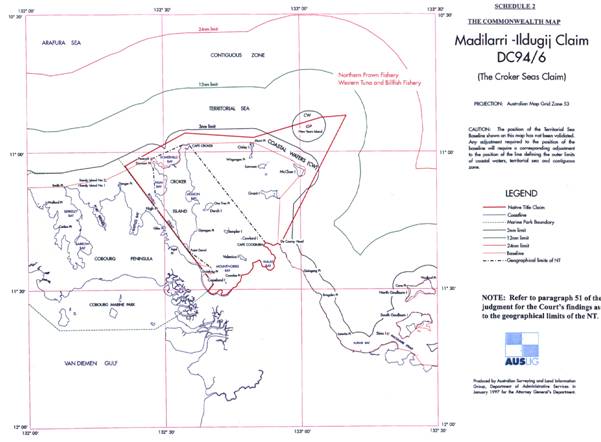
I certify that this and the preceding 117 pages are a true copy of the Reasons for Judgment of the Honourable Justice Olney.
Associate:
Dated: 6 July 1998
Heard: At Croker Island: 22-29 April 1997; 4-7 June 1997
At Darwin: 19-21 August 1997; 1-4 December 1997;
20-23 April 1998
Judgment: 6 July 1998
Counsel for the applicants: Mr J. Basten QC and Mr K.R. Howie
Solicitor for the applicants: Northern Land Council
Counsel for the first respondent: Mr T. Pauling QC and Ms R. Webb
Solicitor for the first respondent: Solicitor for the Northern Territory
Counsel for the second respondent: Dr G. Griffith QC, Dr M. Perry and Mr S. Lloyd
Solicitor for the second respondent: Australian Government Solicitor
Counsel for the third, fourth and Mr G. Hiley QC and Mr N. Henwood
and seventh respondents:
Solicitor for the third, fourth and Cridlands
and seventh respondents:
Counsel for the eighth respondent: Mr M. Storey
Solicitor for the eighth respondent: North Australian Aboriginal Legal Aid Service Inc.
The fourth and fifth respondents were not represented.
[1] 175 CLR 1.
[2] ibid., at p 15.
[3] ibid., at p 57.
[4] ibid., at p 217.
[5] See finding of Moynihan J quoted by Toohey J, 175 CLR 1 at p 191.
[6] The spelling of some of the Aboriginal names varies from that used in the application. In these reasons the spelling used in the applicants’ anthropological report is adopted.
[7] The deceased applicant is referred to by name on several occasions in the anthropologists’ report but having regard to Aboriginal custom concerning the avoidance of naming recently deceased persons he is referred to in these reasons as Mary Yarmirr’s father.
[8] Section 84(2) of the Native Title Act provides that a person may seek leave to be joined as a party to proceedings if the person’s interests are affected by the matter or may be affected by a determination in the proceedings. Ms Henwood is an Aboriginal person whose family origins are in another part of the Northern Territory but who was taken to the mission at Croker Island as one of the “stolen generation”. She holds a number of licences issued under the Fisheries Act 1988 (NT) which entitle her to undertake commercial fishing activities within, inter alia, the claimed area.
[9] Minjilang is not shown on the Commonwealth map. It is the main settlement on Croker Island, located near Mission Bay.
[10] 76 FCR 492.
[11] Attorney-General (UK) v Chambers (1854) 4 De GM & G 206 (43 ER 486); Blundell v Catterall (1821) 5 B & Ald 218(106 ER 1190); Delap v Hayden (1923) 4 DLR 1102; Bowen v Minister for Urban Affairs and Planning (1996) 90 LGERA 368.
[12] 135 CLR 337.
[13] 175 CLR 1 per Mason CJ and McHugh J at p 15.
[14] 175 CLR 1 at p 59.
[15] For examples of circumstances in which the non-extinguishment principle applies see Native Title Act ss 23(3), (4); s 25(1); s 46; s 47(3).
[16] 138 CLR 346.
[17] The sources of the information include a report entitled “Croker Island Seas Native Title Claim Area: Review of historical and archaeological information regarding non-Aboriginal use of the sea and seabed” (exhibit NT3) and various official records tendered by the Commonwealth.
[18] 161 CLR 475.
[19] 161 CLR 475 at p 483. See also similar comments per Mason and Brennan JJ at pp 488-9; per Deane J at p 492; per Dawson J at pp 495-6.
[20] Transcript p 502-503.
[21] ibid., at p 505.
[22] ibid., at p 993-995.
[23] ibid., at p 1069.
[24] Yuwurrumu membership can be acquired by the process of adoption. Jim Wauchope, who is referred to in the discussion of the Mandilarri-Ildugij estate group, was born in central Australia but was taken away from his mother at an early age and at about the age of 9 was taken to the Methodist Mission on Croker Island where, after World War II he developed a close relationship with an Ildugij man Bob Mangarnawu who taught him about the local cultural landscape and customs. He has since been recognised as a member of the Mandilarri-Ildigij yuwurrumu as are his children. He knows nothing of the country of his parents. Compare Jim Wauchope’s position with that of the eighth respondent who also grew up at the Mission on Croker Island about whom Mary Yarmirr said -
“She has no rights. Her yuwurrumu is totally different from mine. She is not a Mandilarri woman” (Transcript p 528 (22-3)).
The following exchange then took place:
His Honour: Just to clarify that, I think really what Ms Henwood was saying was not only that she lived here but she was forced to live here. From what I understand you to say, that would not make any difference, whether she lived here voluntarily?
Mary Yarmirr: No, that wouldn’t make any difference, your Honour, because, as I’ve said ...
His Honour: Her country is somewhere else?
Mary Yarmirr: Her country is somewhere else (Transcript 528 (24-29)).
[25] Peterson and Devitt, pp 18-19.
[26] ibid., at p 2.
[27] ibid., at p 16.
[28] Transcript p 72 (8-9).
[29] ibid., at p 72 (29-30).
[30] ibid., at p 80 (8-10).
[31] ibid., at p 85 (21) - 86 (22).
[32] ibid., at p 99 (13-28).
[33] ibid., at p 99 (13-28).
[34] ibid., at p 632 (15-17).
[35] ibid., at p 633 (1).
[36] ibid., at p 570 (6-10).
[37] ibid., at p 571 (27) - 572 (4).
[38] ibid., at p 659 (2) - 660 (2).
[39] ibid., at p 715 (17-21).
[40] ibid., at p 476 (20-27).
[41] ibid., at p 613 (10).
[42] ibid., at p 612 (23).
[43] ibid., at p 618 (8).
[44] Section 3 of the Aboriginal Land Rights (Northern Territory) Act 1976 provides that unless the contrary intention appears:
“traditional Aboriginal owners”, in relation to land, means a local descent group of Aboriginals who:
(a) have common spiritual affiliations to a site on the land, being affiliations that place the group under a primary spiritual responsibility for that site and for the land; and
(b) are entitled by Aboriginal tradition to forage as of right over that land.
[45] Applicants’ written submission (12 November 1997) para 10.1.2.
[46] Transcript p 49 (28-29).
[47] ibid., at p 194 (7-10).
[48] ibid., at p 49 (1).
[49] ibid., at p 194 (28-31).
[50] 175 CLR 1 at p 207.
[51] Applicants’ proposed determination, paragraph (c).
[52] Transcript p 54 (17) - 55 (2).
[53] ibid., at p 55 (3-22).
[54] ibid., at p 515 (27) - 516 (18).
[55] ibid., at p 49 (20-23).
[56] ibid., at p 554 (9-11).
[57] ibid., at p 554 (24-25).
[58] ibid., at p 50 (20-23).
[59] ibid., at p 65 (21) - 66 (7).
[60] ibid., at p 54 (3-7.
[61] ibid., at p 51 (8-14).
[62] ibid., at p 52 (11-31).
[63] ibid., at p 52 (32) - 53 (28).
[64] ibid., at p 730 (9-26).
[65] Applicants’ statement of facts issues and contentions dated 24 October 1996;
paragraph 6 (e), (f) and (g).
[66] Peterson and Devitt, pp 18-19.
[67] Transcript p 92 (22) - 93 (8).
[68] ibid., at p 529 (15-30).
[69] ibid., at p 559 (11) - 560 (3).
[70] ibid., at p 138 (19) - 139 (24); 255 (28) - 256 (16).
[71] Peter and Devitt, pp 22-23.
[72] 175 CLR 1; per Mason CJ and McHugh J at p 15.
[73] ibid., per Brennan J at p 64 and per Toohey J at p 195.
[74] ibid., at p 64.
[75] The Wik Peoples v The State of Queensland and others (Wik) 187 CLR 1 per Toohey J at p 133.
[76] ibid., at p 133.
[77] 175 CLR 1 at p 67.
[78] ibid., at p 43.
[79] ibid., at p 60.
[80] ibid., at p 61.
[81] ibid., at p 69.
[82] 18 Halsbury’s Laws of England (4th Ed) para 604.
[83] (1993) 119 ALR 108.
[84] ibid., at pp 124-125.
[85] 168 CLR 314 at p 330.
[86] Unreported; delivered 27 February 1998.


