

CATCHWORDS
INTELLECTUAL PROPERTY - Patents - authorising and procuring infringement - ring clutches with lever-arm and remote release for use in face-lift tilt-up concrete operations - whether supply of components together with illustration of use in a manner which would infringe the patent constitutes "authorising or procuring" an infringement - authorisation of infringement - meaning of "authorise".
INTELLECTUAL PROPERTY - Patents - combination patents - supply and sale of components - common design necessary to constitute procuring or inducing infringement use together with supply of some components not sufficient for necessary common design.
TRADE PRACTICES - misleading and deceptive conduct - silence in not informing customers that use would infringe - when silence constitutes misleading and deceptive conduct.
DAMAGES - s82 Trade Practices Act - causation - supply of components and accessories - necessity of showing damage caused by breach - damage not shown.
Patents Act 1952 (Cth): s69
Patents Act 1990 (Cth): ss13(1), 117, 230, 233
Trade Practices Act 1974 (Cth): ss52, 86
Windsuring International Inc v Pettit [1984] 2 NSWLR 196; distinguished.
WEA International Inc v Hanimex Corporation (1987) 17 FCR 274; discussed.
Rescare Ltd v Anaesthetic Supplies Pty Ltd (1992) 25 IPR 119; discussed.
Demagogue Pty Ltd v Ramensky (1992) 39 FCR 31; discussed.
Winterton Constructions Pty Ltd v Hambros Australia Ltd (1992) 39 FCR 97; dicussed.
Typing Centre of NSW Pty Ltd v Northern Business College Ltd (1989) 13 IPR 627; discussed.
Enzed Holdings Ltd v Wynthea Pty Ltd (1984) 57 ALR 167; discussed.
ADVANCED BUILDING SYSTEMS PTY LTD & ANOR v RAMSET FASTENERS (AUST) PTY LTD & ORS
No NG 717 of 1990
CORAM: HILL J
PLACE: SYDNEY
DATED: 13 APRIL 1995
IN THE FEDERAL COURT OF AUSTRALIA )
)
NEW SOUTH WALES DISTRICT REGISTRY ) No NG 717 of 1990
)
GENERAL DIVISION )
BETWEEN: ADVANCED BUILDING SYSTEMS PTY LTD
First Applicant
THE BURKE COMPANY
Second Applicant
AND: RAMSET FASTENERS (AUST) PTY LTD
First Respondent
A & V MAMONE CONSTRUCTIONS PTY LTD
Second Respondent (Deleted)
BRAMBLES AUSTRALIA LIMITED
Third Respondent (Deleted)
RAMSET FASTENERS (AUST) PTY LTD
Cross-Claimant
ADVANCED BUILDING SYSTEMS PTY LTD
Second Cross-Respondent
CORAM: HILL J
PLACE: SYDNEY
DATED: 13 APRIL 1995
MINUTES OF ORDER
THE COURT DIRECTS THAT:
1. The matter be listed on a date to be determined with counsel for short submissions as to costs and also as to the form of injunctive relief to be granted.
2. The applicant to file and serve draft short minutes to give effect to the reasons for decision.
Note: Settlement and entry of orders is dealt with in Order 36 of the Federal Court Rules.
IN THE FEDERAL COURT OF AUSTRALIA )
)
NEW SOUTH WALES DISTRICT REGISTRY ) No NG 717 of 1990
)
GENERAL DIVISION )
BETWEEN: ADVANCED BUILDING SYSTEMS PTY LTD
First Applicant
THE BURKE COMPANY
Second Applicant
AND: RAMSET FASTENERS (AUST) PTY LTD
First Respondent
A & V MAMONE CONSTRUCTIONS PTY LTD
Second Respondent (Deleted)
BRAMBLES AUSTRALIA LIMITED
Third Respondent (Deleted)
RAMSET FASTENERS (AUST) PTY LTD
Cross-Claimant
ADVANCED BUILDING SYSTEMS PTY LTD
Second Cross-Respondent
CORAM: HILL J
PLACE: SYDNEY
DATED: 13 APRIL 1995
REASONS FOR JUDGMENT
The Background:
The first applicant, Advanced Building Systems Pty Ltd ("Advanced") is the registered proprietor of Australian Letters Patent Number 544832 for an invention entitled "Lift Systems for Tilt-Up Walls" ("the [Australian] patent"). It became the registered proprietor of the patent pursuant to an assignment dated 22 November 1990 from the second applicant, the Burke Company ("Burke"), expressed to be for a consideration of $100.
Advanced and Burke claim that Ramset Fasteners (Aust) Pty Ltd ("Ramset") has infringed the patent or procured, induced or authorised such infringement and seek relief by way of damages as well as injunctive relief. They claim also that Ramset has breached the provisions of s52 of the Trade Practices Act 1974 (Cth) ("the Trade Practices Act") for which breach damages are claimed.
Ramset cross-claimed on the grounds that the patent was invalid. That cross-claim was heard separately from the issues of infringement and damage and in a judgment given on 23 April 1993 I held the patent to be valid. I set out in that judgment the terms of the patent (there referred to as "the Australian patent") and the background to the dispute between the parties. So that this present judgment can be self-contained it is necessary to repeat some of what I there said.
Where concrete is used in building construction for walls or panels it is convenient that the walls or panels be prefabricated, that is to say, poured on or off site then ultimately lifted into position at the building site.
There are two methods for lifting concrete walls or panels into position. These are usually described as face-lift or edge-lift. In an edge-lift operation the crane is linked to lifting inserts or anchors embedded in the edge of the wall or panel. In a face-lift operation, the wall or panel would usually be poured on site horizontally. Lifting inserts or anchors are cast into the wall or panel symmetrically about a point called "the centre of lift" which lies between the centre of gravity of the wall or panel and its top edge. The crane rigging is attached to these anchors embedded in the face of the wall or panel so that when the crane commences to lift the load of the panel, the panel lifts clear of the casting bed except along its bottom edge. As the crane continues to lift, the panel rotates from the horizontal position to a position typically ten percent to twenty percent from vertical. At this point the line of the crane is, by virtue of the panel rotation, directly above the centre of gravity of the panel and the bottom edge of the panel can be lifted clear of the casting bed and into the final position for the wall or panel. The wall or panel is then braced and the crane disconnected from the anchors.
An essential ingredient in the face-lift method described in the patent is a ring clutch which connects with an anchor embedded in the concrete wall or panel. That clutch is the subject of a United States Patent Number 3,883,170 originally granted to Siegfried Fricker of Germany with a priority date of 16 August 1972. The clutch itself is not the subject of the patent presently under consideration. Burke had an exclusive licence from Siegfried Fricker GmbH in respect of the United States patent. By virtue of another agreement between Siegfried Fricker GmbH and Ramset, Ramset was entitled to manufacture and develop clutches in Australia.
The principal object of the invention the subject of the Australian patent is stated in the patent to be:
"... to provide a method for using a quick release hoisting attachment of the type described for tilt-up walls characterised by the fact that release of the attachment is not possible until the hoisting shackle part of the attachment is lowered out of its normal upright position."
The patent describes the preferred embodiment in the following terms:
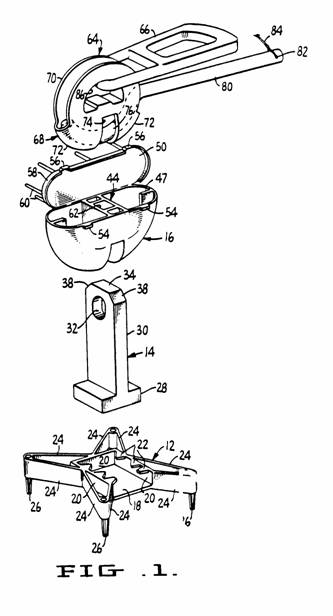
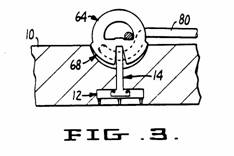
"Fig.3 shows the hoisting attachment in locked relation to the wall slab 10 prior to applying a lifting force to shackle 66 through lifting cable 88. The lever arm 80 is pre-positioned to extend in the direction of the ultimate top end of the wall slab. Once the lifting action begins, the binding force applied by the anchor 14 through the locking bolt to the body of the ring clutch prevents any relative movement taking place between the lever arm 80 and the ring clutch during the tilt-up movement of the slab.
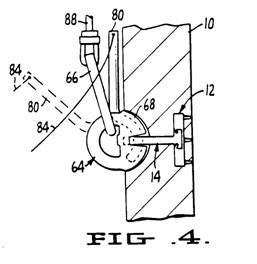
Fig.4 illustrates the slab in vertical condition at the end of the tilt-up operation. A pulling force is no longer being applied by cable 88 to shackle 66. The shackle nevertheless remains in blocking relation to the lever arm 80. Thus, premature release of the locking means, with possible damaging consequences, is prevented until such time as the hoist operator lowers the cable 88 to drop the shackle 66 to a non-blocking position relative to lever 80.
This safety feature of the release mechanism is made possible by making the lever arm 80 long enough so that its unlocking movement can be blocked by shackle 66 and the preorientation of lever 80 in the direction of the upper end of the wall slab."
Figures 1, 3 and 4 contained in the patent are here reproduced.
|
|
|
The claims defining the invention are stated as follows:
"1. Apparatus for putting up a tilt-up wall section comprising a hoisting cable, a shackle connected to the cable, a ring clutch interconnecting the shackle with an anchor emplaced in the wall section, the ring clutch comprising a ring having a split therein and an arcuate locking bolt rotatable relative to said ring between a locked condition extending across the split and a released condition removed from the split, said bolt having an elongated lever arm extending generally parallel to the wall section during lifting and in the direction of the upper end thereof, a release cable attached to the distal end of the lever arm to remotely operate the lever arm by rotating it outwardly and downwardly to a predetermined degree relative to the wall section to rotate the bolt to the released condition and disconnect the ring clutch from the anchor, and hoisting cable-controlled means to selectively block or allow rotation of the lever arm to said predetermined degree, said means being operated responsive to the application of lifting force to the hoisting cable to block rotation of the lever arm upon the application of lifting force to the hoisting cable and release the arm for rotation upon slacking off of the hoisting cable.
2. The apparatus of claim 1 wherein the shackle is pivotally secured to the ring clutch for movement to and from a position blocking rotation of the lever arm, the hoisting cable-controlled means comprising the shackle which is disposed in blocking relation to the lever arm when the shackle is supported in an upwardly directed position by the hoisting cable and which is disposed in non-blocking relation to the lever arm when it moves to a downwardly directed position in response to the slacking off of said hoisting cable."
The applicants' case as pleaded:
By their further amended statement of claim Advanced and Burke allege that Ramset sold and/or supplied by way of hire what is referred to as a "a rapid lift system" or some or all of the components therefore. It is also alleged that Ramset sold or supplied by way of hire a system referred to as "a tilt-up wall lift system" or some or all of the components therefore. The gravamen of so much of the case as is brought under the provisions of the Patents Act 1952 (Cth) ("the 1952 Act") is that Ramset supplied the relevant systems or components with brochures giving instructions to users of the systems so that if the instructions were followed, infringement of the patent would result. Reliance is placed also on talks said to have been given by Ramset representatives to industry participants in seminars and discussions said to have taken place between potential users of the components and Ramset representatives. The applicants claim that Ramset has been aware, since 1987, that users of the Ramset lifting system components risked infringing the patent, was aware of the likely uses of these components as being in breach of the patent but neither instructed users not to do so nor imposed any conditions to the effect that such use was not permitted. It is this conduct which the applicants claim to be in breach of the 1952 Act. Thus the statement of claim alleges that:
"In the premises the respondent has infringed or threatened to infringe or, in the alternative, has procured or induced or aided the infringement or threatened to procure or induce or aid the infringement of the patent and/or has acted pursuant to a common design with users of components of the Respondent's lifting system to infringe the patent."
An alternative or additional claim is made in respect of the Patents Act 1990 (Cth) ("the 1990 Act"). It is claimed that the same conduct constitutes an authorisation by Ramset to the users of components of its system to make, use and exercise the invention the subject of the patent. Reliance is placed on s13(1) of the 1990 Act and additionally s117 of that Act.
The applicants' claim under the Trade Practices Act refers to statements in brochures and orally said to have been made, to the effect that the Ramset system components were cheaper or, at least, no more expensive than others including those supplied by the applicants; that the use of the Ramset system components was more efficient or no less efficient than other systems; that the Ramset system components had at least all of the advantages and benefits of other systems; that the Ramset components complied with applicable standards and codes of practice; that the Ramset system components were suitable for use in the way described in the brochures, and that users would enjoy quiet possession of them. These statements are said to constitute misleading and deceptive conduct in breach of s52 of the Trade Practices Act because they omitted reference to the fact that use of the components would constitute an infringement of the patent. The applicants claim thereby to have suffered loss and damage.
In particulars supplied at the commencement of the hearing the applicants claimed, in respect of loss of profits for the period up to 30 June 1993, the sum of $6,059,331.40. After taking into account amounts which Advanced claimed it would otherwise have been able to increase its prices by, an additional amount of $1,211,866.20 was claimed. Additional damages are said to include profit which Advanced claims it would have made on future infringing uses had Ramset not engaged in the conduct complained of, a loss amounting to $363,559; a loss of goodwill asserted to be valued at $2,750,000; interest costs incurred on a higher overdraft said to have been otherwise unnecessary had Ramset not engaged in the conduct complained of in the sum of $191,011 and the cost of rehiring staff claimed to be $40,000.
In respect of the patents claim, in addition to damages calculated in the same way in respect of the period post-22 November 1990, Advanced claims alternatively or additionally what is said to be a reasonable royalty on Ramset's acts of infringement. I will return later to the issue of loss of damages and the particulars supplied.
The dispute between the parties was hotly contested and the hearing ranged over a number of weeks. Although most matters were in dispute between the parties, there were some factual matters which were not in dispute. It is convenient to commence with these.
The supply of clutches by Ramset:
There is no suggestion that Ramset itself directly used clutches in face-lift operations. It supplied clutches to others. From some time in mid-1988 until about September 1989, the clutches it supplied were Frimeda clutches, that is to say, clutches manufactured overseas and purchased from the German company owning the clutch patent. From around September 1989 Ramset manufactured its own clutch upon which the name "Ramset" prominently appeared. Save for the length of the lever arm the Ramset clutch was otherwise identical to the Frimeda clutch.
The Frimeda clutch was basically as shown in fig.3 of the patent. The lever arm was not unduly elongated although when positioned parallel to the wall section during a face-lift tilt-up operation the arm was blocked by the hoisting cable controlled mechanism. The Burke clutch supplied by Advanced had an extended lever-arm but otherwise was identical to the Frimeda clutch for all relevant purposes.
The Ramset clutch differed from the Frimeda clutch in that the Ramset clutch had a relatively short lever arm which, when positioned parallel to the wall section in the direction of the upper end thereof during a face-lift tilt-up lifting operation, was not blocked by any hoisting cable controlled mechanism. The addition of an extension arm to the smaller lever arm was, however, capable of producing the blocking effect. A longer lever arm also had the advantage of providing a greater moment on the lever arm to facilitate release of the clutch.
From June 1993 the Ramset clutch was supplied by Ramset with a length of chain attached to the lever arm. It was said that the smaller lever arm and chain were deliberately designed to ensure that the chain would pass back through the shackle. Far from simplifying the operation of the clutch, demonstrations made it clear that so to position the chain indeed complicated the use of the clutch and, so far as it is relevant, I do not accept the evidence that this was a design feature of the Ramset clutch. One thing, however, that the chain did achieve was to facilitate the attachment of a release cable or rope to the lever arm.
Ramset supplied both Frimeda and Ramset clutches to its customers by way of loan, hire, gift or sale.
From an economic point of view any profit on sale or hire of clutches was relatively unimportant. The clutches had a long life and needed only regular cleaning and servicing. Relatively few clutches could be expected to be sold or hired. Commercially, the profit to Ramset (like the profit to Advanced) would thus arise from selling other components for use in face-lift operations, including the anchors which were designed to be embodied in the concrete panel or walls when poured. While clutches were reused, each face-lift operation utilised a number of anchors (the number varied with the size of the panel), each anchor only being used once.
Although there is considerable dispute as to the extent to which Ramset supplied, in various States of Australia, clutches to which extended lever arms had been added, the evidence made it clear that, at least prior to June 1993, in New South Wales, this was frequently, perhaps normally, the case. It may very well be that supply in this manner arose at the request of the persons to whom the clutches were supplied, but that is not to the point. After June 1993 Ramset supplied clutches only with the short arm and chain. It is probable that some contractors or builders employing the Ramset clutch with short lever arm and chain would have inserted an extension, but the evidence does not enable me to say in how many cases this would have occurred.
As will later be observed the situation in other States differs. The relevance of the June 1993 date is that it is at this time that the litigation between the parties commenced.
The evidence on behalf of Advanced on infringement:
The New South Wales situation:
A number of witnesses swore affidavits on behalf of Advanced in which they deposed to observing the use of clutches supplied by Ramset in tilt-lift operations in such a way as to constitute an infringement of the patent. Most were cross-examined. Some of the cross-examination was directed to show that lists of sites where such infringements were said to have been observed were, to some extent at least, incorrect. Although that cross-examination may have cast, in individual cases, some doubt about the method of identification of the sites, it did not cast doubt on the main thrust of the evidence given. I would accept, in general terms, the evidence of all of the witnesses called on behalf of Advanced to show examples of what was said to constitute infringement by others.
Most of the evidence was directed to New South Wales. It amounted to the witness saying that on a number of occasions, sometimes as many as 100 such occasions, the witness had observed clutches used with inserts supplied by Ramset in face-lift tilt-up operations in circumstances where there were extended lever arms and ropes to disengage the clutches used in the manner described in the patent. It is unnecessary here to spell that evidence out in greater detail. Sometimes the clutches were owned by those who used them. Sometimes the clutches had been hired. The observations generally concerned Ramset clutches.
This evidence was somewhat strengthened by evidence given by Mr McIntosh who had, between March and October 1988, been New South Wales Sales Manager for Ramset with responsibility for overseeing the sales and distribution of Ramset building products. Mr McIntosh deposed that he had, in 1988, been instructed by Mr Patterson, Operations Manager of Ramset's Building Products Division for Australia, to fit extension handles to five tonne clutches to be hired to contractors for use in face-lift tilt-up operations. The extension handles were to facilitate the removal of the clutches from the anchors cast into the panels once the panels were in the vertical plane.
The circumstances in which this occurred were explored in oral evidence. A sales representative told Mr McIntosh that he was having problems releasing the clutches on a job and suggested that there be longer handles for easier release. In consequence Mr McIntosh contacted Mr Patterson and subsequently fitted extended levers. The representative had said that the job in question was a face-lift operation.
Mr McIntosh also confirmed that during his time with Ramset, building products were priced competitively in the market place.
A Mr Wilson was a consultant to the Architects and Project Managers who designed and constructed a refuse transfer station at Wetherill Park. He it was who advised that Ramset clutches and components be used on the project. He had read promotional material from Ramset which contained photographs which made it clear how the clutches could be used in a way which was described in the patent. The clutches actually used were Ramset clutches, which Mr Wilson found unsatisfactory. He requested Mr McKenzie, a representative of Ramset, to take them back and return them with the extended lever arms. Mr McKenzie complied with the request.
A Mr Nightingale, who was the Engineering Manager of Brambles Cranes, was also introduced to the Ramset face-lift tilt-up method of operation through perusing a Ramset brochure. He had been involved in some 300 or more tilt-up operations and when Ramset clutches were used they had been used with an extended arm and rope in accordance with the method disclosed in the patent.
The situation in Victoria:
The evidence in respect of Victoria was more limited. A Mr Toniolo, Managing Director of Everest Concrete Constructions Pty Limited which had been involved in tilt-up construction for approximately ten years, was a user of the Burke clutch and components purchased from Advanced. He had used the Ramset products on two occasions but found the Ramset system not to his liking. According to his evidence, the normal method used in Victoria was edge-lift rather than face-lift tilt-up construction. His own business, at the time of trial, was approximately in the proportion of forty edge-lift operations to sixty face-lift operations.
Evidence was given also by Mr Wachtel, an employee of Advanced, of an occasion when he had seen Frimeda clutches in use in the manner described in the patent. He said that he had attended a trade show given by Ramset in Geelong when the Ramset representative had said that the clutches would be supplied with extended lever arms and ropes attached as is industry practice, to allow for ground release operation. While in Adelaide he had purchased two five tonne clutches from Ramset and was originally shown clutches with an elongated lever attached but the extended lever arm had been removed after another Ramset representative had said that the handles were no longer supplied.
He also deposed to having observed some 50 tilt sites in Melbourne at which tilt-up operations had taken place. In another affidavit he said that he had observed over a two year period some 1000 panels being lifted in or around Melbourne by means of face-lift tilt-up operations. In anticipation of evidence subsequently given on behalf of Ramset he said that he had never seen clutches released manually by a workman standing in a cherry-picker and on only one occasion had seen a worker climb a ladder to release the clutch. He said such a method of release would be too costly.
The situation in Queensland:
Only one witness gave evidence of the situation in Queensland. This was Mr Combe, previously the Queensland State Manager of Advanced. He said that he had seen hundreds of face-lift operations but had never seen ladders used to release clutches manually unless some problem arose. He had seen Ramset clutches with extended lever arms and ropes used on two sites.
The Ramset evidence on infringement:
A Mr Polglase, Newcastle Sales Manager for Ramset since 1992, deposed that Ramset had not, to his knowledge, supplied any clutches with extended lever arms and release cables attached. He said that he had attended a building site in 1993 and seen a face-lift tilt-up operation where the clutch was manually released by a workman standing on a ladder. On another occasion he had been at a building site where the clutch release had been effected by a workman standing in a mini cherry-picker, disengaging the clutch by hand.
Mr Henry was the Technical Services Manager of the New South Wales branch of Ramset and had occupied that position since 1991. He deposed that on only one occasion had he been involved in the supply of lifting clutches for tilt-lift operations where the clutch had an extended lever arm. He said that he had never supplied a hoisting cable with any clutch, evidence which is hardly surprising.
In cross-examination Mr Henry was questioned about particular sites where Ramset had in New South Wales supplied clutches with extended lever arms and ropes. He confirmed that prior to June 1993 Ramset had generally supplied clutches with extended lever arms supplying to the holder of the clutch the face-lift anchors and brace inserts, the latter in only about 30 percent of cases.
Mr Lasker was Senior Technical Representative of Ramset and had been a Technical Representative since 1989. According to his evidence only fourteen lifting clutches had been sold by Ramset through the New South Wales branch of Ramset since June 1989. He agreed that when some lifting clutches had been returned to Ramset's office he had, as requested by the owner of the clutches, fitted extended release arms. Normally, however, Ramset lent clutches to concreters or contractors. He had fitted extension arms and ropes to these.
Some of Mr Lasker's evidence concerning building sites in New South Wales was adduced to contradict evidence advanced by the applicants. Although I have no reason to doubt Mr Lasker's credit, this evidence did not in any way affect the credit of the applicant's witnesses. No doubt some matters of recollection may have led to error on the one side or the other, but ultimately credit was not affected.
A Mr Drayton, a Civil Engineer involved in concrete construction, gave evidence of his experience with face-lift operations in New South Wales. He said that he had had difficulty disconnecting clutches by using ropes and instead had reverted to manual release by a workman using a ladder.
The situation in Victoria:
It is unnecessary to detail the evidence concerning Victoria. In accordance with it, I would find that edge-lift construction was more popular in Victoria than face-lift tilt-up operations. Manual release of clutches regularly occurred but users of clutches had fitted extended lever arms and ropes. Mr Poole, the Victorian Product manager of Ramset accepted that it was common practice for clutches to be modified by Ramset in New South Wales and Queensland. This was not the case in Victoria.
Mr Morris, Managing Director of Conmor Plant Hire Pty Ltd, deposed to having fitted extended release arms onto clutches and having some clutches with rope release but said that he had not received any instruction from Ramset to do this.
In summary, the situation in Victoria appears to have been that Ramset did not supply clutches with extended lever arms and ropes or chains attached. Some users of clutches, however, did attach them. However, on at least on one occasion, Ramset made a modification of that kind at the request of a customer.
The situation in Queensland:
It was standard practice for rope release to be used in Queensland. Clutches supplied from Sydney for use in Queensland often had extended lever arms and ropes attached. The Ramset brochure which contained illustrations of how the clutch would be used with the extended lever arm and rope in a face-lift tilt-up operation was available through representatives in Queensland.
The situation in South Australia, Western Australia and the Territories:
In South Australia Ramset products were little used. Edge-lift was the main means of lifting concrete panels. Frimeda brand clutches were supplied by Ramset in South Australia but without release cable chains or ropes attached. After mid-1990 Ramset clutches were supplied but these did not have an extended lever arm.
It does not seem that clutches with extended lever arms and ropes were ever supplied in Western Australia or the Northern Territory. Nevertheless it is clear that extended lever arms were fitted as were ropes for remote release by those using clutches from time to time.
Finally, Ramset had supplied components for about six face-lift tilt-up operations in the Australian Capital Territory. The clutches were modified by Ramset fitting an extension to the lever arm and a short length of chain was also attached. However, clutches with extended release arms were supplied from Sydney. The Ramset brochure depicting a face-lift tilt-up operation as described in the patent was available to customers since 1994.
Conclusions from evidence of infringement:
It is clear that clutches supplied by Ramset have been used in New South Wales, Victoria, Australian Capital Territory, Queensland and South Australia by persons who have used those clutches in a way which breaches the patent. Advanced has established that clutches were supplied by Ramset with extended lever arms and ropes, particularly in and from New South Wales. Where clutches were not supplied with extended lever arms and ropes attached, those who used the clutches often affixed their own extended arm and attached a rope.
It is likely that customers of Ramset had available for their inspection the Ramset brochure depicting use of the clutch in a manner which would infringe the patent and that a number of customers did inspect that brochure. However, there was no evidence upon which a conclusion could be based that at any time Ramset encouraged persons directly to use clutches in infringement of the patent except so far as supply of a clutch with extended lever arm and rope or chain may be taken as such encouragement.
The evidence further makes clear that some users of clutches do and some do not use a rope for remote release of the clutch. While I would have thought it logically absurd for a worker to climb a ladder each time a clutch was to be released (when the task could be performed by remote release), there seems little doubt that some users of clutches believed the clutches were difficult to operate with remote release and preferred to operate them manually. I would find that a significant portion of face-lift tilt-up operations did, however, occur with a rope or chain remote release.
Supply of components with clutches:
It was essential to the Advanced case to demonstrate that customers who used clutches supplied by Ramset purchased all or a substantial quantity of related components from Ramset, or perhaps other suppliers, rather than from Advanced.
Although there was some evidence which suggested that Ramset anchors or inserts were not compatible with Advanced clutches and vice versa, in the sense that it was suggested that it was preferable to use the anchor designed for the clutch, I am satisfied on the evidence that provided the insert was appropriate to the weight of the clutch, the components were interchangeable.
A user of clutches in face-lift tilt-up operations would, in addition to the clutches, require the following accessories or component items:
1) Anchors or lifting inserts - The number of lifting inserts required to be used in a particular face-lift tilt-up operation will vary depending upon the size of the panel to be lifted. The minimum number of lifting inserts is four. Larger panels would require eight or more. There was some suggestion in the evidence that 70 per cent to 80 per cent of lifts would involve eight inserts, the balance usually being four. There would be one anchor for each clutch. The lifting inserts are embedded in the concrete and consist of a base or metal tag and a void former.
2. Wall braces - Normally two wall braces are used for each panel to be lifted, regardless of panel size. These are normally secured by affixing them to wall brace inserts.
3. Ground brace inserts - These are inserts embedded in the concrete for ground bracing when the panel has been lifted. The number of ground brace inserts will vary with the size of the panel. Ground brace inserts are not necessarily required but the brace must be pinned to the floor in some way.
4. Ferrules - a ferrule is a female cylindrical member which is threaded and adapted to receive a bolt so as to lock, for example, a brace on to a wall or so as to lock a brace on to a floor. Ferrules are not specific to any particular face-lift operation and are generally available. Between six and eight ferrules would likely be used in a face-lift of a single panel.
5. Shims - These are little polystyrene slips used as packing in order to ensure that a panel is appropriately adjusted for height and verticality.
6. Bondbreaker - This is a chemical product designed to ensure that the concrete, when poured on an existing dry slab, does not adhere to the slab or may be pulled away from the slab.
7. Hand sprayer - A hand sprayer is used to apply bondbreaker. It is a spray unit of about fifteen litres capacity, rather like a garden spray. It is continually reused.
8. Chamfer strips - These are timber or plastic strips nailed to the top end of a panel and used also on the edges of in situ columns. Chamfer strips are readily available from numerous suppliers.
9. Burke Bars - This is a particular brand of crow bar with a thicker than usual handle. It is used to manipulate the panel into alignment.
The applicants' case under the 1952 Act:
The 1952 Act confers upon a patentee, by s69 inter alia, the exclusive right to:
"make, use, exercise and vend the invention ... so that [the patentee] shall have and enjoy the whole profit and advantage accruing by reason of the invention during the term of patent."
The allegation in the present case is that Ramset has infringed the patent by supplying components for use in face-lift operations, particularly clutches and anchors, in conjunction with instructions for use, those instructions being said to be found in the Ramset brochure, to which reference has already been made, or talks given by Ramset representatives to industry participants.
Mere supply of a clutch by Ramset would not assist the applicants since clutches themselves are capable of being used either for edge-lift or face-lift operations. Face-lift anchors, on the other hand, must be used for face-lift operations, although not necessarily with clutches supplied by Ramset. For there to have been a breach of the 1952 Act it would be necessary for the applicants to show more than the sale of articles to persons who, in fact, infringe the patent. There has to be something more than knowledge.
The leading Australian authority is Walker v Alemite Corporation (1933) 49 CLR 643 where it was held that the manufacture and sale of separate parts of a combination patent did not infringe a combination patent. In that case Dixon J said that it was settled law that (at 658):
"... sale with a knowledge that the purchaser will use the articles for infringement is not itself an infringement although the vendor gives the purchaser an indemnity: the vendor must have made himself a party to the act of infringement."
However,
as Wilcox J observed in Best
Australia Ltd v Aquagas Marketing Pty Ltd (1988) 83 ALR 217, there may be
cases in which the activity of a supplier goes beyond mere supply such that the
supplier acts to procure the infringement.
Thus a distinction was drawn by Buckley LJ in Belegging-en Exploitatiemaatschapij Lavender B.V. v Witten Industrial
Diamonds Ltd. [1979] FSR 59 at 65, between "facilitating the doing of an act" and "procuring the doing of
the act". So in Mölnlycke A.B. v Proctor and Gamble Ltd
[1992] 1 WLR 1112, Dillon LJ (with whom Woolf and Leggatt LJJ
expressed agreement) said:
"A person who merely facilitated, but did not procure, the infringement was not a joint tortfeasor with the infringer and so was not liable if, for instance, he sold articles which could be used for infringing or non-infringing purposes even though he knew that they would probably be used and were intended to be used for the infringing purposes.
More recently, however, a new concept has been developed. Parties will be regarded as joint tortfeasors if on the facts they have a common design to market in the United Kingdom articles which in truth infringe a United Kingdom patent."
It is accepted by the applicants that to succeed under the 1952 Act they must show a common design on the part of Ramset with another to do acts which amount to infringement, a procuring or inducing the other to infringe.
The evidence falls far short of this. It shows, at the most, that on an unknown number of occasions, more numerous in New South Wales than elsewhere, Ramset supplied clutches with extended lever arms. Where clutches without extended lever arms were sold, they were capable of having attached to them extended lever arms. The persons to whom clutches were sold might, but not necessarily would, use them with ropes attached. Although this seems to have been the general manner of use, clearly a significant number of users preferred manual detachment of clutches from anchor inserts.
The evidence shows also that Ramset supplied anchors or inserts for face-lift operations. Since the anchors were capable of use either with clutches purchased or obtained from Advanced as well as those obtained from Ramset, it does not follow that all inserts were necessarily used without the licence of Advanced. Such a licence no doubt would need to be implied in respect of use with clutches supplied by Advanced.
The case is not analogous to the situation considered in Windsurfing International Inc v Pettit [1984] 2 NSWLR 196, which involved the sale in kit form of sailboards which a user assembled and took apart for the purpose of transport or storage. Nor is it a case where any of the items supplied by Ramset necessarily had to be used in a way where the patent would be infringed. There was, in a number of cases, a likelihood that purchasers would use items obtained from Ramset in a way which infringed the patent but that, in my view, is not enough to constitute the necessary common design to be an infringement.
Emphasis was placed by counsel for Ramset upon the fact that Ramset never supplied a hoisting cable, an ingredient essential to the method described in the patent. I do not think much emphasis should be placed upon this because it can clearly be inferred that anyone engaged in face-lift tilt-up operation must use a hoisting cable. I do accept, however, the submission made by counsel for Ramset that Ramset never had any control over the use of components in a particular manner or in any particular enterprise after the components were sold. The manner of use was a matter in the hands of the building contractor or crane operator, as the case may be.
The Ramset brochure demonstrated use of clutches with extended lever arms in a way which infringed the patent. That brochure was available, at least for inspection, to intended users of Ramset products. Although the brochure demonstrates the method of use in a way which would infringe the patent, in my view that does not involve Ramset in the necessary common design to constitute an infringement.
The applicants' case under the 1990 Act:
To this point I have assumed that the relevant legislation to be applied was the 1952 Act. The applicants' case might be stronger if the matter could be looked at by reference to the 1990 Act. That Act, in s13, defines the exclusive rights of a patentee as being "to exploit the invention and to authorise another person to exploit the invention". The word "exploit" is defined in Schedule 1 of the Act (see s3) as meaning "make, hire, sell or otherwise dispose of the product ... use the method or process".
The 1990 Act commenced on 30 April 1991. By s230 of the 1990 Act the 1952 Act was repealed. By s233 of the 1990 Act, the 1990 Act applies to a patent granted under the 1952 Act as if it had been granted under the 1990 Act. The provisions, however, of s233 are subject to the Regulations made under the 1990 Act and to these we must turn.
Regulation 23.26 of the Patents Regulations made under the 1990 Act provides as follows:
"1. The 1952 Act applies to an action or proceeding made or started under that Act and not finally dealt with or determined before the commencing day:
(a) in which the validity of a patent is disputed; or
(b) concerning infringement of a patent."
The present proceeding commenced prior to 30 April 1991, that is to say, prior to the commencement of the 1990 Act and had not been finally dealt with or determined before the commencement of that Act.
It is
submitted, on behalf of the applicants, that reg23.26(1)(b) should be construed
so as to refer only to the proceedings in so far as they relate to infringement
prior to 30 April 1991, with the consequence that the 1990 Act would
govern proceedings for infringements which occurred after 30 April
1991. The applicants point to reg23.11
which, it is
said, recognises that s117 of the 1990 Act applies to post-30 April 1991
conduct, but for the terms of reg23.11.
It is said that it would be anomalous if reg23.26 protected from the
1990 Act a continuing infringer sued on 29 April 1991 but not first sued
on 1 May 1991.
With respect, I do not find the reliance on reg23.11 convincing.
The words of reg23.26 are unambiguous. They do not distinguish between proceedings for past infringements and proceedings for continuing infringements. The 1952 Act is made applicable to the action or proceeding as a whole so far as it concerns infringement.
It follows that in my view the 1990 Act has no application to the present case.
Have the applicants made out a case on authorisation?:
If I am wrong in this I do not think, in any event, that the applicants have made out a case of authorisation. The meaning of "authorisation" has been considered in other contexts, such as copyright law, WEA International Inc v Hanimex Corporation (1987) 17 FCR 274, 286; Rescare Ltd v Anaesthetic Supplies Pty Ltd (1992) 25 IPR 119, 155. In the context of copyright law the word means "sanction, approve or countenance" or "purport to grant to a third person the right to do the act complained of".
In my view in the present context the word means more than "sanction". It has its ordinary meaning of "to endow with authority", see Oxford English Dictionary, 2nd Ed. So also the first meaning of the word in the Macquarie Dictionary, 2nd Ed. is "to give authority or legal power to". In the present context the reference to "legal power" no doubt has to be modified to encompass a person with no legal power but purporting to act as if he or she did have that power.
In my view a mere countenancing or enabling of infringement by another does not constitute an authorisation, particularly where that is said to arise by virtue of the sale of some, albeit not all, of the components necessary to be used for a patent which describes a method of operation.
The applicants' case under the Trade Practices Act:
Although
the case for the applicants was pleaded in various ways in the further amended
statement of claim, and particularly by reference to the concept of "representation", the gravamen
of the claim is that in promoting its clutches and ancillary products, whether
by virtue of representations that the product was price competitive or
otherwise as alleged, Ramset engaged in conduct that was misleading and
deceptive, or likely to mislead or deceive, within the meaning
of those words in s52 of the Trade Practices Act. The conduct that is said to be misleading and
deceptive is said to be found in Ramset's silence in not informing its
customers that use of clutches and anchors without the licence of Advanced, as
described in the patent, would constitute an infringement of the patent.
It is well established that conduct may be misleading or deceptive where that conduct consists of silence. That will be so, as the cases demonstrate, where the circumstances give rise to a reasonable expectation of disclosure or otherwise nevertheless have the result that a failure to disclose is misleading: Demagogue Pty Ltd v Ramensky (1992) 39 FCR 31; Winterton Constructions Pty Ltd v Hambros Australia Ltd (1992) 39 FCR 97.
As the latter case points out, an example where conduct will be held to be misleading and deceptive will be where the failure to disclose makes the representations in fact made a half truth. It will not be necessary in finding conduct to be misleading and deceptive, in contravention of s52, to find an intention to mislead or deceive.
Counsel for the applicants submitted that the supply by Ramset of anchors and clutches carried with it an implied representation that the components were suitable to be used with existing Frimeda clutches or with Frimeda clutches supplied by Ramset or with Ramset clutches with rope releases and extended lever arms and that there was no problem, from a legal or practical point of view, with such usage.
It may be accepted that Ramset marketed its products in a competitive fashion, as alleged by Advanced. It may also be accepted that it attempted to price its products competitively and it would indeed be strange if this were otherwise. Ramset had a considerable reputation in the industry and held itself out as dealing in products having the highest standards.
It is not a matter of dispute that no attempt was made by Ramset to tell users of its products that they ought not to attach ropes or lever arms to clutches. Nor is it in dispute that Ramset never told customers that use of the clutches or components in accordance with the method described in the patent, at least without the licence of the owner of the patent, would constitute an infringement rendering the user liable to action. Indeed I would find, as was submitted by counsel for the applicants, that the use of rope releases was promoted by Mr Finlay in seminars given by him to potential users as part of Ramset's marketing programme.
It is unnecessary to determine, for the purposes of the present case, the extent of the belief of executives of Ramset as to whether the patent was valid or indeed whether use of clutches and components in the way described in that patent would constitute an infringement of it. Ramset was aware of the patent by August 1987 when negotiations took place between Ramset and Frimeda. Investigations were then made of the validity of the patent. Evidence relevant to the obtaining of legal advice by Ramset was scant and various witnesses, whose evidence might have been relevant to this issue such as Mr Patterson, Mr Branson and Mr Clayton, were not called. Nor was the patent attorney who gave advice called.
An inference is no doubt open from the evidence that Ramset executives were aware, at the very least, that there was a risk that users of components in the way described in the patent might amount to an infringement of a valid patent. However, if a failure to warn did constitute, as I believe it did, misleading and deceptive conduct, the fact that the deceptive conduct was innocent would not protect Ramset.
No evidence was called by the applicants that suggested that any person was in fact misled by the failure of Ramset to warn. Considering that no action had been taken by Advanced or Burke prior to November 1990, it may well be that customers who might have been informed of the potential infringement would have been undeterred by the warning.
In November 1990 Advanced circulated to all then Advanced customers a warning. The document was headed "To All Contractors" but went only to those customers of Ramset who were also customers of Advanced. The warning was in the following terms:
"RE: TILT AND PRECAST CONCRETE PANELS
PLEASE NOTE:-
The use of Ramset and Shisham Engineering inserts and clutch devices may infringe an Australian patent held by Advanced Building Systems Pty. Ltd.
Legal action is currently being taken.
We advise that you do not use such devices until the matter is resolved.
Further use of the Ramset devices may contribute to a contractor's liability and compensation may be sought.
Legal advice may be obtained from Astridge and Murray - ...".
Ironically Ramset rely upon this circular in support of an argument that from and after its date no person dealing with Ramset could be said to have been misled since they would have had notice of Advanced's claim. The argument ignores the possibility that the circular did not find its way to all customers of Ramset. I reject a submission that Ramset's conduct could not be misleading after the circulation of the warning on the basis that there could be no obligation thereafter upon Ramset to warn customers or users of a matter of which they were aware.
After the warning was circulated Ramset continued to sell clutches.
I am of the view that the failure of Ramset to warn its customers that use of clutches or components in a particular way might constitute an infringement of Advanced's patent, does constitute conduct in trade or commerce which is misleading or deceptive or likely to mislead or deceive users. It does not seem to me to affect the proposition to say, as counsel for Ramset says, that Ramset had no control over how, when and where components were to be used, or over its customers or their activities. So much may be conceded but does not affect the reasonable expectation that arises of a warning. Nor, in my view, does the conduct of Ramset cease to be misleading and deceptive even if the facts are, as they have been proved to be, that no legal action was ever taken against any contractors or others using clutches or components supplied by Ramset.
In these circumstances I would be of the view that an injunction should be granted restraining Ramset (unless with the licence of Advanced) from supplying clutches or anchors of the kind similar to a Frimeda clutch without disclosing that use in the manner set out in the patent would be an infringement of the rights of Advanced as owner of that patent. Since the precise form of the injunction may be the subject of debate, particularly as Ramset is presently in the course of manufacturing a different form of clutch, I would wish to hear submissions on the question of the form of the injunction if the parties do not agree.
The applicants' claim for damages:
It is one thing to hold that Ramset was in breach of s52 of the Trade Practices Act in supplying clutches or anchors without disclosing the potential breach of Advanced's patent. It is another to say that Advanced is entitled to damages arising from that breach.
The first difficulty is that Advanced must bring itself within s82 of the Trade Practices Act. That section would require, in the present case, Advanced to show not merely a loss of sales and resultant profit, but also that any loss it suffered came about by reason of Ramset's misleading and deceptive conduct. In other words, Advanced must show in respect of any loss that that loss was caused by the misleading and deceptive conduct of Ramset.
The evidence does not enable me to reach any such conclusion on the balance of probabilities. There is no direct evidence that any particular purchaser, had that purchaser been told of the potentiality of breach of Advanced's patent, would have purchased from Advanced anchors or other items for use in a face-lift operation. Nor is this a matter of necessary inference.
A prospective purchaser advised of the potentiality of breach of Advanced's patent would have had a number of options. The purchaser might have then approached Advanced and purchased some or all of the supplies required from Advanced. The purchaser might, on the other hand, have decided to take his or her chance and continued purchasing from Ramset. After all, the chances of Advanced taking proceedings against those who were in fact potential customers of Advanced was practically not high. The fact that Advanced took no such action against any person for infringement perhaps demonstrates the magnitude of the risk. Further, a purchaser may have received advice that the patent was not valid. That issue was, after all, quite arguable.
Alternatively, some purchasers might well have accepted that they should use the clutches without remote release or without an extended lever arm. Finally, some customers might well have decided to use a quite different system - there were other systems on the market.
All one can say on the evidence is that it is possible that an unquantifiable number of purchasers would have switched to purchase some, at least, of their supplies from Ramset. However, I am wholly unable on the evidence before me to make any finding as to how many would, on the balance of probability, have done so, or indeed if any would more probably than not have done so.
There are other difficulties in the path of Advanced. While it is true that damages need not be proved with mathematical precision and that the Court will use its best endeavours to arrive at a fair figure (cf Typing Centre of NSW Pty Ltd v Northern Business College Ltd (1989) 13 IPR 627 at 641; Enzed Holdings Ltd v Wynthea Pty Ltd (1984) 57 ALR 167 at 182-3) there may come a point, and the present is such a case, when the calculation is just impossible.
First, it would be necessary to determine the number of customers in fact purchasing from Ramset who would, had all the facts been revealed to them, have switched to make purchases thereafter from Advanced. Second, it would be necessary to determine the extent to which those persons would have purchased the whole of their supplies from Advanced rather than merely some of them.
There is an assumption underlying Advanced's case that purchasers of anchors for use with clutches with extended lever arms and remote release would buy all their supplies from the one supplier irrespective of price. However, the evidence before me certainly did not show that this invariably or even usually was the case. Some items, such as ferrules, shims, bondbreakers and chamfer strips were clearly available generally for purchase from vendors other than either Ramset or Advanced. Customers might well be expected to purchase these items from whichever source offered the best price. No doubt purchase of all requirements from one supplier involved greater convenience. But such analysis as was possible from Advanced's own accounting records made it clear that not all customers of Advanced could have purchased all their supplies from Advanced and that there must have been considerable leakage in sales of components.
Third, it is clear that those customers who received from Advanced the circular which Advanced sent to its customers, to which reference has already been made, could not be said to have been thereafter misled as a result of the non-disclosure by Ramset as and from the date of the circular. While it is clear that a circular was sent only to customers of Advanced and so would not necessarily have been received by all customers of Ramset, there is no way on the evidence to determine which customers of Ramset were not customers of Advanced. Consequently there is no way on the evidence to determine which customers of Ramset, not being customers of Advanced, would have switched their purchases to Advanced if full disclosure had been made to them. This problem merely compounds the other issues, to which reference has already been made.
Next, the calculation of loss, even if all these matters were known, depends upon assumptions most of which were not proved by the evidence. The difficulties may shortly be illustrated.
Advanced's initial damages claim proceeded on the assumption that Advanced's loss could be calculated by starting either with the number of wall brace inserts or the number of lifting inserts sold. It was assumed that there could then be calculated the number of panels lifted, the average size of these panels and from there the number of ferrules per panel, the number of shims, the number of ferrule chairs etc. Underlying this calculation was the thesis, which is unacceptable, that every purchaser of anchors would have purchased from Advanced, if full disclosure had been made, all of its requirements and thus a calculable number of ferrules, shims and ferrule chairs, as well as wall braces, wall brace inserts, lifting inserts etc.
The assumptions made on behalf of Advanced did not stand up well to analysis, as the cross-examination of Mr Davis, the Managing Director of Advanced, demonstrated. In particular the results of calculations which Mr Davis advanced in evidence, allegedly from his company's records, bore no resemblance at all to such of those records tendered during the course of the hearing.
The starting point of Mr Davis' initial calculation was the figure of 52 500 said to have been the number of wall brace inserts sold by Advanced in the years 1989 to 1993. When asked to identify the source of this figure, Mr Davis said that it had been obtained from invoices which he had personally analysed at the time of preparing his affidavit. Mr Davis referred to a "myriad of working papers" which had been necessary to perform the calculations and said on oath that he believed that those working papers were in his office. Although there was plenty of opportunity for them to be produced and indeed Mr Davis was requested so to do, they never were. Mr Davis accepted the possibility that the working papers could have been destroyed. However, he could not recall having done so.
This line of cross-examination, pursued also in respect of other figures said to represent sales by Advanced, severely affected Mr Davis' credit. I have reached the conclusion that the figures which Mr Davis asserted as representing sales by Advanced of components can simply not be relied upon.
Another assumption questioned in the course of cross-examination was the number of panels which Mr Davis estimated had been constructed where four inserts were used as compared to the number of panels where eight inserts were used. Clearly the mix of panels would be relevant to the calculation of the number of inserts that would be used.
Mr Davis initially calculated fifteen ferrules per panel, but under cross-examination conceded that the figure of seven or eight was a possibility, particularly as the figure depended upon whether a particular construction had ferrules both at the top or the bottom. This, in turn, depended upon whether there was a pin connection or whether a cantilever was used. Although, if this were the only matter, I would have adjusted the figures by accepting a figure of seven or eight as an average number of ferrules, to make this finding does not take the matter much further.
Other aspects of Mr Davis' calculations bordered on the ludicrous. His initial calculations assumed that for each job for which clutches were used there would be the sale of one hand sprayer and two Burke bars. It is true that a hand sprayer and Burke bars would be used for each job, but each of the items in question was reusable and, in practice, each was used over and over.
The calculation of fifteen ferrules and fifteen ferrule chairs for each panel lifted in no way correlated with the actual sales figures of Advanced which were available for the period 1 July 1992 to 1994. Based upon Mr Davis' assumptions, it could be expected that 80,000 ferrules would have been sold. Actual sales were something in the order of 11,488. Similar discrepancies were revealed in the number of ground brace inserts estimated to be sold.
Any calculation of Advanced's loss would also have to take into account the likely sale price of the various components, had the sales been available to Advanced. Mr Davis' calculations assumed sales at list prices. He maintained, initially, that, except in the case of a small number of named customers, he did not give discounts. Later, cross-examined by reference to Advanced's records, Mr Davis conceded that Advanced regularly discounted from the prices said to be list prices. The evidence makes it virtually impossible to determine the prices which Advanced would have sold at. In consequence it is impossible to calculate the amount of profit which has been lost.
These difficulties led Mr Davis to attempt a different method of calculation of damages, raised by counsel for Advanced in written submissions after evidence had finished. These submissions commenced with sales from records in evidence of anchors and wall brace inserts. Thus, in a period 1 July 1988 to 22 November 1994, 106,103 anchors were sold and, in the same period, 47,879 wall brace inserts. As it was said the evidence disclosed that two inserts were required for each tilt-up face-lift panel, the average number of inserts per panel was 4.43, as a matter of mathematics. Calculations were made of the number of shims, ground brace inserts, bondbreakers, ferrules, ferrules chairs and hand sprayers sold by Advanced for each insert. The submissions then proceeded to assume (and it was said that the assumption was reasonable) that in making sales of anchors or inserts Advanced would have sold and hired associated products, at least at the same rate at which it sold and hired such products on its own sales. Reference was made to some evidence which was said to corroborate the approach. Ultimately, calculations were produced of what was said to have been Advanced's lost profit in each year.
These figures were not available at the time of the trial, they were not the subject of any cross-examination and counsel for Ramset properly protested an attempt at a late stage to make a totally new case on damages.
In any event, there still remained the initial difficulties of causation, to which reference has already been made, which the figures gloss over altogether.
The claim for loss of goodwill can shortly be dealt with. Goodwill can be described as an intangible asset representing the value of repeat custom. It may generally be accepted that valuers will calculate goodwill by reference to sales and profitability. The argument that the goodwill of Advanced has suffered as a result of the conduct of Ramset, proceeds on the underlying premise that there has been an identifiable loss of sales as a result of Ramset's conduct. Unless lost sales can be calculated, loss of goodwill is equally incalculable. Further, to allow both loss of profit on sales and loss of goodwill seems to me to involve a double counting.
The only reliable evidence at all of goodwill came from Mr White, a partner in a leading accounting firm, who was called for Ramset. However, given the difficulty of determining loss of profit in the first place, Advanced, in my view, has not made out a case for loss of goodwill, even if no element of double counting were involved.
Finally, I should mention that no separate attempt was made to calculate damages, if any, suffered by Burke. In any event, the claim by that company suffers the same difficulty as that brought by Advanced, in that causation has not been proved.
Costs:
There remains for consideration the question of costs. Advanced has been successful in showing that Ramset breached the provisions of s52 of the Trade Practices Act. It has failed in its patent case. It has succeeded in obtaining an injunction but failed in its damages case. These circumstances require, I believe, brief submissions to be made as to how the costs should fall.
I would
accordingly direct that the matter be listed at a date convenient to counsel
for short submissions as to costs and also as to the form of injunctive relief
to be granted. I would direct the applicant
to file and serve draft
short minutes of order to give effect to my reasons which can be the subject of
debate when the matter is next listed.
I certify that this and the
preceding forty-seven (47) pages
are a true copy of the Reasons
for Judgment herein of his Honour
Justice Hill.
Associate:
Date: 13 April 1995
Counsel and Solicitors A. Bannon and M Sainsbury
for Applicant: instructed by Astridge & Murray
Counsel and Solicitors R Macaw and D Yates instructed
for Respondent: by Davies Ryan de Boos
Dates of Hearing: 21 November to 12 December 1994 and 10 February 1995
Date Judgment Delivered: 13 April 1995


