Federal Court of Australia
Dong v Minister for Immigration and Citizenship [2026] FCAFC 149
Appeal from: | Phuong Duong Dong v Minister for Immigration and Citizenship & Anor [2026] FCA 554 |
File number(s): | VID 637 of 2026 |
Judgment of: | RANGIAH, ROFE AND MCELWAINE JJ |
Date of judgment: | 23 November 2026 |
Catchwords: | MIGRATION – where visa was mandatorily cancelled pursuant to s 501(3A) of Migration Act 1958 (Cth) by delegate of the Minister – where applicant made representations to the Minister regarding revocation of the decision to cancel visa – where a delegate of the Minister decided to not revoke the cancellation – whether on review to the Administrative Review Tribunal, the Tribunal committed jurisdictional error by failing to properly assess risk of reoffending and denied to the applicant procedural fairness in how it assessed the risk of reoffending – held no error – appeal dismissed – no issue of principle. |
Legislation: | Administrative Review Tribunal Act 2024 (Cth) s 55(1) Migration Act 1958 (Cth) ss 501(3A), 501CA(3)(b) Direction No. 110 – Visa refusal and cancellation under section 501 and revocation of a mandatory cancellation of a visa under section 501CA cl 8.1(2)(b) |
Cases cited: | Minister for Immigration and Citizenship v LLR24 [2026] FCAFC 26; (2026) 315 FCR 297 Phuong Duong Dong v Minister for Immigration and Citizenship & Anor [2026] FCA 554 SZBEL v Minister for Immigration and Multicultural and Indigenous Affairs [2006] HCA 63; (2006) 228 CLR 152 |
Division: | General Division |
Registry: | Victoria |
National Practice Area: | Administrative and Constitutional Law and Human Rights |
Number of paragraphs: | 29 |
Date of hearing: | 17 November 2026 |
Counsel for the Appellant: | Mr L Boccabella |
Solicitor for the Appellant: | Warlows Legal |
Counsel for the Respondents: | Mr K Sypott |
Solicitor for the Respondents: | Australian Government Solicitor |
ORDERS
VID 637 of 2026 | ||
| ||
BETWEEN: | PHUONG DUONG DONG Appellant | |
AND: | MINISTER FOR IMMIGRATION AND CITIZENSHIP First Respondent ADMINISTRATIVE REVIEW TRIBUNAL Second Respondent | |
order made by: | RANGIAH, ROFE AND MCELWAINE JJ |
DATE OF ORDER: | 23 November 2026 |
THE COURT ORDERS THAT:
1. The appeal is dismissed.
2. The appellant must pay the first respondent’s costs.
Note: Entry of orders is dealt with in Rule 39.32 of the Federal Court Rules 2011.
REASONS FOR JUDGMENT
THE COURT:
1 The appellant’s Class BS (subclass 801) Partner visa was mandatorily cancelled on 7 August 2024, following his conviction and sentence for two drug related offences for which he received an effective head sentence of five years and three months: Migration Act 1958 (Cth) s 501(3A). The offences concerned possession of precursor chemicals to manufacture methylamphetamine and cultivation of a commercial quantity of cannabis. On 3 September 2024, the appellant made representations seeking revocation of the cancellation decision. A delegate of the Minister refused to revoke the cancellation decision on 15 April 2025.
2 On 17 April 2025, the appellant then applied to the Administrative Review Tribunal to review the non-revocation decision. Following a hearing at which the appellant was self-represented, the Tribunal affirmed the delegate’s decision on 7 July 2025 (2025/3182, TD). On 11 August 2025, the appellant by originating application applied to this Court for judicial review on two grounds that asserted jurisdictional error by the Tribunal. The primary judge dismissed the application on 19 May 2026: Phuong Duong Dong v Minister for Immigration and Citizenship & Anor [2026] FCA 554 (PJ).
3 The appellant now appeals the orders made by the primary judge and relies on two grounds that are framed differently from the arguments put to her Honour. Leave to advance the new arguments is required.
4 For the following reasons, we grant leave and dismiss the appeal.
Relevant history
5 The appellant’s offending concerned a drug manufacturing and cultivation syndicate. There were several co-offenders. The appellant pleaded guilty to two charges. The first concerned the possession of precursor chemicals for the production of methylamphetamine involving 88 kg of formaldehyde, 9.9 kg of GABA (4-aminobutanoic acid), 3.3 kg of hydrogen, 1.5 kg of benzaldehyde and 107.2 kg of ammonium chloride and a quantity of other chemicals. The second charge concerned the cultivation of a commercial quantity of cannabis amounting to 215.8 kg.
6 The appellant belatedly pleaded guilty and was sentenced with several of his co-offenders in the County Court of Victoria on 5 April 2024. The sentencing judge emphasised the objective seriousness of the offending and stated:
Dealing in large quantities of drugs will necessarily attract lengthy terms of imprisonment in order to deter others from engaging in similar conduct. The profits to be made from this sort of enterprise are likely to be considerable but it must be appreciated in the wider community that the risks of engaging in such an enterprise simply are not worth it.
7 In his s 501CA(3)(b) representation, the appellant addressed his criminal history and risk of reoffending:
I was stupid to listen to irresponsible advice from my friends who dragged me into the narcotic planting activities.
It was a big mistake that I ever made, and I have been filled with remorse since then.
Because of that, since I was imprisoned, I have tried to improve myself in taking various courses of study. I have planned that if I am released I will find a job and work and live a decent life, and be a good husband and father for my family.
…
I committed an offence and I have felt regretted about it. Therefore, if released into the community, I will try to live well and work hard to earn an income to support my family. There will be no risk that I will commit another offence in the future[.]
8 The delegate did not accept those statements. Proceeding in accordance with Direction 110, the delegate, in addressing specifically the risk to the Australian community should the appellant commit further offences or engage in other serious misconduct (cl 8.1(2)(b)), found:
Having regard to the nature of Mr DONG’s offending conduct in the past, as outlined above, I consider that any future offending of a similar nature would have the potential to cause physical and/or psychological injury and/or financial harm to members of the Australian community. Cannabis can negatively affect the health of its users, and the cultivation of cannabis has the potential to destroy the lives of individuals, disrupt families and generate a significant cost to the community both socially and financially.
In assessing the likelihood of Mr DONG reoffending in the future, I have considered factors that may assist to explain Mr DONG’s past conduct, as well as his more recent conduct, remorse and rehabilitation.
…
Mr DONG states that he listened to his friends and got involved with drugs[.]
Mr DONG’s wife, Ms Nguyen, submits that her husband committed the offence for extra income for their family and that he was also in the wrong company, which resulted in him getting involved in the drugs business[.]
In light of the above information, I accept that Mr DONG committed the offence to benefit financially. I note the Judge stated Mr DONG played an organisational role in the offending and as such I do not accept that he was pulled into the syndicate by others.
Mr DONG was in his forties when he committed the offending and had full knowledge of his conduct and its consequences. I consider that Mr DONG made a deliberate and considered decision to engage in the breach of Australian law, by cultivating a commercial quantity of cannabis in order to profit from his criminal offending.
…
Mr DONG submits his offending was a result of listening to his friends. He regards his involvement in the cultivation of cannabis as a ‘big mistake’. Mr DONG submits that his remorse is a driving force for him to rehabilitate in prison and to become a better person[.]
…
I have found that Mr DONG’s conduct is serious. I have further found the cultivation of cannabis in a commercial quantity has the potential to cause physical and/or psychological injury and/or financial harm to members of the Australian community. On balance, I consider there to be a low likelihood that Mr DONG will reoffend. Nevertheless, I consider that, should Mr DONG engage in similar conduct again, it may result in psychological and/or physical harm and/or financial harm to members of the community. I have given this strong weight against revocation.
Tribunal decision
9 To the extent now relevant, the Tribunal when considering the risk of reoffending found at TD [68]-[80]:
68. In regard to the likelihood of the Applicant engaging in further criminal or other serious conduct, the Tribunal considers that his risk is low to moderate. The Tribunal has had regard to the information and evidence on the Applicant’s risk, and evidence of rehabilitation achieved at the time of its decision.
69. The Tribunal notes that the Applicant underwent a Parole Suitability Assessment by Corrections Victoria on 20 August 2024 (‘Parole Report’). The Parole Report (dated 9 September 2024) assessed the Applicant as suitable for parole. The Adult Parole Board of Victoria granted the Applicant parole on 23 January 2025, which commenced on 8 April 2025. At that time, the Applicant was taken into immigration detention where he has remained since.
70. The Parole Report assessed the Applicant as a ‘low-risk general offender’ who has maintained satisfactory prison behaviour. He was assessed as ‘low risk’ according to the Level of Service/Risk Need Responsibility (LS/RNR) assessment tool. He scored ‘very low’ to ‘low’ across a range of risk factors on the LS/RNR histogram including criminal history, family/marital, alcohol/drug problem, procriminal attitude/orientation and antisocial pattern. He scored ‘high’ on the companions risk factor however, as the Applicant was assessed as appearing ‘easily influenced by negative companions.’ This risk was further reflected in the ‘Attitude to offending’ part of the Parole Report where the Applicant reported that he was ‘growing marijuana and tried to help people to move stuff in a vehicle and hide them.’ The author of the report noted that the Applicant ‘appeared to be minimising his part in the offending by explaining this decision to be “under the influence of people I know. They encouraged me into this job.”’ The Tribunal notes that the LS/RNR assessment was administered in two further addendum Parole Reports dated 29 October 2024 and 16 December 2024. On each occasion, the Applicant was assessed overall as ‘low’ risk, but again scored ‘high’ on the companions risk factor for each subsequent assessment.
71. In this respect, the author of the first Parole Report noted that the Applicant and his wife were residing together at the time of his offending. It is then noted that the Applicant’s wife (Ms Nguyen) has a significant criminal record of her own, having been convicted for dealing in the proceeds of crime (over the sum of $1m) in 2009. Ms Nguyen was sentenced to four years and nine months imprisonment with a non-parole period of two years and six months. This offending was put to Ms Nguyen during her cross-examination. The Respondent tendered a news article titled ‘$70m laundering scam puts six in jail’ which described the offending and Ms Nguyen’s role. During cross-examination, Ms Nguyen described her role in that offending as one of an ‘administrative role’ and that it was others in the company who took a lead role. It appeared to the Tribunal that she was downplaying her involvement – that she was somebody who just looked after the finances of the company – rather than someone who dealt with the proceeds of crime in excess of $1million. Ms Nguyen confirmed that she met the Applicant and formed a relationship with him after her release from prison in 2012.
72. The Parole Report noted that the Applicant committed his offending in the context of negative companions. The Tribunal notes the Applicant’s assurances that he has since cut ties with his co-offenders and wants to now focus on his family, children and his work. The Tribunal does not suggest that Ms Nguyen herself is a ‘negative companion’ but simply notes her prior conviction. The Applicant’s relationship with her does not add to his risk. The Tribunal does however have some reservations about the Applicant’s ability to not be negatively influenced by criminal associates in the future given he was so easily influenced by them for his previous offending. This was also a concern of the author of the Parole Report and as such a non-association condition was recommended which prohibited the Applicant from having contact with his co-offenders.
73. The Tribunal also notes that to the Applicant’s credit he has retained contact with prosocial contacts and has offers of employment from two friends, who provided written references on the Applicant’s behalf and gave oral evidence. Mr Loi Nham advised that he would be willing to offer the Applicant work as a handyman and provided a written ‘Employment Agreement’ to the Tribunal.
74. Mr Quang Dang also provided a written reference and gave evidence to the Tribunal that he would be willing to employ the Applicant in an assistant real estate agent role and provided a ‘Real Estate Agency Conjunction Agreement’. The ‘conjunction agent’ role was said to be subject to certain qualifications and certifications such as the Applicant holding the prescribed qualifications and providing a satisfactory police check. When crossexamined as to whether someone with the Applicant’s convictions would be permitted to hold a real estate licence, Mr Dang would not commit to an answer, but did indicate a criminal record would not stop him from working at the real estate agency business in an ‘administrative role’.
75. The Tribunal has also had regard to the Applicant’s vocational training he undertook prior to his arrest, and during his time in prison. Prior to his arrest, the Applicant had completed vocational training in building and construction and completed various real estate courses. Whilst in prison, the Applicant obtained a Certificate II qualification in Horticulture and completed some units towards other vocational programs.
76. He did not provide any evidence that he has undergone any psychological treatment or undertaken rehabilitative courses designed at reducing risk of reoffending. File notes from the Applicant’s time in custody reflect that the Applicant was engaged in regular work, focussed on health and fitness, and maintained regular contact with his family and legal representatives. The Applicant did provide character references from friends, including a social worker that has been supporting the Applicant’s wife and family since 2014.
77. The Tribunal has regard to the Parole Reports and assessments against the LS/RNR tool which assessed the Applicant has a low risk of reoffending. The Tribunal does note however that the Applicant scored high on the companions risk factor which is of concern. The Applicant told the Tribunal he has cut ties with his co-offenders which the Tribunal accepts. However, the Tribunal remains concerned that the Applicant may be susceptible to negative influences, as previously indicated in the Parole Report. The Applicant engaged in criminal offending over a protracted period of time, and which involved many co-offenders who were known to the Applicant. More importantly, the Applicant had the protective factors of his wife and children at the time, and this did not deter him from offending. He told the Tribunal he was badly affected by the COVID-19 pandemic, and that he felt financial pressure to provide for his family. As the Respondent noted however in closing submissions, this was inconsistent with the material in the police brief which reflected the Applicant owned multiple properties across Melbourne, owned luxury goods, and was spending tens of thousands of dollars at Crown Casino. If the Applicant felt financial pressure again, the Tribunal is not confident he would resist the urge to engage in illegal behaviour once again.
78. The Tribunal therefore determines that the Applicant is at a low to moderate risk of reoffending. The Tribunal has already determined that the nature of the harm that would be caused if the conduct were repeated would be detrimental and cause harm to the Australian community.
79. The Tribunal concludes that the risk of the Applicant engaging in further offences is low to moderate, but the harm that would be caused is unacceptable. This weighs against the Applicant, given the serious nature of the offences he committed.
80. The Tribunal considers that primary consideration one weighs very heavily against revoking the mandatory cancellation decision. The Tribunal has attributed this primary consideration greater weight in the balancing exercise, which is consistent with the Principles of Direction 110 which state that the safety of the Australian community is the highest priority of the Australian Government. Although the risk of reoffending might be considered low to moderate, the nature of the harm that would be caused if the conduct were repeated, is so serious that any risk it may be repeated is unacceptable.
The application to the primary judge
10 With the benefit of legal representation, the appellant framed the review grounds as:
1. In deciding to affirm a decision of the first respondent to refuse to revoke the cancellation of the applicant's visa, the second respondent (Tribunal) misconstrued the evidence in relation to the applicant's risk of reoffending.
Particulars
(a) The applicant was assessed as a "low risk" of reoffending, according to three Level of Service/Risk Need Responsibility (LS/RNR) assessments administered by Corrections Victoria.
(b) However, when interpreting the results of the LS/RNR assessments the Tribunal at [70] isolated one of a range of risk factors, being the "companion" risk factor, for which the applicant scored "high". The Tribunal at [70] and [77] expressed its particular concern about the applicant's score on the "companion" risk factor, and at [78] it "therefore" found that the applicant was at a "low to moderate risk" of reoffending. This involved a misconstruction and misunderstanding of the applicant's risk of reoffending which amounted to jurisdictional error.
2. The Tribunal's finding on the applicant's risk of reoffending was made in circumstances where the applicant was denied procedural fairness.
Particulars
(a) The applicant relied on the LS/RNR assessments that he was at a "low risk" of reoffending: see, e.g., transcript 26/06/2025 at 7:34-36[.]
(b) However, the Tribunal at [70] and [77] isolated and took into account the applicant's "high" score on the "companion" risk factor, to find at [78] that the applicant was at a "low to moderate risk" of reoffending.
(c) The Tribunal failed to put the applicant on notice that it was proposing to interpret the LS/RNR assessments in an unusual manner, thereby depriving the applicant of an opportunity to make a submission on this issue: cf SZBEL v Minister for Immigration (2006) 228 CLR 152.
11 The primary judge commenced by setting out what was before the Tribunal relevant to companion risk from PJ [10]. At PJ [12]-[16] her Honour found:
One of the parole documents was a suitability assessment dated 9 September 2024 which included a risk assessment of the Applicant dated 20 August 2024, using the Level of Service/Risk, Need, Responsivity (LS/RNR) tool, which assessed the Applicant at a “Low” risk of reoffending. Under the “Low” risk finding was the following graph entitled “LS/RNR Outcome – Histogram”, which scored the Applicant on eight separate risk factors.
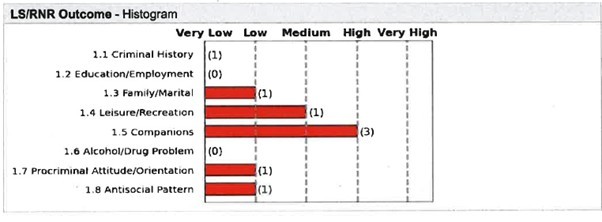
There was a further parole assessment on 16 December 2024 in which the Applicant was again assessed at a low risk of reoffending and received the same scores for the eight risk factors above.
The Applicant also prepared a written submission in letter form dated 28 May 2025 which he relied upon before the Tribunal. The letter enclosed “several key pages from [the Applicant’s] prison records” including the “risk assessment reports”, and stated:
These documents speak for themselves and provide an honest picture of my efforts to change and reintegrate. I respectfully ask the Tribunal to consider these excerpts as part of my submission. I believe they demonstrate my commitment to rehabilitation and my low risk of reoffending.
On the same day, the Applicant submitted an appendix summarising his rehabilitation, including a note that he had been “[a]ssessed as an inmate with a low risk of reoffending and good potential for successful reintegration into society”. In a further appendix submitted by the Applicant, under the heading “Final Summary Statement”, the Applicant repeated that he had “been assessed as low risk”. The next day, on 29 May 2025, the Applicant provided a further submission referring to his “very low risk of reoffending”.
The Court was told that the only reference to the parole assessment report at the hearing before the Tribunal was by the Applicant, in opening submissions, when the Applicant said:
In prison, I actively participated in rehabilitation programs, and I was assessed low risk of reoffending, and the parole board approved me to be in the community with conditions.
12 The primary judge summarised the submissions for ground 1 at PJ [31]:
The Applicant submitted that the Tribunal fell into error because it “cherry-picked” one of eight risk/need factors listed in the LS-RNR assessments – “companions” (which had been graded as “high”) – and, without explanation, determined that the Applicant was a “low to moderate” risk of reoffending. The Applicant submitted, first, that the Tribunal misconstrued the LS-RNR assessments and, second and relatedly, that the determination by the Tribunal was irrational or illogical.
13 A variant of that submission was recorded by the primary judge at PJ [33] to the effect that the Tribunal inflated the risk assessment from low, to low to moderate and failed to explain why. Her Honour rejected the submissions as reflecting a misunderstanding of the Tribunal’s reasons: PJ [34]. In more detail, the primary judge reasoned at PJ [35]-[39]:
Properly construed, the Tribunal’s determination at T [78] was based on four adverse matters set out in T [77] which led to the Tribunal’s own assessment of the Applicant’s risk of reoffending. The Tribunal began, at T [77], by noting that the parole assessment reports had made an assessment, using the LS/RNR tool, that the Applicant had a low risk of reoffending. The Tribunal further noted, however, that the Applicant had scored “high” on the companions risk factor, which it said was “of concern”.
The Tribunal then went on to state that, first, the Tribunal remained concerned that “the Applicant may be susceptible to negative influences, as previously indicated in the Parole Report”. Second, the Applicant had engaged in criminal offending over a protracted period of time and which involved many co-offenders who were known to the Applicant. Thirdly, the Applicant had the protective factors of his wife and children at the time, but this had not deterred him from offending. Fourthly, having regard to the Applicant’s stated financial reasons for the offending, the Tribunal was not confident that, if the Applicant felt under financial pressure, the Applicant would resist the urge to engage in illegal behaviour once again.
Thus, the Tribunal came to its own assessment, at T [78], that the Applicant was at a “low to moderate” risk of reoffending. Furthermore, the Tribunal explained the reasons for reaching that assessment, at T [77].
The Tribunal was not required to give particular weight or deference to the parole assessment reports, a matter which the Applicant conceded at the hearing. The Tribunal was, of course, required to give appropriate consideration to the LS-RNR risk assessments to the extent that they were the subject of argument from the Applicant. As the Tribunal’s reasons demonstrate, the Tribunal had regard to the LS-RNR assessments, but ultimately formed its own view of the Applicant’s risk of reoffending. However, save for the requirements of Direction no. 110, the manner in which the Tribunal assessed the risk of reoffending, and how it treated the parole assessment reports as part of that overall assessment, was a matter for it: RNSQ v Minister for Immigration, Citizenship and Multicultural Affairs [2023] FCA 1111 at [71] (Feutrill J).
Nothing in the Tribunal’s analysis discloses that it misunderstood the risk assessments in the parole assessment reports. Furthermore, the conclusion reached by the Tribunal was open to it for the reasons that it gave.
14 As to ground 2, the primary judge rejected the procedural fairness ground as misconceived because the Tribunal did not modify or misunderstand the parole risk assessments; rather it took them into account and reached its own conclusion as to the risk of re-offending: PJ [43]-[44].
The appeal
15 With new solicitors and counsel, the appellant relies on two new arguments before this Court:
1. The learned trial erred by failing to find that the ART did not properly apply the principles set out on SZBEL v Minister for Immigration and Multicultural and Indigenous Affairs (2006) 228 CLR 152; [2006] HCA 63 in relation to the so-called ‘companion risk factor’ and the assessment of risk.
2. The learned trial erred by failing to find that the ART did not properly undertake the assessment of risk of re-offending.
16 Four initial observations should be made from the oral submissions of the appellant’s counsel. First, counsel did not accept that ground 1 is a new argument requiring leave as it is no more than a “recasting” with refinement of ground 1 before the primary judge. Counsel accepted, however, that ground 2 is a new argument.
17 Second, ground 2 is parasitic on success of ground 1 and falls away if it fails.
18 Third, the oral submissions for ground 1 departed from the written submissions, but this was not objected to by counsel for the Minister.
19 Fourth, as last framed the submission in support of ground 1 is that the risk of future offending was not addressed by the companions risk analysis of the Parole Board and if it was to be deployed by the Tribunal as a tool of analysis to assess future risk, that should have been put to the appellant for response.
20 We are unable to accept the submission. The starting point is s 55(1) of the Administrative Review Tribunal Act 2024 (Cth):
(1) The Tribunal must ensure that each party to a proceeding in the Tribunal is given a reasonable opportunity to:
(a) present the party's case; and
(b) access any information or documents to which the Tribunal proposes to have regard in reaching a decision in the proceeding; and
(c) make submissions and adduce evidence.
21 SZBEL v Minister for Immigration and Multicultural and Indigenous Affairs [2006] HCA 63; (2006) 228 CLR 152 (Gleeson CJ, Kirby, Hayne, Callinan and Heydon JJ) relevantly holds pursuant to the former obligation at s 425(1) of the Act that: (1) ordinarily an applicant before the Tribunal is entitled to the opportunity of being heard on the relevant issues: [32]-[33]; (2) ordinarily, the issues before the Tribunal are those which the delegate considered determinative: [35]; and (3) there is no obligation to provide a running commentary on what the Tribunal thinks of the evidence:[48]. As explained in Minister for Immigration and Citizenship v LLR24 [2026] FCAFC 26; (2026) 315 FCR 297, SZBEL is “not simply a product of the requirements of [s 425] but rather reflects a substantive principle of procedural fairness” and “did not turn on the precise wording [of s 425]”: at [43], O’Sullivan, McElwaine and Hill JJ.
22 Here the appellant put in issue in his representation that he was “stupid” and it was “a big mistake” to be involved with his companion co-accused and if released he intended to pursue a decent life, would find a job and be a good husband and father. The delegate did not accept this claim and concluded that the appellant was at future risk of committing more offences if he “finds himself in a similar social group or faces a financial burden in the future” he “may again look to committing similar offences”. This led the delegate to find that despite a low risk of reoffending, that should he reoffend it may result in harm to members of the community which weighed strongly against revocation. Accordingly, the risk of reoffending was a determinative issue which the delegate confirmed at [100]:
However, I have also given significant weight to the serious nature of Mr DONG’s offending involving the cultivation of cannabis and possession of chemicals for the manufacture of methylamphetamine, for which he received a significant term of imprisonment. I have also considered the Mr DONG’s remorse and the likelihood of Mr DONG re-offending. I am not satisfied remorse and plans for future employment are sufficient deterrents against future offending, taking into account Mr DONG’s limited insight into his offending and the ramifications of his actions.
23 Before the Tribunal, the appellant relied on several typed submissions and letters of explanation in which he relied on the Parole Board risk assessments. Some of the provided documents were identified by the primary judge at PJ [14]-[15]. We note that before the Tribunal, the appellant referenced his severing of ties with his former criminal companions, that he would not have future contact with “bad people” and would not “return to the past” and in 10 separate documents from May 2025, some dated May 2025 and others were multiply dated 15, 25 or 28 May 2025, he asserted that he intended to live lawfully, disassociated from criminal types.
24 As the primary judge also correctly found, the appellant placed the Parole Board risk assessment before the Tribunal in a “letter of explanation” dated 28 May 2025, to which he attached “risk assessment reports”, and stated that the documents “speak for themselves” as demonstrating genuine rehabilitation and a low future risk of offending. The Parole Board risk assessment self-evidently was concerned with the risk the appellant may commit further offences if granted parole. Mr Boccabella for the appellant submitted that the Parole Board risk assessment was concerned with the appellant’s past associations and therefore the Tribunal was obliged to put the appellant on notice that it would use it as a tool to assess the future risk of offending. With respect, the submission fundamentally misunderstands the assessment. The whole purpose of a parole risk assessment is to assess the relative risk of releasing a prisoner into the community, including the risk that the person may commit further offences.
25 The risk assessment table is accompanied by a reasoned recommendation for parole which, when addressing the appellant’s transitional needs, includes:
Companions
Supervision appointments will monitor closely Mr Dong's motivation to form new companions who will reflect his renewed value system. Discussions surrounding cost/benefit analysis of relationships will be held during supervision appointments. The healthy relationships workbook will be utilised throughout supervision and the promotion of healthy living through the completion of the Health and Wellbeing workbook.
Non-association condition (condition 19) will be recommended, prohibiting Mr Dong from having contact with his co-offenders.
Mr Dong appears easily influenced by negative companions, therefore, this service will mitigate this risk by encouraging Mr Dong to establish pro-social relationships and engage in community-based activities.
26 Plainly the companion risk assessment ultimately deemed “high” reflected the risk that once again the appellant may be influenced by others to commit offences, which is the matter required to be assessed in accordance with cl 8.1(2)(b) of Direction 110.
27 Ultimately what this analysis demonstrates is that the future companions risk leading to the commission of further offences issue was first raised by the appellant in his representation in support of revocation of the cancellation decision, was not accepted by the delegate, was responded to by the appellant multiple times in the statements and submissions he placed before the Tribunal and it cannot be gainsaid that he was unaware of it.
28 Once that is understood, the Tribunal was entitled to undertake the assessment at TD [77] by emphasising as the matter of concern that the appellant may in the future be susceptible to companion risk based on his prior conduct as one of the four considerations that the primary judge set out at PJ [35]. The Tribunal was entitled to make its own assessment and was not bound to accept the overall risk conclusion of the Parole Board analysis on a matter that was squarely in issue for the reasons succinctly stated by the primary judge at PJ [38]-[39].
29 For these reasons there is no merit in ground 1 as ultimately developed. Although no explanation was provided as to why the argument was not advanced before the primary judge (other than the inference that the change of lawyers presented an opportunity to reframe the case), Mr Sypott for the Minister was able to respond, we heard the argument and it would be inutile to refuse leave. Ground 1 fails and conformably with the concession of Mr Boccabella there is no need to separately consider ground 2. The appeal will be dismissed and there is no reason costs do not follow the event.
I certify that the preceding twenty-nine (29) numbered paragraphs are a true copy of the Reasons for Judgment of the Honourable Justices Rangiah, Rofe and McElwaine. |
Associate:
Dated: 23 November 2026