
FEDERAL COURT OF AUSTRALIA
Davis v Wilson [2026] FCAFC 142
Appeal from: | Davis v Wilson [2025] FCA 108 Davis v Wilson (Costs) [2025] FCA 666 |
File number: | NSD 1226 of 2025 |
Judgment of: | MARKOVIC, SARAH C DERRINGTON AND BENNETT JJ |
Date of judgment: | 18 November 2026 |
Catchwords: | CORPORATIONS – representative proceedings – financial reporting – alleged overstatement of biological assets in financial reports – valuation of sandalwood plantations under AASB 12 and AASB 141 – assumptions concerning predicted heartwood yield – whether market participant would have adopted predicted heartwood yield of 6 to 8 kg per tree – held counterfactual yield of 6 to 8 kg per tree not established by applicants – held valuation assumptions not shown to be unreasonable PRACTICE AND PROCEDURE – whether pleaded case on liability required proof of predicted heartwood yield of 6 to 8 kg per tree – particulars formed part of pleaded case – held primary judge erred in construction of pleadings CORPORATIONS – misleading and deceptive conduct –directors’ declarations under s 295 of the Corporations Act 2001 (Cth) – whether the first respondent as director, personally made representations contained in declarations to the market – whether reasonable grounds for representations – reliance on internal expertise, audit committee and external auditor – held unqualified collective declaration conveyed that each approving director held stated opinions CORPORATIONS – misleading and deceptive conduct –audit opinions concerning financial reports – whether opinions and audit services were “in relation to” a financial product – s 1041H of the Corporations Act – ss 12BAB and 12DA of the Australian Securities and Investments Commission Act 2001 (Cth) – sufficient connection with company shares established – compliance with Australian Auditing Standards – reasonable foundation for unqualified opinions – held contravention not established APPEAL AND NEW TRIAL – appeal dismissed – cross-appeals allowed in part – remaining causation grounds unnecessary to determine – appellant to pay respondents’ costs |
Legislation: | Australian Securities and Investments Commission Act 2001 (Cth) ss 12BAB, 12DA, 12GF Corporations Act 2001 (Cth) ss 180, 292, 295, 297, 301, 308, 344, 1041E, 1041H, 1014I Federal Court of Australia Act 1976 (Cth) Part IVA Limitation of Actions Act 1974 (Qld) ss 10, 35, 36 |
Cases cited: | ABN AMRO Bank NV v Bathurst Regional Council [2014] FCAFC 65; (2014) 224 FCR 1 Australian Securities and Investments Commission v Cassimatis (No 8) [2016] FCA 1023; (2016) 336 ALR 209 Australian Securities and Investments Commission v Healey [2011] FCA 717; (2011) 196 FCR 291 Australian Securities and Investments Commission v MacDonald (No 11) [2009] NSWSC 287; (2009) 256 ALR 199 Australian Securities and Investments Commission v Narain [2008] FCAFC 120; (2008) 169 FCR 211 Australian Securities and Investments Commission v Westpac Banking Corporation (No 2) [2018] FCA 751; (2018) 266 FCR 147 Avoca Consultants Pty Ltd v Millenium3 Financial Services Pty Ltd [2009] FCA 883; (2009) 179 FCR 46 Bell v St Michael's Golf Club [2003] NSWCA 159; (2003) 46 ACSR 113 Boensch v Pascoe [2019] HCA 49; (2019) 268 CLR 593 Davis v Quintis Ltd (Subject to a Deed of Company Arrangement) [2022] FCA 806 Manicaros v Commercial Images (Aust) Pty Ltd [2024] QCA 40; (2024) 19 QR 445 Mummery v Irvings Pty Ltd [1956] HCA 45; (1956) 96 CLR 99 The Stage Club Ltd v Millers Hotel Pty Ltd [1981] HCA 71; (1981) 150 CLR 535 Thomson v STX Pan Ocean Co Ltd [2012] FCAFC 15 |
Division: | General Division |
Registry: | New South Wales |
National Practice Area: | Commercial and Corporations |
Sub-area: | Corporations and Corporate Insolvency |
Number of paragraphs: | 218 |
Date of last submission: | 27 February 2026 |
Date of hearing: | 23–27 March 2026 |
Counsel for the Appellant: | Mr N Hutley SC appears with Mr C McMeniman and Mr T Liu |
Solicitor for the Appellant: | Piper Alderman |
Counsel for the First Respondent: | Mr S Lawrence SC appears with Mr J Sippe |
Solicitor for the First Respondent: | Wotton & Kearney Lawyers |
Counsel for the Second Respondent: | Mr J Williams SC and Ms F Roughley SC appear with Mr J Entwisle and Mr S Gerber |
Solicitor for the Second Respondent: | Clifford Chance |
ORDERS
NSD 1226 of 2025 | ||
| ||
BETWEEN: | GEOFFREY PETER DAVIS First Appellant GEOFFREY WILLIAM DAVIS Second Appellant | |
AND: | FRANK CULLITY WILSON First Respondent ERNST & YOUNG (A PARTNERSHIP) ABN 75 288 172 749 Second Respondent | |
AND BETWEEN: | FRANK CULLITY WILSON (and another named in the Schedule) First Cross-Appellant | |
AND: | GEOFFREY PETER DAVIS (and another named in the Schedule) First Cross-Respondent | |
order made by: | MARKOVIC, SARAH C DERRINGTON and BENNETT JJ |
DATE OF ORDER: | 18 November 2026 |
THE COURT ORDERS THAT:
1. The appeal be dismissed.
2. Grounds 1, 2, 3, 5 and 6 of the first respondent’s cross-appeal be upheld.
3. Grounds 1, 2, 4 and 5 of the second respondent’s cross-appeal be upheld.
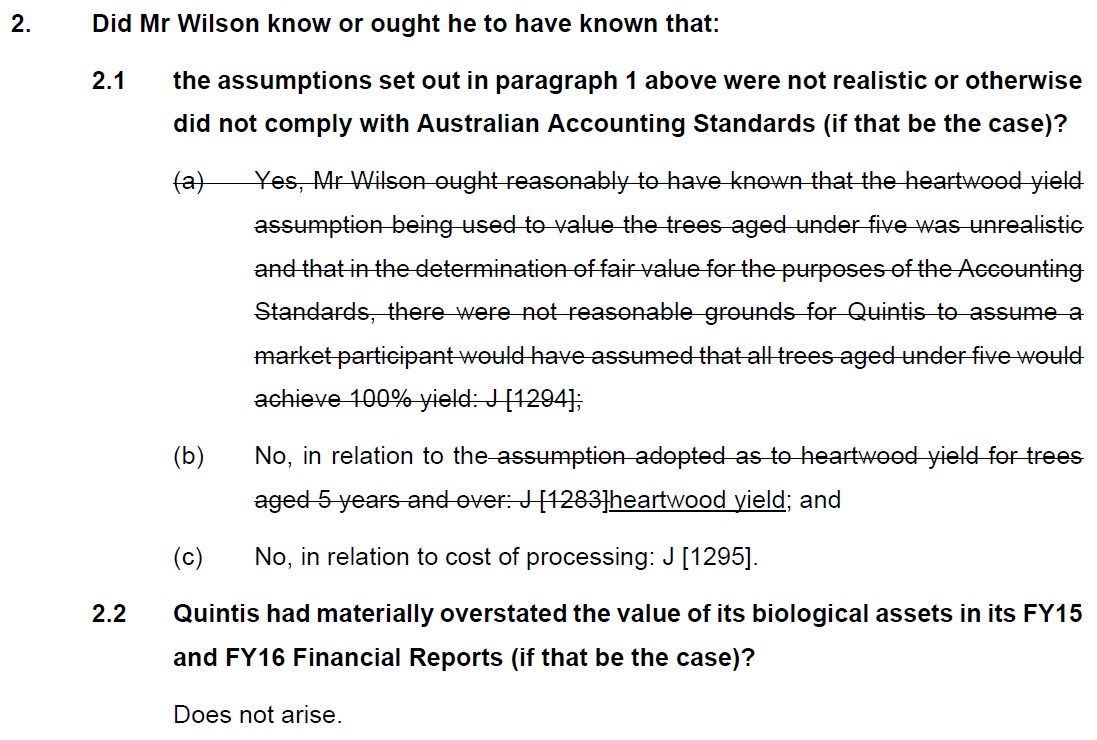
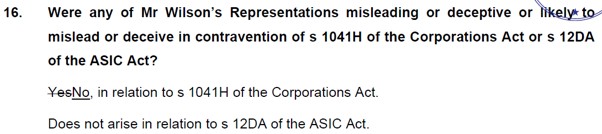
4. Orders 2 and 3 made by the primary judge on 20 June 2025 be varied such that questions 2, 3, 16 and 20 be answered as set out in Annexure A to these Orders.
5. The appellant is to pay the first and second respondents’ costs of the appeal and of their respective cross-appeals.
Note: Entry of orders is dealt with in Rule 39.32 of the Federal Court Rules 2011.
Annexure A


REASONS FOR JUDGMENT
THE COURT
INTRODUCTION
1 The subject matter of this appeal arises in the context of the 2017 collapse of the Australian publicly listed company Quintis Ltd ACN 092 200 854 (Quintis) (formerly TFS Corporation Ltd (TFS)). Quintis was one of the earliest operators to have established commercial sandalwood plantations in Australia. Its first commercial plantation was established in 1999. By 2004, it was listed on the Australian Stock Exchange (now, the Australian Securities Exchange) (ASX) and had achieved considerable success in the marketplace, including being admitted to the “ASX 300”.
2 However, as matters transpired, things were not quite as they seemed. As the primary judge records (J [6]), on 22 March 2017, Glaucus Research Group California, LLC (Glaucus) released a report valuing Quintis’ shares at $0 and made several allegations in relation to Quintis’ business and operations (First Glaucus Report). Glaucus alleged, amongst other things, that Quintis exhibited characteristics similar to those of a “Ponzi scheme” and that its assets of sandalwood trees were effectively worthless.
3 On 27 March 2017, Quintis shares were put into a trading halt by the ASX at Quintis’ request. Quintis denied the allegations made in the First Glaucus Report and described Glaucus as a self-interested short-seller seeking to make a financial gain at Quintis’ expense. On 28 March 2017, Quintis announced the resignation of Mr Frank Cullity Wilson (the first respondent) as Managing Director and, on 29 March 2017, Glaucus released a further report also valuing Quintis’ shares at $0 (Second Glaucus Report).
4 Quintis entered voluntary administration on 20 January 2018 and, after entering into a deed of company administration (DOCA), exited voluntary administration on or about 29 June 2018 having been recapitalised and restructured into a private company. The DOCA did not return anything to Quintis’ members.
5 The appellants, Mr Geoffrey Peter Davis (Mr Davis Snr) and Mr Geoffrey William Davis (Mr Davis Jnr) (the Davis Applicants) commenced proceedings pursuant to Part IVA of the Federal Court of Australia Act 1976 (Cth) on 23 May 2018 as representatives of an open class of people who had acquired an interest in ordinary shares of Quintis in the period commencing on 31 August 2015 and concluding on 15 May 2017 (including those who already had an interest prior to 31 August 2015). The Davis Applicants alleged that they acquired shares in Quintis, either on market or via a share purchase plan, between 31 August 2015 and 15 May 2017 at an inflated price due to misleading or deceptive statements made in Quintis’ financial reports for the financial years ending in 2015 and 2016 (FY15 and FY16 Financial Reports). The allegedly misleading statements centre on the value of Quintis’ principal cash generating asset, sandalwood trees, which were referred to in Quintis’ financial reports as “biological assets” (BA). The Davis Applicants alleged that Quintis materially overstated the value of its biological assets in the FY15 and FY16 Financial Reports by reason of various inputs adopted in the discounted cash flow model (DCF Model) which it used to value those assets. The inputs were assumptions which Quintis made for the purposes of measuring and reporting the fair value of its assets, as required by the Corporations Act 2001 (Cth) and the Australian Accounting Standards (AASBs).
6 The Davis Applicants alleged further that Mr Wilson, as a director of Quintis, made three misleading representations by joining in the resolutions of the directors of Quintis in each of the FY15 and FY16 Financial Reports, being that he was of the opinion that:
(1) the FY15 and FY16 Financial Reports had: (i) been prepared in accordance with the requirements of the Corporations Act, including that they complied with the AASBs; and (ii) gave a true and fair view of the financial position and performance of Quintis; and that those opinions were held on a reasonable basis and were the product of the application of reasonable care and skill by Mr Wilson (together, the Wilson FY15 and FY16 Financial Report Representations);
(2) Quintis had: (i) in FY15, total assets of $1,173,335,000 and net assets of $574,523,000; and (ii) in FY16, total assets of $1,491,958,000 and net assets of $747,222,000; and that those opinions resulted from the application of the AASBs and were held on a reasonable basis and were the product of the application of reasonable care and skill by each director of Quintis, including Mr Wilson (together, the Wilson FY15 and FY16 Assets Representations); and
(3) Quintis had post-tax profit: (i) for FY15 of $113,021,000; and (ii) for FY16 of $90,143,000; and that those opinions resulted from the application of the AASBs and were held on a reasonable basis and were the product of the application of reasonable care and skill by Mr Wilson (together, the Wilson FY15 and FY16 Profit Representations),
(collectively, the Wilson Representations).
7 The second respondent, Ernst & Young (EY), was Quintis’ auditor during the relevant time. EY admitted that it had expressed opinions in the FY15 and FY16 Financial Reports that these reports were in accordance with the Corporations Act, including by: (a) giving a true and fair view of Quintis’ financial position and performance; and (b) complying with the AASBs. Those representations were respectively defined in the Fifth Further Amended Statement of Claim filed 30 August 2024 (FFASC) as the FY15 and FY16 Audit Opinions. The Davis Applicants alleged that in expressing these opinions, by issuing the FY15 and FY16 Audit Opinions in the circumstances pleaded, EY represented to members and potential investors in Quintis that those opinions were: (a) opinions held on a reasonable basis and the product of the application of reasonable care and skill by EY; and (b) formed after EY had conducted an audit in accordance with the Australian Auditing Standards (Auditing Standards or ASAs) (together, the EY FY15 and FY16 Financial Report Representations).
8 As a result of each of these allegedly misleading statements, the Davis Applicants alleged that Mr Wilson and EY each contravened ss 1041H or 1041E of the Corporations Act and s 12DA of the Australian Securities and Investments Commission Act 2001 (Cth) (ASIC Act). They also alleged that EY breached a common law duty of care owed to both current and future members when carrying out the FY15 and FY16 audits of Quintis’ financial accounts.
9 The Davis Applicants had originally commenced the proceedings also against Quintis. A settlement was reached between those parties, which was approved on 1 July 2022: Davis v Quintis Ltd (Subject to a Deed of Company Arrangement) [2022] FCA 806 (Lee J).
10 In a judgment published on 24 February 2025, the primary judge concluded (J [24]) that the Davis Applicants had:
(a) established that the heartwood yield assumption used by Quintis in the DCF Model in respect of trees aged under five was unrealistic and was an assumption that lacked reasonable foundation;
(b) established that Mr Wilson did make the Wilson Representations, and did not have reasonable grounds for making those Representations;
(c) established that the heartwood yield assumption used by Quintis in the DCF Model in respect of trees aged under five was a significant assumption but was not a reasonable one, such that [the primary judge was] satisfied that EY ought reasonably to have evaluated it as an assumption that was not reasonable as that is what a reasonable auditor would have done in the same circumstances, and, further, it was established that EY failed to obtain sufficient appropriate audit evidence so as to, in turn, obtain reasonable assurance that the FY15 and FY16 Financial Reports were free from the audit risk of material misstatement to an acceptably low but not absolute level;
(d) established that EY did not have a reasonable basis to make the EY FY15 and FY16 Financial Report Representations and that they were not the product of reasonable care and skill exercised by EY;
(e) established in light of each of the above (and for the other reasons set out below) that Mr Wilson and EY each contravened s 1041H of the Corporations Act and that EY additionally contravened s 12DA of the ASIC Act;
(f) not established their counterfactual case that the heartwood yield assumption that should have been used was approximately 6 to 8 kg per tree;
(g) not established causally connected loss for the purpose of s 1041I of the Corporations Act and s 12GF of the ASIC Act as against either Mr Wilson or EY, or for the purpose of the negligence claim against EY.
(Emphasis in original.)
11 By Notice of Appeal filed on 18 July 2025, the Davis Applicants have appealed against the orders made by the primary judge on 20 June 2025 giving effect to the reasons (liability orders) and against the costs orders made by the primary judge in Davis v Wilson (Costs) [2025] FCA 666. Both Mr Wilson and EY filed Notices of Cross-Appeal on 25 August 2025.
12 Unless otherwise stated, these reasons adopt the defined terms expressed in the primary judgment.
The grounds of appeal
13 The Davis Applicants raise nine grounds of appeal.
14 First, they challenge the primary judge’s finding that the valuation of Quintis’ sandalwood trees aged five years and over was reasonable and in accordance with what a market participant would have assumed (J [980], [1058]). It is contended that the primary judge ought to have found that the yield curves assigned to trees aged five years and over assumed growth rates proportionate to, and therefore directly based, on the Tree Model and 100% yield curve in circumstances where it was not reasonable to use the Tree Model or the 100% yield curve (Ground 1).
15 Secondly, the Davis Applicants challenge the finding by the primary judge (J [1098]) that the carrying value of the biological assets reported in the FY15 and FY16 Financial Reports was not materially overstated. They contend that the primary judge should have found that the evidence established that there was no basis to conclude that there might be “conservative integers” which would offset the materially overstated heartwood yield assumption and that there was no onus on the Davis Applicants to disprove hypothetical offsetting inputs (Ground 2).
16 Thirdly, the Davis Applicants challenge the primary judge’s rejection (J [1188]) of their counterfactual case that a reasonable heartwood yield assumption for Quintis’ sandalwood plantations was approximately 6-8 kg of sandalwood heartwood per tree at harvest. They submit therefore that the primary judge erred in failing to find that restated accounts for FY15 and FY16 in accordance with AASB 13 and AASB 141 would have included a counterfactual heartwood yield assumption of approximately 6-8 kg of sandalwood heartwood per tree at harvest. The Davis Applicants contend that the primary judge should have found:
(1) that a heartwood yield per tree of approximately 6-8 kg was an assumption that a market participant, using all of the information available to someone conducting a reasonable due diligence of Quintis’ biological assets at the time, would have adopted in the DCF Model to derive the fair value of Quintis’ biological assets (in accordance with AASB 13 and AASB 141);
(2) the multiple datasets approach by Dr Barbour was scientifically valid and based on the data which was available at the time and which a market participant would have access and regard to; and
(3) based on the counterfactual heartwood yield assumption of approximately 6-8 kg, the reported carrying value of the biological assets and the net assets were materially overstated in the FY15 and FY16 Financial Reports,
(Ground 3).
17 Fourthly, the Davis Applicants contend that the primary judge erred in rejecting (J [1544]-[1548]) their counterfactual case against EY that EY would either have required Quintis to restate its FY15 and FY16 Financial Reports so that EY could give an unqualified audit opinion, or issued a qualified or adverse audit opinion in the event Quintis refused to do so (Ground 4).
18 Fifthly, the Davis Applicants contend that the primary judge erred in failing to find that EY was negligent in circumstances where the primary judge held that EY owed a duty of care to all shareholders of Quintis, and a similar duty to potential shareholders, and that the EY FY15 and FY16 Financial Reports Representations were misleading (Ground 5).
19 Sixthly, the Davis Applicants challenge the primary judge’s rejection of their claim under s 1041E of the Corporations Act (J [1341], [1573]) because of the finding that it had no utility and because they had failed to prove that the respondents’ representations were likely to induce persons to acquire shares (Ground 6).
20 Seventhly, the Davis Applicants challenge the primary judge’s rejection (J [1658]-[1659]) of their direct reliance case on causation. They contend that the primary judge ought to have found that Mr Davis Snr’s reliance on the Directors’ Declarations and the FY 15 and FY 16 Audit Opinions in the FY15 and FY16 Financial Reports played a sufficient part in him causing the Davis Fund to purchase shares in Quintis after the issuing of those financial reports and therefore, for the purposes of s 1014I of the Corporations Act and s 12GF of the ASIC Act, they have established loss or damage by the conduct of the respondents engaged in contravention of s 1041E and s1041H and s 12DA of the ASIC Act (Ground 7).
21 Eighthly, the Davis Applicants challenge the primary judge’s rejection of their indirect or market-based/inflation causation case (J [1750]) contending that the primary judge erred in finding the Davis Applicants had failed to prove a relevant relationship between Quintis’ reported net assets and its share price. The Davis Applicants contend that the primary judge ought to have found that the overstatement of Quintis’ net assets would have had some material impact on its share price either as a matter of common sense or because of valuations of sell-side analysts (Ground 8).
22 Ninthly, if the Davis Applicants succeed in overturning the findings of the primary judge, they contend for a costs order in their favour both below and on appeal (Ground 9).
The cross-appeal grounds
23 There is a degree of overlap between the grounds raised by each of the respondents to the appeal in their Notices of Cross-appeal (Wilson cross-appeal and EY cross-appeal respectively).
24 Ground 1 of the Wilson cross-appeal and ground 2 of the EY cross-appeal challenge the primary judge’s finding (J [1052], [1064]) that the heartwood yield assumption used by Quintis to value its trees aged under five was unrealistic, lacked a reasonable foundation, and was materially higher than that which a reasonable market entity in its position would have assessed a market participant to have assumed. Mr Wilson also challenges the finding that, in the determination of fair value for the purposes of the AASBs, there were no reasonable grounds for Quintis to assume a market participant would have assumed that trees under five years would achieve a 100% yield (J [1057]).
25 Ground 2 of the Wilson cross-appeal challenges the primary judge’s finding that Mr Wilson ought reasonably to have known that the heartwood yield used to value trees under five years of age was unrealistic and that in the determination of fair value for the purposes of the AASBs, there were not reasonable grounds for Quintis to assume a market participant would have assumed that trees under five years would achieve a 100% yield (J [1294]).
26 Ground 3 of the Wilson cross-appeal and ground 1 of the EY cross-appeal challenge the primary judge’s finding (J [81]-[83], [871], [873], [888], [1048], [1061]) that the Davis Applicants’ case on liability did not require them to establish that Quintis’ DCF Model should have adopted the assumption as to heartwood yield for a tree harvested at 15 years of 6-8 kg. Mr Wilson also challenges the finding that he ought reasonably to have known that matter (J [71], [76], [77], [81]).
27 Ground 4 of the Wilson cross-appeal contends that the primary judge erred in finding that Mr Wilson had made the Wilson FY15 Financial Report Representation, the Wilson FY15 Asset Representation, the Wilson FY15 Profit Representation, the Wilson FY16 Financial Report Representation, the Wilson FY16 Asset Representation and the Wilson FY16 Profit Representation (J [1211]-[1219]).
28 Ground 3 of the EY cross-appeal contends that the primary judge erred in finding that the pleaded conduct against EY was in relation to a financial product (J [1359], [1373]) and the provision of a service in relation to a financial product (J [1557]).
29 Ground 5 of the Wilson cross-appeal and ground 4 of the EY cross-appeal contend that the primary judge erred in finding that each party did not have a reasonable basis for the opinions they expressed in the Wilson Representations (J [1301]-[1305]) and in the FY15 and FY16 Audit Opinions (J [1536]-[1537]) respectively.
30 Ground 6 of the Wilson cross-appeal and ground 5 of the EY cross-appeal contend that the primary judge erred in finding that each engaged in misleading or deceptive conduct in contravention of s 1041H of the Corporations Act (J [1307], [1538]) and, in the case of EY, s 12DA of the ASIC Act (J [1570]).
31 Ground 7 of the Wilson cross-appeal and ground 6 of the EY cross-appeal challenge the primary judge’s finding that for the purposes of ss 1041H and 1041I of the Corporations Act and ss 12DA and 12GF of the ASIC Act, indirect market-based causation was available as a means of proving causally connected loss (J [1669]).
32 Given the overlap between several of the grounds of appeal and grounds of cross-appeal and as between the grounds in the Wilson cross-appeal and the EY cross-appeal, these reasons are arranged based on the common issues between grounds, rather than by addressing the grounds of appeal and cross-appeal seriatim.
REJECTION OF THE COUNTERFACTUAL YIELD OF 6-8 KG
Ground 3 of the appeal (all trees), ground 1 of the Wilson cross-appeal and ground 2 of the EY cross-appeal (trees under five)
Ground 3 of the Wilson cross-appeal and ground 1 of the EY cross-appeal (the pleading point)
33 Ground 3 of the appeal, and ground 1 of the Wilson cross-appeal and ground 2 of the EY cross-appeal respectively, each deal with the primary judge’s conclusions, based on the expert evidence, as to whether an entity in Quintis’ position would have determined fair value on the basis that a market participant would have predicted cash flows that assumed all trees (both under five years old and over five years old) would achieve a yield of 20 kgs at 15 years old. For that reason, it is convenient to deal with them together.
34 The Davis Applicants contend that the primary judge should have accepted “the multiple data set” approach taken by Dr Barbour as being a scientifically valid approach based on the data that a market participant would use to assume a heartwood yield per tree of approximately 6-8 kg. Mr Wilson and EY challenged the primary judge’s finding that the assumption that all trees aged under five would achieve a 100% yield was “unsound and unsupportable on the facts that were known and on the information that was clearly available” (J [1057]).
35 The primary judge’s findings that the Davis Applicants’ case on liability, as opposed to establishing causation, did not depend on establishing that a market participant would have assumed an average heartwood yield of 6-8 kg for a 15 year old tree, that the DCF Model should have adopted that assumption, and that Mr Wilson knew, or ought reasonably to have known that matter, was also challenged by ground 3 of the Wilson cross-appeal and ground 1 of the EY cross-appeal. This issue was referred to during the hearing of the appeal as the pleading point.
36 The primary judge was not satisfied of that matter with respect to trees under five and held that a reasonable entity in Quintis’ position would not have proceeded on the basis that in an orderly transaction, a knowledgeable market participant would have assumed, acting in its own economic interests, that all trees aged under five would achieve a 100% yield (J [1057]). The primary judge was satisfied that, in relation to trees under five, Quintis assumed a predicted heartwood yield that was materially higher than that which a reasonable entity in its position would have assessed a market participant to have assumed (J [1052]). This finding is challenged by ground 1 of the Wilson cross-appeal and ground 2 of the EY cross-appeal.
37 The gravamen of ground 3 of the appeal is the Davis Applicants’ contention that the primary judge was wrong to reject their “counterfactual heartwood yield of approximately 6-8 kg” per tree, which yield would have been assumed by a market participant, using all the information available to someone conducting a reasonable due diligence of Quintis’ biological assets at the time, and so adopted in the DCF Model to derive the fair value of Quintis’ biological assets (in accordance with AASB 13 and AASB 141).
38 Unless the Davis Applicants succeed on this ground, the appeal must be dismissed. That is because, even accepting contrary to ground 3 of the Wilson cross-appeal and ground 1 of the EY cross-appeal, that the counterfactual was relevant only to causation, the Davis Applicants must establish that the primary judge ought to have found, on the basis of Dr Barbour’s evidence, that Quintis’ failure to record the value of the biological assets based on a heartwood yield assumption of approximately 6-8 kg caused the loss alleged by the Davis Applicants.
Ground 3 of the Wilson cross-appeal and ground 1 of the EY cross-appeal
39 It is convenient to deal first with the pleading point.
40 In paragraphs [166]-[176] of the FFASC, the Davis Applicants pleaded the matters by which they alleged that each of the FY15 and FY16 Financial Reports did not give a true and fair view of the financial position and financial performance of Quintis, such that Quintis had breached s 297 of the Corporations Act and failed to comply with AASB 101. In paragraphs [193]-[194] of the FFASC, the Davis Applicants pleaded a positive case, described as the “[c]ounterfactual”, as to what assumptions should have been used in relation to the FY15 and FY16 Carrying Values and Revaluation Gains, such that the FY15 and FY16 Financial Reports would have been developed and applied in accordance with AASB 13 and AASB 141.
41 Relevantly, the FFASC pleaded:
169. The discounted cash flow model used to derive the FY15 BA Carrying Value and the FY15 Revaluation Gain pleaded in paragraph 99 above adopted assumptions of inputs, as pleaded in paragraph 100 above, that:
(a1) [deleted]
(a2) assumed predicted heartwood yield per tree at harvest that was materially higher than what a market participant would have assumed;
(a3) assigned a yield curve for:
(i) trees under 5 years of age that assumed the trees achieving 100% of the predicted heartwood yield at harvest; and
(ii) trees 5 years of age and older that assumed the tree achieving heartwood yield as a percentage of the theoretical yield of a tree under 5 years of age,
which did not accurately represent the biological assets in their current location and condition; or
(a4) [Not used]
(a5) understated the cost of processing per litre of sandalwood oil.
…
Particulars
The assumptions which should have been adopted are approximately:
(i) as to subparagraph (a1): survival rate of 56% at a stocking rate of 420 stems per hectare;
(ii) as to subparagraphs (a2) and (a3): average yield for a tree harvested at 15 years of around 6 to 8 kg;
(iii) [Not used]
(iv) as to subparagraph (a5): estimated cost of harvesting and processing at $229.72 per litre of oil;
(v) as to subparagraph (a6): foreign exchange rate of 0.73 for sandalwood sales; and
(vi) as to subparagraph (d): discount rates of 16% for trees aged 0 to 5 years, 15% for trees aged 6 to 10 years, and 14% for trees aged 11 years to harvest age.
The material particulars are further identified in the Report of Wayne Basford dated 4 March 2020 at paragraphs 1.1.11, 1.1.12 at footnote 5 and 3.4.26 to 3.4.29; and the Report of Dr Elizabeth Barbour dated 25 February 2020 at paragraphs 13, 171 to 172 and 188 to 198.
169A. The discounted cash flow model used to derive the FY16 BA Carrying Value and the FY16 Revaluation Gain pleaded in paragraph 127 above adopted assumptions of inputs, as pleaded in paragraph 128 above, that:
(a) [deleted]
(b) assumed predicted heartwood yield per tree at harvest that was materially higher than what a market participant would have assumed;
(c) assigned a yield curve for:
(i) trees under 5 years of age that assumed the trees achieving 100% of the predicted heartwood yield at harvest; and
(ii) trees 5 years of age and older that assumed the trees achieving heartwood yield as a percentage of the theoretical yield of a tree under 5 years of age,
which did not accurately represent the biological assets in their current location and condition; or
(d) [Not used]
(e) understated the cost of processing per litre of sandalwood oil.
Particulars
The assumptions which should have been adopted are approximately:
(i) as to subparagraph (a): survival rate of 56% at a stocking rate of 420 stems per hectare;
(ii) as to subparagraphs (b) and (c): average yield for a tree harvested at 15 years of around 6 to 8 kg;
(iii) [Not used]
(iv) as to subparagraph (e): estimated cost of harvesting and processing at $597 per litre of oil;
(v) as to subparagraph (f): discount rates of 16% for trees aged 0 to 5 years, 15% for trees aged 6 to 10 years, and 14% for trees aged 11 years to harvest age.
The material particulars are further identified in the Report of Wayne Basford dated 4 March 2020 at paragraphs 1.1.11, 1.1.14 at footnote 10, 3.4.26 to 3.4.29 and 3.7.13; and the Report of Dr Elizabeth Barbour dated 25 February 2020 at paragraphs 13, 171 to 172 and 188 to 198.
…
193. Had the discounted cash flow model used to derive the FY15 BA Carrying Value and the FY15 Revaluation Gain pleaded in paragraph 99 above been developed and applied in accordance with AASB 141 and AASB 13, it would have:
(a1) contained the following assumptions, or approximately the following assumptions, instead of the significant inputs referred to in paragraph 100 above:
(i) [deleted]
(ii) average predicted heartwood yield per tree for a tree harvested at 15 years of around 6 to 8 kg; and/or
…
(viii) estimated cost of harvesting and processing at $229.72 per litre of oil.
…
193A. Had the discounted cash flow model used to derive the FY16 BA Carrying Value and the FY16 Revaluation Gain pleaded in paragraph 127 above been developed and applied in accordance with AASB 141 and AASB 13, it would have:
(a) contained the following assumptions, or approximately the following assumptions, instead of the significant inputs referred to in paragraph 128 above:
(i) [deleted]
(ii) average predicted heartwood yield per tree for a tree harvested at 15 years of around 6 to 8 kg; and/or
…
(vii) estimated cost of harvesting and processing at $597 per litre of oil.
(Emphasis added.)
42 The primary judge recorded the submission by Senior Counsel for the Davis Applicants during closing submissions that, “I have to prove that ultimately these company’s accounts would have six to eight kilos” (J [1545]).
43 The primary judge was not persuaded that the evidence established that a heartwood yield per tree of approximately 6-8 kg was an assumption that a market participant, using all of the information available to someone conducting a reasonable due diligence of Quintis’ biological assets at the time, would have adopted in the DCF Model to derive the fair value of Quintis’ biological assets (in accordance with AASB 13 and AASB 141) whether that be for trees under five (J [1188]) or over five (J [1181]).
44 As the primary judge observed correctly (J [1061]), the pleaded case did not delineate as between the heartwood yield assumptions used for trees aged under five and those aged over five. In respect of both categories of tree, the pleaded case was that Quintis adopted a heartwood yield assumption that was “materially higher” than that which a market participant would have assumed. However, contrary to the primary judge’s finding that the pleaded case was merely that Quintis had adopted a materially higher yield assumption and was not tied to establishing that a market participant would have adopted a yield assumption of 6-8 kg, the question as to what was meant by “materially higher” was part of the pleaded case as to liability and was contained in the particulars to paragraphs [169] and [169A] of the FFASC.
45 Particular (ii) to paragraph [169 (a2)] and [169A (b)], which contained the allegation that the assumed predicted heartwood yield was “materially higher”, and to paragraph [169 (a3)] and [169A (c)], which contain the allegation of assigning a yield curve of 100% of the predicted heartwood yield to trees under five, and for trees over five, assumed the tree achieving heartwood yield as a percentage of the theoretical yield of a tree under five, stated:
(1) for [169 (a2)] and [169 (a3)]:
(ii) as to subparagraphs (a2) and (a3): average yield for a tree harvested at 15 years of around 6 to 8 kg.
(2) for [169A (b)] and [169A (c)]:
(ii) as to subparagraphs (b) and (c): average yield for a tree harvested at 15 years of around 6 to 8 kg;
46 Paragraph [170] of the FFASC pleaded that, as a result of the matters pleaded in paragraphs [167] to [169A], the directors of Quintis had overstated the fair value of the biological assets. It was pleaded against Mr Wilson specifically at [225]-[226] that he knew, or alternatively ought reasonably to have known, the matters pleaded in, amongst others, paragraph [169].
47 The case on breach, pleaded at [169] and [169A] was consistent with the case on causation and loss pleaded at [193] and [193A]. So much was made pellucid by the amendment sought by the Davis Applicants on Day 6 of the trial when, in discussing the proposed amendments to [193] and [193A], Counsel for the Davis Applicants said:
What we propose to do in this counterfactual plea is to marry it up with what’s in 169 and 169A which is the breach plea …
48 Unlike the position in Thomson v STX Pan Ocean Co Ltd [2012] FCAFC 15 (Greenwood, McKerracher, and Reeves JJ), on which the Davis Applicants rely to refute ground 3 of the Wilson cross-appeal and ground 1 of the EY cross-appeal, this is not a case where the primary judge was being asked to construe the “general thrust” of the assumptions particularised by the Davis Applicants. The Davis Applicants had placed squarely in issue that Quintis’ breach of the Corporations Act and failure to comply with AASB 101 (and consequently Mr Wilson’s alleged misrepresentations and EY’s alleged misrepresentations and negligence) was its failure to produce financial accounts that gave a fair and true value of the financial position of Quintis because it did not adopt a heartwood yield assumption of 6-8 kg.
49 The Full Court’s observations in STX Pan Ocean (at [13]) that “pleadings are not an end in themselves” and “the courts do not, at least in the current era, take an unduly technical or restrictive approach to pleadings such that … a party is bound to the literal meaning of the case it has pleaded”, were concerned with a very different context. There, the Full Court was persuaded that the particulars pleaded of a representation that a party had the wealth necessary to pay for a charter and it was only necessary to allow him a short time to do so – “I am presently ready, willing and able to pay and I will do so as soon as funds become available” – albeit perhaps literally contradictory, in fact served to extend the intervening time for so long as the party possibly could in circumstances where he had no intention to pay. The Full Court considered that the primary judge in that case had “correctly construed the general thrust of the representations pleaded” (STX Pan Ocean at [20]).
50 As Mr Wilson submits, the point is not technical. It is not to the point that the heartwood yield assumption of 6-8 kg was pleaded as a material fact in [193] and [193A] but only particularised in [169] and [169A]. Were that of any consequence, there would have been no utility in seeking the amendments on Day 6 of the trial. Further, on the approach taken by the primary judge, particular (ii) to each of [169] and [169A] would serve no purpose. That cannot be correct. The particulars to each of [169] and [169A] also unambiguously tied the alleged assumption of 6-8 kg to Dr Barbour’s evidence. In that regard, the particulars did precisely what they were supposed to do; limit the issues of fact to be investigated: Mummery v Irvings Pty Ltd [1956] HCA 45; (1956) 96 CLR 99 at 110 (Dixon CJ, Fullagar and Taylor JJ).
51 The Davis Applicants’ case on liability clearly depended on establishing that a market participant would have assumed an average heartwood yield for a tree harvested at 15 years of approximately 6-8 kg and that the DCF Model should have adopted that assumption. As the Davis Applicants failed to establish that fact, the primary judge’s misconstruction of the pleading led him into error in finding that Mr Wilson knew, or ought reasonably to have known, that a market participant would have assumed an average heartwood yield for a tree harvested at 15 years of approximately 6-8 kg. Consequently, ground 3 of the Wilson cross-appeal and ground 1 of the EY cross-appeal are made out.
Ground 3 of the appeal
52 By this ground, the Davis Applicants challenge the primary judge’s assessment of Quintis’ inventory and harvest data, and the data sets used by Dr Barbour. The Davis Applicants submit that the primary judge ought not to have rejected Dr Barbour’s evidence but, in any event, should have found there was evidence other than Dr Barbour’s which proved the counterfactual heartwood yield. They pointed, in particular, to Quintis’ own data, the report of Professor West commissioned by Quintis and delivered in March 2017 (the West Report), and the First Glaucus Report. Of course, what must be borne firmly in mind is that the question the primary judge was required to deal with, in the context of the pleaded allegations, was whether the 6-8 kg assumption would have been adopted by a market participant using all available information (in accordance with AASB 13). Neither the West Report nor the First Glaucus Report was available to any market participant who was assessing the FY15 and FY16 Financial Reports.
53 The Davis Applicants point to the following matters as the source of the primary judge’s alleged error at J [1108] in stating that their “counterfactual case as to the heartwood yield was exclusively based on the opinions expressed by Dr Barbour and their adoption by Mr Basford”. That contention was maintained despite the pleading in [169] and [169A] as identified above,
The material particulars are further identified in the Report of Wayne Basford dated 4 March 2020 at paragraphs 1.1.11, 1.1.14 at footnote 10, 3.4.26 to 3.4.29 and 3.7.13; and the Report of Dr Elizabeth Barbour dated 25 February 2020 at paragraphs 13, 171 to 172 and 188 to 198.
(Emphasis added.)
54 First, the Davis Applicants contend that the primary judge should not have rejected the evidence of Dr Barbour. Dr Barbour’s ultimate opinion was expressed in the Barbour Report at [13] of the executive summary in these terms:
Ultimately in this report I demonstrate why in my opinion, Quintis ought to have used different assumptions as regards to the average heartwood yield and tree survival rates in its modelling. The model that Quintis used to predict heartwood (as set out in the equation referred to in paragraph 156) relies on three variables i.e. Basal Diameter, age and stems per hectare (an alternate measurement of survival depending on how many trees were established in the first instance). In my opinion, as noted in paragraph 6(a) and 6(b) above and as I explain in greater detail in the balance of this report, Quintis’ assumptions that the average Basal Diameter of a 15 year old Sandalwood tree would be 24.5cm and that approximately 420 Sandalwood trees per hectare would survive at the end of a rotation were both misconceived. Having regard to the studies and Quintis’ own harvest data which I have analysed in this report, a more accurate assumption for the Basal Diameter of a 15 year old Sandalwood tree would be 17.4cm while a more accurate assumption of surviving Sandalwood trees on a per hectare basis at the end of a rotation would be 250. When these alternative assumptions are applied to the equation set out at paragraph 156 this produces a result of 2.014 tonnes of heartwood per hectare or 8.06kg per tree at end rotation. Ultimately I conclude that a reasonable estimate of heartwood in a 16 year old Sandalwood tree would be between 4.85 -7.95kg at a moisture content of 25%, whilst the calculation using Quintis’ model of 8.06kg at 15 years is above that range it is nevertheless close to the upper end.
(Emphasis added.)
55 Despite the manner in which the particulars to [169] and [169A] were framed, the Davis Applicants challenge the primary judge’s statement (J [1108]) that their counterfactual case was exclusively based on the opinions expressed by Dr Barbour and their subsequent adoption by Mr Basford (Basford Report), the accounting expert called by the Davis Applicants. In so doing, the Davis Applicants point to the “unchallenged finding” (J [1185]):
I am satisfied that a reporting entity in Quintis’ position would have assessed fair value on the basis that a market participant would have regard to the published studies and datasets available in relation to sandalwood trees, as well as those available in relation to Quintis’ plantations. …
56 The gravamen of this submission is that a market participant would have had regard to the individual studies and data sets on which Dr Barbour had relied to arrive at her ultimate conclusion, and that the primary judge should have so found. These included Quintis’ actual harvest results, the incremental growth rates contained in the Tree Model, each of the 2014, 2015 and 2016 Inventory Reports, a paper by Brand, Norris and Dumbrell, “Estimated heartwood weights and oil concentrations within 16-year-old Indian sandalwood (Santalum album) trees planted near Kununurra, Western Australia” (2012) 75(4) Australian Forestry (Brand Study), and a study by Barbour, Plummer and Norris, “Flood-irrigated Tropical Timber Trials in the North of Western Australia” (Rural Industries Research and Development Corporation, November 2012) (Barbour Study). In her reply report, Dr Barbour’s opinion was reinforced by reference to a study by Brown, Eatt, Done, Raymond and Pattinson, “Harvest of Indian sandalwood (Santalum album L.) and determination of heartwood yield, sandalwood oil yield and sandal wood oil quality from plantations in Kununurra, Western Australia”, Perfumer & Flavourist (December 2011) (Brown Study). Dr Woodall’s and Mr Morton’s evidence was that these published studies constituted the limited publicly available information about sandalwood growth in Australia at the time. The same studies and data sets, together with the evidence of Dr Woodall and Mr Morton, informed the primary judge’s findings in respect of the trees under five and which are challenged by the cross-appeals.
57 Contrary to the submission put by the Davis Applicants, the primary judge did not limit his finding as to the matters to which a market participant would have regard exclusively to the opinions expressed by Dr Barbour and their adoption by Mr Basford. The primary judge’s remarks at J [1108] are no more than a recitation of the case put by the pleadings. The primary judge’s finding as to the matters to which a market participant would have regard is articulated at J [1054] and, as his Honour found, would include:
(a) the primary scientific studies in relation to the growth of sandalwood trees, but noting that these studies were conducted as part of trials that did not simulate the context within which Quintis had planted and was developing its plantations in a commercial plantation of considerably greater scale and with access to greater resources;
(b) further to (a), the fact that Quintis’ plantations were being grown and developed in a commercial setting and in conditions that were different to those considered in the primary scientific studies;
(c) the history of Quintis’ plantations and their performance over time including as reported in the Inventory Reports;
(d) the data and materials underlying and supporting the Enigma Presentation and the development of the Heartwood Model;
(e) each of the elements of the DCF Model including the Tree Model and the Heartwood Model, and the formulae upon which each were based;
(f) the fact that little was known as to the provenance or basis of the Tree Model, and that its veracity or accuracy had not been specifically tested by scientific study, observed data or otherwise;
(g) the data and other information reported in each of the Inventory Reports that were then available; and
(h) management strategies including proposed interventions and present and future improvements to silvicultural practices.
(Emphasis added.)
58 Having undertaken an analysis of these matters, the primary judge was not satisfied that a heartwood yield of 6-8 kg would have been assumed by a market participant (J [1188]).
59 The Davis Applicants submit that the primary judge erred in failing to find that the academic studies that were available to Dr Barbour, and on which she had relied, all pointed to the same conclusion, namely, that sandalwood trees would yield approximately 6-8 kg at 15 years of age. Being unpersuaded by the reliability or persuasiveness of each data set or any combination of them, logic quite properly led the primary judge to reject the proposition that their reliability could be improved by a combination of all of them (J [1180]).
60 Dr Barbour made several concessions about her use of each of those data sets and studies. As to her reliance on the Brand Study, Dr Barbour acknowledged that the average stem diameter over bark (DOB) of the 32 trees to which that study related at 16 years was 14.9 cm, which was not as developed as some trees within the Quintis plantations as reported in the Inventory Reports [J 1129]. The 2016 Inventory Report demonstrated that some trees as young as eight had already achieved or exceeded that DOB. Dr Barbour also acknowledged that eight or nine year old trees in a number of other trials referred to in the Barbour Report had performed better than those reported in the Brand Report. As the primary judge recorded (J [1130]), Dr Barbour accepted that the study of the 32 trees in the Brand Report did not provide a sufficient basis to infer anything about the likely heartwood yield of the Quintis plantations from 2009 onwards.
61 Dr Barbour had also relied on DOB measurements from various sandalwood trials conducted by the Frank Wise Institute (FWI) to which she had referred in her report and plotted a linear regression, referred to by the primary judge as the “Figure 21 Reasoning”, which was corrected in her supplementary report (Corrected Figure 21). She conceded that this was an unreliable analysis to form any meaningful conclusion of the likely size of a Quintis tree planted from 2009 onwards at 15 years. The primary judge was correct to reject this analysis as providing a more accurate assumption for the basal diameter of a 15 year old sandalwood tree would be 17.8 cm and for heartwood yield would be 8.55 kg (J [1149]).
62 The third analysis relied on by Dr Barbour was her “Corrected Figure 25”, which consisted of a further linear regression based on some of Quintis’ DOB measurements. She conceded however that she had not used all of the data in Quintis’ Inventory Reports but only that for 2014, which had been a particularly poor year for growth. As the primary judge recorded, Corrected Figure 25 “tended to conceal the improvement in DOB for trees at different ages in different plantations” (J [1159]). The primary judge was correct to reject Dr Barbour’s reasoning and opinion that Corrected Figure 25 established that the DOB of 15 years of age for sandalwood trees would be similar to that in Corrected Figure 21 (J [1161]).
63 The fourth study relied upon by Dr Barbour was a destructive harvest of 40 trees aged 15 years from the FWI known as “Trial 4”. The results of Trial 4 were said to demonstrate a heartwood yield of 6.3 kg, consistent with the results of the Brand Study. The purpose of Trial 4 was, however, to determine the suitability of three long-term hosts, none of which was ever used by Quintis. The trial also used a stocking density approximately double that of commercial operators. Dr Barbour accepted that Trial 4 was not a proper basis to draw any conclusion as to the likely growth rates of Quintis’ plantations from 2009 onwards. The primary judge was right to reject the proposition that Trial 4 established that Quintis could expect an average heartwood yield of 6.3 kg per tree (J [1165]).
64 Mr Brown had undertaken five destructive harvests to prepare the Heartwood Model. These were the subject of the Enigma Presentation. Dr Barbour performed regression analyses on various combinations of these datasets. She drew conclusions across those datasets to support a range of DOB at 15 years of 15 to 16 cm. She omitted one dataset where trees were measured at 24.2 cm, explaining that the results of that dataset were based on “an anomaly at the Frank Wise Institute which could not be explained, and [whose] agronomy was not copied by Quintis”. In accepting that four of the five destructive harvests were not of Quintis’ trees, and the fifth was from one of Quintis’ oldest and worst performing plantations with very different silvicultural regimes from later plantations, Dr Barbour conceded that it would not be reliable to rely on the size of trees observed in this dataset to form any meaningful conclusion about the likely performance of Quintis’ plantations from 2009 onwards. The primary judge was right to reject Dr Barbour’s conclusion as to the import of this dataset (J [1171]).
65 The Davis Applicants challenged the primary judge’s finding that Dr Barbour “relied upon the data from Quintis’ harvests from 2014 to 2017 (including those that post-dated the FY16 Financial Report) to express the opinion that Quintis should expect a heartwood yield of 3.05 kg at 14 years, 5 kg at 14.5 years and 6.95 kg at 15 years” (J [1172]). As the note to Table 9 (one line of which is extracted at J [1173]) in Dr Barbour’s Report explains, the table was prepared,
amalgamating data on harvest yields from Quintis’ first plantations from the following materials: Report into TFS2 Sandalwood Harvest (2015) (QIN.001.001.0007 p4), Interim Report on Heartwood Yield from 2017 Harvest (QIN.001.001.0009 p11) and Final Report on 2017 Harvest (QIN.001.001.0010 p1), I have also calculated the median yields for the 15 year old trees harvested (PSR1-PSR4).
66 The purpose of the table was to show that the heartwood yield predictions reported by Quintis to shareholders exceeded the actual results achieved by Quintis in its harvest from 2014 (Barbour Report at [166]).
67 Dr Barbour had already acknowledged that it would not be reliable to rely on the results of these harvests because of the very different silvicultural conditions of later plantations and the accepted poor performance of the first two harvests. The primary judge was right to accept that Dr Barbour’s reasoning as to the expected heartwood yield based on the harvest referred to in Table 9 could not be relied upon (J [1176]).
68 The West Report predicted a mean heartwood yield of between 1.3 tonnes/ha and 3 tonnes/ha for the harvests of its current plantings which were to be harvested between 2016 and 2028. That equated to a range of 3.095 kg to 7.142 kg per tree. Not only did this not accord with the counterfactual agitated by the Davis Applicants but it relied on data that postdated the events leading to the finalisation of the FY16 audit and FY16 Financial Report. Professor West did not give evidence and none of the experts was asked to opine on the West Report. The West Report is of no assistance to the Davis Applicants in seeking to uphold ground 3 of the Appeal.
69 Similarly, the First Glaucus Report cannot assist the Davis Applicants. They submit that the market reaction to the First Glaucus Report supports the conclusion that if Quintis had published “the counterfactual accounts”, that would have been new information which the market would have taken into account by adjusting downwards its assessment of Quintis’ future income. So much may be accepted if accounts reflecting lower heartwood yield values had been published. But the First Glaucus Report goes nowhere to establishing that the lower heartwood yield values that would have been published were 6-8 kg.
70 Ground 3 of the appeal cannot succeed. The primary judge was correct to find that the Davis Applicants had not proved the elements of causation necessary to succeed against Mr Wilson or EY. For this reason, the appeal must be dismissed.
71 This conclusion also disposes of grounds 1 and 2 of the appeal. Ground 1 challenges the primary judge’s conclusion that the valuation of the Sandalwood trees aged five years and over was reasonable and in accordance with what a market participant would have assumed (J [980], [1058]). That contention depends upon the Davis Applicants establishing the alternative heartwood yield assumption of approximately 6 – 8 kg per tree, which, for the reasons given in rejecting ground 3 of the appeal, they have not done. Likewise, ground 2 challenges the primary judge’s conclusion that the carrying value of the biological assets reported in the FY15 and FY16 Financial Reports was not materially overstated (J [1098]). That contention depends upon the Davis Applicants establishing that their asserted heartwood yield assumption should have been adopted in the DCF Model and that the failure to do so resulted in a material overstatement of the carrying value of Quintis’ biological assets. Because of our conclusion about the heartwood yield assumption in relation to ground 3, the premise which underpins the Davis Applicants’ contention in ground 2 has not been established. Grounds 1 and 2 of the appeal therefore cannot succeed.
Ground 1 of the Wilson cross-appeal and ground 2 of the EY cross-appeal
72 The corollary of the success of ground 3 of the Wilson cross-appeal and ground 1 of the EY cross-appeal, is that ground 1 of the Wilson cross-appeal and ground 2 of the EY cross-appeal must succeed. By these grounds, Mr Wilson and EY contend that the primary judge erred in finding, in relation to trees under five years, that Quintis assumed a predicted heartwood yield that was unrealistic, lacked reasonable foundation, and was materially higher than that which a reasonable entity in its position would have assessed a market participant to have assumed.
73 As the primary judge observed at J [1061], the pleaded case did not delineate between the heartwood yield assumptions made in respect of trees under five and trees over five. The primary judge’s misconstruction of [169] and [169A] of the FFASC led him to consider that the only question he was required to answer in relation to trees under five was whether the overall assumption that was adopted was materially higher than that which a market participant would have assumed (J [1061]). The primary judge should, however, also have answered the question as to whether the Davis Applicants had proved that the DCF Model used to derive the FY15 and FY16 BA Carrying Values and Revaluation Gains assigned a yield curve for trees under five years of age that assumed the trees achieving 100% of a predicted heartwood yield at 15 years of 6-8 kgs. That question required an answer in the negative; the Davis Applicants did not prove a predicted heartwood yield at 15 years of 6-8 kgs was the correct assumption that should have been adopted by Quintis. For these reasons, the primary judge erred in holding that he did not need to be satisfied of the actual assumption a market participant would have used (J [1064]).
74 Further, to the extent that the primary judge reasoned that, in light of past performance, and notwithstanding signs of improvements in younger plantations (J [1002]), Quintis did not have a reasonable basis to assume that the improvements in silvicultural practices and changes in management strategies would lead to every tree under five achieving a 100% yield on the state of the information that was available at the time of the finalisation of the FY15 and FY16 Financial Reports (J [1004]), the primary judge set a standard of proof that required what was forecast for the future had in fact already been achieved. As EY submits, that is too high a standard.
75 In any event, Mr Brown, who the primary judge accepted to be a qualified expert (J [1420]-[1423]), gave evidence of the matters he considered relevant to Quintis’ heartwood predictions. These included better seedlings, host management, soil selection, and watering. The primary judge found these were the “only basis upon which [Mr Brown] considered the Tree Model as being potentially achieved, and the only reason why it was decided that Quintis would assume trees under the age of five year would achieve it” (J [1003]). However, in response to a question from the primary judge as to why he thought 100% yield would be achieved for the zero to five plantations, Mr Brown said:
Because … the discussions that we had with the forestry guys and the … theoretical work that I was doing with the thinning lines. I suggested that if we move the thinning line further off to the right, by increasing the resources that are available to the tree and then managing the trees so that the – we’re actually growing the right - the right proportions of biomass.
76 The primary judge did not explain why this evidence, together with his recommendation to Mr Wilson in the 2015 Inventory Report that the Tree Model be retained, and its subsequent deployment in the 2016 Inventory Report, was not also considered relevant to Quintis’ heartwood predictions.
77 The DCF valuation approach, of its nature, required Quintis to come up with inputs concerning a fact – the heartwood yield at harvest of its trees aged under five years old – not observable until up to 15 years in the future. As the primary judge observed, this was a “known unknown” (J [978]). EY submits that Quintis was therefore, as the accounting standards contemplated, engaged in an exercise of estimation involving the application of judgment, as the primary judge recognised (J [781], [784]). The primary judge further observed that the determination of fair value under the standards was “necessarily the product of a series of judgements, including quintessentially evaluative judgements about known facts and, in some respects, unknown facts”, and an exercise which “inherently involves prediction and opinion” (J [788]). Quintis accounted for such uncertainty through a tiered discount rate, which added an additional risk premium of 1-3% above Quintis’ weighted average cost of capital, depending on the age of the trees. For trees under five years of age, the rate was 14% (J [307]). The primary judge observed that the mathematical effect of the additional 3% risk premium for trees under five years of age was “to reduce the present value of a newly planted tree to 63% of the value it would otherwise have” (J [309]). The primary judge accepted that the discount rate applied by Quintis accounted for the inherent uncertainty in all the unobservable inputs used by Quintis (J [814]).
78 As EY submits, at most in light of the discounts for uncertainty provided by the discount rate in line with AASB 13, the DCF Model assumed that the 100% yield curve was the most likely outcome, on average, for trees on the 100% yield curve. It was a probabilistic assumption, attended by known, and accounted for, uncertainty. The primary judge did not need to search for proof of what would happen for every tree. There was no onus on Quintis, nor EY, to prove any such thing.
79 Further, we have already set out at [57] above the matters which the primary judge considered a reasonable entity in Quintis’ position would have assessed that a knowledgeable market participant would have had regard to and considered. These matters included the 2015 and 2016 Inventory Reports, each of the elements of the DCF Model including the Tree Model, the Heartwood Model and the formulae on which each was based, and management strategies including proposed interventions and present and future improvements to silvicultural practices.
80 Given the content of that information, in particular the very clear explanations as to forecasting yield and the basis on which yield curves were assigned to the trees under five years of age, including the very clear reference to the trees being “on average” on the model, the primary judge’s conclusion (at J [1057]) that “a reasonable entity in Quintis’ position would [not] have proceeded on the basis that in an orderly transaction, a knowledgeable market participant would have assumed, acting in its own economic interests, that all trees aged under five would achieve a 100% yield” cannot be sustained. The information available to a knowledgeable market participant did not, on any fair reading of it, suggest that all trees under five years of age would achieve a 100% yield. The assumptions as to the heartwood yield of the trees under five years of age used by Quintis to value its trees were not unrealistic, nor was it established that Quintis did not have reasonable grounds for arriving at its determination of fair value for the purposes of the Accounting Standards.
81 Ground 1 of the Wilson cross-appeal and ground 2 of the EY cross-appeal therefore succeed.
FINDINGS AS TO MR WILSON’S KNOWLEDGE
Ground 2 of the Wilson cross-appeal
82 It necessarily follows that this ground must succeed. Given our conclusions rejecting the contention that the heartwood yield assumptions used by Quintis to value its trees aged under five were not unrealistic and that it has not been established that Quintis did not have reasonable grounds for arriving at its determination of fair value for the purposes of the Accounting Standards, it cannot be said that Mr Wilson ought reasonably to have known that the assumptions were unrealistic (J [1294]).
83 Nor is there any basis for the finding by the primary judge that Mr Wilson ought reasonably to have known that in the determination of fair value for the purposes of the Accounting Standards, there were not reasonable grounds for Quintis to assume that a market participant would have assumed that all trees aged under five would achieve 100% yield (J [1294]).
ALLEGED ERROR IN REJECTING THE EY COUNTERFACTUAL
Ground 4 of the appeal
84 Although our conclusions on ground 3 are sufficient to dispose of the appeal, ground 4 of the appeal raises a distinct issue concerning the counterfactual case advanced against EY, and it is appropriate to address it.
85 The primary judge concluded that the primary counterfactual case relied upon by the Davis Applicants – that EY would have engaged an independent expert – did not survive the evidence of Mr Basford (J [1543]). His Honour then noted that the “more obvious option” would have been for a reasonable auditor in EY’s position to have issued a “qualified, adverse or disclaimer audit opinion” (J [1544]). However, his Honour noted that this case was not run by the Davis Applicants, nor did they adduce evidence as to what would have occurred if EY did issue a qualified, adverse or disclaimer audit opinion. His Honour concluded “[i]n any event” that the Davis Applicants eschewed this case and contended that a company such as Quintis would not have countenanced an adverse, qualified or disclaimer opinion and would have instead embraced the “alternative pathway” on the pleaded case (J [1544]).
86 By ground 4 of their appeal, the Davis Applicants argue that the primary judge erred in rejecting their counterfactual case against EY that EY would either have:
(1) required Quintis to restate its FY15 and FY16 Financial Reports so that EY could give an unqualified (and therefore not misleading) audit opinion; or
(2) issued a qualified or adverse audit opinion if Quintis refused to restate its FY15 and FY16 Financial Reports.
87 This ground cannot succeed unless ground 3 of the appeal also succeeds. That is because if the Davis Applicants are incorrect about the correct heartwood yield input being approximately 6-8 kg, then this issue does not arise.
88 Even if the issue did arise, we do not see any error in his Honour’s characterisation of the way in which the case was run below. It is clear that the pleading identified what a reasonable auditor would have done in relation to the FY15 and FY16 Financial Reports. Without being exhaustive, part of the Davis Applicants’ case was that a reasonable auditor would have identified a significant risk that Quintis materially overstated the value of its biological assets, and would have and should have required “sufficient appropriate audit evidence” that no such misstatement occurred. In relation to each relevant financial year, it was pleaded that:
(1) in relation to FY15, that a reasonable auditor, who reached the conclusions pleaded as to the alleged deficiencies, would have expressed an adverse audit opinion, including describing the reason for the adverse audit opinion. The failure to include an adverse audit opinion was said to have been part of the reason why making the FY15 Financial Report Representation was alleged to be likely to mislead or deceive; and
(2) in relation to FY16, that a reasonable auditor would have concluded there was not sufficient data to support an unqualified audit opinion. Unless the directors rectified the issue, a reasonable auditor would have expressed an adverse audit opinion.
89 These were each part of the breach case identified. That is: the way in which the auditors were alleged to have engaged in misleading or deceptive conduct was to issue an unqualified audit opinion in circumstances where they should only have done so with material misstatements corrected, absent which, it was misleading to issue an unqualified audit opinion.
90 However, loss and causation were pleaded on the basis of a particular counterfactual which was identified in the FFASC in the following way:
(1) if EY and Mr Dachs (the lead audit partner for the FY15 audit) had not made the EY FY15 Financial Report Representation in respect of the FY15 Financial Report, then the FY15 Financial Report would not have been issued; and
(2) further or alternatively, the FY15 Financial Report would only have been issued, along with the audit opinion required by s 301 of the Corporations Act, if it did not contain the material misstatements concerning the FY15 BA Carrying Value.
91 The pleading in relation to FY16 is materially the same: had the FY16 Financial Report Representation not been made, then the FY16 Financial Report would not have been issued, or alternatively, it would have been issued, along with the audit opinion required by s 301 of the Corporations Act only if it did not contain the material misstatements.
92 In its Amended Defence filed by EY on 23 December 2022, EY pleaded that if it could not obtain sufficient appropriate audit evidence, a reasonable auditor would express a qualified opinion or disclaim an opinion. However, the way in which this was used by the Davis Applicants was to assert that because a company in Quintis’ position would not have countenanced a qualified opinion of any kind, it would have been forced to restate its accounts. The counterfactual relevant to causation and loss depended in large part upon an analysis of the impact of the restated accounts.
93 This understanding of the counterfactual was reflected in an exchange between the primary judge and Senior Counsel for the Davis Applicants as follows:
HIS HONOUR: What if Quintis said “No”? What if Quintis said we’ve got - -
MR HUTLEY: Then he says “We can’t give you a clean audit.”
HIS HONOUR: So where does that leave you on loss against EY?
MR HUTLEY: Your Honour, we just say, on the balance of probabilities, that wouldn’t happen because a publicly-listed company can’t survive without audit accounts. They would have to go into an immediate trading halt, an indefinite trading halt and if your auditors say, “I am not going to give you an audit certificate”, that is the end of the earth for a company.
HIS HONOUR: Don’t they give qualified opinions?
MR HUTLEY: Well, if they give an opinion saying, “We can’t say whether this gives a true and fair view of the company.”
HIS HONOUR: Where is the evidence to support all this counterfactual?
MR HUTLEY: Well, your Honour, we know what happened.
HIS HONOUR: Mr Basford – I received Mr Basford’s evidence and I think he says that’s what he would have done.
MR HUTLEY: Yes.
94 His Honour was then referred to Mr Basford’s evidence, with his attention directed to the paragraph of his report which said:
In my experience, an entity in the ASX 300 (as Quintis was) would not have issued their FY15 Financial Report with a qualified audit opinion. Had EY notified management and those charged with governance of their intention to issue a modified audit opinion, as they were required to do in accordance with the requirements of ASA 260, ASA 330 and ASA 450, Quintis would either have taken efforts to provide EY with sufficient appropriate audit evidence to support the valuation of its biological assets or corrected the errors identified by EY.
95 Thus, when questioned directly about whether a qualified opinion was part of the counterfactual, the discussion reverted to Mr Basford’s evidence, and the proposition that Quintis would not have permitted the qualified opinion.
96 This view was reinforced in closing submissions, where the Davis Applicants submitted that:
The relevant counterfactual is that, if EY or Quintis had engaged an expert they would have identified a reasonable range of approximately 6-8 kg heartwood yield (as Dr Barbour has in these proceedings and Professor West did in 2017), which would have raised a sufficient audit difference or issue such that EY could only give a qualified audit opinion for the FY15 and FY16 financial statements. If that had occurred, Quintis would have restated its accounts for those years rather than publish financial reports containing a qualified audit opinion. That is supported by the fact that the FY17 Financial Report recorded a loss on revaluation of biological assets in the amount of $307,371,000 (4FASOC [160]-[161]) which was driven by adjustments to the inputs in the discounted cashflow model used to derive fair value – in particular, by increasing the discount rate and assuming a materially lower weighted average heartwood yield per tree – and there was no qualified audit opinion.
(Emphasis added.)
97 In oral submissions before the primary judge, the Davis Applicants explained the counterfactual case by reference to what would have happened in respect of the engagement of an independent expert. The Davis Applicants referred to and relied upon the evidence of Dr Barbour. Senior Counsel for the Davis Applicants explained the counterfactual pathways in the following way:
… I don’t have to prove that. I have to prove that ultimately these company’s accounts would have six to eight kilos. That’s all as to what was likely to happen after we say the almost inevitable consequence – because we can’t see any other way of doing it. If Ernst & Young had done their job, they would have had to engage an independent expert who would have come to an opinion – could have come to an opinion of six to eight or would have come to an opinion that whatever it is, this is wholly unsupportable, and the company was then told “We cannot give you an audit certificate because we have got an expert who says that the accounts are wholly deficient in this regard” and the company would then go on and get a Barbour.
They don’t need to – the distinction – I don’t need to actually say that Ernst & Young would have got an expert who would have said six to eight. What I do need to prove is that the auditor would have got an expert who would have told them that they cannot certify the company’s accounts and then the company would be told, because of the whole deficiency, “You will have to go and spend your money supporting these – redoing your account” and they would have come back with six to eight. That’s all, your Honour. It is just different ways.
98 The case was put on the basis that Quintis would have been forced to restate (i.e. “redo”) the accounts because EY would not have accepted them, had it acted in accordance with their obligations as a reasonable auditor.
99 In supplementary submissions of 31 January 2025, the Davis Applicants reinforced this formulation, submitting that:
[t]he unchallenged evidence regarding causation supports the proposition that, based on the alternative liability case pleaded at FFASOC [304] and [343], Quintis would have restated its accounts rather than publish financial reports containing a qualified audit opinion.
(Emphasis added.)
100 There was thus no error in his Honour declining to consider the counterfactual that the Davis Applicants now rely upon – it was not run as a counterfactual upon which they sought to establish causation and loss before the primary judge. That was reflected in the primary judge’s reasoning. It is not now available to the Davis Applicants to assert error in the primary judge’s conceptualisation of the way in which the case was run, when his Honour’s analysis correctly reflected the approach to the counterfactual question.
101 Thus, ground 4 of the appeal cannot succeed.
ALLEGED ERRORS IN THE FINDINGS CONCERNING S 1041H AND 1041E CORPORATIONS ACT AND S 12DA ASIC ACT
Ground 4 of the Wilson cross-appeal
102 By ground 4 of his cross-appeal Mr Wilson contends that the primary judge erred in finding that he personally made the Wilson Representations (J [1211]-[1219]).
103 As set out above, the Davis Applicants alleged that Mr Wilson made three misleading representations in each of FY15 and FY16 in connection with Quintis’ financial accounts, collectively referred to as the Wilson Representations. The Davis Applicants allege that those representations were made by Mr Wilson as a director of Quintis joining in the resolutions of the directors of Quintis which led to the signing and inclusion of the Directors’ Declarations in each of the FY15 and FY16 Financial Reports.
104 The primary judge summarised the way in which the Davis Applicants pleaded that part of their case at J [40]:
40 Ninth, it was pleaded that:
(a) by making the FY15 Directors’ Declaration, Mr Wilson made the Wilson FY15 Financial Report Representation: FFASOC [113]-[114];
(b) by authorising the issuing of the FY15 Financial Report in the circumstances pleaded, Mr Wilson made the Wilson FY15 Assets Representation and Wilson FY15 Profit Representation: FFASOC [115]-[118]; and
…
105 The pleaded case in relation to the FY16 Financial Report and related representations is substantially the same save, relevantly, for the values attributed to total and net assets and total post tax profits for that reporting period: J [42].
106 The Directors’ Declarations for FY15 and FY16 are set out, in part, at J [571] and J [601]. They are in similar terms. The FY15 Directors’ Declaration, which was signed “on behalf of the Directors” by the Chair of the board, relevantly provides:
The Directors declare that:
(a) in the Directors’ opinion, there are reasonable grounds to believe that the company will be able to pay its debts as and when they become due and payable;
(b) in the Directors’ opinion, the attached financial statements are in compliance with International Financial Reporting Standards, as stated in note 1 to the financial statements;
(c) in the Directors’ opinion, the attached financial statements and notes thereto are in accordance with the Corporations Act 2001, including compliance with accounting standards and the Corporations Regulations 2001 and giving a true and fair view of the financial position and performance of the company; and (d) the Directors have been given the declarations required by section 295A of the Corporations Act 2001.
…
In the Directors’ opinion, there are reasonable grounds to believe that the company and the companies to which the ASIC Class Order applies, as detailed in note 31 to the financial statements will, as a group, be able to meet any obligations or liabilities to which they are, or may become, subject by virtue of the deed of cross guarantee.
Signed in accordance with a resolution of the Directors made pursuant to section 295(5) of the Corporations Act 2001.
107 The Davis Applicants alleged that as a result of the Wilson Representations, Mr Wilson contravened s 1041E and s 1041H of the Corporations Act and s 12DA of the ASIC Act. The primary judge observed that a common issue across each of those statutory causes of action was whether Mr Wilson had in fact made any of the pleaded representations: J [1206]. His Honour addressed that question as a preliminary matter.
108 The primary judge set out Mr Wilson’s submissions to the effect that the Directors’ Declaration were signed on behalf of the directors (in FY15) and the board (in FY16) and that, properly construed, they conveyed that they were the collective opinion of the board as opposed to the opinion of each director individually. Mr Wilson contended before the primary judge that this characterisation accorded with the text of s 295(5)(a) of the Corporations Act and avoided anomalies which may arise where a director is absent or does not vote in favour of the resolution approving a company’s financial statements. Mr Wilson also contrasted s 295(5)(a) with the obligations imposed on the chief executive officer and chief financial officer under s 295A of the Corporations Act: J [1209]. The primary judge did not accept those submissions: J [1211].
109 The primary judge referred to the pleaded case against Mr Wilson, noting that it raised a factual issue as to whether, in making the relevant representations and in authorising the issue of the FY15 and FY16 Financial Reports, Mr Wilson made the Wilson Representations. His Honour also observed that the question was one of fact and characterisation and not statutory construction, a matter which was accepted by Mr Wilson, and identified the factual question to be: “whether the Directors’ Declarations in each year conveyed that they were representations made by Mr Wilson and whether those representations were also conveyed by the fact that Mr Wilson had authorised the issuing of the respective Financial Reports which contained those declarations” (J [1213], [1215]).
110 As there was no dispute that Mr Wilson voted in favour of the resolutions by which the Directors’ Declarations came to be made and that the Quintis board had authorised the issuing of each of the FY15 and FY16 Financial Reports, the primary judge found that there was also no dispute that Mr Wilson was involved in authorising the publication of the FY15 and FY16 Financial Reports which contained the respective Directors’ Declarations (J [1217]).
111 His Honour found (at J [1218]) that:
The respective Directors’ Declarations contained statements that declared, without qualification, that the directors held the opinions therein stated and, also without qualification, that the respective declarations had been signed by Mr Gooding on their behalf. It may be accepted that, in literal terms, the directors’ declarations were expressed as containing the opinions of “the directors”. And, it may be further accepted that they did not state in express terms that each of the individual directors held those opinions. However, the declarations were not qualified in any way and did not contain any statement that one or more directors did not hold the opinions therein stated. Thus, in conveying that the opinions were held by the directors as a collective, the declarations (absent any qualification) necessarily conveyed that each director held the relevant opinions contained in the declarations. The Directors’ Declarations at the very least conveyed that the opinions were held by each of the directors who had voted in favour of the resolution by which the declarations came to be made.
112 The primary judge was satisfied that Mr Wilson made the representations he was alleged to have made and that the declarations conveyed that Mr Wilson held the opinion that the FY15 and FY16 Financial Reports were in accordance with the Corporations Act, including the Accounting Standards, and gave a true and fair view of Quintis’ financial position and performance (J [1219]).
113 Mr Wilson submits that the primary judge erred in making that finding.
114 It is useful to commence with the relevant statutory scheme in relation to the obligation to prepare accounts. Section 292(1) of the Corporations Act provides that a financial report and a directors’ report must be prepared for each financial year by, relevantly, all public companies. That is, the obligation to prepare those financial reports is with the company.
115 Section 295 of the Corporations Act sets out the contents of the annual financial report and includes:
Basic contents
(1) The financial report for a financial year consists of:
(a) the financial statements for the year; and
(b) the notes to the financial statements; and
(c) the directors’ declaration about the statements and notes.
…
Directors’ declaration
(4) The directors’ declaration is a declaration by the directors:
(c) whether, in the directors’ opinion, there are reasonable grounds to believe that the company, registered scheme, registrable superannuation entity or disclosing entity will be able to pay its debts as and when they become due and payable; and
(ca) if the company, registered scheme, registrable superannuation entity or disclosing entity has included in the notes to the financial statements, in compliance with the accounting standards, an explicit and unreserved statement of compliance with international financial reporting standards—that this statement has been included in the notes to the financial statements; and
(d) whether, in the directors’ opinion, the financial statement and notes are in accordance with this Act, including:
(i) section 296 (compliance with accounting standards); and
(ii) section 297 (true and fair view); and
(e) if the company, disclosing entity or registered scheme is listed—that the directors have been given the declarations required by section 295A.
(5) The declaration must:
(a) be made in accordance with a resolution of the directors; and
(b) specify the date on which the declaration is made; and
(c) be signed by a director.
116 It was not in dispute that the reporting entity, in this case Quintis, was obliged to prepare financial reports, and that the directors have an important role to play in ensuring the reliability of their content. So much is apparent from the general duty of care and diligence imposed on directors under s 180 of the Corporations Act and the requirement in s 344 of the Corporations Act for a director to secure compliance by the company with its financial reporting obligations. Nor was it in dispute that the financial reports are those of the company.
117 In Australian Securities and Investments Commission v Healey [2011] FCA 717; (2011) 196 FCR 291 the Australian Securities and Investments Commission brought proceedings against the directors and officers of Centro Properties Limited for declarations of contravention of ss 180(1), 601FD(3) and 344(1) of the Corporations Act, pecuniary penalties and orders for disqualification from managing corporations. The relevant conduct concerned the approval of consolidated financial statements of Centro and two related trusts for the financial year ending 30 June 2007 and the proceeding concerned the role and responsibilities of directors in relation to financial reporting.
118 After surveying the legislative history relating to the preparation of financial statements and authorities concerned with directors’ duties, Middleton J observed (at [128]) that the Corporations Act “requires that the annual directors’ report be prepared by the entity, rather than by the directors themselves” but that “the report must be made in accordance with a resolution of the directors and must be signed by a director”. The obligation to prepare the report is placed on the company but the directors have an important responsibility for its contents. Similarly, in relation to the directors’ declaration required by s 295(4) of the Corporations Act, whilst the company has the obligation to “prepare” the declaration, the directors have a primary responsibility for it. His Honour noted that, “[i]n essence, the [Corporations Act] requires directors to take particular responsibility for the company’s financial reports” (at [128]).
119 Mr Wilson submits, having regard to the obligations imposed by the Corporations Act, that the directors’ declaration required by s 295 of the Corporations Act is a single declaration of the board and not a collection of separate resolutions. So much can be accepted. Mr Wilson then submits that in determining what the directors’ declaration conveyed, the question is whether his conduct in approving the directors’ declaration would reasonably be attributed to him personally, as opposed to the board collectively and therefore the company.
120 Mr Wilson submits that by their wording, the Directors’ Declarations conveyed, to a reasonable reader of the accounts, a collective representation of the board as a corporate organ. He contends that a reasonable reader of the accounts would understand, broadly, the nature of a board resolution, as opposed to a statement by a particular director or directors, and that a resolution is a corporate act, not the act of any director personally. He says that a reasonable reader would understand that the preparation of the accounts of an ASX-listed company involves an internal corporate governance process, and an external audit, on which the directors rely and would understand that directors bring different backgrounds and skills to a board, and a decision by resolution of the board can reflect different input from different directors.
121 Like the primary judge we do not accept those submissions. As set out above, the directors have a responsibility for the company’s financial reports. They are also required by s 295 of the Corporation Act to provide a declaration for inclusion in those reports. While the declaration must be made in accordance with a resolution passed by the directors, it is described in s 295(4) of the Corporations Act as a declaration by the directors to be given about the matters specified. Although expressed as a single declaration made by the “directors”, implicitly, it is a declaration made by each director. As the primary judge recognised, the declarations included in the FY15 and FY16 Financial Reports were not qualified “and did not contain any statement that one or more directors did not hold the opinions therein stated. Thus, in conveying that the opinions were held by the directors as a collective, the declarations (absent any qualification) necessarily conveyed that each director held the relevant opinions contained in the declarations” (J [1218]).
122 Mr Wilson attempted to distinguish Manicaros v Commercial Images (Aust) Pty Ltd [2024] QCA 40; (2024) 19 QR 445 which was referred to by the primary judge starting at J [1214]. That case was concerned with whether the respondent’s claim was barred because it had not commenced the proceedings for recovery of debts alleged to be owing to it by the appellant within the time limitation prescribed by s 10(1)(a) of the Limitation of Actions Act 1974 (Qld). At trial, the respondent accepted that its claim for the debts had accrued more than six years before the proceeding was commenced and therefore the claim was prima facie statute barred. However, the respondent contended that the appellant had acknowledged the debts after the six year limitation period had expired, in accordance with s 35(3) and s 36 of the Limitation Act, and consequently the claim for the debts accrued afresh on 11 November 2016 and on one or more later dates (at [5]).
123 Among other things, at trial the primary judge found that the appellant had signed the respondent’s financial accounts for the year ended 30 June 2016 as a director and in doing so had declared that the accounts presented fairly the respondent’s financial position. Those accounts recorded debts owed by the appellant to the respondent totalling $686,797 as current assets. The primary judge also found that in 2017, in a different proceeding, the appellant also swore an affidavit in which, the primary judge found, she had acknowledged the debt she owed to the respondent (at [7]).
124 The appellant contended on appeal that the primary judge erred in finding that, by signing the 2016 accounts and by swearing, filing and serving her affidavit, the appellant had acknowledged the debts in accordance with s 35(3) and s 36 of the Limitation Act. Acting Justice of Appeal Buss (with whom Flanagan JA and Kelly J agreed) upheld the primary judge’s finding that the 2016 accounts contained a written acknowledgment by the appellant of the respondent’s claim for the debt. His Honour was satisfied that by signing the directors’ declaration the appellant acknowledged in writing the respondent’s claim for the debts within s 35(3) and s 36 of the Limitation Act. His Honour’s reasons for reaching that conclusion included at [168]-[170] and [174]:
[168] First, by signing the 2016 Directors’ Declaration, the appellant declared that the financial statements and notes presented fairly the respondent’s financial position at 30 June 2016 and that in the appellant’s opinion there were reasonable grounds to believe that the respondent would be able to pay its debts as and when they became due and payable.
[169] Secondly, the current assets of the respondent, as set out in the balance sheet at 30 June 2016, included unsecured loans in the total amount of $1,426,246. Note 6 disclosed that the total amount of the unsecured loans included unsecured loans made by the respondent to the appellant totalling $686,797 (and unsecured loans made by the respondent to Mr Verschoyle totalling $739,449). The net assets of the respondent, as set out in the balance sheet at 30 June 2016, were $737,798.
[170] Thirdly, it is inherent in the appellant’s declaration that the financial statements and notes presented fairly the respondent’s financial position as at 30 June 2016, that the appellant must have satisfied herself, in accordance with her general law and statutory duties as a director, that her total indebtedness of $686,797 was outstanding and that she had a liability to the respondent for the $686,797.
…
[174] Seventhly, it is to be inferred from the circumstances set out at [168] - [172] above, that the appellant signed the 2016 Directors’ Declaration both in her personal capacity and for and on behalf of the respondent. See The Stage Club (543, 562).
125 Acting Justice of Appeal Buss was also satisfied that the acknowledgment by the appellant was made to the respondent (at [180]).
126 In Manicaros, Buss AJA referred to The Stage Club Ltd v Millers Hotel Pty Ltd [1981] HCA 71; (1981) 150 CLR 535. That case also concerned the question of whether a limitation period had expired before commencement of a proceeding by the respondent for recovery of a debt owed by the appellant. In answering the plea based on the expiration of the limitation period, the respondent relied on entries in the appellant's 1970 and 1971 balance sheets which showed the respondent as a secured creditor for the amount it claimed. The balance sheets had been signed by two directors of the appellant as required by the Companies Act 1961 (NSW), confirmed by the appellant’s auditor and adopted at a general meeting of the appellant. At 562 Wilson J (with whom Murphy J agreed) considered the appellant’s argument that the balance sheets were not signed on behalf of the company but on behalf of the directors. His Honour said:
… But in my opinion this provision does not deny the collective agency of the board of directors in the management of the company. It merely prescribes the procedure by which the board will discharge its responsibility in relation to the balance sheet, without undermining in any way the character of the document, when signed, as the company's document.
127 It was not in dispute that a directors’ declaration may convey a personal representation as the Court found it did in Manicaros. In Manicaros the appellant, who was also a director, was indebted to the respondent company. In those circumstances by the directors’ declaration which she signed, the appellant was found to have personally represented to the respondent that she was indebted to it. The issue in this case is different. The question is not what representation the directors personally conveyed to the company but what representation they personally conveyed to third parties in passing the resolution and authorising the signing of the directors’ declaration.
128 Mr Wilson accepted that Manicaros shows that a directors’ declaration may convey a personal representation by a director, but he submits that the decision does not assist the Davis Applicants. That is because the issue in Manicaros was what the appellant personally conveyed to the company about her personal liability for the debt recorded in the company’s accounts. The Queensland Court of Appeal did not consider what the appellant might have conveyed to third parties about the company’s assets and liabilities by the directors’ declaration. We accept that the facts of Manicaros are different to those in issue here. However, it is not apparent that the Davis Applicants seek to deploy the decision in any particular way. Manicaros simply illustrates that, as Mr Wilson accepts, a directors’ declaration may convey a personal representation on the part of a director but each case must be considered on its own facts.
129 Ground 4 of the Wilson cross-appeal is not made out.
Ground 5 of the Wilson cross-appeal
130 By ground 5 of his cross-appeal Mr Wilson contends that the primary judge erred in finding that there were no reasonable grounds for the opinions he expressed in the Wilson Representations. This ground of appeal draws attention to J [24(b)] and J [1301]-[1305].
131 In considering the question of reasonable grounds for making the Wilson Representations, the primary judge first observed that, notwithstanding his finding that Mr Wilson ought reasonably to have known that the heartwood yield assumption used by Quintis for trees aged under five years old was unrealistic and did not reflect an assumption that Quintis should have assumed that a market participant would have adopted in the determination of the fair value of the biological assets, it did not follow that Mr Wilson did not have reasonable grounds for making the Wilson Representations (J [1296]).
132 The primary judge rejected Mr Wilson’s submissions as to why he had reasonable grounds at J [1301] stating that he was “satisfied that Mr Wilson ought reasonably to have known, based on all of the materials that were provided to him, that the heartwood yield assumption was unrealistic” (emphasis in original). His Honour continued:
This input into the DCF Model assumed that every sandalwood tree aged under five in each of FY15 and FY16 would achieve a 100% yield of 20 kg at harvest. The trees aged under five in each of FY15 and FY16 comprised approximately 60% of the whole of the biological assets. It was a significant assumption to make, which in my view lacked a factual foundation on the materials that were provided to Mr Wilson and which he ought reasonably to have known about.
133 The primary judge also rejected Mr Wilson’s “swings and roundabouts” argument because he was satisfied that Mr Wilson, or a reasonable person in his position, could not have known, on the materials that were then available, whether the inaccuracies brought about by the use of an unrealistic heartwood assumption would be offset by other, more conservative assumptions (J [1302]).
134 As to reliance on reports, the primary judge considered that the internal and external reports available to Mr Wilson had to be weighed in the mix of the totality of the information which was available to him. In that regard, the primary judge found that the unqualified audit opinions for FY14, FY15 and FY16 had to be weighed with other available information and that other information was “sufficient to incline Mr Wilson’s mind, or the mind of a reasonable person in his position, to the conclusion that the heartwood yield estimate used in respect of trees aged under five was unrealistic and did not have a factual foundation”: J [1303]. Similarly, the primary judge did not consider that the opinion of the expert forestry valuer, Mr Morton, could assist Mr Wilson as it was prepared after the relevant time and without the detailed knowledge of all of the facts known to Mr Wilson (J [1304]).
135 At J [1305] the primary judge recognised that the Davis Applicants bore the onus of establishing the absence of reasonable grounds for the opinions Mr Wilson represented he held in the Directors’ Declarations and concluded that he was satisfied that the Davis Applicants had discharged that onus. His Honour continued:
… As I have set out, Mr Wilson knew that his opinions involved a consideration as to whether the accounts represented the fair value of the biological assets, which in turn required him to consider whether they were the value that would have been paid for the assets in an orderly market transaction, as valued by a market participant, knowledgeable in the market and the asset. Relevantly, Mr Wilson also knew that the biological assets were being valued on the basis of an income-based technique involving an estimation of future cash flows and adjusted by the application of risk adjusted discount rates. In expressing the opinions that he did, I am satisfied that Mr Wilson ought reasonably to have known that a material assumption adopted in this model was unrealistic. I am further satisfied that Mr Wilson ought reasonably to have known that this was not an assumption that Quintis should have assumed that a market participant would have adopted in the determination of the price at which to purchase the assets in an orderly transaction. I am satisfied that as a result of these matters, and notwithstanding the fact that Bentleys and EY had expressed unqualified audit opinions in relation to the FY15 and FY16 accounts, Mr Wilson did not have reasonable grounds for the opinions that he expressed. And because he did not have reasonable grounds for the expression of those opinions, the implied representations in each financial year that he did have such grounds were relevantly misleading.
136 In our view, for the following reasons, the primary judge’s finding that Mr Wilson did not have reasonable grounds for making the Wilson Representations are not correct and cannot be maintained.
137 Critically, underpinning the primary judge’s findings is his earlier finding that Mr Wilson ought to have known that the heartwood yield assumption used by Quintis for trees aged under five years old was unrealistic (see e.g. J [1301] - J [1305] at [131] above). We have found that the primary judge erred in finding that to be so (ground 2 of the Wilson cross-appeal and our reasons at [82]-[83] above). Accordingly, the finding which underscores the primary judge’s reasoning and his Honour’s conclusion that Mr Wilson did not have reasonable grounds for making the Wilson Representations is no longer available.
138 Even if that was not the case, there are other reasons why we are satisfied that this ground of appeal should succeed.
139 Quintis used the DCF Model to determine the fair value of the sandalwood trees. That model, which had a number of inputs, one of which was the heartwood yield assumption, was reviewed by EY. For example, at a meeting of the Audit Committee held on 27 August 2015 a report was provided on EY’s closing report and EY informed the Audit Committee that “they were satisfied with the valuation process for biological assets” (J [569]). The content of EY’s closing report for FY15 is described at J [657]. It addressed the carrying value of Quintis’ biological assets as an area of audit focus and that EY was in the process of completing its audit procedures in relation to the DCF Model, including reviewing its key assumptions and audit integrity having regard to specified accounting standards.
140 Similarly at an Audit Committee meeting which took place on 25 August 2016, at which Mr Wilson was present, EY presented to the Audit Committee in relation to the “Closing Report to the Audit Committee for the year ended 30 June 2016” and the Audit Committee resolved, subject to two matters, and following consultation with the auditors and two other persons, that the board release the financial statements to the ASX (J [598]). The content of the FY16 closing report is summarised at J [682]. As to the carrying value of biological assets, which was one of the areas of audit focus, EY stated:
We have completed our audit procedures in relation to the [DCF Model] for consistency in methodology and key assumptions with those applied in prior periods and to ensure compliance with the requirements of AASB 141 and AASB 13. We involved EY V&BM to complete a review of the discount rate, inflation rate, sandalwood oil price and foreign exchange rate for reasonableness.
Based upon the procedures performed to date, the methodology and assumptions applied by management remain consistent with prior year and broadly within our preferred range. We make the following observations:
…
141 A memorandum dated 15 August from “AS/MW” was also provided to the Audit Committee. It concerned “biological asset valuation as at 30 June 2016” and set out managements’ assessment of the value of Quintis’ biological assets as at 30 June 2016 having regard to the “TFS Tree Valuation Model Policy”.
142 As Mr Wilson submits, to the extent he knew that the data showed some uncertainty about the heartwood yield assumption, he also knew that the data had been considered by Quintis’ finance team, EY and the Audit Committee. The material summarised above establishes that to be the case. He also knew that for FY15 and FY16 Quintis adopted a tiered discount rate in the DCF Model to account for the general risk in managing plantations and that a higher discount rate was applied for trees under five years: J [307]-[309]. Mr Wilson participated in approval of the accounts with that knowledge.
143 Mr Wilson accepts that it was the directors who were responsible for the estimate of the value of the biological assets. However, the question for the Court, as framed by the primary judge at J [1299], was whether Mr Wilson had facts that were known and available to him and were sufficient to induce in the mind of a reasonable person in his position a basis for making the Wilson Representations. We accept Mr Wilson’s submission that the fact that a director in his position knows that an opinion of value has been prepared by people with the relevant expertise within a company and reviewed by external auditors, including in relation to heartwood yield assumption for trees aged under five years old, provides a solid basis on which to find that there were reasonable grounds for making the representations in issue.
144 Given these conclusions it is not necessary for us to consider the role or effect of Mr Morton’s evidence. We observe only that Mr Morton’s opinion was prepared for the purpose of the proceeding and, as the primary judge observed, was not available at the relevant time. Given that, it is difficult to see how his evidence could play a role in determining the question to be considered, which concerned whether Mr Wilson had sufficient facts at the time to induce, in the mind of a reasonable person, a basis for making the representation.
145 It follows that we would uphold ground 5 of the Wilson cross-appeal.
Ground 6 of the Wilson cross-appeal
146 Ground 6 of the Wilson cross-appeal contends that the primary judge erred in finding that he contravened s 1041H of the Corporations Act. As Mr Wilson has been successful in establishing grounds 1, 2, 3 and 5 of his cross-appeal, it follows that this ground must be upheld and the primary judge’s finding that Mr Wilson contravened s 1041H of the Corporations Act set aside.
Ground 3 of the EY cross-appeal
147 The Davis Applicants pleaded, and the primary judge accepted, that EY had engaged in conduct that was “in relation to” a financial product for the purposes of s 1041H of the Corporations Act (J [1359], [1373]) and the provision of a service in relation to a financial product for the purposes of s 12DA of the ASIC Act (J [1557]).
148 EY argues that the primary judge erred in reaching both conclusions.
Conduct in relation to a financial product: s 1041H of the Corporations Act
149 The submissions advanced by EY before the primary judge in support of its contention that the conduct pleaded against it did not relate to a financial product were recorded in his Honour’s reasons (at J [1358]) as follows:
(a) EY prepared and issued its audit report on Quintis’ statutory accounts in furtherance of its statutory function as an auditor;
(b) the reports did not make any reference to Quintis’ shares and were not being published to increase Quintis’ share price or encourage persons to invest in Quintis;
(c) the statutory obligation in s 308 of the Corporations Act pursuant to which the audit reports were prepared does not depend on the company having shares tradeable in an open market, or even having shares at all; and
(d) the representations made in the audit report were akin to communications between the company and its shareholders as to the compliance or non-compliance of the company’s accounts with accounting principles, a matter that relates to the internal management of the company: Vanguard Financial Planners Pty Ltd v Ale [2018] NSWSC 314; (2018) 354 ALR 711 at [208]-[209] (Black J) (dealing with the related question of whether such representations are in “trade or commerce”).
150 His Honour rejected EY’s arguments (J [1359]).
151 While EY did not expand on its argument in oral submissions, its written submissions argue that his Honour erred in failing to distinguish Australian Securities and Investments Commission v Narain [2008] FCAFC 120; (2008) 169 FCR 211 from the present case. EY argued that the ratio of Narain was that the statement was in relation to a financial product because it was “calculated to increase the value of the company’s shares or encourage investment in those shares” (rejected at J [1366]).
152 It argues that:
(1) by contrast to Narain, it was not established in the present case that EY’s audit report would have any impact on Quintis’ shares;
(2) in publishing its audit report, EY was not selling, promoting or attempting to increase or decrease the value of Quintis’ shares;
(3) EY was fulfilling its statutory responsibility of reporting to Quintis’ members on Quintis’ financial statements in accordance with s 308 of the Corporations Act;
(4) any representations made by its audit opinions were in relation to Quintis as a corporate entity, not to the fungible, tradeable units into which its ownership was divided; and
(5) the FY15 and FY16 Audit Opinion said nothing about Quintis’ shares, either expressly or by implication.
153 We do not accept that Narain has the ratio for which EY contends.
154 In Narain, the Full Court rejected the proposition that Mr Narain, the (then) managing director, was not responsible for the publication of a statement which lauded the medical (and therefore commercial) potential of a disinfectant product which would be sold by the company, Citrofresh International Limited (CTF). In so concluding, Finkelstein J rejected the narrow construction of s 1041H of the Corporations Act that had been favoured by the primary judge, noting that CTF was required to comply with the ASX listing rules, including the obligation to disclose information that a reasonable person would expect to have a material effect on the price or value of the entity’s securities (at [9]-[10]). His Honour reasoned that because the publication on the ASX of a statement could reasonably be expected to impact the share price, such conduct could be said to “relate to” those shares. Justice Finkelstein reasoned that the necessary connection arose in part because the statements concerned the business of CTF and because the place of publication was the exchange on which the shares were traded (Narain at [12] (Finkelstein J)).
155 Justices Jacobson and Gordon emphasised (at [76]) that the connection contemplated by s 1041H(1) of the Corporations Act is at the lower end of the spectrum so that an indirect or less substantial connection is sufficient to meet the requirements of the section. Their Honours rejected an approach that would “parse and analyse” the announcement to determine whether it expressly refers to the company’s shares or the value of them as contrary to the meaning of the section and commercial reality (at [82]).
156 The analysis of the majority (Jacobson and Gordon JJ) emphasised that an indirect connection between a financial product and the proscribed conduct would be sufficient for the purposes of s 1041H of the Corporations Act. The comments by Finkelstein J were perhaps more focused upon aspects of commercial reality, including the relationship with share trading. However, they did not lay down a rule or criterion to the effect that the statement must be directed at increasing or affecting share price.
157 We therefore consider that the primary judge in the present case was correct to reject the notion that the “true ratio” of Narain is that the statement made to the ASX was in relation to a financial product because it was “calculated to increase the value of the company’s shares or encourage investment in those shares”.
158 In Australian Securities and Investments Commission v MacDonald (No 11) [2009] NSWSC 287; (2009) 256 ALR 199 (Gzell J), an ASX announcement encouraged support for a particular proposal and resulted in a positive reaction by the market to James Hardie Industries Limited’s shares. Justice Gzell applied Narain to conclude “by analogy” that the relevant ASX announcement was a “notice published in relation to securities” for the purposes of a provision that was “somewhat similar” to s 1041H of the Corporations Act: MacDonald at [625]-[627]. MacDonald does no more than confirm that in that instance the facts supported the notion that the announcement would impact the share price (in that case, positively). It does not proceed on the basis that Narain posits a test or threshold of seeking to positively impact the share price.
159 It may be accepted that EY was not, by its audit report, seeking to promote or alter the value of Quintis’ shares. While the statutory test will generally be met by a statement which seeks to promote or alter the value of shares, s 1041H is not so limited. As Narain makes clear, a low threshold of connection between the report and the financial product is sufficient.
160 The approach in Narain has been applied in this Court in a manner consistent with the primary judge’s approach in this case. For example:
(1) in ABN AMRO Bank NV v Bathurst Regional Council [2014] FCAFC 65; (2014) 224 FCR 1, the Full Court observed (in relation to the cognate provision of the ASIC Act) that by providing a credit rating about “Rembrandt notes”, a service was being provided in relation to a financial product (at [758] (Jacobson, Gilmour and Gordon JJ)). The Full Court concluded that the credit rating was not “anterior to and separate from the provision of financial product advice” (at [759] (Jacobson, Gilmour and Gordon JJ), citing Avoca Consultants Pty Ltd v Millenium3 Financial Services Pty Ltd [2009] FCA 883; (2009) 179 FCR 46 at [232] (Barker J)). It emphasised that the statutory connection could be satisfied by indirect relationships; and
(2) in Australian Securities and Investments Commission v Westpac Banking Corporation (No 2) [2018] FCA 751; (2018) 266 FCR 147, Beach J (at [2261]) considered it was “trite to observe” that the meaning of the expression “in relation to” will be determined by the context. His Honour accepted that the phrase signifies the need for there to be a relationship or correlation between the two subjects formally referenced. Further, his Honour made clear that “an indirect or less than substantial connection may be sufficient”.
161 In the present case, it was accepted that EY was not required to express an opinion to anyone other than the company and its members. Nonetheless, it was also uncontroversial that the audit opinion was rendered in a regulatory environment which required an ASX-listed company to publish a report containing its auditor’s report to members. That same report was also required to be published to ASIC and, because Quintis was listed, on the ASX. It became part of the public record and available more broadly (Bell v St Michael's Golf Club [2003] NSWCA 159; (2003) 46 ACSR 113 at [42]-[43] (Tobias JA, Sheller and Ipp JJA agreeing)).
162 These were all well understood facts. They are far removed from internal management communications. The case pleaded against EY was not confined to the mere expression of the FY15 and FY16 Audit Opinions. His Honour made clear that the pleaded case focused on the expression of the FY15 and FY16 Audit Opinions in the context of their inclusion in the FY15 and FY16 Financial Reports, in circumstances where they would be published on the ASX and beyond (J [1371]).
163 In this respect, the AASB Framework for the preparation and presentation of financial statements (at [9]) refers to the intended users of the financial reports as including present and potential investors. In combination with the breadth of the publication of the FY15 and FY16 Audit Opinions, EY’s opinions could not be seen as analogous to internal management documents.
164 We agree with the primary judge that the opinions at issue in the present case, when considered in their overall context, show a connection with the shares of the company and their value. It could hardly be said to be irrelevant to the company’s share price if the opinion had been that the company’s financial reports did not give a true and fair value of its financial position and performance. Here, the FY15 and FY16 Audit Opinions, in the pleaded context, demonstrated sufficient connection to meet the threshold in s 1041H of the Corporations Act.
165 That conclusion is further reinforced by the obligation of the auditor of an ASX-listed company to attend an annual general meeting where members have a reasonable opportunity to ask questions (s 250T(1) of the Corporations Act) and the auditor has an opportunity to answer certain shareholder questions concerning an audit (s 250T(2) of the Corporations Act). These obligations carry with it the commercial reality that shareholders asking questions about the auditors’ opinions are likely to be doing so to clarify and understand the nature and value of their shareholding. They are contextual matters which reinforce the relationship between the auditors’ role and the evaluation of value by the company’s shareholders.
Provision of a service in relation to a financial product
166 His Honour carried out a similar analysis in relation to s 12BAB(1)(g) of the ASIC Act which defines the provision of a “financial service” to include the provision of “a service” that is “otherwise supplied in relation to a financial product”. EY accepted that it provided a “service” to Quintis by conducting its audit (J [1557]). It argued, however, that the service was not supplied “in relation to” Quintis shares as the relevant “financial product”.
167 His Honour applied the same reasoning to this issue as was applied to the context of s 1041H of the Corporations Act. Once again, his Honour reasoned that the words “in relation to” are of “wide import” and, in the context of misleading or deceptive conduct claims, the words require a relationship that “is at the lower end of the spectrum” where an “indirect or less than substantial connection is sufficient” (J [1557], citing Narain at [76] (Jacobson and Gordon JJ)).
168 We agree that the analysis in relation to s 1041H applies with equal force to s 12BAB(1)(g). Emphasising again the importance of the context within which the services are provided, we agree, for the reasons already explained above in relation to s 1041H, that the necessary connection between EY’s service in providing an audit opinion and Quintis’ shares is established on the facts of this case.
169 It follows that ground 3 of the EY cross-appeal does not succeed.
Grounds 4 and 5 of the EY cross-appeal
170 Ground 4 of the EY cross-appeal is concerned with the primary judge’s finding that EY did not comply with the Auditing Standards, did not have a reasonable basis for its FY15 and FY16 Audit Opinions, that those opinions were not the product of the exercise of reasonable care and skill, and that EY ought reasonably to have known that there was not a reasonable basis for the FY15 and FY16 Audit Opinions (J [1536]-[1537]). Ground 5 of EY’s cross-appeal is focused upon the conclusion flowing from the findings the subject of ground 4, being that EY engaged in misleading or deceptive conduct in contravention of s 1041H of the Corporations Act and s 12DA of the ASIC Act (J [1538], [1570]).
171 The Auditing Standards that EY was said to have failed to comply with were set out by the primary judge at J [834]-[850], [856]-[863] and [1427]-[1431]. We do not repeat them here, save by way of emphasis, that:
(1) ASA 200 deals with the overall objectives and responsibilities of an independent auditor and the conduct of an audit. It identifies the overall objectives of the auditor at [11] as being:
(a) to obtain reasonable assurance about whether the financial report as a whole is free from material misstatement, whether due to fraud or error, thereby enabling the auditor to express an opinion on whether the financial report is prepared, in all material respects, in accordance with an applicable financial reporting framework; and
(b) to report on the financial report, and communicate as required by the Australian Auditing Standards, in accordance with the auditor’s findings;
(2) ASA 500 explains what constitutes audit evidence and addresses the auditor’s responsibility to design and perform audit procedures to obtain sufficient appropriate audit evidence. The standard accordingly addresses two related topics: audit procedures and audit evidence; and
(3) ASA 540 is the auditing standard that applies specifically to audits of accounting estimates, including fair value accounting estimates. Among other things, it required that in responding to “assessed risks of material misstatement”, the auditor was required to take certain steps, including to “[t]est how management made the accounting estimate and the data on which it is based” and “evaluate whether …[t]he assumptions used by management are reasonable in light of the measurement objectives of the applicable financial reporting framework”.
172 The findings which form the basis of grounds 4 and 5 of the EY cross-appeal are focused upon the primary judge’s analysis as it concerned the conclusion that EY failed to properly conduct its audits in connection with the heartwood yield assumption for trees aged under five (J [1488]-[1537]).
173 These grounds of the EY cross-appeal must be considered in the context of our conclusions above, including that:
(1) in light of the discounts for uncertainty provided by the discount rate (as explained at [77]–[78] above) the DCF Model included a probabilistic assumption, attended by known, and accounted for, uncertainty. There was no onus on EY to prove what would happen for every tree;
(2) a reasonable entity in Quintis’ position would have assessed that a knowledgeable market participant would have had regard to, and considered, the 2015 and 2016 Inventory Reports, each of the elements of the DCF Model, including the Tree Model, the Heartwood Model, the formulae on which each was based, and management strategies (see [79] above);
(3) the information available to a knowledgeable market participant did not suggest that all trees under five years old would achieve a 100% yield (see [80] above); and
(4) the assumptions as to the heartwood yield of the trees under five years old used by Quintis to value its trees were not unrealistic (see [80] above).
174 These conclusions significantly undermine his Honour’s analysis of EY’s conduct as it concerns the application of the Tree Model assumption to trees aged under five years old. The Tree Model assumption was one input into the DCF Model and was connected with the heartwood yield because it purported to predict that yield by estimating the rate of growth along a probabilistic curve.
175 His Honour’s reasons proceed on the basis that a “significant assumption” was, in effect, that all of the trees aged under five years old would achieve a 100% yield at a point in the future that was between 10 and 14 years away (J [1494]) and that there was nothing in the data contained in the 2014, 2015 and 2016 Inventory Reports that would support such a conclusion (J [1496]; see also J [1503]).
176 Having concluded that there was a significant problem with the Tree Model assumption, his Honour then found that there was insufficient evidence to conclude that adjustment to any other part of the DCF Model could offset what he identified as the defect in the Tree Model assumption (J [1529]–[1533]). Moreover, his Honour concluded that even though EY took steps to evaluate the reasonableness of the Tree Model assumption, it ought reasonably to have concluded that this was an assumption that was not reasonable and lacked a factual foundation (J [1535]).
177 As explained at [80] above, the assumptions as to the heartwood yield of the trees under five years could not properly be characterised as suggesting that all trees under five years would achieve a 100% yield. It follows that the assumptions as to the heartwood yield of the trees under five used by Quintis were not unrealistic merely because the Tree Model assumption applied a yield curve. Given that analysis, the primary judge fell into error in concluding that EY ought to have viewed the Tree Model assumption as not reasonable and lacking in a reasonable or factual foundation (J [1510], [1535]).
178 Overall, the primary judge’s findings that there had been misleading or deceptive conduct (at J [1538], [1570]) proceeded largely on the basis that the heartwood yield assumptions applicable to trees under five years were unrealistic, lacked a reasonable foundation, and that these defects in analysis should have been identified as problematic by EY, triggering the auditor’s obligations to make further enquiries, seek further evidence, or qualify the audit opinion. For the reasons that we have explained, those conclusions cannot be supported. When assessed together, the evidence did not suggest that all trees under five years would achieve a 100% yield and the assumptions as to the heartwood yield of the trees under five were not unrealistic, particularly when considered in combination with the discount rates adopted to account for uncertainty, the Inventory Reports, the Tree Model, the Heartwood Model and the management strategies which a knowledgeable market participant would have considered.
179 Once the premise that the assumption for trees under five years lacked reasonable grounds is rejected, the basis upon which EY's FY15 and FY16 Audit Opinion was found to lack reasonable foundation disappears. In those circumstances, the representation embodied in the FY15 and FY16 Audit Opinion cannot be shown to have been misleading or deceptive in the manner pleaded.
180 EY further submits that the valuation exercise required EY to assess uncertain future events, and that the function of a reasonable auditor in those circumstances was to assess whether the assumptions actually adopted by management were reasonably open on the information then available. As we explained at [74] above, the primary judge set a standard for the forecast of the under five year heartwood yield at a point which effectively required proof that the forecast had already been achieved, and in doing so, set too high a standard. However, it is not necessary in this appeal to assess precisely where the line is to be drawn in cases of this kind. It is sufficient to conclude that his Honour’s approach was erroneous for the reasons that we have identified.
181 It follows that EY complied with the Auditing Standards and had a reasonable basis for the opinions that it expressed, and that EY did not engage in misleading or deceptive conduct in contravention of s 1041H of the Corporations Act or s 12DA of the ASIC Act in the manner alleged by the Davis Applicants. As a result, grounds 4 and 5 of the EY cross-appeal succeed.
182 These conclusions are also sufficient to dispose of ground 5 of the appeal. That ground proceeded on the basis that the primary judge should have found that EY was negligent, in effect because of alleged defects in EY’s FY 15 and FY16 Audit Opinion. For the reasons that we have explained in connection to grounds 4 and 5 of the EY cross appeal, we do not accept that premise has been established and so ground five must also fail.
183 The conclusions we have reached in relation to s 1041H of the Corporations Act do not determine the separate claim brought under s 1041E of the Corporations Act. We therefore turn to ground 6 of the appeal.
Ground 6 of the appeal
184 By ground 6 the Davis Applicants contend that the primary judge erred in rejecting their claim under s 1041E of the Corporations Act. Although it does not affect the outcome of the appeal, we address this ground for completeness.
185 The primary judge addressed the case under s 1041E of the Corporations Act against Mr Wilson (J [1318]-[1341]) and against EY (J [1572]-[1573]).
186 At J [1341] the primary judge concluded that the appellants had failed to establish their case under s 1041E against Mr Wilson because they had failed to satisfy the Court of the requirements of s 1041E(1)(b), namely that the relevant statement was likely to induce persons to apply for financial products or to dispose of or acquire financial products or otherwise affect the price for trading in financial products on a financial market. His Honour also expressed the view that, even if he had been satisfied that Mr Wilson had contravened s 1041E, he would not have been satisfied that the contravention led to any causally-connected loss that was recoverable against Mr Wilson under s 1041I of the Corporations Act. That was because the appellants had failed to establish their counterfactual case.
187 Similarly, at J [1573] the primary judge concluded that, as was the case for Mr Wilson, he was not satisfied that the Davis Applicants’ claim under s 1041E of the Corporations Act had been established against EY. This was because his Honour was not satisfied that they had established “that the Representations were likely to induce persons to acquire Quintis’ shares or had the effect of increasing Quintis’ share price” as required by s 1041E(1)(b).
188 The Davis Applicants submit that, in rejecting their claims under s 1041E of the Corporations Act, the primary judge’s initial error was to “lament” as “over-pleading” the maintenance of claims under both s 1041H and s 1041E even though the “factual case was largely the same, with some subtlety”: J [28]. We do not accept the Davis Applicants’ submission that in making this observation the primary judge overlooked that a claim under s 1041E is not apportionable. Rather his Honour’s “lament” was concerned with the way in which the Davis Applicants ran their case and, in particular, the very limited attention they gave to the requirements of s 1041E of the Corporations Act. As the primary judge observed, the case based on s 1041E involved considerations additional to those raised by the primary claims which were “far from self-evident” and which were entirely undeveloped by the Davis Applicants (J [29], [1336]).
189 Putting that to one side, the Davis Applicants submit that the primary judge also overlooked the merit of their s 1041E claims. They submit that there was significant evidence that Mr Wilson’s and EY’s misrepresentations satisfied the requirements of s 1041E(1)(b) of the Corporations Act.
190 In relation to the claim against Mr Wilson they refer, by way of example, to:
(1) the primary judge’s finding that Mr Wilson “wished to convey positive news through the 2015 Inventory Report or otherwise” and to avoid a “very large write down” especially “on younger plantations” which “may require a bit of out of the box thinking” on Mr Brown’s part (J [535]) with his Honour concluding by noting that “the email correspondence [involving Mr Wilson] does demonstrate a keen interest on the part of Mr Wilson to ensure that Quintis’ biological assets would not be the subject of a write down.”; and
(2) the evidence at J [513] where Mr Wilson is recorded as saying to Mr Brown in an email dated 25 July 2015 that “[b]ean counters need to be lead (sic) by the nose here”.
191 The Davis Applicants submit that, together, this represented significant evidence that the “statement or information”, that is, the misrepresentation about the value of Quintis’ biological assets, was likely to “induce” dealings in its shares, and that Mr Wilson knew this to be the case.
192 As to the claim against EY, the Davis Applicants submit that the following evidence supports a finding that the FY15 and FY16 Financial Report Representations were also “likely to either induce persons in the jurisdiction to acquire financial products, being shares in Quintis; or have the effect of increasing, reducing, maintaining or stabilising the price for trading in those shares on the ASX” (J [60(a)]):
(1) the reference at J [697] to an email dated 28 October 2015 from Mr Dachs to Ms Parsons, another EY partner which included that “[t]he entity requires a good financial picture in order to maintain funding for its future endeavours” and the “[n]ature of assets and risk associated with the theoretical and unproven growth assumptions in valuation of biological assets”;
(2) the recording at J [699] that:
On 22 August 2016, a member of EY’s Close Monitoring Panel emailed other members of the panel and EY’s audit team (including Mr Lewsen [the partner in charge of the FY16 audit]) with concerns that, even assuming Quintis’ 12 month cash flow was adequate to meet its needs, he remained concerned that its business model is to “prop up existing plantation cash needs by selling new plantations”, and concluded that he “would love to be proved opposite”.
(3) at J [700] and J [702] where the primary judge recorded:
On 29 August 2016, immediately following the completion of the FY16 Audit, EY partner Mr Meyerowitz said in an internal email to the audit team that “[t]his is the most complicated business I have ever come across” and “I would be having sleep[less] nights trying to figure out what these guys do and how they actually make a profit”.
…
… the content of these emails speaks for itself, and demonstrates that particular personnel, including senior personnel, within EY, held serious concerns about Quintis and its management’s approach to the audit. …
(4) at J [1379(a)] where, in rejecting EY’s contentions that their representations were only made to members of Quintis, the primary judge referred to an email sent by Mr Dachs on 4 November 2015 to another member of the audit team saying that “management are overly sensitive to any negativity with investors because their business model is overly reliant on access to capital markets” and at J [1381]-[1383] where the primary judge also found that EY had knowledge that its FY15 and FY16 Audit Opinions would be included in the Financial Reports to be published on the ASX and to shareholders, as pleaded at FFASC [94]-[95]. In addition, the evidence referred to at J [1379] showed that EY was involved in Quintis’ press release on 31 August 2015, that it understood the significance of Quintis going into a trading halt, and EY attended Quintis’ AGM. Quintis’ press release expressly emphasised that its accounts had been audited by a “big four auditor”; and
(5) Mr Davis Snr’s evidence that he would not have purchased shares in Quintis “[i]f they had given a negative opinion” (J [1635]) which supports the conclusion that potential investors would be induced by an unqualified audit opinion included with the accounts which misrepresented the value of Quintis’ biological assets.
193 The Davis Applicants submit that, in giving an unqualified Audit Opinion and making the Directors’ Declaration, this evidence supports a finding that each of Mr Wilson’s and EY’s conduct was “likely to induce” for the purposes of s 1041E, in the sense that there was a “real and not remote chance”, referring to Australian Securities and Investments Commission v Cassimatis (No 8) [2016] FCA 1023; (2016) 336 ALR 209 at [633]-[635] (Edelman J), and also shows that Mr Wilson and EY were aware, having discussed it at the time, of the potential detrimental market impact of a write down in the value of Quintis’ biological assets. In oral submissions the Davis Applicants suggested that, given the nature of the representations, once they were found to be misleading, it must follow that they were materially misleading because the representations were false. No further particularisation is needed.
194 The Davis Applicants submit that the same evidence also supports the “fault element” in s 1041E(c)(1)(ii).
195 Section 1041E(1) of the Corporations Act provides:
(1) A person must not (whether in this jurisdiction or elsewhere) make a statement, or disseminate information, if:
(a) the statement or information is false in a material particular or is materially misleading; and
(b) the statement or information is likely:
(i) to induce persons in this jurisdiction to apply for financial products; or
(ii) to induce persons in this jurisdiction to dispose of or acquire financial products; or
(iii) to have the effect of increasing, reducing, maintaining or stabilising the price for trading in financial products on a financial market operated in this jurisdiction; and
(c) when the person makes the statement, or disseminates the information:
(i) the person does not care whether the statement or information is true or false; or
(ii) the person knows, or ought reasonably to have known, that the statement or information is false in a material particular or is materially misleading.
(Notes omitted.)
196 The primary judge observed that the pleaded case against Mr Wilson for breach of s 1041E asserted conclusions that repeated the statutory text, without elucidating the essential material facts upon which liability was to be sheeted home to Mr Wilson (J [1322]). His Honour observed that the pleadings cross-referenced, by way of particulars, the material facts pleaded in support of the case against Mr Wilson under s 1041H of the Corporations Act and no attempt was made to explain in the FFASC how “those material facts supported the conclusion that Mr Wilson had made a statement that was ‘false in a material particular’ or was ‘materially misleading’, or that such a statement was likely to have one or more of the effects specified in s 1041E(1)(b)” (J [1326]).
197 Insofar as s 1041E(1)(a) was concerned, the primary judge observed that “[t]he Davis Applicants’ submissions assumed that proof that Mr Wilson had engaged in misleading and deceptive conduct under s 1041H(1) would equate to a finding that the relevant statements made by him were therefore ‘false in a material particular’ or ‘materially misleading’” for the purposes of s 1041E(1)(a) and noted that their submissions “did little to differentiate between” s 1041E and s 1041H, which invited “an unsound approach” (J [1328]).
198 We agree with the primary judge that the two sections are different and do not accept the Davis Applicants’ submission that if a representation of the kind in issue here (e.g. as to the veracity of the accounts) is found to be misleading, then it must follow that it is materially misleading. As a Full Court of this Court observed in ABN Amro Bank at [1594] (Jacobson, Gilmour and Gordon JJ):
The facts required to be established to make out a breach of s 1041H may form part of those necessary to prove a claim under s 1041E. However, to make good a claim in respect of conduct done in contravention of s 1041H it would not be necessary to plead or to prove that the statement or information was “false in a material particular” or “materially misleading” or that when that person made the statement or disseminated the information they did not care whether the statement or information was true or false or that they knew or ought reasonably to have known that the statement or information was false in a material particular or is materially misleading: s 1041E. In other words, to make out a contravention of s 1041H will ordinarily require fewer facts to be established than in a case founded on contravention of s 1041E and such was the case here.
199 Of course, every case will turn on its own facts. Relevantly the primary judge observed that there was nothing before him to explain why the representations were materially misleading. Implicitly his Honour did not accept that he could make that finding without more.
200 That said, in rejecting the case pleaded under s 1041E of the Corporations Act, the primary judge focused on the requirement in s 1041E(1)(b) that the Wilson Representations and the FY15 and FY16 Financial Report Representations were likely to induce persons to apply for financial products, dispose of or acquire financial products, or otherwise affect the price for trading in a financial product (J [1333]).
201 Insofar as the case against Mr Wilson was concerned, the primary judge understood that the Davis Applicants’ case was that the requirement under s 1041E(1)(b) was satisfied because of their market based causation case. His Honour said at J [1337] that:
Despite this, as noted above, the Davis Applicants submissions tied their case under s 1041E(1)(b) to their indirect market-based causation case. As those submissions made clear, the Davis Applicants contended that Mr Wilson’s representations had the effect of “significantly inflating” Quintis’ net assets and this induced people to acquire its shares and thereby “inflated the share price”, and disclosure of the true position would have had a significant negative effect on Quintis’ share price.
202 His Honour observed (J [1338]) that the matter was not addressed in oral submissions and there were no submissions made “as to whether the case under s 1041E could succeed for other reasons even if the Court rejected the indirect market-based causation case”. The primary judge thus proceeded on the basis that the Davis Applicant’s case under s 1041E would abide the outcome of their indirect market-based causation case, which his Honour was not satisfied had been established.
203 The Davis Applicants now seek to rely on the evidence referred to at [190] above. The first is the finding at J [535]. In Cassimatis in considering the meaning of the phrase “likely to induce” in s 1041E of the Corporations Act, Edelman J expressed the view that the word likely in that context means a “real and not remote chance”: at [633]-[634]. His Honour said at [635]:
A statement can be “likely to induce” an investor to acquire a financial product even if the statement is only one of several statements which are likely to induce the investor to make the acquisition. It is also relevant whether the persons making the statement intended that the statement induce the investor: James Hardie Industries NV at [185]-[186] (the Court); Tillmanns Butcheries at ALR 382; FLR 348 (Deane J).
204 A finding that Mr Wilson knew that Quintis’ financial statements would be relied on by investors is not the same as a finding that the Wilson Representations were likely to induce investors to buy Quintis shares and that Mr Wilson intended that the statement induce investors to do so. The finding at J [535] and the evidence set out at J [513] alone, and in combination, fall well short of satisfying s 1041E(1)(b) of the Corporations Act.
205 Insofar as the case against EY was concerned, the primary judge was of the view that he did not need to address that case in any detail. His Honour was not satisfied that the case under s 1041E had been established because, in turn, he was not satisfied that the Davis Applicants had established the specific case that they advanced that the relevant representations were likely to induce persons to acquire Quintis shares or had the effect of increasing its share price (J [1573]).
206 Like the case against Mr Wilson, the pleaded case against EY for breach of s 1041E simply referred to and repeated its case relying on s 1041H. The primary judge’s comments at J [1326] and [J1328] would apply equally to it. Once again, the primary judge disposed of the case against EY by focusing on s 1041E(1)(b). His Honour did not address the requirement in s 1041E(1)(a). That is, that in order to succeed the Davis Applicants first had to establish that the FY15 and FY16 Financial Report Representations were false in a material particular or materially misleading. In its written closing submissions at trial EY contended that there was no evidence or any submission that suggests that EY’s representations were material in the sense required by the subsection.
207 The only submission made in response by the Davis Applicants was in their closing submissions in reply where they submitted at [227]:
As previously noted at ACS [398]-[399] and ACS [631], on 13 November 2015 Mr Dachs in an email to Mr Darren Lewsen (who took over the Quintis audit in FY16) observed that “the company is over-sensitive to press coverage because they have a business model that is overly dependent on capital raisings” (CB Tab 1059, p. 23188). Earlier, on 4 November 2015, Mr Dachs also emailed another member of the audit team saying that “management are overly sensitive to any negativity with investors because their business model is overly reliant on access to capital markets” (CB Tab 1050, p. 23171, Key Vol 4). The auditors knew that the publication of the audited accounts (by a “big four auditor”) would inform market and investor perception of Quintis. This is clear from another email, dated 13 November 2015, from Mr Dachs to Mr Lewsen where he expressed his concern that Quintis had tried “to pressure us in to being lenient on biological asset valuation assumptions” (CB Tab 1056, p. 23180, Key Vol 4). In the circumstances, the Court should reject any suggestion that EY’s conduct was not “in relation to a financial product” and, in that context, materially misleading.
(Emphasis added.)
208 Beyond the bare assertion in the submission recorded in the preceding paragraph, the Davis Applicants did not put any material before the Court to establish that the relevant representations were “false in a material particular” or “materially misleading” as required by s 1041E(1)(a). The Davis Applicants do not contend otherwise on appeal. We accept EY’s submission that this failure is sufficient to dispose of this ground of appeal.
209 However, for completeness, we will address the Davis Applicants’ submission about s 1041E(1)(b). EY submits that the Davis Applicants also ignored this element before the primary judge. Having regard to the Davis Applicants written closing submissions, that seems to be the case. Commencing at [503] of those submissions, under the heading “[m]isleading conduct”, the Davis Applicants first addressed their case under s 1041H of the Corporations Act. They turned to their case relying on s 1041E of the Corporations Act at [508] where they submitted:
The analysis above in relation to s 1041H also applies to the issue of whether EY contravened s 1041E. The additional element in relation to s 1041E is that EY knew, or ought reasonably to have known, that its representations were materially misleading.
210 That is, insofar as s 1041E(1)(b) of the Corporations Act is concerned, the Davis Applicants relied on their submissions in relation to the alleged breach of s 1041H, despite the differences between the two provisions. The submissions that followed addressed only s 1041E(1)(c) of the Corporations Act.
211 The Davis Applicants now rely on the evidence identified above to establish that the FY15 and FY16 Financial Report Representations were likely to induce persons to apply for financial products or have an effect on the price of Quintis shares. It is apparent that they did not do so before the primary judge. EY submits that we would not let the Davis Applicants rely on the evidence they now identify for the first time on appeal. That submission has force. The Davis Applicants made a choice about the way they ran their case at trial, relying on the same evidence as they did to establish their case under s 1041H. That said, the Davis Applicants’ submissions can be shortly addressed, and it is convenient to do so. None of the evidence now identified addressed the question of whether the FY15 and FY16 Financial Report Representations were “likely to induce” trading in Quintis’ shares or “likely to affect” its share price. As EY submits:
(1) the emails recorded at [192(1)-(3)] above do not concern EY’s audit opinion but relate to market perception of Quintis’ business. The references in them to funding and cash needs refer to sales of plantations to managed investment schemes and other investors. They are not concerned with trading in Quintis’ shares;
(2) the email and other matters referred to at [192(4)] concern commentary about “negativity” and the fact that Quintis was being audited by a “big four auditor”; and
(3) Mr Davis Snr did not explain the role that the audit opinions played in his investment decisions and, in any event, whether the statements were actually relied on, is not conclusive of whether they were likely to be relied upon: see Cassimatis at [636] (Edelman J).
212 The parties also addressed the fault element in s 1041E(1)(c)(ii) of the Corporations Act. The Davis Applicants argued that it was satisfied having regard to certain findings made by the primary judge. Mr Wilson and EY raised an argument about the construction of s 1041E(1)(c)(ii), the standard to be applied to the expression “ought reasonably to have known” and whether the matters relied on by the Davis Applicants to demonstrate that Mr Wilson and EY ought reasonably to have known that the relevant representations were misleading met that standard. However, given that the Davis Applicants have not established that there was any error in his Honour’s findings in relation to s 1041E(1)(a) and (b), it is not necessary for us to address these submissions.
213 Ground 6 of the appeal is not made out.
CONCLUSION
214 It follows from the above and, in particular our findings in relation to ground 3 of the appeal, that the appeal must be dismissed.
215 On the other hand, Mr Wilson and EY have enjoyed some success in their respective cross-appeals. Grounds 1, 2, 3, 5 and 6 of the Wilson cross-appeal are upheld and grounds 1, 2, 4 and 5 of the EY cross-appeal are upheld.
216 Given this result it is not necessary for us to address grounds 7, 8 and 9 of the appeal and grounds 7 and 6 respectively of the Wilson cross-appeal and the EY cross-appeal which concern questions of causation: Boensch v Pascoe [2019] HCA 49; (2019) 268 CLR 593 at [7]-[8] (Kiefel CJ, Gageler and Keane JJ) and [101] (Bell, Nettle, Gordon and Edelman JJ).
217 We will make orders dismissing the appeal and upholding the grounds of the Wilson cross-appeal and EY cross-appeal set out above. Our findings in relation to those grounds will also necessitate changes to the answers to some of the common questions. Those changes will be reflected in the orders.
218 As the Davis Applicants have not enjoyed any success on their appeal and Mr Wilson and EY have enjoyed some success on their respective cross-appeals, we will make an order that the Davis Applicants pay Mr Wilson’s and EY’s costs of the appeal and their respective cross-appeals.
I certify that the preceding two hundred and eighteen (218) numbered paragraphs are a true copy of the Reasons for Judgment of the Honourable Justices Markovic, Sarah C Derrington and Bennett. |
Associate:
Dated: 18 November 2026
SCHEDULE OF PARTIES
NSD1226 of 2025 | |
Cross-Appellants | |
Second Cross-Appellant: | ERNST & YOUNG (A PARTNERSHIP) ABN 75 288 172 749 |
Cross-Respondents | |
Second Cross-Respondent | GEOFFREY WILLIAM DAVIS |