Federal Court of Australia
Southern Cross Payments Ltd v Australian Securities and Investments Commission [2026] FCAFC 140
Appeal from: | Australian Securities and Investments Commission v iSignthis Limited [2024] FCA 669 Australian Securities and Investments Commission v iSignthis Limited (Penalty) [2025] FCA 917 |
File number(s): | VID 1172 of 2025 |
Judgment of: | STEWART, CHEESEMAN AND NESKOVCIN JJ |
Date of judgment: | 2 November 2026 |
Catchwords: | CORPORATIONS – appeal from liability and penalty – challenge to declarations of contravention, imposition of pecuniary penalties and a disqualification order – misleading representation concerning composition of company revenue – effect of representation on existing market understanding and traded share price – continuous disclosure contraventions – materiality decision to terminate commercially significant payment-scheme relationship and reasons given for termination – distinction between disclosure of risk of termination and disclosure that risk had materialised – false or misleading information given to the Australian Securities Exchange – Corporations Act 2001 (Cth) s 1309(2) – answers to questions considered in context – whether materially false or misleading, including by omission – whether officer took reasonable steps to ensure information was not false or misleading – directors’ duty of care and diligence – involvement in continuous disclosure contravention – ss 674(2A) and 79 – requirement of actual knowledge of essential facts constituting primary contravention – primary contravention constituted by omission to disclose – making and falsity of separate representation not essential facts of non-disclosure contravention – reliance on legal advice – scope and factual basis of advice – distinction between legal assistance in drafting disclosures and advice that disclosure satisfied statutory obligations – relief from liability under ss 1317S(2) and 1318(1) – successive statutory questions – whether person acted honestly – whether person ought fairly to be excused – only if both conditions satisfied, whether relief should be granted – honesty assumed in appellant’s favour – whether person ought fairly to be excused is a value judgment attracting correctness review – ultimate decision whether to grant relief discretionary – person ought not fairly to be excused – discretion to grant relief not reached – pecuniary penalties and disqualification – appellate review of discretionary orders – reliance on legal advice – course of conduct and totality – duration of contraventions – whether anterior factual error materially affected discretionary orders – no appealable error established – declaration of contravention – declaration retained alternatives involving actual knowledge and intentional misconduct not reflected in findings as explained in penalty judgment – declaration overexpansive – appellate power to set aside and replace declaration – correction did not disturb substantive liability, penalty or disqualification – limited factual error established under separate ground but no appellate relief warranted in respect of that error – appeal allowed only to the limited extent necessary to set aside and replace declaration – appeal otherwise dismissed. |
Legislation: | Corporations Act 2001 (Cth) ss 79, 180(1), 674(2), (2A), 677, 1041H, 1309, 1317E, 1317S, 1318 Federal Court of Australia Act 1976 (Cth) s 28(1) Federal Court Rules 2011 (Cth) r 39.05 |
Cases cited: | Australian Competition and Consumer Commission v Reckitt Benckiser (Australia) Pty Ltd [2016] FCAFC 181; 340 ALR 25 Australian Securities and Investments Commission v Australia and New Zealand Banking Group Limited (No 3) [2020] FCA 1421 Australian Securities and Investments Commission v Big Star Energy Limited (No 3) [2020] FCA 1442; 389 ALR 17 Australian Securities and Investments Commission v Healey (No 2) [2011] FCA 1003; 196 FCR 430 Australian Securities and Investments Commission v Mercer Financial Advice (Australia) Pty Ltd [2023] FCA 1453 Australian Securities and Investments Commission v Mitchell (No 3) [2020] FCA 1604; 148 ACSR 630 Australian Securities and Investments Commission v Ryan [2024] FCA 1267 Australian Securities and Investments Commission v Web3 Ventures Pty Ltd [2025] FCAFC 58; 308 FCR 552 Australian Securities and Investments Commission v Web3 Ventures Pty Ltd [2026] HCA 21; 100 ALJR 948 Australian Securities and Investments Commission v Web3 Ventures Pty Ltd (Penalty) [2024] FCA 578 Branir Pty Ltd v Owston Nominees (No 2) Pty Ltd [2001] FCA 1833; 117 FCR 424 Briginshaw v Briginshaw [1938] HCA 34; 60 CLR 336 Fox v Percy [2003] HCA 22; 214 CLR 118 Giorgianni v The Queen [1985] HCA 29; 156 CLR 473 GLJ v The Trustees of the Roman Catholic Church for the Diocese of Lismore [2023] HCA 32; 280 CLR 442 House v The King [1936] HCA 40; 55 CLR 499 Jones v Dunkel [1959] HCA 8; 101 CLR 298 Lee v Lee [2019] HCA 28; 266 CLR 129 Minister for Immigration and Border Protection v SZVFW [2018] HCA 30; 264 CLR 541 Morley v Australian Securities and Investments Commission (No 2) [2011] NSWCA 110; 83 ACSR 620 Productivity Partners Pty Ltd v Australian Competition and Consumer Commission [2024] HCA 27; 281 CLR 338 Steven Moore (a pseudonym) v The King [2024] HCA 30; 282 CLR 460 The King v HCZ [2026] HCA 24; 100 ALJR 1019 Vines v Australian Securities and Investments Commission [2007] NSWCA 75; 73 NSWLR 451 Warren v Coombes [1979] HCA 9; 142 CLR 531 Yorke v Lucas [1985] HCA 65; 158 CLR 661 |
Division: | General Division |
Registry: | Victoria |
National Practice Area: | Commercial and Corporations |
Sub-area: | Corporations and Corporate Insolvency |
Number of paragraphs: | 464 |
Date of hearing: | 23-25 March 2026 |
Counsel for the Appellants: | Mr P Collinson KC, Dr C Parkinson KC and Mr J Mereine |
Solicitor for the Appellants: | HWLE Lawyers |
Counsel for the Respondent: | Mr M Borsky KC and Mr R Kruse |
Solicitor for the Respondent: | Ashurst |
ORDERS
VID 1172 of 2025 | ||
| ||
BETWEEN: | SOUTHERN CROSS PAYMENTS LTD (ACN 075 419 715) First Appellant NICKOLAS JOHN KARANTZIS Second Appellant | |
AND: | AUSTRALIAN SECURITIES AND INVESTMENTS COMMISSION Respondent | |
order made by: | STEWART, CHEESEMAN AND NESKOVCIN JJ |
DATE OF ORDER: | 2 November 2026 |
THE COURT ORDERS THAT:
1. The appeal be allowed to the extent necessary to give effect to order 2 below.
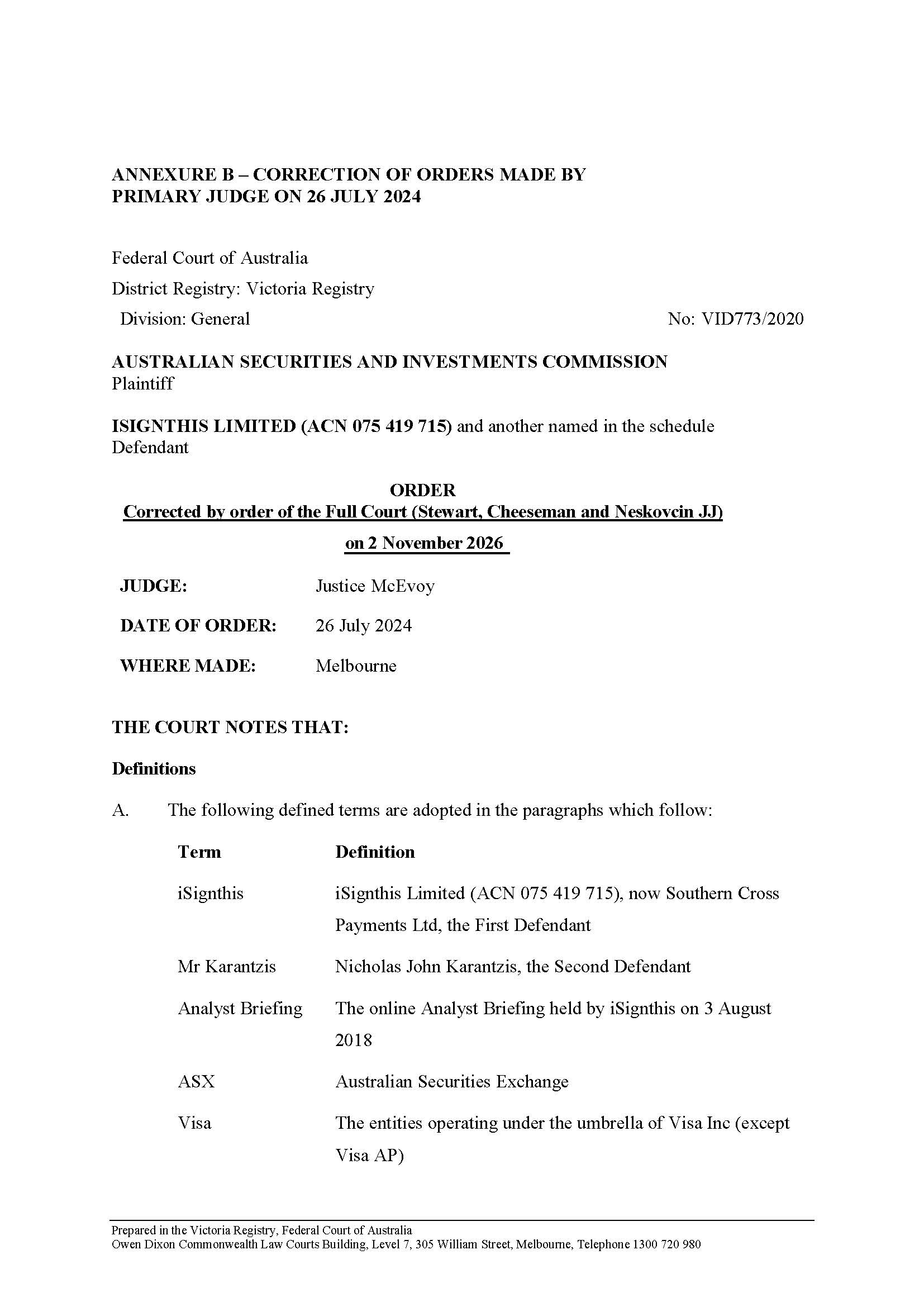
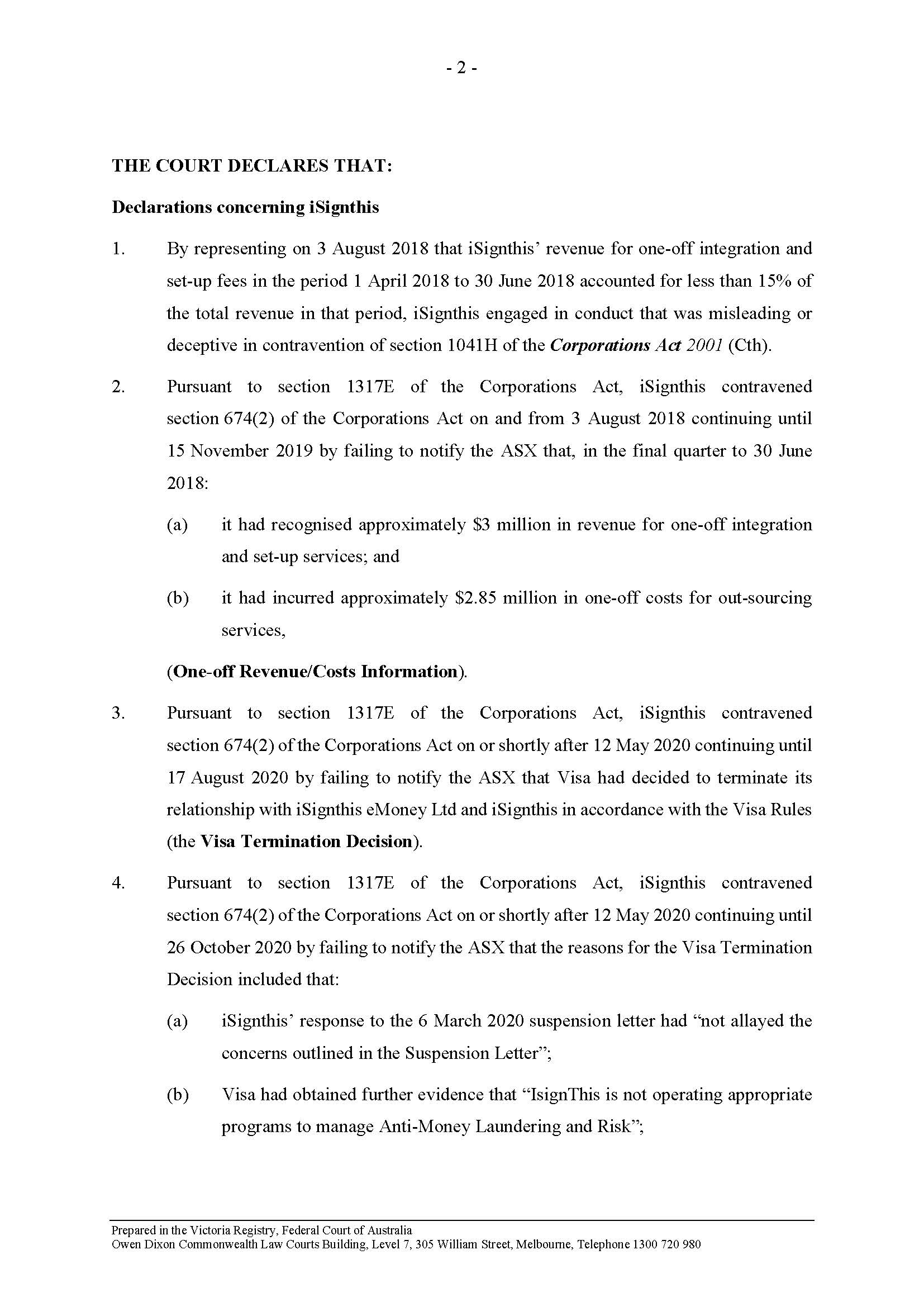
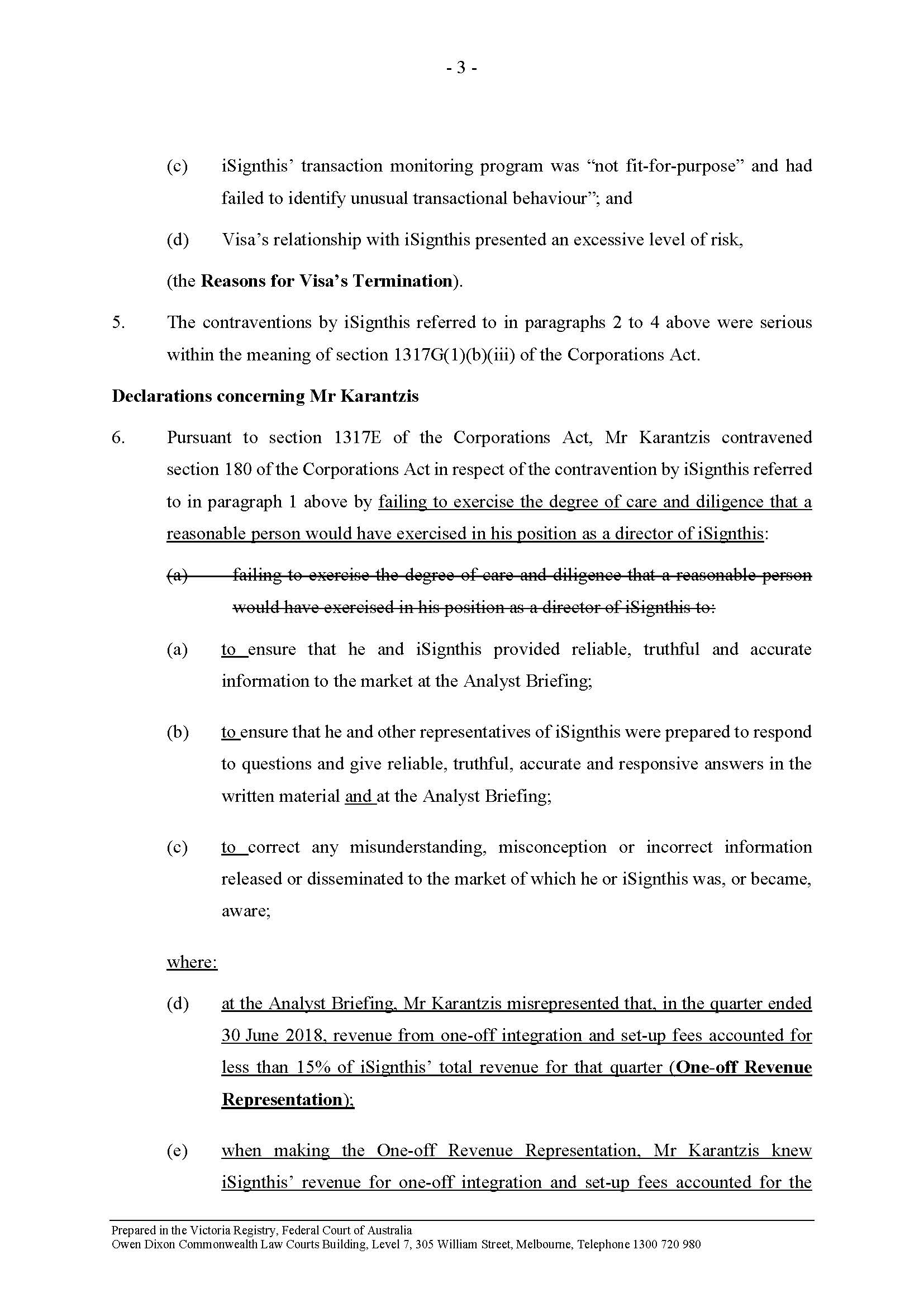
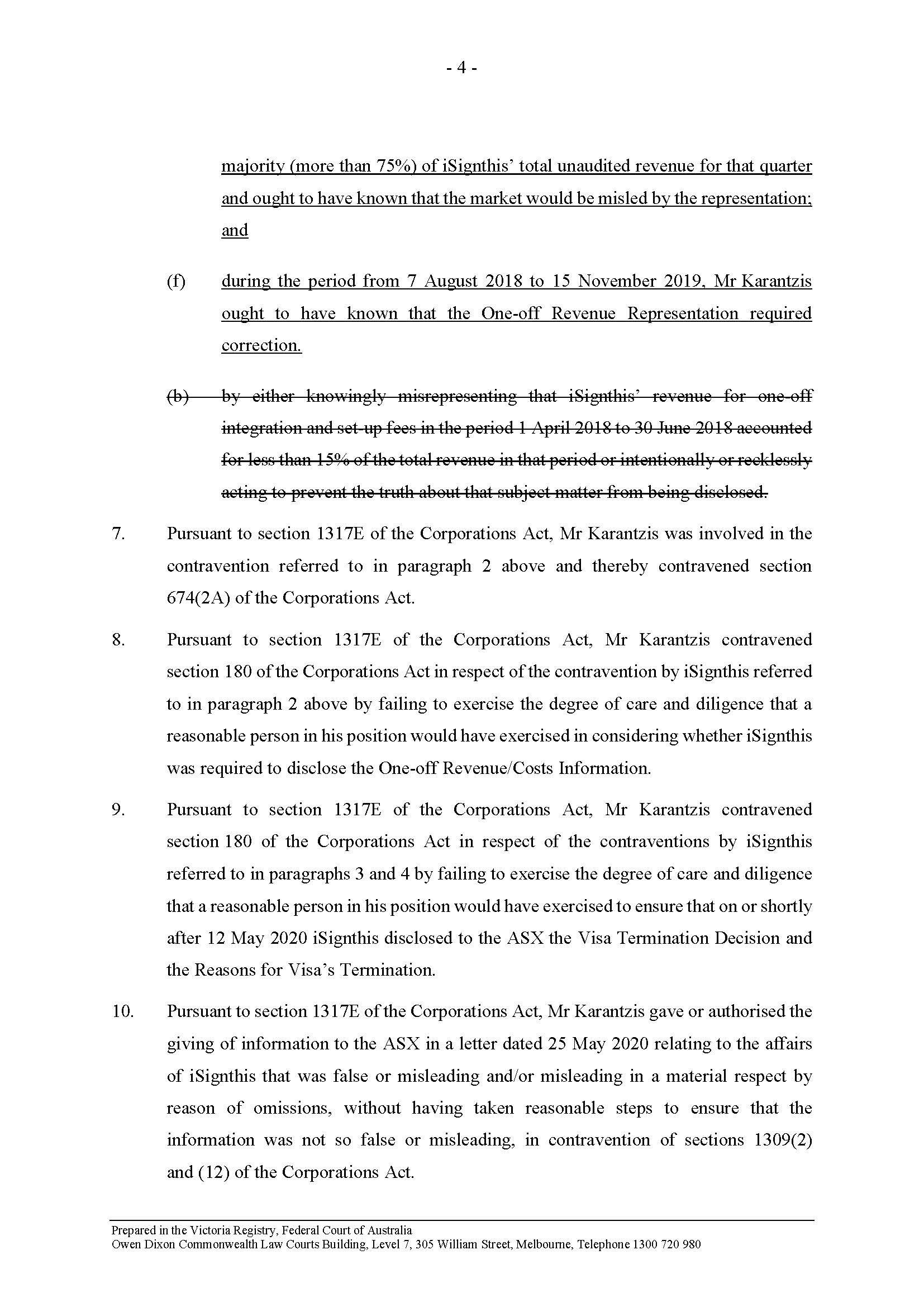
2. Declaration 6 made by the primary judge be corrected so that when included in the orders made on 26 July 2024 it reads as follows:
Pursuant to section 1317E of the Corporations Act, Mr Karantzis contravened section 180 of the Corporations Act in respect of the contravention by iSignthis referred to in paragraph 1 above by failing to exercise the degree of care and diligence that a reasonable person would have exercised in his position as a director of iSignthis:
(a) to ensure that he and iSignthis provided reliable, truthful and accurate information to the market at the Analyst Briefing;
(b) to ensure that he and other representatives of iSignthis were prepared to respond to questions and give reliable, truthful, accurate and responsive answers to questions in the written material and at the Analyst Briefing;
(c) to correct any misunderstanding, misconception or incorrect information released or disseminated to the market of which he or iSignthis was, or became, aware;
where:
(d) at the Analyst Briefing, Mr Karantzis misrepresented that, in the quarter ended 30 June 2018, revenue from one-off integration and set-up fees accounted for less than 15% of iSignthis’ total revenue for that quarter (One-off Revenue Representation);
(e) when making the One-off Revenue Representation, Mr Karantzis knew iSignthis’ revenue for one-off integration and set-up fees accounted for the majority (more than 75%) of iSignthis’ total unaudited revenue for that quarter and ought to have known that the market would be misled by the representation; and
(f) during the period from 7 August 2018 to 15 November 2019, Mr Karantzis ought to have known that the One-off Revenue Representation required correction.
3. The appeal otherwise be dismissed.
4. The appellants pay the respondent’s costs of the appeal.
Note: Entry of orders is dealt with in Rule 39.32 of the Federal Court Rules 2011.
REASONS FOR JUDGMENT
THE COURT:
1. INTRODUCTION
1 This appeal is from the liability judgment in Australian Securities and Investments Commission v iSignthis Limited [2024] FCA 669 (Liability Judgment or LJ) and the penalty judgment in Australian Securities and Investments Commission v iSignthis Limited (Penalty) [2025] FCA 917 (Penalty Judgment or PJ). The first appellant, formerly iSignthis Limited and now Southern Cross Payments Ltd, and the second appellant, Nickolas John Karantzis, its former chief executive officer and managing director, challenge findings of contravention of the Corporations Act 2001 (Cth) and the penalties imposed in respect of those contraventions.
2 iSignthis operated through subsidiaries as a provider of remote identity verification, payment authentication, electronic money, transactional banking and payment-processing services: LJ at [3]. As part of that business, it entered into integration agreements under which it provided clients with integration and set-up services to enable them to access online trading or payment platforms and relevant licensing services: LJ at [37]-[39]. Once a customer had been integrated onto the platform, iSignthis hoped to earn recurring transactional revenue from processing that customer’s payments. The integration and set-up services themselves generated one-off revenue, rather than recurring payment-processing revenue: LJ at [41]-[42]. The company’s recurring payment-processing business depended in part upon its access to international payment schemes. Its relationship with Visa, which operated one such scheme, was commercially significant to that part of its business: LJ at [64]-[68].
3 The appeal raises three principal factual controversies.
4 The first concerns a representation made during an analyst briefing on 3 August 2018 (Analyst Briefing) and the related non-disclosure of the extent to which the company’s reported revenue comprised one-off integration revenue, rather than recurring payment-processing revenue. iSignthis recognised revenue from the integration and set-up services provided under the integration agreements as one-off revenue. Approximately $3 million of the revenue recognised in the relevant quarter was revenue from those one-off services, while approximately $2.85 million in associated one-off outsourcing costs was incurred: LJ at [44]. The distinction between the one-off revenue recognised in the relevant quarter and the recurring payment-processing revenue which iSignthis hoped to earn from integrated customers is central to Grounds 3 to 10 of the appeal.
5 The second concerns the termination of the company’s relationship with Visa, including the materiality and disclosure of the termination decision and Visa’s stated reasons for that decision. The relevant Visa relationship extended to iSignthis’ wholly owned Cypriot subsidiary, iSignthis eMoney Ltd (iSeM): LJ at [73]-[76]. iSeM held an operating licence subject to the licensing and supervisory authority of the Central Bank of Cyprus (CBC). The preservation of that licence was said to be important to the group and gave rise to an issue about informing the CBC before making disclosure to the market: LJ at [344]-[355], [445]. Those matters, including the fact and reasons for Visa’s termination decision and what was disclosed to the CBC, the ASX and the market, are the subject of Grounds 11 to 19.
6 The third concerns answers given to the Australian Securities Exchange (ASX) in a letter dated 25 May 2020 in response to queries it raised in a letter dated 7 May 2020. Those queries included questions concerning Visa’s suspension of iSeM, Visa’s anti-money laundering concerns and the status of its review of iSignthis and iSeM. The primary judge found that six of the answers given were materially false or misleading, including by omission, and made findings of contravention of s 1309 of the Act against Mr Karantzis in respect of those answers: LJ at [545]-[552]. The findings concerning those answers are challenged by Grounds 20 to 23.
7 In addition, Grounds 24 to 28 challenge the penalty orders and the order disqualifying Mr Karantzis from managing corporations for six years.
8 Unless otherwise indicated, expressions commencing with initial capital letters have the meanings given to them in the Liability Judgment and the Penalty Judgment.
9 Five defined expressions are central to the appeal. The One-off Revenue Representation is the representation made by Mr Karantzis during the Analyst Briefing concerning the proportion of revenue in the quarter ending 30 June 2018 derived from one-off integration and set-up fees: LJ at [107]. The One-off Revenue/Costs Information is the information that approximately $3 million, or about 75%, of the relevant quarterly revenue was derived from one-off integration and set-up services, with approximately $2.85 million in associated one-off outsourcing costs: LJ at [44]. The Visa Termination Decision is Visa’s decision to terminate its relationship with iSignthis and iSeM: LJ at [73]-[74]. The Reasons for Visa’s Termination are Visa’s stated concerns about iSignthis’ response to its earlier concerns, its anti-money laundering and risk programs, its transaction monitoring program and the risk it presented to the Visa network: LJ at [299(b)]. The ASX Answers are the six answers given on 25 May 2020 to questions 1(b), 1(e), 2(b) and 2(d) to (f) of the ASX query letter dated 7 May 2020 that the primary judge found to contravene s 1309 of the Act: LJ at [470], [545]-[552].
10 Grounds 1 and 2 were not pressed. The primary judge’s findings that the One-off Revenue Representation was made, that iSignthis contravened s 1041H of the Act, and that Mr Karantzis contravened s 180(1) by making it are therefore not challenged. Ground 3 concerns a different question: whether the representation confirmed and perpetuated a mistaken market understanding that had already inflated the price of iSignthis’ shares, notwithstanding the absence of a material movement in their traded price. The appellants rely on the asserted ambiguity of the Analyst Brief (the PowerPoint presentation used at the Analyst Briefing: LJ at [54]-[55]) and oral answer in addressing that question, but not to reopen the findings that the representation was made and was misleading. The other grounds concern the character and consequences of Mr Karantzis’ conduct, the related continuous disclosure finding, the Visa and ASX issues, and the penalty and disqualification orders.
11 For the reasons that follow, Ground 4 will be upheld only to the extent necessary to replace Declaration 6 so that it accurately reflects the primary judge’s findings in the Liability Judgment as explained in the Penalty Judgment. Although the error in the factual finding made at LJ [461] and identified in Ground 12(a) is established, that error does not affect the primary judge’s dispositive reasoning or any order made below. Ground 12 therefore fails. The appellants have not established any other ground. Subject to the correction of Declaration 6, the appeal will otherwise be dismissed.
2. THE DECISIONS BELOW
2.1 The Liability Judgment
12 The primary judge found contraventions arising from the One-off Revenue Representation (LJ at [153]), the non-disclosure of the One-off Revenue/Costs Information (LJ at [275]), the non-disclosure of the Visa Termination Decision and Visa’s stated reasons (LJ at [434]), and the provision of false or misleading answers to the ASX (LJ at [564]). The primary judge rejected other claims, including aspects of the Australian Securities and Investments Commission’s (ASIC) claim that, in connection with the performance shares, Mr Karantzis contravened ss 181 and 182 of the Act: LJ at [723].
13 In relation to Mr Karantzis, the primary judge found that he had contravened ss 180(1), 674(2A) (as then in force), 1309(2) and (12) of the Act: LJ at [179], [294], [564]. Declarations giving effect to those findings were made on 26 July 2024. Declaration 6 addressed Mr Karantzis’ contravention of s 180(1) in respect of iSignthis’ contravention of s 1041H arising from the One-off Revenue Representation, which was the subject of Declaration 1.
2.2 The Penalty Judgment
14 Following a separate penalty hearing, the primary judge ordered Mr Karantzis to pay a pecuniary penalty of $1 million and disqualified him from managing corporations for six years. Southern Cross was ordered to pay a pecuniary penalty of $10 million.
15 In the Penalty Judgment the primary judge explained the sense in which his Honour had used certain expressions in the Liability Judgment. In particular, the primary judge stated that the finding concerning the One-off Revenue Representation was not, and should not be taken to be, a finding that Mr Karantzis was intentionally dishonest, that the finding was that Mr Karantzis ought to have known that the market would be misled by a misstatement by him, and that the reference to recklessness was used in the sense of “grossly careless” conduct: PJ at [68]-[69].
3. THE APPEAL
3.1 Issues requiring determination
16 The notice of appeal contains 28 grounds. As mentioned, Grounds 1 and 2 were not pressed. The remaining grounds overlap in that some grounds challenge the same findings for different purposes, while others concern the consequences of those findings for relief from liability, penalty or disqualification. We address the issues they raise together where that avoids repetition, while identifying the disposition for each ground.
17 In these reasons, we address the grounds in four broad groups. The first concerns the One-off Revenue Representation and the related non-disclosure of the One-off Revenue/Costs Information. The second concerns the non-disclosure of the Visa Termination Decision and the Reasons for Visa’s Termination. The third concerns the ASX Answers. The fourth concerns the pecuniary penalties imposed on each appellant and the order disqualifying Mr Karantzis from managing corporations.
18 These groupings are not wholly discrete. Anthony Seyfort, a partner of HWL Ebsworth Lawyers and iSignthis’ principal external legal adviser, gave evidence at both the liability and penalty hearings. The appellants rely on his involvement and advice in relation to the Visa disclosures and the ASX Answers, including in their claims for relief from liability. They also rely on those matters in challenging the penalties and Mr Karantzis’ disqualification. Grounds 7, 9, 10, 15, 19 and 23 likewise concern the penalty consequences of matters addressed in the preceding groups. We therefore consider the factual and liability issues in their subject-matter sections, and their consequences for penalty and disqualification in the fourth group.
19 A separate question arises in connection with Ground 4 and the form of Declaration 6. The Liability Judgment and the Penalty Judgment must be read together in determining the character of the contravention found. In addition to determining the substantive challenge advanced by Ground 4, it will be necessary to consider whether Declaration 6 accurately records the contravention as explained in the Penalty Judgment and, if it does not, whether the declaration may be corrected and, if so, on what basis.
3.2 Applicable appellate principles
20 There is no real controversy between the parties as to the general principles governing appellate review. Those principles are well established. The difference between the parties concerns the application of those principles, particularly the extent to which the findings challenged are affected by the primary judge’s assessment of the witnesses and the evidence as it unfolded at the hearing, and the degree of appellate restraint therefore required. Given the number and differing nature of the grounds, we identify the applicable standard of review when addressing each ground, or group of grounds, where necessary. The following summary of the principles drawn from the authorities is not intended to depart from, or add to, the principles stated in the authorities to which we refer.
21 The appeal is by way of rehearing. The Court must conduct a real review of the evidence and the primary judge’s reasons. Appropriate weight must nevertheless be given to the primary judge’s advantages, particularly where the challenged findings depended on the evaluation of oral or expert evidence, or were informed by the conduct and course of the trial. Different considerations apply where the issue is the proper inference from contemporaneous documents or largely undisputed facts. See, eg, Lee v Lee [2019] HCA 28; 266 CLR 129 at [55] (Bell, Gageler, Nettle and Edelman JJ); Fox v Percy [2003] HCA 22; 214 CLR 118 at [23] (Gleeson CJ, Gummow and Kirby JJ); Warren v Coombes [1979] HCA 9; 142 CLR 531 at 551-552 (Gibbs ACJ, Jacobs and Murphy JJ); Australian Competition and Consumer Commission v Reckitt Benckiser (Australia) Pty Ltd [2016] FCAFC 181; 340 ALR 25 at [44]-[54] (Jagot, Yates and Bromwich JJ); Branir Pty Ltd v Owston Nominees (No 2) Pty Ltd [2001] FCA 1833; 117 FCR 424 at [20]-[30] (Allsop J, Drummond and Mansfield JJ agreeing at [1] and [2] respectively).
22 The distinction between the different standards of appellate review does not depend upon whether the reasoning process involves evaluation, judgment or the drawing of inferences. Nor does the mere fact that the decision requires a value judgment, or is one on which reasonable minds may differ, attract the House v The King standard. Warren v Coombes illustrates the point: whether conduct satisfied the standard of reasonable care was evaluative and one on which different views might reasonably be held, but the appellate court was required to determine for itself whether the conclusion reached was correct: at 551-553. Rather, it depends upon the nature of the legal criterion to be applied. Where the applicable criterion requires a single correct outcome, the appellate court must determine for itself whether the challenged finding or conclusion is correct, while making due allowance for any advantages enjoyed by the primary judge. Where the applicable criterion tolerates a range of legally permissible outcomes, appellate intervention is confined to error of the kind identified in House v The King [1936] HCA 40; 55 CLR 499: Steven Moore (a pseudonym) v The King [2024] HCA 30; 282 CLR 460 at [14]-[15] (Gageler CJ, Edelman, Steward, Gleeson and Beech-Jones JJ); Minister for Immigration and Border Protection v SZVFW [2018] HCA 30; 264 CLR 541 at [46]-[49] (Gageler J); GLJ v The Trustees of the Roman Catholic Church for the Diocese of Lismore [2023] HCA 32; 280 CLR 442 at [16]-[17] (Kiefel CJ, Gageler and Jagot JJ); The King v HCZ [2026] HCA 24; 100 ALJR 1019 at [29]-[31] (Gageler CJ, Edelman, Gleeson, Jagot and Beech-Jones JJ).
23 For convenience, we refer below to the first as the correctness standard and the second as the House v The King standard.
24 Under the correctness standard, the existence of error is determined by reference to the correctness of the challenged finding or conclusion. If, after conducting the review and allowing for any relevant advantage of the primary judge, the appellate court reaches a different conclusion from the primary judge, that difference carries with it the conclusion that the primary judge erred. Conversely, an error in the primary judge’s reasoning provides no basis for appellate intervention if, on the appellate court’s own review, the challenged finding or conclusion is nevertheless correct.
25 Under the House v The King standard, appealable error is established where the primary judge acted upon a wrong principle, allowed extraneous or irrelevant matters to affect the decision, mistook the facts, failed to take account of a material consideration, or reached a result which is unreasonable or plainly unjust. It is not sufficient that the appellate court would itself have reached a different result. Where a specific error is identified, it must have caused or materially contributed to the discretionary determination or order under challenge.
26 The appellants submit that many of the challenged factual findings were inferences drawn from contemporaneous documents and largely uncontested evidence and that this Court is in as good a position as the primary judge to draw the relevant inferences. ASIC submits that the findings were evaluative, followed extensive oral and documentary evidence, and were informed by the primary judge’s assessment of the witnesses and experts. It is uncontroversial that the significance of any advantage enjoyed by the trial judge, and the weight to be given to it, must be assessed issue by issue rather than at a global level.
27 The orders imposing pecuniary penalties and disqualifying Mr Karantzis from managing corporations involved exercises of discretion by the primary judge. Challenges to those orders therefore attract the House v The King standard: Reckitt Benckiser at [50], [53]-[54]. Where a specific error is relied upon, we refer below to the requirement that the error materially affect the order.
4. THE ONE-OFF REVENUE ISSUES
4.1 Matters no longer in issue
28 On 3 August 2018, during the Analyst Briefing, Mark Davies, an iSignthis shareholder, asked what percentage of iSignthis’ revenue in the preceding quarter was derived from upfront and one-off fees. Mr Karantzis gave an oral answer that a figure of less than 15% had been cited in the Analyst Brief. It is established that in fact the true proportion of one-off integration revenue in that quarter was approximately 75%: LJ at [44], [107], [153].
29 Because Grounds 1 and 2 were not pressed, the Court proceeds on the basis that the combination of the Analyst Brief and the oral answer conveyed the One-off Revenue Representation and that it was misleading. The appellants cannot reopen that conclusion by relying on the asserted ambiguity in the Analyst Brief or the oral answer. The context provided by the Analyst Briefing may nevertheless remain relevant to the distinct questions concerning the seriousness and consequences of Mr Karantzis’ conduct which are the subject of Grounds 3 to 7.
4.2 Ground 3: effect of the representation on the traded price
30 By Ground 3, the appellants challenge the findings at LJ [177]-[178] concerning the effect of the One-off Revenue Representation. At the outset, it is necessary to distinguish between a material effect on the market and a material effect on the traded price of iSignthis’ shares. The primary judge found that the representation had a material effect on the market because it confirmed and perpetuated the market’s incorrect understanding that the revenue reported for the quarter ended 30 June 2018 was predominantly recurring. His Honour did not find that the representation caused a material movement in the traded price of iSignthis’ shares. Rather, his Honour found that the existing misunderstanding had already artificially and improperly inflated the share price and that the representation perpetuated that misunderstanding. The appellants contend that the Analyst Brief and the oral answer, considered together, had no material effect on the traded price, including by maintaining it at an inflated level. Stripped of the erroneous characterisation that the primary judge found a material effect on the traded price, the real issue raised by Ground 3 is whether the finding that the representation confirmed and perpetuated the market’s existing misunderstanding, and thereby maintained an already inflated share price, was correct on the contemporaneous documentary and expert evidence.
31 Ground 3 attracts the correctness standard.
32 The factual context is as follows. Mr Karantzis was iSignthis’ chief executive officer and managing director. Martyn Jacobs was an analyst employed by Patersons Securities Limited who followed iSignthis and published research reports about the company. The primary judge treated Mr Jacobs as a representative member of the class of market participants to whom the Analyst Briefing was directed: LJ at [126], [136], [272]. Mr Davies, as mentioned, was a shareholder who attended the Analyst Briefing and asked Mr Karantzis about the proportion of revenue derived from upfront and one-off fees. Before the Analyst Briefing, iSignthis had made disclosures emphasising the development of recurring transactional or settlement revenue: LJ at [113]-[115], [163(a)].
33 The relevant disclosures and communications that occurred before the Analyst Briefing included the following. In its report to shareholders concerning the half-year results published on 28 February 2018, iSignthis stated that settlement revenue comprised more than 65% of revenue and would be its principal driver of revenue going forward. In response, a Patersons research note published in March 2018 stated that settlement activity was expected to dominate the revenue and earnings profile in the second half of FY2018, with approximately 65% of revenue in the third quarter to date being settlement-related: LJ at [45]-[46], [114(c)], [115(a)]. On 31 July 2018, iSignthis published its quarterly report for the period ended 30 June 2018, together with Appendix 4C, being the quarterly report for entities subject to ASX Listing Rule 4.7B. The 31 July 2018 report stated that iSignthis would hold an online Analyst Briefing on 3 August 2018: LJ at [49]. The 31 July 2018 report disclosed unaudited revenue exceeding $3.95 million, while Appendix 4C disclosed receipts from customers of approximately $2.63 million and payments for product manufacturing and operating costs of approximately $2.66 million. The 31 July 2018 report also referred to additional one-off integration revenue, described as low-margin revenue having a direct correlation with an increase in the cost of goods sold: LJ at [232]-[233]. After publication of the 31 July 2018 report, Mr Jacobs asked Mr Karantzis by email on 31 July 2018 how much of the revenue was integration-based. Mr Karantzis responded: “No - those other questions are for the annual report post audit - I don’t [sic] have data”: LJ at [50]. On 1 August 2018, Mr Jacobs sent Mr Karantzis a list of proposed questions for the Analyst Briefing, including a request that he advise the percentage of revenue in the June 2018 quarter that could be regarded as genuine recurring business activity rather than one-off integration revenue: LJ at [52], [118(c)].
34 At the Analyst Briefing on 3 August 2018, Mr Karantzis presented iSignthis’ results to analysts and investors using the Analyst Brief. The Analyst Brief stated that revenue for the June 2018 quarter exceeded $3.95 million and, on a slide headed “Discussing the ‘Cash to Revenue Lag’”, stated:
One off Fees / One off Setups (Integrations) < 15% of revenue (recur on each new agreement) – Invoiced at milestone on 30 day terms
35 After the presentation, Mr Davies asked what percentage of the revenue in the preceding quarter was derived from upfront and one-off fees. Mr Karantzis answered: “We’ve actually cited a figure in the pack of less than 15 per cent on the first question”: LJ at [56], [108(c)]. An audio recording of the Analyst Briefing, including that exchange, was published on the ASX market-announcement platform: LJ at [57].
36 It was not in dispute that iSignthis had recognised approximately $3 million in one-off integration and set-up services revenue during the June 2018 quarter, representing about 75% of its total unaudited revenue of $3.95 million: LJ at [44]. Timothy Hart, then independent non-executive chairman of iSignthis, accepted that, if the Analyst Brief and the oral answer conveyed that less than 15% of the reported quarterly revenue was one-off revenue, it was incorrect: LJ at [111]. The primary judge found that Mr Davies’ question and Mr Karantzis’ answer, construed in the context of the Analyst Brief, gave rise to no real ambiguity. His Honour accordingly found that iSignthis represented that one-off integration and set-up fees accounted for less than 15% of the revenue reported for the June 2018 quarter, when the true proportion was approximately 75%: LJ at [155]-[159].
37 On 6 August 2018, Patersons published a further research note, prepared by Mr Jacobs, which stated that recurring business activity constituted approximately 85% of revenue, with the balance comprising one-off integration revenue. Mr Jacobs forwarded that note to Mr Karantzis on 7 August 2018: LJ at [58], [163(j)]. The primary judge found that the note reflected Mr Jacobs’ understanding of the Analyst Briefing, and accepted that he had in fact been misled by the One-off Revenue Representation: LJ at [126], [136]. His Honour later treated Mr Jacobs as a reasonable representative participant in the market: LJ at [272].
38 In finding that, as at 3 August 2018, the market had already anticipated that the revenue reported for the quarter ended 30 June 2018 was predominantly recurring, and that this understanding had been encapsulated in the company’s share price, his Honour also relied upon the earlier company disclosures, Mr Jacobs’ pre-briefing reports and questions, and the evidence of Andrew Roy Newbery Sisson, the expert called by ASIC on materiality, concerning the assumptions underlying the decision to annualise the June 2018 quarter revenue: LJ at [113]-[118], [177]-[178], [208], [215]-[220], [265]-[270]. The evidence at trial was that Mr Sisson was a non-executive director with substantial experience in market analysis. The primary judge found that his experience gave him specialised knowledge of the workings of the stock market and of how investors were likely to react to particular information when deciding whether to acquire or dispose of shares: LJ at [268].
39 The appellants submit that the Analyst Brief and the oral answer had no material effect on the traded price of iSignthis’ shares on the ASX either by moving the price or by holding the price at an inflated level. They further submit that there was no proper evidence to support a finding that the market had already anticipated that approximately 85% of iSignthis’ revenue for the June 2018 quarter was recurring.
40 For the reasons given at [30], Ground 3(a) mischaracterises the finding below insofar as it attributes to the primary judge a finding that the One-off Revenue Representation caused a material movement in the traded price of iSignthis’ shares. His Honour found instead that the representation perpetuated an incorrect understanding already reflected in the share price: LJ at [177]-[178].
41 Proof that the representation caused a material effect on the traded price was not an element of the contravention of s 180(1) of the Act. That provision directs attention to the degree of care and diligence exercised by the director, not to whether the breach produced an observable movement in the share price or caused quantifiable loss. The absence of such an effect may bear upon the seriousness and consequences of the contravention, but it does not negate the finding of breach which is no longer challenged following the abandonment of Grounds 1 and 2. Success on Ground 3 could not therefore disturb the conclusion that Mr Karantzis contravened s 180(1) by making the representation, although it may affect the assessment of the seriousness and consequences of that contravention: LJ at [176]-[180]. See Australian Securities and Investments Commission v Mitchell (No 3) [2020] FCA 1604; 148 ACSR 630 at [35] (Beach J).
42 In any event, we are not persuaded that the primary judge erred in finding that, before the Analyst Briefing, the market understood that the company’s revenue for the quarter ended 30 June 2018 was predominantly recurring. That conclusion did not depend only upon the absence of a price movement after the briefing. It was supported by a combination of the company’s earlier disclosures, the contemporaneous reports and communications of Mr Jacobs, the significance that Mr Jacobs attributed to the represented composition of the revenue, and the expert evidence of Mr Sisson: LJ at [113]-[118], [208], [215]-[220], [265]-[270].
43 The company’s disclosures had generated what ASIC submitted, and the primary judge recorded, as “a narrative of a startup company building recurring transactional (or “settlement”) revenue…”: LJ at [113]. In particular, the report of 28 February 2018 stated that settlement revenue then comprised more than 65% of revenue and would be the principal driver of revenue going forward: LJ at [114(c)]. That statement was reflected in Mr Jacobs’ March 2018 research note, which stated that settlement activity was expected to dominate the revenue and earnings profile and that approximately 65% of revenue in the third quarter to date was settlement-related: LJ at [115(a)]. The primary judge accepted that the company’s disclosures had caused the distinction between recurring and one-off revenue to be known by, and important to, the market. Those contemporaneous materials provided a substantial foundation for the conclusion that market participants approached the June 2018 quarter results with an expectation that recurring settlement revenue was an important and growing component of the company’s revenue: LJ at [265], [270], [272].
44 We agree that significance should be attached to Mr Jacobs’ treatment of the company’s announcement of 22 June 2018 that cash receipts exceeded $3.75 million for the half year. In a research note dated 26 June 2018, Mr Jacobs stated that the announcement suggested that iSignthis had generated approximately $3.5 million in revenue in the June 2018 quarter, or approximately $14 million on an annualised run-rate basis: LJ at [115(b)]. Mr Sisson explained that the June 2018 quarter revenue could sensibly be annualised in that manner only if it was understood to be recurring rather than one-off: LJ at [116]. That inference received some further support from Mr Karantzis’ response when Mr Jacobs asked whether the quarterly revenue could be annualised: “Once supply chain issues are solved, yes”: LJ at [117].
45 Mr Jacobs’ understanding was relevant beyond his individual opinion. The primary judge found that Mr Jacobs was a representative member of the class of persons to whom the Analyst Briefing was directed and that his views could be taken to reflect those of market participants: LJ at [136]. Gregory John Houston, the expert economist called by the appellants on the question of materiality, accepted that Mr Jacobs’ views could be taken to reflect those of market participants: LJ at [126], [217(c)]. After the Analyst Briefing, Mr Jacobs reported the One-off Revenue Representation as meaning that recurring business activity constituted approximately 85% of revenue, but did not alter his valuation of the company: LJ at [58], [169], [209(e)], [218]-[220]. The primary judge inferred that the representation confirmed, rather than changed, the understanding on which Mr Jacobs’ valuation was based: LJ at [269]-[270].
46 We do not accept that the questions asked by Mr Jacobs shortly before the Analyst Briefing compel a different conclusion. Those questions were consistent with his seeking confirmation of the precise division between recurring and one-off revenue. They do not establish that he had no existing expectation as to the broad composition of the revenue. His research note of 1 August 2018 stated that it would be helpful for the market to know what proportion of the June 2018 quarter revenue was recurring rather than one-off and continued, “[a]ssuming it is a high portion”, that understanding the division would assist the market’s understanding of the company’s underlying business momentum: LJ at [118(b)]. Read with his earlier annualisation of the quarterly revenue, that document was consistent with an existing expectation that a substantial proportion of the revenue was recurring, coupled with uncertainty as to its precise extent: LJ at [270], [272].
47 The appellants submit that Mr Sisson altered his opinion over the course of his reports and evidence. In his first report, Mr Sisson stated that, before the announcement of 22 June 2018, information implying recurring revenue of approximately $500,000 for the quarter would not have been sufficiently different from market expectations to have had a material effect on the price or value of iSignthis’ shares. He further stated that the announcements of 22 June and 31 July 2018 would have raised expectations about the level of recurring revenue, although there was insufficient information to be definitive before the Analyst Briefing. The appellants rely on that evidence as inconsistent with the later opinion that the market had already anticipated that the June 2018 quarter revenue was predominantly recurring revenue.
48 The appellants submit that changes in Mr Sisson’s evidence about the date from which disclosure of the One-off Revenue/Costs Information would have been material undermined his opinion. His first report expressed less confidence about the effect of disclosure before the Analyst Briefing on 3 August 2018. The primary judge recorded that criticism and concluded that the differences in Mr Sisson’s evidence did not undermine his central opinion that the market had anticipated that revenue for the June 2018 quarter was predominantly recurring, so the representation at the Analyst Briefing confirmed rather than changed that understanding: LJ at [247]-[258], [268]-[270]. The material bearing on that opinion included iSignthis’ earlier reporting about settlement revenue, Mr Jacobs’ annualisation of the June 2018 quarter revenue and his communications with Mr Karantzis: LJ at [113]-[118], [208], [269]-[270]. The absence of a significant price movement after the Analyst Briefing was consistent with the opinion, but did not of itself establish what the market had previously understood. On our review, the differences in Mr Sisson’s evidence about the earlier dates do not undermine his opinion concerning the position at 3 August 2018 or the primary judge’s acceptance of that opinion: LJ at [247]-[252], [269]-[270].
49 The appellants next rely upon the increase in “product manufacturing and operating costs” from $157,000 in the preceding quarter to approximately $2.656 million in the June 2018 quarter, together with the accompanying reference to low-margin integration revenue, as indicating that a substantial proportion of the reported revenue was one-off: LJ at [231]-[233]. Mr Hart, iSignthis’ independent non-executive chairman, Scott William Minehane, a non-executive director of iSignthis, and Mr Houston gave evidence which the appellants relied on in support of that inference: LJ at [235]-[237]. The primary judge acknowledged the argument and the evidence on which it was based, but was not satisfied that the extent of one-off revenue could be reverse-engineered from the 31 July 2018 report and Appendix 4C in the way in which the appellants contended: LJ at [261]-[262].
50 On our review, the primary judge’s conclusion was correct. ASIC submitted, by reference to Mr Sisson’s evidence, that “product manufacturing and operating costs” were not a proxy for one-off integration costs and included other costs, including costs associated with servicing recurring revenue: LJ at [197], [262]. The company had also disclosed that margins on transactional revenue had been reduced by a temporary increase in supply-chain costs relating to settlement processes: LJ at [197]. The increase in that composite cost item therefore did not compel the inference that a substantial proportion of the reported revenue was one-off and was not inconsistent with the market having anticipated that the revenue was predominantly recurring: LJ at [262], [270], [272].
51 Further, the evidence did not establish that market participants in fact drew from the 31 July 2018 report the inference for which the appellants contended. Mr Houston suggested that the 31 July 2018 report may have supported the drawing of a “potential inference” about the balance of recurring and one-off revenue, but the primary judge found that this did not provide a basis for concluding that analysts could have discerned the true position: LJ at [237], [262]. The primary judge observed that Mr Jacobs and Mr Davies were also evidently unable to obtain the required information, as demonstrated by the questions they asked: LJ at [261]. While Mr Hart and Mr Minehane considered that an inference could be drawn, their understanding did not establish what the market in fact understood or could reasonably determine from the information disclosed: LJ at [235]-[236], [261].
52 In their written submissions, the appellants contend that there was no evidence as to the distribution list for Mr Jacobs’ 6 August 2018 research note and that it was therefore unsafe to conclude that the One-off Revenue Representation registered with the wider market. ASIC pointed in oral argument to the email by which the note was distributed, which was addressed to a distribution group of wealth advisers and others. Although the email does not establish how widely the note was received or read, the primary judge’s reasoning did not depend on proof of the number or identity of its recipients, or on a finding that the note itself caused a measurable market reaction. His Honour treated Mr Jacobs’ response as evidence of the significance of the revenue composition information to a representative market participant who understood the Analyst Briefing and considered it together with the company’s earlier disclosures, the lay evidence concerning the market’s interest in recurring revenue and Mr Sisson’s opinion about the market’s prior expectations: LJ at [264]-[270]. The appellants’ point about distribution does not, without more, undermine that reasoning.
53 For those reasons, we agree with the primary judge’s finding that the One-off Revenue Representation confirmed and perpetuated the market’s existing misunderstanding about the proportion of recurring revenue, notwithstanding that it produced no observable movement in the traded price of iSignthis’ shares. Ground 3 fails.
4.3 Grounds 4 and 5: characterisation of the conduct and the relationship between the Liability and Penalty Judgments
54 Grounds 4 and 5 concern Mr Karantzis alone and the relationship between ASIC’s case recorded at LJ [163], the primary judge’s findings at LJ [173]-[176], the terms of Declaration 6, and the primary judge’s later explanation of those findings at PJ at [62]-[69]. Ground 4 raises whether the Liability Judgment and Declaration 6 record alternatives involving knowing misrepresentation or intentional misconduct that extend beyond the findings as subsequently explained in the Penalty Judgment, namely that Mr Karantzis ought to have known that his statement would mislead the market, acted with gross carelessness and had, at least, constructive knowledge that a correction was required. Ground 5 raises the related question whether the findings, as so explained, affect the character and seriousness of his conduct for penalty purposes.
55 Ground 4 attracts the correctness standard insofar as it challenges the proper characterisation of the liability findings when the Liability Judgment and Penalty Judgment are read together. Ground 5, by contrast, challenges the significance attributed to the conduct in the exercise of the penalty and disqualification discretions and attracts the House v The King standard.
56 The questions arising from Grounds 4 and 5, and the relief said to follow, differ. Ground 4 challenges the findings at LJ [174] and [176]. A separate question arising in connection with that ground is whether Declaration 6 accurately records those findings and the Court’s appellate power to correct it, so that it no longer preserves alternatives involving knowing misrepresentation or intentional misconduct and instead reflects the contravention as subsequently explained in the Penalty Judgment. Although Ground 4 challenges LJ [174] and [176], the notice of appeal does not formulate the precise replacement declaration that arises for consideration. Ground 5 is directed principally to penalty. Mr Karantzis submits that, once knowing misrepresentation and intentional dishonesty are excluded, the seriousness of the conduct must be reassessed and the discretion concerning pecuniary penalty and disqualification re-exercised.
57 Before addressing those submissions, it is convenient to identify the relevant findings, the terms and timing of Declaration 6, and the primary judge’s later explanation of the findings in the Penalty Judgment.
58 The Liability Judgment was delivered on 21 June 2024. At LJ [173], the primary judge found that Mr Karantzis failed to exercise the care and diligence required by s 180(1) of the Act: first, by failing to ensure that he and iSignthis provided reliable, truthful, and accurate information to questions in the written material and at the Analyst Briefing; secondly, by failing to ensure that he and other representatives of iSignthis were prepared to give reliable, accurate and responsive answers; and thirdly, by failing to correct any misunderstanding, misconception or incorrect information released or disseminated to the market of which he or the company was, or became, aware. At LJ [174], the primary judge further found that Mr Karantzis “either knowingly misrepresented facts or intentionally or recklessly acted to prevent the truth from being disclosed”, and had failed for more than a year to correct his statement “knowing that the market had been misled”. His Honour concluded that the contravention was serious and could not be regarded merely as a careless mistake. At LJ [175]-[176], the primary judge explained that seriousness principally concerned the degree of departure from the requisite standard of care and diligence, rather than the actual or potential harm, and described the contravention as a serious breach of the normative standard of honesty required by s 180(1) and on which market efficiency rests, citing Australian Securities and Investments Commission v Australia and New Zealand Banking Group Limited (No 3) [2020] FCA 1421 at [74] (Allsop CJ) (ASIC v ANZ).
59 On 26 July 2024, before the penalty hearing, the primary judge made declarations under s 1317E. Declaration 6 was in the following terms:
Pursuant to section 1317E of the Corporations Act, Mr Karantzis contravened section 180 of the Corporations Act in respect of the contravention by iSignthis referred to in paragraph 1 above by:
(a) failing to exercise the degree of care and diligence that a reasonable person would have exercised in his position as a director of iSignthis to:
(i) ensure that he and iSignthis provided reliable, truthful and accurate information to the market at the Analyst Briefing;
(ii) ensure that he and other representatives of iSignthis were prepared to respond to questions and give reliable, truthful, accurate and responsive answers in the written material at the Analyst Briefing;
(iii) correct any misunderstanding, misconception or incorrect information released or disseminated to the market of which he or iSignthis was, or became, aware;
(b) by either knowingly misrepresenting that iSignthis’ revenue for one-off integration and set-up fees in the period 1 April 2018 to 30 June 2018 accounted for less than 15% of the total revenue in that period or intentionally or recklessly acting to prevent the truth about that subject matter from being disclosed.
60 Subject to a minor variation in the wording of paragraph 6(a)(ii), Declaration 6(a) reproduced the three respects in which the primary judge had concluded at LJ [173] that Mr Karantzis had failed to exercise the care and diligence required of a reasonable person in his position. Declaration 6(a)(ii) omitted the words “to questions” and the conjunction “and” appearing in the corresponding finding at LJ [173], with the result that it referred to “responsive answers in the written material at the Analyst Briefing”. If Declaration 6 is replaced, the replacement should reproduce the finding at LJ [173] accurately by referring to “responsive answers to questions in the written material and at the Analyst Briefing”. This is a consequential textual correction and does not identify an additional respect in which Ground 4 succeeds. Declaration 6(b) reproduces the alternatives expressed at LJ [174]. The declaration does not expressly identify which alternative formed the basis of Mr Karantzis’ contravention of s 180 or state that “recklessly” was used in the sense of gross carelessness, which was explained in the Penalty Judgment. Declaration 11 separately declared that the contraventions identified in Declarations 6 to 10 were serious within the meaning of s 1317G(1)(b)(iii). The orders were dated 26 July 2024 and authenticated on 29 July 2024. They deferred the time for filing an application for leave to appeal or notice of appeal concerning the declarations until 28 days after final orders were made in the proceeding.
61 The declarations were made before the primary judge received the evidence and submissions directed to penalty. Mr Karantzis had not given evidence at the liability hearing, having relied on the penalty privilege: LJ at [15], [166]. At the penalty hearing, he gave evidence that he did not recall reading Mr Jacobs’ research note, that no one had raised with him the answer he had given at the Analyst Briefing, and that he was unaware that the market had been misled: PJ at [65]. At PJ [65], the primary judge accepted that the evidence might be inconsistent with an intention on Mr Karantzis’ part to mislead the market and that it was open to the defendants to adduce the evidence at the penalty hearing. His Honour addressed its significance for the proper understanding of LJ [174] at PJ [66]-[69].
62 It is convenient to set out PJ at [64]-[68]:
64. I accept the defendants’ submission that the findings in the Liability Judgment with regard to the One-off Revenue Representation, and in particular the use of the expression “recklessly acted” (at [174]), should not be understood as amounting to a finding that Mr Karantzis engaged in conduct which intentionally or dishonestly sought to mislead.
65. The defendants adduced evidence in the penalty hearing from Mr Karantzis that he was not aware that the market had been misled by his misstatement at the Analyst Briefing, and that he does not recall reading Mr Jacobs’ research note which was sent to him on 7 August 2018 as he relied on other people to read material of this kind. Mr Richards, the company secretary, gives evidence that he had no independent recollection of the question which was asked by Mr Davies at the Analyst Briefing or the answer given by Mr Karantzis. It was also Mr Richards’ evidence that he has no memory of speaking to Mr Karantzis after the Analyst Briefing about the question, and that he considered he would recollect such a conversation if it occurred. I accept that this evidence may be inconsistent with any intention on the part of Mr Karantzis to mislead the market and that in circumstances where ASIC was alleging that Mr Karantzis’ conduct was dishonest, it was open for this evidence to be led at the penalty hearing.
66. As the defendants submit, ASIC brought a case that iSignthis contravened s 1041H of the Act and that Mr Karantzis failed to discharge his duties with appropriate care and diligence in breach of s 180 of the Act. The proceeding was conducted by both parties on that basis. I accept that ASIC’s allegation was that Mr Karantzis had particular knowledge that the One-off Revenue Representation was false, or ought to have had that knowledge, and either was said by ASIC to be sufficient to amount to a breach of s 180 of the Act. ASIC succeeded on the second limb of this case (Liability Judgment at [180]).
67. Nonetheless, to the extent that the defendants maintain a submission that Mr Karantzis’ conduct which was the subject of the One-off Revenue Representation was nothing more than a careless mistake, and could not therefore be regarded as serious, I do not accept that this is so. Indeed, the finding in the Liability Judgment was to the contrary (at [174]). Nor am I persuaded, as the defendants submit, that the One-off Revenue Representation can properly be characterised as no more than a failure by Mr Karantzis to exercise care and diligence on a single occasion when particular words were spoken in response to a question. On any view it was more than this.
68. Although the finding in the Liability Judgment was not, and should not be taken to be, that Mr Karantzis was intentionally dishonest, it remains that Mr Karantzis knew that the question which was asked and the answer he gave which is the subject of this contravention was of interest and importance to the market. Mr Karantzis ought to have known that the market would be misled by a misstatement by him, and it was reckless, in the sense that it was “grossly careless” (to use the language of senior counsel for the defendants), for him to have acted as he did. I accept therefore, as ASIC submits, that nothing in Mr Karantzis’ evidence about the One-off Revenue Representation (and the One-off Revenue/Costs Information) casts doubt upon these particular findings in the Liability Judgment. These are serious matters.
63 The effect of that explanation was that ASIC had succeeded on the second limb of its case, namely that Mr Karantzis ought to have known that the representation was false, rather than on the basis that he actually knew it was false: PJ at [66]. The reference to recklessness at LJ [174] was explained as recklessness in the sense of “grossly careless” conduct, rather than intentional dishonesty: PJ at [68]. At PJ [69], the primary judge further characterised Mr Karantzis as having, at the least, constructive knowledge that correction was required.
64 The Penalty Judgment did not set aside or vary Declaration 6. On 8 August 2025, the primary judge ordered that Mr Karantzis be disqualified from managing corporations for six years and pay to the Commonwealth a pecuniary penalty of $1 million in respect of his contraventions of ss 180(1), 674(2A), 1309(2), and 1309(12) identified in Declarations 6 to 11. Southern Cross was ordered to pay a pecuniary penalty of $10 million in respect of the contravention of s 674(2) identified in Declarations 2 to 5: PJ at [314].
65 Mr Karantzis submits that the explanation at PJ [62]-[69] demonstrates that the findings at LJ [174] and [176], and Declaration 6, were expressed too broadly. He relies upon the primary judge’s explanation that ASIC succeeded on the case that he ought to have known that the representation was false, rather than the case that he actually knew it was false; that the finding was not one of intentional dishonesty; and that his conduct was reckless in the sense of being grossly careless: PJ at [66], [68]. He also relies upon the finding that he had, at the very least, constructive knowledge that a correction was required: PJ at [69]. Mr Karantzis submits that Declaration 6 is inconsistent with those findings and that this Court should replace it with the formulation sought in the prayer for relief in the further amended statement of claim (FASOC). For the reasons given below at [452]-[462], Ground 4 succeeds to the extent necessary to replace Declaration 6 so that it accurately reflects the primary judge’s findings in the Liability Judgment as explained in the Penalty Judgment. As mentioned, we will address the relief sought in relation to Declaration 6 separately below.
66 For the purposes of Ground 5, Mr Karantzis submits that the clarification provided by the primary judge’s explanation materially affects the character and seriousness of the conduct. He relies upon the findings that he did not act dishonestly, did not have actual knowledge that the representation was false and was unaware that the market had been misled. He contends that the proper inference is that he misunderstood the question asked at the Analyst Briefing, and that his conduct should be characterised as careless rather than reckless or grossly careless.
67 Mr Karantzis further submits that the evidence accepted at PJ [65] is inconsistent with treating the continuing failure to correct the representation as knowing or deliberate. He challenges the reasoning at PJ [69] that the absence of a material change in trading volumes or the share price might have alerted him to the fact that the market had been misled. In his submission, the absence of a price movement could not have alerted him to the need for correction unless he knew that the market already held an incorrect understanding and that his answer had confirmed it.
68 Mr Karantzis contends that those matters affect the weight to be given to the duration of the failure to correct the representation, and the assessment of his pecuniary penalty and disqualification. He submits that Declaration 6 should be corrected and that, if a material error affecting penalty is established, the discretion concerning his pecuniary penalty and disqualification should be re-exercised by this Court.
69 Against that background, the primary judge’s explanation at PJ [64]-[69] clarified the liability findings by excluding intentional dishonesty, identifying the basis on which ASIC had succeeded, and explaining the sense in which “reckless” had been used. In giving that explanation, the primary judge clarified, but did not contradict or withdraw, the liability findings.
70 The findings left undisturbed included that Mr Karantzis knew the true composition of the company’s revenue; knew that the relative proportion of recurring revenue was of interest and importance to the market; and knew before the Analyst Briefing that a question concerning that matter was expected. The primary judge found that Mr Davies’ question was clear and direct and that there was no suggestion Mr Karantzis misunderstood it. The primary judge also found that Mr Karantzis gave no explanation for his answer and that the misinformation was not corrected for more than a year: LJ at [163(c), (g), (i)-(k)], [173]-[174], [176], [199]-[201], [265], [283]. Those findings were relevant to the degree by which Mr Karantzis departed from the standard of care and diligence required by s 180(1), and therefore to the seriousness of the contravention and the determination of penalty. They did not depend upon a finding that Mr Karantzis acted dishonestly or actually knew that the market had been misled.
71 ASIC accepted that the relevant finding concerning the need for correction was one of constructive, rather than actual, knowledge. Mr Karantzis’ receipt of Mr Jacobs’ research note formed part of the objective circumstances bearing upon what he ought to have known, but the primary judge did not find that he had read the note. We accept ASIC’s submission that this distinction made by the primary judge was maintained in the Penalty Judgment. At PJ [65], the primary judge accepted Mr Karantzis’ evidence concerning his lack of recollection of reading the note, but found at PJ [68]-[69] that he ought to have known that the market would be misled and had constructive knowledge that correction was required.
72 Mr Karantzis’ characterisation of his answer as no more than an isolated instance of carelessness cannot be accepted in light of the findings which we have identified above. The primary judge expressly rejected the proposed characterisation of the contravention as a failure to exercise care and diligence on a single occasion at PJ [67]. The finding of gross carelessness concerned an answer given when Mr Karantzis knew the correct factual position, knew that the subject was important to the market and knew that a question concerning that subject was expected. Separately, the finding of constructive knowledge concerning correction addressed what he ought to have known, having regard to those circumstances and his responsibilities as managing director. Neither finding depended upon proof that he knew his answer was false or intended to mislead the market: LJ at [163(c), (g), (j)], [173]-[174]; PJ [64]-[69]. The relevant distinction is between what Mr Karantzis actually knew about the company’s revenue composition and its significance to the market, and what he ought to have known about the misleading effect of his answer and the need for correction.
73 The challenge under Ground 4(b) to the characterisation at LJ [176] also fails. The description of the conduct as a serious breach of the “normative standard of honesty of conduct required by s 180(1)” must be read with the findings at LJ [173]-[175] and the explanation at PJ [64]-[69]. Section 180(1) imposed an objective standard of care and diligence. The reference at LJ [176] to a normative standard of honesty drew upon the findings at LJ [173] that Mr Karantzis failed to ensure that reliable, truthful and accurate information was provided to the market. Read in that context, the primary judge at LJ [176] neither treated dishonesty as an element of the contravention nor found that Mr Karantzis had acted dishonestly.
74 The primary judge’s citation at LJ [176] of ASIC v ANZ at [74] does not support a different conclusion. That case concerned statutory unconscionability and civil penalty, not the elements of s 180(1). Chief Justice Allsop observed that market efficiency and consumer confidence depend upon reliability, good faith, fairness and honesty of conduct. His Honour expressly stated that he did not find any aspect of ANZ’s conduct dishonest, while describing it as objectively contrary to the statutory standard: PJ at [64]. The passage at [74] of ASIC v ANZ could therefore be invoked to explain the importance of reliable conduct in the market without implying a finding of subjective dishonesty. The primary judge’s reliance on it was not in aid of a conclusion that dishonesty was an element of s 180(1) or that Mr Karantzis had been found to be dishonest: PJ at [64], [66], [68]-[69].
75 Reading the Liability Judgment and the Penalty Judgment together, we are satisfied that the liability findings, as explained in the Penalty Judgment, are not inconsistent or otherwise erroneous. The Penalty Judgment excluded intentional dishonesty, identified constructive knowledge as the relevant finding requiring correction, and explained the sense in which “reckless” had been used in the Liability Judgment. It did not withdraw the underlying factual findings, the finding of gross carelessness or the conclusion that the contravention was serious. Ground 4 therefore fails insofar as it alleges inconsistency or error in the liability findings based on the reasons given in the Penalty Judgment. The separate question whether Declaration 6 should be corrected so that its terms conform more precisely to the findings as explained in the Penalty Judgment is addressed below.
76 Ground 5 also fails for the reasons which follow. Applying the knowledge distinction explained at [72], Mr Karantzis has not established that the primary judge’s exercise of the penalty and disqualification discretions proceeded upon the erroneous basis that he actually knew the representation was false or acted dishonestly: PJ at [64], [66]-[69], [229]. His Honour expressly took the absence of dishonesty into account when determining disqualification and pecuniary penalty: PJ at [229], [242], [262].
77 ASIC submits that Ground 5 is incompatible with Declaration 11, which declared the contravention serious within the meaning of s 1317G(1)(b)(iii) of the Act. Mr Karantzis correctly answers that the declaration did not determine the weight to be given to the contravention in fixing the period of disqualification or the amount of the pecuniary penalty. The primary judge separately addressed that question. When dealing specifically with the One-off Revenue Representation, his Honour treated Mr Karantzis’ conduct as grossly careless rather than dishonest and expressly took the absence of a finding of dishonesty into account when determining disqualification and pecuniary penalty: PJ at [68], [229], [242], [262]. The primary judge’s references to deliberate or knowing conduct at PJ [108], [227] and [234], and to conduct that was not inadvertent at PJ [263], were made in assessing Mr Karantzis’ contraventions collectively and the overall penalties they warranted. Relevantly, PJ [108] itself distinguished the One-off Revenue Representation, describing it as reckless rather than knowing. Those broader descriptions do not reinstate a finding that the One-off Revenue Representation was knowingly false or dishonest, contrary to the explanation at PJ [64]-[69]. The primary judge considered the circumstances bearing upon the seriousness of that contravention and assessed it together with the other contraventions established against Mr Karantzis. Mr Karantzis has not identified any error of principle, mistake of fact, failure to take account of a material consideration or other discretionary error in the weight attributed to the One-off Revenue Representation in fixing the six-year disqualification or the aggregate pecuniary penalty of $1 million: PJ at [225]-[242], [261]-[266].
78 By Ground 5(d), Mr Karantzis contends that the primary judge erred by not accepting a characterisation of the conduct as a failure to exercise care and diligence on a single occasion when particular words were spoken in response to a question. The primary judge’s rejection of that characterisation does not warrant appellate intervention in the exercise of the penalty discretion. The proposed characterisation did not account for Mr Jacobs’ two earlier questions about the composition of the June 2018 quarter revenue, Mr Karantzis’ indication that he would respond at the Analyst Briefing, or his subsequent failure to correct the representation. See LJ at [163(c)], [173]-[174]; PJ at [67]-[69]. Those circumstances were relevant to the character and seriousness of the contravention. The primary judge did not treat the One-off Revenue Representation itself as conduct continuing after 3 August 2018. Rather, his Honour treated the subsequent failure to correct the misleading impression as a further aspect of Mr Karantzis’ conduct relevant to the assessment of seriousness: PJ at [59], [67]-[69].
79 By Ground 5(e) Mr Karantzis contends that the primary judge should have inferred that he misunderstood the question, with the result that his conduct should have been properly characterised as careless but not reckless or grossly careless. At LJ [163(g)], the primary judge recorded ASIC’s submission that there was no suggestion that Mr Karantzis misunderstood the question or misspoke, rather that he knew the question was coming, that it was stated clearly and directly, and that he knew the answer. His Honour accepted those matters at LJ [173]. Ground 5(e) identifies no mistake of fact, failure to consider material evidence or other error of the kind warranting appellate intervention in the exercise of the discretion. For those reasons, and applying the knowledge distinction at [72] above, the later exclusion of intentional dishonesty does not support the inference that Mr Karantzis misunderstood the question.
80 Ground 5 fails.
4.4 Ground 6: trading volumes and share-price movements
81 Ground 6 concerns PJ at [69] in which the primary judge said:
In circumstances where it was a conclusion in the Liability Judgment that Mr Karantzis received a copy of Mr Jacobs’ research note (Liability Judgment at [163(i),(j)], [173]), I am satisfied that Mr Karantzis had, at the very least, constructive knowledge that a correction of his statement at the Analyst Briefing was required. The evidence relied upon by the defendants at the penalty hearing as to Mr Karantzis’ actual state of mind does not affect the finding at [174] of the Liability Judgment as to the seriousness of Mr Karantzis’ recklessness or, to use the defendants’ language, “gross carelessness”. As the defendants themselves acknowledge, in circumstances where Mr Karantzis’ usual practice was to use trading volumes and share prices to alert him to information which had been released to the market, one might reasonably think that the absence of share price movement would have alerted him to the fact that the market had been misled.
82 Ground 6 challenges the reasoning in the final sentence of PJ at [69]. The primary judge observed that Mr Karantzis usually used trading volumes and share prices to alert him to information released to the market. His Honour added that “one might reasonably think” the absence of share price movement would have alerted Mr Karantzis to the fact that the market had been misled. Mr Karantzis submits that the reasoning is illogical. On his case, the absence of share price movement was the reason neither iSignthis nor Mr Karantzis knew that the market had been misled, not a circumstance that should have alerted him to that fact.
83 Ground 6 is advanced by Mr Karantzis alone and challenges reasoning bearing upon the exercise of the penalty and disqualification discretions. It therefore attracts the House v The King standard. The ground nevertheless involves two questions. The first is whether the impugned observation concerning the absence of share-price movement was erroneous. If error is established, the second is whether that error caused or materially contributed to either the pecuniary penalty or the disqualification order. An error which did not materially affect either discretionary order does not warrant appellate intervention.
84 In oral argument, the Court raised with ASIC whether the reasoning involved a further layer of constructive knowledge. The concern was that the absence of a price movement could have alerted Mr Karantzis to the need to correct his answer only if he appreciated both that inaccurate information was already present in the market and that his answer had confirmed it. ASIC accepted that, if the reasoning were confined to the immediate aftermath of the Analyst Briefing, the point presented difficulty. ASIC submits, however, that the misinformation remained uncorrected for more than a year. ASIC relied on Mr Karantzis’ receipt of Mr Jacobs’ research note as part of the circumstances bearing on constructive knowledge, while acknowledging that it had not established that he read the email. ASIC maintains that, in light of what Mr Karantzis actually knew, the absence of share price movement ought to have alerted a reasonably careful and diligent chief executive officer in his position to the fact that the market had been misled.
85 We accept that the reasoning in the final sentence of PJ at [69], if treated as an independent basis for the finding of constructive knowledge, is not persuasive. The absence of share price movement after the Analyst Briefing would not, without more, reveal that the market had misunderstood the composition of iSignthis’ revenue or that Mr Karantzis’ answer had confirmed that misunderstanding. The absence of a market reaction was capable of more than one explanation. Moreover, the primary judge recorded at PJ [65] Mr Karantzis’ evidence that he was not aware that the market had been misled by his answer, and accepted that the evidence might be inconsistent with an intention to mislead. Those matters limited the weight that could properly be placed upon the absence of a price movement as a circumstance alerting him to the need for correction.
86 That error does not, however, warrant appellate intervention unless it caused or materially contributed to either the pecuniary penalty or the disqualification order: Reckitt Benckiser at [53]-[54].
87 Read in context, the impugned observation was neither the sole nor a necessary basis for the finding of constructive knowledge or the assessment of seriousness. Before making that observation, the primary judge had found that Mr Karantzis knew the true composition of the company’s revenue (LJ at [163(g)], [173]); knew that the proportion of recurring revenue was of interest and importance to the market (LJ at [174], [176]; PJ at [68]); knew that a question concerning the subject was expected (LJ at [163(c)], [173]); and gave a materially incorrect answer to the clear question asked by Mr Davies (LJ at [154], [163(g)], [173]). The primary judge also rejected the characterisation of the conduct as an isolated verbal mistake and found that it was grossly careless: PJ at [67]-[69]. The misinformation then remained uncorrected for more than a year: LJ at [163(k)], [173]; PJ at [60(n)]. In finding constructive knowledge of the need for correction, the primary judge relied expressly on Mr Karantzis’ receipt of Mr Jacobs’ research note. The observation about the absence of share price movement followed his Honour’s express reliance on receipt of Mr Jacobs’ research note and was stated in qualified terms. It may have reinforced the reasoning, but it was not necessary to the finding: PJ at [69].
88 Mr Karantzis submits that receipt of Mr Jacobs’ note cannot bear that weight because it was not established that Mr Karantzis read it. The primary judge did not find that he read it or that he actually appreciated the need for correction. His Honour’s finding was one of constructive knowledge: in light of the note received by Mr Karantzis, and the matters he knew about the true revenue composition and the importance of the subject to the market, and the objective responsibilities of his position as managing director, a person exercising reasonable care and diligence in his position ought to have appreciated that the reported understanding required correction: LJ at [163(j)], [173]; PJ at [65], [68]-[69]. That conclusion does not depend on treating the absence of share price movement as notice that the market had been misled.
89 We have considered Mr Karantzis’ further submission that the primary judge’s observation about share price movement cannot be dismissed as immaterial merely because it followed the finding of constructive knowledge in PJ at [69]. We accept that its position in the paragraph does not, by itself, determine whether the observation formed part of, or reinforced, the reasoning supporting that finding. But the primary judge stated the finding by reference to receipt of Mr Jacobs’ note before adding, in qualified terms, what “one might reasonably think” about the absence of price movement. We do not read the latter observation as a necessary step in the reasoning from receipt of the note to constructive knowledge, or in the separate characterisation of the conduct as grossly careless.
90 Removing the observation concerning the absence of share price movement does not alter the factual basis upon which the primary judge characterised the conduct as serious. Nor does it undermine the independent basis for the finding that Mr Karantzis ought to have appreciated that correction was required. The primary judge based that finding expressly on Mr Karantzis’ receipt of Mr Jacobs’ research note: PJ at [69]. The finding was made against the background that Mr Karantzis knew the true revenue composition, knew the subject was important to the market, and had answered a clear question that he knew was expected: LJ at [163(c), (g), (j)], [173]; PJ at [68]-[69]. The failure to correct the misrepresentation continued for more than 15 months: LJ at [163(k)], [173]; PJ at [60(n)]. Mr Karantzis has therefore not established that the identified error caused or materially contributed to either the pecuniary penalty or the disqualification order. Ground 6 fails.
4.5 Ground 8: involvement in the continuous disclosure contravention
91 Ground 8 is advanced by Mr Karantzis alone. Ground 8 challenges the finding that Mr Karantzis was involved in, and thereby contravened s 674(2A) of the Act in respect of, iSignthis’ contravention of s 674(2) constituted by its failure to notify the ASX of the One-off Revenue/Costs Information. The ground is not pressed insofar as it challenges the finding that Mr Karantzis also contravened s 180(1) in relation to that non-disclosure.
92 Ground 8 attracts the correctness standard. It raises a question as to the essential facts of the primary contravention and the knowledge required for involvement under s 674(2A), read with s 79, of the Act. This Court must determine for itself whether the primary judge’s conclusion was correct.
93 Ground 8 turns on whether the making of the One-off Revenue Representation, and its falsity, were essential facts of the company’s contravention of s 674(2) of the Act, of which Mr Karantzis was required to have actual knowledge before he could be found to have been involved in that contravention. Mr Karantzis’ answer depends upon the date from which the company’s contravention was declared, namely 3 August 2018. Mr Karantzis puts his submission in terms that “it all turns on the date”, senior counsel for Mr Karantzis accepting that the submission would not have been made if the company’s case had succeeded in respect of a date earlier than 3 August 2018.
94 At the time of the contravention, s 674(2) required a listed disclosing entity, in the circumstances specified, to notify the ASX of information concerning the entity that was not generally available and that a reasonable person would expect, if it were generally available, to have a material effect on the price or value of its securities. Section 674(2A) provided that a person involved in such an entity’s contravention of s 674(2) contravened that subsection. Section 79 relevantly defined the phrase “involved in a contravention” to include having aided, abetted, counselled or procured the contravention, or having been directly or indirectly knowingly concerned in or party to it.
95 It was common ground below, and remains common ground on appeal, that involvement of that kind required proof that Mr Karantzis intentionally participated in the contravening conduct in the sense of having actual knowledge of the essential elements constituting the contravention, but did not require proof that he knew that those facts gave rise to a contravention of s 674(2): LJ at [280], [285], [287], citing Australian Securities and Investments Commission v Big Star Energy Limited (No 3) [2020] FCA 1442; 389 ALR 17 at [457]-[487], [493]-[494] (Banks-Smith J). The dispute that is the subject of Ground 8 concerns whether the making and falsity of the One-off Revenue Representation were among those essential facts, not the standard of knowledge.
96 The relevant findings may be shortly stated. The One-off Revenue/Costs Information was that, in the quarter ended 30 June 2018, iSignthis recognised approximately $3 million in revenue for one-off integration and set-up services, being approximately 75% of its reported total unaudited revenue of $3.95 million, and incurred approximately $2.85 million in one-off costs for outsourcing services: LJ at [44], [181], [275].
97 The primary judge found that the One-off Revenue/Costs Information was not generally available from 18 June 2018 until 15 November 2019 (LJ at [260]), when iSignthis notified the ASX that one-off integration revenue recorded in the 30 June 2018 quarter totalled $2,923,960: LJ at [191], [285]. His Honour accepted that iSignthis contravened s 674(2) by failing to notify the ASX of that information “at the latest by 3 August 2018”, and determined that a declaration should be made in respect of a contravention on and from 3 August 2018 continuing until 15 November 2019: LJ at [275]. ASIC had alleged that disclosure was required by 3 August 2018, having also advanced earlier dates: LJ at [181], [227]. The company’s contravention of s 674(2) is not challenged on appeal.
98 The primary judge was satisfied that Mr Karantzis intentionally participated in the relevant conduct, in the sense of having actual knowledge of the essential elements constituting the company’s contravention, basing that conclusion on the matters set out at LJ [282]-[285]: LJ at [294]. Those matters are that Mr Karantzis was aware of the One-off Revenue/Costs Information and well aware of its significance to the market; that he knew the information was not generally available; and that he knew that, had it been generally available, a reasonable person would have expected it to have a material effect on the price or value of iSignthis’ shares: LJ at [294]. The Penalty Judgment recorded the contraventions at PJ [70] and restated those knowledge findings at PJ [71], referring to LJ at [199]-[201], [265], [282]-[285] and [294]. At PJ [71], the primary judge also referred to Mr Karantzis’ direct communications with investors and analysts before and during the Analyst Briefing.
99 Mr Karantzis submits that the company’s contravention on and from 3 August 2018 was inevitable because, as the primary judge found, on that date the market was told essentially the opposite of the true position when the One-off Revenue Representation was made: LJ at [191]. He emphasises the course of the pleadings. ASIC originally pleaded disclosure dates of 18 June 2018, alternatively 19 July 2018 or 31 July 2018. In the course of the trial it amended its pleading to add 3 August 2018 and particular (5A) to FASOC [35], which stated that on 3 August 2018 iSignthis made the One-off Revenue Representation: FASOC [33]-[36]. ASIC succeeded only on the amended date: LJ at [275]. Mr Karantzis submits that it necessarily follows from the selection of that date, together with the added particular, that the making of the representation was an essential fact constituting the contravention.
100 Mr Karantzis’ submission may be considered together with PJ [73], where the primary judge accepted that the One-off Revenue Representation contravention and the One-off Revenue/Costs Information contravention “arise from the one event (that is, the representation on 3 August 2018)”. He submits that ASIC’s success only from that date makes the representation an essential fact of the company’s contravention. PJ at [73] describes the relationship between the contraventions in the context of penalty; it does not itself determine which facts were essential to the contravention of s 674(2).
101 As to the requisite knowledge, Mr Karantzis relies upon Yorke v Lucas [1985] HCA 65; 158 CLR 661 at 670 (Mason ACJ, Wilson, Deane and Dawson JJ), Giorgianni v The Queen [1985] HCA 29; 156 CLR 473 at 487-488 (Gibbs CJ), 494 (Mason J), 500, 504-507 (Wilson, Deane and Dawson JJ), and Productivity Partners Pty Ltd v Australian Competition and Consumer Commission [2024] HCA 27; 281 CLR 338 at [146], [153] (Gordon J), [261]-[262], [269] (Edelman J). He submits that Yorke v Lucas is the closer analogy: Mr Lucas knew he had made the representations but did not know they were false. Mr Karantzis relies in particular on Edelman J’s explanation in Productivity Partners at [269] that Mr Lucas needed to know of the statement made and its tendency to lead others into error. In reply, Mr Karantzis submits that the question addressed in Productivity Partners was whether an accessory must know the proper legal characterisation of the primary contravenor’s conduct. He distinguishes that question from knowledge of the falsity of a representation, which he characterises as knowledge of an essential fact constituting the primary contravention, rather than knowledge of its legal characterisation.
102 Based on those authorities, Mr Karantzis submits that one of the essential facts of the company’s known disclosure contravention was that on 3 August 2018 Mr Karantzis made the One-off Revenue Representation. Mr Karantzis contends that although he spoke the words constituting the representation, he did not appreciate that he had made the representation found against him or that it was false. He relies on the primary judge’s explanation at PJ [66] that ASIC succeeded, in its case concerning the representation, on the basis that he ought to have known it was false, rather than that he actually knew it was false. He further submits that there was no finding that he actually knew the market had been misled by the representation and that corrective disclosure was required: PJ at [65]-[66].
103 ASIC submits that the ground proceeds from an incorrect premise, namely that Mr Karantzis’ making of the One-off Revenue Representation was an essential fact of iSignthis’ contravention of s 674(2), of which he had to have actual knowledge to contravene s 674(2A). ASIC accepts that the ss 1041H and 180(1) misrepresentation case and the s 674 non-disclosure case overlap substantially, but submits that they involve different causes of action with different essential elements and are not coextensive.
104 ASIC points to the fact that Mr Karantzis does not challenge the findings that he was aware of the One-off Revenue/Costs Information and of its significance to the market, or that he knew it was not generally available. His challenge to the materiality finding depends only upon the inference that such knowledge is inconsistent with a finding that he had no more than constructive knowledge that the market had been misled by the One-off Revenue Representation. ASIC emphasises the evidentiary foundation for those findings: Mr Hart’s evidence that he and the other directors, including Mr Karantzis, were aware that the composition of revenue was of interest and importance to the market and that, at least up to 30 July 2018, the market did not know the extent of one-off revenue and costs (LJ at [283]); Mr Minehane’s evidence that the distinction between recurring and one-off revenue was important to the market (LJ at [201], [265]); and Mr Karantzis’ direct communications with investors and analysts, including Mr Jacobs’ statement to him that his questions were asked to assist his own understanding and “frankly that of the market in general, who largely rely on me to help them” (LJ at [284]).
105 ASIC submits that it is beside the point whether Mr Karantzis had actual knowledge that he made the representation as found, or that the market had been misled by it. He knew the words he had spoken. ASIC submits that it was unnecessary for him also to know that, when construed in their context, those words conveyed the representation found. For the purposes of the non-disclosure contravention, it was sufficient that he knew the true composition of the company’s revenue, that the information was not generally available, and that it was material. ASIC submits that the explanation at PJ [69] concerned the distinct finding that Mr Karantzis ought to have known that the One-off Revenue Representation was false and did not qualify the primary judge’s finding that he actually knew the essential matters constituting the non-disclosure contravention: LJ at [294]; PJ at [66], [71].
106 ASIC accepts that Productivity Partners does not require an accessory to know the ultimate legal or normative characterisation of the primary conduct. ASIC submits that Mr Karantzis knew the words he had spoken at the Analyst Briefing but was not additionally required to appreciate that, when construed in context, those words conveyed the One-off Revenue Representation found by the primary judge or that the representation thereby conveyed was false. On ASIC’s case, neither matter was an essential fact of iSignthis’ separate contravention of s 674(2). The essential facts were the existence and content of the undisclosed information, its non-availability to the market and its materiality.
107 The dispute that is the subject of Ground 8 concerns whether the making and falsity of the One-off Revenue Representation were among those essential facts, not the standard of knowledge.
108 The conduct constituting the company’s contravention of s 674(2) was an omission. The contravention lay in the failure to notify the ASX of the One-off Revenue/Costs Information, being information concerning iSignthis that was not generally available and that a reasonable person would expect, if generally available, to have a material effect on the price or value of its securities: LJ at [260], [263], [275]. The essential facts material to the present dispute concerned the content of the One-off Revenue/Costs Information, the fact that it was not generally available, and the facts by reason of which a reasonable person would have expected it to have the requisite effect: LJ at [263], [275], [294]. The objective characterisation of the words spoken by Mr Karantzis as conveying the One-off Revenue Representation, and the falsity of the representation so conveyed, were not essential facts of that non-disclosure contravention. That is so notwithstanding that the primary judge relied on the representation in finding that, on 3 August 2018, the market was told essentially the opposite of the undisclosed information: LJ at [191].
109 It is for that reason that Yorke v Lucas does not assist Mr Karantzis in contending that knowledge of the making or falsity of the One-off Revenue Representation was required. There the conduct relied upon as misleading was the false statement itself, so that knowledge of the statement and of its falsity was knowledge of essential facts of the primary contravention: see Productivity Partners at [262] (Edelman J); Yorke v Lucas at 667-8. Here the primary contravention was not constituted by the making of a statement but rather by omitting to disclose the relevant information: LJ at [275], [294].
110 Mr Karantzis’ submission attributes to the declared commencement date a significance it cannot bear. He submits that, because the contravention was declared from 3 August 2018, the objective characterisation of the words spoken by him as conveying the One-off Revenue Representation, and the falsity of the representation so conveyed, must have been essential facts of the company’s contravention. The primary judge did not find that the One-off Revenue/Costs Information became disclosable only because the representation was made. His Honour found that the information was not generally available from 18 June 2018 and rejected the contention that it became generally available because it could be deduced from the Appendix 4C read with the 31 July 2018 report to shareholders: LJ at [260]-[261]. Those findings concerned general availability. His Honour did not determine that the information satisfied the statutory test of materiality on any earlier date: LJ at [263], [275].
111 ASIC’s case, which the primary judge accepted, was that the information was required to be disclosed “at the latest by 3 August 2018”: LJ at [181], [275]. Those matters explain why the contravention was found and declared from 3 August 2018. They do not establish that the objective characterisation or falsity was an essential fact of iSignthis’ contravention of s 674(2): LJ at [275], [294].
112 Mr Karantzis places considerable weight upon what was said by the primary judge at PJ [73]. He submits that the first sentence of that paragraph supplies express judicial confirmation of what is otherwise an inference from the declared commencement date. Mr Karantzis’ submission as to the primary judge’s reasoning was put in this way. The declaration commenced on 3 August 2018, rather than on any of the earlier dates advanced by ASIC. Mr Karantzis submits that this shows that ASIC’s case failed on those earlier dates. It follows, in Mr Karantzis’ submission, that the making of the representation must have formed part of the basis of the obligation to make proper disclosure, and that his Honour confirmed as much at PJ [73] by accepting that the two contraventions “arise from the one event (that is, the representation on 3 August 2018)”. This paragraph is relied upon as doing double service: for Ground 9, in support of treating the contraventions as a single course of conduct for penalty; and for Ground 8, as establishing that the making of the representation was an essential fact of the company’s contravention, so that Mr Karantzis “cannot have contravened” s 674(2A) because he must know all of the essential facts and yet he did not know of the falsity of the representation.
113 We do not accept that what was said at PJ [73] supports Mr Karantzis’ submission that the making of the One-off Revenue Representation was an essential fact of the company’s contravention of s 674(2). The paragraph appears in the primary judge’s consideration of penalty. It responds to the submission recorded at PJ [72] that, because ASIC succeeded only from 3 August 2018, Mr Karantzis’ conduct in relation to the One-off Revenue/Costs Information was indistinguishable from his conduct in relation to the One-off Revenue Representation and added nothing for the purposes of penalty. His Honour accepted that the two contraventions arose from the one event but rejected the submission that the non-disclosure contravention could effectively be ignored. His Honour observed that it involved misleading the ASX as well as the market and indicated that it would be necessary to return to the course of conduct principle: PJ at [73].
114 To say that two contraventions arise from one event is to identify their connection for the purpose of assessing penalty. It did not make that event a constituent fact of each contravention. The company’s contravention was its failure to notify the ASX of the One-off Revenue/Costs Information by 3 August 2018: LJ at [275]. The primary judge separately identified the matters on which he relied in finding that Mr Karantzis knew the essential facts of that contravention: LJ at [294]. The balance of PJ [73] confirms that the non-disclosure retained independent significance for penalty, notwithstanding its factual connection with the representation. The consequences of treating the contraventions as a single course of conduct for penalty are addressed under Ground 9 at [374]-[378] below; the distinct question of the significance of the duration of the non-disclosure is addressed under Ground 10 at [380]-[382] below.
115 It follows that the premise of Mr Karantzis’ argument is incorrect. The requirement of actual knowledge is not in dispute: LJ at [280], [294]. The issue is whether the essential facts of iSignthis’ contravention included the objective characterisation of the words spoken by Mr Karantzis as conveying the One-off Revenue Representation, or the falsity of the representation thereby conveyed. For the reasons given above, they did not. The essential facts material to the finding of involvement were the content of the One-off Revenue/Costs Information, its non-availability to the market and its materiality. The primary judge found that Mr Karantzis had actual knowledge of those matters: LJ at [294]. That conclusion follows from the distinction drawn between Mr Karantzis’ actual knowledge of the underlying information and what he ought to have appreciated about the meaning and effect of his answer: see [72] above. It is therefore immaterial that he may not have appreciated that his words, construed in context, conveyed the One-off Revenue Representation or that the representation was false. It is unnecessary to determine whether, and if so to what extent, Productivity Partners qualifies or explains Yorke v Lucas.
116 That conclusion also answers Ground 8(b) as pleaded. The absence of a finding that Mr Karantzis actually knew that the One-off Revenue Representation was false, or that it had misled the market, does not entail that he lacked the knowledge required for his separate non-disclosure contravention. The primary judge found that Mr Karantzis knew the content of the One-off Revenue/Costs Information, knew that it was not generally available, and knew the facts establishing its materiality: LJ at [282]-[285], [294]. PJ [66] addressed the distinct question whether Mr Karantzis actually knew that the One-off Revenue Representation was false, in the context of his contravention of s 180(1) in making the representation. The findings concern different subject matters; the finding at PJ [66] does not contradict or qualify the finding at LJ [294].
117 Mr Karantzis’ evidence at the penalty hearing that he did not appreciate that the words he spoke conveyed the One-off Revenue Representation does not disturb the findings on which the primary judge relied at LJ [294]. The evidentiary basis for those findings included Mr Hart’s evidence that the directors, including Mr Karantzis, understood that the composition of the company’s revenue was important to the market and that, at least until 30 July 2018, the market did not know the extent of the one-off revenue and costs (LJ at [200], [265], [283]); Mr Minehane’s evidence concerning the importance to the market of the distinction between recurring and one-off revenue (LJ at [201]); and Mr Karantzis’ own dealings with analysts and investors, including Mr Jacobs (LJ at [284]). Mr Karantzis does not directly challenge the findings as to his awareness of the information’s significance to the market, or his knowledge that it was not generally available. His challenge to the finding that he knew of its requisite materiality rests on the submission that the absence of an observable share-price movement, referred to by the primary judge at PJ [69], supports an inference that he did not appreciate that the One-off Revenue/Costs Information was material. For the reasons given above, we do not accept that inference. The finding of actual knowledge at LJ [294], read with the findings at LJ [282]-[285], is not inconsistent with the later observation in the Penalty Judgment.
118 Mr Karantzis’ further reliance on the Appendix 4C and the 31 July 2018 report does not alter that conclusion. His submission on Ground 3 was that those documents permitted an inference about the proportion of one-off revenue, not that they disclosed the precise One-off Revenue/Costs Information. The primary judge separately rejected the contention that the information was generally available because it could be deduced from those documents: LJ at [260]-[262].
119 We therefore agree with the primary judge’s conclusion that Mr Karantzis had the knowledge of the essential facts required for involvement in iSignthis’ contravention of s 674(2). Accordingly, Ground 8 fails. Mr Karantzis no longer presses Ground 8 insofar as it challenges the separate finding that he contravened s 180(1) in relation to the One-off Revenue/Costs Information. No separate question concerning that finding therefore arises under this ground.
4.6 Grounds 7, 9 and 10: penalty consequences of the One-off Revenue conduct
120 Grounds 7, 9 and 10 are penalty grounds concerning the treatment of the One-off Revenue Representation and the related failure to disclose the One-off Revenue/Costs Information. They proceed on the footing that the relevant contraventions occurred and challenge aspects of the primary judge’s assessment of their seriousness and treatment for penalty. Each ground therefore attracts the House v The King standard applicable to the review of discretionary penalty decisions.
121 Ground 7 is advanced by Mr Karantzis and concerns the weight attributed, for penalty purposes, to his continuing failure to correct the One-off Revenue Representation. It is addressed at [369]-[372] below and for the reasons there given, it fails.
122 Ground 9 challenges, for penalty purposes, the primary judge’s treatment of the contraventions arising from the One-off Revenue Representation and the non-disclosure of the One-off Revenue/Costs Information as distinguishable rather than as a single course of conduct. Ground 10 challenges the significance attributed, for penalty purposes, to the duration of the non-disclosure contravention. Those grounds are addressed at [374]-[382] below.
123 The grounds considered to this point concern the One-off Revenue Representation and the related non-disclosure of the One-off Revenue/Costs Information. We next turn to the Visa Disclosure Issues, which arose from later and distinct events.
5. THE VISA DISCLOSURE ISSUES
5.1 Context
124 The grounds in this section concern two distinct categories of information, namely the Visa Termination Decision and the Reasons for Visa’s Termination.
125 Visa communicated the Visa Termination Decision and the Reasons for Visa’s Termination by its letter dated 17 April 2020: LJ at [73]-[76], [299(b)]. The Reasons for Visa’s Termination included the four reasons identified in Declaration 4:
(1) iSignthis’ response to the 6 March letter had “not allayed the concerns outlined in the Suspension Letter”;
(2) Visa had obtained further evidence that “IsignThis was not operating appropriate programs to manage Anti-Money Laundering Risk;
(3) iSignthis’ transaction monitoring program was not “fit-for-purpose” and had failed to identify unusual transaction behaviour; and
(4) Visa’s relationship with iSignthis presented an excessive level of risk.
126 ASIC’s case was that each of those reasons ought to have been disclosed. Declaration 4 identifies the four reasons comprising the information that iSignthis failed to notify to the ASX.
127 The primary judge treated the two categories of information separately, and declared separate contraventions in respect of each by Declarations 3 and 4, each commencing “on or shortly after 12 May 2020” and continuing until 17 August 2020 and 26 October 2020 respectively: PJ at [3(a)(ii)-(iii)].
128 iSeM’s operating licence, and the significance attributed to preserving it, became relevant to the course adopted in responding to Visa’s termination decision. Mr Hart described that licence as “the most precious thing” the group had, and the appellants’ case below was that its preservation was critical to shareholders and a paramount consideration for the company: LJ at [444]-[445]. Throughout the period from which these grounds arise, iSignthis’ shares were suspended from trading on the ASX, having been suspended on 2 October 2019: LJ at [2]. The primary judge held that the suspension provided no defence to iSignthis’ contraventions of s 674(2) of the Act, because suspension did not suspend its disclosure obligations and information could still affect the underlying value of its shares: LJ at [429]. His Honour also held that the suspension did not assist Mr Karantzis in answer to the alleged breach of his duty under s 180(1): LJ at [466].
129 Listing Rule 3.1 required iSignthis, once it was or became aware of information concerning it that a reasonable person would expect to have a material effect on the price or value of its securities, to tell the ASX that information immediately: LJ at [184]. Listing Rule 3.1A provided an exception. It applied only while each of three conditions was satisfied: (1) one or more of five specified situations applied (relevantly that it would be a breach of law to disclose the information or that the information concerned an incomplete proposal or negotiation); (2) that the information was confidential and the ASX had not formed the view that it had ceased to be confidential; and (3) that a reasonable person would not expect the information to be disclosed: LJ at [185]. Section 674(2) required notification in accordance with the Listing Rules where the information required to be notified was not generally available and a reasonable person would expect it, if generally available, to have a material effect on the price or value of the entity’s securities: LJ at [182].
5.2 Relevant chronology
130 By letter dated 6 March 2020, which was sent on 9 March 2020, Visa advised that it had suspended the acquiring bank identification numbers of iSignthis and iSeM in Europe and Australia, raising concerns as to anti-money laundering and risk and requesting information by 16 March 2020: LJ at [69]-[70]. Mr Karantzis responded on behalf of both companies, and further information was exchanged during March 2020: LJ at [72].
131 By letter dated 17 April 2020, Visa communicated its decision to terminate its relationship with iSignthis and iSeM, and stated its reasons: LJ at [73]-[76]. iSignthis disputed the decision and sought its withdrawal by emails of 21 and 27 April 2020: LJ at [81]. Visa replied on 1 May 2020 that the information provided was not sufficient to impact its decision to terminate. Visa stated that it trusted iSignthis had had sufficient opportunity to provide evidence of its “IST Risk Programs” and that nothing substantive had been omitted; consequently, it would not review further documentation concerning its findings: LJ at [83].
132 Following receipt of Visa’s letter of 17 April 2020, iSignthis and Mr Karantzis consulted Mr Seyfort about disclosure. Mr Seyfort’s evidence was that there remained a prospect of persuading Visa to reconsider its decision, and that he advised that the information concerned an incomplete negotiation for the purposes of Listing Rule 3.1A. He also doubted that the card-acquiring relationship with Visa was material to the price or value of iSignthis’ shares. As to Visa’s assertions about deficiencies in iSignthis’ processes, his view at that time was that assertions by a commercial counterparty were not, without wider context or greater operational impact, material to the price or value of the shares. The scope and continuing significance of Mr Seyfort’s views on materiality are separate questions addressed in considering grounds 11 and 16 below: LJ at [78]-[80], [325]-[327], [336]-[343].
133 On 29 April 2020 iSignthis released a business activity report for the first quarter of the 2020 calendar year. It disclosed that processing across the Visa network had been suspended for parts of March 2020 pending a response to Visa’s queries, but did not disclose that Visa had communicated its decision to terminate: LJ at [82].
134 iSignthis responded further to Visa on 5 May 2020: LJ at [84]. On 6 May 2020 Mr Karantzis emailed Sam Gianniotis, Visa’s Chief Risk Officer for Australia, New Zealand and the South Pacific, seeking a call to see whether it was possible to “work this out”. Mr Gianniotis replied on 7 May 2020 that he would obtain information and respond to Mr Karantzis: LJ at [85].
135 On 7 May 2020 the ASX sent iSignthis a query letter under Listing Rule 18.7. It concerned, in part, iSeM’s listing on Visa’s Global Registry of Service Providers as “SUSPENDED BY AML”: LJ at [93].
136 By letter dated 12 May 2020, Visa stated that it had reviewed the information provided with iSignthis’ letter of 5 May but had not altered its decision to terminate the relationship. Visa said that its decision was final and that it would not review further information concerning its basis: LJ at [86].
137 The primary judge held that, between 17 April and 12 May 2020, iSignthis was entitled to rely on the incomplete-negotiation exception in Listing Rule 3.1A. His Honour found that Visa’s continued engagement with iSignthis meant that its decision lacked finality in the relevant sense until 12 May 2020. The exception ceased to apply when Visa confirmed on that date that its decision was final: LJ at [336]-[343].
138 On 13 May 2020 Mr Karantzis acknowledged the termination to Visa while continuing to dispute its basis: LJ at [87].
139 The documented exchange with the CBC commenced when, on 15 May 2020, an officer of the CBC wrote to iSeM’s anti-money laundering compliance officer enclosing a public article reporting that Visa’s anti-money laundering division had suspended iSignthis, and sought comment: LJ at [88]. iSeM responded by letter dated 18 May 2020: LJ at [90]. The primary judge found that the letter did not disclose that Visa had terminated the relationship, nor that Visa’s stated reasons included concerns about the anti-money laundering programs of iSignthis and iSeM: LJ at [91]. On 21 May 2020 the CBC acknowledged receipt and confirmed that no further clarification was required: LJ at [92].
140 The primary judge found that the law of Cyprus did not require notification to the CBC before disclosure to the ASX. His Honour rejected the contention that the exception provided by Listing Rule 3.1A was engaged between 12 and 21 May 2020 on the ground that disclosure would have breached a law: LJ at [355]-[358].
141 The shareholders’ letter dated 24 May 2020, titled “Letter to Shareholders re Visa Relationship & ASX Suspension”, was sent to shareholders and to the ASX for release to the market on 25 May 2020. It stated that iSignthis would “end its contractual relationship with Visa as a principal member in approximately 90 days”, and attributed the ending of the relationship to changes to Visa’s rules which, the letter said, raised anti-competitive concerns: LJ at [95], [354]. On 25 May 2020 Mr Karantzis sent an email to the ASX attaching the letter and a document dated 25 May 2020 purporting to respond to the 7 May query letter: LJ at [96]. The primary judge found that the letter did not, in substance, disclose the Visa Termination Decision or the Reasons for Visa’s Termination. Mr Seyfort was involved in settling the letter. As Mr Seyfort accepted, a fair reading of the letter conveyed the impression that it was iSignthis that had ended the relationship, because of difficulties with changes to Visa’s rules: LJ at [374].
142 It was not until its response of 17 August 2020 to the ASX’s further query letter of 5 August 2020 that iSignthis explicitly acknowledged to the ASX that Visa had terminated the relationship. The Reasons for Visa’s Termination appear never to have been disclosed by iSignthis: LJ at [100]-[101], [375].
5.2.1 ASIC’s separate cases based on non-disclosure
143 ASIC’s non-disclosure case treated the Visa Termination Decision and the Reasons for Visa’s Termination as distinct categories of information. The primary judge separately considered the materiality of each category of information and declared separate contraventions in respect of each, running for different periods: LJ at [377]-[434].
144 The appellants submit that ASIC’s case below, and the primary judge’s reasons, did not maintain the distinction between the two categories of Visa information. No ground, however, contends that any such conflation, without more, requires either declaration to be set aside. The Visa Termination Decision and the Reasons for Visa’s Termination were distinct categories of information, and the primary judge considered their materiality both separately and cumulatively. That distinction is maintained in addressing the appeal. Grounds 11 to 15 concern the Visa Termination Decision; Grounds 16 to 19 concern the Reasons for Visa’s Termination.
5.2.2 The findings against iSignthis and against Mr Karantzis
145 The continuous disclosure obligation was that of iSignthis. The primary judge found that iSignthis contravened s 674(2) of the Act by failing to notify the ASX of the Visa Termination Decision and the Reasons for Visa’s Termination on or shortly after 12 May 2020: LJ at [420], [434].
146 Mr Karantzis was not himself subject to iSignthis’ disclosure obligation under s 674(2). The finding against him was that he contravened s 180(1) by failing to exercise the care and diligence that a reasonable person in his position would have exercised to ensure that iSignthis made the required disclosure: LJ at [455], [465]. Declaration 9 concerns both categories of Visa information. Unlike his involvement in the non-disclosure of the One-off Revenue/Costs Information, no contravention of s 674(2A) was declared against him in relation to the Visa information: PJ at [3(b)].
147 That distinction bears upon the grounds in this section in five ways.
148 First, Grounds 11 and 16 are advanced by iSignthis and concern the materiality of the two categories of information. They attract the correctness standard. Materiality is an element of iSignthis’ obligation under s 674(2) and is assessed objectively by asking whether a reasonable person would expect the information, if generally available, to have a material effect on the price or value of iSignthis’ shares. This Court must determine for itself whether the primary judge’s conclusions on materiality were correct, giving appropriate weight to any relevant advantages enjoyed by the primary judge. Materiality does not depend upon Mr Karantzis’ state of mind.
149 Secondly, Ground 12 is advanced by Mr Karantzis and challenges factual findings concerning his decisions and intentions as to disclosure, including his intention to notify the CBC and the ASX. It attracts the correctness standard. This Court must determine for itself whether the challenged findings were correct, giving appropriate weight to any advantages enjoyed by the primary judge in assessing the evidence.
150 Thirdly, Grounds 13 and 17 are advanced by Mr Karantzis and challenge the findings that he contravened s 180(1) in relation to the non-disclosure of the Visa Termination Information. Ground 13 concerns the Visa Termination Decision from 12 May to 17 August 2020. Ground 17 concerns the Reasons for Visa’s Termination from 24 May 2020 and relies particularly on Mr Seyfort's advice. Those grounds attract the correctness standard. This Court must determine for itself whether the conclusions under s 180(1) were correct, on the facts found and having regard to the matters relied upon by Mr Karantzis.
151 Fourthly, Grounds 14 and 18 are advanced by Mr Karantzis alone and seek relief under ss 1317S(2) or 1318(1) on the alternative assumption that the relevant s 180(1) contravention is established. Each ground relies upon Mr Karantzis having acted honestly and contends that he ought fairly to be excused. The ultimate question whether relief should be granted involves the exercise of the statutory discretion conferred by those provisions.
152 Fifthly, Grounds 15 and 19 are advanced by both appellants and contend that from and after 22 May 2020, they acted in accordance with Mr Seyfort’s advice, with the consequence that no penalty or a modest pecuniary penalty was appropriate. Those grounds challenge the exercise of the penalty discretion and attract the House v The King standard. They are addressed with the other penalty grounds at [383]-[387] below. We otherwise consider the grounds according to the issue each raises, rather than in numerical order, while maintaining the distinction between the Visa Termination Decision and the Reasons for Visa’s Termination.
5.3 Grounds 11 and 16: materiality
153 Grounds 11 and 16 challenge the findings that the Visa Termination Decision and the Reasons for Visa’s Termination were each material within s 674(2)(c) of the Act. The two categories of information are distinct and are considered separately. The conclusion that the incomplete negotiation exception in Listing Rule 3.1A ceased to apply on 12 May 2020 did not itself establish the materiality of either category of information. Materiality remained a separate question: LJ at [343], [355], [377].
5.3.1 Ground 11: materiality of the Visa Termination Decision
154 By Ground 11, iSignthis contends that the primary judge erred in finding that the Visa Termination Decision was information that a reasonable person would expect, if it were generally available, to have a material effect on the price or value of iSignthis’ shares within the meaning of s 674(2)(c) of the Act. The error is said to arise as at 12 May 2020 and, in the alternative, as at 24 May 2020. iSignthis contends that the primary judge ought to have found that no contravention of s 674(2) occurred or, in the alternative, that any contravention was confined to the period from 12 to 24 May 2020. The findings challenged are at LJ [420]-[434].
155 iSignthis submits that Mr Sisson’s written opinion addressed materiality from 17 April 2020, rather than separately addressing materiality as at 12 May 2020, and did not assess whether the announcement of 29 April 2020 altered the position. It further submits that the lay and documentary evidence did not otherwise establish materiality as at 12 May 2020. The submission as to the announcement of 29 April 2020 (see [184] below) repeats one made at trial. There, iSignthis submitted that the announcement was likely to have caused market participants to anticipate, or factor in, an increased risk that iSignthis’ principal membership would be terminated. It noted that Mr Houston relied on the announcement to reinforce his opinion as at 17 April 2020, and that Mr Sisson accepted that the announcement would have caused the market to build into its knowledge of iSignthis a risk that the Visa relationship would be terminated. On that basis, iSignthis submitted that, from 12 May 2020, and indeed from any date after 29 April 2020, there could be no serious doubt that disclosure of the Visa Termination Decision would not have been material: LJ at [402]-[403].
156 iSignthis further submits that, read with the announcement of 29 April 2020, the shareholders’ letter dated 24 May 2020 informed the market that the Visa relationship had ended, that the market would have inferred that Visa was the terminating party, and that the identity of the terminating party was not itself material information.
157 In oral argument, the submissions advanced for iSignthis concentrated on that alternative case. In reply, counsel relied on iSignthis’ written submissions on materiality before 24 May 2020.
158 ASIC submits that the Visa Termination Decision was material given the commercial significance of Visa to iSignthis’ business, the company’s own contemporaneous statements, and the lay and expert evidence accepted at LJ [421]-[423].
159 The issue is whether the primary judge erred in finding that, as at 12 May 2020, the Visa Termination Decision was information that a reasonable person would expect to have a material effect on the price or value of iSignthis’ shares and, if not, whether the information remained material as at 24 May 2020.
5.3.1.1 Standard of review
160 As explained at [148], Ground 11 attracts the correctness standard. Three matters bear particularly on its application to the materiality finding.
161 First, the Court must conduct a real review of the evidence bearing on whether the statutory materiality criterion was satisfied as at the time disclosure was required, while giving appropriate weight to any relevant advantage enjoyed by the primary judge: ss 674(2)(c)(ii), 677; LJ at [182], [188].
162 Secondly, the weight to be given to the primary judge’s advantages differs between the bases on which the finding rests. iSignthis submits that the challenged findings were inferences from evidence that was not contested, so that this Court is as well placed as the primary judge to draw them. ASIC relies on the primary judge’s advantage in assessing the expert evidence, which he heard over three days. Neither submission holds for the whole of the finding. So far as the finding rests on the company’s contemporaneous documents and on the evidence of iSignthis’ own witnesses, to the extent that the credibility or reliability of those witnesses is not in issue, the primary judge’s advantage is limited: LJ at [421]. So far as it rests on the preference for Mr Sisson’s evidence over Mr Houston’s, the primary judge’s advantage is real. That preference followed concurrent evidence and was informed by the primary judge’s assessment of each witness, including the findings that Mr Houston was at times unwilling to make reasonable and rational concessions and that his evidence on the materiality of the Visa information sometimes had the flavour of advocacy: LJ at [423]-[426]; Reckitt Benckiser at [45].
163 Thirdly, the finding rests on two independent bases. The primary judge held that the lay evidence alone would be sufficient, and accepted ASIC’s submission that it was strictly unnecessary to have regard to the expert evidence at all: LJ at [422]. His Honour nonetheless accepted Mr Sisson’s evidence: LJ at [423]. It follows that, even if error were established in the treatment of the expert evidence, the finding would remain correct if independently established by the lay and documentary evidence.
164 The materiality finding can stand only if the evidentiary bases relied upon by the primary judge, considered on this Court’s review, support that conclusion both as at 12 May 2020 and, for iSignthis’ alternative case, as at 24 May 2020.
5.3.1.2 Consideration
5.3.1.2.1 The lay and documentary evidence
165 The primary judge’s conclusion rested “first, and most importantly” on the evidence of iSignthis’ own witnesses, which his Honour found to be “entirely supportive” of the conclusion that iSignthis’ principal membership of Visa was a matter of great significance for the company: LJ at [421]. His Honour identified four matters in support of that conclusion. Mr Hart and Mr Minehane each considered iSignthis’ principal membership of Visa to be of the utmost importance. Ms Warrell’s evidence showed Visa’s primacy by reference to a number of indicia. iSignthis itself accepted at the time that Visa was of that significance: it said so in its reporting, particularly the 2019 annual report, and in the strongest terms in its submission to the European competition regulatory authorities in July 2020, made after the Visa Termination Decision: LJ at [421]. His Honour observed that the lay evidence and the company's contemporaneous documents pointed in the same direction: LJ at [383]. That evidence was of three kinds.
166 The first was the evidence of iSignthis’ directors and officers. Mr Hart’s evidence was that the significance of the company’s principal memberships of Visa and the other major card schemes was “definitely a highlight” in its reports, and had been highlighted in the chairman's letters and directors’ reports in terms of the risks of losing those memberships: LJ at [378(a)]. He accepted that if an organisation of Visa’s standing had decided to terminate iSignthis for the reasons in the 17 April 2020 letter, “that would have had a very material effect”: LJ at [379].
167 Mr Minehane’s evidence was that he and the other directors, including Mr Karantzis, appreciated that announcing Visa’s decision to terminate would be materially detrimental to the value of the company, particularly if linked to the anti-money laundering reasons. That was so from 17 April and through May 2020. He was acutely aware in late May 2020 of the potential damage that disclosure might cause, and those concerns were widely held among the directors: LJ at [380(a)-(c), (e)]. Of particular significance to Ground 11, which concerns the Visa Termination Decision alone, was his evidence that the market learning of the mere fact that Visa had decided to terminate would have been detrimental to the value of iSignthis: LJ at [380(d)].
168 Ms Warrell’s evidence established Visa’s primacy by objective measures. In 2019 Visa accounted for about 80% of iSignthis’ card processing and about 40% of its combined card and Single Euro Payment Area (SEPA) (gross processed turnover volume) (GPTV). SEPA accounted for about 50% of the combined GPTV and Mastercard for about 10%. Mastercard reached levels similar to Visa only in about March 2020, by which time Visa had been suspended and its GPTV had fallen to about 20% of its December 2019 level, and never fully replaced Visa’s GPTV. Absent suspension and termination, Visa would have remained the leading source of card processing GPTV: LJ at [382], [421].
169 The second was the company’s own reporting to the market. The 2019 annual report stated that a “substantial portion of the Group’s revenue is dependent on its continued membership in international payment schemes”, and that the business “would be adversely affected if it were to lose membership status in the payment schemes for any reason”: LJ at [389].
170 The third was what iSignthis said to others about the consequences of termination. On 27 April 2020, Mr Karantzis told Visa that the termination would have a significant impact on the company, its staff, shareholders and customers. On 30 July 2020, iSignthis told the European competition authorities that Visa was very material to its business, and that without access to Visa as the dominant card payment scheme its future business and consumer retail strategy would be crippled: LJ at [381].
171 Much of this evidence did not consist of lay opinion on a question of market economics. It consisted of facts about the scale of Visa’s contribution to iSignthis’ business, and of statements the company itself had made, to the market, to Visa and to a regulator, about its dependence on Visa. The significance of those matters to a reasonable person was capable of assessment without expert explanation. That was the basis on which the primary judge considered the lay evidence independently sufficient: LJ at [422].
172 iSignthis makes three criticisms of the primary judge’s reliance on this evidence. None persuades us that the materiality finding was incorrect.
173 First, iSignthis submits that the lay witnesses were questioned about the period around 18 April 2020, and not about the position at 12 May 2020 in light of the announcement of 29 April 2020. The evidence was not uniformly confined in that way. As noted above, Mr Minehane’s evidence was not so confined: LJ at [380(b)-(c)]. The documentary evidence also extended across the relevant date. The 2019 annual report and Mr Karantzis’ email to Visa of 27 April 2020 precede it. The submission to the European competition authorities of 30 July 2020 follows it.
174 That submission was made to the European competition authority in support of iSignthis’ complaint concerning Visa’s conduct in the context of a complaint about Visa’s conduct and referred specifically to the significance of Visa to iSignthis’ future business and consumer retail strategy. Those matters bear on the weight to be given to it. Nevertheless, its description of Visa as “very material” was consistent with the warning in the 2019 annual report that the loss of membership of an international payment scheme would adversely affect the business.
175 The evidence therefore established the substantial commercial significance of the Visa relationship. It did not, without more, resolve whether the announcement of 29 April 2020 had already caused the market to anticipate or factor in the risk of termination, thereby reducing the significance of disclosure of the Visa Termination Decision as at 12 May 2020. That is a separate question, to which we return below.
176 Secondly, iSignthis submits that Mr Hart described the principal memberships as “definitely a highlight” only at an earlier time, that the 2018 and 2019 annual reports did not place any particular significance on Visa, that Mr Hart’s initial reaction to the 17 April 2020 letter reflected the fact that the company had announced its principal memberships “on the way up”, and that he changed his view after receiving Mr Seyfort’s advice.
177 None of those matters undermines the primary judge’s conclusion as to the underlying commercial significance of the relationship. The statement in the 2019 annual report concerned the company's membership of international payment schemes generally, but Ms Warrell's unchallenged evidence established that Visa was the most significant of iSignthis’ memberships, as the primary judge found: LJ at [382], [424]. Mr Hart’s explanation of his initial reaction, that having told the market the good news the company “had better tell them the bad news when we have lost it” (LJ at [378(b)]), is consistent with an understanding that the market treated the principal memberships as significant.
178 It aligns with Mr Hart’s acceptance of the proposition that if “an organisation of Visa’s standing had decided to terminate you for the reasons … in the 17 April letter, that would have had a very material effect”, which was relied on by the primary judge at LJ [379]. That acceptance concerned the combined effect of the termination decision and Visa’s reasons and therefore does not, by itself, determine Ground 11. It nevertheless supports the broader conclusion that the Visa relationship was commercially significant. Nor does a later change in Mr Hart’s view, following advice as to whether disclosure was required, negate the factual matters bearing on the objective significance of the relationship.
179 Thirdly, iSignthis relies on Ms Warrell’s rejection of the proposition that termination would have significant effects. Materiality is assessed objectively. A company officer’s opinion on whether particular information would affect the price or value of the company’s shares is not determinative either way. The primary judge did not rely on Ms Warrell’s opinion on that question. His Honour relied on the objective indicia disclosed by her evidence: LJ at [382], [421].
180 Those objective GPTV measures, set out at [168] above, showed the commercial scale of the Visa relationship notwithstanding the growth of Mastercard and SEPA: LJ at [382(a)-(b), (d)-(f)].
181 iSignthis contests the conclusion to be drawn from those facts, relying among other things on the growth of Mastercard and SEPA and Ms Warrell’s rejection of the materiality proposition. That contest does not deprive the underlying GPTV evidence of probative force, but it bears on whether the loss of Visa would affect expected total GPTV and future revenue.
182 The primary judge also rejected the submission that, because the announcement in October 2017 that Visa was being added to the iSignthis platform had not moved the share price, Visa’s departure in May 2020 would not have been material. His Honour found that by 2020 a number of other factors were in play which, consistently with the lay evidence and the evidence of Mr Sisson, made the information significant: LJ at [433]. We agree that no direct extrapolation could be drawn from the market response in October 2017. Before Visa’s suspension and termination, it had become iSignthis’ leading source of card processing GPTV. That was a materially different factual setting from the position when its addition to the platform was announced in October 2017.
183 On our own review of the evidence, the lay and documentary evidence establishes that the Visa relationship was commercially significant to iSignthis as at 12 May 2020 and that the fact of its termination was capable of affecting an assessment of the company’s future business and revenue: LJ at [382]-[383], [389]-[390], [421]-[423]. Whether that evidence establishes the statutory materiality of the Visa Termination Decision as at that date also requires consideration of the extent to which the market’s expectations had already been altered by the announcement of 29 April 2020: LJ at [402]-[403], [427]. We turn to that matter below.
5.3.1.2.2 The announcement of 29 April 2020
184 iSignthis’ principal submission on this aspect is that the 29 April 2020 announcement had already alerted the market to a risk that the Visa relationship would be terminated, so that the incremental effect of the Visa Termination Decision was not shown by ASIC to be material.
185 The primary judge rejected the submission that the announcement rendered the Visa information “effectively irrelevant from the perspective of materiality”, observing that the announcement “did not go close to making a proper disclosure”. His Honour then accepted “that the more detailed information was significant, and that, had it been made available, it could be expected to have had a material effect on the price or value of iSignthis’ shares”: LJ at [427].
186 The last of those findings addresses the incremental question. It is a finding that the information withheld, over and above what the market had been told on 29 April 2020, was material. That finding was expressed compendiously, by reference to both the Visa Termination Decision and the Reasons for Visa’s Termination. The incremental significance of the Visa Termination Decision alone is, however, supported independently by Mr Minehane’s evidence that the market learning of the mere fact of termination would have been detrimental to the value of iSignthis, and by his evidence concerning the significance of the termination from 17 April 2020 and through May 2020: LJ at [380(b), (d)]. That evidence did not itself use the statutory language of materiality in relation to the mere fact of termination, but it supported the conclusion that the fact of termination retained significance independently of Visa’s reasons.
187 We agree that the announcement did not disclose the Visa Termination Decision and did not remove the material significance of that decision. The announcement stated that processing to merchants across the Visa network “was also suspended for parts of March pending response to Visa re queries”, that the company was providing Visa with information, and that Visa’s response times had been affected by COVID-19: LJ at [82], [402]. It described a suspension, expressed as confined to parts of March, and an exchange of information that was continuing. It said nothing of a decision to terminate.
188 The 29 April 2020 announcement informed the market that processing had been suspended and that iSignthis was providing information to Visa. As Mr Sisson accepted, the market may therefore have factored in some risk of termination: LJ at [403]. It did not follow that the market knew that Visa had decided to terminate, that the decision was final, or that iSignthis would no longer derive future cash flows from Visa transactions: LJ at [384(a)]. That distinction was material because, before Visa’s suspension and termination, Visa had been iSignthis’ leading source of card processing GPTV: LJ at [382(a), (d), (f)]. The information withheld was that the risk of termination had materialised in Visa’s final decision. For the reasons given above, that information was significant. We refer below, where necessary, to this as the distinction between the risk of termination and its realisation.
189 Those conclusions are sufficient to dispose of iSignthis’ criticisms of the expert evidence. We will nevertheless address iSignthis’ arguments directed to the primary judge’s use of the expert evidence as an additional basis for the finding of materiality: LJ at [422]-[423].
5.3.1.2.3 The expert evidence
190 It is not enough for iSignthis to show that competent experts disagreed. iSignthis submitted below that on a question of value experts can disagree (LJ at [405]), and submit on appeal that where the experts disagree ASIC has not established materiality to the standard required by Briginshaw v Briginshaw [1938] HCA 34; 60 CLR 336. A disagreement between experts bears on whether the onus was discharged at trial. Once the primary judge had preferred one expert for stated reasons, the question on appeal is whether iSignthis has demonstrated that the primary judge’s preference or the conclusion supported by it was incorrect : LJ at [423]-[426].
191 iSignthis’ principal criticism is that Mr Sisson’s written opinion addressed materiality as at 17 April 2020, but did not separately address materiality as at 12 May 2020. That criticism was advanced at trial: LJ at [402]. The primary judge expressly rejected the related submission that the 29 April 2020 announcement altered the position by rendering the Visa Termination Decision effectively irrelevant to materiality: LJ at [427]. His Honour did not, however, expressly address the narrower question of whether Mr Sisson’s opinion extended beyond 17 April 2020 and separately supported materiality as at 12 May 2020.
192 That does not, however, affect the materiality conclusion. The reasoning in Mr Sisson’s opinion that the primary judge accepted was that, on the basis of the company’s reporting alone, and particularly the statement in the 2019 annual report that a substantial portion of its revenue depended on continued membership of international payment schemes, a reasonable person would expect the Visa Termination Decision, if generally available, to have had a material effect on the value of iSignthis’ shares: LJ at [390], [423]. That reasoning did not depend on any circumstance peculiar to 17 April 2020. The primary judge considered, consistently with the common sense assessment of Mr Sisson’s reasoning that his Honour accepted, that the market’s incorporation of some risk of termination following the 29 April 2020 announcement did not render disclosure of Visa’s actual decision to terminate effectively irrelevant from the perspective of materiality: LJ at [390], [403], [423], [427].
193 ASIC also submits that Mr Sisson’s opinion was that the information was material from 17 April 2020 and that, in the joint report, he maintained that opinion as at 24 May 2020. It is unnecessary to resolve whether Mr Sisson expressly addressed materiality separately as at 17 April, 12 May and 24 May 2020. Even if his written opinion was framed by reference to 17 April 2020, the rationale accepted by the primary judge applied as at 12 May 2020, subject to the effect of the 29 April 2020 announcement, which we have addressed above.
194 Mr Houston’s evidence does not assist iSignthis. As ASIC pointed out below, he accepted that an announcement that Visa had decided to terminate would have conveyed that iSignthis would derive no future cash flows from Visa transactions, which would have been relevant to its value insofar as Visa accounted for expected future cash flows. He also accepted that, if the market understood that Visa was the largest card payment scheme in the world, and given that almost 70% of iSignthis’ revenue in 2019 came from processing card transactions, a very substantial proportion of that revenue was associated with Visa: LJ at [384].
195 His opinion that the Visa Termination Decision was not material depended on the assumption that an announcement would have stated that SEPA Instant Payment Services were a direct substitute for Visa card acquiring and that the company’s relationships with all other card and payment schemes were unaffected: LJ at [385]. The primary judge rejected that assumption as inconsistent with Ms Warrell’s evidence, because it could not be assumed that SEPA was a direct substitute for Visa, and because any such announcement would have had to correct the company’s own statements about the importance of its scheme memberships, the most significant of which was Visa: LJ at [424]. Giving appropriate weight to the primary judge’s advantage in hearing the concurrent expert evidence, we agree with his Honour’s reasons for discounting Mr Houston’s evidence more generally: LJ at [426].
196 Nor does the suspension of iSignthis’ shares from trading assist. It meant that no event study of the market’s response to disclosure of the Visa Termination Decision was possible (LJ at [405]), but it does not affect the statutory question, which is directed to value as well as price. The primary judge accepted that a market-sensitive event occurring during a suspension can affect underlying value: LJ at [400], [429]. The Listing Rules continued to apply during the suspension, and the primary judge also found that off-market trades had occurred at various times: LJ at [400(b), (f)], [429].
5.3.1.2.4 The alternative case: 24 May 2020
197 The alternative case is that, from 24 May 2020, the market would have inferred from the shareholders’ letter, read with the 29 April 2020 announcement, that Visa was the terminating party, so that the fact that Visa had decided to terminate the relationship was not material.
198 There is a tension between that case and the primary judge’s findings about the letter. The letter stated that iSignthis would “end its contractual relationship with Visa as a principal member in approximately 90 days”, and attributed the ending of the relationship to changes by Visa to its rules which, the letter said, raised anti-competitive concerns: LJ at [95]. The primary judge found that it did not, in substance, disclose the Visa Termination Decision, and that, as Mr Seyfort accepted, a fair reading of the letter conveyed the impression that it was iSignthis that had ended the relationship because of difficulties that iSignthis had with changes in Visa’s rules: LJ at [374].
199 Ground 11 does not expressly challenge those findings. Rather, iSignthis submits that, notwithstanding the terms of the letter, the market would have inferred from it, read with the 29 April 2020 announcement, that Visa was the terminating party. That submission is difficult to reconcile with the primary judge’s unchallenged finding as to what a fair reading of the letter conveyed.
200 The disclosures of 24 and 25 May 2020 also conveyed that iSignthis was confident that its SEPA Instant Payment Services were a direct substitute for Visa card acquiring: LJ at [413]. The primary judge rejected the assumption that this information would neutralise the materiality of the termination, including because it could not be assumed that SEPA was a direct substitute for Visa: LJ at [424]. As explained at [188] above, disclosure of a risk of termination was not equivalent to disclosure that the risk had materialised in Visa’s final decision. The shareholders’ letter did not supply that information. On the primary judge’s unchallenged finding, it conveyed instead that iSignthis had ended the relationship because of difficulties arising from changes to Visa’s rules: LJ at [95], [374]-[375].
201 Read together, the 29 April 2020 announcement and shareholders’ letter did not support the inference for which iSignthis contends. The shareholders’ letter informed the market that the contractual relationship would later end, but conveyed that iSignthis was the party ending it. The earlier disclosure of a suspension and some risk of termination did not convert the later letter into disclosure that Visa had made the termination decision. On our review, we agree that the Visa Termination Decision remained undisclosed and material after 24 May 2020: LJ at [82], [95], [374], [427].
5.3.1.3 Conclusion on Ground 11
202 On our review, we are satisfied that the Visa Termination Decision was material as at 12 May 2020 and remained material on 24 May 2020. The primary judge’s conclusion to that effect was correct. Ground 11 fails.
5.3.2 Ground 16: materiality of the Reasons for Visa’s Termination
203 Ground 16 concerns the second category of Visa information identified at [144] above: the Reasons for Visa’s Termination. It challenges the finding that those reasons were material as at 12 May 2020. The question is whether knowledge of those stated reasons, in addition to knowledge of the termination decision, would be expected to have a material effect on the price or value of iSignthis’ shares: LJ at [299(b)], [377], [423].
204 iSignthis submits that Visa was a commercial counterparty, not a regulator; that it disputed both the accuracy of Visa’s assertions and whether they were its true reasons; and that disclosure without its response could have misled the market. It relies on Mr Seyfort’s view that the disputed assertions lacked sufficient authority to be material, the fact that the Clayton Utz reports did not address whether the Reasons for Visa’s Termination required disclosure, and what it says was ASIC’s failure to identify with sufficient precision the disclosure that should have been made. ASIC submits that Visa’s statement of those concerns, and its decision to act on them by terminating the relationship, were material whether or not the concerns were ultimately proved.
205 The distinction between Visa’s assertions and their truth is important. ASIC did not have to establish that iSignthis’ programs were deficient in the respects alleged by Visa. The information in issue was that Visa had identified those concerns as reasons for ending the relationship. Equally, the fact that Visa made the assertions does not, without more, establish their materiality. Their significance must be assessed objectively in the circumstances known at the relevant time, including that iSignthis disputed them and would have been entitled to explain its position in any disclosure: LJ at [299(b)], [376], [423], [430].
5.3.2.1 Standard of review
206 As explained at [148], Ground 16 attracts the correctness standard.
207 The primary judge said that the lay evidence alone was sufficient to establish the materiality of both categories of information, and accepted Mr Sisson’s evidence as a further basis for the finding: LJ at [422]-[423]. An error affecting only the treatment of the expert evidence would therefore not necessarily disturb the finding.
208 Although his Honour’s discussion at LJ [421] principally concerned the importance of Visa’s membership to iSignthis, the underlying lay evidence addressed separately the significance of Visa’s stated reasons. In particular, Mr Hart gave evidence about the critical risk presented by the use of AML language, and Mr Minehane distinguished between the effect of the termination decision alone and the greater effect of disclosure that Visa had terminated for reasons including AML risk: LJ at [378(c)]-[380]. Ground 16 accordingly requires attention to the evidence bearing on what the reasons added to knowledge that the relationship had ended.
209 The primary judge’s advantage relative to this Court on appeal is limited in assessing the terms of Visa’s correspondence and the company’s disclosures. It is more substantial in relation to his preference for Mr Sisson’s evidence over Mr Houston’s, formed after hearing their concurrent evidence and informed by his assessment of their respective approaches to the materiality question: LJ at [423], [425]-[426].
5.3.2.2 Consideration
5.3.2.2.1 The lay and documentary evidence
210 Visa’s stated reasons conveyed information beyond the loss of the relationship. They included concerns that iSignthis was not operating appropriate anti-money laundering and risk programs, that its transaction monitoring program was not fit for purpose and had failed to identify unusual transaction behaviour, and that the relationship presented excessive risk to Visa’s network. These were Visa’s assertions, not findings that the alleged deficiencies existed: LJ at [299(b)], [393].
211 iSignthis’ answer is that the market already knew it served high-risk merchants. That knowledge did not tell the market that Visa considered the company’s transaction monitoring program inadequate or that Visa had acted on that concern by terminating the relationship. Nor would a statement that no anti-money laundering regulator had previously taken action against iSignthis answer what Visa had said about the adequacy of its programs. The stated reasons were capable of informing an assessment of risks to the business beyond the loss of Visa transactions: LJ at [393]-[395], [423], [425(b)-(c)].
212 The lay evidence bears on that assessment, although it should not be overstated. Mr Hart recognised the risk to iSignthis’ brand and shareholder value from the use of anti-money laundering language, while maintaining that Visa’s reasons were wrong: LJ at [378(c)], [379]. Mr Minehane’s evidence was that disclosure of the reasons, in addition to the decision, would have been more detrimental to the company’s value: LJ at [380(a)-(d)].
213 iSignthis submits that Mr Minehane’s answers did not address a disclosure accompanied by its rebuttal, and that Mr Hart made no admission about the materiality of such a disclosure. Neither witness’s view determines the statutory question. Their evidence nevertheless supports the conclusion that Visa’s stated concerns added information of significance to the fact of termination. Whether that additional information was material must be assessed in the context of the disclosure that would realistically have been made, including any response by iSignthis. We address that question below.
5.3.2.2.2 The expert evidence
214 Mr Sisson’s opinion addressed that additional significance. He considered that, if Visa’s stated reasons became generally known, the risks perceived by a valuer would rise materially. The primary judge accepted that opinion as rational and consistent with the other evidence: LJ at [391], [423].
215 Mr Houston took a different view. He reasoned, among other things, that the market already knew iSignthis served high-risk merchants; that a disclosure would be accompanied by a statement that no anti-money laundering regulator had taken action against the company; and that Visa’s concerns would be understood as particular to Visa. He also referred to later audits conducted by Mastercard and Nexia Poyiadjis. The primary judge rejected each of those explanations: LJ at [393]-[396], [425].
216 We agree that those explanations do not answer the significance of the information in issue. Knowledge of the merchants served by iSignthis did not convey Visa’s assessment of the programs used to monitor their transactions. The absence of prior regulatory action did not answer a concern expressed by a major card scheme about whether those programs were adequate to detect money-laundering risk. Nor do we accept that investors would treat Visa’s concerns as immaterial because other schemes had not expressed the same concerns. Visa was the largest card processing scheme; iSignthis had only recently commenced its Tier 1 card-processing capability; and the fact that Visa was the first scheme to identify concerns did not mean that those concerns were unique to Visa or would not prompt further investigation and reputational risk. The later audits could not establish what a reasonable person would have expected as at 12 May 2020 and, in any event, the later Nexia audit identified weaknesses in iSignthis’ AML/CTF practices and procedures in some areas identified by Visa.
5.3.2.2.3 The disputed reasons and the proposed disclosure
217 iSignthis places particular weight on its belief that Visa’s stated reasons were factually wrong and did not reflect its true motive. Those matters could affect how the market assessed Visa’s assertions. They do not necessarily make it immaterial that Visa stated the concerns and terminated the relationship. The information could have been attributed to Visa, with iSignthis’ disagreement made clear. The primary judge did not proceed on the basis that ASIC required iSignthis to adopt Visa’s assertions without qualification: LJ at [376], [425(a)], [430].
218 iSignthis’ related submission is that the disputed character of Visa’s allegations made the information a matter of supposition or otherwise insufficiently definite to warrant disclosure under Listing Rule 3.1A.1. There was uncertainty about whether Visa’s criticisms were justified and whether they reflected its true motive. There was no comparable uncertainty, by 12 May 2020, about what Visa had stated or about the fact that Visa had confirmed its decision to terminate. The fact that Visa had stated those reasons for its decision was not rendered a matter of supposition by iSignthis’ disagreement with them.
219 ASIC also submits that no separate defence under that limb of Listing Rule 3.1A.1 was relied upon at trial in respect of the reasons. It is unnecessary to resolve that procedural point to reject iSignthis’ materiality argument. The present question is whether the information was material under ss 674(2)(c)(ii) and 677 of the Act, not whether, if material, an exception under Listing Rule 3.1A applied.
220 The complaint about the counterfactual disclosure requires separate attention. ASIC identified the information it said should have been disclosed by reference to four stated reasons in Visa’s letter: LJ at [299(b)]. iSignthis is correct that the precise terms of any accompanying response by iSignthis were not identified. It also points to passages in Mr Sisson’s evidence in which he said he accepted that his opinion did not take account of particular matters that iSignthis might have advanced by way of response. Elsewhere, however, he said that he regarded it as a given that a company making disclosure would place the information in the context that it considered fair and provide a response concerning its implications.
221 That evidence limits the assistance his opinion provides in assessing the effect of the particular rebuttal that iSignthis now says it would have made. It does not prevent the Court from assessing whether the identified information would remain material if fairly attributed to Visa and accompanied by iSignthis’ disagreement: LJ at [365]-[376], [423], [430].
222 In our view, it would. A response disputing the accuracy of Visa’s criticisms, pointing to the absence of prior regulatory action or advancing a different account of Visa’s motive could have provided important context. It would not have changed the fact that Visa had expressed concerns about iSignthis’ programs and acted on them by terminating the relationship. The conclusion does not assume that the whole of Visa’s letter had to be released, or that iSignthis would have made any particular rebuttal. It rests on the materiality of the identified information, fairly attributed to Visa and considered together with the fact that iSignthis disputed Visa’s position: LJ at [376], [393]-[395], [425(a)-(c)], [430].
5.3.2.2.4 Mr Seyfort’s view, the Clayton Utz reports and the ASX
223 Mr Seyfort’s view does not establish error in the materiality finding. He considered Visa’s disputed assertions in April 2020, when the company was challenging Visa’s position and before Visa confirmed that its decision was final. His view that those assertions lacked sufficient authority to be material must be understood in that setting. It does not determine the objective significance, as at 12 May 2020, of Visa’s stated reasons for a confirmed termination: LJ at [326]-[327].
224 Nor does the absence of an express recommendation in the Clayton Utz reports establish that the reasons were immaterial. The report of 16 July 2020 was prepared without knowledge of the Visa Termination Decision. The supplementary report of 4 September 2020 reviewed the Visa correspondence and considered the timing of disclosure of the termination decision. It did not separately assess whether Visa’s stated reasons were material or required disclosure. iSignthis is entitled to point to that silence, but it cannot be treated as a considered opinion on the question raised by Ground 16.
225 iSignthis also relies on the ASX’s letter of 5 August 2020. That letter asked why iSignthis had not included all relevant bases for Visa’s queries, including the fact that they primarily concerned the company’s anti-money laundering and risk programs. It also asked why iSignthis had not referred in its earlier response to Visa’s expressions of serious concern about the adequacy of those programs and the risk presented by the relationship. The query does not decide whether the separately identified Reasons for Visa’s Termination were material under s 674(2) of the Act. But nor does it support the proposition that the ASX had considered those concerns and found their omission immaterial.
5.3.2.2.5 The announcements of 29 April and 24 May 2020
226 The announcement of 29 April 2020 referred to the suspension of Visa processing, Visa’s queries, derogatory media and the focus on high-risk merchants. It did not tell the market that Visa had identified deficiencies in iSignthis’ anti-money laundering and risk programs or transaction monitoring as reasons for terminating the relationship. A market participant might have understood that the Visa relationship was at risk. That is different from knowing both that Visa had decided to terminate it and why Visa said it had done so: LJ at [82], [402]-[403], [427].
227 The shareholders’ letter of 24 May 2020 did not close that gap in the information provided to the market. The primary judge found that it did not, in substance, disclose either the Visa Termination Decision or the Reasons for Visa’s Termination. In particular, it did not tell the market that Visa had stated concerns about the adequacy of iSignthis’ programs as reasons for its decision. Indeed, the primary judge found that the Reasons for Visa’s Termination were never disclosed by iSignthis: LJ at [374]-[375]. iSignthis has not identified any other disclosure that conveyed those reasons to the market or removed their additional significance during the period relevant to Ground 16.
5.3.2.3 Conclusion on Ground 16
228 On our review of the evidence and the competing submissions, we are satisfied that the Reasons for Visa’s Termination were material as at 12 May 2020 and that the primary judge’s finding to that effect was correct. The disputed character of Visa’s reasons called for accurate attribution to Visa and allowed iSignthis to explain its position had it chosen to do so when making the disclosure. It did not deprive the fact that Visa had stated those concerns and acted on them by terminating the relationship of significance. Ground 16 fails.
5.4 Ground 12: intention to disclose to the CBC and the ASX
229 Ground 12 challenges the primary judge’s findings concerning Mr Karantzis’ intention after Visa confirmed its decision on 12 May 2020. The findings include that he did not intend on 13 May to disclose the Visa Termination Decision or the Reasons for Visa’s Termination to the CBC or the ASX; that he was not inclined to inform the CBC until it raised the matter; that he decided that no disclosure would be made before the shareholders’ letter of 24 May; and that he remained disinclined to make proper disclosure after the CBC responded: LJ at [459]-[462]. Mr Karantzis contends that he and the other relevant officers instead decided to notify the CBC first and to announce the termination to the market after the CBC responded.
230 As the ground was argued, Mr Karantzis accepts that he did not intend to disclose the Reasons for Visa’s Termination. His challenge concerns his intention to disclose the Visa Termination Decision. That qualification matters: evidence that he intended to make an announcement cannot, without examination of its proposed content, answer the finding that he did not intend to disclose the information ASIC identified as the Visa Termination Decision, namely that Visa had decided to terminate the relationship.
231 Mr Karantzis relies on the evidence of Mr Hart, Ms Warrell, Mr Minehane and Mr Seyfort that, following Visa’s letter of 12 May, they discussed informing the CBC before making an announcement to the market and, on Mr Karantzis’ case, agreed upon that course. He also relies on Mr Seyfort’s evidence concerning his understanding of the position, although ASIC emphasises that he was not involved in the communications with the CBC.
232 Mr Karantzis further relies on his contemporaneous communications of 13 May 2020, which referred respectively to iSignthis being required to report to its regulators and to an announcement being made at the conclusion of the process. In addition, he relies on Ms Ilina’s evidence that Mr Karantzis sought an update from the CBC on 20 May and that she was told on 21 May that no further clarification was required.
233 ASIC submits that the primary judge was entitled to assess that evidence against the contemporaneous communications, the absence of any step to notify a regulator before the CBC’s enquiry of 15 May, the fact that the CBC initiated the correspondence, and the content of what was eventually sent to the CBC and the ASX.
5.4.1 Standard of review
234 As explained at [149], Ground 12 attracts the correctness standard. The present challenge principally concerns inferences about intention drawn from the contemporaneous communications and the parties’ conduct, considered together with the witnesses’ evidence. The fact that those inferences require evaluation of the evidence does not alter the correctness standard. It bears instead on the weight to be given to any advantage enjoyed by the primary judge. That advantage is limited in relation to the meaning and effect of the contemporaneous documents, but potentially significant where the challenged findings depended on assessments of the witnesses’ evidence.
5.4.2 Consideration
5.4.2.1 The position on 13 May 2020
235 Mr Karantzis relies on evidence that, after receipt of Visa’s letter of 12 May 2020, he discussed informing the CBC before making a market announcement. Mr Hart said that he and Mr Karantzis agreed that steps would be taken immediately to inform the CBC and that, once the CBC had acknowledged the position, iSignthis would make an announcement to the market. Ms Warrell described a discussion to similar effect on the morning of 13 May 2020. She denied that notification to the CBC was to await a further response from Visa. Mr Minehane also gave evidence about the need to communicate with the CBC. More precisely, his evidence was that, based on discussions with Mr Karantzis and the other directors, he understood that the company was going to communicate with the CBC. Mr Seyfort similarly deposed that, following discussions with Mr Karantzis and Mr Hart, he understood that the focus had shifted to providing information to the CBC. Mr Seyfort was not, however, involved in the communications with the CBC. The primary judge recorded iSignthis’ reliance on the evidence of Mr Hart, Ms Warrell, and Mr Minehane at LJ [351].
236 ASIC points to the absence of evidence that iSignthis had contacted the CBC before its query of 15 May. Mr Hart accepted that he knew of no such step, and Ms Warrell accepted that the first draft notification of which she was aware was prepared after the query. Mr Hart also accepted that the query was one of the prompts for the response. ASIC further relies on Mr Minehane’s lack of personal knowledge of the steps taken to notify the CBC and on Mr Seyfort’s evidence that he was not involved in those communications.
237 Those matters show that the first documented steps to prepare a response followed the CBC’s query. They bear on whether any earlier discussion had crystallised into a settled decision, but do not establish that the possibility of approaching the CBC was first considered only after the query. When it was suggested to Mr Hart that the CBC’s email had prompted the decision, he maintained that “we decided, before 15 May, to inform the CBC”. Ms Warrell’s evidence was to similar effect.
238 Mr Karantzis’ email to Visa on 13 May does not resolve the conflict. He continued to seek a change in Visa’s position, including withdrawal of its anti-money laundering allegations and substitution of suspension for termination: LJ at [346], [459]. But continuing that effort was not inconsistent with contemplating a communication to the CBC. His statement, “As we will be required to report to our regulators”, did not specify when or what would be reported. It nevertheless sits uneasily with a finding that he had no intention at all of approaching a regulator, or alternatively, no intention of doing so until such time as the CBC raised the issue: LJ at [459], [461]. That difficulty was raised with ASIC in oral argument, which senior counsel for ASIC acknowledged.
239 Mr Karantzis’ assurance to the ASX on the same day that iSignthis would make an announcement “at the conclusion of the process” likewise indicates an intention to say something publicly, but does not establish when that process would end or that the announcement would identify Visa as the party that had decided to terminate the relationship: LJ at [374].
240 On our review, the evidence does not support the finding at LJ [459] insofar as it states that, on 13 May 2020, Mr Karantzis had no intention to make any disclosure to the CBC. Nor does the evidence support the primary judge’s statement at LJ [461] to the extent that it means that Mr Karantzis first contemplated informing the CBC only after the CBC raised the matter. The evidence supports a narrower conclusion: informing the CBC before making a later market announcement had been discussed, but no notification had been sent before the CBC’s query. The query was at least a prompt for the preparation and delivery of the particular response that followed.
241 It remains necessary to ask what information Mr Karantzis intended to convey, when he intended to convey it, and whether the contemplated market announcement would disclose the defined Visa Termination Decision rather than merely the fact that the relationship would end. The evidence of a proposed course of communication does not answer those questions: LJ at [459]-[462]. Those matters must be assessed against the content of the communications ultimately sent to the CBC and the ASX: LJ at [88]-[102], [374]-[375], [459]-[462].
5.4.2.2 The communications that followed
242 The documented exchange commenced on 15 May when the CBC asked about a public report of Visa’s suspension. The response sent on 18 May addressed that query. Although the letter referred to Visa having issued a final termination notice, it did not communicate clearly that Visa had decided to terminate its relationship with iSignthis and iSeM, nor did it disclose the Reasons for Visa’s Termination as identified in ASIC’s case. The primary judge accordingly found that the letter did not disclose that Visa had terminated the relationship or that its stated reasons included concerns about the anti-money laundering programs of iSignthis and iSeM: LJ at [88]-[91].
243 Mr Karantzis disputes ASIC’s description of the letter as barely mentioning termination. That description reflects a proposition accepted by Mr Hart in cross-examination, although he maintained that the letter was more expansive than that characterisation suggested. However the letter is characterised, it did not convey clearly the Visa Termination Decision or disclose the Reasons for Visa’s Termination as identified in ASIC’s case: LJ at [90]-[91]. Mr Karantzis’ later request that Ms Ilina obtain an update shows that the CBC exchange was pursued: LJ at [353]. It does not change what the letter communicated: LJ at [91].
244 On 21 May the CBC said that no further clarification was required. Mr Karantzis contends that iSignthis then notified the ASX by preparing the shareholders’ letter over the following days and releasing it to the market on 25 May 2020. The letter was dated 24 May and was released through the ASX on Monday, 25 May: LJ at [92], [95]-[96].
245 The subsequent communications do not establish that the Visa Termination Decision was disclosed to the ASX. The primary judge found that the shareholders’ letter conveyed the impression that iSignthis had ended the relationship, rather than disclosing Visa’s decision to terminate it. The answers released on 25 May did not make that disclosure either. iSignthis did not expressly acknowledge to the ASX that Visa had terminated the relationship until 17 August 2020: LJ at [95]-[101], [374]-[375].
246 Those events support the primary judge’s conclusions that the Visa Termination Decision was not properly disclosed before the shareholders’ letter and was not properly disclosed by that letter: LJ at [460], [462]. They do not establish that, on 13 May 2020, Mr Karantzis had resolved that no disclosure of any kind would be made before the letter, or that he had no intention to communicate with the CBC.
247 Nor is it necessary to read the first sentence of LJ [460] as a finding that Mr Karantzis had resolved never to say anything about Visa. That sentence states that, after 12 May 2020, Mr Karantzis decided that the company would refrain from disclosing the Visa Termination Decision and the Reasons for Visa’s Termination. The following sentences explain the practical consequences attributed to that decision: no disclosure was made before the shareholders’ letter; no proper disclosure of the Visa Termination Decision was made until 17 August 2020; and the Reasons for Visa’s Termination were never disclosed. Those conclusions were correct on the evidence.
248 The subsequent communications sustain those conclusions about what was, and was not, disclosed. They do not, without more, sustain the finding that a settled decision to refrain from disclosure had been made immediately after 12 May 2020. To that extent, the primary judge’s finding concerning intention goes beyond what the subsequent communications establish.
5.4.2.3 Procedural fairness and the failure to give evidence
249 Mr Karantzis submits that ASIC did not plead or open a case that he had formed an intention not to disclose, and that the contention first appeared in its written closing submissions. He submits that it was therefore unfair for the primary judge to make that finding and to draw a Jones v Dunkel [1959] HCA 8; 101 CLR 298 inference in support of it: LJ at [467]. That complaint is distinct from whether the evidence supported the finding. ASIC advanced the contention in closing; Mr Karantzis answered it in oral closing and identified the evidence on which he relied. The issue of the intended notification had also been explored in the cross-examination of Mr Hart, Ms Warrell and Mr Minehane. Mr Karantzis submits in reply, however, that the veracity of their evidence concerning the intended notification was not challenged and that ASIC did not submit below that the evidence should be rejected. We are not persuaded that the timing of ASIC’s submission, of itself, prevented Mr Karantzis from answering it. Mr Karantzis was aware of the contention, identified the contrary evidence and made submissions explaining why ASIC’s proposed inference should not be drawn.
250 At LJ [467] the primary judge referred to Mr Karantzis’ failure to give evidence as giving him greater confidence in drawing the following three inferences: first, that, on 13 May 2020, Mr Karantzis did not yet intend to make the required disclosure; secondly, that iSignthis’ communications with the CBC were prompted by the CBC’s enquiry of 15 May 2020; and thirdly, that the shareholders’ letter was not intended to disclose that Visa had terminated the relationship or Visa’s stated reasons.
251 Mr Karantzis’ failure to give evidence could not, without an evidentiary foundation, support a finding that he had no intention on 13 May 2020 to approach the CBC. A Jones v Dunkel inference could strengthen an inference otherwise available from the evidence, but could not supply a factual foundation that was otherwise absent. Each of the three inferences identified at LJ [467] must therefore be examined to determine whether it was supported by the evidence independently of Mr Karantzis’ failure to give evidence.
252 For the reasons already given, the evidence did not support the first inference insofar as it denied any intention to communicate with the CBC. The evidence of Mr Hart and Ms Warrell, supported by Mr Karantzis’ contemporaneous reference to the need to report to regulators, established that notification of the CBC had been contemplated and discussed before the CBC’s enquiry. Mr Karantzis’ failure to give evidence could not convert the absence of implementation before 15 May 2020 into proof that no such intention existed.
253 The second inference requires a more qualified conclusion. The CBC’s enquiry initiated the documented exchange and prompted the preparation of the particular written response sent on 18 May 2020. That supports a finding that the enquiry was at least an operative prompt for the communication that followed. It does not establish that the enquiry first caused iSignthis to contemplate notifying the CBC.
254 The finding about what the shareholders’ letter conveyed rests on its terms and the other evidence. It does not depend on an inference drawn from Mr Karantzis’ absence. The letter objectively conveyed that iSignthis had severed the relationship because of difficulties with Visa’s rule changes, and did not disclose that Visa had made the termination decision or Visa’s stated reasons. The primary judge’s conclusion about the objective effect of the letter therefore stands independently of the Jones v Dunkel inference. Whether Mr Karantzis intended the letter to have that effect is a separate question.
5.4.3 Conclusion on Ground 12
255 We do not uphold the findings that Mr Karantzis had no intention on 13 May 2020 to notify the CBC, or that the CBC’s query of 15 May 2020 first caused him to contemplate doing so. The evidence supports the conclusion that informing the CBC before making a later market announcement had been contemplated and discussed before the CBC’s query, although no concrete step to implement that course had then been taken.
256 Mr Karantzis has not established the further affirmative finding he seeks, namely that a settled decision had been made immediately after 12 May 2020 to notify the CBC of the Visa Termination Decision and then disclose that decision to the ASX forthwith upon the CBC’s response. The findings concerning the content and timing of the communications ultimately made remain. In particular, the communication sent to the CBC on 18 May 2020 did not clearly disclose that Visa had decided to terminate the relationship; the shareholders’ letter did not disclose the Visa Termination Decision; and iSignthis did not expressly acknowledge to the ASX that Visa had terminated the relationship until 17 August 2020: LJ at [90]-[92], [95]-[101], [374]-[375].
257 Ground 12 does not challenge the finding that iSignthis contravened s 674(2), which remains undisturbed. The limited factual correction therefore produces no appellate relief.
5.5 Grounds 13 and 17: contravention of s 180(1)
258 Grounds 13 and 17 challenge aspects of the conclusion that Mr Karantzis contravened s 180(1) of the Act in connection with iSignthis’ failure to disclose the Visa information. Ground 13 concerns the Visa Termination Decision. Ground 17 concerns the Reasons for Visa’s Termination and advances the narrower, alternative contention that Mr Karantzis did not contravene s 180(1) from 24 May 2020 because he and iSignthis acted in accordance with Mr Seyfort’s advice. The grounds require separate conclusions, although both raise the significance of Mr Seyfort’s involvement and advice.
5.5.1 Mr Seyfort’s advice: a common issue
259 Mr Karantzis relies on three aspects of Mr Seyfort’s involvement. First, in April 2020, he advised on the application of Listing Rule 3.1A while iSignthis was seeking to change Visa’s position: LJ at [78]-[80], [321]-[343]. Secondly, he expressed doubt about the materiality of the Visa relationship and considered that Visa’s disputed assertions lacked sufficient authority to be material: LJ at [80], [326]-[327]. Thirdly, he later assisted in preparing the shareholders’ letter dated 24 May and the answers to the ASX’s query letter: LJ at [362]-[363], [510]-[512]. Mr Karantzis submits that his involvement in the letter bears on the failure to identify Visa as the terminating party, and that his earlier view of the disputed assertions bears on the failure to disclose Visa’s stated reasons.
260 The advice must be considered by reference to the question it addressed and the circumstances in which it was given. Mr Seyfort’s April 2020 view was formed while Visa’s decision was being challenged and before Visa confirmed on 12 May 2020 that it was final: LJ at [78]-[80], [326]-[327]. His advice concerning nondisclosure at that time was directed principally to the incomplete-negotiation exception. There is no evidence that, after 12 May 2020, he gave a fresh opinion on whether either category of information was material or required disclosure: LJ at [458]. ASIC characterises his later involvement as advice on strategy and drafting in the context of the ASX query process, rather than advice on the truth, accuracy or completeness of the information ultimately disclosed: LJ at [557]-[558].
261 His subsequent participation in drafting the shareholders’ letter is established. He advised that a shareholders’ letter should be released concurrently with a further response to the ASX’s 7 May query letter: LJ at [362]-[363], [510]. He exchanged drafts with Mr Karantzis and Mr Hart and introduced the sentence stating that iSignthis “will end its contractual relationship with Visa”: LJ at [511]-[512].
5.5.2 Ground 13: the Visa Termination Decision
262 Ground 13 challenges the finding that Mr Karantzis contravened s 180(1) of the Act by permitting iSignthis to fail to disclose the Visa Termination Decision between 12 May and 17 August 2020: LJ at [465]-[467]. Mr Karantzis relies on the circumstances stated in sub-grounds 13(a)-(l), particularly the course of notifying the CBC first, the importance of iSeM’s licence, the suspension of trading, internal consultation and Mr Seyfort’s role in preparing the shareholders’ letter. ASIC submits that those matters did not justify the delay or the failure of the shareholders’ letter to disclose that Visa had decided to terminate the relationship.
263 The issue is whether, having regard to the circumstances then known to Mr Karantzis, his responsibilities as managing director and the course that he caused or permitted iSignthis to take, he exercised the degree of care and diligence required by s 180(1): LJ at [455]-[457], [463]-[465]. The company’s contravention of s 674(2), or Mr Karantzis’ contemplation of an eventual announcement, does not by itself answer that question. His conduct must be assessed by reference to the information requiring disclosure, the steps taken, the duration and risks of nondisclosure, the asserted countervailing benefits, the suspension, the involvement of others and any advice sought and received: LJ at [444]-[452], [458]-[466].
264 The question under Ground 13 is whether, on the facts found and having regard to the course adopted as a whole, the conclusion that Mr Karantzis failed to exercise the care and diligence required by s 180(1) was correct. The limited correction under Ground 12 must be incorporated into that assessment.
5.5.2.1 The approach of notifying CBC first
265 The limited Ground 12 correction must be taken into account. It establishes that informing the CBC before making a later market announcement had been contemplated and discussed before the CBC’s query, but not that a settled course had been agreed upon or implemented. That does not establish that deferring disclosure to the ASX until the CBC responded was a reasonable way of discharging Mr Karantzis’ responsibilities, or that the course ultimately adopted resulted in disclosure of the Visa Termination Decision: LJ at [351]-[358], [444]-[447], [457]-[465]. Ground 13 raises the distinct question whether the course, as adopted and implemented, satisfied the objective standard imposed by s 180(1) of the Act.
266 The importance of iSeM’s licence supported the legitimate commercial purpose of notifying the CBC before, or at least no later than, the market. The primary judge considered the evidence concerning the licence and the views attributed to the Cyprus-based directors: LJ at [444]-[447], [462]. Cypriot law did not, however, require iSeM to await the CBC’s feedback before making disclosure to the ASX. Notification to the CBC and disclosure to the ASX could have occurred contemporaneously: LJ at [355]-[358], [441]. The expert evidence went no further than the proposition that waiting for the CBC’s response might have been commercially prudent. That consideration had to be assessed against the availability of contemporaneous disclosure, the requirement for immediate disclosure, the period of delay and the content of the communications ultimately made: LJ at [349]-[350], [355]-[358], [444]-[447], [457]-[465].
267 The response sent to the CBC on 18 May referred to Visa having issued a final termination notice, but did not clearly disclose the Visa Termination Decision as identified in ASIC’s case: LJ at [89]-[91]. After the CBC said on 21 May that it required no further clarification, iSignthis prepared the shareholders’ letter over the following days. The letter released through the ASX on 25 May did not identify Visa as the party that had decided to terminate the relationship. Whatever legitimate commercial justification may have existed for first consulting the CBC, those events support the conclusion that the course of notifying CBC first did not explain or justify the continuing failure to make proper disclosure after the CBC responded: LJ at [374], [375], [462], [465].
5.5.2.2 Suspension of trading and consultation
268 The suspension of iSignthis’ shares did not remove its disclosure obligation. The relevant information could affect the shares’ underlying value in the absence of on-market trading: LJ at [399]-[400], [429], [466]. The suspension nevertheless reduced the immediate risk of uninformed on-market trading and was relevant to the risks associated with a short delay. It did not justify allowing the Visa Termination Decision to remain undisclosed until 17 August 2020, particularly because Mr Karantzis could not know prospectively whether off-market trading would occur: LJ at [429], [449]-[452], [466].
269 Consultation with Ms Warrell and other directors is also relevant and showed that the strategy of approaching CBC first was not adopted by Mr Karantzis unilaterally. That did not displace his responsibility as the managing director centrally involved in determining the company’s response, or establish that reasonable care was exercised in implementing the chosen course: LJ at [355]-[358], [374], [457]-[465].
5.5.2.3 The shareholders’ letter and Mr Seyfort’s drafting
270 Mr Karantzis submits that the shareholders’ letter would have identified Visa as the terminating party but for a change introduced by Mr Seyfort, and that Mr Karantzis was entitled to rely on him in settling its terms. Mr Karantzis’ draft stated that the contractual relationship “will terminate”; Mr Seyfort changed it to say that iSignthis “will end” the relationship and accepted that the amendment could convey that iSignthis was the terminating party: LJ at [511]. That history bears against attributing the final letter’s misleading implication solely to Mr Karantzis, but his own draft did not expressly identify Visa as the terminating party. Nor does the drafting history alone establish that he exercised reasonable care in approving a letter that did not disclose the Visa Termination Decision: LJ at [374].
271 Mr Seyfort advised that the letter should be issued and participated substantially in settling its terms: LJ at [362]-[363], [510]-[512]. Mr Karantzis relies on Mr Seyfort’s experience, knowledge and involvement in submitting that he was entitled to understand that he was advising on iSignthis’ disclosure obligations. The distinction, however, is between relying on a solicitor’s assistance in drafting a disclosure and obtaining advice that the particular disclosure satisfied the company’s obligation after Visa had confirmed that its decision was final. Mr Karantzis has not identified advice from Mr Seyfort that the Visa Termination Decision need not be disclosed after 12 May 2020, or that the final shareholders’ letter adequately disclosed that decision: LJ at [458].
272 Mr Karantzis also relies on penalty-stage evidence that he expected Mr Seyfort to advise on proper disclosure and would have accepted advice that further information should be disclosed. That evidence cannot establish error in the liability judgment on the evidentiary record then before the primary judge, although it may bear on the penalty grounds.
273 The fact that Mr Seyfort introduced the drafting change on which Mr Karantzis relies does not materially diminish Mr Karantzis’ responsibility for the final form of the shareholders’ letter. His own draft did not adequately disclose the Visa Termination Decision. More significantly, the change made by Mr Seyfort introduced a factual implication that was inconsistent with the circumstances known to Mr Karantzis, namely that it was iSignthis, rather than Visa, which had decided to end the relationship. There was nothing problematic in Mr Karantzis seeking and acting on legal advice concerning the company’s disclosure obligations, including the formulation of an announcement. But reliance on that advice could assist him only to the extent that it was directed to the adequacy of the proposed disclosure under the Act and proceeded on complete and accurate factual instructions. The particular change concerned the accuracy of a factual proposition about which Mr Karantzis had direct knowledge. He approved the final wording notwithstanding that knowledge. Mr Seyfort’s involvement therefore does not materially reduce Mr Karantzis’ responsibility for the misleading implication conveyed by the letter. In any event, it does not account for the earlier delay or the continuing failure to correct the omission after the letter was released. The finding under s 180(1) of the Act rested on that broader course of conduct and Mr Karantzis’ central responsibility for disclosure: LJ at [457]-[465].
5.5.2.4 Conclusion on Ground 13
274 The limited correction made under Ground 12 does not determine Ground 13. The evidence supports the conclusion that informing the CBC before making a later market announcement had been contemplated and discussed before the CBC’s query. On our review, we conclude that notwithstanding the limited correction Mr Karantzis has not established that the course followed was implemented with reasonable care, that delaying disclosure to the ASX until the CBC responded was consistent with his responsibilities, or that the Visa Termination Decision was properly disclosed after the CBC responded.
275 For the reasons at [270]-[273], Mr Seyfort’s substantial drafting involvement does not materially diminish Mr Karantzis’ responsibility for approving the final wording or establish that he was advised that the letter adequately disclosed the Visa Termination Decision.
276 Having regard to the course adopted as a whole, including the delay before the CBC responded, the continuing non-disclosure thereafter, the content of the shareholders’ letter, Mr Seyfort’s involvement and Mr Karantzis’ central responsibility for the company’s response, we are satisfied on our own review that the conclusion that Mr Karantzis contravened s 180(1) was correct. Ground 13 fails.
5.5.3 Ground 17: the Reasons for Visa’s Termination
277 Ground 17 proceeds on the alternative footing that the Reasons for Visa’s Termination were required to be disclosed. Mr Karantzis contends that he nevertheless did not contravene s 180(1) of the Act from 24 May 2020 because he and iSignthis acted in accordance with Mr Seyfort’s advice. Mr Karantzis relies particularly on Mr Seyfort’s view that Visa’s disputed assertions lacked sufficient authority to be material and on Mr Seyfort’s failure to advise that those reasons should be disclosed: LJ at [326]-[327].
278 The question under Ground 17 is whether, notwithstanding Mr Seyfort’s involvement and the advice said to have been given, the conclusion that Mr Karantzis contravened s 180(1) from 24 May 2020 was correct.
5.5.3.1 Consideration
279 Mr Seyfort’s expressed opinion concerned Visa’s assertions as they stood before 12 May 2020, when iSignthis was challenging the decision and the incomplete negotiation exception was being considered: LJ at [326]-[327]. On 12 May, Visa confirmed that its decision was final: LJ at [86]-[87]. As explained at [260] above, Mr Karantzis has not identified advice given in those changed circumstances that Visa’s stated reasons, on which Visa had acted in terminating the relationship, were immaterial or need not be disclosed.
280 Mr Karantzis submits that advice to that effect may nevertheless be inferred from Mr Seyfort’s experience, knowledge of the correspondence, participation in settling the shareholders’ letter and failure to recommend disclosure. Those matters are relevant, but they do not establish that he considered and advised on the materiality or disclosure of Visa’s reasons after the decision became final. His later drafting involvement concerned the shareholders’ letter and the ASX query process. The particular amendment considered under Ground 13 concerned the identity of the terminating party not the disclosure of Visa’s reasons: LJ at [362]-[363], [510]-[512]. His knowledge of the correspondence and involvement in settling the letter do not, without more, establish the advice on which Ground 17 depends.
281 Further, Mr Seyfort’s pre-12 May 2020 opinion was formed in circumstances where he deferred to Mr Karantzis’ superior knowledge of the underlying dealings with Visa: LJ at [557]-[558]. That circumstance does not negate the relevance of Mr Seyfort’s opinion, but it bears on whether Mr Karantzis could reasonably treat it as advice resolving the later disclosure question.
282 Mr Karantzis invokes Australian Securities and Investments Commission v Ryan [2024] FCA 1267 (O’Callaghan J). In that case, the Court found that the director had relied on legal advice relevant to the decision he made, that the material assumptions underlying that advice were not materially inaccurate, and that his reliance was reasonable and in good faith: at [39]. It does not dispense with identifying the advice said to have been sought, given and relied upon in the circumstances of this case. Here, neither Mr Seyfort’s pre-12 May 2020 opinion concerning Visa’s disputed assertions nor his later drafting assistance establishes that he advised that the Reasons for Visa’s Termination were immaterial or need not be disclosed after Visa confirmed its decision.
5.5.3.2 Conclusion on Ground 17
283 For those reasons, we agree with the finding that Mr Karantzis contravened s 180(1) in relation to the Reasons for Visa’s Termination. Ground 17 fails.
5.6 Grounds 14 and 18: relief under s 1317S(2) and s 1318(1) for Mr Karantzis’ s 180(1) contraventions
284 Grounds 14 and 18 are advanced in the alternative to Grounds 13 and 17. Mr Karantzis contends that, if he contravened s 180(1) in relation to the Visa Termination Decision or the Reasons for Visa’s Termination, he acted honestly and ought fairly to be excused under s 1317S(2) or s 1318(1) of the Act. The primary judge refused relief at LJ [468]. It is convenient to consider the two grounds together, while keeping the conduct concerning each category of information distinct.
285 Ground 14 received little separate attention in Mr Karantzis’ written submissions. In oral argument, he relied on the proposed course of informing the CBC before the market, which he said was directed to protecting iSeM’s licence. Ground 18 was put principally by reference to Mr Seyfort’s advice. ASIC submits that neither ground establishes that Mr Karantzis acted honestly and ought fairly to be excused.
5.6.1 Standard of review
286 These grounds concern relief from liability despite an established contravention. The inquiry is distinct from the objective question under s 180(1). It involves three stages: whether Mr Karantzis acted honestly; whether, having regard to all the circumstances, he ought fairly to be excused; and, if so, whether he should be relieved wholly or partly and to what extent: Australian Securities and Investments Commission v Healey (No 2) [2011] FCA 1003; 196 FCR 430 at [84] (Middleton J), as set out in Australian Securities and Investments Commission v Web3 Ventures Pty Ltd (Penalty) [2024] FCA 578 (Web3 penalty judgment) at [3]-[7] (Jackman J). The Full Court did not determine the correctness of that reasoning in Australian Securities and Investments Commission v Web3 Ventures Pty Ltd [2025] FCAFC 58; 308 FCR 552 at [139]-[141] (O’Callaghan, Abraham and Button JJ), save that the Court stated that a defendant who seeks to rely in a mitigating way on having received relevant legal advice would ordinarily need to give evidence about what advice they had in fact received (at [141]). ASIC’s appeal from the Web3 penalty judgment remains to be determined by the Full Court following the High Court’s remitter of the proceeding in Australian Securities and Investments Commission v Web3 Ventures Pty Ltd [2026] HCA 21; 100 ALJR 948.
287 A finding that conduct fell short of reasonable care does not itself decide the question of honesty. Equally, the absence of a finding of dishonesty does not establish that the requirement of honesty is met. The Court must be positively satisfied that Mr Karantzis acted honestly in relation to the conduct constituting the contravention: Healey (No 2) at [87].
288 If the threshold requirement of honesty is satisfied, the Court must next determine whether, having regard to all the circumstances, Mr Karantzis ought fairly to be excused and, if so, whether relief should be granted wholly or partly. The ultimate decision whether to grant relief, and the extent of any relief, is discretionary. The question whether Mr Karantzis ought fairly to be excused is a value judgment rather than a discretion and as such attracts the correctness standard: Vines v Australian Securities and Investments Commission [2007] NSWCA 75; 73 NSWLR 451 at [556]-[559] per Spigelman CJ, Ipp JA agreeing, and [802] per Santow JA agreeing on this point; applied in Morley v Australian Securities and Investments Commission (No 2) [2011] NSWCA 110; 83 ACSR 620 at [16] per Spigelman CJ, Beazley and Giles JJA . We proceed, for the purposes of Grounds 14 and 18, on the assumption that Mr Karantzis acted honestly.
289 On that assumption, Mr Karantzis cannot succeed unless he establishes error in the primary judge’s conclusion that Mr Karantzis ought not fairly to be excused. For the reasons that follow, he has not done so. It is therefore not necessary to determine whether the discretion to grant relief should have been exercised in Mr Karantzis’ favour.
5.6.2 Consideration
290 Ground 14 concerns the Visa Termination Decision. The limited Ground 12 correction at [255]-[257] above is relevant but does not establish the content, timing or adequacy of the communications then contemplated. Nor does the correction disturb the findings concerning the content and timing of the communications ultimately made or remove the need to assess the whole period of non-disclosure for which Mr Karantzis was found responsible.
291 The concern for iSeM’s licence, the consultation with other directors and officers, the suspension of trading and Mr Seyfort’s involvement in drafting the shareholders’ letter are all circumstances relevant to whether Mr Karantzis acted honestly and ought fairly to be excused. Those matters support the conclusion that the contemplated course of approaching the CBC before making a market announcement had a legitimate commercial purpose and had been discussed with others within iSignthis. They do not establish that a settled course had been agreed upon, or the content or timing of the communications then contemplated. Mr Seyfort’s responsibility for introducing the wording that suggested iSignthis would end the relationship also bears against attributing that particular implication solely to Mr Karantzis: LJ at [444]-[452], [511]-[512].
292 Those favourable circumstances, considered with the limited factual correction under Ground 12, must be taken into account in assessing whether Mr Karantzis ought fairly to be excused. They do not, however, persuade us that the primary judge’s conclusion that Mr Karantzis ought not fairly to be excused was incorrect. Cypriot law did not require iSignthis to await the CBC’s response before disclosing the termination to the ASX, and the two communications could have been made contemporaneously: LJ at [355]-[358]. Proper disclosure to the ASX was not made when the CBC responded. Nor has Mr Karantzis shown that Mr Seyfort gave advice that the shareholders’ letter adequately disclosed the Visa Termination Decision. Mr Seyfort’s involvement in settling the letter bears against attributing its misleading implication solely to Mr Karantzis, but does not account for the continuing failure to identify Visa as the party that had decided to terminate the relationship: LJ at [374]-[375], [458]. Taking those favourable circumstances into account, and assuming in Mr Karantzis’ favour that he acted honestly, we agree that, having regard to all the circumstances, he ought not fairly to be excused. Ground 14 is not made out.
293 Ground 18 concerns the separate failure to disclose the Reasons for Visa’s Termination. The reliance placed on Mr Seyfort’s advice does not have the same application to that information. For the reasons given under Ground 17, his pre-12 May 2020 opinion concerning Visa’s disputed assertions was formed before Visa confirmed its decision, and his later involvement in drafting the shareholders’ letter does not establish advice that the stated reasons need not be disclosed after that confirmation: LJ at [86]-[87], [326]-[327].
294 Nor does Mr Seyfort’s failure to recommend disclosure establish that Mr Karantzis acted in reliance on advice addressing the post-12 May 2020 position, because Mr Karantzis has not established that such advice was sought or given. Apart from that asserted reliance, Mr Karantzis identified no separate basis on which he ought fairly to be excused for the continuing non-disclosure of Visa’s stated reasons: LJ at [458], [465]-[468].
5.6.3 Conclusion on Grounds 14 and 18
295 For the reasons just given, and assuming in Mr Karantzis’ favour that he acted honestly in relation to each contravention, we agree, applying the correctness standard, that having regard to the relevant contravening conduct and all the circumstances he ought not fairly to be excused. It is therefore unnecessary to reach the ultimate discretion whether relief should be granted under ss 1317S(2) or 1318(1). Grounds 14 and 18 fail.
5.7 Grounds 15 and 19
296 Grounds 15 and 19 are addressed with the other penalty grounds at [383]-[387] below.
6. THE ASX ANSWERS
6.1 The statutory question, the grounds and standards of review
297 Grounds 20 to 23 are advanced by Mr Karantzis. Grounds 20 and 21 concern the answers Mr Karantzis gave on behalf of iSignthis in its response of 25 May 2020 to the ASX’s query letter of 7 May 2020. The primary judge found that Mr Karantzis contravened ss 1309(2) and (12) of the Act by giving six answers that were false or misleading in the respects identified: LJ at [545]-[552]. Mr Karantzis challenges the findings concerning the character and effect of the answers and contends, additionally or alternatively, that he took reasonable steps by consulting and relying on Mr Seyfort. Ground 22 concerns the primary judge’s refusal to grant Mr Karantzis relief under ss 1317S(2) or alternatively s 1318(1). Consistently with the approach to Grounds 14 and 18, we assume in Mr Karantzis’ favour that he acted honestly and consider, applying the correctness standard in his favour, whether he ought fairly to be excused. Ground 23 concerns the primary judge’s treatment of Mr Seyfort’s advice in the Penalty Judgment: PJ at [131]-[132]. Mr Karantzis contends that his Honour understated Mr Seyfort’s role by characterising his advice as directed principally to strategy rather than the truth or accuracy of the ASX Answers, and thereby failed to give his involvement appropriate mitigating weight in determining penalty. Ground 23 therefore attracts the House v The King standard applicable to the review of discretionary penalty decisions and is addressed with the other penalty grounds in Part 7 below.
298 Section 1309 concerns information relating to a corporation’s affairs given or made available by an officer or employee to specified recipients, including the operator of a financial market: ss 1309(1)(c), (2)(c). Subsection (1) addresses information that the officer or employee knows is false or misleading in a material particular, or from which a matter or thing has been omitted so as to render the information misleading in a material respect. Subsection (2) addresses the giving of information that is false or misleading in either of those ways without reasonable steps having been taken to ensure that it was not false or misleading or rendered misleading by an omission. Where the information is given in answer to a question, the question and answer must be considered together: s 1309(4). Subsections (7)-(10) specify circumstances in which a person will be taken to have taken reasonable steps. A contravention of s 1309(2) also constitutes a contravention of the civil penalty provision in s 1309(12).
299 Section 1309(2) distinguishes information that is false or misleading in a material particular (s 1309(2)(d)) from information rendered misleading in a material respect by an omission (s 1309(2)(e)). Section 1309(2) requires reasonable steps directed to both forms of misleading information: s 1309(2)(f)-(g).
300 The question under Grounds 20 and 21 is not whether each answer disclosed everything known about Visa. It is whether, when read with the question and in its relevant context, the information given conveyed a materially false or misleading impression, including by what it omitted, and whether Mr Karantzis took reasonable steps to ensure that it did not do so.
301 Grounds 20 and 21 attract the correctness standard. The questions raised are whether the statutory criteria were satisfied on the facts. This Court must determine for itself whether each answer was materially false or misleading, including by omission, and whether Mr Karantzis took the reasonable steps required by s 1309(2), giving appropriate weight to the primary judge’s advantages in assessing the evidence concerning the preparation and review of the answers. The separate effect of any error upon the declaration, penalty or disqualification orders is a distinct inquiry.
6.2 Grounds 20 and 21: the 25 May 2020 ASX Answers
6.2.1 The six questions and answers
302 The questions and answers in issue are questions 1(b), 1(e), 2(b), and 2(d) to (f) in the ASX query letter dated 7 May 2020 and the answers given on 25 May 2020. The relevant questions and answers, including the chapeaux to questions 1 and 2, are reproduced in Annexure A.
303 Question 1 listed five sub-questions under a chapeau that stated the ASX noted that the 20 March 2020 announcement had disclosed that iSignthis was “expecting audit results in early April from Visa Inc with regards to access to product”:
(1) Question 1(b) asked for the scope and subject matter of the “Visa Audit”, expressly including whether it concerned anti-money laundering issues. iSignthis answered that it understood the audit to relate to a “compliance and risk review”: LJ at [478]-[480].
(2) Question 1(e) asked whether iSignthis had received the results of that audit and, if so, when and what they were; if not, it asked when the results were expected. iSignthis answered that the audit had been referred to a third-party independent auditor, that it had not received “those results”, and that it had no expected date because of COVID’s effect on audit capacity: LJ at [483]-[484].
304 Question 2 listed a series of sub-questions, introduced by a chapeau referring to iSignthis’ 29 April 2020 Appendix 4C disclosure that Visa-network processing had been suspended for parts of March pending a response to Visa’s queries, and to Visa’s Global Registry listing iSeM as “SUSPENDED BY AML”:
(1) Question 2(b) asked when iSignthis first became aware that Visa had suspended iSeM from processing payments pending a response to Visa’s queries. The answer gave no date. It said instead that the Visa queries were not the basis for suspension and identified the “ASX Investigation” and derogatory media as part of the basis for suspension: LJ at [487]-[489].
(2) Question 2(d) asked whether Visa had given reasons for the suspension and, if so, what they were. iSignthis answered: “Brand risk, including derogatory media and ‘ASX Investigation’”: LJ at [491]-[492].
(3) Question 2(e) asked whether Visa had indicated, when notifying iSeM of the suspension or later, that it had anti-money laundering concerns. iSignthis answered that the question conflated unrelated issues, referred to the Payment Card Industry Data Security Standard (PCI DSS) and the reasons given in its preceding answer, said that no regulator had suggested an anti-money laundering breach, and attributed assertions of money laundering to elements of the Australian media, social media, and the ASX: LJ at [495]-[496].
(4) Question 2(f) was conditional on a negative answer to 2(e). It asked what iSignthis understood by the notation “SUSPENDED BY AML” against iSeM’s status on Visa’s registry. iSignthis answered that it had “no understanding of the statement” and that the reference made no sense because there was no apparent relationship between AML and PCI DSS: LJ at [498]-[499].
305 Mr Karantzis concedes that the answer to question 1(e), even when read with the concurrent letter to shareholders, was misleading in a material respect because it did not disclose that Visa was the party terminating the relationship. He also accepts that the answer to question 2(d) was misleading because it identified brand risk, derogatory media and the ASX investigation without mentioning Visa’s stated concerns about iSignthis’ anti-money laundering program and Visa Rule ID# 0000652, the Visa rule which Visa said iSignthis had breached in connection with its stated anti-money laundering concerns. He concedes that the answer to question 2(e) was false or misleading because it did not disclose those concerns. His position on question 2(b) is more qualified: he accepts that its first sentence was false or misleading if read as denying Visa’s stated basis for suspension, but disputes ASIC’s contention that the answer was misleading by omission. He maintains that the answer to question 1(b) was not misleading in a material respect and that the answer to question 2(f) was correct. As to question 2(f), he relies on the distinction between the suspension described in Visa’s 6 March letter and the registry notation, which he contends recorded action by Visa’s AML section concerning expired PCI DSS certification. Notwithstanding those concessions, Mr Karantzis nevertheless contends he took reasonable steps in preparing the answers, including by consulting and relying on Mr Seyfort.
6.2.1.1 Question 1(b)
306 Question 1(b) and iSignthis’ answer are reproduced in Annexure A. Question 1(b) asked about the scope and subject matter of “the Visa Audit”. It included, among a number of specific matters, whether the audit concerned anti-money laundering issues. That specific question was framed as follows:
Please explain the scope and subject matter of the Visa Audit and specifically whether it concerned:
…
• anti-money laundering issues (noting the statement on Visa’s Global Registry of Service Providers referred to in paragraph F above showing IEL’s current status as 'SUSPENDED BY AML’);
…
307 Paragraph F which is referred to in that question was as follows:
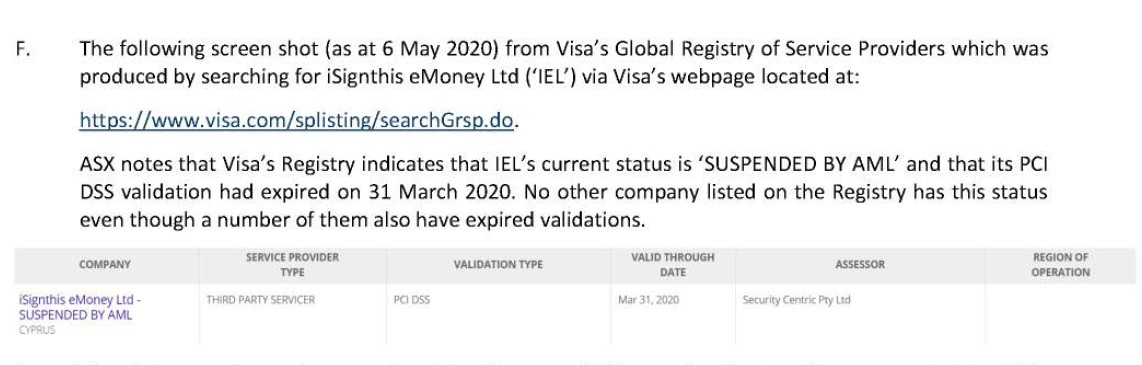
308 The answer given was that iSignthis understood that the audit “was related to compliance and risk review”: LJ at [480].
309 At LJ [547] the primary judge found that question 1(b) was a relatively simple question and that the answer given was more than “circumspect”, it was plainly non-responsive. His Honour described the justification for the answer as contrived to the point of being a virtual non sequitur. His Honour found that the answer omitted to explain that iSignthis had been required to provide information to Visa in relation to AML issues, and that the omission rendered the answer false or misleading in a material respect within s 1309(2)(e) of the Act.
310 Mr Karantzis’ challenge to the primary judge’s findings raises two distinct questions. The first, under Grounds 20 and 21(a), is whether the omission of Visa’s stated anti-money laundering concerns rendered the answer misleading in a material respect within s 1309(2)(e). Mr Karantzis submits that describing the audit as a “compliance and risk review” was accurate because Visa’s 6 March 2020 letter repeatedly referred to compliance and risk, and that the omission made the answer less informative rather than misleading. He also relies on the fact that the answer was framed as iSignthis’ understanding of the audit and submits that it would have been misleading for the company to present Visa’s disputed AML allegations as established facts: LJ at [515]-[517].
311 The second question, under Ground 21(b), is whether Mr Karantzis took reasonable steps within s 1309(2)(g) to ensure that the answer was not rendered misleading by an omission. On that question, Mr Karantzis relies on Mr Seyfort’s involvement in reviewing and amending the answer, his knowledge of the relevant correspondence, and his advice that the answers should be short and accurate.
312 The primary judge rejected the first contention at LJ [547] and the reasonable steps claim at LJ [553]-[559]. We consider each conclusion separately.
313 This challenge requires a real review of the question, answer and the primary judge’s reasons. It is not enough to reject the appeal ground because the primary judge’s conclusion was open; nor is the Court required to adopt Mr Karantzis’ reading merely because the relevant words are recorded in documents. This Court must decide for itself whether the challenged findings are correct, giving due weight to any advantage the primary judge had in assessing the evidence. The impression objectively conveyed by the written question and answer may be assessed by this Court for itself. The primary judge’s advantage is more relevant to the evaluation of the evidence concerning the preparation and review of the answer.
314 On that review, the distinction that Mr Karantzis seeks to draw between an incomplete answer and a misleading omission does not assist him. The ASX did not ask only for a general description of the audit. It specifically asked whether anti-money laundering issues were within its scope. An answer referring only to a “compliance and risk review” did not answer that specific part of the question, although Visa had raised concerns about the company’s anti-money laundering program and required information in response: LJ at [479]-[482], [547]. The fact that “compliance” and “risk” were words used in Visa’s correspondence does not resolve the difficulty. In the context of the express question asked, the general description omitted the particular subject that the ASX had singled out. It thereby conveyed that the audit concerned compliance and risk at a general level without revealing that the information sought by Visa concerned identified AML issues. The omission was material because the question expressly asked whether the audit concerned AML issues and drew attention to iSeM’s “SUSPENDED BY AML” status: LJ at [477], [479]-[482], [547].
315 Nor did the disputed character of Visa’s concerns require iSignthis to present those concerns as established facts. The answer could have identified, accurately and with appropriate attribution, that the audit concerned AML issues raised by Visa while making clear that iSignthis disputed Visa’s position. On our review, we agree that the omission rendered the answer misleading in a material respect.
316 Mr Seyfort’s involvement requires separate consideration. The materials support Mr Karantzis’ submission that he was closely involved in drafting the answer, had the relevant Visa correspondence and advised that the responses should be “short and accurate”. His amendment introduced the words “ISX understands”, and he explained why he regarded the answer as an accurate statement of iSignthis’ opinion: LJ at [509], [512], [515]-[517].
317 It is also correct that Mr Seyfort was not cross-examined about question 1(b). That circumstance gives weight to his evidence concerning the drafting process and his reasons for the amendment. It does not, however, determine the objectively anterior question whether the answer was misleading by omission, or establish that Mr Karantzis satisfied the statutory reasonable steps requirement.
318 The primary judge found that Mr Seyfort was not asked to conduct a fact-checking or due diligence exercise, that he did not engage with whether the matters concerning Visa were true or untrue, and that he relied on Mr Karantzis’ superior knowledge of the relationship and dealings with Visa: LJ at [557]-[558]. His Honour concluded that the evidentiary relationship was therefore the reverse of that contemplated by ss 1309(7)-(10), because Mr Seyfort relied on Mr Karantzis for the underlying facts: LJ at [553]-[558].
319 Although Mr Seyfort’s drafting involvement was substantial, the reasonable steps required by s 1309(2)(g) were steps directed to ensuring that the answer did not omit a matter that rendered it misleading in a material respect. Consultation with a solicitor did not necessarily satisfy that requirement where Mr Karantzis knew that Visa had raised AML issues and the settled answer omitted them despite the ASX’s express question: LJ at [479]-[482], [553]-[559]. Even allowing for Mr Seyfort’s close involvement in drafting, on our review, we agree with the conclusion that Mr Karantzis had not taken reasonable steps to ensure that this answer was not misleading by omission. It is therefore necessary to distinguish Mr Seyfort’s substantial involvement in drafting the answer from advice directed to whether the answer, including what it omitted, was materially misleading for the purposes of s 1309(2).
320 The same distinction is relevant to the remaining answers and need not be repeated in full. Mr Seyfort’s involvement in drafting is material to the reasonable steps inquiry, but does not of itself establish that he advised whether a particular answer, including what it omitted, was materially misleading for the purposes of s 1309(2). The extent and subject of his involvement must nevertheless be considered separately for each answer.
321 The challenges under Grounds 20 and 21 to the finding that Mr Karantzis contravened ss 1309(2) and (12) in giving the answer to question 1(b) fail.
6.2.1.2 Question 1(e)
322 Question 1(e) and the answer are set out in Annexure A. The question asked whether iSignthis had received the results of the Visa Audit and, if so, when and what those results were; if not, it asked when the results were expected. The answer stated that the matter had been referred to Nexia, an independent third-party auditor, and that iSignthis had not received “those results” and “presently ha[d] no expectation [as to] the date” on which it would receive them because of the effect of COVID-19 on audit capabilities. Mr Karantzis submits that the referral of Visa’s assertions to Nexia for independent review was genuine. He points to the Board’s earlier decision to refer Visa’s assertions to the independent auditor, his statement to Visa on 5 May 2020 that he expected the report in approximately eight to ten weeks, and the fact that the report was not ultimately received until 9 June 2021. He says that Mr Seyfort understood the response in the context of the concurrent letter to shareholders, which he believed disclosed the result of Visa’s audit, namely the end of the Visa relationship. He concedes, however, that the answer, even read with that letter, omitted the fact that Visa was the terminating party and was misleading in a material respect.
323 The primary judge found at LJ [548] that the answer failed to reveal the result of Visa’s review and was misleading by omission. Mr Karantzis concedes that the answer, even when read with the shareholders’ letter, was false and misleading because it did not disclose that Visa was the terminating party and that the result of Visa’s audit was termination. The fact that Visa’s allegations had been referred to Nexia did not answer the question about the result of Visa’s audit. In oral argument, Mr Karantzis accepted that the direct answer was that Visa’s audit had resulted in termination. Nor did the shareholders’ letter cure the omission. For the reasons given in relation to the Visa grounds, the shareholders’ letter did not convey that it was Visa that had decided to terminate the relationship. On our review, we agree that the answer was misleading by omission within s 1309(2)(e) of the Act. It is unnecessary, in light of the concession, to decide whether the answer was misleading on the additional basis that the references to Nexia and COVID-related delay were attempts to distract the ASX.
324 The remaining question is whether Mr Karantzis took reasonable steps under s 1309(2)(g). Mr Karantzis relies on Mr Seyfort’s knowledge of the correspondence, his approval of the answer, and the instructions concerning Nexia. Those matters give his involvement more particular significance here than a general instruction to keep the answers short. They establish that Mr Seyfort considered and approved the particular response, rather than merely giving general drafting guidance. They also support his submission that he provided Mr Seyfort with accurate instructions concerning the separate Nexia review. They do not establish, however, that Mr Seyfort advised that the answer, whether alone or together with the shareholders’ letter, adequately disclosed the result of Visa’s audit. His explanation depended on the premise that the shareholders’ letter disclosed that Visa had terminated the relationship. It did not do so: LJ at [374]-[375].
325 The distinction was apparent from the question and the answer. The question concerned Visa’s audit, which Mr Seyfort and Mr Karantzis understood to refer to Visa’s communications culminating in termination; the answer instead referred to the incomplete Nexia review. Giving due weight to his particular involvement in this answer, and for the reasons at [319]-[320] we agree with the primary judge that the reasonable steps requirement was not satisfied.
326 The challenges under Grounds 20 and 21 to the finding that Mr Karantzis contravened ss 1309(2) and (12) in giving the answer to question 1(e) fail.
6.2.1.3 Question 2(b)
327 Question 2(b) and the answer are set out in Annexure A. The question asked when iSignthis first became aware that Visa had suspended iSeM from processing payments pending a response to the Visa Queries. The answer given by iSignthis supplied no date. In the answer iSignthis said that the queries were not the basis for suspension and referred instead to the ASX investigation and derogatory media: LJ at [488]-[489]. Mr Karantzis accepts that the date could have been given as 9 March 2020. He submits that the first sentence expressed iSignthis’ view that Visa’s stated reasons, particularly those concerning high-risk merchants, were not its true reasons. He acknowledges that, if the sentence is read as denying Visa’s stated basis, it was false or misleading in a material particular; he disputes ASIC’s contention that its failure to disclose Visa’s stated AML and risk concerns rendered the answer misleading by omission.
328 At LJ [549], the primary judge found that the answer omitted Visa’s stated reasons for the suspension, as set out in its letter of 6 March 2020, and was misleading in a material respect within s 1309(2)(e) of the Act. That finding must be assessed on the omission case. Mr Karantzis’ qualified acceptance that the first sentence might, on one reading, be false or misleading under s 1309(2)(d) if read as denying Visa’s stated basis is not a concession that the omission case was established. Nevertheless, on our review, the answer was misleading by omission. The question referred to a suspension pending a response to Visa’s queries. Rather than give the date requested, the answer denied that the queries were the basis for suspension and identified the ASX investigation and derogatory media, without disclosing Visa’s stated anti-money laundering and risk concerns. iSignthis could have identified those concerns while stating that it disputed their validity or considered that they did not reflect Visa’s true reasons. It did not distinguish its own view from the reasons Visa had stated.
329 Mr Karantzis also relies on Mr Seyfort’s possession of Visa’s letters and his understanding of the instructions about Visa’s true reasons. He explained that he made only a grammatical correction because he considered that the answer otherwise accurately reflected iSignthis’ opinion, particularly concerning high-risk merchants: LJ at [527]-[528]. That explains the view the company wished to advance, and confirms that Mr Seyfort’s involvement extended to the particular answer. Giving due weight to his involvement, and for the reasons at [319]-[320], we agree that the reasonable steps requirement was not satisfied.
330 The challenges under Grounds 20 and 21 to the finding that Mr Karantzis contravened ss 1309(2) and (12) in giving the answer to question 2(b) fail.
6.2.1.4 Question 2(d)
331 Question 2(d) and the answer are set out in Annexure A. Question 2(d) asked for Visa’s reasons for the suspension. The answer identified brand risk, derogatory media and the ASX investigation. Mr Karantzis accepts that it was misleading in omitting reference to Visa Rule ID# 0000652 and Visa’s stated concerns about iSignthis’ anti-money laundering program. He emphasises that the 6 March 2020 letter later referred to risk and stated that iSignthis presented “excessive risk” to the Visa payment system. He relies on Mr Seyfort’s evidence that he considered the answer accurate and justifiable and made only a grammatical change to it: LJ at [491]-[494], [529]-[530].
332 The primary judge found at LJ [550] that Visa’s anti-money laundering concerns were a primary stated reason for the suspension and that the answer omitted them, rendering it misleading in a material respect under s 1309(2)(e) of the Act. Mr Karantzis’ concession accords with that conclusion. The reference to brand risk had a basis in Visa’s letter, but it did not convey Visa’s stated concerns about the company’s anti-money laundering program. iSignthis was not required to adopt Visa’s concern as correct in giving its answer. It was required not to give a materially misleading account of the reasons Visa had given. On our review, we agree with the primary judge that the omission rendered the answer misleading in a material respect for the purposes of s 1309(2)(e): LJ at [491]-[494], [550].
333 Mr Seyfort’s assessment that the answer was accurate and justifiable is relevant to whether Mr Karantzis took reasonable steps under s 1309(2)(g). Mr Seyfort had Visa’s 6 March 2020 letter and considered that its reference to excessive risk supported an answer referring to brand risk. Mr Karantzis also says that he gave Mr Seyfort complete and accurate instructions, and that Mr Karantzis understood Mr Seyfort’s advice to permit a short answer rather than a full account of Visa’s concerns. Those matters must be given weight. Giving due weight to his involvement, and for the reasons at [319]-[320], we agree that Mr Karantzis did not take the reasonable steps required by s 1309(2)(g).
334 Mr Karantzis’ later evidence that he understood Mr Seyfort’s advice to permit the incomplete answer was not before the primary judge when liability was determined and cannot establish error in that determination.
335 The challenge concerning the answer to question 2(d) fails, and accordingly the corresponding parts of Grounds 20 and 21 fail.
6.2.1.5 Question 2(e)
336 Question 2(e) and the answer are set out in Annexure A. Question 2(e) asked whether Visa had indicated that it held anti-money laundering concerns. Mr Karantzis submits that the ASX question confused two distinct matters. On his account, the notation “SUSPENDED BY AML” on Visa’s registry arose in connection with iSeM’s certification under the PCI DSS, which concerns payment-card data security. He says that notation should not have been treated as referring to the anti-money laundering concerns stated in Visa’s correspondence. He nevertheless accepts that the second part of the question asked whether Visa had indicated that it held such concerns.
337 Mr Karantzis relies on Mr Seyfort’s substantial revision of the draft to expose that perceived confusion without appearing to accept that Visa’s AML concerns were justified. He nevertheless concedes that the final answer did not disclose Visa’s stated concerns and was false or misleading.
338 The primary judge found at LJ [551] that the question asked whether Visa had expressed such concerns, a fact known to Mr Karantzis, and that the response was false and misleading in a material particular under s 1309(2)(d) of the Act. That conclusion does not depend on resolving the significance of the registry notation. ASIC’s case was that the answer failed to acknowledge, and instead denied the relevance of, the substantive anti-money laundering concerns that Visa had expressed. Visa’s correspondence had expressed those concerns. An answer directed to the perceived defect in the question, and to whether a regulator had alleged a breach, did not answer what the ASX had asked about what Visa had indicated. Nor did identifying the distinction between PCI DSS and AML answer the separate and direct inquiry whether Visa had expressed AML concerns. It is therefore unnecessary to determine, for the purpose of question 2(e), whether iSignthis understood the registry notation as recording administrative action concerning PCI DSS certification.
339 Mr Seyfort’s substantial drafting changes are relevant to whether Mr Karantzis took reasonable steps under s 1309(2)(f). He understood the registry notation to concern PCI DSS certification rather than AML compliance and sought to identify what he regarded as that conflation: LJ at [531]-[532]. Giving due weight to his substantial involvement in settling this answer, and for the reasons at [319]-[320], we agree that the reasonable steps requirement was not satisfied.
340 On our review, we agree with the primary judge’s conclusions that the answer to question 2(e) was materially misleading and that Mr Karantzis had not taken reasonable steps to ensure that it was not misleading. The corresponding aspects of Grounds 20 and 21 fail.
6.2.1.6 Question 2(f)
341 Question 2(f), which was conditional on a negative answer to question 2(e), and iSignthis’ answer are reproduced in Annexure A. Question 2(f) requires separate consideration because Mr Karantzis does not concede that its answer was misleading.
342 The question asked what iSignthis understood by the statement on Visa’s Global Registry of Service Providers that iSeM’s status was “SUSPENDED BY AML”. The final answer stated that iSignthis had “no understanding of the statement” and that the reference made no sense because there was no apparent relationship between anti-money laundering and PCI DSS. The primary judge found that, because Mr Karantzis knew that Visa had suspended iSignthis after expressing AML concerns, the purported disclaimer of any understanding of “SUSPENDED BY AML” was false and misleading in a material particular within s 1309(2)(d) of the Act: LJ at [552].
343 Mr Karantzis submits that the primary judge failed to maintain a distinction between Visa’s substantive AML concerns and the administrative meaning of the registry notation. His case is that the notation recorded action by Visa’s AML section concerning the expiry of iSeM’s PCI DSS certification, rather than a suspension imposed for the AML concerns expressed in Visa’s correspondence. He relies on Mr Seyfort’s amendment of the draft answer and his evidence concerning that distinction: LJ at [533]-[535]. His written submissions maintain that the answer to question 2(f) was correct on that basis.
344 There is force in Mr Karantzis’ submission to this extent. Knowledge of the substantive AML concerns expressed by Visa did not, without more, establish the administrative meaning of the registry notation. The primary judge did not make a separate finding that the notation itself recorded the reason for suspension stated in Visa’s letter of 6 March 2020. The evidence upon which Mr Karantzis relies was capable of supporting a distinction between the registry notation and the substantive concerns expressed in Visa’s correspondence: LJ at [533]-[535].
345 That distinction is not, however, determinative of ASIC’s pleaded case. The answer to question 2(f) was not to be considered in isolation, as though it were an abstract inquiry into the technical operation of Visa’s registry. It formed part of a connected sequence of questions directed to Visa’s audit, its stated AML concerns, its reasons for suspension and the registry notation. Question 1(b) expressly asked whether the Visa Audit concerned AML issues and referred to the notation “SUSPENDED BY AML”. Question 2 was introduced by a chapeau referring again to that notation. Questions 2(d) and 2(e) then asked directly about Visa’s stated reasons for suspension and whether Visa had expressed AML concerns. Question 2(f) followed immediately and was expressly conditional on a negative answer to question 2(e). ASIC relied at trial upon the chapeau and the sequence of questions as part of its case concerning the omission from the answers of Visa’s stated AML concerns and the impression conveyed by the answers: LJ at [478]-[500].
346 Mr Karantzis likewise submitted at trial that the answers were not to be read in isolation. He relied on the whole of the ten-page response, the shareholders’ letter and the preceding correspondence as part of the relevant context. His answer to questions 2(e) and 2(f) was that the ASX questions conflated PCI DSS certification with substantive AML compliance, and that Mr Seyfort had amended the answers to identify what he regarded as that conflation. The parties therefore squarely joined issue on whether that distinction answered ASIC’s pleaded case at trial.
347 ASIC’s closing case was that the 25 May 2020 response reflected a deliberate strategy to confine the information given to the ASX, avoid candour and deny legitimacy to the proposition that iSignthis had AML issues. ASIC relied on the answers as parts of that course. The answer to question 1(b) did not disclose that the Visa Audit required information in response to AML issues. The answers to questions 2(d) and 2(e) did not acknowledge Visa’s expressed AML concerns. Question 2(f) culminated in the categorical statement that iSignthis had “no understanding” of the registry notation and that the AML reference made “no sense”: LJ at [473]-[500]. ASIC’s pleaded complaint concerning that answer was that it omitted the substantive AML matters identified in the FASOC [48] and [49].
348 The primary judge accepted that contextual case. His Honour did not determine question 2(f) by treating the answer as a freestanding statement about the technical meaning of the registry notation. His Honour considered it as part of the 25 May 2020 response and against the information known to Mr Karantzis. In expressing his overall conclusion, the primary judge found that the information provided in the response conveyed that Visa had temporarily suspended iSignthis for reasons relating to the ASX investigation, derogatory media and brand risk, while the reference to “SUSPENDED BY AML” was an unrelated and nonsensical mistake: LJ at [559]. His Honour concluded that the contravention was established by the relevant answers considered together: LJ at [559]-[560].
349 We agree with that contextual approach. Section 1309(4) required the question and answer to be considered together in determining whether the information given was materially false or misleading. In the circumstances, the relevant context included the express dependence of question 2(f) on the answer to question 2(e), the chapeau to question 2 and the preceding inquiries about Visa’s reasons for suspension and its expressed AML concerns. Read in that context, the answer did more than dispute the technical meaning attributed to the registry notation. It conveyed that iSignthis knew of no intelligible connection between that notation, Visa’s action and the AML concerns repeatedly identified in the relevant questions.
350 Mr Karantzis’ own explanation also bears on the impression conveyed by the answer. That matter is relevant only to testing the contextual reading for which Mr Karantzis contends. His case is that iSignthis understood the notation to refer to action by Visa’s AML section concerning PCI DSS certification. That asserted understanding is difficult to reconcile with the unqualified statement that iSignthis had “no understanding” of the notation.
351 We do not treat Mr Karantzis’ asserted understanding of the notation as a separate basis of contravention. ASIC did not distinctly submit that this understanding was itself sufficient to establish the falsity of the statement that iSignthis had “no understanding” of the notation. ASIC’s case was that the answer omitted Visa’s substantive AML concerns and the AML and risk matters stated in its suspension and termination correspondence. The primary judge accepted that case: LJ at [552]. It is therefore unnecessary to sustain his Honour’s finding on a different and narrower basis.
352 Mr Karantzis’ proposed distinction does not alter our conclusion on the case that was decided. We agree that the answer should be assessed in the setting of the 25 May 2020 response, the structure and language of the ASX questions and the information known to Mr Karantzis. His Honour was not required to accept that identifying a possible administrative distinction between PCI DSS certification and substantive AML compliance answered the allegation that the response, read as a whole, conveyed a misleading account of Visa’s stated position.
353 This conclusion does not depend on a finding that the registry notation itself recorded the substantive reason stated in Visa’s letter of 6 March 2020. It rests on the impression conveyed by the answer when read in the context in which it was sought and given. In that setting, the categorical disclaimer reinforced the answers given immediately before it, which did not acknowledge Visa’s expressed AML concerns and instead attributed the suspension to other matters. In light of the information known to Mr Karantzis, we conclude that the answer was materially misleading and agree with the conclusion at LJ [552].
354 Mr Seyfort’s amendment is relevant to the separate question of reasonable steps because it shows that he considered the wording of the answer and understood the intended distinction between PCI DSS certification and substantive AML compliance. That involvement did not extend to advice on whether the categorical disclaimer, read in the context of the preceding answers and the repeated focus on AML, was materially misleading.
355 Giving due weight to Mr Seyfort’s substantial involvement in settling the answer, we agree that Mr Karantzis had not taken the reasonable steps required by s 1309(2).
356 The challenges under Grounds 20 and 21 concerning the answer to question 2(f) fail.
357 If, contrary to our conclusion applying the correctness standard, the finding concerning question 2(f) cannot stand, it remains necessary to consider separately the consequences for the declaration and for the discretionary orders. The relevant declaration concerns Mr Karantzis’ contravention of ss 1309(2) and (12) in giving the 25 May 2020 response. It was not framed as a separate declaration for each answer. The primary judge found that five other answers in that response were materially false or misleading and that Mr Karantzis had not taken reasonable steps to ensure that they were not. Those findings independently sustain the conclusion that he contravened ss 1309(2) and (12) by giving the response: LJ at [545]-[564].
358 As to the discretionary orders, the primary judge did not isolate question 2(f) when assessing the seriousness of the contravention, the need for deterrence or the appropriate penalty and period of disqualification. The Penalty Judgment treated the contravention as arising from the 25 May 2020 response and referred collectively to the objectively false or misleading character of that response. The primary judge regarded it as significant that the contravention occurred after the ASX had sent its query letter and assessed the answers as part of Mr Karantzis’ broader contravening conduct. His Honour did not attribute any separate or identifiable part of the pecuniary penalty or disqualification order to question 2(f): PJ at [100], [227]-[229], [246]-[247], [259], [263].
359 The remaining findings would independently sustain the declaration of contravention. Further, Mr Karantzis has not established that removal of the finding concerning question 2(f) would cause or materially contribute to a different pecuniary penalty or disqualification order. It would therefore provide no basis for appellate intervention in the orders below.
360 For the reasons given in relation to each of the six answers, Grounds 20 and 21 fail.
6.3 Ground 22: statutory relief
361 Ground 22 is distinct from the question whether s 1309(2) of the Act was contravened. In seeking relief, Mr Karantzis relies on his consultation with Mr Seyfort, Mr Seyfort’s detailed involvement in settling the ASX Answers, his knowledge of the relevant correspondence and the advice that the answers should be short and accurate as supporting relief under ss 1317S and 1318. Consistently with the approach at [288], we assume in Mr Karantzis’ favour that he acted honestly. Even applying the correctness standard, the directness of the ASX’s questions, the matters known to Mr Karantzis and the material respects in which the answers failed to convey Visa’s position support the conclusion that, having regard to all the circumstances, he ought not fairly to be excused. It is therefore unnecessary to reach the ultimate discretion whether relief should be granted under ss 1317S(2) or 1318(1). Ground 22 therefore fails.
7. DISQUALIFICATION AND PENALTY
362 The remaining grounds challenge the orders disqualifying Mr Karantzis from managing corporations for six years and requiring him and iSignthis to pay pecuniary penalties of $1 million and $10 million respectively. Some of the grounds concern the significance, for those orders, of particular contraventions considered earlier in these reasons. Others contend that errors established in relation to liability require the relevant discretions to be re-exercised, or identify independent errors in the primary judge’s exercise of those discretions. It is convenient first to address the grounds concerning particular conduct, then the asserted consequences of the liability grounds, and finally the challenges to each order.
363 In considering the orders made against Mr Karantzis, we address disqualification before pecuniary penalty, consistently with the distinct purposes of those orders and the established sequence adopted by the primary judge: PJ at [15]-[17], [225]-[266].
364 The applicable standard of appellate review has been addressed above. In what follows, we bear in mind that it is not enough that this Court might have attributed different weight to a consideration or selected a different period of disqualification or penalty amount. An appellant challenging a discretionary order must establish error in the exercise of the relevant discretion. Where the challenge relies on an error in an anterior factual or liability finding, the appellant must also establish that the error caused or materially contributed to the exercise of that discretion. It is therefore necessary to consider not only whether an earlier ground succeeds, but whether the correction of the relevant finding undermines the basis on which the particular order was made. The primary judge’s reasons must be read as a whole, including his treatment of matters favourable to the appellants, and without isolating individual observations from the broader assessment of the nature of the contraventions, the need for protection and deterrence, and the mitigating circumstances relied upon.
7.1 Applicable principles
365 The appellants accept that the primary judge correctly stated the principles governing disqualification and pecuniary penalty: PJ at [12]-[46]. It is therefore unnecessary to restate those principles comprehensively. It is nevertheless useful to identify those features that bear directly on the remaining grounds.
366 A disqualification order and a pecuniary penalty serve distinct purposes. The primary purpose of disqualification is the protection of the public from the harmful use of the corporate structure, or from its use contrary to proper commercial standards. Relevant considerations include the seriousness of the contraventions, the risk of similar future conduct, the likely harm to the public, and any mitigating considerations bearing upon whether disqualification is justified and, if so, for what period. Any period of disqualification must not be excessive. Consistently with the distinct purposes of the two remedies, the established practice is to determine disqualification before considering pecuniary penalty: PJ at [15]-[22].
367 The primary purpose of a civil pecuniary penalty is to promote compliance through specific and general deterrence. The penalty must be proportionate and appropriate in the sense that it strikes a reasonable balance between oppressive severity and the amount necessary to achieve deterrence. The penalty must be no more than is reasonably necessary to secure that purpose. The statutory maximum is relevant, but the Court does not begin with the maximum and apply arithmetical deductions. Nor is the maximum reserved for the objectively worst category of contravention. The assessment requires consideration of all relevant circumstances, including the nature, extent and duration of the contraventions, any loss or damage and any profit or benefit, the contravener’s prior history, cooperation, remedial conduct and financial capacity, insofar as those matters bear upon deterrence: PJ at [27]-[38].
368 The course of conduct and totality principles inform both the period of disqualification and the assessment of pecuniary penalty where multiple contraventions are involved. Those principles guard against double punishment without requiring the distinct seriousness or duration of each contravention to be disregarded. In determining disqualification, the Court likewise assesses the contravening conduct as a whole, but does so by reference to whether disqualification is justified for the protection of the public and, if so, for what period. In fixing a pecuniary penalty, capacity to pay is relevant, particularly to specific deterrence, but does not displace the need to give appropriate effect to general deterrence: PJ at [15]-[26], [37]-[43].
7.2 Grounds 7, 9, 10, 15, 19 and 23: the consequences of the particular contraventions
7.2.1 Ground 7: weight attributed to the continuing failure to correct the One-off Revenue Representation
369 Ground 7 concerns the weight attributed to Mr Karantzis’ failure to correct the One-off Revenue Representation for more than a year. Ground 7 attracts the House v The King standard because it challenges the weight attributed to the continuing failure to correct the representation in the assessment of penalty. It is not sufficient that this Court might have assigned different weight to that circumstance.
370 Mr Karantzis relies on the evidence accepted at the penalty hearing that he was not actually aware that the market had been misled. He submits that the continuing failure to correct the representation could not therefore be treated as a deliberate decision made with actual knowledge that his answer had misled the market. For the reasons at [70]-[72] and [87]-[90], however, the primary judge’s assessment did not depend on actual awareness that the market had been misled. His Honour proceeded on the basis of what Mr Karantzis knew and ought to have known, including that correction was required.
371 His Honour rejected Mr Karantzis’ submission that the conduct should be characterised as a misunderstanding or a single careless mistake, while making clear that the liability finding was not one of intentional dishonesty: PJ at [67]-[68], [108], [229]. His Honour maintained that Mr Karantzis knew the correct position and the market’s interest in it, ought to have known that his answer would mislead and had, at least, constructive knowledge that a correction was required: PJ at [68]-[69]. The period for which the representation remained uncorrected was relevant to the seriousness of the contravention without establishing that Mr Karantzis actually knew that the market had been misled. For the reasons given under Ground 6, we do not rely on the final sentence of PJ [69], in which the primary judge suggested that the absence of a price movement might have alerted Mr Karantzis to the need for correction. Leaving that observation aside, Mr Karantzis has not shown any basis for appellate intervention in the weight attributed to the period for which the representation remained uncorrected.
372 ASIC relies on the finding that the representation perpetuated the market’s incorrect understanding of recurring revenue, notwithstanding the absence of a material movement in the traded share price: LJ at [177]-[178]. Given the rejection of the anterior challenges to liability, Mr Karantzis was required to demonstrate error of the kind identified in House v The King, rather than merely invite this Court to make a different assessment of seriousness or assign different weight to the duration of the contravention. He has not done so.
373 Ground 7 fails.
7.2.2 Ground 9: whether the one-off revenue contraventions were distinguishable
374 At PJ [73] the primary judge accepted the appellants’ submission that the One-off Revenue Representation and the non-disclosure of the One-off Revenue/Costs Information arose from one event, namely the representation on 3 August 2018, but rejected their submission that Mr Karantzis’ conduct in relation to the One-off Revenue/Costs Information could effectively be ignored in the Court’s consideration of penalty: PJ at [73].
375 Ground 9 concerns the treatment, for penalty purposes, of the One-off Revenue Representation and the failure to disclose the One-off Revenue/Costs Information. Ground 9 attracts the House v The King standard. The issue is whether the primary judge’s treatment of the connected contraventions disclosed discretionary error, not whether this Court would have described or weighed their relationship differently. The appellants contend that the primary judge erred in treating the contraventions as distinguishable because the former was directed to analysts and the latter involved non-disclosure to the ASX. They submit that both were directed to the market and should have been treated as indistinguishable.
376 The submission does not identify any error in the primary judge’s application of the course of conduct principle. Although his Honour considered that the contraventions were differently directed, he recognised that they arose from the same underlying conduct and treated them as a single course of conduct when determining penalty. That approach guarded against double punishment: PJ at [73], [241], [257]. ASIC accepts that his Honour applied the course of conduct principle on that basis.
377 The application of the course of conduct principle did not require his Honour to disregard the distinct features of the contraventions when assessing their seriousness. One involved the making of a misleading representation at the Analyst Briefing. The other involved the continuing failure to disclose the true revenue position to the ASX and, through it, the market. Their common factual foundation justified treating them as a single course of conduct, but did not make them identical or preclude consideration of the distinct nature and duration of each contravention: PJ at [73], [257]-[258].
378 The appellants’ reliance on the primary judge’s statement that the contraventions were “in one sense … quite different” isolates that observation from the reasoning that followed. His Honour gave effect to their overlap by treating them as a single course of conduct and guarding against double punishment. The appellants have not shown that the distinction otherwise drawn by the primary judge resulted in double punishment or materially affected either penalty.
379 Ground 9 fails.
7.2.3 Ground 10: weight attributed to the duration of the One-off Revenue/Costs Information contravention
380 Ground 10 concerns the weight attributed to the duration of the failure to disclose the One-off Revenue/Costs Information, from 3 August 2018 to 15 November 2019. Ground 10 likewise attracts the House v The King standard because it challenges the weight attributed to duration in assessing seriousness and penalty. The appellants contend that the duration of the non-disclosure should not have increased the assessment of seriousness because the One-off Revenue Representation caused no observable movement in the traded price of iSignthis’ shares and neither appellant knew that the market had been misled. They further submit that, because a share price reflects expected future earnings, the representation and associated nondisclosure necessarily lost any materiality when subsequent earnings were released.
381 The appellants’ submission conflates the representation with the separate continuous disclosure contravention. The absence of an observable price movement following the representation did not determine the materiality of the undisclosed information or the significance of its continuing nondisclosure from 3 August 2018 to 15 November 2019. The primary judge found that the information was material, was generally not available throughout that period, and that Mr Karantzis knew the information and its significance to the market: LJ at [263]-[270], [282]-[285], [294]. The appellants’ reliance on their asserted lack of awareness that the market had been misled substantially repeats the contentions advanced under Grounds 4, 6 and 7. For the reasons given in rejecting those grounds, that asserted lack of awareness does not establish that the duration of the separate non-disclosure contravention was irrelevant to its seriousness. Nor does the asserted release of subsequent earnings establish that the One-off Revenue/Costs Information ceased to be material or generally unavailable at any identified earlier date. The unchallenged liability finding is that iSignthis’ contravention continued until 15 November 2019, when it disclosed the amount of one-off integration revenue in response to the ASX’s query letter: LJ at [190]-[192], [260], [275].
382 It was not an error of principle for the primary judge to take account of the period during which the information remained undisclosed when assessing seriousness. His Honour treated the daily contraventions as a single course of conduct, thereby avoiding double punishment, while retaining duration as a circumstance relevant to seriousness: PJ at [256], [275]. Those were compatible conclusions. The course of conduct principle controlled the accumulation of penalties; it did not require the Court to disregard how long the contravening conduct continued. Ground 10 does not establish any error warranting appellate intervention in the penalty discretion. Ground 10 fails.
7.2.4 Grounds 15 and 19: reliance on legal advice in mitigation of penalty
383 Grounds 15 and 19 concern the significance, for penalty, of the appellants’ reliance on Mr Seyfort’s advice from 22 May 2020. Each ground attracts the House v The King standard because it challenges the mitigating weight attributed to legal advice in the assessment of penalty. Ground 15 concerns the Visa Termination Decision, while Ground 19 concerns the Reasons for Visa’s Termination. The grounds arise on the assumption that the appellants’ reliance on that advice does not answer liability. They contend that that reliance nevertheless warranted no penalty or only a modest pecuniary penalty. The issue is whether the primary judge erred in concluding that reliance on the advice did not warrant a materially different assessment of penalty for either appellant: PJ at [114]-[136], [290]-[291].
384 The appellants rely on the matters concerning Mr Seyfort’s advice and drafting involvement considered at [259]-[261], [270]-[273] and [279]-[282], together with the penalty-stage evidence concerning the extent of Mr Karantzis’ reliance upon him: PJ at [114]-[118], [128], [131]. ASIC relies on the distinction, addressed in those passages, between advice given while Visa’s decision remained under challenge and advice concerning the disclosure obligations after Visa confirmed its decision on 12 May 2020.
385 As to Ground 15, we accept that Mr Seyfort’s alteration of the shareholders’ letter, and Mr Karantzis’ reliance on his drafting, were relevant to penalty. The alteration materially bears on the responsibility fairly attributable to Mr Karantzis for the impression conveyed by the final wording: LJ at [510]-[512]. These matters did not, however, establish that Mr Seyfort advised either appellant that iSignthis need not disclose the fact that Visa had decided to terminate the relationship. Nor did Mr Karantzis’ own preceding draft expressly identify Visa as the terminating party. They also did not address the continuing failure to correct the position after the shareholders’ letter was published: LJ at [374]-[375], [458], [511]-[512]; PJ at [128]-[136]. The primary judge considered the asserted reliance in light of the scope and factual basis of the advice provided by Mr Seyfort and the findings concerning what Mr Karantzis knew. His Honour accepted the fact of reliance but concluded that it did not mitigate the conduct to the extent contended: PJ at [128]-[136]. The appellants have not established that the primary judge acted on a wrong principle, misunderstood the advice or attributed to it a weight outside the permissible exercise of the penalty discretion.
386 As to Ground 19, Mr Seyfort’s earlier view concerned assertions made by Visa while they remained disputed and before Visa confirmed its decision. His later involvement in preparing the shareholders’ letter did not establish that, after the decision had been confirmed, he advised either appellant that Visa’s stated reasons were immaterial or need not be disclosed: LJ at [326]-[327], [458]. Nor did the supplementary Clayton Utz report establish that proposition. That report addressed the termination decision, rather than Visa’s stated reasons or their materiality, and proceeded on assumptions defined by its agreed scope. The appellants also rely on Mr Seyfort’s possession of Visa’s 17 April 2020 letter, his participation in settling the shareholders’ letter and Mr Karantzis’ evidence that he would have disclosed Visa’s reasons if advised to do so. Those matters support the fact of reliance, but do not establish that Mr Seyfort considered the post-12 May 2020 disclosure question and advised that the reasons need not be disclosed. The appellants have not shown that the primary judge misunderstood the scope or effect of the advice relied upon in determining penalty.
387 The primary judge did not treat the receipt of legal advice from Mr Seyfort as irrelevant to penalty or proceed on the basis that reliance on erroneous advice could never be mitigating: PJ at [114]-[136]. His Honour considered the advice actually sought and given, the circumstances in which it was given and, in that context, the superior information available to Mr Karantzis: PJ at [129]-[136]. In determining the penalty to be imposed on iSignthis, his Honour separately considered its reliance on legal advice and the Clayton Utz reports: PJ at [290]-[291]. The appellants have not established that his Honour disregarded the asserted reliance, misunderstood its material features or attributed it no mitigating weight as a matter of principle. Their complaint is ultimately directed to the weight assigned to the asserted reliance, and does not establish a basis for appellate intervention in the penalty discretion.
388 Grounds 15 and 19 fail.
7.2.5 Ground 23: reliance on legal advice concerning the ASX Answers
389 Ground 23 concerns the significance of Mr Seyfort’s involvement in preparing the ASX Answers for the pecuniary penalty imposed on Mr Karantzis and his disqualification. Mr Karantzis contends that the primary judge understated the scope of his role by characterising Mr Seyfort’s advice as strategic rather than as advice directed to the truth and accuracy of the answers, and by finding that he had not been fully informed of the relevant facts and documents. Mr Karantzis relies on Mr Seyfort’s general retainer, his knowledge of the Visa correspondence, his close involvement in settling successive drafts, his view that the answers did not contravene s 1309(2) of the Act, and the evidence that iSignthis and Mr Karantzis would have followed any advice he gave to answer differently. Mr Karantzis also relies on the context of iSignthis’ dispute with the ASX. On that basis, he submits that no penalty or only a modest pecuniary penalty should be imposed on him, and that the primary judge erred in determining both the penalty and the period of disqualification.
390 The primary judge accepted that Mr Karantzis broadly relied on Mr Seyfort’s advice and that legal advice reasonably sought and followed in good faith may mitigate penalty: PJ at [128]-[129]. His Honour nevertheless found that Mr Karantzis’ reliance was of little assistance because, although Mr Seyfort was involved in drafting the ASX Answers, his advice was sought and given on strategy in the context of iSignthis’ broader dispute with the ASX, rather than on the truth or accuracy of the information provided: PJ at [130]-[131]. His Honour also relied on the findings, considered at [318]-[320] above, concerning the respective factual knowledge of Mr Seyfort and Mr Karantzis and the limits of Mr Seyfort’s role: LJ at [557]-[558]; PJ at [131].
391 The primary judge recorded the acknowledgment in Mr Karantzis’ submissions that reliance on legal advice will not assist a contravenor where the adviser was not fully informed of the relevant facts and documents: PJ at [132]. In those circumstances, his Honour concluded that it was not open to Mr Karantzis, at the penalty stage, to traverse the findings made in the Liability Judgment concerning the scope and factual basis of Mr Seyfort’s advice: PJ at [132].
392 Mr Karantzis submits that this characterisation understated Mr Seyfort’s role, relying on his close involvement in settling the answers, possession of the Visa correspondence and advice concerning how the ASX queries should be answered accurately. ASIC accepts that legal advice reasonably sought and followed may mitigate penalty even if wrong, but maintains that the evidence did not establish advice directed to whether each answer, including its omissions, complied with s 1309(2). Those competing characterisations have been considered in relation to the individual answers above.
393 The primary judge did not overlook Mr Seyfort’s close drafting involvement. The findings concerning the nature and limits of that involvement are addressed at [316]-[320] and in relation to the individual answers above. Mr Karantzis has not established that any understatement of Mr Seyfort’s drafting role caused or materially contributed to the penalty or disqualification order.
394 Nor does the hostile relationship between iSignthis and the ASX alter that conclusion. It explains the strategic setting in which the answers were prepared, but did not diminish the responsibility of iSignthis and Mr Karantzis to ensure that the information given to the ASX was not materially misleading. The primary judge considered and rejected that relationship as an answer to the contraventions: LJ at [546], [562]; PJ at [130]-[132].
395 Ground 23 fails.
7.3 Ground 24: whether an anterior error requires re-exercise of the discretions
396 Ground 24 attracts the House v The King standard and invokes the requirement stated at [27] above that an identified anterior error must have caused or materially contributed to the discretionary order under challenge. The ground is advanced by both appellants and applies where an anterior error concerning the contraventions established against either appellant is said to require re-exercise of a penalty or disqualification discretion. The limited factual correction under Ground 12 must therefore be considered by reference to its effect on the penalty and disqualification orders. The same inquiry applies, if necessary, to the alternative conclusion concerning question 2(f) at [357]-[359], insofar as the alleged error is relied upon as affecting those discretionary orders. ASIC’s separate contingent submission concerning the statutory basis for disqualification is addressed below.
397 Ground 12 is established to the limited factual extent identified above. We have not upheld the findings that, on 13 May 2020, Mr Karantzis had no intention to notify the CBC or that the CBC’s query first caused him to contemplate doing so. Those findings formed part of the primary judge’s penalty reasoning. At PJ [94]-[96], his Honour expressly applied the liability findings concerning Mr Karantzis’ intention, the CBC’s query and his failure to give evidence. The limited Ground 12 correction therefore removes part of the factual basis upon which the seriousness of Mr Karantzis’ conduct concerning the Visa information was assessed. It is necessary to determine whether that correction caused or materially contributed to Mr Karantzis’ pecuniary penalty or disqualification order.
398 The content and limits of the Ground 12 correction are set out at [255]-[257] above. It did not establish the broader factual premise for which Mr Karantzis contends, and it leaves undisturbed the findings concerning the content, timing and inadequacy of the communications ultimately made.
399 The correction gives additional weight to Mr Karantzis’ explanation that communication with the CBC before a market announcement had been contemplated and discussed before the CBC’s query. Its mitigating significance is nevertheless confined. The primary judge observed that the argument concerning the CBC process could bear only on the relatively short period from 12 to 21 May 2020. His Honour’s assessment remained directed principally to the continuing failure to make proper disclosure after the CBC responded: PJ at [97]-[99]. The assessment of seriousness remains supported by the undisturbed findings concerning the information known to Mr Karantzis, the materiality of that information, the content and timing of the communications ultimately made, and the duration and inadequacy of the non-disclosure. The limited factual correction has not been shown to have caused or materially contributed to Mr Karantzis’ pecuniary penalty or disqualification order. It does not require either of those discretions to be exercised again.
400 ASIC also submits that, if the disposition of the appeal altered the contraventions established against the appellants, it might be necessary to examine separately the statutory basis for disqualifying Mr Karantzis. Counsel referred, tentatively, to a possible alternative source of power if only a contravention of s 180 of the Act remained. The limited factual correction under Ground 12 does not set aside any declaration of contravention or otherwise alter the contraventions established against either appellant. It therefore does not affect the statutory basis on which the disqualification order was made. The contingent question identified by ASIC does not arise.
401 No anterior error has been established that materially affects a pecuniary penalty or disqualification order. Neither the correction of Declaration 6 under Ground 4 nor the limited factual correction under Ground 12 alters the substantive liability finding or the basis upon which the penalty and disqualification discretions were exercised. Ground 24 fails.
7.4 Grounds 25 and 26: Mr Karantzis’ disqualification and pecuniary penalty
7.4.1 Disqualification
402 Ground 25 challenges both Mr Karantzis’ disqualification and his pecuniary penalty. Ground 26 alleges, in the alternative, that the primary judge failed to take account of specified considerations or took account of an irrelevant consideration. Mr Karantzis accepts that the primary judge correctly stated the governing principles. His principal submission concerning disqualification is that the established conduct, properly characterised, did not warrant an order for the protection of the public. He relies particularly on the absence of a finding of dishonesty, the character evidence, his relocation to Europe, his stated intention not to manage an Australian company, the interests of shareholders in iSignthis FEU, and the consequences of his disqualification for the proposed listing of iSignthis FEU on an overseas securities exchange.
403 Grounds 25 and 26 attract the House v The King standard. The issue is not whether this Court would have imposed the same penalty or period of disqualification, but whether the primary judge’s exercise of discretion involved an identified error or produced a result outside the range reasonably available.
404 Some context concerning iSignthis FEU is necessary. In October 2021, after this proceeding had commenced, iSignthis demerged its European operations. The demerger was effected by a reduction of capital and the distribution to existing iSignthis shareholders of shares in iSignthis FEU, which had previously been a subsidiary of iSignthis. Mr Karantzis relies on evidence that the demerger followed the continuing suspension of iSignthis’ shares from trading and was intended to provide a means by which iSignthis FEU could seek listing on an overseas securities exchange, permit its shares to be traded on an open market and enhance its ability to raise capital: PJ at [160]-[165], [304].
405 The demerger is relevant to Mr Karantzis’ disqualification case. Mr Karantzis contends that he remains central to the management and development of iSignthis FEU and that his disqualification may impede its proposed overseas listing, to the financial disadvantage of its shareholders: PJ at [160]-[178]. The financial consequences of the demerger for iSignthis’ pecuniary penalty are considered separately below.
406 ASIC submits that the primary judge considered each of the matters relied upon by Mr Karantzis, although he did not attribute to them the weight sought by Mr Karantzis. While accepting the absence of any prior finding of contravention or actual dishonesty, ASIC relies on the number and seriousness of the contraventions established in this proceeding, Mr Karantzis’ direct involvement, the findings concerning his knowledge, and the duration of much of the conduct. ASIC submits that those matters supported the primary judge’s conclusions concerning future risk and the need to protect the public. PJ at [105]-[111], [225]-[235].
407 The primary judge did not overlook the favourable evidence concerning Mr Karantzis’ character. He accepted that the character witnesses described Mr Karantzis favourably on the basis of what they had observed in their dealings with him, and acknowledged his abilities and importance to the business: PJ at [143]-[156]. Those perceptions were nevertheless to be assessed against the established contraventions and Mr Karantzis’ evidence at the penalty hearing. The primary judge explained why, in light of those matters, the favourable evidence did not resolve whether disqualification was required for the protection of the public: PJ at [157]-[159], [229]-[232].
408 Mr Karantzis disputes aspects of that assessment, including the significance attributed to his answers about his control of another company and his admission concerning an ASIC interview. Those matters formed part of the primary judge’s assessment of his evidence and insight: PJ at [158], [229]-[232]. Mr Karantzis has not demonstrated that the primary judge was required to treat the favourable character evidence as determinative, or that his assessment depended on a finding that the conduct constituting the contraventions was dishonest. His Honour expressly acknowledged that there had been no finding of actual dishonesty, but considered that the contraventions and Mr Karantzis’ response to them remained relevant to the protective assessment: PJ at [108], [158], [225]-[235].
409 The primary judge did not overlook the interests of iSignthis FEU shareholders. His Honour accepted that disqualification was likely adversely to affect the financial interests of minority shareholders and could make the proposed overseas listing more difficult: PJ at [160]-[173]. ASIC emphasises that the evidence reflected the views of a limited number of shareholders, rather than the shareholder body as a whole. In any event, the primary judge gave shareholder interests some weight, while declining to treat the financial interests or expressed preferences of that group as the measure of the public interest in disqualification: PJ at [174]-[178], [242].
410 The primary judge also considered Mr Karantzis’ relocation to Europe and his stated intention not to manage an Australian company: PJ at [137]-[142]. Those matters were relevant to the practical need for protection, but did not compel the conclusion that disqualification served no protective purpose. The evidence contemplated that Mr Karantzis would continue to occupy a central management role in iSignthis FEU and remain instrumental to the demerged business and its proposed listing: PJ at [160]-[178]. The primary judge was therefore required to assess future risk by reference to Mr Karantzis’ proposed continuing corporate management role, rather than solely by reference to his place of residence or stated intention not to manage an Australian company.
411 ASIC relies in that respect on the findings concerning the risk of similar conduct, the potential for financial damage and the significance of misleading the market operator: PJ at [233]-[235]. The primary judge’s conclusion did not require a finding that Mr Karantzis would necessarily contravene Australian law again. The protective inquiry concerned whether his conduct, insight and proposed continuing management role disclosed a sufficient risk to justify an order directed to the protection of the public.
412 Mr Karantzis also challenges the finding that he had not demonstrated genuine contrition or sufficient insight. He relies on his expressions of regret and acceptance of responsibility for the ASX Answers: PJ at [179]-[184]. He also relies on the circumstances in which the company issued its press release after the Liability Judgment. The primary judge considered the terms of that press release, which Mr Karantzis had read before publication, together with his oral evidence at the penalty hearing: PJ at [185]-[194].
413 ASIC submits that the prospect of an appeal, or the existence of reasonably arguable appeal grounds, did not prevent the primary judge from assessing whether the evidence demonstrated contrition and insight in relation to the findings that then stood. The primary judge’s conclusion was not that Mr Karantzis had expressed no regret, or that pursuing an appeal was inconsistent with contrition. Rather, after considering the expressions of regret, the press release and Mr Karantzis’ oral evidence, the primary judge was not satisfied that the evidence as a whole demonstrated the insight and acceptance of responsibility claimed as mitigation: PJ at [179]-[194], [225]-[232]. Mr Karantzis has not established that the primary judge misunderstood the evidence, applied a wrong principle or otherwise exceeded the range permitted in the exercise of the disqualification discretion.
414 The settlement offers were also considered. The first offer was made before trial and proposed that the proceeding be resolved on terms that included concessions, financial penalties and a contribution to ASIC’s costs, but no disqualification order. The primary judge acknowledged the extent to which aspects of that offer resembled findings later made in the Liability Judgment: PJ at [195]-[215].
415 The primary judge nevertheless gave the offers little weight as cooperation or contrition. The offers did not result in unconditional admissions that narrowed the issues for trial or relieved ASIC of the need to prove its case. After the offers were rejected, the appellants continued to contest liability and to put ASIC to proof: PJ at [216]-[222]. The practical or utilitarian value of the offers was therefore limited. The primary judge’s reasoning distinguished between an offer that might have led to settlement and cooperation that in fact saved the resources of ASIC and the Court: PJ at [216]-[222].
416 ASIC also relied on the second offer in answering the contention that the first evidenced contrition. The second offer maintained that ASIC’s allegations were misconceived and bound to fail, and proposed that the proceeding be dismissed with no order as to costs. ASIC submitted that its terms were inconsistent with the contention that the earlier offer reflected genuine acceptance of responsibility. The primary judge’s consideration of the offers together discloses no discretionary error.
417 The appellants’ entitlement to contest ASIC’s case was not treated as a separate wrong. The point was that their forensic position meant that the offers did not produce the saving of public and judicial resources for which mitigation was sought. Mr Karantzis has not established that the primary judge overlooked his cooperation or misunderstood its practical effect: PJ at [216]-[224].
418 For the reasons given under Ground 24, the limited Ground 12 correction at [255]-[257] above has not been shown materially to affect the primary judge’s protective assessment. It does not disturb the findings concerning the information known to Mr Karantzis, the communications ultimately made, the continuing non-disclosure after the CBC responded or the broader pattern of contraventions on which that assessment rested. The correction therefore does not warrant re-exercise of the disqualification discretion.
419 The period of disqualification imposed also indicates that the primary judge gave operative weight to matters favouring Mr Karantzis. His Honour rejected the ten-year period sought by ASIC and fixed a period of six years: PJ at [236]. In doing so, he allowed for overlap and totality, Mr Karantzis’ age and the practical effect of a longer order: PJ at [236]-[243]. He also took account of the absence of a positive finding of dishonesty, the absence of significant financial loss, the lack of apparent enrichment at the expense of others and, to a limited extent, shareholder interests: PJ at [240]-[242].
420 Mr Karantzis has not shown that the protective assessment proceeded on a wrong principle, omitted a material consideration, took account of an irrelevant consideration, or produced a period outside the range reasonably available in the exercise of the discretion.
421 Grounds 25 and 26 fail insofar as they challenge disqualification.
7.4.2 Mr Karantzis’ pecuniary penalty
422 The challenge to the $1 million pecuniary penalty relies substantially on the same matters. The primary judge took account of the absence of previous findings of contravention and the absence of a positive finding of dishonesty: PJ at [261]-[263]. His Honour also recognised that there was no evidence that Mr Karantzis had personally benefited financially from the market having been misled: PJ at [242], [263].
423 The absence of quantified loss to particular shareholders did not, however, negate the findings of harm to the market, including the finding that the One-off Revenue Representation perpetuated the market’s incorrect understanding of iSignthis’ recurring revenue, which was reflected in an artificially inflated share price: LJ at [177]-[178]; PJ [263]. The primary judge was not required to quantify loss to individual shareholders before treating harm to market integrity as relevant to penalty: PJ at [263]. Nor did the absence of quantified loss require his Honour to treat the duration and seriousness of the contraventions as immaterial to deterrence. His Honour also took account of the six-year disqualification already imposed when fixing the pecuniary penalty: PJ at [262]-[266].
424 The primary judge expressly addressed overlap. His Honour treated the daily contraventions concerning the One-off Revenue/Costs Information as a single course of conduct: PJ at [255]-[256]. He also treated that conduct and the One-off Revenue Representation as one course for penalty purposes: PJ at [257]. The Visa non-disclosures and the ASX Answers were treated as one further course of conduct: PJ at [258]-[259]. His Honour then assessed the two courses of conduct together by reference to totality: PJ at [260]. That treatment addressed Mr Karantzis’ concern about double punishment. It did not require the distinct features of the contraventions, or the duration of the continuing failures to disclose, to be ignored.
425 Mr Karantzis also challenges the primary judge’s reliance on the fact that some of the contraventions occurred while he and iSignthis were under investigation by ASIC. The investigation had commenced in relation to the issue of performance shares. Mr Karantzis submits that this was a separate matter and that the primary judge therefore erred in treating the investigation as a circumstance demonstrating disregard for the regulatory framework. He also relies on the fact that, when iSignthis responded on 15 November 2019 to the ASX query concerning the composition of its revenue, ASIC had not yet alleged the disclosure contraventions ultimately established in this proceeding.
426 ASIC disputes the characterisation of the investigation as wholly unrelated. Although the investigation originally concerned performance shares, ASIC relies on its questioning of Mr Karantzis in October 2019 and the subsequent expansion of the investigation. In November 2019, Mr Karantzis was put on notice that ASIC had broadened its investigation to include misleading or deceptive conduct, including whether he had made misleading statements to the ASX: PJ at [230].
427 The primary judge did not proceed on the basis that ASIC had already identified or formulated every contravention ultimately established. The significance attributed to the investigation was narrower. His Honour treated the later conduct as occurring in circumstances where iSignthis and Mr Karantzis knew they were subject to regulatory scrutiny, including an ASIC investigation which had expanded to encompass misleading or deceptive conduct and whether Mr Karantzis had made misleading statements to the ASX: PJ at [110]-[111], [230], [263].
428 The fact that the investigation originally concerned performance shares did not make its later expansion irrelevant. Equally, the existence of an investigation could not aggravate conduct merely because it preceded contraventions on subjects that had not then arisen or been identified. The relevant question was whether the matters under scrutiny were sufficiently connected to the conduct under consideration to bear upon the seriousness of Mr Karantzis’ response to regulatory scrutiny. The One-off Revenue/Costs contravention continued after ASIC formally commenced its investigation on 2 October 2019, while the Visa and ASX Answers contraventions occurred wholly after that date: PJ at [110]. Mr Karantzis has not shown that the primary judge proceeded on the irrelevant premise alleged. Nor has he shown that this circumstance materially affected the penalty beyond the significance it was capable of bearing: PJ at [110]-[111], [263].
429 In fixing the amount, the primary judge considered the applicable maximum penalties and the purposes of deterrence: PJ at [244]-[254]. His Honour then considered the mitigating matters, the courses of conduct and the aggregate effect of the contraventions: PJ at [255]-[263]. He rejected ASIC’s proposed penalty of $1.5 million as more than necessary and Mr Karantzis’ proposed penalty of $250,000 as insufficient: PJ at [264]-[266].
430 The challenge to the pecuniary penalty received limited separate attention in oral argument, which focused principally on disqualification. ASIC nevertheless maintained that the ordinary principles of appellate restraint applied to the pecuniary penalty. The resulting $1 million penalty was an evaluative judgment, not the product of accumulating penalties for overlapping conduct: PJ at [261]-[264]. Mr Karantzis has not identified an error permitting appellate intervention in the exercise of the penalty discretion. Ground 25 fails insofar as it challenges the pecuniary penalty.
431 Ground 26 alleges, in the alternative, that the primary judge’s exercise of the discretions concerning Mr Karantzis miscarried because his Honour failed to take account of the relevant considerations identified in Grounds 5-7, 9-10, 15, 19, 23, and 25, and took account of the allegedly irrelevant consideration concerning the ASIC investigation. Mr Karantzis contends that those matters require the disqualification and pecuniary penalty discretions to be re-exercised by this Court.
432 ASIC treats Ground 26 as derivative of the earlier grounds. That characterisation is correct. The matters incorporated from those grounds have been addressed above. The matters expressly identified in Ground 25 were considered by the primary judge, although not given the weight for which Mr Karantzis contends. The investigation point has not been shown materially to have affected either discretion through reliance on an irrelevant consideration.
433 Ground 26 fails.
7.5 Grounds 27 and 28: iSignthis’ pecuniary penalty
434 Grounds 27 and 28 concern the $10 million pecuniary penalty imposed on iSignthis. They require separate consideration because the company’s penalty was imposed for its continuous disclosure contraventions, not for every contravention found against Mr Karantzis: PJ at [267]-[269], [314(c)]. The company relies on the absence of any previous finding of contravention, the asserted absence of loss or benefit, its reliance on legal advice, the settlement offers, the overlap and duration of the contraventions, its delisting and present financial position. It also repeats the complaint concerning the ASIC investigation. Grounds 27 and 28 attract the House v The King standard. iSignthis must establish discretionary error affecting the company’s penalty. It is not sufficient that this Court might have imposed a penalty in a different amount.
435 ASIC adopts its corresponding submissions concerning seriousness, legal advice, cooperation, contrition, overlap and the investigation, while accepting that iSignthis had not previously been found to have contravened the Act. ASIC also submits that the company’s focus upon its inability to contravene s 674 of the Act in the future is too narrow because a public unlisted company may remain subject to continuous disclosure obligations under s 675 of the Act.
436 The primary judge considered the company’s circumstances separately rather than simply transferring to it his assessment of Mr Karantzis. His Honour nevertheless recognised that much of the earlier assessment was relevant because Mr Karantzis was iSignthis’ guiding mind at the relevant times: PJ at [296]. His Honour addressed the duration and seriousness of the non-disclosure of the One-off Revenue/Costs Information: PJ at [271]-[275]. He separately considered the Visa Termination Decision and the Reasons for Visa’s Termination, including the duration and significance of each non-disclosure: PJ at [279]-[292]. His Honour rejected the contention that the shareholders’ letter had adequately disclosed the Visa Termination Decision: PJ at [279]-[284].
437 The primary judge also considered the involvement of Mr Seyfort and the Clayton Utz reports: PJ at [290]-[291]. Consistently with the conclusions reached under Grounds 15 and 19, the primary judge distinguished the existence of drafting and strategic advice from advice directed to whether the relevant information was required to be disclosed. He accepted that the company had not previously been found to have contravened the Act: PJ at [308].
438 The absence of quantified loss to particular shareholders did not require the primary judge to find that the disclosure contraventions caused no harm to the market, or that loss had to be quantified before a civil penalty could be imposed: PJ at [309]. The relevant harm included harm to the integrity and proper operation of the market and was not confined to demonstrated financial loss suffered by an identified shareholder. His Honour relied in particular on the finding that the One-off Revenue/Costs contravention perpetuated the market’s incorrect understanding and an artificially inflated share price: LJ at [177]-[178]; PJ at [274], [309].
439 His Honour also allowed for overlap. He treated the Visa Termination Decision and Reasons for Visa’s Termination contraventions as involving essentially the same underlying conduct: PJ at [293]-[294]. His Honour regarded the company’s contraventions as comprising two courses of conduct and applied totality to avoid double punishment: PJ at [293]-[295]. The duration of each continuing failure remained relevant without treating each trading day as requiring a separately accumulated penalty: PJ at [275], [285], [293]-[295].
440 The context of the company’s present financial position was the October 2021 demerger described above. The demerger occurred after the proceeding had commenced and was effected by a reduction of capital and the distribution to existing iSignthis shareholders of shares in iSignthis FEU: PJ at [304]. It transferred the group’s revenue-producing businesses and assets, including the iSeM licence, to iSignthis FEU, while leaving the Australian company with limited assets and cash reserves: PJ at [304]-[305].
441 ASIC relied on the company’s financial capacity at the time of the contraventions, when its consolidated revenue was substantially greater, and on the objective financial consequences of the demerger. ASIC also relied on the absence of any provision in the demerger for a possible penalty or costs in this proceeding: PJ at [303]-[305]. Those matters were relevant to the assessment of iSignthis’ present financial position and the appropriate pecuniary penalty.
442 The primary judge did not find unequivocally that the demerger had been effected for the purpose of avoiding a penalty. His Honour acknowledged the evidence that the purpose of the demerger was to enable iSignthis FEU to seek listing in Europe, permit its shares to trade and improve its access to capital: PJ at [304]. The penalty assessment should not be read as resting upon a finding of an improper purpose that his Honour expressly declined to make.
443 His Honour nevertheless regarded the objective effect of the demerger as relevant to the company’s present capacity and to general deterrence. He accepted that iSignthis might not be able to pay a substantial penalty without an influx of funds from iSignthis FEU: PJ at [302]-[306]. That did not require the company’s capacity at the time of the contraventions, the transfer of the revenue-producing assets or the absence of provision for the potential liabilities in this proceeding to be disregarded. Nor did the possibility of non-payment outweigh the importance of general deterrence: PJ at [307].
444 The primary judge also considered the company’s future circumstances. His Honour accepted that, following delisting, iSignthis was unlikely to commit another contravention of s 674 in the same circumstances: PJ at [310]. ASIC submits that a focus confined to s 674 is too narrow because an unlisted public company may remain subject to disclosure obligations under s 675. ASIC also relies on the findings that iSignthis had demonstrated limited insight into the seriousness of its contraventions and that there was no evidence of remedial or disciplinary action, revision of compliance systems or relevant education: PJ at [298]-[301].
445 Those matters supported the continuing significance of general deterrence. iSignthis has not shown that the primary judge assumed that it was likely to contravene s 674(2) again. Nor has it shown that his Honour misunderstood the relevance of the company’s continuing status as a public company, its limited remedial response or the objective financial consequences of the demerger.
446 Insofar as iSignthis relies upon the ASIC investigation, the same contextual distinction explained at [427]-[428] above applies equally to its penalty. The primary judge treated the existence and expansion of the regulatory scrutiny as part of the context in which the later conduct occurred, rather than as establishing that every contravention ultimately found was already under investigation: PJ at [110]-[111], [263], [296]. That matter provides no basis for appellate intervention in the penalty imposed on iSignthis.
447 Finally, the primary judge considered the company’s response to the liability findings, the absence of evidence of remedial steps, the amounts proposed by the parties and the need for specific and general deterrence and a proportionate penalty. ASIC proposed $12.5 million after allowing for course of conduct and totality, while the company proposed $350,000: PJ at [267]-[269], [311]-[312]. The primary judge rejected ASIC’s proposal as more than necessary and the company’s proposal as insufficient, and fixed a penalty of $10 million: PJ at [296]-[313].
448 iSignthis has not established that the amount selected resulted from an error of principle, a material factual mistake, a failure to consider a material matter or reliance on an irrelevant matter that materially affected the result. Nor has it shown that the amount was outside the range reasonably available in the exercise of the discretion.
449 Ground 27 fails.
450 Ground 28 alleges, in the alternative, that the discretion concerning iSignthis’ penalty miscarried because the primary judge failed to take account of the relevant considerations identified in Grounds 9-10, 15, 19, and 27, and took account of the allegedly irrelevant consideration identified in Ground 27(i), concerning the ASIC investigation. iSignthis submits that those matters provide an independent basis for this Court to re-exercise the penalty discretion.
451 ASIC treats Ground 28 as derivative of the grounds upon which it depends. That characterisation is correct. The incorporated matters have been addressed in considering Grounds 9-10, 15, 19, and 27. The investigation point has not been shown materially to have affected the company’s penalty through reliance on an irrelevant consideration. Ground 28 therefore discloses no independent basis to disturb the penalty and fails.
8. DECLARATION 6
8.1 Relationship to Ground 4 and the form of the orders
452 Ground 4 concerns the proper characterisation of the finding expressed at LJ [174] in light of the explanation given at PJ [62]-[69]. Declaration 6 separately records the contravention in terms reflecting the alternatives stated in the Liability Judgment. Relevantly, Declaration 6(b) states that Mr Karantzis either knowingly made the One-off Revenue Representation or intentionally or recklessly acted to prevent the truth from being disclosed. The substantive disposition of Ground 4 does not necessarily exhaust the question concerning the declaration. It remains necessary to determine whether Declaration 6 accurately records the contravention found, and, if it does not, the consequences of correcting it for the disposition of Ground 4, the appeal, and costs.
8.2 Correction of Declaration 6
453 In oral argument ASIC accepted that Declaration 6(b) was overexpansive because it retained all three alternatives stated at LJ [174], although only the recklessness alternative, understood in the sense explained in the Penalty Judgment, remained operative. ASIC maintained that the overexpansion did not itself establish appealable error. The parties therefore differ as to the procedural and dispositive consequences, but not as to whether Declaration 6(b), in its present terms, confines the formal declaration to the basis on which liability and penalty proceeded.
454 When the Liability Judgment and the Penalty Judgment are read together, ASIC succeeded on the case that Mr Karantzis ought to have known that the One-off Revenue Representation was false. His conduct in making the representation was subsequently characterised as reckless in the sense of gross carelessness, and he was found to have had at least constructive knowledge that a correction was required after receiving Mr Jacobs’ research note: LJ at [174]; PJ at [65]-[69]. Declaration 6(b) should not continue to preserve alternatives involving actual knowledge that the representation was false or intentional misconduct.
455 Although Ground 4 fails insofar as it alleges substantive error in the liability findings, Declaration 6 should be set aside and replaced. Section 28(1)(a) and (b) of the Federal Court of Australia Act 1976 (Cth) empowers the Court, in the exercise of its appellate jurisdiction, to vary the judgment appealed from and to make such order as it thinks fit. Varying an entered declaration because it does not accurately express the findings is, in substance, to allow the appeal to that limited extent. It would be inconsistent for this Court to dismiss the appeal without qualification in circumstances where it is necessary to set aside and replace part of the primary judge’s orders. Ground 4 should therefore succeed only to the extent necessary to correct Declaration 6. The appeal is otherwise dismissed.
456 The correction does not disturb the finding that Mr Karantzis contravened s 180(1), the finding that the contravention was serious, or any pecuniary penalty or disqualification order. It confines the formal declaration to the basis on which liability and penalty proceeded when the Liability Judgment and Penalty Judgment are read together.
457 The appellants did not ask the primary judge, after delivery of the Penalty Judgment, to correct Declaration 6 under the liberty to the parties to apply that was provided for in the orders of 26 July 2024 or under r 39.05 of the Federal Court Rules 2011 (Cth). That omission does not preclude correction on appeal, but is relevant to costs. The difficulty could have been raised before the primary judge, and its correction does not alter any substantive liability or penalty outcome.
8.3 Replacement declaration
458 Section 1317E(1) of the Act requires the Court, upon being satisfied that a person has contravened a civil penalty provision, to make a declaration of contravention. Section 1317E(2) requires the declaration to specify, among other matters, the civil penalty provision contravened, the person who contravened it, the conduct constituting the contravention and, where applicable, the corporation to which that conduct related. The declaration must therefore identify the particular liability found. It should describe the contravening conduct with sufficient precision to provide an accurate formal record of the basis of liability and any penalty imposed in respect of it: Australian Securities and Investments Commission v Mercer Financial Advice (Australia) Pty Ltd [2023] FCA 1453 at [50], [52], [59] (McEvoy J).
459 In the present case, the replacement declaration should state positively and precisely the conduct constituting the contravention. It should identify any relevant state of knowledge only insofar as that is necessary to describe accurately the conduct and the respect in which Mr Karantzis failed to exercise the care and diligence required by s 180(1). It is unnecessary for the declaration itself to state negatively that the contravention was not based on findings of dishonesty, intention or actual knowledge. Those matters are appropriately explained in the reasons. The declaration must not enlarge the conduct or period declared below, merge distinct findings in a manner not supported by the Liability Judgment, or convert the explanation in the Penalty Judgment into a new finding.
460 The replacement declaration should otherwise follow the structure of the orders made on 26 July 2024, so that it may be substituted for Declaration 6 by the orders made on the appeal. The replacement declaration should be in the following terms, with internal cross-references being to the orders made on 26 July 2024:
6. Pursuant to section 1317E of the Corporations Act, Mr Karantzis contravened section 180 of the Corporations Act in respect of the contravention by iSignthis referred to in paragraph 1 above by failing to exercise the degree of care and diligence that a reasonable person would have exercised in his position as a director of iSignthis:
(a) to ensure that he and iSignthis provided reliable, truthful and accurate information to the market at the Analyst Briefing;
(b) to ensure that he and other representatives of iSignthis were prepared to respond to questions and give reliable, truthful, accurate and responsive answers to questions in the written material and at the Analyst Briefing;
(c) to correct any misunderstanding, misconception or incorrect information released or disseminated to the market of which he or iSignthis was, or became, aware;
where:
(d) at the Analyst Briefing, Mr Karantzis misrepresented that, in the quarter ended 30 June 2018, revenue from one-off integration and set-up fees accounted for less than 15% of iSignthis’ total revenue for that quarter (One-off Revenue Representation);
(e) when making the One-off Revenue Representation, Mr Karantzis knew iSignthis’ revenue for one-off integration and set-up fees accounted for the majority (more than 75%) of iSignthis’ total unaudited revenue for that quarter and ought to have known that the market would be misled by the representation; and
(f) during the period from 7 August 2018 to 15 November 2019, Mr Karantzis ought to have known that the One-off Revenue Representation required correction.
461 This formulation identifies positively the conduct constituting the contravention and the findings concerning what Mr Karantzis ought to have known. It removes the alternatives involving actual knowledge that the representation was false or intentional misconduct. It also avoids reproducing the term “reckless” without the explanation given in the Penalty Judgment that the term was used to describe gross carelessness: LJ at [173]-[180]; PJ at [65]-[69].
462 We have included as Annexure B to these reasons the form in which the orders made by the primary judge on 26 July 2024 will be corrected by the orders that we will make on the appeal.
9. CONCLUSION
463 Grounds 1 and 2 were not pressed. Ground 4 succeeds only to the extent necessary to set aside and replace Declaration 6. Although the factual error identified in Ground 12(a) is established, that error does not warrant appellate relief. Ground 12 therefore fails. Grounds 3, 5 to 11 and 13 to 28 fail.
464 The appeal will therefore be allowed only to the extent necessary to set aside and replace Declaration 6 and is otherwise dismissed. The correction to Declaration 6 could have been sought from the primary judge under the liberty to apply in order 15 made on 26 July 2024 and under r 39.05 of the Rules after delivery of the Penalty Judgment. Ground 12 produces no appellate relief, and ASIC has otherwise succeeded on all issues affecting substantive liability, pecuniary penalty and disqualification. Neither instance of limited success warrants an apportionment of the costs of the appeal. The appellants should pay ASIC’s costs.
I certify that the preceding four hundred and sixty-four (464) numbered paragraphs are a true copy of the Reasons for Judgment of the Honourable Justices Stewart, Cheeseman and Neskovcin. |
Associate:
Dated: 2 November 2026
ANNEXURE A – RELEVANT QUESTIONS IN THE ASX QUERY LETTER DATED 7 MAY 2020 AND ISIGNTHIS’ ANSWERS DATED 25 MAY 2020
1. ASX notes that the 20 March Announcement disclosed that ISX was ‘expecting audit results in early April from Visa Inc with regards to access to product’ (see subparagraph C ii) above).
…
b) Please explain the scope and subject matter of the Visa Audit and specifically whether it concerned:
• the enquiries referred to in the Appendix 4C that Visa was making in relation to the ‘ASX “investigation”, concerns re “derogatory media” and the focus on high risk merchants’ (‘Visa Queries’);
• IEL’s PCI DSS certification;
• anti-money laundering issues (noting the statement on Visa’s Global Registry of Service Providers referred to in paragraph F above showing IEL’s current status as ‘SUSPENDED BY AML’); or
• something else?
ISX Response ISX understands that the audit was related to compliance and risk review.
…
e) Has ISX received the results of the Visa Audit? If so, when did it receive them and what were they? If not, when is ISX expecting to receive them?
ISX Response : The audit has been referred to a third-party independent auditor. ISX has not received those results and presently has no expectation on dates due to the impact of COVID on audit capabilities.
2. ASX refers to:
• The disclosure in the Appendix 4C lodged on MAP on 29 April 2020 that processing to merchants across the Visa network was also suspended for parts of March pending a response to the Visa Queries (see sub-paragraph D ii) above); and
• the information currently available on Visa’s Global Registry of Service Providers which shows IEL’s status as ‘SUSPENDED BY AML’ (see paragraph F above).
…
b) When did ISX first become aware that Visa had suspended IEL from processing payments to merchants across the Visa network pending a response to the Visa Queries?
ISX Response : Visa Queries were not the basis for suspension. The basis for suspension included the “ASX Investigation” and derogatory media.
…
d) Did Visa indicate to IEL at the time it notified IEL of its suspension pending a response to the Visa Queries, or subsequently, the reasons for IEL’s suspension? If so, what were they?
ISX Response : Brand risk, including derogatory media and “ASX Investigation”.
e) Noting the statement on Visa’s Global Registry of Service Providers referred to in paragraph F above showing IEL’s current status as ‘SUSPENDED BY AML’, did Visa indicate to ISX at the time it notified IEL of its suspension pending a response to the Visa Queries, or subsequently, that Visa had anti-money laundering concerns?
ISX Response : The question misleadingly conflates different issues. The issues are unrelated, as PCI DSS was not part of any Visa Query, and the apparent reason for the suspension is addressed above. No regulator has suggested that ISX has at any time been in breach of any anti-money laundering regulatory obligations. The only assertions of money laundering appear to have originated with certain elements of the Australian media that are closely linked to the ASX by virtue of commercial relationships, social media and the ASX itself.
f) If the answer to question 2 e) is ‘no’ then what does ISX understand by the statement on Visa’s Global Registry of Service Providers that IEL’s status is ‘SUSPENDED BY AML’?
ISX Response : ISX has no understanding of the statement. The reference makes no sense, since there is no apparent relationship between AML and PCI DSS.
ANNEXURE B – CORRECTION OF ORDERS MADE BY PRIMARY JUDGE ON 26 JULY 2024