

FEDERAL COURT OF AUSTRALIA
Sunna v Commissioner of Taxation [2026] FCAFC 133
Appeal from: | Sunna v Commissioner of Taxation [2025] FCA 1499 |
File number(s): | QUD 22 of 2026 |
Judgment of: | HESPE, STELLIOS AND WHEATLEY JJ |
Date of judgment: | 1 October 2026 |
Catchwords: | TAXATION – appeal from judgment of primary judge dismissing taxpayer’s appeal in part – where taxpayer entered into contract for disposal of CGT asset in 2019 Year – where taxpayer disposed of asset in 2023 Year – where taxpayer deemed to have disposed of asset in 2019 Year by s 104-10(3) of the Income Tax Assessment Act 1997 (Cth) – where taxpayer erroneously included a capital gain in tax return for 2020 Year – where notice of assessment for 2020 Year erroneously included a capital gain – where Commissioner sought to amend notices of assessment for 2019 Year and 2020 Year – whether scheme of income taxation imposed by Income Tax Act 1986 (Cth) precluded amendment of 2019 Year assessment unless 2020 Year assessment was also amended – whether s 6-25 of the Income Tax Assessment Act 1997 (Cth) applied – whether effect of conclusive evidence rule in Sch 1, s 350-10 of Taxation Administration Act 1953 (Cth) was to preclude amendment of 2019 Year assessment without amendment of 2020 Year assessment – whether amendment of erroneous assessment for 2020 Year necessary for “purpose of giving effect to” s 104-10(3) – appeal dismissed – cross-appeal dismissed. CONSTITUTIONAL LAW – whether any part of statutory scheme of income tax legislation is not a “law with respect to taxation” – whether exercise of judicial power involved – whether s 75(v) of the Constitution guarantees a “right” to contest tax liability. |
Legislation: | Constitution s 75(v) Federal Court of Australia Act 1976 (Cth) s 43 Judiciary Act 1903 (Cth) s 78B Income Tax Act 1986 (Cth) ss 4, 5, 7 Income Tax Assessment Act 1922-1934 (Cth) s 37 Income Tax Assessment Act 1936 (Cth) ss 170, 175 Income Tax Assessment Act 1997 (Cth) ss 3-5, 4-1, 4-10, 4-15, 6-25, 104-10 Taxation Administration Act 1953 (Cth) ss 14ZW, 14ZX, 14ZY, 14ZZO, Sch 1 s 350-10 |
Cases cited: | Chemical Trustee Ltd v Deputy Commissioner of Taxation [2014] FCAFC 27; (2014) 96 ATR 32 Commissioner of Taxation (Cth) v Rowe [1997] HCA 16; (1997) 187 CLR 266 Commissioner of Taxation v Australia and New Zealand Savings Bank [1994] HCA 8; (1994) 181 CLR 466 Country Magazine Pty Ltd v Federal Commissioner of Taxation [1968] HCA 27; (1968) 117 CLR 162 Culley v Australian Securities and Investment Commission (No 2) [2010] FCAFC 70 Deputy Commissioner of Taxation v Richard Walter Pty Ltd [1995] HCA 23; (1995) 183 CLR 168 Epov v Federal Commissioner of Taxation [2007] FCAFC 139; (2007) 244 ALR 334 F J Bloemen Pty Ltd v Federal Commissioner of Taxation [1978] 2 NSWLR 468 Federal Commissioner of Taxation v Thomas [2018] HCA 31; (2018) 264 CLR 382 Federal Commissioner of Taxation v Wade [1951] HCA 66; (1951) 84 CLR 105 Firebird Global Master Fund II Ltd v Republic of Nauru (No 2) [2015] HCA 53; (2015) 327 ALR 192 Giris Pty Ltd v Commissioner of Taxation [1969] HCA 5; (1969) 119 CLR 365 Henderson v Federal Commissioner of Taxation [1970] HCA 62; (1970) 119 CLR 612 Hyder v Commissioner of Taxation [2023] FCAFC 29; (2023) 297 FCR 124 Kennedy v Administrative Appeals Tribunal [2008] FCAFC 124; (2008) 168 FCR 566 Latoudis v Casey [1990] HCA 59; (1990) 170 CLR 534 MacCormick v Federal Commissioner of Taxation [1984] HCA 20; (1984) 158 CLR 622 McAndrew v Commissioner of Taxation [1956] HCA 62; (1956) 98 CLR 263 Metlife Insurance Ltd v Federal Commissioner of Taxation [2008] FCAFC 167; (2008) 170 FCR 584 Northern Territory v Sangare [2019] HCA 25; (2019) 265 CLR 164 Oates v Commissioner of Taxation (1990) 27 FCR 289 Plaintiff M76/2013 v Minister for Immigration, Multicultural Affairs and Citizenship [2013] HCA 53; (2013) 251 CLR 322 Platypus Leasing Inc v Commissioner of Taxation [2005] NSWCA 399; (2005) 61 ATR 239 Queensland North Australia Pty Ltd v Takeovers Panel (No 2) [2015] FCAFC 128; (2015) 236 FCR 370 Richardson v Federal Commissioner of Taxation [1932] HCA 67; (1932) 48 CLR 192 Ridge Estate Pty Ltd v Fairfield Pastoral Holdings Pty Ltd [2024] FCAFC 17; (2024) 302 FCR 375 Stevenson v Federal Commissioner of Taxation (1991) 29 FCR 282 Sunna v Commissioner of Taxation [2025] FCA 1499 Trautwein v Federal Commissioner of Taxation [1936] HCA 77; (1936) 56 CLR 63 Ziegler v Commissioner of Taxation [2025] FCAFC 168; (2025) 313 FCR 574 |
Division: | General Division |
Registry: | Queensland |
National Practice Area: | Taxation |
Number of paragraphs: | 101 |
Date of last submission/s: | 24 August 2026 |
Date of hearing: | 20 August 2026 |
Counsel for the Appellant: | Mr M Robertson KC |
Solicitor for the Appellant: | Small Myers Hughes |
Counsel for the Respondent: | Ms M Baker KC with Mr D Ananian-Cooper |
Solicitor for the Respondent: | Australian Government Solicitor |
ORDERS
QUD 22 of 2026 | ||
| ||
BETWEEN: | EDWARD SUNNA Appellant | |
AND: | COMMISSIONER OF TAXATION Respondent | |
order made by: | HESPE, STELLIOS AND WHEATLEY JJ |
DATE OF ORDER: | 1 October 2026 |
THE COURT ORDERS THAT:
1. The appeal be dismissed.
2. The cross-appeal be dismissed.
3. The Appellant pay 90% of the Respondent’s costs of the proceeding.
Note: Entry of orders is dealt with in Rule 39.32 of the Federal Court Rules 2011.
REASONS FOR JUDGMENT
THE COURT
1 This is an appeal from a judgment of the primary judge under Part IVC of the Taxation Administration Act 1953 (Cth) (TAA) against objection decisions made by the respondent (Commissioner) disallowing Mr Sunna’s (the taxpayer) objections. The primary judgment is published as Sunna v Commissioner of Taxation [2025] FCA 1499.
2 Before the primary judge, the taxpayer challenged the excessiveness of an amended assessment issued in respect of the financial year ended 30 June 2019 (the 2019 Year) and an amended assessment issued in respect of the financial year ended 30 June 2020 (the 2020 Year). The primary judge dismissed the taxpayer’s application in respect of the 2019 Year and allowed the taxpayer’s application in respect of the 2020 Year. The taxpayer appeals the judgment in respect of the 2019 Year and the Commissioner cross-appeals the judgment in respect of the 2020 Year.
3 There was and is no challenge to the validity of either of these assessments.
FACTS
4 The proceedings before the primary judge proceeded by way of agreed facts.
5 The relevant agreed facts were as follows.
6 On or about 6 March 2002, the taxpayer acquired unit 17/58 Pitt Street, Sydney (the CGT Asset).
7 On 28 June 2019, the taxpayer entered into a contract for the sale of the CGT Asset (the Contract of Sale). The total sale price was $5,516,500. Shortly thereafter, in the 2020 Year, the taxpayer received payment of a deposit of $2,596,000 under the terms of the Contract of Sale.
8 On 8 May 2020, the taxpayer lodged his income tax return for the 2019 Year. That return did not report a net capital gain in respect of the sale of the CGT Asset.
9 On 15 May 2020, the Commissioner issued an original assessment for the 2019 Year to the taxpayer. That assessment reflected the amounts reported in the taxpayer’s tax return for the 2019 Year.
10 On 16 October 2020, the taxpayer lodged his income tax return for the 2020 Year. That return:
(1) reported a total capital gain of $492,807 (said in the agreed facts to be “referrable to the deposit paid … under the Contract of Sale” to the taxpayer);
(2) applied capital losses from prior years of $138,129; and
(3) reported a net capital gain of $354,678.
11 On 23 October 2020, the Commissioner issued an original assessment for the 2020 Year. That assessment reflected the amounts reported in the taxpayer’s income tax return for the 2020 Year.
12 On 2 August 2022, the Contract of Sale settled. The taxpayer transferred ownership of the CGT Asset to the purchaser. The taxpayer received the balance of the sale price, less a foreign resident capital gains withholding amount (which was withheld and remitted to the Commissioner).
13 On 3 July 2023, the taxpayer lodged his income tax return for the financial year ended 30 June 2023 (the 2023 Year). That return:
(1) reported a net capital gain (of $893,652); and
(2) claimed the foreign resident capital gains withholding credit.
14 Sometime thereafter, the Commissioner commenced an audit of the taxpayer’s income tax return for the 2023 Year and his treatment of the sale of the CGT Asset.
15 In the course of the audit, the taxpayer:
(1) acknowledged that his calculations of his total capital gains in both the 2020 Year and the 2023 Year were incorrect;
(2) provided the Commissioner with corrected calculations for the:
(a) total capital gain made on the sale of the CGT Asset ($3,531,621); and
(b) net capital gain for the 2019 Year ($2,390,625); and
(3) asserted that the Commissioner was out of time to amend the original assessment issued for the 2020 Year and, consequently, without power to amend the original assessment issued for the 2019 Year.
16 Upon finalising the audit, the Commissioner issued to the taxpayer:
(1) on 20 December 2023:
(a) the amended assessment for the 2019 Year, which included a net capital gain of $2,390,624 (including the capital gain on the sale of the CGT Asset); and
(b) a notice of assessment for the 2023 Year, which included no net capital gain.
(2) on 5 January 2024, the amended assessment for the 2020 Year, which included no net capital gain.
17 The taxpayer objected to the two amended assessments. His ‘general’ grounds of objection were framed in the following terms:
(1) The Commissioner was not authorised under s 170 of the Income Tax Assessment Act 1936 (Cth) (ITAA 36) to amend the assessment for the 2020 Year to remove a capital gain reported by the taxpayer in relation to CGT event A1 and assessed in that year; the tax on which was paid by the taxpayer.
(2) The Commissioner was not authorised under s 170 of the ITAA 36 to amend the assessment for the 2019 Year to assess the capital gain in relation to the same CGT event A1 assessed in the 2020 Year because doing so would result in the assessment of the same taxpayer to income tax on the same CGT event A1 twice: Richardson v Federal Commissioner of Taxation [1932] HCA 67; (1932) 48 CLR 192 (Richardson’s case).
18 In the “specific grounds” the taxpayer contended that:
Critically, if the Commissioner is not empowered to amend an incorrect assessment of a taxable fact under s 170 ITAA 36, he cannot assess the same taxpayer again on that same taxable fact in the correct year of income. That would give rise to unauthorised double taxation of the same income. As Evatt J, with whom McTiernan J agreed, put it plainly in Richardson v FCT [1932] HCA 67; (1932) 48 CLR 192:
the Act does not intend the same income to be assessed and taxed more than once…
19 Following the disallowance of his objections, the taxpayer appealed. The primary judge dismissed the appeal in so far as it concerned the 2019 Year but allowed the appeal in so far as it concerned the 2020 Year.
STATUTORY CONTEXT
20 Section 170 of the ITAA 36 relevantly provides:
(1) The Commissioner may amend an assessment as follows:
Amendment of assessments | ||
Time of amendment | Qualification | |
1 | The Commissioner may amend an assessment of an individual for a year of income within 2 years after the day on which the Commissioner gives notice of the assessment to the individual. | This item does not apply: (a) if the individual carries on a business at any time in that year unless the individual is a small business entity or medium business entity for that year; or (b) if the individual is a partner in a partnership that carries on a business at any time in that year unless the partnership is a small business entity or medium business entity for that year; or (c) to an individual in the capacity of a trustee of a trust estate at any time in that year (see item 3 for this case); or (d) if the individual is a beneficiary of a trust estate at any time in that year unless the trust is a small business entity or medium business entity for that year or the trustee of the trust (in that capacity) is a full self-assessment taxpayer for that year; or (e) if it is reasonable to conclude that any person entered into or carried out a scheme (either alone or with others) for the sole or dominant purpose of the individual obtaining a scheme benefit in relation to income tax from the scheme for that year; or (f) in any other circumstance prescribed by the regulations. This item is subject to items 5 and 6. |
…..
6 | The Commissioner may amend an assessment at any time: (a) to give effect to a decision on a review or appeal; or (b) as a result of an objection made by the taxpayer or pending a review or appeal. | None. |
…
(10AA) Nothing in this section prevents the amendment, at any time, of an assessment for the purpose of giving effect to any of the provisions of the Income Tax Assessment Act 1997 set out in this table.
Amendment of assessments | ||
Item | Provision | Brief description |
…
30 | Subsection 104-10(3) or (6) | The time of a CGT event is decided by there being a contract entered into |
21 Section 104-10 of the Income Tax Assessment Act 1997 (Cth) (ITAA 97) relevantly provides:
104-10 Disposal of a CGT asset: CGT event A1
(1) CGT event A1 happens if you *dispose of a *CGT asset.
(2) You dispose of a *CGT asset if a change of ownership occurs from you to another entity, whether because of some act or event or by operation of law. However, a change of ownership does not occur if you stop being the legal owner of the asset but continue to be its beneficial owner.
Note: A change in the trustee of a trust does not constitute a change in the entity that is the trustee of the trust (see subsection 960-100(2)). This means that CGT event A1 will not happen merely because of a change in the trustee.
(3) The time of the event is:
(a) when you enter into the contract for the *disposal; or
(b) if there is no contract—when the change of ownership occurs.
Example: In June 1999 you enter into a contract to sell land. The contract is settled in October 1999. You make a capital gain of $50,000.
The gain is made in the 1998-99 income year (the year you entered into the contract) and not the 1999-2000 income year (the year that settlement takes place).
Note 1: If the contract falls through before completion, this event does not happen because no change in ownership occurs.
Note 2: If the asset was compulsorily acquired from you: see subsection (6).
(4) You make a capital gain if the *capital proceeds from the disposal are more than the asset’s *cost base. You make a capital loss if those capital proceeds are less than the asset’s *reduced cost base.
REASONS OF THE PRIMARY JUDGE
22 The primary judge identified three questions as central to the dispute:
(1) Can the Commissioner amend each of the original assessments, pursuant to s 170(10AA) of the ITAA 36?
(2) Does the existence of the original assessment for the 2020 Year prevent the Commissioner from issuing the amended assessment for the 2019 Year?
(3) Is the Commissioner able to assess the same taxpayer twice in respect of the same income in different years?
23 The primary judge made the following observations about the statutory context:
(1) In the ordinary course there are time limits on how far back the Commissioner can go in amending an assessment. In the present case, it was not disputed that the Commissioner purported to amend the original assessments for the 2019 Year and the 2020 Year outside of the time period provided for in item 1 of s 170(1).
(2) The time limits in item 1 of s 170(1) are subject to exceptions, one of which is provided for in s 170(10AA). That section permits the Commissioner to amend an assessment “at any time … for the purpose of giving effect to any of the provisions” of the ITAA 97 set out in the table.
(3) One of the provisions set out in the table in s 170(10AA) is s 104-10(3). The effect of s 104-10(3) is to retrospectively deem CGT event A1 to have occurred in circumstances where the settlement of a contract for the disposition of a CGT asset occurs in an income year that is subsequent to the income year in which the contract was entered into.
24 The primary judge considered that the Full Court’s decision in Metlife Insurance Ltd v Federal Commissioner of Taxation [2008] FCAFC 167; (2008) 170 FCR 584 provided “useful guidance in framing the dispute in the context of the relevant legislative regime.” In that case, settlement of the contract occurred in the same year as the contract was entered into. The Commissioner sought to rely on s 170(10AA) to issue an amended assessment that was otherwise out of time to increase the amount of the taxable capital gain arising from the disposal of a business. The Full Court held that the Commissioner could not rely upon s 170(10AA) to extend the amendment period.
25 The primary judge recorded the conclusions of the Full Court at [27] and [29] in Metlife:
[27] … The words “for the purpose of giving effect to” were, in our view, chosen deliberately to distinguish between a provision which would give indefinite power to amend an assessment where the entering into, and settling of, a contract for the disposal of a CGT asset occurred at different times, and a provision which was necessary in order simply to effect a “backdating” provision which would otherwise be entirely frustrated. If Parliament intended to create a provision which did the former, it could quite easily have done so. It would not, in our view, have used the term “for the purpose of giving effect” to, but could have drafted laws which gave indefinite power to amend assessments which “concerned” or “related to” or “included” the assessments set out in the table to s 170(10AA). “Giving effect to” a provision cannot mean imbuing that provision with more power tha[n] it otherwise would have.
…
[29] … s 170(10AA) was not designed to allow for oversight by the Commissioner, but was designed to address new facts after the original assessment, and which could occur at any time, enlivening the operation of s 104-10(3). In situations where the settlement occurs before the making of the assessment, s 170(10AA) will generally have no work to do; this is because s 104-10(3) will already have been taken into account by the Commissioner in his assessment. In other words, where an assessment is made at a time when all relevant events have occurred, no mischief arises and no amendment under s 170(10AA) is needed to “give effect to” the retrospective consequences of the subsequent event.
(Emphasis added).
26 The primary judge made three observations about the applicability of the conclusions in Metlife to the present case:
(1) The facts in Metlife are distinguishable from those in the present case because here, the original assessments for the 2019 Year and the 2020 Year were made before the disposal of the CGT Asset (i.e. before the settlement of the Contract of Sale) whereas, in Metlife, the relevant original assessment was made after the disposal (i.e. it had been “made at a time when all relevant events [had] occurred”: Metlife at 593 [29]).
(2) The Full Court’s reasons do not explicitly limit the power of the Commissioner under item 30 of the table in s 170(10AA) to the amendment of the original assessment that was made for the specific year of income in which entry into the relevant contract (for the disposal of the CGT asset) occurred.
(3) Applying the reasoning of the Full Court to the present case, the Commissioner was prima facie authorised by item 30 of the table in s 170(10AA) to amend the original assessment for the 2019 Year to give effect to the “retrospective” force of s 104-10(3) upon the settling of the Contract of Sale.
27 The taxpayer had submitted that:
(1) the amended assessment for the 2020 Year is beyond the ambit of s 170(10AA) because it:
(a) does not relate to the income year in which the relevant CGT event A1 is deemed to have occurred; and, in turn,
(b) serves only to correct an error which arose independently of the retrospective operation of s 104-10(3) – properly understood, it cannot be said to have been made “for the purpose of giving effect” to that section.
(2) Because the original assessment for the 2020 Year could not be amended, that assessment remained in force as “conclusively correct”. Because that assessment “assesses and taxes CGT event A1”, the Commissioner has no power to amend the original assessment for the 2019 Year because such an assessment would:
(a) rely upon taxable facts that are inconsistent with those that underlie the original assessment for the 2020 Year; and
(b) assess and tax the same CGT event as the original assessment for the 2020 Year.
28 The primary judge concluded that s 170(10AA) would authorise the Commissioner to issue the amended assessment for the 2020 Year if the existence of the original assessment for the 2020 Year would have the effect of precluding the Commissioner from issuing an amended assessment for the 2019 Year to include a capital gain from CGT event A1. On those premises, the issue of the amended assessment for the 2020 Year would be “for the purposes of giving effect to s 104-10(3)” because otherwise the existence of the original assessment for the 2020 Year would frustrate the effect of s 104-10(3). The language of the chapeau to s 170(10AA) affords the Commissioner the power to amend an assessment in order to preserve the effect of a backdating provision which would otherwise be frustrated.
29 The primary judge rejected the taxpayer’s contention that the existence of the original assessment for the 2020 Year precluded the Commissioner from issuing the amended assessment for the 2019 Year. Addressing each basis of that submission (as set out at [27(2)] above):
(a) The primary judge considered that the taxpayer’s contention equated to an estoppel argument – that is, that the Commissioner’s conduct in having issued the original assessment for the 2020 Year prevented or estopped the Commissioner from amending the original assessment for the 2019 Year. It is well-established that there can be no estoppel raised against the Commissioner: Federal Commissioner of Taxation v Wade [1951] HCA 66; (1951) 84 CLR 105. The conclusive evidentiary effect accorded by s 350-10 of Sch 1 to the TAA to the original assessment for the 2020 Year was held by the primary judge to be limited. The conclusive effect accorded to the original assessment for the 2020 Year “applies in relation to the facts and circumstances of the assessment for that year” and did not preclude the consideration of the “true” position in other income years: Platypus Leasing Inc v Commissioner of Taxation [2005] NSWCA 399; (2005) 61 ATR 239. Section 350-10 did not operate to prevent the making of the amended assessment for the 2019 Year.
(b) The primary judge rejected the proposition that given the force of the original assessment for the 2020 Year, the issuance of the amended assessment for the 2019 Year would be beyond the scope of the Commissioner’s power because it would involve the imposition of a taxation liability twice in relation to the same income. The primary judge considered that proposition not to be grounded in any particular provision(s) of the taxation legislation and in conflict with the well-recognised obligation of the Commissioner to assess in accordance with law. It is not necessarily the case that a person will not be assessed in relation to the same income more than once. It is an accepted aspect of the regime for assessment that the time limitation imposed by the legislation on the Commissioner’s power to amend will result in erroneous assessments being beyond recall. There is no absolute principle that the Commissioner is obliged in subsequent or other years of income to perpetuate an error. The taxpayer’s submission was not supported by Richardson’s case. In that case, it was held that there was no requirement that an inconsistent assessment be amended before an assessment of the same income could be issued to a (in that case, different) taxpayer. The taxpayer cannot turn assessable income of one year into assessable income of a different year by including it in the wrong year’s return: Country Magazine Pty Ltd v Federal Commissioner of Taxation [1968] HCA 27; (1968) 117 CLR 162. The question of the existence of the power of correction to the incorrect assessment was to be answered by reference to the specific provisions relating to amendments: Commissioner of Taxation (Cth) v Rowe [1997] HCA 16; (1997) 187 CLR 266.
30 The primary judge observed that the fact that the Commissioner is able to issue alternative assessments to different taxpayers in respect of the same income diminishes the suggestion that an assessment acts as a crystallisation of facts, the effect of which is to prevent the Commissioner from making an assessment upon inconsistent facts.
31 The primary judge observed that it was open to the parties to ameliorate the situation by the taxpayer making a request to the Commissioner to lodge an objection to the original assessment for the 2020 Year, out of time (pursuant to ss 14ZW(2) and 14ZX(1) and (4) of the TAA) and the Commissioner acceding to that request and then allowing the objection. In these circumstances, item 6 of the table in s 170(1) would apply to enable the Commissioner to amend the original assessment for the 2020 Year without being time barred.
32 The primary judge dismissed the taxpayer’s appeal in relation to the amended assessment for the 2019 Year. Because the Commissioner could issue the amended assessment for the 2019 Year without having to amend the original assessment for the 2020 Year, it could not be said that the making of the amended assessment for the 2020 Year was “for the purpose of giving effect to” s 104-10(3). Objectively, the only purpose of issuing the amended assessment for the 2020 Year was to correct the errors inherent in the original assessment for the 2020 Year. The appeal in relation to the amended assessment for the 2020 Year was allowed.
33 The central questions were to be answered as follows:
(1) Yes, in relation to the original assessment issued for the 2019 Year, but no in relation to the original assessment for the 2020 Year.
(2) No.
(3) Yes.
APPEAL GROUNDS
34 The taxpayer appeals the judgment of the primary judge in relation to the amended assessment for the 2019 Year. The taxpayer’s grounds of appeal as drafted in the notice of appeal are discursive, convoluted and argumentative. As best as they can be understood, having regard to the fact that this is an appeal from a judgment in proceedings brought under Part IVC of the TAA, the essential contention appears to be that the primary judge erred in failing to conclude that the amended assessment for the 2019 Year was excessive in circumstances where the amended assessment for the 2020 Year was set aside and the original assessment for the 2020 Year remained on foot.
35 The taxpayer also gave notice of a constitutional matter under s 78B of the Judiciary Act 1903 (Cth). Like the notice of appeal, that notice is convoluted and argumentative. The taxpayer appears to contend that:
(1) If the income tax statutory scheme confers power on the Commissioner to assess income tax twice in respect of the same capital gain, the legislation cannot be said to be a law with respect to taxation.
(2) A determination by a court that creates two assessments that effectively tax the same capital gain twice would not be an exercise of judicial power.
36 The taxpayer relies upon various propositions to support his contentions, not all of which are entirely coherent. Those propositions appear to be:
(1) The scheme of the legislation was that a taxpayer was to be assessed to an annual income tax liability only once “in respect of any assessing particular” (here, the capital gain derived from the sale of his property). It was submitted that ss 5 and 7 of the Income Tax Act 1986 (Cth) do not impose “a second liability to income tax on the taxpayer’s capital gain.”
(2) Because the Commissioner’s power of amendment under s 170 of the ITAA 36 was limited to two years, the original assessment for the 2020 Year could not be amended. Accordingly, “the mutual rights of the Commonwealth and the taxpayer in respect of the assessing particulars, including the derived capital gain and the tax payable thereunder, were finalised”. The notice of the original assessment issued for the 2020 Year was conclusive evidence of the correctness of all of its particulars.
(3) It followed that the Commissioner did not have power to create final and mutually inconsistent pecuniary rights as between the Commonwealth and the taxpayer to tax with the consequence that the amended assessment for the 2019 Year was not authorised and was therefore excessive.
CROSS-APPEAL GROUNDS
37 The Commissioner cross-appeals the judgment of the primary judge in allowing the taxpayer’s appeal against the amended assessment for the 2020 Year. The grounds in the notice of cross-appeal are drafted in terms that are difficult to follow. The essence of the Commissioner’s contention is that the primary judge erred in failing to conclude that the Commissioner was empowered by item 30 of s 170(10AA) of the ITAA 36 to issue the amended assessment for the 2020 Year.
38 The Commissioner submits that the primary judge was correct to conclude that if the original assessment for the 2020 Year in some way precluded the issue of the amended assessment for the 2019 Year, s 170(10AA) would operate to permit the issue of the amended assessment for the 2020 Year. In those circumstances, the issue of the amended assessment for the 2020 Year would be necessary for the purpose of enabling effect to be given to s 104-10(3).
39 In the alternative, the Commissioner submits that even if the issue of the amended assessment for the 2020 Year was not necessary in order to facilitate the issue of the amended assessment for the 2019 Year, the issue of the amended assessment for the 2020 Year was nonetheless “for the purpose of giving effect to” s 104-10(3) of the ITAA 97.
40 The Commissioner contends that:
(1) The power under s 170(10AA) was not limited to making amendments that were “necessary” in order to assess the capital gain or loss from the CGT event in the year in which the contract for the disposal was entered into (contrary to the primary judge’s conclusion).
(2) The facts in Metlife were distinguishable because in that case the occurrence of CGT event A1 had occurred when the original assessment had issued. In those circumstances, there was no need to rely upon s 170(10AA) to amend the original assessment in order to give effect to the retrospective consequences of that CGT event. In the present case, CGT event A1 had not happened at the time of issue of the original assessment for the 2020 Year.
(3) The consequence of the application of s 104-10(3) is that CGT event A1 is taken to have occurred at the time of entering into the contract for the disposal and does not occur at any other time. The Commissioner submits that “[g]iving effect to the provision thus requires not only ensuring that the capital gain or loss from the CGT event is assessed in the year the contract for the disposal was entered into, but also that it is not assessed in any other year.”
CONSIDERATION
Appeal
41 The taxpayer accepts each of the following:
(1) The capital gain included in the amended assessment for the 2019 Year has been correctly calculated pursuant to Part 3-1 of the ITAA 97.
(2) The Commissioner was not out of time to issue the amended assessment for the 2019 Year.
(3) The capital gain included in taxable income in the original assessment for the 2020 Year had not been correctly included in accordance with Part 3-1 of the ITAA 97.
42 The taxpayer nonetheless contends that, although correctly calculated, the amended assessment for the 2019 Year is excessive by reason of the existence of the erroneous original assessment for the 2020 Year which cannot be lawfully amended or withdrawn (because the Commissioner is out of time to amend the original assessment for the 2020 Year).
43 That contention holds no logical attraction. It finds no support in the statute or in the authorities and is founded on a factual assumption that is not borne out by the agreed facts.
44 The submissions made by the taxpayer proceeded on the assumption that the original assessment of the taxpayer’s taxable income for the 2020 Year included a capital gain in respect of the happening of CGT event A1.
45 The basis upon which a capital gain was included in the taxpayer’s taxable income cannot be ascertained from the evidence before the Court. The agreed facts cast no light on the reasoning that underpinned the inclusion by the taxpayer of that capital gain in his income tax return for the 2020 Year, aside from the capital gain being said in some way to relate to the receipt of the deposit. The reasoning underlying that capital gain is not apparent from its quantum – the amount bears no obvious relationship to the size of the deposit or to the cost base of the land in respect of which the deposit was received. The taxpayer’s income tax return for the 2020 Year was before the Court but disclosed no more than that:
The taxpayer included in his taxable income for the 2020 Year “current year capital gains” in the sum of $492,807 and “net capital gains” of $354,678.
The taxpayer included in the “CGT associated form” a capital gain of $492,807 in respect of “real estate situated in Australia” and applied prior year net capital losses of $138,129.
46 As set out above, CGT event A1 happens only if a change of ownership of a CGT asset occurs. CGT event A1 did not happen in the 2020 Year because there was no change in the ownership of the taxpayer’s CGT Asset and no provision of the tax legislation deemed CGT event A1 to have occurred in that year. Whatever the basis was for the inclusion of a capital gain in the taxpayer’s income tax return for the 2020 Year, it was not because CGT event A1 had happened.
47 The proposition that the scheme of the legislation precludes a taxpayer from being correctly assessed in a year of income because that taxpayer has been incorrectly assessed in a different year of income finds no support in the legislative scheme or the authorities.
48 The terms of the Income Tax Act 1986 do not support the contention. Sections 4, 5 and 7 of that Act relevantly provide:
4 Incorporation
The Assessment Act is incorporated, and shall be read as one, with this Act.
5 Imposition of income tax
(1) Income tax is imposed in accordance with this Act and at the relevant rates declared by the Income Tax Rates Act 1986.
…
7 Levy of Tax
The tax imposed by subsection 5(1) is levied, and shall be paid, for the financial year commencing on 1 July 1986 and for all subsequent financial years until the Parliament otherwise provides.
49 By its terms, the Income Tax Act 1986 does no more than impose income tax on a financial year basis. It says nothing about imposing tax on “an assessing particular”. There is simply nothing in the express terms of the Income Tax Act 1986 that requires tax to be assessed incorrectly in a financial year because income tax has been assessed incorrectly in a different financial year.
50 The amount on which income tax is imposed is determined in accordance with the ITAA 36 and ITAA 97. Relevantly:
Section 3-5(1) of the ITAA 97 provides that income tax is payable for each year by each individual.
Section 4-1 relevantly provides that income tax is payable by each individual.
Section 4-10(2) provides that your income tax is worked out by reference to your taxable income for the income year. Section 4-10(3) sets out a formula and method statement. The formula is in the following terms: 
Step 1 of the method statement requires a taxpayer to “work out your taxable income”.
Section 4-15(1) sets out the relevant method statement for working out your taxable income for the income year:
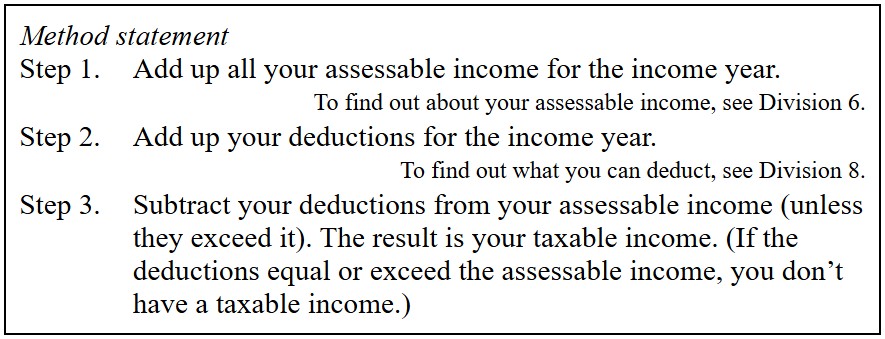
Division 6 sets out the general rules for the amounts to be included in assessable income. Section 6-25 provides:
6-25 Relationships among various rules about ordinary income
(1) Sometimes more than one rule includes an amount in your assessable income:
* the same amount may be *ordinary income and may also be included in your assessable income by one or more provisions about assessable income; or
* the same amount may be included in your assessable income by more than one provision about assessable income.
For a summary list of the provisions about assessable income,
see section 10-5.
However, the amount is included only once in your assessable income for an income year, and is then not included in your assessable income for any other income year.
(2) Unless the contrary intention appears, the provisions of this Act (outside this Part) prevail over the rules about *ordinary income.
Note: This Act contains some specific provisions about how far the rules about ordinary income prevail over the other provisions of this Act.
51 Three propositions emerge from the statutory scheme as it currently exists. First, income tax is imposed on taxable income, not on individual “particulars.” Income tax is not imposed on individual items of assessable income. Second, taxable income is an amount calculated in accordance with the ITAA 36 and ITAA 97 (the Assessment Acts). Third, if more than one rule provided in the Assessment Acts includes an amount in assessable income, the amount is to be included only once for an income year. This is essentially a rule of construction – the provisions of the Assessment Acts are not to be construed as requiring the same amount to be included in assessable income more than once. The statutory scheme does not support the proposition that merely because an amount is mistakenly included in assessable income (not in accordance with any of the rules), the rules for determining the correct amount of assessable income are thereby rendered inoperative.
52 The taxpayer contended that it was a necessary implication from s 6-25 that the Commissioner cannot include the same capital gain under the same section in a different year. The taxpayer’s contention proceeds from a false premise. Section 6-25 applies where more than one provision applies to include an amount in assessable income. It is not concerned with the power of the Commissioner to issue an assessment in order to give effect to the provisions of the Assessment Acts and has no application to a situation where an amount is mistakenly included in assessable income, on a basis that does not reflect the provisions of the Assessment Acts. There was no rule in the ITAA 97 or ITAA 36 that included the capital gain in the taxpayer’s assessable income in the 2020 Year. This is not a case where the provisions of the Assessment Acts require an amount to be included in more than one year of income. Whatever might be said of an implication that the provisions of the Assessment Acts are not to be construed as requiring the same amount to be included in a taxpayer’s assessable income more than once, in the present case the amount included in the original assessment for the 2020 Year was not included pursuant to or in accordance with any provision of the Assessment Acts.
53 The taxpayer seeks to invoke the conclusive evidence rule in s 350-10 of Sch 1 to the TAA (formerly s 177 of the ITAA 36) as somehow mandating that the original assessment for the 2020 Year must be taken to be conclusive evidence of the capital gain derived by the taxpayer from CGT event A1 happening on the disposal of the CGT Asset. Item 2 of the table in s 350-10(1) provides:
Conclusive evidence | ||
Item | Column 1 The production of … | Column 2 is conclusive evidence that … |
2 | a notice of *assessment under a *taxation law; | (a) the assessment was properly made; and (b) except in proceedings under Part IVC of this Act on a review or appeal relating to the assessment—the amounts and particulars of the assessment are correct |
54 The taxpayer appears to submit that the reference to “particulars of the assessment” has the result that a notice of assessment is conclusive evidence of some underlying “taxable fact”. That is, that the production of the notice of original assessment for the 2020 Year was conclusive evidence that the taxpayer had been correctly assessed on the capital gain made on the disposal of the CGT Asset.
55 That submission is not accepted. It seeks to accord a meaning and effect to item 2 of s 350-10 that is not supported by its language or context.
56 As the High Court observed in Commissioner of Taxation v Australia and New Zealand Savings Bank [1994] HCA 8; (1994) 181 CLR 466 (ANZ), the term “particulars” is used in the income tax legislation in a number of provisions but not necessarily with any consistency. As the High Court observed (at 477):
The place to be accorded "particular" and "particulars" within the Act may be discerned from a number of sections. Thus, [former] s.170(3) precludes the amendment of an assessment after three years "increasing the liability of the taxpayer in any particular" where there has been a full and true disclosure of all the material facts necessary for an assessment. [Former] [s]ection 177(1) makes the production of a notice of assessment “conclusive evidence of the due making of the assessment and ... that the amount and all the particulars of the assessment are correct”. The limitation imposed by [former] s.185(2) [now s 14ZV of the TAA] on the right of a taxpayer to object against an amended assessment has already been mentioned. But the terms are not used with a consistency that warrants the significance attached to them by the Federal Court. Furthermore, there is no basic distinction drawn between "particular" and "amount" in Pt IV of the Act [which included the former s 177]. And it may be noted that "amount" appeared in s.166 before "particular" was introduced in s.185(2).
57 The authorities that have considered the meaning of the term “particulars” must be read in their context. Authorities considering the term “particular” in the context of construing the taxpayer’s rights of objection to an amended assessment will not necessarily be relevant in ascertaining the correct construction of the term “particulars” in the context of the conclusive evidence rule now found in s 350-10 of the TAA.
58 As the learned primary judge explained, there may be some tension in the authorities concerning the scope of the term “particulars” as it appears in s 350-10 of the TAA (and in former s 177 of the ITAA 36). In that respect, we make the following observations:
(1) In McAndrew v Commissioner of Taxation [1956] HCA 62; (1956) 98 CLR 263, at 276 Kitto J cites Trautwein v Federal Commissioner of Taxation [1936] HCA 77; (1936) 56 CLR 63 as authority in support of his proposition that the “particulars” of the assessment encompasses the ingredients or constituent elements in the ascertainment of the amount of tax to be paid. The reference to “constituent elements” by Dixon and Evatt JJ at 107 in Trautwein was in the context of a taxpayer’s right to object to an amended assessment. As explained in ANZ, discussed above at paragraph [56], the term particulars is not used with consistency in the tax legislation, and its meaning in s 350-10 (and the former s 177) is not necessarily the same as in s 14ZV (or the former s 37, which was the particular predecessor of this provision of the Income Tax Assessment Act 1922-1934 (Cth) at issue in Trautwein).
(2) The decision of Hill J in Oates v Commissioner of Taxation (1990) 27 FCR 289 supports the proposition that a notice of assessment for a year of income does not preclude a claim for a carried forward loss in a later year of income. The conclusiveness accorded to a notice of assessment for one year of income does not affect or determine the correctness of an assessment for later years of income.
(3) The Court of Appeal in Platypus Leasing was not concerned with the year in which a notice of assessment is issued. The issue for the Court of Appeal was the extent to which the tender of a notice of assessment precluded a taxpayer from challenging the basis of that assessment outside Part IVC (by seeking declarations inconsistent with the assessment). The observations by the Court of Appeal on the temporal effect of the conclusive evidence rule were in the nature of obiter dicta.
(4) The decision in Chemical Trustee Ltd v Deputy Commissioner of Taxation [2014] FCAFC 27; (2014) 96 ATR 32 concerned debt recovery proceedings. The statements made in that case must be understood in context. It was not a case concerned with the construction of the term “particulars” in the context of the conclusive evidence rule. The taxpayer in that case had sought to invoke the conclusive evidence rule in support of a contention that the Commissioner was precluded from recovering under an amended assessment in circumstances where the Commissioner had recovered tax under the original assessment. Relevantly, the Full Court concluded (at [15]) that nothing in the conclusive evidence rule limited the Commissioner’s power to issue an amended assessment. Properly understood we do not consider Chemical Trustee to conflict with the observations in Platypus Leasing.
59 It is unnecessary in the present case to consider the extent to which there is a conflict in the authorities about whether the “particulars” of a notice of assessment extends to matters beyond those that appear on the face of the notice (being the date of issue, the amount of taxable income and the amount of tax payable).
60 Even if it be accepted that the term “particulars” refers to items of assessable income or allowable deductions, it does not extend to “taxable facts”. As Gageler J observed in Federal Commissioner of Taxation v Thomas [2018] HCA 31; (2018) 264 CLR 382:
[84] Tax lawyers often speak of "taxable facts". They mean by that expression to refer to more than just facts. They mean by it to refer to the combination of events that have occurred and legal consequences of events that have occurred on which a taxing statute fixes to impose a taxation liability or to confer a taxation benefit.
61 Taxable facts are not determined by a notice of assessment. The notice of assessment may reflect the Commissioner’s view of the legal consequences of the Commissioner’s understanding of the facts, but the notice of assessment is not evidence of the underlying facts. At most, the notice of assessment is conclusive evidence of the amounts of assessable income derived by a taxpayer and the amounts of deductions incurred by a taxpayer. This is consistent with the historical context of the former s 177 in Part IV of the ITAA 36, which as the High Court observed in ANZ, did not distinguish between “amounts” and “particulars”.
62 With due respect to the primary judge (at PJ [82]), we do not agree that the effect of Kitto J’s reasons in McAndrew (that “particulars” encompasses the elements which make up the Commissioner’s conclusion as to the taxpayer’s income and amount of tax payable) is that, as against the taxpayer, the original assessment for the 2020 Year is “conclusive” as to the underlying facts upon which the CGT liability was assessed. In referring to “particulars” as ingredients or constituent elements, Kitto J is referring to no more than elements of taxable income, whether they be amounts of deductions or assessable income. At most, a notice of assessment is evidence that a particular amount was an amount of assessable income or an amount of an allowable deduction.
63 In the present case, at most, the notice of the original assessment for the 2020 Year is conclusive evidence that the taxpayer was assessed on a taxable capital gain in that year. It is not evidence that CGT event A1 occurred in relation to a particular asset in that year of income. The existence of the original assessment for the 2020 Year does not prevent the Commissioner or a court from forming a view about the correct operation of the taxing statute on the “taxable facts” in a different year of income.
64 The proposition that the fact that a smaller amount has been incorrectly assessed in one year of income in some way precludes a correct assessment from being issued for a larger sum in another year of income is not consistent with authority. As Kitto J held in Country Magazine, the mere fact that an amount has been incorrectly included in assessable income in a different year (in that case, a prior year) and taxed accordingly, does not preclude the Commissioner from including that amount in taxable income in the correct year of income and collecting tax on that amount. As Kitto J stated (at 165-6) (citations omitted and paragraph formatting varied):
The argument in support of the appellant's case has been put in various ways, but I do not think that any of them has substance.
First it is said that money received cannot be income in more than one year, that the Arthur Murray Case and the judgment of Dixon J. in Carden's Case, Commissioner of Taxes (S.A.) v. Executor Trustee and Agency Co. of South Australia Ltd show that the question in which year it is income is to be answered according to accepted business and accounting principles, and that a recipient of money in the position of the present appellant, if he has treated the money as income of a year in which it was not income (according to those principles) must (according to those principles) treat it as not income of the year in which (according to those principles) it was income. Of course the argument was not put in this form of words, but this is what it seems to come to. I can only say that I know of no authority for it and I can see no logic in it. The witness, Mr. Faulks, who seemingly was called to establish it, so qualified his opinion in the end that there is no evidence that I could regard as supporting it. Even if there were I should not be at all ready to accept it.
Then the appellant contends that the Income Tax Assessment Act discloses an intention that an amount which, in an assessment, is (even mistakenly) included in a taxpayer's assessable income of one year of income shall not be included in his assessable income of another such year. This argument does not suggest that there is an estoppel against the Commissioner in such a case; it is purely an argument as to the interpretation of the Act. I must reject it, however, for the reason that I can find nothing in the Act to indicate any such intention. Various provisions have been referred to by counsel, but none of them seems to me to give any countenance to the notion.
Finally, it was argued that the Arthur Murray Case is to be distinguished on the ground that it shows only what is the result of applying ordinary commercial and accountancy practice in a case which is uncomplicated by the special feature of the present case, namely that the taxpayer treated the $10,480 as income in its 1965 return. … the Commissioner, in my opinion, is right in the broad answer that he gives, namely that the taxpayer cannot turn what is assessable income of one year into assessable income of a different year by including it in the wrong year's return. The Act requires that he include it in his return for the year of income in which he derived it as income, and he is not excused from doing so by the fact that, under a mistaken view as to when he derived it as income, he included it in his return for an earlier year. Likewise the Act obliges the Commissioner to assess tax in respect of all income which the taxpayer in fact derived in each year, and it gives him no discretion to leave any such income out of the assessment on the ground that the taxpayer mistakenly included that income in his return of the previous year and was taxed accordingly. If there is any remedy for the mistake it must be by means of an amendment of the previous year's assessment. Whether that assessment may or should be amended is a question which must be answered by reference to the specific provisions of the Act relating to amendments; but in its application to the appellant it is not a question which arises on this appeal.
65 In the present case, the taxpayer seeks to run a similar line of reasoning to that argued in Country Magazine. Although not seeking to rely upon some view of general business principles, the taxpayer instead seeks to invoke some principle that the scheme of the tax legislation requires that an amount only be assessed once and if included incorrectly in an assessment, that amount cannot be included correctly in another assessment for a different year. For the reasons given above, that proposition is not accepted.
66 The taxpayer seeks to rely upon Richardson’s case as support for the proposition that the scheme of the income tax legislation requires that a taxpayer be assessed to tax on an amount only once. The taxpayer draws on three sentences. The first sentence relied upon appears in the first instance decision of Starke J, where his Honour said (at 201):
The Income Tax Acts do not authorize the Commissioner to take income tax twice over in respect of the same source for the same period of time.
The second is a sentence that appears in Evatt J’s judgment on appeal, where his Honour said (at 212):
"One income, one taxpayer, one tax" is the general scheme of the Act.
The third is part of a sentence that appears in Dixon J’s judgment on appeal, where his Honour records (at 205):
…it is plain that two persons cannot be severally liable each in his own right to include in his individual assessment for the same year the same income.
67 Single sentences, much less parts of sentences, appearing in the reasons for judgment given in Richardson’s case cannot be read in isolation as support for some freestanding principle that the income tax legislation must be read as precluding the Commissioner from issuing an assessment that would otherwise be in accordance with the Assessment Acts because an incorrect assessment remains in existence for a different year of income.
68 Richardson’s case was analysed by the Full Court in Hyder v Commissioner of Taxation [2023] FCAFC 29; (2023) 297 FCR 124. For present purposes, it is to be observed that:
(1) The part of the sentence quoted from Dixon J’s reasons for judgment appears in his Honour’s summary of the taxpayer’s grounds of appeal. Read in context, it is not a statement of principle. The relevant principle was stated by Dixon J in the following terms (at 207):
…there is nothing in the character of the power given in sec. 37 or in the nature of the power of assessment which requires the formal alteration of the nominee's assessments before the alteration of the assessment of the taxpayer.
(2) The sentence quoted from Evatt J’s reasons was expressly recognised by Evatt J (in the immediately preceding sentence) as a general principle that could not be stated without qualification.
(3) As the decision in Richardson’s case made clear, there is no unqualified principle that required that tax not be levied more than once in respect of a particular amount. There was no prohibition on the Commissioner issuing an assessment to Mr Richardson for the same amount in the same year as had been assessed to Mr Collins but the Commissioner would be expected to apply the amount paid by Mr Collins against the tax owed by Mr Richardson and to amend the assessment issued to Mr Collins.
(4) The statements made in Richardson’s case about the general scheme of the Act must be read in light of the limitations provided for in the taxing statutes on the power to amend. As general statements, they may be useful as guides to the construction of the language of the legislation and useful guides to how the Commissioner might approach the exercise of any discretion. But they are not statements of free-standing principle that exist outside of the express terms of the legislation (including the power to issue amended assessments).
69 The taxpayer contends that Dixon J recognised in Richardson’s case that situations where more than one taxpayer have extant assessments in respect of the same amount were “no doubt attended with difficulty” and the solution proffered by the High Court lay in the amendment provisions. Because that solution was not available in the present case, the taxpayer contends that it follows that a result different from that endorsed by the High Court in Richardson’s case and Country Magazine should follow – with the result that the amended assessment for the 2019 Year be considered excessive. The logic of the proposition is illusive at best. The answer given by Kitto J to the third argument in Country Magazine (quoted above at [64]) remains applicable; namely, that the taxpayer cannot turn an amount that is correctly assessable in one year of income into an amount that cannot be assessed because the taxpayer has incorrectly included an incorrect amount in an earlier year of income. The Assessment Acts require the taxpayer to include the net capital gain of $2,390,624 in his assessable income for the 2019 Year, and he is not excused from doing so by the fact that, under some unexplained mistaken view, he included a capital gain of a much smaller sum in his assessable income for the 2020 Year and had been assessed on that smaller sum. Likewise, the Assessment Acts oblige the Commissioner to assess tax in respect of all income which the taxpayer is in fact taken to have derived in each year, and they give him no discretion to leave any such income out of the assessment on the ground that the taxpayer mistakenly included an amount in his return for a different year and was taxed accordingly. The correctness of those answers is not affected by whether any power to amend has lapsed.
70 The obligation of the Commissioner is to issue an assessment for each year of income that correctly assesses the taxpayer for that year. Income tax is imposed on an annual basis. In a scheme of annual taxation upon the income derived in each financial year, there cannot be any warrant for combining the results of more than one year in order to obtain the assessable income for a particular year of tax: Henderson v Federal Commissioner of Taxation [1970] HCA 62; (1970) 119 CLR 612. The fact that an amount may have been incorrectly assessed in a different year of income does not relieve the Commissioner from an obligation to correctly assess in another year of income.
71 In so far as the taxpayer’s constitutional arguments are concerned, it is not entirely clear how these relate to the grounds of objection. Subject to leave, a taxpayer on an appeal under Part IVC is limited to the grounds of objection: s 14ZZO of the TAA. Such an appeal is premised on the existence of a valid assessment. Part IVC proceedings are predicated on there being an assessment against which a taxpayer may object and the issue in such proceedings is whether the assessment was excessive: Deputy Commissioner of Taxation v Richard Walter Pty Ltd [1995] HCA 23; (1995) 183 CLR 168 at 187; F J Bloemen Pty Ltd v Federal Commissioner of Taxation [1978] 2 NSWLR 468 at 480; see further Kennedy v Administrative Appeals Tribunal [2008] FCAFC 124; (2008) 168 FCR 566.
72 Each of the propositions relied upon by the taxpayer is misconceived:
(1) Even if the law has the effect of rendering the same amount subject to tax more than once, it does not thereby cease to be a law with respect to taxation. A law imposing a compulsory exaction is a law with respect to taxation provided that the liability can be contested (in the sense that a taxpayer has a right to resist an assessment by proving in the courts that the criteria of liability were not satisfied, see for example, Giris Pty Ltd v Commissioner of Taxation [1969] HCA 5; (1969) 119 CLR 365 at 378-379 per Kitto J), the liability is imposed by reference to criteria which are sufficiently general in their application and which mark out the objects and subject-matter of the tax (see for example, MacCormick v Federal Commissioner of Taxation [1984] HCA 20; (1984) 158 CLR 622 at 639) and the impost is neither a penalty nor a fee for a service (or other like charges). The taxpayer did not identify any provision of the ITAA 36 or ITAA 97 which did not satisfy these criteria and did not identify how the application of the law to the facts resulted in the imposition of a liability that was capricious.
(2) In so far as judicial power is concerned, the Court in the present case is doing no more than construing the terms of the legislation and determining the legal rights and obligations of the parties, a quintessential judicial function. It is neither purporting to exercise nor is it exercising any form of executive power. The taxpayer’s characterisation of s 75(v) of the Constitution as guaranteeing a “right” to contest tax liability misunderstands the jurisdictional function performed by that provision and how jurisdiction is conferred on this Court to determine disputes as to liability.
73 The taxpayer’s appeal in relation to the amended assessment for the 2019 Year must be dismissed.
Cross-Appeal
74 The Commissioner’s first ground of cross-appeal is more in the nature of a notice of contention. For the reasons given above, the issue of the amended assessment for the 2019 Year was not precluded by the existence of the original assessment for the 2020 Year. As such, an amendment of the original assessment for the 2020 Year was not necessary in order to facilitate the issue of the amended assessment for the 2019 Year. The amended assessment for the 2020 Year is not supported on the premise that it was necessary to issue that amended assessment in order to issue the amended assessment for the 2019 Year.
75 The premise of the Commissioner’s alternative submission (that s 170(10AA) is engaged because giving effect to s 104-10(3) requires that the capital gain or loss from CGT event A1 be assessed only at the time the contract for the disposal is entered into) is not established by the facts in the present case.
76 Section 170(10AA) enables the Commissioner to amend an assessment where he would otherwise be out of time to do so. But the Commissioner’s power to so amend is conditional – the amendment must be (relevantly) “for the purpose of giving effect to[…] subsection 104-10(3)”. It is not a power to correct an error in the assessment of a capital gain. It is a power to give effect to the retrospective operation of s 104-10(3).
77 Section 104-10(3) relevantly provides that the time of CGT event A1 is when you enter into the contract for the disposal. But CGT event A1 only happens “if you dispose of a CGT asset” (s 104-10(1)). A disposal of a CGT asset occurs if there is a change in the ownership of the CGT asset. As the Commissioner and the taxpayer (in oral submissions addressing the cross-appeal) acknowledged, the original assessment for the 2020 Year did not include an amount of taxable income that was referable to the happening of CGT event A1. The precondition for the happening of CGT event A1 – the change of ownership of the CGT asset – had not occurred during the 2020 Year and was never deemed to have occurred during that financial year. Based on the agreed facts, whatever the capital gain included in the original assessment for the 2020 Year may have been referable to, it was not and could not be referable to the happening of CGT event A1.
78 The Commissioner’s submission is not supported by Metlife. Section 170(10AA) does not permit an amendment to an assessment that is otherwise out of time on the basis that the amendment relates in some way to the consequences of CGT event A1. The power to amend under s 170(10AA) is not a power to amend for the purposes of giving effect to s 104-10 generally. It is a power to amend only to give effect to the retrospective deeming of the time of the event by s 104-10(3). As the Full Court said in Metlife at [20] and [32]:
[20] However, an amendment taking account of a CGT event or an amendment that relates to the consequences of the CGT event is not one which is necessarily an amendment of an assessment “for the purposes of giving effect to” any of the provisions of the 1997 Act as set out in the table in s 170(10AA).
…
[32] ... It is not the case that once a CGT transaction has been backdated by s 104-10(3), s 170(10AA) is enlivened and allows amendments generally to the treatment of the CGT transaction by the Commissioner: in our judgment s 170(10AA) operates only to the extent necessary to backdate the transaction…
79 In the present case, the issue of the amended assessment for the 2020 Year was not for the purpose of giving effect to the deemed retrospective occurrence of CGT event A1. It was not an amendment that was made to carry s 104-10(3)’s operation into effect because the entering into, and settling, of the contract for the disposal of the CGT asset occurred at different times. At most, the amendment related to part of the capital proceeds that would be taken into account in calculating the capital gain made from CGT event A1. Such an amendment is not one made for the purpose of giving effect to s 104-10(3). The need to issue the amended assessment for the 2020 Year is not triggered by reason of the retrospective deeming effect of s 104-10(3). Instead, it was an amendment made to correct an error. Such an amendment is not supported by s 170(10AA).
80 The Commissioner’s cross-appeal is to be dismissed.
THE SOLUTION IDENTIFIED BY THE PRIMARY JUDGE
81 In our view, the primary judge was correct to observe that it was possible for the parties to ameliorate the consequences of the fact that, as a result of the amended assessment for the 2019 Year, and in the absence of an amendment to the original assessment for the 2020 Year, the taxpayer will be liable to pay more tax than he would have been liable to pay had he been correctly assessed for the 2020 Year. As the primary judge identified, it was open to the taxpayer to request that the Commissioner accept the lodgement of an objection to the original assessment for the 2020 Year out of time and for the Commissioner to allow that objection and give effect to that allowed objection by issuing an amended assessment for the 2020 Year. Such an amended assessment would not be time barred because item 6 of the table in s 170(1) would apply.
82 At the hearing, the Commissioner conceded that it would not be legally reasonable for him to refuse an extension of time for the taxpayer to lodge an objection to the original assessment for the 2020 Year, if the amended assessment for the 2019 Year was paid and having regard to the fact that he was willing to issue the amended assessment for the 2020 Year. The Commissioner also conceded that the original assessment for the 2020 Year was wrong. It included an amount as a capital gain that was not in accordance with the Assessment Acts.
83 The taxpayer submits that the solution identified by the primary judge was not available because:
(1) The taxpayer did not seek to object to the original assessment for the 2020 Year because he was not “dissatisfied” with it (and therefore s 175A of the ITAA 36 was not engaged).
(2) Item 6 of the table in s 170(1) applied only if the taxpayer objected within the amendment period otherwise provided for in s 170(1).
84 Neither of those submissions is accepted.
85 The first is a problem of the taxpayer’s own making and entirely within the taxpayer’s control. Although accepting that the original assessment for the 2020 Year is excessive by reason of the incorrect inclusion of a capital gain that has no basis under Part 3-1 of the ITAA 97, the taxpayer contends that he is not dissatisfied with the admittedly incorrect original assessment for the 2020 Year and therefore does not object against it. The only reason why the taxpayer is not “dissatisfied” with the incorrect original assessment is because whilst that assessment is on foot, the taxpayer contends the Commissioner is precluded from collecting on the amended assessment for the 2019 Year. As senior counsel for the taxpayer candidly submitted:
MR ROBERTSON: We don’t want to object against it. We’re not dissatisfied with it.
HESPE J: You’re not dissatisfied with an assessment you know is wrong.
MR ROBERTSON: Of course not.
…
HESPE J: And why aren’t you dissatisfied with an assessment that you know has no legal foundation and is wrong?
MR ROBERTSON: Because it happens to be, in our case, in less than an amount of the capital gain.
And in reply:
MR ROBERTSON: And the other final point is that the client is not dissatisfied with the assessment at the present time, and that situation may change as a result of what’s happening, but we also point out another reason why the client is not dissatisfied is because the Commissioner, we say, can’t collect on the second assessment.
86 The state of the taxpayer’s “dissatisfaction” with the incorrect original assessment for the 2020 Year may well be subject to change.
87 The taxpayer’s second submission concerning item 6 of the table in s 170(1) finds no support in the statutory language or in the authorities. Post-hearing, the taxpayer referred the Court to the following authorities:
Stevenson v Federal Commissioner of Taxation (1991) 29 FCR 282 at 299;
Epov v Federal Commissioner of Taxation [2007] FCAFC 139; (2007) 244 ALR 334 at [34]; and
Ziegler v Commissioner of Taxation [2025] FCAFC 168; (2025) 313 FCR 574 at [66].
88 None of those cases support the taxpayer’s position.
89 In so far as relevant, Stevenson considered the power of the Tribunal under an earlier enactment of s 170 to amend an assessment to increase taxable income above the amount assessed by the Commissioner. The years of income in that case concerned the years ended 30 June 1981 to 1986. At that time, s 170(7) provided:
Nothing contained in this section shall prevent the amendment of any assessment in order to give effect to the decision upon any appeal or review, or its amendment by way of reduction in any particular in pursuance of an objection made by the taxpayer or pending any appeal or review.
90 The Court considered the meaning of the phrase “to give effect to a decision on review or appeal”. In obiter the Court observed that this wording “manifests a clear legislative intention that the time which elapses between a decision by the Commissioner on an objection against an assessment and the amendment of that assessment ‘in order to give effect to the decision upon any review’ is not to be included in the measurement of the periods ordained by other provisions of that section.” The Court went on to observe that “s 170(3) operated to deny the Commissioner, at the time he made his decision on objection, the power he would have if the prescribed period of three years had not elapsed of increasing the liability of the applicant on his consideration of the objection” (at 300).
91 The decision in Stevenson concerned the power under what was then s 170(7) to amend an assessment “to give effect to a decision of the Tribunal on review”. It did not consider the power the Commissioner has to amend an assessment “as a result of an objection made by a taxpayer or pending review or appeal” (now item 6(b)). The facts in Stevenson did not engage the second limb of what was then s 170(7) because that second limb only permitted an amendment by way of reduction whereas the facts in Stevenson concerned a proposed increase to an assessment. The solution identified by the primary judge would invoke item 6(b) of the table in s 170(1) and not item 6(a) of that table. The decision in Stevenson does not support the taxpayer’s contentions.
92 In Epov, a taxpayer had submitted that the Commissioner did not have the power to issue an amended assessment in respect of a year of income (being the year of income ended 30 June 1997) when there was already an appeal to this Court on foot against an appealable objection decision made by the Commissioner on a Part IVC objection lodged by the taxpayer against the original assessment of income for that same year. In the course of rejecting that submission, the Court observed that:
[34] The substance of the appellant’s contention was that the operation of s 170 of the ITAA 1936 and, in particular, the respondent’s power of amendment, was somehow stayed or otherwise rendered inoperable if a taxpayer had instituted proceedings under Pt IVC of the TAA. The express words of s 170 are directly contrary to that contention. Subject to the limitations I have identified, it permitted the respondent to amend the assessment at any time. The terms of s 170(7) did not lead to a different conclusion. It did not, as the appellant contended, limit the respondent’s power of amendment when Pt IVC proceedings were on foot only to those circumstances described in that section. Section 170(7) did not operate as a limit on the other subsections. Section 170(7) contained an additional power to permit the respondent to issue an amended assessment even if the time-limits otherwise prescribed in s 170 had expired and, then, only in the most limited of circumstances: to give effect to a decision of a court or tribunal or to reduce the assessable income of a taxpayer as a result of an objection, appeal or review. The existence of that power does not result in the reading down of the other provisions of s 170 in the manner contended for by the appellant.
93 As that reasoning makes apparent, each of the provisions within s 170 operates according to its terms. In Epov, s 170(7) did not limit the power of the Commissioner to amend under other provisions of s 170. So too, unless expressly otherwise provided, item 6(b) of the table in s 170(1) is not to be read down merely because of the existence of other powers to amend. Nothing in Epov supports the taxpayer’s contentions.
94 The decision in Ziegler relevantly concerned the power of the Commissioner to amend a penalty assessment. The Full Court held (at [66]):
Section 14ZY does not expressly or impliedly confer a power to amend a penalty assessment. Section 14ZY applies to all taxation objections, including assessments of tax. The power to amend a tax assessment as a result of an objection is conferred by item 6 in s 170(1) of the ITAA 1936. There is no equivalent express power in relation to assessments of administrative penalties. Contrary to Aurora (No 2), s 14ZY does not contain an implied power to amend a penalty assessment.
95 Nothing in Ziegler supports the taxpayer’s proposition that the amendment power in item 6 in s 170(1) is limited in the manner suggested by the taxpayer.
DISPOSITION
96 The appeal and cross-appeal are to be dismissed.
COSTS
97 Section 43 of the Federal Court of Australia Act 1976 (Cth) (FCA) provides the Court with a very broad discretion in respect of costs: Culley v Australian Securities and Investment Commission (No 2) [2010] FCAFC 70 at [12]. Costs are compensatory in nature, not punitive: Latoudis v Casey [1990] HCA 59; (1990) 170 CLR 534 at 543, 563 and 567. The exercise of the discretion is guided by settled and established principles: Northern Territory v Sangare [2019] HCA 25; (2019) 265 CLR 164 at [24].
98 An important factor guiding the exercise of the costs discretion, is the result of the litigation, the ‘event’. The ‘event’ is usually referred to as the overall outcome of the case: Queensland North Australia Pty Ltd v Takeovers Panel (No 2) [2015] FCAFC 128; (2015) 236 FCR 370 at [16]. Sometimes, the ‘event’ may be contestable, where separate issues have fallen in different ways: Plaintiff M76/2013 v Minister for Immigration, Multicultural Affairs and Citizenship [2013] HCA 53; (2013) 251 CLR 322 at [241]. However, it has been said that there are “good reasons not to encourage applications regarding costs on an issue-by-issue basis, involving apportionments based on degrees of difficulty of issues, time taken to argue them and the like”: Firebird Global Master Fund II Ltd v Republic of Nauru (No 2) [2015] HCA 53; (2015) 327 ALR 192 at [6]. Generally, if costs are to be allocated relating to the issues involved, a broad brush approach based on matters of impression and evaluation should be undertaken: Ridge Estate Pty Ltd v Fairfield Pastoral Holdings Pty Ltd [2024] FCAFC 17; (2024) 302 FCR 375 at [206].
99 The taxpayer was unsuccessful in his appeal.
100 The Commissioner was unsuccessful in his cross-appeal.
101 Rather than order any costs effectively on an issues basis (being one order for the costs of the appeal and one for the costs of the cross-appeal) we propose to take an impressionistic, evaluative, broad brush approach to costs. Having regard to the course of the hearing and the relative time occupied by the issues on the appeal, that evaluation results in the taxpayer being ordered to pay 90% of the Commissioner’s costs of the proceeding.
I certify that the preceding one hundred and one (101) numbered paragraphs are a true copy of the Reasons for Judgment of the Honourable Justices Hespe, Stellios and Wheatley. |
Associate:
Dated: 1 October 2026


