

Federal Court of Australia
Frugtniet v Mansfield (Trustee), in the matter of Frugtniet [2026] FCAFC 105
Appeal from: | Mansfield (Trustee), in the matter of Frugtniet v Frugtniet [2025] FCA 803 Mansfield (Trustee), in the matter of Frugtniet v Frugtniet (Reopening Application) [2025] FCA 804 |
File number: | NSD 1388 of 2025 |
Judgment of: | FEUTRILL, OWENS AND WHEATLEY JJ |
Date of judgment: | 20 August 2026 |
Catchwords: | EVIDENCE – section 304 of the Duties Act 1997 (NSW) – inadmissibility of unstamped instrument – discretion to admit if transmitted to the Chief Commissioner in accordance with arrangements approved by the court – meaning of ‘transmitted’ – meaning of ‘arrangements approved by the court’ – appellant undertaking to pay duty and transmit instrument to Chief Commissioner – appellant impecunious – whether court bound to accept undertaking and admit the instrument – whether court bound to disregard likelihood of actual payment of duty – whether evidence sufficient to conclude compliance with undertaking unlikely EVIDENCE – section 304 of the Duties Act 1997 (NSW) –unstamped instrument ruled inadmissible – whether instrument subsequently stamped and admissible – whether evidence sufficient to find that the previously unstamped instrument had been ‘duly stamped’ or ‘stamped by the Chief Commissioner or in a manner approved by the Chief Commissioner’ PRACTICE AND PROCEDURE – reopening – applicable principles – interests of the proper administration of justice – finality of litigation – prejudice – – delay – public interest in expedition of bankruptcy proceedings – unstamped instrument ruled inadmissible – reopening sought to tender instrument after asserted stamping – authenticity of instrument contested – fact of stamping of instrument contested – inadequate explanation of delay stamping instrument – insufficient forensic utility of reopening without recalling witnesses – recalling witnesses otherwise necessary – in all the circumstances reopening not warranted EQUITY – resulting trusts – objective intention – presumptions – voluntary conveyance – payment of purchase money – advancement – parent and child – conveyance from parent to child – child contribution to purchase money by way of bank loans – parental contribution to purchase money by way of payment of deposits and transaction costs – parental residence in certain properties – parental management of properties and receipt of rents from third parties – rents used to repay bank loans – objective intention of advancement in all the circumstances – no resulting trusts in favour of parents |
Legislation: | Bankruptcy Act 1966 (Cth) ss 31, 58, 116 Federal Court of Australia Act 1976 (Cth) ss 24, 37M Federal Court Rules 2011 (Cth) rr 4.12, 39.32 Conveyancing Act 1919 (NSW) s 23C Duties Act 1997 (NSW) Chs 2, 7, 8, 8AA, 9, 10, 11; Pts 1, 2, 3, 4, 5, 6, 7, 8; ss 8, 9, 11, 12, 13, 15, 16, 18, 19, 20, 21, 32, 58, 61, 62, 62A, 62B, 287, 288, 289, 289A, 290, 297, 301, 304, 307 Interpretation Act 1987 (NSW) ss 9, 33, 34 Stamp Duties Act 1898 (NSW) s 15 Stamp Duties Act 1920 (NSW) ss 27, 29 State Debt Recovery Act 2018 (NSW) s 29 Taxation Administration Act 1996 (NSW) Pts 5, 6, 9; Div 2; ss 8, 9, 10, 11, 14, 37, 42, 43, 44, 95, 107, 119 Uniform Civil Procedure Rules 2005 (NSW) rr 31.13, 31.14 |
Cases cited: | Acclaim Holdings Pty Ltd v Vlado Pty Ltd (1989) 1 WAR 128 Ash Street Properties Pty Ltd v Pollnow [1987] 9 NSWLR 80 Australian Receivables Ltd v Tekitu Pty Ltd [2012] NSWSC 170; 260 FLR 243 Australian Securities and Investments Commission v Rich [2006] NSWSC 826; 235 ALR 587 Black Uhlans Incorporated v Crime Commission (NSW) [2002] NSWSC 1060 Bloch v Bloch [1981] HCA 56; 180 CLR 390 Bosanac v Federal Commissioner of Taxation [2022] HCA 34; 275 CLR 37 Bryant v Commonwealth Bank of Australia [1996] HCA 3; 134 ALR 460 Calverley v Green [1984] HCA 81; 155 CLR 242 Chief Commissioner of State Revenue (NSW) v Benidorm Pty Ltd [2020] NSWCA 285; 104 NSWLR 232 Chief Commissioner of State Revenue (NSW) v Platinum Investment Management Ltd [2011] NSWCA 48; 80 NSWLR 240 Commonwealth v Davis Samuel Pty Ltd (No 7) [2013] ACTSC 146; 282 FLR 1 Currie v Hamilton [1984] 1 NSWLR 687 Dent v Moore [1919] HCA 11; 26 CLR 316 Dimmock v Whymark (1965) 65 SR (NSW) 194 El-Debel v Micheletto [2021] FCAFC 117; 153 ACSR 15 Fineglow Pty Ltd v Anastasopoulos [2002] NSWSC 1181; 57 NSWLR 39 Flint v Richard Busuttil & Co Pty Ltd [2013] FCAFC 131; 216 FCR 375 Halloran v Minister Administering National Parks and Wildlife Act 1974 [2006] HCA 3; 224 ALR 79 House v The King [1936] HCA 40; 55 CLR 499 Inspector-General in Bankruptcy v Bradshaw [2006] FCA 22 Kia Ora Gold Corporation NL v Washer [1982] WAR 306 Mackwell v Petkovic (1999) 20 WAR 367 Minister for Aboriginal Affairs v Peko-Wallsend Ltd [1986] HCA 40; 162 CLR 24 Murray v Figge (1974) 4 ALR 612 Nelson v Nelson [1995] HCA 25; 184 CLR 538 Palmanova Pty Ltd v Commonwealth of Australia [2025] HCA 35; 424 ALR 768 Ralston v South Greta Colliery Co (1912) 13 SR (NSW) 6 Re Coolgardie Goldfields Ltd [1900] 1 Ch 475 Re Meyer (1906) 23 WN (NSW) 55 Sangora Holdings Pty Ltd v Dunstan (1996) 16 WAR 552 Shepherd v Felt and Textiles of Australia (1931) 45 CLR 359 Spotlight Pty Ltd v NCON Australia Ltd [2012] VSCA 232; 46 VR 1 St Barnabas Nominees Pty Ltd v Stallard Corp Pty Ltd [2011] WASC 261; 43 WAR 477 Urban Transport Authority (NSW) v Nweiser (1992) 28 NSWLR 471 |
Division: | General Division |
Registry: | New South Wales |
National Practice Area: | Commercial and Corporations |
Sub-area: | General and Personal Insolvency |
Number of paragraphs: | 156 |
Date of hearing: | 10 March 2026 |
Counsel for the Appellants: | Mr D Robertson (pro bono) |
Solicitor for the Appellants: | Sydney Law Practice |
Counsel for the Respondent: | Mr J Hynes |
Solicitor for the Respondent: | Bird & Bird |
ORDERS
NSD 1388 of 2025 | ||
| ||
BETWEEN: | BRIAN FRUGTNIET First Appellant SUZANNE FRUGTNIET Second Appellant | |
AND: | DAVID IAN MANSFIELD IN HIS CAPACITY AS TRUSTEE FOR THE BANKRUPT ESTATE OF JEROME FRUGTNIET Respondent | |
order made by: | FEUTRILL, OWENS AND WHEATLEY JJ |
DATE OF ORDER: | 20 August 2026 |
THE COURT ORDERS THAT:
1. The appeal be dismissed.
2. The appellants pay the respondent’s costs of the appeal to be taxed.
Note: Entry of orders is dealt with in Rule 39.32 of the Federal Court Rules 2011.
REASONS FOR JUDGMENT
THE COURT:
Introduction
1 The respondent is the trustee in bankruptcy of Mr Jerome Frugtniet. In the proceeding before the primary judge the respondent applied for declaratory and other relief to the effect that four real properties vested in him, as trustee in bankruptcy, at the date of his appointment. The appellants (who are the bankrupt’s parents) opposed the respondent’s application on the ground that the bankrupt held three of the properties in trust for the first appellant (his father) and one of the properties in trust for the second appellant (his mother). The appellants asserted the trusts were constructive trusts based on a common intention or joint endeavour, alternatively express trusts based on a deed of trust, alternatively resulting trusts based on contribution to the purchase money or transfer of ownership of the properties. The primary judge rejected all the appellants’ grounds of opposition and substantially granted the respondent the relief he sought in the proceeding: Mansfield (Trustee), in the matter of Frugtniet v Frugtniet [2025] FCA 803 (FJ).
2 As to the asserted express trusts, the authenticity of the asserted deed of trust was in issue in the proceeding below and the respondent objected to the appellants tendering that document under s 304(1) of the Duties Act 1997 (NSW) on the ground the instrument was unstamped. The first appellant gave a written undertaking to pay any duty payable on the trust deed, but the primary judge refused to admit the instrument into evidence under s 304(2)(a) of the Duties Act on the ground that he was not satisfied that the first appellant would comply with the undertaking. As a consequence, it was not necessary for the primary judge to consider the appellants’ ground of opposition based on the asserted express trust: FJ at [31]-[43]. After the trial, when judgment was reserved, the appellants applied for leave to reopen the proceeding for the purpose of tendering the asserted trust deed on the basis that it had been stamped after judgment was reserved. The primary judge dismissed that interlocutory application and published separate reasons for so doing: Mansfield (Trustee), in the matter of Frugtniet v Frugtniet (Reopening Application) [2025] FCA 804 (IJ).
3 The appellants appeal from the primary judge’s final judgment on the grounds that his Honour erroneously excluded the asserted trust deed from evidence and erroneously refused to allow them to reopen to tender that instrument after it was stamped. Alternatively, they appeal on grounds to the effect that the primary judge erred in his application of the legal principles concerning resulting trusts and in failing to conclude that the bankrupt held the relevant properties on resulting trust for the appellants.
4 Grounds 1A and 1B of the further amended notice of appeal concern the asserted errors relating to non-admission of the asserted trust deed and refusal to reopen. In the appellants’ further amended notice of appeal they purport to appeal from the primary judge’s final judgment and the interlocutory judgment dismissing their application to reopen. To the extent that the notice of appeal purports to appeal directly from the primary judge’s interlocutory order, the notice is incompetent because leave to appeal directly from an interlocutory order is necessary and has neither been sought nor obtained: s 24(1A) of the Federal Court of Australia Act 1976 (Cth). Nonetheless, the fact that there has been, or can be, no appeal from an interlocutory judgment does not prevent a party from founding an appeal from a final judgment in the proceeding on the interlocutory judgment or the Court from taking account of the interlocutory judgment in determining an appeal from a final judgment: s 24(1E). Therefore, while the form of the notice of appeal suggests the appeal is, in part, from an interlocutory order, it is evident from the grounds of appeal and the appellants’ submissions that, in substance, the appeal from the interlocutory order is an appeal from the final judgment on grounds that include asserted errors in the interlocutory order. Therefore, notwithstanding a suggestion in the respondent’s submissions to the contrary, the appeal from the interlocutory judgment falls within s 24(1E) and leave is not required to include grounds 1A and 1B in the notice of appeal.
5 However, as each of grounds 1A and 1B challenge the exercise of a discretionary power of the primary judge, these grounds invoke the well-established principles set out in House v The King [1936] HCA 40; 55 CLR 499 at 504-505. Therefore, it is not enough that we (as an appellate court) consider that, if we had been in the position of the primary judge, we would have taken a different course. It must appear that some error has been made in exercising the discretion. In this respect, we must be satisfied that the primary judge acted upon a wrong principle, took into account irrelevant considerations, disregarded a relevant consideration or mistook the facts. If so, we may review the determination and may re-exercise the discretion, if we have the materials for doing so, and substitute our decision for that of the primary judge.
6 In the case of ground 1A, the appellants contend the primary judge made two errors of the relevant kind that engage an appellate court’s power to review. First, it is contended that the primary judge acted upon the wrong principle or took into account an irrelevant consideration in that his Honour took into account whether there will be actual payment of any duty in the exercise of the discretion under s 304(2)(a) of the Duties Act. Second, it is contended that if actual payment is a relevant consideration, there was no evidence before the primary judge from which his Honour could have concluded that any duty would not be paid and, therefore, he acted on a mistake of fact.
7 In the case of ground 1B, the appellants contend that the primary judge erred in dismissing their application to reopen for reasons that included that the asserted trust deed had not, at the time of the application, been ‘duly stamped’ under the eDuties system. That is, the appellants contend the primary judge acted on a mistake of fact because, as a matter of fact and law, the asserted trust deed had been ‘duly stamped’ for the purposes of the Duties Act at the time the application to reopen was determined.
8 Grounds 2, 3 and 4 of the further amended notice of appeal assert errors relating to the primary judge’s failure to find that the relevant properties were held by the bankrupt on resulting trusts for the appellants. Ground 2 was not pressed and grounds 3 and 4 boil down to contentions that the primary judge misapplied the ‘presumption of advancement’ by ignoring objective evidence of the appellants’ intentions and failing to find that the appellants had not intended to transfer or purchase the relevant properties as gifts to the bankrupt. The appellants contend that this Court should set aside the primary judge’s judgment and declare that the relevant properties are held by the bankrupt on resulting trust for the appellants.
9 From the grounds of appeal and the parties’ submissions the following emerge as the principal issues for determination in the appeal.
(1) Was the primary judge bound to disregard the ability of the first appellant to pay the duty and any interest and penalty payable under the Duties Act as a factor to be taken into account in the exercise of the power to admit an instrument in evidence conferred under s 304(2)(a) of the Duties Act?
(2) If not, was there insufficient evidence for the primary judge to find that the first appellant would not be able to pay the duty and any interest and penalty payable on the asserted trust deed and would not comply with the undertaking the first appellant proffered to the Court at the trial?
(3) If not, as a matter of fact and law was the trust deed ‘duly stamped’ or ‘stamped by the Chief Commissioner or in a manner approved by the Chief Commissioner’ and, therefore, admissible under s 304(1) of the Duties Act as at the date of dismissing the interlocutory application to reopen the proceeding?
(4) If all the preceding questions are answered unfavourably to the appellants, on the facts as found, was there a misapplication of the presumption of advancement by the primary judge?
(5) If the primary judge made any of the asserted errors, what, if any, orders should be made in the appeal?
Was there insufficient evidence to find that duty would not be paid?
10 Although the issue of whether actual payment of duty, interest and penalty was a factor the primary judge was bound to disregard is logically anterior, it is convenient to start with the evidentiary issue because addressing that issue provides the background within which to understand all issues in the appeal.
The appellants’ case before the primary judge
11 The respondent filed an originating application in which, amongst other relief, he sought a declaration under s 31(1)(f) and s 58 of the Bankruptcy Act 1966 (Cth) that each of the relevant properties had vested in him on 11 February 2021 (the date of his appointment). The relevant properties are described in the primary judge’s reasons as the First Rosehill Property, the Lidcombe Property, the Second Rosehill Property and the Mount Druitt Property: FJ [8]-[15]. The proceeding was evidently commenced because the appellants claimed that the bankrupt held the relevant properties in trust for them as beneficiaries. However, as the primary judge observed, there was a long history of correspondence between the appellants and the respondent in which the grounds upon which the appellants asserted the existence of trusts evolved over time: FJ [31]-[32].
12 Before commencing the proceeding the respondent called for any evidence to support the appellants’ asserted beneficial ownership of the properties. Initially the first appellant asserted that the relevant properties were held on constructive trust. Later he claimed a new family trust had been created and that, subject to approval of finance from a bank, the properties were to be transferred to the new trustee. The appellants offered inspection of documents pertaining to the constructive trust arrangements. Then, by a letter dated 14 December 2021, the appellants provided the respondent with a copy of the asserted trust deed: FJ [31]-[32].
13 There was also a degree of evolution in the appellants’ grounds of opposition filed in the proceeding. Initially, they asserted that the relevant properties were held by the bankrupt on constructive trust for the appellants and sought a counter-declaration to the effect that the properties be transferred to a corporate trustee that had been established. Later, the appellants filed a document described as grounds of opposition. That document was signed by their legal representative and in it the appellants claimed that the First and Second Rosehill Properties and Mount Druitt Property were held in trust for the first appellant and the Lidcombe Property was held in trust for the second appellant. Eventually, the basis for those trusts apparently emerged as the asserted express trusts, alternatively constructive trusts, alternatively resulting trusts: FJ [25].
The asserted trust deed as an instrument that effects a dutiable transaction
14 The asserted trust deed is dated 2 September 2014. It is expressed to be between ‘Brian Worrell Frugtniet’ (first appellant) and ‘Jerome Bryan Frugtniet’ (bankrupt). It identifies the first appellant’s address as the First Rosehill Property and the bankrupt’s address as the Lidcombe Property.
15 The asserted trust deed recites that ‘at the request of the [first appellant] the [bankrupt] has purchased or acquired in the name of the [bankrupt] but on trust for the [first appellant] the real properties listed in Schedule A and subject to the trusts hereinafter declared’. It also recites that the ‘[first appellant] has paid the whole of the purchase money or application money for the real properties upon the purchase of the same by the [bankrupt]’. Schedule A lists the addresses of each of the four relevant properties.
16 The operative provisions of the asserted trust deed commence with ‘NOW THIS DEED WITNESSETH that the parties hereto mutually declare covenant and agree as follows’. After that preamble there are six numbered clauses. Relevantly, cl 1 provides that the ‘[bankrupt] holds the real properties in trust for the [first appellant] absolutely and the [bankrupt] shall forthwith pay to the [first appellant] the amount of all rents in respect of the real properties’. The document purports to be signed by the first appellant and the bankrupt in the presence of the same witness.
17 At the date of the asserted trust deed, Ch 2 of the Duties Act charged duty on certain transactions including ‘a declaration of trust over dutiable property’: s 8(1)(b)(ii). Such a transaction was a ‘dutiable transaction’ for the purposes of the Duties Act: s 8(2). Land in New South Wales was dutiable property: s 11(1)(a). A ‘declaration of trust’ meant ‘any declaration (other than by a will or testamentary instrument) that any identified property vested in the person making the declaration is or is to be held in trust for the person or persons, or the purpose or purposes, mentioned in the declaration although the beneficial owner of the property, or the person entitled to appoint the property, may not have joined in or assented to the declaration’: s 8(3).
18 The duty charged on a declaration of trust was to be charged as if the declaration of trust was a transfer of dutiable property: s 9(1). The property transferred was taken to be the property vested or to be vested in the declarant. The transferee was taken to be the person declaring the trust. The transfer of the property was taken to occur at the time when the declaration was made: s 9(2). Section 12 described when a liability for duty charged by Ch 2 arose. Duty charged was payable by the transferee: s 13. A transferee who was liable to pay duty in respect of a dutiable transaction was obliged to lodge with the Chief Commissioner the written instrument that effected the dutiable transaction within three months of the liability arising: s 16.
19 The general rate of duty chargeable on a dutiable transaction was based on the dutiable value of the dutiable property as was set out in s 32: s 19. Dutiable value was described in s 21.
20 It follows that the asserted trust deed, if authentic, was an instrument that effected a dutiable transaction.
Section 304 of the Duties Act
21 Section 304 of the Duties Act provides, relevantly:
304 Receipt of instruments in evidence
(1) An instrument that effects a dutiable transaction or is chargeable with duty under this Act is not available for use in law or equity for any purpose and may not be presented in evidence in a court or tribunal exercising civil jurisdiction unless—
(a) it is duly stamped, or
(b) it is stamped by the Chief Commissioner or in a manner approved by the Chief Commissioner.
(2) A court or tribunal may admit in evidence an instrument that effects a dutiable transaction, or is chargeable with duty in accordance with the provisions of this Act, and that does not comply with subsection (1)—
(a) if the instrument is after its admission transmitted to the Chief Commissioner in accordance with arrangements approved by the court or tribunal, or
(b) if (where the person who produces the instrument is not the person liable to pay the duty) the name and address of the person so liable is forwarded, together with the instrument, to the Chief Commissioner in accordance with arrangements approved by the court or tribunal.
…
The respondent’s objection to admissibility of the asserted trust deed
22 Although the letter of 14 December 2021 and the asserted trust deed were attached to an affidavit of the respondent filed before the commencement of the trial, the respondent contested the authenticity of that document. The declarations the respondent sought in the originating process were, in part, to negate the existence of the trusts purportedly expressed in the asserted trust deed.
23 The bankrupt denied signing the asserted trust deed and there were a number of features of that instrument and the circumstances in which it was produced to the respondent that called into question its authenticity. First, the instrument was produced after a significant delay in the respondent requesting evidence of the existence of the asserted trusts. Second, the trusts declared in the instrument were inconsistent with the ‘constructive trust agreement’ asserted in the appellants’ grounds of opposition by which it was contended that the first appellant was the beneficial owner of the First and Second Rosehill Properties and Mount Druitt Property and the second appellant was the beneficial owner of the Lidcombe Property. Third, at the date of the instrument, the bankrupt was the registered proprietor of only the First Rosehill Property. He became the registered proprietor of the Lidcombe Property on 18 December 2014 and the Second Rosehill Property and Mount Druitt Property on 13 January 2016: FJ [8]-[15]. Fourth, the purchase money for the properties was substantially funded by loans financial institutions made to the bankrupt that were secured by registered mortgages over the properties. That is, contrary to the recitals, the first appellant had not paid the whole of the purchase money or application money for the properties: FJ [8]-[16], [52]. Many of these matters were explored in the respondent’s cross-examination of the appellants. The primary judge did not find the appellants’ explanations convincing: FJ [32].
24 While it is evident that the respondent had initially intended tendering the asserted trust deed as part of his case, he changed his mind. On the first day of the trial the respondent submitted that the trust deed was a declaration of trust within the meaning of s 8(1)(b)(ii) of the Duties Act and, as such, was a dutiable transaction. Further, as there was no evidence that the document had been stamped, the document was not admissible in evidence in the proceeding under s 304(1) of the Duties Act. The appellants accepted that the trust deed was subject to s 304(1) of the Duties Act and, otherwise, it was not in issue that, if the document were authentic, it was a ‘declaration of trust’ for the purposes of s 8(1)(b)(ii) of the Duties Act. However, the appellants argued, amongst other things, that the trust deed should be admitted for the purpose of determining the authenticity of that document because if it were not authentic no duty would be payable as no dutiable transaction would be effected by that document.
25 The primary judge received the trust deed into evidence provisionally and on the basis that the admissibility of the document would be resolved at a later point in the trial. The trial was then adjourned, part heard, without the issue of the admissibility of the trust deed having been resolved. When the trial resumed, the appellants indicated that they wanted to call two further witnesses to address the authenticity of the deed of trust which had plainly been under attack during the cross-examination of the appellants. However, before calling those witnesses, it was necessary to resolve the admissibility of the trust deed under s 304 of the Duties Act.
26 Self-evidently, neither the bankrupt nor the respondent considered that the bankrupt was liable to pay duty on any ‘declaration of trust’ because the authenticity of the trust deed was contested. Therefore, while the bankrupt was arguably ‘the person declaring the trust’ under the trust deed, he had not lodged the instrument with the Chief Commissioner and it may be assumed he had no intention of doing so. In those circumstances, as the operative provisions were expressed as mutual declarations, the appellants evidently accepted that the first appellant was a person liable to pay the duty charged on the dutiable transaction as a ‘transferee’ under s 9 and s 13 and a person required to lodge the instrument with the Chief Commissioner in accordance with s 16 of the Duties Act. Accordingly, the appellants filed an affidavit of the second appellant in which she deposed that she had submitted an application to ‘Infotrack who outsourced it to Sydney Legal Agents’ and that she would ‘provide the stamped Trust Deed as soon as [she] receive[d] it’. The affidavit annexed a copy of emails from ‘helpdesk@infotrack.com.au to frugtniet@gmail.com’ dated 25 June 2025. The facts deposed and document annexed were evidently intended to prove that the trust deed had been submitted to the Chief Commissioner for stamping.
27 The respondent submitted that the issue that the asserted trust deed was not stamped had been raised two months earlier on the first day of the trial, the instrument remained unstamped and the primary judge could not be satisfied that there would be compliance with the arrangements described in s 304(2)(a). In substance, the respondent argued and the primary judge accepted that the question of whether the instrument would be stamped under any arrangements approved by the Court was one of the factors the Court should take into account in exercising the power to admit the instrument. The first appellant then proffered a handwritten undertaking to the Court by which he undertook ‘to pay the stamp duty on the trust deed dated 2 September 2014 to the revenue office of New South Wales’. The respondent maintained his objection to the admissibility of the asserted trust deed and, amongst other things, argued that the Court should not accept the first appellant’s undertaking on the ground that the first appellant was impecunious and there would not be compliance with the undertaking. In substance, the appellants submitted that the Court could admit the instrument on the basis that it would be transmitted to the Chief Commissioner in accordance with the first appellant’s undertaking and, insofar as non-payment of duty was concerned, that was a risk for the first appellant upon sanction of the Court.
The primary judge’s ruling
28 The primary judge ruled the asserted trust deed inadmissible under s 304(1) and refused to admit it under s 304(2)(a) and said:
… for reasons which I will elaborate on in due course, I’m not satisfied as to the arrangements for the payment of duty, and therefore, I will not admit the purported trust deed. That being the case, the evidence, which is additional evidence, which the respondents seek to rely on is not relevant, and I don’t allow that evidence.
29 In the primary judge’s reasons for final judgment, after setting out and explaining the effect of the applicable provisions of the Duties Act, his Honour provided the elaboration of his reasons for not admitting the asserted trust deed in evidence under s 304(2)(a) of the Duties Act: FJ [39]-[42].
30 The primary judge found that the first appellant was impecunious and there was little prospect that the first appellant would be able to pay the stamp duty on an ad valorem basis. His Honour said that the ‘result is that I was not satisfied, and could not possibly be satisfied, that the stamp duty would be paid’. Therefore, his Honour was not satisfied that the trust deed would be either ‘duly stamped’ or ‘stamped by the Chief Commissioner or in a manner approved by the Chief Commissioner’ for the purposes of s 304(1) of the Duties Act in circumstances where s 288 of that Act provides that the Chief Commissioner will stamp an instrument when duty ‘is paid in full’: FJ [40].
31 The primary judge then identified a divergence in the authorities regarding the effect of admitting an unstamped document into evidence under one of the exceptions in s 304(2) of the Duties Act: FJ [41]. Although not entirely clear, his Honour evidently was of the view that in the case of a trial, as opposed to interlocutory hearing, although a document may be admitted into evidence upon the tendering party giving an undertaking, the Court would not be able to order any final relief until the document had been stamped for the purposes of s 304(1) of the Duties Act. Accordingly, the primary judge observed that the ‘upshot [of the divergent authorities] is that it is likely that [the first appellant’s] inability to pay any ad valorem duty would result in the deed being of no utility to the [appellants’] case, notwithstanding the proffering of an undertaking to pay the duty’: FJ [41].
32 In addition to the first appellant’s impecuniosity the primary judge was not satisfied that the first appellant would comply with the undertaking because the trust deed had not been stamped notwithstanding that the appellants had been on notice of the deficiency for sufficient time to have made the necessary arrangements but had failed, without explanation, to do so before the trial commenced: FJ [42]. His Honour then said:
… I saw no reason why they should be afforded additional time, in particular given how they had previously failed to abide by various timetabling and procedural orders since 2023 when the matter was in a Registrar’s docket, and the delay in the ultimate hearing of the case. “[T]he public interest in the protection of the revenue rises above any of the private interests of parties to litigation”: Arnautovic & Sutherland t/as Jirsch Sutherland & Co v Cvitanovic [2011] FCA 809; 199 FCR 1 at [77] per Katzmann J citing Dent v Moore [[1919] HCA 11; 26 CLR 316] at 330. It is important to give effect to the prohibition in s 304(1) and not avoid its effect merely because a party proffers an undertaking which, on further scrutiny, may not be efficacious in facilitating the assessment of revenue – that is part of the role of the Court in “approving” the arrangements in question.
The first appellant’s ability to comply with the proffered undertaking
33 The appellants contend that the primary judge was in error for taking into account the impecuniosity of the first appellant and concluding that there was little prospect that he would be able to pay the ad valorem duty in circumstances in which there was no evidence as to the amount or likely amount of duty payable upon stamping the trust deed. Therefore, so the appellants contend, there was no evidence for the finding that the first appellant would not be able to pay the amount of duty payable and comply with the undertaking he proffered to the Court. The appellants’ contentions are not accepted.
34 The appellants, as the parties proffering the undertaking to the Court, had the onus of proving or satisfying the Court that the undertaking formed part of an arrangement the Court should accept for the purposes of s 304(2)(a) of the Duties Act. In circumstances in which the first appellant had made an affidavit in which he deposed facts to the effect that he was impecunious and that evidence had resulted in the primary judge providing a pro bono referral certificate under r 4.12 of the Federal Court Rules 2011 (Cth) (FJ [40]), it was incumbent upon the appellants to adduce evidence of the likely amount of duty, interest and any penalty and his ability to pay such amounts. It was for the appellants to demonstrate that the undertaking was likely to be ‘efficacious in facilitating the assessment [and payment] of revenue’. They had not done so at the time the primary judge made his Honour’s ruling during the trial.
35 In the course of the argument concerning the admissibility of the asserted trust deed the primary judge observed that it was his Honour’s understanding that the first appellant might be liable for paying any duty and that the duty was ‘likely to be quite a lot’. The appellants made no submission to the effect that nominal or reduced duty was payable on the instrument for some reason or other. In the absence of any other evidence or submission, the primary judge was entitled to consider and take into account that the amount of duty payable on the instrument was likely to be substantial and neither nominal nor reduced.
36 No error has been demonstrated in the primary judge’s finding that the first appellant was ‘impecunious’, that there was ‘little prospect that [the first appellant] would be able to pay the stamp duty on an ad valorem basis’ or that his Honour ‘was not satisfied that the proffered undertaking to pay any duty would be able to be complied with’. The second limb of ground 1A fails.
Was actual payment of duty a factor the primary judge was bound to disregard?
37 In the first limb of ground 1A the appellants contend that, on the proper construction of s 304(2)(a) of the Duties Act, that provision operates where a court is satisfied that, after its admission into evidence, the instrument will be transmitted to the Chief Commissioner in accordance with arrangements approved by a court. There is no further requirement that the court be satisfied that any duty assessed on the instrument will be paid. The appellants’ argument might be seen to operate at two levels.
(1) The appellants contended that, in determining the ‘arrangements’ relating to transmission of an instrument that it would approve, a court may not include arrangements directed to ensuring the actual payment of the duty that may be assessed. (Alternatively, the court may not, in the exercise of its discretion to approve particular arrangements, refuse approval on the ground that the arrangements will not result in the actual payment of the duty owing.) The relevant ‘arrangements’, it was said, are confined to those directed only to ensuring that the instrument is provided to the Chief Commissioner.
(2) If the arrangements approved by a court are complied with, and the instrument is provided to the Chief Commissioner, then the fact that the duty has not been, or may not be, paid is not a relevant consideration in the court’s decision whether to admit the document into evidence.
38 Both arguments are concerned with the bounds of a discretion conferred on the court. In relation to the first, the court has a discretion as to the content of the arrangements that it approves (or whether it approves particular arrangements). In relation to the second, section 304(2)(a) provides that a court or tribunal may admit in evidence an instrument that effects a dutiable transaction that does not comply with s 304(1) if the instrument is after its admission transmitted to the Chief Commissioner in accordance with arrangements approved by the court or tribunal. The use of the word ‘may’ to confer a power indicates that the power may be exercised or not, at discretion: s 9(1) of the Interpretation Act 1987 (NSW).
39 The factors that a decision-maker is bound to take into account or bound to disregard in the exercise of a discretionary power are determined by construction of the legislation conferring the discretion. If the relevant factors are not expressly stated, they must be determined from the subject-matter, scope and purpose of the Act. Where legislation confers a discretion which is in its terms unconfined, the factors that may be taken into account in the exercise of the discretion are similarly unconfined, except in so far as there may be found in the subject-matter, scope and purpose of the legislation some implied limitation on the factors to which the decision-maker may legitimately have regard: Minister for Aboriginal Affairs v Peko-Wallsend Ltd [1986] HCA 40; 162 CLR 24 at 39-40 (Mason J).
40 It follows that, in substance, the appellants contend that either expressly or by implication from the subject-matter, scope and purpose of the Duties Act, the primary judge was bound to disregard the extent to which duty, interest and penalty would be or was likely to be paid as a factor to be taken into account in the exercise of the discretion conferred by s 304(2)(a). For the reasons that follow, the Duties Act contains no such express or implied limitation.
Applicable principles of statutory interpretation
41 The applicable principles of statutory interpretation are well established and, for the purposes of this appeal, may be shortly summarised as follows. While the analysis of the meaning of a provision in a statute or legislative instrument starts and finishes with the text, the text must be considered in context and having regard to the legislative purpose. The modern approach to statutory interpretation insists that context, in its widest sense to include such things as the existing state of the law and the mischief which the statute was intended to remedy, be considered in the first instance not merely when ambiguity might be thought to arise: Palmanova Pty Ltd v Commonwealth of Australia [2025] HCA 35; 424 ALR 768 at [4]-[5] (Gageler CJ, Gordon, Jagot and Beech-Jones JJ). Where different interpretations are open, the interpretation that would best achieve the purpose or object of the Act is to be preferred to each other interpretation: s 33 of the Interpretation Act (NSW). To that end, material not forming part of the Act that is capable of assisting in the ascertainment of the meaning of the provision to be considered may be taken into account, either to confirm the ordinary meaning of the provision or to determine the meaning in cases where meaning is ambiguous, obscure, absurd or unreasonable: s 34 of the Interpretation Act (NSW).
42 In the case of the Duties Act, the legislative context, history and purpose or object of the legislation favours, if anything, an implication that actual payment of the applicable duty, interest and penalty payable upon a dutiable transaction effected by an instrument is a factor that a court or tribunal is bound to take into account rather than disregard in the exercise of the discretion under s 304(2)(a) of the Duties Act to determine approved arrangements (or approve determined arrangements), or to admit an unstamped instrument in evidence. At the very least, these matters do not exclude a court or tribunal taking into account the extent to which actual payment of the duty, interest and penalty will be or is likely to be achieved under any approved arrangements as a factor, if not the decisive factor, in the exercise of the discretion to admit an instrument in evidence and (or) the formulation of approved arrangements.
Legislative context
43 The principal charging provisions are contained in Ch 2 Pt 1 of the Duties Act. The provisions most relevant to charging duty on the transaction effected by the trust deed have been set out and summarised earlier in these reasons: ss 8, 9, 11, 12, 13, 16, 19 and 21 of the Duties Act.
44 As already mentioned, the duty charged by Ch 2 is payable by the transferee, unless the Chapter requires another person to pay the duty: s 13. A transferee who is liable to pay duty in respect of a dutiable transaction must, within three months of the liability arising, lodge with the Chief Commissioner the written instrument(s) that effect(s) the dutiable transaction, or where not effected by a written instrument a written statement the transferee is required to make in accordance with s 15: s 16. Duty is charged on the dutiable value of the dutiable property subject to the dutiable transaction at the relevant rate set out in Ch 2 Pt 3: s 19. Part 2 contains provisions describing and calculating the ‘dutiable value’ of dutiable property. Part 3 contains provisions setting out the rate of duty chargeable on dutiable transactions.
45 Where duty has been paid on a dutiable transaction nominal or reduced duty is imposed on certain instruments, transfers, declarations of trust and transactions in respect of marketable securities so as to avoid double taxation: s 18. There are also numerous provisions dealing with concessions and exemptions from duty in Pts 6, 7 and 8: s 20. Otherwise, Pt 4 contains provisions relating to the abolition of certain duties and Pt 5 contains special provisions relating to certain kinds of transactions. Additionally, Chs 7, 8, 9 and 10 make provision to charge duty on mortgages in certain circumstances, general and life insurance premiums and policies, registration of motor vehicles and duplicates, counterparts and replicas of instruments and Ch 11 further exemptions and concessions.
46 Separately, the Taxation Administration Act 1996 (NSW) makes general provision with respect to the administration and enforcement of taxation laws in New South Wales including the Duties Act. The Chief Commissioner has general power to make an assessment and re-assessment of the tax liability of a taxpayer: s 8, s 9. A person who is liable to pay tax under a taxation law must, before or at the time an assessment of the tax liability is made, fully and truly disclose to the Chief Commissioner all the facts and circumstances affecting the tax liability under the relevant taxation law: s 10(1). The Chief Commissioner may issue a notice of assessment (showing the amount of the assessment): s 14(1). If a tax default occurs the taxpayer is liable to pay interest on the amount of tax unpaid and penalty tax under the provisions of Pt 5. A notice of assessment of a taxpayer’s liability issued following a default by the taxpayer must specify any interest and penalty tax payable by the taxpayer under Pt 5 or s 95 in respect of the default.
47 The Chief Commissioner may make an assessment on the information the Chief Commissioner has from any source at the time the assessment is made: s 11(1). Under Pt 9 the Chief Commissioner has powers of investigation for the purposes of a taxation law. Self-evidently, the exercise of those powers may lead to an assessment of tax, interest and penalty where there has been a tax default. Production of a notice of assessment, or of a document signed by the Chief Commissioner purporting to be a copy of a notice of assessment is conclusive evidence of the due making of the assessment and conclusive evidence that the amount and all particulars of the assessment are correct, except in objection or review proceedings when it is prima facie evidence only: s 119.
48 Section 43 of the Taxation Administration Act (NSW) provides that tax that is payable is payable to the Chief Commissioner. If the whole or part of tax payable by a taxpayer is not paid to the Chief Commissioner as required by a notice of assessment, the amount unpaid is a debt payable to the Chief Commissioner by the taxpayer: s 44(1). Tax must be paid to the Chief Commissioner using a method approved by the Chief Commissioner: s 107(1). If a tax debt is not paid the Chief Commissioner may make a debt recovery order and invoke the debt recovery procedures under the State Debt Recovery Act 2018 (NSW). That procedure can lead to a property seizure order, a garnishee order, or registration of a charge on land with respect to a taxpayer.
49 Section 288 of the Duties Act provides that the Chief Commissioner must stamp an instrument in respect of which duty is chargeable under that Act, or that effects or evidences a dutiable transaction, and that has been lodged for stamping with the Chief Commissioner if the duty, and any interest or penalty tax under Pt 5 of the Taxation Administration Act (NSW) is paid in full. For the purposes of the Taxation Administration Act, the stamping of an instrument by the Chief Commissioner is taken to constitute an assessment of the duty payable under the Duties Act in respect of the instrument or the dutiable transaction effected or evidenced by that instrument: s 297(1) of the Duties Act. If the Chief Commissioner does not issue a notice of assessment at the time that the instrument is stamped, the stamped instrument is taken, for the purposes of the Taxation Administration Act, to be a notice of assessment: s 297(2) of the Duties Act. Accordingly, an instrument will not be stamped unless and until any duty, interest and penalty has been paid in full. Therefore, where a taxpayer has failed to lodge an instrument with the Chief Commissioner and the Chief Commissioner makes an assessment of duty, interest and penalty with respect to a dutiable transaction effected by that instrument, the instrument may not be stamped if the taxpayer fails to pay the amount of the assessment and the Chief Commissioner is not able to recover the full amount of the assessment through a debt recovery procedure.
50 Chapter 11 Pt 2 of the Duties Act contains additional non-fiscal provisions relating to enforcement of a taxpayer’s liability to pay duty, interest and penalty that have the effect of depriving the dutiable transactions of utility for certain purposes unless an instrument that effects the dutiable transaction is appropriately stamped. Section 301(1) prevents registration of legal or beneficial interests in dutiable property in a register of such property. Section 307(1) confers power on the Chief Commissioner to impound an instrument that ought to be but is not stamped or sufficiently stamped. Section 304, set out earlier in these reasons, limits use of the instrument in law or equity and evidence in a court or tribunal.
51 It follows that the legislative context is a firm indication that the purposes of the Duties Act and related Taxation Administration Act (NSW) include ensuring compliance and payment of duty, interest and penalties on dutiable transactions and depriving instruments that effect such transactions of legal and practical utility unless the instrument is stamped. The creation of an exception that would permit an unstamped document to be admitted into evidence in accordance with an arrangement approved by a court or tribunal that will not, or may not, result in payment of duty, interest and penalty would undermine and be inconsistent with those purposes.
Legislative history
52 The Duties Act is the latest enactment in a series of statutes the progenitor of which was an English statute enacted in 1654. Stamp duty was originally a temporary measure that became a permanent impost and means of raising revenue in England and Wales and, in time, in each of the colonies and later States and Territories of Australia: Chief Commissioner of State Revenue (NSW) v Benidorm Pty Ltd [2020] NSWCA 285; 104 NSWLR 232 at [46]-[53] (Leeming JA, Meagher and Payne JJA agreeing). In New South Wales there have been three Acts, the Stamp Duties Act 1898 (NSW), the Stamp Duties Act 1920 (NSW) and the Duties Act. Provisions directed at enforcement and precluding the admission into evidence of unstamped documents were a feature of these statutes from inception: see, e.g., Stamp Duties Act 1898 s 15; Stamp Duties Act 1920 s 27; St Barnabas Nominees Pty Ltd v Stallard Corp Pty Ltd [2011] WASC 261; 43 WAR 477 at [15] (Edelman J). While the Duties Act represents a departure from the approach taken for centuries by imposing duty on transactions rather than on instruments (vellum, parchment and paper), it continues to disclose much drafting dating from the time when the predecessor legislation imposed a tax on instruments. Therefore, in general, authorities concerning the interpretation of materially similar provisions under the predecessor legislation should be applied: Benidorm at [84], [91]-[93]; Chief Commissioner of State Revenue (NSW) v Platinum Investment Management Ltd [2011] NSWCA 48; 80 NSWLR 240 at [67]-[83] (Handley AJA, Macfarlan JA agreeing).
53 Section 29(1) of the Stamp Duties Act 1920, the equivalent of s 304(1) of the Duties Act, provided:
29 Inadmissibility of unstamped and other instruments
(1) Except as aforesaid, no instrument executed in New South Wales or relating (wheresoever executed) to any property situate or to any matter or thing done or to be done in any part of New South Wales, shall, except in criminal proceedings, be pleaded or given in evidence, or admitted to be good, useful, or available in law or equity for any purpose whatsoever, unless it is duly stamped in accordance with the law in force at the time when it was first executed: Provided that any instrument chargeable with duty before the appointed day shall be deemed to be duly stamped in accordance with the law in force at the time when it was first executed, notwithstanding that the duty chargeable on such instrument is denoted in terms of the currency provided for by Part II of the Currency Act 1965 of the Parliament of the Commonwealth of Australia or any Act passed in amendment of or substitution for the same.
54 Section 15 of the Stamp Duties Act 1898 provided that ‘no unstamped instrument shall, except in criminal proceedings, be admissible in evidence, or available or effectual for any purpose whatsoever in law or equity’. The meaning of that provision was not considered open to reasonable doubt in Dent v Moore [1919] HCA 11; 26 CLR 316 at 324-325 (Barton, Isaacs and Rich JJ).
The Legislature by way of securing the payment of the impost for public purposes, which is placed on the instrument, provides in effect that the sanction of law shall be withheld from the acts of the parties until the revenue law is obeyed. It lies at the root of all contractual obligation that the mere convention of the parties creates no binding tie between them. It is the law operating on their compact—either the common law or some Statute—which creates the obligatory relation that one can enforce against the other. But here, acting impersonally on the bargain finally embodied in an “instrument,” and therefore contained nowhere else, it strikes that instrument with sterility (to borrow an expression from another branch of the law) unless and until the public requirement of taxation has been complied with. Until that has happened, the instrument (except in criminal proceedings) is not “available” and not “effectual”—that is, it has no effect—for any purpose whatsoever at law or in equity: in other words, it cannot be considered as an instrument giving title, or as one which could be made the means of compelling anyone to give title. It is in the eye of the law a nullity, except for criminal proceedings and, of course, for the purpose of being stamped.
Further, once the court was made aware that a document was an ‘unstamped instrument’ and it was sought to be made ‘available’ or ‘effectual’ it was the duty of the court to withhold judicial power, which it only exerts with the authority of the State, and which in the instance of s 15 of the Stamp Duties Act 1898 had directed shall not be exerted: Dent v Moore at 327. Section 29(1) of the Stamp Duties Act 1920 and the equivalent provision in the stamp acts of the other States was interpreted consistently with the High Court’s view of s 15 of the Stamp Duties Act 1898: e.g., Ash Street Properties Pty Ltd v Pollnow [1987] 9 NSWLR 80 at 82 (Mahoney JA), 100 (Priestley JA, Samuels JA agreeing); Acclaim Holdings Pty Ltd v Vlado Pty Ltd (1989) 1 WAR 128 at 131 (Wallace J), 133-135 (Kennedy J); Halloran v Minister Administering National Parks and Wildlife Act 1974 [2006] HCA 3; 224 ALR 79 at [22] (Gleeson CJ, Gummow, Kirby and Hayne JJ).
55 Section 27 of the Stamp Duties Act 1920, the equivalent of s 304(2)(a) of the Duties Act, provided:
27 Terms on which unstamped or insufficiently stamped instruments may be received in evidence
(1) On the production of an instrument chargeable with stamp duty as evidence in any court of civil judicature, the officer whose duty it is to read the instrument shall call the attention of the Judge to any omission or insufficiency of the stamp thereon, and if the instrument is one which may legally be stamped after execution it may, on payment to such officer of the amount of the unpaid duty and the fine payable by law, be received in evidence, saving all just exceptions on other grounds.
(2) Such officer shall detain and immediately transmit to the Chief Commissioner the instrument, together with the duty and fine so paid thereon, and the payment thereof shall be denoted on such instrument accordingly.
56 Notwithstanding the terms of s 27 of the Stamp Duties Act 1920, it was a well-established practice of courts in New South Wales, other States of Australia and England to receive an unstamped document into evidence upon the undertaking of the solicitor for the party tendering the document to have the document stamped: Sangora Holdings Pty Ltd v Dunstan (1996) 16 WAR 552 at 555 (Rowland J); Kia Ora Gold Corporation NL v Washer [1982] WAR 306 at 309 (Kennedy J); St Barnabas Nominees at [15]-[22] (Edelman J); Dimmock v Whymark (1965) 65 SR (NSW) 194 at 196 (Manning J); Re Meyer (1906) 23 WN (NSW) 55 (Darley CJ); Ralston v South Greta Colliery Co (1912) 13 SR (NSW) 6 (Cullen CJ); Re Coolgardie Goldfields Ltd [1900] 1 Ch 475 at 478-479 (Cozens-Hardy J). That practice continues to be reflected in r 31.14(1) of the Uniform Civil Procedure Rules 2005 (NSW). The practice and the rationale for it was summarised by Cozens-Hardy J in Re Coolgardie Goldfields Ltd (at 478-479) in the following manner:
… The advantages of the practice are obvious. It was not always easy to settle at once what is the amount of the stamp duty, and, moreover, it may well be that when the amount required is known the case is not at the moment in court. It would be in the last degree inconvenient and undesirable to direct an action to stand over in the middle of the trial in order that a document might be stamped. The Court, therefore, accepts the undertaking of its own officer that the document shall be stamped before the order is drawn up as satisfying the obligations of the statute. The Court looks to its own officer, and leaves that officer to claim indemnity from his own client.
57 However, as Kennedy J also observed in Kia Ora Gold Corporation at 309, the practice did not exist for the benefit of the other party, it was a rule of convenience which, at the same time, protected the revenue. Moreover, a judge may have insisted on production of the stamped document before delivering judgment in the action: Sangora Holdings at 555.
58 Section 29(4) of the Stamp Duties Act 1920, the equivalent of s 304(2)(b) of the Duties Act, provided:
29 Inadmissibility of unstamped and other instruments
…
(4) Sections 27 and 28 and this section do not apply to an instrument or a copy of an instrument tendered as evidence on behalf of a party (not being a person who is primarily liable to duty in respect of the instrument) if the court is satisfied:
(a) that the party has informed, or will in accordance with arrangements approved by the court inform, the Chief Commissioner of the name of the person primarily liable to duty in respect of the instrument, and
(b) that the party will, in accordance with arrangements approved by the court, lodge the instrument or a copy of the instrument with the Chief Commissioner.
59 Section 29(4) of the Stamp Duties Act 1920 was enacted in its first form in 1990. Similar provisions were also enacted in other States. That provision ameliorated the apparent harshness of the operation of s 29(1) and s 27 where the party producing the document was not the person liable to pay the duty and any fine on the instrument. In the case of that provision, it was sufficient for the party tendering the document to give an undertaking to the court to inform the Chief Commissioner of the name of the person primarily liable to duty in respect of the instrument and lodge a copy of the instrument with the Chief Commissioner: r 31.14(2) of the UCPR; Mackwell v Petkovic (1999) 20 WAR 367 at 378-379 (Malcolm CJ, Ipp and Steytler JJ).
Legislative purpose or object
60 It is clear that the purpose of s 304(1) of the Duties Act and earlier provisions like s 29(1) of the Stamp Duties Act 1920 is to sterilise the instrument for use to vindicate legal or equitable rights of which the instrument was evidence until the instrument is stamped in accordance with the provisions of the Duties Act: Dent v Moore at 324. Under the earlier provisions like s 27 of the Stamp Duties Act 1920 payment of the amount of the unpaid duty and fine in court, detention of the instrument and transmission of the instrument together with the unpaid duty and fine to the Chief Commissioner was an exception to the requirement that the instrument be ‘duly stamped’ to be pleaded, given in evidence or admitted to be good, useful, or available in law or equity for any purpose: see, e.g., Shepherd v Felt and Textiles of Australia (1931) 45 CLR 359 at 383 (Dixon J). The payment was to be denoted on the instrument transmitted to the Chief Commissioner. In other words, the instrument could be received in evidence if, for all intents and purposes, the instrument had been stamped. An undertaking by a solicitor as an officer of the court was accepted by the court as equivalent to the procedure described in s 27 of the Stamp Duties Act 1920 because the substantive effect of the solicitor’s undertaking was that the court received the duty and fine, detained the instrument and transmitted the instrument and duty and fine to the Chief Commissioner.
61 The concept of transmission of the instrument to the Chief Commissioner after it is admitted into evidence is preserved in s 304(2)(a) of the Duties Act. The instrument, if admitted into evidence, will be in the possession or custody of the court. Therefore, s 304(2)(a) continues to contemplate that the court will transmit the instrument to the Chief Commissioner under arrangements approved by the court. Further, the use of the verb ‘transmit’ in s 304(2)(a) is to be contrasted with the verb ‘lodge’ used in s 16. That is, s 304(2)(a) is not directed to the person liable to pay duty lodging the instrument with the Chief Commissioner but to transmitting the instrument (in the custody of the court or tribunal) to the Chief Commissioner.
62 The concept of transmission after receipt into evidence in s 304(2)(a) is also to be contrasted with the concept of forwarding the name and address of the person liable to pay the duty and the instrument to the Chief Commissioner in s 304(2)(b). The use of ‘forward’ in s 304(2)(b) indicates that the provision is directed to providing information to the Chief Commissioner. Section 304(2)(b) also omits the qualification ‘after its admission’. Thus, s 304(2)(b) of the Duties Act reflects the effect of s 29(4) of the Stamp Duties Act 1920.
63 It follows that the structure and text of s 304(1) and s 304(2) do not suggest that s 304 was intended to effect any significant departure from the well-established and long-standing practice of courts in New South Wales to admit unstamped documents in evidence as exceptions to s 29(1) under arrangements approved by the court. These were undertakings by which the court could be reasonably satisfied, where the party tendering the instrument was liable to pay the duty, that the duty and any fine would be paid and the instrument stamped and, where the party tendering was not liable to pay the duty, that the Chief Commissioner would be informed of the name of the person so liable and provided with the instrument such that the Chief Commissioner could take appropriate steps to recover the amount of the duty and fine from the person liable to pay that amount.
64 Notwithstanding these observations, r 31.13(1) of the UCPR, in effect, provides that an undertaking of the party, not the party’s solicitor, to transmit the instrument to the Chief Commissioner is an arrangement approved by the court. Further, unlike the solicitor’s undertaking under r 31.14(1), the undertaking under r 31.13(1) does not require the party to undertake to ‘cause the duty and fine … to be paid’. However, it is implicit in an undertaking given by a party to transmit the instrument to the Chief Commissioner, in effect on behalf of the court, that the party so transmitting will pay any duty, interest and penalty arising from transmission of the instrument to the Chief Commissioner. The party is not undertaking to ‘lodge’ the instrument with the Chief Commissioner. Of course, these rules of court cannot control the proper construction of the statute. But they reflect, in any event, a practice consistent with the construction we have identified.
65 If transmission of the instrument were equivalent to mere lodgement of the instrument, an undertaking to transmit an instrument would do no more than provide the Chief Commissioner with the instrument and make the Chief Commissioner aware of the person liable to pay the duty, interest and penalty and would reduce s 304(2)(a) to essentially the same requirement as s 304(2)(b). Moreover, it would be contrary to the evident purpose of s 304(1) to permit the person liable to pay the duty to tender an instrument effecting a dutiable transaction for the purpose of proving a legal or equitable right without requiring that person to pay the applicable duty, interest and penalty with respect to the dutiable transaction such that the Chief Commissioner must stamp the instrument. To do so would undermine the revenue and permit the person to take advantage of their own wrong.
Use of unstamped instruments admitted in evidence
66 Having regard to the legislative context, history and purpose or object, it is implicit that for an instrument to be ‘transmitted to the Chief Commissioner’ within the meaning of s 304(2)(a) the instrument together with the duty, interest and penalty is to be conveyed to the Chief Commissioner. It follows that it cannot be said to be impermissible for a court to determine the content of arrangements for transmission of an instrument to the Chief Commissioner that include matters directed to ensuring the actual payment of any duty to be assessed (or to refuse to approve arrangements that are not likely to result in the actual payment of duty). That is, a mere undertaking of a party to transmit the instrument to the Chief Commissioner and pay the duty, interest and penalty may or may not be an arrangement that is effective to ‘transmit’ the instrument to the Chief Commissioner within the meaning of ‘transmit’ in s 304(2)(a) of the Duties Act. If the person giving the undertaking is unable or unlikely to be able to pay the applicable duty, interest and penalty plainly the instrument will not be stamped in accordance with s 288 of the Duties Act and the revenue will be undermined if the instrument is then able to be used to found relief claimed or a defence asserted by the tendering party in the proceeding.
67 As the primary judge observed, there are divergent authorities of single judges of the New South Wales Supreme Court regarding the consequences of admitting an unstamped instrument in evidence under s 304(2) of the Duties Act: FJ [41] citing Fineglow Pty Ltd v Anastasopoulos [2002] NSWSC 1181; 57 NSWLR 39 at [36]-[37] (Palmer J). As his Honour explained:
41 … One view is that the unstamped instrument is admissible in evidence but not for “use in law or equity for any purpose” as said at s 304(1) – ie, a “nullity” incapable of bearing upon title pending its stamping: see Reliance Financial Services Pty Ltd v Baddock [2002] NSWSC 857 at [46] per Young CJ in Eq and Dent v Moore [1919] HCA 11; 26 CLR 316 at 324. The other is that the giving of an undertaking under subss (2) and (3) creates an exception allowing general use as “there would be no point in admitting the unstamped document into evidence if the court could not make use of it”: see Weston v Metro Apartments Pty Ltd [2002] NSWSC 682 at [20] per Campbell J. This debate “still appears to remain unresolved”: Mathews v Council of the Shire of Gunnedah [2010] NSWSC 412 at [7] per Ball J (although his Honour in that case followed the view of Campbell J, accepting an undertaking on an interlocutory basis). …
68 None of the authorities to which the primary judge had reference, except Fineglow, concerned final relief. These authorities concerned interlocutory injunctions or extensions of caveats where, relevantly, the issue is whether there is a serious question to be tried arising from a transaction effected by an unstamped instrument. Fineglow concerned final relief, but, because of the way the issues in that case were decided, it was not necessary for Palmer J to resolve the divergent authority.
69 For the purposes of this appeal, it is also not necessary to resolve the divergent authorities regarding the use of an unstamped instrument. On either line of authority, the applicable construction of s 304 does not support an implication that a court or tribunal is bound to disregard actual payment of duty, interest and penalty as a factor to be taken into account in the exercise of either of the discretions in issue. Indeed, each line of authority suggests the opposite and that actual payment is an important and relevant consideration to give effect to the evident purpose and object of the Duties Act.
70 If an instrument admitted in evidence under s 304(2)(a) has no effect in law or equity under s 304(1) until it is stamped, then there would be no point in admitting the instrument in evidence if there will not be payment of the duty, interest and penalty. On the other hand, if an instrument admitted in evidence under s 304(2)(a) may be used by a court to found final relief in law or equity even if not ultimately stamped, then admitting an instrument into evidence that will not be stamped would permit the tendering party to take advantage of its wrong and undermine the revenue and purpose of s 304(1).
71 Consistently with the view that actual payment may be a relevant consideration, without reference to the ‘divergent authorities’, in Australian Receivables Ltd v Tekitu Pty Ltd [2012] NSWSC 170; 260 FLR 243 at [22], [168]-[169], Ward J admitted an unstamped instrument in evidence upon the tendering party’s undertaking to submit it to the Commissioner for stamping as necessary. However, her Honour withheld final relief until satisfied that there had been compliance with the undertaking. Otherwise, the relief was substantially founded on the terms of the unstamped instrument. Therefore, the extent to which there was actual payment of duty, interest and penalty was a relevant consideration in Tekitu as a condition of the arrangement the court approved for ‘transmission’ of the instrument to the Chief Commissioner.
No express or implied exclusion of actual payment as a relevant factor
72 The appellants’ construction of s 304(2)(a) effectively reduces the factors relevant to the exercise of the discretionary powers conferred by the provision to a single factor; namely, the effective provision of the instrument to the Chief Commissioner. We do not accept the appellants’ contentions for a number of reasons.
73 To the extent the relevant discretion is that relating to the determination of the content of arrangements for the ‘transmission’ of the instrument to the Chief Commissioner (or the approval of particular arrangements), as the above discussion makes plain, the concept of ‘transmission’ involves more than the mere provision of a document. A court is plainly entitled to have regard to the likelihood that any duty, interest and penalty will in fact be paid in determining the content of the relevant arrangements (or in deciding whether to approve them).
74 Insofar as the discretion to admit the instrument in evidence following its provision to the Chief Commissioner is concerned, the appellants’ argument, first, renders ‘may’ equivalent to ‘shall’ or ‘must’ if there be transmission (in the narrow sense for which the appellants contend) in accordance with arrangements approved which is inconsistent with the discretionary nature of the power. Second, it ignores the word ‘if’ and, therefore, that transmission to the Chief Commissioner in accordance with arrangements approved by the court or tribunal is a pre-condition to the exercise of the power. Such transmission is a necessary, but not sufficient, condition to exercise of the power.
75 The power conferred on a court or tribunal under s 304(2)(a) involves broad discretions, confined only by implication from the subject-matter, scope and purpose of the Duties Act. The breadth of the discretions is confirmed by the matters to which we have referred, both in terms of what factors may be taken into account in the exercise of the discretion to admit an instrument in evidence and in terms of the conditions of any arrangements for transmission of the instrument after admission to the Chief Commissioner that the court or tribunal approves.
76 Having regard to the legislative context and history and the evident purpose and object of s 304 of the Duties Act, we also do not accept that actual payment of duty, interest and penalty is a factor that a court or tribunal is implicitly bound to disregard in the exercise of the power under s 304(2)(a). On the contrary, actual payment may be a relevant consideration to be taken into account both in terms of exercise of the discretion to admit an instrument in evidence at all and in terms of the conditions of any ‘arrangements approved by the court or tribunal’ if admitted.
77 In many, if not most, circumstances an undertaking by the person liable to pay the duty to transmit the unstamped document to the Chief Commissioner and pay the duty, interest and penalty may be sufficient to satisfy a court that the duty will be paid. That is, the Chief Commissioner after assessing the duty, will recover the duty from the person liable to pay it. However, where there is evidence to the effect that the person liable to pay the duty or the person undertaking to pay the duty is impecunious, a court may not be satisfied that the evident purpose of s 304(1) and the exception in s 304(2)(a) will be fulfilled.
78 The primary judge was not in error for taking into account the extent to which the first appellant would be able to comply with the undertaking he proffered and would be able to pay the duty, interest and penalty payable on the trust deed.
Was the trust deed properly ‘stamped’ at the time of the reopening application?
79 After the primary judge reserved judgment on 26 June 2025 the appellants filed an interlocutory application in which they sought orders for the proceeding to be reopened for the purpose of admitting further evidence including the trust deed. The application was supported by an affidavit of the first appellant in which he deposed that the trust deed had been stamped. Annexed to the affidavit were copies of a ‘Duties Notice of Assessment’ from Revenue NSW ‘Electronic Duties Returns’ dated 30 June 2025 indicating that an amount of $1,030.14 (comprised of $500.00 for duty plus $530.14 for interest) was payable by 7 July 2025 and a notice from St George Bank showing the transfer of $1,030.14 to Revenue NSW on 30 June 2025 with the description ‘Stamping of Trust Deed dated 2 SEPTEMBER 2014 between BRIAN OWEN REGINALD FRUGTNIET and JEROME BRYAN FRUGTNIET’: IJ [5]. The application was also supported by a second affidavit of the first appellant which the primary judge considered contained submission and no additional evidence of any relevance: IJ [6].
80 The respondent filed an affidavit in opposition to the application. That affidavit contained hearsay opinion evidence of Mr Steve Paterson, a partner of Deloitte in its tax services division, given by the respondent as information on belief. The effect of Mr Paterson’s opinion was that if the trust deed were stamped as a declaration of trust over dutiable property under s 8 and s 11 of the Duties Act (or as an acknowledgment of trust under s 8AA of the Duties Act which was not relevant at the date of the asserted trust deed), on the information available regarding the value of the relevant properties, the duty payable would be $73,490 and penalty interest would be $78,200. Further, based on the amount of duty and interest in the Duties Notice of Assessment ($1,030.14), Mr Paterson opined that the trust deed was mistakenly submitted and processed using the automated Electronic Duties Return (EDR) service of Revenue NSW, when, due to the nature of the trust deed, it was required to be processed using the eDuties service: IJ [7]-[9].
81 The primary judge dismissed the application to reopen for the following reasons.
10 … I am satisfied that the Trust Deed has not been properly stamped and that it is not admissible under s 304 of the Duties Act. For the reasons given in my dispositive reasons, I remain unsatisfied that the duty payable on the Deed will be paid. I accept that a considerable amount of duty, of the order of that advised by Mr Paterson, is payable on the Deed (assuming it to be genuine).
11 For those reasons, the central underlying basis to the reopening application fails and the application must be dismissed.
12 In any event, given the considerable delays in the matter by the respondents and the lengthy opportunity that they have had to have the Trust Deed stamped – as documented in the written submissions submitted on behalf of Mr Mansfield at [7]-[12] which I accept, as an exercise of discretion I would not be inclined to reopen the proceeding. At some point, enough is enough; the case must be brought to an end. That point was reached on 26 June.
82 The appellants contend that the primary judge was in error in finding that the trust deed had not been properly stamped for three reasons. First, at the time the appellants made the reopening application the trust deed had been stamped and the first appellant had paid the assessed stamp duty. Therefore, at that time, s 304(1) had no application to the trust deed. Second, the Notice of Assessment should have been accepted as conclusive evidence of the due making of the assessment and that the amount and all particulars of the assessment are correct: s 119 of the Taxation Administration Act: Fineglow at [29]-[33]. Third, properly construed, the trust deed merely acknowledged the existing position, as at 2 September 2014, that the bankrupt held the relevant properties on trust and, therefore, did not effect a dutiable transaction. The appellants submit that s 8AA of the Duties Act was not in force at the applicable time and Benidorm is authority for the proposition that mere acknowledgment of an existing position was not a dutiable transaction under s 8 of the Duties Act. The appellants also contend that the primary judge was in error for failing to exercise his Honour’s discretion to reopen on case management grounds in circumstances in which there had been cross-examination on the trust deed and the trust deed could have been received in evidence without any further hearing.
83 The appellants produced the Notice of Assessment on the application to reopen. That was conclusive evidence of the due making of an assessment and that the amount and all particulars of the assessment were correct: s 119 of the Taxation Administration Act (NSW). That assessment was not open to challenge by any person other than the taxpayer in proceedings for review between the taxpayer and the Chief Commissioner: Fineglow at [31]. However, the real question is whether production of the Notice of Assessment and evidence of payment of the amount of that assessment was sufficient evidence to prove that the specific trust deed the appellants had sought to tender had been properly stamped for the purposes of s 304(1) of the Duties Act. Put another way, the real question is whether there was sufficient evidence to establish that the Notice of Assessment was an assessment of the duty and penalty interest payable on the specific trust deed and that the specific trust deed was stamped. In substance, the primary judge was not satisfied, on the evidence before him, that the specific trust deed had been ‘properly stamped’; namely, ‘duly stamped’ or ‘stamped by the Chief Commissioner or in a manner approved by the Chief Commissioner’ for the purposes of s 304(1) of the Duties Act: IJ [10].
Stamping instruments under the Duties Act
84 As already mentioned, the Chief Commissioner must stamp an instrument in respect of which duty is chargeable under the Duties Act and that has been lodged for stamping with the Chief Commissioner if the duty and any interest or penalty tax under Pt 5 of the Taxation Administration Act is paid in full: s 288. An instrument is ‘duly stamped’ if it is stamped in accordance with the Duties Act: s 289. An instrument that is required to be stamped by the Duties Act is to be stamped by means of an impressed stamp or a unique transaction identifier or reference number: s 287(1). However, another form of stamping may be used if its use is authorised by the Duties Act or the Chief Commissioner: s 287(2). The Chief Commissioner may authorise the endorsement or certification of an instrument as referred to in s 289A or s 290: s 287(3).
85 Sections 289A, 290 and 297 of the Duties Act provide:
289A Stamping by means of endorsement
(1) An instrument is duly stamped if it is endorsed in accordance with an arrangement, approved by the Chief Commissioner under Division 2 of Part 6 of the Taxation Administration Act 1996, under which—
(a) information concerning an instrument (rather than the instrument itself) is lodged with the Chief Commissioner, and
(b) the information is used by the Chief Commissioner to assess the duty payable on the instrument, and
(c) a number, or other information, is issued by the Chief Commissioner, in respect of the instrument, for endorsement on the instrument.
(2) Section 297 applies in respect of an instrument endorsed in accordance with an arrangement referred to in this section as if the instrument had been stamped by the Chief Commissioner, and section 42 (3) of the Taxation Administration Act 1996 does not apply.
(3) However, the endorsement of an instrument in accordance with an arrangement referred to in this section does not affect any liability for payment of the duty in relation to the instrument under this Act.
(4) A notice of assessment or statement of confirmation issued by the Chief Commissioner in relation to the assessment of an instrument as referred to in this section may include any of the information provided to the Chief Commissioner on which the assessment of the instrument was based.
290 Special procedures for electronic registry instruments
(1) The Chief Commissioner may approve procedures for the payment of duty in respect of electronic registry instruments and the endorsement or certification of those instruments in a way that indicates that duty has been paid, is payable or is not chargeable.
(2) An electronic registry instrument is taken to be duly stamped if the instrument is endorsed or certified in accordance with such a procedure.
(3) An approved procedure may permit the endorsement or certification of an instrument before it is digitally signed but, in that case, the instrument is taken to be duly stamped only when the instrument is digitally signed in accordance with the Electronic Conveyancing National Law (NSW).
(4) The endorsement or certification of an instrument under this section—
(a) is not evidence of an assessment of the duty payable under this Act in respect of the instrument, and
(b) does not affect any liability for payment of the duty in relation to the instrument under this Act.
(5) Particulars of any procedure approved under this section are to be published on the website of Revenue NSW.
(6) A person who endorses or certifies an electronic registry instrument otherwise than under and in accordance with a procedure approved under this section so as to suggest or imply that the instrument has been endorsed or certified in accordance with the procedure is guilty of an offence.
Maximum penalty—100 penalty units.
…
297 Stamping taken to constitute assessment
(1) For the purposes of the Taxation Administration Act 1996, the stamping of an instrument by the Chief Commissioner is taken to constitute an assessment of the duty payable under this Act in respect of the instrument or the dutiable transaction effected or evidenced by that instrument.
(2) If the Chief Commissioner does not issue a notice of assessment at the time that the instrument is stamped, the stamped instrument is taken, for the purposes of the Taxation Administration Act 1996, to be a notice of assessment.
86 Division 2 of Pt 6 of the Taxation Administration Act (NSW) makes provision for the approval of special tax return arrangements. The Chief Commissioner may give approval for a special arrangement for the lodging of returns and payment of tax to a person that may, exempt a taxpayer from specified provisions of, amongst other taxation laws the Duties Act, and may authorise the lodging of returns and payments of tax by electronic means: s 37(1)-(2) of the Taxation Administration Act (NSW).
87 Section 42 of the Taxation Administration Act (NSW) provides:
42 Stamping of instruments
(1) If—
(a) an approval under this Division provides for an exemption from a requirement for the stamping of an instrument, and
(b) the instrument is endorsed in accordance with the conditions of the approval, the instrument is taken to be duly stamped but without affecting liability for the payment of tax in relation to the instrument under the relevant taxation law.
(2) A person who endorses an instrument otherwise than under and in accordance with an approval under this Division so as to suggest or imply that the instrument is properly so endorsed and as a result is taken to be duly stamped is guilty of an offence.
Maximum penalty—100 penalty units.
(Note omitted.)
Approved arrangements of Chief Commissioner
88 In the first appellant’s first affidavit in support of the application to reopen he deposed in a conclusionary statement that the trust deed ‘was stamped after the close of the case’. The first appellant also exhibited a number of documents to that affidavit.
89 Amongst the documents exhibited was an email from Sydney Legal Agents to the second appellant dated 3 July 2025. That document included information from Revenue NSW about EDR and eDuties. It records that under s 289A of the Duties Act the Chief Commissioner has approved procedures for the endorsement of duty on an instrument processed through EDR and eDuties and there is no longer a requirement to endorse instruments using a duty stamp. Under the approved procedures an instrument is endorsed with the duties assessment number (DAN). The DAN must be written on the instrument or added to a fillable eDocument. For protected or locked documents a Duties Notice of Assessment showing a Nil balance must be kept with each document as evidence of payment. There is a process by which a Duties Notice of Assessment showing a Nil balance can be obtained after payment of the assessment. The following example is given for endorsement of the DAN on a discretionary trust deed.
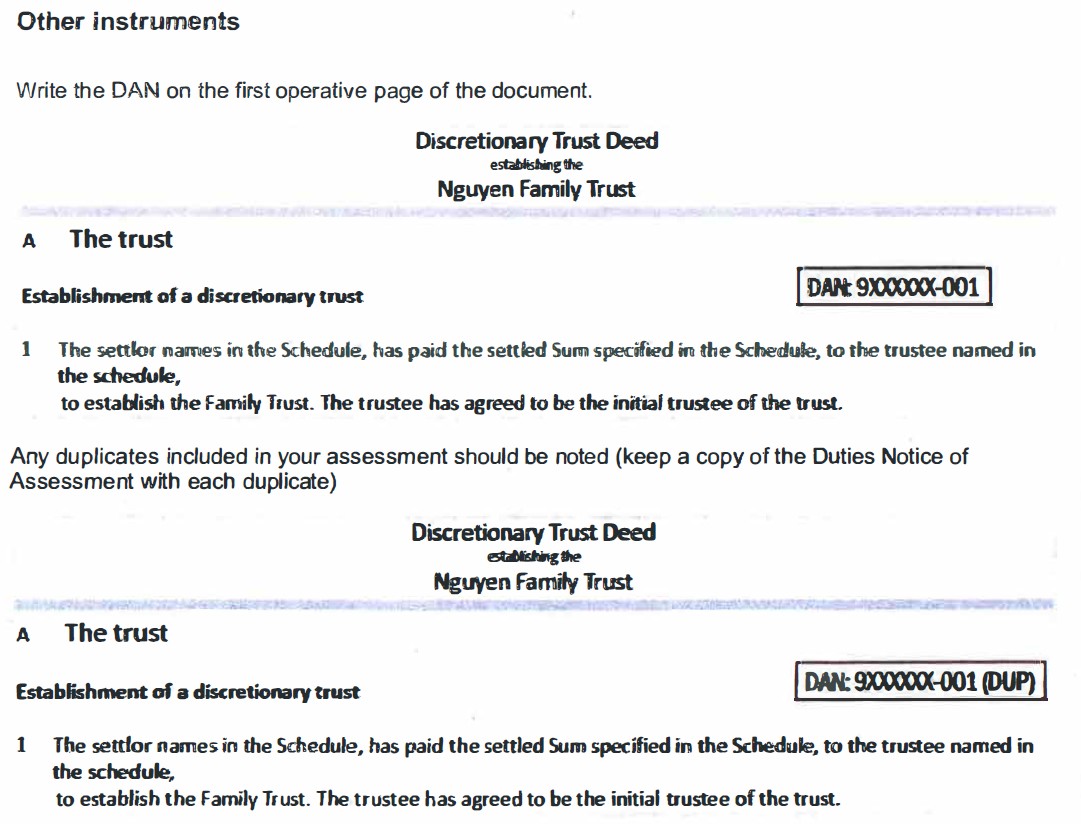
Evidence of stamping of the specific trust deed was equivocal
90 Amongst the documents exhibited to the first appellant’s affidavit of 4 July 2025 was the Duties Notice of Assessment to which the primary judge referred: IJ [5]. That assessment has the DAN 11211388-001. That assessment is addressed to ‘Sydney Legal Agents’, the client identification number is ‘162958653’, the reference is ‘HE Frugtniet 16524’, the liable party is ‘Brian Owen Reginald Frugtniet’, and the issue date is 30 June 2025. The Notice of Assessment does not record a Nil balance. The document exhibited also includes a Duties Statement with the same DAN and reference. That document identifies the client as ‘Sydney Legal Agents’ and the lodgement date as 30 June 2025. It may be inferred from these documents that Sydney Legal Agents has received an approval from the Chief Commissioner under Div 2 of Pt 6 of the Taxation Administration Act.
91 A copy of the specific trust deed was also included in the exhibits. The copy exhibited to the affidavit does not have an impressed stamp or a unique transaction identifier or reference number for the purposes of s 287(1) and has not been endorsed with the DAN referred to in the Notice of Assessment or any other number. That is, it has not been endorsed in accordance with any conditions of an approval for the purposes of s 289A(1) of the Duties Act and s 42(1)(b) of the Taxation Administration Act.
92 It follows that the appellants’ evidence before the primary judge fell short of positively proving that the specific trust deed had been stamped for the purposes of s 304(1) of the Duties Act. Further, there are a number of matters that suggest that the trust deed the appellants had sought to tender at the trial may not have been the instrument that was the subject of the Notice of Assessment.
93 The specific trust deed identifies ‘Brian Worrell Frugtniet’ as the ‘Beneficiary’. As already mentioned, on one view, the first appellant, as Beneficiary, was a person declaring the trust and therefore a person liable to pay any duty chargeable on a dutiable transaction effected by the deed. However, the Notice of Assessment identifies the person liable to pay the duty as ‘Brian Owen Reginald Frugtniet’. Therefore, whether or not each name identified the same person, the name of the party liable to pay the duty is not consistent with the name of the relevant party ‘declaring the trust’ as described in the specific trust deed. The inconsistency in the names suggests that the document referred to in the Notice of Assessment may not be the same document as the specific trust deed.
94 In an affidavit of the second appellant sworn 26 June 2025 she deposed, in effect, that the trust deed had been lodged with Revenue NSW through Sydney Legal Agents on 20 June 2025 and as of 25 June 2025 it was ‘Pending Investigation’. However, the Duties Statement indicates that the document the subject of the Notice of Assessment was lodged on 30 June 2025. Again, the apparent differences in lodgement dates suggest that the document lodged on 20 June 2025 may not be the same document as the document lodged on 30 June 2025.
95 Section 18 of the Duties Act contains a number of provisions that prevent payment of double duty if duty has been paid on a dutiable transaction. If on the proper construction of the specific trust deed it is a mere acknowledgement of a pre-existing trust, the duty chargeable on that declaration of trust would be $10 or $50 depending upon the nature of the pre-existing trust: s 18(6), s 18(6A) of the Duties Act. The Notice of Assessment was for duty of $500. Section 58 provides that duty of $500 is chargeable in respect of an instrument that declares a trust over New South Wales property none of which is dutiable property or an instrument that declares that property, although not identified in the instrument, when vested in the person executing the instrument is to be held in trust for a person or persons or purpose or purposes mentioned in the instrument. On the face of the trust deed, it is not an instrument to which s 58 applies because it purports to declare a trust of identifiable dutiable property (land in NSW). There were other provisions of the Duties Act that provided for duty of $500 to be chargeable on an instrument but none of these could have been applicable to the specific trust deed: s 61(2) (transfers of property in connection with persons changing superannuation funds), s 62(3)(a) (transfers between trustees/custodians of superannuation funds or trusts), s 62A(1) (transfers to self-managed superannuation funds) and s 62B(1) (declarations of trust by custodian).
96 Having regard to the foregoing matters and that it is an offence to endorse an instrument otherwise than under and in accordance with an approval under Div 2 of Pt 6 of the Taxation Administration Act, the failure of the appellants to produce the specific trust deed endorsed with the DAN in the Notice of Assessment if that instrument has been stamped is inexplicable. Further, in context and in the circumstances, it cannot be inferred from production of the Notice of Assessment and evidence of payment of that account in that notice that the notice and payment relate to the specific trust deed. There is other evidence from which an inference can be drawn that the Notice of Assessment relates or may relate to a different instrument. On the evidence before the primary judge the latter inference could not be excluded on the balance of probabilities. Thus, the primary judge was not in error for failing to be satisfied that the specific trust deed had been properly stamped and was not admissible under s 304(1) of the Duties Act.
Case management considerations
97 Even if the primary judge had been wrong to conclude that the trust deed was not admissible under s 304(1) at the time of determination of the application to reopen, the mere fact that further probative evidence was available to be tendered at that time is not sufficient reason to disturb the primary judge’s order.
98 The Court has power to reopen a proceeding after a trial and judgment has been reserved and before it has been delivered: Murray v Figge (1974) 4 ALR 612 at 613 (Muirhead J). The power is discretionary and is exercised in accordance with well-established principles: Urban Transport Authority (NSW) v Nweiser (1992) 28 NSWLR 471 at 474-475 (Clarke JA, Mahoney and Meagher JJA agreeing); Commonwealth v Davis Samuel Pty Ltd (No 7) [2013] ACTSC 146; 282 FLR 1 at [1578] (Refshauge J).
99 In general, the power may be exercised in one of the following circumstances: (1) fresh evidence; (2) inadvertent error; (3) mistaken apprehension as to the facts; and (4) mistaken apprehension of the law. However, the categories are not closed and, ultimately, it is a question of where the interests of justice lie: Spotlight Pty Ltd v NCON Australia Ltd [2012] VSCA 232; 46 VR 1 at [25]-[26] (Harper and Tate JJA, Beach AJA); Inspector-General in Bankruptcy v Bradshaw [2006] FCA 22 at [24] (Kenny J). Likely prejudice to the party resisting the application is relevant: Nweiser at 478. Also relevant is the public interest in the timely conclusion of litigation: Australian Securities and Investments Commission v Rich [2006] NSWSC 826; 235 ALR 587 at [18] (Austin J); s 37M of the Federal Court Act. In this case, the public interest in the timely resolution of bankruptcy proceedings is also a relevant factor: Bryant v Commonwealth Bank of Australia [1996] HCA 3; 134 ALR 460 at 464 (Kirby J); Flint v Richard Busuttil & Co Pty Ltd [2013] FCAFC 131; 216 FCR 375 at [38] (Allsop CJ, Katzmann and Perry JJ).
100 The appellants contend that the power to reopen was enlivened because they misapprehended the operation of s 304(2)(a) of the Duties Act. That is, they expected that the trust deed would have been admitted upon the first appellant undertaking to pay any duty payable on the transaction effected by the instrument.
101 It is doubtful that a misapprehension about the admissibility of a document tendered in evidence is a misapprehension of the law of the kind that usually invokes exercise of the power to reopen. However, be that as it may, even on the assumption that the primary judge should have accepted that the trust deed was admissible because s 304(1) was no longer applicable, it may have been in the interests of justice to reopen the proceeding because the trust deed had been admitted provisionally and the appellants had been cross-examined as if the document were in evidence. Therefore, if it were possible to admit the trust deed into evidence without recalling witnesses it might be thought that there would be little prejudice to the respondent or the public interest in reopening the proceeding for the limited purpose of receiving the trust deed in evidence.
102 The parties’ written submissions in support of and in opposition to the application to reopen were not before the Court in the appeal. Although the terms of the interlocutory application suggest that the application was limited to admitting the trust deed and the appellants filing supplementary written submissions on the relevance and admissibility of the trust deed, it is difficult to see how a reopening would not have involved further oral evidence. While each of the appellants was cross-examined on the trust deed, the bankrupt was not cross-examined on it because by the time he was called to give evidence the primary judge had ruled the trust deed inadmissible. Also, before the primary judge excluded the trust deed from evidence, the appellants had proposed calling two further witnesses to deal with the authenticity of the instrument including a person who it was proposed would give evidence attesting to the first appellant and bankrupt executing the instrument. Taking into account that the authenticity of the trust deed was in issue and the appellants faced a number of forensic difficulties, admitting the trust deed into evidence on any limited basis would not have been of any great assistance to the appellants’ case. Therefore, for a reopening to admit the trust deed in evidence to have any real forensic purpose it would have been necessary to recall the bankrupt and cross-examine him about that instrument and to call additional witnesses to assist the appellants’ case regarding the authenticity of the instrument.
103 The orders sought in the appeal include an order that the proceedings be remitted for rehearing before another judge of the Court. The appellants accepted during their oral submissions in the appeal that if the proceeding were reopened it would be necessary, at least, to recall and cross-examine the bankrupt and, for similar reasons, if the matter were remitted for rehearing on the appeal it may require a complete retrial before a different judge.
104 It follows that for any reopening to have any real forensic purpose it would necessarily have resulted in a further oral hearing, recalling witnesses, calling further witnesses and inevitable delay in resolution of the proceeding. On the other hand, if the proceeding were reopened for the limited purpose of tendering the trust deed, it would not have served any real forensic purpose. In either case, having regard to the time for which the appellants had been on notice that the respondent objected to the admissibility of the trust deed under s 304(1) of the Duties Act and their unexplained failure to take steps to have the instrument stamped until, at the earliest, 20 June 2025 and, at the latest, 30 June 2025, it was not in the interests of justice that the proceeding be reopened for the purpose of admitting the trust deed in evidence. As the primary judge observed at IJ [12], ‘[a]t some point, enough is enough’ and the public interest in the facilitation of the just resolution of disputes (particularly bankruptcy disputes) as quickly, inexpensively and efficiently as possible prevails.
105 For the foregoing reasons, if the primary judge was in error in concluding that the trust deed was not properly stamped for the purposes of s 304(1), upon re-exercising the discretion, the primary judge’s order dismissing the application to reopen should not be disturbed.
Was there misapplication of the presumption of advancement?
106 As a consequence of the primary judge refusing to admit the trust deed in evidence it was not necessary for his Honour to address the appellants’ objection based on the existence of express trusts: FJ [43]. The primary judge then addressed and rejected the appellants’ claims that the relevant properties were held on constructive trust, or alternatively resulting trusts: FJ [46]-[95]. The appellants contend that the primary judge’s rejection of their resulting trusts claim was erroneous but do not challenge his Honour’s conclusions about their constructive trusts claim.
107 In ground 3 of the notice of appeal the appellants contend that the primary judge erred (FJ [85]-[90]) in applying the presumption of advancement as determinative when the objective evidence of intention rebutted any inference of parental gift. However, it is not contended that the presumption of advancement was applied despite contemporaneous documents, correspondence and admissions establishing that the bankrupt (himself) did not regard himself as the beneficial owner of the relevant properties.
108 In ground 4 of the notice of appeal the appellants contend that the primary judge erred in law in holding that the relevant properties vested in the respondent when, on the proper construction of s 116(2)(a) of the Bankruptcy Act, they were held on resulting trusts for the appellants. Relevantly, the appellants assert that the presumption of advancement was not applicable and the uncontested evidence established resulting trusts.
Legal principles applicable to establishing resulting trusts
109 A resulting trust may arise by operation of law and be imposed independently of the objective intention of the transferor to create a trust, or it may arise due to objective or manifested intention to create a trust upon the transfer of property. Relevantly, a resulting trust based on objective intention usually arises in circumstances where the transferor conveys property to the transferee for no consideration (voluntary conveyance resulting trust) or a person other than the transferee pays the transferor all or part of the purchase money upon conveyance of the property (purchase money resulting trust): Bosanac v Federal Commissioner of Taxation [2022] HCA 34; 275 CLR 37 at [93]-[94] (Gordon and Edelman JJ). Although based on objective intention, a resulting trust is not the result of an express declaration of trust (written or oral). Therefore, a resulting trust is a trust that arises by law or implication. It is also an exception to the requirement that enforceable interests in land can only be created by writing: s 23C(1) and s 23C(2) of the Conveyancing Act 1919 (NSW).
110 The primary judge set out the following applicable principles for resulting trusts in terms in which, subject to two qualifications, were not challenged in the appeal: FJ [49]-[52].
(1) The starting position is ‘that prima facie the beneficial ownership of real property is commensurate with the legal title’: Currie v Hamilton [1984] 1 NSWLR 687 at 690 (McLelland J): FJ [49].
(2) That position may be displaced and a presumption of a resulting trust may arise where one person provides the purchase price of property the legal title of which is conveyed to another person: Calverley v Green [1984] HCA 81; 155 CLR 242 at 246 (Gibbs CJ), 255 (Mason and Brennan JJ), 266 (Deane J); Bosanac at [12] (Kiefel CJ and Gleeson J), [52] (Gageler J), [104] (Gordon and Edelman JJ). Where two or more persons provide the purchase price of property in shares not reflected in conveyance of the legal title, a resulting trust may arise by which the beneficial interest in the property is presumed to be held in proportion to each person’s contributions to the purchase price: Calverley v Green at 266-267 (Deane J); Bosanac at [51] (Gageler J): FJ [49].
(3) The presumption of a purchase money resulting trust may be rebutted by evidence of a contrary objective intention or by a presumption of advancement: Bosanac at [13]-[14] (Kiefel CJ and Gleeson J), [52]-[53] (Gageler J), [115] and [121] (Gordon and Edelman JJ): FJ [49].
(4) The ‘presumption of advancement’ which is strictly not a presumption but an evidential circumstance, is that there are certain relationships from which it is inferred (presumed) that any benefit provided for the transferee at the ‘expense’ of the transferor, in the case of a voluntary conveyance resulting trust, or person paying the purchase price, in the case of a purchase money resulting trust, was provided by way of ‘advancement’ such that the transferee was intended to receive the legal and beneficial interest in the property. The presumption of advancement may be rebutted, or supported, by evidence of actual intention of the parent or other person providing the benefit at the time of transfer of the property to the transferee: Nelson v Nelson [1995] HCA 25; 184 CLR 538 at 547 (Deane and Gummow JJ): FJ [50].
(5) The presumption of advancement allows an inference as to intention to be drawn from the fact of certain relationships including parent and child and husband and wife. The fact of these relationships can be considered ‘good consideration’ for the conveyance, even though the rationale for the presumption is the prima facie likelihood that a beneficial interest was intended to be conveyed to the transferee: Bosanac at [14]: FJ [51].
(6) Unless the evidence establishes a contrary position, if the purchase price is funded in whole or in part by moneys raised by loans secured by a mortgage of the property the money borrowed to purchase the property is treated as a contribution to the purchase price by the person(s) indebted to the financier and obligated to repay the loan (debt): Calverley v Green at 251 (Gibbs CJ), 257-258 (Mason and Brennan JJ), 267-268 (Deane J); El-Debel v Micheletto [2021] FCAFC 117; 153 ACSR 15 at [7(6)] (Markovic, Derrington and Colvin JJ): FJ [51].
111 Relying on Bosanac at [22], the appellants submit that the presumption of advancement should be regarded as ‘especially weak’. However, the context in which Kiefel CJ and Gleeson J made that observation concerned the presumption of advancement that arises in a relationship of husband and wife. In that case, the Federal Commissioner of Taxation advanced the submission that the presumption of advancement of a wife by her husband, which operates to preclude a resulting trust from arising, was no longer part of the law of Australia in relation to the matrimonial home. All members of the High Court rejected that submission. However, in so doing Kiefel CJ and Gleeson J recognised that the circumstances in which the presumption arises between spouses was ‘especially weak today’ (emphasis added). Further, their Honours observed that both the presumption of the objective intention for a purchase money resulting trust and the presumption of advancement ‘may be rebutted by comparatively slight evidence’: at [22], [31]. Justices Gordon and Edelman expressed the view that ‘[a]cknowledging that it is too late to abolish it, the presumption of a resulting trust should be recognised as a weak presumption given that the circumstances justifying it have changed so much since the foundations of the presumption in the 15th century’: at [98]. Similarly, Gageler J said ‘[w]hether any, and if so what, inference is … to be drawn about the actual intention of the contributor and the purchaser falls to be determined as an ordinary question of fact on the balance of probabilities’ and ‘there are no special rules about proving intention. No predetermined weight is to be given either to the fact of a contribution having been made or to the categorisation of the relationship between the parties. The significance of each of those circumstances falls to be assessed within the totality of the circumstances of the case.’: at [64]-[67].
112 Further, relying on Black Uhlans Incorporated v Crime Commission (NSW) [2002] NSWSC 1060 at [138], [141]-[142] (Campbell J), the appellants submit, that where the purchase price is funded by moneys raised by loan secured by mortgage of the land, the presumption that there is a resulting trust in favour of the person who borrowed the purchase money, may be rebutted by evidence of a contrary objective intention. In that case (at [142]) Campbell J made reference to a passage from the joint reasons of Mason and Brennan JJ in Calverley v Green where their Honours referred to an earlier High Court judgment in Bloch v Bloch [1981] HCA 56; 180 CLR 390. Therefore, indirectly, the appellants rely on Bloch v Bloch as authority for the relevant proposition.
113 Bloch v Bloch was a case in which there was direct evidence about the objective intention of the parents in that case and their son relating to the purchase of a block of flats. The parents managed the flats for their son who lived overseas, resided in one of the flats and contributed approximately 1/3rd of the purchase price. The balance of the purchase price was financed by way of a bank loan to the son and secured by a mortgage of the land. The actual contributions were 19/60ths by the parents and 41/60ths by the son (through the loan) which was not quite contributions in the proportions 1/3rd and 2/3rds. The legal title to the land was held solely in the name of the son. He sold the property and claimed to be entitled to the whole proceeds of the sale. The trial judge found that the presumption of advancement was rebutted on the evidence and there was a resulting trust by which the property had been held by the son in trust for the parents as to 1/3rd of the land. The finding of no presumption of advancement was not challenged, but the son challenged the proportion in which he was found to have held the property in trust based on his contribution to the purchase price through the loan and mortgage.
114 Justice Wilson, with whom Gibbs CJ, Murphy and Aikin JJ agreed, was of the view that there was an inference that the parents intended their son to hold the property in the proportions 1/3rd to 2/3rds and a certain proportion of the rents received from the property applied in reduction of the principal and interest was an accretion to the parents’ initial contribution: at 398. Justice Brennan was of the view that the inference to be drawn from the facts was that the parties intended their respective beneficial interests to be proportionate to the contributions made to acquire the land and to free it of encumbrance: at 402.
115 In Calverley v Green at 262-263 Mason and Brennan JJ expressed the view that Bloch v Bloch was a case:
… where the relevant property which the parties intended to acquire was seen to be not the title to land subject to mortgage but the land freed of the mortgage [(1981) 55 A.L.J.R., at p. 706; 37 A.L.R., at p. 64]. In such a case the price paid to free the land of mortgage as well as the price paid for the title to the land itself must be taken into account in determining the parties' beneficial interests. Mortgage payments may quantify the parties' interests under a resulting trust of a property acquired as a mortgage-free investment, but they would rarely quantify the interests of parties under a resulting trust of a house property acquired [by the contributing parties] as a home to live in.
116 It follows that in Bloch v Bloch, upon which the appellants ultimately rely, the relevant investment property was not presumed to have been held on resulting trust in the proportions in which the parents and their son contributed purchase money because there was objective evidence of the parties’ intention that the mortgage-free property be held in trust in different proportions. The primary judge’s summary of the applicable principles acknowledges the potential for the facts to alter the presumption that a resulting trust arises from financing the purchase price of property through a loan secured by a mortgage: FJ [52].
117 We detect no error in the primary judge’s summary and explanation of the legal principles applicable to the existence of a resulting trust.
The primary judge’s reasons for rejecting the resulting trusts claim on the facts
118 In the course of addressing the constructive trusts and resulting trusts claims, the primary judge summarised the evidence and made a number of observations about credibility: FJ [53]-[86]. His Honour said that the appellants’ evidence was ‘far from clear or consistent’, their affidavit evidence was in an objectionable form for various reasons and ‘obviously prepared in collaboration’ and his Honour had ‘no confidence that their evidence [was] each their own independent recollection’: FJ [53]-[54]. In contrast, no adverse observations were made regarding the bankrupt’s evidence.
119 Earlier, the primary judge made findings of ‘principal facts’ to the following effect: FJ [7]-[24].
(1) The bankrupt entered into a contract for the sale and purchase of the First Rosehill Property. The purchase price was $260,000. The purchase price was financed with loans from the Commonwealth Bank of Australia to the bankrupt secured by mortgages of the property that were later refinanced with loans from the National Australia Bank to the bankrupt also secured by a mortgage of the property: FJ [9].
(2) The Lidcombe Property was transferred to the bankrupt from the executors of the estate of the bankrupt’s maternal grandmother (the second appellant’s mother) in exchange for consideration of $500,000. The consideration was financed with a loan from the NAB to the bankrupt secured by a registered mortgage of the property: FJ [11].
(3) The Second Rosehill Property was transferred to the bankrupt from his paternal grandfather (the first appellant’s father) in exchange for consideration of $440,000. The consideration was financed with a loan from the NAB to the bankrupt secured by a registered mortgage of the property: FJ [13].
(4) The Mount Druitt property was transferred to the bankrupt from the first appellant in exchange for consideration of $400,000. The consideration was financed with a loan from the NAB to the bankrupt secured by a registered mortgage of the property: FJ [15].
(5) As at November 2015 the bankrupt had two home loans from NAB secured by registered mortgages of each of the relevant properties. The loans were for $400,000 in respect of the Lidcombe Property and $900,000 in respect of the other properties: FJ [16].
(6) Ultimately, the bankrupt was not able to service the loans and made a decision to enter voluntary bankruptcy: FJ [18].
120 After setting out the relevant evidence, the primary judge made a number of other additional relevant findings of fact: FJ [87]-[93].
(1) There was not an express oral trust agreement relating to the relevant properties. His Honour described the appellants’ evidence as ‘too inconsistent’ and that there was ‘insufficient evidence on which to base a conclusion that there was an express trust created’. ‘The [appellants’] contention that the properties were held on trust for them [was] also at odds with their evidence and that of [the bankrupt] that the properties were bought for [the bankrupt] to “get his foot in the door” [of the property market]’: FJ [87].
(2) The arrangement between the appellants and the bankrupt was (at FJ [88]):
… when [the appellants] identified good opportunities to invest in property, the properties were bought and registered in Jerome’s name. [The first or second appellant] paid the deposits where deposits were required. They also paid the other transfer costs. The remainder of the purchase price was paid by bank loans to Jerome for which he was liable to the relevant bank. The properties were mortgaged to secure the loans. Between them, [the appellants] managed the properties by ensuring they were tenanted, collecting the rent, paying the bills and depositing the balance to the loan accounts. It was the expectation all round that the properties would remain positively geared and in that way be paid for by the rentals collected.
(3) The arrangement did not include the appellants paying a 20% deposit on a property for the bankrupt: FJ [89]-[90].
(4) Aside from the benefit the appellants obtained by residing separately in two of the properties for a period (and then later together in one of them), the appellants assisted the bankrupt to acquire a property portfolio, including by paying deposits and transfer costs and managing the relevant properties, for the bankrupt’s benefit as their ‘son whom they love and whom they wanted to be financially secure’: FJ [91].
(5) The bankrupt paid the bulk of the purchase prices of the relevant properties in the form of loans for which he was liable to the bank: FJ [93].
121 Based on the primary judge’s findings of fact, his Honour concluded that there was no joint endeavour which subsequently failed, and there was no intention that in the circumstances of failure, beneficial ownership would not follow legal ownership. That is, there were no constructive trusts over the relevant properties: FJ [92].
122 As for resulting trusts, the primary judge expressed his conclusions for rejecting the appellants’ claims as follows:
93 … the bulk of the purchase price was paid by Jerome in the form of loans for which he was liable to the bank. To the extent that [the appellants] made some contributions to the purchase price, the presumption of advancement is not displaced by evidence, objectively determined, of any contrary intention (see the characterisation of the relationship above at [91]). That is to say, to the extent that [the appellants] contributed to the purchase of the properties by paying deposits and transfer costs, and to the extent that they contributed thereafter by managing the properties, they did that for the benefit of their young son. They may well also have had in mind that they could impose on him to make the properties available as security for development opportunities that they later wished to pursue, but their contributions were nevertheless by way of advancement.
94 There is evidence of [the appellants] paying monies from time to time into the loan accounts. The details of those payments are proved by the bank statements and they are summarised in the document labelled “MFI-1”. It shows that deposits in the sum of $13,237.10 were made in [the first appellant’s] name and $36,572.41 in [the second appellant’s] name. That is the only reliable evidence of the extent of the contributions made by [the appellants], but in any event those payments were in all probability rental payments that they had collected. So, although I accept that [the appellants] paid the deposits and transfer costs on the properties, how much those in fact were was not proved. I do not accept their say-so on the amounts many years later when they cannot be expected to remember them. I place no weight on that evidence. I am also not satisfied that the amounts recorded in “MFI-1” are contributions from them – rather, they are rentals collected and properly due to Jerome.
No error in the primary judge’s consideration of the presumption of advancement
123 Relevantly to any purchase money resulting trust, the primary judge found that the appellants had contributed towards a proportion of the purchase price of the relevant properties through payment of deposits and transfer costs, but the amounts paid were not proved. Also, the bankrupt paid the ‘bulk of the purchase price … in the form of loans’: FJ [88], [93], [94].
124 The primary judge made no finding of fact to the effect that the appellants or the bankrupt had expressed an intention that the appellants’ contributions towards the purchase prices were not gifts or the land (mortgage-free) was to be held in trust for the appellants in whole or in part. On the contrary, the primary judge made a positive finding that the appellants assisted the bankrupt to acquire the relevant properties for the bankrupt’s benefit: FJ [91]. That finding formed part of the primary judge’s reasons for concluding that there was no ‘joint endeavour’ and ‘no intention that in the circumstances of failure [of a joint endeavour] beneficial ownership would not follow legal ownership’: FJ [92]. The primary judge also made no finding that the appellants had made any payments of principal and interest with respect to the bankrupt’s loans. The relevant finding was that the appellants had made deposits into the bankrupt’s bank accounts, but these were deposits of rent collected with respect to the properties.
125 The appellants contend that the primary judge erred in the application of the law in that his Honour failed to consider or take into account the following matters which they submit, in effect, are inconsistent with a gift of the appellants’ financial contributions toward the acquisition of the properties and are otherwise consistent with a family arrangement (or rearrangement) of legal ownership of the properties by which it was intended that the appellants had or would acquire the entire beneficial interest in the relevant properties.
(1) The appellants cavil with the primary judge’s characterisation of the relevant properties as sourced for the bankrupt through the efforts of the appellants and identified and acquired as investment properties for the bankrupt. The appellants submit that the evidence establishes that the transactions were in the nature of family arrangements (or rearrangements) rather than investment opportunities for the bankrupt.
(2) The appellants submit that the bankrupt did not contribute any of his own funds to acquire the properties. They submit that all funds were contributed by the appellants from their own funds.
(3) The appellants submit that while the mortgages were in the bankrupt’s name, the arrangements between the appellants and the bankrupt were that the bankrupt was not to repay any of the loans using his own funds and he did not do so. The appellants submit that the loans were repaid with their own funds. These facts, so the appellants submit, rebut the presumption that money raised by loan or mortgage is to be treated as a contribution of the borrower or mortgagor towards the purchase price of the property.
(4) While the bankrupt was the registered proprietor of the properties he made no contribution towards them. The bankrupt did not live in, maintain or manage any of them and he made no financial contribution towards repayment of the loans, maintenance or other ownership costs and expenses.
(5) The notion that the appellants assisted the bankrupt to acquire four properties as his investments is ‘highly unusual’ (which we take to be a synonym for inherently improbable) in circumstances in which the appellants used two of the properties as their primary residences, the appellants did not own any other real estate, and the appellants had three other adult children, but apparently only embarked upon this investment scheme for the bankrupt.
126 Although no ground of appeal contends that the primary judge made any error of fact, the appellants’ submissions, in substance and in effect, depend upon unarticulated and implicit errors in fact-finding. At one point during the appellants’ oral submissions they proposed formulating an amendment to the notice of appeal to challenge the primary judge’s findings of fact. However, ultimately, no application to amend was made, the proposal withdrawn, and the appellants confirmed that their case in the appeal depended upon demonstrating that the primary judge’s application of the applicable legal principles to the facts as found by the primary judge was erroneous. Accordingly, to the extent that the appellants’ submissions are founded upon an explicit or implicit contention that the primary judge erred in fact, the submissions may be put to one side.
Characterisation of the acquisition of the properties as investments of the bankrupt
127 The appellants submit that the following ‘characterisation’ by the primary judge of the circumstances in which the bankrupt acquired the relevant properties was contrary to the evidence.
(1) Each property was sourced for the bankrupt through the efforts of the appellants, who assisted him with ‘obtaining finance, liaising with the banks and completing the necessary documentation’: FJ [7].
(2) The arrangement between the appellants and the bankrupt was that when the appellants identified good opportunities to invest in properties, the properties were purchased and registered in the bankrupt’s name: FJ [88].
(3) The appellants had assisted the bankrupt to acquire a property portfolio: FJ [91].
128 As to the First Rosehill Property, the appellants submit the evidence was that it was acquired as a residence for the first appellant because he was unable to get finance. The mortgage was originally in the name of Sascha Frugtniet (the bankrupt’s brother). The first appellant lived in the property and paid all the mortgage repayments and outgoings in respect of the property.
129 As to the Lidcombe Property, the appellants submit that the second appellant negotiated with her siblings (the executors of her mother’s estate) to acquire the property, but the bankrupt was registered as the legal owner of the property. The second appellant lived in the property for many years and paid all mortgage repayments and outgoings in respect of the property.
130 As to the Second Rosehill Property, the appellants submit it was transferred to the bankrupt from the first appellant’s father. As to the Mount Druitt Property, the appellants submit the first appellant purchased that property in 2007. In 2016 the property was transferred into the bankrupt’s name.
131 The appellants submit that the described circumstances in which the relevant properties were acquired were not consistent with the bankrupt acquiring them as investments. Rather, the circumstances were consistent with acquisition of the properties as part of family arrangements (as residencies for the appellants) or family re-arrangements (transfers of family properties from grandparents or parents).
132 While framed as a challenge to the primary judge’s ‘characterisation’ of the circumstances in which the relevant properties were acquired, in substance, the appellants challenge the primary judge’s findings of fact (FJ [7], [88]) or description of the effect of findings of fact made earlier in the reasons (FJ [91]). As there is no ground of appeal that asserts the primary judge made an error of fact, it is not open to the appellants to challenge the primary judge’s findings in these paragraphs. Therefore, there is no ground upon which this Court may conclude that the primary judge was in error for finding that the relevant properties were acquired as investments for the bankrupt rather than as part of family arrangements to acquire residences for the appellants and rearrange legal ownership of properties previously owned by the bankrupt’s grandparents or the first appellant. Thus, we do not accept that the primary judge made any error in concluding that the relevant properties were acquired as investments of the bankrupt.
133 In any event, no appealable error of fact was identified in any orthodox manner in the notice of appeal or the appellants’ written or oral submissions. Further, the Court was not taken to all the evidence before the primary judge that had or could have had a bearing on the primary judge’s relevant findings of fact. It is not sufficient, as the appellants have sought to do here, to identify isolated or particular elements of evidence (whether or not controversial) and contend due to some inconsistency between that evidence and a finding of the primary judge that the finding was erroneous. An asserted error in fact finding must be articulated and demonstrated by reference to all relevant or potentially relevant evidence that addressed that topic. Here, the appellants have neither done so, nor attempted to do so.
Contributions towards the purchase money for the properties
134 The appellants’ submission to the effect that three of the relevant properties were already a ‘family asset’ which the appellants transferred to the bankrupt is also not consistent with the primary judge’s findings of fact. The primary judge found that consideration was given for the transfer of each of the relevant properties to the bankrupt. Further, only one property (the Mount Druitt Property for which consideration of $400,000 was given) was transferred directly from one of the appellants to the bankrupt. The other transfers were from an unrelated party (First Rosehill Property), the executors of the estate of the bankrupt’s grandmother (Lidcombe Property) or the bankrupt’s grandfather (Second Rosehill Property).
135 The appellants also submit that the bankrupt made no contributions of his own funds to acquire any of the relevant properties and all funds were contributed by the appellants from their own funds. That submission is also not consistent with the primary judge’s findings of fact and is not accepted.
136 The primary judge accepted that the first appellant had made deposits of $13,237.10 and the second appellant a deposit of $36,572.41 into the bankrupt’s loan accounts. However, his Honour found those payments were not contributions of the appellants, but rent they had collected on the relevant properties. His Honour also accepted the appellants had contributed amounts towards the purchase money for the relevant properties in the form of deposits and transfer costs. However, his Honour placed no weight on the appellants’ evidence of the amounts paid and, therefore, the amounts of these contributions were not proved: FJ [94]. Thus, on the facts as found, the appellants made unproven contributions towards the deposits and transfer costs upon transfer of the relevant properties to the bankrupt. As to the balance of the purchase moneys, the primary judge found these were paid by bank loans to the bankrupt for which he was liable to the relevant bank and the properties were mortgaged to secure the loans: FJ [88].
137 Although the appellants evidently acknowledge and accept that part of the purchase money for acquisition of the relevant properties was financed with loans in the bankrupt’s name, they submit that, by arrangement between the appellants and the bankrupt, the bankrupt was not liable to repay any of the loans himself using his own funds. The appellants repeatedly submit that they made all mortgage repayments and ‘always accepted that they were the parties liable to repay the loans to NAB’ and submit that the loans and mortgages were repaid by the appellants from their own funds and from rents collected from the tenants of the properties in which the appellants were not residing. Ultimately, the appellants submit that these facts rebut the presumption which otherwise applies that the purchase moneys paid by loans secured by mortgages of the relevant properties are to be treated as contributions by the person legally liable to repay the loan.
138 The appellants also submit, with respect to the First Rosehill Property, that Sascha Frugtniet (the bankrupt’s brother) was the original mortgagee of that property. The purpose or relevance of that submission was not explained beyond, perhaps, supporting the submission that the First Rosehill Property was not acquired as an investment of the bankrupt. But, in any event, the evidence does not support the submission.
139 The loan documentation for the purchase of the First Rosehill Property was not in the appeal book, but the registered transfers, mortgages, discharge of mortgages and NAB loan documentation were in evidence and in the appeal book. Transfer AD939680K, registered on 10 June 2008, identifies the First Rosehill Property as ‘Lot 2/SP79889’ and the transferor as the bankrupt. Mortgage AD939681H, also registered 10 June 2008, identifies the mortgaged property in typewriting as ‘1/SP79889’ and in handwriting with initials as ‘2/SP79889’. The mortgagor is identified as ‘Sascha Warren Frugtniet’, and that person evidently executed the mortgage, and the mortgagee is identified as the Commonwealth Bank of Australia. There are other handwritten annotations on the document. There was no evidence that Sascha Frugtniet was, at any time, the registered proprietor of 2/SP79889, therefore, the manner in which he could have been the registered ‘mortgagor’ of that property is inexplicable. The bankrupt gave evidence to the effect that he could not recall the reason Sascha Frugtniet’s name was on the mortgage, but he understood his brother may have purchased the property 1/SP79889. By discharge of mortgage AG342270H, registered 18 July 2011, mortgage AD939681 over the property 2/SP939681 was discharged. That document identifies the mortgagor as the bankrupt. Mortgage AG342271F was registered the same day identifying the bankrupt as the mortgagor, the property as 2/SP79889 and the mortgagee as CBA. By discharge of mortgage AI406068Y, registered 28 February 2014, mortgage AG342271 was discharged. The same day a mortgage AI406069W was registered against 2/SP79889. The bankrupt was the mortgagor and NAB the mortgagee.
140 In the absence of the written loan documentation concerning the initial CBA loan, it was open to the primary judge to infer from the discharge of mortgage AD939681, which identified the bankrupt as the mortgagor, that the CBA had lent money to the bankrupt at the time he became the registered proprietor of that property that was secured by a mortgage over the First Rosehill Property. That inference was supported by the bankrupt’s evidence to the effect that he understood from discussions with the first appellant that the first appellant ‘could not get financing and this was a way for me to enter the property market and assist my father’. It is also supported by evidence that the bankrupt applied for the second NAB loan to refinance an existing CBA loan. The reference to Sascha Frugtniet as ‘mortgagor’ on mortgage AD939681 was inexplicable on the evidence and the typewritten reference to property 1/SP79889 suggested that Sascha Frugtniet may have been the registered proprietor of that property. However, in the absence of the CBA loan and security documentation, the nature of any obligation of Sascha Frugtniet secured by the mortgage would be speculation. Otherwise, there was no evidence to which the Court was taken that suggested that any person other than the bankrupt had borrowed money to finance the purchase price of the First Rosehill Property at the time that property was purchased and transferred to the bankrupt.
141 To the extent that the appellants submit that they made all loan and mortgage repayments, that submission is contrary to the express findings of fact of the primary judge (FJ [88], [94]). The ‘evidence’ upon which the appellants rely in support of the submission is that they always accepted that they were liable to repay the NAB loans is a self-serving letter dated 17 March 2021 sent to the respondent after he was appointed trustee of the bankrupt’s estate. The primary judge made no finding to the effect that the appellants always considered themselves liable for repayment of the loans. Further, that fact could not possibly be described as admitted or uncontested. Moreover, the letter of 17 March 2021 is not evidence of any objective intention manifested at the time of acquisition of the relevant properties. Accordingly, we do not accept that the primary judge made any error in failing to conclude that the appellants made all loan and mortgage repayments.
142 In any event, the appellants’ submission that they made all loan and mortgage repayments is another example of an implicit challenge to the primary judge’s findings of fact. That challenge is not made in the notice of appeal and is made without reference to all potentially relevant evidence that may bear on the question of fact. Thus, the appellants’ implicit challenge to the primary judge’s findings is not open on the grounds of appeal.
143 On the facts as found, the appellants contributed unproven amounts towards deposits and transfer costs upon the transfer of the legal title to the relevant properties to the bankrupt. The bankrupt contributed the amounts of the loans as described in the primary judge’s reasons to the purchase moneys. Therefore, subject to the question of advancement, at best for the appellants, the facts as found provide a foundation for a presumption that the relevant properties were held on resulting trust for the appellants as to unproven proportions of the purchase moneys and for the bankrupt as to the proportion the loans secured by mortgages were used to pay the purchase moneys.
Contributions towards management, maintenance and outgoings of the relevant properties
144 The appellants submit that while the bankrupt was the registered proprietor of the relevant properties he had no involvement with them. He did not maintain them; he did not manage the rental of them. He did not pay any of his own funds towards the acquisition of them, the repayment of the loans, or the ongoing maintenance and other costs and expenses associated with ownership of them. The appellants submit that they undertook all those activities.
145 To the extent that the appellants submit that they repaid loans, for the reasons already given, that submission is not accepted. Nor was there any express finding of fact to the effect that the appellants paid maintenance or other ownership costs out of their own funds. Otherwise, the primary judge found that the appellants lived in two of the relevant properties, managed the properties that were rented and collected the rental payments due on those properties.
146 Relying on Black Uhlans at [138]-[139], the appellants submit that factors such as occupation and control of the property, management of the properties, payment of maintenance and outgoings in respect of the property may be taken into account, in effect, as admissions by the bankrupt that the appellants were the beneficial owners of the relevant properties. Therefore, the primary judge’s findings about these matters, so the appellants submit, support the conclusion that they were the beneficial owners of the properties and not the bankrupt.
Plausibility of parental advancement
147 In substance, the appellants also submit that it was inherently improbable or implausible that the financial and non-financial contributions they made towards the purchase moneys and management of the relevant properties were made by way of advancement in circumstances in which they lived in two of the properties as their primary residences, did not own other properties, and had three other children but only assisted the bankrupt.
148 The primary judge found that the appellants resided in two of the properties separately for a time and then together in one of the properties: FJ [91]. The primary judge made no finding about the extent to which the appellants owned other properties. However, the appellants rely on paragraph [111] of an affidavit of the first appellant sworn 1 April 2025 to support a submission, in effect, that the primary judge should have found and taken into consideration that they owned no other property. The asserted fact could not be regarded as admitted or uncontested and, again, it is an implicit and unpleaded attack on the primary judge’s findings of fact. Further, in any event, the relevant paragraph of the affidavit merely deposed to the fact that given the respondent ‘has lodged caveats on all the properties of the Family Estate, we are unable to refinance and obtain the necessary funds to pursue this litigation’. Thus, the facts deposed even in isolation and if uncontested, without more, do not support the submission that the appellants owned no other real property.
149 The primary judge also made no findings of fact about what, if any, financial or other assistance the appellants have provided to their other children. It is, again, an implicit and unpleaded attack on the primary judge’s findings of fact. Further, and in any event, the appellants have not indicated where, if at all, that issue was raised in the proceeding before the primary judge and, if so, what evidence there was in relation to it and the extent to which it was admitted or not contested. It is not the function of this Court to trawl through the appeal books in an attempt to find if there was any such evidence. Therefore, in the absence of any findings of fact and direction as to admitted or uncontested facts, we proceed on the basis that there was no evidence about these matters before the primary judge and no error in failing to make any findings about them.
The circumstances as a whole
150 It follows that the only facts upon which the appellants can rely in support of their contention that the primary judge misapplied the legal principles are the facts that: they made financial contributions in unproven amounts towards the purchase moneys for the properties; they resided in two of the properties; and they managed the properties and collected rents from tenants in the properties in which they did not reside. It is also implicit that the primary judge found that the rent the appellants collected was used to make repayments on the bankrupt’s bank loans and that the appellants arranged for other ownership costs (maintenance, rates, taxes and other outgoings) to be paid in respect of the properties. These are facts that could be relied upon to support an implicit admission that, due to their possession and control of the properties, the appellants were, at least in part, beneficial owners of the properties: Black Uhlans at [138]-[139]. However, there are other factors that tend against inferring such an admission.
151 The primary judge found that the properties were acquired as investments for the bankrupt. It is not unusual and is consistent with ownership of investment properties that the owner would not reside at the property and would have the property managed by another person. Further, in the absence of any direct evidence of objective intention, an inference arises from the fact that the appellants resided in two of the properties and managed all the properties that the appellants’ management of the bankrupt’s investments was part of a quid pro quo for the right to reside in the properties. For similar reasons, the mere fact the appellants resided at two of the properties does not make it implausible that they also made financial and non-financial contributions for advancement of the bankrupt.
152 Additionally, the primary judge records that the first appellant gave evidence during his cross-examination to the effect that he told the bankrupt ‘he would get tax benefits’ for purchasing the properties: FJ [57]. That is, no doubt, an allusion to the bankrupt claiming interest on the bank loans as a deduction from his assessable income. Therefore, it is implicit that the first appellant understood that the bankrupt would account for the rent received and costs incurred, including interest, in his taxable income. At the very least, it is consistent with an understanding that the bankrupt was a beneficial owner of the relevant properties from which he would derive some tax benefit. Accordingly, the first appellant’s admission is inconsistent with the bankrupt holding the properties in trust for the appellants. For example, in Black Uhlans at [138]-[139] Campbell J observed that receipt of rent and payment of tax on rent are factors in favour of an admission that the person receiving rent and paying tax is the beneficial owner of the property.
153 A further difficulty with the appellants’ submissions is that, unlike the circumstances in Bloch v Bloch, the primary judge made no finding to the effect that there was an objective expression of an intention that the beneficial interests in the relevant properties would be held in any particular proportions or, specifically, an intention that the bankrupt would hold the relevant properties in trust for the appellants. Also, unlike Bloch v Bloch, the primary judge found that the presumption of advancement was not rebutted by objective evidence. Rather, his Honour made a positive finding of fact that the appellants intended, to the extent that they made any contributions towards the acquisition of the properties, that the bankrupt would have the whole beneficial interest in those properties: FJ [91].
154 The primary judge did not approach the task of considering the facts as a whole as if the presumption of advancement was determinative. The primary judge had regard to the totality of the circumstances. On the facts found those circumstances included an objective intention of the appellants and the bankrupt that the bankrupt would acquire the properties as investments, the bankrupt contributed the bulk of the purchase moneys through loans he was liable to repay secured by mortgages registered over the properties, the appellants contributed deposits and transfer costs towards the purchase moneys, and the appellants resided in two of the properties, managed the properties and collected rent on the properties. Having regard to the totality of the circumstances and the facts found, the primary judge was satisfied that the appellants’ contribution towards the purchase moneys was by way of advancement for their son. In other words, the primary judge took into account a presumption or finding of advancement as part of the totality of the circumstances. Having regard to the general weakness of any presumption of resulting trust, the primary judge was not satisfied that there was objective evidence of an intention or that an intention should be presumed that the appellants were to hold any beneficial interest in the relevant properties. In short, his Honour made no error in the application of the legal principles to the facts as found.
What orders should be made in the appeal?
155 It follows that the primary judge made none of the asserted errors. Further, if contrary to our view, the primary judge was in error for concluding that the trust deed had not been properly stamped and was not admissible in evidence under s 304(1) of the Duties Act, that error would not have changed the outcome of the application to reopen. For the reasons already given, upon re-exercising the discretion we would dismiss the application.
Disposition
156 The appeal should be dismissed with costs.
I certify that the preceding one-hundred and fifty-six (156) numbered paragraphs are a true copy of the Reasons for Judgment of the Honourable Justices Feutrill, Owens and Wheatley. |
Associate:
Dated: 20 August 2026


