

Federal Court of Australia
Aldi Foods Pty Limited v Hampden Holdings I.P. Pty Limited [2026] FCAFC 103
Appeal from: | Hampden Holdings I.P. Pty Ltd v Aldi Foods Pty Ltd [2024] FCA 1452 |
File number(s): | NSD 277 of 2025 |
Judgment of: | BURLEY, MOORE AND OWENS JJ |
Date of judgment: | 19 August 2026 |
Catchwords: | COPYRIGHT – artistic works – range of packaging for children’s snacks designed to emulate works on a competitor’s packaging – whether primary judge erred in considering abstracted features rather than undertaking a detailed side-by-side comparison of the copyright and impugned works – whether substantial part reproduced – proper role of layout and design and “look and feel” – whether primary judge erred by finding liability for additional damages – whether to undertake a reconsideration of copyright liability |
Legislation: | Copyright Act 1968 (Cth) |
Cases cited: | Autodesk Inc v Dyason (No 2) [1993] HCA 6; (1993) 176 CLR 300 Baigent v Random House Group Ltd (2007) 72 IPR 195; [2007] EWCA Civ 247 Cummins v Vella [2002] FCAFC 218 Data Access Corp v Powerflex Services Pty Ltd [1999] HCA 49; (1999) 202 CLR 1 Designers Guild Ltd v Russell Williams (Textiles) Ltd [2000] UKHL 58; [2000] 1 WLR 2416 Dixon Investments Pty Ltd v Hall (1990) 18 IPR 49 Eagle Homes Pty Ltd v Austec Pty Ltd [1999] FCA 138; (1999) 87 FCR 415 Elwood Clothing Pty Ltd v Cotton On Clothing Pty Ltd [2008] FCAFC 197; (2008) 172 FCR 580 EMI Songs Australia Pty Ltd v Larrikin Music Publishing Pty Ltd [2011] FCAFC 47; (2011) 191 FCR 444 House v The King [1936] HCA 40; (1936) 55 CLR 499 Hytera Communications Corporation Ltd v Motorola Solutions Inc [2024] FCAFC 168; (2024) 308 FCR 68 IceTV Pty Ltd v Nine Network Australia Pty Ltd [2009] HCA 14; (2009) 239 CLR 458 Lidl Great Britain v Tesco Stores [2024] EWCA Civ 262 Lift Shop Pty Ltd v Next Level Elevators Pty Ltd [2025] FCAFC 108; (2025) 312 FCR 127 Microsoft Corporation v CPL Notting Hill [2024] FCAFC 20; (2024) 177 IPR 389 Milpurrurru v Indofurn Pty Ltd (1994) 54 FCR 24 PDP Capital Pty Ltd v Grasshopper Ventures Pty Ltd [2021] FCAFC 128; (2021) 285 FCR 598 Seafolly Pty Ltd v Fewstone Pty Ltd [2014] FCA 321; (2014) 106 IPR 85 SW Hart & Co Pty Ltd v Edwards Hot Water Systems [1985] HCA 59; (1985) 159 CLR 466 West v Francis (1822) 5 B & Ald 737; (1822) 106 ER 1361 |
Division: | General Division |
Registry: | New South Wales |
National Practice Area: | Intellectual Property |
Sub-area: | Copyright and Industrial Designs |
Number of paragraphs: | 241 |
Date of hearing: | 13 – 14 November 2025 |
Counsel for the First Appellant: | Mr ADB Fox SC with Ms CL Bembrick and Mr H Letcher |
Solicitor for the First Appellant: | Spruson & Ferguson Lawyers |
Counsel for the First and Second Respondents: | Mr JM Hennessy SC with Mr S Hallahan |
Solicitor for the First and Second Respondents: | Gestalt Law |
ORDERS
NSD 277 of 2025 | ||
| ||
BETWEEN: | ALDI FOODS PTY LIMITED ACN 086 210 139 Appellant | |
AND: | HAMPDEN HOLDINGS I.P. PTY LIMITED ACN 123 139 097 First Respondent LACORIUM HEALTH AUSTRALIA PTY LIMITED Second Respondent | |
AND BETWEEN: | HAMPDEN HOLDINGS I.P. PTY LIMITED ACN 123 139 097 (and another named in the Schedule) First Cross-Appellant | |
AND: | ALDI FOODS PTY LIMITED ACN 086 210 139 Cross-Respondent | |
order made by: | BURLEY, MOORE AND OWENS JJ |
DATE OF ORDER: | 19 August 2026 |
THE COURT ORDERS THAT:
1. The appeal be allowed in part.
2. The cross-appeal be allowed in part.
3. Orders 1 and 2 of the orders made on 17 February 2025 be set aside and replaced with the following declarations:
THE COURT DECLARES THAT:
1. By authorising in Australia the manufacture of packaging bearing the works depicted in:
a. items 4, 6 and 9 of the Impugned Works, the respondent infringed the copyright in item 1 of the Applicants’ Works;
b. item 10 of the Impugned Works, the respondent infringed the copyright in item 6 of the Applicants’ Works; and
c. item 11 of the Impugned Works, the respondent infringed the copyright in item 7 of the Applicants’ Works,
within the meaning of s 36 of the Copyright Act 1968 (Cth) (the Copyright Act).
2. By selling, offering for sale and exposing for sale in Australia products in packaging bearing the works depicted in:
a. items 4, 6 and 9 of the Impugned Works, the respondent infringed the copyright in item 1 of the Applicants’ Works;
b. item 10 of the Impugned Works, the respondent infringed the copyright in item 6 of the Applicants’ Works; and
c. item 11 of the Impugned Works, the respondent infringed the copyright in item 7 of the Applicants’ Works,
within the meaning of s 38 of the Copyright Act.
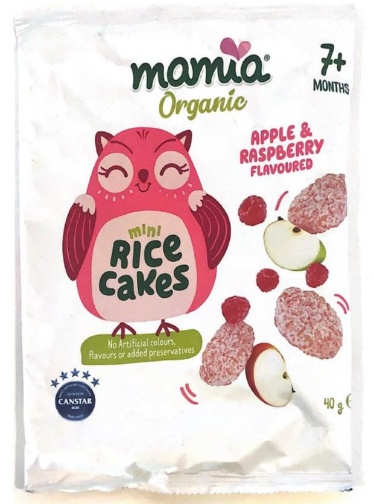
4. There be no order as to costs of the appeal and cross-appeal.
Note: Entry of orders is dealt with in Rule 39.32 of the Federal Court Rules 2011.
REASONS FOR JUDGMENT
THE COURT:
1. INTRODUCTION
1 The respondents, who we will refer to together as Hampden, are the owners of copyright in artistic works comprising the front face of the packaging of baby and child food products sold under the marks BABY BELLIES, LITTLE BELLIES and MIGHTY BELLIES (the Hampden Works). This case concerns activities by the appellant (Aldi) in developing new packaging for rival baby and child food products to be sold in its own retail supermarkets under its MAMIA house brand. The primary judge concluded that Aldi set out to create artistic works for packaging (Aldi Works) that resembled the Hampden Works, albeit Aldi’s intention was to avoid making the resemblance so close as to infringe the law.
2 The result of this activity by Aldi was packaging that adopted design features and visual elements from the Hampden Works, but did not precisely reproduce any particular image from the Hampden Works. Two examples are set out below, with the Hampden Work on the left and the Aldi Work on the right:
Item 1: Blueberry Puffs Hampden Work |
Item 9: MAMIA Baby Puffs Blueberry Aldi Work | |
Item 6: Apple & Cinnamon Puffs Hampden Work |
Item 7: MAMIA Fruit Snack Cereal Bars Apple Aldi Work | |
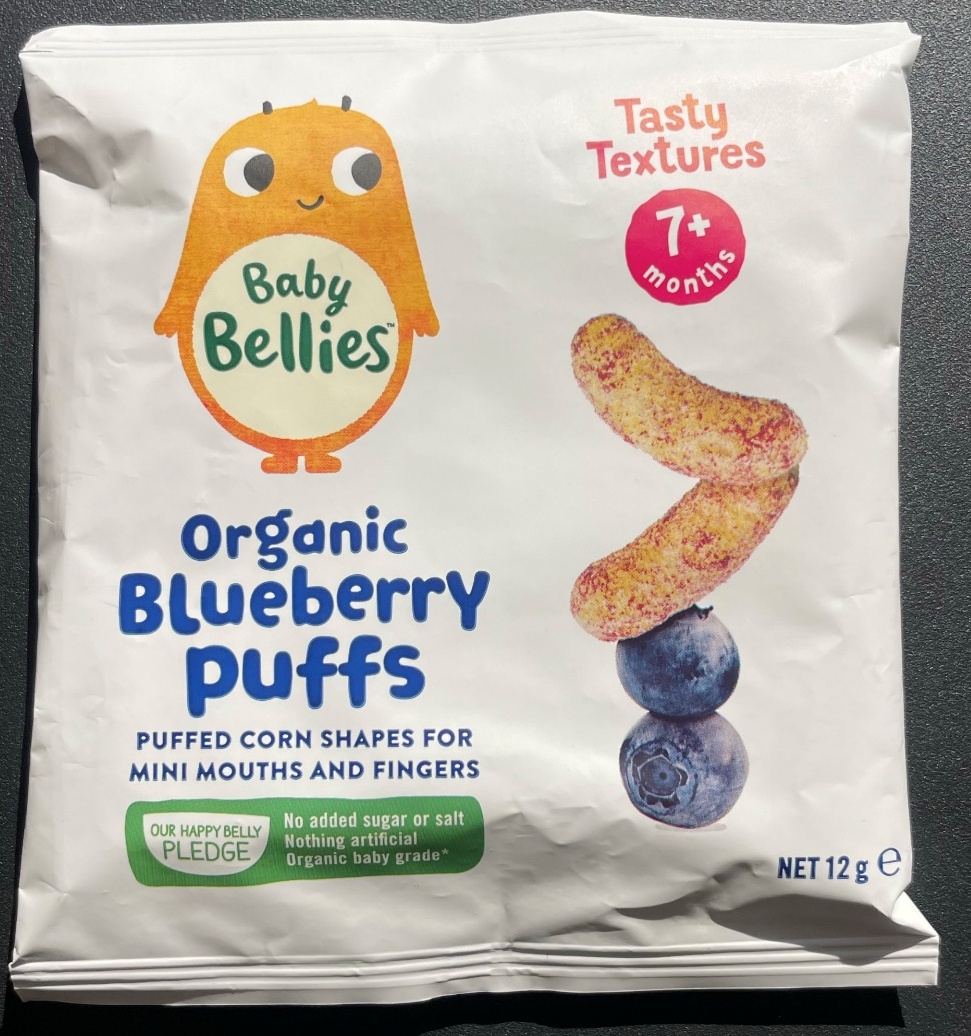
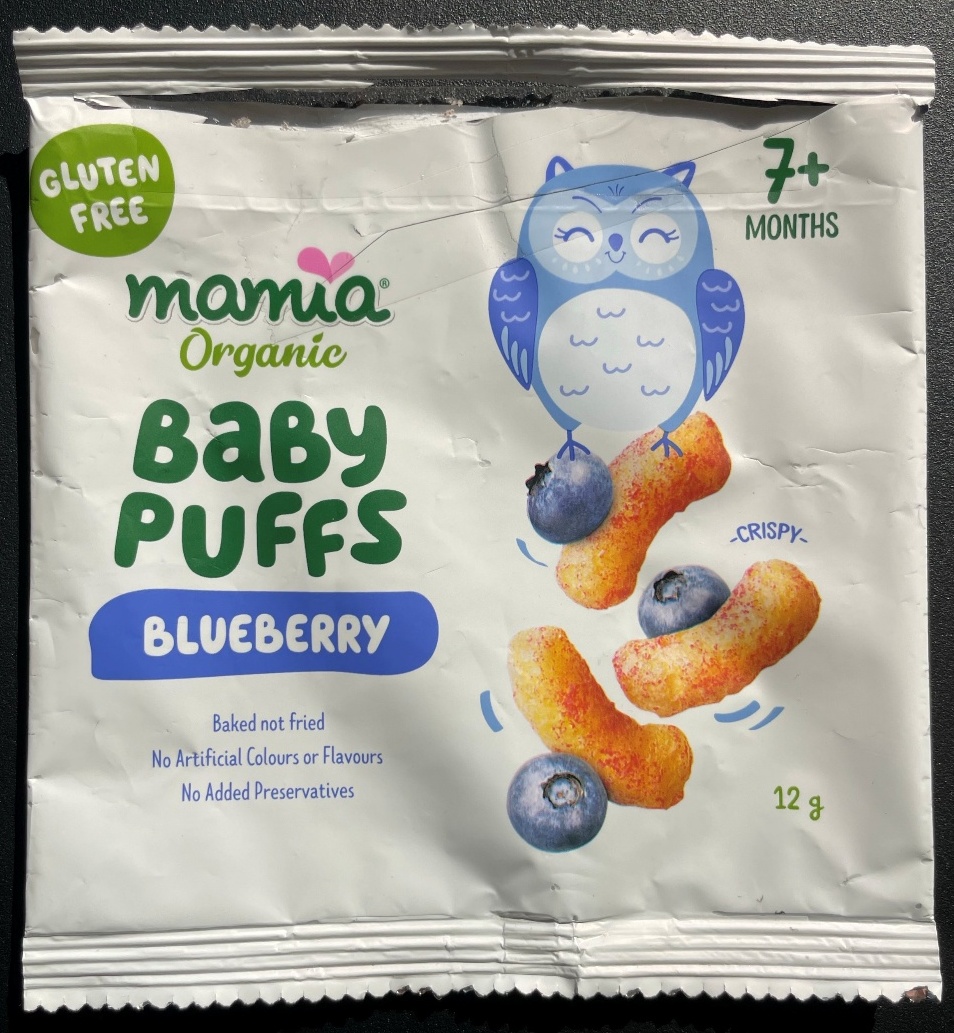
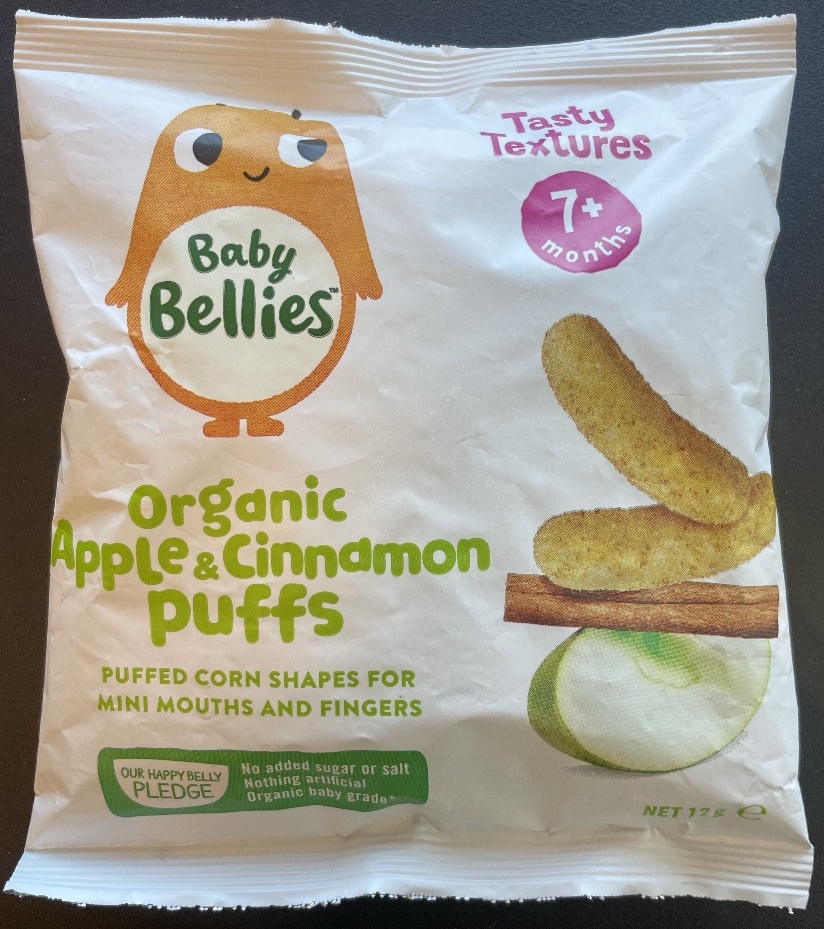
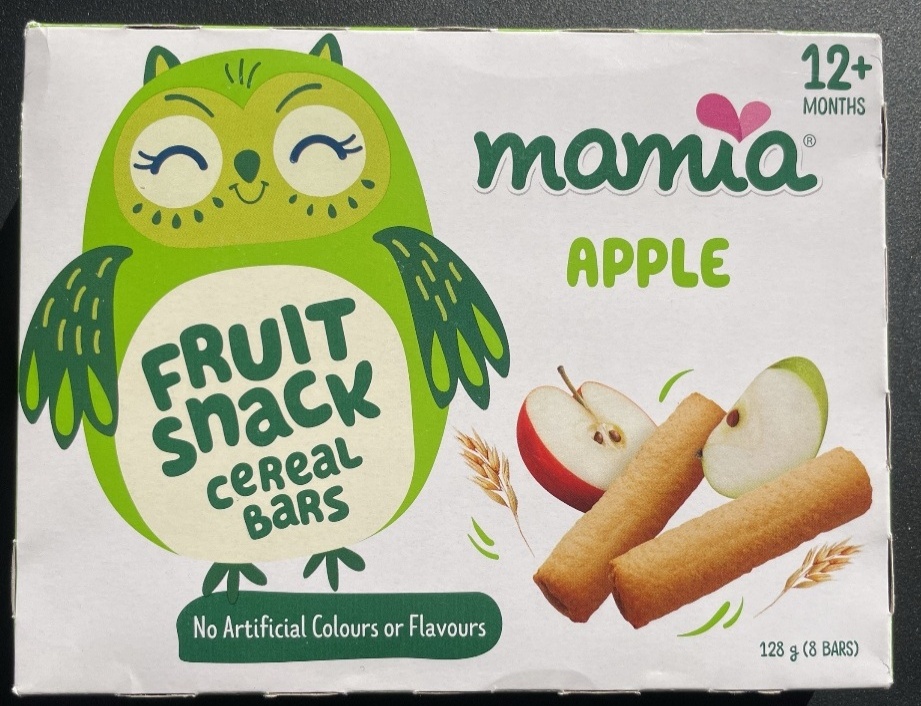
3 The case raises issues concerning the correct approach to the assessment of whether there has been a substantial reproduction of an artistic work, particularly where there is a similarity in layout or design.
4 Hampden had a mixed result at trial, in the sense that the primary judge found that three of the Aldi Works infringed the Hampden Works (including the first example above), but eight of the Aldi Works did not (including the second example above). Aldi appeals the findings of copyright infringement and Hampden cross-appeals the findings of non-infringement. Because of the mixed result, neither side supports the whole of the reasons of the primary judge.
2. THE REASONS OF THE PRIMARY JUDGE
5 Having regard to the considerable number of appeal grounds raised, it is necessary to summarise the approach of the primary judge in a little detail.
6 The nine Hampden Works, and the number given to them by the primary judge, are as follows:
Item 1: Blueberry Puffs Hampden Work |
Item 2: Organic Animal Biscuits Hampden Work |
Item 3: Organic Tomato Fiddlesticks Hampden Work |
Item 4: Cocoa Brown Rice Crispy Bars Hampden Work |
Item 5: Vanilla Brown Rice Crispy Bars Hampden Work |
Item 6: Apple & Cinnamon Puffs Hampden Work |
Item 7: Organic Carrot Puffs Hampden Work |
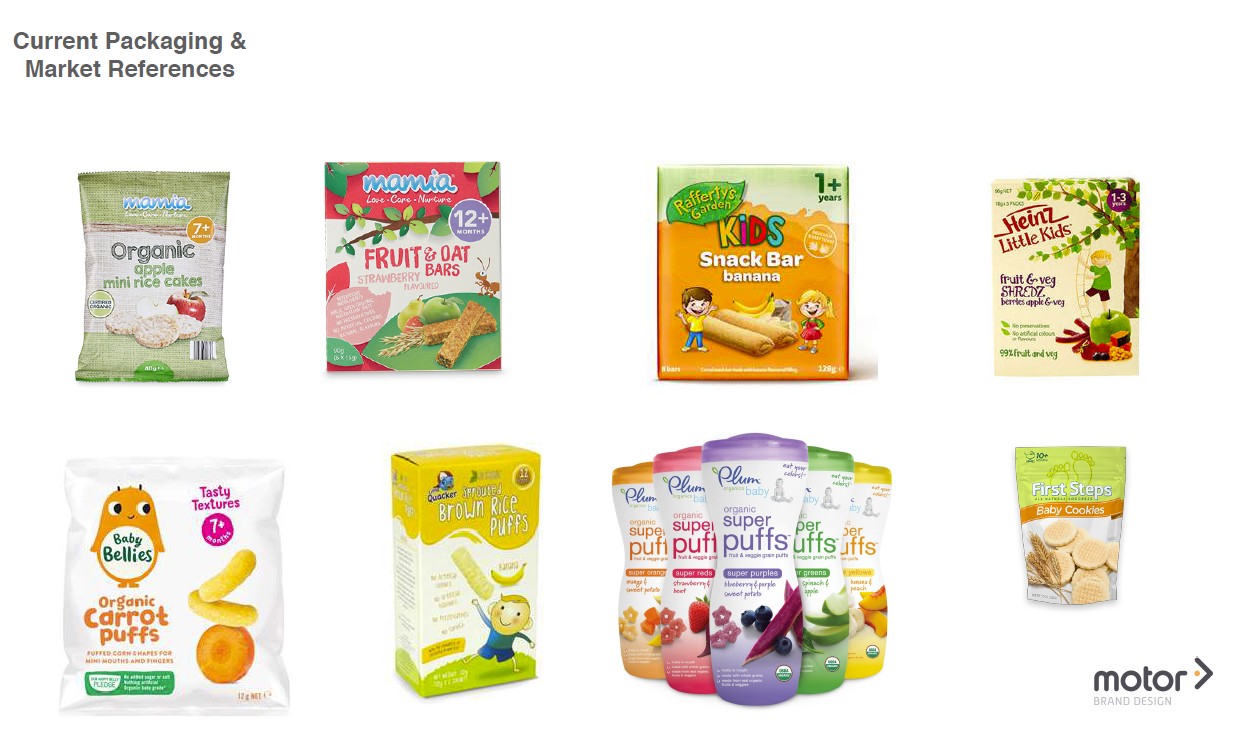
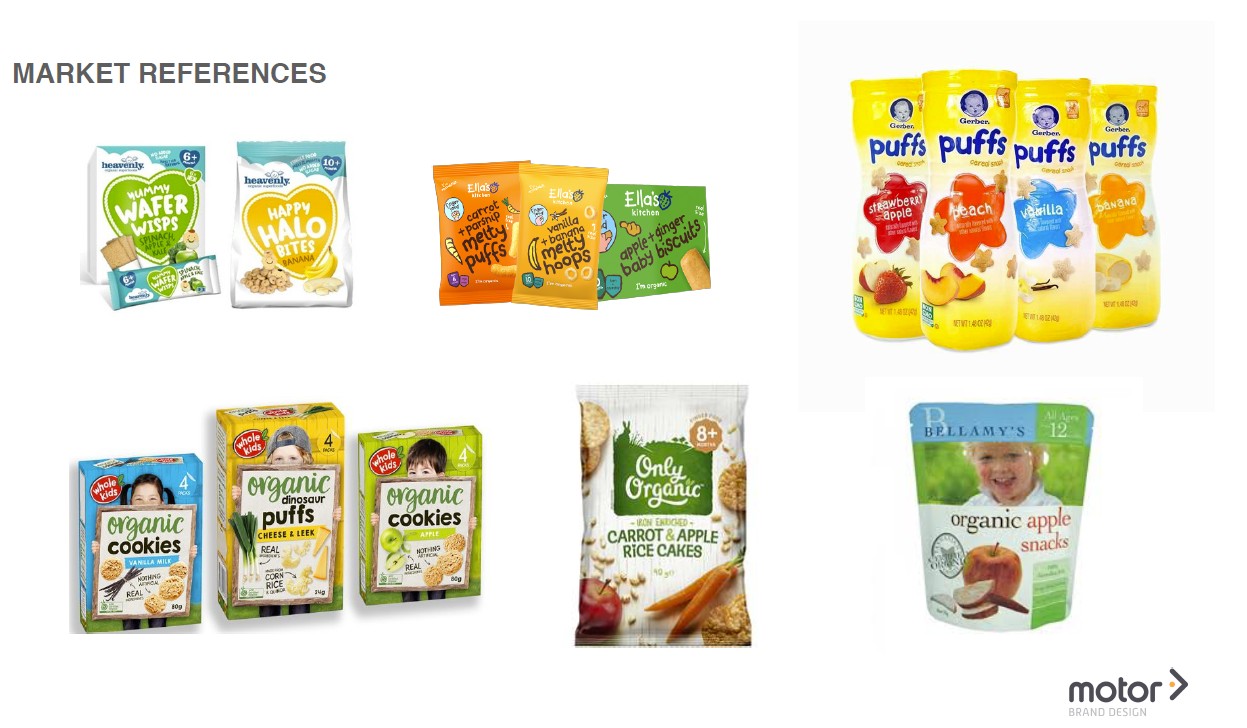
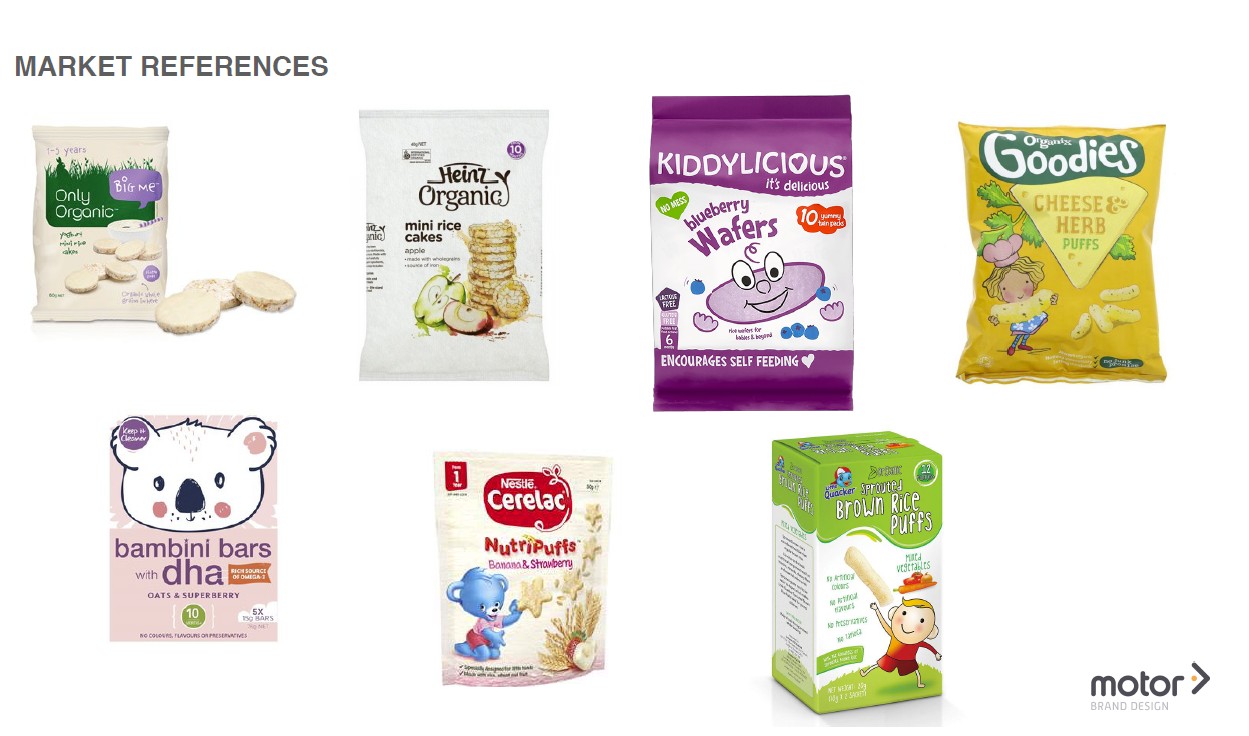
Item 8: Organic Cheese & Herb Fiddlesticks Hampden Work |
Item 9: Organic Gingerbread Men Hampden Work |
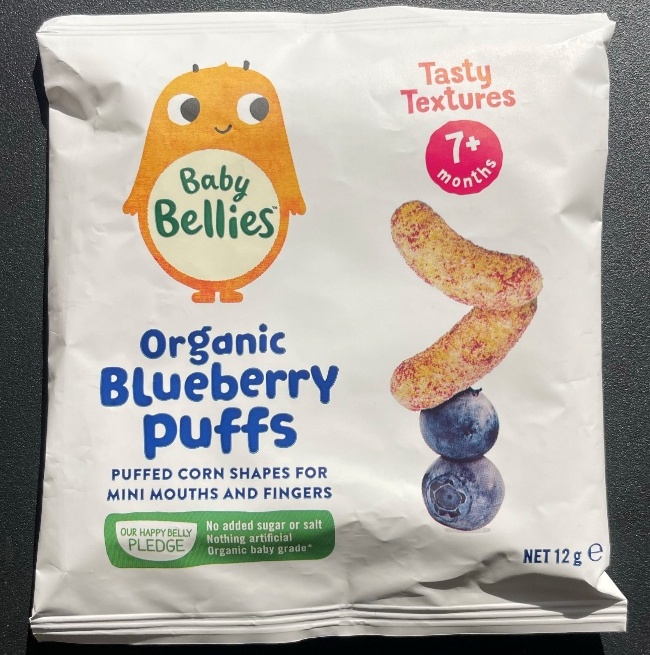
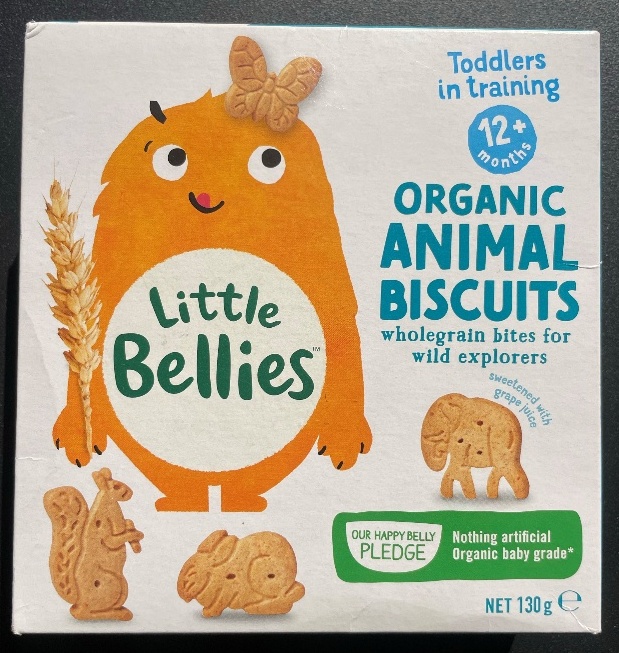
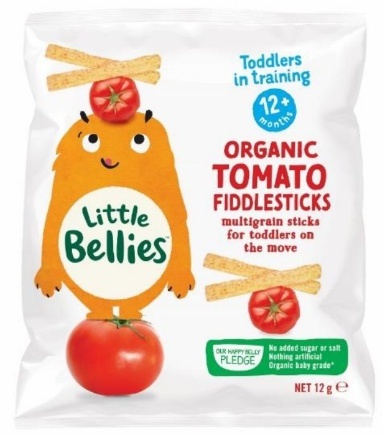
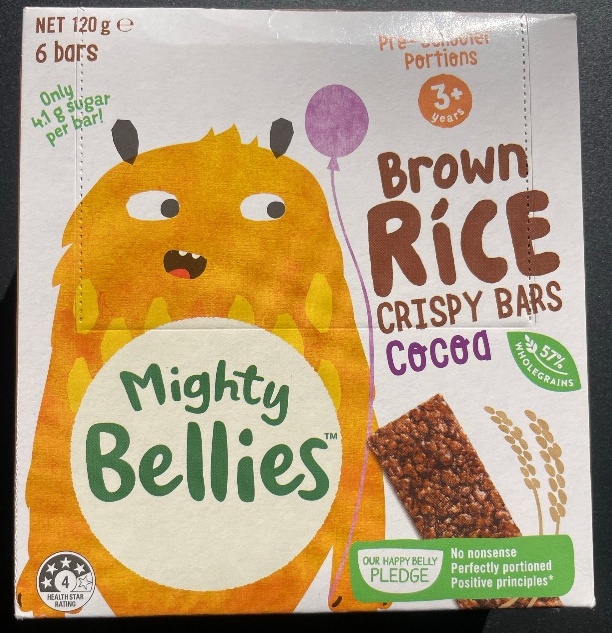
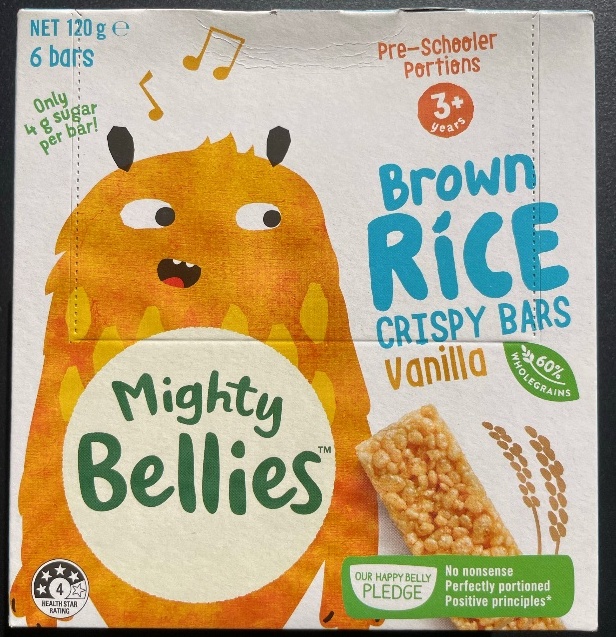
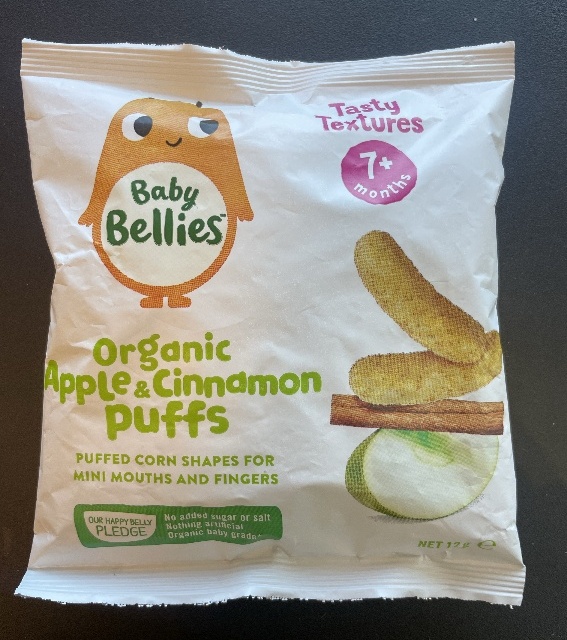
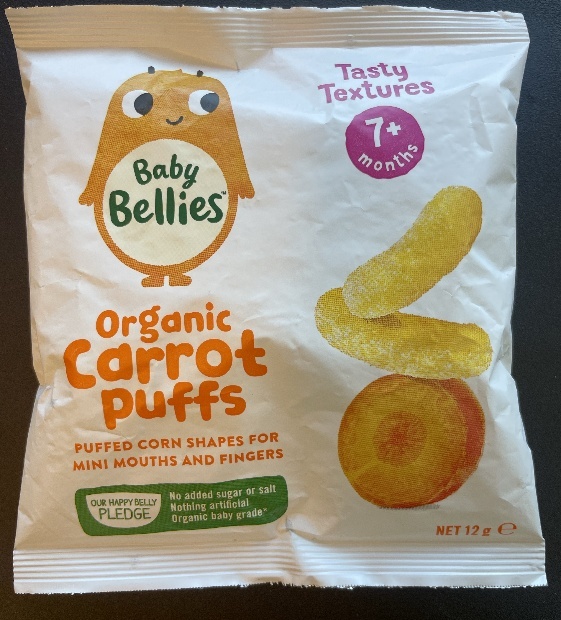
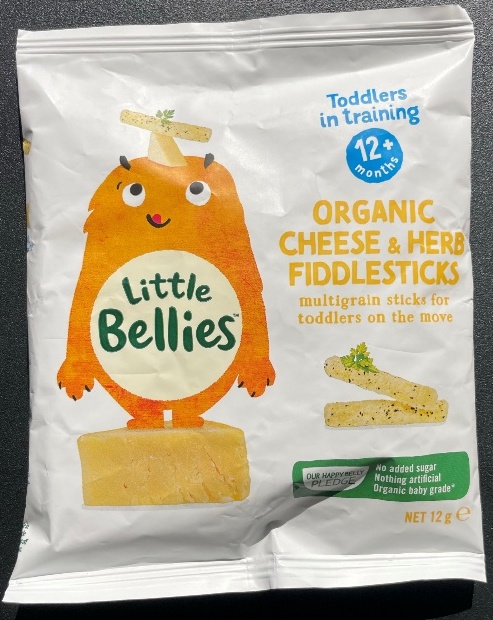
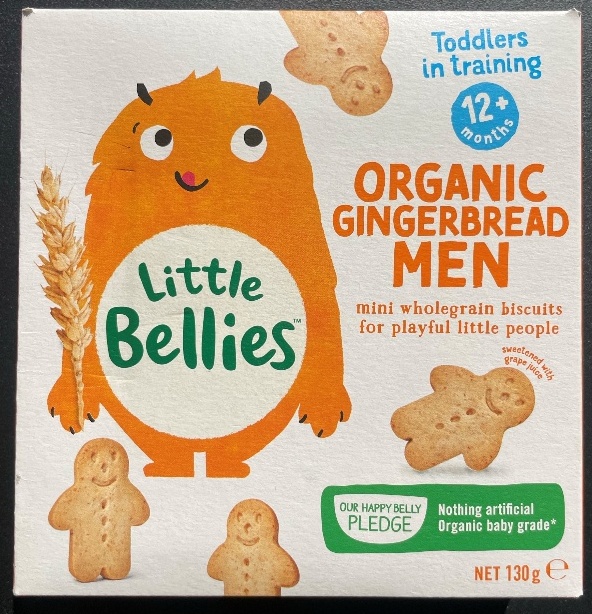
7 The primary judge further divided the Hampden Works into the puffs works (items 1, 6 and 7), which we will refer to as the Hampden Puffs Works, and the non-puffs works (being the balance), which we will refer to as the Hampden Non-Puffs Works.
8 There is no issue on this appeal in relation to subsistence of copyright or ownership (or right to sue). Nor was there any issue as to the identity of the copyright works, the parties proceeding on the assumption, that the primary judge adopted, that each of the works identified is a single artistic work. The relevant issues concern infringement and additional damages.
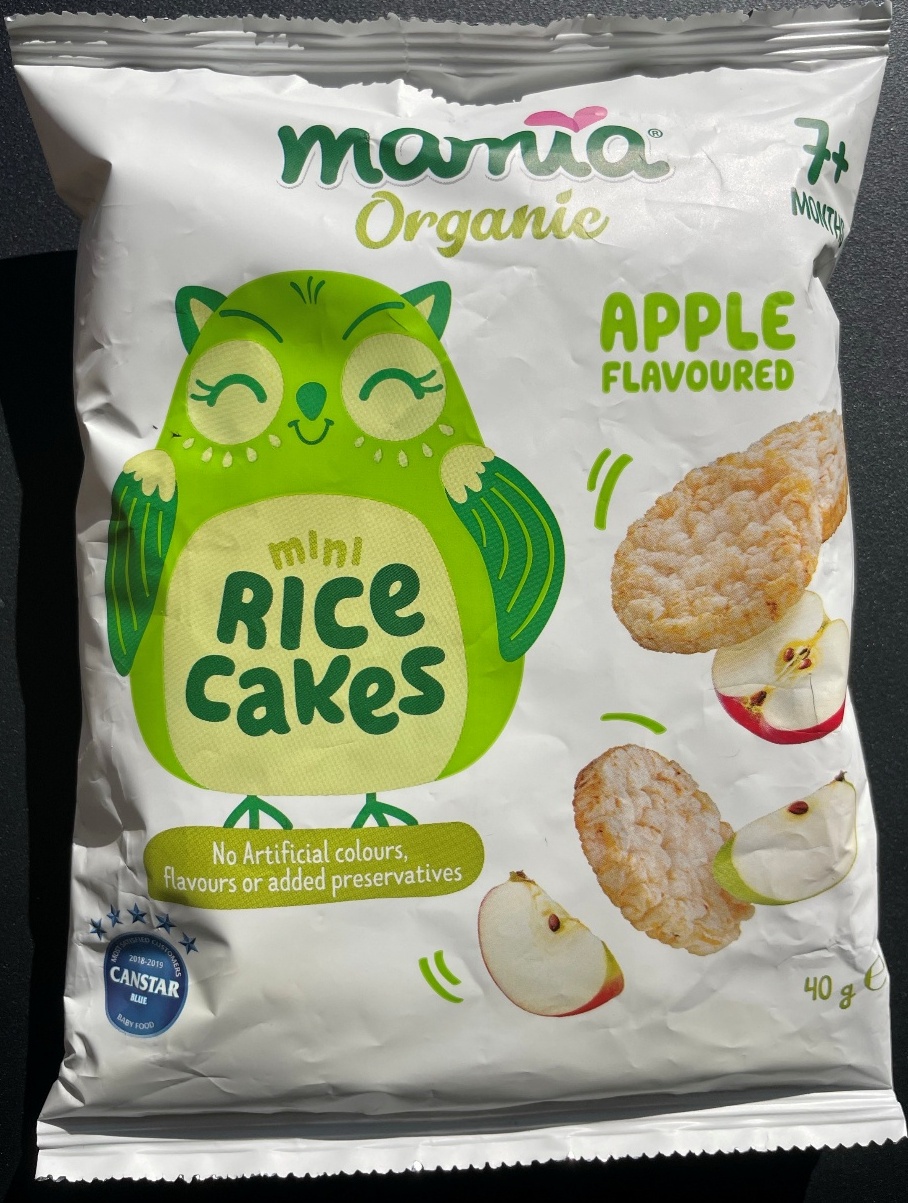
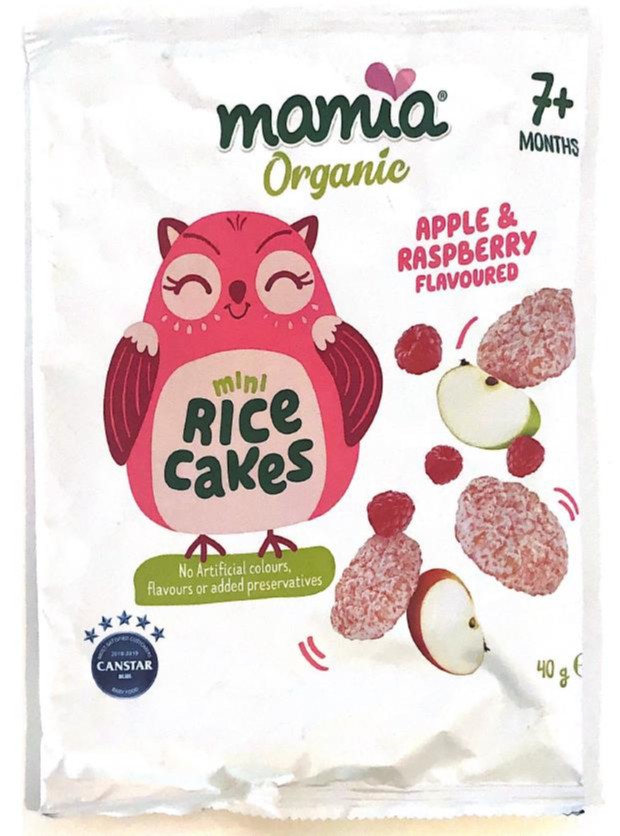
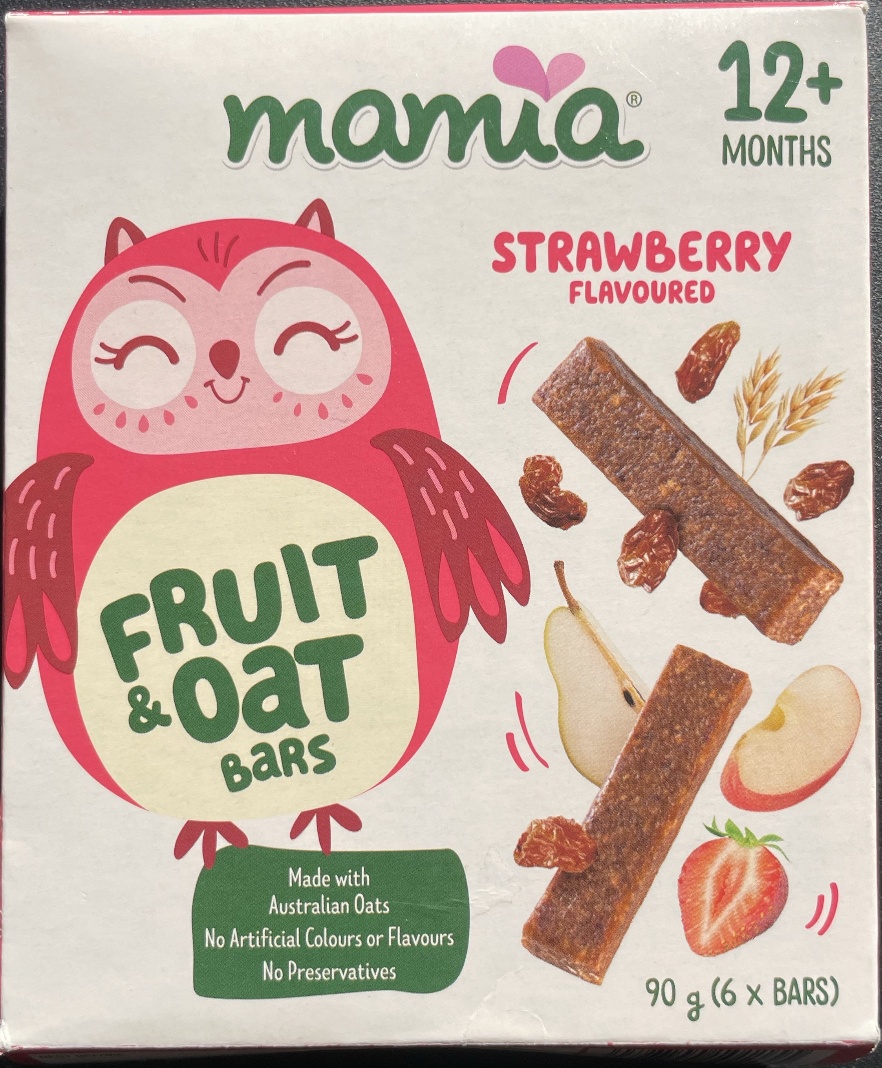
9 What was alleged to infringe were eleven Aldi Works, being the front faces of the packaging of various items of Aldi’s MAMIA snacking range. The eleven Aldi Works, with the number given to them by the primary judge, are as follows:
Item 1: MAMIA Rice Cakes Apple Aldi Work |
Item 2: MAMIA Rice Cakes Apple and Raspberry Aldi Work |
Item 3: MAMIA Fruit & Oat Bars Strawberry Aldi Work |
Item 4: MAMIA Fruit & Oat Bars Apricot Aldi Work |
Item 5: MAMIA Fruit & Oat Bars Apple and Raisin Aldi Work |
Item 6: MAMIA Fruit Snack Cereal Bars Apple, Blueberry and Banana Aldi Work |
Item 7: MAMIA Fruit Snack Cereal Bars Apple Aldi Work |
Item 8: MAMIA Fruit Snack Cereal Bars Apple and Raspberry Aldi Work |
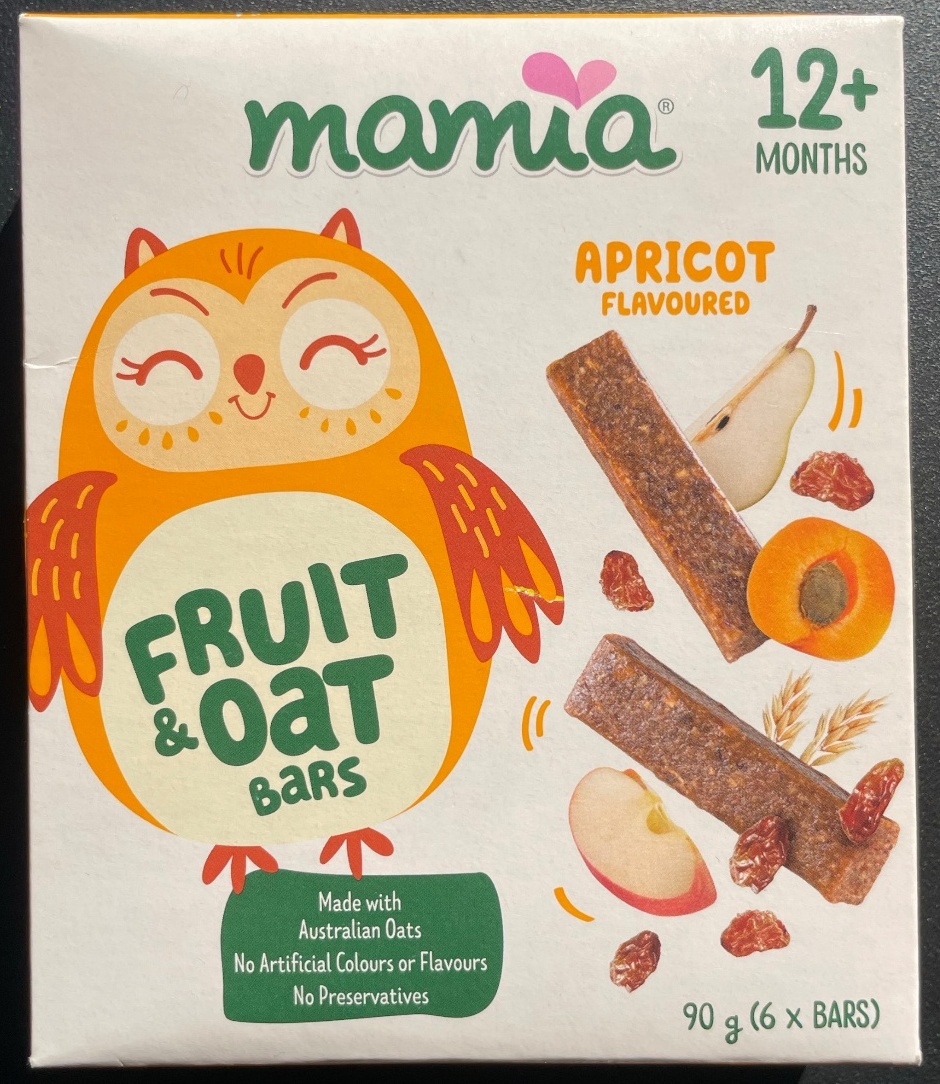
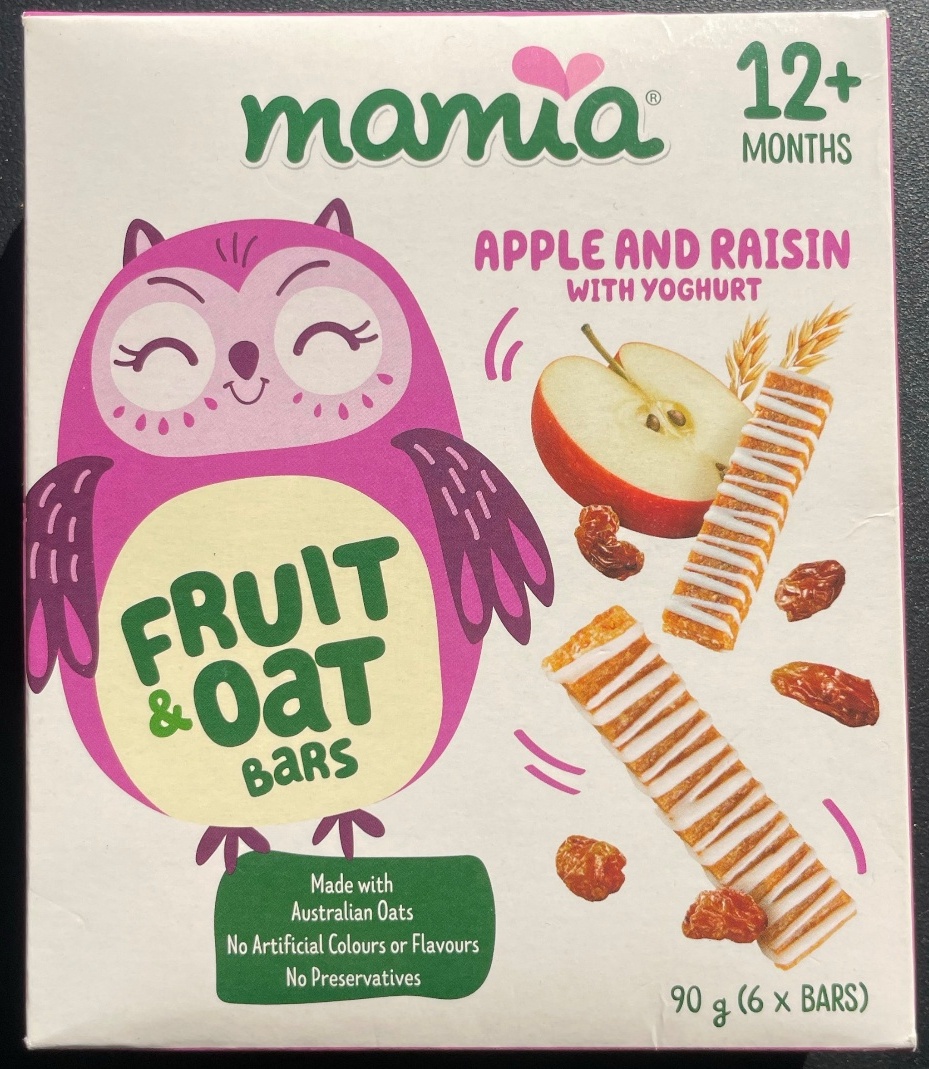
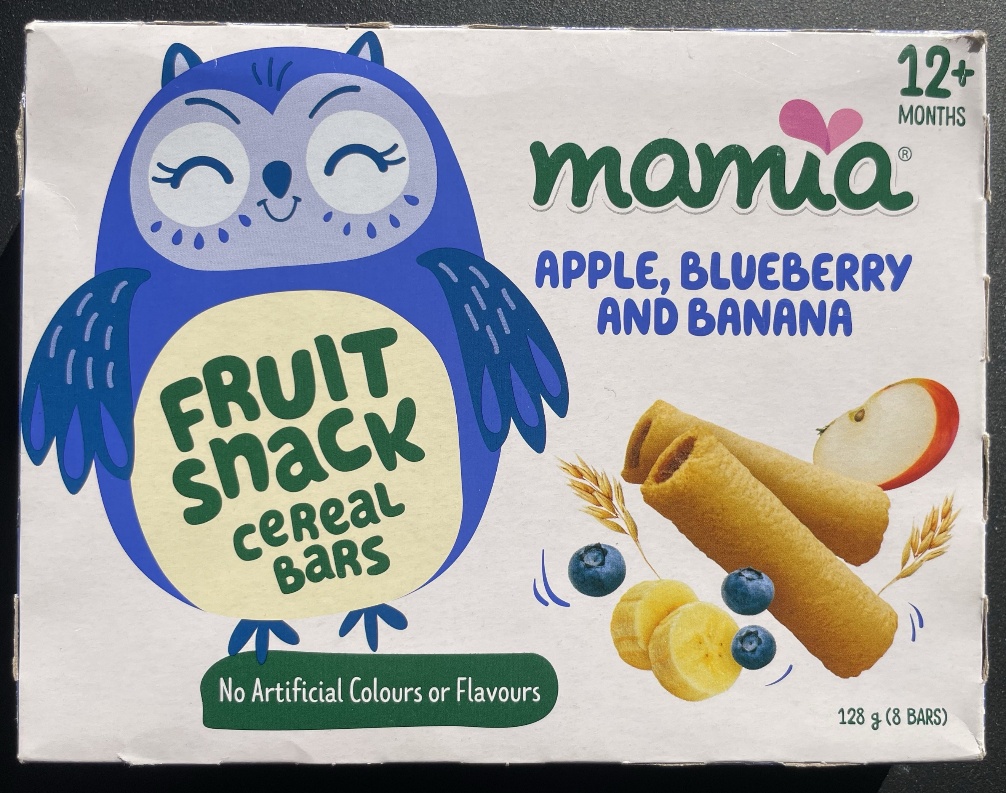
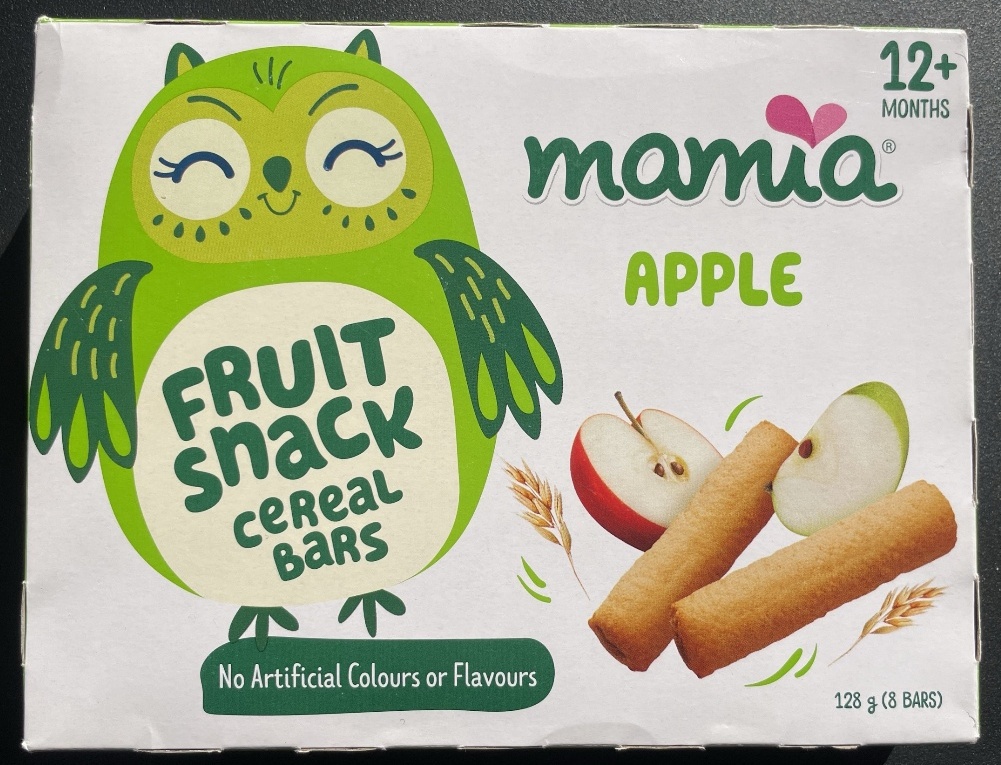
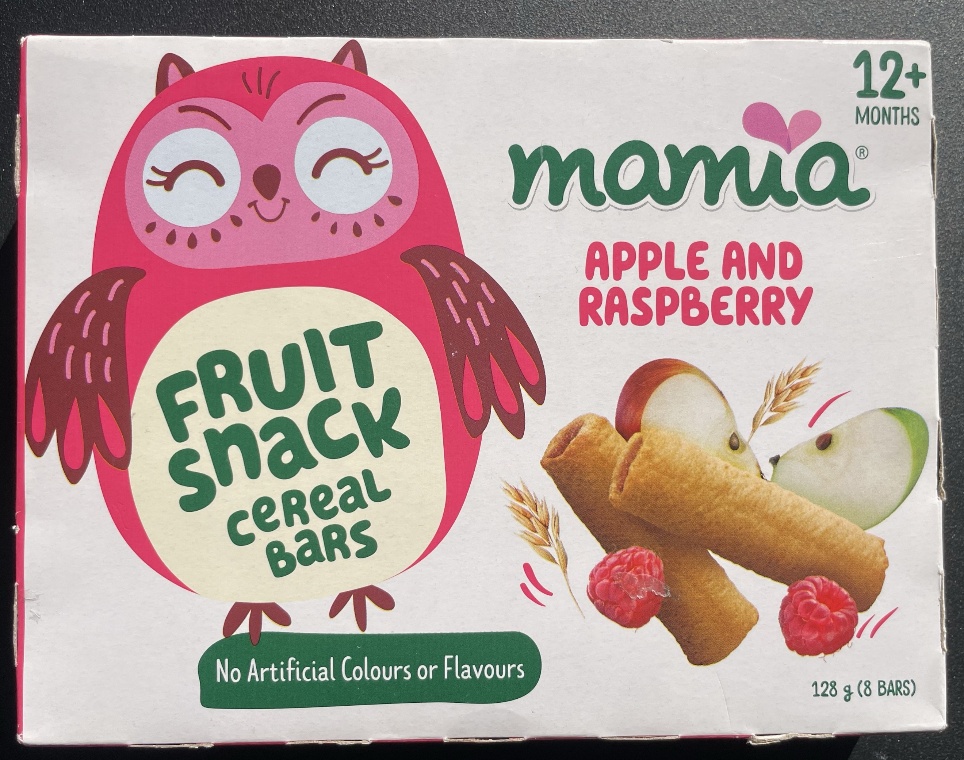
Item 9: MAMIA Baby Puffs Blueberry Aldi Work |
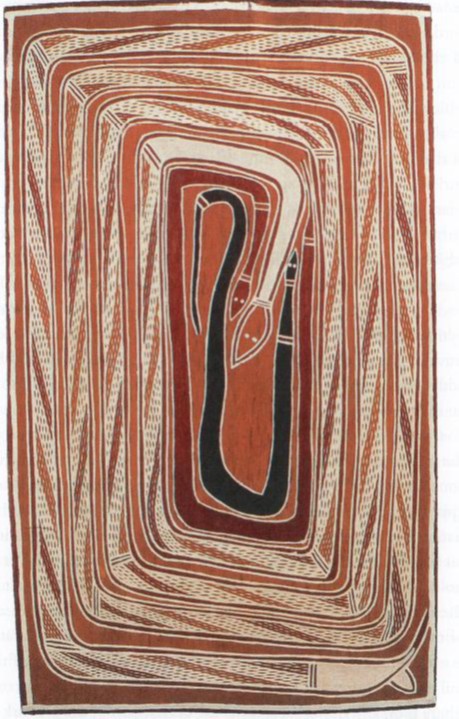
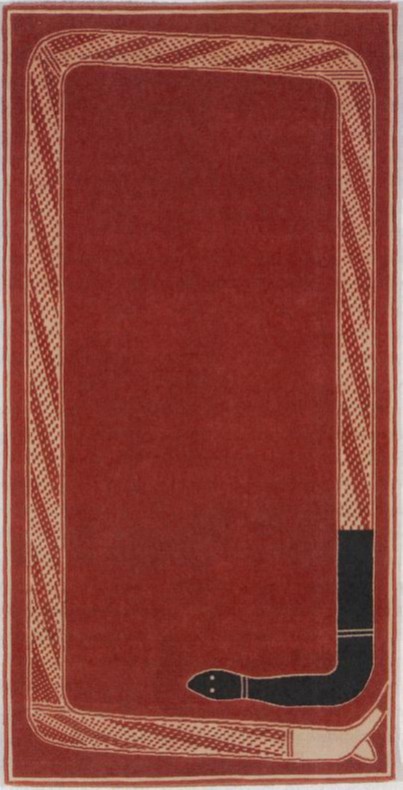
Item 10: MAMIA Baby Puffs Apple and Cinnamon Aldi Work |
Item 11: MAMIA Baby Puffs Carrot Aldi Work |
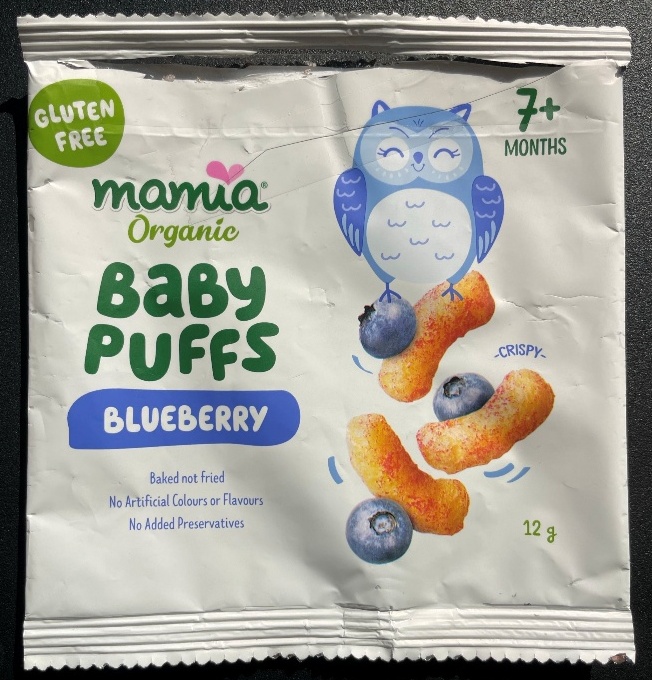
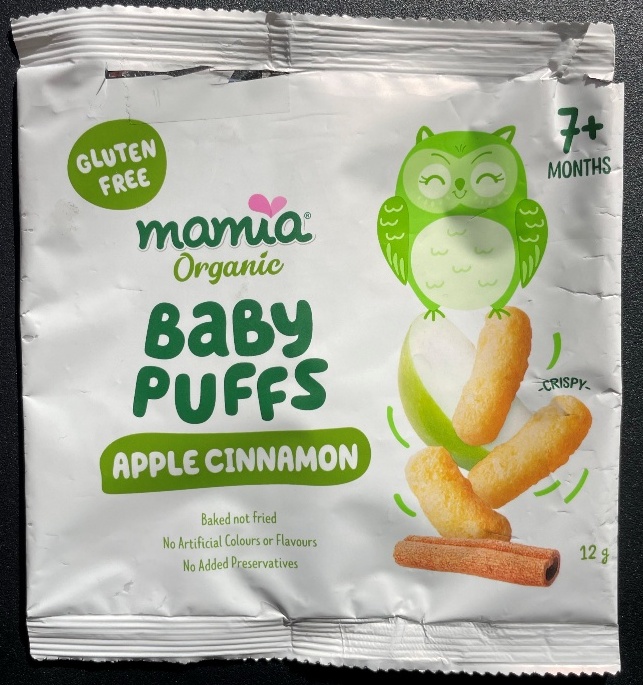
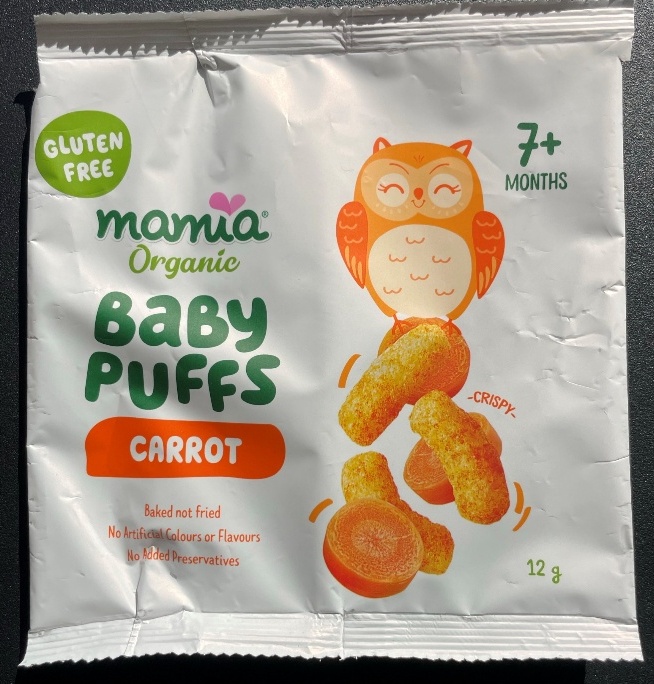
10 Again, the Aldi Works were broken into non-puffs works (the Aldi Non-Puffs Works) and the puffs works (the Aldi Puffs Works). The Aldi Non-Puffs Works were items 1 – 8 above, while the Aldi Puffs Works were items 9 – 11 above.
11 These digital reproductions do not in every case capture the precise details, including the particular colour shades, of the physical exhibits that were in evidence and to which we have had access.
12 The primary judge made detailed factual findings on the evidence before him, primarily in a chronological sequence. Those factual findings focussed on the disputed questions of (1) ownership of copyright, and the right to sue, and (2) the process by which Aldi used the Hampden Works to produce its works, and the extent to which Aldi “copied” the Hampden Works. As discussed below, those factual findings did not focus on the skill or labour involved in the production of the Hampden Works, or the extent of their originality for the purposes of assessing infringement.
13 The primary judge found that the first respondent had the right to bring a claim for breach of copyright in respect of Hampden Works items 1 – 5: PJ [148]. His Honour also found that both the first and second respondents had the right to bring a claim for infringement in respect of Hampden Works items 6 – 9: PJ [154]. There is no appeal from these conclusions.
14 In relation to copying, at PJ [72]–[112] and [121]–[128], the primary judge charted the chronology of Aldi using the Hampden Works as part of a deliberate strategy to create packaging for its own products that resembled the packaging of its competitor. That included the provision of the Hampden Works to Aldi’s designers as the “benchmark” to be emulated, the giving of instructions by Aldi to Aldi’s designers to “follow the architecture” of the Hampden Works, the creation of a design that was even closer to the Hampden Works, the receipt of “feedback” that this design was “too close to our benchmark”, and the changes made to that design to make it slightly less similar. Rather than undertake its own independent design process, Aldi set out to obtain the benefit of somebody else’s intellectual and creative effort. However, it also sought to stay on the right side of the line so as to avoid legal liability.
15 The primary judge made two central findings. First, his Honour made the following finding about the process undertaken by Aldi, through its agent Motor Brand Design (Motor Design) (at PJ [129]):
On the basis of the contemporaneous documents (set out above), I infer that the process undertaken by Motor Design was to design packaging for the MAMIA snacking range that resembled packaging of the benchmark product (the BELLIES range) (albeit not too closely, because that would infringe the law).
His Honour made a similar finding at [128] and [130].
16 This factual finding is not challenged on appeal, although Aldi says that the primary judge failed to give proper effect to the qualification in the final bracket.
17 Secondly, the primary judge made findings that Motor Design “copied” certain of the Hampden Works. His Honour made separate findings for the Aldi Puffs Works and the Aldi Non-Puffs Works. It is relevant to set out the whole of the findings, because they are challenged on this appeal. At PJ [177], the primary judge made the following findings about the Aldi Puffs Works at the commencement of his consideration (emphasis in original):
I start with the question of causal connection. On the basis of the evidence and findings set out above, I am satisfied that Motor Design, in designing the [Aldi] Puffs Works, copied the [Hampden] Puffs Works. The documents make clear that Motor Design had access to the packaging for the BABY BELLIES Organic Blueberry Puffs (item 1 of the [Hampden] Works). This was one of the six works appearing on the page headed “BENCHMARK” in Motor Design’s 30 April 2019 presentation to Aldi (see [83] above). The documents also make clear that Motor Design had access to the packaging for the BABY BELLIES Organic Carrot puffs (item 7 of the [Hampden] Works). This was one of the images in the document attached to Motor Design’s 9 April 2019 email to Aldi (see [79] above). It is to be inferred that Motor Design also had access to BABY BELLIES Organic Apple & Cinnamon puffs (item 6 of the [Hampden] Works), given that Motor Design received from Aldi the link to the BELLIES website and given the similarity between the packaging for BABY BELLIES Organic Apple & Cinnamon puffs and the packaging for MAMIA Apple Cinnamon Baby Puffs (a similarity implicitly accepted by Ms Bartholomeusz in the Sticky Note set out at [107] above). Further, as set out above, I infer that the process undertaken by Motor Design was to design packaging for the MAMIA snacking range (including the baby puffs) that resembled the packaging of the benchmark product (albeit not too closely). In the case of the baby puffs packaging, it is likely that Motor Design based each of the MAMIA designs on the BABY BELLIES packaging for the corresponding product (i.e. the design for the packaging for MAMIA Blueberry Baby Puffs was based on the packaging for BABY BELLIES Organic Blueberry puffs, etc.). This can be inferred from the similarity between the designs.
18 A similar approach was taken with the Aldi Non-Puffs Works at PJ [192], as follows (emphasis in original):
I start with the question of causal connection. On the basis of the evidence and findings set out above, I am satisfied that Motor Design, in designing the [Aldi] Non-Puffs Works, copied (at least) items 1 and 2 of the [Hampden] Works. The documents make clear that Motor Design had access to the packaging for BABY BELLIES Organic Blueberry puffs (item 1 of the [Hampden] Works), the packaging for the LITTLE BELLIES Organic Animal Biscuits (item 2 of the [Hampden] Works], and the packaging for LITTLE BELLIES Organic Gingerbread Men (item 9 of the [Hampden] Works). These were three of the six works appearing on the page headed “BENCHMARK” in Motor Design’s 30 April 2019 presentation to Aldi (see [83] above). It is likely that Motor Design also had access to the balance of the [Hampden] Works, given that it received a link to the website for the BELLIES brand. Further, as set out above, I infer that the process undertaken by Motor Design was to design packaging for the MAMIA snacking range that resembled the packaging of the benchmark product (albeit not too closely).
19 The reference to “copied” in these passages has to be understood in context. The paragraphs adopt a very similar structure and language, but one paragraph (PJ [177]) refers to Aldi Works that the primary judge found were reproductions, and the other paragraph (PJ [192]) refers to Aldi Works that the primary judge found were not reproductions. The primary judge went on to consider the question of whether the Aldi Works were a reproduction of a substantial part of any of the Hampden Works, and in the case of the Aldi Non-Puffs Works determined that they were not a substantial reproduction. The reference to “copied” therefore cannot mean “reproduced” in the statutory sense.
20 However, it is also apparent that the primary judge found there was more than just a causal connection. The word “copied” appears to be used by his Honour to describe the process identified in PJ [177], whereby Aldi used the corresponding Hampden Work (i.e. the packaging for the MAMIA Blueberry Baby Puffs was based on the BABY BELLIES Organic Blueberry Puffs and so on) to create packaging that resembled the corresponding packaging, “albeit not too closely”. This might perhaps have been better described as “mimicked” rather than “copied”. His Honour found, in effect, that Aldi emulated the relevant Hampden Works. We will return to the significance of the words “albeit not too closely”.
21 In relation to his analysis of infringement, the primary judge commenced, at PJ [156]–[175], with the applicable principles. No party criticises this section of his Honour’s reasons, except that Aldi submits that Elwood Clothing Pty Ltd v Cotton On Clothing Pty Ltd [2008] FCAFC 197; (2008) 172 FCR 580 (Elwood), cited by the primary judge, was wrongly decided.
22 At PJ [160], the primary judge observed, by reference to the decision of SW Hart & Co Pty Ltd v Edwards Hot Water Systems [1985] HCA 59; (1985) 159 CLR 466 at 472 (Gibbs J) (SW Hart) and Eagle Homes Pty Ltd v Austec Pty Ltd [1999] FCA 138; (1999) 87 FCR 415 at [98] per Lindgren J, Finkelstein and Weinberg JJ agreeing, that “reproduction” in copyright law involves two elements: (a) a causal connection between the works of the author and the alleged infringer; and (b) a sufficient degree of objective similarity between the two works. The primary judge also referred to the observations of Wilson J in SW Hart (at 484) to the effect that where there is evidence of copying, evidence of similarity may take on greater significance, in the sense that “such dissimilarities as are apparent may be seen as no more than a deliberate attempt to obscure what has actually taken place, namely, the appropriation of another person’s labour.”
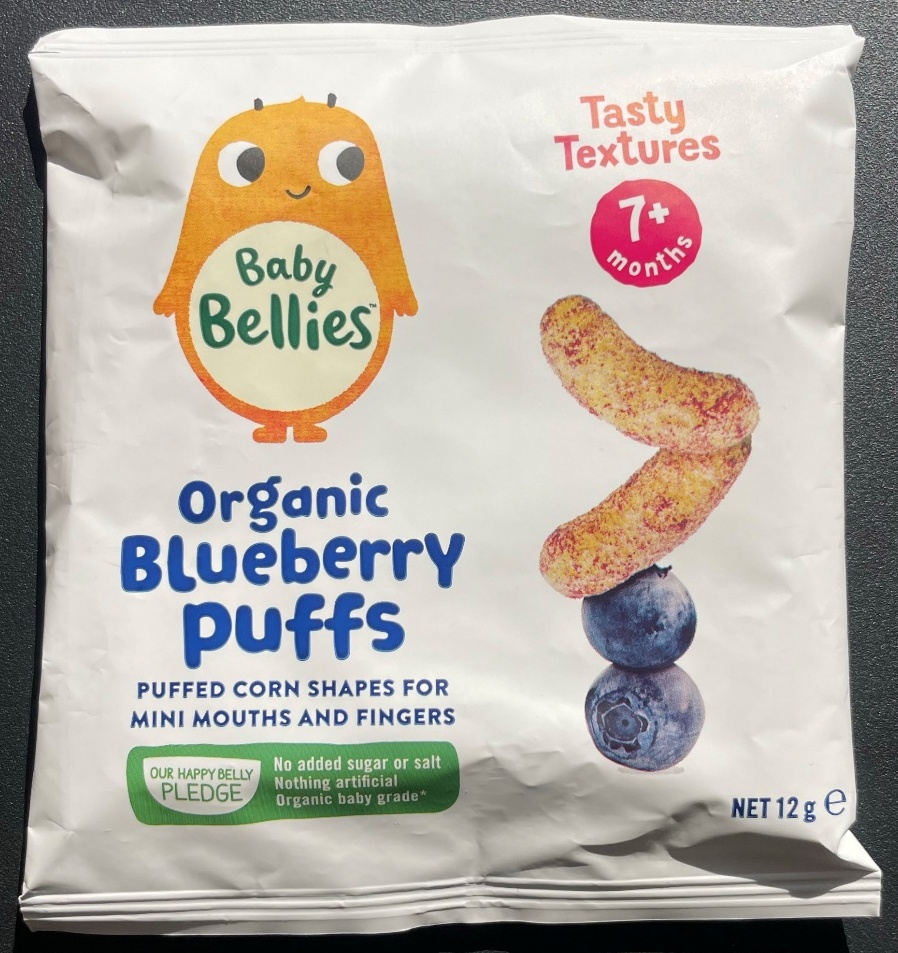
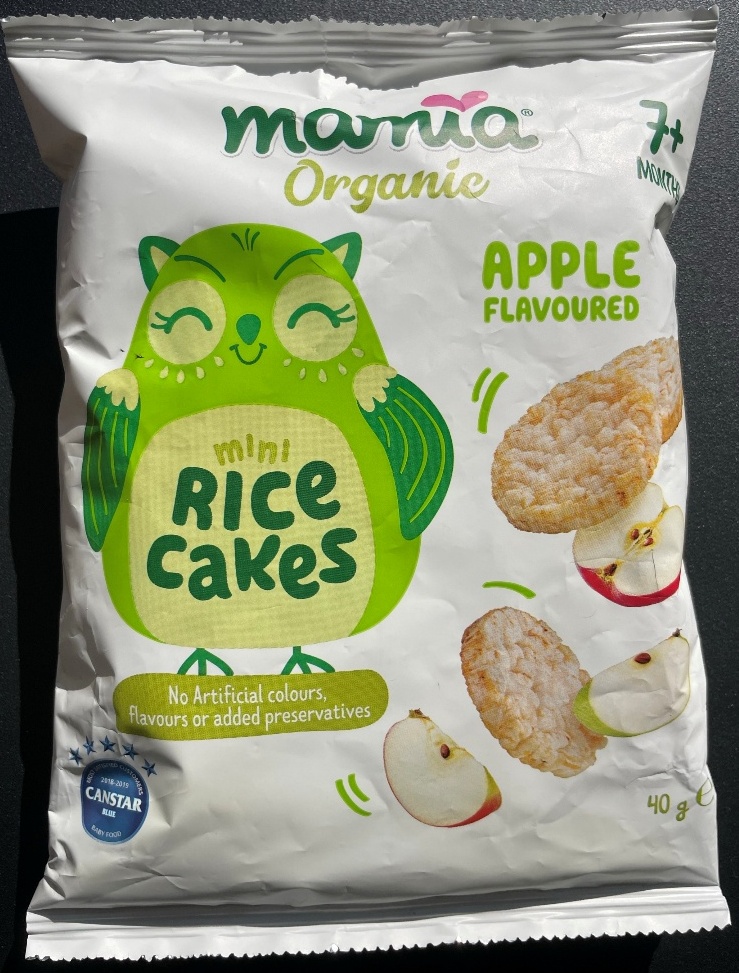
23 At PJ [161]–[169], the primary judge discussed the decision of the High Court in Autodesk Inc v Dyason (No 2) [1993] HCA 6; (1993) 176 CLR 300 (Autodesk (No 2)), Data Access Corp v Powerflex Services Pty Ltd [1999] HCA 49; (1999) 202 CLR 1 (Data Access) and IceTV Pty Ltd v Nine Network Australia Pty Ltd [2009] HCA 14; (2009) 239 CLR 458 (IceTV), including by quoting relevant passages from the judgments in IceTV at some length. In setting out those passages from IceTV, his Honour emphasised certain parts by placing them in bold text. The relevant passages from his Honour’s decision are as follows (preserving his Honour’s emphasis):
162 French CJ, Crennan and Kiefel JJ stated at [30]:
28 Copyright does not protect facts or information. Copyright protects the particular form of expression of the information, namely the words, figures and symbols in which the pieces of information are expressed, and the selection and arrangement of that information. That facts are not protected is a crucial part of the balancing of competing policy considerations in copyright legislation. The information/ expression dichotomy, in copyright law, is rooted in considerations of social utility. Copyright, being an exception to the law’s general abhorrence of monopolies, does not confer a monopoly on facts or information because to do so would impede the reading public’s access to and use of facts and information. Copyright is not given to reward work distinct from the production of a particular form of expression.
29 These concepts are relevant to the determination, called for by the Act, of whether a part reproduced is a “substantial part” of a work in which copyright subsists.
Substantial part
30 So as to indicate that the time and title information alleged to have been reproduced did not form a large part of a Weekly Schedule, the primary judge referred to the copying of “slivers of information”. However, in order to assess whether material copied is a substantial part of an original literary work, it is necessary to consider not only the extent of what is copied: the quality of what is copied is critical.
31 This principle has a long provenance and it is particularly apposite when considering a compilation. Some compilations are no more than a selection or arrangement of facts or information already in the public domain. When the particular form of expression contains facts and information, it is not helpful to refer to “the rough practical test that what is worth copying is prima facie worth protecting”. To take an example, facts are obviously worth copying for purposes such as a narrative work of history which depends on secondary sources. It is equally unhelpful to refer to the “commercial value” of the information, because that directs attention to the information itself rather than to the particular form of expression.
32 It is often said that questions of whether a substantial part has been copied are questions of fact and degree. However, a factor critical to the assessment of the quality of what is copied is the “originality” of the part which is copied.
(Footnotes omitted; emphasis added.)
…
165 French CJ, Crennan and Kiefel JJ dealt with originality in the context of infringement from [35] onwards. Their Honours stated at [39]-[40]:
39 In Data Access, Gleeson CJ, McHugh, Gummow and Hayne JJ approved Mason CJ’s view [in Autodesk (No 2)] and said that, in the case of a computer program, “the originality of what was allegedly taken from a computer program must be assessed with respect to the originality with which it expresses [the] algorithmic or logical relationship [between the function desired to be performed by a device and the device] or part thereof” and its “inherent originality”. Their Honours concluded that the “Reserved Words” under consideration, which were user inputs associated in the program with certain functions, were not a substantial part of the computer program. This was, first, because the Reserved Words were “irrelevant to the structure, choice of commands and combination and sequencing of the commands in source code”. Secondly, since the Reserved Words consisted of ordinary English words suggestive of their function or words common in other computer languages (or combinations thereof), “they d[id] not possess sufficient originality as data to constitute a substantial part of the computer program”.
40 These cases direct attention to the degree of originality in the expression of the part of the work reproduced. The same point is made in the current edition of Copinger and Skone James on Copyright:
“[T]he more simple or lacking in substantial originality the copyright work, the greater the degree of taking will be needed before the substantial part test is satisfied.”
(Footnotes omitted.)
166 French CJ, Crennan and Kiefel JJ also referred to the topic of skill and labour in the context of infringement and stated:
49 In the context of infringement, in particular the determination of whether a part reproduced is a “substantial part”, a matter often referred to is whether there has been an “appropriation” of the author’s skill and labour. As already noted, both the primary judge and the Full Court adopted that approach in this case. However, it is always necessary to focus on the nature of the skill and labour, and in particular to ask whether it is directed to the originality of the particular form of expression.
(Footnotes omitted; emphasis added.)
167 In their judgment, Gummow, Hayne and Heydon JJ noted at [155] that the Full Court had stated that a finding of substantiality depended much more on the quality than the quantity of that which had been copied. Gummow, Hayne and Heydon JJ stated that that starting point was in accordance with authority, citing Autodesk (No 2) at 305. Their Honours continued:
155 … However, the “quality” relevant in the case of a literary work, including a compilation, was said to be “the literary originality of what has been copied”. That quality was to be assessed by reference to “the interest protected by the copyright”. The origin of these latter two propositions in Newspaper Licensing has been described earlier in these reasons.
156 Neither proposition is satisfactory and each is apt to mislead.
(Footnotes omitted.)
168 In relation to the first proposition, Gummow, Hayne and Heydon JJ stated:
157 The proposition that in a case such as the present one looks to the literary originality of what IceTV copied, rather than to the Weekly Schedule as a whole, in answering the question whether IceTV reproduced a substantial part of the Weekly Schedule, shifts consideration to an extraneous issue. This is whether what the primary judge called the “slivers” of information may themselves be classified as original literary works. The issue requiring the comparison between what was taken and the whole of the work in suit may be distorted by a meditation, inspired by Desktop Marketing, upon the protection given by the Act against misappropriation of any investment of skill and labour by the author. In the present case, the temptation then is to classify the slivers each as original literary works. An important proposition may be overlooked. This is that the statutory requirement that the part of a work taken must be substantial assumes there may be some measure of legitimate appropriation of that investment.
(Footnote omitted.)
169 In relation to the second proposition, Gummow, Hayne and Heydon JJ stated:
160 The proposition that the Court should look to “the interest” which the copyright protects invites processes of reasoning to which there applies the warning by Judge Learned Hand in Nichols v Universal Pictures Corporation. This is to the effect that the more remote the level of abstraction of the “interest”, the greater the risk of protecting the “ideas” of the author rather than their fixed expression. That risk appears to have been realised in the reasoning of the Full Court.
161 The Full Court approached the issue of substantiality at too high a level of abstraction, and in doing so tipped the balance too far against the interest of viewers of digital free to air television in the dissemination by means of new technology of programme listings. The Full Court did so by treating the issue of substantiality as dominated by an “interest” in the protection of Nine against perceived competition by Ice.
(Footnote omitted.)
24 The passages given careful emphasis by the primary judge underscore that the Court must bear steadily in mind that copyright protects a particular form of expression, that the quality of what is copied is important, and that a factor critical to the assessment of the quality of what is copied is the “originality” of the part which is copied.
25 Having regard to the degree of emphasis the primary judge gave to the role of originality in the consideration of infringement, it seems unlikely that his Honour was not conscious of its significance.
26 The primary judge also quoted from Designers Guild Ltd v Russell Williams (Textiles) Ltd [2000] UKHL 58; [2000] 1 WLR 2416 (Designers Guild), and cited Elwood and Seafolly Pty Ltd v Fewstone Pty Ltd [2014] FCA 321; (2014) 106 IPR 85 (Dodds-Streeton J) (Seafolly).
2.1 Puffs Works
27 The primary judge then turned to the application of the principles, under the heading “Consideration”. His Honour dealt first with the Aldi Puffs Works. His Honour made the finding in relation to causal connection, set out above. His Honour then dealt with reproduction of a substantial part, at PJ [178]–[188]. The primary judge commenced with the item 1 of the Hampden Works, and compared it with item 9 of the Aldi Works. The relevant works are as follows:
Item 1: Blueberry Puffs Hampden Work |
Item 9: MAMIA Baby Puffs Blueberry Aldi Work |
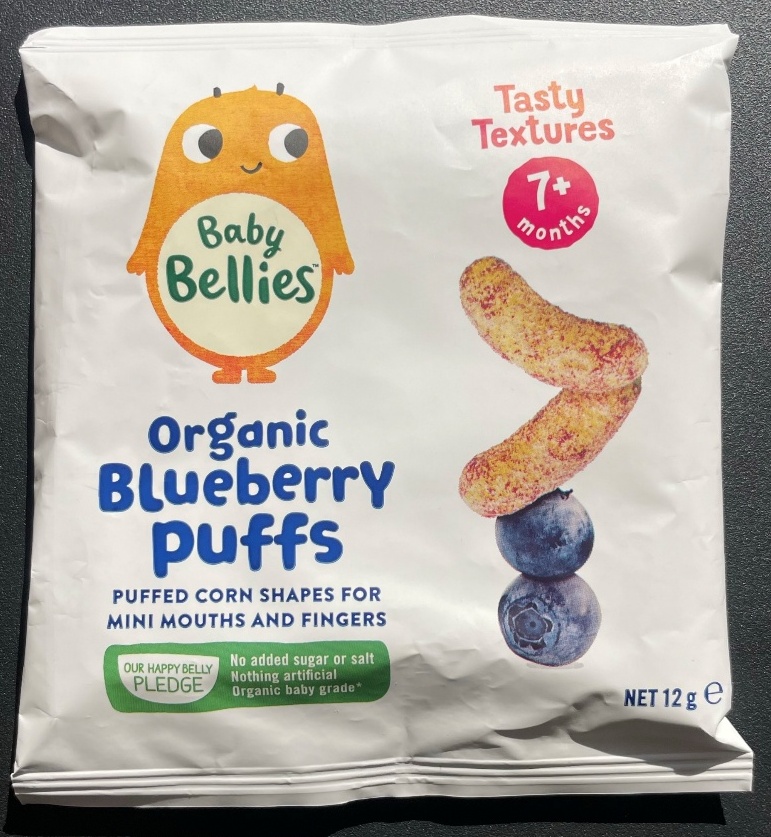
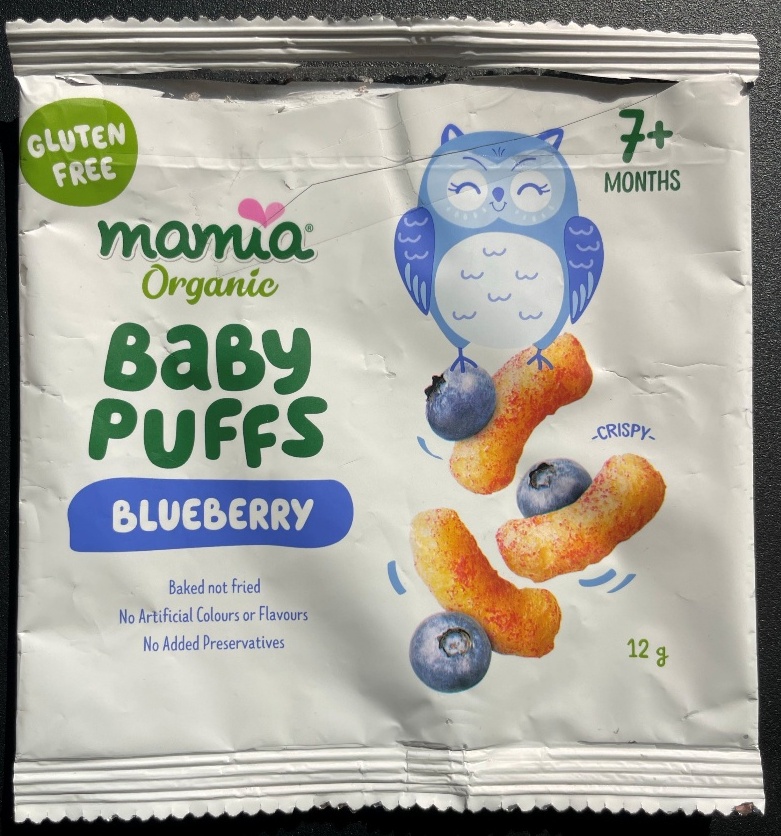
28 The primary judge stated that item 9 of the Aldi Works reproduces “a number of the layout and design elements of item 1 of the [Hampden] Works”. His Honour then listed seven elements which he considered to have been reproduced, being:
(a) a small oval-shaped cartoon character, with a large, light-coloured belly;
(b) a solid white background;
(c) a two-column layout;
(d) a rounded, childlike font;
(e) on the left side, text elements of varying sizes, “stacked” vertically;
(f) on the right side, photographic images of the product and ingredients, in a vertical composition; and
(g) a number in the upper-right corner.
29 In a key paragraph at PJ [181], the primary judge said the following:
In my view, considered cumulatively, these layout and design elements constitute a substantial part of item 1 of the [Hampden] Works. The layout and design elements need to be considered in combination. While a solid white background on its own may be unremarkable, it needs to be considered in conjunction with the other elements. When considered together, in my opinion, the layout and design elements involve a degree of creativity or originality. They go beyond the idea or concept and constitute a form of expression. Considered together, the layout and design elements set out in the preceding paragraph are qualitatively significant.
30 His Honour, at PJ [182], rejected a submission by Aldi that Hampden was seeking to protect an idea or the “look and feel” of their products rather than a form of expression, concluding that the design elements constituted forms of expression.
31 His Honour then said as follows, at PJ [183]:
Aldi’s characterisation of [Hampden’s] claim as residing in the “look and feel” of the [Hampden] Works rested on a submission that none of the listed design elements was taken “precisely” by Aldi. I do not accept that submission. Each element listed above is present in item 9 of the [Aldi] Works. It is true that the identification of those elements involves some degree of abstraction, but the elements are not identified at so high a level of abstraction as to venture into the protection of ideas rather than their expression.
32 As Aldi submitted below, and submits again on this appeal, and we accept, a feature of the present case is that none of the images or graphical elements on the Hampden Works is reproduced unaltered by Aldi. For example, the cartoon figure, the green rectangle, the photographs of ingredients, the text about a suitable age, the form of the product name and variety and the writing used for that name and variety as present in the Hampden Works, all take a different form on the Aldi packaging to a greater or lesser extent. However, in this passage the primary judge is using his own taxonomy of “layout and design elements”. Those elements have been abstracted from the precise pictorial or textual form of the element present on the Hampden Work to something more general. For example, the precise pictorial form of the orange “monster” on the Hampden Work is described by the primary judge as “a small, oval-shaped cartoon character, with a large, light-coloured belly”. When expressed at that level of abstraction, the element is present in the relevant Aldi Work.
33 We will consider further below this process of abstraction, and whether it departed from the required analysis. In that regard, we will consider whether the effect of the approach of the primary judge was to ignore differences by abstracting to a level where the difference disappears.
34 However, having engaged in the process of abstraction, the primary judge did not simply conduct a tick-a-box exercise with the abstracted elements. Rather, it is apparent from PJ [181], set out above, that his Honour considered the layout of the relevant Hampden Work and the design elements of that Work in combination, and considered whether that combination was a substantial part of the Hampden Work. The primary judge observed that the layout and design elements involved a degree of creativity or originality, and go beyond an idea or concept and constitute a form of expression. Put another way, his Honour approached the matter by considering whether Aldi took the layout and design of the work, and whether the layout and design that was taken was a qualitatively significant part of the Hampden Work. To an extent, that involves a focus on layout and design removed from the particular form of expression of individual parts of the relevant Hampden Work.
35 When the primary judge observed, at PJ [181], that the parts of the layout and design that were reproduced “involve a degree of creativity or originality”, it is apparent that his Honour was undertaking that assessment by examining the relevant Hampden Work itself. His Honour was not drawing upon, and did not refer to, any evidence as to the skill or labour that went into the formation of the layout and design elements that were taken.
36 Further, the reference in PJ [181] to the solid white background on its own being “unremarkable” indicates that the primary judge was conscious that assessing originality may well require a consideration against the backdrop of existing works to see what has already been done. Other than the comment about a solid white background, however, there was no analysis of the extent to which the elements identified (e.g. “a two-column layout” or “a rounded, childlike font”) were themselves original or unoriginal.
37 At PJ [184], the primary judge observed that while there are differences between the two works, “this is not the focus for present purposes”, citing Designers Guild (at 2421–2422). It is apparent that his Honour there meant that the assessment of substantial reproduction is undertaken by considering whether the part taken is a substantial part of the Hampden Work, rather than whether the part taken is a substantial part of the Aldi Work or whether there are other parts of the Aldi Work not present in the Hampden Work. In our respectful view, that observation is plainly correct.
38 The primary judge found, at PJ [185], that item 9 of the Aldi Works reproduced a substantial part of item 1 of the Hampden Works. The primary judge then dealt in a shorthand way with each of the other Aldi Puffs Works, finding that each of them reproduced a substantial part of the relevant Hampden Puffs Work for the same reason: that is, that each involved a reproduction of the same aspects of the design and layout, being the seven elements identified above. His Honour concluded that these design elements were also present in items 6 and 7 of the Hampden Works, and the relevant Aldi Puffs Works reproduced item 1 of the Hampden Works. Thus the primary judge also found that:
(a) item 10 of the Aldi Works reproduced items 6 and 1 of the Hampden Works; and
(b) item 11 of the Aldi Works reproduced items 7 and 1 of the Hampden Works.
39 The primary judge concluded that each of the Aldi Puff Works infringed the relevant Hampden Works and that Hampden’s case based on ss 36 and 38 of the Copyright Act 1968 (Cth) (the Copyright Act) was established.
2.2 Non-Puffs Works
40 The primary judge then turned to consider the Aldi Non-Puffs Works. This section of the judgment adopted a similar structure and approach to that concerning the Aldi Puffs Works.
41 The primary judge first concluded (at PJ [192]) that Hampden had established the relevant causal connection, finding that in designing the Aldi Non-Puffs Works, Aldi “copied” (at least) items 1 and 2 of the Hampden Works, in the sense described earlier.
42 His Honour then considered the layout and design features of the relevant Hampden Work which had been reproduced in the relevant Aldi Work and whether those features were a substantial part of the Hampden Work. In that regard, the primary judge limited his consideration to whether there was infringement of items 1 and 2 of the Hampden Works, observing that the other Hampden Works contained “similar layout and design features” and that “[i]f the applicants are unable to make out their case by reference to either item 1 or item 2 of the [Hampden] Works, then in my view they are unable to make out their case by reference to any of the other [Hampden] Works”: PJ [194]. When reduced to a list of abstracted features, that may be so. However, it excluded relevant comparisons on the basis of visual similarity.
43 The primary judge considered the Aldi Non-Puffs Works in three groups. His Honour first considered whether items 1 and 2 of the Aldi Works infringed item 1 of the Hampden Works. The relevant works are as follows:
Item 1: Blueberry Puffs Hampden Work |
Item 1: MAMIA Rice Cakes Apple Aldi Work |
Item 2: MAMIA Rice Cakes Apple and Raspberry Aldi Work |
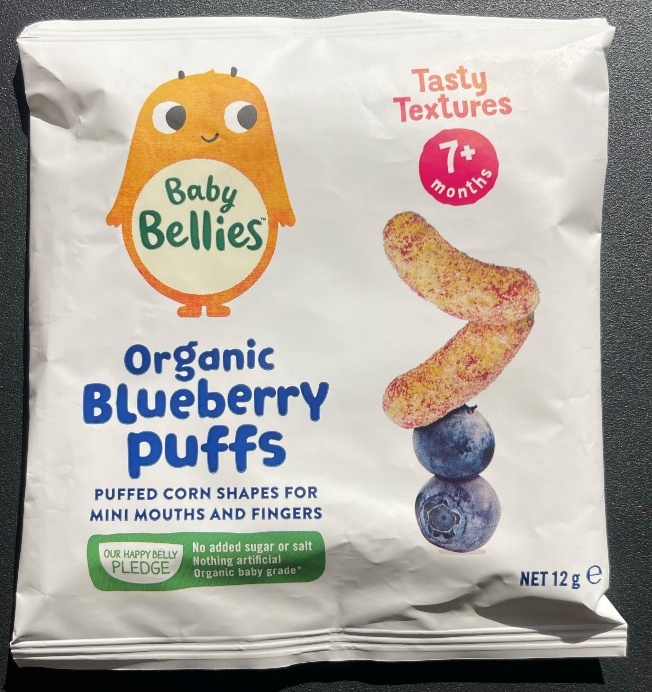
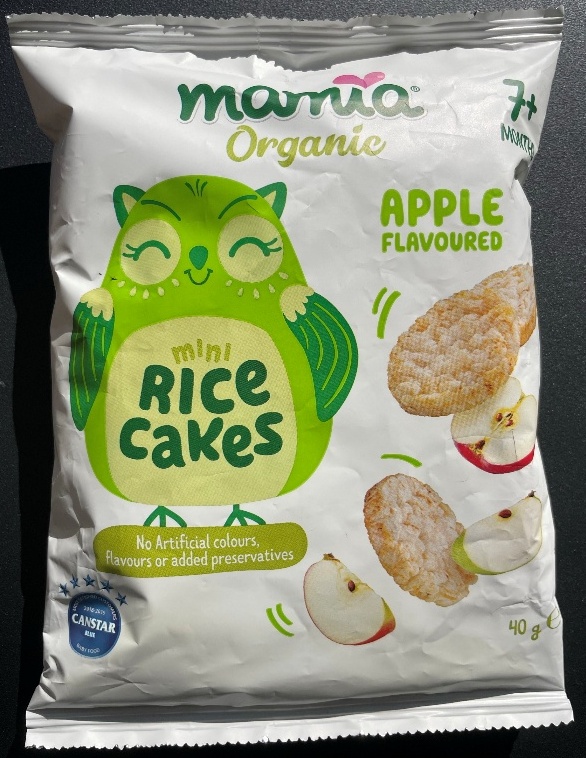
44 The primary judge concluded (at PJ [196]) that items 1 and 2 of the Aldi Works reproduced the following layout and design elements of item 1 of the Hampden Works:
(a) a solid white background;
(b) a rounded, childlike font;
(c) on the bottom left, a green oblong shape with writing in it;
(d) on the right side, photographic images of the product and ingredients, in a vertical composition; and
(e) a number in the upper-right corner.
45 However, the primary judge found that this was insufficient for infringement. His Honour reasoned as follows:
197 Unlike the [Aldi] Puffs Works, items 1 and 2 of the [Aldi] Works do not reproduce the design element of a small, oval-shaped cartoon character. The owl in items 1 and 2 of the [Aldi] Works is much larger, and does not resemble the cartoon character in item 1 of the [Hampden] Works. While it might be said that a large, light-coloured belly (with writing in it) has been reproduced, I do not consider that this can be considered separately from the character itself, which is not reproduced. Further, unlike the [Aldi] Puffs Works, items 1 and 2 of the [Aldi] Works do not reproduce a two-column layout. The ingredients near the bottom of the image stray into the middle of the work, and the MAMIA brand name is central, such that there is not a clear impression of two columns.
198 I am not satisfied that the layout and design elements that have been reproduced, even if taken cumulatively, constitute a substantial part of item 1 of the [Hampden] Works. The question is to be approached qualitatively rather than quantitatively. Several of the reproduced elements are commonplace. Further, the combination of these elements does not, in my opinion, produce something that is of sufficient creative significance. I consider that, even if taken together, the reproduced elements lack sufficient qualitative significance to constitute a substantial part of item 1 of the [Hampden] Works.
46 Although describing “several” of the reproduced elements as “commonplace”, his Honour did not identify which elements, or explain why they were commonplace. Four of the five elements his Honour found to be reproduced (being everything except the green oblong) are present in the list of reproduced elements of the Aldi Puffs Works which are listed in paragraph [28] above, only one of which his Honour expressly identified as “commonplace” (being the solid white background) and where his Honour found there was an infringement.
47 By the express reference to the “layout and design elements”, it is apparent that the primary judge was again focussing on layout and design. On this occasion, his Honour used the term “creative significance” rather than referring to the originality of that which was taken. However, in context, it is apparent that his Honour was referring to the same concept.
48 The primary judge adopted a similar approach to the next combination, being whether items 1 and 2 of the Aldi Works were a substantial reproduction of item 2 of the Hampden Works. However, unlike the comparison of the same impugned Aldi Works against item 1 of the Hampden Works, on this occasion his Honour found that the first relevant design element in this Hampden Work was a large oval-shaped cartoon character, with a large, light-coloured belly (with writing in it), as opposed to a small character in item 1 of the Hampden Works. On the basis of this size distinction, his Honour found on this occasion that this design element was reproduced. Thus rather than considering the similarities between the figures regardless of size, his Honour used size as a determinant of whether an element is or is not present, in the form of a “yes/no” assessment. That is a significant aspect of the reasons of the primary judge.
49 The primary judge otherwise found that on this occasion the only other elements reproduced were “a solid white background” and “a number of the upper-right corner”. The relevant reasoning on substantial part is as follows:
203 I am not satisfied that the layout and design elements that have been reproduced, even if taken cumulatively, constitute a substantial part of item 2 of the [Hampden] Works. Although the impugned work reproduces the design element constituted by a large, oval-shaped cartoon character, with a large, light-coloured belly (with writing in it), which may be considered to be a creative or original element, the other elements that have been reproduced are commonplace. While the question is to be approached qualitatively, the number of layout and design elements that have been reproduced can be relevant to the qualitative assessment. Here, the number of elements that have been reproduced is too few to conclude that the layout and design elements that have been reproduced, even if taken together, constitute a substantial part of item 2 of the [Hampden] Works.
50 The primary judge adopted a very similar approach to the question of whether items 3, 4 and 5 of the Aldi Works reproduced a substantial part of items 1 and 2 of the Hampden Works. For example, his Honour found that items 3, 4 and 5 of the Aldi Works did not reproduce the cartoon figure in item 1 of the Hampden Works, in that the owl is bigger in the Aldi Works, but that they did reproduce the cartoon figure in item 2 of the Hampden Works (which is larger). Again, in each case, his Honour found that several elements reproduced were commonplace. His Honour’s reasoning was otherwise the same as for items 1 and 2 of the Aldi Works.
51 An almost identical approach was taken for whether items 6, 7 and 8 of the Aldi Works substantially reproduced items 1 or 2 of the Hampden Works.
52 In the result, his Honour concluded that none of the Aldi Non-Puffs Works infringed any of the Hampden Works.
2.3 Approach of the primary judge and the case put below
53 From the matters summarised above, it is apparent that the primary judge placed greatest emphasis on the design or layout of the Hampden Works. His Honour also described the relevant design elements found to be present in the Aldi Works at a level of abstraction, such that the element was found either to be present in whole or not present at all. For example, the cartoon figure was given an abstract description and was found to either be present or absent based on size.
54 The approach of the primary judge has to be viewed in light of how Hampden put the case before him. In that regard, it is appropriate to set out some relevant passages from Hampden’s written closing submissions before the primary judge, which are tolerably short, as follows (emphasis in original):
104. The layout of elements in the Applicants’ Works gives the Works a particular look and feel (see Elwood at [76]). The look and feel is shared by all of the Applicants’ Works, whether it is packaging for a “Baby Bellies”, “Little Bellies” or “Mighty Bellies” product, and regardless of the type of product or flavour. Of course, that is the entire reason for developing a suite of designs as part of a branding or rebranding project – to make the products easily identifiable as part of the one brand (it is also no doubt the reason why Aldi uses a “framework” across its different Mamia food products).
105. That look and feel is the result of a combination of elements in the Applicants’ Works. Those elements include (by reference to the “Baby Bellies” designs): (a) a solid white background; (b) a two-column layout; (c) a number in the upper-right corner; (d) on the right side, photographic cutouts of ingredients and the internal product are clustered together in a vertical arrangement; (e) on the left side, different text elements of varying sizes “stacked” vertically, as well as a green oblong shape with rounded corners and wavy lines and text formed from the negative space; (f) a cartoon character of an oval shape, with two small ears on top of its head, two small legs under its body, arms by its side, a rounded belly in a lighter tone; (g) the cartoon character is positioned in one of the two columns; (h) a rounded, child-like font. That combination of elements, in the way they are laid out in the Applicants’ Works, is unique and original to the Applicants’ Works. It was the focus of much of the work that the B&B Authors did in making the works. [Footnoted reference is then made to certain paragraphs of an affidavit of Mr Bowen.]
…
107. The Impugned Packaging has a similar look and feel to the Applicants’ Works, because of the combination of elements which have been copied from the Applicants’ Works (by reason of Motor following the architecture of the Applicants’ Works).
55 These references to the “look and feel” invokes the approach in Elwood, which is discussed below. Thus Hampden was contending for an approach whereby there was a single design, or single “look and feel”, which was common across the Hampden Works and which Aldi had taken in each of the Aldi Works. As discussed below, that is an unconventional (and incorrect) approach to the infringement of an artistic work in circumstances such as the present.
56 In its written submissions before the primary judge, Hampden relied upon two works as exemplar works for this common “look and feel”, being items 1 and 3 of the Hampden Works. Hampden went on to make a single submission about infringement by the Aldi Non-Puffs Works (at written closing submissions [108]), and a single submission about infringement by the Aldi Puffs Works (at written closing submissions [109]), albeit in each case the single paragraph identified some minor variations in the Aldi Works.
57 Hampden continued this general approach to infringement on the appeal. Somewhat surprisingly in an artistic work copyright case, at no stage was the Court taken to any pair of works and asked to undertake any side-by-side comparison. After seeking some clarity as to Hampden’s approach during the course of the first day of the hearing, at the end of that day the following exchange occurred:
MOORE J: Just before we [adjourn], Mr Hennessy, just so you can think about it overnight, Mr Fox earlier gave a submission where he set out with reference to these two products the differences between them that he said prevented there being an infringement. I know you’re going to defend his Honour’s reasoning and so on, but it would be very helpful if in the course of tomorrow you had a crisp articulation for each of the products you allege to be an infringement: (1) precisely what do you say it infringes and (2) precisely why, by reference to the visual elements. I think we’ve just teased out the issue there. If you’re going to say, “Well, if has got child-like writing on it”, well, which precise writing and what precisely does it match against, if you’re relying on that feature, so that it’s very clear to us exactly how you’ve put that case.
SENIOR COUNSEL: We will do that, your Honour.
58 That was an invitation to identify the particular pairs of works for comparison purposes, and what precisely was said to be reproduced. Instead, what occurred the following day was that Hampden handed up three aides memoire comprising:
(a) a comparison between item 1 of the Hampden Works and all of the Aldi Puffs Works;
(b) a comparison between item 1 of the Hampden Works and all of the Aldi Non-Puffs Works;
(c) a comparison between item 3 of the Hampden Works (being the organic tomato fiddlesticks packaging) and all of the Aldi Non-Puffs Works.
59 Further, in each case, the aide memoire identified a series of alleged common features in an abstracted format, e.g. “on the right, photographic images of the product and ingredients in a vertical composition”. However, that renders it difficult to consider whether a substantial part of any particular work has been reproduced. For example, different works have different pictures of the product or the ingredients. Item 1 of the Hampden Works has photographs of blueberries and two puffs. Only items 6 and 9 of the Aldi Works have photographs of blueberries. Item 9 of the Aldi Works has photographs of blueberries and three puffs. Item 6 of the Aldi Works also has photographs of blueberries, as well as other ingredients (apple, banana and oats) and a photograph of a cereal bar, being the product. No other product has blueberries. It follows that the comparisons of the “photographic images” are necessarily different. Hampden’s approach improperly obscures and elides these differences.
60 Notwithstanding these matters, Hampden did not formally confine its case to the approach adopted in the aides memoire.
61 We say more about the correct approach to the relevant assessment of copyright infringement when considering the grounds of appeal.
3. GROUNDS 1 – 2 OF THE APPEAL
3.1 The submissions
62 In grounds 1 and 2, Aldi contends that the primary judge erred in concluding at PJ [189], [190] that Aldi was liable for copyright infringement pursuant to s 36 and s 38 of the Copyright Act in relation to items 9, 10 and 11 of the Aldi Works by reference to the copyright held by Hampden in items 1, 6 and 7 of the Hampden Works.
63 Although (somewhat excessively) nine particulars are appended to this ground, in its submissions Aldi focussed on the following aspects of the reasoning of the primary judge as reflecting error.
64 The first was a failure to make an evaluation of the Hampden Works in the context of their originality (T33.29–45) which Aldi referred to as a failure on the part of the primary judge to consider the nature and scope of Hampden’s copyright interest in the Hampden Works (Appellant’s Written Submissions in Chief (AS) [9], [16]). In this context, Aldi submits that whilst the primary judge identified at PJ [180] seven general “layout and design elements” (AS, [22]), the primary judge did not consider their originality in light of the evidence that was before him going to the commonly used aspects of those elements (AS [23], [24]).
65 Relatedly, Aldi submits that the primary judge erred in his assessment of whether or not a substantial part of the Hampden Works was taken because the primary judge failed to take into consideration, in reaching his conclusion of infringement, the degree of originality of the part taken, in accordance with the reasoning in IceTV at [40] (AS [30]), despite there being evidence given by the Hampden witness, Mr Bowen, that a number of the elements in the Hampden Works were commonly used among traders (AS [30], [23]).
66 In that regard, Aldi submits that Hampden’s witness, Mr Bowen, accepted in cross-examination that there were specific elements within the Hampden Works that were commonly used by traders, including a photographic image of ingredients/fruit, the use of an age indicator, a “playful character”, and a photographic image of the product itself.
67 In the course of oral submissions, counsel for Aldi took the Court to various examples from the evidence of packaging of children’s products in an effort to demonstrate this common substratum of visual elements. The following images provide examples of this evidence:
|
|
|
68 Secondly, Aldi submits that the primary judge ought to have found that the copyright interest in each of the Hampden Works was limited to the particular form of expression found in each work, being the “layout and design elements” found in each work (AS [25]). Aldi submits that the primary judge (implicitly (T35.01-.09)) accepted a submission advanced by Hampden that the Full Court decision in Elwood applied insofar as he concluded that particular aspects within an artistic work may be ignored if they are “obscure” and “insubstantial and vague” (AS [27], [28]). Aldi submits that insofar as Elwood stands for the proposition that elements of a work may be ignored in lieu of the “look and feel” of the work, then it was incorrectly decided and the primary judge erred in ignoring elements of the impugned Aldi Puffs Works (AS [27], [28]). Alternatively, Aldi submits that Elwood is inapplicable on its facts because the Aldi Puffs Works did not take a substantial part of the precise layout and combination of features of any of the Hampden Puffs Works (AS [29]).
69 Thirdly, Aldi submits that the primary judge erred in rejecting the role and importance of differences between the impugned Aldi Puffs Works and the Hampden Puffs Works (AS [29]).
70 Fourthly, Aldi submits that the primary judge erred in concluding that Aldi ought to have called as a witness an employee of Motor Design, Ms Nicole Bartholomeusz and that the failure to do so warranted the drawing of an adverse inference against Aldi, providing “added comfort” to the primary judge in drawing the inference that the process undertaken by Motor Design was to design packaging that resembled the Hampden Works (AS [31], PJ [130]).
71 As clarified in oral submissions, on the fourth point Aldi’s concern is twofold. Aldi submits that the primary judge should not be understood to have concluded in PJ [177] that Aldi “reproduced” the relevant work, because that was the subject of further consideration by reference to substantial part, and that his Honour was referring to causal connection. We have earlier made observations about what the primary judge found in this section of the reasons, including that his Honour did not conclude in PJ [177] that Aldi reproduced the Hampden Works in the statutory sense. Further, Aldi complains that the finding in PJ [177] (and also PJ [192] in respect of the Aldi Non-Puffs Works) was not, and should have been, expressed to be subject to the further limitation present in PJ [128] and [130], i.e. “because that would infringe the law”. Aldi clarified in oral submissions that the findings of the primary judge are attacked only insofar as they would be construed as going further than PJ [128], namely that Aldi was engaged in a process of developing a packaging design that resembled the packaging of the Hampden products, albeit not too closely, because that would infringe the law. As we concluded that the primary judge did not go further, this point falls away.
72 Fifthly, Aldi submits that the primary judge failed to give proper effect to his finding that the purpose of Aldi’s benchmarking process was not to infringe Hampden’s legal rights, by failing to take that into account when considering the issue of substantial reproduction.
73 Hampden responds to the first of the above points somewhat literally and defines what Aldi meant by the “copyright interest” in the Hampden Works to mean the exclusive rights identified in s 31(1)(b) of the Copyright Act, including the right to reproduce a substantial part of the work in material form (Respondent’s Written Submissions in Answer (RS) [21]). It submits that the primary judge did construe the scope of the monopoly in the Hampden Works (RS [22], [23]) by reproducing the whole of each of the Hampden Works in the tables at PJ [5] (RS [24]–[26]).
74 Hampden submits that, having made findings that there is a causal connection between the impugned Aldi Works and the Hampden Works, the primary judge correctly proceeded to identify the elements of the Hampden Works that had been reproduced in the impugned Aldi Puffs Works, in accordance with Elwood. Hampden submits that the primary judge’s findings at PJ [180] that the 7 elements identified were reproduced was based on the primary judge’s view that there was an objective similarity between the elements as they appeared in the Aldi Puffs Works and the respective elements of item 1 of the Hampden Puffs Works (RS [33]). It submits that in considering whether the reproduced parts of the Aldi Puffs Works constituted a substantial part of the Hampden Works the primary judge correctly focussed on the degree of originality and qualitative significance of the reproduced elements in combination, finding that they involved “a degree of creativity or originality” and were “qualitatively significant”, having received evidence from Mr Bowen of B&B Studio, creative director of the project, regarding the work that went into creating the Hampden Works as well as receiving evidence from Aldi about other works in the market (RS [34]).
75 Hampden submits that the primary judge made no finding as to any element in the Hampden Puffs Works being commonplace (except as to the white background), and made no finding as to which elements in the Hampden Non-Puffs Works were commonplace, notwithstanding his Honour’s statement that a number of elements were commonplace. That is a concession of sorts, although Hampden does not frame it as one. However, Hampden’s main point on this topic is that the primary judge did not find that the combination of elements was commonplace, and any finding that any individual element is commonplace is of less significance. Hampden submits that where even commonplace elements are put together in a combination, the combination is protected by copyright provided that the combination is not itself commonplace.
76 Hampden disputes that the primary judge erred regarding Ms Bartholomeusz (RS [38]–[40]).
3.2 Consideration
77 The distinction between the idea of a work and the form of expression of that work has challenged Courts considering the infringement of artistic works for more the two centuries. In West v Francis (1822) 5 B & Ald 737; (1822) 106 ER 1361, Bayley J said (at 743) that “[a] copy is that which comes so near to the original as to give every person seeing it the idea created by the original”. However, over time, the distinction between the idea behind a work and its form of expression became firmly established. The application of that idea/expression dichotomy can, however, be challenging where the impugned conduct is, or includes, the appropriation of the design of an artistic work.
78 In cases that do not involve unaltered copying (i.e. where what has been emulated takes a different form from the original), addressing the question of whether there has been a reproduction of a substantial part of the form of expression comprising the copyright work requires a largely qualitative assessment both to determine what has been taken and to determine whether that forms a substantial part of the copyright work. A critical consideration is the quality of what has been taken, including, importantly, its originality.
79 In Designers Guild, Lord Hoffman, having noted that the question is one of impression, said (at 2420):
When judges say that a question is one of impression, they generally mean that it involves taking into account a number of factors of varying degree of importance and deciding whether they are sufficient to bring the whole within some legal description. It is often difficult to give precise reasons for arriving at a conclusion one way or the other (apart from an enumeration of the relevant factors) and there are borderline cases over which reasonable minds may differ.
80 Even a quantitatively small part of an artistic work (and much less than the majority of the work) may amount to a substantial part of the copyright work if it constitutes a “vital or material part”: Dixon Investments Pty Ltd v Hall (1990) 18 IPR 490 at 494 (Lockhart, Spender and Ryan JJ). For example, in Milpurrurru v Indofurn Pty Ltd (1994) 54 FCR 240, it was held that a distinctive border constituting no more than 5%-10% of the copyright artistic work was a substantial part of it. Specifically, the carpet on the right below was held to infringe the artistic work on the left:
|
|
81 Likewise, in Autodesk (No. 2), Mason CJ (in dissent as to the result but not as to the law) observed (at 305) that it was:
… important to inquire into the importance which the taken portion bears in relation to the work as a whole: is it an “essential” or “material” part of the work?
(citations omitted)
82 To similar effect is the discussion in the Kookaburra case: EMI Songs Australia Pty Ltd v Larrikin Music Publishing Pty Ltd [2011] FCAFC 47; (2011) 191 FCR 444 (EMI v Larrikin) at [54] per Emmett J, and at [188]–[189] per Jagot J. See also Seafolly at [242] (Dodds-Streeton J).
83 Nor is there a need for there to be a precise or unaltered reproduction of any part of the copyright work. Changes may, of course, prevent there being a reproduction of a substantial part, but the fact that the alleged infringer has made some changes to the appropriated part does not necessarily immunise that person from a finding of infringement. The relevant assessment is a qualitative one. Further, it is relevant to bear in mind the observations from SW Hart quoted in [22] above that where there is evidence of copying (in the sense of using one work to create another), dissimilarities may be seen as no more than a deliberate attempt to obscure what has actually taken place.
84 If all that is copied is the “style” or the “technique” of the work, then (depending on the circumstances) this may be insufficient. That was the case in Cummins v Vella [2002] FCAFC 218 (Heerey, Mansfield and Hely JJ). However, the style or technique of the work may be a matter that contributes (possibly along with other things) to a conclusion of sufficient similarity for there to be infringement. For example, in Designers Guild, the “neo-impressionistic style” and the “brushstroke technique” (including what was described as a “resist effect” where parts of the colour of the stripes show through some of the petals) were amongst a list of matters said to give rise to sufficient similarity. Other similarities in that case included colour (two distinct shades of green), the shape of petals, the effect of stripes with leaves and flowers scattered over and between the stripes, and flowers having a “blob” at the centre.
85 As Designers Guild emphasises, one must have regard to all of the similarities (which may not be identical as to any part), which might include style, technique, colour, and visual or design elements, and then consider whether those similarities constitute a substantial part of the copyright work.
86 In that regard, as observed in Designers Guild, the relevant question is whether the common or similar features form a substantial part of the copyright work, not whether they form a substantial part of the impugned work. Having identified the similarities, no further regard should be had to the differences in the impugned work. An excellent illustration of that concept is provided by EMI v Larrikin. In that case, a short, evocative portion of “Kookaburra Sits in the Old Gum Tree” (Kookaburra) was included as a flute riff in the song by Men at Work known as “Down Under”. The riff in question was a fleeting moment in Down Under, but the relevant part of the melody reproduced formed 2 of the 4 bars of Kookaburra, and was a part that sticks in the mind. It was concluded that a substantial part of Kookaburra was taken, notwithstanding that it was a very small part of Down Under, and the works otherwise were very different. Having identified what was reproduced, comparing the differences between Down Under and Kookaburra would have been an impermissible exercise. Emmett J, in dissent on the result but not as to the principles, described it this way at [53] (citing Designers Guild):
In order for infringement to occur, what is taken must be a substantial part of the copyright work. However, the taken part need not form a substantial part of the alleged infringing work. There may be a taking of a substantial part even if the overall appearance of the alleged infringing work is very different from the work in which copyright subsists. Whether what has been taken constitutes a substantial part of the copyright work depends upon its importance to the copyright work, not upon its importance to the alleged infringing work.
87 That may mean that when undertaking a side-by-side comparison, the works may appear quite different, but the impugned work might nevertheless take a substantial part of the copyright work.
88 In the present case, the primary judge confined his consideration of reproduction of a substantial part to what he described as “layout and design elements”: see, for example, PJ [196]. The use by the primary judge of the term “layout and design elements” is not, of itself, conclusive as to the nature of the approach his Honour adopted. The term “design”, in particular, is not a statutory term or a term of art and could have a broader meaning or a narrower meaning. When his Honour used the term “design elements”, he was not simply referring to what might be described as the architecture of the Hampden Works. Rather, he used “design” in a somewhat broader sense to include the form of visual elements, such as the oval cartoon character, but nevertheless at a relatively high level of abstraction.
89 It may be appropriate in a particular case to consider whether an impugned work reproduces the layout and design of a copyright artistic work (even if “design” is used in a relatively narrow sense). The layout and design of an artistic work forms part of the work, and if all or part of the layout and design is reproduced then this may constitute the taking of a substantial part of the copyright work. Whether it does or not is an evaluative question in an individual case. There may be cases, such as Elwood, where the only thing that is reproduced is some or all of the layout and design in a narrower sense.
90 The circumstances of Elwood differ somewhat from the present case. In Elwood, the original designs consisted of words on a T-shirt in a stylised format. The impugned T-shirts contained designs also consisting of words, being different words from the words in the original designs. The respondents contended that the original designs, consisting of words, were literary works rather than artistic works. The primary judge rejected that contention and found that they were artistic works, but found that the respondent had only reproduced the general layout of the designs, which was only one aspect of the original designs, and characterised that as the idea that underpinned the work and not a form of expression.
91 Hence a central issue on appeal in Elwood concerned whether the layout and design in the original designs was a mere idea or a protectable form of expression. The Full Court concluded that it was a form of expression. The Full Court made the following observations (at [75]–[77]) (emphasis in original):
75 At [15], when addressing the artistic v literary work issue, her Honour said that the Designs were calculated to convey “a visual look and feel” rather than to be understood (read) as conveying “semiotic” meaning. In the same vein, at [16] her Honour said that consumers would purchase the NewDeal T-shirts because the selection and arrangement of the various elements (text, colour, font, shape, and so on) had been carefully made to form an aesthetically pleasing visual “look and feel”.
76 In our opinion, the layout and the elements referred to by her Honour that gave rise to the “look and feel” and resulted in the creation of an artistic work were matters of expression, not merely matters of idea or concept. The look and feel arose from the selection, arrangements and style of the elements regarded as a whole.
77 Having erroneously attributed to the category of idea or concept that which was in our view expression, her Honour was forced, when identifying that which was expression, to descend to “the precise selection and arrangement of the various design elements” (our emphasis): at [27]… Her Honour was therefore able to find, and did find, that differences in words and numbers, devices and fonts, were sufficient to avoid infringement.
78 … Even though the logo and numbers were different, by taking the layout and other elements of expression that created the desired “look and feel”, Cotton On took a substantial part of the copyright work.
92 This passage rightly identifies that the layout and design of a work may reflect a form of expression which, if copied, may potentially involve the reproduction of a substantial part of a work. However, the reference in this passage to the “look and feel” of the copyright works has the potential to be misunderstood. That concept is often associated with a different form of analysis, such as that concerning misleading and deceptive conduct, where a stylistic resemblance might be significant because it might suggest a relationship, a sponsorship or a common origin. By contrast, as observed in Seafolly at [236], copyright protects the “look and feel” of a work only to the extent that it is represented by identifiable elements of expression in a material form. In Elwood, in the particular circumstances of that case, the term was used to distinguish the visual layout and features of the design from the particular words and symbols used. Elwood is not authority for the broader proposition that copyright prevents the appropriation of the “look and feel” adopted by a particular trader, as opposed to the particular layout and design of a particular work. In that regard, any attempt to derive some “look and feel” from multiple works (as Hampden urged upon the primary judge and upon us in the present case) is likely to involve error because it distracts attention from the necessary comparison between the particular work in which copyright is said to subsist and the particular work that is said to represent the infringement.
93 We reject Aldi’s somewhat faintly pressed criticism of Elwood.
94 Further, Elwood involved a particular, and somewhat unusual, factual context. Where one artistic work is said to be a substantial reproduction of another, the relevant inquiry will usually not be limited to the layout and design in the usual sense of that expression. It may require consideration of pictorial elements, shape, colour, texture, technique, materials and potentially numerous other things. Where pictorial elements have not been precisely reproduced, an assessment of substantial part will require a qualitative (and to some extent impressionistic) assessment of the degree of similarity. For example, in the present case, the cartoon characters in the Aldi Works have similarities with, but are not the same as, the characters in the Hampden Works. Consideration of substantial part required consideration of the similarities and differences between them, not just a conclusion that a design element described in an abstract way is present or absent.
95 In considering whether an impugned work reproduces a substantial part of a copyright work, it is necessary to consider the originality of that which is reproduced. The assessment of originality may take different forms. That assessment may include a review of the work itself. A work may contain something so strikingly original that it is not necessary to receive and consider evidence of how it was created and the labour involved. However, a consideration of originality may require consideration of the evidence of the skill and labour (in a requisite sense) that went into the process of creation. Where such evidence is adduced, a failure to consider it may amount to failure to give proper consideration to the issue of originality.
96 In the present case, the consideration of whether the Aldi Works reproduced a substantial part of any of the Hampden Works required a multifaceted analysis. The similarities between the works range across a number of different aspects. For example: (a) each work has a cartoon figure, and most (but not all) of the figures have text in their belly; (b) each work has photographs of ingredients and the product; (c) each work has similar stylised text; (d) each work has some matching colours; (e) each work has an age range in the top right; (f) each work has a rectangular coloured box with white writing, usually about the naturalness of the ingredients (but about the variety in the case of the Aldi Puff Works); (g) each Hampden Work has a particular layout and structure, although it is not the same layout or structure in each case.
97 However, the above list is not itself a relevant comparison. It is simply an identification of matters that would require more detailed consideration. A proper analysis requires a side-by-side comparison of each relevant pair of works to consider, having regard to all of the similarities and differences, whether a substantial part of the Hampden Work is reproduced. That includes, but is not limited to, an analysis of the extent to which visual or pictorial elements alleged to be copied are similar or different. It also requires consideration of the originality of the Hampden Work. For example, as we will discuss below, there was evidence about the process of creation and the design choices that were made, including the reasons for some of those choices. To assess substantial reproduction without considering that evidence is to fail to undertake the requisite consideration of originality.
98 The exercise described above is not the exercise undertaken by the primary judge.
99 In the first place, his Honour identified features at a level of abstraction and considered whether they were present or not present. His Honour thus ruled features wholly in or wholly out, rather than undertaking a nuanced analysis of the extent of similarity. For example, in considering the following pair of works:
Item 1: Blueberry Puffs Hampden Work |
Item 1: MAMIA Rice Cakes Apple Aldi Work |
his Honour found that the Aldi Work did not contain the figure in the Hampden Work, because he abstracted the figure in the Hampden Work to describe it as a “small, oval-shaped cartoon character, with a large, light-coloured belly” and then held that the figure in the Aldi Work was “much larger”. The cartoon figures thereafter played no further role in the infringement analysis, notwithstanding the presence of clear visual similarities, including the distinctive light-coloured belly with its writing, which his Honour said, at PJ [197], could not be considered separately. However, in our respectful view, it is not correct to say that it could not be considered separately. The belly with writing in it was part of the Aldi Work, and so required consideration as part of the overall consideration of whether a substantial part of the Hampden Work had been reproduced.
100 It may readily be accepted that for the purpose of an infringement analysis it will often be necessary to describe a visual feature in words. Likewise, describing why one work is similar to another work may require reducing artistic similarities to words. In one sense, that involves a process of abstraction. His Honour’s response (at PJ [183]) to Aldi’s submission that none of the listed design elements was taken “precisely” nevertheless demonstrates the limits of this point: his Honour stated that he did not accept the submission because “each element listed above is present”. However, it is not just a matter of a feature being present or absent. Rather, the degree of similarity is important. As noted above, in the present case each relevant pictorial and visual element took a different form in the Aldi Works (to a greater or lesser extent), and those differences (as well as the similarities) were required to be considered as part of the overall analysis. Aldi’s submission should not have been rejected: rather, it raised a matter that was required to be taken into account.
101 More generally, in relation to the Aldi Puffs Works, it is unclear how the primary judge came to select the seven elements for comparison (and the equivalent list of elements for the Aldi Non-Puffs Works). Whilst one may see from the submissions advanced before the primary judge that Hampden put forward eight points of comparison to which Aldi responded, the primary judge does not address the process of selection. The whole exercise of identifying common elements (including common elements across multiple Hampden Works), and then determining whether they were either present or absent in each Aldi Work, tended to obscure the real issue in the infringement case, which concerned whether copyright in a particular, identified work had been infringed by a correlative impugned work. The identification of any elements of similarity or difference between the identified work and correlative impugned work should arise as a result of the side-by-side comparison of the pair of works, and is likely to involve questions of degree.
102 Further, the conclusion as to reproduction expressed at PJ [180] does not describe with any precision what aspect of the Hampden Works is reproduced in the Aldi Works. For example, the general reference in (d) to “a rounded, childlike font” does not identify the particular writing being singled out as rounded and childlike. Senior counsel for Hampden accepted in oral argument that this was unclear. Was it the words “organic blueberry puffs” in the Hampden Work with such font on the one hand and the words “baby puffs” in the Aldi work on the other, or something different?
103 Secondly, the primary judge did not consider the evidence as to originality when undertaking the analysis of substantial part, either the evidence adduced by Hampden as to the process of creation of the Hampden Works, or the evidence adduced by Aldi as to whether certain aspects of the Hampden Works were common. The primary judge did not ignore originality entirely – as noted above, his Honour stated that he had regard to the originality or creativity of the Hampden Works, and also referred to some things as being “commonplace”. However, his Honour’s assessment appears to have been at a level of impression from viewing the works themselves, rather than based on any of the evidence. That was to overlook a relevant part of the analysis.
104 As noted above, to a considerable extent these aspects of the reasons of the primary judge were prompted by Hampden’s own approach to the question of infringement. Hampden’s submission before the primary judge that there was a particular “look and feel” shared by all of the Hampden Works, comprising a combination of abstracted elements, was unhelpful and distracted from the correct analysis. Whilst, as noted above, a design could form part of an artistic work and copying a design could amount to a reproduction of a substantial part of the copyright work, the Hampden Works in the present case took a variety of different forms. Attempting to generalise to a common “look and feel” across multiple different artistic works is a process more appropriate for a case alleging misleading and deceptive conduct than for a copyright case. Copyright does not protect a style or get-up. Copyright protects a particular form of expression, and considering whether copyright is infringed requires consideration of whether there has been a reproduction of a substantial part of that particular form of expression. Consideration of whether there has been an infringement of item 1 of the Hampden Works is necessarily a different question from whether there has been an infringement of item 2 of the Hampden Works, and so on, because the works are different.
105 For example, if we take item 4 of the Hampden Works and item 4 of the Aldi Works, as set out below:
Item 4: Cocoa Brown Rice Crispy Bars Hampden Work |
Item 4: MAMIA Fruit & Oat Bars Apricot Aldi Work |
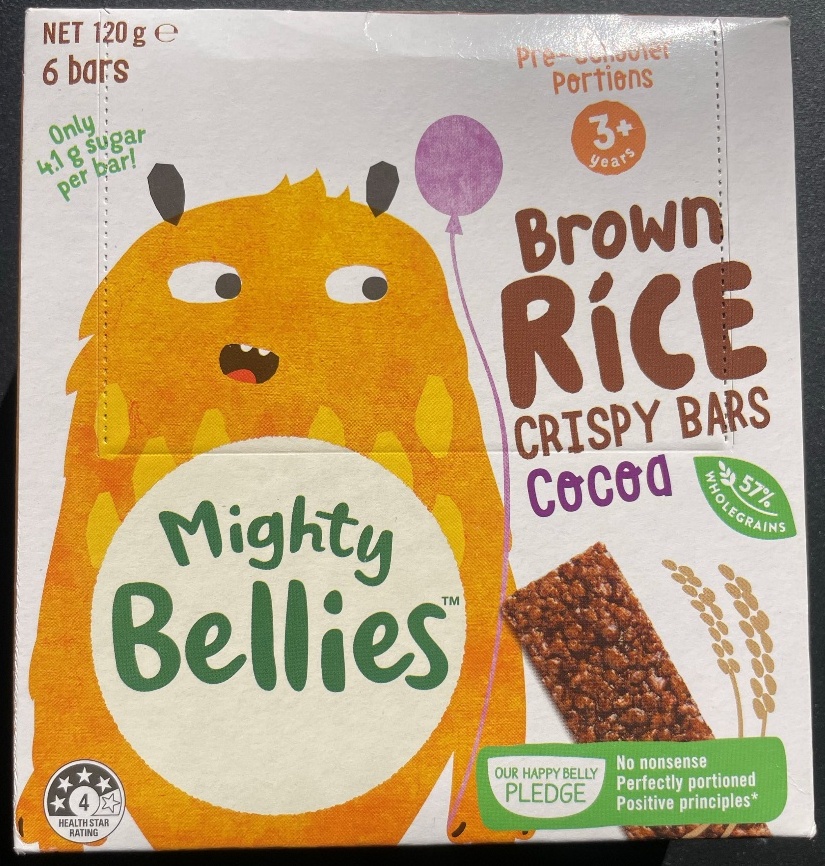
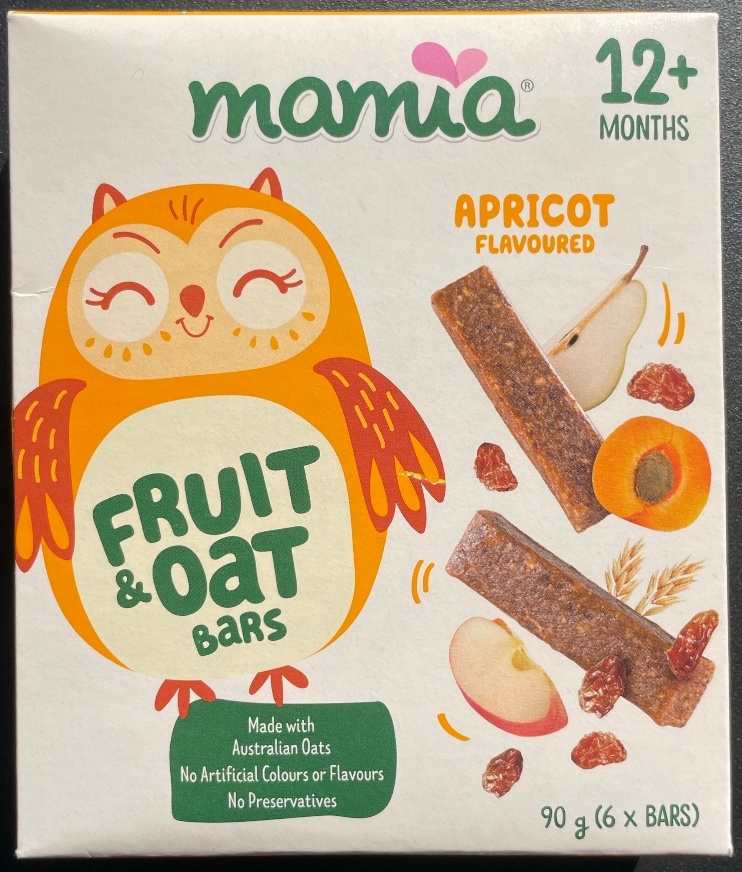
each work has a large orange figure with an off-white round belly with writing in it in a casual style where the letters are not aligned on the horizontal. Each has a brown bar or bars with texture. Each has a picture of oats. Each has orange writing. The similarities and differences in those elements could be analysed in more detail.
106 It is clear that the comparison referred to in the previous paragraph is not the same as the comparison between the following two works, being item 1 of the Hampden Works and item 6 of the Aldi Works.
Item 1: Blueberry Puffs Hampden Work |
Item 6: MAMIA Fruit Snack Cereal Bars Apple, Blueberry and Banana Aldi Work |
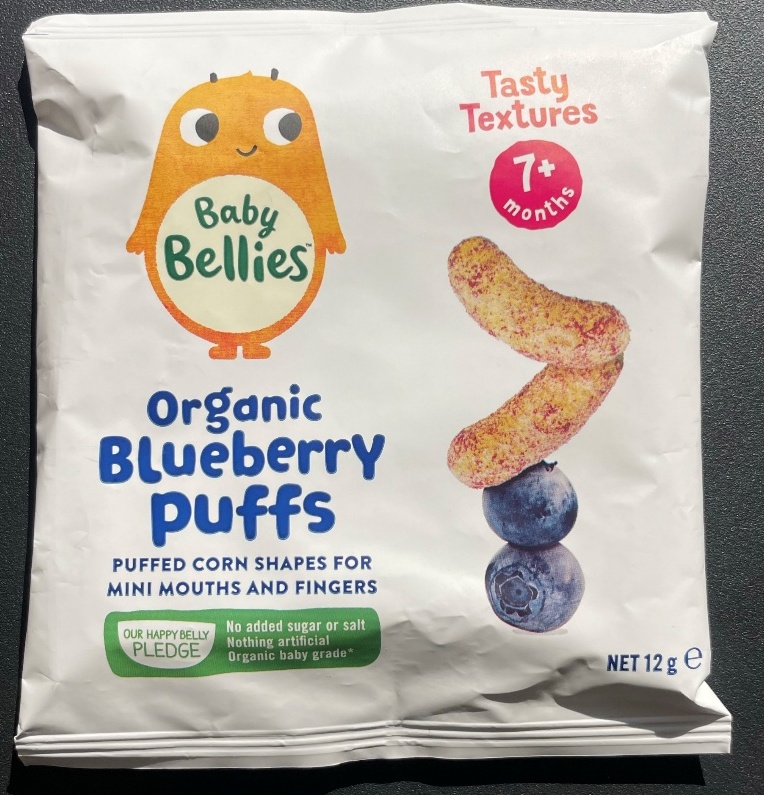
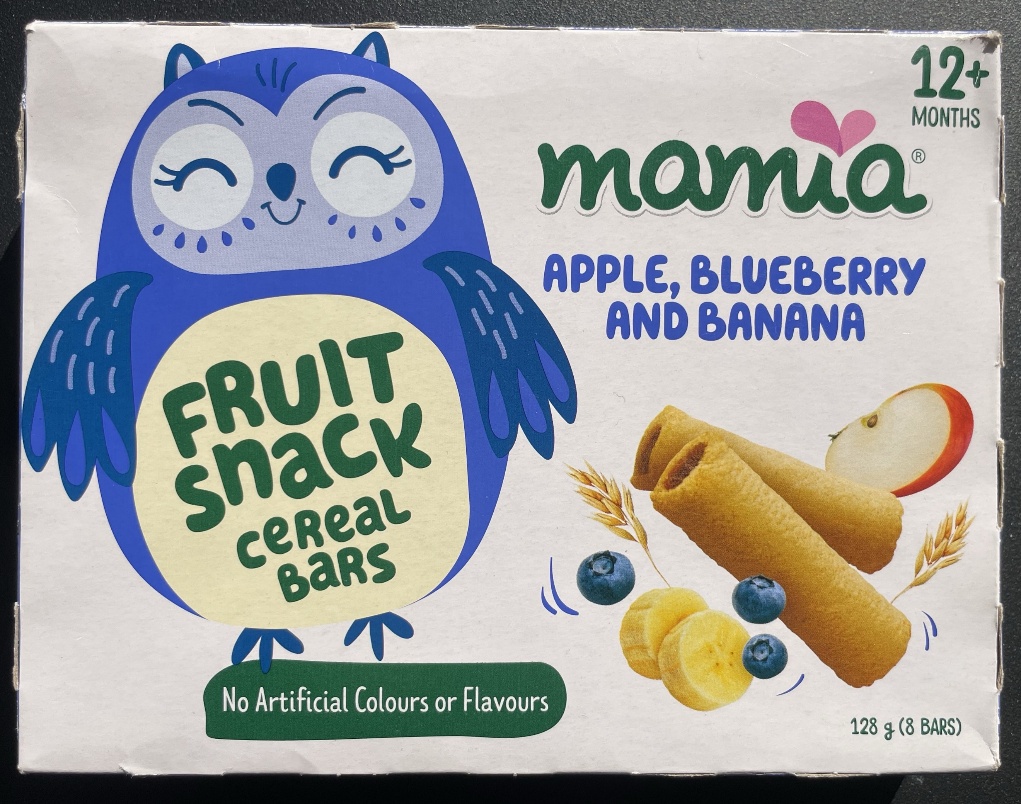
107 The theoretical number of pairs of works (99) is large. However, it was not necessary to consider every pair. What should have occurred is that, for each of the Aldi Works, Hampden should have nominated its preferred matching work, or at most two works, which were said to be the relevant comparison.
108 It follows that we agree with criticisms contained within Aldi’s first to third points summarised above.
109 In relation to Aldi’s fourth point, as noted above by reference to Aldi’s clarification in oral submissions, this point falls away once the decision of the primary judge is understood.
110 That brings us to Aldi’s fifth point. In particular (h) to Ground 1, Aldi says that having found that the purpose of Aldi’s benchmarking process “was not to infringe the Respondents’ legal rights in the Hampden Works” (being an apparent reference to the qualification of “albeit not too closely because that would infringe the law”), the primary judge erred by failing to take those findings into consideration when determining the questions of objective similarity and substantial part. However, the primary judge did not utilise Aldi’s intentions when reaching a conclusion about substantial reproduction, and so this particular appears to have no work to do. The finding about Aldi’s intention cannot assist Aldi if substantial reproduction is otherwise established on objective grounds.
111 The fifth point does, however, have a potential relevance to any reconsideration of infringement insofar as there is any reliance upon the principle of animus furandi. We will return to this topic later in these reasons.
112 It follows that, in relation to Grounds 1 and 2, Aldi succeeds on its appeal in part insofar as it contends that the primary judge erred in:
(a) considering an abstracted list of features, rather than undertaking a side-by-side comparison of the similarities between the relevant copyright and impugned works including by considering the differences between the visual elements relied upon for the purposes of the comparison; and
(b) failing to consider the evidence of the originality of those aspects of the work found to be objectively similar.
113 Ground 1 is established in part. We discuss below what follows from these conclusions. Ground 2 (i.e. that the primary judge ought to have found that the relevant Aldi Works did not infringe) depends upon the outcome of any reconsideration.
4. GROUNDS 3 – 5 OF THE APPEAL
4.1 The submissions
114 Aldi submits that the primary judge erred with respect to the finding as to liability for additional damages on several grounds. Aldi says that:
(a) Hampden failed to give proper notice of the basis for seeking additional damages, citing Microsoft Corporation v CPL Notting Hill [2024] FCAFC 20; (2024) 177 IPR 389 at [75]–[77];
(b) Aldi’s benchmarking process sought to avoid infringing the law, and therefore was not about copying per se;
(c) Aldi has no history of prior copyright infringements;
(d) no evidence was led to show the prospect of any loss to Hampden from the infringing conduct; and
(e) having regard to the circumstances as a whole, an award of additional damages was not warranted.
115 In relation to unjustified threats, Aldi submits that, if Grounds 1 and 2 are upheld, it follows that the primary judge’s dismissal of its cross-claim for unjustified threats was in error.
116 Hampden responds as follows:
(a) Hampden gave notice of its unjustified threats claim in its Further Amended Statement of Claim, including that Aldi’s conduct had been flagrant and it refused to cease selling the infringing products;
(b) the conclusion of the primary judge on flagrancy was not dependent upon a conclusion that Aldi sought to breach the law, and Aldi has not sought to challenge the finding in PJ [231];
(c) there is no principle that additional damages are only available against repeat infringers; and
(d) it was not necessary for the primary judge to make any findings as to the benefits obtained by Aldi, and this is not a precondition to an award of additional damages.
117 Hampden accepts that in the event that Aldi’s appeal in respect of the Aldi Puffs Works succeeds, the cross-claim for unjustified threats would be made out.
4.2 Consideration
118 The role of additional damages in the present case depends upon the outcome of the further consideration as to what result should follow from the establishment of error by the primary judge. Any assessment of additional damages can only follow from a conclusion as to whether Aldi has infringed any of the Hampden Works, and if so which ones.
119 However, if Aldi has infringed the Hampden Works, we otherwise accept the matters raised by Hampden set out above in defence of the award of additional damages. At PJ [231], the primary judge observed as follows:
I first consider whether the infringement was flagrant. On the basis of the findings set out above, I am satisfied that Aldi deliberately developed packaging for the MAMIA baby puffs products that resembled the packaging of the BELLIES puffs products. Aldi sought to use for its own commercial advantage the designs that had been developed by a trade rival. Although Aldi may have intended, if possible, to avoid infringement and legal liability, it took the risk that its use of the BELLIES designs would exceed what the law allows. I consider Aldi’s conduct to be flagrant.
His Honour also observed that Aldi continued to use the packaging for some months after being sent relevant letters of demand: PJ [233].
120 His Honour thus relied upon Aldi’s conduct in deliberately courting a risk while seeking to obtain a commercial advantage. His Honour was correct to do so. Aldi could have used any packaging of its own design, but chose to emulate the Hampden Works for its own benefit. That is a matter that falls within the broad discretion conferred by s 115(4) of the Copyright Act, and specifically is a matter going to the flagrancy of the infringement. His Honour was entitled to rely on that matter. If Aldi chooses to conduct its business in that manner, it runs the risk that infringement will lead to additional damages.
121 The award of damages pursuant to s 115(4) is a discretionary decision. An appeal against an such an award attracts the principles in House v The King [1936] HCA 40; (1936) 55 CLR 499; Hytera Communications Corporation Ltd v Motorola Solutions Inc [2024] FCAFC 168; (2024) 308 FCR 68 at [903]–[904]; Lift Shop Pty Ltd v Next Level Elevators Pty Ltd [2025] FCAFC 108; (2025) 312 FCR 127. No attempt has been made to establish an error of the requisite sort, and no such error has been demonstrated.
122 We note that the reasoning and conclusions of the primary judge in relation to additional damages would apply equally to any conclusion on a redetermination that the Aldi Non-Puffs Works infringed any of the Hampden Works.
5. HAMPDEN’S CROSS-APPEAL
123 Hampden cross-appeals against the conclusions of the primary judge that none of the Aldi Non-Puffs Works infringe any Hampden Work.
124 In doing so, Hampden faces the dilemma that it wishes to support the reasons of the primary judge that each of the Aldi Puffs Works are infringements, but wishes this Court to overturn the reasons of the primary judge that each of the Aldi Non-Puffs Works are not infringements.
125 Hampden’s contentions on its cross-appeal can be dealt with quite briefly. That is because Hampden’s contentions follow the same approach it has adopted more generally of seeking to distil “design elements” at a considerable degree of abstraction that are said to be common across multiple Hampden Works and then contending that they are present in each of the Aldi Non-Puffs Works.
126 For example, in relation to the Aldi works for its MAMIA rice cakes products, being items 1 and 2 of the Aldi Works, Hampden’s Notice of Cross-Appeal contends as follows (Ground 3):
In addition to the layout and design elements of the Blueberry Puffs Works reproduced on the packaging for the Appellant’s MAMIA Rice Cakes products (items 1 and 2 of the [Aldi] Non-Puffs Works) identified at J[196], the trial judge ought to have found that the packaging for the MAMIA Rice Cakes products also reproduced the following layout and design elements of the Blueberry Puffs Work:
(a) a substantially two-column layout; and
(b) on the left-hand side, a cartoon character of an oval shape, with two small ears on top of its head, two small legs under its body, arms by its side, and a rounded belly in a lighter tone.
127 For the reasons discussed earlier, this approach of abstracting design elements and assessing whether they are wholly present or not present in the Aldi Works is not the correct approach to copyright infringement.
128 In those circumstances, it is of little utility to consider the particular arguments raised by Hampden on its cross-appeal, because they proceed upon an incorrect foundation and are distracting from the correct analysis. Nevertheless, as observed above, the approach of the primary judge was not the correct approach, and this affects the reasoning in relation to each of the Aldi Non-Puffs Works.
6. WHAT COURSE SHOULD BE ADOPTED?
129 In light of our conclusion on Aldi’s appeal that the reasons of the primary judge proceed on an incorrect approach and cannot be sustained, a question arises as to the approach that should be adopted in dealing with the appeal and cross-appeal. In that regard, the relevant issue is:
(a) whether (as Aldi submits) Hampden’s case at trial and on appeal was so closely bound to an erroneous approach that its claim for infringement should be dismissed as a failed case; or
(b) if that is not the correct analysis, whether the case should be remitted to the primary judge for redetermination or whether this Court should undertake a reconsideration of the question of infringement.
130 In relation to (b), there is a further issue as to whether Hampden has constrained the type of redetermination that can be undertaken in either case.
131 In its oral reply submissions, Aldi focussed on the importance of originality in the context of infringement in accordance with Ice TV, and contended that Hampden had eschewed any reliance on its evidence as to originality in that context. There is some apparent force to Aldi’s contention, having regard to what occurred in oral submissions before the primary judge. Aldi’s written submissions before the primary judge raised the question of originality in the context of infringement and referred to Ice TV and the case of Lidl Great Britain v Tesco Stores [2024] EWCA Civ 262, where the UK Court of Appeal observed that where the originality of the work is low the scope of protection conferred by the copyright in the work is correspondingly narrow, so that “only a close copy will infringe” (at [43]). Aldi having squarely raised the question of originality, the submission from Hampden in oral closing submissions was as follows (at Appeal Book Tab 96, T312.24–.29):
Then turning to the three-step process that my learned friends addressed you on this afternoon, it was submitted that the applicants cannot identify for you how much work, in terms of skill and labour, went into creating the copyright works. Just, with respect, to remind your Honour that subsistence has been admitted by the respondents, and it’s under that umbrella that skill and labour is dealt with.
This submission treats originality as if it was relevant only to subsistence.
132 However, two further things should be observed in this context. The first is that in its written submissions before the primary judge, Hampden made express reference to the work involved in the creative process in the context of infringement (see Hampden’s Written Closing Submissions at [105] and footnote 135). It cannot therefore be said that Hampden confined its reliance on evidence of originality to the issue of subsistence. The second is that Aldi correctly appreciated that Ice TV required a consideration of the degree of originality in each work in considering the question of reproduction of a substantial part. Aldi addressed that question at the trial and again on appeal.
133 For example, at the trial, Aldi made the following submission (at paragraph [61] of Aldi’s Written Closing Submissions) (citations omitted):
There is a temptation to infer from Mr Bowen’s evidence that significant labour was engaged in by B&B Studios for the purposes of creating these works. As set out in paragraph 15 above, copyright is not given to reward work in a general sense, as distinct from effort engaged in the production of a particular form of expression. Aldi submits that the court should resist any invitation by the Applicants to the effect that the creation of the B&B works involved extensive or significant labour, particularly when Mr Bowen acknowledged that the artistic works included elements commonly used by other traders, and that he could have, but did not, provide evidence of any draft drawings prepared by B&B Studios (which would have been evidence directly relevant to the question of the extent of labour required to produce the works). This is not a trifling observation – it is important because, as will be apparent from the analysis below, many of the elements of the Applicants’ Works were found in earlier prior art packaging or taken from image libraries (i.e. therefore not original), which bears on the extent of originality residing in those works as a whole.
134 On appeal, as observed earlier, Aldi took the Court through imagery present in the market at the relevant time in an endeavour to demonstrate an absence of any significant originality in the visual elements present in the Hampden Works. Aldi referred to concessions it said that Mr Bowen had made in cross-examination that certain things were commonplace.
135 It therefore cannot be said that Aldi would be prejudiced by a consideration of the originality of the Hampden Works in the context of infringement, including by reference to Mr Bowen’s evidence. Aldi has expressly addressed that topic.
136 The next question is whether there should be a reconsideration of infringement through the proper prism of a side-by-side comparison of relevant works, having regard to all of the similarities and dissimilarities in relation to that which might be said to have been copied. Hampden never undertook that exercise and so Aldi never responded in a direct way to an analysis of that type.
137 Although Aldi was critical of Hampden’s approach, and the approach of the primary judge, of seeking to isolate design features described at a considerable level of abstraction, Aldi did not make any submission in this Court that it was not permissible to undertake a reconsideration on the proper basis. Put another way, Aldi’s submissions to this Court on the limits of any reconsideration were confined to the issue of originality.
138 Having found error on the part of the primary judge, we consider that it is appropriate for the Court to reconsider the question of infringement on the proper basis. As the Full Court said in PDP Capital Pty Ltd v Grasshopper Ventures Pty Ltd [2021] FCAFC 128; (2021) 285 FCR 598 (Jagot, Nicholas, Burley JJ) (citations as in original):
98 …Where the process of evaluation by the primary judge has miscarried, the Full Court should carry out its own evaluation: Pham Global Pty Ltd v Insight Clinical Imaging Pty Ltd [2017] FCAFC 83; (2017) 251 FCR 379 at [55] (Greenwood, Jagot and Beach JJ); Aldi Foods at [2]-[10] (Allsop CJ, with whom Markovic J agreed) and [49]-[50] (Perram J); see also Homart Pharmaceuticals Pty Ltd v Careline Australia Pty Ltd [2018] FCAFC 105; (2018) 264 FCR 422 at [35]-[37] (Murphy, Gleeson and Markovic JJ); Verrocchi v Direct Chemist Outlet Pty Ltd [2016] FCAFC 104; (2016) 247 FCR 570 at [45]-[47] (Nicholas, Murphy and Beach JJ); Hashtag Burgers at [8]; Combe International at [12]-[15].
99 The task of an appellate court in reviewing an evaluative assessment was explained by Allsop J (as his Honour then was) in Branir Pty Ltd v Owston Nominees (No 2) Pty Ltd [2001] FCA 1833; (2001) 117 FCR 424 at [28]-[29] (Drummond and Mansfield JJ agreeing):
[28] …First, the appeal court must make up its own mind on the facts. Secondly, that task can only be done in the light of, and taking into account and weighing, the judgment appealed from. In this process, the advantages of the trial judge may reside in the credibility of witnesses, in which case departure is only justified in circumstances described in Abalos v Australian Postal Commission (1988) 171 CLR 167; Devries v Australian National Railways Commission (1993) 177 CLR 472 and SRA v Earthline, supra. The advantages of the trial judge may be more subtle and imprecise, yet real, not giving rise to a protection of the nature accorded credibility findings, but, nevertheless, being highly relevant to the assessment of the weight to be accorded the views of the trial judge. Thirdly, while the appeal court has a duty to make up its own mind, it does not deal with the case as if trying it at first instance. Rather, in its examination of the material, it accords proper weight to the trial judge’s views. Fourthly, in that process of considering the facts for itself and giving weight to the views of, and advantages held by, the trial judge, if a choice arises between conclusions equally open and finely balanced and where there is, or can be, no preponderance of view, the conclusion of error is not necessarily arrived at merely because of a preference of view of the appeal court for some fact or facts contrary to the view reached by the trial judge.
[29] The degree of tolerance for any such divergence in any particular case will often be a product of the perceived advantage enjoyed by the trial judge. Sometimes, where matters of impression and judgment are concerned, giving “full weight” or “particular weight” to the views of the trial judge might be seen to shade into a degree of tolerance for a divergence of views [citations omitted] … However, as Hill J said in Commissioner of Taxation (Cth) v Chubb Australia (1995) 56 FCR 557 at 573 “giving full weight” to the view appealed from should not be taken too far. The appeal court must come to the view that the trial judge was wrong in order to interfere. Even if the question is one of impression or judgment, a sufficiently clear difference of opinion may necessitate that conclusion.
139 In this context we do not consider that any unfairness is visited upon either party in reconsidering the merits of the case within the constraints accepted by Hampden (as we explain below) or that Hampden’s limited and incorrect approach to the question of infringement forecloses this Court from evaluating the question of infringement in the correct way. Firstly, Aldi did not submit that the Court is so prevented. Secondly, in the course of oral argument in this Court, counsel for Aldi accepted that, by taking the Court to the material as to what was commonplace in the industry, Aldi was inviting a reconsideration having regard to that material. Indeed, Aldi assisted the Court in understanding where the totality of relevant material for the Court to reconsider had been identified (T21.4–.30). Thirdly, although Hampden was distracted by its incorrect approach, Aldi was not. Aldi understood the correct approach. Aldi recognised that a proper infringement analysis required consideration of the particular form of expression in the relevant Hampden Work and the similarities and differences in the allegedly common visual elements, together with a consideration of their originality, and sought to persuade the Court both at first instance and on appeal that Hampden ought to fail on the correct analysis.
140 For example, Aldi made a submission to the primary judge about the differences in the visual elements, which the primary judge rejected on the basis that his process of abstraction eliminated any relevant difference. Both at the trial and on appeal, Aldi addressed the originality of the visual elements, and why differences assumed more significance. On appeal, Aldi referred to evidence, some of which was set out earlier, of elements that Aldi submitted were commonplace. For example, Aldi identified examples of “playful characters” or “playful animals” in support of a submission that it was the particular form of cartoon character that would need to be reproduced and a different cartoon character would not give rise to an infringement. Likewise, Aldi addressed the commonality of pictures of the product and ingredients, and that they were sometimes on the right-hand side of the packaging, such that having pictures of fruit was not itself of significance. Aldi submitted that a “two-part layout” was common, as was having the name of the product and a product description on the left-hand side, and as was having an age range indicator in the top right. These matters, and others, were said by Aldi to support its contention that it had not engaged in a substantial reproduction of the particular form of expression comprising the Hampden Works.
141 In adopting this approach, we have considered whether or not remission of the matter to the primary judge is a better course. However, the relevant evidentiary material is confined in scope. On originality, the relevant evidence is of Mr Bowen, and it consists of approximately ten pages. The relevant cross-examination of Mr Bowen only occupies a few pages of transcript. There is a limited number of pages of images from products in the market at the relevant time, going to the question of the commonality of visual elements in the Hampden Works, and Aldi took us to those images on the appeal, in seeking to persuade us that the Hampden Works and their constituent elements were not original (or not particularly original).
142 Notwithstanding our conclusion that it is appropriate that we undertake a reconsideration, there is one significant limitation to that exercise. On its cross-appeal, concerning the Aldi Non-Puffs Works, Hampden has made it clear that it confines its cross-appeal to the infringement of two works only, being items 1 and 3 of the Hampden Works (which Hampden describes as the Blueberry Puffs Work and the Organic Tomato Fiddlesticks Work). Set out below are these two works:
Item 1: Blueberry Puffs Hampden Work |
Item 3: Organic Tomato Fiddlesticks Hampden Work |
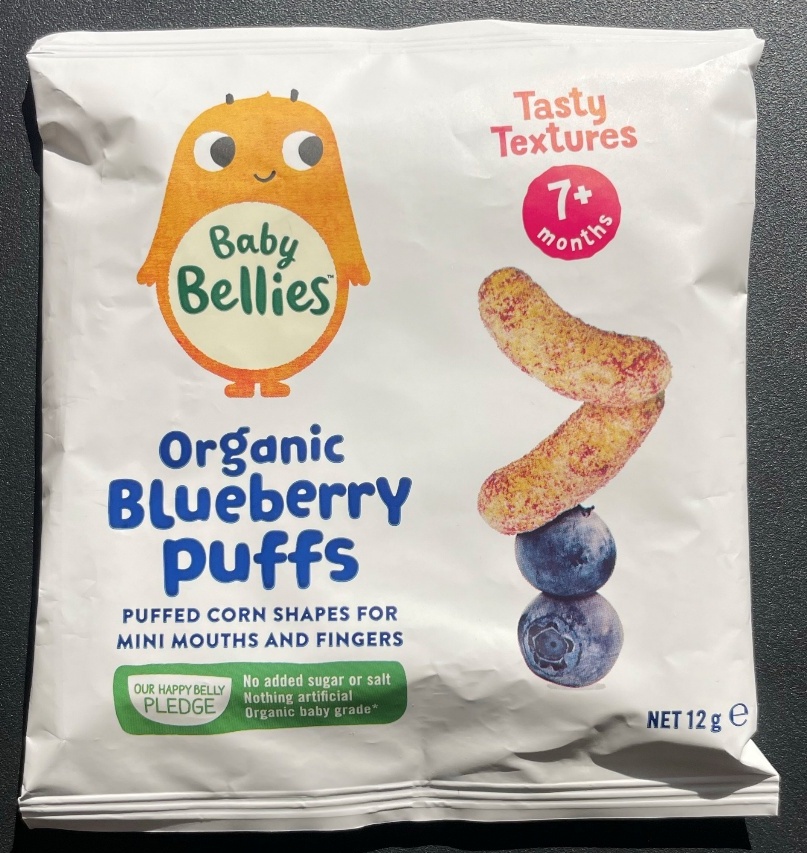
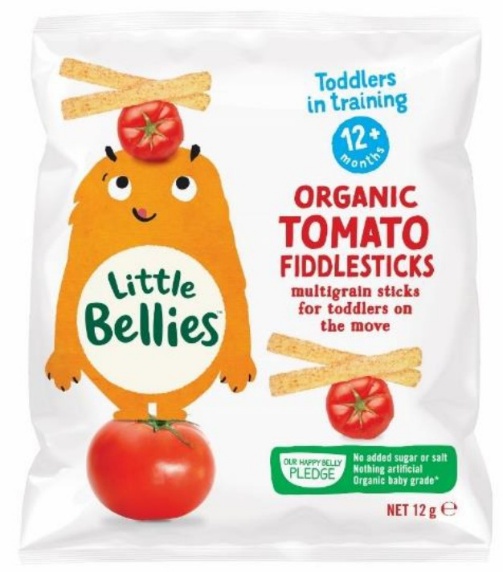
143 In its Notice of Cross-Appeal, Hampden says that the primary judge erred in confining his comparison to items 1 and 2 of the Hampden Works, and that he should have included item 3 of the Hampden Works. In paragraph 2, particular (vii) of the Notice of Cross-Appeal, Hampden says that the most significant “layout and design elements” of item 1 of the Hampden Works are also shared by items 6 and 7 of the Hampden Works, and that the most significant layout and design elements of item 3 are shared by item 8 of the Hampden Works, but then says this (emphasis added):
However, the Respondents consider that it will be sufficient for the purposes of the cross-appeal for the Full Court to consider and determine whether the Impugned Non-Puffs Works infringe copyright in each of the Blueberry Puffs Work [being item 1 of the Hampden Works] and the Organic Tomato Fiddlesticks Work [being item 3 of the Hampden Works], and they do not seek findings of infringement with respect to the other Respondent’s Works referred to in this paragraph.
144 This is a limitation on the form of infringement analysis that we might undertake. This limitation does not apply to the three Aldi Puffs Works, which may be compared to any relevant Hampden Work.
145 Accordingly, we understand Hampden on its cross appeal to have abandoned its infringement case insofar as it concerns any other of the various alternatives and permutations of potential infringement. In this regard, we note that in its pleaded case Hampden alleged that each of the impugned Aldi works infringed at least three of the Hampden works and sometimes that particular Aldi works infringed (in the alternative) as many as seven of the Hampden works (e.g. Further Amended Statement of Claim [86M], [86W]). This diffuse approach to advancing infringement allegations is not to be encouraged and perhaps contributed to the manner in which the proceeding was argued by Hampden at first instance.
7. INFRINGEMENT ANALYSIS
7.1 Evidence in relation to originality
146 There was evidence before the primary judge as to the process of creation of the Hampden Works. Mr Bowen, who was a director and founder of B&B Studio, gave evidence of the design process in his affidavit of 2 March 2023. The primary judge observed at PJ [28] that Mr Bowen gave evidence in a frank and honest manner and he accepted Mr Bowen’s evidence. That evidence was detailed and included the following:
(a) There was initially a detailed international market review and competitor analysis.
(b) The design process commenced with a team of designers of varying levels of experience being briefed together and then working independently on ideas and thoughts before coming together for design team reviews and reviews with the wider team, including strategy and client services.
(c) Concepts were gradually created and developed and refined by the design team to the concepts that were then presented to the client, who provided commentary and input, which led to revisions.
(d) There was a lot of discussion concerning colour palette, fonts and illustration style.
(e) A few different concepts were developed. One of the concepts involved a “mascot character” that had the brand name in an off-white circle in the belly of the mascot. That concept had a colourful background. Based on client feedback, it was decided to use a white background and that the design of the packet needed to be modernised (so as to appeal to the target audience of “millennial mothers”).
(f) A design choice was made to use flat, simple shapes with hand-drawn details and bright, fresh colours. The white background was thought to express freshness, as well as provide a link to previous BELLIES designs. The use of colour was explored across the range to bring in variant differentiation based on product and flavour.
(g) The font choices were friendly (rounded) and not too serious or functional. Mr Bowen said that the idea of these softer fonts was to engage more warmly with the consumer as a “friend”, on a personal level.
(h) The choice of placement of the brand in a circle in the belly reinforces the brand and provides a visual reinforcement, so that they “become synonymous with one another”.
(i) The packaging went through drafts and was further modified after being presented to the client and receiving client feedback. After receiving feedback, the packaging was revised to:
(i) incorporate a consistent white background;
(ii) avoid dual colour backgrounds;
(iii) have a simple, uncluttered packaging design;
(iv) have the “monster” mascot interact with the ingredients; and
(v) include a redesigned “monster” so as to include black ears and claws and a textured effect on the fur.
(j) Real food photography was selected to convey taste and naturalness. The photographic images were laid out in non-rigid natural patterns, often stacked in a loose zigzag formation. The layout was chosen to add playfulness to the pack and to add “surprise and movement” to what otherwise could be a static pack, and to create the impression that the products are fun and tasty to eat, such that they were not seen as too serious even though they are natural.
147 The evidence summarised above reveals an iterative process with numerous revisions and modifications. It is readily apparent that significant effort went into preparation of the various works, although this is not quantified in any way. It is also apparent that the creation of the works required the application of skill, including skill in making imagery that would appeal to customers. Unlike the position in Ice TV, where the substantial work in preparing the schedule was unrelated to the particular form of expression, in the present case the marketing and design skill and effort contributes directly to the particular form of expression. For example, the use of design skill to select particular imagery to project warmth, friendliness and fun forms part of the originality of the form of expression of the artistic work.
148 The evidence of Mr Bowen summarised above was not really challenged in his brief cross-examination, other than that he accepted that there were competitor products that used:
(a) images of puffs;
(b) images of pieces of fruit, including slices of apple;
(c) a “playful animal” or a “playful childlike character”;
(d) an age range in the top right corner; and
(e) a white background.
149 It was not suggested to him that other products used any of these in any particular combination. Nor, importantly, did he accept that the particular forms of the visual elements in the Hampden Works were present in any other works.
150 In relation to so-called “commonplace elements”, we have noted above that if an element in a copyright work is described at too great a level of abstraction, then the distinctive character of the element can be overlooked. For example, in the present case, it is not overly helpful to say that it is common for the packaging of children’s food to have a “playful childlike character”. The characters in each of the Hampden works and the Aldi Works are more distinctive than would be suggested by that generic description.
7.2 Consideration of the Aldi Puffs Works
Item 9 of the Aldi Works
151 In considering item 9 of the Aldi Works, it is clear that the relevant comparator is item 1 of the Hampden Works. No other Hampden Work is as close. The relevant works are as follows:
Item 1: Blueberry Puffs Hampden Work |
Item 9: MAMIA Baby Puffs Blueberry Aldi Work |
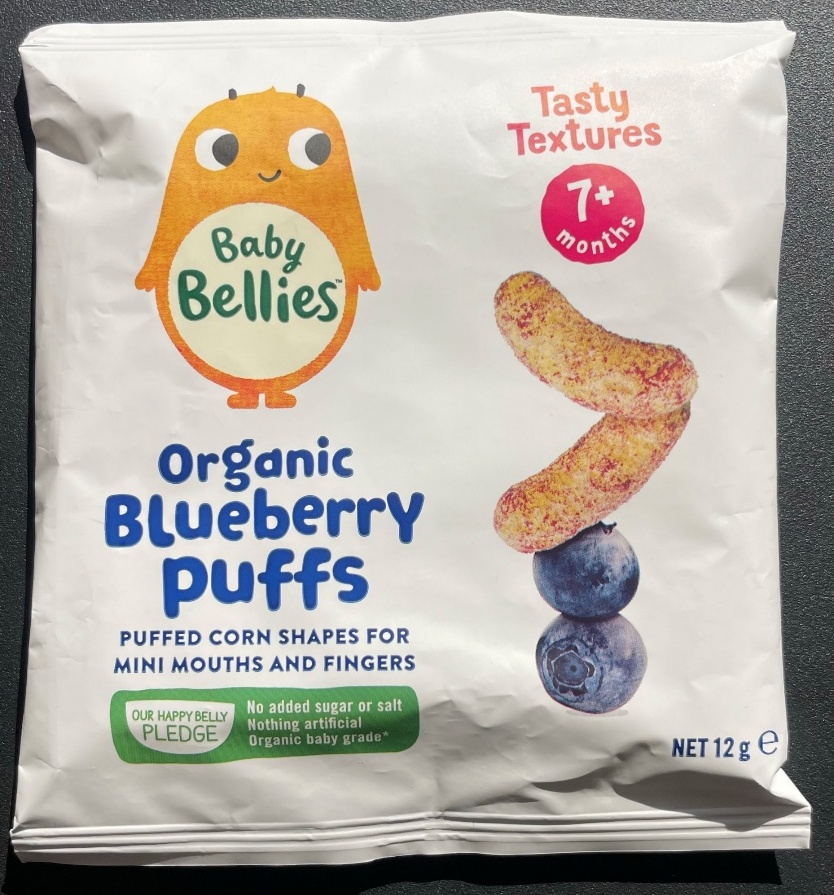
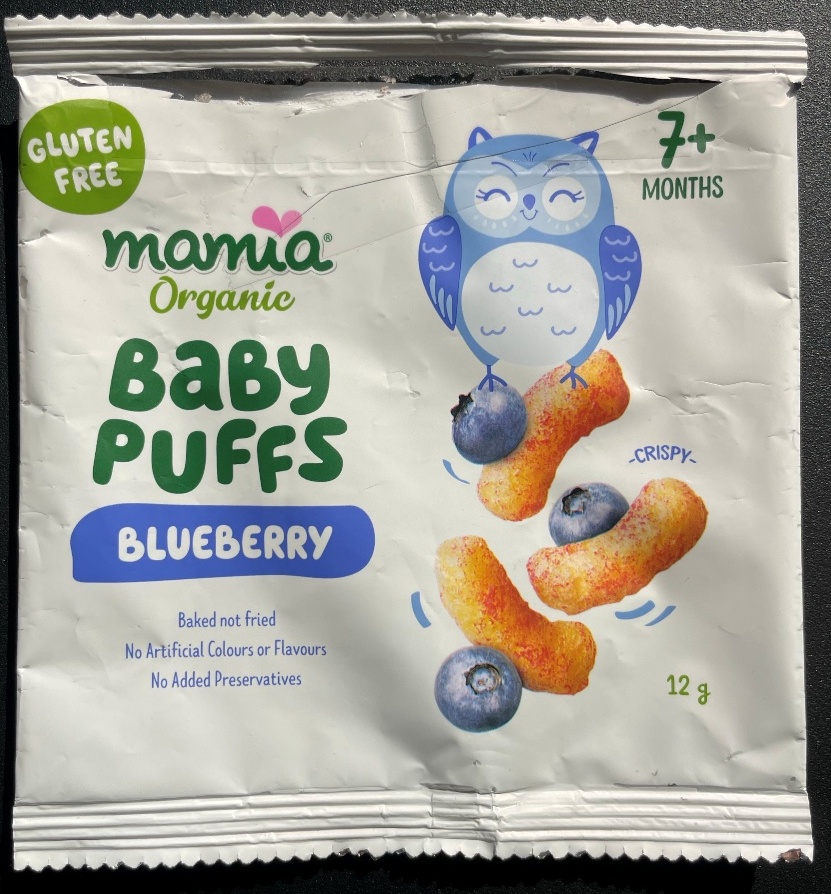
152 There are some clear similarities between the works, as follows:
(a) both have photographs of blueberries and puffs in a vertical arrangement on the lower right side of the packet. The blueberries and puffs are very similar. Each puff has a yellow/orange base with a red speckled coating. The blueberries and puffs are sufficiently similar that it can be said that Aldi has largely reproduced this visual element in item 1 of the Hampden Work, albeit with modifications;
(b) both have a white background;
(c) both have a similar palette of colours: orange, blue, green and pink in similar shades. In particular, there is an identical shade of green for “Baby Bellies” (Hampden) and “Baby Puffs” (Aldi);
(d) in relation to the words “Organic Blueberry Puffs” on the Hampden Work and “Baby Puffs” on the Aldi Work, both have writing in a soft, rounded, child-like style, including with some letters that are not on the same horizontal line, and a mix of capital and little letters (little “a” in the Aldi Work, capital “B”, “L” and “Y” in the Hampden Work). Although the fonts are not identical, they are very similar, and the same visual impression is created. On the Aldi Work, “Blueberry” is also written in a somewhat similar font, although it does not have the mix of capital and little letters or the lack of vertical alignment;
(e) both have what has been described as a two-column layout, with elements on each side of the pack arranged vertically. However, the layout of the work otherwise is not identical, the most obvious difference being the different positions of the cartoon figures;
(f) both have somewhat similar cartoon characters, discussed in more detail below;
(g) both have an age range in the top right corner; and
(h) both have a rectangular box on the lower left side of the pack that has irregular edges, as if hand drawn.
153 In relation to the cartoon characters, there are some similarities, in that:
(a) both are the same general shape and size, as well as being two-dimensional;
(b) both have a round off-white circle in their belly of roughly the same size, which is a distinctive feature;
(c) both have a very small tuft on their head, albeit in a different form;
(d) both have small ears, although again there are differences;
(e) both have a mouth as a curved line in a smile; and
(f) both have round white (or light-coloured) eyes, albeit those eyes are open in the Hampden Work and closed in the Aldi Work.
However, there are also differences, including that the Aldi cartoon character is an owl, is blue rather than orange, has wings and feathers, has bird feet, has a nose, and has different details around the eyes (including closed lids, eyebrows, a mask on the face, and dots below the eyes). The differences are such that it cannot be said (contrary to the conclusion of the primary judge) that Aldi has simply reproduced the cartoon character, so that one could turn to a consideration of whether the cartoon character was a substantial part of the Hampden Work. Nevertheless, various visual aspects of the character have been copied in a way that contributes to the overall assessment of whether Aldi has reproduced a substantial part of the Hampden Work.
154 There are numerous other differences between the two works. However, consistently with the principle in Designers Guild, the only differences that are relevant are differences in the elements that otherwise might be copied from the Hampden Work. The relevant question is whether a substantial part of the Hampden work has been taken. For example, the Aldi Work has a green circle bearing the words “Gluten Free” that is not present in the Hampden Work, but this difference is not relevant for present purposes because it does not affect whether a substantial part of the Hampden Work has been reproduced.
155 In this respect, in a case such as the present, whilst it is appropriate to undertake a side-by-side comparison, the relevant consideration is not merely an overall assessment of similarity between the two works, and is more nuanced.
156 Relevant differences include:
(a) the Hampden Work has the brand name in the belly of the character, whereas the Aldi Work has the brand name on the left at the top;
(b) in the Aldi Work, the flavour or variant (blueberry) is in a separate rectangular box, rather than as part of the descriptor as in the Hampden Work;
(c) although each has an irregular rectangular box on the lower left hand side, the one in the Hampden Work is green whereas the one in the Aldi Work is blue and serves a different purpose; and
(d) there are other text features in the Hampden Work (such as “Tasty Textures”) which are not in the Aldi Work.
157 The differences in the cartoon characters and the other differences mean that the assessment of infringement is not a quantitative analysis, or a straightforward consideration of whether one or two copied elements are a substantial part of the Hampden Work.
158 The present case is not an easy or clear-cut case. Nevertheless, we have concluded that the Aldi Work reproduces a substantial part of the Hampden Work. We have reached that conclusion for the following reasons.
159 First, the photographs of the blueberries and puffs on the Aldi Work are sufficiently similar to the equivalent part of the Hampden Work so as to amount, in large part, to a reproduction of that element. That is itself a relatively significant part of the Hampden Work. As noted earlier, there is no requirement that the elements copied amount to the majority of a work or anything close to it, provided that it be a material element, which is also influenced by considerations of originality.
160 The emulation of the photography was deliberate, as the primary judge concluded at PJ [86]–[88], by reference to the Aldi instruction that:
Snacking range architecture needs to follow Baby Bellies with real photography.
His Honour held that “follow” meant “resemble”.
161 Secondly, when the photographs of blueberries and puffs are combined with the other elements of similarity – the colour palette, the distinctive child-like font, the two-column layout, the irregular rectangular boxes, the similarities in the cartoon character (especially the distinctive off-white circular belly), the white background and the age indicator in the top right corner – it is apparent that the Aldi Work appropriates numerous aspects of the Hampden Work. There are differences in the precise form of these elements, some of which are discussed above. For example, the irregular rectangle in the Aldi Work is blue and contains the flavour, compared to green and referring to natural ingredients in the Hampden Work, and the rectangles are in a slightly different position. We take these differences into account in considering whether the similar elements constitute a substantial part of the Hampden Work. However, when considered as a whole, what has been taken is a material part of the Hampden Work.
162 Thirdly, it is necessary to consider the evidence concerning the material already in the public domain, relied upon by Aldi. Aldi emphasised the presence in other packaging of a friendly cartoon character, pictures of fruit and other ingredients, a two-column layout (although the particular example used by Aldi did not seem to involve any distinct two-column effect), a white background and an age indicator in the top right. However, the cartoon characters and pictures of ingredients are different from the ones under consideration in this part of the analysis, and the layouts and combinations of elements are quite dissimilar. The evidence relied upon by Aldi does indicate that not much weight should be placed on the white background or the age indicator by themselves. Nevertheless, there was no evidence of anything containing the particular combination of features present in the Hampden Work and replicated by Aldi, and it is the totality of relevant elements in combination that falls to be assessed. Further, the evidence of material in the public domain serves to emphasise the very large number of ways in which Aldi could have chosen to present its packaging, rather than choosing to emulate the Hampden Works.
163 Fourthly, consideration of Mr Bowen’s evidence, discussed above, indicates that the creation of the work as a whole involved a degree of skill, effort and creativity, and a material part of that skill, effort and creativity has been appropriated. There were several iterations, and there were modifications based on client feedback. In relation to the photographs of blueberries and puffs, Mr Bowen explained that real food photography was selected to convey taste and naturalness, that the photographic images were laid out in non-rigid natural patterns, and stacked, and that the layout was chosen to add playfulness to the pack and to add “surprise and movement” to what otherwise could be a static pack and to create the impression that the products are fun and tasty to eat, such that they were not seen as too serious even though natural. Those aspects of the design, and the skill and effort that went into creating it, have been taken by Aldi.
164 Aldi has likewise appropriated to some extent the skill and effort in the design of the font choices, including the choice of fonts that Mr Bowen described as friendly and not serious or functional, including so as to engage more warmly with the consumer as a “friend” on a personal level. In addition, the use of an off-white circle in the belly of the character takes some of the benefit of an original and recognisable aspect of the Hampden Work. Further, the copying of the colour palette takes the benefit of the work behind selecting what Mr Bowen described as “bright, fresh colours”, and the particular choice of those colours.
165 In relation to item 9 of the Aldi Works, Aldi has infringed the copyright in item 1 of the Hampden Works.
Item 10 of the Aldi Works
166 The obvious comparator for item 10 of the Aldi Works is item 6 of the Hampden Works. That was the principal comparison undertaken by the primary judge. The two relevant works are set out below:
Item 6: Apple & Cinnamon Puffs Hampden Work |
Item 10: MAMIA Baby Puffs Apple and Cinnamon Aldi Work |
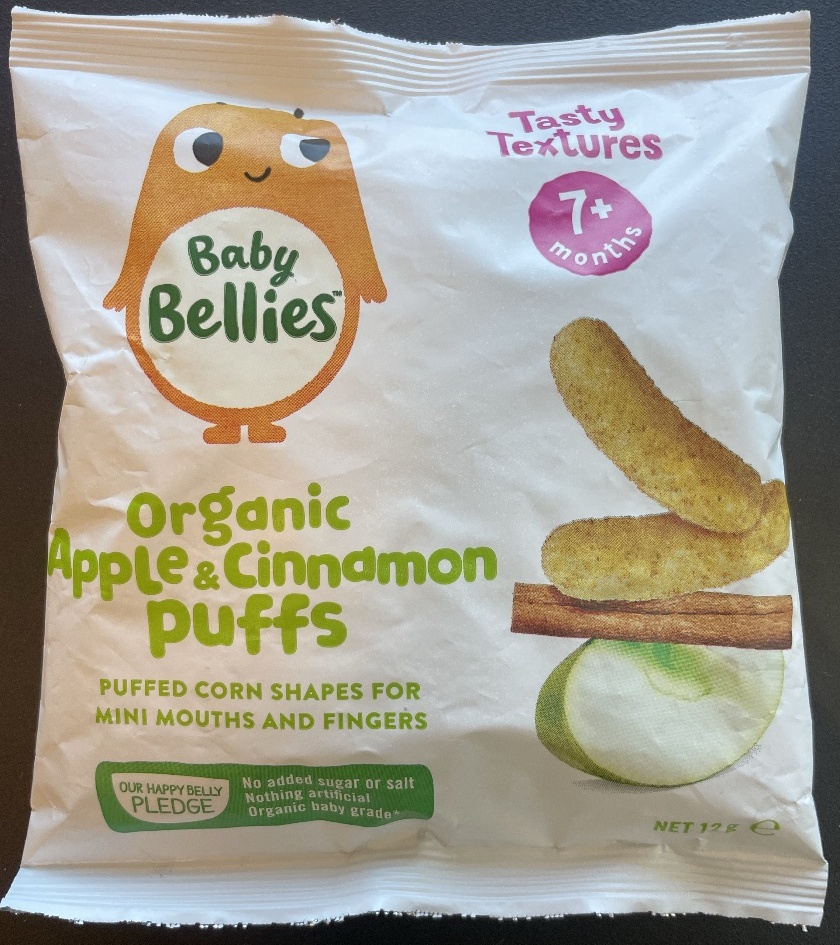
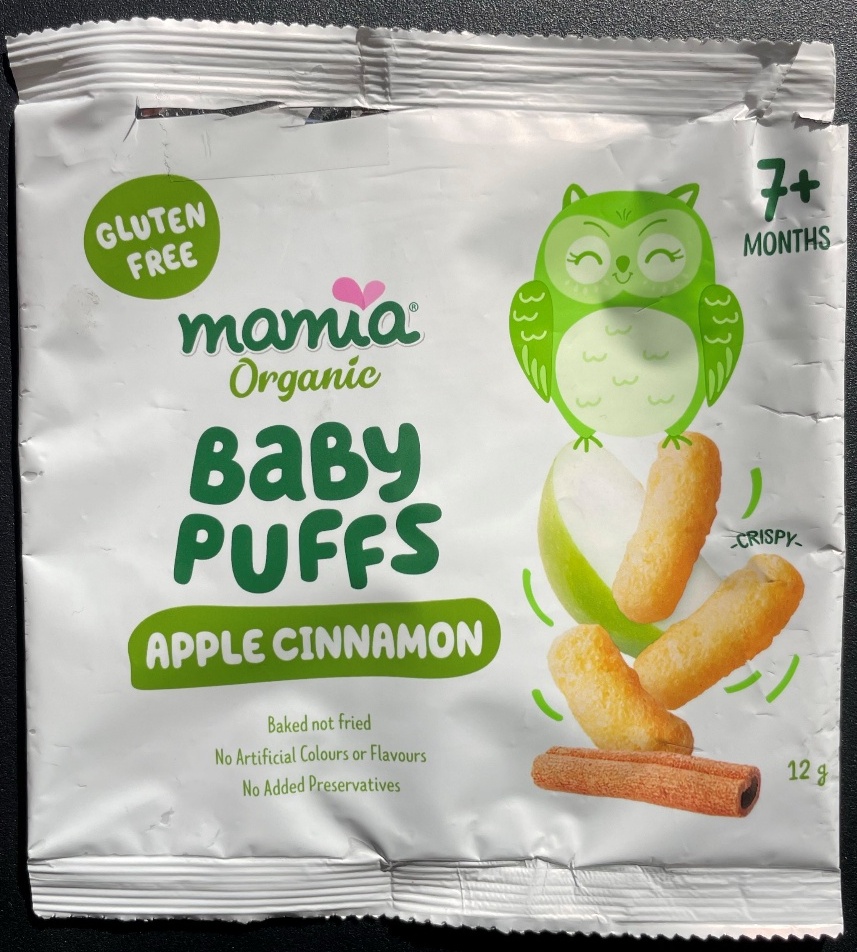
167 The process of comparison between these two works is very similar to the comparison between the blueberry puffs works considered above, such that it is more efficient to identify where the comparison is different. In that regard:
(a) The fruit is apple rather than blueberry, but there is a picture of a single green apple slice on each of the Aldi Work and the Hampden Work. Each work has a picture of a single cinnamon stick. Each work has a picture of puffs, although the Aldi Work lacks the reddish sprinkles present on the Hampden Work (which is harder to see in the photographs as opposed to the packaging). Notwithstanding this, the pictures of ingredients and products are sufficiently similar that it can be said that Aldi has reproduced that part of the Hampden Work.
(b) The writing is all green on both works, rather than being green and blue. The colour blue does not appear on either work. Therefore, the colour palette is more limited, but that applies to both works and so is not a point of distinction from the analysis of the blueberry works.
(c) The irregular rectangles are green on both works, rather than green on one and blue on the other, which brings the works closer together when compared with the two blueberry works.
(d) The owl is green rather than blue.
(e) Like the equivalent blueberry work, the Hampden Work has a mixture of capital and little letters (e.g. the capital “L” in Apple), although the letters that are capitalised are different.
168 None of these matters alter the analysis set out above for the blueberry puffs works.
169 The primary judge also undertook a comparison between item 10 of the Aldi Works and item 1 of the Hampden Works (i.e. compared an Apple and Cinnamon pack with a Blueberry pack). As explained below, we would not conclude there was infringement of item 1 of the Hampden Works by item 10 of the Aldi Works.
170 In relation to item 10 of the Aldi Works, Aldi has infringed the copyright in item 6 of the Hampden Works.
Item 11 of the Aldi Works
171 The obvious comparator for item 11 of the Aldi Works is item 7 of the Hampden Works. That was the principal comparison undertaken by the primary judge. The two relevant works are set out below:
Item 7: Organic Carrot Puffs Hampden Work |
Item 11: MAMIA Baby Puffs Carrot Aldi Work |
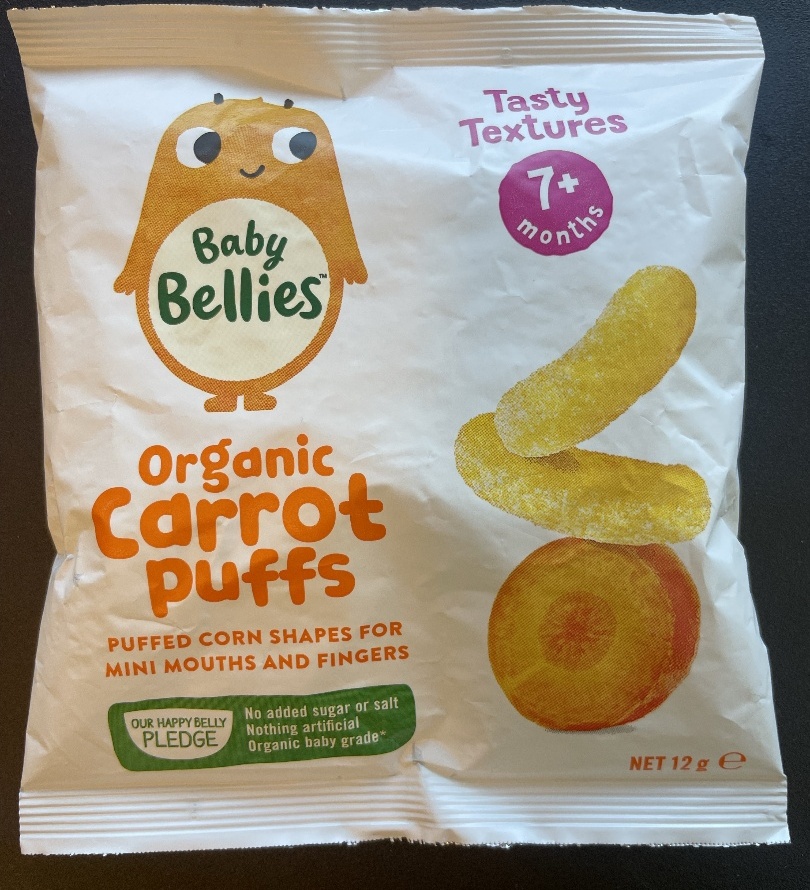
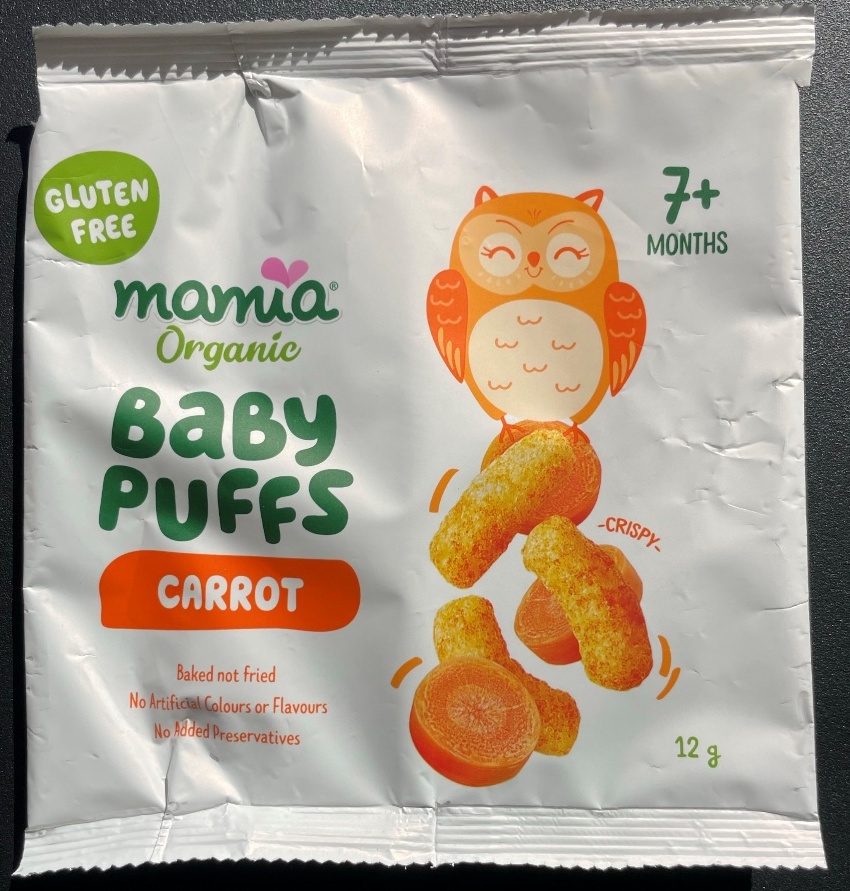
172 Again, the process of comparison between these two works is very similar to the comparison between the blueberry puffs works considered above, such that it is more efficient to identify where the comparison is different. In that regard:
(a) A key ingredient is carrot rather than blueberry, and there is a picture of carrot slices in the Aldi Work and a picture of a slice of carrot in the Hampden Work. The pictures of ingredients and products are sufficiently similar that it can be said that Aldi has reproduced that part of the Hampden Work.
(b) In place of blue colour in the blueberry puffs works, there is orange colour. But as that applies to both works, it is not a point of distinction from the analysis of the blueberry puffs works.
(c) In the Aldi Work, the owl is orange rather than blue. However, this brings it closer to the Hampden Work.
(d) Like the equivalent blueberry work, the Hampden Work has a mixture of capital and little letters (with a capital “C” in carrot), although the letters that are capitalised are different.
173 None of these matters alter the analysis set out above for the blueberry puffs works.
174 In relation to item 11 of the Aldi Works, Aldi has infringed the copyright in item 7 of the Hampden Works.
Infringement of the other Hampden Works by the Aldi Puffs Works
175 The primary judge found that his conclusions as to the infringement of one Hampden Puffs Work applied to the other Hampden Puffs Works. That was a function of his Honour’s approach in identifying a set of abstracted elements that were in common across the works. His Honour therefore made declarations that each of items 9, 10 and 11 of the Aldi Works infringed each of items 1, 6 and 7 of the Hampden Works.
176 Unlike the primary judge, we do not consider that the reasoning in relation to one Hampden Puffs Work carries across to other Hampden Puffs Works without more. In our reconsideration, an important factor in reaching a conclusion of infringement is the striking similarity in the photographs of ingredients and products between the Aldi Work and the corresponding Hampden Work, and also the similarities in colour schemes. That reasoning does not apply if one was considering whether there was infringement across varieties: for example, whether the Aldi carrot product (item 11 of the Aldi Works) infringes the Hampden blueberry product (item 1 of the Hampden Works). We do not consider that a case for infringement has been made out across the different ingredient varieties. That is relevant to the orders that should be made.
7.3 Consideration of the Aldi Non-Puffs Works
177 As noted earlier, in relation to the Aldi Non-Puffs Works, Hampden has confined itself to the use of items 1 and 3 of the Hampden Works as relevant comparators against all of the Aldi Non-Puffs Works. This has potential implications for Hampden, because in some cases the Hampden Work that most resembles the relevant Aldi Work is not items 1 or 3.
178 Merely by way of example, were it not for this confinement by Hampden, the most obvious comparator for item 1 of the Aldi Works is item 6 of the Hampden Works, including because it has an image of an apple slice and a light green colour in an identical shade to the green colour used on the Aldi Work, as follows:
Item 6: Apple & Cinnamon Puffs Hampden Work |
Item 1: MANIA Rice Cakes Apple Aldi Work |
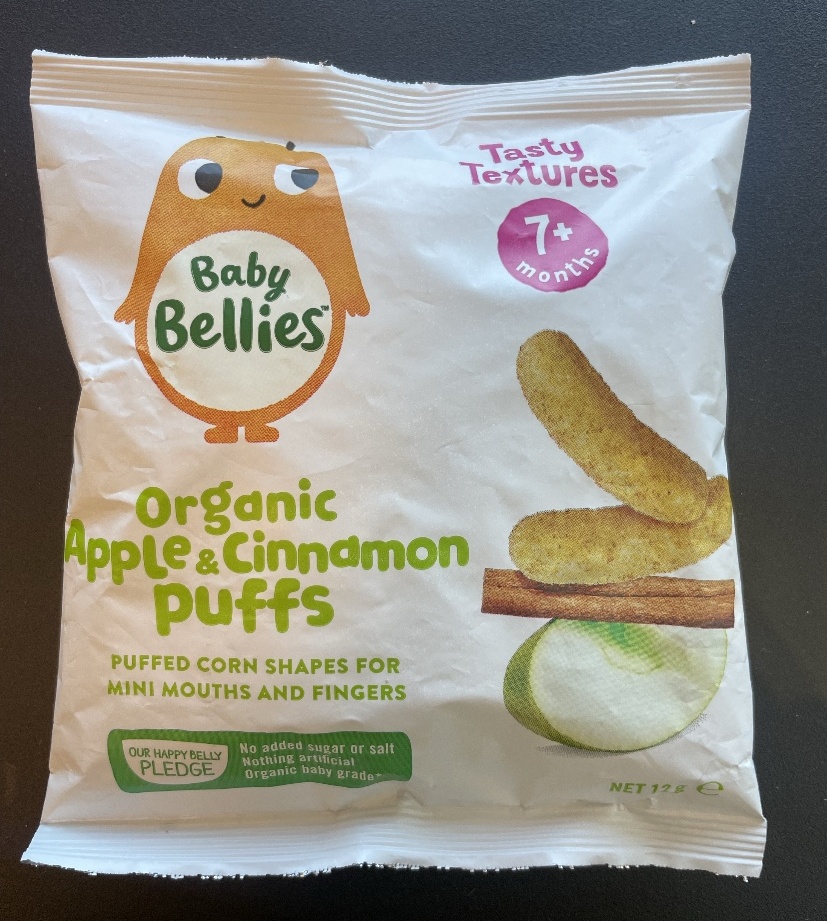
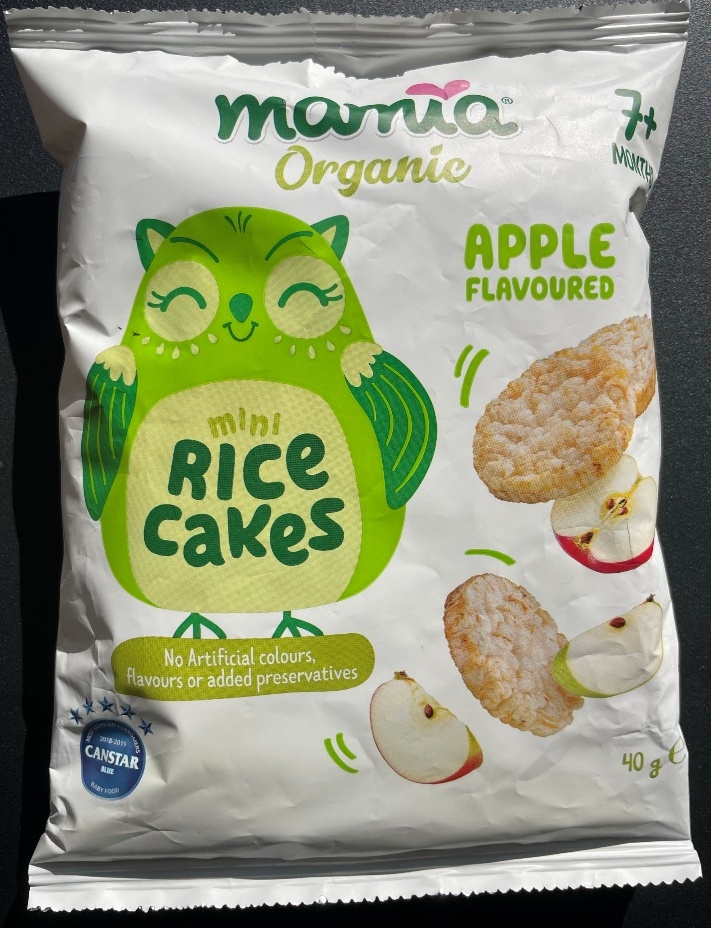
179 However, on appeal, Hampden has eschewed reliance on this work. Therefore, the relevant comparators are items 1 and 3 of the Hampden Works.
Item 4 of the Aldi Works
180 We will commence our consideration of the Aldi Non-Puffs Works with item 4 of the Aldi Works. The first relevant comparator is item 1 of the Hampden Works. The relevant works are as follows:
Item 1: Blueberry Puffs Hampden Work |
Item 4: MAMIA Fruit & Oat Bars Apricot Aldi Work |
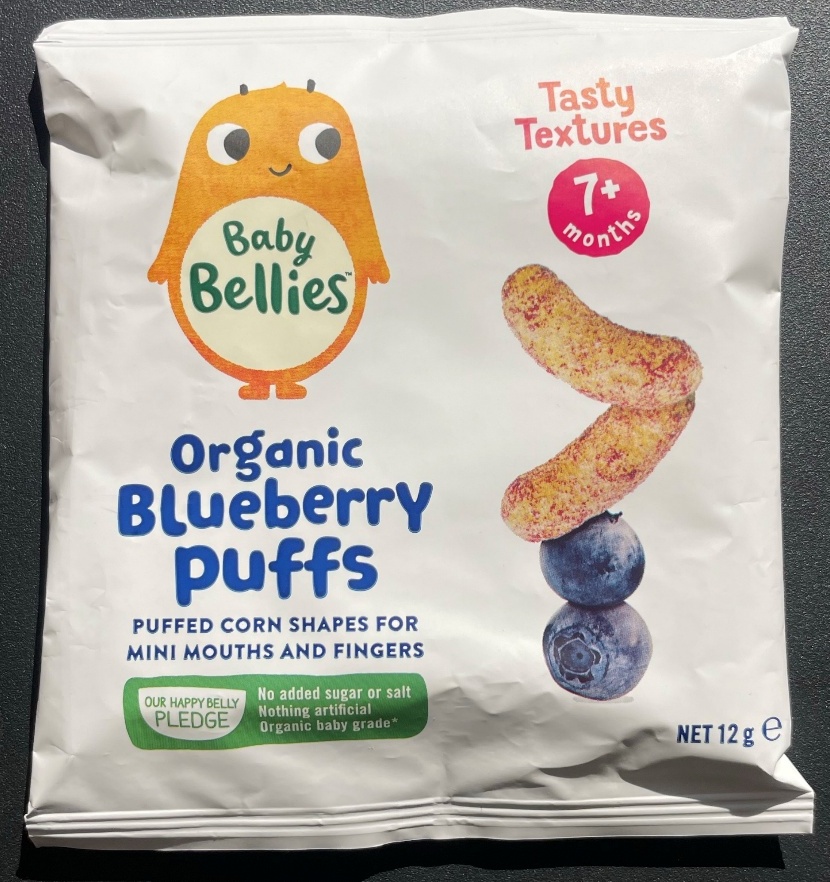
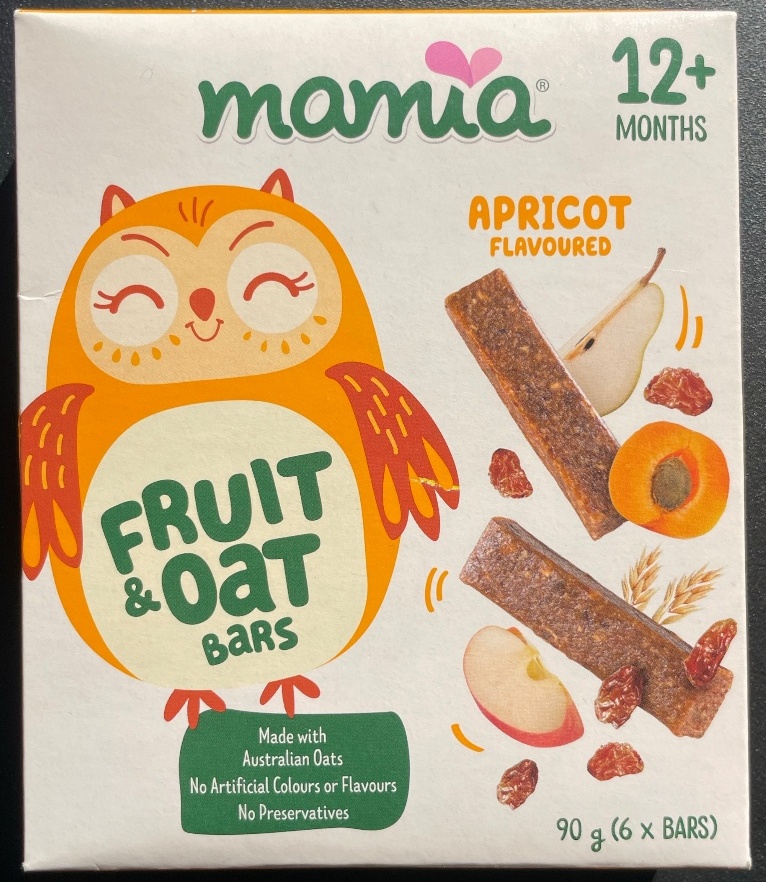
181 There are similarities between the works, as follows:
(a) both have a white background;
(b) both have a cartoon figure on the left hand side of the work, which is discussed in more detail below;
(c) both have photographs of ingredients and product in a vertical arrangement on the lower right side of the packet, although what is depicted is quite different (blueberries and puffs vs. various fruits (not blueberries), rice plants and brown bars);
(d) in relation to the product descriptors, being “Organic Blueberry Puffs” on the Hampden Work and “Fruit and Oat Bars” on the Aldi Work, both have writing in a soft, rounded, child-like style, including with some letters that are not on the same horizontal line, and a mix of capital and little letters (e.g. little “a” in “Oat” and “Bars”, with the rest capitals on the Aldi Work, capital “B”, “L” and “Y” in the Hampden Work). Although the fonts are not identical, they are very similar, and the same visual impression is created;
(e) both have a green rectangular box on the lower left side of the pack that has irregular edges, as if hand drawn;
(f) the same shade of green is used for “Baby Bellies” and the rectangular box in the Hampden Work, and “Fruit and Oat Bars”, “Mamia”, “12+ Months” and the rectangular box in the Aldi Work. Each work also has an orange cartoon figure, and an element (the age indicator in the Hampden Work and the heart above the ‘I’ in MAMIA in the Aldi Work) in pink at the top;
(g) both have an age range in the top right corner; and
(h) both have a similar layout, in that there is a cartoon character with a light coloured belly on the upper left, a green rectangular box in the bottom left, pictures of fruit and product on the lower right side, an age indicator on the top right, and a weight on the bottom right.
182 In relation to the cartoon characters, as well as both being the same colour, the most significant similarity is the round, light-coloured belly with dark green writing in it. Unlike the Aldi Puffs Works, this Aldi Work has green writing inside the belly. The belly is an original and prominent artistic feature. There are other similarities between the characters, in that:
(a) both are the same general shape, as well as being two-dimensional;
(b) both have a very small tuft on their head, albeit in a different form;
(c) both have small ears, although again there are differences;
(d) both have a mouth as a curved line in a smile; and
(e) both have round white (or light-coloured) eyes, albeit those eyes are open in the Hampden Work and closed in the Aldi Work.
However, there are also differences, including that the Aldi character is significantly larger, is an owl, has wings and feathers, has bird feet, has a nose, and has different details around the eyes (including closed lids, eyebrows, and dots below the eyes). In relation to the belly, there are also some differences: the belly of the Aldi Work is not completely circular and has no rim at the bottom; and the words are different. The differences are such that it cannot be said that Aldi has simply reproduced the whole cartoon character, so that one could immediately turn to a consideration of whether the cartoon character of the Hampden Work was a substantial part of that work. Nevertheless, important visual aspects of the character, including the light-coloured belly with writing in it, have been copied in a way that contributes to the overall assessment of whether Aldi has reproduced a substantial part of the Hampden Work.
183 There are other relevant differences between the two works, including that:
(a) the Aldi Work does not have the prominent dark blue colour of the Hampden Work;
(b) although there is a picture of fruit, the Aldi Work has a different fruit and a different product;
(c) the Hampden Work has the brand name in the belly of the character, whereas the Aldi Work has the brand name at the top of the work;
(d) in the Aldi Work, the flavour or variant (Apricot) is written separately on the top right, rather than as part of the product description as in the Hampden Work; and
(e) the Hampden Work has other features, such as “Tasty Textures” in the top right, that are not present in the Aldi Work.
184 As is the case for the Puffs Works, the differences in the cartoon characters and the other differences mean that the assessment of infringement is not purely a quantitative analysis, or a straightforward consideration of whether one or two copied elements are a substantial part of the Hampden Work.
185 The present case is certainly not an easy or clear-cut case. We have concluded that the Aldi Work reproduces a substantial part of the Hampden Work. We have reached that conclusion for the following reasons.
186 First, the cartoon character in the Aldi Work has, to a material extent, taken the distinctive round, light-coloured belly with writing in it that is present in the Hampden Work. It is a significant and original part of the Hampden Work and a key point of resemblance between the two works. The similarity includes the same cream background in the belly, and the same colour shade of green writing. Aldi has therefore appropriated a significant aspect of the Hampden Work.
187 That is not to say that there is a complete reproduction even of that element. There are differences. A significant difference is that the Hampden Work has the relevant brand name in the belly whilst the Aldi Work has the product descriptor. Mr Bowen’s evidence emphasised as a significant aspect of the element the incorporation of the brand name (i.e. including “Bellies”) in the belly, because it provided a visual image that reinforces the brand. Part of the originality and skill of the belly feature in the Hampden Work is therefore this use of “Bellies” in the belly, with the belly providing a visual underscoring of the brand name, which is not present in the Aldi Work. Another difference is that the belly in the Aldi Work is not completely circular and is not enclosed at the bottom. Therefore, there is the taking of a distinctive feature, but with modifications.
188 Secondly, both cartoon characters are orange, which is a key part of the Hampden Work and contributes in a material way to their resemblance.
189 Thirdly, both works have a child-like font for the product description, which adds materially to the similarity between them.
190 Fourthly, when these aspects are considered with the other elements of similarity – the balance of the cartoon character, the green irregular rectangular box, the dark green shade of a number of elements, the general layout, the white background, the pink colour at the top, and the age indicator in the top right corner – it is apparent that the Aldi Work appropriates a number of other aspects of layout, design and imagery of the Hampden Work. However, we also take account of the differences identified above.
191 Fifthly, we take into account the evidence concerning the material in the public domain. This analysis is relevantly the same as for item 9 of the Aldi Works (see [162] above).
192 Sixthly, the evidence supports a conclusion that Aldi has appropriated material that has a significant degree of originality. The round belly is particularly distinctive, and there was no evidence that such a thing was otherwise present in the market. The evidence reveals that creative effort went into this and other aspects of the Hampden Work (although, as noted above, the relevant originality does not include the originality of the “Bellies” brand name being placed in the belly). The analysis is otherwise the same as for item 9 of the Aldi Works (see [163] above), except that the reference to the “colour palate” is confined to the dark green writing, the orange characters, the green rectangles, and a small amount of pink. Aldi has, nevertheless, adopted those colours.
193 When these matters are considered as a whole, in our view what has been taken is (just) sufficient to amount to a substantial part of the Hampden Work.
194 In relation to item 4 of the Aldi Works, Aldi has infringed the copyright in item 1 of the Hampden Works.
195 Hampden also invites consideration of item 3 of the Hampden Works. However, this does not take the matter any further, and indeed is a weaker basis for infringement. The relevant works are as follows:
Item 3: Organic Tomato Fiddlesticks Hampden Work |
Item 4: MAMIA Fruit & Oat Bars Apricot Hampden Work |
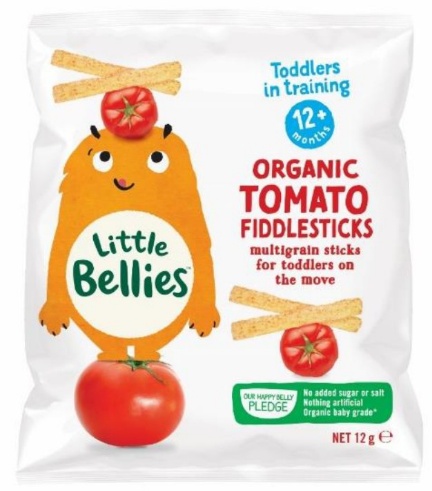
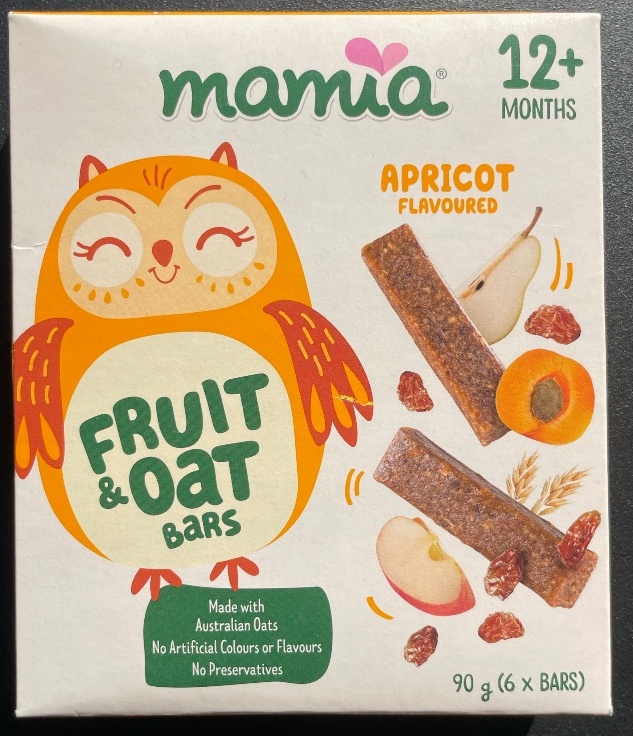
196 Compared to item 1 of the Hampden Works, this work has a cartoon character similar in size to the Aldi Work. No doubt this was why it was selected in addition to item 1. However, the organic tomato fiddlesticks work:
(a) lacks the distinctive child-like font, which is an important aspect that is missing;
(b) has a different location for pictures of the ingredients and products, including directly above and below the cartoon character, and therefore does not have the same layout, another important aspect;
(c) lacks the pink in the upper right of the packet; and
(d) has the irregular green box on the right instead of the left (and therefore again does not have the same layout).
197 In these circumstances, and given that no separate case relying on this work was advanced by Hampden, we do not propose to consider item 3 of the Hampden Works further. However, the differences identified immediately above emphasise the flaw in the contention by Hampden that there was some common design, or “look and feel”, running through each of the Hampden Works which was appropriated by Aldi.
198 We also do not propose to consider item 3 of the Hampden Works further for any other Aldi Work. It does not advance Hampden’s case any further for any of those works.
Item 6 of the Aldi Works
199 The relevant comparator is item 1 of the Hampden Works. The relevant works are as follows:
Item 1: Blueberry Puffs Hampden Work |
Item 6: MAMIA Fruit Snacks Cereal Bars Apple, Blueberry and Banana Aldi Work |
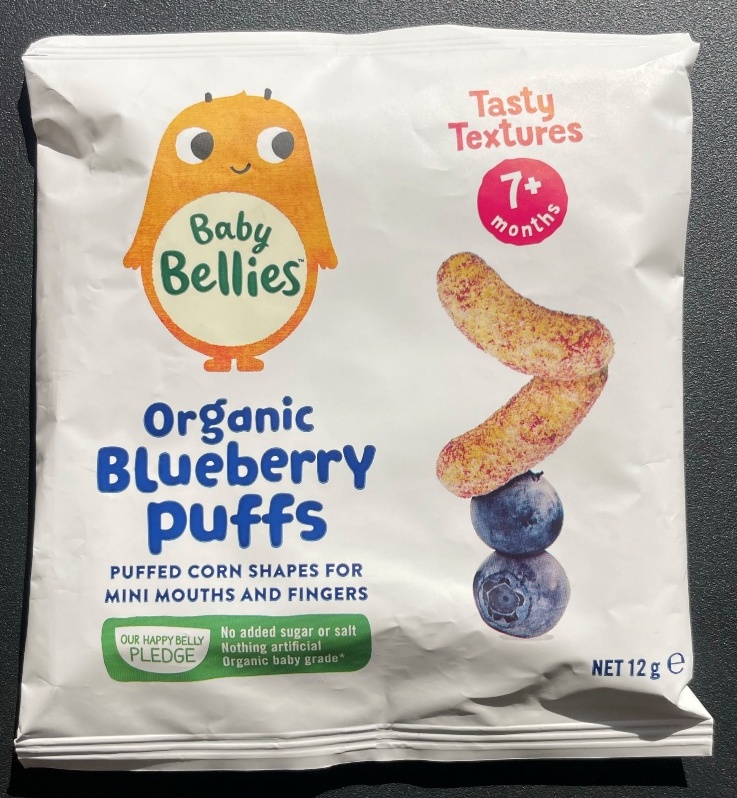
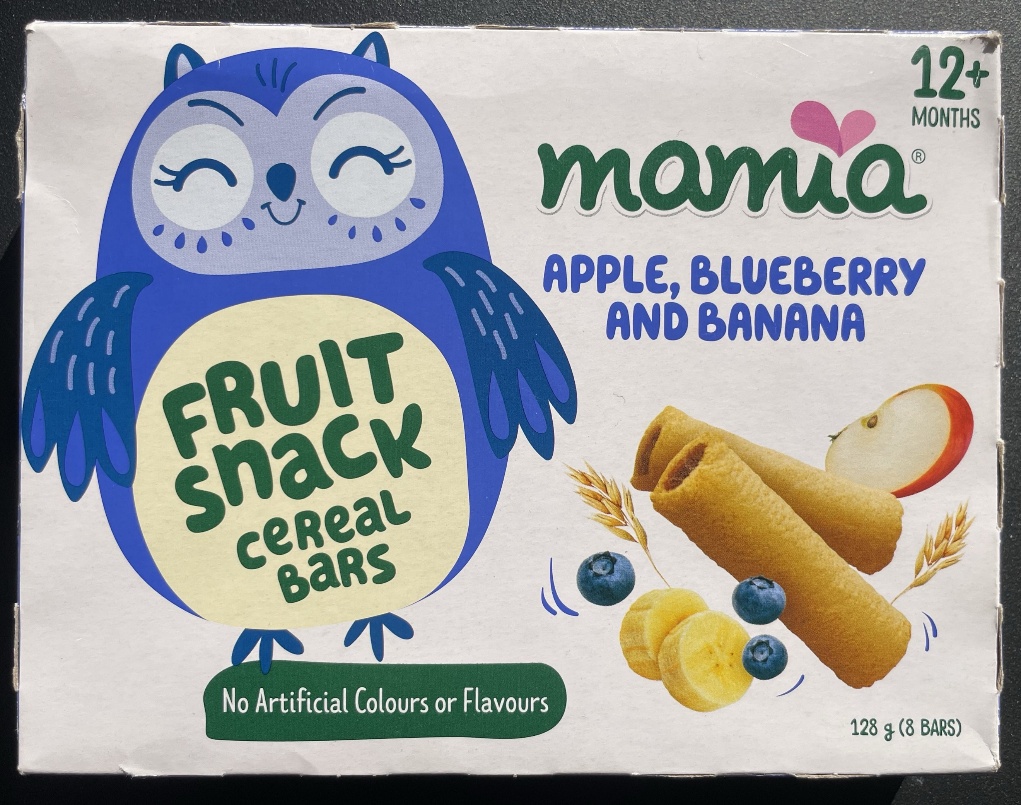
200 The analysis of item 6 of the Aldi Works is somewhat similar to that for item 4 of the Aldi Works as to which see [181]–[193] above. The relevant differences in the comparison are:
(a) the owl is blue instead of orange;
(b) there is again a mixture of lower and upper case letters in the belly, but the particular letters are different (because the product name is different);
(c) the green irregular rectangular box on the bottom left is closer in resemblance to the Hampden Work than is the case for item 4 of the Aldi Works;
(d) there are photographs of blueberries in the Aldi Work (and also in the Hampden Work);
(e) there is blue writing in the Aldi Work (“Apple, Blueberry and Banana”), noting that there is also blue writing in the Hampden Work;
(f) whilst the photographs of the ingredients and products are in the same position on the pack, the arrangement is less vertical than it is for item 4 of the Aldi Works (or the Hampden Work). This is because the pack is wider, and therefore the work is a rectangle rather than a square. This difference is relatively minor; and
(g) the brand name on the Aldi Work is on the top right, rather than centred as it is for item 3 of the Aldi Works. That means there is pink colour in the top right corner (in the form of a heart above the ‘I’ in MAMIA), as is the case for the Hampden Work (in the form of the age indicator). It also means that the layout is more of a two-column layout than is the case with item 4 of the Aldi Works.
201 The differences in (c), (d), (e) and (g) above make item 6 of the Aldi Works closer to item 1 of the Hampden Works than item 4 of the Aldi Works. The differences in (a) and (f) above make it further apart. On balance, these matters are largely neutral. The consideration is otherwise the same as for item 4. When these matters, and the matters set out in relation to item 4 above, are considered as a whole, in our view what has been taken by Aldi is (just) sufficient to amount to a substantial part of the Hampden Work.
202 In relation to item 6 of the Aldi Works, Aldi has infringed the copyright in item 1 of the Hampden Works.
Item 1 of the Aldi Works
203 The relevant comparator is item 1 of the Hampden Works. The relevant works are as follows:
Item 1: Blueberry Puffs Hampden Work |
Item 1: MAMIA Rice Cakes Apple Aldi Work |
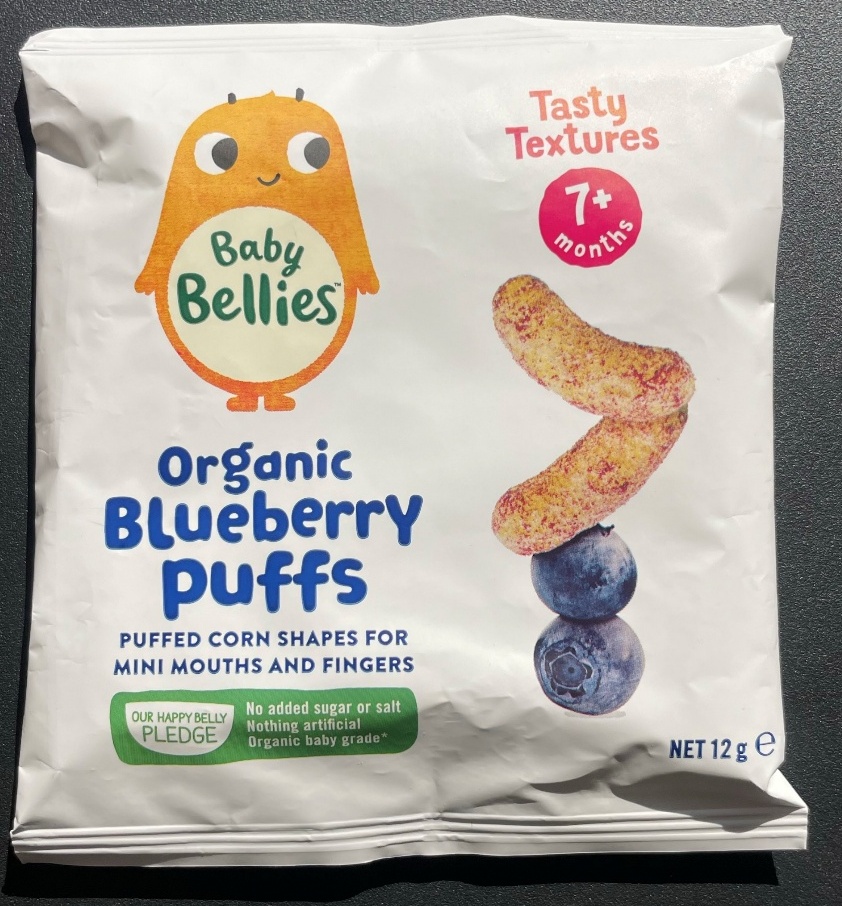
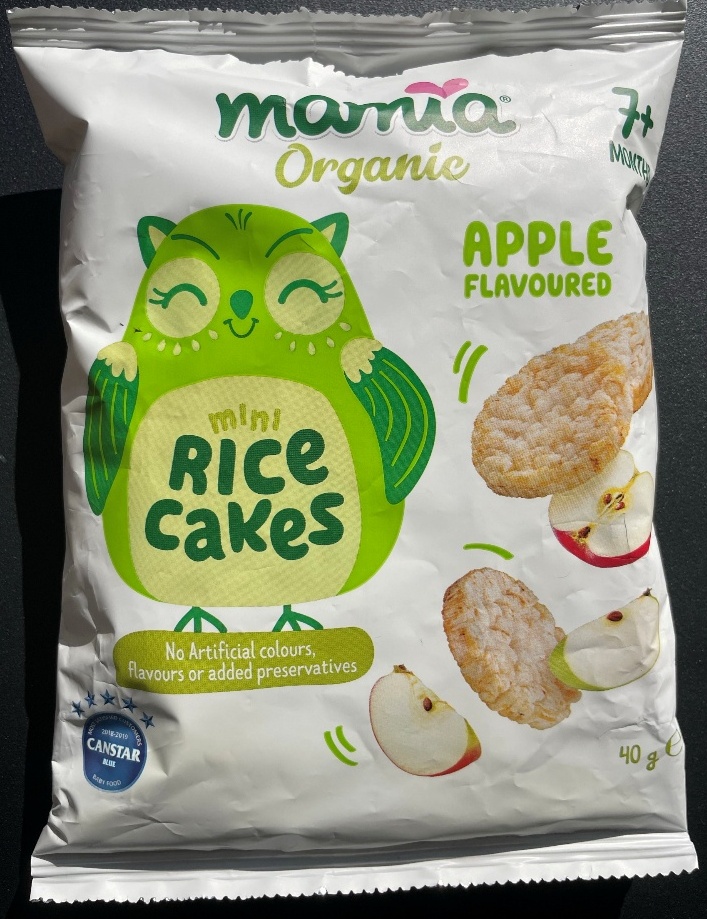
204 There are similarities between the works, as follows:
(a) both have a white background;
(b) both have a similar cartoon figure on the left hand side of the work, which is discussed in more detail below;
(c) both have photographs of ingredients and product in a vertical arrangement on the lower right side of the packet, although what is depicted is quite different (blueberries and puffs vs. apple pieces and rice cakes);
(d) in relation to the words “Organic Blueberry Puffs” on the Hampden Work and “mini Rice Cakes” and “Apple Flavoured” on the Aldi Work, both have writing in a soft, rounded, child-like style, including with some letters that are not on the same horizontal line, and a mix of capital and little letters (e.g. little “e” in “Rice”, with the rest capitals, little “a” and “e” and capital “C”, “K” and “S” in “Cakes” on the Aldi Work, capital “B”, “L” and “Y” in the Hampden Work). Although the fonts are not identical, they are very similar, and the same visual impression is created;
(e) the same shade of green is used for “Baby Bellies” and the rectangular box in the Hampden Work, and “Rice Cakes”, “Mamia” and “7+ Months” (as well as some owl detail) in the Aldi Work. Each work also has a pink element at the top, as discussed in [181](f) above;
(f) both have a green rectangular box on the lower left side of the pack that has irregular edges, as if hand drawn;
(g) both have an age range in the top right corner; and
(h) both have a similar layout, in that there is a cartoon character with a light coloured belly on the upper left, a green rectangular box in the bottom left, pictures of fruit and product on the lower right side, an age indicator on the top right, and a weight on the bottom right.
205 In relation to the cartoon characters, the most significant similarity is the round, light-coloured belly with dark green writing in it. Unlike the Aldi Puffs Works, this Aldi Work has green writing inside the belly. The belly is a prominent and original feature. There are other similarities between the characters, in that:
(a) both are the same general shape, as well as being two-dimensional;
(b) both have a tuft on their head, albeit in a different form;
(c) both have small ears, although again there are differences;
(d) both have a mouth as a curved line in a smile; and
(e) both have round white (or light-coloured) eyes, albeit those eyes are open in the Hampden Work and closed in the Aldi Work.
However, there are also differences, including that the Aldi character is significantly larger, is an owl, is green rather than orange, has wings and feathers, has bird feet, has a nose, and has different details around the eyes (including closed lids, eyebrows, and dots below the eyes). In relation to the belly, there are also some differences: the background colour is light green rather than cream; the belly of the Aldi Work is not completely circular and has no rim at the bottom; and the words are different. The differences are such that it cannot be said that Aldi has simply reproduced the whole cartoon character, so that one could immediately turn to a consideration of whether the cartoon character of the Hampden Work was a substantial part of the that work. Nevertheless, important visual aspects of the character, including a distinctive light-coloured belly with writing in it, have been copied in a way that contributes to the overall assessment of whether Aldi has reproduced a substantial part of the Hampden Work.
206 There are other relevant differences between the two works, including that:
(a) the Aldi Work does not have the prominent dark blue colour of the Hampden Work;
(b) although there is a picture of fruit, the Aldi Work has a different fruit and a different product;
(c) the Hampden Work has the brand name in the belly of the character, whereas the Aldi Work has the brand name at the top of the work;
(d) in the Aldi Work, the flavour or variant (Apple) is written separately on the top right, rather than as part of the product description as in the Hampden Work; and
(e) the Hampden Work has other features, such as “Tasty Textures” in the top right, that are not present in the Aldi Work.
207 As is the case for item 4 of the Aldi Works, the differences in the cartoon characters and the other differences mean that the assessment of infringement is not simply a quantitative analysis, or a straightforward consideration of whether one or two copied elements are a substantial part of the Hampden Work.
208 The present case is certainly not an easy or clear-cut case. It is rendered more difficult by the fact that Hampden has chosen a comparator work that does not have the same fruit images, or the same light green colour, as the Aldi Work, unlike item 6 of the Hampden Works.
209 We have concluded that in this case Aldi is on the right side of the line. We have concluded that the Aldi Work does not reproduce a substantial part of the Hampden Work. This is primarily because some of the similarities present in the case of items 4 and 6 of the Aldi Works are not present in this case. In particular, unlike item 4 of the Aldi Works, the cartoon character is green not orange. The background to the belly is light green, not cream, and the belly is less circular. It is therefore more difficult to say that Aldi has appropriated distinctive aspects of the cartoon character.
210 Further, unlike item 6 of the Aldi Works, item 1 of the Aldi Works does not contain photographs of blueberries and does not have blue writing or other blue elements. If Hampden had put forward item 6 of the Hampden Works as a comparator, then this analysis might have been different, but Hampden chose not to do so.
211 Although most of the analysis is relevantly the same, these distinctions mean that item 1 of the Aldi Works does not reproduce a substantial part of item 1 of the Hampden Works and Aldi has not infringed that work.
Item 2 of the Aldi Works
212 Again, the relevant comparator for item 2 of the Aldi Works advanced by Hampden is item 1 of the Hampden Works. The relevant works are as follows:
Item 1: Blueberry Puffs Hampden Work |
Item 2: MAMIA Rice Cakes Apple and Raspberry Aldi Work |
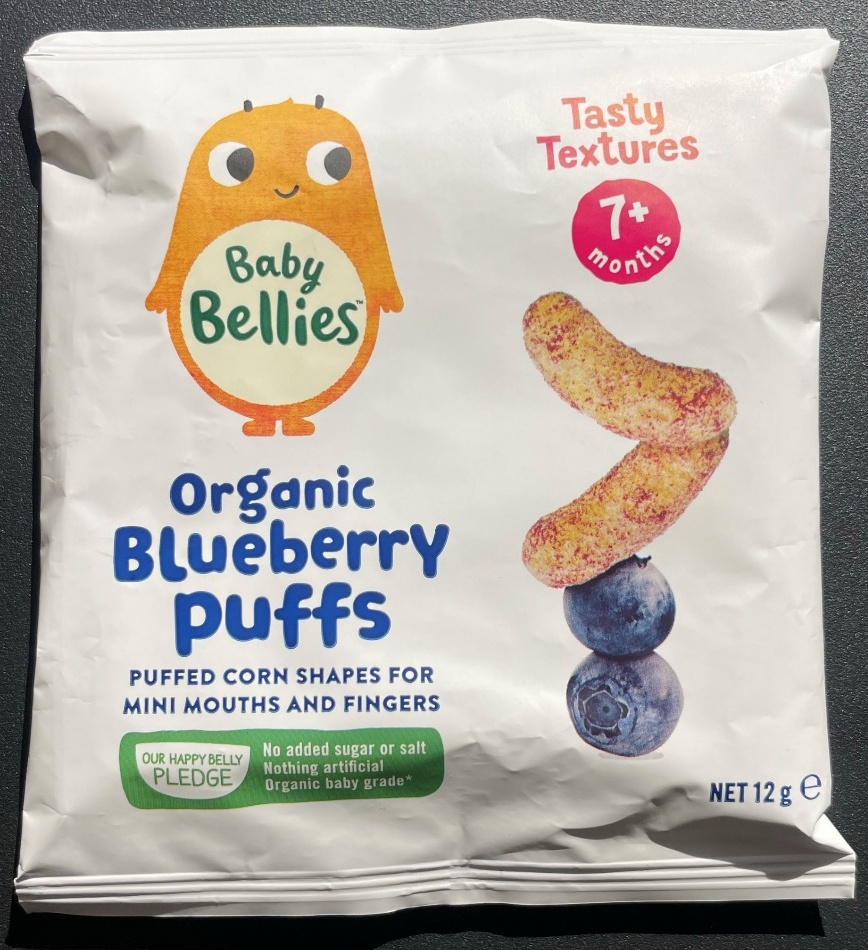
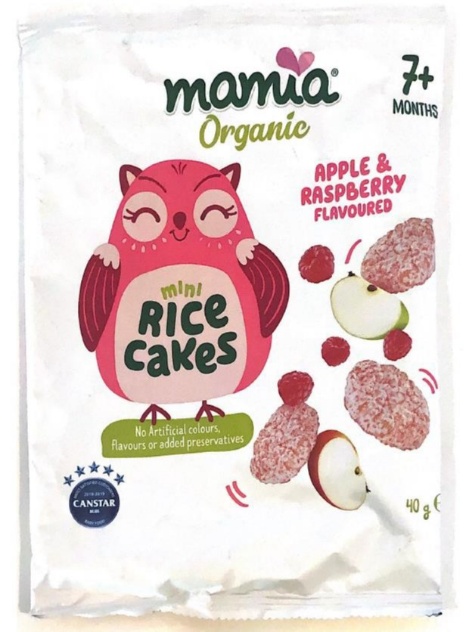
213 The analysis of this Aldi Work is virtually identical to the analysis of item 1 of the Aldi Works (see [204]–[207] above). The only relevant difference is that the owl is hot pink rather than green and the ingredients are different. Therefore, where there is reference in that analysis to the dark green colour also being present on parts of the cartoon character other than the writing in the belly, that is not true of item 2 of the Aldi Works. Likewise, where there is a reference to light green as the background to the belly, that is light pink in item 2 of the Aldi Works. However, these matters are not material to the conclusion, and the conclusion is therefore the same.
214 In relation to item 2 of the Aldi Works, Aldi has not infringed the copyright in item 1 of the Hampden Works.
Item 3 of the Aldi Works
215 Again, the relevant comparator is item 1 of the Hampden Works. The relevant works are as follows:
Item 1: Blueberry Puffs Hampden Work |
Item 3: MAMIA Fruit & Oat Bars Strawberry Aldi Work |
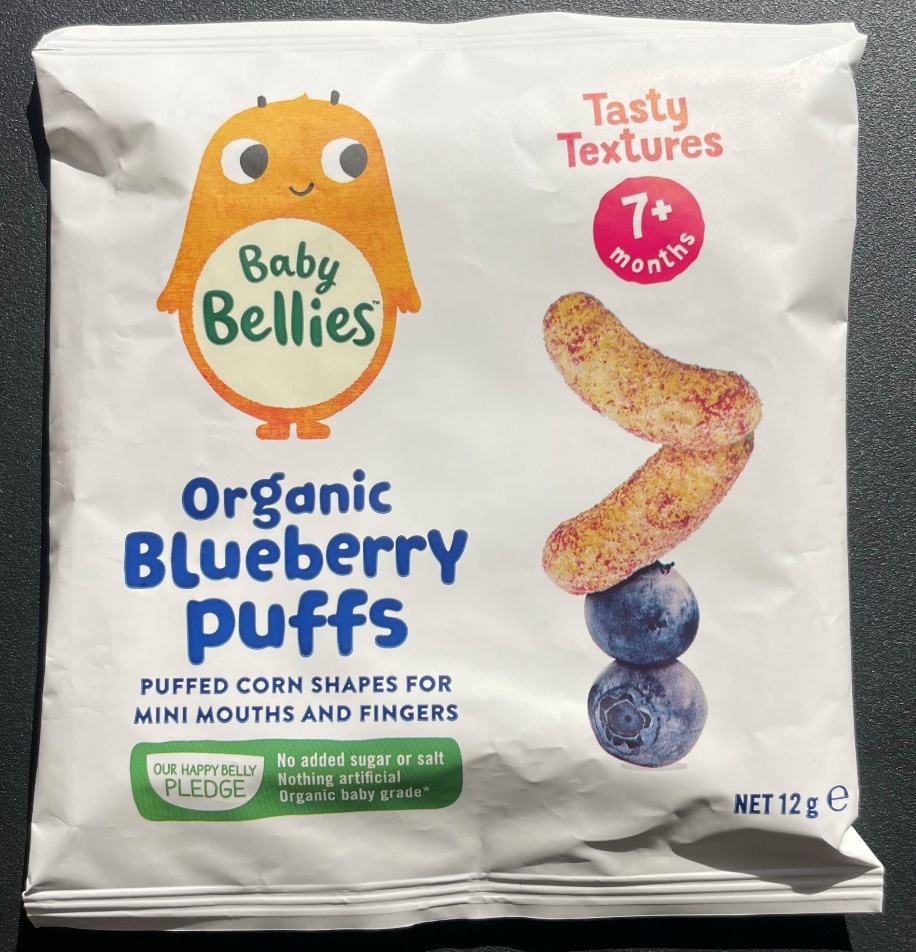
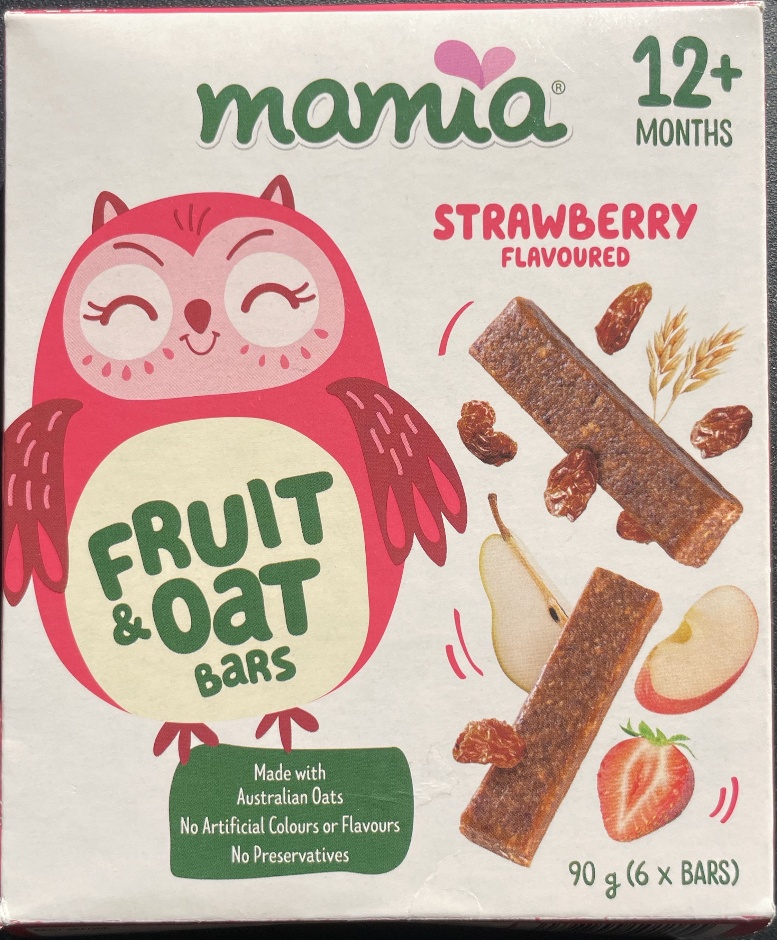
216 The analysis is very similar to the analysis for item 4 of the Aldi Works (see [181]–[193] above). We will therefore focus on the matters that are different in the comparison. In that regard:
(a) The owl is hot pink rather than orange.
(b) The photographs of the ingredients and product are different, but not in a way that matters – i.e. not in a way that brings the Aldi Work closer to the Hampden Work.
217 Although the relevant difference is to only one element (the colour of the owl), this is a significant element in the overall conclusion. The fact that the cartoon character of item 4 of the Aldi Works is orange is a material contributor to the conclusion that item 4 of the Aldi Works is (just) sufficiently similar to amount to a reproduction of a substantial part of item 1 of the Hampden Works. Item 3 lacks that feature. It does not have any feature that weighs in the opposite direction (unlike item 6 of the Aldi Works). It is merely less similar to item 1 of the Hampden Works than item 4 of the Aldi Works. In those circumstances, we are of the view that there is insufficient similarity between the items to amount to infringement.
218 In relation to item 3 of the Aldi Works, Aldi has not infringed the copyright in item 1 of the Hampden Works.
Item 5 of the Aldi Works
219 Again, the relevant comparator is item 1 of the Hampden Works. The relevant works are as follows:
Item 1: Blueberry Puffs Hampden Work |
Item 5: MAMIA Fruit & Oat Bars Apple and Raisin Aldi Work |
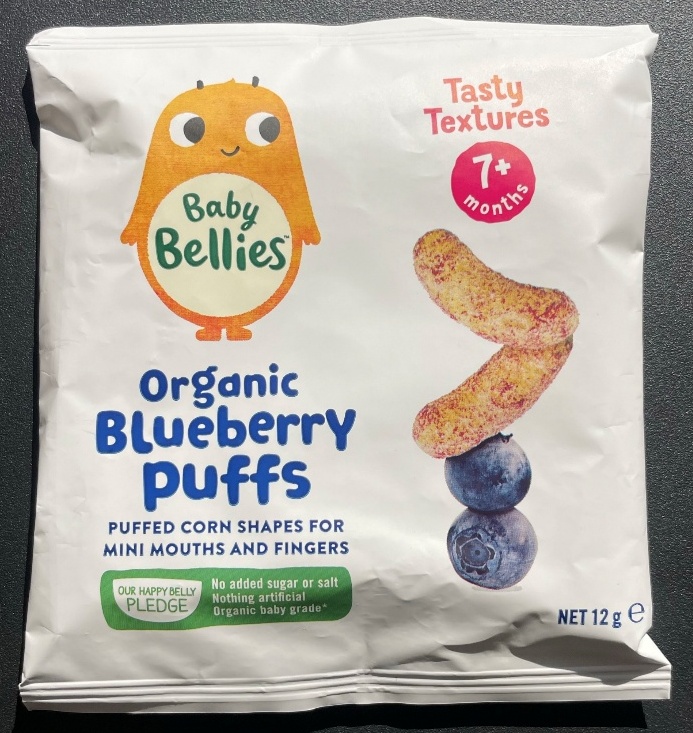
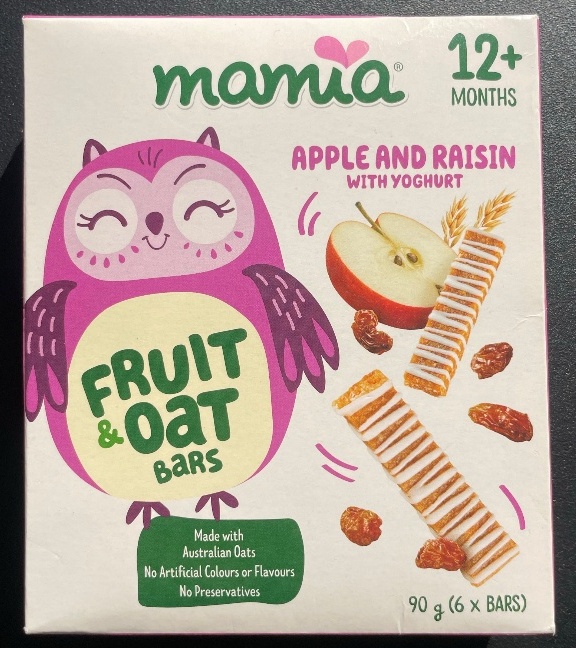
220 The analysis of item 5 of the Aldi Works is identical to item 3 of the Aldi Works, except that the owl is purple instead of hot pink and the ingredients (and product photo) are different (see [215] above). Nothing turns on that difference.
221 In relation to item 5 of the Aldi Works, Aldi has not infringed the copyright in item 1 of the Hampden Works.
Item 7 of the Aldi Works
222 Once again, the obvious comparator is item 6 of the Hampden Works, which contains a distinctive light green shade present on the Aldi Work, as well as similar photographs of ingredients and product. However, that comparison has been expressly ruled out by Hampden for this purpose.
223 The relevant comparator is therefore item 1 of the Hampden Works. The relevant works are as follows:
Item 1: Blueberry Puffs Hampden Work |
Item 7: MAMIA Fruit Snack Cereal Bars Apple Aldi Work |
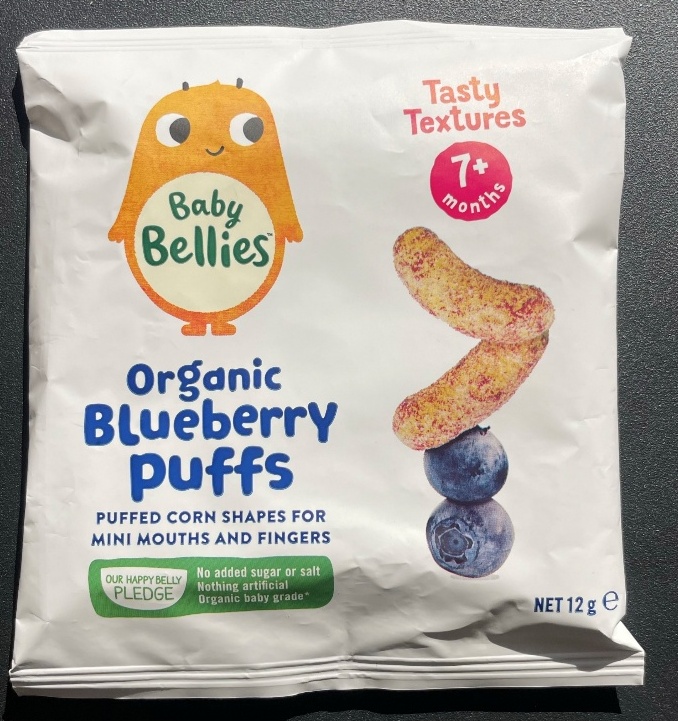
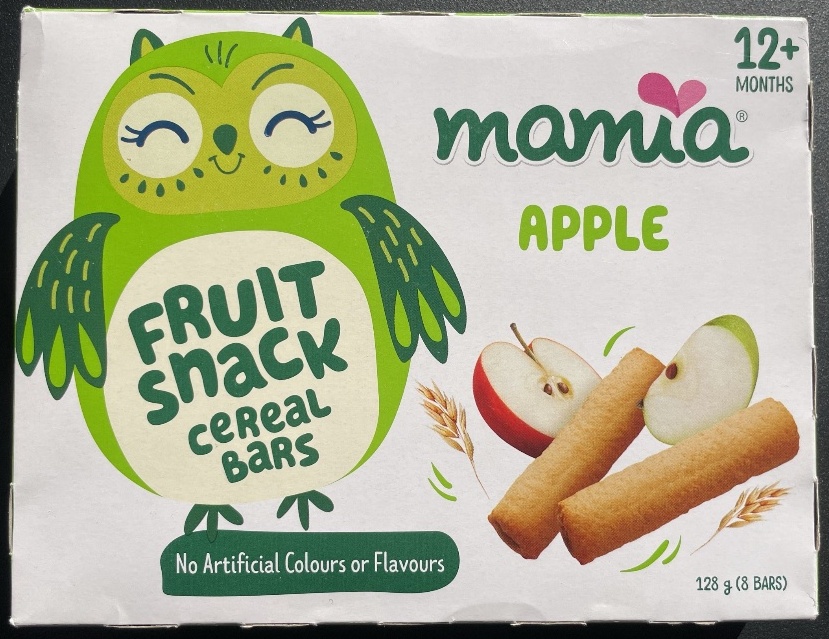
224 Item 7 of the Aldi Works has similarities with item 6 of the Aldi Works (see [200]–[201] above). The relevant differences are:
(a) The owl is green rather than blue.
(b) There are no photographs of blueberries to match item 1 of the Hampden Works.
(c) There is no blue writing to match the blue writing of item 1 of the Hampden Works.
225 These differences are material because the blueberries, blue writing and blue in the colour scheme were material contributors to the conclusion that item 6 of the Aldi Works was (just) sufficiently similar to item 1 of the Hampden Works as to amount to a reproduction of a substantial part of that work. Item 7 of the Aldi Works lacks those features, and does not have any other features to weigh in the opposite direction. It is merely less similar to item 1 of the Hampden Works than item 6 of the Aldi Works. In those circumstances, we are of the view that there is insufficient similarity between the items to amount to infringement.
226 In relation to item 7 of the Aldi Works, Aldi has not infringed the copyright in item 1 of the Hampden Works.
Item 8 of the Aldi Works
227 The relevant comparator is item 1 of the Hampden Works. The relevant works are as follows:
Item 1: Blueberry Puffs Hampden Work |
Item 8: MAMIA Fruit Snack Cereal Bars Apple and Raspberry Aldi Work |
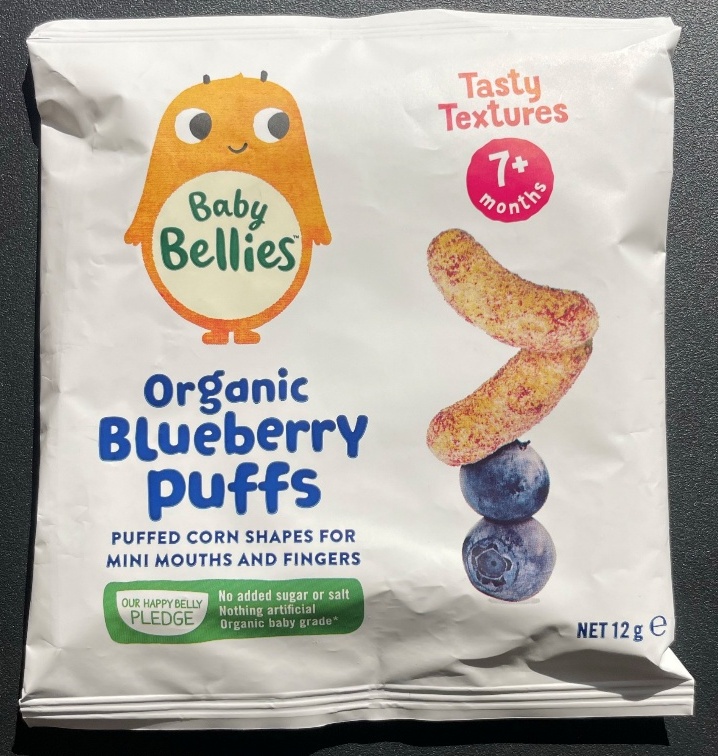
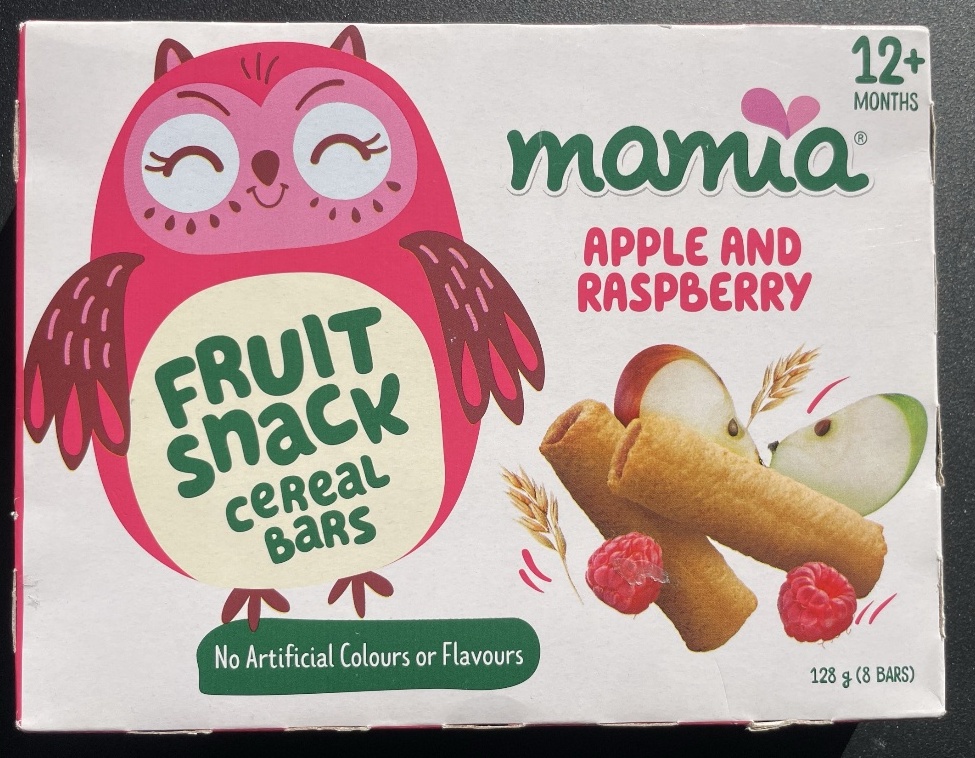
228 The analysis for item 8 of the Aldi Works is essentially the same as the analysis for item 7 of the Aldi Works (see [224]–[225] above). The owl is hot pink rather than green, but the comparison is otherwise the same.
229 In relation to item 8 of the Aldi Works, Aldi has not infringed the copyright in item 1 of the Hampden Works.
7.4 The role of Animus Furandi
230 The was no exploration in the submissions before us as to whether, and if so how, the principle of animus furandi might have a role to play in the circumstances of the present case. The application of that principle to the process of assessing whether there has been a reproduction of a substantial part of a work has been criticised in the UK: Baigent v Random House Group Ltd (2007) 72 IPR 195; [2007] EWCA Civ 247 (Baigent) at [95]–[97] (Lloyd LJ). Close attention would need to be given to the role of the principle in relation to an assessment that requires an objective comparison. Baigent was referenced in Ice TV at [55] (French CJ, Crennan and Kiefel JJ), but the animus furandi principle was cited with approval by Gummow, Hayne and Heydon JJ in the same case at [171]. In EMI v Larrikin at [221], Jagot J (Nicholas J agreeing) referred to the potential for the principle to be used to more readily make findings against the infringer, although the principle was not applied in that case.
231 In circumstances such as the present, where an objective analysis leads to the conclusion that some works are insufficiently similar for there to have been a reproduction of a substantial part of the work in suit, the mechanism by which the principle could result in a finding of infringement would require some explication.
232 Further, in the present case, any application of the principle would have to accommodate the findings of the primary judge that Aldi did not intend to copy the Hampden Works to the extent that the result would infringe the law. That might have implications for whether an Aldi Work that, on an objective analysis, fell short of an infringement could, by the application of the animus furandi principle, be carried across the line that Aldi did not intend to cross.
233 None of these matters were explored in submissions. We would prefer to reserve further consideration of the animus furandi principle to a case in which it has been fully argued.
7.5 Conclusions on infringement
234 Each of the Aldi Puffs Works and items 4 and 6 of the Aldi Non-Puffs Works infringe the copyright in a Hampden Work, being the works identified above. The other Aldi Non-Puffs Works are not infringements of the Hampden Works.
8. DISPOSITION OF THE APPEAL
235 Each of Aldi and Hampden have succeeded on their appeal and cross-appeal in demonstrating that the primary judge did not apply the correct approach in the circumstances of the present case.
236 Following our reconsideration, Hampden has succeeded on its cross-appeal in obtaining a finding of infringement in respect of two of the Aldi Non-Puffs Works where it was unsuccessful at trial, but for reasons somewhat different from the submissions which it advanced, and only in respect of the infringement of one of the Hampden Works (being item 1 of the Hampden Works). There should be declarations, consistent with the existing declarations ordered by the primary judge, in relation to the infringement of those works.
237 Following our reconsideration, Hampden has also succeeded in retaining the findings of infringement in relation to the Aldi Puffs Works, but on a narrower basis, in that only a single Hampden Work has been found to be infringed by each Aldi Work. Orders 1 and 2 of the orders of the primary judge of 17 February 2025 comprised declarations that each of items 9, 10 and 11 of the Aldi Works infringed each of items 1, 6 and 7 of the Hampden Works. Those orders should therefore be set aside, and narrower declarations made in their place.
238 We have concluded that there is no basis for setting aside of the order of the primary judge concerning additional damages. As a practical matter, it will apply to the broader set of Aldi Works, but that is appropriate for the reasons set out earlier. The primary judge’s dismissal of the cross-claim for unjustified threats also remains, as do the procedural orders concerning the enquiry as to the quantum of pecuniary relief.
239 Given that most of the orders of the primary judge can remain in place, the orders we will make will replace the declarations of the primary judge with revised declarations, using the same defined terms as the primary judge. If that is done, then the other orders of the primary judge, including the machinery provisions for quantification of damages and additional damages, will continue to operate in accordance with their terms.
240 In relation to costs, each side has had a mixed result in this Court. Aldi has succeeded in demonstrating that the reasons of the primary judge involve error and require reconsideration, and has defended six of its works on that reconsideration, but has gone slightly backwards overall. Hampden has advanced its position slightly in that it will obtain relief in relation to two additional infringing products, although the Aldi Puffs Works have each been found to infringe only a single Hampden Work rather than multiple Hampden Works. However, Hampden only reached that position after Aldi was successful in challenging the reasons below, where those reasons were in part influenced by Hampden’s erroneous approach to infringement. Further, Hampden’s modest success on appeal is not due to the way that it chose to articulate the matter.
241 It is not appropriate that Aldi bear any part of Hampden’s appellate costs in these circumstances. In our view, the appropriate order is that there be no order as to the costs of the appeal and the cross-appeal with the consequence that each party bear its own costs. There is no reason to disturb the costs orders of the primary judge, being orders 8 and 9 of the orders of 17 February 2026.
I certify that the preceding two hundred and forty-one (241) numbered paragraphs are a true copy of the Reasons for Judgment of the Honourable Justices Burley, Moore and Owens. |
Associate:
Dated: 19 August 2026
SCHEDULE OF PARTIES
NSD 277 of 2025 | |
Cross-Appellants | |
Second Cross-Appellant: | LACORIUM HEALTH AUSTRALIA PTY LTD |


