

Federal Court of Australia
Latham v Greenwich [2026] FCAFC 82
Appeal from: | Greenwich v Latham [2024] FCA 1050 |
File number(s): | NSD 147 of 2025 |
Judgment of: | COLVIN, WHEELAHAN AND ABRAHAM JJ |
Date of judgment: | 10 June 2026 |
Catchwords: | DEFAMATION — publication of a tweet – whether the tweet conveyed imputations in its natural and ordinary meaning or by a true innuendo – ordinary reasonable reader’s understanding of the tweet – imputation that the respondent engaged in disgusting sexual activities conveyed – true innuendo that the respondent was not fit for office not conveyed – matter was defamatory – whether the publication caused “serious harm” to the respondent’s reputation – assessing serious harm requires an evaluative judgment having regard to ordinary principles relating to the sufficiency of proof – serious harm must stem from the publication of the defamatory matter rather than the imputation – the respondent established serious harm by inference from the online abuse directed to him as a result of the publication of the primary tweet – whether the defence of honest opinion was established – the appellant’s opinion was not based on proper material for comment – defence failed – whether the defence of common law qualified privilege for a reply to an attack was established – whether proportionality is an element of the defence – the attack was not commensurate with the occasion – defence failed. DAMAGES — whether the award of general damages for non-economic loss was in error – award of damages was soundly reasoned and not manifestly excessive – whether the primary judge erred in awarding aggravated damages – where respondent failed to make relevant submissions in relation to aggravated damages at trial – application for leave to amend notice of appeal dismissed – no error established |
Legislation: | Federal Court of Australia Act 1976 (Cth) s 37M Judiciary Act 1901 (Cth) s 78B Civil Law (Wrongs) Act 2002 (ACT) s 122A Defamation Act 1958 (NSW) Defamation Act 1974 (NSW) Defamation Act 2005 (NSW) ss 8, 10A, 25, 26, 28, 29, 29A, 30, 31, 33 and 35 Defamation Amendment Act 2020 (NSW) Defamation Act 2013 (UK) s 1 Human Rights Act 1998 (UK) |
Cases cited: | Accommodation West Pty Ltd v Aikman [2017] WASC 157 Adam v Ward [1917] AC 309 at 320 Rader v Haines [2022] NSWCA 198 Alcan (NT) Alumina Pty Ltd v Commissioner of Territory Revenue [2009] HCA 41; 239 CLR 27 Aljazeera International (Malaysia) SDN BHD v Hun [2026] FCAFC 22 Amersi v Leslie [2023] EWCA Civ 1468 Australian Securities Commission v Marlborough Gold Mines Ltd [1993] HCA 15; 177 CLR 485 Favell v Queensland Newspapers Pty Ltd [2005] HCA 52; 221 ALR 186 Baini v The Queen [2012] HCA 59; 246 CLR 469 Bashford v Information Australia (Newsletters) Pty Ltd [2004] HCA 5; 218 CLR 366 Bauer Media Pty Ltd v Wilson (No 2) [2018] VSCA 154; 56 VR 674 Bazzi v Dutton [2022] FCAFC 84; 289 FCR 1 Berezovsky v Forbes Inc [2001] EWCA Civ 1251; EMLR 45 Blake v Fox [2025] EWCA Civ 1321 Boensch v Pascoe [2019] HCA 49; 268 CLR 593 Braddock v Bevins [1948] 1 KB 580 Calwell v Ipec Australia Ltd (1975) 135 CLR 321 Carson v John Fairfax & Sons Ltd [1993] HCA 31; 178 CLR 44 Cassell & Co Ltd v Broome [1972] AC 1027 Channel Seven Adelaide Pty Ltd v Manock [2007] HCA 60; 232 CLR 245 Chappell v TCN Channel Nine Pty Ltd (1988) 14 NSWLR 153 Clift v Slough Borough Council [2010] EWCA Civ 1484; [2011] 1 WLR 1774 Consolidated Trust Company Ltd v Browne (1948) 49 SR (NSW) 86 Cush v Dillon [2011] HCA 30; 243 CLR 298 Deeming v Pesutto (No 3) [2024] FCA 1430 Federal Commissioner of Taxation v Consolidated Media Holdings Ltd [2012] HCA 55; 250 CLR 503 Gould v Jordan (No 2) [2021] FCA 1289 Greenwich v Latham [2024] FCA 1050 Griniezakis v Morelas (Trial Judgment) [2026] FCA 156 Harbour Radio Pty Ltd v Trad [2012] HCA 44; 247 CLR 31 Harding v Essey [2005] WASCA 30; 30 WAR 1 Heytesbury Holdings Pty Ltd v City of Subiaco (1998) 19 WAR 440 Hill v Zuda Pty Ltd [2022] HCA 21; 275 CLR 24 House v The King [1936] HCA 40; 55 CLR 499 Jameel (Yousef) v Dow Jones & Co Inc [2005] EWCA Civ 75; QB 946 Jones v Skelton [1963] 1 WLR 1362 Lachaux v Independent Print Ltd [2019] UKSC 27; [2020] AC 612 Lange v Australian Broadcasting Corporation [1997] HCA 25; 189 CLR 520 Lewis v Daily Telegraph Ltd [1964] AC 234 Loveday v Sun Newspaper Ltd (1938) 59 CLR 503 Massoud v Nationwide News Pty Ltd [2022] NSWCA 150; 109 NSWLR 469 MG v PJ [2025] QCA 99 Mirror Newspapers Ltd v World Hosts Pty Ltd (1979) 141 CLR 632 Mond v The Age Company Pty Ltd [2025] FCA 442 Moore v Martin [2026] NSWSC 493 Mowlds v Fergusson (1940) 64 CLR 206 Nationwide News Pty Ltd v Rush [2020] FCAFC 115; 380 ALR 432 Nevill v Fine Arts and General Insurance Co [1895] 2 QB 156 Norton v Hoare [No 1] [1913] HCA 51; 17 CLR 310 Ogden Industries Pty Ltd v Lucas [1970] AC 113 Palmer v McGowan (No 5) [2022] FCA 893; 404 ALR 621 Penton v Calwell (1945) 70 CLR 219 Peros v Nationwide News Pty Ltd (No 3) [2024] QSC 192 Purkess v Crittenden (1965) 114 CLR 164 at 167 Radio 2UE Sydney Pty Ltd v Chesterton [2009] HCA 16; 238 CLR 460 Reader’s Digest Services Pty Ltd v Lamb [1982] HCA 4; 150 CLR 500 Roberts v Bass [2002] HCA 57; 212 CLR 1 Rogers v Nationwide News Pty Ltd [2003] HCA 52; (2003) 216 CLR 327 Russell v Australian Broadcasting Corporation (No 3) [2023] FCA 1223; 303 FCR 372 Selkirk v Hocking (No 2) [2023] FCA 1085 Selkirk v Wyatt [2024] FCAFC 48; 302 FCR 541 Shi v Migration Agents Registration Authority [2008] HCA 31; 235 CLR 286 Sube v News Group Newspapers Ltd [2018] 1 WLR 5767 SunshineLoans Pty Ltd v Australian Securities and Investments Commission [2025] FCAFC 34; 308 FCR 474 Supaphien v Chaiyabarn [2026] ACTCA 5 Sutcliffe v Pressdram Ltd [1991] 1 QB 153 SZTAL v Minister for Immigration & Border Protection [2017] HCA 34; 262 CLR 362 Thornton v Telegraph Media Group Ltd [2011] 1 WLR 1985 Stocker v Stocker [2019] UKSC 17; [2020] AC 593 Triggell v Pheeney (1951) 82 CLR 497 Trkulja v Google LLC [2018] HCA 25; 263 CLR 149 Turner v Metro-Goldwyn-Mayer Pictures Ltd [1950] 1 All ER 449 Whisprun Pty Ltd v Dixon [2003] HCA 48; 200 ALR 447 Sir Brian Neill and Richard Rampton (eds), Duncan and Neill on Defamation (Butterworths, 1983) Richard Parkes KC, Gatley on Libel and Slander (13th ed, Sweet & Maxwell, 2022) |
Division: | General Division |
Registry: | New South Wales |
National Practice Area: | Other Federal Jurisdiction |
Number of paragraphs: | 166 |
Date of hearing: | 25–26 November 2025 |
Counsel for the Appellant: | Ms G R Rubagotti |
Solicitor for the Appellant: | Zali Burrows Lawyers |
Counsel for the Respondent: | Dr M J Collins KC with Ms S Jeliba |
Solicitor for the Respondent: | Dowson Turco Lawyers |
ORDERS
NSD 147 of 2025 | ||
| ||
BETWEEN: | MARK WILLIAM LATHAM Appellant | |
AND: | ALEXANDER GREENWICH Respondent | |
order made by: | COLVIN, WHEELAHAN AND ABRAHAM JJ |
DATE OF ORDER: | 10 JUNE 2026 |
THE COURT ORDERS THAT:
1. The appeal is dismissed.
2. The cross-appeal is dismissed.
3. The parties are to confer and email to the Chambers of the members of the Court by 4.00pm on 17 June 2026 an agreed minute of orders for the Court’s consideration concerning the question of costs, and if the parties are unable to agree on costs, the agreed minute is to provide for a timetable for the filing of any supporting affidavits and written submissions not exceeding three pages and for the question of costs to be considered on the papers.
Note: Entry of orders is dealt with in Rule 39.32 of the Federal Court Rules 2011.
REASONS FOR JUDGMENT
COLVIN J:
1 I have the considerable advantage of being provided with a draft of the joint reasons of Wheelahan and Abraham JJ. Respectfully, I agree that the issues for determination are those described in the joint reasons and I agree with the orders proposed by their Honours. I also agree with the reasons as to Issues 2 and 4 to 8. For the following reasons, I agree with the conclusions reached as to Issues 1 and 3. Those issues concern whether the imputation that Mr Greenwich engages in disgusting sexual activities was conveyed by Mr Latham's tweet and, if so, whether that imputation was defamatory. I will deal with the two issues together.
2 As the joint reasons explain, the case for Mr Latham as to the first imputation was to the effect that the published words referred only to Mr Greenwich engaging in male homosexual intercourse. In effect, Mr Latham maintained that the profane terms of the tweet described only that activity and the interrogatory “Disgusting?” was to be understood accordingly. On that basis, the alleged imputation that Mr Greenwich engages in disgusting sexual activities and the alleged injury to reputation were both denied.
3 Whether a particular meaning is conveyed by a publication for the purposes of defamation law has two aspects. First, is the published matter capable of conveying the alleged defamatory meaning. Second, did the published matter convey the alleged defamatory meaning. As to the significance of the distinction, see Aljazeera International (Malaysia) SDN BHD v Hun [2026] FCAFC 22 at [35].
4 It was the first of these two aspects that was in issue in Trkulja v Google LLC [2018] HCA 25. In that case, the High Court decided that the first aspect is to be determined by using the legal device of the ordinary reasonable reader amongst a relevant class of readers and asking whether the words are capable of conveying the alleged defamatory meaning; at [31]-[32], [52]-[56]. As their Honours explained, the first aspect of the exercise is “one of attempting to envisage a mean or midpoint of temperaments and abilities [amongst the class of ordinary reasonable readers] and on that basis to decide the most damaging meaning that ordinary reasonable people at the midpoint could put on the impugned words or images considering the publication as a whole”: at [31] (footnote omitted).
5 However, in determining whether an alleged defamatory meaning has been established, the second aspect must also be considered. It requires a factual conclusion to be reached as to whether the words do convey the alleged defamatory meaning (not whether those words are capable of doing so). In this Court, the practice is for that further question, which might otherwise be submitted to a jury, to be determined by the judge as the trier of fact.
6 In Radio 2UE Sydney Pty Ltd v Chesterton [2009] HCA 16; (2009) 238 CLR 460, the High Court considered the nature of the direction that should be given to a jury when it comes to determining whether a matter is defamatory. It was concluded that the same direction was required in all cases, rejecting the proposition that a different approach was required where the claimant alleged injury to their business or professional reputation (as distinct from their personal reputation). Further, the test to be applied in determining whether there had been a defamatory publication was that of the ordinary reasonable reader. As to the direction that was required to be given to the jury, their Honours said (at [53]):
It was necessary that the jury in this case be told that the imputations as to the plaintiff's professional reputation were to be adjudged by reference to whether they would be likely to make an ordinary reasonable person think less of the plaintiff. In doing so they were to assume that that hypothetical person applied whatever community standards as were appropriate and relevant to the imputations.
7 Later, their Honours referred to the directions that had been given by the trial judge to the jury. It included the following (quoted at [56]):
You listen to the broadcast. You ask yourselves what that would have conveyed to ordinary reasonable listeners, and in doing so, you apply the standards of the community. What would ordinary decent people in the community have drawn from that? And you also apply that to whether or not it was defamatory, you apply the standards of ordinary decent members of the community.
This aspect of the directions was described as “impeccable”: at [58].
8 Therefore, in the present case, the primary judge was required ultimately to determine whether, in fact, the tweet conveyed to an ordinary reasonable person the imputation alleged by Mr Greenwich and, if it did, whether that imputation was likely to make an ordinary reasonable person think less of Mr Greenwich.
9 It is often said that the meaning to be considered is that formed as a matter of first impression. This is to do no more than emphasise the way views as to the meaning conveyed by published words are formed by ordinary reasonable people. Further, the ordinary reasonable reader is a person who tends to ‘read between the lines’ and reaches the kind of conclusions that are reached in everyday parlance even though they may not be expressed in the language used: see the summary of the authorities in Kazal v Thunder Studios Inc (California) [2023] FCAFC 174 at [336]. There are many ways by which words can be used to convey a particular meaning to an ordinary readership without saying so in terms.
10 Before considering whether error has been demonstrated in the finding by the primary judge that the first of the defamatory meanings alleged in the present case was established, I note that aspects of the submissions advanced by Mr Greenwich appeared to invoke those exceptional cases where a matter has been found to be defamatory on the basis that the publication was of a matter that would cause the claimant 'to be shunned or avoided, which is to say excluded from society': see Radio 2UE Sydney Pty Ltd v Chesterton at [4]. As I explain below, the tweet invoked language of a kind that has long been used to alienate homosexual men. Even though societal views have moved considerably, there remains the potential for such statements to be used as means of encouraging people to be shunned or avoided from society based upon their sexuality. However, as I am of the view that the primary judge was correct to conclude that this was an instance where the imputation alleged was conveyed and that it was an imputation that was likely to make an ordinary reasonable person think less of Mr Greenwich, it is not necessary to reach a conclusion as to whether the primary judge's decision rested in part upon any such exceptional basis and if so whether error has been demonstrated in that reasoning. Therefore, it is not necessary to consider the nature or extent of those exceptional instances.
11 Mr Latham's tweet was an aggressive invocation of the kind of trope that has been used to foment hatred and violence towards homosexual men. Consequently, it was intimidating and shocking. Mr Greenwich may be expected to have felt the threat associated with the making of such statements because of the flames of anger and animosity that they fuel. However, those aspects of the tweet did not make it defamatory. Defamation law is concerned with whether the statements in the tweet injured Mr Greenwich's reputation amongst ordinary reasonable people.
12 As to the meaning conveyed, Mr Latham's tweet was published as a response to Mr Greenwich's statement that Mr Latham was a disgusting human being. Mr Latham accepted as much by his contention that the tweet was a classic tu quoque response. However, Mr Latham's response was not an appeal to hypocrisy. It did not engage with the subject matter of Mr Greenwich's language (which concerned the discharge by Mr Latham of his public responsibilities as a member of Parliament). It was no rhetoric. It was a blatant attempt to denigrate by making an unrelated statement about Mr Greenwich's sexual activities. It did so by referencing Mr Greenwich's own language about the kind of human being that Mr Latham was (by using the same word, disgusting). It posed that word as a question followed by a profane rhetorical question describing Mr Greenwich's sexual activities. It connected the notion of being a disgusting human being with that profane description.
13 To the ordinary reasonable reader, the use of the word disgust when coupled with profanity of the kind used by Mr Latham conjures notions of strong distaste and loathing. It conveys the idea that there are aspects of Mr Greenwich's sexual behaviour that are properly characterised as nauseating. Applying the standards of ordinary reasonable people, statements of that kind about a person's sexual behaviour make an ordinary reasonable person think less of that person.
14 Mr Latham's attempt to recast the language of the publication as a bland statement which was only to the effect that Mr Greenwich engages in homosexual intercourse should not be accepted. The tweet was not of that character. The strength of the language, both in its hostility and its profanity, together with its formulation as a basis for saying that Mr Greenwich was a disgusting human being conveys much more. The defamatory imputation of the tweet was that Mr Greenwich was disgusting as a human being by reason of the disgusting nature of the sexual activities in which he engaged. Once that conclusion is reached, the contentions to the effect that the tweet was somehow not defamatory fall away. As stated in the joint reasons, those contentions depended upon giving the tweet a meaning other than that which it conveyed.
15 For those reasons, I agree that there was no error in the findings by the primary judge upholding the first defamatory imputation.
16 Relatedly, the considerable evidence that the tweet fomented hatred and vitriol directed towards Mr Greenwich did not establish that it operated only upon those who harboured prejudice towards homosexual men and consequently did not affect his reputation amongst ordinary reasonable people. As has been explained in the joint reasons, no error has been demonstrated in the primary judge drawing an inference from the nature of the language used and the extent and intensity of the response that, in addition to being personally insulted and threatened on the basis of his sexuality, views were formed by ordinary reasonable people that Mr Greenwich's sexual activities were of a kind that were properly described as disgusting and that thereby Mr Greenwich's reputation was harmed considerably.
I certify that the preceding sixteen (16) numbered paragraphs are a true copy of the Reasons for Judgment of the Honourable Justice Colvin. |
Associate:
Dated: 10 June 2026
REASONS FOR JUDGMENT
WHEELAHAN AND ABRAHAM JJ:
17 The appellant, Mr Mark Latham, appeals a decision by which he was held to be liable to the respondent, Mr Alexander Greenwich, to pay damages on account of the publication of a matter that was held to be defamatory of Mr Greenwich: Greenwich v Latham [2024] FCA 1050 (J). A claim for a permanent injunction was later dismissed: Greenwich v Latham (No 2) [2025] FCA 131.
18 Mr Latham and Mr Greenwich are members of the New South Wales Parliament. Mr Latham is a member of the Legislative Council and Mr Greenwich is a member of the Legislative Assembly for the seat of Sydney. Mr Greenwich is openly homosexual and is an advocate for members of the LGBTQIA+ community. Mr Greenwich and Mr Latham both sit as independents, although Mr Latham was formerly a member of the One Nation party. Mr Greenwich and Mr Latham may be described as political opponents, and they have different views on a range of issues. Some of the background to those differences was the subject of findings by the primary judge at J [11] to [21].
19 The publication for which Mr Latham was held liable to Mr Greenwich was a post that he made on Twitter, now known as “X”. This publication was referred to at trial as the primary tweet. Mr Latham published the primary tweet shortly after the State election that was held on 25 March 2023 in which both men campaigned and were re-elected. There are two other publications to consider in placing the primary tweet in context. The first is a statement published by Mr Greenwich to a journalist which was republished on the Sydney Morning Herald website on 22 March 2023 –
Mark Latham is a disgusting human being and people who are considering voting for One Nation need to realise they are voting for an extremely hateful and dangerous individual who risks causing a great deal of damage to our state.
20 The second publication is a tweet by Ms Susan Metcalfe on 22 March 2023 (the Metcalfe tweet), which quoted Mr Greenwich’s statement to the journalist and added his name and a video with the words “Video shows LGBTQ protesters pleading for help outside Mark Latham event”. The primary tweet for which Mr Latham was held liable was his response to the Metcalfe tweet. The primary tweet was published about a week later on 30 March 2023 and appeared on Mr Latham’s Twitter account in the following form –
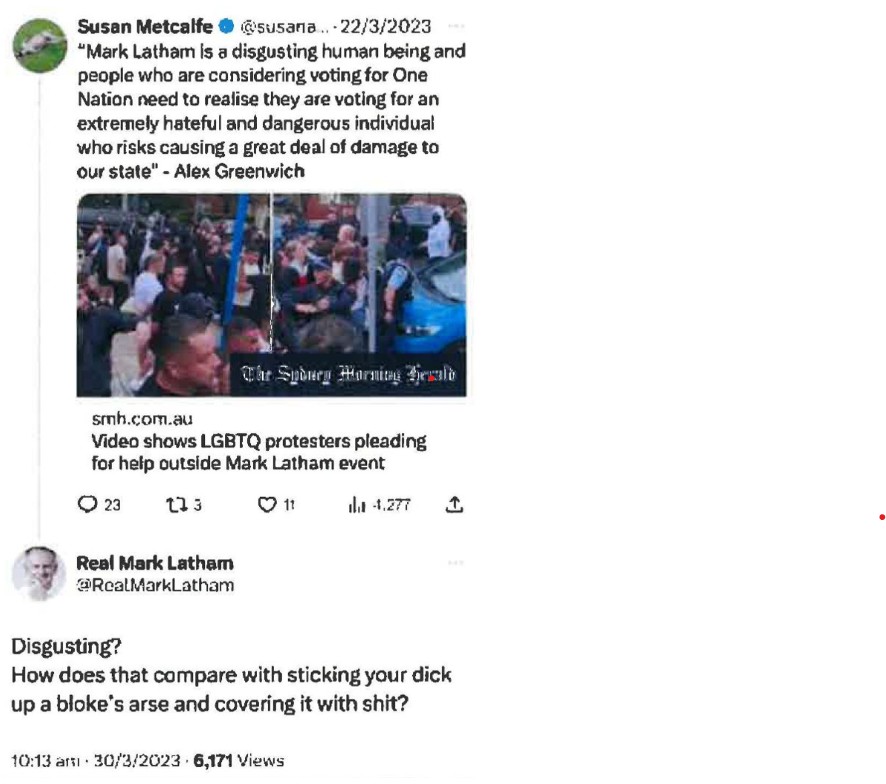
21 The particular words of the primary tweet about which Mr Greenwich complained were those by which Mr Latham stated –
Disgusting?
How does that compare with sticking your dick up a bloke’s arse and covering it with shit?
22 Mr Greenwich relied on two imputations. The first imputation was alleged to arise on the natural and ordinary meaning of the primary tweet and was –
Mr Greenwich engages in disgusting sexual activities.
23 The second imputation was alleged to arise as a true innuendo and was –
Mr Greenwich is not a fit and proper person to be a member of the NSW Parliament because he engages in disgusting sexual activities.
24 The extrinsic facts relied on by Mr Greenwich in support of the true innuendo were knowledge of the Metcalfe tweet and that Mr Greenwich is a member of the New South Wales Parliament.
25 The primary judge held that the primary tweet conveyed the first imputation and in that meaning the publication was defamatory of Mr Greenwich. His Honour rejected the second imputation alleged by Mr Greenwich by way of true innuendo. The primary judge held that the publication of the matter caused or was likely to cause serious harm to the reputation of Mr Greenwich, thereby satisfying the serious harm element in s 10A of the Defamation Act 2005 (NSW). Two affirmative defences maintained by Mr Latham at trial failed. Those defences were common law qualified privilege, the claimed occasion being a reply to attack, and a statutory defence of honest opinion under s 31 of the Act. His Honour assessed damages, including damages on account of aggravation, in the sum of $140,000.
Overview of the issues
26 The grounds of appeal challenge several of the central findings of the primary judge. In addition, Mr Greenwich has cross-appealed the primary judge’s rejection of the second imputation.
27 In overview, the issues on the appeal and cross-appeal are as follows –
(1) Did the primary judge err in finding that the publication conveyed the imputation that Mr Greenwich “engages in disgusting sexual activities”?
(2) Did the primary judge err in rejecting the second imputation in the nature of a true innuendo?
(3) Did the primary judge err in finding that the publication was defamatory of Mr Greenwich?
(4) Did the primary judge err in finding that the publication caused, or was likely to cause, serious harm to the reputation of Mr Greenwich?
(5) Did the primary judge err in not upholding Mr Latham’s defence of common law qualified privilege?
(6) Did the primary judge err in not upholding Mr Latham’s defence of statutory honest opinion?
(7) Did the primary judge award general damages on an erroneous basis or in a sum that was manifestly excessive?
(8) And did the primary judge award “aggravated damages” on an erroneous basis or otherwise on a basis not supported by sufficient reasons?
Issue 1: Was the first imputation conveyed?
28 For the purpose of establishing liability in defamation the significance of words is in their meaning. Until the meaning of a matter sued on is ascertained, other issues that turn on meaning cannot be determined: see Channel Seven Adelaide Pty Ltd v Manock [2007] HCA 60; 232 CLR 245 at [84] to [85] (Gummow, Hayne and Heydon JJ). The first to fourth issues raised on the appeal are related because the question whether the primary tweet was defamatory is tied to the question whether it conveyed the imputations which Mr Greenwich alleged which in turn informs the question whether the primary judge was correct to find that Mr Greenwich suffered serious harm.
29 The primary judge applied the objective standard of the ordinary reasonable reader of a tweet: J [125] to [136]. His Honour held at J [157] that the literal meaning of the primary tweet was that Mr Greenwich engages in disgusting sexual activities which corresponded to the first imputation.
Issue 1: the parties’ submissions
30 On appeal, counsel for Mr Latham submitted that the first imputation was not conveyed. First, it was submitted that Mr Latham’s tweet mentioned only one form of sexual activity, namely anal intercourse between two males, whereas the imputation referred generally to disgusting sexual activities. Secondly, it was submitted that it is impossible to construe the publication as referring to any form of intercourse other than anal intercourse between two males. Thirdly, it was submitted that the imputation was generalised in a way that pluralises the number of sexual matters into multiple “activities”. It was submitted that no ordinary reasonable reader reading the primary tweet would think that more than one form of activity, namely anal sex between males, was being referred to. It was submitted that the imputation studiously avoided referring to anal intercourse between males and avoided any reference to any form of homosexual intercourse and that to have done so would have been fatal to Mr Greenwich’s case that the imputation was defamatory. It was submitted that in drafting the imputation, Mr Greenwich misrepresented the true meaning of the publication which had nothing to do with disgusting sexual activities generally, and nothing to do with anything other than anal intercourse between two males. It was submitted that, accordingly, the words conveyed no more than that Mr Greenwich engaged in homosexual male intercourse. Counsel for Mr Latham submitted that the profane words “covering it in shit” in the primary tweet were subsidiary to an imputation which was concerned with no more than male homosexual intercourse and that the tweet approached vulgar abuse which did not give rise to a defamatory meaning because the ordinary reasonable reader would not appreciate those words to convey anything defamatory of and concerning Mr Greenwich.
31 In response, counsel for Mr Greenwich submitted that the finding of the primary judge was no more than an orthodox application of the uncontroversial principle that the imputation carried by a publication is the sting that the ordinary reasonable reader would understand the words to convey, citing Favell v Queensland Newspapers Pty Ltd [2005] HCA 52; 221 ALR 186 (Favell) at [6]–[12], [17] and Trkulja v Google LLC [2018] HCA 25; 263 CLR 149 (Trkulja) at [30] to [32]. Counsel for Mr Greenwich relied on the primary judge’s finding at J [157] – in the context of holding that the publication was defamatory – that the pleaded imputation was “the literal meaning” of the publication. It was submitted that another way of putting the point was that the particulars of the sexual activity were a matter of detail, rather than the sting. Alluding to a submission made on behalf of Mr Greenwich at trial, it was submitted that the same imputation would have been conveyed had the publication been about the presumed sexual activities of a woman or a heterosexual male.
Issue 1: the first imputation was conveyed
32 The question whether the primary judge was in error in finding that the primary tweet conveyed the first imputation attracts the correctness standard of appellate review and this Court is in as good a position as the primary judge to determine the question whether the first imputation was conveyed because the primary judge enjoyed no relevant advantage.
33 We do not accept Mr Latham’s submissions that the primary judge was in error in finding that the first imputation was conveyed.
34 It should be recognised that findings of fact as to defamatory meaning at trial are not the same as determining whether a matter has the capacity to convey a defamatory meaning, which was the issue in the cases of Favell and Trkulja cited on behalf of Mr Greenwich. The question of capacity was also the issue in Jones v Skelton [1963] 1 WLR 1362 and Lewis v Daily Telegraph Ltd [1964] AC 234 which were cited in Favell and in Trkulja. These were appeals in jury cases and not appeals where the appellate court had to determine for itself on an appeal by way of rehearing from a judge sitting alone the question of defamatory meaning. Therefore, as the High Court in Trkulja made clear at [32], the statement of Sedley LJ in Berezovsky v Forbes Inc [2001] EWCA Civ 1251; EMLR 45 at 1040 [16] that the “exercise is one in generosity and not parsimony” is directed to what the trier of fact could sensibly think the words conveyed to the ordinary reasonable reader, and not what the matter in fact conveyed to the ordinary reasonable reader.
35 The question before the primary judge was whether by the application of the single meaning rule the primary tweet in fact conveyed to the ordinary reasonable reader the defamatory meaning captured by the first imputation. The single meaning rule reflects that an objective audience of ordinary reasonable readers collectively has a uniform view of the meaning of a matter. It does not matter that some readers might in fact have understood the matter differently.
36 The ordinary reasonable reader of a social media post has typical attributes of a social media user: Stocker v Stocker [2019] UKSC 17; [2020] AC 593 at [41] to [43] (Lord Kerr), cited in Bazzi v Dutton [2022] FCAFC 84; 289 FCR 1 at [29] (Rares and Rangiah JJ). Twitter (now X) is a casual, conversational medium, where the ordinary reasonable reader reads posts and then moves on. It is therefore the impression conveyed by a post that is important to ascertaining the objective single meaning and not an interpretation of a post that is the product of some deep analysis.
37 Mr Latham’s submissions rested upon analysis rather than impression. The ordinary reasonable reader of the primary tweet would have understood that its sting was directed to Mr Greenwich and would have been struck by the profane and arresting words “sticking your dick up a bloke’s arse and covering it in shit”. The ordinary reasonable reader would quickly have been left with the impression that Mr Greenwich engages in disgusting sexual acts. We do not accept that the words used were merely some proxy to describe Mr Greenwich as a homosexual. The words conveyed that Mr Greenwich engaged in a particular disgusting sexual act involving covering his genitals in faecal matter. That meaning is squarely within the first imputation. While it is possible that some readers might have understood the primary tweet differently, upon the application of the single meaning rule the primary judge was correct to uphold the first imputation.
Issue 2: Was the true innuendo the subject of the cross-appeal conveyed?
38 At trial, Mr Greenwich claimed that the publication conveyed a second imputation by way of true innuendo which we set out at [23] above. Mr Greenwich claimed that the second imputation was conveyed to persons with knowledge of the extrinsic facts to which we referred at [24] above.
39 In the case of the true innuendo alleged by Mr Greenwich, the question of meaning remained an objective one. The requirement to prove, whether by direct evidence or inference, knowledge amongst some readers of a publication of extrinsic facts supporting a true innuendo goes to proof of publication of the matter conveying the true innuendo: Consolidated Trust Company Ltd v Browne (1948) 49 SR (NSW) 86 at 89 (Jordan CJ, Street J agreeing), cited in Mirror Newspapers Ltd v World Hosts Pty Ltd (1979) 141 CLR 632 at 639 (Mason and Jacobs JJ). In the case of a true innuendo the question of defamatory meaning is concerned with the objective understanding of the hypothetical ordinary reasonable reader or audience member with knowledge of the extrinsic facts: Duncan and Neill on Defamation (Butterworths, 1983) at [4.18(b)].
40 The primary judge held at J [139] that the second imputation was not conveyed. His Honour held that the primary tweet was assumed to have been read by the ordinary reasonable reader in an impressionistic way. His Honour accepted a submission advanced on behalf of Mr Latham that the link on which the true innuendo was sought to be based was too tangential, and that the second imputation went well beyond the context of the primary tweet.
Issue 2: the parties’ submissions
41 On the cross-appeal, counsel for Mr Greenwich submitted that while the primary judge had been correct to approach the assessment of the primary tweet impressionistically, his Honour had erred by not giving more weight to the context in which it was published. It was submitted that the context of the primary tweet included the Metcalfe tweet which had extracted the statement given by Mr Greenwich to the Sydney Morning Herald. It was submitted that this statement went unequivocally to Mr Latham’s fitness to be an elected representative of the people of New South Wales. It was submitted that the primary tweet was a publication by a politician, about a politician, in the immediate aftermath of a hotly contested election campaign, and by way of response to an unequivocal attack on the politician’s fitness for office. Both publications used the adjective “disgusting”. It was submitted that the primary tweet, likewise, impugned Mr Greenwich’s fitness for office and that this was direct and not tangential.
42 In response, counsel for Mr Latham submitted that what Mr Latham said in the primary tweet was short, clear, explicit and memorable. It was submitted that the primary tweet did not link any unfitness to hold office with Mr Greenwich engaging in sexual activities. Rather, it was submitted, the primary tweet was a tu quoque response which picked up the allegation by Mr Greenwich that Mr Latham was “disgusting”. Further, it was submitted that the second imputation was attended by the same problems upon which Mr Latham relied to submit that the first imputation was not conveyed. It was submitted that the primary tweet was arguably vulgar but did not focus on anything other than anal intercourse between males and said nothing about disgusting sexual activities generally. In addition, it was submitted that to succeed on the second imputation in addition to the first was very difficult because if there was a defamatory meaning conveyed it would be the first, not the second imputation, and that the ordinary reasonable reader would not extract two similar imputations from the publication.
Issue 2: the true innuendo was not conveyed
43 The primary judge was correct to reject the second imputation for the reasons that his Honour gave at J [139]. When the objective impression conveyed by the primary tweet is identified, it corresponds to the first imputation. We do not consider that the ordinary reasonable reader of the primary tweet with the attributes of a social media user and knowledge of the extrinsic facts would pause, consider the extrinsic facts, and then reason tangentially towards the second imputation.
Issue 3: Was the matter defamatory of Mr Greenwich?
44 The question whether the primary tweet in the meaning found to have been conveyed was defamatory of Mr Greenwich is also determined objectively and is determined by reference to general community standards: Reader’s Digest Services Pty Ltd v Lamb [1982] HCA 4; 150 CLR 500 at 507 (Brennan J, with whom Gibbs CJ, Stephen J, Murphy J and Wilson J agreed). What is involved is a loss of standing in some respect, or lowering of the estimation in which a person is held, or simply that people would be likely to think less of Mr Greenwich: Radio 2UE Sydney Pty Ltd v Chesterton [2009] HCA 16; 238 CLR 460 at [36] (French CJ, Gummow, Kiefel and Bell JJ); Harbour Radio Pty Ltd v Trad [2012] HCA 44; 247 CLR 31 (Harbour Radio) at [54] (Gummow, Hayne and Bell JJ).
45 The primary judge found that that the imputation conveyed by the primary tweet was defamatory of Mr Greenwich. Counsel for Mr Latham at trial had submitted that the primary tweet conveyed to the ordinary reasonable reader no more than raising disgust at homosexual sex in response to being called disgusting himself. The primary judge rejected this submission, holding at J [157] that the primary tweet exposed Mr Greenwich to hatred, contempt and ridicule, and that the ordinary reasonable reader would think less of Mr Greenwich because the literal meaning of the primary tweet was that he engaged in disgusting sexual activities.
Issue 3: the parties’ submissions
46 On appeal, counsel for Mr Latham submitted that the central problem with the finding that the publication was defamatory was that, at its core, the publication when read in context simply stated that someone who is a homosexual man has engaged in the activity of anal intercourse with another male, and that this was not defamatory. It was submitted that the words “covering it in shit” in the context of a publication on Twitter was a vernacular way of describing the act of homosexual anal male intercourse in rather blunt language which would not be understood as being defamatory of Mr Greenwich. The submission continued that it was not defamatory to say that a male is homosexual, that it was not defamatory to say of a homosexual man that he engages in sexual intercourse with another male, and that it was not defamatory to say of a male that he engages in a form of sexual intercourse which is, as a matter of notoriety, commonly practised between consenting male adults. It was further submitted that to the extent that, as Mr Greenwich submitted, the primary tweet employed an offensive trope, the ordinary reasonable reader would not think less of a person to whom a hurtful stereotype was applied. It was submitted that if Mr Greenwich’s grievance was discrimination or anti-homosexual vilification, then he did not have a remedy in the courts under the law of defamation but in another forum.
47 Counsel for Mr Latham submitted that Mr Greenwich’s reputation would not be lowered in the estimation of right-thinking members of society by being called either a homosexual man or a homosexual man who had engaged in anal intercourse with another man. It was submitted that although there may be some sections of the community, or some persons, who would not agree with that conclusion, in the current day it is impossible to suggest that ordinary members of the Australian community would think less of a person because he was gay and engaged in anal intercourse with another male. It was submitted that the use of the word “disgusting” by Mr Latham followed by a question mark did not make any difference. That was because, it was submitted, for someone to engage in an act regarded by one other person as disgusting does not render the words defamatory if the act is not of itself defamatory. It was further submitted that the assessment of whether a publication is defamatory must take account of the words in their context, and that in this case the various statements were made in an electoral context between two parliamentarians where Mr Latham was clearly responding to Greenwich calling him disgusting. It was submitted that the ordinary reasonable reader would understand that there is a measure of cut and thrust in political, and especially electoral, debate.
48 In response, counsel for Mr Greenwich submitted that Mr Latham had not squarely confronted whether the first imputation which was found to have been conveyed was defamatory. It was submitted that instead the submissions advanced on behalf of Mr Latham centred on other imputations, namely that Mr Greenwich was a male homosexual, or a homosexual man who had engaged in anal intercourse with another male, and that those imputations were not defamatory. Counsel for Mr Greenwich submitted that the primary tweet peddled a crudely reductionist trope that slurred Mr Greenwich by reference to a graphic description of a sexual activity involving excrement.
49 Counsel for Mr Greenwich submitted that Mr Latham’s claim that the language used was just part of the cut and thrust of political debate should be rejected. It was submitted that it is unthinkable that political debate would tolerate a corresponding publication about a female politician, her genitals and evaluations about the cleanliness of her assumed private sexual activities or based on offensive stereotypes about a politician based upon their race or religious faith.
Issue 3: the matter was defamatory of Mr Greenwich
50 The primary judge was correct to hold that the primary tweet was defamatory of Mr Greenwich for the reasons that his Honour gave at J [156] to [157] –
156 Mr Latham did not squarely confront the question of whether, assuming the first imputation of the primary tweet to be conveyed (that is, that Mr Greenwich engages in disgusting sexual activities), it was defamatory. The submissions advanced on his behalf both in writing and orally proceeded on the assumption that the primary tweet went no further than saying that Mr Latham was “raising disgust at homosexual sex in response to himself being called disgusting” and that so understood, that would not make the ordinary reasonable person think any less of Mr Greenwich. Mr Smark put his submissions as follows:
Having regard to the present standard of community attitudes, towards people’s private sexual lives, if it’s right to say, as we say it is, that an allegation that people are homosexual, or men are homosexual, or that a man or a group of men engage in homosexual intercourse, is not defamatory to ordinary reasonable people in 2024, or 2023 … then the question is – and we say the answer to that is that’s correct, it’s not – then what is relevantly different about the primary tweet – relevantly different? Can it be that the difference to the ordinary reasonable person who thinks what people do in their own bedroom is up to them, as long as no one’s hurt and as long as there aren’t children involved, can it be supposed that the type of homosexual intercourse makes a difference to the ordinary reasonable person?
…
But the context – the fact that the ordinary reasonable reader would see that Mr Latham is referring to – raising disgust at homosexual sex in response to him himself being called disgusting – how is that going to make people think less of Mr Greenwich?
And we say the position is advanced by invoking the ridicule test, because they still – the ridicule mechanism still has to be brought within … the main test, and as we sought to illustrate by reference to the ridicule cases, that the mechanism – it’s one thing to attempt to expose someone to ridicule, but to successfully ridicule someone in a way that carries a meaning that lowers them in the estimation of right-minded people is very challenging.
157 I do not accept those submissions, because, in my view, the ordinary reasonable person would not read the primary tweet as being limited to homosexual men generally, or that they would shrug off the tweet in the way Mr Smark suggests. In my view, the primary tweet exposed Mr Greenwich to hatred, contempt and ridicule for the reasons submitted by Dr
Collins, and the ordinary reasonable person would think less of Mr Greenwich because the literal meaning of the tweet is that he engages in disgusting sexual activities.
51 The submissions advanced on behalf of Mr Latham did not address the primary tweet in the meaning that was conveyed, but in a different meaning that Mr Greenwich was a homosexual man who has engaged in sexual activity with another male. That does not meet the sting of the primary tweet, which arose as a result of its graphic, profane, and arresting reference to disgusting sexual activities involving faeces.
Issue 4: The serious harm element
52 Pursuant to s 10A(1) of the Defamation Act it was a necessary element of Mr Greenwich’s cause of action against Mr Latham that the publication of the primary tweet caused, or was likely to cause, serious harm to his reputation –
(1) It is an element (the serious harm element) of a cause of action for defamation that the publication of defamatory matter about a person has caused, or is likely to cause, serious harm to the reputation of the person
Issue 4: discussion of the principles
53 The serious harm element in s 10A of the Defamation Act has some resemblance to the corresponding provision in s 1(1) of the Defamation Act 2013 (UK). Both s 10A(1) of the Defamation Act and s 1(1) of the United Kingdom Act are concerned with the existence of serious harm to reputation in actual fact, and not with the inherent tendency of a matter to cause harm to reputation or serious harm amongst a notional cohort of ordinary reasonable people. However, the United Kingdom provision has a different legislative and common law context and is in different terms –
A statement is not defamatory unless its publication has caused or is likely to cause serious harm to the reputation of the claimant.
54 The different common law context of the United Kingdom provision was the anterior common law requirement that a matter was defamatory if it “substantially” affected in an adverse manner the attitude of other people towards him or had a tendency to do so: Jameel (Yousef) v Dow Jones & Co Inc [2005] EWCA Civ 75; QB 946 (Jameel) (Lord Phillips MR, Sedley and Parker LJJ); Thornton v Telegraph Media Group Ltd [2011] 1 WLR 1985 (Thornton) at [96] (Tugendhat J). These anterior common law developments in the United Kingdom underpinned the approach to the construction of s 1 of the United Kingdom Act in Lachaux v Independent Print Ltd [2019] UKSC 27; [2020] AC 612 (Lachaux) where it was held at [12] that s 1 raised the threshold of seriousness above that envisaged in Jameel and Thornton.
55 The different statutory context in Australia was the availability under the uniform legislation of a statutory defence of triviality.
56 The serious harm element provided for by s 10A of the Defamation Act has been considered in the Federal Court in several cases, including Russell v Australian Broadcasting Corporation (No 3) [2023] FCA 1223; 303 FCR 372 at [252] to [254] (Lee J), Selkirk v Wyatt [2024] FCAFC 48; 302 FCR 541 (Besanko J, Anderson and O’Sullivan JJ agreeing), Deeming v Pesutto (No 3) [2024] FCA 1430 (O’Callaghan J), Mond v The Age Company Pty Ltd [2025] FCA 442 (Mond) (Wheelahan J), and Griniezakis v Morelas (Trial Judgment) [2026] FCA 156 (Abraham J). Section 10A was part of a reform which introduced serious harm to reputation as an element of the cause of action in defamation while at the same time repealing the statutory defence of triviality.
57 The term “serious harm” in s 10A is not defined. It is an open textured phrase that is to be construed by reference to the modern principles of statutory construction that look to text, context, and purpose, where text includes surrounding provisions, and where context includes legislative history and extrinsic materials to which regard is had at the first stage and in its widest sense: Alcan (NT) Alumina Pty Ltd v Commissioner of Territory Revenue [2009] HCA 41; 239 CLR 27 at [47] (Hayne, Heydon, Crennan and Kiefel JJ); Federal Commissioner of Taxation v Consolidated Media Holdings Ltd [2012] HCA 55; 250 CLR 503 at [39] (French CJ, Hayne, Crennan, Bell and Gageler JJ); SZTAL v Minister for Immigration & Border Protection [2017] HCA 34; 262 CLR 362 at [14] (Kiefel CJ, Nettle and Gordon JJ).
58 The history of the introduction of s 10A was described in Mond at [373] to [377]. The extrinsic materials show that the provision was introduced to weed out trivial, spurious, frivolous and vexatious defamation claims. That purpose is also reflected in the text of the legislation where, under s 10A(5), the serious harm element must be determined as soon as practicable before trial if an application is made and there are no special circumstances justifying the postponement of the determination to a later stage of the proceeding including during the trial. This feature of s 10A, in combination with the object in s 3(c) of the Act to provide effective and fair remedies for persons whose reputations are harmed, assumes that the serious harm element may be capable of ready determination prior to trial, thereby indicating that “serious harm to reputation” is harm that is at least not trivial or minor in nature, as the second reading speeches to the Victorian and New South Wales Bills would indicate, rather than establishing an especially high threshold requiring extensive evidence to be led by an applicant: Mond at [377]. However, as Applegarth J explained in Peros v Nationwide News Pty Ltd (No 3) [2024] QSC 192 (Peros) at [89], serious harm is not to be treated as the converse of the repealed triviality defence. The terms of the provisions do not correspond. The now-repealed defence of triviality under s 33 of the Defamation Act was engaged “if the defendant proves that the circumstances of publication was such that the plaintiff was unlikely to sustain any harm” (emphasis added). Proof by a claimant of some harm to reputation is not to be equated with “serious harm” which is harm of a higher order warranting the characterisation of “serious”.
59 In Rader v Haines [2022] NSWCA 198 the New South Wales Court of Appeal considered a cause of action that was governed by s 1 of the Defamation Act 2013 (UK). In construing the United Kingdom provision Brereton JA (Macfarlan JA agreeing) stated at [27] that –
“serious” harm sits on the spectrum above “substantial” but below “grave”. Importantly, there can be harm which, though substantial, does not reach the level of serious harm.
60 Basten AJA, writing separately, expressed a reservation about Brereton JA’s exegesis on the meaning of s 1 of the United Kingdom Act, noting at [91] the risk in seeking to place the term “serious” on a scale between other terms of equal imprecision. We agree with Basten AJA. The High Court has warned against straying from the text of legislation and deploying judicial formulations as a substitute for legislative text: Baini v The Queen [2012] HCA 59; 246 CLR 469 at [14] (French CJ, Hayne, Crennan, Kiefel and Bell JJ); Shi v Migration Agents Registration Authority [2008] HCA 31; 235 CLR 286 at [92] (Hayne and Heydon JJ). See also, Ogden Industries Pty Ltd v Lucas [1970] AC 113 at 127 (PC). Section 10A of the New South Wales Act should be construed having regard to its text, its context, and its purpose and not by reference to judicial language used to explain a different provision enacted in a different jurisdiction with a different legislative context.
61 Because the judgment of Brereton JA in Rader v Haines did not concern the construction of the Australian legislation, it does not attract the principle that it should be followed unless it is plainly wrong or there is a compelling reason not to do so: cf, Australian Securities Commission v Marlborough Gold Mines Ltd [1993] HCA 15; 177 CLR 485 at 492 (Mason CJ, Brennan, Dawson, Toohey and Gaudron JJ); Hill v Zuda Pty Ltd [2022] HCA 21; 275 CLR 24 at [26] (Kiefel CJ, Gageler, Keane, Gordon, Edelman, Steward and Gleeson JJ). Further, the correctness of the reservation of Basten AJA in Rader v Haines has been favoured in other decisions: Selkirk v Hocking (No 2) [2023] FCA 1085 at [30] (O’Callaghan J); Peros at [95] (Applegarth J); Mond at [374]; MG v PJ [2025] QCA 99 at [83] (Flanagan JA, Brown JA and Davis J agreeing); Moore v Martin [2026] NSWSC 493 at [28] (Campbell J).
62 In Supaphien v Chaiyabarn [2026] ACTCA 5 (Supaphien), a majority of the Court of Appeal of the Australian Capital Territory applied the reasoning of Brereton JA in Rader v Haines to the construction of the corresponding serious harm provision in s 122A(1) of the Civil Law (Wrongs) Act 2002 (ACT). McCallum CJ and Loukas-Karlsson J concluded at [73] that the legislation intended to introduce a higher threshold than non-trivial harm and rejected a claim that the primary judge had applied the wrong test by treating “serious” as sitting on a spectrum above “substantial” but below “grave”, citing Rader v Haines. It appears from the judgment of McCallum CJ and Loukas-Karlsson J at [55] that the appeal in Supaphien was argued on the basis that the Australian provisions were modelled on the United Kingdom provision and that for reasons of comity Rader v Haines should ordinarily be followed. For reasons that we have given, while we accept that the New South Wales provision might have been inspired by the United Kingdom provision, we do not agree that it was modelled on it. As a result, Rader v Haines does not have any special precedential status. Instead, the decisions to which we referred at [61], which include the decision of the Queensland Court of Appeal in MG v PJ, should be followed. MG v PJ was not addressed expressly in the joint judgment in Supaphien, although it was referred to indirectly at [55] where their Honours referred to the fact that the other member of the Court, McWilliam J, had noted that other decisions had expressed a preference for Basten JA’s approach. At [107] to [110] McWilliam J referred to MG v PJ and Mond and stated that her Honour would take a similar approach to that of Basten AJA in Rader v Haines in considering whether there was serious harm. Subsequently, in Moore v Martin at [26] to [29] Campbell J followed MG v PJ rather than Supaphien in relation to the operation of the New South Wales provision.
63 The correct approach to the construction of the term “serious harm” in s 10A(1) of the Defamation Act is that identified in MG v PJ at [83] to [84], which is that the plain and ordinary meaning of the word “serious” should be adopted and that it is also appropriate to have regard to the purpose of the provision when construing the term. This approach accords with that identified earlier in Mond at [407] to [408] with the result that the term “serious harm” calls for the Court to reach an evaluative conclusion on the evidence in the exercise of its own judgment. In making that evaluative judgment precision on the issue will rarely be possible: Lachaux at [21]. And in making the evaluation it is to be borne in mind that the common law accepts that damage to reputation is not a commodity, and that every defamation is necessarily unique: see Rogers v Nationwide News Pty Ltd [2003] HCA 52; (2003) 216 CLR 327 at [66] (Hayne J). In addition, as observed in Mond at [383], harm to reputation is not like a bodily injury. A person’s reputation exists in the minds of others, and it may not be homogeneous. It is the impact of the defamatory matter on those to whom it was published that falls for consideration. That impact may result in serious harm without the impact being uniform.
64 Ordinary principles apply to the sufficiency of proof of actual harm to reputation. Allowance can be made for the inherent difficulties in marshalling direct evidence going to the causation and existence of serious harm owing to the nature of harm to reputation, which may lie lurking in unknown places: see Cassell & Co Ltd v Broome [1972] AC 1027 at 1071 (Lord Hailsham). However, there must be such proof and certainty as is reasonable having regard to the circumstances of the particular case. Therefore, while proof of serious harm may be supported by direct evidence, it can and often will depend upon drawing inferences from all the circumstances: see Lachaux at [21]. The authorities show that the circumstances from which an inference of serious harm might be drawn may include a combination of some of the following considerations –
(a) the inherent tendency of the defamatory matter and its actual or probable impact on those to whom it was published, in other words, the gravity of the imputations;
(b) the extent of publication, any likely republication, and any likely “grapevine effect” or “percolation”;
(c) whether there was a prompt apology, and the breadth of the audience to which any apology was published;
(d) the reputation of the publisher – a defamatory publication by a generally reputable publisher that is represented as being reliable and the product of research might be more capable of causing serious harm than one by a publisher that is not so reputable;
(e) the medium of the publication – a transient publication might cause less harm to reputation than one in print or which is available for viewing online for an extended period or indefinitely;
(f) the situation of the applicant, including the applicant’s existing reputation in the relevant sector;
(g) the identity of the persons to whom the defamatory matter was published; and
(h) the inherent probabilities generally.
65 This is not a check list, and it is not exhaustive. What circumstances may be relevant will vary from case to case, and in some cases a consideration of only some circumstances may readily lead one way or the other to a determination of whether the serious harm element has been established: Mond at [371].
66 The serious harm element sits with the general law principle under which, notwithstanding that different people might understand a defamatory matter in different ways, the defamatory sense of a publication is determined objectively by reference to a single meaning. However, because the serious harm element is concerned with actual harm and not presumed harm, it is not directed to harm suffered amongst a notional cohort of hypothetical ordinary reasonable readers. Nonetheless, in a case such as the present where a finding of causation of serious harm as a result of widespread publication is the product of inference, the single meaning that the publication is found to bear is a sound starting point in determining by reference to all the circumstances the probable impact of the publication of the matter on those to whom it was published.
Issue 4: the primary judge’s reasons
67 The primary judge found that the serious harm element was satisfied based upon the extent of publication and republication, the imputation that was conveyed, and the contents and volume of the responses to the publication.
68 As to the extent of publication, there were 6,171 direct views of Mr Latham’s primary tweet before he deleted it two hours and twenty minutes after posting it. There were many comments posted in response to the primary tweet which were supportive of Mr Latham.
69 As to republication, the primary tweet was republished by a television journalist, Mr Hugh Riminton, by reposting it on Twitter. Mr Riminton’s tweet was viewed 654,700 times and provoked further comments that were supportive of Mr Latham. There were other responses caused by the primary tweet or its republication that were the subject of findings, including tweets posted in response to mainstream media reporting of the controversy and feedback and emails to the online account of Mr Greenwich’s electoral office.
70 As to the content of the responses, the primary judge characterised the online tweets and comments as unleashing “hate-filled venom” and at J [188] set out some of the descriptions of Mr Greenwich in those communications. The primary judge concluded at J [196] that the communications that Mr Greenwich received as a result of the primary tweet clearly indicated that he had suffered harm to his reputation because of its publication. His Honour found that the evidence, in combination with the inherent tendency of the imputation that Mr Greenwich engaged in disgusting sexual activities, the extent of the publication, and the inferred “percolation” of it, meant that he was satisfied that the publication of the primary tweet had caused, or was likely to cause, serious harm to his reputation.
Issue 4: the parties’ submissions
71 On appeal, counsel for Mr Latham submitted that proof of the serious harm element will almost always require reputation evidence from before and after the impugned publication, and evidence that people thought less of an applicant because of the publication. It was submitted that the primary judge found that there had been serious damage to reputation without making such underlying findings. It was submitted that, on the contrary, the primary judge found that Mr Greenwich had a good reputation before and after the publication “across the chamber” and with “a majority of his constituents”: J [278]. Reliance was also placed on the primary judge’s findings that after the publication Mr Greenwich was supported by both sides of politics and the media: J [79] to [86]. It was further submitted that there was no evidence from any witness that he or she thought less of Mr Greenwich, and there was evidence of sympathy and concern from people who approached Mr Greenwich after publication. In addition, it was submitted that the suggestion of loss of standing because Mr Greenwich was exposed to ridicule (J [277]) did not prove damage to reputation from the pleaded imputation, and that the primary judge did not point to any specific communication made to Mr Greenwich which demonstrated damage to reputation flowing from the publication of the pleaded imputation.
72 Counsel for Mr Latham submitted that it was not to the point that the primary tweet caused Mr Greenwich to receive various communications. It was submitted that serious harm to reputation must be proved to stem from publication of the imputation, and not the primary tweet, and that very few, if any, of the specifically identified communications could be said to relate to that imputation as opposed to the primary tweet. Further still, it was submitted that given that Mr Greenwich is an openly homosexual politician, it was open to conclude that many who communicated had “well-entrenched perceptions” as to his character, reputation, homosexuality, and politics, and that Mr Greenwich took “advantage of the opportunity created by the publication… to respond forcefully in public and… to advance… [himself] politically”, citing Palmer v McGowan (No 5) [2022] FCA 893; 404 ALR 621 at [434] (Lee J). In the result, counsel for Mr Latham submitted that the primary judge should have held that Mr Greenwich suffered little if any damage to his reputation and that the serious harm element in s 10A of the Act was not satisfied.
73 In response, counsel for Mr Greenwich submitted that the evidence described by the primary judge at J [75] to [78], J [188], J [190(a)], and J [191] amply established that Mr Greenwich had suffered serious harm to his reputation by the publication of the primary tweet. It was submitted that the responses to the publication were rightly described by the primary judge, variously, as vile, offensive, confusing, threatening and deranged as well as despicable and hate-filled: J [75], J [188]. It was submitted that it was appropriately conceded by Mr Latham at trial that it was “obvious that much of the comments and messages relied on by Mr Greenwich were in a causal sense a response to the primary tweet”: J [185]. It was submitted that the primary judge was correct to find that there was no break in the chain of causation between the primary tweet and a preponderance of the communications, including those made after the subsequent publication of quotations given by Mr Latham to the Daily Telegraph which is not a publication in issue on appeal: J [186]. It was submitted that having regard to that evidence and the concession made on Mr Latham’s behalf at trial, the primary judge’s reasoning and finding at J [196] was sound.
74 Counsel for Mr Greenwich submitted that Mr Latham was wrong in claiming that the suggestion that there was a loss of standing because Mr Greenwich was exposed to ridicule did not prove damage to reputation. Mr Greenwich relied on the reasons of the primary judge at J [140] to [157] where his Honour concluded that the primary tweet was defamatory of Mr Greenwich which it was submitted were not challenged on appeal.
75 Further, counsel for Mr Greenwich submitted that Mr Latham’s claim that serious harm must be proved to stem from publication of the imputation and not the primary tweet was also wrong. It was submitted that s 10A of the Defamation Act directs attention to the effect or likely effect of “the publication of defamatory matter”, not the imputation. Counsel for Mr Greenwich compared s 10A of the Act to ss 8, 25, 26, 29A(3)(a), and 30(3)(a) of the Act which in different contexts employ the word “imputation”. It was submitted that in any event the primary judge’s findings at J [188] concerning the venom that was unleashed showed that there was an obvious connection between many of the messages Mr Greenwich received and the imputation on which he succeeded at trial and that this was hardly surprising.
76 Counsel for Mr Greenwich submitted that Mr Latham’s submission that Mr Greenwich took “advantage of the opportunity created by the publication… to respond forcefully in public and… to advance… [himself] politically”, was irresponsible and should be withdrawn.
Issue 4: Mr Greenwich did establish serious harm to reputation
77 Mr Latham has not demonstrated any error in the primary judge’s reasoning or in his conclusion that the publication of the primary tweet caused serious harm to Mr Greenwich’s reputation.
78 We do not accept the submission advanced on behalf of Mr Latham that proof of the serious harm element will almost always require reputation evidence from before and after the impugned publication to the extent that this submission is understood as indicating that direct comparison evidence is required. The primary judge found at J [278] that prior to the publication of the primary tweet, Mr Greenwich enjoyed a good reputation. That finding is not challenged on appeal. Mr Greenwich established serious harm to his reputation as an inference arising from all the circumstances, central elements of which were the vile social media and other responses that the primary tweet and its republication provoked. In the absence of other evidence, that was sufficient to establish the existence of serious harm to Mr Greenwich’s reputation caused by the publication. In a case such as the present, involving widespread publication which subjected Mr Greenwich to vile ridicule, if Mr Latham wished to contest the inference of serious harm that otherwise arose on the evidence on the ground that there was some pre-existing and relevant bad reputation, or some unusual feature which rebutted the inference of serious harm, then while recognising that the legal onus of demonstrating serious harm remained at all times on Mr Greenwich, Mr Latham had an evidentiary onus to put that question in issue: see Purkess v Crittenden (1965) 114 CLR 164 at 167 to 168 (Barwick CJ, Kitto and Taylor JJ).
79 We accept Mr Latham’s submission that proof of the serious harm element requires evidence that people thought less of an applicant because of the publication. But as we have identified, a conclusion of serious harm to reputation can and often will be an inference arising from all the circumstances. The evidence before the primary judge overwhelmingly supported the finding of serious harm to reputation and no body of evidence that would materially undermine that inference was adduced or identified by Mr Latham other than to speculate in submissions that many who communicated responses to the primary tweet had “well-entrenched perceptions” as to Mr Greenwich’s character, reputation, homosexuality and politics, citing a preliminary factual observation relating to the assessment of general damages in Palmer v McGowan (No 5) at [433] (Lee J).
80 We do not accept the submission advanced on behalf of Mr Latham that serious harm to reputation must be proved to stem from publication of the imputation, and not the publication of the matter, being primary tweet. On occasion there is a tendency for some parties to defamation proceedings to make submissions as if the Defamation Act 1974 (NSW), under which each imputation was a separate cause of action, had not been repealed. To reinforce the significance of the repeal of the 1974 Act, s 6(3) of the current New South Wales Act provides that the general law from time to time applies as if the Defamation Act 1974 (NSW) and the Defamation Act 1958 (NSW) had never been enacted. Under the general law and under s 8 of the current Act, a person has a single cause of action in relation to the publication of defamatory matter even if more than one defamatory imputation is conveyed. In relation to the United Kingdom provision, Warby J has stated that “[t]he statutory test is not phrased in terms of the reputational harm caused by a meaning, or an imputation”, and has held that the text of the United Kingdom provision directs attention to the publication of the “statement” and that the statement is distinguished from its meaning: Sube v News Group Newspapers Ltd [2018] 1 WLR 5767 at [27]. Subsequently, in Blake v Fox [2025] EWCA Civ 1321 Warby LJ stated at [113] –
In any defamation case the single meaning of the statement complained of plays an important role. The single meaning identifies the “charges” or imputations against the claimant which the statement would convey to the ordinary reasonable reader. The claimant must always satisfy the court that each such imputation has a defamatory tendency according to the common law tests identified at the start of this judgment. The claimant must also show, in relation to each imputation, that “its publication caused, or is likely to cause, serious harm to the reputation of the claimant”. That is one effect of s 1 of the 2013 Act (see Sube v News Group Newspapers Ltd [2018] EWHC 1961 (QB), [2018] 1 WLR 5767; Amersi v Leslie [2023] EWCA Civ 1468 [55]).
(Emphasis added.)
81 The two cases cited by Warby LJ in the above passage were Sube v News Group Newspapers Ltd, which was the decision of his Lordship at first instance to which we referred above, and Amersi v Leslie [2023] EWCA Civ 1468 in which his Lordship wrote the leading judgment of the Court of Appeal. Neither decision supports the proposition that each imputation must satisfy the serious harm element, and Sube v News Group Newspapers Ltd at [27] is authority to the contrary. We cannot help but think that there must have been a slip in Blake v Fox at [113], and that the reference to “each imputation” should be understood as a reference to “each statement”.
82 Subsection 10A(1) of the Defamation Act which establishes the serious harm element is directed to the publication of the defamatory matter, and not a defamatory meaning or imputation. While the provision does direct attention to serious harm caused by the defamatory nature of the matter, it does not require that attention be directed to a connection between individual imputations and serious harm to reputation. Such a field of inquiry is not contemplated by the terms of s 10A and would be difficult where two or more imputations are found to be conveyed by the one matter. In any event, as a matter of reality the point argued does not arise as a material issue in this case. There is a strong correlation between the publication of the primary tweet in the defamatory sense found by the primary judge with the reactions that were the subject of his Honour’s findings.
83 The primary judge’s findings in relation to the responses to Mr Latham’s initial publication of the primary tweet and Mr Riminton’s republication provided strong support for the inference that Mr Greenwich suffered harm to his reputation that is to be correctly characterised as serious for the purpose of s 10A of the Act. Those findings included the findings as to causation at J [182] to [186] noting that causation had been the subject of a concession on behalf of Mr Latham at trial. Even without the concession, the primary judge’s findings as to the existence of harm to reputation and causation were well-supported by the posts on social media which the primary judge described at J [188] as “hate-filled venom”. It is not to the point that the primary judge also made findings as to Mr Greenwich’s good reputation before and after the publication “across the chamber” and with “a majority of his constituents”: J [278]. As we stated earlier, reputation is not like a bodily injury: see Mond at [383] and Blake v Fox at [77] (Warby LJ). Reputation exists in the minds of others and harm to reputation may not be uniform. In a case of any publication an inference of reputational harm in the minds of some persons to whom the matter is published may be sufficient to support a finding of serious harm. There was an inescapable association between the vile nature and content of the social media posts and other communications and the ridicule to which Mr Greenwich was subjected by the primary tweet and its republication which supported the finding of serious harm.
Issue 5: Honest opinion
84 Subsection 31(1) of the Defamation Act provides for a defence of honest opinion of the defendant if –
(a) the matter is an expression of opinion of the defendant rather than a statement of fact;
(b) the opinion related to a matter of public interest; and
(c) the opinion was based on proper material.
85 What is proper material is the subject of s 31(5) –
(5) For the purposes of this section, an opinion is based on proper material if—
(a) the material on which it is based is—
(i) set out in specific or general terms in the published matter, or
(ii) notorious, or
(iii) accessible from a reference, link or other access point included in the matter (for example, a hyperlink on a webpage), or
(iv) otherwise apparent from the context in which the matter is published, and
(b) the material—
(i) is substantially true, or
(ii) was published on an occasion of absolute or qualified privilege (whether under this Act or at general law), or
(iii) was published on an occasion that attracted the protection of a defence under this section or section 28 or 29.
86 A defence of honest opinion under s 31(1) is defeated if, and only if, the plaintiff proves that the opinion was not honestly held by the defendant at the time the defamatory matter was published: s 31(4)(a).
87 Mr Latham claimed by his defence to the statement of claim that the primary tweet was an expression of honest opinion, based on proper material, relating to a matter of public interest, and that a defence under s 31 of the Defamation Act therefore arose. Mr Latham did not plead in terms what the expression of opinion was. At trial, counsel for Mr Latham opened the defence of honest opinion in writing by submitting, “[t]he context, and the use of the term ‘disgusting’ clearly marks to the [ordinary reasonable person] that an opinion was being expressed”. And in oral opening, senior counsel for Mr Latham submitted, “[d]ealing with honest opinion, we say that the context, to which I’ve already referred, and the use of the term ‘disgusting’ mark out the publication as an expression of opinion”.
88 It is therefore far from clear what expression of opinion, as distinct from a statement of fact, Mr Latham relied on at trial. The identification of the opinion is important, because s 31 of the Defamation Act fastens upon a distinction between an expression of opinion and a statement of fact: see Massoud v Nationwide News Pty Ltd [2022] NSWCA 150; 109 NSWLR 469 at [195] to [197] (Leeming JA, Mitchelmore JA and Simpson AJA agreeing). The defamatory matter insofar as it conveys the defamatory meaning must be an expression of opinion rather than a statement of fact, and the opinion must relate to a matter of public interest and be based on proper material. At J [204] the primary judge held that it was not easy to say whether the matter was an expression of opinion or a statement of fact but stated that he would assume in Mr Latham’s favour that the matter contained in the primary tweet was an expression of opinion. And at J [211], his Honour acted on a submission by senior counsel for Mr Greenwich that if there was an opinion, it was an opinion to the effect that “Mr Greenwich is disgusting because he sticks his dick up a bloke’s arse to cover it in shit”.
89 Mr Latham alleged in his defence that the matter of public interest was Mr Greenwich’s attack on him, the substance of which was to say that Mr Latham was a disgusting human being and an extremely hateful and dangerous individual who risked causing a great deal of damage to the State and who was therefore unfit to serve as a member of the New South Wales Legislative Council. At trial Mr Latham relied on this context in support of the claim that the opinion related to a matter of public interest.
90 At trial, Mr Latham relied on the following agreed factual matters as proper material for the opinion which were set out at J [202] –
(a) Greenwich’s attack, as republished in the Metcalfe Tweet, and it was substantially true that Greenwich’s attack occurred;
(b) On 21 March 2023, Latham was a speaker at St Michael’s Church in Belfield for a community forum on religious freedom and parental rights (the Event), as recorded in the Online SMH Attack, hyperlinked to the Metcalfe Tweet, and this material is substantially true;
(c) A violent incident occurred at the Event when LGBTQ protesters were confronted by people outside St Michael’s Church, as recorded in the Online SMH Attack, hyperlinked to the Metcalfe Tweet, and this material is substantially true;
(d) On 21 March 2023, Latham tweeted, “I didn’t see what happened on the front street but I sincerely convey my best wishes to those injured and thank the police officers involved for their work. No one should take the law into their own hands. Violence at political events is wrong”, as recorded in the Online SMH Attack, hyperlinked to the Metcalfe Tweet, and this material is substantially true;
(e) Greenwich’s attack as read in the Online SMH Attack, hyperlinked to the Metcalfe Tweet, blamed Latham for the violence that occurred at the Event, and it is substantially true that Greenwich’s attack blamed Latham for the violence;
(f) Latham was an NSW MLC and leader of the NSW One Nation party, material that was substantial [sic] true and on Latham’s Twitter account, recorded in the Online SMH Attack, hyperlinked to the Metcalfe Tweet, and otherwise notorious or apparent in the context the Primary Tweet was published;
(g) Greenwich was an independent NSW MLA, material that was substantially true, recorded in the Online SMH Attack hyperlinked to the Metcalfe Tweet, and otherwise notorious or apparent in the context the Primary Tweet was published; and
(h) Greenwich was advocating in support of the LGBTQIA+ community, as appears from his comments in the Online SMH Attack hyperlinked to the Metcalfe Tweet.
91 For the large part, the above agreed facts corresponded to the proper material alleged by Mr Latham at [77] of his defence to the statement of claim. Mr Latham abandoned at trial the following matter which had been pleaded at [77(h)] of his defence as part of the proper material on which he claimed the opinion was based –
Greenwich is an openly gay man who has participated in homosexual sexual activities, material that was set out in specific or general terms in the Primary Tweet and is substantially true.
92 There was no claim in Mr Latham’s defence that any of the proper material on which he relied was published on an occasion of absolute or qualified privilege or which attracted the protection of a defence under s 31 or under s 28 or s 29 of the Defamation Act. The terms of the defence directed attention to the substantial truth of the proper material.
93 Mr Latham further alleged that to the extent that any of the proper material alleged in the defence was not proper material, the expression of opinion in the primary tweet might reasonably be based on such of the material as is proper material: see Defamation Act, s 31(6).
94 By way of reply to the defence of honest opinion Mr Greenwich relied on s 31(4) of the Act to defeat the defence of honest opinion by alleging that the opinions were not honestly held by Mr Latham at the time the primary tweet was published by reason of the following matters –
(i) At the time of publishing the Primary Tweet, Mr Latham did not know, and could not have known anything about the private sexual activities of Mr Greenwich.
(ii) The Primary Tweet was based on homophobic prejudices of Mr Latham, as opposed to any proper material upon which to base an opinion.
95 The primary judge rejected the defence of honest opinion for two reasons. First, his Honour held that the opinion did not relate to a matter of public interest. That was because the opinion related to the private sexual practices of Mr Greenwich which was not a matter of public interest: J [207]. His Honour did not accept Mr Latham’s claim that the matter of public interest was Mr Greenwich’s attack upon him, instead holding that this was the context in which Mr Latham published the primary tweet but not the matter the subject of the opinion: J [208]. Secondly, his Honour held that the opinion was not based upon proper material that was substantially true. As we mentioned above, Mr Latham abandoned reliance on the matter set out at [91] above as constituting proper material upon which the opinion was based. This had the consequence that there was no pleading and there was no evidence that Mr Greenwich engaged in the act described in the primary tweet. The primary judge addressed this issue at J [214] to [215] –
214 In any event, Mr Latham did not plead the defence properly. As Dr Collins submitted:
If Mr Latham were going to defend this opinion, he would need to have pleaded and proved that at the time of the publication of the primary tweet, he knew, and it was true, that Mr Greenwich, in fact, engages in the act describing the tweet.
215 There was no such pleading.
Issue 5: the parties’ submissions
96 On appeal, counsel for Mr Latham submitted that the primary judge was in error in holding that the primary tweet did not relate to a matter of public interest. It was submitted that s 31(1)(b) of the Defamation Act did not require that the matter the subject of the opinion constitute a matter of public interest, but only that it relate to a matter of public interest. It was submitted that there were obvious matters of public interest to which the opinion related, namely the New South Wales State election, the behaviour of elected representatives and those in public life, the actions and statements of candidates for elected office as parliamentarians and criticism of such candidates, and the fitness for office of such persons. It was submitted that the primary tweet did not relate only to private sexual matters, but also to the matters of public interest relied on by Mr Latham.
97 In relation to the primary judge’s finding that the opinion was not based on proper material that was substantially true, counsel for Mr Latham submitted that the primary tweet could be characterised in ways other than that which was accepted by the primary judge. It was submitted that the opinion constituted by the primary tweet was clearly and ostensibly based on other material in the publication, for example the Metcalfe tweet. It was also submitted that there was no requirement in s 31 that the opinion itself be substantially true. It is unclear to where this submission was directed, because that point is obvious and there is nothing to suggest that the primary judge was under any such misapprehension.
98 It was further submitted that the primary judge made no assessment of whether the material stated in the publication was substantially true, or of whether the comment in the primary tweet was based, or could reasonably be based, on that material. It was also submitted that no assessment was made of whether the opinion constituted by the primary tweet might reasonably be based on such of the material stated in the publication as amounts to proper material for comment for the purposes of s 31(6) of the Act.
99 Further still, it was submitted that the primary judge’s reasoning wrongly addressed the question whether the opinion was honestly held, which was not relevant to whether the opinion was based on proper material, rather than the question whether the opinion was based on material referred to which was substantially true.
100 It was also submitted that the primary judge did not give adequate consideration to the various ways in which Mr Latham put his case in relation to the defence of honest opinion. This discrete submission was not developed.
101 Several submissions on behalf of Mr Latham were directed to the primary judge’s reasons at J [214] to [215] which we extracted at [95] above. It was submitted that the reasoning in those paragraphs did not rise above assertion and that there was no reasoning provided which established that Mr Latham’s pleading was defective or that he needed to plead and prove the matters referred to. It was again submitted that J [214] to [215] did not address the various ways in which Mr Latham claimed that his opinion was based on proper material for comment. It was further submitted that there was no adequate reasoning provided by the primary judge as to why the defence of honest opinion, in its various manifestations in the pleading, required that Mr Latham prove that he knew that Greenwich had engaged in the act described in the primary tweet. It was submitted that the opinion in the primary tweet can be said to be reasonably based on other material referred to.
102 Finally, it was submitted that if the primary tweet was an opinion, as the primary judge was content to assume, it was ostensibly based on the various matters which were agreed to be substantially true which we have set out at [90] above. It was submitted that in those circumstances it was difficult to see why the opinion was not based on proper material for comment, or at least reasonably based on such of that material as is proper material for comment: see s 31(6) of the Defamation Act.
103 In response, counsel for Mr Greenwich submitted that Mr Greenwich was content, for the purposes of the appeal, to proceed on the same basis as the primary judge; that is, to assume that the primary tweet was an expression of Mr Latham’s opinion and that accordingly the first limb of the honest opinion defence in s 31(1)(a) of the Defamation Act was made out.
104 Mr Greenwich disputed that the words of the primary tweet related to the matters of public interest on which Mr Latham relied, namely the New South Wales state election, the behaviour of elected representatives and those in public life, the actions and statements of candidates for elected office as parliamentarians (and criticism of such candidates), and the fitness for office of such persons. Counsel for Mr Greenwich observed that Mr Latham’s submission that the primary tweet conveyed an opinion about Mr Greenwich’s fitness for office as a Parliamentarian was not consistent with his submission in respect of Mr Latham’s cross-appeal that ordinary reasonable readers of the primary tweet would not have understood it in that sense. Counsel for Mr Greenwich submitted that Mr Latham could not escape the fact that if the primary tweet was an opinion, then his case had to be that it was an opinion to the effect of the true innuendo imputation that is the subject of the cross-appeal and that he denies was carried, namely that Mr Greenwich is unfit to hold public office because of the sexual activities Mr Latham presumes he engaged in behind closed doors. It was submitted that the subject-matter of the opinion could not be divorced, as Mr Latham contends, from the actual words he used to express it.
105 In relation to the requirement that the opinion be on a matter of public interest, counsel for Mr Greenwich submitted that the entire foundation for Mr Latham’s opinion was his presumption as to Mr Greenwich’s private sexual activities. It was submitted that Australian law had never treated the publication of such opinions as matters of public interest, except where they were relevant to the performance of a person’s public duties or where the persons had themselves put those activities before the public: see e.g. Chappell v TCN Channel Nine Pty Ltd (1988) 14 NSWLR 153 at 167 (Hunt J). It was submitted that it had not been contended at trial that either of those categories applied to Mr Greenwich and that the element of the honest opinion in s 31(1)(b) of the Act was had not been established.
106 In relation to the requirement that the opinion be based on proper material, counsel for Mr Greenwich submitted that Mr Latham had to establish, relevantly, that his opinion was based on material that was set out in specific or general terms in the published matter and which was substantially true. It was submitted that the material on which Mr Latham’s opinion was based was set out explicitly in the primary tweet, which was the only matter put before readers of the tweet for their consideration.
107 Counsel for Mr Greenwich submitted that the alleged proper material relied on by Mr Latham pleaded in his defence at [77] and which was relied on at trial did not engage with the terms of the primary tweet. It was submitted that the only particular relating to Mr Greenwich’s presumed sexual activities was at [77(h)] (see [91] above) which was starkly different from the sexual activity described, in very specific terms, in the primary tweet. Moreover, Mr Latham did not press that particular at trial, and it was submitted that Mr Latham could not do so because he conceded he knew nothing about Mr Greenwich’s sex life.
Issue 5: the honest opinion defence was correctly rejected
108 There was no error in the primary judge’s rejection of the honest opinion defence. Mr Latham failed to establish that any opinion expressed in the primary tweet was based upon proper material. The only candidate for proper material to support the opinion captured by the word “disgusting” as opened on Mr Latham’s behalf at trial was the description of the sex act of Mr Greenwich to which Mr Latham referred in the primary tweet. The ordinary reasonable reader would consider that the opinion expressed in the primary tweet was based on those facts. No attempt was made at trial to establish the substantial truth of those facts. It is not necessary to address the other submissions made on behalf of Mr Latham in relation to other elements of the honest opinion defence: Boensch v Pascoe [2019] HCA 49; 268 CLR 593 at [7] to [8] (Kiefel CJ, Gageler and Keane JJ), and [101] (Bell, Nettle, Gordon and Edelman JJ).
Issue 6: Common law qualified privilege – reply to attack
109 The question whether the occasion on which a defamatory matter is published is the subject of common law qualified privilege is a question of law for the judge to determine where there is a trial by jury and any question of malice is a question of fact for the jury: Loveday v Sun Newspaper Ltd (1938) 59 CLR 503 at 509 (Latham CJ) and 515 (Starke J); Calwell v Ipec Australia Ltd (1975) 135 CLR 321 at 329 (Mason J, Barwick CJ, Gibbs J, Stephen J and Jacobs J agreeing). That allocation of functions does not occur in the case of a trial by judge alone, but the division of functions is still relevant as a reminder that whether an occasion is privileged and whether privilege is defeated by malice are different issues that should not be conflated.
110 While the occasions of qualified privilege are not closed, and the privilege is the subject of the general principles referred to in Bashford v Information Australia (Newsletters) Pty Ltd [2004] HCA 5; 218 CLR 366 (Bashford) at [9] to [10] (Gleeson CJ, Hayne and Heydon JJ), there are recognised occasions of corresponding duty and interest which are the subject of their own developed principles. It is necessary, therefore, that the occasion of any qualified privilege that is alleged be identified. That is because the nature of the occasion will inform other issues, including whether the publication of the matter was relevant to the occasion and whether the publication was made for a purpose foreign to the occasion.
111 At trial, the occasion on which Mr Latham relied to support his defence of qualified privilege to the publication of the primary tweet was precise: he relied on the recognised reply to attack privilege. The privilege to reply to an attack accommodates robust answers including defences and counterattacks that are relevant to the occasion. In the past, comparisons with self-defence in the criminal law have been drawn: see Norton v Hoare [No 1] [1913] HCA 51; 17 CLR 310 at 318 (Barton ACJ) and 321 to 322 (Isaacs, Gavan Duffy and Rich JJ). In Turner v Metro-Goldwyn-Mayer Pictures Ltd [1950] 1 All ER 449 at 471 Lord Oaksey said, “[i]f you are attacked by a prize fighter you are not bound to adhere to the Queensberry rules in your defence”:
112 The use of language that exceeds an occasion that is alleged to be privileged can be significant in two respects. First, the words may be such that they are not within the privileged occasion at all because they are not relevant to the occasion: Cush v Dillon [2011] HCA 30; 243 CLR 298 at [19] and [25] (French CJ, Crennan and Kiefel JJ). Therefore, “[a]nything that is not relevant and pertinent to the discharge of the duty or the exercise of the right or the safeguarding of the interest which creates the privilege will not be protected”: Adam v Ward [1917] AC 309 at 320 to 321 (Earl Loreborn). In relation to the reply to attack privilege, the privilege will not arise if the legitimate limits of the occasion have been exceeded. A response must be relevant to the attack and be commensurate with the occasion: Penton v Calwell (1945) 70 CLR 219 at 234 (Dixon J). The phrase “be commensurate with” reflects what Earl Loreborn said in Adam v Ward at 321: Harbour Radio at [33]. A consideration of what is relevant to the attack requires particular care and may involve questions of degree: Harbour Radio at [27] and [35]. In the context of identifying whether the occasion of a public response to an attack was privileged, in Harbour Radio Gummow, Hayne and Bell JJ observed at [27] that while the use of vigorous language has been a characteristic of public debate in this country, in general the law “does not encourage persuasion by public vilification and by an abdication of reason”.
113 Secondly, where the words come within the privileged occasion, but exaggerated language is used, the language may be evidence of malice: Cush v Dillon at [24] to [25], citing Nevill v Fine Arts and General Insurance Co [1895] 2 QB 156 at 170 (Lord Esher MR). Therefore, if the words used in a reply to an attack are not extraneous or irrelevant to the occasion, the language used may nonetheless be evidence of malice which may defeat the privilege: Harbour Radio at [26] and [33] (Gummow, Hayne and Bell JJ).
114 The attack that Mr Latham alleged gave rise to the privileged occasion was Mr Greenwich’s statement to the Sydney Morning Herald journalist that Mr Latham was a disgusting human being which was republished by the Metcalfe tweet. Mr Latham claimed that the primary tweet was in direct reply to the Metcalfe tweet and that he published it pursuant to a duty or interest to respond to the attack on his reputation. Qualified privilege was not advanced at trial on any other basis. No reliance was placed on the privilege to communicate to electors in the course of an election that was recognised in Braddock v Bevins [1948] 1 KB 580 and considered in Roberts v Bass [2002] HCA 57; 212 CLR 1. And in relation to the publication of the primary tweet no reliance was placed on the extended qualified privilege relating to communications to the public about government and political matters that was recognised in Lange v Australian Broadcasting Corporation [1997] HCA 25; 189 CLR 520 (Lange) or the statutory qualified privilege under s 30 of the Defamation Act. In order to rely on the extended and the statutory qualified privilege Mr Latham would have been required to prove the additional element that his conduct in publishing the primary tweet was reasonable.
115 In his reply to Mr Latham’s defence, Mr Greenwich pleaded, amongst other things, that the primary tweet was disproportionate and not germane to the attack on Mr Latham, and that Mr Latham published the primary tweet predominantly for the improper purpose of exposing Mr Greenwich to public humiliation, ridicule, contempt, and hatred by reason of Mr Greenwich’s sexuality. In support of these claims, Mr Greenwich alleged by way of particulars that the attacks on Mr Latham concerned his fitness for public office and had nothing to do with graphic sexual activity. Mr Greenwich claimed that the primary tweet was based upon homophobic prejudices of Mr Latham and that he had used language that was demeaning, homophobic, and over-sensationalised. It was also alleged that Mr Latham knew that the imputations were false, or that he was recklessly indifferent to their truth or falsity, and that Mr Latham did not know, and could not have known, anything about the private sexual activities of Mr Greenwich.
116 The primary judge rejected the defence of qualified privilege on the ground that Mr Latham’s reply was not proportionate and commensurate with Mr Greenwich’s attack. His Honour held that the primary tweet was personal, and not germane to any matter of politics contained in the attack, which the primary judge held concerned Mr Latham’s fitness for public office and had nothing whatsoever to do with graphic sexual activity. His Honour held in the alternative that the primary tweet was actuated by malice in the sense that Mr Latham was actuated by motives of personal spite or ill-will. In this respect, his Honour held that Mr Latham must have known that what he said in the tweet was untrue because he did not know anything about the private sexual activities of Mr Greenwich. In making this finding, his Honour referred to an admission to this effect by counsel for Mr Latham at trial.
Issue 6: the parties’ submissions
117 On appeal, counsel for Mr Latham submitted that he had a duty or interest to respond to the attack upon him, and each recipient had a reciprocal interest in receiving the information which responded to the political attack upon him. It was submitted that in these circumstances the conception of a corresponding duty or interest must be very widely interpreted, citing Harbour Radio at [25] (Gummow, Hayne and Bell JJ), where Mowlds v Fergusson (1940) 64 CLR 206 at 214-215 (Dixon J) is cited. Counsel for Mr Latham also referred to Roberts v Bass, which concerned the discrete common law privilege to communicate defamatory views during the course of an election contest that was recognised in Braddock v Bevins.
118 It was submitted on behalf of Mr Latham that the reply to attack privilege permitted a person who is attacked to respond not only by denying the accusations that were the subject of the attack, but also by way of counterattack including attacks on the general credibility of the attacker. It was submitted that Mr Latham’s words were a classic tu quoque response alluding to the hypocrisy of Mr Greenwich’s attack on him: “he calls me disgusting and yet he…”. It was submitted that there was little scope in this context for an allegation of malice on the part of Mr Latham because Mr Latham’s purpose and motive on the face of the publication was clearly to respond to the political attack made upon him by a political opponent. It was submitted that in this situation the implied freedom of political communication recognised in Lange will mould both the requirements of malice at common law and the elements of qualified privilege at common law, citing Roberts v Bass at [64] to [74], [100] to [102] and [110] (Gaudron, McHugh and Gummow JJ). In relation to the submissions on behalf of Mr Latham that sought to shape the common law principles by reference to the constitutional freedom referred to in Lange, Mr Latham served a notice in accordance with s 78B of the Judiciary Act 1901 (Cth).
119 Against this background, it was submitted on behalf of Mr Latham that the primary judge erred in two respects. First, it was submitted that his Honour erred in rejecting the defence of qualified privilege on the ground that primary tweet was not proportionate and commensurate with Mr Greenwich’s attack. Secondly, it was submitted that the primary judge erred in upholding the plea of malice.
120 In relation to the first claimed error, counsel for Mr Latham submitted that there is no requirement at common law that a response to an attack be proportionate and that no decision of the High Court holds that there is any such requirement. As to the primary judge’s finding that Mr Latham’s reply was not commensurate to the attack, it was submitted that the requirement that the reply be commensurate with the attack was easily met in the present case because Mr Latham’s response was both relevant to and connected to the privileged occasion, citing Harbour Radio at [33] to [35] (Gummow, Hayne and Bell JJ), [130] (Kiefel J).
121 It was further submitted that even if there was any further requirement at common law of “proportionality”, or a similar requirement, such a requirement, at least in the present context, would be eliminated by the operation of the implied freedom of political communication. It was submitted that the robust nature of political discourse, particularly at election time, with its “cut and thrust”, would be inappropriately limited and subjected to a “chilling effect” if such a requirement was one of the elements of the defence in a case involving criticism by two politicians of each other, particularly where the publisher is responding to an attack made upon him during an election campaign.
122 In the alternative, it was submitted that there is no reason why Mr Latham’s reply to the attack upon him should not be characterised as “proportionate” in the circumstances. It was submitted that the attack by Mr Greenwich was a vile attack, describing Mr Latham as “a disgusting human being” and as “an extremely hateful and dangerous individual who risks causing a great deal of damage to our State”. It was submitted that the proportionality of Mr Latham’s response, if that was relevant, needed to be assessed in that context. It was submitted that even the intimate private affairs of a person in the public eye may be proper matter for comment by a political opponent, particularly if those private activities demonstrate hypocrisy. It was submitted that Mr Latham was accused of being “disgusting” and that he responded by alleging that Mr Greenwich too was “disgusting” in a specified respect.
123 As to the second area of challenge, which was to the primary judge’s finding of malice, several submissions were made on Mr Latham’s behalf. It was submitted that the primary judge pointed to no evidence of personal spite or ill will, and nor was there any such evidence, where it was submitted that malice must be proven by substantial evidence to a Briginshaw standard and could not be established by conjecture. It was further submitted that the concession made by senior counsel for Mr Latham at trial that Mr Latham knew nothing about Mr Greenwich’s sex life (see [107] above) did not establish knowledge on Mr Latham’s part that the primary tweet was false, and did not amount to substantial evidence of such knowledge established to a Briginshaw standard. It was submitted that the concession was at most an item of evidence that might possibly have been used in an attempt to establish a lack of belief in the truth of what was stated, and that such a lack of belief does not ipso facto establish malice.
124 Counsel for Mr Latham submitted that the only relevant particular of malice that was pleaded in Mr Greenwich’s reply was the allegation that Mr Latham published the primary tweet predominantly for the improper purpose of exposing Greenwich to public humiliation, ridicule, contempt and hatred by reason of Mr Greenwich’s sexuality. It was submitted that the primary judge did not address this claim, and that in the end his Honour did not specify the ulterior purpose sought to be established.
125 It was submitted that moreover the requirements of malice in an electoral context such as the present were, if anything, more favourable to a politician than the traditional common law position given the operation of the implied freedom recognised in Lange.
126 Finally, it was submitted that the primary judge’s reasoning did not “front up to the difficulty that almost everyone in the community would assume that an openly gay man in a gay marriage would be likely to have engaged in the sexual act referred to in the primary tweet”.
127 In response, counsel for Mr Greenwich submitted that in order to attract privilege a reply to an attack must be a “bona fide answer or retort by way of vindication which appears fairly warranted by” and “commensurate with the occasion”, citing Penton v Calwell at 233 to 234 (Dixon J). It was further submitted that the reply “must be relevant to the attack”, and that while vigorous use of language may be tolerated, “the law, in general, does not encourage persuasion by public vilification and an abdication of reason”, citing Harbour Radio at [27] (Gummow, Hayne and Bell JJ). Counsel for Mr Greenwich submitted that the reply must be “for the purpose of vindication”, going either to “the content of the attack”, “the credibility of the attack” or “the credibility of the person making that attack”, and that it must be “a relevant and reasonable response”, again citing Harbour Radio at [33]–[36], and also citing Bashford at [27] (Gleeson CJ, Hayne and Heydon JJ), Gould v Jordan (No 2) [2021] FCA 1289 at [50] (White J), and Palmer v McGowan (No 5) at [375] (Lee J).
128 Counsel for Mr Greenwich submitted that the primary tweet went after Mr Greenwich’s presumed private, sexual activities and was a public vilification that was incapable of being defended by reference to reason. It was submitted that the primary tweet had no connection to the content of Mr Greenwich’s attack on Mr Latham, the credibility of that attack, or Mr Greenwich’s credibility. It was submitted that the primary judge correctly stated at J [243] –
The attack was strongly worded, to be sure, but it was essentially about politics and, in substance, urged electors not to vote for Mr Latham because of his views about LGBTQIA+ issues. Mr Latham’s reply, on the other hand, was personal and not germane to any matter of politics contained in the attack. It was neither proportionate nor commensurate.
129 As to malice, counsel for Mr Greenwich submitted that Mr Latham knew nothing about the private, sexual activities of Mr Greenwich, yet he founded his attack on Mr Greenwich entirely on that basis. It was submitted that the concession made by Mr Latham’s counsel at trial leading to the finding of malice in J [244] was properly and responsibly made. Counsel submitted that the primary judge’s finding as to malice at J [243] to [244] could have been better expressed, but the relevant finding was really at J [243] where the primary judge accepted Mr Greenwich’s plea of malice at [3](b)(vi) of his reply, which was in the following terms –
In publishing the [p]rimary [t]weet, Mr Latham used language that was disproportionate and not germane to the language used in any of the alleged attacks … which concerned Mr Latham’s fitness for public office and had nothing whatsoever to do with graphic sexual activity.
130 Counsel for Mr Greenwich further submitted that it was not necessary for Mr Latham’s improper motive to be identified, citing Roberts v Bass at [77] (Gaudron, McHugh and Gummow JJ). It was submitted that malice could be inferred from, for example, knowledge of falsity, ill-will, prejudice, bias, recklessness or lack of belief in truth that is present on the occasion of, and actuates, the publication. It was submitted that in the guise of responding to an attack on his suitability for election on the basis of his political views, Mr Latham waited until after the election to launch an attack on Mr Greenwich’s presumed private sexual activities, a matter which was the subject of the concession at trial that he knew nothing about. Counsel for Mr Greenwich relied on the fact that Mr Latham elected not to give evidence and submitted that the inference that the dominant motive actuating the attack was improper was thus irresistible.
Issue 6: common law qualified privilege was correctly rejected
131 The primary judge did not err in rejecting the reply to attack qualified privilege on the ground that the publication of the primary tweet was not commensurate to Mr Greenwich’s attack. The primary tweet was only superficially germane to the attack in the sense that both publications used the word “disgusting”. However, as a matter of substance the primary tweet was not a reply at all because the imputation that it conveyed, and which it is to be inferred Mr Latham intended to convey, was not germane to the attack. Mr Greenwich’s attack on Mr Latham, which was expressed in strong and forthright terms, concerned Mr Latham’s fitness for office as a member of Parliament, describing him as a “disgusting human being”. The primary tweet was not an answer to that attack but was retaliation on a different front. To disparage Mr Greenwich on the basis that he engaged in a disgusting sexual act was not a relevant response: cf, Harbour Radio at [36]. To pick up the language of Adam v Ward which was referred to in Harbour Radio at [33], the primary tweet was “not relevant and pertinent to the discharge of the duty or the exercise of the right or the safeguarding of the interest which creates the privilege” and was therefore not commensurate with the occasion.
132 The primary judge also held that the primary tweet was not proportionate to the attack. There was force in the submissions of counsel for Mr Latham that there is no recognition in High Court authority of any separate requirement that a response to an attack be proportionate to the attack in order that an occasion of privilege arise. A requirement that a response be proportionate was referred to in Gould v Jordan (No 2) at [68] and [71] (White J), citing Accommodation West Pty Ltd v Aikman [2017] WASC 157 at [191] (Kenneth Martin J) and Harding v Essey [2005] WASCA 30; 30 WAR 1 at [10] (Steytler J). See also Heytesbury Holdings Pty Ltd v City of Subiaco (1998) 19 WAR 440 at 459 (Steytler J) where the idea that a reply must be reasonably proportionate to an attack was the subject of a submission made by the defendants which was recorded in the judgment. The element of proportionality in the context of qualified privilege is referred to in Gatley on Libel and Slander (13th ed, Sweet & Maxwell, 2022) at [15-067] where rights enacted under the Human Rights Act 1998 (UK) are engaged: see Clift v Slough Borough Council [2010] EWCA Civ 1484; [2011] 1 WLR 1774. That legislation does not affect the position under the law of New South Wales or the common law of Australia.
133 It must be recognised that the primary judge’s reference to the primary tweet not being proportionate was responsive to the way in which the case was pleaded by Mr Greenwich in his reply and the terms on which it was argued by the parties below where Gould v Jordan (No 2) was cited to the primary judge. However, because we have held that the primary tweet was not commensurate with the occasion and have upheld the primary judge’s decision on this ground by picking up the language of Penton v Calwell in the way explained in Harbour Radio at [33], we need not consider whether for the purposes of establishing an occasion of qualified privilege there is any independent requirement of proportionality. However, we do observe that if it is established that an occasion was privileged because the response was commensurate with the attack, then a disproportionate response may be evidence of malice in the way explained in Cush v Dillon at [24] to [25]. In a jury trial, the question whether a disproportionate response supported a finding of malice would be a question of fact for the jury.
134 It is also unnecessary to address whether there was any error by the primary judge in upholding the plea of malice in defeasance of the claimed privilege based on his Honour’s acceptance of Mr Greenwich’s claim that the language of the primary tweet was not germane to the attack and based on his Honour’s findings that Mr Latham must have known that what he said was untrue. The question of malice is swamped by our acceptance that the publication was not commensurate with the attack. To entertain an argument on malice in these circumstances, where the occasion of privilege has not been established, is to run up a dry gully.
135 It follows that it is also unnecessary to address the submissions advanced on behalf of Mr Latham in relation to whether the implied constitutional freedom of communication identified in Lange shapes the question of malice. That argument was advanced in reliance on dicta in Roberts v Bass at [77] and [101] to [102] (Gaudron, McHugh and Gummow JJ) and was not advanced at trial. Roberts v Bass was a different case because it concerned the electoral privilege recognised in Braddock v Bevins which is not a defence that Mr Latham ran at trial. Further, Roberts v Bass concerned the relevance to the question of malice of the state of mind of secondary publishers of electoral material which they did not author, which is not the situation in this case.
Issue 7: The assessment of general damages
136 The breadth of the publication and republication of the primary tweet was very extensive and was the subject of findings by the primary judge that are not challenged on appeal.
137 The primary judge found at J [278] that Mr Greenwich had a prior good reputation, but had or was likely to have suffered serious harm to his reputation by reason of the publication of the primary tweet: J [196].
138 The publication of the primary tweet provoked a torrent of vile, threatening, abusive, and deranged communications on social media platforms and to Mr Greenwich and his electoral office. The effect on Mr Greenwich was the subject of evidence that the primary judge set out or summarised at J [87] to [108]. Senior counsel who appeared for Mr Latham at trial accepted that much of the evidence of hurt to feelings was entirely unchallenged and that it was completely apparent that Mr Greenwich was hurt in a significant way by the primary tweet in particular: J [268].
139 His Honour held at J [277] that there was no doubt that as a result of the publication of the primary tweet, for which Mr Latham offered no genuine apology, that Mr Greenwich had suffered a loss of standing because he was exposed to ridicule and had experienced significant subjective hurt to feelings, which was aggravated by a foreseeable “maelstrom” of adverse reactions. The adverse reactions included: the tweets posted in response to the primary tweet to which his Honour referred at J [33]; the tweets posted in response to the republication by Mr Riminton to which his Honour referred at J [37]; tweets posted by Twitter users in response to the mainstream reporting of the primary tweet to which his Honour referred at J [39]; and the “torrent of abuse” that was directed to Mr Greenwich which his Honour recounted at J [72] to [78]. The abuse included some voicemail messages referred to at J [77] which his Honour described at J [277] as “particularly menacing, and very disturbing”. There was no challenge on appeal to these findings, many of which were the subject of a statement of agreed facts at trial.
140 The primary judge awarded Mr Greenwich $100,000 in general damages and made an additional award of $40,000 on account of aggravated damages. Mr Latham challenges both awards. Mr Latham’s ground of appeal in relation to the award of general damages is terse, claiming: “[t]he primary judge erred in awarding the Respondent damages in the sum of $100,000”.
Issue 7: the parties’ submissions
141 In support of the challenge to the award of general damages, counsel for Mr Latham submitted that the reasoning in support of the award was flawed, and that a much lower sum was appropriate. In relation to Mr Greenwich’s hurt feelings, counsel for Mr Latham submitted that it was necessary to establish that the hurt was caused by the imputation in the primary tweet and that his Honour made no direct findings of fact as to Mr Greenwich’s hurt to feelings consequent upon publication of the imputation. It was submitted that instead, the evidence tended merely to indicate that Mr Greenwich’s feelings were hurt by the offensive and homophobic reactions from “those who do not like homosexual people”, drawing on a passage from Mr Greenwich’s affidavit evidence. It was further submitted that Mr Greenwich’s hurt feelings did not warrant anything more than a modest award of damages and that the sum of $100,000 for general damages was manifestly excessive.
142 In response, counsel for Mr Greenwich relied on the primary judge’s findings that Mr Greenwich had a good prior reputation, that he had or was likely to have suffered serious harm to his reputation by reason of the publication, and the substantial body of evidence as to the impact of the publication on Mr Greenwich. Counsel submitted that the primary judge had correctly identified the principles relating to awards of damages for non-economic loss at J [257] to [263] – the relevant purposes being consolation for personal distress and hurt, reparation for the harm done to reputation, and vindication – and submitted that the award of $100,000 was about 25% of the cap prescribed for the purposes of s 35 of the Act. It was submitted that the Court would only interfere with the primary judge’s award if it considered the amount to be “outside the range of what could reasonably be regarded as appropriate to the circumstances of the case”, which it was not, citing Carson v John Fairfax & Sons Ltd [1993] HCA 31; 178 CLR 44 (Carson) at 59 to 60 (Mason CJ, Deane, Dawson and Gaudron JJ).
Issue 7: there was no error in the assessment of general damages
143 There is no merit to Mr Latham’s challenge to the primary judge’s assessment of general damages.
144 There is no claim by Mr Latham that the uncontroversial principles in relation to the assessment of general damages which the primary judge set out at J [258] to [263] and acted upon involved any error. And the facts on which the primary judge’s assessment of general damages proceeded were the subject of largely unchallenged evidence, admissions, and concessions at trial.
145 The case at trial was not conducted on the basis that the accepted hurt to Mr Greenwich’s feelings had been caused other than as a result of the publications that were in issue. The submission advanced on behalf of Mr Latham on appeal that there had to be a finding that the hurt to Mr Greenwich’s feelings was caused by the imputation conveyed by the primary tweet suffers from the flawed thinking to which we referred earlier at [80] that the imputation remains the cause of action notwithstanding the repeal of the 1974 New South Wales Act. There will be cases, of which this is not one, where it might be open to a publisher to challenge at trial evidence about hurt feelings on the ground that the hurt was caused by a meaning not sued on or some other extraneous factor. But as we have said, there was no such challenge in this case and the arguments advanced on appeal cut across the acceptance on behalf of Mr Latham at trial that Mr Greenwich was hurt in a significant way as a result of the publication of the primary tweet.
146 In relation to Mr Latham’s challenge to the award of $100,000 for general damages on the ground that it was manifestly excessive, the principles that are applicable to a challenge on this ground were stated in Nationwide News Pty Ltd v Rush [2020] FCAFC 115; 380 ALR 432 at [472] to [479] (White, Gleeson and Wheelahan JJ). The assessment of general damages for non-economic loss is an intuitive process where every defamation is necessarily unique. Subject to the influence on awards of damages by the limit fixed by s 35 of the Defamation Act, which is to be awarded only in a most serious case, reputation does not have a market value. While the correctness standard applies on an appeal against any findings of fact or against the application of legal principles in arriving at an assessment of damages, it does not apply to the assessment itself. In the absence of specific error, a claim on appeal that an award of damages for non-economic loss was manifestly excessive invokes the last of the bases for appellate review in House v The King [1936] HCA 40; 55 CLR 499 at 504 to 505 (Dixon, Evatt and McTiernan JJ). It is not enough, therefore, “that the judges composing the appellate court consider that, if they had been in the position of the Judge, they would have taken a different course. It must appear that some error has been made in exercising the discretion”: House v The King at 504 to 505.
147 The primary judge’s award of general damages for non-economic loss had to serve the three purposes identified by Mason CJ, Deane, Dawson and Gaudron JJ in Carson which the primary judge cited at J [258], namely: (i) consolation for the personal distress and hurt caused to the applicant by the publication; (ii) reparation for harm done to the applicant’s personal and (if relevant) business reputation; and (iii) vindication of the applicant’s reputation. Having regard to the findings of the primary judge in relation to the extent of publication, the disgusting nature of the primary tweet, the responses to the tweet, and the hurt suffered by Mr Greenwich, the purposes identified in Carson combined to warrant a significant award of general damages and there was no error by the judge in assessing damages at $100,000.
Issue 8: The award of aggravated damages
148 At common law “aggravated damages” is not a separate head of damage, and for the reasons explained in Mond at [501] a separate award of aggravated damages was not usually made. Rather, the conventional approach was to take any aggravating conduct and the increased harm caused by that conduct into account in assessing general compensatory damages.
149 The situation is modified by the Defamation Act. Subsection 35(1) provides for a limit on damages for non-economic loss which is referred to in s 35 as “the maximum damages amount”. At the time of trial, the maximum damages amount was $443,000. Under s 35(2) of the Act, the maximum damages amount is to be awarded only in a most serious case. There is an exception to s 35(1) that is provided for by ss 35(2A) and (2B) in the following terms –
(2A) Subsection (1) does not limit the court’s power to award aggravated damages if an award of aggravated damages is warranted in the circumstances.
(2B) An award of aggravated damages is to be made separately to any award of damages for non-economic loss to which subsection (1) applies.
150 The object and effect of these provisions is that the maximum damages amount does not preclude an award of “aggravated damages” on top of an award of damages for non-economic loss to which the limit in s 35(1) applies, and that an award of “aggravated damages” is to be made separately: see Mond at [503]. This may be compared to the operation of s 35 before the amendments effected by the Defamation Amendment Act 2020 (NSW), where it was held that the effect of s 35 as originally enacted was that the statutory cap on damages had no application where the court was satisfied that the circumstances of publication were such as to warrant an award of aggravated damages: Bauer Media Pty Ltd v Wilson (No 2) [2018] VSCA 154; 56 VR 674; Nationwide News Pty Ltd v Rush [2020] FCAFC 115; 380 ALR 432.
151 In this case, the primary judge made a separate award of aggravated damages in the sum of $40,000. At J [265] to [266] his Honour referred to the principles that are applicable to compensation for aggravation of harm, citing Triggell v Pheeney (1951) 82 CLR 497 at 514 (Dixon, Williams, Webb and Kitto JJ). At J [274] his Honour summarised the matters which were relied on by Mr Greenwich as supporting an award of aggravated damages in the following terms –
274 Counsel for Mr Greenwich submitted that an award of aggravated damages should be made, including for the following reasons in relation to the primary tweet.
(a) Mr Latham had no proper basis whatsoever for the publication of his “slur”.
(b) His conduct was improper, unjustifiable and lacking in bona fides and obviously hurtful to Mr Greenwich.
(c) It is plain from the face of primary tweet that Mr Latham presented it in a demeaning, homophobic and over-sensationalised manner, which added to Mr Greenwich’s hurt, and was improper, unjustifiable and lacking in bona fides.
(d) Mr Greenwich’s solicitors sent to Mr Latham a concerns notice dated 19 April 2023, calling for a reasonable apology, which was rejected.
(e) Leaving aside the concerns notice, Mr Latham could have apologised to Mr Greenwich at any time. He has not done so, in circumstances where an apology is self-evidently called for.
(f) Mr Latham doubled down in his campaign against Mr Greenwich and “disingenuously and falsely asserted that he had apologised to [him]” (referring to Mr Latham’s tweet of 2 May 2023 set out at [66] above, in response to Ms Boyd’s tweet, and his tweet of 4 May 2023 set out at [69]).
(g) Mr Latham’s conduct after the publication of the matters complained of being:
(i) Mr Latham’s “never apologise” tweet dated 31 March 2023 (at [50] above);
(ii) Mr Latham’s “normal people” tweet dated 1 April 2023 (at [52] above);
(iii) Mr Latham’s “like” of a tweet stating, “Stick your apology up [your] ass” (at [62] above);
(iv) the TNT Radio interview (at [60] above), which was promoted, reported in the news, and the subject of social media posts by Mr Latham;
(v) Mr Latham’s “Alphabet people” tweet dated 28 April 2023 (at [63] above);
(vi) Mr Latham’s reply to the “Alphabet people” tweet dated 28 April 2023 (at [64] above);
(vii) Mr Latham’s tweets in response to Abigail Boyd on 2 May 2023 (at [63] and [67], and Mr Latham’s “likes” of replies to those tweets (at [68] above);
(viii) Mr Latham’s “can’t win” tweet dated 4 May 2023, which accused Mr Greenwich of being “obsessed with petty litigation against me for disagreeing with him” (at [69] above); and
(ix) Mr Latham’s “AVO” tweet dated 4 May 2023, which called Mr Greenwich an “entitled European Prince”, referred to “lawfare” and mocked Mr Greenwich, stating, “Should I take out an AVO for harassment?” (with crying, laughing emojis) (at [70] above).
152 The primary judge’s summary drew upon the written and oral closing submissions made on behalf of Mr Greenwich to the extent that those submissions related to the primary tweet and cross-referenced each of the tweets and the radio interview referred to in J [274] (f) and (g) to the corresponding findings that his Honour made at J [50], [52], [60], [62], [63], [64], [66], [67], [68], [69] and [70] which are not the subject of any challenge on appeal.
153 At J [275] the primary judge extracted a further submission made on behalf of Mr Greenwich which claimed that the terms of the opening submissions advanced on behalf of Mr Latham at trial was a further matter that went to aggravation.
154 The primary judge recorded at J [276] that Mr Latham did not make any detailed submissions by way of response to the submissions that his Honour set out at J [274] and [275].
155 At J [280], the primary judge did not accept that the content of the written opening of counsel for Mr Latham, or the pleas in the defence that were the subject of a claim of aggravation in Mr Greenwich’s reply, increased the hurt and harm occasioned to Mr Greenwich. However, at J [282] his Honour held that the conduct of Mr Latham which he had set out at J [274] “rubbed salt in the wound” caused by the primary tweet, reflecting the language of Lord Donaldson MR in Sutcliffe v Pressdram Ltd [1991] 1 QB 153 at 170. The primary judge held that this conduct was sufficient to warrant a modest award of aggravated damages which his Honour assessed at $40,000.
Issue 8: Mr Latham’s submissions
156 Mr Latham’s ground of appeal in relation to the award of aggravated damages was also terse: “[t]he primary judge erred in awarding the Respondent aggravated damages”. The written argument initially filed on behalf of Mr Latham provided some content to this ground which claimed that the primary judge’s reasoning in relation to the award of aggravated damages was inadequate. It was submitted that judicial reasons dealing with matters of aggravation which have been pleaded and argued will generally require the following: findings of fact as to the precise conduct engaged in by the respondent; reference to evidence by the applicant of how that conduct aggravated the damages; and a finding that each particular of conduct said to amount to aggravation was improper, unjustifiable or lacking in bona fides (usually by reference to the relevant case law). It was submitted that there were no proper reasons dealing with any of these matters.
157 During oral argument, counsel for Mr Latham accepted that the primary judge had made findings in terms of what his Honour set out at J [274] but submitted that his Honour did not make underlying factual findings to support them. This submission was then enlarged to embrace new claims that the subject-matter of the findings had not been pleaded by way of particulars and that the findings of aggravation were not supported by the evidence. These extended claims were raised in oral argument on appeal against the background that: (1) there was no complaint at trial on behalf of Mr Latham that the matters relied on by counsel for Mr Greenwich in closing submissions had not been pleaded; (2) there were no substantial responsive submissions made at trial in relation to the matters relied on as aggravating the harm; (3) there was no challenge on appeal to the findings that were incorporated into J [274] as a result of his Honour’s cross-referencing of findings in other paragraphs; (4) the extended claims had not been raised by the written submissions filed on the appeal on behalf of Mr Latham; and (5) the Court had granted to Mr Latham an enlargement of the page limit to 20 pages for his outline of written submissions for the appeal.
158 At the request of counsel for Mr Latham the Court afforded an opportunity for the additional matters to be put in writing and provided to the Court before the commencement of the second day of hearing. Overnight, counsel for Mr Latham prepared a 13-page submission directed to the award of aggravated damages. This submission sought to change substantially the basis on which the award of aggravated damages was challenged and to submit that several findings that the primary judge made at J [274] were not the subject of particulars, that others were not the subject of direct evidence by Mr Greenwich, and that the factual matters referred to by the primary judge at J [274] did not aggravate the harm to Mr Greenwich.
Issue 8: Mr Latham’s application for leave to amend the notice of appeal
159 Upon considering the additional written submissions in relation to the award of aggravated damages, and upon hearing brief oral submissions from counsel, the Court determined that despite the extremely general nature of the ground of appeal directed to the award of aggravated damages, the appeal was being conducted on the basis of the outlines of written submissions which the parties had been ordered to file. The Court determined that in order to support the additional submissions that counsel for Mr Latham sought to advance, an application for leave to amend the notice of appeal was required.
160 Counsel for Mr Latham then applied for leave to amend the notice of appeal to bring within it the matters set out in the additional written submission on aggravated damages. The Court refused leave to amend the notice of appeal, with reasons to be published at the time the Court delivered judgment on the appeal.
Issue 8: the Court’s reasons for refusing leave to amend the notice of appeal
161 The Court’s reasons for refusing leave to amend the notice of appeal may be stated succinctly. The matters raised by the proposed additional submissions went well outside the way in which the case was argued by Mr Latham at trial and well outside the way in which the appeal had been conducted to that point, where in accordance with interlocutory orders the parties had filed detailed written outlines of submissions. Neither the notice of appeal nor the outline of written submissions filed on behalf of Mr Latham squarely challenged any factual findings made in relation to the award of aggravated damages: see SunshineLoans Pty Ltd v Australian Securities and Investments Commission [2025] FCAFC 34; 308 FCR 474 at [131] to [134] (Perram, Bromwich and Colvin JJ). The ground of appeal relating to the award of aggravated damages was completely unfocused but was then given some limited content by the written submissions which raised the adequacy of reasons rather than any specific error in making findings.
162 While the appeal before the Court is an appeal by way of re-hearing, its purpose is to correct error. There was no error by the primary judge in not addressing submissions that were not put on behalf of Mr Latham at trial, such as the several pleading points that Mr Latham sought to raise for the first time on appeal. Further, it would not have been in accordance with the overarching purpose in s 37M of the Federal Court of Australia Act 1976 (Cth) to permit Mr Latham to expand the scope of the appeal in the way that was proposed. To do so would have required giving leave to Mr Greenwich to respond by way of written or oral submissions not previously advanced, which would have resulted in unjustified additional costs, inconvenience, and disruption of the appeal process.
Issue 8: the challenge to the primary judge’s award of aggravated damages is rejected
163 At trial, Mr Latham was represented by experienced senior and junior counsel. Their conduct of the trial was commended by the primary judge at J [281] as being impeccable. They plainly had an appreciation that the best advocacy is selective and economical: see Whisprun Pty Ltd v Dixon [2003] HCA 48; 200 ALR 447 at [18] (Gleeson CJ, McHugh and Gummow JJ). The primary judge’s summary of the matters relied on by Mr Greenwich concerning aggravation at J [274] was firmly based on the submissions that were put on behalf of Mr Greenwich at trial which his Honour accepted. No question was raised at trial as to whether those submissions were outside Mr Greenwich’s pleaded case, or otherwise outside the way in which the trial had been conducted. Were the situation otherwise, then it was incumbent on Mr Latham to take the point at trial, and any legitimate point could have been addressed by the primary judge. Instead, counsel for Mr Latham did not make any detailed submission at trial in relation to aggravation by way of response to the submissions advanced on behalf of Mr Greenwich: J [276].
164 There was no inadequacy in the primary judge’s reasons. The primary judge correctly identified the relevant legal principles and made findings by accepting the submissions that were put on behalf of Mr Greenwich as to increased subjective hurt as a result of conduct that was unjustifiable to which there was no detailed response.
Conclusions
165 The appeal and cross-appeal should be dismissed.
166 The parties should be given an opportunity to confer on the question of costs. If there is no agreement, then we will consider the question of costs on the papers.
I certify that the preceding one hundred and fifty (150) numbered paragraphs are a true copy of the Reasons for Judgment of the Honourable Justices Wheelahan and Abraham. |
Associate:
Dated: 10 June 2026


