

FEDERAL COURT OF AUSTRALIA
Crowley v Worley Limited [2026] FCAFC 78
Appeal from: | Crowley v Worley Limited (No 2) [2023] FCA 1613 |
File number: | NSD 115 of 2024 |
Judgment of: | MARKOVIC, HALLEY AND OWENS JJ |
Date of judgment: | 28 May 2026 |
Catchwords: | HIGH COURT AND FEDERAL COURT – appeal and cross-appeal – notice of contention – where Worley Limited (WOR) made announcements as to earning expectations – whether the remitter judge failed properly to determine the scope of remitter and matters binding on the primary court on remitter CORPORATIONS – whether the remitter judge erred in determining that there was no reasonable basis for certain adjustments made by WOR management to its budget – whether those adjustments lacked reasonable grounds – whether remitter erred in finding that there was no reasonable basis for FY14 budget CORPORATIONS – whether remitter judge erred in finding that individuals within WOR had knowledge or were “aware” of the defects in the FY14 budget – whether remitter judge erred in finding that WOR employees held the relevant opinion that WOR did not have a reasonable basis for making representation to the market during the relevant period – whether knowledge of WOR’s employees can be attributed to WOR CORPORATIONS – whether non-disclosure of material information and misleading and deceptive conduct caused some loss to appellant – availability of market-based or indirect causation – level of generality at which it is necessary to identify and prove a counterfactual for the purposes of determining the existence of some loss – existence of some loss proved on the evidence – approach to quantification of damages once some loss established – relevance of and approach to counterfactuals in connection with quantification – significance of differences between actual and counterfactual market disclosures – difficulties of proof and evaluation of past hypothetical situations – whether the evidence as a whole provided a sufficient basis upon which to quantify appellant’s loss |
Legislation: | Australian Consumer Law, being Sch 2 to the Competition and Consumer Act 2010 (Cth) ss 18, 236 Australian Securities and Investments Commission Act 2001 (Cth) ss 12DA, 12GF Corporations Act 2001 (Cth) ss 674, 1041I, 1317HA Fair Trading Act 1985 (VIC) Federal Court of Australia Act 1976 (Cth), Pt IVA Trade Practices Act 1974 (Cth) (now repealed) |
Cases cited: | Aldi Foods Pty Ltd v Moroccanoil Israel Ltd [2018] FCAFC 93; (2018) 261 FCR 301 Allesch v Maunz [2000] HCA 40; (2000) 203 CLR 172 Allianz Australia Insurance Limited v GSF Australia Pty Limited [2005] HCA 26; (2005) 221 CLR 568 AZC20 v Minister for Immigration [2023] HCA 26; (2023) 278 CLR 512 Berry v CCL Secure Pty Ltd [2020] HCA 27; (2020) 271 CLR 151 Blatch v Archer (1774) 98 ER 969 Botany Bay City Council v Jazabas [2001] NSWCA 94; (2001) ATPR 46-210 Bull v Attorney-General (NSW) (1913) 17 CLR 370 Cessnock City Council v 123 259 932 Pty Ltd [2024] HCA 17; (2024) 281 CLR 39 Comcare v Martin [2016] HCA 43; (2016) 258 CLR 467 Community and Public Sector Union v Telstra Corp Ltd (No 2) (2001) 112 FCR 324 Crowley v Worley Limited (Costs) [2024] FCA 211 Crowley v Worley Limited (No 2) [2023] FCA 1613 Crowley v Worley Limited [2020] FCA 1522 Crowley v Worley Limited [2022] FCAFC 33; (2022) 293 FCR 438 Davis v Wilson [2025] FCA 108 Enzed Holdings Ltd v Wynthea Pty Ltd [1984] FCA 416; (1984) 57 ALR 167 Generic Health Pty Ltd v Bayer Pharma Aktiengesellschaft [2018] FCAFC 183; (2018) 267 FCR 428 Grant-Taylor v Babcock & Brown Ltd (in liq) [2016] FCAFC 60; (2016) 245 FCR 402 Grant-Taylor v Babcock & Brown Ltd (in liq) [2015] FCA 149; (2015) 322 ALR 723 Halliburton Co v Erica P John Fund Inc 573 US 258 Harvard Nominees Pty Ltd v Nicoletti [2022] FCAFC 179 Harvard Nominees Pty Ltd v Tiller (No 4) [2022] FCA 105; (2022) 403 ALR 498 HTW Valuers (Central Queensland) Pty Ltd v Astonland Pty Ltd [2004] HCA 54; (2004) 217 CLR 640 I & L Securities Pty Limited v HTW Valuers (Brisbane) Pty Limited [2002] HCA 41; (2002) 210 CLR 109 ICI Australia Operations Pty Limited v Trade Practices Commission (1992) 38 FCR 248 Jones v Dunkel [1959] HCA 8; (1959) 101 CLR 298 Jones v Schiffmann (1971) 124 CLR 303 Krakowski v Eurolynx Properties Ltd [1995] HCA 68; (1995) 183 CLR 563 Lee v Westpac Banking Corporation [2015] FCA 467 Legal Services Board v Gillespie-Jones [2013] HCA 35; (2013) 249 CLR 493 Marks v GIO Australia Holdings Limited [1998] HCA 69; (1998) 196 CLR 494 Masters v Lombe (liquidator), in the matter of Babcock & Brown Limited (in liq) [2021] FCAFC 161; (2021) 392 ALR 326 Masters v Lombe (Liquidator); In the matter of Babcock and Brown Limited (In Liq) [2019] FCA 1720 McFarlane as Trustee for the S McFarlane Superannuation Fund v Insignia Financial Ltd [2023] FCA 1628 McRae v Commonwealth Disposals Commission [1951] HCA 79; (1951) 84 CLR 377 Murphy v Overton Investments Pty Limited [2004] HCA 3; (2004) 216 CLR 388 Placer (Granny Smith) Pty Ltd v Thiess Contractors Pty Ltd [2003] HCA 10; (2003) 77 ALJR 768 Purkess v Crittenden (1965) 114 CLR 164 R Lawyers v Mr Daily [2025] HCA 41; (2025) 99 ALJR 1504 Ratcliffe v Evans [1892] 2 QB 524 Re HIH Insurance [2016] NSWSC 482; (2016) 335 ALR 320 Sellars v Adelaide Petroleum NL (1994) 179 CLR 332 Southernwood v Brambles Limited (No 3) [2026] FCA 418 SSABR Pty Ltd v AMA Group Ltd [2024] NSWCA 175 Tabet v Gett [2010] HCA 12; (2010) 240 CLR 537 The Commonwealth v Amann Aviation Pty Limited [1991] HCA 54; (1991) 174 CLR 64 TPT Patrol Pty Ltd as trustee for Amies Superannuation Fund v Myer Holdings Limited [2019] FCA 1747; (2019) 293 FCR 29 Worley v Crowley [2022] HCATrans 182 Yam Seng Pte Ltd v International Trade Corporation Ltd [2013] 1 Lloyd’s Rep 526 Zonia Holdings Pty Ltd v Commonwealth Bank of Australia Limited [2025] FCAFC 63 Zonia Holdings Pty Ltd v Commonwealth Bank of Australia Limited (No 5) [2024] FCA 477 |
Division: | General Division |
Registry: | New South Wales |
National Practice Area: | Commercial and Corporations |
Sub-area: | Corporations and Corporate Insolvency |
Number of paragraphs: | 497 |
Date of last submissions: | 20 June 2025 |
Date of hearing: | 19 – 21 March 2025 |
Counsel for the Appellant: | Mr B Walker SC, Mr J Redwood SC, Ms N Oreb and Mr M Pulsford |
Solicitor for the Appellant: | Shine Lawyers |
Counsel for the Respondent: | Ms W Harris KC, Mr R Craig KC and Ms J Findlay |
Solicitor for the Respondent: | Herbert Smith Freehills Kramer |
ORDERS
NSD 115 of 2024 | ||
| ||
BETWEEN: | LARRY CROWLEY Appellant | |
AND: | WORLEY LIMITED ACN 096 090 158 Respondent | |
order made by: | MARKOVIC, HALLEY AND OWENS JJ |
DATE OF ORDER: | 28 May 2026 |
THE COURT ORDERS THAT:
1. The appeal be allowed.
2. Order 1 of the Orders made by the remitter judge on 19 December 2023 be varied so that:
(a) the answer to Question 13 is “Yes, in relation to question 13.2. The market price for WOR Securities included an amount of share price inflation equal to - 5.92%”; and
(b) the answer to Question 15 is “Yes, in the amount of $593 plus interest pursuant to s 51A(1)(a) of the Federal Court of Australia Act 1976 (Cth), from 4 October 2013”.
3. The Orders made by the remitter judge on 7 March 2024 be set aside and in lieu thereof order that:
(a) the respondent is to pay the applicant’s costs of and incidental to the initial and remitted trials.
4. The cross-appeal be dismissed.
5. The respondent/cross-appellant is to pay the appellant’s/cross-respondent’s costs of the appeal and the cross-appeal.
6. If either party wishes to vary Order 5 above:
(a) that party may file submissions, not exceeding three pages in length, setting out the variation sought and the basis for it, together with any affidavits on which it intends to rely by 11 June 2026;
(b) the other party may file any submissions in reply, not exceeding three pages in length, and any affidavits on which it intends to rely by 25 June 2026; and
(c) the question of whether Order 5 above should be varied will be determined on the papers.
Note: Entry of orders is dealt with in Rule 39.32 of the Federal Court Rules 2011.
REASONS FOR JUDGMENT
THE COURT:
1 This appeal has a lengthy history.
2 The appellant, Larry Crowley, commenced a proceeding in this Court pursuant to Pt IVA of the Federal Court of Australia Act 1976 (Cth) on his own behalf and on behalf of other persons who purchased shares in the respondent, Worley Limited (WOR), in the period 14 August 2013 to 19 November 2013 (Relevant Period) and who alleged they suffered loss because of WOR’s conduct as pleaded in a fourth further amended statement of claim (4FASOC). WOR, a publicly listed company, is a provider of services in the resources, energy and infrastructure sectors.
3 By the 4FASOC Mr Crowley alleged that WOR contravened its continuous disclosure obligations under s 674 of the Corporations Act 2001 (Cth) and r 3.1 of the ASX Listing Rules and the prohibition on misleading or deceptive conduct in s 1041H of the Corporations Act, s 12DA of the Australian Securities and Investments Commission Act 2001 (Cth) (ASIC Act) and s 18 of the Australian Consumer Law, being Sch 2 to the Competition and Consumer Act 2010 (Cth) (ACL): see Crowley v Worley Limited (No 2) [2023] FCA 1613 (Crowley (No 2) or RJ) at [3].
4 The proceeding below concerned the following announcements made in 2013 by WOR to the then Australian Stock Exchange (now the Australian Securities Exchange) (ASX):
(a) WOR’s announcement to the ASX made on 14 August 2013 to the effect that it had a solid foundation for expecting earnings growth on the figure of $322 million, being WOR’s net profit after tax (NPAT) for the year ended 30 June 2013. The earnings guidance statement published on 14 August 2013 stated:
While recognizing the uncertainties in world markets, we expect our geographic and sector diversification to provide a solid foundation to deliver increased earnings in FY2014.
The earnings guidance was based on WOR’s internal budget for FY14, approved by its board of directors (Board) on 13 August 2013, which forecast NPAT for that year of $352 million;
(b) WOR’s announcement to the ASX on 9 October 2013, the date of its Annual General Meeting, to the effect that its first-half result would be lower than in the prior year but in which it affirmed the earnings guidance statement made on 14 August 2013;
(c) WOR’s announcements made on 10 and 15 October 2013 by which it repeated the earnings guidance statement initially made on 14 August 2013; and
(d) WOR’s revised earnings guidance made on 20 November 2013 in the following terms:
On current indications the company now expects to report underlying NPAT for FY2014 in the range of $260 million to $300 million with first half underlying NPAT in the range of $90 million to $100 million.
See Crowley (No 2) at [2].
5 In the 4FASOC Mr Crowley alleged that WOR:
(a) engaged in misleading and deceptive conduct by representing that it expected to achieve NPAT in excess of $322 million in the financial year ended 30 June 2014 and that it had reasonable grounds to expect so in contravention of s 1041H of the Corporations Act, s 12DA of the ASIC Act and/or s 18 of the ACL; and
(b) contravened its continuous disclosure obligations under s 674 of the Corporations Act and listing rule 3.1 of the Listing Rules by not notifying the ASX of the “Material Information” and/or the “Earnings Expectation Material Information”,
on 14 August 2013, 9 October 2013 or, alternatively, 15 October 2013.
6 Relevantly:
(a) the Material Information was that WOR did not have a reasonable basis for making the earnings guidance statement on 14 August 2013; and
(b) the Earnings Expectation Material Information was that WOR’s FY14 earnings were likely to fall materially short of the Consensus Expectation of professional analysts covering the ASX and WOR securities that WOR would deliver between approximately $354 million and $368 million in NPAT for FY14,
see Crowley v Worley Limited [2022] FCAFC 33; (2022) 293 FCR 438 (Crowley Appeal or AJ) at [6].
7 On 22 October 2020 the primary judge made orders dismissing the originating application and the 4FASOC: see Crowley v Worley Limited [2020] FCA 1522 (Crowley (No 1) or PJ).
8 Mr Crowley appealed from those Orders. On 11 March 2022 a Full Court of this Court (Perram, Jagot and Murphy JJ) (which we will refer to as the First Full Court) made orders allowing the appeal and remitting the proceeding to a single judge for such further hearing as that judge decides and for determination: see Crowley Appeal.
9 Upon its remitter, there was a further hearing before the remitter judge. On 19 December 2023 the remitter judge made orders, among others, answering questions in a “Joint List of Issues for Determination” provided by the parties. The effect of those answers was to find that:
(a) WOR had engaged in conduct that was misleading or deceptive or likely to mislead or deceive contrary to the pleaded provisions of the Corporations Act, the ASIC Act and the ACL during the Relevant Period in relation to the “FY2014 Guidance Representation” and the “FY2014 Earnings Guidance Statement”;
(b) WOR had contravened s 674(2) of the Corporations Act by not informing the ASX of the “FY2014 Guidance Material Information” on 14 August 2013, 21 September 2013, 9 October 2013 or 15 October 2013; and
(c) none of the “Contraventions” caused the market price for WOR’s securities to be substantially greater than their true value and/or the market price that would have prevailed but for the “Contraventions”,
see Crowley (No 2).
10 Definitions of terms relevant to the questions and answers in the Joint List were appended to the Orders made by the remitter judge. Relevantly the term “Contraventions” was defined to mean:
(a) FY2014 Guidance Representation Contravention (as defined in Question 3);
(b) FY2014 Guidance Statement Contravention (as defined in Question 4);
(c) FY2014 Guidance Material Information Contravention (as defined in Question 12.1); and/or
(d) FY2014 Guidance Material Information Contravention (as defined in Question 12.2);
where the “Questions” referred to were those in the Joint List.
11 On 7 March 2024 the remitter judge made orders dismissing the originating application and 4FASOC and for Mr Crowley to pay WOR’s costs of and incidental to the proceeding, including the costs of the trial before the primary judge: see Crowley v Worley Limited (Costs) [2024] FCA 211 (Crowley (Costs)).
12 In the meantime:
(a) on 7 February 2024 Mr Crowley filed a notice of appeal, appealing from the whole of Crowley (No 2). On 12 March 2025 Mr Crowley filed an amended notice of appeal by which he also seeks to appeal from the orders made on 7 March 2024 in relation to costs. Mr Crowley’s amended notice of appeal challenges the remitter judge’s findings in relation to causation, loss and damage; and
(b) on 28 February 2024 WOR filed a notice of cross-appeal challenging the remitter judge’s findings on liability and a notice of contention which concerns the remitter judge’s findings in relation to causation. WOR seeks leave to file an amended notice of contention, a matter which we address below.
13 For ease, in the balance of these reasons we adopt definitions used by the remitter judge set out under the heading “Glossary” at RJ[4]. The relevant definitions, including terms defined above, are included in Annexure A to these reasons.
THE REASONS OF THE FIRST FULL COURT
14 Before turning to the reasons of the remitter judge, it is useful to set out a summary of the reasons in Crowley Appeal. The orders made by the First Full Court resulted in the remittal and their Honours’ reasons are relevant to understanding the remitter judge’s reasons and have prominence in WOR’s grounds of cross-appeal.
15 The principal reasons of the First Full Court were given by Jagot and Murphy JJ with whom Perram J agreed. Their Honours set out a summary of the key facts, many of which they observed were not in dispute: Crowley Appeal at [10]-[38]. While some of these key facts are recorded in other parts of these reasons, it is convenient to record them here. Relevantly:
(a) on 14 August 2013 WOR published to the ASX the August 2013 Earnings Guidance Statement to the effect that, despite recognising uncertainties in world markets, it expected to “deliver increased earnings in FY2014”. WOR’s NPAT for FY13 was $322 million;
(b) WOR’s earnings guidance was based on its FY14 Budget which forecast FY14 NPAT of $352.1 million;
(c) on 4 October 2013 Mr Crowley obtained an interest in 423 WOR shares for a total consideration (including brokerage) of $10,046.59;
(d) on 9 October 2013 WOR made the 9 October 2013 Announcement;
(e) on 10 October 2013 Mr Wood gave a strategy presentation on behalf of WOR to members of the investment community. WOR lodged a slide pack of the presentation with the ASX thus releasing it publicly. By that presentation WOR repeated the August 2013 Earnings Guidance Statement;
(f) on 15 October 2013 Mr Wood presented at the Macquarie WA Investor Forum. His presentation repeated the August 2013 Earnings Guidance Statement. In particular it concluded with several bullet points including:
• We remain committed to our Vision 2017
…
• Expect improved earnings FY14 across all sectors
(g) on 20 November 2013 WOR published the November 2013 Revised Earnings Guidance;
(h) on publication of the November 2013 Revised Earnings Guidance, the price of ordinary shares in WOR fell approximately 26%;
(i) on 30 May 2015 Mr Crowley sold all of his WOR shares for $2,755.70;
(j) the November 2013 Revised Earnings Guidance led to reflection among WOR senior management about what might have gone wrong in WOR’s budgeting process. Andrew Wood, WOR’s chief executive officer (CEO) and executive director, requested Simon Holt, WOR’s chief financial officer (CFO), to “download…the issues as people saw them” about WOR’s budget process. Mr Holt interviewed WOR managers and others, made the Holt Memo Interview Notes, and prepared the Holt Memorandum, a detailed memorandum about WOR’s “financial forecasting process”, the purpose of which was “to provide a review of the current process that [WOR] follows with respect to its budgeting and forecasting and to discuss certain changes to this process being actioned or considered by management”;
(k) WOR did not call Mr Holt to give evidence. Nor did it call Stuart Bradie, Group Managing Director of Operations, John Allen, Global Director – Corporate Finance, or Michael Daly, Global Director – Operations and Communications Support, all of whom were directly involved in the amendments to the 27 May 2013 Draft Budget, in which the 27 May 2013 Draft Budget with an NPAT of $252 million ($284 million with FX increases up to August 2013) was increased in the FY14 Budget to an NPAT of $352.1 million. The primary judge described this process in the following way at PJ[47]:
(1) the [27 May 2013 Draft Budget] produced a forecast NPAT of $252 million;
(2) Messrs Bradie and Daly then added $34.9 million in operational EBIT and Mr Allen added $12 million for acquisition stretch with the result that the budgeted FY14 NPAT was $288.6 million;
(3) Messrs Bradie and Daly then added $20.7 million in operational EBIT with the result that budgeted FY14 NPAT increased to $295 million;
(4) CEOC then resolved to include an additional $43.8 million in overhead savings in the [FY14 Budget], of which $33 million would be recorded in operational EBIT; and
(5) $32 million was added to the budget NPAT figure using the current foreign exchange spot rate (Mr Crowley makes no complaint about this adjustment).
(l) on 31 May 2013 Mr Daly sent an email to Messrs Holt and Allen about the 27 May 2013 Draft Budget in which he noted that “you see that the level of [Blue Sky] in ANZ (North and West) in particular is very high (ANZ South is high but is not such a worry given the nature of their business)”;
(m) on 3 August 2013 Mr Bradie sent an email to all regional managing directors about the 27 May 2013 Draft Budget noting that the first and second half weighting of 43/57 was too second-half weighted and that they needed to look across Locations to see if more revenue could be moved into the first half;
(n) on 7 August 2013 Mr Daly sent an email to Mr Holt which included:
As an fyi only, there remains a strong sense within the business that the FY14 targets – both full year and H1 – are a stretch and I agree with that given current performance and the reliance on timely realisation of the cost saving targets. Something to bear in mind during your briefings over the coming weeks!
(o) WOR released its final FY14 results on 27 August 2014. It reported statutory NPAT of $249 million, down 23%, and underlying NPAT of $263 million, down 18%.
16 As Jagot and Murphy JJ observed “having represented to the market that it expected to achieve NPAT in excess of $322 million in FY14 and that it had reasonable grounds to so expect, WOR in fact achieved NPAT of only $263 million”: Crowley Appeal at [38].
17 After summarising the primary judge’s key findings, Jagot and Murphy JJ considered Mr Crowley’s misleading and deceptive conduct case. In doing so their Honours set out Mr Crowley’s submissions commencing with the contention that the primary judge made all necessary findings to support the conclusion that WOR lacked reasonable grounds for the August 2013 Earnings Guidance Statement which conveyed the FY14 Guidance Representation other than the ultimate finding to that effect. This failure was said to result from four fundamental errors on the part of the primary judge, namely:
(a) a focus on justifying a decision of the Board of WOR to approve the FY14 Budget for 2014 and the August 2013 Earnings Guidance Statement, rather than the required focus on the reasonableness or otherwise of WOR using the FY14 Budget to justify the August 2013 Earnings Guidance Statement;
(b) an unwarranted search for a level of detail in the evidence which would permit the primary judge to identify a calculation of NPAT for FY14 which would have been reasonably based;
(c) failing to appreciate the full significance of the evidence that was tendered and the findings made by considering the issues through too narrow a lens and failing to assess the evidence in the context of the other evidence; and
(d) failing to weigh the evidence and the proper inferences to be drawn consistently with the principles in Blatch v Archer (1774) 98 ER 969 and Jones v Dunkel [1959] HCA 8; (1959) 101 CLR 298,
see Crowley Appeal at [47].
18 The First Full Court accepted Mr Crowley’s contention that the primary judge’s process of reasoning miscarried: AJ[53]. Their Honours explained how they had reached that conclusion.
19 First, the issue was not whether the Board acted reasonably or unreasonably given the information made available to it by WOR’s officers. In the 4FASOC Mr Crowley pleaded (at [51]) that WOR made the FY14 Guidance Representation and Mr Crowley’s submissions before the primary judge did not suggest otherwise: AJ[54]-[55].
20 The primary judge’s erroneous focus on the conduct and knowledge of the Board, as opposed to that of WOR, was most evident in the way in which her Honour dealt with her finding that the FY14 Budget was not a P50 Budget (at PJ[428]). The relevant issues were that the FY14 Budget was not a P50 Budget and whether WOR knew that to be so or knew the facts from which it should be inferred to have known that was so: AJ[56]-[57].
21 The First Full Court rejected WOR’s submission that Mr Crowley did not contend before the primary judge that the FY14 Budget did not provide reasonable grounds for the making of the FY14 Guidance Representation having regard to his pleaded case. The First Full Court also rejected WOR’s contention that it was no part of Mr Crowley’s case that there was no reasonable basis for the FY14 Budget because it was not a P50 Budget. As to that:
(a) while their Honours accepted, as WOR contended, that Mr Crowley did not plead that the FY14 Budget was not a P50 Budget, they noted that Mr Crowley submitted before the primary judge that “the case was not a case about a generally defective budget process but concerned an ‘obvious and unreasonable upwards adjustment of projected earnings by [WOR] executives once its budget process had produced unsatisfactory numbers’ in the sense of the projected NPAT being too low”;
(b) it followed that Mr Crowley accepted before the primary judge that the outcome produced by the 27 May 2013 Draft Budget was reasonable;
(c) the 4FASOC sufficiently pleaded the alleged deficiencies in the budgeting process which meant that the FY14 Budget was not a P50 Budget; and
(d) Mr Crowley’s opening and closing submissions also made the point that, while WOR claimed to have produced a P50 Budget, the evidence would disclose otherwise.
22 Given Mr Crowley’s pleaded case, his submissions and the way in which WOR ran its defence, WOR could not now complain that it was not part of Mr Crowley’s case before the primary judge that the FY14 Budget was unreasonable and not fit for use to prepare the August 2013 Earnings Guidance Statement because of “(a) WOR’s history of material budget underperformance, (b) WOR having to twice downgrade its earnings forecasts in 2013, (c) the fact that the [FY14 Budget] was not a [P50 Budget] and should have been known by WOR (and, it must be inferred, was known by some WOR employees) not to be such when it was adopted, (d) the fact that the [FY14 Budget] did not result from a risk-adjusted approach to forecasting, (e) the fact that WOR’s markets were not growing or were deteriorating when the [FY14 Budget] was being prepared, and (f) the fact that WOR maintained the 19% [Blue Sky] revenue, the same as 2013 when markets were buoyant, given that [Blue Sky] performance was a function of market buoyancy”: AJ[67].
23 It was not to the point that WOR asserted that it held Mr Crowley to his pleading. Mr Crowley was entitled to respond to WOR’s positive case that its FY14 Budget was the result of a robust and reasonable budgeting process, was reasonable as a matter of substance and was a P50 Budget which, by definition, was suitable for budgetary purposes and, by implication based on WOR’s case, was suitable to support the making of the August 2013 Earnings Guidance Statement: AJ[68].
24 The primary judge referred to Mr Crowley’s contentions to this effect (at PJ[52]) as the core factual matters on which he relied to establish that the FY14 Budget did not provide reasonable grounds for the August 2013 Earnings Guidance Statement. WOR did not file a notice of contention to the effect that her Honour erred in identifying Mr Crowley’s case in those terms: AJ[69].
25 For these reasons the First Full Court rejected many of WOR’s submissions made in the appeal in relation to whether certain matters were raised by the 4FASOC. Their Honours concluded that: the 4FASOC pleaded the facts from which it was open to Mr Crowley to prove that the FY14 Budget was not a P50 Budget and that WOR (not its Board) should be inferred or taken to have been aware of this before the FY14 Budget was adopted; as WOR positively asserted that the FY14 Budget was a P50 Budget and therefore was reasonable and by extension, a reasonable foundation for the August 2013 Earnings Guidance Statement, it was open to Mr Crowley to rebut that assertion by seeking to prove that the FY14 Budget was not a P50 Budget and that relevant persons within WOR knew this to be so before the August 2013 Earnings Guidance Statement was made; and it was also open to Mr Crowley to seek to prove that WOR’s reliance on the alleged robust budget process did not establish the reasonableness of the FY14 Budget or provide reasonable grounds for the August 2013 Earnings Guidance Statement: AJ[71]-[74].
26 Secondly, in the context of the cases put forward by the parties the primary judge was required to decide whether Mr Crowley had established the facts set out at [22] above and whether, as a result, Mr Crowley was correct in his contention that WOR’s defence, being principally that the evidence established the reasonableness of the FY14 Budget and provided reasonable grounds for the August 2013 Earnings Guidance Statement, should be rejected. The First Full Court accepted that the primary judge found all of the underlying facts but failed to draw the relevant inferences from those facts for the four reasons it had identified (see [17] above). Their Honours set out the relevant findings made by the primary judge, noting that WOR had not filed a notice of contention to the effect that her Honour erred in making those findings: AJ[75]-[76].
27 The First Full Court observed that the primary judge’s reasons had not brought all of the facts together in assessing whether WOR’s defence, and Mr Crowley’s rebuttal of it, should be accepted. Rather, her Honour (erroneously) focused on each piece of evidence explaining why, of itself, it did not support Mr Crowley’s rebuttal: AJ[77].
28 In addition, while the primary judge’s reasons referred to Blatch v Archer and Jones v Dunkel, it was not apparent that she had regard to: the fact that the inferences Mr Crowley submitted that her Honour should draw were available on the whole of the evidence including the facts as found by her; and, whether or not to draw those inferences should be informed by the principles in Blatch v Archer at 970, that “all evidence is to be weighed according to the proof which it was in the power of one side to have produced, and in the power of the other to have contradicted”, and Jones v Dunkel at 321, that when a party who is capable of testifying fails to give evidence without explanation “it may lead rationally to an inference that his evidence would not help his case”. The First Full Court went on to explain why these principles were important in the context of the evidence before the primary judge: AJ[78]-[86].
29 Their Honours analysed the evidence before the primary judge, in particular the Holt Memorandum and the positions of Messrs Daly and Allen. As to the former Jagot and Murphy JJ observed at AJ[90]:
Considered in isolation the [Holt Memorandum] suggests that: (a) senior management required the budgets of [Locations] to reflect year-on-year growth, (b) [Locations] used [Blue Sky] revenue to meet the expectations of senior management, (c) WOR’s budgeting process assumed no downsides even though managers knew downsides would emerge, and (d) that these dynamics were at play in the preparation of the [FY14 Budget] process (which saw the [Locations’] budgets forecasting NPAT of $252 million to the final NPAT forecast in the [FY14 Budget] of $352.1 million in the context of flat or deteriorating markets). It is also relevant that Mr Holt was not called to give evidence. Nor were Mr Daly or Mr Allen. While the whole of the evidence must be considered, which cannot be done in the context of this appeal, there is an obvious question as to whether Mr Holt should be inferred to have known that the [FY14 Budget] (and earlier budgets) were not [P50 Budgets] at all. None of these matters, however, are apparent from the primary judge’s reasoning given her focus on the notion of a required line-by-line budget analysis and the processes of the [Board] in considering and adopting the [FY14 Budget].
30 As to the latter, their Honours found that the same kind of reasoning was applicable to Messrs Daly and Allen and explained why that was so having regard to the available evidence and noting that neither was called to give evidence: AJ[91]-[92].
31 Having regard to those findings, Jagot and Murphy JJ rejected the primary judge’s observation (at PJ[69]) that Mr Crowley’s case was “mostly hindsight and is not supported by detail that might have contradicted the evidence of WOR’s witnesses in substantial respects”. Their Honours accepted Mr Crowley’s submission that “[t]he Holt Memorandum ought to have been given significant weight in considering the reliability of WOR’s budget process” and that “[i]f WOR wished to suggest it did not reflect the facts, it could have called Mr Holt or the executives he interviewed”: AJ[93].
32 Justices Jagot and Murphy concluded at AJ[95]-[96]:
95 All of these considerations indicate that the primary judge’s process of reasoning miscarried. If considered in isolation, a number of these circumstances, in and of themselves, would be sufficient to support the conclusion that the [FY14 Budget] did not provide WOR with reasonable grounds to make the [August 2013 Earnings Guidance Statement]. On that basis, the [FY14 Guidance Representation], which the primary judge (correctly) concluded the [August 2013 Earnings Guidance Statement] conveyed, would be misleading and deceptive in contravention of the statutory provisions on which [Mr Crowley] relied. This is because it was WOR’s case that the [FY14 Budget] process and [FY14 Budget] provided it with reasonable grounds to make the [August 2013 Earnings Guidance Statement]. WOR did not rely on any other matter to constitute reasonable grounds. The same conclusions would apply to the subsequent maintenance and reconfirmation of the [August 2013 Earnings Guidance Statement], as well as the risk management representation case which the primary judge rejected at [PJ] [657].
96 However, the identified circumstances cannot be considered in isolation. Rather they have to be considered along with the whole of the evidence. We do not consider that the questions in annexure A to [Mr Crowley’s] notice of appeal are able to be answered without a reconsideration of the whole of the evidence. This appeal is not an appropriate vehicle for that reconsideration to take place. It follows that while the appeal must be allowed and orders 2 and 3 set aside (as well as the answers to questions about misleading and deceptive conduct in the judgment below to the extent they are inconsistent with the conclusions in the appeal), the matter needs to be remitted to a single judge for determination.
33 Justices Jagot and Murphy also considered and rejected the balance of WOR’s submissions in relation to this aspect of Mr Crowley’s appeal, to the extent they had already not been considered. It is not presently necessary to set out the Court’s reasoning in that respect. Their Honours concluded that the appeal must be allowed insofar as it concerned the misleading and deceptive conduct case: AJ[143].
34 The First Full Court next considered Mr Crowley’s continuous disclosure case. Mr Crowley relied on the same facts to support his claim that WOR had contravened its continuous disclosure obligations under s 674 of the Corporations Act. Accordingly, given the errors which had been identified in the primary judge’s process of reasoning in respect of the inferences to be drawn from the facts as found, Jagot and Murphy JJ expressed the view that it could not be concluded that the primary judge would have reached the same conclusions as she did about the continuous disclosure case had those errors not been made, referring in particular to PJ[617]-[618]. For that reason alone, their Honours concluded that the primary judge’s dismissal of the continuous disclosure case had to be set aside: AJ[144].
35 Justices Jagot and Murphy continued at AJ[145]:
As we have explained, the primary judge did not accept the appellant’s case that WOR did not have reasonable grounds for the [August 2013 Earnings Guidance Statement], and therefore the alleged Material Information and Earnings Expectation Material Information did not exist. It followed that no breach of s 674 was found: J [617]-[620]. The primary judge did not deal with the parties’ submissions as to the operation of s 674(2) of the Corporations Act and the ASX Listing Rules (Listing Rules) having regard to the possibility that her Honour’s conclusion about the alleged Material Information and Earnings Expectation Material Information was wrong.
36 Their Honours referred to the submissions made by the parties on the appeal, resolving some of the issues raised but not all in circumstances where they considered that an issue would need to be decided in the remitted hearing.
37 One of the issues raised which was addressed was whether, as WOR submitted on appeal, the alleged Material Information that was allegedly not disclosed to the ASX in breach of WOR’s continuous disclosure obligations – that WOR did not have reasonable grounds for the FY14 Guidance Representation – was an opinion. WOR submitted that where the information which is required to be disclosed is an opinion, s 674 of the Corporations Act and Listing Rule 3.1 only require disclosure of “opinions actually held or possessed by the company” and do not require “disclosure of opinions not actually held – even if it could be said that they ought to have been”. WOR said that the question for the Court on appeal was “not what opinion Messrs Holt, Allen, Daly or anyone else within WOR ought to have formed – but whether in fact they did form those opinions”: AJ[154].
38 Justices Jagot and Murphy rejected WOR’s submissions explaining their reasons for doing so. Their Honours concluded at AJ[177]:
In a case like the present, where the allegations (sic) is that the company issued an overstated profit guidance, the proper question is not whether WOR ought to have held an opinion that its NPAT for FY14 was likely to fall materially short of the amount forecast or the market consensus as to the NPAT, but whether the company had or ought reasonably to have had information to that effect. The proper questions for the Court are:
(1) whether it was the fact that there were not reasonable grounds for the forecast (that fact being the relevant material information); and
(2) whether that information – the fact that there were not reasonable grounds – was information of which the officer(s) ought reasonably to have been aware.
39 Their Honours went on to explain that if the evidence shows that the information in fact existed, reasonable information systems or management procedures ought to have brought the information to the attention of a relevant company officer, and acting reasonably the company officer ought to have discerned the significance of the information, then s 674 of the Corporations Act and the Listing Rules deem the company to have had the information: AJ[178].
THE REMITTER JUDGE’S REASONS
40 The remitter judge first considered the nature of the remitter made by the First Full Court. His Honour proceeded on the basis that the remitter was made pursuant to s 28(1)(c) of the Federal Court Act and that the further hearing and determination was a continuation of a trial that had begun although interrupted by a final order which had been set aside: RJ[6].
41 The remitter judge referred to the Joint List prepared by the parties for the remitter. His Honour noted that it was common ground between the parties that the questions in the Joint List should be answered by reference to the evidence adduced at the hearing before the primary judge. The remitter judge then referred to the principles in Harvard Nominees Pty Ltd v Tiller (No 4) [2022] FCA 105; (2022) 403 ALR 498 at [45]-[47] (Jackson J), approved in Harvard Nominees Pty Ltd v Nicoletti [2022] FCAFC 179 (Harvard Nominees Appeal) at [96] (Banks-Smith, Colvin and O’Sullivan JJ), which the parties accepted applied to the remitter. But, as his Honour noted, there was significant controversy between the parties about the application of the principles to the questions that arose for determination: RJ[8].
42 The remitter judge considered that a further exception could be added to the principles in Harvard Nominees to permit a remitter judge to deal with an obvious slip or clerical error by a primary judge or appellate court, which would not be inconsistent with the reasons in Harvard Nominees as approved in Harvard Nominees Appeal. However, this exception would not extend to circumstances where either the primary judge or the appellate court made a finding which was clearly intentional, but which appeared to be wrong or even plainly wrong: RJ[9].
43 The remitter judge addressed the questions in the Joint List by category of claim, commencing with misleading and deceptive conduct. His Honour first summarised the reasons of the First Full Court in relation to Mr Crowley’s misleading and deceptive conduct case (at RJ[11]-[46]) before turning to consider the questions in the Joint List relating to that part of Mr Crowley’s case.
44 There was no dispute about Question 1: was the FY14 Guidance Representation a representation as to a future matter and, if so, in what respects? The parties agreed that question 1 should be answered consistently with the primary judge’s conclusion at PJ[687] as follows:
Yes, to the extent only that it conveyed the representation that WOR expected to achieve NPAT in excess of $322 million in FY14.
The remitter judge adopted the agreed position as correct: RJ[48].
45 Question 2 was:
At any time throughout the [Relevant Period], alternatively in the period from 9 October 2013, 10 October 2013 or 15 October 2013 to the end of the Relevant Period:
2.1 in so far as the FY2014 Guidance Representation was a representation as to present matters, was it misleading or deceptive, or likely to mislead or deceive; and
2.2 in so far as the FY2014 Guidance Representation was a representation as to future matters, was it made without a reasonable basis?
46 The parties agreed that the finding at PJ[688] (which answered the above question “No”) was disturbed on appeal but did not agree on the answer to be given to it.
47 The remitter judge identified two preliminary issues that arose between the parties.
48 The first was reflected in WOR’s proposed answer to question 2 and concerned whether the scope of the remitter was confined to the primary judge’s findings which could be shown to be affected by the four kinds of error identified in Crowley Appeal at [75], or more precisely the first two: an erroneous focus on the conduct of the Board rather than of WOR; and a search for a level of detail to enable the primary judge to decide what would have been a reasonable forecast of FY14 NPAT. His Honour said at RJ[50]:
While it is true to say that the four matters referred to at AJ[75] were the fundamental sources of error as found by the Full Court, the Full Court did not limit the remitter specifically to issues which can be demonstrated to have been infected by one or more of those errors. On the contrary, the matter was remitted in general and unlimited terms. The Full Court was emphatic that the remitter must consider the whole of the evidence (see AJ[90], [96] and [116]), and that on the remitter the single judge would have to undertake an “overall evaluative exercise” (at AJ[101]). I approach that task on the basis stated by the Full Court in Harvard Nominees Pty Ltd v Nicoletti, which I have summarised above, in particular that where the appellate court has disturbed the findings of the primary court, it is open to the primary court to determine those issues afresh provided that it does so in accordance with the judgment of the appellate court. On that approach, it is neither necessary to identify specifically those findings by the primary judge which were infected by one or more of the four fundamental errors identified at AJ[75], nor is such a course desirable in that it would divert attention from a consideration of the whole of the evidence in undertaking the overall evaluative exercise.
49 The second preliminary issue concerned what WOR submitted was a lack of conformity between Mr Crowley’s submissions on the remitter and the case pleaded in the 4FASOC: RJ[51]. WOR submitted that Mr Crowley’s submissions in relation to his misleading and deceptive conduct case as at 14 August 2013 were structured around matters referred to at AJ[67], [69] and [102] and involved an impermissible departure from the 4FASOC in relation to the allegations and particulars of the lack of reasonable grounds for the FY14 Guidance Representation. WOR submitted that there was no pleaded allegation that the following matters deprived it of reasonable grounds:
(a) WOR’s historical performance against budget or its revisions to earnings guidance in FY13; and
(b) the amount of Blue Sky revenue in the FY14 Budget, except in respect of the ANZ Region and the SWO Location (in the USAC Region).
50 The remitter judge rejected WOR’s submissions. That was because, as his Honour explained (at RJ[51]), the First Full Court:
(a) held that WOR could not complain that it was not part of Mr Crowley’s case before the primary judge that the FY14 Budget was unreasonable because of six matters, including WOR’s history of material budget underperformance, and WOR having twice downgraded its earnings forecast in 2013, as well as the fact that WOR maintained the 19% Blue Sky revenue, the same as in 2013 when markets were buoyant, given that Blue Sky performance was a function of market buoyancy; and
(b) rejected WOR’s contentions that Mr Crowley’s case did not include WOR’s historical performance against budget and that his pleaded case in relation to Blue Sky revenue was confined to the ANZ Region and SWO Location.
51 Before the remitter judge, WOR made a number of submissions about the Holt Memorandum and the Holt Memo Interview Notes. The focus of those submissions was that the Holt Memorandum was written from a hindsight perspective, after WOR had revised its guidance, and there is well established authority which demonstrates that the existence of reasonable grounds for the purpose of s 4(1) of the ACL and s 12BB(1) of the ASIC Act is to be judged at the date of the representation. The examination of later events is only relevant insofar as it sheds light on the position at the time of the representation.
52 The remitter judge referred to some of the First Full Court’s findings in relation to the Holt Memorandum and noted that “[t]he Full Court said that there was an obvious question as to whether Mr Holt should be inferred to have known that the FY14 Budget (and earlier budgets) were not P50 Budgets at all, but that was a matter to be considered in light of the whole of the evidence”: RJ[55]. The remitter judge concluded in relation to the Holt Memorandum at RJ[56] that:
(a) as it was written only about three weeks after the November 2013 Revised Earnings Guidance of 20 November 2013 and it did not suggest that its contents came to light only in that three week period, it is unlikely that the Holt Memorandum identified knowledge acquired by Mr Holt and other WOR employees after 20 November 2013, or indeed only after 14 August 2013; and
(b) the submission that Mr Holt would not have put forward a proposed budget which he did not regard as having a reasonable basis must be seen in the context of the substantial pressure on Mr Holt and other WOR senior management, as recorded in the Holt Memorandum and elsewhere, to present a budget which showed year on year growth. The Holt Memorandum itself provided ample support for that contextual matter. After referring to findings made by the primary judge in relation to WOR’s budget setting process, the remitter judge found that it was not “at all incongruous that a CFO who was under that kind of pressure would present a budget showing an increase in NPAT over the previous financial year which he regarded as having a realistic chance of being reached, but not one which he reasonably believed had at least a 50% probability of being achieved”.
53 The remitter judge then turned to consider the question of whether there was a reasonable basis for the FY14 Guidance Representation as at 14 August 2013 by reference to seven topics identified and addressed by the parties.
54 The first topic was WOR’s historical performance against budget. After setting out the parties’ submissions the remitter judge found (at RJ[62]) that the history of WOR’s material underperformance against budget from FY09 to FY13 provided a basis for senior management to be sceptical about the FY14 Budget and at least raised an issue about systemic forecasting problems in WOR (as found by the primary judge at PJ[410]-[415] and recorded at AJ[76(2)-(3)]). His Honour continued:
The Holt Memorandum identified that problem over the past six years, and represented Mr Holt’s views as to the reasons for that history of overly optimistic budgeting. While I do not regard the history of underperformance against budgets as being itself determinative of any lack of reasonable grounds for the FY14 Guidance Representation, it is highly relevant in assessing the degree of scepticism and caution which senior management of WOR had to apply in preparing the FY14 Budget in order to establish that they had reasonable grounds for the FY14 Guidance Representation.
55 The remitter judge did not attribute any significant weight to WOR’s announcements of downgrades to earnings guidance on 13 February 2013 and 17 May 2013 in the context of the evidence as a whole, noting that WOR had provided sufficient and cogent explanations for those downgrades being attributable to specific market conditions rather than demonstrating a systemic flaw in the budgeting process used to prepare the FY13 budget.
56 The second topic was that “the FY14 Budget was not a P50 Budget”. The remitter judge expressed the view that “a budget which is not broadly in line with the parameters for a P50 Budget does not provide a reasonable basis for earnings guidance announced to the market” and that “a reasonably based budget requires that the relevant company has reasonable grounds to think that, in broad terms but not necessarily with the precision of a bookmaker, the company is at least as likely to exceed its estimate as it is to perform below it”: RJ[68].
57 As to the evidence, the remitter judge found that comments recorded by Messrs Holt and Bradie provided a strong basis for finding that there was a commonly held view among WOR senior management at the time of preparing the FY14 Budget that it did not meet the parameters of a P50 Budget. While those comments were recorded after the event his Honour was of the view that it was unlikely that they were formed only after the FY14 Budget had been approved and the FY14 Guidance Representation communicated. His Honour observed that the comments Messrs Holt and Bradie recorded “were expressed as referring to matters which were experienced and thought of in the period when the FY14 Budget was being prepared and before it was adopted by the Board” and, given the heavy involvement of those gentlemen in the process of preparing the FY14 Budget, it was likely that they were aware of those views about systemic problems at the time, i.e. before 14 August 2013.
58 The third topic was “Management Adjustments to the Draft Budget”. This concerned the adjustments made to the 27 May 2013 Draft Budget which led to an increase in WOR’s projected FY14 NPAT from $252 million to $352.1 million. The process that resulted in the increased projected FY14 NPAT was first described by the primary judge at PJ[47] (also referred to by the First Full Court at AJ[33]) and is recorded at [15(k)] above.
59 The remitter judge observed that the primary judge later made findings to similar effect, although the figures at PJ[47(2) and (3)] for operational EBIT (see [15(k) at (2) and (3)]) changed to $31.046 million and $14.093 million respectively: RJ[72]. The term Management Adjustments as used by the remitter judge is defined having regard to the adjusted figures found by the primary judge (see Annexure A).
60 In summary Mr Crowley submitted that it was not necessary for him to identify whether any individual adjustment was unjustifiable, what the reasonable forecast range would have been, or any counterfactual budget NPAT (referring to AJ[115] and AJ[136]-[138]). Mr Crowley’s complaint concerned the forecast in the FY14 Budget of an additional $100 million in NPAT on top of the already “ambitious” budget forecast of 27 May 2013: RJ[73]. In response, WOR submitted that the primary judge found that the additional $100 million in NPAT which was added to the FY14 Budget between 27 May 2013 and 14 August 2013 was reasonable and that finding was undisturbed: RJ[75].
61 The remitter judge concluded on this topic at RJ[76]:
Mr Crowley correctly submitted that the [First] Full Court held that it was not necessary for Mr Crowley to identify whether any individual adjustment was unreasonable, or what figure should have been put in its place. The [First] Full Court’s starting point on this matter was that the primary judge had found that the 27 May 2013 Draft Budget, forecasting NPAT of $252 million, was “ambitious” which, as I have said, I am bound to follow, despite my reservations about whether the primary judge actually made that finding. Once one adopts that as the starting point, an increase in the forecast NPAT of $68 million (that is, $100 million less the uncontroversial foreign exchange adjustment of $32 million), being an increase of about 27% over an NPAT of $252 million, would prima facie be likely to lack reasonable grounds. However, some of the particular integers contributing to that $100 million may have been justified. I consider this matter in relation to Question 13 at [249]-[255] below. At this stage, however, I note that in answering Question 13, I regard the “first round” of Management Adjustments of an additional $31.046 million in operational EBIT (with the exception of about $6.6 million relating to MENAI and ASCH) as not being justified. The same conclusion applies to the “second round” of Management Adjustments of $14.1 million, except for the amount of about $6.7 million relating to MENAI and ASCH. That conclusion is fortified by the comments in the Holt Memorandum as to overly optimistic expectations of growth by senior management and the tension between Locations and senior management in the budget process. Accordingly, in light of the evidence as a whole, I regard that aspect of the Management Adjustments as itself sufficient to support a finding of a lack of reasonable grounds for the FY14 Budget, which thus did not provide reasonable grounds for FY14 Guidance Representation.
62 The fourth topic was that “the FY14 Budget did not result from a risk-adjusted approach to forecasting”. The remitter judge appears to have accepted Mr Crowley’s submissions on this topic and thus the proposition that the FY14 Budget did not result in a risk adjusted approach to forecasting. His Honour rejected WOR’s submission that the evidence relied on by Mr Crowley in relation to this topic post-dated the November 2013 Revised Earnings Guidance and formed part of a review after the event into the budget process generally, the ultimate result of which was that the budget process remained “largely” unaltered. The remitter judge found that the comments referred to in the Holt Memo Interview Notes were expressed as matters of which the various members of WOR’s senior management whose views were recorded were aware at the time of the preparation of the FY14 Budget, and Mr Holt’s own observations in the Holt Memorandum reflected his views at that time. The remitter judge also observed that WOR’s submission was contrary to the First Full Court’s finding at AJ[89] that the Holt Memorandum conveyed Mr Holt’s assessment as to why the FY14 Budget miscarried and identified things said to be known about the budget process, not matters which were uncovered or discovered: RJ[79].
63 In relation to the meeting of the A&RC on 11 December 2013, the primary judge found that the statements in issue were “recorded immediately after Mr Holt advised the meeting ‘that a common query from analysts and investors was why we had not known of the issues affecting our outlook earlier than 20 November’” and that the comments about the lack of a risk-adjusted view and a risk-based analysis appeared to refer to known shortcomings in the budget process as it existed in the preparation of the FY14 Budget, even if the quantification of adjustments required by a risk-based analysis were brought to light only on about 19 November 2013 in light of the then known circumstances. WOR submitted that the comment in the A&RC minutes about the “budgeting process currently … lacking a risk adjusted view” was specifically for “public commentary purposes”. However, the remitter judge found that the statement, that “a risk-based analysis, such as was carried out overnight on 18 and 19 November, should be a standard part of the process”, indicated that the proposition had a wider and more fundamental application: RJ[79].
64 The fifth topic was that “WOR’s markets were not growing or were deteriorating when the FY14 Budget was prepared”. Mr Crowley referred to the primary judge’s finding that, when the FY14 Budget setting process began, WOR’s major markets were either not growing or were deteriorating. Mr Crowley attributed to the First Full Court an acceptance of the proposition that the fact that WOR’s markets were flat and falling was sufficient to permit a conclusion that the FY14 Budget did not provide reasonable grounds for the August 2013 Earnings Guidance Statement. The remitter judge did not read the First Full Court’s reasons as having gone so far. His Honour said at RJ[81]:
The relevant finding was that the fact that Mr Wood (and, it must be inferred other key employees involved in the budget setting process) knew that WOR’s markets were not growing or were deteriorating when the FY14 Budget was prepared was (and is) “important”: AJ[125]. The Full Court did not say that no further analysis was required to conclude that the FY14 Budget did not provide reasonable grounds, and any such reasoning would be inconsistent with the perceived need for this remitted hearing on issues of liability. The Full Court did state that the FY14 Budget forecasted both increased revenue and decreased costs: AJ[127]. The Full Court said the following at AJ[127]:
In other words, the efforts of Mr Bradie, in particular, who reported directly to Mr Holt [sic; in fact, he reported directly to Mr Wood], ensured that in flat or falling markets for WOR’s services the [FY14 Budget] reflected a 13.8% increase in earnings over the buoyant FY13 market. Mr Wood (and by inference Mr Holt) must have known exactly what the process involving Mr Bradie’s hard work with the [Locations] involved.
In the rhetorical question of an unnamed interviewee in the Holt Memo Interview Notes, “How do you grow by 10% in a flat market?”: PJ[74].
65 The remitter judge considered WOR’s submissions before concluding that, on the whole of the evidence, he did not think that WOR had established that it had reasonable grounds to forecast a 13.8% increase in earnings. His Honour did so in circumstances which he was bound to accept involved the First Full Court’s findings as to the state of the market in FY13 and FY14 and, on the basis on which the remitted hearing was to be conducted, his Honour regarded “this aspect of the case as another demonstration of the lack of reasonable grounds for the FY14 Guidance Representation”: RJ[86].
66 The sixth topic was that “WOR maintained the 19% Blue Sky revenue, being the same as FY13 when markets were buoyant”. The remitter judge observed that the FY14 Budget made significant allowance for Blue Sky revenue and that it stated that FY14 had been budgeted with, among other things, “19% [Blue Sky]”: RJ[87]. The remitter judge referred to the reasons at AJ[129], on which Mr Crowley relied, and while expressing reservations about two aspects of the First Full Court’s analysis of the evidence therein, accepted that he was bound by that reasoning. The remitter judge noted Mr Crowley’s reliance on the Holt Memorandum and the Holt Memo Interview Notes, which referred to “optimistic” and/or “unrealistically high” Blue Sky numbers. After summarising WOR’s submissions, the remitter judge concluded at RJ[95]:
Even if I were impermissibly to disregard the Full Court’s reasoning at AJ[129], viewing the evidence as a whole, there is force in the contention that WOR did not have reasonable grounds for the estimate of Blue Sky revenue in the FY14 Budget. The comments in the Holt Memorandum and Holt Memo Interview Notes point strongly towards that conclusion, together with Mr Daly’s comments in his email of 31 May 2013. I do not regard the evidence of Mr Wood and Mr Ashton as sufficiently strong or detailed to displace the primary judge’s conclusions at PJ[601] that WOR’s budget setting process was affected by a culture of optimism and that there were cases were (sic) Locations inflated their projections of Blue Sky revenue in order to meet senior management expectations. Further, I am bound by the Full Court’s reasoning at AJ[129], which comes very close to finding a lack of reasonable grounds in relation to this aspect of the case.
67 The remitter judge turned to the parties’ submissions about the 27 May 2013 Draft Budget and the amount of Blue Sky added to it by Management Adjustments up to 14 June 2013. His Honour observed that while the First Full Court disturbed the primary judge’s reasoning that Mr Crowley had implicitly accepted that there was a reasonable basis for the Blue Sky revenue forecast in the 27 May 2013 Draft Budget, it did not ultimately decide the point in relation to the reasonableness of the amount of Blue Sky in the FY14 Budget and thus the issue was open for him to decide: RJ[100]. Ultimately the remitter judge found that $6.294 million of the additional Blue Sky which arose between 27 May 2013 and 14 August 2013 was not reasonably based. Accordingly, there was a lack of reasonable grounds for incorporating that amount of Blue Sky in the revenue component of the FY14 Budget. That amount was calculated based on the additional Blue Sky figure of $7.831 million net of the Blue Sky for MENAI and ASCH, the Management Adjustments for which the remitter judge found were reasonably based: RJ[101]. The remitter judge observed at RJ[101]:
I recognise that on this occasion I have descended into a level of detail in relation to a particular integer of the FY14 Budget, which the [First] Full Court said in general terms was an unnecessary and erroneous approach, but I regard that approach as necessary and appropriate on this particular issue given the effect of Mr Crowley’s concession as to the reasonableness of the Locations’ budgetary submissions adopted in the 27 May 2013 Draft Budget.
68 The seventh and final topic was the “[a]wareness of WOR as to defects in its FY14 Budget process and FY14 Budget”. The remitter judge referred to findings made by the First Full Court and observed (at AJ[118]) it “accepted that a relevant issue is whether the representor was aware of matters that falsified the representation of opinion” which was “a question to be answered by reference to the knowledge properly attributable to WOR according to orthodox principles, not merely knowledge of the Board”: RJ[102].
69 The remitter judge identified the real issue to be whether Messrs Holt, Bradie, Daly and Allen, each of whom was a senior employee of WOR and on whom Mr Crowley focused his submissions in relation to awareness of defects in the FY14 Budget process and FY14 Budget, were aware of the alleged defects: RJ[103]. Noting that WOR did not call any of them to give evidence his Honour relevantly observed at RJ[103]:
… one of the fundamental errors identified by the [First] Full Court in the primary judge’s approach was failing to weigh the evidence and the proper inferences to be drawn consistently with the principle in Jones v Dunkel, which may be stated as follows, that the unexplained failure by a party to call a witness may in appropriate circumstances:
(a) support an inference that the uncalled evidence would not have assisted the party’s case, particularly where it is the party who is the uncalled witness; and
(b) permit the court to draw, with greater confidence, any inference unfavourable to the party who failed to call the witness, if that uncalled witness appears to be in a position to cast light on whether the inference should be drawn.
… In addition, the principle in Blatch v Archer is to the effect that all evidence is to be weighed according to the proof which it was in the power of one side to have produced, and in the power of the other to have contradicted.
70 The remitter judge considered the available evidence in relation to the knowledge of each of Messrs Holt, Bradie, Daly and Allen. In summary, his Honour:
(a) inferred that Mr Holt “was aware of defects in the budget and the budget process adopted in preparing it which meant that the chance of achieving the FY14 Budget was substantially less than a 50% likelihood”. The remitter judge drew the inferences more confidently given that Mr Holt was in a position to cast light on whether they should be drawn and, while he was no longer employed by WOR at the time of the trial, there was insufficient evidence to explain the failure to call him. The remitter judge was satisfied that Mr Holt was not in Mr Crowley’s camp, given evidence that indicated that he was not willing to co-operate with Mr Crowley’s legal representatives: RJ[105]-[106];
(b) inferred that Mr Bradie “thought that it was more likely than not that the FY14 Budget would not be achieved” and that “Mr Bradie’s comments recorded in the Holt Memo Interview Notes strongly indicate that he thought the FY14 Budget (along with previous budgets) was unreasonably optimistic”. His Honour did not accept that Mr Bradie was not prepared to co-operate with his former employer in litigation concerning, in part, his own conduct, and accepted that there was an implicit finding by the primary judge that Mr Bradie was in WOR’s camp: RJ[110]-[111];
(c) found that Mr Daly “was aware that there was a lack of reasonable grounds for the FY14 Budget, in that while he thought that the forecasts were achievable, he thought it relatively unlikely that they would in fact be achieved, and was aware that was a view which was widespread in WOR”: RJ[113]; and
(d) accepted that the inference identified by the First Full Court (at AJ[123]) should be drawn based on Mr Allen’s email dated 11 June 2013 sent to all RMDs that “at the least, Mr Allen considered in June 2013 that the draft budget was ‘too stretched’ and unreasonable, and that he had ‘foundational concerns’ with the process by which the draft budget had been developed”. The remitter judge drew the inference more confidently given WOR’s failure to call Mr Allen who remained in its employ at the time of the hearing. Accordingly, his Honour found that Mr Allen “was aware by 14 August 2013 that the FY14 Budget lacked reasonable grounds”: RJ[115].
71 The remitter judge concluded, based on his analysis, that as at 14 August 2013 WOR lacked reasonable grounds for the FY14 Budget and thus it lacked reasonable grounds for the FY14 Guidance Representation, and that lack of reasonable grounds persisted throughout the Relevant Period. Despite the latter finding, his Honour dealt with the evidence about matters which arose during the Relevant Period.
72 In relation to the Relevant Period, the primary judge considered the 2+10 forecast which compared the results of the first two months of the financial year against the full year budget and provided a high level reappraisal of expectations for the remaining 10 months of the year. WOR commenced preparation of the 2+10 forecast in early September 2013. Upon reviewing the evidence, the remitter judge concluded at RJ[124]:
In light of that evidence in relation to the circumstances known to WOR after 14 August 2013, even if I had been of the view that WOR had established reasonable grounds for the FY14 Guidance Representation as at 14 August 2013, I would have concluded that there was a lack of reasonable grounds for maintaining the FY14 Guidance Representation on 9, 10 and 15 October 2013. As the [First] Full Court said at AJ[136], the only basis advanced by WOR as to reasonable grounds for maintaining the FY14 Guidance Representation after 14 August 2013 was the FY14 Budget and the process of preparing it, and there was no longer a reasonable basis for the FY14 Budget even if there had originally been a reasonable basis for it.
73 The remitter judge concluded that Question 2 should be answered “Yes, at all times throughout the Relevant Period”.
74 Question 3 was:
By making the FY14 Guidance Representation, did WOR engage in conduct that was misleading or deceptive or likely to mislead or deceive in contravention of any of the pleaded statutes (Misleading or Deceptive Conduct) during all or any part of the Relevant Period (and if so, when) (FY2014 Guidance Representation Contravention)?
75 Given the answer to Question 2, the remitter judge answered this question: “Yes, during all of the Relevant Period”.
76 Question 4 was:
By making the FY14 Earnings Guidance Statement, did WOR engage in Misleading or Deceptive Conduct during all or any part of the Relevant Period (and if so, when) (FY2014 Guidance Statement Contravention)?
77 In light of the answers to Questions 2 and 3, the remitter judge also answered this question “Yes, during all of the Relevant Period”.
78 The remitter judge next moved to consider the continuous disclosure case, once again commencing with a summary of the reasons of the First Full Court before addressing Questions 5 to 12 in the Joint List which concerned that aspect of Mr Crowley’s case.
79 Question 5 was:
At any time during the Relevant Period, was it the fact that WOR did not have a reasonable basis for making the FY2014 Earnings Guidance Statement (FY2014 Guidance Material Information)?
80 The remitter judge found that Question 5 was essentially the same as Question 2 and should be answered in the same way, namely “Yes, at all times throughout the Relevant Period”.
81 Question 6 was:
If the answer to Question 5 is “yes”, was WOR “aware” within the meaning of ASX Listing Rule 19.2 of the FY2014 Guidance Material Information at any time during the Relevant Period (and if so, when)?
82 The remitter judge noted that the First Full Court had made clear that the knowledge of WOR’s employees is generally attributable to WOR for the purpose of the misleading and deceptive conduct case but noted that the definition of “aware” in Listing Rule 19.12 refers to “an officer” of the entity coming into “possession of the information in the course of the performance of their duties as an officer of that entity”. WOR admitted that Messrs Wood and Bradie were officers of WOR and the primary judge found that Mr Holt was an officer of WOR from at least 1 February 2013. As no findings had been made by the primary judge in relation to Messrs Allen and Daly, the remitter judge was required to determine if they were officers of WOR: RJ[145].
83 Before determining that question of fact, the remitter judge said at RJ[146]:
… it follows from my reasoning at [104]-[115] above in relation to Question 2 that each of Mr Holt, Mr Bradie, Mr Allen and Mr Daly was aware throughout the Relevant Period that WOR did not have a reasonable basis for making the FY2014 Earnings Guidance Statement. In my view, not only did they know the facts on which that opinion ought to have been formed, but they actually formed that opinion themselves.
84 The remitter judge reviewed the available evidence in relation to each of Messrs Allen and Daly.
85 In relation to Mr Allen, his Honour concluded that the evidence demonstrated that he was a senior manager who participated in the making of decisions by the Board that affected at least a substantial part of WOR’s business and that he participated in WOR’s decisions concerning its financial performance and forecasts, despite not being a decision-maker himself. The remitter judge was able to draw those inferences more confidently by reason of Mr Allen’s unexplained failure to give evidence: RJ[149].
86 In relation to Mr Daly, the remitter judge found that he appeared to have been the most senior head office operational finance manager, responsible for managing the operational finance of WOR’s business, and was responsible for presenting financial information in relation to the business as a whole to the most senior members of WOR’s executive management. The remitter judge also found that Mr Daly played a significant role in WOR’s decisions in relation to formulating, maintaining and revising budget forecasts. Accordingly, his Honour inferred that Mr Daly did participate in the making of decisions that affected a substantial part of WOR’s business, and once again, was able to draw that inference more confidently by reason of his unexplained failure to give evidence: RJ[151].
87 It followed that the remitter judge answered Question 6 “Yes, at all times throughout the Relevant Period”.
88 Question 7 was:
Between 14 August 2013 and immediately before WOR’s announcement to the ASX on 20 November 2013 (20 November 2013 Announcement), was it a fact that the [Consensus Expectation] of professional analysts covering the ASX and ordinary shares in WOR (WOR Securities), that WOR would deliver between $354 and $368 million in NPAT for FY2014 (FY2014 Earnings Expectation)?
89 The remitter judge was of the view that the answer to Question 7 raised important issues about the proper interpretation to be given to the reasons of the primary judge and the First Full Court. After undertaking an analysis of the relevant aspects of Crowley (No 1) and Crowley Appeal, the remitter judge concluded at RJ[162]:
Accordingly, in my view there is an undisturbed finding by the primary judge that the Consensus Expectation did not exist as a matter of fact, and accordingly the continuous disclosure case failed for that reason. I am therefore bound to adopt that reasoning. I should add that I do so with very great reservations. The primary judge’s reasons appear to me to involve a construction of para 22D of the 4FASOC which is plainly wrong, given that any ambiguity in the text of para 22D is readily resolved by having regard to the particulars which indicate that Mr Crowley was alleging that the consensus (meaning the average) expectation of analysts varied from time to time during the Relevant Period, but remained during that period within the range of $354 million and $368 million. All relevant lay and expert witnesses proceeded on the basis that the concept of an analysts’ consensus means an average of views of the principal analysts, rather than the analysts coming together and reaching a common view as to what the figure should be, consistently with what they regarded as the conventional usage of the term: … While I regard that as an error by the primary judge, it cannot be regarded as either a slip of the pen or an incidental remark of the kind which, in my view, should be regarded as an exception to the principle that the primary judge on remitter is bound by any of the previous primary judge’s findings that have not been disturbed by the appellate court.
90 The remitter judge therefore answered Question 7 “No” but did so with “very considerable reservations”.
91 Question 8, which was “[i]f the answer to Question 7 above is “Yes”, by 14 August 2013, was WOR aware of the FY2014 Earnings Expectation”, did not arise for consideration given the answer to Question 7: RJ[164]. Similarly, Questions 9 and 10 did not arise: RJ[165]-[166]. For completeness we note that those questions were in the following terms:
(a) Question 9: “At any time during the Relevant Period, was it the fact that WOR’s FY2014 earnings were likely to fall materially short of the FY2014 Earnings Expectation (FY2014 Consensus Forecast Material Information)?”
(b) Question 10: “If the answer to question 9 is “yes”, was WOR “aware” within the meaning of … Listing Rule 19.2 of the FY2014 Consensus Forecast Material Information at any time during the Relevant Period (and if so, when)?
92 Question 11 was:
Did WOR at any time prior to 20 November 2013 become obliged pursuant to Listing Rule 3.1 to tell the ASX of the FY2014 Guidance Material Information and/or the FY2014 Consensus Forecast Material Information?
93 The remitter judge answered Question 11 in the following way at RJ[167]:
In light of my answers to Questions 5 and 7 above, this question should be answered as follows:
(a) in relation to the FY2014 Guidance Material Information (being the same as what I have referred to as the Material Information): “yes”; and
(b) in relation to the FY2014 Consensus Forecast Material Information (being the same as what I have referred to as the Earnings Expectation Material Information): “no”.
94 Finally, Question 12 was:
Did WOR contravene section 674(2) of the Corporations Act by not informing the ASX of:
12.1 the FY2014 Guidance Material Information on 14 August 2013, 21 September 2013, 9 October 2013 or 15 October 2013 (FY2014 Guidance Material Information Contravention); and/or
12.2 the FY2014 Consensus Forecast Material Information on 14 August 2013, 21 September 2013, 9 October 2013 or 15 October 2013 (FY2014 Consensus Forecast Material Information Contravention)?
95 The answers to Questions 12.1 and 12.2 were “yes” and “no” respectively: RJ[168].
96 Having found in favour of Mr Crowley on the question of liability, the remitter judge turned to address causation, loss and damage and questions 13 to 15 in the Joint List which were concerned with those topics.
97 The remitter judge recorded that Mr Crowley’s “primary damages claim is that he and Group Members have suffered loss applying market-based causation, and that, for the purposes of the relevant statutory provisions, it is not necessary to prove direct reliance on a misrepresentation or non-disclosure”: RJ[170]. His Honour observed at RJ[171] that the “concept of market-based causation in this context was the subject of thorough analysis by Beach J” in TPT Patrol Pty Ltd as trustee for Amies Superannuation Fund v Myer Holdings Limited [2019] FCA 1747 (2019) 293 FCR 29, and that he was “in complete agreement with Beach J’s analysis of the relevant principles”: RJ[172]. It followed that the remitter judge rejected WOR’s submission that Beach J’s endorsement of market-based causation was plainly wrong.
98 The remitter judge also rejected WOR’s attempt to distinguish Myer on the basis that there was no evidence in these proceedings that the disclosure failures caused or induced buyers and sellers in the market to inflate the trading price. His Honour said that argument wrongly assumed that an “inflated” trading price could not “include a case where wrongful earnings guidance confirms what market participants were (wrongly) expecting, and thus where they had already factored that erroneous expectation into the market price”: RJ[175].
99 The remitter judge then turned to consider Question 13, which was:
During the Relevant Period, did the Contraventions (or any of them) cause the market price for WOR Securities to be substantially greater than:
13.1 their true value; and/or
13.2 the market price that would have prevailed but for the Contraventions (or any of them), and if so, by how much?
100 The remitter judge summarised the evidence of Mr Torchio and Mr Holzwarth, economists who had prepared event studies upon which Mr Crowley and WOR, respectively, relied. His Honour observed that at the level of principle and methodology, there was no real dispute between the parties: RJ[177].
101 The remitter judge then considered what the correct “counterfactual” NPAT guidance by WOR on 14 August 2013 and thereafter during the Relevant Period would have been. Between RJ[225] and RJ[255], the remitter judge rejected the three specific counterfactual NPAT guidances that had been advanced by Mr Crowley. His Honour’s ultimate conclusion in this regard was that the correct figure for counterfactual NPAT for FY14 was $317 million: RJ[255].
102 From RJ[256], the remitter judge considered whether counterfactual earnings guidance for FY14 of NPAT of $317 million as at 14 August 2013 and subsequently during the Relevant Period would have had an adverse effect on the market price of WOR shares. His Honour said that while the fact that the average of analysts’ forecasts for FY14 NPAT throughout the Relevant Period varied within a range of about $352 million to $368 million might provide a basis for concluding that guidance of $317 million would have caused a decline in the share price, he was unable to conclude, on the balance of probabilities, that that would actually have occurred. The remitter judge held at RJ[256]:
In the absence of expert evidence, I conclude that the prospect of a counterfactual disclosure of NPAT of $317 million adversely affecting the share price of WOR shares was no more than a real possibility. Mr Crowley’s case as to causation of loss is based on the proposition that the counterfactual disclosure would have caused an adverse effect on the market price of WOR shares, treating market price as a proxy for the true value of WOR shares. Accordingly, I find that Mr Crowley’s case fails on the basis that he has not discharged his onus of establishing on the balance of probabilities that the various contraventions have caused loss to himself and Group Members.
103 The remitter judge said, however, that he would have reached a different conclusion in that regard if he had accepted the counterfactual propounded by Mr Crowley that guidance of NPAT of $284 million was appropriate. His Honour said at RJ [257] that he :
… would have inferred, even in the absence of expert evidence, that such a disclosure would have been more likely than not to have had an adverse effect on the WOR share price. That inference is based on the substantial fall in the WOR share price which occurred when WOR announced revised NPAT guidance for FY14 on 20 November 2013 of a range of $260-$300 million, given that $284 million falls comfortably within that revised range. Mr Crowley would thus have surmounted the obstacle of establishing causation of loss.
104 Even then, however, the remitter judge considered that there was insufficient evidence to enable the quantification of loss. His Honour said that Mr Crowley had “sought to calculate damages with great precision” by reference to a particular schedule based on an aspect of the evidence of Mr Torchio, but that the schedule was only valid “in circumstances where it has been demonstrated that the counterfactual disclosure has economic equivalence with the actual corrective disclosure”: RJ[259]. His Honour said that there was no expert evidence before him that would enable him to draw the necessary conclusion of economic equivalence, and “no basis upon which I could infer economic equivalence in the absence of any expert evidence”: RJ[259]. His Honour went on to say at RJ[260]:
I do not accept that this is a case where Mr Crowley was unable to adduce precise evidence of what had been lost, in the sense referred to by Hayne J in Placer [(Granny Smith) Pty Ltd v Thiess Contractors Pty Ltd [2003] HCA 10 at [38]]. There may well have been techniques available for using event study analysis despite the lack of evidence of economic equivalence between a counterfactual disclosure of $284 million (or $317 million) and the actual corrective disclosure of $260-$300 million. For example, Mr Torchio referred to methodologies and metrics to deal with “parsing out” situations where the counterfactual disclosure is not as adverse as the actual corrective disclosure …, but no such exercise has been undertaken by Mr Torchio (or any other expert witness) in the present case. Further, there was no impediment to the applicant conducting an event study analysis on different assumptions from the primary counterfactual (which was effectively the same as the actual corrective disclosure of 20 November 2013) together with a genuine attempt to prove those assumptions and the consequences for the event study analysis. Moreover an event study analysis is not the only available approach to the issue of finding the true value of shares.
105 The reference to approaches other than event studies to prove the value of shares was a reference to so-called fundamental analysis or valuations (most commonly performed by way of a discounted cash flow methodology, or a capitalisation of maintainable earnings methodology): RJ[260].
106 In light of those conclusions, the remitter judge thus found that Question 13 should be answered “no” in relation to both Questions 13.1 and 13.2, and said that the “question as to how much does not arise, but if it had arisen then the evidence would not have enabled me to provide an answer to that question”: RJ[263].
107 Question 14 was:
In the decision to acquire an interest in WOR Securities did the Applicant rely directly on the FY2014 Guidance Representation or the FY2014 Earnings Guidance Statement and its repetition on 9, 10 and 15 October 2013?
108 The parties agreed that question should be answered: “Yes, in relation to the FY2014 Guidance Representation and the FY2014 Earnings Guidance Statement, but not in relation to its repetition on 9, 10 and 15 October 2013”: RJ[264].
109 Question 15 was:
Has the Applicant suffered loss and damage in relation to his interest in WOR Securities by and resulting from his reliance on the Contraventions, and if so by how much?
110 Given the answer to Question 13, the remitter judge concluded that this question should be answered “no”.
THE CROSS-APPEAL
111 The notice of cross-appeal challenges a number of the remitter judge’s findings on liability. Accordingly, it is necessary to address it before turning to Mr Crowley’s appeal and WOR’s notice of contention. In particular, WOR challenges his Honour’s answers to Questions 2 to 6 and 12.1 of the Joint List and the reasons of the remitter judge in Crowley (No 2) insofar as they support those answers.
Grounds 1 to 6
112 Grounds 1 to 6 of the notice of cross appeal concern WOR’s contention that the remitter judge failed properly to determine the scope of the remitter and the findings that were binding on him.
113 By way of introduction to these grounds, WOR submits, having regard to the relevant authorities, that where a proceeding is remitted for further hearing after an appeal, not everything that falls from an appellate court in its judgment is binding on the remitter court. It contends that the issues for decision by the First Full Court were defined by the notice of appeal before it (First NOA) and that, in construing which parts of the First Full Court’s reasons were binding on the Court on remittal and which parts were collateral observations or reasoning, the remitter judge was obliged to consider what was before the Court for determination, by reference to the context of the appeal, and whether any finding informed part of the reasoning of the First Full Court. WOR contends that the remitter judge was required to determine whether any particular utterance of the First Full Court formed a necessary or operative part of its determination of a ground of appeal identifying an asserted error for its review.
114 WOR submits that the First Full Court found that the primary judge’s reasoning miscarried for the reasons it gave at AJ[75], all of which were matters which were the subject of asserted errors in the First NOA. To the extent the First Full Court strayed beyond determining the issues arising for determination in the First NOA, or made comments extraneous to those issues, it could not be taken to have disturbed findings of the primary judge and the remitter judge was not bound by what the First Full Court said. Rather, the remitter judge was bound by the (necessarily undisturbed) findings of the primary judge.
115 WOR submits that, despite this, the remitter judge regarded himself bound by virtually all that the First Full Court said, even when it was “plainly wrong” or outside the scope of what that Court had been called upon to adjudicate. WOR submits that the remitter judge also held that he was bound by all that “intentionally” fell from the First Full Court even where it was plainly wrong with the result that he felt himself beholden to “follow and adopt that erroneous reasoning” (RJ[9]), an error which was compounded by the remitter judge’s failure to address himself adequately, or at all, to whether the particular statement formed a necessary or operative part of the First Full Court’s reasoning on a matter which fell for its determination.
116 In order to address those submissions, it is necessary to make some observations about the appellate process, the findings of the First Full Court in Crowley Appeal and the role of a court on remittal.
117 It is well understood that when exercising its appellate jurisdiction, the Court conducts an appeal by way of rehearing: see Aldi Foods Pty Ltd v Moroccanoil Israel Ltd [2018] FCAFC 93; (2018) 261 FCR 301 at [45] (Perram J with Allsop CJ and Markovic J agreeing). Further, an appeal is against orders, not reasons for judgment: see AZC20 v Minister for Immigration [2023] HCA 26; (2023) 278 CLR 512 at [34] (Kiefel CJ, Gordon and Steward JJ).
118 Section 28 of the Federal Court Act sets out the Court’s powers when exercising its appellate function. Those powers, which are exercisable where the appellant can demonstrate, having regard to all of the evidence before the appellate court, that the order the subject of the appeal is the result of some legal, factual or discretionary error, include the power to set aside the orders the subject of the appeal, in whole or in part, and to remit the proceeding for further hearing subject to such directions as the appellate court thinks fit: see Allesch v Maunz [2000] HCA 40; (2000) 203 CLR 172 at [23] (Gaudron, McHugh, Gummow and Hayne JJ); s 28 (1)(c), Federal Court Act. A remitted trial is the continuation of a trial that has already begun which is to be conducted having regard to the judgment and reasons of the appellate court: see [125] below.
119 In Crowley Appeal the First Full Court relevantly made orders allowing the appeal, setting aside the primary judge’s orders and for “the matter [to] be remitted to a single judge for such further hearing as that judge decides and for determination”.
120 The First Full Court found that the primary judge’s reasoning in relation to both the misleading and deceptive conduct case and the continuous disclosure case had miscarried: AJ[53], [144]. Their Honours’ reasons are summarised above.
121 Justices Jagot and Murphy set out a summary of their conclusion (with which Perram J agreed) at AJ[8] as follows:
For the reasons given below the appeal must be allowed and the matter must be remitted to a single judge for further hearing as that judge decides and determination. It is a matter for decision by that judge, but there is no apparent reason why it would be necessary for the further hearing to involve anything other than submissions as required, having regard to the reasons of the [First] Full Court in this matter.
122 More particularly, as to the former Jagot and Murphy JJ said at AJ[75]:
In the context of the cases put by the parties below, the primary judge was required to decide whether [Mr Crowley] had established the facts described in [67] above and whether, as a result, [Mr Crowley] was correct that WOR’s defence, that the evidence established the reasonableness of the [FY14 Budget] and that it provided reasonable grounds for the [August 2013 Earnings Guidance Statement], should be rejected. As [Mr Crowley] submitted, the primary judge did find all of the underlying facts but failed to draw the relevant inferences from those facts because of her Honour’s: (a) focus on the conduct of the [Board] (in accordance with WOR’s submissions) rather than of WOR as [Mr Crowley] submitted was appropriate, (b) search for a level of detail in the evidence enabling her Honour to decide on what would have been a reasonable forecast of FY14 NPAT, which was misguided, (c) lack of focus on the overall effect of the evidence, including the [Holt Memorandum], and (d) not weighing the evidence consistently with the principles in Blatch v Archer and Jones v Dunkel.
123 At AJ[95]-[96] their Honours summarised how the primary judge’s process of reasoning about whether the FY14 Budget provided WOR with reasonable grounds to make the August 2013 Earnings Guidance Statement miscarried (see [32] above) and why the matter had to be remitted. Relevantly at AJ[101] their Honours went on to observe that:
As noted, the grounds of appeal focus on a miscarriage in the process of reasoning of the primary judge in respect of the drawing of inferences from the facts as found (other than in ground 2(d) referred to above). That is not an impermissible approach to an appeal. We do consider, however, that [Mr Crowley] is asking the appellate court to do too much insofar as he sought amended answers to the joint list of issues because, as explained, it is necessary for the matter to be remitted to a single judge for that overall evaluative exercise to be undertaken. What is apparent, however, is that [Mr Crowley] has established error by the primary judge which requires the setting aside of her Honour’s order dismissing the originating application.
124 As to the latter, at AJ[144] the First Full Court held that, as Mr Crowley had relied on the same facts to support the claim that WOR had contravened its continuous disclosure obligations and, in light of the errors already identified in relation to the misleading and deceptive conduct case in relation to the inferences to be drawn from the facts as found, it could not be concluded that the primary judge would have reached the same conclusions as she did about the continuous disclosure case had those errors not been made. It followed that the primary judge’s dismissal of the continuous disclosure case had to be set aside.
125 The principles which guide a judge upon remittal of a matter for further hearing by an appellate court were not in dispute. They were considered and summarised by Jackson J in Harvard Nominees at [45]-[47], approved on appeal in Harvard Nominees Appeal at [96]. In Harvard Nominees a Full Court of this Court had remitted a proceeding to the primary judge pursuant to s 28(1)(c) of the Federal Court Act. Having regard to the principle that a remitted trial is a continuation of a trial that has already begun, albeit interrupted by a final order subsequently set aside, Jackson J observed that the remitter was to be approached as a continuation of the original trial but conducted in light of the decision of the Full Court in which the remitter is ordered: Harvard Nominees at [43]-[45]; see too Community and Public Sector Union v Telstra Corp Ltd (No 2) (2001) 112 FCR 324 at [15]. His Honour identified the following implications for the conduct of the remitted proceeding at [45]-[47]:
(a) the court on remitter must act consistently with the judgment of, in this case, the First Full Court which “includes not only the ultimate orders made, which may give express direction to the court on remitter, but also the reasons for decision”: at [45];
(b) where the appellate court has disturbed findings of the primary court, and thus potentially reopened issues that the primary court had resolved, it will be open to the remitter court to determine those issues afresh, once again provided that it does so in accordance with the judgment of the appellate court: at [46]; and
(c) the primary court, on remitter, cannot go outside the scope of what is remitted, or reconsider any of its previous findings that have not been disturbed by the appellate court, unless it determines in accordance with ordinary principles that it is in the interests of the administration of justice to give leave to reopen: at [47].
126 Justice Jackson noted that these implications of an appellate court’s judgment make it important for the court on remitter to understand both the precise scope of what was remitted and the meaning and effect of the appellate court’s judgment more generally: Harvard Nominees at [50].
127 The remitter judge was aware of and referred to these principles, adding a further uncontroversial exception, to deal with “an obvious clerical error slip” by either the primary court or the appellate court which the remitter judge can correct.
128 The First Full Court set aside the orders made by the primary judge and remitted the proceeding to a single judge for further hearing in the manner that judge saw fit but having regard to its reasons and issues for determination. WOR suggests that the remitter judge was required to construe the reasons of the First Full Court to identify those aspects which were binding on his Honour, having regard to the grounds of appeal and that court’s findings. That proposition unnecessarily confines the role of a court on remitter. The remitter judge’s role was as set out in Harvard Nominees. That is to determine that part of the proceeding that was remitted, which in this case was the primary judge’s findings on both categories of claim made by Mr Crowley, and to determine those issues afresh having regard to the reasons of the appellate court. As the remitter judge accepted in undertaking that task, the reasons of the First Full Court were binding on him.
129 We now turn to consider the grounds raised by WOR in its notice of cross appeal in this category.
Grounds 2, 4 and 6
130 Grounds 2, 4 and 6 are in similar terms. In each case WOR contends that, having regard to matters pleaded in the immediately preceding ground, the First Full Court was wrong. In other words, these grounds are a direct attack on findings of the First Full Court in Crowley Appeal. They do not contend that the remitter judge erred in any way. In each case WOR says that the First Full Court was plainly wrong and thus the remitter judge was not bound to follow its findings.
131 As Mr Crowley submits the premise of grounds 2, 4 and 6, that a remitter judge can depart from the findings and reasoning of the Full Court if sufficiently convinced of error, is contrary to the hierarchy of courts, the doctrine of legal precedent, s 28(1)(c) of the Federal Court Act, the nature and function of a remitter and the principle of finality.
132 Nor is this appeal a vehicle by which WOR can challenge the findings and reasoning of the First Full Court directly and ask this Court to find them to be wrong. WOR has sought and been refused special leave to appeal from decision in Crowley Appeal: Worley v Crowley [2022] HCATrans 182 (Kiefel CJ and Gordon and Steward JJ). The role of this Court is to determine whether there is any error in the orders and reasons of the remitter judge.
133 It follows that grounds 2, 4 and 6 cannot succeed.
Grounds 1, 3 and 5
Ground 1
134 By ground 1 WOR contends that:
1. In circumstances where the [remitter judge] was required (consistently with the principles in Harvard Nominees v Tiller Pty Ltd (No 4) (2022) 403 ALR 498; [2022] FCA 105 (Harvard Nominees)) to determine the scope of the remitter, what was and was not decided by the Full Court in Crowley v Worley Limited (2022) 293 FCR 438; [2022] FCAFC 33 (AJ) and the extent to which, in the relevant context (which context included the grounds of appeal, the submissions on appeal and the primary judgment), statements contained in the [First] Full Court’s reasons were binding on the primary court on remitter, [the remitter judge] erred in finding at RJ, [121] that he was precluded on the remitter from accepting that the relevant benchmark for questions of liability was any figure in excess of $322 million in NPAT because the statement of the [First] Full Court in AJ, [136] (also appearing at AJ, [114]) was not the subject of any controversy that fell to be or was decided by the [First] Full Court, in the relevant context of the appeal, where:
a. [Mr Crowley] pleaded, and WOR admitted, that by making and repeating the FY14 Earnings Guidance Statement, WOR represented to the Affected Market that (a) it expected to achieve NPAT in excess of $322 million in the financial year ending 30 June 2014; and (b) it had reasonable grounds to expect that it would achieve NPAT in excess of $322 million in the financial year ending 30 June 2014: …. (4FASOC), [51] and [further amended defence] filed on 17 April 2019 (FAD), [51(c)];
b. [Mr Crowley’s] case was run at trial by reference to the pleaded (and admitted) FY14 Guidance Representation: Crowley v Worley Limited [2020] FCA 1522 (PJ), [23]-[29];
c. the… primary judge at the initial trial … found that the FY14 Guidance Representation was a representation as to a future matter and conveyed the representation that WOR “expected to achieve NPAT in excess of $322 million in FY14”: PJ, [687];
d. the finding in paragraph 1 c was not the subject of [Mr Crowley’s] Notice of Appeal filed on 19 November 2020 (NOA) and the NOA proposed that Question 9 be answered in the same terms as PJ, [687]: “Yes, to the extent only that it conveyed the representation that WOR expected to achieve NPAT in excess of $322 million in FY14”; and
e. the parties agreed that Question 1 in the Joint List should be answered as follows: “Yes, to the extent only that it conveyed the representation that WOR expected to achieve NPAT in excess of $322 million in FY14”, which agreed position [the remitter judge] adopted as correct: RJ, [48].
135 WOR submits that at RJ[121], the remitter judge held that “[t]he use of $322 million as the relevant benchmark for questions of liability was clearly rejected by the [First] Full Court”, referring to AJ[136]. It observes that at AJ[136] the First Full Court refers to an earlier discussion in Crowley Appeal (at AJ[114]) where it asserted that $322 million could not be the relevant benchmark for determining whether the FY14 Guidance Representation lacked reasonable grounds because it amounted to a “representation (and reasonable grounds for it) of achieving an NPAT of materially in excess of $322 million” (emphasis in original). WOR submits that in proceeding on this basis, the remitter judge erred because the First Full Court’s comment with respect to what was conveyed by the FY14 Guidance Representation was gratuitous and not binding upon him.
136 WOR submits that the question of what was conveyed by the pleaded representation did not fall for determination by the First Full Court because Mr Crowley’s pleaded case, which it admitted and which the primary judge found, was that WOR expected to achieve “NPAT in excess of $322 million”. That was the representation for which Mr Crowley alleged WOR did not have reasonable grounds. WOR contends that there was no challenge before the First Full Court to the correctness of the primary judge’s findings or her Honour’s answer to the common question about what was conveyed by WOR’s guidance (question 9). Before the remitter judge the parties jointly submitted that the answer given by the primary judge about what the representation conveyed should remain unchanged and therefore that question did not fall for determination by the First Full Court, and could not be regarded as a binding justification for a conclusion by the remitter judge that he was bound not to use $322 million in NPAT as the benchmark for the purposes of determining WOR’s liability.
137 WOR submits that because Mr Crowley had contended that WOR represented to the market that it expected to achieve “in excess of” $322 million NPAT in FY14, he did not, in the First NOA, raise a ground of appeal to the effect that the primary judge ought to have found that any discrepancy between the budgeted NPAT of $352 million and reasonably budgeted NPAT necessarily deprived the FY14 Guidance Representation of reasonable grounds, regardless of the size of the discrepancy and the existence of reasonable grounds for NPAT in excess of $322 million. Rather, he contended that the primary judge erred in her approach by requiring him to identify particular integers within the FY14 Budget that were overstated and what would have been a counterfactual budget. WOR submits that while these contentions were upheld by the First Full Court, they did not require antecedent acceptance of the unarticulated proposition that $322 million was not the relevant benchmark created by the FY14 Guidance Representation.
138 WOR submits that the remitter judge’s finding that the First Full Court had found that $322 million was not the relevant benchmark for liability questions led him directly into error when assessing the existence of reasonable grounds for the FY14 Guidance Representation after 13 August 2013. WOR says that is apparent from RJ[122]-[124] which, on the evidence, expose that while WOR was behind budget, its forecast NPAT remained comfortably above $322 million prior to revision of its guidance in November 2013. WOR submits that the remitter judge’s view (at RJ[121]) that the First Full Court’s finding foreclosed any enquiry as to whether NPAT of in excess of $322 million was achievable prior to the guidance revision (leading to the adverse answer to Question 2 in the Joint List at RJ[125]) demonstrates the significant impact of the error.
139 WOR submits that, even if the First Full Court’s opinion about the content of the FY14 Guidance Representation, and the consequential issue of whether something in excess of $322 million in NPAT was the relevant benchmark for determining whether it was misleading, did form part of its operative reasoning, the First Full Court’s conclusion at AJ[136]), to the effect that WOR could not defend the claim by showing that, on the material before it, there were reasonable grounds to forecast NPAT in excess of $322 million, was plainly wrong having regard to the undisputed and unambiguous content of the FY14 Guidance Representation itself (a matter which was not referred to by the First Full Court or the remitter judge in this context). WOR contends that it follows that the remitter judge was not, upon a proper application of the principles in Harvard Nominees, bound to follow this aspect of the First Full Court’s reasoning.
140 In considering this ground and WOR’s submissions, it is convenient to commence with Mr Crowley’s pleaded case.
141 In the 4FASOC Mr Crowley contended at [51] that:
On 14 August 2014 (sic), 9 October 2013, 10 October 2013 and 15 October 2013 by making and repeating the FY2014 Earnings Guidance Statement, WOR represented to its intended audience, which relevantly included investors and potential investors in WOR Securities (Affected Market), that:
(a) it expected to achieve NPAT in excess of $322 million in the financial year ending 30 June 2014; and
(b) that it had reasonable grounds to expect that it would achieve NPAT in excess of $322 million in the financial year ending 30 June 2014,
(individually and together, the “FY2014 Guidance Representation”).
142 At [51(c)] of its further amended defence WOR admitted that “on 14 August 2013, 9 October 2013, 10 October 2013 and 15 October 2013, by making and repeating the August 2013 Earnings Guidance Statement, WOR represented to the Affected Market that it had a basis for expecting that it would achieve NPAT in excess of $322 million in the financial year ending 30 June 2014”.
143 The primary judge found that the FY14 Guidance Representation was a representation as to a future matter “to the extent only that it conveyed the representation that WOR expected to achieve NPAT in excess of $322 million in FY14”: PJ[687]. WOR contends that this finding was not the subject of a ground of appeal in the First NOA. It says that the remitter judge erred in finding at RJ[121] that he was precluded from accepting that the relevant benchmark for questions of liability was any figure in excess of $322 million because the statement at AJ[136], by which his Honour says he was bound, was not the subject of any controversy. For the reasons that follow we would reject those submissions and, it follows, ground 1.
144 At RJ[121] the remitter judge, in considering whether WOR lacked reasonable grounds for maintaining the FY14 Guidance Representation after 14 August 2013, said:
WOR also submits that it is not to the point that WOR’s financial results in July, August and September were below budget, and submits that the question is not whether WOR was behind budget but whether it could take positive action to achieve NPAT in excess of $322 million. The use of $322 million as the relevant benchmark for questions of liability was clearly rejected by the [First] Full Court, which said at AJ[136]:
The point is that WOR relied on the [FY14 Budget] with its forecast NPAT of $352.1 million as reasonable grounds for its [FY14 Guidance Representation]. WOR cannot defend the claim by arguing that while a forecast NPAT of $352.1 million might not have been reasonable, a forecast NPAT in excess of $322 million was reasonable. This is because the ground on which WOR in fact relied to make the [FY14 Guidance Representation] was the [FY14 Budget] with its forecast NPAT of $352.1 million. For this reason, WOR’s various submissions that, after August 2013, it may have been below budget but above guidance are misconceived. The issue at August 2013 is the existence of reasonable grounds. The issue after August 2013 is the continued existence of reasonable grounds. The fact that WOR was tracking materially below the [FY14 Budget] later in 2013 is highly relevant to the continued existence of reasonable grounds or otherwise.
I am bound to follow that reasoning.
145 As set out above, commencing at AJ[97] the First Full Court considered WOR’s submissions contrary to its conclusion (at AJ[95]) that the primary judge’s process of reasoning miscarried. Relevantly, at AJ[136] the First Full Court observed that WOR’s focus on the need for a counterfactual budget NPAT reflected the second error identified by Mr Crowley. Their Honours explained that Mr Crowley’s “fundamental case was that the FY14 NPAT forecast of $352.1 million was unreasonable and thus did not provide reasonable grounds for the [FY14 Guidance Representation]” and “[a]s discussed, the fact that the [FY14 Guidance Representation] was that [WOR] expected to achieve NPAT exceeding $322 million in FY14 is not really to the point”. The First Full Court then continued as extracted at RJ[121] (see above).
146 Contrary to WOR’s submission, there is no basis on which to conclude that in making its findings at AJ[136] the First Full Court relied on its earlier observations at AJ[114]. That is not apparent from a reading of the First Full Court’s reasons. At AJ[136] the First Full Court considered whether WOR had reasonable grounds for a NPAT forecast in excess of $322 million. Its finding depended, in turn, on its finding that WOR relied on the FY14 Budget in making the FY14 Guidance Representation: see for example AJ[104], [106], [111].
147 In contrast, at AJ[112] the First Full Court considered WOR’s contention that Mr Crowley had to quantify errors that were made to show that a reasonable FY14 NPAT did not exceed $322 million and, in that context, WOR’s contention that the Board gave itself $30 million “headroom” between the forecast NPAT in the FY14 Budget of $352 million and the FY14 Guidance Representation by referring to NPAT in excess of $322 million. The First Full Court observed that “[e]ither the [FY14 Budget] provided reasonable grounds for the [FY14 Guidance Representation] or it did not”.
148 At AJ[114] the First Full Court returned to the “headroom” argument saying:
Second, the $30 million “headroom” argument is misconceived. The forecast NPAT of $352 million in the [FY14 Budget] was either reasonable or it was unreasonable. If it was reasonable, there were reasonable grounds for the making of the [FY14 Guidance Representation]. If it was not reasonable, there were not reasonable grounds for the making of the [FY14 Guidance Representation]. The “headroom” argument appears to assume that even if the NPAT in the [FY14 Budget] had been $322 million WOR would have made the same [FY14 Guidance Representation]. There is no suggestion in the evidence to support that inference. In any event, the “headroom” argument is overstated. The [FY14 Guidance Representation] was not that WOR expected to achieve an NPAT of $322 million in FY14. It was that WOR expected to achieve NPAT in excess of $322 million in FY14. As [Mr Crowley] submitted, there are materiality considerations in play. The [FY14 Guidance Representation] did not convey simply that WOR expected to achieve NPAT of $1.00 more than $322 million. By the [FY14 Guidance Representation] it conveyed a representation (and reasonable grounds for it) of achieving an NPAT materially in excess of $322 million. As [Mr Crowley] submitted, immaterial growth in NPAT would not be the subject of the announcement that FY14 NPAT was expected to exceed FY13 NPAT. If a 5% materiality threshold is assumed that would be about $338 million; if a 10% threshold is assumed that would be about $354 million. Consistently with the evidence as to WOR’s success in aligning the analysts’ NPAT projections with WOR’s own expectations, it was open to conclude that WOR represented that NPAT would be around $352 million. Even so, the fact remains that the only ground for making the [FY14 Guidance Representation] was the [FY14 Budget] and the process by which it was prepared and the NPAT forecast in that budget as a result of that process of $352.1 million either was or was not reasonable.
149 The remitter judge referred to and relied on the First Full Court’s reasons at AJ[136]. There was no error in his Honour doing so.
150 We would reject Ground 1.
Ground 3
151 By ground 3 WOR contends that:
In circumstances where [the remitter judge] was required (consistently with the principles in Harvard Nominees) to determine the scope of the remitter, what was and was not decided by the [First] Full Court in the AJ and the extent to which, in the relevant context (which context included the grounds of appeal, the submissions on appeal and the primary judgment), statements contained in the [First] Full Court’s reasons were binding on the primary court on remitter, [the remitter judge] erred in finding that his Honour was bound to follow:
a. (RJ, [74] and [76]): the statement at AJ, [76(5)] that [the primary judge] had found that the 27 May 2013 Draft Budget was “ambitious” because this was not the subject of any controversy that fell to be or was decided by the [First] Full Court, in the relevant context of the appeal, where:
i. [the primary judge] found that the [27 May 2013 Draft Budget] was not “ambitious” (PJ, [196]); and
ii. that finding was not the subject of the NOA;
b. (RJ, [85]): the statement by the [First] Full Court at AJ, [129] that “FY13 was a buoyant market” because this was not the subject of any controversy that fell to be or was decided by the [First] Full Court, in the relevant context of the appeal, where [the primary judge] had not made, and the evidence did not support, such a finding but rather:
i. [Mr Crowley] pleaded (and WOR admitted) that WOR had twice downgraded its earning guidance on two previous occasions in FY2013: 4FASOC, [23] and FAD, [23(h)(i) and (ii)];
ii. [Mr Crowley] pleaded (and WOR admitted) that in FY2013, WOR experienced challenging conditions in a number of its key markets: 4FASOC, [24(a)]; FAD, [24(b)]; PJ, [419(1)];
iii. [the primary judge] made findings (undisturbed by the [First] Full Court), accepting the evidence of Mr Wood, that FY13 was an “incredibly turbulent period” in which it was difficult to budget and forecast: PJ, [129]-[130]; and
iv. those findings were not the subject of the [First] NOA;
c. (RJ, [86]): the statement by the [First] Full Court at AJ, [129] that FY14 was a “flat or falling” market because this was not the subject of any controversy that fell to be or was decided by the [First] Full Court, in the relevant context of the appeal, where [the primary judge] had not made, and the evidence did not support, such a finding, but rather:
i. [Mr Crowley] had pleaded as set out in paragraphs 3.b.i and 3.b.ii;
ii. [the primary judge] had made the findings at paragraph 3.b.iii and those findings were not the subject of the NOA;
iii. [the primary judge] made findings in relation to the complexity of WOR’s business, in both geographical and sector diversity (PJ, [90], [93], [95]) and accepted Mr Wood’s undisputed evidence as to the condition of WOR’s various markets in early 2013, which were all performing differently (PJ, [130]); and iv. the findings referred to in 3.c.iii were not the subject of the [First] NOA (other than to embrace PJ, [95] as correct in ground 2(a)(i) of the [First] NOA).
d. (RJ, [88]): the statement by the [First] Full Court at AJ[129] that “[Blue Sky] revenue is a function of market buoyancy” because this was not the subject of any controversy that fell to be or was decided by the [First] Full Court, in the relevant context of the appeal where:
i. [Mr Crowley] had pleaded as set out in paragraphs 3.b.i and 3.b.ii; and
ii. [the primary judge] had made the findings at paragraphs 3.b.iii and 3.c.iii and those findings were not the subject of the [First] NOA.
152 Ground 3 challenges aspects of Crowley (No 2) where the remitter judge made or adopted factual findings by which he considered himself to be bound because of the First Full Court’s reasons in Crowley Appeal. WOR submits that in doing so his Honour erred because: the findings contradicted findings made by the primary judge that were not challenged before or set aside by the First Full Court; and having regard to the whole of the evidence, including matters not referred to by the First Full Court, those findings were plainly wrong.
153 WOR submits that the terms upon which the proceeding was remitted for further hearing are encapsulated in AJ[96] (see [32] above) and AJ[101]. It contends that, subject to one matter, in his First NOA Mr Crowley did not seek to overturn any of the primary judge’s factual findings. His complaints centred on the inferences drawn by the primary judge by reference to the facts as found. WOR submits that the First Full Court expressly eschewed undertaking for itself the overall evaluative exercise of balancing all of the available evidence so as to make findings about the proper inferences to be drawn. That being so, the remitter judge ought not to have found himself bound to follow findings made by the First Full Court, particularly given his views on their correctness.
154 As to the specific matters raised by ground 3, WOR makes the following submissions:
(a) the remitter judge found (at RJ[74] and [76]) that he was bound by the First Full Court’s finding at AJ[76(5)] that the primary judge had found at PJ[423] the 27 May 2013 Draft Budget was “ambitious”, despite the fact that this was not what the primary judge found and was not the subject of any controversy that fell to be or was decided by the First Full Court. Thus, it could not be overturned by the First Full Court. As the remitter judge identified, the relevant finding of the primary judge was at PJ[196] where, after considering the evidence, the primary judge found that she was “not persuaded that [she] should conclude that this draft budget, as a whole, was ‘ambitious’ or took up ‘all reasonable stretch’”. In those circumstances the First Full Court’s statement at AJ[76(5)] could not have been binding on the remitter judge;
(b) the remitter judge next considered himself bound to follow the statements at AJ[129] that “FY13 was a buoyant market”, that FY14 was a “flat or falling” market and that “[Blue Sky] revenue is a function of market buoyancy” (RJ[85]-[86], [88]), despite the fact that those findings were not the subject of undisputed evidence as the First Full Court had recorded and were a matter of unsubstantiated assertion by senior counsel for Mr Crowley during oral submissions. For the reasons the remitter judge identified, the available evidence and various undisturbed findings made by the primary judge, along with admissions made by WOR, positively contradicted the unsupported conclusions drawn by the First Full Court. None of that evidence was the subject of any ground of appeal or otherwise challenged by Mr Crowley before the First Full Court; and
(c) the primary judge also made a host of other findings about the complexity of WOR’s business, both as to geographical and sector diversity (at PJ[90], [93] and [95]), and accepted Mr Wood’s undisputed evidence that WOR’s various markets in early 2013 were all performing differently (at PJ[130]). As the remitter judge noted, the comment of the First Full Court at AJ[129] that “FY13 was a buoyant market” is also internally inconsistent with other observations made by that Court to the effect that the primary judge concluded that in FY13 WOR had experienced challenges in a number of its key markets. As identified by the remitter judge (at RJ[85]) the First Full Court’s comment about buoyant markets at AJ[129] “should have been described as an unfounded submission by counsel for Mr Crowley”. It follows that the remitter judge was not bound to follow the findings at AJ[129] because they were not matters that the First Full Court was called upon to adjudicate and they were plainly wrong having regard to the evidence and the unchallenged findings of the learned primary judge.
155 We turn to address those submissions.
156 First, at RJ[74] the remitter judge said:
WOR submits that the primary judge did not find that the 27 May 2013 Draft Budget was “ambitious”, referring to the rejection of that submission at PJ[196], and contending that the finding at PJ[423] was merely that “there is evidence that … overall, the draft budget was ‘ambitious’”. That argument, in my view, does appear to reconcile the apparently contradictory findings in those two paragraphs, although it is contrary to the reasoning of the [First] Full Court at AJ[76(5)], which treated the primary judge as having found that the 27 May 2013 Draft Budget “overall” was “ambitious”. Although I have reservations about the [First] Full Court’s reading of PJ[423], I am bound by the [First] Full Court’s reasoning. In any event, the finding expressed by the primary judge at PJ[196] is infected by the second class of error identified by the [First] Full Court at AJ[75].
The primary judge’s reasons at RJ[76] are set out at [61] above.
157 The remitter judge did not err in finding that he was bound to follow the First Full Court’s findings at AJ[76(5)] that the 27 May 2013 Draft Budget was ambitious.
158 The primary judge considered the 27 May 2013 Draft Budget at PJ[196] and [423] where she said:
196 The [27 May 2013 Draft Budget] was “tested”, albeit not yet tested by either Mr Wood or the Board. On Mr Wood’s evidence, this draft budget generally reflected the [Locations’] efforts to identify “aggressive yet achievable budget targets”. However, I am not persuaded that I should conclude that this draft budget, as a whole, was “ambitious” or took up “all reasonable stretch”, without more evidence or supporting analysis of the integers of the budget, or at least the major integers.
…
423 As set out above, there is evidence that aspects of the [27 May 2013 Draft Budget] were optimistic and that, overall, the draft budget was “ambitious”. However, without more analysis, I do not accept that, as a corollary, there were no reasonable grounds for the alterations to the [FY14 Budget] that were subsequently made.
159 At AJ[76(5)] the First Full Court said:
In particular, the primary judge made the following findings (and WOR has not filed a notice of contention that her Honour erred in so doing):
…
(5) aspects of the [27 May 2013 Draft Budget] (forecasting an NPAT of $252 million) were optimistic and that draft budget, overall, was “ambitious”, but the [FY14 Budget] forecast NPAT of $352.1 million: J [423];
…
160 The First Full Court again referred to that finding at AJ[85(2)] where it considered the ways in which a party might prove that a forecast lacked reasonable grounds. The First Full Court observed that one such method was for Mr Crowley to prove, among other things, that the 27 May 2013 Draft Budget with an NPAT of $252 million was itself ambitious, which their Honours observed he did.
161 In the circumstances, there can be no error in the remitter judge following AJ[76(5)].
162 Further to the extent there is any tension between PJ[196] and PJ[423], as Mr Crowley submits, the finding at PJ[423] should be preferred. It was in that part of the primary judge’s reasons, commencing at PJ[409], that her Honour made findings on the “eight core factual matters” relied upon by Mr Crowley to support a conclusion that the FY14 Budget did not provide reasonable grounds for WOR’s earnings guidance.
163 Secondly, at RJ[85] the remitter judge considered WOR’s challenge to the First Full Court’s observation at AJ[127] and [129] that the FY13 market had been buoyant. His Honour said:
What appears to have happened is that the then Senior Counsel for Mr Crowley made a submission to the [First] Full Court that “in 2013, the markets were buoyant” and “the court will see that from the 29 August 2012 media release” (T12.33-35). As I have indicated at [84(a)] above, in my view, that statement, made only two months into FY13 and qualified by doubt over the very matter it is said to establish, could not possibly prove that WOR’s markets in FY13 were actually buoyant. However, the [First] Full Court seems to have accepted uncritically the submission thus made. Accordingly, what the [First] Full Court described at AJ[129] as “undisputed evidence” that “FY13 was a buoyant market” should have been described as an unfounded submission by counsel for Mr Crowley. However, I am bound to follow the [First] Full Court’s reasoning, despite the obvious flaws in it, and I do so with great reservation.
164 At RJ[87]-[88] the remitter judge considered the allowance for Blue Sky revenue in the FY14 Budget. His Honour said:
The FY14 Budget made significant allowance for Blue Sky revenue. The Board pack in relation to the final FY14 Budget stated that “FY14 has been budgeted with a 53% secured backlog, 28% [Prospects] and [Proposals] and 19% [Blue Sky]”: PJ[297(4)]; CB6,731. The 19% Blue Sky figure was in line with historical metrics, according to Mr Wood: PJ[350], as stated at para 191 of Mr Wood’s affidavit of 23 November 2018. At AJ[129], the [First] Full Court said the following:
The available undisputed evidence included that: (a) FY13 was a buoyant market, (b) FY14 was a flat or falling market, (c) [Blue Sky] revenue is a function of market buoyancy, and (d) the [Blue Sky] gross margin percentage allowed in FY14 was the same as in FY13, 19%. Again, the primary judge appears to have found all of the relevant facts but not drawn the inevitable inference those facts would require to be drawn.
I have considerable reservations, which I have indicated at [84]-[85] above, as to whether proposition (a) in that extract is sound, and I do not regard it as correct to say that there was any cogent evidence to that effect or that such evidence as there may have been on that matter was “undisputed”. However, I am bound by the [First] Full Court’s reasoning as expressed in that passage at AJ[129]. It also seems to me that proposition (c) is an oversimplification, as Blue Sky revenue is not merely a function of market buoyancy, but as Mr Wood said, it is also a function of the nature of the work, in that there tends to be more Blue Sky revenue from consultancy work (being of a short duration) than from major projects which are put to tender, and thus WOR has good visibility in relation to that latter work:… However, I must put that reservation aside also, as I am bound by the [First] Full Court’s finding that Blue Sky revenue is a function of market buoyancy.
165 WOR challenges the remitter judge following the findings at AJ[129] that “FY13 was a buoyant market” and that “[Blue Sky] revenue is a function of market buoyancy”. Like definitions of “Blue Sky” were adopted by the First Full Court and the remitter judge with both describing Blue Sky as “estimated revenue from expected projects not identified at the time of forecasting”.
166 At PJ[187] and PJ[360]-[362] the primary judge referred to the evidence of Robert Ashton, at the relevant time the budget regional managing director, including that “[Blue Sky] revenue is a function of market buoyancy”. Mr Crowley relied on that evidence before the First Full Court. Senior counsel for Mr Crowley submitted (at T12.27-43) that:
We have mentioned [Blue Sky] already. Mr Ashton’s evidence – Mr Ashton was at the time the budget regional managing director, at the time of trial he was the chief operating officer, and he is now, I believe, the managing director of [WOR], his evidence was that [Blue Sky] is a function of market buoyancy and your Honours will see that reflected in the judgment at paragraph 360.
Now, the 19 per cent figure for [Blue Sky] was the same in 2014 as it had been in 2013, but in 2013 the markets were buoyant. And the court will see that from the 29 August 2012 media release that we added to the court book over the weekend, I think, but I will just give your Honours the Bates number at CRO.002.001.0050, I don’t need to take your Honours to it now, it’s in basically the same structure as the following years and the outlooks are all very favourable.
And, indeed, but in contrast, Mr Wood’s evidence, possibly slightly in tension with the actual market disclosure, but his evidence was that the financial year ’14, at the time of the budget, the markets were flat, were deteriorating. Nevertheless, [Blue Sky] gets incorporated in the budget at the same percentage.
167 As Mr Crowley observes, this submission, which was directed to market conditions and outlook at the time Blue Sky was included in the FY13 budget as compared to the FY14 Budget, was made good by reference to WOR’s 29 August 2012 media release. Contrary to WOR’s submission, the findings at AJ[129] were not a matter of unsubstantiated assertion by senior counsel for Mr Crowley.
168 Even if this was not the case, at RJ[95] the remitter judge observed that “… if [he] were impermissibly to disregard the First Full Court’s reasoning at AJ[129], viewing the evidence as a whole, there is force in the contention that WOR did not have reasonable grounds for the estimate of Blue Sky revenue in the FY14 Budget” and gave reasons for why that was so.
169 Lastly, at RJ[86], among other things, the remitter judge said:
As to WOR’s submissions in relation to the market conditions in FY14, those submissions are also contrary to the findings of the [First] Full Court. Indeed, Mr Wood himself said that during the budget setting process for FY14, “some of our markets were falling and our primary market was flat” (T478.14-16). The [First] Full Court clearly held at AJ[127] that the markets for WOR’s services when the FY14 Budget was prepared were “flat or falling” and that the FY13 market had been “buoyant”. I am bound by those findings, …
170 WOR submits that the remitter judge erred in finding that he was bound to follow the finding at AJ[129] that FY14 was a flat or falling market. However, there was a finding and evidence to that effect before the primary judge. For example, at PJ[418] her Honour found that Mr Wood’s evidence, recorded earlier in the reasons (e.g. at PJ[193], [195], [216] and [219]), supported Mr Crowley’s contention that “as the [FY14 Budget] setting process began, WOR’s major markets were ‘either not growing or were deteriorating’”. WOR did not file a notice of contention in the first appeal challenging the primary judge’s finding to this effect (see AJ[76(4)]), a matter which was acknowledged by the remitter judge (see RJ[81]).
171 In short, as Mr Crowley submits, WOR’s complaint concerns a finding made by the primary judge that WOR’s major markets were either not growing or were deteriorating which was referred to by the First Full Court, albeit in different but synonymous terms, i.e. “flat or falling”.
172 Ground 3 is not made out.
Ground 5
173 By ground 5 of its notice of cross-appeal WOR contends that in circumstances where the remitter judge was required to determine the scope of the remitter, what was and was not decided by the First Full Court and the extent to which, in the relevant context, statements contained in the First Full Court’s reasons were binding on the Court on remitter, his Honour erred in finding at RJ[51] that he was bound on the remitter to accept that:
a. WOR’s historical performance against budget or its revisions to earnings guidance in FY13 (incorrectly applying AJ, [102] and [103]) (Historical Performance Case); and
b. the amount of Blue Sky revenue in the FY14 Budget, except in respect of the ANZ Region and the SWO Location (in the USAC Region) (incorrectly applying AJ, [130]) (Blue Sky Case),
were matters that deprived WOR of reasonable grounds because these were not the subject of any controversy that fell to be or were decided by the [First] Full Court in the relevant context, where:
c. the scope of [Mr Crowley’s] case fell to be determined by the matters pleaded in the 4FASOC, as summarised by [the primary judge] at PJ, [32]-[46];
d. in accordance with Banque Commerciale SA (en liq) v Akhil Holdings Ltd (1990) 169 CLR 279; [1990] HCA 11 at 286–287, WOR consistently noted throughout the trial that it was conducting the trial on the basis that [Mr Crowley] was being held to his pleaded case; and
e. the scope of [Mr Crowley’s] pleaded case, including whether that case included the Historical Performance Case and the Blue Sky Case, was not the subject of the [First] NOA.
174 WOR refers to its insistence that Mr Crowley be held to his pleaded case and notes, in relation to Mr Crowley’s central allegation that WOR did not have a reasonable basis for making the FY14 Guidance Representation, that the particulars of “no reasonable grounds” at [46] of the 4FASOC refer to and repeat the particulars in relation to “WOR’s budget process” at [22B] of the 4FASOC. Those particulars concern the following aspects of the FY14 Budget: the Management Adjustments case, and the no critical review of any Locations’ Blue Sky prior to 13 August 2013; and unreasonable Blue Sky in ANZ Region and SWO Location, which can be put to one side as Mr Crowley confined himself to the Management Adjustments case before the primary judge. Mr Crowley accepted that the 27 May 2013 Draft Budget presented by the Regions and Locations was reasonable. WOR observes that was the case that Mr Crowley opened and ran at trial and maintained on the remitter and, submits that, having confined himself to the Management Adjustments case, and conceded in the course of running that case that the 27 May 2013 Draft Budget was reasonable, Mr Crowley also conceded that the Blue Sky estimates in the ANZ Region and SWO Location budgets were not overstated and the FY14 Budget could not have been defective due to lack of critical review of the Locations’ budgeted Blue Sky.
175 WOR submits that none of this was challenged on appeal, and even though the First Full Court suggested at AJ[109] that Mr Crowley’s contentions were not inconsistent, the remitter judge ultimately found, upon consideration of all of the evidence, that they were (at RJ[100]).
176 WOR submits that notwithstanding that Mr Crowley’s pleaded lack of reasonable grounds (at 4FASOC[46]) did not include any allegation that the FY14 Guidance Representation lacked reasonable grounds by reason of the matters listed below, the remitter judge found, based on comments of the First Full Court, that he was obliged to allow Mr Crowley to press those allegations. The relevant matters were:
(a) WOR’s historical performance against budget or its revisions to earnings guidance in FY13 (Historical Performance Case); and
(b) the amount of Blue Sky revenue in the FY14 Budget other than in the ANZ and SWO budgets (Blue Sky Case).
177 WOR submits that these matters were relied upon by Mr Crowley for the first time in closing (in the case of the Historical Performance Case) and in submissions before the First Full Court (in the case of the Blue Sky Case).
178 In relation to the Historical Performance Case (RJ[57]-[63]), WOR submits that the First Full Court was plainly wrong to hold that it formed part of Mr Crowley’s case and, in any event, the primary judge made findings that were not challenged by Mr Crowley on appeal but, rather, were embraced by him (First NOA [1(c)]). At PJ[414] the primary judge found that WOR’s historical performance against budget did not of itself provide a sound basis for concluding that the FY14 Budget lacked reasonable grounds. WOR submits that, even if bound to accept the First Full Court’s finding that Mr Crowley was entitled to rely on this matter in the context of his “lack of reasonable grounds” submission, there was no occasion for the remitter judge to revisit matters that were the subject of unchallenged findings by the primary judge. WOR submits that, whilst his Honour did not attribute significant weight to these matters (RJ[63]), it appears that he felt himself able to determine whether they contributed to a conclusion that the FY14 Budget did not provide reasonable grounds for the FY14 Guidance Representation. WOR contends that, even if it was open to conclude that the First Full Court’s reasons foreclosed any argument that Mr Crowley had failed properly to make these matters part of his case, it was not open to the remitter judge to revisit findings made by the primary judge that had been embraced by Mr Crowley.
179 In relation to the Blue Sky Case, WOR submits that it is apparent that the First Full Court was plainly wrong in holding (at AJ[130]) that Mr Crowley’s pleading with respect to inflated Blue Sky was not confined to the USAC and ANZ Regions. Mr Crowley specifically identified only those Locations in his surviving particulars of no reasonable grounds at 4FASOC [46(c)]. The First Full Court did not advert to this pleading or to the way Mr Crowley opened and ran his case, which involved no specific challenge to Blue Sky estimates other than in those two Locations (and positively posited that all of the Blue Sky estimates included by the Locations and Regions in the 27 May 2013 Budget were reasonable). WOR submits that, as the remitter judge found, the amount of $7.831 million in Blue Sky gross margin was added to the total Location budgets by the Locations themselves (PJ[324], [327]) between 27 May 2013 and 13 August 2013 (RJ[101]) and the only deduction his Honour made from the figure of $7.831 million was in respect of the MENAI and ASCH Regions, where he was bound by unchallenged findings of the primary judge in relation to the evidence of Messrs Ashton and Lucey. WOR submits that the only evidence the remitter judge relied on in finding that adjustments to Blue Sky made after 27 May 2013 (other than in relation to MENAI and ASCH) were not reasonable was:
(a) generalised statements in the Holt Memorandum, which were not specific to FY14 let alone the Blue Sky adjustments after 27 May 2013, and the primary judge’s finding at PJ[601(1)] that the Holt Memorandum and Holt Memo Interview Notes supported a conclusion that “WOR’s budget-setting process was affected by a culture of optimism” and “[t]here were [unspecified] cases where Locations inflated their projections of [Blue Sky] revenue in order to meet senior management expectations”; and
(b) an email dated 31 May 2013 from Mr Daly in which Mr Daly commented about the level of Blue Sky in ANZ. WOR says that from 27 May 2013 only $652,000 in Blue Sky gross margin was added to the ANZ Region. Any concern about the level of Blue Sky in the ANZ budgets (as raised by Mr Daly) is irrelevant in light of Mr Crowley’s concession that those budgets were reasonable.
180 WOR submits that none of this evidence supported the finding that Blue Sky had been inflated in Locations across the board. It only supports a finding for the MENAI and ASCH Locations after 27 May 2013. WOR raises as an anterior point that, because Mr Crowley both pleaded and ran his case in this way, the remitter judge should not have considered this submission at all.
181 WOR submits that because Mr Crowley had not amended his pleading prior to the remitter and it held Mr Crowley to his pleading, the remitter judge was bound to decide the remitter within the confines of the pleaded case and was not obliged to follow the First Full Court’s comments at AJ[67] and [102]-[103].
182 In short, by these submissions WOR complains that Mr Crowley went beyond his pleaded case before the primary judge and that the remitter judge also permitted that to occur.
183 At RJ[51] the remitter judge identified as a preliminary question WOR’s submission that there was a lack of conformity between Mr Crowley’s submissions on the remitter and the case pleaded in the 4FASOC. As articulated by the remitter judge:
Mr Crowley’s submissions in relation to the misleading and deceptive conduct case as at 14 August 2013 are structured around the matters referred to by the [First] Full Court in AJ[67], [69] and [102]. WOR submits that those matters involve impermissible departures from the 4FASOC in relation to the allegations and particulars as to the lack of reasonable grounds for the FY14 Guidance Representation, in particular submitting that there is no pleaded allegation that the following matters deprived WOR of reasonable grounds:
(a) WOR’s historical performance against budget or its revisions to earnings guidance in FY13; and
(b) the amount of Blue Sky revenue in the FY14 Budget, except in respect of the ANZ Region and the SWO Location (in the USAC Region).
184 His Honour referred to AJ[67], [102]-[103] and [130] noting that:
(a) at AJ[67] the First Full Court held that WOR could not complain in the appeal that it was not part of Mr Crowley’s case before the primary judge that the FY14 Budget was unreasonable because of six identified matters, including WOR’s history of material budget underperformance, WOR having to downgrade twice its earnings forecast in 2013 and the fact that WOR maintained the 19% Blue Sky revenue, the same as in 2013 when markets were buoyant, given that Blue Sky performance was a function of market buoyancy;
(b) at AJ[102]-[103] the First Full Court rejected WOR’s contentions that Mr Crowley’s case did not include WOR’s historical performance against budget; and
(c) at AJ[130] the First Full Court rejected WOR’s contention that Mr Crowley’s pleaded case in relation to Blue Sky revenue was confined to two regions.
185 The remitter judge observed that it followed from those findings that he was bound to accept that those issues arose as part of Mr Crowley’s case and rejected WOR’s submissions on the preliminary pleading point. WOR cavils with the position taken by the remitter judge and, by its prolix submissions, seeks to argue that the First Full Court was wrong to find as it did in relation to the ambit of Mr Crowley’s pleaded case and thus the remitter judge was wrong to follow those findings.
186 As we have already pointed out, the role of this Court is not to consider alleged error by the First Full Court. Any complaint about the orders and findings made by that Court was by an application for special leave to appeal to the High Court of Australia which, as noted above, was pursued and refused. The role of this Court is to consider any alleged error on the part of the remitter judge. There can be no complaint and no error in circumstances where the remitter judge followed the findings of the First Full Court, as he was bound to do.
187 More particularly, submissions were made by WOR to the First Full Court that Mr Crowley’s misleading and deceptive conduct case was “vastly different” from that which was run before the primary judge. The First Full Court (at AJ[102]) referred to the detailed submissions filed by the parties in relation to the question of what was or what was not in issue before the primary judge. Their Honours felt it was unnecessary to reiterate “the minutiae” of those submissions. However, they considered them and, having done so, rejected WOR’s submissions that certain things were not in contention before the primary judge. Those findings remain in place.
188 Ground 5 is not made out.
Grounds 7 and 8
189 Grounds 7 and 8 of the notice of cross-appeal concern what WOR refers to as the Management Adjustments case.
190 By ground 7 WOR contends that the remitter judge erred in finding at RJ[76] that the adjustments of $68 million in NPAT (that is, $100 million less the uncontroversial foreign exchange adjustment of $32 million) (i.e. the Management Adjustment) made to the 27 May 2013 Draft Budget were prima facie unreasonable, and impermissibly shifted the onus of proof to WOR to dispositively prove that the Management Adjustments were reasonable when it had already discharged the evidentiary onus with respect to the existence of some reasonable grounds.
191 WOR submits that Mr Crowley had the burden of proving that the FY14 Guidance Representation was made without reasonable grounds and, to the extent that WOR had an evidentiary burden to adduce evidence of reasonable grounds, that burden was to show that it had some reasonable grounds for the representation that it made. WOR submits that it discharged its evidentiary burden given that it led copious evidence of the budget process and outcome (namely, budgeted NPAT of $352 million, well in excess of the FY13 NPAT), and Mr Crowley accepted that “it was not in dispute” that Mr Wood as CEO and the rest of the Board relied on the outcome of the FY14 Budget process as the basis for the August 2013 Earnings Guidance Statement and the FY14 Guidance Representation. WOR contends that this evidence necessarily satisfied its evidentiary burden, and Mr Crowley did not claim otherwise before the First Full Court.
192 WOR submits that the dispositive burden then lies on Mr Crowley to establish that the FY14 Guidance Representation in fact lacked reasonable grounds, which was the question that was remitted. Despite this, the remitter judge’s analysis impermissibly inverted the dispositive onus of proof.
193 WOR submits that, having regard to the way in which Mr Crowley ran his case, the remitter judge correctly focused on the Management Adjustments in terms of whether reasonable grounds existed but, notwithstanding that, his Honour commenced on the wrong foot by erroneously opining that (despite his reservations) he was bound by the First Full Court’s incorrect holding to the effect that the primary judge had found the May 2013 Draft Budget was “ambitious”, when the primary judge had in fact rejected a submission to that effect at PJ[196]. The remitter judge held (at RJ[76]) that, as a consequence, any adjustments made after that point “would prima facie be likely to lack reasonable grounds”. WOR submits that, by shackling himself to an incorrect proposition, being that he was bound to assume that the 27 May 2013 Draft Budget was already “ambitious”, the remitter judge ventured into further error by assuming that any and every adjustment made to the 27 May 2013 Draft Budget thereafter was prima facie unreasonable and effectively requiring WOR to prove that it was not. According to WOR, that was not its burden.
194 WOR submits that, nevertheless, the remitter judge proceeded to find that all of the Management Adjustments were unreasonable, other than those that: (a) had been the subject of unchallenged findings by the primary judge based on the evidence of Messrs Ashton and Lucey, (PJ[332] and [334]; RJ[253]); (b) had been the subject of unchallenged findings by the primary judge in relation to Overhead Adjustments (PJ[336]; RJ[250]); (c) explicit concessions made by Mr Crowley with respect to the reasonableness of the foreign exchange adjustment (RJ[99], [100], [249]–[252]); and (d) explicit concessions made by Mr Crowley with respect to the reasonableness of the acquisition stretch embedded in the 27 May 2013 Draft Budget (RJ[254]). WOR submits that there was simply no justification for that finding. Mr Crowley was required to prove that the adjustments were unreasonable, failing which the FY14 Budget amply justified the guidance.
195 Commencing at RJ[70] the remitter judge considered the Management Adjustments. His Honour first referred to the observations and findings of the First Full Court in relation to the 27 May 2013 Draft Budget and the adjustments made to it which led to the FY14 Budget, particularly at AJ[85]. The remitter judge then set out Mr Crowley’s and WOR’s respective submissions before expressing his views at RJ[76]. In short, his Honour found that an increase in NPAT of $68 million would prima facie be likely to lack reasonable grounds. The remitter judge explained why in his view certain adjustments to the FY13 Draft Budget were not justified. WOR complains that in making his findings in that way the remitter judge impermissibly shifted the onus of proof to WOR such that it was required to prove that the adjustments were reasonable.
196 The findings at RJ[76] must be viewed in context, including that the remitter judge was bound by the findings of the First Full Court. To that end in considering the misleading and deceptive conduct case, among other things, the First Full Court:
(a) summarised Mr Crowley’s submissions including his contention that the primary judge made all necessary findings to support the conclusion that WOR lacked reasonable grounds for the August 2013 Earnings Guidance Statement which conveyed the FY14 Guidance Representation other than the ultimate finding to that effect and that the failure to do so resulted “from four fundamental errors in the primary judge’s approach”, one of which was an “unwarranted search for a level of detail in the evidence which would permit the primary judge to identify a calculation of NPAT for FY14 which would have been reasonably based”: at AJ[47];
(b) accepted Mr Crowley’s contentions that the primary judge’s process of reasoning miscarried: at AJ[53];
(c) accepted Mr Crowley’s submission that the primary judge had found all of the underlying facts but failed to draw the relevant inferences from those facts because of, among other things, the primary judge’s misguided search for a level of detail in the evidence enabling her Honour to decide on what would have been a reasonable forecast of FY14 NPAT: at AJ[75];
(d) referred to Blatch v Archer and Jones v Dunkel observing (at AJ[78]) that, while the primary judge referred to the relevant principles, it was not apparent that her Honour:
… had regard to the fact that: (a) the inferences the appellant submitted the primary judge should draw were available on the whole of the evidence including the facts as found by the primary judge, (b) whether or not to draw those inferences should be informed by the principles in Blatch v Archer at 970 and Jones v Dunkel at 321 respectively that “all evidence is to be weighed according to the proof which it was in the power of one side to have produced, and in the power of the other to have contradicted” and when a party who is capable of testifying, fails to give evidence without explanation “it may lead rationally to an inference that his evidence would not help his case”.
(e) stressed the importance of these principles because, among other things, the evidence established that Messrs Bradie, Daly and Allen and Mr Holt were key participants in the budget process which caused the forecast NPAT to be increased from $252 million to $352.1 million, but neither of Messrs Bradie, Daly, Allen or Holt was called to give evidence: at AJ[79]. The First Full Court found that it was not apparent that the primary judge applied the relevant principles when assessing the individual pieces of evidence or in drawing inferences overall: at AJ[81]; and
(f) observed that the Holt Memorandum reinforced the conclusion that the primary judge’s approach to the evidence and the drawing of inferences miscarried having regard to the principles in Blatch v Archer and Jones v Dunkel. Their Honours observed that the primary judge’s observations at PJ[600] reflected a “search for a line by line analysis of the [FY14 Budget] sufficient to enable the primary judge to identify the number or range for NPAT which would have been reasonable”. A budget and earnings forecast might be proved unreasonable by a line by line analysis or by demonstrating that the reasonable range was materially lower than the forecast NPAT but these were not the only ways in which a forecast might be proved to have lacked reasonable grounds when made: at AJ[85]. By way of example, the First Full Court described three alternate methods of proof which included at AJ[85(2)]:
if [Mr Crowley] proved that the [27 May 2013 Draft Budget] with an NPAT of $252 million would itself be “ambitious” (which it did), and that the [FY14 Budget] forecast NPAT of $100 million more, at $352 million (which it did), then that also might be sufficient, in and of itself, to prove that the [FY14 Budget] did not provide reasonable grounds for the [August 2013 Earnings Guidance Statement], if it could also be proved that WOR knew or ought to have known that fact by reason of its knowledge of the underlying facts; and …
197 In making his findings at RJ[76] the remitter judge did not shift the onus of proof to WOR. His Honour applied the reasoning of the First Full Court to reach his conclusion that the Management Adjustments were unreasonable. His Honour expressly noted that Mr Crowley was not required to identify whether any individual adjustment was unreasonable or what figure should have been put in its place, as the First Full Court held to be the case.
198 Like the First Full Court the remitter judge adopted as his starting point the finding that the 27 May 2013 Draft Budget, forecasting NPAT of $252 million, was “ambitious”. Despite expressing reservations his Honour was bound to do so given the finding of the First Full Court. There was no error in the remitter judge proceeding in this way.
199 The remitter judge expressed his view about the lack of reasonable grounds as “prima facie”. It is perhaps the use of that tentative expression that gives rise to WOR’s contention that the remitter judge shifted the onus to it. However, as Mr Crowley submits the use of that language does no more than reflect that, while the remitter judge followed the First Full Court’s holding that it was not necessary for Mr Crowley to identify whether any individual adjustment was unreasonable, or what figure should have been put in its place on the question of liability, he was not bound to do so in relation to questions of causation, loss and damage. At RJ[76] his Honour considered that such analysis was required in considering those questions, referring to RJ[249]-[255].
200 Ground 7 is not made out.
201 Ground 8 also concerns the findings at RJ[76]. It raises similar issues to those arising in connection with Ground 5 of the Notice of Contention (save in relation to the proposed amendment to that Ground, that we consider below). Fundamentally, the issue concerns the remitter judge’s finding that the first and second round Management Adjustments (other than the adjustments made in relation to the MENAI and ASCH Regions) lacked reasonable grounds on and from 14 August 2013. WOR submits that the remitter judge failed to have proper regard and give appropriate weight to some or all of the following matters:
a. in relation to the “first round management adjustments” (other than the adjustments made in relation to the MENAI and ASCH Regions in the amount of $6.6 million) in the amount of $24.446 million in operational EBIT (or $17.36 million NPAT applying the formula of 71% adopted by [the remitter judge] in RJ, [253]), [the remitter judge] erred at RJ, [76] in failing to take into account or give appropriate weight to the following undisturbed findings of [the primary judge], which he was bound to accept on remitter as they were undisturbed by the [First Full Court]:
i. Between 29 and 31 May 2013, Mr Bradie (WOR’s Group Managing Director of Operations) conducted a round of calls to discuss the detailed location budgets with each region: PJ, [198];
ii. Mr Bradie’s review calls might have identified adjustments for specific locations but the regions were left to find the adjustments to be made across all locations within their purview: PJ, [203];
iii. Senior management did not demand adjustments to operational EBIT and adjustments were not “imposed” by senior management: PJ, [324]; and
iv. Locations were not “pushed too hard” in any single location or more generally: PJ, [329].
b. in relation to the “second round management adjustments” (other than the adjustments made in relation to the MENAI and ASCH Regions in the amount of $6.7 million) in the amount of $7.4 million in operational EBIT (or $5.254 million NPAT applying the formula of 71% adopted by [the remitter judge] in RJ [253]), [the remitter judge]erred at RJ, [76] in failing to take into account or give appropriate weight to the following undisturbed findings of [the primary judge], which he was bound to accept on remitter as they were undisturbed by the [First Full Court]:
i. Mr Wood (CEO of WOR) considered that the draft FY14 Budget as at 31 May 2013 was “unacceptable and unrealistic as it sought to justify a decrease in operational … EBIT of 1% with an increase in functional costs of 17%”: PJ, [215];
ii. the challenge set by Mr Wood (including in relation to the “second round management adjustments”) was an attack on overhead structures: PJ, [226]; and
iii. the “second round adjustments” were not a product of “finding ways to pump up the numbers”: PJ, [232], [334]-[335];
c. in relation to the amount of $23.4 million NPAT in overhead reduction made as part of the Management Adjustments (Overheads Adjustment), [the remitter judge] erred in failing to take into account or give appropriate weight to:
i. his finding at RJ, [250]-[252] that the Overheads Adjustment was not shown to lack reasonable grounds and his finding at RJ, [251] and RJ, [252] that the Overheads Adjustment satisfied the parameters of a P50 budget;
ii. [the primary judge’s] finding at PJ, [340] that WOR did not lack a reasonable basis for the Overheads Adjustment (which [the remitter judge] correctly found he was bound by on the remitter); and
iii. that [Mr Crowley] did not submit that the Overhead Adjustments were unreasonable as recorded in RJ, [250] and PJ, [336].
202 WOR submits that the remitter judge’s finding at RJ[76] that the Management Adjustments were not reasonable is not supported by any reasoning that could have grounded the liability case against it. WOR notes that the remitter judge refers to his discussion at RJ[249]-[255] and said that his conclusion was fortified by comments in the Holt Memorandum about overly optimistic expectations of growth but contends that the remitter judge did not tie those comments to any aspects of the Management Adjustments that could, by reason of those expectations, have been found to have been unreasonable. Rather, the remitter judge simply held that the Management Adjustments, save in relation to MENAI and ASCH, supported a lack of reasonable grounds.
203 WOR submits that it is clear that at RJ[249]-[255], which concern the reasonable budget counterfactual necessary to ground causation, the remitter judge in fact found that all of the Management Adjustments were reasonably based, other than the “first round” and “second round” Management Adjustments in relation to Regions outside MENAI and ASCH. WOR contends that in relation to those adjustments that the remitter judge found to be unreasonable, his Honour identified no evidentiary basis capable of supporting that conclusion, and furthermore that the conclusion was contrary to undisturbed findings of the primary judge.
204 At RJ[249]-[255] the remitter judge addressed one of three counterfactuals of reasonable guidance proposed by Mr Crowley, that is reasonable guidance having been approximately $284 million made up of the 27 May 2013 Draft Budget NPAT figure of $252 million and the foreign exchange benefit of $32 million. The remitter judge observed that a counterfactual of $284 million was consistent with Mr Crowley’s concessions before the primary judge and before him that such guidance would have been reasonably based as at 14 August 2013 and during the Relevant Period. The remitter judge also observed that the figure of $284 million presupposed that the Management Adjustments (other than the $32 million for foreign exchange movements) were not reasonably based and thus it was necessary to analyse those Management Adjustments to ascertain whether there were amounts in them which were reasonably based and accordingly should be added to the figure of $284 million. His Honour did so at RJ[250]-[255] finding:
(a) in relation to the reduction of $33 million in overheads made by CEOC, Mr Crowley accepted that he was bound by the primary judge’s finding about the reasonableness of the overhead reduction figure of $33 million and that reduction, made as part of the Management Adjustments in June 2013, was not shown to lack reasonable grounds;
(b) the increase in earnings from Locations by $31.046 million and $14.093 million included $6.6 million and $6.7 million respectively relating to ASCH and MENAI. Mr Crowley accepted that his Honour was bound by the primary judge’s findings that those adjustments were reasonably based. However, the remitter judge did not regard the balance of the Management Adjustments making up the $31.046 million and $14.093 million to be reasonably based; and
(c) that the “acquisitions stretch” of $12 million was included in the 27 May 2013 Draft Budget pending review as a step towards the total forecast NPAT of $252 million, Mr Crowley accepts that the 27 May 2013 Draft Budget is reasonably based and accordingly “whether the Management Adjustment of $12 million by way of acquisitions stretch was reasonably based is a non-issue”.
205 WOR makes the following submissions about the findings at RJ[250]-[255]:
(a) the remitter judge should have realised that the reasonableness of the MENAI and ASCH adjustments ran directly counter to the proposition that comments in the Holt Memorandum (which did not pertain directly to the FY14 Budget, still less to any particular aspects of it) supported a conclusion that adjustments after the 27 May 2013 Draft Budget were unreasonable unless they were positively proved by WOR to be reasonable or were the subject of concessions or undisturbed findings by the primary judge;
(b) over 50% of the adjustments in the “second round” (the increases in earnings from Locations) were made to the MENAI and ASCH Regions. The high proportion of the “second round” Management Adjustments that related to the MENAI and ASCH Regions formed part of the primary judge’s reasoning in declining to find that the “second round” Management Adjustments lacked a reasonable basis (PJ[334]–[335]) which conclusion undermined the presumed position that the balance of the adjustments were unreasonable unless WOR proved otherwise;
(c) the remitter judge’s reasoning in relation to the overhead adjustments is significant in that his Honour accepted that the Holt Memorandum did not impugn the need for WOR to cut overheads. Thus, this aspect of the Management Adjustments was not unreasonable. It also had further implications because the primary judge had found (at PJ[226]) that the challenge set by Mr Wood, including in relation to the second round Management Adjustments, was an attack on overhead structures. In other words, the “second round” Management Adjustments were not directed towards growth in revenue, but an appropriate reduction in overheads, precisely because revenue was not growing;
(d) to the same effect, in relation to the “first round” Management Adjustments excluding ASCH and MENAI, $28.5 million in Management Adjustments were requested, of which $16.35 million was described to be in relation to “[o]verhead reductions” and another $6 million in relation to Australia West was described as “[l]ease cost write back as reserved in FY13”. Mr Wood described the latter as an “accounting adjustment”. Together the overhead reductions plus the accounting adjustment accounts for $24.35 million of the remaining $28.4 million requested, or 85.4%; and
(e) despite the ex-post and non FY14 specific cogitations in the Holt Memorandum, it was positively proved that all (or at least the vast bulk) of the adjustments made to the 27 May 2013 Draft Budget were reasonable. While it was for Mr Crowley to prove that other adjustments were not, the remitter judge did not require him to do so.
206 The starting point for consideration of these arguments must be the remitter judge’s finding, to which we have already referred, that once it was accepted that the 27 May 2013 Draft Budget was “ambitious”, then an increase of $68 million NPAT would prima facie be likely to lack reasonable grounds: (RJ[76]). As the First Full Court observed, that “might be sufficient, in and of itself, to prove that the FY14 budget did not provide reasonable grounds for the August 2013 earnings guidance statement”: AJ[85(2)]. To that finding, of course, must be added the effect of the Holt Memorandum and the Holt Interview Notes, to which the remitter judge referred. It is against that background, and not a clean slate, that the “undisturbed findings” of the primary judge upon which WOR relied must be considered.
207 We do not see how the findings upon which WOR relies (being the ones specified in Ground 8, and Ground 5 of the Notice of Contention, set out at [201] above), with one possible exception, could be capable of undermining, in that context, the remitter judge’s conclusion that, save in certain respects, the first and second round Management Adjustments were unreasonable. The possible exception is that identified in sub-paragraph (a)(iv), which says that the primary judge found that “Locations were not “pushed too hard” in any single location or more generally”. That was a reference to a finding made by the primary judge at PJ[329].
208 The primary judge’s finding was, however, more nuanced. The full statement of her Honour’s conclusions in that paragraph is as follows:
I am not persuaded that WOR’s locations were “pushed simply too hard” during the process that led to the approximately $67.739 million increase to operational EBIT. The Holt Memo interview notes provide a basis for suspecting that some locations may have submitted to pressure to accept adjustments to their respective budgets that they considered to be unrealistic, or may even have proposed budgets that they considered to be unrealistic, but the evidence does not demonstrate on the balance of probabilities that this occurred in relation to any single location or more generally.
209 The primary judge’s ultimate conclusion in that paragraph, we think, comprises an instance of the second class of error identified by the First Full Court at AJ[75]; that is, her Honour’s “search for a level of detail in the evidence enabling her Honour to decide on what would have been a reasonable forecast of FY14 NPAT, which was misguided”. But even on its own terms, the available inference that some Locations may have “submitted to pressure” to accept unrealistic budgets, or proposed budgets that they themselves considered to be unrealistic, is consistent with and reinforces the broader inference available from the fact that increases were being made to an already “ambitious” budget. Especially when the evidence is weighed in accordance with the principles in Blatch v Archer and Jones v Dunkel, but even without that, the conclusion at which the remitter judge arrived was amply supported by the evidence.
210 In those circumstances, the fact that the specific adjustments relating to MENAI and ASCH were found to be reasonably based, did not involve any tension with the more general inferences that were available on the evidence as a whole, and did not deprive the Holt Memorandum or the Holt Interview Notes of their force. The fact that some particular Locations did not succumb to the pressures to which the primary judge referred, does not mean that the inference may not be drawn that others did.
211 Similarly, the fact that over 50% of the second round adjustments were made to the MENAI and ASCH regions, and that Mr Crowley did not establish that that portion of the adjustments was reasonable, says nothing as to the reasonableness of the balance. It is not that there was a “presumption” that the adjustments were unreasonable, and that WOR proved that MENAI and ASCH were reasonable by calling Messrs Ashton and Lucey. Rather, the fact that Messrs Ashton and Lucey gave evidence was significant, because, in relation to MENAI and ASCH, it meant that, because of their evidence, Mr Crowley was unable to prove that those adjustments were unreasonable. However, when the evidence as a whole was considered in relation to the other Locations, a different conclusion was reached: see RJ[253].
212 Nor can the finding that the adjustment to overheads made in June 2013 was reasonable, even if combined with the evidence of Mr Wood to which the primary judge referred at PJ[226], operate to undermine the force of the inference otherwise available on the evidence as a whole. The matters to which WOR referred certainly did not “positively prove” that “all (or at least the vast bulk) of the adjustments made to the 27 May 2013 Draft Budget were reasonable”. WOR’s submissions simply do not take account of the effect of the evidence as a whole and, in particular, the need to weigh that evidence in accordance with the principles in Blatch v Archer and Jones v Dunkel.
213 It is not the case, as WOR submitted, that the remitter judge provided “simply no reasoning underpinning his conclusions”. The remitter judge’s reasons between RJ[70]-[76] constitute a more than adequate explanation of his Honour’s reasons for concluding that the first and second round Management Adjustments were not reasonable, on the basis of a consideration of the evidence as a whole, save for the particular individual adjustments that he accepted had been proven reasonable and with which he dealt later in the judgment.
214 It follows that we would reject Ground 8 of the Notice of Cross Appeal and, for the same reasons, Ground 5 of the Notice of Contention (other than in relation to the proposed amendments, which we consider below) must also fail.
Grounds 9 to 18
215 Grounds 9 to 18 concern alleged errors on the part of the remitter judge in making findings about WOR’s awareness of the reasonableness of the FY14 Budget.
Grounds 13 and 16-18
216 By these grounds WOR contends, in summary, that the remitter judge erred in finding that certain officers’ knowledge (Messrs Holt, Bradie, Allen and Daly) was properly attributable to WOR in circumstances where there were other committees, that is the Board or management committees, which had relevant responsibility in relation to the FY14 Budget. In failing to find whose knowledge was properly attributable to WOR for the purposes of determining whether it was aware of matters that falsified the opinion constituted by the FY14 Guidance Representation, the remitter judge erred. As WOR puts it, grounds 13 and 16 to 18 raise the question of whose state of mind is properly attributable to it.
217 WOR submits that there can be no dispute that the Board, including Mr Wood, subjectively formed the view that the August 2013 Earnings Guidance Statement was reasonable and was not aware of any matter which falsified that opinion at the time the FY14 Guidance Representation was made. WOR notes that the primary judge found that to be the case in unchallenged and undisturbed findings and that the First Full Court’s criticism (at AJ[57], [90], [93], [123]-[124], [182] and [184]) was that the primary judge did not adequately consider the state of mind of certain other WOR employees.
218 WOR submits that the remitter judge gave no reasoning for the finding at RJ[103] that each of Messrs Holt, Bradie, Daly and Allen was a senior employee of WOR whose knowledge is to be attributed to WOR and that the finding begged a critical question with which his Honour did not grapple but rather assumed against WOR. According to WOR the question is: “where employees whose state of mind might properly be attributable to the company in accordance with ordinary principles have differing opinions on a given question, whose state of mind becomes that of the company and liable to disclosure under the Listing Rules”?
219 WOR contends that once the remitter judge made a finding that Messrs Holt, Bradie, Daly and Allen’s states of mind were attributable to it, and that one or more of them was aware of matters that contradicted the opinion of the Board about the reasonableness of the FY14 Budget, he was required to go further and resolve what the implications of that finding were for WOR’s state of mind in circumstances where the most senior officers of the company – the CEO and the Board – considered that the FY14 Budget and the guidance based on it, were reasonable. WOR submits that the remitter judge did not do so. Rather, he ignored the opinion of Mr Wood and the Board and assumed that opinions of subordinate officers (which he inferred they held) were attributable to WOR and falsified the reasonable grounds for the FY14 Guidance Representation. WOR submits that in proceeding that way the remitter judge erred.
220 WOR submits that in the context of the Court ascribing knowledge to a company of “information” of which it was “aware”, the issue of competing opinions has been adverted to as one of considerable complexity, without any concluded view having yet been expressed by the Courts but it is clear the issue does, and in this case did, need to be resolved. WOR submits that a recognised method of resolving the issue of conflict of opinions within a company is to attribute to the company the opinion of the most closely and relevantly connected person, referring to Krakowski v Eurolynx Properties Ltd [1995] HCA 68; (1995) 183 CLR 563 at 582-583 (Brennan, Deane, Gaudron and McHugh JJ) and that most “closely and relevantly connected” in this context requires a consideration of the “relevant decision-making” authority, referring to Lee v Westpac Banking Corporation [2015] FCA 467 at [19]–[23] (Dowsett J).
221 WOR submits that in this case only the Board had authority to give earnings guidance to the market and speak on behalf of the company, the Board approved all earnings guidance, it was within the clear responsibility of the Board to do so and the Board closely considered the draft FY14 Budget and the wording of any guidance to be provided to the market, with care and close attention paid to each. WOR observes that the FY14 Guidance Representation was only released to the market after it was amended and approved by the Board, reflecting the views of the Board, not those of management, and the Board was the decision-maker when it came to determining whether to maintain or revise guidance. Thus, the Board was the most “closely and relevantly connected” person in relation to the publication of earnings guidance to the market, including the August 2013 Earnings Guidance Statement (and the FY14 Guidance Representation). WOR says that resolving the question of conflicting opinions within WOR must therefore be addressed by attributing to WOR the opinion of the Board rather than allowing that opinion to be “trumped” by the opinions of subordinate members of management.
222 WOR submits that to the extent that any opinions of subordinate employees in relation to the FY14 Budget or August 2013 Earnings Guidance Statement conflicted with the information provided to the Board by Mr Holt as CFO, Mr Wood as CEO, and other senior members of management who put the FY14 Budget and August 2013 Earnings Guidance Statement to the Board for approval, then at most those opinions could only form part of the total universe of information possessed by the Board at the time the budget was approved and the guidance given. WOR submits that follows from the proposition explained in Botany Bay City Council v Jazabas [2001] NSWCA 94; (2001) ATPR 46-210 at [83]-[85] (Mason P) and accepted by the First Full Court to the effect that, in determining whether reasonable grounds for a representation exist, the inquiry is limited to those matters that were actually within the knowledge of the person making the representation and not what a person should or could have known. In this case, while WOR was the “person” making the FY14 Guidance Representation, it was the Board who determined whether and in what terms it should do so.
223 WOR submits that the question then becomes: “assuming the Board, including Mr Wood as CEO, had been aware of some contradictory opinion on the part of one or more employees, would it have been enough to render it unreasonable for WOR to form the opinion it formed and published – namely, that WOR expected to achieve increased NPAT in FY14” or, put another way, “would the existence of that contradictory opinion necessarily deprive the FY14 Guidance Representation of reasonable grounds”. WOR contends that the answer to these questions is “no” for the reasons it outlines in its submissions in support of grounds 9 to 12 and 14 to 15 of its notice of cross-appeal (addressed below).
224 Finally, WOR submits that these submissions do not cut across the findings in Crowley Appeal to the effect that the representor was WOR, not the Board. That is because the First Full Court specifically left open the question of whether, upon consideration of the entirety of the evidence, the opinion of the Board or more junior officers, was the relevant opinion to attribute to WOR.
225 We do not accept these submissions.
226 The remitter judge concluded that WOR was aware that it did not have a reasonable basis for making the August 2013 Earnings Guidance Statement: at RJ[104]-[115], [146]. WOR challenges that finding by asking this Court to revisit the findings and conclusions of the First Full Court.
227 The First Full Court held that:
(a) Messrs Holt, Bradie, Daly and Allen were “key participants” in the budget process which caused the forecast NPAT to increase from $252 million to $352.1 million: at AJ[79];
(b) given his role and responsibilities as CFO in the process of preparing and putting the budget to the Board, Mr Holt’s knowledge is attributable to WOR under the normal principles of agency: AJ[117]; and
(c) whether the states of mind and knowledge of Messrs Bradie, Daly and Allen were attributable to WOR depends on their respective roles and responsibilities, the nature of the information and the evidence: AJ[182].
228 For the purposes of Mr Crowley’s misleading and deceptive conduct case, the remitter judge found that each of Messrs Holt, Bradie, Daly and Allen, none of whom WOR called to give evidence, was a senior employee of WOR whose knowledge is to be attributed to it: RJ[102]-[103]. For the purposes of Mr Crowley’s continuous disclosure case, WOR admitted that Messrs Holt and Bradie were “officers” and, after considering their respective roles, the remitter judge found that Messrs Daly and Allen each participated in the making of decisions that affected a substantial part of WOR’s business.
229 Despite the First Full Court’s reasons, WOR seeks to make the Board the relevant entity for the purposes of considering WOR’s liability. It does so by raising for resolution the question of the manner in which a court should resolve differing opinions as between the decision-making entities or persons within a company for the purposes of attribution of knowledge. It seeks that this Court answer that question, relying on Krakowski, to say that the determinative opinion is that of the most closely and relevantly connected person which it says, applied to the facts, is the Board. That approach is rejected.
230 The relevant principle is one of attribution of knowledge. The First Full Court summarised the approach to be taken to the question of determining whether WOR had reasonable grounds for making the FY14 Guidance Representation at AJ[105]-[107] as follows:
105 As discussed, the fact that the [FY14 Guidance Representation] reflected an opinion formed by WOR’s [Board] is immaterial. WOR made the [FY14 Guidance Representation]. WOR either had reasonable grounds to make that representation as to a future matter or it did not. WOR does not challenge the primary judge’s conclusions that WOR made the [FY14 Guidance Representation] by making the [August 2013 Earnings Guidance Statement] and that the [FY14 Guidance Representation] is a representation as to a future matter, that WOR expected to achieve NPAT in excess of $322 million in FY14.
106 Accordingly, the reasonableness of the formation of the opinion of WOR’s [Board], based on the information before or known to the [Board], is not the beginning and the end of the matter. It is, in fact, of marginal relevance. It was not necessary for [Mr Crowley] to challenge the primary judge’s conclusions about the state of mind of the [Board]. [Mr Crowley] was correct to recognise before the primary judge that the [Board’s] state of mind was potentially relevant as recorded at J [640]-[642]. This relevance was not because the [Board] made the [FY14 Guidance Representation]. It was because the reasonable grounds relied upon had to be known to the decision-makers and those involved in the decision-making process at the time of the decision which [Mr Crowley] said included the [Board] and also senior executives of WOR such as Mr Holt. If, for example, it should have been inferred that Mr Holt knew or ought to have known that the [FY14 Budget] included an unreasonable forecast of NPAT then it is not apparent why that knowledge or putative knowledge would not be attributable to WOR given Mr Holt’s position, responsibilities and involvement in the process by which the [FY14 Budget] was prepared and submitted to the [Board]. That being so (if it is so), it should follow that WOR did not have reasonable grounds for making the [FY14 Guidance Representation] as the [FY14 Budget] and budget process were the only matters on which WOR relied to establish such reasonable grounds.
107 If it were otherwise the position would be untenable. A person in Mr Holt’s position, as the CFO, or Mr Wood’s position as the CEO, could withhold from the [Board] the fact that its budget NPAT forecast which was to be used to give earnings guidance to the market was unreasonably and unrealistically high. Based on WOR’s approach, WOR could then succeed in defending itself from a claim of misleading and deceptive conduct merely because the [Board] itself had no reason to know that the budget NPAT forecast was unreasonably and unrealistically high. That is not the law.
231 As is apparent the question of attribution is not one of ranking and reconciling conflicting knowledge of a company’s directors and officers. Rather the knowledge of each is attributed to the company and, as the First Full Court made clear, it is sufficient to establish lack of reasonable grounds if at least one of those persons knew of facts and circumstances which were inconsistent with the reasonableness of the representation, even if another person was not aware of those same facts and circumstances. In this case the relevant persons include Messrs Holt, Bradie, Daly and Allen who were members of WOR’s senior management and were involved in the budget setting process for the FY14 Budget. An acceptance of WOR’s submissions would neutralise operation of the statutory provisions. As Mr Crowley submits a company could make representations to the market about its financial position which were inconsistent with knowledge held by, for example, its CFO and other members of senior management involved in the development of the information, with impunity.
232 WOR relies on Krakowski to support its position. That case does not advance WOR’s position.
233 Krakowski concerned a contract for the sale of retail premises between Eurolynx Properties Pty Ltd as vendor and Mr and Mrs Krakowski as purchasers. The sale was negotiated by Norman Mermelstein, Mr Krakowski’s nephew, on behalf of Mr and Mrs Krakowski and Mark Cini, a selling agent, on behalf of Eurolynx. Mr Mermelstein informed Mr Cini of Mr and Mrs Krakowski’s requirement that any property they purchased was to render a 10% return. Mr Cini subsequently informed Mr Mermelstein that a tenant, Swaeder Sales Pty Ltd, had been found for the premises paying rent of $156,000 per annum at the commencement of the lease and that a 10% return was agreeable. On that basis the purchase price was $1.56 million. Mr Mermelstein passed that information on to Mr Krakowski who instructed him to go ahead with the purchase. Mr Mermelstein also spoke with a Eurolynx director, Adam Ryan, about the purchasers’ requirement for a 10% return and was given assurances by Mr Ryan about the tenant.
234 In negotiating the lease for the premises Eurolynx agreed to give Sweater a three month rent free period and a payment of $156,000 for fit out and stock. That arrangement was the subject of a separate agreement between Eurolynx and Swaeder in the form of a “letter of understanding”. Neither Mr and Mrs Krakowski nor Mr Mermelstein were aware of this separate agreement and it was not referred to in answers to relevant requisitions on title. The sale of the premises to Mr and Mrs Krakowski settled on 20 November 1989. Thereafter, Swaeder failed to pay the rent due on 1 January 1990, defaulted on payment of the rent in February 1990 and vacated the premises in April 1990. It was during this period that Mr Mermelstein and Mr and Mrs Krakowski learnt of the side agreement with Swaeder.
235 Mr and Mrs Krakowski sought to rescind the contract for sale because of misrepresentations in relation to the terms of the lease with Swaeder. Eurolynx refused to meet their demands. Accordingly, Mr and Mrs Krakowski commenced a proceeding against Eurolynx alleging deceit and misleading or deceptive conduct in contravention of s 52 and s 53 of the Trade Practices Act 1974 (Cth) (now repealed) and cognate provisions of the Fair Trading Act 1985 (VIC).
236 The question of whether Eurolynx had committed a fraud was considered by the High Court. In doing so a majority of the Court (Brennan, Deane, Gaudron and McHugh JJ) observed that the mind of Eurolynx did not depend on the acceptance of a single employee of Eurolynx alone about his appreciation of the relevance of the side agreement. Account also needed to be taken of the evidence that Mr Cini, Eurolynx’s agent, and Mr Ryan, Eurolynx’s officer, who had procured the agreement to sell the premises, knew that Mr and Mrs Krakowski were willing to buy at a price ten times the amount the property would yield. Their Honours held that their knowledge was Eurolynx’s knowledge as they were responsible for the initial negotiations and had set the scene in which the representation was made: at 582. In that context their Honours said at 582-583:
… As Bright J said in Brambles Holdings Ltd v Carey:
Always, when beliefs or opinions or states of mind are attributed to a company it is necessary to specify some person or persons so closely and relevantly connected with the company that the state of mind of that person or those persons can be treated as being identified with the company so that their state of mind can be treated as being the state of mind of the company. This process is often necessary in cases in which companies are charged with offences such as conspiracy to defraud.
A division of function among officers of a corporation responsible for different aspects of the one transaction does not relieve the corporation from responsibility determined by reference to the knowledge possessed by each of them. …
(Footnotes omitted.)
237 As two agents of Eurolynx had knowledge of the relevant facts which constituted the fraud, Eurolynx could not escape liability because one of its officers did not.
238 WOR also relies on SSABR Pty Ltd v AMA Group Ltd [2024] NSWCA 175. Likewise, we do not think it assists WOR. That case concerned the construction of cl 5.1 of a business sale agreement between the respondent, AMA Group Ltd, as purchaser and the appellant, SSABR Pty Ltd, as vendor. The clause provided for a formula to calculate an amount to be paid by AMA as deferred consideration within 90 days of the second anniversary of completion of the business sale agreement. A dispute arose about the manner in which the calculation was to be undertaken pursuant to cl 5.1. SSABR commenced a proceeding seeking, among other things, declaratory relief in relation to the proper construction of cl 5.1. AMA filed a cross summons seeking, among other things, rectification of cl 5.1 either as a matter of law or in equity. At first instance AMA was successful in its claim for rectification of cl 5.1. SSABR appealed.
239 In considering whether the primary judge erred in making the order for rectification, Stern JA (with whom Ward P and Price AJA agreed) considered whether the primary judge erred in finding that the intention of one board member, Mr Nicholson, could be attributed to AMA at the time it entered into the business sale agreement. In doing so Stern JA referred (at [149]) to Krakowski at 582-583. At [151]-[152] her Honour set out further relevant principles including those concerning rectification in equity. WOR relies in particular on [153]-[154] where Stern JA applied the principles to the facts. Her Honour found that completion of the transaction was conditional on the AMA board’s consent, that the board was the substantive decision-maker in relation to the decision to enter into the business sale agreement, that the primary judge had erred in attributing Mr Nicholson’s intention to the AMA board and that “the intention of AMA should have been inferred from the terms of the Circular Resolution which each of the AMA directors approved”.
240 Given the nature of the claim for equitable rectification and the finding that the entry into the transaction was conditional on board approval, it is understandable that, in the context of that case, the intentions of one director could not be attributed to the whole of the board and thus to AMA. The decision similarly does not advance WOR’s case.
Grounds 9 and 10 – Mr Holt
241 Grounds 9 and 10 of the notice of cross-appeal concern Mr Holt’s knowledge.
242 By ground 9 WOR contends that the remitter judge erred in finding at RJ[105] that Mr Holt was aware of defects in the FY14 Budget and the process adopted in preparing it which meant that the chance of achieving the FY14 Budget was substantially less than a 50% likelihood, because he failed to have proper regard, or give appropriate weight, to some or all of the following undisturbed findings of the primary judge:
a. it was Mr Holt who, as CFO, prepared the FY14 Budget and presented it to the Board for approval: PJ[309];
b. Mr Holt attended the joint Board, Executive Committee (ExCo) and the [CEOC] meeting where he presented the draft FY14 Budget, which contemplated NPAT of $352 million, the draft Budget was the subject of presentations to and discussions with the Board over two days on 26-27 June 2013: PJ[265]-[270];
c. [Mr Crowley] had not pleaded a case, and the evidence did not establish, that the Board was not duly sceptical, and did not challenge the FY14 Budget or the budget process as presented by Mr Holt in any meaningful way: PJ[271]-[276], [649];
d. Mr Holt drafted and tabled the first iteration of the draft FY14 Guidance Representation, proposing to the Board that WOR announce to the ASX that WOR was “expect[ed] to achieve increased earnings in FY2014”: PJ[298]-[300];
e. on its face and properly construed in its context, including:
i. the Holt Memo Interview Notes;
ii. the evidence of Mr Wood referred to at PJ[577], [580], [586] and [593]-[596];
iii. the evidence of Mr Wood that at the time of the initial trial in September 2019, WOR’s budget process remained largely unaltered: T610.38–T611.10; and
iv. the findings made by [the primary judge] as to the purpose of the review conducted by Mr Holt, the outcome of which was summarised in the Holt Memorandum (PJ[577] and [595]-[597]),
the Holt Memorandum did not reflect any view by Mr Holt or other members of senior management at the time the FY14 Budget was formulated and approved that the budget process or the FY14 Budget itself was not reasonable and did not provide reasonable grounds for the FY14 Guidance Representation, but, rather, reflected (relevantly) general observations untethered to the FY14 Budget and conclusions drawn by Mr Holt after 20 November 2013 with respect to potential flaws in the budget process.
243 By ground 10 WOR contends that, by reason of the matters relied on in ground 9, the remitter judge erred at RJ[146] in finding that Mr Holt was aware, and held the opinion throughout the Relevant Period, that WOR did not have a reasonable basis for making the August 2013 Earnings Guidance Statement.
244 WOR submits that the remitter judge’s conclusion that Mr Holt was aware that the FY14 Budget and budget process did not provide reasonable grounds for the FY14 Guidance Representation was reliant on the finding at RJ[105] that the Holt Memorandum and Holt Memo Interview Notes exposed reasons for that conclusion. WOR contends that, in effect, the remitter judge held that Mr Holt held the views set out in those documents, and did so by 14 August 2013, when he presented the FY14 Budget to the Board for approval. WOR submits that the inference drawn by his Honour was not open to him on the totality of the evidence, regardless of the application of the rule in Jones v Dunkel.
245 WOR submits that the Holt Memo Interview Notes captured a variety of views and perspectives from a number of WOR employees which Mr Holt used to compile the Holt Memorandum which was a general review of WOR’s budget process over the preceding six years and was not specific to the FY14 Budget. WOR contends that there would have been no need for Mr Holt to undertake a fact finding exercise if he already knew the facts and held the views set out in the Holt Memorandum. WOR submits that on any sensible reading of the Holt Memorandum it conveys what Mr Holt learned in the course of the review he conducted after the November earnings downgrade, not what he already knew, and the remitter judge ought to have found that to be the case. WOR contends that this construction is consistent with Mr Wood’s evidence, which was accepted and the subject of undisturbed findings by the primary judge, and the contemporaneous documentary evidence.
246 WOR submits that Messrs Lucey and Ashton have comments attributed to them in the Holt Memo Interview Notes, and made comments which, while often unclear in their meaning, were not necessarily flattering. Notwithstanding, the primary judge found, and Mr Crowley and the remitter judge accepted, that Messrs Lucey’s and Ashton’s budgets were reasonable. Accordingly, it cannot axiomatically follow from critical comments being recorded in the Holt Memo Interview Notes that the people who made them regarded the budget as lacking reasonable grounds.
247 WOR submits that the inference drawn by the remitter judge goes further than Mr Crowley’s submissions at the initial trial or on remittal. Having regard to the way the Holt Memorandum is expressed and the manner in which Mr Holt conducted himself, the proposition that he already knew of the matters and held the views set out in the Holt Memorandum, and had done so since prior to presenting the FY14 Budget and draft August 2013 Earnings Guidance Statement wording to the Board for approval, is consistent only with him being a dissembler of comprehensive proportions. There was no evidence to support such a conclusion.
248 WOR submits, having regard to a substantial number of key facts which it says the remitter judge glanced over (see [258] below), that there was no sound basis for the remitter judge to find that Mr Holt was aware, and held the opinion throughout the Relevant Period that WOR lacked a reasonable basis for making the August 2013 Earnings Guidance Statement and he erred in doing so.
249 Commencing at RJ[102] the remitter judge considered WOR’s awareness of defects in the FY14 Budget process and the FY14 Budget. In that context the remitter judge considered Mr Holt’s awareness and in doing so had regard to the Holt Memorandum and the Holt Memo Interview Notes. At RJ[105] the remitter judge accepted Mr Crowley’s submission that those documents exposed why the FY14 Budget and budget process did not provide reasonable grounds for the FY14 Guidance Representation. His Honour drew a number of inferences based on those documents before concluding that:
While I would not infer that as at 14 August 2013 Mr Holt regarded the FY14 Budget as unachievable, I do infer that Mr Holt was aware of defects in that budget and the process adopted in preparing it which meant that the chance of achieving the FY14 Budget was substantially less than a 50% likelihood.
250 We do not accept that the remitter judge erred in reaching that conclusion.
251 First, the primary judge found, based on the Holt Memorandum, that the FY14 Budget was not a P50 Budget. Her Honour made that finding at PJ[197] where she said:
… However, the evidence did not identify how the P50 standard was applied in the [FY14 Budget] process. For example, the [FY14 Budget] instructions do not refer to P50. Nor was there evidence directed to the steps that might have be taken, or not taken, to create a [P50 Budget]. In the Holt Memorandum, Mr Holt concluded that WOR’s budgets had not genuinely been [P50 Budgets] (see [402] below). On this basis of the conclusion of WOR’s CFO, I find that the [FY14 Budget] was not a [P50 Budget]. …
252 The primary judge repeated that finding at PJ[426] where she accepted, based on Mr Holt’s conclusion in the Holt Memorandum, that the FY14 Budget “was not a true [P50 Budget]”. Mr Holt’s conclusion in the Holt Memorandum on which the primary judge relied was:
… in many cases, the bottom up build that the [Locations] submit does not match the expectations of growth from senior management. In order to meet these expectations, the most common response is for [Locations] to simply include a greater level of “[Blue Sky]” revenue in the second half of their budget period. In essence, [Locations] are ending up budgeting on the hope that work will materialise, rather than any real expectation that it will. Therefore, the probability that the budget will be met decreases. A conclusion from this is that our budgets have not genuinely been [P50 Budgets]. This is supported by the fact that we have missed budget five out of the last six years.
253 The First Full Court referred to this finding, which WOR did not challenge in the appeal from Crowley (No 1), at AJ[41], [76(1)] and [83(2)].
254 In light of the primary judge’s undisturbed finding and its affirmation by the First Full Court, the remitter judge also found that the FY14 Budget was not a P50 Budget. His Honour said at RJ[64]:
The primary judge found that WOR professed to adopt the P50 parameter to produce its budgets, such that there was an equal chance of exceeding or going below the estimate: PJ[114]. Further, the primary judge found that the FY14 Budget was not a P50 Budget: PJ[197], [426]; affirmed by the [First] Full Court at AJ[41], [73], [76(1)]. The primary judge’s reasoning for that conclusion was based on Mr Holt’s conclusion in the Holt Memorandum (referred to at PJ[426] by way of cross-reference to PJ[402]), which identified that WOR’s budgeting process had been infected with optimism bias, there was an expectation of growth, driven both internally and externally, but not by WOR’s own assessment of the markets in which it operated, and in many cases the bottom-up build that the Locations submitted did not match the expectations of growth expressed by senior management, quoting the Holt Memorandum as follows:
In order to meet these expectations, the most common response is for [Locations] to simply include a greater level of “[Blue Sky]” revenue in the second half of their budget period. In essence, [Locations] are ending up budgeting on the hope that work will materialise, rather than any real expectation that it will.
The [First] Full Court affirmed those findings at AJ[83(2)]. Mr Holt then stated that these matters meant that WOR’s budgets have not genuinely been P50 Budgets, and that this was supported by the fact that WOR had missed budget five out of the last six years: PJ[402].
255 Secondly, WOR’s contention that the “sole” basis identified by the remitter judge for finding that Mr Holt held the views in the Holt Memorandum by 14 August 2013 was the absence of anything in the Holt Memorandum or the Holt Memo Interview Notes which indicated that Mr Holt regarded it as appropriate to distance himself from the views expressed or to suggest that they were not shared by him at the time of preparation of the FY14 Budget is incorrect. The remitter judge considered Mr Holt’s knowledge of the information and issues canvassed in the Holt Memorandum and the subject of the Holt Memo Interview Notes in earlier parts of his reasons:
(a) at RJ[56] the remitter judge found that “[i]n light of the fact that the Holt Memorandum was written only about three weeks after the November 2013 Revised Earnings Guidance of 20 November 2013, and nowhere suggested that its contents came to light only in that three week period, it is unlikely in my view that it was identifying knowledge acquired by Mr Holt and other employees of WOR only after 20 November 2013, or indeed only after 14 August 2013”. His Honour was fortified in that view by Mr Allen’s email sent on 11 June 2013 and Mr Daly’s email sent on 7 August 2013 “which provide contemporaneous insight into the views held by senior management during the FY14 Budget process”;
(b) at RJ[68] in support of his view that a budget that is not broadly in line with the parameters of a P50 Budget does not provide a reasonable basis for earnings guidance announced to the market, the remitter judge observed that “[t]he comments recorded by Mr Holt and Mr Bradie, to which [he had] referred above, provide a strong basis for finding that there was a commonly held view among WOR’s senior management at the time of preparing the FY14 Budget that it did not meet the parameters of a P50 Budget”. Although Messrs Holt’s and Bradie’s comments were recorded after the relevant events, his Honour regarded it “as unlikely that those views were formed by senior management only after the FY14 Budget had been approved and the FY14 Guidance Representation had been communicated” because, if that was so, he would have expected to see a reference to the timing and reasoning for such a proposition, particularly given that the proposition may have absolved a number of key senior personnel from personal responsibility of what turned out to be an overly optimistic budget; and
(c) at RJ[79] the primary judge expressly considered WOR’s submission that “the evidence relied on by Mr Crowley … all post-dated the November 2013 Revised Earnings Guidance and formed part of a review after the event into the budget process generally, the ultimate result of which was that the budget process remained ‘largely’ unaltered”. The remitter judge rejected that submission observing that the comments in the Holt Memo Interview Notes were “expressed as matters of which the various members of WOR’s senior management whose views are recorded in those notes were aware at the time of the preparation of the FY14 Budget” and that he read Mr Holt’s observations in the Holt Memorandum as reflecting his views at the time. This was particularly so in the absence of any statement that those views had only occurred to him or were formed after 14 August 2013 or 20 November 2013.
256 It is clear, having regard to those findings, that the remitter judge carefully considered the evidence and made a number of findings before stating his ultimate finding at RJ[105] about the time by which Mr Holt held the views in the Holt Memorandum.
257 WOR’s suggestion that the Holt Memorandum was the result of hindsight reflection was addressed and rejected by the remitter judge at RJ[53] and [55]. As his Honour pointed out the First Full Court addressed that question and found that the Holt Memorandum identified things “said to be known about the budget process” and not things uncovered or discovered about that process: at AJ[89]. His Honour correctly observed that he was bound to follow that finding. Any suggestion to the contrary is rejected.
258 WOR contends that the remitter judge “glossed over” the following “key facts”:
(a) Mr Holt who, as CFO, prepared the FY14 Budget and presented it to the Board, both in draft at a two-day joint meeting of the Board, ExCo and CEOC in June 2013 and in final on 13 August 2013. Together with Mr Wood, the CEO, he had ownership of the FY14 Budget;
(b) Mr Holt’s credibility and bonus incentive was on the line if the budget was not reasonable and likely to be achieved. It was Mr Holt who drafted and tabled before the Board the first iteration of the draft August 2013 Earnings Guidance Statement suggesting an increase on FY13 earnings and who tabled further drafts at subsequent ACRC and Board meetings, as the August 2013 Earnings Guidance Statement wording was developed by the Board;
(c) the Board watered down the unvarnished language of “increased earnings” used by Mr Holt in his first draft;
(d) Mr Holt demonstrably supported the reasonableness of the material put before the Board as a foundation for approving the FY14 Budget and formulating the August 2013 Earnings Guidance Statement;
(e) Mr Crowley did not plead, and the evidence did not establish, that the Board was not duly sceptical, and did not challenge the FY14 Budget or the budget process as presented by Mr Holt in any meaningful way. Accordingly, Mr Holt continued to express confidence in the achievability of guidance after the August 2013 Earnings Guidance Statement was published; and
(f) on 11 October 2013 Mr Allen sent an email to Mr Daly in which he wrote “Andrew [Wood] and Simon [Holt] remain optimistic”. That email was referred to by the remitter judge at RJ[119] but it was not adverted to in the context of drawing an inference against Mr Holt. That evidence cannot be reconciled with the remitter judge’s finding that Mr Holt was aware of, and held the views expressed in the Holt Memorandum from the time of the preparation of the FY14 Budget, nor that “the chance of achieving the FY14 Budget was substantially less than a 50% likelihood”.
259 It is not the case that the remitter judge glossed over these facts. As recorded at RJ[54] WOR referred to these very facts, among others, before the remitter judge in support of its submission that any inference to the effect that Mr Holt was aware that the FY14 Budget included an unreasonable NPAT figure could not be drawn having regard to the totality of the evidence. At RJ[55] the remitter judge referred to some of the First Full Court’s findings about the Holt Memorandum. At RJ[56] the remitter judge made findings about the Holt Memorandum and expressly addressed WOR’s submission (and implicitly the evidence on which it was based) that Mr Holt would not have put forward a proposed budget which he did not regard as having a reasonable basis. His Honour reasoned:
… that submission must be seen in the context of the substantial pressure on Mr Holt and other senior management of WOR, as recorded in the Holt Memorandum and elsewhere, to present a budget which showed year-on-year growth. The Holt Memorandum itself provides ample support for that contextual matter. The primary judge found at PJ[601] that: (1) WOR’s budget setting process was affected by a culture of optimism, with expectations of growth by senior management leading to Locations inflating their projections of Blue Sky revenue to meet those expectations; (2) insufficient allowance was made in the budget setting process for potential downsides including instances of active discouragement to do so; and (3) there was a belief by some of WOR’s senior management that Locations were not sufficiently stretching in their initial budgets which was not necessarily valid. I do not regard it as being at all incongruous that a CFO who was under that kind of pressure would present a budget showing an increase in NPAT over the previous financial year which he regarded as having a realistic chance of being reached, but not one which he reasonably believed had at least a 50% probability of being achieved.
260 There was no error in the remitter judge’s findings about Mr Holt’s knowledge. Grounds 9 and 10 are not made out.
Grounds 11 and 12 – Mr Bradie
261 By ground 11 WOR contends that the remitter judge erred at RJ[110] in finding that Mr Bradie thought it was more likely than not that the FY14 Budget would not be achieved because he failed to have proper regard to, or give appropriate weight to, some or all of the following:
a. The eight regional managing directors reported to Mr Bradie, and Mr Bradie reported directly to Mr Wood, the CEO: PJ, [97]-[98];
b. Mr Bradie was likely to have thought that the FY14 Budget was achievable: RJ, [110];
c. Mr Bradie was determined to do his best to achieve the FY14 Budget, believing that that could be done: RJ, [110];
d. Between 29 May 2013 and 31 May 2013, Mr Bradie conducted a round of calls with each region (PJ, [198(1)]) and identified adjustments to be made by regions in excess of the adjustments ultimately made by locations (PJ, [201]-[203]);
e. On 11 and 12 June 2013, Mr Bradie sent emails to the regions requesting amendments (PJ, [233]) in excess of the adjustments ultimately made by locations (PJ, [243]). The reason specified in the request for adjustments was, in many cases, “drop in GM/hour; “drop in GM versus revenue”; or “overheads increase” (PJ, [237]); and
f. Mr Bradie attended the joint Board, ExCo and CEOC meeting over two days on 26-27 June 2013 where he participated in presentations to, and discussions with, the Board with respect to the draft FY14 Budget, which contemplated NPAT of $352 million: PJ, [265]-[270].
262 By ground 12 WOR contends that by reason of the matters relied on in ground 11 the remitter judge erred at RJ[146] in finding that Mr Bradie was aware, and held the opinion throughout the Relevant Period, that WOR did not have a reasonable basis for making the August 2013 Earnings Guidance Statement.
263 At RJ[110] the remitter judge made the following findings about Mr Bradie:
… While I accept that Mr Bradie is likely to have thought that the FY14 Budget was achievable, and I accept WOR’s submission that Mr Bradie was determined to do his best to achieve the FY14 Budget, believing that that could be done, I infer that Mr Bradie thought that it was more likely than not that the FY14 Budget would not be achieved. Mr Bradie’s comments recorded in the Holt Memo Interview Notes strongly indicate that he thought the FY14 Budget (along with previous budgets) was unreasonably optimistic.
264 WOR submits that the remitter judge’s finding appears to have been influenced almost solely by the generic comments attributed to Mr Bradie in the Holt Memo Interview Notes, none of which specifically concerned the FY14 Budget, or actually suggest that Mr Bradie considered that budget, or any earlier WOR budget in which he had been involved, was more likely than not to be achieved. It contends that the remitter judge did not explain how these or the other general comments attributed to Mr Bradie supported the inference at RJ[110], or the critical inference at RJ[146], that Mr Bradie was aware throughout the Relevant Period that WOR lacked a reasonable basis for making the FY14 Guidance Representation of earnings in excess of $322 million. WOR submits that they could not reasonably do so.
265 WOR submits that those inferences were less available once one considers the objective evidence:
(a) Mr Bradie’s intimate role in the preparation of the FY14 Budget, including his role in the Management Adjustments. It says that the adjustments suggested by Mr Bradie in relation to both the “first round” and “second round” Management Adjustments exceeded the adjustments ultimately made by Locations and Mr Bradie’s explanation to the RMDs when he requested the “second round” Management Adjustments was entirely consistent with a request for reasonable cost-saving measures. The explanation for Mr Bradie’s view that Locations ought to have been able to improve EBIT even more than they ultimately did was amply explained in the documents. WOR submits that the objective evidence demonstrates that Mr Bradie thought that the Location EBITs should be higher than they were in fact; and
(b) Mr Bradie also attended the joint Board, ExCo and CEOC meeting on 26-27 June 2013 where he participated in presentations to, and discussions with, the Board in relation to the draft FY14 Budget. This conduct was antithetical to the proposition that Mr Bradie knew the FY14 Budget lacked a reasonable basis and “negatived” the inferences drawn by the remitter judge on the sole basis of the general and ambiguous comments in the Holt Memo Interview Notes.
266 In making its submissions WOR focuses on the remitter judge’s reasons at RJ[107]-[110]. However, at RJ[65] the remitter judge referred to the comments of WOR’s senior management recorded in the Holt Memo Interview Notes as supporting the proposition that WOR knew or ought to have known that the FY14 Budget was not a P50 Budget and did not provide reasonable grounds for the August 2013 Guidance Representation. His Honour observed that:
Those notes record the comments: “General recognition of P50 trending now to P25” (PJ[400]); and “We are not meeting the budget cause they are wrong” (CB11,100, last line). Mr Wilkinson, the then RMD of ANZ, made statements recorded as: “Push to achieve growth and the response was to put more Bluesky … Top of the organisation was driving … P50 but we were effectively lower, p25 in reality … Attitude that the business must grow no matter what”: PJ[401]. Similarly, Mr Bradie conducted conversations with RMDs and Location managers on 1 and 12 November 2013 and distributed a slide pack on 15 November 2013, which recorded the “common theme” (quoted at PJ[604] from CB10,418.21):
Do we create our own issues when we bully people into accepting budgets that cannot be supported with facts (no issues with stretch targets but they do need some form of basis to support them). A lot of time and effort goes into preparing budgets with traceable supporting evidence then they are unilaterally changed.
(Emphasis in original)
The primary judge described that as a “serious criticism” of the budget process in setting budgets that could not be supported with facts and unilaterally changing budgets after preparation on the basis of supporting evidence: PJ[606].
267 The remitter judge found that the comments recorded by, relevantly, Mr Bradie provided a strong basis for finding that there was a commonly held view among WOR’s senior management at the time of preparing the FY14 Budget that it did not meet the parameters of a P50 Budget, that the comments recorded by Mr Bradie (and Mr Holt) were expressed as referring to matters which were experienced and thought of in the period when the FY14 Budget was being prepared and before it was adopted by the Board and, given Mr Bradie’s (and Mr Holt’s) heavy involvement in the preparation of the FY14 Budget, it is likely, that Mr Bradie (and Mr Holt) was aware of the views as to systemic problems at the time, i.e. before 14 August 2013: RJ[68].
268 Having regard to these earlier findings and the remitter judge’s consideration of the evidence about “phasing” as between the first and second half of the financial year (at RJ[108]), WOR’s submission that the remitter judge’s finding at RJ[110] was influenced solely by comments attributed to Mr Bradie in the Holt Memo Interview Notes is rejected.
269 There is no inconsistency between the remitter judge’s finding that Mr Bradie is likely to have thought that the FY14 Budget was achievable and drawing the inference that Mr Bradie thought that it was more likely than not that the FY14 Budget would not be achieved. Both are available when one considers the nature of a P50 Budget, which the FY14 Budget was intended to be. As described by the remitter judge at RJ[68]:
… a budget which is not broadly in line with the parameters for a P50 Budget does not provide a reasonable basis for earnings guidance announced to the market. A reasonably based budget requires that the relevant company has reasonable grounds to think that, in broad terms but not necessarily with the precision of a bookmaker, the company is at least as likely to exceed its estimate as it is to perform below it.
270 Finally, the “objective” evidence relied on by WOR does not lead us to conclude that the inferences drawn by the remitter judge were not open. As we have already observed in relation to a similar submission made about Mr Holt, the remitter judge found that there was substantial pressure on Mr Holt and other WOR senior management to present a budget which showed year on year growth. That Mr Bradie attended the two day Board, ExCo and CEOC meeting and participated in discussion about the draft FY14 Budget is not antithetical to the inferences ultimately drawn by the remitter judge.
271 We reject grounds 11 and 12.
Ground 14 – Mr Daly
272 By ground 14 WOR contends that the remitter judge erred at RJ[113] in finding that Mr Daly was aware that there was a lack of reasonable grounds for the FY14 Budget because he failed to have proper regard, or give appropriate weight, to some or all of the following:
a. Mr Daly thought that the forecasts were achievable: RJ, [113];
b. the email sent by Mr Daly to Mr Holt on 7 August 2013 and quoted by [the remitter judge] at RJ, [112] indicated that there was a view within the business, with which Mr Daly agreed, to the effect that the FY14 Budget targets were a “stretch” but did not indicate or imply that he or anyone else considered them to be unreasonable or unlikely to be achieved;
c. no other contemporaneous documentary evidence was identified by [the remitter judge] as supporting the inference that Mr Daly considered the FY14 Budget targets were unlikely to be achieved;
d. Mr Daly did not have direct responsibility to deliver any aspect of the FY14 Budget, and was not interviewed by Mr Holt for the purpose of the Holt Memorandum; and
e. drawing adverse inferences against WOR as to Mr Daly’s state of mind on the basis that of a finding at RJ, [113] that “Mr Daly remained an employee of WOR at the time of the initial hearing”, when [the primary judge] had made an undisturbed finding which bound him on the remitter to the effect that the current employment of Mr Daly at the time of trial was unknown: PJ, [70(2)].
273 Mr Daly was the Global Director of Operations and Communications Support, reporting directly to Mr Holt. After referring to his role in WOR, the primary judge described him as “the financial lead for Mr Bradie”: PJ[101]. At RJ[112]-[113] the remitter judge made the following findings about Mr Daly:
I have referred above to Mr Daly’s email of 5 August 2013, expressing concerns about adjusting the HOH by reference to various [Locations]. On 7 August 2013, Mr Daly wrote to Mr Holt about Mr Bradie’s request to move another 1%, declining to make further changes to the budget and saying the following, as quoted at PJ[293] and AJ[92]:
As an fyi only, there remains a strong sense within the business that the FY14 targets – both full year and H1 – are a stretch and I agree with that given current performance and the reliance on timely realisation of the cost saving targets. Something to bear in mind during your briefings over the coming weeks!
Mr Daly’s email of 7 August 2013 does, in my opinion, support the inference that Mr Daly thought that the FY14 Budget targets, both full year and H1, were relatively unlikely to be achieved, describing them as “a stretch”. Further, Mr Daly’s email indicates that he was aware that that was a reasonably widespread view among WOR’s management, referring to “a strong sense within the business”. As Mr Daly remained an employee of WOR at the time of the initial hearing, his unexplained failure to give evidence justifies that inference being drawn more confidently. Accordingly, I find that Mr Daly was aware that there was a lack of reasonable grounds for the FY14 Budget, in that while he thought that the forecasts were achievable, he thought it relatively unlikely that they would in fact be achieved, and was aware that that was a view which was widespread in WOR.
274 WOR submits that Mr Daly’s comment in his 7 August 2013 email cannot justify the conclusion drawn by the remitter judge that Mr Daly was aware that there was a lack of reasonable grounds for the FY14 Budget. It contends that a “stretch” target is not necessarily one that is unlikely to be achieved and, on the contrary, the evidence showed that the Locations were expected to set stretch targets that were nonetheless achievable. WOR submits that Mr Crowley’s repeated embrace of the 27 May 2013 Draft Budget as a “reasonable” budget accepts the proposition that “stretch” targets can necessarily be reasonable and achievable. The same applies to the remitter judge’s acceptance of the $12 million in acquisition stretch as a reasonable integer of the FY14 Budget.
275 WOR submits that the Court must also be aware of the context in which Mr Daly sent his email on 7 August 2013. That is, it was sent prior to the FY14 Budget being presented by Mr Holt to the Board for approval. WOR contends that, even if Mr Daly’s email could be construed as reflecting a view that the FY14 Budget lacked reasonable grounds and was unlikely to be achieved, it is evident, for the same reasons relied on in connection with Mr Holt, that the CFO, as Mr Daly’s superior, did not agree.
276 WOR submits that Mr Daly was not senior enough to attend the Board meetings at which the FY14 Budget was discussed and, even if he held the opinion attributed to him, it could hardly falsify the opinion of the CEO, the CFO, and the members of ExCo and CEOC, all of whom had endorsed the budget, or the Board which approved it after careful scrutiny. WOR contends that on no view could Mr Daly’s opinion be regarded as WOR’s opinion and yet that is the corollary of the remitter judge’s conclusion that WOR lacked reasonable grounds for the FY14 Guidance Representation because Mr Daly, along with Messrs Holt, Bradie and Allen, was aware that statement lacked reasonable grounds.
277 The remitter judge’s findings were not based solely on Mr Daly’s 7 August 2013 email. His Honour expressly referred to Mr Daly’s 5 August 2013 email. As explained by the remitter judge, by reference to findings made by the primary judge, at RJ[108]:
(a) on 30 July 2013, in considering a draft FY14 group budget which showed an HOH split of 34:66, ExCo expressed concern about the phasing split and the need to reduce the weighting to the second half of the financial year;
(b) on 3 August 2013 Mr Bradie sent an email to all RMDs referring to the “need to … sort out the phasing. At 43/57 this is too 2nd half weighted … For the big [Locations] if we can even move 1 or 2 % this will make a difference”. He asked the RMDs to let Mr Daly know what they thought could be achieved;
(c) on 5 August 2013, after speaking to RMDs and Finance Directors, Mr Daly sent his email to Messrs Holt and Bradie explaining “the difficulty in adjusting the HOH by reference to various [Locations]” and included comments on SWO that “H2 a real stretch” and on Saudi that “H2 has very low level of [Secured Work]”; and
(d) on 6 August 2013 Mr Bradie responded saying that he would like to “move another 1%”.
278 In addition, the Holt Memorandum lent support to Mr Daly’s views expressed in his 7 August 2013 email where Mr Holt said, among other things:
A culture of optimism
A consistent message is that there has been an expectation at group level that the company will grow, or grow at a certain rate versus previous years. This expectation seems to be driven both internally (“[WOR] has always grown at these type of rates”) and externally (“the market expects us to grow at x% so therefore that is what we need to do”). It does not necessarily seem to be driven by our own assessment of the markets in which we operate.
This expectation is then communicated back to the [Locations]. The consequence of this is that, in many cases, the bottom up build that the [Locations] submit does not match the expectations of growth from senior management. In order to meet these expectations, the most common response is for [Locations] to simply include a greater level of “[Blue Sky]” revenue in the second half of their budget period. In essence, [Locations] are ending up budgeting on the hope that work will materialise, rather than any real expectation that it will. Therefore, the probability that the budget will be met decreases. A conclusion from this is that our budgets have not genuinely been [P50 Budgets]. This is supported by the fact that we have missed budget five out of the last six years.
279 Mr Crowley submits that Mr Daly’s evidence must also be understood in the context of his concerns about Blue Sky in the FY14 Budget and his role in stripping out $120 million of Blue Sky overnight on 18 November 2013. The remitter judge referred to this evidence in relation to Mr Crowley’s contention that the allowance for Blue Sky revenue in the FY14 Budget was overly optimistic. However, his Honour did not regard Mr Daly’s email sent on 31 May 2013 to Messrs Holt and Allen, in which he expressed concern about Blue Sky revenue being “very high” in ANZ but also “referred to the Secured Work of approximately 53% being ‘about right’ and Blue Sky of approximately 19% being ‘ok’”, as evidence of a belief by Mr Daly that the FY14 Budget overall lacked reasonable grounds: RJ[114]. In light of this finding, which Mr Crowley does not seek to challenge, we do not think that the evidence about Mr Daly’s view in relation to Blue Sky in the FY14 Budget can take the matter any further.
280 Putting that to one side, as Mr Crowley submits, Mr Daly was in WOR’s camp and if WOR wished to contend that Mr Daly did not, by his email, mean that the FY14 Budget was unlikely to be achieved, it should have called him to give evidence about what his email and any other relevant documents meant. It did not.
281 WOR has not established any error in the remitter judge’s approach to the evidence concerning Mr Daly or his findings about Mr Daly’s awareness. Ground 14 is not made out.
Ground 15 - Mr Allen
282 By ground 15 WOR contends that the remitter judge erred at RJ[115] in finding that Mr Allen was aware by 14 August 2013 that the FY14 Budget lacked reasonable grounds because he failed to have proper regard, or give appropriate weight, to some or all of the following:
a. the email, which was the only piece of evidence referred to by [the remitter judge] as a foundation for the inference, was written on 11 June 2013 when the FY14 Budget was still under development – that is, before the second round of management adjustments (the subject of undisturbed findings by [the primary judge] at PJ [247], [333]-[335]) and the CEOC overhead savings (the subject of undisturbed findings by [the primary judge] at PJ, [248], [252], [255] and [257]), and more than two months before the FY14 Budget was finalised and approved by the Board;
b. properly construed, the email did not indicate or imply that Mr Allen thought that the then draft budget or the final FY14 Budget was unrealistic, either at the time the email was written or as at 14 August 2013; and
c. Mr Allen did not have direct responsibility to deliver any aspect of the FY14 Budget, and was not interviewed by Mr Holt for the purpose of the Holt Memorandum.
283 The remitter judge considered Mr Allen’s role and drew his inference in relation to Mr Allen’s awareness about the FY14 Budget at RJ[115]:
Mr Allen was the Global Director of Corporate Finance, reporting to Mr Holt: PJ[101(2)]. I have referred above to his email to Ms Wallace on 11 June 2013 (CB4,425). At that time, approximately $43.05 million had already been added to the 27 May 2013 Draft Budget which had been prepared by the Locations and which forecast NPAT of $252 million, being the amounts of $31.046 million in operational EBIT (which was added between 31 May and 3 June 2013), and the amount of $12 million for acquisition stretch (which was added on or about 4 June 2013). A further contextual matter is that on 10 June 2013, Mr Bradie had sent an email to all RMDs seeking improvements in BEBIT: PJ[ 223]. Mr Allen wrote in his email of 11 June 2013, quoted at PJ[224]:
Had a very interesting conversation with Michael [Daly] on this and other topics. He really doesnt seem to have any concept of the amount of work involved in this.
Our guess is that Stu Stu [Mr Bradie] got a rocket from Andrew [Wood] last week re the budget and has been told to change everything – making somewhat of a mockery of the process. If there was going to be a top down target why didn’t we start with that in the first place??
I am also concerned that we are putting the company’s reputation at risk. If we go out with another unrealistic budget, and need to do another profit downgrade next year, it is not going to look good at all in the market. Something to discuss with Simon [Holt].
The Full Court said that, considering that email in isolation, it was an obvious inference to draw that, at the least, Mr Allen considered in June 2013 that the draft budget was “too stretched” and unreasonable, and that he had “foundational concerns” with the process by which the draft budget had been developed: AJ[123]. Having considered the whole of the evidence, I consider that such an inference should be drawn. Contrary to WOR’s submission made in writing (but not orally), I do not regard Mr Allen’s email of 11 June 2013 as a complaint merely about the amount of work involved in Mr Daly’s request to the RMDs to review their budgets and find additional cost savings. Nor do I regard the email as mere “banter” between a couple of close associates, as Mr Wood suggested in his cross-examination: T496.1-2. Further, I draw the inference more confidently in light of WOR’s failure to call Mr Allen, who remained an employee of WOR at the time of the hearing: PJ[70(3)] and AJ[91]. Accordingly, I find that Mr Allen was aware by 14 August 2013 that the FY14 Budget lacked reasonable grounds.
284 WOR submits that in making his findings at RJ[115] the remitter judge failed to have proper regard to the fact that the email relied on was sent on 11 June 2013, at a time when the FY14 Budget had not been finalised and the ASX announcement containing earnings guidance had not been drafted. It contends that Mr Allen could not, at that time, have done any more than speculate about what a final budget might look like and what guidance might be given. Whatever view Mr Allen held at that time, prior to having a discussion with Mr Holt, as foreshadowed in the email, the remitter judge could not find that he necessarily continued to hold that view after speaking with Mr Holt or when the FY14 Budget was finalised. WOR further submits that, importantly, the email predates the “second round” Management Adjustments, and the Overhead Adjustments, which the remitter judge held were reasonably based.
285 WOR submits that, even if Mr Allen held that opinion, the remitter judge does not grapple with how his opinion as a subordinate officer could falsify the overall existence of reasonable grounds for the FY14 Guidance Representation. WOR observes that in cross-examination Mr Wood said that he “absolutely” disagreed with the sentiments expressed by Mr Allen in the email (T495.40-41). WOR submits that, self-evidently, if Mr Allen had expressed the view to Mr Wood at the time, it would not have changed Mr Wood’s view about the reasonableness of the FY14 Budget.
286 WOR submits that there is no reason to suppose Mr Allen’s email would have altered anyone else’s view; the email foreshadows that Mr Allen was going to discuss it with his superior, Mr Holt, who nevertheless proceeded to finalise a budget incorporating the adjustments made up to 11 June 2013 and further adjustments, and then to recommend to the Board that it provide more robust guidance than the FY14 Earnings Guidance Statement ultimately sanctioned by the Board. WOR submits that whatever Mr Allen’s reservations as expressed to Mr Holt, they did not persuade him, as CFO, that the FY14 Budget was either unreasonable or provided an unreasonable foundation for the guidance given. It contends that the available evidence did not allow the remitter judge to draw the inferences he did with respect to Mr Allen’s state of mind, and it could not, in any event, justify the conclusion that Mr Allen’s opinion meant WOR lacked reasonable grounds.
287 We can discern no error as alleged in the remitter judge’s finding that Mr Allen was aware by 14 August 2013 that the FY14 Budget lacked reasonable grounds.
288 Mr Allen’s 11 June 2013 email to Ms Wallace, WOR’s Group Financial Controller, was referred to by the First Full Court. At AJ[91] Jagot and Murphy JJ said:
The same kind of reasoning is equally applicable to the positions of Mr Daly and Mr Allen. Mr Allen reported directly to Mr Holt. Mr Allen expressed the view in his email of 11 June 2013 that the upwards adjustments to the EBIT and NPAT after late May 2013 made “somewhat of a mockery of the process” (which was meant to involve a bottom-up build of the budget) and WOR risked its reputation if it went with “another unrealistic budget, and need to do another profit downgrade next year”. The available inference is that Mr Allen considered that the adjusted budget by June 2013 to be unrealistic. WOR did not call Mr Allen to give evidence, although he remained employed by WOR: J [70]. Yet the primary judge was concerned that she was “not able to make a finding (and Mr Crowley did not propose a finding) about what constituted Mr Allen’s basis for his concerns”: J [225]. The potential inference as to the basis of Mr Allen’s concerns, in the context in which they were expressed, is also obvious (the forecast EBIT and NPAT were too high), and reinforced by the fact that WOR did not call him to give evidence. Again, whether any such inference should be drawn depends on a consideration of the whole of the evidence.
289 At AJ[123] their Honours relevantly said:
... The inference that, at the least, Mr Allen considered in June 2013 that the draft budget was “too stretched” and unreasonable, and that he had “foundational concerns” with the process by which the draft budget had been developed was not only available on the material, it was an obvious inference to draw if the 11 June 2013 email is considered in isolation. …
290 In considering the continuous disclosure case their Honours said at AJ[184]:
The relevance of Mr Allen’s email of 11 June 2013, whether or not Mr Allen conveyed these views to Mr Holt and Mr Wood, is that a person directly involved in the [FY14 Budget] process at a relatively high level apparently considered that the management adjustments made to the [27 May 2013 Draft Budget] to ensure the [FY14 Budget] showed growth in NPAT can be inferred to have held the view that the result of that process would be an unrealistic budget and involve the real risk of the need for forecast earnings to be downgraded. …
291 The remitter judge considered the whole of the evidence, as the First Full Court said must be done, and having done so, drew the same inferences. As the First Full Court observed (see above) the significance of Mr Allen’s 11 June 2013 email is that, irrespective of whether he conveyed his views to Mr Holt or Mr Wood, Mr Allen, a person directly involved in the FY14 Budget process, “can be inferred to have held the view that the result of [the Management Adjustments] process would be an unrealistic budget and involve the real risk of the need for forecast earnings to be downgraded”.
292 That the email predates the “second round” Management Adjustments and the Overhead Adjustments does not undermine the remitter judge’s findings. As Mr Crowley submits, that more revenue was added and overhead reduced in the FY14 Budget, in accordance with Mr Bradie’s original request, underscores the relevance of Mr Allen’s concerns.
293 Ground 15 is not made out.
Ground 19 – performance case
294 By ground 19 WOR contends that:
[The remitter judge] erred in finding at RJ, [124] that there was no longer a reasonable basis for the FY14 Budget after 14 August 2013 because [the remitter judge]:
a. failed to have proper regard to, and give appropriate weight to, his Honour’s finding at RJ, [117] that the email from Mr Bradie to Mr Wood and Mr Holt on 21 September 2013 that referred to the need for a “major reset out of CEOC/ExCo referred to Mr Wood and Mr Bradie holding the opinion that a change in the business operations of WOR could be implemented as at that date in order to achieve the FY14 Budget;
b. failed to have proper regard to, and give appropriate weight to, the fact that each of the finance reports and forecasts referred to at RJ, [117]-[123] showed that WOR’s financial performance for FY14 was still in line with guidance of NPAT in excess of $322 million (as to which, WOR refers to grounds 1 and 2 above); and
c. erred in construing the finding of [the primary judge] at PJ [463] as a finding that [Mr Crowley] had not established that it was beyond WOR’s ability to achieve an NPAT in the order of $352 million when:
i. having regard to the evidence referred to by [the primary judge] in the antecedent paragraphs and the question with which [the primary judge] was concerned (namely, whether WOR had reasonable grounds for maintaining and repeating the [FY14 Guidance Representation] after 14 August 2013), properly construed PJ, [463] embodied a finding that there were reasonable grounds as at 21 September 2013 to expect that WOR would meet its FY Budget; and
ii. that finding had not been disturbed, such that [the remitter judge] was bound it.
295 This ground of appeal concerns the remitter judge’s reasons at RJ[124] where his Honour concluded that, even if he had been persuaded that WOR had established reasonable grounds for the FY14 Guidance Representation as at 14 August 2013, he would have concluded that there was a lack of reasonable grounds for maintaining the FY14 Guidance Representation on 9, 10 and 15 October 2013.
296 At RJ[116] the remitter judge concluded, based on his analysis, that WOR lacked reasonable grounds for the FY14 Budget and accordingly for the FY14 Guidance Representation and that the lack of reasonable grounds persisted throughout the Relevant Period. His Honour reached that conclusion having considered and made findings about each of the matters identified by the First Full Court at AJ[67] (see [22] above).
297 At RJ[117]-[123], for completeness, the remitter judge addressed the evidence about matters that arose during the Relevant Period. Having considered that evidence, at RJ[124] the remitter judge concluded that even if he had been satisfied that WOR had established reasonable grounds for the FY14 Guidance Representation as at 14 August 2013, he would have concluded that it lacked reasonable grounds for maintaining the FY14 Guidance Representation on 9,10 and 15 October 2013. WOR attacks this conclusion. That is so despite the observation of the First Full Court that the fact that WOR was tracking materially below the FY14 Budget later in 2013 was “highly relevant to the continued existence of reasonable grounds or otherwise”: at AJ[136].
298 In support of this ground WOR relies on the 2+10 forecast and the draft 3+9 forecast as demonstrating that reasonable grounds continued to exist throughout the Relevant Period up until ExCo met on 19 November 2013 and agreed, having regard to events that had occurred since the FY14 Budget was set and the revised NPAT calculation circulated earlier that day, to recommend to the Board that revised guidance should be given. WOR submits that the finance reports and forecasts referred to at RJ[117]-[123] demonstrate that the forecasts prepared by WOR and presented to senior management forecast NPAT for FY14 “in excess of $322 million”.
299 However, the remitter judge found, having regard to the evidence, that those forecasts were unlikely to be achieved. At RJ[118] in discussing the 2+10 forecast the remitter judge referred to comments made to CEOC at its meeting on 4 and 5 October 2013 which his Honour interpreted to mean that Mr Holt was of the view that the required second half performance was unlikely to be achieved. At RJ[123] the remitter judge considered the draft 3+9 forecast which, based on the evidence, showed that EBIT and NPAT were down against budget and the 2+10 forecast. His Honour referred to an email from Mr Holt where he relevantly commented that based on “this assessment” he could not “see how we are going to get there” and felt “extremely uncomfortable” that WOR was “likely to achieve growth on last year”.
300 The Holt Memorandum also considered “Re-forecasts”. As the First Full Court noted, Mr Holt said under that heading:
As noted above, the intention behind our re-forecast process is to give management an assessment, on a quarterly basis, as to how the group is tracking versus its original budget. This assessment is then used to determine whether WorleyParsons current market guidance is appropriate.
In practice, it appears that similar issues to those identified in the budget are cropping up in the re-forecast process. In particular, [Locations] are under significant pressure to “hold the line” with respect to their original [Blue Sky] forecasts, even in situations where the local market conditions are such that it has become less likely that this work will materialise.
The reason given for this approach is to continue to put pressure on [Locations] to perform. However, the risk is that our re-forecast is still about work we hope will come, rather than about work that we feel the market for our services will deliver.
(Our emphasis).
301 In any event, as Mr Crowley observes the 2+10 forecast and draft 3+9 forecast were not relevant to his case. Mr Crowley obtained his shares in WOR on 4 October 2013. The 2+10 forecast was distributed to the Board on 4 October 2013 and work commenced on the 3+9 forecast in late October.
302 WOR also seeks to rely on the primary judge’s findings at PJ[463]. In that part of Crowley (No 1) the primary judge was considering the “EBIT Improvement Program” which was described as a “program of redundancies”: see PJ[449(3)]. At PJ[462] the primary judge referred to Mr Crowley’s submission that “senior management ought reasonably to have been aware by 21 September 2013 that WOR was no longer tracking in line with the [FY14 Budget] but rather at a level very materially below it”. At PJ[463] her Honour said:
WOR disputed that this submission was relevant to Mr Crowley’s case as pleaded. In any event, the “major reset” emails show that Messrs Wood and Bradie were concerned that WOR would not achieve the projected NPAT without positive action. However, I am not persuaded that WOR was not capable of taking positive action to ensure that WOR would achieve an NPAT in the order of $352 million in accordance with the [FY14 Budget]. There was no evidence that any relevant person within WOR had formed the view that WOR was tracking at a level very materially below the [FY14 Budget] by 21 September 2013. In those circumstances, I do not accept that WOR’s senior management ought to have determined that this was the position by 21 September 2013.
303 WOR submits that, contrary to RJ[120], the primary judge’s finding at PJ[463] was not disturbed and the remitter judge was wrong to dismiss it. WOR contends that, properly construed, PJ[463] embodied a finding that there were reasonable grounds as at 21 September 2013 to expect that WOR would meet its FY14 Budget. The primary judge’s finding could not sensibly be characterised as being that it was only “within the realm of possibilities” that WOR was capable of getting the budget back on track; she must be understood to have found that it was reasonable for Messrs Wood and Bradie to consider that WOR was able to take “positive action” to achieve the projected NPAT. A reading of PJ[463] in that way is consistent with the remitter judge’s finding at RJ[117].
304 At RJ[120] the remitter judge referred to the primary judge’s finding at RJ[463] and WOR’s submission that it was not disturbed on appeal. His Honour’s interpretation of the primary judge’s finding at PJ[463] was that “Mr Crowley had not established that it was beyond WOR’s ability to achieve an NPAT in the order of $352 million” and not that “there were reasonable grounds to think that WOR was likely actually to do so”. There is no error in that interpretation of the primary judge’s finding. The primary judge’s finding could not be understood as a finding that there was an equal chance of WOR either exceeding or falling below an NPAT of $352 million, which the remitter judge correctly identified to be the issue: see RJ[118].
305 WOR has not established any error as alleged in ground 19 of the cross-appeal.
Conclusion on the cross-appeal
306 WOR has not made out any of the grounds in its notice of cross-appeal. It follows that the answers given by the remitter judge to questions 2 to 6 and 12.1 in the Joint List are not disturbed and the notice of cross-appeal must be dismissed.
THE APPEAL AND NOTICE OF CONTENTION
307 Mr Crowley’s appeal, and WOR’s notice of contention, each raise various issues concerning the remitter judge’s findings in relation to causation, loss, and damages.
Market-based Causation
308 It is appropriate to commence with an issue raised by WOR in its notice of contention that is fundamental to the issue of causation generally. In particular:
(a) by Ground 2 of its notice of contention, WOR contended that the remitter judge “erred in determining that, in a securities class action, market-based causation is a valid means of proving the necessary causal connection between alleged contravening conduct and the claimed losses of a purchaser of shares”; and
(b) in the event that that challenge at the level of principle was unsuccessful, WOR contended by Grounds 1, 3 and 4 of its notice of contention that the remitter judge had erred in finding that a factual basis for the conclusion of market-based causation had been established on the evidence.
Is market-based causation available as a matter of principle?
309 A reference to market-based causation is a reference to a particular form of the second of three well-established mechanisms for causation in cases of this kind to which Beach J referred in Myer; namely, “active indirect causation” (at [1659]). That was a “scenario where a respondent’s misleading conduct induces some reaction in X, and the applicant would have acted differently but for that reaction by X. There is no additional requirement that the applicant was aware of or relied on the respondent’s conduct. It is enough that X relied, and that the applicant would have acted differently but for that reliance by X” (at [1659]).
310 The argument of the applicant in Myer, as summarised by Beach J, provides a useful illustration of the application of that paradigm to the circumstances of proceedings involving a failure to disclose price-sensitive information about listed securities. His Honour said (at [1662]):
It should be clear by now that the applicant’s case before me is that:
(a) Myer’s disclosure failures caused the actions of intermediaries, namely, the buyers and sellers in the market, to inflate the trading price of MYR ED securities above the price which a properly-informed market would have set;
(b) the applicant acquired its securities, that is, it was active not passive in that inflated market; and
(c) the applicant would not have acquired those securities, at that price, but for the market’s reaction to Myer’s misleading or deceptive conduct and disclosure failures.
So, this may be seen as active indirect causation. In my view it is enough, in terms of causation, that the applicant unknowingly acted by acquiring its MYR ED securities at the prevailing market price during the period of inflation …
311 By the second ground of its notice of contention, WOR disputes that causation could ever be established by way of such an argument. It is, in the words used by Beach J to describe a similar argument put to him in Myer, a challenge to “the availability, as distinct from proof in an individual case, of market-based causation under Australian law” (at [1630]) (emphasis in original). WOR submitted that the reason, or reasons, that market-based causation could never work was because it is “a causal model which … is grounded on the fragile underpinning of assumed fundamental efficiency, is onus-reversing and allows compensation to investors who knew or did not care about the true state of affairs at the time of purchase”.
312 In relation to the first of those objections, that market-based causation necessarily depends upon an unproven assumption of fundamental efficiency, it is convenient to commence with the remitter judge’s summary of a portion of the evidence of Mr Torchio, Mr Crowley’s event study expert, that was not subject to challenge and which explains the relevant concepts (RJ[180]):
Because an event study measures the price reaction to newly disclosed information, an event study analysis is most useful when the stock in question is traded in an “informationally” efficient market (para 44). The term efficient market refers to the Efficient Market Hypothesis (EMH), which is conventionally divided into three categories by economists, each dealing with a different type of information:
(a) in its weak form, the EMH states that information contained in historic prices is fully reflected in current prices;
(b) in its semi-strong form, the EMH states that publicly available information is fully reflected in current prices; and
(c) in its strong form, the EMH states that all information, both public and non-public, is fully reflected in current prices (para 45).
Generally, a market is considered efficient if it meets the criterion of a semi-strong form efficient market (para 46). One criticism of the EMH asserts that share prices deviate from “fundamental” values and these deviations are caused by, or persist due to, investor irrationality (para 47). While “informational efficiency” refers to public information being quickly “impounded” in the share price, fundamental efficiency is concerned with whether the information is “impounded” correctly or accurately (para 47). In Mr Torchio’s experience, courts have not accepted fundamental efficiency as a necessary condition for securities litigation cases, but have continued to use informational efficiency as the standard (para 48). Thus, Mr Torchio does not regard the concept of fundamental efficiency as relevant to his opinion on efficiency (para 50).
313 As his Honour there recorded, in terms that we did not understand to be in contest, a market for a particular security is fundamentally efficient if the price at which the security trades accords with its true, or fundamental, value.
314 To the extent that WOR’s contention was that the remitter judge proceeded on an assumed basis that the market in WOR’s securities was fundamentally efficient, we reject it. His Honour made quite clear that he did not assume the market had that quality (RJ[173]):
In the present case it is not in dispute that WOR’s shares traded in an efficient market in the relevant sense (as discussed at [180] and [204] below). The opinion of Mr Torchio (expert witness engaged by Mr Crowley) was that the market for WOR shares was “informationally efficient” during the Relevant Period (as explained at [180] below), and Mr Holzwarth (expert witness engaged by WOR) assumed that to be the case …
315 To the extent that that paragraph does not make it sufficiently clear, his Honour’s cross-reference to RJ[180] (from which we have quoted above) removes any doubt that the remitter judge proceeded only on the basis that the market in WOR’s shares was informationally efficient.
316 To the extent that WOR’s contention was that market-based causation could only work if fundamental efficiency was proven (or assumed), we also reject that.
317 It may be accepted, as WOR submitted, that different market participants may have access to, or regard to, different information, may interpret the same information in different ways, and may form different opinions about the value of a security in light of the information available to them. We do not regard it as helpful, or even meaningful, to describe the different views held by different individual traders, much less the equilibrium created by their collective trading decisions, as correct or incorrect by reference to a standard of “true value”. Indeed, to speak of “true value” as something that exists, for all purposes, objectively and independently of a transaction between two parties, seems to us to be problematic.
318 The market price of a security that is traded in a semi-strong, informationally efficient, market is an acceptable proxy for its true value. That is because in such a market all publicly available information is taken to be fully reflected in current prices. It is not necessary to make any assumption that the market has, as WOR submitted, “got it right”. Once it has been proven that the market is informationally efficient, it will follow axiomatically that the market price will reflect the available information. Or, to put it the other way around, “public information generally affects stock prices”: Halliburton Co v Erica P John Fund Inc 573 US 258 at 272 (2014). Whether it does so in a way that corresponds with some particular theory about how that information should have affected value is not relevant to the question whether a respondent’s contravention in fact caused a share’s price to be different. As Beach J said in Myer at [753]:
Had the information that was not disclosed to the market been revealed in a timely manner, the share price would have changed at that time by the amount estimated by reference to the corrective disclosure. Assuming that the market for the relevant securities trades with semi-strong efficiency, they subsequently would have traded at their “true value”. The difference between the observed price, absent the timely and accurate disclosure of material information, and the price at which the shares would have traded following a timely disclosure (the true value) can be described as the extent of share price inflation.
319 Or, as the remitter judge summarised Mr Torchio’s evidence (RJ[195]):
Artificial inflation is generally defined by economists as the difference between the actual share price and the “true value” of the share on the date that a plaintiff purchased the shares during the period between when the misrepresentation was made and when it was corrected (the relevant period), where the “true value” of the security is the value that reflects the valuation effects of information that the respondent failed to disclose to the market in accordance with its duty under securities laws (para 93).
320 The fundamental purpose of the statutory regime that WOR has been held to have contravened is to ensure a well-informed market leading to greater investor confidence: Grant-Taylor v Babcock & Brown Ltd (in liq) [2016] FCAFC 60; (2016) 245 FCR 402 at [92] (Allsop CJ, Gilmour and Beach JJ). It does so by ensuring that the trading of securities occurs on the basis of all material information of which the company is aware (unless an exception applies). The statute is unconcerned with the value of securities, save to the extent it is concerned that investors ought to be able to make their own decisions about value on a fully informed basis. If trading does not occur on such a basis, then it is possible that the securities will trade at a price different from that which they would have traded in a fully informed market. If they do, then that difference in price is properly regarded as being produced by the company’s breach, whether or not the breach has caused the securities in question to trade at a price different to their (howsoever it might be determined) “correct” value.
321 Turning then to the second objection, in no sense does recognition of the possibility of market-based causation involve a reversal of onus. WOR’s submission was that it did so because a respondent will be liable “unless it can disprove assumptions as to informational efficiency, fundamental efficiency and the attitudes of investors in a given market”.
322 The burden of proving the facts by reference to which market-based causation might be proved will always rest on the applicant. Those facts, of course, may be proved, in the usual way, by evidence or inference.
323 There is no “assumption”, let alone presumption, of informational efficiency. If an applicant wishes to rely on the fact that a market has certain qualities, then they are required to prove it. In this case, Mr Crowley adduced evidence from Mr Torchio to establish that fact (and Mr Holzwarth gave his evidence on the basis of an assumption to that effect): RJ[173]. That he did so is consistent with the legal burden that lay upon him. We cannot detect the “implication” that WOR submitted was to be found in the remitter judge’s reasons at RJ[173], citing Myer at [1629], that it was for a respondent to disprove that a market was efficient. Neither his Honour, nor Beach J in Myer, said any such thing.
324 Insofar as fundamental efficiency is concerned, we have already explained why that concept does not play a necessary role in proving causation. Recognition of the availability of market-based causation certainly involves no assumption as to its existence.
325 The submission that there is a reversal of onus, such that a respondent will be liable unless able to disprove the attitudes of individual investors, is in substance the same as the third objection, which is that to allow market-based causation is to allow compensation to “investors who knew or did not care about the true state of affairs at the time of purchase”.
326 The reason why that submission should not be accepted was explained by Beach J in Myer at [1654]:
Now Myer raised various possibilities that it suggested would deny market-based causation. What about the investor who knew the non-disclosed information it said? What about the investor who did not know, but even if they had known would have purchased anyway and at the same price that they did pay? Interesting possibilities. But none of them negate generally the availability of market-based causation. They may, however, negate an individual claim.
327 In other words, the fact that individual investors knew, or did not care, about the non-disclosed information does not change the fact that the price of securities in an informationally efficient market does reflect all publicly available information. If the non-disclosure of information caused the market price to be different than it would have been, then that fact is true whether or not there were individual investors of the kind postulated participating in the market.
328 That is not to say, of course, that an investor of that kind would be entitled to recover. An on-market purchase of securities alone would not establish that an applicant would not have acquired those securities, or not at that price, but for the contravening conduct. That said, in nearly every case, absent some other relevant circumstance, an inference to that effect may well be easy to draw from the mere fact of purchase. But so to observe is not to suggest that there is any kind of reversal of onus at play: cf. Re HIH Insurance [2016] NSWSC 482; (2016) 335 ALR 320 at [72] (Brereton J); Masters v Lombe (Liquidator); In the matter of Babcock and Brown Limited (In Liq) [2019] FCA 1720 at [390]-[392] (Foster J). It simply reflects the reality that most market participants do trade on the basis of an assumption that all material information has been disclosed to the market: see Myer at [1530]. To the extent the issue has practical dimensions in a class action, we agree with the observations of Beach J in Myer at [1671]:
[A]n investor may still need to give evidence that but for the contravention he would not have purchased the shares or not at the price he paid. The individual claimant may still have this onus, but it would hardly be onerous or challenged in the vast majority of cases; and it could be discharged by a simple statutory declaration or ticking boxes in a verified questionnaire post judgment on the common issues. That is one solution to get around the reverse onus problem involved in the control mechanism of a novus actus interveniens solution of the type discussed in HIH Insurance. And it cures the perceived problem in market-based causation referred to by Foster J in Masters at [392].
329 In these proceedings, Mr Crowley gave detailed evidence about the process by which he came to invest in WOR shares. On no view could it be said that the issue arises in connection with Mr Crowley’s claim.
330 Overall, it may be observed that the availability of market-based causation has now been considered and accepted in a number of first instance decisions: Re HIH Insurance at [73], [77] (Brereton J); Grant-Taylor v Babcock & Brown Ltd (in liq) [2015] FCA 149; (2015) 322 ALR 723 at [211]-[222] (Perram J); Myer at [20] (Beach J); Zonia Holdings Pty Ltd v Commonwealth Bank of Australia Limited (No 5) [2024] FCA 477 at [1149] (Yates J); McFarlane as Trustee for the S McFarlane Superannuation Fund v Insignia Financial Ltd [2023] FCA 1628 at [656]-[673] (Anderson J); Davis v Wilson [2025] FCA 108 at [1669] (Shariff J); and Southernwood v Brambles Limited (No 3) [2026] FCA 418 at [4004]-[4007], [4018] (Murphy J). That broad acceptance reflects its fundamental orthodoxy. The seminal, and detailed, consideration of the issue in Myer by Beach J is one with which we agree entirely.
331 For all these reasons, we would reject Ground 2 of the Notice of Contention.
Were the premises for the availability of market-based causation established here?
332 The first, third and fourth grounds of WOR’s notice of contention were concerned with whether, assuming market-based causation was available in theory, Mr Crowley had sufficiently proved the facts necessary to support its existence or operation in this particular case. The arguments advanced in relation to these grounds overlapped, in various ways, with issues to which we will turn in due course in considering Mr Crowley’s appeal (and we will consider WOR’s arguments, to the extent necessary, in that context).
333 One issue, however, can be usefully addressed at this point.
334 WOR submitted that the remitter judge had misunderstood the submission recorded at RJ[174], and rejected at RJ[175]:
WOR also sought to distinguish Myer on the basis that there was no evidence in the present case that the alleged disclosure failures caused or induced buyers and sellers in the market to inflate the trading price. Indeed, Mr Holzwarth gave oral evidence that there was no change in analysts’ expectations of FY14 NPAT before and after the August 2013 Earnings Guidance Statement such as might have enabled one to infer a causal relationship between the statement and the analysts’ estimate … In any event, WOR submitted that an analysts’ consensus does not evidence what caused buyers and sellers in the market to act, referring to Myer at [1246].
WOR’s argument proceeds on a misunderstanding of the first of the three elements referred to in Myer at [1662], namely that the disclosure failures caused buyers and sellers in the market to inflate the trading price of the relevant securities “above the price which a properly-informed market would have set”. Those quoted words are apt to include a case where wrongful earnings guidance confirms what market participants were (wrongly) expecting, and thus where they had already factored that erroneous expectation into the market price.
335 It was submitted that his Honour had wrongly understood the point to be that the contravention did not “inflate” the share price, in the sense of cause it to increase from the level it had been prior to the contravention. WOR did not dispute that his Honour was correct to find that the relevant question is whether the contraventions caused the share price to be inflated relative to the price that would have obtained in a fully informed market. Thus, in circumstances where a contravention serves to “confirm” existing information, share price inflation may in fact be found in a stable share price.
336 WOR’s real point, it was said, was that recorded by the remitter judge in the final sentence of RJ[174]: “that an analysts’ consensus does not evidence what caused buyers and sellers in the market to act”. It followed, in WOR’s submission, that the remitter judge erred in the following passage at RJ[175], which WOR said showed his Honour had found “that there did not need to be evidence of this causal link where guidance was ‘confirmatory’” (emphasis in original):
As Mr Torchio said in his oral evidence, he regarded the August 2013 Earnings Guidance as “confirmatory”, in that it reinforced what the company had previously said, and thus he would not have expected to see a price reaction: T846.17-34. Mr Torchio’s statement in that passage that “it’s not de facto a causal relationship” (T846.30-31) was made in relation to the absence of a price reaction by reason of the confirmatory nature of the announcement.
337 We do not agree that the remitter judge accepted that no causal link was required to be demonstrated. He was explaining that Mr Torchio’s statement that, on its face, might have appeared to deny the existence of a causal relationship, in fact bore a more limited meaning: namely, that no movement in price had been caused. In any event, his Honour was dealing with the submission he described, whether or not that accorded with WOR’s intended meaning. It is plain that his Honour recognised the need for Mr Crowley to prove causation. At the end of RJ[175] he said this:
The question whether Mr Crowley has actually established that the August 2013 Earnings Guidance Statement and the FY14 Guidance Representation did in fact cause the WOR share price to be above the price which a properly-informed market would have set, and if so by how much, are matters to be considered in answering Question 13 below.
338 Insofar as the broader proposition about whether a sufficient evidentiary foundation existed upon which a causal link between WOR’s guidance to the market, and the behaviour of market participants (i.e., buyers and sellers) is concerned, it is sufficient for now to observe that the conclusions that we have reached in relation to causation are not based on a simple assumption that the views of analysts are a proxy for the views of buyers and sellers in the market. The role of analysts, and their reaction to WOR’s guidance, is but one matter from which inferences as to critical facts may be drawn. Certainly, we reject any suggestion that the influence of WOR’s contravening conduct on market participants, or the question of whether they traded in reliance on the integrity of the market, could only be proven by calling direct evidence from buyers and sellers.
Some Loss and Damage?
339 We turn, then, to consider the appeal. By his first ground, Mr Crowley contends that the remitter judge erred in failing to find that WOR’s contraventions caused him “some loss or damage”.
340 This ground of appeal is thus concerned with the fact of loss, rather than the quantification of it. They are separate issues (see, e.g., I & L Securities Pty Limited v HTW Valuers (Brisbane) Pty Limited [2002] HCA 41; (2002) 210 CLR 109 at [50] (Gaudron, Gummow and Hayne JJ), citing Marks v GIO Australia Holdings Limited [1998] HCA 69; (1998) 196 CLR 494 at [95] (Gummow J)), and courts approach the determination of each in different ways (see, e.g., Sellars v Adelaide Petroleum NL (1994) 179 CLR 332 at 355 (Mason CJ, Dawson, Toohey and Gaudron JJ), and at 364 (Brennan J)).
341 In relation to the first issue, “the general standard of proof in civil actions will ordinarily govern the issue of causation and the issue whether the applicant has sustained loss or damage. Hence the applicant must prove on the balance of probabilities that he or she has sustained some loss or damage”: Sellars at 355 (Mason CJ, Dawson, Toohey and Gaudron JJ) (emphasis in original). Loss or damage, in this sense, is “detrimental difference”: R Lawyers v Mr Daily [2025] HCA 41; (2025) 99 ALJR 1504 at [42] (Gageler CJ, Jago and Beech-Jones JJ), citing Tabet v Gett [2010] HCA 12; (2010) 240 CLR 537 at [69] (Hayne and Bell JJ). In other words, Mr Crowley must prove that WOR’s contraventions probably, and not merely possibly, caused him to suffer some detriment constituting loss or damage within the meaning of s 236 of the ACL, s 1041I and s 1317HA of the Corporations Act, and s 12GF of the ASIC Act. That said, it should be borne in mind that the general standard of proof required by the common law and applied to causation is “relatively low”, and “admits of some uncertainty”: Tabet at [145] and [148] (Kiefel J) (see also R Lawyers at [42] (Gageler CJ, Jagot and Beech-Jones JJ)).
342 When it comes to the assessment of damages, however, (a topic to which we will return in more detail below) courts will proceed “by reference to the probabilities or possibilities of … what would have happened”: Sellars at 349-350 (Mason CJ, Dawson, Toohey and Gaudron JJ). In particular, the civil standard of proof will not apply to the determination of past hypothetical situations for the purposes of the assessment of damages. That difference in approach was (at 355):
based on a consideration of the peculiar difficulties associated with the proof and evaluation of future possibilities and past hypothetical fact situations, as contrasted with proof of historical facts.
343 (We pause to interpolate that, whatever the difficulties involved in the proof of past hypothetical fact situations where the critical fact in issue concerns the state of mind or actions of a single, or confined group, of known individuals, they are likely to pale in comparison to those associated with scenarios involving very large numbers of anonymous actors. It would simply never be feasible to prove what the outcome of the individual counterfactual trading decisions of all those actual and potential buyers and sellers of shares in a heavily traded listed company would be.)
344 While an applicant must always prove the existence of some loss on the balance of probabilities, that does not mean that the nature of the contraventions, and the circumstances in which they occur, are not relevant to the nature and quality of the proof required. As Bowen LJ observed in Ratcliffe v Evans [1892] 2 QB 524 at 532-33:
[T]he character of the acts themselves which produce the damage, and the circumstances under which these acts are done, must regulate the degree of certainty and particularity with which the damage done ought to be stated and proved. As much certainty and particularity must be insisted on, both in pleading and proof of damage, as is reasonable, having regard to the circumstances and to the nature of the acts themselves by which the damage is done. To insist upon less would be to relax old and intelligible principles. To insist upon more would be the vainest pedantry.
345 In Ratcliffe, the example was given (at 533) of a case involving slander of title at an auction, as a result of which bidders simply left. The fact that the identity of the bidders could not be proved was irrelevant; that would be an inevitable consequence of the injury alleged. As was said:
This case shews, what sound judgment itself dictates, that in an action for falsehood producing damage to a man’s trade, which in its very nature is intended or reasonably likely to produce, and which in the ordinary course of things does produce, a general loss of business, as distinct from the loss of this or that known customer, evidence of such general decline of business is admissible.
346 The relevance of these observations to the present circumstances ought to be obvious. To require an applicant to prove, on the balance of probabilities, the precise consequence of thousands of individual, hypothetical, trades of a publicly listed stock in consequence of a market disclosure that was never in fact made, will, in many cases, be to demand the impossible. The degree of confidence and precision with which conclusions may be capable of being drawn about such an outcome in different cases will, to state the obvious, depend on the individual circumstances of the case in question. The more closely that the hypothetical scenario resembles some scenario that has later in fact occurred, then the degree of precision that is possible is likely to be increased. With an increase in the differences between the hypothetical scenario and actual events there is likely to be a corresponding reduction in the certainty and particularity of the proof that is possible. We emphasise again, that none of that is to suggest that an applicant will ever be able to succeed on anything less than the proof of some loss and damage on the balance of probabilities. It is simply to observe that whether something has been proved cannot be considered independently of the nature of what it is that was required to be proved.
The relevance of counterfactuals to the question of loss
347 With that point in mind, it is convenient to address WOR’s submission that Mr Crowley was “bound by the way in which he ran the case below”, and, in particular, what was said to have been his acceptance that “the method for determining whether WOR’s alleged Contraventions caused any, and if so, what, increase in the prices at which its shares traded was by conducting an event study” (emphasis in original). In that way, WOR submitted that Mr Crowley had confined himself to proving both the existence of causally connected loss, and the quantum of that loss, by reference to an event study and three specific counterfactuals. According to WOR, if Mr Crowley could not prove “the appropriate counterfactual on the balance of probabilities”, then he would necessarily fail to have proved that WOR’s contraventions caused any loss or damage at all.
348 The short answer to that submission is that it does not accurately state the way that Mr Crowley ran his case below.
349 To commence with the way that the case was pleaded, Section G.2 of the 4FASOC was entitled “Contraventions caused loss to the applicant and the Group Members”, and Section G.3 was headed “Loss or damage suffered by the applicant and Group Members”.
350 The first of those sections pleaded the existence of a causally connected loss, but did not do so in a way that tied the existence of loss and damage to a specific counterfactual. In particular, it was pleaded that:
69. During the Relevant Period, the applicant and Group Members acquired an interest in WOR Securities:
(a) in a market regulated by, inter alia, sections 674(2) and 1041H of the Corporations Act, Rule 3.1 of the Listing Rules, section 12DA of the ASIC Act, and section 4 of the Australian Consumer Law;
(b) where the price or value of WOR Securities would reasonably be expected to have been informed or affected by information disclosed in accordance with sections 674(2) and 1041H of the Corporations Act, Rule 3.1 of the Listing Rules, and by the conduct by WOR alleged in this Fourth Further Amended Statement of Claim to be in contravention of section 12DA of the ASIC Act and section 4 of the Australian Consumer Law;
(c) in a market to which the representations alleged in this Fourth Further Amended Statement of Claim had been made [where] a reasonable person would expect those representations to have a material effect on the price of WOR Securities;
(d) further or alternatively to paragraph (c), in a market to which the material information alleged in this Fourth Further Amended Statement of Claim had not been disclosed and which a reasonable person would expect, had it been disclosed, would have had a material effect on the price or value of WOR Securities;
(e) in which falls in the price of WOR Securities on and after 20 November 2013 were a result of release of information to the market which had not been previously revealed because of the Relevant Subsisting Contraventions (as defined in Schedule A) (or any of them).
70. During the Relevant Period the Relevant Subsisting Contraventions (or any of them) caused the market price for WOR Securities to be substantially greater than:
(a) their true value; and/or
(b) the market price that would have prevailed but for the Relevant Subsisting Contraventions (or any of them).
351 It may be observed that the basis upon which the existence of loss was pleaded was not tied to any specific or defined counterfactual, and relevantly alleged simply that the contravening conduct caused WOR shares to trade at a higher price than they would otherwise have done.
352 The quantum of the loss and damages suffered was then pleaded in Section G.3. In particular, the 4FASOC alleged:
74. The applicant has suffered loss and damage in relation to his interest in WOR Securities by and resulting from the Relevant Subsisting Contraventions pleaded above (or any one or combination of those contraventions).
Particulars
(i) The loss suffered by the applicant will be calculated by reference to:
A. the difference between the price at which he acquired his interest in WOR Securities during the Relevant Period and the true value of that interest; or
B. the difference between the price at which he acquired an interest in WOR Securities and the market price that would have prevailed had the Relevant Subsisting Contraventions not occurred; or
C. alternatively, on the days during the Relevant Period where the traded price of WOR Securities fell as a result of the disclosure information which had not previously been disclosed because of the Relevant Subsisting Contraventions, the quantum of that fall; or
D. alternatively, on the days after the Relevant Period when the traded price of WOR Securities fell as a result of the disclosure of information which had not previously been disclosed because of the Relevant Subsisting Contraventions, the quantum of that fall.
(ii) The applicant relies upon the expert report of Frank Torchio.
353 Although those particulars referred to the expert report describing the event study performed by Mr Torchio, they did not in terms confine Mr Crowley’s case to one of the specific counterfactuals considered within it (and, indeed, as will become apparent, Mr Torchio’s reports were not confined to a consideration of specific counterfactuals in any event). That said, it was, of course, necessarily implicit that the “calculation” in question would require the identification of two prices for WOR shares (that is, the “price at which [Mr Crowley] acquired an interest in WOR securities and the market price that would have prevailed had the Relevant Subsisting Contraventions not occurred”), and in that regard Mr Crowley “relied upon” Mr Torchio’s report.
354 Nor do we think that Mr Crowley’s case was confined during the hearing in the way WOR contended. It is certainly true that, before the remitter judge, WOR submitted that Mr Crowley could only prove that he had suffered some loss by proving, by reference to Mr Torchio’s event study, one of the three specific counterfactuals on the balance of probabilities. In closing submissions, counsel for WOR said this:
The importance of the counterfactual in this part of the case, your Honour, cannot be understated. It provides the causal link, as your Honour knows, between the loss and damage and the alleged contravening conduct.
…
If there is no proven equivalence between the counterfactual of what ought to have been disclosed and what was disclosed on 20 November, it cannot be said that any inflation that left the share price on the date of the corrective disclosure was caused by the failure to make the counterfactual disclosure of the so-called true position. It’s thus important to say at the outset, your Honour, the counterfactual and the event study are not simply matters of quantification; they go directly to the question of causation and the question of loss, and as we know, those are matters to be proven by way of expert evidence.
355 In response, counsel for Mr Crowley made plain that his case, insofar as proving some loss was concerned, was not limited to proof of a specific counterfactual on the balance of probabilities. He referred to the passage of transcript recording WOR’s submission above, and said:
Your Honour will see what my learned friend said about the importance of the counterfactual, providing the causal link between loss and damage and the alleged contravening conduct.
…
Now, we disagree with that. He also said … that the counterfactual and the event study is relevant to causation loss and damage.
…
Now, our starting point is that we accept that the counterfactual and the event study is relevant to quantification.
…
But we don’t necessarily accept that it’s relevant to causation, or essential for causation.
…
[O]ne can infer some loss in an informationally efficient market by the fact of a wrongful disclosure. So in other words, one can get to first base without needing to interleave the event study and the counterfactual into the question of whether one has suffered some loss.
…
Now, that’s a gateway issue, because if your Honour accepts that proposition, then I get more quickly into the [Enzed Holdings Ltd v Wynthea Pty Ltd [1984] FCA 416; (1984) 57 ALR 167 at 183] “do your best” type arguments before I get to my counterfactual, whereas I think my learned friend wants to put me into a proof – a strict proof-type scenario earlier on in the analysis.
356 WOR submitted, however, that Mr Crowley accepted, and that the remitter judge found, that in order to prove loss he needed to prove the outcome of a particular counterfactual on the balance of probabilities. The remitter judge said this (RJ[220]):
Mr Crowley advanced three alternative counterfactuals as to the reasonable guidance that WOR should have provided to the market on 14 August 2013 and thereafter during the Relevant Period. Mr Crowley accepts that he bears the onus of demonstrating the appropriate counterfactual on the balance of probabilities (T430.1-21)
357 The relevant passage in the transcript was as follows:
HIS HONOUR: Just dealing with that point, as I understand it, you don’t dispute the proposition that you have the burden of demonstrating the counterfactual on the balance of probabilities.
COUNSEL: No, I don’t dispute that.
HIS HONOUR: Yes.
COUNSEL: There are some things wrapped up in that in terms of past hypotheticals and level of proof required, but in terms of ---
HIS HONOUR: Yes. But ultimately you’ve got to persuade me that, more likely than not, the company should have made an announcement on 14 August to a particular effect, and you’ve got three candidates that you put forward, and there are a couple of competing candidates. There’s the 316 or 17 million, and there’s Mr Craig’s 352 with the odd consequence that that’s the very budget which, ex hypothesi, lacks reasonable grounds.
COUNSEL: That’s – we would agree with what just fell from your Honour as the way to assess it.
358 We do not consider that the effect of that exchange was to confine Mr Crowley’s case in the way suggested by WOR, and apparently accepted by the remitter judge:
(a) it is not entirely clear whether the subject matter of the exchange concerned the proof of loss generally, or the quantification of damages, or whether counsel and the remitter judge had the same understanding of the topic they were discussing. Nor is it clear that, in all cases, counsel and the remitter judge had the same understanding of what was signified by the term “counterfactual”:
(i) the remitter judge’s reference to proof on the balance of probabilities might suggest that his Honour had in mind only the topic of causally connected loss. Counsel’s reference to “past hypotheticals and level of proof required”, on the other hand, might suggest that counsel had in mind the passage from Sellars to which we have referred above (which is concerned with quantification). Furthermore, counsel’s reference to “the way to assess it” reinforces the impression that, from counsel’s perspective, the exchange, at least in part, concerned the quantification of damages;
(ii) in terms, counsel’s initial acceptance that Mr Crowley needed to prove “the counterfactual” on the balance of probabilities is consistent with orthodox principle that an applicant must prove, on the balance of probabilities, that he or she has suffered some loss by reason of the respondent’s contravention. To prove the existence of some loss is, necessarily, to have regard to a counterfactual, albeit one at a certain level of generality. Counsel’s following reference to there being “some things wrapped up” in his acceptance of the first general proposition put to him by the remitter judge might naturally have been understood as signalling a necessary qualification to what Mr Crowley needed to prove when it came to quantification of damages; and
(iii) real uncertainty was only introduced by counsel’s final statement that Mr Crowley agreed with his Honour’s final proposition as “the way to assess it”. If that is read as accepting that the impact of a specific counterfactual announcement needed to be proven in order to prove the existence of some loss and damage, then it would appear to be inconsistent with Mr Crowley’s case; and
(b) to the extent that the exchange might have been interpreted as an acceptance by Mr Crowley that he needed to prove a specific counterfactual disclosure on the balance of probabilities in order to prove that he had suffered some loss, any confusion was cleared up by the subsequent passage of transcript that we have set out above at [355]. Whatever the arguable effect of the passage upon which WOR, and the remitter judge, relied, there could have been no doubt as to Mr Crowley’s position once counsel made clear that he could “get to first base without needing to interleave the event study and the counterfactual into the question of whether one has suffered some loss”.
359 This understanding of Mr Crowley’s case is consistent with the observation of the Full Court in the Crowley Appeal that the relevance of “a counter-factual budget number or range … may well be confined to the quantification of damages only”: AJ[138].
360 It follows from the above that the remitter judge erred in proceeding on the basis that Mr Crowley’s case, whether as pleaded or run, was limited to proving the existence of some loss by way of proof of the impact of a specific counterfactual guidance on the balance of probabilities. That error played out as follows:
(a) after the remitter judge stated, at RJ[220], that “Mr Crowley accepts that he bears the onus of demonstrating the appropriate counterfactual on the balance of probabilities”, he considered (between RJ[220]-[255]) various candidate counterfactuals. Ultimately, he concluded that “Mr Crowley has not established that counterfactual earnings guidance in the amount of $317 million NPAT would not have been reasonably based, or would not have satisfied the parameters of a P50 Budget”: RJ[255];
(b) that finding then led the remitter judge to frame the critical question as follows (at [RJ[256]):
The question then arises whether counterfactual earnings guidance for FY14 of NPAT of $317 million as at 14 August 2013 and subsequently during the Relevant Period would have had an adverse effect on the market price of WOR shares.
(c) his Honour answered that question in these terms (at RJ[256]):
[T]he material available to me does not enable me to conclude that an adverse effect on the market price of WOR shares would actually have occurred on the balance of probabilities. That is a matter which would require expert evidence, whether given by an economist or a quantitative analyst or some other expert. … In the absence of expert evidence, I conclude that the prospect of a counterfactual disclosure of NPAT of $317 million adversely affecting the share price of WOR shares was no more than a real possibility. Mr Crowley’s case as to causation of loss is based on the proposition that the counterfactual disclosure would have caused an adverse effect on the market price of WOR shares, treating market price as a proxy for the true value of WOR shares. Accordingly, I find that Mr Crowley’s case fails on the basis that he has not discharged his onus of establishing on the balance of probabilities that the various contraventions have caused loss to himself and Group Members.
361 It may be observed that the remitter judge thus determined Mr Crowley’s case that he had suffered some loss on a very specific basis. He identified the highest NPAT guidance that Mr Crowley had failed to prove would have been unreasonable, and asked whether Mr Crowley had proved that that guidance would have caused a decline in the price of WOR’s shares. Expressed differently, his Honour translated the question “Did the contravention cause share price inflation?” into “Would particular non-contravening counterfactual guidance have caused a drop in the share price?”.
362 While it may be accepted that, as a matter of strict logic, those two questions could be regarded as equivalent, we think that there is a risk, which was realised in this case, that approaching the question of loss through the latter may encourage an excessively narrow or rigid analysis, with a corresponding deflection from the critical statutory question. In particular, by framing the issue in terms of the impact of a hypothetical counterfactual disclosure, rather than the impact of the contravention that had been established, a range of relevant considerations are liable to be (and here were in fact) left out of account.
363 Mr Crowley had expressly declined to put his case in relation to some loss by reference to a specific counterfactual. He said that the existence of some loss could be inferred on a more general basis. The remitter judge failed to engage with that broader argument and in doing so erred in failing to find that Mr Crowley had proven, on the balance of probabilities, that he had suffered some loss.
Mr Crowley did establish some loss
364 The starting point is the recognition that causation in a legal context is always purposive, and the application of a causal term in a statutory provision is always to be determined by reference to the statutory text construed and applied in its statutory context in a manner which best effects its statutory purpose: Comcare v Martin [2016] HCA 43; (2016) 258 CLR 467 at [42] (French CJ, Bell, Gageler, Keane and Nettle JJ); Legal Services Board v Gillespie-Jones [2013] HCA 35; (2013) 249 CLR 493 at [137] (Bell, Gageler and Keane JJ); Allianz Australia Insurance Limited v GSF Australia Pty Limited [2005] HCA 26; (2005) 221 CLR 568 at [42] (McHugh J), [99]-[100] (Gummow, Hayne and Heydon JJ).
365 We have already referred to the fact that the fundamental purpose of the statutory provisions that WOR has been held to have contravened is the promotion of a well-informed market: Grant-Taylor at [92] (Allsop CJ, Gilmour and Beach JJ). They are all provisions that may be described as “fundamental piece[s] of remedial and protective legislation which give[] effect to ‘matters of high public policy’” which should be construed so as “to give the fullest relief which the fair meaning of [their] language will allow”: Marks at [99] (Gummow J), citing ICI Australia Operations Pty Limited v Trade Practices Commission (1992) 38 FCR 248 at 256 (Lockhart J) and Bull v Attorney-General (NSW) (1913) 17 CLR 370 at 384 (Isaacs J).
366 In the circumstances of the contraventions found in the present case, that statutory purpose requires a steady focus on the actual effects of the actual conduct of WOR in misinforming the market. It is that conduct that constituted the contraventions, and it is in the consequences of that conduct that any statutory entitlement to damages must be found. To focus only on a different, albeit related, question (namely, the hypothetical effect on the market of a disclosure that WOR did not release) risks losing sight of the central statutory concern.
367 Also of relevance is the context in which that statutory regime operates, and in which the contraventions found to have been established occurred. The statutory provisions have their relevant operation on and in relation to markets for publicly listed securities. They will commonly be, and the market in which WOR shares were traded was, comprised of a large number of individual and effectively anonymous participants, engaged in a large number of discrete transactions, with the result that the identification of the precise causal mechanisms operating to produce an effect on the price of those shares is inherently challenging. Those challenges increase exponentially when the inquiry is directed, not to the actual operation of the market, which if nothing else has the quality of being observable, but to hypothetical market activity.
368 To frame the matter required to be proven in order to establish the existence of some loss solely in terms of a hypothetical market reaction to a hypothetical release, is to impose an unwarranted additional burden on an applicant. It does so, if for no other reason, because it effectively excludes from the analysis those matters which pertain to the contraventions themselves. The inquiry becomes one that is concerned only with how the market would have reacted if WOR had complied with its obligations in some particular hypothetical way. It thus deprives the applicant of the benefit of a number of inferences that naturally arise in connection with a material misstatement of a company’s guidance in relation to future earnings. To proceed in that way is to fail to have regard to an important part of the case that Mr Crowley ran.
369 The analysis of the question of loss should have commenced with the fact that the relevant contraventions had been established. One consequence of that finding was that it had been established that WOR had published to the market information about its future financial performance that was misleading or deceptive, and for which there was not a reasonable basis.
370 The subject matter of the information that had been so published was squarely relevant to the market’s assessment of the value of WOR’s shares. If nothing else, that conclusion was inherent in the finding that WOR had contravened s 674(2) of the Corporations Act; that is, that the information in question was information that would be expected to have a material effect on the price or value of WOR’s shares. But more generally, the conclusion that the information would be price sensitive accorded with both the evidence and common sense. It was information concerning WOR’s expected future earnings, and it was not in dispute that, as Mr Torchio had described, “modern finance theory holds that the market price of a share equals the discounted present value of the market’s consensus of expected future profits available to shareholders” (RJ[178]). In those circumstances, as Brereton J held in Re HIH Insurance, “it is a reasonable and logical hypothesis that the ordinary and natural consequence of an overstatement to the market of a listed company’s financial performance would be to inflate its share price” (at [105]).
371 Those inferences were reinforced by the evidence in the proceedings:
(a) the Holt Memorandum disclosed that WOR was “good at guiding the market to [its] budgeted number” (RJ[16]). As the primary judge and the Full Court observed, “WOR aimed to get the analysts to align with WOR’s expectations and to encourage analysts to forecast WOR’s” NPAT consistently with its budget (AJ[45]). But, as WOR itself submitted, the market is more than analysts, and there is no reason to think that WOR would have been any less successful in influencing the expectations of buyers and sellers themselves. As the Holt Memorandum put it, it was “the market” that WOR considered itself to be good at guiding;
(b) WOR tracked analysts’ estimates of its earnings, identifying the average or “consensus”, and comparing those numbers to its own internal forecasts;
(c) Mr Torchio’s evidence was that analysts were “paying attention” to the company’s guidance and that analysts’ expectations in turn had an effect on the share price. Certainly, as a general proposition, “forecast future earnings given by analysts may be an appropriate source for assessing the market’s expectation of future earnings”: Masters v Lombe (liquidator), in the matter of Babcock & Brown Limited (in liq) [2021] FCAFC 161; (2021) 392 ALR 326 at [288] (Middleton, Beach and Colvin JJ);
(d) at all times prior to 20 November 2013, the consensus of analysts’ estimates for FY14 NPAT substantially exceeded $322 million. On 13 August 2013, the consensus was $370.75 million. It dropped slightly to $368 million after the FY2014 Earnings Guidance Statement on 14 August 2013, and was $351.8 million immediately before the release of the November 2013 Revised Earnings Guidance on 20 November 2013: RJ[205]. Those were the figures identified by Mr Torchio, but Mr Holzwarth’s numbers were substantially similar;
(e) the counterfactual guidance by reference to which the remitter judge performed his analysis was thus about 15% lower than the analysts’ consensus at the start of the Relevant Period, and about 10% lower at the end. Those percentages are not so small as to be self-evidently immaterial. Indeed, if anything, they might be thought to be prima facie material. Some support for that conclusion may be found in the terms of ASX Guidance Note 8 in force at the relevant time, which stated that the “ASX would suggest that entities apply the guidance on materiality in Australian Accounting and International Financial Reporting Standards, that is: treat an expected variation in earnings compared to its published guidance equal to or greater than 10% as material and presume that its guidance needs updating; and treat an expected variation in earnings compared to its published guidance equal to or less than 5% as not being material and presume that its guidance therefore does not need updating”;
(f) the November 2013 Revised Earnings Guidance (which provided revised guidance of FY14 NPAT between $260-$300 million, with a midpoint of $280 million) was followed by a drop in the consensus of analysts’ estimates to $274 million: RJ[205]. The share price declined by $5.59 per share, or 25.89%: RJ[203]. Mr Torchio identified the “excess return”, being the amount of the decline that could not be explained by the market model (and which, therefore, it can be inferred was attributable to the information disclosed on 20 November 2013), to be 24.28%: RJ[203];
(g) the remitter judge recorded that Mr Torchio’s conclusion was that “the predominant cause for the share price decline from the announcement on 20 November 2013 was the reduced future profit expectations conveyed to the market from WOR’s revised guidance for FY14”: RJ[206]. Mr Holzwarth’s opinion was that, “[f]undamentally … it was the amount of the revised guidance and the accompanying discussion of (1) changing economic conditions, (2) restructuring costs, and (3) the split between the first half and second half earnings that were the cause of the excess return”; and
(h) Mr Torchio also gave evidence that “a reasonable guidance in excess of $340 million may not yield an economically material return”. He also said that he could “swear that that price is going to go down” if counterfactual NPAT guidance of $330 million was given. Mr Holzwarth calculated that “the level of counterfactual NPAT guidance [that would be] economically material would have been approximately $338 million”. That evidence was consistent with the proposition that the materiality threshold for a price impact on WOR’s shares was around $340 million (or at least above $330 million). That evidence is, in turn, consistent with the inference able to be drawn from the ASX Guidance Note that we have referred to above that variations of less than 5% are presumptively not material.
372 The combined effect of that evidence is to confirm the natural inference that there was a connection between WOR’s guidance to the market about its future earnings and its share price. WOR regarded itself as good at guiding the market to its internally budgeted forecast number. WOR released guidance that was heeded by analysts, with the result that the consensus of analysts’ estimates tended to align with WOR’s actual budgeted number. As a general proposition, the market’s expectations concerning a company’s future earnings may be inferred from the consensus of analysts in that regard. Given the centrality of future earnings to the valuation of a company, and thus its share price, it would be expected that changes in guidance, once the threshold of 5% was crossed, and with increasing certainty as the magnitude of the variation increased, would affect analyst and market assessment of likely future earnings, and would thus affect the share price of WOR.
373 Although Mr Torchio and Mr Holzwarth were not agreed on the full explanation for the fall in WOR’s share price after the November 2013 Revised Earnings Guidance, it is important to observe that Mr Holzwarth did agree that “the amount of the revised guidance” was one factor explaining the drop. Even if it the reduction in guidance did not explain, in Mr Holzwarth’s opinion, all of the decrease in price, it shows that the price of WOR’s shares were sensitive to changes in the assessment of the company’s future earnings. In circumstances where it is only necessary for an applicant to prove that a contravention was a cause of loss, that is important. The precise extent of the so-called “economic equivalence” between the November 2013 Revised Earnings Guidance, and the extent of the overstatement effected by WOR’s contraventions, need not be resolved in order to answer the present question. It is sufficient for now to observe that it demonstrates that which all of the other circumstances to which we have referred make plain in any event: that WOR’s share price was sensitive to changes in market expectations concerning its future earnings.
374 Of course, to a point, the remitter judge accepted all of that. So much can be inferred from the fact that his Honour would have been prepared to infer some loss if the counterfactual disclosure by reference to which he performed his analysis was $284 million, instead of $317 million: RJ[257]. Indeed, with respect, in light of the evidence to which we have referred, it would have been very difficult to come to any other conclusion. The very substantial drop that occurred following a change in guidance to a range of $260-$300 million (midpoint $280 million) points irresistibly to an inference that counterfactual guidance of $284 million would have resulted in at least some reduction in the share price.
375 But in declaring himself to be unpersuaded that counterfactual guidance of $317 million would have resulted in some decrease in WOR’s share price, we consider that the remitter judge failed to recognise the combined force of all of the evidence. Given the central importance of the market’s expectations about future earnings to the price of WOR’s shares (and given WOR’s skill and effectiveness at guiding the market to its budgeted number), and the resulting inference that the analysts’ consensus is a solid basis from which to infer the market’s consensus, we consider that it is more likely than not that a misrepresentation of the magnitude that occurred would have had some impact on the price of WOR’s shares. It is not necessary to have expert evidence to prove that fact. The inference arises powerfully from the evidence as a whole.
376 In that regard, it is important to bear in mind that, “although a claimant bears the burden of proof in the sense of the ultimate burden of establishing its case on the balance of probabilities, the burden of proof in the sense of introducing evidence is liable to shift constantly ‘according as one scale of evidence or the other preponderates’”: Berry v CCL Secure Pty Ltd [2020] HCA 27; (2020) 271 CLR 151 at [39] (Bell, Keane and Nettle JJ), citing Purkess v Crittenden (1965) 114 CLR 164 at 168 (Barwick CJ, Kitto and Taylor JJ). The inferences that arose from the evidence as a whole were of a sufficient strength to require WOR, if it wished to contend that those inferences should not be drawn in the particular circumstances of this case, to adduce evidence explaining why.
377 Nor is it necessary, in order to draw the conclusion at which we have arrived, to have regard to a specific or precise counterfactual disclosure. That is to say, the evidence sustains an inference that the price of WOR shares was higher by reason of the contraventions without needing to identify and isolate the precise contours of what a world without the contraventions in question would have looked like. The inference that those contraventions would have caused the price of WOR’s shares to be inflated to some extent at least is irresistible.
378 That conclusion would stand even if the highest non-contravening guidance that WOR might have given was $329.5 million. That is the figure that WOR has sought to contend, in the alternative, by way of a proposed amended notice of contention that it has filed, that the remitter judge ought to have found was the correct counterfactual guidance. (We consider that application below.) That amount was still between about 5% and 10% lower than the analysts’ consensus during the Relevant Period. Viewed from the opposite perspective, it was only $7.5 million higher than the 2013 earnings of $322 million (or just over 2%). In circumstances where WOR’s contravening guidance to the market was that it expected “increased earnings”, by which it must be taken to have meant materially increased earnings (see First Full Court at [114]), we consider that, in light of the totality of the evidence, there was still an overstatement of sufficient magnitude to have caused some inflation of WOR’s share price. So much is also confirmed by the evidence of Mr Torchio, who said, in evidence to which we have already referred:
If, in fact, there is a duty to disclose 330, I’m here to tell you that that would have caused a stock price decline. … If the market is somehow told at that – or it should have been told at that point in time that the – that the FY14 expected NPAT is 330, then I – I – I can swear that that price is going to go down.
379 Furthermore, for the reasons we give below in relation to the quantification of damages, the analysis in Mr Torchio’s reports that identified a linear relationship between the counterfactual NPAT guidance and the attributable excess return it would produce, also provides support for the conclusion that counterfactual NPAT guidance of $329.5 million would have caused some loss.
Quantification of damages
380 It is “undoubtedly true” that “mere difficulty in estimating damages [does] not relieve a tribunal from the responsibility of assessing them as best it [can]”: McRae v Commonwealth Disposals Commission [1951] HCA 79; (1951) 84 CLR 377 at 411 (Dixon and Fullagar JJ); see also, e.g., Sellars at 349 (Mason CJ, Dawson, Toohey and Gaudron JJ); HTW Valuers (Central Queensland) Pty Ltd v Astonland Pty Ltd [2004] HCA 54; (2004) 217 CLR 640 at [47] (Gleeson CJ, McHugh, Gummow, Kirby and Heydon JJ). Indeed, “the assessment of damages … does sometimes, of necessity, involve what is guess work rather than estimation”: Jones v Schiffmann (1971) 124 CLR 303 at 308 (Menzies J), cited with approval in The Commonwealth v Amann Aviation Pty Limited [1991] HCA 54; (1991) 174 CLR 64 at 83 (Mason CJ and Dawson J).
381 As always, the particular nature and characteristics of that which is required to be proved will define the court’s task. We have already referred to Sellars, and the High Court’s holding that the civil standard of proof does not apply to proof of “future possibilities and past hypothetical situations for the purpose of assessing damages”, by reason of the “peculiar difficulties associated with the proof and evaluation” of such matters “as contrasted with proof of historical facts” (at 350 and 355, per Mason CJ, Dawson, Toohey and Gaudron JJ; see also at 368 per Brennan J).
382 We have also already referred to the particular challenges of proving what the specific, or precise, response of a market to a hypothetical disclosure would have been. The particular price at which WOR’s shares trade at any given point in time is a product of the interactions between a large number of actual and potential buyers and sellers. To require an applicant to prove that it is more likely than not that, had a particular hypothetical disclosure been made, at a particular point in time, WOR’s shares would have traded at some particular price, is to demand the impossible.
383 The remitter judge, however, said that he did “not accept that this is a case where Mr Crowley was unable to adduce precise evidence of what had been lost, in the sense referred to by Hayne J in Placer”: RJ[260]. That was a reference to the following passage from Placer (Granny Smith) Pty Ltd v Thiess Contractors Pty Ltd [2003] HCA 10; (2003) 77 ALJR 768 at [38]:
It may be that, in at least some cases, it is necessary or desirable to distinguish between a case where a plaintiff cannot adduce precise evidence of what has been lost and a case where, although apparently able to do so, the plaintiff has not adduced such evidence. In the former kind of case it may be that estimation, if not guesswork, may be necessary in assessing the damages to be allowed. References to mere difficulty in estimating damages not relieving a court from the responsibility of estimating them as best it can may find their most apt application in cases of the former rather than the latter kind. This case did not invite attention to such questions. Placer sought to calculate its damages precisely.
(Emphasis in original; footnotes omitted.)
384 Indeed, the remitter judge observed that “Mr Crowley has sought to calculate damages with great precision”, in that a “schedule showing counterfactual FY14 NPAT guidance ranges and proportional calculations of share price inflation (MFI 2) calculates percentage inflation per WOR share to two decimal places, and dollar inflation per WOR share to the nearest cent”: RJ[259]. That was a reference to a document prepared by Mr Crowley that showed in numerical terms the results of a particular analysis performed by Mr Torchio (Mr Crowley’s event study expert) to which we will come in due course.
385 While it may be accepted that Mr Crowley propounded calculations at such a level of precision, that fact (and the related fact that the Court can only express an award of damages in a specific dollar amount) cannot be permitted to obscure the inherent uncertainty of the subject matter of the inquiry. It was, quite simply, not possible for Mr Crowley to adduce precise evidence of his loss. The following observations of Brereton J in Re HIH Insurance at [99] are equally applicable to the present circumstances:
The defendants rightly suggest that there is a distinction between cases in which sufficient evidence of loss can be but is not adduced, from cases in which the nature of the loss is such that precise evidence cannot be adduced. However, they wrongly submit that the present case is in the former and not the latter category. Precisely how the market would have responded had the Hannover Re contracts been properly accounted for cannot realistically be the subject of precise proof, and necessarily involves hypothesis and a degree of speculation.
386 We will return below to explain in more detail why that is so. But because it is so, we think that this is a case where the so-called “facilitation principle” is enlivened, and has work to do.
387 The “facilitation principle” “is not confined to circumstances where it is impossible to assess damages, or to intentional acts of a defendant, but has been applied in particular categories of case where the wrongdoing of the defendant has resulted in uncertainty that has made the assessment more difficult”: Cessnock City Council v 123 259 932 Pty Ltd [2024] HCA 17; (2024) 281 CLR 39 at [131] (Edelman, Steward, Gleeson and Beech-Jones JJ) (footnotes omitted). Indeed, it has been observed that the principle operates where the wrongdoing of the other party “made quantification difficult”: Murphy v Overton Investments Pty Limited [2004] HCA 3; (2004) 216 CLR 388 at [74] (Gleeson CJ, McHugh, Gummow, Kirby, Hayne, Callinan and Heydon JJ), cited with approval in Cessnock City Council at [132] (Edelman, Steward, Gleeson and Beech-Jones JJ). It is an example of courts doing the “best they can not to allow difficulty of estimation to deprive the claimant of a remedy, particularly where that difficulty is itself the result of the defendant’s wrongdoing”: Yam Seng Pte Ltd v International Trade Corporation Ltd [2013] 1 Lloyd’s Rep 526 at 553 [188] (Leggatt J, quoted with approval in Cessnock City Council at [139] (Edelman, Steward, Gleeson and Beech-Jones JJ)).
388 In Zonia Holdings Pty Ltd v Commonwealth Bank of Australia Limited [2025] FCAFC 63, the Full Court described the principle in the following terms (at [607] (Murphy, Moshinsky and Button JJ)):
The facilitation principle allows for assumptions favourable to a plaintiff to be made, for example that the jury should award the plaintiff the market value of the best jewel that would fit in the setting where the defendant refused to produce the jewel actually retained for valuation, as occurred in Amory itself. However, and as the plurality summarised the position in Cessnock, a plaintiff is given a “‘fair wind’ but not a ‘free ride’” and the “strength of the wind” varies depending on the extent of the uncertainty resulting from the defendant’s breach: Cessnock at [139]. In JLW (Vic) Pty Ltd v Tsiloglou [1994] 1 VR 237 (JLW), Brooking J surveyed the authorities (at 241-246). What Brooking J’s analysis exposes is that, as we have already observed, the evidence required of a plaintiff (in this Court, an applicant) is responsive to the circumstances concerning the evidence that could be adduced, and the impact of the defendant’s wrongdoing on the capacity of the plaintiff to establish quantum. In JLW, Brooking J also referred to the need to have regard to whether the damages sought are of a kind that is left to the opinion of the Court, acting at large (eg in the assessment of damages for pain and suffering in personal injuries cases) or are of a kind that are capable of quantification, such as property valuation or, one might add, inflation to a share price.
389 Here, for reasons we have explained, we consider that the difficulty, if not impossibility, of proving what the reaction of the market would have been to a hypothetical disclosure, was caused by WOR’s contraventions. Put another way, that difficulty is inherent in the task required to be undertaken as a result of WOR’s contraventions.
390 None of this is to say that it is permissible to “resort to irrational bases” in quantifying damages: Zonia at [614] (Murphy, Moshinsky and Button JJ). But the fact that “a degree of speculation and guess work is involved” is not inconsistent with that proscription: Enzed Holdings Ltd v Wynthea Pty Ltd [1984] FCA 416; (1984) 57 ALR 167 at 183 (Sheppard, Morling and Wilcox JJ). Indeed, in some cases, of which the present is an example, to pretend otherwise is to ignore the fundamentally imponderable nature of that which is required to be determined.
The Appropriate Counterfactual NPAT Guidance
391 The first step in quantifying Mr Crowley’s damage is to identify the terms in which non-contravening disclosure would have been given. That is because, to calculate the impact on the market of contravening disclosure it is necessary to establish a baseline against which to measure it. The parties correctly approached this topic on the basis that it was necessary to identify a “real world” counterfactual, and that that would consist of the disclosure to the market of reasonably based NPAT guidance for FY14, along with accompanying reasons.
392 There was something of a division between the parties, however, as to how precisely, or to what standard, the content (as distinct from the consequences) of the counterfactual disclosure needed to be proved. Mr Crowley’s position was that, as part of a past hypothetical, the counterfactual guidance did not need to be proved on the balance of probabilities; WOR contended to the contrary.
393 We consider that WOR’s position is correct. The identification of the baseline against which the damage caused by WOR’s contravening conduct is not part of the “past hypothetical” in relation to which the Court will proceed “by reference to the probabilities or possibilities of what would have happened” (to use the language of Sellars). Fundamentally, that is because the relevant question is not what WOR would, as a matter of fact, have done, but rather what it ought to have done in the circumstances of the actual facts which are capable of proof in the ordinary way. There is thus an important distinction. First, there is the question of what non-contravening conduct by WOR would have looked like. Secondly, there is the question what the differential impact of WOR’s contravening conduct compared to that non-contravening conduct would have been. The former is a question required to be, and capable of being, determined with reasonable precision. It is in relation to the latter that considerations of the difficulty of proof of hypothetical past facts come into play.
394 Grounds 2 and 3 of the notice of appeal challenge the remitter judge’s finding that counterfactual earnings guidance of $317 million NPAT would have been reasonably based, and his corresponding rejection of the counterfactuals advanced by Mr Crowley.
395 Relatedly, by Ground 5 of its notice of contention, WOR says that the remitter judge ought to have found that reasonable counterfactual NPAT for FY14 was $352.1 million, or alternatively an amount between $322.1 million and $352.1 million. We have already explained, when addressing Ground 8 of WOR’s Notice of Cross Appeal, why we would reject those aspects of Ground 5 of the Notice of Contention. WOR also applied, however, shortly before the hearing of the appeal, to amend Ground 5 of its notice of contention to raise a new alternative argument, that the correct counterfactual guidance was, if its primary contention of $352.1 million were not accepted, $329.494 million. We deal with that issue below.
396 We will consider Mr Crowley’s challenge first, before turning to consider that of WOR.
397 Mr Crowley’s primary case was that reasonably based NPAT guidance for FY2014 to the market on and from 14 August 2013 would have been in the same amount as the disclosure in fact made on 20 November 2013 (i.e., between $260 million and $300 million): RJ[220]. In the alternative, he contended for counterfactual disclosures of either $284 million (being WOR’s 27 May 2013 Draft Budget plus allowance for foreign exchange movements), or $289 million (which was the highest amount materially less than the prior years’ earnings ($322 million) using a 10% materiality threshold): RJ[220]. On each counterfactual scenario, it was Mr Crowley’s case that the reasons accompanying the revised guidance would have been economically equivalent to those provided by WOR alongside its November 2013 Revised Earnings Guidance.
398 A further alternative possibility was built into Mr Crowley’s case in this respect, in that he submitted that, even if one of his counterfactuals was not accepted as at 14 August 2013, they ought to have been accepted on and from 27 September 2013.
399 Mr Crowley made a general submission that his three counterfactuals “were closely interrelated and mutually reinforced an NPAT of less than $300M for quantification purposes”. That was said to be for the following reasons:
Given the temporal proximity of the corrective disclosure to the contravening conduct, the primary counterfactual was a natural and logical starting point in assessing the amount of loss from WOR’s contravening conduct. The mid-point of the primary counterfactual ($280M) corresponded closely with the first alternative counterfactual ($284M). The materiality considerations upon which the second alternative counterfactual was based yielded a similar figure ($289M). In other words, whether one approached the task of quantification through the corrective disclosure (primary counterfactual), a bottom-up process referable to WOR’s initial budget process (first alternative), or the principles of materiality (second alternative), a similar (hypothetical) reasonably-based earnings guidance was reached.
400 To the extent that it was being submitted that the three counterfactuals are capable of reinforcing one another, or any particular conclusion, absent a demonstration of independent support for each one, that plainly cannot be accepted. On the other hand, if the point was simply that different analyses all lead to the same broad conclusion, then it may be accepted that the various strands might fortify each other. On any view, though, it would always remain necessary to assess the merits of each postulated counterfactual disclosure on its own terms.
401 WOR submitted, however, that an insurmountable hurdle standing in the way of acceptance of any of Mr Crowley’s counterfactual disclosures was the fact that each was lower than the sum of the amounts that he had conceded were reasonable (or had conceded he was bound to accept had been determined to be reasonable). That is to say, Mr Crowley conceded that:
(a) the 27 May 2013 Draft Budget was a reasonable budget (as were the submissions made by individual Locations as part of the process by which it was prepared): RJ[243]. It had forecast earnings of $252 million NPAT;
(b) between the time of the 27 May 2013 Draft Budget and 14 August 2013, WOR had benefitted from movements in foreign exchange rates in the sum of $32 million: RJ[244];
(c) the remitter judge was bound by the primary judge’s finding that the reduction in overheads by $33 million in June 2013 was reasonably based: RJ[250]. The after-tax benefit of that reduction in the FY14 Budget was $23.4 million: RJ[252]; and
(d) the remitter judge was bound by the primary judge’s findings that the first and second round Management Adjustments that increased earnings in relation to ASCH and MENAI in a total amount of $13.3 million were reasonably based: RJ[253]. The after-tax benefit of that increase to the FY14 Budget was $9.4 million.
402 The total of those amounts is $316.8 million which, of course, produced the rounded figure of $317 million that the remitter judge held had not been demonstrated by Mr Crowley to have lacked a reasonable basis: RJ[255].
403 The first aspect of Mr Crowley’s response to that submission related to the first and third integers (that is, the 27 May 2013 Draft Budget, and the later $33 million reduction in overheads). It was submitted that the Blue Sky revenue forecast in the 27 May 2013 Draft Budget cannot be considered independently of the projected overhead costs that accompanied it. To put it simply, it is necessary to incur costs in order to earn revenue, and it would not be reasonable to reduce overhead expenses without recognising the consequential impact on revenue. The First Full Court had acknowledged that an argument to this effect formed part of Mr Crowley’s case: AJ[102(4)]. It followed, it was said, that reducing overheads by $33 million would inevitably affect the reasonableness of the 27 May 2013 Draft Budget. Mr Crowley’s concessions as to the reasonableness of the two integers individually thus could not be understood to extend to their combined effect.
404 It is important to be clear as to the precise scope of Mr Crowley’s submission in this regard. The remitter judge acknowledged that the First Full Court (at AJ[109]) had disturbed the primary judge’s finding that Mr Crowley had implicitly accepted that there was a reasonable basis for the Blue Sky revenue forecasts in the 27 May 2013 Draft Budget: RJ[100]. Whether that component of the 27 May 2013 Draft Budget was reasonable was thus a matter for the remitter judge to decide. In that regard, the remitter judge said (RJ[100]):
The repeated concession made at the hearing before me by Mr Crowley as to the reasonableness of the 27 May 2013 Draft Budget expressly included acceptance of the reasonableness of what the Locations had submitted for that draft budget (T93.13-19), which plainly included their budgeted Blue Sky. I am unable to see how the 27 May 2013 Draft Budget could be accepted as reasonable as the budget comprising the Locations’ budgetary submissions if the very substantial amount of Blue Sky included in it was not reasonably based, and Mr Crowley made no attempt to show how that could be done. Accordingly, I regard it as inconsistent with Mr Crowley’s concession as to the reasonableness of the 27 May 2013 Draft Budget for Mr Crowley to submit, and for the Court to find, that the amount of Blue Sky revenue forecast by the Locations in that draft budget was not reasonably based.
405 Mr Crowley did not challenge that conclusion before us. That is to say, even if the Blue Sky embedded in the 27 May 2013 Draft Budget could be described as “aggressive” (AJ[129]), “ambitious” or “optimistic” (RJ[99]), it was not disputed that there existed reasonable grounds for it as part of that draft budget. Mr Crowley’s point was only that the amount of the Blue Sky projections in the 27 May 2013 Draft Budget would cease to be reasonably based if downward adjustments were made to forecast overhead expenses. As the submission was articulated in argument before us:
What his Honour did not resolve, though, and having regard to, as I have explained, how Mr Crowley put his case and what the Full Court said, is he did not resolve the significance of overhead being stripped out by subsequent management adjustments because as I now explain by reference to the relationship between blue-sky and overhead, whilst there was an acceptance that the figure of 284 could be regarded as P50 and the blue-sky in could be P50 at that time, Mr Crowley’s case was very clear that if subsequently you strip out overhead, then to maintain the blue-sky that was in the May budget is fraught.
So there – as I say, the remitter judge’s conclusion that Mr Crowley’s challenge to the amount of overhead was confined to the amount added by way of blue sky, but it overlooked, as I said, the significance of maintaining what was in there given the relationship between the overhead and blue sky.
406 We are not persuaded that the retention of the amount of Blue Sky in the 27 May 2013 Draft Budget was unreasonable in light of the subsequent reduction in overheads. While it may be accepted as a general proposition that it is necessary to incur expenses in order to earn revenue, the relationship between the two is not invariably directly proportional. There may be no obvious or direct connection between some overhead expenses and the generation of revenue. Other overhead expenses may involve waste or inefficiency, with the result that a reduction may not produce any impact on revenues. Here, we consider that the evidence about the process that led to this specific reduction in forecast overheads does not support the conclusion that the reduction could only have been achieved at the expense of revenue, and that it was accordingly unreasonable to maintain the existing Blue Sky projections:
(a) the record of the 24 June 2013 CEOC meeting that led to the reduction in overheads (set out by the primary judge at [251]) demonstrates a commitment to reducing costs otherwise than at the expense of revenue. The goal was said to be to spend overhead on “fixing what our customers want” (as opposed, inferentially, to expenditure that did not help to achieve customer outcomes). There are references, for example, to a desire to achieve “cost efficiencies”, to “driv[ing] costs down”, and to being “disciplined and only spend[ing] where it matters”. Mr Holt was recorded as asking whether CEOC could “work it [i.e., the budget] to achieve growth?”. Overall, the focus was very much on how the company might spend money more effectively and efficiently. A reduction in overheads that would decrease revenues would have been inconsistent with that driving motivation;
(b) the record of the 25 June 2013 CEOC meeting (set out by the primary judge at [253]) reinforced that impression. It recorded that cuts to overheads should be made “where it makes sense” and that the company “need[s] to only have people employed in valuable activities – we currently employ a lot of people whose primary function is gathering information”. The plain implication is that it was costs associated with non-revenue generating activities that were being cut;
(c) Mr Ashton gave evidence about the discussion on 25 June 2013, including the process by which all representatives discussed and agreed on the total overhead reduction target. He said this (see primary judge at [254]):
The total overhead reduction target agreed by CEOC was $42m. At the time, I strongly believed that this was very achievable without affecting profit generation, given that global overheads totalled $1.5b, $42m was therefore less than 3% of total global overheads. For the MENAI region, I committed to reducing overheads by $2m, which was also less than 3% of the FY13 overheads in the MENAI region. At the time I commenced my role as RMD of MENAI I was already aware, or had a strong belief, that I would be able to reduce overheads by implementing changes such as consolidating certain locations … , or support functions for locations.
As far as I can recall, none of the CEOC members expressed the view that the overhead reductions committed to were not possible or that they would impact adversely upon our ability to generate revenue.
In other words, Mr Ashton’s evidence (which was not challenged: PJ[339]) confirmed that the focus of overhead reductions was on those expenses that did not generate revenue, or on generating revenue more efficiently. The connection between overheads and revenue was expressly considered, and the basis upon which the reduction was agreed is inconsistent with there being any reduction in revenue;
(d) Mr Lucey was asked some questions about the connection between overheads and Blue Sky, but he was not challenged on his evidence that costs savings were not made at the expense of the revenue line: PJ[314], [339]; and
(e) Mr Wood also gave unchallenged evidence in support of the reasonableness of the reduction in global overheads: PJ[339].
407 Furthermore, the remitter judge quoted extensively from the Holt Memo Interview Notes, the effect of which was to demonstrate that, as stated in the Holt Memorandum, WOR had “allowed additional overhead to creep into the organisation”: RJ[251].
408 Mr Crowley pointed to certain features of the evidence that he said weakened the strength or quality of the inference that the full amount of the reduction in overheads could have been achieved with no impact on revenues. For example:
(a) he referred to the fact that Mr Wood was not present during the CEOC meeting. It is unclear, however, why that fact should weaken the relevant aspect of Mr Wood’s evidence (which was concerned with the reasonableness of the reduction in global overheads, rather than the events of the CEOC meeting itself, and upon which he was not challenged);
(b) he referred to the fact that Mr Ashton and Mr Lucey were directly responsible only for the ASCH and MENAI regions (and thus directly responsible for only about $3 million of the total $33 million in reduced overheads). So much may be accepted, but the fact remains that they were participants in the meetings at which the total amount was discussed, and in which a collective approach to the issue was adopted. As the discussion points quoted by the primary judge disclose, the meeting was conducted on the basis that issues should not be considered in “silos”, and that participants needed to “put the problem out there so we can solve it together”: PJ[251]. Mr Holt told the meeting that participants were “not looking to dissect each other’s budgets but to look at the overall picture”: PJ[251]. Overall, we think it is clear that Mr Ashton and Mr Lucey were able to give evidence about the reasonableness of the proposed reductions as a whole. For example, in the passage we have quoted from his evidence above, Mr Ashton said that he “strongly believed that [the total overhead reduction target] was very achievable without affecting profit generation”. It was not put to him that he was not in a position to give that evidence, nor was he challenged on the reasonableness of his belief; and
(c) he also relied on the Holt Memorandum, the Holt Memo Interview Notes, and an email sent by Mr Daly on 31 May 2013, which the remitter judge found “point strongly towards” the conclusion that WOR did not have reasonable grounds for the Blue Sky revenue estimate in the FY14 Budget: (RJ[95]). It may be accepted, for the reasons that his Honour gave, that the reduction in overheads rendered the increased Blue Sky projections in the FY14 Budget, over and above those contained in the 27 May 2013 Draft Budget, unreasonable. But we are not persuaded that the evidence supports the conclusion that the overhead cuts were sufficient to deprive the existing Blue Sky forecasts of a reasonable basis.
409 It follows that we are not persuaded that the evidence as a whole, especially once the evidence of Messrs Ashton, Lucey and Wood is taken into account, demonstrates that the reduction in forecast overhead expenses meant that it was no longer reasonable, in the context of a P50 Budget, to maintain the Blue Sky forecasts that had been built into the 27 May 2013 Draft Budget.
410 There is, in any event, another reason why we do not consider that Mr Crowley’s arguments in this regard should be accepted. We have already mentioned that Mr Crowley accepted that the remitter judge was bound by the primary judge’s finding that the $33 million reduction in overheads was reasonably based: RJ[250].
411 The primary judge, of course, considered all of the evidence concerning the process by which the $33 million reduction in overheads came to be included in the FY14 Budget (see PJ[248]-[257], [279]-[281], [297] and [336]-[340]). It is clear that her Honour’s consideration of the reasonableness of the reduction in overheads of $33 million took into account the connection between the reduction and the Blue Sky that remained in the budget. It would, quite simply, not be possible to find that the reduction in overheads was reasonable if the effect of it was to remove expenses necessary to earn income that remained in the budget. It is, therefore, necessarily implicit in her Honour’s finding that the reduction in overheads was reasonable, that it was reasonable in the context of the budget as a whole.
412 It follows that we do not see how Mr Crowley’s concession that the remitter judge was bound by the primary judge’s finding that the $33 million reduction in overheads was reasonable, could be understood to leave open room to contend that the effect of the reduction was to remove costs necessarily required to be incurred in order to earn budgeted Blue Sky.
413 The second facet to Mr Crowley’s response to WOR’s overarching submission was a more general statement of the objection underlying the first submission we have just rejected. That is, Mr Crowley submitted that the critical question was whether the FY14 Budget as a whole was reasonable as a P50 Budget, and that it was not possible to reach a state of positive satisfaction in that regard simply by adding together various individual amounts (even if they were each, independently, reasonable). Such an approach, it was submitted, failed properly to take into account the way that those different amounts may interact with one another in the context of a single budget.
414 Mr Crowley said that the inappropriateness of the “build up” approach undertaken by the remitter judge was exposed by the reasoning of the First Full Court (at, for example, AJ[75(b)], [85], [112], and [115]). The relevant aspect of the First Full Court’s reasoning was that it was not necessary for Mr Crowley, in order to demonstrate the unreasonableness of the August 2013 Earnings Guidance Statement, to impugn any particular budget input, or quantify the amount in which reasonable guidance should have been given. So much may be accepted in the context of establishing liability (and, indeed, for the reasons we have given, in the context of proving the existence of some loss). But at the point of attempting to quantify the loss suffered, it may be necessary to identify the terms in which non-contravening guidance would have been given. That is no doubt why the First Full Court said that “the resolution of any issue requir[ing] a counter-factual budget number or range … may well be confined to the quantification of damages only”: AJ[138].
415 More fundamentally, though, we do not consider that Mr Crowley has demonstrated that there was any reason why the particular adjustments that the remitter judge aggregated (other than the reduction in overheads) might, notwithstanding that they were each individually reasonable, interact in such a way as to deprive the budget overall of its P50 quality. We have already explained why, in relation to overheads, we do not consider that that potential, although it existed, was realised. But in relation to the remaining two integers (the foreign exchange effect, and the ASCH and MENAI adjustments) we do not understand how, even as a matter of theory, that effect might be brought about.
416 The foreign exchange effect was simply an objective benefit that had accrued to WOR. There was no suggestion that that benefit would have any impact on other items in the budget, or that it might somehow reduce the likelihood of the budget as a whole being achieved. Similarly, in relation to the adjustments to the ASCH and MENAI Locations, there was no explanation as to how those changes might affect other Locations, or the company’s prospects more generally. The remitter judge considered whether the adjustments were consistent with the parameters of a P50 Budget (at RJ[253]):
Mr Crowley accepts that I am bound by the primary judge’s reasoning to conclude that the amounts of $6.6 million and $6.7 million made by way of those adjustments were reasonably based: T127.13-35, T451.34-35. While Mr Crowley does not accept that those adjustments are necessarily consistent with the parameters of a P50 Budget, Mr Ashton expressly stated that he regarded the final MENAI FY14 Budget as being a P50 Budget (para 149 of his affidavit of 23 October 2018), and Mr Lucey’s evidence was generally consistent with the parameters of a P50 Budget for the ASCH Region (see paras 140-160 of his affidavit of 13 December 2018). Neither was challenged in cross-examination on that issue. I am satisfied that there was a reasonable basis to conclude that it was at least as likely that WOR would achieve those adjusted earnings figures in MENAI and ASCH as it was that WOR would fail to do so. Accordingly, I regard it as appropriate to include those adjustments in the counterfactual earnings guidance.
417 Having reached that conclusion, we do not see how it might be argued that the budget as a whole could, as a result, have some lower probability of being achieved. Some reason would need to be identified (such as was done in relation to overheads and revenue) as to why that might be so. In the absence of any such reason being identified, the fact that two individual Locations’ budgets were found to have been adjusted in a way that was reasonable cannot alter the fact, as was conceded to be the case, that the individual budgets for other Locations submitted as part of the process for determining the 27 May 2013 Draft Budget were each reasonably based.
418 Overall, we do not consider that there is anything conceptually flawed in the approach of aggregating individually reasonable adjustments where no failure to consider their interaction with other elements of the budget has been identified.
419 For those reasons, we consider that WOR was correct to submit that Mr Crowley’s three counterfactual scenarios could not be adopted in light of the conceded reasonableness of the four integers identified above. It follows that it is not necessary to consider Mr Crowley’s arguments in support of each of those counterfactuals. By definition, in light of the conclusions we have reached, those arguments were not capable of justifying the adoption of any counterfactual disclosure below $317 million.
420 In relation to Mr Crowley’s submission that, if his counterfactuals could not be supported as at 14 August 2013, then at least one of them ought to have been found applicable from a later date, the remitter judge said this (RJ[241]):
Mr Crowley submits that, even if the counterfactual guidance of $260-$300 million was not appropriate as at 14 August 2013, it was appropriate at subsequent points in the Relevant Period, such as on 9, 10 and 15 October 2013 when WOR repeated its earnings guidance of 14 August 2013. While it is true to say that the closer one gets to 20 November 2013, the less is the degree of hindsight which is called for, there is nevertheless a significant hindsight error in that alternative submission. As I have indicated at [238] above, the minutes of the ExCo meeting of 19 November 2013 refer expressly to adverse changes which had occurred since the AGM on 9 October 2013. Moreover, the emails and minutes of meetings from 15 to 20 November are replete with references to the October results which had been adopted in the then draft of the 3+9 forecast, as the first sentence of Mr Holt’s email on that date (extracted at [233] above) indicates, and those October results had only just come to hand as at 15 November 2013. 15 November 2013 was a Friday, and there was evidently a great deal of activity which occurred, particularly on 18 and 19 November 2013, before the Board meeting at 8 am on Wednesday 20 November 2013. It is those actual results which led to the revised guidance of $260-$300 million, and there is nothing in the contemporaneous documents to indicate that material available to WOR’s senior management before then would have reasonably led to a downgrade of the same magnitude. For example, the Board pack for the 2+10 forecast on 4 October 2013 showed NPAT for the first half of FY14 as $120.2 million (PJ[476(1)]), which was substantially higher than the first half forecast announced on 20 November 2013 of a range of $90-$110 million (CB10,780). Accordingly, I reject the submission that, acting reasonably, WOR would have announced revised earnings guidance of $260-$300 million for FY14 NPAT at any time before it actually did so on 20 November 2013.
421 Mr Crowley submitted that, contrary to that reasoning, there were contemporaneous documents that indicated that the guidance in fact given on 20 November 2013 should have been given on and from 27 September 2013. In particular, Mr Crowley relied on the following matters:
(a) the August Finance Report (sent to Mr Holt on 20 September 2013) showed that WOR had achieved only 10% of its half-year target despite one-third of the half-year having elapsed: RJ[117]; and
(b) WOR’s draft 2+10 forecast, circulated on 27 September 2013, forecast only $120.2 million NPAT for the first half of FY14. In those circumstances (see RJ[118]):
(i) even if WOR matched the “largest second half ever achieved” of $192 million, that would amount to $312.2 million NPAT; and
(ii) the HOH split was 37:63, compared to 41:59 in the FY14 Budget (and 48:52 in FY13).
422 In relation to the August Finance Report, Mr Crowley submitted that it had been recognised by senior management to demonstrate that a “major reset” of the FY14 Budget was needed. The basis for that submission was an exchange of emails between Mr Bradie and Mr Wood, in which both had acknowledged the need for “a major reset”: RJ[117]; PJ[446]-[447]. WOR submitted, however, that the required “reset” was to WOR’s business operations. The remitter judge preferred WOR’s construction, for the following reasons (RJ[117]):
At PJ[448], the primary judge extracted a passage of cross-examination in which Mr Wood was asked why he took the view that a major reset was required in respect of the company’s financial performance, and in his answer Mr Wood said “a reset of expectations was necessary” (T547.1-13). However, it is not apparent whose expectations were being referred to (for example, internal management or market participants), or whether the expectations were as to WOR’s business operations generally or the FY14 Budget forecast for NPAT. Mr Wood stated in his cross-examination (at T547.1-13) that at that stage WOR did not consider that it would not meet guidance, which points towards the “reset” pertaining to WOR’s business operations with the aim of achieving the forecast NPAT announced on 14 August 2013. That is consistent with Mr Crowley’s acceptance of Mr Wood’s denial that he had a subjective belief that the FY14 Budget was unachievable at that time (T71.33-72.22). Accordingly, I find that the “reset” being referred to related to changes in WOR’s business operations rather than a change to budgeted NPAT for FY14.
423 We do not consider that error has been demonstrated in relation to that conclusion.
424 But, in any event, it may be accepted that the financial performance disclosed by the August Finance Report, particularly when considered with the draft 2+10 forecast, showed that WOR’s budgeted FY14 NPAT was looking highly doubtful. In relation to the 2+10 forecast, for example, the remitter judge referred to the primary judge’s findings that Mr Wood had accepted that there was a “significant shift” in HOH phasing early in the year, and that Mr Holt had said to the Board in early October that it made the “required second half a big ask”: RJ[118]; PJ[482], [488]). His Honour said that he interpreted “that latter comment as meaning that in Mr Holt’s view, the required second half performance was unlikely to be achieved”: RJ[118]. That was all important evidence in support of his Honour’s conclusion that, at least from this time, WOR lacked a reasonable basis for the FY14 Budget.
425 But it does not follow from the conclusion that WOR lacked a reasonable basis for its budget, that the counterfactual guidance that it ought to have given at the time was the same as the guidance it in fact gave on 20 November 2013. It was for Mr Crowley to prove the amount of reasonable guidance that was required to be given at particular points in time; that is a different task to proving that the guidance that had been given was not reasonably based at those same points in time. For the reasons given by the remitter judge that we have quoted above (RJ[241]), we are not persuaded that Mr Crowley has positively established that guidance in accordance with one of his three counterfactuals ought to have been given on and from 27 September 2013.
WOR’s Notice of Contention
426 Shortly before the hearing of the appeal, WOR applied for leave to amend its notice of contention to amend Ground 5(c) so that it read as follows:
alternatively to grounds 5a and 5b above, [the remitter judge] erred at RJ[255] in that, having found that:
i. first round management adjustments of $24.446 million in operational EBIT (being $31.046 million less $6.6 million in relation to ASCH and MENAI Regions) were not reasonably based (being $17.36 million NPAT applying the formula of 71% adopted by the [remitter judge] in RJ[253]); and
ii. second round management adjustments of $7.4 million in operational EBIT (being $14.093 million less $6.7 million in relation to ASCH and MENAI Regions) were not reasonably based (being $5.249 million NPAT applying the formula of 71% adopted by the learned primary judge in RJ[253]),
the [remitter judge] calculated the counterfactual earnings guidance by adding amounts in respect of the FX adjustment, the CEOC Overheads Adjustment and the first and second round management adjustments in respect of MENAI and ASCH (all of which had been found to be reasonably based) to the NPAT in the 27 May 2013 Draft Budget, rather than deducting adjustments he found not to be reasonably based from the NPAT in the FY14 Budget. In doing so, he failed to take into account other adjustments made to the FY14 Budget between 27 May 2013 and 13 August 2013 which were not alleged (or found) to be unreasonable, including adjustments made to Global Function Costs, Corporate Costs and Restructuring Costs;
427 Consequential amendments were then sought to be made to Ground 5(d), to contend that the remitter judge ought, in the alternative, to have found that a reasonable counterfactual NPAT for FY14 was $329.494 million. Mr Crowley opposed the grant of leave.
428 The issue was as follows.
429 WOR’s overall budget was comprised of two broad streams; one in respect of “Local Operations” and one in respect of “Global Functions”. Those two components combined to produce the overall “Group” budget. For the most part, Global Functions involved expenses rather than revenues: it was where the group-wide functions that facilitated the delivery of services for the group as a whole were located. It is that stream to which the references to “Global Function Costs, Corporate Costs and Restructuring Costs” in the proposed amendments refer. The outward facing, revenue generating, activities of the Group (along with their associated direct costs) were located within Local Operations.
430 Mr Crowley’s pleaded case in relation to the absence of a reasonable basis for WOR’s FY14 earnings guidance was concerned only with the Local Operations side of the budget. That is to say, the specific complaints he made about the process by which approximately $100 million in NPAT was added to the 27 May 2013 Draft Budget were concerned with particular changes that came to be referred to as the “Management Adjustments”. A summary of the way that Mr Crowley put his case in this respect may be seen in the primary judge’s summary of his opening submissions at PJ[47]. The remitter judge summarised the Management Adjustments case at RJ[70]-[76] (see also RJ[249]). Mr Crowley did not, in other words, make any complaint about any adjustments that were made to the Global Functions stream of the budget process.
431 That is relevant because the evidence demonstrates that the increase in forecast FY14 NPAT from that contained in the 27 May 2013 Draft Budget was a function of movements in both the Local Operations and Global Functions streams. That is to say, in the 27 May 2013 Draft Budget, Global Functions contributed total costs of $418 million. By 7 August 2013, that amount had reduced to $402.2 million. The evidence did not explore, and no attempt was made in submissions, to translate that $15.8 million reduction in costs into an effect on forecast NPAT, but it must inevitably have had some impact.
432 It will be recalled that the process of reasoning by which the remitter judge arrived at his counterfactual non-contravening guidance figure was to add to the amount of NPAT forecast by the 27 May 2013 Draft Budget each of the Management Adjustments that he had found were reasonably based. WOR’s conceptual point was that by proceeding in that way, his Honour left out of account the impacts of the changes in the Global Functions stream that had not been challenged. WOR submitted, therefore, that in circumstances where the remitter judge had identified which aspects of the Management Adjustments were unreasonable, he ought to have deducted those amounts from the total budgeted NPAT figure. If his Honour had done so, then the counterfactual NPAT figure would have been $329.5 million.
433 Mr Crowley opposed leave being granted on several grounds.
434 First, he submitted that WOR had never previously raised the argument, and should not be permitted to do so for the first time on appeal.
435 The following circumstances are relevant to place this submission in context:
(a) first, as we have already mentioned, Mr Crowley advanced three specific counterfactuals for the purposes of quantification of the damage he suffered;
(b) secondly, in argument below, the remitter judge sought to test the availability of any of Mr Crowley’s counterfactuals by aggregating all of the elements that Mr Crowley had accepted were reasonable (or accepted he was bound by a finding that the element was reasonable). This approach, that the parties referred to as the “build-up” approach, did not, in other words, form part of the case or argument of either side, but emerged through the process of the remitter judge engaging with the parties in oral argument;
(c) thirdly, Mr Crowley’s response to the remitter judge’s questioning in this regard was to submit that it did not follow from the conclusion that individual elements were reasonable that, if they were aggregated, the overall NPAT figure thereby produced would be reasonable. In other words, Mr Crowley resisted the “build-up” approach, and maintained that it was always necessary to approach any counterfactual budget as a whole;
(d) fourthly, WOR submitted that there was “no princip[led] basis upon which that build-up can be ignored … [a]nd so the starting point for the counterfactual is that a minimum of 316 million is disclosed” Expressed in that way, WOR’s submissions were consistent with a position that the “build-up” approach revealed why Mr Crowley’s counterfactuals could not be accepted, without necessarily endorsing it as a sufficient analysis to determine a final counterfactual figure. However, initially, at least, the remitter judge and Mr Crowley did not understand WOR’s position in that way:
COUNSEL: Now, particularly on the counterfactual, if your Honour rejects my submission about not needing to do a build-up – your Honour knows I say you don’t have to do the building up and so you don’t have to add on the overhead 33 and the MENAI and ASCH parts that I have to live with.
HIS HONOUR: Yes.
COUNSEL: But if you do, then that comes out of this document, ie, I can’t challenge those particular locations because I’ve got ---
HIS HONOUR: But you draw the line at that.
COUNSEL: I draw the line there.
HIS HONOUR: I don’t think a submission was put that the build-up should go beyond that.
COUNSEL: I don’t think so. I think it’s – there’s the 33, which we’ve got to live with, and ---
HIS HONOUR: So ---
COUNSEL: Yes.
HIS HONOUR: --- if Worley has lost on liability, then we’re in a territory where there wasn’t a reasonable basis for the actual budget of 352. So there must have been something in monetary terms that was wrong with it. And no submission was put, that I recall, to the effect that the build-up would go beyond 33 million for overheads and 13 million for MENAI and Asia.
COUNSEL: No. And it would have been a difficult submission to make in the absence of calling ---
HIS HONOUR: Very, yes.
COUNSEL: Yes.
HIS HONOUR: Yes. Anyway.
COUNSEL: Yes.
HIS HONOUR: But I don’t think you need to deal with that possibility.
Counsel for WOR, however, responded to that submission the following day as follows:
COUNSEL: As your Honour knows, the applicant’s case is that for the purposes of liability, the court should not descend into looking at the individual integers but that it can do so on quantum.
HIS HONOUR: Yes. Yes.
COUNSEL: The so-called build-up exercise. The applicant’s $284 million counterfactual is predicated on its management adjustments case and an acceptance that the 27 May 2013 budget is reasonable per paragraph 377 of the primary judgment. When one adds the accepted Asia/China and MENAI adjustments of 13.3 million and the CEOC overhead adjustments, one gets to 316 million in NPAT.
…
COUNSEL: But at that point in time, we’re then in the territory of the applicant proving on the counterfactual that the other management adjustments are not reasonable.
HIS HONOUR: Yes. Yes, yes.
…
COUNSEL: Yes. So our position is that none of the management adjustments complained of are unreasonable ---
HIS HONOUR: I see.
COUNSEL: --- and therefore that the counterfactual is not 316 million in NPAT; it is 352 million in NPAT.
HIS HONOUR: Right.
COUNSEL: And when one accepts that the FX was reasonable, the number is 368 million because the budget held the impact of FX as a contingency. So our position, your Honour, is that there are no management adjustments which are unreasonable, and our learned friends, in order to identify a counterfactual, need to go through and identify in respect of the management adjustments those which they contend are unreasonable and should be the subject of discussion.
HIS HONOUR: I understand. Thank you. All right.
It may be accepted, therefore, that while WOR did submit that any “build-up” should not stop at $317 million, it did not expressly identify to the remitter judge that it would also be necessary to take into account the effect of changes to the Global Functions budget stream. Inferentially, however, it was plain that WOR’s position was that only those elements positively shown to be unreasonable should be excluded from the amount of counterfactual guidance.
436 Overall, we consider that it is relevant that both parties were engaging with an issue that had been raised for the first time in oral argument by the remitter judge. Fundamentally, his Honour was exploring and testing Mr Crowley’s case in relation to the amount of counterfactual guidance by reference to the integers that would have been included in a reasonable NPAT figure. The real debate, as a matter of substance, was whether it was legitimate to construct counterfactual NPAT guidance by reference to a consideration of the reasonableness or unreasonableness of individual items. Mr Crowley’s position was that such an approach was not available, because even if a budget was comprised solely of individually reasonable items, it might nonetheless be unreasonable when considered as a whole. WOR’s position, on the other hand, was that except to the extent that Mr Crowley demonstrated some aspect of the budget was unreasonable, it should be found to be reasonably based.
437 So, while it may be accepted that WOR did not specifically identify to the remitter judge that the changes referable to the Global Functions budget should be included in any process of the kind being considered by the remitter judge, we think that it was necessarily implicit in WOR’s position that they should have been. WOR’s failure was a failure to draw to attention a particular integer to be included in a calculation, rather than a failure to identify in concept and substance what its argument was as to how the calculation should be performed.
438 Mr Crowley also submitted that the new argument was devoid of merit. In that regard:
(a) he submitted that any methodology that sought to examine the reasonableness of individual budget items, as opposed to examining the budget as a whole, was inconsistent with the reasons of the First Full Court and the remitter judge’s findings on contravention. We do not accept that submission in the context of the task of quantification. It is necessary to determine what the counterfactual reasonable NPAT guidance would have been, and it is appropriate to do that by reference to individual items, provided that their interaction with one another is given due consideration;
(b) while it is true that Mr Crowley’s case on liability was established by reference to the unreasonableness of the $352 million budget, without needing to descend to an item by item consideration of its constituent elements, it does not follow that, for the purpose of discharging his burden of identifying the counterfactual guidance by reference to which his loss will be proved that he can assert that the budget was unreasonable save to the extent that it is shown to be reasonable. It is not possible to ignore the way that Mr Crowley pleaded and ran his case. That case involved no challenge to the Global Functions component of the budget. It follows that Mr Crowley cannot now assert (and a fortiori submit in the absence of evidence) that that component should be excluded from the relevant counterfactual; and
(c) Mr Crowley’s submissions that there is a relationship between costs and revenue (with the result that a reduction in Global Functions costs means that the overall budget’s revenue projections may lack a reasonable basis) do not assist him either. There was no basis in the evidence upon which it may be inferred that the reduction in costs incurred in relation to the general functions within Global Functions would have the potential to impair the earning of projected revenue.
439 Next, Mr Crowley submitted that there was no satisfactory explanation for why the argument was not identified sooner than it was. There is some force to that submission. The point was raised for the first time very shortly before the hearing of the appeal, and thus after all preparatory steps, including the filing of written submissions, had concluded. WOR’s explanation is simply that its lawyers had not appreciated the point sooner. It may be accepted that they should have done. But WOR has candidly accepted that that is the explanation. If there was any element of prejudice to Mr Crowley, that fact may have provided a powerful basis upon which to exercise the discretion against WOR. But in the absence of real prejudice (a topic to which we turn next), we do not consider that the quality of WOR’s explanation provides a reason not to grant leave.
440 As for prejudice:
(a) while it may be accepted that the late raising of the point would have caused some disruption to Mr Crowley’s preparation for the appeal, we are not satisfied that Mr Crowley in fact suffered any disadvantage. We granted leave to him to file supplementary written submissions in relation to the topic, and there is no suggestion that Mr Crowley has not had every opportunity that he needs to respond to the point, or has been otherwise hampered in the presentation of his arguments on appeal;
(b) we do not accept that Mr Crowley has been prejudiced by reason of his inability to “test with any witness, lay or expert” the issues arising from the amendment. A challenge to the changes to the Global Functions budget formed no part of Mr Crowley’s case. The point now sought to be raised is fairly described as one of arithmetic; and
(c) to the extent that he would need it, Mr Crowley does, in fact, have evidence that counterfactual guidance of $329.5 million would still have caused him loss. Mr Torchio gave evidence, that was not challenged, in the following terms:
If, in fact, there is a duty to disclose 330, I’m here to tell you that that would have caused a stock price decline. … If the market is somehow told at that – or it should have been told at that point in time that the – that the FY14 expected NPAT is 330, then I – I – I can swear that that price is going to go down.
441 Overall, we are persuaded that it is appropriate to grant leave to WOR to amend its notice of contention. In those circumstances, for the reasons we have given, we are persuaded that the correct counterfactual NPAT guidance, in accordance with which the quantification of loss is to be performed, is $329.5 million.
The Impact of Counterfactual Disclosure on the Market
442 We have referred many times already to the difficulty of discerning the likely response of a market in shares to the disclosure of a piece of information. In saying that, we do not, of course, deny that there are sophisticated means by which the behaviour of markets in response to particular events may be studied, with a corresponding ability to make informed deductions or inferences about how they may have responded to a relevant hypothetical event. Event studies have become a familiar part of litigation in Australia where the impact of information on the price at which a company’s securities trade is in issue. A thorough description of the general nature of such studies was set out by the remitter judge in his summary of Mr Torchio’s evidence (see RJ[177]-[197]), and may be found in many other Australian cases including Beach J’s summary in Myer at [661]-[774].
443 There are, of course, a range of factors that will influence the reliability of, or confidence with which, conclusions may be drawn about the likely cause or causes of any price movement following the disclosure of information (or, to look at it from the other direction, about the price movement that was caused by the disclosure of particular information). In most real-world situations, there will be an inherent challenge in identifying and disentangling the multitude of factors that influence market behaviour at any point in time and isolating the effects of the disclosure of a particular piece of information of interest. These sorts of issues will be always be relevant to any assessment of the quality and persuasive power of an event study. Not by any means, however, do they exhaust the range of issues that are likely to attend a Court’s consideration of the evidentiary utility of such studies.
444 In some cases, the actual disclosure that is studied may consist of, or at least include, precisely the same piece of information that is the subject of the relevant hypothetical inquiry being undertaken by the Court. In such a case, the Court may be asked to infer that the response of the market in the relevant hypothetical would be substantially the same as the observed response. Whether the Court would draw such an inference may depend on a range of considerations over and above the inherent quality of the observations in question. To take an obvious example, it is not self-evidently true that the response to the same piece of information will always be the same at two different points in time. The circumstances and conditions in which a disclosure is made may potentially affect the market’s response to it.
445 In other cases, the precise information that is relevant to the parties’ dispute may not ever have been disclosed to the market. The reasons why that is so are likely to be infinitely varied. If nothing else, the passage of time may mean that information that was in fact disclosed to the market could never have been disclosed at an earlier point in time. To take an example close to the present case: the disclosure of forecast earnings for a particular financial year in a certain amount half-way through the year is information that could never have been disclosed at an earlier point in time. Even if the actual disclosure and the hypothetical disclosure are in precisely the same amount, the passage of time will mean that the actual disclosure is inevitably supported by greater experience, and will involve a correspondingly lesser element of prediction. In a fundamental sense, different information is being disclosed to the market at the two points in time. In cases of this kind, in addition to the issues that may arise as to the strength of the inference available to be drawn from an observed event in relation to a hypothetical event involving the same information, there will be a range of additional issues arising out of the degree of similarity or dissimilarity of the information in the actual and hypothetical events.
446 In truth, we think it is unhelpful to speak as if there are distinct categories of case. In all instances, the same fundamental issue is presented: what are the similarities and differences between the actual, observed, event, and the hypothetical event that the Court is called upon to decide? And, having regard to those similarities and differences, what inferences from the observed event may be drawn in relation to the hypothetical event under consideration? Viewed in that way, of course, the issues arising in connection with the use of event studies are but a specific manifestation of an aspect of the task of fact-finding that Courts have been performing for many years.
447 In any event, it follows that, in some cases, an event study analysis may provide a secure foundation to predict, with a high degree of confidence, the precise impact that the disclosure of particular information would have had on the price of a company’s securities. In other cases, an event study may do no more than shed light, potentially even only dim or diffuse light, on the question required to be answered by the Court. But simply because some piece of evidence does not conclusively determine an issue does not, of course, make it useless. The question is always what to make of the evidence as a whole in the context of the particular task in which the Court is engaged. Here, of course, that task is the assessment of the “probabilities and possibilities” of what would have happened to the share price of WOR, had WOR not contravened the law as it did.
448 A recent example of the kinds of issues that may arise in relation to the consideration of event studies is provided by Zonia. It is an example of the first kind of case that we discussed above. That is to say, the problem confronting the applicant in that case was that the “event” the subject of the event study in question included the “market reaction to the disclosure of information that was equivalent to the pleaded information, and its reaction to the other matters that were the subject of the … announcement, but went beyond the pleaded information”: at [585]. The Full Court there held that, in such circumstances, a party was required to take steps “to attempt to arrive at a principled basis upon which a price decline that is plainly referable to a raft of ‘bad news’ going well beyond the pleaded information, can be attributed to the alleged contraventions”: [593]. That extra information is often referred to as “confounding information”: at [595]. Their Honours referred (at [594]) to Beach J’s observation in Myer that where “two or more items of information are released to the market on the same day” and it is, as a result, “difficult to separate their respective effects on a share price”, then, in order “to estimate the likely separate price effect of each item of news, other techniques must be employed”: Myer at [727].
449 The failure of the applicant in Zonia to attempt to distinguish between the real-world price effects of the disclosure of the information of interest and confounding information, was held to be fatal to its submission that the Court should infer that the full amount of the price inflation observed following the actual disclosure would also have occurred after the narrower disclosure in the relevant hypothetical. The Full Court held that recourse to the facilitation principle could not assist in circumstances where the one thing that was clear was that the full amount of the abnormal return was attributable in part to other information, and where the applicant could have, but chose not to, adduce evidence separating out the relevant impact. Their Honours said (at [608]):
[W]e do not accept that the Bank’s breach of its continuous disclosure obligations on and from 24 April 2017 meant that the appellants were practically unable to do more, in establishing quantum, than to point to the entire abnormal return of $3.29. As the primary judge found, the appellants had not established any ‘rational starting point for the valuation of the inflation’, and the principle in Armory (and, we would add, Cessnock) does not assist as the deficiencies in proof are not a problem of the Bank’s making.
450 The Zonia applicant also had a fall-back case, which sought to justify an adjustment of the full amount downwards by reference to a particular academic study (the “Lieser paper”): see at [609]. The Full Court simply found that that paper did not provide any rational basis upon which to quantify the applicant’s loss: see at [613].
451 In Zonia, therefore, there was simply no attempt to grapple with the particular problem presented by the facts of that case. As the Full Court said (at [599]):
Our observations should not be misunderstood as suggesting that this kind of analysis [i.e., possible ways in which the effects of different pieces of information in the real world disclosure might have been separated out] will necessarily yield mathematically rigorous exactitudes. The point is, rather, that in order to establish quantum, an attempt at estimation must be made. It is not enough for the appellants to put up Professor Easton’s event study and then throw their hands up, say it was impossible to seek to allocate the observed price effect between the information that was substantively the same as the pleaded information and the other “bad news” disclosed on 3 August 2017, and then rely on principles in Armory and Cessnock to claim the whole of the $3.29 figure when that plainly is a figure that reflects the market’s reaction to much, much more than the pleaded information.
452 Here, of course, Mr Crowley faced a different problem. The “event” that was studied was the reaction of the market to the November 2013 Revised Earnings Guidance. It was no part of the information released on that day that WOR’s expected earnings for FY14 would be $329.5 million. (Indeed, that information was never released to the market.) The reasons accompanying the downgrade in expected earnings that was made were necessarily different to those that would have accompanied an earlier, different, downgrade. We will return to the similarities and differences in due course, but if nothing else the actual reasons were inevitably framed by reference to another three months of actual experience.
453 This was thus not a case, like Zonia, where the relevant counterfactual information was disclosed, albeit along with a raft of other information unrelated to the contravention. The problem here was not the presence of confounding information in that sense, but rather the fact that the actual disclosure, although “economically linked”, was worse than (and different from) the hypothesised disclosure (Mr Torchio called it an “overcorrection” relative to the counterfactual disclosure. The remitter judge summarised the evidence relevant to this distinction at RJ[187]-[191].) Mr Torchio explained the difference in his cross-examination:
[I]n my view it’s different than an overcorrection; overcorrection just means the problem got worse over time and, you know, some of that is timely disclosure, but it’s related to the misrepresentation, whereas confounding information, as I define it here, is something that is unrelated to the misrepresentation but nonetheless has to be factored out of the excess return.
454 We would simply note, in this regard, that the use of different labels (confounding information compared to overcorrection, for example) should not be allowed to conceal the fundamental similarity of the issue being grappled with; namely, the existence of differences between the actual and hypothetical disclosures. In all cases, it is necessary to have regard to the nature of the particular differences, and to discern what impact they may have on the ability to reason from observations of an actual event to conclusions about a hypothetical one.
455 In any event, the actual disclosure on 20 November 2013, the effects of which were studied, bore some obvious similarities to the relevant hypothetical disclosure. Perhaps most significantly, they both concerned an estimate, in dollar terms, of WOR’s NPAT for FY14. The amount of the estimate was, however, different. The reasons that accompanied, or would have accompanied, the two disclosures involved, as we shall explain, a significant substantive overlap. But they were not the same.
456 Given the nature and extent of the similarities, it would seem highly probable that some useful inferences would be capable of being drawn from observations of the effect of the November 2013 Revised Earnings Guidance. But, equally, there would always, necessarily, be an element of estimation, or guesswork, involved in translating those observations to conclusions about the relevant hypothetical. So much follows inexorably from the fact that an event on all fours with the event required to be hypothesised has never occurred, and where the contours of such an event are inherently incapable of any empirical proof.
457 To some extent, the significance of the differences between the actual and hypothetical disclosures is a topic upon which expert evidence may shed some light. It may be, for example, that expert evidence is capable of illuminating the financial consequences to a company of particular differences in disclosure, or the way that such differences would be analysed by market participants. In some cases, such evidence will be necessary to enable the Court to understand the significance of the differences. There is a danger, though, we think, in assuming that the judgments required to be made about the extent to which the observed event may provide a guide to the outcome of the hypothetical analysis must in all cases inevitably be made by an expert witness. The sophistication of the methods used to prepare event studies should not be permitted to conceal what may be little more than ordinary inferential reasoning.
458 It follows that the fact that an applicant has chosen not to use other methods which seek to address the same inherently uncertain subject matter in different ways, invariably by making contestable assumptions of their own, cannot require the conclusion that the applicant must necessarily fail. The remitter judge here, for example, referred to the failure of Mr Crowley to undertake a “fundamental analysis or valuation of shares in WOR”: RJ[260]. There are several reasons why the decision not to obtain evidence of that kind was not fatal to Mr Crowley’s case. For one thing, the relevant way in which Mr Crowley advanced his case on loss and quantum was by reference to the market price (and not the “true value”) of WOR shares. For another, the assumptions required to be made for the purposes of performing an intrinsic valuation of the kind to which his Honour referred seem to us to substitute one form of estimation for another. Approaches of the kind to which his Honour referred are different ways of approaching the same, ultimately unknowable, question. The critical question is whether Mr Crowley has adduced a sufficient evidentiary basis for the quantification of his loss; not whether some other approach, with its own limitations, might have been taken. The reference in the decision in Zonia to the availability of other methods, and the significance of the fact that the applicant had not availed itself of them, was in the context of the Court determining that no basis had been established for the rational estimation of quantum. That is not, as will be seen, this case.
459 In this case, the experts used the language of “economic correspondence” and “economic equivalence” to describe a lack of difference in quality and degree between actual and hypothetical disclosures that are “economically linked”. (As we have mentioned already, the term “confounding information” was used to describe different information that was wholly unrelated to the contraventions. An actual disclosure that was not economically equivalent to, and worse than, the required hypothetical disclosure is an “overcorrection”.) The remitter judge summarised this aspect of the evidence at RJ[187]-[189], but then said that (at RJ[190]):
I found these descriptions of the concepts of economic correspondence and equivalence too vaguely expressed to be of any real assistance in circumstances where the corrective disclosure is not exactly the same as what would have been required or appropriate to ensure that the respondent’s conduct did not contravene the relevant legal norm. The concepts were more clearly expressed by Senior Counsel for both parties in what emerged as common ground. Mr Craig KC for WOR submitted that economic equivalence and economic correspondence require that the counterfactual and the actual corrective disclosure are sufficiently qualitatively and quantitatively similar so as to have driven in the minds and actions of market participants the same (or substantially the same) conclusion as to the foreseeable cash flow consequences: T326.33-327.20). Mr Sulan SC accepted that economic equivalence or economic correspondence requires that the counterfactual disclosure would have had substantially the same economic impact on the market as the actual corrective disclosures had (T450.9-28) and effectively agreed with what Mr Craig KC had put as to the meaning of those concepts (T450.34-451.2). Mr Sulan SC submitted that the quantitative element, being the figures in the actual and counterfactual disclosures, would have the major impact on the market, referring to “the main thing the market reacts to, of course, is the numbers” (T106.24-26; T441.10-18), but also recognised the importance of the reasons given in the disclosures (T400.32-47), as too did Mr Craig KC (T331.41-332.23). For example, the reasons may indicate whether the corrective disclosure is the result of an isolated one-off event, on the one hand, or a systemic problem for ongoing cashflows, on the other hand.
460 This concept assumed some significance in the remitter judge’s rejection of Mr Crowley’s case on loss and quantification. That is because, at least in relation to a hypothetical disclosure of $317 million (and, of necessity, any higher amount) Mr Crowley accepted (as was obvious) that the actual disclosure on 20 November 2013 was not economically equivalent (on any definition) to a hypothetical non-contravening disclosure on 14 August 2013. The question was, thus, what significance that fact had to the analysis.
461 Unlike in Zonia where no attempt was made to deal with the presence of “confounding” information in the observed event, in this case, Mr Crowley did advance evidence designed to deal with the issue of “overcorrection”; that is, the possibility that the Court would find that the relevant counterfactual disclosure was higher than the November 2013 Revised Earnings Guidance, and with different accompanying reasons. He did so by “apportioning” the observed excess return along a range of hypothetical reasonable NPAT guidances.
462 The remitter judge described the relevant aspect of Mr Torchio’s evidence as follows (by reference to a hypothetical example of reasonable earnings guidance having been $290 million) (RJ[218]):
Mr Torchio explained (at T827.32-39), that if the prior analysts’ consensus was $352 million, one would subtract from that the counterfactual guidance of $290 million, being $62 million; next one would look at the total shortfall that occurred in analysts’ expectations by taking the prior consensus of $352 million and subtracting from that the analysts’ consensus after the 20 November 2013 disclosure, which was $274 million, being a difference of $78 million; and one then divides $62 million by $78 million, being 79%. Accordingly, 79% of the total decline on the event (ie 24.28%) would be attributable to the alleged contraventions. Mr Torchio calculated the appropriate figures for apportioned excess returns attributable to a range of reasonable guidance from $260 million to $340 million, saying that reasonable guidance in excess of $340 million may not yield an economically material return because such apportioned excess return may not be considered significant based on his measure of WOR’s normal volatility of excess returns (second report para 44).
463 Mr Torchio prepared a graph that showed the results of his calculations as follows:
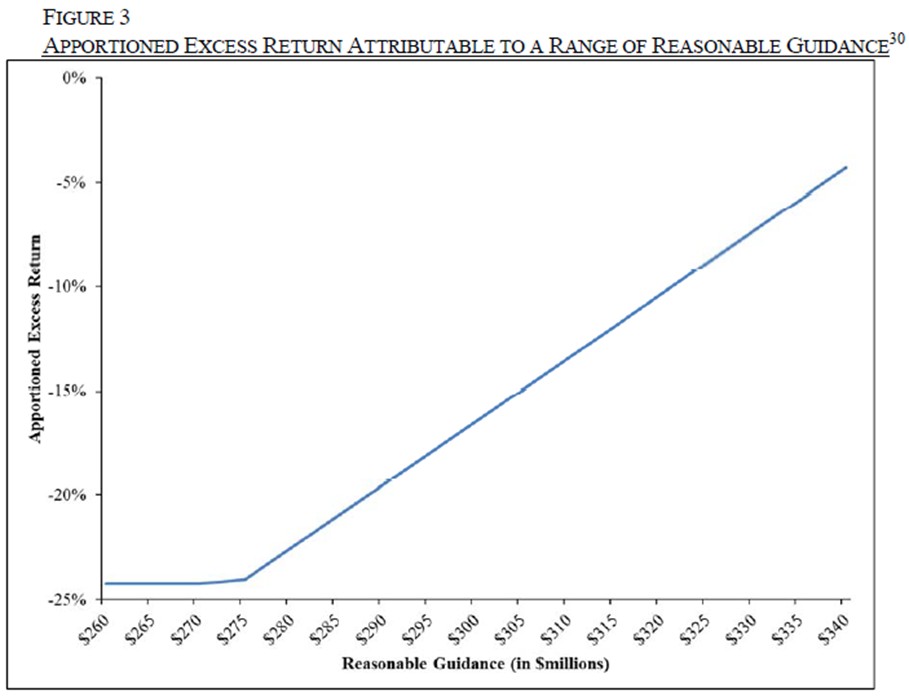
464 Mr Holzwarth did not disagree with Mr Torchio’s methodology or calculations. In their joint expert report, they each responded to the question: “Does Torchio’s event study analysis provide a reliable and reasonable estimate of the losses (excess return) attributed to a counterfactual guidance anywhere in the range of $260 million to $352 million … ?”. Mr Holzwarth’s answer was:
… Holzwarth generally agrees with the calculation of the excess return calculated in the Torchio Supplemental Report regarding this range of counterfactual NPAT guidance, assuming all of the underlying assumptions are correct.
465 The reference to the underlying assumptions being correct was explained more fully in Mr Holzwarth’s report, where, critically, he said:
The Torchio Supplemental Report assumes that the “underlying reasons” for these counterfactual disclosures would have been “economically equivalent” to reasons provided on 20 November 2013. It is necessary for purposes of the Torchio Supplemental Report that this assumption of “economically equivalent” underlying reasons would scale with the level of assumed revised NPAT guidance. For purposes of my comments for this aspect of the Torchio Supplemental Report, I have assumed that is correct. If not, then important economic correspondence issues would need to be addressed in relation to how the “underlying reasons” for the counterfactual disclosure may have differed from the actual disclosure.
(Footnotes omitted.)
466 The remitter judge appeared to accept the validity of the methodology and calculations propounded by Mr Torchio, subject to the need to demonstrate “economic equivalence”. His Honour said (RJ[219]):
Importantly, Senior Counsel for both parties accepted that the apportionment exercise, represented by the linear relationship between the figure for reasonable guidance and the apportioned excess return, applies only within the parameters of economic equivalence, and only when that economic equivalence has been established: Mr Craig KC at T357.19-358.21; Mr Sulan SC at T442.16-37, 444.9-15. That common ground is consistent with the opinion expressed by Mr Holzwarth in his oral evidence (at T832.36-45), which I accept. Mr Torchio accepted that the analysis in his second report concerning a range of reasonable guidance of $260 million to $352 million and the commensurate level of artificial share price inflation was based on the assumption of economic equivalence in the underlying reasons in the counterfactual disclosure and the actual disclosure on 20 November 2013 (T859.21-38). That common ground also seems to me to be intuitively correct. At the higher end of the range for reasonable counterfactual guidance of (say) $330-340 million, market participants would seem unlikely to form any adverse view at all of the competence or integrity of WOR’s management, but at the range of the actual corrective disclosure of $260-300 million, that loss of “reputational capital” (see [188] and [211] above) would likely be very substantial as a driver downwards of the WOR share price (a point reflected in some of the analysts’ reports issued shortly after 20 November 2013, as referred to in Mr Torchio’s first report at para 144). There would thus be no economic equivalence (in the sense referred to at [190] above) between those two scenarios. Accordingly, it is only where there is economic equivalence between the actual corrective disclosure and the selected range of counterfactual guidance that a linear relationship with excess returns would make sense.
467 It is important to be clear about precisely what was meant by an assumption of “economic equivalence” in this context. It is apparent that when Mr Torchio and Mr Holzwarth were speaking of a need to demonstrate economic equivalence between the 20 November 2013 disclosure and the counterfactual disclosure before resort could be had to the apportionment methodology proposed by Mr Torchio, they were referring to economic equivalence between the underlying reasons that accompanied the November 2013 Revised Earnings Guidance and those that would have accompanied any counterfactual NPAT guidance. As Mr Holzwarth said in the passage from his report that we have quoted above, this part of Mr Torchio’s reasoning “assumes that the ‘underlying reasons’ for these counterfactual disclosures would have been ‘economically equivalent’” (emphasis added). They were not suggesting that the linear relationship plotted in Figure 3 was only valid where the amount of the guidance in the two disclosures was also economically equivalent.
468 The remitter judge, however, appears to have taken a different view. After referring to the fact that the analysis in Figure 3 depended on economic equivalence, his Honour said that it was “common ground between the parties that economic equivalence and economic correspondence require that the counterfactual and the actual corrective disclosure are sufficiently qualitatively and quantitatively similar so as to have driven in the minds and actions of market participants the same (or substantially the same) conclusion as to the foreseeable cash flow consequences”: RJ[259]. The reference to “quantitative” similarity was plainly intended to be a reference to the amount of the earnings guidance. His Honour thus went on to say that there was “no basis on which I could infer economic equivalence in the absence of any expert evidence, given the significant difference in the figures pertaining to the two disclosures”: RJ[259]. The point was repeated at RJ[262]:
More fundamentally, the issue as to whether there is a linear relationship as shown in Figure 3 and as reflected in MFI 2 arises only if economic equivalence is demonstrated between counterfactual guidance of … $317 million … in NPAT and the actual corrective disclosure of 20 November 2013 of a range of $260-$300 million. No attempt was made by way of expert evidence to demonstrate such economic equivalence, and as I have said at [259] above, there is no basis on which I could infer economic equivalence in the absence of expert evidence.
469 We do not think that that accurately reflects the substance of the evidence. For one thing, the very purpose of the linear relationship exercise was to deal with a lack of quantitative similarity between the actual and the counterfactual guidance. That is to say, the whole point was to examine what the price effect of a different level of NPAT guidance would be. If the entire exercise was underpinned by an assumption of both quantitative and qualitative economic equivalence, it is difficult to see why the price impact would vary at all. In other words, if the disclosure of NPAT guidance of either $260 million or $340 million (and accompanying reasons) would have “driven in the minds and actions of market participants the same (or substantially the same) conclusion as to the foreseeable cash flow consequences”, presumably the impact on the price of WOR’s securities would have been the same.
470 It follows that we agree with Mr Crowley’s submission that “the issue of economic equivalence concerned the reasons accompanying the corrective disclosure … and that any difference between the NPAT in the counterfactual and the corrective disclosure was to be addressed through the apportionment exercise”. We therefore conclude that the remitter judge was wrong to reject Mr Torchio’s apportionment analysis on the ground that the actual NPAT guidance on 20 November 2013 ($260 million to $300 million) was not demonstrated to be economically equivalent to the hypothetical counterfactual guidance of $317 million (or, on our findings, $329.5 million).
471 The remitter judge would also, however, have rejected the analysis on the additional ground that economic equivalence had not been demonstrated between the reasons that accompanied the November 2013 Revised Earnings Guidance, and those that would have accompanied hypothetical non-contravening disclosure on 14 August 2013 (RJ[259], see also RJ[262]):
Further, I am unable to conclude on the balance of probabilities that the explanation and reasons which would have been given for a counterfactual disclosure of … $317 million … would have been the same or substantially the same as those set out in the 20 November 2013 announcement, particularly having regard to the fact that the 20 November 2013 announcement was based on detailed matters as to the actual results to October which had formed part of WOR’s corporate knowledge only since about 15 November 2013.
472 The remitter judge set out the text of the 20 November 2013 disclosure at RJ[199] as follows:
WorleyParsons Limited (“the Company”) provides a trading update and revised earnings guidance for the year to 30 June 2014.
At the Company’s Annual General Meeting WorleyParsons reiterated guidance for FY2014 of increased earnings compared to FY2013 net profit after tax (NPAT) of $322 million. After considering our current trading results and having experienced a delay in upturn in our markets the company is issuing revised guidance. On current indications the company now expects to report underlying NPAT for FY2014 in the range of $260 million to $300 million with first half underlying NPAT in the range of $90 million to $110 million.
The revised outlook primarily reflects:
• Reduced professional services revenue compared to the prior year. This reduction is particularly evident in the company’s large Australian and Canadian businesses and to a lesser extent in Latin America and the Middle East;
• Implementation of a rigorous cost reduction program across the entire group. The benefit of this program, net of restructuring costs, will begin to be realized in the second half of the financial year;
• Outperformance in a number of other markets, in particular the United States, Southern Africa and Europe, will not be able to offset the decline experienced in the Australian and Canadian businesses as had previously been expected.
The reduced professional services revenue is driven by:
• The decline in the Australian business has been greater than expected, as hydrocarbons projects in Northern Australia move into the final construction and delivery phase and the Minerals & Metals business remains weak;
• The Canadian business continues to be impacted by major project deferrals and additional costs incurred in our construction and fabrication business WorleyParsonsCord;
• The Latin American business has been impacted by the soft global minerals and metals market;
• The business in the Middle East has also experienced a slow start to the year as a result of delays in the ramp up of a number of projects that have been awarded.
Commenting, Chief Executive Officer, Andrew Wood, said: “Notwithstanding the impacts weaker than expected market conditions are having on our performance, the cost reduction program we are implementing together with the momentum from recent contract awards should position us for medium term growth. The diversity of our business in terms of its geography, industry sector and service offering remains a fundamental strength.
473 Mr Crowley submitted that those reasons were economically equivalent to those that the Court should find would have accompanied non-contravening guidance in August 2013. The remitter judge accepted that “the subject-matter of the various bullet points in the 20 November 2013 announcement corresponded to matters which were known to pose problems for WOR before 14 August 2013”: RJ[240]. He did so as part of his consideration of Mr Crowley’s case that non-contravening guidance in August 2013 would have been in the amount of $260-$300 million (that is, his primary counterfactual). Mr Crowley had submitted that the fact that there was a correspondence in subject matter between what was known in August, and what was disclosed in November, supported a finding that the amount of the guidance disclosed in November was the amount that should have been disclosed in August. The remitter judge’s reasons for rejecting that submission were as follows (RJ[240]):
Mr Crowley’s aide-memoire (MFI 1) indicates that the subject-matter of the various bullet points in the 20 November 2013 announcement corresponded to matters which were known to pose problems for WOR before 14 August 2013. However, as I have noted at [231] above, that analysis does not identify in quantitative terms the monetary impact of those problems on the forecast NPAT for FY14 as it was (or should have been) known before 14 August 2013, compared to the monetary impact which was discerned by senior management and the Board in mid-November 2013. The evidence in the contemporaneous documents strongly indicates that there had been a worsening of the company’s position during that three-month period, such that the revised guidance of $260-$300 million reflected the circumstances as they existed in mid-November 2013, but not the circumstances as had prevailed three months earlier. As Mr Holzwarth expressed the point in a way that was not the subject of challenge (at para 230 of his report):
the 20 November 2013 Disclosure describes aspects of actual results for the first four months of FY2014. These results would not have been available to report about at the start of the Relevant Period and thus do not describe risks related to earnings guidance but rather actual results during the fiscal year. While the fiscal year was not complete, this disclosure describes the realisation of risks rather than the disclosure of risks about future events.
474 The remitter judge’s conclusion that the correspondence between problems known to exist in August 2013, and the explanation accompanying the November 2013 Revised Earnings Guidance, was insufficient to support a conclusion that the amount of the guidance that should have been offered at those different times may be accepted. But that conclusion does not, we think, dispose of the question whether there was sufficient correspondence to justify recourse to Mr Torchio’s linear relationship analysis.
475 To begin, it is important to be clear about what is required to be shown to demonstrate “economic equivalence” between the actual and counterfactual reasons in order to satisfy the assumption upon which Mr Torchio’s linear analysis was based. For analogous reasons to those we gave above concerning why it was not necessary to demonstrate economic equivalence between the amount of actual and counterfactual NPAT guidance, we do not consider that it was necessary for Mr Crowley to prove that the accompanying reasons (either alone, or in combination with the amount of NPAT guidance) would have “driven in the minds and actions of market participants the same (or substantially the same) conclusion as to the foreseeable cash flow consequences”: RJ[190], [259]. That is, it would have been inconsistent with the very purpose of the analysis to have to prove, before resort could be had to it, that market participants would have reached the same conclusions as to its impact on the company’s future cash flows in all circumstances.
476 If there was economic equivalence in the sense used by the remitter judge between the actual and counterfactual disclosures, then it follows that there would have been no need to adjust the excess return computed by the event study to account for any “overcorrection” (see Mr Torchio’s first report, at Figure 6). The premise of the apportionment exercise is that the “minds and actions of market participants” would have been driven by the counterfactual disclosure to a different conclusion as to the foreseeable cash flow consequences. So what did Mr Torchio and Mr Holzwarth mean when they said that the linear analysis depended on an assumption of economic equivalence in relation to the reasons accompanying the NPAT guidance number?
477 The answer is revealed in Mr Holzwarth’s explanation of the basis upon which he agreed with Mr Torchio’s analysis, set out above, where he said that it was necessary that “this assumption of ‘economically equivalent’ underlying reasons would scale with the level of assumed revised NPAT guidance”. We understand Mr Holzwarth’s reference to the reasons “scaling” with the level of assumed revised NPAT guidance to mean that the economic impact would be qualitatively equivalent, but with a varying quantitative significance in proportion to the change in guidance.
478 The potential for the reasons accompanying a downgrade in expected earnings to affect the market’s perception of the company’s value is obvious. The exact same guidance in dollar terms may signify quite different things about the company’s expected future cash flows. To take an example given by the remitter judge (RJ[190]):
For example, the reasons may indicate whether the corrective disclosure is the result of an isolated one-off event, on the one hand, or a systemic problem for ongoing cashflows, on the other hand.
479 Such an example would be one instance of the kind of lack of economic equivalence that would deny resort to Mr Torchio’s linear analysis; the difference in the explanation for the same dollar amount of a downgrade would imply substantially different consequences for the company’s prospects.
480 That seems to us to be very different from explaining two quantitatively different reductions in expected earnings by reference to, for example, the “soft global minerals and metals market”. It may be accepted that the “softness” of the market that explains a $100 million downgrade is likely to be substantively different to the “softness” that would explain a downgrade of only $10 million. But the substance of the explanation, being an economic connection between conditions in a particular market and expected revenue, is the same.
481 So, when Mr Holzwarth said that it was necessary for the underlying reason to “scale” with the level of NPAT guidance, we understood him to be referring to the concept we have just explained. That is to say, the qualitative nature of the factor needs to be the same, albeit with a different quantitative effect reflected in the changed level of guidance.
482 With that understanding of the concept in question, it is possible to see why we said earlier that the remitter judge’s conclusion at RJ[240] was an insufficient basis upon which to deny the possibility of recourse to Mr Torchio’s linear relationship analysis. In fact, we consider that his Honour’s reasoning and conclusions should have led him to the conclusion that it was appropriate to do so. In our view, his Honour’s findings demonstrate that there was a high degree of economic equivalence (in the relevant sense) between the reasons for the downgrade disclosed on 20 November 2013, and those that would have been disclosed in connection with non-contravening guidance on 14 August 2013.
483 As the remitter judge recorded at RJ[226], Mr Crowley “sought to distil the reasons provided in the 20 November 2013 corrective disclosure into four essential propositions, and compared those propositions to the evidence indicating WOR’s knowledge of those matters existing before 14 August 2013”. His Honour then set out that analysis, including by reference to evidence, between RJ[227]-[230], and we respectfully adopt that summary. His Honour then said this (at RJ[231]):
It should be noted in relation to those four aspects of the argument (that is, that there was nothing that arose in the August to November period that was the subject of the 20 November 2013 announcement that was not already known to the company as at 14 August 2013), that the material relied upon for that submission is expressed in qualitative terms by reference to the particular subject matters where problems had been identified. There was no identification in quantitative terms by reference to dollar figures as to the monetary impact of those matters on the forecast NPAT for FY14. Nor was there any suggestion in that evidence that the monetary impact on NPAT of those various matters had not actually been taken into account to an extent that was reasonably based as at 14 August 2013 in the FY14 Budget.
484 So much may be accepted. What his Honour was saying was that there was a qualitative correspondence between the subject matter of the actual and counterfactual releases, but no basis upon which they could be inferred to be quantitatively equivalent. We agree with both aspects of that conclusion; it is comfortably demonstrated by the summary of the evidence at RJ[227]-[230].
485 His Honour then went on, between RJ[232]-[236], to examine the evidence concerning events shortly before the publication of the November 2013 Revised Earnings Guidance. Between RJ[237]-[239], his Honour explained why the effect of that evidence was to demonstrate that the quantum of the downgrade disclosed in November was very much a product of the actual experience of the preceding months. Again, so much may be accepted.
486 What must also be appreciated from that evidence, however, is that the quantitative deterioration in WOR’s prospects that was appreciated in November 2013, was attributable to the same issues that had been known in August 2013. It is sufficient to refer to the ExCo meeting that was held on 19 November 2013. The minutes of that meeting recorded (see RJ[235]):
The company’s performance year-to-date indicated we were having difficulties achieving budgeted volume and margin. In addition, since the AGM there had been further softening in our markets in particular in Canada and Latin America. ExCo agreed that, even with the forecast overhead savings of $64m, based on these details, it was very difficult to support the second half 3+9 forecast and therefore, the full year forecast.
ExCo discussed the things that had changed since the AGM when we had confirmed guidance for the full year. Since then we have received September and October results which were both below budget and there has been a general weakening in our markets.
ExCo discussed the level of “blue sky” (EBIT not supported by prospects and proposals) in the forecast and noted it was higher than it would usually be as there was less coming through in proposals. Simon [Holt] advised that in the last 24 hours he and Stuart [Bradie] had reviewed each location’s assessment of the blue sky in their forecast. Based upon prior performance, known issues in each location and current market conditions, Simon [Holt] and Stuart [Bradie] had concerns over approximately $100-120m of EBIT in the forecast. In particular, concerns were held with regard to forecast by China, Calgary, UK, Cord, Saudi and South West Ops.
Simon advised that the review resulted in a recommended removal of $100m of EBIT in the second half which would then require $200m NPAT in the second half and $290m NPAT for the year. This forecast result would make more sense, particularly as we are in a tough market which appears to be deteriorating.
487 It is plain that WOR considered the fundamental cause of the downgrade disclosed in November to have been that experience had been worse than expected, but not in a way that was unforeseen. There is no indication that some new, unforeseen, issue had arisen. WOR had appreciated the issues, it had simply not anticipated that they would cause a reduction in NPAT to the extent that had become apparent by November 2013. In that context, it is worth repeating the critical part of the remitter judge’s ultimate conclusion at RJ[240]:
[T]he subject-matter of the various bullet points in the 20 November 2013 announcement corresponded to matters which were known to pose problems for WOR before 14 August 2013. However, as I have noted at [231] above, that analysis does not identify in quantitative terms the monetary impact of those problems on the forecast NPAT for FY14 as it was (or should have been) known before 14 August 2013, compared to the monetary impact which was discerned by senior management and the Board in mid-November 2013. The evidence in the contemporaneous documents strongly indicates that there had been a worsening of the company’s position during that three-month period, such that the revised guidance of $260-$300 million reflected the circumstances as they existed in mid-November 2013, but not the circumstances as had prevailed three months earlier.
488 Once the sense in which Mr Torchio and Mr Holzwarth were using the term “economic equivalence” in relation to the reasons accompanying any particular figure of forecast NPAT is appreciated, that conclusion should have led his Honour to recognise that it was legitimate to have regard to the linear relationship analysis. That is to say, his Honour had accepted that there was correspondence between the “subject-matter” of the reasons in the two disclosures, and that the explanation for the quantitative difference between the two disclosures was the “worsening of the company’s position” (and not the introduction of some new cause or issue). Because the causes were qualitatively the same, albeit differing in degree, the economic relevance of the reasons to an assessment of WOR’s future cash flows was the same. It was not as if, to use his Honour’s example at RJ[190], there was an isolated one-off event, as opposed to a systemic problem for ongoing cashflows. The magnitude of the problem might have increased, but it retained its essential character. In substance, his Honour had found that the “underlying reasons would scale with the level of assumed revised NPAT guidance”, to use Mr Holzwarth’s phrase.
489 None of that is to deny, of course, that there are a number of other differences between the reasons that actually accompanied the November 2013 Revised Earnings Guidance, and those that would have accompanied the hypothetical non-contravening disclosure. Some of those differences are inevitable given the passage of time between WOR’s contraventions and its resumption of compliance with its legal obligations on 20 November 2013. The disclosure on 20 November 2013 was made, as WOR and the remitter judge emphasised, with the benefit of knowledge of an additional three months’ actual trading conditions. To that extent, there was necessarily a translation from risk to experience. The passage of time means that the disclosure in fact made on 20 November 2013 could never have been equivalent in all material respects to that which ought to have been made on 14 August 2013.
490 We accept that some of the differences between the November 2013 Revised Earnings Guidance and any counterfactual non-contravening disclosure would be such as to deny strict economic equivalence. The additional certainty provided by an extra three months of actual trading experience is a sufficient example. Such differences, though, we think, are examples of the sort of difficulties that make precise quantification difficult, if not impossible, and justify application of the facilitation principle.
491 The existence of some differences of that kind, though, does not destroy the overall impression of strong economic equivalence (albeit “scaled” in the sense described by Mr Holzwarth). In those circumstances, we think that the appropriate approach is to begin with Mr Torchio’s linear analysis, but to apply a discount to the loss figures suggested by it to reflect the difficulties we have identified. That is consistent with the observations of the Full Court in Generic Health Pty Ltd v Bayer Pharma Aktiengesellschaft [2018] FCAFC 183; (2018) 267 FCR 428 at [186]-[187] (Allsop CJ, Yates and Beach JJ):
[I]n assessing the possibilities or probabilities of a hypothetical counterfactual, one is engaged in the task of estimation, even if the estimation involves an assessment of the counterfactual as being close to a certainty. But being close to a certainty is not the same thing as a certainty. If one is estimating, one still needs to apply a discount, albeit a very modest one, to reflect the assessment that one is not at a certainty. …
… To say that damages should be liberally assessed in no way cuts across what we have just said: that, in estimating or valuing a lost opportunity or in assessing a hypothetical counterfactual for any scenario short of certainty, some discount must be made to reflect that less than certain position, even if the discount is very modest indeed.
492 Mr Crowley’s MFI-2 set out in numerical form the results of Mr Torchio’s linear analysis. As the remitter judge pointed out, there are two basic methods to compute artificial inflation, being percentage and dollar methods: RJ[196] (see also Myer at [757]-[774] (Beach J)). MFI-2 set out calculations of Mr Crowley’s loss on both bases. In Myer, Beach J said (at [760]-[763]):
The question of whether to adopt the constant dollar approach or the constant percentage approach to estimate share price inflation depends upon the nature of the announcement that is being assessed.
Finance theory establishes that on average the value of a firm is equal to the net present value of its expected future cash flows. It follows that a company may experience an increase or decrease in its share price upon the release of new information that alters expectations as to the level of future cash flows or the risks associated with those cash flows.
Generally, the constant dollar method is applied in circumstances where the effect of a disclosure on earnings has a one-off effect on cash flows or reduces cash flows by a constant amount each year, and does not materially alter perceptions as to the risk associated with future cash flows.
Contrastingly, the constant percentage method is typically applied in circumstances where a disclosure affects the market’s assessment of future earnings, either by altering its expectations as to the growth of future earnings and/or the level of risk associated with those earnings.
493 With counterfactual disclosure of $329.5 million, the calculation methodology in MFI-2 is as follows:
(a) first, subtract $329.5 million from the analyst consensus on 19 November 2013 as calculated by Mr Torchio in his Third Report (being $351.84 million), and which Mr Holzwarth accepted in the joint report was not statistically different to his own calculation: RJ[205]. Mr Holzwarth’s own calculation was slightly lower, and thus would have been favourable to WOR. Mr Torchio, on the other hand, considered that using the consensus on 19 November 2013 was conservative, because the consensus at the end of the Relevant Period was lower than it had been at the start. In those circumstances, we have used what might appear to be the unjustifiably precise sum of $351.84 million (being the number used in the MFI-2 methodology) because that is the number that found a measure of agreement between the experts. In circumstances where we propose to apply a general discount, we do not consider that it is necessary to resolve firmly and precisely any dispute as to the correct number. The result, therefore, is $22.34 million;
(b) secondly, subtract $274 million (being the analyst consensus after 20 November 2013) from the analyst consensus on 19 November 2013 (i.e., $351.84 million), which equals $77.84 million;
(c) thirdly, express $22.34 million as a percentage of $77.84 million, which is 28.7%;
(d) fourthly, multiply 28.7% by the total excess return determined by Mr Torchio (being 24.28%). The result is 6.97%;
(e) fifthly, Mr Crowley’s loss on a constant percentage basis is thus 6.97% of the price paid by Mr Crowley per share for his WOR shares (being $23.68), multiplied by the number of shares he purchased (being 423). The result is thus (rounded to the nearest dollar) $698 (excluding interest);
(f) sixthly, dollar inflation per share is calculated by dividing 6.97% by 24.28% (which gives 28.71%), and multiplying that by the total excess return on 20 November 2013 expressed in dollars (namely $5.24). The result is $1.50; and
(g) seventhly, Mr Crowley’s loss on a constant dollar basis is thus $1.50 multiplied by 423, which is (rounded to the nearest dollar) $635 (excluding interest).
494 Taking a broad-brush approach, so as to reflect the lack of precise economic equivalence between the reasons that would have accompanied the actual and hypothetical disclosures, we consider that it is appropriate to apply a discount of 15% to the losses that would otherwise have been indicated by Mr Torchio’s linear analysis. Applying that discount:
(a) the percentage inflation per share is 5.92%, being 6.97% (the result in [493(d)]) multiplied by 85%;
(b) Mr Crowley’s loss on a constant percentage basis is thus (rounded to the nearest dollar) $593, being 5.92% multiplied by $23.68, multiplied by 423;
(c) the dollar inflation per share is $1.28, being 5.92% divided by 24.28% (which gives 24.38%), multiplied by $5.24; and
(d) Mr Crowley’s loss on a constant dollar basis is thus (rounded to the nearest dollar) $541, being $1.28 multiplied by 423.
495 As to which of the constant percentage or constant dollar methods is appropriate, Mr Crowley argued for the former, while WOR contended for the latter. We consider that Mr Crowley is correct. This case falls comfortably within the rationale for the use of the constant percentage method, as described by Beach J in the passage to which we have referred above.
CONCLUSION
496 For the foregoing reasons, we would allow the appeal and dismiss the cross-appeal. The answers given by the remitter judge to questions 13 and 15 set out in the Joint List should be answered:
Question 13: During the Relevant Period, did the Contraventions (or any of them) cause the market price for WOR Securities to be substantially greater than:
13.1 their true value; and/or
13.2 the market price that would have prevailed but for the Contraventions (or any of them),
and if so, by how much?
Answer: Yes, in relation to question 13.2. The market price for WOR Securities included an amount of share price inflation equal to -5.92%.
Question 15: Has the Applicant suffered loss and damage in relation to his interest in WOR Securities by and resulting from his reliance on the Contraventions, and if so by how much?
Answer: Yes, in the amount of $593 plus interest pursuant to s 51A(1)(a) of the Federal Court of Australia Act 1976 (Cth), from 4 October 2013.
497 In those circumstances, it is apparent that Mr Crowley has enjoyed substantial success on the initial trial (including remitter), with the result that the orders made by the remitter judge in Crowley (Costs) dismissing the proceedings, and ordering Mr Crowley to pay WOR’s costs cannot stand. In their place, we would order that WOR pay Mr Crowley’s costs of and incidental to the initial and remitted trials. It is also appropriate that, subject to considering any contrary submission that the parties may make, WOR pay Mr Crowley’s costs of the appeal and cross-appeal. Any broader question of costs in relation to the proceedings generally is appropriately left to the remitter judge to deal with in the context of the resolution of all outstanding issues in the proceedings.
I certify that the preceding four hundred and ninety-seven (497) numbered paragraphs are a true copy of the Reasons for Judgment of the Honourable Justices Markovic, Halley and Owens. |
Associate:
Dated: 28 May 2026
ANNEXURE A
Defined Term | Definition |
4FASOC | Fourth Further Amended Statement of Claim. |
9 October 2013 Announcement | The statement WOR published on 9 October 2013 to the effect that its first-half result would be lower than in the prior year, but that it affirmed the August 2013 Earnings Guidance Statement. |
27 May 2013 Draft Budget | The proposed budgets prepared by each of the Locations in which WOR operated, which when compiled together on 27 May 2013 disclosed an NPAT of $252 million for FY14 (which NPAT increased to $284 million by the time of adoption of the FY14 Budget due to changes in foreign exchange rates). |
A&RC | Audit and Risk Committee of the Board of WOR, comprised of Board members. |
ACL | Australian Consumer Law, being Sch 2 of the Competition and Consumer Act 2010 (Cth). |
AGM | Annual General Meeting. |
ANZ | Australia and New Zealand. |
ASCH | Asia and China. |
ASIC Act | Australian Securities and Investments Commission Act 2001 (Cth). |
ASX | Australian Securities Exchange. |
August 2013 Earnings Guidance Statement | The statement published by WOR on 14 August 2013 saying: “While recognising the uncertainties in world markets, we expect our geographic and sector diversification to provide a solid foundation to deliver increased earnings in FY2014.” |
August Finance Report | The document titled “Finance Report – ExCo August FY14” sent to Mr Holt on 20 September 2013. |
BEBIT | Business earnings before interest and tax. |
| Estimated revenue from expected projects not identified at the time of forecasting. |
Blue Sky Case | The amount of Blue Sky revenue in the FY14 Budget other than in the ANZ and SWO budgets. |
Board | WOR’s board of directors, on which throughout the relevant period Mr Wood was the only executive director. |
CAN | Canada. |
CEO | Chief Executive Officer. |
CEOC | The CEO’s Committee, comprising the members of ExCo, Mr Holt (in the period when he was not formally on ExCo), the eight RMDs who reported to Mr Bradie, and the three Managing Directors of the CSGs. The CEOC’s role was only to advise Mr Wood and it did not make decisions. |
CFO | Chief Financial Officer. |
Consensus Expectation | The allegation of the existence of a consensus expectation of professional analysts covering the ASX and WOR, held between 14 August 2013 and immediately prior to the November 2013 Revised Earnings Guidance, that WOR would deliver between $354 and $368 million in NPAT for FY14. |
Corporations Act | Corporations Act 2001 (Cth). |
CSGs | The three Customer Service Groups into which WOR allocated customers for FY14, being Hydrocarbons (customers involved in extracting and processing oil and gas), Minerals, Metals & Chemicals (also referred to as MM&C) and Infrastructure, each headed by a Managing Director. |
Earnings Expectation Material Information | The proposition that WOR’s FY14 earnings were likely to fall materially short of the Consensus Expectation of professional analysts covering the ASX and WOR securities that WOR would deliver between approximately $354 and $368 million in NPAT for FY14. |
EBIT | Earnings before interest and tax. |
EBITDA | Earnings before interest, tax, depreciation and amortisation. |
ExCo | The Executive Committee which reported directly to Mr Andrew Wood, WOR’s Chief Executive Officer (CEO), and comprising Mr Wood and six Group Managing Directors who reported directly to Mr Wood, being Mr Bradie, Mr Ross, Mr Steele, Mr Karren, Mr Bloch, and, from September 2013, Mr Holt. The ExCo met at least monthly. |
Federal Court Act | Federal Court of Australia Act 1976 (Cth). |
FY13 | The financial year ended 30 June 2013. |
FY14 | The financial year ended 30 June 2014. |
FY14 Budget | WOR’s budget for the financial year 2013/2014 approved by WOR’s Board on 13 August 2013 and which forecast NPAT of $352 million. |
FY14 Earnings Guidance Statement or FY2014 Earnings Guidance Statement | Has the same meaning as defined in paragraph 12(b) of the 4FASOC. It means the following statement made by WOR on 14 August 2013: “While recognizing the uncertainties in world markets, we expect our geographic and sector diversification to provide a solid foundation to deliver increased earnings in FY2014”. |
FY14 Guidance Representation or FY2014 Guidance Representation | The has the same meaning as defined in paragraph 51 of the 4FASOC. It means, individually and together, a representation made by WOR that: (a) It expected to achieve NPAT in excess of $322 million in the financial year ended 30 June 2014; and (b) It had reasonable grounds to expect that it would achieve NPAT in excess of $322 million in the financial year ending 30 June 2014. |
Global Functions | One of two broad process streams comprising WOR’s overall budget, which included group-wide functions that facilitated delivery of services for the group as a whole. |
GMD | Group Managing Director. |
Historical Performance Case | WOR’s historical performance against budget or its revisions to earnings guidance in FY13. |
HOH | “Half on half” referring to the “phasing” or timing of financial results, in particular the comparison of results between the first half of a financial year, being 1 July to 31 December (H1), and the second half, being 1 January to 30 June (H2). |
| The interview notes which accompany the Holt Memorandum. |
Holt Memorandum | A memorandum from Mr Holt, CFO, to the A&RC dated 5 December 2013. |
Joint List | Joint list of issues for determination. |
LAM | Latin America. |
Listing Rules | The Listing Rules of the ASX. |
Local Operations | One of two broad process streams comprising WOR’s overall budget, which included the outward facing, revenue generating, activities of the group and its individual Locations. |
Location | The business locations into which each Region was divided, of which there were 43 in total. |
Management Adjustments | Adjustments to the 27 May 2013 Draft Budget made in or about June 2013 by senior management of WOR comprising: (i) $31.046m in operational EBIT; (ii) $12m for acquisition stretch; (iii) a further $14.093m in operational EBIT; (iv) $33m in overhead savings; and (v) $32m in foreign exchange benefit. |
Material Information | The proposition that WOR did not have a reasonable basis for making the August 2013 Earnings Guidance Statement. |
MENAI | Middle East, North Africa, India. |
MM&C | The CSG known as Minerals, Metals & Chemicals. |
November 2013 Revised Earnings Guidance | The statement WOR published on 20 November 2013 that: “On current indications the company now expects to report underlying NPAT for FY2014 in the range of $260 million to $300 million with first half underlying NPAT in the range of $90 million to $100 million”. |
NPAT | Net profit after tax. |
P50 Budget | A budget using the P50 parameter, being a probabilistic Monte Carlo analysis of the statistical confidence level for an estimate, meaning that 50% of estimates exceed the P50 estimate and 50% of estimates are less than the P50 estimate; that is, there is an equal chance of exceeding or going below the estimate. |
Proposals | Work for which WOR had submitted a tender or had received a request for a tender, where there was usually a proposed start date for the project within the forthcoming year. |
Prospects | Tender processes for which WOR had not yet submitted a tender, or known projects where the tender process had not started. |
Region | One of the eight regions around the world into which WOR’s business was organised, known as ANZ, CAN, ASCH, USAC, LAM, MENAI, EUR and SSA. |
Relevant Period | 14 August 2013 to 19 November 2013. |
RMD | Regional Managing Director. |
Secured Work | WOR’s portfolio of work in hand, where a signed contract for the work existed. |
SSA | Sub-Saharan Africa. |
SWO | Southwest Ops, being one of five Locations in the USAC Region. |
USAC | USA and Caribbean. |
Vision 2017 | WOR’s objective of year-on-year growth in every year from FY13 to the financial year ended 30 June 2017 as described in WOR’s 2012 annual report. |
WOR | Worley Limited, formerly known as WorleyParsons Limited. |


