

Federal Court of Australia
TJ & P Pty Ltd as trustee for the Post Family Trust v Agrinova Pty Ltd [2026] FCAFC 77
Appeal from: | TJ & P Pty Ltd as trustee for the Post Family Trust v Agrinova Pty Ltd (No 3) [2025] FCA 587 |
File number: | NSD 1133 of 2025 |
Judgment of: | STEWART, HALLEY AND STELLIOS JJ |
Date of judgment: | 28 May 2026 |
Catchwords: | ESTOPPEL – equity – equitable estoppel alleged to have arisen from written representations amounting to a promise – promise later withdrawn – whether there was reliance on the promise – whether the remedy should be based on the value of the promise or the detriment suffered from reliance on the promise assessed with reference to expenditure incurred – unconscionability and proportionality of remedy – whether a certain course of conduct was committed to in reliance on the promise so that expenditure on that course even after withdrawal of the promise should be awarded – whether legal expenses and liability for legal costs awarded as equitable compensation have to be proven to have been reasonably incurred and reasonable as to amount |
Legislation: | Conveyancing Act 1919 (NSW), s 66G |
Cases cited: | Allianz Australia Insurance Ltd v Delor Vue Apartments CTS 39788 [2022] HCA 38; 277 CLR 445 Allianz Australia Insurance Ltd v Delor Vue Apartments CTS 39788 [2021] FCAFC 121; 287 FCR 388 Ashton v Pratt [2015] NSWCA; 88 NSWLR 281 Blatch v Archer (1774) 1 Cowp 63; 98 ER 969 Commercial & General Corporation Pty Ltd v Manassen Holdings Pty Ltd [2021] SASCFC 40 Commercial Union Assurance Company of Australia v Ferrcom (1991) 22 NSWLR 389 Commonwealth v Verwayen [1990] HCA 39; 170 CLR 394 Delaforce v Simpson-Cook [2010] NSWCA 84; 78 NSWLR 483 Donis v Donis [2007] VSCA 89; 19 VR 577 Evans v Evans [2011] NSWCA 92 Federal Treasury Enterprise (FKP) Sojuzplodoimport v Spirits International BV [2024] FCAFC 152 FJ & PN Curran Pty Ltd v Almond Investors Land Pty Ltd [2019] VSCA 236 Foran v Wight [1989] HCA 51; 168 CLR 385 Giumelli v Giumelli [1999] HCA 10; 196 CLR 101 Harris v Digital Pulse Pty Ltd [2003] NSWCA 10; 56 NSWLR 298 Houghton v Immer (No 155) Pty Ltd (1997) 44 NSWLR 46 Kramer v Stone [2024] HCA 48; 281 CLR 484 Kronenberg v Macaulay [2025] NSWCA 195 Nikolaou v Papasavas, Phillips & Co [1989] HCA 11; 166 CLR 394 Penya v Penya [2026] NSWCA 73 Pilmer v Duke Group Ltd (in liq) [2001] HCA 31; 207 CLR 165 Pitcher Partners Consulting Pty Ltd v Neville’s Bus Service Pty Ltd [2019] FCAFC 119; 271 FCR 392 Saleh v Romanous [2010] NSWCA 274; 79 NSWLR 453 Sampson in his capacity as trustee of the bankrupt estates of Van Vlymen v Agrinova Pty Ltd [2022] FCA 529 Sidhu v Van Dyke [2014] HCA 19; 251 CLR 505 The Owners - Strata Plan No 36131 v Dimitriou [2009] NSWCA 27; 74 NSWLR 370 Stuart v Rabobank Australia Ltd (No 2) [2021] FCA 1626 TJ & P Pty Ltd as trustee for the Post Family Trust v Agrinova Pty Ltd (No 3) [2025] FCA 587 Tyco Australia Pty Ltd v Optus Networks Pty Ltd [2004] NSWCA 333 Van Dyke v Sidhu [2013] NSWCA 198; 301 ALR 769 Waltons Stores (Interstate) Pty Ltd v Maher [1988] HCA 7; 164 CLR 387 Western Sydney University v Thiab [2023] NSWCA 57; 111 NSWLR 241 McKibbin S, “Cold comfort from the farm: proprietary estoppel’s Hydra-headed nature” (2026) 142 LQR 201 |
Division: | General Division |
Registry: | New South Wales |
National Practice Area: | Commercial and Corporations |
Sub-area: | Regulator and Consumer Protection |
Number of paragraphs: | 191 |
Date of hearing: | 27-28 November 2025 |
Counsel for the Appellant and Cross-Respondent | A Leopold SC and A E Maroya |
Solicitor for the Appellant and Cross-Respondent | Keleher Lawyers |
Counsel for the Respondent and Cross-Appellant | T Rollo |
Solicitor for the Respondent and Cross-Appellant | Rural Law |
ORDERS
NSD 1133 of 2025 | ||
| ||
BETWEEN: | TJ & P PTY LTD AS TRUSTEE FOR THE POST FAMILY TRUST Appellant | |
AND: | AGRINOVA PTY LTD Respondent | |
AND BETWEEN: | AGRINOVA PTY LTD Cross-Appellant | |
AND: | TJ & P PTY LTD AS TRUSTEE FOR THE POST FAMILY TRUST Cross-Defendant | |
order made by: | STEWART, HALLEY AND STELLIOS JJ |
DATE OF ORDER: | 28 MAY 2026 |
THE COURT ORDERS THAT:
1. The appeal be dismissed.
2. The cross-appeal be dismissed.
3. The appellant pay 60% of the respondent’s costs of the proceeding.
Note: Entry of orders is dealt with in Rule 39.32 of the Federal Court Rules 2011.
REASONS FOR JUDGMENT
THE COURT:
Introduction
1 Willem Van Vlymen, through a series of companies, held interests in land in the Solomon Islands. Mr Van Vlymen also had business dealings in the Solomon Islands in a joint venture with Patrick Wong. Mr Van Vlymen and Mr Wong concluded an agreement by which Mr Van Vlymen was to acquire Mr Wong’s interests in the joint venture, but Mr Van Vlymen was unable to pay the agreed amount.
2 That inability led in due course to a settlement deed in November 2016, but Mr Van Vlymen, his wife, Margriet Van Vlymen, and his related companies failed to pay amounts in the order of several million dollars owed to Mr Wong under that deed. Mr Wong then appointed a receiver over the shares in a number of Mr Van Vlymen’s related companies that held his interests in the Solomon Islands.
3 Mr Van Vlymen came into discussions with directors of Agrinova Pty Ltd (Agrinova) about the possibility of Agrinova paying Mr Van Vlymen’s debts to Mr Wong and the costs of the receiver. That was said to be to enable Mr Van Vlymen to regain control of his companies and transfer his interests in those companies and their assets to Agrinova in return for the issue of units in the Agrinova Unit Trust of which Agrinova was the trustee. The other unit holders were to be members of the Hughes and Stott families. Both families farmed various land holdings owned by them in Australia which were also to come under the ownership or control of Agrinova.
4 The central issues below were, first, whether Agrinova and Mr Van Vlymen entered into an oral contract at a meeting on 30 October 2018 pursuant to which Agrinova agreed, inter alia, to fund the payment by the Van Vlymens to Mr Wong of the amount owed under the November 2016 deed and other expenses, including the costs of retiring the receiver.
5 The second issue was whether Agrinova made representations to similar effect as the alleged contract at the meeting on 30 October 2018 and in later correspondence such as to promise to pay the debt to Mr Wong and became estopped in equity from later resiling from that promise.
6 The primary judge rejected the Van Vlymens’ claim against Agrinova in contract on the basis that none had been concluded, but he upheld their claim in equitable estoppel: TJ & P Pty Ltd as trustee for the Post Family Trust v Agrinova Pty Ltd (No 3) [2025] FCA 587 (PJ). He did so only as to the financial detriment suffered by them as a result of having acted on the promise and not as to the financial value of the promise itself. In the result, his Honour entered judgment in favour of TJ & P Pty Ltd (TJ&P), the assignee of the Van Vlymens’ claims, in the sum of $585,000.
7 TJ&P appeals against that judgment. It does not challenge the dismissal of the contractual claim, but it challenges various findings on the estoppel claim which led the primary judge to his conclusion on quantum. It contends that the proper quantum for which it should have been granted judgment is in the order of $20 million calculated with reference to the value of the promise to which, it says, Agrinova should have been held.
8 Agrinova cross-appeals, contending that the estoppel claim should also have been dismissed on the basis of absence of reliance on the promise and that there was in any event insufficient evidence to support the quantum finding.
The essential facts
9 The facts stated below are summarised from the primary judgment. Save where the contrary is indicated, they are not in dispute in the appeal.
10 From around 1994 until around 2014 or 2015, Mr Van Vlymen conducted a business with Mr Wong which, in broad terms, involved the trading and transportation of goods and commodities between Pacific Island nations, and between those nations and countries in Asia.
11 The companies through which Mr Van Vlymen and Mr Wong carried on their business are set out in the following diagram:
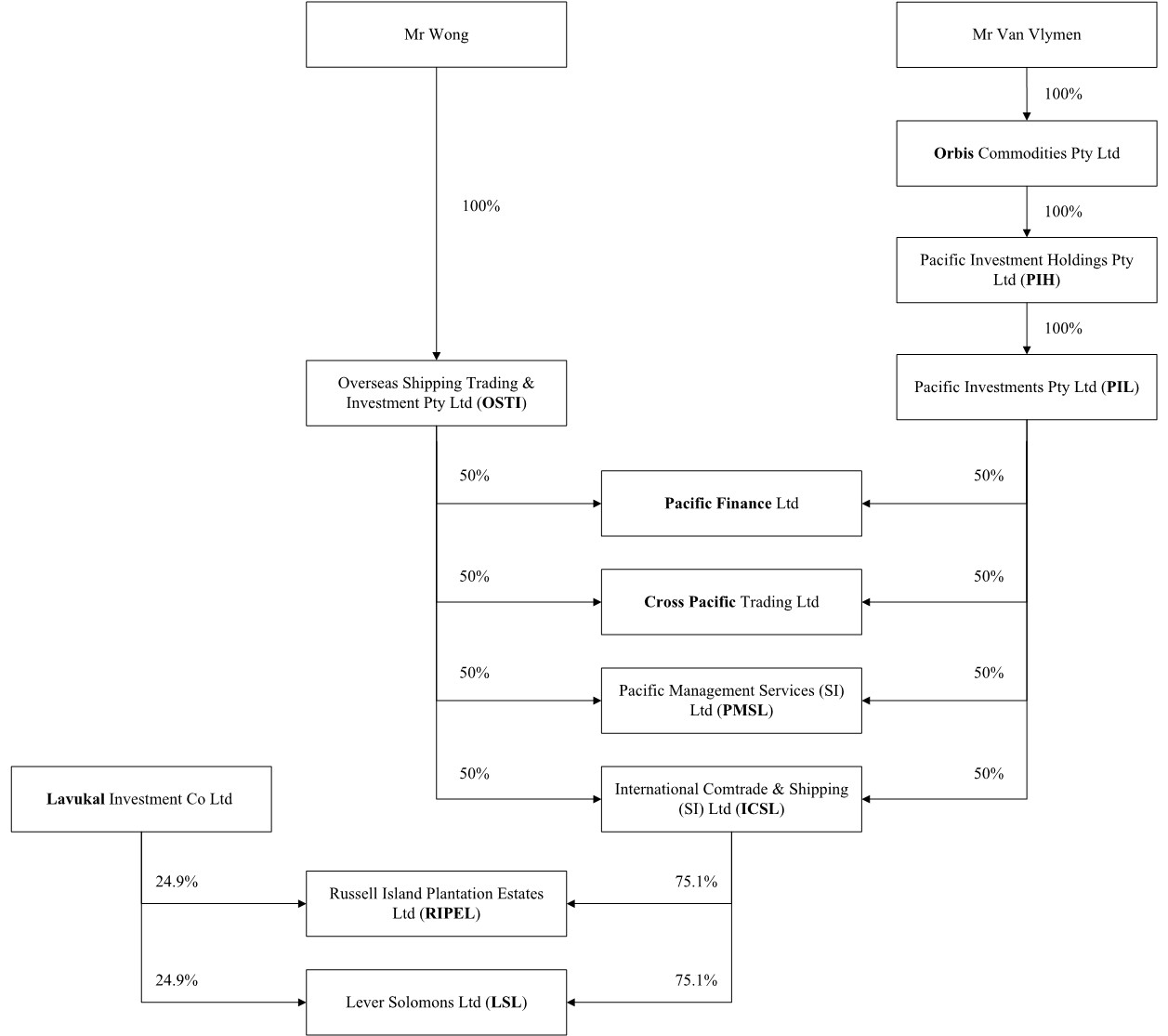
12 In summary, Mr Van Vlymen and Mr Wong, through companies owned by them, each owned 50% of the shares in the four companies: Pacific Finance, Cross Pacific, PMSL and ICSL. The first two of those companies are Cook Islands companies and the second two are Solomon Islands companies. Mr Van Vlymen and Mr Wong, through ICSL, together owned 75.1% of the shares in RIPEL and LSL, with the remaining 24.9% being held by Lavukal which is a company representing the Lavukal people of the Solomon Islands.
13 In November 2014, Mr Van Vlymen and Mr Wong entered into a contract for the purchase by Mr Van Vlymen of Mr Wong’s shares in OSTI (November 2014 contract). The effect of that contract would have been Mr Van Vlymen taking over all of Mr Wong’s interests in the shared business undertakings. However, Mr Van Vlymen was unable to obtain finance to complete the transaction and accordingly fell into breach of the contract.
14 In about May 2015, Mr Wong commenced a proceeding in the Supreme Court of New South Wales (Mr Wong’s proceeding) against Mr Van Vlymen, Orbis, PIH and PIL seeking an order for specific performance of the November 2014 contract. On 1 March 2016, Justice Stevenson delivered reasons for judgment and on 9 March 2016 ordered that Mr Van Vlymen, Orbis, PIH and PIL specifically perform the November 2014 contract.
15 On 11 March 2016, a settlement agreement (March 2016 agreement) was concluded. The parties to it were:
(1) the Wong Entities (defined as Mr Wong and OSTI);
(2) the Van Vlymen Entities (defined as Mr Van Vlymen, PIL, PIH and Orbis); and
(3) the Joint Entities (being Cross Pacific, Pacific Finance, ICSL and PMSL).
16 The March 2016 agreement required the Van Vlymen Entities to pay to the Wong Entities an initial amount of USD250,000 and within 120 days further amounts of USD1.75 million and SBD15 million (SBD being Solomon Islands dollars). In exchange, the Wong Entities were to transfer to the Van Vlymen Entities all the shares in OSTI and relinquish all directorships in the Wong Entities, the Joint Entities, RIPEL and LSL.
17 On 17 June 2016, Justice Stevenson ordered specific performance of the March 2016 agreement.
18 On 26 August 2016, Mr Van Vlymen paid USD250,000 in part fulfilment of his obligations under the March 2016 agreement. However, he was unable to obtain sufficient funding to pay the remainder due under that agreement.
19 On 13 September 2016, on the application of Mr Wong, Christopher Darin was appointed as receiver and manager of Mr Van Vlymen’s interests in the real property owned by Mr and Mrs Van Vlymen.
20 On 23 September 2016, Mr Darin commenced a proceeding in the Supreme Court of New South Wales seeking orders under s 66G of the Conveyancing Act 1919 (NSW) to act as trustee for the sale of certain real property owned by Mr and Mrs Van Vlymen (the receiver’s proceeding).
21 On 5 October 2016, by order of Justice Stevenson, Mr Darin and Nicholas Malanos were appointed as trustees for the sale of that real property.
22 On about 4 November 2016, Mr and Mrs Van Vlymen entered into a deed with Mr Wong and Mr Darin and others (November 2016 deed). The parties to the deed were:
(1) the Wong Entities (defined as Mr Wong and OSTI);
(2) the Van Vlymen Entities (defined as Mr Van Vlymen, PIL, PIH and Orbis);
(3) Mrs Van Vlymen;
(4) Mr Darin in his capacity as:
(a) receiver and manager of the interests of Mr Van Vlymen including in real property at Bayview and Kulnura;
(b) trustee for sale of such land (as per the order made on 5 October 2016); and
(5) Mr Malanos in his capacity as a trustee for sale of the same land (as per the same order).
23 The November 2016 deed, in summary, operated to stay Mr Wong’s proceeding and the receiver’s proceeding and to halt the proposed sale of the properties at Bayview and Kulnura to allow Mr and Mrs Van Vlymen and their related entities further time to pay the amount owing to Mr Wong. Under the November 2016 deed, Mr and Mrs Van Vlymen and their related entities were required to pay to Mr Wong $100,000 on exchange, $20,000 by 30 November 2016 and, by 28 February 2017, $1.4 million (less the amounts of $100,000 and $20,000 already paid), USD1.75 million and SBD15 million.
24 On 4 and 9 November 2016, Mr and Mrs Van Vlymen paid a total of $120,000 to Mr Wong pursuant to the November 2016 deed. However, they were unable to secure sufficient funding to discharge the balance of the obligations owed by them and their related companies by 28 February 2017. From that date they were in breach of the November 2016 deed.
25 Between March and August 2017, Mr Wong exercised his rights under the November 2016 deed by:
(1) causing Mr Darin to be appointed over the sale of all real property owned by Mr and Mrs Van Vlymen;
(2) enforcing orders made by the Supreme Court of New South Wales requiring Mr and Mrs Van Vlymen to deliver up vacant possession of their real property prior to the forced sale of those properties;
(3) forcing the sale of the properties owned by Mr and Mrs Van Vlymen; and
(4) appointing Mr Darin as receiver over the shares in Orbis, PIH and PIL. Mr Van Vlymen was also removed as a director of these companies as well as ICSL, LSL and RIPEL.
26 It is necessary to now introduce Matthew Hogg. Aside from practising as a barrister from chambers in Sydney, Mr Hogg held business interests in Australia and overseas. In about October 2016, Mr Hogg, Mathew Stott and Barney Hughes commenced discussions regarding the possibility of fusing together the farming operations of the Stott and Hughes families with Mr Hogg apparently acting as a facilitator.
27 In 2018, Mr Hogg brought Mr Van Vlymen, whom he had previously met, into the discussions with Mr Hughes and Mathew Stott about a possible joint venture. There was appetite for the idea that Mr Van Vlymen be included in the joint venture between the Hughes and Stott families that had been the subject of discussion, that his Solomon Islands assets be folded into the joint venture along with the Hughes and Stott family businesses and that Mr Van Vlymen’s debts to Mr Wong be paid off in order to achieve that. The discussions included the idea that a company be incorporated to hold the assets and to bid for the shares in BFB Pty Ltd. BFB operated a large agricultural enterprise comprising 65 farms with revenue in the 2017 financial year in the order of $80 million.
28 On 30 October 2018, a meeting took place between Mr Hogg, Mr Van Vlymen, Mathew Stott, Mr Hughes and Thiru Ramakrishnan. Mr Ramakrishnan had been involved in assisting Agrinova to raise finance. The meeting was central to the Van Vlymens’ case in contract as well as their case in estoppel.
29 The primary judge’s findings as to what was represented and what was decided at the meeting will be dealt with later in these reasons. For present purposes it is sufficient to record that the various accounts of the meeting identified that the meeting discussed combining the business assets of the Stotts, the Hugheses and the Van Vlymens in a joint venture in Agrinova as the trustee of a unit trust (the allocation of units in the trust to those parties to be based on the value of their contributed assets minus debts), the paying-off of the parties’ debts including the Van Vlymens’ debt to Mr Wong, reward or remuneration to Mr Hogg, and a discount on the value of the Van Vlymens’ contribution because of the perceived time and effort required to realise the Solomon Islands assets.
30 In the period following the 30 October 2018 meeting, there was correspondence between solicitors acting for Mr Wong, the receiver and the Van Vlymens about the quantum of the Van Vlymens’ debt to Mr Wong. There was also ongoing work by Mr Hogg and others in relation to possible acquisitions for the inclusion in the Agrinova business and the raising of finance. Also, the Agrinova Unit Trust was established with Agrinova as the trustee.
31 The Van Vlymens’ solicitor was Sean Keleher of Keleher Lawyers. Mr Wong’s solicitor was Sydney Birchall of Birchall Legal.
32 On 12 July 2019, Richard Stott on behalf of Agrinova emailed a letter to Mr Keleher. The letter is central to the case and bears being set out in full:
Dear Mr Keleher,
RE: RESOLUTION OF ONGOING DISPUTE BETWEEN PATRICK WONG AND WILLEM VAN VLYMEN
I understand that you act for Mr Willem Van Vlymen in relation to an ongoing dispute between Mr Van Vlymen and Mr Patrick Wong arising from an agreement between Mr Van Vlymen and Mr Wong whereby Mr Van Vlymen (through his corporate entities) agreed to purchase the shares in Overseas Shipping Trade & Investment Pty Ltd, a Cook Islands corporation, owned solely by Mr Wong.
I understand that a Receiver has been appointed over Mr Van Vlymen’s shares in his corporate entities due to Mr Van Vlymen’s inability to complete his obligations under the abovementioned agreement with Mr Wong.
Please note that Stott and Hughes Family through Agrinova Pty Ltd ATF the Agrinova Unit Trust is in a position to satisfy the outstanding amount owed by Mr Van Vlymen to Mr Wong pursuant to the abovementioned agreement including the costs to retire the Receiver. Agrinova is in a position to satisfy the outstanding amount irrespective of whether the amount is agreed between the parties or determined by a Court.
Please provide a cheque direction and breakdown of the final settlement figure owning [sic] to Mr Wong (or his corporate entity), legal fees and Receiver’s fees.
We would be grateful if you could liaise with Matthew Stott ([redacted mobile number]) or Bernard Hughes ([redacted mobile number]) [sic] arrange a suitable date and time for settlement.
Richard Stott
Chairman
Agrinova Pty Ltd ATF Agrinova Unit Trust
33 Mr Keleher immediately sent the letter on to Mr Birchall and the receiver’s solicitor and sought from them information as to the amounts for which the Van Vlymens were liable. There followed correspondence between various parties about the provision of that information.
34 On 23 December 2019, a further letter (mistakenly dated 12 July 2019) signed by Richard Stott for Agrinova was sent to the Van Vlymens via Mr Keleher. Again, given its significance it bears being set out in full:
Dear Mr Keleher,
RE: REQUEST FOR SETTLEMENT FIGURES PATRICK WONG AND WILLEM VAN VLYMEN
We refer to our previous correspondence.
Agrinova remains and is now pressing to meet the outstanding payment owed by Wim Van Vlymen to Patrick Wong pursuant to the agreement between those parties, commonly known as the November 2016 deed.
Please advise as a matter of urgency the amount payable on settlement including the breakdown of the final settlement figure owning [sic] to Mr Wong (or his corporate entity), legal fees and Receiver’s fees.
We would be grateful if you could liaise with Matthew Stott ([redacted mobile number]) or Bernard Hughes ([redacted mobile number]) to arrange a suitable date and time for settlement.
Richard Stott
Chairman
Agrinova Pty Ltd ATF Agrinova Unit Trust
35 By about mid-February 2020, assets of the Hughes and Stott families had been transferred to Agrinova.
36 There was further correspondence between Mr Keleher for the Van Vlymens, Mr Birchall for Mr Wong and the receiver’s solicitor about how much the Van Vlymens were liable to pay to satisfy their obligations and thereby release the Solomon Islands assets.
37 Mr Van Vlymen was not satisfied with the accuracy of the calculation of his liability that was represented to him and so, on 5 March 2020, he took steps to relist Mr Wong’s proceeding in the Supreme Court before Justice Sackar. A live issue in the appeal is whether that step and subsequent steps taken in Mr Wong’s proceeding by Mr Van Vlymen were taken in reliance on the promise contained in the two letters quoted above.
38 On 7 March 2020, there was a meeting of Mr Hogg and Mathew Stott as directors of Agrinova at which Richard Stott and Mr Hughes were also present. It was decided that the Solomon Islands assets should still be pursued on the basis that Agrinova would settle the Van Vlymens’ debts to release the assets. It was understood that that would entail a determination of the quantum of the liability by a hearing in the Supreme Court with a costs order being made against the Van Vlymens. Mr Hogg then reported to Mr Van Vlymen that the directors of Agrinova had considered the matter of the Solomon Islands again and Agrinova was still committed to moving forward with the purchase of his shares.
39 By 23 March 2020, the parties knew that the matter in which the Van Vlymens’ liability was to be determined, ie Mr Wong’s proceeding, was listed before Justice Sackar on 6 April 2020.
40 On 26 March 2020, Mr Keleher filed a notice of motion and points of claim on behalf of the Van Vlymens in Mr Wong’s proceeding seeking a declaration as to the liability of the Van Vlymens “by way of working out” the order for specific performance of Stevenson J on 9 March 2016.
41 Thereafter, Mr Birchall again sought assurances and evidence from Mr Keleher that the Van Vlymens would be able to pay any amount for which they might be determined to be liable to Mr Wong.
42 On 2 April 2020, Mr Hogg as director of Agrinova wrote to Mr Keleher giving that assurance, relevantly as follows (as written):
Dear Mr Keleher,
RE: SETTLEMENT BY AGRINOVA
I refer to the attached letter which we drafted on 23 December 2019 (mistakenly dated 12 July 2019).
For abundant clarity, Agrinova remains ready, willing and able to meet the payment owed by Mr. Van Vlymen to Mr. Wong, pursuant to and in accordance with the formula agreed between the two parties, in the 4 November 2016 Deed.
We have been provided with a copy of a letter from Birchall Legal dated 1 April 2020 and note that Mr Birchall demands significant information within 24 hours of the date of his letter.
On review, I note the goal post keep changing in that Mr Birchall wrote on 10 March 2020 requesting funds be placed in Trust, quoting remarks made by Justice Sackar while in Court. In good faith Agrinova complied with the request at considerable costs. I confirm that Mr Birchall was advised of the same by our funders Solicitor Bransgroves Legal in correspondence dated 13 March 2020 which in part stated:
“We confirm we hold funds in trust for a loan by our client to be used to discharge Mr Van Vlymen’s liability to Mr Wong under the deed dated 4 November 2016 (the Deed). Interest is now accruing on that sum pursuant to or client’s loan.”
Let me be clear, as I have been to Mr Birchall, Agrinova wants no part and will not engage in what appears to be no more than legal huggermugger.
We require proper figures to be determined, so payment can be made.
…
Notwithstanding the above, Agrinova remains ready, willing and able to settle and we await the final Court determination as to the exact figure, to enable finalisation of this matter as soon as possible.
…
Sincerely
Mathew J. Hogg
Director
Agrinova Pty Ltd
43 On 6 April 2020, Justice Sackar listed the notice of motion for hearing on 11 and 12 May 2020. That listing was later pushed out to 29 May 2020.
44 Also on 6 April 2020, Agrinova paid $15,000 toward Mr and Mrs Van Vlymen’s legal fees.
45 On 28 April 2020, Mr Wong filed an amended statement of claim detailing the amounts that he contended that he was owed.
46 On 19 May 2020, there was a meeting between Mr Hogg, Richard and Mathew Stott (by telephone), Mr Hughes, Richard Hewitt and Bruce McInnes (the latter two being advisors to the Stott family). During that meeting, Mr Hogg indicated that the Stott family no longer wished to go ahead with Agrinova or the Solomon Islands and that it would be necessary to “inform Mr Van Vlymen because of the implications for his court case”.
47 A call was then made to Mr Van Vlymen in which it was clearly conveyed that Agrinova would not be providing funds to Mr Van Vlymen to pay Mr Wong. It was common ground, and the case was conducted on the basis, that to the extent there was a promise by Agrinova to fund Mr Van Vlymen’s payment to Mr Wong and the costs of the receiver, Agrinova resiled from that promise on 19 May 2020.
48 Mr Van Vlymen thereafter took no steps to discontinue his attempt, in Mr Wong’s proceeding, to obtain a determination of the amount owing to Mr Wong. An issue in the appeal is whether Mr Van Vlymen was by that time so committed in the proceeding that he should be compensated for expenses which he incurred and costs for which he became liable after the withdrawal of the promise.
49 On 29 May 2020, the hearing before Justice Sackar commenced. It continued on 3 and 9 June 2020 when judgment was reserved. On 2 July 2020, Justice Sackar delivered reasons for judgment and invited the parties to confer as to the form of orders to be made.
50 On 2 September 2020, Justice Sackar made a series of orders including orders requiring the payment to Mr Wong of an amount in the order of $7,074,000 and various amounts for costs.
51 On 10 September 2020, the Van Vlymens commenced the proceeding below in which they claimed breach of an agreement by Agrinova to pay what they were found liable to pay Mr Wong, or that Agrinova was estopped in equity from denying such an agreement.
52 Thereafter, Mr Birchall for Mr Wong pursued the Van Vlymens for payment of the judgment, including serving a bankruptcy notice on them. The receiver also took steps to sell Mr Van Vlymen’s shares held in Orbis.
53 Mr and Mrs Van Vlymen ultimately decided to enter bankruptcy voluntarily. On 29 June 2021, a trustee was appointed to their bankrupt estates. The trustee assigned the chose in action comprising the interests of Mr and Mrs Van Vlymen in the subject matter of the proceeding to TJ&P. An order was made for TJ&P to be substituted as the applicant in the proceeding in place of the trustee: Sampson in his capacity as trustee of the bankrupt estates of Van Vlymen v Agrinova Pty Ltd [2022] FCA 529.
54 On 30 August 2022, Orbis and PIHL were placed into liquidation.
The pleaded claims and how they were decided
Introduction
55 TJ&P pleaded that at the meeting on 30 October 2018 (discussed at [28] above]), Agrinova made representations and an offer to Mr Van Vlymen. The representations, which were pleaded also to have been made in the letters of 12 July 2019 (at [32] above), 23 December 2019 (at [34] above) and 2 April 2020 (at [42] above), were said to be that Agrinova would:
(1) pay the outstanding balance owing to Mr Wong pursuant to the November 2016 deed;
(2) pay the fees and expenses required to retire the receiver;
(3) pay the legal fees and expenses that Mr and Mrs Van Vlymen would incur in finalising all matters with Mr Wong to complete their obligations under the November 2016 deed; and
(4) allocate units in the Agrinova Unit Trust to Mr and Mrs Van Vlymen or their nominee, with such allocation to be done on a pro-rata basis based on the net value of Mr and Mrs Van Vlymen’s assets as a proportion of Agrinova’s total assets with the value of Mr and Mrs Van Vlymen’s assets to be dependent upon the identification of the final amounts payable by Agrinova under (1) to (3) above and on a formal valuation of all of Agrinova’s assets.
56 The primary judge labelled each of the four representations the first, second, third and fourth representation respectively (PJ [261]).
The contract claim
57 Insofar as the contract case is concerned, TJ&P pleaded that the four representations constituted offers by Agrinova in consideration for which Mr and Mrs Van Vlymen would do all things necessary to formalise the amount owing to Mr Wong so as to enable Agrinova to pay that amount and they would transfer or cause to transfer to Agrinova Orbis’s shareholding in PIHL. That would result in Agrinova becoming the sole shareholder of PIL and OSTI and thereby having 100% ownership of ICSL, PMSL, Cross Pacific and Pacific Finance. TJ&P pleaded that the offer was accepted orally at the meeting by Mr Van Vlymen on behalf of himself and Mrs Van Vlymen.
58 The primary judge was not satisfied that the pleaded agreement was concluded (PJ [363]-[377]). As mentioned, there is no challenge to that conclusion in the appeal. However, Mr Van Vlymen’s possible belief that there was such an agreement may be relevant to the estoppel case, a matter to which we will return.
The estoppel claim
59 The estoppel claim was put as a claim in equitable estoppel based on the representations said to have been made by Agrinova. The claim, as expressed, was not one exclusively based upon promissory estoppel or exclusively based upon proprietary estoppel, although both expressions were used at various points before the primary judge (PJ [268]). The primary judge reasoned that there was little to be gained from analysing the estoppel case as one solely of promissory estoppel or solely of proprietary estoppel as the result in the case did not turn on such distinctions. Rather, his Honour found it convenient to address the estoppel claim by reference to estoppel arising from resiling from a promise as explained in Kramer v Stone [2024] HCA 48; 281 CLR 484 (PJ [269]), albeit that that was a case of proprietary estoppel by encouragement.
60 No issue is taken in the appeal with regard to that approach by the primary judge. For example, it is not contended that only a proprietary estoppel and not a promissory estoppel could be relied on in the positive assertion of a right, as to which see Saleh v Romanous [2010] NSWCA 274; 79 NSWLR 453 at [74] per Handley AJA, Giles JA and Sackville AJA agreeing (cf. Ashton v Pratt [2015] NSWCA; 88 NSWLR 281 at [138] per Bathurst CJ, McColl and Meagher JJA agreeing, and [236] per Meagher JA; Commercial & General Corporation Pty Ltd v Manassen Holdings Pty Ltd [2021] SASCFC 40 at [179] per Livesey J, Stanley and Nicholson JJ relevantly agreeing; FJ & PN Curran Pty Ltd v Almond Investors Land Pty Ltd [2019] VSCA 236 at [262]-[263] per Whelan, Niall and Ashley JJA; Federal Treasury Enterprise (FKP) Sojuzplodoimport v Spirits International BV [2024] FCAFC 152 at [15] per Jackman J, Markovic and Rofe JJ agreeing). If only proprietary estoppel, and not promissory estoppel, as a positive cause of action could have been relied on, then it might have been contended that the claim had to fail on the basis that the relevant representations do not concern rights or interests in property (however broadly property is conceived of) (see Kramer v Stone at [32]), but rather a promise to pay another’s debt. Such considerations do not arise, however, on the appeal as it was presented so they can be put to one side.
61 With reference to Kramer v Stone at [36]-[41], the primary judge identified the elements of an equitable estoppel (whether promissory or proprietary) which arises by reason of encouragement from a promise as being the following (PJ [273]):
(1) a “clear and unequivocal” promise by the promisor to the promisee;
(2) a reasonable person in the promisor’s position must have expected or intended (or the promisor actually did expect or intend) that the promisee would rely upon the promise by some action, omission or course of conduct;
(3) the promisee must have relied upon the promise by acting or omitting to act in the general manner that would have been expected; and
(4) the consequence of the promisee’s reliance must be that they will suffer detriment if the promise is not fulfilled, in the sense that the promisee will be left in a worse position as a consequence of reliance upon the promise than if the promise had not been made.
62 No issue is taken in the appeal with regard to those being the applicable elements of the estoppel claim in this case. For example, it is not contended in the appeal that the requirement that the promise be “clear and unequivocal” applies only to promissory estoppel and not to proprietary estoppel, as to which see Kronenberg v Macaulay [2025] NSWCA 195 at [151]-[160] per Leeming JA, Mitchelmore and Free JJA agreeing; Penya v Penya [2026] NSWCA 73 at [37]-[40] per Bell CJ, Mitchelmore and Adamson JJA agreeing. See also McKibbin S, “Cold comfort from the farm: proprietary estoppel’s Hydra-headed nature” (2026) 142 LQR 201.
63 The primary judge was not satisfied that any of the pleaded representations was made by Mr Hogg on behalf of Agrinova at the 30 October 2018 meeting (PJ [281]). However, the primary judge was satisfied that the first and second representations were made in the letters relied on by Agrinova (PJ [299]). His Honour was not satisfied that the third and fourth representations were made in the letters, finding that neither the payment of legal fees nor the allocation of units was mentioned in the letters (PJ [300]).
64 The primary judge thus found that Agrinova promised sufficiently clearly and unequivocally to the Van Vlymens that it would pay the outstanding balance owing to Mr Wong pursuant to the November 2016 deed and the fees and expenses required to retire the receiver.
65 The primary judge was satisfied that Mr and Mrs Van Vlymen acted in reliance upon the promise, by acting in a manner that would have been expected, when Mr Van Vlymen, via Mr Keleher, took steps in early March 2020 to relist Mr Wong’s proceeding and filed the notice of motion of 26 March 2020 in order to determine the amount owing to Mr Wong (PJ [307]). That reliance was found to have occurred on the basis of the promise as expressed in the 12 July 2019 and 23 December 2019 letters, but not the 2 April 2020 letter as the reiteration and confirmation of the promise in that letter was yet to occur (PJ [313]). However, his Honour was satisfied that the Van Vlymens continued to rely on the promise, by continuing to pursue the notice of motion, after the 2 April 2020 letter (PJ [314]). The primary judge found that the Van Vlymens continued reasonably to rely on the promise until Mr Van Vlymen was told on 19 May 2020 that Agrinova had resiled from it (PJ [323]).
66 As to the next element, the primary judge found that the Van Vlymens suffered detriment in reliance upon the promise, principally a liability for legal fees incurred in connection with the re-agitation of Mr Wong’s proceeding for the purpose of determining the amount owing to Mr Wong. It was also found that the Van Vlymens were exposed to a potential liability, which subsequently crystallised, for legal fees incurred by Mr Wong in his response. It was found that that detriment would not have occurred but for the re-agitation of Mr Wong’s proceeding, including the filing of the notice of motion in reliance upon the promise (PJ [329]).
67 As to the appropriate remedy, the primary judge reasoned that relief in equity based upon estoppel arising out of the abandonment of a promise is directed at addressing the detriment caused to the promisee in changing their position in reliance upon the promise and is not directed at fulfilling the expectation created by the promise (PJ [333]). His Honour found that the relevant detriment is limited to the fees and costs for which Mr Van Vlymen became liable in Mr Wong’s proceeding between about early March 2020 and 19 May 2020, and that the appropriate remedy is compensation for that expenditure (PJ [336]-[337]).
68 The primary judge identified the evidence relevant to determining Mr Van Vlymen’s liability to Keleher Lawyers for legal work done for him in that period, and concluded that it amounted to $300,000. From that total, $15,000 had to be subtracted as it had been paid by Agrinova on 6 April 2020 (PJ [339]-[344]). As regards Mr Van Vlymen’s liability for Mr Wong’s costs, the primary judge estimated that such costs would have been about the same as the costs incurred by Mr Van Vlymen, namely $300,000 (PJ [346]).
69 The primary judge found that various other heads of compensation sought by TJ&P did not constitute detriment arising from a change in position by Mr Van Vlymen in reliance upon the promise, and that compensating those heads would be wholly disproportionate to the detriment occasioned (PJ [347]). In particular, the primary judge found that the Van Vlymens’ liability to Mr Wong under the November 2016 deed was not a detriment caused by the adoption of a change of position in reliance upon the promise; the Van Vlymens would have had the same liability regardless of the promise (PJ [348]).
70 There was thus an order for compensation for the legal fees and costs for which the Van Vlymens became liable between the beginning of March 2020 and 19 May 2020 in the amount of $585,000 (PJ [354]).
The issues on appeal and the cross appeal
71 Appeal grounds 1 to 4 are directed at the primary judge’s rejection of TJ&P’s claim for compensation based on the fulfillment of the first and second representations. They assert that Agrinova should have been kept to its promise to pay the debt to Mr Wong. That is in particular because the promise caused the Van Vlymens the loss of a chance, namely the chance that but for their applying for the declaration of their liability, Mr Wong would never have made an application for a “working out” order and for judgment for a liquidated debt in the amount so worked out.
72 Appeal grounds 5 and 6 are directed at the primary judge’s rejection of the third representation. They assert that his Honour ought to have found that both the letters of 12 July 2019 and 23 December 2019 contained an express representation that Agrinova would meet “legal fees”, being the legal fees of the Van Vlymens in relation to the foreshadowed application for a “working out order”.
73 Appeal grounds 7 to 10 are directed at the primary judge’s rejection of the fourth representation. They point to evidence which, so they assert, establishes that the fourth representation was made, in substance, at the 30 October 2018 meeting.
74 Appeal grounds 11 to 15 and 22 are directed at the quantification of compensation. They assert that the failure of Agrinova to keep its promise in the first and second representations caused detriment to the Van Vlymens by depriving them of the opportunity of having the Solomon Islands assets freed up and consequently, upon the transfer of those assets to the Agrinova Unit Trust, of receiving a pro rata allocation of units in the Agrinova Unit Trust based on valuations of the Solomon Islands assets, the Stotts’ assets and the Hughes’ assets transferred to the Agrinova Unit Trust. It is said that the proper amount of equitable compensation is $20,685,811 (amended to $19,518,282 in written submissions). These grounds depend on success in the appeal on grounds 1 to 4 – it is only if the proper relief is enforcement of the promise that one gets into the quantification of that promise and the other detriment flowing from it.
75 Appeal grounds 16 to 20 are directed at the finding, in effect, that the Van Vlymens did not reasonably rely on the promise after 19 May 2020. It is said that by then the Van Vlymens were locked into the proceeding.
76 Appeal ground 21 is directed at the primary judge’s application of a dictum of the plurality in Kramer v Stone at [40] to the effect that equitable relief will not require fulfilment of the assumption upon which the plaintiff acted unless the detriment suffered “involves life-changing decisions with irreversible consequences of a profoundly personal nature”. It is said that misapplication of the authority erroneously led to the denial of equitable relief based on fulfilment of the promise. It can thus be seen that this ground falls to be dealt with together with appeal grounds 1 to 4.
77 Cross-appeal ground 1 contends that the primary judge erred in failing to determine whether the Van Vlymens were ever ready, willing and able to deliver good title to the Solomon Islands assets which, it is contended, was the underlying premise of the promise.
78 Cross-appeal ground 2 is directed at the primary judge’s finding that the Van Vlymens relied on the promise. It contends that the evidence did not support such a finding and that even without the promise Mr Van Vlymen would have continued as he did based on his belief that he had a contract with Agrinova by which it was obliged to pay his debt to Mr Wong.
79 Cross-appeal ground 3 is directed at the primary judge’s conclusions with regard to the legal costs incurred by Mr Van Vlymen and the legal costs payable to Mr Wong. It is said that there was insufficient evidence to support the relevant findings.
80 From the above it can be seen that appeal grounds 16 to 20 and cross appeal ground 2 raise the same issue, namely the reliance by the Van Vlymens on the promise. In the case of the former, it is said that Mr Van Vlymen continued to rely on the promise after 19 May 2020 because it was by then too late to get out of the proceeding to determine the liability to Mr Wong, whereas the latter contends that he never relied on the promise. Those grounds should therefore be considered together.
Appeal grounds 1 to 4 and 21: relief in the nature of fulfillment of the promise
81 TJ&P submits that there is an overarching principle applicable to equitable estoppel by representation that prima facie the representation should be made good. It relies on the references by Deane J in Commonwealth v Verwayen [1990] HCA 39; 170 CLR 394 at 442-443 to an estoppel by conduct “prima facie operat[ing] to preclude departure from the assumed state of affairs”, to a “prima facie entitlement to relief based on the assumed state of affairs”, and that “[p]rima facie, the operation of an estoppel by conduct is to preclude departure from the assumed state of affairs”. TJ&P submits that the primary judge failed to apply that key principle of equitable estoppel.
82 TJ&P relies in particular on Delaforce v Simpson-Cook [2010] NSWCA 84; 78 NSWLR 483, submitting that the present case is of the kind referred to in Delaforce at [5] because Agrinova’s promise caused the Van Vlymens to “abandon” the course of conduct they had adopted until 26 March 2020 of refraining from “stirring the pot” in relation to Mr Wong. It is said that the primary judge should have inferred that there was at least a not fanciful chance or possibility that if the Van Vlymens had continued to refrain from seeking a declaration of their liability, Mr Wong would not have sought to have the debt quantified and enforced by way of a judgment.
83 Delaforce is a very different case from the present case. There, the protagonists had had a relationship for more than 10 years, including being married for more than eight years. In the context of negotiating a property settlement following their divorce, the husband promised the wife that he would leave a particular property to her in his will and pay her $50,000. Concerned that the promise was unenforceable, the wife agreed to forego the $50,000 in return for the promise of the property being recorded in a formal notation in the final orders of the Family Court in the property settlement proceedings. That was done, but the husband years later left the property to someone else. Her claim against his deceased estate based on a proprietary estoppel by encouragement was upheld by the primary judge. She was awarded the property.
84 The appellant relied on a finding of the primary judge that the wife’s detriment was her agreement to give up the $50,000 in return for the notation on the court orders. The appellant submitted that the appropriate relief was to compensate her for that amount, appropriately indexed, and that there was no justification for awarding her the property or anything more.
85 With reference to various High Court authorities, Handley AJA, with whose reasons Allsop P and Giles JA agreed, held that the relevant detriment is not the loss flowing from non-fulfilment of the promise or assurance, and that the detriment that makes an estoppel enforceable is that which the party asserting the estoppel would suffer, as a result of their original change in position, if the assumption which induced it was repudiated by the party estopped (at [41]-[42]). It was held that the wife changed her position when she signed the draft consent orders and allowed the Family Court to act on her consent, and in doing so she not only gave up any claim to the $50,000 but also the right to ask the Family Court to determine her entitlements (at [48]). The wife’s detriment was not limited to the loss of the $50,000, but included the loss of the chance of obtaining an enforceable order giving her the right to the subject property after the death of the deceased (at [50]). There was therefore no basis for limiting her relief to the sum of $50,000 appropriately indexed. Various principles regarding appropriate relief were expounded (at [56]-[70]), including that relief may be limited where the enforcement of the plaintiff’s expectation would be out of all proportion to the detriment (at [62]).
86 TJ&P relies in particular on additional comments made by Allsop P with which Giles JA agreed. His Honour explained that “the role of proportionality is better understood, in a doctrine dealing with the legitimacy or otherwise of resiling from an encouragement or representation that has created an expectation, as assisting in an assessment whether what is claimed or contemplated to be granted is disproportionate or unjust in all the circumstances” (at [4]). It was said that the claim to keep a party to a promise is all the stronger where, as in that case, the promise was “relied upon by a party to abandon a course of conduct that could possibly have led to a different outcome” (at [5]). It was said that that possibility can be described “in the language of loss of a chance that is not fanciful or unrealistic” (at [5]). An aspect of this reasoning was adopted by the majority in Allianz Australia Insurance Ltd v Delor Vue Apartments CTS 39788 [2022] HCA 38; 277 CLR 445 at [81] (Kiefel CJ, Edelman, Steward and Gleeson JJ), namely that the relevant detriment can be established by showing the loss of an opportunity “that was of real and substantial value, even if it could not prove that the opportunity would have realised a benefit”.
87 The posited loss of a chance referred to in Delaforce was the loss of the opportunity to establish in the abandoned Family Court proceeding a sufficient interest in the property such as to justify relief awarding the property to the wife in the event of the husband’s death. Both the loss of that opportunity and subsequently being in the position of being unable to demonstrate what would, or even may, have happened in the case, “it being an alternative, complex and now hypothetical body of human conduct”, were aspects of the detriment (at [5]). It is to this type of case that TJ&P refers in submitting that the present case is such a case.
88 The posited loss of a chance in the present case is quite different. It is not the loss of a chance to establish a right or legal position “of real and substantial value” that resembles the promise, but rather the possibility that a third party (Mr Wong) would not pursue to judgment a proceeding that was on foot in respect of an uncontested liability. In Delaforce it was the uncertain outcome of a process that the person claiming estoppel would otherwise have pursued to vindicate a right that represented the lost chance, whereas in the present case it is said to be the uncertain outcome if the promisee had done and claimed nothing, being the chance that a third person would also then have done and claimed nothing.
89 TJ&P’s central contention is that had Mr Van Vlymen not taken steps on 5 March 2020 to relist Mr Wong’s proceeding and then filed a notice of motion to quantify the liability, there was at least a not fanciful chance that Mr Wong would have allowed the matter to rest and not have himself then pursued the proceeding to a quantified judgment. TJ&P relies in particular on the contention that via the receivers Mr Wong was enjoying the trading income and dividends from the Van Vlymens’ Solomon Islands assets from which the debt was gradually being paid off. It says that, from those sources, Mr Wong had received more than $2.5 million in the 18-month period from July 2017 to December 2018, giving support to the submission that if the Van Vlymens had continued to refrain from seeking a determination of the liability, Mr Wong would not have sought to have the debt determined and enforced.
90 TJ&P also submits that once the debt to Mr Wong was discharged in that way, the Van Vlymens would have become entitled to the whole of the income generated by the Solomon Islands assets. Thus, it is said that the consequence of the unconscionable conduct on the part of Agrinova in resiling from the promise meant that the Van Vlymens were denied that benefit, which is relevant in assessing the proportionality of the relief that is sought.
91 The fallacy in TJ&P’s argument on this point lies in the fact that on both scenarios the Van Vlymens continue to have the same liability to Mr Wong (as recognised at PJ [348]). Where, as happened, quantification of the liability is agitated, the Van Vlymens’ liability is determined and they must pay it. Similarly, on the “do nothing” scenario they continued to have a liability to Mr Wong which on any view was never going to be abandoned; it was going to have to be paid at some point. It does not assist to say, as TJ&P does, that in the latter scenario the liability was going to be paid over time from the income generated by the Solomon Islands assets, because in the other scenario that income would have accrued to the Van Vlymens’ benefit in any event. In other words, on either scenario the Van Vlymens’ liability position is the same. That demonstrates that the enforcement of the promise with the result that their liability to Mr Wong be discharged would be a windfall and entirely disproportionate to the detriment suffered by them as a consequence of their change in position, being the agitation of the determination of the liability.
92 TJ&P also relies on specific evidence by Mr Birchall with regard to what Mr Wong would have done had he known that certain funding to Agrinova to enable it to pay the Van Vlymens’ debt to Mr Wong had been put on hold. The contention appears to be that if that evidence is accepted, then it should be accepted that but for the Van Vlymens agitating the quantification of the liability, Mr Wong would have done nothing.
93 The relevant background to the funding issue is as follows.
94 By 30 June 2019, it appeared to Mr Hogg that Capital Securities Australia Pty Ltd (CSA) was likely to advance approximately $15 million which would allow, amongst other things, the payment of approximately $6.5 million to Mr Wong to allow the Van Vlymen assets to be rolled into Agrinova (PJ [114]). CSA made an indicative offer to that effect on 20 November 2019 (PJ [131]). Thereafter, Bransgroves Lawyers began corresponding on behalf of CSA with regard to the proposed loan (PJ [146]). By mid-February 2020, the facility had been approved and signed, and there had been an advance of approximately $7.2 million to Agrinova (PJ [177]). The remainder of the CSA facility remained undrawn pending final confirmation by CSA that it had completed its due diligence in relation to the “Solomons Transaction” which, as at 14 February 2020, was ongoing (PJ [179]).
95 By 2 March 2020, Mr Birchall, Mr Wong’s solicitor, was aware that finance had been sought from CSA (PJ [184]). On 3 March 2020, Mr Keleher, the Van Vlymens’ solicitor, told Mr Birchall in writing that the financier had raised questions as part of its due diligence process and that subject to the completion of that process, Agrinova was “ready, willing and able to draw down on the funds sufficient to settle the outstanding payment to [Mr Wong]” (PJ [185]). Mr Birchall replied on 5 March 2020, expressing scepticism that Mr Van Vlymen had secured financial assistance that would allow him to pay out Mr Wong (PJ [186]). As mentioned, it was then that Mr Keleher took steps to relist Mr Wong’s proceeding before Justice Sackar.
96 On 13 March 2020, Bransgroves Lawyers wrote to Mr Birchall, amongst others, confirming that Bransgroves Lawyers held funds in trust from CSA for a loan by CSA to be used to discharge Mr Van Vlymen’s liability to Mr Wong (PJ [192]). However, on 25 March 2020 Bransgroves Lawyers wrote to Mr Keleher advising that because of the lack of progress in agreement being reached between Mr Van Vlymen and Mr Wong as to the outstanding indebtedness, CSA was no longer willing to proceed with the funding (PJ [200]). Mr Hogg, however, took the view that CSA had given an unconditional approval and when he followed up directly with CSA he was advised there was no problem and that the communication from Bransgroves Lawyers was “just the lawyers being lawyers” (PJ [200]).
97 The communication from Bransgroves Lawyers of 25 March 2020 saying that CSA was no longer willing to proceed was not provided to Mr Birchall at that time (PJ [206]).
98 On 1 April 2020, Mr Birchall wrote to Mr Keleher requesting evidence of funds being available for payment of the debt, including relevant documentary evidence to show that the funds were being held by Bransgroves Lawyers (PJ [208]). On 2 April 2020, Agrinova reiterated to Mr Keleher that Agrinova remained “ready, willing and able to meet the payment owed by Mr Van Vlymen to Mr Wong” (PJ [209], as detailed at [42] above).
99 On 3 April 2020, Mr Keleher replied to Mr Birchall, enclosing the letter from Agrinova of the previous day. He stated that “it is Agrinova Pty Ltd, not Capital Securities Australia, that is providing the funding to resolve the matter between our clients” (PJ [211]). Mr Birchall replied the same day, saying that he read the letter from Agrinova to possibly imply that CSA was no longer involved in the transaction and that Agrinova itself had the funding. He sought confirmation from Mr Keleher that he presently held $6.65 million in his solicitor’s trust account which would be available immediately if Mr Van Vlymen’s offer to settle the debt at that figure was accepted (PJ [211]).
100 On 4 April 2020, Mr Keleher replied stating that Agrinova’s funding arrangement was a matter for Agrinova and that neither Mr Van Vlymen nor Mr Wong had a right to information regarding Agrinova’s commercial or financial affairs or arrangements, and that he was instructed that Agrinova remained ready to provide funds to settle the matter (PJ [212]-[214]).
101 Mr Birchall’s unchallenged affidavit evidence (he was not cross-examined) that is relied on by TJ&P was as follows (PJ [349]):
Had I become aware that, as appears to be [the] case from the Bransgroves-Keleher Emails, CSA had withdrawn the CSA Funding by the end of March 2020, I would have immediately informed Mr Wong and sought instructions from him. Based on my beliefs about Mr Wong’s attitude to that issue (as deposed to above), I am highly confident that he would have instructed me to:
(a) bring that information to the attention of Sackar J immediately, with a view to aggressively pursuing an application to dismiss, or at least [a] stay pending a revival or replacement of the CSA Funding, the Van Vlymen NoM; and
(b) if successful, refrain from pressing the amended relief sought in the 2015 Proceeding and filing of the 2020 Summons.
102 The primary judge rejected reliance on that evidence of Mr Birchall on the basis that it was, at its highest, a statement of his belief, that it was conditioned on the proposition that CSA had withdrawn the funding by the end of March (which he had found was not actually the position) and on an application to stay or dismiss the notice of motion being successful, and it is inherently unlikely that Mr Wong would have forever abandoned a debt of such magnitude (PJ [353]).
103 TJ&P submits that Mr Birchall’s evidence should have been accepted because he was expressing an opinion based on his experience of acting for Mr Wong since May 2013 (ie about 7 years) and that, in the context of the extensive arrangements between Mr Wong and the Van Vlymens, it was objectively likely that, if Mr Wong had been informed of the CSA funding being shelved, he would have sought to have the Van Vlymens’ notice of motion for a declaration of liability dismissed.
104 There is no error in the primary judge’s treatment of that issue. The evidence in question does not establish the proposition that but for the Van Vlymens agitating the quantification of the indebtedness, Mr Wong would have abandoned the debt or otherwise done nothing.
105 First, whether characterised as a belief or an opinion, the evidence is inherently speculative because, as outlined above, from 3 April 2020, Mr Birchall doubted that CSA was still behind the funding yet Mr Wong was apparently content to continue the proceeding on the assurances given by Agrinova that it was itself ready, willing and able to pay the debt without knowing what Agrinova’s source of funding was and being told that that was no business of his. That continuation of the proceeding by Mr Wong was a substantial commitment by him, including the filing of the second further amended statement of claim and evidence, preparing for trial, and so on.
106 Second, the condition on which the opinion was stated was not made out because CSA had not withdrawn the funding – CSA had confirmed to Mr Hogg that the apparent withdrawal of the funding was merely “lawyers being lawyers” which was accepted by the primary judge (at [200]-[202]) and is not challenged in the appeal.
107 In any event, it is inherently improbable that having come as far as he had over many years of trying to enforce the debt, Mr Wong would have moved the Court for the stay or dismissal of the Van Vlymens’ notice of motion. And even if he had, as explained, the Van Vlymens’ liability would have remained the same.
108 In the circumstances, the primary judge was correct to limit the relief to the financial detriment caused by the change in position, and not to hold Agrinova to the promise. In that regard, the authorities, including those relied on by TJ&P, make it clear that the promise will not be enforced where it would be disproportionate to do so. For example, in one of the passages of the judgment of Deane J in Commonwealth v Verwayen at 442, it was said that “the prima facie entitlement to relief based on the assumed state of affairs must, under a doctrine which is of general application in a system where equity prevails, be qualified if it appears that that relief would exceed what could be justified by the requirements of conscientious conduct and would be unjust to the estopped party”.
109 The primary judge recognised that conception of proportionality in citing Commercial & General Corporation Pty Ltd v Manassen Holdings Pty Ltd [2021] SASCFC 40 at [143] where Livesey J (with Stanley and Nicholson JJ relevantly agreeing) stated that the correct approach “is to first ascertain the detriment caused”, rather than to commence with the proposition that once some substantial detriment is proved the promise or representation is to be fulfilled, because to do otherwise would “convert[] the claim to a contractual claim, rather than a detrimental reliance claim” (PJ [334]). The primary judge also relied on the statement in that case (at [156]) that “in some cases, the appropriate relief will be the enforcement of the assumption or the expectation, while in other cases, the appropriate relief is something less, because to hold the defendant to the promise would be wholly disproportionate to the detriment suffered by the plaintiffs”.
110 The primary judge also quoted (at PJ [335]) from Kramer v Stone at [40] where it was said that “it is the existence of detriment arising from reasonable reliance upon an unfulfilled promise that completes the recognition of the estoppel and moulds the remedial response”. It was also said, quoting from Giumelli v Giumelli [1999] HCA 10; 196 CLR 101 at [35] and Sidhu v Van Dyke [2014] HCA 19; 251 CLR 505 at [58], that “[i]t is not the existence of an unperformed promise that invites the intervention of equity but the conduct of the plaintiff in acting upon the expectation to which it gives rise”.
111 The primary judge reasoned that the present is not a case where performance of the promise is necessary or appropriate (PJ [338]). Further:
In particular, the detriment suffered by Mr Van Vlymen could not on any reasonable measure be said to have involved “life-changing decisions with irreversible consequences of a profoundly personal nature” as was the case for the promisees in each of Giumelli, Sidhu and Kramer v Stone. The relevant detriment suffered by Mr Van Vlymen was purely financial, readily quantifiable, and suffered over a relatively short period (between early March 2020 and 19 May 2020).
112 By appeal ground 21, TJ&P asserts that the primary judge erred in misapplying the dictum about “life-changing decisions”. It is said that the primary judge erroneously treated the dictum as laying down a principle, which would have been contrary to prior authority, that where the financial detriment suffered by the claimant cannot be said to have involved “life-changing decisions with irreversible consequences of a profoundly personal nature” and was instead “purely financial”, the relief should not or cannot be such as to require fulfilment of the assumption upon which the claimant acted. In the alternative, it is said that to the extent that such a principle was applicable, the primary judge ought to have found that the decision by the Van Vlymens to relist the proceedings before Justice Sackar for the purpose of having the debt quantified was objectively likely to have, and did in fact have, irreversible consequences of a profoundly personal nature.
113 The relevant extract from Kramer v Stone (at [40]), omitting the footnotes, is the following:
In cases where the detriment suffered by a plaintiff is “a relatively small, readily quantifiable monetary outlay on the faith of the [defendant’s] assurances” then, apart from interest, the likely equitable relief ordered will be compensation in the amount of the monetary outlay. By contrast, where the detriment suffered “involves life-changing decisions with irreversible consequences of a profoundly personal nature”, the likely equitable relief will be to require fulfilment of the assumption upon which the plaintiff acted, such as by a conveyance of rights, or an assessment of the monetary value of the assumption.
114 TJ&P submits that the extract from Kramer v Stone distinguishes between two extremes: (1) where the detriment is “a relatively small readily quantifiable monetary outlay” and (2) “where the detriment suffered involves life-changing decisions with irreversible consequences of a profoundly personal nature”. It says that the plurality was not saying that prima facie relief by way of making good a promise was only appropriate in the latter case. That much can be accepted but, as we will come to, the primary judge is not to be understood as having done anything contrary to that approach.
115 TJ&P submits that in Allianz Australia Insurance Ltd v Delor Vue Apartments CTS 39788 [2021] FCAFC 121; 287 FCR 388, Waltons Stores (Interstate) Pty Ltd v Maher [1988] HCA 7; 164 CLR 387 and Commonwealth v Verwayen, the relief granted pursuant to an equitable estoppel by conduct or representation had the effect of making good the assumption encouraged by the relevant conduct, notwithstanding the absence of any suggestion that the relevant detriment involved life-changing decisions. It is said that there was no suggestion in those cases that an equitable estoppel was not available because the plaintiff had not made “life-changing decisions with irreversible consequences of a profoundly personal nature”. The true position, it is said, is that where the relevant conduct has induced life-changing decisions, that may be a relevant factor but nothing more.
116 TJ&P’s reliance on the judgment of the Full Court in Allianz v Delor on this is misplaced in view of that judgment having been reversed by the High Court – the estoppel claim failed because of the absence of detriment (at [79]-[91]). Be that as it may, it is true that relief having the effect of making good the assumption was granted in Waltons Stores v Maher and Commonwealth v Verwayen even though there was not a finding in either case that the representation or common assumption had given rise to “life-changing decisions”. However, the primary judge did not apply the dictum as a rule; his Honour’s reasoning was not that the estopped party will only be held to the promise where the promise leads to “life-changing decisions”.
117 The reasoning of the primary judge on this point cannot be faulted. This is clearly not a case of “life-changing decisions with irreversible consequences of a profoundly personal nature” having been taken on account of the promise, despite TJ&P’s submission to the contrary. For the reasons already given, the promise caused the Van Vlymens to take certain steps in existing litigation with a view to the quantification of a pre-existing liability, being a liability that the creditor, Mr Wong, had pursued in various ways for many years. The detriment suffered by the Van Vlymens as a consequence of having relied on Agrinova’s promise from which it later resiled was the wasted expenses incurred by them in taking the steps that they took in the litigation, and not the ultimate quantification of the debt and its sequelae, including a judgment being entered against them leading ultimately to their bankruptcy. The promise and its subsequent withdrawal did not cause those consequences which were always on the cards. In those circumstances, it would be inequitable to hold Agrinova to the promise. Instead, equity demands that Agrinova recompense the Van Vlymens for the limited financial detriment actually suffered by them as a consequence of their reliance on the promise which was later withdrawn.
118 In the result, appeal grounds 1 to 4 and 21 must fail.
Appeal grounds 5 and 6: the third representation
119 By grounds 5 and 6, TJ&P contends that Agrinova’s letters of 12 July 2019 and 23 December 2019 expressly made the third representation, namely that Agrinova would pay the legal fees and expenses that the Van Vlymens would incur in finalising all matters with Mr Wong to complete their obligations under the November 2016 deed. TJ&P also contends that it would not be inequitable, or disproportionate, to enforce that promise.
120 As discussed above, the representation that TJ&P contends for is required to have been made clearly and unequivocally in order to found an estoppel.
121 The 12 July 2019 letter to Mr Keleher stated that Agrinova was in a position “to satisfy the outstanding amount owed by Mr Van Vlymen to Mr Wong pursuant to the [November 2016 deed] including the costs to retire the Receiver” (see [32] above). It then went on to request a “breakdown of the final settlement figure owning [sic] to Mr Wong (or his corporate entity), legal fees and Receiver’s fees”.
122 The 23 December 2019 letter to Mr Keleher stated that Agrinova was “pressing to meet the outstanding payment owed by [Mr Van Vlymen] to [Mr Wong]”, and it asked to be advised “the amount payable on settlement including the breakdown of the final settlement figure owning [sic] to Mr Wong (or his corporate entity), legal fees and Receiver’s fees” (see [34] above).
123 In context, the references in the letters to “legal fees” are most naturally to be understood as references to Mr Wong’s legal expenses. That is because the letters state that Agrinova was “pressing to meet the outstanding amount owed by Mr Van Vlymen to Mr Wong”; they do not state that Agrinova was pressing to meet any obligation that Mr Van Vlymen owed to someone else, relevantly his lawyer. It is uncontroversial that two of the amounts that are then asked about, being the amount owed by Mr Van Vlymen to Mr Wong and the receiver’s fees, are obligations owed to Mr Wong. They are not obligations owed by Mr Van Vlymen to someone else. The three amounts are best understood as components of the globular “outstanding amount owed by Mr Van Vlymen to Mr Wong” that Agrinova was pressing to pay.
124 Certainly, it cannot be said that the references to “legal fees” are clearly and unequivocally references to Mr Van Vlymen’s legal expenses, let alone that they amounted to a representation that Agrinova would pay that liability even for legal expenses incurred far into the future.
125 TJ&P relies on the fact of Agrinova having made a payment of $15,000 towards the Van Vlymens’ legal expenses on 6 April 2020 as supporting the inference that it is those legal expenses that are covered by the representation as to “legal fees” in the letters. The payment was explained by Mr Hogg in an email to Mr Keleher and a barrister briefed by Mr Keleher as being an amount “to split amongst you both immediately with other funds needing to wait until settlement”. Despite the email reflecting Mr Hogg as having written as “Barrister-at-Law” at “Sir Owen Dixon Chambers”, it can be inferred that he wrote on behalf of Agrinova. However, that email, which is not established as having been shown to or relied on by Mr Van Vlymen, cannot be used to construe the objective meaning conveyed by the relevant letters many months earlier.
126 The primary judge was correct to reject the contended for representation.
127 But in any event, the point goes nowhere because the relief would be the same. That is to say, even if the representation that Agrinova would pay the Van Vlymens’ legal expenses is established as having been made and relied on, that promise was also effectively withdrawn, at least from after 19 May 2020 – once Agrinova was not going to pursue having the Van Vlymen assets rolled into Agrinova, there was no possible basis for Agrinova to continue to reimburse the Van Vlymens’ legal expenses. As it happens, the primary judge awarded TJ&P the Van Vlymens’ legal expenses up to 19 May 2020 anyway as part of the detriment suffered by them from having relied on the first and second representations. The third representation would not alter the equities in fashioning appropriate relief, so the representation is irrelevant.
128 Appeal grounds 5 and 6 therefore fail.
Appeal grounds 7 to 10: the fourth representation
129 By appeal grounds 7 to 10, TJ&P contends that the fourth representation, namely that Agrinova would allocate units in the Agrinova Unit Trust to Mr and Mrs Van Vlymen on a pro rata basis based on the net value of their assets as a proportion of Agrinova’s total assets, was established. In particular, it is said that the primary judge erred in failing to have regard to the fact that there was a contemporaneous documentary record “touching upon” what was said at the 30 October 2018 meeting and that various subsequent statements corroborated the making, in substance, of the fourth representation at that meeting.
130 The principal difficulty with these grounds of appeal is that even if the fourth representation was made and it was relied on together with the first and second representations causing the Van Vlymens to detrimentally change their position by agitating the quantification of their liability to Mr Wong, the result in the case would be the same. That is because there would be no different detriment suffered to that that was suffered as a consequence of the first and second representations being made and relied on, and the remedy would be the same – it would remain inequitable and disproportionate to enforce the promise rather than to compensate for the detriment.
131 On that basis alone, appeal grounds 7 to 10 must fail.
132 As to whether the fourth representation was established to the requisite level of clarity and absence of ambiguity, that is an evidence-heavy question. The fourth representation relies on the meeting of 30 October 2018. Four of the five attendees gave evidence and were cross-examined. In material respects their accounts conflict. The documentary record referred to by TJ&P constitutes photographs of writing done by Mr Hogg on a whiteboard listing assets of the Stotts, the Hugheses and the Van Vlymens with dollar figures next to the assets. That shows that the assets were discussed, and even corroborates that there was a discussion about folding the assets into a joint venture and allocating interests in the joint venture on a proportionate basis. But it does not help to show that there was any promise made or agreement reached in that regard, let alone the specificity of the fourth representation as pleaded (see [55(4)] above).
133 There were also subsequent board meetings of Agrinova in which there was discussion of rolling the assets of the Van Vlymens into Agrinova and issuing units in the Agrinova Unit Trust, apparently based on the value of the assets less debts as a proportion of the value of the assets in Agrinova. However, that evidence, like the photographs of the whiteboard at the 30 October 2018 meeting, does not establish that the fourth representation was made at the meeting with sufficient clarity and absence of ambiguity. It goes no further than to confirm that that was the nature of the discussions that were being had, at least at the level of being a proposal and possibly a proposal that it was expected would ultimately be agreed and implemented. It does not establish a firm promise. The primary judge’s unchallenged rejection of an agreement having been reached at the meeting serves to support that conclusion – the contended for promise is in effect the same as the rejected agreement.
134 Given that these appeal grounds must fail in any event, it is neither necessary nor useful to enter further upon the analysis of whether the fourth representation was made.
Appeal grounds 11 to 15 and 22: quantification of compensation for equitable estoppel
135 As explained, grounds 11 to 15 and 22 only arise if appeal grounds 1 to 4 are successful such that it is found that the proper relief on the estoppel is enforcement of the promise. Since grounds 1 to 4 fail, it is unnecessary to quantify the value of the promise and the detriment that was caused by it not having been fulfilled. Thus, appeal grounds 11 to 15 and 22 fall away.
Appeal grounds 16 to 20 and cross appeal ground 2: reasonable reliance
The appeal grounds
136 Appeal grounds 16 to 20 challenge the primary judge’s finding that the Van Vlymens relied on the first and second representations only up until Mr Van Vlymen was told on 19 May 2020 that Agrinova had resiled from them. The appeal grounds are expressed in a narrative form over more than three pages in more than ten paragraphs and sub-paragraphs. The points that they make are the following.
137 First, it is said that by 19 May 2020 the Van Vlymens were “in practical reality locked into the proceedings before Sackar J” such that “his Honour erred by excluding detriment suffered by the [Van Vlymens] after 19 May 2020 even though it flowed from [reliance on the representations]” (Ground 16(a)). This is the principal point which is dealt with in detail further below.
138 Second, it is said that but for the Van Vlymens having relisted Mr Wong’s proceeding on 26 March 2020 in reliance on the representations, there is at least a not fanciful or unrealistic chance that Mr Wong would not have also sought the quantification of the debt and that a judgment be entered against the Van Vlymens (Grounds 16(b)-(d)). Those matters were canvassed under grounds 3 and 4 and therefore need not be considered any further.
139 It is to be noted that appeal ground 17(a), and hence paragraph [37] of TJ&P’s appeal submissions, was abandoned in oral submissions.
140 Third, it is said that it was so unconscionable on the part of Agrinova to resile from the representations on 19 May 2020 that the primary judge ought to have found that Agrinova was precluded in equity from so acting (Ground 17(b)). That matter was also canvassed under grounds 3 and 4 and therefore need not be considered any further.
141 Fourth, reliance is placed on an affidavit by Mr Hogg that was served in Mr Wong’s proceeding on 22 May 2020 (just three days after the representations were resiled from) in which it was said that Agrinova had more than $7 million “to provide to Mr Van Vlymen for the purpose” of paying the balance owing to Mr Wong (Ground 17(c)). It is also said that two subsequent affidavits of Mr Hogg to similar effect were served on 24 and 29 May 2020. It would appear that the point that is sought to be made is that Mr Van Vlymen continued to rely on the representations on the dates that those affidavits were served because of what was stated in them. That is to say, the contention appears to be that Mr Van Vlymen relied on the statements in the affidavits as reaffirmations of the representations. That, however, is not the case that was advanced at trial where it was common ground that Agrinova resiled from the representations on 19 May 2020 (PJ [236]). It is not open to TJ&P to run that case on appeal, in particular because there may have been a factual answer to it including the absence of any authority from Agrinova for Mr Hogg to make those statements. That matter also therefore need be considered no further.
142 Fifth, it is said that resiling from the representations on 19 May 2020 “was all the more offensive in equity having regard to the inference that his Honour should have drawn from the evidence that that withdrawal came about substantially as a result of the accountant for the Stott family” making certain assertions about the Solomon Islands assets when he could have had no reliable personal knowledge of them and was merely speculating (Ground 18). It is hard to understand where this point goes. The fact is that Agrinova decided not to go forward with acquiring the Van Vlymen assets and, because of that, resiled from the promise that it had made. Whether the accountant’s advice in favour of that course was given on the basis of personal knowledge or conjecture about the value of those assets and the risk attached to them is not to the point, and it has nothing to do with the Van Vlymens’ reliance on the representations after 19 May 2020. This point too can therefore be put to one side.
143 Sixth, it is said that the primary judge erred in failing to apply the principle in Blatch v Archer (1774) 1 Cowp 63; 98 ER 969 in drawing inferences from Agrinova’s failure to call Mathew Stott as a witness to give evidence as to whether he had caused Agrinova to excise the Van Vlymens from the joint venture arrangement with the Stott and Hughes families (Ground 19). This point also goes nowhere and says nothing about the Van Vlymens’ reliance on the representations beyond 19 May 2020.
144 Seventh, again it is said that the primary judge erred in not concluding that there was at least a possibility or chance that Mr Wong would not himself have sought a determination of what he was owed by the Van Vlymens had the Van Vlymens not themselves sought such a determination (Ground 20). This matter has been canvassed under appeal ground 4 and therefore need be considered no further.
145 In the result, the only substantive point made by these appeal grounds is that the Van Vlymens were so committed to the proceeding before Justice Sackar by 19 May 2020 that they suffered detriment beyond that date as a consequence of their earlier reliance on the representations which caused them to re-agitate that proceeding. In that regard, TJ&P emphasises that as at 19 May 2020 Mr Wong had served a second further amended statement of claim (on 28 April 2020) by which he sought the quantification of the debt and judgment and the hearing before Justice Sackar was only 10 days away. It is said that by then “the Van Vlymens were in a death spiral” that led eventually to their bankruptcy and the loss of their Solomon Islands assets, all of which was already in motion and too late to stop.
The cross appeal ground
146 As mentioned, cross appeal ground 2 contends that there was insufficient evidence to support a finding of any reliance on the first and second representations, and that Mr Van Vlymen in any event acted as he did in the mistaken belief that he had concluded a contract with Agrinova at the meeting on 30 October 2018 by which Agrinova was obliged to pay his debt to Mr Wong.
Consideration
147 The cross appeal ground, dealing as it does with reliance on the promise before 19 May 2020, logically falls to be dealt with before the appeal grounds which deal with reliance thereafter.
148 In contending that the primary judge erred in finding that Mr Van Vlymen relied on the promise by taking a particular course of conduct to his and Mrs Van Vlymen’s detriment, Agrinova relies in particular on evidence given by Mr Van Vlymen at trial.
149 First, in cross examination he said that it was his understanding since 30 October 2018 that Agrinova was bound by the agreement concluded in the meeting that day, and that that understanding never changed.
150 Second, in re-examination, in relation to the 2 April 2020 letter, Mr Van Vlymen was asked whether if instead of reiterating the promise the letter had said that Agrinova was no longer ready, willing and able to settle the matter, would that have had any impact on his belief that Agrinova had bound itself to the Agrinova agreement, to which he answered: “No, it would not have changed my belief.” He went on to say that had the letter said that, then it would have amounted to written confirmation that there was a problem which is an issue that he would have taken up with his legal representative.
151 On that basis, Agrinova submits that Mr Van Vlymen’s evidence at trial was that he relied on the agreement (which the primary judge found not to have been concluded) and not the promise in taking steps to have the debt quantified.
152 However, when it was put to Mr Van Vlymen in cross examination that he was relying on the 30 October 2018 agreement in relation to steps taken in Mr Wong’s proceeding, he said: “Yes, and the subsequent communications that were following afterwards, including the specific letter of this – I think, 2 April.” It is thus not correct that Mr Van Vlymen’s evidence was that he only relied on the agreement.
153 Agrinova also relies on a letter from Mr Keleher to Mr Stott on 18 August 2020, ie after Justice Sackar’s judgment quantifying the debt, in which he referred to the agreement between Mr Van Vlymen and Agrinova “in relation to the funding of the outstanding balance” owed to Mr Wong as evidence of Mr Van Vlymen’s abiding belief that there was such an agreement.
154 With reference to Kramer v Stone at [39], the primary judge correctly stated the relevant inquiry to be whether the promisee had shown that their reliance made a difference to them taking the relevant course of action or inaction (PJ [306]). That is to say, did TJ&P show that the promise in the letters made a difference to Mr Van Vlymen taking steps on 3 March 2020 to relist the matter before Justice Sackar and to file the notice of motion on 26 March 2020?
155 His Honour identified that the “real question” to be determined was as to “the appropriate inferences to be drawn from the whole of the evidence”, referring to Sidhu v Van Dyke at [64] (PJ [308]). His Honour was satisfied that the promise was objectively intended to be acted upon and, in the context in which it was made, reliance on it was a natural and obvious consequence of Agrinova’s conduct in making the promise. On that basis, the inference arose that Mr Van Vlymen relied on the promise (PJ [309]). Put another way, with reference to Sidhu v Van Dyke at [69], his Honour found that the promise was objectively likely to have had a significant impact on someone in the position of Mr Van Vlymen (PJ [310]).
156 It is significant that on the same day that the 12 July 2019 letter was sent by Agrinova to Mr Keleher on behalf of Mr Van Vlymen, Mr Keleher provided a copy of the letter to Mr Birchall on behalf of Mr Wong and to the solicitor acting for the receiver. Mr Keleher described the letter as “confirming that [Agrinova] is in a position to satisfy the outstanding amount owed by Mr Van Vlymen to Mr Wong pursuant to the November Deed including the cost to retire the Receiver”. He also noted that he had instructions to seek to relist the matter before Justice Sackar if there was a delay in the provision of requested information in relation to the quantification of the debt (PJ [119(3)]). That conduct supports the inference that notwithstanding that Mr Van Vlymen had the continuing belief since 30 October 2018 that he had a contract with Agrinova that incorporated the promise, the letter of 12 July 2019 which expressly made the promise was a causal factor in him acting as he did.
157 Similarly, on the day that Mr Keleher received the 23 December 2019 letter, he provided it to Mr Birchall and the receiver’s solicitor and followed up on information he had requested with regard to quantifying the debt (PJ [144]). Those facts also support the inference that the letter was a causal factor in Mr Van Vlymen’s subsequent conduct in having the matter relisted and seeking a quantification of the debt.
158 In the following months, January and February 2020, Mr Keleher on behalf of Mr Van Vlymen took further steps based on their apparent understanding that Agrinova had promised to pay the debt (PJ [312(3)-(4)]). Then, on 2 and 3 March 2020, Mr Keleher again sought information from the receiver’s solicitor and Mr Birchall, respectively, in order to be able to quantify the debt (PJ [312(5)-(6)]). On 5 March 2020, Mr Birchall responded expressing scepticism that Mr Van Vlymen had secured financial assistance that would allow him to pay out Mr Wong and indicated a payout figure exceeding $8 million (considerably more than Mr Van Vlymen’s assessment of the debt), which is what then caused Mr Van Vlymen to instruct Mr Keleher to seek to relist the matter before Justice Sackar (PJ [186]). Mr Keleher then filed the notice of motion on 26 March 2020. Those facts also support the inference that the promise in the letters of 12 July 2019 and 23 December 2019 were operative causes of Mr Van Vlymen taking steps to have the debt quantified.
159 The fact that Mr Van Vlymen had a simultaneous belief that Agrinova was contractually bound to him to pay Mr Wong’s debt does not detract from the causal significance of the promise that was repeated in the letters. The contract was said to have been concluded on 30 October 2018, yet it was not until after Mr Van Vlymen received the letters which contained the promise that he acted decisively to have the debt quantified.
160 In those circumstances, the primary judge was rightly satisfied that the promise in the letters was causally significant in Mr Van Vlymen having Mr Wong’s proceeding relisted in order to have the debt quantified, and taking other procedural steps towards that end.
161 Agrinova also relies on statements by Mr Van Vlymen in cross examination, characterised by counsel as “concessions”, that at various points between 25 March 2020 and 3 April 2020 he knew that the CSA money was no longer in Bransgroves’ trust account. Agrinova submits that there is an inconsistency between the content of the letter of 2 April 2020, which quoted from the earlier letter of 13 March 2020 stating that money was held in trust by Bransgroves, and Mr Van Vlymen’s understanding as at 2 April 2020 that the money was no longer held in trust. Agrinova submits that he was required to have explained that inconsistency in evidence otherwise the inference should be drawn that he did not rely on the letter, and that speculation as to an explanation for that inconsistency is not permissible. Agrinova relies on Commercial Union Assurance Company of Australia v Ferrcom (1991) 22 NSWLR 389 at 418F-419D and Western Sydney University v Thiab [2023] NSWCA 57; 111 NSWLR 241 at [129] in that regard.
162 The so-called inconsistency is not to the point as the promise was not premised on the money being in Bransgroves’ trust account, or indeed being available from any particular source. Mr Van Vlymen’s evidence included that in June 2019, long before the issue with the CSA funding arose, Mr Hogg told him that Agrinova was then “in a position to complete the Agrinova rollover”. Also, as detailed above, after Bransgroves had said on 23 March 2020 that it was returning the funds to CSA, Mr Hogg told Mr Keleher that the funds had been returned because “the matter [was] not yet ready for settlement”, implying that the funds would be available when the matter was ready for settlement, and that CSA had given unconditional approval (PJ [200(3)]). Mr Hogg also told Mr Keleher of the assurance he had received from CSA that the return of the funds by Bransgroves was “just the lawyers being lawyers” (PJ [200(4)-(5)]). The consequence is that it cannot be said that Mr Van Vlymen knew, or even suspected, that Agrinova had no funds available to it to fulfil the promise. But perhaps more telling, that proposition was never put to Mr Van Vlymen: it was also not put to Mr Van Vlymen that he did not rely on the promise, let alone that he did not do so because he knew, ought to have known or suspected that Agrinova had no funds to fulfil the promise.
163 In those circumstances, Agrinova’s submissions that there was an inconsistency that required explanation must be rejected. There is also no basis to draw any inference against Mr Van Vlymen for not having given such an explanation in his evidence in chief.
164 Agrinova also mounts an argument, based on Mr Van Vlymen’s evidence (referred to at [150] above) that had the 2 April 2020 letter told him that Agrinova would not pay his debt to Mr Wong he would have sought advice from his legal representative, that it is not established that it is more likely than not that but for the promise Mr Van Vlymen would not have reagitated Mr Wong’s proceeding. In other words, Agrinova submits that the evidence is that even if instead of the promise Mr Van Vlymen had been told that Agrinova would not pay his debt to Mr Wong, Mr Van Vlymen may still have acted as he did in seeking quantification of the debt (presumably following advice from his legal representative). It is said that Mr Van Vlymen had no other options to meet his obligations to Mr Wong and that he used the letters containing Agrinova’s promise to try to get a settlement figure from Mr Wong, so that he could then use that settlement figure to compel Agrinova to meet what he believed to be its contractual obligation, ie to pay Mr Wong. On that basis, Agrinova submits that Mr Van Vlymen would have sought a quantification of the debt in Mr Wong’s proceeding regardless of the promise having been made in the letters.
165 In the postulated circumstances, there is a range of advice that Mr Keleher may have given Mr Van Vlymen, including that he do nothing in the hope that Mr Wong would also do nothing, or that he seek declaratory relief against Agrinova as to its contractual obligation to Mr Van Vlymen before agitating the quantification of his debt to Mr Wong. For that reason, the evidence by Mr Van Vlymen that he would have sought legal advice had Agrinova told him on 2 April 2020 that it would not pay his debt to Mr Wong does not negative Mr Van Vlymen’s reliance on the earlier promises; it does not establish that Mr Van Vlymen would in any event have continued to seek the quantification of the debt in reliance on the agreement that he thought that he had with Agrinova.
166 For those reasons, cross-appeal ground 2 fails. It remains to consider whether the primary judge erred in not awarding TJ&P anything for detriment suffered after 19 May 2020.
167 The principal difficulty for TJ&P in that regard is that Mr Van Vlymen took no steps to pause or discontinue the proceeding before Justice Sackar once having learnt on 19 May 2020 that the promise had been retracted. The result is that it is a highly speculative exercise to contemplate what would have occurred had such steps been taken. The letter from Mr Keleher to Mr Stott on 18 August 2020, referred to earlier, suggests that Mr Van Vlymen took no such steps because notwithstanding the retraction of the promise he believed that he could hold Agrinova to a contractual commitment. That belief was found by the primary judge to be misconceived, which is not challenged in the appeal. In the result, the promise caused no detriment after it was retracted – any detriment thereafter was caused by the belief that there was a contract rather than by the promise.
168 Appeal grounds 16 to 20 therefore fail.
Cross appeal ground 1: inability to complete
169 As mentioned, by cross-appeal ground 1 Agrinova contends that the primary judge erred in failing to determine whether Mr and Mrs Van Vlymen were “ready, willing and able” to deliver good title to the Solomon Islands assets. It is said that the alleged agreement with Agrinova, and the substance of the promise which Mr Van Vlymen claims to have relied on, was that Agrinova would purchase those assets, and that the onus then rested on TJ&P to prove that the Van Vlymens were ready, willing and able to perform their side of the bargain.
170 Agrinova submits that in Foran v Wight [1989] HCA 51; 168 CLR 385, the High Court held that there is no action for a repudiatory breach of contract where the innocent party is incapable of performing, and that the innocent party must allege and prove they were ready, willing and able to perform, absent which there is no action. Agrinova then submits that the same principle applies to a corresponding estoppel and cites Foran v Wight at 413 per Mason CJ as authority. However, Mason CJ was in dissent. The other members of the Court, all of whom were in the majority, held that, in the words of Brennan J, “an equity created by estoppel arising from an intimation by A that he does not intend to perform which conveys to B that performance by him would be nugatory absolves B ‘from tendering further performance unless and until A gives reasonable notice that he is once again able and willing to perform’” (at 422, Deane J at 434-437, Dawson J at 444-445 and Gaudron J at 456).
171 Agrinova also cites Van Dyke v Sidhu [2013] NSWCA 198; 301 ALR 769 at [106]-[124] in support of the proposition that it is not unconscionable to resile from the promise if the promise is subject to a condition the fulfilment of which is outside the control of the promisor. However, in that case Barrett JA, with whom Basten JA and Tobias AJA agreed, explained that the time at which the necessary assessment of unconscionability is to be made is the time at which the defendant seeks to disappoint the expectation engendered by their conduct (at [112], citing Delaforce at [81] and Evans v Evans [2011] NSWCA 92 at [107]). The time at which the expectation is disappointed will often be the time at which fulfilment of the promise according to its terms is not forthcoming, but an expectation may be disappointed at an earlier time because the promisor disowns the promise in advance of the time for performance (at [113]). Indeed, that was such a case (at [115] and [120]).
172 The present is also such a case. Agrinova resiled from its promise on 19 May 2020, long before the promise was to be performed. The unconscionability is to be assessed at that date. Given that there was at least “a real chance” that the Van Vlymens would have been able to transfer the Solomon Islands assets to Agrinova, the assessment of unconscionability need take no account of whether or not they would in fact, on a balance of probabilities, have been able to do so – the retraction of the promise denied them the not unrealistic chance that they might (Foran v Wight at 436 per Deane J). Given the commitment that Mr Wong had shown over the years in pursuing specific performance of the agreement to sell the relevant assets to Mr Van Vlymen, including the quantification of the debt arising from that agreement as expressed in the judgment of 2 September 2020, it must be concluded that there was at least a real chance that he would have done all that was necessary to complete the sale, including procuring whatever releases he may have required from minority shareholders of the Solomon Islands companies or waiving that requirement. That would have enabled the Van Vlymens to roll those assets into Agrinova.
173 In the present case, there was no requirement that the Van Vlymens be in a position to transfer their Solomon Islands assets to Agrinova until such time as the debt was quantified and Agrinova was in a position to pay it. As in Foran v Wight, once Agrinova resiled from the promise to pay, the Van Vlymens were excused from having to tender performance in claiming reimbursement for their detriment in having acted on the promise.
174 Cross appeal ground 1 therefore fails.
Cross appeal ground 3: quantification of detriment
175 Cross appeal ground 3 is in the following terms:
The Court below erred in ordering damages:
(a) for legal costs incurred without a finding, or any evidence to support a finding, as to what, if any, amounts of those legal costs were reasonably incurred; and
(b) for legal costs payable to Mr Wong by assuming that the costs payable to the other party in relation to the same portion of the proceedings were the same as those incurred by Mr Van Vlymen.
176 Although the notice of cross appeal uses the language of “damages”, it is appropriate in the case of the relevant equitable remedy to use the terminology of “equitable compensation” in order to avoid confusing the principles applicable to equitable compensation with those applicable to common law damages (eg Pilmer v Duke Group Ltd (in liq) [2001] HCA 31; 207 CLR 165 at [85]).
177 This aspect of the case proceeds on the assumption that it is “compensation in the amount of the monetary outlay” expended “on the faith of the [respondent’s] assurances” that fell to be assessed (Kramer v Stone at [40]). Cross appeal ground 3 essentially asserts that proof of that amount was insufficient, both as to whether the Van Vlymens’ legal costs were incurred reasonably and whether the sum of Mr Wong’s legal costs for which the Van Vlymens were liable could be assessed as the same as their legal costs.
178 In reliance on The Owners - Strata Plan No 36131 v Dimitriou [2009] NSWCA 27; 74 NSWLR 370 (at [37], [40]-[41], [64]-[65], [67], [98], [130] and [132]-[136]), Agrinova submits that “even” when legal costs can be claimed as statutory damages, a plaintiff must prove that they are reasonably incurred and reasonable in amount, and it bears the onus of doing so, and those principles apply in the present case. However, that case was not even about statutory damages, let alone equitable compensation. It concerned proof of “legal costs and disbursements” incurred by an owners’ corporation in recovering a debt and which are recoverable under a particular statutory provision. What was said there cannot be translated to the circumstances of the assessment of equitable compensation. The same is true of the other authorities relied on by Agrinova, Stuart v Rabobank Australia Ltd (No 2) [2021] FCA 1626 at [8] and [18] (concerning the courts’ approach to awarding indemnity costs in the context of the parties’ prior agreement to such costs) and Harris v Digital Pulse Pty Ltd [2003] NSWCA 10; 56 NSWLR 298 at [50]-[51] (concerning whether an award of exemplary damages or a punitive monetary award is available in equity).
179 We accept TJ&P’s submission, with reference to Nikolaou v Papasavas, Phillips & Co [1989] HCA 11; 166 CLR 394 at 404 dealing with common law damages, that once an applicant establishes a right to equitable compensation the Court must do its best to quantify compensation for the detriment, even if a degree of speculation is involved, and that ordinarily that would involve taking a “broad brush approach to the several matters that in the particular case may require to be resolved”. Such an approach is apposite to the assessment of equitable compensation: Donis v Donis [2007] VSCA 89; 19 VR 577 at [21]-[24] per Nettle JA, Maxwell ACJ and Ashley JA agreeing.
180 TJ&P also submits that there is a presumption against wrongdoers that “goes beyond where the wrong has positively made it difficult for the victim to prove its damages, and extends to where the wrong has thrust the victim into a difficult task of proving a past hypothetical”: Tyco Australia Pty Ltd v Optus Networks Pty Ltd [2004] NSWCA 333 at [246]. That principle is applicable insofar as there is a difficulty in proving what outlay the Van Vlymens incurred that they would not have incurred had the promise not been made and then subsequently withdrawn. As it was put in Houghton v Immer (No 155) Pty Ltd (1997) 44 NSWLR 46 at 59, “the Court should assess the compensation in a robust manner, relying on the presumption against wrongdoers, the onus of proof, and resolving doubtful questions against the party ‘whose actions have made an accurate determination so problematic’” (adopted in Pitcher Partners Consulting Pty Ltd v Neville’s Bus Service Pty Ltd [2019] FCAFC 119; 271 FCR 392 at [109]).
181 Aside from Mr Keleher’s lump-sum invoice, to which we will return, Agrinova’s criticisms of the primary judge’s approach are that there was no costs agreement in evidence to indicate how Mr Keleher’s fees were to be calculated, there was no evidence as to why Mr Van Vlymen’s application required senior counsel or even two counsel, there was no evidence to assess the reasonableness of the positions taken by Mr Van Vlymen in the proceedings against Mr Wong, and counsel’s fees (which were supported by detailed invoices) were not shown to be reasonable. None of those criticisms has any merit in view of our rejection of the submission that it was necessary for TJ&P to prove that the costs were reasonably incurred and were reasonable as to amount. There is no error in the primary judge’s broadbrush approach to those issues.
182 Mr Keleher rendered an invoice to Mr Van Vlymen dated 6 May 2021 (ie nearly a year after the end of the relevant period) in a lump sum amount of $300,000 for professional fees “in relation to the application to the NSWSC to seek a working out order in relation to the amount owing to Patrick Wong including Mr Wong’s application for assessment of the judgment debt”. Although the amount of $300,000 was not broken down, it was accompanied by a narrative in the form of a summary of the work undertaken by Mr Keleher. The primary judge’s reliance on that invoice is criticised by Agrinova on the basis that there is no way of ascertaining what work was done and what rate was charged for that work and there was no evidence to demonstrate that the costs were reasonably incurred and reasonable in amount. Agrinova submits that evidence could have been prepared of the itemised work done and the rates charged which would then have allowed for such an assessment.
183 The primary judge reasoned as follows in relation to that invoice (PJ [343]):
Doing the best I can with the information available and taking into account the pattern of incurrence of costs over time shown in the invoices of [senior counsel] and [junior counsel] and the likelihood that the costs rendered by Mr Keleher were not restricted solely to [Mr Wong’s proceeding], I conclude that Mr Keleher’s costs for the period up to 19 May 2020 were in the order of $155,000.00.
184 It was not in dispute that Mr Keleher did the work or charged the fees. Putting to one side, for the reasons already given, the question of the reasonableness of the work and of the amount, the real question is whether the primary judge was justified in apportioning the amount in the way in which he did. In circumstances where Mr Keleher’s invoice was admitted without objection and no criticism is mounted against the primary judge’s use of the pattern of the incurrence of costs shown in the invoices of counsel for that apportionment, there is no error shown in the primary judge’s conclusion.
185 Turning now to the assessment of Mr Van Vlymen’s liability to Mr Wong for the latter’s legal costs, the primary judge rejected TJ&P’s claim for $601,090. That amount was quantified by reference to costs orders that formed part of the orders made by Justice Sackar on 2 September 2020 (referred to at [50] above). Agrinova contended that those costs orders amounted to $517,364. The primary judge was not satisfied that those costs orders provided a reliable indication of the costs incurred by Mr Wong up to 19 May 2020 and thus preferred to estimate costs payable by Mr Wong in the relevant period as being an amount of the same magnitude as the costs incurred by Mr Van Vlymen to that point, namely $300,000 (PJ [345]-[346]).
186 The first criticism that Agrinova makes of that approach is that Mr Wong’s costs in the relevant period should have been assessed at less than Mr Van Vlymen’s costs in that period because Mr Van Vlymen’s costs for the whole proceeding ($678,045.50) were more than Mr Wong’s costs for the whole proceeding ($601,090). That is to say, Agrinova submits that Mr Van Vlymen and Mr Wong’s costs should not have been assessed as being the same. The criticism is unfounded for two reasons. First, Mr Wong’s costs were the subject of formal certificates of assessment with much of them also being on a party-party basis. It is to be expected that Mr Van Vlymen’s actual costs would be greater than Mr Wong’s assessed costs, even if they were otherwise the same. Second, there are many unknowns and variables, including in relation to when the different costs were incurred, making the amounts of $678,045.50 and $601,090 incomparable.
187 The second criticism that Agrinova makes is that it is apparent from the orders of 2 September 2020 that there was detailed evidence in Mr Wong’s proceeding about costs such that TJ&P could have been able to adduce evidence before the primary judge to substantiate what costs were properly recoverable on the estoppel claim. As mentioned, TJ&P sought to justify its claim in relation to Mr Wong’s costs with reference to the costs that were actually awarded against Mr Van Vlymen in Mr Wong’s proceeding. That was a justifiable approach which explains why the detailed evidence on the costs was not adduced. However, not having been satisfied as to that manner of assessing the costs in the relevant period, the primary judge was quite justified in taking the approach that he did on the evidence that there was.
188 In the circumstances, the primary judge’s rough and ready or broadbrush approach to the assessment of the detriment and hence equitable compensation cannot be faulted. Cross-appeal ground 3 thus fails.
Disposition
189 For those reasons, the appeal and the cross-appeal fall to be dismissed.
190 Ordinarily, the appellant should pay the costs of the appeal and the respondent should pay the costs of the cross-appeal. However, in order to avoid the need for both those sets of costs to be quantified, it is convenient to make a rough and ready assessment as to their relative proportions in order to enable a single costs award to be made.
191 In our assessment with reference to the number of grounds, their complexity and the time taken in making the submissions, the cross-appeal took up about 20% of the total time and resources expended in the proceeding. On the assumption that each side’s recoverable costs are about the same, the appellant (TJ&P) should therefore, after set-off, pay the respondent (Agrinova) 60% of the latter’s total costs in the proceeding, ie the appellant pays to the respondent 80% of the latter’s costs of the whole proceeding and the respondent pays to the appellant 20% of the latter’s costs of the whole proceeding.
I certify that the preceding one hundred and ninety-one (191) numbered paragraphs are a true copy of the Reasons for Judgment of the Honourable Justices Stewart, Halley and Stellios. |
Associate:
Dated: 28 May 2026


