

Federal Court of Australia
Frigger v Trenfield [2026] FCAFC 67
Appeal from: | Frigger v Trenfield (No 8) [2024] FCA 1438; Frigger v Trenfield (No 9) [2024] FCA 1486 and Frigger v Trenfield (No 10) [2025] FCA 164 |
File number: | WAD 390 of 2024 |
Judgment of: | SNADEN, NESKOVCIN and owens JJ |
Date of judgment: | 19 May 2026 |
Catchwords: | BANKRUPTCY AND INSOLVENCY – appeal of decision not to set aside sequestration orders on the basis of fraud – appeal of decision not to annul bankruptcies – where alleged substantive or procedural irregularities in bankruptcy notice – alleged substantive or procedural irregularities found baseless – allegations of fraud found baseless – appeal dismissed COSTS – where primary judge varied costs order under rr 39.05(h), or alternatively, r 40.02 of the Federal Court Rules 2011 (Cth) – where appellants contended that the primary judge had no power to amend the costs order previously made – found primary judge had power to vary the costs order – appeal dismissed |
Legislation: | Bankruptcy Act 1966 (Cth) ss 40, 41, 153 Evidence Act 1995 (Cth) s 150(1) Federal Court Rules 2011 (Cth) rr 39.05 and 40.02 Evidence Act 1906 (WA) s 80 Rules of the Supreme Court 1971 (WA) O 43, r 3, O 66, r 57 |
Cases cited: | Bulic v Commonwealth Bank of Australia Ltd [2007] FCA 307 Calandra v Murden [2015] NSWCA 231 Frigger v Kitay [2017] FCA 1278 Frigger v Trenfield (Cost Referee Report Adoption) [2026] FCA 218 Ghosh v Newton [2024] FCA 898 Heinrich v Commonwealth Bank of Australia [2003] FCAFC 315 Kitay, in the matter of Frigger (No 2) [2018] FCA 1032 Rigg v Baker (2006) 155 FCR 531; [2006] FCAFC 179 Yang v L & H Group (a limited partnership) [2015] FCA 932 |
Division: | General Division |
Registry: | Western Australia |
National Practice Area: | Commercial and Corporations |
Sub-area: | General and Personal Insolvency |
Number of paragraphs: | 69 |
Date of hearing: | 27 November 2025 |
Counsel for the Appellants: | The Appellants appeared in person |
Counsel for the First Respondent: | Mr S Majteles |
Solicitor for the First Respondent: | Johnson Winter & Slattery |
Counsel for the Second Respondent: | Mr B Ashdown |
Solicitor for the Second Respondent: | Herbert Smith Freehills Kramer |
ORDERS
WAD 390 of 2024 | ||
| ||
BETWEEN: | ANGELA CECILIA THERESA FRIGGER First Appellant | |
HARTMUT HUBERT JOSEF FRIGGER Second Appellant | ||
AND: | KELLY-ANNE TRENFIELD First Respondent | |
MERVYN JOHN KITAY Second Respondent | ||
order made by: | SNADEN, NESKOVCIN and owens JJ |
DATE OF ORDER: | 19 May 2026 |
THE COURT ORDERS THAT:
1. Leave is granted for the appellants to rely on the amended notice of appeal filed on 20 March 2025.
2. Leave for the appellants to file the further written submissions dated 31 March 2026 is refused.
3. The appeal is dismissed.
4. The interlocutory applications filed by the appellants on 20 June 2025 and 18 November 2025, for leave to file further evidence in the appeal, are dismissed.
5. The appellants pay the second respondent’s costs, to be assessed in default of agreement.
6. The sum of $30,000 paid into Court as security for the second respondent’s costs be paid to the second respondent, once the second respondent’s costs are assessed or agreed.
Note: Entry of orders is dealt with in Rule 39.32 of the Federal Court Rules 2011.
REASONS FOR JUDGMENT
THE COURT:
1 This appeal involves yet another attempt by the appellants, Mrs Angela Frigger and Mr Hartmut Frigger, to challenge the Bankruptcy Notice issued against them and to set aside the sequestration orders made in respect of their estates, almost eight years ago.
2 On 13 December 2024, the primary judge dismissed an originating application filed by the appellants on 24 March 2021 seeking orders annulling the bankruptcy of the appellants or, alternatively, setting aside the sequestration orders made by the Court on 21 July 2018: Frigger v Trenfield (No 8) [2024] FCA 1438 (Frigger (No 8) or PJ). On the same day, his Honour made orders that the respondents’ costs be paid out of the appellants’ bankrupt estates: Frigger v Trenfield (No 9) [2024] FCA 1486 (Frigger (No 9)). On 5 March 2025, his Honour varied the costs orders previously made, pursuant to r 39.05(h) or alternatively r 40.02 of the Federal Court Rules 2011 (Cth), to provide that the second respondent’s costs be paid out of a sum paid into court by the appellants by way of security for costs and that the costs be assessed on an indemnity basis: Frigger v Trenfield (No 10) [2025] FCA 164 (Frigger (No 10)).
3 The appellants sought to appeal the decisions of the primary judge in Frigger (No 8), Frigger (No 9) and Frigger (No 10). On 3 June 2025, the appellants lodged an amended notice of appeal, which was accepted for filing on 6 June 2025. The question of whether leave ought to be granted to rely on the amended notice of appeal was reserved for hearing at the same time as the appeal.
4 By interlocutory application filed on 20 June 2025, the appellants sought an order, pursuant to r 36.57 of the Rules, permitting them to lead further evidence in the appeal, namely, an affidavit of the first appellant affirmed on 18 June 2025. On 17 November 2025, approximately 10 days before the appeal was heard, the appellants lodged a further interlocutory application seeking orders to permit them to lead yet further evidence in the appeal, namely, an affidavit of the second appellant affirmed on 17 November 2025.
5 At the commencement of the hearing of the appeal, it was resolved (with the parties’ consent) that the Court would receive such submissions as the parties were minded to make, including as to the amended notice of appeal and the appellants’ further evidence, on the basis that the Court would determine the question of leave to rely upon the amended notice of appeal and the applications to adduce further evidence in the course of determining the appeal itself.
6 It is well established that an annulment application of the kind that was before the primary judge involves a two-step process. In short, and as will be explained below, first, the Court must consider whether the sequestration order ought not to have been made. Second, the Court must consider whether, in the exercise of its discretion, the bankruptcy should be annulled. The grounds of appeal raised in the amended notice of appeal effectively fell into three separate categories:
(a) Grounds one, two and five, which concerned the primary judge’s reasons in relation to the first step in the annulment process;
(b) Grounds three and four, which related to the second step in the annulment process, which only arises if the Court is satisfied as to the first step; and
(c) Ground six, challenging the costs orders made by the primary judge.
7 The further evidence that was the subject of the applications for leave to adduce further evidence was relevant to Grounds three and four, and whether the Court should have exercised the discretion to set aside the sequestration order, under the second step of the annulment process.
8 The first respondent, the Trustee in bankruptcy of the appellants’ estates, did not seek to be heard and otherwise agreed to abide by the orders of the Court in relation to the appeal.
9 The second respondent, the Liquidator of Computer Accounting and Tax Pty Ltd (in liquidation) (CAT), opposed the applications to adduce further evidence. The Liquidator did not, however, oppose the grant of leave and, accordingly, an order will be made that the appellants have leave to rely on the amended notice of appeal.
10 For the reasons that follow, Grounds one, two and five of the appeal are without any merit, as is Ground six. As a result, it is unnecessary to consider Grounds three and four, or the applications for the Court to receive the further evidence. Accordingly, the appeal should be dismissed.
background
Bankruptcy proceedings
11 In August 2016, the second respondent, in his capacity as Liquidator of CAT, caused a Bankruptcy Notice to issue to the appellants.
12 The Bankruptcy Notice was founded on an order for indemnity costs made against the appellants by Master Sanderson, on 12 June 2014, in Supreme Court of Western Australia proceeding COR 2 of 2010.
13 A bill of costs in respect of the indemnity costs order made by Master Sanderson was prepared. On 6 July 2015, Registrar S Boyle assessed the costs in an amount of $61,000.42 and issued a Certificate of Assessment.
14 The Bankruptcy Notice named the Liquidator and CAT as creditors and stated that the Liquidator and CAT were owed a debt in the amount of $61,000.42 “as per the attached final judgment/s or final orders”. Attached to the Bankruptcy Notice was a sealed copy of the Certificate of Assessment.
15 On 20 September 2016, the appellants filed an application in this Court to set aside the Bankruptcy Notice. The application was heard by Deputy District Registrar Trott and was dismissed on 28 February 2017. The appellants sought a review of Registrar Trott’s decision, which was similarly dismissed on 1 November 2017: Frigger v Kitay [2017] FCA 1278 (Siopis J).
16 In December 2017, the Liquidator of CAT and CAT petitioned the Court for sequestration orders in respect of the appellants’ estates. The petition was listed for hearing before Justice Colvin on 5 June 2018. A number of intervening creditors supported the petition.
17 On 20 July 2018, Colvin J made a sequestration order against the estates of the appellants and published his reasons: Kitay, in the matter of Frigger (No 2) [2018] FCA 1032 (the sequestration judgment). The appellants did not appeal the sequestration order.
Proceeding before the primary judge
18 On 24 March 2021, the appellants issued an originating application seeking orders, pursuant to s 153B of the Bankruptcy Act 1966 (Cth), annulling the bankruptcy of each of them or, alternatively, an order setting aside the sequestration order made against their estates. The appellants also sought orders that the Liquidator and the Liquidator’s solicitor jointly and severally pay the costs, expenses and remuneration of the Trustee and compensation for losses caused by the sequestration order.
19 The issues that arose in the proceeding before the primary judge apparently overlapped with other proceedings instituted by the appellants in other courts and, as a result, the proceeding before the primary judge was not determined for some time. The proceeding was heard by the primary judge on 14 – 15 November 2024 and, on 13 December 2024, his Honour dismissed the originating application, with costs: Frigger (No 8) and Frigger (No 9).
20 As already mentioned, on 5 March 2025, the primary judge varied the costs orders previously made to provide that the second respondent’s costs be paid out of a sum paid into court by the appellants by way of security for costs and that the costs be assessed on an indemnity basis: Frigger (No 10).
THE PRIMARY judge’s reasons for judgment
21 As already mentioned, before the primary judge, the appellants relied on s 153B of the Bankruptcy Act to seek relief by way of annulment of their bankruptcies or, alternatively, an order setting aside the sequestration order made against their estates.
22 Section 153B(1) of the Bankruptcy Act provides:
Annulment by Court
(1) If the Court is satisfied that a sequestration order ought not to have been made or, in the case of a debtor's petition, that the petition ought not to have been presented or ought not to have been accepted by the Official Receiver, the Court may make an order annulling the bankruptcy.
23 There was no challenge to the primary judge’s statement of the applicable principles in relation to an annulment application under s 153B. As his Honour stated, at PJ [7], an annulment application under s 153B(1) involves a two-step process. First, the Court must consider whether the sequestration order ought not to have been made. Secondly, and only if the first question is answered affirmatively, then the Court must consider whether, in the exercise of its discretion, an order annulling the bankruptcy should be made, citing Heinrich v Commonwealth Bank of Australia [2003] FCAFC 315 at [20] (Carr, Finn & Sundberg JJ).
24 The primary judge noted, at PJ [9], that, in addition to alleging that they were not indebted to the petitioning creditors because of procedural and substantive irregularities surrounding the Bankruptcy Notice and Certificate of Assessment on which it was based, the appellants alleged that the Liquidator and CAT effected a fraud on the Court in presenting and prosecuting the creditors’ petition that resulted in the sequestration order made by Colvin J on 21 July 2018. The allegations of fraud effectively repeated the arguments regarding the invalidity of the Bankruptcy Notice, and were to the effect that the Liquidator took steps to procure the issuance of the Bankruptcy Notice, and subsequently presented the creditors’ petition, on the basis of the Certificate of Assessment, which was not a final order of final judgment pursuant to which the Bankruptcy Notice could have been issued, and the Bankruptcy Notice was therefore invalid. His Honour said, at PJ [11], that he would proceed on the basis that, if the appellants could prove that the sequestration order was obtained by fraud, the appellants were entitled to have the sequestration order set aside, without having to proceed to the second step in an annulment process.
25 In relation to the appellants’ arguments regarding the alleged invalidity of the Certificate of Assessment, the primary judge, at PJ [33], held that, although the Certificate of Assessment was not a final judgment, it was enforceable as a judgment by reason of Order 66, r 57 of the Rules of the Supreme Court 1971 (WA) (WASC Rules). His Honour further rejected the appellants’ argument that the Certificate of Assessment had not been proven to be that of a Registrar of the Supreme Court of Western Australia, bearing the seal of that court: PJ [32] and [35].
26 The primary judge also rejected the appellants’ allegations of fraud by the Liquidator in presenting the creditors’ petition founded on the Bankruptcy Notice and Certificate of Assessment: PJ [41]–[44].
27 The primary judge concluded, at PJ [55], that the appellants had failed to demonstrate that the “sequestration order ought not to have been made” and, therefore, the annulment application had failed at the first step. Nevertheless, his Honour proceeded to address the appellants contentions in relation to the second step in the annulment application.
28 Relevantly for present purposes, the primary judge noted, at PJ [62], that whether or not the appellants were solvent and whether or not they have made full disclosure of their financial affairs were relevant considerations, citing Bulic v Commonwealth Bank of Australia Ltd [2007] FCA 307 at [12(8)] (Tracey J).
29 The primary judge made the following remarks regarding the appellants’ lack of candour in their dealings, and failure to co-operate, with their successive trustees in bankruptcy since 2018:
72. For present purposes, were it necessary to consider the second step in the annulment application, and for the reasons given it is not, I consider that absence of candour by Mr and Mrs Frigger in their dealings with their successive trustees in bankruptcy since 2018 would tell against any annulment of their bankruptcies. Indeed, absence of candour is something of an understatement in relation to Mrs Frigger. Mrs Trenfield quite properly as trustee related in her affidavit (at section 4.2) instances of what she aptly described as “false or manipulated evidence” by Mrs Frigger, flowing from conclusions reached by Jackson J in the Main Proceedings.
…
82. In the end, it only comes to this: were it necessary to proceed to the second step in the annulment application, Mr and Mrs Frigger would not have persuaded me that their case is one for annulment. Rather, having regard to their abject failure to co-operate in the administration of their bankrupt estates and the likely large shortfalls in those estates, the case would not be one for the annulment of either of their bankruptcies.
83. Looking at the long history of litigation which has followed a refusal by Mr and Mrs Frigger to return a confidential affidavit which had come into their hands, it is apparent that Mr and Mrs Frigger have become obsessed with the righteousness of their claim that nothing is owed by them in respect of the costs sequel to the interlocutory application brought to secure the return of that document. The present is but the most recent endeavour to secure vindication of their claim. In reality, it is nothing other than a contrived endeavour, under the guise of a baseless allegation of fraud, to reagitate issues long ago finally determined against them. It is, in truth, a vexatious proceeding.
84. For the above reasons, the application is dismissed.
legal principles
30 As already mentioned, the first step in an annulment application under s 153B(1) of the Bankruptcy Act is that the Court “is satisfied that a sequestration order ought not to have been made”. If that condition is satisfied, then the Court’s power is enlivened and the Court must consider whether, in the exercise of its discretion, an order annulling the bankruptcy should be made: Heinrich at [20] (Carr, Finn & Sundberg JJ).
31 The applicant in an annulment application carries the burden, which is a heavy one: Yang v L & H Group (a limited partnership) [2015] FCA 932 at [29(a)] (Beach J).
32 In an annulment application, the Court may take into account facts that are shown to have been in existence at the time when the sequestration order was made, even if those facts were not before the Court at that time: see, eg, Rigg v Baker (2006) 155 FCR 531; [2006] FCAFC 179 at [61] (French J); Bulic at [12(3)]; Yang at [29(b)]; Ghosh v Newton [2024] FCA 898 at [8] (Jackman J).
33 The phrase “ought not to have been made” raises the question whether, on the facts at the time, now known to have existed at the time, the court making the sequestration order would have been bound not to make the sequestration order. The test is not whether such a court might not have made the order or that it was likely that the court would not have made the order: Bulic at [12(3)] and [12(4)]; Yang at [29(c)].
34 Even if the condition is satisfied, nevertheless the Court may still refuse to exercise its discretion to order an annulment. The sorts of matters that the Court may consider in the exercise of its discretion were helpfully summarised by Beach J in Yang at [29(d)], which it is unnecessary to repeat.
grounds of appeal
35 The appellants’ amended notice of appeal raised six grounds of appeal. While the amended notice of appeal was somewhat difficult to comprehend, the appellants filed written submissions and made oral submissions at the hearing of the appeal. Having regard to those submissions, the amended notice of appeal may be regarded as effectively raising the following grounds of appeal.
Grounds one and five
36 Grounds one and five of the amended notice of appeal, which the appellants accepted overlapped, effectively challenged the validity of the Bankruptcy Notice and whether a sequestration order ought not to have been made based on alleged substantive and procedural irregularities in the issuance and enforcement of the Bankruptcy Notice.
37 The appellants contended that the primary judge erred in mixed fact and law in finding that the appellants committed acts of bankruptcy as a result of non-payment of the amount demanded in the Bankruptcy Notice, and in failing to adequately address procedural defects in the issuance and enforcement of the Bankruptcy Notice.
38 The alleged substantive and procedural irregularities raised by the appellants in relation to the issuance and enforcement of the Bankruptcy Notice were as follows:
(a) the Certificate of Assessment did not satisfy the requirements under s 40(1)(g) of the Bankruptcy Act because it was not “a final judgment or final order”;
(b) the Certificate of Assessment was invalid because it was not signed by the Registrar and was not properly authenticated or enforceable as a judgment under the applicable rules of court;
(c) the Bankruptcy Notice named two creditors, however, it was obtained on the basis of the Certificate of Assessment, which referred to an applicant, singular;
(d) the Bankruptcy Notice was not issued on the application of a valid “judgment” creditor, contrary to the requirements of s 41(3) of the Bankruptcy Act; and
(e) the Liquidator of CAT acted outside his authority in instructing solicitors to issue the Bankruptcy Notice in CAT’s name, when no judgment debt existed and there were no judgment creditors (plural), an argument which the appellants conceded was not raised before the primary judge (although it had been raised in the hearing before Colvin J).
Ground two
39 By Ground two of the amended notice of appeal, the appellants contended that the primary judge erred in law by rejecting allegations of fraud without adequately addressing the evidence suggesting fraud on the Court.
40 The matters relied upon, in support of the contention that the sequestration order was obtained by fraud, were that:
(a) Master Sanderson’s reasons, in relation to the indemnity costs order which preceded the Certificate of Assessment, identified the Liquidator as the sole person who was entitled to costs and, therefore, the judgment debt;
(b) similarly, the Certificate of Assessment was issued in respect of the applicant’s costs, singular, and assessed the Liquidator’s bill of costs;
(c) on the other hand, the Bankruptcy Notice, issued at the behest of the Liquidator, named two creditors – the Liquidator and CAT;
(d) the Liquidator falsely stated under oath that CAT and the Liquidator had not been paid a judgment debt, when there was no valid judgment debt;
(e) at the hearing of the creditor’s petition hearing before Covin J on 5 June 2018, a solicitor for the Liquidator made a false submission to the Court that CAT was also the solicitor’s client, and liable for the solicitor’s costs, despite no evidence of such a relationship; and
(f) the solicitor for the Liquidator further submitted to Registrar Trott and Siopis J that the judgment debt was a joint debt, when no such debt was proven, thereby invalidating the subsequent bankruptcy process.
Ground three
41 Grounds three (as developed) and four of the amended notice of appeal relate to the second step in the annulment process and are only relevant if error is established with respect to the first step in the annulment process.
42 In terms, Ground three challenged the primary judge’s conclusion that this was not a case where the “sequestration order ought not to have been made”. Although it was thus framed as relevant to the first step in the annulment process, as it was developed in writing and in oral submissions it was apparent that in that respect it raised no issue other than those, including the alleged substantive and procedural irregularities in relation to the issuance of the Bankruptcy Notice, arising under Grounds one, two and five. The real substance of Ground three, as it was developed, related to the second step in the annulment process. In particular, in their written submissions the appellants identified the issue arising under Ground three as concerning the alleged solvency of the appellants’ estates and related issues.
43 In particular, the appellants contended that:
(a) the Trustee’s report to the Court which was required for the annulment application, setting out the creditors of the bankrupt estates, was provided only a short time before the hearing before the primary judge, thereby denying the appellants procedural fairness;
(b) the Liquidator lodged “false” proofs of debt of $8,254,033 relating to claims for unliquidated damages for breach of directors’ duties, which ought to have been excluded by the Trustee, and claims in respect of assets which belonged to CAT, or over which a registered charge had been enforced, which were not part of the appellants’ estates; and
(c) the Trustee failed to adduce evidence in support of proofs of debt for claims in the sum of $2,233,817, which the appellants are challenging in separate proceedings commenced in this Court on 22 May 2025 (WAD 155 of 2025).
Ground four
44 By Ground four of the amended notice of appeal, the appellants contended that the primary judge erred in law in dismissing the annulment application by incorrectly applying the second step in the annulment process. Leaving to one side the matters that were raised under the previous Grounds of appeal, Ground four also raised a series of allegations that concerned the Trustee’s alleged non-compliance with regulatory standards or practice-related requirements that applied to the Trustee in her professional capacity as a registered trustee in bankruptcy.
Ground six
45 By Ground six of the amended notice of appeal, the appellants contended that the primary judge erred in mixed fact and law in varying the costs orders made on 13 December 2024, by the orders made on 5 March 2025. The appellants maintained that, when the circumstances in which the original costs orders were made are properly understood, it is apparent that his Honour’s purported variation of them extended beyond what he was authorised to do.
determination
46 Grounds one, two and five of the amended notice of appeal, which are interrelated, concern the first step of the annulment process and raise a series of issues regarding alleged substantive or procedural irregularities in the issuance of the Bankruptcy Notice, which was based on the Certificate of Assessment.
47 The relevant background to the indemnity costs order in proceeding COR 2 of 2010 which preceded the Certificate of Assessment, and ultimately the Bankruptcy Notice and presentation of the creditors’ petition, was conveniently summarised by Colvin J in the sequestration judgment, at [59]–[92], as follows:
59 On 25 November 2013, a document entitled 'Interlocutory Process for Orders Regarding Confidential Affidavit' was filed in COR 2 of 2010 (Interlocutory Application). It was filed by HSF on behalf of 'the Applicants'. The applicants in the proceedings were Mr Kitay as liquidator of CAT and CAT. The details of the application stated that 'Kitay, as the first named Applicant, in his capacity as the liquidator of the second named Applicant, Computer Accounting and Tax Pty Ltd (In Liquidation), applies for the following orders'. I note that, as a result, there is some uncertainty on the face of the application as to whether it was brought by Mr Kitay (as liquidator of CAT) or by both Mr Kitay and CAT.
60 The orders sought were to the effect that Mr and Mrs Frigger do 'deliver up to the Applicants all hard copies of the Confidential Affidavit'. Also, a written statement be provided that they have not retained any copies, and have deleted electronic copies, and dealing with any disclosures to third parties. An order restraining Mr and Mrs Frigger from disclosing the contents of the Confidential Affidavit to any person was also sought. It was clear that the application was brought against both Mr and Mrs Frigger.
…
75 On 15 May 2014, Master Sanderson gave reasons on the Interlocutory Application which concluded at [22]:
This matter has gone on long enough. As soon as it was pointed out to Mrs Frigger she had obtained a copy of the confidential affidavit she was not entitled to possess, she should have returned it to the liquidator's solicitors. That is the beginning and the end of the matter. There can be no possible justification for her retaining possession of any copies of the confidential affidavit and the orders I will make are designed to so far as is possible put the situation to rights. Mrs Frigger should pay the costs of this application including all reserved costs. I will hear the parties as to whether those costs ought be payable on an indemnity basis.
…
83 On 15 May 2014 formal orders were made and sealed orders issued on 16 May 2014. The formal orders stated that they were made on the application ‘of the Applicants by Interlocutory Process dated 25 November 2013’ and were expressly directed to both Mr and Mrs Frigger. Further, on 17 June 2014, each of Mr and Mrs Frigger signed a minute of consent orders inserting some additional words into one of the orders made on 15 May 2014.
84 There was no appeal against the orders.
…
88 On 4 June 2014, HSF [solicitors] in an email to the Associate to Master Sanderson, copied to Mrs Frigger, confirmed that ‘our client seeks an order for indemnity costs against Mr and Mrs Frigger’ and inquired whether it was necessary or appropriate to provide a responsive outline of submissions ‘setting out the basis on which our client considers he should be entitled to indemnity costs’. A response was received from the Associate to the effect that submissions were not needed.
89 On 12 June 2014, Master Sanderson gave short ex tempore reasons on the question of indemnity costs as follows:
The outstanding issue in this matter is the question of costs. I've called for submissions after delivering reasons in which I found that without any just cause, the applicants had failed to deliver up an affidavit to which they should never have had access. The parties, whom I might call the Frigger interests have filed submissions. With respect, those submissions don't take the matter any further.
I won't repeat what I said in the judgment, but I can say this: there was no justification for the Frigger interests resisting the application to deliver up copies of the affidavit. There was an order of the court that it was confidential. Once that was clarified for the Frigger interests, they should have cooperated with the liquidator and delivered the copies of the affidavit forthwith. They should also have given undertakings that the liquidator sought in relation to the use of that affidavit.
In my view, the circumstances of this case are such that an indemnity costs order is warranted against the Frigger interests. I've taken into account what's said in the submissions, but they really don't address the central issue. In my view, there is no question but that in this case the Frigger interests should pay the costs, including the reserved costs of the liquidator on a full indemnity basis, save insofar as those costs have been properly incurred. That will be the costs order.
90 On 17 June 2014, a formal order for indemnity costs was made in the following terms:
UPON THE APPLICATION of the Applicants by Interlocutory Process dated 25 November 2013, IT IS ORDERED THAT:
1. Angela Cecilia Theresa Frigger (Mrs Frigger) and Hartmut Frigger (Mr Frigger) should pay the costs, including the reserved costs of the Applicants on a full indemnity basis, save insofar as those costs have been properly incurred.
91 It is to be noted that the order was made in favour ‘of the Applicants’.
92 On 19 January 2015, a bill of costs was filed by the applicants. On 27 February 2015, the Supreme Court allocated a date for the taxation of the bill, being 9 April 2015.
…
96 On 5 July 2015, Registrar Boyle signed the certificate in respect of the bill of costs in the amount of $61,000.42 and gave a copy to Mrs Frigger.
48 Before the primary judge, the appellants produced a Certificate of Assessment that was signed by Registrar Boyle and dated 6 July 2015. This certificate was unsealed and, as the appellants pointed out, referred to “the applicant’s Bill of Costs”, in the singular. The respondents produced a second, sealed copy of the Certificate of Assessment, which is reproduced below:
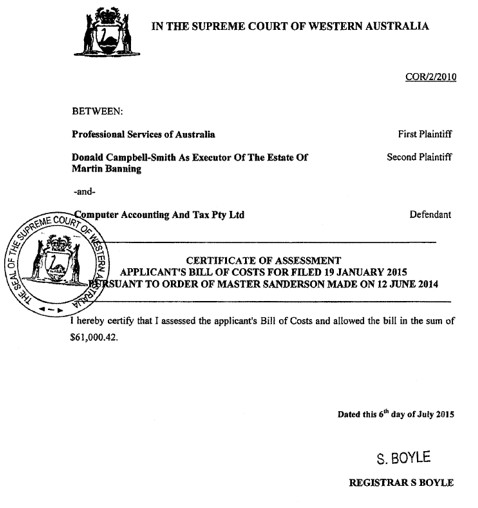
49 The Bankruptcy Notice, which was in standard template form, stated that it was issued in the name of two creditors, being the Liquidator and CAT, who were owed “the following debt” in the amount of $61,000.42, “as per the attached final judgment/s or final orders”. Attached to the Bankruptcy Notice was the sealed copy of the Certificate of Assessment.
50 Section 40(1)(g) of the Bankruptcy Act relevantly provides that a debtor commits an act of bankruptcy if a creditor who has obtained against the debtor “a final judgment or final order”, which has not been stayed, has served on the debtor a bankruptcy notice under the Act and the debtor does not, within the time fixed for compliance, comply with the notice. Section 41(3)(a) further provides, in effect, that a bankruptcy notice shall not be issued in relation to a debtor except on the application of a creditor who has obtained against the debtor a “final judgment or final order within the meaning of paragraph 40(1)(g)”.
51 As the primary judge stated, at PJ [33], the Certificate of Assessment is not a judgment. It is, however, deemed to be a judgment, and enforceable as such, by reason of Order 66, r 57 of the WASC Rules, which provides:
57. Taxing officer’s certificate enforceable as judgment
The costs allowed by the taxing officer on any interim or final certificate of taxation shall be deemed to be a judgment of the Court, and shall be recoverable accordingly.
52 Justice Colvin reached the same conclusion in the sequestration judgment, at [2], citing Calandra v Murden [2015] NSWCA 231 at [5] (Beazley P, Meagher and Leeming JJA).
53 We therefore reject the appellants’ submission that the Bankruptcy Notice did not satisfy the requirements of s 40(1)(g) of the Bankruptcy Act, because it was based on the Certificate of Assessment, which is deemed to be a judgment, and the amount referred to in the Certificate of Assessment was recoverable accordingly, as though it were a judgment.
54 The appellants’ submission that the Certificate of Assessment was invalid because it was not signed by the Registrar or properly authenticated, and therefore enforceable as a judgment, under the WASC Rules, is similarly rejected. Order 43 r 3 of the WASC Rules provides:
3. Authentication of judgments and orders
(1) Every judgment or order shall be marked to show by whom it was made.
(2) An order is sufficiently authenticated if signed by the registrar and sealed with a seal of the Court.
55 As mentioned above, there were two Certificates of Assessment. The second Certificate of Assessment, which was annexed to the Bankruptcy Notice, bore the seal of the Supreme Court of Western Australia and a stamp in the place for signature of Registrar Boyle. It is unnecessary to decide whether the stamp was a sufficient substitute for the signature of Registrar Boyle because of the effect of s 150(1)(f) of the Evidence Act 1995 (Cth), which provides:
150 Seals and signatures
(1) If the imprint of a seal appears on a document and purports to be the imprint of:
…
(f) the seal of a court or tribunal established by a law of a State;
it is presumed, unless the contrary is proved, that the imprint is the imprint of that seal, and the document was duly sealed as it purports to have been sealed.
56 The primary judge, at PJ [35], referred to a similar provision under s 80 of the Evidence Act 1906 (WA). Nevertheless, by reason of s 150(1)(f) of the Evidence Act, the Court was entitled to treat the sealed Certificate of Assessment as a valid order of the Supreme Court of Western Australia.
57 The submissions made before the primary judge to the effect that the Bankruptcy Notice was invalid because it named two creditors, instead of one, and the discrepancies in that regard between the Bankruptcy Notice, on the one hand naming two creditors, and the Certificate of Assessment and indemnity costs order, on the other hand naming the “applicant”, singular, was raised at the hearing of the creditors’ petition before Colvin J. At that hearing, Colvin J also considered arguments put by the appellants regarding the fact that the Liquidator had incurred the legal costs which were the subject of the bill of costs assessed by Registrar Boyle.
58 As Colvin J put it succinctly in the sequestration judgment, at [180]–[182]:
180. Accordingly, liability for the costs the subject of the indemnity costs order was incurred by Mr Kitay as liquidator, not by CAT. The application that was determined by Master Sanderson was brought by Mr Kitay. Orders were made on the application of Mr Kitay. Those orders provided for an order for indemnity costs in favour of both Mr Kitay and CAT as applicants in the substantive winding-up proceedings (being the proceedings in which the interlocutory application was made for orders concerning the Confidential Affidavit).
181. The bill of costs was presented by both Mr Kitay and CAT as the applicants. However, the only costs claimed in the bill were costs that had been incurred by Mr Kitay. The claim to the costs in the bill did not depend upon a claim that costs had been incurred by CAT. The indemnity costs order did not apply only to costs jointly incurred by Mr Kitay and CAT. It is an order in favour of each of them. No claim is advanced by the petitioning creditors that the costs that were assessed by Registrar Boyle were incurred by CAT. They rely upon the terms of engagement agreed between Mr Kitay and HSF.
182. Although the petition for sequestration orders is presented by both Mr Kitay and CAT, it is sufficient if Mr Kitay demonstrates that he is a judgment creditor in respect of the costs the subject of the assessment. For reasons I have expressed elsewhere in these reasons, he has done so.
59 The appellants did not seek to appeal the sequestration order, which as the primary judge observed, at PJ [38]–[39], is final and binding unless and until set aside.
60 Grounds one, two and five should therefore be dismissed. As a result, it is unnecessary to address Grounds three and four.
61 Ground six concerned the primary judge’s orders as to costs made in Frigger (No 10). It might repay to consider how those orders came about. Immediately following his dismissal of the substantive proceeding, the primary judge entertained oral submissions as to costs, following which he made orthodox orders. They were silent as to the basis upon which costs might be assessed (at that point, the parties had not had an opportunity to digest his Honour’s reasons) and said nothing about the sum that the appellants had paid several years earlier by way of security (in satisfaction of an order made by a different judge). A few weeks later, an application was made to his Honour and those two issues were put more firmly in focus. The result was the orders that his Honour made on 5 March 2025.
62 By those orders, his Honour purported to vary, under rr 39.05(h) and/or 40.02 of the Rules, the costs orders that he had made in Frigger (No 9). That course was preferred in a context where, so his Honour accepted, certain oversights or misunderstandings (by or as between the court and the Liquidator’s counsel) had affected the earlier orders. The appellants maintained that nothing had been overlooked or misunderstood; or, at least, not in such a way as to vest in the court authority to amend its own orders once entered. They made an ambitious (and, ultimately, unsuccessful) application of their own for the return of the sum that they had paid as security (apparently on the basis that the costs orders that his Honour had made were made payable by their estates, rather than by them personally).
63 The appellants contended that the primary judge had no power to amend the costs orders that he made on 13 December 2024. That contention cannot be accepted. The primary judge’s findings as to the facts that enlivened r 39.05(h) are, with respect, cogent and well-supported by the objective circumstances that presented before him; and, to the extent that they involved findings that the court had laboured under relevant misunderstandings or oversights, were matters that his Honour was uniquely positioned to assess. To the extent that it might be in doubt, we otherwise respectfully agree with the conclusions that his Honour reached in respect of his power to make the orders that he made: Frigger (No 10), [10], [17]–[25]. The appellants’ submissions were misconceived and this ground should similarly be dismissed.
the Appellants’ proposed further submissions
64 On 2 April 2026, after the appeal had been heard, the appellants sought leave to file further written submissions. The further submissions were said to arise out of a “finding” made in a judgment delivered by Colvin J in Frigger v Trenfield (Cost Referee Report Adoption) [2026] FCA 218. The appellants contended that Colvin J’s judgment contained a “finding of fact and law” regarding the Trustee’s performance of her responsibilities as trustee in bankruptcy. The appellants submitted that leave to file the further written submissions should be granted because the relevant “finding” on which they relied arose after the appeal was heard.
65 The matter before Colvin J concerned an application for an order to adopt a referee report as to the quantum of the Trustee’s costs, for which the appellants were liable having sought and obtained leave to discontinue the proceeding. As is clear from Colvin J’s decision, at [1], the matter proceeded on “common ground … that [the Trustee] carried on her responsibilities as trustee as an employee of FTI Consulting (Australia) Pty Ltd”. This was the relevant “finding” on which the appellants relied for the purpose of their further written submissions.
66 The appellants’ further submissions proceed on a false premise. There was no “finding” as such because, as is clear from Colvin J’s decision, the matter proceeded on “common ground” in relation to the asserted matter relied on by the appellants. Even if his Honour did make “findings” as contended, they would not have wider implications, including for this appeal, given the limited nature of the issues before his Honour.
67 In any event, even if leave to file the further submissions was granted, the further submissions were expressed to be relevant to the exercise of the Court’s discretion under s 153B under the second step in the annulment process. As the appeal failed at the first step, it would not have been necessary to deal with the further submissions and the Grounds of appeal to which they were expressed to relate.
68 For those reasons, leave to file the further written submissions is refused.
conclusion
69 For the foregoing reasons, the appeal and the applications to adduce further evidence on the appeal should be dismissed, with costs.
I certify that the preceding sixty-nine (69) numbered paragraphs are a true copy of the Reasons for Judgment of the Honourable Justices Snaden, Neskovcin and Owens. |
Associate:
Dated: 19 May 2026


