

Federal Court of Australia
Kuksal v Victorian Legal Services Board (Appeal and Interlocutory Matters) [2026] FCAFC 65
Appeal from: | Victorian Legal Services Board v Kuksal (Sequestration Order) [2025] FCA 999 |
File number: | VID 1279 of 2025 |
Judgment of: | BEACH, SHARIFF AND STELLIOS JJ |
Date of judgment: | 12 May 2026 |
Date of publication of reasons: | 20 May 2026 |
Catchwords: | BANKRUPTCY AND INSOLVENCY — appeal against sequestration orders — validity of bankruptcy notices — whether multiplicity of notices gave rise to an abuse of process — whether notices were invalid because of joint and several liability — whether notices were invalid due to methods of service — whether available acts of bankruptcy — whether satisfactory proof of debts and amounts owing required under s 52(1) of the Bankruptcy Act 1966 (Cth) — whether primary judge should have gone behind the various judgment debts concerning costs — whether there was “other sufficient cause” established under s 52(2)(b) of the Act that enlivened the discretion not to make the sequestration orders — whether there was a reasonable apprehension of bias concerning the primary judge — whether there was a reasonable apprehension of bias concerning one or more members of the Full Court – other interlocutory questions — appeal dismissed |
Legislation: | Bankruptcy Act 1966 (Cth) ss 40(1)(g), 41, 43(1), 44(1), 47, 52 Federal Court of Australia Act 1976 (Cth) ss 23P, 24, 27, 37(1)(a), 37AF, 37AG(1)(a) Bankruptcy Regulations 2021 (Cth) reg 10A Federal Court (Bankruptcy) Rules 2016 (Cth) r 4.05 Legal Profession Uniform Law Application Act 2014 (Vic) reg 102 Legal Profession Uniform Law (Vic) |
Cases cited: | Australia Bay Seafoods Pty Ltd v Northern Territory of Australia (2022) 295 FCR 443; [2022] FCAFC 180 Brouwer v Titan Corp Ltd (1997) 73 FCR 241 Carr v Finance Corp of Australia Ltd (No 1) (1981) 147 CLR 246 Charisteas v Charisteas [2021] HCA 29; 273 CLR 289 City of Swan v Lehman Bros Australia Ltd (No 3) [2009] FCA 1190 Cubillo v Commonwealth of Australia (2001) 112 FCR 455; [2001] FCA 1213 Director of Public Prosecutions (DPP) v Smith [2024] HCA 32; 419 ALR 212 Ebner v Official Trustee in Bankruptcy [2000] HCA 63; 205 CLR 337 Glew v Harrowell, in the matter of Glew (2003) 198 ALR 331; [2003] FCA 373 Guss v Johnstone (2000) 171 ALR 598 Johnson v Johnson [2000] HCA 48; 201 CLR 488 Johnson Tiles Pty Ltd v Esso Australia Pty Ltd (2000) 104 FCR 564; [2000] FCA 1572 Kuksal v Victorian Legal Services Board [2024] VSC 732 Kuksal v Victorian Legal Services Board [2025] FCA 1483 Liang v LV Property Investments Pty Ltd [2015] FCA 1057 Licul v Corney (1976) 180 CLR 213 Ling v Enrobook Pty Ltd (1997) 74 FCR 19 Michael Wilson & Partners Ltd v Nicholls (2011) 244 CLR 427 QYFM v Minister for Immigration, Citizenship, Migrant Services and Multicultural Affairs [2023] HCA 15; 279 CLR 148 Royal v El Ali (No 3) [2016] FCA 1573 Sanofi v Parke Davis Pty Ltd (1982) 149 CLR 147 Self Care Corporation Pty Ltd v Green Forest International Pty Ltd (No 15) [2023] FedCFamC2G 1085 SunshineLoans Pty Ltd v Australian Securities and Investments Commission [2026] HCA 8 Timeless Sunrise Pty Ltd v BigJ Enterprises Pty Ltd (No 12) [2024] VSC 588 Toyota Finance Australia Limited v Berro [2022] FCA 497 Victorian Legal Services Board v Kuksal (Interlocutory Matters) [2025] FCA 801 Victorian Legal Services Board v Kuksal (No 2) [2025] FCA 646 Victorian Legal Services Board v Kuksal (Recusal Application) [2025] FCA 828 Victorian Legal Services Board v Kuksal (Sequestration Order) [2025] FCA 999 Victorian Legal Services Board v Kuksal [2025] FCA 558 Zreika v Royal (2019) 271 FCR 65; [2019] FCAFC 82 |
Division: | General Division |
Registry: | Victoria |
National Practice Area: | Commercial and Corporations |
Sub-area: | General and Personal Insolvency |
Number of paragraphs: | 430 |
Date of hearing: | 18 March, 11 and 12 May 2026 |
Counsel for the appellants | The appellants appeared in person |
Counsel for the first to fourth respondents: | Ms K Foley KC and Mr A Silver (18 March 2026) |
Solicitors for the first to fourth respondents: | Corrs Chambers Westgarth |
ORDERS
VID 1279 of 2025 | ||
| ||
BETWEEN: | SHIVESH KUKSAL First Appellant LULU XU Second Appellant PETER ANSELL Third Appellant | |
AND: | VICTORIAN LEGAL SERVICES BOARD First Respondent DAMIAN NEYLON Second Respondent GORDON COOPER (and others named in the Schedule) Third Respondent | |
order made by: | BEACH, SHARIFF AND STELLIOS JJ |
DATE OF ORDER: | 12 May 2026 |
OTHER MATTERS:
The stay referred to in order 3 is made under s 23 of the Federal Court of Australia Act 1976
(Cth) and r 41.03 of the Federal Court Rules 2011, as distinct from s 52(3) of the Bankruptcy Act 1966 (Cth). The stay does not operate as a suspension as such of the sequestration orders as referred to in s 37(2)(a) of the latter Act.
THE COURT ORDERS THAT:
1. The appeal from the orders and determinations of Downes J made on 27 August 2025 be dismissed.
2. As to the orders and determinations of Downes J, Lee J and Meagher J referred to in paragraphs 1 to 6 and the last sentence of paragraph 7 of the amended notice of appeal:
(a) to the extent that the appellants are out of time for making any application for leave to appeal from such orders or determinations, any extension of time to make such an application is refused; and
(b) to the extent that the appellants are within time for making any application for leave to appeal from such orders or determinations, leave to appeal is refused.
3. Until the hearing and determination of any application in the High Court for special leave to appeal or any proceeding in that Court for the issue of prerogative writs concerning these orders or until further order, there be a stay of all proceedings and actions against the appellants under the sequestration orders made against them and their estates by Downes J.
4. Pursuant to s 33(1)(c) of the Bankruptcy Act 1966 (Cth) but only to the extent that any time limit for taking a step or doing an act under that Act has not already expired, that time be extended to 4.00 pm on the next business day falling after the hearing and determination of any application or proceeding referred to in order 3.
5. Orders 2 and 3 of the orders made by Beach J on 28 November 2025 concerning questions of confidentiality be varied such that:
(a) in order 2, the words “Subject to further order” be deleted and the words “Until 4.00 pm on 12 June 2026 or further order” be substituted; and
(b) in order 3, the words “Subject to further order” and the words “until the hearing and determination of the appellants’ appeal” be deleted, with order 3 to begin “Until 4.00 pm on 12 June 2026 or further order”.
6. The costs of the Victorian Legal Services Board and the second to fourth respondents of and incidental to the appeal and all applications for an extension of time, applications for leave to appeal and other interlocutory applications filed within or as part of proceeding VID1279/2025 be treated as their costs in and to be paid out of the bankrupt estates of each of the appellants.
7. Any further issues concerning stays, costs or confidentiality questions be dealt with on the papers.
8. Liberty to apply.
Note: Entry of orders is dealt with in Rule 39.32 of the Federal Court Rules 2011.
REASONS FOR JUDGMENT
THE COURT:
1. INTRODUCTION
1 There is an apparent appeal before the Court from a number of orders and judgments. For the reasons that follow, the appeal is incompetent in several respects and should otherwise be dismissed to the extent that it is not. We deal with these matters in Part A below.
2 During the conduct of the appeal, the appellants also made a number of interlocutory applications. We address these in Part B below.
3 In relation to the application made by the appellants that Beach J be recused from the hearing and determination of the appeal, Shariff and Stellios JJ have expressed a preference for providing separate reasons, which their Honours have set out below. Other than those separate reasons, what follows are the reasons of the Court.
PART A: THE APPEAL
2. BACKGROUND
4 The essential factual background is set out most conveniently in Lee J’s judgment in Victorian Legal Services Board v Kuksal (Interlocutory Matters) [2025] FCA 801 at [3]–[11] (the Interlocutory Matters Judgment). For convenience, we set out the essential aspects of that background to enable an understanding of the present appeal.
5 It is uncontroversial that sometime in the middle of 2021, the Victorian Legal Services Board (VLSB) exercised powers under the Legal Profession Uniform Law Application Act 2014 (Vic) and the Legal Profession Uniform Law (Vic) to commence an investigation into the behaviour of the first appellant (Mr Kuksal) and the second appellant (Ms Xu) relating to the conduct of a business known as “RM Legal Consultants” and “Law Innovation”. Those investigations were later extended to include the third appellant (Mr Ansell) and related to the conduct of an entity named “People Shop Pty Ltd” (People Shop) trading as “New Edge Law” and/or “Erudite Legal”.
6 The VLSB allege that Mr Kuksal and Ms Xu have not been admitted to legal practice and did not hold practising certificates and, although Mr Ansell was admitted to legal practice, it was alleged he ceased to hold a practising certificate from 18 October 2022 onwards.
7 By August 2022, the VLSB had appointed an external manager to the law practice conducted by People Shop.
8 Thereafter, there have been a series of proceedings in the Supreme Court of Victoria. Their details are presently unnecessary to consider. What is presently most relevant is that various costs orders were made in those proceedings in favour of the VLSB and other parties. These costs orders are relevant in that they came to form the basis upon which the Official Receiver, being the Australian Financial Security Authority (AFSA), issued three bankruptcy notices to each of the appellants (the bankruptcy notices) pursuant to s 41 of the Bankruptcy Act 1966 (Cth) (Bankruptcy Act).
9 Each bankruptcy notice related to costs orders made against one or all of the appellants (and some were also made against other parties as well).
10 The costs orders which underlie the bankruptcy notices arose from three proceedings in the Victorian Supreme Court, being proceeding S ECI 2022 03994, proceeding S ECI 2022 04028, and proceeding S ECI 2022 04527. These costs orders were made by Gorton J of the Supreme Court of Victoria with two of them being dated 7 September 2023, and the others were respectively dated 19 February 2024, 8 March 2024 and 5 December 2024 (the Costs Orders).
11 On the VLSB’s case, the bankruptcy notices were not satisfied, which gave rise to an “act of bankruptcy” and entitled it to seek sequestration orders under the Bankruptcy Act. This led to proceedings being commenced by the VLSB in this Court (VID 222 of 2025), which were allocated in due course to the docket of Downes J (Bankruptcy Proceedings). In these proceedings, the VLSB (together with certain other creditors) made an application for sequestration orders against each of Mr Kuksal, Mr Ansell and Ms Xu. The appellants opposed the making of the sequestration orders on various grounds including that the relevant Costs Orders were procured by fraud or are otherwise irregular or void. It was further asserted that the Bankruptcy Proceedings are an abuse of process on the basis that they were said to have been commenced by the VLSB to punish the appellants or to deter them from pursuing complaints of misconduct made against the VLSB.
12 Additionally, the VLSB brought applications against the appellants in this Court in proceedings VID 642 of 2025 (the Collateral Proceedings). The VLSB sought, amongst other things, interlocutory relief restraining the Mr Kuksal, Mr Ansell and Ms Xu from conduct which was said to amount to a threatened abuse of process or threatened conduct that would otherwise constitute a contempt of court and orders with respect to the removal of documents accepted for filing and from the Court file, the inspection of documents and suppression. In the Collateral Proceedings, Meagher J made orders on 21 May 2025 for the reasons set out in Victorian Legal Services Board v Kuksal [2025] FCA 558 (the Collateral Proceedings Judgment). Meagher J made orders which were expressed to continue in operation “until the hearing and determination of the [VLSB’s] interlocutory application filed in [the Collateral Proceedings] on 21 May 2025 or further order …”. Her Honour also made suppression and non-publication orders pursuant to ss 37AF(1)(b) and 37AG(1)(a) of the Federal Court of Australia Act 1976 (Cth) (the FCA Act).
13 Thereafter, various interlocutory applications were brought before Lee J including the following:
(a) an application by which Mr Kuksal, Mr Ansell and Ms Xu sought the disqualification of Downes J from the further conduct of the Bankruptcy Proceedings and the Collateral Proceedings;
(b) various claims made by Mr Kuksal, Mr Ansell and Ms Xu by which they contended that the VLSB has acted in contempt of court, the solicitors acting on behalf of the VLSB were accessories in the VLSB’s conduct in contempt of court and a number of ancillary matters including issues identified in a s 78B notice filed by the appellants in the Bankruptcy Proceedings pursuant to the Judiciary Act 1903 (Cth) (Filed s 78B Notice);
(c) an informal oral application for judicial review arising from the rejection by Judicial Registrar Schmidt of an affidavit of Mr Kuksal affirmed 23 June 2025, a further s 78B notice dated 30 June 2025 and an affidavit of Ms Xu affirmed 30 June 2025;
(d) an application made by the VLSB for orders seeking that an affidavit of Ms Xu made on 13 May 2025 be removed from the Court file and an order that certain allegations referred to in that Affidavit not be made in the Bankruptcy Proceedings; and
(e) an application made by Mr Kuksal, Mr Ansell and Ms Xu that the Court set aside the orders made by Meagher J,
(the Interlocutory Matters).
14 Lee J did not determine the application that Downes J be disqualified and left that as a matter for her Honour to deal with. In the Interlocutory Matters Judgment, Lee J gave reasons for determining the other Interlocutory Matters and made orders, which, on the whole, were adverse to Mr Kuksal, Mr Ansell and Ms Xu. Lee J also made orders in respect of non-publication and suppression under ss 37AF(1)(b) and 37AG(1)(a) of the FCA Act. Lee J made two sets of orders on 9 July 2025. One set of orders were made in the Bankruptcy Proceedings (Lee J’s Bankruptcy Proceedings Orders) and the other in the Collateral Proceedings (Lee J’s Collateral Proceedings Orders).
15 In the substantive Bankruptcy Proceedings, on 17 June 2005, Downes J listed the matter for final hearing: Victorian Legal Services Board v Kuksal (No 2) [2025] FCA 646 (the Listing Judgment).
16 Then, on 23 June 2025, the Mr Kuksal, Mr Ansell and Ms Xu filed an interlocutory application seeking an order that Downes J recuse herself from hearing the Bankruptcy Proceedings and the Collateral Proceedings. Downes J dismissed that application: Victorian Legal Services Board v Kuksal (Recusal Application) [2025] FCA 828 (Downes J) (the Recusal Judgment).
17 In the lead up to the hearing of the Bankruptcy Proceedings, Downes J made orders for non-publication and suppression on 21 July 2025 and further such orders on 22 July 2025.
18 Downes J heard the Bankruptcy Proceedings between 28 and 30 July and on 15 August 2025. Mr Kuksal, Mr Ansell and Ms Xu made a further application that Downes J recuse herself. On 27 August 2025, Downes J made various orders for the reasons set out Victorian Legal Services Board v Kuksal (Sequestration Order) [2025] FCA 999 (the Sequestration Order Judgment or PJ). Her Honour’s orders included:
(a) an order sequestering the estates of Mr Kuksal, Mr Ansell and Ms Xu (the Sequestration Order);
(b) an order that the applicant creditors’ costs and the costs of the supporting creditor, including reserved costs, be taxed and paid from the estates of Mr Kuksal, Mr Ansell and Ms Xu;
(c) orders for non-publication and suppression under ss 37AF(1) and 37AG(1)(a) of the FCA Act.
19 Her Honour also dismissed the further recusal application and her reasons are set out in Annexure A to the Sequestration Order Judgment.
3. THE NOTICE OF APPEAL
20 The appeal proceeds on the basis of the Amended Notice of Appeal filed on 1 October 2025. In the section of the Amended Notice of Appeal entitled “Orders Subject to Appeal”, the appellants say that they appeal from the following:
1. The orders and determinations made by the Honourable Justice Kylie Elizabeth Downes on 17 June 2025 in the proceeding VID 222/2025 [Bankruptcy Proceeding], as referred to in the order and reasons published by Justice Downes.
2. Paragraphs 2-9 of the order, made on 9 July 2025, and associated adverse determinations against the Appellants, recorded in the reasons for judgment, delivered ex tempore by the Honourable Justice Michael Lee on 8 July 2025 in the Bankruptcy Proceeding.
3. Paragraph 8 of the order and related determinations made by the Honourable Justice Fiona Meagher on 21 May 2025 in the proceeding VID 222/2025 [Suppression Proceeding], as recorded in the reasons for judgment published by Her Honour on 28 May 2025.
4. The orders and determinations made by Justice Downes, as referred to in the order and reasons for judgment,4 delivered on 21 July 2025 in the Bankruptcy Proceeding.
5. Paragraphs 2-3 of the order made by Justice Downes on 21 July 2025 to suppress the affidavit of Mr Thomas Christian Flitner, filed in the Bankruptcy Proceeding.
6. Paragraph 2 of the order made by Justice Downes on 22 July 2025 to suppress the documents sought to be filed by the Appellants in the Bankruptcy Proceeding.
7. The orders and determinations made by Justice Downes, as referred to in the order [Downes Bankruptcy Order] and reasons for judgment (including all the rulings listed in the “Annexure - Reasons for Rulings”), delivered on 27 August 2025 in the Bankruptcy Proceeding. This includes the determinations made by Her Honour between 28 July 2025 and 27 August 2025, referred to or improperly omitted from the reasons for judgment.
21 The appellants made a number of applications in the conduct of the appeal. In doing so, the appellants filed various documents with the Court’s registry and sent numerous emails to Chambers. We deal with these applications in Part B below.
4. THE APPELLANTS’ CONDUCT IN PROSECUTION OF THE APPEAL
22 It is necessary to say something about the appellants’ conduct in the prosecution of their appeal.
23 The Notice of Appeal was filed on 24 September 2025. It was a single document filed by each of the appellants. The Amended Notice of Appeal was filed on 1 October 2025. It too was a single document filed by each of the appellants.
24 On 14 November 2025, orders were made for the filing and service of submissions by the appellants and the respondents for the purpose of the appeal. The appeal was listed for a single day hearing on 18 March 2026. The appellants did not file any substantive submissions in support of the Amended Notice of Appeal as required by the orders of the Court. Instead, as we have adverted to above, the appellants made a number of applications including for the recusal of Beach J from the hearing and determination of the appeal. Various documents including submissions were filed or emailed to Chambers in support of these applications.
25 At the hearing of the appeal on 18 March 2026, Mr Kuksal addressed the Court for almost the entirety of that day in support of the application for the recusal of Beach J. The substantive matters raised in the appeal were not addressed. As a result, the Court listed the hearing of the appeal for a further two days on 11 and 12 May 2026.
26 In advance of the hearing of the appeal on 11 and 12 May 2026, the appellants again filed various documents or emailed them to Chambers. These were almost exclusively focussed upon interlocutory and associated applications that we deal with separately in Part B below. Some of these documents touched upon the matters arising in the substantive appeal but they were interspersed amongst the many matters of an interlocutory nature raised by the appellants.
27 At and during the hearing of the appeal on 11 and 12 May 2026, the appellants continued to provide documents to the Court by email that were in the form of submissions in support of their interlocutory applications, but some of these also addressed the substantive matters raised in the appeal. Despite the late provision of these documents and the absence of notice to the respondents, during the hearing of the appeal we ultimately indicated that we would grant leave for these submissions to be relied upon and have had regard to them to the extent that they contained matters relevant to the determination of the appeal.
28 It is also necessary to observe that throughout the conduct of the appeal, the various documents provided to the Court were mostly provided by Mr Kuksal and supported by Ms Xu and Mr Ansell. Ms Xu did ultimately provide some submissions on her own behalf on the second day of the resumed hearing of the appeal on 12 May 2026. Mr Kuksal made oral submissions on his own behalf, with Mr Ansell indicating that he supported Mr Kuksal’s written and oral submissions. When Mr Ansell was asked to address and assist the Court in relation to the substantive appeal, he was unable to provide any substantive assistance beyond indicating that he relied on Mr Kuksal’s submissions. Ms Xu also supported Mr Kuksal’s submissions but indicated that she had her own interests and wished to be heard separately to Mr Kuksal. She was given that opportunity and, as indicated above, was also granted leave to rely upon separate written submissions she belatedly provided to the Court. In the result, Ms Xu’s written submissions were far better at articulating the appellants’ contentions in the substantive appeal than the documents relied upon by Mr Kuksal.
29 In all, the Court dedicated three hearing days to the conduct of the appeal. Mr Kuksal addressed the Court for the majority of those three days, though Ms Xu was also given the opportunity to do so, as was Mr Ansell. Mr Kuksal’s oral and written submissions may be fairly characterised as intemperate and disrespectful. It is unnecessary to say more, but the way that he conducted himself will be apparent from the transcripts of the hearing before the Court.
5. INCOMPETENCY OF THE APPEALS IN RELATION TO INTERLOCUTORY ORDERS
30 As best can be discerned from the Amended Notice of Appeal, the appellants seek to challenge:
(a) the orders made by Downes J dated 17 June 2025 as reflected in the Listing Judgment;
(b) certain of Lee J’s Bankruptcy Proceedings Orders;
(c) the suppression orders made by Meagher J;
(d) the suppression orders made by Downes J on 21 July 2025 and further such orders made on 22 July 2025;
(e) the orders made by Downes J in the Sequestration Order Judgment and certain other orders said to have been made by her Honour during the hearing of the Bankruptcy Proceedings.
31 Save in relation to the matters dealt with in the Sequestration Orders Judgment, the appeal is not competent without leave being granted. Further, any such application for leave to appeal would require an extension of time as each of the orders appealed from have been made outside the periods specified for the institution of applications for leave to appeal and appeal.
32 It is necessary to briefly explain why by reference to basal principles as to the appellate jurisdiction of the Court and the determinations made by each of the respective judges.
5.1 The appellate jurisdiction of the Court
33 Division 2 of Pt III of the FCA Act is headed “Appellate and related jurisdiction (civil proceedings).” That division consists of ss 23P to 30. Section 23P states that Div 2 applies to the Court’s appellate jurisdiction in relation to civil matters.
34 The appellate jurisdiction of the Court is conferred under s 24(1) of the FCA Act. Section 24(1)(a) gives the Court jurisdiction to “hear and determine…appeals from judgments of the Court constituted by a single Judge exercising the original jurisdiction of the Court”. This is the only provision conferring appellate jurisdiction on the Court in respect of a judgment of a single judge of the Court.
35 However, relevantly, s 24(1A) provides:
(1A) An appeal shall not be brought from a judgment referred to in subsection (1) that is an interlocutory judgment unless the Court or a Judge gives leave to appeal.
36 This provision makes plain that an application for leave to appeal is required where the judgment is interlocutory.
37 In addition, s 24(1D) prescribes certain types of judgment which are “taken to be interlocutory judgments” for the purposes of s 24(1A). Section 24(1D)(c) makes plain that an order made by the Court under s 37AF is taken to be an interlocutory judgment.
38 In relation to the other various orders made that are under challenge, the test for determining whether a judgment or order appealed from is final or interlocutory is whether the judgment or order, as made, finally determines the rights of the parties: Australia Bay Seafoods Pty Ltd v Northern Territory of Australia [2022] FCAFC 180; 295 FCR 443 at [70] (Besanko, Charlesworth and O’Bryan JJ) citing Cubillo v Commonwealth of Australia [2001] FCA 1213; 112 FCR 455 at [182] (Sackville, Weinberg and Hely JJ), applying Carr v Finance Corporation of Australia Ltd (No 1) [1981] HCA 20; 147 CLR 246 at 248 (Gibbs CJ) and 253–254 (Mason J) and Sanofi v Parke Davis Pty Ltd (No 1) [1982] HCA 9; 149 CLR 147 at 153 (Gibbs CJ, Stephen and Mason JJ).
39 The test depends on whether the legal, not the practical, effect of the judgment is final; the legal effect of a judgment is not final where it would be open to a party to bring a second application, even if it would be doomed to fail: Australia Bay Seafoods at [70], citing Carr at 248, 256 and Brouwer v Titan Corporation Ltd (1997) 73 FCR 241 at 242.
40 Further, one is considering the legal effect of the judgment or order as to whether it is interlocutory or final, rather than by reference to the findings which formed part of the reasons for making the judgment or order: Johnson Tiles Pty Ltd v Esso Australia Pty Ltd [2000] FCA 1572; 104 FCR 564 at [45] (French J, with whom Beaumont and Finkelstein JJ agreed at [1] and [99], respectively). Moreover, the question is determined by the nature of the order actually made, not the nature of the application made to the Court: Licul v Corney [1976] HCA 6; 180 CLR 213 at 225 (Gibbs J).
5.2 The appeals from the suppression orders made by Meagher J, Lee J and Downes J
41 The Amended Notice of Appeal seeks to appeal from various of the non-publication orders made by Meagher J, Lee J and Downes J. Each of those orders was made under s 37AF of the FCA Act. By dint of s 24(1D)(c), these orders are taken to be interlocutory. It follows that leave to appeal is required. No such leave was sought and, even if it was, such an application would need to be supported by an application for an extension of time given that the time for bringing such applications has well passed. It follows that the appeals from these orders are incompetent and the appeals in this respect must be dismissed.
5.3 The orders made by Downes J in the Listing Judgment
42 The orders that Downes J made on 17 June 2025 had the effect of listing the Bankruptcy Proceedings for final hearing. These were clearly procedural and, therefore, interlocutory orders. Leave is required to appeal from them. The appeal in respect of these orders is also incompetent. The appeal in relation to these orders also requires an extension of time, which we would not grant in any event.
5.4 The orders made by Lee J
43 Aside from making non-publication and suppression orders under s 37AF of the FCA Act, Lee J made orders dismissing the interlocutory relief sought before his Honour and made certain other procedural orders. These orders were made in the context of various interlocutory applications that had been made before his Honour which we have set out above. The appeal from these orders is also incompetent and requires an extension of time that we would not grant, and, therefore, this aspect of the appeal must be dismissed.
5.5 The appeals from the decisions made by Downes J refusing the applications that she be recused
44 As set out above, Downes J dealt with applications for recusal on two relevant occasions.
45 On 21 July 2005, Downes J dismissed an application made on 23 June 2025 made by Mr Kuksal, Mr Ansell and Ms Xu that she recuse herself from hearing the Bankruptcy Proceedings and the Collateral Proceedings. Downes J dismissed that application for the reasons set out in the Recusal Judgment.
46 Downes J also dismissed a similar application that was made during the hearing of the Bankruptcy Proceedings and set out her reasons for doing so in Annexure A of the Sequestration Order Judgment.
47 Whether an order to refuse an application for recusal is interlocutory or final depends on the context. In Michael Wilson & Partners Ltd v Nicholls [2011] HCA 48; 244 CLR 427, Gummow ACJ, Hayne, Crennan and Bell JJ determined that there was no relevant reasonable apprehension of bias in the trial judge (Einstein J) refusing an application for recusal. It was therefore not strictly necessary for their Honours to determine whether such orders were interlocutory in nature. Nevertheless, their Honours stated at [76]–[77]:
It is well established that a party to civil proceedings may waive an objection to a judge who would otherwise be disqualified on the ground of actual bias or reasonable apprehension of bias. (It may well be that the principle extends to criminal proceedings but that issue need not be considered.) If a party to civil proceedings, or the legal representative of that party, knows of the circumstances that give rise to the disqualification but acquiesces in the proceedings by not taking objection, it will likely be held that the party has waived the objection.
Here, of course, the respondents did object to Einstein J trying the proceeding. They did not waive their objection by any failure to raise the point. But could they, having failed in their application to have Einstein J recuse himself, raise the issue on appeal against the final judgment entered at trial?
48 What their Honours identified was that a party could waive their right to object to a judge who would otherwise be disqualified, but considered whether that party could nonetheless having made such an application and failed thereafter raise it on appeal. In this respect, their Honours stated at [79]–[86]:
In most cases, a judge’s refusal of an application that the judge not try, or continue to try, a case on account of reasonable apprehension of bias will constitute a final determination by the judge that the facts and circumstances relied on by the applicant do not establish the relevant apprehension. In such a case, it may be that an applicant who does not seek to challenge the refusal by seeking leave to appeal should be held to have given up the point.
In this case, if the respondents were right in asserting that there was a reasonable apprehension of bias, the whole of the trial with its attendant expense and use of court time would be wasted. Of course it must be recognised that the respondents in this case had no right to appeal against the refusal of Einstein J to recuse himself. But the respondents did have a right to seek leave to appeal.
As was explained in Gas & Fuel Corporation Superannuation Fund v Saunders, a later interlocutory order made by a judge who has refused an application that the judge not hear the matter on account of a reasonable apprehension of bias is an order against which leave to appeal can be sought on the ground that the judge who made the order should not have done so. Conversely, as Saunders itself illustrates, where a judge allows an application for disqualification and makes orders effecting that decision, leave to appeal can be sought against those orders on the ground that they should not have been made. Thus the order against which the respondents could have sought leave to appeal in this case was whatever order was made by Einstein J after he had refused to recuse himself. If, as the respondents asserted, Einstein J should not have continued to sit in the matter, whatever order was made (other than an order adjourning the case for the purpose of allowing another judge to deal with it) was an order which should not have been made by the judge who made it and would found an application for leave to appeal. And as it happened Einstein J made such an order on 4 June 2009 when he set dates for compliance with the general requirements for trial of proceedings in the Equity Division.
In so far as Barton v Walker holds to the contrary, that decision should not be followed. The decision in Barton v Walker depended upon the proposition that whether a judge should continue to hear a case was a matter only for the judge concerned and that a motion that the judge disqualify himself or herself was “not cognizable”; the judge was held to make no order on the application for disqualification.
The decisions about apprehension of bias that have been given by this court since Barton v Walker show that a judge’s decision to grant or refuse an application for disqualification is not a matter only for the particular judge. As was pointed out in the plurality reasons in Ebner, the apprehension of bias principle has its roots in principles fundamental to the common law system of adversarial trial.
Whether failure to seek leave to appeal against refusal of an application that a judge not try the case on account of a reasonable apprehension of bias precluded maintenance of the complaint in an appeal against the final judgment would require consideration of whether the failure to seek that leave was reasonable. That would require examination of all relevant circumstances. Ordinarily those would include the stage the proceedings had reached when the disqualification application was made and refused and the consequences that would follow from leaving appellate determination of the issue of disqualification until after trial. In this case, trial was fixed to begin within a very short time after the refusal. How much time and money would be spent if the question were to be left over to an appeal against final judgment? The trial of this matter was expected to be very long. A lot of time and money would have been wasted if the judge who tried the proceedings should not have done so.
If it was reasonable in the circumstances of the particular case not to seek leave, and there was no other basis upon which a choice not to persist with the allegation of apprehended bias can be identified as having been made (either then or at some later time), the point would remain open in an appeal against the final judgment. But if it was reasonable in the circumstances to seek leave, and leave was not sought, why should it not be concluded, absent countervailing considerations, that the party making the complaint did not maintain the objection? Simply saying to the opposite party that it is sought to preserve the point for consideration in an appeal against final judgment would not of itself be effective to achieve that result.
As explained earlier these points need not be decided. It is, however, important to add, contrary to what was said in the Court of Appeal, that an application for leave to appeal against the rejection of an application that a judge not hear a matter due to apprehended bias may well be a case where the usual criteria would require leave to be granted, at least if a long and costly trial would be wasted if the judge’s decision were incorrect.
49 Although obiter, what these reasons demonstrate is that much will depend on the circumstances.
50 In the present case, Downes J dealt with two applications for recusal, both of which were dismissed. The first application was determined before the final hearing on 21 July 2005. It may be said that it would have been prudent for the appellants to have sought leave to appeal at this point in time. However, given that the determination was made only a week before the commencement of the final hearing, we do not consider that the applicants could be viewed to have given up the point or waived their right to object. Such an application for leave to appeal may have been seen as an intrusion into the efficiency of the conduct of the final hearing. In any event, the appellants then made a further application for recusal during that final hearing. They seek to challenge both determinations. In the relevant context and circumstances, and having regard to what was said in Michael Wilson, we do not consider that these judgments were interlocutory in nature. We will proceed on the basis that the appeal in these respects is not incompetent.
5.6 Conclusions on incompetency of the appeal
51 It follows that we consider the appeal to be incompetent other than in relation to the Sequestration Order Judgment and the Recusal Judgment. We now turn to address the appeal in respect of those Judgments.
6. APPEAL FROM THE SEQUESTRATION ORDER JUDGMENT AND THE RECUSAL JUDGMENT
52 We have had to discern the appellant’s grounds of appeal and their arguments in support of those grounds from the matters asserted in the Amended Notice of Appeal and so much of the submissions filed or provided by Mr Kuksal and Ms Xu that addressed the matters arising in the appeal. As already noted, Mr Ansell did not provide any separate submissions and indicated that he relied upon Mr Kuksal’s submissions. We have had careful regard to the documents filed and provided by Mr Kuksal and Ms Xu, as well as the matters they raised in oral addresses.
53 We are not satisfied that the appellants have established any of the errors that they allege.
54 Before doing so, it is convenient to briefly summarise the main aspects of the Sequestration Order Judgment.
6.1 The Sequestration Order Judgment
55 As noted above, in the Bankruptcy Proceedings, the VLSB tother with certain other creditors sought sequestration orders against the appellants.
56 Each of the appellants filed a Notice Stating Grounds of Opposition to Creditor’s Petition on 22 July 2025 (Notices). The Notices superseded earlier such notices which had been accepted for filing on 1 April 2025. By the Notices, the appellants essentially raised the same contentions, which by reference to the one filed by Mr Kuksal advanced the following grounds in summary:
(1) Ground 1: The Petition was not personally served on Mr Kuksal (this ground is only raised in Mr Kuksal’s Notice);
(2) Ground 2: No act of bankruptcy has been committed;
(3) Ground 3: No debt is owed to the Applicants because the relevant costs orders were obtained by fraud;
(4) Ground 4: The respondents have genuine and arguable claims against the creditors for amounts that substantially exceed the judgment debt owed by the respondents to the applicants; and
(5) Ground 5: Other sufficient causes exist for the Court to dismiss the creditor’s petition.
57 Thereafter, the appellants made attempts to, and did, file many documents with the Court including affidavits and other documents, as well as sending numerous items of correspondence to her Honour’s Chambers: PJ [7]–[16]. The appellants were given multiple opportunities to file submissions: PJ [16]. During the course of the hearing, Mr Kuksal applied on two occasions to amend the Notice during the course of cross-examining witnesses on the ground that the bankruptcy notices had been issued on the basis of misleading communications made by the VLSB’s lawyers to AFSA and thereby “obtained by fraud”: PJ [214] and [215]. Downes J refused the applications to amend for the reasons set out at PJ [214] and [215] including on the basis that the appellants had “enjoyed ample time and opportunity” to advance their grounds of objection.
58 The final hearing was initially listed for two days but ultimately extended to four days. As we return to below, the necessity for the additional hearing days was caused by the disruptive, discourteous and deplorable conduct of the appellants: PJ [19]–[37].
59 Downes J’s reasons disclose that in determining the application for the sequestration orders and in addressing the various arguments raised by the appellants, her Honour addressed herself to the correct statutory provisions and principles.
60 Most fundamentally, her Honour correctly recognised the essential elements of the statutory scheme enacted in the Bankruptcy Act in relation to the issuing of bankruptcy notices and creditors’ petitions as they are relevant to the determination of an act of bankruptcy: PJ [58]–[62]. We next set out the relevant provisions to which her Honour had regard, which were entirely correct and orthodox.
61 Relevantly, her Honour commenced her analysis of the relevant statutory provisions by setting out that s 41(1) of the Bankruptcy Act provides that an Official Receiver may issue a bankruptcy notice on the application of a creditor who has obtained against a debtor a final judgment or final order that is of the kind described in s 40(1)(g) and is for an amount of at least the statutory minimum. Section 40(1)(g) in turn provides that a debtor commits an act of bankruptcy if:
…a creditor who has obtained against the debtor a final judgment or final order, being a judgment or order the execution of which has not been stayed, has served on the debtor in Australia or, by leave of the Court, elsewhere, a bankruptcy notice under this Act and the debtor does not …comply with the requirements of the notice or satisfy the Court that he or she has a counter-claim, set-off or cross demand equal to or exceeding the amount of the judgment debt or sum payable under the final order…
62 Next, her Honour addressed s 43(1) of the Bankruptcy Act which relevantly provides that, subject to the Act, where a debtor has committed an act of bankruptcy and otherwise meets the territorial connection requirement, the Court may “on a petition presented by a creditor” make a sequestration order against the estate of the debtor. Her Honour then recognised that s 44(1) sets out the conditions on which a creditor may present a petition, which relevantly include that:
(a) there is owing by the debtor to the petitioning creditor a debt that amounts to the statutory minimum;
(b) that debt is a liquidated sum due at law or in equity or partly at law and partly in equity and is payable either immediately or at a certain future time; and
(c) the act of bankruptcy on which the petition is founded was committed within 6 months before the presentation of the petition.
63 Section 52 is essential and her Honour had regard to it. That section provides:
(1) At the hearing of a creditor’s petition, the Court shall require proof of:
(a) the matters stated in the petition (for which purpose the Court may accept the affidavit verifying the petition as sufficient);
(b) service of the petition; and
(c) the fact that the debt or debts on which the petitioning creditor relies is or are still owing;
and, if it is satisfied with the proof of those matters, may make a sequestration order against the estate of the debtor.
…
(2) If the Court is not satisfied with the proof of any of those matters, or is satisfied by the debtor:
(a) that he or she is able to pay his or her debts; or
(b) that for other sufficient cause a sequestration order ought not be made;
it may dismiss the petition.
64 The next parts of Downes J’s reasons record a considered and detailed consideration of the necessary integers in being satisfied that the creditors’ petitions should be upheld and in rejecting the various arguments that the appellants had raised. It is unnecessary for us to set out in detail her Honour’s reasoning process, which is apparent on the face of the reasons. Here, we deal with these reasons in summary form so as to identify the methodical manner in which her Honour addressed the requirements of the relevant statutory provisions and rejected the appellant’s various arguments. Relevantly:
(a) Downes J was satisfied that an act of bankruptcy had occurred (at PJ [65]–[91]) and in coming that conclusion her Honour:
(i) was satisfied that valid bankruptcy notices had been issued, each of which related to a judgment debt arising from the Costs Orders remaining unpaid;
(ii) rejected the appellants’ contentions as to the number of notices issued and the assertion that they had not been correctly served in accordance with the Bankruptcy Regulations 2021 (Cth) (the Bankruptcy Regulations);
(iii) rejected the appellants’ contentions as to whether the appellants were jointly and severally liable to pay some or all of the Costs Orders;
(iv) was satisfied that the 21-day deadline to comply with or contest the Bankruptcy Notices had passed without satisfaction;
(b) Downes J was satisfied that the necessary territorial connection existed because there was no dispute that the appellants were ordinarily resident in Australia at the time of the acts of bankruptcy: PJ [92];
(c) Downes J was satisfied that the respondents had presented valid petitions in respect of the judgment debts the subject of the bankruptcy notices for the purposes of ss 44(1)(a), (b) and (c) of the Bankruptcy Act: PJ [93]–[96];
(d) Downes J was satisfied that the creditors’ petitions were validly served pursuant to r 4.05 of the Federal Court (Bankruptcy) Rules 2016 (Cth) (Bankruptcy Rules) and rejected Mr Kuksal’s contentions that he had not been served including by observing he had filed a Notice of Appearance in the Bankruptcy Proceedings: PJ [97]–[104];
(e) as a result, Downes J was satisfied that the respondents had established each of the formal matters such that the respondents had a prima facie right to a sequestration order: PJ [105]–[111];
(f) Downes J next turned to address s 52 of the Bankruptcy Act, including by specifically considering whether, despite the formal matters being satisfied, there was any other sufficient cause to dismiss the creditor’s petition: PJ [112]–[114];
(g) in assessing this criterion, Downes J considered each of the arguments advanced by the appellants:
(h) her Honour rejected Mr Kuksal’s contention that he had not been validly served with the creditor’s petition: PJ [116];
(i) her Honour rejected the appellants’ contentions that no act of bankruptcy was committed because of the Costs Orders being irregular or unenforceable or because they had applied to set aside the bankruptcy notices: PJ [117]–[119];
(j) her Honour rejected the contention that the Costs Orders were obtained by fraud: PJ [120]–[126];
(k) her Honour rejected the various claims made by the appellants that they had genuine and arguable claims against the respondents such that there was some other sufficient cause to dismiss the creditor’s petition. In doing so, her Honour had regard to the applicants’ various claims including the claim for defamation, the claim for conversion of property unlawfully seized, and the multiple tortious claims that the appellants alleged were available to them, including the general claims for economic loss and expenses: PJ [127]–[148];
(l) her Honour next dealt with and rejected a claim advanced by the appellants that there was other sufficient cause to dismiss the creditors petition because the bankruptcy notices were being challenged in the Administrative Review Tribunal (ART Proceedings): PJ [150]–[151];
(m) her Honour rejected the contentions raised by the appellants that the Bankruptcy Proceedings were an abuse of process: PJ [152]–[160];
(n) her Honour was not satisfied that the appellants’ belated application to seek a stay and appeal of the Costs Orders provided sufficient cause to dismiss the creditor’s petition: PJ [161]–[165];
(o) her Honour then in Annexure A of the reasons, set out detailed reasons for rejecting the recusal application which the appellants agitated at the commencement and throughout the final hearing.
65 Her Honour’s reasons disclose a methodical determination of the issues at hand. As we now address, none of the arguments propounded which the appellants advanced demonstrate any error. The arguments advanced by the appellants did not at all times conform with the grounds advanced in the Amended Notice of Appeal but for completeness we have considered as many of the appellants’ arguments as were comprehensible.
6.2 A general overview of the appellants’ arguments
66 The appellants’ contentions on appeal involved various overlapping complaints including as to the issuing, validity and service of the bankruptcy notices, as well as the VSLB’s motivations in seeking to have AFSA issue those notices to them. These complaints included a challenge to the validity of the debts underlying the bankruptcy notices, the apparent inconsistencies arising from the methods of service adopted in serving those notices, their lack of clarity as to the debts due by each of the appellants in the context of underlying debts for which the appellants were jointly and severally liable, and the existence of arguable off setting claims that each of the appellants have against the VLSB.
67 In advancing these arguments, the appellants paid insufficient regard to essential elements of bankruptcy procedure as enacted under the Bankruptcy Act. In particular, the appellants conflated aspects of the steps relating to the issuing and setting aside of bankruptcy notices with those involved in the making of sequestration orders. In failing to appreciate the related but distinct aspects of these procedures, the appellants’ complaints in relation to Downes J’s reasoning proceeded on a misconceived basis. These relevant distinctions were made plain in Downes J’s reasons, but it is necessary to reiterate them in light of the various contentions made by the appellants.
68 Section 41(1) of the Bankruptcy Act provides that an Official Receiver, which in the present case was AFSA, may issue a bankruptcy notice on the application of a creditor who has obtained against a debtor a final judgment or final order that is of the kind described in s 40(1)(g) and is for an amount of at least the statutory minimum. Relevantly, s 40(1)(g) of the Bankruptcy Act provides that a debtor commits “an act of bankruptcy”:
if a creditor who has obtained against the debtor a final judgment or final order, being a judgment or order the execution of which has not been stayed, has served on the debtor in Australia or, by leave of the Court, elsewhere, a bankruptcy notice under this Act and the debtor does not:
(i) where the notice was served in Australia--within the time fixed for compliance with the notice; or
(ii) where the notice was served elsewhere--within the time specified by the order giving leave to effect the service;
comply with the requirements of the notice or satisfy the Court that he or she has a counter-claim, set-off or cross demand equal to or exceeding the amount of the judgment debt or sum payable under the final order, as the case may be, being a counter-claim, set-off or cross demand that he or she could not have set up in the action or proceeding in which the judgment or order was obtained…
69 In the present case, as we explain below, the VLSB had the benefit of the Costs Orders that were extant at the relevant time and which had not been set aside. They created a debt in favour of the VLSB and as against Mr Kuksal, Ms Xu and Mr Ansell, jointly and severally. The bankruptcy notices were served on the appellants and they were not complied with. It would have been open to the appellants to seek to set aside the bankruptcy notices, but they did not do so within the prescribed time and did not otherwise comply with them. The appellants put each of these matters in issue by impugning the validity of the debts that were incurred as well as the validity of the bankruptcy notices and their service. We deal with these matters below.
70 For present purposes, assuming the validity of the bankruptcy notices and their service, the objective fact was that the appellants had not complied with them and had not sought to set them aside. This meant that they had each committed an “act of bankruptcy”.
71 Pausing here, it is necessary to make the trite observation that the process of the issuing, service and setting aside of a bankruptcy notice, and compliance with it, is a step anterior to the processes relating to a creditor’s petition and the making of an ultimate sequestration order. These steps and processes are the ones that give rise to “an act of bankruptcy”. It is necessary to make this trite observation because the appellants continued to conflate these processes which are anterior to the making of a sequestration order and, in doing so, misconceived the jurisdiction and powers that Downes J was exercising in the proceedings below.
72 More directly relevant to the powers that Downes J was exercising is that s 43(1) of the Bankruptcy Act relevantly provides that, subject to the Act, where a debtor has committed an “act of bankruptcy” (i.e., by reason of some anterior act such as non-compliance with a bankruptcy notice) and otherwise meets the territorial connection requirement (as set out in s 43(1)(b)), the Court may “on a petition presented by a creditor” make a sequestration order against the estate of the debtor. Relevantly, the conditions on which a creditor may present a petition include that specified in s 44(1):
(1) A creditor's petition shall not be presented against a debtor unless:
(a) there is owing by the debtor to the petitioning creditor a debt that amounts to the statutory minimum or 2 or more debts that amount in the aggregate to the statutory minimum, or, where 2 or more creditors join in the petition, there is owing by the debtor to the several petitioning creditors debts that amount in the aggregate to the statutory minimum;
(b) that debt, or each of those debts, as the case may be:
(i) is a liquidated sum due at law or in equity or partly at law and partly in equity; and
(ii) is payable either immediately or at a certain future time; and
(c) the act of bankruptcy on which the petition is founded was committed within 6 months before the presentation of the petition.
73 Here, a creditor’s petition was presented. Section 52 of the Bankruptcy Act was critical to the powers of the Court that Downes J was exercising in the proceedings below. It provides as follows:
52 Proceedings and order on creditor’s petition
(1) At the hearing of a creditor’s petition, the Court shall require proof of:
(a) the matters stated in the petition (for which purpose the Court may accept the affidavit verifying the petition as sufficient);
(b) service of the petition; and
(c) the fact that the debt or debts on which the petitioning creditor relies is or are still owing;
and, if it is satisfied with the proof of those matters, may make a sequestration order against the estate of the debtor.
…
(2) If the Court is not satisfied with the proof of any of those matters, or is satisfied by the debtor:
(a) that he or she is able to pay his or her debts; or
(b) that for other sufficient cause a sequestration order ought not be made;
it may dismiss the petition.
74 As will be apparent from the text and structure of ss 52(1) and (2), the Court must be satisfied of certain procedural matters and matters of proof (as specified in s 52(1)) and may dismiss a petition if those matters are not proved or the debtor satisfies the Court that either he or she is able to pay his or her debts or that there is “other sufficient cause” not to make the sequestration order (as specified in s 52(2)).
75 As is plain from the text of s 52(2)(b), the debtor bears the onus of establishing that he or she is able to pay the debts or there is “other sufficient cause” not to make the sequestration order. This meant that each of the appellants bore the onus of satisfying Downes J of these matters.
76 A number of contentions that were advanced by or on behalf of the appellants (especially by Mr Kuksal and Ms Xu during oral submissions and their written submissions in support) conflated the processes by which a debtor may challenge a bankruptcy notice and those by which a debtor may seek to satisfy the Court that the sequestration order should not be made. It is convenient here to briefly deal with some of these contentions.
77 At the outset here, it is necessary to observe that the appellants did not adduce any evidence that each of them was able to pay the debts or any evidence in the form of a statement of financial affairs or other similar evidence. As a result, there was no evidence before Downes J that was directed to s 52(2)(a) and the application of that subsection was not in issue in the proceedings below.
78 Section 52(1) requires the Court to be satisfied of certain procedural and related matters as to the matters stated in the creditor’s petition, whether in those respects the creditor’s petition has been verified by a person who knows the relevant facts (as set out in s 47), whether the creditor’s petition has been served, and whether the fact of the debt or debts on which the petitioning creditor relies remain owing.
79 Section 52(2)(b) provides for the Court to dismiss the creditor’s petition where there is “other sufficient cause” to not make the sequestration order. As Downes J explained at PJ [112], the Court:
…retains a discretion whether or not to make a sequestration order even when all of the jurisdictional requirements are established”. This discretion is unfettered, and if the respondents seeks to satisfy the Court under s 52(2) of the Bankruptcy Act that there is some “other sufficient cause” to dismiss the creditor’s petition, they bear the onus of satisfying the Court of those matters: Bechara v Bates (2021) 286 FCR 166; [2021] FCAFC 34 at [27] (Allsop CJ, Markovic and Colvin JJ).
80 As her Honour further explained at PJ [113]-[114], the scope of the discretion is a broad one and the Court may make a sequestration order even if the other sufficient cause is shown: relying on Toyota Finance Australia Limited v Berro [2022] FCA 497 at [33]–[34] and [37] (Burley J). In Toyota Finance, Burley J conveniently and correctly stated the applicable principles as follows at [33]–[37]:
The petitioning creditor has a prima facie right to a sequestration order once proof of the matters required by s 52(1) has been satisfied: Cain v Whyte [1933] HCA 6; 48 CLR 639 at 646 and 648 (Rich J, Starke, Dixon, Evatt and McTiernan JJ agreeing); Rozenbes v Kronhill [1956] HCA 65; 95 CLR 407 at 414 (Dixon CJ, Webb and Fullagar JJ).
Nevertheless, the Court retains a discretion to refuse such an order if the debtor is able to pay their debts (s 52(2)(a)) or for “other sufficient cause” (s 52(2)(b)). The onus is on the debtor, Mr Berro, to establish either or both of the preconditions. The circumstances which may constitute “other sufficient cause” are variable, and it is inappropriate to catalogue or circumscribe them: Clyne v DCT [1985] FCA 4; 5 FCR 1 at 5 (Fisher, Morling and Wilcox JJ); Liang v LV Property Investments Pty Ltd [2015] FCA 1057 at [52] (Beach J).
The requirement that the creditor prove that the debt relied upon is still owing will ordinarily be easier to fulfil in respect of a judgment debt, the judgment being prima facie evidence of the debt: Wolff v Donovan [1991] FCA 222; 29 FCR 480 at 487 (Davies J).
One relevant matter is that the Court has power to go “round the judgment”, to enquire into its subject matter, so as to satisfy itself that the creditor’s petition is founded on a “good debt”: Shaw v Yarranova Pty Ltd [2017] FCAFC 88; 252 FCR 267 at [16] (North, Perry and Charlesworth JJ). The scrutiny required by s 52, which includes consideration of “whether there is, in truth and reality, a debt owing to the petitioning creditor[,] serves to protect the interests of third parties, particularly other creditors of the debtor”: Ramsay Health Care Australia Pty Ltd v Compton [2017] HCA 28; 261 CLR 132 at [55] (Kiefel CJ, Keane and Nettle JJ).
Even if “other sufficient cause” has been shown, that merely enlivens the court’s discretion to refuse to make a sequestration order. “The power in s 52(2) is permissive, not mandatory. Even if a debtor can bring himself or herself within s 52(2)(b), that does not entitle him or her to have a sequestration order refused”: Endresz v Australian Securities and Investments Commission (No 2) [2015] FCAFC 33; 228 FCR 334 at [37] (Edmonds, Gordon and Beach JJ); Russell v Polites Investments Pty Ltd [2012] FCA 11 at [24] (Flick J); Liang at [53] (Beach J).
81 As pointed out in Toyota Finance at [34], it is inappropriate to catalogue or circumscribe the circumstances that may give rise to “other sufficient cause”. Those circumstances have said to include the Court, in appropriate circumstances, to “go behind” a judgment that gives rise to a debt: Liang v LV Property Investments Pty Ltd [2015] FCA 1057 at [52], [54]–[55] (Beach J). This may include, for example, circumstances where the judgment debt was obtained by default, procured or tainted with fraud or collusion or where there was an adjudication on the merits but where there are “substantial reasons” for questioning whether there is in substance a debt: Liang at [54].
82 Given the circumstances that may give rise to “other sufficient cause”, it is possible that in an appropriate case even where a bankruptcy notice has not been set aside on the basis that the relevant judgment debt is the subject of a pending appeal or the subject of some form of genuine dispute or counter-claim, the Court may be satisfied not to make a sequestration order. The principles applicable to when the Court may do so were addressed by Downes J and we deal with them further below. The appellants contended that this was such a case because (on their submission) the Costs Orders were procured by fraud and that they each had claims against the VLSB (in defamation and other causes) which were arguable. The appellants contended that the test for an assessment of these matters was to be likened to the test to be applied when seeking to set aside a bankruptcy notice: relying upon, amongst others, Guss v Johnstone [2000] HCA 26; 171 ALR 598 (Gleeson CJ, Gaudron, McHugh, Kirby and Callinan JJ). Mr Kuksal additionally relied upon what he described as “British authorities” to support the proposition that the Court’s assessment of a debtor’s counter-claim is akin to the test applicable in assessing whether a person has an arguable claim before a court that is not to be summarily dismissed. In an email sent to the Court on the final hearing day of the appeal, Mr Kuksal submitted as follows:
1. The consideration that the Court must give to whether a counterclaim may be relied on as a basis to stop the making of sequestration orders is the same as that given to such claims when used as a basis to set aside bankruptcy notices: Dusoruth (A Bankrupt), Re v None [2022] EWHC 2346 (Ch), Khan v Sing-Sall [2022] EWHC 1913 (Ch), Thomas-Everard and Others v Society of Lloyd’s [2003] EWHC 1890 (Ch), Go Capital Ltd v Phull [2020] EWHC 1235 (Ch), In re a Debtor No 1 of 1987 ex parte the Royal Bank of Scotland CA [1989] 1 WLR 271 (“British Authorities”).
2. When the Court is considering the counterclaims, it doesn’t have to consider their probability of success, but only that they are arguable (same standard as summary dismissal), they are capable of giving rise to claims of comparable monetary amounts and that they have not been fabricated only to delay or obstruct the progression of the bankruptcy proceeding: British Authorities, Glew v Harrowell, in the matter of Glew [2003] FCA 373 (also cited by Downes J in the sequestration order), Guss v Johnstone (2000) 74 ALJR 884, Dowling v Colonial Mutual Life Assurance Society Ltd (1915) 20 CLR 509, Bayne v Baillieu (1907) 5 CLR 64, Ramsay Health Care Australia Pty Ltd v Compton (2017) 261 CLR 132
3. The same considerations apply when the Court is considering the annulment of a sequestration order, the appeal against a bankruptcy order, a creditor’s petition seeking sequestration orders, or an application to set aside the statutory demand: British Authorities, Wren v Mahony (1972) 126 CLR 212, Re Raymond; ex parte Raymond (1992) 36 FCR 424, JML Rose Pty Ltd v Jorgensen (No 3) [2025] FCA 976, Cheng v Zhang [2020] FCA 1859.
The British Authorities, in fact, stipulate that the court, considering the annulment of sequestration orders (or an appeal against them), has no discretion but to set them aside if a jurisdictional error in their making is identified: JSC Bank of Moscow v Kekhman [2015] EWHC 396 (Ch), Yang v Official Receiver [2017] EWCA Civ 1465, Bolsover District Council v Dennis Rye Ltd [2009] EWCA Civ 372
Additionally, the Registrar’s decision on Court filings is reviewable and subject to being deemed a nullity at law or set aside for jurisdictional error: Siniakovich v Hassan-Soudey & Ors [2026] EWCA Civ 215, David Grant & Co Pty Ltd v Westpac Banking Corp [1995] HCA 43, Frigger v Trott [2021] FCA 18, Nyoni v Murphy (No 2) [2017] FCA 1479.
83 Putting to one side for the moment the application of the British authorities from a different statutory context, the fact remains that an assessment of any claims that the debtor may have against a creditor to give rise to “other sufficient cause” not to make a sequestration order for the purpose of s 52(2)(b) is quintessentially a matter of evaluation on the materials before the Court and involves an exercise of discretion not only as to whether there is “other sufficient cause” but whether that should lead to no sequestration order being made. That is the point that Burley J made in Toyota Finance by reference to the applicable authorities (as set out above). As we explain further below, we discern no error in Downes J’s assessment of the appellants’ various claims against the VLSB.
84 In the present case, the appellants in the proceedings below, and on appeal, maintained direct and collateral attacks on the existence of the underlying debts (i.e, the Costs Orders), the validity of the bankruptcy notices and associated issues. These contentions were raised to challenge the state of satisfaction that Downes J was required to be satisfied about for the purpose of s 52(1) and otherwise raised to establish that there was “other sufficient cause” not to make the sequestration order for the purpose of s 52(2)(b). The same and similar arguments were advanced on the appeal. These arguments appeared to involve one or more of the following contentions (or variants of them):
(a) the debts relied upon by the VLSB were invalid, procured by fraud and were the subject of one or more applications to have them set aside;
(b) the VLSB and/or its solicitors had sought the AFSL to issue bankruptcy notices on the basis of misrepresentations or fraudulent conduct;
(c) there was no evidence before the Court to satisfy it as to the proof of the debts or the amounts owing by each appellant;
(d) the bankruptcy notices were invalid because of their number;
(e) the bankruptcy notices were invalid because they related to debts in respect of which there was joint and several liability and left it uncertain as to what amount was to be paid by one or other of the appellants to comply with the respective notices;
(f) the service of the bankruptcy notices by email and then by post made the time for compliance uncertain;
(g) applications had been made to set aside the bankruptcy notices but they had been rejected by a Registrar of the Court and that decision was being reviewed in the ART Proceedings;
(h) the appellants had claims against the VLSB for amounts at least equal to or greater than the debts alleged to be owed by them to the VLSB, and whilst these claims remained on foot and/or had been found to be arguable, there was other sufficient cause not to make the sequestration orders;
(i) the appellants had been deprived of the opportunity to obtain documents to advance one or more of their contentions;
(j) there was an inadequacy of reasons; and
(k) the totality of these matters, together with others, established that there was sufficient cause not to make the sequestration orders.
85 As we have already noted, these arguments did not align with the grounds of appeal. In deference to the fact that the appellants were self-represented (though Mr Ansell is a qualified lawyer), we have sought to address these arguments in sequential order before addressing the specific grounds of appeal that were advanced.
6.3 The various challenges to the Costs Orders
86 As noted above, the appellants contended that the debts relied upon by the VLSB were invalid, procured by fraud and were the subject of one or more applications to have them set aside. As further noted above, the judgment debts consisted of the Costs Orders, being orders made by Groton J in proceeding S ECI 2022 03994, proceeding S ECI 2022 04028, and proceeding S ECI 2022 04527. It is convenient to set out the terms of these Costs Orders.
87 In proceedings S ECI 2022 03994, Gorton J made an order on 19 February 2024 (which was mistakenly dated 19 February 2023) in proceedings commenced by the VLSB and to which Mr Kuksal, Ms Xu, Mr Ansell and, another person, Ms Maria Di Gregorio were parties as defendants. Mr Kuksal was the first defendant, Mr Ansell the second defendant and Ms Xu was the fourth defendant. The relevant orders were as follows:
Costs
2. The first, second and fourth defendants pay the plaintiff’s costs of and incidental to:
(a) the hearings on 17 August 2023, 3 November 2023, 28 November 2023; and
(b) the application for costs;
fixed in the sum of $14,346.31.
88 In the same proceedings, Gorton J made a further order for costs on 5 December 2024 against Mr Kuksal, Mr Ansell and Ms Xu. The relevant orders were as follows:
1. The first, second and fourth defendants pay the plaintiff’s costs to be taxed in default of agreement on the indemnity basis, with those costs to include (but not be limited to) the following amounts, totalling $40,749.98, immediately payable:
a. $31,118.18 in counsels’ fees for appearances on 14, 20, 21 and 28 October 2022, 19 February 2024, 4 June 2024 and 1, 5, 20 and 21 August 2024;
b. $8,136.40 for transcript of hearings on 19 February 2024, 4 June 2024, and 1, 5, 20 and 21 August 2024; and
c. $1,495.40 for service fees incurred on 10 October 2022, and 9 and 11 November 2022.
89 In proceedings S ECI 2022 04028, Gorton J made an order on 7 September 2023 in proceedings to which each of Mr Kuksal, Ms Di Gregorio, Ms Xu, People Shop and Peter Ansell were parties as the plaintiffs and the VLSB and its officers or lawyers were the defendants. Mr Kuksal was the first plaintiff, Ms Di Gregorio was the second plaintiff, Ms Xu was the third plaintiff, People Shop was the fourth plaintiff and Mr Ansell was the fifth plaintiff. The relevant costs order was as follows:
2. The plaintiffs pay the defendants’ costs of and incidental to the plaintiffs’ notice of appeal dated 15 November 2022 and filed on 16 November 2022 fixed in the sum of $9,000.
90 In the same proceedings, Gorton J made a further order for on 8 March 2024. The relevant costs order was as follows:
3. The first and third to fifth plaintiffs pay the defendants’ costs thrown away by reason of the first and third to fifth plaintiffs’ summons filed 4 December 2023 fixed in the sum of $18,978.50 together with costs of receiving judgment on 8 March 2023 with those costs to be taxed in default of agreement on the standard basis.
91 In proceedings S ECI 2022 04527, Gorton J made an order on 7 September 2023 in proceedings to which Mr Kuksal was the plaintiff and the VLSB was the sixth defendant. The relevant costs order was as follows:
6. The plaintiff pay the sixth defendants’ costs of and incidental to the notice of appeal filed on 11 February 2023 fixed in the sum of $5,189.96.
92 It will be apparent from the above Costs Orders that each of them was for a fixed and liquidated sum.
93 As far as we are able to ascertain on the materials before Downes J and before us, the appellants did not appeal (or seek leave to appeal from) any of the abovementioned Costs Orders. Despite this, in Mr Kuksal’s Notice (which as noted was substantively similar to those of Ms Xu and Mr Ansell, and which set out the grounds upon which the appellants objected to the VLSB’s creditor’s petition), he contended that the following matters showed that the Costs Orders had been obtained by fraud:
3.1. Justice Gorton’s awareness that he was disqualified from presiding over the proceedings [Gorton Proceedings] in which the Costs Orders were made, before His Honour had made the Costs Orders;
3.2. The Costs Orders were made unlawfully following hearings that violated the presuppositions of a fair trial; and
3.3. Justice Gorton unlawfully denied me the opportunity to seek protective costs orders before making the Costs Orders.
94 In the written submissions that Ms Xu provided for the purpose of the appeal, she submitted that this was a case where Downes J was required to “go behind” the judgment debts. Her submissions were as follows:
Her Honour erred at Reasons [120]–[126] in declining to go behind the judgment debt under Ramsay Health Care Australia Pty Ltd v Compton (2017) 261 CLR 132 and Wren v Mahony (1972) 126 CLR 212.
At the Day 4 Tr P-597 to P-602, Ms Xu set out (in detail not addressed in the Reasons) the basis on which she contended that the costs orders made by Gorton J were attended by miscarriage of justice. The substance of her submission, summarised:
(a) at the conclusion of the second hearing day on 21 August 2024, Gorton J had ruled — “literally the last few minutes of the hearing” and “without any notice” — that there would be no further oral hearing and that the matter would proceed by written submissions only (P-597–598). Ms Xu had been ready to give evidence in chief and to make oral submissions (P-600);
(b) the matter involved a finding of a criminal offence on the civil standard against Ms Xu (i.e., that she had engaged in unqualified legal practice contrary to the Legal Profession Uniform Law), and that finding was made over only “three paragraphs” of his Honour’s reasons (P-601–602, citing Victorian Legal Services Board v Kuksal [2024] VSC 674 at [83] and surrounding paragraphs);
(c) Gorton J had repeatedly stopped Ms Xu from cross-examining the Respondents’ witness, Mr Anstee, on the grounds that the case was “about what you have done” rather than the regulator’s investigation — and yet the regulator’s investigation had been the foundation of the appointments and the resulting injunction (P-599–600); and
(d) evidence relied upon by the Respondents in those proceedings (in particular, metadata of certain documents) had emerged for the first time in written submissions filed after the close of the oral hearing, depriving Ms Xu of any opportunity to cross-examine on it (P-602).
Ms Xu was clear in identifying her ground: this was not mere disagreement with Gorton J’s reasoning, but a denial of the elementary requirement of audi alteram partem — a foundational miscarriage of justice within the meaning of Corney v Brien (1951) 84 CLR 343 at 347 (Reasons [122]).
95 We reject these contentions and discern no error in Downes J’s reasons in declining to go behind the relevant Costs Orders.
96 We have already set out above the applicable authorities that set out the circumstances in which a court may go behind a judgment debt. Downes J referred to and applied these authorities. After referring to them, her Honour reasoned as follows at PJ [125]–[126]:
However, the voluminous evidence adduced by the respondents did not establish that the costs orders are the result of any alleged fraud by Gorton J, or that the costs orders or his Honour’s conduct was unlawful. That the respondents disagree with his Honour’s reasons for making the costs orders, or assert errors by his Honour including as to case management decisions in the proceedings in which the costs orders were made, does not rise to the heights of fraud, illegality or even miscarriage of justice. Further, if any of the costs orders was the subject of genuine challenge and there has been a “denial of due process” as claimed by the respondents, then one would have expected the respondents to take steps to appeal those orders, especially as those orders were made between September 2023 (so nearly two years ago) and December 2024.
For these reasons, the respondents did not establish any proper basis to exercise the discretion to go behind the judgment debts, and nor did they establish any proper basis to challenge whether there was “in truth and reality a debt due to the petitioning creditor”: Ramsay at [42], citing Wren v Mahony (1972) 126 CLR 212 at 224 (Barwick CJ, with whom Windeyer and Owen JJ agreed).
97 Not only do we discern no error in her Honour’s assessment of the contentions advanced by the appellants, we agree with her Honour’s conclusion on our own assessment of the voluminous materials put before us. We see no evidentiary basis for the very serious contention that the Costs Orders were procured by fraud or that Gorton J made those Orders with an awareness that he was disqualified from presiding over the proceedings or following unlawful hearings where the appellants were denied fair trials.
98 Relatedly, in their various written and oral contentions in the appeal, the appellants contended the Costs Orders were in some way procured by fraud because there was no evidence that they reflected costs that had been incurred or had been assessed as such. To that end, reliance was placed on aspects of the cross-examination of witnesses in the proceedings below. This contention was rejected by Downes J at PJ [123]–[124], where her Honour stated:
In Kitay, in the matter of Frigger (No 2) [2018] FCA 1032, a creditor’s petition was presented based on a failure to pay the assessed amount pursuant to a costs order made in proceedings where the assessment takes effect as a judgment. At [34]–[35], Colvin J stated:
The result is that the debt relied upon by the petitioning creditors has no antecedent aspect in the sense that arose in the cases to which I have referred . Rather, the claimed liability was brought into existence solely by the costs order. Then the quantum of the debt was established by the assessment made by the Registrar in taxing the bill presented to the court. Upon that assessment a judgment in the assessed amount was brought into existence by operation of O 66 r 57 of the Rules of the Supreme Court.
So, the petitioning creditors in this case do not rely upon the judgment of Master Sanderson to prove an underlying debt. They rely upon the making of the order and the assessment of the bill of costs presented pursuant to that order as the debt. Accordingly, care must be taken in simply assuming the existence of a broad jurisdiction to ‘go behind’ the decision of the court in which the costs order was made on the basis of the line of authorities considered in Ramsay Health Care. The question is whether a debt has been proved, not whether there should be some review of the exercise of the discretion to make the indemnity costs order or a reconsideration of the assessment undertaken on taxation of the bill of costs presented pursuant to that order.
…
In this case, each of the costs orders by Gorton J contained quantification of the amounts payable pursuant to the costs orders.
99 We discern no error in her Honour’s rejection of the appellants’ contentions. On our review of the materials before us, we agree with her Honour’s reasoning and conclusion.
100 In our view, it is beside the point that the appellants now seek, or have since sought, to claim that the Costs Orders are liable to be set aside. As Downes J stated at PJ [125], if any of the Costs Orders was the subject of “genuine challenge”, one would have expected the appellants to have appealed those orders which they did not do, especially as those Orders were made between September 2023 and December 2024.
6.4 Invalidity of the bankruptcy notices because of joint and several liability and the multiplicity of those notices
101 The appellants contended that the bankruptcy notices were invalid because they related to debts in respect of which they were not jointly and severally liable. It was further submitted that, in any event, the bankruptcy notices left it uncertain as to what amount was to be paid by one or other of the appellants to comply with them and took no account of the fact that some parts of the outstanding debts had been paid or might be paid. The appellants relatedly contended that the multiplicity of notices issued to each of them (three each), and all of them (nine overall), made those notices invalid.
102 As to these points, Downes J rejected them as follows at [69] to [75]:
Another complaint raised by the respondents is that the AFSA raised a query with the applicants’ lawyers in some (but not all) of its correspondence concerning whether the costs were payable jointly and severally. In two letters dated 19 September 2024 relating to the judgment in S ECI 2022 4,028 and S ECI 2022 3,994 (and which letters related to Mr Kuksal and Ms Xu respectively), clarification was sought as to whether “the first, second and fourth defendants are to pay the costs jointly and severally”. There is no evidence as to what, if any, clarification was provided by the applicants’ lawyers.
The relevance of the response by the applicants’ lawyers in response to the queries raised in these two letters is not apparent, and notwithstanding an oral application by the respondents during the hearing that I order the applicants’ solicitors to produce these responses, I declined to do so for this reason. As a matter of law, and irrespective of whether the relevant order stated that the costs were payable jointly and severally, they were so payable: see Law of Costs (Dal Pont, 5th ed., LexisNexis Australia 2021) at [11.2].
In any event, this type of query was not raised by the AFSA in relation to the applications for the bankruptcy notices with respect to Mr Ansell, and it was not raised in relation to the costs order made in proceeding S ECI 2022 04527.
Further, this query was not raised in relation to all applications for the issue of a bankruptcy notice. This means that, irrespective of the responses to those queries, it did not impact upon the issue of all nine bankruptcy notices.
For example, in the letter dated 4 November 2024 relating to bankruptcy notice number BN274226 with debtor name SHIVESH KUKSAL, it was stated that:
1. The judgment S ECI 2022 4,028 dated 7 September 2023 amount $9,000 and S ECI 2022 4,028 dated 8 March 2024 amount $18,978.50 are awarded to defendants. Accordingly, all those defendants must be listed in the BN. You may request a separate BN for these two judgments/amounts as the other below two judgments are awarded to only one party.
2. We can issue this BN but only for these two following judgments/amounts: S ECI 2022 4,527 dated 7 September 2023 amount $5,189.96 and S ECI 2022 3,994 dated 19 February 2023 amount $14,346.31.
As another example, in the letter dated 5 November 2024 relating to bankruptcy notice number BN274228 with debtor name LULU XU, it was stated that the:
Order S ECI 2022 4,028 awards more than just one creditor. All creditors awarded must be included in the application.
Another complaint which was raised by Ms Xu was that the fact that the same amounts were sought from the respondents in relation to the same costs orders. Ms Xu also focussed on the reference to the word “jointly” in the bankruptcy notices. However, there is nothing in these complaints, and I was not directed to any evidence which indicated the consequences of these facts, or the relevance to any of the Grounds.
103 In written submissions provided to the Court on the final day of the hearing of the appeal, Ms Xu submitted as follows:
2. Ms Xu did not contend that costs orders made against multiple parties can never be enforced jointly and severally as a matter of substantive law. Her contention was different and more precise:
“Where a court makes a costs order against two or more persons but is silent as to the nature of the liability, that costs order does not, of itself and without more, support the issue of multiple bankruptcy notices each demanding the entire debt from each individual co-debtor. Joint-and-several enforcement of costs against multiple persons is not an automatic legal incident of every multi-respondent costs order. It is, rather, a matter that the successful party must specifically seek and that the Court must specifically address in formulating the order.”
3. That submission is the true foundation of Ground 2 of the Notices of Opposition (“no act of bankruptcy”) and Ground 5.2 (“abuse of process”). The Reasons dispose of it in a single sentence at [70] without engaging with: (a) the cases Ms Xu placed before the Court (Timeless Sunrise, Self Care Corporation); (b) the AFSA Practice Statement (ORPS3); (c) the form of Gorton J’s costs orders (which on their face do not impose joint and several liability); (d) Mr Silver’s relevant concessions; or (e) the substantial body of authorities cited in the very paragraph of Dal Pont relied on, properly read.
104 Ms Xu proceeded to make the following submissions:
4. The opening sentence of [11.2] of Dal Pont (5th ed) reads:
“As a general rule, where a court orders that costs be paid by two or more persons (whether defendants or plaintiffs, or even third parties or non-parties), the costs liability is joint and several. It follows that the costs order can be enforced against those persons jointly or against any of them separately. For example, if one of two parties made jointly liable for costs absconds, dies or becomes insolvent, the costs order may be enforced against the other party.”
5. Two textual features of that paragraph are critical, but neither was addressed in the Reasons:
(a) First, the proposition is expressed as “a general rule” — not an inflexible one. Indeed, the very next paragraph of Dal Pont, [11.3], is headed “Discretion to make apportionment” and opens with the warning: “It should not be assumed that courts slavishly apply the general rule. In various instances ... the court may apportion costs between the persons liable, rather than expect them to apportion inter se. This reflects no more than the court’s general costs discretion, which is not to be fettered by inflexible (or even general) rules.”
(b) Second, the example given by the author (“if one of two parties ... absconds, dies or becomes insolvent”) is specifically the example of joint enforcement against a co-debtor where the order is on its face joint. In context, the author is dealing with the situation where a costs order has been made and the party who is the subject of an enforcement step is unable or unwilling to meet his or her share. That is not this case. Here, all three Appellants are solvent; the Respondents did not pursue any one of them and seek to extend recovery against the others. They sought, instead, to issue nine separate notices, simultaneously, against three Appellants in respect of the same body of debt — extracting from each of them, on the face of the notices, the full amount.
6. That conduct is not what [11.2] of Dal Pont describes or sanctions. It is the very abuse against which [11.3]–[11.5] are concerned, where Dal Pont collects authorities on the discretion of the court not to apply the general rule where its application would produce an unjust result.
105 Ms Xu submitted that the authorities established that, where a court intends to make a costs order “enforceable jointly and severally, the order says so on its face”: relying upon Timeless Sunrise Pty Ltd v BigJ Enterprises Pty Ltd (No 12) [2024] VSC 588 and Self Care Corporation Pty Ltd v Green Forest International Pty Ltd (No 15) [2023] FedCFamC2G 1085 at order 2 (Judge Baird). Ms Xu submitted that the authorities cited in the Law of Costs (Dal Pont, Law of Costs (5th ed, LexisNexis Australia, 2021)) at [11.2]–[11.3] did not support a different proposition and should be approached with caution as in some cases the outcome was dependent on the rules applicable to the relevant court deciding that case.
106 Ms Xu contended that the Costs Orders did not make each of the appellants jointly and severally liable because (a) the VLSB and other parties in those proceedings did not seek such an order, and (b) the Orders were silent and did not specify joint and several liability. Ms Xu submitted that:
In short, the case law gathered in [11.2] of Dal Pont is not authority for the broad proposition that a multi-defendant costs order may, regardless of its terms, be deployed by a creditor to issue a series of bankruptcy notices each demanding the entirety of the costs from each named co-debtor. The cases proceed, expressly or impliedly, on the basis that the order says, or has been construed to say, that liability is joint and several.
107 Mx Xu next contended that AFSA’s published practice statement entitled “Official Receiver Practice Statement 3 — Bankruptcy by sequestration order” (ORPS 3) did not support the conclusion reached by Downes J. Ms Xu relied upon the following aspect of ORPS 3:
In the case of a sequestration order made against more than one debtor, unless the sequestration order provides to the contrary, the payment of the petitioning creditor’s costs will depend on the nature of the liability of the debtors to the petitioning creditor (i.e. joint and several versus joint). Where the debt was joint and several, the petitioning creditor will be entitled to recover its costs out of any one or more of the joint and separate estates, where sufficient funds are realised ... A petitioning creditor that is owed a debt jointly, as opposed to jointly and severally, will generally be able to recover its costs out of the joint estate where sufficient money is realised.
108 Ms Xu contended that this passage was “fatal” as it was said to emphasise that there was no automatic rule, to distinguish between debts that give rise to joint and several liability and those which are joint liability and to reinforce that the nature of the liability has to be construed by reference to the underlying debt or applicable instrument. Ms Xu submitted as follows:
ORPS3 also expressly recognises the procedural option that the Respondents in the present case did not pursue:
“A creditor who is owed money by two or more joint debtors (whether partners or not) may present a petition against all of the debtors.” (2.5)
That is, the proper course where a creditor wishes to treat several persons as jointly liable on a costs order is to apply for one petition against all the joint debtors, not nine separate notices, each demanding the entire debt, served simultaneously. This is precisely Ms Xu’s point at the hearing (Day 4 Tr P-590–593): the proper course was “to have three people in one bankruptcy notice and serve one bankruptcy notice, and that will be matching what’s in their creditors petition. So even when we go to the Federal Circuit Court to set aside that one bankruptcy notice, it will be around $2000” (P-593).
109 In support of her contentions that the Costs Orders did not give rise to joint and several liability, Ms Xu submitted that Mr Heath (the VLSB’s instructing solicitor) had conceded in cross-examination that Gorton J was not asked to make costs orders on a joint and several basis.
110 We reject the appellants’ contentions, which were most ably advanced by Ms Xu on their behalf.
111 The propositions stated in the passages from Dal Pont (2021) at [11.2]–[11.3] cite the relevant authorities in support which are unnecessary to extract. These propositions reflect the correct state of the law. It is the general rule that where a court orders that costs be paid by two or more persons, the costs liability is joint and several, and those orders may be against those persons jointly or against any of them separately. In City of Swan v Lehman Bros Australia Ltd (No 3) [2009] FCA 1190, Rares J stated at [14]:
Ordinarily, where defendants or respondents in the same interest all participate in the proceedings and fail, as a practical result (but not because of any rule of law or practice) they will be liable jointly and severally to an order that they pay the plaintiffs’ costs: cf Probiotec Ltd v University of Melbourne (2008) 166 FCR 30 at 44–46 [53]–[61] per myself, Finn and Besanko JJ agreeing. In general, the purpose of an order for costs is to indemnify, at least partially, a successful party: Probiotec 166 FCR at 44 [51] and Cachia v Hanes (1994) 179 CLR 403 at 410–411 per Mason CJ, Brennan, Deane, Dawson and McHugh JJ.
112 In Royal v El Ali (No 3) [2016] FCA 1573, Davies J stated at [53] that:
The applicants seek orders that costs be ordered against the respondents on a joint and several basis by reason of the general principle that unsuccessful parties bear the costs liability jointly and severally: ASIC v ActiveSuper Pty Ltd (in liq) (No 2) [2015] FCA 527 ; (2015) 106 ACSR 302 at [111] citing City of Swan v Lehman Bros Australia Ltd (No 3) [2009] FCA 1190; GE Dal Pont, Law of Costs (3rd ed, LexisNexis Butterworths Australia, 2013) at [11.2]. The general principle that multiple respondents are to be made jointly and severally liable for the costs of the successful party flows from the rationale that, because the successful party’s prima facie entitled to its costs of the action, that party should not lose that entitlement if one of the parties against whom costs orders are made cannot, or will not, meet its share of the costs burden: Perigo v Workers Compensation Nominal Insurer (No 3) [2013] NSWSC 6 at [4]–[5], citing Trade Practices Commission v Nicholas Enterprises Pty Ltd (No 3) (1979) 42 FLR 213 and Rushcutters Bay Smash Repairs Pty Ltd v H McKenna Netmakers Pty Ltd [2003] NSWSC 670 at [16]; GE Dal Pont, Law of Costs (3rd ed, LexisNexis Butterworths Australia, 2013) at [11.2]. The general principle is that each unsuccessful party will be jointly and severally liable for the costs of the successful party, without differentiation between them, unless there are “special circumstances” warranting a departure from that principle: Tomasetti v Brailey [2012] NSWSC 120 at [30] and the authorities cited.
(Emphasis added.)
113 Her Honour’s reasons were affirmed in Zreika v Royal [2019] FCAFC 82; 271 FCR 65 at [315]ff (Besanko, Farrell and O’Callaghan JJ).
114 The appellants’ point that the Costs Orders did not express that the liability was to be joint and several between them should be rejected, as it was by Downes J. It is true that the Costs Orders do not expressly state that each of the appellants is jointly and severally liable. However, that is clearly the effect of the Orders. It reflects the general rule and accords with the ordinary position that a party that has succeeded against multiple others is entitled to be compensated and indemnified for its costs from each of the parties against whom it has had success jointly and severally.
115 It is correct, as Ms Xu submitted, that courts may not apply the general rule. However, that proposition is beside the point on the facts here. That is because each of the relevant Costs Orders were expressed in a way such that the liability to pay those costs was shared jointly and severally by Mr Kuksal, Ms Xu and Mr Ansell. There was no step taken to apportion the relevant costs liability between them. Thus, the position that prevailed is that each of them was liable for the full amounts ordered. It is of no moment that the VLSB did not specifically ask Gorton J to make costs orders that the liability be joint and several; the orders that were made were the usual course in the case of a party that had succeeded against multiple others.
116 Further, the fact that one or more of Mr Kuksal, Ms Xu and Mr Ansell could have attended to payment of some or all of the costs liability, thereby reducing the indebtedness to the VLSB on their own behalf or on behalf of one or more of them is also beside the point. That is because this never occurred.
117 Nor do we consider any of the parts of the ORPS 3 relied upon by Ms Xu lead to any contrary position. In fact, the parts that are extracted reflect precisely the course that was taken by the VLSB and AFSA. As reflected in ORPS 3, where the underlying debt gives rise to joint and several liability, the creditor was entitled to have sought the issue of bankruptcy notices to each of them for the full amount of the debt.
118 We discern no error in Downes J’s conclusion that the fact of joint and several liability and the multiplicity of bankruptcy notices issued to each and all of Mr Kuksal, Ms Xu and Mr Ansell did not render those notices defective. That conclusion was plainly correct. It is convenient to explain why by reference to one of the bankruptcy notices that was issued in respect of Ms Xu. This notice was identified as annexure JRH-08 to an Affidavit of the VLSB’s instructing solicitor, Mr Heath. It contained the following text on the first page:
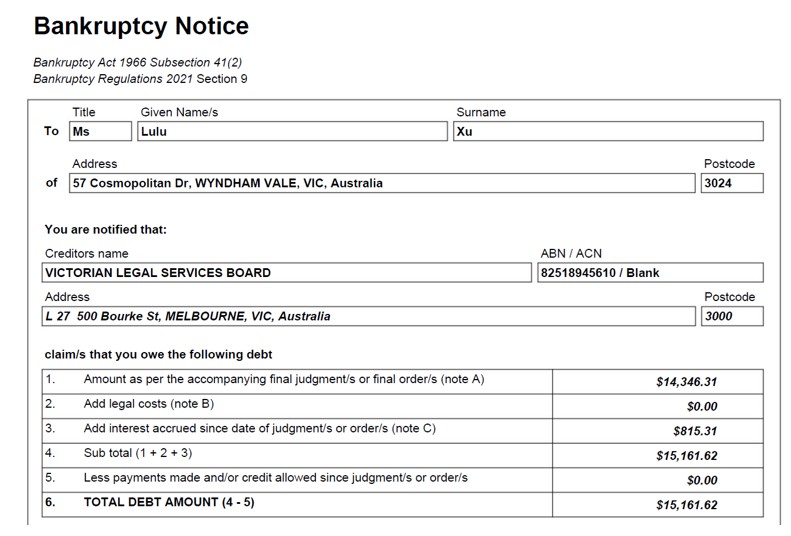
…
119 The second page of the bankruptcy notice contained the following text:
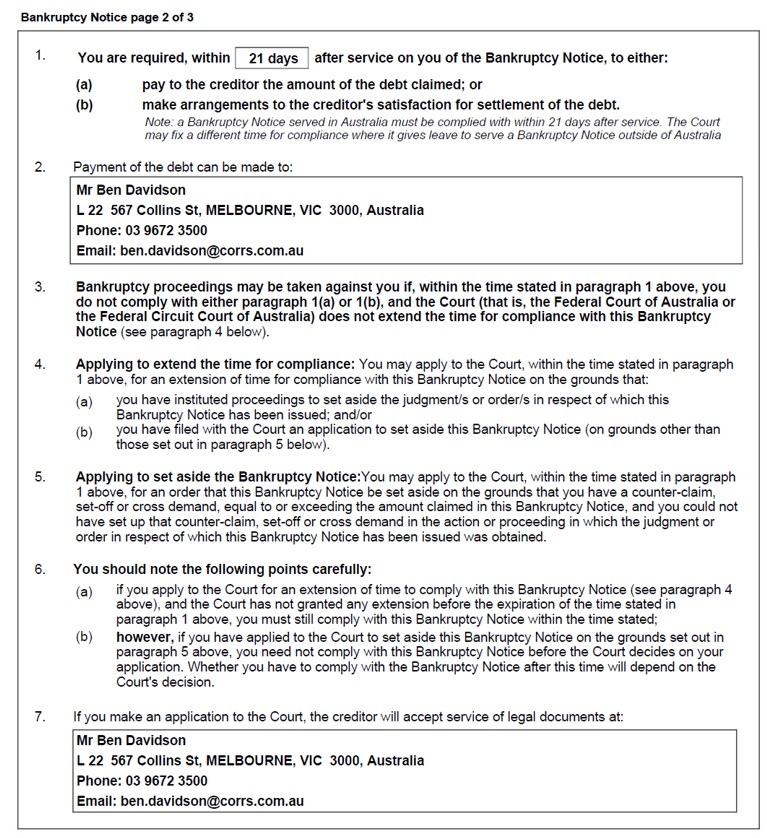
120 Each of the other two bankruptcy notices issued to Ms Xu were in the same terms, save that the amount claimed in those notices was different. The three bankruptcy notices issued to Ms Xu reflected the three primary Costs Orders made by Gorton J that made her liable jointly and severally in respect of the amounts claimed. These were three separate judgment debts. This explains why there were three notices issued to Ms Xu. The same position prevailed in relation to the three notices issued respectively to each of Mr Kuksal and Mr Ansell.
121 For these reasons, Downes J was correct to find that neither the multiplicity of the bankruptcy notices issued to each of the appellants or the fact that they were issued to all three appellants rendered those notices invalid.
6.5 The multiplicity of bankruptcy notices gave rise to an abuse of process
122 The appellants separately contended that the multiplicity of bankruptcy notices issued to them gave rise to an abuse of process.
123 Again, it was Ms Xu who most cogently sought to articulate the appellants’ contentions as follows:
Ms Xu’s submission, developed at length on Day 4, was that the issuing and simultaneous service of nine bankruptcy notices on three Appellants in respect of the same body of costs orders amounted to an abuse of process because:
(a) the cumulative face-value of the notices was approximately three times the actual judgment debts (P-589–592, P-595);
(b) each notice was addressed to a single named debtor and demanded payment of the entire amount, with no statement that the debt was joint and several or that payment by one would discharge the others (P-588–590);
(c) the practical effect was that the only economically rational course for the Appellants was to apply to set the notices aside, which alone (because the AFSA had insisted on nine separate notices: see Reasons [68]) attracted a filing-fee burden of approximately $20,000 (P-503–504);
(d) the inconsistency between the notices (cumulative ~$250,000) and the creditor’s petition (~$83,000 jointly plus a smaller individual amount) was raised by Ms Xu in cross-examination of Mr Heath, who declined to clarify how much was actually owing or what payment would discharge the alleged act of bankruptcy (P-592–593); and
(e) the AFSA itself had previously rejected an attempt to use one of the same costs orders for a single notice and had repeatedly raised queries about joint and several liability (Reasons [69]–[74]; P-585–586) — facts which, on any fair view, demonstrate that the confusion alleged by Ms Xu was real and was created by the Respondents’ own conduct.
124 These contentions should also be rejected. They add little to the points we have already addressed above. As we have already set out, Downes J rejected the contentions as to the multiplicity of notices on the basis that they were warranted in light of the separate Costs Orders that were made and the fact that they gave rise to joint and several liability.
125 Nor do these contentions reflect the evidence. It was AFSA that required separate notices in respect of each debt (or Costs Order) and for them to be sent in respect of each debtor. That was both reasonable and appropriate in light of the underlying liability arising from separate debts and that liability being joint and several. As to the contentions made in relation to Mr Heath’s evidence, we deal with these below.
126 We discern no error in Downes J’s reasons.
6.6 Invalidity of the bankruptcy notices due to their methods of service
127 The appellants contended that the service of the bankruptcy notices by email and then by post made the time for compliance uncertain.
128 The unchallenged facts as found by Downes J are that each of the bankruptcy notices was served by email on 23 January 2025 pursuant to reg 102 of the Bankruptcy Regulations 2021 (Cth): PJ [79]. As her Honour observed, the appellants “did not contend that they did not receive these emails, or the documents attached to them”. Instead, the appellants contended that they had not “consented” to service of the bankruptcy notices by email. As her Honour further explained, such consent was formerly but is no longer required by required by reg 102 for service by email: PJ [80].
129 The bankruptcy notices were also sent by registered post to each of the appellants and the evidence was that the envelopes to each of Mr Kuksal and Ms Xu were delivered on 4 February 2025 and the envelope to Mr Ansell was delivered on 6 February 2025: PJ [82].
130 The essence of the appellants’ contentions was that the multiple methods of service left it uncertain as to when they were each required to comply with the bankruptcy notices, which specified a 21 day period of compliance from their receipt. The most cogent articulation of the appellants’ contentions were again advanced in Ms Xu’s written submissions. It was submitted that:
…the bankruptcy notices were misleading and ought to be set aside, or treated as ineffective, because they had been served on two different dates by two different methods. The first method (email on 23 January 2025 and registered post arriving on or about 4 to 6 February 2025), with no clarification by the respondents as to which date the recipients were required to comply by.
Ms Xu specifically relied on Godfrey v Weriton Finance Pty Ltd [2013] FCA 1057 (Perry J), which expressly contemplates at [1] (and again at [48]) that a bankruptcy notice may become invalid because it has become misleading by reason of events post-dating the valid issue and service of the notice, namely service on a second and later date. The relevant passage was read out at P-576:
“Bankruptcy notice may be invalid on the ground that it has become misleading as to the time within which compliance is required by the reasons of events postdating the valid issue and service of the notice, namely service on the second and the later day.”
131 Ms Xu submitted that Downes J did not address these contentions. She further submitted that:
As Re Wimborne makes unequivocally clear, a bankruptcy notice will be rendered a nullity if an ambiguity or defect possesses the capacity to reasonably mislead a debtor; any investigation into whether the debtor was misled in fact is an “impermissible field of inquiry”. When viewed objectively, the staggered service of the notices generating irreconcilable 21-day compliance deadlines—compounded by the Respondents’ conceded failure to clarify the operative date when expressly asked—clearly possessed the requisite capacity to mislead a reasonable lay person in the Appellants' position. In reliance on Re Wimborne, it was not necessary for Ms Xu to adduce evidence of subjective prejudice or confusion; the objective ambiguity created by the Respondents' conduct was alone sufficient in law to render the notices invalid.
132 We reject these submissions.
133 As Downes J pointed at PJ [79]-[81], not only was service of the bankruptcy notices effective under the Regulations, the appellants did not dispute that they had received the respective emails when they were sent. That unassailable fact meant that each applicant had received the respective notices on that day and knew full well that the express terms of those notices specified a 21 day period of compliance, which passed without any step taken by them to set them aside or comply with them.
134 The fact that the bankruptcy notices were also sent by registered post did not alter the fact of receipt of those notices on the day on which they were emailed to the appellants. We do not consider that this fact in the present case gave rise to any capacity to mislead the ordinary recipient as to what was required to be done to comply with the notices that were served by email. There was no error in the Downes J’s reasons.
6.7 The VLSB had sought the issue of the bankruptcy notices on the basis of misrepresentations or fraudulent conduct
135 The appellants contended that the VLSB and/or its solicitors had sought AFSA to issue bankruptcy notices on the basis of misrepresentations or fraudulent conduct.
136 From the various oral and written submissions made by the appellants, it was difficult to discern the precise misrepresentation that was said to have been made or the fraudulent conduct that was engaged in. It appears to have involved a combination of the VLSB and/or its solicitors seeking AFSA to issue bankruptcy notices in circumstances where it was known that (a) the Costs Orders were procured by fraud, (b) the liability was not joint and several and no such order had been sought from Gorton J, (c) a multiplicity of notices was not warranted, and (d) it was not known what amount of debt had been paid or was owing in total or individually by each of the appellants.
137 For the reasons we have already stated above and address further below, we see no evidentiary basis to support these serious allegations. Nor were we taken to any rational or cogent evidence to support them.
6.8 No evidence to satisfy the Court as to the proof of the debts or the amounts owing by each appellant
138 The appellants contended that there was no evidence before Downes J as to the proof of the debts or the amounts owing by each appellant.
139 Again, this argument was difficult to discern. It appeared to involve a contention that the debts were not proved, or at least that it was not established on the evidence that debts were owing by each appellant or their quantum (including by reference to the amounts that were paid).
140 We reject these submissions.
141 As set out above, ss 52(1)(a) and (c) of the Bankruptcy Act required Downes J to be satisfied that the matters stated in the VLSB’s creditor’s petition were verified by a person with knowledge of them and that the debt or debts on which the petitioning creditor relies is or are still owing.
142 The VLSB’s creditor’s petition was filed on 28 February 2025. It contained the following:
The Petition
The applicant creditors, the Victorian Legal Services Board, Damian Neylon, Gordon Cooper and Howard Rapke, of Level 27, 500 Bourke Street, Melbourne, Victoria 3000, apply to the Court for a sequestration order under section 43 of the Bankruptcy Act 1966 against the estates of Shivesh Kuksal, of 57 Cosmopolitan Drive, Wyndham Vale, Victoria 3024, Lulu Xu, of 57 Cosmopolitan Drive, Wyndham Vale, Victoria 3024, and Peter Ansell, of 172 Aberdeen Street, Geelong West, Victoria 3218.
1. The respondent debtors jointly owe the applicant creditors the judgment debt of $83,074.79 plus interest pursuant to:
a) the Orders made by Justice Gorton on 7 September 2023 in proceeding S ECI 2022 04028, ordering the respondent debtors to pay $9,000.00;
b) the Orders made by Justice Gorton on 19 February 2024 in proceeding S ECI 2022 03994, ordering the respondent debtors to pay $14,346.31;
c) the Orders made by Justice Gorton on 8 March 2024 in proceeding S ECI 2022 04028, ordering the respondent debtors to pay $18,978.50; and
d) the Orders made by Justice Gorton on 5 December 2024 in proceeding S ECI 2022 03994, ordering the respondent debtors to pay $40,749.98.
In addition, the first respondent debtor owes the applicant creditors the judgment debt of $5,189.96 plus interest pursuant to the Orders made by Justice Gorton on 7 September 2023 in proceeding S ECI 2022 04527, ordering the first respondent debtor to pay $5,189.96.
2. The applicant creditors do not hold security over the property of the respondent debtors.
3. At the time when the acts of bankruptcy were committed, the respondent debtors:
a) were personally present in Australia; and
b) were ordinarily resident in Australia.
4. The following acts of bankruptcy were committed by the respondent debtors within 6 months before presentation of this petition:
a) The first and second respondent debtors each failed to comply by 13 February 2025 with the requirements of a bankruptcy notice served on each of them via email on 23 January 2025, or in the alternative, failed to comply by 25 February 2025 with the requirements of a bankruptcy notice served on each of them via registered post and delivered to each of them on 4 February 2025. Further, by either 13 February 2025 or 25 February 2025, the first and second respondent debtors each failed to satisfy the Court that they had a counter-claim, set-off or cross demand equal to or more than the sum claimed in the bankruptcy notice, being a counter-claim, set-off or cross demand that they could not have set up in the action in which the judgment referred to in the bankruptcy notice was obtained.
b) The third respondent debtor failed to comply by 13 February 2025 with the requirements of a bankruptcy notice served on them via email on 23 January 2025, or in the alternative, failed to comply by 27 February 2025 with the requirements of a bankruptcy notice served on them via registered post and delivered to them on 6 February 2025. Further, by either 13 February 2025 or 27 February 2025, the third respondent debtor failed to satisfy the Court that they had a counter-claim, set-off or cross demand equal to or more than the sum claimed in the bankruptcy notice, being a counter-claim, set-off or cross demand that they could not have set up in the action in which the judgment referred to in the bankruptcy notice was obtained.
5. The applicant creditors provide the following information, to the extent it is known to the applicant creditors, for use by the Australian Financial Security Authority:
• any alias used by the respondent debtors: unknown
• the date of birth of the respondent debtors:
i. first respondent: 13 February 1991;
ii. second respondent: 1 August 1993;
iii. third respondent: 3 October 1958;
• the business name of the respondent debtors: inapplicable
• the business address of the respondent debtors: formerly 24C Waiora Parade, West Footscray, Victoria 3012.
143 In support of the creditor’s petition, Mr Heath filed an affidavit in the appropriate form. It provided as follows:
Affidavit verifying creditor’s petition
On 28 February 2025, I, Jared Robert Heath, of Level 22, 567 Collins Street, Melbourne, Victoria 3000, partner of Corrs Chambers Westgarth, affirm:
1. I am a solicitor of the applicants and, as such, have access to the books and records of the applicants and am authorised to make this affidavit on the applicants' behalf.
2. The statements made in paragraphs 1, 2 and 3 of the creditor's petition are within my own knowledge true.
3. In respect of the statements made in paragraph 4 of the creditor's petition, I say the respondents failed, within 21 days after service of the bankruptcy notice, to pay the debt or make an arrangement to the applicants' satisfaction for payment of the debt.
144 In addition, an Affidavit of debt was filed by Mr Matthew Anstee on 25 July 2025. Mr Anstee is the Executive Director of the VLSB. He gave the following evidence:
3. Paragraph 1 of the applicants’ creditors petition refers to:
(a) a judgment debt of $83,074.79 plus interest owed jointly by all of the respondents to the applicants; and
(b) a judgment debt of $5,189.96 plus interest owed by the first respondent to the applicants,
(collectively, the Debt).
4. As Executive Director, I have access to the books and records of the Board.
5. I have reviewed the books and records of the Board and, as at the date of this affidavit, I confirm that save for the payment of $1,500.00 received from Maria Di Gregorio on 19 October 2023, the Board has not received any other payment for the Debt and the Debt remains owing.
6. In relation to paragraph 2 of the creditors petition, the applicants are not secured creditors in respect of the Debt.
145 The appellants relied upon the cross-examination of Mr Heath and Mr Anstee to seek to establish that they did not have knowledge of the individual debts owing by each appellant and whether other amounts had been paid. However, as indicated in Mr Anstee’s affidavit, other than an amount paid by Ms Di Gregorio, the debts remained outstanding.
146 We are satisfied that there was no error in Downes J accepting this evidence for the relevant purposes of ss 52(1)(a) and (c) of the Bankruptcy Act. Further, if there was any error in her Honour relying on the evidence of Mr Heath, it was immaterial given the other evidence before her Honour.
6.9 The failure to account for the rejection of the applications to set aside the bankruptcy notices and the ART Proceedings
147 The appellants contended that Downes J engaged in various failures in relation to the applications that had been made to set aside the bankruptcy notices which had been rejected by a Registrar of the Court and the fact of the ART Proceedings in which the appellants were seeking a review of the Registrar’s decision. It was contended that Downes J erred by not deferring the determination of the VLSB’s creditor’s petition until the determination of the ART Proceedings.
148 In her submissions, Ms Xu articulated the appellants’ contentions as follows:
At Day 4 Tr P-499 to P-518, Ms Xu submitted that the petition should be adjourned pending the determination of the related ART proceedings (listed for 18 and 19 August 2025), in which the Federal Court itself was a respondent and which addressed the lawfulness of the Federal Court Registry’s refusal to file the Appellants’ applications to set aside the bankruptcy notices.
The submission was supported by detailed documentary material in the 267-page bundle annexed to Mr Ansell’s affidavit of 31 March 2025, including:
(a) the email of 24 February 2025 in which the Registry confirmed orally that, where the urgency basis for fee deferral was relied upon, the date of email lodgement would be preserved (Day 4 Tr P-515 to P-516);
(b) the email of Mr Matthew Kemp (Federal Court Registrar) dated 27 February 2025 at 13:42 (267-page bundle, p 89) representing in writing: “Should payment be made or the fees payable otherwise resolved, the applications will be accepted for filing and retain the original time and date of lodgement for each application”;
(c) the email of Mr Kemp dated 28 February 2025 at 15:53 (267-page bundle, p 101) representing precisely the contrary: “Documents can only be filed when the fee is paid or exempt. Any documents you have submitted for filing will be filed on the day you pay the fee or make a successful application for exemption of the filing fees”; and
(d) paragraphs 10 and 11 of the affidavit of Mr Heath dated 28 February 2025, recording that on the same day “I instructed Mr Cameron Inglis, an associate at Corrs, to call the Victorian registry” — i.e., a telephone call from Corrs to the Registry occurred at the very moment when the Registry’s position changed (Day 4 Tr P-553).
Her Honour’s treatment of this material is, with respect, perfunctory: see Reasons [150]–[151]. Her Honour states only that “the applications to set aside the bankruptcy notices were not made within time (that is, by 13 February 2025). This is so irrespective of the outcome of the ART proceedings.” That conclusion sidesteps the substance of the submission. The submission is that:
(a) the Appellants attempted to lodge their applications within 21 days, on 24–25 February 2025, by email to the Registry, in reliance on Federal Court Information Sheet 4 (court file copy at p 25 of the 267-page bundle);
(b) the Registry’s position changed during the ordinary course of email correspondence on 28 February 2025, immediately after the Respondents’ solicitors made telephone contact with the Registry; and
(c) if the ART set aside the Registry’s decision to refuse fee deferral or accept the lodgement, then the Appellants’ applications to set aside would be deemed lodged within time and there would be no act of bankruptcy. The hearing of the petition before that determination was thus a step that, on her Honour’s own logic, would render the ART proceeding moot. In an environment where the Federal Court was itself a respondent in the ART proceeding, the conflict-of-interest dimension of forcing the petition on before the ART hearing was acute.
Her Honour’s separate finding (Reasons [85]–[91]) that, even on the Appellants’ best case, the applications were not “made” because they were not “accepted for filing” by the Registry, relies on Lamb v Sherman (2023) 298 FCR 79; [2023] FCAFC 85 at [36], [54]–[56]. That reliance is, with respect, misplaced. The Full Court in Lamb v Sherman was concerned with an application that was not accepted for filing because of the applicant’s own delay or default. It did not address (and did not purport to address) circumstances where the Registry itself reverses an undertaking previously given. To hold the Appellants to the consequences of Lamb v Sherman in such circumstances is to deny them the benefit of the conduct-based discretion that the bankruptcy jurisdiction has historically reserved to do justice in cases of this kind.
149 We reject these contentions.
150 As we have already noted, the appellants failed to comply with the bankruptcy notices and failed to seek to have them set aside within the 21 day period prescribed in those notices. That was the force of her Honour’s reasons and findings (as set out above). The appellants’ contentions proceeded on the contentions which we have rejected as to when they were served with those notices. As Downes J pointed out, the application that was not accepted by the Registry of the Court was made after the time for compliance had passed.
151 We discern no error in Downes J’s reasons.
6.10 Alleged failures in relation to the appellants’ claims against the VLSB
152 The appellants contended that they had a number of claims against the VLSB for amounts at least equal to or greater than the debts alleged to be owed by them to the VLSB, and whilst these claims remained on foot and/or had been found to be arguable, there was other sufficient cause not to make the sequestration orders.
153 In oral submissions, Mr Kuksal emphasised that each of the appellants’ claims was arguable and that gave rise to sufficient cause such that Downes J should have exercised a discretion in the appellants’ favour not to make the sequestration orders. As we have noted above, in advancing these submissions, Mr Kuksal relied upon both Australian and “British authorities”. Mr Kuksal emphasised that in relation to the claims in defamation, Gorton J in Kuksal v Victorian Legal Services Board [2024] VSC 732 had rejected an application to strike out the defamation proceedings and stated at [56]:
The appointments to People Shop Pty Ltd have arguably had an effect on Mr Kuksal’s reputation and Mr Ansell’s reputation, and probably also Ms Xu’s, in particular because the television media filmed and broadcast Mr Rapke’s taking over of the affairs of People Shop Pty Ltd and did so in a way that arguably implied that People Shop Pty Ltd was being operated by dishonest or incompetent people. If the Board as regulator of the legal profession appointed persons to People Shop Pty Ltd for an improper purpose, then there is, at least arguably, a public interest, and a legitimate private interest held by Mr Kuksal, Mr Ansell and Ms Xu, in obtaining a declaration to that effect. For that reason, the application for the relief sought in paragraph 1 of the summons is not an abuse of process and will not be summarily dismissed or struck out.
154 Mr Kuksal submitted that as Gorton J had not struck out or dismissed the proceedings and had accepted that the appellants “arguably” had a public interest and legitimate interest in seeking a declaration against the VLSB (provided the appellants could prove their allegations of impropriety), Downes J should have made a similar finding and accepted that there was sufficient cause not to make the sequestration order. Mr Kuksal said this was especially the case in circumstances where the quantum claimed by the appellants in the defamation claim was significant and would have readily off set the amounts of any debt owing by them under the Costs Orders.
155 Mr Kuksal submitted that the other claims advanced by the appellants against the VLSB were equally meritorious but Downes J had erroneously given them cursory attention without closely analysing those claims.
156 Ms Xu made the following submission:
In the closing minutes of Day 4 (P-602–603), Ms Xu directed her Honour to two specific cross-claims:
(a) a conversion / detinue claim arising out of the entry of Mr Rapke and “10 other people” into the People Shop premises on 22 August 2022, the seizure of office contents and the deprivation of Ms Xu’s personal property, supported by a spreadsheet itemising approximately $168,319.51 of contested goods (referred to in the Reasons at [142] but otherwise undeveloped); and
(b) a claim for compensation arising from the discharge of the interim injunction in proceeding VID 642/2025 — noting that interim relief had been granted by Meagher J on the usual undertaking as to damages, which by force of established principle creates a constructive trustee-like obligation on the Respondents if the injunction is discharged: see Day 4 Tr at P-606–607.
The Reasons reject the conversion claim summarily at [142] on the basis that “there is no evidence which identifies which of the respondents owned which item” and that no proceedings have been commenced. With respect, that reasoning fails to grapple with the actual question under Glew v Harrowell (2003) 198 ALR 331 at [11]–[12]: whether there is sufficient substance to the cross-demand to make it one which the debtor should, in justice, be permitted to have heard — not whether, on a paper hearing of the petition, every detail of the cross-demand is fully proved. Ms Xu was the sole occupant of the premises at the relevant time (P-603), and her oral evidence on that point, had it been received, would have been directly probative.
On the defamation claim, her Honour at [137]–[140] read down the observation of Gorton J in Kuksal v Victorian Legal Services Board [2024] VSC 732 at [56], that “the appointments to People Shop Pty Ltd have arguably had an effect on Mr Kuksal’s reputation and Mr Ansell’s reputation, and probably also Ms Xu’s, in particular because the television media filmed and broadcast Mr Rapke’s taking over of the affairs of People Shop Pty Ltd ... in a way that arguably implied that People Shop Pty Ltd was being operated by dishonest or incompetent people”. That observation is a substantial finding by a judge of the Supreme Court of Victoria that the Appellants have, at the level of arguability, a defamation claim. Her Honour’s rejection is bare.
On the VID 642/2025 compensation claim, the Reasons deal with this at [145]–[148]. They reject it for two reasons: (a) the proceeding has not been finally determined; and (b) the claim, if any, lies only against the Board, not the other Respondents. Both propositions are correct as far as they go, but neither addresses Ms Xu’s actual point: that the Board’s judgment debt against her represented the bulk of the debt sought to be enforced, and that any cross-demand against the Board which approached or exceeded that amount would, on a Glew / Ling v Enrobook (1997) 74 FCR 19 analysis, constitute “other sufficient cause” for refusing the petition at least as against the Board.
157 We reject these contentions.
158 It is first necessary to observe that Downes J stated the legal position correctly at PJ [128] where her Honour stated:
The existence of a claim that has not yet been determined may provide a basis upon which a judgment debtor may demonstrate that there is “other sufficient cause” as to why a sequestration order ought not be made and the petition dismissed, but it will depend on the circumstances.
(Emphasis added.)
159 As her Honour correctly stated, the existence of legitimate claims initiated by the debtor as against the creditor, “may” give rise to other sufficient cause not to make a sequestration order. That proposition reflects the general position stated by Lindgren J in Glew v Harrowell, in the matter of Glew [2003] FCA 373; 198 ALR 331 at [11] and [12] in relation to applications to set aside bankruptcy notices. For the assessment under s 52(2)(b) of the Bankruptcy Act, Downes J relied upon the decision of the Full Court in Ling v Enrobook Pty Ltd (1997) 74 FCR 19, where Davies, Wilcox and Branson JJ stated at 25 to 26:
A review of the authorities discloses that in certain circumstances, but not in all circumstances, the fact that the debtor has pending before a court a legitimate claim to funds sufficient to satisfy the petitioning creditor’s debt will amount to “other sufficient cause” not to make a sequestration order. The circumstance that the legitimate claim of the debtor is one against the judgment creditor is likely to be a significant circumstance for the purposes of s 52(2)(b).
…
The authorities also show that satisfaction that the debtor is well advanced with litigation likely to result in the debtor being in a position to pay his or her debts may well provide a basis for a finding that there is a “sufficient cause ” for a sequestration order not to be made. But the authorities do not suggest that it is in the public interest to allow insolvent debtors to prosecute litigation generally. They only recognise that it is not in the public interest for a debtor to be forced into bankruptcy by reason of a state of insolvency likely to be of only short duration.
(Citations omitted; emphasis added.)
160 It is these principles drawn from the Full Court’s decision in Ling that reflect the position under Australian law and which Downes J correctly identified and applied. It is evident that Downes J was not satisfied that the claims being advanced by the appellants were genuine and, in any event, were unmeritorious. Her Honour observed that none of the claims were the subject of any “existing litigation” and this cast “significant doubt upon whether they are genuine as opposed to being raised for the purposes of avoiding a sequestration order being made”: PJ [132]. Her Honour was not satisfied that “the each of the respondents has a genuine and arguable claim for defamation against the applicants which exceeds the quantum of the costs orders made in favour of the respective applicants”: PJ [140]. Downes J reached this conclusion for the following reasons:
(a) the events relating to the defamation claim had occurred years ago on 22 August 2022 and in respect of which a declaration was sought that the VLSB had played some role in “broadcasting spurious and inflammatory allegations against [Mr Kuksal] through multiple media organisations”: PJ [132], [134] and [139];
(b) Gorton J’s decision in Kuksal v Victorian Legal Services Board [2024] VSC 732 at [56] had to be viewed in its proper context;
(c) Gorton J had stated in footnote 34: “As noted above in para 43, the defendants’ application for summary dismissal is limited to matters of form rather than merit. Beyond what I have held above, I therefore make no comment as to the prospects of success of the substance of paragraph 1”: PJ [136];
(d) the section of the judgment where Gorton J had stated that there was an arguable impact on reputation was addressing whether there was any prospect of that declaratory relief being obtained by the respondents and that one could not describe his Honour’s observation as “a strong endorsement of a case that the reputations of the respondents had been affected adversely, or that they had a genuine claim for defamation against all of the applicants”: PJ [137];
(e) there was no evidence that the appellants had a claim for defamation against all of the respondents: PJ [138]–[139].
161 We agree with her Honour’s assessment of Gorton J’s reasons. We discern no error in her Honour’s assessment that on the material before the Court, the defamation claims had not been shown to be ones which gave rise to other sufficient cause not to make the sequestration orders. Her Honour’s assessment in this respect involved an evaluative assessment and exercise of discretion as to whether the defamation claims gave rise to other sufficient cause. We see no error in her Honour’s evaluative assessment of these matters.
162 In relation to claims for conversion, Downes J was not satisfied that these were genuine claims including because (a) no claim had in fact been commenced or brought against the respondents despite the alleged unlawful seizure having occurred on 22 August 2022, and (b) there was no evidence to support the spreadsheet which had been prepared on 31 March 2025 including as the value of the items said to have been seized: PJ [142].
163 In relation to claims comprised of “Multiple tort law claims…”, Downes J reasoned that they were “stated in such general and conclusory terms as to be incomprehensible” and was not otherwise satisfied that they were genuine: PJ [143]–[144].
164 As to the “claim for the economic loss and expenses incurred due to the Applicants’ commencement of the “misconceived” Collateral Proceedings, Downes J was not satisfied that they were genuine for a number of reasons including that the “evidence did not establish that the respondents have a genuine and arguable claim for compensation which exceeds the quantum of the costs orders made against each of them and which are the subject of the bankruptcy notices”: PJ [145]–[148].
165 We discern no error in Downes J’s careful and methodical assessment of each of the so-called claims that the appellants were seeking to advance. We were not assisted by the authorities that Mr Kuksal relied upon. As we have already stated, Downes J relied upon and applied the correct approach as determined for the purpose of s 52(2)(b) of the Bankruptcy Act.
6.11 Alleged failure to hold a hearing and permit the production of documents
166 The appellants variously complained that Downes J did not conduct a hearing according to law and that they were deprived of a proper hearing including because they were not given leave to compel the production of certain documents and were otherwise placed under limits in relation to the filing and service of evidentiary materials, and in relation to cross-examination and oral addresses.
167 In our view, it is unnecessary to set out or examine all the various complaints that the appellants made in these respects. Downes J’s reasons disclose that her Honour sought to list and deal with the application for sequestration orders with a degree of expedition as is customary in applications of this type. However, Downes J’s reasons also disclose the burden which the appellants, and especially Mr Kuksal, placed on the proper administration and hearing of the case at hand. That involved not only a deluge of materials filed with the Court or sent to Chambers, but also the belligerent and disrespectful conduct that was exhibited. Our own experience in the conduct of the appeal has not been dissimilar.
168 No litigant has an unqualified right to burden the Court with voluminous materials or demand the Court to compel the production of documents that are disproportionate to and do not conform with the dictates of the justice of each case having regard to the real issues in dispute. The appellants conducted the proceedings below and the appeal as if there was such an unqualified right. The limits that Downes J placed on the appellants in relation to their provision of and reliance on materials, their time in addresses, their time occupied in cross-examination and her Honour’s refusal to compel the production of documents determined to be of no relevance was in our view entirely proper and conformed with the dictates of the justice of the case before her. We reject the appellants’ contentions that Downes J erred in any relevant respect.
6.12 Inadequacy of reasons
169 The appellants contended that there was an inadequacy of reasons in various respects. We reject these contentions. For the reasons set out above, we consider her Honour’s reasons were cogent and methodical.
6.13 Ground 1 of the Amended Notice of Appeal
170 Ground 1 of the Amended Notice of Appeal is as follows:
Justice Downes made orders sequestering the estates of the Appellants, purportedly upon a successful creditors’ petition filed by the first four Respondents, notwithstanding that:
1.1. The first four Respondents did not present evidence concerning the amounts owed to them by each of the Appellants; and
1.2. Her Honour did not determine the amounts owed by the specific Appellants to each of the Respondents.
171 We have already addressed these contentions. They are both factually incorrect and misconceived. As Downes J set out at PJ [65]–[78], the evidence presented by the respondents included evidence of the “judgment debts” which consisted of the Costs Orders, the bankruptcy notices that were issued following the Costs Orders remaining unsatisfied, and the subsequent creditor’s petition.
172 The contention that Downes J was required to determine the amounts owed by the specific appellants is misconceived. As her Honour pointed out at PJ [67], the total amount of the Costs Orders was in excess of the statutory minimum of $10,000 as provided in reg 10A of the Bankruptcy Regulations. Her Honour was also satisfied that each of the appellants were jointly and severally liable for the payment of some of the Costs Orders and otherwise primarily liable for others: at [70]–[78]. Her Honour was not required to make a determination of the total amount of the underlying debts owed by each appellant. This discloses a misunderstanding by the appellants of the relevant statutory regime.
173 Ground 1 is without substance and should be dismissed.
6.14 Ground 2
174 Ground 2 of the Amended Notice of Appeal asserts that:
…Justice Downes had refused to hear the Appellants regarding the absence of jurisdictional facts necessary to enliven the Court’s authority to consider the creditors’ petition, as they had filed applications to set aside the Bankruptcy Notices, without explanation.
175 This contention is also factually incorrect.
176 A fair reading of the entirety of the Sequestration Order Judgment discloses that the appellants had filed notices of opposition to the creditor’s petition, and had every opportunity to present evidence, make submissions and raise arguments: e.g. see at [6], [9]–[16]. A fair reading of the Sequestration Order Judgment also discloses that Downes J considered the various arguments that were raised by the appellants and found them to be unmeritorious.
177 The hearing was conducted over four days, even though it was initially only listed for two: PJ [28]. During the hearing, the conduct of the appellants, especially Mr Kuksal was deplorable: at [30]–[37]. Although Mr Kuksal had to be removed from the Court and at other times one or more of the appellants failed to appear in Court at the commencement or re-commencement of the hearing, Downes J listed the matter for a further hearing day to further hear the appellants’ arguments: PJ [34]. That hearing day too proved to be disruptive: PJ [35]. As her Honour observed, the appellants persisted in devoting their time to disrupting the proceedings instead of devoting time to addressing the real issues in dispute: PJ [35]–[37].
178 We discern no error. Ground 2 should be dismissed.
6.15 Ground 3
179 By Ground 3 of the Amended Notice of Appeal, the appellants assert that:
Justice Downes failed to consider and address the Appellants’ submission that the Court ought to have set aside the Bankruptcy Notices as defective, or alternatively, refused to grant the creditors’ petition because the manner in which the first four Respondents had issued the Bankruptcy Notices, obligated the Appellants to each pay the entirety of the costs orders jointly made against them, at the same time, to avoid committing an act of bankruptcy.
180 As noted above, Downes J did not fail to consider the appellant’s submissions that were relevant to the questions to be determined. The reasons disclose that her Honour addressed those arguments that were raised in an intelligible form, including the contentions as to the effect of some of the Costs Orders imposing liability on the appellants jointly and severally: PJ [69]–[78].
181 Ground 3 is without substance and should be dismissed.
6.16 Ground 4
182 Ground 4 of the Amended Notice of Appeal asserts:
Justice Downes unjustly refused to take into account the Appellants’ multiple claims against the first four Respondents, ostensibly on an ill-founded assumption that the claims could only be made against some (but not all) the Respondents, in circumstances that:
4.1. Her Honour prevented the Appellants from adducing evidence and making submissions in Court to establish the bases of their claims against the first four respondents;
4.2. Her Honour obstructed the Appellants from filing and relying upon evidence of their freshly instituted defamation, misfeasance, and related tort law claims against the first four Respondents, despite the Appellants foreshadowing their plans to initiate proceedings in respect of the claims on or before 22 August 2025, during the hearing on 15 August 2025 and seeking leave to rely on that evidence;
4.3. The Respondents had abandoned their claims in relation to two of the costs orders [Costs Orders] used to justify the Bankruptcy Notices. Those were the only two orders that had listed the second, third and fourth Respondents as beneficiaries; and
4.4. Though none of the Respondents presented satisfactory evidence of specific amounts owed to them by the Appellants, the second, third and fourth Respondents filed no evidence at all to make a claim against the Appellants.
183 These assertions are mostly repetitive of earlier matters that we have addressed. For the reasons we have already stated, Downes J did not refuse to take into account the appellants’ asserted claims against the respondents.
184 Ground 4 is without substance.
6.17 Ground 5
185 Ground 5 of the Amended Notice of Appeal asserts that:
Justice Downes failed to recognise that, as the Court effectively enforcing the Costs Orders, the Federal Court had the unfettered discretion and the responsibility to determine the manner in which the costs liability ought to be apportioned between the Appellants, if the Court found the orders to be enforceable in bankruptcy.
186 This contention is entirely misconceived. The primary judge did not have “an unfettered discretion and the responsibility to determine the manner in which the costs liability ought to be apportioned between the Appellants”. As we have repeatedly observed, the primary judge had to be satisfied of a relevant indebtedness by reference to the Costs Orders, the existence of which made each of the appellants jointly and severally liable for costs that remained unpaid.
187 Ground 5 is without substance.
6.18 Ground 6
188 Ground 6 of the Amended Notice of Appeal asserts that:
In finding that the inaccuracies in the Costs Orders were inconsequential to their enforcement in bankruptcy, Justice Downes evidently cured the defects in the orders, contrary to the law, which exclusively vests the jurisdiction to cure such irregularities and defects on the Court that issued the orders or a Court exercising appellate jurisdiction over it.
189 This contention misunderstands her Honour’s reasons at PJ [118]. What her Honour there observed was that a typographical error in the date of one of the Costs Orders did not render that order irregular or unenforceable and, in any event, there were other Orders not so affected.
190 Ground 6 is without substance.
6.19 Ground 7
191 Ground 7 of the Amended Notice of Appeal asserts that:
Justice Downes displayed Wednesbury unreasonableness in ignoring extensive evidence, the first four Respondents’ own admissions and judicial determinations affirming the veracity of the Appellants’ claims against the first four Respondents, and invoked irrelevant, contextually misrepresentative or plainly inaccurate matters in asserting that the Appellants’ claims against the Respondents were not contestable.
192 This ground of appeal is misconceived. This is an appeal, not an application for judicial review such that the principles of “Wednesbury unreasonableness” apply. In any event, Downes J plainly considered each of the matters that the appellants had raised as genuine arguable claims against the respondents and rejected them for reasons in respect of which we discern no error.
193 Ground 7 is without substance.
6.20 Ground 8
194 Ground 8 of the Amended Notice of Appeal makes a series of assertions as to Downes J’s reasons for rejecting various of the appellants’ claims.
195 First, it is contended that Downes J erred by rejecting the appellants’ contentions as to their alleged belief as to the time by which they were required to comply with the bankruptcy notices. The contention is misconceived. Downes J was not required to address the subjective belief of the appellants but the objective facts of service of the bankruptcy notices and non-compliance with them within the prescribed times.
196 Second, the appellants’ claim that they were misled about time for compliance, but there was no error in her Honour’s state of satisfaction as to the contents of the letters sent to the appellants and the bankruptcy notices which made it clear when and how the respondents were required to comply with the notices.
197 Third, it is contended that Downes J “contrived specious arguments” to justify her “unconscionable efforts” to deprive the appellants of their statutory and constitutional right to challenge matters in the ART Proceedings. The contention is no more than a baseless allegation of impropriety. As Downes J reasoned, the difficult with the ART Proceedings is that the applications to set aside the bankruptcy notices were not made within the specified time.
198 Ground 8 is without substance.
6.21 Ground 9
199 Ground 9 of the Amended Notice of Appeal asserts various legally incoherent points to the effect that Downes J erred by failing to investigate the making of the Costs Orders by Gorton J and level other serious allegations in relation as to her Honour engaging in illegitimate conduct. It was no part of her Honour’s task to investigate the making of the Costs Orders. The balance of the appellant’s allegations are entirely without substance and are scandalous. We reject them.
6.22 Ground 10
200 Ground 10 of the Amended Notice of Appeal allege that Downes J absolved the respondents from their abuse of the bankruptcy regime and alleging that her Honour was complicit in the fraud. These allegations are also scandalous and made without any foundation. We reject them.
6.23 Ground 11
201 Ground 11 of the Amended Notice of Appeal challenges the non-publication and suppression orders made by Downes J and is incompetent for the reasons set out above.
6.24 Ground 12
202 Ground 12 of the Amended Notice of Appeal alleges the infliction of oppressive circumstances and deprivation of unavoidable human rights to procedural fairness. These contentions are misconceived and, in any event, as we have already set out the appellants were provided with more than ample opportunities to present their case. Ground 12 is without substance.
6.25 Grounds 13–19
203 Grounds 13–19 of the Amended Notice of Appeal make further scandalous allegations. It is unnecessary to detail all of them. Their general tenor is that Downes J engaged in conduct to deprive the appellants of their rights, a fair hearing, making malicious attacks on the appellants in her reasons, subjecting them to cruel and inhuman treatment and related claims of judicial misconduct. These allegations are entirely baseless. We reject them.
6.26 Grounds 20–29
204 Grounds 20 to 29 of the Amended Notice of Appeal take issue with the interlocutory orders made by Lee J and seek to challenge decisions made by Registrars Morgan and Schmidt. For the reasons we have already set out above, the appeal from the orders of Lee J is incompetent. As to the appeal from the apparent orders made by the respective Registrars, the appellants have not provided any particulars of the relevant decisions or the errors that are said to have been made, other than bare assertions. These Grounds are without substance.
6.27 Recusal applications
205 We have referred earlier to the Recusal Judgment and also her Honour’s reasons set out in Annexure A of the Sequestration Order Judgment concerning her dismissal of a recusal application made during the hearing of the Bankruptcy Proceedings. We have considered each of these sets of reasons and separately considered the matter for ourselves. There was nothing on the part of her Honour’s conduct that justified these applications. Moreover, no ground of appeal raised by the appellants demonstrates either any error in her Honour’s assessment and disposition of these applications or warrants us, in considering the matter for ourselves, concluding that her Honour should have recused herself.
7. DISPOSITION OF THE APPEAL
206 For the above reasons, we dismissed the appeal and made other consequential orders.
207 We next turn to provide our reasons in relation to the various interlocutory applications made by the appellants.
PART B: THE INTERLOCUTORY APPLICATIONS
8. THE APPELLANTS’ VARIOUS INTERLOCUTORY APPLICATIONS
208 As noted above, other than in relation to the application made by the appellants that Beach J be recused from hearing and determining the appeal, what follows are the Court’s reasons for dismissing the various interlocutory applications made by the appellants.
209 It is convenient in this section of our reasons to deal with various interlocutory applications made by the appellants prior to 11 May 2026 and our determination of those applications. We have already delivered oral reasons at the start of the resumed hearing of the appeal on 11 May 2026 (see the transcript of the ex tempore reasons annexed to the present reasons), but indicated that we would provide more detailed written reasons. These are those reasons. We will also address further applications that were made on 11 May 2026 itself and our reasons for rejecting those applications.
210 We will first set out some of the chronological sequence of events concerning the interlocutory applications. We will then identify some of the voluminous material provided to the Full Court that the appellants have sought to rely on. We will then proceed to set out our reasons on the rulings that we have made concerning these various interlocutory applications, including the recusal applications.
8.1 The relevant chronology
211 On 4 March 2026, Beach J made the following orders:
1. The appellants are directed to make any interlocutory application that they seek to pursue concerning or relating to the appeal returnable at 10.15 am on 18 March 2026 before the Full Court.
2. Any such interlocutory application with supporting material should be filed and served as soon as reasonably practicable.
212 On 17 March 2026, the day before the hearing of the appeal, the appellants filed an extensive interlocutory application dated 17 March 2026 which claimed the following relief in 16 paragraphs:
1. The Court determine that Justice Beach is disqualified from presiding over the proceeding VID 1279/2025 (“Appeal Proceeding”).
2. The Court determine and declare that the combination of the following actions in relation to the proceeding VID 642/2025 (“Suppression Proceeding”) was unfairly prejudicial and/or unjust to the Appellants, and it is in the interests of justice to the Appellants as well as the public interest for it to be reinstated to the Full Court for the determination of all matters and claims arising within it, as Mortimer CJ had originally determined appropriate (on 10 October 2025):
2.1. Justice Beach’s dismissal of the Suppression Proceeding on 14 November 2025, on an oral application from the First Respondent’s counsel brought without notice to the Appellants, in circumstances such that:
2.1.1. His Honour refused to hear the Appellants in relation to their pending applications in the Suppression Proceeding;
2.1.2. Made derisive remarks towards the First Appellant and implied that he was fabricating legal precedent for the purpose of misleading the Court for personal benefit when he sought to be heard against the dismissal of the Suppression Proceeding, including by making the comments included in the excerpts of the transcript of the hearing contained in Appendix A; and
2.1.3. Refused to accept the prejudice arising from the denial of the benefit of Mortimer CJ’s referral to the Full Court, or that the vindication of their rights and reputations may also be of significance to the Appellants besides monetary compensation.
2.2. Justice Beach’s reinstatement of the Suppression Proceeding, on the basis that the dismissal was merely an interlocutory order, to consider whether His Honour had been incorrect in presuming that the Appellants were incorrect in the assertion they had made regarding their pending applications in VID 642/2025. This occurred after the Appellants expended considerable time, effort and resources into comprehensively identifying all the errors His Honour had made at the expense of progressing their interlocutory application in the Appeal Proceeding.
Beach J then ruled against the Appellants again, without allowing them to be heard in open court, or to be properly heard at all. In ruling against the Appellants, His Honour made irrefutable errors of fact and law. His Honour also refused to address all the relevant issues raised by the Appellants regarding the prejudice they had suffered through the misrepresentation of the First Respondent’s counsel. The refusal to provide adequate reasons in relation to all matters raised by the Appellants was in part based on His Honour’s asserted view that, in light of the Appellants’ pursuit of an appeal against his decisions, it was inappropriate for His Honour to address each matter.
2.3. The appeal, which the Appellants had lodged on 21 November 2025, was held over until the day after Beach J relied upon it to avoid addressing multiple issues raised by the Appellants, and then rejected, on the basis that it was seeking relief from interlocutory orders (see Appendix B). The registry also warned the Appellants that:
“Lastly, I note that the 14 November 2025 decision of Beach J in the appeal VID642/2025 is on its face an exercise of the appellate jurisdiction of the Court. No appeal lies to the appellate jurisdiction of the FCA from an exercise of the appellate jurisdiction, and I recommend you carefully consider this point.”
This was even though His Honour had decided the matter as a single judge sitting in a matter that was to be originally heard by the Full Court.
2.4. On 5 March 2026, Beach J changed his view in relation to His Honour’s previous classification of his dismissal of the Suppression Proceeding as interlocutory and advised the Appellants that he would not permit any applications to be listed in the proceeding.
3. The Court hear and determine the Appellants’ application (“ART Review Application”) for judicial review and declaratory relief in relation to the dismissal of their applications (“ART Applications”) seeking a merits review of the decision of Registrar Morgan regarding the rejection of their applications to set aside the bankruptcy notices. A copy of that application accompanies this form as Appendix C, which sets out the basis upon which it is brought and the relief sought.
4. In respect of the Appellants’ Amended Notice of Appeal, the Court give them leave to appeal all interlocutory decisions and those decisions which fell out of time on the date that the Appellants commenced the appeal, contained therein.
5. The Court adjourn the trial in the Appeal Proceeding and list it together with the trials in the ART Review Application and the Suppression Proceeding over a two-and-a-half-day period, one week after the determination of the Appellants’ interlocutory claims or the earliest available date thereafter.
6. The Court allow the Appellants to seek disclosure in relation to the items identified in the Amended Notice of Appeal and Appendix D, either through subpoenas or by ordering their discovery.
7. The Court stay all proceedings arising under the sequestration order made by Downes J on 24 August 2025.
8. The Court extend the time for compliance in respect of the provision of the statement of affairs to the Official Trustee until the conclusion of the Appeal Proceeding.
9. The Court set aside the interim suppression orders made by Beach J on 28 November 2025.
10. The Court stay the suppression orders made by Downes J on 24 August 2025 until the conclusion of the Appeal Proceeding.
11. The Court make all documents and hearings in the Appeal Proceeding and the Suppression Proceeding accessible to the general public through its website.
12. The Court permit the Appellants to prepare a digital courtbook by 25 March 2026, comprising:
12.1. All the documents lodged in the proceeding VID 222/2025 (“Bankruptcy Proceeding”), the Appeal Proceeding and the Suppression Proceeding.
12.2. All the documents lodged with the ART in relation to the ART Applications and documents relevant to the ART Review Application.
12.3. Any correspondence with the chambers of judicial officers, the registry, the Tribunal and the Respondents concerning the Bankruptcy Proceeding, the Appeal Proceeding and the Suppression Proceeding.
12.4. The documents sought to be filed by the Appellants in the Bankruptcy Proceeding and the Suppression Proceeding, whose rejection is the subject of appeal in the Appeal Proceeding.
12.5. The transcripts and audio recordings of hearings in the Appeal Proceeding, the Bankruptcy Proceeding and the ART Applications.
13. The Court give the Appellants leave to file and rely on fresh evidence in the Appeal Proceeding as identified below:
13.1. All invoices, costs applications, and correspondence filed by the Appellants or the First Four Respondents in the Supreme Court of Victoria in connection with the costs orders relied upon by the First Four Respondents in issuing the bankruptcy notices (“Costs Orders”).
13.2. All documents and correspondence lodged or exchanged by the Appellants or the First Four Respondents with the Supreme Court of Victoria in relation to the proceedings in which the Costs Orders arose, the appeals against orders made in those proceedings and the proceedings relied upon by the Appellants to establish any claims against the First Four Respondents.
13.3. All documents capable of establishing an error of fact in the decision-making process of Downes J, or the Respondents’ misrepresentations, resulting in the Court forming a misapprehension of fact.
13.4. All documents necessary to provide evidence of matters resulting in delays to the completion of obligations arising from the Appeal Proceeding, the Bankruptcy Proceeding and the Suppression Proceeding.
13.5. Any determinations made by courts or integrity and oversight bodies capable of supporting the Appellants’ allegations of persecution by the First Four Respondents or the police officers verifiably working in concert with them.
13.6. Any evidence of ongoing or anticipated prejudice in relation to injunctive relief sought in proceedings before the Full Court.
13.7. All documents capable of supporting compensation, restitution and other equitable relief claims in relation to the Appeal Proceeding, the Bankruptcy Proceeding and the Suppression Proceeding.
13.8. All documents capable of providing evidence, including tendency and character evidence, to support disciplinary complaints, including contempt proceedings in relation to the Appeal Proceeding, the Bankruptcy Proceeding and the Suppression Proceeding.
13.9. Any documents obtained through disclosure processes in proceedings before the Full Court.
14. The Court make a standing order for the provision of transcripts of future hearings to the Appellants.
15. The Court direct all the Respondents to file a notice of appearance in the Appeal Proceeding.
16. The Court direct the registry not to conceal the names of decision-makers and registry staff interacting with the Appellants or making decisions in relation to their proceedings before the Court.
213 Some supporting material was filed at this time being a proposed notice of appeal in proceeding VID642/2025 concerning Beach J’s November 2025 order, some transcript of a hearing before Beach J and some material concerning Administrative Review Tribunal proceedings and a proposed judicial review application.
214 The appeal before the Full Court was listed for a one day hearing on 18 March 2026. On that day, Mr Kuksal on behalf of the appellants spoke to the application that Beach J disqualify himself from sitting as a member of the Full Court. Mr Kuksal’s address took all day. It consisted of two aspects, being Beach J’s alleged conduct in November 2025 and his alleged conduct in March 2026. The Court reserved its decision as the appellants indicated that they wanted to place further material before the Court.
215 The complaints concerning Beach J’s alleged November 2025 conduct had previously been ventilated at a one day hearing on 21 November 2025 where the appellants had made an application for Beach J to disqualify himself. Beach J dismissed that application on 28 November 2025 and published reasons; see Kuksal v Victorian Legal Services Board [2025] FCA 1483.
216 At the hearing on 18 March 2026, reference was made to a draft affidavit of Ms Xu with no annexures that it was said would be filed later; in fact this was not provided in proper form with annexures until early April 2026 as we have later explained.
217 After the hearing on 18 March 2026, the Court sought by numerous emails sent to the appellants the timely filing of material in support of their interlocutory application dated 17 March 2026. This was to little avail in the sense that material was filed late and when filed was disproportionately voluminous.
218 On 23 March 2026, the Court made the following orders:
OTHER MATTERS:
A. On 21 November 2025, the appellants applied for Beach J to recuse himself from the appeal, with the appellants making oral submissions for 1 day on that question.
B. On 28 November 2025, Beach J refused to recuse himself and published reasons (Kuksal v Victorian Legal Services Board [2025] FCA 1483).
C. On 18 March 2026, the appellants applied before the Full Court to have Beach J recuse himself over what was said to be his November 2025 conduct and his March 2026 conduct. The appellants made oral submissions for 1 day on that question and also indicated to the Full Court that they wished to rely on an affidavit of Ms Xu putting before the Full Court material concerning Beach J’s November 2025 conduct, including material sent to Beach J’s chambers on 27 November 2025 and sought to be relied on.
D. On 18 March 2026, Mr Kusal indicated to the Full Court that in terms of any resumed hearing of the appeal he did not have “any unavailable dates”. Neither of the other appellants indicated any unavailability.
THE COURT ORDERS THAT:
1. The resumption of the appeal hearing be fixed for 11 and 12 May 2026 beginning at 10.15 am on each day, with the constitution of the Full Court to be determined after the Full Court has ruled on the appellants’ recusal application concerning Beach J.
2. Subject to order 3, the appellants be given leave to file and serve by 4.00 pm on 27 March 2026 an affidavit of Ms Xu which annexes any documents and correspondence provided to Beach J or his chambers in November 2025 and relevant to the appellants’ recusal application.
3. Any annexures to the affidavit of Ms Xu referred to in order 2 are to be provided in pdf form only. No link to a Dropbox (or similar) folder is to be used. Further, the annexures should not include any document including any transcript, whether of a Federal Court or Supreme Court hearing, that is already contained in Parts A, B or C of the current appeal book, although reference to such a document can be made in the body of the affidavit itself if Ms Xu so chooses.
4. The appellants also be given leave to file and serve by 4.00 pm on 27 March 2026:
(a) a further outline of submissions to be limited to 10 pages concerning the appellants’ recusal application; and
(b) a list of any further authorities (but not copies) that the appellants did not draw to the Court’s attention on 18 March 2026.
5. Save for what has been provided for in orders 2 to 4, the Court otherwise refuses to grant leave in the terms sought in paragraphs 1 to 4 of the email of Mr Kuksal sent to the chambers of each member of the Full Court on 19 March 2026 at 2.38 pm.
219 These orders were sent to the parties under cover of an email from the executive assistant to Beach J on behalf of the members of the Full Court which stated the following:
I have been asked by the Full Court to advise the parties of the following matters.
The Full Court has re-fixed the resumption of the appeal hearing for 2 days on 11 and 12 May 2026 beginning at 10.15 am on each day.
The constitution of the Full Court will depend on the outcome of the recusal application concerning the position of Beach J on which the appellants made oral submissions on 18 March 2026.
Attached is an order made by the Full Court today concerning the recusal application. As is apparent from the order and as discussed with the appellants on 18 March 2026, the appellants only have leave concerning providing November 2025 material. The provision of the March 2026 material is not necessary given that the chambers of all members of the Court were copied in on all March 2026 material.
In terms of Ms Xu's application for a pro bono reference from the Full Court, that application should be filed as soon as reasonably practicable with supporting material.
In terms of any other interlocutory application to be pursued by the appellants, appropriate written submissions (limited to 10 pages on any one topic including annexures) and affidavit material should also be filed and served as soon as reasonably practicable. These applications will not be considered and determined by the Full Court until it has ruled on the recusal application. But there is no reason why the appellants' supporting material should not be filed and served as soon as reasonably practicable so that the Full Court, whether as presently constituted or re-constituted (depending on the outcome of the recusal application), can deal with them expeditiously at the appropriate time.
As to whether the Full Court will require responding submissions from the respondents, the Full Court will consider that question once it considers the appellants' material.
As indicated by the Full Court on 18 March 2026, the Full Court may make a determination of any such application by the appellants on the papers.
Finally, the Full Court expects the appellants' material to be electronically filed and served, including by email to the chambers of the judges. The Full Court refuses leave for material to be provided by a link to a Dropbox (or similar) folder. Any material in the form of submissions, affidavits or attachments should be provided in pdf form.
220 On 8 April 2026, the Full Court dismissed the further application made to disqualify Beach J and published the following order:
1. The various oral and written applications made by the appellants that Beach J be disqualified from sitting as a member of the Full Court on the present appeal including the application set out in paragraph 1 of the appellants’ interlocutory application dated 17 March 2026 be refused.
…
221 On 8 April 2026 the Full Court also made the following orders:
OTHER MATTERS:
A. The Court may make a self-executing order dismissing any paragraph of the appellants’ interlocutory application dated 17 March 2026 if orders 4 and 5 are not complied with in relation to filing and serving material concerning that paragraph of the interlocutory application.
B. Further, the Court may give consideration to determining any application referred to in order 4 on the papers.
THE COURT ORDERS THAT:
1. Until the hearing and determination of the appeal or until further order, there be a stay of all proceedings and actions against the appellants under the sequestration orders made against them and their estates by Downes J.
2. Pursuant to s 33(1)(c) of the Bankruptcy Act 1966 (Cth) and to the extent that any time limit for taking a step or doing an act under the Act has not expired, that time be extended to 4.00 pm on the next business day falling after the hearing and determination of the appeal.
3. If the appellants seek an extension of time under s 33(1)(c) of the Act in relation to the taking of a step or the doing of an act under the Act where the time limit for its performance has already expired, they should file and serve written submissions limited to 10 pages by 4.00 pm on 17 April 2026 in support of any such extension.
4. By 4.00 pm on 17 April 2026, the appellants file and serve written submissions limited to 20 pages in support of paragraphs 2 to 6, 10 and 13 of their interlocutory application dated 17 March 2026.
5. In relation to the written submissions referred to in order 4, such submissions to the extent necessary should refer to any evidence currently electronically filed or emailed to the Court, but such evidence should not be re-filed or re-emailed to the Court. If there is new evidence to be relied on, this should be put in an affidavit and filed and served at the same time as the written submissions and annexing extracts only of any new documents sought to be relied on.
…
222 But notwithstanding the Court’s orders on 8 April 2026 there was still an absence of compliance with the Court’s directions.
223 Accordingly on 20 April 2026 the Court made the following further order:
1. If the appellants do not comply with orders 4 and 5 of the Court’s orders made on 8 April 2026 by 1.00 pm on 22 April 2026, the appellants’ interlocutory application dated 17 March 2026 stand dismissed concerning the paragraph or paragraphs of that interlocutory application referred to in order 4 of the 8 April 2026 orders for which there has been non-compliance.
2. The appellants file and serve any application and supporting material concerning any further recusal application concerning the Court by 1.00 pm on 22 April 2026.
224 This order also dealt with the further recusal application concerning all members of the Full Court which had been flagged by the appellants in earlier material.
225 On 22 April 2026, a further application concerning disqualification was made by the appellants as part of an interlocutory application filed on that date, but this time directed to all members of the Full Court that they each disqualify themselves. It is convenient to note here that this was dismissed by the Court on 5 May 2026 in orders published on that day.
226 Further, the appellants’ interlocutory application filed on 22 April 2026 contained 14 paragraphs seeking the following:
1. Recusal of the current Full Court. That the Full Court recuse itself from further conduct of the current proceeding (“Appeal Proceeding”).
2. Retraction of paragraphs [99]–[100] in Kuksal v VLSB [2025] FCA 1483. That the Court retract paragraphs [99] and [100] of the reasons of Beach J in Kuksal v Victorian Legal Services Board [2025] FCA 1483, which state:
“Now material containing the Flitner allegations was the subject of confidentiality and suppression orders made by Downes J having been admitted into evidence by her Honour in proceeding VID222/2025 on a provisional basis, but later being ruled inadmissible. They concern personal allegations against two VLSB employees who have been described by the pseudonyms, person 1 and person 2.”
“Moreover, attempts by the appellants to raise the Flitner allegations in proceedings between the appellants and the VLSB in this Court have been the subject of judicial criticism, and have been described as scandalous and vexatious by both Meagher J and Lee J.”
3. Reconstitution of the Full Court and listing of related appeals together. That a reconstituted Full Court hear and determine:
3.1. The Appellants’ appeal from the orders of Justice Beach, Justice Lee and Justice Meagher in proceeding VID 642 of 2025 (the “Suppression Proceeding”), together with all other matters arising in that proceeding; and
3.2. Concurrently, the substantive appeal from the sequestration orders (“Sequestration Appeal”) made by Justice Downes in proceeding VID 222 of 2025 (“Bankruptcy Proceeding”), as originally directed by Chief Justice Mortimer.
4. Unperfected court closure order of 18 March 2026. That the Court urgently set aside the unperfected court closure order made on 18 March 2026. In the alternative, if the Court declines to set aside the order, that the Court urgently:
4.1. List the matter for hearing; and
4.2. After hearing from the parties, issue a perfected order.
5. Hearing and determination of VLSB Misconduct Complaints. That the Court urgently hear and determine the Appellants’ complaints (“VLSB Misconduct Complaints”) against the First, Second, Third, Fourth, Eighth and Ninth Respondents, and against counsel for the First to Fourth Respondents, Mr Andrew Silver and Ms Kathleen Foley, concerning allegations that they have, in relation to the Appeal Proceeding, the Bankruptcy Proceeding and the Suppression Proceeding:
5.1. Repeatedly misled the Court;
5.2. Withheld relevant documents and information, or obstructed the Court’s access to them; and
5.3. On multiple occasions, engaged in an abuse of the Court’s process
(together, “VLSB Parties’ Misconduct”), which the Appellants allege has resulted in serious miscarriages of justice.
6. Ongoing involvement of VLSB Lawyers. That, after forming a preliminary view as to the VLSB Parties’ Misconduct and the consequent injustice alleged to have been inflicted upon the Appellants, the Court consider the appropriateness of the ongoing involvement of the Eighth and Ninth Respondents, Mr Silver and Ms Foley (together, “VLSB Lawyers”), as legal representatives for the First to Fourth Respondents in the Appeal Proceeding and in the Suppression Proceeding (including any appeal arising from it).
7. Notice to Produce dated 17 April 2026. That the Court order that the Notice to Produce dated 17 April 2026, addressed to the First Respondent, be included within the relief sought in paragraph 6 of the Appellants’ Interlocutory Application, dated 17 March 2026.
8. Production of documents sought under paragraph 6 of the Interlocutory Application. That the Court order that the documents sought pursuant to paragraph 6 of the Interlocutory Application dated 17 March 2026 be provided to the Appellants at least 10 days prior to the commencement of the hearing of the Sequestration Appeal.
9. Threshold determination – lawfulness of Original Suppression Orders. That the Court determine, as a threshold issue in the Appeal Proceeding, whether the suppression orders made by Downes J on 21 and 22 July 2025 (“Original Suppression Orders”) were made in accordance with Part VAA of the Federal Court of Australia Act 1976 (Cth), and whether any jurisdictional error in that regard pre‑ordains the outcome of the Sequestration Appeal.
10. Further amended Notice of Appeal – Removal of Allegations Against Downes J. That the Court grant the Appellants leave to file a further amended Notice of Appeal that:
10.1. Deletes paragraphs 2.3 and 2.4 of the “Interlocutory Orders Sought” in their Amended Notice of Appeal; and
10.2. Substitutes in their place the following paragraph:
“All documents in the possession, custody or control of the FCA Registry relating to any communication between the FCA Registry and the First Respondent or its agents concerning the Appellants’ applications to set aside the bankruptcy notices issued on behalf of the First to Fourth Respondents, and the associated fee‑waiver applications.”
11. Further amended Notice of Appeal – Substitution of contempt charges with declaratory relief re VLSB Parties’ Misconduct. That the Court grant the Appellants leave to:
11.1. Substitute paragraph 7 of the “Orders Sought” in their Amended Notice of Appeal with declaratory relief in respect of the VLSB Parties’ Misconduct; and
11.2. Provide the Court with the specific wording of the declaration sought at they provide the material in support of the VLSB Misconduct Complaints.
12. Consolidation of economic loss claim and damages. That the Court grant the Appellants leave to:
12.1. Consolidate their claim for economic loss arising from the Suppression Proceeding with the relief sought in paragraph 8 of the “Orders Sought” in their Amended Notice of Appeal; and
12.2. Bring those claims against the First Four Respondents and the VLSB Lawyers in the current proceeding by filing a Form 31 and an accompanying affidavit.
13. Case management directions. That the Court:
13.1. Give directions for the filing and service of material in relation to the claims referred to in paragraph 12; and
13.2. List the hearing of those claims on a date shortly after the hearing of the Sequestration Appeal.
14. Further or other orders. Such further or other orders as the Court considers appropriate.
227 On 23 April 2026, the Court made the following order to address the interlocutory application filed on 22 April 2026:
OTHER MATTERS:
A. The Court has made the self-executing order in order 3 below and also made orders 4 and 5 below on the basis that this is the second interlocutory application filed by the appellants, the appellants did not file material concerning the first interlocutory application dated 17 March 2026 in a timely fashion and, further, the resumption of the appeal (being adjourned from the full day’s hearing on 18 March 2026) will occur on 11 May 2026 for two days and it is necessary that the Court give its rulings on these interlocutory applications before that time.
B. The Court is proposing to determine the interlocutory application referred to in order 1 below on the papers.
THE COURT ORDERS THAT:
1. By 4.00 pm on 30 April 2026, the appellants file and serve written submissions limited to 20 pages in support of their interlocutory application dated 22 April 2026.
2. In relation to the written submissions referred to in order 1, such submissions to the extent necessary should refer to any evidence currently electronically filed or emailed to the Court, but such evidence should not be re-filed or re-emailed to the Court. If there is new evidence to be relied on, this should be put in an affidavit and filed and served at the same time as the written submissions and annexing extracts only of any new documents sought to be relied on.
3. If the appellants do not comply with orders 1 and 2, the appellants’ interlocutory application dated 22 April 2026 stand dismissed concerning the paragraph or paragraphs of that interlocutory application for which there has been non-compliance.
4. No further interlocutory application is to be filed by the appellants without the leave of the Court.
5. The Registry of the Court is not to accept for filing any further interlocutory application sought to be made by the appellants without leave being granted by the Court as contemplated by order 4.
…
228 It will be seen from the Court’s orders of 8 April 2026 and 23 April 2026 (see the “Other Matters” in those orders) that the Court considered an appropriate course to be to determine the matters on the papers. First, members of the Court were in different locations and it was not convenient to arrange an oral hearing given the members’ other court commitments. Second, to enable the appeal to proceed on 11 and 12 May 2026, it was appropriate and efficient to rule on the interlocutory applications before that time. Third, given the inefficient conduct of the oral argument on 18 March 2026, it was considered to be more efficient to rule on these applications on the papers. It should be noted that the appellants objected to having these matters dealt with on the papers, but that objection lacked substance given that the appellants were given every opportunity to say what they wanted to say in writing.
229 It will also be seen from the Court’s orders of 23 April 2026 that orders 4 and 5 precluded the appellants from making any further interlocutory application without leave. This order was made to ensure that the appeal could properly continue on 11 and 12 May 2026 and in light of the fact that the appellants had already made their extensive interlocutory applications of 17 March 2026 and 22 April 2026. They had been given more than adequate time to make their interlocutory applications.
230 Nevertheless on 5 May 2026, the appellants sought leave to make yet a further interlocutory application with the following 16 paragraphs of orders and directions sought:
I. Narrowing of the Scope of the Trial on 11 and 12 May 2026
1. The hearing on 11 and 12 May 2026 (“Next Hearing”) be confined to:
1.1. The determination of the appeal against the sequestration orders (but not the entirety of the Appellants’ Amended Notice of Appeal in VID 1279/2025) (“Sequestration Appeal”); and
1.2. The review of Registrar Morgan’s decision to reject the filing of their applications to set aside the bankruptcy notices, together with the ART’s decision to dismiss the Appellants’ applications seeking review of that decision (“Morgan Rejection Review”).
2. All remaining issues — including the determination of the First to Fourth Respondents (“VLSB Parties”) and their lawyers’ alleged abuse of the Court’s bankruptcy and suppression regime in proceedings VID 222/2025 (“Bankruptcy Proceeding”) and VID 642/2025 (“Suppression Proceeding”), their alleged improper interference with the judicial process, and the Appellants’ consequent entitlement to compensation and equitable relief — should be determined at a subsequent trial, to be scheduled in consultation with the parties at the conclusion of the Next Hearing.
II. Discovery of Essential Documents
3. The Court order the VLSB to produce the following documents (“Essential Documents”), by no later than 10:00 am on Thursday, 7 May 2026:
3.1. The documents sought through paragraphs 1–4 of the notice to produce dated 11 March 2026, issued by the Appellants to the First Respondent (“First VLSB NPD”).
3.2. The documents sought through paragraph 8 of the First VLSB NPD, i.e., the VLSB Parties’ correspondence and documents exchange with the Australian Financial Security Authority (“AFSA”) in relation to their attempts (both successful and unsuccessful) to obtain bankruptcy notices addressed to the Appellants between 1 November 2023 and 1 March 2025.
3.3. The documents sought through paragraph 9 of the First VLSB NPD.
3.4. All documents produced by Mr Rapke in reporting on the performance of his duties as external manager of People Shop Pty Ltd (“Firm”), together with all documents accompanying those reports.
4. The Court grant the Appellants leave to issue a subpoena to the AFSA today (5 May 2026), seeking the production of the documents specified in subparagraph 3 of the preceding paragraph on 12 May 2026.
5. The Court make orders regarding the discovery of all other documents sought through the Appellants’ first two interlocutory applications (“First Two SK-Applications”) after consulting the parties at the conclusion of the Next Hearing.
III. Expansion of Threshold Issues for Determination
6. The Court decide the following matters as threshold issues (“Threshold Issues”) in relation to the Sequestration Appeal:
6.1. Whether the suppression orders made by Downes J on 21 and 22 July 2025 (“Original Suppression Orders”) were made in accordance with Part VAA of the Federal Court of Australia Act 1976 (Cth), and if not, whether the jurisdictional error in that regard pre‑ordains the outcome of the Sequestration Appeal, either by invalidating the ensuing trial or by demonstrating the denial of due process to the Appellants.
6.2. The validity of the bankruptcy notices issued by the VLSB Parties to the Appellants.
6.3. The period within which the Appellants were required to make an application to set aside the bankruptcy notices.
6.4. Whether Registrar Morgan’s purported refusal to accept the Appellants’ applications to set aside the bankruptcy notices is effectively rendered beyond review by the statutory scheme implemented through the Bankruptcy Act 1966 (Cth) and the regulations concerning it.
6.5. The validity of the creditors’ petition.
IV. Leave to File Additional Material
Threshold Issues
7. The Court grant the Appellants leave to file submissions in support of their case in relation to the Threshold Issues by 6:00 pm tomorrow, 6 May 2026.
8. The Court order the Respondents to file submissions in response by no later than 12:00 pm on Friday, 8 May 2026.
9. The Court grant the Appellants leave to file submissions in reply to the Respondents’ submissions by 9:00 am on Monday, 11 May 2026.
Disqualification of the Court
10. The Court grant the Appellants leave to file material in support of their application seeking that the Court recuse itself from determining some or all of the issues in proceeding VID 1279/2025 (“Recusal Application”) by 10:00 am tomorrow, 6 May 2026.
All Other Matters
11. The Court order the Parties to provide 5-page summaries of the cases advanced by them for publication on the Court website by no later than 4:00 pm tomorrow, 6 May 2026.
12. The Court grant the Appellants leave to file affidavits and submissions in relation to all other issues to be determined at the Next Hearing by 10:00 am on Friday, 8 May 2026.
V. Resolution of All Other Matters
13. By no later than 4:00 pm on Thursday, 7 May 2026, the Court:
13.1. Issue orders and publish reasons in relation to the Recusal Application.
13.2. Set aside the suppression orders made by Downes J on 24 August 2025.
13.3. Set aside the interim suppression orders made by Beach J on 28 November 2025.
13.4. Set aside the unperfected court closure order made on 18 March 2026 and order the release of an unredacted transcript of the hearing.
13.5. Publish a publicly accessible link for attendance at the Next Hearing and 5-page summaries of the cases advanced by the two sides.
13.6. Grant the relief sought through paragraphs 12 and 13 of the interlocutory application dated 17 March 2026 (“First SK-Application”).
14. The Court grant the Appellants leave to raise issues arising from the Suppression Proceeding or its dismissal so they may be heard and determined in accordance with paragraph 2 above.
15. The Court permit the Appellants to withdraw the First Two SK-Applications, except for paragraphs 10-13 of the First SK-Application, and set aside all orders made in response to them, except those contained in paragraphs 1-3 of the orders made by the Court on 8 April 2026 (“Sequestration Stay Orders”).
16. The Court extend the time for compliance with paragraph 3 of the Sequestration Stay Orders to the conclusion of the Next Hearing and permit the Appellants to make oral submissions on that issue.
231 That leave has been refused.
232 On 5 May 2026 the Court made the following order:
OTHER MATTERS:
A. This appeal was listed for 18 March 2026 and occupied a full day’s hearing on that day. It was then adjourned to 11 May 2026 for a further two day hearing on 11 and 12 May 2026.
B. Since 18 March 2026, the Court has made orders on 23 March, 8 April (x2), 20 April and 23 April 2026 dealing with various interlocutory applications and the voluminous material filed by the appellants in support of their applications. The appellants were provided with numerous opportunities to file submissions on various topics. The Court also indicated that it may deal with the appellants’ interlocutory applications on the papers and before the resumed hearing of the appeal.
C. The orders below relate to various interlocutory applications made by the appellants on 17 March 2026 and 22 April 2026. The Court will in due course publish reasons for the rulings below.
D. The Court has presently refused leave to the appellants to file yet a further interlocutory application as referred to in order 7.
THE COURT ORDERS THAT:
1. Paragraphs 2 to 6 of the appellants’ interlocutory application dated 17 March 2026 be dismissed.
2. Paragraphs 9 to 12 of the appellants’ interlocutory application dated 17 March 2026 be dismissed.
3. Paragraphs 13 to 16 of the appellants’ interlocutory application dated 17 March 2026 be dismissed.
4. Paragraph 1 of the appellants’ interlocutory application dated 22 April 2026 be dismissed.
5. Paragraph 2 of the appellants’ interlocutory application dated 22 April 2026 be dismissed.
6. Paragraphs 3 to 13 of the appellants’ interlocutory application dated 22 April 2026 be dismissed.
7. The appellants are presently refused leave to file their proposed interlocutory application dated 5 May 2026 forwarded to chambers at 11.37 am on 5 May 2026.
8. Costs reserved.
233 This order reflected and gave effect to the Court’s rulings on the papers of the appellants’ various interlocutory applications, including the recusal application directed to all members of the Full Court.
234 It is appropriate to now give the Court’s principal bases for these rulings. But first we should identify some of the material provided to the Court.
8.2 Material provided to the Court
235 Between 18 March 2026 and today there have been a very large number of email communications between the appellants and the chambers of the members of the Full Court. Many of these emails contained multiple attachments consisting of submissions, affidavits, annexures and other documents. This material purported to be in support of the appellant’s various interlocutory applications, but regularly descended into complaints concerning the conduct of Beach J and his chambers in terms of how documents were being received and dealt with. At one stage the appellants wanted to use a “drop box link” under their control to “file” material electronically. This request was refused.
236 It is not productive to give a listing of all the material received, but a flavour is necessary. Much of it related to proceedings that were not before the Full Court including three proceedings in the Supreme Court of Victoria.
237 We will not at this point deal with the material provided by the appellants prior to 18 March 2026. We will refer to that material to some extent later when dealing with the recusal applications to the extent that they were directed to Beach J.
238 In the appeal itself (VID1279/2025), 13 sets of written submissions including the following were received:
Date | Document Description | No of pages |
3 March 2026 and emailed 7 April 2026 | 03-05.03.26 – The Appellants’ Complaints Regarding Beach J’s Obstruction of Justice | 679 |
7 April 2026 | Legal Principles Addressing the Subject of ‘Litigants’ Presumptive Right to an Oral Hearing in Open Court in Bankruptcy Matters’ | 33 |
7 April 2026 | Letter headed ‘Documents Accompanying This Correspondence’ | 7 |
8 April 2026 | Letter headed ‘Documents Accompanying This Correspondence’ | 6 |
8 April 2026 | Legal Principles Addressing the Subject of ‘Exercise of Discretion and Appellate Review Involving Evaluative Judgments, Including Subpoena Applications’ | 8 |
8 April 2026 | The Impropriety of Beach J’s Unwarranted Disparagement of the Appellants | 9 |
8 April 2026 | The Impropriety of Beach J’s Unwarranted Disparagement of the Appellants | 10 |
22 April 2026 | Letter headed ‘Documents Accompanying This Correspondence’ | 13 |
22 April 2026 | Legal Principles Governing Discovery Obligations and the Reception of Fresh Evidence on Appeal | 23 |
26 April 2026 | Key Academic Work Relied Upon in Developing the Folklore Effect | 12 |
30 April 2026 | Abuse of Process | 17 |
30 April 2026 | Justice Beach’s Unwarranted Disparagement of the Appellants in Kuksal v VLSB [2025] FCA 1483 | 34 |
Filed 30 April 2026 | Tender Bundle - Appendix A - Table of Contents | 105 |
239 Further, on 18 March 2026 at 8.32 am, the appellants also emailed chambers inter-alia:
Document Description | No of pages |
Observations of Finanzio J Concerning the Appellants’ Allegations Against the VLSB, Gorton J and the Prothonotary (17.03.26) | 20 |
Finanzio’s Treatment of the Appellants’ Application for Disclosure by the Court (17.03.26) | 10 |
Transcript – Kuksal v Victoria (08.10.25) (Supreme Court) | 170 |
Transcript – Kuksal v Victoria (17.10.25) (Supreme Court) | 116 |
Transcript – Kuksal v Victoria (27.10.25) (Supreme Court) | 165 |
Transcript – Kuksal v Victoria (29.10.25) (Supreme Court) | 195 |
Brouwer Report Recommendations | 10 |
240 Further, we have also received the following sets of written submissions sourced from the VID222/2025 proceeding that were re-filed including an email:
Date | Document Description | No of pages |
8 July 2025 | Relevant Authorities on the Application of the Open Courts Principle and the Implied Freedom of Political Speech | 42 |
8 July 2025 | Relevant Authorities on the Determination of Objections to Subpoenas | 91 |
25 July 2025 | Partial Outline of Submissions | 13 |
25 July 2025 | Submissions on Suppression Orders and Going Behind the Judgment Debt | 37 |
12 August 2025 | Outline of Matters | 5 |
Emailed 22 April 2026 | VID 222-2025 (28.07.25) - Annotated Transcript | 134 |
241 We note that the appeal books already have in them the trial record of the proceedings before Downes J (appeal book A – 616 pages, appeal book B – 10,491 pages and appeal book C – 111 pages).
242 There have also been filed two further affidavits of Ms Xu of 2 April 2026 and 22 April 2026.
243 The Xu affidavit of 2 April 2026 contained 22 annexures that were forwarded by email to chambers over many days. The number of pages received in the emails totalled 5081 pages; contrastingly the affidavit and annexures that were filed with the Court on 16 April 2026 in fact totalled 5853 pages.
244 The Xu affidavit of 22 April 2026 contained annexure LX23 which contained numerous affidavits which were filed in three Supreme Court proceedings; the affidavit and annexures that were filed with the Court on 24 April 2026 totalled 31,583 pages.
245 There were other documents filed including notices to produce directed to various parties, being the VLSB, the Official Trustee in Bankruptcy and the Victorian Ombudsman, a “Notice of Intention to Adduce Tendency Evidence” (11 pages) and the like.
246 Now it is important to note that we have not been exhaustive in terms of our description of the material filed.
247 Further, it must be said that in terms of addressing the appellants’ various interlocutory applications, much of this material was of little if any relevance. But we have sifted through it to determine what is relevant and have considered that material in ruling on the interlocutory applications.
248 There is one other matter that we should note at this point. Ms Xu made an application for a referral for pro bono assistance. This was supported by an affidavit of 14 April 2026 affirmed by Ms Xu. We refused that application. In all the circumstances and taking into account her personal circumstances, the timing of the application and the nature of the real issues which needed to be addressed in the appeal from the sequestration orders (which in our view are reasonably straight-forward), we did not consider it appropriate to make the reference. In any event, it is problematic whether pro bono assistance would have been provided, and in a timely fashion.
249 It is appropriate to now turn to each of the interlocutory applications and deal first with the non-recusal aspects.
8.3 The 17 March 2026 application – rulings (non-recusal aspects)
250 It is convenient here to say briefly why we have dismissed paragraphs 2 to 6, 9 to 12 and 13 to 16 of the 17 March 2026 interlocutory application, which we have set out earlier.
251 First, proceeding VID642/2025 is not before this Full Court. Moreover, the appellants have separately appealed Beach J’s decision(s) in VID 642/2025, which is or will be the subject of a separate process that does not involve the presently constituted Full Court.
252 Further, and importantly, if Downes J made any error in the sequestration proceedings VID222/2025 where any thing done or not done by her in VID642/2025 before she made the sequestration orders had any relevance to the sequestration orders (and we do not say that is the case), then that may be an issue on the appeal from Downes J’s orders. But none of that has anything to do with or justifies the orders or matters set out in paragraph 2 of the interlocutory application.
253 Second, the relief sought in paragraph 3 is misconceived. First, we are sitting in the appellate jurisdiction. The so-called “ART Review Application” is or would be in the Court’s original jurisdiction. Further, it is unclear when and what relief might be obtained. Further, none of this could amount to demonstrating any error on the part of Downes J on the material then before her at the time she made the sequestration orders.
254 Third, paragraph 4 in its width and scope is impermissible. Moreover, no proper grounds have been established to demonstrate satisfaction of the usual two-pronged test for the grant of leave concerning the relevant interlocutory orders. The appellants have not established the necessary sufficient doubt to warrant re-consideration or that any substantial injustice would result if the orders were left in place (assuming them to be wrong). Further, the appellants are out of time in respect of seeking such leave in relation to many of the orders and no good excuse has been shown for their delay.
255 Fourth, the application for an adjournment referred to in paragraph 5 must fail by reason of the first and second points made above. This would all be an exercise in futility.
256 Fifth, the application for the material in paragraph 6 is misconceived. None of this material was before Downes J. Further, it seems to be fishing. But in any event the material would not likely be relevant to establishing error on the part of Downes J. Moreover, there is no proper basis shown as to why we would allow this material to be adduced as fresh evidence on the appeal.
257 For completeness, similar points could be made concerning the various notices to produce that the appellants have filed and presumably served, and any material that might be produced thereunder.
258 Sixth, as to paragraphs 7 and 8, on the material before us we granted a stay in our orders of 8 April 2026. Nothing further need be said concerning these orders. But no further stay has been justified on the material filed.
259 Seventh, paragraphs 9 and 10 have not been justified. Moreover, at this time no significant prejudice arises by leaving those suppression orders in place.
260 Eighth, paragraph 11 is unnecessary and goes nowhere. Paragraph 12 is not necessary. The appeal books presently contain all relevant material including transcripts. Further, the sub-categories of paragraph 12 contain material that is not relevant to showing that Downes J made an error. See references to the ART material in 12.2 and 12.5, the 12.3 correspondence, 12.5 audio recordings, the “Suppression Proceeding” material etc. Further 12.4 is misconceived and meaningless in its generality.
261 Ninth, paragraph 13 is impermissibly broad and has not been justified either in its breadth or in specific terms. The direct relevance is not established in terms of showing error by Downes J. Indeed it seems to amount to a fishing expedition. Further, the conditions for justifying the receipt of “fresh evidence” have not been made out.
262 Tenth, as to paragraph 14, the Court has made available copies of the transcripts to the appellants, as Beach J has previously done. Paragraphs 15 and 16 are inappropriate and go nowhere.
263 We will return to our reasons for refusing the order set out in paragraph 1 later concerning the recusal question.
8.4 The 22 April 2026 application – rulings (non-recusal aspects)
264 It is convenient here to say briefly why we have dismissed paragraphs 2 to 13 of the 22 April 2026 interlocutory application, which we have set out earlier. We will return to discuss our rejection of the application in paragraph 1 later concerning the question of recusal.
265 Paragraph 2 is misconceived. It is not for this Full Court to “retract” any paragraphs of the November 2025 judgment of Beach J.
266 Paragraph 3 is not appropriate. Any appeal involving VID642/2025 is not before this particularly constituted Full Court. Further, as explained earlier concerning paragraph 2 of the 17 March 2026 interlocutory application, if any error was made by Downes J concerning VID642/2025 that has any relevance to her findings concerning the sequestration orders, then that may be an issue on the appeal from Downes J’s orders which were made in VID222/2025.
267 Paragraph 4 is misconceived and in any event the point is stale, save as to the redacted transcript which we will mention later.
268 Paragraph 5 is not appropriate. Any so-called “VLSB Misconduct Complaints” is not a matter for this Court sitting in its appellate jurisdiction. Further, none of this is or has been shown to be directly relevant to showing any error on the part of Downes J. It is not appropriate for the Court to engage in such collateral questions or inquiries. The same point can be made about paragraph 6.
269 Paragraph 7 is not appropriate. There is no basis to require the production of that material under a notice to produce. Further, any such material would not show error on the part of Downes J and would not be admissible as fresh evidence.
270 Paragraph 8 is not appropriate. We have already rejected paragraph 6 of the appellants’ interlocutory application dated 17 March 2026.
271 Paragraph 9 is misconceived. It is not necessary to determine any such threshold question in order to determine the appeal against the sequestration orders.
272 Paragraph 10 has been refused. The Court would not permit any amendments at this late stage, particularly to add 10.2 which is not appropriate.
273 Paragraph 11 has been refused. The question of “contempt charges” or declaratory relief as to the “VLSB Misconduct Complaints” has no relevance to the appeal against the sequestration orders.
274 Paragraph 12 is also not appropriate. No such claim was properly pursued with evidence including any quantification before Downes J and to belatedly formulate and seek to prove such a claim now could not demonstrate error on the part of Downes J. It also seems to be a back-door way to bring in proceeding VID642/2025 which is not before the Full Court.
275 Paragraph 13 has no work to do given our ruling concerning paragraph 12.
8.5 The proposed 5 May 2026 interlocutory application – leave refused
276 The Court has declined to give leave to the appellants to make their proposed interlocutory application dated 5 May 2026. It has done so for the following reasons.
277 Generally, the appellants have not only had more than adequate time to make their interlocutory applications but they have made such applications on 17 March 2026 and 22 April 2026 which the Court has considered and now addressed. Further, to permit the appellants to continually file interlocutory applications would be to grant the appellants an indulgence which is not available to other litigants. Moreover, it would not be conducive to maintaining the further hearing dates for the appeal on 11 and 12 May 2026. It should also be appreciated that bankruptcy matters, including any appeals from sequestration orders, should be dealt with as expeditiously as feasible. To permit multiple and belated interlocutory applications is not conducive to that objective.
278 In terms of the individual paragraphs of this belated 5 May 2026 interlocutory application, which we have set out earlier, we would make the following points as to why in the exercise of our discretion leave has been refused.
279 First, in terms of paragraphs 1 and 2, all issues raised in the notice of appeal were to be heard and disposed of. It is not appropriate to permit any fragmentation. But having said that, we would note that the “Morgan Rejection Review”, the ART proceedings and proceeding VID 642/2025 are not before us in any event as has been previously indicated.
280 Second, the discovery and subpoena orders set out in paragraphs 3, 4 and 5 are not appropriate as to their relevance or timing. Further, none of that material is necessary to address whether Downes J made any error in making the sequestration orders. Further, it has not been shown that any of such material if produced could have any prospect of being admitted as fresh evidence. Further, if such orders were made, it is unlikely that the dates of 11 and 12 May 2026 could be kept in terms of the further hearing of the appeal.
281 Third, paragraph 6 seeks to have the Court decide further “threshold issues”. But the Court would be deciding the issues raised by the notice of appeal to the extent necessary. That is, the Court would be deciding whether the errors said to have been made by Downes J were made. As to these alleged errors, by the Court’s orders last year which set out a time-table, the appellants have had more than adequate time to file submissions, as has the VLSB. No further time-table for submissions referred to in paragraphs 7 to 9 is appropriate nor needs to be made. It is to be recalled that Beach J on 14 November 2025 made inter-alia the following orders:
…
Appeal Book
5. By 4.00 pm on 28 November 2025, the respondents shall submit to the Registrar a draft of:
(a) the indexes to Part A and Part C of the appeal book; and
(b) Part B of the appeal book.
6. Within 14 days after being notified of the Registrar’s approval, the respondents file and serve:
(a) Part A of the appeal book, including all documents indexed and ordered according to a unique tab number; and
(b) Part B of the appeal book.
7. Not later than 15 business days before the hearing of the appeal, the respondents file and serve Part C of the appeal book.
Submissions and Chronology
8. Not later than 30 business days before the hearing of the appeal, the appellants file and serve:
(a) an outline of their written submissions on the appeal limited to 15 pages; and
(b) a chronology of the relevant events.
9. Not later than 20 business days before the hearing of the appeal, the respondents file and serve:
(a) an outline of their written submissions on the appeal limited to 15 pages; and
(b) a chronology of the relevant events.
10. Not later than 15 business days before the hearing of the appeal, the appellants file and serve an outline of their written submissions in reply to the respondents’ submissions limited to 10 pages.
Book of Authorities and Legislation
11. Not later than 15 business days before the hearing of the appeal, the appellants file and serve:
(a) a list of authorities to which they intend to refer, with pinpoint references; and
(b) a list of any legislation they intend to refer.
12. Not later than 10 business days before the hearing of the appeal, the respondents file and serve:
(a) a list of authorities to which they intend to refer, with pinpoint references; and
(b) a list of any legislation they intend to refer.
…
282 Fourth, as to paragraph 10, the Court has already ruled on that application. Orders for the filing of any material were made on 20 April 2026 concerning any further recusal application concerning the Court; we have previously set out this order. We will set out our reasons later for dismissing that application.
283 Fifth, paragraph 11 is neither necessary nor justified. Paragraph 12 in its generality is impermissible. No such open-ended leave is appropriate.
284 Sixth, paragraph 13 is a wish list of matters, none of which are appropriate or justified. But as to specific aspects the Court notes the following. The Court has by these reasons published reasons concerning the recusal applications that have been made (see 13.1). Further, we have already said that the topic in 13.4 is stale, save that as to the transcript, the very modest part that has been redacted is not appropriate for release. Moreover, the part that was redacted dealt with inappropriate references that Mr Kuksal had made that had little to do with the appeal. Further, we note that 13.5 is not necessary. Further, as to 13.6 we have already rejected paragraphs 12 and 13 of the appellant’s interlocutory application dated 17 March 2026. Finally, as to 13.2 and 13.3, no basis has been shown for such orders.
285 Seventh, as to paragraph 14, this is yet another attempt to bring in proceeding VID 642/2025. We have discussed and disposed of this suggestion previously.
286 Eighth, as to paragraph 15, we are not sure what is sought to be achieved here. Suffice it to say that at this late stage no such withdrawal is appropriate. Orders have been made on these interlocutory applications and we are here providing reasons for our rulings.
287 Ninth, as to paragraph 16, no modification to the stay orders is appropriate at this time and none has been justified. As is made clear in order 1 of our orders made on 8 April 2026, the current stay operates “[u]ntil the hearing and determination of the appeal or until further order”.
288 We should make some other observations concerning the ART proceedings and proceeding VID642/2025.
8.6 ART proceedings
289 The proceedings before the Administrative Review Tribunal had apparently been filed on 28 March 2025 (we will assume this) concerning Registrar Morgan’s decision on 27/28 February 2025 apparently refusing the appellants’ application(s) to defer filing fees that it was said prevented the appellants from filing applications to set aside the bankruptcy notices. The ART on 20 January 2026 dismissed the appellants’ applications.
290 But the various bankruptcy notices appear to have been served on or about 23 January 2025, with the various acts of bankruptcy committed on or about 13 February 2025 (see s 40(1)(g) of the Bankruptcy Act). Further, during the currency of the notices it would seem that there was no attempt to establish any counter-claim, set off or cross-demand. Further, there was no application of the type referred to in ss 41(6A) or 41(7) made before the expiration of the time fixed for compliance with the bankruptcy notices.
291 So, at the time of the making of the sequestration orders by Downes J, there were completed acts of bankruptcy having occurred on or about 13 February 2025. The ART proceedings did not change that reality.
292 Whether her Honour ought to have considered whether the ART proceedings or the appellants’ complaint concerning the bankruptcy notices amounted to an “other sufficient cause” under s 52(2)(b) such that the sequestration orders should not have been made, is a different question. Whether her Honour so erred is a matter that can be dealt with on the present appeal. But none of this justifies or requires us having to hear the judicial review proceeding recently filed in March 2026 concerning the ART decision or fragmenting the present appeal.
8.7 Proceeding VID642/2025
293 As we have indicated, the completed acts of bankruptcy that the petitions were based on were committed on or about 13 February 2025.
294 Accordingly, the appellants’ so called claims under the undertaking as to damages given to Meagher J on 21 May 2025 had nothing to do with the bankruptcy notices or the fact that an available act of bankruptcy occurred on or about 13 February 2025. Any counterclaim or cross-claim, if there was any, arose for the first time (if at all) many months later.
295 Accordingly, the relevance of any potential claim flowing from the undertaking as to damages could only bear on whether Downes J should have considered there to be “other sufficient cause” under s 52(2)(b) of the Bankruptcy Act such as to justify not making the sequestration orders.
296 That question does not require or justify the appellants belatedly now seeking to bring an application in proper form supported by affidavit evidence and proper quantification now seeking to establish such a claim. The question is rather what material was then before her Honour and how she dealt with what was before her in terms of addressing any argument concerning “other sufficient cause” under s 52(2)(b).
297 So, as to the proceeding itself being VID642/2025, the orders made by Beach J in November 2025 and any challenge to those orders do not bear on how we are to address whether her Honour made an error in making the sequestration orders. The question is whether on the material before Downes J concerning any underdeveloped claim arising under the undertaking given to Meagher J in VID642/2025, that material amounted to “other sufficient cause” under s 52(2)(b) such that the sequestration orders should not have been made.
298 It is appropriate to now address the various recusal applications. Section 8.8 sets out the reasons of Beach J only. Shariff and Stellios JJ have separately set out their own reasons on the topic discussed in section 8.8.
8.8 Recusal applications concerning Beach J
299 Late last year, Beach J dismissed the appellants’ recusal application concerning what was alleged to be conduct on his part that gave rise to actual or apparent bias (the November conduct). His Honour delivered reasons on 28 November 2025 which dealt with and disposed of the appellants’ complaints (see Kuksal v Victorian Legal Services Board [2025] FCA 1483) that had been raised on 14 and 21 November 2025.
300 Before the Full Court on 18 March 2026, the appellants made a further oral application that Beach J should recuse himself as a member of the Full Court. This application was also made in paragraph 1 of an interlocutory application dated 17 March 2026. The oral address in support of this application by Mr Kuksal took almost a full day. Essentially the appellants repeated their November conduct arguments and also raised matters concerning Beach J’s conduct in March 2026 (the March conduct).
301 In terms of the November conduct, Beach J has reached the same views on the question of recusal as he reached on 28 November 2025.
302 As to the other members of the Court, they were provided by both the appellants and the chambers of Beach J with all the material relevant to the November conduct that the appellants wished to place before them and which had been before Beach J in order to assess the appellants’ arguments. In addition to what the appellants emailed to chambers including the affidavit of Ms Xu affirmed on 2 April 2026 and numerous annexures, some of which were not relevant to the recusal application, the chambers of Beach J also on 2 April 2026 provided an electronic folder of the November 2025 material to the other members of the Court. The parties were informed about this by an email on that day at 12:18 pm stating the following:
These chambers have forwarded to the other judges’ chambers the principal material that was before Beach J in November 2025 sent by the appellants to the chambers of Beach J.
It is contained in the following folder:
https://fca-sb2.sig-box.com/index.php/s/sFoQKrZEyrJd7Sm
The other judges also have access to the underlying material filed in the proceedings before Downes J including VID642/2025.
303 Further, paragraph 28 of the Xu affidavit identified the relevant annexures in the following terms:
The grounds originally relied upon by the Appellants in relation to their application seeking Justice Beach’s recusal are encapsulated in LX-1, LX-2, LX-5 and LX-13. LX-3, LX-4, LX-20 and LX-21 provide vital factual context to these grounds.
304 It is appropriate to say something concerning the March conduct that it is said that Beach J engaged in between 2 March and 18 March 2026 and whether that conduct separately or in combination with the November conduct required that Beach J recuse himself.
305 The March 2026 conduct was said by the appellants to substantially arise from or be inferred from email communications passing between the chambers of Beach J and the parties. But it must be said at the outset that the chambers of all members of the Full Court were copied in to each and every communication.
306 In terms of what was said to be the March conduct of Beach J, the detail of this appears in the oral submissions made by Mr Kuksal on 18 March 2026 and in written material. It is appropriate to address some of this written material.
307 First, in an email of 4 March 2026 from Mr Kuksal, various complaints were made. It was said that Beach J “failed to invite all the Respondents to the trial, giving rise to an apprehension that [the Court] never intended to hear the Appellants in respect of many of the Grounds raised in their appeal”. The predicate is misconceived, and in any event the conclusion does not follow. Then it was said that Beach J refused to permit the issue of subpoenas or to make disclosure orders. But that matter was to be addressed by the Full Court as made clear in March 2026. Then it was said that Beach J’s “improper and unlawful conduct” prevented the appellants from being ready for the 18 March 2026 hearing. There is no substance to this factually. Then it was said that Beach J “also improperly denied our application seeking orders for the arrangement of legal representation”. But this has no factual basis. Then the appellants complained that in March 2026 their interlocutory applications had not been brought on before a single judge. But nothing was heard from the appellants about such applications from the end of November 2025 until the start of March 2026. And putting to one side the precise nature of what these applications were, at the start of March 2026 it was made clear to the appellants that because the Full Court was sitting on 18 March 2026, all interlocutory applications then to be pursued were to be directed to and decided by the Full Court rather than at that late stage a single judge. This was all said to give rise to prejudgment on the part of Beach J, but this is misconceived. It was also said that Beach J was “dishonestly motivated to frustrate our rights and unlawfully aid the VLSB”. This allegation has no substance.
308 Further, as to the various emails of Mr Kuksal on 4 March 2026 at 10:10 am and 12:29 pm, but without descending into all the detail, the content of them lack substance and the complaints are not made good.
309 Second, in an email of 5 March 2026 at 12:09 pm some of the matters raised on 4 March 2026 were repeated. It was also said that “His Honour’s correspondence does not explain why Beach J has excluded 8 Respondents from the hearing on 18 March 2026”. His Honour did not exclude anyone.
310 Third, it was then asserted by the appellants over various emails in March 2026 that his Honour had somehow impeded the “issue” of notices to produce. This was misconceived. The Court does not “issue” such notices nor was Beach J concerned with what the appellants sought to file and serve. It was also asserted that somehow, as yet unexplained, Beach J was responsible for the appeal book not being fit for purpose. But the appeal book is fit for purpose. Further, the ambit of what Beach J was said to be responsible for is unclear.
311 Fourth, in voluminous March 2026 material the appellants have again and in various ways repeated their allegations and criticisms of the November conduct of Beach J. But this has already been addressed. It is not necessary to go into the detail.
312 Further, the affidavit of Ms Xu affirmed on 2 April 2026 stated the following (at [32] to [43]):
32. Based on my discussions with the other Appellants immediately after the hearing on 18 March 2026, I note that our initial grievances with Beach J’s conduct arose from:
32.1. Beach J’s indication that His Honour was closing the Court during the hearing on 18 March 2026, because in identifying the differences in the approach taken by Justice Finanzio and Justice Beach in relation to the Appellants’ allegations against the VLSB and its officials (“VLSB Parties”), Mr Kuksal had specified the allegations he had made before both the judges. It is uncontestable that the evidence was not only relevant but of significant probative value in relation to the Appellants’ case, that His Honour’s adjudication of our proceedings thus far raises an apprehension that His Honour is improperly influenced by a need to prevent the exposure of VLSB Parties’ misconduct, such that His Honour is unable to objectively consider:
32.1.1. The jurisdictional checks on the Court’s power imposed by the relevant legislation;
32.1.2. The Court’s obligation to consider the impact of its decision on the Appellants’ human rights and the public interest in maintaining the implied political speech guaranteed by the Constitution;
32.1.3. The inferences His Honour is obliged to draw in relation to the facts in the Proceeding and the apparent motivations of the parties, in so far as they may be properly ascertained by the matters in evidence; and
32.1.4. The Court’s foremost obligation to bolster public confidence in the administration of justice through the manner in which it adjudicates matters and to ensure that it does not present itself as existing in a continuum with executive agencies or as an instrument for safeguarding the interests and implementing the policy of the executive
33. Immediately after Mr Kuksal stated the allegations, the counsel acting for the First Four Respondents, Ms Foley, interjected and requested the Court to restrain Mr Kuksal from naming individuals in relation to the Appellants’ allegations of retaliatory conduct on the basis that, in doing so, he was deliberately breaching the suppression orders made by Justice Downes on 27 August 2025.
34. Mr Kuksal objected to Ms Foley’s unfounded allegation that he had acted in contempt of court, which all the Appellants (based on my discussions with the other two Appellants afterwards) found unsettling, given that these allegations had been previously made and shortly thereafter withdrawn before Finanzio J and Beach J.
35. Before Ms Foley could finish, Beach J instructed Mr Kuksal to refrain from naming individuals before him. When Mr Kuksal indicated that he would not do so unless His Honour made an order to the effect, Beach J consulted with the other two judges and announced that he would make an order to close the court and redact the affidavit to prevent the individuals protected by the interim suppression orders made by Beach J on 28 November 2025 to be associated with the allegations also suppressed by those orders.
36. The basis for the suppression order above only became clear to us after we received the affidavit yesterday. During the hearing, on account of Mr Kuksal and Beach J speaking over each other, we had all thought (based on my interactions with the other two Appellants on 18 March 2026 and yesterday) that the closure of the Court and the redaction of the transcript were pursuant to the orders referred to by Ms Foley.
37. Furthermore, during the hearing, Beach J:
37.1. Was continuously hostile towards Mr Kuksal and constantly interrupted his submissions, ostensibly to disrupt the presentation of the Appellants’ case;
37.2. Engaged in defensive ad hominem towards Mr Kuksal to distract attention from his own alleged wrongdoing (for instance, falsely accusing Mr Kuksal of fabricating facts concerning his application to seek injunctive relief against the Federal Court’s improper interference in our ART proceedings challenging the decision of Registrar Morgan to reject the filing of our applications to set aside the bankruptcy notices and fee deferral applications, which Mr Kuksal promptly corroborated by referring to the transcript of the hearing on 14 November 2025);
37.3. Improperly protected and encouraged Ms Foley as she advanced spurious and incendiary allegations of criminal contempt of court against Mr Kuksal from the bar table, in order to intimidate and coerce him into refraining from raising the allegations of misconduct by VLSB Parties on which the Appellants critically rely, as is sought to be demonstrated through LX-21;
37.4. Despite being referred to unequivocal evidence that the interim suppression orders made by His Honour are the product of a misapprehension of fact, owing to the fraudulent misrepresentation of the VLSB and its lawyers, Beach J persisted in maintaining their operation and refused to take disciplinary actions against them; and
37.5. Made multiple assertions that give rise to further apprehensions of dishonesty and improper manipulation of the Court record.
38. We also note that Beach J’s reliance on 20(5) of the Federal Court of Australia Act 1976 (Cth) in dismissing the Suppression Proceeding summarily for want of prosecution conflated between the discontinuance and dismissal of the proceeding. Rule 26.13 of the Federal Court Rules requires that “A party who files a notice [of discontinuance] must, as soon as reasonably practicable, serve a copy of the notice on each other party to the proceeding.”
39. Furthermore, His Honour’s assertion in [2025] FCA 1483 (at [48]) regarding the proceeding in which the written interlocutory application (seeking equitable compensation in VID 642, among other things) was filed on 25 July 2025, is difficult to reconcile with the fact that Mr Kuksal had sent His Honour a copy of the application stating VID 642/2025 at the top during the hearing on 21 November 2025 (see LX-4) and then referred to it during the hearing.
40. Moreover, His Honour had acknowledged receipt of the application and confirmed with the Appellants his understanding that they had lodged it, but the registry had refused to accept its filing.
41. The application was also included in the submissions, which were provided to His Honour on 27 November 2025.
42. As to the relevance of the material Beach J has improperly suppress, leaving aside that we had applied to set aside the creditors’ petition because it was necessary, in the interests of justice, to prevent the VLSB from weaponising its regulatory functions to silence our exposure of its corruption (as the Legal Practice Board in WA is currently accused of doing before a Parliamentary Committee - the person in charge of its regulatory functions is a former interim CEO of the Board and gained expertise in methods of intimidation and extortion as they went through their professional training here; see: https://www.ruleofflaw.com/p/lpb-parliamentary-inquiry), the material in question is plainly relevant in the Appeal proceeding if it is relevant to any of the five proceedings we are prosecuting against the VLSB in the Supreme Court of Victoria. This is because another ground on which we had sought to set aside the creditors’ petition is that it was being pursued specifically to disrupt the prosecution of our claims in the Supreme Court proceedings. Those claims are brought on uncontested evidence and, if successful, will have catastrophic consequences for the senior officials accused of corrupt conduct. It is also significant that the VLSB’s stated purpose in pursuing VID 642 was that, if we were not stopped from making the disclosures they sought to suppress, it would effectively destroy the Board’s ability to carry out its functions and prosecute its proceedings.
43. Moreover, keeping aside the grounds of relevance above, in committing fraud to obtain the interim suppression order, the VLSB has now made the material highly probative in relation to their misconduct, and we will rely on it to seek the setting aside of Beach J’s suppression orders.
313 In Beach J’s view none of these complaints have any substance.
314 Fifth and more generally, much of the material complains about various orders and rulings of Beach J which the appellants complain are adverse to their interests. But that does not amount to grounds for disqualification. Further, the appellants seem also to complain about a lack of procedural fairness. But again, even if that were to be established, which Beach J does not accept, that of itself does not give rise to grounds for disqualification.
315 Sixth, Beach J has reviewed the appellants’ document of 39 pages headed “The Appellants’ Complaints Regarding Beach J’s Obstruction of Justice” attached to an email of 3 March 2026. But that seems to relate to the November conduct that has already been addressed.
316 Further, there is other material before the Court concerning both the November conduct and the March conduct including the following material which makes some reference to or criticism of Beach J’s conduct or is relevant to it: (a) a 39 page document (3 March 2026) headed “The Appellants’ Complaints Regarding Beach J’s Obstruction of Justice”; (b) a 33 page document (7 April 2026) headed “Legal Principles … Right to an oral hearing …”; (c) a 7 page document (7 April 2026) headed “Documents Accompanying this Correspondence”; (d) an 8 page document (8 April 2026) headed “Documents Accompanying this Correspondence”; (e) an 8 page document (8 April 2026) headed “Legal Principles Addressing the Subject of ‘Exercise of discretion …”; (f) 2 versions of a document dated 8 April 2026 (9 and 10 pages) headed “The Impropriety of Beach J’s Unwarranted Disparagement of the Appellants”; (g) a draft notice of appeal in proceeding VID642/2025 (15 April 2026); (h) a 13 page document (22 April 2026) headed “Documents Accompanying this Correspondence”; (i) a 34 page document (30 April 2026) headed “Justice Beach’s Unwarranted Disparagement of the Appellants in Kuksal v VLSB [2025] FCA 1483”; and (j) a tender bundle of 105 pages (30 April 2026) that has been referred to in one of the earlier tables set out in these reasons and where the contents have been described.
317 In summary and considering all the material before the Court including the oral submissions of 18 March 2026, Beach J considers the allegations concerning the March conduct to be without substance in the sense that they do not give rise to grounds for disqualification.
318 Further, considering the totality of the so-called November conduct and the March conduct, Beach J does not consider that, in combination, grounds for disqualification are made out.
319 Finally, in reaching his views, Beach J has applied Ebner v Official Trustee in Bankruptcy (2000) 205 CLR 337, where Gleeson CJ, McHugh, Gummow and Hayne JJ blessed the “double might” test (at [6]) and then stipulated a two steps approach in the following terms (at [8]):
The apprehension of bias principle admits of the possibility of human frailty. Its application is as diverse as human frailty. Its application requires two steps. First, it requires the identification of what it is said might lead a judge (or juror) to decide a case other than on its legal and factual merits. The second step is no less important. There must be an articulation of the logical connection between the matter and the feared deviation from the course of deciding the case on its merits. The bare assertion that a judge (or juror) has an “interest” in litigation, or an interest in a party to it, will be of no assistance until the nature of the interest, and the asserted connection with the possibility of departure from impartial decision making, is articulated. Only then can the reasonableness of the asserted apprehension of bias be assessed.
320 Applying the usual test, in Beach J’s view the appellants have not satisfied either step. And in any event, the added step articulated in later authority augmenting Ebner of showing the reasonableness of the apprehension of bias from the relevant perspective has not been made out.
321 The following sections 8.9 to 8.14 and 9 now return to setting out the joint reasons of all members of the Court.
8.9 Recusal application concerning all members of the Full Court
322 On 2 April 2026, Ms Xu forwarded an email attaching her signed affidavit of that date and stated:
“Please see the attached my signed affidavit of today's date in support of the Full Bench's recusal application. The Exhibits will follow shortly.”
323 We have referred to this affidavit earlier. It contained 22 annexures that were sent through at different times on and after 2 April 2026. We have also set out the relevant paragraphs insofar as they referred to the recusal application against Beach J.
324 The last paragraph of that affidavit stated the following (at [44]):
The Appellants’ Recusal Application Against the Full Bench
The Appellants will address how the evidence adduced through this affidavit engaged with the grounds for the Bench’s recusal in submissions provided shortly after the provision of this affidavit.
325 On 7 April 2026 at 4:47 pm, Mr Kuksal sent through an email which contained the following paragraphs:
The appellants further note that on 2 April 2026, we first advised the Court, through Ms Xu’s affidavit, that we now seek the Full Court’s recusal. This is a fresh application founded on new grounds, not previously raised, including the Court’s improper closure of the Court and suppression of the transcript, on an apparently fraudulent basis, in the absence of a clear articulation of the extent of the suppression or the duration for which it will hold, let alone the usual mandatory requirements that apply to the jurisdiction.
We clarify that we had previously sought only the recusal of Beach J, as evidenced by our submissions on 18 March 2026, and that the grounds then relied upon arose solely from Beach J’s conduct as a single judge in determining interlocutory applications.
This is in addition to other new grounds we will raise in my foreshadowed affidavit and our submissions. We submit that we have a right to properly raise the application and that it should be heard and determined in open court. Additionally, we note that any delay in raising it is solely due to the Court’s improper delay in releasing the transcript, which was made available to us only on 1 April 2026 (see LX-13) and which we had not fully reviewed prior to finalising Ms Xu’s affidavit on 2 April 2026 (as explicitly stipulated in the affidavit).
The Court’s last correspondence reinforces previous apprehensions regarding Beach J’s attempts to impede us in adequately presenting our case and snub our application without properly considering it.
Please confirm whether the Court is unwilling to consider our application seeking the Full Bench’s recusal as a matter of urgency, so that we may avoid expending further time on it, given the other urgent matters from which this is diverting resources.
326 On 8 April 2026 at 1:11 pm, Mr Kuksal sent through an email which contained the following paragraph:
This issue affects not only Ms Xu’s affidavit but also my own. As previously advised, I have prepared an affidavit in support of our application for the recusal of the Full Court and other urgent interlocutory relief, including an urgent stay of the sequestration orders. We seek that this application be listed for a hearing this week before a duty judge. We have copied the registry in this correspondence, so they are aware of our urgent, impending application.
327 On 9 April 2026 at 11:33 am, the chambers of Beach J forwarded an email to the parties responding to some of the material that had been sent through from the appellants. One document referred to a recusal application directed to the Full Court. In response, the email from chambers stated the following:
Further, in a 6 page document headed “Documents Accompanying This Correspondence” it is asserted (at [2]) that “on 2 April 2026, we made a fresh application seeking the Full Court’s recusal”.
First, there is no such application in proper form and any assertion in an email suggesting such a wish does not amount to such an application. It would seem that you are aware of the proper form as is apparent from the interlocutory application filed on 17 March 2026 and paragraph 1 referring to Beach J’s recusal. Moreover at [15.2] of your 6 page document you seem to recognise this.
Second, if the appellants wish to make such an application they should file and serve an interlocutory application as soon as possible with submissions limited to 10 pages setting out the conduct of the Full Court said to justify such an application. The Court will then consider whether the matter should be dealt with on the papers or whether an oral hearing is required.
328 Nothing further was received specifically directed to the recusal application. Accordingly, on 20 April 2026 the Court made the following order 2:
The appellants file and serve any application and supporting material concerning any further recusal application concerning the Court by 1.00 pm on 22 April 2026.
329 On 22 April 2026, the appellants filed their interlocutory application dated 22 April 2026, order 1 of which said:
Recusal of the current Full Court. That the Full Court recuse itself from further conduct of the current proceeding (“Appeal Proceeding”).
330 On 22 April 2026, the appellants filed in effect a 13 page submission headed “Documents Accompanying this Correspondence” which raised grounds of complaint against the Full Court.
331 The first complaint was identified and discussed over 3 pages under the heading “The Invalidation of the Full Court’s Jurisdiction Arising from the Improper Court Closure Order”. It was said that “the Full Court’s (alleged) unlawful closure of the Court on 18 March 2026 has invalidated its jurisdiction”. This complaint has no substance as a matter of law. And even if an error of law was made, that does not give rise to any grounds for recusal.
332 The second complaint was identified and discussed over 3 pages under the heading “The Court’s Error of Law in Ignori[n]g the Appellants’ Application Seeking Its Recusal on 2 April 2026”. We quote the following from the appellants’ document:
We also address what we grasp to be an error of law in the Court’s reasoning, evident on multiple occasions, including in respect of [68] of [2025] FCA 1483, where Beach J particularises “apprehension of bias ground in the terms put by Mr Kuksal”, while generally refusing to address the jurisdictional error, improper purpose and other forceful grounds raised by us, on the basis that the lodgment of the appeal raises a conflict of interest in this respect. This is analogous to the approach taken by the Full Court on 8 April 2026, when it issued a stay of the sequestration orders despite the Appellants clearly expressing their view that it was disqualified from presiding over the matter through Ms Xu’s affidavit on 2 April 2026, on the basis that “no interlocutory application had been filed”. It is an unremarkable statement that an unavoidable incident of the objective, reasonable observer test is that the Court has an active, immutable obligation to ensure that the dispensation of justice and the appearance as such are consistently maintained throughout court proceedings. The Court has no power to prevent an informal challenge to its jurisdiction unless it first determines that such an attempt is a serious abuse of process.
…
The Full Court’s refusal to consider (see the attached correspondence from the chambers of Beach J dated 9 April 2026 and the document filed on 8 April 2026 — we are in the process of imminently filing a substantially revised version of those submissions) a substantial matter going to the disqualification of both Beach J and itself—namely, our submissions concerning Beach J’s spurious and incendiary attacks on our reputation and character through the publication, at [100] of [2025] FCA 1483, of the VLSB’s unfounded and fraudulent allegations—before fast‑forwarding the determination of a substantive matter which it had previously indicated it would not consider until the following day, and in circumstances where we were not afforded an adequate opportunity to file our material, is itself disqualifying.
In this regard, we note that the submissions we filed on 8 April 2026 did not identify the VLSB as the source of the inflammatory allegations. Nonetheless, that omission is a distinction without a difference so far as satisfying the low threshold for disqualification is concerned. Had His Honour not adopted, in our submission maliciously, the VLSB’s phrasing, the natural inference would have been that he was actively originating it.
We further note that, in rushing to judgment in this way, the Full Court has removed any arguable basis for challenging the relevance of the “Flitner allegations”. It has made a substantive determination which, so far as our extensive research discloses, sets an unprecedented authority for the grant of a stay of sequestration orders solely on the basis of the Notice of Appeal, before the applicant has even identified the particulars of prejudice, and relying solely on that evidence as proof of prejudice. The Court’s decision not to permit the VLSB to take a position cannot now be held against us.
Mr Flitner’s affidavit has been read into evidence and is part of the record in the Appeal Proceeding. We submit that the Court is bound to interpret Rule 2.32 of the Federal Court Rules 2011 (Cth) consistently with Rule 28.05(3) of the Supreme Court General (Civil Procedure) Rules 2015 (Vic), consistent with the principles of legality and proportionality and the principle that suppression of evidence is a derogation from the open courts principle is supported at the highest level …
333 There is no substance to the complaint that the Full Court rushed to judgment or made any error of law of the type contended for. Further, it considered all relevant material that it had been provided with up and until the time it made the 8 April 2026 order.
334 The third and fourth complaints related to Beach J’s conduct concerning proceeding VID642/2025. We do not need to detail that here.
335 The fifth complaint under the heading “The Apprehension of Malice Associated with the Court’s Unlawful Court Closure Order of 18.03.26” relates to the first complaint. It has no substance for reasons similar to the first complaint. The assertion of an “apprehension of malice” was without foundation.
336 The sixth complaint can be passed over concerning “[t]he Flitner Affidavit as Evidence of Downes J’s Malice …”.
337 The seventh complaint was identified as “Improper Restrictions on Filing Evidence Comprising the Record of the Proceedings Under Review”. We quote the following from the appellants’ document:
Additionally, we refer to your email to us sent at 1:36 pm (attached), by which the Court has seemingly sought to improperly restrict us from filing relevant evidence. Respectfully, the Appellants disagree with the factual premise underlying that correspondence. We also note that a central objective of the adoption of the uniform Evidence Act was to substantially confine the Court’s discretionary power. The law of evidence confers substantive rights on litigants which, in our submission, are constitutionally entrenched and cannot be displaced by procedural orders. Section 11 of the Evidence Act forbids the Court from exercising its discretion in abrogation of the rights conferred on litigants by that Act, save where a judicial determination of abuse of process has first been made. Moreover, it is our view that the orders previously made were specific to the application seeking the recusal of Justice Beach. We understood the basis of the denial at the time to be relevance, not the format in which the evidence was adduced. In this regard, we draw the Court’s attention to the meaning of “documents” in the Evidence Act 1995. We also note that making advance orders of the kind foreshadowed in your email is incompatible with the proper exercise of the discretion under s 192A of the Evidence Act.
Likewise, we regard the Court’s decision to reject the filing of our Notice to Adduce Tendency Evidence (see attached correspondence) as a jurisdictional error, apparently motivated by an improper purpose. We will address the prejudice arising from that decision in our submissions in support of the Full Court’s recusal.
338 The attempt to file a Notice to Adduce Tendency Evidence was misconceived. Further, the Full Court did not restrict the provision of material that was filed in a timely fashion.
339 On 30 April 2026, the appellants forwarded a 34 page document headed “Submissions” with the subject identified as “Justice Beach’s Unwarranted Disparagement of the Appellants in Kuksal v VLSB [2025] FCA 1483”. The document deals with a number of topics which we do not need to canvass here. But there is a section C headed “The Basis for Seeking the Full Court’s Recusal” which we should address.
340 The following appears in paragraph 11:
11. Although these submissions focus solely on the conduct of Beach J in relation to matters predating the active involvement of the Full Court in the Appeal Proceeding, the basis on which that subject matter is relied upon to ground an application for the Full Court’s recusal is two‑fold:
11.1. First, in dismissing the Appellants’ application seeking the recusal of Beach J on 8 April 2026 (“Recusal Dismissal”), the Full Court is presumed to have overlooked the matters raised in these submissions. When that is considered in light of:
11.1.1. Beach J’s announcement toward the end of the hearing on 18 March 2026 that the Appellants “will be notified of at least the result of the recusal application this Friday, then there would be no impediment to us then dealing with all of these other interlocutory applications to the extent that we thought them appropriate to deal with in the interim to deal with them on the papers and give you a decision before the resumed hearing of the appeal”; and
11.1.2. The context in which the Recusal Dismissal was delivered — in an abrupt and rushed manner, ostensibly driven by a need to prevent the Appellants from making their application for a stay of the sequestration orders before a duty judge —
it is capable of giving rise to an apprehension of pre‑judgment, or of a decision‑making process rushed, or improperly motivated to achieve a specific result.
11.2. Secondly, it is the Appellants’ contention that, having regard to the entirety of Beach J’s involvement in the Appeal Proceeding and the Suppression Proceeding (together, “Original Full Court Proceedings”), the most plausible explanation for His Honour’s apparent pre‑disposed adverse opinion of the Appellants — which has, among other things, manifested itself on occasion in an unwarranted, dismissive and scornful attitude toward them (particularly when challenged about his decisions on issues by the First Appellant) and in a marked disparity in the treatment of the two sides — is that His Honour has come to associate certain mental labels with the Appellants (“Beach Adverse Predisposition”).
11.3. That Beach Adverse Predisposition is likely to have resulted from His Honour’s exposure to improper and prejudicial attacks on the Appellants’ character and intentions by the First Four Respondents and by Justice Downes, against which His Honour may not have been sufficiently vigilant.
11.4. The events of the hearing on 18 March 2026, culminating in what the Appellants contend was an unlawful closure of the Court approved by all three members of the Full Court, demonstrate the potency of the Beach Adverse Predisposition to produce iniquitous outcomes and cause a miscarriage of justice. It is the Appellants’ position that the Beach Adverse Predisposition has created, in the Appeal Proceeding, a situation akin to that in which Kiefel CJ and Gageler J observed in QYFM at [58] that:
“The process and the outcome would be tainted were a biased judge ‘in the room’.”
341 The first point raised in paragraph 11 has no substance. The Full Court in dismissing the application on 8 April 2026 concerning Beach J’s position took into account all relevant material and arguments that had been placed before the Court up to that time.
342 The second point raised concerns what is said to be and defined as the “Beach Adverse Predisposition” (as later elaborated on) which it is said has somehow contaminated other members of the Full Court. This is said to have been manifested by the unlawful closure of the Court on 18 March 2026.
343 First, there was no closure, let alone unlawful closure. Second, the “Beach Adverse Predisposition” has not been made out factually, whether actually or a reasonable apprehension thereof. Third, there have been no actual or apparent produced “iniquitous outcomes” or any “miscarriage of justice”.
344 We should note that in saying what we have said, as well as finding that the relevant factual assertions have not been made good we also have found that the reasonable bystander would not have any reasonable apprehension as to such assertions of fact.
345 Finally, we note that, without leave, on 7 May 2026 the appellants filed an amended version of the 30 April 2026 document dated 6 May 2026 with, inter-alia, paragraph 11 renumbered paragraph 12.
346 On 1 May 2026 at 9:47 am the chambers of Beach J sent through the following email:
The Court’s orders of 8 April 2026, 20 April 2026 and 23 April 2026 make it clear that the appellants are now beyond time for the filing of material concerning the interlocutory applications of 17 March 2026 and 22 April 2026.
The Court will now proceed to dispose of those applications on the papers. You will be advised of the outcome early next week.
The Court will not accept further material concerning those applications.
347 In summary, applying the Ebner test as augmented by later authority, no basis has been shown that would warrant the members of the Full Court recusing themselves.
348 Further, we should deal with one other matter. On 6 May 2026 at 5.06 pm, Mr Kuksal sent to chambers an email foreshadowing a yet “further application for the Court’s recusal on multiple fresh grounds”.
349 The email asserted, inter-alia, the following:
The last email I sent was before I had seen the Court’s orders dismissing our interlocutory applications.
Having now seen those orders, the Plaintiffs bring a further application for the Court’s recusal on multiple fresh grounds. Foremost among these is that the Court’s conduct in failing to comply with the obligatory legal requirements governing the determination of recusal applications, and in abstaining to consider any substantive matters before determining that application and delivering reasons, gives rise to a clear apprehension of prejudgment.
…
It is apparent that, contrary to its explicit assurance to us, on 18 March 2026, the Full Court was in fact considering, on the papers, the substantive and complex interlocutory applications before determining our application for its recusal. The nuanced complexity of the situation is such that it cannot reliably be said that any judge, acting in those circumstances, would not be influenced to decide the interlocutory applications in a manner that achieves superficial coherence with their reasons for dismissing the recusal application. This concern is especially acute given the Court’s disproportionate and unfairly prejudicial pre-emptive, self-executing orders, and its decision to determine the issues on the papers despite our vigorous objection, including on the basis of a presumed statutory entitlement to an oral hearing, the complexity of the matters, the severity of the consequences, and our inability to present the case effectively on the papers within an unreasonably limited timeframe.
That apprehension is further corroborated by the unfairly prejudicial procedural orders made by the Court, which appear designed to improperly steer the outcome towards that end.
A reasonable apprehension arises that the procedure adopted — both the unreasonably restrictive timeframes and the denial of an oral hearing — was designed specifically to facilitate the improper consideration of those applications prior to determining recusal, and that the issuing of self executing orders capable of determining substantive rights without hearing the parties disclosed a prejudgment that the Court would ultimately dismiss the recusal application. It would have been unreasonable for the Court to bind a differently constituted bench to those orders in relation to issues that would both sabotage the prosecution of our appeal and determine our substantive rights.
350 We proposed to hear further from the appellants for a brief time on such matters at the start of the further hearing of the appeal, but it suffices for present purposes to say that the ruling on 8 April 2026 concerning the recusal application well preceded the other interlocutory rulings which were not ruled on at the time. Of course, the Court was pressing the appellants to file and serve their other material on other aspects of their interlocutory application. But this is a different matter. The Court was concerned to ensure that it was in a position to deal with the other matters efficiently after it had decided the recusal application if it ruled against it.
351 Further and in any event, there is no absolute rule that a Court must decide and rule upon a disqualification application before addressing other interlocutory matters. That may be the usual case, but it depends on the context.
352 The last complaint concerning “the unreasonably restrictive timeframes and the denial of an oral hearing” lacks substance. In any event the restrictive timeframes and the Full Court’s approach to deal with these matters on the papers were a function of the lateness of the applications and material filed and the fact that an efficient course had to be adopted which fairly accommodated both the parties and each member of the Court so that the appeal, if it was to proceed, could properly continue on 11 and 12 May 2026 without further delay or fragmentation given that it involves a bankruptcy matter.
353 We should deal with yet another matter.
8.10 Another matter
354 In Mr Kuksal’s email of 6 May 2026 at 5.06 pm, Mr Kuksal stated that “the Appellants will apply to the High Court this week for a writ of prohibition against the judges constituting the Full Court”.
355 Then the following was said:
It is our position that the Court should not take any further steps until the determination of that application, and we are willing to provide an undertaking to the Court as to filing it by no later than Friday, 8 May 2026, if the Court accedes to this request. Doing otherwise risks rendering the application — which carries grave consequences for our lives, liberty, and property — nugatory or, worse, prejudicing our ability to prosecute it properly, given the distractions caused by the Full Court and the duress arising from the prospect of immediate and substantial harm if we do not engage with it. Thus, if the Court proceeds with the hearing of the matter next week, despite the above, we will continue to participate in the current proceeding under protest to avert substantial and irreparable prejudice. We do so expressly under duress and will rely on that principle to reject any suggestion of waiver arising from our actions hereon.
356 On 7 May 2026 at 12.18 pm, the chambers of Beach J responded as follows:
I acknowledge your email.
I have been asked to respond as follows.
The appellants have prior to this email made three disqualification applications, two of which have been directed to Beach J and one of which has been directed to all members of the Full Court. Each of them have been dismissed. The first application was the subject of written reasons (Kuksal v Victorian Legal Services Board [2025] FCA 1483). As to the second and third applications, the Court will at the start of the proceedings this Monday give short oral reasons for the dismissal of those applications to be followed by written reasons.
As to the “further application”, and it would seem fourth application, the Court does not propose to engage with you as to your assertions. But if a further application is to be made, the Court will only allocate a modest amount of time on Monday to that matter being no more than 1 hour. The Court would wish to proceed with and complete the argument on the substantive appeal without further delay, assuming of course that your fourth application is not successful. If the application on Monday is successful then the hearing will be vacated.
357 At 12.58 pm on 7 May 2026, Mr Kuksal sent a responding email, which included the following:
We note that the Court has not addressed our application for an adjournment or stay following the lodgment of our application seeking the prohibition of the judges constituting the bench with the High Court. We confirm that we are proceeding with the application.
We will file material both in support of the recusal application and the substantive matter as soon as possible. We reiterate our position that any engagement with the proceeding is under duress, explicitly to mitigate the immediate and serious prejudice we would otherwise face.
358 At 1.14 pm on 7 May 2026, the chambers of Beach J responded as follows:
I acknowledge receipt of your email. I have been asked to respond as follows.
The appeal is proceeding on Monday.
As to your reference to the number of applications for recusal, the transcript of the hearings on 14 and 21 November 2025 speak for themselves, with the reasons given on 28 November 2025 covering the matter.
359 At 10.07 am on 8 May 2026, Mr Kuksal sent an email to the VLSB’s solicitor but copied to chambers in part saying the following:
As previously advised, we are finalising documents in support of our application for constitutional writs and injunctive relief against the Full Court. These documents will be filed before the hearing on Monday, and we will rely on them in support of our applications if the hearing proceeds.
360 At 10.44 am on 8 May 2026, the chambers of Beach J sent an email to the parties as follows:
I have been asked to inform you that at the start of the proceedings on Monday, the Court will give short oral reasons on the various interlocutory applications including the recusal applications (as previously indicated), the subject of the Court’s previous orders dismissing such applications.
If there is to be any adjournment application or further recusal application, the Court will devote 1½ hours only to hearing any oral argument; please note that this 1½ hours is the total for both topics combined. The parties should ensure that they keep within that time limit, which the Court will strictly observe. The parties can proceed on the basis that the Court has before it and considered the relevant material. If any adjournment application and/or further recusal application are not successful, the Court will proceed to hear oral argument concerning the appeal against Downes J’s sequestration orders.
Finally, any application for constitutional writs and injunctive relief against the Full Court is not a matter for it, and no substantial time will be allocated to such matters except where the fact of such an application is relevant to any adjournment application.
361 At 3.02 pm on 8 May 2026, Mr Kuksal sent a lengthy email to chambers, parts of which related to the following:
For the record, after the Court’s contemptuously dismissive emails yesterday, clarifying that under no circumstance would it entertain an application for adjournment, and that it would necessarily conclude the hearing of the matters on 11 and 12 May, when we started receiving plainly offensive emails from Respondents served with Notices to Produce, indicating that they don’t intend to comply because they aren’t proper parties in the court's system or as per some other silly framework, and the Court dignified the Official Trustee’s email to that effect, by acknowledging their position instead of correcting it, we released them from the obligation, not because of an exercise of free will but because it is clear to us that the Court will only exploit such matters to ultimately waste our time before it drops the guillotine at the pre-scheduled time.
…
I speak for myself when I say that, unless the Court is willing to threaten me with imprisonment, I will not dignify the charade with my presence and will seek to be excused while the Court vocalises some variation of the predictably few things it can say, in the absence of substantive words. It’s not just that I value my freedom, but that imprisonment will disrupt the judicial review of the bench’s unlawful actions to which I have been forced to commit myself.
362 At 3.30 pm on 8 May 2026, the chambers of Beach J sent the following email to Mr Kuksal and the other parties:
I acknowledge receipt of your email.
I have been asked to respond as follows.
First, pursuant to my earlier emails, including the one at 10.44 am this morning that you are responding to (see below in email chain), the Court has indicated that it will hear an adjournment application and any recusal application but keep any submissions within a time limit in total of 1½ hours. Second, you have already been told that the Court will deliver short oral reasons on the interlocutory rulings that it has already made with later written reasons to follow.
As to your last paragraph, it is a matter for you as to whether you personally appear. Otherwise, the Court does not propose to say anything further concerning your email.
363 The appellants have suggested that the Court has prejudged a yet further possible adjournment application. There is no substance to this.
364 The Court’s email at 1.14 pm on 7 May 2026 that “(t)he appeal is proceeding on Monday” was a correct statement at that time; indeed paragraph 1 of the appellants’ proposed 5 May 2026 interlocutory application presupposed that:
1. The hearing on 11 and 12 May 2026 (“Next Hearing”) be confined to:
1.1. The determination of the appeal against the sequestration orders (but not the entirety of the Appellants’ Amended Notice of Appeal in VID 1279/2025) (“Sequestration Appeal”); and
1.2. The review of Registrar Morgan’s decision to reject the filing of their applications to set aside the bankruptcy notices, together with the ART’s decision to dismiss the Appellants’ applications seeking review of that decision (“Morgan Rejection Review”).
365 Further, the Court’s email at 1.14 pm on 7 May 2026 was responding to the appellants’ email that the appellants proposed filing of a High Court application later that week somehow affected whether the matter was to go ahead on 11 May 2026. The Court was indicating that the filing of such an application did not of itself mean that the hearing on 11 May 2026 was not going ahead. Further, the Court’s email sought to respond directly to what was asked of it at 12.58 pm on 7 May 2026.
366 Further, the later emails make it clear that the Court would hear any further adjournment application.
367 From all of this, no apprehension of prejudgment relevantly arises applying the Ebner test.
8.11 Further oral disqualification application on 11 May 2026
368 On 11 May 2026, the appellants through the oral submissions made by Mr Kuksal together with further written material filed that morning made a further application that all members of the Court recuse themselves.
369 After lunch on 11 May 2026, and after taking into account such submissions and material, the Court gave the following ruling dismissing this further recusal application:
BEACH J: We should say that we’ve looked over lunch and considered it appropriate to receive the two sets of written submissions filed at 11.56 am this morning on the question of recusal. One is a set of submissions of 33 pages, and the other is the set of 71 pages.
To the extent that those submissions deal with fresh points that could not have been raised as part of the earlier recusal application concerning the Full Court, they cover the oral argument this morning, in substance. And to the extent that they cover earlier applications, they are repetitious of what we have already disposed of. We don’t need to hear submissions from the board on this further recusal application. And I will ask Justice Shariff to give a short ruling.
SHARIFF J: Yes. The appellants – Mr Kuksal, Ms Xu and Mr Ansell – have made a further application that the members of the Full Court recuse themselves from further hearing and determining these proceedings. We dismiss that application for reasons to be published, which include the reasons raised with the appellants during the course of oral argument. In coming to this decision, we have also considered and had regard to the further submissions which the appellants relied upon to the extent that they raised new points in support of those applications.
BEACH J: I agree with what Justice Shariff says.
STELLIOS J: Yes. I agree with what Justice Shariff has said.
BEACH J: All right. Mr Kuksal, we will now proceed to deal with your adjournment application.
370 It is appropriate that we set out briefly more detail as to the reasons why we dismissed this further recusal application.
371 First, it was said somehow that the Court had represented that as to the previous recusal applications that had been dismissed, the Court would publish written reasons before 11 May 2026 concerning such determinations. But no such representation was made on 18 March 2026 or thereafter. It is useful to demonstrate this by reference to the following chronology.
372 On 18 March 2026, the following exchange occurred:
MR KUKSAL: No. What I was seeking to inquire is if the court has any indication about when it will decide on the recusal because before that, if we made the application, you can’t consider it anyway because it’s the entire Bench, so - - -
BEACH J: At the moment, the court hasn’t ruled that I should recuse myself. That being so, we can deal with all of these interlocutory applications.
MR KUKSAL: I think QYFM defers – it says that when a recusal application is made, effectively, before anything else – literally says the first duty of the court is to decide whether it has jurisdiction before it takes any further steps, so - - -
BEACH J: These are interlocutory matters. Anyway, we will consider that position.
MR KUKSAL: Okay. So is your Honour saying that we – if we file the application before the recusal is decided, that will be considered before, or - - -
BEACH J: I’m not saying that one way or the other. What I’m saying is if you want to press these interlocutory applications – I will say it again - -
MR KUKSAL: Okay. All right. We will - - -
BEACH J: Put on written submissions and supporting evidence.
MR KUKSAL: Okay. All right. Thank you.
BEACH J: And then we will ask for supporting evidence and submissions from the board or any affected third party. All right. That’s the first point. Our default position is going to be to rule on these on the papers, but if we decide that we need to give a ruling on the recusal application before we decide to rule on the papers on this, well, that’s the way it will occur. But if we say, well, some of these matters, we don’t need to decide the recusal application yet, then we might rule on some of these interlocutory matters.
MR KUKSAL: Okay. It’s just that we have other proceedings as well, and we want to prioritise this one, so we will take our time from the progression of others if we make all the filings here. So if the court could give us a decision about whether or not it is willing to consider the interlocutory matters in the interim first, as a first step, then we can maybe file the - - -
BEACH J: It’s possible that we might notify the parties this Friday that we’ve made a decision on the recusal application and here it is with reasons to be delivered later.
Now, let’s assume that hypothetically we dismiss the application, then there’s no difficulty in us dealing with all of the interlocutory applications on the papers between now and the next hearing of the appeal. Do you follow what I mean?
MR KUKSAL: Okay.
BEACH J: So the timing is a bit fluid as to what’s going to come first and when, but that’s – assume that that’s a possibility.
MR KUKSAL: Okay.
BEACH J: You will be notified of at least the result of the recusal application this Friday, then there would be no impediment to us then dealing with all of these other interlocutory applications to the extent that we thought them appropriate to deal with in the interim to deal with them on the papers and give you a decision before the resumed hearing of the appeal.
MR KUKSAL: Okay.
BEACH J: Which would take place on the foundation that we’ve refused your recusal application. That’s one possible - - -
MR KUKSAL: Two queries: one, can we make the applications in a staggered sense because some of the relief is more urgent than the others so what we’re saying is do we need to make the up all the applications at the same time or can we - - -
BEACH J: What I think we will do is - - -
MR KUKSAL: Because the stay applications, we need to - - -
BEACH J: We will adjourn sine die the interlocutory application and you can write to us and say you would like to bring on these particular paragraphs of the interlocutory application and at the time you do that, give us a submission and an affidavit. That’s probably a sensible way to do it so that this interlocutory application is what I will describe as the umbrella application and you just tell us which bits of it you want to agitate in the sequence that is of your choosing.
MR KUKSAL: Yes. And how long is the court minded to give the respondents?
BEACH J: Well, it depends on the complexity of the matter.
MR KUKSAL: Yes.
BEACH J: And how much material you provide. So that’s why I - - -
MR KUKSAL: No, that’s fine.
373 On 23 March 2026, the Court sent via the executive assistant to Beach J the following email to the parties:
I have been asked by the Full Court to advise the parties of the following matters.
The Full Court has re-fixed the resumption of the appeal hearing for 2 days on 11 and 12 May 2026 beginning at 10.15 am on each day.
The constitution of the Full Court will depend on the outcome of the recusal application concerning the position of Beach J on which the appellants made oral submissions on 18 March 2026.
Attached is an order made by the Full Court today concerning the recusal application. As is apparent from the order and as discussed with the appellants on 18 March 2026, the appellants only have leave concerning providing November 2025 material. The provision of the March 2026 material is not necessary given that the chambers of all members of the Court were copied in on all March 2026 material.
In terms of Ms Xu's application for a pro bono reference from the Full Court, that application should be filed as soon as reasonably practicable with supporting material.
In terms of any other interlocutory application to be pursued by the appellants, appropriate written submissions (limited to 10 pages on any one topic including annexures) and affidavit material should also be filed and served as soon as reasonably practicable. These applications will not be considered and determined by the Full Court until it has ruled on the recusal application. But there is no reason why the appellants' supporting material should not be filed and served as soon as reasonably practicable so that the Full Court, whether as presently constituted or re-constituted (depending on the outcome of the recusal application), can deal with them expeditiously at the appropriate time.
As to whether the Full Court will require responding submissions from the respondents, the Full Court will consider that question once it considers the appellants' material.
As indicated by the Full Court on 18 March 2026, the Full Court may make a determination of any such application by the appellants on the papers.
Finally, the Full Court expects the appellants' material to be electronically filed and served, including by email to the chambers of the judges. The Full Court refuses leave for material to be provided by a link to a Dropbox (or similar) folder. Any material in the form of submissions, affidavits or attachments should be provided in pdf form.
374 On 7 April 2026, a further email was sent from the chambers of Beach J to the appellants saying the following:
You have not sent through exhibits LX-15 and LX-19. It is a matter for you, although I have been asked to tell you that these and other exhibits are well beyond both the time limit and the subject matter upon which you were given leave to file further evidence relevant to the disqualification application. The Court will issue a ruling on the disqualification question as soon as it is able to.
375 On 8 April 2026, the Court ruled on the then current disqualification application concerning Beach J and issued the relevant order dismissing that application. The following email was sent from the chambers of Beach J to the parties on that day:
The Court has made the following order.
It will publish reasons for this order in due course.
376 In summary, there was no representation by the Court to deliver written reasons prior to 11 May 2026, although the Court does accept that it was appropriate to deliver short oral reasons on the question of disqualification before continuing with the substantive hearing of the appeal on 11 May 2026. This was done at the start of the hearing on 11 May 2026, together with reasons dismissing the other interlocutory applications.
377 On 1 May 2026, the chambers of Beach J sent the following email to the parties responding to an email of Mr Kuksal:
I acknowledge receipt of your email.
The Court’s orders of 8 April 2026, 20 April 2026 and 23 April 2026 make it clear that the appellants are now beyond time for the filing of material concerning the interlocutory applications of 17 March 2026 and 22 April 2026.
The Court will now proceed to dispose of those applications on the papers. You will be advised of the outcome early next week.
The Court will not accept further material concerning those applications.
378 Again, no representation was made concerning the delivery of written reasons prior to 11 May 2026.
379 On 7 May 2026 at 12:18 pm, the chambers of Beach J sent an email to the parties responding to an email of Mr Kuksal. We have set this out earlier. On 8 May 2026 at 10:44 am the chambers of Beach J sent an email to the parties which we have set out earlier. Later that day the chambers of Beach J sent a further email at 3:30 pm responding to Mr Kuksal’s email. We have set this out earlier.
380 From the foregoing it should be apparent that no representation was made concerning the delivery of written reasons on any recusal application or the other interlocutory applications prior to 11 May 2026.
381 Further, it was said that there was somehow detrimental reliance by the appellants on the Court’s representations and a “change of course” by the Court. As we have said, we do not accept that there were any of the representations alleged or that a reasonable bystander might so apprehend. But in any event, the assertion of detriment is misconceived. The appellants always had to proceed to prepare for the main appeal arguments on 11 May 2026 if the matter proceeded. Moreover, they have had since late last year to have so prepared. Indeed they should have prepared by 18 March 2026 when the appeal first came on for hearing.
382 The appellants say that if the Court had published written reasons they could have sought prerogative writs directed to the Court from the High Court. They say that the Court’s “change of course” denied them an opportunity. But there was no change of course, and in any event query the value of the lost opportunity.
383 Mr Ansell, a qualified lawyer albeit without a current practising certificate, developed an argument on the detriment question to the following effect:
BEACH J: The High Court would have had to have made a prohibition order to stop the proceeding here.
MR ANSELL: Yes, your Honour. But I’m saying - - -
BEACH J: So what was the detriment?
MR ANSELL: No. Not – no. What I’m saying is that we were unable to – we said we were going to make that application to the - - -
BEACH J: And you haven’t.
MR ANSELL: - - - High Court – we – because of the fact we deferred on the - - -
BEACH J: Yes.
MR ANSELL: We thought, the issue of reasonableness to wait to see what the court said within its reasons.
BEACH J: But how have you acted to your detriment?
MR ANSELL: Because we could have filed – if we had filed that, that may have led to this matter not proceeding, because - - -
BEACH J: How?
MR ANSELL: A prohibition ..... were indicated to by - - -
BEACH J: So you would have had to have got an order for prohibition from the High Court last Friday.
MR ANSELL: No.
MR KUKSAL: We were also applying for - - -
BEACH J: .....
MR ANSELL: Yes. If they had issued that – if they had issued our application - - -
BEACH J: Yes.
MR ANSELL: - - - then the court would have to consider that application.
MR KUKSAL: And we were also seeking injunctive relief, your Honour.
MR ANSELL: And that – correct. We were also seeking injunctive relief.
BEACH J: But you would need to get an injunction out of the High Court or something stopping us from proceeding.
MR KUKSAL: Yes. But now we can’t apply for it.
MR ANSELL: We – that’s – that was the issue there, your Honour. So - - -
BEACH J: But you can apply for it. You can just wait until we’ve made a final decision. So what’s the detriment - - -
MR KUKSAL: So, your Honour - - -
MR ANSELL: No.
BEACH J: Be quiet, Mr Kuksal.
MR ANSELL: Because - - -
BEACH J: I want to hear from Mr Ansell.
MR KUKSAL: Can I also address - - -
BEACH J: Will you - - -
MR KUKSAL: - - - you or - - -
BEACH J: Will you - - -
MR KUKSAL: Later?
BEACH J: - - - sit down, Mr Kuksal. Thank you.
MR KUKSAL: But - - -
BEACH J: Mr Ansell.
MR KUKSAL: - - - I want to address - - -
BEACH J: No, Mr Kuksal. Be quiet. Mr Ansell.
MR ANSELL: Because, your Honour, as I said, if – we’ve indicated we had from the High Court registry – right – was that if we filed our application for prohibition - - -
BEACH J: Yes.
MR ANSELL: - - - which – also seeking an injunction – right – being – the proceeding today may not have occurred.
BEACH J: How? It just would have - - -
MR ANSELL: Because we were led to believe that the court would consider that there was an application for prohibition - - -
BEACH J: Yes.
MR ANSELL: - - - and they would not have proceeded. That was the advice.
BEACH J: And you would have assumed that we would not have proceeded merely - - -
MR ANSELL: No, no.
BEACH J: - - - because you - - -
MR ANSELL: We weren’t assuming.
BEACH J: - - - have filed an - - -
MR ANSELL: That was advice that was given to us by the registry.
MR KUKSAL: We have authority - - -
BEACH J: By the High Court registry?
MR ANSELL: Yes. Yes, your Honour.
384 Mr Ansell’s arguments, with respect, were incoherent and surprising coming from a qualified lawyer, albeit without a current practising certificate.
385 Finally on this particular aspect, it was asserted by the appellants that the Court had somehow proceeded in a manner contrary to QYFM v Minister for Immigration (2023) 279 CLR 148 in terms of the giving of reasons. We disagree with that assertion.
386 Gordon J said (at [103]):
… If the Court, of its own motion, raises a question or concern about its jurisdiction or if an application for recusal is renewed in the Court as constituted and the Court proceeds to hear the substantive matter, the Court should make an order formally recording its determination on jurisdiction, and reasons should be given ex tempore and, if necessary, further addressed in any later substantive judgment.
387 But her Honour was addressing a case where the Court was sitting to hear the recusal application and the main matter at the one sitting. However, the Court in our case was ruling on the recusal question on the papers. Nevertheless at the start of the hearing on 11 May 2026 the Court did deliver short oral reasons before proceeding to further address the appeal, but with an indication that later written reasons would be given. In our view this is in keeping with the spirit of what Gordon J considered to be an appropriate course.
388 Second, it was said that the Court had represented that it would dispose of the recusal applications before ruling on the interlocutory applications. The Court did so proceed concerning the dismissal on 8 April 2026 of the recusal application then before it. As to the 22 April 2026 interlocutory application concerning the recusal application addressed to the Full Court, the Full Court on 5 May 2026 dismissed that application as well as also proceeding to dismiss all other interlocutory applications. Moreover, it is to be noted that there is no hard and fast rule concerning the ordering of the timing of the dispositions in so far as interlocutory applications are concerned.
389 Third, Ms Xu made some separate points:
MS XU: But I just say that it is – there is an apprehension after – or after hearing the delivery of this morning’s reasons, that the other two judges had no real input in considering of the recusal application. And I say that there is a strong apprehension because, obviously, they had not said anything in terms of their reasons, or the judge – or the reasons are delivered by Beach J. Your Honour had asked the other two judges to make comments or add things they had not. So I say that is already an apprehension for any reasonable, fair-minded observer to think that they are – they had no real input. That’s what I said – it’s an apprehension that the reasonable observer will have. And I want to just quickly take the court to the passages in – like, very quickly – in the QYFM.
…
So when we – or when I renewed the recusal application in March, my expectation was that, obviously, because Beach J had dismissed that recusal application, it might not be so hopeful that your Honour will change your mind. So it was more to the point that the other two judges will consider everything that has been given to the court, including before when they had come to the proceeding. So the reason that was delivered this morning, it’s just – there is a strong apprehension that the Full Court had not fully engaged in the second step that has been identified by QYFM. And that’s after the first judge had refused their own recusal, then the Full Court will come in play, and then decide whether the court has jurisdiction to continue to hear the case.
BEACH J: Well, I think we get to that point. The short point is, from the oral reasons this morning, you glean that the other two judges didn’t look at the material properly, and form their own independent view about the recusal questions that have been raised by you. And that gives rise to an apprehension of bias now, flowing from the bare fact of the content of the oral reasons delivered this morning. Is that a fair summation?
MS XU: Yes, thank you.
390 In our view there was no substance to that suggestion or that a reasonable bystander might so apprehend.
391 Fourth, it was said that the appellants were prejudiced by disposing of these matters on the papers. There is no substance to this.
392 Fifth, the appellants say that some of the Court’s conduct is “a replication of the conduct of Downes J” for which they complain. Again, this assertion lacked any substance.
393 Sixth, the appellants made a misconceived point concerning the dismissal of paragraph 12 of their interlocutory application dated 17 March 2026, but we have dealt with that elsewhere concerning the absence of “critical documents” from the appeal books. We have set out paragraph 12 earlier and its impermissible scope.
394 Seventh, it was complained that the appellants had been denied an opportunity to put material before the Court and that it had “accepted the VLSB’s version that these documents were irrelevant rather than … listening to us with an open mind”. Generally it was said that the Court’s determinations concerning the appellants’ notices to produce gave rise to an apprehension of bias. Again this point lacked any substance. The appellants have had adequate opportunity to put before the Court relevant material.
395 Eighth, it was said that the Court “has also misapprehended the issue about the complaint that we had made regarding the VLSB solicitors and the counsel …” that they have misled the Court. The Court did not misapprehend what was alleged. But its relevance to the appeal issues was problematic to say the least.
396 More generally, the appellants sought to put points that were or could have been put to the Court before it ruled on 5 May 2026 against the recusal application concerning the Full Court. But the Court directed the appellants to focus on new matters that had arisen on or after 5 May 2026, albeit that it is accepted that the cumulative effect of conduct could be considered, whether such conduct occurred before or after 5 May 2026.
397 In summary, we rejected the further recusal application. It was based upon many factual inaccuracies and misconceived concepts. Of course we are mindful that in addressing these matters, we are concerned with what the reasonable bystander might know or be taken to know and what reasonable apprehension the reasonable bystander might have. But after considering all the matters raised by the appellants and considered from this perspective, recusal was not warranted applying the “double might” test and the two steps approach in Ebner as augmented by later authority.
8.12 The adjournment application on 11 May 2026
398 After the Court dismissed the further recusal application, the Court proceeded to hear and then dismissed the appellants’ adjournment application.
399 The following ex tempore ruling was then given as appears from the transcript:
BEACH J: In my view – and I will allow the other members of the court to speak for themselves – I would refuse the adjournment application. The appellants have had from late last year to prepare submissions and material on the substantive questions on the appeal.
Particularly, they have had at least since March 2026 to put forward material that was before Downes J but was not in the appeal book. And in relation to the point that there is, somehow, material that the board has that should have been produced under a notice to produce, I’m not convinced at all that that material would be directly relevant or admissible and received by the Court as fresh evidence under section 27 of the Federal Court of Australia Act.
In my view, the appellants have been put on notice, also, since late March that the hearing of the appeal was to continue today and tomorrow. If the appellants chose to put all their energy into disqualification applications instead of preparing their arguments properly on the merits of the appeal, that was a matter for them.
In my view, the appellants have had more than adequate time to prepare the matter, and any further adjournment would be disruptive both to the Board, members of the Court, and other litigants. Moreover, this is a bankruptcy matter, and so the appeal should be dealt with expeditiously.
For those short reasons, I would refuse the adjournment – but in due course, more detailed written reasons will be produced. Justice Shariff and Justice Stellios, I invite you to add anything you want to.
SHARIFF J: Yes. I agree with the reasons of the presiding judge, Justice Beach.
STELLIOS J: Yes. I am not persuaded that an adjournment should be allowed – largely for the reasons given by Justice Beach.
400 Now the Court did indicate that more detailed written reasons would be produced, but given that many of the matters dealt with on the latest recusal application overlap with the adjournment question, we will not repeat ourselves. It will be recalled that what was said on the recusal application was that in the manner in which we had proceeded concerning the recusal applications and our reasons, we had somehow denied the appellants an opportunity to seek High Court relief. And the appellants say that if they had issued proceedings out of the High Court and/or obtained relief from that Court, they expected that the appeal before us would not have gone ahead on 11 May 2026. So, they say that they are now under-prepared, because they had acted on a wrong expectation believing that by reason of their High Court application, the appeal before us would go off. This position has many flaws and is all of the appellants’ own making. No adjournment was justified on that basis. Let us deal with some additional points.
401 First, the appellants say that they have been denied additional and relevant documents from the VLSB and/or AFSA. But none of the material identified was directly relevant and in any event would not likely have been received as fresh evidence under s 27 of the FCA Act.
402 Second, the appellants say that they have been denied a reasonable opportunity to put further written submissions before us. This ground has no substance. The appellants have had numerous opportunities and filed voluminous submissions on many and varied topics, including detailed material filed at 1:14 am, 8:22 am and 11:56 am on 11 May 2026.
403 Third, the appellants say that they have been denied an opportunity to put further material in the appeal book. But the appeal book contains the trial record, that is, all material including evidence before her Honour. Further, we have the Xu affidavits of 2 April and 22 April 2026 that contained a very large volume (to say the least) of material by way of annexures. The Xu affidavit of 22 April 2026 for example annexed numerous Supreme Court affidavits.
404 Fourth, the appellants were given an opportunity over night to identify and put further material to us on the next day being 12 May 2026. The following extract from the transcript reveals this:
MR KUKSAL: So besides the documents that are missing, it prevents us from making the submission. This is why we’ve not been able to make the submissions as we’ve also raised in the email, because to make the submissions, we have to refer to the documents. We have the principles, but we have to refer to the evidence that was before her Honour to complete the submissions.
BEACH J: Well, this – if we refuse your adjournment application, you will be able, once we rise tonight, to uncover the further documents that you want to refer to. Send them to us by email, and we will consider them over night. So that doesn’t justify an adjournment - - -
405 Finally, it was said that the appellants wanted more time to consider the rulings that had been made by the Court that morning. But given that the adjournment question was being considered shortly after lunch, there was no good reason why the appellants could not start on their arguments and consider our interlocutory rulings further over night to the extent necessary.
8.13 Confidentiality issues – 18 March 2026
406 On 12 May 2026, Mr Kuksal raised matters asserting what he said had been done on 18 March 2026 concerning confidential information. He said that on 18 March 2026 there had been an inappropriate closure of the Court and that the Court had made confidentiality orders that were not justified.
407 On 18 March 2026, Mr Kuksal in oral address made inappropriate reference to two individuals and allegations concerning matters that were extraneous to the issues before the Court. The VLSB objected to these references and the following exchange occurred:
MS FOLEY: Your Honour, if I might rise?
BEACH J: Yes.
MS FOLEY: The submissions that my learned friend has just made, including the naming of people who should not be named, pursuant to existing orders of the court, I just raised that for the court’s attention. And we would open - - -
MR KUKSAL: There’s no suppression order about that. This is about a hearing that took place on 27 October. It was after Downes J’s decision was given. I’m talking about something that’s already in the public record. And it’s not affected by Beach J’s orders, which, as his Honour pointed out, were very confined to a specific exhibit. I’m not relying on that exhibit in Mr Silver - - -
BEACH J: Mr Kuksal - - -
MS FOLEY: Your Honour, maybe - - -
BEACH J: No. Hold on a moment. I think you can make your submission without referring to any names.
MR KUKSAL: Why?
BEACH J: Or the content of that information.
MR KUKSAL: Why?
BEACH J: Let’s assume that - - -
MR KUKSAL: No. I want to name them, because it’s my right to name them.
BEACH J: No. I’m not going to allow you to name them.
MR KUKSAL: And I want you to make an order to that effect.
BEACH J: I will not allow you to name people unnecessarily, coupled with allegations that are the subject of existing confidentiality orders.
MR KUKSAL: Your Honour should make an order to that effect, and I will comply with it.
BEACH J: Well, I will make that order now.
MR KUKSAL: Okay. Please.
BEACH J: But I will just speak with my colleagues. I will direct that you not refer by name to any individual, coupled together with allegations of the type that are the subject of my interim confidentiality orders that I made on the - - -
MR KUKSAL: Can you clarify what orders you refer to?
BEACH J: The orders are 28 November 2025.
MR KUKSAL: I’m just going to read those orders again, now, in light of what your Honour is saying. But I note that this is not how suppression orders should be made on the fly, because it creates a very serious prejudice to me.
BEACH J: Yes. I don’t think you need them to make any points you want to about that.
MR KUKSAL: Yes. But what your Honour - - -
BEACH J: No, don’t talk over me. I don’t think you need to refer to names or the content of these allegations - - -
MR KUKSAL: Okay. I’m just going to read - - -
BEACH J: - - - that are the subject of existing interim confidentiality orders to make your points - - -
MR KUKSAL: There is no interim - - -
BEACH J: Don’t talk over me, please. To make your points about whether or not I should be disqualified.
MR KUKSAL: Okay. So - - -
BEACH J: Do you understand what I’m saying to you, Mr Kuksal?
MR KUKSAL: No, I’m reading the order so I can understand.
BEACH J: I’m telling you now - - -
MR KUKSAL: Yes.
BEACH J: - - - what I will provide in an order now.
MR KUKSAL: Yes, please tell me what.
BEACH J: That you not be permitted at this stage to refer openly to individuals - - -
MR KUKSAL: Yes, I’m waiting for - - -
BEACH J: - - - coupled with these allegations that you’re making about them, that have been the subject of my interim confidentiality orders that were made on 28 November last year.
MR KUKSAL: But your Honour does not refer to any people in that order. Your Honour does not refer to any people in that order.
BEACH J: You know very well who the individuals are, don’t you? You know.
MR KUKSAL: So, if your Honour is saying two individuals – I’m making very serious allegations about everybody - - -
BEACH J: Yes, I know that.
MR KUKSAL: - - - in the group referred to as “VLSB corrupt officials”, which is defined, again on good basis, on documentary evidence.
BEACH J: Can I suggest that you come back to the question, which is - - -
MR KUKSAL: No, but your Honour has - - -
BEACH J: - - - why I should be recused.
MR KUKSAL: - - - made a suppression order. I need to know which individual – all individuals your Honour is referring to, because only two individuals have previously been the subject of an order by Downes J. Your Honour has not made any order. Lee J criticised the board for seeking orders of that nature. So did Finanzio J, but - - -
MS FOLEY: Your Honour, if I might assist.
BEACH J: Yes, thank you. Mr Kuksal, can you take a seat, please?
MR KUKSAL: Yes.
BEACH J: Thank you. Yes.
MS FOLEY: It’s our position that these matters are already covered by orders made Downes J, which continue to be in effect. And if I can take the court to those orders.
BEACH J: Yes.
MS FOLEY: They were made on 27 August 2025. And indeed Mr Kuksal has just referred to them, which indicates to me he knows very well what those orders are and what they say.
MR KUKSAL: No.
MS FOLEY: It’s in the application book at part A, page 251. Key parts of the orders being paragraphs 4, subparagraphs (a) to (c), and also paragraph 5, which make very clear, by reason of the identities referred to as person 1 and person 2, and who they are by reference to certain paragraphs in the affidavit of Mr Flitner of 21 July 2025. Those orders remain in place for a period of 15 years from the date of the order, and include, we say, anything revealing the identities of those people. And we say that that has now been breached by Mr Kuksal today. Paragraph 5, of course, also refers to “publication of any information in the proceeding that refers to or records the allegations that were set out in relevant parts of the affidavit”. So those orders remain in place.
BEACH J: Yes.
MS FOLEY: And at the end of today I will ask the court for consequential orders to ensure that the transcript doesn’t refer to the names of people who are person 1 or person 2.
BEACH J: At this stage, what I will direct is that the transcript be - - -
MR KUKSAL: Your Honour, do you want to hear from me?
BEACH J: Hold on a moment.
MR KUKSAL: I want to be heard about this.
BEACH J: No. Just be quiet, Mr Kuksal. At this stage, I will direct that the transcript will remain confidential until we can work out which parts of the transcript may need to be redacted.
MS FOLEY: Thank you, your Honour.
408 Contrary to Mr Kuksal’s assertions, there was no closure of the Court. Further, to the extent that any order or direction was made, no further reasons or written order are necessary. The Court’s reasons are obvious from the transcript. The only outstanding question was as to what parts of the transcript should be redacted. Ultimately the only parts redacted were on p 26 lines 6 to 12. To the extent that any further orders need to be made concerning the redacted part of that transcript, that matter will be addressed at the time further confidentiality orders are issued as contemplated by paragraphs 5 and 7 of the Court’s orders of 12 May 2026.
409 Now on 20 March 2026, the first to fourth respondents indicated that they had requested a copy of the transcript of the proceedings on 18 March 2026 and undertook to provide the appellants with a copy as soon as they received it. In a series of email exchanges between Mr Kuksal and Mr Heath from 20 March 2026 to 31 March 2026, the first to fourth respondents indicated that they had not yet received the transcript. On 1 April 2026 the first to fourth respondents sent to the appellants by email attachment a copy of the transcript, marked (erroneously) “Transcript in Confidence”, with the one paragraph just identified redacted. This was all confirmed in LX-13, an annexure to Ms Xu’s affidavit of 2 April 2026. That redacted version of the transcript is not confidential and should not have been so marked. The Court on 15 May 2026 informed the parties of this incorrect marking and re-forwarded the redacted transcript for 18 March 2026 without that marking. The unredacted version of the transcript has not been released.
8.14 Other transcript
410 On 15 May 2026, the parties were sent the full transcript for both 11 and 12 May 2026, save for the oral rulings given at the start of the proceedings on 11 May 2026. That ruling has been checked for errors and is released at the same time as the Court’s written reasons for the orders made on 12 May 2026.
9. CONCLUSION
411 In summary, for the foregoing reasons we dismissed the appellants’ appeal and made the other orders on 12 May 2026.
412 Further, these reasons also set out why we dismissed the appellants’ other applications.
I certify that the preceding four hundred and twelve (412) numbered paragraphs are a true copy of the Reasons for Judgment of the Honourable Justices Beach, Shariff and Stellios. |
Associate:
Dated: 20 May 2026
REASONS FOR JUDGMENT
SHARIFF J:
413 As noted above in the reasons of the Court, I prefer to express my own brief reasons in relation to the application made by the appellants before the Full Court on 18 March 2026 that Beach J be recused from hearing and determining the appeal (March 2026 Recusal Application). That application was pressed in prayer 1 of an interlocutory application dated 17 March 2026. This application was made in addition to one that the applicants had made in November 2025 (November 2025 Recusal Application) and in respect of which Beach J published reasons for dismissing that application: see Kuksal v Victorian Legal Services Board [2025] FCA 1483 (Beach J’s November 2025 Recusal Determination).
414 I agree that the March 2026 Recusal Application should be dismissed. My brief reasons for doing so are as follows.
415 The appellants made it clear that they were not alleging actual bias on the part of Beach J, and their contentions were limited to a reasonable apprehension of bias. In order to establish grounds for recusal on this basis, the appellants had to prove that a “fair-minded lay observer might reasonably apprehend that [Beach J] might not bring an impartial mind to the resolution of the question [that Beach J was and is] required to decide”: Ebner v Official Trustee in Bankruptcy [2000] HCA 63; 205 CLR 337 at [6] (Gleeson CJ, McHugh, Gummow and Hayne JJ). There are at least two steps involved in the application of the test enunciated in Ebner: first, one must identify “what it is said might lead a [decision-maker] to decide a case other than on its legal and factual merits”; and second, there “must be an articulation of the logical connection between the matter and the feared deviation from the course of deciding the case on its merits”: Ebner at [8] (Gleeson CJ, McHugh, Gummow and Hayne JJ). Where this is made out, the decision-maker is disqualified: Ebner at [6]. It has since been confirmed that there is a third step or final evaluative enquiry as to the reasonableness of the apprehension of bias.
416 In Charisteas v Charisteas [2021] HCA 29; 273 CLR 289 at [11], Kiefel CJ, Gageler, Keane, Gordon and Gleeson JJ stated that there are two steps involved in assessing whether a reasonable apprehension of bias arises, and, once those steps are taken, an assessment is to be made as to the reasonableness of the apprehension of bias: see also Director of Public Prosecutions (DPP) v Smith [2024] HCA 32; 419 ALR 212 at [92]–[95] (Gageler CJ, Gleeson, Jagot and Beech-Jones JJ); SunshineLoans Pty Ltd v Australian Securities and Investments Commission [2026] HCA 8 at [60] (Gordon J), [105] (Edelman J), [130] (Jagot J) and [173] (Beech-Jones J). In Charisteas at [11], their Honours stated:
Where, as here, a question arises as to the independence or impartiality of a judge, the applicable principles are well established, and they were not in dispute. The apprehension of bias principle is that "a judge is disqualified if a fair-minded lay observer might reasonably apprehend that the judge might not bring an impartial mind to the resolution of the question the judge is required to decide". The principle gives effect to the requirement that justice should both be done and be seen to be done, reflecting a requirement fundamental to the common law system of adversarial trial - that it is conducted by an independent and impartial tribunal. Its application requires two steps: first, "it requires the identification of what it is said might lead a judge … to decide a case other than on its legal and factual merits"; and, secondly, there must be articulated a "logical connection" between that matter and the feared departure from the judge deciding the case on its merits. Once those two steps are taken, the reasonableness of the asserted apprehension of bias can then ultimately be assessed.
417 In QYFM v Minister for Immigration, Citizenship, Migrant Services and Multicultural Affairs [2023] HCA 15; 279 CLR 148 at [38], Kiefel CJ and Gageler J stated that the criterion arising from Ebner logically entails:
(1) identification of the factor which it is said might lead a judge to resolve the question other than on its legal and factual merits; (2) articulation of the logical connection between that factor and the apprehended deviation from deciding that question on its merits; and (3) assessment of the reasonableness of that apprehension from the perspective of a fair-minded lay observer.
418 In essence, the appellants relied upon various conduct on the part of Beach J arising after Beach J’s November 2025 Recusal Determination, and up to and including the hearing of the appeal on 18 March 2026 as giving rise to a reasonable apprehension of bias. That conduct is identified (as best as can be discerned) from the various materials relied upon by the appellants as emanating from various communications with Beach J’s chambers, including in relation to the conduct and hearing of the appeal on 18 March 2026. Variously that conduct was said to have involved Beach J failing to invite all of the respondents to attend the appeal hearing, improper and unlawful conduct which prevented the appellants from being ready for the hearing of the appeal, improperly denying the appellants the opportunity to seek orders for the arrangement of legal representation, improperly refusing to issue notices to produce or impeding this course, improperly closing the Court and directing Mr Kuksal to not name individuals or information the subject of suppression and non-publication orders, exhibiting hostility towards Mr Kuksal, accusing Mr Kuksal of fabricating facts, improperly seeking to suppress information, making orders that were adverse to the appellants’ interests, denying the appellants procedural fairness and a fair hearing, and being dishonestly motivated to frustrate the appellants’ rights and to assist the VLSB in succeeding in the appeal.
419 Having carefully considered all of the materials, it is my view that none of the matters raised by the appellants established any basis for a reasonable apprehension of bias and therefore I am not satisfied that there was any basis for the recusal of Beach J.
420 The fair-minded lay observer is not assumed to be entirely ignorant of the law or its processes. The “fictional observer” is not to be “assumed to have a detailed knowledge of the law”, but “the reasonableness of any suggested apprehension of bias is to be considered in the context of ordinary judicial practice”: Johnson v Johnson [2000] HCA 48; 201 CLR 488 at [13] (Gleeson CJ, Gaudron, McHugh, Gummow and Hayne JJ). That includes the observer being aware of the relevant legal, statutory and factual context: see eg SunshineLoans at [40] (Gageler CJ and Gleeson J), [69] (Gordon J), [146] (Jagot J) and [178] (Beech-Jones J).
421 Viewed by reference to these principles, it must be accepted that the fair-minded lay observer is not oblivious to the facts and context as to the manner in which the appellants have conducted this appeal. The fair-minded lay observer is taken to be aware that the matter before the Full Court was to involve, and did involve, an appeal from sequestration orders made against the appellants. The fair-minded lay observer is taken to know that the determination of such an appeal would and will involve an application of appellate principles to determine whether Downes J made the factual or legal errors alleged by the appellants based on the evidentiary and other materials before her Honour. The fair-minded lay observer is also taken to be aware of the sheer volume of communications that the appellants, especially Mr Kuksal, has sent to Beach J’s chambers, and those of the other members of the Full Court including myself. Those communications made various demands of Beach J and the Full Court and required attention. The communications also attached various documents and evidentiary materials, and made various applications for the production of documents.
422 The nature and content of the communications sent from Beach J’s chambers were, in my view, entirely appropriate. I agreed with them. The fact that some of them were adverse to the appellants’ interests, or perceived by them to be adverse to their interests, does not provide grounds to give rise to a reasonable apprehension of bias. For example, the refusal to compel the production of documents involved a rejection of a demand that was, in the circumstances of an appeal, entirely appropriate.
423 Nor did I regard the conduct of the appeal hearing on 18 March 2026 as giving rise to any basis for the recusal of Beach J. The direction given during the hearing of the appeal to Mr Kuksal to not identify particular persons was also entirely appropriate in the circumstances, and I agreed with it. Beach J’s testing of various propositions made by Mr Kuksal during the hearing of the appeal on 18 March 2026 was also entirely appropriate. Judicial officers are not expected at all times to sit “Sphinx like” and accept various assertions, especially where (as was the case here) the litigant, Mr Kuksal, was making submissions as to factual and legal propositions that were without foundation or entirely misconceived.
424 I was, and continue to be, satisfied that none of the matters raised by the appellants satisfy any of the three steps identified by Keifel CJ and Gageler J in QYFM at [38].
425 I have also separately considered the materials relating to the November 2025 Recusal Application and Beach J’s November 2025 Recusal Determination. For similar reasons, I am not satisfied that any reasonable apprehension of bias as alleged by the appellants in the November 2025 Recusal Application is established.
426 In relation to the further applications made by the appellants that all members of the Full Court be recused, my reasons for dismissing those applications are as set out in the joint reasons of the Court.
I certify that the preceding fourteen (14) numbered paragraphs are a true copy of the Reasons for Judgment of the Honourable Justice Shariff. |
Associate:
Dated: 20 May 2026
REASONS FOR JUDGMENT
STELLIOS J:
427 I write separately in relation to the application made by the appellants before the Full Court on 18 March 2026 that Beach J be recused from the hearing of the appeal. I need not repeat the principles that are set out in the joint reasons, and also in the separate reasons of Shariff J.
428 I have considered the appellants’ arguments in support of that recusal application and the supporting material. Those arguments and that material have been described in the joint reasons and in Shariff J’s concurring reasons. It is not necessary to canvass them separately.
429 Applying the accepted tests for determining the existence of apprehended bias, I am not satisfied that there was any proper foundation for Beach J to be recused. In so concluding, I agree with the observations in the joint reasons and those made by Shariff J in his separate reasons that the appellants’ submissions are without merit. To the extent that the appellants complain about Beach J’s treatment of them during the hearings, a fair-minded lay observer would accept that a judge may properly and appropriately scrutinise arguments and assertions that are put by a party, and seek to correct misstatements, misconceptions or misapprehensions on the part of that party, without casting a shadow over the appearance of their impartiality to determine the issues in dispute.
430 My reasons for dismissing the further applications that all members of the Full Court should be recused are as set out in the Court’s joint reasons.
I certify that the preceding four (4) numbered paragraphs are a true copy of the Reasons for Judgment of the Honourable Justice Stellios. |
Associate:
Dated: 20 May 2026
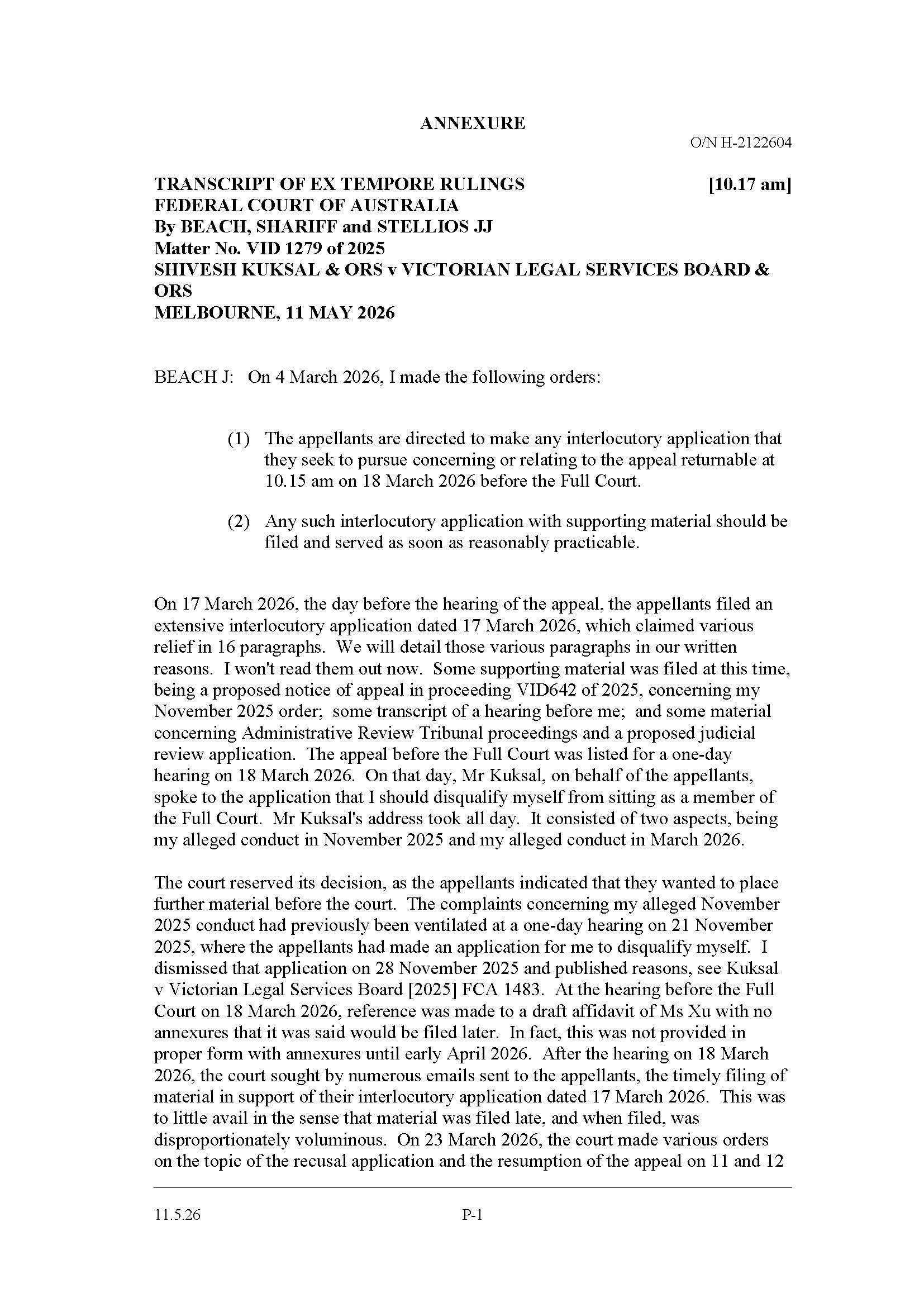
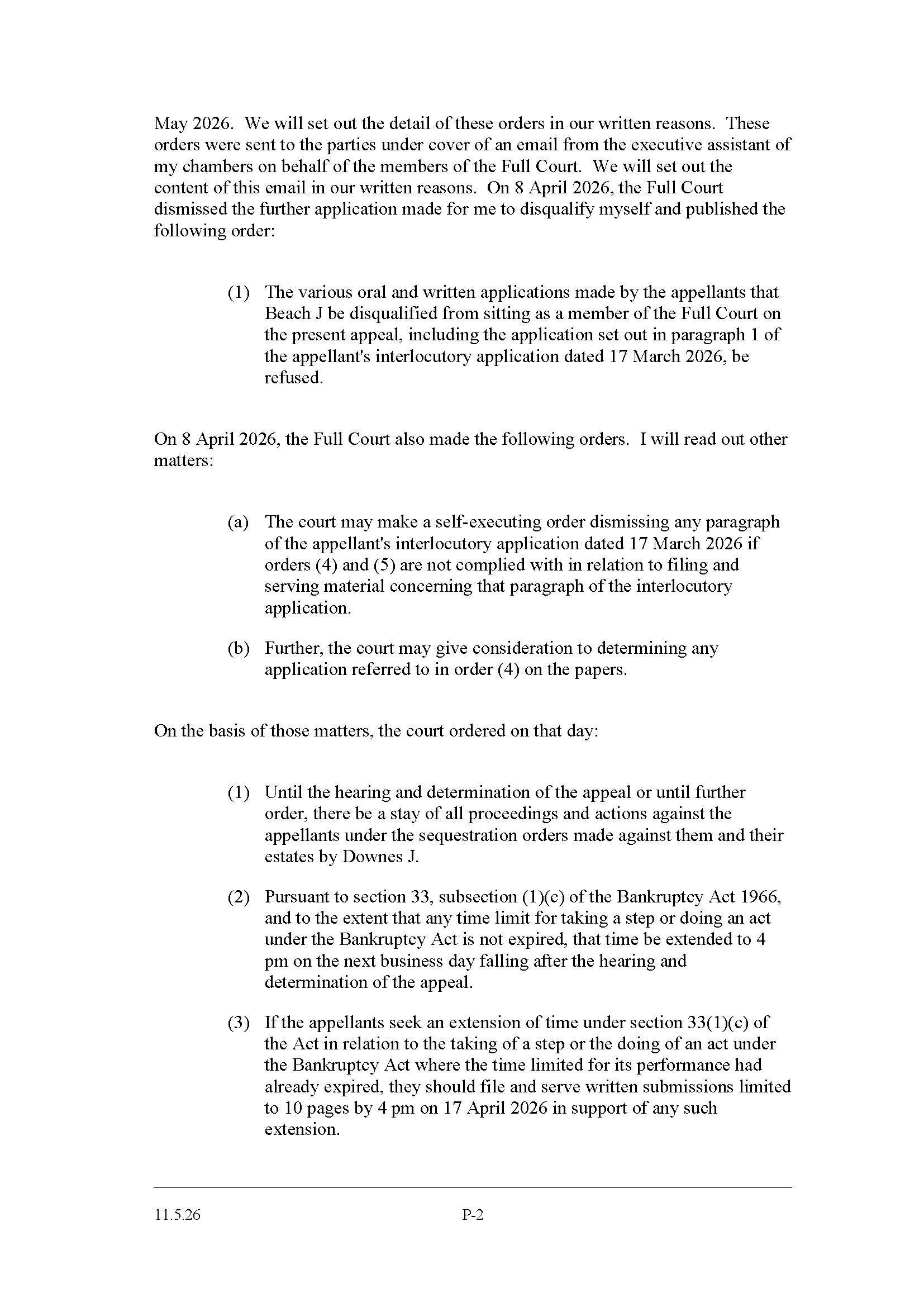
SCHEDULE OF PARTIES
VID 1279 of 2025 | |
Respondents | |
Fourth Respondent: | HOWARD RAPKE |
Fifth Respondent: | MATTHEW ANSTEE |
Sixth Respondent: | PERSON 1 |
Seventh Respondent: | PERSON 2 |
Eighth Respondent: | CORRS CHAMBERS WESTGARTH |
Ninth Respondent: | JARED HEATH |
Tenth Respondent: | OFFICIAL TRUSTEE IN BANKRUPTCY |
Eleventh Respondent: | VICTORIAN OMBUDSMAN |
Twelfth Respondent: | JOBWATCH INC |


