

FEDERAL COURT OF AUSTRALIA
Blucher on behalf of the Gaangalu Nation People v State of Queensland [2025] FCAFC 177
Appeal from: | Blucher on behalf of the Gaangalu Nation People v State of Queensland (No 3) [2023] FCA 600 Blucher on behalf of the Gaangalu Nation People v State of Queensland (No 4) [2024] FCA 425 |
File number: | QUD 289 of 2024 |
Judgment of: | MURPHY, SARAH C DERRINGTON AND BENNETT JJ |
Date of judgment: | 5 December 2025 |
Catchwords: | NATIVE TITLE – appeal from determination by primary judge that native title does not exist in relation to the Claim Area – whether having found appellant held rights at sovereignty over large part of Claim Area, primary judge erred in failing to find they did not have such rights in remainder of Claim Area – whether appellant continues to hold rights and interests under the relevant traditional laws and customs in the disputed area – whether appellant established maintenance of connection by the normative system they acknowledge and observe – whether primary judge erred in finding certain alleged apical ancestors were not Gaangalu – whether primary judge erred in exercising discretion to make a negative determination NATIVE TITLE – meaning of “society” in Yorta Yorta sense – whether primary judge erred by failing to consider whether the Gaangalu had continued to exist as a society – whether primary judge incorrectly understood Gaangalu to assert only the existence of a regional society of which they were a member NATIVE TITLE – where contemporary Gaangalu system concerning inheritance of primary rights and interests from either parent has been adopted since sovereignty – whether primary judge erred in rejecting contemporary system as an adaptation of traditional system APPEALS – role of appellate court in considering factual findings of a trial judge – whether nature of inquiry called for by the Native Title Act 1993 (Cth) makes it difficult for an appellate court to interpose its analysis of factual findings |
Legislation: | Native Title Act 1993 (Cth) ss 3, 87, 87A, 223, 225 |
Cases cited: | Allesch v Maunz [2000] HCA 40; 203 CLR 172 Banjima People v State of Western Australia (No 2) [2013] FCA 868; 305 ALR 1 Banjima People v Western Australia [2015] FCAFC 84; 231 FCR 456 Bennell v State of Western Australia [2006] FCA 1243; 153 FCR 120 Blucher on behalf of the Gaangalu Nation People v State of Queensland (No 3) [2023] FCA 600 Blucher on behalf of the Gaangalu Nation People v State of Queensland (No 4) [2024] FCA 425 Bodney v Bennell [2008] FCAFC 63; 167 FCR 84 Briggs on behalf of the Boonwurrung People v State of Victoria (No 2) [2025] FCA 279 CG v Western Australia [2016] FCAFC 67; 240 FCR 466 Commonwealth v Yarmirr [2001] HCA 56; 208 CLR 1 Construction, Forestry, Mining and Energy Union v Alfred [2011] FCAFC 13; 203 IR 78 Dearman v Dearman (1908) 7 CLR 549 Drill on behalf of the Purnululu Native Title Claim Group v State of Western Australia [2020] FCA 1510 Fox v Percy [2003] HCA 22; 214 CLR 118 Frigger v Trenfield (No 3) [2023] FCAFC 49 Griffiths v Northern Territory [2006] FCA 903; 165 FCR 300 Griffiths v Northern Territory of Australia [2007] FCAFC 178; 165 FCR 391 Harrington-Smith on behalf of the Wongatha People v State of Western Australia (No 9) [2007] FCA 31; 238 ALR 1 Henderson v Queensland [2014] HCA 52; 255 CLR 1 Lee v Lee [2019] HCA 28; 266 CLR 129 Mace v State of Queensland [2019] FCAFC 233; 274 FCR 41 Malone on behalf of the Western Kangoulu People v State of Queensland (No 6) [2025] FCA 363; 310 FCR 95 Malone v State of Queensland (Clermont-Belyando Area Native Title Claim (No 5) [2021] FCA 1639; 397 ALR 397 Members of the Yorta Yorta Aboriginal Community v Victoria [2002] HCA 58; 214 CLR 422 Minister for Immigration and Border Protection v SZVFW [2018] HCA 30; 264 CLR 541 Narrier v Western Australia [2016] FCA 1519 Nona on behalf of Badulgal, Mualgal and Kaurareg Peoples (Warral & Ului) v State of Queensland (No 5) [2023] FCA 135 Northern Territory v Alyawarr, Kaytetye, Warumungu, Wakaya Native Title Claim Group [2005] FCAFC 135; 145 FCR 442 Rainbow on behalf of the Kurtjar People v State of Queensland (No 2) [2021] FCA 1251 Risk v Northern Territory of Australia [2007] FCAFC 46; 240 ALR 75 Robinson Helicopter Company Incorporated v McDermott [2016] HCA 22; 90 ALJR 679 Sampi v Western Australia [2005] FCA 777 Stuart v South Australia [2023] FCAFC 131; 299 FCR 507 Stuart v South Australia [2025] HCA 12; 99 ALJR 731 Stuart v State of South Australia (Oodnadatta Common Overlap Proceeding) (No 4) [2021] FCA 1620 Wagonga Local Aboriginal Land Council v Attorney-General of New South Wales [2020] FCA 1113 Wang v Hur [2024] QCA 126 Warren v Coombes (1979) 142 CLR 531 Western Australia v Sebastian [2008] FCAFC 65; 173 FCR 1 Western Australia v Ward (2002) 213 CLR 1 Worimi Local Aboriginal Land Council v Minister for Lands (NSW) (No 2) [2008] FCA 1929 Worimi v Worimi Local Aboriginal Land Council [2010] FCAFC 3; 181 FCR 32 Wyman on behalf of the Bidjara People v Queensland (No 2) [2013] FCA 1229 Wyman v Queensland [2015] FCAFC 108; 235 FCR 464 |
Division: | General Division |
Registry: | Queensland |
National Practice Area: | Native Title |
Number of paragraphs: | 353 |
Date of last submissions: | 29 May 2025 |
Date of hearing: | 3–5 March 2025 |
Counsel for the Appellant: | R J Webb KC, J Waters SC and J Creamer |
Solicitor for the Appellant: | Saylor Legal |
Counsel for the First and Seventy-Sixth Respondents: | A Duffy KC and L Kruger |
Solicitor for the First and Seventy-Sixth Respondents: | Crown Law |
Counsel for the Sixth and Seventy-Fourth Respondents: | C Klease |
Solicitor for the Sixth and Seventy-Fourth Respondents: | Moray & Agnew Lawyers |
Counsel for the Seventy-Fifth Respondent: | D O’Gorman SC |
Solicitor for the Seventy-Fifth Respondent: | Queensland South Native Title Services |
ORDERS
QUD 289 of 2024 | ||
| ||
BETWEEN: | LYNETTE GAIL BLUCHER & ORS ON BEHALF OF THE GAANGALU NATION PEOPLE Appellant | |
AND: | STATE OF QUEENSLAND First Respondent BANANA SHIRE COUNCIL Second Respondent CENTRAL HIGHLANDS REGIONAL COUNCIL (and others named in the Schedule) Third Respondent | |
order made by: | MURPHY, SARAH C DERRINGTON AND BENNETT JJ |
DATE OF ORDER: | 5 December 2025 |
THE COURT ORDERS THAT:
1. The Negative Determination dated 30 April 2024 be set aside.
2. By 13 February 2026, the parties make submissions of no more than 20 pages in length as to the appropriate disposition of the appeal (including as to costs) having regard to the reasons of the Full Court.
Note: Entry of orders is dealt with in Rule 39.32 of the Federal Court Rules 2011.
REASONS FOR JUDGMENT
[1] | |
[8] | |
[13] | |
[18] | |
[23] | |
Inalienability of land and embodied relationship between people and land | [24] |
[27] | |
[29] | |
[31] | |
[33] | |
[35] | |
[37] | |
[39] | |
[42] | |
[43] | |
[44] | |
[45] | |
[47] | |
[50] | |
[61] | |
[61] | |
[64] | |
The identification of the relevant society in the primary judgment | [70] |
[76] | |
[91] | |
[99] | |
[103] | |
[110] | |
[114] | |
[118] | |
[138] | |
[138] | |
[154] | |
[156] | |
[159] | |
[164] | |
[169] | |
[173] | |
[177] | |
[185] | |
[193] | |
[198] | |
[204] | |
[205] | |
[206] | |
[215] | |
[221] | |
[226] | |
[234] | |
[238] | |
[246] | |
[249] | |
[253] | |
[256] | |
[257] | |
[263] | |
[263] | |
[289] | |
[302] | |
[303] | |
[312] | |
[318] | |
Polly Doctor (and her grandchildren, Charlie, Willie and George Riley) | [325] |
[332] | |
[339] | |
[342] | |
[344] | |
[345] | |
[348] |
THE COURT:
INTRODUCTION
1 In August 2012, Lynette Blucher and others on behalf of the Gaangalu Nation People (the Gaangalu or Appellant) filed this proceeding seeking a determination of native title over approximately 25,506 km2 of land and waters broadly west and south-west of Rockhampton in Central Queensland (the Claim Area).
2 In June 2023, the primary judge delivered reasons answering a separate question in the following terms:
But for any question of extinguishment of native title, does native title exist in relation any and, if so what, land and waters of the claim area?
3 The primary judge answered “no” to that separate question (Blucher on behalf of the Gaangalu Nation People v State of Queensland (No 3) [2023] FCA 600 (PJ1)). Only the Gaangalu and the First Respondent, the State of Queensland (the Respondent or Queensland), participated in the hearing concerning the separate questions. Queensland cross-examined the expert witnesses and some of the lay witnesses called by the Gaangalu and made extensive submissions opposing the Gaangalu’s case in the hearing of the separate questions (Blucher on behalf of the Gaangalu Nation People v State of Queensland (No 4) [2024] FCA 425 (PJ2) at [13]).
4 Two respondents (the 6th respondent and the 74th respondent, together the Woorabinda parties) subsequently sought a determination that native title does not exist in the land and waters of the Claim Area to the west of the Dawson River, or alternatively, that a determination should be made that native title does not exist in the particular areas in which they hold interests. Those orders were opposed by the Gaangalu and the 75th respondent, being Queensland South Native Title Services Limited (QSNTS). Queensland took no position on whether a negative determination should be made.
5 Following a hearing, orders were made in PJ2 declaring that “Native Title does not exist in relation to any part of the claim area to the West of the Dawson River” (the Negative Determination).
6 The present appeal concerns both PJ1 and PJ2. By their amended notice of appeal, the Appellant raises five grounds of appeal, as follows:
(1) Ground one: In circumstances where the primary judge correctly found that at sovereignty, Gaangalu people occupied and had rights and interests in the whole of the Claim Area to the west of the Dawson River and in those parts to the east of the Dawson River in the Three Rivers, Mount Spencer and Banana areas the primary judge then erred in finding that Gaangalu people at sovereignty did not occupy and have rights and interests in the remainder of the Claim Area.
(2) Ground two: In circumstances where the primary judge correctly found that at sovereignty, Gaangalu people occupied and had rights and interests in the whole of the Claim Area to the west of the Dawson River and in those parts to the east of the Dawson River in the Three Rivers, Mount Spencer and Banana areas and should have found that at sovereignty Gaangalu people also occupied and had rights and interests in the remainder of the Claim Area (ground one) the primary judge then erred in finding that Gaangalu had not established that they continue to hold rights and interests under the relevant traditional laws and customs in those areas.
(3) Ground three: In circumstances where the primary judge correctly found that at sovereignty, Gaangalu people occupied and had rights and interests in the whole of the Claim Area to the west of the Dawson River and in those parts to the east of the Dawson River in the Three Rivers, Mount Spencer and Banana areas and should have found that at sovereignty Gaangalu people also occupied and had rights and interests in the remainder of the Claim Area (ground one) the primary judge then erred in finding that Gaangalu did not establish that they maintain a connection to those areas by the normative system which they acknowledge and observe.
(4) Ground four: The primary judge erred in finding that the descendants of the named deceased ancestors identified in the notice of appeal were not members of the claim group because the excluded ancestors were either not Gaangalu, had not been shown to have been Gaangalu, and/or did not have, or had not been shown to have had, rights and interests in the Claim Area at sovereignty.
(5) Ground five: The primary judge erred in the exercise of the discretion to make a determination that native title does not exist in attributing weight to the submissions of the Woorabinda parties beyond the area of their geographic interest.
7 On 9 April 2025, the High Court delivered judgment in Stuart v South Australia [2025] HCA 12; 99 ALJR 731 (Stuart HC). Because of the relevance of that decision to the issues raised in this appeal, particularly to the third ground, we granted leave for the parties to file additional written submissions. Those submissions were filed between 8 May 2025 and 29 May 2025.
SUMMARY OF GROUNDS AND STRUCTURE OF THESE REASONS
8 Grounds one and four relate to conclusions of fact reached by the primary judge and are broadly concerned with whether findings of that kind were available on the material, or were reached via a permissible reasoning process. The second and third grounds concern the operation of s 223 of the Native Title Act 1993 (Cth) (the NTA), and whether the statutory tests were appropriately applied. Ground two concerns whether the rights and interests under consideration were relevantly traditional for the analysis of s 223(1)(a) of the NTA. The third ground is concerned with whether or not the primary judge correctly identified and applied the test for connection found in s 223(1)(b) of the NTA. The fifth ground is concerned with the appropriateness of the Negative Determination.
9 At the outset, we note that the primary judge observed at PJ1[18] that he found the statement of claim to be “somewhat ambiguous and unclear” and the Gaangalu’s written submissions unclear and lacking in analysis. His Honour said (at PJ1[26]):
It is necessary to say something about the applicant’s approach to its written submissions. Their written submissions consist largely of chunks of evidence extricated verbatim from the anthropological reports, statements or transcript, followed by the statement of one or more general propositions. To give one example, the section of their submissions dealing with continuity of traditional understanding of mythology starts with extensive extracts from the transcript and statements, and then segues to broad statements to the effect that those extracts demonstrate, “clear continuity in relation to the knowledge and content of the stories”. However, there is no analysis of the evidence concerning traditional mythology and how and why the contemporary evidence demonstrates continuity of that aspect of law and custom. It has been necessary for me to, in effect, construct the argument that the applicant may be putting and then address that putative argument. That kind of issue was repeated throughout the applicant’s lengthy written submissions. One important issue, the continuity of a traditional law and custom described as, “the presence of landholding units which were small local groups (capable of description as hordes or clans) who recruited members mainly by patrilineal descent”, was not addressed at all. The applicant’s approach has made the task of understanding and addressing some parts of the applicant’s case problematic.
10 In our view it is sufficiently clear from the primary judge’s reasons that, in part, the Gaangalu’s approach led his Honour into error. Similarly, in our view Queensland made submissions on the evidence regarding apical ancestors which, having regard to the evidence, it should not have made, and his Honour was drawn to accept some of those submissions.
11 On appeal, however, a much clearer approach was taken in relation to the facts and the identification of the issues in dispute. Taken together with the benefit of his Honour’s careful and thorough analysis of the material before him, this has allowed us to have a degree of clarity over some matters which our review of the material below suggests was not available to the primary judge.
12 For the reasons that we have outlined below, we have concluded that:
(1) The primary judge erred in his approach to the identification of the relevant “society” for the purposes of s 223(1)(a) of the NTA (see [64]-[98] below). In addition, his Honour erroneously failed to identify that the shift in inheritance rights from being patrilineally biased to cognatic was an adaptation of the traditional system (see [99]-[137] below) and that the shift from clan estates to language groups was also an adaptation (see [138]-[168] below). Thus, ground two must be upheld.
(2) The erroneous analysis in respect of ground two infected the analysis of the continuity enquiry the subject of ground three. We have nonetheless considered his Honour’s approach to the continuity enquiry and have concluded that his Honour erred for the reasons explained at [173]-[204] below.
(3) In relation to grounds one and four, there were errors in his Honour’s approach to the identification of apical ancestors, and to the exclusion of certain evidence concerning important parts of the Claim Area (see [215]-[252] below in relation to ground one, and [253]-[344] below in relation to ground four).
(4) In light of the errors that we have identified in the other grounds, it was not appropriate for a negative determination of native title to have been made, and the Negative Determination the subject of ground five must be set aside. The findings on grounds one and four render it unnecessary and inappropriate to consider ground five further (see [345]-[347] below).
BACKGROUND AND THE PRIMARY JUDGMENT
13 The background and facts are comprehensively set out in PJ1. We here set out some of the core factual findings that are relevant to the matters concerning the five appeal grounds. These reasons should, however, be read in conjunction with PJ1 and we assume familiarity with those reasons.
14 The Claim Area covers 25,506 km² of land and waters broadly west and south-west of Rockhampton in Central Queensland. It is not in dispute that at sovereignty, the Gaangalu people occupied and had rights and interests in the whole of the Claim Area to the west of the Dawson River, as well as rights and interests in part of the Claim Area east of the Dawson River, including in Three Rivers, Mount Spencer and Banana areas (PJ1[1238(1)]. The Claim Area was depicted in the application as follows:
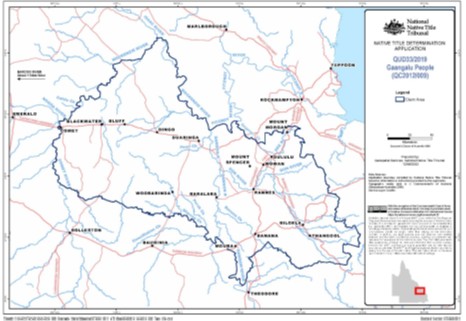
15 The application sought exclusive and non-exclusive native title rights and interests in some areas, and non-exclusive rights and interests in the remainder. An application for a determination of native title over an area to the south-west of the Claim Area was dismissed in Wyman on behalf of the Bidjara People v Queensland (No 2) [2013] FCA 1229 (Jagot J), as was an application over an area to the north-west in Malone v State of Queensland (Clermont-Belyando Area Native Title Claim (No 5) [2021] FCA 1639; 397 ALR 397 (Reeves J). In the time since the determination of the present matter, native title has been found to exist in the area immediately to the west of the Claim Area: Malone on behalf of the Western Kangoulu People v State of Queensland (No 6) [2025] FCA 363; 310 FCR 95 (O’Bryan J) (Malone).
16 There was broad agreement between the parties that the traditional laws and customs included those matters set out at PJ1[1072], including:
(1) an understanding of mythology, including spiritual forces inhering in land and waters;
(2) an understanding of spirits in the landscape, including appropriate ways of managing spiritual presence;
(3) an embodied relationship between people and their land or waters; and
(4) various funerary practices.
17 However, there was dispute about the ongoing existence of a range of traditions, laws and customs, and whether they could be properly considered “traditional” in the sense understood in the authorities. Queensland was the only active respondent at the hearing of the separate question, and it contended that native title did not exist in relation to any part of the Claim Area.
Evidence
18 The primary judge carried out a careful and detailed analysis of the evidence. There were three primary expert witnesses. They produced joint reports following two Court-ordered experts’ conferences, and two of them gave evidence in the hearing.
(1) Dr Kim de Rijke, an anthropologist engaged by the Appellant since 2011 to investigate the Gaangalu claim. Dr de Rijke gave concurrent oral evidence in the course of the hearing.
(2) Dr Hilda Maclean, an historian engaged by the Appellant in 2013 to undertake a genealogical investigation for use in the claim. Dr Maclean was not required to give evidence.
(3) Dr Anna Kenny, an anthropologist engaged by Queensland, who gave concurrent oral evidence with Dr de Rijke in the course of the hearing.
19 In addition, Dr Fiona Powell, an anthropologist, attended the conference of experts on 20 February 2019 although she did not provide an individual report. There were also additional joint anthropological statements involving Dr Martin, Dr Gorring and Mr McCaul, although those individuals were not called to give evidence and did not participate in the expert conclave.
20 There was also evidence of 20 lay witnesses who were each cross-examined (PJ1[28]) over a period of seven days in April 2021. The evidence of three individuals who had passed away prior to the hearing was also received into evidence (PJ1[29]). His Honour recognised the primacy of the lay evidence (PJ1[35]), although the extent to which this primacy was given effect is significant in respect of grounds one and four. The evidence of the Gaangalu witnesses was summarised in detail by his Honour in PJ1[55]-[449].
21 There is no challenge to his Honour’s careful and thorough summary of that material.
22 There were 28 apical ancestors identified by the claim group. Of those 28, the appropriateness of the inclusion of 16 of them was challenged by Queensland (PJ1[527]) and his Honour found that a number of them were not Gaangalu people, or were not shown to have rights and interests in the Claim Area. Those findings are challenged in ground four.
Findings: ongoing connection
23 The evidence before his Honour was voluminous and we do not seek to comprehensively summarise it here. There were substantial areas of contest in relation to the existence of a relevant society, and who were properly members of the claim group. We therefore have set out some of the factual findings that are important to understand the issues in dispute.
Inalienability of land and embodied relationship between people and land
24 There was evidence which his Honour accepted that it was an aspect of pre-sovereignty Gaangalu law and custom that rights and interests in land and waters were understood to be inalienable, that that belief continues with members of the claim group (PJ1[1067]-[1071], [1218]) and that there existed an embodied relationship between people and the land (PJ1[1072]).
25 His Honour noted that the embodied relationship between people and the land was attenuated post-sovereignty, observing that the evidence did not establish that the contemporary belief about the role of ancestor spirits in looking after Gaangalu people was consistent with traditional beliefs, nor the existence of a contemporary belief by the Gaangalu people as a whole that their spirits will return to the land (see PJ1[1126]).
26 His Honour accepted that there is a contemporary concept of communal ownership amongst the Gaangalu in the sense that rights and interests are understood as being held collectively, which was found to be based on traditional law and customs (PJ1[1071]). Nonetheless, his Honour held that this conclusion had to be qualified because of the shift to the contemporary system of “undifferentiated rights and interests” (PJ1[1071]) from the position pre-sovereignty, when rights and interests in Gaangalu country were held by what Dr de Rijke referred to as “a collective of culturally related local groups” or “patriclans”. That issue has some relevance to the second ground.
Customary use of material resources
27 His Honour found that there was customary use of material resources, noting that anthropological and lay evidence supported the use of natural resources by contemporary Gaangalu as including bush tucker (like wallaby, porcupine, goanna, grubs, fish, yams, sugar ants and berries), use of timber for nulla nullas, fires and smoking, bush medicine, ochres for painting, and wallaby and kangaroo skins (PJ1[1141]-[1143]). His Honour accepted that, while some of the hunting, camping and working around country was simply part of life, there is no requirement under s 223(1) of the NTA that every relevant custom of the pre-sovereignty society and succeeding generations is steeped in spiritual or ritual significance (PJ1[1146]). Accordingly, even though some of the pre-sovereignty hunting and consumption of native animals and the use of bush medicine may be viewed as originally driven by survival and subsistence, and the contemporary practice is no longer driven by those factors, they remain customs that are continued (PJ1[1146]).
28 His Honour concluded that, while it is “doubtful” that the practice of hunting and gathering by the Gaangalu people as a whole continues today, the Gaangalu people as whole consider that they have a right to so hunt and gather upon the Claim Area under their traditional laws and customs (PJ1[1148]). Ultimately, the continued use of, and belief in the right to use natural resources was found by his Honour to support the Appellant’s contention that the claimed rights and interests are possessed under the traditional laws and customs (PJ1[1149]).
Inheritance of secondary usufructuary rights
29 A range of rights the subject of the application was described as usufructuary insofar as those rights of access, to be present on or to move about in an area were exercised in a temporary way (PJ1[1047]). Examples include the right to occupy, use and camp on the area temporarily, hunt, fish and gather on the land and waters, or take and use natural resources, or light fires in the area (PJ1[1047]).
30 His Honour accepted the expert evidence that “‘secondary’ or ‘contingent’ rights” were inherited matrilineally at sovereignty (PJ1[1006], [1009]) and inferred that the rights described above were rights of this kind (PJ1[1047]). His Honour considered that such rights must also have been encompassed in the primary rights inherited patrilineally (PJ1[1047]). To the extent that the present system involves inheritance of usufructuary rights and interests from either parent, his Honour held it to be consistent with traditional laws and customs (PJ1[1047]).
Classificatory kinship system
31 His Honour analysed the classificatory kinship system that provided the social organisation of the Gaangalu, encompassing two named moieties and four named sections. His Honour accepted that the contemporary evidence of kinship practices is consistent with the adaptation of the Gaangalu classificatory kinship system relating to who should marry who, and the nature of kinship and authority, although in “substantially attenuated form” (PJ1[1158]). For example, Dr De Rijke gave evidence of the contemporary practice of all of a child’s aunts being referred to as “mother” and all uncles as “father”, with cousins being referred to as “brother” and “sister” respectively (PJ1[1154]). The nature of caring responsibilities and authority over children was consistent with these kinship concepts (PJ1[1154]). The pre-sovereignty system was, his Honour found, more finely-grained and nuanced, particularly because it included matters such as “in-law avoidance” and the importance of a mother’s brother in sponsoring a youth through initiation, which were largely lost (PJ1[1158]). His Honour concluded (at PJ1[1160]) that:
…the continuation of traditional classificatory kinship practices in attenuated form does not significantly affect the question of continuity of the traditional laws and customs under which the Gaangalu may have their claimed rights and interests in the claim area.
32 His Honour found that the classificatory kinship system was connected with totems, which were also the subject of findings by his Honour.
Totems
33 His Honour identified substantial evidence about totems, observing that some people or families had totems, which impacted on certain matters like who they could marry, and what food they could eat (with a prohibition on killing one’s own totem identified by the anthropologists) (PJ1[1163]-[1169]). His Honour surveyed the broad historical use of totems, and concluded regarding the contemporary relevance of totems (at PJ1[1175]) that:
The only normative contemporary use of totems seems to be as family or personal identifiers. While they may signify marriage rules, since they are inherited both matrilineally and patrilineally, they seem to signal little more than a biological imperative that people from the same family group should not marry. There remains a prohibition on consumption of one’s totem.
34 His Honour ultimately accepted that for the claim group as a whole, the use of totems as personal or family signifiers is an adaptation of traditional law and custom “but is very much attenuated” noting that the contemporary significance of totems as personal or family signifiers “does not seem to be connected with rights and interests in land” (PJ1[1177]).
The role of senior people
35 His Honour noted that the Gaangalu witnesses gave evidence of a contemporary system of authority emphasising the role of senior people and their authority in the overall group (PJ1[1193]). His Honour noted that the role of elders is now shared equally as between male and female elders, and that this represents a departure from tradition (PJ1[1195]).
36 Nonetheless, his Honour accepted that overall the contemporary Gaangalu have a system of authority emphasising the role of senior people that finds its origins in traditional laws and customs, although “that system has significantly changed and attenuated” and was not, his Honour found, a system that directly affects the continuation of rights and interests in the Claim Area under traditional law and custom (PJ1[1196]).
Responsibility to manage and protect the land and waters
37 The primary judge observed that a number of the Gaangalu witnesses gave evidence of being taught that they had a responsibility to look after Gaangalu country, which his Honour understood to refer to looking after country in both a spiritual and physical sense (PJ1[1202]). While his Honour rejected the contention that the evidence demonstrated a traditional principle of not taking more than is needed, he accepted that belief in responsibility for physical and spiritual protection of the land is, at least to some extent, a continuation of traditional law and custom (PJ1[1205]-[1206]). In particular, his Honour accepted the contemporary belief in the presence of Gaangalu in the landscape reflected a traditional belief of their ancestors that their spirits would return to the land (PJ1[1206]).
38 Overall, his Honour accepted that members of the claim group continue to observe responsibilities under traditional laws and customs to protect sacred areas and, more generally, to protect the land against trespass (PJ1[1218]).
Spiritual connection with the land
39 His Honour noted that the Gaangalu traditional laws and customs agreed between the parties included spiritual forces inhering in the lands and waters, and an understanding of spirits in the landscape, including appropriate ways of managing spiritual presence (PJ1[1072]). Based on the anthropological evidence of Aboriginal mythology generally, his Honour accepted that it was probable that Gaangalu people at sovereignty had a mythology which involved them being allotted their land and language by ancestral beings at the foundation of the world (PJ1[1114]-[1115]). However, his Honour found that, apart from inconsistent fragments of stories about Mundagarra, no such stories remain and much of the metaphysical knowledge connecting Gaangalu people to the land has been lost (PJ1[1115], [1138]). Other than Mundagarra, the other aspects of evidence about spiritual connection were not accepted by his Honour to have originated in traditional laws and customs, or to represent a shared norm (PJ1[1139]).
40 His Honour also found that the claim group has a spiritual connection with the land reflecting beliefs based on traditional law and custom that the spirits of their ancestors would return to the land (PJ1[1126], [1218]).
41 Relatedly, his Honour found that contemporary funeral practices contain elements of traditional customary practice and belief, particularly a belief in burying people on country and smoking ceremonies (PJ1[1125]). His Honour considered that this was a continuation of some traditional funerary practices, albeit in “significantly attenuated form” (PJ1[1125]).
Intermarriage
42 His Honour accepted that it was an aspect of traditional law and custom that marriage could take place both among Gaangalu and between Gaangalu and non-Gaangalu persons. However, his Honour did not consider this custom to affect the question of possession of the claimed rights and interests under traditional law and custom (PJ1[965], [1207]).
Disrupted laws and customs
43 His Honour likewise made a number of findings that the laws and customs of the Gaangalu people had been disrupted over time. A number of those findings are summarised below.
Shift from patrifiliation to cognatic descent
44 His Honour analysed the evidence concerning inheritance of primary rights and interests, noting that contemporary Gaangalu society recognises inheritance of those interests from either parent (PJ1[1048]). His Honour said that traditionally, rights in land were acquired patrilineally (PJ1[1048]). His Honour rejected the Gaangalu’s contention that the present system was an adaptation of a traditional one (PJ1[1050]). This shift, and his Honour’s analysis of it, is a significant aspect of the second ground of appeal. His Honour’s findings and the evidence upon which they were based are explored in detail at [99]-[137] below.
Shift from patriclan to language group
45 An issue that is connected to the question of succession of landholding rights is the nature of the tenure system. His Honour found that at sovereignty, that land tenure system of the region was characterised by small, local landholding clan groups (PJ1[1007]). These groups lived mainly in small family-based clans of 20 to 30 people who camped together in an area (PJ1[1007]). The members of each group spoke the same language (PJ1[1007], [1220]). These groups were referred to by some of the experts as patriclans (see PJ1[860]). His Honour considered whether contemporary forms of differentiation within the claim group (by which particular groups “speak for” particular parts of the Claim Area) are an adapted expression of traditional principles (see PJ1[1051]-[1065]). This was said by the Appellant to call for an intramural allocation of rights and interests across the Claim Area, with the native title determination application itself contemplating undifferentiated rights and interests held by the claim group as a whole across the Claim Area (PJ1[1038]-[1039]).
46 His Honour concluded that he was not satisfied that the Gaangalu had demonstrated that the asserted undifferentiated native title rights and interests held by the claim group as a whole were a permissible adaptation of traditional law and custom, rather than a post-sovereignty construct (PJ1[1065]). Moreover, his Honour was not satisfied that any differentiation by reference to the east and west side of the Claim Area was a permissible adaptation of traditional law and custom (PJ1[1065]). His Honour said that the wholesale change to the group now said to have landholding rights did not merely involve adaptation of traditional laws and customs, but represented substantial discontinuity and reformulation (PJ1[1220]).
Other aspects of discontinuity
47 His Honour found that traditional Gaangalu creation mythology was no longer substantially known, acknowledged or observed amongst the claim group (PJ1[1115]). His Honour noted that traditional mythology was likely to have involved sacred patterns, integrating the land with languages, totems, dreaming tracks and other defining features of the Gaangalu geopolitical landscape (PJ1[1114]-[1115]). However, his Honour concluded that the body of mythology creating the sacred laws by which the Gaangalu people were given rights and interests in the Claim Area was substantially lost, such that only fragments remain (PJ1[1115]). That presents what his Honour considered to be a “very substantial and important discontinuity of traditional laws and customs” (PJ1[1221]).
48 Moreover, his Honour carefully and thoroughly identified a range of other aspects of Gaangalu traditional life which he considered related (perhaps indirectly) to the exercise, acquisition or transmission of rights and interests in land and waters that were no longer observed. His Honour said (PJ1[1222]-[1223]):
These include initiation, the moiety and section system, totems and ceremonies such as increase ceremonies. The evidence shows that there must have been significant interrelationship between such aspects of traditional law and custom, but much of the detail of their functions and roles has been lost. However, as I have discussed earlier in these reasons, each of them had some connection with rights and interests in land. The loss or attenuation of these aspects of traditional law and custom should be given some weight.
The evidence does not establish that acknowledgement and observance of traditional laws and customs has continued substantially uninterrupted since sovereignty. Ultimately, I am not satisfied that the claim group possesses the claimed rights and interests under a body of traditional laws and customs acknowledged and observed by them.
49 It is with this background to the factual findings relevant to this appeal that we turn to consider the statutory framework and legal principles.
THE STATUTORY FRAMEWORK AND LEGAL PRINCIPLES
50 This case concerns the operation of the NTA. It is well understood that a determination of native title may be made by the Federal Court in accordance with s 225. Section 223(1) of the NTA defines the words “native title” or “native title rights and interests”. It provides:
Common law rights and interests
(1) The expression native title or native title rights and interests means the communal, group or individual rights and interests of Aboriginal peoples or Torres Strait Islanders in relation to land or waters, where:
(a) the rights and interests are possessed under the traditional laws acknowledged, and the traditional customs observed, by the Aboriginal peoples or Torres Strait Islanders; and
(b) the Aboriginal peoples or Torres Strait Islanders, by those laws and customs, have a connection with the land or waters; and
(c) the rights and interests are recognised by the common law of Australia.
51 Section 223 was recently the subject of consideration by the High Court in Stuart HC. The operation of s 223(1) was summarised at [3] as follows:
To hold native title within the meaning of s 223(1) of the Native Title Act, the claimant Aboriginal peoples or Torres Strait Islanders must relevantly have rights and interests possessed under the traditional laws acknowledged, and the traditional customs observed, by them (s 223(1)(a)); and they must have a connection with land (or waters) by those traditional laws and customs (s 223(1)(b)).
52 The approach of the plurality of the High Court in Stuart HC at [19] (Gageler CJ, Gordon, Edelman, Gleeson and Beech-Jones JJ) made it clear that there are two inquiries required by s 223(1) (citing Western Australia v Ward (2002) 213 CLR 1 (Ward) at [18] (Gleeson CJ, Gaudron, Gummow and Hayne JJ)):
(1) First: identification of the traditional laws and customs and the identification of the rights and interests possessed under those traditional laws and customs; and
(2) Second: identifying the connection with land or waters by those laws and customs.
53 Thus, it is necessary to identify the laws and customs at present for the purposes of s 223(1)(a) separately from the laws and customs at the time of sovereignty. The connection required by s 223(1)(b) is to be “by [the] laws and customs”. That is a reference to the laws and customs identified in s 223(1)(a) (Stuart HC at [23]).
54 There is no requirement that the connection is a physical one. The plurality explained the matter in this way (Stuart HC at [22]):
… if the laws and customs demonstrate that connection with the relevant land and waters is generally by undertaking physical acts of acknowledgment or observance within the area of those land and waters, then establishing a connection may depend on whether such acts were performed. But equally, if the laws and customs demonstrate that connection may be established other than by physical acts of acknowledgment or observance within the relevant area, then such acts may not be necessary to demonstrate "connection".
55 It follows, as was acknowledged in Ward (at [64]), that a lack of recent use of the land or waters does not, of itself, require the conclusion that there can be no relevant connection. The connection can be spiritual as much as it can be physical (Stuart HC at [26]).
56 Queensland urged the need for appellate restraint in native title proceedings and emphasised the advantage enjoyed by the primary judge. It submitted that the “… findings of the primary Judge with respect to continuity and connection were neither glaringly improbable nor contrary to compelling inferences and were indeed supported by the evidence as it was given at trial”. We were not assisted by this submission, which puts a gloss on our task.
57 As an appellate court, we are required to conduct a real review of the trial, and of the judge’s reasons and we are “not excused from the task of ‘weighing conflicting evidence and drawing [our] own inferences and conclusions’” while making due allowance for the trial judge’s advantage in seeing and hearing the witnesses (Fox v Percy [2003] HCA 22; 214 CLR 118 (Fox v Percy) at [25] (Gleeson CJ, Gummow and Kirby JJ), quoting Dearman v Dearman (1908) 7 CLR 549 at 564 (Issacs J)). In the present case, the primary judge had a significant advantage in that he had the benefit of hearing evidence from Aboriginal lay witnesses “on country”, was able to weigh that evidence having seen the land to which the evidence referred, and of seeing the expert witnesses give evidence in concurrent session: see Banjima People v Western Australia [2015] FCAFC 84; 231 FCR 456 (Banjima FC) at [57] (Mansfield, Kenny, Rares, Jagot and Mortimer JJ).
58 It is established that where a trial judge’s factual findings relate to impressions of the credibility of witnesses, the trial judge enjoys very considerable advantages over an appellate court. In such circumstances it is commonly said that the appellate court will not depart from the trial judge’s conclusions unless they are shown to be wrong by reference to “incontrovertible facts or uncontested testimony” or otherwise “contrary to compelling inferences” (Fox v Percy at [28]-[29]). Here, however, the primary judge did not make credibility findings in relation to any of the lay or expert witnesses that are relevant to the errors alleged. Further, some of the challenged findings turn on his Honour’s treatment of evidence based on historical or ethnographic materials in respect of which we are at no disadvantage. In relation to other findings and inferences, the primary judge is said to have set too high a bar for the evidence necessary to establish the findings sought, and other findings are said simply to be erroneous on a proper review of the evidence.
59 Correctness is the general standard of appellate review, as articulated in Minister for Immigration and Border Protection v SZVFW [2018] HCA 30; 264 CLR 541 (SZVFW) at [41]-[49] (Gageler J), and we take that approach. The principles were discussed in significant depth in Frigger v Trenfield (No 3) [2023] FCAFC 49 at [133]-[147] (Allsop CJ, Anderson and Feutrill JJ). In carrying out our task, we are conscious of and have taken account of the significant advantage enjoyed by the primary judge (Banjima FC at [57]).
60 It is convenient to deal first with the second and third grounds, before moving to grounds one, four and five.
SECTION 223(1) OF THE NTA: GROUNDS TWO AND THREE
Ground two
61 Ground two states:
In circumstances where the primary judge correctly found that at sovereignty, Gaangalu people occupied and had rights and interests in the whole of the claim area to the west of the Dawson River and in those parts to the east of the Dawson River in the Three Rivers, Mount Spencer and Banana areas and should have found that at sovereignty Gaangalu people also occupied and had rights and interests in the remainder of the claim area (Ground 1) the primary judge then erred in finding that Gaangalu had not established that they continue to hold rights and interests under the relevant traditional laws and customs in those areas.
62 Leaving aside the part of ground two which depends upon our determination of ground one, the core of the error alleged is that the primary judge fell into error in concluding that the Gaangalu had not established that they continue to hold rights and interests under the relevant traditional laws and customs in the relevant areas. There are said to be three aspects to this error:
(1) First: by assessing continuity for the purposes of s 223(1)(a) of the NTA by reference to the regional society, rather than to the Gaangalu as a group within that society, his Honour asked himself the wrong question.
(2) Second: in response to evidence of a changed emphasis of some rules concerning inheritance of rights – favouring cognatic transmission rather than patrilineal transmission – the primary judge is said to have erred by failing to find that the shift in emphasis was a permissible adaptation of traditional laws and customs.
(3) Third: in response to changes from clan estates (at sovereignty) to the contemporary Gaangalu people as the relevant unitary group holding ownership (or primary rights), the primary judge erred in failing to find that a shift in arrangements under which primary rights were held from locally focused clan estates to undifferentiated communal holding of rights and interests in the whole of the Claim Area by all Gaangalu people, was a permissible adaptation of traditional laws and customs and not indicia of substantial discontinuity.
63 We first consider each alleged error, before turning to consider whether the ground is established.
Identification of “society” in the context of the NTA
64 Section 223(1)(a) of the NTA requires that the rights and interests identified are possessed under “traditional laws acknowledged and traditional customs observed” (emphasis added). The High Court in Members of the Yorta Yorta Aboriginal Community v Victoria [2002] HCA 58; 214 CLR 422 (Yorta Yorta) at [46] (Gleeson CJ, Gummow and Hayne JJ) made clear that a law or custom would be “traditional” for this purpose where it had its origin in the normative rules of the society that existed before sovereignty by the British Crown was asserted. This involves identifying laws and customs that have a normative content: a body or system of normative rules that existed before sovereignty (Yorta Yorta at [46]). There is a connection between the identification of a normative body of laws and customs and the identification of a society: the concepts are “inextricably linked” (Yorta Yorta at [55]).
65 The High Court used the word “society” in Yorta Yorta, noting as it did so the word was adopted rather than “community” so as “to emphasise this close relationship between the identification of the group and the identification of the laws and customs of that group” (Yorta Yorta at [49] footnote 94).
66 It is not the society per se that produces rights and interests (Bodney v Bennell [2008] FCAFC 63; 167 FCR 84 (Bodney) at [74] (Finn, Sundberg and Mansfield JJ)). The body of laws and customs under which native title rights and interests are possessed by a group of persons does not require uniformity – not each member of the group must have precisely the same knowledge of the laws and customs, or have precisely the same understanding of them (Western Australia v Sebastian [2008] FCAFC 65; 173 FCR 1 (Sebastian) at [84] (Branson, North and Mansfield JJ); Worimi Local Aboriginal Land Council v Minister for Lands (NSW) (No 2) [2008] FCA 1929 at [152] (Bennett J)). The function that the concept of “society” serves is to assist in the analysis of whether the normative system of law and custom being considered in s 223 is traditional in the relevant sense.
67 Caution has been expressed about the way that “society” has come to be used in the context of native title claims. For example, in Northern Territory v Alyawarr, Kaytetye, Warumungu, Wakaya Native Title Claim Group [2005] FCAFC 135; 145 FCR 442 (Alyawarr) the Full Court (Wilcox, French and Weinberg JJ) said at [78]:
The relevant ordinary meaning of society is “a body of people forming a community or living under the same government” – Shorter Oxford English Dictionary. It does not require arcane construction. It is not a word which appears in the NT Act. It is a conceptual tool for use in its application. It does not introduce, into the judgments required by the NT Act, technical, jurisprudential or social scientific criteria for the classification of groups or aggregations of people as ‘societies’. The introduction of such elements would potentially involve the application of criteria for the determination of native title rights and interests foreign to the language of the NT Act and confining its application in a way not warranted by its language or stated purposes.
68 There has been acknowledgment in a range of cases since that the identification of a “society” requires no more than the identification of a group of persons united by their acknowledgment and observance of a body of laws and customs. Justice Mortimer said of the concept of “society” in Nona on behalf of Badulgal, Mualgal and Kaurareg Peoples (Warral & Ului) v State of Queensland (No 5) [2023] FCA 135 at [455] that:
It is revealing that many judges in this Court, working at trial and appellate level in native title, are not enthusiastic about the concept in their published reasons. The concept tends to distract from the questions asked by the NTA.
69 In many respects the present appeal illustrates the issues that can arise where there is an oversized emphasis on the concept of “society”: converting it into almost an integer of the claim itself. We join with earlier decisions that have expressed concern at the way in which the concept of “society” sometimes operates in the context of this aspect of the NTA, noting its capacity to distract from the true issues required by the statute for determination.
The identification of the relevant society in the primary judgment
70 The primary judge’s analysis of the society commences at PJ1[830]. It is clear at the outset that his Honour understood that the task before him was to consider the existence of a regional society, noting that “[t]he applicant does not seek to demonstrate the existence of a society consisting solely of Gaangalu people” (PJ1[831]). This observation was correct: in the hearing below the Appellant did not seek to establish the existence of a society consisting solely of Gaangalu people. It alleged that the Gaangalu were part of a broader regional society, and that the regional society was part of the evidentiary matrix that was relevant to the identification of the normative system of laws and customs of the Gaangalu.
71 The assessment his Honour carried out was also identified in PJ1[997] as follows (emphasis added):
Each of the lay witnesses identified themselves as Gaangalu. As has been discussed, the applicant framed the relevant society as a Regional Society consisting of Gaangalu, Garingbal and Wadja people. Accordingly, it must be determined whether there has been continued acknowledgement and observance by the Regional Society of pre-sovereignty laws and customs under which the Gaangalu hold the claimed rights and interests in the claim area. However, as the applicant did not call any Garingbal and Wadja witnesses, the issue must be determined on the evidence of the Gaangalu witnesses. The continuity of the Regional Society will be addressed separately.
72 There, his Honour appears to have proceeded on an analysis of the statutory task by reference to the identification of Gaangalu rights and interests as a constituent element of the regional society. That approach involved an attempt to identify the normative system of the regional society, and an assessment of any shift from that system (see for example at PJ1[1216]: “[t]he traditional laws and customs of the regional society encompassing the Gaangalu are able to be described only at a level of generality because their details are simply not known”). The approach found its ultimate expression at PJ1[1232] where his Honour found that:
The applicant must demonstrate that the Regional Society continues to exist as a group that acknowledges those laws and customs. The Applicant made little attempt to demonstrate the continued existence of the Regional Society. It did not, for example, call any Garingbal or Wadja people to give evidence aimed at demonstrating the continuation of a common body of law and custom. The evidence of the Gaangalu witnesses as a whole does not demonstrate any emic view supporting the continued existence of such a society.
73 It is clear, therefore, that the learned primary judge proceeded on the basis that he was required to consider whether the regional society continued to exist. Having carried out that task, his Honour concluded that the regional society had not continued, and that this was fatal to the Appellant’s attempt to establish the relevant connection (see his Honour’s summary of conclusions at PJ1[1238(2)]-[1238(4)]). His Honour summarised his approach in PJ2[24]:
I held that the applicant had not proved that the present-day Gaangalu people possess the claimed rights and interests under traditional laws and customs of the Regional Society, nor that they have a connection with the land or waters by the traditional laws and the customs of the Regional Society. I also held that the applicant had not proved that the asserted Regional Society continues to exist.
74 Before us, Queensland argued that:
(1) the Appellant’s argument on appeal is inconsistent with the way the case was put below, and it is not now open to argue for the existence of a “Gaangalu society” as opposed to a regional society; and
(2) in any event, PJ1[1218] contains no finding by the primary judge that the Gaangalu people continue to be a group united in and by their acknowledgment and observance of a body of laws and customs that give rise to rights and interests in land. Thus, it is said his Honour’s findings are no more than a finding that there were “observable patterns of behaviour but not rights or interests in relation to the claim area”.
75 The Appellant did not argue before us that his Honour was in error to find that the regional society had ceased to exist, but simply that the primary judge erred by failing to consider whether the Gaangalu had continued to exist as a society in the Yorta Yorta sense.
How the matter was put below
76 Queensland submitted that the second ground of appeal is not available to the Appellant, arguing that (footnotes omitted):
… where the Appellant’s case was expressly put on the basis that they [the Appellant] did not have to prove the Gaangalu people existed as a society (in a Yorta Yorta sense) it cannot be said that the primary Judge committed any error in failing to ask himself that question. The reasons of the primary Judge must be considered in light of how the Appellant articulated its case and advanced its submissions.
The State submits it is not open to the Appellant on this appeal to present an evidentiary case to the effect that the evidence at trial provides that Gaangalu were a society in the Yorta Yorta sense in their own right. For the reasons discussed above, the case now presented by the Appellant on this appeal differs from that presented below before the Primary Judge.
77 Upon reviewing the materials in the appeal, it is immediately apparent that there was some ambiguity in the way that the Gaangalu put the question of “society” below. The pleadings were, as the primary judge observed, ambiguous as to the way in which the case was put. The amended statement of claim stated:
Sovereignty of the Gaangalu ancestors were, amongst themselves and with other new Aboriginal people, united in and by their acknowledgment and observance of a common body of traditional laws and customs.
…
At sovereignty the use of the area as of right by Gaangalu ancestors occurred under and in accordance with the traditional normative system…
78 In the trial, there was a lengthy exchange about “society” between the primary judge and counsel for Gaangalu. It is useful to extract the transcript in a relatively comprehensive manner to identify the way in which the matter was put. There was initially this exchange:
HIS HONOUR: I wonder if there are really two fundamental issues raised in the submissions in reply. One is something that I haven’t fully understood yet, and that is the relevance the regional society to the Gaangalu society.
MR WATERS: Yes.
HIS HONOUR: And the second one is the fifth issue that’s raised, which is, does the evidence establish - -
MR WATERS: Yes.
HIS HONOUR: - - - the necessary elements of native title?
MR WATERS: Your Honour, that’s probably a fair summary of where we stand. It is, I might say, sort of difficult to reduce issues to singular sort of propositions because there’s a lot of overlap in many of the issues, but certainly the society issue and the regional society issue is one that I was proposing to address your Honour on, and that is plainly something that concerns the State and needs to be addressed, and the level of detail, both in relation to proof of society and proof of law and custom, which are, I think, the second and the fifth issues that I’ve identified, overlaps substantially because it’s really a question of expectations as to what might be established and what is to be made of the evidence that might go to those issues and how unique or distinctive or closely associated with the particular law and custom or society the particular evidence has to be.
HIS HONOUR: Well, I wonder if even in the two issues that I mentioned, there’s also an overlap in the sense that - - -
MR WATERS: There is. There is. Yes.
HIS HONOUR: I mean, I may have this wrong, but I think that what you’re seeking to do in view of the gap of ethnographic material concerning this group - - -
MR WATERS: Yes.
HIS HONOUR: - - - is to say that there is evidence of a regional society.
MR WATERS: Yes.
HIS HONOUR: And it can be inferred from that that there was also within that regional society a Gaangalu society which had laws and customs that can be inferred to be the same or similar.
MR WATERS: Yes. That’s the point, your Honour. And if I might say, your Honour, the applicant takes the view and has taken the view that the notion of a regional society is interesting in an absolute sense in studying the region. But to the applicants, it’s not pivotal to their case, and never has been. The fact is that by reason of the laws and customs that the applicant group acknowledges it sees itself as a community that abide in an adapted form. Laws and customs are the traditional origin. Now, that, in our submission, is sufficient. It doesn’t fall upon this court to make an inquiry as to the limits of the society - - -
HIS HONOUR: But that’s not sufficient, is it, because how the current group views itself is not enough. I understood that the purpose of turning to the regional society is to establish that at sovereignty, and at all times since sovereignty - - -
MR WATERS: Yes.
HIS HONOUR: - - - there has existed a society known as Gaangalu which had a set of normative laws and customs - - -
MR WATERS: Yes.
HIS HONOUR: - - - that are still adhered to and an adapted form.
MR WATERS: That is the position. But I just wonder whether your Honour the use of the word “society,” we ran out of appropriate choices of words, in a sense, because we put forward the Gaangalu people as the community that hold – of native title holders. The Gaangalu people – that is, the claimants in this case – can be viewed as a society. And that’s an issue of scale and an issue of, if I might say, degrees of separation that it’s not necessarily the case that a particular Aboriginal group has to be defined in a particular way.
79 We pause to note that in this exchange the Appellant identified that the regional society was a part of the factual matrix that made up any analysis of the laws and customs of the area, but it was not pivotal to the establishment of the Appellant’s case. A further exchange occurred shortly after, as follows:
HIS HONOUR: And you’re seeking to fill in the gaps from – perhaps from sovereignty up until a relatively recent time by asking the court to infer that the laws and customs of the Gaangalu society were the same as or similar to the laws of the regional society.
MR WATERS: That’s the position we take, your Honour, that the Gaangalu people did not stand as an island of law and custom in contrast to the region in which they lived that that is safe to infer that they were, as one might say might be the case with most Aboriginal groups, very similar to their immediate neighbours. And it’s only when you get to degrees of separation and distance and absence or communication and direct engagement that more significant contrasts emerge. And that’s a phenomenon that is observable in various clusters around Australia. And I think the anthropologists both expressed the view, and fairly immediately, that it was reasonable to draw from what is known about surrounding or nearby peoples to make inferences as to what would have been the state of affairs at sovereignty.
HIS HONOUR: All right. So the way you construct your case then as I understand it is that you – the starting point is that there is evidence that – from which it can be inferred that at sovereignty, there were a group of people known as Gaangalu people. That’s the starting, isn’t it?
MR WATERS: Yes.
HIS HONOUR: All right.
MR WATERS: Yes, your Honour. And - - -
HIS HONOUR: And then – and in the terms of – and you can establish, I think, from such ethnographic and anthropological evidence that there is that those people – and I’m just leaving aside for the moment the lay evidence.
MR WATERS: Yes.
HIS HONOUR: That those persons occupied a broad area.
MR WATERS: Yes.
HIS HONOUR: Corresponding roughly with the area that is the subject of the claim.
MR WATERS: Yes. That’s right, your Honour.
HIS HONOUR: And then the parts of it that you then have to fill in are what were the laws – well, I suppose the salient point is whether that group of people had a set of normative laws and customs.
MR WATERS: Yes.
HIS HONOUR: And then, second, what they were. And in that respect, as I understand it, and correct me if I’m wrong, but the only evidence then is the evidence of – concerning other groups in the region, and then more broadly, other indigenous groups in Australia. And from that, you draw – we seek to draw an inference - - -
MR WATERS: Yes.
HIS HONOUR: - - - that the laws and customs of the Gaangalu people must have been the same or similar. Is that the broad - - -
MR WATERS: That’s the broad position that we’re in.
HIS HONOUR: Yes.
80 It is sufficiently clear from this exchange that Gaangalu’s case below was that the identification of the regional society was little more than an evidentiary tool, and that the Appellant put its case on the basis of the Gaangalu society as a group within a broader society, but still itself having a normative system of laws and customs. The Appellant argued that the identification of the system of laws and customs could be augmented by reference to the regional society.
81 Shortly after, there was a more expansive exchange, which we set out below. Queensland relied expressly upon this exchange to submit that the Appellant put its case below on the basis that the regional society was the relevant society, and that no reliance was placed on the identification or existence of a Gaangalu society. Given the importance Queensland placed upon the exchange, we have set it out in full (emphasis added):
MR WATERS: Your Honour, I – I’m going to agree with what my friend has said, in terms of how we’ve put our case. The difficulty is the use of the word “society”. There’s a Gaangalu community who are a subset of the society. I’m only using that word distinctly, “community”, to make it clear that I’m not talking about the Yorta Yorta society when I refer to the Gaangalu community. They are observers of law and custom amongst themselves and, in all likelihood, with other people in the region. And we say the court doesn’t need to be too troubled about that, as to where the society starts and finishes, as long as this group are united in and by their observance of the body of law and custom. They are either the whole society or part of a society.
HIS HONOUR: But why does it matter whether this group is united by and in their observance of law and custom?
MR WATERS: Well, they must be that in order to hold native title.
HIS HONOUR: But doesn’t it just matter whether there’s a regional society that is united in and by its system of laws and customs?
MR WATERS: That – either is sufficient, your Honour. Either is sufficient. We say it is the latter. That there is a regional society. And that’s the way we’ve put our case. It’s actually at paragraph 59 of our primary submissions. We’re saying that – and I will just read it. It’s very short:
As has been noted above, the GMP group does not purport to constitute the entire society but acknowledges and observes the body of laws and customs that unite the group’s members.
HIS HONOUR: See, the – but that says something different. It doesn’t say – it says it’s not “the entire society”, which I take to mean that it could be a society, but is not the entirety, because there’s – the entirety is the regional society.
MR WATERS: It’s not the entirety of the regional society, but – your Honour, the problem emerges from the usage of the word society. And I have to say, the judgments are not always perfectly pure in the way that word is employed, and it’s sometimes employed to refer, actually, to a community. But there is a distinct divide between the native title holder and the society. And perhaps one way of focusing on that is that the native title rights and be individual, group or communal rights. So individual rights would plainly not – the society and the individual – the individual can hardly constitute the whole society, unless he’s the last man standing. But it’s a tiered construct in which the society, as it’s used in Yorta Yorta, is the – in effect, the biggest relevant grouping. It’s the body of people that are united. And within that, there may be several native title holding groups.
In – the Western Desert and Torres Strait are examples of where there are – it’s not a single aggregation of all of the people of that society that have the rights and interests in land: it’s a subset.
HIS HONOUR: All right. So is it the case then that you don’t have to prove that the Gaangalu people were a community of people united by and through their observance of a single set of laws and customs, as long as you can prove that there is a broader regional society united in and through a set of laws and customs?
MR WATERS: Of which - - -
HIS HONOUR: One of those laws and customs being that the Gaangalu group –
MR WATERS: - - - have their own place.
HIS HONOUR: Yes. Have the right to occupy and use - - -
MR WATERS: That – that’s - - -
HIS HONOUR: - - - a particular area of land.
MR WATERS: That’s conceptually how we see it.
HIS HONOUR: Right, I see.
MR WATERS: And we don’t – I mean, what I perhaps am saying that is a little confusing is, I say, in one sense, we don’t have to prove the limits of that society, but in this particular case, we’re interested in that society because it’s that outer society that we’re doing to draw inferences from, not people within the claim area, in relation to the holding and the content of laws and customs.
HIS HONOUR: Well, one of the confusing things is even the very title of the matter, which is The Gaangalu Nation People. So it’s – you’re saying - - -
MR WATERS: Yes, yes. Or - - -
HIS HONOUR: - - - you’re not even – apart from not being a nation, you’re saying, you don’t even have to prove it as a society, or you’re not attempting to prove it as a society.
MR WATERS: Your Honour, I remember Finn J calling it “balkanisation of the area”. There’s divisions and the use of “nation” shouldn’t be taken as conferring a global society. I mean, I appreciate that the ordinary meaning of the word “nation” - - -
HIS HONOUR: Well, no, but I mean my point is, though, that it’s – you’re saying it’s not even a society in the Yorta Yorta sense?
MR WATERS: It’s not the complete society. It is - - -
HIS HONOUR: It’s a part of a society.
MR WATERS: - - - a landholding group within – that’s part of that society, your Honour. That’s how we’ve put it. And I appreciate my friend’s clarification or, perhaps, fleshing this out, because it hasn’t been a matter of contention between the parties that the Gaangalu People – your Honour would, obviously, recall that there are Wadja – well, people that call themselves, Wadja, and people that call themselves, Western Kangoulu, who are probably part of the same society, but we will leave it to them to make their case out. But we say that that’s some indication of the scope of the regional society.
And your Honour will recall there was some questioning of the experts concerning whether Darumbal were part of that society or not, and there were, you know – as the experts have explained, as you get further afield, the certainty with which you can see people as unified becomes less clear, but certainly near neighbours and almost namesakes in the case of Western Kangoulu, you know, the likelihood is that there’s a very common foundation in law and custom for the two groups.
82 After a further exchange about the pleadings, his Honour said:
HIS HONOUR: So really what you’re meaning is that at sovereignty there was a society consisting of people known as Gaangalu and other people who were together, united in their acknowledgement and observance of a - - -
MR WATERS: Yes.
HIS HONOUR: - - - common body of traditional laws and customs. All right. Well, at least, I understand that now, but in the document that I’ve asked you to prepare, perhaps, you can in the context of that allegation - - -
83 It is clear from these extensive exchanges that the question of “society” in this context was vexed and ripe for misunderstanding in the manner of which the authorities warn. The existence of a “regional society” or a “Gaangalu society” were, in effect, distractions from the core question of identifying whether the claimant group could identify a traditional normative system that gave the group rights and interests in a particular area of land. The regional society or Gaangalu society were each pathways to doing so. It appears that the Appellant primarily relied upon the former, but did not eschew the latter. Ultimately, they submitted that it was not necessary to identify the metes and bounds of the “society” in a complete way.
84 The Gaangalu written submissions below also provided some assistance in understanding the way that the matter was put. Without extracting all of the submissions relied upon by the Appellant, we note the following extract:
Collectively, the written and oral evidence are directly relevant to the continued existence of the [Gaangalu] people as members of a “society” who are united in and by their acknowledgment and observance of a common body of traditional laws and customs. That evidence is also directly relevant to the continuity of the [Gaangalu] people’s acknowledgment and observance of traditional laws and customs, in particular, but not limited to the laws and customs under which they possess the native title rights and interests claimed and have a connection with the land and waters of the application area. The written and the oral Aboriginal evidence also provides a firm factual basis for the expert opinions expressed by Dr de Rijke and Dr Kenny in their expert anthropological reports and as recorded in the reports following the conferences of experts.
85 In addition, at the conclusion of the lay evidence, Queensland filed a “List of Matters Remaining in Contention”. That document sets out the following table summarising its position by reference to 13 questions dealt with by the anthropologists in their reports arising from the conferences of experts held on 20 February 2019 and 8 March 2019 (Joint Expert Reports). The issue is identified in the centre cell, and the right cell identifies the position of the Respondent on the status of the joint expert evidence:
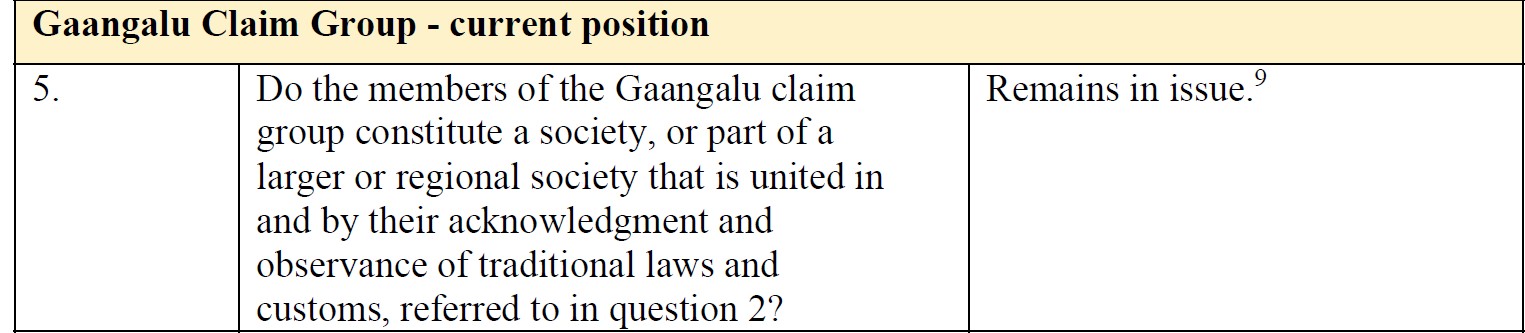
86 This conceptualisation of the issue makes it reasonably clear that the parties joined issue with the identification of the relevant society, including whether it was properly described as the Gaangalu claim group, or the larger regional society.
87 Similarly, the amended agreed statement of facts recorded as matters not in dispute (emphasis added):
At sovereignty and effective sovereignty:
(a) The Aboriginal people present in, using and occupying the claim area included persons who were part of a regional society or societies;
(b) The traditional laws and customs acknowledged and observed by the Aboriginal people referred to in sub-paragraph (a) above, conferred rights and interests in relation to the land and waters of the claim area, including land holding rights; and
(c) Some of the traditional laws and customs referred to in sub-paragraph (b) above were normative.
88 The agreed facts therefore made it clear that the question of the precise society, be it a regional society or other society, remained an issue between the parties. It was not agreed that only the regional society was in issue, nor that it was necessary for the Gaangalu to establish the continuing existence of that society, nor that it was necessary for the Gaangalu to establish the precise boundaries and demographic limits of the regional society to establish connection for the purposes of s 223 of the NTA.
89 The Appellant argued that there should be some flexibility in the way that native title cases are put, so as to give effect to the beneficial purposes of that legislation (see, eg, Commonwealth v Yarmirr [2001] HCA 56; 208 CLR 1 at [249] (Kirby J)). We accept that a flexible and beneficial approach to evidence on matters such as connection, continuity and claim group composition is appropriate, having regard to the beneficial purpose of the NTA as revealed by its preamble, the objects in s 3 and its legislative history (see, for example, Alyawarr at [62]-[88] (Wilcox, French and Weinberg JJ); Narrier v Western Australia [2016] FCA 1519 at [31], [311]-[312], [389]-[400], [822]-[848], [864]-[868] (Mortimer J)).
90 But we do not consider that proposition has any work to do in relation to the present issue. We accept that there was ambiguity in the way that the Gaangalu put the issue of society, and that this made the task of the primary judge difficult. However, the transcript and other material that we have extracted show that the Appellant put its case in a way that is consistent with the argument it seeks to progress on appeal, and it is not prevented from doing so.
Substantive argument on ground two
91 Queensland separately argued that even if the Appellant was not precluded from advancing its argument, then ground two must nonetheless fail because the primary judge (at PJ1[1218]) made no finding that the Gaangalu people continue to be a group united in and by their acknowledgment and observance of a body of laws and customs that give rise to rights and interests in land and waters. PJ1[1218] states:
I have accepted that the members of the claim group as a whole continue to observe the traditional law or custom of inalienability of land and waters and communal ownership. I have accepted that the contemporary system of inheritance of what may be described as secondary or usufructuary rights and interests from a Gaangalu mother or father is consistent with traditional law and custom. I have accepted that the members of the claim group continue to observe responsibilities under traditional law and custom to protect sacred areas and, more generally, to protect the land against trespass. I have accepted that the claim group continues to engage in customary use of the natural resources of the land. I have also accepted that the claim group has a spiritual connection with the land reflecting beliefs based on traditional law and custom that the spirits of their ancestors would return to the land. These are relevant and significant aspects of continuity of traditional laws and customs.
92 Queensland argued that without seeking to prove, nor proving, that the Gaangalu were a society in the Yorta Yorta sense, the findings of the primary judge at PJ1[1218] are no more than a finding that there are observable patterns of behaviour, but not rights or interests in relation to the Claim Area.
93 That submission must be rejected. For the reasons already explained, we do not accept that the Appellant disavowed a Gaangalu society (in the Yorta Yorta sense); it submitted merely that the identification of that precise society was one available pathway to satisfy the statutory requirements of s 223. As explained above, the phrase “the traditional laws acknowledged, and the traditional customs observed” in s 223(1)(a) is a reference to laws and customs having a normative content: that is, a body or system of normative rules that existed before the assertion of British sovereignty. The rights and interests possessed under an identified body of laws and customs means rights and interests that are creatures of the laws and customs of a particular society that exists as a group that acknowledges and observes those laws (Yorta Yorta at [50]). To suggest that there is some other element that makes the group a “society” is to misstate Yorta Yorta.
94 In this case, the primary judge identified that members of the claim group as a whole continue to observe the traditional law and custom including:
(1) the traditional law or custom of inalienability of land and waters and communal ownership (PJ1[1067]);
(2) the contemporary system of inheritance of what may be described as secondary usufructuary rights and interests from a Gaangalu mother or father (PJ1[1047]);
(3) responsibilities under traditional law and custom to protect sacred areas and, more generally, to protect the land against trespass (PJ1[1206], [1218]);
(4) customary use of the natural resources of the land (PJ1[1149]); and
(5) a spiritual connection with the land reflecting beliefs based on traditional law and custom that the spirits of ancestors would return to the land (PJ1[1126]).
95 His Honour described these as being “relevant and significant aspects of continuity of traditional laws and customs” (at PJ1[1218]). To identify a group that has, continuously, from sovereignty, observed the traditional laws and customs is to identify a society. Because the primary judge (incorrectly) understood Gaangalu to assert only the continued existence of the regional society, his Honour erroneously interposed a further step of requiring that the group identified was part of a “society” (in this case, the regional society) which observed those traditional laws and customs. In so doing, his Honour erred.
96 Relatedly, after his Honour identified the “relevant and significant” aspects of continuity of traditional laws and customs (PJ1[1218]), his Honour went on to observe that merely identifying these continuing laws and customs did not “adequately reflect the very substantial loss, change and attenuation that traditional laws have undergone since sovereignty” (PJ1[1219]). It is not clear why this step was necessary. The NTA does not call for a balancing of extant versus lost or extinct aspects of traditional law and custom, requiring that there be more laws and customs identified as continuous than identified as lost. This aspect of his Honour’s reasoning appears to have fed into the conclusion at PJ1[1223] that:
The evidence does not establish that acknowledgement and observance of traditional laws and customs has continued substantially uninterrupted since sovereignty. Ultimately, I am not satisfied that the claim group possesses the claimed rights and interests under a body of traditional laws and customs acknowledged and observed by them.
97 Queensland appeared to rely upon these passages to assert that even if his Honour had not relied upon the absence of a regional society, this conclusion was nonetheless fatal to the Appellant’s claim. That is not so. First, that conclusion was infected by the erroneous approach to society. Secondly, the above passage represents the outcome of an analysis of lost laws and customs, rather than the analysis required by s 223(1). It was not part of the analysis which his Honour was required to carry out in order to fulfil the statutory task conferred by that provision.
98 In any event, the Appellant further argued as part of ground two that there were two erroneous findings in relation to certain rights or interests which his Honour found were not continuous from sovereignty. They are two significant aspects of traditional law and custom pursuant to which the Gaangalu were said to have rights and interests, and we turn now to consider this aspect of ground two.
Changed rules of transmission from patrilineal to cognatic
99 The primary judge held that the contemporary system of inheritance of primary rights and interests from either parent has been adopted since sovereignty, and so cannot be described as an adaptation of the traditional system. His Honour found (at PJ1[1050], emphasis added):
The contemporary system of inheriting primary rights from either parent runs into the problem of how it is that women are now capable of passing to their children primary rights that they were incapable of passing down under traditional laws and custom. The evidence does not explain how children could have inherited primary interests from their mothers under the traditional system or some adaptation of the traditional system. The contemporary system concerning inheritance of primary rights and interests from either parent law has been adopted since sovereignty, and cannot be described as a mere adaptation.
100 The core of his Honour’s conclusion is that there is no explanation in the evidence for how children could have inherited primary rights and interests in Gaangalu country from their mothers under the traditional system or how the change to the inheritance of primary rights and interests in Gaangalu country by cognatic descent represents an adaptation of the traditional system. His Honour therefore concluded that the contemporary system concerning inheritance of primary rights and interests from either parent had been adopted since sovereignty, and so could not be described as mere adaptation.
101 Queensland submitted:
… although the opinion evidence established why a change to cognatic descent had occurred, it did not explain whether that change was permissible. Dr Kenny provided no opinion as to whether the change from a patrilineal biased system to a cognatic form of system was permissible under traditional law and custom. Instead, Dr Kenny stated that the change in this traditional law and custom occurred because it had to change to adapt to the challenges of settlement and the adaptation of a patrilineal biased system towards a cognatic form of descent is likely to have arisen as a consequence of an increasing number of children fathered by non-Aboriginal men during white settlement.
102 To understand his Honour’s finding, and the challenge to it in the appeal, it is necessary to refer to some of the evidence that was before the primary judge.
Dr de Rijke
103 At the time of giving evidence, Dr de Rijke was a Lecturer in Anthropology in the School of Social Science at the University of Queensland, with a PhD in anthropology from the University of Queensland, among a range of other qualifications. He produced a number of reports, including:
(1) Gaangulu Nation People Native Title Determination Application (QUD400/2012), Expert Anthropological Report (the First de Rijke Report).
(2) Gaangulu Nation People QUD33/19: Supplementary Expert Report (the Second de Rijke Report), produced after the hearing of the lay evidence.
104 Among a range of other issues, Dr de Rijke was requested to provide an opinion as to:
… the extent to which there has been any adaptation or change in the pre-sovereignty traditional laws and customs and whether there has been any substantial interruption in the acknowledgement and observance of those laws and customs, and in particular in the acknowledgement and observance of the fundamental features of those laws and customs. To the extent to which there has been change or interruption of this type, your report should identify the nature and extent of any such change or interruption and state whether, in your opinion, the present-day native title claim group continue to acknowledge and observe traditional laws and customs.
105 Without seeking to be exhaustive as to the methodology Dr de Rijke employed, the First de Rijke Report was written following a review of a broad range of ethno-historical documentation, including written materials produced in the 19th century, the notes and publications of earlier anthropologists, as well as fieldwork with the claimants and with some Aboriginal persons who assert connections to land and waters outside the Claim Area. Dr de Rijke said in the First de Rijke Report that it appeared that there was “a tendency to inherit rights to land patrilineally” (at [268]). Dr de Rijke considered various sources (at [274]) and said that there may have been:
… a more flexible system of practice than an ideological focus on patrilocality and virilocality would suggest. Both men and women, in my opinion, held a variety of rights and interests in land and water, both core and contingent, obtained through various means.
106 Dr de Rijke provided the following opinion (at [275]) about the observed shift from patrilineal forms of descent to cognatic forms of descent (emphasis added):
The shift from patrilineal forms of descent to cognatic forms of descent, by which a person inherits rights through either the father or the mother, has been the topic of considerable debate. The adaptation of a patrilineal bias towards a cognatic form of descent can be seen to have arisen as an increasing number of children were fathered by non-Aboriginal men post-colonisation (Sutton 2003:173ff). Children of such unions obtained rights and interest in land from their mother.
107 In oral submissions, Queensland argued that this was no more than a general observation about patrilineal bias rather than an opinion concerning the Gaangalu based on evidence. We accept that, on one view, those observations were made at a general level, but the better view is that it was an expert anthropological opinion proffered as relevant to the Gaangalu experience. It is not in dispute that, in common with other Aboriginal groups, the Gaangalu experienced an increasing number of children that were fathered by non-Aboriginal men post-colonisation. In any event, Dr de Rijke made his opinion sufficiently clear by stating the following (at [277], emphasis added):
In terms of patrifiliation, cognatic descent and traditional laws and customs, the principle mechanism involved in the inheritance of rights and interests in land remains filiation, and I argue that the shift from a patrifilial system (or at least a patrifilial bias that appears to have existed to some extent at sovereignty) to a cognatic practice represents a change of emphasis, and not a substantial interruption of traditional practices (see e.g. Sutton 2003: 213).
108 There are a number of matters to note from this evidence:
(1) Dr de Rijke spoke in terms of a patrifilial system or bias, noting the evidence for a broad range of factors to influence how a person received rights and interests in land.
(2) Dr de Rijke argued that filiation was the “principle mechanism” involved in the inheritance of rights and interests in land.
(3) Dr de Rijke opined that the shift to a cognatic practice represents a change in emphasis, not a substantial interruption of traditional practice.
109 This opinion was based on an analysis that encompassed direct Gaangalu evidence, augmented by an understanding of the broader experience in Aboriginal Australia post-sovereignty. It is common and appropriate for an anthropologist to consider a broad range of evidence which, in the exercise of his or her expertise, the anthropologist considers relevant to the analysis of the question at hand.
Dr Kenny
110 Dr Kenny is a consultant anthropologist with a PhD in anthropology from the University of Sydney and two Masters degrees from the University of New South Wales and the University of Zurich. She was engaged by Queensland in 2017 in respect of the Gaangalu application. She produced a report dated 9 November 2018, entitled Anthropology Overview Report: Assessment of Expert and Lay Evidence filed for the GNP Cluster Native Title Claims (QUD 400/2012, QUD 229/2013, QUD 422/2012, QUD 619/2017) (the Kenny Report).
111 In the body of the Kenny Report, Dr Kenny focused upon those laws and customs identified as being relevant to land ownership and in that context considered the First de Rijke Report, and concluded (emphasis added):
In my opinion, based on the available material it can be inferred that the Gaangalu Nation People have continued to hold country according to laws and customs of their regional society that are rooted in tradition. That is, their system that allows membership to be reckoned through cognatic connections to a forebear is based on traditions originating in a pre-sovereignty system that was patrilineally biased.
112 In conclusion, Dr Kenny said (emphasis added):
There have been many changes and adaptations since Effective Sovereignty, as well as discontinuities, which mainly relate to initiation ceremonies, languages and cosmological beliefs and social organisation.
In relation to the laws and customs relating to land ownership in the application areas the adaptions that have taken place suggest that they have their origin in tradition (i.e. a shift from patrilineal descent to cognatically-reckoned relationships. The process of local group amalgamation under a 'language label' and the shift from patrilineal descent to cognatic relationships to a forebear that determines an individual's membership of a native title group has been very common in settled south-east Australia including central Queensland.
While I am of the view that small local groups recruited their members mainly by way of patrilineal descent at Effective Sovereignty (see Chapter 2 for details), I concur with the authors of the expert reports that the landholding groups of the application areas belong today to a broader regional society in which members are recruited by cognation, i.e. cognatically-reckoned relationships.
113 There are two matters of relevance arising from Dr Kenny’s report. First, it is clear that she considered that the pre-sovereignty system was patrilineally biased, not strictly patrilineal. Secondly, she described the change to cognatic transmission of rights as an adaptation that had its origin in tradition.
The joint expert evidence
114 In the joint report produced following the first conference of experts held on 20 February 2019 (the February 2019 Joint Report), Dr de Rijke, Dr Powell and Dr Kenny all expressed the view that there was:
A system of inheritance of identity and generic and locality-specific rights in land through different genealogical links, including the inheritance of rights through male and female forebears as well as relations based on marriage and adoption.
115 In the Second de Rijke Report, Dr de Rijke considered the “on-country” lay evidence (including associated witness statements and affidavits) and said that that evidence did not alter his opinions regarding the traditional laws and customs described in the February 2019 Joint Report (extracted above).
116 Dr de Rijke and Dr Kenny gave evidence in concurrent session. In the course of that process, they were asked questions about the issue:
MR DUFFY: Now, firstly, the system of inheritance at sovereignty or effective sovereignty and by inference before that, did that involve inheritance through male and female forebears?
DR DE RIJKE: Yes.
MR DUFFY: And so, when the question of primary rights in land being inherited as a result of what are called patrilineal links or link to patrilineal clans, does that not suggest that at sovereignty the inheritance of locality – of locally specific rights were through patrilineal links rather than matrifilial links?
DR DE RIJKE: In my view there was a patrilineal bias in the acquisition of primary rights, but people also held secondary rights through, for instance, one’s mother. And, so, it is appropriate in my view to speak of both genealogical links, but it is true to say that primary rights on the whole were acquired with an emphasis on patrilineal links, yes.
MR DUFFY: All right. And you there talk about it being based on – or sorry, as well as relations based on marriage and adoption? Firstly, marriage, can I clarify this. Do you say that at sovereignty a person who married – if one has a – if one has a person who is – has rights in land, does the person who married them – marries them by that marriage also acquire rights in land?
DR DE RIJKE: Yes.
MR DUFFY: Was that the system?
DR DE RIJKE: Well, certainly, in – I think the evidence indicates certainly use rights. So for instance, the system was very local. That means a woman on the whole went to live in her husband’s territory, that woman had rights to use the territory of her husband just as anybody else. In other words, marriage did confer upon the person certain rights. And equally, the husband could freely use and access the territory of his wife. So marriage did have implications for – for rights and interests in land.
117 The discussion then moved to other aspects of the reports. Thus, the oral evidence and the written reports on this issue remained as summarised above.
Analysis
118 The requirement for the Gaangalu to show that the traditional laws and customs acknowledged and observed are continuous from pre-sovereignty society comes from Yorta Yorta (at [43]-[44]) where Gleeson CJ, Gummow and Hayne JJ said (emphasis in original, footnotes omitted):
… Upon the Crown acquiring sovereignty, the normative or law-making system which then existed could not thereafter validly create new rights, duties or interests. Rights or interests in land created after sovereignty and which owed their origin and continued existence only to a normative system other than that of the new sovereign power, would not and will not be given effect by the legal order of the new sovereign.
That is not to deny that the new legal order recognised then existing rights and interests in land. Nor is it to deny the efficacy of rules of transmission of rights and interests under traditional laws and traditional customs which existed at sovereignty, where those native title rights continue to be recognised by the legal order of the new sovereign. The rights and interests in land which the new sovereign order recognised included the rules of traditional law and custom which dealt with the transmission of those interests. Nor is it to say that account could never be taken of any alteration to, or development of, that traditional law and custom that occurred after sovereignty. Account may have to be taken of developments at least of a kind contemplated by that traditional law and custom. Indeed, in this matter, both the claimants and respondents accepted that there could be “significant adaptations”. … Because there could be no parallel law-making system after the assertion of sovereignty it also follows that the only rights or interests in relation to land or waters, originating otherwise than in the new sovereign order, which will be recognised after the assertion of that new sovereignty are those that find their origin in pre-sovereignty law and custom.
119 The Full Court in Bodney considered these passages of Yorta Yorta, and said at [120] that (emphasis added):
when determining whether rights and interests are traditional, the proper enquiry is whether they find their origin in pre-sovereignty law and custom, and not whether they are the same as those that existed at sovereignty. Clearly laws and customs can alter and develop after sovereignty, perhaps significantly, and still be traditional. The fourth and last sentences of the passage quoted at [119] suggest that rights and interests, which are the product of laws and customs which adapt or develop, may themselves change without losing recognition.
120 Their Honours said that it may be that what cannot be created after sovereignty are rights that impose a greater burden on the Crown’s radical title (at [121]). However, a change or adaptation of traditional laws and customs will not necessarily be fatal to a native title claim, provided that the laws and customs still find their origin in pre-sovereignty law and custom.
121 The Appellant submitted that the evidence discloses that there was a patrilineal bias within the principal process for transmitting rights and interests in Gaangalu country, being filiation. It is said that the primary judge fell into error by failing to recognise this, and by failing to recognise that the shift which occurred was an adaptation and not a shift that involved the adoption of a new right or practice post-sovereignty. Queensland submitted that the primary judge was not satisfied that the evidence explained how, under traditional law and custom or some permissible adaptation, there was a conversion of inheritance rules from patrilineal inheritance of primary rights and interests in Gaangalu country to a system of inheritance of those rights and interests from either parent.
122 We do not accept Queensland’s submission. First, there is no requirement that the evidence establish that traditional law or custom permitted the adaptation alleged: there is no reason for a society to have in place laws or customs to respond to the catastrophic disruption caused by colonisation. As the Appellant submitted, adaptation and adaptability are, by their nature, responses triggered by unexpected or unprecedented events.
123 Identifying whether a shift in law or custom is a permissible adaptation involves considering whether the custom or practice finds its origin in pre-sovereignty law and custom. Evidence explaining how that adaptation occurred may be available and appropriate. Indeed, his Honour was, appropriately, careful to avoid a “book-end” approach, noting that the continuity assessment cannot be carried out merely by examining the asserted laws and customs of the present day against those that had existed at sovereignty (PJ1[470], citing Risk v Northern Territory of Australia [2007] FCAFC 46; 240 ALR 75 at [82] (French, Finn and Sundberg JJ)).
124 Nonetheless, by interposing a requirement for an explanation as to how the adaptation was permissible by reference to traditional law and custom, we consider his Honour imposed an unnecessary step in the analysis.
125 Secondly, Queensland urged us to avoid “second-guessing” the primary judge’s conclusion, noting the observations of the Full Court in Wyman v Queensland [2015] FCAFC 108; 235 FCR 464 (North, Barker and White JJ) at [261]-[262] that (emphasis in original):
In each case the evidence before the court will dictate whether any relevant change in the “tenure system” is an acceptable adaptation of pre-sovereignty rule, or a new rule reflecting a lack of continuity of the traditional normative system.
While, in this case, the evidence of Professor Sutton may have provided context for consideration of the question whether or not the contemporary rule governing the exercise of rights to country was but an adaptation of a pre-sovereignty rule, it is difficult in the circumstances to second-guess her Honour’s finding that the old “tenure system” had been lost by the early 20th century and the clear inference that the contemporary rule bestowing a similar right in relation to country on each and every Bidjara person was a new rule put forward by claimants today, following a complete break in continuity of the old rule. No evidence to explain the evolution of such a rule was offered by the preservation evidence given in 2001, or the lay witnesses at trial.
126 These observations reflect the well-accepted advantages of a trial judge. However, having regard to the necessary evidentiary analysis for this ground of appeal, they have little application to our task. Here, we are faced with the question of whether the appropriate facts were identified and the correct statutory task applied. That does not involve “second-guessing” the primary judge’s conclusions in the manner submitted.
127 Thirdly, having carefully reviewed the expert evidence, we can see no evidentiary basis for a conclusion that the cognatic form of transmission of rights and interests was adopted at some unidentified point post-sovereignty. Indeed, as the outline of the expert evidence above makes clear, it is apparent that the experts for both parties considered that cognatic transmission was an adaptation from the traditional system, and a not-uncommon one for Aboriginal societies trying to deal with the damage suffered through colonisation.
128 His Honour was not, of course, bound to adopt the conclusion of the experts, and we acknowledge that the question of adaptation can sometimes give rise to difficult questions of fact and degree (Bodney at [79]). But by focusing on a lack of evidence as to how children could inherit primary rights from their mothers under the traditional system or some adaptation of the traditional system, his Honour misapplied the test. As we said earlier, there is no reason for a society to have in place laws or customs to respond to catastrophic disruption as a result of (unforeseen) colonisation. Further, his Honour’s focus on the (perceived) lack of evidence meant that he failed to consider whether children could have inherited primary interests from their mother as an adaptation of the traditional system. Put another way, it is in the nature of an adaptation that there be a shift from an earlier form. The question required by Yorta Yorta is whether the laws and customs in question find their origin in pre-sovereignty society. A reduction or change in a bias which previously governed the transmission of rights and interests in land is an example of an adaptation insofar as it reduces the focus on one element, but does not change the core features of the law or custom.
129 The Appellant argued that there was ample evidence for the primary judge to conclude that the current form of rights transmission was either traditional or an adaptation of a traditional system. Certain facts appear uncontroversial on the materials before us:
(1) Pre-sovereignty, there had been a patrilineal bias in the system for the transmission of “primary” rights in respect of land while other rights (often called “secondary” or “contingent”) had a matrilineal bias. His Honour referred to these rights as being “inherited” patrilineally and matrilineally respectively (PJ1[1008]-[1009]) whereas at PJ1[1050], his Honour referred to a “patrilineal bias”.
(2) Post-sovereignty, there was a change from that system to a cognatic system for the transmission of rights (PJ1[1012], [1025], [1029]). The significance of the gender of the parent was the aspect of the system which was altered.
(3) The cognatic system operates today (PJ1[1045]).
130 The notion of a patrilineal bias in the transmission of rights and interests is significant, because it is consistent with the principal aspect of transmission being filiation, and the patrilineal factor being of greater significance pre-sovereignty than after the impacts of colonisation. Pre-sovereignty and post-sovereignty, inheritance by descent remained the core means by which rights were transmitted from one generation to the next. That has not changed.
131 Queensland submitted that the evidence supported a view that the only circumstance in which secondary rights can become primary rights is when the original clan group becomes unviable or extinct. That may be so, but it is not the question which arises in the present case. Gaangalu did not allege, and the expert witnesses did not opine, that the present case is one in which one group which has secondary rights in an area could legitimately “take over” the primary rights of another group which had become unviable or extinct. Instead, it is concerned with whether it is appropriate to find that the shift from a patrilineal bias in transmission of primary rights in Gaangalu country to a cognatic bias (or perhaps more accurately, to remove any bias at all) is properly understood as an adaptation of the traditional system.
132 As the Appellant asserted, there have been a range of cases in which the shift from patrilineal to cognatic descent has been considered an adaptation. It is useful to outline some examples where an issue of this kind has been considered:
(1) In Griffiths v Northern Territory [2006] FCA 903; 165 FCR 300 at [501], Weinberg J held:
I find that there has been a gradual shift from a patrilineal to a cognatic system, and that this shift continues today. However, the crucial point is that rights to “country” in Timber Creek are and always have been based upon principles of descent. The shift to cognation is one of emphasis and degree. It is not a revolutionary change, giving rise to a new normative system.
On appeal, the Northern Territory contended that the trial judge erred because his Honour “did not enquire whether the change … was a permissible adaptation of a traditional rule” (at [130]). The Full Court dismissed that argument, stating that on the facts of that case the relevant principle of transmission of rights by descent had not changed; it was simply that in its present exercise it involved increased reliance on matrifiliation at the expense of patrifiliation (Griffiths v Northern Territory of Australia [2007] FCAFC 178; 165 FCR 391 at [141] (French, Branson and Sundberg JJ)). There was, therefore, no adaptation at all.
(2) In Bennell v State of Western Australia [2006] FCA 1243; 153 FCR 120 (Wilcox J), the primary judge described the pre-settlement position as “a general rule of patrilineal descent, subject to exceptions” (at [350(iv)]) and later referred to the widening of the exception as a result of European settlement (at [774]), and a “move away from a relatively strict patrilineal system to a mixed patrilineal/matrilineal or cognative system [that] should be regarded as not inconsistent with the maintenance of the pre-settlement community and the continued acknowledgement and observance of its laws and customs” (at [777]). On appeal in Bodney, their Honours rejected the submission that this could not be considered “traditional” in the relevant sense (at [116]).
(3) In Malone, O’Bryan J concluded that the Western Kangoulu People had many adaptations that have occurred following European settlement, including “changes to the system of inheritance of rights and interests in land (from patrifilial to cognatic)” (at [325], [583]).
133 While each case turns on its own facts, these are examples of cases where the primary means by which rights were transmitted from one generation to the next was descent and a shift in the emphasis based on whether the parent was male or female was not found to be the adoption of a new practice but (if a change at all) an adaptation of traditional practice.
134 It is relevant too that we are unable to identify any evidence before the primary judge that the change to a cognatic system was not an adaptation but had instead been adopted by Gaangalu people post-sovereignty so that it was not traditional. In the February 2019 Joint Report, the experts all joined in the conclusion that the change was an adaptation. We reiterate that Dr Kenny, the expert retained by Queensland, put the matter this way (emphasis added):
In relation to the laws and customs relating to land ownership in the application areas the adaptations that have taken place suggest that they have their origin in tradition (i.e. a shift from patrilineal descent to cognatically-reckoned relationships). The process of local group amalgamation under a 'language label' and the shift from patrilineal descent to cognatic relationships to a forebear that determines an individual's membership of a native title group has been very common in settled south-east Australia including central Queensland.
135 It appears that his Honour was troubled by the lack of explanation as to how the adaptation had arisen, and his Honour therefore focused upon the law of succession of orphaned country as relevant to the question of adaptation (PJ1[1059]). But that was a process by which rights to land could be acquired where there was a vacant estate prior to sovereignty. It was not, on the evidence, relevant to the way that the shift to cognatic transmission of rights and interests in land occurred.
136 We therefore accept that his Honour was in error in concluding that the shift from a patrilineally biased system of rights transmission to one with a cognatic bias was the adoption of a new practice. It is a different question whether his Honour ought to have found that the shift was, as a matter of fact, an adaptation. Ultimately, we are persuaded that his Honour should have so found. That is because:
(1) The anthropologists were united in their evidence that the cognatic bias was, at most, an adaptation (noting that Dr de Rijke appears to have submitted that it represented no real change from the filial transmission that was the primary mode in place at sovereignty and that the increased focus on a cognatic system was merely a change of emphasis in an ongoing system).
(2) We were taken to nothing in the lay evidence relevant to the question.
(3) The evidentiary issues with which his Honour concerned himself, being the lack of explanation for the change, or whether the change was permissible according to traditional law and custom, were not matters of dispositive relevance to the overall analysis of whether there was a change, or whether the change was an adaptation so that the practice remained traditional.
137 Applying the “correctness” standard of appellate review (SZVFW at [41]-[49]), we are satisfied that it is appropriate to conclude that his Honour ought to have found that the transmission of rights and interests through the current, cognatic system was an adaptation of a traditional system of transmission with a patrilineal bias.
Changed rules of adaptation from clan estates to Gaangalu
The findings of the primary judge
138 There was no dispute that, below, the Gaangalu asserted native title rights and interests held by the claim group as a whole. There was likewise no dispute that the evidence of the social construct at sovereignty was scant, but that at that time there were a “collective of culturally related local groups”, sometimes called “patriclans”. The “patriclans” did not exist in isolation; they were connected to a broader network. His Honour was satisfied at PJ1[1007] that:
First, the land tenure system of the region at sovereignty was characterised by small local landholding clan groups. These groups lived mainly in small family-based clans of approximately twenty to thirty people, who camped together in an area. The members of each group spoke the same language (subject to intermarriage and adoption).
139 There was substantial lay evidence about who could “speak for” different parts of the Claim Area. His Honour explained the right of being able to speak for country as (PJ1[1035]):
… encompass[ing] making important decisions about the land, including giving permission to other Aboriginal people to enter the land.
140 Different members of the claim group gave evidence that they had different rights to speak for different parts of the Claim Area, and in some respects it was necessary to seek permission to enter certain areas.
141 His Honour found the amended statement of claim to be ambiguous (see PJ1[1037]). On the one hand, the originating application was authorised by the whole of the claim group, claiming that “[n]ative title in the determination area is held by the native title claim group”. But the amended statement of claim provides:
... rights and interests in relation to the land and waters of the claim area remain communal in the sense that they are not individually owned but rather are held collectively and in aggregate by the groupings with affiliations and particular rights to the particular area concerned albeit they are allocated intramurally…
142 It went on to say:
… their [the Claimant’s] generic and locality-specific entitlement to rights and interests in land are acquired through descent from a Gaangalu parent.
143 It is apparent that this aspect of the Appellant’s case was put in a confused and disjointed way below. His Honour recorded (at PJ1[1038]) that:
In written submissions, the applicant contends that, “the native title claim group members are, in aggregate, the holders of all the native title rights and interests claimed”, and the rights and interests can be described as either “communal” or “group” rights and interests.
144 The primary judge also observed (at PJ1[1038]) as to the written submissions that:
The submissions also contend that native title, “is held by the members of a single [Gaangalu] community, albeit there is an intramural allocation of rights amongst various family groups and individuals within the community”. The postulated intramural allocation seems to be that the claimed rights and interests will be allocated as between people with connection to the east and west sides of the Dawson River respectively.
145 In the face of this confusion, his Honour identified that it was his task to examine the consistency with traditional law and custom of the contemporary tenure system involving either undifferentiated rights and interests across the claim group and Claim Area, or differentiated rights and interests only by connection of members of the claim group with either the east or west side of the Dawson River (PJ1[1040]).
146 Dr de Rijke and Dr Kenny concluded that the Claim Area was likely to have been occupied at sovereignty by a number of small clans, whose members held rights and interests in a particular clan estate (PJ1[1041]). Moreover, his Honour noted at PJ1[1042]-[1043] that the evidence of Dr de Rijke and Dr Kenny was to the effect that:
Traditional laws and customs regulating relationships to land involved different clan groups possessing rights and interests for different areas and, in addition, within a clan group, its members possessing differential rights and interests in respect of the clan’s estate. There is no suggestion by the anthropologists that all people identified as Gaangalu had rights and interests in all areas occupied by other Gaangalu people.
There is very little evidence about the clan groups in the claim area. Nothing is known about the boundaries, focal sites or dreaming or totemic connections by which they may have been traditionally conceived or clustered. It can be surmised that there must have been rules and protocols for one clan to access and use the land of another, but nothing is known about their content in the claim area. Dr de Rijke explicitly states that there is no information about the nature of constituent Gaangalu groups and their territorial connections at sovereignty.
147 Having identified the position at sovereignty, and the historical barriers to establishing them, his Honour went on to note (at PJ1[1044]) that:
The contemporary system involving all Gaangalu people having uniform rights and interests in the whole of the claim area, or divided only as between those associated with the east side or west side, is in stark contradistinction to the laws and customs applying at sovereignty. The making of a claim of such undifferentiated, or substantially undifferentiated, rights involves an acceptance, consistent with the evidence, that the regulation of rights and responsibilities in the claim area through multiple clan groups has disappeared.
148 His Honour then considered whether the two aspects of change from the pre-sovereignty tenure system can be regarded as a permissible adaptation of pre-sovereignty law and custom. First, he considered whether the shift from patrilineal inheritance of primary rights in Gaangalu country pre-sovereignty (and matrilineal inheritance of secondary rights) to cognatic inheritance of both primary and secondary rights post-sovereignty represents an adaptation (analysed at [99]–[137] above). As earlier explained, we consider his Honour erred in concluding that that shift was not an adaptation from the traditional system.
149 Secondly, his Honour considered whether the “… shift to all Gaangalu people holding rights in the whole of the claim area, or some holding rights in the whole of the east side and some holding such rights in the whole of the west side” represented a permissible adaptation of pre-sovereignty law and custom (PJ1[1045]).
150 His Honour approached this question on a specific basis, which he outlined at PJ1[1051]:
The second aspect of change from the pre-sovereignty tenure system that must be considered is the contemporary conception of all Gaangalu people holding rights and interests in the whole of the claim area, or differentiated only by some Gaangalu people holding rights in the whole of the east side, and others holding such rights in the whole of the west side. The claim must be that the Gaangalu people as a whole, or differentiated only by connection to the east side or west side, have succeeded to the rights and interests of the clan groups under or through traditional laws and customs of the Regional Society. Otherwise, such succession would not involve adaptation of traditional laws and customs, but adoption of new laws and customs.
151 While his Honour referred to changes being in accordance with or an adaptation of traditional law and custom (see for example at PJ1[1067]), this passage makes clear that his Honour proceeded to consider the question from the perspective of succession under traditional laws and customs, on the basis that this was the only way that there could be adaptation. But as identified above, we do not consider that adaptation must occur conformably with traditional laws and customs: it is in the nature of adaptation that it is a response to such unexpected upheaval that the adaptation may well occur outside the strictures of laws and customs that had previously existed. We therefore consider that his Honour’s focus on succession was misplaced. The necessary inquiry was whether the shift from patriclans to the language group was an adaptation in the sense that the current language group identification finds its origin in pre-sovereignty law and custom.
152 The primary judge found in relation to this issue (at PJ1[1065]-[1066]) that:
I am not satisfied that the applicant has demonstrated that the asserted undifferentiated native title rights and interests held by the claim group as a whole is a permissible adaptation of traditional law and custom, rather than a post-sovereignty construct. Further, I am not satisfied that any differentiation by reference to the east side and west side is a permissible adaptation of traditional law and custom.
For these reasons, I conclude that the changes from the pre-sovereignty tenure system to the contemporary system as a whole have not been shown to be in accordance with, or an adaptation of, traditional law and custom.
153 At PJ1[1220] his Honour relevantly found (emphasis in original):
… Under the pre-sovereignty tenure system, small local clan groups had rights and interests in particular areas of land. There were rules differentiating primary rights held amongst members of the clan groups based on patrilineal or matrilineal descent. The contemporary system is asserted to involve all Gaangalu people collectively holding undifferentiated rights and interests in the whole of the claim area, subject to intramural allocation between people associated with the east side and west side of the Dawson River. In Bodney FC, in a similar context, the Full Court observed at [97] that, “[t]here could not be a more important law or custom for the identification of rights and interests in land than that by which Aboriginal people are related to tracts of land”. I respectfully agree. The laws and customs under which clan groups were connected with particular tracts of land have been substantially lost. Such wholesale change does not merely involve adaptation of traditional laws and customs giving rise to possession of rights and interests, but represents substantial discontinuity and reformulation.
Submissions of the Appellant
154 Fundamentally, the Appellant submitted that the primary judge erred by focusing on what had been lost, not what remained. The Appellant argued that his Honour’s reference to “substantial discontinuity” involved a conflation of the concept of “significant change or adaptation” with the concept of “societal interruption”, and an approach which treated both concepts as equally fatal to a claim, in a manner which discloses error.
155 The Appellant argued that the evidence demonstrates that ‘tribal’ and/or ‘linguistic’ levels of identification existed pre-sovereignty, but became more prominent in the course of the 20th century because of severe demographic losses and displacement of Aboriginal populations as a result of colonisation. The small patrilineal local groups are said to have amalgamated under the linguistic label, Gaangalu, and to have become a single group. The Appellant argued, in effect, that the ‘tribal’ or linguistic association or identification was a traditional one. Pre-sovereignty, the tribal or linguistic association or identification is said to be less significant than patriclan identification, but the reduction in population meant that patriclan identification became less significant and the tribal or linguistic association gained prominence as the remaining association. This, it is said, remains traditional identification carrying with it rights and interests in land. The Appellant argued that the experts were united in their conclusion that evolution within the Gaangalu language group and communal landholding by the larger language group, rather than small and vulnerable patriclans, represented an adaptation.
Submissions of the Respondent
156 Queensland submitted that there was no suggestion by the anthropologists that all Gaangalu people had rights and interests in all areas occupied by other Gaangalu people, and observed that there was no information about the nature of the constituent Gaangalu land-holding groups and their territorial connections at sovereignty.
157 Queensland argued that the evidence supported the view that the contemporary distribution of rights and interests in land and waters among the Gaangalu claimants is most likely the result of historical change, including long-term residence in regional townships, work at pastoral properties and removal from country. It relied upon the evidence of severe disruption to the fabric of Aboriginal lives in the Claim Area, including through the extensive removal of Aboriginal men, women and children to Woorabinda and Cherbourg.
158 Queensland asserted that the consequences of those post-sovereignty historical changes are inconsistent with any claim that the shift to the whole of the Gaangalu people holding undifferentiated (or substantially undifferentiated) rights and interests in the whole of the Claim Area represented an adaptation and that, in light of the evidence that is summarised above, it was open to, and appropriate for, his Honour to make the finding that he did.
The anthropological evidence
159 The anthropological evidence was relatively consistent. In the February 2019 Joint Report, anthropologists Dr de Rijke, Dr Powell and Dr Kenny jointly stated:
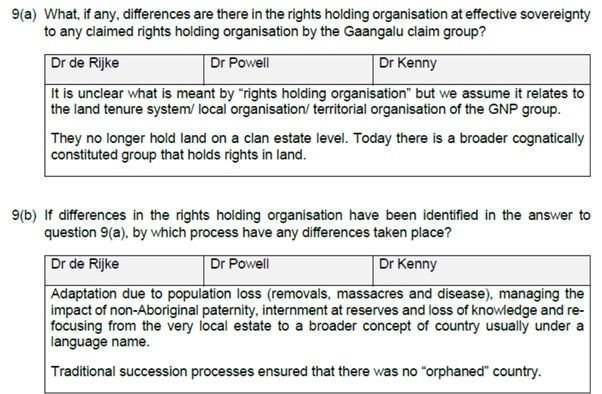
160 In the course of oral evidence, Dr de Rijke also explained that patriclans did not exist in isolation: they were connected to a broader network. He said (emphasis added):
… the patriclans do not exist in isolation. They are connected to a broader network, certainly within Gaangalu, and then output into a broader region. And instances such as regional ceremonies, initiation ceremonies, there is a – an assertion of holders of proximate rights, and the members of the jural public who are present acknowledge the holders of these proximate rights. And then there is a – a broader jural public that also allows, as Dr Kenny referred to earlier, in the cases of, for example, succession, that there is a broader regional public which shared lores and customs who then are the rightful jural public to, how should I put it, to – within that context succession to vacant estates can take place, right. So it’s just to point to the levels of interaction that are important to cases of extinction and – and the taking over of vacant estates where the alternative view of isolated estates would lead to land becoming permanently vacated. So the underlying title is held by a broader regional public that acknowledges under their shared lore and custom the existence of proximate rights in land.
161 In the Second de Rijke Report, Dr de Rijke said (emphasis added):
The contemporary [Gaangalu] claim group – a collective of descent groups who emphasise their shared language identity – is in my view an adapted form of the collective of local descent groups that existed at sovereignty. In explaining this historical adaptation, I noted at [190] of my expert report that “[l]ocal named groups, if they existed, were likely much less relevant in daily life at settlements such as Cherbourg (see also Rumsey 1989, 1993 and Rigsby 1995, 1999 on cultural change and language-named tribes, as well as Trigger (1987) on languages and linguistic groups at Doomadgee, an Aboriginal settlement in North-West Queensland).” Furthermore, footnote 26 describes a record which confirms the existence of the Gangulu as a language-named group in the 1970s: “Based on ethnographic fieldwork in Cherbourg in 1973 and 1974, Koepping (1976: 35) included the “Gangalu” among others in a “list of tribal groups identifiable as linguistic units in 1974””. Caroline Tennant-Kelly and Norman Tindale had earlier recorded statements by a range of Aboriginal people who identified as Gangulu in the 1930s. Furthermore, their records also indicate that Gangulu people were so identified by other non-Gangulu Aboriginal people.
162 Dr Kenny opined in the Kenny Report that a ‘tribal’ or ‘linguistic’ level of identification was observable, not as a new identity, but as a pre-existing identity which took on more significance with the decline of patriclans. Dr Kenny said (footnotes omitted; emphasis added):
As mentioned above, the 'tribal' and/or 'linguistic' level of identification became more prominent in the course of the 20th century due to severe demographic losses and the displacement of Aboriginal populations. In time these small patrilineal local groups of the [Gaangalu] cluster amalgamated under a number of linguistic labels as the knowledge of their landed distinctions lost currency – and became single groups with particular identity labels. In my experience, in contemporary settled Australia all rights and interests in all land are usually held by all members of a composite group of former smaller landed units.
Commonly the contact situation with its pressures such as restrictive legislation, reduced population numbers, alienation from country, mission regimes and/or government settlements set a process of coalescing of groups in train that resulted in the amalgamation of local groups and the disappearance of finer details of their land ownership system. Through this process the 'language group' and its label has gained importance in many settled areas of Australia and became the land holding group rather than the smaller patrilineal groups that held country in the past. These 'language groups' are comprised of descent groups or families who often do not have localised affiliations to particular areas, but hold country together under a cognatic system. They are sometimes referred to as 'new tribes' (Sutton 1995, 1998, 2003: 213). Garring and Martin have cited this concept in their expert report.
163 Thus, the experts for both parties accepted that the change from the patriclan to language group as the landholding or tenure system was an adaptation. Again, the question of adaptation was one for the trial judge having regard to all of the evidence (including the lay evidence as to who “speaks for” country) and his Honour was not bound to accept the experts’ joint opinion. Nonetheless, it is significant that there was no dispute between the experts that this shift was an adaptation, involving a “refocusing” from one estate level to another. Significantly, the primary judge did not explain the basis for his declining to accept their evidence.
Analysis
164 As discussed above, the core inquiry in the context of adaptation is whether or not the current practice has its origin in pre-sovereignty law and custom, and is therefore traditional in the relevant sense. The claimant must establish that (Yorta Yorta at [89]):
… the society, under whose laws and customs the native title rights and interests are said to be possessed, has continued to exist throughout that period as a body united by its acknowledgement and observance of the laws and customs.
165 In assessing the changes or adaptations made to pre-sovereignty laws and customs, difficult questions of fact and degree can emerge – those difficulties are prominently on display in this aspect of this matter, where there is a marked paucity of evidence concerning the position pre-sovereignty. However, the enquiry remains as identified in Bodney at [120]: whether the rights and interests identified find their origin in pre-sovereignty law and custom. The inquiry in this instance therefore is whether the current tenure system is an adaptation of pre-sovereignty law and custom or has been (as his Honour found: PJ1[1066]) adopted since sovereignty.
166 In our respectful view there are several difficulties with the primary judge’s analysis:
(1) In considering whether there had been adaptation of laws and customs, his Honour did so from the perspective of the regional society, which he found no longer existed (see PJ1[1051]). For the reasons we have already explained, we consider that his Honour fell into error by focusing on the regional society to the exclusion of a Gaangalu group or society, and that error carried through to this aspect of the analysis.
(2) By focusing (in PJ1[1220]) on the extent of the loss since sovereignty, his Honour failed to analyse whether and to what extent the extant system (which his Honour accepted as existing: PJ1[1218]) was relevantly “traditional”. As the Appellant submitted, the primary judge focused on the degree of change rather than whether the traditional laws or customs that existed had continued “substantially uninterrupted”. The former (the degree of change) focuses on areas of break and loss of traditional connection. That can be a relevant inquiry, but the question is whether the traditional laws and customs, as they are presently practised, have continued “substantially uninterrupted”. This shift in emphasis underscores the difficulty with his Honour’s analysis insofar as it focused upon the aspects of lost law and culture, and not whether what remained had its origin in the traditional system for the purposes of the s 223(1)(a) analysis.
167 We therefore accept that his Honour erred in his analysis leading to his conclusion that the shift from primary rights held by clan estates to undifferentiated rights held communally by Gaangalu people in the whole of the Claim Area (subject to intramural allocation) was not an adaptation of traditional law and custom.
168 It is a different question whether his Honour ought to have found that the shift was, as a matter of fact, an adaptation. This is finely balanced, but ultimately we are persuaded that his Honour should have so found. That is because:
(1) The anthropologists jointly described the shift as an “[a]daption due to population loss (removals, massacres and disease), managing the impact of non-Aboriginal paternity, internment at reserves and loss of knowledge and refocusing from the very local estate to a broader concept of country, usually under a language name”. As the Appellant submitted, they were united in their evidence that evolution from small and vulnerable patriclans within the Gaangalu language group to communal land-holding by the larger language group represented an adaptation of the traditional system.
(2) There was substantial uncontradicted lay evidence to the effect that while in contemporary times undifferentiated rights are held communally by Gaangalu people, different Gaangalu people “speak for” different parts of the Claim Area in the sense of making important decisions about the land, including giving permission to other Aboriginal people to enter the land. That also indicates adaptation of the traditional system, rather than a post-sovereignty adoption of a system not rooted in the traditional system. Further, we were not taken to any lay evidence which supported an inference that the relevant shift was not an adaptation.
Ground two: Conclusion
169 In our respectful view, the primary judge fell into error in substantially the manner alleged in ground 2.1 of the notice of appeal. His Honour erroneously considered the question of continuity under s 223(1)(a) of the NTA by reference to the regional society, rather than considering whether the Gaangalu people have continued as a group to hold rights and interests in land and waters under the normative system which they acknowledge and observe.
170 This conclusion is sufficient to uphold ground two.
171 Further, having regard to the matters outlined above, we have concluded that his Honour erred in failing to find that:
(a) the shift from patrilineal to cognatic inheritance of primary rights and interests in land was an adaptation of pre-sovereignty traditional law and custom; and
(b) the shift from primary rights held by clan estates to undifferentiated rights held communally by Gaangalu people in the whole of the Claim Area (subject to intramural allocation) was also an adaptation of pre-sovereignty traditional law and custom.
172 The appropriate disposition of the appeal in light of that conclusion is discussed below.
Ground three
173 Ground two focused upon s 223(1)(a) of the NTA, and the identification of the rights and interests possessed under traditional laws acknowledged and traditional customs observed by the Aboriginal peoples or Torres Strait Islanders. Ground three is focused upon s 223(1)(b) of the NTA, which focuses attention upon the laws and customs identified under s 223(1)(a) and asks whether, by those laws and customs, the Aboriginal peoples or Torres Strait Islanders have a connection with the land or waters.
174 The conclusion as to the errors in ground two means that the learned primary judge also fell into error in identifying the traditional laws and customs observed for the purposes of s 223(1)(a) of the NTA. His Honour was thus not in a position to determine whether, by those laws and customs, a relevant connection to land and water arose for the purposes of s 223(1)(b).
175 Nonetheless, in light of the way that the matter was argued, it is appropriate for this Court to consider the particular errors alleged in respect of the third ground. This ground was put in the following way:
In circumstances where the primary judge correctly found that at sovereignty, Gaangalu people occupied and had rights and interests in the whole of the claim area to the west of the Dawson River and in those parts to the east of the Dawson River in the Three Rivers, Mount Spencer and Banana areas and should have found that at sovereignty Gaangalu people also occupied and had rights and interests in the remainder of the claim area (Ground 1) the primary judge then erred in finding that Gaangalu did not establish that they maintain a connection to those areas by the normative system which they acknowledge and observe.
176 Ground three was particularised as follows:
3.1 The primary judge erred in proceeding on the basis that the test for connection for the purposes of s 223(1)(b) of the NTA requires a consideration of whether the claim group continues to acknowledge and observe traditional laws and customs and is to be answered in the negative without regard to the nature and extent of the connection disclosed notwithstanding continuities (and discontinuities) in the acknowledgment and observance of particular laws and customs (see PJ1[1227]).
3.2 The primary judge erred in failing to approach the assessment of connection for the purposes of s 223(1)(b) of the NTA by firstly identifying the content of the traditional laws and customs and secondly the characterisation of the effect of those laws and customs as constituting a connection with land and waters.
3.3 The primary judge erred in failing to have regard to or give due weight to the opinions of the relevant expert witnesses that the connection of the Gaangalu people with the claim area by their acknowledgement and observance of traditional laws and customs includes ‘cognatically traced Gaangalu ancestry, as well as forms of physical and spiritual connection’.
The test for connection
177 The test for connection was at the centre of the Full Court decision of Stuart v South Australia [2023] FCAFC 131; 299 FCR 507 (Stuart FC) and was referred to by both parties in their submissions. Shortly after the hearing of this appeal, the High Court delivered its judgment in Stuart HC. The parties provided supplementary submissions in relation to the impact of that decision.
178 The case in Stuart HC concerned overlapping claims for determination of native title, in which the claim area related to an area in the vicinity of Oodnadatta in South Australia. The area of overlap was around 150km2. The primary judge there considered a number of claims heard together, including the claim by the Arabana people (Arabana) and the Walka Wani people (Walka Wani). The primary judge dismissed the claim by the Arabana, and made a determination in favour of the Walka Wani (Stuart v State of South Australia (Oodnadatta Common Overlap Proceeding) (No 4) [2021] FCA 1620). The Arabana appealed from the orders dismissing their claim as well as the determination made in favour of the Walka Wani. In addition, the State of South Australia appealed from the determination in favour of the Walka Wani and opposed the Arabana appeal.
179 By majority decision, the Full Court dismissed the Arabana appeal and upheld the grounds impugning the Walka Wani determination (Stuart FC (Rangiah and Charlesworth JJ; O’Bryan J in dissent)). In doing so, the majority held that the Arabana had not established the maintenance of their connection with the claim area. While there were some other issues in the Full Court concerning the Walka Wani, they are not relevant to the present analysis.
180 The Arabana successfully appealed to the High Court. The core issue upon which the Arabana were successful related to the primary judge’s approach to s 223(1) of the NTA, which was upheld by majority decision on appeal.
181 We previously set out some general propositions concerning s 223(1) at [50]–[55] above. Relevantly to the third ground of appeal in the present case, the High Court set out the principles related to the “connection inquiry” called for by s 223(1)(b). Their Honours identified the two steps required by s 223(1) (set out at [53] above). Importantly for this ground of appeal, it is the laws and customs as found to have been adapted under s 223(1)(a) that need to be analysed for the purposes of present connection that is under consideration in s 223(1)(b). Put another way, it is the connection of the currently identified traditional law or custom that is at issue in s 223(1)(b).
182 The High Court also focused upon the nature of the connection for the purposes of s 223(1)(b), observing that because that provision focused attention upon the “laws and customs” there was no basis to require a physical connection with the claim area. The plurality (Gageler CJ, Gordon, Edelman, Gleeson and Beech-Jones JJ) said at [24]:
Put in different terms, establishing "connection" requires identifying the nature of the laws and customs by which that "connection" arises but proving that "connection" may not depend on evidence of physical acts of acknowledgment or observance in the claim area.
183 The High Court expressly embraced the proposition that a spiritual connection can be sufficient, holding that there was no textual basis for reading “connection” in s 223(1)(b) of the NTA as limited to “physical connection” (at [26] (Gageler CJ, Gordon, Edelman, Gleeson and Beech-Jones JJ); [189] (Jagot J)). The plurality made clear the correct approach (at [53]) in the following terms (emphasis in original):
The proper approach to s 223(1)(b) is to ask whether there is a "connection" with the claim area "by [the] laws and customs" for the purposes of s 223(1)(a). This does not necessarily require that there be physical acts of acknowledgment or observance in the claim area. If, as here, the laws and customs include that the Arabana have a collective right to Arabana country, "connection" may arise from knowledge of the Overlap Area as Arabana country, together with "spiritual" or "cultural" connection to Arabana country that is not necessarily demonstrated by acts of "acknowledgment" or "observance".
184 We turn now to consider whether the approach of his Honour was consistent with the test expressed by the High Court.
The approach of the primary judge
185 The primary judge found that, at sovereignty, the Gaangalu held rights and interests in the Claim Area to the west of the Dawson River, and in certain parts to the east of the Dawson River (at the Three Rivers, Mount Spencer and Banana) (at PJ1[631], [641], [672], [674], [1238(1)]). For the reasons previously set out in relation to ground two, his Honour then erred by considering that the existence of a regional society was a precondition to the claim being successful. It is apparent that his Honour’s conclusion on s 223(1)(b) reflected that position.
186 His Honour set out the correct principles relevant to connection (at PJ1[502]-[512]) and identified a range of laws and customs which were accepted as continuing to be observed (at PJ1[1218], set out at [91] above).
187 His Honour then went on to consider the “very substantial loss, change and attenuation that traditional laws and customs have undergone since sovereignty…” (PJ1[1219]). The approach to some of those matters is considered in detail in ground two. However, in summary, his Honour concluded that:
(1) Traditional laws and customs concerning primary rights and inheritance of such rights were no longer substantially observed (PJ1[1220]).
(2) Traditional Gaangalu creation mythology is no longer substantially known, acknowledged or observed amongst the claim group, finding (at PJ1[1221]):
Traditional mythology is likely to have involved sacred patterns integrating the land with languages, totems, dreaming tracks and other defining features of the Gaangalu geopolitical landscape. The creation myths probably involved heroic ancestral figures travelling across the landscape, allotting land areas to Gaangalu people and embedding the Gaangalu language in the land at the foundation of the world. The body of mythology creating the sacred laws by which the Gaangalu people were given rights and interests in the claim area have been substantially lost, and only fragments remain. That presents a very substantial and important discontinuity of traditional laws and customs.
(3) A number of other aspects of traditional law and custom which related, although perhaps indirectly, to the acquisition, transmission and exercise of rights and interests in land and waters are either no longer observed or are observed in a substantially changed form, for example, initiation, the moiety and section system, totems and ceremonies (PJ1[1222]).
188 His Honour’s application of his findings to the task in s 223(1)(b) commenced at PJ1[1224], where he said:
Section 223(1)(b) of the NTA requires proof that the relevant Aboriginal peoples “by” their traditional laws acknowledged, and traditional customs observed, have a connection with the land or waters claimed.
189 It is the laws and customs which satisfy the test in s 223(1)(a) which are relevant to the analysis carried out in s 223(1)(b). It is not the acknowledgment or observation of the laws and customs that is relevant to s 223(1)(b). But it may be that his Honour’s expression of the test in PJ1[1224] was no more than a means of identifying that the laws and customs are those identified under s 223(1)(a). Indeed, his Honour goes on (at PJ1[1225]) to identify, by reference to Ward at [64], that s 223(1)(b) of the NTA:
… “requires first an identification of the content of traditional laws and customs and, secondly, the characterisation of the effect of those laws and customs as constituting a “connection” of the peoples with the land or waters in question”.
190 His Honour then noted that evidence relevant to s 223(1)(a) is often the same as that relevant to s 223(1)(b) and concluded his analysis of s 223(1)(b) in the following terms (at PJ1[1227]):
I have found that I am not satisfied that the claim group continues to acknowledge or observe a body of traditional law and customs. It follows that the claim group does not have a connection with the land or waters “by” their traditional laws and customs.
191 At first blush, the conclusion that his Honour was not satisfied that the claim group continues to acknowledge or observe a body of traditional law and customs appears to be at odds with his findings at other parts of the judgment, including at PJ1[1218] where his Honour identified a substantial number of Gaangalu traditional laws and customs and found that they were ongoing. But when considered in the context of his Honour’s overall findings, it is clear that his Honour’s conclusions in this respect were influenced by his conclusion that it had not been proved that the regional society continued to exist. Thus, at PJ1[1238(2)]-[1238(3)] his Honour summarised his findings in the following way (emphasis added):
(2) The applicant has not proved that the Gaangalu possess the claimed rights and interests under traditional laws acknowledged and the traditional customs observed by the Regional Society.
(3) The applicant has not proved that the Gaangalu have a connection with the land or waters by the traditional laws acknowledged and the customs observed by the Regional Society.
192 Thus, the analysis required by s 223(1)(b) was not carried out by reference to the rights and interests which his Honour had found continued for modern Gaangalu people, bearing in mind the appropriate approach to the identification of the relevant society. That erroneous approach (discussed in the context of ground two) ultimately infected the approach to the question of continuity under s 223(1)(b). This is sufficient to identify error for the purposes of ground three. Nonetheless, because of the manner in which the appeal was argued, and the potential relevance to the disposition of this appeal, we have proceeded to consider the arguments deployed in support of ground three.
Submissions of the parties
193 The Appellant referred to his Honour’s conclusion about s 223(1)(b) at PJ1[1227], which states:
I have found that I am not satisfied that the claim group continues to acknowledge or observe a body of traditional law and customs. It follows that the claim group does not have a connection with the land or waters “by” their traditional laws and customs.
194 The Appellant argued that this passage demonstrates that his Honour was looking for actual acknowledgment and observance of laws and customs giving rise to connection in the Claim Area. It submitted that was an error because it is not necessary to identify physical acts of connection (Stuart HC at [53] (Gageler CJ, Gordon, Edelman, Gleeson and Beech-Jones JJ)). It said that the primary judge should have identified the relevant laws and customs in accordance with the well understood process in s 223(1)(a). Having done that, his Honour ought to have examined those laws and customs, to see if Aboriginal peoples or Torres Strait Islanders have (at present) a connection with the land or waters “by” those laws and customs. For example, in Malone, O’Bryan J found that the connection required by s 223(1)(b) can be evidenced by a physical presence, but can also occur in other ways. At [606] his Honour said (emphasis added):
As stated earlier in these reasons, connection involves the continuing assertion by the claim group of its traditional relationship to the country defined by its laws and customs; this relationship may be evidenced by its physical presence there but also in other ways involving the maintenance of the stories and allocation of responsibilities and rights in relation to it. The laws and customs themselves characteristically will presuppose or envisage direct connections with land or waters or will, if acknowledged and observed, link community members to each other and to the land or waters in a complex of relationships. Further, connection to land or waters may have subsisted at a spiritual and/or cultural level notwithstanding that the claimants have not been able to maintain a physical presence on substantial parts of their traditional lands or waters.
195 In that case, connection with the land and waters of the claim area was evident from a range of laws and customs, including (at [607]):
The connection of the claim group with the land and waters of the claim area is evident from many aspects of their traditional laws and customs, discussed above. It is evident from: the claim group’s continuing identity as Western Kangoulu people with rights and obligations to the claim area; the claim group’s embodied relationship with the lands and waters of the claim area, expressed in a spiritual connection with country; the claim group’s knowledge of the traditional boundaries of Western Kangoulu country and of sacred and significant sites within the claim area; the claim group’s belief in the spirits that reside within the claim area, both creator spirits and ancestral spirits, and their cultural practices to acknowledge and respect those spirits.
196 Queensland accepted that the required analysis is as the Appellant submitted, but argued that the primary judge understood and applied that approach in PJ1[1227]. Queensland argued that the reference to “those laws and customs” in s 223(1)(b) must be read as referring to the traditional laws and customs that are acknowledged and observed in the present day and that his Honour did no more than reflect that fact. It said that his Honour’s reasons involve a rejection of the Appellant’s factual case, presented at trial.
197 Moreover, Queensland argued that the Appellant now puts its case on the narrow footing that only Mundagarra formed the basis for a spiritual connection to country. It said that this is impermissible because in the hearing below, the Appellant relied upon a broader set of laws and customs (such as the retention of knowledge about boundaries between countries and language areas: PJ1[509]) to form a basis for connection for the purposes of s 223(1)(b).
Analysis: Connection under s 223(1)(b)
198 His Honour recognised that the approach under s 223(1)(b) “should not be fused or confused” with the rights and interests inquiry under s 223(1)(a) (PJ1[502]), and he correctly identified the relevant principles at PJ1[502]-[512].
199 Taking the relevant parts of the reasons as a whole, we consider that his Honour approached the analysis in the following way:
(1) The relevant Aboriginal peoples must establish that “by” their traditional laws and customs they have a connection with the land or waters claimed (PJ1[1224] read with PJ1[1215]).
(2) The claim group must continue to acknowledge or observe that body of traditional laws and customs (PJ1[1227]).
(3) Because his Honour was not satisfied that the claim group continued to acknowledge or observe a body of traditional laws and customs, it follows that the claim group did not have a connection with land or waters “by” their traditional laws and customs (PJ1[1227]).
200 In our view the step which his Honour failed to take was to analyse whether the laws and customs which he had found to be observed and acknowledged were laws and customs by which the Aboriginal people had a connection with the land and waters.
201 In the present case, as in Stuart HC, connection could be found to have arisen from knowledge of the Claim Area as Gaangalu country, together with a “spiritual” or “cultural” connection that is not necessarily demonstrated by acts of acknowledgment or observance.
202 Queensland argued that in any event, his Honour found that, apart from inconsistent fragments of mythological stories about Mundagarra, no such stories remain and much of the metaphysical knowledge connecting Gaangalu people to the land has been lost (PJ1[1115] and [1138]), and that the remaining Mundagarra mythology was fragmented and lacking in coherence (PJ1[1116]).
203 We do not accept Queensland’s submission that the Gaangalu case below confines the manner in which it can now proceed in relation to spiritual connection. It is clear from his Honour’s reasons that the application proceeded on the basis that there were significant traditional laws and customs which concerned rights and interests in the land that were canvassed (see for example, PJ1[1218]), including those which his Honour concluded no longer existed (PJ1[1222]) and those which did (PJ1[1218]).
Ground three: Conclusion
204 Because of the errors we have identified in relation to ground three, we do not consider it necessary to consider whether his Honour sufficiently considered the expert opinions, or to attempt to consider the holistic balancing of the lay and expert evidence that his Honour carried out. In this instance, it is not necessary to set out and reconsider all aspects of the lay and expert evidence that his Honour balanced and analysed, because we have determined that there was an erroneous approach taken at the level of principle.
GROUNDS ONE AND FOUR
205 By grounds one and four, the Appellant challenges certain conclusions drawn by the primary judge from the factual material before him. This requires consideration of the role of an appellate court. We commence our analysis of these grounds by surveying the authorities relevant to the proper role of an appellate court when called upon to consider the factual findings of a trial judge.
Appellate courts and fact finding
206 Queensland referred to and relied upon Construction, Forestry, Mining and Energy Union v Alfred [2011] FCAFC 13; 203 IR 78 (Alfred) at [89] (Flick J) to submit that the errors alleged by the Appellant ask the Court to review the whole of the lay evidence in aid of an argument that the primary judge was wrong to have not accepted certain evidentiary findings in favour of other findings. The Full Court in that case was considering issues that were connected with allegations of coercion under s 789 of the then-in-force Workplace Relations Act 1996 (Cth). The issue on appeal centred around the meaning of “intent to coerce”, and whether the facts supported the conclusion that it was intended that pressure be exerted which, in a practical sense, would negate choice. Justice Buchanan noted at [14] the uncontroversial proposition that:
An appeal such as the present involves examination of the question of whether error was made in the judgment under appeal (see eg Whittaker v Child Support Registrar [2010] FCAFC 112 at [2]). In its examination of that question, an appeal court may be required to make its own assessment of the facts. Whether it is in a position to do so in a way which differs from the assessment made by a trial judge will often depend on whether the findings of fact made by the trial judge are based on an advantage not enjoyed by the appeal court, such as the resolution of disputed facts based on an assessment of the credit (or lack of credit) of witnesses in circumstances which depend upon actually hearing and seeing the witnesses give evidence.
207 The issue in Alfred was characterised by Buchanan J at [15] as follows:
In the present case the resolution of the conflict between the evidence of Mr Holm and the evidence of Mr Manna depended very substantially upon an assessment of the credit of each of them. It depended, in part, upon observation of the way each of them gave evidence and responded to questions. The FMCA said it was comfortably satisfied that Mr Holm’s account of the conversation should be accepted. It said it had a very favourable impression of Mr Holm’s demeanour when giving evidence, to which it had given significance. By contrast, it found Mr Manna’s evidence to be (variously described) unpersuasively presented, untruthful, unbelievable, unsatisfactory and clearly inconsistent with contemporaneous records.
208 It was in that context that Buchanan J at [17] referred to the well-known comments of the High Court in Fox v Percy at [26] reflecting on “… the need for appellate respect for the advantages of trial judges, and especially where their decisions might be affected by their impression about the credibility of witnesses whom the trial judge sees but the appellate court does not”. As earlier noted, it is established that an appellate court should not interfere with a trial judge’s findings based on impressions about the credibility of witnesses unless the findings are demonstrated to be wrong by “incontrovertible facts or uncontested testimony”, or they are “glaringly improbable” or “contrary to compelling inferences”: see Fox v Percy at [28]–[29]. We reiterate that the primary judge made no credibility findings.
209 Buchanan J in Alfred (at [25]) also emphasised that:
… as the authorities make clear, the respect to be accorded to the findings of fact does not prevent a re-assessment of inferences drawn from them. So far as inferences are concerned, it is well established that an appeal court is in as good a position as a trial judge to draw inferences from established facts and should not be deflected from so doing. In the present case, for example, the fact that Mr Holm’s evidence about the content of the disputed conversation with Mr Manna was accepted (and Mr Manna’s evidence rejected) does not mean that Mr Holm’s subjective conclusions are necessarily to be accepted, that inferences arising from the established facts are not reviewable or that legal conclusions based on the established facts, and the inferences to be drawn from them, do not remain a matter for debate.
210 Justice Flick, agreeing with the other judges in the outcome, noted that the jurisdiction of the Full Court in that case (being the jurisdiction to hear and determine appeals from the Federal Magistrates Court) was in the nature of a re-hearing. His Honour noted at [89]:
In undertaking that task, the Court is to determine whether the findings made are correct but it is not the function of the appellate court “merely to substitute its own view, as if it were again performing the function of the trial judge”: cf. Wade v Australian Railway Historical Society (SA Division) (t/as Steamranger) [2000] SASC 233 at [38], 77 SASR 221 at 227 per Doyle CJ (Duggan and Lander JJ concurring). Nor is it appropriate to invite an appellate court “simply to revisit the relevant evidence … and then contend that the court should reach a different conclusion … In an appeal by way of rehearing, error must be demonstrated for the appellate court to be entitled to disturb the decision of the primary decision-maker… Furthermore, the manner in which the case is conducted by the parties on appeal ought not depart from the manner in which the case was conducted at trial, and generally, the appeal arena is not the appropriate forum to raise new arguments”: cf. Tasmanian Sandstone Quarries Pty Ltd v Legalcom Pty Ltd [2010] SASCFC 6 at [34] per Gray J (Nyland and Kourakis JJ agreeing).
211 That proposition may be accepted, and in respect of some aspects of this appeal it has some force. However, in relation to large parts of the appeal, we do not understand that we are asked to merely substitute our own view, or to revisit the relevant evidence as if again performing the function of the trial judge. Instead, in part, the Appellant alleged certain specific errors in relation to the evidence, which, on the Appellant's argument, led to an error in the overall conclusion the subject of ground one and ground four.
212 In Wang v Hur [2024] QCA 126 (Wang) (at [24]) the Queensland Court of Appeal (Morrison and Bond JJA and Davis J) helpfully summarised the principles governing the circumstances in which an appellate court may intervene, doing so by reference to the principles explained in Warren v Coombes (1979) 142 CLR 531 at 551 (Gibbs CJ, Jacobs and Murphy JJ), Allesch v Maunz [2000] HCA 40; 203 CLR 172 at [23] (Gaudron, McHugh, Gummow and Hayne JJ), Fox v Percy at [26]-[27] (Gleeson CJ, Gummow and Kirby JJ), Robinson Helicopter Company Incorporated v McDermott [2016] HCA 22; 90 ALJR 679 at [43] (French CJ, Bell, Keane, Nettle and Gordon JJ) and Lee v Lee [2019] HCA 28; 266 CLR 129 at [55] (Bell, Gageler, Nettle and Edelman JJ), and retaining the language of those authorities. Their Honours in Wang said at [24]:
(a) On an appeal by way of rehearing, it is for the appellant to satisfy the appellate court that the order that is the subject of appeal is the result of some legal, factual or discretionary error.
(b) On such an appeal, the appellate court is bound to conduct a “real review” of the evidence given at first instance and of the judge’s reasons for judgment to determine whether it should be so satisfied.
(c) If the appellate court concludes that the judge has erred in fact, it is required to make its own findings of fact and to formulate its own reasoning based on those findings.
(d) When determining whether a judge has erred in fact, in general an appellate court is in as good a position as the trial judge to decide on the proper inference to be drawn from facts which are undisputed or which, having been disputed, are established by the findings of the trial judge.
(e) However, in determining whether the judge has erred in fact, an appellate court is required to exercise restraint when invited to interfere with a primary judge’s findings of fact, at least where those findings are likely to have been affected by impressions about the credibility and reliability of witnesses formed by the trial judge as a result of seeing and hearing them give their evidence. Such appellate restraint applies not merely to findings of primary facts but also applies to findings of secondary facts which are based on a combination of these impressions and other inferences from primary facts.
(f) In such cases, a finding of fact is not to be set aside because an appellate court thinks that the probabilities of the case are against – even strongly against – that finding of fact. The finding must stand unless it can be shown that the trial judge “has failed to use or has palpably misused [his or her] advantage” or has acted on evidence which was “inconsistent with facts incontrovertibly established by the evidence”, or which was glaringly improbable, or which was “contrary to compelling inferences.”
213 The observations in Wang at [24(e)] and [24(f)] are primarily concerned with those circumstances where an appellate court ought to demonstrate restraint, primarily due to the primary judge’s advantage in forming impressions about credibility and reliability as a result of seeing the witnesses give evidence. Those aspects of appropriate appellate restraint may be important in the context of determining questions of “connection” for the purposes of the NTA, but they are not apposite to the present case.
214 Some of the errors alleged in ground one and ground four are concerned with whether the correct principles have been applied, or whether inferences drawn from primary facts are available. These are circumstances where appellate intervention may be warranted and appropriate. But to the extent that a conclusion is said to be simply against the weight of the evidence, the nature of the inquiry called for by the NTA makes it difficult, and perhaps inappropriate, for the Full Court to interpose its analysis. That particularly may be the case where, as here, it seems likely that the primary judge will have formed impressions from evidence given “on country”, and may have been informed by a range of difficult-to-quantify aspects that cannot at a distance of time and place be unravelled. These are issues to which we return when we consider the appropriate disposition of this appeal. We turn now to consider ground one and ground four.
Ground one
215 Ground one states:
In circumstances where the primary judge correctly found that at sovereignty, Gaangalu people occupied and had rights and interests in the whole of the claim area to the west of the Dawson River and in those parts to the east of the Dawson River in the Three Rivers, Mount Spencer and Banana areas the primary judge then erred in finding that Gaangalu people at sovereignty did not occupy and have rights and interests in the remainder of the claim area.
216 Queensland characterised this ground as one in which the Appellant’s “essential contention” is that the primary judge erred in giving weight to the ethnographic evidence as to the extent of Gaangalu country at effective sovereignty in favour, or to the exclusion, of lay evidence. We do not accept that Queensland accurately summarised the Appellant’s contention as to the alleged error. Nor do we accept the Appellant’s contention that his Honour erroneously excluded lay evidence from consideration. In our view the primary judge undertook an extensive review of all the evidence (in particular, at PJ1[55]-[449]).
217 However, the Appellant’s particularisation of the appeal included complaint about several key pillars which underpinned his Honour’s conclusion as to the exclusion of certain parts of the Claim Area. The areas of complaint are broadly identified as follows:
(1) First: that there was ethnographic and historical material associating Gaangalu people with the whole of the Claim Area which his Honour rejected.
(2) Second: properly understood, there was no evidence from lay witnesses or expert evidence contrary to the Claim Area being within the area associated with Gaangalu people at sovereignty.
218 The Appellant's complaints fell into two broad categories:
(1) His Honour mistook or misunderstood the evidence about what had been said by Mr Toby III as to the extent of Gaangalu country, and in particular, whether it included Mount Morgan. The Appellant argued that his Honour’s conclusions about this issue were, in turn, important aspects of his Honour’s conclusion about the reliability of accounts which were derived from information passed down by Mr Toby III.
(2) There was evidence (lay, expert and ethnographic) associating Gaangalu people with the whole of the Claim Area and beyond, and that in light of the preponderance of that evidence, his Honour should have found that at sovereignty, Gaangalu people occupied and had rights and interests in respect of the whole area, including all areas to the east of the Dawson River.
219 In response, Queensland submitted that:
The Appellant appears to invite this Court on appeal to review the whole of the lay evidence to identify evidence in aid of the argument that the primary Judge was wrong to have not accepted that evidence over the evidence that his Honour found indicated that the whole of the area east of the Dawson River was not Gaangalu country at effective sovereignty. That is not properly the role of the Court on this appeal.
220 We do not accept that submission, having regard to our observations at [206]-[214] above. The Appellant’s criticisms of the primary judge’s understanding and analysis of the evidence in relation to the inclusion of Mount Morgan in Gaangalu country concern specific evidence. Whether his Honour mistook or misunderstood that evidence, and whether the inferences his Honour drew followed from the factual findings relied upon, do not require this Court to review the whole of the lay evidence. It is to these issues that we turn first.
William Toby III
221 William Toby I was accepted as Gaangalu (PJ1[650]). The evidence was that he was born between 1851 and 1859 at Banana and died on 25 December 1911 at Banana. Banana is east of the Dawson River, and in the vicinity of 100 km to the south-west of Mount Morgan. William Toby I had seven children. The fifth of those children was named William Toby II. William Toby II was born in about 1894 at Banana. He married Rosina Lamb. The first of their children was named William Toby III. William Toby III was born on 15 October 1923 at Mount Morgan. The primary judge records that in 1993, William Toby III told an amateur anthropologist, Betty Cosgrove, that Gaangalu country included the Mount Morgan range, but also said it encompassed Monto, a view not supported by any other evidence (PJ1[654]).
222 His Honour noted that in November 1990, William Toby III gave an address to mark the repatriation of Indigenous skeletal remains to Mount Morgan from Scotland. His Honour described William Toby III as expressing uncertainty as to the tribal affiliation of Mount Morgan, saying in his speech (PJ1[654]):
Before white man came, sections of the country now known as Mount Morgan could have belonged to one of three tribes, the Gungulu tribe, the Biaili tribe or the Tarumbul tribe. ... This is all part of history that we will be looking at now and trying to recognise some of the great traditions of the past.
223 His Honour commented at PJ1[655]:
In the same address, William Toby III identified his father as, “a Gunglu tribal man”, and his mother as, “belonging to the Biaili tribe from the Mount Morgan area”. The specific reference to his mother’s people, but not his father, as being from the Mount Morgan area tends to suggest that Mr Toby III thought the Gaangalu were not from that area.
224 Separately, the primary judge went on to make the following observations about an audio recording of a subsequent address by William Toby III in 1996 (at PJ1[656]-[658]):
Mr Toby III also said in an audio recording in the mid-1990’s:
“Granny Lamb and her tribal people used to live at Mount Morgan. Would walk from Westwood to Mount Morgan and camp at the mouth of Cattle Creek, on the Dee River. This was Granny Lamb’s tribe, Bayali tribe. That is what I believe anyhow.
Our land is Banana…”
In this passage, Mr Toby III seemed to distinguish between Gaangalu people whose land was at Banana and Bayali people whose land was at Mount Morgan.
In view of these statements, I do not accept that information passed on by William Toby III to his descendants indicating that Mount Morgan was Gaangalu country can be regarded as reliable.
225 It is useful to set out the context of both pieces of evidence.
The November 1990 speech
226 The November 1990 speech (1990 Speech) was one that was extracted in the report of Frank McKeown, Gangulu Native Title Claim QC 97/36 (QG6144/98) Draft Connection Report to Gurang Land Council (30 July 2006).
227 In a section about Mary Ann Crook, the author identified strands of evidence about her life and family. This included an address given by William Toby III at a ritual service in Mount Morgan on 10 November 1990 for the repatriation of skeletal remains that he had brought back from Scotland. The full extract included in the draft report was as follows:
Before white man came, sections of the country now known as Mt Morgan could have belonged to one of three tribes, the Gungulu tribe, the Biaili tribe or the Tarambul tribe. The flow of rivers and the position of mountain ranges would have determined the identity of the tribes in an area. In the case of Mt Morgan, the flow of the Dawson and the Dee Rivers on the western side of the Mt Morgan range, into the Fitzroy River on the eastern side of the Mt Morgan range meant that the tribal people in all these areas could have met and been very closely related. This is all part of history that we will be looking at now in trying to recognize some of the great traditions of the past.
I, William (Palmtree) Toby, was selected to represent the Aboriginal people of Mt Morgan, and I accepted to go and receive these bones taken from Mt Morgan and bring them back to their country and to lay them to rest here. As there was limited information given regarding these bones taken from Mt Morgan, I was sent to receive them as a native of the Mt Morgan area. My involvement in being selected to receive these bones is a part of my life that I would like to explain. My father was a Gungulu tribal man. I am led to believe that my Mother belonged to the Biaili tribe from the Mt Morgan area.
228 The Appellant noted that the remarks were made on the occasion of the repatriation of an Indigenous person’s bones, and that the address was identified in the footnote of the draft report as being a “Ritual service rendered by the Murrie Community Mount Morgan”, the “Murrie Community” being a generic term for Aboriginal people from that general area. The Appellant submitted that William Toby III was addressing a range of different tribal groups.
229 The identity and tribal affiliation of the person whose remains were being repatriated were not known; simply that they were from the Mount Morgan area. In that context, the Appellant argued that William Toby III can be understood to have been explaining his dual connections with the Mount Morgan area, i.e. his Gaangalu father and his Bayali mother. Further, the Appellant made two connected submissions in relation to the above passage, properly understood in its entirety (rather than in the truncated manner extracted in PJ1[654]):
(a) first: it does not suggest uncertainty about Mount Morgan being associated with Gaangalu people; and
(b) second: understood properly, William Toby III can be understood as asserting that there is a connection between the Gaangalu people and Mount Morgan: that there were three tribes at Mount Morgan, and the Gaangalu were one of them.
230 Queensland submitted that his Honour comprehensively went through all of the ethnographic material that was before him, but ultimately reached the conclusion that it could not be determined that Mount Morgan was clearly Gaangalu country. It did not make specific submissions directed to defending his Honour’s approach to the 1990 Speech, save in the general sense of asserting that his Honour’s conclusions were not properly open to doubt, having regard to the appellate standard for which it contended.
231 When understood in its full context, we do not consider it was open to the primary judge to read the 1990 Speech as an expression of doubt as to whether Mount Morgan was part of Gaangalu country. That is because:
(1) First: the speech commences with a positive assertion of association, observing that pre-sovereignty, “Mt Morgan could have belonged to one of three tribes, the Gungulu tribe, the Biaili tribe or the Tarambul tribe”.
(2) Second: William Toby III asserted his association with the area to which the remains were to be returned in two ways: first because his mother was Bayali, whose lands, he understood, encompassed Mount Morgan, and second because of his father, who was Gaangalu. The association of the Gaangalu with Mount Morgan had already been addressed. We do not consider that it was open to infer that because William Toby III did not refer to Mount Morgan as associated with the Gaangalu in the final part of his speech that Mount Morgan was not an area of land to which the Gaangalu were connected.
232 In our view the 1990 Speech sheds little light on the question of the boundaries of Gaangalu country, because its purpose was not directed to the precise (or even approximate) boundaries of that country.
233 We therefore consider that the conclusion which his Honour drew from this evidence (to the effect that it tended to suggest that the Gaangalu did not have rights and interests at Mount Morgan: PJ1[655]) was not available.
The 1996 audio recording
234 The audio recording of William Toby III was made on 9 March 1996. It refers to Granny Lamb, which is another name for Mary Ann Crook.
235 The complete extract of the recording is as follows:
Granny Lamb and her tribal people used to live at Mount Morgan. Would walk from Westwood to Mount Morgan and camp at the mouth of Cattle Creek, on the Dee River. This was Granny Lamb's tribe, Bayali tribe. That is what I believe anyhow.
Our land is Banana. This is all our area too because Granny Lamb comes from here too, Mount Morgan. I think she does. I got the idea that they used to walk the range, Gogango, for these big ceremonies.
236 The Appellant argued that the recording was not created for the purposes of a native title claim, and should not be read with the precision of a pleading. It submitted that in this passage, William Toby III’s reference to “our land” in context is a reference to the land where each of William Toby I, William Toby II and William Toby III were born (i.e. Banana). Moreover, the Appellant noted that the audio extract does not record William Toby III disavowing Mount Morgan as Gaangalu country; he simply notes the association with the Bayali tribe. The Appellant submitted that his Honour impermissibly reasoned that, having identified the Bayali tribe as having an association with Mount Morgan, the failure to explicitly do the same for the Gaangalu meant it was not associated with Mount Morgan. His Honour concluded (at PJ1[657]):
In this passage, Mr Toby III seemed to distinguish between Gaangalu people whose land was at Banana and Bayali people whose land was at Mount Morgan.
237 In our view his Honour used the word “seemed” to indicate uncertainty over the appropriate way of understanding the extract. We consider that the 1996 audio recording has little probative value to identifying the scope and extent of Gaangalu country. Had William Toby III been giving evidence, one would have asked him what was meant by “our land” being Banana. Because that was not available, the inference which Queensland asserts was available from that isolated extract was not available. In our view his Honour was in error to infer that William Toby III was in doubt about whether Gaangalu people were from Mount Morgan.
The effect of the errors
238 His Honour concluded (at PJ1[658]) that “[i]n view of these statements” (being the 1990 Speech and the 1996 audio recording), the information passed on by William Toby III to his descendants indicating that Mount Morgan was Gaangalu country could not be regarded as reliable. This meant that the evidence of various claim group members and descendants of William Toby III about Mount Morgan based on information derived from William Toby III was effectively excluded from his Honour’s analysis. This appears to have led to the exclusion of the following evidence about Mount Morgan being Gaangalu country, derived from information passed down by William Toby III:
(1) Lynette Blucher was born at Mount Morgan in 1957 and gave evidence that her father, Gordon Toby, lived and worked at Mount Morgan most of his life and “was buried, as he wanted to be, on Gaangalu country at Mount Morgan”. She gave evidence that William Toby II was her father’s father, and he lived at Mount Morgan. Her Uncle (“Uncle Bill”) was William Toby III. She said that “Uncle Bill” taught her that the boundaries of Gaangalu country were the Dawson River, Castle Creek, the Callide Range, the Mount Morgan Range, the Sandy Creek and Gogango Creek into the Fitzroy River. Her evidence was that:
Uncle Bill and my father were very clear to me and to others that Mount Morgan was their country. As I have already mentioned from when I was a very young child my father used to take us down to different parts of the country around Mount Morgan a lot. Whenever we were on this part of the country he told us that it was our country. I can remember my father describing Gaangalu country by saying “this is our country”. I knew that when he said our country he meant our family and Gaangalu people. Gaangalu country belongs to all Gaangalu people and it is our responsibility to look after it.
In the course of cross examination, Ms Blucher clarified that she got information about country from both her father and William Toby III, but that information about boundaries was from William Toby III alone. We infer that his Honour afforded this evidence no weight because of his findings about the reliability of information passed down by William Toby III about Mount Morgan being Gaangalu country.
(2) Deborah Tull was born at Mount Morgan. Her father was the son of William Toby II. Her mother’s father was Harold Tyson, a Gaangalu man. She grew up in Mount Morgan. She said that her knowledge about Gaangalu country came from her father, her mother and William Toby III, whom she referred to as “Uncle Bill Toby”, “Uncle Guv” or “Uncle Will”. She said that her knowledge of Gaangalu boundaries came from William Toby III, and that the boundary follows the Dawson River to where it meets the McKenzie River, up to where it meets the Fitzroy River. She described the Mount Morgan range as the boundary between Gaangalu and Darumbal country. She gave evidence that even though she now lives in Rockhampton, she was not far from Gaangalu country, and has lived in or visited Mount Morgan for most of her adult life on the basis that it was Gaangalu country. Ms Tull was cross-examined about her evidence, including that about Mount Morgan and associations with Mundagarra, identifying a particular area on Mount Morgan as separating the Gaangalu and Darumbal people.
It appears that because William Toby III was the source for much of Ms Tull’s information about the specific boundaries of Gaangalu country, it was discounted by the primary judge.
(3) Robert Toby was deceased by the time of the hearing. His statement was nonetheless admitted into evidence and considered by the primary judge. His grandfather was William Toby II. His evidence was that he spent his childhood camping out on country with his father, uncles and aunties, who talked about places like Mount Morgan as being their country (PJ1[280]). He was prepared to give evidence that he was told by his father that Gaangalu country includes an area up into Mount Morgan. He was also prepared to give evidence that he was told that “… we knew we were on country where the waters flowed west into the Dawson River” and that “[a]t the top of the Mount Morgan range on the boundary between Gangulu and Darumbal there is a ridge which is the place where Mundagarra rested before she went into Darumbal country”. He said “[m]y dad and uncles were always very clear about Mount Morgan being Gangulu country”. It is not clear whether this evidence was excluded by his Honour because of his findings about the reliability of information passed down by William Toby III about Mount Morgan. While his Honour recounts Robert Toby’s evidence about Mount Morgan in the course of the reasons (PJ1[279]-[308]) it is not otherwise discussed in the part of the judgment in which his Honour analyses connection with Mount Morgan. We therefore infer that this evidence was given reduced weight at least in part because of his Honour’s erroneous conclusions about the reliability of information passed down by William Toby III in relation to Mount Morgan.
(4) Dale Toby was a grandson of William Toby II, and a great grandson of William Toby I. His father was Gordon Toby. He gave evidence that his father “told me that Gangalu country is from the Mount Morgan range towards Riverslea, this side of Gogango Range, down to the Dawson River, down past Baralaba, down to Theodore, cutting back up to Callide Dawson Valley Range, around near Biloela, and back up to Mount Morgan”. He gave evidence that his father was “very clear” that Mount Morgan was Gaangalu country, saying that “[Gordon Toby], Uncle Rob and Uncle Bill, my father’s brothers” were all told that Mount Morgan was Gaangalu country by their father, being William Toby II. In the course of cross examination, he identified Mount Morgan as one of the five pillars holding up the sky over Gaangalu country but was unable to say how he came to be aware that Mount Morgan was one of these pillars. Once again, while not entirely clear it seems that this evidence was excluded from consideration because of the association with William Toby III, even though he was only one of a number of sources for that evidence.
(5) Colin Toby was born in 1955 at Mount Morgan. He is the son of William Toby III. He said of Mount Morgan that:
Mount Morgan is brilliant to us. The dam up there in Mount Morgan it rejuvenates you. When you get to the top of the range. You can smell the air, it's different. You can feel the temperature start to change too. It is home. I always tell my younger ones the same thing. When I go up the range, I talk to them Old People every time. I say "G'Day". I say "I'm home now".
It appears that the evidence of Colin Toby was taken to have been sourced from William Toby III, and thus discounted.
(6) Rosemary Hoffman was born in Gladstone but was raised on Mount Morgan. It was her evidence that Mount Morgan has “always been our country” and that “Mount Morgan is Gaangalu country.” Her statement made clear that her knowledge of the area came from her father, William Toby III. We infer that her evidence about Mount Morgan being Gaangalu was discounted because it was sourced from William Toby III.
239 Further, and importantly, the evidence below included a map annexed to a letter dated 11 January 1993, which purported to show Gaangalu country identified by Robert Henry Toby. The covering letter, which enclosed the map, stated:
… the Gungulu tribe who formerly lived in an area south of Mt Morgan incorporating Biloela, Banana and Theodore. Mr Toby provided a map showing an outline of the relevant area...
240 His Honour referred to the letter and annexed map in the following way at PJ1[660]:
There is in evidence a letter dated 11 January 1993, stating that the Lands Branch, “had been approached by a Mr Robert Henry Toby of Mount Morgan who said that he was one of the oldest surviving members of the Gungulu tribe who formerly lived in an area south of Mount Morgan incorporating Biloela, Banana and Theodore”. Mr Toby provided a map outlining the relevant area. Mr Toby’s description refers to an area “south of Mount Morgan”, not Mount Morgan itself. Theodore is outside the claim area. The available ethnographic evidence does not support the proposition that the Gaangalu occupied the Biloela area at sovereignty. The letter cannot be given any significant weight.
241 It is apparent that his Honour understood the reference in the letter to “south of Mount Morgan” as being a reference to an area south of Mount Morgan which excluded Mount Morgan. An equally open reading would be an area from Mount Morgan extending south (that is, including Mount Morgan). That possible ambiguity is, however, rendered moot because the covering letter (which was written by the Assistant Divisional Head of the Lands Branch within the Division of Aboriginal and Islander Affairs and not by Mr Toby) enclosed a map which was said to show Gaangalu country as drawn by Robert Toby. That map, as reproduced below, showed “Gungulu” country as bisecting Mount Morgan:
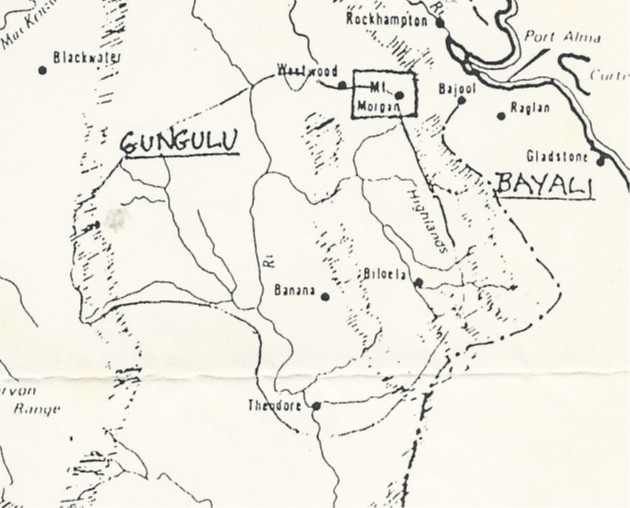
242 His Honour correctly identified that the map did not otherwise precisely match the Claim Area, but it is apparent that his Honour misunderstood the evidence by failing to apprehend that the area shown in the map included Mount Morgan and the area south of it.
243 There was, however, other evidence about Mount Morgan that was considered by his Honour that was not subject to appeal, including:
(1) The evidence of Mona Barry, a granddaughter of William Toby I, who was significantly older than other witnesses descended from William Toby I. She described Gaangalu country as “around Banana, the Dawson River, Moura”. His Honour noted that this description did not include Mount Morgan (PJ1[659]).
(2) Substantial ethnographic material about Mount Morgan. Dr de Rijke considered that Mount Morgan was part of Gaangalu country (PJ1[670]), while Dr Kenny was not able to reach the same conclusion (PJ1[635]). There were conflicting reports from early sources who had visited the area in the late 19th century, and subsequent analysis of those records by Norman Tindale, a field researcher, from 1938 (see PJ1[559]).
244 In the course of argument, the Appellant submitted that the area around Mount Morgan was properly understood as a “zone of transition” and that because no other party has come forward, the Gaangalu were the only traditional owners remaining to assert their connection to that country.
245 We are satisfied that his Honour erroneously excluded or failed to accord weight to evidence that was directly relevant to whether Mount Morgan was Gaangalu country. However, it is not so straightforward to conclude that a finding that Mount Morgan was Gaangalu country should be made. That is because of the integrated nature of the analysis, and the significance of hearing evidence from Aboriginal witnesses on country on the question of connection. This issue is further considered along with the question of the appropriate disposition of this appeal, below.
The balance of the Claim Area
246 The first ground of appeal fastens upon his Honour’s findings to the effect that the Gaangalu people, at sovereignty, did not occupy and have rights and interests in the Claim Area other than those areas to the west of the Dawson River, and in those parts to the east of the Dawson River in the Three Rivers, Mount Spencer and Banana. The argument focused upon the evidence regarding Mount Morgan, and as noted above, we consider that his Honour erred in his approach to that evidence. The balance of the ground was concerned with a more general proposition that because there was some lay evidence connecting Gaangalu group members with excluded parts of the Claim Area, his Honour was in error by failing to prefer them. In this respect, the Appellant argued that there was no countervailing evidence. That may be so, but it is possible for there to be uncontradicted evidence which nevertheless remains insufficient to satisfy a trial judge that an applicant has discharged its burden of proof.
247 The Appellant relied upon Banjima FC at [52] as an example of a case in which a Full Court consisting of five judges upheld the ruling of the trial judge that his Honour was not satisfied that he could make a finding that, at sovereignty, any person shared traditional rights and interests with the Banjima people, so that where no other Aboriginal person asserts the existence of continued shared rights to any part of Banjima country, the Banjima people’s otherwise exclusive rights and interests can be upheld in a previously shared area.
248 We do not consider those principles to be relevant to the issue with which we are concerned. We accept that transitional zones can be the subject of a native title claim, and that where only one surviving group asserts that title, that fact may, depending on the circumstances, be probative to establishing native title in that zone. However, the issue in relation to the balance of ground one concerns the appropriateness of substituting our own factual finding for a finding of the primary judge without our having had the benefit of hearing from the witnesses “on country”. That concern is exacerbated where, as here, the Appellant expresses concern over the alleged failure of the primary judge to accord the lay evidence appropriate primacy.
Ground one: Conclusion
249 It is apparent that there was a substantial evidentiary contest concerning whether or not Mount Morgan was properly characterised as land in respect of which the Gaangalu people occupied and held rights and interests at sovereignty. In our view, it was not open to his Honour to conclude from the 1996 audio recording and the 1990 Speech that William Toby III was uncertain as to whether Mount Morgan was Gaangalu country, nor that as a result any lay evidence derived from information passed down by William Toby III in that regard was unreliable. His Honour’s approach to the lay evidence on this issue was therefore erroneous.
250 It follows that the holistic analysis in which his Honour engaged proceeded on the erroneous footing that:
(1) William Toby III had expressed doubts about Gaangalu country including Mount Morgan.
(2) Lay evidence sourced from William Toby III (including that summarised at [238] above) was unreliable.
(3) The correspondence concerning Mount Morgan received in 1993 referred to the area south of Mount Morgan, rather than including the area of Mount Morgan, proceeding south.
251 The effect of this approach was to rely too heavily on the sparse (PJ1[632]) ethnographic material, and to inappropriately exclude reliance upon lay evidence of group members (Sampi v Western Australia [2005] FCA 777 at [48] (French J)). This approach infected the analysis which his Honour undertook. Thus, while we are able to say that his Honour’s analysis miscarried, it is a separate question whether:
(a) this Court is in a position to conclude that the opposite conclusion ought to have been reached; and
(b) the evidence supports such a conclusion in relation to Mount Morgan, or the balance of the Claim Area more broadly.
252 These issues are canvassed in relation to the ultimate disposition of the appeal, below.
Ground four
253 By ground four, the Appellant impugns his Honour’s findings that certain apical ancestors are not (or could not be shown to be) Gaangalu. These individuals (referred to as the Excluded Ancestors) were:
(1) Rose Ann Tyson,
(2) Blanche of Duaringa,
(3) Peter Tyson,
(4) Violet Thompson,
(5) Jenny Doctor,
(6) Queenie Hart of Duaringa,
(7) Polly Doctor (and her grandchildren Charlie, Willie and George Riley),
(8) Lily/Lilla Livingstone,
(9) Myra Freeman, and
(10) Sarah Dodd.
254 The Appellant argued that it was for the claimant group to decide for itself whether particular persons or groups of persons (identified by reference to ancestors) were accepted to be group members according to its understanding, as a group, of the content of its traditional laws and customs, particularly those relating to membership. It was said that there was no dissent or contest within the claimant group, or between the Appellant and any indigenous or other respondent speaking for an indigenous person or group who raised any concern about the appropriateness of the description of the claimant group by reference to the identified apical ancestors.
255 Queensland submitted that, in respect of each Excluded Ancestor, his Honour appropriately weighed the evidence and reached conclusions that were open to him or otherwise appropriate.
General observations
256 Ground four fundamentally concerns the circumstances in which the Court will require independent satisfaction as to the identity of apical ancestors who are proffered by the claim group itself. The only party opposing acceptance of the named apical ancestors was Queensland, which took an adversarial position in the proceeding despite its assertion to the contrary (a position about which his Honour expressed some scepticism: PJ2[13]).
The approach to proof for apical ancestors
257 It is not in dispute that the standard of proof required in matters under the NTA is the civil standard, being the balance of probabilities. However, the Court is not “the arbiter of history” (Drill on behalf of the Purnululu Native Title Claim Group v State of Western Australia [2020] FCA 1510 at [13] (Mortimer J)). Her Honour in that case recognised that the exercise of drawing conclusions from evidence in native title cases can be difficult, noting that the exercise:
… is carried out on the basis of the evidence adduced, and inferences which can reasonably be drawn from that evidence. The Court must assess what, reasonably and rationally, can be made of the evidence before it. It does so from a more objective perspective than that brought by the parties, and for that reason, it may well see some evidence as persuasive although one party does not. Conversely, it may see other evidence as unpersuasive, although a party, its expert or the claim group members find that evidence persuasive. Even where the task is challenging, and the evidence pulls in different directions (as it does in many of the factual issues to be resolved in these separate questions), the Court’s function is to make a decision, and to decide if the party with the onus of proof has discharged it.
258 A number of the excluded apical ancestors were born in or near the Claim Area. In its closing submissions below, Queensland submitted that “… the mere fact that an apical ancestor is associated with an area within the claim area is not probative of the fact that they are an apical ancestor of the claim group”. It identified the authority for that proposition as Rainbow on behalf of the Kurtjar People v State of Queensland (No 2) [2021] FCA 1251 (Kurtjar) at [263] (Rares J). It is useful to examine the assertion, because Queensland deployed it a number of times in the hearing below, and the assertion that a matter is “not probative” is a significant one for a State party to advance.
259 Kurtjar was an application under s 225 of the NTA for a determination of non-exclusive native title in respect of land and waters. One of the matters in issue in that case was the identification of apical ancestors of the claim group, the Kurtjar. One of the potential apical ancestors was identified as “Lucy”. There was no lay evidence whatsoever about Lucy, or about where she was born. Unnamed senior Kurtjar people told an anthropologist that they accepted Lucy’s family (the O’Brien family) as Kurtjar and that “some members of the claim group associated the O’Brien family with Midlothlian” (at [260]). Two of the anthropologists agreed that they “know nothing” about Lucy, including where she originated, and the third anthropologist’s evidence provided “no substantive information about Lucy from which any reasonable inference can be made” (at [263]). It was in that context that his Honour concluded that “the mere fact that she [Lucy] was thought to be associated with Midlothlian is not probative that she was Kurtjar” (at [263]). It is important to note that part of the reason for this conclusion is that the anthropologist expert’s unnamed informants gave no substantive information about Lucy from which any reasonable inference could be made. Given the context, the proposition which Queensland seeks to derive from the case, that “the mere fact that an apical ancestor is associated with an area within the claim area is not probative of the fact that they are an apical ancestor of the claim group”, is not a principle of general application. It is a factual conclusion arising from a specific case.
260 Association with an area within the claim area may well be probative of a person being an apical ancestor, depending upon the circumstances of that information in its overall context. Indeed, the submission which Queensland seeks to draw from Kurtjar is directly at odds with the earlier observations of Rares J (at [241]) that:
In assessing the disputed genealogical evidence, I have accepted the experts’ view that the closer to effective sovereignty a record (or recollection) of the association of an individual with a place is, the greater the likelihood that he or she was a member of the group with whose traditional land or waters the record or recollection associated him or her.
261 The nature and extent of an association is one part of the inferential factual matrix that needs to be considered. Depending on the case that task may be a difficult one. It involves drawing an inference that is reasonably available, from basal facts found. This process was explained by Gageler J in Henderson v Queensland [2014] HCA 52; 255 CLR 1 at [89], [91] as follows (footnotes omitted):
Generally speaking … a party who bears the legal burden of proving the happening of an event or the existence of a state of affairs on the balance of probabilities can discharge that burden by adducing evidence of some fact the existence of which, in the absence of further evidence, is sufficient to justify the drawing of an inference that it is more likely than not that the event occurred or that the state of affairs exists. The threshold requirement for the party bearing the burden of proof to adduce evidence at least to establish some fact which provides the basis for such a further inference was explained by Kitto J in Jones v Dunkel:
“One does not pass from the realm of conjecture into the realm of inference until some fact is found which positively suggests, that is to say provides a reason, special to the particular case under consideration, for thinking it likely that in that actual case a specific event happened or a specific state of affairs existed.”
…
The process of inferential reasoning involved in drawing inferences from facts proved by evidence adduced in a civil proceeding cannot be reduced to a formula. The process when undertaken judicially is nevertheless informed by principles of long standing which reflect systemic values and experience. One such principle, forming “a fundamental precept of the adversarial system of justice”, is that “all evidence is to be weighed according to the proof which it was in the power of one side to have produced, and in the power of the other to have contradicted”. Another such principle, “reflecting a conventional perception that members of our society do not ordinarily engage in fraudulent or criminal conduct”, is that “a court should not lightly make a finding that, on the balance of probabilities, a party to civil litigation has been guilty of such conduct”.
262 Many of the evidentiary issues in this ground of appeal concern a lack of evidence, and what should follow from that absence. For example, for many of the Excluded Ancestors there are no descendant witnesses, and no written records which provide evidence for a person’s genealogy or place of birth. In that context, we turn to consider each of the Excluded Ancestors.
The Excluded Ancestors
Rose Ann Tyson
263 Rose Ann Tyson was born in the Claim Area, at Comet Downs in 1878 (PJ1[713]), within a generation of effective sovereignty. Two of her children were born in the Claim Area (at Bluff) in 1909 and 1913 (PJ1[713]). These facts were uncontroversial and were accepted by the primary judge.
264 Dr de Rijke’s report of September 2018 relied in part on the detailed information provided in a report of Dr Maclean from 2015. That report, entitled “Review of Genealogical Data – Gaangalu Nation People Apical Ancestors”, includes an entry about Rose Ann Tyson. It identifies her as the daughter of Robert and Maggie. The identification of Rose Ann Tyson’s parents is derived from a 2007 report of Peter Blackwood titled “Draft Anthropological Report on Gangalu Dialect Groups of the East Comet West Dawson Ver 1: Containing descriptive profiles of descent groups connected to the claim area”, which was not in evidence.
265 Dr de Rijke observed that the proximity of Rockhampton to the Claim Area facilitates regular access and ongoing connection with the Claim Area. In his opinion, residency in that area was part of a residential pattern displayed by the descent group, being an example of proximity to the Claim Area.
266 The Kenny Report records Dr Kenny’s view, at the time, that she was unable to form a concluded opinion about Rose Ann Tyson.
267 In the February 2019 Joint Report, Dr Kenny said:
Mainly due to lack of time and the contested nature of their linguistic or ‘tribal’ affiliation (i.e. Gangalu or Kanolu), I am unable to form a concluded view about [Gaangalu] apical ancestors Rose Ann Tyson, Biddy, Lizzie Tiger, Annie French, Polly Doctor, Peter Tyson, Brothers Charlie, Willie and George Riley. However these will be discussed with Dr de Rijke on March 8 2019.
268 Another conference of experts was held on 8 March 2019, and attended by Dr de Rijke and Dr Kenny. Again, a report was produced (the 8 March Joint Report). In that report, the experts jointly accepted there was very limited ethnographic information about Rose Ann Tyson, but noted that her descendants identify as Gaangalu, and are acknowledged by the claimant group as Gaangalu. Dr de Rijke and Dr Kenny observed that “most places she was associated with place her in the [Claim Area]”. Dr de Rijke then concluded that:
In relation to Rose Ann Tyson… in spite of the limited record, based on the fieldwork I have undertaken with the [Gaangalu] claimants as well as wider acknowledgement of these ancestors as [Gaangalu] people, I am of the opinion that these people are appropriately included in the [Gaangalu] claim group description.
269 Dr Kenny was more circumspect, finding:
In relation to Rose Ann Tyson… the very limited record suggests that they may have had rights and interests in the [Gaangalu] claim area. I am not in a position to adopt a more certain position because I have not conducted any primary research with the relevant claimants.
270 By contrast, Dr de Rijke’s clarity of opinion was achieved following fieldwork he had undertaken with the Gaangalu.
271 In the Second de Rijke Report, Dr de Rijke provided his opinions following his review of the hearing of the lay evidence and some changes to the lay evidence. For that purpose, Dr de Rijke was provided with the document entitled “State of Queensland List of Matters Remaining in Contention” dated 4 June 2021, which listed Rose Ann Tyson as a disputed apical ancestor. Accordingly, Dr de Rijke’s comments about the “[Gaangalu] ancestors that remain in dispute as far as the State of Queensland is concerned” can be understood to include Rose Ann Tyson. His conclusion was (emphasis added):
With regard to the [Gaangalu] ancestors that remain in dispute as far as the State of Queensland is concerned, I note Dr Kenny and I agreed that all these ancestors were appropriately included in the [Gaangalu] claim (see report of expert conference, dated 8 March 2019). Where documentary evidence regarding ancestors’ linguistic affiliation and/or associated places is limited or absent, we took the view that contemporary recognition by the wider claim group should be the deciding factor. Considering the documentary evidence and contemporary recognition, we agreed all ancestors listed in the [Gaangalu] claim group description were appropriately included on the [Gaangalu] claim. (But note the comments above regarding Myra Freeman and those ancestors listed on the Western Kangoulu claim).
272 No lay evidence was led in relation to Rose Ann Tyson, including from any descendant witnesses.
273 Thus, there was no evidence before the primary judge that any person disputed her Gaangalu identity. In effect, Queensland put Gaangalu “to proof” and asserted that Rose Ann Tyson did not meet the necessary standard. In its submissions, Queensland argued that Rose Ann Tyson should not be identified as Gaangalu. In its summary of the expert evidence, it said:
Dr Kenny in her overview report at [176]-[177] who was unable to accept Rose Anne Tyson was more likely than not a [Gaangalu] apical ancestor. This opinion remained unchanged following the joint expert conferences.
274 The second sentence of this submission (“[t]his opinion remained unchanged following the joint expert conferences”) is questionable in light of the evidence summarised above. It is, at best, a gloss, which failed to draw attention to the change which did occur in Dr Kenny’s opinion, in which she concluded in the 8 March Joint Report that Rose Ann Tyson “may have had rights and interests in the [Gaangalu] claim area”.
275 Queensland’s submission that the evidence does not support a finding on the balance of probabilities that Rose Ann Tyson’s traditional country was within the Claim Area can be summarised as follows:
(1) There is a lack of oral history that associates the descent line with the Claim Area.
(2) There is a paucity of documentary evidence associating Rose Ann Tyson with the Claim Area, outside the fact that she and two of her children were born within the Claim Area.
(3) None of the lay witnesses discuss Rose Ann Tyson as an apical ancestor associated with the Claim Area. Queensland submitted that “while there is no evidence that members of the claim group dispute her inclusion, where an apical ancestor is in issue and there is a lack of independent ethnographic record or clear agreement amongst members of the claim group, it is not enough that a community or segments of a community of Aboriginal people acknowledge a person as part of their group if the person does not also have a relevant ancestry within that group by their law and custom”.
(4) Even if the Court were to accept that Rose Ann Tyson had an association with Comet Downs or Bluff, the mere fact that an apical ancestor is associated with an area within the Claim Area is not probative of the fact that they are an apical ancestor of the claim group.
276 There are a number of difficulties with Queensland’s submissions:
(1) First: there was no basis to suggest that Rose Ann Tyson might not have had an association with Comet Downs or Bluff (the place where she was born and had two of her children, respectively). For the reasons that we have already explained, in that context, the submission that “the mere fact that an apical ancestor is associated with an area within the claim area is not probative of the fact that they are an apical ancestor of the claim group” was an inappropriate submission. While we accept that it is not determinative, it cannot be said that the fact that Rose Ann Tyson, an Aboriginal woman born within the Claim Area 28 years after effective sovereignty (assuming effective sovereignty to be 1850) was “not probative” of whether she might properly be an apical ancestor.
(2) Second: we accept that no lay witness gave evidence about Rose Ann Tyson, but the submission that there is a lack of “clear agreement” amongst members of the claim group is a curious one in circumstances where her inclusion as an apical ancestor was part of the application itself, which was approved by the claim group. And as we later explain, Queensland did not take us to any evidence of disagreement within the claim group that Rose Ann Tyson was Gaangalu. This issue is one which Queensland could have explored in cross-examination of the Gaangalu lay or expert witnesses, but it did not.
277 In addition, Queensland advanced a submission before the Court below that:
where an apical ancestor is in issue, and there is a lack of independent ethnographic record or clear agreement amongst members of the claim group, it is not enough that a community or segments of a community of Aboriginal people acknowledge a person as part of their group if the person does not also have a relevant ancestry within that group by their law and custom…
278 It relied on Banjima People v State of Western Australia (No 2) [2013] FCA 868; 305 ALR 1 (Banjima) at [598] (Barker J) as authority for that proposition. It is necessary to look at the circumstances of that case to understand the appropriateness of that submission. The Court in that case was considering the native title claim of a people known as the Banjima. One of the ancestors was known as Daisy Nyiyabarli. The anthropologists in that case did not accept that Daisy Nyiyabarli was Banjima, and there was evidence she was a member of a different group, known as the Nyiyabarli. The anthropologists’ report noted that “it is not accepted by all claimants that Daisy was a member of Banjima language group” (Banjima at [588]). It appears that the issue was explored in the concurrent evidence session involving the anthropologists. It is apparent that the lack of ethnographic evidence was vexing in that case because there was conflicting, apparently reliable, evidence about Daisy Nyiyabarli’s ancestry (Banjima at [596]). It was apparent that some Banjima did not consider her to be an apical ancestor and some did. It was in that context in which Barker J said (at [597]):
There are some circumstances in which the lack of an independent ethnographic record supporting the inclusion of a claimed apical ancestor amongst the ancestors who may be taken to have possessed native title rights in the claim area at sovereignty may be of relatively little moment, and the evidence of claimants themselves concerning the reputation of a claimed apical ancestor will be determinative and lead to a finding that the claimed apical ancestor was indeed an ancestor for native title purposes – as indeed I have found above in the cases of Sam Coffin and Whitehead. In this particular instance, however, there is no clear agreement amongst members of the claim group themselves as to Daisy’s identity. There are those who emphasise Daisy’s Nyiyabarli ancestry and those who say she was Banjima.
279 It was in the context of that dispute – arising on the evidence and pressed by members of the claim group – that his Honour concluded (at [598]) that (emphasis added):
The Court accepts that, for native title purposes, it is not enough that a community or segments of a community of Aboriginal people acknowledge a person as part of their group if that person does not also have a relevant ancestry within that group by their law and custom, as Mr Robinson and Dr Palmer explained in their evidence. It is not enough, if a person’s ancestry is in question, for example, merely to show that a person has lived for many years in the relevant claim area and been involved in the relevant community’s cultural activities, if there is some real doubt about their ancestral connection or traditional incorporation within that community. This is one of the difficult issues governing native title claim group membership.
280 As the emphasised portions of the above passage make clear, the significance of a community’s acknowledgement of an apical ancestor will depend on the surrounding circumstances. While it may be accepted that community acknowledgment is not enough alone, the analysis in Banjima operates in the context of disputed, conflicting evidence about the person’s ancestry, as well as concern raised by members of the claim group, with some emphasising her Nyiyabarli ancestry, and others who said she was Banjima. That is different to the present case where no one (other than Queensland) raised the concern that Rose Ann Tyson might not be Gaangalu. Nor was there a competing identity which was the subject of credible ethnographic evidence.
281 Queensland does not address in its submissions why the opinion of the experts retained by both parties should be ignored, nor whether any of the experts were asked any questions by Queensland impugning the conclusion (at least by Dr de Rijke) that Rose Ann Tyson was a Gaangalu person. While it is the Appellant’s burden to establish the apical ancestors, to impugn an expert opinion without having raised the issue with that expert, who Queensland cross-examined, is an unsatisfactory approach.
282 The evidence concerning Rose Ann Tyson is entirely written, and this Court is in as good a place as the primary judge to consider it. The primary judge’s analysis is evident from his reasons. His Honour records that Dr de Rijke considered the inclusion of Rose Ann Tyson to be appropriate, and records that Dr Kenny explained that she “was not in a position to adopt a certain position because she had not conducted primary research” (PJ1[53]). The primary judge also observed at PJ1[713]-[717]:
Rose Ann Tyson was born in about 1878 at Comet Downs within the claim area. Rose married Henry Black and had six children, including Kathleen and James Black, both of whom were born in the claim area at Bluff in 1909 and 1913 respectively. Kathleen’s children were all born in, and both Kathleen and James died in, Rockhampton.
Drs de Rijke and Maclean consider that Rose Anne Tyson was Gaangalu. Dr Kenny was unable to accept that Rose was more likely than not an apical ancestor. This opinion remained unchanged following joint expert conferences.
There are no descendant witnesses nor direct evidence given by the lay witnesses about Rose Ann Tyson.
The State submits that the evidence does not support a finding that Rose Anne Tyson’s traditional country was within the claim area. The basis for this submission is that: there is no oral history that associates this descent line with the claim area; the only documentary evidence in Dr Maclean’s report that associates Rose Anne Tyson with the claim area is a reference to Blackwood who cites the burial register in support of her birth place being Comet Downs; and none of the lay witnesses discuss Rose Anne Tyson as an apical ancestor. While there is no evidence that the claim group disputes her inclusion, there is a lack of independent ethnographic record or clear agreement amongst members of the claim group.
I accept the State’s submissions. I am not satisfied that Rose Ann Tyson was Gaangalu.
283 There, his Honour notes that two experts accept Rose Ann Tyson as Gaangalu and records the position of Dr Kenny in accordance with the submissions made by Queensland. His Honour does not, though, explain why he does not consider the evidence of the experts to be sufficient, particularly given that Dr Kenny expressed a view that Rose Ann Tyson may have had rights and interests in the Claim Area, but was not able to express a clearer view in the absence of primary research with the relevant claimants. Dr de Rijke on the other hand had carried out primary research with the relevant claimants, and opined that Rose Ann Tyson was Gaangalu. Again, the primary judge was not obliged to accept the expert opinions of Dr de Rijke and Dr Maclean. But, it is a curious feature of this case that in cross-examination the State did not question Dr de Rijke on his position regarding Rose Ann Tyson, yet it later submitted that his evidence on this point should not be accepted.
284 Moreover, we were not taken to any evidence in support of the primary judge’s conclusion that there was a “lack of … clear agreement” amongst members of the claim group as to Rose Ann Tyson’s Gaangalu identity. The affidavit of Lynette Gail Blucher dated 12 November 2012 affirmed that the native title determination application was made following a process of public notices being advertised in various publications, inviting descendants of 25 apical ancestors to the authorisation meeting held on 18 August 2012 at Rockhampton. She deposed that at that meeting:
… registration recorded an attendance of over 210 Gaangalu persons, I, along with the other members of the Applicant, was unanimously authorised, with a sole vote only against, to make this application and to deal with matters arising in relation to it.
285 Evidence to the same effect was given by each of the individuals authorised to act on behalf of the claim group. The application that was authorised included Schedule A, which provided:
The Gaangalu Nation native title claim group comprises all persons who are biologically descended from the following deceased ancestors, all of whom are recognised by the living Gaangalu claim group members as having been Gaangalu:
…
• Rose Ann Tyson
…
286 Once again, we were not taken to anything to show that any of the individuals who gave evidence about the authorisation of the native title claim in those terms were cross-examined about the inclusion of Rose Ann Tyson as an apical ancestor. We therefore do not consider it was open to the trial judge to conclude that there was a lack of clear agreement within the claim group as to her Gaangalu identity. In proceeding on the basis that there was such a lack of clear agreement, his Honour erred.
287 On balance the evidence supports the view that Rose Ann Tyson was Gaangalu, because:
(1) She was born in the Claim Area 28 years after effective sovereignty;
(2) She had two of her children on the Claim Area;
(3) She was one of the apical ancestors specifically identified by over 200 of the “living Gaangalu claim group members as having been Gaangalu” and there is no suggestion of any challenge to that designation by any person at any time. Once again, none of the deponents who gave evidence as to the authorisation of the claim in those terms was cross-examined to the effect that the recognition was not appropriate; and
(4) The preponderance of anthropological evidence supports the conclusion that she was Gaangalu. The only anthropologist to qualify that view (Dr Kenny) did so on the basis that she had not carried out field work in connection with the issue. Dr de Rijke, however, did carry out such work, and explicitly relied upon it to reach the conclusion that Rose Ann Tyson was Gaangalu. Had there been a serious dispute about that conclusion, it should have been raised in the course of cross-examination of Dr de Rijke.
288 We do not consider the paucity of ethnographic record to be fatal in the circumstances of this case.
Blanche of Duaringa
289 Blanche of Duaringa was born between 1875 and 1890 at Duaringa in the Claim Area, and was at Blackwater (in the Claim Area) in 1908 before being moved to Barambah in 1923 (PJ1[726]). One of her children was born in Blackwater and another at Honeycombe Station (just outside the Claim Area).
290 In giving the location of Duaringa, Queensland as her birthplace, Dr Maclean’s report notes that the Queensland death certificate for Blanche of Duaringa was cited by P Blackwood. Dr Maclean explains that the reason for her removal from Duaringa to Barambah (outside the Claim Area) was identified in correspondence as being for using bad language to her employer. Dr Maclean states that records maintained in Queensland State Archives show that Blanche of Duaringa twice applied for an “exemption” and was later found to be employed at Glencoe without a permit on 14 May 1941. She died on 20 December 1945.
291 The Kenny Report records as follows:
There is sufficient evidence that allows the following individuals to be identified as apical ancestors of the Gaangalu claim: … Blanche of Duaringa…
292 Dr Kenny goes on to conclude that:
While no linguistic or ‘tribal’ identity appear in the written record, her life history ties her to the claim area and her uncontested status suggests that she is more likely than not an apical ancestor of the Gaangalu application.
293 In the First de Rijke Report, Dr de Rijke identified Blanche of Duaringa as Gaangalu.
294 In the February 2019 Joint Report, Dr de Rijke, Dr Powell and Dr Kenny all agreed that:
Among the [Gaangalu] claim group there is sufficient evidence that allows the following individuals to be identified as apical ancestors of the Gaangalu claim… Blanche of Duaringa…
295 Queensland submitted below that there was not enough evidence to support a finding on the balance of probabilities that Blanche of Duaringa’s traditional country was within the Claim Area. The arguments it made are similar to those deployed in respect of Rose Ann Tyson and can be summarised as follows:
(1) There is no oral history associating this descent line with the Claim Area of the Gaangalu.
(2) None of the lay witnesses discuss Blanche of Duaringa as an apical ancestor associated with the Claim Area. While there is no evidence that members of the claim group dispute her inclusion, where an apical ancestor is in issue, and there is a lack of independent ethnographic record or clear agreement amongst members of the claim group, it is not enough that a community or segments of a community of Aboriginal people acknowledge a person as part of their group if the person does not also have a relevant ancestry within that group by their law and custom.
(3) In the absence of any oral history, the focus shifts to the ethnographic material. The earliest dated documentary evidence referenced in the report of Dr Maclean that associates Blanche of Duaringa with the Claim Area is from 1923 (approximately 70 years after effective sovereignty). Apart from the death certificate of Blanche, most of the referenced archival material relates to places at which she worked. Further, apart from an implication that the Bundaberg Cemetery Burial Registry entry for Blanche’s daughter Agnes shows Blackwater as her place of birth, the documents for Blanche’s children Agnes, Leslie and Eva do not appear to reference areas within the Claim Area.
(4) Even if the Court was to accept that Blanche had an association with Duaringa or Blackwater, the mere fact that an apical ancestor is associated with an area within the Claim Area is not probative of the fact that they are an apical ancestor of the claim group.
296 The difficulties with this analysis are even more pronounced in this case than in respect of Rose Ann Tyson. In this instance there is no dispute at all among the anthropologists that Blanche of Duaringa was a Gaangalu person. The observation by Dr Kenny about a lack of linguistic or tribal identity in the written record does not detract from the experts’ joint conclusion, in spite of that limitation, that there was sufficient evidence to conclude that she was Gaangalu.
297 Queensland’s submissions peremptorily dismiss the death certificate for Blanche, which gives her place of birth as being within the Claim Area only a generation after effective sovereignty. The State gave no reason why this evidence should not be considered significant. Moreover, Queensland’s submissions proceed on the basis that there was a lack of clear agreement amongst members of the claim group as to the inclusion of Blanche of Duaringa as an apical ancestor, despite the fact that over 200 self-identified Gaangalu voted to a different effect. Finally, in cross-examination Queensland did not ask any of the anthropologists to clarify their opinions, nor raise the issue with any of the lay witnesses.
298 The analysis of the trial judge concerning Blanche of Duaringa is set out at PJ1[726]-[730] as follows:
Blanche of Duaringa was born at Duaringa between 1875 and 1890. Blanche was at Blackwater in 1908 and was removed to Barambah in February 1923, lived with a child in Cherbourg between at least 1937 and 1940, worked at Glencoe Station between 1941 and 1943 and died at Eidsvold District Hospital in 1945. Blanche was the mother of Agnes Ross Kemp, who was born near Blackwater in about 1904 to 1908.
Drs de Rijke, Maclean and Kenny accept Blanche of Duaringa to be Gaangalu. Dr Kenny notes the lack of available documentary evidence of her linguistic or tribal identity.
There are no descendant witnesses for this apical line and no direct evidence was provided by the lay witnesses.
The State submits that the evidence does not support a finding that Blanche of Duaringa’s traditional country was within the claim area. There is no oral history that associates this descent line with the claim area or the Gaangalu Nation People and none of the witnesses discuss Blanche as an apical ancestor. In the absence of any oral history, the State relies on ethnographic material. The earliest dated documentary evidence referenced by Dr Maclean is from 1923, at least 67 years after effective sovereignty. The material includes Blanche’s death certificate and a Bundaberg Cemetery Burial Registry entry implying Blanche’s place of birth as Blackwater. Despite this, most of the material relates to places where Blanche worked and the documents for her children Agnes, Leslie and Eva do not appear to reference areas within the claim area.
I accept the State’s submissions. I am not satisfied that Blanche of Duaringa was Gaangalu.
299 Once again, we consider that the failure to engage with the rejection of the anthropological evidence is concerning – particularly given the lack of examination of the anthropologists in relation to this issue in the course of the hearing. This is compounded in this instance by reciting Dr Kenny’s potential reservation about a lack of tribal affiliation, without acknowledging that she nonetheless reached the conclusion that Blanche was Gaangalu.
300 There is also a disconformity in his Honour’s reasons, insofar as he appears to find at PJ1[726] that Blanche of Duaringa was born at Duaringa and was at Blackwater in 1908. Both places are within the Claim Area. However, at PJ1[729] his Honour casts doubt upon the evidence recording the place of Blanche’s birth as being a mere implication arising from a Bundaberg Cemetery Burial Registry entry. Having accepted that Blanche of Duaringa was born at Duaringa, it was not open to his Honour to conclude that the evidence upon which he relied for that conclusion was not reliable for the purposes of the analysis of whether or not Blanche of Duaringa was relevantly associated with the Claim Area.
301 Accordingly, we consider his Honour fell into error by concluding that Blanche of Duaringa was not Gaangalu.
Peter Tyson
302 It was common ground between the parties that his Honour’s conclusion at PJ1[754] that “I am not satisfied that Peter Tyson was Gaangalu” was a typographical error, which should have omitted the word “not”. Whether a typographical error or not, the parties agree that this finding was in error, and we will make orders reflecting that consensus.
Violet Thompson
303 Violet Thompson was born around 1903 at Emerald or Kilarney Station. She was the mother of Erik and Claude Thompson. Violet Thompson was identified as Kanjulu by Tindale in the 1930s.
304 Queensland submitted that:
… the evidence, such as it is, does not support a finding, on the balance of probabilities, that Violet Thompson’s traditional country was within the claim area.
305 Dr de Rijke, Dr Maclean and Dr Kenny all considered Violet Thompson to be Gaangalu and that conclusion is recorded by his Honour (at PJ1[761]). His Honour recounted that there were no lay witnesses for the line of descent from Violet Thompson (PJ1[762]) and that the “ethnographic material considered by the experts is indeterminate” (PJ1[764]). Queensland did not, however, put to the experts its concern that the ethnographic material relied upon by them was indeterminate or otherwise unable to support their conclusions.
306 Once again, the State argued that where no lay witnesses describe Violet Thompson as an apical ancestor, that there is no evidence that the claim group disputed her inclusion is nonetheless insufficient “if the person does not have a relevant ancestry within that group by their law and custom” (at PJ1[765]). His Honour further noted that it was said by Queensland to be unclear if Violet Thompson was from the Claim Area and migrated out, or whether her area of association was west of the Claim Area.
307 Ultimately his Honour concluded in relation to Violet Thompson that (at PJ1[767]):
Despite the uncertainty of Violet Thompson’s area of association, I, again, place weight on her identification as Kanjulu by Tindale in the 1930s. The evidence of Dr de Rijke indicates that at sovereignty, Gaangalu country is likely to have extended to Emerald. I accept Violet Thompson was probably Gaangalu. However, I do not accept that she had rights and interests in the claim area.
308 Therefore, while his Honour found that Violet Thompson was Gaangalu, he nonetheless concluded that she had no rights and interests in the Claim Area. It appears that this conclusion was reached on the basis that the evidence was sufficient to support an inference that Violet Thompson was Gaangalu and was born at Emerald, but that because that is now outside the Claim Area there was insufficient evidence to support the notion that she had any rights or interests in the Claim Area.
309 The Appellant argued that even if Violet Thompson’s traditional country was Emerald and not in the Claim Area, it does not demand the conclusion that she was not part of the group which held communal rights and interests in the Claim Area. It said that his Honour’s approach erroneously regarded areas associated with individuals as if they comprised a personal estate rather than a communally held title to the Gaangalu country. It submitted, in addition, that a reference to “Emerald” as the individuals’ birthplace does not mean that it can be treated as if it were a pinpoint reference to a modern population centre rather than, for example, a region or Police District such as the Emerald Police District depicted in an accompanying map.
310 There is force in the Appellant’s argument that the primary judge does not explain why a Gaangalu person could be said to have no rights or interests in the Claim Area, such that it was not open to the claim group to include a Gaangalu person as an apical ancestor. In that respect, Violet Thompson plainly had a relevant ancestry within that group by their law and custom and was accepted by the claim group. It is not clear, therefore, on what basis that relevant ancestry, when coupled with acceptance by the claim group, was insufficient for a finding that she was an apical ancestor.
311 It appears that his Honour rejected the conclusions of the anthropologists, but considered the more contemporaneous records of Tindale to be sufficiently persuasive to conclude that Violet Thompson was born near Emerald, and thus had a Gaangalu identity (at PJ1[767]). But there is no analysis of the nature of the rights and interests which a person in the circumstances of Violet Thompson would have had, only the negative conclusion that she did not have any rights and interests in the Claim Area. It seems likely that conclusion is based on his Honour’s erroneous conclusion that the shift in landholding rights to a large clan-based model post-sovereignty was not a permissible adaptation. This also impacts upon the conclusion in relation to Violet Thompson and renders it unsound.
Jenny Doctor
312 Jenny Doctor was born not before 1871 at Emerald, 40 km west of the Claim Area. She was the mother of Nancy, Willie and Mary Lee. Nancy’s place of birth is unknown and Willie and Mary were born in Emerald.
313 His Honour summarised the anthropological evidence in this way at PJ1[769]:
Drs de Rijke, Maclean and Kenny consider that Jenny Doctor was Gaangalu. Dr Kenny was unable to form a conclusive view because there is no linguistic or tribal identity in the written record for Jenny Doctor. Dr Kenny also notes that the areas of association place Jenny in the western areas of the broader [Gaangalu] cluster region.
314 While the paragraph invites some conjecture due to its apparent inconsistency in relation to the view of Dr Kenny, we consider that a fair reading is to the effect that Dr Kenny concluded that Jenny Doctor was Gaangalu, after noting concerns due to a lack of linguistic or tribal identity in the written record.
315 The position in relation to Jenny Doctor is very similar to the analysis for Violet Thompson, save that Jenny Doctor had descendants who gave evidence:
(1) Paul Hegarty is a descendant who testified that his Gaangalu identity was via his great grandmother, Jenny Doctor. In oral evidence, he said that while she was associated with Emerald, she was born near the Comet River (within the Claim Area).
(2) Lillian Harrison also gave evidence that Jenny Doctor was an antecedent for the Hegarty family.
316 There was an inconsistency between archival records which place Jenny Doctor’s place of birth at Emerald, and the oral evidence of Mr Hegarty, that Jenny Doctor was associated with Emerald but was born on the Comet River. The State submitted that the inconsistency makes it difficult for the Court to attribute significant weight to the available oral history. It is not clear why such a submission would be made. Certainly it is permissible to take account of the inconsistency, but that can be done in light of the limitations of written records (Harrington-Smith on behalf of the Wongatha People v State of Western Australia (No 9) [2007] FCA 31; 238 ALR 1 at [440]-[441] (Lindgren J)) and in light of the purpose of the NTA, being to rectify the consequences of past injustice (CG v Western Australia [2016] FCAFC 67; 240 FCR 466 at [7]-[8] (North, Mansfield, Jagot and Mortimer JJ)). Further, the authorities provide that the Court should be cautious in relying on historical records to disprove a version of ancestry based on Aboriginal oral history (Briggs on behalf of the Boonwurrung People v State of Victoria (No 2) [2025] FCA 279 at [71]-[76] (Murphy J), and the authorities there cited).
317 Queensland submitted that the Appellant’s argument proceeds from the inference that there is evidence of acceptance by the ‘jural public’ of apical ancestors, which therefore cannot be questioned. The Appellant made no such submission. In this case, there was ample evidence that Jenny Doctor was Gaangalu, and she was accepted as such. Her place of birth being Emerald, an area outside the Claim Area, appears to have been treated as sufficient to conclude that she had no rights or interests in the Claim Area. Such a location-specific conclusion is, we apprehend, associated with the pre-sovereignty model for land tenure which, we have found, was adapted following effective sovereignty. That conclusion (the subject of ground three in this appeal) renders the analysis in respect of Jenny Doctor erroneous insofar as it proceeds on the faulty premise that close physical association with the area of one’s birth is dispositive of the question of whether the person has or had relevant rights or interests.
Queenie Hart of Duaringa
318 Queenie Hart of Duaringa was born at an unidentified date and place. Based on the birth of her first child in 1912, Queenie Hart was likely born not before 1897. In 1916, Queenie Hart was removed with her husband from Emerald to Barambah. She was the mother of Steve, Derker and Nugget Hart and an infant who died. Steve and Derker were born outside the Claim Area.
319 Lillian Harrison gave evidence that Queenie Hart’s descendants were known to her as Gaangalu people.
320 The anthropologists all accepted that Queenie Hart of Duaringa was Gaangalu.
321 Queensland’s submissions below were summarised by the primary judge as follows (at PJ1[778]):
The State submits that the evidence does not support a finding that Queenie Hart of Duaringa’s traditional country was within the claim area. The basis for this submission is that there is no substantive oral history that associates Queenie with the claim area. The ethnographic material shows that: Queenie’s estimated date of birth is at least 40 years after effective sovereignty; no place of birth can be determined; and the only other documentary evidence relates to her removal from Emerald to Barambah in 1916, both of which are outside the claim area. The State accepts that there is no evidence that the claim group disputes Queenie’s inclusion but argues that this is not sufficiently probative to establish that she was an apical ancestor of the claim group.
322 His Honour accepted those submissions, and concluded that: “I am not satisfied that Queenie Hart was Gaangalu” (PJ1[779]). Queensland’s submissions do not appear to have been to the effect that Queenie Hart of Duaringa was not Gaangalu; rather, it asserted that “the evidence, such as it is, does not support the finding, that Queenie Hart of Duaringa’s traditional country was within the claim area”. However, no point about this issue was taken in the appeal.
323 The Appellant asserted that in reaching the finding that he did, the primary judge gave weight to the absence of descendant witnesses and accepted the State’s submission that the claim group’s acceptance of her inclusion was not sufficiently probative. It said that prioritising those matters over the anthropological consensus and the evidence of Ms Harrison, in combination with the claim group’s acceptance of Queenie Hart, constitutes error.
324 It is clear that his Honour accepted the State’s submission that the claim group merely did not dispute the inclusion of Queenie Hart, rather than positively accepting her as an apical ancestor. There is an important distinction between the two concepts, and as the above analysis of the case of Banjima makes clear, that can be an important factor in the approach to the overall analysis. We have concluded that his Honour fell into error in that analysis. He ought to have accorded weight to the inclusion of Queenie Hart by the claim group, particularly when the State did not put the issue to any of the lay witnesses. In combination with the unanimous anthropological evidence and lay evidence, she ought to have been recognised as Gaangalu.
Polly Doctor (and her grandchildren, Charlie, Willie and George Riley)
325 Polly Doctor was born in about 1863 at an unidentified place. She was at Blackwater in November 1908 with her four children, Trixie, Alice, Arthur and Freda Doctor. At least two of her children were born within the Claim Area.
326 The evidence about Polly Doctor was summarised by Queensland in the trial below as including:
(a) reference in the evidence of Lillian Harrison to Polly Doctor being Gaangalu by identifying her descendants as Gaangalu people who lived outside the Claim Area;
(b) expert evidence, in which Dr de Rijke and Dr Maclean accepted her as Gaangalu, while Dr Kenny was unable to form a concluded view. As noted above, Dr de Rijke’s and Dr Maclean’s expert opinions followed genealogical and field work. There was no cross examination of the experts about Polly Doctor; and
(c) documentary evidence, including that the earliest evidence of her location in the Claim Area is around 30 years after effective sovereignty.
327 Queensland characterised the evidence of the claim group as being that there is no evidence that the claim group disputed her inclusion. As noted above, a more accurate summary of that evidence would be that the claim group accepted her inclusion (see the analysis at [284]-[286] above).
328 Queensland submitted that:
The State’s submission is that the evidence, such as it is, does not support a finding, on the balance of probabilities, that Polly Doctor’s traditional country was within the claim area.
329 The Appellant argued that in excluding Polly Doctor, the primary judge directed attention to the absence of evidence (and in particular, written evidence), and said that in circumstances where there was no evidence to the contrary, the primary judge ought to have inferred from the limited material available that Polly Doctor and her grandchildren were Gaangalu, were associated with the Claim Area, and had been identified by the claim group as apical ancestors.
330 The trial judge had the benefit of hearing directly from the lay witnesses and oversaw the manner in which they were cross-examined, but his Honour’s acceptance of the characterisation of the claim group as having merely failed to object to Polly Doctor’s inclusion is a matter of some significance. It effectively negates the positive assertion of Gaangalu identity that was made by the claim group, converting it into a passive failure to object. Again, it is permissible for a trial judge to reject the experts’ opinions; but his Honour’s failure to explain why he did not accept the evidence of two expert anthropologists, in combination with the misapprehension of the evidence of the acceptance of the claim group, together suggest an erroneous approach to the evidentiary analysis.
331 We consider that the correct view is that Polly Doctor was Gaangalu.
Lily/Lilla Livingstone
332 Lily/Lilla Livingstone was born in about 1885 at Banana, in the Claim Area, approximately 30 years after effective sovereignty (PJ1[785]). She was accepted as Gaangalu by Dr de Rijke and Dr Maclean. The primary judge noted that Dr Kenny initially could not form a concluded view due to conflicting material, but ultimately concluded that Lily/Lilla Livingstone should be “on the Gaangalu claim” (PJ1[786]). His Honour recorded that the evidence of Mr Kim McCaul, in a report prepared for the Wadja native title claim, was that the Livingstone family has a clear association with Redcliff Station, and that their well-attested association with Redcliff Station supports the view that they have a legitimate connection to the Wadja area. Mr McCaul then later agreed that Lily/Lilla Livingstone was appropriately included in the Gaangalu claim.
333 Of the lay witnesses, Lillian Harrison referred to Lily/Lilla Livingstone as Gaangalu. The evidence of Ms Harrison was that “[o]ther Gaangalu people who were talked about all the time include the Kemps, the Tysons, Lilla Livingstone, Orams, Leishas, Whites, Claude Anderson, Moses Mason, and the Toby’s”.
334 It appears that below the Gaangalu submitted that Ms Harrison was a descendant of Lily/Lilla Livingstone. Queensland argued that Ms Harrison’s reference to Lily/Lilla Livingstone as Gaangalu was inaccurate, because “Lillian Harrison says that she gets her Gaangalu from her father and grandfather”. We accept that the Gaangalu submission below that Ms Harrison was a descendant of Lily/Lilla Livingstone was inaccurate, as that is not the evidence that Ms Harrison gave. It appears to be a mistake in the submissions.
335 However, the evidence of Ms Harrison remained to the effect that Lily/Lilla Livingstone was a Gaangalu person who was “talked about all the time”. Queensland made no submission as to a basis for rejecting or discounting this evidence, save that Ms Harrison was not a descendant. Queensland cross-examined Ms Harrison, yet asked her no questions about her understanding of Lily/Lilla Livingstone’s Gaangalu identity, and her comments, extracted above, were not challenged. The submissions of Queensland simply ascribe that evidence no value because it does not come from a descendant. The primary judge took up that approach.
336 Separately, Queensland submitted, and it was accepted by the primary judge, that the fact that Lily/Lilla Livingstone was included as an apical ancestor on the Wadja claim is a relevant consideration that demonstrates the weakness of the evidence relating to her (PJ1[788]). It is not clear why such a conclusion should follow. The learned primary judge elsewhere noted Queensland’s acceptance that a person having a Wadja identity was not in and of itself a barrier to inclusion as a Gaangalu apical ancestor (PJ1[807] with reference to Myra Freeman). The existence of rights and interests deriving from multiple identities are not necessarily mutually exclusive.
337 Overall, the experts were unanimous that Lily/Lilla Livingstone was properly identified as an apical ancestor, and there was lay evidence to the effect that Lily/Lilla Livingstone was Gaangalu that was not challenged in cross examination. It was accepted that Lily/Lilla Livingstone was born within the Claim Area, and that she had at least one child within the Claim Area. The evidence also shows that she was accepted by the claim group as an apical ancestor.
338 The evidence pointing to a contrary conclusion was a lack of oral history, and a lack of direct evidence as to her affiliation. We accept the Appellant’s submission that, at the very least, his Honour erred in his approach to the significance of Lily/Lilla Livingstone’s Wadja claim, approaching it as though it were mutually exclusive with a Gaangalu identity, where there was no basis to do so. We therefore accept that his Honour fell into error in his analysis of Lily/Lilla Livingstone’s identity and that she should have been identified as Gaangalu.
Myra Freeman
339 Myra Freeman was born not before 1879 at Planet Downs Station, about 30 km south of the Claim Area. She married Mick Freeman and had 10 children including Leo Freeman. From the birth dates of her children, she was in the Rolleston area from about the mid-1880s to mid-1890s. She was identified as Wadja by Norman Tindale in the 1930s.
340 The evidence of the anthropologists was that Myra Freeman was appropriately identified as Wadja. His Honour recognised that this was not, in and of itself, a barrier to her having Gaangalu identity (PJ1[807]). There are no descendants of Myra Freeman.
341 The evidence about her in the proceeding below was scant. The Appellant relied primarily in this instance upon the recognition by the claim group of Myra Freeman as Gaangalu. As we have explained at [284]-[286] above, we do not consider that the submissions made by Queensland (and accepted by his Honour) as to the relevance of group acceptance were accurate. However, this was an instance where there was virtually no evidence about Myra Freeman that was consistent with a Gaangalu identity. Given the advantages of the trial judge, we do not consider that his Honour’s approach in this respect disclosed error.
Sarah Dodd
342 Sarah Dodd was born between 1862 and 1875 at Banana (in the Claim Area) and died in Rockhampton in September 1956. Dr de Rijke considered that Sarah Dodd was mainly associated with Baralaba, Redcliffe and Banana, which are mainly in the Claim Area, but are partially in the Wadja claim area. The Appellant submitted that the experts “all … agreed that, at effective sovereignty, Sarah Dodd was mainly associated with Baralaba (in the claim area)”. However, there was no unanimity from the experts identifying Sarah Dodd as Gaangalu.
343 His Honour identified the lay evidence referring to the Dodd family as Gaangalu, and identified the reasons why his Honour ascribed that evidence little weight, and considered that the evidence predominantly associated Sarah Dodd with areas outside the Claim Area (PJ1[813]-[815]). Taken together, the approach to the analysis of Sarah Dodd was open to the learned primary judge and no error is disclosed.
Ground four: Conclusion
344 In the foregoing analysis, we have identified a range of matters that were either inconsistent with principle or evidence which we consider require the conclusion that his Honour’s evidentiary analysis miscarried in respect of some (but not all) of the apical ancestors the subject of the fourth ground.
GROUND FIVE
345 By ground five, the Appellant impugns the Negative Determination – that is, the determination that native title does not exist in the Claim Area. QSNTS sought and was granted leave to make submissions in support of this fifth ground, as were the Woorabinda parties to oppose it.
346 Generally speaking, when considering a negative determination there are a number of principles that are relevant:
(1) Each case is assessed on its own facts (Worimi v Worimi Local Aboriginal Land Council [2010] FCAFC 3; 181 FCR 32 at [58] (Moore, Mansfield and Perram JJ)).
(2) An assertion of native title in the claim area which is objectively arguable is the key evidence most likely to impede a negative determination, but that evidence must go higher than the mere potential for an assertion of native title (Mace v State of Queensland [2019] FCAFC 233; 274 FCR 41 (Mace FC) at [51]-[52] (Jagot, Griffiths and Mortimer JJ)).
(3) While the circumstances which a court may consider are not closed (Mace FC at [68], [72]-[73]), and there are no hard and fast rules about the appropriate exercise of the discretion, the factors outlined in Mace FC are relevant when considering the exercise of the discretion to make a negative determination.
(4) The Court must take account of the “gravity of a negative determination and its permanency in terms of its effect on native title rights and interests which are otherwise sought to be protected by the NTA” (Wagonga Local Aboriginal Land Council v Attorney-General of New South Wales [2020] FCA 1113 at [10(13)] (Jagot J)).
347 We accept that there is a significant interest in finality of proceedings that have been ongoing for a long period of time, but in light of the errors that we have identified in the other grounds, it is not appropriate for a negative determination to be made. In the circumstances we need not consider the specific factors advanced in respect of this ground.
DISPOSITION OF THE APPEAL
348 At the conclusion of the hearing of this appeal, the parties urged this Court to make determinations arising from any issues identified rather than to remit the matter to be re-heard.
349 We understand that submission is motivated both by the comprehensive factual analysis undertaken by his Honour, and the delay and cost that would be caused if the matter were remitted and a rehearing ordered. Because of the importance of preserving evidence in matters of this kind, and the beneficial nature of the legislative scheme, we accept that there are compelling reasons not to remit the matter.
350 We nonetheless have concerns about deciding questions of connection to country in circumstances where, because of the errors in approach we have identified, it is arguable that insufficient factual findings have been made that would enable this Court to finally determine the application. Further, in the time allowed for the appeal the Court was not taken to the entirety of the evidence that might enable further factual findings to be made, and this Court has not had the benefit of seeing the Aboriginal witnesses give evidence on country. The nature of an inquiry into connection with country under the NTA is not of a kind that is readily amenable to taking place in a manner that is remote from the land and the people affected.
351 However, having regard to the compelling public interest in bringing this long-running proceeding to finality, and that the parties have specifically requested that the Court decide the application rather than remit the matter for rehearing, we consider the appropriate course is to provide the parties with an opportunity to make submissions as to the appropriate orders that this Court should make, having regard to our conclusions as to the facts and the law as set out in these reasons.
352 In this regard, and without in any way seeking to limit the parties’ options, we note that the options include the parties:
(a) reaching an agreement for a consent determination pursuant to s 87 or s 87A of the NTA;
(b) identifying agreed facts and positing them as a basis for a final disposition of the matter by this Court; or
(c) putting on further written submissions (or written and oral submissions) regarding the evidence (but not further evidence), as a basis for a final disposition of the matter by this Court.
353 We will therefore order that:
(1) The Negative Determination dated 30 April 2024 be set aside;
(2) By 13 February 2026, the parties make submissions of no more than 20 pages in length as to the appropriate disposition of the appeal (including as to costs) having regard to the reasons of the Full Court.
I certify that the preceding three hundred and fifty-three (353) numbered paragraphs are a true copy of the Reasons for Judgment of the Honourable Justices Murphy, Sarah C Derrington and Bennett. |
Associate:
Dated: 5 December 2025
SCHEDULE OF PARTIES
QUD 289 of 2024 | |
Respondents | |
Fourth Respondent: | COMMONWEALTH OF AUSTRALIA |
Fifth Respondent: | ROCKHAMPTON REGIONAL COUNCIL |
Sixth Respondent: | WOORABINDA ABORIGINAL SHIRE COUNCIL |
Seventh Respondent: | ERGON ENERGY CORPORATION LIMITED |
Eighth Respondent: | SUNWATER LIMITED |
Ninth Respondent: | AMPLITEL PTY LTD |
Tenth Respondent: | TELSTRA CORPORATION LIMITED ACN 33 051 775 556 |
Eleventh Respondent: | ANGLO COAL (CALLIDE) NO 2 PTY LTD |
Twelfth Respondent: | ANGLO COAL (CALLIDE) PTY LTD |
Thirteenth Respondent: | ANGLO COAL (DAWSON SOUTH) PTY LTD |
Fourteenth Respondent: | ANGLO COAL (DAWSON) LIMITED |
Fifteenth Respondent: | ANGLO COAL (FOXLEIGH) PTY LTD |
Sixteenth Respondent: | ANGLO COAL (GERMAN CREEK) PTY LTD |
Seventeenth Respondent: | AURIZON NETWORK PTY LTD ACN 132 181 116 |
Eighteenth Respondent: | AURIZON OPERATIONS LIMITED (ACN 124 649 967) |
Nineteenth Respondent: | AURIZON PROPERTY PTY LTD (ACN 145 991 724) |
Twentieth Respondent: | AUSTRALIA PACIFIC LNG GLADSTONE PIPELINE PTY LIMITED |
Twenty-First Respondent: | AUSTRALIA PACIFIC LNG PTY LIMITED ABN 68 001 646 331 |
Twenty-Second Respondent: | BRONCO ENERGY PTY LIMITED ABN 70 121 979 664 |
Twenty-Third Respondent: | CAML RESOURCES PTY LTD |
Twenty-Fourth Respondent: | COOK RESOURCE MINING PTY LTD |
Twenty-Fifth Respondent: | ENEX TOGARA PTY LIMITED |
Twenty-Sixth Respondent: | GWM RESOURCES NL |
Twenty-Seventh Respondent: | HARCOURT (QUEENSLAND) LLC |
Twenty-Eighth Respondent: | HARCOURT PETROLEUM NL |
Twenty-Ninth Respondent: | JEMENA QUEENSLAND GAS PIPELINE (1) PTY LTD |
Thirtieth Respondent: | JEMENA QUEENSLAND GAS PIPELINE (2) PTY LTD |
Thirty-First Respondent: | KGLNG E&P II PTY LTD |
Thirty-Second Respondent: | KGLNG LIQUEFACTION PTY LTD |
Thirty-Third Respondent: | MATILDA COAL PTY LIMITED |
Thirty-Fourth Respondent: | MITSUI MOURA INVESTMENT PTY LTD |
Thirty-Fifth Respondent: | NIPPON STEEL & SUMITOMO METAL AUSTRALIA PTY LTD |
Thirty-Sixth Respondent: | NORTON GOLD FIELDS LIMITED |
Thirty-Seventh Respondent: | OCEANIC COAL AUSTRALIA LIMITED |
Thirty-Eighth Respondent: | PAPL (DOWNSTREAM) PTY LIMITED |
Thirty-Ninth Respondent: | PAPL (UPSTREAM II) PTY LTD |
Fortieth Respondent: | SANTOS GLNG PTY LTD |
Forty-First Respondent: | SANTOS QNT PTY ABN 33 083 077 196 |
Forty-Second Respondent: | TOTAL E&P AUSTRALIA III |
Forty-Third Respondent: | TOTAL GLNG AUSTRALIA |
Forty-Fourth Respondent: | VALE BELVEDERE (BC) PTY LTD |
Forty-Fifth Respondent: | VALE BELVEDERE PTY LTD |
Forty-Sixth Respondent: | WESTSIDE ATP 769P PTY LTD |
Forty-Seventh Respondent: | WESTSIDE CSG A PTY LTD |
Forty-Eighth Respondent: | WESTSIDE CSG D PTY LTD |
Forty-Ninth Respondent: | JAMES CHARLES WISE |
Fiftieth Respondent: | HAZEL LAUREL ANDERSON |
Fifty-First Respondent: | OWEN WILFRED ANDERSON |
Fifty-Second Respondent: | DEBORAH LEIGH AUSTIN |
Fifty-Third Respondent: | MICHAEL JAMES AUSTIN |
Fifty-Fourth Respondent: | KEVIN WILLIAM BARTON |
Fifty-Fifth Respondent: | THOMAS JOHN BEHAN |
Fifty-Sixth Respondent: | ALAN JEFFREY DAVEY |
Fifty-Seventh Respondent: | CAROLE ANN DAVEY |
Fifty-Eighth Respondent: | ANNE MARY DUNNE |
Fifty-Ninth Respondent: | BARRY STUART HOARE |
Sixtieth Respondent: | CLAIRE JENNIE HOARE |
Sixty-First Respondent: | ANTHONY JOHN JONES |
Sixty-Second Respondent: | DAWN PATRICIA JONES |
Sixty-Third Respondent: | BRENDAN GERRARD MCAULIFFE |
Sixty-Fourth Respondent: | DEBORAH FAYE MCAULIFFE |
Sixty-Fifth Respondent: | ANDREW EDWARD MCCAMLEY |
Sixty-Sixth Respondent: | DIANA MCCAMLEY |
Sixty-Seventh Respondent: | SCOTT JEFFREY MCCAMLEY |
Sixty-Eighty Respondent: | ANDREW REA |
Sixty-Ninth Respondent: | ROBERT MATTHEW REIMER |
Seventieth Respondent: | JUNE ELLEN ROSS |
Seventy-First Respondent: | DARRYL RONNAN SUTTLE |
Seventy-Second Respondent: | SHELLYMAREE SUTTLE |
Seventy-Third Respondent: | LISA J TYNAN |
Seventy-Fourth Respondent: | WOORABINDA PASTORAL COMPANY |
Seventy-Fifth Respondent: | QUEENSLAND SOUTH NATIVE TITLE SERVICES LIMITED |
Seventy-Sixth Respondent: | STATE MINISTER FOR THE STATE OF QUEENSLAND |


