

Federal Court of Australia
Otsuka Pharmaceutical Co Ltd v Sun Pharma ANZ Pty Ltd [2025] FCAFC 161
Appeal from: | Sun Pharma ANZ Pty Ltd v Otsuka Pharmaceutical Co Ltd [2025] FCA 44 |
File number: | NSD 275 of 2025 |
Judgment of: | BURLEY, ROFE AND OWENS JJ |
Date of judgment: | 1 December 2025 |
Catchwords: | PATENTS – validity – patent for controlled release aripiprazole formulations and methods for preparing and using such formulations – whether primary judge erred in finding claims were invalid for failing to define the invention and lacking clarity – ss 40(2)(b) and 40(3) of the Patents Act 1990 (Cth) (Patents Act) – where no error shown in finding that claims were limited by result – where claims found to define the invention and have sufficient clarity PATENTS – validity of extension of term of patent –meaning of pharmaceutical substance for purposes of s 70 of the Patents Act – whether pharmaceutical substance can include formulations – meaning of pharmaceutical substance limited to active substances and does not include formulations – extension of term of patent found to be invalid – appeal dismissed |
Legislation: | Acts Interpretation Act 1901 (Cth) ss 11B, 15AA Competition and Consumer Act 2010 (Cth) Sch 2, s 18(1) Intellectual Property Laws Amendment Act 2006 (Cth) Intellectual Property Laws Amendment Act 1998 (Cth) Patents Act 1990 (Cth) ss 18(1)(c), 40, 40(2)(b), 40(3), 70, 70(2)(a), 70(2)(b), 70(3)(a), 70(3)(b), 71, 78(1)(b)(i), 78(2) (repealed), 70–79A, 119A, 230, Sch 1 Patents Act 1903 (Cth) Patents Act 1952 (Cth) Patents Act 1921 (Cth) s 4 Patents Amendment Act 1989 (Cth) Customs (Prohibited Imports) Regulations (Cth) regs 2, 5, 5A–5G, Sch 4, as at 8 July 1988 Intellectual Property Laws Amendment Bill 1997 (Cth) Patents Amendment Bill 1989 (Cth) Explanatory Memorandum, Intellectual Property Laws Amendment Bill 2006 (Cth) Explanatory Memorandum, Intellectual Property Laws Amendment Bill 1997 (Cth) Explanatory Memorandum, Patents Amendment Bill 1989 (Cth) Revised Explanatory Memorandum, Intellectual Property Laws Amendment Act 1998 (Cth) Supplementary Explanatory Memorandum, Patents Amendment Bill 1989 (Cth) |
Cases cited: | Alcan (NT) Alumina Pty Ltd v Commissioner of Territory Revenue [2009] HCA 41; 239 CLR 27 Alphapharm Pty Ltd v H Lundbeck A/S [2015] FCAFC 138; 234 FCR 306 Alphapharm Pty Ltd v H Lundbeck A/S [2014] HCA 42; 254 CLR 247 Alphapharm Pty Ltd v H Lundbeck A/S [2008] FCA 559; 76 IPR 618 AQO v Minister for Finance and Services [2016] NSWCA 248; 93 NSWLR 46 Aspen Pharma Pty Ltd v H Lundbeck A/S [2013] FCAFC 129; 216 FCR 508 Austal Ships Sales Pty Ltd v Stena Rederi Aktiebolag [2008] FCAFC 121; 77 IPR 229 Australian Education Union v Department of Education and Children’s Services [2012] HCA 3; 248 CLR 1 BlueScope Steel Ltd v Dongkuk Steel Mill Co., Ltd (No 2) [2019] FCA 2117; 152 IPR 195 Boehringer Ingelheim International GmbH v Commissioner of Patents [2001] FCA 647; 112 FCR 595 Boehringer Ingelheim International v Commissioner of Patents [2000] FCA 1918; (2001) AIPC 91-670 CIC Insurance Ltd v Bankstown Football Club Ltd [1997] HCA 2; 187 CLR 384 Cipla Australia Pty Ltd v Novo Nordisk A/S [2024] FCA 1414; 185 IPR 299 Commissioner of Patents v AbbVie Biotechnology Ltd [2017] FCAFC 129; 253 FCR 436 Commissioner of Stamps v Telegraph Investment Co Pty Ltd [1995] HCA 44; 184 CLR 453 Deputy Federal Commissioner of Taxes v Elder’s Trustee & Executor Co Ltd [1936] HCA 64; 57 CLR 610 Electrical & Musical Industries Ltd v Lissen Ltd [1938] 4 All ER 221; 56 RPC 23 Federal Commissioner of Taxation v Consolidated Media Holdings Ltd [2012] HCA 55; 250 CLR 503 General Tire & Rubber Co v Firestone Tyre & Rubber Co Ltd [1972] RPC 457; (1971) 1A IPR 121 Generic Health Pty Ltd v Bayer Pharma Aktiengesellschaft [2018] FCAFC 183; 267 FCR 428 GlaxoSmithKline Consumer Healthcare Investments (Ireland) (No. 2) Limited v Apotex Pty Ltd [2016] FCA 608; 119 IPR 1 Grain Elevators Board (Victoria) v President, Councillors and Ratepayers of the Shire of Dunmunkle [1946] HCA 13; 73 CLR 70 H Lundbeck A/S v Alphapharm Pty Ltd [2009] FCAFC 70; 177 FCR 151 H Lundbeck A/S v Sandoz Pty Ltd [2018] FCA 1797; 137 IPR 408 Hunter Resources Ltd v Melville [1988] HCA 5; 164 CLR 234 Independent Commission Against Corruption v Cunneen [2015] HCA 14; 256 CLR 1 Kelly v The Queen [2004] HCA 12; 218 CLR 216 Kimberly-Clark Australia Pty Ltd v Arico Trading International Pty Ltd [2001] HCA 8; 207 CLR 1 Lockwood Security Products Pty Ltd v Doric Products Pty Ltd [2004] HCA 58; 217 CLR 274 Merck Sharp & Dohme Corp. v Sandoz Pty Ltd [2022] FCAFC 40; 291 FCR 26 Novartis AG v Pharmacor Pty Ltd (No 3) [2024] FCA 1307; 186 IPR 24 Pharmacia Italia SpA v Mayne Pharma Pty Ltd [2005] FCA 1078; 222 ALR 552 Pharmacia Italia SpA v Mayne Pharma Pty Ltd [2006] FCA 305; 69 IPR 1 Prejay Holdings Ltd v Commissioner of Patents [2003] FCAFC 77; 57 IPR 424 Probuild Constructions (Aust) Pty Ltd v Shade Systems Pty Ltd [2018] HCA 4; 264 CLR 1 Project Blue Sky Inc v Australian Broadcasting Authority [1998] HCA 28; 194 CLR 355 R v Aubrey (2012) NSWCCA 254; 82 NSWLR 748 SAS Trustee Corporation v Miles [2018] HCA 55; 265 CLR 137 Sanofi v Amgen Inc (No 3) [2025] FCA 387 Sigma Pharmaceuticals (Australia) Pty Ltd v Wyeth [2011] FCAFC 132; 119 IPR 194 Spirit Pharmaceuticals Pty Ltd v Mundipharma Pty Ltd [2013] FCA 658; 216 FCR 344 SZATL v Minister for Immigration and Border Protection [2017] HCA 34; 262 CLR 362 Thomas v Mowbray [2007] HCA 33; 233 CLR 307 Wake Forest University Health Sciences v Smith & Nephew Pty Ltd (No 2) [2011] FCA 1002; 92 IPR 496 Welch Perrin & Co Pty Ltd v Worrel [1961] HCA 91; 106 CLR 588 Blanco White TA, Patents for Inventions and the Protection of Industrial Designs (5th ed, Stevens & Sons, 1983) |
Division: | General Division |
Registry: | New South Wales |
National Practice Area: | Intellectual Property |
Sub-area: | Patents and associated Statutes |
Number of paragraphs: | 298 |
Date of hearing: | 20–21 May 2025 |
Counsel for the Appellants: | Mr AJL Bannon SC with Ms KJ Howard SC and Mr DB Larish |
Solicitor for the Appellants: | Corrs Chambers Westgarth |
Counsel for the Respondent: | Mr JS Cooke SC with Ms C Cunliffe |
Solicitor for the Respondent: | Ashurst Australia |
ORDERS
NSD 275 of 2025 | ||
| ||
BETWEEN: | OTSUKA PHARMACEUTICAL CO., LTD First Appellant H. LUNDBECK A/S Second Appellant LUNDBECK AUSTRALIA PTY LTD (and others named in the Schedule) Third Appellant | |
AND: | SUN PHARMA ANZ PTY LTD Respondent | |
order made by: | BURLEY, ROFE AND OWENS JJ |
DATE OF ORDER: | 1 December 2025 |
THE COURT ORDERS THAT:
1. The parties confer and supply to the chambers of Justices Burley, Rofe and Owens within 14 days draft short minutes of order giving effect to these reasons.
2. Until further order, the reasons for judgment not be disclosed to or published by any person save for the external legal representatives of the parties or any persons who have executed suitable confidentiality agreements as determined by the external legal representatives of the parties.
3. The parties confer and supply to the chambers of Justices Burley, Rofe and Owens within 14 days, a copy of these reasons for judgment with the paragraphs or parts therefore which are said to contain confidential information highlighted.
4. Insofar as the parties are unable to agree to the terms of the draft short minutes of order referred to in Order 1 or the list of confidential information referred to in Order 3, the areas of disagreement should be set out in mark-up.
Note: Entry of orders is dealt with in Rule 39.32 of the Federal Court Rules 2011.
REASONS FOR JUDGMENT
[1] | |
[13] | |
[13] | |
[17] | |
[25] | |
[31] | |
[31] | |
[34] | |
[36] | |
[38] | |
[47] | |
[47] | |
[48] | |
[61] | |
[67] | |
[116] | |
[117] | |
[117] | |
[118] | |
4.3 NoC Ground 3: Formulations are not pharmaceutical substances | [130] |
[131] | |
[135] | |
[140] | |
[152] | |
[160] | |
[167] | |
[179] | |
[180] | |
4.3.2.7 Intellectual Property Laws Amendment Act 2006 (Cth) (2006 Amendment Act) | [200] |
[207] | |
[208] | |
[210] | |
4.3.4.2 Alphapharm FC, Alphapharm HC and Alphapharm Pty Ltd v H Lundbeck A/S (2015) 234 FCR 306 (together, the Lundbeck Cases) | [217] |
[226] | |
[233] | |
[236] | |
[243] | |
[252] | |
[261] | |
4.4 NoC Ground 1: Freeze-dried Controlled Release Formulations do not satisfy s 70(2)(a) | [262] |
4.5 NoC Ground 2: Controlled Release Injectable Formulations do not satisfy s 70(3)(a) | [276] |
4.6 NoC Ground 5: The Formulations are not “pharmaceutical substances per se” under s 70(2)(a) | [286] |
[296] |
THE COURT:
1. Introduction
1 Otsuka Pharmaceutical Co., Ltd is the patentee of Australian Patent No. 2004285448, entitled “Controlled release sterile injectable aripiprazole formulation and method”, which has a priority date of 23 October 2003. The Patent’s standard 20-year term expired on 18 October 2024. The Patent describes and claims controlled release aripiprazole formulations. The only active pharmaceutical ingredient (API) is aripiprazole.
2 The therapeutic effect (or mechanism of action) of aripiprazole described in the Patent is the binding of the aripiprazole molecules to receptors (primarily D2 receptors) in the brain, which is useful in treating schizophrenia and bipolar I disorder.
3 On 13 August 2014, Otsuka sought an extension of the term of the Patent (Request). The Request was based on a single alleged “pharmaceutical substance” predicated on claim 16 of the Patent and two products listed on the Australian Register of Therapeutic Goods (ARTG) on 25 July 2014. Both of these ARTG products are kits, comprising a vial of freeze-dried powder (aripiprazole and vehicle) and another vial containing a solvent for injection, named ABILIFY MAINTENA (the ARTG Goods) (Primary Judgment (PJ) [4]). After an initial rejection, the Request was granted, extending the Patent’s expiry date to 25 July 2029 (the Patent Extension) (PJ [5]).
4 Sun Pharma ANZ Pty Ltd commenced proceedings challenging the validity of the Patent Extension. Otsuka, together with the second, third and fourth appellants, cross-claimed for threatened infringement of the Patent and s 18(1) of Schedule 2 to the Competition and Consumer Act 2010 (Cth), also known as the Australian Consumer Law (ACL). The claims asserted by Otsuka were claims 1–12, 13–26, 30, 32–35, 37–40, 42–47, 51–55, 57–61, 66 and 68 of the Patent (Asserted Claims). For the purposes of these reasons, the appellants will be referred to as Otsuka, unless it is necessary to distinguish between them.
5 At trial, Otsuka expanded the basis for the Patent Extension, alleging ten cascading “pharmaceutical substances” (the Substances) based on eight claims of the Patent in support of the Patent Extension (PJ [8]–[9]). Those PTE Claims are exemplified by two different types of claims:
(a) those involving controlled release liquid (i.e. ready to use) injectable formulations (being independent claim 1 and dependent claims 3, 6 and 14) (Controlled Release Injectable Formulation Claims); and
(b) those involving freeze-dried (i.e. lyophilised) controlled release formulations (being independent claim 16 and dependent claims 19, 21 and 25) (Freeze-dried Controlled Release Formulation Claims).
We refer to the formulations in these claims as the Freeze-dried Controlled Release Formulations and the Controlled Release Injectable Formulations (together, the Formulations). The ten asserted pharmaceutical substances per se relied upon by Otsuka were set out at PJ [9]. These were examples of the claimed Formulations.
6 For the purposes of enabling expedition of the hearing of the proceeding, Sun Pharma did not contest the claim of threatened infringement made against it in relation to its proposed generic version of Otsuka’s ARTG Goods (the Sun Pharma Products). Sun Pharma’s admissions as to infringement were expressed to have been made without prejudice to its position on the proper construction of the Patent claims, and in circumstances where it maintained its position concerning the invalidity arguments and the Patent Extension (PJ [15]).
7 Ultimately, the primary judge held that the PTE Claims and the Patent Extension were invalid because:
(a) The PTE Claims failed to comply with ss 40(2)(b) and 40(3) of the Patents Act 1990 (Cth) (Patents Act); and
(b) Substances I–IV and VI–IX did not in substance fall within the scope of the claim or claims as required by s 70(2)(a) of the Patents Act.
8 As a result, the primary judge held that the Sun Pharma Products did not infringe the Asserted Claims, and that Sun Pharma had not threatened to infringe the Asserted Claims or contravene the ACL.
9 In its Notice of Appeal (NoA) dated 3 March 2025, Otsuka appeals the following findings of the primary judge:
(a) The PTE Claims were invalid as they failed to define the invention and lacked clarity as required by ss 40(2)(b) and 40(3) of the Patents Act (PJ [298]) (NoA Ground 1);
(b) The PTE Claims were limited by result (PJ [235]–[236]) (NoA Ground 4);
(c) If, contrary to (b), the PTE Claims are claims limited by result (being the period of release of aripiprazole):
(i) as a matter of construction, that blood plasma concentration did not show or was not a surrogate for the release period (PJ [246]–[247]) (NoA Ground 2);
(ii) that blood plasma concentration levels did not provide a workable standard by which to identify the release period (PJ [283], [294]–[297]) (NoA Ground 3);
(d) the Patent Extension was invalid because Substances I–IV and VI–IX did not in substance fall within the scope of the claim or claims as required by s 70(2)(a) of the Patents Act (PJ [17(1)], [299(1)]) (NoA Ground 5);
(e) Substances V and X did not satisfy s 70(2)(a) of the Patents Act because the PTE Claims were invalid (PJ [298], [299(2)]) (NoA Ground 6);
(f) The exploitation of the Sun Pharma Products would not infringe the Asserted Claims (PJ [301]) (NoA Ground 7(a)); and
(g) Sun Pharma had not threatened to infringe the Asserted Claims or contravene s 18(1) of the ACL (NoA Ground 7(b); NoA Ground 8).
10 By its Amended Notice of Contention (NoC) filed on 2 May 2025, Sun Pharma contends that the finding of the primary judge that the Patent Extension was invalid should be affirmed on the following grounds other than those relied on by the primary judge (Ground 4 of the NoC was not pressed):
(a) The Formulations were not “pharmaceutical substances” within the meaning of s 70(2)(a) of the Patents Act, because only APIs, and not formulations, fall within the meaning of that term (NoC Ground 3);
(b) Even if the term “pharmaceutical substances” does include formulations, the Freeze-dried Controlled Release Formulations did not satisfy s 70(2)(a) of the Patents Act (NoC Ground 1);
(c) Even if the term “pharmaceutical substances” does include formulations, the Controlled Release Injectable Formulations did not satisfy s 70(3)(a) of the Patents Act (NoC Ground 2);
(d) The Formulations were not pharmaceutical substances “per se” within the meaning of s 70(2)(a) of the Patents Act because they include process features and/or features which limit the use of the formulations and/or include limitations by result (NoC Ground 5).
11 For the reasons set out below, we have found that the NoC succeeds with the consequence that the patent expired on 18 October 2024. Although not necessary to do so for the outcome in the proceedings, we have also found that, had the patent not expired, the claims would not be invalid for failure to comply with ss 40(2)(b) and 40(3) of the Patents Act. More particularly, our findings are:
(1) The Formulations are not pharmaceutical substances for the purposes of s 70(2) of the Patents Act, meaning Ground 3 of the NoC succeeds (further, although not necessary to our decision, so too do Grounds 1, 2 and 5 of the NoC);
(2) Accordingly, the Patent Extension was invalid;
(3) The PTE Claims are limited by result, meaning that but for the expiry of the Patent Ground 4 of the NoA would be dismissed;
(4) The PTE Claims are not invalid for failure to define the invention or lack of clarity, meaning that but for the expiry of the Patent Grounds 1, 2 and 3 of the NoA would be allowed;
(5) Grounds 5, 6 and 7 of the NoA are premised on the outcome of Grounds 1 to 4 of the NoA and accordingly they too would have been allowed; and
(6) Ground 8 of the NoA is dependent on the outcome of the NoC and must be dismissed.
12 These reasons first provide an outline of some background matters relevant to the Patent and proceedings, in section 2. They then address the reasons for our findings in relation to the NoA and the NoC in turn, in sections 3 and 4 respectively.
2. Background matters
2.1 Aripiprazole
13 Aripiprazole is an antipsychotic agent. It achieves a therapeutic effect (or mechanism of action) via the binding of aripiprazole molecules to receptors in the brain, which is useful for treating schizophrenia and bipolar I disorder (PJ [3]).
14 As the primary judge noted at PJ [44], aripiprazole itself is not the invention claimed in the Patent, nor was it a new substance as at the filing date. Rather, as the Patent’s specification noted, it was the subject of a US Patent No. 5,006,528 (a compound patent) granted in 1991. We were informed that no equivalent Australian compound patent was filed.
15 Goods containing aripiprazole were first included in the ARTG in May 2003 (i.e. before the priority date of the Patent). The relevant ARTG registrations were: 91001, 90925, 90997, 90998, 90999 and 91000 for ABILIFY aripiprazole (immediate release) tablets in 2mg, 5mg, 10mg, 15mg, 20mg and 30mg tablet blister packs.
16 The expert witnesses, Professors Gerhard Winter and Allan Evans, agreed at page 21 of the Joint Expert Report (JER) in relation to the Formulations that only aripiprazole can exert the desired therapeutic effect. The experts also agreed that none of the excipients in the Formulations have any therapeutic effect, and they are to be considered “therapeutically inert” compounds.
2.2 The Patent
17 As noted above, the Patent is entitled “Controlled release sterile injectable aripiprazole formulation and method”. It was common general knowledge at the priority date that drug release profiles could be immediate release or controlled release. In a controlled release formulation (such as a coated tablet, or polymer-based formulation) the release rate of the drug is retarded, relative to an immediate release formulation, so that the drug is released over time, rather than immediately. By extending the release profile of a drug, the required frequency of dosing of the drug can be reduced (PJ [34]).
18 In the Patent, the section entitled “Brief Description of the Invention” first provides (p 2, lines 11–20):
Disclosed herein is a sterile freeze-dried aripiprazole formulation which upon constitution with water for injection releases aripiprazole, in therapeutic amounts, over a period of at least about one week, and preferably over a period of two, three or four weeks and up to six weeks or more. The freeze-dried aripiprazole formulation may include:
(a) aripiprazole, and
(b) a vehicle for the aripiprazole,
which formulation upon constitution with water forms an injectable suspension which, upon injection, preferably intramuscularly, releases therapeutic amounts of aripiprazole over a period of at least one week, preferably two, three or four weeks, and up to six weeks or more.
19 It then describes five different aspects of the invention before providing (p 3, line 23 to p 4, line 5):
A mean particle size of the freeze-dried aripiprazole formulation within the range from about 1 to about 30 microns is essential in formulating an injectable which releases aripiprazole over a period of at least about one week and up to six weeks or more, for example up to 8 weeks.
It has been found that the smaller the mean particle size of the freeze-dried aripiprazole, the shorter the period of extended release. Thus, in accordance with the present invention, when the mean particle size is about 1 micron, the aripiprazole will be released over a period of less than three weeks, preferably about two weeks. When the mean particle size is more than about 1 micron, the aripiprazole will be released over a period of at least two weeks, preferably about three to four weeks, and up to six weeks or more. Thus, in accordance with the present invention, the aripiprazole release duration can be modified by changing the particle size of the aripiprazole in the freeze- dried formulation.
The term “mean particle size” refers to volume mean diameter as measured by laser- light scattering (LLS) methods. Particle size distribution is measured by LLS methods and mean particle size is calculated from the particle size distribution.
20 The specification then refers to the Controlled Release Injectable Formulations as follows (p 4, lines 6–17):
Also disclosed herein is a controlled release sterile injectable aripiprazole formulation in the form of a sterile suspension, that is, the freeze-dried formulation of the invention suspended in water for injection, is provided which, upon injection, preferably intramuscularly, releases therapeutic amounts of aripiprazole over a period of at least one week, which includes:
(a) aripiprazole,
(b) a vehicle therefor, and
(c) water for injection.
The controlled release sterile injectable formulation of the invention in the form of a sterile suspension allows for high drug loadings per unit volume of the formulation and therefore permits delivery of relatively high doses of aripiprazole in a small injection volume (0.1 - 600 mg of drug per 1 mL of suspension).
21 The specification also states (p 4a, line 12 to p 5, line 10):
As an unexpected observation, it has been discovered that a suspension of aripiprazole suspended in an aqueous solvent system will maintain a substantially constant aripiprazole drug plasma concentration when administered by injection; preferably as an intra-muscular injection. No large “burst phenomenon” is observed and it is considerably surprising that a constant aripiprazole drug plasma concentration can be maintained from one (1) to more than eight (8) weeks employing the aripiprazole suspension of the invention. The daily starting dose for an orally administered aripiprazole formulation is fifteen (15) milligrams. In order to administer a drug dose equivalent to one (1) to more than eight (8) weeks of the oral dosage quantity requires the administration of a very large amount of the drug as a single dose. The aqueous aripiprazole injectable formulation of the invention may be administered to deliver large amounts of the drug without creating patient compliance problems.
The aripiprazole injectable formulation of the invention may include anhydrous or monohydrate crystalline forms of aripiprazole or an admixture containing both. If the monohydrate is used, the maintenance of an extended drug plasma concentration is possible.
The aripiprazole injectable formulation of the invention can be administered as an aqueous ready-to-use suspension; however, by freeze-drying this suspension a more useful drug product can be supplied.
22 In the section entitled “Detailed Description of the Invention”, the following is stated (p 5, line 21 to p 6, line 3):
The controlled release sterile injectable aripiprazole formulation of the invention will include aripiprazole in an amount within the range from about 1 to about 40%, preferably from about 5 to about 20%, and more preferably from about 8 to about 15% by weight based on the weight of the sterile injectable formulation.
As indicated, desired mean particle size of the aripiprazole is essential in producing an injectable formulation having the desired controlled release properties of the aripiprazole. Thus, to produce desired controlled release, the aripiprazole should have a mean particle size within the range from about 1 to about 30 microns, preferably from about 1 to about 20 microns, and more preferably for about 1 to about 10 to 15 microns.
Where the desired controlled release period is at least about two weeks, up to six weeks or more, preferably about three to about four weeks, the aripiprazole will have a mean particle size within the range from about 1 to about 20, preferably from about 1 to about 10 microns, more preferably from about 2 to about 4 microns, and most preferably about 2.5 microns.
23 At PJ [54], the primary judge set out the following passage from the Detailed Description (p 6, line 12 to p 9, line 10):
The aripiprazole formulation of the invention will preferably be formed of:
A. aripiprazole,
B. a vehicle therefor, which includes:
(a) one or more suspending agents,
(b) one or more bulking agents,
(c) one or more buffers, and
(d) optionally one or more pH adjusting agents.
The suspending agent will be present in an amount within the range from about 0.2 to about 10% by weight, preferably for about 0.5 to about 5% by weight based on the total weight of the sterile injectable formulation. Examples of suspending agents suitable for use include, but are not limited to, one, two or more of the following: sodium carboxymethyl cellulose, hydroxypropyl cellulose, carboxymethyl cellulose, hydroxypropylethyl cellulose, hydroxypropylmethyl cellulose, and polyvinylpyrrolidone, with sodium carboxymethyl cellulose and polyvinylpyrrolidone being preferred. Other suspending agents suitable for use in the vehicle for the aripiprazole include various polymers, low molecular weight oligomers, natural products, and surfactants, including nonionic and ionic surfactants, such as cetyl pyridinium chloride, gelatin, casein, lecithin (phosphatides), dextran, glycerol, gum acacia, cholesterol, tragacanth, stearic acid, benzalkonium chloride [etc]…
Carboxymethyl cellulose or the sodium salt thereof is particularly preferred where the desired mean particle size is about 1 micron or above.
The bulking agent (also referred to as a cryogenic/lyophilize protecting agent) will be present in an amount within the range from about 1 to about 10% by weight, preferably from about 3 to about 8% by weight, more preferably from about 4 to about 5% by weight based on the total weight of the sterile injectable formulation. Examples of bulking agents suitable for use herein include, but are not limited to, one, two or more of the following: mannitol, sucrose, maltose, xylitol, glucose, starches, sorbital, and the like, with mannitol being preferred for formulations where the mean particle size is about 1 micron or above. It has been found that xylitol and/or sorbitol enhances stability of the aripiprazole formulation by inhibiting crystal growth and agglomeration of drug particles so that desired particle size may be achieved and maintained.
The buffer will be employed in an amount to adjust pH of an aqueous suspension of the freeze-dried aripiprazole formulation to from about 6 to about 8, preferably about 7. … Examples of buffers suitable for use herein include, but are not limited to, one, two or more of the following: sodium phosphate, potassium phosphate, or TRIS buffer, with sodium phosphate being preferred.
The freeze-dried formulation of the invention may optionally include a pH adjusting agent which is employed in an amount to adjust pH of the aqueous suspension of the freeze-dried aripiprazole within the range from about 6 to about 7.5, preferably about 7 and may be an acid or base depending upon whether the pH of the aqueous suspension of the freeze-dried aripiprazole needs to be raised or lowered to reach the desired neutral pH of about 7. …
The freeze-dried aripiprazole formulations may be constituted with an amount of water for injection to provide from about 10 to about 400 mg of aripiprazole delivered in a volume of 2.5 mL or less, preferably 2 mL for a two to six week dosage.
24 The specification refers to four examples as presenting preferred embodiments of the invention. We set out below the primary judge’s summary:
57 In Examples 1 and 2, there is a description of two ways to prepare an aripiprazole injectable (IM [intramuscular] Depot) aqueous suspension (200 mg aripiprazole/2 mL, 200 mg/vial), one by media milling (Example 1) and the other by impinging jet crystallisation (Example 2).
58 Example 3 (Animal PK Data) relates to injecting the formulation in Example 1 into 15 rats and 5 dogs. Reference is made to Figures 1 and 2 as showing “mean plasma concentrations vs. time profiles”. Reference is then made to “PK profiles” (with PK being a reference to pharmacokinetics) and it is stated that [page 22 lines 10 to 16]:
Mean aripiprazole rats’ serum concentration-time profiles are shown graphically in Fig.1. Aripiprazole aqueous suspensions showed steady serum concentration for at least 4 weeks in the rats’ model.
Mean aripiprazole dogs’ serum concentration-time profiles are shown graphically in Fig.2.
Aripiprazole aqueous suspensions showed steady serum concentration for 3-4 weeks in the dogs’ model.
59 Example 4 (Human PK Data) relates to a single-dose IM Depot study. The following is the entirety of the information relating to Example 4 [page 22 lines 20 to 30]:
Aripiprazole I.M. depot formulation prepared in Example 1 was administered intramuscularly to patients diagnosed with chronic, stable schizophrenia or schizoaffective disorder at [sic]. The study design included administration of a 5-mg dose of aripiprazole solution to all subjects followed by a single dose of IM depot at 15, 50, and 100 mg per patient. Samples for PK analysis were collected until plasma concentrations of aripiprazole were less than the lower limit of quantification (LLQ) for 2 consecutive visits.
Figure 3 shows mean plasma concentrations vs. time profiles of aripiprazole in subjects 2 and 3 dosed with 15 mg of IM Depot, and subjects 4 and 5 who received 50 mg of IM Depot. In all cases aripiprazole plasma levels showed a fast onset of release and sustained release for at least 30 days.
60 Figure 3 (which appears after the claims) shows the following:
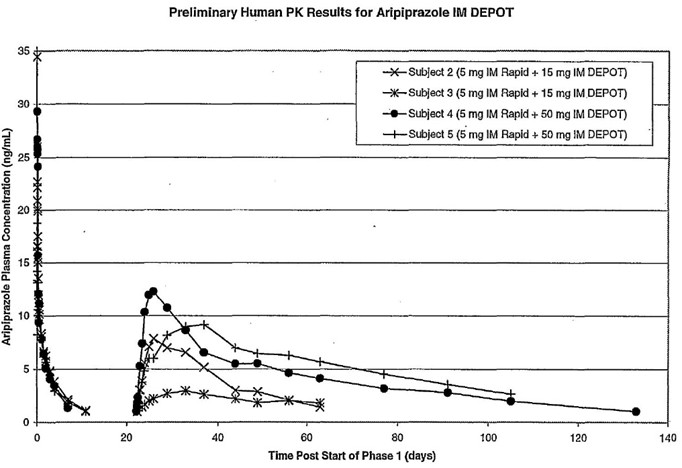
61 The reference to IM Rapid appears to be a reference to the 5-mg dose of aripiprazole solution referred to in Example 4.
3. The Appeal
25 Grounds 1 to 4 of the NoA challenge the finding of the primary judge that each of the PTE Claims is invalid because they fail to define the invention and lack clarity pursuant to ss 40(2)(b) and 40(3) of the Patents Act.
26 Claim 1 of the Patent provides:
A controlled release sterile aripiprazole injectable formulation which upon injection releases aripiprazole over a period of at least one week, which comprises:
(a) aripiprazole having a mean particle size of about 1 to 10 microns,
(b) a vehicle therefor, and
(c) water for injection.
(Emphasis added)
27 Claim 16 provides:
A sterile freeze-dried controlled release aripiprazole formulation which comprises:
(a) aripiprazole having a mean particle size of about 1 to 10 microns, and
(b) a vehicle therefor,
which formulation upon constitution with water forms a sterile injectable formulation which upon injection releases aripiprazole over a period of at least about two weeks.
(Emphasis added)
28 The emphasised integer in each of these claims, “which upon injection releases aripiprazole over a period of [a specified time]”, was defined in the judgment as the Relevant Feature (PJ [68]). Each of the PTE Claims includes the Relevant Feature, with the Controlled Release Injectable Formulation Claims specifying a release period of “at least one week” and the Freeze-dried Controlled Release Formulation Claims specifying a release period of “at least about two weeks”.
29 The primary judge rejected the contention advanced by Otsuka that the Relevant Feature imposes no limitation on the scope of the invention because formulations possessing the other requirements of the invention will inherently have that feature (PJ [192(a)], [234]–[236]). This forms the basis for Ground 4 of the NoA. The primary judge also upheld the argument advanced by Sun Pharma that the PTE Claims so construed do not satisfy the requirements of s 40(2)(b) and s 40(3) (PJ [298]). This finding forms the basis for Grounds 1, 2 and 3 of the NoA.
30 The applicable version of s 40 is that which applied prior to the Intellectual Property Laws Amendment (Raising the Bar) Act 2012 (Cth) (RTB Act), as follows:
40 Specifications
(1) A provisional specification must describe the invention.
(2) A complete specification must:
(a) describe the invention fully, including the best method known to the applicant of performing the invention; and
(b) where it relates to an application for a standard patent – end with a claim or claims defining the invention; and
(c) where it relates to an application for an innovation patent – end with at least one and no more than 5 claims.
(3) The claim or claims must be clear and succinct and fairly based on the matter described in the specification.
(4) The claim or claims must relate to one invention only.
3.1 NoA Ground 4: Limitation by result
3.1.1 Introduction
31 Otsuka contends in Ground 4 of the NoA that the reference in the PTE Claims to the release period was not a limiting integer to be satisfied but was an inherent consequence of the formulation having the features of each of the PTE Claims. It submits that it is not necessary for the person skilled in the art to identify whether the release period is satisfied in a formulation falling within those claims because the Patent teaches that this is an inherent feature of such formulations and they will necessarily achieve the minimum release period.
32 There is no dispute as to the correct law, which was recited by the primary judge at PJ [200]:
In Rescare Ltd v Anaesthetic Supplies Pty Ltd (1992) 25 IPR 119 at 125–126, Gummow J quoted Patents for Inventions and the Protection of Industrial Designs (op. cit.) at 4-413:
To amount to a limitation by result, what is in the claim must at least be a limitation: something that draws a line between two classes of things that would otherwise fall within the claim: with the implication that conditions of the manufacture can be adjusted, by the reader of the specification, to secure the specified result. It is, of course, a matter of construction to determine whether words in the claim effect a limitation or merely assert that complying with the claim will secure a certain result…
33 The argument advanced by Otsuka depends on the final sentence of this passage.
3.1.2 The reasons of the primary judge
34 The reasoning of the primary judge is in section 6.1 of the PJ, where her Honour reviewed passages in the specification and drew the following conclusions:
(1) The person skilled in the art would be aware that a number of variable factors can affect the length of time of the release of aripiprazole from the depot in the Formulations claimed (PJ [206]). One variable is dosage of aripiprazole, but there is nothing in the PTE Claims to limit the dosage amount, the specification allowing for a dosage in the range of 0.1 to 600mg per 1 mL (PJ [208]). Another is particle size. It was common general knowledge that particle size has an impact on release (PJ [214]), however, the Patent does not describe the mathematical relationship between particle size and absorption/release (PJ [215]). Another is volume. The pressure associated with the administration of larger volumes (2 mL or more) of formulation can decrease the time that it takes for the drug to dissolve (PJ [216]). Other factors include whether the formulation is injected subcutaneously or intramuscularly and, if the latter, the site of administration (PJ [218]).
(2) Claim 1 has a release period of at least one week, claim 16 has a release period of at least two weeks (PJ [219]), yet they claim the same range of mean particle size (of about 1 to 10 microns) (PJ [220]). Other claims have other variations, where the mean particle size range is the same but the release periods are different (such as claims 6 and 19). From these, it is apparent that the same particle size alone will not provide the same release period (PJ [222]) and that other factors, in addition to particle size, will play a role in the duration of the release of aripiprazole, as noted in (1) (PJ [223]).
(3) Each of the PTE Claims claim many different embodiments within each claim – allowing for variation in mean particle size, variations of dosage and variations in respect of the vehicle. But each must meet the stated release period. The person skilled in the art must accordingly make choices concerning matters not referred to in the PTE Claims (such as dosage concentration, frequency, volume and site of administration) by reference to the result to be achieved (PJ [224]).
(4) Contrary to Otsuka’s submission, the patent does not teach that release period is an inherent feature of the particle size alone (PJ [225]). The passages on p 2, lines 11 to 14 and p 3, line 22 to p 4, line 10 do not provide a teaching that the release period is an inherent property of the formulations such that there is a direct correlation between that metric and particle size – other factors must come into play (PJ [228]–[235]).
35 As a consequence, the primary judge concluded that the inherent characteristics of the PTE Claims as identified in claim 1 (a), (b) and (c) and claim 16 (a) and (b) are not sufficient to define the invention, with the claims being limited by reference to the stated result (being the release period).
3.1.3 Otsuka’s submissions
36 Otsuka contends that the passages set out in section 2.2 above from pages 2–4 of the specification are the relevant parts which assert that complying with the claim will secure a certain result. They indicate that:
(1) the release period of “at least about one week” is an inherent property of formulations according to the invention with an aripiprazole particle size of at least 1 micron. Thus the Controlled Release Injectable Formulation Claims are not limited by result – formulations which possess the other features of those claims will necessarily have a release period of “at least about one week”; and
(2) the release period of “at least two weeks” is an inherent property of formulations according to the invention with an aripiprazole particle size of more than about 1 micron. This includes formulations with an aripiprazole particle size of about 2 to 4 microns (that is, claim 19 and claims 21 and 25, insofar as dependent on claim 19). Thus, those claims are not limited by result; formulations which also possess the other features of those claims will necessarily have a release period of “at least about one week [sic, “at least two weeks”]”.
37 Otsuka contends that the primary judge erred in concluding the non-particle size variables – such as dosage amount – affect whether or not the claimed minimum release period is met. It argues that, based on the passages set out above, such variables can only affect the extent to which the release period is above the claimed minimum period. It further contends that the primary judge also erred in identifying “inconsistencies” between the passages on pages 2–4 of the specification and the claims Otsuka relies upon.
3.1.4 Consideration
38 The essential question is whether the PTE Claims should be construed such that the Relevant Feature is not a limitation required to be demonstrated in respect of each claim or whether, as Otsuka contends, a product possessing the other features of the claim will necessarily have the Relevant Feature (being the release of aripiprazole over the specified period of at least one week (for the Controlled Release Injectable Formulation Claims) or at least two weeks (for the Freeze-dried Controlled Release Formulation Claims)).
39 For the following reasons we do not consider that Otsuka has identified error in the reasoning of the primary judge.
40 First, the language of each of the claims includes as a positive integer the requirement of a formulation that upon injection “releases aripiprazole over a period of at least one week” for the Controlled Release Injectable Formulation Claims and “at least about two weeks” for the Freeze-dried Controlled Release Formulation Claims. Those words on their face require that the integer be satisfied.
41 Secondly, the formulation that follows in each case “comprises” the elements then described. The word “comprises” is defined in the body of the specification to mean “includes”, and does not mean the exclusion of any other integer or step (p 22a, lines 1–5). Accordingly, the definitive list of components to be included within the formulation is not identified. Nor do the claims identify beyond broad generalisation the contents of the formulation. For instance, claim 1 is for (a) aripiprazole with the particle size specified, in (b) “a vehicle therefor” plus (c) water. Other integers added by dependent claims generically identify suspending agents, bulking agents, buffering agents and the like, each of which is broadly described in the specification.
42 Thirdly, the primary judge found that the person skilled in the art would be aware that there are a number of variable factors that will affect the release time of aripiprazole from the depot (at PJ [206]), including the dosage amount, the volume and the injection site. That finding is not challenged on appeal, though Otsuka claims that these variable factors only affect the extent (if any) to which the release time is above the claimed minimum period (as opposed to whether the claimed minimum period is met or not). It is apparent that the primary judge did not accept that proposition and we see no basis upon which it should be overturned.
43 Fourthly, in forming an understanding of the PTE Claims, the primary judge considered the claims as a whole, which form part of the specification (Kimberly-Clark Australia Pty Ltd v Arico Trading International Pty Ltd [2001] HCA 8; 207 CLR 1 at [15]–[16]), and identified aspects of those claims that the person skilled in the art would understand to reflect a teaching that there is a necessary scope for variance in dosage and other factors that will affect the release period (PJ [206]). In this regard, her Honour noted that the Freeze-dried Controlled Release Formulation Claims require a release period of at least about two weeks (PJ [219]). For those claims the formulation includes aripiprazole having a mean particle size of about 1 to 10 microns and a vehicle therefore (claim 16) or, in the case of claim 19, a mean particle size of 2 to 4 microns. Like claim 16, claim 1 also comprises aripiprazole with a mean particle size of about 1 to 10 microns. Yet, the combination claimed in claim 1 is for a formulation which releases aripiprazole over “at least one week”. In PJ [221] the primary judge provides other examples where the same mean particle size range is specified in claims which have different release periods.
44 Her Honour concludes, as a matter of the logic of the claim set as a whole, that the same particle size alone will not provide the same release period (PJ [222]). The person skilled in the art is directed to select the particle size within the stated range, excipients and water but must make other choices concerning matters such as dosage concentration, dosage frequency, volume and site of administration by reference to the result to be achieved (PJ [224]). This accorded with the expert evidence accepted by the primary judge to the effect that in order to determine whether a given formulation fell within the Relevant Feature in the PTE Claims, experimentation would be required – see, for example, PJ [206], [290]–[293]. This addresses Otsuka’s argument on appeal that the variable factors only affect the extent (if any) to which a formulation’s release period is above the claimed minimum period.
45 Whilst it is apparent that an important part of the invention is the selection of particle size, we do not consider that the primary judge erred in concluding that particle size and other variables must be considered by the person skilled in the art in order to achieve the release rates identified in the PTE Claims.
46 Ground 4 of the NoA must be dismissed.
3.2 NoA Grounds 1, 2 and 3: Clarity of the PTE Claims
3.2.1 Introduction
47 Otsuka contends in Grounds 1, 2 and 3 that the primary judge erred in concluding that the PTE Claims fail to define the invention and lack clarity based on the wording of the Relevant Feature. Ground 1 is a general challenge to her Honour’s conclusion. In Ground 2, Otsuka contends that the primary judge erred in failing to find as a matter of construction that blood plasma concentration showed or was a surrogate for the release period of the claim. In Ground 3, Otsuka contends that the primary judge erred in finding that blood plasma concentration levels do not provide a workable standard by which to identify the release period.
3.2.2 The findings of the primary judge
48 In section 6.2, the primary judge considered that, having found the Relevant Feature to impose a limitation by result, the person skilled in the art must be able to adjust the Formulations to ensure that they satisfy that feature (PJ [237]).
49 Her Honour considered the significance of the term “release” as used in the claims in section 6.2.1 of her reasons, noting that the experts agreed that “release” of aripiprazole is the dissolution of aripiprazole molecules from the depot at the injection site (PJ [240]). “Release” is not the same as “absorption” which her Honour found, accepting the evidence of Professor Evans, to take place after the drug has been dissolved within bodily fluid (that is, released) when it can be absorbed by passing through membranes to enter the bloodstream (PJ [241]). Her Honour noted that “release” is also not the same as “blood plasma concentration” which provides information about the concentration of the drug substance in the blood at a particular point in time (PJ [242]–[243]).
50 The primary judge accepted the evidence that while release has an effect upon blood plasma levels, blood plasma levels are not the same as the release of the aripiprazole from the particle depot at the injection site and there can be a delay between the cessation of the release and the disappearance of the drug from the blood plasma (PJ [244]), and depending on a number of factors, an active ingredient can be circulating in the blood for significant periods after the last of the drug has been released from a formulation (PJ [245]).
51 After considering these matters the primary judge concluded that the reference to “release” in the PTE Claims is not “release as measured by blood plasma concentration of aripiprazole”, and the Patent does not use blood plasma concentration to refer to “release” as that term is used in those claims (PJ [246], [247]).
52 The primary judge in section 6.2.2 accepted that the only manner by which release might be determined which is disclosed in the Patent is the blood plasma concentration data and descriptions contained in Examples 1 to 4 and Figures 1 to 3 (PJ [248]). Her Honour noted Otsuka’s submission that the teaching of the Patent cannot be departed from and that the person skilled in the art would be able to determine whether the Relevant Feature is present in a formulation otherwise possessing the features of the PTE Claims by taking blood plasma concentration measurements of aripiprazole at various times following injection, that the Patent teaches that such concentrations can be and are used to determine release and that the Patent indicates that analysis of such concentrations acts as a surrogate for determining the release period (PJ [250]).
53 After setting out Example 4 and Figure 3 from the Patent, the primary judge levelled some criticism at Figure 3 including that it shows significant variability across limited data points and that various data points were hard to discern. She noted that the x axis was not divided into increments which would allow the release boundaries in the claims to be discerned (PJ [255]). Her Honour said that importantly, Figure 3 does not purport to depict or even refer to “release” and that expert witness Professor Winter observed that “release is nowhere measured” in the Patent (PJ [256]). In this regard, the primary judge quoted from a passage of the evidence of Professor Winter given in the JER as follows at [257]:
Even today with very modern and very expensive methods, release from an intramuscular depot in vivo in humans is practicably not measurable with a precision that allows determination of whether a formulation would fall in or outside the boundaries of the 448 Patent. With this in mind it is not at all plausible that the single in vivo study in the 448 Patent with 4 subjects and nothing more than about 50 blood plasma values (surrogate data) could provide evidence that all formulations within each of the relevant claims would fall within the boundaries of each of the relevant claims.
…
When contemplating the many different formulations one must recall that the dose, the crystal form, the site or type of injection, the volume, the exact particle size and other parameter options are all left open, providing a wide array of many formulations and to predict their behaviour on the basis of the extremely little technical information contained in the 448 Patent is impossible.
54 The primary judge noted that the Patent provides, in Example 4, that “[i]n all cases aripiprazole plasma levels showed a fast onset of release and sustained release for at least 30 days”. Her Honour observed that (at PJ [259]):
… as release (within the meaning of the PTE Claims) is not shown in Figure 3, only blood plasma concentration is shown, there will be at least some delay between release and entry of the drug substance into the plasma… and there must have been some intermediate analysis performed which underlies this statement.
55 Her Honour relied on the evidence of Professor Winter in this regard, who explained that the Patent did not inform the reader how release is determined, although Professor Winter accepted that the patentee wished to support its conclusions on release with Example 4 and Figure 3 (PJ [261]).
56 The primary judge concluded:
264 Further, even if it could be said that the evidence established that some formulations, such as that in Example 1, would achieve minimum periods of release, that is not the end of the matter. That is because the issue is whether the person skilled in the art is able to determine whether other formulations which lie closer to the boundaries of the PTE Claims, such as with a mean particle size that may or may not achieve a specified minimum release period depending on the formulation, will fall within the PTE Claims. For example, a formulation with a mean particle size of about 1 micron for release over a period of at least two weeks, such as that contemplated by claim 16, would require the day on which the formulation stops releasing (rather than being measurable in blood plasma) to be measured with precision in order to determine whether it released for less or more than two weeks.
265 In summary, the Patent does not show the person skilled in the art how to determine whether or not each formulation that otherwise satisfies any of the PTE Claims falls inside or outside the release boundary specified in the Relevant Feature. The Patent is silent as to how the person skilled in the art is to extrapolate from the disclosed blood plasma concentration data to a determination of the release of aripiprazole from the depot. As the person skilled in the art is not given that information, the person skilled in the art is not able to use that information to enable them to determine whether all formulations which otherwise fall within any of the PTE Claims take the Relevant Features.
266 For this reason, the PTE Claims are bad for ambiguity because the instructions in the Patent for attaining the Relevant Feature are meaningless to those skilled in the art: BlueScope at [719]. Contrary to Otsuka’s submissions, these matters would cause difficulty to a manufacturer wishing to satisfy himself that he is not infringing the PTE Claims.
(Emphasis in bold added; emphasis in italics original).
57 The primary judge then expressed the view that the conclusion so reached was fortified by the content of three confidential Otsuka documents which (at PJ [267]):
… show significant inter-patient variability such that a person skilled in the art would not consider that blood plasma concentration data alone will be sufficient to determine if the Relevant Feature in the PTE Claims has been met by any given formulation.
58 The primary judge in 6.2.4 then considered whether other routine methods known by the person skilled in the art could be used to determine release, or whether inventive faculty or burdensome experimentation is required (PJ [284]). Her Honour found:
285 In this case, the person skilled in the art would need to experiment with (at least) dosage concentration and frequency, volume, site of administration and particle size in order to determine whether any given formulation falls within or outside the boundaries of any of the PTE Claims. However, as explained by Professor Winter, “it is not possible to determine through routine testing available at the Relevant Date whether or not the aripiprazole particles have completely dissolved from a site of administration upon injection into the body”: Winter 1, [168].
286 Further:
(1) as there is “no direct method to measure the release of aripiprazole from the site of injection, it would be necessary to consider a combination of methods in order to determine whether an aripiprazole formulation satisf[ies]” the Relevant Features;
(2) such combination of methods is a complicated process such that “reasonable minds may differ about what would be the appropriate model to apply, and/or about what assumptions to rely on for using that model (thereby, arriving at different results)”; and
(3) the person skilled in the art would need to also deal with issues in respect of sample size, large inter-patient variability, formulating an appropriate intravenous comparator, applying appropriate PK analysis techniques, deploying deconvolution studies, and so forth.
(Winter 2, [116]; see also Winter 1, [165]–[181]; Winter 2, [110]–[116].)
59 The primary judge considered that the evidence of Professor Evans supported the conclusion that within the PTE Claims there were included many different permutations of excipients, hydrates and polymorphs (PJ [290]) and that to determine whether a formulation fell within the scope of the claims would need experimentation (PJ [291]). The primary judge found:
294 The confidential Otsuka documents demonstrate that if the person skilled in the art was to try to use the blood plasma profiles as a proxy to identify whether a formulation that otherwise meets the PTE Claims falls inside or outside the release boundaries, such experiments, modelling and deconvolution studies are not routine or straightforward, and instead are onerous, time consuming and would provide greatly variable and unreliable results.
(Emphasis added)
60 The primary judge concluded:
296 For these reasons, even if the person skilled in the art was able to use blood plasma concentrations as an indirect means to identify whether a given formulation that otherwise meets the PTE Claims falls inside or outside the release boundaries, experiments would need to be performed. Such experiments are not simple, routine or straightforward, but would be onerous, time-consuming, and would provide variable and unreliable results such that the person performing the experiments would be left in doubt as to whether any given formulation falls within the scope of the PTE Claims or not: Austal Ships at [14].
297 It follows that the person skilled in the art would not be able to determine whether or not all aripiprazole formulations (that is, all embodiments) that otherwise meet the requirements of the PTE Claims fall within or outside the Relevant Feature based upon the information in the Patent and the common general knowledge, even allowing for routine experimentation.
3.2.3 The submissions
61 In relation to Ground 2 of the NoA, Otsuka submits that the primary judge erred in failing to find as a matter of construction that blood plasma concentration showed or was a surrogate for the release period and that the method disclosed in the specification for the identification of whether the claimed minimum release period is met is the measurement of blood plasma concentration of aripiprazole over time. It submits that each of the Figures in the Patent is a plasma concentration versus time profile of aripiprazole and that these teach that aripiprazole blood plasma concentration is to be used to identify whether aripiprazole is continuing to release at a point in time. No other method is disclosed or suggested. When the specification is considered as a whole in light of the common general knowledge, it is, Otsuka submits, clear from Example 4 that the release period can be identified by measuring blood plasma concentration over daily intervals. The primary judge erred at PJ [246]–[247] because Otsuka did not contend that “release” in the PTE Claims should be understood to mean “as measured by blood plasma concentration of aripiprazole” but rather that the claims, read in the context of the specification as a whole in the light of the common general knowledge, would be understood by the person skilled in the art to explain how to identify the release period. In this regard Otsuka relies on a number of passages of the evidence of Professor Winter, the expert preferred by the primary judge.
62 Otsuka submits that having found at PJ [257] that there was in effect no practical means of measuring release from a depot before a drug’s entry into the blood, the effect of the primary judge’s construction was to require identification of a release period by a means which was not possible, which is contrary to principle. It submits that the importance of Example 4 is that it teaches that blood plasma concentration is used to identify whether aripiprazole is continuing to release at a point in time and that the accepted evidence of Professor Winter that blood plasma concentration cannot provide an actual duration of release or be used to measure release should be understood in the context where the PTE Claims do not require an actual duration or measurement of release but only for release to occur for longer than the minimum specified period, which is denoted in terms of weeks, not days or hours.
63 Sun Pharma defends the reasoning of the primary judge. It submits that Otsuka seeks to vary the plain meaning of the Relevant Feature by reference to the specification, contrary to authority. It submits that Otsuka does not confront the finding that the specification does not disclose how blood plasma concentration measurements can be used to determine whether a formulation has the Relevant Feature and that there is no teaching in the Patent. The expert evidence did not support a conclusion that the person skilled in the art could simply measure the blood plasma concentration to identify whether a formulation had the Relevant Feature. Even if the evidence established that some formulations would have the Relevant Feature, the person skilled in the art would not know how to understand whether other formulations, closer to the boundary, fall in or outside the claim.
64 In relation to Ground 3 of the NoA, Otsuka submits that the primary judge erred in finding that blood plasma concentration did not provide a workable standard by which to identify whether the claimed minimum release period was met, citing the UK Court of Appeal in General Tire & Rubber Co v Firestone Tyre & Rubber Co Ltd [1972] RPC 457; (1971) 1A IPR 121 at 167–168 and the Full Court in Austal Ships Sales Pty Ltd v Stena Rederi Aktiebolag [2008] FCAFC 121; 77 IPR 229 at [13]–[16] which emphasise, respectively, that the issue of definition is to be considered as a practical matter with little weight given to puzzles set out at the edge of a claim and that expressions in claims must be understood in a “practical, commonsense manner”. Otsuka relies on the finding at [257] that release from an intramuscular depot in vivo in humans is not practicably measurable with precision to support its contention that “surrogate parameters” are required using a workable standard, bearing in mind the relative imprecision required by the claims in the form of a minimum specified period.
65 Otsuka submits that there is an inherent contradiction in the findings of the primary judge. It submits that on the one hand, at PJ [188] the primary judge accepted evidence from Professor Winter that ABILIFY MAINTENA released aripiprazole over a period of at least one or two weeks based on Professor Winter’s evidence in the JER and the confidential Otsuka documents, and yet on the other hand her Honour found that the claims lacked clarity. It submits that the primary judge erred in relying on the confidential Otsuka documents to support what the person skilled in the art would take into consideration, as those documents were not referred to in the Patent and did not form part of the common general knowledge. Furthermore, even if they were consulted, there was no evidence that any variability in inter-patient blood plasma concentration shown in the documents affected the identification of whether the minimum release period in the PTE Claims was met. Otsuka submits that the person skilled in the art could determine the release of aripiprazole in a formulation from a depot upon administration simply by testing the amount of the drug in blood plasma at different time points, and that the primary judge wrongly set aside evidence recited at PJ [251] and [287] on the basis that it relates to the use of blood plasma concentration to determine the dosage interval of a formulation, when it was common general knowledge that dosage interval for a drug is based on its release period.
66 Sun Pharma submits that the reasoning of the primary judge contained no error. Having rejected that blood plasma concentration provided a sufficient means for establishing release as required by the claims, the primary judge correctly reviewed the evidence and found that other common general knowledge means could not be used to determine release, and consequently surrogate parameters would need to be used requiring onerous and time-consuming testing. It submits that the problems found by the primary judge do not lie as puzzles at the edge of the claim, but that for the claims to define the invention and be clear and succinct the limitation must enable the person skilled in the art to determine whether all aripiprazole formulations that otherwise fall within the PTE Claims fall in or outside the boundary of the limitation. Sun Pharma submits that there is no contradiction between the finding, based on Professor Winter’s evidence, that the ARTG Goods (that is, ABILIFY MAINTENA) fell within the claims and the lack of clarity finding because the confidential Otsuka documents showed that aripiprazole was present in blood plasma for several weeks longer than the required minimum threshold of 7 days, and Professor Winter’s view was expressed with considerable reservation, noting that blood plasma concentration was not used as a direct means of estimating release, that there were “intermediate steps” taken in that document and that he was unable, based on that study, to determine whether the Relevant Feature was present in formulations that are very close to either side of the boundary of the claim 1 Relevant Feature. Sun Pharma submits that, contrary to the contention advanced by Otsuka, the person skilled in the art could not determine the release of aripiprazole by testing blood plasma concentration at different time points, as the primary judge found at PJ [288] that the use of blood plasma concentration to determine dosage was not the relevant question and, at best, only formed part of any process to determine release period.
3.2.4 Consideration
67 The Patents Act in s 40 relevantly requires by s 40(2)(b) that a complete specification end with a claim or claims defining the invention, and by s 40(3) that the claim or claims be clear and succinct.
68 In Welch Perrin & Co Pty Ltd v Worrel [1961] HCA 91; 106 CLR 588 at [7] the High Court (Dixon CJ, Kitto and Windeyer JJ) set out the criterion to be applied when it is said that a specification is ambiguous:
… we are not construing a written instrument operating inter partes, but a public instrument which must, if it is to be valid, define a monopoly in such a way that it is not reasonably capable of being misunderstood. Nevertheless, it is to be remembered that any purely verbal or grammatical question that can be resolved according to ordinary rules for the construction of written documents, does not, once it has been resolved, leave uncertain the ambit of the monopoly claimed… The specification must be read as a whole. But it is a whole made up of several parts, and those parts have different functions. Courts have often insisted that it is not legitimate to narrow or expand the boundaries of monopoly as fixed by the words of a claim by adding to those words glosses drawn from other parts of the specification. Similarly, if a claim be clear it is not to be made obscure simply because obscurities can be found in particular sentences in other parts of the document.
(Citations omitted)
69 Lord Russell in Electrical & Musical Industries Ltd v Lissen Ltd [1938] 4 All ER 221; 56 RPC 23 at 39 said:
The function of the claims is to define clearly and with precision the monopoly claimed, so that others may know the exact boundaries of the area within which they will be trespassers. Their primary object is to limit, and not to extend, the monopoly. What is not claimed is disclaimed.
70 In this context it is apposite to note the following passage in Generic Health Pty Ltd v Bayer Pharma Aktiengesellschaft [2018] FCAFC 183; 267 FCR 428 (Allsop CJ, Yates and Beach JJ) at [133]:
Take first the legal obligation with respect to a complete specification. The obligation of an applicant for a standard patent is to provide a complete specification that complies with s 40 of the Act. Thus, the patent applicant must provide a complete specification that describes the invention fully, including the best method known to the applicant of performing the invention. The specification must end with a claim or claims that define the invention. The claim or claims must be clear and succinct, and fairly based on the matter described in the specification. (We speak here, relevantly, of patents granted before the amendments introduced by the Intellectual Property Laws Amendment (Raising the Bar) Act 2012 (Cth)). It is not, however, an obligation of the patent applicant to explain how the invention was made or the theoretical basis underlying any stipulated integer: NV Philips Gloeilampenfabrieken v Mirabella International Pty Ltd [1992] FCA 493; 24 IPR 1 at 27. It follows, necessarily, that the patent applicant does not need to supply the proof that the invention works. And if the patent applicant does not need to supply that proof, it does not need to have that proof for the purposes of drafting the specification. As Fletcher Moulton LJ explained in British Ore Concentration Syndicate Ltd v Minerals Separation Ltd (1909) 26 RPC 124 at 144:
An inventor patents a process and not its scientific explanation. He may not, and in many cases does not, know the modus operandi of Nature in bringing about the results that he obtains, and I know inventions in which, to this day, it is a matter of controversy as to how they act to produce their results.
71 In the present case, the challenge to the validity of the PTE Claims was confined to lack of definition within s 40(2)(b) and lack of clarity within s 40(3).
72 Despite this, there is no dispute as to the meaning of the words in the PTE Claims. The Relevant Feature is encompassed in the language “which upon injection releases aripiprazole over a period of at least” or “at least about” one week or, in the case of claim 16 and its dependent claims, two weeks. The primary judge found, and it is not challenged on appeal, that “releases aripiprazole” refers to the dissolution of aripiprazole molecules from the depot at the injection site (PJ [240]). There is nothing lacking in clarity in those words.
73 The dispute between the parties concerns whether or not those words serve to define the invention, or are clear and succinct, when the integer is understood to be a limitation claimed by reference to the result achieved.
74 In General Tire the UK Court of Appeal considered whether or not a claim failed to define sufficiently the scope of the claims in the patent ((1972) RPC 457 at 507), the legislative requirement there being whether the scope of the claim was “sufficiently and clearly defined”. This was by reference to what the Court described as an integer of claim 1 requiring that the polymerisation product of the claim shall have a computed “Mooney plasticity” of at least 90. What was denoted by “computed Mooney plasticity” was explained in the body of the specification and was a measure of viscosity using a Mooney viscometer.
75 The Court made several observations that have resonated in Australian patent law since.
76 The first is that the mere fact that knowledge, skill and even some experimental tests may be necessary in putting a patented invention into practice is not sufficient to invalidate the patent if the nature of the invention is adequately described: General Tire at 514, quoting from British Thomson-Houston Co Ltd v Corona Lamp Works Ltd (1922) 39 RPC 49; Sanofi v Amgen Inc (No 3) [2025] FCA 387 at [208] (Nicholas J).
77 The second is that the duty of the patentee is to state clearly and distinctly, either in direct words or by clear and distinct reference, the nature and limits of what it claims. If using language that is avoidably obscure or ambiguous, the patent is invalid: General Tire at 514, quoting from Natural Colour Kinematograph Co Ltd v Bioschemes Ltd (1915) 32 RPC 256 at 266.
78 The third is that allowance must be made for any difficulties of the particular patent in issue. The Court adopted the language of Lord Simonds in Raleigh Cycle Co Ltd v H Miller & Co (1948) 65 RPC 141 at 149, that “a greater degree of clarity than the subject reasonably admits of is not to be demanded of the patentee”: General Tire at 515. One relevant difficulty in the present case is, as the primary judge found, there was no means known to the person skilled in the art of measuring release at the injection site.
79 The fourth is that it is not the duty of the inventor to define the scope of its claim so as to ensure that it can never be difficult to decide the question of infringement, but only to enable the court to formulate the question which a skilled addressee, wishing to avoid infringement, should ask itself. However, that is not on the basis of any hypothetical infringer. The test is more practical. In this regard, the Court relevantly said at 515–6:
…while the court is to have regard to all the relevant facts, the issue of definition is to be considered as a practical matter and little weight is to be given to puzzles set out at the edge of the claim which would not as a practical matter cause difficulty to a manufacturer wishing to satisfy himself that he is not infringing the patent. We accept also that definition of the scope of a claim is not necessarily insufficient because cases may arise in which it is difficult to decide whether there has been infringement or not provided the question can be formulated which the court has to answer in the issue of infringement.
(Emphasis added)
This passage that has been cited numerous times in Australian cases: see, for instance, BlueScope Steel Ltd v Dongkuk Steel Mill Co., Ltd (No 2) [2019] FCA 2117; 152 IPR 195 at [715] (Beach J); Sanofi v Amgen Inc (No 3) at [184] (Nicholas J); H Lundbeck A/S v Sandoz Pty Ltd [2018] FCA 1797; 137 IPR 408 at [83] (Jagot J); GlaxoSmithKline Consumer Healthcare Investments (Ireland) (No. 2) Limited v Apotex Pty Ltd [2016] FCA 608; 119 IPR 1 at [743] (Beach J); Wake Forest University Health Sciences v Smith & Nephew Pty Ltd (No 2) [2011] FCA 1002; 92 IPR 496 at [808] (Dodds-Streeton J).
80 In resolving the question of the adequacy of the claims in that case, the Court at 516 acknowledged that there was a problem for the inventors in defining the scope of their claims and that the solution they adopted (the computed Mooney test) was a reasonable one, none better having been found since the patent was granted. The test imposed no serious difficulties for manufacturers carrying out normal operations, but if a manufacturer chose to work within an unusual range (such as 80 to 100 Mooney) it would have to take special care.
81 In this context the Court said (at 516):
…but the question he would have to ask himself, if he desired to avoid infringement, can be formulated and in our judgment is, as Mr Gratwick submitted, not “How close to the wind can I sail?”, but “Have I satisfactorily established that the computed Mooney attributed to this polymer is below 90?”, and it is not, in our judgment, unreasonable that in order to arrive at the answer to this question he would have to make a number of tests.
82 The claim under consideration in General Tire may be understood to be one where the relevant integer imposed a limitation by result, the result being that a polymer have a computed Mooney of at least 90 (at 491).
83 The reasoning in General Tire was picked up in Blanco White TA, Patents for Inventions and the Protection of Industrial Designs (5th ed, Stevens & Sons, 1983) where at p 146, [4–704] the learned authors said:
However carefully a claim may be drafted, there are bound to be borderline cases, but this will not render the claim invalid for lack of definition. “I know of no principle which says that a patent is bad because it is possible to imagine an article as to which there might be an argument as to whether it does nor does not infringe. What is necessary is that the specification should enable the court to formulate the question to be answered” [citing Cleveland Graphite v Galacier Metal (1949) 66 RPC 157 at 174]… Thus it is permissible for a claim limited to the attainment of a particular useful result to be somewhat vague at the borderline where that useful result is only partially attained (or where practical men do not normally want to work [citing General Tire v Firestone [1971] FSR 417 at 480, 484]) provided the specification is not avoidably obscure and is sufficiently definite to inform workers in the art how they may obtain the benefit of the invention even at the borders of its ambit.
(Citations omitted, other than those indicated)
84 The passage in Austal Ships at [14], which was cited by the primary judge in her conclusion at PJ [296], sets out a lengthy quotation from Blanco White in which some general propositions in relation to ambiguity are stated. However, the extract in Austal Ships does not quote from the passage at [4–704] extracted above.
85 In the present case we have upheld the primary judge’s finding that the Relevant Feature amounts to an integer that defines the invention by reference to the result achieved, being the release period of aripiprazole. The present challenge is that the claim is not clear or succinct or does not define the invention by reference to that result.
86 In Sigma Pharmaceuticals (Australia) Pty Ltd v Wyeth [2011] FCAFC 132; 119 IPR 194 (Bennett, Nicholas and Yates JJ), one contention was that the phrase “therapeutic blood plasma concentration” where used in certain claims was not clear and succinct within s 40(3) (see [116] per Bennett J and [257] per Yates J). Justice Yates (Nicholas J agreeing generally at [133]) said:
258 Based on the argument developed on appeal, there seems to be no error suggested in the primary judge’s acceptance that the phrase should be given its ordinary English meaning as referring to a single daily dosing of a formulation of venlafaxine hydrochloride that achieves a blood plasma concentration of venlafaxine that is therapeutically effective. The import of the appellants’ submissions is that, so understood, the phrase is unclear: it does not provide a workable standard because there is no way of predicting in advance what the therapeutic concentration for a particular formulation will be, thereby enabling the person skilled in the art to avoid the possibility of infringement. In advancing these submissions the appellants did not suggest that the determination of the therapeutic efficacy of a given formulation of venlafaxine hydrochloride itself presents a challenge to the person skilled in the art.
259 In my view the appellants’ contention raises, in a conventional way, a criticism that can be made of many claims limited by result. As a general rule, however, such claims do not fail for lack of clarity simply because further steps must be taken by the person skilled in the art, in the nature of trial and error or routine testing not involving invention, in order to understand when the result will be achieved: No-Fume Ltd v Frank Pitchford & Co Ltd (1935) 52 RPC 231 at 238, 245–246 and 247–249. The necessity for, or extent of, the work required in that regard may point to the possibility of insufficient description, but no challenge to validity of that kind has been raised in this respect.
(Emphasis added)
87 In this passage, Yates J drew attention to the difference between a challenge to a claim for want of clarity of expression and a challenge for “insufficient description”. In the form of s 40 under present consideration (before the RTB Act amendments were introduced) lack of sufficient description concerned whether or not the specification complied with the obligation under s 40(2)(a) that it described the invention. The obligation was that the disclosure would enable the addressee of the specification to produce something within each claim without new inventions or additions or prolonged study of matters presenting initial difficulty: Kimberly-Clark at [25]. That challenge is not made in the present case. Nor is a challenge advanced on the basis that the claim lacks utility. Otsuka, in its oral submissions, also drew attention to Nicholas J’s observations in Sanofi v Amgen (No 3) in this regard at [218], where his Honour observed that:
What is essential is that the PSA be able to determine whether a particular MAb is within or outside the claims. In this regard, it is important not to conflate the requirement that the claims define the invention with the requirement that the CS [specification] describe the invention fully (i.e. sufficiency) arising under s 40(2)(a) of the Act before amendment by the RTB Act.
(Emphasis added)
88 We have in section 3.1.1 above noted that the primary judge adopted the statement in Rescare, where Gummow J adopted the following passage from Blanco White in relation to claims limited by result. That passage appears at [4–413] of the text, in the chapter concerning a challenge on the basis that the invention claimed lacks utility, where the learned authors observe that a claim so limited is unlikely to suffer from that defect. We have added in italics the complete quotation in the passage cited:
To amount to a limitation by result, what is in the claim must at least be a limitation: something that draws a line between two classes of things that would otherwise fall within the claim: with the implication that conditions of the manufacture can be adjusted, by the reader of the specification, to secure the specified result. It is, of course, a matter of construction to determine whether words in the claim effect a limitation or merely assert that complying with the claim will secure a certain result, and this like other questions of construction affecting validity is likely in present-day conditions to be decided in favour of an otherwise meritorious patentee.
(Footnotes omitted)
89 In our view, the appropriate course is to have regard to the passages from the chapter concerning ambiguity, to which we have referred and extracted above at [83].
90 It is apparent from the authorities to which we have referred that the drawing of the line between the two classes of things must be considered at a practical level, not by reference to impractical hypotheses at the margins. Nor, as Sigma makes plain, is clarity to be resolved by a question of whether one can predict in advance whether something falls within the claims, as to which see Sanofi v Amgen Inc (No 3) per Nicholas J at [203].
91 The test propounded by Sun Pharma was set out by the primary judge as being that the person skilled in the art would not be able to determine whether or not all aripiprazole formulations (i.e. all embodiments) that otherwise meet the requirements of the PTE Claims fall within or outside the Relevant Feature based on the information in the Patent and the common general knowledge, even allowing for routine experimentation (PJ [191]). It is apparent that this places the bar too high. This was a test posed to the experts in question 3 of the JER, and, as the primary judge’s reasons make clear, adopted by Professor Winter (PJ [239], [249]) and ultimately embraced by the learned primary judge (PJ [265]). In our respectful view, this reflects error. The question is not to be based on a hypothetical consideration of whether or not infringement of any embodiment within the scope of the claim may be difficult to ascertain.
92 Accordingly, it is appropriate on appeal for the Court to consider the position.
93 In Ground 2, Otsuka contends that the error of the primary judge lay in failing to find as a matter of construction of the Patent that blood plasma concentration showed or was a surrogate for the “release of aripiprazole” as set out in the PTE Claims. There is force in this contention.
94 The Patent, in the Brief Description of the Invention, makes plain that the invention concerns the release of aripiprazole, in therapeutic amounts, over a period of “at least about one week, and preferably over a period of two, three or four weeks and up to six weeks or more” (p 2, lines 12–14). It discloses that mean particle size of the freeze-dried aripiprazole formulation from about 1 to 30 microns is “essential” in formulating an injectable which achieves this release rate (p 3, lines 22–25), and that the smaller the mean particle size, the shorter the period of extended release (p 3, lines 26–27). In Example 1, an aripiprazole microsuspension preparation is described with particles determined to have a mean particle size of 2.5 microns (p 19, line 4).
95 In Example 3, a single dose depot study using an aripiprazole formulation prepared in Example 1 injected intramuscularly into fifteen rats is reported at doses of 12.5, 25 and 50 mg/kg. The Patent states that blood samples for evaluation of systemic exposure were collected on days 1 (after 6 hours), 2, 4, 7, 10, 15, 22, 28, 36 and 43 and analysed for aripiprazole (p 21, lines 22–29).
96 The results are reported in Figure 1, which is described as showing “mean plasma concentrations vs. time profiles of aripiprazole in rats” (p 21, lines 29–30; p 35):
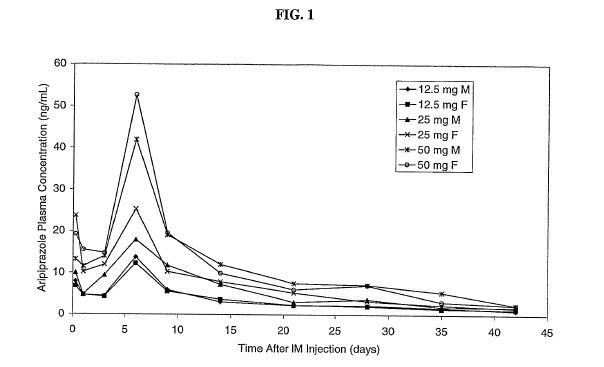
97 Also reported in Example 3 is a single dose depot study in dogs. There, the aripiprazole depot formulation prepared in Example 1 was injected into the thigh muscle of five dogs at doses of 100, 200 and 400 mg. Blood samples were collected on day 1 (after 10 and 30 minutes, and 1, 3 and 8 hours) as well as on days 2, 4, 7, 10, 15, 22, 28, 36 and 42 and analysed for aripiprazole (p 22, lines 1–7).
98 The results are reported in Figure 2 which shows “mean plasma concentrations vs. time profiles of aripiprazole in dogs” (p 22, lines 7–8; p 36):
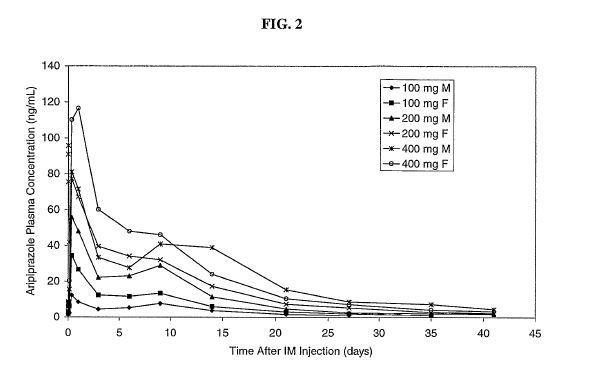
99 The Patent reports as Example 4 that the aripiprazole depot formulation was prepared in accordance with Example 1 and administered intramuscularly to patients with schizophrenia or schizoaffective disorder. The study involved a first administration of a 5 mg dose of aripiprazole solution to all subjects followed by a single dose of intramuscular depot at 15, 50 and 100 mg per patient. The 5 mg solution is an immediate release formulation, which provides a comparator for the depot formulation’s sustained release, as it is immediately released from the injection site. Samples for pharmacokinetic analysis were collected “until plasma concentrations of aripiprazole were less than the lower limit of quantification (LLQ) for 2 consecutive visits” (p 22, lines 24–26).
100 The results in Figure 3 are set out below. It is said to show mean plasma concentrations vs. time profiles of aripiprazole in four subjects, two dosed with 15 mg of the intramuscular deport formulation and two with 50 mg of the intramuscular depot formulation. The Patent reports (at p 22, lines 29–30; p 37):
In all cases aripiprazole plasma levels showed a fast onset of release and sustained release for at least 30 days.
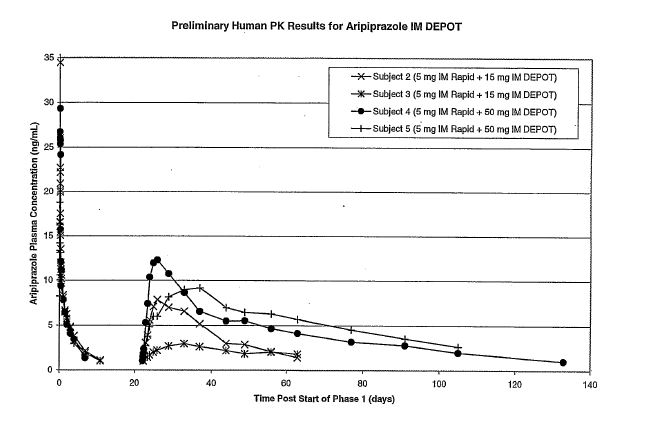
101 The claims follow immediately after the examples, commencing on page 23 of the patent.
102 It will be apparent from the foregoing that the Patent contains no definition of “release”. It is a term, as the primary judge found, that was well understood by those skilled in the art (PJ [71], [240]). Nor does the specification contain any description of how to measure the release of aripiprazole over time. The primary judge accepted evidence from Professor Winter that measuring the release of aripiprazole from the intramuscular depot with enough precision to determine whether a formulation would fall in or outside the claim boundaries was not possible with the technology in existence at the priority date or the date on which the experts gave their evidence (PJ [257], [265]).
103 However, the Patent makes plain by its reporting of the results of the examples that it measured the onset of release and sustained release of aripiprazole by reference to blood plasma levels. All of the reported examples do so, in stating that the corresponding figures show “mean plasma concentrations vs. time profiles of aripiprazole”. There can be little doubt that the patentee was there using such blood plasma levels (measured as blood plasma concentration of aripiprazole) as a means for approximating release rates, even accepting (as the primary judge found) that release is not the same as blood plasma concentration (PJ [242]–[245]). There was no dispute between the experts that this is what the patentee intended. As the primary judge found at PJ [248], the only manner by which release might be determined that is disclosed in the Patent is the blood plasma concentration data and descriptions contained in Examples 1–4 and Figures 1–3.
104 It was Otsuka’s case before the primary judge that the measurement of blood plasma concentration was a proxy for the release of aripiprazole at the injection site. This the primary judge rejected at PJ [258] by rejecting the premise of the statement in Example 4:
258 In Example 4, it is stated by reference to Figure 3 that, “[i]n all cases aripiprazole plasma levels showed a fast onset of release and sustained release for at least 30 days”. However, as release (within the meaning of the PTE Claims) is not shown in Figure 3, only blood plasma concentration is shown, there will be at least some delay between release and entry of the drug substance into the plasma and as the drug substance can remain in the blood plasma after the release has ceased, the basis for asserting that Figure 3 “shows” release (whether fast or sustained) is neither apparent nor explained, and there must have been some intermediate analysis performed which underlies this statement.
(Emphasis added)
105 Much of the primary judge’s reasoning was based on the contention, drawn from the evidence of Professor Winter, that there would be a “delay” between release and entry in the blood stream and that accordingly blood plasma concentration could not be an accurate measure of release.
106 However, the degree of precision required is governed by the nature of technology involved as disclosed in the Patent. Here, the metric required by the claims is that the release be “at least” one week or “at least about” two weeks. This metric is used to distinguish the long-acting slower release drug formulation from the immediate release formulation in order to increase the rate of compliance (p 2, lines 3–5). Specificity as to the precise time at which the release occurs is not required by the Patent or the claims. A “workable standard” for the person skilled in the art would permit for a degree of approximation.
107 Furthermore, the patentee does not need to supply proof that the invention works. An inventor patents a process and not its scientific explanation: Generic Health at [133]. The reasoning of the primary judge reflected a view that it was necessary for the patentee to prove that the release of aripiprazole was accurately measured by the taking of a plasma concentration vs time curve. This is not a requirement under s 40(2)(b) or s 40(3). To the extent that it might have been asserted that the invention claimed did not achieve the promise of the invention (in supplying a sustained release dosage form of aripiprazole), that is a ground of invalidity appropriately considered under the ground of want of utility within s 18(1)(c) of the Patents Act. The grounds of invalidity are conceptually distinct and must be considered separately: Lockwood Security Products Pty Ltd v Doric Products Pty Ltd [2004] HCA 58; 217 CLR 274 at [46]. We do not, by this observation, mean to suggest that the claims may lack utility.
108 However, it was not Otsuka’s case that the blood plasma concentration curve “showed” release. Rather, it was that blood plasma concentration was the means by which the Patent described the assessment of fast onset versus sustained release could be established, and thus the person skilled in the art could determine whether the Relevant Feature was present. In our respectful view, that it is a correct construction of the disclosure of the Patent.
109 Otsuka next challenged the finding of the primary judge that the Patent does not provide a “workable standard” for measuring release by reference to blood plasma concentration levels (that is, plasma concentrations versus time profiles of aripiprazole present in the bloodstream).
110 In this regard, the primary judge reasoned in the italicised passage at PJ [258], extracted above, that an “intermediate analysis” was performed to ascertain release as described in Example 4. However, in our respectful view, this misstates the disclosure of the patent. No intermediate analysis was mentioned. Her Honour’s view was reliant on the evidence of Professor Winter, who gave evidence that there is “additional thinking” undisclosed in the patent as to how there can be a correlation between release of aripiprazole and blood plasma concentration levels measured (PJ [259]–[262]). However, as we have noted, the evidence of Professor Winter was based on the incorrect premise that scientific proof was required as the standard of the disclosure of the Patent.
111 Her Honour went on to say:
264 Further, even if it could be said that the evidence established that some formulations, such as that in Example 1, would achieve minimum periods of release, that is not the end of the matter. That is because the issue is whether the person skilled in the art is able to determine whether other formulations which lie closer to the boundaries of the PTE Claims, such as with a mean particle size that may or may not achieve a specified minimum release period depending on the formulation, will fall within the PTE Claims. For example, a formulation with a mean particle size of about 1 micron for release over a period of at least two weeks, such as that contemplated by claim 16, would require the day on which the formulation stops releasing (rather than being measurable in blood plasma) to be measured with precision in order to determine whether it released for less or more than two weeks.
(Emphasis in bold added; emphasis in italics original)
112 In our respectful view, this misstates the test. The question applicable to the PTE Claims is not whether it may be hard to determine whether unstated, hypothetical formulations at the margins of the claims fall within their scope. As General Tire and later authorities make clear, the test is more pragmatic and requires consideration of a particular formulation, not a series of hypothetical formulations that are not in dispute.
113 In this regard, Sun Pharma did not advance a case that a particular formulation could not be considered by reference to a concentration vs time analysis as conducted in Example 3. Its case was based upon the theoretical construct that all conceivable embodiments falling within the scope of the claims should be ascertainable. However, the onus lying on Sun Pharma was to demonstrate, in more practical terms, that the infringement of more realistic, practical formulations within the claims could not be determined. As was stated in General Tire, a claim is not necessarily lacking in definition simply because cases may arise in which it is difficult to decide whether there has been infringement.
114 In the JER, Professor Winter accepted that for the intramuscular depot formulation of Example 1 (as applied in Example 4) “a release of more than one week is likely for the formulation studied but cannot be proven due to the lack of precision” (emphasis added). Leaving aside the irrelevant question of proof, it is apparent from this answer that Professor Winter accepted that the metric used in Figure 3 (being a plasma concentration vs time profile) could be applied to ascertain that release was of more than one week. Similarly, he also accepted that the standard of release over a period of “at least about two weeks” was likely for the formulation studied in claim 16. This was also the view of Professor Evans. Accordingly, to the extent that there was available evidence of a practical, real-world example of the application of the test set out in the Patent, it indicated that the person skilled in the art would be able to ascertain whether that example fell within the scope of the claims.
115 In our respectful view Otsuka has demonstrated error in the reasoning of the primary judge. Applying the correct approach to claim clarity within s 40(3) and claim definition in s 40(2)(b), we have found that Sun Pharma did not demonstrate that the claims fail to satisfy the requirements of s 40(2)(b) and s 40(3) of the Patents Act. Accordingly, Grounds 1, 2 and 3 of the NoA must be allowed.
3.3 NoA Grounds 5, 6, 7 and 8: Remaining grounds of appeal
116 In Ground 5 of the NoA, Otsuka contends that the primary judge erred insofar as her Honour held that the Patent Extension was invalid because Substances I to IV and VI–IX did not satisfy s 70(2)(a) of the Patents Act. In Ground 6, Otsuka contends that the primary judge erred insofar as her Honour found that Substances V and X did not satisfy s 70(2)(a) of the Patents Act because the PTE Claims are invalid. Ground 7 challenges the findings of the primary judge that Sun Pharma did not infringe the claims. The outcome of Grounds 5 and 6 is premised on the outcome of Grounds 1 to 4. Accordingly, but for the success of the NoC, to which we refer below, those grounds of appeal would also succeed. Similarly, the primary judge’s conclusion on the question of infringement was premised on the primary judge’s conclusions as to validity (PJ [301]). Ground 8 concerns a misrepresentation case brought under the ACL, consideration of which the parties agreed could be deferred pending the outcome of the balance of the issues. Given that we have determined that the NoC must succeed for the reasons in the following section, with the consequence that the Patent Extension is invalid, it is unnecessary to address this further.
4. The Notice of Contention
4.1 Introduction
117 As we identified at the outset of these reasons, the primary argument advanced in relation to the NoC was that the primary judge erred by finding that the Formulations satisfied the definition of “pharmaceutical substance” for the purposes of s 70(2)(a) of the Patents Act (PJ [128]–[135]) (Ground 3). That was said to be because the term “pharmaceutical substance” for the purposes of Sch 1 and s 70(2)(a) of the Patents Act is confined to APIs and does not include formulations such as an extended release formulation.
4.2 Primary judge’s reasons
118 The primary judge set out the PTE Claims at PJ [63] and [64]. Claim 1 is set out above at [26].
119 Claim 3 is dependent on claim 1, and reads as follows:
3 A controlled release aripiprazole injectable formulation which upon injection releases aripiprazole over a period of at least one week, which comprises:
(a) aripiprazole having a mean particle size of about 1 to 10 microns,
(b) a vehicle therefor, and
(1) one or more suspending agents,
(2) optionally one or more bulking agents, and
(3) optionally one or more buffering agents, and
(c) water for injection.
120 Claim 16 is set out above at [27]. Dependent claim 21 claimed the formulation in any one of claims 16 to 20 wherein said vehicle comprises:
(a) one or more suspending agents,
(b) one or more bulking agents, and
(c) one or more buffering agents.
121 The primary judge then moved to issues of statutory construction beginning with s 70 of the Patents Act and the definitions of “pharmaceutical substance” and “therapeutic use”, noting at PJ [73] that s 70 required three conditions to be satisfied by a patentee seeking a term extension, each of which must be satisfied in respect of a “pharmaceutical substance”.
122 From PJ [82], the primary judge considered the meaning of “pharmaceutical substance per se”. Consistent with Full Court authorities, the primary judge observed at PJ [83] the term “pharmaceutical substance per se” means the pharmaceutical substance “by or in itself, intrinsically, essentially”, or “taken alone; essentially; without reference to anything else”; see Boehringer Ingelheim International GmbH v Commissioner of Patents [2001] FCA 647; 112 FCR 595 at [34], [37] (Wilcox, Whitlam and Gyles JJ).
123 At PJ [90] the primary judge referred to the comments of Bennett J at [243] in H Lundbeck A/S v Alphapharm Pty Ltd [2009] FCAFC 70; 177 FCR 151 (Alphapharm FC) (with which Middleton J agreed) to the effect that the scheme of the Patents Act does not provide for the extension of term of a patent which claims an improvement in the delivery of a known pharmaceutical substance already listed on the ARTG.
124 At PJ [94] the primary judge referred to the High Court decision of Alphapharm Pty Ltd v H Lundbeck A/S [2014] HCA 42; 254 CLR 247 (Alphapharm HC), and the statement of Crennan, Bell and Gageler JJ made in the context of setting out the background facts at [23] and footnote 40 which attached to the statement:
There are six claims – claims 1 to 5 are product claims and claim 6 is a method claim, which, for present purposes can be put to one side.
125 Footnote 40 stated:
Relevantly, the extension of term scheme under the Act covers standard patents for pharmaceutical substances per se pursuant to s 70(2)(a), hence patents for pharmaceutical methods or tablets do not fall within the scheme. It can be noted that pharmaceutical substances produced by a process that involves the use of recombinant DNA technology, the subject matter of s 70(2)(b), are not relevant to this case.
(Emphasis added)
126 At PJ [96], the primary judge set out Perram J’s comments on footnote 40 in Cipla Australia Pty Ltd v Novo Nordisk A/S [2024] FCA 1414; 185 IPR 299 at [175]–[176]:
The statement that patents for pharmaceutical methods cannot be a patent for a pharmaceutical substance per se accords with the manner in which the words ‘per se’ has been interpreted in this Court in the authorities noted at [5] above…
…The statement is that tablets cannot be a pharmaceutical substance per se. Since this appears immediately after an explanation of the uncontroversial proposition that a patent for a pharmaceutical method cannot be a pharmaceutical substance per se and since there is no reference to tablets in s 70(2) at all, I read this footnote as exhibiting a conclusion that a patent for a tablet is a patent for a pharmaceutical method of delivery. If not read that way, the reference to ‘tablet’ seems to come from nowhere although an alternative view may be that it derives from the passage in explanatory memorandum for the Intellectual Property Laws Amendment Act 2006 set out above which also refers to tablets. But wherever the reference to a tablet comes from, it is clear that the conclusion in footnote 40 is about the proposition that a method patent will not disclose a pharmaceutical substance per se within the meaning of s 70(2).
127 After reviewing the Full Court decisions in Boehringer, Prejay Holdings Ltd v Commissioner of Patents [2003] FCAFC 77; 57 IPR 424, Commissioner of Patents v AbbVie Biotechnology Ltd [2017] FCAFC 129; 253 FCR 436, and Alphapharm FC, and the first-instance decisions of Pharmacia Italia SpA v Mayne Pharma Pty Ltd [2006] FCA 305; 69 IPR 1, Spirit Pharmaceuticals Pty Ltd v Mundipharma Pty Ltd [2013] FCA 658; 216 FCR 344, and Cipla, the primary judge considered at PJ [99] that the following five propositions (which were not mutually exclusive) could be drawn from these authorities:
(1) only a claim for a pharmaceutical substance as such or alone will qualify;
(2) a pharmaceutical substance which forms part of a method or process does not qualify;
(3) an existing pharmaceutical substance prepared by a new and inventive process does not qualify;
(4) a pharmaceutical substance when produced by a particular process (product by process claim) does not qualify;
(5) a new and inventive method of using an existing pharmaceutical substance (such as in a new method of treatment) does not qualify. This could extend to a new and inventive pharmaceutical method of delivery.
128 At PJ [110], the primary judge then turned to consider whether the definition of “pharmaceutical substance” excludes formulations. Largely for the reasons articulated by Perram J in Cipla, the primary judge considered that “pharmaceutical substance” includes formulations at PJ [114].
129 For the reasons which follow we consider that the primary judge erred at PJ [114] in considering that formulations fall within the definition of “pharmaceutical substance”. The primary judge further erred in holding that the Formulations were pharmaceutical substances for the purposes of s 70 of the Patents Act (PJ [135] and [154]). The relevant pharmaceutical substance is aripiprazole. That substance was first listed on the ARTG in May 2003. The Patent claims an improved delivery of aripiprazole (the controlled release Formulations), a substance already listed on the ARTG. As we discuss below, the Patent is not capable of extension under the extension regime of the Patents Act.
4.3 NoC Ground 3: Formulations are not pharmaceutical substances
130 Sun Pharma contends that the primary judge should have found that none of the Formulations comply with s 70(2)(a) of the Patents Act because they are not a “pharmaceutical substance” as that term is defined in the Act, by reason of being formulations (i.e. API(s) with excipients).
4.3.1 Applicable extension of term regime
131 Otsuka’s request for its Patent Extension having been made on 13 August 2014, it is the current extension of term regime that applies. The substantive provisions constituting that regime are contained in Pt 3 of Ch 6 (ss 70–79A) of the Patents Act, which is entitled “Extension of term of standard patents relating to pharmaceutical substances”.
132 Critically for present purposes, s 70 sets out three requirements (in sub-ss (2), (3), and (4)) to be satisfied by a patentee seeking to apply for a term extension, each of which must be satisfied in respect of a “pharmaceutical substance”. The requirements are:
(2) Either or both of the following conditions must be satisfied:
(a) one or more pharmaceutical substances per se must in substance be disclosed in the complete specification of the patent and in substance fall within the scope of the claim or claims of that specification;
(b) one or more pharmaceutical substances when produced by a process that involves the use of recombinant DNA technology, must in substance be disclosed in the complete specification of the patent and in substance fall within the scope of the claim or claims of that specification.
(3) Both of the following conditions must be satisfied in relation to at least one of those pharmaceutical substances:
(a) goods containing, or consisting of, the substance must be included in the Australian Register of Therapeutic Goods;
(b) the period beginning on the date of the patent and ending on the first regulatory approval date for the substance must be at least 5 years.
(4) The term of the patent must not have been previously extended under this Part.
133 The term “pharmaceutical substance” is defined in Sch 1 of the Patents Act to mean:
a substance (including a mixture or compound of substances) for therapeutic use whose application (or one of whose applications) involves:
(a) a chemical interaction, or physico-chemical interaction, with a human physiological system; or
(b) action on an infectious agent, or on a toxin or other poison, in a human body;
but does not include a substance that is solely for use in in vitro diagnosis or in vitro testing.
134 The term “therapeutic use” is defined in Sch 1 of the Patents Act to mean use for the purpose of:
(a) preventing, diagnosing, curing or alleviating a disease, ailment, defect or injury in persons; or
(b) influencing, inhibiting or modifying a physiological process in persons; or
(c) testing the susceptibility of persons to a disease or ailment.
4.3.2 Statutory Construction
135 The task of statutory construction must begin, and end, with a consideration of the statutory text: Federal Commissioner of Taxation v Consolidated Media Holdings Ltd [2012] HCA 55; 250 CLR 503 at [39], quoting Alcan (NT) Alumina Pty Ltd v Commissioner of Territory Revenue [2009] HCA 41; 239 CLR 27 at [47]. That does not mean, of course, that (per SAS Trustee Corporation v Miles [2018] HCA 55; 265 CLR 137 at [64]):
… the text of a statute must be interpreted only according to the range of semantic meanings of the individual words. It means only that the interpretation of a statute, like any other legal instrument, is an interpretation of its words. Those words are interpreted in their context and in light of their purpose although legal rules can sometimes exclude or restrict the use of some context.
Fundamentally, of course, legislation must be construed as a whole to ensure that the construction is consistent with the “language and purpose of all the provisions of the statute”: Project Blue Sky Inc v Australian Broadcasting Authority [1998] HCA 28; 194 CLR 355 at [69].
136 The context of a provision includes its purpose. Regard to purpose is required both by the Acts Interpretation Act 1901 (Cth) (s 15AA) and by common law (see, e.g., SZATL v Minister for Immigration and Border Protection [2017] HCA 34; 262 CLR 362 at [14]). Indeed, as was observed in CIC Insurance Ltd v Bankstown Football Club Ltd [1997] HCA 2; 187 CLR 384 at 408:
[T]he modern approach to statutory interpretation (a) insists that the context be considered in the first instance, not merely at some later stage when ambiguity might be thought to arise, and (b) uses ‘context’ in its widest sense to include such things as the existing state of the law and the mischief which … one may discern the statute was intended to remedy.
137 Thus, as was observed in Alphapharm HC at [42] in relation to the current patent extension regime, the task of statutory construction may require “some appreciation of the pre-existing law and the legislative history of relevant provisions” and furthermore that “[u]ndoubtedly, questions of policy can inform the Court’s task of statutory construction” (citing Thomas v Mowbray [2007] HCA 33; 233 CLR 307 at [80]–[93]).
138 In relation to the construction of defined terms in particular (at least where the definition is an exhaustive one), it was said in Kelly v The Queen [2004] HCA 12; 218 CLR 216 at [103] (McHugh J) that:
[T]he better – I think the only proper – course is to read the words of the definition into the substantive enactment and then construe the substantive enactment – in its extended or confined sense – in its context and bearing in mind its purpose and the mischief that it was designed to overcome. To construe the definition before its text has been inserted into the fabric of the substantive enactment invites error as to the meaning of the substantive enactment.
139 That method of proceeding also assists in focussing attention on the importance of identifying the particular form of the substantive legislation by reference to which the meaning of the defined term is to be ascertained. Here, for instance, the key definitions in question were inserted along with substantive provisions that have since been repealed. It may be important to distinguish clearly between the meaning of the definition when it was introduced (and the matters to which regard may legitimately be had in ascertaining that meaning), the effect (if any) of subsequent amendments to the substantive regime on the meaning to be ascribed to the defined term, and thus the meaning of the definition in the context of the legislation in its current form (and the matters to which regard may legitimately be had for that purpose).
4.3.2.1 The pre-existing state of the law
140 The majority in Alphapharm HC (Crennan, Bell and Gageler JJ) surveyed the pre-existing state of the law at the time of the introduction of the current extension of term regime from [42]. We will not endeavour to repeat the full detail of that survey, and will content ourselves with identifying those aspects of particular significance for the resolution of the present issue.
141 The prior extension regimes under the Patents Act 1903 (Cth) (1903 Patents Act) and the Patents Act 1952 (Cth) (1952 Patents Act) permitted the extension of term in respect of standard patents, covering any subject matter, on the grounds of inadequate remuneration (or, after 1921, as amended by s 4 of the Patents Act 1921 (Cth), on the grounds of war loss). The current extension of term regime, of course, by contrast, applies only to pharmaceutical substances and “regulatory delay is now the proxy for inadequate remuneration and merit is now assumed for a pharmaceutical substance suitable for human use”: Alphapharm HC at [48].
142 The majority in Alphapharm HC summarised the origins of the present regime as follows (at [47]):
Because of the way in which the balance was struck under the extension of term regimes in the 1903 Act and the 1952 Act, patentees bore a heavy onus, as inadequate remuneration alone was not necessarily sufficient to warrant an extension. All the circumstances of the case were relevant, including the nature and merits of an invention in relation to the public. Extensions of term were rare (at least until the 1970s) and proceedings for extensions of term (particularly if the patentee sought an "exceptional" term) were complex and expensive. As a result, extensions of term (and the need to balance the competing interests of patentees and the public (including competitors)) became the subject of sustained policy debates in Australia (and elsewhere) for some twenty years before the extension of term scheme relevant to this appeal came into operation on 27 January 1999.
(Citations omitted)
143 The majority observed (at [49]) that, in the 1984 report of the Industrial Property Advisory Committee (the IPAC Report), it had been recommended at [11] that the procedures for “granting of extensions of the terms of standard patents be eliminated in toto”. The Government’s response to the IPAC Report, published in the Official Journal of Patents, Trade Marks and Designs, 18 December 1986, vol 56, No 47, from 1466–1467, however, was as follows:
The Government approves this proposal in principle, but is aware of the special circumstances of the pharmaceutical, agricultural and veterinary chemicals industries which are required to obtain approval from Commonwealth and State authorities before they can commence marketing of their products. The delays necessarily incurred in obtaining such approvals erode the effective patent lives of these products by periods of up to several years. The industries concerned are seeking an extension of patent term to compensate for these delays. This is a matter which will be further considered by the Government.
144 The majority in Alphapharm HC at [51] noted the introduction of a more limited extension of term scheme to the 1952 Patents Act that was created by the Patents Amendment Act 1989 (Cth) (1989 Amendment Act), which was then substantially re-enacted with the commencement of the Patents Act. Their Honours quoted the primary objects of the more limited scheme as explained by the Minister for Justice in the Second Reading Speech for the relevant Bill:
The Bill abolishes the present complex procedures for extending the term of a patent and replaces them with more straightforward procedures applicable only to pharmaceuticals … This Bill implements the Government’s response to recommendation 11 of the [IPAC Report] … The arrangements acknowledge that the effective patent life for pharmaceuticals for human use is reduced by the stringent and time-consuming evaluation procedures that the Department of Community Services and Health is required to conduct to ensure both the safety of patients and the efficacy of drugs.
145 The majority referred to ongoing policy debates following those amendments in connection with the raising of the term of a standard patent to twenty years, and, in particular, to the possibility that patents for pharmaceutical substances be extended beyond that term “because in the pharmaceutical industry research and development costs were high, imitation costs low, and regulatory delays significant” (at [55]).
146 With the introduction of a twenty-year term for all standard patents in 1994, the majority noted at [56] that the extension of term scheme limited to standard pharmaceutical patents which had operated since the 1989 Amendment Act was repealed. A new extension of term scheme was instituted by the Intellectual Property Laws Amendment Act 1998 (Cth) (1998 Amendment Act). The majority noted (at [57]) that the principal objects and rationale of the new extension scheme were summarised in the Revised Explanatory Memorandum for the 1998 Amendment Act (REM 1998) as follows:
The Bill amends the Patents Act 1990 to give effect to the government’s decision to provide for an extension of term scheme for pharmaceutical patents. An extension of up to five years will be available for a standard patent relating to a pharmaceutical substance that is the subject of first inclusion on the [ARTG]. The scheme will apply to all existing 20 year patents, as well as those patents granted after the commencement date.
The new arrangements make provision for ‘spring-boarding’ activities. This allows manufacturers of generic drugs to undertake certain activities at any time after the extension is granted solely for the purposes of meeting pre-marketing regulatory approval requirements.
(Citations omitted)
147 The rationale for reintroducing extension of term legislation was explained in detail in the REM 1998 (at [58] of Alphapharm HC):
The development of a new drug is a long process, estimated to average around 12 years, which requires a new chemical entity to be patented early in the process in order to secure its intellectual property rights. However, considerable research and testing is still required before the product can enter the market. As a consequence, patentees of new drugs usually have considerably fewer years under patent in which to maximise their return.
It is expensive to bring a drug to market, around US$380 million, and involves considerable risk. As such, research based pharmaceutical companies rely heavily on patents to generate the substantial cash flows needed to finance the development of new drugs from the discovery stage, through the pre-clinical and clinical development phases, to eventual marketing…
The objective of this proposal is to provide an ‘effective patent life’ – or period after marketing approval is obtained, during which companies are earning a return on their investment – more in line with that available to inventions in other fields of technology. It is also intended to provide a patent system which is competitive with other developed nations.
148 The majority then observed, at [60], that the purpose of the new extension of term scheme was to:
… balance the competing interests of a patentee of a pharmaceutical substance whose exploitation of monopoly has been delayed (because of regulatory delay) and the public interest in the unrestricted use of the pharmaceutical invention (including by a competitor) after the expiration of the monopoly (that is, the term).
149 The dissentients, Kiefel and Keane JJ, also had regard to the legislative history of ss 70 and 71 of the Patents Act, and observed, at [116], that:
… [i]t may be accepted that it has for some time been considered necessary to encourage research and development in the area of pharmaceutical substances, and that permitting extensions of patent terms, to allow patentees to recoup costs and to benefit from the patent, is a means of doing so.
150 Their Honours thus said that there was “no doubting that the purpose behind s 70(1) is to benefit and encourage research and development” (at [120]).
151 Against that general background, we turn to consider in more detail the extrinsic material relevant to the construction of the defined term “pharmaceutical substance”.
4.3.2.2 The 1989 Amendments
152 The present definition of “pharmaceutical substance” (subject only to minor and, for present purposes irrelevant, modifications) and “therapeutic use” first appeared in the 1952 Patents Act, following amendments made by the 1989 Amendment Act.
153 The purpose of the Patents Amendment Bill 1989 (Cth) (1989 Bill) was said in the Explanatory Memorandum to the 1989 Bill (EM 1989) to be to amend the 1952 Patents Act to abolish the existing extension procedure and to replace it with a once-off four-year extension of term for a standard patent for pharmaceutical substances for human use which are approved to be marketed in Australia. The new extension provisions were said to recognise the time necessarily taken to obtain marketing approval for new pharmaceuticals and were intended to replace the existing costly court actions with more straightforward administrative procedures.
154 The EM 1989 recognised (at [2]):
Under the existing legislation, pharmaceutical companies regularly seek patent extensions of up to 10 years through the courts. The time taken by the present complex proceedings, particularly in cases where the extension is opposed, means that several years elapse before a decision is handed down. During that period, the patentee enjoys monopoly prices under the Pharmaceutical Benefits Scheme (PBS), whether or not an extension is subsequently granted. The more straightforward arrangements made by this Bill will result in earlier determination and substantially shorter extensions than may be granted at present. It is likely that patent extensions will be sought for more drugs than is the case at present. However, any increase in costs which may flow from an increase in numbers of extensions will be significantly offset by the more rapid introduction of competitor products after patent extensions expire, as a result of the provision which permits the testing of products by other manufacturers in the last 2 years of an extension.
155 In relation to the new defined terms “pharmaceutical substance” and “therapeutic substance”, the 1989 EM said this (at [8]):
The definitions of “pharmaceutical substance” and “therapeutic use” have the effect that the new patent extension scheme will apply only to pharmaceuticals for human use. The scheme will be available for “therapeutic substances” in the terms of the Customs (Prohibited Imports) Regulations, with added limitations that:
• only substances for use in relation to humans are included (those solely for veterinary use would not be included);
• only substances whose use involves a chemical or physico-chemical interaction with a human physiological system, or involves action on an infectious agent, or on a toxin or other poison, within a human body, are included (devices such as surgical ligatures are not included);
• substances whose sole use is in in vitro diagnosis or testing are not included.
156 It may be immediately observed, in other words, that the stated intention was to make patent extensions available for those substances that would meet the definition of “therapeutic substances” within the meaning of the Customs (Prohibited Imports) Regulations (Cth), as at 8 July 1988, subject to three specific exceptions or limitations.
157 The Supplementary Explanatory Memorandum to the 1989 Bill (Supplementary EM 1989) noted at [6] that the proposed definition of “pharmaceutical substance” “will clearly include antibiotics, antivirals, anti-toxins and other pharmaceuticals whose mode of action is on a poison in the body rather than on a human physiological system itself”.
158 The 1989 Bill also introduced the new concept of a “marketing approval certificate”, possession of which was a necessary condition for obtaining an extension. That term was defined to mean, in relation to a particular pharmaceutical substance:
a certificate given by the Secretary to the Department of Community Services and Health certifying that he or she has approved the marketing of the substance, or a product containing the substance, in Australia.
The EM 1989 thus recorded (at [14]) that:
[a] single application for an extension of term will be able to include all pharmaceutical substances covered by a patent, provided that one of those substances, or a product containing one of those substances, receives marketing approval.
159 Given the explicit statement of intention in the EM 1989 that the substances for which a patent extension would be available were those, subject to certain exceptions, falling within the concept of a “therapeutic substance” in the Customs Regulations, before considering the implications of the material to which we have just referred, it is necessary to pause to examine those provisions.
4.3.2.3 Customs Regulations
160 The term “therapeutic substance” was defined in the Customs Regulations to mean:
a substance, including a mixture or compound of substances, that has a therapeutic use and includes a surgical ligature, suture or dressing, but does not include a vaccine prepared from microscopic organisms from the body of a person or animal for use in the treatment of that person or animal only.
The definition of “therapeutic use” is, for present purposes, the same as that found in the current extension regime in the Patents Act.
161 It is clear that the definition of “therapeutic substance” in the Customs Regulations included formulations. The concept is not limited to any particular kind of substance, with the only requirement being that it has a “therapeutic use”. The breadth of the concept is revealed by the fact that it is acknowledged to include surgical ligatures, sutures and dressings. A tablet, injectable solution, or other formulation plainly has a “therapeutic use”, and thus would be a “therapeutic substance”.
162 That conclusion is reinforced by the terms of reg 2(2), which made further provision in relation to “therapeutic substances” for the purposes of regs 5A to 5G as follows:
(a) each form of a therapeutic substance shall be taken to be a separate and distinct therapeutic substance;
(b) if a therapeutic substance is manufactured according to two or more formulations – the substance manufactured according to a particular formulation shall be taken to be a different therapeutic substance from the substance manufactured according to the other or each other formulation; and
(c) a therapeutic substance having a particular strength shall be taken to be a different therapeutic substance from the substance having a different strength.
163 Those provisions, and in particular (b), provide explicit acknowledgment that a “therapeutic substance”, for the purposes of the Customs Regulations, included a formulation. Regulations 5A to 5G concerned the importation into Australia of therapeutic substances, and the purpose of reg 2(2) was to make clear that permissions, designations and the like in relation to a particular formulation did not constitute a permission etc. in relation to all other formulations of the product in question. Other aspects of regs 5A to 5G reinforced the conclusion that a “therapeutic substance” included formulations. For example, reg 5A(2)(c) excluded from the operation of a particular provision a “therapeutic substance imported by a passenger in a ship or aircraft” that was “for the personal use of the passenger or a member of his family”. It would appear that the central concern of that exclusion was to permit people to travel with their medication; which, in the ordinary course, would be a formulation. In any event, the detail of the regime in regs 5A to 5G is presently unimportant, save to observe that it demonstrates beyond argument that a “therapeutic substance” in the Customs Regulations included a formulation.
164 A different approach was taken in the Customs Regulations to dealing with the importation of “drugs”. That was the concern of reg 5, which defined “drug” in sub-reg (20). The core of that definition was, in (a), “a chemical, compound, or other substance or thing, that is included in the Fourth Schedule”. The Fourth Schedule then listed various chemical compounds and their isomers and derivatives (including salts). The definition in sub-reg (20) then went on to further define a “drug” to include various other substances by reference to that core concept, including, for example in (d), “a substance or thing … that contains, or consists in part of” the drug listed in the Fourth Schedule.
165 Fundamentally, the difference in the approach to defining a “therapeutic substance” and a “drug” may be described as follows. The defining feature of a “therapeutic substance” was the use to which it may be put. The defining feature of a “drug” was the presence of a particular thing. It follows that it may be accepted that, without more, the adoption of the concept of “therapeutic substance” from the Customs Regulations would be consistent with an intention to include formulations.
166 That was the point being made by Perram J, in Cipla at [55], where his Honour observed that reg 2(2)(b) of the Customs Regulations “assumes that a pharmaceutical substance may be manufactured according to a formulation”. Of course, the Customs Regulations do not contain any reference to “pharmaceutical substances”, the relevant term being “therapeutic substance”. But what his Honour was plainly saying was nothing more than that the concept upon which the term “pharmaceutical substance” as it is found in the Patents Act was explicitly based (namely, a “therapeutic substance” within the meaning of the Customs Regulations) did include formulations.
4.3.2.4 The 1989 Amendments – reprise
167 It will be recalled that the EM 1989 stated that the new patent extension regime would “be available for ‘therapeutic substances’ in the terms of the [Customs Regulations], with added limitations”. Having determined that “therapeutic substances” within the meaning of the Customs Regulations included formulations, the obvious next question is whether the “added limitations” operated to exclude them.
168 We think that the limitation of relevance for present purposes is the second identified by the 1989 EM, which was expressed in the legislation with the words “whose application (or one of whose applications) involves a chemical interaction, or physico-chemical interaction, with a human physiological system” or “action on an infectious agent, or on a toxin or other poison, in a human body”.
169 So what do those words mean?
170 The requirement that the application of a “pharmaceutical substance” must involve an “interaction” or “action” of the specified kinds immediately and naturally puts the focus on the substance which itself produces the therapeutic effect, as distinct from any excipients present in a given formulation with such a substance. Excipients, by definition, are not therapeutically active. They are the non-therapeutic ingredients of dosage forms. It is only the active ingredient that can have a chemical or physico-chemical interaction with a human physiological system, or that can act on an infectious agent, or on a toxin, or other poison, in a human body.
171 That is to say, the natural and ordinary meaning of the words of sub-paragraphs (a) and (b) of the definition of “pharmaceutical substance” operates to limit substances falling within the definition to those which are “active” (i.e., capable of “interacting with” a human physiological system in specified ways, or “acting on” certain harmful presences). In that way, the limitation may be seen to confine the otherwise broad concept borrowed from the Customs Regulations to those substances that are “active”.
172 The intended focus of the definition on “active” ingredients is confirmed by the extrinsic material to which we have referred. The reference in the Supplementary EM 1989, for example, to the “mode of action” of certain kinds of pharmaceutical substances supports the conclusion that the key characteristic of the new concept was that it was “active”. Similarly, the reference in the EM 1989 to the fact that extensions would be sought for more “drugs” than was previously the case seems to us naturally to refer to the relevant active chemical compound, rather than the variety of ways in which it might be formulated.
173 Other features of the new regime point in the same direction. It will be recalled that the definition of “marketing approval certificate” referred to an approval of “the marketing of the substance, or a product containing the substance”. At [47] of Cipla, Perram J in his review of the extrinsic materials, commented that he did not consider the distinction in this definition between “the substance” and a “product containing the substance” as throwing any light on the meaning of pharmaceutical substance “since the range of products which may contain pharmaceutical substances is capable of extending to items such as bottles and dispensers”. However, in our respectful view, in the context of substances being approved for use in humans, the “product” referred to in the definition of a “product containing the substance” is more likely to be a formulation containing the substance, such as a tablet or solution for injection, rather than a bottle or dispenser containing a formulation, as there would be no requirement for a bottle containing the formulation (e.g. a bottle of tablets) to be separately approved for use in humans.
174 Otsuka submitted that if the legislature had intended the term “pharmaceutical substance” to be limited to only APIs, then that term could have been used.
175 To the extent this submission was directed at the concept of a “pharmaceutical substance” as a whole, it is clear that substances that may not be, or may be argued not to be, APIs as that term is commonly used are intended to be included within the scope of the defined term. There exists a broad array of “active” substances from molecules such as aripiprazole, to monoclonal antibodies and antigens or recombinant proteins produced by recombinant DNA technology (the latter subsequently being recognised in s 70(2)(b) of the Patents Act). As the second sub-paragraph in the definition of “pharmaceutical substance” highlights, in addition to a chemical interaction, or a physico-chemical interaction, with a human physiological system, the concept includes substances whose application involves action on:
(a) “an infectious agent… in a human body” which as senior counsel for Sun Pharma submitted, would include an antibiotic to treat a disease caused by the agent and a vaccine to prevent infection by the agent (in which the antigen might be attenuated or mRNA); or
(b) “a toxin… in a human body” which would include an antibody to neutralise the toxin; or
(c) “other poison… in the human body” which would include an antidote to the poison, or a molecule to compete for the receptor site to which the poison binds in the body.
176 The term “active pharmaceutical ingredient”, commonly used in the patent context to describe “small” molecules such as aripiprazole which undergo a physico-chemical interaction with a human physiological system, is somewhat inapt to encompass all the above examples of active substances for therapeutic use. A broader term which encompasses all such therapeutically active substances is required. In the context of the extension regime, “pharmaceutical substance” (as defined) is that term.
177 To the extent that the submission was focussed on the particular limitation now found in sub-paragraph (a) of the definition, the words used constitute a careful description of the substance of the concept involved. Use of the term “active pharmaceutical ingredient” would do nothing other than substitute a label for the underlying concept.
178 For all of these reasons, when the definition of “pharmaceutical substance” was introduced as part of the 1989 amendments, in connection with that extension regime, we consider that it was limited to active substances only.
4.3.2.5 The Patents Act
179 By s 230, the Patents Act repealed the 1952 Patents Act. Part 3 of Chapter 6 set out the extension of term regime for “pharmaceutical substances” and, save in inconsequential respects, that regime was in the same terms as it had been when enacted as part of the 1989 amendments. No party submitted that the re-enactment of the regime (and definition) in the Patents Act effected any change to its meaning.
4.3.2.6 1998 Amendment Act and REM 1998
180 The Patents Act was next relevantly amended by the 1998 Amendment Act. It was this set of amendments that introduced the substance of the current extension regime. We have set out above, at [146], the fundamental nature of the change involved. While the substantive regime changed, however, no change was made to the definition of “pharmaceutical substance”.
181 The REM 1998 plainly discloses an understanding that the existing form of the definition of “pharmaceutical substance” did not include formulations, and was limited to active substances. Equally plainly, it evinced no intention or understanding that the meaning of that definition would in some way be altered or affected by the other amendments.
182 In the section entitled “Notes on Clauses”, at [8], the REM 1998 states that a “pharmaceutical substance” is defined in Sch 1 of the Patents Act and “may comprise combinations of active ingredients or single active ingredients” (emphasis added). It then notes at [10] that an “extension of term will not be available for claims to new processes of making pharmaceutical substances or new methods of using pharmaceutical substances where the substances themselves are already known”. We interpolate that the claims to the Formulations, which are new modified release dosage forms of the known pharmaceutical substance aripiprazole, are examples of the type of claim to which the note at [10] was directed.
183 Later in the same section at [23], in relation to the spring-boarding provision in s 78(2) of the Patents Act, the REM 1998 stated:
… This has the effect of enabling a generic manufacturer to produce a generic pharmaceutical formulation containing the patented pharmaceutical substance solely for the purpose of obtaining regulatory approval while the patent is still in force. It therefore prevents a patentee from ending up with a further de facto extension of term which would occur if a generic producer could not commence any work on the patented pharmaceutical substance to meet these requirements until the extended term expired.
(Emphasis added)
184 All of these references support our construction of the term “pharmaceutical substance” as being limited to active substances or API(s), and not including formulations. (In Cipla, Perram J, at [84], considered that the use of the word “may” in the passage from [8] of the REM 1998 undermined the strength of any conclusion that could be drawn from that passage. We think, however, that it is plain enough that the possibility contemplated by the word “may” related only to the potential for either combinations or single active ingredients. We do not think that that passage can be read as to encompass the possibility of pharmaceutical substances comprised of anything other than active ingredients. His Honour also regarded the passage quoted from [23] as “textually weak”; with respect we do not agree.)
185 Some care is required, however, to ensure that statements or assumptions about the meaning of an existing provision, plainly not intended to be amended or to have its meaning changed, are not used illegitimately in the construction of the provision itself: see, e.g., Hunter Resources Ltd v Melville [1988] HCA 5; 164 CLR 234 at 241 (Mason CJ and Gaudron JJ) and Australian Education Union v Department of Education and Children’s Services [2012] HCA 3; 248 CLR 1 at [33] (French CJ, Hayne, Kiefel and Bell JJ). See also R v Aubrey (2012) NSWCCA 254; 82 NSWLR 748 at [37] (Macfarlan JA).
186 Certainly, the simple fact that the drafter of the REM 1998 assumed that the definition of “pharmaceutical substance” meant what we have found it to mean would not provide any support for our construction. And we do not think that the words of the 1998 Amendment Act, considered on their own and in isolation, could be said to provide any additional support for our construction (that is to say, over and above the features to which we have already referred). The real question is whether it is possible to look “afresh” at the definition, in light of the evident legislative purpose of the new extension regime as revealed by the extrinsic material to which we have referred.
187 In Deputy Federal Commissioner of Taxes v Elder’s Trustee & Executor Co Ltd [1936] HCA 64; 57 CLR 610, Dixon, Evatt and McTiernan JJ held that a particular piece of legislation, construed on its own terms, would have a particular meaning. A later piece of legislation was passed, however, on the assumption that the earlier legislation bore a different meaning. Their Honours said (at 625–6):
Doubtless the true explanation is that, in drafting the Act of 1930, it was supposed that the exclusion by the Act of 1914 of Crown leases from the exemption took effect for the financial year beginning 1st July 1914. But, in our opinion, the supposition ought not to lead us to give that effect to the Act of 1914. “An Act of Parliament does not alter the law by merely betraying an erroneous opinion of it” (Maxwell, Interpretation of Statutes, 6th ed. (1920), p. 544, and, per Lord Atkinson, Ormond Investment Co v Betts (1928) AC 143 at 164). “Where the interpretation of a statute is obscure or ambiguous, or readily capable of more than one interpretation, light may be thrown on the true view to be taken of it by the aim and provisions of a subsequent statute” (per Lord Atkinson (1928) AC 143 at 164). In Cape Brandy Syndicate v Inland Revenue Commissioners (1921) 2 KB 403 at 414, Lord Sterndale said: “I quite agree that subsequent legislation, if it proceed upon an erroneous construction of previous legislation, cannot alter that previous legislation; but if there be any ambiguity in the earlier legislation, then the subsequent legislation may fix the proper interpretation which is to be put upon the earlier.” In reference to this statement, Lord Buckmaster said in Ormond Investment Co v Betts at 156: “That is, in my opinion, an accurate expression of the law, if by ‘any ambiguity’ is meant a phrase fairly and equally open to divers meanings”. But it is not permissible to construe an unambiguous phrase in an earlier Act by an erroneous assumption of its effect contained in a later Act which did not purport to alter or amend the earlier Act (per Lawrence LJ, Port of London Authority v Canvey Island Commissioners (1932) 1 Ch 466 at 493).
In the present case the Act of 1930 did not intend to amend the Act of 1914. It was not concerned with it and was dealing with a matter unconnected with the question for what financial year the amendments made by the Act of 1914 first took effect. On that question it did no more than proceed upon an assumption. It was a question depending, not on an ambiguous word or phrase, but on the absence from the Act of 1914 of any express statement of the financial year first to be affected. The ordinary rules of interpretation supplied the deficiency ….
188 A broader approach to the permissible use of subsequent legislation may possibly be reflected in Grain Elevators Board (Victoria) v President, Councillors and Ratepayers of the Shire of Dunmunkle [1946] HCA 13; 73 CLR 70. In that case, subsequent legislation provided for an exemption from rates for land used for a particular purpose (but only from a certain year onwards). The question was whether the scope of the exemption could be used to construe the pre-existing legislation. Dixon J, at 86, said:
Although the provision was passed too late to apply to the present case, I think that it may be considered on the question of interpretation. It would be a strange result if we were to interpret the prior legislation as giving a wider exemption than that conferred by the provision so that the express exemption it makes would prove unnecessary and the qualifications it places upon that exemption would be futile.
189 Of that statement, Basten JA has observed in AQO v Minister for Finance and Services [2016] NSWCA 248; 93 NSWLR 46 at [143], in terms that identify some of the general issues that make reliance on subsequent legislation challenging:
This somewhat elliptical statement has been treated with understandable caution in subsequent cases, although often applied. Caution is required because there are a number of assumptions, usually implicit, underlying later legislation. For example, on the facts in Dunmunkle, did the legislature (a) assume that the land was otherwise rateable and confer a limited exemption, or (b) assume that the land was probably not rateable, but seek to resolve any doubt? Thus, in formulating the amendment, it may not have realised that it was conferring a more limited exemption than might have been available under the general law. Furthermore, if a court were satisfied that, absent the amendment, particular land was exempt, would the later amendment impliedly and in part repeal that exemption and do so retrospectively? That might be a more surprising result than the assumption that the legislature took a different view of the scope of rateable land from that adopted by the court. Nevertheless, accepting that it is permissible to consider the effect of later amendments, careful consideration should be given to the inference properly drawn from the specific legislation.
190 Of course, where later legislation amends the very Act in question, then s 11B of the Acts Interpretation Act, which is consistent with the common law in any event (see Commissioner of Stamps v Telegraph Investment Co Pty Ltd [1995] HCA 44; 184 CLR 453 at 463 (Brennan CJ, Dawson and Toohey JJ)), requires that the two acts be read together as a combined statement of the will of Parliament. As a result, the “effect of the amending Act may be to alter the meaning which remaining provisions of the amended Act bore before the amendment” (at [14]).
191 Here, the relevant statutory provision the construction of which is at issue is a definition. The 1998 Amendment Act introduced a new set of substantive provisions constituting the new extension regime, but which operated by reference to a defined term that had first been included in relation to the previous extension regime. That defined term was not picked up by any pre-existing substantive provision that remained in the Patents Act after it was amended. That seems to us to raise a quite different question from that presented by a subsequent Act which proceeds upon a particular view concerning the meaning of a substantive provision that continues to have operation.
192 In the circumstances with which we are concerned, the traditional approach to statutory construction, as we have already described, involves reading the words of a definition into the substantive provisions to which it relates. That approach recognises that defined terms do not have a meaning and operation independently of the substantive provisions that incorporate them. It follows, we think, that if a new substantive regime, that makes use of a pre-existing defined term, is enacted on an assumption as to the meaning of that defined term, that fact is capable of altering the meaning of the defined term. Whether or not it will do so, of course, will depend on the particular circumstances. But at least as a matter of principle, we think that it is possible to regard the amending Act as doing more than merely “betraying an erroneous opinion” of the meaning of the existing definition; it may be, in effect, reenacting the definition afresh for the purposes of a new substantive regime intended to have a particular operation. At the very least, provided the defined term is “obscure or ambiguous, or readily capable of more than one interpretation”, it is difficult to see why “light may [not] be thrown on the true view to be taken of it by the aim and provisions of a subsequent statute” (Elder’s Trustee at 625–6).
193 We, of course, consider that the original meaning of the defined term “pharmaceutical substance” is consistent with the assumption as to its meaning in the EM 1998. It follows that we agree that the 1998 Amendment Act did not intend to effect any change to the meaning of that term. But, if we were wrong about that, would the 1998 amendments have altered the term’s meaning?
194 In addition to the passages we have set out above which make explicit the assumption that “pharmaceutical substances” are limited to active ingredients, the passage in the REM 1998 quoted by the High Court in Alphapharm HC at [58], that we have set out above under the heading “The preexisting state of the law”, observed that “[t]he development of a new drug is a long process, estimated to average around 12 years, which requires a new chemical entity to be patented early in the process”. The “chemical entity” to which reference is made is plainly the active ingredient in a product that is ultimately brought to market. It is clear that it was patents of that kind to which the extension regime introduced by the 1998 Amendment Act was intended to apply.
195 We would also observe that our construction of “pharmaceutical substance” as the active substance(s) is consistent with the broader purpose of the current extension regime, with the policy objectives evinced in the extrinsic materials.
196 ARTG registration of a medicine containing a new chemical or biological entity follows years of research and development and a comprehensive review by the Therapeutic Goods Administration (TGA) of the medicine’s quality, safety and efficacy. The number and extent of biopharmaceutic studies required to obtain regulatory approval for a new formulation of an already approved active ingredient is less than those required for regulatory approval of a medicine containing a new chemical or biological entity.
197 A construction of “pharmaceutical substance” which has the effect of restricting extensions of terms to patents for newly discovered drugs, such as new chemical or biological entities or APIs, that have taken an extended effort and time to achieve regulatory approval is consistent with the object articulated in the extrinsic materials to which we have referred above. We repeat the majority’s articulation of the purpose of the extension scheme in Alphapharm HC at [60], which was cited by the Full Court in Merck Sharp & Dohme Corp. v Sandoz Pty Ltd [2022] FCAFC 40; 291 FCR 26 at [70]:
to balance the competing interests of a patentee of a pharmaceutical substance whose exploitation of monopoly has been delayed (because of regulatory delay) and the public interest in the unrestricted use of the pharmaceutical invention (including by a competitor) after the expiration of the monopoly (that is, the term).
Allowing extensions of term for improved or modified dosage forms of known drugs already registered on the ARTG is inconsistent or contrary to that object.
198 Otsuka disputed that the lengthier regulatory process for new chemical or biological entities as compared to that of modified dose formulations of known drugs, justifies the extension. According to Otsuka, s 70(3)(b) of the Patents Act acts as a brake on unmerited extensions. Otsuka argues that it is only if the condition in s 70(3)(b) is met that the patentee will get the benefit of an extension, whether that be in respect of a new drug or a modified formulation. We disagree. Section 70(3)(b) supplies a minimum period of time lost to regulatory approval before an extension is available. The evident purpose of that provision is to limit the circumstances in which the extension regime applies. Otsuka’s construction, on the other hand, would dramatically increase the potential scope of the regime.
199 We thus conclude that the considerations of context and purpose to which we have referred, and to which regard may appropriately be had in accordance with the principles that we have earlier identified, reinforce and confirm the textual and contextual features that we concluded support our construction, so as to put beyond doubt the meaning of the term “pharmaceutical substance” as incorporated into the Patents Act following the 1998 amendments.
4.3.2.7 Intellectual Property Laws Amendment Act 2006 (Cth) (2006 Amendment Act)
200 By the 2006 Amendment Act, the extension of term regime was further refined, with amendments to the springboarding regime. The existing s 78(2) was repealed, and a new s 119A was inserted, which included a new definition of “pharmaceutical patent” in s 119A(3):
pharmaceutical patent means a patent claiming:
(a) a pharmaceutical substance; or
(b) a method, use or product relating to a pharmaceutical substance, including any of the following:
(i) a method for producing a raw material needed to produce the substance;
(ii) a product that is a raw material needed to produce the substance;
(iii) a product that is a pro-drug, metabolite or derivative of the substance.
201 Once again, it is plain that nothing in the 2006 Amendment Act, or the Explanatory Memorandum to the Intellectual Property Laws Amendment Bill 2006 (Cth) (EM 2006), evinced an intention to change the meaning of the unaltered definition of “pharmaceutical substance”, and we do not consider that the insertion of s 119A had such an effect. Indeed, we consider the new definition of “pharmaceutical patent” to be, and the EM 2006 makes clear that it was intended to be, consistent with our construction of the term “pharmaceutical substance”.
202 The EM 2006, at 19, said:
Current Springboarding Provision
… There are broadly four types of pharmaceutical patent: those on the active pharmaceutical ingredient (API); the formulation of the medication; the process for making the API; and methods of use of the medication. Only patents which claim a pharmaceutical substance (ie API) are currently eligible for patent extension in Australia. Pharmaceutical products are frequently the subject of multiple patents which cover different aspects of the product. These patents are potentially of different types, some of which may not be eligible for extension. In some cases the most important (or ‘blocking’) patent may not be extended and thus the most important springboarding work cannot be done until this patent expires in Australia.
…
Pharmaceutical substance patents are granted an extension of patent term (and consequently become subject to springboarding) in recognition of the lengthy regulatory approval process required before pharmaceuticals can be marketed.
(Emphasis added)
203 This express clarification of the distinction between an API and a formulation, and the express recognition that an API is the relevant “pharmaceutical substance”, is entirely consistent with what we regard as the correct construction of “pharmaceutical substance”.
204 As to the definition of “pharmaceutical patent” in s 119A(3) of the Patents Act, the EM 2006 at 43 [159] stated that the definition was “intended to cover all patents that a generic pharmaceutical company would need to exploit in order to seek inclusion of a good… on the ARTG”. It was intended that patents claiming the following “methods, products and uses relating to a pharmaceutical substance” would be covered by the definition of “pharmaceutical patent”. The list included “(a) a pharmaceutical substance per se; or… (d) a method of administering a pharmaceutical substance; or… (f) a product or formulation incorporating a pharmaceutical substance or a mixture of pharmaceutical substances, including products such as layered or coated tablets…” (emphasis added). It may thus be seen that, once again, the EM 2006 was drafted on the assumption that a “pharmaceutical substance” was limited to active ingredients.
205 Again, the mere fact that the drafter of the EM 2006 construed the existing definition of “pharmaceutical substance” in a particular way is not relevant to the task of construction. On our approach, of course, it is not necessary to rely on the EM 2006 to support our construction. It follows that the question whether the meaning of “pharmaceutical substance” was altered by the 2006 amendments does not arise. The arguments on that subject may be acknowledged to be more finely balanced than those in relation to the effect of the 1998 amendments that we have addressed above. The contours of that debate were outlined by Perram J in Cipla at [95]–[105]. In circumstances where, on our reasoning, the issue is hypothetical, and indeed proceeds from a premise that we deny, we do not propose to enter into it.
206 Ultimately, therefore, in our view, the 2006 amendments are not relevant to the proper construction of the term “pharmaceutical substance”.
4.3.3 An overarching submission of Otsuka to the contrary
207 Otsuka submitted that there has been no amendment to clarify the limited nature of “pharmaceutical substance” since it was first introduced into the 1952 Patents Act by the 1989 Amendment Act, and following the decisions in Pharmacia (delivered in 2006) and Spirit (delivered in 2013) (each of which we consider below). We accept that a failure to amend legislation that has been given a particular interpretation may possibly in some circumstances support adherence to that interpretation: see, e.g., Probuild Constructions (Aust) Pty Ltd v Shade Systems Pty Ltd [2018] HCA 4; 264 CLR 1 at [52] (Kiefel CJ, Bell, Keane, Nettle and Gordon JJ); see also Independent Commission Against Corruption v Cunneen [2015] HCA 14; 256 CLR 1 at [113] (Gageler J), but cf. at [16] (French CJ, Hayne, Kiefel and Nettle JJ). We think it is fair to say that, whatever difficulties attend the use of subsequent legislation to interpret an Act, they are eclipsed by the care required before the use of the absence of legislation is relied upon (see, e.g., AQO at [144]–[147] (Basten JA)). We do not think that there is anything in the circumstances here that would permit reliance on an absence of legislative activity. In circumstances where we consider that, properly construed, the defined term “pharmaceutical substance” has had a consistent meaning since its introduction into the 1952 Patents Act by the 1989 Amendment Act, the absence of an amendment to “clarify” that which has already been achieved is of no significance.
4.3.4 Full Court authorities
208 While there are a number of Full Court authorities that have considered various aspects of Australia’s patent term extension regimes, none have directly and authoritatively settled the meaning of “pharmaceutical substance”. That fact is relevant for two reasons. First, it means that there is no prior decision the ratio of which determines any contested issue in these proceedings. Secondly, it means that there is no decision of a Full Court to which regard might be had for the purpose of the construction exercise (for example, to inform the content of a presumption that re-enacted legislation should be construed conformably with earlier legislation that has received a judicial construction).
209 Nevertheless, to the extent that judgments of the Full Court have addressed the meaning of the term “pharmaceutical substance”, we consider that they have done so consistently with our construction.
4.3.4.1 Boehringer
210 The patent in Boehringer was concerned with compositions for the treatment of nasal hypersecretion. The subject patent made no claim as to the composition alone. Claims 1 to 5 of that patent were to a container comprising an aerosol or spray composition. At trial, Heerey J drew a careful distinction between the “composition” within the container, and its “active ingredient”. So much may be observed from the way in which his Honour distinguished between the “composition”, and a defined term “the Substance”. The following passage from Boehringer Ingelheim International v Commissioner of Patents [2000] FCA 1918; (2001) AIPC 91-670 (Boehringer Trial) at [3]–[4] is sufficient to make the point:
Claim 1 of the Patent is as follows:
“1. A container comprising an aerosol or spray composition for nasal administration which composition comprises as active ingredient a quaternary tropane alkaloid derivative with atropine-like activity [hereafter “the Substance”], the container being provided with a nozzle adapted for nasal administration of the composition.”
Claims 2 and 3 are for a container where the composition comprises or contains specified substances, being more particular forms of the Substance. … Claims 6 to 9 are directed to methods of treatment of nasal hypersecretion comprising the nasal administration of an effective amount of a pharmaceutical composition comprising as active ingredient the Substance or particular forms or quantities of the Substance.
(Emphasis added)
211 His Honour also held (at [15]) that:
… the policy to be deduced in light of the legislative history is that Parliament has decided that what is intended to be fostered is primary research and development in inventive substances, not the way they are made or the way they are used, with the sole (and important) exception of recombinant DNA techniques, this being an area particularly worthy of assistance for research and development.
(Emphasis added)
Ultimately, his Honour concluded that “[a]ll the claims of the Patent are for modes of treatment involving the Substance, not for the Substance in itself” (at [19]).
212 On appeal, the appellant submitted that s 70(2)(a) of the Patents Act required no more than that a pharmaceutical substance be included in the relevant claim(s) as an essential feature, and that any such relevant claim may also include “one or more other elements”. The Full Court rejected that submission. The Full Court’s reasoning did not depend on the distinction between the “Substance” (being the active ingredient) and the composition of which it was a part. Howsoever the “pharmaceutical substance” might be defined, each claim included additional elements, with the result that the appellant’s argument effectively read the words “per se” out of s 70(2) of the Patents Act (at [38]).
213 The other elements of the Full Court’s reasoning likewise did not require it to identify the “pharmaceutical substance” with precision. At [39]–[40], the Full Court rejected the appellant’s reliance on the Minister’s Second Reading Speech in relation to the Intellectual Property Laws Amendment Bill 1997 (Cth) (the 1997 Amendment Bill) on 26 November 1997, and the Explanatory Memorandum to the 1997 Amendment Bill:
… [T]he Second Reading Speech and the Explanatory Memorandum provide no support to the appellant’s argument; quite the contrary. The second reading speech speaks about the “development of a new drug” and the research and testing required before “the product” can enter the market. This is plainly a reference to the drug itself; not to the drug in combination with other elements.
Similarly, the Explanatory Memorandum says that claims to “pharmaceutical substances per se, would usually be restricted to new and inventive substances”. The Explanatory Memorandum excludes the application of the new provisions to “new processes of making pharmaceutical substances or new methods of using pharmaceutical substances, where the substances themselves are known.
(Emphasis altered)
214 We accept that the reference to the “drug itself” as distinct from “other elements” cannot, on the facts of Boehringer, be read unequivocally as drawing a distinction between the active ingredient and its formulation.
215 So too with the Full Court’s third reason for rejecting the appeal: that it would produce “an interpretation of s 70 that is anomalous, having regard to s 78”. While the Full Court observed (at [41]) that it was “apparent from s 78(1)(b)(ii) that only exploitation of the pharmaceutical substance itself by a third party is an infringement during the extended term. No other embodiment of the invention is protected”, the presence of additional elements above and beyond the composition in each claim means that it is not possible to unambiguously attribute to the Full Court a particular construction of the term “pharmaceutical substance”. A similar observation can be made in relation to the reasoning at [42]. In each case, when the Full Court referred to “the substance” it is not clear precisely what they considered it to be.
216 Thus, while we think that Heerey J’s reasons clearly enough identify the “pharmaceutical substance” as the active ingredient alone, the same cannot be said of the Full Court’s reasons, and, in both cases, the result does not depend on that distinction. It follows that we consider Boehringer to be consistent with our construction, but it certainly cannot be said to constitute the ratio.
4.3.4.2 Alphapharm FC, Alphapharm HC and Alphapharm Pty Ltd v H Lundbeck A/S (2015) 234 FCR 306 (together, the Lundbeck Cases)
217 The High Court explained the somewhat complex but relevant background to the Lundbeck Cases at [23]–[34] of Alphapharm HC.
218 Lundbeck marketed the antidepressant Cipramil. The active ingredient in Cipramil was the racemate of citalopram. A racemate, or racemic mixture, comprises two enantiomers in equal measure. Enantiomers are non-superimposable mirror images of each other and are designated (+) or (-) based on how they rotate polarised light.
219 The racemate was described and claimed in the Citalopram Patent owned by Lundbeck which expired on 5 January 1993. Cipramil was included in the ARTG on 9 December 1997.
220 Lundbeck subsequently obtained a patent for the purified or isolated (+)-enantiomer of citalopram (the Escitalopram Patent), which it marketed under the name Lexapro. Lexapro was registered on the ARTG in September 2003. The isolated enantiomer (+)-citalopram was therapeutically more active in treating depression than the racemate.
221 Claim 1 of the Escitalopram Patent claimed (+)-enantiomer of citalopram and non-toxic acid addition salts thereof. Claim 2 claimed a particular salt. Claims 3 to 4 claimed pharmaceutical compositions comprising the active ingredient claimed in claim 1 and, respectively, together with a pharmaceutically acceptable carrier or excipient. Claim 6 claimed a method for the preparation of the compound claimed in claim 1. The specification of the Escitalopram Patent set out the relevant claims as follows:
1. (+)-1-(3-dimethylaminopropyl)-1-(4’-fluorophenyl)-1,3-dihydroisobenzofuran-5-carbonitrile and non-toxic acid addition salts thereof.
2. The pamoic acid salt of (+)-1-(3-dimethylaminopropyl)-1-(4’-fluorophenyl)-1,3-dihydroisobenzofuran-5-carbonitrile.
3. A pharmaceutical composition in unit dosage form comprising as an active ingredient, a compound as defined in claim 1, together with a pharmaceutically accepta[ble] carrier or excipient.
4. A pharmaceutical composition in unit dosage form comprising, as an active ingredient, the compound of claim 2, together with a pharmaceutically acceptable carrier or excipient.
5. A pharmaceutical composition in unit dosage form, according to claim 3 or 4, wherein the active ingredient is present in an amount from 0.1 to 100 milligram per unit dose, together with a pharmaceutically acceptable carrier or excipient.
…
222 At [23] of Alpharpharm HC, the High Court discussed the Escitalopram Patent:
… Lundbeck, a Danish pharmaceutical company, applied for the Escitalopram Patent on 13 June 1989 (the expiry date of which became 13 June 2009), for an invention entitled “(+)-Enantiomer of citalopram and process for the preparation thereof”. There are six claims – claims 1 to 5 are product claims and claim 6 is a method claim, which, for present purposes, can be put to one side. Claim 1 claims a compound (an enantiomer) known as “(+)-citalopram” and its non-toxic acid addition salts, and claims 3 and 5 claim a pharmaceutical composition comprising, as an active ingredient, that compound. The pharmaceutical substance disclosed in the complete specification, (+)-citalopram, is used to treat depression.
(Citations omitted)
223 Lundbeck’s first extension of term of the Escitalopram Patent based on Lexapro was challenged by Alphapharm on the basis that the extension should have been based on the registration of Cipramil, not Lexapro, in the ARTG. Lindgren J upheld the challenge on the basis that the Racemate “contained” the pharmaceutical substance disclosed in the Escitalopram Patent: see Alphapharm Pty Ltd v H Lundbeck A/S [2008] FCA 559; 76 IPR 618 at [29]. A subsequent appeal to the Alphapharm FC was dismissed, and special leave was denied.
224 Lundbeck then made a second application to extend the Escitalopram Patent on the basis of the Cipramil ARTG registration, coupled with an application under s 223(2) of the Patents Act for an extension of time (of just over 10 years) to make the required application as the extension of time application was made out of time. The Commissioner granted the extension of time. The extension of time was upheld by the Full Court (Aspen Pharma Pty Ltd v H Lundbeck A/S [2013] FCAFC 129; 216 FCR 508) and ultimately the High Court in Alphapharm HC.
225 Following Alphapharm HC, the delegate granted the extension of the Escitalopram Patent. The primary judge upheld the grant of the extension. Alphapharm sought leave to appeal, which was heard together with the appeal by the Full Court in Alphapharm Pty Ltd v H Lundbeck A/S [2015] FCAFC 138; 234 FCR 306. The Full Court upheld the grant of the extension on the basis of the Cirpamil ARTG registration.
4.3.4.3 Alphapharm FC
226 As discussed above, this case concerned the challenge to Lundbeck’s first extension based on the Lexapro ARTG registration. At [231], Bennett J (with whom Middleton J agreed) said that there was “no dispute that the pharmaceutical substance for the purposes of s 70(2)(a) is (+)-citalopram”. At [232], her Honour accepted that s 70(2) operates to “identify a candidate patent for extension, where the pharmaceutical substance… [is] disclosed and [is] in substance within the scope of a claim”. The next question turns to whether under s 70(3) of the Patents Act, that pharmaceutical substance is contained in the goods registered on the ARTG.
227 Given that at first instance Lindgren J noted, in obiter, that “Lundbeck was not entitled to an extension of the term of the Patent as from the date of the registration of Lexapro on the ARTG but only to an extension by reference to the registration of Cipramil…” as set out in Alphapharm FC at [224], Bennett J made similar observations regarding Cipramil, notwithstanding that Lundbeck’s application for extension was based on Lexapro’s ARTG registration. More specifically, Bennett J observed at [238]–[239] that the definition of pharmaceutical substance focuses on the ingredient for therapeutic use that involves the relevant type of interaction. That ingredient, being (+)-citalopram, was present or contained in the other relevant registered ARTG good, Cipramil. This was because being a racemate, Cipramil comprised the racemic mixture included both enantiomers, including the (+)-enantiomer, being (+)-citalopram.
228 Importantly, her Honour stated at [242]:
In my view, s 70 recognises that the pharmaceutical substance per se may not equate with the subject matter of the claim in patent in terms. For example, a chemical compound claimed in the patent may not have the necessary therapeutic use or enable the required physico-chemical interaction unless formulated. It is sufficient if the pharmaceutical substance is in substance disclosed in the specification and in substance falls within the scope of the claim or claims…
(Emphasis added)
229 It is clear in the foregoing passage that Bennett J was distinguishing between the pharmaceutical substance, the therapeutically active chemical compound or API, and the formulation (or dosage form) in which the substance is administered to a person.
230 Her Honour then went on to say (at [244]):
[T]he pharmaceutical substance per se is the molecule, the (+)-enantiomer. The racemic mixture is a solution that contains both (+) and (-) enantiomers in equal proportions. That (+)-enantiomer molecule per se fulfils the requirements of s 70(2). It is the molecule that “works” as a pharmaceutical substance alone, or together with other substances, in goods listed on the ARTG. These other substances may be components of a formulation or may otherwise be described as impurities, such as the (-)-enantiomer.
231 In Cipla, Perram J doubted that her Honour was, in these passages, “specifically adverting her mind to the question of whether a formulation of the (+)-enantiomer would be a pharmaceutical substance” (at [164], see also at [166]). His Honour also made the point (with which we do not disagree), that to the extent that her Honour was expressing a view on that question, it was obiter dictum.
232 In our view, the better construction of her Honour’s reasons is that she regarded it as uncontroversial that the concept of “pharmaceutical substance” is limited to active ingredients. That is to say, we do not think that there was anything unthinking about her Honour’s use of language, with the result that we do consider that she was consciously reflecting her view as to the meaning of the term (which is consistent with our construction). We accept, however, that it was not a point that her Honour was called upon to decide, nor one about which argument appears to have been devoted, and so its significance rises no higher than that.
4.3.5 First Instance Decisions
233 Three single judge decisions have held that formulations do fall within the definition of “pharmaceutical substance”.
234 Both Pharmacia and Spirit involved claims to new and inventive methods of using a known pharmaceutical substance or API, in other words in a modified dose formulation: in Pharmacia a ready to use injectable form, and in Spirit an extended release form. In both Pharmacia and Spirit, the relevant active ingredient or API – being an anthracycline glycoside and oxycodone, respectively – was already known and available in a different dose form.
235 None of the decisions in Pharmacia, Spirit and Cipla were the subject of an appeal. For the reasons that follow, having given consideration to the reasoning in each decision, we remain unpersuaded that the definition of “pharmaceutical substance” includes formulations.
4.3.5.1 Pharmacia
236 In the course of considering whether a permanent injunction ordered following an earlier finding of infringement by Crennan J in relation to Mayne’s product – an epirubicin hydrochloride in injectable ready-to-use (RTU) solutions – should be extended for the period of the extended patent term, Weinberg J considered whether claim 1 was correctly characterised as a “pharmaceutical substance per se”. Concurrently, Weinberg J heard an application by Interpharma for judicial review of the Commissioner’s decision to extend the patent term.
237 Claim 1 of the patent in suit claimed:
A sterile, pyrogen-free an anthracycline glycoside solution which comprises a physiologically acceptable salt of an anthracycline glycoside dissolved in a physiologically acceptable aqueous solvent therefor at an anthracycline glycoside concentration of from 0.1 to 50 mg/ml, which has not been reconstituted from a lyophilizate and the pH of which has been adjusted from 2.5 to 5.0 solely with a physiologically acceptable acid.
238 Anthracycline glycosides are anticancer drugs that were well known at the priority date and available at that time solely in the form of lyophilized preparations that needed to be reconstituted into an injectable form before administration to a patient: see Pharmacia Italia SpA v Mayne Pharma Pty Ltd [2005] FCA 1078; 222 ALR 552 at [6] (Crennan J).
239 Mayne argued that claim 1 involved method or process elements and thus was not a claim to a pharmaceutical substance per se within the meaning of s 78(1)(b)(i) of the Patents Act and therefore did not warrant any protection by injunctive relief beyond the original expiry date of the patent. According to Mayne, it was not any anthracycline glycoside solution that would infringe claim 1, but only a solution obtained in accordance with the process integers of that claim.
240 Interpharma relied on expert evidence that the active ingredient, the anthracycline glycoside, was the pharmaceutical substance as it was the only substance to exert a therapeutic effect in the body (a cytotoxic effect on cancer cells) as a direct result of interaction between the compound and the physiological system. This evidence grounded the submission that Pharmacia’s epirubicin hydrochloride RTU solution was not a pharmaceutical substance.
241 In his consideration, Weinberg J paid close attention to the reasons of Heerey J in the Boehringer Trial. His Honour said, at [106], that Heerey J did not distinguish between the “active ingredients” in a compound and other components of that compound. For the reasons we have already given, we do not think that that is right (although we would accept that the distinction was not the basis upon which his Honour decided the case). His Honour went on to say (at [107]):
[Heerey J’s] approval of the manual, and its analysis of the concept of a pharmaceutical substance which was generally accepted as correct by the Full Court, cannot be reconciled with Dr Elliott’s view that the introduction of any non-active ingredient into a product prevents it from being a pharmaceutical substance. For one thing, her approach would effectively mean that s 70 had almost no function to perform. Almost every pharmaceutical product will consist of a combination of individual substances, some of which may be intrinsically therapeutic (active ingredients), while others serve different, albeit essential, roles. To restrict the capacity to extend a patent to those unlikely cases where every component of the compound is itself therapeutically useful would be to derive the section of any real utility, and largely defeat the purpose of its enactment.
242 The answer to that reasoning is, with respect, supplied by Bennett J in Alphapharm FC at [242].
4.3.5.2 Spirit
243 Spirit involved a challenge to an extension of patent term based on an ARTG registration for a controlled release form of oxycodone, marketed as OxyContin, on the grounds that the patent did not disclose a pharmaceutical substance per se within the meaning of s 70(2)(a) of the Patents Act. OxyContin was first registered on the ARTG on 23 July 1999.
244 Oxycodone was first patented in Germany in 1916. It is an API that relieves pain by attaching to nerve cell receptors in the spinal cord and brain. An immediate release form of oxycodone, Endone, had been registered on the ARTG since 9 September 1991.
245 Each of the relevant claims 3–11 was to a controlled release formulation of oxycodone. None of the claims were to oxycodone per se. Each of claims 3–11 included a dosage or range of dosages of oxycodone to be delivered orally contained in a matrix of excipients to provide a specified mean plasma concentration over a ten to fourteen hour period, following repeated administration every twelve hours. The purpose of the controlled release matrix was to control the rate of release of oxycodone into the human GI (gastrointestinal) tract. Once released from the matrix, the oxycodone was absorbed into the bloodstream, ultimately reaching the nerve cell receptors in the spinal cord and brain.
246 At [42]–[43], Rares J had regard to the comments of Bennett J in Alphapharm FC at [238] and [242], observing that Bennett J said that the definition of “pharmaceutical substance” focused “on the ingredient for therapeutic use that involve[d] the relevant type of interaction”. As we indicated above, in Alphapharm FC it was the (+)-enantiomer that worked as the pharmaceutical substance alone, or together with excipients in the relevant goods listed on the ARTG.
247 At [49], his Honour said:
I am of the opinion that the expression “pharmaceutical substance” used in s 70(2)(a), read with its definition and that of “therapeutic use”, relevantly in the context of considering the nature of OxyContin, meant a substance, including a mixture, used for the purpose of alleviating an ailment (pain), one of whose applications involved a chemical interaction with a human physiological system. The definition of “therapeutic use” required that the substance (or mixture) be used “for the purpose” of alleviating pain in persons. The substance or mixture had to have at least one application that involved a chemical interaction with a human physiological system. The statutory language thus required, if s 70(2)(a) were to be satisfied, the use of the substance for the purpose of alleviating pain by being applied in a way that involved a chemical interaction with a human physiological system.
248 At [62] Rares J found that OxyContin achieved a “therapeutic use” via two chemical interactions:
It follows that the formulation OxyContin, is a mixture of substances that has a “therapeutic use” within the statutory definition of that expression. That use is achieved by at least two chemical interactions in the human physiological system. The first is the GI tract interaction where the mixture gradually leaches its constituents into the GI tract. The chemicals in the GI tract gradually break down the excipients that effectively contain the oxycodone so that both the excipients and oxycodone are released from the mixture through that chemical interaction. The second is the nerve interaction that results in the alleviation of the pain when the oxycodone interacts with the nerve cells in the spinal cord and brain.
(Emphasis added)
249 The emphasis added to the word “in” in the above passage misstates the definition of “pharmaceutical substance”, which requires a chemical interaction or physico-chemical interaction, with a human physiological system. As can be seen by the passage, the two are not equivalent. The disintegration of a modified release dosage form in the GI tract into its constituents is not an interaction with a human physiological system. It is not a “therapeutic use” either as it is a disintegration of a dose form to release the active ingredient or API into a form which can then be absorbed into the body. That is to be contrasted with the therapeutic effect of pain alleviation which is brought about by the interaction of the known drug oxycodone with the nerve cells or receptors in the spinal cord and brain, following the dissolution of said dose form or excipient. That is, the only chemical or physico-chemical interaction relevant to the definition of “pharmaceutical substance” under Sch 1 of the Patents Act is the interaction of oxycodone with the relevant receptors.
250 The mischaracterisation of the disintegration of the OxyContin matrix in the GI tract as a relevant chemical or physico-chemical interaction with a human physiological system infects the subsequent reasoning in Spirit (see [61], [64]–[66], [74] and [75]). The only substance involved in a chemical or physico-chemical interaction with a human physiological system is oxycodone, the substance long used for alleviating pain.
251 At [64] Rares J noted that the definition of “pharmaceutical substance” requires the mixture to be, relevantly, for therapeutic use and “whose application involves” a chemical interaction with a human physiological system. Rares J further observed that the word “involves” relates to the application of the substance or mixture. OxyContin’s first relevant chemical interaction, via its disintegration in the GI tract, is an essential aspect of his Honour’s reasoning in finding OxyContin to be a pharmaceutical substance. With respect, we find that essential aspect of his Honour’s reasoning incorrect.
4.3.5.3 Cipla
252 In Cipla, the extension of the term of the patent in suit which claimed formulations for injection containing liraglutide was unsuccessfully challenged. The formulations comprised the active substance or API liraglutide and excipients including disodium phosphate dihydrate, propylene glycol and phenol. It was not in dispute that the use of propylene glycol in the formulation rather than mannitol was inventive.
253 Liraglutide, a peptide used to treat type 2 diabetes, is a GLP-1 analogue, produced by recombinant DNA technology. It was not in dispute that liraglutide could not be administered orally as it would be broken down in the gastrointestinal tract, and that in order to be administered by means of injection it must be formulated with excipients.
254 The patentee had an earlier patent (the 957 Patent) which claimed the chemical compound liraglutide itself in claim 47. The term of the 957 Patent had been extended (at [15]), based on an ARTG registration for goods consisting of or containing liraglutide. The 957 Patent as extended had expired in August 2022. Following expiry of the 957 Patent, a person who made a formulation of liraglutide other than the formulation claimed in the patent in suit, would not infringe.
255 Claim 1 of the patent in suit (the 862 Patent) claimed:
A pharmaceutical formulation comprising at least one GLP-1 agonist and propylene glycol and a buffer which is disodium phosphate dihydrate, wherein said propylene glycol is present in said formulation in a final concentration of from about 1 mg/ml to about 100mg/ml and wherein said formulation has a pH of about 7.0 to about 10.0.
256 According to the specification of the 862 Patent, a GLP-1 agonist is a peptide that binds to the GLP-1 receptor and exhibits insulinotropic activity, stimulating the secretion of insulin. Liraglutide is a GLP-1 agonist.
257 At the heart of Cipla was the question whether the two formulations of liraglutide disclosed in the claims of the 862 Patent are claims for a “pharmaceutical substance”. Put simply, are formulations within the definition of “pharmaceutical substance”? At [38] Perram J found that a “pharmaceutical substance” included a formulation (a mixture of active ingredients and excipients).
258 At [58], Perram J noted that he saw nothing in the terms of the 1989 Amendment Act or the EM 1989 that provided support for the idea that a “pharmaceutical substance” could not include a formulation. As we discussed above, however, a pharmaceutical substance is a sub-class of a “therapeutic substance” as defined in the Customs Regulations. The express requirement in the definition that the pharmaceutical substance have a chemical or physico-chemical interaction with a human physiological system, or involves action on an infectious agent, or on a toxin or other poison, in a human body, involves elements absent from the definition of “therapeutic substance”, and explains why a pharmaceutical substance does not include a formulation. It is really at that point that our reasoning diverges from his Honour’s.
259 We do note, however, that at [186] of Cipla, Perram J accepted that if the High Court’s reference to “tablet” in footnote 40 of Alphapharm was not read as an illustration of a method, it was inconsistent with the construction that his Honour had reached. Perram J concluded that if the tablet reference was not merely an illustration of a method claim then, as it was not obiter dictum, he would not follow it.
260 We consider that the High Court used “tablet” in footnote 40 as an example of what is not a pharmaceutical substance per se, i.e. claims to the active ingredient plus other integers concerning excipients in a dose form such as a tablet or modified release tablet, rather than the pharmaceutical substance or active therapeutic ingredient itself. As we have observed above at [221], Claims 3 and 4 of the patent in suit in Alphapharm FC and Alphapharm HC claimed pharmaceutical compositions in unit dosage form comprising the active ingredients from claims 1 and 2, respectively, together with a pharmaceutically acceptable carrier or excipient. An example of the unit dosage form claimed would be a tablet.
4.3.6 Conclusion
261 For the reasons outlined above, we consider that the term pharmaceutical substance is limited to active substances and that formulations do not fall within the scope of the definition. Having reached that conclusion it is apparent that the Formulations are not pharmaceutical substances for the purposes of s 70(2) of the Patents Act. Consequently, there should be no extension of term of the Patent based on the ARTG registrations of the Formulations. It is not necessary for us to consider the remaining grounds on the NoC, which proceed on the basis contrary to our construction, i.e. that the Formulations are pharmaceutical substances. However, as they were the subject of argument, we make the following comments on the remaining grounds.
4.4 NoC Ground 1: Freeze-dried Controlled Release Formulations do not satisfy s 70(2)(a)
262 Sun Pharma contends that regardless of the construction of “pharmaceutical substance” adopted, the Freeze-Dried Controlled Release Formulations do not satisfy s 70(2)(a) of the Patents Act as their application does not involve a chemical interaction, or physico-chemical interaction, with a human physiological system. Sun Pharma propounds a different construction of “application” to that adopted by the primary judge as meaning “use” or “purpose” at PJ [133] (and in Cipla at [124]): the use to which the substance is put. Sun Pharma interprets “application” to mean a “physical application” of the pharmaceutical substance.
263 Sun Pharma further contends that the Freeze-Dried Controlled Release Formulations are not disclosed in the specification of the Patent nor do they in substance fall within the scope of the claim or claims of the specification.
264 Otsuka adopts the meaning of “application” given by Perram J in Cipla at [124]: “a use to which the substance is put”.
265 In Cipla Perram J rejected the construction of “application” propounded by Cipla as “the application of the pharmaceutical substance to the target in the human physiological system (in th[at] case the GLP-1 receptor)”, on the basis that a formulation was not “applied” in that sense at the relevant target; only its active pharmaceutical ingredient is. At [114] Perram J accepted that the excipients in the formulations did not bind to the GLP-1 receptor, thus the formulation could not be applied on Cipla’s meaning.
266 At [116], Perram J set out two meanings of “application” from the Macquarie Dictionary: “1. the act of putting to a special use or purpose: the application of common sense to a problem… 5. the act of applying: the application of salve to a wound” (emphasis in original). At [117] Perram J explained the first meaning was to be preferred, saying that his Honour did not think it would be correct usage of “application” to discuss of an antibiotic being applied to an infectious agent, or a blood thinner being “applied in that sense”. At [123] Perram J observed that his understanding of “application” as meaning “use” was consistent with the fact that a substance may have other uses that do not involve interaction with a human physiological system, such as use in animals.
267 For the reasons outlined above, we consider that the term pharmaceutical substance is limited to active substances and that formulations do not fall within the definition of pharmaceutical substance. Our construction does not depend upon which meaning of “application” is adopted. A meaning of “application” which does not require the implication or injection of a “target” into the definition is to be preferred. However, whilst we prefer the meaning adopted by Perram J, given “application” arises in the context of the definition of “pharmaceutical substance”, we consider that the use to which the substance is put should be the therapeutic use or purpose to which the substance is put, or to be put. This is consistent with the statutory wording in the definition of “pharmaceutical substance” as meaning “for therapeutic use whose application (or one of whose applications” involves…”. Evidently, the word “application” is informed by the words “therapeutic use”.
268 As the primary judge observed at PJ [133], the “application” in the present case is the treatment of schizophrenia and related disorders. Aripiprazole is the pharmaceutical substance which is used to treat schizophrenia. Aripiprazole is formulated into the Formulations in order to be put to its therapeutic purpose. It is the aripiprazole molecules contained within the Formulations that undergo a physico-chemical interaction with a human physiological system when they bind with receptors in the brain.
269 As Professor Winter explained in his evidence:
… the dry powder formulations claimed in the Freeze-Dried Formulation Claims do not involve any chemical or physicochemical interactions with a human physiological system… Because the claimed formulations themselves no longer exist after administration, they do not themselves involve any chemical or physicochemical interaction with a human physiological system.
270 Whilst the therapeutic purpose to which the Freeze-dried Controlled Release Formulations are to be put is the treatment of schizophrenia, this example shows why it is the active ingredient or API which is the pharmaceutical substance, rather than the formulation. The Freeze-dried Controlled Release Formulations provides the means by which the stability of the aripiprazole is maintained whilst stored prior to use. In order to be administered to a patient, the Freeze-dried Controlled Release Formulations must first be reconstituted into an injectable solution for delivery into the body. Upon injection, it is the aripiprazole molecules that undergo the physico-chemical interaction with a human physiological system, i.e. the relevant receptors in the brain, to produce the therapeutic effect of treating schizophrenia.
271 At PJ [134] the primary judge referred to Bennett J’s comments in Alphapharm FC at [242] (with whom Middleton J agreed) that the pharmaceutical substance per se claimed in a patent “may not have the necessary therapeutic use or enable the required physico-chemical interaction unless formulated”. The primary judge took from this that the reconstitution of a freeze-dried substance for administration was no different to the formulation of an active ingredient into a dosage form.
272 As discussed above, Bennett J’s comments in Alphapharm FC at [242] go to a different issue, the meaning of “pharmaceutical substance”. Her Honour recognised that an active ingredient is seldom administered on its own without excipients, or in the case of a peptide, other than in an injectable form. Bennett J’s comments should not be taken as accepting that the dosage formulation containing the active ingredient and excipients is itself a “pharmaceutical substance”. That understanding is inconsistent with Bennett J’s earlier comments at [238] that “[t]he definition of pharmaceutical substance focuses on the ingredient for therapeutic use that involves the relevant type of interaction”. It is clear from Bennett J’s comments at [238] and [242] that she considered “pharmaceutical substance” to be limited to active ingredients. This is confirmed by her conclusion at [244] that “the pharmaceutical substance per se is the molecule, the (+)-enantiomer”:
That (+)-enantiomer molecule per se fulfils the requirements of s 70(2). It is the molecule that “works” as a pharmaceutical substance alone, or together with other substances, in goods listed on the ARTG. These other substances may be components of a formulation or may otherwise be described as impurities, such as the (-)-enantiomer.
273 Contrary to Otsuka’s contention, the Freeze-dried Controlled Release Formulations require reconstitution prior to administration at which point that formulation ceases to exist. When the (+)-enantiomer of Alphapharm FC is formulated for administration, it is still the (+)-enantiomer that continues to exist which, when put to its therapeutic use, has a physico-chemical interaction with a human physiological system.
274 The Freeze-dried Controlled Release Formulations are not a pharmaceutical substance for the purposes of s 70(2)(a) of the Patents Act.
275 Ground 1 of the NoC is upheld.
4.5 NoC Ground 2: Controlled Release Injectable Formulations do not satisfy s 70(3)(a)
276 Even if the Formulations were to satisfy s 70(2)(a), Sun Pharma contends that the primary judge erred in finding that the Controlled Release Injectable Formulation satisfied s 70(3)(a), as the ARTG Goods do not contain, or consist of, that Formulation.
277 The ARTG registration 211122 for ABILIFY MAINTENA aripiprazole (as monohydrate) is described as “300 mg powder and solvent for prolonged release suspension for injection vial” and as comprising two components: water for injections USP 2 mL vial, and aripiprazole (as monohydrate) 300 mg powder for injection, vial. The ARTG registration 211150 for ABILIFY MAINTENA aripiprazole (as monohydrate) is described as “400 mg powder and solvent for prolonged release suspension for injection vial” and as comprising two components: water for injections USP 2 mL vial, and aripiprazole (as monohydrate) 400 mg powder for injection, vial.
278 The requirement in s 70(3) of the Patents Act takes one or more of the pharmaceutical substances identified in the s 70(2) inquiry and asks whether at least one of those substances satisfies each condition of sub-ss 70(3)(a) and (b) of the Patents Act.
279 As observed by Yates J in Novartis AG v Pharmacor Pty Ltd (No 3) [2024] FCA 1307; 186 IPR 24 at [258]–[259], the s 70(3) inquiry is the factual one:
… whether the nominated goods, included in the ARTG, contain or consist of the disclosed and claimed “pharmaceutical substance per se”—in other words, is the “pharmaceutical substance per se” an “ingredient” of the nominated goods? The inquiry does not look to the therapeutic effect of the pharmaceutical substance. Nor is the factual inquiry bounded by what the ARTG, itself, discloses about the goods.
Section 70(3)(a) looks, firstly, to whether goods contain or consist of the pharmaceutical substance(s) identified in the s 70(2) inquiry. If the answer is “yes”, the next question is whether those goods are included in the ARTG. The answer to this question is a simple “yes” or “no”. No further interrogation of the ARTG is necessary.
(Citations omitted)
280 Where the relevant pharmaceutical substance is aripiprazole, the answer is “yes”. However, goods containing aripiprazole have been on the ARTG since before the priority date of the Patent. Otsuka’s ABILIFY tablets (containing aripiprazole) have been on the ARTG since May 2003.
281 Where, contrary to our conclusion, the relevant pharmaceutical substance for the purposes of the s 70(3) inquiry is the Controlled Release Injectable Formulation, the answer to the question posed is “no”. This is because the ARTG Goods are kits comprising inter alia a vial of freeze-dried powder (aripiprazole and vehicle) (i.e. the Freeze-Dried Controlled Release Formulation) and a separate vial of diluent. The evidence of both Professor Winter and Professor Evans was that there were differences between the two types of formulations, including that the injectable form was liquid and the freeze-dried form was a solid.
282 The primary judge correctly observed at PJ [151] that “the relevant authorities do not support an approach where the form of the goods registered on the ARTG has any impact upon the question of whether s 70(3) is satisfied”.
283 The primary judge’s observation is correct because the focus of the enquiry, the pharmaceutical substance, is the active ingredient, and as such the formulation of the active ingredient, whether it be in a tablet or injectable form makes no difference to the answer. Goods containing, or consisting of, the active ingredient are included in the ARTG.
284 The primary judge found at PJ [146] that the ARTG Goods are kits comprising inter alia a vial of freeze-dried powder (aripiprazole and vehicle) and a separate vial of diluent. If the Controlled Release Injectable Formulations are the relevant pharmaceutical substance, contrary to PJ [152] they are different to the ARTG Goods. The ARTG Goods do not contain or consist of the Controlled Release Injectable Formulation and s 70(3) of the Patents Act is not satisfied.
285 Ground 2 of the NoC is upheld.
4.6 NoC Ground 5: The Formulations are not “pharmaceutical substances per se” under s 70(2)(a)
286 There was no direct challenge to the primary judge’s finding at PJ [182] and PJ [183] that Substances I–IV and VI–IX (as listed at PJ [9]) did not in substance fall within the scope of the PTE Claims as required by s 70(2)(a) of the Patents Act, except to the extent Ground 5 of the NoA argued that this was an erroneous basis to hold the Extension invalid if it was found that Substances V and X satisfied s 70 (subject to the clarity/definition issues) and hence “one or more” substances fell within its terms.
287 However, Sun Pharma challenges the primary judge’s findings that Substances V and X were pharmaceutical substances per se. Whilst Substances V and X fall within the scope of the claims in terms, Sun Pharma contends that each of Substances V and X include delivery features such that they are not claims to pharmaceutical substances per se. Like the claim to the aerosol spray and container adapted for nasal administration in Boehringer was not a claim to the pharmaceutical substance per se, Sun Pharma submits that the claims in suit are to a product and a method of delivery, not a pharmaceutical substance per se (see also Prejay at [24] and [40]–[41]).
288 The experts agreed that each of the claims followed a similar structure and referred to three elements:
(a) a process of injection of the claimed formulation;
(b) a parameter for the release of aripiprazole which is the dissolution of aripiprazole molecules from the aripiprazole particle depot at the injection site; and
(c) a defined discrete boundary for release expressed in weeks.
289 Otsuka relies on the decisions in Pharmacia and Spirit to support its submission that the new and inventive substance, being the Formulations, is a product and a pharmaceutical substance per se. That the claims have process or in-use features does not have the consequence that the claims are not to a new and inventive substance (the Formulations) rather than a process or method (PJ [176]). As outlined above, neither Spirit nor Pharmacia are of assistance.
290 Sun Pharma likens Otsuka’s argument to that of the appellant in Boehringer, in that it effectively reads out of s 70(2)(a) the words “per se”. On Otuska’s argument it is enough that the specification discloses one or more pharmaceutical substances (the Formulations), whether as the sole element of the invention or in combination with other elements.
291 For the reasons outlined above, we consider that the term pharmaceutical substance is limited to active pharmaceutical substances and that formulations do not fall within the definition of pharmaceutical substance. Thus, the Formulations are not within the definition of pharmaceutical substances, and accordingly they are not pharmaceutical substances per se.
292 In any event, the claims to the Formulations, although expressed as product claims rather than method or process claims, do include process integers in addition to the pharmaceutical substance (aripiprazole) itself. Like the appellants in Boehringer, Otsuka’s approach reads out of s 70(2)(a) of the Patents Act the words ‘per se’: see Boehringer at [38].
293 As Allsop J noted at [40] in Prejay, the definition of “pharmaceutical substance” refers to a substance, which must have a purpose or use- therapeutic use, and whose application involves the other matters identified in the definition. The definition is of a particular kind of substance, but it is a substance, and only a substance. Likewise, the Full Court observed in AbbVie at [56] that s 70(2) is concerned with pharmaceutical substances, “not additional or other matter concerning or involving the use of pharmaceutical substances”.
294 On the test articulated by Allsop J at [41] in Prejay: if the use of the substance (in this case aripiprazole) outside the particular administration regime in the claims is outside the scope of the claim, then it cannot be said that the substance per se falls within the scope of the claim. The use of aripiprazole to treat schizophrenia by immediate release tablet was known before the priority date and falls outside the claims of the patent in suit. The claims to the Formulations are not claims to a pharmaceutical substance per se. They are claims to a new modified release dosage form of aripiprazole, limited by method of delivery, dissolution and release time.
295 At PJ [99] the primary judge listed five propositions that she gleaned from the authorities. The fifth of these was that a new and inventive method of using an existing pharmaceutical substance (such as in a new method of treatment) does not qualify for an extension. The primary judge postulated that this could extend to a new and inventive method of delivering a pharmaceutical substance. The Formulations fall into this fifth category, the formulations are new (and as there was no inventive step challenge) inventive methods of administering (or delivering) the known pharmaceutical substance, aripiprazole. Aripiprazole was first included in the ARTG in the form of Otsuka’s ABILIFY tablets on 21 May 2003 (PJ [5]), before the priority date of the Patent. Consistent with the primary judge’s reasoning at PJ [99(5)], the Formulations should not qualify for an extension based on the Patent. The Formulations are not a pharmaceutical substance per se.
5. Disposition
296 For the reasons set out above, Grounds 1, 2, 3 and 5 of the NoC should be upheld.
297 The appeal should be dismissed, noting that Otsuka was successful in Grounds 1, 2 and 3 of the NoA but this becomes redundant in the face of Sun Pharma’s success on the NoC.
298 Otsuka should pay Sun Pharma’s costs of the appeal. Having regard to the fact that Sun Pharma succeeded in the proceedings before the primary judge and succeeded in upholding that outcome on appeal (albeit on different grounds), we do not consider that it is necessary to alter the costs order made by the primary judge.
I certify that the preceding two hundred and ninety-eight (298) numbered paragraphs are a true copy of the Reasons for Judgment of the Honourable Justices Burley, Rofe and Owens. |
Associate:
Dated: 1 December 2025
SCHEDULE OF PARTIES
NSD 275 of 2025 | |
Appellants | |
Fourth Appellant: | OTSUKA AUSTRALIA PHARMACEUTICAL PTY LTD |


