FEDERAL COURT OF AUSTRALIA
Invisalign Australia Pty Ltd v SmileDirectClub LLC [2024] FCAFC 46
ORDERS
Appellant | ||
AND: | First Respondent SMILEDIRECTCLUB AUS PTY LTD Second Respondent | |
DATE OF ORDER: | 11 April 2024 |
THE COURT ORDERS THAT:
1. The further hearing of the appeal be listed on a date to be fixed.
2. The parties file any written submission on the future conduct of the appeal within 21 days.
Note: Entry of orders is dealt with in Rule 39.32 of the Federal Court Rules 2011.
THE COURT
INTRODUCTION
1 The appellant (Invisalign) and the respondents (collectively, SDC) were, until recently, competitors in the market for clear aligner teeth straightening products in Australia. The first respondent (SDC US) was the ultimate parent of the second respondent (SDC AU), an Australian incorporated entity. The appellant contended below, and on appeal, that the respondents engaged in false, misleading or deceptive conduct in relation to certain promotional material with respect to its clear aligners, which are a type of orthodontic appliance available to dentists and orthodontists to induce the mechanical movement of teeth.
2 Since around May 2019, until late 2023, when it ceased all of its operations, SDC promoted and supplied its clear aligners and associated treatment (SDC Aligner Treatment) directly to patients in Australia and engaged in a multi-media marketing campaign, including on Facebook, Instagram, Snapchat and TikTok, and in Google and YouTube advertisements, much of which was directed in one way or another to the proposition that SDC Aligner Treatment was a cheaper, quicker alternative to Invisalign aligners and braces.
3 The primary judge found that, with one exception, none of the alleged representations was conveyed. In the case of that exception, SDC admitted that the alleged representation had been made, but denied that it was false, misleading or deceptive. The primary judge agreed, and dismissed Invisalign’s proceeding. See Invisalign Australia Pty Ltd v SmileDirectClub LLC (2023) 166 ACSR 215; [2023] FCA 395 (Primary Judgment).
4 SDC AU also brought a cross-claim against Invisalign, which was also dismissed. SDC AU did not bring an appeal against that dismissal.
5 By its amended notice of appeal dated 27 November 2023, Invisalign pressed most of the allegations it made below. There were 13 grounds of appeal.
6 Invisalign contended that SDC made five categories of representations which were false, misleading or deceptive or likely to mislead or deceive in contravention of ss 18 and 29 of the Australian Consumer Law (the ACL, being Schedule 2 to the Competition and Consumer Act 2010 (Cth)). They were referred to as the Price Comparison Representations and the Lower Cost Representation (Grounds 3, 4 and 5), the Less than $4 a Day Representation (Grounds 6 and 7), the Comparable Treatment Representations (Grounds 8 and 9), and the Total Cost Representation (Ground 10).
7 We have formed a different view to the learned primary judge in certain critical respects. We would allow grounds 3, 4, 5, 8 and 9, for reasons we will explain below.
8 Grounds 1 and 2 added nothing to grounds 3–10, and the substance of the complaints made in grounds 1 and 2 (that the primary judge failed to assess the effects of the promotional materials on consumers and misunderstood Gillette Australia Pty Limited v Energizer Pty Limited (2002) 193 ALR 629; [2002] FCAFC 223) are dealt with below.
9 We would also allow ground 11, which concerned the primary judge’s rejection of Invisalign’s inclusion of various documents in its schedule setting out the documents by which the various representations were said to have been made. Ground 12, which concerned the primary judge’s methodology, is unnecessary to decide. Ground 13, which concerned the reproduction of submissions in the judgment below, was not pressed.
10 We propose, therefore, to allow the appeal. In the ordinary course of things, we would also propose that there be an order under s 28(1)(f) of the Federal Court of Australia Act 1976 (Cth) (Federal Court Act) granting a new trial of the proceeding in respect of the Price Comparison Representations, the Lower Cost Representation and the Comparable Treatment Representations, before a judge other than the primary judge.
11 We say “in the ordinary course of things” because on 26 January 2024, two months after the hearing of this appeal was finished, a United States Court ordered that SDC US be liquidated under the supervision of a trustee. And SDC AU no longer trades, and there is no intention for it to do so again. It is not currently earning, and is not expected in future to earn, any revenue. It is to be assumed that its assets are of little, if any, value.
12 For reasons we explain below, the only orders that we will therefore make upon the publication of these reasons are: (1) the further hearing of the appeal be listed on a date to be fixed; and (2) the parties file any written submission on the future conduct of the appeal within 21 days.
THE PARTIES AND THEIR BUSINESSES
Invisalign
13 Invisalign supplies in Australia, under the Invisalign® trade mark, clear dental aligners forming an orthodontic appliance treatment system (the Invisalign system). It commenced operations in Australia in 2001, and was the first supplier of clear aligners in Australia.
14 The Invisalign system is a medical device included on the Australian Register of Therapeutic Goods and is indicated for the orthodontic treatment of malocclusion (the imperfect positioning of teeth when the jaws are closed).
15 Treatment with the Invisalign system is made available to patients upon prescription and after an in-person consultation with a dentist or orthodontist (who has undertaken training from Invisalign) to assess suitability for treatment with Invisalign aligners. This involves an intraoral examination, scan of the patient’s teeth and gums and dental x-rays to assess the condition of teeth below the gumline.
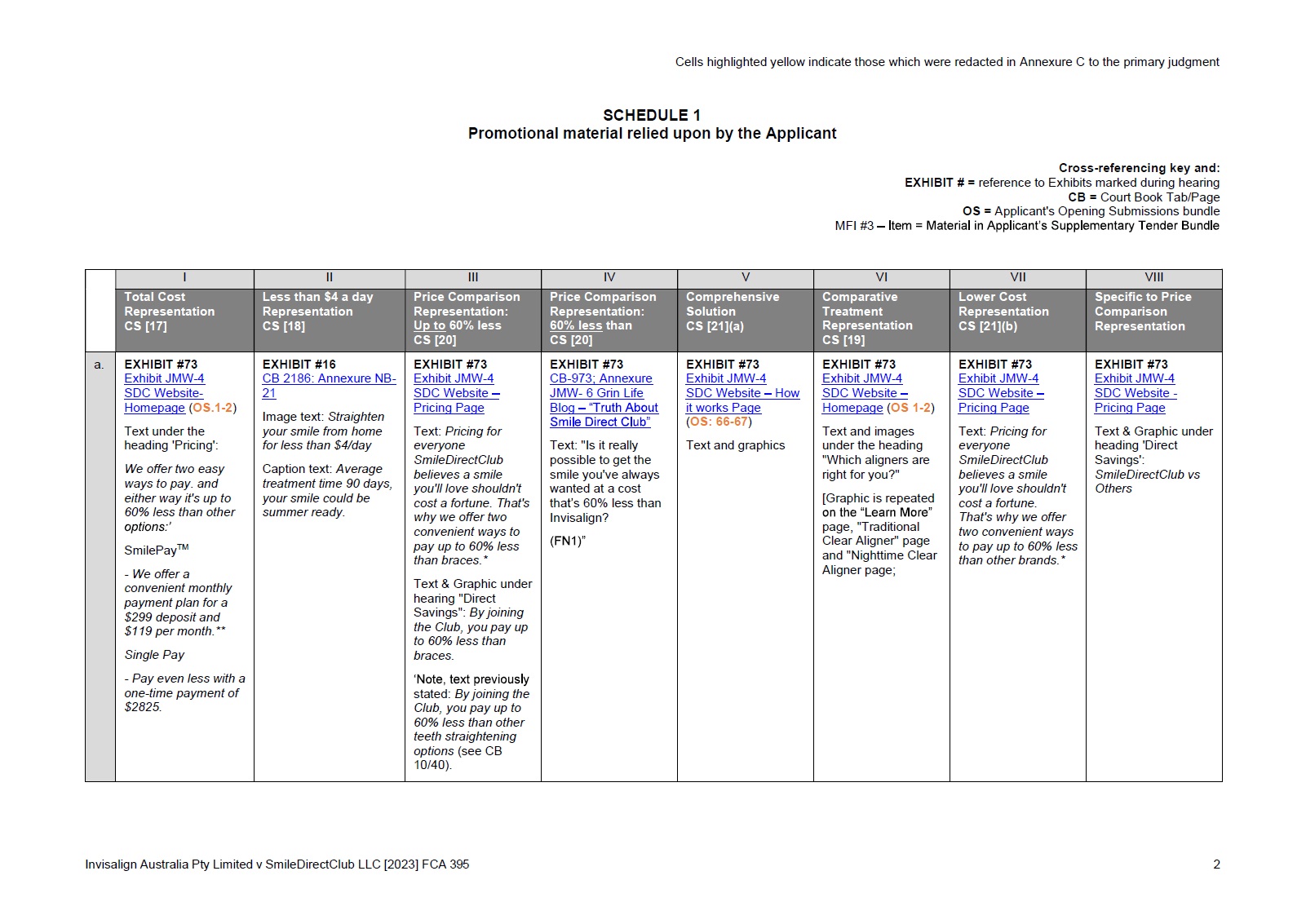
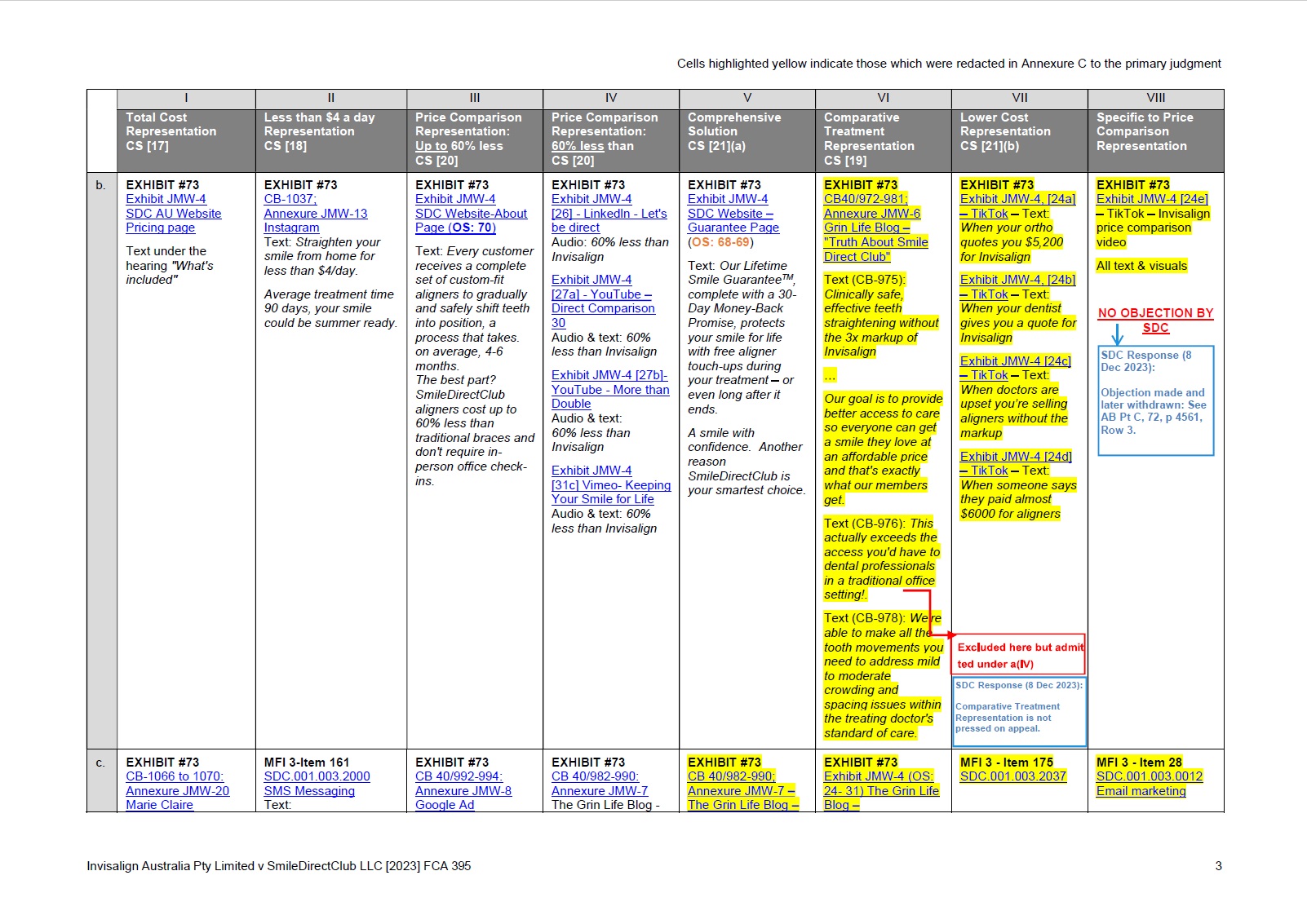
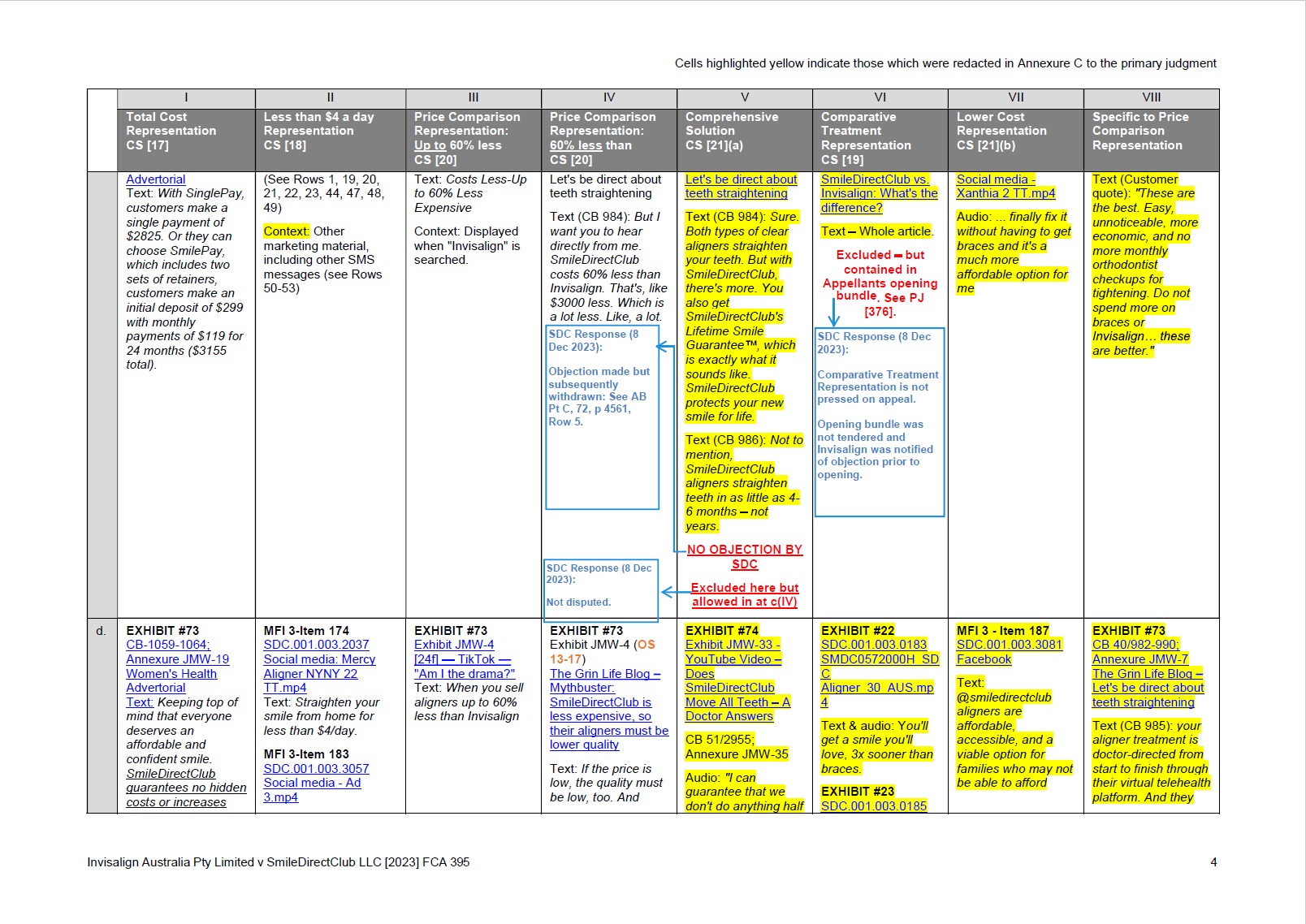
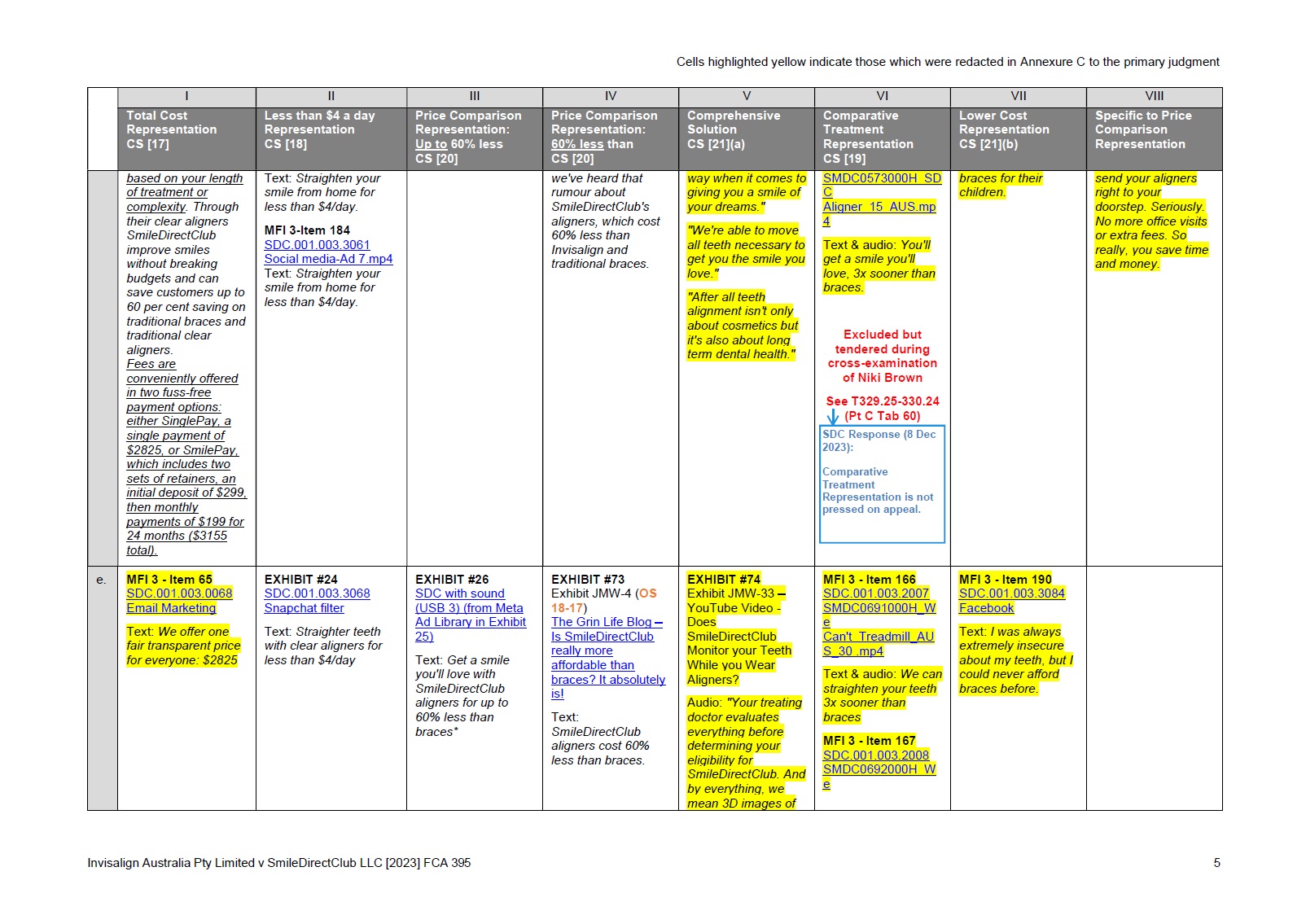
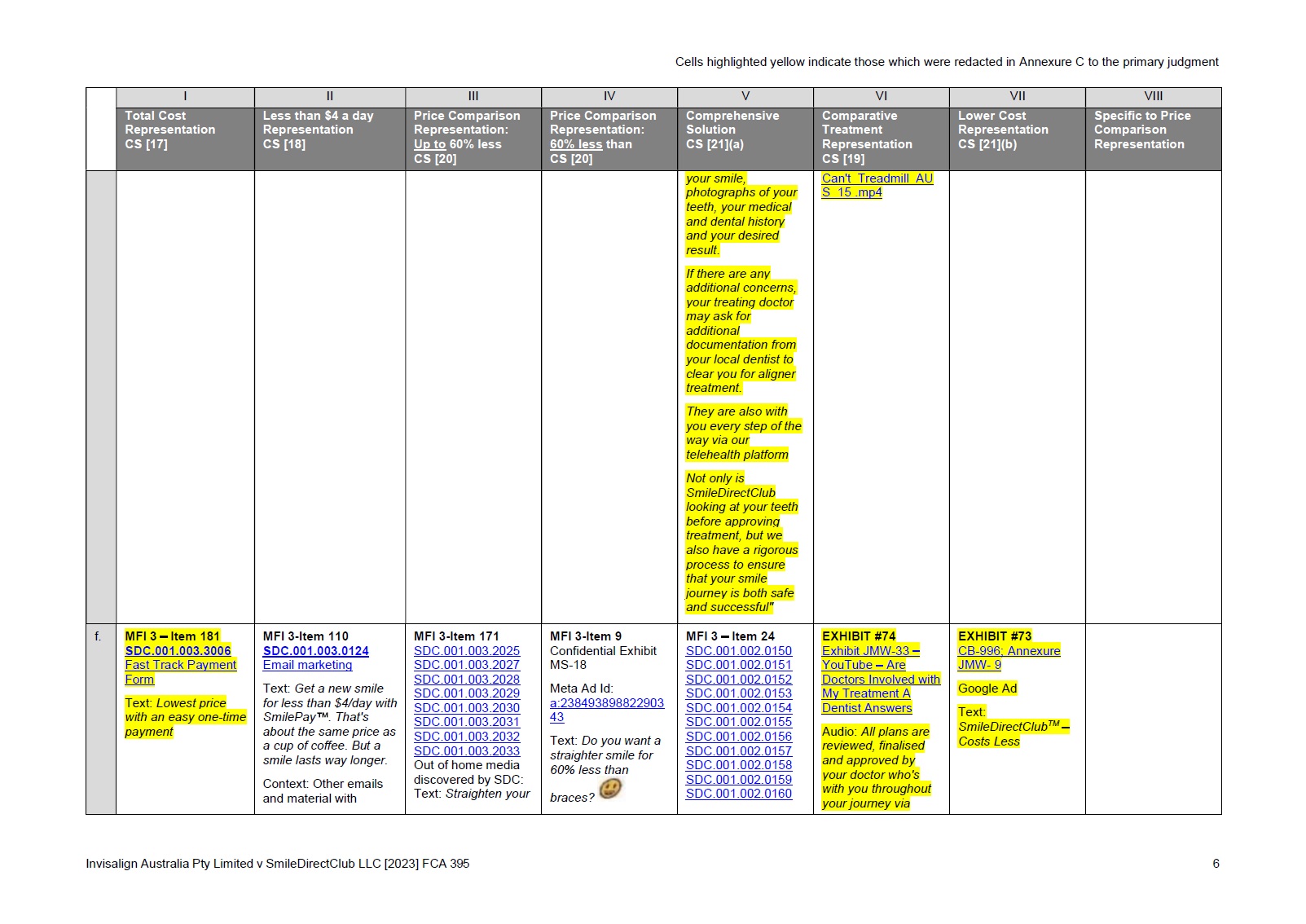
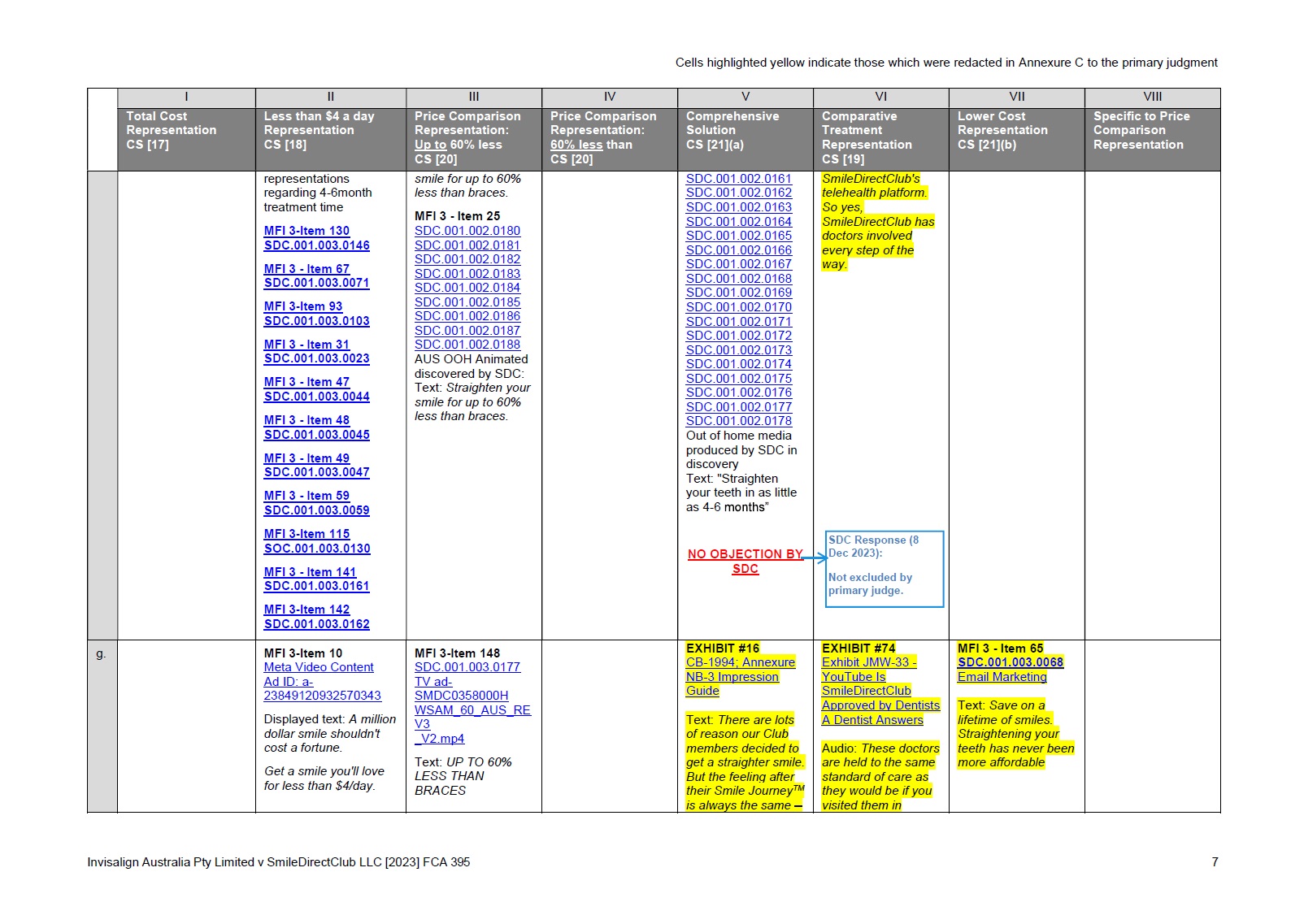
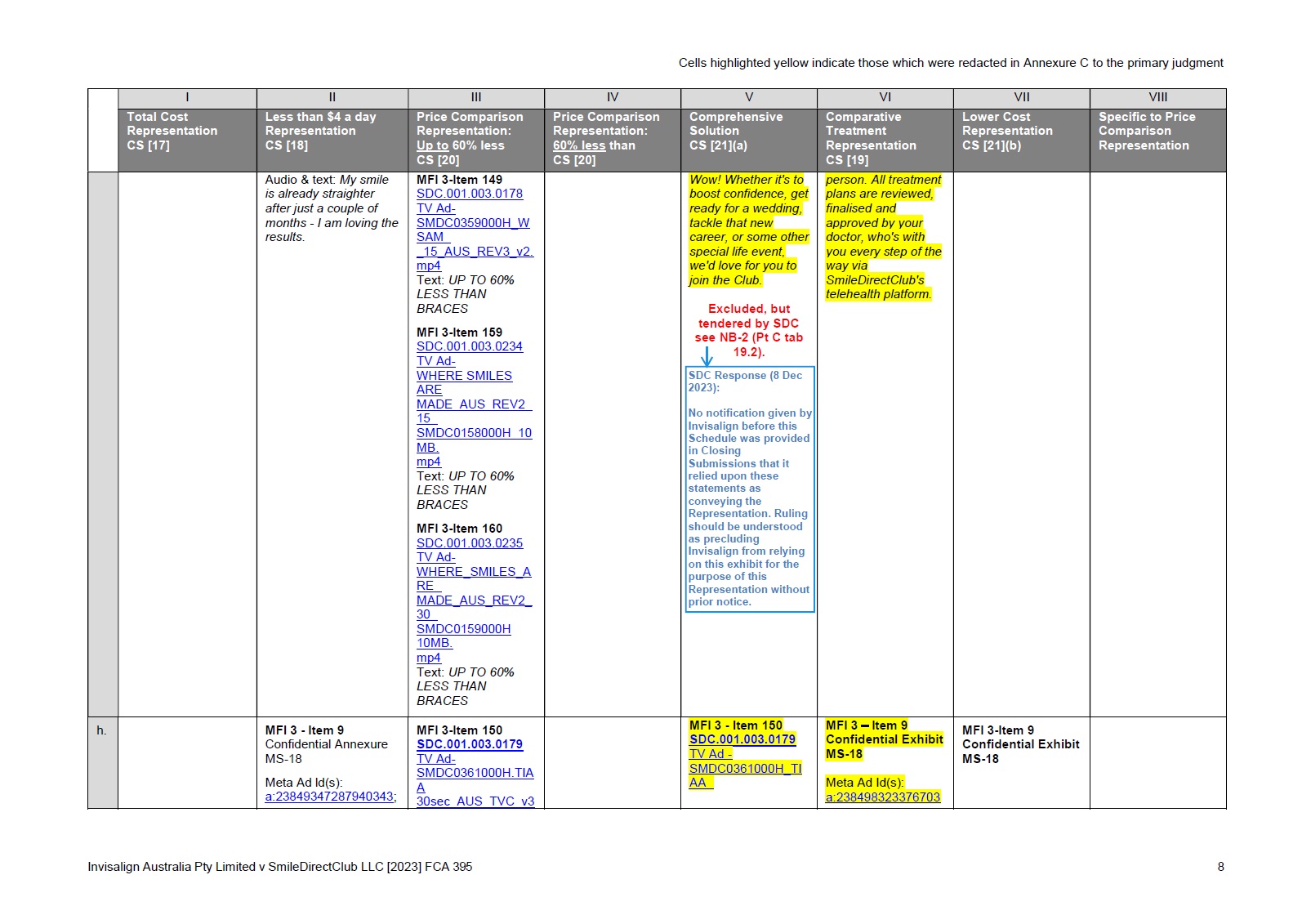
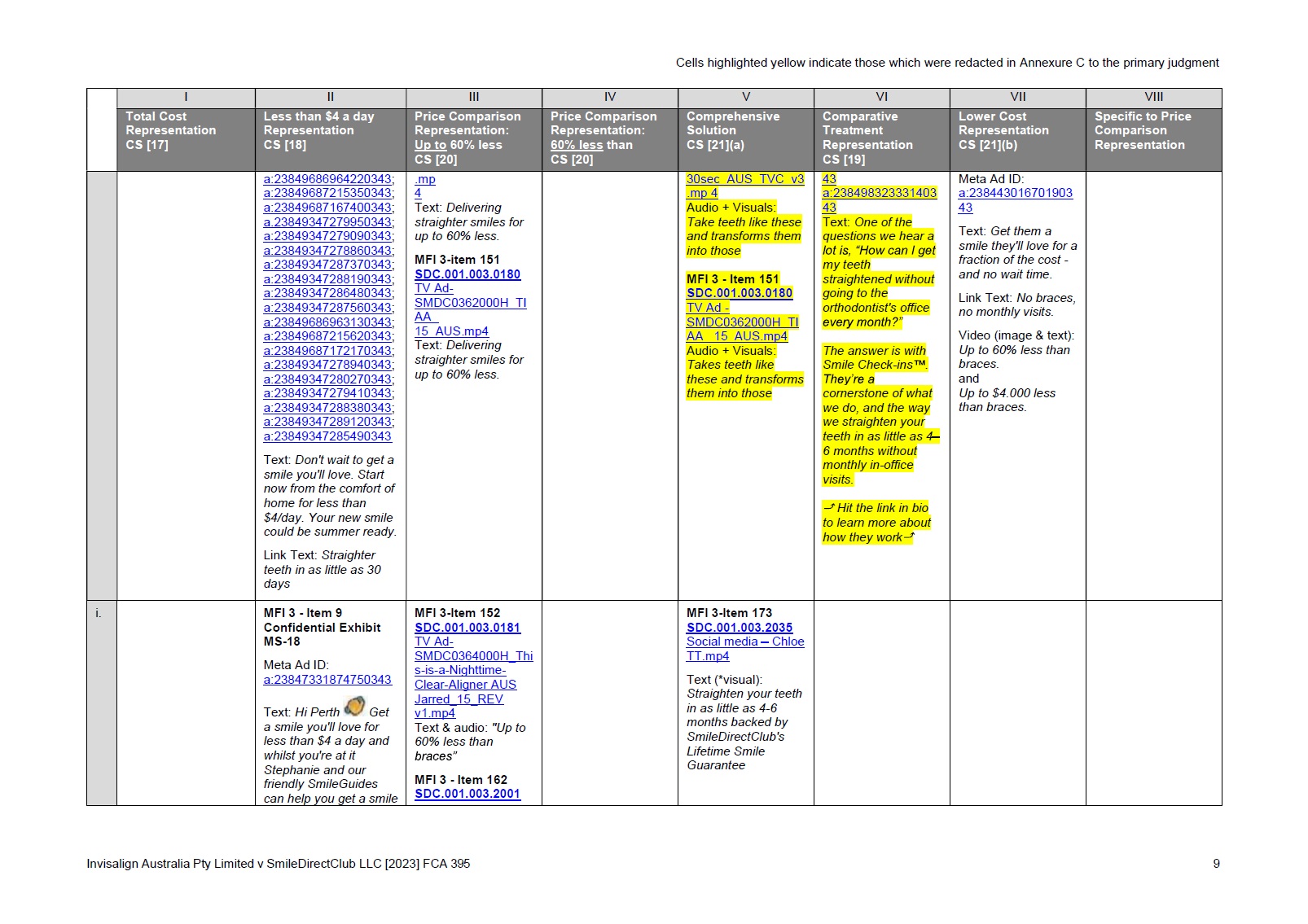
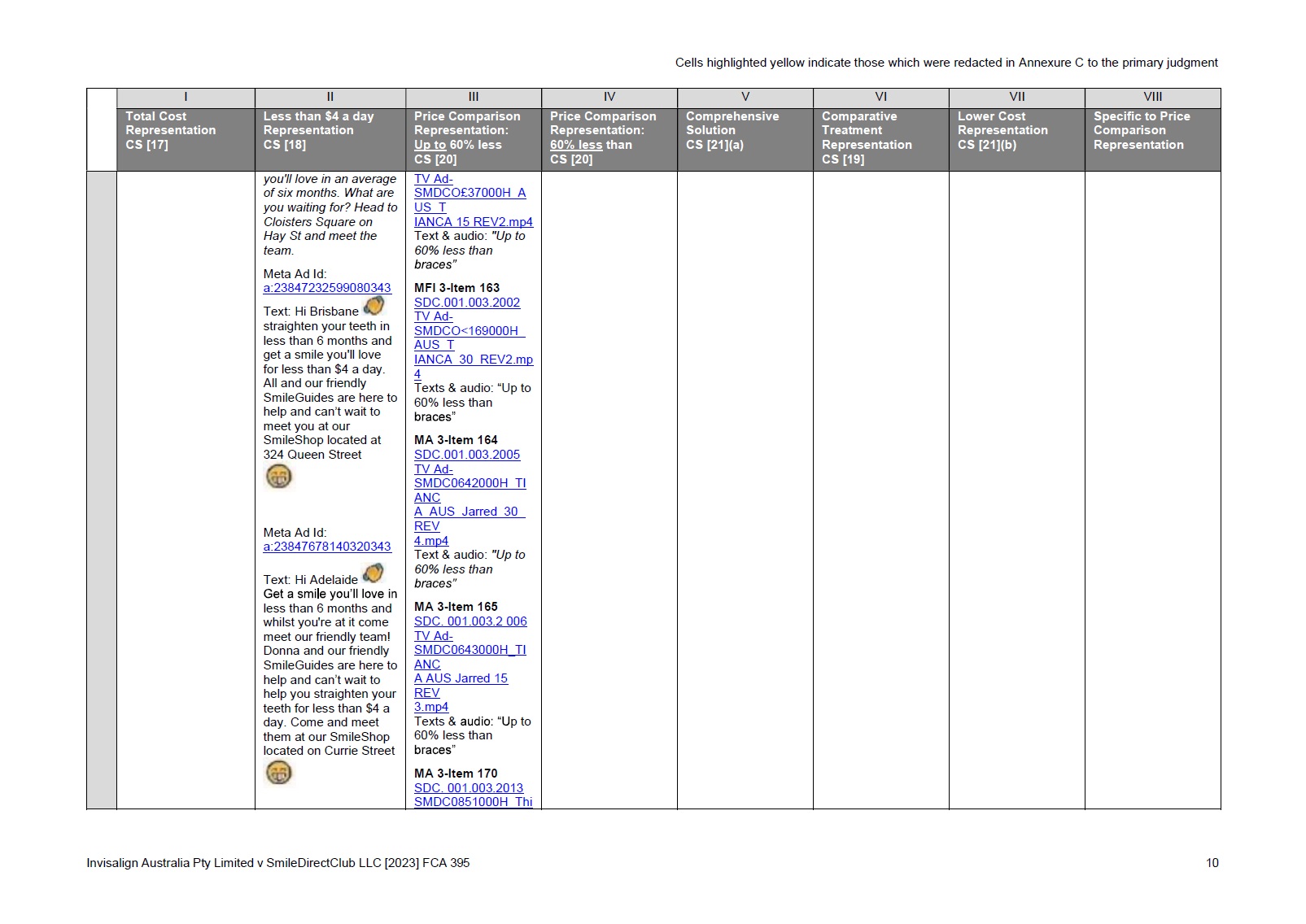
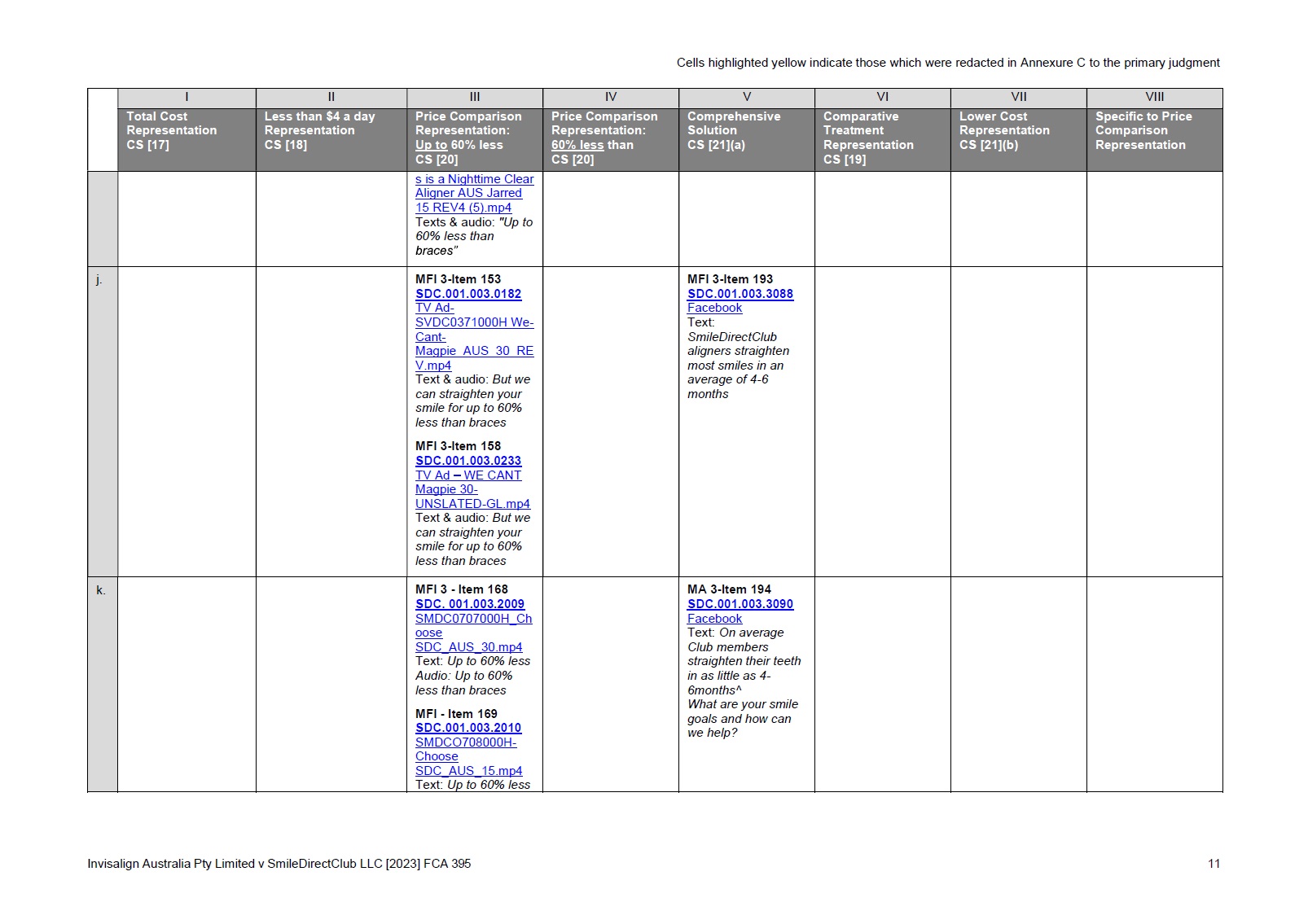
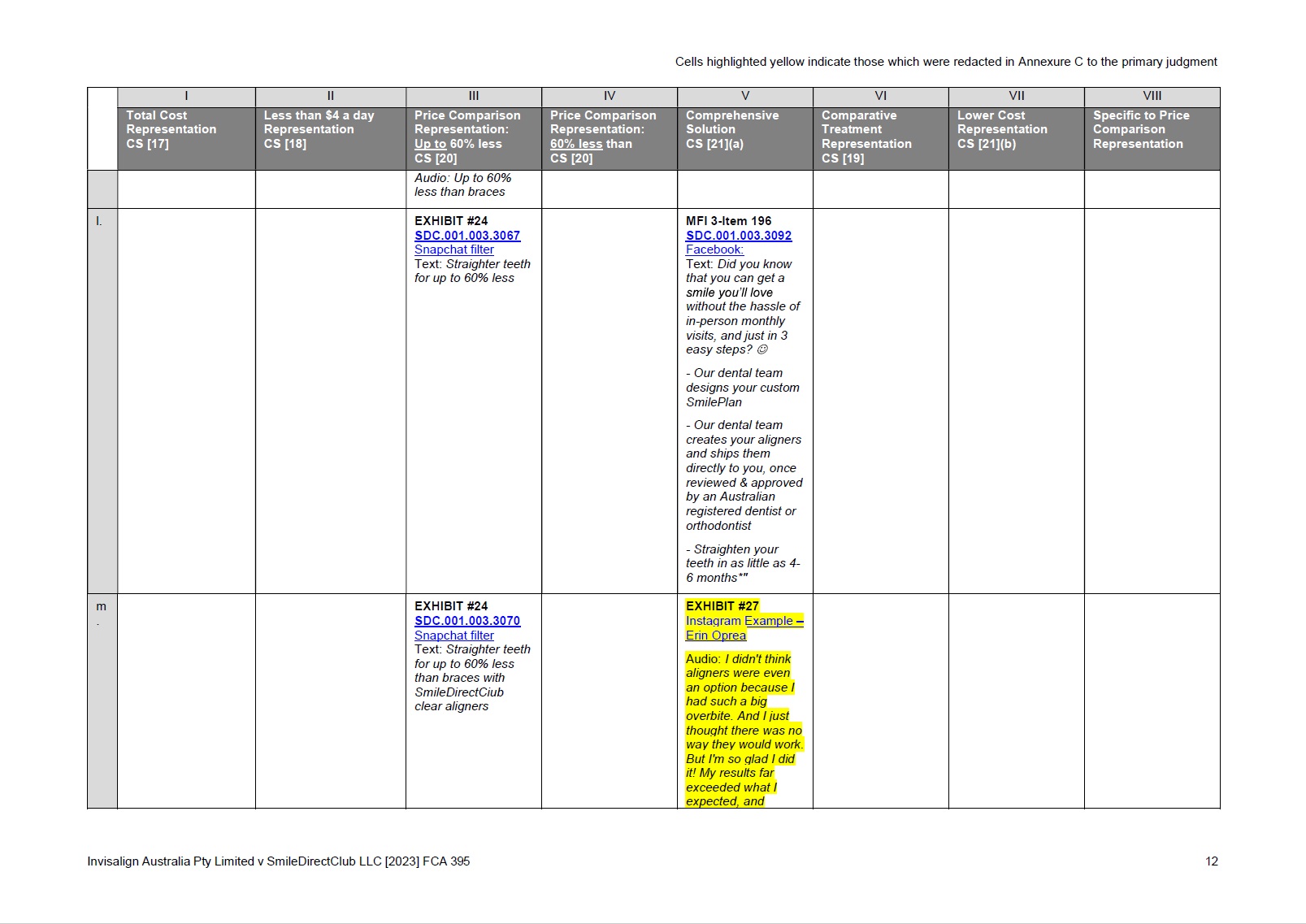
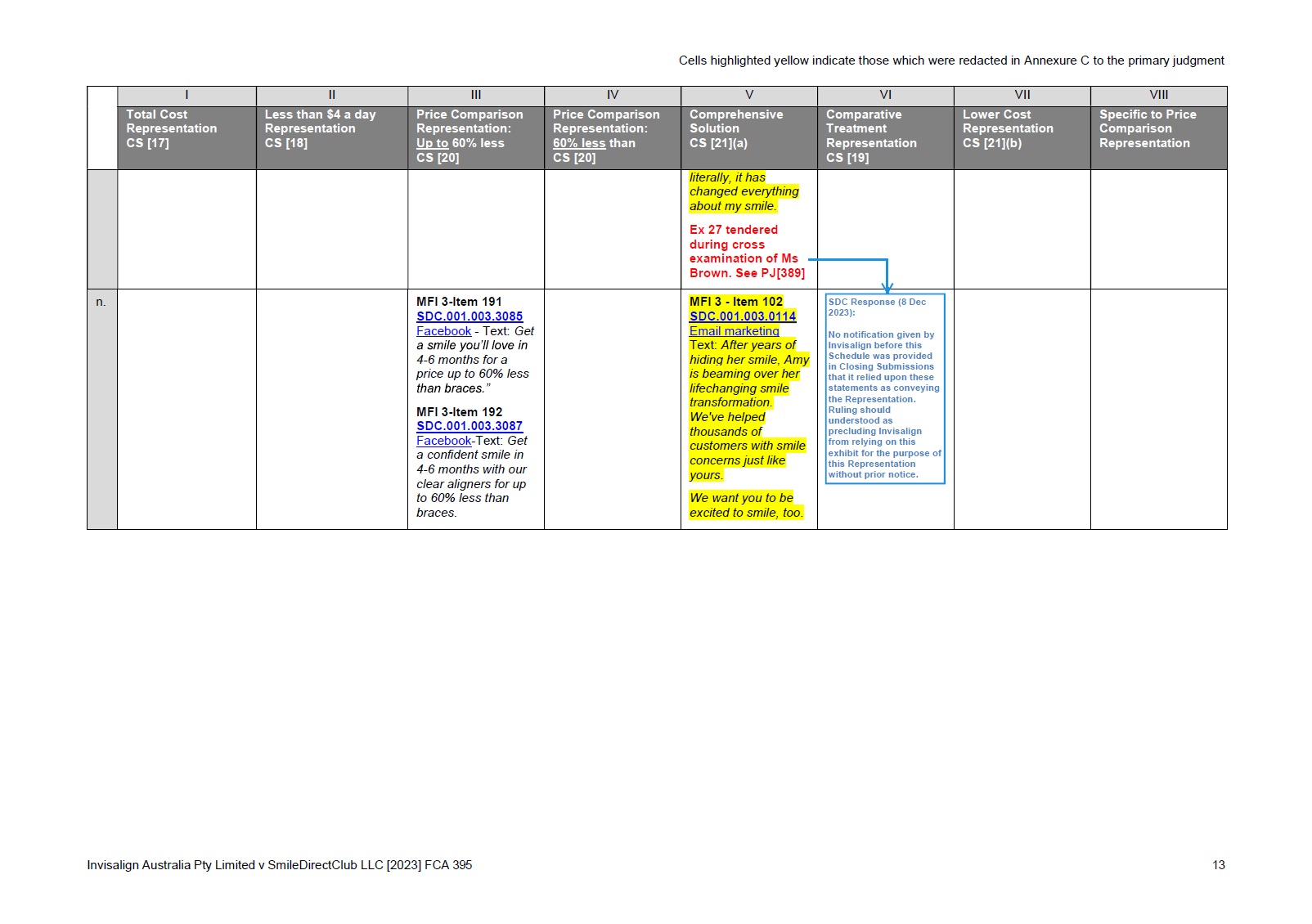
16 The Invisalign system features include:
(a) The use of a series of clear removable aligners, worn over a patient’s teeth, that gently move teeth to a desired final position in order to correct or treat malocclusion.
(b) Clear aligners, which are made with “SmartTrack” material, a proprietary and multilayer orthodontic aligner material.
(c) “Attachments” which are nearly always prescribed by the treating doctor as part of a patient’s treatment plan, depending on the patient’s individual circumstances. Attachments are small pieces of enamel-coloured composite which the doctor fixes onto the patient’s teeth to help the aligner grip the teeth, providing additional force and greater control over the movement of teeth than clear aligners alone. The combination of attachments in a treatment plan are custom designed for the individual patient’s treatment.
SDC
17 SDC US is a company based in Nashville, Tennessee. It is a foreign corporation within the meaning of s 4(1) of the Competition and Consumer Act 2010 (Cth).
18 Its subsidiary, SDC AU, commenced trading in Australia in 2019.
19 From May 2019, until late last year, SDC promoted and supplied its SDC Aligner Treatment directly to consumers in Australia.
20 As SDC explained in its concise response, it did not provide consumers undertaking “SDC Aligner Treatment” with an in-person assessment by a registered Australian dentist or orthodontist to assess tooth or gum health or undertake dental x-rays. A consumer was instead required to either attend a “SmileShop” (a physical retail space operated by SDC AU) for an intraoral scan of their teeth, or create their own impression with a dental impression kit provided by SDC.
21 SDC then reviewed a computer-generated treatment plan based on the scan or impression and then had a dentist or orthodontist approve, modify or reject it. Once the treatment plan had been created, and the patient confirmed that they wish to proceed with treatment, a set of clear dental aligners was manufactured for and supplied to the patient.
THE REPRESENTATIONS ALLEGED
22 The substance of the representations alleged by Invisalign was as follows. In each case, Invisalign alleged that the representations were false, misleading or deceptive, or were likely to mislead or deceive.
Comparable Treatment Representations
23 The gist of Invisalign’s case about the Comparable Treatment Representations was founded on the proposition that SDC’s promotional and marketing strategy was to set itself up as a true alternative to Invisalign and braces. We will explain the exact representations alleged below.
Price Comparison Representations and Lower Cost Representation
24 The alleged Price Comparison Representations were in summary:
(1) SDC Aligners were less expensive in all instances than treatment with braces or equivalent treatments from a dentist or orthodontist;
(2) SDC Aligners were 60% less, or further or alternatively up to 60% less expensive than other treatment options, including Invisalign treatment or traditional orthodontic treatments obtained from a dentist or orthodontist, including braces, in patients with equivalent treatment needs.
25 The alleged Lower Cost Representation was that SDC Aligner Treatment would provide an orthodontic solution in respect of orthodontic issues, or alternatively all orthodontic issues that are not severe, at a cost which is significantly less than that of equivalent treatments with metal braces and/or Invisalign.
Less than $4 a Day Representation
26 Invisalign alleged that by its conduct, including its website and social media content, SDC represented to consumers that the total cost associated with SDC Aligner treatment was less than $4 a day for the duration of treatment, or alternatively for the duration of a 90 day to 6- month treatment.
Total Cost Representation
27 Invisalign alleged that SDC represented to consumers that the total cost associated with SDC Aligner Treatment was either $2,825 for upfront payment or $3,155 if paid by instalments and that the Total Cost Representation was misleading, false or deceptive because the advertised costs did not include “Additional Costs”, including the ongoing costs associated with purchasing retainers, necessary to keep teeth in their position and maintain the “Lifetime Smile Guarantee”.
THE EVIDENCE
28 The promotional material that was the subject of Invisalign’s claim was set out in Annexure A to its original concise statement. It was later attached as Annexure A to the amended concise statement. The promotional material was then further particularised in another version of the Annexure, called “Schedule 1 to Invisalign’s closing submissions.”
29 On appeal, the court was provided with a document titled “SCHEDULE 1 Promotional material relied upon by [Invisalign]”. It was attached to Invisalign’s written submissions in reply and included annotations referring to particular circumstances in relation to each excluded item of evidence (eg noting where certain evidence had been excluded despite SDC having withdrawn its initial objection). Another version of that document was subsequently provided containing various notations inputted by SDC’s counsel, in response to Invisalign’s comments. It contained references and hyperlinks to a large number of documents and, like its predecessors, contained column headings corresponding to the alleged representations. The final version of that document, containing both Invisalign’s and SDC’s annotations, is attached to these reasons, marked Annexure A. The column headed “Comprehensive Solution” can be ignored. The case made below in that regard is not pressed on appeal.
30 At the hearing of the appeal, we were taken to a selection of the materials referred to in Annexure A.
31 Those promotional materials fell into these broad categories:
(a) Image-based social media posts.
(b) Text-based “advertorials”.
(c) Video advertisements.
(d) Blog posts.
(e) Screenshots of website pages.
32 Many of the platforms or sites were interconnected. For example, the SDC AU website contained hyperlinks to its various social media platforms, including Facebook, Instagram, YouTube and also to something called the “Grin Life Blog”. The SDC AU Facebook page contained a hyperlink to the SDC AU website. The SDC AU Instagram account also contained a hyperlink to the SDC AU website.
33 Before turning to the evidence of the promotional materials, we should mention an evidentiary issue that arose during closing submissions below about what promotional materials were to be in evidence before the primary judge. His Honour ruled inadmissible certain evidence that Invisalign sought to rely on in closing, because it was outside the “pleadings”, and because it was too late.
34 The documents shaded in yellow in Annexure A to these reasons are documents that the primary judge ruled were inadmissible. Invisalign’s case was that the primary judge was wrong to exclude the documents or materials highlighted in yellow in Annexure A because SDC had, at the hearing, agreed that some of those documents with the notation (added by their counsel) “no objection by SDC” should be in evidence, and some documents were excluded by the primary judge in respect of a particular representation, but allowed in respect of other representations. SDC accepted, on the appeal, that the primary judge had erred in excluding the documents it had agreed to.
35 Ground 11 of the amended notice of appeal was that the primary judge erred by excluding from his consideration of the alleged representations any of SDC’s marketing material that his Honour ruled inadmissible which were redacted in Annexure C to his Honour’s reasons.
36 In our view, the primary judge erred in excluding the additional material, as Invisalign submitted, both in respect of the documents agreed to by SDC, and the other excluded documents. SDC submitted that it was prejudiced by the late notification of Invisalign’s reliance on additional materials, but it was never explained how any prejudice arose. They are, after all, SDC’s own documents and they are not significantly different in substance from the documents that were in evidence from the outset. In our view, the primary judge ought to have admitted the evidence that he excluded.
37 Ground 11 is therefore allowed.
38 In saying that, we intend no criticism of the primary judge. This was a case that was wholly ill-suited to have proceeded to trial by way of concise statement. As Beach J said in Australian Securities and Investments Commission v Australia and New Zealand Banking Group Limited [2023] FCA 1150 at [15]–[17]:
In simple factual cases where the real contest is say a point of construction on an insurance policy or some other straight-forward legal point, concise statements are desirable and can more than adequately take the place of proper pleadings.
But where there is substantial factual complexity involving circumstances or transactions over a lengthy time frame, which facts are contested, the use of a concise statement should be confined to its valuable triaging function only …
I have had the advantage of reading Derrington J’s nicely equilibrated discussion on the use and abuse of concise statements in Australian Securities and Investments Commission v National Australia Bank Limited (No 2) [2023] FCA 1118 at [30] to [39], and at the least agree with what he has said. But I would go even further in being even less generous and sympathetic than he is as to their use in complex contexts …
39 The use of a concise statement was a most unfortunate way of pleading a case about alleged false, misleading or deceptive representations said to arise from a large body and variety of promotional material. Each of the representations should have been pleaded in the conventional fashion, by way of a statement of claim. It was, quite apart from anything else, unfair on the primary judge to expect him to trawl through the myriad material referred to in the annexure to the concise statement. Counsel for Invisalign also acknowledged on the appeal that there was significant confusion below concerning the documentary record.
THE ORDERS SOUGHT BY INVISALIGN ON APPEAL
40 Invisalign sought the following orders in its amended notice of appeal:
1. The appeal be allowed.
2. Orders 2 and 3 of the orders of 5 May 2023 be set aside.
3. In lieu thereof:
a. declarations that the respondents, in trade or commerce, have:
i. engaged in conduct that was misleading or deceptive, or likely to mislead or deceive in contravention of s 18 of the Australian Consumer Law; and
ii. made false or misleading representations that services are of a particular standard, quality, value or grade in contravention of s 29(1)(b) of the Australian Consumer Law; and
iii. made false or misleading representations with respect to the price of goods or services in contravention of s 29(1)(i) of the Australian Consumer Law,
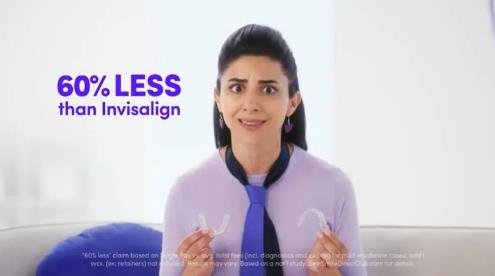
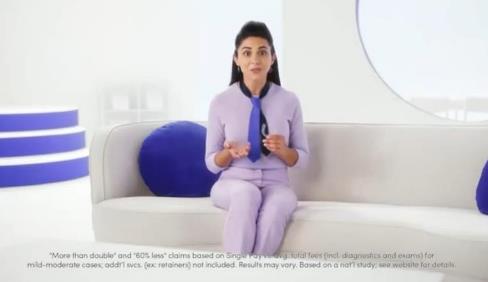
by making the Less than $4 a Day Representation, the Price Comparison Representations, the Comparable Treatment Representations, the Lower Cost Representation and the Total Cost Representation in the course of the supply and promotion of the supply of the SDC Aligner Treatment;
b. the respondents be permanently restrained from making each of the:
i. Less than $4 a day Representation;
ii. Price Comparison Representations;
iii. Comparable Treatment Representations;
iv. Lower Cost Representation; and
v. Total Cost Representation;
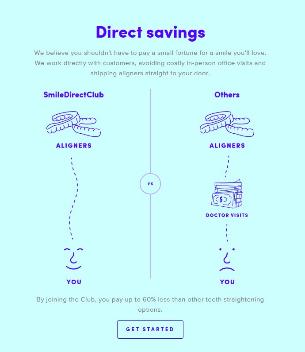
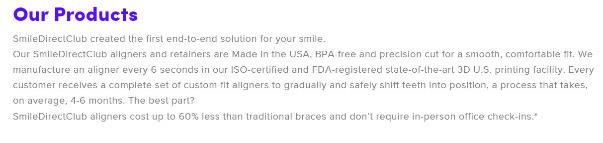
c. an order that the respondents undertake corrective advertising pursuant to s 232 of the Australian Consumer Law in a form and a manner to be agreed between the parties within 14 days of the date of these orders, or if not agreed, to be determined by the Court;
d. an order that the matter be remitted for an inquiry to assess the quantum of damages payable to the Appellant pursuant to s 236 of the Australian Consumer Law; and
e. an order that the Respondents pay the Appellant’s costs of the Separate Issues (as defined in Order 1 made on 7 April 2022) on a lump sum basis payable within 21 days or as otherwise determined by the Court.
4. In the alternative to 3, that the proceedings be reallocated to a docket judge for a new trial pursuant to s 28(1)(f) and s 30 of the Federal Court Act 1976 (Cth) in respect of the Appellant's claims.
5. The Respondents pay the Appellant’s costs of the appeal.
41 Orders 2 and 3 referred to in the amended notice of appeal were orders dismissing Invisalign’s claim, and ordering that Invisalign pay SDC’s costs of the claim.
42 Proposed order 3.e. in the amended notice of appeal, as best we can tell, was not mentioned in written or oral submissions, so we will say no more about it. If there is some extant issue about Invisalign’s costs of the “Separate Issues” referred to, the parties can address it at the further hearing contemplated in the orders we will make upon publication of these reasons.
THE STANDARD OF APPELLATE REVIEW
43 In a case such as this, the appellate court stands in the same position as the trial judge in its ability to make findings about whether a representation was or was not conveyed.
44 The appellate court will give respect and weight to the conclusion of the trial judge, but once it has reached its own conclusion, will not shrink from giving effect to it. See Warren v Coombes (1979) 142 CLR 531 at 551 (Gibbs ACJ, Jacobs and Murphy JJ).
45 As Perram J explained when considering the standard of appellate review of “evaluative” findings in Aldi Foods Pty Ltd v Moroccanoil Israel Ltd (2018) 261 FCR 301 at 317 [49] (Allsop CJ and Markovic J agreeing):
What kinds of case lie in this indeterminate area? Warren v Coombes provides part of the answer: the drawing of inferences from facts already found. But there are other examples, too: does certain packaging convey a representation; is a word capable of distinguishing one trader’s goods from another? There are also some legal standards which are so amorphous in nature that it will be difficult to say with any certainty whether a given fact lies within or without the standard. Examples will include concepts such as unconscionability and oppressive conduct. Whilst the question of whether a given set of facts could fall within such a standard is a question of law … the question of whether a particular set of facts does do so is a question of fact. It is for that reason that such questions are sometimes referred to as, perhaps confusingly, mixed questions of fact and law. Each of these kinds of standard involves an element of evaluation (just as the drawing of an inference does). When an appellate court comes to review such conclusions it must be guided not by whether it disagrees with the finding (which would be decisive were a question of law involved) but by whether it detects error in the finding. On the one hand, error may appear syllogistically where it is apparent that the conclusion which has been reached has involved some false step; for example, where some relevant matter has been overlooked or some extraneous consideration taken into account which ought not to have been. But error, on the other hand, may also appear without any such explicitly erroneous reasoning. The result may be such as simply to bespeak error. Allsop J said in such cases an error may be manifest where the appellate court has a sufficiently clear difference of opinion: Branir at 437-438 [29].
THE AUSTRALIAN CONSUMER LAW
46 As the Full Court recently said in RB (Hygiene Home) Australia Pty Ltd v Henkel Australia Pty Ltd [2024] FCAFC 10 at [168] (Nicholas, Burley and Hespe JJ), “[d]etermining whether a person has breached s 18 of the ACL involves four steps: first, identifying with precision the ‘conduct’ said to contravene s 18; second, considering whether the identified conduct was conduct ‘in trade or commerce’; third, considering what meaning that conduct conveyed; and fourth, determining whether that conduct in light of that meaning was ‘misleading or deceptive or ... likely to mislead or deceive’” (citing Self Care IP Holdings Pty Ltd v Allergan Australia Pty Ltd (2023) 97 ALJR 388; [2023] HCA 8 at [80] (Kiefel CJ, Gageler, Gordon, Edelman and Gleeson JJ)).
47 In these reasons, we address only the first and third questions. The second question was not in dispute. And because the primary judge did not address most of the issues of the alleged falsity of the representations, those issues, in the view we take about the principal grounds of appeal concerning whether the representations were made, will need to be determined at a retrial.
48 Where the conduct complained of is not directed at a specific individual, as is the case here, what is conveyed by the particular conduct is to be considered by reference to the class or classes of consumers likely to be affected by the conduct. See RB (Hygiene Home) at [170] and the cases there cited.
49 In this case, the primary judge accepted, correctly in our view, that the class of consumers likely to be affected by the conduct are consumers who are interested in undertaking treatment for teeth straightening. See Primary Judgment at [744].
50 The question of what message is conveyed by the relevant promotional materials is to be determined by reference to a reasonable or ordinary member of that class of consumers.
51 In determining whether s 18 or s 29 of the ACL has been contravened, the court must “characterise, as an objective matter, the conduct viewed as a whole and its notional effects, judged by reference to its context, on the state of mind of the relevant person or class of persons. That context includes the immediate context – relevantly, all the words in the document or other communication and the manner in which those words are conveyed, not just a word or phrase in isolation – and the broader context of the relevant surrounding facts and circumstances”. See Self Care at [82].
52 Further, as Invisalign submitted, this is a case where much of the conduct (the advertisements, the social media communications, the texts and so on) constituted “an unbidden intrusion on the consciousness of the target audience”. See Australian Competition and Consumer Commission v TPG Internet Pty Ltd (2013) 250 CLR 640 at [47]. As French CJ, Crennan, Bell and Keane JJ explained in that case at [47]–[50]:
The intrusion will not always be welcome. The very function of the advertisements was to arrest the attention of the target audience. But while the attention of the audience might have been arrested, it cannot have been expected to pay close attention to the advertisement; certainly not the attention focused on viewing and listening to the advertisements by the judges obliged to scrutinise them for the purposes of these proceedings. In such circumstances, the Full Court rightly recognised that many persons will only absorb the general thrust. That being so, the attention given to the advertisement by an ordinary and reasonable person may well be perfunctory, without being equated with a failure on the part of the members of the target audience to take reasonable care of their own interests.
Secondly, the Full Court did not recognise that the tendency of the advertisements to mislead was to be determined, not by asking whether they were apt to induce consumers to enter into contracts with TPG, but by asking whether they were apt to bring them into negotiation with TPG rather than with one of its competitors on the basis of an erroneous belief engendered by the general thrust of TPG’s message.
It might be said, as TPG did, that consumers, acting reasonably in their own interest, could be expected to obtain a clear understanding of their rights and obligations before signing up with TPG; but to say that is to confuse the question whether the consumer has suffered loss with the anterior question as to whether the advertisement, viewed as a whole, has a tendency to lead a consumer into error. Thus, in Campbell v Backoffice Investments Pty Ltd French CJ noted that the question of characterisation as to whether conduct is misleading is logically anterior to the question whether a person has suffered loss or damage thereby. French CJ observed that characterisation of conduct generally requires consideration of whether the impugned conduct viewed as a whole has a tendency to lead a person into error. As observed earlier in these reasons, questions of carelessness by consumers in viewing advertisements may be relevant to that question of characterisation.
It has long been recognised that a contravention of s 52 of the TPA may occur, not only when a contract has been concluded under the influence of a misleading advertisement, but also at the point where members of the target audience have been enticed into the marketing web by an erroneous belief engendered by an advertiser, even if the consumer may come to appreciate the true position before a transaction is concluded. That those consumers who signed up for TPG’s package of services could be expected to understand fully the nature of their obligations to TPG by the time they actually became its customers is no answer to the question whether the advertisements were misleading.
(Internal quotations and citations omitted).
53 And as Lindgren J said in Gillette at [47]–[49] in the context of considering comparative advertisements (in that case about batteries for retail consumer use in electrical and electronic appliances):
I have carefully viewed the modified advertisement several times and tried to assess its likely effect on viewers. But, as I observed in the earlier Eveready case (at [38]), apart from the difference between a one-off viewing and repeated viewings, the circumstances in which a judge attends to a television commercial for the purposes of a case are not those in which members of the public do so. First, members of the public watch a commercial after and before viewing other things, rather than in isolation. Secondly, unlike the judge, they do not carefully view the commercial with a special interest in noting and memorising its features. Thirdly, they view the commercial, not in the calm of chambers, but against a background of distractions, such as domestic activity, or simply a preoccupation with other more interesting or pressing concerns. Fourthly, usually they do not know in advance that the commercial is about to commence.
I have tried to make allowances for these considerations.
In assessing the likely effect the commercial would have on the viewing public, I have borne in mind the fact that the impressions conveyed and taken away are at once more and less than those conveyed by, and taken away from, a studied reading of the transcript … A television commercial simultaneously stimulates the visual and auditory senses. There are subtleties of suggestion not available from a reading of the transcript.
THE REPRESENTATIONS CONSIDERED
Comparable Treatment Representations (Grounds 8 and 9)
The representations alleged
54 Invisalign alleged below and on appeal that SDC represented to consumers, among other things, that:
(a) all, or alternatively the majority of, patients will achieve the same or a similar clinical outcome from SDC Aligner Treatment as they would achieve from traditional orthodontic treatment, including clear aligner treatment such as Invisalign;
(b) patients with equivalent treatment needs will achieve the same clinical outcome from SDC Aligner Treatment as they would achieve from traditional orthodontic treatment, including Invisalign treatment;
(c) SDC Aligner Treatment is of comparable efficacy to Invisalign treatment and/or traditional braces treatment.
55 This is the example dealt with by the primary judge (at [874]) from SDC’s Australian website:
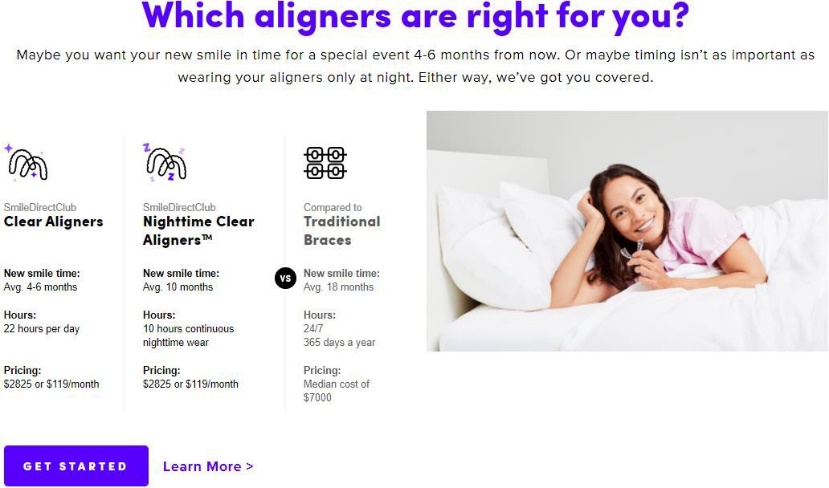
56 Invisalign also relied on other promotional material to similar effect, listed in Annexure A to these reasons, but the primary judge did not include any of it in his reasons. It was, and is, not necessary to do so because the “Which aligners are right for you?” advertisement is a sufficient exemplar.
Consideration
57 The primary judge found that Comparable Treatment Representations were not conveyed by any of the promotional material relied on by Invisalign. He concluded at [877]–[881] of the Primary Judgment:
An analysis of the above representation, in my view however, shows a comparison between SDC’s aligners, SDC’s Nighttime Aligners and Traditional Braces, with three elements that have been accentuated, which are:
(1) treatment time;
(2) hours worn per day; and
(3) price.
Invisalign’s Comparable Treatment Representation is foreclosed by the principles set out by the Full Court in Gillette Australia. As in Gillette Australia, SDC has advertised its product by reference to particular features (here: treatment time, hours worn and price). The above representation does not give rise to any implied representation about “like for like” (or equivalent) products or about other potential bases for comparison. Nothing in item (a) above gives rise to any express or implied misrepresentation about the “clinical outcomes” or “efficacy” of its products compared to braces or Invisalign aligners.
Like in Gillette Australia, if a consumer formed the conclusion, after viewing item (a) above, that SDC Aligner Treatment is of comparable efficacy to braces or Invisalign treatment for all or the majority of cases, it would be their own mistaken assumption, and not from anything SDC has represented in its promotional material.
While Invisalign submits that SDC “set[s] itself up as an alternative to Invisalign and braces” and that in doing so “SDC has to market the SDC Aligner Treatment as capable of correcting the range of malocclusions that Invisalign and braces can correct”, this submission is not supported by SDC’s promotional material which states that SDC aligners are designed for correction of mild to moderate teeth crowding and spacing. It is contrary to the principles in Gillette Australia to assume that because a comparison is made in respect of certain features of a product, that the comparison represents that the products are alike or comparable in all respects. SDC has made no representation to consumers that it provides treatment of the same efficacy that a consumer would receive from Invisalign Aligner Treatment or braces.
With respect to Invisalign’s submission that the words “new smile” would convey to a consumer that they will end up with the same smile irrespective of whether they chose braces or SDC Aligner Treatment, this places an exaggerated and fanciful emphasis on the ordinary use of the words and is plainly wrong.
58 We do not, with respect, agree.
59 As Invisalign submitted, the “Which aligners are right for you?” advertisement conveys that SDC Clear Aligners are comparable, or an alternative to (“vs”) traditional braces. Consumers are told that they can get their “new smile” from either SDC Clear Aligners or SDC Nighttime Aligners or (that is “vs’) “Traditional Braces”. And, again as Invisalign submitted, “[i]t is the same new smile that is portrayed as the end goal for consumers”.
60 The advertisement compares a range of features, including how long it will take consumers to get their “new smile”, the hours of wear involved and the cost of the new smile. And as Invisalign also submitted, “[t]he notional effect of the table is asking consumers: How would they like to get their new smile? Which method suits them best? Importantly, according to the table, it is the same ‘new smile’ irrespective of the treatment option selected”.
61 In our view, contrary to the view formed by the primary judge, the words “new smile” would convey to a consumer that they will end up with the same smile irrespective of whether they chose braces or SDC Aligner Treatment. As Invisalign submitted, “[t]he impact of the ‘vs’ as well as the comparison table layout bears on the notional effect to the ordinary consumer. Further, the heading, ‘Which aligners are right for you’ sets up the consumer to make a choice (to achieve the same outcome) by choosing one of the options presented in the table. If it is not the same ‘new smile’ that a consumer achieves from the three options contained in the table, the comparison of the ‘hours worn’ and ‘new smile time’ features are rendered meaningless.” We agree.
62 We do not agree that Invisalign’s submissions are “foreclosed” by the decision in Gillette.
63 The facts in that case were far removed from the facts here.
64 Gillette Australia Pty Ltd and Energizer Australia Pty Ltd both manufactured and distributed batteries. Gillette used the brand “Duracell”, and it supplied alkaline, but not carbon zinc, batteries. Energizer used the brands “Energizer” and “Eveready”, and supplied both alkaline and carbon zinc batteries.
65 It was not disputed that alkaline batteries last longer, but cost more, than carbon zinc batteries of the same size.
66 Energizer brought proceedings against Gillette in respect of a television advertisement showing four “bunny” rabbits engaged in a race. The winning rabbit was powered by a Duracell alkaline battery, and the voiceover included words to the effect that the Eveready Super Heavy Duty battery (a carbon zinc battery) “just can’t keep up” and that “with up to three times more power Duracell always wins”.
67 Energizer complained that the advertisement constituted misleading and deceptive conduct in breach of ss 52 and 53(a) of the Trade Practices Act 1974 (Cth), including because the advertisement did not inform viewers that the Eveready Super Heavy Duty battery was considerably cheaper than the Duracell battery, and that it was only the fifth most powerful battery in Energizer’s range of batteries.
68 Energizer succeeded before the primary judge, but Gillette’s appeal was unanimously allowed.
69 Justice Heerey made the following observations about comparative advertising at [20] and [22]:
The characterisation of advertising as comparative does not of itself have legal significance, or create any kind of presumption in favour of a party alleging a breach of Pt V of the TPA. There is no basis in the TPA for regarding comparative advertising as an inherently disreputable form of commercial conduct, to be viewed with suspicion by the courts. On the contrary, to the extent that comparative advertising provides consumers with accurate hard facts about competing products, it assists in the making of better informed consumer choices and thereby results in more effective competition.
…
Provided the factual assertions are not untrue, or misleading half-truths, an advertiser can lawfully compare a particular aspect of its product or service favourably with the same aspect of a competitor’s product or service.
70 His Honour held at [28] that the “bunny” rabbit advertisement was not misleading in failing to disclose that Energizer had a comparable battery to that of Gillette’s because:
[t]here is no doubt on the evidence that the Eveready Super Heavy Duty battery, the highest selling carbon zinc battery in Australia, competes head to head with Duracell’s alkaline battery. Duracell is entitled, in my opinion, to point out truthfully to consumers a feature of its product which is superior to that of a rival product. If viewers think that Energizer has no other batteries which are more powerful than the Eveready Super Heavy Duty, then that belief would spring from their own mistaken assumptions and not from anything Duracell has told them in the advertisement. The appropriate remedy is for Eveready to correct such mistaken assumptions, if they exist, by its own advertising. There is no legal or ethical obligation on a trader to publicise the full range of a competitor’s products, and reasonable viewers would not think otherwise.
71 Justice Lindgren reasoned along similar lines, especially at [53], where his Honour said that there could be no objection in principle to Duracell’s promoting its battery by comparing it with the Eveready Super Heavy Duty battery, and that it cannot be accepted as a general proposition that in order not to be misleading or deceptive, comparative advertising must refer to all of the criteria by reference to which the goods might be compared.
72 Justice Merkel adopted a similar approach at [90], holding that the advertisement did no more than represent in graphic terms the power difference between two specified batteries which were direct competitors in the market place.
73 As is apparent from that the reasoning of the Full Court, Gillette turned on its own facts, and does not establish some overriding legal principle of the type SDC contended for, that is capable of “foreclosing” what would otherwise constitute a misrepresentation founded on comparative advertising.
74 Although the following passage was written almost a decade before Gillette, Hill J’s observations in Trade Practices Commission v Telstra Corporation Limited (1993) ATPR 41-256 at 41,454 are applicable to it:
The point being made [in the cases about comparative advertising] is that errors in comparative advertising may have a greater potential to mislead consumers than statements made in ordinary advertising which may be perceived as mere “puffs”.
It is unnecessary to elevate what is said in those cases into a principle of law. Whether conduct is misleading or deceptive must depend upon all the facts and those facts include, in the case of advertising, the entire context in which the advertising appears.
75 Further, the primary judge’s observation that it is contrary to Gillette “to assume that because a comparison is made in respect of certain features of a product, that the comparison represents that the products are alike or comparable in all respects”, seems to us to miss the point. Invisalign’s case did not rest on such an assumption. Rather, its case emphasised that, unlike the battery advertisement being considered in Gillette, which only compared a specific feature of identified batteries, SDC’s promotional materials conveyed a dominant message about the overarching comparability, and substitutability, of the products; in other words, the comparisons were not limited to specific features.
76 It may be accepted, as the primary judge found, that SDC “has made no [express] representation to consumers that it provides treatment of the same efficacy that a consumer would receive from Invisalign Aligner Treatment or braces”. But the lack of such an express representation is not decisive. As the cases make clear, it is the impression that is likely to be created that is important.
77 And as Merkel J said in Telstra Corporation Ltd v Optus Communications Pty Ltd (1996) 36 IPR 515 at 524, “[i]n television and print advertising where a false dominant impression is conveyed, its message will not be ameliorated by the accuracy of the detailed message which is derived from a careful analysis of all of the constituent parts of the advertisement”.
78 In our view, the dominant impression created by the materials relied on under grounds 8 and 9 is to convey to a consumer that they will end up with the same smile irrespective of whether they chose braces or SDC Aligner Treatment, that consumers will achieve the same or a similar clinical outcome from SDC Aligner Treatment as they would achieve from the Invisalign treatment, and that the SDC Aligner Treatment is of comparable efficacy to Invisalign treatment and traditional braces treatment.
79 It follows that grounds 8 and 9 should be allowed.
Price Comparison Representations and Lower Cost Representation (Grounds 3, 4 and 5)
The representations alleged
80 The alleged Price Comparison Representations were in summary:
(1) SDC Aligners are less expensive in all instances than treatment with braces or equivalent treatments from a dentist or orthodontist;
(2) SDC Aligners are 60% less, or further or alternatively up to 60% less expensive than other treatment options, including Invisalign treatment or traditional orthodontic treatments obtained from a dentist or orthodontist, including braces, in patients with equivalent treatment needs.
81 The alleged Lower Cost Representation was that SDC Aligner Treatment would provide an orthodontic solution in respect of orthodontic issues, or alternatively all orthodontic issues that are not severe, at a cost which is significantly less than that of equivalent treatments with metal braces and/or Invisalign.
82 The primary judge found that none of those representations was conveyed. See Primary Judgment at [872], [888]–[889]. At [836], his Honour said that all of the advertising material relied upon by Invisalign in respect of the Price Comparison Representations was “confined to a pricing comparison.” See more generally the Primary Judgment at [825]–[845]. For example, at [834] the primary judge considered a promotional YouTube advertisement, which spans 30 seconds and incorporated the following audio: “This is a direct comparison. This is an Invisalign aligner. This is a Smile Direct Club Aligner. Both straighten your teeth. But Smile Direct Club is 60% less than Invisalign… Smile …”
83 The evidence relied on by Invisalign and set out in his Honour’s reasons, included the following from SDC’s website (see, for example, [832] of the Primary Judgment):

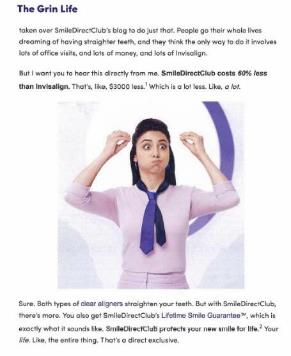
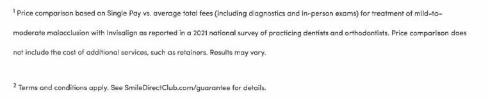
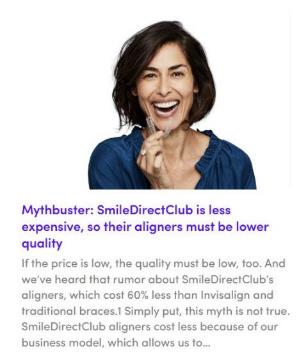

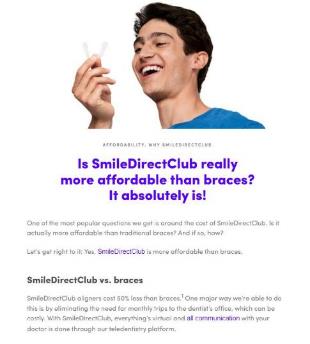
84 The primary judge also included screenshots from a video advertisement posted on SmileDirectClub’s YouTube channel, viz:
85 The primary judge referred to what the actress in the video advertisement says, which is as follows:
This is a direct comparison. This is an Invisalign aligner. This is a SmileDirectClub aligner. Both straighten your teeth.
But SmileDirectClub is 60% less than Invisalign. [The actress then throws away the Invisalign aligner]
With SmileDirectClub you get a smile you love directed by one of their doctors with aligners sent directly to you. So the savings go directly to you. And SmileDirectClub guarantees your smile for life. Your life. Choose Smile. Choose Direct.
86 This depiction of a post on SDC’s “The Grin Life” blog titled “Let’s be direct about teeth straightening” was excluded by the primary judge, but as we have explained, his Honour ought to have admitted it into evidence:
The Grin Life

AFFORDABILITY, CONFIDENCE, CONVENIENCE, WHY SMILEDIRECTCLUB
Let’s be direct about teeth straightening
Can I be direct with you?
Some people are paying more than double for teeth straightening with Invisalign.1
Phew. It feels good to say that out loud. See, being direct is my thing. And I’ve taken over SmileDirectClub's blog to do just that. … People go their whole lives dreaming of having straighter teeth, and they think the only way to do it involves lots of office visits, and lots of money, and lots of Invisalign.
But I want you to hear this directly from me. SmileDirectClub costs 60% less than Invisalign. That’s, like, $3000 less.1 Which is a lot less. Like, a lot.

Sure. Both types of clear aligners straighten your teeth. But with SmileDirectClub, there’s more. You also get SmileDirectClub’s Lifetime Smile Guarantee™, which is exactly what it sounds like. SmileDirectClub protects your new smile for life.2 Your life. Like, the entire thing. That’s a direct exclusive.
Think about it this way. Have you ever heard someone say, “Wow. I sure do love my smile now that I've spent [text obscured] … my teeth. But I think I’ll only keep it until after my we[text obscured] … [Lifetime] Smile Guarantee, you …
…

SmileDirectClub also sends your aligners directly to you – so the savings go directly to you.
Honestly, we all have a million things going on already. Who has time to drive to the doctor’s office, circle the block looking for a parking spot, and then sit in the waiting room for what feels like an eternity? No one. SmileDirectClub gets it. That’s why your aligner treatment is doctor-directed from start to finish through their virtual telehealth platform. And they send your aligners right to your doorstep. Seriously. No more office visits or extra fees. So really, you save time and money.

Not to mention, SmileDirectClub aligners straighten teeth in as little as 4-6 months – not years.3
Months. Picture yourself in 4 months. Maybe you’re walking across that stage with your hard-earned diploma in hand. Or maybe you’re at the altar, saying “I do” to the love of your life. Or maybe you’re feeling so bold that you decide to go talk to that cute barista. Now, think about doing any of those things with straighter teeth, in as little as 4 - 6 months from now. Sound too good to be true? It’s not.

So, let’s review. With SmileDirectClub, you get a smile you love. You get aligners sent directly to you, so the savings go directly to you. You get direct exclusives, like the Lifetime Smile Guarantee. And, like I said, you get it all for 60% less than Invisalign (that’s, like, $3000).1 It’s kind of like that present you get for your birthday – you know, the big box that you think is just one present, but really, it has more presents wrapped up inside the same box. You end up getting that gift you really wanted, plus all these other great things you didn’t put on your list. Talk about reasons to smile.
Choose smile. Choose direct. SmileDirectClub.
1 Price comparison based on Single Pay vs. average total fees (including diagnostics and in-person exams) for treatment of mild-to-moderate malocclusion with Invisalign as reported in a 2021 national survey of practicing dentists and orthodontists. Price comparison does not include the cost of additional services, such as retainers. Results may vary.
2 Terms and conditions apply. See SmileDirectClub.com/guarantee for details.
3 Typical SmileDirectClub treatment takes 4-6 months. See SmileDirectClub.com/ claims for details. Results may vary.
87 The primary judge also included this image from an SDC TikTok video:

88 As the primary judge explained at [827]–[828]:
The above image … is a TikTok post from the official “@smiledirectclub” TikTok account. This TikTok video portrays a woman asking herself “Am I the drama? Maybe I am? Am I the villain? I don’t think I’m the villain” which, as far as I am aware, was a viral TikTok trend in which the person making the post seemingly comes to terms with the realisation that they could be the root cause of the current “drama” that they are faced with. In this context the “drama” seems to be, by virtue of the text, that SDC is offering, and is representing that it offers, its SDC Aligner Treatment for “up to 60% less than Invisalign”, which, as can be inferred by this dispute, has caused a degree of “drama” between the parties.
The TikTok post … also contains a disclaimer which qualifies the “up to 60% less” claim as being based on the calculation of average total fees excluding retainers.
89 At [825], the primary judge also included in his reasons what appears below:
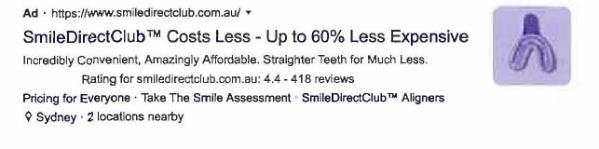
90 The image immediately above portrays a Google search result that appears when an individual causes a search of “Invisalign” to be made. Further examples of “60% less than” promotional materials are set out at [379], [382], [385], [386], [388] and [830] of the Primary Judgment. It is unnecessary to reproduce them in these reasons, because it was not suggested to us that they add anything to the issue before us.
Consideration
91 We take a different view to the primary judge, and would allow grounds 3, 4 and 5 (referring also to what we say below concerning the Cristofaro report in relation to grounds 4 and 5).
92 We do not, with respect, agree that the content of the YouTube video was strictly limited to the comparison of pricing. See Primary Judgment at [836] and [844]. As Invisalign submitted, the video makes a direct comparison between Invisalign and SDC. Consumers were told that the products “both straighten your teeth” and that they can “choose [their] smile”. It seems to us that the dominant message of that video is that the consumer should choose SDC Aligners, not Invisalign Aligners. As the voice-over on the video said, in terms:
(1) This is a direct comparison.
(2) This is an Invisalign aligner.
(3) This is a SmileDirectClub aligner.
(4) Both straighten your teeth.
(5) But SmileDirectClub is 60% less than Invisalign (said as the actress throws away the Invisalign aligner).
(6) Your life. Choose Smile. Choose Direct.
93 The dominant message of the advertisement is that the products are interchangeable or equivalent or have an equivalent effect on consumers’ teeth. This message was not qualified by reference to the severity of the problems with the consumers’ teeth.
94 In our respectful view, the view that the primary judge formed to the contrary was too literal a reading of the material in evidence and failed to consider the dominant message of the video, viz, that SDC Aligners and Invisalign Aligners both straighten teeth to similar effect, but that SDC Aligners cost 60% less. That is so even though, as the primary judge noted, not all of the advertising material expressly attached the comparative statements to Invisalign’s product by adding “than Invisalign”. When one looks at the material as a whole, including multiple examples of promotional materials that include express claims that SDC costs “60% less than Invisalign”, the ordinary reasonable consumer interested in undertaking treatment for teeth straightening, would understand that SDC could only be referring to the alternatives — which necessarily included Invisalign — when the words “than Invisalign” are omitted from particular messaging. SDC’s promotional material compared SDC’s product with Invisalign’s clear aligners, and some particular promotional material compared SDC’s product with Invisalign’s clear aligners and with traditional metal braces.
95 If it matters, it follows that Invisalign’s case that SDC represented that SDC Aligners are less expensive in all instances than treatment with braces or equivalent treatments from a dentist or orthodontist is also made out.
The Cristofaro report
96 Mr Cristofaro is a principal of Actionable Research, a market research firm based in California. He gave what purported to be factual, not expert, evidence of Actionable Research’s market research survey into the prices charged for professional teeth straightening by dentists and orthodontists using braces and clear aligner treatment in Australia.
97 SDC led the evidence on the question of falsity of the Price Comparison Representations. Invisalign objected to it on the basis that it was hearsay and opinion evidence and said further that it should be excluded pursuant to s 135 of the Evidence Act 1995 (Cth) or, alternatively, should be given no weight.
98 Although he found that the Price Comparison Representations had not been made out, the primary judge went on to consider the evidence of Mr Cristofaro, including at [865]–[867], in case he was wrong about the Price Comparison Representations not having been established.
99 His Honour accepted Mr Cristofaro’s evidence, and held that the particular claims that SDC Aligner Treatment is “60% less than” or “up to 60% less than” braces or Invisalign Aligner Treatment, were not false, misleading or deceptive because:
I am satisfied that the evidence of Mr Cristofaro has established that SDC Aligner Treatment is up to 60% less than braces and Invisalign Aligner Treatment: first Cristofaro Affidavit at [54]. The Actionable Study identified that the fees charged in Australia for treating mild to moderate malocclusion with braces, in fact, far exceeded the prices pleaded by Invisalign ranging from $3,500 to $9,180, by more than 60%: first Cristofaro Affidavit at [43]. The prices for Invisalign Aligner Treatment in Australia also far exceeded the prices pleaded by Invisalign, which ranged from $4,500 to $9,500: first Cristofaro Affidavit at [43], [45].
Additionally, the Actionable Study revealed that the overall average fee charged for braces in treating mild to moderate malocclusion at the time of the data collection in July 2021 was $6,939 and the overall median fee was $7,100: first Cristofaro Affidavit at [42]. The overall average fee charged for treatment using Invisalign aligners for mild to moderate malocclusion was $6,926 and the overall median fee was $7,000: first Cristofaro Affidavit at [44]. The average and median prices were slightly higher for complex forms of malocclusion: first Cristofaro Affidavit at [46], [48].
100 On appeal, Invisalign contended that his Honour erred in a number of respects, including that “he did not address at all Invisalign’s closing submissions.”
101 The primary judge did deal with Invisalign’s submission about Mr Cristofaro’s demeanour and credibility (at [847]–[853]) and did make certain conclusory findings about the reliability of his report, but in our view the primary judge failed to have regard to, and give adequate reasons in relation to, Invisalign’s detailed closing submissions about the general unreliability of Mr Cristofaro’s data, due to:
(1) the small sample size;
(2) the lack of representativeness of the sample;
(3) the fact that survey respondents were unidentified;
(4) the lack of testing of respondents’ understanding of questions, especially given the complexity and ambiguity of some of the questions;
(5) inexplicable results – for example, 25% of orthodontist respondents said they treated patients with SDC aligners when SDC has never engaged an Australian orthodontist;
(6) Mr Cristofaro did not follow even his own recommended practices in conducting the survey, including on matters of sample sizes and confidence levels; and
(7) the way in which the evidence was put forward by SDC was unsatisfactory and had the result that Invisalign was unable to test it comprehensively, and in many respects, at all.
102 Invisalign made detailed submissions about each of these points in its written closing submission dated 31 October 2022 at [198]–[265] and in its written reply dated 11 November 2022 at [64]–[72], but the primary judge did not deal with them.
103 In our view, that failure to do so (and leaving aside Invisalign’s other complaints about Mr Cristofaro) means that his Honour’s reasoning in relation to his evidence is not “adequate for the exercise of a facility of appeal”. See Soulemezis v Dudley (Holdings) Pty Limited (1987) 10 NSWLR 247 at 260 (Kirby P), 268–269 (Mahoney JA); Beale v Government Insurance Office of New South Wales (1997) 48 NSWLR 430 at 444 (Meagher JA).
104 Reasons must do justice to the issues posed by the parties’ cases. See, for example, Moylan v The Nutrasweet Company [2000] NSWCA 337 at [61] (Sheller JA, Beazley and Giles JJA agreeing). Discharge of that obligation is necessary to enable the parties to identify the basis of the judge’s decision and the extent to which their arguments have been understood and accepted. See Soulemezis at 279 (McHugh JA). And it is also necessary that the primary judge “‘enter into’ the issues canvassed and explain why one case is preferred over another”. See Jones v Bradley [2003] NSWCA 81 at [129] (Santow JA, Meagher and Beazley JJA agreeing). In our view, by not dealing with Invisalign’s serious and substantial submissions about why no weight should be given to Mr Cristofaro’s evidence, his Honour did not, with respect, discharge that obligation.
105 It is thus unnecessary to deal with Invisalign’s contentions that Mr Cristofaro’s evidence was inadmissible.
106 In our view, grounds 3, 4 and 5 should be allowed.
Less than $4 a Day Representation (Grounds 6 and 7)
The representations alleged
107 The primary judge explained Invisalign’s case with respect to this claim as follows (at [779]–[780]):
By Amended CS at [18], Invisalign has claimed that SDC represented to consumers that the total cost associated with SDC Aligner Treatment is “less than $4 a day” for the duration of the treatment, or alternatively for the duration of a 90 day to 6 month treatment.
Invisalign submits that the less than $4 a day representations would mislead an ordinary and reasonable consumer into concluding that they would pay less than $4 a day for the time taken to treat their smile and straighten their teeth. Because SDC, in its promotional material, has made representations that it takes on average 4-6 months to “straighten [a customer’s] smile”, Invisalign submits that an ordinary and reasonable consumer would view the less than $4 a day representations and would form the view that they would pay, on average less than $4 a day for the 4-6 months of treatment time. This would therefore lead the ordinary and reasonable consumer to believe that, using the 6 month treatment time as the prime example, SDC Aligner Treatment would cost approximately $730 (calculated as 365/2 = 182.5. 182.5 x $4 = $730), which is significantly less than the advertised price.
108 SDC contended to the contrary. The primary judge summarised its case as follows (at [781]–[782]):
SDC accepts that, in certain instances, it has represented to consumers that the cost of SDC’s Aligner Treatment was less than $4 a day, however, SDC does not accept that it represented that the period over which this cost would be incurred was referrable to the 4-6 month treatment time.
SDC admits that it has published material which contains the statement “Straighten your smile from home for less than $4 per day”. However, SDC submits that doing so is not false, misleading or deceptive, or likely to mislead or deceive the ordinary and reasonable consumer. This is because the ordinary and reasonable consumer would understand that these representations are not referrable to treatment time, but rather, to the time over which instalments for SDC Aligner Treatment are paid, which is over a 24 month period.
109 His Honour then set out a number of examples of the promotional materials relied on, including as follows (at [790]–[792]):
I have also considered, at item (f) of column II in Annexure C, a dozen examples of marketing emails which contained the less than $4 a day representation. These marketing emails were largely repetitive. I have placed a few examples of the content of these emails, insofar as the less than $4 a day representation is relevant, below:

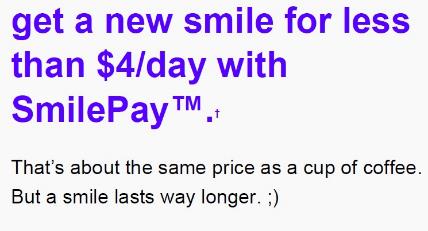
The examples shown above of the email marketing material are clear. The less than $4 a day representation is qualified by the SmilePay payment option, which, as noted above, is correct in representing that SDC Aligner Treatment indeed does cost less than $4 a day over the 24 month payment period.
It should also be noted that the marketing material emails contain a footnote marked as a “✝”, which qualifies and provides calculations for the less than $4 a day representations. Examples of this can be seen below.



110 The crux of his Honour’s reasoning in rejecting Invisalign’s case on the $4 per day point was as follows (at [794]–[795]):
In my view, the placement of the footnote marked as a “✝” in the email marketing material, is sufficiently prominent to alert the ordinary and reasonable consumer to the manner in which the less than $4 a day representations are calculated. In any event, the representation itself makes clear to the ordinary and reasonable consumer that the price is referrable to, and qualified by, the payment time over 24 months using SmilePay.
In considering the promotional material pleaded under column II, I have formed the view that the ordinary and reasonable consumer would view the less than $4 a day representations against the metric of time taken to complete the payment via instalments with SmilePay, which occurs over a 24 month period. There is nothing in the promotional material which would lead an ordinary and reasonable consumer to form the view that the $4 a day is referrable to treatment time. If an ordinary and reasonable consumer formed the view that the less than $4 a day representations are referrable to treatment time, it would be their own mistaken assumption, as such a view does not arise from anything SDC has represented in its promotional material.
Consideration
111 Invisalign’s case on appeal was the same case that was contended for before the primary judge, which the primary judge summarised in his reasons. In our view, Invisalign’s case on ground 6 and 7 fails because there is no error in his Honour’s reasons in relation to the Less than $4 a Day Representation.
Total Cost Representation (Ground 10)
The representations alleged
112 Before the primary judge, Invisalign, by its Total Cost Representation claim, alleged that SDC represented that the total cost associated with SDC Aligner Treatment was either $2,825 for one lump sum payment or $3,155 by instalments. SDC accepted that this representation was made, but disputed that it was misleading as Invisalign contended. Invisalign contended that the representation was misleading because the advertised price did not refer to:
(a) the costs associated with complying with the terms and conditions of SDC Aligner Treatment in relation to obtaining dental care prior to SDC Aligner Treatment and ongoing dental care during SDC Aligner Treatment (prior and ongoing dental care costs);
(b) the costs associated with further treatment after SDC Aligner Treatment (further treatment costs); and
(c) the ongoing costs associated with purchasing retainers (required to “keep your teeth in their new positions” and purchased at six-monthly intervals after completion of treatment to maintain the “Lifetime Smile Guarantee™” except for the monthly payment plan which includes 2 sets of retainers) (retainer costs).
113 Collectively, the primary judge defined each of those three costs as “the Additional Costs”.
114 On appeal, Invisalign pressed only one ground, namely that SDC represented that the total cost associated with SDC Aligner Treatment is either $2,825 for one lump sum payment or $3,155 by instalments (advertised price) and that this representation was misleading because the advertised price did not refer to ongoing “retainer” costs.
115 SDC accepted below, and on appeal, that the Total Cost Representation was conveyed in its promotional material, but contended that it was not misleading because the ordinary and reasonable consumer would not consider ongoing retainer costs to be included within the price of SDC’s Aligner Treatment.
116 The reasons of the primary judge in respect of the ongoing retainer costs aspect of the Total Cost Representation appear at [761]–[763] of the Primary Judgment, as follows:
Neither the SDC Website Homepage nor the SDC AU Pricing Page conveys to the ordinary and reasonable consumer that, after the SDC Aligner Treatment is completed, the cost of retainers is included in the price.
It is clear that the ongoing costs associated with purchasing retainers, are outside of the costs of SDC Aligner Treatment, and were expressly not intended to be included within the price of SDC’s Aligner Treatment.
As a result, I do not find this to be false, misleading or deceptive to the ordinary and reasonable consumer.
Consideration
117 In our view, Invisalign’s case with respect to ground 10 fails because there is no error in his Honour’s reasons in relation to the only aspect of the Total Cost Representation pressed on appeal, viz the ongoing retainer costs.
GROUND 12
118 Ground 12 was as follows:
The primary judge erred in his assessment of whether the Price Comparison Representations, the Lower Cost Representation and the Comparable Treatment Representations were conveyed and that the Price Comparison Representations, if conveyed, were false, misleading or deceptive, by approaching that assessment on the basis of:
a. his finding (or in finding there was no dispute) at J[816(a)] and J[817] (and J[662]), that “SDC aligners are capable of treating mild to moderate cases” including because all the experts agreed (and the primary judge accepted) that there is no accepted or common understanding of the phrases “mild to moderate malalignment”, “mild to moderate spacing” and “mild to moderate crowding” (J[655]); and/or
b. his finding at J[817] that SDC aligners, braces and Invisalign aligners “treat different issues” when the primary judge should have found that Invisalign aligners and braces can treat any case that may be treated with SDC aligners but SDC aligners cannot treat many cases that Invisalign aligners and braces can treat.
119 SDC submitted that the submissions that Invisalign made in support of ground 12 misconstrued the factual findings of the primary judge.
120 In light of the fact that grounds 3, 4, 5, 8 and 9 are to be allowed, it is unnecessary to burden these reasons with consideration of ground 12, which was a challenge to factual findings that will have no bearing on any new trial.
SDC’S FINANCIAL PREDICAMENT
121 On 14 February 2024, after hearing this appeal, the Court wrote to the parties as follows:
Dear Practitioners
Re: Invisalign Australia Pty Ltd v SmileDirectClub LLC (NSD 503 of 2023)
It has been brought to the Court’s attention that on 8 December 2023, SmileDirectClub publicly announced that it had made the decision “to wind down its global operations” effective immediately (the decision).
The Court asks that the legal representatives of the respondents (SmileDirectClub LLC and SmileDirectClub Aus Pty Ltd) confirm that position, and provide any additional information that may be relevant, including in respect of the second respondent.
The Court is of the view that a number of issues could potentially arise as a result of the decision, including:
(i) Whether and in what circumstances it might become necessary for the Court to consider the stay of the proceeding, pursuant to the provisions contained in s 440D or s 471B of the Corporations Act 2001 (Cth);
(ii) Whether there would be utility in the granting of any of the declaratory relief sought by the appellant, in the event that the Court were otherwise minded to grant it;
(iii) Whether there would be any utility in the making of an order that the respondents undertake corrective advertising, in the event that the Court were otherwise minded to make such an order;
(iv) The implications for the conduct of any rehearing or retrial, in the event that the Court were otherwise minded to make such an order;
(v) Whether bearing in mind, among other things, the need efficiently to use the judicial resources available for the purposes of the Court and the efficient disposal of the Court’s overall case load (see s 37M(2) of the Federal Court Act 1976 (Cth)) there is utility in the appeal proceeding further and, if so, whether directions might be made for the filing of further submissions.
At this stage, the Court does not invite the making of substantive submissions about the matters mentioned in (i), (ii), (iii), (iv) and (v).
The only response required at this stage is from the respondents regarding the matters raised in the second paragraph of this email.
122 The solicitor for SDC replied to that communication by email on 19 February 2024, as follows (omitting formal parts):
We refer to your email of 14 February 2024 and set out below the requested information about the First and Second Respondents.
The First Respondent, SmileDirectClub LLC (SDC US), has less than USD 3 million in unallocated cash and assets. On January 26, 2024, a US Court ordered that SDC US be liquidated under the supervision of a trustee. On 14 February 2024, the US Court approved an interim amount of approximately USD 400,000 to the trustee to wind down operations, with the remaining unallocated cash and assets to be assigned:
(i) firstly, to repay debtor in possession (DIP) lenders, who provided DIP funding to SDC US after it filed for Chapter 11 bankruptcy protection in the US (the amount of such DIP lender claims is estimated to be in excess of USD 30 million);
(ii) secondly, if there are any remaining distributable assets after satisfying all claims in paragraph (i), to repay administrative and priority creditors who provided goods or services to SDC US after it filed for Chapter 11 bankruptcy protection in the US or are otherwise entitled to priority under the US Bankruptcy Code (the amount of such administrative and priority creditor claims is estimated to be in excess of USD 27 million); and
(iii) thirdly, if there are any remaining distributable assets after satisfying all claims in paragraphs (i) and (ii) in full, to repay allowed general unsecured claims.
The Second Respondent, SmileDirectClub Aus Pty Ltd (SDC AU) is not currently trading and there is no intention for it to do so again. SDC AU is not currently earning, and is not expected in future to earn, any revenue.
Each of SDC AU, the trustee supervising the SDC US liquidation, and its creditors has an ongoing interest in the present appeal proceeding as follows:
• a bank guarantee from JP Morgan Chase for AUD 700,000 in favour of the Federal Court of Australia, with an issuance date of 4 July 2023 and an expiry date of 30 May 2024. An initial bank guarantee was deposited with the Federal Court of Australia Registry in accordance with Order 9 of the Orders dated 19 August 2022 as security for costs, in the proceeding below (NSD 1356/2021), and replaced by the current bank guarantee in July 2023. This bank guarantee is secured by an amount of AUD 700,000 paid by SDC US to JP Morgan Chase (and held by JP Morgan Chase). We understand that an order would be required in respect of the bank guarantee for SDC US to ultimately obtain return of the funds held by JP Morgan Chase (in the event that the Respondents were successful on appeal and/or costs were not ordered against the Respondents and the bank guarantee was returned by the Court);
• order 3 of the Judgment of his Honour, Justice Anderson, of 5 May 2023 in the proceeding below (NSD 1356/2021), requiring the payment of the Respondents’ costs by the Applicant. While the Respondents were ordered to pay the costs of the Applicant in respect of the Respondents’ cross-claim, as the Applicant’s claim was significantly more extensive than the Respondents’ cross-claim, the costs payable by the Respondents to the Applicant would be offset against part of the costs payable by the Applicant to the Respondents; and
• the Respondents’ costs of the present appeal proceeding, if the Respondents are successful.
The interests of the Respondents identified above could result in additional funds being paid that would increase the value of the estate of SDC US and the equity of SDC AU. As the equity of SDC AU is pledged as collateral to the DIP lenders, the equity value of SDC AU could provide a source of recovery for creditors in the SDC US bankruptcy.
Please let us know if we may be able to assist the Court further in this regard.
123 The Court then wrote to the solicitors for Invisalign, asking (as a matter of procedural fairness) whether it wished to say anything about SDC’s reply to the Court’s email.
124 The solicitors for Invisalign responded on 28 February 2024 as follows (omitting formal parts):
As the appellant understands the respondents’ email of 19 February 2024, in effect there is no application to the Court under the Model Law on Cross-Border Insolvency of the United Nations Commission on International Trade Law, Schedule 1 to the Cross-Border Insolvency Act 2008 (Cth). Accordingly, the appellant understands that the statutory stay provisions referred to in the Court’s email of 14 February 2024 are not engaged in relation to the first respondent, SDC LLC.
Consistently with the respondents’ email to the Court, an ASIC search undertaken a few days ago of the second respondent, SDC AU, does not disclose any insolvency event in relation to that party.
In relation to the other points in the respondents’ email of 19 February 2024:
(a) On 13 September 2023 the Court ordered a stay (by consent) on orders 3 and 5 until final determination of proceeding NSD503/2023. We attach a copy of the stay orders.
(b) If the appellant is successful on determination of the appeal, it will proceed expeditiously to enforce the costs order in its favour on the cross-claim (order 5) which was not appealed. As the respondents have indicated, a bank guarantee was lodged with the Court as security for Invisalign’s costs of the cross-claim and expires on 30 May 2024.
(c) Given the cross-claim was brought by SDC AU only, it is unclear to the appellant the nature of any interest SDC LLC has in the bank guarantee.
WHERE TO FROM HERE?
125 Sub-sections 28(1) and (2) of the Federal Court Act provide:
28 Form of judgment on appeal
(1) Subject to any other Act, the Court may, in the exercise of its appellate jurisdiction:
(a) affirm, reverse or vary the judgment appealed from;
(b) give such judgment, or make such order, as, in all the circumstances, it thinks fit, or refuse to make an order;
(c) set aside the judgment appealed from, in whole or in part, and remit the proceeding to the court from which the appeal was brought for further hearing and determination, subject to such directions as the Court thinks fit;
(d) set aside a verdict or finding of a jury, and enter judgment notwithstanding any such verdict or finding;
(f) grant a new trial in any case in which there has been a trial, either with or without a jury, on any ground upon which it is appropriate to grant a new trial; or
(g) award execution from the Court or, in the case of an appeal from another court, award execution from the Court or remit the cause to that other court, or to a court from which a previous appeal was brought, for the execution of the judgment of the Court.
(2) It is the duty of a court to which a cause is remitted in accordance with paragraph (g) of subsection (1) to execute the judgment of the Court in the same manner as if it were its own judgment.
(Emphasis added).
126 Section 30 of the Federal Court Act further provides:
30 New trials
(1) In an appeal in which the Court grants a new trial, the Court may impose such conditions on a party, and may direct such admissions to be made by a party, for the purpose of the new trial as are just.
(2) Where the Court grants a new trial in a suit, the Court:
(a) may grant it, either generally or on particular issues only, as it thinks just; and
(b) may order that testimony of a witness examined at the former trial may be used in the new trial in the manner provided in the order.
127 If a new trial is granted pursuant to s 28(1)(f), the trial starts again de novo, so that existing issues can be abandoned and new ones raised; the parties are not bound by how they conducted the original trial; and they may improve their case by leading new evidence or by making new arguments. And where the same issues arise in both trials, the judge at the second trial is not hampered by any decision at the original one. See, for example, New Aim Pty Ltd v Leung (No 3) [2023] FCA 1295 at [12] (O’Callaghan J).
128 As Finkelstein J said in Community and Public Sector Union v Telstra Corporation Ltd (No 2) (2001) 112 FCR 324 at 326–327 [9]–[11]:
At common law there were two classes of case where it was possible to obtain a new trial of a jury action. Every issue of law was determined by the judge, and he directed the jury as to the law. If there was an error of law, such as a misdirection, or an erroneous reception or rejection of evidence, there could be a new trial. This type of error also founded a writ of error. The second class was where a jury returned a verdict that was clearly wrong. Here a writ of error did not lie, and all that could be done to rectify the position was to order a new trial. See generally Holford v The Melbourne Tramway and Omnibus Co Ltd [1909] VLR 497 at 525-526; Australian Iron and Steel Ltd v Greenwood (1962) 107 CLR 308 at 315-319. As to the procedure for obtaining a new trial, see South Eastern Railway Co v Smitherman (1883) 47 JP 773 at 774.
The manner in which the court exercised its jurisdiction to grant a new trial differed, depending upon the nature of the error. In the first class of case (error of law) there would be a new trial of all issues, as of right: Bernasconi v Farebrother (1832) 3 B & Ad 372; 110 ER 140. In the second class (error of fact) the court could limit the new trial to the particular issue in respect of which error was found: Hutchinson v Piper (1812) 4 Taunt 555; 128 ER 447; Earl of Macclesfield v Bradley (1841) 7 M&W 570; 151 ER 893.
A new trial is a rehearing “as if [the case] had never been heard before”: Blackstone’s Commentaries on the Laws of England (1768) Vol 3 at 391 … Thus, for the purpose of a new trial, any finding in the first trial has been got rid of: Roe v Naylor (1918) 87 LJKB 958 at 963. The parties are not bound by the manner in which they conducted the original trial. On the rehearing, the parties may improve their case by leading evidence that had not been led at the first trial or by putting forward new arguments: Horton v Horton [1960] 1 WLR 987 at 988; 1 All ER 503 at 503-504. See also Venn v Tedesco [1926] 2 KB 227, where counsel, who waived a right to rely on a defence at the first trial, was not precluded from raising the point in the new trial. That is because a new trial is a trial that starts again de novo. In Bobolas v Economist Newspaper Ltd [1987] 1 WLR 1101 at 1104; 3 All ER 121 at 123-124, Lloyd LJ explained that: “[A] new trial ‘means what it says’. Existing issues can be abandoned and fresh issues can be raised. Where the same issues arise in both trials, the judge at the second trial should not be hampered by any decision at the first trial.”
129 If there is to be a new trial ordinarily it will be of the whole case, unless that will cause injustice. See Holford v Melbourne Tramway and Omnibus Co Ltd [1909] VLR 497 at 515 (Madden CJ) and 529 (Cussen J); Pateman v Higgin (1957) 97 CLR 521 at 527–529 (Kitto J); and Croucher v Cachia (2016) 95 NSWLR 117 at 155 [198] (Leeming JA, Beazley P and Ward JA agreeing). Although there are exceptions, mainly in personal injury actions, where questions of liability and damages are often completely separate. See Quinn v Rocla Concrete Pipes Ltd (1986) 6 NSWLR 586 at 602 (McHugh JA); Community and Public Sector Union v Telstra Corporation Ltd (No 2) (2001) 112 FCR 324 at 327 [12] (Finkelstein J).
130 But if a proceeding is remitted for further hearing and determination pursuant to s 28(1)(c), that hearing will be conducted on the basis that it is a continuation of the first trial, with all the limitations that such a course entails.
131 As to costs, the usual order is that subject to any order of the judge hearing the new trial, the costs of the first trial are costs in the second trial. See eg Monie v Commonwealth (No 2) [2008] NSWCA 15 at [61] (Campbell JA); and Hatziandoniou v Ruddy (No 2) [2015] NSWCA 277.
132 If this were an ordinary case, it would be appropriate to order that there be a new trial in respect of the Price Comparison Representations, the Lower Cost Representations and the Comparable Treatment Representations, before a judge other than the primary judge. (We should also say, lest it be thought otherwise, it is not the court’s function in an appeal such as this to make our own findings of fact, including here exploring the depths of Annexure A or resolving whether any of the representations that we have found were made were misleading or deceptive. Compare Waterways Authority v Fitzgibbon (2005) 79 ALJR 1816; [2005] HCA 57 at 1836 [133] (Hayne J); Goodrich Aerospace Pty Limited v Arsic (2006) 66 NSWLR 186 at 204 [118]–[119] (Ipp JA, Mason P and Tobias JA agreeing); and Monash Health v Singh [2023] FCAFC 166 at [162] (Katzmann, Snaden and Raper JJ)).
133 But this is not an ordinary case. As we said above, between the hearing of the appeal, and the publication of these reasons, SDC US and SDC AU have ceased to carry on business, and it seems that their remaining assets (other than the bank guarantee of AUD 700,000) are of little, if any, value. It is also not clear, for example, whether SDC AU will be wound up. If that occurs, as the Court’s correspondence with the parties alluded to, that would mean that a new trial could not be proceeded with, except with the leave of the Court. See ss 440D and 471B of the Corporations Act 2001 (Cth). And see Unilever Australia Ltd v Rosella Foods Pty Ltd (2012) 15 DCLR (NSW) 185; [2012] NSWDC 221 at [68]ff (Taylor DCJ); Lianos v Order of AHEPA NSW Inc (No 2) [2020] NSWCA 304 at [19]–[23] (Emmett AJA, Macfarlan and Meagher JJA agreeing); Sovereign MF Limited v Compliance & Risk Services Pty Ltd [2013] VSC 213 at [8]–[10] (Lansdowne AsJ); Botany Bay Council v Saab Corp Pty Ltd (2011) NSWLR 171 at [21] (Basten JA); and X Pty Ltd (admin apptd) v Milstead [2015] FamCAFC 50 at [25]–[51]).
134 In this case, the threat of ongoing contraventions is nil and the utility of much of the relief that Invisalign seeks (declarations, corrective advertising and so on) is questionable. Further, the prospects of a new trial occurring, we would have thought, are remote.
135 In those circumstances, and in particular having regard to the Court’s available judicial resources and our obligation as judges efficiently to dispose of the Court’s overall caseload, it seems to us that, at least for the time being, we should limit the orders in the way that we have.
136 For the avoidance of doubt, the orders that we would otherwise propose to make would be as follows:
1. The appeal be allowed.
2. Pursuant to s 28(1)(f) of the Federal Court of Australia Act 1976 (Cth), there be a new trial in respect of the Price Comparison Representations, the Lower Cost Representations and the Comparable Treatment Representations before a judge other than the primary judge.
3. Subject to any order of the judge hearing the new trial, the costs of the first trial be costs in the second trial.
4. The respondents pay the appellant’s costs of the appeal.
DISPOSITION
137 For the forgoing reasons, the only orders we will make, for the time being, are that the further hearing of the appeal be listed on a date to be fixed, and that the parties file any written submission on the future conduct of the appeal within 21 days.
I certify that the preceding one hundred and thirty-seven (137) numbered paragraphs are a true copy of the Reasons for Judgment of the Honourable Justices O’Callaghan, Halley and Button. |
Associate:
Dated: 11 April 2024