

Federal Court of Australia
RB (Hygiene Home) Australia Pty Ltd v Henkel Australia Pty Ltd [2024] FCAFC 10
ORDERS
RB (HYGIENE HOME) AUSTRALIA PTY LTD First Appellant RECKITT BENCKISER FINISH B.V. Second Appellant | ||
AND: | Respondent | |
DATE OF ORDER: |
THE COURT ORDERS THAT:
1. The appeal be allowed in part.
2. Order 3 of the primary judge made on 3 October 2022 be set aside.
3. The respondent be restrained, whether by itself, its directors, employees or agents, from offering for sale or selling its Somat Excellence products under or by reference to the following device:

4. The respondent pay 80% of the costs of the appeal.
5. The parties confer and supply to the Court within 21 days of these Orders draft short minutes setting out any further or other orders that they contend should be made, marked up to indicate any points of disagreement between them.
6. In the event that the parties disagree as to the form of further or other orders, within 14 days after the date in Order 5:
(a) the appellants provide a submission of no more than 5 pages setting out their position;
(b) the respondent provide within 14 days thereafter a submission in answer of no more than 5 pages; and
(c) the appellants to file a submission in reply of no more than 3 pages within 7 days thereafter, with the dispute to be resolved by the Court on the papers.
7. Order 3 above be stayed for a period of 14 days or until further order.
8. The respondent is to file and serve any application to vary Order 7 within 12 days.
Note: Entry of orders is dealt with in Rule 39.32 of the Federal Court Rules 2011.
[1] | |
[1] | |
[11] | |
[12] | |
[13] | |
[14] | |
[14] | |
[18] | |
[24] | |
[24] | |
2.3.2 Use of the 914 mark with additions or alterations not substantially affecting the identity of the trade mark | [34] |
[38] | |
[50] | |
[63] | |
[72] | |
[73] | |
[89] | |
[94] | |
[96] | |
[98] | |
[102] | |
[103] | |
[103] | |
[104] | |
[108] | |
[111] | |
[120] | |
[120] | |
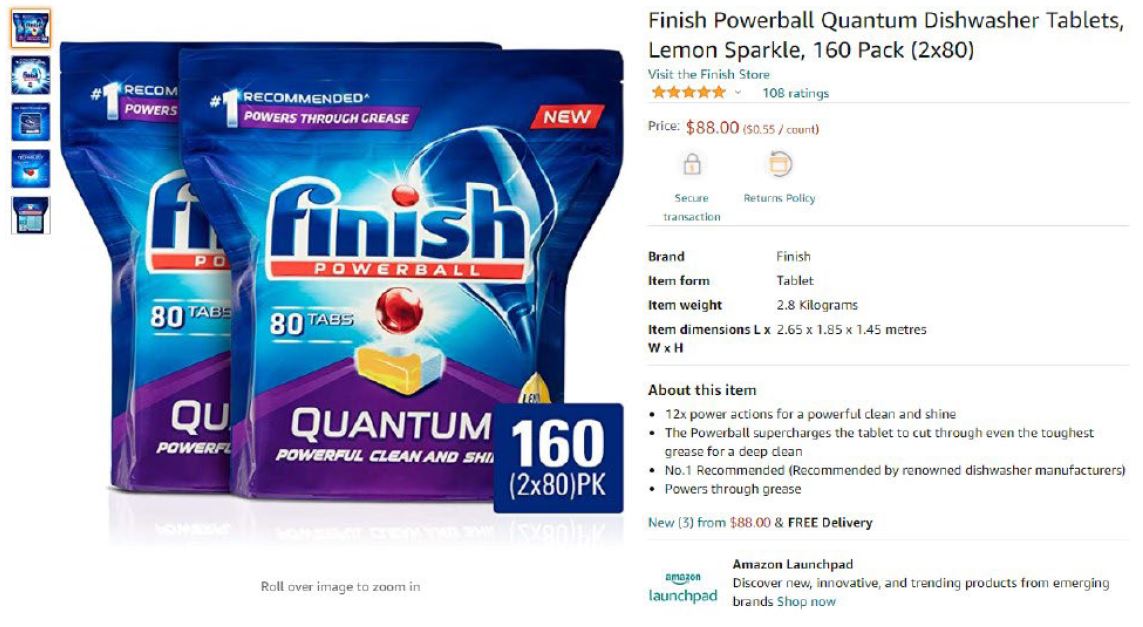
4.2 The findings of the primary judge as to the exercise of discretion | [121] |
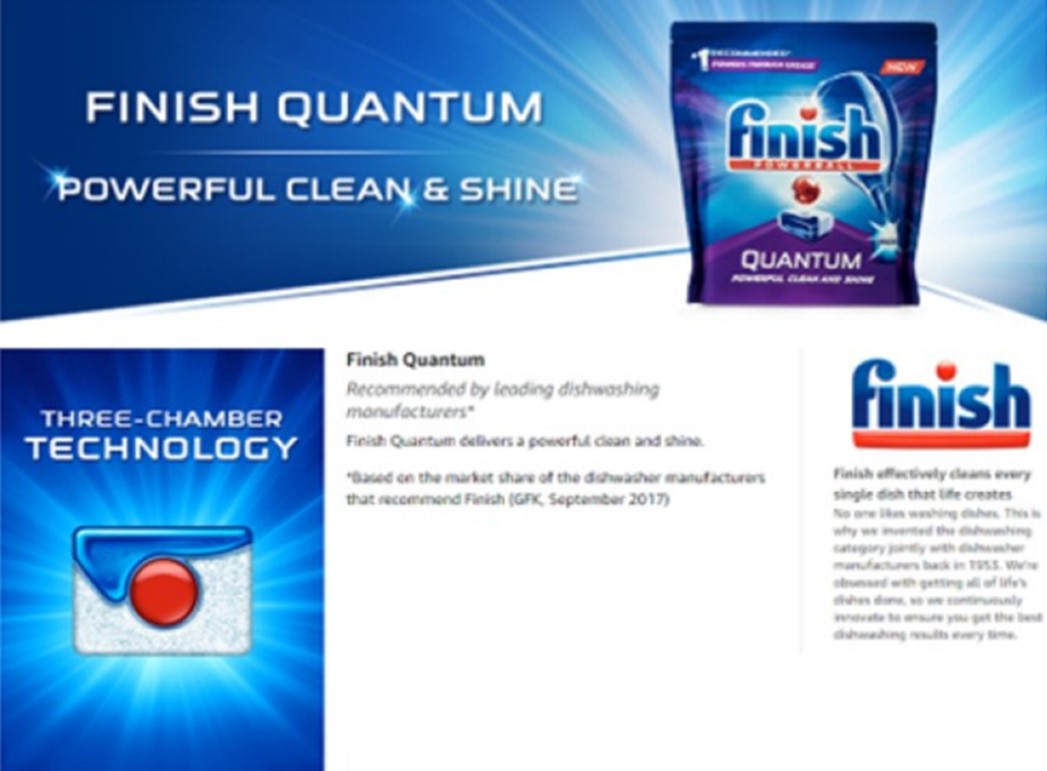
[123] | |
[125] | |
[133] | |
[133] | |
[140] | |
[150] | |
[154] | |
[165] | |
[176] |
THE COURT:
1 This appeal concerns the application of the principles relevant to questions going to the use, non-use and infringement provisions of the Trade Marks Act 1995 (Cth), and whether or not the respondent engaged in conduct in breach of provisions of the Australian Consumer Law (ACL) (being Schedule 2 of the Competition and Consumer Act 2010 (Cth)). The products involved are capsules for use in dishwashers. The primary judge dismissed the infringement claims advanced by the appellant and made orders that the trade marks in question be removed from the Trade Marks Register; RB (Hygiene Home) Australia Pty Ltd v Henkel Australia Pty Ltd [2022] FCA 1042.
2 The appellants are RB (Hygiene Home) Australia Pty Ltd and Reckitt Benckiser Finish BV (RBF). Both are part of the Reckitt Benckiser group of companies, being a group of companies ultimately owned by Reckitt Benckiser Group PLC. The respondent is Henkel Australia Pty Ltd, which is part of the global Henkel group of companies that imports, markets and sells a diverse range of consumer and industrial goods in Australia, including laundry and home care goods.
3 RBF is the owner of two registered trade marks the subject of this appeal. RB is an authorised user of those marks. One is a colour and shape mark, no 1008914 (914 mark), which is registered in respect of goods in classes 1 and 3, including bleaching preparations and other substances for dishwashing, whether or not in solid, fluid or gel form; and dishwasher cleaner, freshener and deodoriser in gelcap form.
4 The 914 mark includes a written endorsement, as set out below, and takes the form of the following representation:
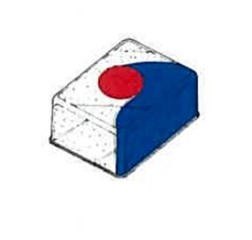
The trade mark consists of the shape and colour of the goods as depicted in the representation attached to the application form, namely, a rectangular shaped capsule with rounded corners; the capsule has a RED cylindrical compartment embedded in the capsule; the RED centre is partly encircled by a BLUE portion of the capsule resembling a wave; the BLUE wave portion of the capsule is made of a gel substance; the remaining portion of the capsule consists of multi coloured granules of powder.
5 The other trade mark is for a design or image and is No 1211311 (311 mark). It is registered in respect of goods in Class 3, including bleaching preparations and other substances for dishwashing; dishwashing preparations; dishwasher cleaner, freshener and deodoriser; and rinse agents. It features a red ball in a white “explosion” against a blue backdrop, as depicted below:

6 Nothing in the present appeals turns on the particular goods the subject of either registration and we refer to them generally below as dishwashing capsules.
7 In the hearing before the primary judge, the appellants alleged that the use of the following logo promoting SOMAT Excellence Gel Caps (SE Gelcaps) constituted infringement of the 914 and 311 marks in breach of s 120(1) of the Trade Marks Act and also constituted misleading and deceptive conduct in contravention of ss 18 and 29 of the ACL and passing off:

(SE Logo)
8 The respondent advanced a cross claim alleging that the 914 and 311 marks should be removed from the Register for non-use pursuant to Part 9 of the Trade Marks Act.
9 The primary judge found, in summary:
(a) that neither of the 914 or 311 marks had been used as a trade mark and declined to exercise her discretion pursuant to s 101(3) of the Trade Marks Act not to remove them from the Register;
(b) that the SE Logo had not been used as a trade mark and accordingly did not infringe the 914 or 311 marks;
(c) that the SE Logo was not deceptively similar to either the 914 mark or the 311 mark and so did not infringe those marks;
(d) that the respondents were entitled to rely on a good faith defence to infringement under s 122(1)(b) of the Trade Marks Act;
(e) that the appellant’s case under the ACL and the tort of passing off based on the contention that consumers familiar with the FINISH tablet products would be likely to view the SE Logo and be misled or deceived into thinking that SE Gelcaps are, or are associated with, the FINISH products was not made out; and
(f) that the ACL claim advanced by the appellants that the respondent had engaged in conduct in breach of s 18(1) and s 29(1)(a) and (g) of the ACL on the basis of a representation to consumers that SE Gelcaps are wholly biodegradable (Biodegradability Representation) by virtue of the use of the following Biodegradability Device on its packaging, was not made out:
10 The primary judge ordered that the 914 mark and the 311 mark be removed from the Register but stayed the operation of that order pending the outcome of the present appeal.
11 The appellants rely on 10 grounds of appeal, to which numerous particulars are appended. In summary, the appeal contends that the primary judge erred:
(a) in finding that the 914 mark had not been used during the non-use period from 16 July 2018 to 16 July 2021 (grounds 1 – 3);
(b) in finding that the 311 mark had not been used during the non-use period (ground 4);
(c) in declining to exercise the discretion under s 101(3) of the Trade Marks Act to retain each of the 914 and 311 marks on the Register (ground 5);
(d) in failing to find that the SE Logo infringed the 914 mark (grounds 6 – 8); and
(e) in failing to find that the Biodegradability Representation was conveyed by the Biodegradability Device (grounds 9 and 10).
1.3 The standard of appellate review
12 When evaluative findings are made on the basis of facts not in dispute (as is the case here), the appellate court stands in the same position as the trial court in its ability to draw the inference. However, before it embarks on that process, it must be satisfied that an error has occurred: Aldi Foods Pty Ltd v Moroccanoil Israel Ltd [2018] FCAFC 93; (2018) 261 FCR 301 at [47] – [48]. In deciding what is the proper inference to be drawn, the appellate court will give respect and weight to the conclusion of the trial judge, but once it has reached its own conclusion, will not shrink from giving effect to it; Warren v Coombes [1979] HCA 9; (1979) 142 CLR 531 at 551. As Perram J explained in Aldi Foods at [49] (Allsop CJ and Markovic J agreeing):
What kinds of case lie in this indeterminate area? Warren v Coombes provides part of the answer: the drawing of inferences from facts already found. But there are other examples, too: does certain packaging convey a representation; is a word capable of distinguishing one trader’s goods from another? There are also some legal standards which are so amorphous in nature that it will be difficult to say with any certainty whether a given fact lies within or without the standard. Examples will include concepts such as unconscionability and oppressive conduct. Whilst the question of whether a given set of facts could fall within such a standard is a question of law (Vetter v Lake Macquarie City Council [2001] HCA 12; 202 CLR 439 at 450 [24]) the question of whether a particular set of facts does do so is a question of fact. It is for that reason that such questions are sometimes referred to as, perhaps confusingly, mixed questions of fact and law. Each of these kinds of standard involves an element of evaluation (just as the drawing of an inference does). When an appellate court comes to review such conclusions it must be guided not by whether it disagrees with the finding (which would be decisive were a question of law involved) but by whether it detects error in the finding. On the one hand, error may appear syllogistically where it is apparent that the conclusion which has been reached has involved some false step; for example, where some relevant matter has been overlooked or some extraneous consideration taken into account which ought not to have been. But error, on the other hand, may also appear without any such explicitly erroneous reasoning. The result may be such as simply to bespeak error. Allsop J said in such cases an error may be manifest where the appellate court has a sufficiently clear difference of opinion: Branir at 437-438 [29].
13 For the reasons set out below, we will order that:
(a) the appeal be allowed in part.
(b) Order 3 of the primary judge, which is for the removal from the Register of the 914 and 311 marks, be set aside.
(c) the respondent be restrained, whether by itself, its directors, employees or agents, from offering for sale or selling its Somat Excellence products under or by reference to the Biodegradability Device.
(d) the respondent pay 80% of the costs of the appeal.
(e) the parties confer and supply to the court within 21 days of these orders draft short minutes setting out any further or other orders that they contend should be made, including as to costs, marked up as to any points of disagreement between them.
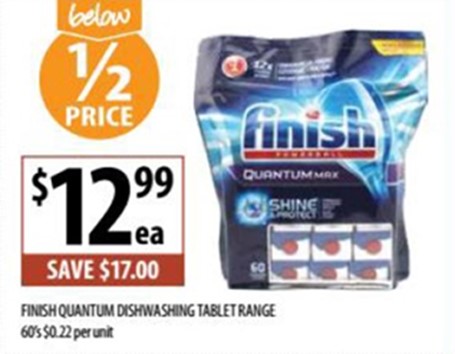
(f) in the event that the parties are unable to agree as to the form of draft orders, within 14 days after the date in (d), the appellants provide a submission of no more than 5 pages setting out their position, with the respondent to provide within 14 days thereafter a submission in answer of no more than 5 pages and the appellants to file a submission in reply of no more than 3 pages within 7 days thereafter, with the dispute to be resolved by the Court on the papers.
2. NON-USE OF THE 914 MARK (GROUNDS 1 – 3)
14 The successful cross claim advanced by the respondent before the primary judge alleged that the 914 and 311 marks ought to be removed under s 92(4)(b) of the Trade Marks Act on the basis that the appellants had not used either as a trade mark during the non-use period in relation to any of the goods in respect of which they are registered.
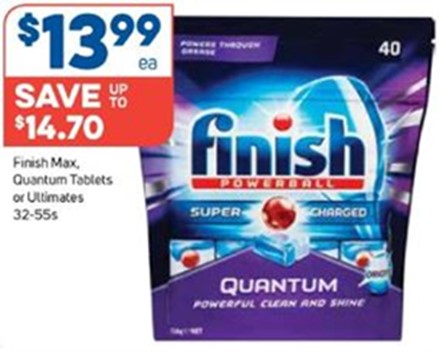
15 The appellants contend in grounds 1 – 3 that the primary judge erred in concluding that the 914 mark had not been used as a trade mark in the non-use period having regard to the sale or promotion of RB products in the following forms:
(a) The use of the Quantum Device, as depicted at [118(a)] of the judgment.
(b) The display of Quantum, Quantum Max and Quantum Ultimate products (collectively, Quantum Products) in four different forms, being the display of those products:
(i) on the Purple Quantum Packaging, as depicted at [141];
(ii) in the clear window on Quantum Tablets Packaging, as depicted at [145];
(iii) on the Amazon online store, as depicted at [168]; and
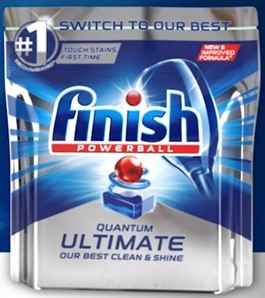
(iv) during three television commercials, as depicted at [148].
16 The appellants submit that as a matter of law, the primary judge erred in failing to apply the correct legal test in determining whether or not there had been “use as a trade mark” when other branding elements are used in conjunction with the sign in question.
17 In ground 5, the appellants contend that the primary judge erred in declining to exercise the discretion under s 101(3) of the Trade Marks Act to retain each of the 914 and 311 marks on the Register.
18 Part 9 of the Trade Marks Act allows for the removal of a registered trade mark from the Register for non-use. Section 92(1) permits a person to apply to the Registrar for removal of a trade mark from the Register where it has not been in use. Where, as in this case, there was pending litigation concerning the trade mark, the person cannot apply directly to the Registrar but must instead apply to the Court under s 92(3) for an order directing the Registrar to remove the mark.
19 Section 92(4) provides the grounds on which an application under ss 92(1) or (3) can be made. The respondent relies on s 92(4)(b), which permits removal where a mark has been registered for a continuous period of three years but has not been used in Australia. Section 92(4)(b) provides:
An application under subsection (1) or (3) (non-use application) may be made on either or both of the following grounds, and on no other grounds:
(a) …
(b) that the trade mark has remained registered for a continuous period of 3 years ending one month before the day on which the non-use application is filed, and, at no time during that period, the person who was then the registered owner:
(i) used the trade mark in Australia; or
(ii) used the trade mark in good faith in Australia;
in relation to the goods and/or services to which the application relates.
20 The trade mark owner bears the onus to prove use in the relevant period in respect of all goods in respect of which the trade mark is registered. Section 100(1)(c) provides:
(1) In any proceedings relating to an opposed application, it is for the opponent to rebut:
…
(c) any allegation made under paragraph 92(4)(b) that the trade mark has not, at any time during the period of 3 years ending one month before the day on which the opposed application was filed, been used, or been used in good faith, by its registered owner in relation to the relevant goods and/or services.
21 For the purposes of s 100(1)(c), the trade mark owner must establish use of the trade mark, or of the trade mark with additions or alterations not substantially affecting its identity: s 100(3).
22 The use must be by the “registered owner”. Section 7(3) provides that an “authorised use” of a registered trade mark is taken to be use of the mark by the registered owner. “Authorised use” and “authorised user” are defined in s 8, which provides in sub-s (1) that a person is an authorised user of a mark if they use the mark under the control of the owner of the trade mark. Without limiting the concept of control in sub-s (1), sub-ss (3) and (4) provide that control can be established by the owner exercising quality control over the goods in relation to which the mark is used, or exercising financial control over the other person using the marks.
23 The Court has a discretion under s 101(3) to allow the trade mark to remain on the Register even if non-use is established during the relevant period. For the discretion to operate in favour of the registered owner, the Court must be positively satisfied that it is reasonable that the trade mark should not be removed.
2.3 The reasoning of the primary judge
24 The primary judge found that FINISH dishwashing products have been sold in Australia since 1964 and FINISH is a well-known brand. Since 1999, the appellants have sold a two-tone white and blue hard-pressed dishwashing capsule in Australia. This FINISH Tablet has a protruding red “Powerball”, an image of which her Honour reproduced at [19]. Since about 2007, they have also sold a three-coloured gelcap (FINISH Gelcap) an image of which she reproduced at [21]:
|
|
FINISH Tablet | FINISH Gelcap |
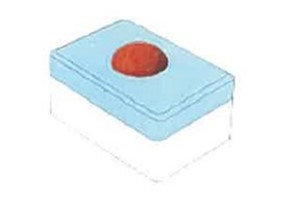

25 It is relevant to note that the primary judge found that the FINISH Gelcap is the form that the FINISH Quantum and FINISH Quantum Ultimate Products take.
26 Her Honour observed for both the FINISH Tablet and the FINISH Gelcap that there is no functional basis for the placement of the components or their colouring. The colours and shape serve a purely aesthetic purpose. Other products in the FINISH range use different colours.
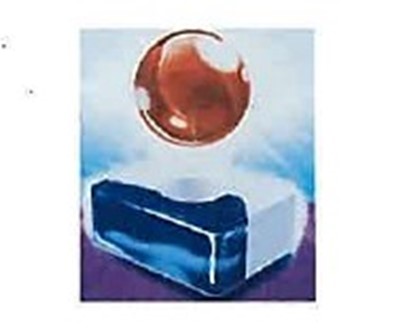
27 The primary judge found that there are several key elements on FINISH packaging that remain relatively constant throughout the range. These include: (a) the FINISH POWERBALL Logo; (b) in the centre of each package, a stylised depiction of the particular dishwashing capsule found in the package, such as the Quantum Device and the Quantum Ultimate Device; and (c) words denoting particular products such as “Quantum Ultimate” or “All in 1 Max”. Her Honour observed that the FINISH packaging is cluttered with other words, phrases and pictures, which vary based on each product within the range.
28 Each of the FINISH POWERBALL Logo, the Quantum Device and the Quantum Ultimate Device are depicted below:
FINISH POWERBALL Logo
|
|
Quantum Device | Quantum Ultimate Device |
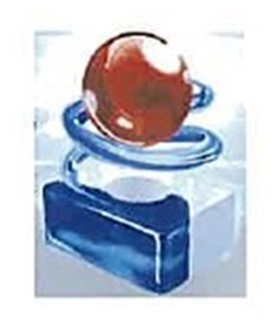
29 After setting out details of the trade marks in suit and the impugned uses of the SOMAT products (to which we return later), the primary judge made some general observations about retail sales of dishwashing products taken from the expert and lay evidence.
30 The primary judge found that automatic dishwashing detergent products are mainly sold in supermarkets and other retail stores like Big W and The Reject Shop. They are also sold online at websites including Amazon and supermarket online shops. The main brands are FINISH and FAIRY which account for about 90% of all sales, the remaining 10% being taken up by smaller brands. Blocks of each brand’s dishwashing products are located together on supermarket shelves, each product package (whether a tablet, capsule or gelcap) having the brand name displayed prominently on the front of the package.
31 The primary judge said at [58] that it is common to the trade to display stylised product depictions on the front of the packaging “to distinguish between the varieties of dishwashing capsule within the brand range”, and set out a range of products that used this technique:
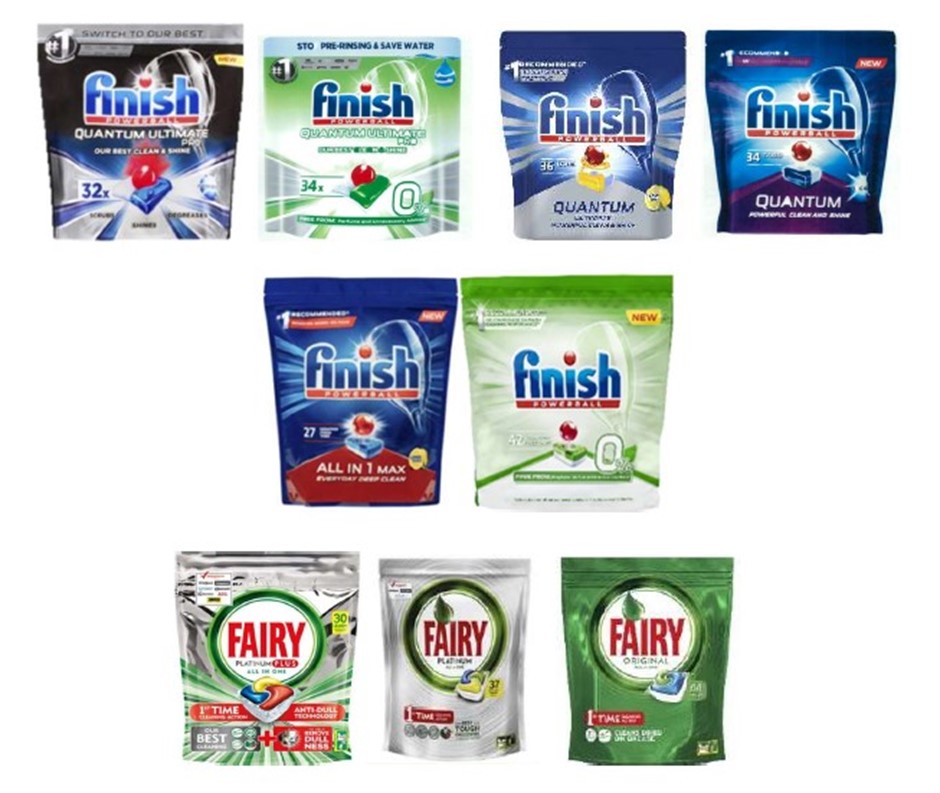

32 The primary judge made a number of observations based on the evidence given by marketing experts Professor O’Sullivan, Professor Klein and Mr Blanket:
(a) The major brands’ packaging of dishwashing capsules is “cluttered” with multiple visual elements and with similar sizing and uses of format.
(b) Consumers of dishwashing capsules spend relatively little time studying the product packaging and may be identified as “low involvement” consumers relative to other items, like appliances or clothing. Even so, consumers will be motivated to select their preferred product and will shop with a predetermined product and brand in mind to buy.
(c) Consumers purchase capsules once in several weeks, but use them daily, seeing the front of the package when they use it, as well as the tablet.
(d) Consumers will use visual stimuli to help them categorise a product and use visual cues to help them find them in busy environments such clues include brand names, colours, typefaces and layout, graphics and imagery.
(e) Faced with multiple cues, consumers tend to place greater weight on cues that they perceive to be more useful in differentiating between brands and products from different brands. When a cue is used by multiple brands within a category, and is thus not unique, it has less utility.
(f) Generally, they rely on the fewest possible cues to make their decision. The brand name will be the most diagnostic cue for identifying a preferred brand but other cues may be pictures of the product, the colour of the packaging, brand variants and pack size.
(g) Cues that are common to the packaging of FINISH and other dishwashing capsule packaging include brand name, a depiction of the product, streaks of light, a wine glass and references to “new” or “best”.
(h) There was a dispute between the experts as to the primacy of brand or imagery as the diagnostic cue. Her Honour preferred the opinion expressed by Professor Klein, who considered that the FINISH POWERBALL Logo was the most diagnostic cue for the consumer to find a FINISH capsule product. She was not persuaded that an image of the product would be a powerful diagnostic tool for a particular variant of a brand.
33 The primary judge then turned to the non-use application and set out at [98] – [106] a summary of the relevant provisions of the Trade Marks Act and the principles applicable to the question of whether there is use as a trade mark in the sense contemplated by s 92.
2.3.2 Use of the 914 mark with additions or alterations not substantially affecting the identity of the trade mark
34 The primary judge considered the law in relation to use on packaging or otherwise of a trade mark that is not the same as the registered trade mark, observing that s 7(1) provides that the Court may decide that a person has used a trade mark if it is established that the person has used the mark with additions or alterations that do not substantially affect the identity of the trade mark. After considering the authorities, the primary judge concluded that the relevant test in this respect equates to an assessment as to whether the use is of a mark that is substantially identical to the registered trade mark in question. Her Honour’s summary of the law is challenged on appeal and we set out her reasons below:
[108] Section 7(1) of the TMA provides that the Court may decide a person has used a trade mark if it is established that the person has used the trade mark with additions or alterations that do not substantially affect the identity of the trade mark. This has been interpreted to require that the two marks must be substantially identical to each other: Optical 88 Limited v Optical 88 Pty Ltd (No 2) (2010) 89 IPR 457 (Optical 88 (FCA)) at [256], affirmed in Optical 88 Ltd v Optical 88 Pty Ltd (2011) 93 IPR 202 (Optical 88 (FCAFC)) at [35]–[39] and PDP Capital Pty Ltd v Grasshopper Ventures Pty Ltd (2021) 160 IPR 174 (PDP Capital) at [161].
[109] The test for assessing substantial similarity involves a side by side comparison of the two marks. The Court must be satisfied that, when viewed side by side, having regard to their similarities and differences, a total impression of similarity emerges from a comparison of the two marks: Shell at 414; PDP Capital at [161]; Carnival Cruise Lines Inc v Sitmar Cruises Ltd (1994) 31 IPR 375 at 391.
35 The primary judge considered whether or not the alleged prior uses of the 914 mark satisfied the requirements of s 92 of the Trade Marks Act by first addressing the question of whether or not the asserted use was of a mark that is substantially identical to the 914 mark. This began with consideration of the endorsement, and a comparison of the similarities between the mark and the alleged uses:
[125] The endorsement to the registration of the 914 Mark notes that [the] capsule has a red cylindrical compartment embedded in the capsule. In the depiction of the 914 Mark, the cylinder appears as a red circle on the top surface of the capsule which is flush with the surface. It is not possible from the depiction alone to know whether the red circle is a spot, or whether the red has depth and extends into or through the capsule, or whether it is visible on the bottom of the capsule. Likewise, in the Quantum Ultimate Product there is a red circle on the top surface which is flush with the surface, it is not possible to see whether the circle has depth and extends into or through the product.
36 Her Honour found the Quantum Products (as depicted in the prior uses set out below in section 2.3.3) to be substantially identical to the 914 mark, but she did not consider either the Quantum Device or the Quantum Ultimate Device (Quantum Devices), depicted above at [28], to be substantially similar to it (at [130]). In this regard, she considered there to be significant differences between the 914 mark and the Quantum Devices such that no total impression of similarity emerges. The appellants do not challenge the primary judge’s findings in relation to the Quantum Ultimate Device but do challenge the finding in relation to the Quantum Device.
37 Her Honour’s reasons concerning the Quantum Devices were as follows:
[133] Both the Quantum Devices feature a prominent red ball floating above the capsule. In contrast the 914 Mark does not feature any image of a red ball. The endorsement refers to a red cylindrical compartment being “embedded” in the capsule and the depiction has a flat red circle flush with the top surface. Even though the cylinder of the 914 Mark is not visible to the viewer, it is apparent to the viewer of the Quantum Devices that the red ball floating above the capsule is not the embedded “cylindrical compartment” of the endorsement.
[134] The red cylindrical compartment is said in the endorsement to be partly encircled by the blue section. In the 914 Mark depiction, the red circle is partly encircled by the blue wave like section of the capsule. In the Quantum Devices the red ball is suspended above the surface of the capsule; there is no contact between the red ball and the capsule, including the blue section.
[135] The red ball in the Quantum Devices floats above the capsules, it is wholly separated from the capsule. In contrast the 914 Mark endorsement refers to a red cylindrical compartment and the depiction has a flat red circle flush with the top surface. In both the endorsement and the depiction, the red element is wholly connected with the capsule, either flush with the surface in the case of the depiction, or embedded within the capsule.
[136] The separation of the red ball from the capsule is emphasised in the Quantum Devices by a “star burst” effect which surrounds the red ball, and of which reflections can be seen on the surface of the red ball. There is also a translucent column of light emanating from the empty hole or cavity in the capsule which connects the ball to the capsule, and suggests that the red ball has burst or exploded dynamically from the capsule. The dynamic movement of the red ball in the Quantum Devices has no counterpart in the 914 Mark.
2.3.3 Instances of alleged use of the 914 mark
38 The primary judge considered instances of use of the Quantum Device and images of the Quantum Products as relied upon by the appellants being use on the Purple Quantum Packaging, on the Quantum Tablets Packaging, in the Three-Chamber Technology image on the Amazon website and in three television commercials. Having rejected the contention that either of the Quantum Devices was sufficiently similar to the 914 mark to satisfy the requirements of s 92, her Honour did not consider it necessary to consider whether the use of the Quantum Devices on the packaging relied upon amounted to trade mark use.
39 It is convenient to set out images of the Purple Quantum Packaging and the Quantum Tablets Packaging as reproduced in the judgment. It will be noted that the Quantum Device is depicted in the centre of the Purple Quantum Packaging:
|
|
Purple Quantum Packaging | Quantum Tablets Packaging |
40 In relation to the image of the Quantum Product on the Purple Quantum Packaging, the primary judge found:
[142] The purple packaging has the FINISH POWERBALL Logo prominently displayed at the centre of the top of the packaging. Under the FINISH POWERBALL Logo is a Quantum Device in the centre of the packaging, with the word “QUANTUM” underneath on a triangular purple section.
[143] A row of four Quantum Ultimate Products is displayed at the bottom of the packaging. The two centre Quantum Ultimate Products are mostly obscured by the purple triangular section that rises up from the bottom of the packaging. The far left and right Quantum Ultimate Products are partially obscured by the purple triangular section, with about three quarters of each visible.
[144] I do not consider that the use of the image of the Quantum Ultimate Product is use as a trade mark on this packaging. The only purpose of the presence of the Quantum Ultimate Product image on this packaging is to show what the product inside the packaging looks like. This is not an example of use of the 914 Mark as a trade mark.
41 In relation to the Quantum Products visible in the clear window of the Quantum Tablets Packaging, the primary judge found:
[146] In this packaging, there is a clear cut out on the front of the bag, where shoppers can see six of the actual Quantum tablets inside the packaging.
[147] Again, I do not consider this packaging to be use of the 914 Mark as a trade mark. Although this packaging does allow shoppers to see the actual product, that product in my view is not functioning as a trade mark. Rather the clear window in the packaging allows the customer to see what the tablets that are otherwise concealed in the packaging look like, taking the place of the stylised depiction.
42 The next example of use relied upon by the appellants were displays of the Quantum Ultimate Product during three television commercials. Her Honour reproduced stills from the commercials as examples. On appeal, the appellant relies on depictions of the Quantum Ultimate Product in each of those commercials. The primary judge identified the following as images of the Quantum Ultimate Product at [148]:
|
|
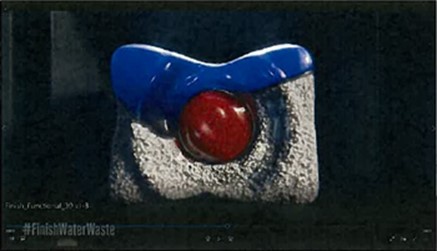
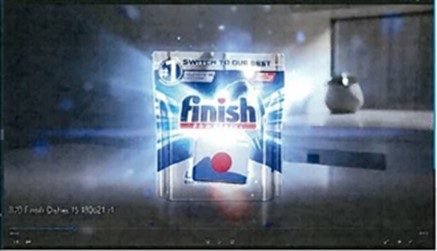
43 Her Honour describes that the first commercial begins with the focus on a packet of FINISH Quantum Ultimate in the centre of screen on a blurred white kitchen bench and a voice over saying “new FINISH Quantum Ultimate with even more cleaning power”. She describes the commercial further:
[152] In an animated sequence the Quantum Ultimate Device on the front of the package transforms into a Quantum Ultimate Product which explodes into round droplets of blue and white liquid. The blue and white liquid droplets then swirl amongst the dirty dishes and glasses to clean them, including, according to the voiceover, by removing grease and leaving them shining. It is during this sequence that the two images relied on by RB appear.
[153] The transformation sequence commences with the red ball suspended above the tablet on the packaging sinking down into the tablet and being absorbed into and becoming a part of the tablet. The tablet then rises out of the packaging to become a Quantum Ultimate Product which comes towards the viewer and for an instant an image like the 914 Mark is seen. It appears that it is during this sequence that the image of the product packaging image (with the Quantum Ultimate Product rather than the Quantum Ultimate Device) above is taken.
[154] The Quantum Ultimate Product is then seen for an instant in a dishwasher before exploding into white, blue and red balls which, in turn, explode outwards. On closer examination the white ball appears to be a clear ball containing granules. The focus of the commercial is then only on the white and blue balls as they travel towards the dirty dishes. Where the balls splatter on the dishes, the dishes are clean. A blue ball then swirls around a glass leaving it clean and shining.
[155] For the last three seconds of the 15-second advertisement the FINISH Quantum Ultimate packaging (as seen at the start of the advertisement) is displayed.
[156] In the first commercial, the display of the Quantum Ultimate Product in the form shown above is the fleeting appearance during the transformation at around the two second mark.
[157] Even less time is devoted to the shot of the product packaging with the Quantum Ultimate Product, which appears only as part of the sequence whereby the Quantum Ultimate Device on the packaging transforms to the Quantum Ultimate Product in the dishwasher.
44 The second and third commercials are more briefly described by the primary judge. Each contains materially the same animated sequence in which the Quantum Ultimate Device transforms into the Quantum Ultimate Product, which includes the images depicted above. The primary judge observes:
[161] In each of the three commercials, it is only possible to discern the stages of the transformation animated sequence described above by stopping the video at millisecond intervals. This is a facility not available to the ordinary viewer of the advertisement on the television during a commercial break. The impression left with the ordinary viewer when the commercial is viewed in its entirety is of the FINISH Quantum Ultimate packaging, as this packaging is displayed at the start and finish of the advertisement for a time sufficient for the viewer to see and read the packaging. This impression is reinforced by the voiceover which emphasises the FINISH brand, for example ending “Choose the Number 1 recommended brand, FINISH”. The viewer is left in no doubt that what is being advertised is a dishwashing capsule product made and offered for sale under the FINISH brand.
[162] The two still images relied upon by RB to show use as a trade mark are decontextualised images, removed from the context in which the consumer viewing the advertisement would actually see them. They are visible if the viewer knows to look for them, and then only if the viewer is able to stop the video to see them, otherwise their appearance is at best fleeting and overwhelmed by the surrounding colour and movement of the advertisement.
[163] These fleeting glimpses of the 914 Mark are not dissimilar to the animated humanised oil drop in the Shell case. In that case, a humanised oil drop was seen throughout the advertisement, but there were only ‘fleeting glimpses of substantial identity’.
45 After referring to Shell Co of Australia Pty Ltd v Esso Standard Oil (Australia) Ltd [1963] HCA 66; (1963) 109 CLR 407 (Shell Oil), the primary judge concludes that none of the fleeting images of the Quantum Ultimate Product shown in any of the television commercials constitute trade mark use:
[166] This reasoning applies with respect to each of the three commercials relied upon by RB, and the short animated sequence within them. The FINISH Quantum Ultimate Product appears fleetingly in the commercials for the purpose of conveying by a combination of pictures and words a particular message about the qualities of the FINISH Quantum Ultimate capsules the subject of the commercials. The FINISH Quantum Ultimate capsule is depicted in a functional role to demonstrate the cleaning power of the FINISH Quantum Ultimate capsule. The image of the FINISH Quantum Ultimate Product appears fleetingly in the course of the animated sequence (which itself only occupies a brief portion of the commercial) the purpose of which is to show the FINISH Quantum Ultimate Product quickly and effectively cleaning dirty dishes and leaving them sparkling. It is not used to designate trade origin. That role is performed by the prominent use of the FINISH brand name and FINISH POWERBALL Logo, both in the text displayed throughout the commercials, on the packaging depicted, and in the voiceovers which form part of the commercials.
[167] I do not consider that the fleeting images of the Quantum Ultimate Product in any of the three television commercials constitute trade mark use.
46 The final example of use of the 914 mark relied upon by the appellants is images taken from the Amazon website depicting the “Three-Chamber Technology” during the non-use period as follows:

(Three-Chamber Technology Images)
47 The primary judge refers to evidence to the effect that in order to view the Three-Chamber Technology Images it was necessary for one witness to take several steps, once she had opened the Amazon.com.au website, including entering the search term “Finish Quantum” into the Amazon site search bar. The search produced many different FINISH products, all bearing the FINISH brand and the word FINISH in the product description. The particular product relied upon by the appellants was the 17th listed. After clicking on the product page, the main image was of the product packaging, with a row of small thumbnails, which included the Three-Chamber Technology Images, located on the left-hand side as follows:
48 The viewer could navigate to the other images by clicking on the thumbnails. If the viewer scrolled further down the page, a larger Three-Chamber Technology Image would be seen as follows:
49 The primary judge rejected the submission advanced by the appellants that the depictions of the product in the Three-Chamber Technology Images were used for more than one purpose. Her Honour found:
[178] The evidence shows that no consumer would ever be immediately confronted with the Three-Chamber Technology Images on entering the Amazon website or searching for “finish quantum”. There are no instances of use of the Three-Chamber Technology Images as the primary image in any advertising use, whether in a supermarket catalogue, television commercial, or online. To the contrary, the evidence is that to find these images, the consumer would need to follow the process undertaken by Ms Cade: to go to the Amazon website, search for “finish quantum”, scroll past 16 other FINISH products displayed as a result of the search (each bearing the prominent FINISH brand), click on the 17th product, and then, once on the page (displaying a large package of FINISH Quantum), click on to the fourth thumbnail at the side of the page (or, alternately, scroll through several further pages of information relating to the product).
[179] At best, all that can be inferred from the evidence, is that during the relevant period, one page on the Amazon website (being for the particular FINISH Quantum product) displayed an image of the 914 Mark, accessible only if the consumer clicked on the thumbnail or scrolled through the information on the page.
[180] The Three-Chamber Technology Images were not immediately available to consumers who searched for a FINISH Quantum product on the Amazon website. It was a matter of chance whether the consumer selected the product page which contained the images from amongst the many that did not.
[181] As Henkel submits, the reasoning of the Full Court in Nature’s Blend Pty Ltd v Nestle Australia Ltd (2010) 87 IPR 464 is apposite (Nature’s Blend). Adopting the language of the Full Court at [42]:
[B]y the time the consumer has [viewed the Three-Chamber Technology Images], if indeed the consumer does so, he or she has already seen that it is in [a FINISH] brand of product with the name of the product variant being [Quantum Max]. If the consumer does go on to [see the Three-Chamber Technology Images], the consumer is well aware by that stage that the brand and commercial source is [FINISH].
[182] Taking into account the context in which the Three-Chamber Technology Images appear, I do not consider that the images on the Amazon website constitute trade mark use. The images are not being used to distinguish FINISH goods from those of others. By the stage at which the images are encountered on the website, the consumer is well and truly aware that they are looking at a particular variant of a FINISH product on the Amazon site. The images are used to highlight particular technical attributes of the tablets — that they utilise ‘three-chamber’ technology — and not as a badge origin.
2.4 The law concerning use as a trade mark
50 Section 17 of the Trade Marks Act provides that a trade mark is a sign used, or intended to be used, to distinguish goods or services dealt with or provided in the course of trade by a person from goods or services so dealt with or provided by any other person.
51 Subsection 7(4) provides that “use of a trade mark in relation to goods” means “use of the trade mark upon, or in physical or other relation to, the goods (including second-hand goods)”.
52 The word “sign” is defined in s 6 of the Trade Marks Act as follows:
sign includes the following or any combination of the following, namely, any letter, word, name, signature, numeral, device, brand, heading, label, ticket, aspect of packaging, shape, colour, sound or scent.
53 The authorities establish that context is all-important. Not every use of a sign that is identical with or deceptively similar to a registered trade mark will infringe within s 120 of the Trade Marks Act or amount to use within s 92. In Shell Oil, Kitto J (Dixon CJ, McTiernen and Owen JJ agreeing) noted at 425 that the question becomes whether, in the setting in which the particular pictures referred to were presented, they would have appeared to the viewer as possessing the character of devices, or brands, which the appellant was using or proposing to use in relation to petrol for the purpose of indicating, or so as to indicate, a connexion in the course of trade between the petrol and the appellant. That statement has been followed on many occasions. The test has also been framed as a question of whether or not the use in question has been use as a “badge of origin”: E & J Gallo Winery v Lion Nathan Australia Pty Ltd [2010] HCA 15; (2010) 241 CLR 144 (Gallo) at [43]; Coca-Cola Co v All-Fect Distributors Ltd [1999] FCA 1721; (1999) 96 FCR 107 at [19]; Koninklijke Philips Electronics NV v Remington Products Australia Pty Ltd [2000] FCA 876; (2000) 100 FCR 90 at 103 [15] per Burchett J (Hill and Branson JJ agreeing).
54 Recently, in Self Care IP Holdings Pty Ltd v Allergan Australia Pty Ltd [2023] HCA 8; (2023) 408 ALR 195, the High Court said:
[23] Use of a trade mark in relation to goods means use of a trade mark upon, or in physical or other relation to, those goods, and so can include use of the mark on product packaging or marketing such as on a website. There is a distinction, although not always easy to apply, between the use of a sign in relation to goods and the use of a sign as a trade mark. A trade mark is a sign used, or intended to be used, to distinguish goods dealt with by one trader from goods dealt with by other traders; that is, as a badge of origin to indicate a connection between the goods and the user of the mark.
[24] Whether a sign has been "use[d] as a trade mark" is assessed objectively without reference to the subjective trading intentions of the user. As the meaning of a sign, such as a word, varies with the context in which the sign is used, the objective purpose and nature of use are assessed by reference to context. That context includes the relevant trade, the way in which the words have been displayed, and how the words would present themselves to persons who read them and form a view about what they connote. A well known example where the use was not "as a trade mark" was in Irving's Yeast-Vite Ltd v Horsenail, where the phrase "Yeast tablets a substitute for 'Yeast-Vite'" was held to be merely descriptive and not a use of "Yeast-Vite" as a trade mark. Therefore, it did not contravene the YEAST-VITE mark.
[25] The existence of a descriptive element or purpose does not necessarily preclude the sign being used as a trade mark. Where there are several purposes for the use of the sign, if one purpose is to distinguish the goods provided in the course of trade that will be sufficient to establish use as a trade mark. Where there are several words or signs used in combination, the existence of a clear dominant "brand" is relevant to the assessment of what would be taken to be the effect of the balance of the label, but does not mean another part of the label cannot also act to distinguish the goods.
(Citations omitted.)
55 The references provided in Self Care at [25] were to Woolworths Ltd v BP Plc (No 2) [2006] FCAFC 132; (2006) 154 FCR 97 at [77] (Woolworths full court) and Anheuser-Busch Inc v Budejovický Budvar Národní Podnik [2002] FCA 390; (2002) 56 IPR 182 at 227 [191].
56 In Woolworths full court, the Full Court (Heerey, Allsop, Young JJ) said (citations omitted):
[77] Whether or not there has been use as a trade mark involves an understanding from an objective viewpoint of the purpose and nature of the use, considered in its context in the relevant trade. How the mark has been used may not involve a single or clear idea or message. The mark may be used for a number of purposes, or to a number of ends, but there will be use as a trade mark if one aspect of the use is to distinguish the goods or services provided by a person in the course of trade from the goods or services provided by any other persons, that is to say it must distinguish them in the sense of indicating origin…
[78] It is necessary, therefore, to examine the evidence of the use by BP of colour before 1991 and before 1995 to assess whether, objectively, the use of colour (identifying what colour or colours) would be understood in the context of the trade and the surrounding circumstances to have been used so as to indicate a connection in the course of trade between the product or service and the person using the mark, in the respects claimed in the application.
57 In Anheuser, Allsop J (as the former Chief Justice then was) said at [191]:
It is not to the point, with respect, to say that because another part of the label (the white section with ‘Budějovický Budvar’) is the obvious and important ‘brand’, that another part of the label cannot act to distinguish the goods. The ‘branding function’, if that expression is merely used as a synonym for the contents of ss 7 and 17 of the TM Act, can be carried out in different places on packaging, with different degrees of strength and subtlety. Of course, the existence on a label of a clear dominant ‘brand’ is of relevance to the assessment of what would be taken to be the effect of the balance of the label.
58 In reviewing the authorities, the primary judge in the present case referred at [106] to the decision of the Full Court in Pepsico Australia Pty Ltd v Kettle Chip Company Pty Ltd [1996] FCA 48; (1996) 33 IPR 161 where Sackville J, with whom Lockhart J agreed, said at 213:
The purpose and effect of the words are to be determined by having regard to the context in which they are used. In this connection, the fact that Frito-Lay has used the words in conjunction with its own distinctive mark (THINS and, perhaps, DOUBLE CRUNCH) does not prevent the use being for the purpose of distinguishing its chips from those of other traders. However, the use of the distinctive marks on Frito-Lay’s packets has a bearing on whether the words ‘Kettle Cooked’ have been used to show the commercial origin of the potato chips in the packets, or whether they have some other purpose and effect. It is necessary to consider the words used, as they present themselves to buyers or potential buyers of Frito-Lay’s chips who are to form a view about what they are meant to connote.
59 It is apposite to note that the 914 mark is a three-dimensional or shape trade mark. Like the colour trade mark under scrutiny in Woolworths full court, it is a non-traditional mark. There are likely to be complexities in the analysis arising from that fact because the distinction between the product itself and the trade mark may become difficult to discern, the former being perhaps analogous to a descriptive use. After the introduction of such marks with the passing of the 1995 Trade Marks Act, there was some discussion of their role, and the challenges posed in determining whether or not their use is in a trade mark or another sense.
60 In Koninklijke Philips, a case concerning two-dimensional trade marks in the shape of the head of an electric shaver, Burchett J observed that before the 1995 Trade Marks Act, Australian courts accepted the law expounded by Windeyer J in Smith Kline and French Laboratories (Australia) Limited v Registrar of Trade Marks [1967] HCA 42; (1967) 116 CLR 628 at 639 – 640, to the effect that the definition of a trade mark as “a mark used or proposed to be used in relation to goods” assumed that the trade mark is something distinct from the goods in relation to which it is used or to be used, that is, something which is extra, which is added to the goods for the purpose of denoting the origin of the goods. His Honour considered, obiter dicta, that the inclusion of shape trade marks in the 1995 Trade Marks Act was not intended to effect a radical change in trade mark law and that if the trade mark is for a shape, it must remain something extra added to distinguish the products of one trader from those of another, a function which cannot be performed by a mark consisting of either a word or a shape other traders may legitimately wish to use. His Honour said at [16]:
It does not follow that a shape can never be registered as a trademark if it is the shape of the whole or a part of the relevant goods, so long as the goods remain distinct from the mark… A shape may be applied, as has been said, in relation to goods, perhaps by moulding or impressing, so that it becomes a feature of their shape, though it may be irrelevant to their function. Just as a special word may be coined, a special shape may be created as a badge of origin. But that is not to say that the 1995 Act has invalidated what Windeyer J said in Smith Kline. The special cases where a shape of the goods may be a mark are cases falling within, not without, the principle he expounded. For they are cases where the shape that is a mark is “extra”, added to the inherent form of the particular goods as something distinct which can denote origin. The goods can still be seen as having, in Windeyer J’s words, “an existence independently of the mark” which is imposed upon them.
61 In Kenman Kandy Australia Pty Ltd v Registrar of Trade Marks [2002] FCAFC 273; 122 FCR 494, a case concerning whether a three dimensional bug shape was inherently adapted to distinguish confectionary from the goods of other persons within s 41 of the Trade Marks Act, Stone J, who together with French J was in the majority (Lindgren J dissenting), observed that the reservations expressed in Koninklijke Philips arose in the context where the shape of the goods in question had functional significance, the concern of the Court there being to ensure that potentially perpetual monopolies were not created over products, the shape of which other traders would wish to use. Her Honour said at [137] (French J agreeing at [45]):
The concerns expressed in both Philips v Remington (Aust), FC and Philips v Remington (Eng) about the prospect of trade marks creating monopolies related only to the registration of trade marks that would restrict access to functional features or innovations, and for this reason were well founded. It is this concern that finds expression in the requirement that a trade mark be something added to the inherent form of goods. The “inherent form” of goods, in my view, can only refer to those aspects of form that have functional significance. Were the 1995 Act to enable the registration of a trade mark that would give the owner a monopoly over functional features it would indeed have made a radical change to trade mark law. There is nothing in the 1995 Act or in the discussions that preceded it to suggest that this was intended…
62 Justice Stone considered that where a shape trade mark had non-functional features it had the capacity to operate as a trade mark for the purpose of distinguishing the proprietor’s goods from those of other persons (at [143]). That case was concerned with an objection raised under s 41 of the Trade Marks Act, as to whether a shape trade mark was inherently adapted to distinguish the goods of one trader from those of another. In finding that the shape in question was so adapted, it was not necessary for the Court to consider when such a shape trade mark is being used as a sign within s 17, as opposed to being simply the product that is for sale.
63 In relation to the Quantum Device (grounds 2 and 3), the appellants first raise a legal argument. They submit that the primary judge erred in concluding that the test under s 100(3) of the Trade Marks Act of “additions or alterations not substantially affecting its identity” is the same as the test for substantial identity identified in other sections of the Trade Marks Act, including s 120 and s 44. In oral submissions, they contended that the primary judge’s reliance on the decision in PDP Capital Pty Ltd v Grasshopper Ventures Pty Ltd [2021] FCAFC 128; (2021) 285 FCR 598 was misplaced and, if necessary, would contend that that case was wrongly decided. They submit that whilst two marks that are substantially identical will satisfy the test under s 100(3)(a), for a mark to fall within the relevant provision it must only resemble the mark as registered as to give it a total impression of similarity, citing Gallo at [69].
64 In this regard, the legal argument advanced relies on three propositions.
65 First, no binding authority indicates that the language of s 100(3)(a) should be understood to mean the same thing as the test for whether one trade mark is substantially identical to another one, as required in s 120 (infringement) and elsewhere. Secondly, the statutory language of s 100(3)(a) calls for analysis in terms as set out, namely, that the trade mark, or the trade mark with additions or alterations not substantially affecting its identity, be used (in good faith). Substantially affecting the identity goes to the question of whether the mark will still have the identity in its relationship with consumers, its capacity to convey to consumers the information that the registration conveys. Whereas, the substantial identity test is whether sitting side by side, making lists of their similarities and differences, (under s 100(3)(a) this is not required) the differences were so minor that the total impression of similarity may emerge. Thirdly, the requirements of s 100(3)(a) are less onerous than that required for ascertaining whether one mark is substantially identical to another and requires identification of the identity of the mark, and consideration of whether alterations affect that identity, which is in practice a degree more liberal than the test for substantial identity.
66 The appellants submit further that the primary judge failed correctly to apply the test for substantial identity by looking only at differences and not assessing their impact relative to the similarities. Had she applied the correct approach, they submit that the result would have been different and that the Quantum Device had been used as a trade mark.
67 In relation to the Quantum Tablets Packaging (ground 1), the appellants refer to the use of the FINISH POWERBALL Logo and the clear cut-out on the front of the bag which allows shoppers to see six of the actual FINISH Quantum products. They submit that the primary judge failed to analyse the use of the tablet shape in context, the function it performs and what it tells the consumer and further failed to conclude that the FINISH Quantum tablets perform at least the dual function as a badge of origin and being a feature of the packaging itself, in context the six tablets arranged in a tessellate pattern, showing the red powerball centre and blue gel wave on the top informs the consumer that “this tablet comes from FINISH”.
68 In relation to the Purple Quantum Packaging (ground 1), the appellants referred in oral submissions to the depictions of the Quantum Product. A row of four Quantum Products is displayed towards the bottom of the packaging, under the words “SUPER CHARGED”, partially obscured by the purple triangular section in which the word “QUANTUM” appears. They submit that these depictions perform a trade mark function and convey a message to consumers that the Quantum gelcap product, one of the products in the FINISH family, is to be found inside the pack. The appellants accept that the depictions may also perform a descriptive function but contend that the shape and colour elements, which have no functional purpose, have been added to the capsule to indicate to the consumer that the product comes from a particular source (namely, FINISH).
69 In relation to the Three-Chamber Technology Images, the appellants contend that the primary judge erred in asking whether the sign was “immediately available to” a person navigating the Amazon website and ought to have found that the display of the products was dual use.
70 In relation to the television commercials, the appellants contend that images of the Quantum Ultimate Product were present in each. The primary judge mischaracterised the display of the product as having a single, functional role to demonstrate its cleaning power, not to designate trade origin and failed to find that the images might have a dual purpose, and that multiple signs can have a branding function.
71 The respondents submit that for each use relied upon it was open to the primary judge to conclude that the only purpose of the images of the Quantum Products was to show the consumer what the product inside the packaging looked like. That evaluative conclusion was open to her based on the authorities, noting that each of Pepsico Australasia and Anheuser involved the question of multiple trade marks playing multiple roles on a product’s packaging, the primary judge having considered the specific context of the dishwashing capsule market where it is common in the trade for multiple visual images to appear on the packaging. In relation to the Quantum Tablets Packaging, the respondents submit that the conclusion that there was not trade mark use arose after the primary judge had properly considered the evidence that it was common for multiple visual images to appear on the packaging of each product and where different stylised product depictions distinguish between different varieties of capsule within each brand range.
72 It is convenient to address the appellants’ case by reference to the instances of use upon which it relies.
73 It is first necessary to address the legal argument concerning the correct approach to s 100(3)(a) before considering the question of whether the primary judge erred in concluding that the prior use relied upon by the appellants should be set to one side.
74 Section 100(3)(a) provides that for the purposes of considering an opposition to removal of a trade mark for non-use, the opponent is taken to have rebutted the allegation of non-use during the relevant period if it has established “that the trade mark, or the trade mark with additions or alterations not substantially affecting its identity, was used…”
75 In Gallo, the plurality relevantly considered a cross claim for the removal of the trade mark BAREFOOT pursuant to s 92(4)(b). The issue was whether within the terms of s 100(3)(a), Gallo had established that it had made use of the mark within the non-use period. The prior use relied upon involved the word BAREFOOT in conjunction with a stylised device of a bare foot. Lion Nathan contended that this did not constitute use of the registered mark. This argument was rejected by the primary judge. The Full Court did not consider the issue. The High Court also rejected the argument, finding at [69]:
…The addition of the device to the registered trade mark is not a feature which separately distinguishes the goods or substantially affects the identity of the registered trade mark because consumers are likely to identify the products sold under the registered trade mark with the device by reference to the word BAREFOOT. The device is an illustration of the word. The monopoly given by a registration of the word BAREFOOT alone is wide enough to include the word together with a device which does not substantially affect the identity of the trade mark in the word alone. So much is recognised by the terms of s 7(1), which speak of additions or alterations which "do not substantially affect the identity of the trade mark". Except for a situation of honest concurrent use, another trader is likely to be precluded from registering the device alone while the registered trade mark remains on the Register. The device is an addition to the registered trade mark that does not substantially affect its identity. Accordingly, the use of the registered trade mark with the device constitutes use of the registered trade mark in accordance with s 7(1).
76 Although this passage refers to s 7(1) of the Trade Marks Act rather than s 100(3)(a), it is apparent from the Court’s conclusion at [70] that the plurality considered that nothing turned on the slightly different wording of the two provisions.
77 The appellants submit that the primary judge erred at [108] in equating the test under s 100(3)(a) of the Trade Marks Act with the test for substantial identity and challenge the correctness of her reliance on the reasoning in Optical 88 Limited v Optical 88 Pty Limited (No 2) [2010] FCA 1380; (2010) 275 ALR 526 (Optical 88 first instance), Optical 88 Ltd v Optical 88 Pty Ltd [2011] FCAFC 130; (2011) 197 FCR 67 (Optical 88 full court) and PDP Capital.
78 In the passage cited by her Honour in Optical 88 first instance, Yates J said:
[256] Is the modified ‘707 mark a use of the ‘707 mark with additions or alterations not substantially affecting its identity? In order for that question to be answered affirmatively it is necessary to find that a total impression of similarity emerges from a comparison between the two marks: Carnival at 391; Shell at 414. In my view a total impression of similarity does emerge from a comparison of the modified ‘707 mark with the ‘707 mark itself. I therefore find that, by using the modified ‘707 mark, the applicant used the ‘707 mark with additions or alterations not substantially affecting its identity. However, the ‘707 mark is registered only for goods, not services.
79 By the authorities cited in this passage, Yates J invoked the test for substantial identity of marks considered by Gummow J (sitting then as a judge of the Federal Court) in Carnival Cruise Lines Inc v Sitmar Cruises Ltd [1994] FCA 68; (1994) 31 IPR 375 at 391 which:
…requires a total impression of similarity to emerge from a comparison between the two marks.
80 This, as Gummow J explained, was a summary of the well-known statement of principle of Windeyer J in Shell Oil who, after referring to the distinction between a mark which is substantially identical to another and a mark which is deceptively similar to another, said at page 414:
In considering whether marks are substantially identical they should, I think, be compared side by side, their similarities and differences noted and the importance of these assessed having regard to the essential features of the registered mark and the total impression of resemblance or dissimilarity that emerges from the comparison.
(Emphasis added.)
81 The Full Court in Optical 88 affirmed the decision of Yates J, although the point now raised was not taken on appeal. The approach of Yates J was accepted as correct by the Full Court in PDP Capital at [49] and [161].
82 One must of course allow for differences in statutory language. The words “that the trade mark, or the trade mark with additions or alterations not substantially affecting its identity, was used” permits a scope for deviation between a mark as registered and a mark as used: the monopoly given by registration includes use of a mark with changes that do not substantially affect the identity of the mark. That question involves evaluation of the identity of the mark as registered and consideration of whether or not the mark used during the non-use period (provided for in s 94(4)(b)) is with additions or alterations “not substantially affecting its identity”.
83 Evaluative comparisons of this type are an important and long-standing feature of trade mark law. In the Trade Marks Act 1955 (Cth), the test for proprietorship of a trade mark was not set out in terms in the Act, rather, under s 40(1), a person who claimed to be the proprietor of a trade mark could oppose the registration by another who makes an application. In determining competing applications, it was for the challenger to establish “nothing less” than substantial identity between the two marks; Carnival Cruise at 391. This served to establish the degree of deviation permitted between the registered prior mark and the claimed ownership of a later mark and is consistent with cases decided in the 19th century about what could be registered based on prior use; Colorado Group Ltd v Strandbags Group Pty Ltd [2007] FCAFC 184; (2007) 164 FCR 506 (Kenny, Gyles, Allsop JJ) at [106], citing In re J B Palmer’s Trade Mark (1883) 24 Ch D 504; Re Spencer’s Trade Mark (1886) 54 LT NS 659; In re Grossmith’s Trade Mark (1889) 6 PR 180; Perry Davis & Son v Harbord (1890) 15 App Cas 316; Powell v The Birmingham Vinegar Brewery Company Limited [1894] AC 8; Re Chorlton and Dugdale’s Trade Mark (1885) LT NS 337.
84 The appellants submit that whilst two trade marks that are substantially identical will satisfy the test under s 100(3)(a), the proper question is not one of side-by-side comparison between marks, but rather whether the mark “will still have the identity in its relationship with consumers in its capacity to convey to consumers the information that the registration conveys”. Despite the care with which this submission was put, we do not accept it to be correct.
85 It is apparent from the authorities to which we have referred that the statutory test must be applied in terms, namely by asking whether the opponent (here, the trade mark owner) has established that the trade mark or the trade mark with additions or alternations not substantially affecting its identity was used (in good faith). In considering whether such additions or alterations have been made, the identity of the mark must first be considered and whether that identity has been “substantially affected”. An addition or alternation not substantially affecting its identity will be a permissible deviation from the registered mark. Consideration of that question cannot realistically take place without a review of the features and characteristics of the two marks and a comparison between them. Whether or not the test is satisfied will in most cases be determined by considering whether a total impression of similarity emerges from a comparison between the two marks. Whether or not there exists a penumbra of cases where a mark that is not substantially identical (within established principles) nonetheless falls within s 100(3)(a) does not arise in the present case.
86 We have set out at [37] above the primary judge’s consideration of the question in relation to the Quantum Devices. The appellants challenge only the finding that the Quantum Device does not satisfy the test in s 100(3)(a). That involves a comparison of that device with the 914 mark in the context of its likely use:
|
|
Quantum Device | 914 mark (noting the endorsement set out at [4] above) |
87 The primary judge compared the features of the Quantum Device with those of the 914 mark, noting that the former includes a red ball floating above a capsule, whereas the latter does not feature any image of a red ball. Furthermore, the red ball has no contact with the capsule or any blue section, as required by the endorsement. The dynamic movement of the red ball in the Quantum Device, depicted by a “star burst” effect which surrounds the red ball has no counterpart in the 914 mark. These features were sufficient to satisfy her Honour that the Quantum Device is not substantially identical to the 914 mark.
88 We see no error in her Honour’s reasoning in this respect. Nor, setting aside that test and considering whether or not the Quantum Device constitutes use of the mark with additions or alterations not substantially affecting its identity, would we consider that there should be any different result. A quite different impression is yielded when one considers the respective marks, such that in our view the Quantum Device does have additions or alterations substantially affecting the identity of the 914 mark. The features to which the primary judge drew attention support that conclusion. Those changes do not fall within the range of deviation contemplated by s 100(3)(a). In our view, this ground of appeal must be dismissed.
2.6.2 Quantum Tablets Packaging
89 The primary judge found that the depiction on the Quantum Tablets Packaging of the FINISH Quantum Product was substantially identical to the 914 mark, but found that as depicted, it did not amount to trade mark use. Her Honour concluded at [147] that the clear window merely allows the customer to see what the tablets look like, taking the place of the stylised depiction that is typically on other FINISH packaging.
90 In our evaluation, the finding of her Honour in this respect reflects error.
91 For convenience we reproduce the image relied upon:
92 In reviewing background matters relevant to the trade, the primary judge observed at [58] that it was common to display stylised product depictions on the front of the packaging to distinguish between the varieties of dishwashing capsule within a brand range. Later, in considering the expert evidence, the primary judge noted the experts’ agreement that a variety of aspects of packaging play a role in allowing a consumer to identify a branded product, including “graphics and imagery” (at [68]) and that a common cue to the packaging of FINISH and other capsule packaging included a depiction of the product, although because such a cue is used by multiple brands within a category, it has “less utility as a cue that products come from a specific brand” and “customers will not typically scan the shelves for such an element” (at [73], [74]). Her Honour later considered that product images are unlikely to be “the primary diagnostic cue for a particular variant of a brand” (at [83]) and accepted Professor Klein’s opinion that the FINISH POWERBALL Logo was the “most diagnostic cue” for the consumer to find a FINISH capsule product (at [86]). However, as the authorities make clear, to establish trade mark use it is not necessary for the mark in question to be the primary diagnostic tool; Woolworths full court at [77]; Pepsico Australia at 213.
93 It is apparent that six capsules of the Quantum Product visible to the consumer through the clear window at the front of the packaging and arranged in a tessellate pattern show the red powerball centre and blue gel wave on top. They serve to provide a visual prompt to the consumer. In our respectful view, the primary judge failed to take into account that a display of the product could serve a dual function: not only to serve the descriptive function of showing the product for sale, but also serving to reinforce to the consumer that the product is the very one that comes from the supplier of FINISH products. Having found that the Quantum Product is substantially identical to the 914 mark, and after noting earlier that there is no functional basis for the placement of the components or colouring of the features of the 914 mark, they serving a purely aesthetic purpose (at [21]), in our view the primary judge ought also, having regard to the context of use in the Quantum Tablets Packaging, to have concluded that the display of the tablets reflected trade mark use. In that respect, it is not to the point that there are other obvious brands displayed on the packaging. As the High Court noted in Selfcare at [25], the existence of a descriptive element or purpose does not necessarily preclude the sign being used as a trade mark. In our view, in objective terms it may accurately be said that the display of the Quantum Product in the window serves, at least as one purpose, to distinguish the goods in the course of trade in reference to their origin.
2.6.3 The Purple Quantum Packaging
94 The appellants contend that the primary judge erred in her assessment that the depiction of the Quantum Product on the front of the Purple Quantum Packaging did not amount to trade mark use. For convenience, we reproduce the image relied upon:
95 For the reasons given above in relation to display of the Quantum Product in the window of the Quantum Tablets Packaging, we respectfully consider that the primary judge ought to have found that the depictions of the Quantum Product on the Purple Quantum Packaging also constitute trade mark use.
96 The appellants criticise the primary judge’s findings in relation to the Three Chamber Technology Images in two respects. First, they submit that the primary judge’s findings at [178] – [182] to the effect that the image of the Quantum Product was not “immediately available to” the consumer or the consumer was not “immediately confronted” by the sign reflect error. They submit that “immediacy” is not part of the test. Secondly, they submit that the primary judge erred in concluding that a person viewing the Three-Chamber Technology Images would not see them as a trade source.
97 In our view, neither criticism is warranted. The purpose of highlighting the obscure availability of the Three-Chamber Technology Images was for her Honour to explain the context in which the consumer came to see them. That is, after they had been supplied with numerous references to other trade marks to enable them to identify the trade source of the product. Her Honour considered that this context informed the next conclusion, which was that the images are used to highlight particular technical attributes of the tablets, namely that they utilise ‘three-chamber’ technology. Her Honour did not consider that this was a circumstance where the image of the product was used as a sign to indicate trade origin. We do not consider that the appellants have identified error in that conclusion.
2.6.5 The three television commercials
98 We have set out above in section 2.3.3 the primary judge’s description of the first television commercial. The appellants do not challenge the accuracy of that description. As noted above at [44], each of the three commercials contain the same animated sequence in which the Quantum Ultimate Device transforms into the Quantum Ultimate Product. The appellants submit that because images of the Quantum Ultimate Product were present in the commercials, the primary judge ought to have concluded that it was being used in a trade mark sense. They also submit that her Honour erred by failing to apply the principles that a sign may have a dual purpose and that multiple signs may perform a branding function.
99 As we have noted, the identification of a shape that is not only a registered trade mark but also the shape of the product being sold presents a particular challenge when it comes to establishing use. There may be an inherent ambiguity between the display being simply of the product, and the display being not only of the product but also of the shape as a designation of trade origin; Koninklijke Philips at [16]; Kenman Kandy Australia Pty Ltd v Registrar of Trade Marks [2002] FCAFC 273; (2002) 122 FCR 494 at [137].
100 The primary judge considered that in the transformation sequence the Quantum Ultimate Product is depicted and “for an instant” an image like the 914 mark is seen (at [153]) before exploding into white, blue and red balls which, in turn explode outwards. This description accords with our viewing of the commercials. The primary judge considered that it was only possible to discern the stages of the transformation sequence by stopping the video at millisecond intervals. The impression left with the ordinary viewer (who does not have the facility or the desire to do this) is of the FINISH Quantum Ultimate packaging as displaying the trade marks that indicate the source of origin of the tablet displayed. That packaging, which does not include an image of the Quantum Ultimate Product is as follows:
101 We do not consider that the applicants have established error in the primary judge’s conclusion that the fleeting display of the product did not, in context, amount to trade mark use.
2.6.6 Summary in relation to non-use of the 914 mark
102 For the reasons set out above, we find that the appellants have established error in the conclusion that the 914 mark was not used during the relevant period, by reason of the use in respect of the Quantum Tablets Packaging and Purple Quantum Packaging. Accordingly, it is not necessary to consider the exercise of discretion under s 101(3) in respect of that mark. It is entitled to remain on the register.
3. NON-USE OF THE 311 MARK (GROUND 4)
103 In ground 4, the appellants contend that the primary judge erred in finding that the 311 mark had not been used as a trade mark having regard to the use of the red dot over the second “I” in FINISH as used in the FINISH POWERBALL Logo as it appears on the appellants’ packaging.
3.2 The reasoning of the primary judge
104 The case advanced before the primary judge was that the 311 mark had been used as a trade mark in the context of the FINISH POWERBALL Logo, which is pictured below:
105 The primary judge noted that it is well-established that use of a mark that is a component of a larger composite mark, or a mark used in conjunction with other marks, can still constitute use of a trade mark, citing Chocolaterie Guylian NV v Registrar of Trade Marks [2009] FCA 891; (2009) 180 FCR 60 at [97]; Sports Warehouse Inc v Fry Consulting Pty Ltd [2010] FCA 664; (2010) 186 FCR 519 at [133]; and Phone Directories Company Australia Pty Ltd v Telstra Corporation Limited [2014] FCA 373; (2014) 106 IPR 281 at [245]. Her Honour referred to the decision at first instance of Finkelstein J in BP plc v Woolworths Limited [2004] FCA 1362; (2004) 212 ALR 79 (Woolworths first instance), where his Honour considered case law from the US and the principles governing when separate components are registerable. His Honour observed at [64]:
[S]eparate components of a single get-up or design may qualify for registration as a mark. They will be capable of registration if each feature considered separately distinguishes the goods or services in question. If the get-up or design creates “a separate and distinct commercial impression” then the separate parts will not be registrable. However, if each separate part creates an impression which is totally separate from the others and is distinctive, that is it performs the trade mark function of identifying the source of the goods and services to customers, that will suffice.
106 Her Honour also referred to Colorado Group v Strandbags Group (No 2) [2006] FCA 880; (2006) 69 IPR 281 (Colorado first instance) where at [8] Finkelstein J observed that in very limited situations it was possible to dissect a total image to obtain proprietorship (and trade mark registration) of only one component of the total image. The test he adopted was the one he extracted from looking at the US cases in his decision in Woolworths first instance:
[W]hether the component created “a separate and distinct commercial impression” from the other components, so that it might be said of the distinct component that it performs a trade mark function.
107 In applying these tests to the facts of the case her Honour said:
[194] The evidence in relation to the use of the 914 Mark during the relevant period (discussed above) showed that the FINISH POWERBALL Logo was prominently displayed on all FINISH Quantum and Quantum Ultimate packaging and featured in supermarket catalogues, television commercials, and displayed on the Amazon website. I find there has been extensive use of the FINISH POWERBALL Logo as trade mark during the relevant period.
[195] On the other hand, there is no evidence that the 311 Mark has been used on its own, either during or outside of the relevant period.
[196] I do not consider that the totality of the FINISH POWERBALL Logo gives the impression of several distinct trade marks. As a consequence, I do not consider that the red Powerball on the FINISH POWERBALL Logo constitutes use of the 311 Mark.
108 The appellants submit that the primary judge correctly identified two elements of the test as to whether there has been separate use as a trade mark of an element within a larger overall design; the first being that each element is to be considered separately and second, the question is whether the individual component in issue created a “separate and distinct commercial impression”. However, at [196] her Honour adopted and applied an entirely different test of whether the overall design “gives the impression of several distinct trade marks”. That, the appellants submit, is the beginning of the analysis, but it was also necessary for the primary judge to go on to consider whether within that composite whole a particular element also performed a trade mark function.
109 The primary judge found that the FINISH POWERBALL Logo comprises the word FINISH in dark blue text with a white border. The dot over the “I” is a red ball. Underneath the word FINISH is the word POWERBALL in uppercase white font on a red background. The appellants contend that the use of the red dot amounted to trade mark use. The designer of the logo did not treat the dot as simply being part of the word – it is emphasised by contrasting colour and by several forms of highlighting. It evokes the word “Powerball” and the circular element in the tablet design. Considered separately, as the appellants contend the primary judge ought to have done, they submit that it is independently capable of distinguishing the appellants’ goods.
110 The respondents defend the reasoning of the primary judge.
111 It has long been accepted that a sign may be registrable as a trade mark even though it is used together with another trade mark, and that there can still be use of a mark where it is a component of a larger composite mark: Chocolaterie Guylian at 93 [97]; Sports Warehouse at [133] (Kenny J); Colorado Group Ltd v Strandbags Group Pty Ltd [2007] FCAFC 184; (2007) 164 FCR 506 (Colorado full court) at [110] (Allsop J).
112 In Woolworths first instance, Finkelstein J considered on appeal from the Registrar of Trade Marks, the opposition by Woolworths to several trade mark applications filed by BP for the colour green in relation to various goods and services on the basis that the applications were not sufficiently capable of distinguishing the goods or services of BP from those of other traders within s 41 of the Trade Marks Act. BP’s service station get-up consisted of several features, including a shield, the letters “BP”, the use of the colour yellow and the colour green. Finkelstein J posed the question whether it is possible to dissect that total image and obtain trade mark registration of only one component of the whole image. His Honour said at [64]:
I have not found any English or Australian authorities which provide any guidance on this issue. On the other hand the matter has been extensively considered in the US. Most, but not all, of the cases have arisen when an attempt has been made to register as a trade mark the background design for a word, letter or device mark. The cases include: Application of E J Brach & Sons 256 F 2d 325 (1958); In re Dailey Pickle Co. 122 USPQ 340 (1959); In re McGregor – Doniger Inc. 123 US PQ 49 (1959); Application of Schenectady Varnish Company 280 F 2d 1969 (1960); Application of Esso Standard Oil Company 305 F 2d 495 (1962); The American Basketball Association v AMF Voit, Inc and AMF Incorporated 358 F Supp 983 (1973); Seabrooke Foods, Inc, v Bar-Well Foods Limited, 568 F 2d (1977); In re National Institute for Automotive Service Excellence 218 USPQ 744 (1983); In re Chemical Dynamics, Inc. 839 F 2d 1569 (Fed. Cir 1988). The relevant principles to be extracted from these cases, principles which I intend to apply, are these: Separate components of a single get-up or design may qualify for registration as a mark. They will be capable of registration if each feature considered separately distinguish the goods or services in question. If the get-up or design creates “a separate and distinct commercial impression” then the separate parts will not be registrable. However, if each separate part creates an impression which is totally separate from the others and is distinctive, that is it performs the trade mark function of identifying the source of the goods and services to customers, that will suffice. J McCarthy, McCarthy on Trade Marks and Unfair Competition Vol. 1 at §7.28 puts it this way: “The design must emerge out of the ‘background’ and ‘hit the buyer in the eye’ such that it is likely to guide the buyer in purchasing decisions.”
113 Woolworths first instance was overturned on appeal; Woolworths full court. The primary criticism of his Honour’s reasons was that they were not directed to the full scope of the trade mark applications, which permitted not the registration of the colour green simpliciter, but its “predominant” use. The Full Court did not adopt the reasoning in [64], observing that the primary judge failed to express his analysis in terms of s 41(6), but proceeded instead to analyse the evidence and draw his conclusions by reference to the get-up of the services stations; at [81]. In this context the Court said that one “can recognise” the discussion of what may be a very similar issue in the United States of disaggregating get-up for the purposes of individual trade mark registration, however, s 46(1) called for a more precise analysis.
114 The indirect criticism of the reasoning of Finkelstein J at [64] may leave the relevance of his reference to the United States law and the test arising from it somewhat unclear. In our view, it is preferable to draw from first principles as developed in Australian law to consider the question. In this regard, we refer to the authorities to which we have referred in section 2.4 above and, in particular, Shell Oil at 425, Gallo at [43] and Self Care at [23] – [25].
115 In our view, the Full Court’s observation in Woolworths full court at [77] as to the correct analytical approach, is just as applicable to the answer of this question as it is to the question of trade mark use generally. Namely:
Whether or not there has been use as a [separate] trade mark involves an understanding from an objective viewpoint of the purpose and nature of the use, considered in its context in the relevant trade. How the mark has been used may not involve a single or clear idea or message. The mark may be used for a number of purposes, or to a number of ends, but there will be use as a [separate] trade mark if one aspect of the use is to distinguish the goods or services provided by a person in the course of trade from the goods or services provided by any other persons, that is to say it must distinguish them in the sense of indicating origin…
116 Adopting that approach, it is necessary to consider whether a component of a trade mark, objectively assessed from the perspective of the notional consumer, would be regarded as a separate badge of origin to the composite whole. An instance may be where a word operates separately as a mark, notwithstanding that it is within a composite mark. Disentangling a separate image or design from a composite whole may be more difficult.
117 In the present case, adapting the language in Shell Oil at page 425, one may pose the question of whether the red ball of the 311 mark would have appeared to the viewer as possessing the character of a separate brand or device which the appellant was using or proposing to use in relation to a dishwasher tablet for the purpose of indicating, or so as to indicate, a connexion in the course of trade between the dishwasher tablet and the appellant. Put another way, does the use as part of the composite mark amount to use as a separate “badge of origin”: Gallo at [43].
118 In this regard, the decision in Colorado full court is instructive, where the Full Court considered that the use of the word “Colorado” was not separately used from the word together with the mountain device, thereby representing one composite mark. Although the Court was there considering the question of whether the mark was inherently adapted to distinguish the owner’s goods from the goods of other persons, as required by s 41(3) of the Trade Marks Act, the uncomplicated analysis required a finding of whether, viewed objectively, the mountain device operated as a separate mark, not a descriptor. The Full Court found at [110] that it had the capacity to distinguish, but did not operate as a separate mark, nor as a mere descriptor. It operated as part of a combination with the word “Colorado”, in part reinforcing it.
119 In the present case, the primary judge considered the totality of the FINISH POWERBALL Logo and concluded that the red Powerball on the logo did not constitute separate use of the 311 mark. She did not consider that the totality of the logo gave the impression of several distinctive trade marks (at [196]). Applying the approach that we have preferred does not yield a different outcome. This ground of appeal must be dismissed.
4. THE EXERCISE OF DISCRETION UNDER S 101(3) (ground 5)
120 In ground 5, the appellants contend that the primary judge erred in declining to exercise the discretion under s 101(3) of the Trade Marks Act to retain the 914 mark and/or the 311 mark on the Register. We have concluded that use during the relevant period has been established in respect of the 914 mark and so it is unnecessary for us to consider the exercise of discretion in respect of that mark. However, we have concluded that that no use has been established in relation to the 311 mark. The appellants contend that products bearing the 311 mark, even if not amounting to trade mark use, remained on sale and had retained a real and ongoing connection in the minds of consumers as badges of origin for the FINISH brand (particular 5(i)).
4.2 The findings of the primary judge as to the exercise of discretion
121 The primary judge noted that the onus lies on the registered owner to satisfy the Court that it would be reasonable not to remove the mark, notwithstanding that the power to order removal is enlivened and observed that s 101(3) provides that if satisfied that it is reasonable to do so, the Court may decide not to remove a challenged mark from the register even where the grounds of challenge have been established. The discretion afforded under s 101(3) of the TMA is broad and unfettered, limited only by the subject matter and purpose of the Act, citing Lodestar at [35]. Its exercise is not preconditioned on the existence of “exceptional circumstances”: Optical 88 first instance at [273].
122 After referring to considerations relevant to the exercise of the discretion, her Honour explained why she would not exercise the discretion in favour of retention of either the 914 or 311 marks in the present case:
[223] RB has not explained its failure to use the Marks during the relevant period; instead it continues to maintain that the product depictions constitute use. Its appeal to the Court to exercise its discretion to maintain the Marks on the Register is predicated on the product depictions constituting use as a trade mark.
[224] RB asks the Court to exercise its discretion to retain registration of the Marks as their removal would effectively “clear the way” for Henkel to use the SE Logo. For the reasons I discuss below, I do not consider that the use of the SE Logo or SE Gelcap constitutes infringement of the 914 or 311 Marks. Henkel is free to use the SE Logo if the Marks remain on the Register.
[225] There has been no use of either of the Marks by RB on closely related goods or services. Nor has there been any evidence adduced of use of either of the Marks since the relevant period.
[226] RB has not adduced any evidence of any intention to commence using either of the Marks as trade marks, which might be a relevant factor in the exercise of discretion under s 101(3): see Austin, Nichols & Co Inc v Lodestar Anstalt (2012) 202 FCR 490 at [43].
[227] The removal of the Marks would not give rise to any risk of deception or confusion. The reputation and goodwill of FINISH lies in the FINISH POWERBALL Logo and FINISH trade mark, and not in the product depictions.
123 The appellants contend that the primary judge’s failure to exercise her discretion to retain the 311 mark miscarried through an error of principle within House v The King [1936] HCA 40; (1936) 55 CLR 499. They submit that her Honour proceeded on the mistaken belief at [211] and [223] that use could only be relevant to the exercise of discretion if it was use ‘as a trade mark’, whereas the submission put below was that assuming use had not been use as a trade mark, the volume of and length of use and the emphasis placed on the tablet and packaging had nonetheless created an association analogous to the ‘residual reputation’ seen in cases like Mark Foys v TVSN (Pacific) Ltd [2000] FCA 1626; (2000) 104 FCR 61 or Re Hermes TM [1982] RPC 425. This, they submit was a valid basis for the exercise of the discretion. The appellants further submit that her Honour erroneously took into account the findings on the infringement claim, which they say conflates the tests for use and infringement. The primary judge set out at [324] and [343] various depictions of the FINISH packaging between 2011 and 2020 and at [358], in respect of the passing off and ACL claim, made findings to the effect that RB enjoys a reputation in the red Powerball, including when it is either embedded in the capsule or floating above it, which ought to have been sufficient to warrant the exercise of discretion.
124 The respondents defend the reasoning of the primary judge.
4.4 Consideration – exercise of discretion
125 Section 101(3) provides:
101 Determination of opposed application—general
…
(3) If satisfied that it is reasonable to do so, the Registrar or the court may decide that the trade mark should not be removed from the Register even if the grounds on which the application was made have been established.
126 The relevant law in relation to the exercise of discretion under s 101(3) of the Trade Marks Act was summarised in PDP Capital at [153] as follows (citations omitted):
(1) It is broad and is unfettered in the sense that there are no express limits on it. It is to be understood as limited only by the subject-matter, scope and purpose of the legislation and, in particular, by the subject-matter scope and purpose of Part 9 of the Trade Marks Act...
(2) The scope and purpose of the Trade Marks Act strikes a balance between various disparate interests. On the one hand there is the interest of consumers in recognising a trade mark as a badge of origin of goods or services and in avoiding deception or confusion as to that origin. On the other is the interest of traders, both in protecting their goodwill through the creation of a statutory species of property protected by the action against infringement, and in turning the property to valuable account by licensing or assignment…
(3) The particular purpose of Part 9, within which s 101 falls, is to provide for the removal of unused trade marks from the Register. It is designed to protect the integrity of the Register and in that way the interests of consumers. At the same time, it seeks to accommodate, where reasonable to do so, the interests of registered trade mark owners... Accordingly, the Court must be positively satisfied that it is reasonable that the trade mark should not be removed. The onus in this respect lies on the trade mark owner to persuade the Court that it is reasonable to exercise the discretion in favour of the owner… This a reflection of the importance of the public interest in maintaining the integrity of the Register ..and so ensuring that trade marks that fail to comply with the conditions that underpin the entitlement to the statutory monopoly are removed from the Register.
(4) The discretion in s 101(3) is expressed in the present tense. It requires consideration of whether, at the time that the Court is called upon to make its decision, it is reasonable not to remove the mark...
(5) The range of factors considered in the exercise of the discretion has included whether or not:
(a) there has been abandonment of the mark;
(b) the registered proprietor of the mark still has a residual reputation in the mark;
(c) there have been sales by the registered owner of the mark of the goods for which removal was sought since the relevant period ended;
(d) the applicant for removal had entered the market in knowledge of the registered mark;
(e) the registered proprietors were aware of the applicant’s sales under the mark;
see Hermes Trade Mark [1982] RPC 425 (Falconer J) as followed in E & J Gallo Winery v Lion Nathan Australia Pty Limited [2008] FCA 934; (2008) 77 IPR 69 (Flick J)) at [202]-[203].
(f) A further factor, explicitly noted in s 101(4), but which falls within the scope of the discretion in s 101(3), is whether or not the trade mark under consideration has been used by its registered owner in respect of similar goods or closely related services: Pioneer Computers Australia Pty Ltd v Pioneer KK [2009] FCA 135; (2009) 176 FCR 300 at [173] (Bennett J); Goodman Fielder Pte Ltd v Conga Foods Pty Ltd [2020] FCA 1808; (2020) 158 IPR 9 at [271] (Burley J).
127 The error to which the appellants point that warrants this Court re-exercising the discretion on appeal is that the primary judge failed to take account of the relevance to the discretion of non-trade mark use that nonetheless engendered an association in the minds of consumers between the 311 mark and products sold under the FINISH brand.
128 In our view, there is force in this submission. At [223] of her reasoning the primary judge characterised the appellant's submission before her as being predicated on the “product depictions” relied upon as constituting trade mark use. This observation applied to both the 914 mark as well as the 311 mark, although as noted in section 3 above, the case for trade mark use for the 311 mark depended not on a product depiction but rather the use of the red powerball within the FINISH Powerball Logo. Leaving that to one side, her Honour’s observation does not account for the substance of the position being put by the appellants, which was that even if the court found that there had been no independent trade mark use of the 311 mark, nonetheless there was a sufficient association between that mark and consumers such that permitting another trader to use the 311 mark would be likely to cause confusion.
129 In the context of the passing off and ACL case the primary judge depicted at [324] and [343] examples of its packaging over time that depicted, inter alia, the red ball in the context of the FINISH POWERBALL Logo and on its packaging generally that were relied upon by the appellants:
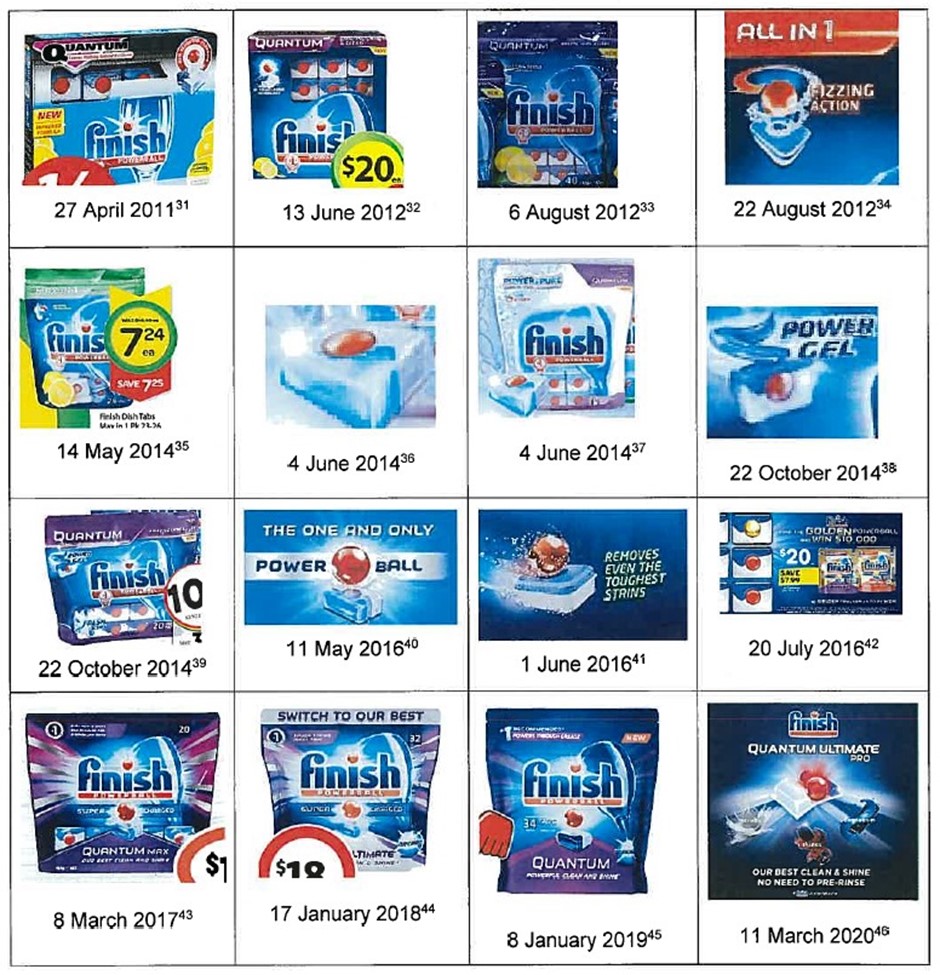
130 The primary judge concluded at [358], after considering the evidence of reputation before her:
I accept that RB may have a reputation in the red Powerball, as it is the one constant on the FINISH capsule packaging aside from the FINISH POWERBALL Logo, although there is variation in the depiction of the red ball in respect of its relationship with the tablet or capsule — whether it is embedded in the capsule or floating above. However, the red Powerball is but one part of the Distinctive Components relied upon by RB.
131 The primary judge did not take this finding into account when considering the exercise of the discretion. We consider that to be an error of the type recognised in House v The King. A significant aspect of the exercise of discretion under s 101(3) is the public interest in avoiding confusion amongst consumers. Even though the use of the 311 mark was not as a separate trade mark, its use in the context of the FINISH POWERBALL Logo was part of use of the composite mark. It is a feature of that mark that is likely to have assisted the consumer to draw a connection between FINISH goods and those of other traders. The primary judge found that the red Powerball simpliciter would be recognised by consumers as being connected with the FINISH brand. A corollary of that finding is that consumers may well be confused if they see a red Powerball as depicted in the 311 mark if it is used by other traders.
132 This important point, when added to the evidence that the packaging depicted has been used for a considerable time, during and after the non-use period, and the self-evident intention of the appellants to continue to use it in the future, persuades us that in re-exercising the discretion we would determine that the 311 mark ought not to be removed from the register.
5. TRADE MARK INFRINGEMENT (Grounds 6, 7 and 8)
133 Section 120(1) of the Trade Marks Act provides:
A person infringes a registered trade mark if the person uses as a trade mark a sign that is substantially identical with, or deceptively similar to, the trade mark in relation to goods or services in respect of which the trade mark is registered.
134 The phrase “deceptively similar” is defined in s 10 of the Trade Marks Act:
For the purposes of this Act, a trade mark is taken to be deceptively similar to another trade mark if it so nearly resembles that other trade mark that it is likely to deceive or cause confusion.
135 Section 122 provides a list of circumstances where a person, despite s 120, does not infringe a trade mark. It relevantly provides:
(1) In spite of section 120, a person does not infringe a registered trade mark when:
(a) …
(b) the person uses a sign in good faith to indicate:
(i) the kind, quality, quantity, intended purpose, value, geographical origin, or some other characteristic, of goods or services; or
(ii) the time of production of goods or of the rendering of services…
136 In ground 6, the appellants contend that the primary judge erred in finding that the respondent had not used the SE Logo as a trade mark in relation to both the product packaging for the SE Gelcaps and on supermarket aisle fins, bins and shelf wobblers and other point of sale promotional material.
137 Representative samples of such uses are as follows:
|
|
Somat Product Packaging | Somat Aisle Fin |
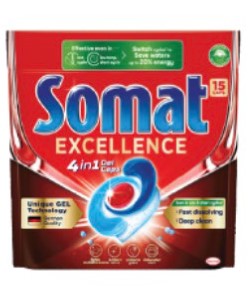

138 In ground 7, the appellants contend that the primary judge erred in finding that the SE Logo was not deceptively similar to the 914 mark.
139 In ground 8, the appellants contend that the primary judge erred in finding that the respondent’s use of the SE Logo on product packaging and associated marketing material was in good faith to indicate the kind, quality or other characteristics of the SE Gelcaps, pursuant to s 122(1)(b)(i) of the Trade Marks Act. Her Honour considered this question against the prospect that she was incorrect in her findings as to trade mark use and in her conclusion that the SE Logo was not deceptively similar to the 914 mark. We do not consider that it is necessary to consider this ground in light of our conclusion that the appeal in relation to the question of deceptive similarity fails.
5.2 The reasoning of the primary judge
140 In reaching the conclusion that the SE Logo was not used as a trade mark, the primary judge noted that context is critical and that the experts agreed that it is common to the trade for dishwasher capsule packaging to include: a prominently displayed name; a word such as “Quantum”, “Platinum” or “Excellence” near the brand name; a stylised depiction of the tablet within the package; a background colour scheme of silver with a colour; an array of laudatory epithets; and the number of capsules in the package. Her Honour also observed that the SE Gelcap packaging generally followed this form, with some 16 different visual elements on the front of the Somat Product Packaging.
141 After observing that purchasers looking to buy will make a quick decision, using as few visual cues as possible, the primary judge made a number of background observations about the market approach to branding.
142 First, the experts agreed that when searching for products in this market, the number of visual cues used by consumers will be as low as one or two.
143 Secondly, consumers seeking to distinguish between products will first focus and rely on the brand name, which remains constant between each brand and the experts agreed is the “most diagnostic cue” for brand identification. In the present case the brand SOMAT is clear and is prominently positioned. The cluttered nature of the packaging the SOMAT brand forces consumers to focus on brand name to identify the brand of the product.
144 Thirdly, background colour themes of the packaging also act to distinguish between brands. The SOMAT Product Packaging has a red background with gold lettering, as opposed to FAIRY and FINISH which do not use those colours. When viewed on supermarket shelves, one is faced with a block of blue products (for FINISH) a block of green products (for FAIRY) and a block of red products (for SOMAT).
145 When it came to consideration of the SE Logo her Honour reasoned:
[263] The common practice of each brand to place a stylised depiction of the product on the packaging assists the consumer to select the variety within the brand. FINISH has at least six different product depictions of dishwashing tablets, FAIRY has three, and SOMAT has two. These stylised product depictions assist the consumer to differentiate variants available within each brand. Taking the SOMAT depictions as an example, the SE Logo shows four components, as compared to the two components of the SOMAT Gold.
[264] In the supermarket situation where the brands are located in blocks, and even if they were not, it would not make sense for the consumer to be looking first at the 11 different stylised depictions of products when the prominent brand names of FINISH, FAIRY and SOMAT are hitting them in the eye, enabling them to make a quick brand identification. The product image is a poor cue for identifying the brand
[265] When faced with a “dizzying” array of product depictions across a range of brands, consumers seeking to identify and distinguish between the brands of those products will focus and rely on the prominent brand name which remains constant within the product range of each brand. In a context where all products have a very prominent and highly visible brand name, there is little likelihood that consumers would think that the SE Gelcap products come from the same source as the FINISH products.
[266] For these reasons I do not consider that the stylised depiction of the SE Gelcap on the SE Gelcap packaging is use as a trade mark.
146 The primary judge reached the same conclusion in relation to the aisle fins, bins and wobblers.
147 The primary judge considered the question of whether the SE Logo was deceptively similar to the 914 mark against the prospect that she is found to be wrong about trade mark use. Her Honour noted at [281] that the 914 mark is registered for a coloured shape and that the endorsement and the representation of the mark together identify the nature of the mark. She then found at [285]:
The impression that the ordinary consumer would take from the 914 Mark is more than just a white tablet, with a red centre component and a wave of blue. The impression taken by the ordinary consumer would be of a rectangular prism with sharp edges and rounded corners, made up of two distinct coloured parts with a red circle in the centre of, and flush with, the upper surface of the prism. The two coloured parts are a first speckled white part and second blue part that partially wraps around the red circle on the upper surface in a wave-like shape. In the three dimensional form, the prism has four side faces. The speckled white part would take up at least one of the long and one of the short side faces of the prism, and most of the second short side face of the prism. The blue part would occupy one long side of the prism, and possibly a small part of the second short side.
148 The primary judge then noted at [286] that the SE Logo uses a combination of white, red and blue parts with a round red shape in the centre, but “that is where the commonality ends” and listed 7 points of difference, namely that the SE Logo:
(1) is not a rectangular prism or rectangular shaped capsule, and it does not have clearly defined side faces;
(2) does not have a capsule made up of two distinct parts — the main capsule component in the SE Logo is composed entirely of white speckles;
(3) does not have flat side faces of the prism in speckled white or blue;
(4) does not have a red circle in the centre of, and flush with, its top face;
(5) does not have a blue wave portion on the top surface of the capsule which partially wraps around the red circle flush with the top face;
(6) has a red oval shape depicted in a three dimensional form which appears to sit on top of the capsule, and to reflect a beam of light;
(7) has two swirling droplets, external to and sitting above, the capsule, which encircle the red oval shape, and which are depicted as dynamic three dimensional shapes in two different shades of blue.
149 Her Honour concluded:
In noting the differences between the 914 Mark and the SE Logo or SE Capsule, I am conscious that the relevant comparison is not the side by side comparison for determining substantial identity, but rather deceptive similarity based on imperfect recollection. Allowing for the possibility of imperfect recollection of the SE Logo, I am not persuaded that either the SE Logo or SE Capsule is deceptively similar to the 914 Mark. The impression created by each mark is substantially different to that of the 914 Mark.
150 The appellants first submit that the primary judge erred in concluding that it was exclusively the SOMAT brand that functioned as a badge of origin in the SE Gelcap packaging (at [261]). They contend that the primary judge’s conclusion at [265] that there is little likelihood that consumers would think that the SE Gelcap products come from the same source as the FINISH products was in error. Her Honour failed to ask the correct question of whether use of the SE Logo was used as a trade mark having regard to its appearance on the SE Gelcap packaging and associated promotional materials.
151 The respondent defends the reasoning of the primary judge. It submits that the SE Gelcap product and the rest of the SOMAT range serves to demonstrate that the stylised product depiction was not used as a trade mark but as usage which is representative of the nature of the goods in a manner that is common to the trade and incompatible with the use of the symbol or picture as a trade mark, citing Koninklijke Philips at [10].
152 The appellants secondly submit that the primary judge erred by failing to apply the test for deceptive similarity. Rather than estimating the effect or impression produced on the consumer by the 914 mark and the SE Logo, the primary judge performed an analysis akin to the side-by-side comparison for substantial identity and in making the comparison undertook an overly detailed analysis of the two marks, contrary to the principles of Australian Woollen Mills Ltd v FS Walton & Co Ltd [1937] HCA 51; (1937) 58 CLR 641. They submit that the primary judge also placed excessive weight on the endorsement to the 914 mark, which ought to have been used as means to assist the viewer to understand what the 914 mark depicted, but not as a way of supplanting the representation of the image itself and not decisive of the consumer’s imperfect recollection.
153 The respondents observe that the appellants cite no authority for the suggestion that the endorsement must play a subordinate role to the depiction and submit that the primary judge’s approach was consistent with authority, which requires that each of the marks must be considered as a whole and the identity of the registered mark is to be ascertained objectively from the trade mark register. Furthermore, the criticism of the primary judge’s approach fails to take into proper account the whole of her process of reasoning. Finally, the respondent submits that there was no error in identifying features where the SE Logo does or does not resemble the 914 mark, citing the definition of “deceptive similarity” in s 10 of the Trade Marks Act and the High Court’s observations in Self Care at [26].
5.4 Consideration of grounds 6, 7 and 8
154 Turning first to the question of whether the SE Logo was used as a trade mark (ground 6), we respectfully disagree with the reasoning and conclusion of the primary judge.
155 In forming the conclusion that the SE Logo was not used as a trade mark, it would appear that her Honour was influenced by the expert evidence of the cognitive process by which a low involvement consumer would approach the branding to reason that consumers may only look to one or two visual cues. From there, the primary judge reasoned that brand name SOMAT is the most diagnostic cue and that next consumers may consider background colour themes to be of assistance in selecting brand. It was in this context that her Honour found that a stylised depiction of the product would have no brand function. That is, it would not perceived to be a designation of origin of the goods, as well as a stylised depiction of the product itself. Influential in that reasoning was the fact that different stylised depictions were used by the respondent for different products (at [263]). In that regard, her Honour found it persuasive that on the supermarket shelf, the product would be located in blocks, and it would not make sense for the consumer to look for the stylised depiction to identify the brand when the names SOMAT, FAIRY and FINISH are prominently displayed.
156 However, her Honour found at [263] that the stylised product depictions “assist the consumer to differentiate variants available within each brand”. It appears to us that such a finding is very close to a finding that the stylised product enables a consumer to understand, within the SOMAT product range, that this is a particular product or sub-brand. The words BIG MAC will be used as a trade mark, even though the product is always sold with the brand name McDONALDS in close proximity. Similarly, the sale of a TOYOTA vehicle which has the sub-brand name PRIUS will also involve the use of both words as trade marks. It is not to the point that the stylised depiction in the SE Gelcap is a “poor cue” for identifying brand (as her Honour found at [264]), or that the brand name may be a better brand indicator. The question of trade mark use does not call for a consideration of how effective the sign is as a trade mark. Nor, in our respectful view, is it relevant to take into account whether, given the prominent use of the SOMAT name, there is a likelihood that consumers would think that the SE Gelcap products come from the same source as the FINISH products (at [265]). As the appellants submit, the question of likely deception has no role to play in deciding what constitutes trade mark use. The inquiry is not whether the sign indicates a connection between the alleged infringer’s goods and those of the registered owner, but whether the sign used indicates the origin of the goods of the user of the sign; Self Care at [60].
157 Having determined that the primary judge erred in this respect, it falls to us to consider the question of trade mark use. Considered in the setting in which the SE Logo is presented, in our view it would have appeared to the consumer as possessing the character of a device, or brand. It is true that other features of the SE Packaging are likely also to appear as indicating the trade origin of the product. It is also true that the SOMAT name is likely to be a primary indicia of origin. However, having regard to its central location, the highly stylised rendition of the product with two enlarged, dynamic blue swirls around a red circle and rays of radiating white lines emerging from it, it appears to us that the SE Logo is being used in part to signify that a product with something like this shape originates from the supplier of the product and partially to provide a description of the product in the packaging. That is sufficient to yield the conclusion that the SE Logo has, in context, been used as a trade mark.
158 We consider that a consumer would also regard the SE Logo to represent trade mark use when perceiving it displayed on the aisle fin. There, the logo is displayed with a prominence that exceeds that of the SOMAT name and is striking to the eye.
159 In relation to deceptive similarity (ground 7), the appellants make no criticism of her Honour’s reference to the legal test as set out in several cases. It suffices to refer only to Australian Woollen Mills, where Dixon and McTiernan JJ described it as follows at 658:
But, in the end, it becomes a question of fact for the court to decide whether in fact there is such a reasonable probability of deception or confusion that the use of the new mark and title should be restrained.
In deciding this question, the marks ought not, of course, to be compared side by side. An attempt should be made to estimate the effect or impression produced on the mind of potential customers by the mark or device for which the protection of an injunction is sought. The impression or recollection which is carried away and retained is necessarily the basis of any mistaken belief that the challenged mark or device is the same. The effect of spoken description must be considered. If a mark is in fact or from its nature likely to be the source of some name or verbal description by which buyers will express their desire to have the goods, then similarities both of sound and of meaning play an important part. The usual manner in which ordinary people behave must be the test of what confusion or deception may be expected. Potential buyers of goods are not to be credited with any high perception or habitual caution. On the other hand, exceptional carelessness or stupidity may be disregarded. The course of business and the way in which the particular class of goods are sold gives, it may be said, the setting, and the habits and observation of men considered in the mass affords the standard. Evidence of actual cases of deception, if forthcoming, is of great weight.
160 Her Honour further referred to this case at page 659 where the Court observed that because the determination for the Court is one of estimation and impression, it is never susceptible of much discussion (at [236]).
161 We do not consider that the primary judge’s reasoning reflects error. The 914 mark and the SE Logo are set out below:
|
|
914 mark | SE Logo |
162 Her Honour at [285] described the impression that the ordinary consumer “would take from the 914 mark”, which we take to be a clear reference to imperfect recollection, a point that her Honour emphasised at [288] when she said in terms that the relevant comparison is not side by side, but based on imperfect recollection. Her Honour then engaged in what may be regarded as a conventional process of summarising the impression of the 914 mark, and comparing and contrasting that with the features of the SE Logo. To do so does not signify that the primary judge was merely making a side-by-side comparison of the type made when considering the question of substantial identity; Shell Oil at 415 (Windeyer J). Her Honour did so as a precursor to undertaking the task of stepping back and considering the effect of an imperfect recollection that the consumer may take away after viewing the 914 mark, and encountering the SE Logo. At [288], her Honour reached the evaluative conclusion that the impression created by the SE Logo is “substantially different” to that of the 914 mark. We see no error of either principle or evaluation on the part of the primary judge in this respect.
163 We do not consider that the appellants have demonstrated any error on the part of the primary judge in respect of her consideration of the endorsement to the 914 mark. Her Honour’s approach was consistent with the authorities cited at [242], that each of the marks must be considered as a whole and that the identity of the registered mark is to be obtained objectively from the Register; Australian Meat Group Pty Ltd v JBS Australia Pty Ltd [2018] FCAFC 207; (2018) 268 FCR 623 at [71] (Allsop CJ, Besanko and Yates JJ); Frucor Beverages Ltd v The Coca-Cola Company [2018] FCA 993; (2018) 358 ALR 336 at [120] (Yates J). As Yates J observed in Frucor at [119], reg 4.3(7) of the Trade Mark Regulations 1995 (Cth) requires a “concise and accurate description of the trade mark” as represented and not “without reference to” or “despite” the representation of the mark. There is no indication that there is any material inconsistency between the 914 mark and the endorsement, nor that the primary judge preferred the endorsement to the depiction of the 914 mark. This argument must be rejected.
164 Accordingly, ground 7 of the appeal must fail.
165 The appellants appeal the primary judge’s finding at [400] that the respondent’s use of the “Biodegradability Device” (see below) on the front of the packaging for the SE Gelcaps (both on the foil bags and on the plastic tubs) did not result in the respondent engaging in misleading and deceptive conduct in contravention of s 18(1) of the ACL, or making false and misleading representations that the SE Gelcaps are of a particular standard, quality or composition, or have particular performance characteristics in contravention of s 29(1)(a) and (g) of the ACL. The appellants contend that the primary judge erred in failing to find that the respondent’s use of the Biodegradability Device conveyed the Biodegradability Representation as defined above at [9]. It was accepted that, if made, such a representation would be false.
166 The Biodegradability Device was described by the primary judge at [380] – [383]:
[380] Prior to 3 September 2021, the SE Gelcaps were offered for sale in packaging that bore the following green device (the Biodegradability Device):
[381] The Biodegradability Device included text reading “biodegradable” at the top of the circle and “100% water-soluble film” at the bottom of the circle, in what can only be described as very small font. The text was white against a green background. The Biodegradability Device appeared on the top right of both kinds of SE Gelcap packaging: the foil bag and the plastic tub. The device was about the size of a 10c piece on the foil bags and a 5c piece on the tubs.
[382] A smaller version of the Biodegradability Device is also found on the side of the tub, and on the back of the foil bag. In both cases, the device is part of a green coloured panel of four “environmental” call outs. In this form the wording is beside the circle containing the image and reads “Biodegradable and 100% water-soluble film”.
[383] Since 3 September 2021, the text of the Biodegradability Device on the packaging of the SE Gelcaps has been altered to read “biodegradable film” and “100% water-soluble film”.
167 The primary judge dismissed the appellant’s claim based on misleading and deceptive conduct. At [398] – [399], the primary judge concluded:
[398] In the circumstances where the SE Gelcaps are a low involvement product where consumers take a matter of seconds to select the product that they are to purchase, consumers are very unlikely to pick up the packages off the shelf to examine them, and read the many epithets and shout outs on the packaging in detail. The small size of the Biodegradability Device makes it unlikely that any consumers would be able to read the words contained in the circle without picking up and closely examining the packaging.
[399] Those consumers who were minded to pick up and examine the SE Gelcap packaging, would be expected to examine the packaging fully, and not just limit their examination to the front of the packaging. These consumers would also see as part of their examination the Biodegradability Device on the back, or tin foil in the tub, and would not be misled or deceived that the capsule, rather than just the film, was biodegradable.
168 Determining whether a person has breached s 18 of the ACL involves four steps: first, identifying with precision the "conduct" said to contravene s 18; second, considering whether the identified conduct was conduct "in trade or commerce"; third, considering what meaning that conduct conveyed; and fourth, determining whether that conduct in light of that meaning was "misleading or deceptive or ... likely to mislead or deceive”: Self Care at [80]. In answering this last question it is not necessary to show that the conduct in question actually deceived or misled anyone: Taco Co of Australia Inc v Taco Bell Pty Ltd [1982] FCA 170; (1982) 42 ALR 177 at 202; Parkdale Custom Built Furniture Pty Ltd v Puxu Pty Ltd [1982] HCA 44; (1982) 149 CLR 191 at 198 (per Gibbs CJ); Google Inc v Australian Competition and Consumer Commission [2013] HCA 1; (2013) 249 CLR 435 at [6] (per French CJ and Crennan and Kiefel JJ); Australian Competition and Consumer Commission v TPG Internet Pty Ltd [2020] FCAFC 130; (2020) 278 FCR 450 at [22(c)]. Nor is it necessary to show that a significant number of persons to whom the conduct is directed would be led into error: TPG Internet at [23] – [24].
169 Here, the alleged conduct is said to amount to a representation. It was not disputed that the representation, if made, was made in trade or commerce and it was conceded that if the representation was made, it was false. The real issue for determination is thus whether the alleged representation is established by the evidence: Self Care at [81]. More specifically, the question here is whether the Biodegradability Device conveyed the Biodegradability Representation.
170 Where the conduct complained of is not directed at a specific individual, what is conveyed by the particular conduct is to be considered by reference to the class or classes of consumers likely to be affected by the conduct: Australian Competition and Consumer Commission v Telstra Corporation Ltd [2007] FCA 1904; (2007) 244 ALR 470 at 474 [16]; Puxu at 199 (per Gibbs CJ); Campomar Sociedad, Limitada v Nike International Ltd [2000] HCA 12; (2000) 202 CLR 45 at [102], [103], [105] and [106]; Butcher v Lachlan Elder Realty Pty Ltd [2004] HCA 60; (2004) 218 CLR 592 at [36] (per Gleeson CJ, Hayne and Heydon JJ); Self Care at [83]. Here the class of consumers likely to be affected by the conduct are prospective purchasers of a mass-marketed product for general use in the form of dishwasher tablets. The question of what message is conveyed by the Biodegradability Device is to be determined by reference to a reasonable or ordinary member of that class of consumers: Self Care at [83].
171 The primary judge further confined the class of consumers likely to be affected by the conduct to those consumers who were minded to pick up and examine the SE Gelcap packaging. In the circumstances of this case, we do not consider it necessary to decide whether her Honour was correct to limit the class of consumers in this way. It appears to us that the determination of the message conveyed by a device is to be premised on the assumption that the device is read.
172 In determining the message conveyed by particular conduct, it is necessary to consider the context in which the conduct is engaged: Telstra at [19]; Self Care at [82]. In determining the message conveyed by a particular device it is necessary to consider the context in which the device is used. This includes both the broader context of the surrounding circumstances (including the class of consumer for the product) and the immediate context, in the form of the surrounding words and design of the packaging: Self Care at [88] – [89]. Here, in ascertaining what is conveyed by the Biodegradability Device it is necessary to consider the use of the device in the context of the packaging as a whole.
173 For the following reasons, we conclude that the Biodegradability Representation was conveyed by the Biodegradability Device to a reasonable or ordinary prospective consumer of dishwashing tablets and are unable to agree with the primary judge’s conclusion that when the Biodegradability Device on the foil bag, or on the tub, was examined in the context of the packaging as a whole, consumers would not be misled or deceived that the capsule, rather than just the film, was biodegradable:
(1) First, the word “Biodegradable” appears on the top half of the Biodegradability Device, the appearance of which is bifurcated by the line running through the middle of the device. The device may thus be seen as containing two distinct even if related representations. One representation is that the capsule as a whole (depicted as a drawing in the middle of the device) is biodegradable. Another representation is that the film itself is water soluble. We do not accept that read as a whole, the device contains a single representation that clearly states “biodegradable 100% water-soluble film”. Nor do we accept that the Biodegradability Representation could only conceivably arise if the consumer confined their attention to the top half of the Biodegradability Device, ignoring the text on the bottom half.
(2) Second, whilst the Biodegradability Device should be read and understood by the ordinary and reasonable consumer in the context of the SE Gelcap packaging as a whole, the statement on the back of the foil bag (and on the side of the tub), “Biodegradable and 100% water-soluble film”, does not clarify or qualify the Biodegradability Device. When read in the context of packaging that contains several environmental claims in short point form, it is inappropriate to adopt a technical grammatical approach to the construction of the text of those claims. The word “and” when used in the phrase “Biodegradable and 100% water-soluble film” may have a disjunctive as distinct from conjunctive effect of conjoining two adjectives to a single noun. In context, and when read together with the Biodegradability Device, an ordinary or reasonable person would equate the word “and” with the word “with”. The message conveyed by the phrase would therefore be a biodegradable capsule (as depicted in the picture) with a 100% water-soluble film.
174 Given the Respondent’s concession (correctly made) that if the Biodegradability Representation was conveyed, it was false, it follows from the above that the use of the Biodegradability Device:
(1) was misleading or deceptive or likely to mislead or deceive contrary to s 18 of the ACL;
(2) falsely represented that goods were of a particular standard or quality or composition contrary to s 29(1)(a) of the ACL; and
(3) falsely represented that goods had performance characteristics they did not have contrary to s 29(1)(g) of the ACL.
175 The Respondent has voluntarily taken steps to amend the device to read “biodegradable film” and “100% water-soluble film” and the contravening conduct came to an end from 3 September 2021. Furthermore, the Respondent proffered an undertaking to the Court that it would not use the unamended Biodegradability Device on SE Gelcaps again, unless the facts change, and the product as a whole is capable of being described as biodegradable. However, the Court has the power to grant an injunction under s 232 of the ACL whether or not it appears to the Court that the person intends to engage in the conduct again or to continue to engage in the conduct: ACL s 232(4)(a).
176 For the reasons set out above we have found that:
(1) the primary judge erred in determining that the 914 mark had not been used during the non-use period. The 914 mark was used by displaying images of the Quantum Tablets Packaging and by the depictions of the Quantum Products on the Purple Quantum Packaging;
(2) the appellants failed to establish that the primary judge erred in determining that the Quantum Device was not use of the 914 mark in the sense required by s 100(3) of the Trade Marks Act;
(3) accordingly, there is no occasion to consider the exercise by the primary judge of the discretion under s 101(3) in respect of the 914 mark;
(4) the appellants failed to establish that the primary judge erred in determining that the 311 mark was not used as a trade mark during the non-use period;
(5) the primary judge erred in the exercise of the discretion pursuant to s 101(3) by declining to find that the 311 mark should remain on the register;
(6) the appellants have succeeded in establishing that the primary judge erred in concluding that the SE Logo was not used as a trade mark but failed to establish that her Honour erred in concluding that the SE Logo was not deceptively similar to the 914 mark; and
(7) the primary judge erred in finding that the Biodegradability Representation was not made. Accordingly, the respondents engaged in conduct in contravention of ss 18, 29(1)(a) and 29(1)(g) of the ACL.
177 We have in section 1.4 above set out a summary of the Orders that we consider are appropriate. The appellants have succeeded in retaining each of the 914 and 311 marks on the Register but have failed to establish that the primary judge erred on the question of infringement. They have also succeeded in the ACL Biodegradability claim. In the result, we consider that the appellants’ success warrants an order that the respondents pay 80% of the appellant’s costs of the appeal.
I certify that the preceding one hundred and seventy-seven (177) numbered paragraphs are a true copy of the Reasons for Judgment of the Honourable Justices Nicholas, Burley and Hespe. |
Associate:


