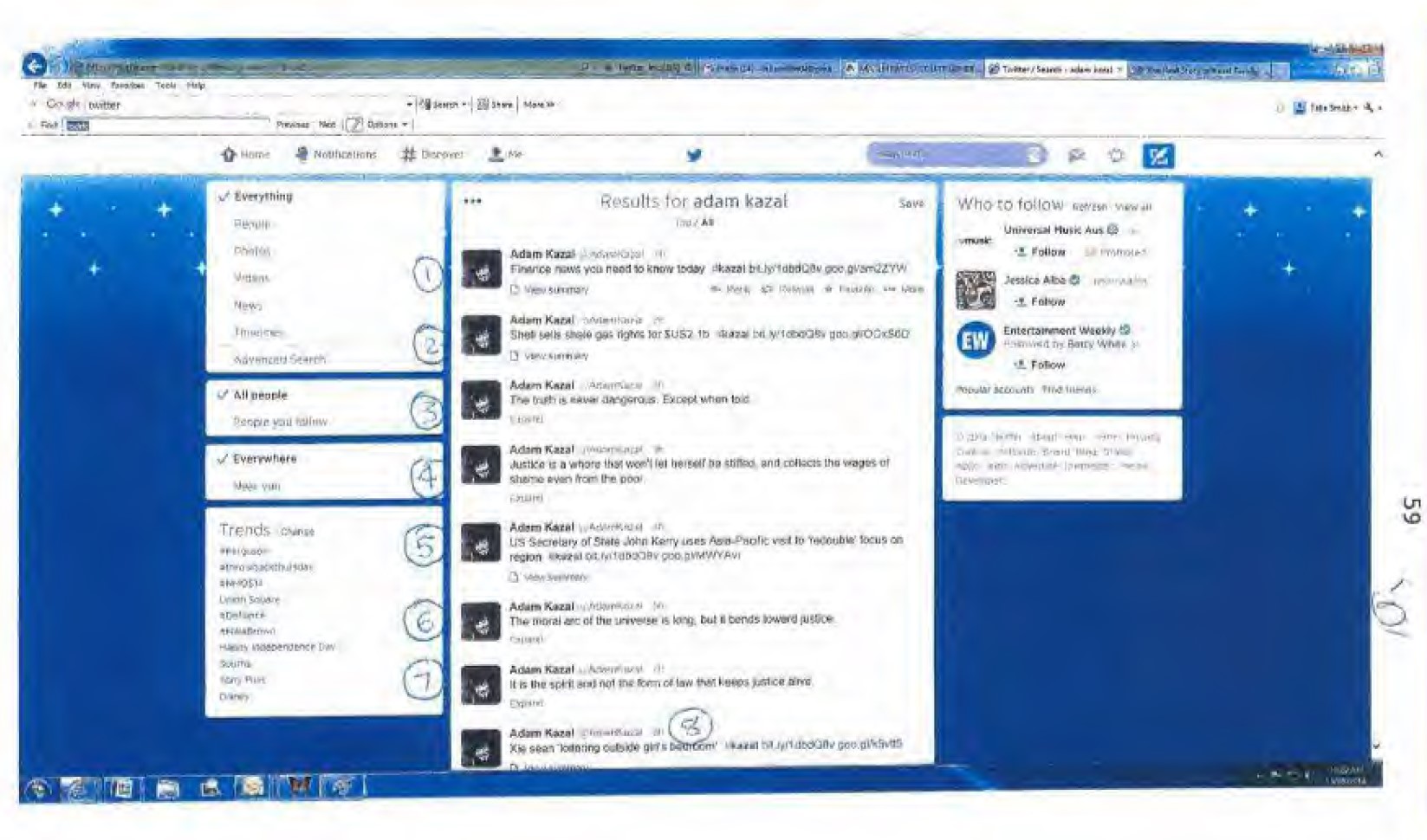
Federal Court of Australia
Kazal v Thunder Studios Inc (California) [2023] FCAFC 174
Thunder Studios Inc (California) v Kazal (No 5) [2017] FCA 1572 Thunder Studios Inc (California) v Kazal (No 7) [2018] FCA 996 Thunder Studios Inc (California) v Kazal (No 9) [2020] FCA 846 Thunder Studios Inc (California) v Kazal (No 10) [2020] FCA 16 Thunder Studios Inc (California) v Kazal (No 12) [2022] FCA 110 | |
File number(s): | NSD 276 of 2022 |
Judgment of: | WIGNEY, WHEELAHAN AND ABRAHAM JJ |
Date of judgment: | 3 November 2023 |
Catchwords: | PRACTICE AND PROCEDURE — appeal and new trial – apprehended bias – where some time prior to trial the primary judge found the second appellant guilty of contempt of court and sentenced him to a term of imprisonment – where before trial the appellants made an application to the judge that he disqualify himself from further hearing the proceeding on the ground of apprehended bias – where the primary judge refused to disqualify himself – no application by the appellants for leave to appeal at the time – not reasonable for the appellants to save up apprehended bias point as a ground of appeal from the primary judge’s final orders – point given up by the appellants. PRACTICE AND PROCEDURE — appeal and new trial – apprehended bias – where the primary judge made findings in the final judgment adverse to the appellants and beneficial to the respondents – where the appellants appealed on the ground that the conduct of the trial and the primary judge’s findings disclosed a reasonable apprehension of bias – no apprehended bias established. PRACTICE AND PROCEDURE — appeal – where the first appellant failed to comply with orders to provide verified answers to interrogatories – where against that background, the primary judge made a self-executing order that the first appellant’s defence be struck out if he did not provide verified answers to interrogatories by 15 September 2017 – where the first appellant failed to comply with that order – where the primary judge refused an application to extend time to comply with the self-executing order – interlocutory application for leave to appeal interlocutory orders dismissed – whether appellate jurisdiction of the Court exhausted – whether decision to refuse extension of time affected the final result – whether House v The King errors affected the judge’s refusal to extend time – no error shown. STATUTORY INTERPRETATION – practice and procedure – where prior to trial an interlocutory application to stay the hearing of the proceeding was made to the primary judge on the ground that other proceedings in the docket of another judge of the Court gave rise to a risk of inconsistent findings – where neither appellant had a defence on foot – where the primary judge refused the interlocutory application, inter alia, because there was no substantive risk of conflicting judgments – no error by the primary judge in reaching that conclusion – where the primary judge concluded on the interlocutory application that r 16.07(2) of the Federal Court Rules 2011 (Cth) gave rise to deemed admissions of allegations in a statement of claim where no defence was on foot – primary judge’s construction of r 16.07(2) in error – previous first instance decisions should not be followed – not material to the disposition of the interlocutory application – orders on interlocutory application did not affect the final result – point not taken at trial – no reliance by trial judge on r 16.07(2) in making findings of fact at trial – no material error shown. DEFAMATION — imputation – where the respondents alleged defamation by the appellants by the publication of matters on the internet – primary judge found that the first matter conveyed a meaning and representation that doing business with the respondents ran the risk of physical injury – challenge to imputation on appeal – no error by the primary judge. DEFAMATION — excluded corporation – where the pleaded case of the first respondent was that it ceased to be an “excluded corporation” within the meaning of s 9(2)(b) of Defamation Act 2005 (NSW) on 11 October 2013 – where the appellants alleged that the primary judge erred in failing to find that the first respondent ceased to be an “excluded corporation” by that date and therefore erred in the assessment of damages for defamation of the first respondent – the primary judge erred as alleged – however the same conduct constituted a breach of s 18 of the Australian Consumer Law (ACL) and the same award of damages for such contravention of ACL was not limited by whether the first respondent was an “excluded corporation” – therefore the primary judge’s error was not material. CONSUMER LAW — appeal – where the respondents alleged contraventions of s 18 ACL by the appellants in relation to matter published on the internet – where the primary judge found that the nature of the publications was to induce readers to click on hyperlinks to divert them to a website and its articles for the purpose of warning readers against engaging commercially with the respondents – where the primary judge found this to be misleading and deceptive conduct “in trade or commerce” within the meaning of s 18 of the ACL – where the appellants appealed on the ground that the primary judge erred in finding impugned conduct occurred “in trade or commerce” – the impugned conduct arose out of commercial disputation and was intended to have commercial effects in the way found by the primary judge – no error established. PRIVATE INTERNATIONAL LAW — damages – where the primary judge found that the second appellant engaged in, or sanctioned, conduct in the United States that aggravated damage to the respondents – where that conduct had been found by the United States Court of Appeals for the Ninth Circuit to be constitutionally-protected under the First Amendment to the United States Constitution for the purposes of liability for the tort of stalking under the laws of California – where the appellants appealed on the ground that the Court of Appeals’ decision gave rise to an issue estoppel – no submission to the primary judge that an issue estoppel arose – in any event no issue estoppel established – false issue – conduct in aggravation of damage as a result of a tort does not itself have to be unlawful. DAMAGES — defamation – where appellants appealed on the ground that the assessments of damages were excessive on the basis of various specific errors – where the primary judge made some errors but not others – where the only order sought by respondents was that a new trial be ordered – where the powers of the Full Court in exercise of its appellate jurisdiction under s 28 of the Federal Court of Australia Act 1976 (Cth) are extensive and include the power to reassess damages – where the errors of the primary judge were minor in broad context – where the Full Court would assess damages in sums no less that those assessed by the primary judge – primary judge’s awards not excessive. EVIDENCE — appeal – where no defences on foot – where the appellants sought to cross-examine the second respondent on matters said to go to mitigation of damage in reliance on Burstein v Times Newspapers Ltd [2001] 1 WLR 579 – cross examination permitted on some matters but not others – no error by primary judge. |
Legislation: | Competition and Consumer Act 2010 (Cth), ss 6(3), 131; Sch 2, ss 18, 232, 236, 237 Copyright Act 1968 (Cth), s 196 Evidence Act 1995 (Cth), ss 91, 174, 175 Federal Court of Australia Act 1976 (Cth), ss 24, 25, 28, 37M, 37P; Part VB Legislation Act 2003 (Cth), s 15G(4) Legislative Instruments Act 2003 (Cth), s 26 (as previously in force) Trade Practices Act 1974 (Cth) (as previously in force), ss 52, 82 Federal Court Rules 2011 (Cth), rr 1.39, 5.21, 5.22, 5.23, 16.03, 16.07, 16.08, 16.11, 39.04, 42.22 Federal Court Rules 1979 (Cth) (as previously in force), O 10 rr 7 and 8, O 11 r 13, O 35A Crimes Act 1958 (Vic), s 17 Defamation Act 2005 (NSW), ss 9, 36 Supreme Court Act 1970 (NSW), s 94 Chapter 1 of the Rules of the Supreme Court (Vic) (as previously in force), O 19 r 13 Uniform Civil Procedure Rules 2005 (NSW), r 14.26 Uniform Civil Rules 2020 (SA), r 67.6(6) Rules of the Supreme Court of 1883 (England and Wales), O 19 r 13, O 27 r 11, O 36 r 37 Rules of the Supreme Court 1965 (England and Wales), O 18 r 14 California Civil Code, § 1708.7 |
Cases cited: | Achos Pty Ltd v RA Bashford Consulting Pty Ltd (1997) 144 ALR 528 Adam P Brown Male Fashions Pty Ltd v Philip Morris Inc [1981] HCA 39; 148 CLR 170 Administration of the Territory of Papua New Guinea v Daera Guba [1973] HCA 59; 130 CLR 353 ALDI Foods Pty Ltd v Transport Workers Union [2020] FCAFC 231; 282 FCR 174 Alesco Corporation Limited v Te Maari [2015] NSWSC 469 Armacel Pty Ltd v Smurfit Stone Container Corp [2008] FCA 592; 248 ALR 573 Aubrey v The Queen [2017] HCA 18; 260 CLR 305 Australian and New Zealand Banking Group v RQA Accountants Pty Ltd [2013] NSWSC 165 Australian Broadcasting Corporation v O'Neill [2006] HCA 46; 227 CLR 57 Australian Broadcasting Corporation v Wing [2019] FCAFC 125; 271 FCR 632 Australian Competition and Consumer Commission v Alice Car & Truck Rentals Pty Ltd [1997] FCA 920 Australian Competition and Consumer Commission v Dataline.Net.Au Pty Ltd [2006] FCA 1427; 236 ALR 665 Australian Competition and Consumer Commission v Dataline.Net.Au Pty Ltd [2007] FCAFC 146; 161 FCR 513 Australian Competition and Consumer Commission v Leahy Petroleum Pty Ltd [2007] FCA 794; 160 FCR 321 Australian Consolidated Press v Driscoll (1988) Aust Torts Reports ¶80–175 Australian Securities and Investments Commission v PE Capital Funds Management Ltd (Admins Apptd) [2022] FCA 76; 159 ASCR 1 Australian Securities Commission v Macleod [1994] FCA 901; 54 FCR 309 Babaniaris v Lutony Fashions Pty Ltd [1987] HCA 19; 163 CLR 1 Badenach v Calvert [2016] HCA 18; 257 CLR 440 Bauer Media Pty Ltd v Wilson (No 2) [2018] VSCA 154; 56 VR 674 Blair v Curran [1939] HCA 23; 62 CLR 464 Brooks v The Upjohn Company (1998) 85 FCR 469 Chamberlain (Trustee) v Tilbrook [2017] FCA 1586 Clayton v Bant [2020] HCA 44; 272 CLR 1 CNIP Pty Ltd v Chan & Naylor Norwest Pty Ltd (No 2) [2011] FCA 1170 Concrete Constructions (NSW) Pty Ltd v Nelson [1990] HCA 17; 169 CLR 594 Concrete Pty Ltd v Parramatta Design & Developments Pty Ltd [2006] HCA 55; 229 CLR 577 Coyne v Citizen Finance Ltd [1991] HCA 10; 172 CLR 211 Cranssen v The King [1936] HCA 42; 55 CLR 509 Cruse v Multiplex Ltd [2008] FCAFC 179; 172 FCR 279 Cryeng Pty Ltd v Loyola [2011] FCA 956 Damberg v Damberg [2001] NSWCA 87 Décor Corporation Pty Ltd v Dart Industries Pty Ltd [1991] FCA 844; 33 FCR 397 Devries v Australian National Railways Commission [1993] HCA 78; 177 CLR 472 Doggett v Commonwealth Bank of Australia [2019] FCAFC 19 Dow Jones and Company Inc v Gutnick [2002] HCA 56; 210 CLR 575 Downey v Acting District Court Judge Boulton (No 5) [2010] NSWCA 240; 272 ALR 705 DPP Reference No 1 of 2019 [2021] HCA 26; 274 CLR 177 Durolek v Pier (WA) Pty Ltd (No 2) [2019] WASCA 138 Ebner v Official Trustee in Bankruptcy [2000] HCA 63; 205 CLR 337 Electoral Commissioner v Wharton (No 3) [2021] FCA 742 Embleton Motor Co Pty Ltd v St Kilda Beach Taxi School and Staffing Pty Ltd [2014] WASCA 183 Enzed Holdings Ltd v Wynthea Pty Ltd (1984) 57 ALR 167 Fairfax Digital Australia and New Zealand Pty Ltd v Kazal [2018] NSWCA 77; 97 NSWLR 547 Farquhar v Bottom [1980] 2 NSWLR 380 Favell v Queensland Newspapers Pty Ltd [2005] HCA 52; 219 CLR 165 Federal Commissioner of Taxation v Consolidated Media Holdings Ltd [2012] HCA 55; 250 CLR 503 Ferguson v Dallow (No 2) [2021] FCA 152 Firewatch Australia Pty Ltd v Country Fire Authority [1999] FCA 761; 93 FCR 520 Flamingo Park v Dolly Dolly (1986) 6 IPR 431 Fletcher v Nextra Australia Pty Ltd [2015] FCAFC 52; 229 FCR 153 Gerlach v Clifton Bricks Pty Ltd [2002] HCA 22; 209 CLR 478 Hahn v Conley [1971] HCA 56; 126 CLR 276 Hamod v State of New South Wales [2011] NSWCA 375 Hanwood Pastoral Co Pty Limited v Kelly [2020] FCA 1020 Harris v The Queen [1954] HCA 51; 90 CLR 652 Hicks v Gregory (1904) 6 WALR 100 Hodge v TCN Channel Nine (No 2) [2006] NSWSC 1272 Houghton v Arms [2006] HCA 59; 225 CLR 553 House v The King [1936] HCA 40; 55 CLR 499 Jackson v Goldsmith [1950] HCA 22; 81 CLR 446 Jiangyin Yinying Goods and Materials Trade Co. Ltd v Australia Victoria Capital Pty Ltd [2012] FCA 274 John Fairfax & Sons Ltd v Kelly (1987) 8 NSWLR 131 Johnson v Johnson [2000] HCA 48; 201 CLR 488 Kazal v Thunder Studios Inc [2017] FCAFC 111; 256 FCR 90 Knaggs v Director of Public Prosecutions (NSW) [2007] NSWCA 83; 170 A Crim R 366 Konica Minolta Business Solutions Australia Pty Ltd v Vongkeneta [2013] NSWSC 486 Kuhl v Zurich Financial Services Australia Ltd [2011] HCA 11; 243 CLR 361 Kuligowski v Metrobus [2004] HCA 34; 220 CLR 363 Kumova v Davison (No 2) [2023] FCA 1 Laws v Australian Broadcasting Tribunal [1990] HCA 31; 170 CLR 70 Lenijamar Pty Ltd v AGC (Advances) Limited (1990) 27 FCR 388 Livesey v New South Wales Bar Association [1983] HCA 17; 151 CLR 288 Loveday v Sun Newspapers Ltd [1938] HCA 28; 59 CLR 503 Lower Murray Urban and Rural Water Corp v Di Masi [2014] VSCA 104; 43 VR 348 MacDonald v Australian Securities and Investments Commission [2007] NSWCA 304; 73 NSWLR 612 Madden v Seafolly Pty Ltd [2014] FCAFC 30; 313 ALR 1 Mangena v Wright [1909] 2 KB 958 Marlin Brands Australia Ltd v Brando Aus Holdco Pty Ltd [2022] NSWCA 59 Michael Wilson & Partners Ltd v Nicholls [2011] HCA 48; 244 CLR 427 Michell, in the matter of Aizome1 Pty Ltd (in liq) v Millar [2019] FCA 2169 Mirembe Pty Ltd v Dangar [2009] NSWSC 1268 MY Distributors Pty Ltd v Omaq Pty Ltd [1992] FCA 491; 36 FCR 578 National Bank of Australasia v Cohen (1986) 22 VLR 269 National Builders Group IP Holdings Pty Limited v ACN 092 675 164 Pty Limited (In Liq) [2015] VSCA 260 Nationwide News Pty Ltd v Rush [2020] FCAFC 115; 380 ALR 432 Neilson v Overseas Projects Corporation of Victoria Ltd [2005] HCA 54; 223 CLR 331 Nicholls v Michael Wilson & Partners Ltd [2010] NSWCA 222; 243 FLR 177 Nixon v W Phelan & Son Pty Ltd [1959] VR 83 Norco Co-Operative v Kelly [2010] NSWSC 719; 14 BPR 27,723 O’Brien v Komesaroff [1982] HCA 33; 150 CLR 310 Obela Fresh Dips and Spreads Pty Ltd v Coetzee [2020] NSWSC 1862 Palmer v John Fairfax & Sons Ltd (1986) 5 NSWLR 727 Palmer Bruyn & Parker v Parsons [2001] HCA 69; 208 CLR 388 Parkville Court Pty Ltd v Salvaris [1975] VR 393 Quality Bakers Australia Pty Ltd v Yassin Modern Bakery Pty Ltd [2007] NSWSC 804 Radio 2UE Sydney Pty Ltd v Chesterton [2009] HCA 16; 238 CLR 460 RAIA Insurance Brokers Ltd v FAI General Insurance Co Ltd [1993] FCA 127; 41 FCR 164 Ramsay v Pigram [1968] HCA 34; 118 CLR 271 Re Avant Garde Investments Pty Ltd (in liq) v Cheema [2021] FCA 125 Re JRL; Ex parte CJL [1986] HCA 39; 161 CLR 342 Re Morling; Ex parte Australasian Meat Industry Employees Union (1985) 66 ALR 608 Re the Will of Gilbert (dec) (1946) 46 SR (NSW) 318 Rigby v Associated Newspapers [1969] 1 NSWLR 729 Roadshow Films Pty Limited v Telstra Corporation Limited [2020] FCA 1468 Robinson Helicopter Company Inc v McDermott [2016] HCA 22; 331 ALR 550 Royal Guardian Mortgage Management Pty Ltd v Nguyen [2016] NSWCA 88; 332 ALR 128 Rush v Nationwide News Pty Ltd (No 2) [2018] FCA 550; 359 ALR 564 Rush v Nationwide News Pty Limited (No 8) [2019] FCA 1382 Sampson (Trustee) v Taboda [2016] FCA 926 Schiff v Nine Network Australia Pty Ltd (No 4) [2023] FCA 688 Searson v Salmon [2014] FCA 748 Sergi v Jurcevic [1999] NSWCA 254; 46 NSWLR 672 Sheppard v Feely (Unreported, 1 August 1954) Sneddon v State of New South Wales [2012] NSWCA 351 Sony Corporation v Costaneo [2012] FCA 153 Steele v Mirror Newspapers Ltd [1974] 2 NSWLR 348 Stewart v Coughlan (1885) 11 VLR 279 Tamaya Resources Ltd (in liq) v Deloitte Touche Tohmatsu (a firm) [2016] FCAFC 2; 332 ALR 199 Taylor v Nationwide News Pty Limited [2023] FCAFC 117 Thomas Borthwick & Sons (Pacific Holdings) Ltd v Trade Practices Commission (1988) 18 FCR 424 Thunder Studios Inc (California) v Kazal [2016] FCA 1598 Thunder Studios Inc (California) v Kazal (No 2) [2017] FCA 202 Thunder Studios Inc (California) v Kazal (No 3) [2017] FCA 1170 Thunder Studios Inc (California) v Kazal (No 4) [2017] FCA 1571 Thunder Studios Inc (California) v Kazal (No 5) [2017] FCA 1572 Thunder Studios Inc (California) v Kazal (No 6) [2017] FCA 1573; 356 ALR 238 Thunder Studios Inc (California) v Kazal [2018] FCA 593 Thunder Studios Inc (California) v Kazal (No 7) [2018] FCA 996 Thunder Studios Inc (California) v Kazal (No 8) [2018] FCA 1995 Thunder Studios Inc (California) v Kazal (No 9) [2020] FCA 846 Thunder Studios Inc (California) v Kazal (No 10) [2020] FCA 1636 Thunder Studios Inc (California) v Kazal (No 11) [2020] FCA 1656 Thunder Studios Inc (California) v Kazal (No 12) [2022] FCA 110; 403 ALR 698 Thunder Studios Inc (California) v Kazal (No 13) [2022] FCA 256 Tomlinson v Ramsey Food Processing Pty Ltd [2015] HCA 28; 256 CLR 507 Triggell v Pheeney [1951] HCA 23; 82 CLR 497 Trkulja v Google LLC [2018] HCA 25; 263 CLR 149 Tyne (as trustee of Argot Trust) v UBS AG (No 3) [2016] FCA 5; 236 FCR 1 Typing Centre of NSW Pty Ltd v Northern Business College Ltd (1989) 13 IPR 627 Uren v John Fairfax Ltd [1966] HCA 40; 117 CLR 118 Vakauta v Kelly [1989] HCA 44; 167 CLR 568 Village Building Co Ltd v Canberra International Airport Pty Ltd [2004] FCAFC 240; 139 FCR 330 VUAX v Minister for Immigration and Multicultural and Indigenous Affairs [2004] FCAFC 158; 238 FCR 588 Walker v W A Pickles Pty Ltd [1980] 2 NSWLR 281 Warren v Coombes [1979] HCA 9; 142 CLR 531 Water Efficiency Labelling and Standards Regulator v Renaissance Traditional Bathrooms Pty Ltd [2022] FCA 1456 Waterways Authority v Fitzgibbon [2005] HCA 57; 221 ALR 402 Watt v Shepherd (No 2) [2021] FCA 826 Witham v Holloway [1995] HCA 3; 185 CLR 525 Yeo v Damos Earthmoving Pty Ltd, in the matter of Beachwood Developments Pty Ltd (in liq) [2011] FCA 1129 Re Emergent 2011 (2) CILR 329 Maharaja Moheshur Sing v The Bengal Government (1859) VII Moore Ind App 283 Broadhurst v The Queen [1964] AC 441 Broome v Cassell & Co Ltd [1972] AC 1027 Burstein v Times Newspapers Ltd [2000] EWCA Civ 338; [2001] 1 WLR 579 Chalmers v Shackell (1834) 6 Car & P 475 Coghlan v Cumberland [1898] 1 Ch 704 Cribb v Freyberger [1919] WN 22 Dakhyl v Labouchere [1908] 2 KB 325 Dingle v Associated Newspapers Ltd [1964] AC 371 DSV Silo-und Verwaltungsgesellschaft mbH v Owners of The Sennar (The Sennar) (No 2) [1985] 1 WLR 490 Forsdike v Stone (1868) LR 3 CP 607 Hobbs v Tinling (CT) & Co Ltd [1929] 2 KB 1 Lewis v Daily Telegraph Ltd [1964] AC 234 Plato Films v Speidel [1961] AC 1090 Praed v Graham (1889) 24 QBD 53 Prager v Times Newspapers [1988] 1 WLR 77 Ratcliffe v Evans [1892] 2 QB 524 Scott v Sampson (1882) 8 QBD 491 Turner v News Group Newspapers Ltd [2006] EWCA Civ 540; 1 WLR 3469 Warren v The Random House Group Ltd [2008] EWCA Civ 834; [2009] 1 QB 600 In re Nevitt 117 Fed Rep 448 (8th Cir, 1902) Planned Parenthood of the Columbia/Willamette Inc v American Coalition of Life Activists, 290 F.3d 1058 (9th Cir, 2002) Thunder Studios Inc v Kazal 13 F.4th (9th Cir, 2021) United States v. Orozco–Santillan, 903 F.2d 1262, 1265 (9th Cir, 1990) Coghill, Default of Appearance by Motorist Defendant (1954) 28 ALJ 268 Gatley on Libel and Slander (10th edition, 2004) Jacob et al, The Supreme Court Practice 1982 (the White Book), Centenary Edition Williams Supreme Court Practice (2nd edition, 1973) |
Division: | General Division |
Registry: | New South Wales |
National Practice Area: | Other Federal Jurisdiction |
Number of paragraphs: | 425 |
25-26 August 2022 | |
Ms H Jager | |
Solicitor for the Appellants: | HWL Ebsworth Lawyers |
Counsel for the Respondents: | Mr P Gray SC Mr M A Polden |
Solicitor for the Respondents: | Russell Kennedy Lawyers |
ORDERS
NSD 276 of 2022 | ||
First Appellant ADAM KAZAL Second Appellant | ||
AND: | THUNDER STUDIOS INC (CALIFORNIA) First Respondent RODRIC MARC DAVID Second Respondent | |
DATE OF ORDER: | 3 November 2023 |
THE COURT ORDERS THAT:
1. The appeal is dismissed.
2. Subject to paragraphs 3 and 4, the appellants pay the respondents’ costs of the appeal.
3. Either the appellants or the respondents may seek a variation of the order in paragraph 2 by filing and serving by 4.00 pm on 13 November 2023 a written submission of no more than three pages, 1.5 spacing, 12 point font, in which event the other parties may by 4.00 pm on 20 November 2023 file and serve a responding written submission of no more than three pages, 1.5 spacing, 12 point font.
4. Subject to further order, any application for variation of the order for costs will be determined on the papers.
Note: Entry of orders is dealt with in Rule 39.32 of the Federal Court Rules 2011.
REASONS FOR JUDGMENT
WIGNEY J:
1 I agree with the orders proposed by Wheelahan J. I also agree with his Honour’s reasons for concluding that the appeal should be dismissed.
I certify that the preceding one (1) numbered paragraph is a true copy of the Reasons for Judgment of the Honourable Justice Wigney. |
Associate:
Dated: 3 November 2023
REASONS FOR JUDGMENT
WHEELAHAN J:
[2] | |
[14] | |
The Emergent joint venture and the initiation of a proceeding in the Cayman Islands | [16] |
[19] | |
[23] | |
[25] | |
[30] | |
[33] | |
[35] | |
[37] | |
[38] | |
[39] | |
[67] | |
[70] | |
[71] | |
[81] | |
[84] | |
[86] | |
[88] | |
[91] | |
[93] | |
Judgment No 5 – is an appeal precluded by the refusal of leave to appeal? | [96] |
[105] | |
[128] | |
[131] | |
[135] | |
Judgment No 5 – was the decision unreasonable or plainly unjust? | [140] |
[146] | |
[147] | |
[152] | |
[154] | |
[163] | |
[169] | |
[172] | |
[182] | |
[186] | |
[187] | |
[190] | |
[235] | |
[240] | |
[243] | |
[254] | |
[255] | |
[265] | |
Ground 5(b) – findings in relation to the judgment of Jones J in Re Emergent | [290] |
[299] | |
[301] | |
Ground 5(e) – claimed error in treating Thunder Studios as an excluded corporation | [311] |
Ground 5(f) – claimed derogatory observations giving the appearance of hostility | [313] |
[329] | |
[330] | |
Judgment No 12 – was the appellants’ conduct in trade or commerce? | [339] |
Judgment No 12 – was Thunder Studios an excluded corporation after 11 October 2013? | [355] |
[375] | |
[420] | |
[424] |
Introduction
2 This appeal concerns the publication by the appellants of four sets of matters on the internet. The primary judge characterised the publications as being part of conduct of the appellants from 2013 up to trial that resembled a concerted, continuous campaign that was conducted as a vendetta to vilify and denigrate the respondents.
3 The two appellants are brothers: Charif Kazal, and Adam Kazal. The respondents to the appeal, who were the successful applicants below, are Mr Rodric David, and a company incorporated under the laws of California, Thunder Studios Inc (Thunder Studios). At the times relevant to the proceeding Mr David was the chairman and chief executive officer of Thunder Studios and was responsible for its day-to-day business.
4 The trial of the proceeding took place over the course of seven days in October 2020. Due to the COVID-19 pandemic, the trial was conducted by video link on Microsoft Teams, with the judge, counsel, and witnesses, in different locations.
5 Following trial, judgment was given for the respondents against the appellants for damages, and orders in the nature of permanent injunctions were made. The primary judge’s reasons for judgment on liability issues and damages following the trial are published: Thunder Studios Inc (California) v Kazal (No 12) [2022] FCA 110; 403 ALR 698 (Judgment No 12, or J12). His Honour subsequently gave reasons for granting permanent injunctions, reasons in respect of the extent of joint liability of the appellants, and reasons in relation to costs, which were awarded to the respondents on an indemnity basis: Thunder Studios Inc (California) v Kazal (No 13) [2022] FCA 256 (Judgment No 13, or J13).
6 The first and second of the four matters were published on a website titled the Kazal Family Story to which the judge referred as the Kazal website. His Honour held that these matters were defamatory of the respondents. His Honour also held that these matters were published maliciously and conveyed imputations that were false, and which had caused actual financial damage, thereby also giving rise to liability for injurious falsehood.
7 Thunder Studios and Mr David also alleged that the publication of the first and second matters on the Kazal website constituted conduct in the course of trade or commerce that was misleading and deceptive in contravention of s 18 of the Australian Consumer Law (ACL), which is Sch 2 of the Competition and Consumer Act 2010 (Cth), and by operation of s 131 of the Act has effect in relation to the conduct of corporations. Section 18 of the ACL is given extended effect by operation of s 6(3) of the Act to persons who are not corporations where the conduct involves the use of postal, telegraphic or telephonic services. The respondents relied on the extended operation of s 18 of the ACL¸ and this did not appear to be in issue at trial, and it was not in issue on the appeal. The primary judge did not make any specific findings in relation to whether the website publications contravened s 18 of the ACL, but his Honour must be taken to have found that those representations that were found to have been conveyed by the first and second matters engaged s 18 of the ACL, because his Honour referred to contraventions of s 18 of the ACL when assessing damages, and granted a permanent injunction in relation to them pursuant to s 232 of the ACL in terms to which the parties agreed: see J12 [354], [360] and J13 [3]. No point was taken on appeal in relation to the adequacy of findings in relation to the first and second matters.
8 Each of the appellants also had Twitter accounts. The publications on the Twitter accounts comprised the third and the fourth matters. The primary judge held that from about May 2013 the appellants published thousands of tweets on their respective Twitter accounts that purported to include links to headlines and news stories, but which instead took anyone who clicked on the links to the Kazal website which contained matter that was defamatory of the respondents. The judge held that the effect of readers being taken to the Kazal website was to drive up traffic, and consequently to raise the search engine optimisation ranking of the Kazal website when persons searched the internet for information about Mr David. The judge held that these Twitter publications constituted conduct in trade or commerce that was misleading and deceptive in contravention of s 18 of the ACL.
9 The primary judge assessed damages against the appellants in substantial sums. The awards against Adam Kazal were assessed in higher amounts than those assessed against Charif Kazal as a reflection of the greater degree of aggravation of injury that was attributed to him. In summary, the awards, together with the assessments of pre-judgment interest, are set out in the following table –
Charif Kazal | Adam Kazal | ||
Thunder Studios | Damages | $50,000 | $75,000 |
Interest | $15,000 | $22,500 | |
Total: | $65,000 | $97,500 | |
Mr David | Damages: | $400,000 | $600,000 |
Interest: | $125,000 | $225,000 | |
Total: | $525,000 | $825,000 |
10 As between Charif Kazal and Adam Kazal, the primary judge held at J13 [24] that Charif Kazal and Adam Kazal should be held jointly and severally liable for $350,000 of the awards in favour of Mr David and $45,000 of the awards in favour of Thunder Studios, with a similar proportion of pre-judgment interest in each case.
11 The substantial awards of damages in favour of Mr David were due in no small part to the extensive conduct of the appellants in pursuit of a campaign of intimidation and vendetta against the respondents that was held to be improper, unjustified, and lacking bona fides and which aggravated the injury to Mr David by causing him additional hurt. The primary judge also assessed compensatory damages that were awarded to Thunder Studios on the basis that aggravation by the appellants of its injury was to be taken into account: J12 [361].
12 In awarding damages to Thunder Studios and Mr David, the judge excluded damage to their reputations from publications in the United States on the ground that the laws of that country were substantively different to the laws of Australia: J12 [340], [357]-[358].
13 I will set out some more background before identifying the array of issues that arise out of the grounds of appeal.
14 The proceeding has a lengthy history. The matters the subject of the respondents’ claims were first published in June 2013. The proceeding was commenced in August 2014. Prior to trial there were a number of interlocutory decisions, and there were findings of contempt of court against Adam Kazal: Thunder Studios Inc (California) v Kazal [2016] FCA 1598 (Judgment No 1, or J1). These findings resulted in an order by the primary judge that Adam Kazal be sentenced to concurrent terms of imprisonment, the longest of which was 18 months: Thunder Studios Inc (California) v Kazal (No 2) [2017] FCA 202 (Judgment No 2, or J2). Four of six findings of contempt were upheld by the Full Court, which re-exercised the sentencing power, imposing a total effective sentence of 15 months’ imprisonment, which Adam Kazal served: Kazal v Thunder Studios Inc [2017] FCAFC 111; 256 FCR 90. The interlocutory background and the contempt proceedings were referred to by the primary judge at J12 [7]-[23]. Three interlocutory decisions of a procedural nature are also the subject of this appeal. In addition, the appellants challenge an interlocutory decision of the primary judge not to disqualify himself on the ground of apprehended bias which was said to arise from his Honour’s findings of contempt against Adam Kazal.
15 The course of this proceeding is set against the context of a wider field of disputation and acrimony between the appellants, the respondents, and corporations with which they have been associated leading to what his Honour described at one point as a “farrago of litigation across the world”. The wider disputation was referred to by the primary judge at J12 [109]-[150], and aspects of it are summarised below.
The Emergent joint venture and the initiation of a proceeding in the Cayman Islands
16 In 2006, Mr David was living in Sydney and working in property development and construction. It was about this time that he was introduced to Charif Kazal.
17 In early 2008, Mr David and Charif Kazal agreed to participate in a joint venture in the UAE. They incorporated Emergent Capital Limited (Emergent) in the Cayman Islands as a vehicle through which to pursue the joint venture. Emergent had two corporate shareholders, which were also incorporated in the Cayman Islands: RAAL Ltd, controlled by Mr David, and KTC, which was controlled by Charif Kazal and at least one of his brothers, Mr Tarek Kazal, known as “Tony” Kazal. The share capital of Emergent was 50,000 shares of US$1 each. The issued capital comprised 100 shares, held in equal proportions by RAAL Ltd and KTC. I will refer to RAAL Ltd’s participation in the venture as the David side of the venture and to KTC’s participation as the Kazal side of the venture.
18 The relationship between the two sides disintegrated over time. Ultimately, there were disputes, inter alia, as to the nature of the joint venture and the obligations of the relevant parties, the performance or otherwise of those obligations, and allegations of shareholder oppression regarding Emergent. The David side of the venture claimed that the Kazal side had only provided about AU$600,000 of funding contra the approximately AU$5.8 million the David side asserted it had contributed. The Kazal side claimed that the David side was responsible for its oppression in the context of shareholding in Emergent. It was said that on 28 January 2010, Mr David convened a board meeting of Emergent. Another board member, Mr Nick Mavromanolakis, had provided the Kazal side notice of the meeting on 22 January 2010. Only Mr David and Mr Mavromanolakis attended the board meeting at which it was resolved that 49,000 shares in Emergent would be issued to RAAL Ltd at US$1 each, with a correlative reduction in RAAL Ltd’s loan to Emergent. This was said to have been a deliberate ploy by the David side to gain control of Emergent. These allegations led to the matter being litigated before the Grand Court of the Cayman Islands. A proceeding was commenced by the Kazal side in March 2010 in which the winding up of Emergent was sought on the just and equitable ground.
19 Mr David moved to the UAE for the purpose of pursuing the joint venture. In about April 2010, Tony Kazal made a complaint to the Department of Immigration in Dubai. He alleged that Mr David had absconded in breach of his visa. The primary judge found that this complaint was false.
20 On 6 May 2010, both a civil and a criminal complaint were lodged by Charif Kazal in the Court of First Instance of Abu Dhabi against Mr David. These complaints alleged embezzlement by Mr David in relation to the joint venture, and other financial misdeeds. The primary judge found that these allegations were false.
21 As a result of Tony Kazal’s complaint, Mr David was summoned to a police station in Abu Dhabi in May 2010. Upon his attendance, he was detained so that he could be transported to the Dubai authorities. He was detained for two nights by the Abu Dhabi authorities before being released while they investigated the criminal complaint. The primary judge drew the inference that “the purpose of Tony’s complaint was to humiliate Mr David and make it difficult for him to conduct any defence of the winding up petition in the Cayman Islands while he was detained in custody in the UAE falsely accused of conduct that contravened his visa conditions”: J12 [119]. While travelling back to Abu Dhabi after his release by the Dubai authorities, Mr David was telephoned by a journalist, Mr Linton Besser. This was their first contact. Mr David and Mr Besser spoke with one another sporadically thereafter. In 2013, Mr Besser published an article in The Sydney Morning Herald which detailed Mr David’s detention. I will address that article in more detail below.
22 On about 3 May 2012, the UAE Court acquitted Mr David of all criminal charges and rejected the civil proceeding brought against him by Charif Kazal. On 9 January 2013, the Court of Appeal of the UAE dismissed Charif Kazal’s appeal against the first instance court’s decision – in respect of both the criminal aspect and the civil aspect.
The decision in the Cayman Islands proceeding
23 The Cayman Islands proceeding came before Jones J in the second half of 2010, which ultimately resulted in the decision in Re Emergent 2011 (2) CILR 329. Jones J held, inter alia, that the issue of the new shares amounted to a breach of fiduciary duty by Mr David in effecting a transaction with the dominant purpose of protecting his own position vis-à-vis Emergent by diluting the shareholding of the Kazal side. Mr Mavromanolakis was also found to have breached his fiduciary duty. In consequence, Jones J ordered that Emergent’s register of members be rectified to reflect the original distribution between the two sides, in equal proportions, of 100 shares at US$1.
24 In the Cayman Islands Grand Court, Jones J further found that Charif Kazal’s denial, in evidence, that the Kazal side had an obligation to fund Emergent equally with the David side, was not credible. The primary judge in this Court accepted evidence from Mr David that the two sides had agreed to fund equally the joint venture run through Emergent. His Honour further accepted that the Kazal side “did not contribute [its] share of that funding to Emergent”. The primary judge noted at J12 [112] –
Importantly, s 91 of the Evidence Act 1995 (Cth) precludes evidence of the decision, or a finding of fact, of Jones J or any other court, from being admissible here to prove the existence of a fact that was in issue in such a proceeding. However, Jones J’s findings are relevant, not to establish the truth of those findings in this proceeding, but as evidence simply of what his Honour said about the dispute that he resolved and his reasoning process to arrive at those findings. The matters complained of purport to give a significantly distorted account of his Honour’s finding that Mr David breached his fiduciary duty. The findings are thus admissible to prove what Jones J found, but not to prove the correctness or otherwise of those findings, save as to the extent that they may create issue estoppels as between Mr David and his privies on the one hand and, on the other hand, Charif and his privies.
25 Another axis to the wider disputation between the parties involves the Independent Commission Against Corruption (ICAC) of New South Wales. Mr David was subpoenaed in early 2011 to give evidence at a private hearing, and he and his lawyers provided documents and evidence to ICAC. The subject of ICAC’s inquiry was an allegation that there was an undisclosed conflict of interest between a Mr Andrew Kelly, a senior executive of the Sydney Harbour Foreshore Authority, and Charif Kazal, in relation to their discussions, from 2007 onwards, regarding the establishment of a joint venture in the UAE.
26 The primary judge found that during the period of the ICAC inquiry, Mr David was confronted by two members of the Kazal family at a bar in Sydney on 12 May 2011. They threatened Mr David, by saying “We’re going to get you” and by following Mr David and his companions out of the bar, yelling and swinging a bag that appeared to contain heavy cans or jars of protein powder. The primary judge further found that on 20 May 2011, a person whom the police said was a private investigator engaged by Tony Kazal, had been following Mr David’s wife in a car as she drove in the vicinity of Bondi Junction, Sydney. Mrs David alerted the police and she and her husband went to pick their children up from their school. Upon arriving at the school, Mrs David noticed the presence of the same car which had been tailing her. Mr David followed the car on foot, in an attempt to capture a photograph of the driver on his mobile phone. When Mr David got close, the driver lunged through the window of the car and snatched Mr David’s phone. As the car began to drive off, Mr David jumped onto the bonnet and held onto the windscreen wipers as the car accelerated away. Mr David eventually jumped off the bonnet and sustained head injuries.
27 The police and the ICAC organised surveillance security for Mr David and his family and Mr David employed a private security firm to provide him and his family physical protection.
28 During the public hearings conducted by the ICAC in July 2011 a friend of Mr David, a Mr Mike Hammond, who was giving evidence, was accosted in the hearing room by Charif Kazal.
29 As a result of fears for his and his family’s safety as a result of the matters just described, Mr David and his family left Australia towards the end of 2011. The primary judge accepted Mr David’s evidence that he and his family “were terrified”.
30 Mr Besser used the information imparted to him by Mr David over the course of his interviews in relation to Mr David’s detention in the UAE in 2010 and related matters, to publish an article in The Sydney Morning Herald on 16 March 2013. That article was titled “Bad Company”. The article commenced as follows –
The stench - a gagging foulness of human sweat and faeces from filthy squat toilets - overwhelms Rodric David as he’s led, handcuffed, into a dank cell block crammed with 300 unwashed men. The Australian business tycoon - son of former grocery magnate John David, of IGA fame - tries his best to remain calm, but under his label shirt beads of sweat are trickling down his back. The shortish, stocky 40-year-old is the only Westerner in the cell at Abu Dhabi’s Port Zayed police station. And certainly the only one wearing a Zegna suit.
Knowing that any sign of weakness could be perilous, David keeps his eyes fixed firmly on the concrete floor. He spots a spare little table, sits down, and pulls out a notebook and pen from his jacket. He starts writing- and writing. When he runs out of pages, he starts scribbling over the writing between the lines.
“The chairman will see you now,” a fellow prisoner in a kendora, a traditional cream-coloured Arab gown, announces to him in English. David, at a loss as to what else to do, follows the man into a separate cell. Sitting on the bed is a fresh-shaven Arab, who looks David up and down and, in a plummy British accent, pronounces: “You are under my protection.” He issues David with a series of instructions. Don’t go to the showers. Don’t go to the toilet. Don’t leave your cell.
31 Amongst other things, the article proceeded to give an account of –
(a) the germination, and structure, of the Emergent joint venture;
(b) the falling out between the David side and the Kazal side;
(c) the 28 January 2010 board meeting;
(d) the complaint lodged by Tony Kazal with the UAE authorities;
(e) Mr David’s detention by the UAE authorities;
(f) the history of the Kazal family, presenting a narrative which in the words of the primary judge, “asserted numerous less than flattering accounts of their personal and business ethics and dealings”, including an allegation tying Tony Kazal to dealings with Hezbollah;
(g) the judgment of Jones J in the Cayman Islands proceeding;
(h) the ruling of the UAE Court at first instance;
(i) the ICAC hearings, including the incident involving Mr Hammond; and
(j) the incidents of 12 May 2011 and 20 May 2011, as outlined above.
32 In cross-examination, Mr David said that he had been interviewed from time-to-time by Mr Besser, but had not provided all the information contained in the article. He also gave evidence, accepted by the primary judge, that there was a difference between the conditions of his detention on his first night of detention with the Abu Dhabi authorities and his second night of detention with those authorities, which was at a different location to the first.
33 There were further proceedings brought by Thunder Studios and Mr David against Charif Kazal, Adam Kazal, and their brother Tony Kazal in the United States District Court for the Central District of California at Los Angeles in February 2017. In that proceeding, Thunder Studios and Mr David made claims against the Kazals for the tort of stalking under California Civil Code § 1708.7. I will refer to the circumstances that gave rise to this claim later in these reasons. The proceeding was tried by a jury in December 2018, which found that Adam Kazal and Tony Kazal were liable to Mr David for US$100,000 in compensatory damages, and US$1,000,000 in punitive damages. The jury also awarded US$2,600 against Charif Kazal in favour of Thunder Studios for copyright infringement.
34 Adam and Tony Kazal appealed the judgment to the United States Court of Appeals for the Ninth Circuit. On 15 September 2021, and following the conclusion of the hearing before the primary judge, the Court of Appeals allowed the appeal: Thunder Studios Inc v Kazal 13 F.4th (9th Cir, 2021). The appeal was allowed on the ground that the Californian stalking statute excluded “constitutionally protected activity”, which included speech, protest, and assembly protected by the First Amendment to the United States Constitution. One of the issues that was determined was whether the conduct fell outside First Amendment protection on the ground that it constituted a “true threat”. I will return to the decision of the Court of Appeals for the Ninth Circuit later in these reasons.
Other proceedings in this Court
35 At the time the proceeding below was being prepared for trial, there were two other proceedings on foot in this Court involving parties to this appeal and which were in the docket of Perram J. The first proceeding (the Re.Group proceeding) was NSD 2080 of 2016 in which the applicants were Re.Group Pty Ltd and Naveen David Singh, and the respondents were Adam Kazal, Charif Kazal, and Tawfik Elgazzar. Neither Mr David nor Thunders Studios was a party to this proceeding. The second proceeding (the KTC proceeding) was NSD 555 of 2019 in which KTC, the company incorporated in the Cayman Islands and controlled by at least Charif Kazal and Tarek Kazal to which I referred at [17] above, was applicant, and Mr David together with other parties were respondents.
36 The immediate relevance of the existence of the other two proceedings is that prior to trial the primary judge refused an interlocutory application by the appellants to transfer the proceeding below to the docket of Perram J, or to stay the proceeding until the other two proceedings had been determined: Thunder Studios Inc (California) v Kazal (No 9) [2020] FCA 846 (Judgment No 9, or J9). That decision is challenged on this appeal.
37 It is against the above background of disputation that, as the primary judge held, the appellants published matter on the Kazal website and by thousands of Twitter posts that contained hyperlinks directing readers to the Kazal website all of which comprised the four matters. Save for one imputation that I will identify, the meanings held to have been conveyed by the first and second matters and the misleading representations conveyed by the third and the fourth matters were not the subject of challenge on appeal. I will identify the four matters, the meanings held to have been conveyed, and the primary judge’s findings as to publication.
38 The first matter was a page on the Kazal website to which the primary judge referred as the “landing page”.
The content of the first matter
39 There were seven screenshots which comprised the first matter. The primary judge referred to the first screenshot as “shot A1”. The words “Kazal Family Story” appear at the top of the screenshot as they do for the next three screenshots relevant to the first matter. Underneath those words appear the words “Know the truth”, which are not clearly visible from the screenshot. The further words “RipOff 101 with the Corporate Thief John David” appear in the screenshot. Those words include an unexplained reference to Mr David’s father.
40 Handwritten numerical annotations were added to the copies of the screenshots for reference purposes. The primary judge referred to each annotation as “par X”, and I adopt that terminology.
41 Shot A1 is as follows –
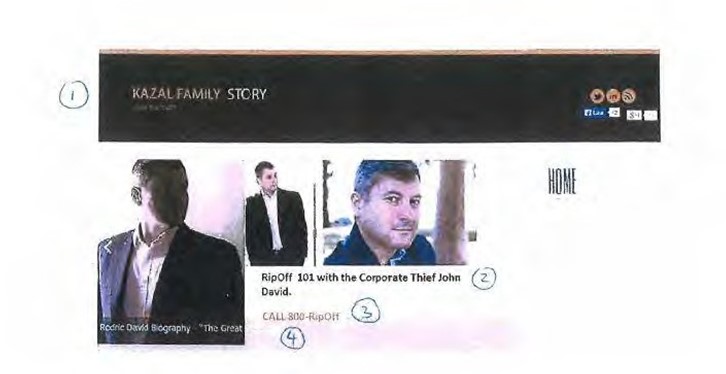
42 The individual in the three photographs in shot A1 is Mr David. The far-left photograph is captioned “Rodric David Biography – ‘The Great Pretender’”. That text is hyperlinked to par 11 in shot A5, which is referred to below.
43 Shot A2 is as follows –
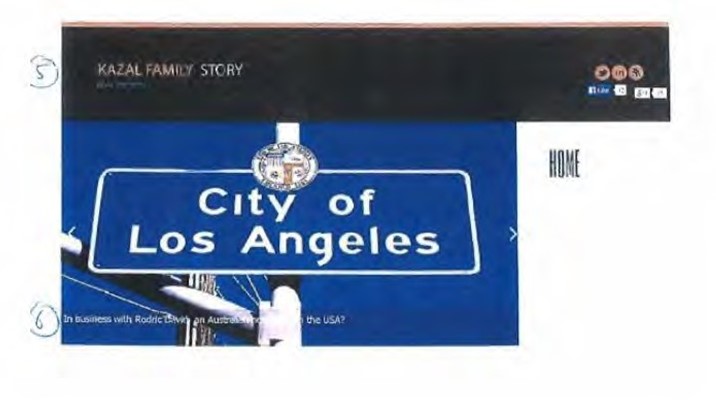
44 Par 6 reads “In business with Rodric David, an Australian living in the USA” and is a hyperlink to par 16 in shot A5, which is referred to below.
45 Shot A3 is as follows, and depicts a masked man reaching out with his hand –
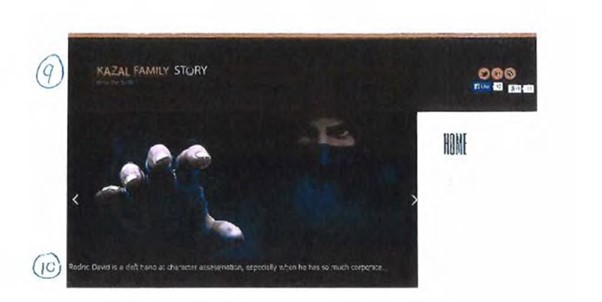
46 Par 10 reads “Rodric David is a deft hand at character assassination, especially when he has so much corporate …” and contains a hyperlink to par 19 in shot A5, referred to below.
47 Shot A4 is as follows –
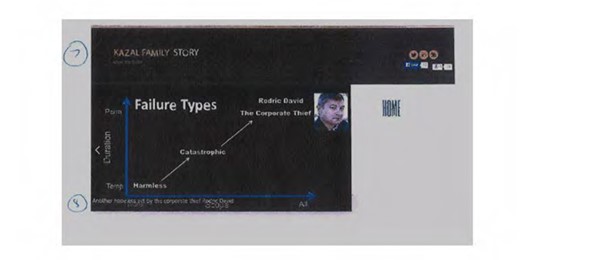
48 Shot A4 depicts a graphic device entitled “Failure Types”. Par 8 is a caption which reads “Another hopeless act by the corporate thief Rodric David” and is a hyperlink to par 22 in shot A5, referred to below. At the high-end of the “Perm[anent]” axis of the graph is a picture of Mr David. Arrows depict an upwards progression from “Harmless” to “Catastrophic” to the picture of Mr David next to a caption “Rodric David The Corporate Thief”.
49 Shot A5 is as follows –
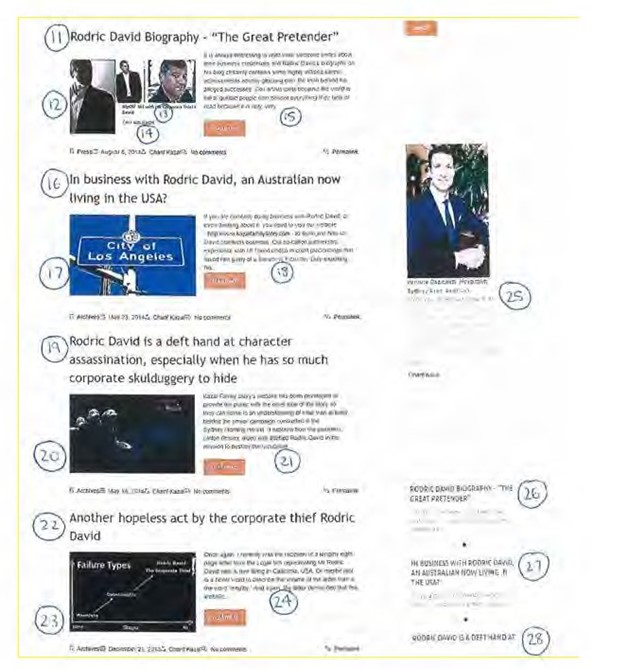
50 Pars 11, 16, 19, and 22 are the places to which hyperlinks from the pars in shots A1, A2, A3, and A4 lead.
51 There are further hyperlinks on the right-hand side of shot A5. Par 26 links to par 11; par 27 to par 16; and par 28 to par 19. The primary judge noted at J12 [37] –
Each of the passages of text below the hyperlinked headings in pars 11, 16, 19 and 22 is introductory to another, presumably longer, passage of text on a subsequent webpage not in evidence. However, the passages have a common theme that disparages Mr David. For example, par 15 begins by referring to Mr David’s biography on his blog and tells the reader that this glossed “adroitly… over the truth behind his alleged successes Con artists exist because the world is full of gullible people who believe everything they hear or read because it is very, very…” and is followed by a hyperlink box entitled “read more”.
52 Par 16 has the heading “In business with Rodric David, an Australian now living in the USA?” and introduces the following text in par 18 –
If you are currently doing business with Rodric David, or even thinking about it, you need to visit our website – http://kazalfamilystory.com – to learn just how Mr David conducts business. Our so-called partnership experience with Mr David ended in court proceedings that found him guilty of a Breach of Fiduciary Duty exposing his
read more
53 The photograph at par 25 is of Charif Kazal.
54 The text of par 21 purports to explain the purpose of the website, being “to provide the public with the other side of the story so that they can come to an understanding of what was actually behind the smear campaign conducted in the Sydney Morning Herald. It explains how the journalist, Linton Besser, aided and abetted Rodric David in his mission to destroy the reputations …”.
55 Shot A6 is as follows –

56 The person depicted in the image to the right of par 30 is Mr David.
57 The text above par 31 refers, and provides a link to a letter written by Mr David’s lawyer, which sought that the website’s publisher “Cease and Desist and to Retract Libel”.
58 The headline to par 32 states, “Will Sydney Morning Herald correct the record as they promised?”.
59 Par 34 replicates the opening text of an email sent by Charif Kazal on 16 July 2013 alleging that Mr Besser had “written a complete fiction …”.
60 Pars 35-37 relate to an email sent by Charif Kazal to Mr Besser on 5 July 2013. The opening text of that email is above par 37. To the right of par 36 is an image captioned “TRUTH OR DARE”.
62 It was accepted by the parties before the primary judge that elements of the above screenshots which appear orange were actually red.
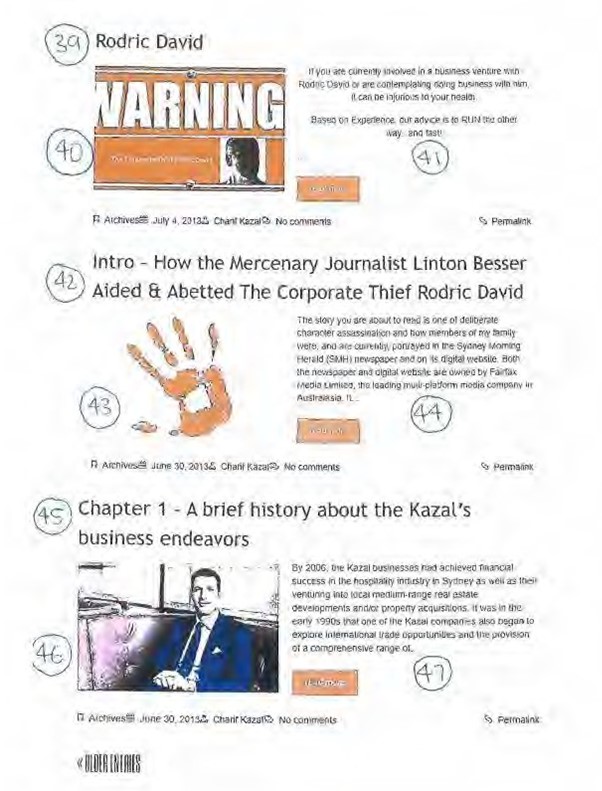
63 To the right of par 40 is a red box containing the words “WARNING” and a picture of Mr David captioned “The Corporate Thief Rodric David”.
64 The text above par 41 reads –
If you are currently involved in a business venture with Rodric David or are contemplating doing business with him, it can be injurious to your health.
Based on Experience, our advice is to RUN the other way … and fast!
65 Par 42 is linked to the narrative comprised of pars 21, 32-34, and 35-7 and to the “Intro” article which is linked to pars 42-44. The full title of that article is “Intro – How the Mercenary Journalist Linton Besser Aided & Abetted the Corporate Thief Rodric David” and appears to the right of par 42. The text above par 44 reads –
The story you are about to read is one of deliberate character assassination and how members of my family were, and currently are, portrayed in Sydney Morning Herald (SMH) newspaper on its digital website. Both the newspaper and digital website are owned by Fairfax Media Limited, the leading multi-platform media company in Australasia. It…
READ MORE
66 Pars 45-47 are related and introduce an article. To the right of par 45 is the heading “Chapter 1 – a brief history about the Kazal’s business endeavours”. To the right of par 46 is a picture of Charif Kazal. Above par 47 is the introductory text to the article.
The imputations conveyed by the first matter
67 The primary judge held that the first matter conveyed the following defamatory imputations concerning Mr David. For convenience, the judge’s own numbering of the imputations used at J12 [48] is noted in square brackets –
(1) Mr David is a corporate thief [6(b)];
(2) Mr David was convicted of breach of fiduciary duty as a result of not fulfilling his partnership obligations to the Kazal family [6(c)];
(3) Mr David is so lacking in integrity that he paid the journalist Linton Besser to publish deliberately invented lies in The Sydney Morning Herald about the Kazal family and their business dealings [6(d)];
(4) anyone doing business with Mr David runs the risk of physical injury if they do not go along with him [6(e)]; and
(5) Mr David paid the journalist Linton Besser to smear the Kazal family in an attempt to cover up his own criminal theft [6(f)].
68 The primary judge also held that the first matter conveyed the following defamatory imputations concerning Thunder Studios, again noting the primary judge’s numbering used at J12 [49] –
(1) Thunder Studios is run by a corporate thief [7(b)];
(2) Thunder Studios is run by Mr David, who was convicted of breach of fiduciary duty as a result of not fulfilling his partnership obligations to the Kazal family [7(c)];
(3) Thunder Studios is run by Mr David, who is so lacking in integrity that he paid the journalist Linton Besser to publish deliberately invented lies in The Sydney Morning Herald about the Kazal family and their business dealings [7(d)];
(4) anyone doing business with Thunder Studios runs the risk of physical injury [7(e)]; and
(5) Thunder Studios is run by a person who paid the journalist Linton Besser to smear the Kazal family in an attempt to cover up his own criminal theft [7(f)].
69 As to imputations 7(d), (e), and (f) concerning Thunder Studios, there were no express findings by the primary judge at J12 [69], [71], or [72] as to whether they were conveyed when the primary judge was considering those imputations together with the corresponding imputations 6(d), (e), and (f) concerning Mr David. However, a fair reading of the reasons for judgment as a whole shows that his Honour did find that imputations 7(d), (e), and (f) were conveyed because his Honour’s consideration of the question of identification of Thunder Studios at J12 [56], and his consideration of the falsity of the imputations at J12 [303]-[305], proceed on the premise that the imputations were conveyed.
70 The second matter was referred to by the primary judge as the “Intro article”. Like the first matter, it was published on the Kazal website.
The content of the second matter
71 The Intro article is reproduced as “Annexure A” to these reasons. The Intro article was featured on the landing page and pars 5-6 in shot A2, and pars 16-18 and 25 in shot A5 relate to that article. At the top of the article is a photograph of a City of Los Angeles street sign captioned with the words “In business with Rodric David, an Australian now living in the USA?”. The headline reads “How the Mercenary Journalist Linton Besser Aided & Abetted the Corporate Thief Rodric David”. The words “Charif Kazal” appear to the bottom-right of par 1. Below those words appears a photograph of Charif Kazal and brief biographical notes appear adjacent to par 24.
72 The opening paragraph, par 2, begins “The story you are about to read is one of deliberate character assassination” in the portrayal of members of the Kazal family in The Sydney Morning Herald. Par 3 states that since 1 September 2010, that newspaper and Fairfax’s website had published over 24 “well-constructed articles” that Mr Besser and Fairfax “carried out [as] this prolonged smear campaign… purely to assist Rodric David, the David family and their business interests”. According to par 4, the reader “will finally discover the truth” on the Kazal website. Charif Kazal, in par 5, tells the reader that Mr Besser initially set out to denigrate three members of his family, namely himself and his brothers, Tony and Karl, but the targets expanded to include his parents and, later, his pregnant wife. At par 6, the reader is given a definition of “defame” and then told that Mr Besser “clearly worked directly for and with Rodric David to frame the distorted content of his articles defaming my family to apply inordinate pressure on us during legal proceedings we had commenced” against Mr David in May 2010 in the UAE and later in the Cayman Islands. At par 8, the reader is told that the articles were planned to coincide with and influence steps in those two proceedings. At par 8, Mr Besser’s photograph is captioned “The Mercenary Journalist”.
73 The Intro article provides some biographical details about Mr David, and his father John, at par 9. At par 10, the article tells the reader of John David “openly advising us to drop our court cases against Rodric and he [John David] would ensure that all the adverse media and attention towards the Kazal family would cease” and, at par 12 –
We did not take up Mr David’s offer and the overall consequences of us seeking justice through the courts have been severe. My brothers and I have been threatened, our business have been threatened, bullying of our children in school and sporting activities has occurred and continual stress is caused to all other family members awaiting the next unwarranted attack to be published in the Sydney Morning Herald against the family.
74 At par 12, the Intro article described the UAE proceeding as being based on Mr David’s corporate fraud as well as his breach of fiduciary duty as a director of a company in which the Kazal family had a financial interest.
75 At par 14, the article tells the reader that Mr David “designed the media smear campaign” to destroy the Kazals’ credibility during critical stages of the two foreign legal proceedings. It stated that he had annexed to his affidavit of 27 September 2010 in the Cayman Islands proceeding nine articles published between 1 and 17 September 2010 and referred in the affidavit to negative publicity about the Kazals. The article asserts that if that proceeding were dismissed swiftly, Mr David would benefit from “a much more rewarding business deal” of which the Kazal family was then ignorant.
76 At par 15, the article tells the reader that Mr David worked “closely” with Mr Besser to time the publications to “disguise secret financial deals of significant benefit to him”. It also asserts that Mr David used his training as an actor, the media, and other proceedings, including in the New South Wales Independent Commission Against Corruption (ICAC), to shift the focus away from his corporate fraud.
77 The Intro article informs the reader, at par 16, that the “deceptive attacking front page” publicity was “excruciating” and distracted the Kazal family’s focus from other important business matters. In par 17 under the sub-heading “Power of the news media” the reader is told, at par 17a, 17b, and 18, about how news media can influence and manipulate public perception and how the adverse publicity affected the Kazals.
78 The par 19 sub-heading, “Truth will prevail”, introduces the reader to the purpose of the Kazal website, outlined at par 20, being to present “the other side of the story” so that the public will understand “what was actually behind the smear campaign conducted in the Sydney Morning Herald”. The reader is told that the Kazal website would explain how Mr Besser aided and abetted Mr David “in his mission to destroy our family for financial gain” in the multi-million dollar range.
79 The Intro article asserts that Mr Besser only contacted the Kazal family for their responses as “impartiality pretences”, but, even then, nothing that they said was included in any of Mr Besser’s articles. It tells the reader that every attempt that the Kazal family made to get The Sydney Morning Herald to report the story fairly “was summarily rebuffed” and at par 21 states –
[t]hat is why my preference for a title for our heretofore unknown side of the story is “The Corporate Thief and The Mercenary Journalist” but then, that is just my opinion of a very appropriate headline.
80 The Intro article concludes with the promise that the Kazal family will continue to challenge openly “the abominable treatment” they had received from Mr David, Mr Besser, the newspaper, and Fairfax “until we obtain justice”: pars 20-23. The Intro article web page also contains links to other pages on the Kazal website.
The imputations conveyed by the second matter
81 The primary judge held that the second matter conveyed the following defamatory imputations concerning Mr David –
(1) Mr David was responsible for the children of Charif Kazal and each of his brothers being bullied at school and at sporting activities, because he paid Linton Besser to publish unwarranted attacks upon members of the Kazal family for having sought justice against him through the courts [9(f)];
(2) Mr David attempted to pervert the course of justice, by threatening Charif Kazal and each of his brothers and their business, because the Kazal family sought justice through the courts [9(g)];
(3) Mr David committed corporate fraud in the United Arab Emirates [9(h)];
(4) Mr David paid the reporter Linton Besser to lie about the Kazal family and their business dealings [9(i)]; and
(5) Mr David paid the journalist Linton Besser to smear the Kazal family, in an attempt to cover up his own corporate fraud and theft [9(j)].
82 The primary judge also held that the second matter conveyed the following defamatory imputations concerning Thunder Studios –
(1) Thunder is run by a corporate criminal who was responsible for the children of Charif Kazal and each of his brothers being bullied targeted at school and at sporting activities, because he paid Linton Besser to publish unwarranted attacks upon members of the Kazal family for having sought justice against him through the courts [10(f)];
(2) Thunder is run by a corporate criminal who attempted to pervert the course of justice, by threatening Charif Kazal and each of his brothers and their business, because the Kazal family sought justice through the courts [10(g)];
(3) Thunder is run by a person who committed corporate fraud in the United Arab Emirates [10(h)];
(4) Thunder is run by a corporate criminal who paid the reporter Linton Besser to lie about the Kazal family and their business dealings [10(i)]; and
(5) Thunder is run by a corporate criminal, Rodric David, who paid the reporter Linton Besser to smear the Kazal family in an attempt to cover up his own corporate fraud and theft [10(j)].
83 Although there was no express finding that imputation 10(h) was conveyed, the judge stated at J12 [82] that the respondents accepted that imputation 9(h) concerning Mr David was conveyed by the second matter. As with three of the imputations concerning Thunder conveyed by the first matter, fairly read, his Honour relied on the admission of imputation 9(h), and is to be understood as finding that Thunder Studios was identified by the second matter, thereby supporting a finding that 10(h) was conveyed. There is a further point, which is that there were no specific findings by the primary judge as to the falsity of imputations 9(h) or 10(h): see J12 [307]-[308]. This was likely an oversight, because the judge found at J12 [299] that each of the imputations that was found to have been conveyed was false. No party took any point about these issues on appeal, and they need not be pursued any further.
The falsity of the first and second matters
84 Mr David gave evidence, and was cross-examined. The appellants did not give evidence, and otherwise did not call any witnesses at trial, but did tender some documentary evidence. The primary judge found that each of the imputations conveyed by the matters was false on the ground that he accepted Mr David’s evidence: J12 [299]. Further, the primary judge made the following specific findings as to falsity at J12 [300]-[309] –
300 Imputations 6(a) and 7(a): Mr David was not “convicted” of any crime. Moreover, he did not run away to California because of any conviction. There is no evidence or basis to say that Mr David’s conduct that Jones J found to be a breach of his fiduciary duty as a director in causing the diluting share allotment was a crime. Imputations 6(a) and 7(a) are false.
301 Imputations 6(b) and 7(b): Mr David is not a corporate thief and, accordingly, imputations 6(b) and 7(b) are false.
302 Imputations 6(c) and 7(c): For the reasons I have given in respect of imputations 6(a) and 7(a), Mr David was not convicted of anything. Moreover, there is no evidence that he did not fulfil any of his partnership obligations to the Kazal family. Jones J’s finding (which is not in evidence in this proceeding of the true position) was that Mr David had breached his fiduciary duty as a director owed to Emergent in exercising the power to make the allotment of shares that his Honour set aside. Imputations 6(c) and 7(c) are also false.
303 Imputation 6(d) and 7(d): Mr David did not pay Mr Besser to write his articles. Moreover, there is no evidence that anything in those articles for which Mr David was responsible was “deliberately invented” or other kind of lie. Accordingly, imputations 6(d) and 7(d) are false.
304 Imputation 6(e) and 7(e): There was no evidence to support any suggestion that Mr David posed any risk to anyone or that he caused or threatened, or even would cause or would threaten, physical injury to anyone at all, including anyone doing business with him. Imputations 6(e) and 7(e) are false.
305 Imputations 6(f) and 7(f): There is no evidence that Mr David paid Mr Besser anything or that Mr David had committed any criminal theft. Accordingly, imputations 6(f) and 7(f) are false.
306 Imputations 9(f) and 10(f): As I have found above, there is no evidence that Mr David paid Mr Besser anything. Nor is there any basis to suggest that Mr David was a corporate criminal or responsible for any conduct affecting Charif’s or his brothers’ children, or that any involvement of Mr David with Mr Besser’s articles had a purpose that had anything to do with members of the Kazal family seeking justice through the courts. Thus, imputations 9(f) and 10(f) are false.
307 Imputations 9(g) and 10(g): There was no evidence to suggest that Mr David had threatened Charif or any of his brothers or their businesses at all, let alone as an attempt to pervert the course of justice. Imputations 9(g) and 10(g) are false.
308 Imputations 9(i) and 10(i): These imputations are false for the same reasons as imputations 6(d) and 7(d) are.
309 Imputations 9(j) and 10(j): These imputations are false for the same reasons as imputations 6(f) and 7(f) are.
85 The primary judge found that for the purposes of the action for injurious falsehood the publication of the matters was malicious, and that Mr David and Thunder Studios had suffered special, or actual damage in the sense discussed by Bowen LJ in Ratcliffe v Evans [1892] 2 QB 524 at 527-533 as the intended and reasonably probable result of the publication of the matters.
86 The third and fourth matters comprised some thousands of publications made on the Twitter accounts maintained by Charif Kazal and Adam Kazal respectively. The causes of action that were alleged were misleading and deceptive conduct in contravention of s 18 of the ACL. There were no claims in defamation or injurious falsehood in relation to the matters published by the appellants on their Twitter accounts. As I have indicated, the third and fourth matters comprised entries on the appellants’ Twitter accounts that had the appearance of links to ordinary commercial newsfeeds, but which in fact contained shortened hyperlinks in the form of bitlinks that took a reader to the Kazal website, including to the landing page. “Annexure B” and “Annexure C” to these reasons provide some indicative examples by way of screenshots. Those examples are the same as those which the primary judge reproduced in his Honour’s reasons in J12.
87 The primary judge found at J12 [102] that once a reader was taken to the Kazal website, he or she could, and some did, move to the Intro article. The primary judge found at J12 [103] that the purpose of each of the appellants in posting large numbers of tweets with these characteristics was to mislead and deceive anyone who took such a tweet at face value into being presented with the landing page, as the home page of the Kazal Family Story, and its attacks on Mr David.
The appellants’ defences at trial
88 At trial, the appellants were represented by senior and junior counsel. The trial proceeded without the appellants having any pleaded defences before the Court. In the case of Charif Kazal, he had filed a defence and then an amended defence, but his defence was struck out in consequence of his failure to comply with a self-executing, or “guillotine” order directed to the provision of verified answers to interrogatories. A subsequent application for an extension of time nunc pro tunc within which to comply with the order was dismissed: Thunder Studios Inc (California) v Kazal (No 5) [2017] FCA 1572 (Judgment No 5, or J5). An application for leave to appeal was dismissed: Thunder Studios Inc (California) v Kazal [2018] FCA 593 (Bromwich J). On this appeal, Charif Kazal seeks to challenge the primary judge’s decision to refuse the extension of time within which to comply with the self-executing order.
89 In the case of Adam Kazal, he did not file a defence, and an application to file a defence out of time was dismissed: Thunder Studios Inc (California) v Kazal (No 3) [2017] FCA 1170 (Judgment No 3, or J3). There was no application for leave to appeal the dismissal of that application and the correctness of that decision is not in issue on this appeal.
90 The consequences for the appellants of having no defences on foot, and whether the absence of defences gave rise to deemed admissions as a result of the operation of r 16.07(2) of the Federal Court Rules 2011 (Cth) is a question in issue on this appeal. Although the appellants had no defences on foot, the primary judge permitted the appellants to cross-examine, to tender evidence, to make submissions in opposition to the respondents’ claims for relief, including as to mitigation of damage, and to put the respondents to their proof. Charif Kazal also had the ability to lead evidence in support of a cross-claim that he brought against Mr David. During the course of the trial the cross-claim was dismissed with costs on an indemnity basis upon Charif Kazal electing to call no evidence: Thunder Studios Inc (California) v Kazal (No 11) [2020] FCA 1656.
The decisions the subject of this appeal
91 Before going to the grounds of appeal and the issues in more detail, I will identify the subject matter of the appeal. There are five decisions of the primary judge that are challenged by the appellants –
(1) In Thunder Studios Inc (California) v Kazal (No 5) [2017] FCA 1572 (to which I have referred as Judgment No 5, or J5), the primary judge dismissed an application by Charif Kazal for an extension of time within which to comply with the self-executing order that resulted in his defence being struck out. As I mentioned above, the application prior to trial for leave to appeal that decision was dismissed. On the leave application it was held that none of the errors that was asserted was viable and that any appeal was doomed to fail: Thunder Studios Inc (California) v Kazal [2018] FCA 593 at [21] (Bromwich J). Charif Kazal challenges on this appeal the primary judge’s exercise of discretion to refuse his application for an extension of time on the ground that the claimed errors affected the final orders.
(2) In Thunder Studios Inc (California) v Kazal (No 7) [2018] FCA 996 (Judgment No 7, or J7), the primary judge dismissed an application that he disqualify himself from hearing the proceeding on the ground of apprehended bias. No application for leave to appeal Judgment No 7 was made prior to trial. The claimed errors attending that decision are now relied on by the appellants in order to challenge the final orders.
(3) In Thunder Studios Inc (California) v Kazal (No 9) [2020] FCA 846 (to which I have referred as Judgment No 9, or J9), the primary judge refused an application by the appellants for orders that the proceeding be stayed pending the hearing and determination of two other proceedings in the docket of Perram J. Alternatively, the appellants sought orders that the proceeding be transferred to the docket of Perram J. No application was made prior to trial to appeal that decision. The appellants now seek to challenge that decision as affecting the final orders.
(4) In Thunder Studios Inc (California) v Kazal (No 10) [2020] FCA 1636 (Judgment No 10, or J10), the primary judge ruled in the course of the trial that some particulars of mitigation of damage that had been relied on by the appellants be struck out, and that in consequence a particular line of cross-examination of Mr David that was said to go to the assessment of damages be disallowed.
(5) Thunder Studios Inc (California) v Kazal (No 12) [2022] FCA 110; 403 ALR 698 (to which I have referred as Judgment No 12, or J12) is the principal judgment following trial. In addition to the challenges to the interlocutory decisions to which I referred above, the appellants challenge the final orders on the following grounds –
(a) that there was a reasonable apprehension of bias having regard to the conduct of the proceeding and to various features of the principal reasons for judgment on which the appellants relied;
(b) that the primary judge was in error in holding that the first matter conveyed imputations 6(e) and 7(e);
(c) that the primary judge was in error in holding that the impugned conduct occurred in trade or commerce for the purposes of s 18 of the ACL;
(d) that the primary judge erred in finding that Thunder Studios was an excluded corporation for the purposes of s 9(2)(b) of the Defamation Act 2005 (NSW); and
(e) that for several specific reasons the assessments of damages were excessive.
92 I will address the grounds of appeal by reference to the decisions to which they are directed, although noting that in an omnibus way the amended notice of appeal embraces an appeal against the final orders relying on all of the grounds of appeal.
(1) Judgment No 5 – default in answering interrogatories
93 On 7 September 2017, the primary judge made the following interlocutory orders which were of a self-executing nature –
4. [Charif Kazal] provide sufficient answers, verified by affidavit, to the Applicants’ interrogatories 13, 15, 36(b), 38 and 44 on or before 4.00 pm on 15 September 2017.
5. In the absence of compliance with Order 4 above, [Charif Kazal’s] Defence (including any amended pleadings) be struck out.
94 The background to the making of these orders was set out clearly and in detail by the primary judge at J5 [9] to [15]. Of particular note is that the orders were made against a background where Charif Kazal had defaulted in complying with earlier orders of the Court that he make verified answers to interrogatories.
95 Charif Kazal did not comply with the orders of 7 September 2017, as a result of which by operation of those orders his defence was struck out. Mr Kazal then made an application to the primary judge on 4 December 2017 that the time for compliance with the orders be extended to 22 September 2017, by which time he had filed his verified answers to interrogatories. That application was dismissed, with the primary judge giving ex tempore reasons for his decision which were subsequently revised and published on 31 January 2018. Charif Kazal then sought leave to appeal the dismissal of his application for an enlargement of time within which to comply with the orders of 7 September 2017. As I mentioned above, the application for leave to appeal was dismissed. One of the issues that arises is whether, in consequence of the refusal of leave to appeal the primary judge’s interlocutory decision in Judgment No 5, the Court’s appellate jurisdiction has been exhausted.
Judgment No 5 – is an appeal precluded by the refusal of leave to appeal?
96 The first issue to address is whether it is open to this Court to entertain a challenge to the orders made in Judgment No 5 in circumstances where the application by Charif Kazal for leave to appeal those orders was refused.
97 There is a separation embedded in the text and architecture of the Federal Court of Australia Act 1976 (Cth) between the Court’s original jurisdiction and its appellate jurisdiction. The Court’s appellate jurisdiction is conferred by s 24. Under s 24(1A), an appeal cannot be brought from an interlocutory judgment of a court unless the Court or a Judge gives leave. Under s 25(2), applications for leave to appeal to the Court must be heard and determined by a single Judge unless a Judge directs that it be heard and determined by a Full Court, or the application is made in a proceeding that has already been assigned to a Full Court and the Full Court considers that it is appropriate to hear and determine the application. Applications for leave to appeal are heard in the Court’s appellate jurisdiction, and not its original jurisdiction. A party may apply to a single judge or a Full Court for leave once and only once, and no appeal lies to a Full Court from a refusal of leave by a single judge: see, Thomas Borthwick & Sons (Pacific Holdings) Ltd v Trade Practices Commission (1988) 18 FCR 424 at 431-433 (Bowen CJ, Lockhart and Sheppard JJ).
98 A decision to give or refuse leave to appeal involves the exercise of an unfettered discretion in s 24(1A) of the Act: see, Décor Corporation Pty Ltd v Dart Industries Pty Ltd [1991] FCA 844; 33 FCR 397 at 399 (Sheppard, Burchett and Heerey JJ). The legal effect of a decision refusing leave to appeal is to deny permission to appeal the interlocutory order. In this case, the reasons of Bromwich J for refusing leave to appeal the orders made in Judgment No 5 were that his Honour held that the proposed grounds of appeal had no serious prospect of success, and that the appeal was doomed to fail. However, while the merits of a proposed appeal from an interlocutory order are usually relevant to the question of leave, a refusal of leave is not an adjudication on an appeal itself. Leave might be refused for a range of discretionary reasons including, for instance, that an appeal from an interlocutory decision made during the course of a trial would interfere with the proper conduct of the trial and hamper the proper administration of justice.
99 By their notice of appeal, the appellants challenge the primary judge’s final orders made on 21 March 2022 and a number of interlocutory orders made during the course of the proceeding, including those consequent upon Judgment No 5. The Court’s appellate jurisdiction in relation to an appeal directly from those interlocutory orders has been spent, because leave to appeal was refused. However, no leave is required to appeal the final orders, and on an appeal from final orders an appellate court can correct any interlocutory order that affected the final result, at least where it is shown that the error resulted in a miscarriage of justice: see, Gerlach v Clifton Bricks Pty Ltd [2002] HCA 22; 209 CLR 478 at [4]-[8] (Gaudron, McHugh and Hayne JJ). Indeed, as long ago as 1859 the Judicial Committee of the Privy Council, in a judgment delivered by Dr Lushington in Maharaja Moheshur Sing v The Bengal Government (1859) VII Moore Ind App 283 at 302-303, stated –
We believe there have been very many cases before this Tribunal in which their Lordships have deemed it to be their duty to correct erroneous interlocutory Orders, though not brought under their consideration until the whole cause had been decided, and brought hither by appeal for adjudication.
100 But this principle is qualified. One qualification, which is relevant to another ground of appeal in this case, is that a failure to seek leave to appeal against the refusal of an application that a judge not try a case on account of a reasonable apprehension of bias might, upon an examination of all the relevant circumstances, preclude the maintenance of the complaint in an appeal against the final orders: Michael Wilson & Partners Ltd v Nicholls [2011] HCA 48; 244 CLR 427 (Michael Wilson & Partners) at [78]-[79], [84]-[85] (Gummow A-CJ, Hayne, Crennan and Bell JJ). The reasons for such a preclusion might include that a decision by a judge to refuse an application for disqualification is final in relation to the subject matter of that decision, and that a party that does not seek to challenge the decision by seeking leave to appeal is to be regarded as having given up the point: Michael Wilson & Partners at [79]. There may be other circumstances where a failure to challenge an interlocutory order may preclude a challenge to the order on appeal against final orders. It is unnecessary to explore those circumstances.
101 This is not a case where Charif Kazal gave up on his challenge to the orders refusing an extension of time to comply with the self-executing orders. The question here, as I have said, is whether the refusal of leave to appeal precludes the appellants from challenging the final orders on the ground that the interlocutory orders made as a result of Judgment No 5 were attended by error. In my view, there is no preclusion. In Marlin Brands Australia Ltd v Brando Aus Holdco Pty Ltd [2022] NSWCA 59 (Marlin Brands) the New South Wales Court of Appeal, by majority, dismissed an application for leave to appeal an interlocutory decision that backdated to the commencement of the proceeding the joinder as a defendant of the applicant for leave to appeal. The Court of Appeal heard argument as if on appeal, because the President directed pursuant to UCPR r 51.12(1)(b) that there be a concurrent hearing of the application for leave to appeal and the appeal itself. Leeming JA, with whom Meagher JA agreed, refused leave to appeal, but without expressing a concluded view on the principal points going to the merits that were agitated. In refusing leave, Leeming JA held that the refusal did not shut the applicant out from vindicating its contention that the backdating of its joinder was in error, stating at [40] –
To the contrary, this is a case where in the event that the litigation proceeds to trial and judgment in one of the permutations in which the timing of the joinder of the Sellers matters becomes significant, then the decision of the primary judge will be an interlocutory decision which will directly bear upon the ultimate outcome, and thus the Sellers will have an appeal as of right on that point: Gerlach v Clifton Bricks Pty Ltd (2002) 209 CLR 478; [2002] HCA 22 at [6]-[8]; Michael Wilson & Partners Ltd v Nicholls (2011) 244 CLR 427; [2011] HCA 48 at [78]. Brando properly acknowledged as much. It is overwhelmingly likely that if that eventuality materialises, there will be other grounds of appeal or cross appeal or notices of contention which the parties wish to agitate in this Court.
102 Another illustration is Durolek v Pier (WA) Pty Ltd (No 2) [2019] WASCA 138, where the Western Australian Court of Appeal allowed an appeal from a final judgment after an assessment of damages on the ground that an interlocutory self-executing order that had operated to strike out the defence of the appellant and to enter judgment against her for damages to be assessed was made in error, and that this order had thereby affected the final result.
103 In this case, Bromwich J did not hear an appeal from the orders in Judgment No 5. To the extent that his Honour considered the merits of the proposed appeal, that was for the purpose of informing the exercise of the unfettered discretion whether to grant leave to appeal. The legal effect of his Honour’s refusal of the application for leave to appeal was that no appeal lay from those interlocutory orders. But as with Marlin Brands, it remains open to Charif Kazal to challenge the final orders as of right on the ground that the refusal of the extension of time within which to comply with the self-executing order affected the final result. That follows not just as a matter of general principle, but also from the express terms of s 24(1E) of the Federal Court of Australia Act, which provides –
(1E) The fact that there has been, or can be, no appeal from an interlocutory judgment of the Court in a proceeding does not prevent:
(a) a party from founding an appeal from a final judgment in the proceeding on the interlocutory judgment; or
(b) the Court from taking account of the interlocutory judgment in determining an appeal from a final judgment in the proceeding.
104 Subsection 24(1E) is engaged because, by reason of the refusal of leave to appeal, there has been no appeal from the interlocutory orders the subject of Judgment No 5.
Judgment No 5 – consideration of the grounds of appeal
105 I turn now to the grounds of appeal in relation to the refusal of an extension of time within which to comply with the self-executing order that was the subject of Judgment No 5. At one level, it might be said that the refusal of the extension of time concerned a question of practice and procedure, thereby attracting appellate restraint. However, one of the factors that must be considered is whether, on the hypothesis that the decision was wrong, there has been a substantial injustice. That is generally a relevant and necessary consideration: Adam P Brown Male Fashions Pty Ltd v Philip Morris Inc [1981] HCA 39; 148 CLR 170 (Adam P Brown Male Fashions) at 177 (Gibbs CJ, Aickin, Wilson and Brennan JJ). That issue need not turn on whether the exercise of power resulting in the orders is characterised as procedural or substantive: see Australian Broadcasting Corporation v O'Neill [2006] HCA 46; 227 CLR 57 at [55] (Gummow and Hayne JJ). On the appellants’ case the refusal of the extension of time affected substantive rights in a practical sense, because the primary judge held at J5 [14] that the absence of a defence gave rise to deemed admissions as a result of the operation of r 16.07(2) of the Federal Court Rules, and Charif Kazal was precluded from advancing positive defences at trial. In relation to the causes of action in defamation, the positive defences included substantial truth, contextual truth, and qualified privilege in the nature of a response to attack qualified privilege. It remains, however, that the decision was discretionary thereby attracting the principles concerning appellate review of discretionary decisions essayed in House v The King [1936] HCA 40; 55 CLR 499.
106 By the amended notice of appeal the primary judge’s refusal of the application to extend time for compliance with the orders of 7 September 2017 is challenged on the following grounds –
1. The primary judge erred in the exercise of his discretion in refusing the First Appellant (Charif Kazal) an extension of time (from 15 September 2017 until 22 September 2017) in which to file and serve verified answers to interrogatories, because:
(1) such exercise of discretion was founded upon the following incorrect findings of fact:
(a) at [34], that Charif Kazal had made no attempt to comply with the order that he file and serve his verified answers to interrogatories by 15 September 2017;
(b) at [40], that Charif Kazal’s lawyers did not bring his problems to the attention of the Respondents’ lawyers; and
(c) at [47], that Charif Kazal did not intend to verify his answers until it suited him after his return to Australia,
and failed to take into consideration the material fact that Charif Kazal’s unverified answers were provided to the Respondents on 15 September 2017 in a form that was the same as the form in which they were subsequently verified on 21 September 2017;
(2) such decision was unreasonable and plainly unjust in all the circumstances, including having regard to the matters identified in paragraph 1(1).
107 Although this is an appeal by way of rehearing, the powers of the Court will be enlivened for the purpose of correcting error. In the case of the discretionary decision to refuse the extension of time within which to comply with the self-executing order, it is not for this Court to substitute its own discretionary decision. Rather, the primary judge’s decision must be shown to be wrong in accordance with established principles governing appellate review of discretionary decisions. The appellants’ claim that there were incorrect findings of fact invokes the third limb identified in House v The King at 505, namely that a discretionary decision may be reviewed by an appellate court if the primary judge mistakes the facts. See also, Cranssen v The King [1936] HCA 42; 55 CLR 509 at 519-520 (Dixon, Evatt and McTiernan JJ), and Harris v The Queen [1954] HCA 51; 90 CLR 652 at 655 (Dixon CJ, Fullagar, Kitto and Taylor JJ). In order to establish that a discretionary decision was in error because the primary judge was mistaken as to the facts, the burden on the appellants is to persuade this Court that one or more of the findings under challenge was wrong and that it was material to the exercise of the discretion such that the Court comes to the view that the discretion was wrongfully exercised. The claim that the judge’s decision was unreasonable or plainly unjust invokes the fifth limb identified in House v The King at 505, and is a circumstance in which an appellate court may infer some error and review the decision of the court below on the ground that a substantial wrong has occurred. I will consider first the challenges to findings of fact, before addressing the appellants’ claim that the decision was plainly unreasonable and unjust.
108 There were three affidavits before the primary judge that were relied on by Charif Kazal: an affidavit of Mr Kazal sworn 3 December 2017, and two affidavits of his solicitor Mr Mitry sworn, respectively, on 4 and 6 December 2017. There was also before the primary judge an affidavit of the solicitor for Thunder Studios and Mr David, Ms Sambrook, sworn 1 December 2017.
109 The background to Mr Kazal’s application to extend time within which to file and serve verified answers to interrogatories in accordance with the self-executing order of 7 September 2017 was set out by the primary judge in some detail in Judgment No 5. The following summary of the background draws on the primary judge’s reasons, together with some details relating to the hearing of the application that are evident from the transcript: see, Cruse v Multiplex Ltd [2008] FCAFC 179; 172 FCR 279 at [63] (Goldberg and Jessup JJ).
110 On 19 May 2017, the primary judge made orders by consent that Charif Kazal file and serve verified answers to interrogatories by 30 May 2017. The terms of the interrogatories had been the subject of discussion and agreement between the parties. Mr Kazal did not comply with the order. Mr Kazal stated that his solicitors served unverified answers on 15 June 2017, “...as I was away at the time”. Mr Kazal’s solicitors later served verified answers on 30 June 2017, being the date on which he verified them. At [10], the primary judge noted the absence of explanation by Charif Kazal for his failure to comply with the order of 19 May 2017.
111 On 6 July 2017, Thunder Studios and Mr David complained of the adequacy of Charif Kazal’s answers, and on 7 July 2017 the primary judge ordered Mr Kazal to file and serve sufficient verified answers by 21 July 2017, particularly interrogatories 44 and 45 which were held to relate to Mr Kazal’s defence of qualified privilege. Mr Kazal failed to comply with this order. His solicitors wrote to the solicitors for Thunder Studios and Mr David on 21 July 2021 stating that Mr Kazal had been unable properly to review all documents in his possession to effect discovery and sufficient answers to interrogatories “due to personal matters”. The personal matters were not explained. Mr Kazal’s solicitors subsequently served unverified answers on 28 July 2017, and verified answers on 31 July 2017.
112 The primary judge stated that Mr Kazal’s verified answer to interrogatory 44 did not comply with the obligation of a publisher alleging qualified privilege to provide a detailed list of information in the possession of the publisher at the time of publication, citing Palmer v John Fairfax & Sons Ltd (1986) 5 NSWLR 727 (Palmer) at 732B-733G (Hunt J). On this appeal, counsel for the appellants submitted that the decision in Palmer was distinguishable because it concerned a statutory defence of qualified privilege, and not the common law defence that had been alleged by Mr Kazal. That submission is beside the point, because interrogatory 44 sought the identification of documents and information, the lawyers acting for Mr Kazal at the relevant time appear to have accepted that it should be answered, and it was the subject of orders by the primary judge that it should be answered.
113 On 15 August 2017, the solicitors for Thunder Studios and Mr David complained to the solicitors for Charif Kazal about the adequacy of the answers, and foreshadowed an application for a self-executing order for further answers. An interlocutory application to that effect was filed on 16 August 2017 and was heard on 18 August 2017. On that occasion, experienced counsel appearing for Mr Kazal accepted that the 31 July 2017 answers to interrogatories “...suffered from the vice in Palmer”, and that the second attempt was no better. Counsel for Mr Kazal sought 28 days within which to make further answers, but opposed a self-executing order. At the hearing the primary judge ruled that Mr Kazal should have 28 days, that is until 15 September 2017, to provide further answers to five interrogatories and that in default his defence would be struck out. It took some time for the parties to prepare orders to reflect the primary judge’s rulings on 18 August 2017. Ultimately, orders were made on 7 September 2017, which included the self-executing order that I have set out at [93] above.
114 Following the hearing on 18 August 2017, Charif Kazal’s solicitor sent him an email reporting that a self-executing order had been made, and that if within 28 days it was not complied with, the defence would be struck out. The affidavits of Charif Kazal’s solicitor, Mr Mitry, deposed to the steps taken between 18 August 2017 and 15 September 2017 to prepare further verified answers to interrogatories. Significantly, on 4 September 2017 Mr Kazal left Australia for New York. A receipt for the airline ticket that was produced by Mr Mitry showed that it had been purchased on 3 September 2017, and that the return flight would arrive in Sydney on 19 September 2017. There was no evidence of the purpose of the trip or its circumstances. Counsel were briefed to assist with the preparation of the answers on 5 September 2017, after Mr Kazal had left for overseas.
115 I will set out [20] and [21] of the primary judge’s reasons, because they are material to the grounds of appeal that are raised –
20 On 6 September 2017 Charif emailed Mr Mitry [his then solicitor] saying that he wanted the draft “asap as with my travelling it’s a juggle when I will be uncontactable so as much notice as possible please”. Mr Mitry immediately replied that he expected the draft to be ready early in the following week, noting “deadline next Friday”. Mr Mitry said that in the afternoon of 11 September 2017, counsel provided a first draft of the answers that Mr Mitry immediately sent to Charif in New York who gave responsive instructions about two hours later.
21 Mr Mitry had to travel to Melbourne on 12 September 2017 to do work for another client, and remained there until 7.00pm on 15 September 2017. He said he worked on revisions of the draft while there with the assistance of his solicitor and counsel. Charif was asked to provide further instructions on some matters on 12 September 2017, which he did so [sic] early on 13 September 2017. Counsel forwarded a further revision to Mr Mitry and his solicitor at 2.16pm on 14 September 2017, that was sent promptly to Charif who responded by just before 5.00pm that night.
116 Mr Mitry’s employed solicitor, and counsel who were briefed, dealt with other amendments to the draft, and at 3.36 pm on 15 September 2017 counsel emailed what Mr Mitry understood to be the final form of the answers that were then emailed to Charif Kazal at 3.55 pm Sydney time, being 1.55 am on 15 September 2017 in New York. Mr Mitry said that his employed solicitor understood, “in communication with [Mr Kazal’s] office that afternoon”, that it was very late at night where Mr Kazal was. Shortly afterwards, counsel for Mr Kazal communicated to junior counsel for Thunder Studios and Mr David the “difficulty in providing verified answers” and told him that unsworn draft answers would be forwarded to his solicitors to comply “at least in spirit” with the order. Mr Kazal’s counsel, in his email to Mr Mitry, correctly anticipated that Thunder Studios and Mr David would require Mr Kazal to apply to the Court for an order extending the time for his answers to be filed in light of his default.
117 Mr Mitry said that until 15 September 2017, he was “hopeful” that the final form of the answers “would be completed before that time and [Charif Kazal] would be able to attend to verification from overseas and return them to me”. Mr Mitry said he did not advise Mr Kazal that, regardless of the time at the place where he was present, he should stay awake and locate a person qualified to take his oath, who should remain with him so that he could verify the interrogatories by 4.00 pm.
118 On 15 September 2017 at 4.55 pm, Charif Kazal’s solicitors wrote to the solicitors for Thunder Studios and Mr David attaching unverified answers and stating that Mr Kazal had “not been able to swear the affidavit required … as he is overseas, and where it is now late evening”. The solicitors apologised for “not being in a position to file the sworn answers this afternoon”. The email said that they were attending to this as a matter of urgency and had attached the answers “in draft to comply with the orders in spirit”. Mr Kazal’s solicitors said in the email that they did not believe that there would be any significant changes as “we have been liaising with our client on the draft answers during the week”.
119 The primary judge inferred from the airline ticket that Charif Kazal arrived in Sydney on the morning of 19 September 2017. At some point on 21 September 2017, Mr Kazal verified the answers to the interrogatories which his solicitors filed at 4.07 pm that day. Thereafter, there was silence from Mr Kazal’s side until 11 October 2017 when his solicitors sent a letter by email to the solicitors for the Thunder Studios and Mr David referring to the self-executing order and seeking consent to an extension of time for the filing and service of the verified answers to 21 September 2017 pursuant to rr 1.39 and 39.04 of the Federal Court Rules in order “to regularise the proceedings”. The solicitors sought a response by noon the following day, 12 October 2017.
120 The solicitors for Thunder Studios and Mr David responded early on 12 October 2017 but noted, as Charif Kazal’s solicitors were aware, that their clients were overseas and could not respond in the timeframe sought. Later on 12 October 2017, the solicitors emailed Mr Kazal’s solicitors stating that they had been instructed to seek substantiation of the reason for the non-compliance and as to why Mr Kazal could not have verified his answers, wherever he had been, at the time at which the verified answers should have been filed. They requested a copy of Mr Kazal’s passport for the period of September 2017 certified by Mr Mitry as solicitor on the record. From then until 28 November 2017, Mr Kazal’s solicitors made no response to those requests. There was no explanation in evidence for that seven-week delay.
121 On 28 November 2017, Mr Mitry sent an email to the solicitors for Thunder Studios and Mr David with a copy of the relevant pages of Mr Kazal’s passport that he had certified. The solicitor explained that because Mr Kazal had been in New York “we were unable to meet our client in person to physically verify the interrogatories until after his return to the country”.
122 The proceeding was listed for an interlocutory hearing before the primary judge on Monday 4 December 2017 for purposes that included the hearing of an application by non-parties to set aside a subpoena, which was granted: Thunder Studios Inc (California) v Kazal (No 4) [2017] FCA 1571. At the conclusion of the hearing of that application counsel for Charif Kazal filed in court, without objection from counsel for Thunder Studios and Mr David, an interlocutory application seeking an extension of time until 4.00 pm on 22 September 2017 for compliance with the self-executing order made on 7 September 2017. The primary judge gave leave to file the application in court returnable instanter, and the hearing of the application occupied the balance of the day on 4 December 2017. During the course of the hearing on 4 December 2017, his Honour raised with counsel appearing for Mr Kazal whether there had been an adequate explanation for the failure to comply with the self-executing order, and the further delay that had occurred before the application for the extension of time was made. Towards the conclusion of the day his Honour expressed an inclination not to make the order because of the inadequacy of the explanations. However, his Honour stated that given the drastic consequences that would ensue from the dismissal of the application, he would give Mr Kazal “one more opportunity to put on a proper and full explanation, including why he had not made arrangements to swear his affidavit or affirm his affidavit of verification in New York, knowing of the order, what he had done about that, if anything, and why he took so long to bring it back before the Court, and that goes for any solicitors as well ...”. Orders were then made allowing for the filing of further affidavits, and the application was stood over part-heard until Friday 8 December 2017. At the adjourned hearing the second affidavit of Mr Mitry was read to the Court, and a small bundle of emails and an itinerary of Mr Kazal relating to his absence from Australia on the day of the adjourned hearing were tendered. Further argument on the application proceeded. After the luncheon adjournment, the primary judge gave ex tempore reasons for refusing the application, which were later revised from the transcript and published.
123 Relevant to the grounds of appeal that are advanced, his Honour made findings, as follows –
33 ... from 18 August 2017 Charif personally was aware that, if he failed to file and serve verified answers to the five interrogatories by 15 September 2017, his defence would be struck out.
34 Despite that knowledge, the evidence of Charif and Mr Mitry established that Charif made no attempt to comply with the requirement in order 4 that his answers be verified and filed by 15 September 2017. In order to verify his answers, Charif had to swear them before an Australian lawyer with a current practicing certificate or, because he was in New York, a notary public or Australian consular officer or person authorised to take oaths in that jurisdiction: see s 45(2) of the Federal Court Act; see too: STX Pan Ocean Co Ltd v Bowen Basin Coal Group Pty Ltd (2010) 188 FCR 528. He knew that when he was in New York on 14, and the early hours of 15, September 2017 New York time, it would be the afternoon of 15 September 2017 in Sydney. He knew that if he failed to verify his answers in accordance with order 4, the very consequence from which he now seeks relief and seeks to characterise as an “injustice” to him would occur automatically. He acted on 14 and 15 September 2016 [sic] in the context where he had breached two earlier orders to file verified answers to the interrogatories, on each occasion filing his answers substantially later than the time limited in each order and, at least in the case of the verified answers due to be filed on 21 July 2017, in breach of his obligation to answer interrogatory 44 in compliance the requirements identified in Palmer 5 NSWLR 727.
35 Charif’s evidence explaining his breach of order 4 was simply that, although he knew of the order to verify and file the answers by 15 September 2017, on that day:
I was still in the United States … out of the country and unavailable to verify the Answers. (emphasis added)
36 That evidence was not correct. He would have been able to verify the answers, had he made arrangements in New York to do so. He chose not to make any arrangements there either in advance of the time specified in order 4 or later. It is not an explanation of his default for him to assert that, by the time he and his lawyers finalised the drafting of his answers, it was in the early morning, around 2.00am, in New York, which he knew was about 4.00pm on 15 September 2017 in Sydney. Both Charif and his lawyers knew that his answers had to be verified and filed by that time. First, they did not seek an extension before 15 September 2017, despite their awareness of the consequence of non-compliance under order 5, and the difficulties that his conduct in being in New York on 14 and 15 September 2017 caused (the reason for which he did explain) in having his answers verified while he was there, particularly having regard to the then state of preparation of his draft answers. Secondly, Charif made no attempt to verify his answers subsequently while in New York. As his evidence made clear, he never intended to do so because, in his words, he was “out of the country and unavailable to verify the Answers”.
37 He chose to be out of the country and his “unavailability” consisted in his failure to arrange to be with someone before whom he could verify his answers in New York, before the expiry of the time in order 4. He did not make arrangements to attend upon such a person then, or even after the expiry of the time in order 4. Indeed, he chose to wait, as I infer he always intended, until it suited him to verify his answers after his subsequent return to Australia, when he would no longer be “unavailable”. In fact, he only did so, again for reasons he did not explain, two days after his return on 19 September 2017.
38 So the question that arises is: what is the injustice against which Charif is seeking relief? In my opinion, it is the consequence of his deliberate, unexplained and conscious choice to be “unavailable” in New York as a result of which he made no arrangements to comply for the third time with an order that he file and serve verified answers to the interrogatories on or before the date ordered by the Court, in this instance, 15 September 2017.
39 I am unable to see, in those circumstances, why the orders of 7 September 2017, or their operation, have created injustice to Charif. No doubt the consequence of his wilful and deliberate flouting of the Court’s orders is harsh on him in this litigation, for he has presently lost his defence to the current statement of claim. But he lost that defence because he did not intend to, and did not, comply with the order to verify his answers until it suited him on his subsequent return to Australia. Nothing prevented him from putting himself into the position to verify his answers with, if need be, his own amendments to the draft he then had in New York during 14 or early on 15 September 2017 New York time, or seeking to do so, after receiving the final version, later during the day on 15 September 2017 after, perhaps, the time had passed in Sydney and then returning the verified answers promptly.
40 While he might still have been in breach (because of the time difference in filing and serving his answers), had he taken the latter course he would at least have been able to demonstrate that he was trying his best to comply while counsel was redrafting his answers here on 14 and 15 September 2017. The looming non-compliance did not spur Charif or his lawyers into seeking an extension of time, bringing his problem to the Court or to the attention of Thunder Studios or Mr David prior to order 5 taking effect. Nor did he explain why he chose to be in New York and so to disable himself from being in a position to comply, if the difficulty for him were his inability to arrange for someone before whom he could swear his answers so that he could file and serve verified answers as order 4 required.
41 Charif took this course, conscious of orders 4 and 5 and the consequences to him of failing to comply with order 4. His solicitor had warned him that there was a guillotine order. He acted in circumstances where, on two previous occasions, he had not complied with orders within time and, when he did, filed answers that were not proper answers to the interrogatories themselves.
42 I do not see how there is injustice to Charif, in those circumstances, in allowing order 5 to operate as he knew, from 18 August 2017, it would operate if he failed to obey order 4 in accordance with its terms on or before 4.00pm on 15 September 2017.
(Emphasis of primary judge.)
124 The primary judge then referred at J5 [46] to the circumstances of the adjournment of the hearing on 4 December 2017, and the concerns that his Honour had expressed about gaps in the evidence, including the absence of any evidence about any steps that had been taken to arrange for Mr Kazal to verify his answers in New York at any time while he was there, knowing, as he did, of the self-executing order for the striking out of the defence if he did not comply with the order in time. His Honour then stated –
47 In the circumstances, I find that Charif made no arrangements or inquiries while he was in New York about how he could verify his answers while he was there (even after the time in order 4 had expired) and he did not intend to do so until it suited him after his return to Australia: Kuhl v Zurich Financial Services Australia Ltd (2011) 243 CLR 361 at 384-385 [62]-[64] per Heydon, Crennan and Bell JJ.
125 The primary judge referred again to the absence of explanation at J5 [53]-[54] –
53 In this case, Charif has chosen not to give any explanation as to why he was in New York or why he could not find, and had not arranged, someone before whom he could swear his answers within the time limited by order 4 or later on 15 September or at any time before 21 September 2017. Accepting that his counsel and solicitors were taking longer than anticipated to finalise the draft answers, Charif was aware of that problem on 14 September 2017 while in New York and of its consequences if order 5 came into effect. There is no evidence that, as the deadline approached in the week of 11-15 September 2017, he raised any concern about possible default. Rather, as he said, he was in the United States and “unavailable” to verify his answers.
54 One factor relevant to the exercise of the discretion in this case is the need to have due regard to public policy of finality in litigation brought about by a self-executing order: FAI General 165 CLR at 283. Another factor is that Charif ought give an explanation why he ought be excused from his non-compliance.
126 Later, the primary judge referred again at J5 [59] to the opportunity which had been afforded to Mr Kazal to give further evidence, stating –
59 When I offered Charif the opportunity to supplement what I saw as being deficiencies in his case, Charif chose, once again, not to devote his attention to explaining to the Court and the applicants why he had not been able to deal with matters in New York, but instead left for overseas. That was indicative of his lack of commitment to his duty to comply with his obligations under s 37N.
127 The primary judge concluded at J5 [63] –
63 I am not satisfied that Charif has explained why he failed to comply with what he appreciated fully at the time was his third opportunity to give verified answers to interrogatories. For reasons that he has chosen not to explain at all, he was out of the jurisdiction and in a place where it was difficult for him to achieve compliance. But he knew of those difficulties (or their potential to arise because of his choice to be out of Australia) and he knew what needed to be done to comply. I am not satisfied that Charif has shown any injustice to him or any other basis for me to extend the time for his compliance with order 4. His interlocutory application must be dismissed with costs.
Judgment No 5 – first factual challenge
128 In relation to the first finding that is challenged, namely the finding at J5 [34] that Charif Kazal had made no attempt to comply with the order, the appellants submitted that the finding was contrary to and could not withstand other factual findings made by the primary judge. In this respect, the appellants relied on the following findings, with the corresponding paragraphs said to contain the finding noted –
(a) on 6 September 2017, Charif Kazal emailed his then solicitor asking for the draft of his answers to interrogatories “asap” as with his travelling commitments he required “as much notice as possible” – J5 [20];
(b) Charif Kazal was provided with a first draft on 11 September 2017, and he responded within two hours – J5 [20];
(c) on 12 September 2017, Charif Kazal was asked to provide further instructions, and he did so early on 13 September 2017 – J5 [21]; and
(d) on 14 September 2017, Charif Kazal was provided with a further draft, and again he responded within several hours – J5 [21].
129 It was submitted that the above findings demonstrated that Charif Kazal worked assiduously to finalise his answers to interrogatories. In oral argument, counsel submitted that the evidence was to be assessed in the context that the verified answers that had been ordered were further answers that had been held to be relevant to the defence of common law qualified privilege. It had been accepted by counsel for Charif Kazal upon the application for further answers that the previous answers were inadequate. In oral argument on appeal, counsel for the appellants submitted that Charif Kazal relied on his lawyers to draft the further answers, and that the evidence showed that he responded in a timely way to requests for instructions.
130 I do not accept that the primary judge was mistaken as to the facts in relation to his finding at J5 [34] that Charif Kazal made no attempt to comply with the requirement in order 4 that his answers be verified and filed by 15 September 2017. As I have demonstrated, his Honour set out the primary facts with care, and in considerable detail. The first sentence of J5 [34] which is the subject of challenge is an evaluative conclusion that must be read in context. When read in context, and in particular with the balance of J5 [34], its focus is on the failure by Mr Kazal to make any attempt to verify his answers while overseas when he knew before leaving Australia that verified answers had to be filed and served by 15 September 2017 or else his defence would be struck out. The primary judge’s conclusion was well supported by the evidence, including that by his affidavit sworn 3 December 2017 Mr Kazal did not explain his failure to have plans in place to verify the answers when overseas, and the fact that Mr Kazal did not verify his answers until 21 September 2017 after he returned to Australia. There was therefore no error in the primary judge’s conclusion that Mr Kazal made no attempt to comply with the requirement that verified answers be filed by 15 September 2017.
Judgment No 5 – second factual challenge
131 In relation to the second finding that is challenged, namely the finding at [40] that Charif Kazal did not bring the problem to the attention of Thunder Studios or Mr David prior to the order taking effect, the appellants submitted that on the evidence recounted by his Honour, Mr Kazal did so on at least two occasions. It was submitted first, that counsel for Mr Kazal communicated the difficulty in verifying the answers to the respondents’ junior counsel, and informed him that the unsworn answers would be provided to the respondents’ solicitor to comply “at least in spirit” with the orders. Second, it was submitted that Mr Kazal’s then solicitors wrote to the solicitors for Thunder Studios and Mr David attaching the unverified answers, and apologised for the inability to file sworn answers and foreshadowed that there were unlikely to be any significant changes in the answers when verified. In the event, the answers were verified in exactly the same form.
132 I do not accept that the primary judge’s findings at [40] show that his Honour was mistaken as to the facts. Again, regard must be had to the care with which the primary judge made his findings of primary fact throughout the whole of his reasons, and regard must be had to the real focus of the impugned passage in J5 [40], and to context. At J5 [22] of the reasons his Honour referred to counsel for Mr Kazal communicating to junior counsel for Thunder Studios and Mr David the “difficulty in providing verified answers” (see [116] above). And the primary judge referred at J5 [24] to a letter from Mr Kazal’s solicitors sent by email on 15 September 2017 at 4.55 pm to the solicitors for Thunder Studios and Mr David attaching unverified answers (see [118] above). That email was sent almost an hour after the time for compliance with the self-executing order had expired.
133 There was no direct evidence as to when counsel spoke. The conversation between counsel was referred to in the email sent to the solicitors for Thunder Studios and Mr David at 4.55 pm. In addition, in Mr Mitry’s affidavit sworn 6 December 2017 at [20]-[22], he referred to the following sequence of relevant events on 15 September 2017 –
(a) at 3.36 pm the solicitors received an email from counsel with what they understood to be the final form of answers for verification by Mr Kazal;
(b) at 3.55 pm the solicitors sent the answers to Mr Kazal;
(c) the solicitors then telephoned counsel to discuss the most appropriate way forward, noting the difficulties in getting in touch with Mr Kazal; and
(d) at 4.46 pm Mr Mitry received an email from the senior of the two counsel retained to settle the draft answers, which he produced, in which counsel stated that he learned of the fact that Mr Kazal was unavailable for verification of the answers upon his return to chambers at around 4.05 pm and that he then telephoned counsel for Thunder Studios and Mr David.
134 The primary judge referred to the email from counsel to Mr Mitry sent at 4.46 pm at J5 [22]. The proper inference is that counsel for the parties did not speak to each other until after 4.00 pm when the time for compliance with the self-executing order had expired. There was, therefore, no error in the primary judge’s findings at J5 [40], and the appellants’ submissions must be rejected.
Judgment No 5 – third factual challenge
135 In relation to the third finding that is challenged, namely the finding at J5 [36] and [37] that Charif Kazal did not intend to verify his answers until it suited him after his return to Australia, counsel for the appellants submitted that the finding that Mr Kazal “never intended to do so” relied upon a selective extract from Mr Kazal’s affidavit stating that he was “out of the country and unavailable to verify the Answers”. It was submitted that the primary judge appeared to apply Mr Kazal’s stated unavailability to the entirety of his time in New York. It was submitted that this was contrary to his Honour’s finding at J5 [35] that on that day, being 15 September 2017, Mr Kazal’s evidence was that he was unavailable to verify the answers. Further, it was submitted that there was no evidentiary basis for his Honour’s conclusion that Mr Kazal’s unavailability was deliberate, and not only intentional but “always intended” (at J5 [37]), and that there had been “wilful and deliberate flouting” of the Court’s orders (at J5 [39]). Counsel for the appellants submitted that these conclusions were contradicted by other findings of the primary judge on which the appellants relied and which I summarised at [128] above. Counsel for the appellants further submitted that the primary judge at J5 [47] erroneously applied Kuhl v Zurich Financial Services Australia Ltd [2011] HCA 11; 243 CLR 361 (Kuhl) to arrive at those conclusions. It was submitted that the proper inference was not that there was such an intention, but rather that any further evidence given by Mr Kazal would not have assisted him. It was submitted that to use the failure of Mr Kazal to give evidence to support an inference of intention required that there be a basis for the inference in the first place, which there was not. Finally in relation to this aspect of the grounds, counsel for the appellants submitted that at J5 [59] (see [126] above) the primary judge imputed to Mr Kazal a state of mind upon his return from New York that was unsupported by evidence. It was submitted that it was not correct that Mr Kazal did not devote his attention to providing supplementary evidence, but rather that his solicitor chose to file an affidavit. It was further submitted that there was a compelling inference that Mr Kazal had relied on his legal advisers, and that in the circumstances an explanation by his legal advisers as to the circumstances of non-compliance with the orders had been given.
136 I do not accept that the primary judge was mistaken as to any facts that are the subject of the appellant’s third challenge. The appellant’s submissions suffer from the fact that they cherry-pick words that are stripped from their full context. One should read the whole of the primary judge’s findings at J5 [37]. Those findings are supported by all the circumstances to which his Honour referred, including: (1) Mr Kazal had previously failed to comply with orders requiring that verified answers to interrogatories be filed and served; (2) Mr Kazal was aware of the self-executing order when it was ruled upon on 18 August 2017; (3) Mr Kazal left Australia for New York on 9 September 2017 knowing of the self-executing order; (4) Mr Kazal made no attempt while in New York to comply with the order by arranging to verify his answers; (5) the only explanation that Mr Kazal gave was that he was “unavailable to verify the answers”; (6) this explanation was rejected by the primary judge because Mr Kazal could have sworn the answers in New York; (7) Mr Kazal, by his lawyers, did not seek an extension of time before 15 September 2017 despite their awareness of the consequence of non-compliance with the order; and (8) Mr Kazal verified his answers only upon his return to Australia. It was in this context that the explanation of Mr Kazal that he was “unavailable” fell to be assessed. Given the circumstances, there was no error by the primary judge in finding that Mr Kazal’s “unavailability” consisted of his failure to make arrangements to swear his answers and that this was a deliberate, unexplained, and conscious choice, and because he had made no arrangements he had never intended to verify his answers until it suited him.
137 The primary judge’s conclusions were also supported by the circumstance, to which the primary judge referred at J5 [46], that his Honour had adjourned the hearing on 4 December 2017 for the specific purpose of enabling Mr Kazal to adduce further evidence to explain his default, and to fill the gaps in the evidence to which his Honour referred. Mr Kazal did not swear any further affidavit. His solicitor, Mr Mitry, made a further affidavit in which he stated, amongst other things –
As a great deal of work was performed in the final days (and hours) before the 15 September 2017 deadline, my focus was upon ensuring that this was able to be finalised. I did not advise Mr Kazal that, regardless of the time where he was located, he should find remain awake and locate a qualified witness (who should remain with him) so that he could verify the interrogatories in order for them to be filed and served before 4:00pm (AEST) on 15 September 2017.
138 At J5 [46] the primary judge referred to the fact that Mr Mitry provided further evidence. It remained the fact that there was no explanation by Mr Kazal of his failure to make arrangements while overseas to comply with the order by verifying the answers to interrogatories. The significance of Mr Kazal’s failure to give an explanation was emphasised by his Honour by citing at J5 [52] the following passages from Tamaya Resources Ltd (in liq) v Deloitte Touche Tohmatsu (a firm) [2016] FCAFC 2; 332 ALR 199 at 226 [154]-[156] (Gilmour, Perram and Beach JJ), with the emphasis added by the primary judge –
It must be borne in mind that the explanation required is that of the moving party, not merely their solicitor or counsel. The client may very well know of matters relevant to the explanation for delay which are not known by the lawyers.
Evidence as to the explanation for delay will often be given by an applicant’s solicitor from their own knowledge but that may, in some cases, not be sufficient.
139 Contrary to the submissions of counsel for the appellants there was no misapplication by the primary judge of the reasons of the majority (Heydon, Crennan and Bell JJ) in Kuhl v Zurich Financial Services Australia Ltd. At J5 [47] his Honour cited [62]-[64] of the majority reasons in Kuhl which are extensive, covering much of pages 384 and 385 of the Commonwealth Law Reports. His Honour’s reasons at J5 [47] cannot be understood as misstating or misapplying any relevant principles. The principles referred to in Kuhl at [63] include that the “failure to adduce evidence from a party witness may permit a court to draw, with greater confidence, any inference unfavourable to the party that failed to call the witness, if that uncalled witness appears to be in a position to cast light on whether the inference should be drawn”. That is what the primary judge did here, because his Honour referred at J5 [46] to the fact that at the conclusion of the interlocutory hearing on 4 December 2017 he was minded not to grant the relief sought on the material then before him. Mr Kazal’s failure to take up the opportunity to swear a further affidavit engaged directly the principles referred to in Kuhl at [63], thereby giving further support to the conclusion that the primary judge expressed at J5 [47]. That conclusion then informed the discretionary considerations to which his Honour referred at J5 [53], [54], [59] and [63] where the absence of explanation from Mr Kazal was relevant to his Honour’s consideration. And contrary to the submissions of the appellants, in this state of the evidence there was no compelling inference to be drawn that Mr Kazal had relied on the advice of his legal representatives.
Judgment No 5 – was the decision unreasonable or plainly unjust?
140 The fifth limb of the principles essayed in House v The King at 505 authorises an appellate court to review a discretionary decision on the ground that on the facts it was unreasonable or plainly unjust and that a substantial wrong has occurred where the nature of any specific error leading to that result may not be discoverable. This threshold recognises the decisional freedom conferred on a judge exercising a discretionary power, which in this case was the procedural power to extend time.
141 The appellants submitted that Thunder Studios and Mr David did not contend that they were prejudiced by the late filing of the answers to interrogatories, and nor could they have been, given the correspondence between the verified and unverified answers.
142 It was further submitted that the primary judge made an error of fact at J5 [55] in concluding that the delay in filing verified answers to interrogatories had caused a delay of some four months in the proceeding. It was submitted that in the intervening period there was a dispute about the adequacy of answers, including as to whether they complied with the requirements referred to in Palmer v John Fairfax & Sons. It was submitted that because Mr Kazal had pleaded common law qualified privilege rather than statutory qualified privilege the primary judge’s conclusion at J5 [13] that his “July 2017 verified answer to interrogatory 44 did not comply with the well-settled obligation of a publisher who pleaded, as Charif had done, a defence of qualified privilege to provide a detailed list of information” was in error.
143 It was submitted that the primary judge’s conclusion at J5 [63] that Mr Kazal did not show injustice as a basis for extension of time must be rejected. That was because, it was submitted, Mr Kazal was denied the opportunity to present a defence at trial, and that the prejudice was “evident and was extraordinary”.
144 I do not accept the appellant’s submissions in relation to this ground. Commencing first with that part of the submissions concerning the requirements relating to answers to interrogatories referred to in Palmer v John Fairfax & Sons, this was not in issue before the primary judge. Counsel experienced in defamation proceedings who appeared before the primary judge at the interlocutory hearing on 18 August 2017 had accepted that previous answers were insufficient, as a consequence of which the order for further answers was made: see [112]-[113] above.
145 As to the appellants’ submissions directed to injustice, there is a distinction to be drawn between injustice that might flow from an interlocutory decision upon the hypothesis that there was some error, and establishing that a decision was unreasonable or plainly unjust as a ground for inferring error. The former is concerned with substantial injustice that must normally be demonstrated to succeed in an appeal against a procedural decision where error is otherwise shown: see, Adam P Brown Male Fashions at 177. The latter is concerned with injustice in the sense of plain unfairness or unreasonableness, for the purpose of establishing error, as the formulation in House v The King at 505 indicates. It may be accepted that Mr Kazal was prejudiced as a result of the dismissal of his application to enlarge time. The primary judge was well aware of this, and acknowledged the significant prejudice that Mr Kazal might suffer if the extension of time was refused. That is why his Honour gave Mr Kazal an opportunity to adduce further evidence. But the primary judge held for the comprehensive reasons that his Honour gave that Mr Kazal did not show that this was an injustice. Prominent among those reasons were the findings of fact that his Honour made, and which I would uphold, that Mr Kazal had on two previous occasions been in breach of orders requiring verified answers to interrogatories, that he chose to be out of the jurisdiction knowing of the self-executing order, made no arrangements while overseas to verify his answers, intended to verify the answers only when it suited him, and had not by evidence given any acceptable explanation for what occurred. These adverse findings are given added complexion by Mr Kazal’s delay in responding to reasonable enquiries relating to the production of his passport, and his delay of seven weeks after the self-executing order took effect in making an application to the Court for the extension of time, to which the primary judge referred at J5 [26]. It is also to be noted that the Court’s power to strike out a defence for failure to comply with a direction of the Court includes the powers in s 37P(5) and (6)(b) of the Federal Court of Australia Act in addition to the power in r 5.21(c) of the Federal Court Rules. The powers conferred by s 37P are for the overarching purpose in s 37M of the Act, which is to facilitate the just resolution of disputes according to law as quickly, inexpensively and efficiently as possible. The exercise of the powers in r 5.21 is also subject to the overarching purpose: see s 37M(3). For these reasons, the primary judge has not been shown to be wrong in concluding that he was not satisfied that Mr Kazal had shown any injustice, and nor has the primary judge’s decision been shown objectively to be unreasonable or unjust such that a substantial injustice has occurred.
(2) Judgment No 7 – claimed apprehended bias
146 In Judgment No 7, the primary judge dismissed a formal interlocutory application made prior to trial that he disqualify himself from the further hearing of the proceeding on the ground of apprehended bias. The disqualification application was heard and determined on 8 June 2018, which was more than two years before the trial of the proceeding commenced on 19 October 2020.
The findings of contempt of court
147 On 21 December 2016, the primary judge found the appellant Adam Kazal guilty of six charges of contempt of court: Judgment No 1. Subsequently, on 27 February 2017 his Honour imposed a series of six concurrent sentences of imprisonment, the shortest of which was two months, and the longest of which was 18 months: Judgment No 2.
148 Adam Kazal appealed the convictions and the sentences to the Full Court. On 31 July 2017, the Full Court set aside the convictions on two of the six charges, and for this and other reasons the factual basis on which Adam Kazal had been sentenced was altered. The standalone grounds relating to the sentences were rejected by the Court. However, because the factual basis on which Mr Kazal was sentenced had changed, the Full Court resentenced him. In relation to the four convictions that stood, Mr Kazal was sentenced to one term of imprisonment of nine months, one term of imprisonment of six months that was to be served concurrently with the sentence of nine months, and a further term of six months that was to be served concurrently with a fourth sentence of 12 months. In relation to those concurrent sentences, it was ordered that they be served partly cumulatively with the other concurrent sentences, and that the appropriate period of accumulation was three months: Kazal v Thunder Studios Inc [2017] FCAFC 111; 256 FCR 90 (FCJ) at [179], [182], [185] and [190]. The Full Court summarised the four concurrent sentences in a table at FCJ [191]. There was therefore a total effective sentence of 15 months, which was three months less than the primary judge’s total effective sentence.
149 The background to the application was that on 4 November 2016, which was more than two years after the proceeding commenced, the respondents filed an interlocutory application seeking injunctions to restrain Adam Kazal from making public statements of a kind that were the subject of the substantive proceedings. It was alleged that Mr Kazal had been publishing matter by causing vans to be driven around Sydney containing signage that was disparaging of Mr David, by Twitter posts, and by publications on the Kazal website. Initially, Perram J made interim ex parte orders on 4 November 2016. On the return of the application before the primary judge on 11 November 2016, Adam Kazal, who was represented by senior and junior counsel, consented to orders restraining him in comprehensive terms from publishing the matter that was the subject of the orders, and requiring him to remove or cause to be removed from the internet the material referred to in the orders. The orders were set out by the Full Court at FCJ [11].
150 The contempt charges against Adam Kazal were brought on 25 November 2016. The text of all the charges, including those of which Mr Kazal was found not guilty, was set out by the Full Court at FCJ [12]. The charges that were found proven by the primary judge and upheld on appeal fell into two categories. The first category comprised charges that Mr Kazal had breached the consent orders that were made on 11 November 2016. These were charges 3 and 5, the convictions for which were upheld by the Full Court. The Full Court held that there was no error by the primary judge in concluding that Mr Kazal had committed a serious and deliberate flouting of the consent orders which was highly organised, ongoing, and included other participants, and which was a public defiance of the authority of the Court and its orders. It followed that there was no error in concluding that the breaches of the orders were contumacious: FCJ [130]-[133].
151 The second category comprised the convictions in respect of charges 8 and 9, which involved the making of public statements comprising the publication by Mr Kazal of Twitter posts, emails, videos, website posts and displays on vans in central Sydney, that were intended, and calculated to influence a party in the conduct of the proceedings, and which exposed a party to pre-judgment. In particular, there were two emails dated 28 October 2016 and 31 October 2016 that were sent by Adam Kazal to, respectively, Mr David and to his solicitor and which were posted on Mr Kazal’s Twitter account. Those emails were referred to by the primary judge at J1 [2]-[10], which were reproduced by the Full Court at FCJ [9], stating that no issue had been taken with the way in which the primary judge had summarised the background to the case. These contempts were regarded by the Full Court as even more serious than the breaches of the consent orders, involving as they did interference with the administration of justice. The seriousness with which the Full Court regarded the contempts was reflected in the Full Court’s own sentencing remarks and orders in respect of charges 8 and 9.
The application by Adam Kazal to be discharged from prison
152 On 27 October 2017, being about three months after the Full Court’s decision on appeal, Adam Kazal applied to the Court for an order pursuant to r 42.22 of the Federal Court Rules that he be discharged from prison before the end of his term. The application was heard and determined by the primary judge on 15 December 2017. Mr Kazal relied on a detailed affidavit in support of his application, and he was examined and cross-examined at the hearing.
153 The primary judge refused the application, giving detailed reasons: Thunder Studios Inc (California) v Kazal (No 6) [2017] FCA 1573; 356 ALR 238 (Judgment No 6). His Honour held that he had jurisdiction to hear the application. That issue warranted attention because the operative orders by which Adam Kazal had been committed to prison had been made by the Full Court. Underpinning the primary judge’s path of reasoning was that his Honour held that r 42.22 was to be approached on the basis that it conferred a discretion that was unconfined by the terms of the rules, but which was to be exercised within the subject-matter, scope, and purpose of the statutory enactment. The contempts that had been upheld by the Full Court were in substance criminal contempts in respect of conduct that had been completed by the time the charges were laid. It was not a case where there was continuing disobedience of a court order where the sanction for contempt was remedial or coercive. In this respect, the Full Court at FCJ [22] cited Witham v Holloway [1995] HCA 3; 185 CLR 525 at 532 and the reference to the metaphor used in United States authority that those in breach of an order or undertaking “carry the keys of the prison in their own pockets”: In re Nevitt 117 Fed Rep 448 at 461 (8th Cir 1902). The primary judge held that the contempts were criminal in character because the contraventions of the consent orders were contumacious, and the interference with the administration of justice was criminal contempt. This directed attention to the underlying purposes of sentencing for criminal contempt. The reasons advanced by Adam Kazal in support of his application included statements of contrition and a realisation of the wrongfulness of his conduct. The primary judge observed that this reflected rehabilitation, which was one purpose of imprisonment for criminal contempt. Another reason was that Mr Kazal claimed that he had not given instructions to consent to the orders. His Honour did not accept this evidence for reasons including that it had not previously been raised on the sentencing hearing or on the appeal. Ultimately, having regard to a range of considerations, including the seriousness of the contempts, his Honour was not satisfied that it was in the interests of justice to exercise powers to discharge him.
The application to the primary judge
154 I now turn to the grounds on which the appellants submitted that the primary judge should disqualify himself from the further hearing of the proceeding. The grounds of the application to the primary judge were referred to by his Honour at J7 [2] and [4]. The appellants relied on the following interlocutory decisions of his Honour –
(a) the conviction of Adam Kazal on six counts of contempt that was the subject of Judgment No 1, and the subsequent sentence that was the subject of Judgment No 2;
(b) the refusal of leave to Adam Kazal to file a defence nearly two-and-a-half years out of time while he was in contempt, which was the subject of Judgment No 3;
(c) the refusal to extend the time within which Charif Kazal could comply with the self-executing order for answers to interrogatories that was the subject of Judgment No 5, which had the consequence that his defence remained struck out; and
(d) the dismissal of the application of Adam Kazal under r 42.22 of the Federal Court Rules that he be discharged before the end of the 15 month total effective term of imprisonment imposed by the Full Court, which was the subject of Judgment No 6.
155 It was submitted to the primary judge that a fair-minded lay observer might reasonably apprehend that his Honour might not bring an impartial mind to bear on the resolution of the balance of the case, and in particular, to circumstances on which his Honour would have to exercise judicial discretions. The application was put on the basis of the cumulative impression that his Honour’s reasons and decisions in the four matters referred to in the previous paragraph were capable of creating in the mind of a fair-minded lay observer. It was submitted that the observer might reasonably apprehend that his Honour had been provoked to a sense of indignation about the past conduct of each of Charif and Adam Kazal that might carry through to future situations in which he might have to exercise a discretion as to the conduct of their cases, or in deciding what remains in the substantive cases. The primary judge noted at J7 [5] that the appellants had stated that there was nothing that his Honour had said to give rise to any apprehension of bias in the course of deciding to dismiss Adam Kazal’s application to be discharged from his imprisonment prior to the expiry of the term fixed by the Full Court, other than his Honour’s decision to dismiss that application.
156 In dismissing the application, the primary judge referred to the principal authorities, including Johnson v Johnson [2000] HCA 48; 201 CLR 488 and Ebner v Official Trustee in Bankruptcy [2000] HCA 63; 205 CLR 337. In particular, the primary judge cited the following passage from Re Morling; Ex parte Australasian Meat Industry Employees Union (1985) 66 ALR 608 at 611, which was an application for a writ of prohibition against Morling J, who was part-heard in a matter –
I am not persuaded that there is any foundation for supposing that Morling J, in expressing the conclusions which he did upon the evidence which was then before him, was demonstrating any incapacity to bring to the resolution of the question of damages an impartial or unprejudiced mind. The course which the proceedings before him took, and which apparently commended itself to the parties at the time, required him to reach separate conclusions in relation to the issue of injunctive relief and the issue of damages. This must have been obvious when that course was adopted. But having expressed his views regarding the evidence adduced upon the question of injunctive relief, there is no reason to suppose that, upon the question of responsibility of the union for any loss or damage suffered by the claimant and the extent of any such loss or damage, his Honour will not reach his conclusions in accordance with the evidence which, having regard to the course taken, may not be the same evidence as that upon which his Honour granted an injunction.
…
The way in which the proceedings have been conducted carries with it the difficulty that the judge must reach conclusions at different stages upon evidence which may not be the same, but there is no reason to suppose that Morling J will be unable to approach the resolution of that difficulty in a fair and impartial manner. Whatever criticism might, and perhaps subsequently will, be made of the procedure, it does not provide the basis for any suspicion of lack of impartiality. It was, as I have already observed, a procedure adopted without objection from the union.
(Emphasis added by the primary judge.)
157 The primary judge referred at J7 [16]-[19] to the fact that he had found Adam Kazal not guilty in relation to three charges, and part of a fourth charge. His Honour referred to the fact that the Full Court set aside two of the six convictions, but in re-sentencing Mr Kazal imposed new sentences that reflected the same gravity of the offending that his Honour had expressed.
158 The primary judge noted at J7 [32] that there had been no application by Adam Kazal that his Honour not hear the application under r 42.22 of the Federal Court Rules that he be discharged that was the subject of Judgment No 6, stating that he must have waived any objection to his Honour hearing the case up to that point. In the case of Charif Kazal, the primary judge referred to the reasons of Bromwich J for refusing leave to appeal the orders the subject of Judgment No 5, which included that no arguable error had been shown in relation to the primary judge’s finding that there was no intention to verify the answers to interrogatories while overseas, which Bromwich J held was a reasonably compelling inference to draw on the available evidence.
159 The primary judge held at J7 [19] that –
Given that the Full Court upheld the convictions on the other counts and imposed sentences that reflected a similar view of the gravity of the offending conduct that I had expressed, I am of opinion that the fair-minded lay observer might not reasonably apprehend that I might not bring an impartial mind to the resolution of any future question. Moreover, Adam did not give evidence in the contempt proceedings and the convictions (so far as they survived appeal) were arrived at on other, basically objective, evidence beyond reasonable doubt. And as I have said, I found him not guilty on a number of the counts, indicating to the fair-minded lay observer that I was not prepared to convict him regardless of the evidence
160 Later, at J7 [31] the primary judge held –
I am not able to see that the fair-minded lay observer might draw a logical connection between the four decisions which I made, or any one or more of them, and the fear that I might not deal with any future issues fairly and impartially: Ebner 205 CLR at 345 [8].
161 In consequence, the primary judge concluded at J7 [34] –
In my opinion, a fair-minded lay observer would approach the assessment of whether I might bring, or be perceived to bring, an impartial mind to the future resolution of the issues that will arise in this case, having regard to the facts that, in all the circumstances, I arrived at the adverse conclusions in each of the four judgments complained of fairly and impartially, in light of an objectively appropriate assessment of the evidence, arguments, and legal and factual merits of each application, and for no other reason.
162 There was no application by the appellants for leave to appeal the primary judge’s orders dismissing the application that he disqualify himself from the further hearing of the proceeding. As a result, the proceeding remained in the primary judge’s docket, and proceeded to trial and then judgment.
The appellant’s arguments on appeal
163 On this appeal, the appellants advanced the following ground directed to the reasons in Judgment No 7 –
2. The primary judge erred in finding at [19] and [31], that a fair-minded lay observer might not reasonably apprehend that he might not bring an impartial mind to the resolution of any future question in the proceeding because he failed to consider that the findings that he had made concerning the conduct of the Second Appellant (Adam Kazal) (with respect to the contempt charges) also concerned conduct that would be (and was) in issue at the trial of the proceeding.
164 No separate application was made for leave to appeal the interlocutory order that was the subject of Judgment No 7, and the ground advanced must be treated as being a challenge to the final orders on the basis that the appellants would contend that the order dismissing the interlocutory application affected the final result.
165 The appellants submitted that the primary judge ought to have refrained from hearing the substantive proceeding because in making findings as to Adam Kazal’s contempt of court his Honour had expressed clear views about Adam Kazal’s conduct and the effect that it had on Mr David, which issues of fact would be, and were, significant to the determination of Mr David’s claim for aggravated damages in the subsequent defamation trial. The appellants relied on the appearance of bias by way of pre-judgment in the way identified in Livesey v New South Wales Bar Association [1983] HCA 17; 151 CLR 288 at 300 (Mason, Murphy, Brennan, Deane and Dawson JJ). In particular, it was submitted by the appellants –
(1) In the circumstances of the case, a reasonable observer might apprehend that at trial the primary judge might not move his mind from the position reached, even if different materials were presented at the trial – that is, bring an impartial mind to the issues relating to Adam Kazal’s conduct the subject of the contempt charges.
(2) What occurred went further than a mere unfavourable finding, or a reasonable apprehension that the case would be decided adversely to one party. Rather, the findings traversed issues that would arise in the substantive trial.
(3) Adam Kazal’s conduct the subject of the contempt charges was referred to on numerous occasions in Judgment No 12. It was submitted that the conduct of Adam Kazal formed a lens through which the primary judge assessed aggravated damages, in circumstances where the primary judge had already judged that conduct to be egregious, and had delivered an undoubtedly stern penalty in respect of it. The appellants’ submissions gave instances of findings made in Judgment No 1 that were relied on –
(a) the findings at J1 [108]-[112] that Adam Kazal’s email to Mr David of 28 October 2016 was a threat that was intended to put pressure on Mr David;
(b) the findings at J1 [65]-[66] and [75], and J2 [33], that Adam Kazal was liable as a publisher of the Kazal website; and
(c) the finding at J2 [34] and [37] that Adam Kazal’s conduct in October and November of 2016 had caused substantially more people to visit the Kazal website.
166 The appellants submitted that the lens through which the primary judge’s assessments at trial of character, credit, and damages were made was affected by the conduct of Adam Kazal, with consequent difficulties in separating their conduct. The appellants referred to the primary judge’s reference at J12 [338] to, “the splenetic vendetta that Charif and Adam have pursued against Mr David and Thunder that has involved the unjustified intimidation of his family, including his young children”.
167 As to the reasons why the appellants had not sought leave to appeal the primary judge’s orders dismissing the application that he disqualify himself, the appellants submitted that “although it was apparent and it must have been apparent to anyone who practises in the law of defamation that Adam’s contempt – the conduct – or the finding of contempt might become an issue at trial”, the extent to which the subject of the findings would be issues at trial was not apparent. In support of a separate ground of appeal alleging apprehended bias, which will be addressed later, the appellants annexed to their written submissions extracts of transcript of exchanges between counsel and the primary judge on different days and at different hearings, namely 18 August 2017, 22 May 2020, 19 October 2020, 20 October 2020, and 28 October 2020. In the present context, the appellant drew attention to an exchange between senior counsel for the appellants and the primary judge during the course of final submissions at trial concerning whether Adam Kazal had published the second matter on the Kazal website, during which the primary judge stated –
That couldn’t possibly be in contention. He put it on the website. He put the website up. The – I convicted him and the Full Court affirmed the conviction that he published that with the intention of people going to the website. That made him a publisher. That was a matter I determined in the contempt case. He’s bound by an issue estoppel at the very least on that. You cannot put that seriously.
...
He has admitted he has published it because he has no defence. I’m not going to go into all this. He has admitted he’s a publisher because he has no defence and he has never filed a defence to this. He has chosen to accept as admitted under rule 16.07(2) that he is a publisher. He has admitted every allegation in the statement of claim against him.
168 The appellants submitted that a reasonable apprehension of bias had been revived by those exchanges.
169 The most significant problem for the appellants is that they did not seek leave to appeal the orders made in Judgment No 7 at the time they were made, but allowed the proceeding to progress to final judgment. In Michael Wilson & Partners, to which I referred earlier, Gummow A-CJ, Hayne, Crennan and Bell JJ referred at [78] to the majority judgment in Gerlach v Clifton Bricks Pty Ltd [2002] HCA 22; 209 CLR 478 at [8], and its reference to limits on the general rule that an interlocutory order that affects the final result can be challenged in an appeal against the final judgment. One of the limits identified in Gerlach was an interlocutory decision that must be treated as concluding an issue between the parties. In Michael Wilson & Partners, the joint judgment developed this in the context of an application for disqualification –
79 In most cases, a judge’s refusal of an application that the judge not try, or continue to try, a case on account of reasonable apprehension of bias will constitute a final determination by the judge that the facts and circumstances relied on by the applicant do not establish the relevant apprehension. In such a case, it may be that an applicant who does not seek to challenge the refusal by seeking leave to appeal should be held to have given up the point.
80 In this case, if the respondents were right in asserting that there was a reasonable apprehension of bias, the whole of the trial with its attendant expense and use of court time would be wasted. Of course it must be recognised that the respondents in this case had no right to appeal against the refusal of Einstein J to recuse himself. But the respondents did have a right to seek leave to appeal.
170 As to the matters that might be relevant to determining whether a failure to seek leave to appeal precludes reliance on the interlocutory refusal to disqualify in order to impugn final orders, the joint judgment stated, but without deciding these points –
84 Whether failure to seek leave to appeal against refusal of an application that a judge not try the case on account of a reasonable apprehension of bias precluded maintenance of the complaint in an appeal against the final judgment would require consideration of whether the failure to seek that leave was reasonable. That would require examination of all relevant circumstances. Ordinarily those would include the stage the proceedings had reached when the disqualification application was made and refused and the consequences that would follow from leaving appellate determination of the issue of disqualification until after trial. In this case, trial was fixed to begin within a very short time after the refusal. How much time and money would be spent if the question were to be left over to an appeal against final judgment? The trial of this matter was expected to be very long. A lot of time and money would have been wasted if the judge who tried the proceedings should not have done so.
85 If it was reasonable in the circumstances of the particular case not to seek leave, and there was no other basis upon which a choice not to persist with the allegation of apprehended bias can be identified as having been made (either then or at some later time), the point would remain open in an appeal against the final judgment. But if it was reasonable in the circumstances to seek leave, and leave was not sought, why should it not be concluded, absent countervailing considerations, that the party making the complaint did not maintain the objection? Simply saying to the opposite party that it is sought to preserve the point for consideration in an appeal against final judgment would not of itself be effective to achieve that result.
86 As explained earlier these points need not be decided. It is, however, important to add, contrary to what was said in the Court of Appeal, that an application for leave to appeal against the rejection of an application that a judge not hear a matter due to apprehended bias may well be a case where the usual criteria would require leave to be granted, at least if a long and costly trial would be wasted if the judge’s decision were incorrect.
(Footnotes omitted.)
171 In this case, on the hypothesis that there was some proper ground on which to seek leave to appeal Judgment No 7, it was open to the appellant to seek leave to appeal the orders that were made on 8 June 2018, such as the order for costs: Brooks v The Upjohn Company [1998] FCA 929; 85 FCR 469 at 475-476 (Beaumont, Carr and Branson JJ). There were other interlocutory orders made between then and the commencement of trial on 19 October 2020 that could have been the subject of an application for leave to appeal on the ground of apprehended bias: see, Michael Wilson & Partners at [81]. It was not reasonable for the appellants to save up a challenge on the ground of apprehended bias until after the final orders were made following a trial that commenced more than two years later. An application for leave to appeal the interlocutory orders could have been armed with the observations in the joint judgment in Michael Wilson & Partners at [86] that the usual criteria would require leave be granted, as here a costly trial would have been in prospect. In the circumstances, the appellants must be taken to have abandoned their objection to the primary judge hearing the case. Nobody reasonably experienced in the laws of defamation could have failed to appreciate the potential relevance of the conduct of Adam Kazal that was the subject of the contempt findings to questions of damages at trial, including aggravated damages. It is well-established that the conduct of a publisher right up until judgment may be relevant to the assessment of compensatory damages: see Nationwide News Pty Ltd v Rush [2020] FCAFC 115; 380 ALR 432 at [428]-[431] (White, Gleeson and Wheelahan JJ). As to the question of publication of the second matter by Adam Kazal, the Court was not taken to any material that showed that the application to the primary judge that he should disqualify himself was made on the ground that there was a reasonable apprehension that he had pre-judged that issue. Nor was any such application made immediately prior to, or at trial. The appellant’s failure to make any application at trial will be addressed further when considering the grounds of appeal relating to the conduct of the trial.
(3) Judgment No 9 – refusal of stay
172 On 24 April 2020, the appellants filed an interlocutory application seeking a stay of this proceeding pending the hearing and determination of the two proceedings docketed to Perram J to which I referred at [35] above, namely the Re.Group proceeding and the KTC proceeding. Alternatively, the appellants sought an order that the proceeding be transferred to the docket of Perram J.
173 At the time the appellants’ stay application was filed, Charif Kazal’s defence had been struck out as a result of his failure by 4.00 pm on 15 September 2017 to comply with the self-executing order for verified answers to interrogatories. However, an amended cross-claim by Charif Kazal that was filed on 11 September 2017 and to which Mr David was a cross-respondent remained on foot. An interlocutory application by Thunder Studios and Mr David for the separate trial of an issue arising in the cross-claim had been refused by the primary judge on 7 August 2018: Thunder Studios Inc (California) v Kazal (No 8) [2018] FCA 1995 (Judgment No 8, or J8). Ultimately, on the sixth day of the trial the primary judge gave judgment for Thunder Studios and Mr David on the cross-claim upon refusing an application by Charif Kazal for leave to discontinue the cross-claim and upon him then electing to call no evidence: Thunder Studios Inc (California) v Kazal (No 11) [2020] FCA 1656 at [23]-[24]. The primary judge described the subject-matter of Charif Kazal’s cross-claim at J8 [7] –
Charif’s latest cross-claim asserts that both applicants, as cross-respondents, posted or caused to be posted words and images on a website,Error! Hyperlink reference not valid. www.charifkazal.com, titled ‘Kazal Family Truth’ (the website), that conveyed a number of defamatory imputations, namely, that Charif, first, was a money launderer, secondly, had dishonestly sought to influence a senior government employee in order to obtain favourable treatment in respect of his family business interests, thirdly, was guilty of the criminal offence of perjury, and fourthly, along with his brothers, had assisted Unaoil in funnelling huge sums of cash between multinational companies and government officials in what has been termed “the world’s biggest bribery scandal”. Charif claims aggravated damages, including by reason of his knowledge of the cross-respondents’ alleged improper motive in publishing the matter complained of, namely, to cause him maximum damage.
174 Mr David’s defences to the cross-claim were identified by the primary judge at J8 [9] –
In his defence to the amended notice of cross-claim filed on 9 October 2017, Mr David pleaded that, among other matters, first, he denied publishing the matter complained of at all, secondly, each of the first three of Charif’s imputations was substantially true, thirdly, the contextual truth of four imputations was a defence under s 25 of the Defamation Act 2005 (NSW), and fourthly, the matter complained of was published under common law qualified privilege as a reply to an attack by Charif in respect of the publication by Charif and Adam of the matters complained of in the statement of claim; thus, reconnecting the perhaps otherwise discrete claim and cross-claim in this proceeding.
175 As for Adam Kazal, he had not filed a defence, and on 18 August 2017 by Judgment No 3 his interlocutory application seeking leave to file a defence out of time was dismissed by the primary judge.
176 The primary judge described the KTC proceeding and the Re.Group proceeding that were in the docket of Perram J at J9 [17]-[18]. In relation to the KTC proceeding, his Honour stated –
17 In the KTC proceeding KTC seeks final relief based on allegations that relevantly Mr David engaged in a dishonest breach of his fiduciary duties as a director of Emergent. That breach allegedly consisted of Mr David participating in a dishonest and fraudulent design to act contrary to the interests of KTC in exercising his director’s powers in the management of Emergent, in which Mr David, as well as KTC and the Kazal family, were also interested. In effect, the allegation was that Mr David breached his director’s fiduciary duties by bringing about an almost total dilution of KTC’s previous 50% shareholding to 0.1%. KTC claims that Mr David became a constructive trustee of his or RAAL’s shareholding and is liable for an account of profits and or equitable compensation or, alternatively, that KTC has an equitable lien over Mr Singh’s or Re.Group’s shareholding.
177 The primary judge then described the Re.Group proceeding –
18 On 18 March 2019 Kunc J decided to cross vest the KTC proceedings to this Court: KTC v David (No 1) [2019] NSWSC 281. His Honour found, after a two day hearing, that the main allegation in the Re.Group proceeding was that the Kazal parties had made false representations to the public about Re.Group’s principal, Mr Singh, arising from events that gave rise to the KTC proceeding. Kunc J found that all parties before him recognised that the claims and the proposed defence of Charif and Adam in the KTC proceeding would involve consideration of many of the same events as were in issue in the Re Group proceeding and that most, if not all, of the events that informed the KTC proceeding also had been considered in the Cayman Islands proceeding. His Honour said that “a multiplicity of proceedings traversing the same facts [was] undesirable, including the expense to the parties, the possibility of inconsistent findings and using up the valuable public resource of access to courts more than once”. He accordingly cross-vested the KTC proceeding so that it could be managed with the Re Group proceeding by Perram J, who has been case managing it ever since.
178 At J9 [19]-[25], the primary judge referred to the submissions of the appellants in support of the application to stay the proceeding. Those submissions were that, first, there was a real risk of inconsistent findings being made on disputed questions of fact that were common to the proceedings. The appellants cited the reasons given by Maxwell P and Kaye JA in National Builders Group IP Holdings Pty Limited v ACN 092 675 164 Pty Limited (In Liq) [2015] VSCA 260 (National Builders Group) and, in particular, at [55]–[57]. Their Honours held, in the context of a dispute over the ownership of copyright, that it would be “inimical to the proper and orderly administration of justice” for a corporate defendant, whose defence had been struck out, to have a declaratory judgment as to the ownership of copyright entered against it while it was still possible for the remaining defendant, who was entitled to defend in the same proceeding, to secure a finding that he was the owner of the copyright that would conflict with the Court’s declaration given against the company.
179 The appellants also argued before the primary judge that key witnesses in the proceeding below would also be key witnesses in the other two proceedings, and that there was a prospect of multiple appeals and substantial delays if the three proceedings were heard separately. The primary judge stated that the appellants made that submission without any sense of irony or insight, despite the fact that their very application sought to delay the hearing of the proceeding that was otherwise ready for hearing. The primary judge stated that the appellants accepted that there would be inevitable delay and prejudice to Thunder Studios and Mr David if the proceeding was stayed or transferred and its hearing delayed until it could be heard with or after Re.Group and KTC proceedings. His Honour stated that the appellants argued that, in some way, any such prejudice could be compensated potentially, if Mr David succeeded, by an award, or an increased, award of aggravated damages. His Honour correctly observed that it was difficult to conceive how obtaining an order of the Court staying the proceeding could be characterised as conduct that was improper, unjustifiable or lacking in bona fides so as to entitle him to an award of aggravated damages: see Triggell v Pheeney [1951] HCA 23; 82 CLR 497 at 514 (Dixon, Williams, Webb and Kitto JJ).
180 The appellants submitted to the primary judge that all parties to the three proceedings had common representation. They also asserted that the Re.Group and KTC proceedings raised similar issues to this proceeding, and submitted that any prejudice to Thunder Studios and Mr David was outweighed by the interests of justice in granting the orders that the appellants sought. They contended that, by reason of the decision of the Full Court in MY Distributors Pty Ltd v Omaq Pty Ltd [1992] FCA 491; 36 FCR 578 (MY Distributors) on the former provisions of O 11 r 13 of the Federal Court Rules 1979 (Cth), the absence of a defence did not constitute an admission of the allegations made in a statement of claim or that, alternatively, his Honour was not bound to act on any such deemed admissions in the absence of a defence. The appellant submitted to His Honour that even in the absence of any defence, it would still be incumbent upon Thunder Studios and Mr David to satisfy the Court, on the balance of probabilities, that each of their respective causes of action was established and that they were entitled to the relief sought and that the common substratum of facts in each proceeding would be relevant to that exercise. On the question of damages, they submitted that any damages to which Mr David was entitled ought not be assessed in a “blinkered” manner, citing Burstein v Times Newspapers Ltd [2000] EWCA Civ 338; [2001] 1 WLR 579 at 598–601 (May LJ).
181 The primary judge dismissed the interlocutory application, holding that –
(a) while there was a possibility of findings that might be inconvenient to one party or the other, there was no substantive risk of there being conflicting judgments, pointing to the different nature of the causes of action arising in the proceedings, and to the differences between the imputations that were alleged, and a potential finding that Mr David was in breach of fiduciary duties;
(b) the situation in which the appellants found themselves was of their own making by reason of their failure to give instructions about the Thunder Studios proceeding to the solicitor for KTC at the time he commenced the KTC proceeding in the Supreme Court of New South Wales, and by their conduct that resulted in a situation where in the Thunder Studios proceeding they had no defences on foot;
(c) the decision in MY Distributors, which concerned the construction of O 11 r 13 of the 1979 Rules did not govern r 16.07 of the 2011 Rules;
(d) in any event, it was still a question for trial to determine whether or not the matters complained of conveyed the imputations or representations alleged (there could be no real dispute that they were published) and to assess whatever damages it might be appropriate to award to Thunder Studios and Mr David on the basis of the issues in that undefended proceeding;
(e) while both sets of parties had been responsible for delay, more recent delays had been caused by defaults of one or other or both of the appellants;
(f) it could not be accepted that Mr David’s damages could be assessed on a false basis;
(g) one of the proceedings before Perram J had yet to advance beyond arguments about the pleading of the statement of claim, and the other was presumably being held in abeyance while that occurred; and
(h) therefore, it was not in the interests of justice to stay the proceeding pending the hearing of the other two proceedings, and the overarching purpose in Part VB of the Federal Court of Australia Act would not be achieved by staying or transferring this proceeding to the docket of Perram J to be dealt with together with the other two proceedings.
Judgment No 9 – ground of appeal
182 The appellants raised one ground of appeal in respect of Judgment No 9 –
3. The primary judge erred in finding, at [27], [29] and [38], that there was no substantive risk of there being conflicting judgments because the issues in the proceeding were not the same as the issues in the KTC and Re Group proceedings.
183 In support of this ground the appellants submitted that the primary judge erred in concluding in Judgment No 9 that there was no substantive risk of there being conflicting judgments. It was submitted that the importance that the factual substratum common with the KTC proceeding would assume was illustrated by the manner in which the respondents opened their case at trial, and by numerous findings of fact, and evaluative and pejorative inferences from those facts, which overlapped with the issues that were squarely raised in the KTC proceeding, including as to the assessment of Mr David’s damages. The appellants relied on the following matters that were referred to by the primary judge in Judgment No 12, to which I have added the corresponding references to his Honour’s reasons in J12 –
(a) the formation of the joint venture between the Kazals and Mr David – J12 [110];
(b) the nature of the dispute before Jones J in Re Emergent – J12 [111]-[115];
(c) a finding that that there was an agreement that KTC and RAAL would fund Emergent in equal measures, and that KTC did not contribute its share to Emergent – J12 [134]-[135], [178], [325];
(d) a finding rejecting the proposition that the Kazals, through KTC, were worse off as a result of the winding up of Emergent – J12 [325];
(e) a finding that the Kazals’ “supposed sense of grievance” at Mr David’s conduct was unintelligible – J12 [325]; and
(f) the characterisation of Mr David’s breach of fiduciary duty – J12 [326]-[327].
184 In response to a submission on behalf of the respondents, the appellants contended that in making the above findings the primary judge did not merely recount the findings of fact by Jones J in the decision of the Grand Court of the Cayman Islands in Re Emergent, but had described Charif Kazal’s conduct at J12 [178] as dishonest, when no such findings were made, and had ignored adverse findings made in relation to the conduct of Mr David.
185 The appellants further submitted that the primary judge’s construction of r 16.07 of the Federal Court Rules was in error, and that the true consequence of the appellants having no defences at trial was not that all allegations in the statement of claim were admitted, but that the appellants had no pleading that traversed the allegations contained in the statement of claim. The appellants submitted that it was “inimical to the proper and orderly administration of justice” to enter judgment with respect to an issue where a defence has been struck out, when the very same issue will be litigated in related proceedings, again citing the decision of the Victorian Court of Appeal in National Builders Group. It was further submitted that as a result of the failure to stay the proceeding damages may have been assessed on a false basis.
186 It must be said that the appellant’s challenge to Judgment No 9 as part of this appeal was ambitious. The primary judge’s decision not to stay the proceeding, or to transfer it to the docket of Perram J, was a paradigm instance of a decision on a question of practice and procedure. A party who seeks to challenge such an order faces a formidable task, as made clear in the joint judgment of Gibbs CJ, Aickin, Wilson and Brennan JJ in Adam P Brown Male Fashions at 177, and their Honours’ citation of the well-known passage from the reasons of Jordan CJ in Re the Will of Gilbert (dec) (1946) 46 SR (NSW) 318 at 323. A further obstacle for the appellants is that the present appeal is not an appeal from the interlocutory orders, because no leave to appeal was sought or obtained. The appeal is from the final orders, and the appellants must demonstrate, in addition to identifying some error of principle, that any error in the procedural decision in Judgment No 9 affected the final result. Ultimately, the appellants have to show that by reason of the errors that they allege in relation to Judgment No 9 the final orders were wrong.
No substantial risk of conflicting judgments
187 I do not accept that the primary judge was in error in rejecting the appellants’ claim that there was a substantial risk of conflicting judgments. The starting point is that there was no identity of parties between the proceedings, and it was not argued that there was privity between KTC and the appellants. It is difficult to see, therefore, how there could be a risk of an issue estoppel. If there was such a risk, this might well have given rise to an injustice in circumstances where the appellants did not have any defences on foot: see, Ramsay v Pigram [1968] HCA 34; 118 CLR 271 at 276 (Barwick CJ), cited in Kuligowski v Metrobus [2004] HCA 34; 220 CLR 363 at [40] and [47]. No doubt that is why the prospect of inconsistent findings was raised, which assumes that no issue estoppel or other form of preclusion would be engaged. Nor was it argued on the appeal that the findings made by the primary judge in this proceeding would preclude KTC from raising, on proper material, any relevant issue in the KTC proceeding.
188 The decision of the Victorian Court of Appeal in National Builders Group on which the appellants relied is distinguishable, because it concerned the prospect of a direct inconsistency with a declaration of right of ownership of copyright, which is a form of personal property: see, Copyright Act 1968 (Cth), s 196. The argument of the appellants appeared to rise no higher than to point to a potential appearance of inconsistencies that might have arisen.
189 Further, the submissions of the appellants were not based upon a correct characterisation of the findings of the primary judge in Judgment No 12 on which they relied and which are identified at [183]-[184] above. At J12 [112], which I set out at [24] above, the primary judge stated that s 91 of the Evidence Act 1995 (Cth) precluded evidence of the decision of Jones J from being admissible as evidence of any fact in issue, but was admissible simply as evidence of what Jones J said, but not to prove the correctness of the findings, save to the extent that they created any issue estoppel. I note in passing that normally an issue estoppel should be pleaded, and there was no issue estoppel alleged on the pleadings here. Further, the primary judge made no finding that any issue estoppel arose as a result of the judgment in the Re Emergent proceeding. The relevance of the judgment in Re Emergent was to the falsity of the imputations that were alleged that turned on what Jones J had decided, such as imputations 6(a) and 7(a), where the primary judge held at J12 [112] that the matters complained of gave a significantly distorted account of Jones J’s finding that Mr David had breached his fiduciary duty. For these reasons, I reject the appellants’ submissions that the matters on which they relied and to which I referred at [183] and [184] could reasonably give rise to the prospect of inconsistent findings with those that might be made in the other proceedings. It is very clear that the primary judge was concerned with making findings only as to what Jones J had held in the Re Emergent proceeding, and how those findings would be understood by business people. The appellants’ endeavour to rely upon these findings as illustrating potential inconsistencies with those that might be made in the other proceedings was misconceived.
190 In relation to the primary judge’s conclusions in J8 [6] and J9 [32]-[35] that r 16.07 of the Federal Court Rules 2011 (Cth) gives rise to deemed admissions of the allegations in a statement of claim where no defence has been filed, or where a defence has been struck out, I respectfully consider that his Honour’s construction of the rule was wrong. I will give my reasons for this conclusion, but I say at once that I do not consider that the error was a material error in relation to the third ground of appeal relating to the subject-matter of Judgment No 9 where the appellants would have to demonstrate that the error affected the final result.
191 As to the correct operation of r 16.07, it is necessary to recount a little history and to refer to its legislative context.
192 The provisions of the 2011 Rules concerning orders that might be made on default, including self-executing orders, are within Division 5.2, headed “Orders on default”. Rule 5.21, concerning self-executing orders, authorises a range of orders that might be made, including that a pleading of the respondent be struck out, and that a party have judgment against another party. Rule 5.23(2)(c) empowers the Court to give judgment against a respondent in default “for the relief claimed in the statement of claim”. In this case, the respondents did not seek an order for judgment against Adam Kazal on the ground that they he was in default, but they proceeded to trial. There may be good forensic reasons for this course in a proceeding that includes claims for injurious falsehood and defamation, where findings of falsity may further the object of vindication in a way that a default judgment may not.
193 Rule 16.07 is contained within Part 16 of the Rules which is concerned with pleadings. Rules 16.01 to 16.13 all contain provisions concerning the required or permissible content of pleadings. Rule 16.07 provides –
16.07 Admissions, denials and deemed admissions
(1) A party pleading to an allegation of fact in another party’s pleading must specifically admit or deny every allegation of fact in the pleading.
(2) Allegations that are not specifically denied are taken to be admitted.
(3) However, a party may state that the party does not know and therefore cannot admit a particular fact.
(4) If a party makes a statement mentioned in subrule (3), the particular fact is taken to be denied.
Note: The rule requires a party to address each material fact pleaded in an opposing party’s pleading. A general denial or an evasive answer will not be sufficient.
194 The current Rules were made in 2011, and replaced the Federal Court Rules 1979 (Cth) (1979 Rules). The corresponding provision in the 1979 Rules was O 11, r 13, which was also concerned with the content of pleadings, and which provided –
13 Admissions and traverse
(1) Subject to subrule (3) and to Order 43, rule 7 (which deals with persons under disability), an allegation of fact made by a party in his pleading is deemed to be admitted by the opposite party unless it is traversed by that party in his pleading or a joinder of issue under rule 14 operates as a denial of it.
(2) A traverse may be made either by a specific denial or by a statement of specific non-admission.
(3) Subject to subrule (4), every allegation of fact made in a statement of claim or counterclaim which the party on whom it is served does not intend to admit must be specifically traversed by him in his defence or defence to counterclaim, as the case may be; and a general denial of such allegations, or a general statement on non-admission of them is not a sufficient traverse of them.
(4) Any allegation that a party has suffered damage and any allegations as to the amount of damages is deemed to be traversed unless specifically admitted.
195 Provisions like O 11, r 13(1) can be traced back to O 19, r 13 the English Rules of the Supreme Court of 1883 (1883 Rules), which were made following the enactment of the Judicature Acts. As originally enacted, O 19, r 13 of the 1883 Rules provided –
13 Every allegation of fact in any pleading, not being a petition or summons, if not denied specifically or by necessary implication, or stated to be not admitted in the pleading of the opposite party, shall be taken to be admitted, except as against an infant, lunatic, or person of unsound mind not so found by inquisition.
196 Although r 16.07, and O 11, r 13 before it, have their conceptual genesis in the Judicature Act Rules, it has been observed that the language and effect of rules providing for admissions in the event that allegations in a pleading are not denied have varied: Sergi v Jurcevic [1999] NSWCA 254; 46 NSWLR 672 at [13] (Giles JA, Beazley JA and Davies A-JA agreeing). For instance, in South Australia, r 67.6(6) of the Uniform Civil Rules 2020 provides that if a defence does not address an allegation of fact in the statement of claim, it is taken to be denied. The Federal Court Rules have had some distinct features, as identified by Wilcox and Gummow JJ in Lenijamar Pty Ltd v AGC (Advances) Limited (1990) 27 FCR 388 at 394-395 in relation to the 1979 Rules.
197 In the Centenary Edition of the White Book, Jacob et al, The Supreme Court Practice 1982, the authors stated in the commentary to O 18, r 14 of the English Rules of the Supreme Court 1965, which provided that there was a joinder of issue on the defence if there was no reply (see r 16.11 of the Federal Court Rules), that –
The effect of the Rule is to ensure that the parties are ultimately but definitely brought to an issue, and that at the close of pleadings the issues between the parties are clearly and precisely defined. ...
Thus, if no defence is served in answer to the statement of claim or no defence to counterclaim is served in answer to the counterclaim, there are no issues between the parties; the allegations of fact made in the statement of claim or counterclaim are deemed to be admitted, Rule 13(1), supra, and the plaintiff or defendant, as the case may be, may enter, or apply for, judgment in default of pleading under O 19, infra.
198 No authority was cited in the commentary for the proposition that the allegations of fact were deemed to be admitted.
199 In Williams Supreme Court Practice (2nd edition, 1973), in the commentary to O 19, r 13 of Chapter 1 of the Victorian Rules of the Supreme Court, the authors stated –
Where the defendant does not appear and the plaintiff proceeds to obtain judgment on motion under O 27, r 11 on default of delivery of defence, the allegations of fact contained in the statement of claim are, by virtue of this Rule, taken to be admitted.
200 For this proposition the authors cited National Bank of Australasia v Cohen (1896) 22 VLR 269 at 270, Cribb v Freyberger [1919] WN 22, Nixon v W Phelan & Son Pty Ltd [1959] VR 83 at 84, and Lombank Ltd v Cook [1962] 1 WLR 1133 at 1140. However, the authors also cited an article in the Australian Law Journal, Coghill, Default of Appearance by Motorist Defendant (1954) 28 ALJ 268, where reference was made to a decision of Lowe J in Sheppard v Feely (Unreported, 1 August 1954). The article reported that in Sheppard v Feely, upon the defendant making default in delivering a defence the case was brought on for trial before a jury where the plaintiff called evidence and the judge charged the jury as if the burden was on the plaintiff to prove the case in all respects, with the author submitting that this was the correct practice.
201 In New South Wales, the rule corresponding to r 16.07 of the Federal Court Rules is r 14.26 of the Uniform Civil Procedure Rules 2005, which provides –
14.26 Admission and traverse from pleadings
(1) An allegation of fact made by a party in a pleading is taken to be admitted by any opposite party required to plead in response unless:
(a) in the pleading in response, the opposite party traverses the allegation, or
(b) a joinder of issues under rule 14.27 operates as a denial of the allegation.
…
202 There have been different views expressed in the Supreme Court of New South Wales concerning the operation of r 14.26 where no defence has been filed. The weight of first instance authority favours the view that where there is such a failure, r 14.26 gives rise to deemed admissions: Quality Bakers Australia Pty Ltd v Yassin Modern Bakery Pty Ltd [2007] NSWSC 804 at [2], [8] and [11] (Brereton J); Mirembe Pty Ltd v Dangar [2009] NSWSC 1268 at [4] (Brereton J); Norco Co-Operative v Kelly [2010] NSWSC 719; 14 BPR 27,723 at [2], (Lindgren AJ); Australian and New Zealand Banking Group v RQA Accountants Pty Ltd [2013] NSWSC 165 at [32] (Adamson J); Konica Minolta Business Solutions Australia Pty Ltd v Vongkeneta [2013] NSWSC 486 at [8] and [33] (Hallen J); Alesco Corporation Limited v Te Maari [2015] NSWSC 469 at [41]-[57] (Hallen J); Obela Fresh Dips and Spreads Pty Ltd v Coetzee [2020] NSWSC 1862 (Rees J). In the Court of Appeal, the issue was referred to by Mason P in MacDonald v Australian Securities and Investments Commission [2007] NSWCA 304; 73 NSWLR 612 at [49], but without expressly citing r 14.26 –
Indeed, a defendant who refuses to file a Defence exposes him or herself to a most significant prejudice. Without filing a Defence the allegations in the statement of claim stand admitted. It would then be open for the moving party (here ASIC) to apply for judgment according to the nature of its claim for relief (see Uniform Civil Procedure Rules, r 16.3).
203 In Sneddon v State of New South Wales [2012] NSWCA 351, default judgment for damages had been entered in a common law proceeding for personal injury against one of three defendants, who were claimed to be liable to the plaintiff on different causes of action where legislation gave rise to different bases on which damages were to be assessed. Macfarlan JA, in the course of his reasons, addressed the effect of the default judgment. In relation to whether r 14.26 had any operation, Macfarlan JA held at [152] that the rule was concerned with a situation where a pleading was filed, and not one where there was a failure to file a responsive pleading. That was because the expression in r 14.26(a) referred to “the” pleading. Macfarlan JA held that the consequences of failing to file a defence were dealt with by Part 16 of the UCPR, and not r 14.26. The other members of the Court did not consider r 14.26.
204 In Western Australia, the Court of Appeal (Newnes JA, Murphy JA and Edelman J agreeing) in Embleton Motor Co Pty Ltd v St Kilda Beach Taxi School and Staffing Pty Ltd [2014] WASCA 183, referred at [43] to the corresponding Western Australian rule, and stated –
... It is the case that where judgment is entered in default of defence, a defendant is deemed to have admitted the allegations of fact contained in the statement of claim in the action. That is because O 20 r 14(1) of the Rules of the Supreme Court 1971 (WA) provides that an allegation of fact made by a party in a pleading is deemed to be admitted by the other party unless it is traversed by that party in its pleading or a joinder of issue under r 15 operates as a denial of it. Where a defendant fails to file a defence, the effect of O 20 r 14 is to relieve the plaintiff of the obligation to prove the facts pleaded in the statement of claim in order to obtain such relief in that action as the plaintiff may be entitled to on those facts. ...
205 For this proposition, two Victorian cases were cited: Nixon v W Phelan & Son Pty Ltd, to which I referred earlier, where Pape J appeared to hold at 84 that the effect of O 19, r 13 of the Victorian Rules was to provide a foundation for an application for judgment based upon admissions that would arise upon a default of pleading to allegations of fact in a counterclaim, and Parkville Court Pty Ltd v Salvaris [1975] VR 393, where Anderson J referred at 395 to the defendant’s default in delivering a defence as giving rise to every allegation in the statement of claim being admitted, citing O 19, r 13 of the Victorian Rules.
206 The operation of O 11, r 13(3) of the 1979 Rules was considered by the Full Court of this Court in MY Distributors, which the primary judge cited and to which I referred at [180] above. In MY Distributors, the respondents to the proceeding did not file or serve a defence, and the trial was conducted without any defence having been filed. Evidence was led on behalf of the appellant, but the second respondent, who appeared in person at the trial, did not give or tender any evidence. The trial judge reserved, and upon delivering judgment dismissed the proceeding. One of the grounds of appeal raised by the appellant, who had been the unsuccessful applicant below, was that the trial judge had erred in failing to apply O 11, r 13 and treating the allegations in the statement of claim as having been admitted. This ground of appeal was advanced notwithstanding that counsel for the applicant at trial had not referred the trial judge to this provision. Each member of the Full Court rejected this ground. At 581, Sweeney J stated –
The grounds of appeal based upon O 11, r 13 were, in my opinion, misconceived. That rule is part of O 11 which deals with pleadings. It has the effect that where a defence has been filed and served, an allegation of fact made in the statement of claim which is not traversed in the defence is deemed to be admitted.
Rule 13 has no application in a case such as the present where no defence has been filed or served. The position was that on and after 22 June 1991, the respondents had failed to comply with an order of the court directing them to take a step in the proceeding and the applicant was entitled under O 10, r 7, to move the court on notice for judgment or an order against the respondents. If it had done so, it would have been obliged to support its motion “by affidavit setting forth the facts relied upon” (see O 19, r 1(2)). The facts would no doubt have included those relied upon to show the existence of the court's jurisdiction. The applicant did not choose to move the court under O 10, r 7, but was content to allow the matter to go to trial.
(Emphasis added.)
207 At 584, Northrop J stated –
Pleadings are designed to define the issues raised between parties to an action in court. In this context, O 11, r 13 makes it clear that if any party does not admit or does not deny an allegation of fact contained in the pleading of an opposite party, that fact is deemed to be admitted with the result that that fact need not be proved by evidence at the trial. If no defence is filed to a statement of claim, the absence of the defence cannot constitute an admission of the facts alleged in the statement of claim. There is no defence and thus there is nothing in existence on which O 11, r 13 can operate.
This is the short and very clear answer to the appeal. In the absence of a defence being filed, O 11, r 13 has no application. Here no defence had been filed by either respondent, therefore O 11, r 13 could not have any application at the trial of the application. The respondents had failed to comply with an order of the court. The appellant elected not to move the court for an order based upon O 10, r 7(1)(b).
(Emphasis added.)
208 At 587, Gray J, after setting out the text of O 11, r 13, stated –
This rule appears in the context of a series of rules dealing with the form of pleadings, which constitute Div 1 of O 11. Within O 11, r 13 itself, there are to be found specific provisions as to the form which pleadings must take. It does not appear on the face of the rule that it is designed to apply to a case in which there is no defence at all. Rather, the rule appears to convey that an allegation in a statement of claim will be deemed to be admitted if the opposite party does not traverse it (either denying or not admitting it) in its pleading. It presupposes that the opposite party will file and serve a pleading.
(Emphasis added.)
209 Gray J cited some authorities which his Honour said were to the effect that provisions corresponding to O 11, r 13(1) in the rules of other courts operated to deem all allegations in a pleading to be admitted in the absence of a pleading by the opposite party, being the cases cited in Williams Supreme Court Practice to which I referred at [200] above. Gray J stated that the cited cases were in the context of a motion for judgment in default of delivery of a defence where it was the practice to treat the allegations in the statement of claim as having been established. That observation would also be supported by an earlier case, not cited by Gray J, Stewart v Coughlan (1885) 11 VLR 279 (Molesworth J). And in a sense, that was the position in Cribb v Freyberger [1919] WN 22 where judgment in default of appearance had been signed, and the defendant sought to argue that the debt arose other than on the basis that had been alleged in the statement of claim. The 1883 English rule on which a motion for judgment could be brought in default of delivery of a defence, O 27, r 11, was in the following terms –
In all other actions than those in the preceding Rules of this Order mentioned, if the defendant makes default in delivering a defence, the plaintiff may set down the action on motion for judgment, and such judgment shall be given as upon the statement of claim the court or a judge shall consider the plaintiff to be entitled to.
(Emphasis added.)
210 In MY Distributors, Gray J observed at 588 that there was no equivalent provision to O 27, r 11 in the Federal Court Rules 1979, stating –
I have considerable doubt whether O 11, r 13(1) can have the same effect as the equivalent provision in other rules of court. There is no equivalent in O 10, r 7, or in O 11, r 23, to the words “such judgment shall be given as, upon the writ or statement of claim, the Court or a Judge shall consider the plaintiff to be entitled to”. The procedures in this Court differ from those in courts whose rules were based on the English rules of court. There are no provisions in this Court for the automatic entry of judgment in default of appearance. Instead, O 4, r 5 of the Federal Court Rules requires an application to bear a note that a respondent will be liable to suffer judgment or an order against him if there is no attendance on his behalf on the return date. The form of application, being Form 5 in the first schedule to the Rules, reflects this requirement. There is no provision for the automatic entry of judgment in default of delivery of a defence. Pleadings are filed as well as served. Order 10 of the Rules provides for directions hearings. The practice of the court is that the interlocutory stages of proceedings are conducted according to directions given at one or more directions hearings. If an occasion arises for a party to move for judgment under O 10, r 7, or O 11, r 23, O 19, rr 1 and 2 require that the motion be by notice and be supported by an affidavit, setting forth the facts relied upon. This Court is a court of limited jurisdiction. No judgment can be given unless the Court is satisfied that it has jurisdiction. At the very least, an affidavit supporting a motion for judgment, where no defence has been filed and served, would need to provide evidence on which the court could be so satisfied. I am inclined to the view that affidavit evidence proving the facts necessary to entitle the party moving the court to judgment would also be necessary.
211 The history of the practices in other jurisdictions of treating allegations in a statement of claim as having been admitted for the purpose of moving for judgment in default of appearance or defence was referred to by Drummond J in Australian Securities Commission v Macleod [1994] FCA 901; 54 FCR 309 at 311-312, and by Kiefel J in Australian Competition and Consumer Commission v Dataline.Net.Au Pty Ltd [2006] FCA 1427; 236 ALR 665 at [36]-[37] (appeal dismissed: Australian Competition and Consumer Commission v Dataline.Net.Au Pty Ltd [2007] FCAFC 146; 161 FCR 513). In Australian Securities Commission v Macleod, Drummond J held at 312-313 that a motion by an applicant for judgment in default of the respondents complying with an order of the Court under the former O 10, r 7(1)(b) of the 1979 Rules required evidence to be given in support of each of the causes of action on which it sued, citing at 313 the reasons of Gray J in MY Distributors at 588. MY Distributors was followed in relation to the application of O 11, r 13 of the 1979 Rules by Mansfield J in Australian Competition and Consumer Commission v Alice Car & Truck Rentals Pty Ltd [1997] FCA 920 at [4].
212 In 2004, the 1979 Rules were amended by the Federal Court Amendment Rules 2004 (No 4) (Cth), which omitted O 10, rr 7 and 8, and added a new O 35A, which was titled “Order or judgment on default”, and to which r 5.23 of the 2011 Rules broadly corresponds, although as Flick J noted in Speedo Holdings BV v Evans (No 2) [2011] FCA 1227 at [23] there are some differences. The important change brought about for the purposes of the present discussion was that since the 2004 amendments and the introduction of the 2011 Rules, judgment against a respondent in default does not require proof of the claim by evidence, but only requires that – on the face of the statement of claim – there is a claim for the relief sought: see, Australian Competition and Consumer Commission v Dataline.Net.Au Pty Ltd [2007] FCAFC; 161 FCR 513 at [42] (Moore, Dowsett and Greenwood JJ); Yeo v Damos Earthmoving Pty Ltd, in the matter of Beachwood Developments Pty Ltd (in liq) [2011] FCA 1129 at [9] (Gordon J) and the cases cited therein; CNIP Pty Ltd v Chan & Naylor Norwest Pty Ltd (No 2) [2011] FCA 1170 at [18]-[19] (Perram J); Searson v Salmon [2014] FCA 748 at [6]-[9] (Rares J).
213 At the time the Federal Court Rules 2011 were made, s 26 of the Legislative Instruments Act 2003 (Cth) (as then in force) required that if a legislative instrument was lodged for registration under the Act, the rule-maker was required to lodge for registration an explanatory statement that related to the instrument: see now, Legislation Act 2003 (Cth), s 15G(4). The Federal Register of Legislation contains an explanatory statement for the Federal Court Rules issued by the authority of the Judges of the Court. The covering statement includes the following –
Explanation of the New Rules
...
The new Rules do not substantially alter existing practice and procedure but rather explain it in a way that it can be more easily followed and applied. They do contain a number of new provisions and some innovative and streamlined procedural approaches. All provisions have been developed with ease of understanding in mind and so that, individually and collectively, the new Rules speak for themselves.
214 An attachment to the explanatory statement addressed the new Rules in more detail. In relation to Part 16 of the Rules, concerning pleadings, the attachment provided –
Part 16 deals with pleadings. A pleading is a document which defines the issues to be decided in the proceeding, including a statement of claim or cross-claim, defence and reply but not an application, notice or an affidavit. Part 16 provides for the content of pleadings generally including, in Rule 16.02, the requirement to state the material facts necessary to give an opposing party fair notice of the case at trial. It also deals with how particular matters or things are to be deal with (for example facts, references to documents or spoken words, conditions precedent, admissions and denials); matters that in certain pleadings must be expressly pleaded; close of pleadings; making an application to strike out pleadings; the time for filing a defence and a reply; making an application for particulars (for example of a claim, defence or other matter stated in a pleading, of the nature of the case relied on or a claim for damages); and amendment of pleadings.
Part 16 adopts, simplifies and streamlines the process and procedures which operated under the former Rules and does not substantially alter existing practice.
(Emphasis added.)
215 There are a number of published decisions where the Full Court’s decision in MY Distributors has not been applied to the construction of r 16.07 of the 2011 Rules. The starting point is a decision of Gray J in Jiangyin Yinying Goods and Materials Trade Co. Ltd v Australia Victoria Capital Pty Ltd [2012] FCA 274 (Jiangyin), which involved an application for judgment in default of defence. It appears that only the applicant was represented by counsel upon the hearing of the application. In approaching the power under r 5.23(2)(c) to give judgment, Gray J at [12] referred to r 16.07 –
12 In approaching that question, I apply r 16.07 of the Federal Court Rules. Subrule (1) of that rule requires a party pleading to an allegation of fact in another party’s pleading to admit or deny specifically every allegation of fact in the pleadings. Subrule (2) provides that allegations that are not specifically denied are taken to be admitted. It is therefore open to the applicant to rely on deemed admissions of all the facts pleaded in the statement of claim. Those facts are as follows.
216 There are two noteworthy features about Jiangyin. The first is that Gray J did not cite the Full Court’s decision in Australian Competition and Consumer Commission v Dataline.Net.Au Pty Ltd, or Gordon J’s decision in Yeo v Damos Earthmoving Pty Ltd, in the matter of Beachwood Developments Pty Ltd (in liq), or any of the other cases which by that time had held that judgment against a respondent in default did not require proof of the claim by evidence, but required only that on the face of the statement of claim there was a claim for the relief sought. The second noteworthy feature is that Gray J did not cite, still less consider, the Full Court’s decision in MY Distributors on which Gray J had sat and which provided at least persuasive authority that was against the idea that r 16.07 operated in the manner suggested in circumstances where there was a failure by a respondent to file a defence.
217 There is a line of first instance decisions that has applied like reasoning to Jiangyin to the operation of r 16.07 in the event that a defence has not been filed. Those decisions include: Sony Corporation v Costaneo [2012] FCA 153 at [15] (Yates J); Sampson (Trustee) v Taboda [2016] FCA 926 at [11] (Burley J); Chamberlain (Trustee) v Tilbrook [2017] FCA 1586 at [31] (Flick J); Michell, in the matter of Aizome1 Pty Ltd (in liq) v Millar [2019] FCA 2169 (O’Bryan J); Hanwood Pastoral Co Pty Limited v Kelly [2020] FCA 1020 at [25]-[27] (Rares J); Roadshow Films Pty Limited v Telstra Corporation Limited [2020] FCA 1468 at [11]-[12] (Rares J); Re Avant Garde Investments Pty Ltd (in liq) v Cheema [2021] FCA 125 at [5]-[6] (Jagot J); Ferguson v Dallow (No 2) [2021] FCA 152 at [7] (White J); Electoral Commissioner v Wharton (No 3) [2021] FCA 742 (Logan J); Watt v Shepherd (No 2) [2021] FCA 826 at [4], [25] (Rares J); Australian Securities and Investments Commission v PE Capital Funds Management Ltd (Admins Apptd) [2022] FCA 76; 159 ASCR 1 at [14] (Cheesman J); and Water Efficiency Labelling and Standards Regulator v Renaissance Traditional Bathrooms Pty Ltd [2022] FCA 1456 at [62] (Cheesman J). Prior to the primary judge’s decision in Judgment No 9, none of the cases concerning r 16.07 addressed the Full Court’s decision in MY Distributors, which the primary judge held did not govern the construction of r 16.07. Most of the cases cited above concerned applications for default judgment, or in one instance, summary judgment. However, five cases concerned the application of r 16.07 in the context of a final hearing: (1) Chamberlain (Trustee) v Tilbrook; (2) Roadshow Films Pty Limited v Telstra Corporation Limited; (3) Electoral Commissioner v Wharton (No 3); (4) Australian Securities and Investments Commission v PE Capital Funds Management Ltd (Admins Apptd); and (5) Water Efficiency Labelling and Standards Regulator v Renaissance Traditional Bathrooms Pty Ltd. In Electoral Commissioner v Wharton (No 3), Logan J considered that r 16.07 was prima facie applicable, but having regard to the penal character of the relief sought decided the case on the evidence rather than upon any deemed admissions.
218 In Judgment No 9, the primary judge considered the application of the Full Court’s decision in MY Distributors to the operation of r 16.07. His Honour cited at J9 [32] a number of the decisions to which I have referred where the view had been taken that the failure to file a defence engaged r 16.07(2). However, none of those decisions cited the Full Court’s decision in MY Distributors. Addressing the text of r 16.07(2), the primary judge held at [33] –
33 In one sense, of course, Div 16 of the Rules contemplates that there will be a joinder of issue on pleadings and rr 16.32 and 16.33 provide for parties to file defences and any replies. Nonetheless, r 16.07(2) does not expressly require there to be a pleading in order for its deeming to operate. Rather, r 16.07(2) operates according to its terms. In its ordinary and natural meaning, the rule allows a party to choose not to deny any part of an applicant’s claim or to file a defence, and to enable the Court to act on the basis that matters are admitted if they are not denied.
(Emphasis added.)
219 The primary judge referred to the place of r 16.07(2) within the scheme of civil procedure in the Court, which includes the overarching obligation –
34 In my opinion, having regard to the provisions of Pt VB, one purpose of the power to strike out a defence in aid of achieving the overarching objective is to enable a proceeding to be dealt with on the basis of the deemed admissions that r 16.07(2) brings into existence because s 37M(3) provides that the civil practice and procedure provisions must be interpreted and applied, and any power conferred, or duty imposed, by them (including the power to make Rules of Court) must be exercised or carried out, in the way that best promotes the overarching purpose, and those provisions include, relevantly, the Rules of Court.
220 The primary judge then addressed MY Distributors –
35 Since MY Distributors 36 FCR 578 was decided, the Federal Court Act has been amended, in particular by the insertion of Pt VB and the conduct of litigation has changed significantly through the construction of analogous provisions in Aon Risk Services Australia Ltd v Australian National University (2009) 239 CLR 175 and Expense Reduction Analysts Group Pty Ltd v Armstrong Strategic Management and Marketing Pty Limited (2013) 250 CLR 303.
221 On this question, the primary judge concluded at [36] –
36 In any event, in the Thunder proceeding, it will still be a question for trial to determine whether or not the matters complained of conveyed the imputations or representations alleged (there can be no real dispute that they were published) and to assess whatever damages might be appropriate to award to Thunder and Mr David on the basis of the issues in that undefended proceeding.
222 For my part, I do not find these reasons persuasive. His Honour’s reasoning at J9 [34] has as its premise the construction of r 16.07(2) which his Honour preferred. In my view, the provisions of Part VB of the Federal Court of Australia Act inform the exercise of procedural powers, but there is nothing particular about the terms of those provisions that should shape the interpretation of r 16.07(2) such that it brings about deemed admissions in the event that a defence is not filed. The failure to file a defence has other consequences that are consistent with the overarching purpose. Those consequences include that there will be no contradictory case advanced by a respondent and, generally speaking, no positive defences will be available to a respondent: see, rr 16.03 and 16.08. There may be exceptions that are beyond the scope of the issues in this case where questions of public interest arise in relation to rights that an applicant may seek to enforce, for example, where the enforcement of a contractual term amounts to a penalty, or an unlawful restraint of trade. In practical terms, the absence of a contradictory case or positive defences may make an application for summary judgment more feasible, and otherwise may make proof at a final hearing more straight-forward.
223 It is also to be recalled that the failure of a respondent to file a defence will be a “default” for the purposes of r 5.22. If the applicant’s claim is for a debt or liquidated damages, then an order for default judgment can be made under r 5.23(2). If an applicant claims other relief, then an application for an order giving judgment can be made under r 5.23(2)(c) or (d). No deemed admissions under r 16.07 arise for the purposes of the exercise of the discretionary powers under r 5.23 because those provisions only require that there is a claim for relief on the face of the statement of claim that is within the jurisdiction of the Court: see, Yeo v Damos Earthmoving Pty Ltd, in the matter of Beachwood Developments Pty Ltd (in liq) [2011] FCA 1129 at [9] (Gordon J).
224 As for the terms of r 16.07(2), it should be construed in accordance with established principles of construction, which begin and end with the text, and have regard to context and purpose where part of the context is the legislative history of the provision: see, Federal Commissioner of Taxation v Consolidated Media Holdings Ltd [2012] HCA 55; 250 CLR 503 at [39] (French CJ, Hayne, Crennan, Bell and Gageler JJ). Although r 16.07 is drafted in a different style to the former O 11, r 13 that was considered by the Full Court in MY Distributors, I am unable to see any material difference in its substance. As with the former O 11, r 13, r 16.07 is included within that part of the Rules concerned with the content of pleadings, and not amongst those provisions concerned with the consequences of default in filing responsive pleadings. As I have sought to demonstrate, albeit at some length, deemed admissions by a respondent under r 16.07 are not needed for the purpose of supporting an application for judgment under r 5.23 on the ground of default. As well as the other context within the Rules to which I referred, r 16.07(2) is to be construed especially against r 16.07(1). When that is done, the same reasoning that found favour with the Full Court in MY Distributors applies. The reference in r 16.07(2) to “allegations that are not specifically denied” is a reference to allegations that are not specifically denied by a party who has pleaded to an allegation of fact in another party’s pleading. Any deemed admission arises upon the filing of the responsive pleading, and not upon the failure to file a pleading. If anything, I consider that this construction is clearer in relation to r 16.07(2) than it was in relation to O 11, r 13 of the 1979 Rules. The text of r 16.07 is consistent with an objective intent that the Full Court’s reasoning in MY Distributors would be carried over, and that there would be no substantial alteration of existing practice, as the extrinsic material stated.
225 I have given consideration to whether, despite the construction of r 16.07 that I prefer, effect should be given to the interpretation of r 16.07 in Jiangyin, and the subsequent line of authority to which I referred at [217]. In Babaniaris v Lutony Fashions Pty Ltd [1987] HCA 19; 163 CLR 1, the High Court considered the circumstances in which the doctrine of stare decisis might operate with the result that an appellate court refrains from overruling a decision of a Workers’ Compensation Board of long standing notwithstanding that it concludes that the decision was wrong. At 13, Mason J referred to the view that a decision of long standing on which persons have arranged their affairs should not be lightly disturbed, but stated at 13-14 –
The injustice or inconvenience which will result from displacement of a long-standing decision is certainly a very important factor to be considered, but there is no support in principle or authority for the proposition that the court should persist with a manifestly incorrect interpretation on the ground that it will cause injustice or inconvenience. There is, after all, an obvious injustice in departing from the legislative intention and in most cases a proposed departure from antecedent authority involves competing detriments.
…
To conclude in the circumstances of the present case that the Court should not give effect to its conviction that Little was wrongly decided would in my opinion give the doctrine of stare decisis a far-reaching operation with ramifications that may restrict the capacity of appellate courts to correct the law as it has been stated by inferior courts and tribunals.
226 At 23-24, Wilson and Dawson JJ referred to authority that has held that a court should not reopen points of construction upon ambiguous language which have been settled for a long period of years. However, their Honours stated that this approach had –
.. no application where the meaning of a statute is plain and free from ambiguity [citations omitted]. If it were otherwise, it would be an invitation to perpetuate an obvious misconstruction of a statute and to disregard the evident intention of the legislature. No line of authority, however longstanding, could justify such a course.
227 Brennan and Deane JJ dissented, holding that the earlier decision of the Workers’ Compensation Board represented a long-settled view of the law that should not be disturbed.
228 Allied issues arose in DPP Reference No 1 of 2019 [2021] HCA 26; 274 CLR 177, where the Court considered whether a decision of the Victorian Court of Appeal relating to the construction of s 17 of the Crimes Act 1958 (Vic), and the meaning of “recklessly” should be overruled in light of the Court’s decision in Aubrey v The Queen [2017] HCA 18; 260 CLR 305 concerning cognate legislation in New South Wales. By majority, the Court held that amendments to the Crimes Act could only be understood upon an acceptance of the interpretation of “recklessness” arrived at by the Court of Appeal in an earlier decision.
229 This case is not a situation where there can be said to have been a legislative acceptance of the interpretation of r 16.07 reached in Jiangyin that would engage anything resembling the re-enactment presumption. There has been no occasion for that to occur. On the contrary, if anything the extrinsic material would point to the applicability of the Full Court’s interpretation in MY Distributors of the corresponding 1979 Rules to r 16.07. And while r 16.07 has been invoked so as to give rise to deemed admissions that were determinative in some cases involving a final hearing, those cases have been very few. The duty of this Court is to correct error, and it should do so by holding that the reasoning of the Full Court in MY Distributors applies equally to r 16.07 in accordance with what I conclude to be the objectively ascertained intent of the rule-makers. That has the consequence that those first instance decisions that have held otherwise should not be followed.
230 Despite the above conclusions in relation to r 16.07, nothing turns on them. That is for three reasons. The first reason is that, although the primary judge considered the construction of r 16.07 in Judgment No 9, I am not persuaded that this was material to the dismissal of the appellants’ interlocutory application to stay the proceeding. His Honour considered the point because it had been the subject of the parties’ written submissions, but held at J9 [35] that in any event it would still be a question for trial to determine whether or not the matters complained of conveyed the imputations or representations alleged (stating that there could be no real dispute that they were published) and to assess whatever damages might be appropriate to award on the basis of the issues in that undefended proceeding. The gravamen of his Honour’s decision was that the interlocutory application seeking a stay should be dismissed because there was no real likelihood of conflicting judgments: see J9 [38]. The second reason is that because the appellants have not shown that there was any substantial risk of conflicting judgments, the appellants have failed to demonstrate that the final orders were affected by error. The third reason is that the primary judge’s reasons in Judgment No 12 do not base any of the findings upon a deemed admission: his Honour made findings based upon the evidence led at trial.
231 There is a further point to note for completeness, and that is that by the appellants’ written opening dated 15 October 2020 that was before the primary judge at trial, the appellants accepted that there were deemed admissions, citing the interlocutory decision in Judgment No 9. The appellants did not take the point, even formally for the preservation of appeal rights, that the position was otherwise. Nonetheless, the parties conducted the trial on the basis that the Court was required to be satisfied of the following elements of the relevant causes of action despite any deemed admissions of fact –
(1) that the pleaded imputations or representations were conveyed;
(2) that the pleaded imputations were defamatory;
(3) that the pleaded misrepresentations were misleading and deceptive;
(4) the extent of Mr David’s hurt feelings; and
(5) the extent of the actual damage on the injurious falsehood claims, the damage itself being admitted on the respondents’ case.
232 The conduct of the trial in this manner was a consequence of counsel for the respondents setting out these issues in their written opening submissions, and accepting that they had to be determined, and accepting that the primary judge had a discretion not to act on admissions, citing Australian Competition and Consumer Commission v Leahy Petroleum Pty Ltd [2007] FCA 794; 160 FCR 321 at [42]-[51] (Gray J) and Damberg v Damberg [2001] NSWCA 87; 52 NSWLR 492.
233 There was one point in the trial where the primary judge put to senior counsel for the appellants during closing address that Adam Kazal had admitted publication because he had no defence, to which counsel responded –
It’s a matter for you, your Honour, but we’ve put our submissions. We say that is a matter that the applicants still have to prove because even – because there are some matters – and we’ve had – we’ve been around this mulberry bush before, your Honour, but we say that there is still some scope and some matters that it’s incumbent upon the applicants to prove and that is one of them. We’ve made our submissions for what they’re worth. I won’t take them any further.
234 It is also the case that the respondents’ closing submissions at trial dated 28 October 2020 relied on deemed admissions, in addition to the evidence that was led. This was consistent with the appellants’ acceptance that there were deemed admissions. However, as I have said, it does not appear that the primary judge’s findings rested on any deemed admissions. In saying this, I have not overlooked J12 [315] where the judge stated that Charif Kazal admitted that he controlled the Kazal website. However, this was an express admission that Mr Kazal had made in his defence, and in written opening and final submissions at trial, counsel for the appellants stated that publication of the matters on the Kazal website by Charif Kazal was not disputed.
(4) Judgment No 10 – particulars of mitigation of damage
235 Mr David gave evidence on the second, third, fourth, and fifth days of the trial. At this point, the cross-claim of Charif Kazal was still on foot. There were, however, no defences on foot. The amended defence of Charif Kazal, which had been struck out, had alleged at [36] the following in mitigation –
(a) the circumstances in which the publications were made;
(b) the substantial truth of such of the representations and imputations that are proved to be true;
(c) the facts, matters and circumstances proven by the respondents in evidence in support of the justification and truth defences;
(d) the reputation of the applicants.
236 During the course of the cross-examination of Mr David, an issue arose as to the extent to which Mr David could be cross-examined on matters that were said to be relevant to mitigation of damage on the ground that they went to the circumstances of publication in the sense referred to in Burstein v Times Newspapers [2000] EWCA Civ 338; [2001] 1 WLR 579 (Burstein). In particular, senior counsel for the appellants foreshadowed that in relation to the claim that the appellants had embarked on a vendetta, she wished to explore who threw the first stone, and that she wished to put to Mr David some matters about his involvement in the “Bad Company” article written by the journalist Mr Besser which was published in The Sydney Morning Herald and to which I referred at [30] above. The primary judge suggested, and counsel for the appellants accepted, that some particulars should be formulated.
237 The following morning, being the fourth day of the trial, the appellants furnished some particulars titled, “Matters Relied on in Mitigation”, which provided –
The respondents will rely on the following conduct of the second applicant which directly provoked the publication of the matters complained of:
1. In accordance with the principles explained by May LJ in Burstein v Times Newspapers Ltd [2001] 1 WLR 579 at 590,
(a) The second applicant’s conduct in providing information to and participating in the following stories published in the Sydney Morning Herald:
(i) ‘Secret Favours Greased Rocks Deal’ by Linton Besser dated 1 September 2010; and
(ii) ‘Bad Company’ by Linton Besser dated 16 March 2013.
(b) The second applicant’s conduct in making a complaint to the Independent Commission Against Corruption.
(c) The second applicant’s conduct giving rise to the proceedings in the Grand Court of the Cayman Islands.
2. The findings made in the judgment of the Hon. Justice Jones QC in the Grand Court of the Cayman Islands of 23 November 2011, Re Emergent Capital Limited 2011 (2) CILR 329.
238 Counsel for the appellants submitted at trial that the matters referred to were relevant to credit in relation to matters on which Mr David had already given evidence in addition to being permissible topics going to mitigation. Counsel for Thunder Studios and Mr David disputed at trial the appellants’ entitlement to rely on the particulars, submitting amongst other things that they had not been the subject of any previous pleading.
239 In Judgment No 10, which was revised from the transcript of the ex tempore ruling, the primary judge ruled that the appellants were able to rely on the matters referred to in 1(a)(ii) and 2 above, but not the balance of the matters alleged. His Honour referred to Burstein, and to two subsequent cases in the Court of Appeal that have considered it, namely Turner v News Group Newspapers Ltd [2006] EWCA Civ 540; 1 WLR 3469 (Turner) and Warren v The Random House Group Ltd [2008] EWCA Civ 834; [2009] 1 QB 600 (Warren). The primary judge was persuaded that there was a sufficient connection between the publication of the “Bad Company” article on 16 March 2013 and the matter complained of to warrant its consideration as part of the context in which damages were to be assessed, and potentially as going to credit. The other matters in paragraph 1 of the particulars were held to be outside the principle in Burstein as explained in Warren. His Honour held that the judgment of the Grand Court of the Cayman Islands in Re Emergent was already in evidence which might lead to cross-examination in respect of which rulings on admissibility could not be made in advance. In arriving at these conclusions, his Honour noted that one of the difficulties with what had happened was that at no prior point had the appellants sought to rely on the particulars. In this regard, the terms of Charif Kazal’s reply to attack qualified privilege defence had not alleged that Mr David had made the attack, but alleged that Mr Kazal was responding to an attack made in a series of 19 articles published in The Sydney Morning Herald and written by Mr Besser: cf, Loveday v Sun Newspapers Ltd [1938] HCA 28; 59 CLR 503.
Judgment No 10 – the ground of appeal
240 The appellants challenge the ruling in Judgment No 10 by Ground 4 of their amended notice of appeal –
4. The primary judge erred in striking out paragraph 1 of the Appellants’ particulars of mitigation of damages. The primary judge should have permitted the Appellants to rely upon the matters in paragraph 1 in mitigation of damages.
241 In support of this ground the appellants submitted that in circumstances where Charif Kazal’s defence had been struck out, the primary judge’s reliance on those matters not having been pleaded in that defence as matters in mitigation was an irrelevant consideration. It was further submitted that the relevant background context to the defamatory conduct, including Mr David’s conduct, was admissible as an exception to the exclusionary rule that evidence of a plaintiff’s misconduct is not admissible under the guise of bad reputation. The appellants submitted that the facts giving rise to the publication of the first and second matters, including the Cayman Island proceedings and the findings of a breach of fiduciary duty by Mr David, and the allegations made by Mr David that were published in The Sydney Morning Herald and which resulted in the ICAC proceedings, were relevant to the damage suffered by Mr David, and directly provoked the publication of the matters of which complaint was made. It was submitted that each of those matters was properly characterised as being directly relevant to the damage that Mr David claimed to have suffered within the principles explained by May LJ in Burstein, and absent that material, the assessment of damages had occurred in “blinkers”, such that there was a real risk that the Court had assessed damages on a false basis.
242 In response, the respondents reminded this Court that the primary judge struck out some, but not all of the proposed particulars of mitigation. It was submitted that none of the matters had ever been pleaded, and that nowhere in his struck-out defence had Charif Kazal advanced any suggestion that his defamatory publications were provoked by Mr David, as distinct from Mr Besser and the newspaper.
Judgment No 10 – consideration
243 The English Court of Appeal’s decision in Burstein sanctions the admission of evidence of directly relevant background facts in mitigation so that the assessment of damages does not occur “in blinkers”. Prior to Burstein, there were established and limited circumstances in which evidence could be adduced in defamation proceedings as going solely to mitigation of damage. The limited circumstances were referred to by Gleeson JA in Fairfax Digital Australia and New Zealand Pty Ltd v Kazal [2018] NSWCA 77; 97 NSWLR 547 at [176]-[180], which was cited with approval by the Full Court in Australian Broadcasting Corporation v Wing [2019] FCAFC 125; 271 FCR 632 at [94] (Besanko, Bromwich and Wheelahan JJ). In relation to facts concerning reputation, the question was governed by authorities such as Scott v Sampson (1882) 8 QBD 491, Hobbs v Tinling (CT) & Co Ltd [1929] 2 KB 1, Plato Films v Speidel [1961] AC 1090, Dingle v Associated Newspapers Ltd [1964] AC 371, and Prager v Times Newspapers [1988] 1 WLR 77. One aspect of these rules was that, generally, a party could not adduce evidence to justify an imputation in the absence of a plea of truth. Another was that evidence of specific incidents of misconduct, as opposed to evidence of general reputation, was usually inadmissible. In relation to facts that were in evidence on some other basis, such as in support of a defence that fails, it had long been the case that a court was entitled to take such evidence into account in assessing damages: see, Chalmers v Shackell (1834) 6 Car & P 475; 172 ER 1326; Hicks v Gregory (1904) 6 WALR 100 at 104 (Stone CJ). In relation to the circumstances of publication, the circumstances could be relevant to the presence or absence of malice, which might inform the assessment of damages: see, Uren v John Fairfax Ltd [1966] HCA 40; 117 CLR 118 at 151 (Windeyer J), citing Forsdike v Stone (1868) LR 3 CP 607 (Willes J). The absence of malice as being relevant to mitigation of damage may arise if the publication was provoked by a publication about the defendant before the defamatory publication: Broome v Cassell & Co Ltd [1972] AC 1027 at 1071 (Lord Hailsham). But there may be a difference for this purpose between provocation and deliberate retaliation. Now, under s 36 of the Defamation Act 2005 (NSW) and corresponding legislation, a court is to disregard the malice or other state of mind of the defendant at the time of publication of the matter, or at any other time, “except to the extent that the malice or other state of mind affects the harm sustained by the plaintiff”.
244 The limitations on the admissibility of evidence going to mitigation that were identified in Scott v Sampson and Speidel v Plato Films Ltd were said by May LJ in Burstein at [20] and [40] to address what might be called case management problems, and to avoid a defamation trial becoming a “roving inquiry” into aspects of the plaintiff’s life unconnected with the defamatory publication. Other case management issues were addressed by rules of civil procedure. For many years, the Rules of the Supreme Court in England and in some Australian jurisdictions contained a rule in substantially the following terms (see, for instance, O 36, r 37 of the 1883 Rules which was made in the year after Scott v Sampson) –
In actions of libel or slander in which the defendant does not by his defence assert the truth of the statement complained of, the defendant shall not be entitled at the trial to give evidence in chief with a view to mitigation of damages, as to the circumstances under which the libel was published, or as to the character of the plaintiff, without the leave of the judge unless seven days at least before the trial he furnishes particulars to the plaintiff of the matters as to which he intends to give evidence.
245 The above rule referred to “the circumstances in which the libel was published”. However, the rule was held not to enlarge the scope of evidence that was admissible in accordance with the authorities: Mangena v Wright [1909] 2 KB 958 at 979 (Phillimore J); Speidel Plato Films Ltd at 1140 (Lord Denning). Thus, the “particulars of circumstances under which the alleged libel was published” and the “particulars of the matters relating to the character of the plaintiff” that were relied on in Speidel v Plato Films Ltd and which were set out at AC 1092 were disallowed.
246 In Gatley on Libel and Slander (10th edition, 2004), which was the edition first published after Burstein, the authors at [33.43] referred to the decision as follows –
The decision in Burstein has to be regarded as a radical departure from the previous well-established and recognised rule that particular acts of misconduct cannot be relied upon in mitigation of damage except where they have formed part of a (unsuccessful) plea of justification. However salutary this development it has to be recognised that there is now some uncertainty as to what evidence may be permissible as part of the relevant background context. The term is not defined, except perhaps by example, in Burstein and nor is guidance offered as to how relevant back- ground context is to be distinguished from the categories of evidence ruled inadmissible in Spiedel v Plato Films, which must still be the governing authority.
247 If I may add to those observations. The controls on the scope of evidence that might be admissible in mitigation that were identified by May LJ in Burstein at [39] and [40] include the prospect of active case management under modern civil procedure legislation where issues might be confined, including by exercising procedural powers to exclude evidence that might otherwise be admissible: cf, Federal Court of Australia Act, s 37P(6)(c). Another control is that caution must be exercised in the application of the Burstein principle. This has the effect of creating a rule where established common law principles that are calculated to keep cases under control are subject to a supervening principle where there is the prospect that ad hoc discretionary decisions under statute involving case management, and general guidance to exercise caution, become the controlling mechanisms.
248 It might be thought that Burstein provides an unprincipled and unduly vague basis on which evidence relating to damage should be judged admissible. However, at least at this level of the court hierarchy, the ship appears to have sailed. No party submitted at trial or before this Court that Burstein and the line of authorities that it has spawned should not be followed. Therefore, the next issue is to identify the principles that are involved.
249 The Burstein line of authorities has been considered and applied by judges of this Court on a number of occasions. In Rush v Nationwide News Pty Ltd (No 2) [2018] FCA 550; 359 ALR 564 (Rush No 2) Wigney J discussed the principles in some depth at [32]-[63]. His Honour’s analysis has been cited with approval in other cases: Kumova v Davison (No 2) [2023] FCA 1 at [99]-[101) (Lee J); and Schiff v Nine Network Australia Pty Ltd (No 4) [2023] FCA 688 (Schiff No 4) at [9]-[10] (Jackman J). The explanation of the Burstein principle by the Court of Appeal in Warren at [78]-[79], citing the earlier Court of Appeal decision in Turner, is the best place to start –
78 The decision of this court in Burstein v Times Newspapers Ltd [2001] 1 WLR 579, cited above, established two important interlocking propositions. (a) In relation to the court’s assessment of damages for libel it is open to a defendant to seek to rely upon such facts as fall within the “directly relevant background context” to the defamatory publication. See in particular the judgment of May LJ, at para 42. (b) It is illogical and undesirable that a defendant can seek to rely upon such facts in relation to such assessment only if he has presented them as part of a substantive defence to liability, in particular within a plea of justification of the publication. He can rely upon them as freestanding matters pleaded as relevant only to the assessment of damages: see in particular the judgment of May LJ, at para 47.
79 … But, although we are clear that the “directly relevant background context” is the best encapsulation within a single phrase of the criterion for admissibility, we agree with the observations of Moses LJ in Turner’s case, at paras 87–89, to the effect that, taken on its own, it would give insufficient guidance to judges called upon to apply it. There is no substitute for examination in each case of whether the material qualifies as background context directly relevant to the assessment of the damage sustained by the claimant as a result of the publication, in particular the damage to his reputation in the sector of his life to which it relates and the injury to his feelings. Indeed, as Keene LJ pointed out in Turner’s case, at para 60, the claimant’s reputation should largely have been repaired by publication of the correction and apology which attends acceptance of an offer of amends, with the result that injury to feelings tends to play an especially prominent part in determination of compensation under the Act. Keene LJ also called for caution in the application of the principle. Then he stated, at para 56:
“If evidence is to qualify under the principle spelt out in Burstein’s case, it has to be evidence which is so clearly relevant to the subject matter of the libel or to the claimant’s reputation or sensitivity in that part of his life that there would be a real risk of the [court’s] assessing damages on a false basis if [it was] kept in ignorance of the facts to which the evidence relates.”
250 The above passages were cited by the primary judge at J10 [11], and by Wigney J during the course of his analysis in Rush No 2 at [32]. As the passages indicate, relevant background context may be relevant not only to reputation, but also to injury to feelings as the cases on malice, or the rebuttal of malice, indicate. There are four points that are worth emphasising. The first is that the open-textured criterion of “directly relevant background context”, on its own, gives insufficient guidance, and an examination of other cases may be required. The second is that in order to qualify under the principle, the evidence must be “so clearly relevant to the subject matter of the libel or to the claimant’s reputation or sensitivity in that part of his life that there would be a real risk of the [court’s] assessing damages on a false basis” if kept in ignorance of those facts. The third point is that in Burstein at [25] May LJ considered that evidence of direct provocation of a kind referred to in the existing authorities was admissible as part of the context in which the publication was made, citing Broome v Cassell & Co Ltd at 1071. The fourth point is that there should be caution in the application of the principle, which was also emphasised in Rush No 2 at [45]. Overriding all these issues is the overarching purpose in s 37M of the Federal Court of Australia Act to facilitate the just resolution of disputes according to law as quickly, inexpensively and efficiently as possible. That purpose may affect the Court’s control of the trial, its consideration of the largely evaluative criteria involved in assessing the pleading of facts in a defence that are alleged to go to damages, and inform the caution that is to be exercised in the application of the Burstein principle: see Burstein at [40]; Schiff No 4 at [20]-[21].
251 I am not persuaded that the primary judge was in error in excluding several topics referred to in the appellants’ particulars of matters in mitigation from the scope of permissible cross-examination. Before considering what topics of foreshadowed cross-examination were disallowed, it is worth recalling what the primary judge allowed. First, his Honour allowed cross-examination in relation to Mr David’s conduct in giving information and participating in the “Bad Company” article that was published on 16 March 2013. Senior counsel for the appellants had submitted to the primary judge that this was relevant because Mr David had given evidence that the matters on which he had sued just came out of the blue, and that she wished to challenge that evidence by reference to the fact that Mr David had participated in the preparation of the article, and had posed for photographs. His Honour permitted that cross-examination. Second, his Honour did not preclude cross-examination about the findings made in Cayman Islands proceeding.
252 There was a burden on the appellants at trial to show that the evidence that they sought to elicit in cross-examination was so clearly relevant that there would be a risk of the Court assessing damages on a false basis if it were ignorant of those facts. The particulars of some of the matters relied on in mitigation were terse. That was so in relation to the references to Mr David’s conduct “giving rise to the proceedings in the Grand Court of the Cayman Islands”, and “in making a complaint to the Independent Corruption Commission [sic]”. The particulars given as to those matters, and the arguments in support, did not go anywhere near providing a sufficient foundation to think that they engaged the Burstein principle. In Warren, the Court of Appeal proposed that the examination of decided cases was an antidote to the insufficient guidance given by the general terms of the expression, “directly relevant background context”. It is instructive to compare the extreme economy in the particulars that were proposed here, to the detail of the particulars set out in Burstein at [10], and the particulars set out in Schiff No 4 at [4]. In both cases, the courts were able to evaluate whether those detailed particulars engaged the Burstein principle. Here, the particulars were pitched at such a high level that they suggested a likelihood of a roving inquiry that would involve matters that were beyond the directly relevant context of publication. And the particulars that his Honour required were important in order to assist the Court to delineate allowable topics of cross-examination and any evidence-in-chief as going to mitigation of damage so as to avoid the roving enquiry that was on the cards, and to promote good case management by preventing the introduction of material that would have had only a tenuous connection to the real issues in dispute: see Schiff No 4 at [20].
253 As to the appellants’ reliance on Mr David’s involvement with the publication on 1 September 2010 of the other article in The Sydney Morning Herald, it is not clear how this could be directly relevant. Senior counsel for the appellants submitted to the primary judge that she wanted to cross-examine Mr David about the article to demonstrate how unfair it was, and how it then provoked an investigation by ICAC, which she submitted ruined Mr Kazal’s reputation. That might be background to the appellants’ decision to publish the defamatory matter, but I am not persuaded that this could amount to direct provocation in the sense discussed in Burstein at [25] by reference to Broome v Cassell & Co Ltd at AC 1071. The judge’s decision to limit the matters that could be relied on by the appellants in mitigation in reliance on the Burstein principle was well within the proper exercise of control over the management of the trial, and there was no error by the trial judge in excluding the contested issues on the ground of insufficient relevance to the assessment of damages on the supposition that the imputations were conveyed.
(5) Judgment No 12 – the principal judgment following trial
254 In addition to the grounds that have already been addressed, the principal judgment following trial is challenged by the appellants on a number of grounds and sub-grounds that raise the following topics, which I will consider in turn –
(a) Ground 5 – the conduct of the primary judge during the course of the trial was alleged to give rise to a reasonable apprehension of bias;
(b) Ground 6 – the primary judge erred in finding, at J12 [70], that the first matter conveyed imputations that anyone doing business with the appellants ran the risk of physical injury;
(c) Ground 7 – the primary judge erred in finding, at J12 [293] and [296], that the impugned conduct occurred in trade or commerce within the meaning of s 18 of the ACL;
(d) Ground 8 – the primary judge erred in finding, at J12 [107], that Thunder Studios was an excluded corporation because it had fewer than 10 employees and was not related to another corporation within the meaning of section 9(2)(b) of the Defamation Act 2005 (NSW), and instead the primary judge should have found, in accordance with the allegation in paragraph 1(d) of the amended statement of claim, that Thunder Studios ceased to be an excluded corporation on 11 October 2013;
(e) Ground 9 – as a consequence of the error identified in Ground 8, the primary judge erred in awarding Thunder Studios damages for any publications occurring after 11 October 2013; and
(f) Ground 10 – the amount of general and aggravated damages awarded was excessive, having regard to a number of claimed specific errors.
Judgment No 12 – Ground 5 – apprehended bias
255 In an appeal to an intermediate appellate court where a ground alleging apprehended bias is raised coupled with other discrete grounds, the court should consider dealing with the issue of bias first on the ground that logically it comes first: Concrete Pty Ltd v Parramatta Design & Developments Pty Ltd [2006] HCA 55; 229 CLR 577 (Concrete) at [2]-[3] (Gummow A-CJ), [117] (Kirby and Crennan JJ). On the other hand, Callinan J at [172] considered that it may be appropriate for an intermediate appellate court to consider an issue that was dispositive of the whole case, without considering the question of apprehended bias. In this appeal, all the grounds considered thus far, if upheld, would on the appellants’ case result in a new trial. There is no claim by the appellants that this Court should substitute any findings for those of the primary judge. All grounds of appeal are relied on by the appellants in support of orders that the matter be remitted for retrial. In the circumstances of this appeal it is convenient to consider the grounds in the order that they have been advanced, because the order is logical and corresponds to the order in which the issues that they raise unfolded over the course of the proceeding: cf Hamod v State of New South Wales [2011] NSWCA 375 at [61] (Beazley JA, Giles JA and Whealy JA agreeing); Royal Guardian Mortgage Management Pty Ltd v Nguyen [2016] NSWCA 88; 332 ALR 128 (Royal Guardian) at [9]-[13] (Basten JA).
256 The appellants claim that the trial of the proceeding miscarried in that the conduct of the proceeding by the primary judge, in conjunction with Judgment No 12, gave rise to a reasonable apprehension of bias. The appellants made no application to the primary judge during the course of the trial that he should disqualify himself. On appeal, the appellants rely on a wide range of grounds, and the submissions were put on the basis that the grounds were cumulative.
257 The grounds fall into six categories: (1) a series of contentions directed to findings that the primary judge made that are said to be relevant to findings of credit; (2) findings that it is said the judge made by reference to the judgment of Jones J in Re Emergent; (3) a claim that there was differential treatment of the parties during the course of exchanges at trial; (4) a claim that there was an error in awarding damages on the basis that the Kazal website remained online up until trial; (5) a claim that the primary judge erred in treating Thunder Studios as an excluded corporation for the purposes of s 9 of the Defamation Act beyond 11 October 2013; and (6) a claim that the primary judge made derogatory observations giving the appearance of hostility towards the appellants and their family. I will consider the combined force of the grounds in due course. Before doing so, it is necessary to break down the grounds that are advanced and give them individual attention: see, Downey v Acting District Court Judge Boulton (No 5) [2010] NSWCA 240; 272 ALR 705 at [176] (Basten JA, Macfarlan JA and Allsop P agreeing).
258 The principles that are engaged were not in dispute. The core principles are those identified in Ebner v Official Trustee in Bankruptcy [2000] HCA 63; 205 CLR 337 at [6]-[8] (Gleeson CJ, McHugh, Gummow and Hayne JJ), supplemented by other authorities. The test is objective. A reasonable apprehension of bias will arise where a fair-minded lay observer might reasonably apprehend that the judge might not bring an impartial mind to the question that the judge is required to decide. Where, as here, the matter has already been decided, the question remains one concerned with whether the judge might not have brought an impartial mind to bear on the outcome. This requires no conclusion about what actually influenced the outcome, and no attempt need be made to inquire into the actual thought processes of the judge. The application of these principles requires two steps, which I adapt to the situation here, where the decision has already been made. The first is that that there must be identification of what is said might have led the judge to decide the case other than on its legal or factual merits. The second step is that there must be an articulation of the logical connection between the matter and the claim that the judge might have deviated from the course of deciding the case on its merits.
259 There are some attributes of the fair-minded lay observer that are material to the arguments raised by the appellants on this appeal. One attribute is that the reasonableness of the apprehension of the fair-minded lay observer is to be considered in the context of ordinary judicial practice. Ordinary judicial practice involves dialogue between bench and bar which is often helpful in identifying real issues and real problems, and where counsel are usually assisted by hearing tentative opinions, and being given an opportunity to deal with them: Johnson v Johnson [2000] HCA 48; 201 CLR 488 at [13] (Gleeson CJ, Gaudron, McHugh, Gummow and Hayne JJ). On the other hand, particular comments made by a judge during the course of a trial may wrongly convey to the fair-minded lay observer an impression of bias: Vakauta v Kelly [1989] HCA 44; 167 CLR 568 at 571-572.
260 Ordinary judicial practice also involves judges making decisions. The decisions might include, as here, decisions on interlocutory applications, rulings on evidence in the course of the trial, and the making of findings following trial. Ultimately, the judge has to give final judgment. Judicial decisions usually involve one party being successful, and another being unsuccessful. The fact that a party has been unsuccessful should not, without more, lead the fair-minded lay observer to think that the judge has done other than bring an impartial and unprejudiced mind to bear on the matters in issue: Doggett v Commonwealth Bank of Australia [2019] FCAFC 19 at [11] (Kerr, Davies and Thawley JJ). That is because the focus of the reasonable apprehension of bias is not on whether the judge decided the case adversely to one party, but whether the judge did not decide the case impartially or without prejudice: Re JRL; Ex parte CJL [1986] HCA 39; 161 CLR 342 at 352 (Mason J). Therefore, apprehended bias will not generally be established by pointing to adverse findings in the judgment under challenge, even where the findings involve strong adverse credit findings: Rush v Nationwide News Pty Limited (No 8) [2019] FCA 1382 at [25] (Wigney J), citing Royal Guardian at [234] (Ward JA, Basten JA and Emmett AJA agreeing) and Knaggs v Director of Public Prosecutions (NSW) [2007] NSWCA 83; 170 A Crim R 366 at [95] (Campbell JA, Mason P and Tobias JA agreeing). It follows also that, even if the judge is shown to have been in error in relation to some rulings or findings, that would not ordinarily speak to whether the fair minded lay observer might think that the judge might not have brought an impartial mind to bear on the issues. That is because the fair-minded lay observer would appreciate that the administration of justice is a human process which accommodates the possibility of error by providing for appeals. The existence of error does not normally carry with it a reasonable apprehension that the judge was not impartial in the conduct of the trial or in the consideration of the case.
261 In Michael Wilson & Partners, which I cited earlier, the Court considered a claim of apprehended bias by way of pre-judgment based upon interlocutory decisions made by the primary judge on ex parte applications. The issue before the High Court in Michael Wilson & Partners has some similarities to some of the arguments advanced on this appeal. In the New South Wales Court of Appeal arguments were advanced that the primary judge’s reasons for judgment confirmed in a practical fashion the reasonableness of an apprehension of bias that was alleged. The features of the judgment that were relied on included: (1) a failure to address eleven matters that were put to the primary judge as supporting adverse credit findings; (2) the adoption by the primary judge of a broad-brush approach to liability proffered by the respondent in its submissions; and (3) a claimed failure to address submissions as to the consequences of the acceptance of evidence of two witnesses: Nicholls v Michael Wilson & Partners Ltd [2010] NSWCA 222; 243 FLR 177 at [88]-[90]. Basten JA (with whom Lindgren A-JA at [317] agreed) held at [92] that there was substance in the appellant’s complaints, and at [94] held that the judgments of the primary judge following trial tended to enhance, rather than diminish, the apprehension of bias that would otherwise arise.
262 In the High Court, Gummow A-CJ, Hayne, Crennan and Bell JJ held that the New South Wales Court of Appeal had been in error in taking account of the primary judge’s reasons for judgment following trial in concluding that a reasonable apprehension of bias was established. That was because, as Gummow A-CJ, Hayne, Crennan and Bell JJ stated at [73], the Court of Appeal had impermissibly reasoned backwards from what was decided at trial, and how it was decided, to conclude that the primary judge might have pre-judged those matters. On the way to reaching this conclusion, their Honours stated at [67] –
67 As pointed out earlier in these reasons, an allegation of apprehended bias requires an objective assessment of the connection between the facts and circumstances said to give rise to the apprehension and the asserted conclusion that the judge might not bring an impartial mind to bear upon the issues that are to be decided. An allegation of apprehended bias does not direct attention to, or permit consideration of, whether the judge had in fact prejudged an issue. To ask whether the reasons for judgment delivered after trial of the action somehow confirm, enhance or diminish the existence of a reasonable apprehension of bias runs at least a serious risk of inverting the proper order of inquiry (by first assuming the existence of a reasonable apprehension). Inquiring whether there has been “the crystallisation of that apprehension in a demonstration of actual prejudgment” [citation omitted] impermissibly confuses the different inquiries that the two different allegations (actual bias and apprehended bias) require to be made. And, no less fundamentally, an inquiry of either kind moves perilously close to the fallacious argument that because one side lost the litigation the judge was biased, or the equally fallacious argument that making some appealable error, whether by not dealing with all of the losing side’s arguments or otherwise, demonstrates prejudgment.
(Emphasis added.)
263 Where a judge makes remarks during the course of a hearing which are likely to convey to the fair-minded lay observer an impression of bias, a party who has legal representation is not entitled to stand by until the contents of the final judgment are known and then, if those contents prove unpalatable, attack the judgment on the ground that, by reason of those earlier comments, there has been a failure to observe the requirement of the appearance of impartial judgment. The reason that is so is that if clear objection had been made to the remarks, the judge may have been able to correct the remarks or refrain from further hearing the matter: Vakauta v Kelly at 572 (Brennan, Deane and Gaudron JJ). However, there may be cases, of which Vakauta v Kelly was one, where the apprehension of bias is revived by what the judge says in the judgment such that the failure to object during trial is not a waiver of the ability to contend that statements in the judgment itself give rise to a reasonable apprehension of bias. It is also permissible to take reasons for judgment into consideration for the purposes of determining whether there was a reasonable apprehension of bias taking account of all the circumstances of the case. There may be cases where it is only after judgment is delivered that it is clear that objections should have been taken, because the risk of pre-judgment only then become apparent: Royal Guardian at [27]-[33] (Basten JA), citing Concrete at [112] (Kirby and Crennan JJ) and [179] (Callinan J).
264 Finally, a reasonable apprehension of bias by way of pre-judgment is a serious allegation, and in the case of a professional judge it must be firmly established. It is important that a court not too readily accede to claims of apprehended bias: Re JRL; Ex parte CJL [1986] HCA 39; 161 CLR 342 at 352 (Mason J); Laws v Australian Broadcasting Tribunal [1990] HCA 31; 170 CLR 70 at 100 (Gaudron and McHugh JJ).
Ground 5(a) – issues of credit
265 Ground 5(a) raises as an issue the manner in which the primary judge approached issues of credit. The ground is advanced in the following terms –
(a) The manner in which the primary judge approached issues of credit, including:
(i) the primary judge’s summary (at Primary Judgment [111]), of the findings as to credit made by Jones J in in [sic] Re Emergent Capital Ltd 2011 (2) CILR 329 (‘Emergent’), which omitted the finding of Jones J that the Second Respondent (David) “was not always truthful”;
(ii) accepting the evidence of David ‘as a whole’ at [231], in circumstances where the primary judge was aware that Jones J had found David to be unreliable and not always truthful and had himself found, at [230], that David had lied to the jury in the US proceeding between the parties and had rejected David’s denial that he had done so in the current proceeding (at Primary Judgment [229]);
(iii) the primary judge’s rejection of Charif Kazal’s verified answers to interrogatories (at Primary Judgment [191]), in circumstances where those answers were tendered and relied upon by Thunder and David and were not otherwise challenged at trial;
(iv) accepting the evidence of Mr Panos as to the reasons for a failed IPO or ‘triangular merger’ at Primary Judgment [256]-[257], in circumstances where Mr Panos had admitted to having ‘made a career out of creating fraudulent shell companies’ and had engaged in ‘fraudulent’ conduct, and had to pay US$1.3 million in compensation to victims of his conduct (at Primary Judgment [258]);
(v) the primary judges’ rejection of the Appellants’ submission that the finding that David had breached his fiduciary duty as a director of Emergent was ‘extremely serious’ and reflected on David’s honesty and integrity as a businessman (at Primary Judgment [326] and [327]), in circumstances where the effect of that conduct was to deprive the Kazals of a valuable shareholding;
(vi) in contradistinction to (v) above, the characterization of the “Kazal’s” [sic] conduct in relation to the Emergent facts as the spreading of ‘malicious, deliberate untruths’ (at Primary judgment [325]) and ‘dishonest’ denials of their funding obligations (at Primary Judgment [327]), where Jones J had made no such finding;
(vii) the primary judge’s acceptance of the evidence of David that, (at Primary Judgment [157]), the First and Second Matters and (at [216], [227], [232] and [355]), the conduct of the respondents in Los Angeles in late October and November 2016 (the Los Angeles conduct), including the email from Adam Kazal to David dated 28 October 2016, amounted to a threat and caused David to fear for his life and that of his family, in circumstances where, in the US proceedings between the parties the Court of Appeals for the Ninth Circuit had held that such conduct could not on either an objective or subjective test amount to a true threat;
...
266 In support of these grounds, the appellants submitted that the primary judge accepted Mr David’s evidence as a whole, notwithstanding his Honour’s finding that Mr David had lied in his sworn evidence to a jury in US Proceedings between the parties, and his rejection of Mr David’s denial that he had done so. The appellants submitted that Mr David’s evidence was unsatisfactory in a number of respects. It was submitted that he took a high-handed, pedantic and evasive approach in the proceeding; that he was combative and discourteous, including by calling senior counsel for the appellants a “piece of work”. It was submitted that Mr David had sought to minimise his own discreditable conduct, describing his breach of fiduciary duty as “irrelevant” and the Kazals’ complaints about that conduct as them “squealing like banshees”. The appellants submitted that the primary judge also accepted evidence of a witness who was called by the appellants, Mr Panos, that an initial public offering (or IPO), or triangular merger, that he and Mr David had tried to take to market had failed due to the conduct of the Kazals, notwithstanding Mr Panos’ admission in proceedings brought against him by the US Securities and Exchange Commission that he had made a career out of creating fraudulent shelf companies and taking them to market. It was submitted that by way of contrast, the primary judge rejected Charif Kazal’s verified answers to interrogatories as to the extent of publication in circumstances where they were relied upon by Thunder Studios and Mr David and were not challenged.
267 The appellant’s submissions in support of Ground 5(a) are unsound. None of the grounds, either individually or in combination amounts to anything more than dissatisfaction with an array of subordinate factual findings. It is difficult to see that the grounds relating to the findings disclose error, still less provide a foundation for a claim of apprehended bias. I will now consider each of the matters relied on in Ground 5(a).
268 Ground 5(a)(i): In J12 [111] the primary judge referred to some findings made by Jones J in Re Emergent. His Honour stated that Jones J “found that Charif was not a truthful or reliable witness and that Mr David was not a reliable one in that proceeding”. The appellants’ complaint is that the primary judge omitted a finding of Jones J that Mr David “was not always truthful”. At [20] of the judgment in Re Emergent, Jones J stated, “I do not regard Charif Kazal as a reliable and truthful witness. Nor do I regard Mr David as a reliable witness”. Jones J went further in [20] to explain that Mr David’s manner of giving evidence “left me with the impression that his evidence was being carefully crafted to suit his own case and was not always truthful”. The primary judge’s reasons at J12 [111] do not purport to be a complete account of the reasons of Jones J in Re Emergent. The primary judge’s omission to explain why Jones J found that Mr David was not a reliable witness does not give rise to a reasonable apprehension of partiality.
269 Ground 5(a)(ii): The appellants claimed that the primary judge accepted the evidence of Mr David “as a whole” at J12 [231], in circumstances where the primary judge was aware that Jones J had found Mr David to be unreliable and not always truthful and had himself found at J12 [230], that Mr David had lied to the jury in the US proceeding between the parties and had rejected Mr David’s denial that he had done so in the current proceeding. There are at least three problems with this claim. The first is that the appellants’ account of the primary judge’s finding in their amended notice of appeal is not correct. The primary judge stated at J12 [231] –
Having considered Mr David’s evidence as a whole, including as to his state of mind, I am satisfied that, in general, he was endeavouring to tell the truth and recounting a reasonably accurate history of his experiences of the verifiably extraordinary behaviour of the Kazals towards him and his family.
270 As this passage indicates, the primary judge did consider Mr David’s evidence as a whole, before making findings concerning Mr David’s experiences of the extraordinary behaviour of the Kazals.
271 The second problem is that this aspect of the grounds of appeal does not even rise to a claim that there was any error by the primary judge in accepting Mr David’s evidence on the issue identified in J12 [231]. The primary judge heard Mr David give evidence across four days of hearing, albeit via video link. Authority is abundant in relation to the allowance that appellate courts must make for the advantages enjoyed by a trial judge when it comes to the assessment of the credit of witnesses.
272 The third problem is that the thinking underlying this ground is fallacious. It proceeds on the premise that a finding that a witness told lies on one or more other occasions should result in the rejection of the witness’s evidence. People sometimes tell lies when giving evidence. What is significant is not the mere fact of the untruthfulness, but its relevance to the issues in dispute. A finding that a witness has lied about a matter need not lead to the rejection of all of the evidence of that witness, but may affect the degree of satisfaction of the existence or otherwise of a fact in issue to which the witness’s evidence was directed: see, Broadhurst v The Queen [1964] AC 441 at 457 (Lord Devlin). The judge was alive to these types of considerations, as demonstrated by J12 [230], where his Honour stated that his finding that Mr David had lied in giving evidence in a case before a Californian jury made him examine Mr David’s evidence closely and cautiously –
230 I do not accept that Mr David was mistaken in giving his answer to the jury that he did not have Syrian blood. I find that he lied on that occasion. This has made me examine closely his evidence in general and be cautious in treating it at face value before accepting the large part of it in these reasons as I have, including his account of what happened to him while detained in the UAE during May 2010. Most of his evidence, apart from his state of mind, was consistent with objective facts or satisfied me as to its inherent plausibility. I have said that some of his account is coloured by the hurt and pain of the abusive conduct of the Kazals beginning with his arrest in the UAE, and continuing with the online and then physical threats and harassment to which he was exposed. Nonetheless, in considering the evidence as a whole, which spanned events over 13 years and concerned the considerable antipathy between the parties, I formed the view that the findings that I have made are warranted after having had regard to the matters and standard of satisfaction that I must reach prescribed in s 140 of the Evidence Act.
273 Ground 5(a)(iii): The appellants relied on the primary judge’s rejection at J12 [191] of Charif Kazal’s verified answers to an interrogatories in circumstances where the answers were tendered and relied upon by Thunder Studios and Mr David and were not otherwise challenged at trial. This claim is misconceived. The verified answers to the interrogatories were in evidence as an admission by Charif Kazal, and not an admission by the respondents who tendered them. Like any piece of evidence, it fell to be weighed with other evidence.
274 Ground 5(a)(iv): The appellants relied on the primary judge’s acceptance of the evidence of Mr Panos as to the reasons for the failed initial public offering or “triangular merger” at J12 [256]-[257], in circumstances where the appellants claimed that Mr Panos had admitted to having “made a career out of creating fraudulent shell companies” and had engaged in “fraudulent” conduct, and had to pay US$1.3 million in compensation to victims of his conduct, citing J12 [258]. This ground is not a completely accurate reflection of the primary judge’s findings in relation to Mr Panos. There was no finding in terms that Mr Panos had admitted to having “made a career out of creating fraudulent shell companies”. Rather, this was an allegation made in a complaint by the Securities and Exchange Commission in the United States District Court for the District of Columbia which, in December 2016 Mr Panos and his wife settled by agreeing to a penalty, compensation, and a disqualification order. The primary judge recorded all of this at J12 [258], and held at J12 [259] that there was no evidence that Mr Panos had had any allegations aired in public about his conduct at the time in 2014 that he was seeking to market the proposed venture including Mr David and Thunder Studios.
275 Mr Panos was called at trial on behalf of Thunder Studios and Mr David, and gave evidence about a proposed business venture in 2014 involving a proposed merger of three companies and a capital raising though an initial public offering which failed to proceed for lack of investor interest. Mr Panos gave evidence of Googling Mr David’s name and finding the Kazal website and of making other inquiries about Thunder Studios and Mr David. He also gave evidence of hearing that potential investors when undertaking due diligence had read negative reviews of Mr David, and that they referenced the Kazal website. The cross-examination of Mr Panos was brief. It was not squarely put to Mr Panos in cross-examination that he had “made a career out of creating fraudulent shell companies”. Rather, what was put to Mr Panos was that it was possible that the potential investors had done some due diligence on Mr Panos, to which Mr Panos responded by stating that the settlement did not occur until 2016. In written closing submissions at trial, the appellants referred to the terms of the Securities and Exchange Commission complaint and the consent judgment against Mr Panos. This was relied on to support a submission that Mr David had a number of most serious allegations and findings made against him in the conduct of his business, and had chosen to associate with others of the same ilk. It was not put to Mr David that he had consciously chosen to associate with Mr Panos knowing of those characteristics.
276 The primary judge’s findings at J12 [256]-[259] were responsive to the way in which the appellant’s case was put, and were consistent with the basis on which Mr Panos was cross-examined. There is therefore no substance to Ground 5(a)(iv), which does not support a claim of a reasonable apprehension of bias.
277 Ground 5(a)(v): In support of their claim of a reasonable apprehension of bias, the appellants relied on the primary judge’s rejection at J12 [326]-[327] of their submission that the finding that Mr David had breached his fiduciary duty as a director of Emergent was “extremely serious” and reflected on Mr David’s honesty and integrity as a businessman, in circumstances where the effect of that conduct was to deprive the Kazals of a valuable shareholding. The primary judge explained his reasons for doing so at J12 [327] –
... A breach of a director’s fiduciary duty in making a share allotment requires no finding of dishonesty. The law is that directors can misuse their power of allotment even though they have the bona fide belief that the allotment is in the best interests of the company, as Lord Wilberforce held giving the opinion of himself, Lords Diplock, Simon of Glaisdale, Cross of Chelsea and Kilbrandon in Howard Smith Ltd v Ampol Petroleum Ltd [1974] AC 821 at 834F-H. The highest that Jones J went in his reasons (to the extent that they may be relevant to Mr David’s reputation) was to find that Mr David was determined to protect his own position by eliminating the Kazal brothers’ equity and assuming 99.99% ownership and control of Emergent in circumstances where “the Kazal brothers would not honour their commitment to contribute capital”: Emergent 2011 (2) CILR 329 at [49], [51].
278 Ground 5(a)(v) is little more than a complaint that the appellants’ submission at trial was not accepted, and does not support a claim that, from the perspective of the fair-minded lay observer, the primary judge might not have considered the issue impartially. Moreover, counsel for the appellants did not advance any real argument as to why the judge’s reasoning was to be doubted, and therefore the appellants have not demonstrated that the judge’s reasoning at J12 [327] was wrong.
279 Ground 5(a)(vi): The appellants complain of the primary judge’s characterisation at J12 [325] of the Kazals’ conduct in relation to “the Emergent facts” as the spreading of “malicious, deliberate untruths”, and of the reference at J12 [327] to the “dishonest” denials of their funding obligations, claiming that Jones J in Re Emergent had made no such finding. This ground of appeal is rejected. The primary judge’s reference at J12 [325] to the spreading of malicious deliberate untruths was a reference to the false claims that Mr David had stolen money: on one version of $180 million which had been the subject of publications on posters, on the vans, and on a YouTube video (see J12 [233]-[234], [245]); or on another version $3 billion which had been the subject of an email (see J12 [207]-[208]). As to the reference to dishonest denials, in Re Emergent at [8] Jones J accepted Mr David’s evidence about the agreement as to the funding arrangements, and held that Charif Kazal’s subsequent denial of the agreement and contrary assertions were “not credible”, stating that he did not believe that it was ever agreed that Mr David would bear the whole downside risk, but share the upside risk with the Kazal brothers. These findings provided a sound foundation for the primary judge’s own characterisation of Jones J’s reasons as indicating that the Kazals were “dishonestly seeking to have Mr David take all the funding burden and risk”. The judge’s characterisation of the situation at J12 [327] does not support or contribute to a reasonable apprehension of bias.
280 Ground 5(a)(vii): Before turning to consider this ground, I will set out some more background.
281 At J12 [157], the primary judge addressed the evidence of Mr David about the impact of the appellants’ publications. The primary judge referred to Mr David’s evidence that he interpreted a depiction of a blood-red hand on the Kazal website as suggesting a risk to the life, principally of himself, as well as those whom he loved. An image of the hand was set out in J12 [44] and was numbered “43”: see [61] above. Mr David was not challenged on this evidence in cross-examination.
282 At J12 [216]-[217], [227], [232] and [355] the primary judge referred to threatening behaviour that Adam Kazal and his brothers had orchestrated in Sydney and Los Angeles in late October and November 2016. That behaviour included men on the street outside the family home and outside the business premises of Thunder Studios in Los Angeles holding signs displaying a picture of Mr David’s face and which proclaimed Mr David to be a corporate thief. It extended to banners that were hung from trees and from stop signs in the street.
283 Evidence about the events outside the Los Angeles home was given by Mrs David, who testified about what she observed outside the home and in the vicinity of her daughter’s school. She spoke of the way in which the activities of the protestors and the presence of a van caused distress to her and her family, describing the conduct as being terrifying, unhinged, and referring to the fear, the taunting, the intimidation, and the anxiety that it caused to her and her husband. None of this evidence was challenged by senior counsel for the appellants in cross-examination of Mrs David.
284 Mr David gave evidence about hearing from his wife of the protestors outside the family home in Los Angeles when she telephoned him in a state of distress. He drove home where he saw men holding placards referring to him as a “corporate thief” and referring to the Kazal website. The protestors chanted, “Rodric the robber”. He also saw that long banners had been hung on street furniture. Then, after driving his daughter to school he returned to work where protestors holding placards had also assembled. Mr David gave evidence of his reaction, which was exasperation and terrible fear. He also gave evidence of hearing on the same day that vans were driving around Sydney and its eastern suburbs with posters that referred to him and a Mr David Singh as a “corporate thief” and referring to the Kazal website. Mr David gave evidence of a van then appearing in Los Angeles which, like the vans in Sydney, had his image on the side with references to “Corporate thief” and the Kazal website. This van drove around his neighbourhood, his children’s school, and the premises of Thunder Studios. At about this time, Adam Kazal sent Mr David an email dated 28 October 2016 to which the primary judge referred at J12 [223] which I extract below. Mr David burst into tears in evidence when he was taken to this email. He gave evidence that as a result of receiving the email he was traumatised, and was in fear for his life and that of his family. Mr David was cross examined about his evidence as to his racial heritage, to which I will return. But it was never put that the incidents did not occur, and he was not challenged on his reactions to them.
285 The primary judge’s account of the events at J12 [217]-[224] should be set out, as they are also relevant to other aspects of the appeal –
217 On 26 October 2016, at about 6:15am, Mrs David walked downstairs in their Los Angeles home, which was in a cul de sac. It was dark outside but she saw a car full of men driving slowly past their house and slowly back again. Mr David had gone to the gym earlier that morning. She received a call from her neighbour who normally picked up their son to take him to school. The neighbour informed Mrs David that there were men on the street holding signs with Mr David’s picture on them. Her son went outside and got into the neighbour’s car. About two minutes later, the boy phoned her, hysterical, about the men, the signs and their allegations against his father. She told him that she would deal with things, he could go to school and she would talk to him later. At that stage she had not seen what was outside. She told their daughter not to leave the house because she did not feel safe. She locked up, leaving her daughter in the home, put on the alarm and got into the car. When she got to the corner she saw about five men holding large posters with Mr David’s face on them that proclaimed him to be a “Corporate Thief”. They had also placed two metre long banners on trees and stop signs. She rang her husband and said that she did not know what was happening. Mrs David also called the police because she was so distressed.
218 Mr David arrived home from the gym while his wife was speaking to the police. The police told the protestors that they could not hang their signs on public or private property, but the police told Mrs David that there was not much else that they could do as the men were on public property. Mrs David said that, given their experiences of the Kazals, she felt a heightened sense of threat and fear from this incident. She said their daughter, who usually walked to her school, which was a short distance away, was in tears, confused and terrified. She had to go with her daughter into the classroom and discuss the situation with the school principal. The men returned again over the next days. Their daughter did not walk to school until after Christmas 2016.
219 When he arrived at Thunder’s premises later on 26 October 2016, Mr David saw about 12 protestors doing the same thing as at his home, disrupting the driveway into the studios. Mr David rang his wife from work and told her that the same thing was happening outside Thunder’s premises. He called the sheriff who told the protestors that they could not approach private property. He was horrified, exasperated and very afraid because of those actions and posters. To him, “this was a step that we could never imagine”. He felt powerless to protect his family and children from this abnormal conduct. He said that the protestors were posting what they were doing on social media. He also saw a van (as depicted in [221] below) driving slowly in Los Angeles near his home, the children’s school’s front gates and Thunder’s premises. Mr David said that the protestors chanted “Rodric the robber” and took videos of their activities and posted these on Youtube and the Kazal website as appears below:
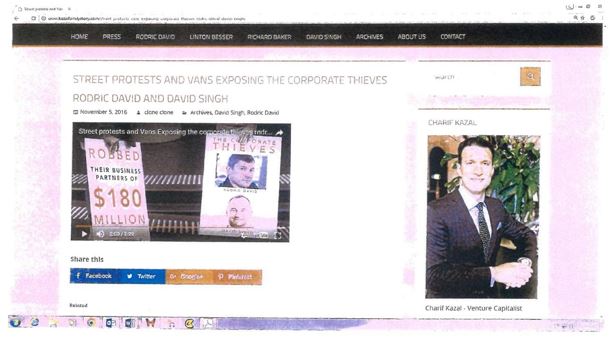
220 On 26 October 2016, Mr David rang his wife and said that the same thing was happening in Sydney (where it was 27 October 2016). At some point that day he also told her that vans were driving around Sydney. Mr David’s brother sent him photos of the similar activities of protestors and vans in Sydney, in the Central Business District and Eastern Suburbs, one of which is below:

221 Within a few days, Mrs David saw a van with the detailing below driving past their home, her daughter’s school and the neighbourhood:

222 Mrs David said that on one occasion the van and some accompanying cars were taunting her as she spoke to police about her fears. She said, and I find, that “it was terrifying. It was intimidating”. She engaged a security company to change all the locks at their home and install security lights and security cameras. She said that the Kazals were having her followed and photographed. Her doctor had to prescribe her with anti-anxiety medication as the extraordinary behaviour escalated. She began losing her hair and losing weight. The behaviour was, as I would infer could be expected, having a significant, adverse impact on their children and, of course, to her observation, on Mr David. She said his reaction was “fury… tempered by anxiety and fear”. Mrs David said that:
there just seemed to be this ever escalating series of events, and this was this was sort of our nightmare come true, that them being here on our doorstop, with men and aggressive tactics you know, we had tried very hard to keep our address in the United States secret, private used a PO Box for everything, you know, purchased the house in the name of a trust that had nothing, no reference to our Christian names. You know, the idea of them being here in Los Angeles, on our doorstep, around our children’s school, around his business, was it was terrifying, so whilst there was a lot of anger and rage and fury, there was equally fear and anxiety. It was gobsmacking.
223 On 28 October 2016 (Sydney time), Adam sent an email to Mr David and numerous Thunder employees, in the same manner of communication that Charif and Tony had used since about April 2016. Adam’s email was headed “Adam Kazal Demands Answers from Online Identity Thief Rodric David – Day 1” and read:
Rodric David,
You defrauded companies you owned with my brothers Charif & Tony.
You admitted under Oath to being the one the Sydney Morning Herald wrote their lies for to fabricate an ICAC Inquiry.
You used the Herald articles to avoid prosecution and steal the $180 million company you owned with Charif & Tony Global Renewables with help on the theft from CEO David Singh.
You had the Herald write an article attacking all of our family members and Oscar is suing them for that.
Now I find for at least the last 6 months you have stolen my identity to publish disgusting lies to embarrass me and my family just because I am Charif & Tony’s brother. You also stole the identity of Charif, Tony & Karl.
You made it personal and I will show you that I am not going to put up with the crap you tried to dish out to my brothers.
My team in LA are going to expose you wherever you go until you are charged with your crimes and my team in Sydney will expose all of the spineless thieves who thought they could help themselves to steal from my family.
Getting your hyena to scream at the LA Police like she did yesterday exposing how the disgustingly racist elements of your family are not restricted just to your Syrian David blood is not going to stop me and my crew!!
I will show the good people of LA what scum they have allowed into their city that Australia is glad to be rid of. Let’s see how you like having the truth of what you get up to reported for the world to see your true colours.
You and your crime lord father John David might be used to stealing white collar style with help from your family’s ex-politician lapdog but I really don’t care about any of that.
You start a fight with me, I will show you how Adam Kazal is different to the rest of the family.
See you around grub.
(emphasis added)
224 Adam’s statement “Getting your hyena to scream at the LA police” was a reference to Mrs David’s reaction to the shocking events that occurred on 27 October 2016 outside their home.
(Emphasis of primary judge.)
286 The primary judge then made the following further findings in relation to Mr David’s reaction to Adam Kazal’s email of 28 October 2016 –
232 I accept Mr David’s evidence that Adam’s email of 28 October 2016 “changed the game”. He was in fear of his life and said that “[t]he escalation was extreme, and here is a clear and concise statement saying he is going to be very much different to his brothers in the way he seeks to deal with this”. He described Adam’s use of the anonymous face mask on his Twitter feed as reinforcing his perception that the behaviour to which he and his family were subjected in late 2016 was a vendetta. He was also concerned that Adam had included in his emails and tweets the individual email addresses of many of Thunder’s staff. This conduct caused Thunder to install a new firewall.
287 The appellants have not challenged the above findings as being wrong on the ground that they were not supported by the evidence. That would be a formidable task given that there was essentially no cross-examination of Mr or Mrs David about the subject-matter of these findings. Yet, by Ground 5(a)(vii) the appellants claim that the primary judge’s acceptance of the evidence of Mr David that, the first and second matters and the conduct of the respondents in Los Angeles in late October and November 2016, including the email from Adam Kazal to Mr David dated 28 October 2016, amounted to a threat and caused Mr David to fear for his life and that of his family, contributed to a reasonable apprehension of bias in circumstances where the Court of Appeals for the Ninth Circuit had held that such conduct could not on either an objective or subjective test amount to a “true threat”.
288 The decision of the United States Court of Appeals for the Ninth Circuit was handed down on 15 September 2021, some months after the primary judge had reserved his decision on 28 October 2020. The parties were given leave to address the consequences of that decision to the present proceeding by supplementary written submissions. By their written submissions to the primary judge dated 16 November 2021, counsel for the appellants submitted, amongst other things, that constitutionally-protected free speech in the United States could not be taken into consideration as a ground for awarding aggravated damages. It was also submitted that certain factual findings made by the United States Court of Appeals supported the appellants’ submission that the Court should not accept Mr David’s evidence that he was terrorised by the 2016 conduct, and supported a submission that Charif Kazal’s email of 24 February 2017 ought not be construed as a threat. It is noteworthy that there was no submission to the primary judge by the appellants that the decision of the United States Court of Appeals gave rise to an issue estoppel. The primary judge addressed the decision of the Court of Appeals at J [273]-[276], invoking s 91 of the Evidence Act as precluding the admission of the judgment in that proceeding as evidence of the existence of any facts, other than the fact that by reason of that decision Thunder Studios and Mr David did not recover any damages in respect of the matters complained of.
289 I will consider this ground further when addressing the challenges to the judge’s assessments of damages. For present purposes, there is no substance to the appellants’ claims that the primary judge’s findings in relation to what occurred in Sydney and Los Angeles in October 2016, and in relation to Adam Kazal’s email of 28 October 2016, and their effect on Mr David, contributed to a reasonable apprehension of bias. As I have mentioned, the evidence on these matters was unchallenged by cross-examination. Furthermore, the appellants have not advanced any ground of appeal, or any argument, challenging the primary judge’s reasoning that s 91 of the Evidence Act precluded the admissibility of the reasons of the judgment of the United States Court of Appeals for the Ninth Circuit as evidence of any facts that were found.
Ground 5(b) – findings in relation to the judgment of Jones J in Re Emergent
290 Ground 5(b), which is relied on by the appellants as one of the matters giving rise to a reasonable apprehension of bias, is in the following terms –
(b) the primary judges’ [sic] treatment of Emergent, and contentious facts within the KTC and Re Group proceedings, including in circumstances where his Honour had made findings in Judgment No 9 that there was no substantive risk of there being conflicting judgments, and had determined (at Primary Judgment [112]) the limited use that could be made of Emergent in accordance with s 91 of the Evidence Act 1995 (Cth), including at T471-T476.2; T493 ‘…have got everything they were entitled to’; and Primary Judgment [325] (in its entirety), [327], and at [338] the extraneous finding that ‘the lack of commercial morality and integrity of KTC and its principals, Karl, Tony and Charif, was patent’;
291 Counsel for the appellants submitted that the gravamen of the findings by Jones J in Re Emergent was that Mr David had breached his fiduciary duty to the Kazals by eliminating their considerable equity interest in the company. It was submitted that notwithstanding the inherently serious nature of any breach of fiduciary duty and, on the facts found by Jones J, of Mr David’s breach in particular, the primary judge unduly focused on the findings of credit made by Jones J regarding Charif Kazal, and his own characterisation of the appellants’ conduct, while omitting to refer to the finding by Jones J that Mr David “was not always truthful”. It was submitted that the appearance of partiality might also be said to arise from the primary judge’s description of the Kazal brothers’ conduct as “dishonestly repudiating their obligations”, where no finding of dishonesty or repudiation was made by Jones J, and the primary judge’s observation that businesspeople might have some sympathy with Mr David’s predicament, whilst at the same time rejecting the submission made on behalf of the appellants that the finding that Mr David had breached his fiduciary obligations was “extremely serious” and reflected upon his honesty and integrity.
292 There appears to be some overlap between Ground 5(b) and Grounds 5(a)(i) and (iv). One of the premises for the appellants’ submissions is their reference to the “inherently serious nature of any breach of fiduciary duty”. That submission was made at trial and was considered and rejected by the primary judge for the reasons that his Honour set out at J12 [326]. At [279] above, I addressed the primary judge’s reasons at J12 [325] and [327], rejecting the appellants’ submission that they supported or contributed to a reasonable apprehension of bias on the basis alleged in Ground 5(a)(vi).
293 Ground 5(b) makes a separate claim in support of the appellants’ allegation that there was a reasonable apprehension of bias that at J12 [325], [327] and [338] the judge made findings based on the judgment in Re Emergent which went beyond the limited basis on which it was admissible pursuant to s 91 of the Evidence Act. Towards the outset of these reasons at [24], I set out what the judge said at J12 [112] about the effect of s 91 of the Evidence Act and the permissible relevance of the reasons of Jones J in the Grand Court of the Cayman Islands in Re Emergent, namely that they were admissible as evidence of what Jones J said, which the appellants relied on at trial as going to damages. The findings of Jones J were also relevant to the falsity of at least imputations 6(c) and 7(c) arising from the first matter: see [67] and [68] above. The falsity of these imputations was established as an element of the causes of action in injurious falsehood: see J12 [302].
294 The judge’s findings at J12 [325] and [327] addressed submissions of the appellants referred to at J12 [324] relating to the assessment of damages. In opening written submissions at trial, counsel for the appellants relied on the Cayman Islands proceedings and the finding of breach of fiduciary duty by Mr David as background context relevant to the assessment of damages. In final written submissions at trial, counsel for the appellants relied on the findings of Jones J for the purposes of challenging Mr David’s “overarching narrative”. Counsel for the appellants also relied on the findings of breach of fiduciary duty as affecting Mr David’s reputation as an honest businessman. In final address at trial, senior counsel for the appellants submitted to the primary judge that the Cayman Islands judgment was significant, stating –
It demonstrates a calculated effort by Rodric David to effectively eliminate the Kazal interest in ECL [Emergent Capital Ltd] and to do so in circumstances where he would effectively own ECL and he would effectively own the only asset which that company had, which was an interest in this Eastern Creek waste management facility.
295 This submission was further developed by counsel at trial and the appellants thereby put in issue and invited the judge to consider the correct understanding of the findings of Jones J in Re Emergent. The fact that his Honour did so at J12 [325] and [327] is therefore unsurprising and provides no foundation for the appellants’ claim of apprehended bias.
296 As for the appellants’ submission that the primary judge omitted reference to Jones J’s finding that Mr David “was not always truthful”, I have already addressed this issue at [268] above and rejected the appellants’ submission.
297 In relation to the appellants’ complaint that the primary judge’s statement at J12 [338] that “the lack of commercial morality and integrity of KTC and its principals, Karl, Tony and Charif, was patent” was extraneous, I disagree. The statement was made by the primary judge by reference to the evidence that was before his Honour in that part of the judgment where his Honour considered the appellants’ conduct in mis-characterising the findings of Jones J in Re Emergent, and the comment was made to emphasise that mis-characterisation. The full context of the statement appears from J12 [337]-[338] –
337 The respondents have no defence in this proceeding. In particular they cannot rely on a defence of qualified privilege to reply to an attack: Loveday v Sun Newspapers Ltd (1938) 59 CLR 503; Harbour Radio Pty Ltd v Trad (2012) 247 CLR 31. Yet, it appeared to be Charif’s and Adam’s submission that, in effect, Mr David brought their conduct complained of on himself so as to reduce any damages to which he might otherwise be entitled. On the evidence before me, that proposition is baseless. I reject the respondents’ argument that somehow Mr David’s entitlement to damages is affected by his having participated as a source in the publication of the Bad company article on 16 March 2013. He is responsible for republication of what he told Mr Besser in preparation of that article because such republication was intended by him and or was the natural and probable result of his provision of that material to Mr Besser: John Fairfax & Sons Ltd v Cojuangco (1988) 165 CLR 346 at 350 per Mason CJ, Wilson, Deane, Toohey and Gaudron JJ. There is no evidence that Mr David gave any incorrect information to Mr Besser and the respondents’ allegation in the matter complained of that he paid Mr Besser was without foundation. And as I have explained, Jones J’s finding that Mr David had breached his fiduciary duty as a director of Emergent by causing the allotment to dilute the shareholding of KTC did not entitle the respondents to publish their false distortion of it.
338 Rather, Charif and Adam chose, in publishing the matters complained of and their subsequent vindictive conduct including in this trial, to characterise his Honour’s finding as having a significance out of all proportion to the joint venture dispute. On the evidence before me, rather, the lack of commercial morality and integrity of KTC and its principals, Karl, Tony and Charif, was patent. What made their behaviour worse was Tony’s false allegation against Mr David that resulted in his detention, Charif’s conduct in bringing the baseless criminal charges and civil complaint in the UAE and Karl, Tony and Charif’s false assertion in the Grand Court that Mr David had been imprisoned in the UAE. However, the first of two instances of that behaviour are not relevant to the assessment of damages in this proceeding. The Bad company article did not provide any intelligible basis to support or justify the publication of the matters complained of, the Kazal website or the splenetic vendetta that Charif and Adam have pursued against Mr David and Thunder that has involved the unjustified intimidation of his family, including his young children.
(Emphasis added.)
298 As to the transcript references in Ground 5(b), namely T471-T476.2 and T493, these references are to the closing submissions of senior counsel for the appellants at trial. Counsel for the appellants included extracts from some of these pages of transcript in a table in Annexure A to their written submissions on appeal, which was described in footnote (59) to the submissions as a “table summarising other occasions of concern”. No extract from T493 was included in Annexure A, and the appellants’ reliance on it was left unexplained. No argument was developed by the appellants as to how the exchanges recorded T471-476.2 could give rise to a reasonable apprehension of bias.
Ground 5(c) – claimed differential treatment of the parties
299 Ground 5(c) is in the following terms –
(c) the primary Judge’s differential treatment of the parties as indicated in the exchanges at T79.1-84.26; see also T93.42-94.1 and T249.3-4;
300 Reasonable apprehension of bias is a serious allegation, and no written or oral submissions were developed on behalf of the appellants in relation to the passages of transcript referred to in support of Ground 5(c). I reject Ground 5(c) for the reasons that I have given above in relation to passages of transcript relied on in support of Ground 5(b). Further, having examined the passages for myself, it is not apparent how the exchanges that they record support a claim that the appellants were given differential treatment that was capable of giving rise to a reasonable apprehension of bias.
Ground 5(d) – claimed error in awarding damages
301 Ground 5(d) relies on the basis on which damages were awarded by the primary judge as giving rise to a reasonable apprehension of bias –
(d) the award of damages on the basis that the Kazal website remained accessible online up until the date of the Primary Judgment, in circumstances where:
(i) David’s own evidence at T203.44-47-204.1-18, and that of his wife at T107.37-39, was that the Kazal website was taken offline in 2017;
(ii) the evidence of the Respondents’ expert, Mr Schatz was that the matters complained of were no longer available to be downloaded from the internet as at 23 July 2018;
(iii) there was otherwise no evidence to support the primary judge’s finding, and no submission was made to that effect;
302 The underlying substance of this ground is also advanced in Ground 10, which claims that the primary judge’s awards of damages were excessive on account of some specific errors that are claimed to have occurred.
303 The appellants claim that at J12 [244], [245], [316], [331], [344], and [353] the primary judge found that the Kazal website and the first and second matters remained online up until the date of Judgment No 12. At J12 [244], the primary judge stated that he accepted that from about March 2017 the Kazal website ceased being updated, but remained online –
244 Even after I found Adam guilty of contempt on 21 December 2016 (Thunder [2016] FCA 1598) and sentenced him on 27 February 2017 (Thunder (No 2) [2017] FCA 202), the Kazal website remained active and contained posts that Charif updated or caused to be updated, by reason of his control of it, until at least 2 March 2017 when Tony posted, and emailed to Mr David, Thunder, six of its employees and Charif his article, “Rodric David Reminded the Kazal Family Refused his Family’s Witness Tampering Attempts – Day 163” (see [205] above). Mr David said that in separate proceedings that Mr Singh and his company, Re.Group, brought in respect of similar conduct including that posting in October and November 2016, Perram J had made an order that had the consequence that “the website was, in effect, shut off”. Whatever order, if any, was in effect, it was not before me, but I accept that from about March 2017 the Kazal website ceased being updated, but has remained online.
304 At J12 [245], the primary judge referred to evidence of YouTube videos that were played live in Court during the hearing on 21 October 2020 by Mr MacCallum, who was the solicitor for Thunder Studios and Mr David. This was held to be real evidence that the videos were still then available for viewing. The videos were recorded and tendered. At J12 [245]-[247] the judge described the videos as follows –
245 However, during the trial, Mr MacCallum [the solicitor for Thunder Studios and Mr David] was able to play, in Court on 21 October 2020 (which was conducted electronically on Microsoft Teams), as real evidence, YouTube videos on youtube.com that were still available for viewing through using a Google article on the Kazal website. One video, that lasted for about two minutes 20 seconds, showed a van driving in Sydney and protestors holding posters and placards with Mr David and Mr Singh’s photos (see [241] above) and “Robbed $180 million” and standing outside a house (which I infer was Mr Singh’s) from which a man emerges and gets into a car. A voice-over states: “Mr Singh, Adam Kazal wants to know why four and a half years ago you had no money and now you live in a $30 million house at [a named eastern suburb in Sydney]. Can you explain that?” The video also showed about ten people holding the posters and placards outside 1 Bligh Street, chanting “Rodric the Robber” before concluding with a display of the Kazal website’s internet address. This became Exhibit B.
246 Another short video of about 20 seconds, which became Exhibit D showed, progressively, still images of the names of the Kazal Family Story, Mr David with a cloak over his shoulder and a large hand reaching toward him (par 30, as seen in the landing page), a smiling labelled photo of Charif, a road sign “Integrity” the “Truth or Dare” sign (par 36), a “Caring for Sustainability Sign”, the “Failure Types” graph (par 23), a sign “Contact us”, followed by “NSW, Sydney, Australia” and the Kazal website’s internet address. Music played in the background of this video.
247 When Mr MacCallum tried to copy Exhibit D after Court on 21 October 2020 he could not do so directly on his computer but made a copy using his mobile phone. That became the physical Exhibit D. However, overnight, the videos were removed from YouTube by the uploader and could not be viewed anymore.
305 A Pinterest page for the “Kazal Family Strory [sic]” was also brought up live during the course of evidence at the trial, and a printout was tendered. Two Pinterest pages were titled, respectively, “Another Desperate Attempt by the Corporate Thief Rodric David”, and “Another hopeless act by the corporate thief Rodric David”. The primary judge found at J12 [252] that as at 1 September 2020, the second page of a Google search of “Rodric David” displayed the Kazal Family Story Pinterest account with the caption, “Another hopeless act by the corporate thief Rodric David”.
306 At J12 [316], the primary judge stated that a stream of emails that Charif Kazal and his brothers wrote to Mr David, Mr Singh, and their employees, that repeated one or more imputations that were conveyed up to March 2017 by the first or second matters, had remained accessible to anyone visiting the Kazal website since then, referring to J12 [244]. At J12 [331], the primary judge stated that “[t]he conduct of Charif began with his initial publication online of the matters complained of in June 2013 and those publications have continued to the present time”. At J12 [344], the primary judge referred to the “ongoing” publication of the matters complained of. And at J12 [353] in assessing pre-judgment interest, his Honour stated that “elements of publication and aggravation continued over the whole period between the initial publications of the matters complained of in June 2013 to the present time...”. I do not see that there is any error in J12 [331], [344] or [353], because there was no error in finding that the aggravating conduct of the appellants had continued, including a finding that the appellants made unjustified aspersions on Mr David’s character in the course of the trial that aggravated the damage: see, J12 [341] and [348].
307 The statement at J12 [244] that the Kazal website remained online is puzzling for at least three reasons. The first is that at J12 [244] his Honour referred to the evidence of Mr David that “the website was, in effect, shut off” following orders that were made by Perram J. The evidence of Mr David was to the effect that the website remained online until mid-2017, but he did not know of the date. The second reason is that J12 [245], which refers to the YouTube videos that were still available for viewing, commences with the word “[h]owever”, suggesting that there was a distinction to be drawn between the YouTube videos, which remained online, and the Kazal website. The third reason is that the primary judge did not refer to any evidence that the Kazal website itself remained available online. I note that in Thunder Studios Inc (California) v Kazal (No 13) [2022] FCA 256, which concerned the form of final orders and which was published at the time the final orders for judgment for damages were made, his Honour stated at [8] that the parties appeared to have accepted that the Kazal website was no longer accessible online.
308 Upon the hearing of the appeal, senior counsel for the respondents accepted that the primary judge’s finding at J12 [244] that from March 2017 the Kazal website ceased being updated but remained online was “at least partly, an error”, and “not in accordance with the evidence”. This concession was made by reference to evidence given by each of Mr and Mrs David that they had the impression that the Kazal website had been taken down at some time in 2017. There was, however, other evidence before the primary judge that the website had remained online in two senses: the website itself remained online; and the content remained online and accessible in the web archive service known as the Wayback Machine. That evidence was in an expert report of Dr Bradley Schatz dated 23 July 2018 which is referred to in sub-paragraph 5(d)(ii) of the amended notice of appeal. The report was received without objection at trial, and Dr Schatz was not cross-examined: J12 [96]. The amended notice of appeal claims that the evidence of Dr Schatz was that the matters complained of were no longer available to be downloaded from the internet as at 23 July 2018. This is not an entirely accurate reflection of Dr Schatz’s report. Dr Schatz navigated to the long URLs for pages on the Kazal website which resulted in the display of holding pages titled “Kazal Family Story” under which were the words “not available”. However, Dr Schatz located at web.archive.org, which is also known as the Wayback Machine, a page which was a substantial republication of the second matter, being the Intro article, from a capture of the Kazal website, a printout of which was Annexure E to his report. Dr Schatz also located an archived page titled “Kazal Family Story” containing a number of defamatory references to Mr David, a printout of which he attached as Annexure G.
309 The concession made by the respondents in response to this aspect of the appeal was that the primary judge was at least partly in error. The concession in those terms was properly made. I am not persuaded that the primary judge was entirely in error in stating at J12 [244] that while the website ceased being updated it had remained online. The evidence of Dr Schatz was that the website itself remained online, but its content had been removed. Some of the content was still available on the internet as an archive on the Wayback Machine. However, the primary judge appears to have been in error at J12 [316] in stating that a stream of emails that Charif Kazal published on the Kazal website that repeated one or more of the imputations conveyed by the first and second matters up to March 2017 had remained accessible to anyone visiting the Kazal website since then.
310 For present purposes, I do not accept that the apparent error would lead the fair-minded lay observer to think that the judge might not have brought an impartial mind to bear on the questions in issue in the proceeding. I will return to the question of other consequences of the error of the primary judge in his reasons at J12 [244] and [316] when addressing Ground 10, which relies on the error in support of the claim that the damages awarded were excessive.
Ground 5(e) – claimed error in treating Thunder Studios as an excluded corporation
311 Ground 5(e) is in the following terms –
(e) the award of damages on the basis that the First Respondent (Thunder) was an excluded corporation (at Primary Judgment [107]) after 11 October 2013 in circumstances where Thunder’s pleaded case was that it ceased to be an excluded corporation on 11 October 2013;
312 This ground picks up a claim that is separately the subject of Grounds 8 and 9, which I consider below. For the reasons that I give in relation to those grounds, the judge was in error in not confining Thunder Studios’ claim in defamation to publications that occurred before 11 October 2013. However, this error does not support a claim of apprehended bias. The fair-minded lay observer would think that the judge’s error, in what was factually a complex case, was the result of oversight, and was not reasonably indicative of partiality. There is the further problem with this and the other grounds that rely on the judge’s findings to support a claim of reasonable apprehension of bias, in that they involve the fallacious argument that the making of an appealable error demonstrates pre-judgment or partiality, which is an error of thinking identified in Michael Wilson & Partners at [67]: see [262] above.
Ground 5(f) – claimed derogatory observations giving the appearance of hostility
313 Ground 5(f) is in the following terms –
(f) derogatory observations giving the appearance of hostility towards the Appellants and their family, orally and in written judgments, including:
(i) at T482.43-483.20, in particular the primary judge’s observation at T482.47 as recorded in the transcript ‘…came to fruition didn’t it, in 2016’; T509.25-37; T513.18-25-T514.28, in particular the primary judge’s comment at T513.22 ‘Hired by your client’ where there was no evidence that the investigator was hired by either Appellant;
(ii) at Primary Judgment [321] the statement ‘and others of their siblings’ in circumstances where other Kazal family members were not parties to the proceeding;
(iii) at Primary Judgment [119] where the primary judge inferred that Tony Kazal’s complaint was intended to humiliate Mr David, when no such submission or evidence was made or given in the proceeding, and the finding was extraneous to the issues before the Court and Tony Kazal was not a party to the proceeding;
(iv) at Primary Judgment [141] the primary judge recounted, as fact ‘Also on 8 March 2013, Adam, in company with another man, accosted John David in Woolloomooloo. Both were carrying hand held dumb bells. John David was then 82 years old’ where at trial it was submitted, and his Honour had accepted, that the police facts were not an account of what Adam Kazal did, but of allegations made against him, T358.27-30;
(v) at Primary Judgment [338] the extraneous finding that ‘the lack of commercial morality and integrity of KTC and its principals, Karl, Tony and Charif, was patent’;
(vi) at Primary Judgment [341] the aside ‘I doubt that the respondents intended the submission to include his unfortunate business association with Charif, Tony, and other members of the Kazal family’;
...
314 In support of a submission that there had been gratuitous disparagement of the appellants, counsel for the appellants relied particularly upon an exchange that took place during the course of closing submissions at T482/43-T483/35. In the following passages setting out the exchanges between senior counsel for the appellants and the primary judge, I have added T482/40-41 and T483/37-44 for context –
HIS HONOUR: And what about Mr Rockefeller, and his wife, saying, “I don’t want to be involved with these sorts of people, through the website”?
SENIOR COUNSEL: Well, her comment, “Crazy Arabs knocking on her door” that, in our submission, made – one can’t tell anything from that, really. Who knows – that’s what they may have said to - - -
HIS HONOUR: came to fruition, didn’t it, in 2016.
SENIOR COUNSEL: I’m sorry, your Honour.
HIS HONOUR: Certainly, came to fruition in 2016, for Mr David and Mr Singh, on the evidence before me.
SENIOR COUNSEL: I don’t understand, your Honour - - -
HIS HONOUR: People standing outside – your client standing outside or getting protestors, or people to stand outside with placards and things.
That’s the very thing that they did.
SENIOR COUNSEL: I hope your Honour’s not suggesting that my clients are crazy Arabs, knocking on people’s doors.
HIS HONOUR: No. The argument was that both sides involved, as you have pointed out in your submissions, have Middle Eastern blood. Which was viewed – in the jury case – as being Arabs, as you put, and you put it to Mr David that he has Syrian blood, and, you know, you made all that point. I’m just saying Ms – Mrs Rockefeller says, “Well, I’m looking at this website, this all looks crazy to me. I’m not going to have people coming around and doing things” - - -
SENIOR COUNSEL: There is no evidence, in this case, of the Kazals ever doing anything – the only evidence is in relation to Mr David.
HIS HONOUR: No, there is the evidence of Mr Singh in the video, in Sydney.
SENIOR COUNSEL: Yes, Mr David and Mr Singh, exactly, exactly.
HIS HONOUR: That’s right.
SENIOR COUNSEL: Your Honour - - -
HIS HONOUR: ..... that’s all. I’m just saying, she is saying, looking at this website, “I don’t want people getting involved in this, sort of, potential”. And that potential came to fruition.
SENIOR COUNSEL: Your Honour has to draw an inference about all of that. And in our submission, the – the much – the much more likely inference is that Mr Rockefeller, having – wouldn’t not have wanted to go into a joint venture with Mr Roderick [sic] David, and invest 10 million of his dollars, if he had read what Justice Jones found about Mr David, in the Cayman Island Proceeding. And we know, because Mr David told your Honour that Mr Rockefeller knew about the proceeding. He confirmed that Mr Rockefeller would have had knowledge about the Cayman Island proceeding.
(Emphasis added by the appellants in their written submissions.)
315 There were further references by senior counsel for the appellants to the term “crazy Arabs” in the following exchange with the primary judge at T484/7-24 –
HIS HONOUR: He would not be inviting him to come to his house if – and Mr David, as you say, said he told Mr Rockefeller all about the Cayman Islands, gave him all that information. So that he wouldn’t be disappointed, searching in his other due diligence. He could go and find all that, because Mr David pointed him to all that. But he said, “The point was, once they looked at the website” ..... family story website “Mrs Rockefeller got spooked by it”. Am I not entitled to draw the inference, that - - -
SENIOR COUNSEL: I don’t think your Honour is entitled to draw that inference. I think, really, it’s more likely to be Mr David’s explanation to the Rockefellers, about all these “crazy Arabs”. Because he was explaining the history of the relationship between them. And, your Honour, looking at the website – let’s look at the website. There is nothing on the face of the website that would draw anyone to think that the Kazals are “crazy Arabs”. The website doesn’t provide any evidence of that whatsoever. Nobody reading that website – or the first or second matter complained of – would think, “The Kazals are crazy Arabs, and they might come knocking on my door”. It – it just is simply not open to your Honour to make a finding like that - - -
316 Counsel for the appellants submitted that the judge’s reference to “came to fruition in 2016” went beyond the ordinary challenges and intervention by trial judges properly testing the submissions put to them. It was submitted that while the primary judge disavowed adopting the statement attributed to Mrs Rockefeller – that the Kazals were “crazy Arabs” – the unfortunate and regrettable impression conveyed by the exchange to the ordinary reasonable person would be one of prejudice and partiality. In oral argument on appeal, senior counsel for the appellant submitted that by his remark the judge implied that the appellants were crazy Arabs, and that they had been knocking on people’s doors. It was submitted that when his Honour was asked to clarify the remark, he attempted to step back from it, but not successfully.
317 I do not accept these claims. The subject of the submissions that were put at trial on behalf of the appellants with which his Honour was engaged was the evidence that Mr David had given concerning a proposed merger in 2015 of the business of Thunder Studios and an entertainment business conducted by a Mr Steven Rockefeller. Mr David’s evidence was that he and his wife were invited to the Rockefeller estate in New York to sign documentation to give effect to the deal, but that he was informed 24 hours beforehand that Mr Rockefeller was withdrawing. Mr David was asked whether anything was said as to why this had occurred to which Mr David responded –
As it was explained to me, Steven’s wife specifically said to him she was not going to have crazy Arabs knocking on her door, specifically. ...
318 This topic was taken up by senior counsel for the appellants in her cross-examination of Mr David where he confirmed that this was what he had been told.
319 The reference to “crazy Arabs knocking on her door” were not words used by the judge. The evidence of Mr David was that the words were attributable to Mrs Rockefeller. The words were introduced in final address by senior counsel for the appellants in the course of responding to a question by the judge concerning the evidence about Mr and Mrs Rockefeller. The judge’s reference to the concerns of Mrs Rockefeller coming to fruition in 2016 was an offhand remark made by his Honour that alluded to other evidence to which his Honour referred, namely that protestors engaged by the appellants had stood outside the home of Mr and Mrs David in Los Angeles with placards. As to that evidence, Mrs David gave evidence, which was unchallenged, about her reaction and the reaction of Mr David and their family to the vans and the placards organised by Adam Kazal. Mrs David referred to “them being here on our doorstep” –
Q: What did you observe of your husband’s reaction to all of these things, either together or separately? That is: the posters and placards near your home, the posters and placards at Thunder, the vans in Los Angeles, the posters and placards in Sydney, the vans in Sydney. What was your husband’s reaction as all of that unfolded, to your observation?
A: Fury. Fury, anger, but also tempered by anxiety and fear. As I said, there just seemed to be this ever escalating series of events, and this was – this was sort of our nightmare come true, that them being here on our doorstop, with men and aggressive tactics – you know, we had tried very hard to keep our address in the United States secret, private – used a PO Box for everything, you know, purchased the house in the name of a trust that had nothing, no reference to our Christian names. You know, the idea of them being here in Los Angeles, on our doorstep, around our children’s school, around his business, was – it was terrifying, …
(Emphasis added.)
320 The judge’s remark, “certainly, came to fruition in 2016”, which was made during final address, was made in the course of exchanges concerning the weight to be placed on Mr David’s account of the Rockefellers’ reasons for not proceeding with the deal, when that was a question put in issue by the appellants. The judge was entitled to test the case advanced by the parties, including by expressing tentative views about the evidence, which led to his Honour’s remark that Mrs Rockefeller had been “spooked” by the Kazal website. The judge explained his remark in terms that were unexceptionable. The remark had a proper context, and did not go beyond part of the ordinary dialogue that can occur between bench and bar when addressing the evidence: see, Johnson v Johnson [2000] HCA 48; 201 CLR 488 at [13] (Gleeson CJ, Gaudron, McHugh, Gummow and Hayne JJ); Concrete at [105], [111] (Kirby and Crennan JJ). His Honour’s remark would not have led the fair-minded lay observer to apprehend that the judge might not bring an impartial mind to bear on the resolution of the issues in the proceeding. Moreover, no application was made to his Honour to disqualify himself on the basis of the exchange. The transcript of the hearing records that the exchange occurred shortly after 11.00 am on the final day of the trial. The closing address of counsel for the appellants continued until the luncheon adjournment. After lunch, senior counsel for the respondents addressed until 4.34 pm, at which time judgment was reserved. There were opportunities for counsel for the appellants to make an application for disqualification, and none was taken. There was therefore no opportunity given to the judge to make any further comments to correct any wrong impression of bias. And it would be wrong to sanction a situation where the appellants stood by until final judgment before a complaint was made on this ground: see, Vakauta v Kelly [1989] HCA 44; 167 CLR 568 at 572 (Brennan, Deane and Gaudron JJ).
321 Counsel for the appellants referred in footnote (59) of their written submissions to the “table summarising other occasions of concern” that was Annexure A to the written submissions. The table comprised 13 pages of selected extracts from the transcript of the interlocutory hearings on 18 August 2017 and 22 May 2020, and of the trial of the proceeding. In oral submissions, senior counsel for the appellant referred in general terms to occasions where it was said the primary judge weighed into arguments and went beyond just testing the arguments. Counsel described the matters referred to in Annexure A to the written submissions as “high points”. Counsel referred in particular to one instance during the course of final address where his Honour described a submission put by senior counsel for the appellant as “a load of nonsense”. This occurred during the course of a long exchange in which senior counsel submitted that Thunder Studios had no reputation at the time of the initial publications in 2013 because it had only been set up in early 2013. His Honour drew attention to what he described as unchallenged evidence of a reputation witness, Mr Hammond, and counsel initially submitted that Mr Hammond’s evidence should be rejected, before accepting that it was at least evidence of identification. The transcript of this exchange, included the following –
HIS HONOUR: I think Mr Gray’s argument is that Mr David based on among other – Mr Hammond’s evidence – I think that was his name, the last witness – that Mr David was Thunder and Thunder was Mr David in the eyes of those in the industry once he went to the United States because everybody knew that he would start up this new studio and that was the studio so - - -
SENIOR COUNSEL: Well - - -
HIS HONOUR: - - - how do you deal with that?
SENIOR COUNSEL: Well, we say, firstly, that Mr David, really, had no reputation at that time with – vis-à-vis Thunder because we know that Thunder was only setup [sic] in early 2013 anyway and I – we look at this by analogy with those cases where there’s something defamatory about a company which is a – basically, a single – there’s a single director who’s the alter ego of the company and often one will see the director then saying, “Well, you say something negative about my company, therefore, that reflects on me because everyone knows that I’m the company.” But that can’t be the case here where there simply isn’t that history because this comes so soon in the life of Thunder and - - -
HIS HONOUR: So you say I should reject Mr Hammond’s evidence.
SENIOR COUNSEL: Yes.
HIS HONOUR: Why?
SENIOR COUNSEL: Well, your Honour - - -
HIS HONOUR: ..... nobody knew that. That’s a load of nonsense - - -
SENIOR COUNSEL: Mr Hammond knew it - - -
HIS HONOUR: .....
SENIOR COUNSEL: - - - because – Mr Hammond knew it.
HIS HONOUR: He did, he did. So that’s evidence of identification.
SENIOR COUNSEL: All right. So there’s one person who identified Thunder, your Honour.
HIS HONOUR: Well, he identified a reputation, didn’t he? He gave unchallenged evidence that everyone knew Mr David had setup [sic] this company, that it was running. Everybody was abuzz, he said, about it. Now - - -
(Emphasis added.)
322 It is difficult to gauge the full complexion of argument from the above transcript extracts, and it appears that unintentionally the judge and counsel may have been speaking over each other at one point. This was an understandable and known consequence of the fact that the hearing was being conducted remotely on Microsoft Teams during the time of the COVID-19 pandemic. In all the circumstances, I am not persuaded that the judge’s reference to “nonsense” was anything more than a robust comment during argument that was calculated to expose his Honour’s thinking and to test a submission by senior counsel for the appellants that unchallenged evidence of Mr Hammond should be rejected: see, Johnson v Johnson at [13] (Gleeson CJ, Gaudron, McHugh, Gummow and Hayne JJ).
323 Otherwise, no submissions were developed by counsel for the appellants in relation to the other transcript extracts in Annexure A of their written submissions. One is therefore left to guess as to how it is said that any of the occasions referred to in Annexure A, in context, alone or in combination, gave rise to a reasonable apprehension of bias. Having reviewed the extracts myself, it is certainly not self-evident that they did. And as I have said, no application was made by counsel for the appellants during the trial of the proceeding that the judge disqualify himself on the ground of apprehended bias.
324 It was further submitted in writing by counsel for the appellants that the primary judge had made derogatory and gratuitous observations during the course of the hearing and in Judgment No 12 about the appellants and their non-party family members that also gave rise to an apprehension of partiality. The appellants relied by way of example on: (1) the judge inferring at J12 [119] that a purpose of Tony Kazal (who was not a party to the proceeding) was to humiliate Mr David; (2) recounting at J12 [129] an incident of two unnamed Kazal brothers allegedly accosting Mr David; (3) recounting at J12 [130]-[131] a further incident said to involve a private investigator allegedly hired by Tony Kazal; (4) stating in final submissions that a private investigator was “hired by your client” when it was claimed there was no such evidence; (5) recounting at J12 [141] as fact rather than allegation, an incident in which Adam Kazal was said to have accosted Mr David’s father; and (6) what were claimed to be gratuitous references to other Kazal siblings at J12 [321], [323] and [341].
325 I do not accept that any of the above references was gratuitous. The injury to Mr David as a result of the publications and the aggravation of harm, were to be evaluated in context. A significant feature of the evidence of Mr David was the effect that the publications and the appellants’ aggravating conduct had on him and his family, and on their general well-being. That effect was set against the history of acrimonious encounters with members of the Kazal family, as known to Mr David, which could not sensibly be disentangled from the publications for which the appellants were held liable. Some of the history was the subject of evidence of Mr David in re-examination because the topic was opened up by senior counsel for the appellants in her cross-examination by challenging Mr David’s evidence that he was in fear of the Kazals. That history included –
(1) In about April 2010 Tony Kazal lodged a false complaint with the Department of Immigration in Dubai alleging that Mr David had not communicated with him for over a year and absconded in breach of his visa: J12 [116].
(2) On 6 May 2010, Charif lodged a criminal and civil complaint in the UAE in the Court of First Instance of Abu Dhabi against Mr David making false allegations that he had embezzled funds and that, among other financial misdeeds, Mr David had embezzled Tony Kazal’s salary in one of the joint venture companies: J12 [117].
(3) The complaint by Tony Kazal caused Mr David to be detained by police in Abu Dhabi before he was delivered to Al Awir prison in Dubai whereupon he was then discharged: J12 [118], [120].
(4) Upon Mr David being discharged, the Dubai authorities required him to remain in the UAE while they investigated Tony Kazal’s complaint. After about six weeks, the Dubai immigration authorities apologised to Mr David, returned his passport, and fined Tony for making a false complaint: J12 [118].
(5) While he was in a Department of Immigration interview room at Al Awir prison, Mr David was served there with the petition to wind up Emergent that KTC had filed in the Grand Court of the Cayman Islands: J12 [118].
(6) On 12 May 2011, Mr David was having a drink with business associates at the Vault Bar in the central business district of Sydney when two of the Kazal brothers made their presence felt. They threatened Mr David with profanities, saying “we’re going to get you”. Mr David and his associates left the bar and the two brothers followed them calling out, loudly and verbosely and swinging a bag that appeared to contain heavy cans or jars of protein powder: J12 [129].
(7) On 20 May 2011, Mrs David was driving in the vicinity of Bondi Junction in Sydney when she noticed that someone was following her in another car and took note of the registration number. Mrs David then attended Rose Bay police station and telephoned Mr David. The car continued to follow Mr and Mrs David when they went to pick their children up from school. Mr David got out of their car and walked down the street carrying his mobile phone with the aim of photographing the driver of the other car through the passenger window which was wound down. As he approached, the passenger lunged forward, grabbed Mr David’s phone and the car began to drive off. Mr David jumped onto the bonnet and held onto the windscreen wipers for a distance as the car accelerated down the street. Later, at the Paddington police station the police told Mr David that the other car was owned by a private investigator engaged by Tony Kazal: J12 [130]-[131].
(8) On 8 March 2013, Adam Kazal, in company with another man, accosted Mr David’s then 82-year-old father, John David, in Woolloomooloo. Both were carrying hand held dumb bells. The New South Wales police facts in support of the ex parte provisional apprehended violence order that was issued on 22 March 2013 recorded that Adam Kazal had demanded $150 million, accused the David family of “swindling us out of $150 million” and yelled in John David’s face “you have stolen from us you cunt! I’m back in Australia now. I’m going to get you”. Passers-by intervened and Adam Kazal and his companion left. The police facts also recorded that on 15 March 2013 Adam attended at John David’s business address and demanded to see him, but he was not there: J12 [141].
326 It is true that at J12 [141], in referring to the provisional apprehended violence order, the primary judge expressed himself in terms of factual findings rather than recounting allegations that had been made against Adam Kazal in support of the order. But in my view this is immaterial. The relevance of the evidence was to damages, and the effect of the publications on Mr David having regard to his knowledge of the making of the provisional apprehended violence order against Adam Kazal and the allegations that supported it, and his claim that he was in fear of the Kazals, and in particular Adam Kazal who wrote the email of 28 October 2016 to which I have referred on a number of occasions. The primary judge set out that email at J12 [223] which I extracted at [285] above. The apprehended violence order was in evidence, and Mr David referred to it in an answer given in cross-examination. It appears that the order included the accounts by police of what Adam Kazal was alleged to have done on 8 and 15 March 2013. Mr David was taken to the order in re-examination and gave evidence that he saw the order at about the time it was made, and that the order was front and centre in his mind in March 2013 as a reason to be afraid of the Kazals. In the course of final address, senior counsel for the appellants accepted that senior counsel for the respondents “in re-examination quite rightly sought to elicit from Mr David evidence to support his contention that he was in fear. So that evidence in re-examination was sought to be led to demonstrate that Mr David had a real basis for fearing the Kazals...”.
327 In relation to the appellants’ claim that in the course of senior counsel’s final address the primary judge referred to a private investigator having been hired by “your client”, I do not accept that his Honour is to be understood as asserting this as an objective fact. The relevant exchange was as follows –
SENIOR COUNSEL: ...someone was following the Davids, and Mr David went up to take a photograph, he told the court, of the driver of this car. His photograph [sic] was grabbed, and so Mr David then threw himself onto the bonnet of this car, and he said that he then spoke to the police and the police told him it was a private investigator. So that was the first thing.
HIS HONOUR: Hired by your client.
SENIOR COUNSEL: Well, that’s what the police said, hired by Tony Kazal, your Honour.
328 All that the judge did in this exchange was to complete the account of the evidence. In doing so, the judge made an error in referring to “your client” rather than Tony Kazal, but senior counsel for the appellants quickly corrected this. The judge’s slip did not carry through to the reasons for judgment, where his Honour referred correctly to the police telling Mr David that the vehicle was owned by a private investigator hired by Tony Kazal: J12 [131]. His Honour’s slip in the course of final address was not reasonably capable of contributing to a reasonable apprehension of bias.
329 Addressing globally the matters relied on by the appellants arising from the two interlocutory hearings, the trial, and Judgment No 12 as giving rise to a reasonable apprehension of bias, they fall into the six broad categories to which I referred at [257] above. In summary, my conclusions in relation to those matters are as follows –
(1) In relation to the judge’s approach to issues of credit on which the appellants relied, I have rejected those submissions as unsound, holding for the reasons I have expressed that none of the sub-grounds, either individually or in combination amounts to anything more than dissatisfaction with an array of minor factual findings, in circumstances where many of the findings themselves are not subject to challenge on appeal: see [268]-[289] above.
(2) In relation to the judge’s treatment of the judgment of Jones J in Re Emergent, I have considered and rejected the appellants’ submissions at [290]-[298] above.
(3) As to the appellants’ claim that there was differential treatment of the parties during the course of exchanges at trial, I have rejected that claim at [300] above.
(4) I have accepted the appellants’ claim that there was an error by the judge in awarding damages on the basis that the Kazal website remained online up until judgment. However, I do not accept that this error gives rise to a reasonable apprehension of bias.
(5) The judge’s error in not confining Thunder Studios’ claims in defamation to publications that occurred during the period it pleaded it was as an excluded corporation for the purposes of s 9 of the Defamation Act does not support a claim of apprehended bias.
(6) I have addressed the appellants’ claims that the primary judge made derogatory observations giving the appearance of hostility towards the appellants and their family at [313]-[328] and rejected them.
Judgment No 12 –contested imputation
330 Ground 6 of the notice of appeal is in the following terms –
6. The primary judge erred in finding, at [70], that the First Matter conveyed imputations that anyone doing business with the Appellants runs the risk of physical injury.
331 The first matter is described at [38] to [66] above, and comprised the numbered components that are identified in the screenshots. I draw attention in particular to Shot A7 that is extracted at [61] above. Adjacent to a photograph of Mr David under the heading “WARNING” the following is stated –
If you are currently involved in a business venture with Rodric David or are contemplating doing business with him, it can be injurious to your health.
Based on Experience, our advice is to RUN the other way ..and fast!
332 Imputations 6(e) and 7(e) are set out at [67(4)] and [68(4)] above. Both imputations are concerned with a risk of physical injury to anybody doing business with Mr David or Thunder Studios. The judge considered both imputations together at J12 [70]. While the judge referred at J12 [71] only to imputation 6(e) as having been conveyed, it is clear that his Honour also held that imputation 7(e) was conveyed, because his Honour had held at J12 [62] –
62 Once an ordinary, reasonable reader knew that Mr David ran or owned Thunder, then the reader would have understood each of the landing page and the Intro article to have conveyed each of the corresponding imputations pleaded about Thunder that, below, I have found it to have conveyed about Mr David.
333 The judge’s reasons for finding that imputations 6(e) and 7(e) were conveyed were as follows. The references to “pars”, as I noted at [40] above, are references to the numbered components of the first matter –
70 The ordinary reasonable reader would understand that the landing page was critical of Mr David as a person with whom to do business, not just because he was “the corporate thief”, but because of the matters that pars 11–18, 27, 39, 40 and 41 elaborate. In particular, pars 40 and 41 are emphatic. The reader is told that par 41 is a “WARNING” about Mr David, again characterised as “the corporate” thief. The reader is told in terms that if he or she is, or is contemplating, doing business with Mr David, “[i]t can be injurious to your health. Based on experience, our advice is to RUN the other way… and fast!”. The reader would be drawn to understand that Mr David is not just a “corporate thief” but that he also can be a physical threat to persons with whom he is in business because of the potential injury to one’s health, based on the experience of the Kazal family. That threat of physical injury, the reader would think, is additional to the financial risk to which he or she would be exposed in going into business with Mr David. The reader would understand that he or she should “RUN the other way” because doing business with Mr David carried with it a danger to his or her physical safety, being an injury to the reader’s health or wellbeing.
334 Counsel for the appellants submitted that the primary judge’s reasoning from “injurious to your health” to “physical injury” was strained, and forced. It was submitted that the judge’s reasoning relied upon parsing the content of the first matter and an elaborate analysis, rather than reflecting the general impression that would be created in the mind of the ordinary reasonable reader. It was submitted that “injury” and “injurious” are not synonyms, and that the ordinary understanding of “injurious” is “harmful or detrimental”, and that “health”, in this context, would be understood to mean the general condition of the mind or body, citing the Macquarie Dictionary online.
335 The principles applicable to the review on appeal of the judge’s findings that imputations 6(e) and 7(e) were conveyed are not in doubt. This Court is in as good a position as the primary judge to determine whether the imputations were conveyed for the purpose of determining whether the primary judge was in error: Taylor v Nationwide News Pty Limited [2023] FCAFC 117 at [66] (Wigney, O’Callaghan and Jackson JJ), citing Warren v Coombes [1979] HCA 9; 142 CLR 531 at 547 (Gibbs ACJ, Jacobs and Murphy JJ).
336 In relation to whether the imputations were conveyed, the question is to be decided objectively, by reference to the sole meaning conveyed to the ordinary reasonable reader. The accepted attributes of the ordinary reasonable reader are well known, and have been referred to in: Lewis v Daily Telegraph Ltd [1964] AC 234 at 260 (Lord Reid) and 285 (Lord Devlin); Farquhar v Bottom [1980] 2 NSWLR 380 at [21]-[22] (Hunt J); Favell v Queensland Newspapers Pty Ltd [2005] HCA 52; 219 CLR 165 at [10]–[12], (Gleeson CJ, McHugh, Gummow and Heydon JJ); Radio 2UE Sydney Pty Ltd v Chesterton [2009] HCA 16; 238 CLR 460 at [4]–[6] (French CJ, Gummow, Kiefel and Bell JJ); and Trkulja v Google LLC [2018] HCA 25; 263 CLR 149 at [31]-[32] (Kiefel CJ, Bell, Keane, Nettle and Gordon JJ), noting that some of the authorities concern the capacity of words to convey pleaded imputations. A court at trial is required to determine whether the meanings alleged were conveyed to a readership composed of ordinary decent persons, being reasonable people of ordinary intelligence, experience and education who bring to the question their general knowledge and experience of worldly affairs, and if conveyed, to determine by reference to that objective standard whether the publication in those meanings was defamatory. In undertaking that exercise, it is the broad impression conveyed by the publication that is important. That is because, as Lord Reid stated in Lewis v Daily Telegraph at 258 –
The ordinary man does not live in an ivory tower and he is not inhibited by a knowledge of the rules of construction. So he can and does read between the lines in the light of his general knowledge and experience of worldly affairs.
337 In a similar vein, Lord Devlin observed at 277 that the layman’s capacity for implication is much greater than the lawyer’s stating –
The layman reads in an implication much more freely; and unfortunately, as the law of defamation has to take into account, is especially prone to do so when it is derogatory.
338 I am not persuaded that the judge was in error in accepting that imputations 6(e) and 7(e) were conveyed by the first matter. Further, in publishing a claim that doing business with Mr David can be injurious to your health, the appellants ran the risk that, as the judge found, this would be understood by the ordinary reasonable reader as a risk of physical injury. To adapt the words of Lord Devlin in Lewis v Daily Telegraph at 285, where the appellants warned that dealing with Mr David and Thunder could be injurious to health, they had to pick their words very carefully in order not to convey that this was a risk of physical injury. The appellants’ submissions, which sought to draw a conceptual distinction between the adjective “injurious” and the noun “injury” by reference to dictionary definitions, is the very sort of lawyer’s analysis that the authorities deprecate. In my view, the judge’s conclusion was correct for the reasons that his Honour gave.
Judgment No 12 – was the appellants’ conduct in trade or commerce?
339 Ground 7 of the notice of appeal is in the following terms –
7. The primary judge erred in finding, at [293] and [296], that the impugned conduct occurred in trade or commerce within the meaning of s 18 of the ACL.
340 Ground 7 concerns the appellants’ use of bitlinks that were embedded in what on their face appeared to be news stories published on their Twitter accounts that directed readers to the Kazal website. The conduct in publishing the news stories containing these bitlinks was the subject of the third and the fourth matters, which was held to contravene s 18 of the ACL on the grounds that they were misleading or deceptive or likely to mislead or deceive. The judge described the conduct at J12 [293]-[295] –
293 I reject the respondents’ argument that their use of the bitlink to the website did not contravene s 18 of the ACL because that conduct did not occur in trade or commerce. First, they used the bitlink in association with news stories so as to induce readers of their tweets to click on the bitlink in order to be taken to the associated stories. Instead, the reader would be taken to the Kazal website which had nothing to do with the news story. The consequence was that the readers of the tweets were misled and deceived, or likely to be misled or deceived, about the browsing activity that they were seeking to pursue.
294 Secondly, the effect of the readers being taken to the Kazal website was to drive up traffic to it and consequently the search engine optimisation ranking of that website when other persons with an interest in reading about Mr David searched the internet for information about him.
295 Thirdly, this conduct, of using the misleading nature of the tweets to drive traffic to the Kazal website, was calculated to publicise its content, or at least that of the landing page, being the first matter complained of, to the readers of the tweets who used the bitlink. Thus, by misleading readers of the tweets into viewing, involuntarily, the Kazal website, the respondents increased the traffic to it and its publication of the defamatory imputations that I have found that it conveyed, or at least that of the landing page, and possibly also of the Intro article.
341 At J12 [296] the judge held that the conduct referred to above was in trade or commerce –
296 The design of this conduct was to cause persons who might be interested in doing business, or investing in projects, with Mr David and his company, Thunder, to be presented with the Kazal website and encouraged to explore its content, thus disseminating the landing page and, possibly, the Intro article more broadly. In effect, the two matters complained of were in the nature of advertising by Charif and Adam, warning readers against engaging with Mr David and Thunder. In this way, the respondents’ conduct had the character of an aspect or element of trading or commercial activities or transactions, designed to encourage others not to do business, or invest in projects, with Mr David or Thunder. That was conduct in “trade or commerce”: Houghton v Arms (2006) 225 CLR 553 at 565 [33]–[34] per Gleeson CJ, Gummow, Hayne, Heydon and Crennan JJ; ALDI Foods Pty Ltd v Transport Workers’ Union of Australia (2020) 282 FCR 174 at 187 [34]–[36] per Besanko, Bromberg and O’Bryan JJ; Madden v Seafolly Pty Ltd (2014) 313 ALR 1 at 4 [9] per Marshall J, 28 [97]–[98] per Rares and Robertson JJ.
342 In support of Ground 7, the appellants submitted as a preliminary matter that the respondents’ pleadings alleged as a conclusion that the relevant conduct occurred in trade or commerce without providing the material facts on which the conclusion could be reached. This pleading point appears to be a remnant of the appellants’ opening written submissions to the primary judge where a similar submission was made. The appellants’ submissions did not identify how this pleading point concerning the claimed inadequacy of particulars supported their submission that there was error in the primary judge’s decision that the appellants’ conduct was in trade or commerce.
343 On the substantive issue, counsel for the appellants submitted that conduct that is designed to discourage the trade or commerce of another is not, in and of itself, sufficient to characterise it as conduct “which is itself an aspect or element of activities or transactions which, of their nature, bear a trading or commercial character”, citing Concrete Constructions (NSW) Pty Ltd v Nelson [1990] HCA 17; 169 CLR 594 (Concrete Constructions) at 603 (Mason CJ, Deane, Dawson and Gaudron JJ). It was submitted that in circumstances where the parties were not competitors, the matters complained of were not “self-promotion” (citing Fletcher v Nextra Australia Pty Ltd [2015] FCAFC 52; 229 FCR 153, at [54]), and did not generate revenue or promote the Kazals’ business interests, where the publications did not name Thunder Studios, the business through which Mr David operated.
344 The relevance of the appellants’ challenge to the finding that the conduct of the appellants was in trade or commerce is to the awards of damages in the event that the claims in defamation and injurious falsehood are not upheld. The point is also relevant to the injunction granted pursuant to s 232 of the ACL in order 6, which largely replicated the injunction under general law that was the subject of order 5: see Judgment No 13.
345 In Concrete Constructions, it was held that an internal communication between employees in the course of their ordinary activities in constructing a building was not conduct “in trade or commerce” for the purposes of s 52 of the Trade Practices Act 1974 (Cth), which was the precursor to s 18 of the ACL. In their joint judgment, Mason CJ, Deane, Dawson and Gaudron JJ held at 602 that the phrase “in trade or commerce” has a restrictive operation, qualifying the prohibition against engaging in conduct of a particular kind. Their Honours rejected a construction of the phrase that would result in s 52 applying to activities that were undertaken in the course of, or which were incidental to carrying on an overall trading or commercial business. Instead, their Honours preferred a construction where the phrase “in trade or commerce” in s 52 referred –
... only to conduct which is itself an aspect or element of activities or transactions which, of their nature, bear a trading or commercial character. So construed, to borrow and adapt words used by Dixon J. in a different context in Bank of N.S.W v. The Commonwealth [(1948) 76 CLR 1 at 381], the words “in trade or commerce” refer to “the central conception” of trade or commerce and not to the “immense field of activities” in which corporations may engage in the course of, or for the purposes of, carrying on some overall trading or commercial business.
346 Their Honours then elaborated at 604 –
What the section is concerned with is the conduct of a corporation towards persons, be they consumers or not, with whom it (or those whose interests it represents or is seeking to promote) has or may have dealings in the course of those activities or transactions which, of their nature, bear a trading or commercial character. Such conduct includes, of course, promotional activities in relation to, or for the purposes of, the supply of goods or services to actual or potential consumers, be they identified persons or merely an unidentifiable section of the public. In some areas, the dividing line between what is and what is not conduct “in trade or commerce” may be less clear and may require the identification of what imports a trading or commercial character to an activity which is not, without more, of that character.
347 At 613, Toohey J stated that while in most cases the focus will be on the nature of the business of a defendant, the section was not so limited. This was taken up in Houghton v Arms [2006] HCA 59; 225 CLR 553 at [34] (Gleeson CJ, Gummow, Hayne, Heydon and Crennan JJ) –
... in his judgment in Concrete Constructions, Toohey J emphasised that, while in most cases, the focus would be on the nature of the business of the party making the representation, s 52 was not so limited; in particular, the section did not, in terms, refer to the trade or commerce of any particular corporation. Accordingly, statements made by a person not himself or herself engaged in trade or commerce may answer the statutory expression if, for example, they are designed to encourage others to invest, or to continue investments, in a particular trading entity.
(Footnotes omitted.)
348 In the passage from the joint judgment in Concrete Constructions at 604 set out above it was stated that in some areas the dividing line between what is and what is not conduct “in trade or commerce” may be less clear: see also, Village Building Co Ltd v Canberra International Airport Pty Ltd [2004] FCAFC 240; 139 FCR 330 at [48] (French, Sackville and Conti JJ). Many of the authorities were referred to by the Full Court in ALDI Foods Pty Ltd v Transport Workers Union [2020] FCAFC 231; 282 FCR 174 (ALDI Foods) at [52]-[54] (Besanko, Bromberg and O’Bryan JJ), noting at [36] that the assessment of whether conduct is undertaken in trade or commerce is necessarily fact-specific. In ALDI Foods, the Full Court held that the publication of misleading matters to the public by the respondent union that was undertaken for the substantial purpose and with the intention of placing pressure on ALDI Foods to negotiate with or to discuss issues with the union in order to secure improved terms and conditions for the union’s members, was not conduct in trade or commerce for the purposes of s 18 of the ACL. In arriving at this conclusion, the Full Court held at [50] that the publications did not call for a boycott of ALDI stores, and that –
... we would not take the step of concluding that a substantial purpose or intention of the TWU was to affect ALDI’s trade with its customers. On the unchallenged findings made by the primary judge, the substantial purpose and intention of the TWU was to put pressure on ALDI to negotiate with or to discuss issues with the union.
349 The Full Court further held at [51] that –
... as a matter of legal principle, we reject the contention that conduct is to be characterised as “in trade or commerce” within the meaning of the Australian Consumer Law merely because it is intended to affect consumers in whether or not they will purchase particular products. In our view, that contention is contrary to the reasoning of the majority in Concrete Constructions. The plurality (Mason CJ, Deane, Dawson and Gaudron JJ) adopted the narrower construction of the phrase as “referring only to conduct which is itself an aspect or element of activities or transactions which, of their nature, bear a trading or commercial character” (at 603) and stated that “the section is concerned with … the conduct of a corporation towards persons, be they consumers or not, with whom it (or those whose interests it represents or is seeking to promote) has or may have dealings in the course of those activities or transactions which, of their nature, bear a trading or commercial character” (at 604). Toohey J expressed the same view, stating that the phrase “as part of trade or commerce” comes close to the intended meaning (at 614).
350 The conclusion that conduct is not to be characterised as “in trade or commerce” within the meaning of the ACL merely because it is intended to affect consumers in whether or not they will purchase particular products is illustrated by the decided cases concerning representations made in the course of political, social, or consumer advocacy to which the Full Court referred. On the other hand, the Full Court referred at [53] to instances where statements made by a trader, disparaging the business or products of a competitor, were held to be conduct in trade or commerce notwithstanding that the statements are made on the trader’s personal Facebook page or personal blog, citing: Madden v Seafolly Pty Ltd [2014] FCAFC 30; 313 ALR 1; and Fletcher v Nextra Australia Pty Ltd [2015] FCAFC 52; 229 FCR 153.
351 In Madden v Seafolly Pty Ltd the appellant made misleading statements on her own Facebook page, and the Facebook page of her business, claiming that the respondent had copied some of her swimwear designs. These statements were held to be in trade or commerce. At [9], Marshall J held –
9 ... The statements on Ms Madden’s personal Facebook page were found by his Honour to have been made in the context of a criticism by Ms Madden about the way Seafolly conducted its business. As the primary judge said (at [83]):
[83] … She thereby sought to influence the attitudes of customers and potential customers of Seafolly. In these circumstances, I consider that her statements were made “in trade or commerce”.
The statements were made in such context and in such circumstances as to render them statements having a commercial character; see Taylor v Crossman (No 2) (2012) 199 FCR 363; [2012] FCAFC 11 at [44] per Cowdroy and Flick JJ, Lander J agreeing at [7].
352 At [97]-[98], Rares and Robertson JJ held that the appellant’s statements related to the manner in which Seafolly conducted its business, thereby seeking to influence the attitudes of customers and potential customers of Seafolly, and that there had been no error by the primary judge in concluding that the statements had a trading or commercial character.
353 In Fletcher v Nextra Australia Pty Ltd, the appellant published a misleading article on an internet blog that was critical of a flyer published by the respondent, which conducted a newsagency franchising business. The appellant had his own newsagency franchising business that competed with that of the respondent. The Full Court (Middleton, McKerracher and Davies JJ) upheld the primary judge’s decision that the appellant’s conduct in publishing the article on the blog was in trade or commerce. Amongst other things, the Court held at [56]-[57] that the purpose of the publication was to protect the appellant’s own business interests, and that the appellant intended that his conduct have an impact on trading activities.
354 In this case, the appellants did not challenge the central findings of primary fact in J12 [293]-[296]. Those findings were that the appellants engaged in the conduct the subject of the claims with the design of causing persons who might be interested in doing business, or investing in projects with Mr David and his company to be presented with the Kazal website by which readers were warned against engaging with Mr David and his company. The findings were well supported by the evidence and there is no reason to doubt them. On the basis of these findings, the primary judge was correct to conclude that the appellants’ conduct “had the character of an aspect or element of trading or commercial activities or transactions”, alluding to Houghton v Arms at [33]. The genesis of the publications was the commercial disputation between the Kazal brothers and Mr David and their associated companies that was the subject of the findings in Re Emergent. The publications were correctly characterised by the primary judge at J12 [331] as a concerted, continuous campaign to vilify and denigrate Mr David and Thunder Studios that was conducted as a vendetta. The publications were calculated by their express terms to influence persons not to have commercial dealings with the appellants: see, Firewatch Australia Pty Ltd v Country Fire Authority [1999] FCA 761; 93 FCR 520 at [64] (Goldberg J). Although the conduct of the appellants was quite extraordinary and was well outside normal experience of commercial behaviour, it arose out of commercial disputation, and was intended to have commercial effects in the way the judge found. The conduct was therefore “in trade or commerce”.
Judgment No 12 – was Thunder Studios an excluded corporation after 11 October 2013?
355 Grounds 8 and 9 of the notice of appeal are in the following terms –
8. The primary judge erred in finding, at [107], that Thunder was an excluded corporation because it had less than 10 employees and was not related to another corporation within the meaning of section 9(2)(b) of the Defamation Act 2005 (NSW). The primary judge should have found, in accordance with paragraph 1(d) of the Amended Statement of Claim, that Thunder ceased to be an excluded corporation on 11 October 2013.
9. As a consequence of the error identified in 8 hereof, the primary judge erred in awarding Thunder damages for any publications occurring after 11 October 2013.
356 Section 9 of the Defamation Act 2005 (NSW) restricts the causes of action in defamation available to corporations by providing, inter alia –
9 Certain corporations do not have cause of action for defamation
(1) A corporation has no cause of action for defamation in relation to the publication of defamatory matter about the corporation unless it was an excluded corporation at the time of the publication.
(2) A corporation is an excluded corporation if:
(a) the objects for which it is formed do not include obtaining financial gain for its members or corporators, or
(b) it employs fewer than 10 persons and is not related to another corporation,
and the corporation is not a public body.
...
357 Under s 9(6) of the Defamation Act, a corporation includes any body corporate or corporation constituted by or under the law of any country. Thunder Studios was incorporated under the laws of California.
358 By paragraph 1 of the amended statement of claim filed 13 March 2015, the respondents to the appeal alleged –
1. The first applicant (Thunder California):
(a) is a company incorporated in the US state of California, which carries on business as a film, TV and commercial production studio;
(b) is able to sue and be sued in its own name;
(c) employs fewer than 10 persons;
(d) during the period 8 March 2013 to 11 October 2013, was not related to another corporation;
(e) is not a public body.
359 At trial Mr David gave evidence-in-chief that Thunder Studios went from employing fewer than 10 employees to more than 10 employees in late 2018, and that it first had subsidiaries or related companies, “Best recollection, possibly late ’14, early ‘15”. In cross-examination, Mr David said that there were up to about 20 employees by September 2015, but that this number reduced to 11 or 10 by the end of 2015. Further, Mr David accepted in cross-examination that Bindana Productions LLC was a wholly-owned subsidiary of Thunder Studios in January 2014, and remained so. In addition, Mr David gave some imprecise evidence in cross-examination about two other companies, Fine Tuned Productions LLC and Thunder Thunder LLC, and whether they became subsidiaries of Thunder Studios. Mr David was asked in the course of cross-examination to produce records overnight relating to these matters but evidently did not do so. Another witness, Mr Hammond, gave evidence based upon his observations when visiting the premises of Thunder Studios between June and October 2013 that he could recall only three or four employees in that period.
360 In written closing submissions at trial, counsel for Thunder Studios and Mr David submitted that Thunder Studios was an excluded corporation “as at June 2013 and at least until the latter part of 2013”. For their part, at trial counsel for the appellants put in issue whether on the evidence Thunder Studios had proven that it was an excluded corporation. Counsel for the appellants submitted at trial that in any event, on the pleaded case Thunder Studios was an excluded corporation only until 11 October 2013.
361 The primary judge found at J12 [107] that Thunder Studios was an excluded corporation at the time of the first publications in June 2013 because it had fewer than 10 employees and was not then an excluded corporation. No challenge is made to that finding. The judge otherwise did not make any findings as to whether Thunder Studios was an excluded corporation.
362 In relation to damage suffered by Thunder Studios as a result of the publications, this was considered at two stages. First, for the purposes of establishing liability under the tort of injurious falsehood, the primary judge held at J12 [317] that both Mr David and Thunder had suffered actual damage. The judge referred at J12 [318] to four specific occasions where Mr David received a commercial rebuff that was directly connected to the Kazal website: (1) a dinner with a prominent entertainment attorney; (2) what was referred to as the “Westside transaction”; (3) a failed initial public offering involving a Mr Panos; and (4) the incident with Mr Rockefeller to which I referred earlier. The judge’s findings in relation to the dinner with the prominent entertainment attorney were at J12 [166]. His Honour found that the dinner occurred in about October 2013 in Los Angeles, and that as Mr David was leaving the restaurant the lawyer took him aside and stated that he could not do business with him because when he went to the bathroom he had undertaken a Google search on Mr David and saw material on a website that gave him cause for concern. The judge’s findings in relation to the Westside transaction were at J12 [176]-[178]. Thunder Studios commenced preliminary negotiations in early December 2013 to lease some 45,000 square feet of space in premises that it had acquired. On 10 December 2013, the party acting for the potential tenant enquired about the history of the dispute between Mr David and the Kazal brothers, and a few days later the negotiations were terminated because preliminary due diligence on the internet had revealed Mr David to be “some type of fraud”. The judge’s findings in relation to the failed initial public offering involving Mr Panos were at J12 [256]-[259], and concerned events that occurred in the United States from April 2014. And the judge’s findings in relation to the proposed business deal with Mr Steven Rockefeller were at J12 [198], and concerned events in the United States in 2015.
363 The second stage at which damage to Thunder Studios was addressed was for the purpose of assessing damages. At J12 [340] the judge excluded publications in the United States from the awards of damages to Mr David and Thunder Studios, and found at J12 [343] that the Google Analytics evidence showed that the publication in Australia comprised the bulk of the downloads of the matters complained of. At J12 [357], the judge found that there was no evidence that Thunder had suffered any actual economic loss, except as a result of publications in the United States, noting that his Honour was not satisfied that the publications were actionable in that country. His Honour found, however, that the matters complained of had caused some substantive damage to the reputation of Thunder Studios in Australia, stating at J12 [358] and [360] –
358 I am satisfied, however, that the matters complained of have caused some substantive damage to Thunder’s reputation, because as Mr Hammond’s evidence showed, like Mr David, it is known not only in the United States, but in Australia as well. Mr David’s and Thunder’s involvement with Australians in the film industry both in Los Angeles and here meant that the wide publication of the matters complained of would have had, as their content was calculated to make them have, a damaging impact on Thunder’s reputation in Australia. In addition, Thunder was not able to consummate any dealing with Foxtel, an Australian company, to which Mr Hammond referred in his evidence.
...
360 Even though a company that has been defamed or is the subject of an injurious falsehood or misleading or deceptive conduct does not prove that it has suffered any direct financial loss, a serious attack on its commercial reputation that has received wide publicity will cause real damage, albeit that that damage is insusceptible of precise calculation. In such a case a court can only estimate what amount is necessary to compensate it for the defamatory or injuriously false publication: cf: Placer (Granny Smith) Pty Ltd v Thiess Contractors Pty Ltd (2003) 196 ALR 257 at 266 [38] per Hayne J with whom Gleeson CJ, McHugh and Kirby JJ agreed at 259 [6]–[7]; [Madden v Seafolly Pty Ltd (2014) 313 ALR 1] at 31 [116].
364 Counsel for the appellants submitted that the primary judge erred in finding that Thunder Studios was an excluded corporation, and that his Honour should have found, in accordance with the claim made in paragraph 1(d) of the amended statement of claim, that Thunder Studios had ceased to be an excluded corporation on 11 October 2013. It was submitted that accordingly, the judge erred in awarding Thunder Studios damages for any publications or republications occurring after 11 October 2013. Counsel for the appellants further submitted that it followed that, not only were each of the four alleged lost business opportunities not actionable in the United States, they also could not give rise to a cause of action in Australia as they each occurred after Thunder Studios ceased to be an excluded corporation on the respondents’ pleaded case. And in relation to Thunder Studios’ reputation in Australia, attention was drawn to evidence of Mr David in examination-in-chief that the business of Thunder Studios had a global or international aspect from late 2018 into 2019. Counsel for the appellants submitted that in light of Mr David’s evidence, there was no sufficient evidence that Thunder Studios had a reputation and suffered harm in Australia during the period of time in respect of which it could maintain a cause of action. Counsel for the appellants further submitted that no evidence had been led as to a general loss of business, or loss which affected the ordinary day-to-day business of Thunder Studios. It was submitted that no books of account were in evidence, and that there was no sufficient evidence of, or rational relationship between, the damages awarded to Thunder Studios and the alleged harm it suffered. For these reasons, it was submitted that the judge erred in awarding damages to Thunder Studios in defamation, or alternatively, that such damages should have been nominal.
365 In response, counsel for the respondents did not submit that Thunder Studios continued to be an excluded corporation beyond 11 October 2013. Instead, it was submitted that the appellants had conceded that Thunder Studios was an excluded corporation at the time of initial publication, and that no authority was cited for the proposition that Thunder Studios could not recover damages arising from that cause of action that was referrable to any later period during which it ceased to be an excluded corporation. Further, it was submitted that the effect on the assessment of Thunder Studios’ damages would be negligible, because more often than not the majority of damage stemming from a defamatory publication, putting special damages to one side, accrued proximate to the time of first publication, citing Hodge v TCN Channel Nine (No 2) [2006] NSWSC 1272 and Australian Consolidated Press v Driscoll (1988) Aust Torts Reports ¶80–175. Counsel for the respondents further submitted that the primary judge had also accepted that Thunder Studios was entitled to damages for injurious falsehood and for contraventions of s 18 of the ACL, and that these causes of action were not dependent upon Thunder Studios establishing that it was an excluded corporation.
366 I accept the submissions of the appellants that, in assessing the damages for defamation that were awarded to Thunder Studios, the primary judge erred by failing to assess damages by reference to the period during which the appellants had pleaded that Thunder Studios was an excluded corporation. In relation to the question whether Thunder Studios was an excluded corporation, there is nothing to indicate that the appellants acquiesced in the trial being conducted on any basis other than what had been pleaded. In any event, if findings were required, there is little to no evidentiary support for a finding that Thunder Studios was an excluded corporation much beyond the pleaded period ending 11 October 2013.
367 In defamation, publication is a bilateral act, in which the publisher makes a matter available and a third party has it available for comprehension. The cause of action is not complete until there is comprehension of defamatory matter by a reader, listener, or viewer, and each individual publication in this sense is a separate cause of action: see, Dow Jones and Company Inc v Gutnick [2002] HCA 56; 210 CLR 575 at [25]-[28] and [44] (Gleeson CJ, McHugh, Gummow and Hayne JJ). Accordingly, the effect of s 9 of the Defamation Act in this case is that Thunder Studios has no cause of action in defamation for the downloading, reading, and comprehension of the first and second matters for the period after 11 October 2013. Yet it is clear that the primary judge assessed damages for Thunder Studios for publications in the period after 11 October 2013.
368 I am unable to accept the respondents’ submission that the effect of the judge’s error on the assessment of damages would be negligible. One of the features of the case was the attention that the appellants directed to the Kazal website in the years after 2013 by their use of bitlinks in their Twitter posts, thereby driving up web traffic so that the Kazal website appeared in Google searches for Mr David, and by the publication of posters and displays on vans that took place in 2016 that directed people to the website. The evidence of Dr Schatz addressed Bitly statistics showing clicks from Charif Kazal’s Twitter account to the Kazal website only from 2016: see J12 [100].
369 As for the respondents’ reliance on Hodge v TCN Channel Nine (No 2) and Australian Consolidated Press v Driscoll, those cases do not assist the respondents’ argument. The former case concerned the assessment of interest on damages in defamation proceedings involving a television broadcast, and the latter involved assessment of interest in respect of damages for a print publication. The fixing of a rate of interest for the purposes of s 94 of the Supreme Court Act 1970 (NSW) on the whole or any part of the money recovered, where interest on damages can run from the date on which the cause of action arose, is discretionary. In John Fairfax & Sons Ltd v Kelly (1987) 8 NSWLR 131, it was held at 143-144 (McHugh JA, Kirby P agreeing) that a practical approach as a prima facie position was to treat the injury as being be spread over the period from publication until trial. There have been many instances where this practical approach has resulted in the applicable interest rate being halved. There are other instances where in calculating interest more weight has been given to damage at the time of publication. One such instance was Australian Consolidated Press v Driscoll where Hope JA, with whom Mahoney JA and Priestley JA agreed, calculated an award of interest on the basis that a substantial part of the verdict in that case represented damages upon publication. Another was Hodge v TCN Channel Nine (No 2), where Smart AJ held that the hurt to the plaintiff’s feelings was most intense at the time of and shortly after initial publication. Both these decisions concerned exercises of discretion that turned on the facts.
370 The two cases cited by the respondents are not capable of laying down any principle of law that the majority of damage stemming from a defamatory publication accrues proximate to the time of first publication. The time at which injury is sustained as a result of defamatory publications is a matter for evidence, and not for the law books, or by seeking analogies with other cases, or by relying on judicial observations in relation to the facts of other cases: see, Hahn v Conley [1971] HCA 56; 126 CLR 276 at 294 (Windeyer J). The evidence in this case bears that out. Because the first and second matters were published to individuals by way of internet downloads over many years, it is difficult to conclude that there was more intense harm to Thunder Studios at the time of the initial publications in 2013. Thunder Studios cannot suffer injury to feelings. Further, the evidence in relation to the four matters relied on by the primary judge as giving rise to actual damage to Thunder Studios for the purposes of the tort of injurious falsehood point to a likelihood that such damage, if actionable, was caused by publications that occurred after 11 October 2013: see [362] above.
371 I do not accept the respondents’ submission that the awards of damages to Thunder Studios can be supported by the claimed causes of action in injurious falsehood. Although at J12 [360] the primary judge rolled up references to defamation, injurious falsehood, and misleading and deceptive conduct in addressing the damages to be awarded to Thunder Studios, I am not satisfied, on the basis of the judge’s findings, that the elements of the tort of injurious falsehood were established. The elements of the tort were identified in Palmer Bruyn & Parker v Parsons [2001] HCA 69; 208 CLR 388 at [1] (Gleeson CJ), [52] (Gummow J), [154] (Hayne J), and [192] (Callinan J). One of the elements of the cause of action is proof of actual damage suffered as a result of the tortious publication, which may include a general loss of business. This requires that a causal relationship be demonstrated between the actual damage and the publication. Depending on the nature of the claimed damage, this may be established by inference, and any inherent difficulties of proof may be taken into account in evaluating the sufficiency of, and weight to be given to general proof: Ratcliffe v Evans [1892] 2 QB 524 at 531 (Bowen LJ); Bauer Media Pty Ltd v Wilson (No 2) [2018] VSCA 154; 56 VR 674 at [565], [571] (Tate, Beach and Ashley JJA), noting that Bauer Media concerned proof of actual damage in a defamation proceeding. And where actual damage is alleged to be the loss of a commercial opportunity, ordinary principles will apply, requiring proof of the beneficial commercial opportunity on the balance of probabilities: see, Badenach v Calvert [2016] HCA 18; 257 CLR 440 at [40]-[41] (French CJ, Kiefel and Keane JJ).
372 In the present case, in support of the claims for injurious falsehood, the respondents by their amended statement of claim alleged that they had suffered actual damage, including by way of loss of business and custom, particulars of which would be provided. The respondents also claimed reliance on the inherently damaging nature of the imputations. In closing address at trial counsel for the respondents relied on the four matters to which I referred at [362] above as amounting to actual damage. However, as I recounted earlier, the judge at J12 [357] was not satisfied that this damage was actionable under the laws that might apply in the United States. Although the judge referred at J12 [358] to damage to Thunder Studios’ reputation in Australia, and evidence about failing to consummate a dealing with Foxtel, an Australian company, these findings do not rise to findings of actual damage for the purposes of the tort of injurious falsehood, and in any event they were outside the basis on which the respondents’ case on actual damage was put at trial. The respondents filed no notice of contention in this appeal. It follows that on the primary judge’s findings the respondents’ claims of actual damage were not established.
373 That leaves for consideration the topic of damages awarded to Thunder Studios for misleading and deceptive conduct in contravention of s 18 of the ACL. Thunder Studios opened and closed its case at trial seeking compensation under ss 236 and 237 of the ACL. The judge’s reasons at J12 [357]-[362] are to be understood as assessing an award of damages in favour of Thunder Studios against each appellant in respect of all three causes of action, without distinguishing between the causes of action. That understanding is supported by the terms of J12 [360] which refer to defamation, injurious falsehood, and misleading and deceptive conduct, and his Honour’s citation at J12 [359] of Madden v Seafolly Pty Ltd at [112]-[114], where Rares and Robertson JJ referred to authorities in the areas of defamation and misleading and deceptive conduct concerning the assessment of damages for injury to commercial reputation where there was no evidence of actual damage in terms of financial loss. The authorities that were cited in Madden v Seafolly Pty Ltd included the decision of the Full Court in RAIA Insurance Brokers Ltd v FAI General Insurance Co Ltd [1993] FCA 127; 41 FCR 164 which upheld an award of damages under s 82 of the Trade Practices Act for an inferred commercial loss based on what the trial judge in that case had described as “extremely exiguous material”. These and other authorities support a broad-brush approach to the assessment of damages in these circumstances. The primary judge’s assessment of damages – for injury to commercial reputation pursuant to ss 18 and 236(1) of the ACL when there was no evidence of actual damage in terms of financial loss – was not in error. His Honour’s approach was consistent with authority, which suggests that “[a]ny assessment of damages for a loss of reputation must necessarily be made with a broad brush”: Flamingo Park v Dolly Dolly (1986) 6 IPR 431 at 455 (Wilcox J); see, also, Typing Centre of NSW Pty Ltd v Northern Business College Ltd (1989) 13 IPR 627 at 641 (Wilcox J) at 641; Enzed Holdings Ltd v Wynthea Pty Ltd (1984) 57 ALR 167 at 182-184; Achos Pty Ltd v RA Bashford Consulting Pty Ltd (1997) 144 ALR 528 at 537-538 (Merkel J); Cryeng Pty Ltd v Loyola [2011] FCA 956 at [102]-[105] (Stone J). I see no reason why the observations in the cases just cited, which related to misleading and deceptive conduct said to cause harm to commercial reputation in the context of ss 52 and 82 of the Trade Practices Act (being the precursor provisions to ss 18 and 236 of the ACL), do not apply with equal force to similar claims brought under ss 18 and 236 of the ACL
374 For the above reasons, the primary judge’s error in not acting on the pleaded case as to the period in which Thunder Studios was an excluded corporation for the purposes of s 9 of the Defamation Act was not material, because the awards of damages against the appellants were supported by the causes of action under s 18 of the ACL in respect of which there was no such limitation.
Judgment No 12 – were the damages awarded excessive?
375 The appellants allege that the awards of damages were excessive as a consequence of a number of specific errors that they claim were made by the primary judge. There is no claim that, independently of specific error, the assessments of damages were manifestly excessive. Many of the specific errors going to the assessment of damages that are alleged by the appellants have been considered in addressing other grounds. The claimed errors are extensive, and are set out in 23 sub-grounds of Ground 10 of the amended notice of appeal which I will consider in turn. In considering the sub-grounds, I will group some of them together.
(a) The primary judge erred in finding, at [244], [245], [316], [331], [344, [353], that the ‘Kazal website’ and the First and Second Matters remained online up until the date of the Primary Judgment.
376 I have addressed the substance of this ground at [301] to [310]. While the matter is not clear-cut, on balance I am persuaded that the judge’s findings at J12 [244], [315], and [316] contain an error to the extent that it appears that his Honour considered that the Kazal website remained online beyond mid-2017 and up until the time of publication of Judgment No 12. I do not think that by his Honour’s findings he intended to treat publication of the archived website on the Wayback Machine as a publication by the appellants for the purpose of assessing damages. There was no evidence that the archived Kazal website on the Wayback Machine would be disclosed by an ordinary Google search. The judge’s error may also have infected his understanding of where the YouTube videos that were played to the Court during the trial were posted, which is a matter that I will address under Ground 10(q).
(b) The primary judge erred in finding, at [100], that “short Link 1” had received 1016 “clicks” in the period commencing in 2016 and ending on 12 July 2018;
(c) The primary judge erred in finding, at [100], [311], [206] and [294], that the Respondents’ use of bitlinks had the effect of prioritising the position or ranking of the Respondents’ website in search engine results;
377 Counsel for the appellants addressed sub-grounds 10(b) and (c) together.
378 At J12 [96] to [103], the primary judge addressed the evidence concerning the use of bitlinks on the appellants’ Twitter accounts, and the way in which they disguised hyperlinks to the Kazal website. The judge at J12 [98] referred to evidence in the expert report of Dr Schatz that was tendered by Thunder Studios and Mr David and stated that the reasons why short links are used on Twitter accounts can include an intention to drive users to the website and to increase the ranking of that website in search engines or provide a reference to source material related to an assertion referred to in the tweet. The appellants impugned the primary judge’s findings at J12 [100], which were as follows –
100 Dr Schatz found that Bitly’s statistics showed that the bitlink to the website that he labelled “Short Link 1” had received 1016 “clicks” as at 12 July 2018 which, of course, only covered a period commencing in 2016. Dr Schatz said that he did not have access to Google or Twitter Analytics or statistics to confirm his opinion, based on his expertise and experience, it would be reasonable to assume that the inclusion of that bitlink in Charif’s tweets would have the effect of prioritising the position or ranking of the Kazal website in search engine results at the time of their publication. In my opinion, based on the evidence, Dr Schatz’s view about this is correct.
379 The reference to “Short link 1” in the above passage was to a bitlink that Dr Schatz identified in his report which had appeared on Charif Kazal’s Twitter account and for which the target URL was the Kazal website. Dr Schatz referred to data that he retrieved from a Bitly statistics page that showed that “Short link 1” had been created on 13 September 2013, and to available statistics for the link for the period commencing in 2016 that indicated that by 12 July 2018 “Short Link 1” had received 1,016 clicks, and that this was a measure of the amount of traffic that had been driven to the Kazal website through the bitlink. As the primary judge correctly stated at J12 [100], Dr Schatz was not able to provide a concluded opinion regarding whether the inclusion of “Short Link 1” in the numerous Tweets on the Charif Kazal Twitter feed would have prioritised the position or ranking of the Kazal website in search engine results, but on the basis of his knowledge, and in the absence of evidence to the contrary, it was Dr Schatz’s opinion in [83] of his report that it was reasonable to assume that it had that effect –
83. In absence of evidence to the contrary, based on my knowledge it is my opinion that it is reasonable to assume that the inclusion in the numerous Tweets on the CharifKazal twitter feed had the effect of prioritizing the position or ranking of the Kazal Website in search engine results at their time of publishing.
380 In Ground 10(c), the appellants also referred to J12 [206], [294], and [311] as containing findings that the use of bitlinks had the effect of prioritising the position or ranking of the Kazal website in search engine results. Indeed, at J12 [311] the judge found that the appellants used their Twitter accounts over several years with the purpose of enhancing search engine optimisation of results for the Kazal website for persons seeking information about Mr David, and that together with other evidence supported the inference that the appellants intended to injure Mr David and Thunder Studios.
381 On appeal, the appellants submitted in writing in support of Grounds 10(b) and (c) that the primary judge impermissibly expanded the extent of publication by relying on the Tweets, being the third and fourth matters, as evidence of publication of the first and second matters, when those matters were only pleaded in respect of the misleading and deceptive conduct claim. Counsel for the appellants relied on J12 [100] and his Honour’s finding that it would be reasonable to assume that the use of “Short Link 1” had the effect of prioritising the ranking of the Kazal website in search engine results, as disclosing this claimed error. In relation to this finding, counsel for the appellant submitted in writing that –
The evidence of Dr Schatz was far more equivocal. He opined ‘it may be possible to determine the extent to which Short Link 1 effectively drove content to the Kazal Website based on analysis of the records in Twitter Analytics and Google Analytics. I do not currently have access to these sources of evidence’. As to the effect of Short Link 1 on prioritising the position or ranking of the Kazal website in search engine results, he thought it ‘may have’ done so, ‘in the absence of evidence to the contrary’, based on his experience, however he was ‘unable to provide a concluded opinion regarding whether Short Link 1’s inclusion in the numerous Tweets on the Charif Kazal twitter feed would have prioritized the position or ranking of the Kazal Website in search engine results’.
(Footnotes omitted.)
382 I do not accept the appellant’s submissions in support of grounds 10(b) and (c). Dealing with the pleading point first, the fact that the appellants’ Twitter posts were alleged to give rise to separate causes of action, being the third and fourth matters, did not immunise their relevance to other issues in the proceeding. The evidence of the Twitter posts and their use of bitlinks provided evidence of publication of the first and second matters, and evidence of the appellants’ malice for the purposes of the injurious falsehood claims, and on the question of damages to the extent provided for by s 36 of the Defamation Act, to which the primary judge referred at J12 [350]. In relation to the injurious falsehood claims, the appellants’ use of their Twitter accounts was pleaded in paragraphs (f) and (o) of the particulars under [21] of the amended statement of claim as supporting the allegation of malice, and those particulars were also relied on in support of the claim for aggravated damages.
383 Next, the account of the evidence of Dr Schatz in the appellants’ submissions is incomplete. While it is correct that Dr Schatz qualified his opinions in the ways submitted on behalf of the appellants, in the end he did express the opinion at [83] of his report that it was reasonable to assume that the inclusion of Short Link 1 in the numerous Tweets had the effect of prioritising the position or ranking of the Kazal Website in search engine results. There was no error by the primary judge in acting on this evidence in circumstances where it was unchallenged by any cross-examination, or any evidence called on behalf of the appellants. Further, while the technical aspects of the workings of bitlinks and search engines was the subject of expert evidence, the question of the purpose and effect of the appellants’ use of their Twitter feeds containing the links to the Kazal website was for the judge based upon the totality of the evidence. The evidence before the judge, and the absence of any contradictory evidence called by the appellants, compelled the findings that his Honour made.
(d) The primary judge erred in rejecting, at [191], Charif Kazal’s verified answers to interrogatories as to the extent of publication of the Second Matter, in circumstances where those answers were tendered by the Respondents (at T445.1) and not challenged;
384 At [273] above, I rejected this ground as misconceived when addressing Ground 5(a)(iii) in support of the claim of apprehended bias.
(e) The primary judge erred, at [150], in accepting the evidence of David that his anxiety increased when he read of links between the Kazals and Hezbollah in an article published by Linton Besser in the [sic] Sydney Morning Herald on 16 March 2013 entitled “Two bags of Money and a lot of trouble in Beirut”;
385 Although the counsel for appellants submitted at [10.1] of their written submissions that they relied on “each of the specific errors identified in paragraph 10 of the Notice of Appeal, some of which have already been addressed in these submissions”, several of the claimed errors were unsupported by any written or oral submissions. Ground 10(e) is one such instance. The judge’s finding at J12 [150] was supported by evidence that Mr David gave in re-examination, and no error has been shown.
(f) The primary judge erred, at [157], in accepting the evidence of David that the First and Second Matters caused him to have real concern for his life;
386 I have addressed the subject-matter of this ground at [281] above in considering Ground 5(a)(vii) in support of the appellants’ claim of apprehended bias. This ground is without merit. Mr David gave evidence that he interpreted the blood-red hand depicted in the Intro article (see [61] above) as suggesting a risk to life, and he was not challenged on this evidence in cross-examination.
(g) The primary judge erred in finding, at [318], that Thunder and David had suffered actual damage in circumstances where they had not pleaded or particularised and led no evidence of any business that they were conducting in Australia or of a general decline of business in Australia (or the United States);
387 I have addressed the subject-matter of this ground at [371] to [374] above. I uphold the appellants’ claim that the primary judge erred in finding that Thunder Studios and Mr David had established actual damage for the purposes of the tort of injurious falsehood. However, the appellants have not demonstrated that the judge was in error in awarding damages to Thunder Studios under ss 236 and 237 of the ACL for reputational damage, even though the evidence supporting the assessments was exiguous.
(h) The primary judge erred in finding, at [176], that the Westside Group’s concern that David was “some type of fraud” was not induced by its knowledge of allegations of fraud made against the Respondents in proceedings brought by Focus on Cars;
(i) The primary judge erred in finding, at [178] and [327], that businesspeople who knew of the findings of Jones J in Emergent, would not be deterred from doing business with David;
(j) As a consequence of the errors in (h) and (i) above, the primary judge erred in finding at [317] and [319], that the Westside Group ceased its negotiation with Thunder as a result of the First and Second Matters and that Thunder and David had suffered actual loss and damage as a result;
388 Each of these grounds has diminished significance as a result of the fact that, for the reasons I have given, the primary judge’s findings did not support a conclusion that Thunder Studios or Mr David had suffered actual damage for the purposes of the tort of injurious falsehood. That is because the four matters that were relied on by Thunder Studios and Mr David as giving rise to actual damage occurred in the United States, and the judge was not satisfied that such damage was actionable.
389 For completeness, I will consider Grounds 10(h) and (i). The appellants’ challenge to the judge’s finding at J12 [176] that was the subject of Ground 10(h) was not supported by any written or oral argument. The finding at J12 [176] related to the cessation of negotiations by Thunder Studios to let some space to the Westside Group to which I referred at [362] above. The negotiations did not proceed following Mr David being told that preliminary due diligence on the internet showed that he was “some type of fraud”. At J12 [177], the judge considered and rejected a submission by counsel for the appellants that the likely reason for the cessation of negotiations was actually a concern that Westside had about litigation in which Thunder Studios was involved that was referred to at J12 [168] as “the Focus proceedings”. On appeal, counsel for the appellants did not engage with the judge’s findings at J12 [177], still less develop any submission that there was any error.
390 As to Ground 10(i), the judge’s findings at J12 [178] included the following –
It is doubtful that businesspeople would consider the facts or Jones J’s findings (or a fair report about them) about Mr David as suggesting that they should not do business as a tenant with Mr David or Thunder. The conduct as Jones J found was suggestive of Mr David’s frustration with having to continue to fund the joint venture with substantial funds, while the Kazal brothers were dishonestly repudiating their obligations to provide any significant funds.
391 It is to be noted that the judge’s findings were tied to the preparedness of businesspeople with knowledge of the findings of Jones J in Re Emergent to do business with Mr David or Thunder Studios as a tenant. Counsel for the appellants did not develop any submissions that the judge was wrong in making these findings.
(k) The primary judge erred in accepting the evidence of Mr Panos that a proposed IPO in which he and David were involved had failed as a result of the publication of the First and Second Matters and in finding, at [318] and [319], that Thunder and David had suffered actual loss and damage as a result;
(l) The primary judge erred in finding, at [318] and [319], that Thunder and David had suffered actual loss as a result of the incident with Steven Rockefeller;
392 Grounds 10(k) and (l) also have diminished significance as a result of my conclusion that the primary judge’s findings did not support a conclusion that Thunder Studios or Mr David had suffered actual damage for the purposes of the tort of injurious falsehood. Otherwise, as with Grounds 10(h) and (i), counsel for the appellants did not develop any submissions in support of them.
(m) The primary judge erred in permitting the Respondents to rely upon and lead evidence concerning the Los Angeles conduct in circumstances where such conduct had not been pleaded or particularised and was first introduced by the Respondents in opening;
(n) Further to (m) above, the primary judge erred, at [343], [347] and [348], in awarding aggravated damages to David and Thunder on the basis of the Los Angeles conduct, in circumstances where that conduct was determined by the United States Court of Appeals for the Ninth Circuit to be lawful;
(o) The primary judge erred in finding, at [216], [227], [232] and [355], that the Los Angeles conduct, including the email from Adam Kazal to David dated 28 October 2016, amounted to a threat and caused David to fear for his life and that of his family, in circumstances where, in the US proceedings between the parties the Court of Appeals for the Ninth Circuit had held that such conduct could not on either an objective or subjective test amount to a true threat;
393 In opening the case at trial, senior counsel for Thunder Studios and Mr David referred to evidence that he proposed to lead relating to the conduct that occurred in Los Angeles in 2016 where Adam Kazal had organised protestors outside the family home of Mr and Mrs David, and outside the premises of Thunder Studios, together with a van roaming the streets carrying signage disparaging of Mr David and directing attention to the Kazal website. This activity coincided with similar activity in Sydney at that time, and it was during this period that Adam Kazal sent the 28 October 2016 email that was set out at J12 [223], which I extracted at [285] above, and other emails to employees of Thunder Studios. Senior counsel for the appellants objected to evidence of this conduct being led on the grounds that it had not been pleaded, and that there was otherwise no notice of it in the affidavits that had been filed and which served the purpose of outlines of evidence. In response, senior counsel for Thunder Studios and Mr David submitted to the trial judge that the allegations were within the particulars of aggravated damages under [50] of the amended statement of claim, that the matters were referred to in the chronology that had been filed, and that documents that were included in the court book gave the appellants notice that the conduct in Los Angeles would be relied on. The primary judge obviously thought there was merit in some of the submissions of senior counsel for the appellants, but was concerned to know what prejudice they would suffer in circumstances where the subject matter of the evidence had already been the subject of the proceedings in California which at that point had been the subject of a trial verdict in favour of Thunder Studios and Mr David, and which would later result in the successful appeal: Thunder Studios Inc v Kazal 13 F.4th (9th Cir, 2021). The judge declined to rule on the objection at that point in time, not wishing to talk in generalities. The judge stated that counsel for the appellants could object to the evidence, and that his Honour would rule upon the objections when they arose.
394 Towards the commencement of the second day of the hearing, senior counsel for the appellants again made a submission that Thunder Studios and Mr David had sought to introduce material that had not been properly pleaded, accepting that there might be good answers to the objections, but raising the prospect that time would be needed to consider the materials. Counsel for the appellants also raised with the primary judge the question whether his Honour would reserve the appellants’ ability to call further evidence directed to the legal consequences in the United States, whether there would be double-recovery, and sought time to investigate these matters. Counsel for the appellants formally applied for an adjournment of the trial to deal with the material to which the judge did not accede. His Honour did not accept that counsel would be prejudiced in cross-examining Mr or Mrs David, and stated that any legal question concerning double-recovery could be the subject of submissions.
395 No submissions were developed on appeal concerning the admission of evidence of the Los Angeles conduct, and no ruling by the primary judge on this issue was identified still less challenged, and the judge’s refusal of the appellants’ application for an adjournment was not challenged. Instead, the submissions of counsel for the appellants focussed on the legal consequences of the dismissal of the stalking claim by the United States Court of Appeals for the Ninth Circuit (US Court of Appeals) in Thunder Studios Inc v Kazal on the ground that for the purposes of the First Amendment to the United States Constitution, the conduct of Adam Kazal did not constitute a “true threat”. Counsel for the appellants submitted that the Los Angeles conduct was ultimately found to have been lawful because it was constitutionally-protected activity, and that the email from Adam Kazal dated 28 October 2016 did not amount to a “true threat”. It was submitted that the primary judge erred at J12 [343], [347] and [348], in awarding aggravated damages to Mr David and Thunder Studios on the basis of the Los Angeles conduct, and that by purporting to confine the award to conduct that “originated in Australia” (at J12 [343]), the primary judge drew a distinction that was not available on the evidence or at law.
396 Counsel for the appellants also sought to rely on the decision of the US Court of Appeals as giving rise to an issue estoppel. It was submitted that two relevant issues had been decided by the United States Court of Appeals for the Ninth Circuit (US Court of Appeals), namely: (1) whether a reasonable person could conclude that Adam Kazal’s conduct would be interpreted by Mr David as a serious expression of intent to harm or assault; and (2) whether Adam Kazal subjectively intended to threaten Mr David. It was submitted that both issues were determinative in the primary judge’s decision to award aggravated damages against Adam Kazal. As to the first, the appellants relied on the primary judge’s finding at J12 [355] that Adam Kazal’s conduct was “significantly more threatening and malicious (as communicated to and perceived by Mr David)” than Charif Kazal’s extraordinary behaviour. As to the second issue, counsel for the appellants relied on the primary judge’s finding at J12 [350] that the intention of Charif and Adam Kazal to harm Mr David “as much as they could” was relevant to the award of damages. It was submitted that the decision of the US Court of Appeals was a final decision in a proceeding between the same parties, and that the primary judge erred in reopening matters that had already been raised and decided.
397 As I mentioned earlier at [288] above, the appellants did not submit to the primary judge that the decision of the US Court of Appeals gave rise to an issue estoppel. No leave was sought from this Court to raise issue estoppel as a fresh argument. No features of the case that might attract leave to raise a new point on the ground that it was “expedient in the interests of justice” were identified, or argued by counsel for the appellants: see, O’Brien v Komesaroff [1982] HCA 33; 150 CLR 310 at 319 (Mason J), cited in VUAX v Minister for Immigration and Multicultural and Indigenous Affairs [2004] FCAFC 158; 238 FCR 588 at [46] (Kiefel, Weinberg and Stone JJ). In the circumstances the Court should decline to consider this new argument.
398 In any event, no issue estoppel is made out. An issue estoppel operates to preclude the raising in a subsequent proceeding of an ultimate issue of fact or law which was necessarily resolved as a step in reaching the determination made in an earlier proceeding: Tomlinson v Ramsey Food Processing Pty Ltd [2015] HCA 28; 256 CLR 507 at [22] (French CJ, Bell, Gageler and Keane JJ), citing Blair v Curran [1939] HCA 23; 62 CLR 464 at 510 (Starke J), 531-533 (Dixon J); Jackson v Goldsmith [1950] HCA 22; 81 CLR 446 at 466-467 (Fullagar J). It is important to emphasise that insofar as the doctrine applies to facts, it is confined to ultimate facts, and does not extend to mere evidentiary facts. In Blair v Curran at 532. Dixon J stated in an often-cited passage –
Nothing but what is legally indispensable to the conclusion is thus finally closed or precluded. In matters of fact the issue estoppel is confined to those ultimate facts which form the ingredients in the cause of action, that is, the title to the right established. Where the conclusion is against the existence of a right or claim which in point of law depends upon a number of ingredients or ultimate facts the absence of any one of which would be enough to defeat the claim, the estoppel covers only the actual ground upon which the existence of the right was negatived. But in neither case is the estoppel confined to the final legal conclusion expressed in the judgment, decree or order. In the phraseology of Coleridge J. in R. v. Inhabitants of the Township of Hartington Middle Quarter (1), the judicial determination concludes, not merely as to the point actually decided, but as to a matter which it was necessary to decide and which was actually decided as the groundwork of the decision itself, though not then directly the point at issue. Matters cardinal to the latter claim or contention cannot be raised if to raise them is necessarily to assert that the former decision was erroneous.
(1) (1855) 4 E. & B. 780, at p. 794 [119 E.R. 288, at p. 293].
399 The doctrine of issue estoppel extends to a decision of any tribunal which has jurisdiction finally to decide a question arising between the parties: Administration of the Territory of Papua New Guinea v Daera Guba [1973] HCA 59; 130 CLR 353 at 453 (Gibbs J), cited by the Court in Kuligowski v Metrobus [2004] HCA 34; 220 CLR 363 at [22]. It is now accepted that the doctrine extends to decisions of foreign courts: Clayton v Bant [2020] HCA 44; 272 CLR 1 at [52]-[54] (Gordon J), [72] (Edelman J, who noted that it was common ground that a cause of action estoppel could arise out of a foreign judgment); Armacel Pty Ltd v Smurfit Stone Container Corp [2008] FCA 592; 248 ALR 573 at [56]-[78] (Jacobson J), citing DSV Silo-und Verwaltungsgesellschaft mbH v Owners of The Sennar (The Sennar) (No 2) [1985] 1 WLR 490; Tyne (as trustee of Argot Trust) v UBS AG (No 3) [2016] FCA 5; 236 FCR 1 at [397] (Greenwood J). However, caution is required in evaluating whether it has been proven that a decision of a foreign court meets the other requirements so as to give rise to a preclusion, such as the requirement that an ultimate issue of fact or law was resolved finally on the merits by a foreign court of competent jurisdiction. Any material may be looked at which will show what issues were raised and decided, and reasons given for the judgment pronounced are likely to be particularly important for this purpose: Jackson v Goldsmith at 467; see also, Evidence Act, ss 174 and 175.
400 The question determined by the US Court of Appeals was whether Tony Kazal and Adam Kazal had committed the tort of stalking. The majority opinion described the statutory foundation for the tort, and framed the issue at [4]-[5] –
[4] Under California law, a defendant commits the tort of stalking by ‘‘engag[ing] in a pattern of conduct the intent of which was to follow, alarm, place under surveillance, or harass the plaintiff.’’ Cal. Civ. Code § 1708.7(a)(1). The pattern of conduct must lead the plaintiff either to ‘‘reasonably fear[ ]’’ for his own safety or that of an immediate family member, or to ‘‘suffer substantial emotional distress’’ when a reasonable person would also suffer substantial emotional distress. Id. § 1708.7(a)(2)(A), (B); see also id. § 1708.7(a)(3) (articulating additional elements that must be satisfied). The statute proscribes only conduct occurring in California. See Diamond Multimedia Sys., Inc. v. Superior Ct., 19 Cal.4th 1036, 80 Cal.Rptr.2d 828, 968 P.2d 539, 554 n.20 (1999) (the determinative factor in California’s presumption against extraterritoriality is the location of the conduct).
[5] The stalking statute excludes ‘‘[c]onstitutionally protected activity’’ from the definition of ‘‘pattern of conduct.’’ Cal. Civ. Code § 1708.7(b)(1); see also id. § 1708.7(f) (‘‘This section shall not be construed to impair any constitutionally protected activity, including, but not limited to, speech, protest, and assembly.’’). The question before us is whether Tony and Adam Kazal’s conduct was protected by the First Amendment and thus excluded from coverage under the statute.
(Footnote omitted.)
401 The factual foundation for that determination was that –
The Kazals hired protestors, organized leafletting, hired a van to drive around Los Angeles with a message on its side, and published emails online to ‘‘openly and vigorously [ ] mak[e] the public aware’’ of their views of David’s business practices.
402 The prima facie position was that this activity constituted protected free speech. However this would be otherwise if its content rose to the level of a “true threat”. A “true threat” is a concept developed in US constitutional cases which refers to threats that are not protected by the First Amendment. The majority opinion stated at [12-14] that true threats were, “statements where the speaker means to communicate a serious expression of an intent to commit an act of unlawful violence to a particular individual or group of individuals”, though the speaker “need not actually intend to carry out the threat”. The majority stated at [18] that in civil cases the test was objective, with the Court only asking “whether a reasonable person would foresee that the statement would be interpreted by those to whom the maker communicates the statement as a serious expression of intent to harm or assault”. This was referred to as the “reasonable speaker” test, citing Planned Parenthood of the Columbia/Willamette Inc v American Coalition of Life Activists, 290 F.3d 1058 (9th Cir, 2002) and United States v. Orozco–Santillan, 903 F.2d 1262, 1265 (9th Cir, 1990). The Court did not decide whether a subjective element that was required in criminal cases also needed to be satisfied in a civil case, being a subjective intent to threaten. The Court held that the conduct of Adam and Tony Kazal did not satisfy either test, stating at [19] –
A reasonable speaker could not conclude that David would understand these communications to threaten anything more than a continuation of this campaign to provide their side of the story. Nor is there any evidence that Tony subjectively intended to threaten violence. Tony wrote in an email to his investigator that he intended to “screw with” David. In context, this did not show an “intent to commit an act of unlawful violence.”
403 The above findings were made by reference to a standard of review under which the Court made an independent de novo examination of the whole record in order to determine for itself whether speech constituted a “true threat” and was therefore unprotected by the First Amendment to the US Constitution.
404 Therefore, there were two issues of relevance that were determined by the US Court of Appeals that were essential to its disposition of the proceeding. The first was whether, by reference to an objective standard, the reasonable speaker would conclude that the communications by Adam Kazal would be understood as threatening a serious intent to commit an act of unlawful violence. The second issue was, on the hypothesis that a subjective intent to threaten had to be shown, whether Adam Kazal subjectively intended to threaten violence. Both issues were determined in favour of Adam Kazal.
405 The issue before the primary judge was in what sum should damages be assessed in respect of publications that occurred outside the United States. As I have mentioned, his Honour excluded from the assessment of damages publications within the United States on the ground that the evidence showed that the laws of that country in relation to damage to reputation by defamatory publications was substantively different from that in Australia such that no reliance could be placed upon the common law presumption of fact that the laws are the same: see, Walker v W A Pickles Pty Ltd [1980] 2 NSWLR 281 at 284–285 (Hutley JA); Neilson v Overseas Projects Corporation of Victoria Ltd [2005] HCA 54; 223 CLR 331 [16] (Gleeson CJ, [115], [125] (Gummow and Hayne JJ), [249] (Callinan J) and [275] (Heydon J). The legally indispensable issues that the US Court of Appeals determined were different from the relevant issues before the primary judge, which were: (1) whether in relation to torts committed outside the United States the appellants had engaged in conduct that was unjustified, improper, or lacking bona fides such that it aggravated the respondents’ harm and could be taken into account in assessing compensatory damages in accordance with the principles referred to in Triggell v Pheeney [1951] HCA 23; 82 CLR 497 at 514 (Dixon, Williams, Webb and Kitto JJ); and (2) whether the respondents’ conduct should otherwise be taken into account in assessing compensatory damages in accordance with the well-known principle stated by Lord Esher in Praed v Graham (1889) 24 QBD 53 at 55 that in assessing damages for defamation the whole of the publisher’s conduct down to judgment may be relevant: see, Nationwide News Pty Ltd v Rush [2020] FCAFC 115; 380 ALR 432 at [428]-[429] (White, Gleeson and Wheelahan JJ). The determination of these issues did not require any findings that the aggravating conduct, or conduct that might otherwise inform the assessment of damages, be unlawful or itself constitute a civil wrong: Nationwide News Pty Ltd v Rush at [441]. Nor was the objective “reasonable speaker” test that was applied by the US Court of Appeals relevant. And whether Adam Kazal had an actual intent to threaten violence was not the issue. In determining whether there was aggravating conduct that should be taken into account in assessing compensatory damages the issue was whether, for the purposes of the law of tort in Australia, the conduct of Adam Kazal was not justifiable as between the parties and had the result of increasing the hurt to Mr David in relation to torts that had occurred outside the United States. And in assessing compensatory damages generally, there is a broad range of circumstances that may be taken into account.
406 The judge’s findings concerning the Los Angeles conduct were concerned with what Adam Kazal did, and its effect on Mr David and his family. Neither inquiry involved determining whether Adam Kazal exercised a right to constitutionally-protected free speech in the United States by reference to the objective standard of the “reasonable speaker”, and neither inquiry was dependent upon establishing that Adam Kazal committed the tort of stalking under Californian law. Further, the judge’s findings had as their focus the fact that the conduct of Adam Kazal was inseparably linked to parallel conduct in Sydney: see J12 [356]. There is therefore nothing about the primary judge’s findings on damages that suggests that the US Court of Appeals decision was erroneous. What Adam Kazal did was not put in issue. And the decision of the US Appeals Court did not operate as a preclusion on the primary judge accepting Mr David’s unchallenged evidence, during which he broke down in tears. Mr David gave evidence of his reaction to Adam Kazal’s email of 28 October 2016, that he was traumatised, and that he was in fear of his life and the lives of the members of his family: see J12 [227], [232] and [355].
407 Counsel for the appellants also submitted that the primary judge erred at J12 [313]-[316] in imputing to Charif Kazal the conduct of Adam Kazal. The judge’s findings were as follows –
313 Charif asserted that there was no evidence of his being involved in Adam’s conduct in October and November 2016. However, two of the orders that I made by consent on 11 November 2016 had required Adam to cease publishing on the Kazal website and YouTube and remove from the website a video entitled “STREET PROTESTS AND VANS EXPOSING THE CORPORATE THIEVES RODRIC DAVID AND DAVID SINGH”. The Full Court set aside the convictions that I entered against Adam for breaching those orders. They also found that, although there was no doubt the video continued to be available on the website and YouTube after 11 November 2016, Adam’s convictions had to be set aside because as they said (Kazal 256 FCR at 121 [66]):
[i]n this case, aspects of the available evidence positively suggested that the appellant [Adam] did not in fact have control of the Family Website, in particular because it was operated by his brother, Charif. It was a reasonable possibility therefore that the appellant may not have had the control and thus capacity to determine whether or not the video continued to be on the Family Website. The suggestion at least followed that, rather than him, his brother or perhaps somebody else also had control of the means by which the video was on YouTube, although that is less clear.
(emphasis added)
314 Thus there was an inference consistent with Adam not being in a position to bring about compliance with the orders to take the video down and so there was a reasonable doubt as to his guilt.
315 However, because Charif, as he admitted in this proceeding, controlled the Kazal website, he was a publisher of the video showing the street protests and vans. I infer that this video was, or was similar to, the video in evidence which Mr MacCallum played from the website during the trial, that I described at [245] above. It is also safe to infer that Charif posted that video on the website because he intended to disseminate more widely how Adam and he were “exposing” the alleged conduct of Mr David and Mr Singh. In addition, he made or authorised the posting of content on the Kazal’s website during the period of Adam’s conduct in contempt, that repeated, yet again, the imputations, that I infer he knew at all times after 11 November 2016, Adam had given undertakings not to publish. For example, on 27 November 2016, Charif posted on the Kazal website an email he had sent to Mr Singh entitled “Charif Kazal Queries why David Singh a corporate fraud who stole $180 million, has nothing to say? – Day 62”. The post commenced by asserting that for nearly nine weeks Charif had “highlighted to you the many crimes you and Rodric David committed”. He wrote to Mr Singh:
… the best you could come up with to respond to the most damaging allegations a businessman could face was for you to have your wife seek an AVO against my brother Adam because he is driving a van around time [sic] exposing you for being a Corporate Fraud who stole $180 million from our family…
My website www.kazalfamilystory.com is tracking all of the despicable acts Corporate Thief #1 (C1) Rodric David and Corporate Thief #2 (C2) David Singh committed against Tony & I.
(emphasis added)
316 Moreover, Charif continued the publication on the Kazal website of the stream of emails that he and his brothers, including Tony, wrote to Mr David, Mr Singh and their employees that repeated one or more of the imputations that the landing page and or the Intro article conveyed up to March 2017 and have remained accessible to anyone visiting the Kazal website since then (see [244] above).
408 Counsel for the appellants submitted that these findings were contrary to the respondents’ own case. Counsel relied on the following exchange at trial between the primary judge and senior counsel for Thunder Studios and Mr David at T28/20-27 –
SENIOR COUNSEL: Your Honour asked me, secondly, do we say that the conduct of 20 October/November 2016 which was, of course, not just vans but posters, placards, videos and so on is something that we rely upon as impugning Charif. And the answer is no; we don’t have that evidence.
HIS HONOUR: So but you were just relying on that against Adam, so - - -
SENIOR COUNSEL: Yes.
409 Contrary to the appellants’ submissions, the primary judge did not at J12 [313]-[316] impute Adam Kazal’s conduct to Charif Kazal. The judge’s findings were concerned with the publication of those activities on the Kazal website, which Charif Kazal had admitted to controlling.
(p) The primary judge erred in finding, at [230], that the Appellants physically threatened David;
410 This ground of appeal was not supported by any submissions on behalf of the appellants and is without merit. The ground is not a fair reflection of the primary judge’s findings at J12 [230], as it strips the reference to physical threats from its context. At J12 [230] the judge addressed credit issues affecting Mr David’s evidence, in the course of which his Honour stated –
Most of his evidence, apart from his state of mind, was consistent with objective facts or satisfied me as to its inherent plausibility. I have said that some of his account is coloured by the hurt and pain of the abusive conduct of the Kazals beginning with his arrest in the UAE, and continuing with the online and then physical threats and harassment to which he was exposed.
411 The physical threats and harassment, as opposed to those that were online, included the use of the vans, the protestors, and the placards that were the subject of his Honour’s findings.
(q) The primary judge erred, at [245], in finding that the YouTube video played by Mr MacCallum during the trial was available for viewing though the Kazal Website and, at [315], that Charif Kazal had continued to publish that video, or one similar to it, after the Court had enjoined its publication on 11 November 2016;
412 This ground of appeal was also not the subject of any submissions. The primary judge did not find in terms at J12 [245] that the YouTube video that was downloaded and viewed during the course of the trial was “available for viewing through the Kazal website”. At J12 [245] his Honour referred to a “Google article on the Kazal website” thereby suggesting that a Google page was the source of the reference to the YouTube video, although the position is not entirely clear, as this Court has only the written record of the trial and the recordings of the YouTube videos that were tendered. There were references in the transcript of the trial when the YouTube videos were played to a “YouTube link” (at T211/19) and to a “Google page” (at T212/34). What does appear from the evidence is that Charif Kazal had a YouTube account, and the evidence at trial was that the videos that were played in Court were from his YouTube account. I do not consider that this matter of detail is material to the most relevant aspect of the judge’s findings at J12 [315], namely that Charif Kazal posted the video showing the street protests and vans, which became exhibit B, because “he intended to disseminate more widely how Adam and he were ‘exposing’ the alleged conduct of Mr David and Mr Singh”.
(r) The primary judge erred, at [325], [326] and [327], in his characterisation of the findings of Jones J in Emergent;
413 Counsel for the appellants made submissions about the primary judge’s characterisation of the findings of Jones J in Re Emergent in support of Grounds 5(a)(v) and (vi) and 5(b), claiming that his Honour’s characterisation gave rise to a reasonable apprehension of bias. At [277]-[279], [291], and [294]-[295] above I rejected the underlying foundation for the submissions.
(s) The primary judge erred in holding, at [339], that there was no evidence that anyone to whom the matters complained of were published knew of the actual findings of Jones J in Emergent or had read a fair report of them;
(t) As a consequence of the error identified in paragraph (s) above, the primary judge erred in finding, at [324], that the Appellants’ case in mitigation of damages had no proper basis;
414 At J12 [339] the primary judge considered, for the purpose of assessing damages, whether account should be taken of the possibility that Mr David’s reputation could have been affected, to a minor extent, in the eyes of persons who had knowledge of the findings of Jones J in Re Emergent. The judge held that there was no evidence that anyone to whom the matters complained of were published knew of the actual findings of Jones J or had read a fair report of them, and nor was there any evidence of any effect of the findings on Mr David’s reputation. Counsel for the appellants on appeal did not develop any submissions in support of the above grounds, and I reject them.
(u) The primary judge erred, at [341], in finding that the Appellants’ submission that the following allegations and finding made against David and Thunder were the cause of any actual loss of business they claimed to have suffered was unjustifiable:
(i) the finding of Jones J in Emergent that David was not always truthful in his evidence and had breached his fiduciary duty;
(ii) a jury finding of fraud against David in proceedings brought by a former business associate; and
(iii) the Focus of Cars proceeding against David and Thunder which included allegations of fraud against them;
(v) As a consequence of the error identified in paragraph (u) above, the primary judge erred in finding, at [341], that in making the submission the Appellants had aggravated the damages suffered by David;
415 Grounds 10(u) and (v) challenge the judge’s findings at J12 [341] that the conduct of counsel for the appellants in cross-examining Mr David and making submissions about other court proceedings in which a jury in the United States made a finding of fraud against him, and about the character of Mr Panos, whom Mr David called as a witness, aggravated the damage. The findings at J12 [341] were as follows –
I reject the respondents’ submission that Mr David had had a number of most serious allegations and findings against him in the conduct of his business, and had chosen to associate with others, such as Mr Panos, of the same ilk. In my opinion that submission was unjustifiable and aggravated the damages. First, the proposition that Mr David had made such a conscious choice was not put to him. I doubt that the respondents intended the submission to include his unfortunate business association with Charif, Tony and other members of the Kazal family. And, had Mr David had any inkling of how they behaved in business and elsewhere, it is unlikely that he would never be where he is now. Secondly, the respondents referred in cross examining Mr David to a jury finding in a proceeding that Carey Martell brought. Thunder had employed him as a vice president from January 2015 to late 2016. Mr David and Mr Martell had a falling out and Mr Martell took proceedings that Mr David “didn’t attend”. The jury made a finding of fraud, but the judgment was vacated by agreement. The circumstances of that proceeding and the settlement are not in evidence. The jury’s findings were vacated by consent. There is no sufficient basis on which to make any findings about Mr David’s conduct in relation to his dealings with Mr Martell, who agreed to the jury’s findings being vacated. Nor is there any evidence of the effect, if any, of the jury’s finding on Mr David’s reputation.
416 It is plain that the judge rejected the submissions that were put, and did not think much of the submissions. However, in my view the judge was in error to treat the submissions and the cross-examination as aggravating the damage. Such a finding would have required subordinate findings that the cross-examination and submissions were unjustified, improper, or lacked bona fides in the way discussed by Walsh JA in Rigby v Associated Newspapers [1969] 1 NSWR 729 at 740, cited with approval by the Full Court in Nationwide News Pty Ltd v Rush [2020] FCAFC 115; 380 ALR 432 at [433]. No specific findings of this nature were made. As the Full Court explained in Rush at [432] –
... The reason for the requirement that conduct in the course of defending a proceeding must meet the threshold of being unjustified, improper or lacking bona fides in order to qualify as a basis for awarding aggravated damages is the unfairness that would result if proper conduct in the pursuit of a legitimate defence exposed a publisher to increased damages on that account
417 In support, the Full Court referred to Coyne v Citizen Finance Ltd [1991] HCA 10; 172 CLR 211 at 237 (Toohey J), citing Steele v Mirror Newspapers Ltd [1974] 2 NSWLR 348 at 379 where Samuels JA stated –
It is quite clear, in my opinion, that the vigorous persistence in a legitimate defence cannot be used to aggravate the damages. The manifest unfairness of any contrary view is obvious.
418 In circumstances where Mr David had been the subject of a finding of breach of his fiduciary duties as a director, had been the subject of a finding of fraud by a Californian jury, albeit in an undefended proceeding that was later compromised on appeal, and where counsel for Mr David called as a witness Mr Panos, who had reached a compromise with the United States Securities and Exchange Commission in relation to claims of creating fraudulent shelf companies, I cannot agree that it was outside the bounds of legitimate advocacy to raise these matters as issues affecting the assessment of damages. The fact that the judge rejected the submissions, and that one of the submissions of counsel for the appellants misfired because its substance was not put to Mr David in cross-examination, did not for these reasons render the appellants’ conduct of the trial, as between the parties, unjustified, improper, or lacking bona fides. I would therefore uphold Grounds 10(u) and (v).
(w) The primary judge should have taken the findings of Jones J in Emergent into account as mitigating any damage.
419 No separate submissions were made on behalf of the appellants in relation to Ground 10(w). The ground is a loaded one, because it likely rests on an assumption that the findings of Jones J were far more serious than the primary judge considered them to be at J12 [178] and [327], and also upon an assumption that the findings were known to persons to whom the matters were published, which the judge did not accept. For the reasons I have given, I am not persuaded that the judge was in error in his characterisation of the findings of Jones J, or in relation to his finding that there was no evidence that the findings were known to persons to whom the matters were published. It follows that Ground 10(w) should be rejected.
420 The appellants’ submissions that the judge was in error in treating the publication of the Kazal website as having continued beyond mid-2017 and up until judgment have been accepted. So too have the submissions in support of Grounds 10(u) and (v), which challenged the judge’s findings at J12 [341] that the cross-examination and submissions at trial that were referred to by the judge were to be taken into account as aggravating the damage.
421 The only substantive order sought by the appellants in relation to the disposition of the appeal was an order remitting the matter for retrial. However, the powers of the Court in the exercise of its appellate jurisdiction under s 28 of the Federal Court of Australia Act 1976 (Cth) are extensive. They are not limited to ordering a new trial. During the hearing of the appeal, the Court raised with senior counsel for the appellants the fact that the grounds of appeal gave rise to different possibilities in terms of disposition of the appeal. Counsel for the appellants accepted that if the appellants succeeded only in relation to Ground 10, then it may be possible for this Court to reassess damages. The Court also raised with senior counsel for the appellants the possibility that a reassessment of damages by this Court might result in a higher amount being awarded. For his part, senior counsel for the respondents resisted any order on appeal in the event that there was some error concerning the assessment of damages. It was submitted that the primary judge’s awards of damages were to be regarded as conservative, if not modest, when regard was had to what was characterised as the utter and shocking flagrancy of the aggravating conduct.
422 In Dakhyl v Labouchere [1908] 2 KB 325 at 327, Lord Loreburn LC said that a retrial “is a most deplorable result, not to be entertained upon any but the most solid grounds, as the only means of redressing a clear miscarriage”. Dakhyl v Labouchere was an appeal in a libel case which had been tried by a jury where it was held that the trial miscarried as a result of the trial judge’s directions to the jury and a retrial was ordered. That is not the situation here, where the errors that have been identified are not errors that go to the conduct of the trial, but are errors of fact-finding made by a judge sitting without a jury that have been found upon a real review of the evidence and the judge’s reasons for judgment. If the Court concludes that the judge has erred in fact, it is required to make its own findings of fact and to formulate its own reasoning based on those findings: Robinson Helicopter Company Inc v McDermott [2016] HCA 22; 331 ALR 550 at [43] (French CJ, Bell, Keane, Nettle and Gordon JJ); Devries v Australian National Railways Commission [1993] HCA 78; 177 CLR 472 at 480-481 (Deane and Dawson JJ), citing the following passage from Coghlan v Cumberland [1898] 1 Ch 704 at 704-705 (Lindley MR, Rigby and Collins LJJ), which was an appeal from a case tried without a jury –
Even where, as in this case, the appeal turns on a question of fact, the Court of Appeal has to bear in mind that its duty is to rehear the case, and the Court must reconsider the materials before the judge with such other materials as it may have decided to admit. The Court must then make up its own mind, not disregarding the judgment appealed from, but carefully weighing and considering it; and not shrinking from overruling it if on full consideration the Court comes to the conclusion that the judgment is wrong. When, as often happens, much turns on the relative credibility of witnesses who have been examined and cross-examined before the judge, the Court is sensible of the great advantage he has had in seeing and hearing them. It is often very difficult to estimate correctly the relative credibility of witnesses from written depositions; and when the question arises which witness is to be believed rather than another, and that question turns on manner and demeanour, the Court of Appeal always is, and must be, guided by the impression made on the judge who saw the witnesses. But there may obviously be other circumstances, quite apart from manner and demeanour, which may shew whether a statement is credible or not; and these circumstances may warrant the Court in differing from the judge, even on a question of fact turning on the credibility of witnesses whom the Court has not seen.
423 Neither of the errors that I have identified at [420] above involves substituting any findings of fact that turn on the credibility of witnesses: cf, Waterways Authority v Fitzgibbon [2005] HCA 57; 221 ALR 402 at [132]-[134] (Hayne J). Moreover, the two errors are of small moment in the scheme of things, and they do not lead me to the view that the awards of damages by the primary judge were excessive, which is the claim made by the appellants in Ground 10 on their notice of appeal. If I were called upon to reassess damages myself, they would be in sums no less than those awarded to the respondents by the primary judge. The imputations found to have been conveyed by the first and second matters were very serious, and required high awards of damages as vindication. In addition, the appellants’ aggravating conduct that was the subject of the detailed findings by the primary judge was quite extraordinary, and caused increased harm to Mr David. As to Thunder Studios, the award of damages or compensation in its favour was modest, and I am not persuaded that it was excessive. There was a submission made at the hearing of the appeal by senior counsel for the appellants that the primary judge had awarded aggravated damages to Thunder Studios when this had not been pleaded. This claim was not raised as a ground of appeal or the subject of any written submissions. For the avoidance of doubt, no aggravating conduct of the appellants informs my assessment that the damages awarded to Thunder Studios were not excessive.
424 Appeals are made against orders, and not reasons: Lower Murray Urban and Rural Water Corp v Di Masi [2014] VSCA 104; 43 VR 348 at [108] (Warren CJ, Tate and Beach JJA). No error has been shown in the orders made by the primary judge. The following orders should be made –
1. The appeal is dismissed.
2. Subject to paragraphs 3 and 4, the appellants pay the respondents’ costs of the appeal.
3. Either the appellants or the respondents may seek a variation of the order in paragraph 2 by filing and serving by 4.00 pm on 13 November 2023 a written submission of no more than three pages, 1.5 spacing, 12 point font, in which event the other parties may by 4.00 pm on 20 November 2023 file and serve a responding written submission of no more than three pages, 1.5 spacing, 12 point font.
4. Subject to further order, any application for variation of the order for costs will be determined on the papers.
I certify that the preceding four hundred and twenty-three (423) numbered paragraphs are a true copy of the Reasons for Judgment of the Honourable Justice Wheelahan. |
Associate:
REASONS FOR JUDGMENT
ABRAHAM J:
425 I agree that the appeal should be dismissed for the reasons given by Wheelahan J, and with the orders proposed.
I certify that the preceding one (1) numbered paragraph is a true copy of the Reasons for Judgment of the Honourable Justice Abraham. |
Associate:
Dated: 3 November 2023
ANNEXURE A
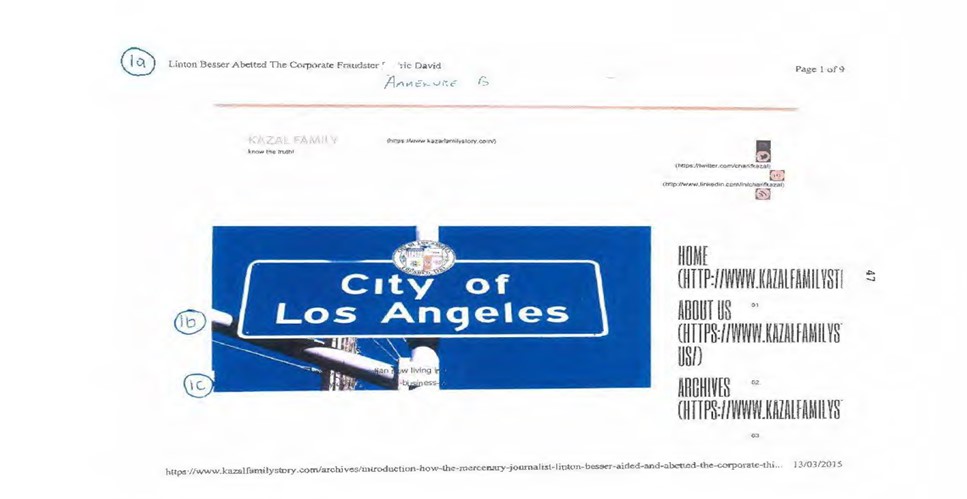
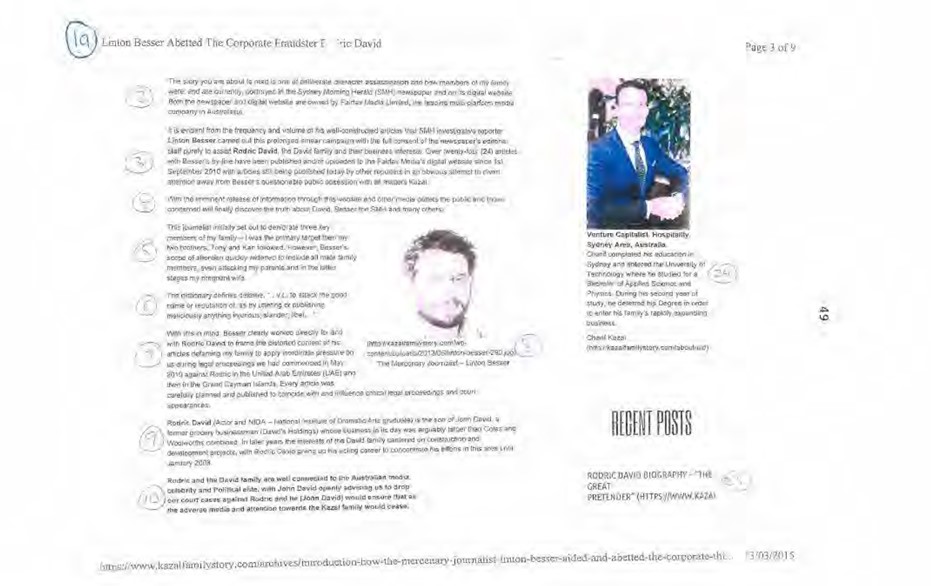
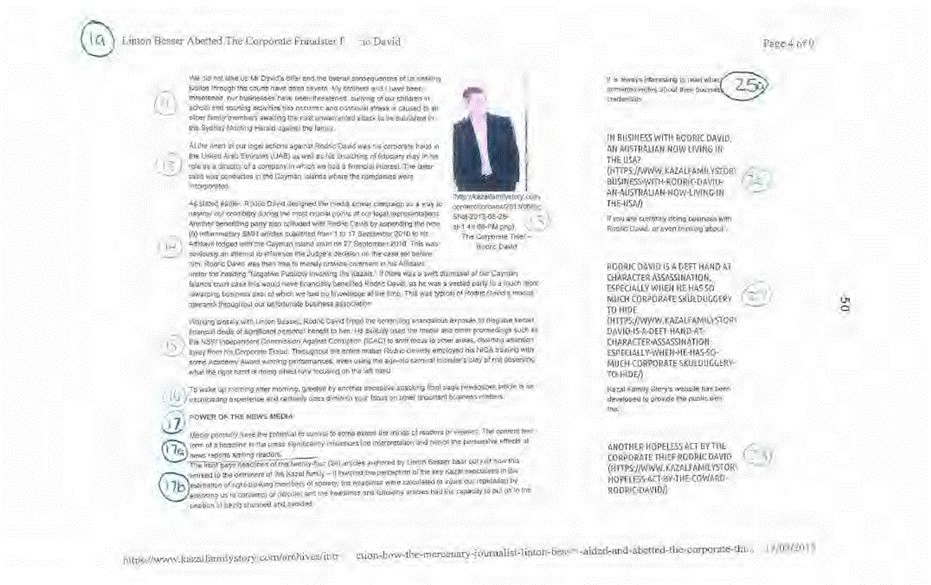
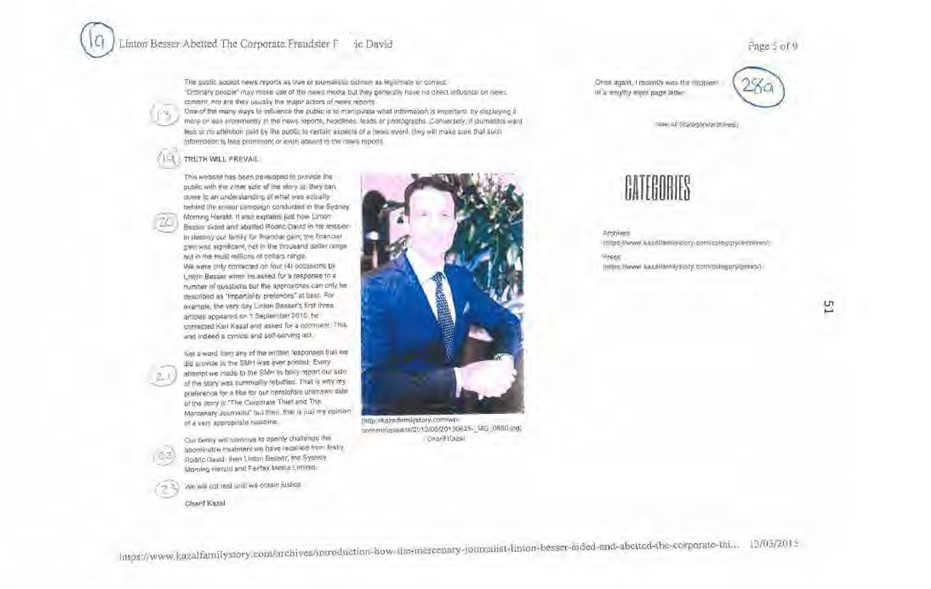
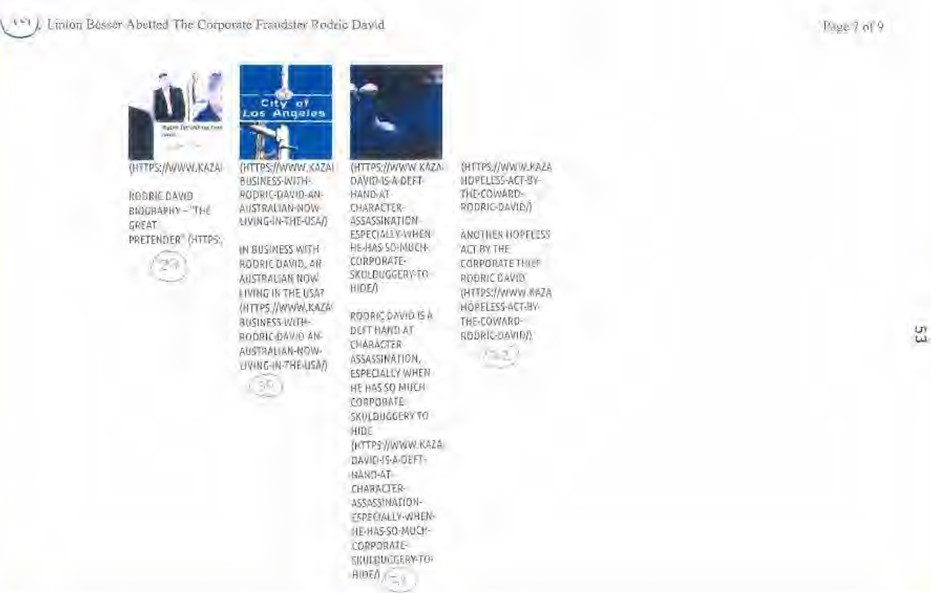
ANNEXURE B
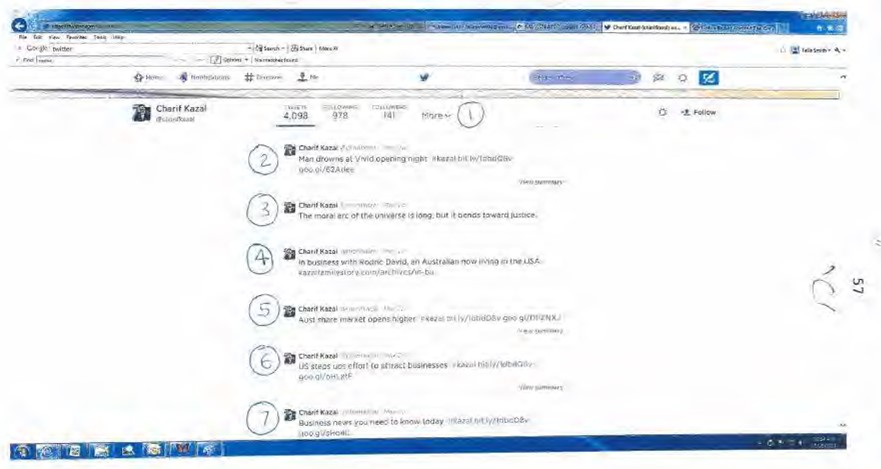
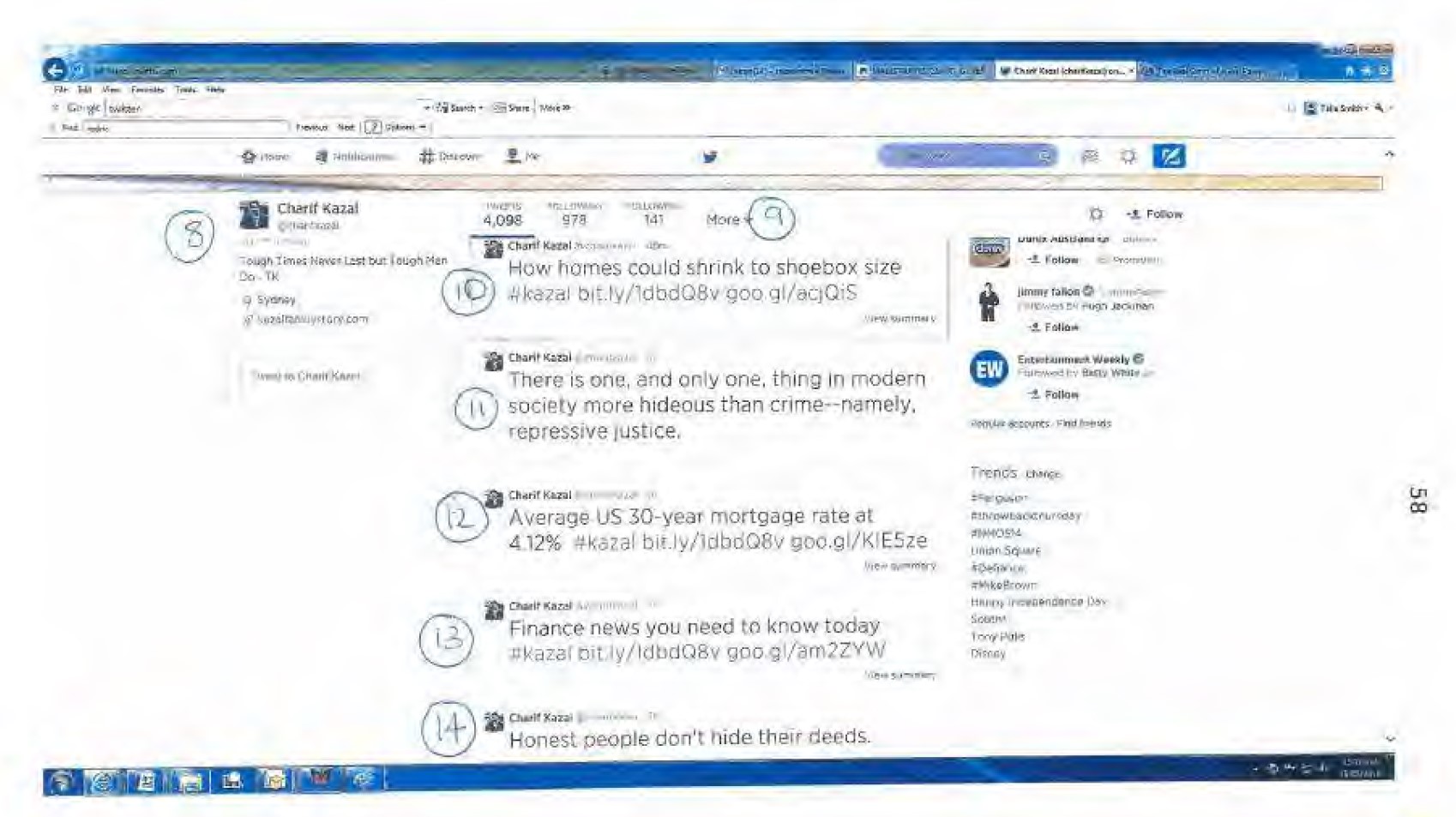
ANNEXURE C